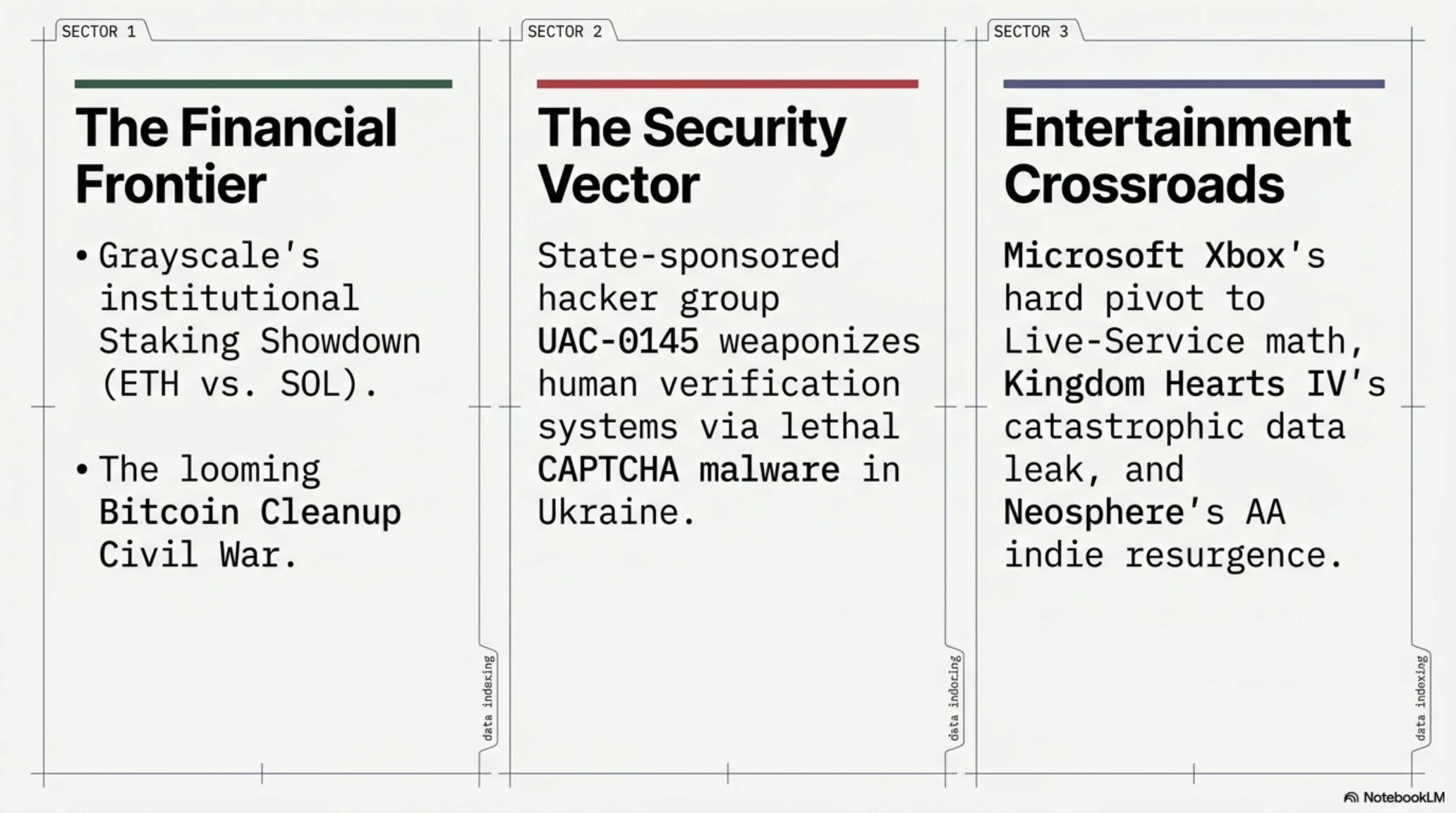
Tonight's Tekin Night dissects the blurring lines between traditional finance, cybersecurity, and gaming. From Grayscale's Ethereum staking battle to deceptive CAPTCHA malware and the massive Kingdom Hearts IV cinematic leak.
Tekin Night July 20, 2026: Institutional Staking Wars and Bitcoin's Censorship Crisis
Tonight on Tekin Night, we dive deep into the high-stakes battles defining the future of cryptocurrency, from Wall Street's aggressive push into network validation to the philosophical war tearing the Bitcoin community apart.
- 🎮Staking Showdown- Grayscale's massive bet on Ethereum and Solana staking
- 🎧Saylor's Warning- Michael Saylor fiercely opposes the Bitcoin blockchain cleanup plan
- 🚀ClickFix Malware- UAC-0145 deploys deceptive CAPTCHAs in Ukraine
- 🗡️Xbox's Pivot- Microsoft shifts focus away from single-player experiences
- 📰Kingdom Hearts Leak- Cinematic prologue for KH4 leaks online
- 🎮Neosphere Returns- Legacy announced exclusively for Switch and PC
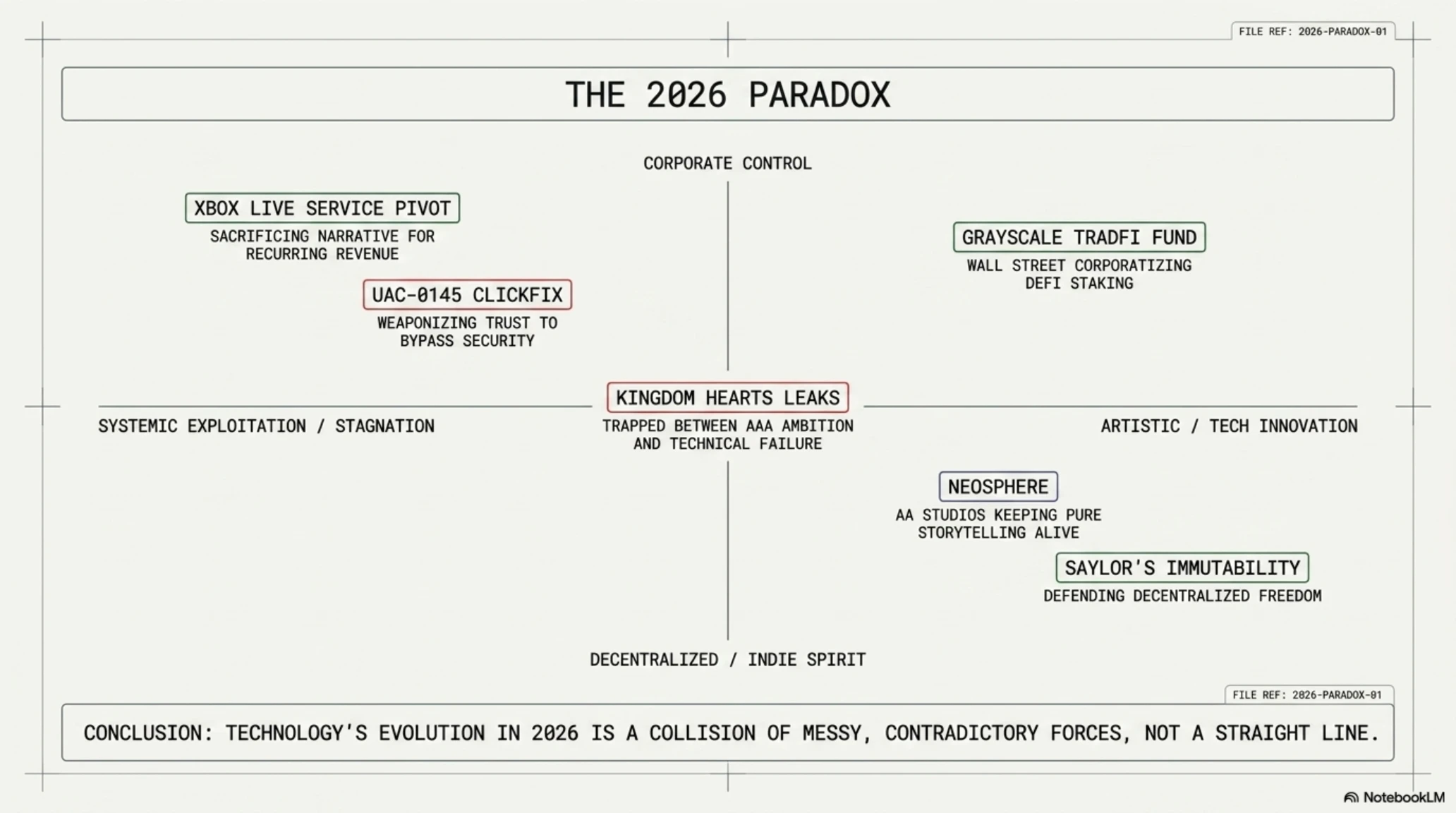
Good evening, readers. In tonight's edition of Tekin Night, we are tracking a series of seismic shifts across the technological landscape. The boundaries separating traditional finance, global cybersecurity warfare, and the multibillion-dollar interactive entertainment industry are not just blurring; they are completely disintegrating. On Wall Street, institutional giants are no longer satisfied with merely holding digital assets; they are actively seeking to control the foundational consensus mechanisms of major blockchains. Meanwhile, the gaming industry is undergoing one of the most agonizing identity crises of the decade, as exorbitant development costs force legendary studios to abandon their artistic roots in favor of sustainable, recurring revenue models. Let’s dive straight into the heart of these transformative events.
Key Takeaways
- Grayscale officially enters the staking arena, pitting Ethereum and Solana against each other for institutional dominance.
- Bitcoin's censorship resistance faces its greatest threat as core developers debate filtering non-financial data.
- The concept of 'neutrality' in decentralized networks becomes a multibillion-dollar battleground.
1. The Bloodshed in the Staking Arena: Ethereum and Solana in Grayscale's Sights
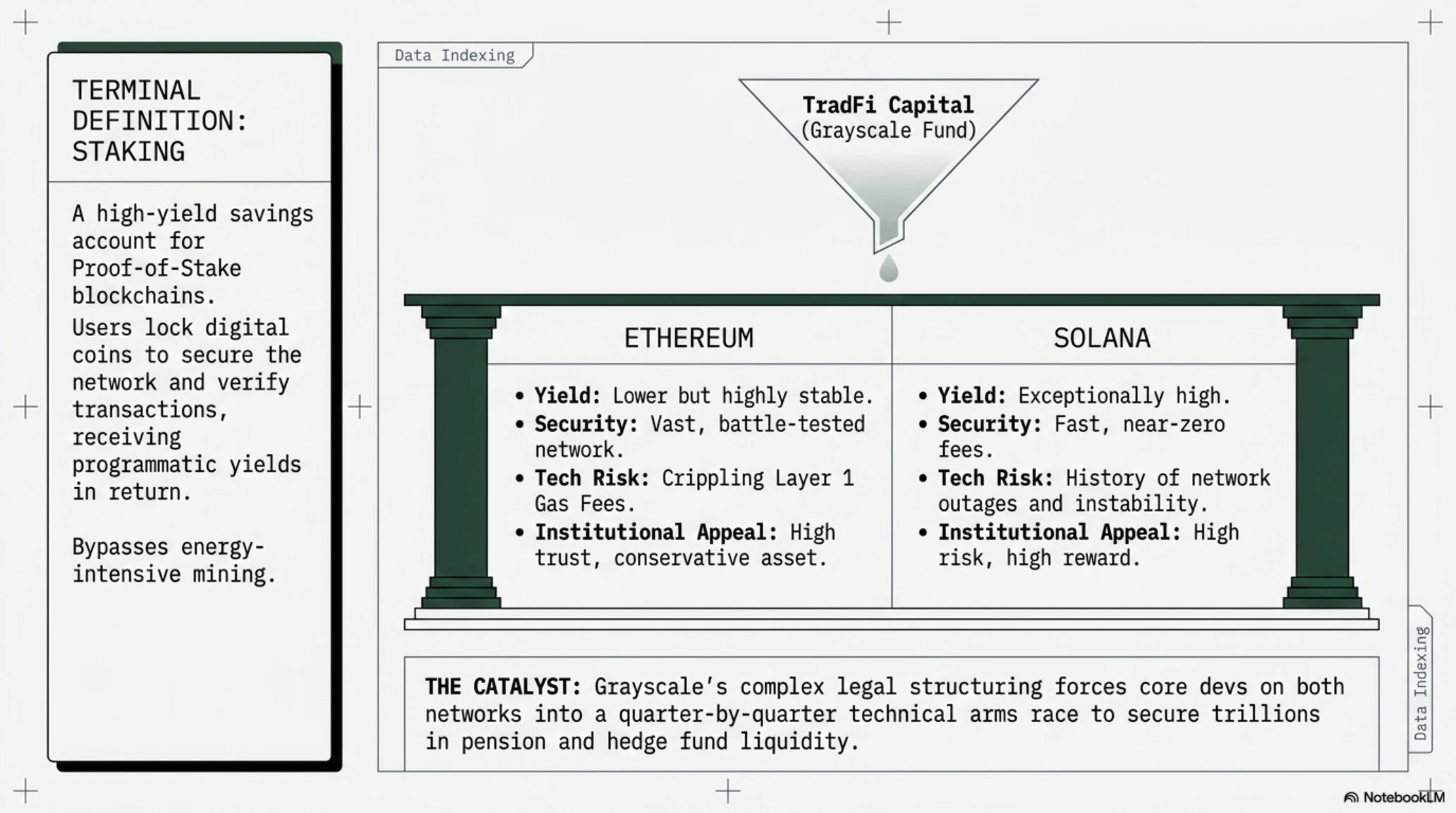
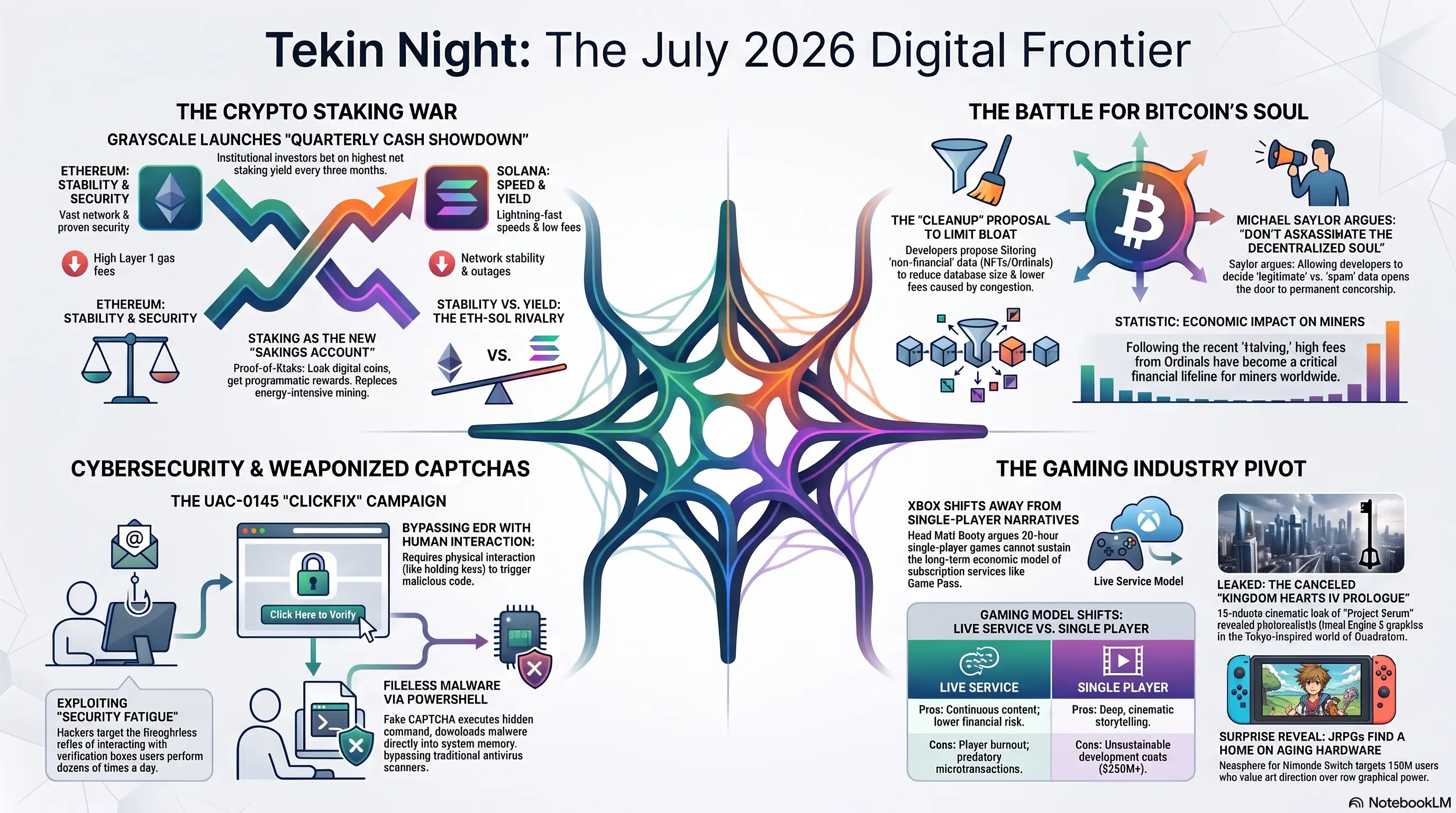
For years, the cryptocurrency industry has been locked in passionate, often tribal debates over which smart contract platform possesses the superior architecture. However, this technical rivalry has now migrated from developer forums and Discord channels straight into the glass-walled boardrooms of Wall Street. Grayscale Investments, the digital asset management behemoth that fundamentally reshaped traditional finance with its spot Bitcoin and Ethereum ETFs, has just unleashed its most aggressive product yet: a quarterly cash showdown fund dedicated entirely to staking yields, focusing primarily on Ethereum (ETH) and Solana (SOL).
The implications of this move cannot be overstated. For the first time, massive institutional investors—pension funds, endowments, and sovereign wealth portfolios—who traditionally recoil at the technical complexities and security risks of self-custody and validator node management, can now seamlessly participate in the consensus mechanisms of the world’s largest decentralized networks. These institutions are no longer content with simple capital appreciation; they are ruthlessly pursuing the holy grail of traditional finance: the "dividend." In the crypto world, this dividend is realized through staking rewards, paid out programmatically by the blockchain protocol to those who secure the network.
Ethereum, the undisputed king of decentralized finance (DeFi) and enterprise adoption, commands the lion's share of this new institutional interest. With its highly secure Proof-of-Stake (PoS) architecture, deflationary mechanics post-Merge, and a sprawling ecosystem of Layer-2 scaling solutions, Ethereum represents the safe, conservative bet for institutional capital. However, Solana has entered the arena as a ferocious, high-octane challenger. Boasting lightning-fast transaction speeds, near-zero fees, and a monolithic architecture that simplifies composability, Solana offers a fundamentally different value proposition. The "showdown" Grayscale has initiated is essentially a high-stakes, quarterly performance review: which network can consistently deliver higher staking yields with lower operational risk?
Jargon Buster: Institutional Staking
Institutional Staking: The process by which large financial entities lock up massive amounts of client capital in Proof-of-Stake (PoS) networks. This allows them to earn programmatic yields from network transaction fees and inflation without the technical burden of running independent validator nodes, effectively transforming crypto into a yield-bearing corporate bond.
Market analysts predict that Grayscale’s strategic pivot will ignite a "Cold War" among Layer-1 blockchains. The network that successfully captures and retains institutional staking capital will secure an insurmountable liquidity moat for the next decade. Yet, this influx of Wall Street money carries profound existential risks. As institutions like Grayscale, BlackRock, and Fidelity amass control over substantial percentages of staked assets, the specter of centralization looms large. If a handful of heavily regulated American corporations control the majority of validator nodes on Ethereum or Solana, can these networks truly claim to be decentralized and censorship-resistant? The crypto community is fiercely divided on whether this institutional embrace is a blessing of mainstream adoption or a Trojan horse designed to domesticate the cypherpunk movement.
From a purely technical standpoint, Ethereum’s staking yields tend to be more stable and predictable, making them highly attractive for conservative institutional models. Conversely, Solana often advertises higher nominal yields, driven by the network’s built-in inflation schedule and aggressive incentive structures, though it carries a historical stigma of network outages and instability. Grayscale’s new fund will serve as the ultimate stress test, pitting Ethereum's robustness against Solana's sheer speed in an unforgiving, quarter-by-quarter battle for capital dominance.
2. Michael Saylor's Dire Warning: Cleaning Up the Blockchain Will Kill Bitcoin's Soul
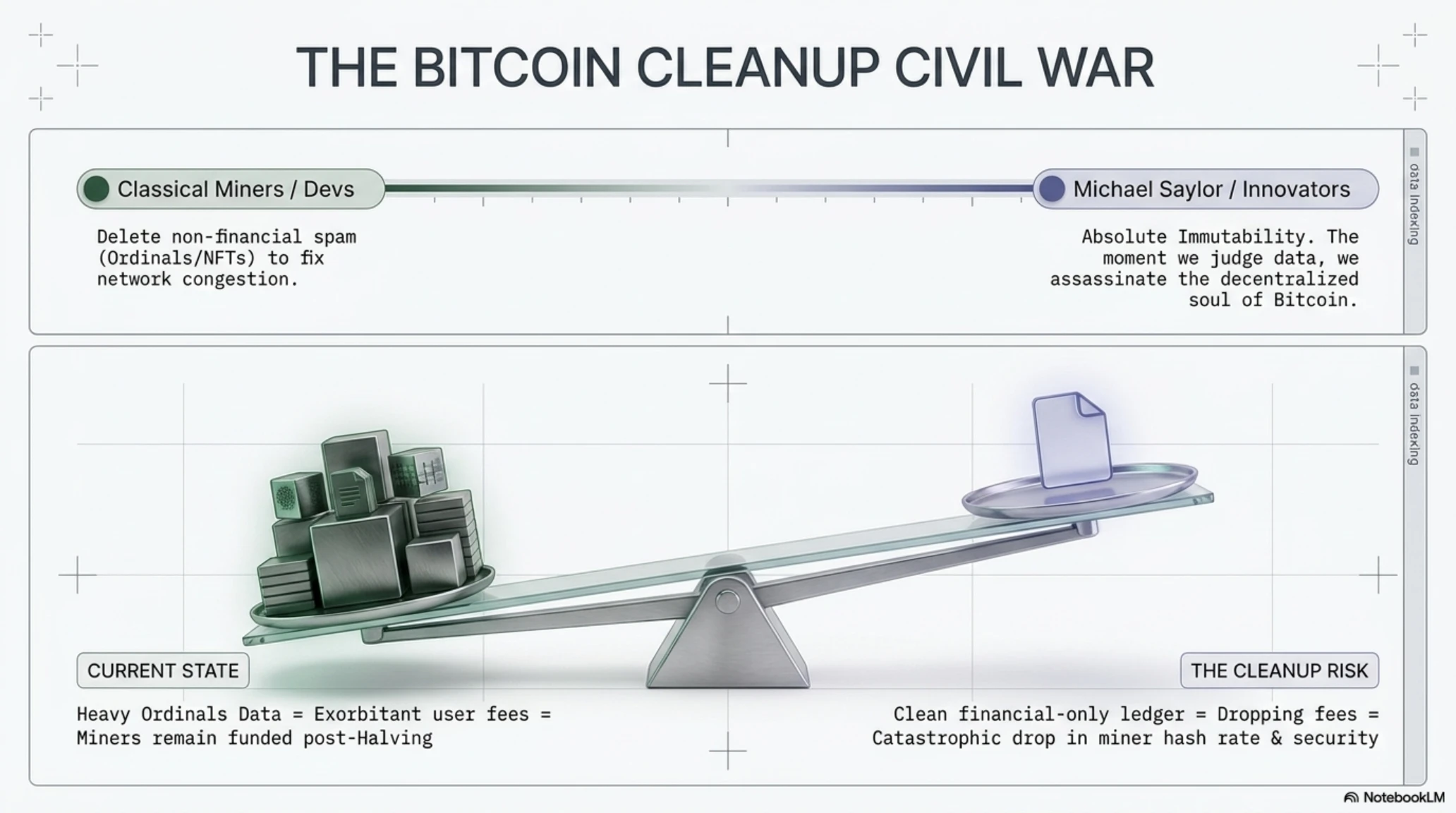
While Ethereum and Solana are engaged in an arms race to attract institutional staking capital, the undisputed king of cryptocurrency, Bitcoin, is grappling with a profound philosophical and identity crisis. Over the past year, a faction of prominent Bitcoin Core developers has introduced proposals aimed at "cleaning up" the Bitcoin blockchain. These technical updates specifically target the proliferation of non-financial data on the network—most notably the Ordinals protocol, Inscriptions, and BRC-20 tokens, which allow users to embed arbitrary data like images, audio, and complex code directly onto individual Satoshis (the smallest unit of Bitcoin).
The argument from the "cleanup" camp is rooted in network efficiency and purism. They argue that Bitcoin was designed exclusively as a peer-to-peer electronic cash system and a decentralized store of value. The explosion of Ordinals has flooded the network with what they classify as "spam," drastically inflating the size of the blockchain, slowing down node synchronization times, and pushing transaction fees to astronomical highs, rendering the network unusable for everyday financial transfers. Their proposed solution involves implementing filtering mechanisms at the node level to reject transactions containing non-standard, non-financial data payloads.
However, Michael Saylor, the visionary founder of MicroStrategy and arguably the most influential institutional advocate for Bitcoin in the world, has vehemently condemned these proposals. In a fiery, widely circulated interview, Saylor characterized any attempt to filter, censor, or clean up the blockchain as a "catastrophically bad idea" that strikes at the very heart of Bitcoin’s value proposition. Saylor’s argument is deeply anchored in the foundational Cypherpunk ethos that birthed the protocol: absolute, uncompromising Censorship Resistance. He argues that the moment developers or node operators presume the moral authority to dictate what constitutes "legitimate" data versus "spam," Bitcoin ceases to be a decentralized protocol and becomes just another permissioned corporate database.
Why This Matters for the Future of Decentralized Finance
- Implementing data filtering sets a dangerous precedent that could eventually be used by governments to censor specific financial transactions.
- The elimination of Ordinals could devastate miner revenues in a post-halving environment, severely compromising network security.
- The outcome of this debate will define whether Bitcoin remains an immutable global truth layer or reverts to a narrow, specialized financial tool.
This controversy transcends mere technical disagreements; it is a battle for the very soul of the network. One faction views Bitcoin purely as money and demands optimal efficiency for that single use case. The opposing faction, now amplified by Saylor's immense platform, views Bitcoin as an immutable, globally distributed "truth layer." According to this perspective, if a user is willing to pay the required market fee to permanently etch a JPEG, a manifesto, or a piece of software onto the blockchain, the network is obligated to process and preserve that transaction without judgment. This absolute, algorithmic neutrality is what differentiates Bitcoin from legacy financial rails like Visa, SWIFT, or the Federal Reserve.
Ironically, the very phenomenon the purists seek to eliminate—high transaction fees driven by Ordinals—has provided a critical economic lifeline for Bitcoin miners. Following the recent halving event, which slashed the block subsidy in half, the surge in transaction fees from Inscriptions has kept mining operations highly profitable, thereby ensuring the continued security and hashing power of the network. Saylor firmly believes that the solution to scalability and high fees does not lie in censoring the base layer (Layer-1), but rather in accelerating the development and adoption of Layer-2 solutions, such as the Lightning Network, for everyday transactions. Attempting to "clean up" the blockchain might offer temporary relief from network congestion, but in the long run, it risks amputating the very feature—immutability—that gives Bitcoin its trillion-dollar valuation.
3. The Evolution of Deception: UAC-0145's ClickFix CAPTCHA Campaign Decimates Ukrainian Networks
In the murky, high-stakes realm of state-sponsored cybersecurity warfare, the most devastating weapons are rarely those that forcefully shatter cryptographic barriers; they are the insidious tools that quietly bypass security perimeters by manipulating human psychology. Recent threat intelligence reports emerging from the digital frontlines of Eastern Europe, corroborated by extensive analysis from The Hacker News, have exposed a highly sophisticated and deeply unsettling campaign orchestrated by the notorious threat actor group known as UAC-0145. This collective, possessing a long and documented history of politically motivated cyber-espionage and sabotage, has pioneered a terrifying new vector for bypassing modern security alerts: the weaponization of human verification systems, specifically CAPTCHAs, through a technique dubbed "ClickFix."
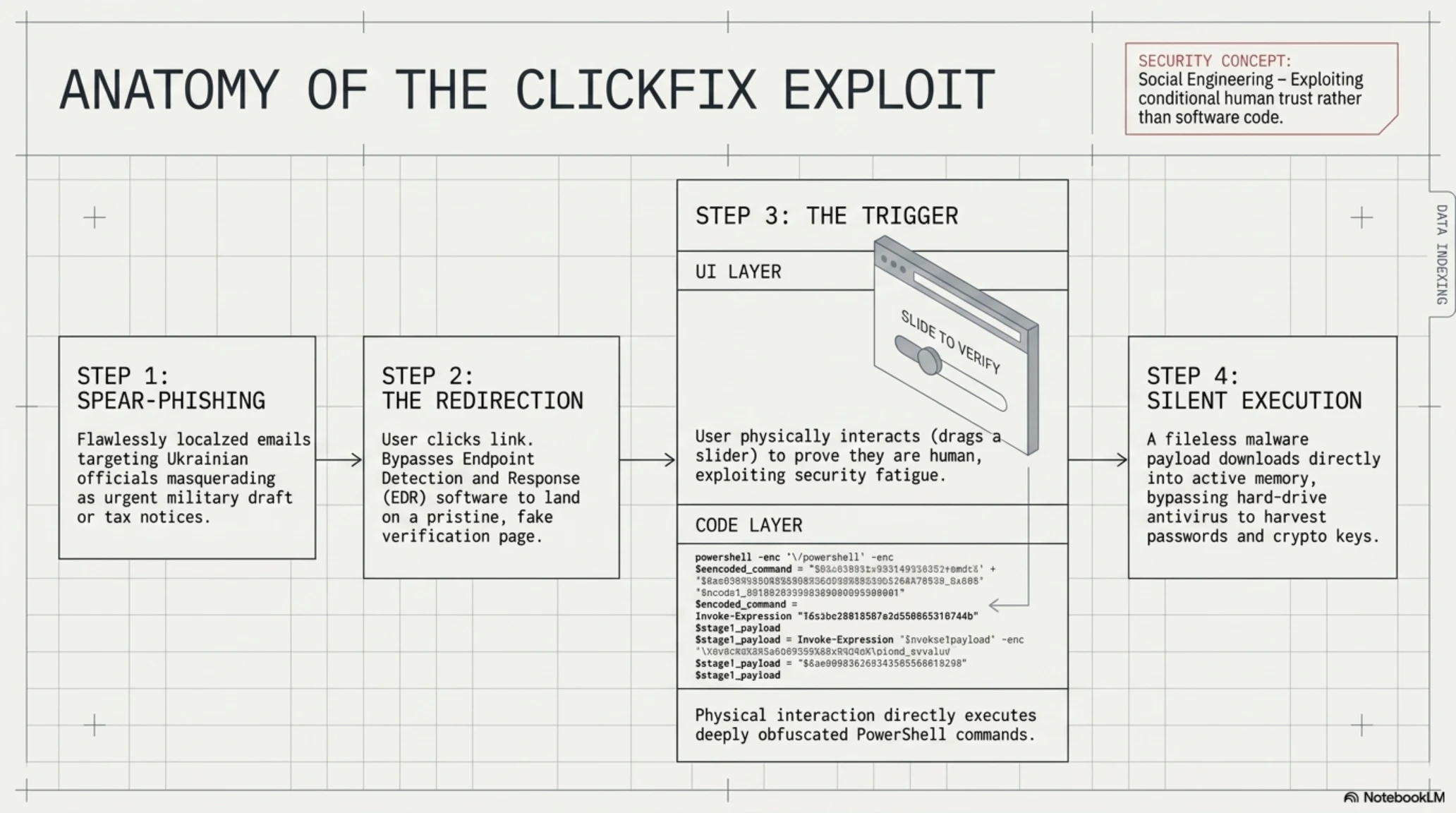
The mechanics of the ClickFix attack are diabolically simple yet devastatingly effective. The initial compromise occurs via highly targeted, spear-phishing emails—often meticulously crafted to resemble urgent government advisories, critical military updates, or routine IT department alerts. When an unsuspecting user clicks the embedded link, they are not immediately prompted to download a suspicious executable file, a red flag that modern endpoint detection and response (EDR) solutions would instantly block. Instead, the victim is seamlessly redirected to a clean, professionally designed webpage that perfectly mimics industry-standard verification gateways like Cloudflare Turnstile, Google reCAPTCHA, or hCaptcha.
Here lies the psychological trap: rather than asking the user to identify traffic lights or crosswalks, the fake CAPTCHA interface prompts the user to perform a specific physical action to "prove they are human." They might be asked to click and hold a button for three seconds, or execute a specific keyboard shortcut combination (such as Windows Key + R, followed by Ctrl + V and Enter). This seemingly innocuous, mundane physical interaction is, in reality, the execution trigger. The moment the user complies, a hidden, heavily obfuscated PowerShell script executes in the background. Because the user physically initiated the action, the operating system registers the command as an authorized, intentional user input, completely bypassing User Account Control (UAC) prompts and antivirus heuristics.
The secondary payload downloaded post-execution is a masterclass in modern malware engineering. It utilizes a "fileless" infection architecture, meaning the malicious code is loaded directly into the computer's volatile memory (RAM) rather than writing executable files to the hard drive. This renders traditional, signature-based antivirus scanning essentially useless. Once entrenched in the system memory, the malware establishes a persistent backdoor, granting the UAC-0145 operators unfettered access. The primary objectives appear to be aggressive data exfiltration, targeting classified government communications, sensitive corporate intellectual property, stored browser credentials, and even cryptographic keys used for secure internal network access.
The terrifying success rate of the ClickFix campaign hinges entirely on exploiting "security fatigue" and conditional trust. We interact with CAPTCHAs dozens of times a day; clicking them has become an automated, thoughtless reflex. UAC-0145 has identified this cognitive blind spot and ruthlessly weaponized it. Cybersecurity experts and government intelligence agencies are now rushing to issue widespread alerts, emphasizing that standard CAPTCHAs will never require users to interact with the underlying operating system terminal. To protect your networks, experts recommend the following immediate actions:
- Strict Clipboard Policies: Never copy and paste text provided by a third-party verification site directly into the Windows Run dialog or PowerShell terminal.
- Advanced Heuristic Monitoring: Deploy EDR solutions capable of detecting abnormal PowerShell execution originating from web browser child processes.
- Continuous User Education: Regularly train employees to recognize the visual inconsistencies between legitimate Cloudflare Turnstile prompts and malicious ClickFix overlays.
This campaign is a stark, chilling reminder that in the complex chain of cybersecurity defense, human psychology remains the most vulnerable, unpatchable exploit.
4. The Xbox Identity Crisis: Microsoft Demands Gamers Stop Fixating on Single-Player Narratives
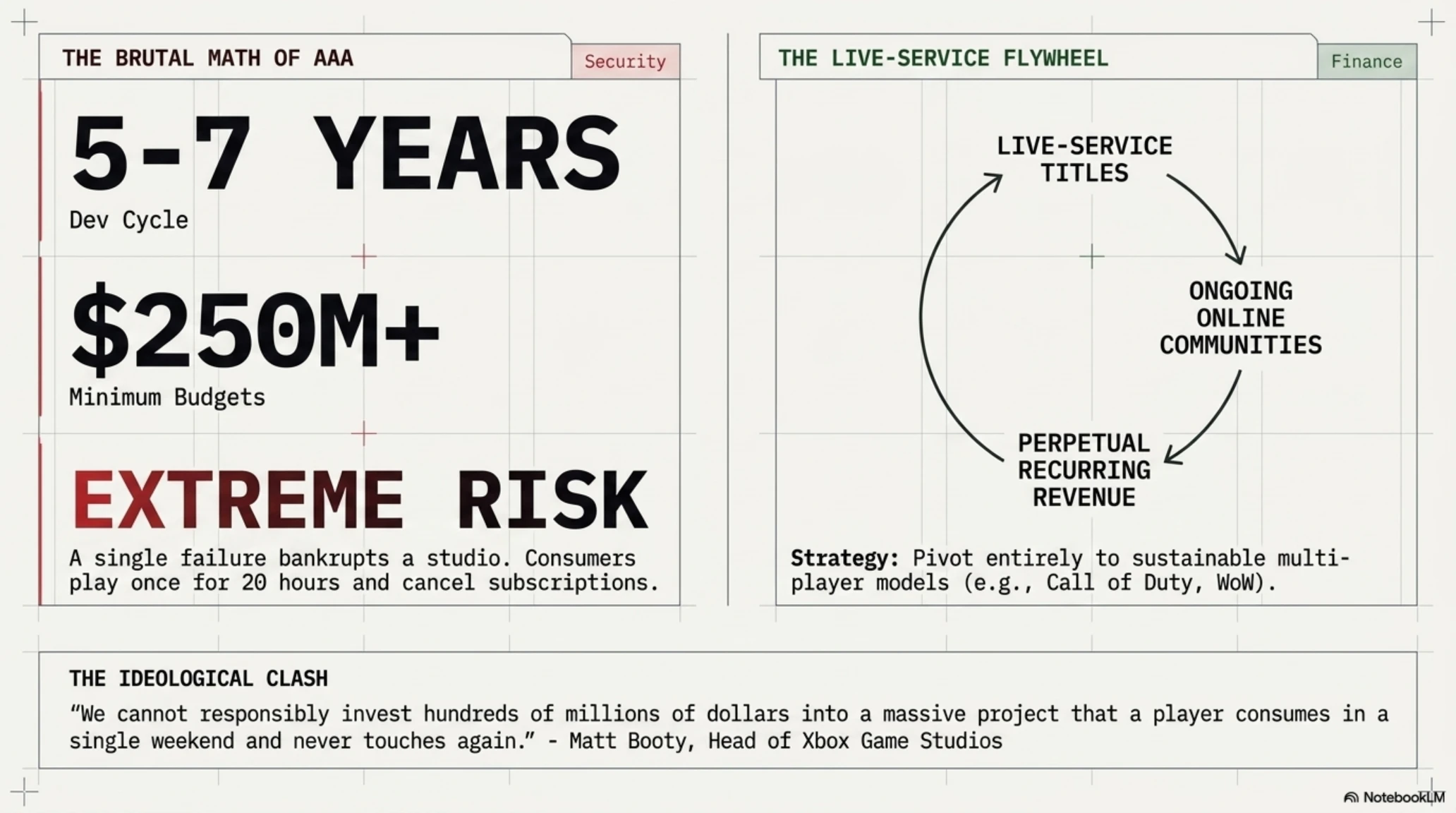
While the cybersecurity landscape battles sophisticated deception, the video game industry is tearing itself apart trying to reconcile the artistic demands of its audience with the brutal, unforgiving realities of modern economic constraints. The industry is currently undergoing a painful transition from the traditional retail model (selling discrete, boxed products) to a continuous, subscription-based service ecosystem. No corporate entity has pushed for this paradigm shift more aggressively, or invested more capital into it, than Microsoft. In a recent, highly controversial interview with IGN that ignited a firestorm across social media platforms, Matt Booty, the Head of Xbox Game Studios, made statements that fundamentally challenged the desires of traditional gamers, urging them to pivot their expectations away from "single-player, narrative-driven" experiences and toward expansive, live-service multiplayer ecosystems.
Booty’s comments struck a raw nerve, particularly given the historical context of the console wars. Sony’s PlayStation brand has built an empire, and garnered unparalleled critical acclaim, almost exclusively on the back of lavishly funded, single-player cinematic masterpieces like God of War, The Last of Us, and Spider-Man. Xbox fans perceived Booty's remarks as a preemptive surrender in the prestige gaming space. However, when analyzed through the cold, unforgiving lens of corporate finance, the Xbox leadership's argument is frustratingly logical. The cost to develop a top-tier, "AAA" single-player game in the current hardware generation easily exceeds $250 million, requiring a grueling five-to-seven-year development cycle involving hundreds of developers. If such a monumental project fails to achieve critical and commercial success upon launch, the resulting financial crater can instantly bankrupt a massive studio and trigger industry-wide layoffs.
Rumor vs. Reality: Is Xbox Abandoning Story-Driven Games?
The Rumor: Internal directives from Microsoft leadership have ordered all first-party studios to cease development on traditional single-player games due to unsustainable production costs.
The Reality: This claim is demonstrably false. Highly anticipated, purely narrative-driven projects such as Playground Games' Fable, inXile's Clockwork Revolution, and id Software's Doom: The Dark Ages remain in active development and are heavily promoted. The shift in Xbox's strategy does not equate to the total cancellation of these prestige projects. Rather, it represents a crucial rebalancing of portfolio risk. Microsoft is mandating that for every risky, high-budget single-player masterpiece in development, the portfolio must be offset by multiple high-margin, live-service titles (like Sea of Thieves or the newly acquired Call of Duty franchise) that generate predictable, recurring revenue streams.
The economic architecture of the Xbox Game Pass subscription service fundamentally demands continuous, engaging content to incentivize users to maintain their monthly payments. A brilliant, emotionally devastating 20-hour single-player campaign, regardless of how many Game of the Year awards it wins, is ultimately a finite experience. Players beat the game, cancel their subscription, and move on. In stark contrast, live-service titles like Fortnite, Destiny 2, or Fallout 76 employ meticulously designed psychological loops and continuous content updates that retain players for hundreds of hours, generating a river of continuous revenue through Battle Passes and microtransactions. Microsoft's historic $69 billion acquisition of Activision Blizzard was not an accident; it was a calculated maneuver to dominate the live-service market and secure these exact revenue streams.
Comparison: Single-Player vs. Live Service Architectures
| Feature / Characteristic | Single-Player (Narrative-Driven) | Live Service (Games as a Service) |
|---|---|---|
| Experience Longevity | Permanent; playable as long as the hardware functions ✅ | Ephemeral; ceases to exist the moment servers are shut down ❌ |
| Studio Revenue Potential | Heavily restricted to initial launch sales and occasional DLC ❌ | Theoretically limitless through continuous microtransactions and Battle Passes ✅ |
| Infrastructure Requirements | None; functions perfectly offline without external dependencies ✅ | Absolute; impossible to play without continuous server connectivity ❌ |
| Financial Risk to Publisher | Astronomically high; a single commercial failure can destroy a studio ❌ | Significantly lower; allows for continuous iteration and monetization over time ✅ |
Despite the sound financial logic driving Microsoft's strategy, the apprehension among hardcore gamers is entirely justified. An extreme, industry-wide pivot toward live-service models threatens to stifle artistic creativity and homogenize game design. The industry recently witnessed the catastrophic fallout when Rocksteady Studios, globally revered for their masterful, single-player Batman: Arkham series, attempted to build a live-service shooter with Suicide Squad: Kill the Justice League. The result was a critical and commercial disaster that severely damaged a decade of accumulated goodwill. The paramount challenge facing Xbox over the next five years will not be technological; it will be finding a delicate, almost impossible balance between satisfying the insatiable revenue demands of Microsoft shareholders and preserving the soul of interactive art for the players.
5. The Quadratum Breach: Canceled Kingdom Hearts IV Prologue Leaks Expose Square Enix's Darkest Secrets
In the highly secretive, closely guarded ecosystem of Japanese video game development, nothing generates simultaneous waves of ecstatic hype and corporate panic quite like a massive data breach. Square Enix, a publishing giant currently navigating a brutal, company-wide financial restructuring aimed at consolidating its development efforts, has just become the victim of one of the most significant intelligence leaks of 2026. Overnight, vast quantities of fully rendered cinematic footage, highly detailed concept art, and deep narrative documents pertaining to a completely canceled prologue project for the fiercely anticipated Kingdom Hearts IV began circulating on anonymous Japanese imageboards before exploding across global platforms like Reddit and X (formerly Twitter). This catastrophic leak has forcefully pulled back the curtain on the narrative direction that legendary director Tetsuya Nomura had spent years meticulously trying to conceal from the public eye.
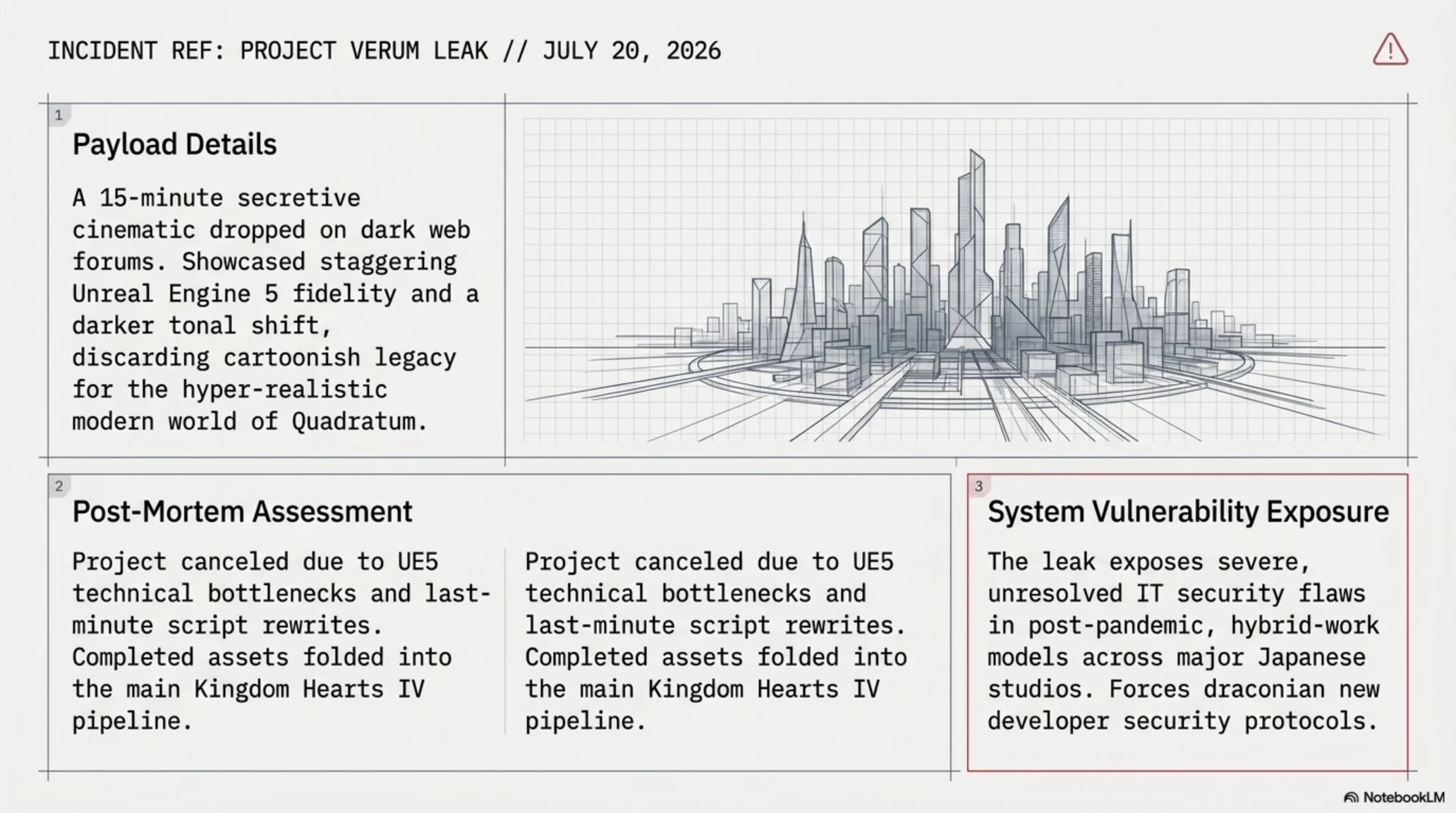
According to metadata analysis of the leaked files and corroborating reports from industry insiders, this aborted project—internally referred to by the enigmatic codename 'Missing Link'—was originally greenlit as an expansive, standalone cinematic prologue. Its primary narrative objective was to bridge the notoriously complex, convoluted lore gaps between the conclusion of the Kingdom Hearts III 'Re Mind' expansion and the beginning of the fourth mainline installment. The leaked video files, which appear to be running natively on a highly customized build of Epic Games' Unreal Engine 5, display a staggering leap in visual fidelity. The footage showcases "Quadratum," a sprawling, hyper-realistic metropolis heavily inspired by modern-day Shibuya, Tokyo. The art direction marks a shocking departure from the vibrant, stylized Disney aesthetics that defined the franchise's past two decades. Instead, the environments are oppressive, drenched in volumetric rain, and illuminated by striking, ray-traced neon signs, establishing an atmosphere that is undeniably dark, mature, and deeply melancholic.
Timeline: The Kingdom Hearts 4 Leak
1. The Initial Reveal (April 2022)
Tetsuya Nomura shocks the gaming world with a moody, realistic trailer announcing Kingdom Hearts IV and the introduction of the mysterious world of Quadratum.
2. Secret Development (2023-2025)
Square Enix greenlights a secretive, smaller-scale project codenamed 'Missing Link', intended to serve as a cinematic bridge to KH4. It is later quietly cancelled.
3. The Catastrophic Leak (July 2026)
Massive caches of fully rendered cinematic files from the cancelled prologue are extracted from a compromised contractor server and distributed across Reddit.
The immediate and pressing question gripping the gaming community is: why would Square Enix unceremoniously cancel a project possessing such an extraordinary level of visual polish and narrative significance? The answer lies buried in the publisher's recent, highly publicized financial disclosures. Over the past twelve months, Square Enix executed a brutal, ruthless $140 million corporate restructuring. The new executive leadership made the controversial decision to systematically cull dozens of mid-tier and experimental projects, electing instead to hyper-focus the company's finite financial and human resources onto a handful of guaranteed, blockbuster AAA titles—most notably Final Fantasy VII Remake Part 3 and Kingdom Hearts IV itself. This breathtaking cinematic prologue, despite its obvious quality, appears to have been deemed an unnecessary financial risk and a distraction, sacrificed on the altar of corporate austerity and streamlined development pipelines.
Tekin Analysis: The Double-Edged Sword of AAA Consolidation
Square Enix's recent pivot away from mid-tier, experimental projects to focus exclusively on massive AAA blockbusters is a high-stakes gamble. While it theoretically ensures maximum quality for flagship titles by pooling resources and talent, it vastly increases the time between releases, risking audience fatigue. Canceling this visually stunning KH4 prologue proves that no project, regardless of its artistic merit, is immune to the new era of strict financial austerity currently sweeping through Japanese publishers.
The fan reaction to this unprecedented leak has been a volatile cocktail of awe, vindication, and intense frustration. On one hand, witnessing the franchise finally embrace a darker, more mature narrative tone is incredibly validating for a massive, dedicated community that has literally grown into adulthood alongside Sora and Riku. The photorealistic rendering of Quadratum hints at a gameplay experience that could genuinely rival the visual benchmarks set by Western studios. However, the confirmed cancellation of this prologue means that crucial, foundational lore will likely never be experienced interactively by the player base. Instead, these critical narrative beats may be awkwardly crammed into an opening cutscene in the final game, or worse, relegated to obscure ultimania guidebooks. Furthermore, this breach represents a monumental failure on the part of Square Enix's cybersecurity infrastructure, marking the second time in a year that highly sensitive intellectual property has been exfiltrated from poorly secured third-party contractor networks.
Square Enix Financial Context (2026)
- Q2 Net Income Decline: -14%
- Cancelled Project Write-offs: $140M
- Active FF XIV Subscribers: 30M+
If there is one undeniable truth to emerge from the chaos of this leak, it is that the global expectations for Kingdom Hearts IV have now skyrocketed to almost unattainable heights. Director Tetsuya Nomura had previously promised that this fourth mainline entry would serve as a definitive, conclusive end to the convoluted storylines of the past, while simultaneously launching the franchise into a completely new, unpredictable era. Now that these illicitly obtained videos have publicly proven the raw, unbridled power of Square Enix's mastery over Unreal Engine 5, the pressure to deliver an absolutely flawless masterpiece is immense. The industry will be watching closely to see if Square Enix can navigate this storm of their own making and finally deliver on the decade-long promise of Quadratum.
- The leaked footage demonstrates an absolute mastery of Unreal Engine 5, showcasing photorealistic graphics that redefine the series' visual identity.
- The significantly darker, more mature narrative tone perfectly aligns with a dedicated fanbase that has grown up alongside the franchise.
- The brutal realities of AAA development timelines mean players may be waiting several more years for the final product.
- The cancellation of prologue content means critical lore may be permanently lost or heavily condensed, confusing players.
6. A Return to Artistic Roots: Neosphere of The Deep-blue Sky: Legacy Revives the Visual Novel Genre on Switch and PC
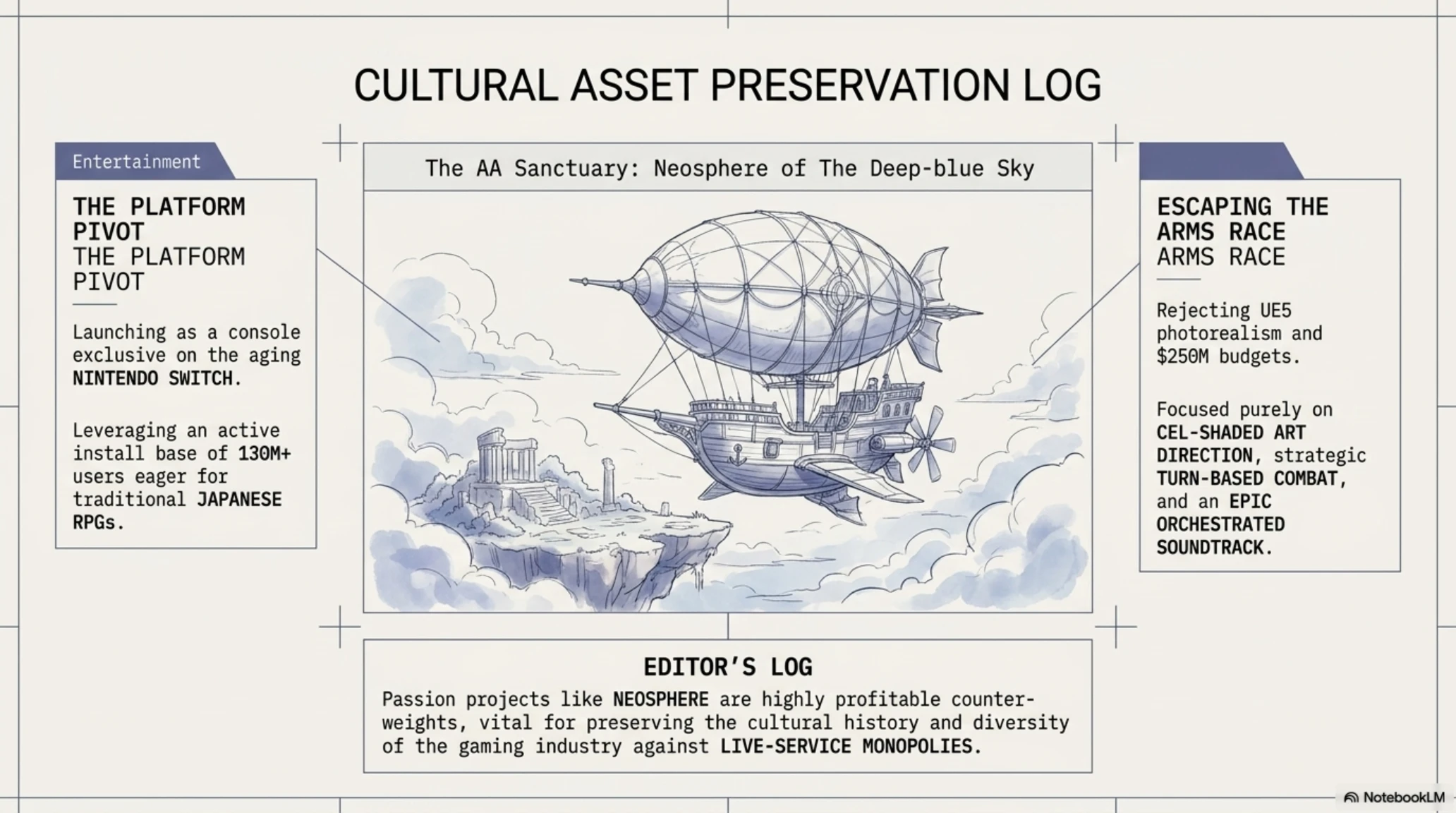
Amidst the deafening roar of Western technology giants fiercely competing to construct the most expensive, photorealistic, and endlessly monetized live-service ecosystems, independent Japanese studios continue to serve as a vital, stabilizing counterweight. They remind us that the authentic soul of interactive entertainment does not inherently reside in hundred-million-dollar budgets or microtransaction loops, but rather in profound, emotionally resonant storytelling and distinctive, uncompromising artistic vision. This morning, in a delightful and largely unexpected announcement, the revered Japanese studio responsible for the critically acclaimed Neosphere series officially unveiled their latest masterpiece: Neosphere of The Deep-blue Sky: Legacy. Confirmed as a console exclusive for the Nintendo Switch, alongside a simultaneous global release on PC, this new entry promises to transport players back into its breathtaking, meticulously crafted steampunk universe, proving that there is still a massive, hungry market for traditional narrative games.
The Neosphere franchise has always defied easy categorization, brilliantly blending the deep, branching narratives of traditional Japanese Visual Novels (VNs) with the complex, addictive mechanics of resource management and city-building simulators. For years, the series maintained a cult following in Japan and among dedicated anime enthusiasts in the West, celebrated for its jaw-dropping, hand-drawn art style, profoundly complex character development, and sweeping, orchestral soundtracks. In this new Legacy iteration, players will once again step into the grease-stained boots of young, idealistic engineers and bold explorers. Their monumental task: utilizing forgotten, ancient steam-powered technologies to rebuild massive, floating cities suspended in the sky, all while unraveling the dark, heavily guarded secrets of lost civilizations. The debut trailer, which immediately trended across gaming forums, showcased a staggering evolution in the series' 2D animation techniques, employing dynamic, multi-layered sprites and vastly improved gameplay mechanics that promise a substantial upgrade over its predecessors.
The strategic decision to launch Neosphere exclusively on the Nintendo Switch for the console market is far from a coincidental alignment of schedules; it is a calculated, highly intelligent business maneuver. Over the past five years, the Switch has quietly but definitively established itself as the undisputed, primary ecosystem for visual novels, independent artistic games, and mid-budget (AA) Japanese titles. While Sony’s PlayStation and Microsoft’s Xbox remain inextricably locked in an unsustainable, cash-burning arms race prioritizing 4K resolutions, ray tracing, and live-service engagement metrics, Nintendo's massive, 130-million-strong global install base has demonstrated an insatiable appetite for story-driven, artisanal experiences. This deliberate platform strategy virtually guarantees a healthy profit margin for the developers, as the development costs associated with optimizing a 2D narrative game for the Switch's aging hardware are exponentially lower than attempting to compete in the bloodbath of the current-generation AAA console space.
Market Sentiment
Current Status of Japanese Mid-Tier (AA) and Visual Novel Markets on Nintendo Switch: Extremely Bullish
While massive Western studios continue to suffer through historic waves of layoffs and studio closures due to the crushing weight of exorbitant AAA development costs and the saturation of the live-service market, mid-sized Japanese developers are experiencing a renaissance. By exercising strict, intelligent budget control and fiercely catering to highly dedicated, passionate niche communities on the Nintendo Switch, these studios are consistently posting record profits. Institutional investors and venture capital firms are increasingly viewing this low-risk, high-margin business model with extreme optimism, viewing it as a safe harbor amidst the volatility of the broader gaming industry.
One of the most universally praised aspects of the Neosphere of The Deep-blue Sky: Legacy announcement was the confirmed return of the original creative team. The lead scenario writers, character designers, and composers who birthed the early magic of the franchise have been reunited for this project. This vital continuity assures the dedicated fanbase that the distinct, melancholic yet hopeful atmosphere of the series will be preserved, untainted by modern industry trends toward monetization or forced multiplayer integration. Furthermore, in a significant departure from historical practices where Japanese games would take years to be localized for Western audiences, the publisher confirmed that Legacy will feature a simultaneous global launch with full, multi-language subtitle support, including a comprehensive English localization. This aggressive, global-first approach highlights a monumental shift in the Japanese publishing industry, acknowledging that international sales are no longer a secondary bonus, but a primary pillar of financial success in 2026.
The enduring success and fervent anticipation surrounding games like Neosphere serve as a powerful, necessary reality check for the broader industry. It decisively proves that bleeding-edge graphics engines, bloated development teams, and nine-figure budgets are not the only avenues to commercial and critical triumph. When a video game successfully establishes a profound emotional connection with its audience, meticulously constructing a cohesive, fascinating universe, a fiercely loyal demographic will always emerge to support it. This is a fundamental lesson that monolithic corporations like Microsoft and Square Enix—currently hemorrhaging talent and canceling projects in a desperate bid to balance their ledgers—would do well to remember as they chart their increasingly precarious futures.
Smart History Tags
As we conclude tonight's extensive analysis, it is clear that the technological and entertainment landscapes are being reshaped by powerful, often contradictory forces. From the sterile boardrooms of Wall Street to the passionate development desks in Tokyo, the struggle for control, profitability, and artistic integrity has never been more intense. The events of July 20, 2026, will likely be remembered as a crucial turning point, a day when the industry was forced to confront the ultimate consequences of its own rapid, unrestrained evolution.
Conclusion / Final Thoughts
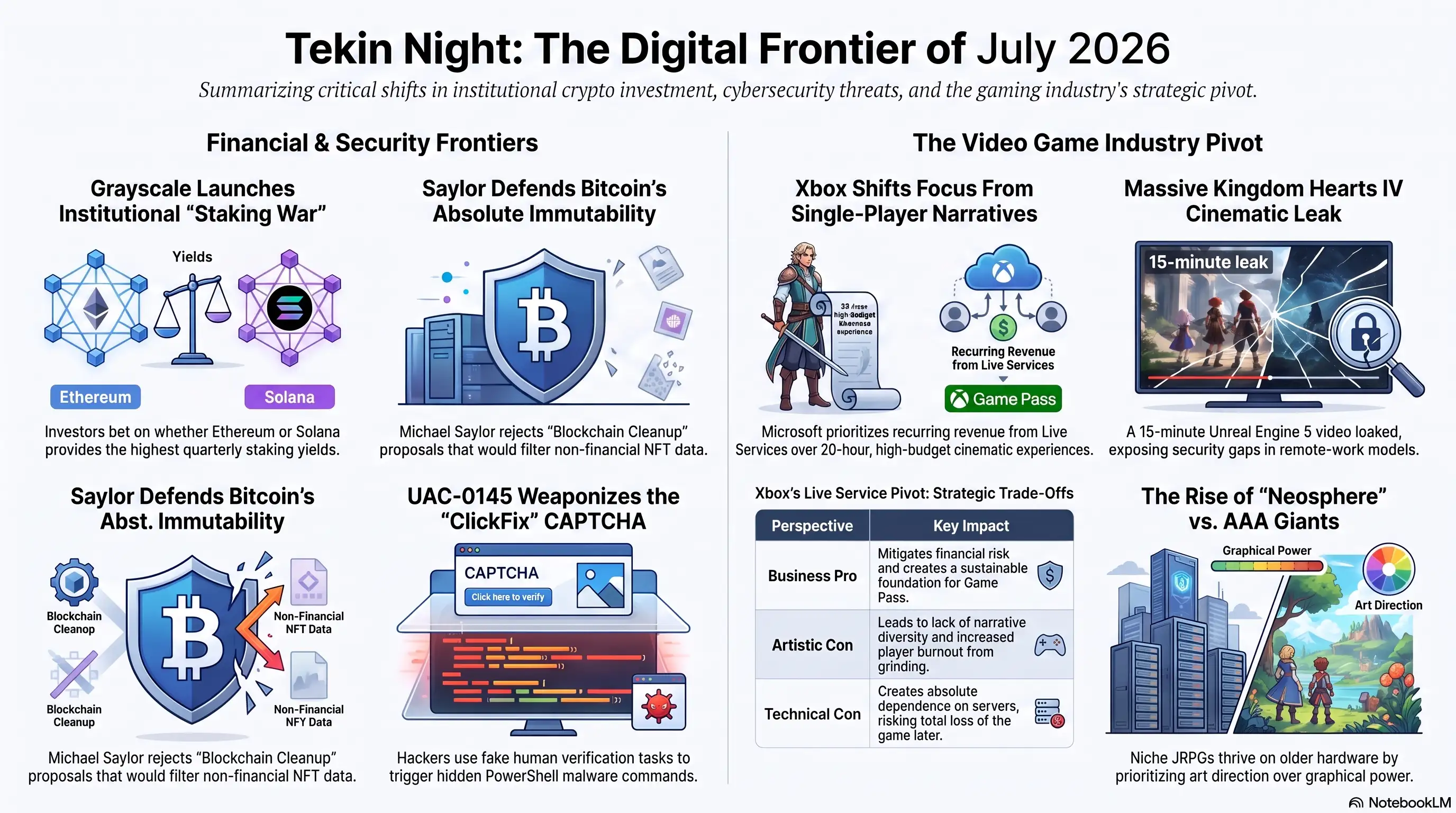
Tonight's news cycle presented a stark, fascinating tapestry of financial warfare, ideological crises, and artistic resilience. Grayscale's aggressive foray into institutional staking unequivocally demonstrated that traditional finance is no longer content with merely holding cryptocurrencies; they demand consistent, programmatic yield, setting the stage for a massive centralization battle on Ethereum and Solana. Concurrently, Michael Saylor's dire warnings regarding the censorship of the Bitcoin blockchain served as a critical reminder that the foundational cypherpunk ethos of absolute neutrality is under severe threat from within its own community.
In the realm of cybersecurity, the horrifying success of UAC-0145's ClickFix CAPTCHA campaign highlighted a terrifying truth: as our cryptographic defenses become impenetrable, hackers will increasingly target the most vulnerable, unpatchable system of all—the human mind. And in the gaming sector, we witnessed a profound dichotomy. Xbox and Square Enix are desperately retreating from high-risk narrative projects in favor of sustainable live-service revenues, terrified by unsustainable development costs. Yet, simultaneously, independent creators like the team behind Neosphere are finding unprecedented, sustainable success by embracing narrative purity on platforms like the Switch. These striking contradictions prove that the intersection of technology and art remains as chaotic, unpredictable, and thrilling as ever.
Frequently Asked Questions (FAQ)
Will Grayscale's new Ethereum and Solana staking fund be available to regular retail investors?
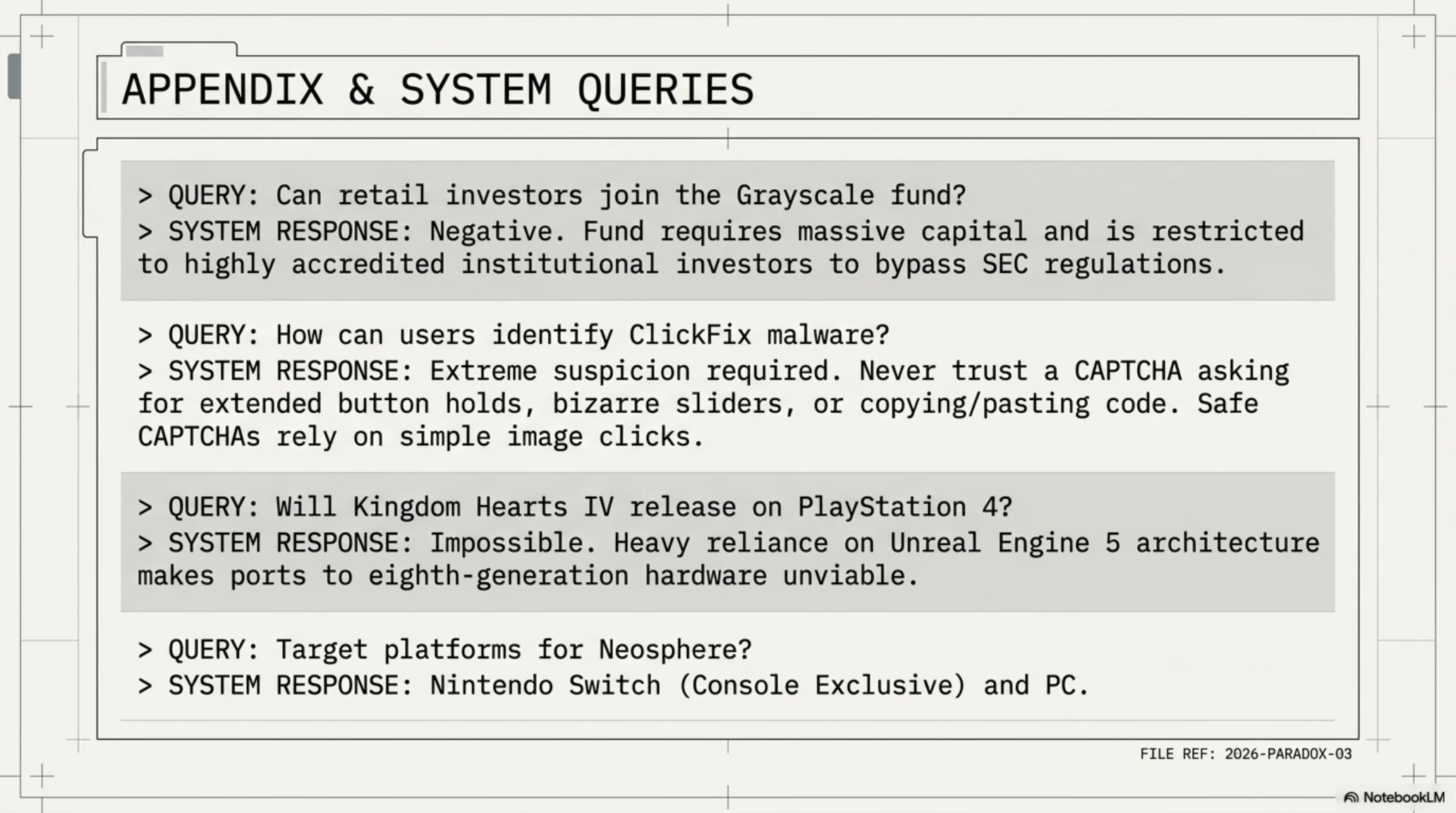
No, not immediately. At launch, this highly specialized investment vehicle is exclusively designed for accredited institutional investors and high-net-worth individuals, primarily to navigate the extremely strict, complex regulatory hurdles currently enforced by the U.S. Securities and Exchange Commission (SEC).
What exactly is an Ordinal, and why do some developers want to ban them from Bitcoin?
An Ordinal is essentially a method of permanently attaching arbitrary data—like images, text, or application code—to a single Satoshi on the Bitcoin blockchain. Purists argue that this non-financial data acts as 'spam,' severely bloating the network size and driving up transaction fees for users who simply want to send money, hence the push for filtering.
How can I protect my organization from the new ClickFix CAPTCHA malware attacks?
The primary defense is strict user education. Employees must be trained to recognize that no legitimate CAPTCHA or verification system will ever require them to hold down keyboard shortcuts, copy and paste text into a terminal, or execute commands in the Windows Run dialog. Implementing aggressive browser-based script blocking and strict endpoint execution policies is also critical.
Is Microsoft completely abandoning all single-player, story-driven games for the Xbox?
No, they are not completely abandoning them; high-profile single-player games like Fable and Doom: The Dark Ages remain in active development. However, the corporate strategy has shifted dramatically to prioritize live-service games. Microsoft's leadership has realized that sustaining the Xbox Game Pass business model requires games that retain players for months or years, generating continuous revenue, rather than experiences that are finished in a single weekend.
Is there any chance the leaked Kingdom Hearts IV prologue project will resume development?
Given Square Enix's recent $140 million write-off and aggressive internal restructuring, it is highly improbable. The company is violently pivoting to focus solely on massive, guaranteed blockbuster releases. The prologue was likely deemed too expensive and too risky to complete as a standalone product, though narrative elements from it will almost certainly be repurposed for the main game.
What platforms will Neosphere of The Deep-blue Sky: Legacy be available on?
The developer has officially confirmed that the game will be released as a console exclusive for the Nintendo Switch, while simultaneously launching on PC (likely via Steam). There are currently no announced plans to port the game to PlayStation or Xbox ecosystems, reflecting the studio's focus on platforms with established visual novel audiences.
Sources and References
- Grayscale's Aggressive Staking Fund Sparks Rivalry Between Ethereum and Solana (CryptoSlate)
- Michael Saylor Vehemently Opposes Bitcoin Blockchain Filtering Proposals (CoinDesk)
- UAC-0145 Hacker Group Deploys Deceptive ClickFix CAPTCHAs in Ukraine (The Hacker News)
- Xbox Executives Advise Gamers to Manage Expectations Regarding Single-Player Titles (IGN)
- Massive Leak Reveals Canceled Cinematic Prologue for Kingdom Hearts IV (Kotaku)
- Narrative Adventure Neosphere Legacy Officially Announced for Switch and PC (Gematsu)
Additional Gallery: Tekin Night: Ethereum Storm, Xbox Crisis & Kingdom Hearts Leaks