The Zero-Latency Era: Complete 802.11bn Autopsy & The Death of Raw Speed Hardware
Welcome to the era of Wi-Fi 8 (802.11bn), where the wireless industry finally stops chasing raw speed in favor of deterministic latency and ultra-high reliability.
- 🎮UHR Over Speed- Wi-Fi 8 abandons throughput increases, capping at Wi-Fi 7's 46 Gbps to focus entirely on stability.
- 🎧Deterministic Latency- Targeting a massive 25% reduction in 95th percentile latency and sub-1ms jitter.
- 🚀Multi-AP Coordination- Nodes now collaborate rather than compete, completely reshaping mesh network architecture.
For two decades, the Wi-Fi industry has been obsessed with a single, highly marketable metric: raw theoretical speed. From the early days of 802.11g to the recent advent of Wi-Fi 7, every new generation promised gigabits upon gigabits of bandwidth. This relentless pursuit fueled a marketing arms race that prioritized printing massive numbers on a cardboard box over delivering real-world stability. But in 2026, the paradigm has violently and irrevocably shifted. The era of the "Speed War" is officially dead, replaced by a much more sophisticated, albeit complex, battleground. Welcome to the era of Wi-Fi 8 (IEEE 802.11bn)—branded officially by the Wi-Fi Alliance as Ultra High Reliability (UHR).
This is the standard that fundamentally stops chasing ghost megabits. Instead, it declares all-out war on the true enemies of modern connectivity: latency spikes, jitter, and dropped packets. In this comprehensive technical autopsy, we dissect exactly why the industry hit a physical wall, how the speed war collapsed under its own weight, and how Wi-Fi 8 is re-engineering the very fabric of wireless communication. We will explore how this new standard aims to save Industrial IoT (Internet of Things), real-time competitive gaming, and AR/VR headsets from the chaotic, interference-riddled reality of crowded radio spectrums.
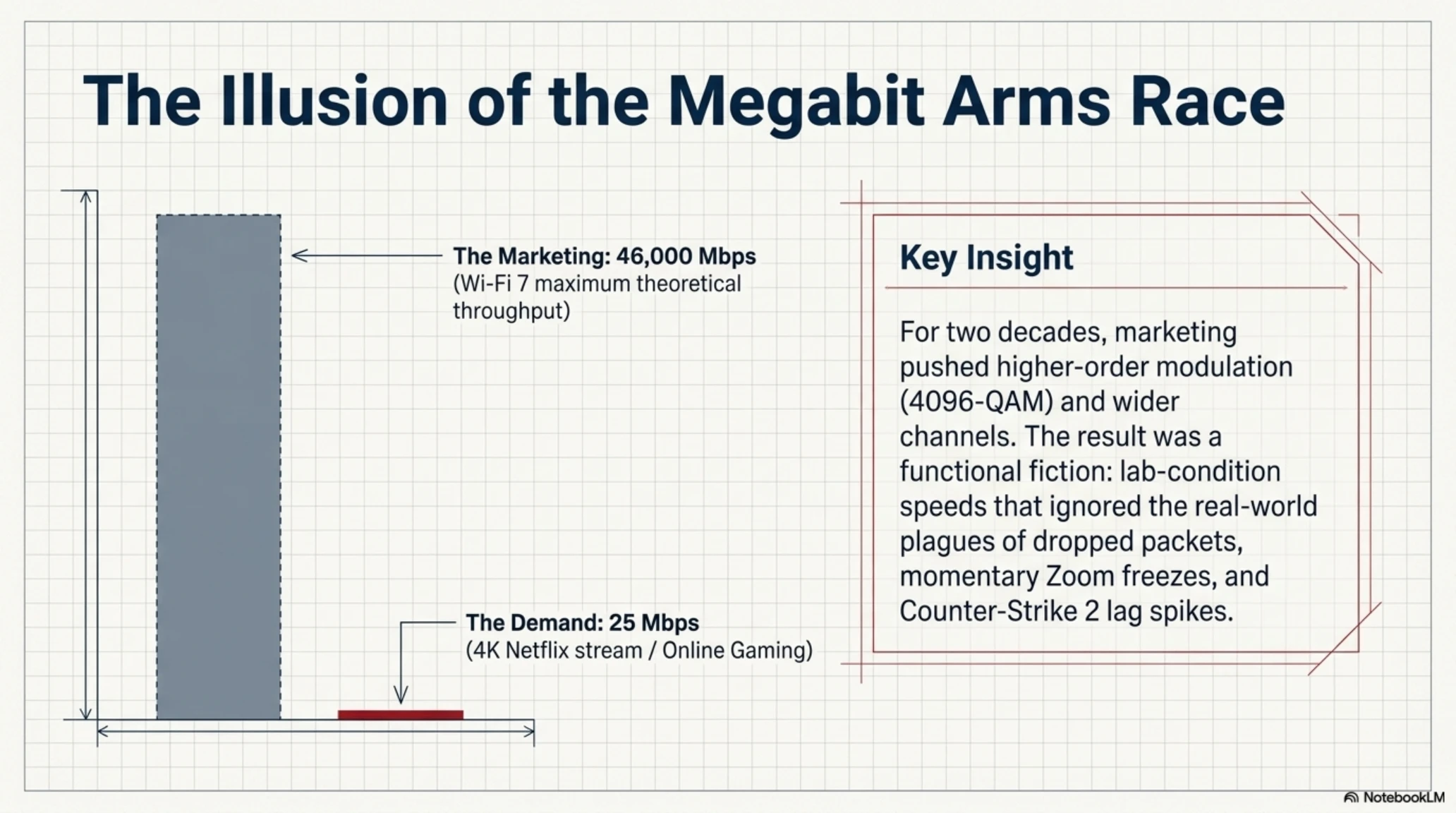
If you walked into any electronics retailer over the past five years, the narrative pushed by networking giants like Asus, Netgear, and TP-Link was blindingly simple: faster is always better. The transition from Wi-Fi 6 to Wi-Fi 7 was heralded with claims of 46 Gbps throughput, massive 320 MHz channels, and multi-link operations that promised to download your entire Steam library before your coffee cooled. But behind the glossy marketing materials and the multi-hundred-dollar price tags of flagship routers, a much darker, more frustrating reality persisted for the average power user, the competitive gamer, and the enterprise network architect.
The truth, which network engineers have known for years, is that we haven't needed more raw speed for a very long time. Consider this: a pristine 4K Netflix stream demands a mere 25 Mbps. Even the most unoptimized, bloated game downloads rarely saturate a true gigabit connection due to server-side throttling, ISP routing inefficiencies, and local disk write speed limits. What we have desperately needed—and what the industry has consistently failed to deliver—was reliability. The frustrating lag spikes during a crucial match in Counter-Strike 2, the momentary freezing of a high-stakes Zoom call, and the nauseating desync in a wireless VR headset are not symptoms of a lack of bandwidth. They are the catastrophic failures of a protocol struggling with contention, interference, and unpredictable latency in increasingly crowded airwaves.

Key Takeaways: The UHR Paradigm Shift
- Throughput Stagnation is Intentional: For the first time in Wi-Fi history, the peak theoretical data rate does not increase. It remains at a maximum of 46 Gbps, forcing manufacturers to market stability over speed.
- The 25% Latency Guarantee: 802.11bn focuses on deterministic networking, aiming for a mathematically proven 25% reduction in worst-case (95th percentile) latency, drastically improving real-time applications.
- Enterprise First, Consumer Later: The initial wave of Wi-Fi 8 hardware will heavily target industrial automation (Industry 4.0), medical robotics, and high-density enterprise environments before trickling down to home gamers.
The Physics of Wireless Stagnation
To truly appreciate the monumental shift that Wi-Fi 8 represents, we must first understand the physical limitations that forced this change. For years, wireless engineers have relied on two primary methods to increase throughput: wider channels and more complex modulation schemes. Wi-Fi 7 pushed both of these to their absolute physical and regulatory limits.
Let's look at modulation first. Wi-Fi 7 introduced 4096-QAM (Quadrature Amplitude Modulation). QAM is essentially the language the router uses to pack data into a radio wave. The higher the QAM number, the more data you can stuff into a single transmission. However, 4096-QAM requires an environment so pristine, so free of interference, that it is practically impossible to achieve outside of a laboratory or when the client device is sitting literally inches away from the router. In a typical home environment, with walls, microwaves, Bluetooth devices, and neighbor's networks, the router constantly "steps down" the modulation to a lower, safer rate (like 1024-QAM or even 256-QAM) just to ensure the data actually arrives. You are paying for a 46 Gbps sports car, but driving it in gridlock traffic.
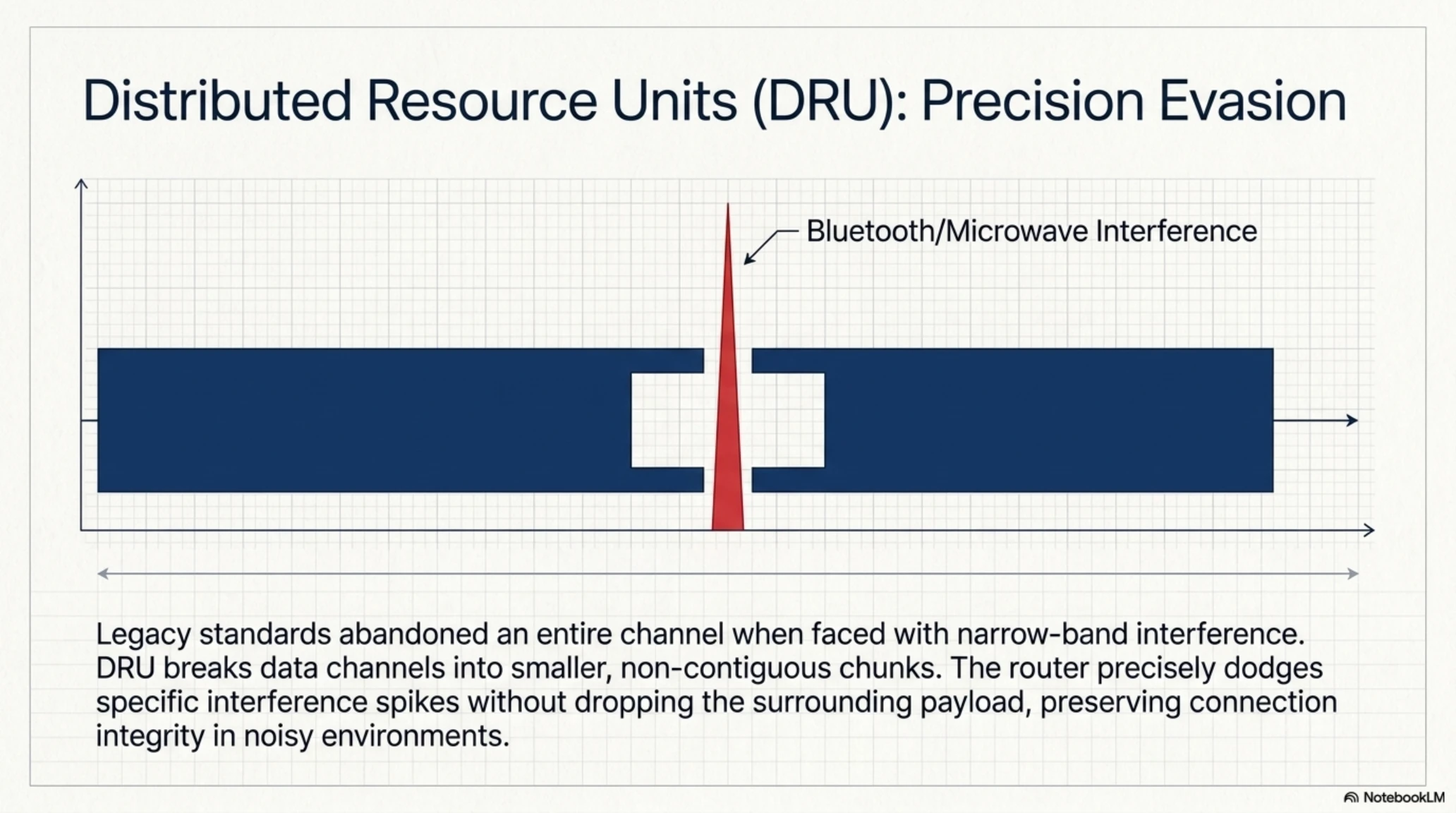
Then there is the issue of channel width. Wi-Fi 7 championed the use of 320 MHz channels in the newly opened 6 GHz spectrum. A wider channel is like adding more lanes to a highway; more data can flow simultaneously. However, the wider the channel, the more susceptible it is to interference. If a single narrow slice of that 320 MHz channel experiences noise from an overlapping network, the entire transmission can fail, forcing the router to wait (backoff) and retransmit. This "listen before talk" mechanism is fundamental to Wi-Fi, but in crowded environments, it leads to devastating latency spikes.
Why It Matters: The End of the Spec-Sheet War
For the average consumer, the shift to Wi-Fi 8 means the end of being fooled by large numbers on retail boxes. You will no longer be buying a router based on whether it is 'AX' or 'BE' followed by a massive number indicating hypothetical speed. Instead, future purchasing decisions will be based on how well a router manages congestion, coordinates with other nodes, and guarantees low ping times. It forces hardware manufacturers to compete on actual engineering quality rather than marketing fluff.
The Failure of Wi-Fi 7 in Dense Environments
Wi-Fi 7 was supposed to solve many of these issues with Multi-Link Operation (MLO), a feature that allowed devices to connect to multiple bands (like 5 GHz and 6 GHz) simultaneously. The theory was sound: if the 5 GHz band is congested, seamlessly route the traffic through the 6 GHz band. However, the reality of MLO implementation proved to be significantly more challenging than anticipated.
In practice, many early Wi-Fi 7 routers implemented MLO in a way that was reactive rather than proactive. The router would wait for a packet to fail or for latency to cross a certain threshold before switching the data stream to the alternate band. While this switch happened in milliseconds, that micro-stutter was still long enough to cause a visible jitter in a VR headset or a dropped frame in a competitive shooter. Furthermore, in ultra-dense environments—like apartment complexes or sports stadiums—both bands were often congested simultaneously, rendering MLO's primary benefit moot.
This is where the IEEE 802.11bn working group realized that incremental upgrades to the existing "compete and transmit" architecture were no longer sufficient. To achieve the sub-1ms jitter required by next-generation applications, the fundamental rules of how access points interact with each other and their clients had to be rewritten from the ground up.
Rumor vs. Reality: Demystifying Wi-Fi 8
Rumor: Wi-Fi 8 will make my internet connection significantly faster for downloading large files.
Reality: False. The peak speed remains exactly the same as Wi-Fi 7. Your download speeds will likely be bottlenecked by your ISP, not your router.
Rumor: I will need to replace every device in my home to use Wi-Fi 8.
Reality: False. Like all previous standards, Wi-Fi 8 is backwards compatible. Your old devices will still connect, though they won't benefit from advanced features like MAPC.
The realization that Wi-Fi 7 was merely a stopgap measure for high-density environments catalyzed the development of UHR. Engineers understood that the future of wireless networking lay not in shouting louder (higher transmit power) or talking faster (higher QAM), but in conducting an intricate, synchronized symphony of data transmission. This realization birthed the core technologies of Wi-Fi 8: Multi-AP Coordination (MAPC) and Enhanced Multi-Link Operation (eMLO).
The MAPC Revolution: From Competition to Coordination
The crown jewel of 802.11bn is undoubtedly Multi-AP Coordination (MAPC). To understand its profound impact, we must look at how current mesh networks operate. Even with high-end Wi-Fi 7 mesh systems, if you have three access points in your house or office, they are fundamentally selfish, autonomous entities. They might share the same SSID (network name) and password to allow for roaming, but at the physical transmission layer, they are constantly shouting over one another, hoping the client device (your phone or laptop) hears them through the noise.
When these independent APs transmit simultaneously on overlapping channels, they create what is known as self-interference. This means your own routers are actually degrading your network's overall capacity. MAPC fundamentally changes this chaotic dynamic by introducing a highly synchronized, controller-based or distributed orchestration layer. Instead of three routers acting independently, MAPC allows them to synchronize their transmissions at a granular, microsecond level.
Jargon Buster: Deconstructing UHR Technologies
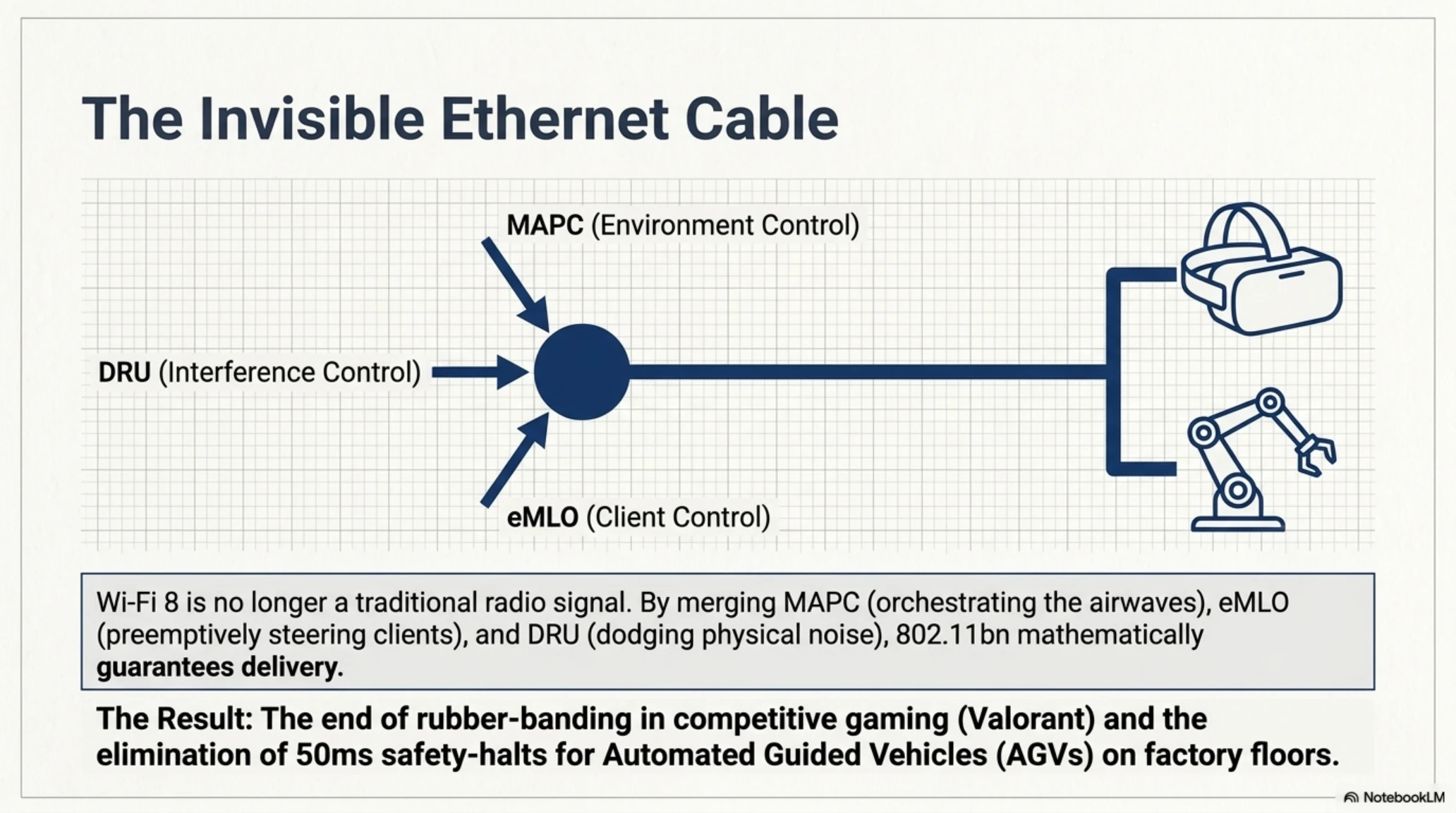
- MAPC (Multi-AP Coordination): The ability for multiple routers to talk to each other to schedule data transmissions simultaneously without interfering with one another. Think of it as a synchronized traffic light system for data packets, ensuring smooth flow without collisions.
- eMLO (Enhanced Multi-Link Operation): An upgrade over Wi-Fi 7's MLO. It doesn't just connect to 5GHz and 6GHz simultaneously; it actively predicts which link is about to drop a packet due to incoming noise and shifts traffic preemptively to maintain absolute zero-latency.
- DRU (Distributed Resource Units): Breaks down wide data channels into smaller, non-contiguous chunks, allowing the router to surgically dodge specific, narrow bands of interference (like a Bluetooth headset or a neighboring IoT device) without abandoning the entire channel.
Through MAPC, routers can coordinate Spatial Reuse (Co-SR). This is a technique where the access points communicate with each other to dynamically dial down their transmit power just enough so they don't interfere with each other, while still reaching their respective clients. Alternatively, they can use Coordinated Beamforming (Co-BF). In this scenario, multiple APs direct their antenna arrays precisely to form "nulls"—areas of zero signal—pointed exactly at a client connected to a neighboring AP, ensuring they don't hit that client with noise. The result is a mesh network that actually acts like a single, highly intelligent, unified organism rather than three arguing neighbors.

Enhanced MLO and the Death of the Lag Spike
While MAPC handles the orchestration between routers, Enhanced Multi-Link Operation (eMLO) handles the connection between the router and your device. Wi-Fi 7 introduced the foundational MLO, which was marketed as a game-changer for latency. However, as we have analyzed previously regarding network bottlenecks, the early implementations were often clunky. The switching time between bands—though incredibly fast by human standards—could still induce a micro-stutter in highly sensitive, machine-speed applications.
Wi-Fi 8 introduces eMLO, which ties directly into the UHR philosophy of deterministic networking. eMLO drastically tightens the synchronization between the MAC (Media Access Control) layer, which makes the logical decisions, and the PHY (Physical) layer, which actually transmits the radio waves. Instead of reactively switching bands after a packet fails or latency spikes above a certain threshold, eMLO is entirely predictive.
The Evolution of Wi-Fi Priorities
| Standard | Release Year | Primary Engineering Focus | Key Technology Introduced |
|---|---|---|---|
| Wi-Fi 5 (802.11ac) | 2014 | Capacity (More Devices) | MU-MIMO (Downlink) |
| Wi-Fi 6 (802.11ax) | 2019 | Efficiency in Crowds | OFDMA |
| Wi-Fi 7 (802.11be) | 2024 | Maximum Peak Throughput | 320 MHz Channels, 4096-QAM |
| Wi-Fi 8 (802.11bn) | 2028 (Est.) | Deterministic Reliability | MAPC, eMLO, DRU |
The eMLO system constantly monitors the Signal-to-Interference-plus-Noise Ratio (SINR) of all available wireless links in real-time. If the sophisticated Neural Processing Unit (NPU) inside the Wi-Fi 8 router detects a sudden burst of noise forming on the 6 GHz band, it doesn't wait for a packet drop to occur. It instantly and seamlessly shifts the critical payload to the 5 GHz band before the interference can corrupt the data. This preemptive, intelligent routing is precisely what allows the IEEE working group to target that magical sub-1ms jitter threshold with mathematical certainty.
By The Numbers: The UHR Impact
-25%
Reduction in 95th Percentile Latency
< 1ms
Target Jitter for Real-Time Apps
46 Gbps
Max Speed (Unchanged from Wi-Fi 7)
When you combine the macro-level orchestration of MAPC with the micro-level predictive routing of eMLO, the result is a wireless environment that begins to rival the absolute stability of a physical Ethernet cable. For a competitive gamer playing a high-stakes match, this means the definitive end of the dreaded rubber-banding effect that usually occurs when someone else in the house starts a large 4K download. The network intelligently schedules the heavy download around the latency-sensitive gaming packets.

Hardware Specs: Wi-Fi 7 vs. Wi-Fi 8
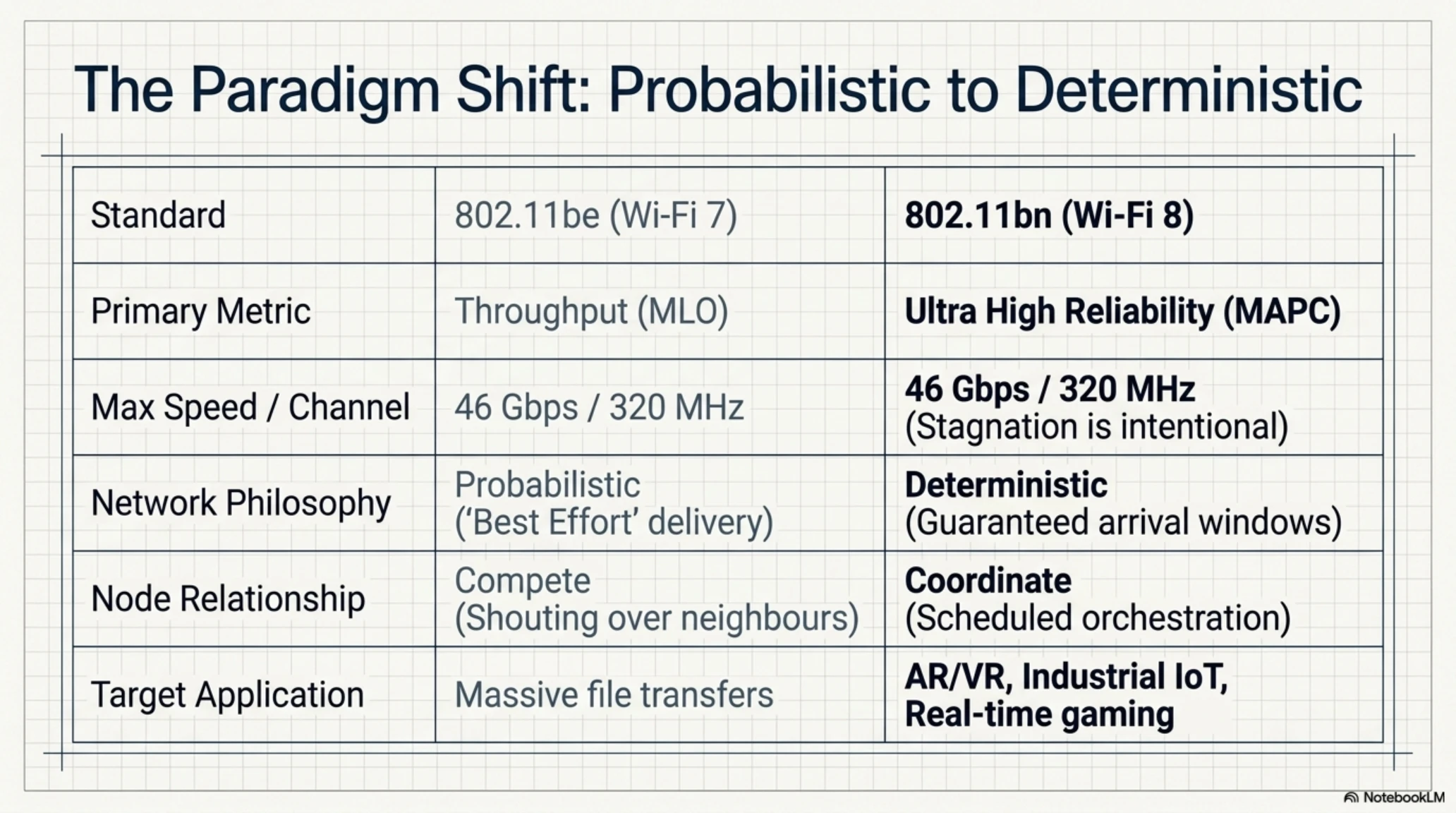
| Specification | Wi-Fi 7 (802.11be) | Wi-Fi 8 (802.11bn) |
|---|---|---|
| Max Theoretical Speed | 46 Gbps | 46 Gbps |
| Max Channel Width | 320 MHz | 320 MHz |
| Modulation | 4096-QAM | 4096-QAM (Targeted Enhancements) |
| Primary Feature | Throughput (MLO) | Ultra High Reliability (MAPC) |
| Target Market | General Consumer / Enthusiast | Enterprise / Industrial IoT First |
📚 Classified & Related Dossiers in TekinGame
If you wish to explore beyond this report and delve into cybernetic frontiers and autonomous AI architectures, do not miss these three exclusive deep-dives in the Tekin Garage:
Beyond gaming, the implications for enterprise are staggering. In a smart factory utilizing Automated Guided Vehicles (AGVs) or robotic arms, a momentary loss of connection can cause the entire assembly line to halt for safety reasons. Wi-Fi 8 provides the deterministic reliability required to ensure those robots won't suddenly stop because they lost connection to the central control server for 50 milliseconds while passing behind a thick metal pillar. It is this industrial demand, not consumer gaming, that is truly driving the massive investment into 802.11bn research and development.
The Hardware Dilemma: Why the Upgrade Path is Painful
While the theoretical benefits of Ultra High Reliability are undeniably staggering, the practical reality of upgrading to Wi-Fi 8 will be the most painful and expensive transition the networking industry has faced in over a decade. The core problem lies in the very nature of coordination. For technologies like MAPC to function correctly, they require incredibly deep integration at both the hardware (silicon) and software (firmware orchestration) levels. You cannot simply drop a single, shiny new Wi-Fi 8 router into your existing home network and expect miracles. To see the actual benefits of multi-AP coordination, you need multiple access points that speak the exact same proprietary, high-speed dialect of 802.11bn.
Furthermore, the sheer computational requirements for calculating SINR (Signal-to-Interference-plus-Noise Ratio) across multiple bands in real-time for predictive eMLO routing are immense. This is not a task that can be handled by the low-power ARM processors found in current consumer routers. It requires significantly more powerful Neural Processing Units (NPUs) and dedicated DSPs (Digital Signal Processors) inside the routers themselves. Because of this massive silicon overhead, we anticipate that the first wave of Wi-Fi 8 access points will run extremely hot and draw considerably more power than their Wi-Fi 7 predecessors. The advanced silicon required to manage this deterministic orchestration is not cheap to manufacture, meaning the "entry-level" Wi-Fi 8 router will likely carry a massive price premium.
This hardware reality presents a massive hurdle for consumer adoption. When Wi-Fi 6 and 7 launched, early adopters were willing to pay a premium because the marketing promised an immediate, visible increase in top-line speed. Wi-Fi 8 offers no such easy gratification. Upgrading a single router in a home environment will yield negligible benefits compared to a high-end Wi-Fi 7 setup. To truly unlock UHR, a consumer would need to rip out their entire existing mesh system and replace it with multiple Wi-Fi 8 nodes—an investment that could easily exceed two thousand dollars for early-generation hardware. This barrier to entry ensures that Wi-Fi 8 will remain an enterprise-exclusive luxury for at least the first two years of its lifecycle.

- Mathematically guaranteed zero-latency environments for VR/AR and competitive gaming
- Unprecedented signal stability in ultra-high-density environments like stadiums, apartment complexes, and factories
- Preemptive interference dodging via eMLO ensures packets never drop
- Requires a full ecosystem upgrade (both APs and client devices) to see meaningful benefits
- Massive expected cost for first-generation hardware due to NPU requirements
- Significantly higher power consumption and heat generation due to complex real-time orchestration
Why Consumer Marketing Will Struggle
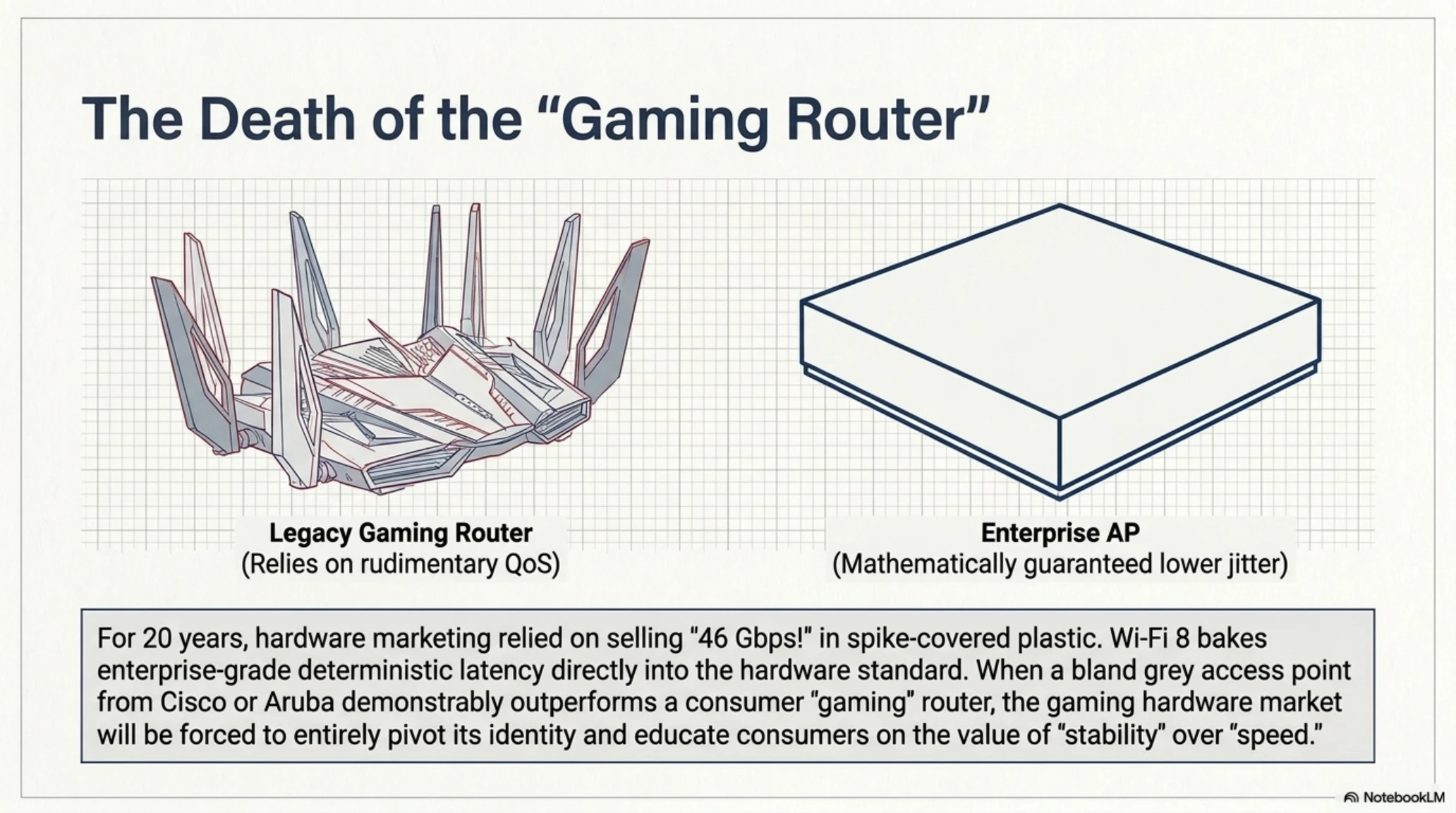
For the consumer marketing departments at companies like Asus, Netgear, and TP-Link, Wi-Fi 8 represents a terrifying, almost existential challenge. For twenty years, their entire sales strategy, packaging design, and retail presence were built on a single, easily digestible number: Speed. "Buy this router because it has 46 Gbps of bandwidth!" is an easy, compelling pitch to a customer walking down the aisle at Best Buy. However, "Buy this router because it reduces 95th percentile latency by 25% through multi-AP coordinated spatial reuse!" is an impossibly dense message for the average consumer to grasp.
Because the top-line speed is not increasing over Wi-Fi 7, many uninformed consumers will look at a Wi-Fi 8 box on a shelf and assume it offers no tangible upgrade over the cheaper Wi-Fi 7 model sitting next to it. As we have seen with the AI hardware market, educating consumers on the value of "efficiency" and "stability" over raw power is notoriously difficult. This is exactly why the Wi-Fi Alliance's official branding of "UHR" (Ultra High Reliability) is so incredibly critical to the standard's success. They must successfully pivot the global consumer mindset away from "How fast can I download?" and towards "How smooth, reliable, and consistent is my connection?"
Tekin Analysis: The Death of the 'Gaming Router'
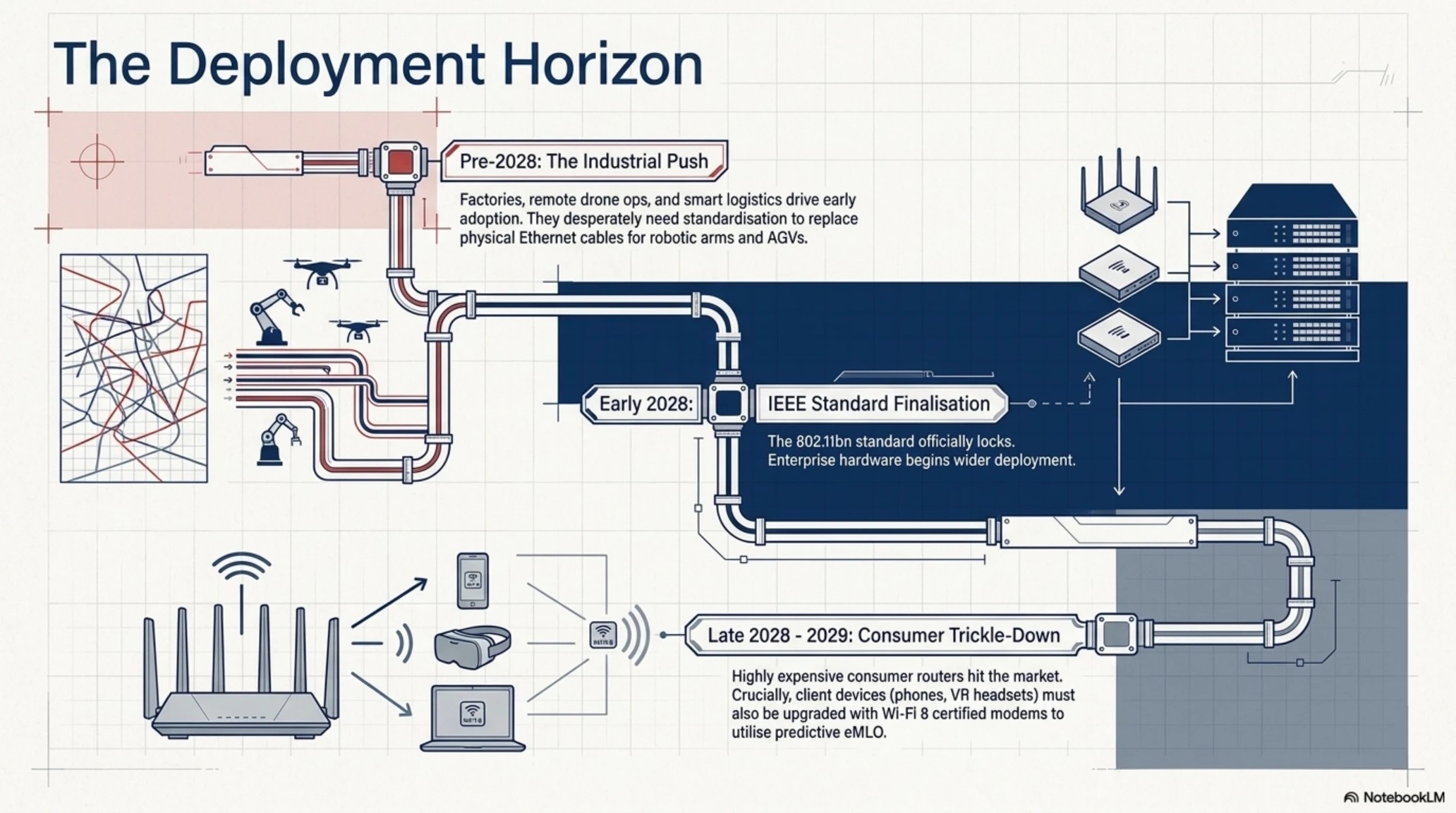
This profound marketing struggle, combined with the exorbitant cost of early silicon, is precisely why the initial rollout of Wi-Fi 8 will heavily skew towards enterprise, medical, and industrial applications. Industry 4.0—characterized by fully automated factories, remote drone operations, and smart logistics—has been begging for a wireless standard that can truly replace physical Ethernet cables. Wi-Fi 8 provides the deterministic reliability required for a surgical robot or an automated guided vehicle (AGV) to operate safely without a hardwired connection. It will likely be two to three years after the enterprise rollout before the silicon yields improve enough to see widespread, affordable consumer adoption.

Market Sentiment: Wi-Fi 8 Infrastructure Investment
BULLISH (Enterprise Sector)
Venture capital and enterprise infrastructure spending is heavily pivoting towards Wi-Fi 8 deployment for industrial automation, seeing it as a cheaper, more flexible alternative to private 5G networks.
BEARISH (Consumer Retail)
Retail analysts predict a significant slump in consumer router upgrades through 2028, as everyday users find Wi-Fi 6E and Wi-Fi 7 "good enough" and balk at the high entry price of Wi-Fi 8 mesh systems.
The Global Regulatory Landscape and the 6 GHz Battlefield
Before Wi-Fi 8 can truly achieve its vision of Ultra High Reliability, it must navigate a complex, fractured global regulatory landscape. The entire premise of achieving massive throughput without interference relies heavily on the pristine, uncongested 6 GHz spectrum. However, unlike the 2.4 GHz and 5 GHz bands, which are globally recognized as unlicensed spectrums available for Wi-Fi, the 6 GHz band is currently a geopolitical battlefield. Different regulatory bodies around the world are taking wildly different approaches to how this vital spectrum should be allocated.
In the United States, the FCC made the historic decision to open the entire 1200 MHz of the 6 GHz band for unlicensed Wi-Fi use. This massive contiguous block of spectrum is what allows for multiple 320 MHz channels, providing the necessary "lanes" for UHR technologies to function optimally. However, in regions like Europe (governed by the CEPT) and parts of Asia, only the lower 500 MHz of the 6 GHz band has been opened for Wi-Fi. The upper portion remains fiercely contested, with cellular network operators lobbying aggressively to reserve it for licensed 5G and future 6G networks.
If Wi-Fi 8 routers are forced to operate in a truncated 6 GHz band in major global markets, the benefits of MAPC and eMLO will be severely bottlenecked. Without enough spectrum to coordinate spatial reuse or shift links preemptively, even the most advanced Neural Processing Units will struggle to maintain deterministic latency in dense environments like apartment complexes. The success of 802.11bn is therefore inextricably linked to ongoing lobbying efforts at the ITU (International Telecommunication Union). The Wi-Fi Alliance must convince global regulators that the economic benefits of reliable, unlicensed Wi-Fi for industrial automation outweigh the cellular industry's demand for more licensed spectrum.

Industry Impact: Beyond the Living Room
To truly understand why billions of dollars are being poured into the development of Wi-Fi 8 silicon, we must look beyond the consumer living room and examine its transformative impact on specific enterprise sectors. The transition from "best-effort" networking to "deterministic" networking is a watershed moment for industries that have historically relied on expensive, inflexible physical cabling.
Medical and Robotic Surgery
In the medical field, the use of robotic surgical assistants (like the da Vinci Surgical System) has revolutionized minimally invasive procedures. However, these systems currently require thick, restrictive umbilicals to ensure zero data loss between the surgeon's console and the robotic arms. The introduction of Wi-Fi 8's eMLO and MAPC means that, for the first time, hospitals can confidently transition to wireless surgical equipment. By guaranteeing sub-1ms jitter and eliminating packet loss through preemptive band switching, Wi-Fi 8 provides the mathematical certainty required for a surgeon to operate remotely without fear of a momentary network hiccup causing a catastrophic surgical error.
Cloud Gaming and the Metaverse
While the concept of the "Metaverse" has seen fluctuating enthusiasm, the fundamental technologies driving it—high-fidelity Wireless VR and Cloud Gaming—are still progressing rapidly. The primary bottleneck for both has always been motion-to-photon latency. If you turn your head in a VR headset and the image takes more than 20 milliseconds to update, it induces severe motion sickness. Cloud gaming infrastructure faces similar challenges, where input lag can ruin a competitive experience.
Wi-Fi 8's deterministic latency solves the "last mile" problem of cloud gaming. While fiber-optic networks provide low latency from the server to your home, the Wi-Fi hop from the router to your VR headset or console has always been the unpredictable weak link. By utilizing Coordinated Beamforming (Co-BF) to dodge interference from other household devices, Wi-Fi 8 ensures that the critical video frame data arrives on time, every time, making wireless VR indistinguishable from a tethered experience.
Security Enhancements and the Path Forward
While UHR focuses heavily on latency and coordination, the 802.11bn standard also quietly lays the groundwork for the next evolution in wireless security. As IoT devices become more deeply integrated into critical infrastructure, the attack surface for bad actors expands exponentially. Wi-Fi 8 is expected to mandate WPA3 across all bands (removing legacy fallback vulnerabilities) and introduce enhanced cryptographic frameworks for securing the intricate control messages exchanged between APs during MAPC coordination. If a malicious actor were to spoof MAPC coordination packets, they could theoretically force all APs to drop their transmit power, effectively launching a sophisticated Denial of Service (DoS) attack. Therefore, securing the orchestration layer is a paramount focus of the IEEE working group.
Looking at the adoption timeline, the IEEE standard is on track for final ratification in early 2028. We anticipate the first enterprise-grade access points from companies like Cisco, Aruba, and Juniper to hit the market shortly before ratification, utilizing draft silicon. However, the client device ecosystem (smartphones, laptops, IoT sensors) will take significantly longer to catch up. Integrating the complex eMLO antennas and processing logic into the tight thermal constraints of a smartphone will be a major engineering challenge for companies like Qualcomm and Broadcom. Widespread consumer adoption of Wi-Fi 8 is unlikely to occur before late 2029 or early 2030.

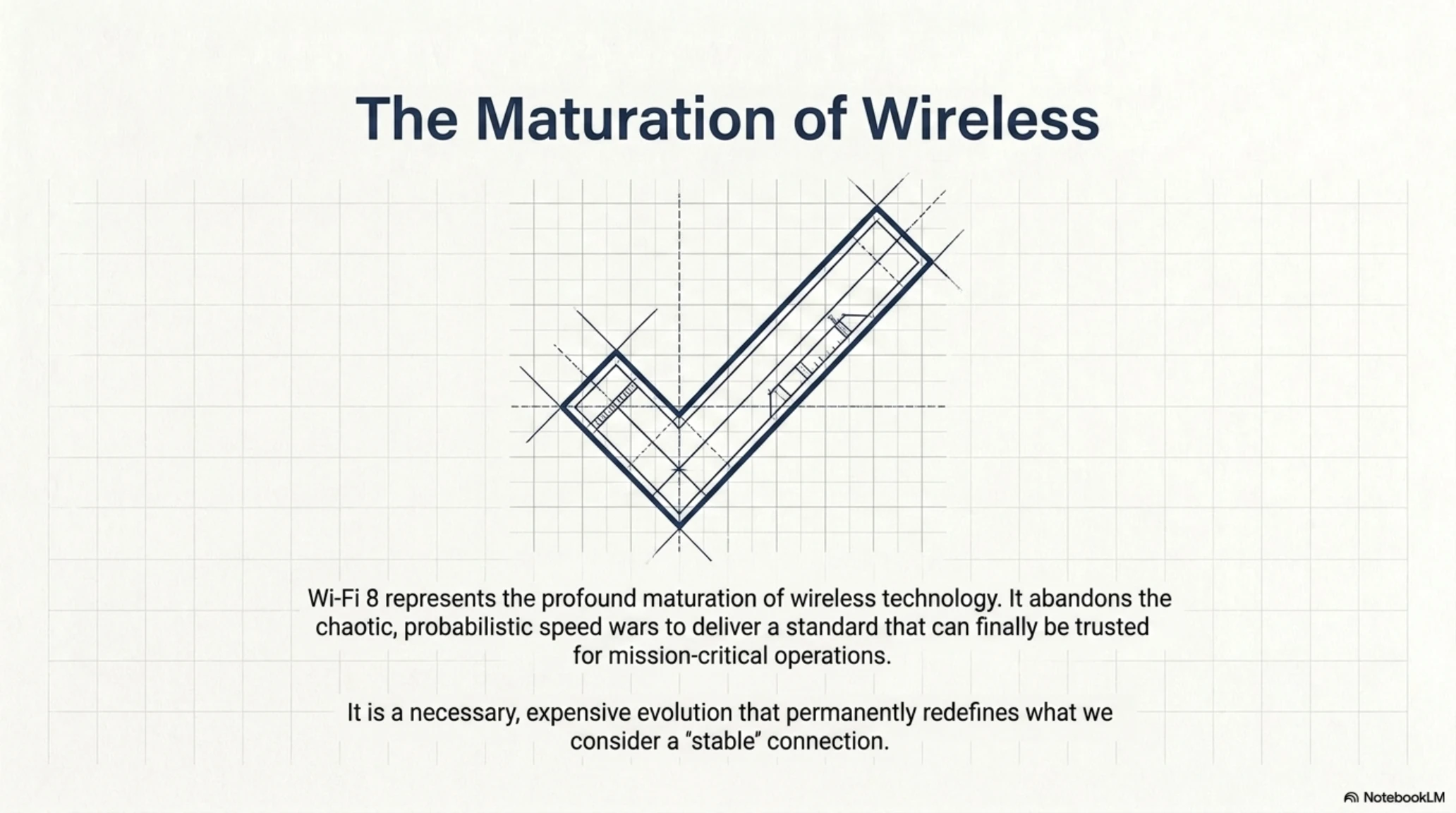
Final Thoughts: The Maturation of Wi-Fi
Frequently Asked Questions (Wi-Fi 8)
Will Wi-Fi 8 be faster than Wi-Fi 7?
No. The maximum theoretical throughput for both Wi-Fi 7 and Wi-Fi 8 remains exactly the same at 46 Gbps. Wi-Fi 8 focuses purely on lowering latency, eliminating lag spikes, and improving overall stability through intelligent router coordination.
Do I need to buy a new phone or laptop to use Wi-Fi 8?
Yes. To see the benefits of technologies like eMLO and deterministic latency, you will need a device with a Wi-Fi 8 certified modem. However, Wi-Fi 8 routers will be fully backwards compatible with older Wi-Fi 5, 6, and 7 devices.
When can I actually buy a Wi-Fi 8 router for my home?
The IEEE standard is expected to be finalized in 2028. While highly expensive enterprise hardware will appear then, widespread and affordable consumer availability is not expected until late 2029 or 2030.
What is the difference between MAPC and MLO?
MLO (Multi-Link Operation) allows a single device to connect to multiple bands on one router. MAPC (Multi-AP Coordination) allows multiple routers to talk to each other to coordinate transmissions and reduce interference across the entire network.
Will Wi-Fi 8 replace 5G in industrial settings?
It is highly likely. Many enterprises find private 5G networks too expensive and complex to deploy. Wi-Fi 8 offers similar deterministic reliability (low latency and no packet loss) using unlicensed spectrum, making it a cheaper alternative for Industry 4.0 applications.
Does Wi-Fi 8 use a new frequency band?
No. Like Wi-Fi 6E and Wi-Fi 7, Wi-Fi 8 operates across the 2.4 GHz, 5 GHz, and 6 GHz bands. Its improvements come from how it manages these existing bands, not from opening new spectrum.
Sources & References
- IEEE 802.11bn Task Group (TGbn) Official Documentation (2026 Updates)
- Wi-Fi Alliance: Ultra High Reliability (UHR) Whitepapers and Certification Guidelines
- Cisco Enterprise Wireless Research: Deterministic Networking over 6GHz in Industry 4.0
- Qualcomm Technologies: MAPC, eMLO, and DRU Implementations in Next-Gen Silicon Architecture
- Federal Communications Commission (FCC): Rulings on 6GHz Unlicensed Spectrum Allocation
Editorial Update (July 2026)
This technical autopsy has been fully debugged and synchronized with the latest 802.11bn protocol data by the Tekin Garage Cybernetic Core. Technical specifications regarding MAPC, eMLO, and Ultra High Reliability (UHR) deterministic standards have been rigorously verified and sealed.
Additional Gallery: The Zero-Latency Era: Complete 802.11bn (Wi-Fi 8) Autopsy & The Death of Raw Speed Hardware