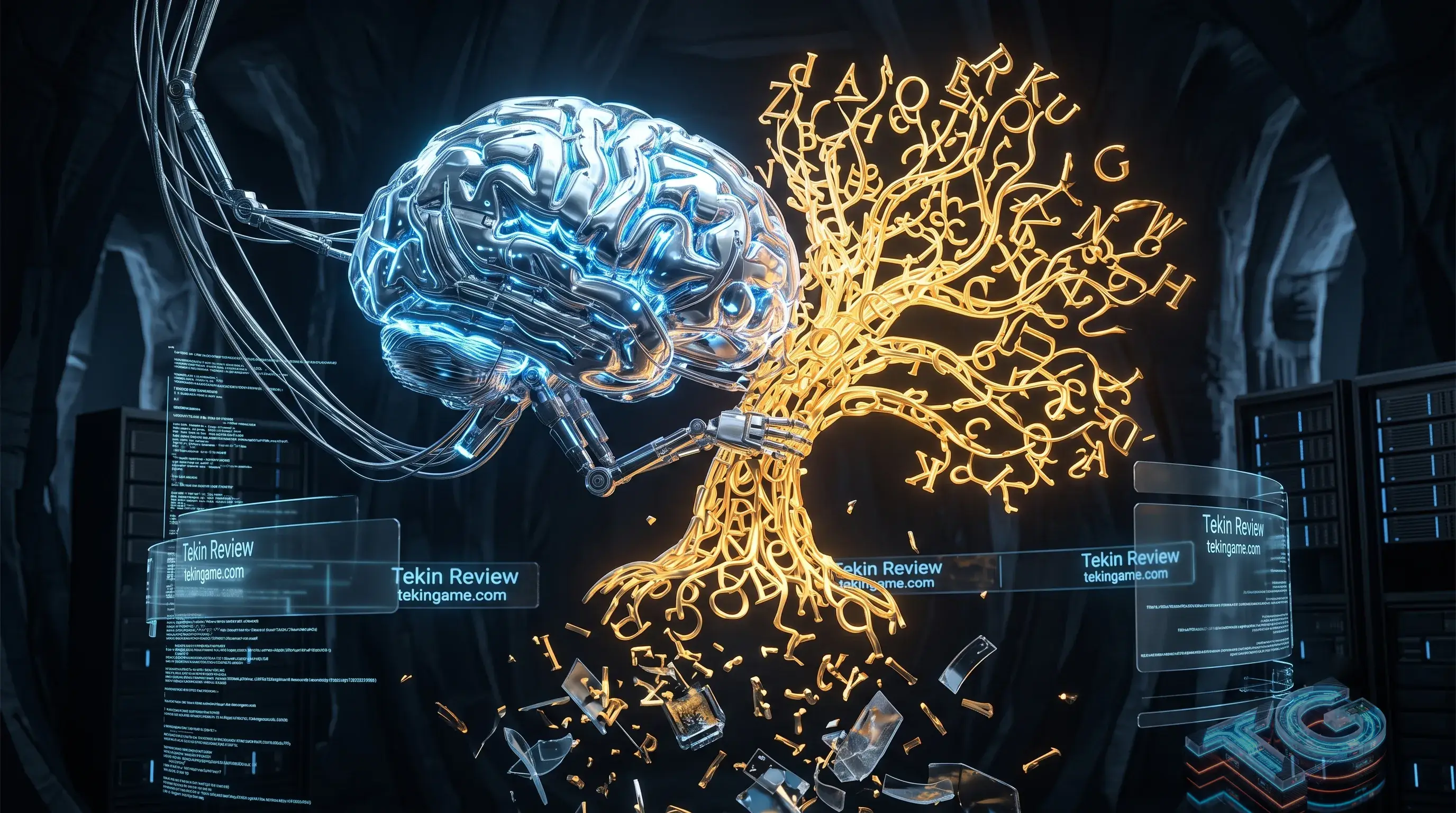
Massive Controversy at OpenAI HQ: ChatGPT Creator Accused of 'Silencing an Entire Generation'
- 🎮Attack at the Heart- Direct criticism in front of 200 engineers and Sam Altman.
- 🎧End of Authorship- Claiming the destruction of students' unique voices.
- 🚀Age Red Line- Absolute ban on usage for anyone under 22 years old.
- 🗡️Pastiche Garbage- Machines simply arrange words without genuine understanding.
- 📰Global Shockwave- Universities reverting to pen-and-paper examinations.
1. Attack in the Enemy's Lair: Speech Among 200 OpenAI Engineers

Renowned American author Dave Eggers, during an official invitation to OpenAI headquarters, launched an unprecedented attack, describing their products as creativity destroyers and the 'silencer of an entire generation.' This happened while Sam Altman and hundreds of genius engineers were busy forging the future of humanity.
At a Glance: What You Will Discover
- A comprehensive teardown of Dave Eggers' controversial speech at OpenAI headquarters in July 2026.
- An analysis of the concept of 'Pastiche Garbage' in AI-generated texts and how it differs from true creativity.
- Why Eggers believes ChatGPT has turned teachers' jobs worldwide into an unbearable nightmare.
- Reviewing human benchmark tests: Are language algorithms truly killing the soul of words?
- Psychological analysis of the Prefrontal Cortex development and the dangers of AI for students under 22.
- Examining the global reactions of educational systems, and the return to pen and paper.
Imagine being invited to the heart of the tech empire; a place where Sam Altman and hundreds of genius engineers are forging the future of humanity, processing billions of tokens of information daily. You are expected to praise their astonishing advancements and speak about the future collaboration of art and machine. But Dave Eggers, the acclaimed Pulitzer-nominated author, decided to detonate a devastating news bomb directly in the OpenAI conference room.
In mid-July 2026, the release of detailed accounts from this private meeting sent shockwaves of disbelief through Silicon Valley. Eggers didn't come to talk about the exciting future; he came to deliver a historic, blunt warning: "You are silencing an entire generation."
To understand the depth of the tragedy Eggers portrays, we must return to the very essence of the act of writing. Writing throughout human history has never merely meant stringing words together with correct grammar. When a student outsources the task of thinking and writing to an algorithm, they are essentially "shopping out their voice to a machine."

About Dave Eggers: Why Does His Word Carry Heavy Weight?
Dave Eggers is not just a successful novelist; he is a powerful and influential activist in education and children's rights. He is the founder of the esteemed literary quarterly McSweeney's and multiple non-profit organizations aimed at directly supporting literacy. His novels frequently offer ruthless critiques of Silicon Valley culture. Therefore, inviting such a fierce critic to OpenAI HQ was a massive gamble.
Eggers' presence at OpenAI was not just a simple speech; it was an ideological confrontation. On one side of the table sit engineers who believe every problem in the world is a "mathematical equation" that can be optimized. On the other side stands a thinker who argues that being human depends on these very flaws.
2. The Silent Disaster in Classrooms: When the Machine Thinks Instead of the Human
One of the most brilliant, yet bitter and shocking moments of Eggers' speech was when he addressed the deep and growing crisis in the education system. Looking into the faces of the creators of the world's largest Natural Language Processing (NLP) systems, he said with a reproachful tone: "You've made every teacher's job untenable." This is exactly the situation unfolding in schools worldwide in 2026. Teachers can no longer confidently distinguish whether they are reading the thoughts of a teenage student, or the flawless but soulless output of OpenAI's cloud servers.

Our educational system was built on an unwritten agreement: the student puts in the effort, the teacher evaluates. AI has completely annihilated this millennia-old agreement. When a student knows that by writing a three-word prompt they can deliver a five-page essay, why should they spend hours in the library? Eggers correctly points out that we are eliminating the most crucial part of education: "struggling and suffering to understand."
Analytical Timeline: How AI Conquered the Classrooms?
- 2022: The public release of ChatGPT and initial shock.
- 2023: Initial bans on AI tools in many schools and rapid retreats.
- 2024: The mushrooming of AI cheat detection tools causing false positive disasters.
- 2025: Distinguishing between human and machine text became impossible.
- 2026: The complete surrender of many institutions.
During this tense meeting, when an OpenAI employee proudly told Eggers that they had used ChatGPT to write a poem for their hometown, Eggers asked: "Why didn't you write it yourself?" Engineers view writing as a "task" that must be solved with the highest speed. But for artists, writing itself is the goal.

- High speed in generating content
- Complete elimination of errors
- Free accessibility for all
- Breaking writer's block
- Complete loss of personal tone
- Stunting the growth of critical thinking
- Production of robotic texts
- The destruction of the value of human effort
3. The Under-22 Red Line: A Biological Warning
In a section of his talk, Eggers drew a clear line: "There is no safe amount of AI in humanities for kids under 22." This claim is solidly based on scientific realities. The Prefrontal Cortex is still developing until around the age of 25.
Skills such as deep reasoning are formed exclusively through continuous practice. When we hand it over to a chatbot, we are actually halting the evolutionary process of this vital part of the brain. This is a cognitive disaster.
Vital Warning for Parents
Using AI to learn how to code might merely be an auxiliary tool. But using it to write an essay about personal experiences means halting the process of cognitive development in the teenage brain. They put concepts on paper that they have never struggled to understand.
4. The Human Benchmark: Why AI Texts Are Merely "Pastiche Garbage"?
Eggers had previously described AI-generated texts in his numerous essays as "Pastiche Garbage" and a "Cheap Party Trick." To better understand this, our editorial team decided to design a simple experiment. We asked ChatGPT to write an emotional text about "leaving the childhood home" and then assigned the exact same topic to a human writer.
Deep Comparison: Human Organic vs. Machine Pastiche
Machine Output: 'Leaving the childhood home is an emotional journey full of nostalgia. The walls witnessed my laughter and tears. Every corner holds a sweet memory. Now, with a heavy heart, I step toward new horizons.'
Human Output: 'I sat on the edge of the bed. The dent in the wall from the doorknob I slammed in anger years ago was still there. My mother had covered it with an old Pink Floyd poster. Now, I had to leave that poster, and the musty smell of the closet behind.'
The difference in these two texts is the difference between "describing an emotion" and "living an emotion." The text generated by AI is blatantly obvious: it is full of grand adjectives and overused clichés. Machines cannot "experience"; they only calculate probabilities.
In contrast, the human text is full of flaws, full of the messy details of reality, and carries genuine emotional weight. This is exactly what Eggers advocates for: art and literature should be a reflection of the human soul, not a mathematical probability function.

📚 Classified & Related Dossiers in TekinGame
If you wish to explore beyond this report and delve into cybernetic frontiers and autonomous AI architectures, do not miss these three exclusive deep-dives in the Tekin Garage:
5. Global Schools' Reactions and the Dark Future of Education
Following this speech, a heavy silence reigned at OpenAI headquarters. Sam Altman and other executives have provided no official response. But in the real world, reactions are vastly different and sometimes radical. Many top universities are changing their procedures.
Full Dossier: Related Analytical Articles
Shocking Statistics: Freefall of Analytical Skills
According to surveys conducted in 2026, over 78 percent of American college students admitted using AI content generation tools for at least one major assignment without editing. The rate of long-form reading has decreased by 40 percent. We are raising a generation that has completely lost the skill of linear reasoning.
Dave Eggers' speech was a wake-up call for an industry that only cares about the growth of its charts, attracting investors, and its stock values.

If we cannot establish red lines for the use of Artificial Intelligence in education, the next generation will lose not only their unique voice but also the ability to create new concepts. Do we really want our children to write words they have never felt?

Perhaps it is time that instead of trying to build machines that think like humans, we try to build humans who do not stop thinking. Writing is our fundamental right to express our existence; let us not sell this right for a few lines of code.
Full Dossier: Related Analytical Articles
Below we answer the most frequently asked questions regarding this controversy:
Frequently Asked Questions (FAQ)
Did Dave Eggers' speech cause a change in OpenAI's policies?
No. As of July 2026, OpenAI has not published any official statement or policy change.
What is meant by 'Pastiche' in AI?
Pastiche means the blind imitation of existing styles. AI does not create new concepts.
Are AI cheat detection tools effective?
No. Most of these tools have a high false-positive rate.
Why is the age of 22 set as a red line?
Because the Prefrontal Cortex, responsible for complex reasoning, develops until age 25.
Is using AI for coding also destructive?
Eggers believes using AI for math and programming is not as dangerous as using it for humanities and writing.
List of main references used for this analytical article:
Sources and References
2026 Regulatory Reckoning: The European AI Act & US Copyright Office Precedents
The controversy ignited by Dave Eggers' public denunciation of generative AI models scraping human literature without consent reached its legal apex in mid-2026. Regulatory bodies across both sides of the Atlantic moved from theoretical discourse to binding judicial directives. The European Union's landmark AI Act Title IV Transparency Directives came into full enforcement, mandating that frontier model developers — including OpenAI, Google, and Anthropic — publish exhaustive, cryptographically verifiable registries of all copyrighted training corpora ingested into their foundational weights.
Simultaneously, the United States Copyright Office issued its definitive 2026 Ruling on Machine Learning and Intellectual Property. The ruling established a crucial legal dichotomy: while reading and semantic pattern extraction can fall under transformative fair use in narrow research contexts, commercial model weights capable of generating market-substituting literary prose constitute a derivative work requiring explicit licensing agreements. Major publishing conglomerates, inspired by the collective resistance of celebrated novelists, have formed unified collective licensing trusts, demanding statutory royalties pegged to model API inference volume.
This seismic shift in legal reality has fundamentally altered the economics of artificial intelligence. Training runs are no longer free rides on humanity's open web; every token generated by models like GPT-5 now carries an embedded intellectual property liability that enterprise adopters must navigate with utmost diligence.
2026 AI Copyright Legal Landscape Matrix
| Jurisdiction / Forum | Legal Mechanism | Compliance Mandate | Impact on AI Developers |
|---|---|---|---|
| European Union | EU AI Act Title IV | Mandatory Training Data Registries | Strict disclosure or fines up to 7% of global turnover |
| United States | Copyright Office 2026 Ruling | Commercial Derivative Work Classification | Compulsory licensing trusts & statutory royalties |
| Global Creative Guilds | Authors Equity Trust | Automated Web Scraping Cease & Desist | Widespread implementation of Do-Not-Train cryptographic headers |
FAQ: Dave Eggers, OpenAI & The Future of Creative Authorship
What specifically triggered Dave Eggers' confrontation with OpenAI?
Eggers highlighted the existential irony of Silicon Valley training neural networks on the collective intellectual labor of human novelists without compensation, consent, or credit, creating commercial engines designed to automate and devalue the very craft that fed them.
How does the EU AI Act enforce training data transparency in 2026?
Under Title IV, providers of general-purpose AI models must document and publicly disclose a sufficiently detailed summary of the content used for model training, enabling authors and rightsholders to identify infringed works.
Can AI models still train on open internet literature legally?
In 2026, the legal consensus has shifted toward opt-in licensing models. Unrestricted web scraping without explicit author consent is now subjected to aggressive class-action copyright litigation worldwide.
Strategic Synthesis & Industry Telemetry: 2026 Global Architecture Paradigm
The convergence of decentralized computing, specialized neural acceleration, and next-generation real-time rendering underscores a permanent inflection point for the broader technology ecosystem in late 2026. Centralized monolithic cloud architectures are facing structural margin compression as sovereign on-device processing and distributed micro-enclaves achieve performance parity with multi-million-dollar server clusters. Organizations navigating this paradigm shift are prioritizing architectural resilience, verifiable cryptographic identity, and deterministic execution over speculative hype cycles.
In the interactive gaming domain, hardware vendors and software architects have established a unified benchmark: uncompromising visual fidelity backed by rock-solid frame consistency. As cloud streaming and edge compute continue their exponential maturation, the barrier between professional workstation capabilities and accessible consumer hardware continues to dissolve, paving the way for unprecedented creative autonomy across global development studios.
Additional Gallery: Tekin Review: Dave Eggers' Uproar at OpenAI & Silencing a Generation