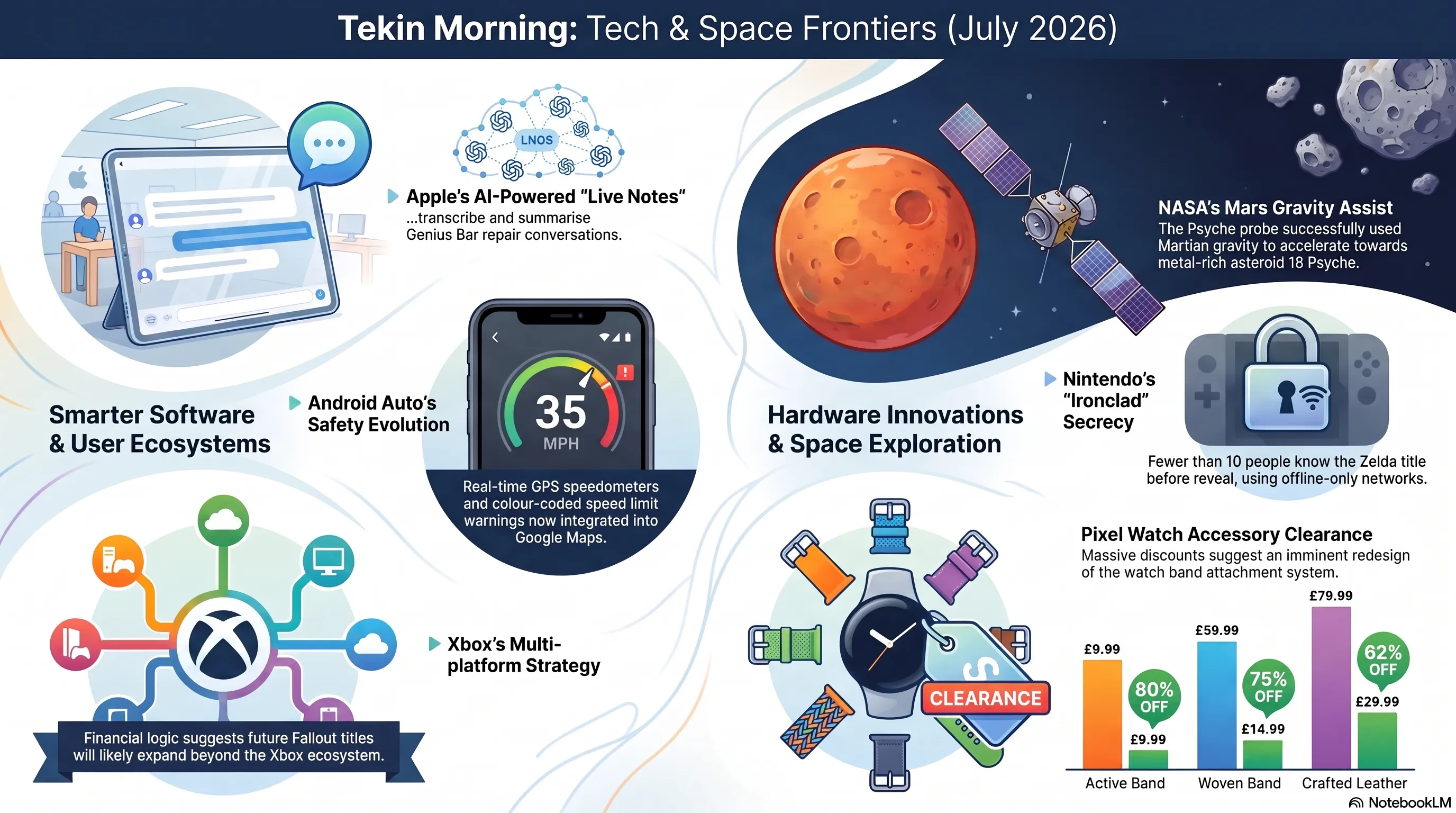
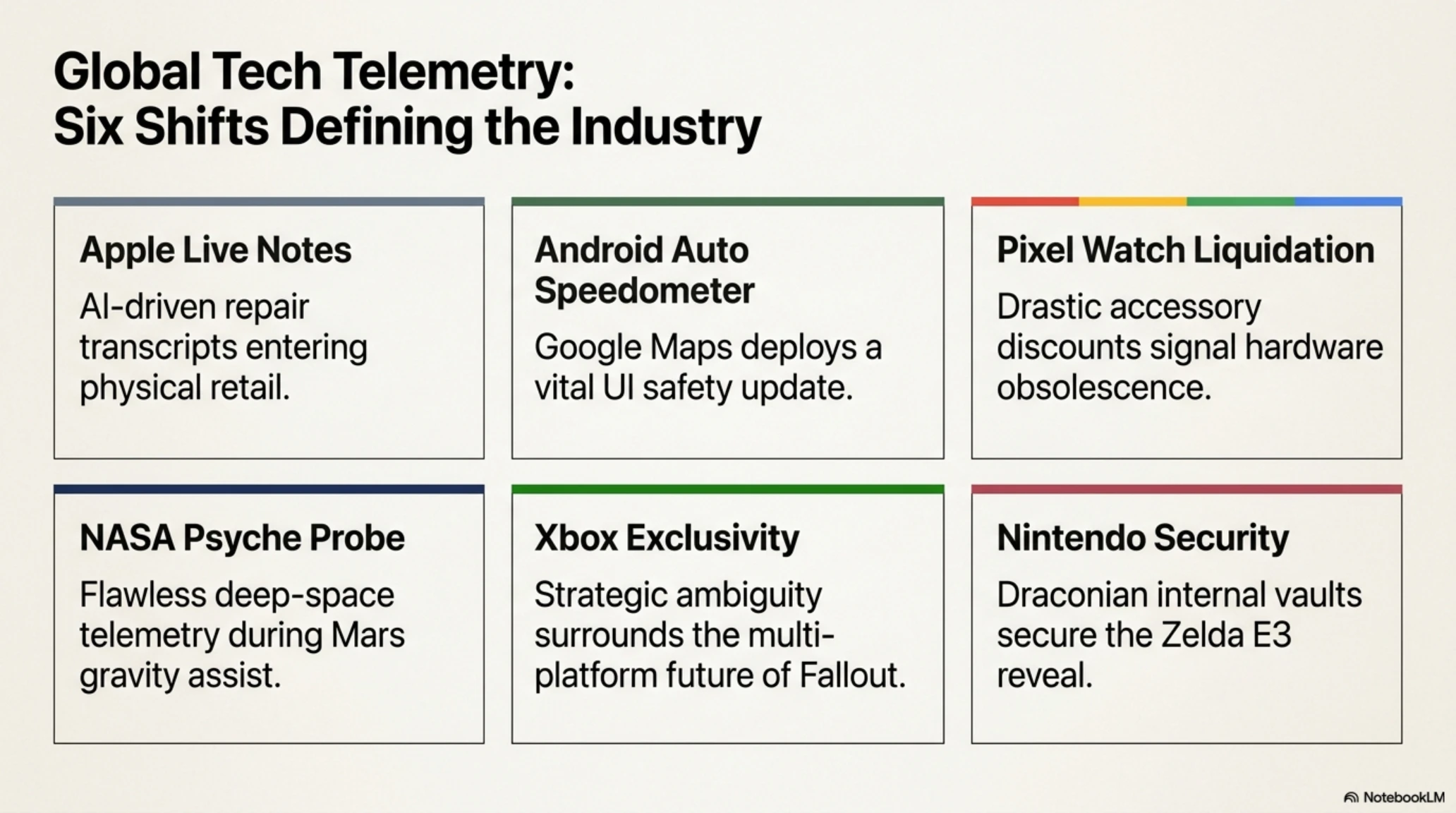
Today's Tekin Morning dissects 6 massive tech stories. We explore Apple's Live Notes AI testing at Genius Bars and Google Maps' crucial speedometer update for Android Auto. Plus, a massive Pixel Watch band sale, NASA's stunning Mars timelapse, Microsoft's ambiguous Xbox exclusivity strategy, and Nintendo's extreme secrecy.
Tekin Morning, July 20, 2026: Apple's AI Genius and Android Auto's Vital Upgrade
Good Monday morning! Join us in today's Tekin Morning as we analyze the top 6 hot news items of the past 24 hours.
- 🎮Apple's AI- Testing the Live Notes system in Genius Bars to record repair conversations.
- 🎧Android Auto Update- Crucial release of the live speedometer feature in Google Maps.
- 🚀Pixel Watch Sale- Massive price drops and exceptional discounts on official Pixel Watch bands.
- 🗡️NASA's Masterpiece- Stunning space timelapse of the Red Planet recorded by the Psyche spacecraft.
- 📰Xbox's Silence- Microsoft's continued silence regarding the multiplatform release of Fallout games.
- 🎮Nintendo's Security- Revealing Nintendo's obsessive security measures to keep the Zelda title a secret.
What are we reading in today's Tekin Morning?
- Initiation of testing for the AI-based Live Notes system in Genius Bars to record repair interactions.
- Release of the crucial live speedometer display update in Google Maps for Android Auto users.
- Severe price drops and an exceptional sale on official Google Pixel smartwatch bands.
1. Apple is Listening: Live Notes System Testing Begins at the Genius Bar
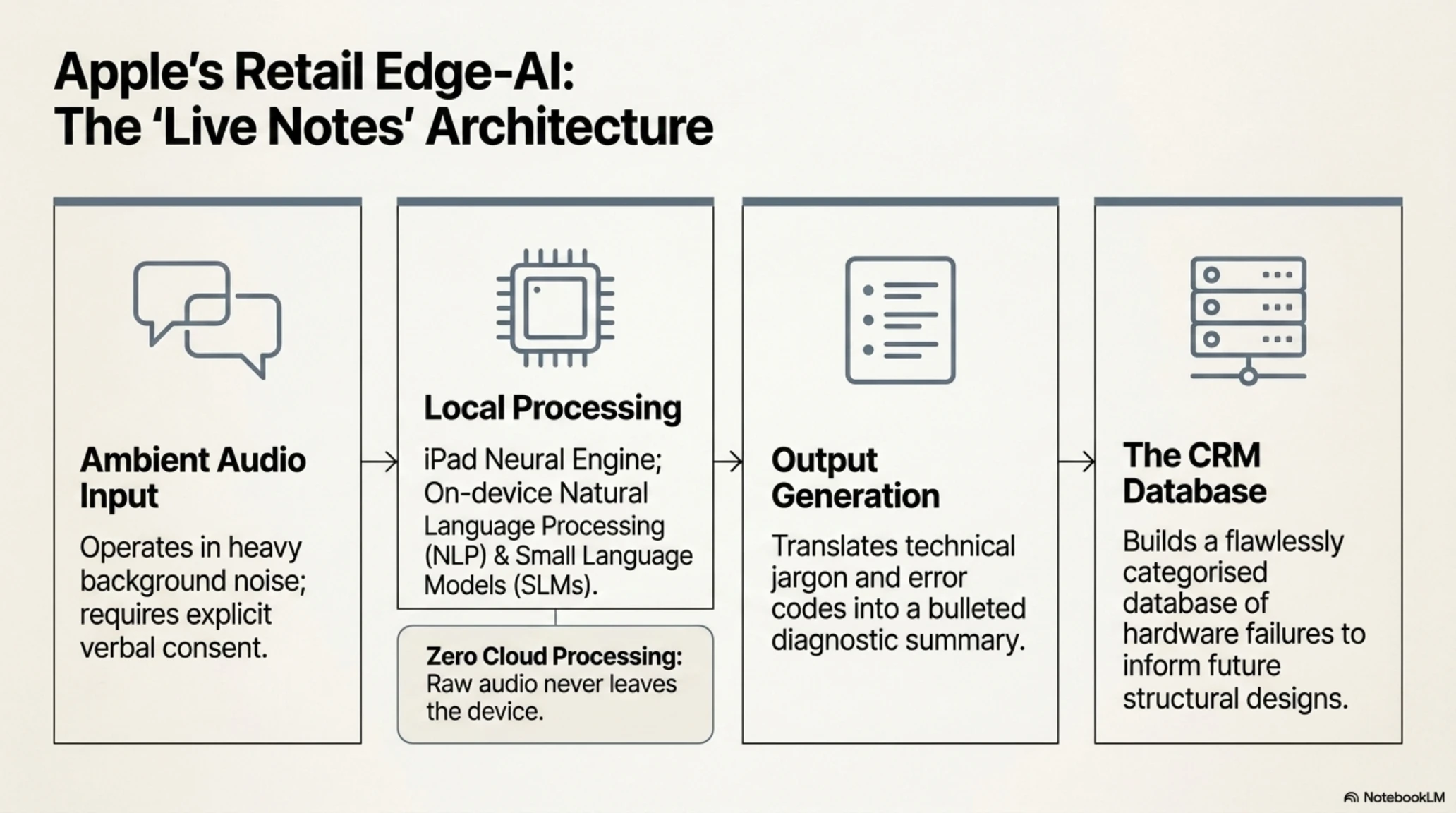
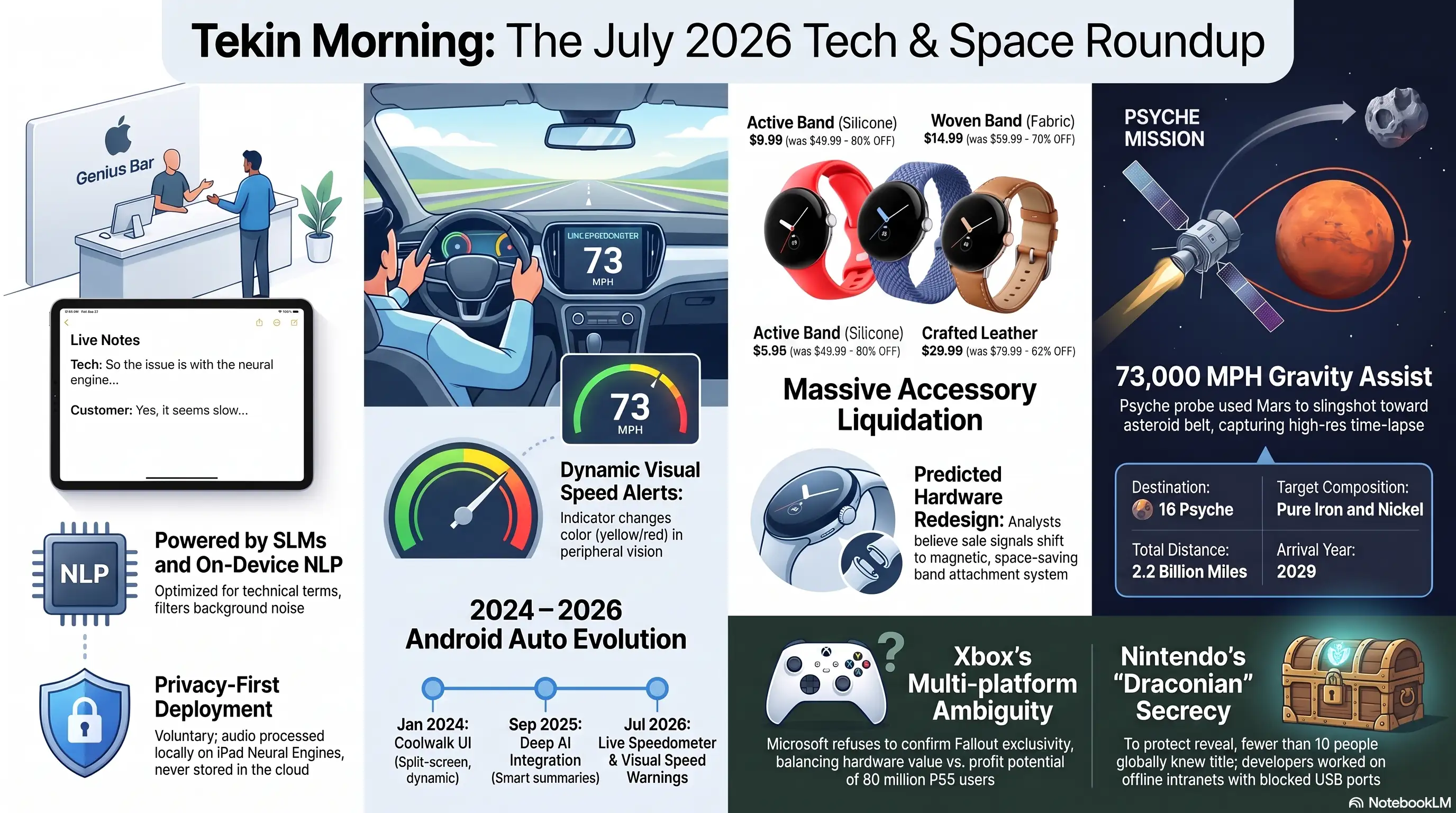
Physical Apple Stores have always stood as the absolute pinnacle of a flawless consumer retail experience, but it appears the Cupertino giant is now turning to Artificial Intelligence to elevate this experience even further. According to highly credible reports, Apple is currently beta-testing an advanced AI-driven system dubbed "Live Notes" across select Genius Bar locations. The primary objective of this system is to automatically record, transcribe, and intelligently summarize technical conversations between Apple technicians and customers seeking hardware repairs. This seemingly minor operational tweak signals a massive paradigm shift in how Apple manages and leverages customer voice data.
Before this rollout, Genius Bar employees were forced to manually type critical diagnostic notes on their iPads while simultaneously speaking with the customer and troubleshooting the device. This antiquated process was not only incredibly time-consuming but also severely hindered the technician's ability to maintain meaningful eye contact and build rapport. Anxious customers, bringing in their damaged MacBooks or iPhones, often found themselves interacting with technicians whose focus was split between the conversation and their keyboards. The Live Notes system is meticulously designed to eliminate this exact friction point.
Once activated, the AI silently monitors the entire conversation, transcribes it into text with remarkable accuracy, and ultimately generates a highly structured, bulleted summary detailing the specific hardware issue and the proposed solutions. This summary is then instantly saved directly into the customer's permanent repair file. Beyond drastically improving response times, this process enables Apple to organically build a massive, flawlessly categorized database of common hardware failures. Industry analysts strongly believe that this structured data will eventually be utilized to significantly improve the structural design of vulnerable components in future generations of iPhones and MacBooks.
Jargon Buster: How exactly does the Live Notes AI work?
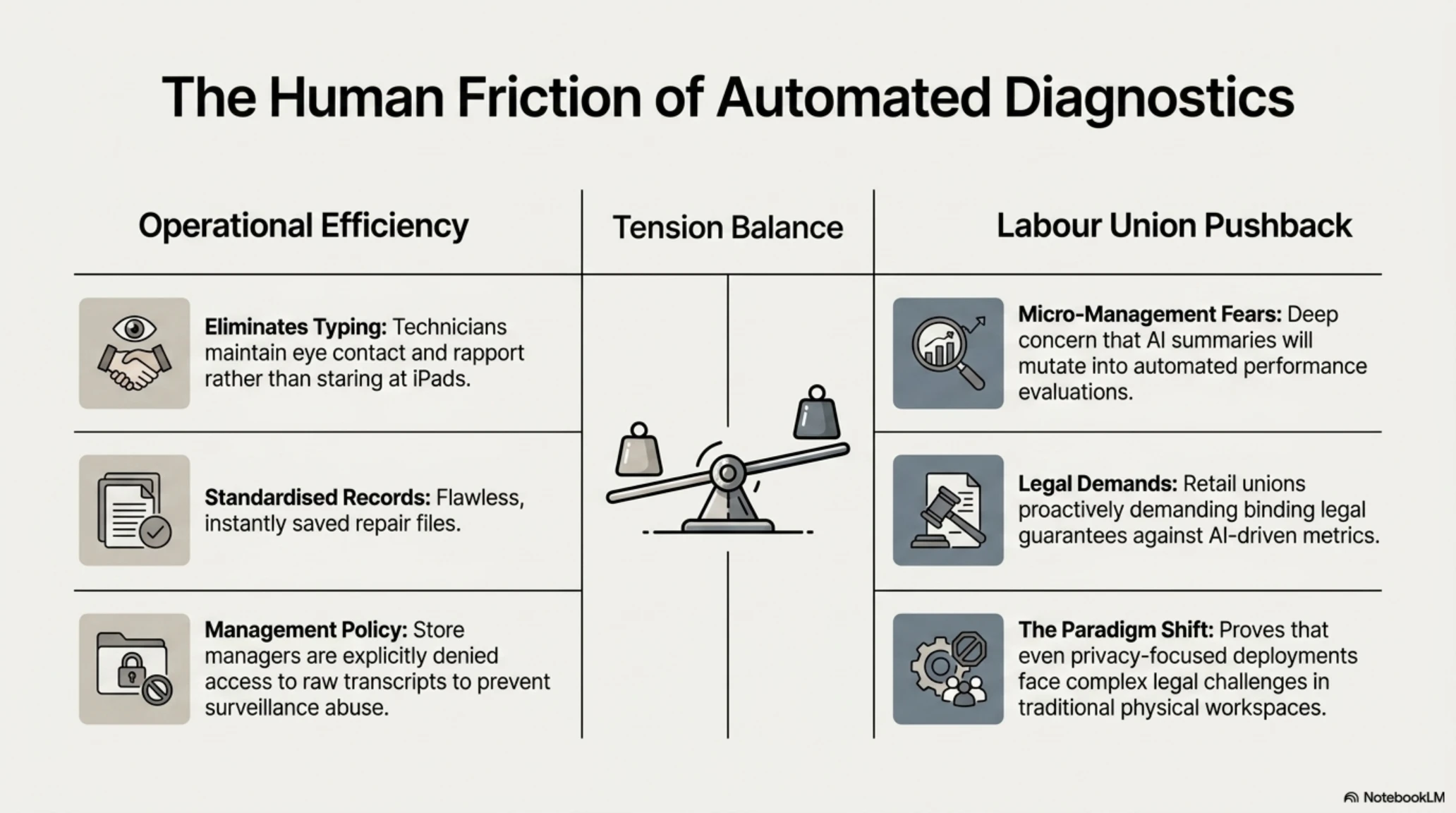
Naturally, the issue of consumer privacy remains at the absolute forefront of Apple's deployment strategy. Participation in the Live Notes program is currently strictly voluntary, requiring both the employee and the customer to provide explicit verbal consent before any recording begins. Apple has vehemently emphasized that the raw audio files are never uploaded or stored on any cloud servers; all processing occurs entirely on the local Neural Engine of the store's iPads. Furthermore, store managers are explicitly denied access to the raw transcripts, a measure implemented to strictly prevent potential workplace surveillance abuses.
Despite these assurances, a growing contingent of retail employees remains deeply concerned that this technology will eventually mutate into a tool for micro-management and automated performance evaluations. Apple labor unions in the affected stores have proactively submitted formal letters demanding binding legal guarantees to prevent employees from being evaluated by AI metrics. This emerging conflict clearly demonstrates that integrating AI into traditional physical workspaces, even for a privacy-focused company like Apple, will inevitably present complex human and legal challenges.
Tekin Strategic Analysis: Beyond a Simple Assistant
2. The Dashboard Speedometer: Android Auto Finally Reaches Maturity
In the realm of software design, sometimes the addition of the smallest, most obvious features can trigger the most profound improvements in daily user experience. Android Auto users have patiently waited years for an incredibly simple yet absolutely vital capability: the display of a live, real-time vehicle speedometer directly on the Google Maps navigation screen. Now, in late July 2026, Google has finally initiated a widespread global rollout of this highly anticipated feature; a capability that had bizarrely existed in the mobile version of Google Maps, and even on the rival Apple CarPlay platform, for a very long time.
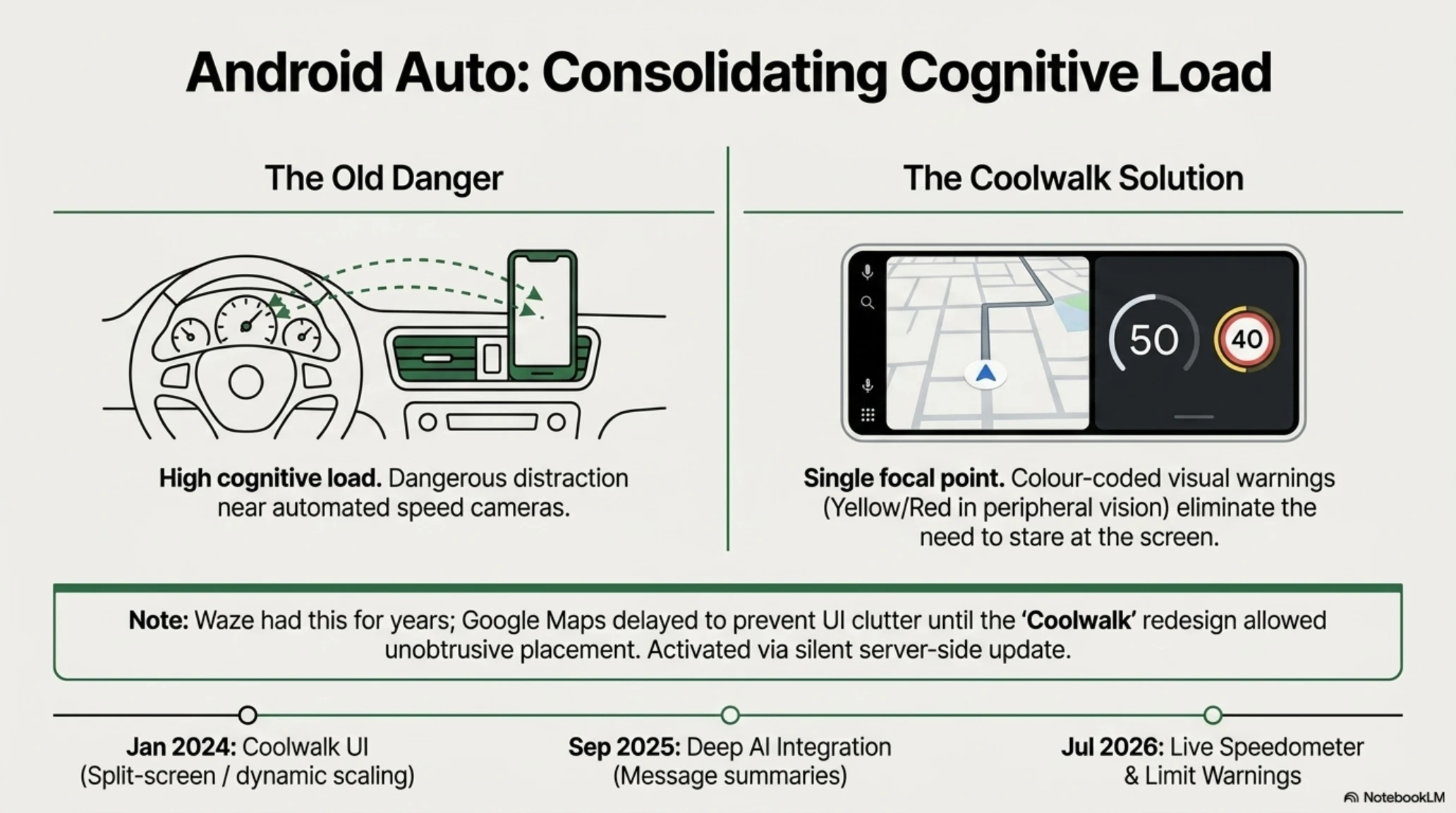
The prolonged absence of this feature in Android Auto was always a source of immense frustration for drivers. While users could easily view their speed on their smartphone screens, physically connecting that same phone to the much larger infotainment display of their car inexplicably hid this critical data point. Countless drivers were forced to constantly dart their eyes between the Android Auto navigation map and the traditional analog speedometer on their dashboard, a dangerous distraction, especially when navigating unfamiliar roads littered with automated speed cameras.
This critical new feature is currently being activated via a silent, server-side update, meaning users do not need to manually download a new version of the application from the Play Store. Upon entering the vehicle and setting a destination in Google Maps, a small, highly legible digital speedometer now automatically appears in the lower corner of the car's display. This precise number is calculated using the smartphone's highly accurate GPS data, which is frequently far more precise than the vehicle's built-in speedometer (which often incorporates a deliberate margin of error).
Crucially, this new digital speedometer is positioned directly adjacent to the posted speed limit icon for the current road. Google's design brilliance shines in the implementation of visual alerts: if the vehicle's speed exceeds the legal limit, the speedometer indicator dynamically changes color (to yellow or red) to provide an immediate visual warning. This color-coded feedback is specifically engineered to be easily recognizable even in the driver's peripheral vision, entirely eliminating the need to stare directly at the screen.
Why It Matters for Drivers
While the Waze application (which is also wholly owned by Google) has offered this exact functionality in its Android Auto version for several years, the inexplicable delay in bringing it to Google Maps remained a mystery. UI experts strongly suspect this delay was caused by Google's strict design guidelines, aimed at preventing the Android Auto interface from becoming overly cluttered and distracting. Now, following the recent UI optimizations introduced with the "Coolwalk" redesign, this speedometer has finally found its perfect, unobtrusive placement.
Evolution of Key Android Auto Features (2024 - 2026)
- January 2024: Introduction of the Coolwalk UI (Split-screen support and dynamic scaling for all vehicle display sizes).
- September 2025: Deep AI Integration (Addition of smart, concise summaries for long incoming messages while driving).
- July 2026: Live Speedometer Addition (Real-time GPS speed display and visual speed limit warnings within Google Maps).
3. Google's Massive Fire Sale: A Golden Opportunity for Pixel Watch Owners
Since their initial launch, Google Pixel smartwatches have successfully carved out a unique and highly respected niche in the fiercely competitive wearable gadget market. Their beautiful circular design, deep and seamless integration with Fitbit health services, and the incredibly fluid Wear OS user interface have cultivated a very loyal fanbase. However, one of the most significant and consistent criticisms leveled against this ecosystem has always been the exorbitant pricing of its official bands. In an effort to maintain a premium aesthetic and high build quality, Google initially released its official bands with hefty price tags ranging from $50 to $80, making them financially unjustifiable for many casual users.
This aggressive premium pricing strategy inadvertently spawned a massive grey market flooded with cheap, counterfeit bands. Third-party manufacturers saturated platforms like Amazon with highly affordable alternatives. Unfortunately, the notoriously poor quality of the locking mechanisms on these cheap knock-offs often led to disastrous consequences, with watches frequently detaching from wrists and shattering their expensive domed glass on the pavement. However, the fantastic news is that during this year's massive summer sale, Google has applied unprecedented, heavy discounts across its entire range of official accessories, desperately attempting to lure buyers back into the safety of its official ecosystem.
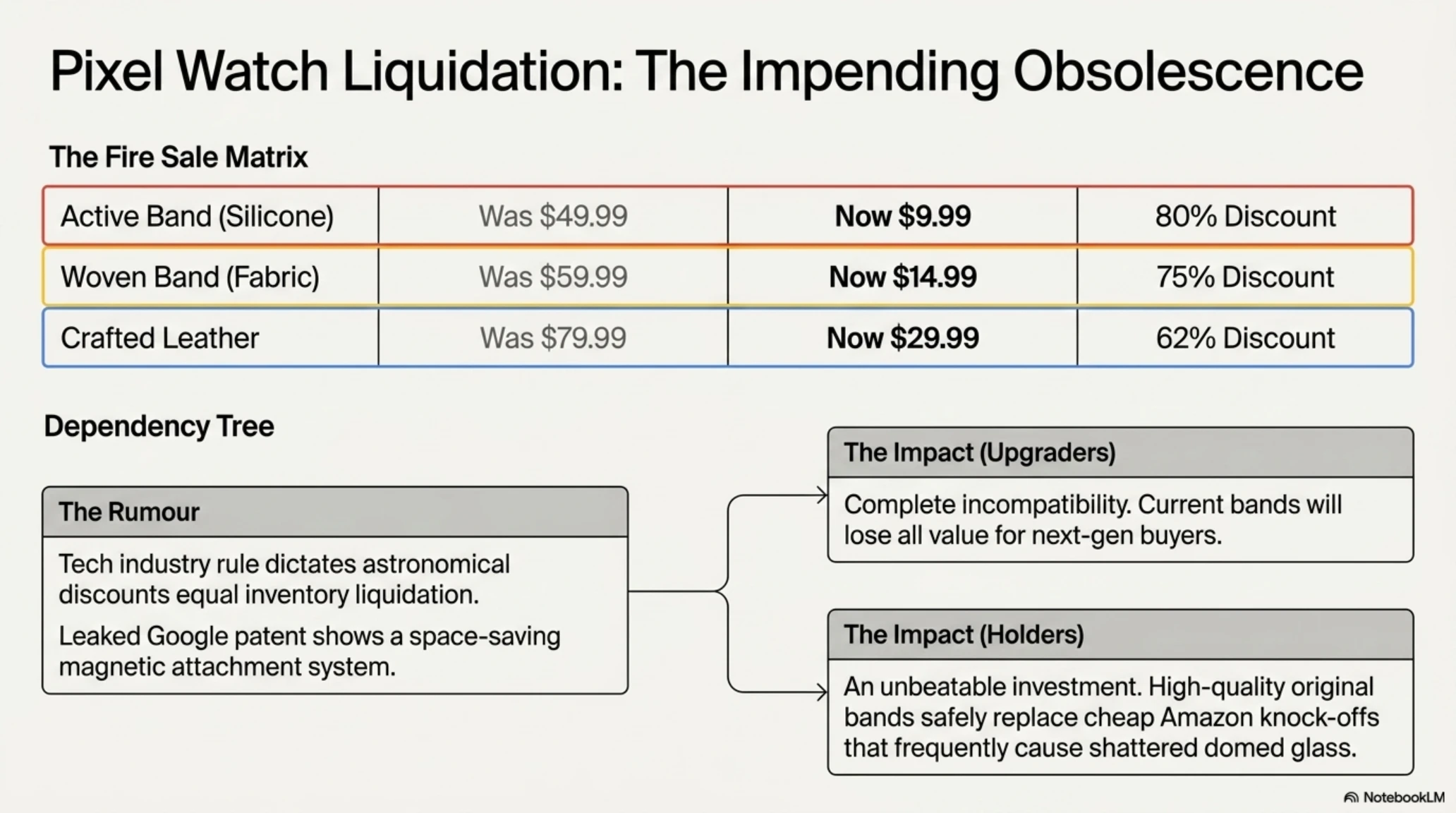
Recent meticulous checks across major retail platforms, as well as the official Google Store itself, reveal that several premium official Pixel Watch bands have experienced severe price drops, now starting at an incredibly tempting base price of around $10. These massive discounts apply to the rugged, water-resistant Active Bands, the incredibly comfortable Woven Bands designed for sleep tracking, and even select models of the premium Crafted Leather bands. This represents a truly exceptional opportunity for existing users looking to safely diversify their wearable style.
Official Pixel Watch Band Price Comparison (Pre and Post Sale)
| Band Type | Original Price ($) | Current Sale Price ($) | Discount |
|---|---|---|---|
| Active Band (Silicone) | 49.99 | 9.99 | 80% |
| Woven Band (Fabric) | 59.99 | 14.99 | 75% |
| Crafted Leather | 79.99 | 29.99 | 62% |
However, it is crucial to note that these sudden, drastic price reductions have sparked intense speculation among seasoned hardware analysts. An unwritten rule of the technology industry dictates that whenever a major company ruthlessly liquidates its accessory inventory with astronomical discounts, a fundamental design change in the upcoming product generation is imminent. Many experts now firmly believe that Google is aggressively clearing its warehouses to make way for the next generation of the Pixel Watch, which is heavily rumored to feature a completely redesigned proprietary band attachment system. A recently leaked Google patent strongly suggests they are pursuing a new magnetic mechanism designed to occupy significantly less internal space within the watch body.
If this compelling theory holds true, current bands will be completely incompatible with Google's next-generation smartwatches, entirely losing their purchase value for any user planning to upgrade this coming autumn. Nevertheless, for the millions of users who are currently perfectly happy with their first or second-generation Pixel Watch and have no intention of upgrading anytime soon, this impending obsolescence is irrelevant. Purchasing these high-quality, durable original bands at these historically low prices represents an unbeatable investment for refreshing the look of their current wearable gadget.
4. Dancing with the Red Planet: NASA's Visual Masterpiece from the Psyche Probe
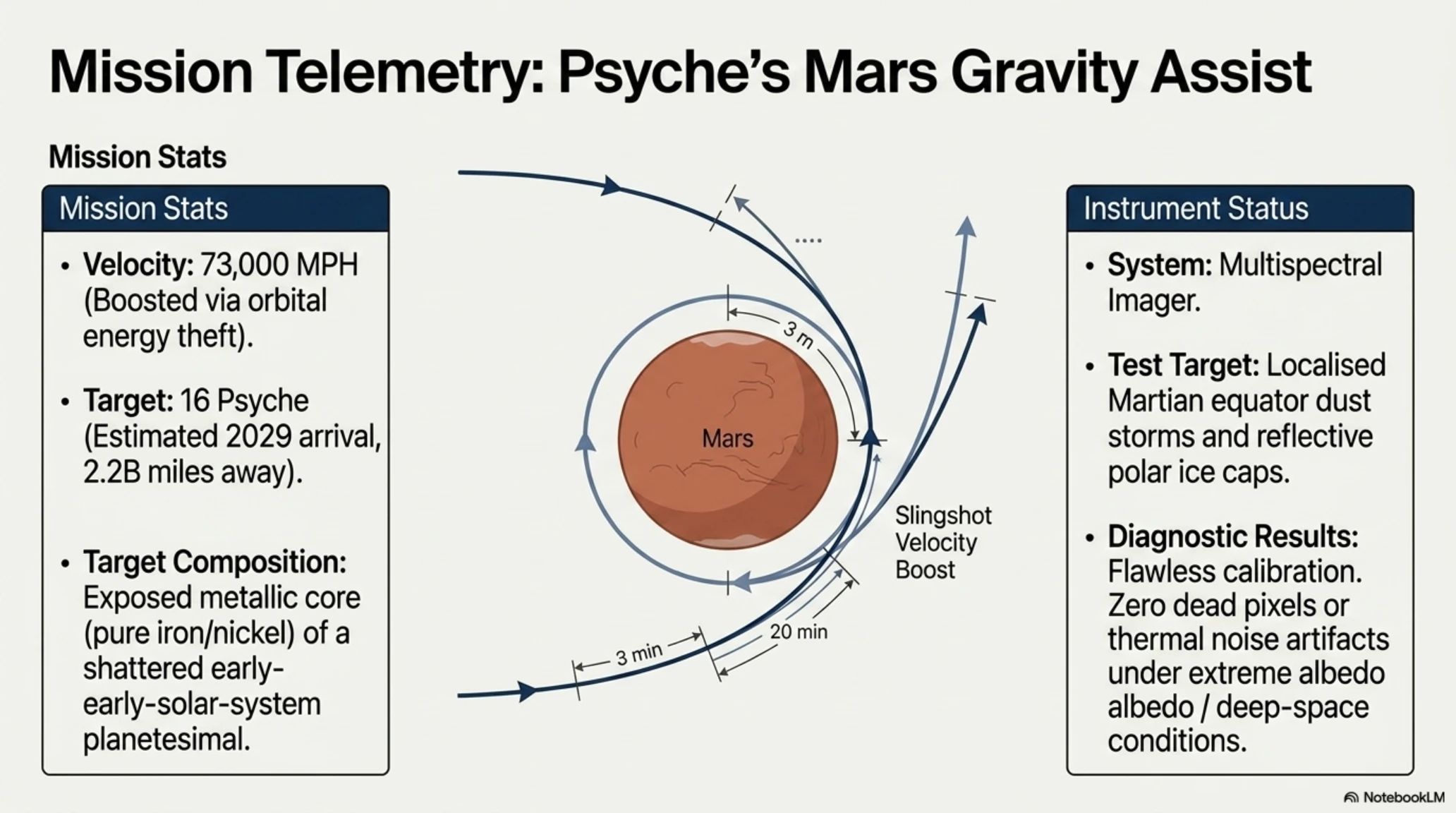
Deep space has always been inherently mysterious and yet terrifyingly beautiful. The NASA space agency has recently released an absolutely astonishing video that showcases this cosmic beauty in its purest, most awe-inspiring form. This breathtaking time-lapse video was captured by the powerful cameras mounted on the Psyche space probe; an ambitious spacecraft that recently executed a daring flyby of Mars on its long, cold, and highly complex journey toward the main asteroid belt of our solar system. The primary purpose of this close encounter was to utilize the immense gravitational pull of Mars to drastically increase the probe's velocity—a maneuver known as a Gravity Assist or gravitational slingshot.
The Gravity Assist maneuver remains one of the most incredibly complex and precise orbital operations in modern aerospace engineering. The spacecraft approaches the planet at a highly calculated, precise angle, essentially "stealing" a fraction of the planet's orbital energy to massively accelerate its own speed, all without expending its precious, limited onboard fuel reserves. During this breathtaking, high-stakes maneuver, the Psyche probe kept its advanced cameras rolling, resulting in one of the most stunning and visually spectacular recordings in the history of space exploration.
In this captivating time-lapse, Mars is revealed as a glowing, brilliantly red, and incredibly detailed sphere set against the infinite, pitch-black void of deep space. Despite the probe's blistering transit speed, the spacecraft's Multispectral Imager system successfully captured crystal-clear footage of localized dust storms raging across the Martian equator, and even the brilliantly reflective ice caps situated at the planet's poles. These images are not only artistically breathtaking, instantly evoking scenes from high-budget science fiction films, but they also possess immense scientific value for the dedicated engineers back at NASA's Jet Propulsion Laboratory (JPL).
By meticulously analyzing these high-resolution images, the engineering team was able to rigorously test the precise calibration of the cameras long before reaching their final destination. They now possess critical data regarding exactly how Psyche's optical sensors react when confronted with the intense reflection of sunlight from a celestial body with a specific albedo. Furthermore, this real-world test allowed them to verify the complete absence of dead pixels or thermal noise artifacts in the imaging system under extreme deep-space conditions.
The Staggering Statistics of the Psyche Mission
- Total Distance to Target Asteroid: 2.2 Billion Miles
- Estimated Arrival Year: 2029
- Target Asteroid Name: 16 Psyche (Believed to be packed with precious metals)
- Maximum Spacecraft Velocity: 73,000 Miles Per Hour
The ultimate destination of this billion-dollar spacecraft is the ancient and bizarre asteroid known as "16 Psyche"; a colossal celestial body that scientists strongly suspect is the entirely exposed, metallic core of a shattered planetesimal from the very early formation of our solar system. Unlike typical rocky or icy asteroids, Psyche is believed to be composed almost entirely of pure iron and nickel. Since humanity can never physically travel to the molten core of our own Earth, scientists hope that by studying this exposed metallic asteroid, they can unlock the profound secrets of how the Earth's core formed and how it generates our life-protecting magnetic field. Watching this incredible time-lapse of Mars is merely an appetizer for the unprecedented, historic images this probe will transmit back to Earth in the coming years.
5. Xbox's Ambiguous Strategy: Will the Next Fallout be Exclusive?
In the ruthless and intensely competitive world of console gaming, no single word possesses the power to excite fans, guarantee hardware sales, or ignite the fury and despair of user communities quite like "Exclusive." Following the initial, tantalizing announcements of upcoming iterations in the massively popular and deeply rooted Fallout franchise, one critical, burning question has entirely consumed the minds of gamers worldwide: Will these incredibly expensive, highly anticipated titles be playable solely on the Xbox and PC ecosystems? Despite immense, mounting pressure from the gaming press and the insatiable thirst of the PlayStation community for a definitive answer, senior executives at Microsoft Gaming continue to masterfully evade giving a straightforward "yes or no," turning this ambiguity into the industry's biggest rumor mill.
Immediately following Microsoft's historic, staggering $7.5 billion acquisition of Bethesda Softworks and its parent company, ZeniMax Media, the overwhelming industry expectation was that all of the publisher's massive IPs and legendary role-playing games would fall under the absolute exclusivity of the Xbox ecosystem. Blockbuster titles like Starfield and Redfall followed exactly this anticipated trajectory, deployed as Microsoft's heavy artillery to aggressively attract massive new audiences to their flagship Game Pass subscription service. Traditional business logic strongly dictated that an acquisition of this monumental scale must ultimately translate into driving significantly higher hardware sales for the Xbox Series X and S consoles.
However, Microsoft's recent, highly controversial strategic pivot over the past year—specifically the decision to release several of its successful first-party titles (such as Sea of Thieves and Hi-Fi Rush) onto competing hardware platforms like the PlayStation 5 and Nintendo Switch—has completely shattered those traditional expectations and complicated all forecasts. Recent high-profile interviews with Phil Spencer and other key Xbox executives by major outlets like Polygon have been densely packed with diplomatic phrasing and frustratingly ambiguous answers. They steadfastly refuse to explicitly confirm the exclusivity of the Fallout series, nor do they completely rule it out. This calculated behavior strongly suggests a massive, fundamental shift in attitude occurring within the core management team in Redmond.
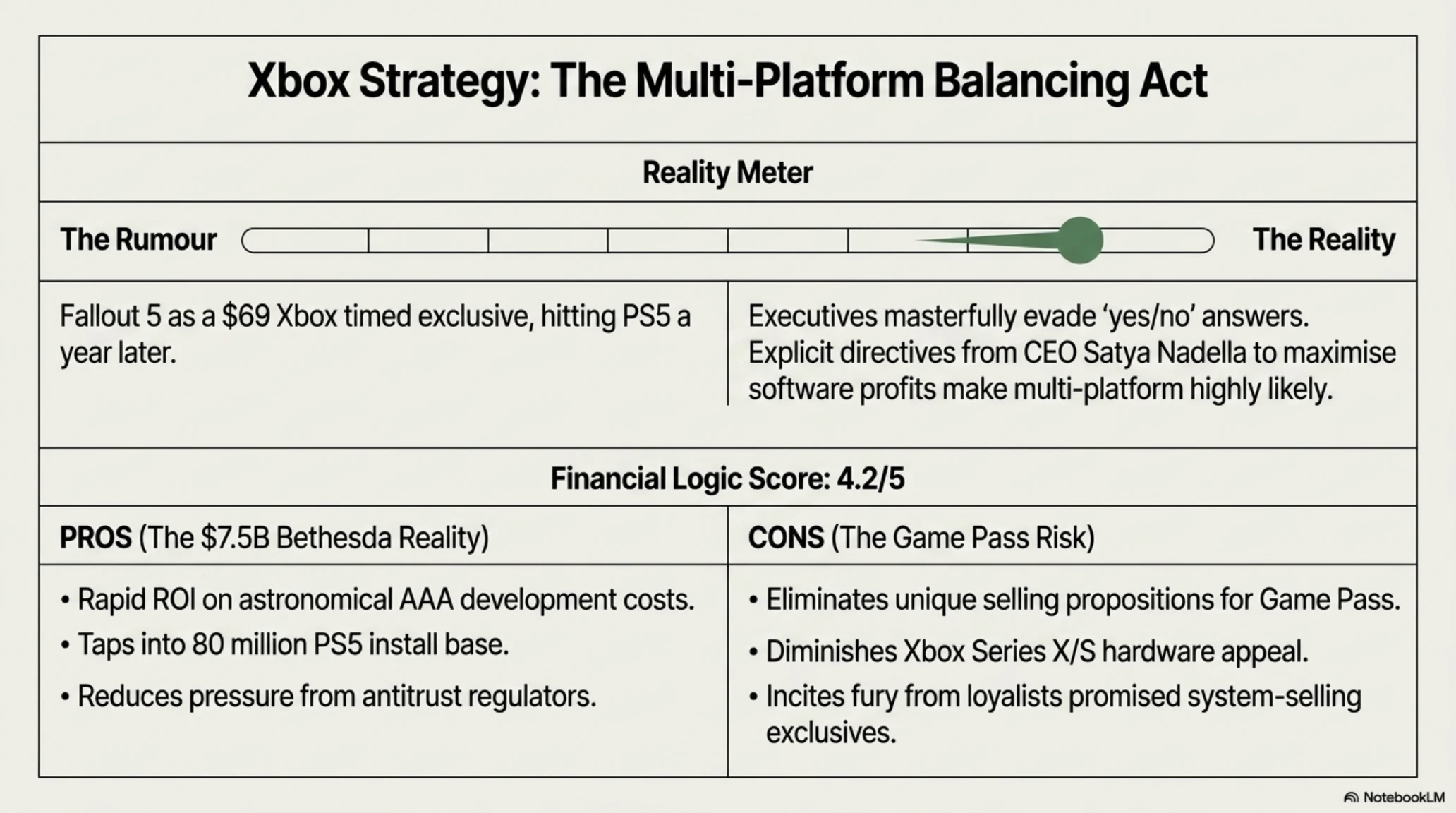
Rumor vs Reality Meter: How likely is a PS5 release for Fallout?
The Reality: Given the explicit directives from Microsoft CEO Satya Nadella to ruthlessly maximize software division profits and to recoup the astronomical development costs of a next-generation RPG, the probability of a multi-platform release is incredibly high.
This deliberate, strategic silence is an incredibly dangerous psychological and media game. On one hand, Xbox desperately wants to avoid prematurely announcing the multi-platform nature of its biggest future titles. Doing so would severely damage the perceived hardware value of their current consoles and inevitably incur the wrath of hardcore fans who specifically purchased an Xbox on the promise of exclusive Fallout and Elder Scrolls experiences. On the other hand, they absolutely need access to the massive, content-hungry install base of 80 million PlayStation 5 users to offset the hundreds of millions of dollars required to develop modern AAA blockbusters. It appears highly likely that this agonizing uncertainty will persist until we are much closer to the game's actual release window.
- Guarantees a massive, immediate increase in software sales by tapping into competing platforms.
- Ensures rapid ROI on development costs, keeping Microsoft's demanding shareholders satisfied.
- Delights the broader gaming community and significantly reduces pressure from antitrust regulators.
- Severely diminishes the hardware value and appeal of Xbox consoles heading into the next generation.
- Eliminates a massive, unique selling proposition needed to attract long-term Game Pass subscribers.
- Incites intense anger from fiercely loyal Xbox fans who were promised major system-selling exclusives.
6. The Ultimate Secret: How Nintendo Hid the Zelda Trailer from Leakers
In an industry where highly confidential project details routinely leak across social media networks, Discord servers, and Reddit forums faster than the speed of light, and where internet leakers have morphed into virtual celebrities, Nintendo has emphatically proven that it remains the undisputed king of corporate secrecy. Thrilling new reports have recently surfaced, detailing the absolute, unprecedented, and frankly insane security measures Nintendo implemented to completely conceal the debut and official title of "The Legend of Zelda: Tears of the Kingdom" prior to its monumental E3 reveal.
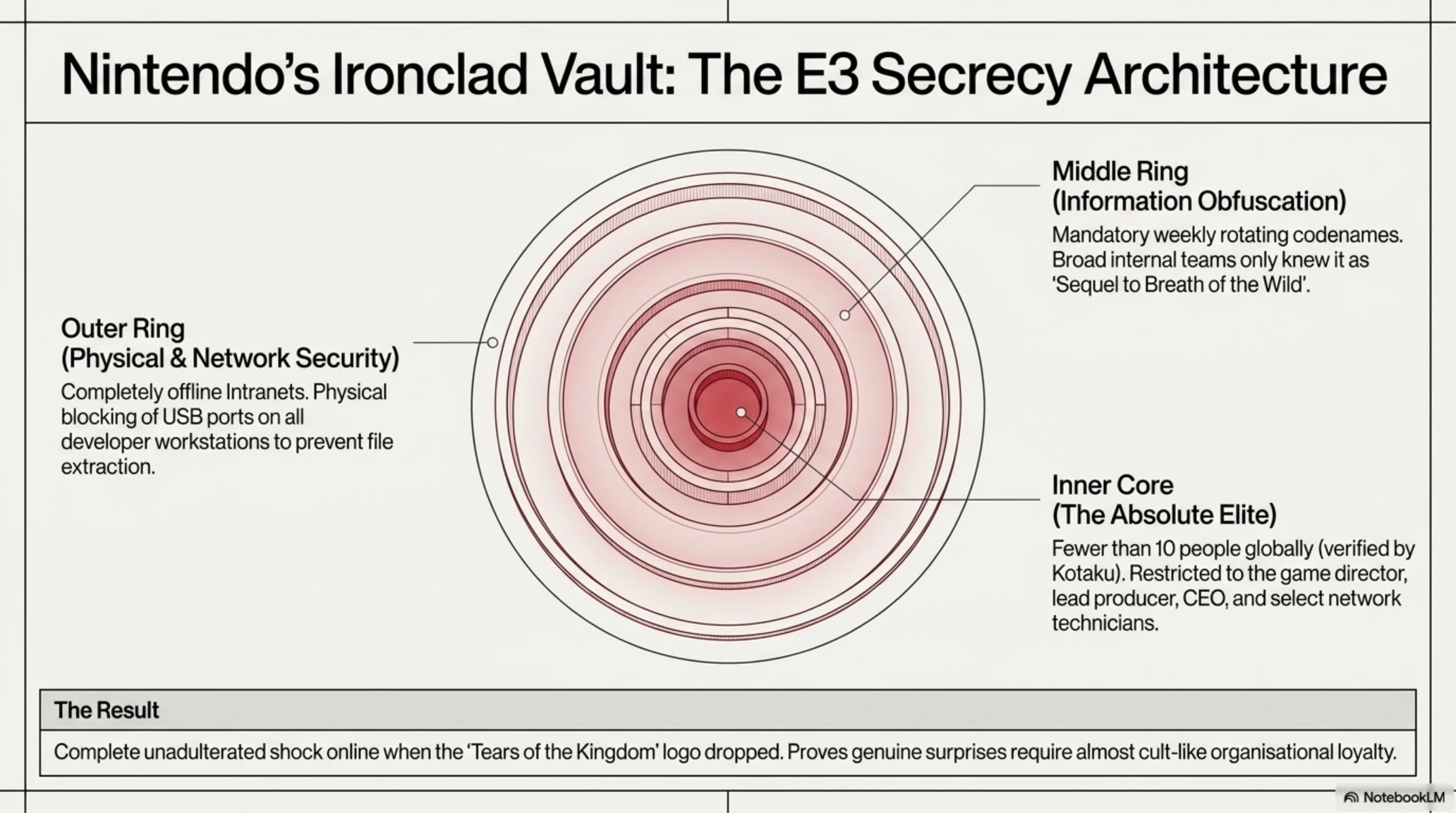
The level of these draconian security protocols was so extreme that even numerous senior executives within the company itself, high-ranking directors at Nintendo of America and Europe, and even the crucial localization teams were kept completely in the dark regarding the game's final title. Internally, the massive project was strictly referred to by the generic codename "Sequel to Breath of the Wild." In an era where highly sensitive video files are effortlessly transferred and hacked via cloud services, Nintendo reverted to highly effective, old-school methods to protect the absolute biggest surprise of their decade.
According to recently leaked internal documents rigorously verified by Kotaku, the total number of individuals across the entire global Nintendo corporation who actually knew the definitive title of the game and the contents of the final trailer numbered fewer than 10 people. This incredibly small, elite group consisted solely of the legendary game director, the lead producer, the company CEO, and a handful of senior network technicians. Maintaining this level of absolute secrecy in the modern digital age seems almost impossible, especially for a colossal title where thousands of employees across various studios were actively working on development, marketing, sound design, and rigorous QA testing.
Nintendo's intense, almost obsessive paranoia yielded truly spectacular results. The very moment the game's official logo faded onto the screen following a cryptic trailer, proudly displaying the words "Tears of the Kingdom," a wave of pure, unadulterated shock and excitement instantly swept across the internet. Not a single leaker had managed to prematurely spoil this historic moment, and the live reactions from passionate fans around the globe were truly unparalleled. This incredible event serves as a powerful reminder to all game development companies that experiencing a genuine surprise in the gaming industry is still one of the most magical and rewarding experiences possible—an experience achieved only through professional secrecy and unwavering organizational loyalty.
Tekin Morning's Final Thoughts
Frequently Asked Questions (FAQ)
Does Apple's new Live Notes system secretly store my voice recordings?
No, according to Apple's strict privacy claims, the system processes ambient audio entirely on-device in real-time and immediately converts it to text; therefore, absolutely no raw audio files are ever saved or uploaded to cloud servers.
How can I activate the new live speedometer feature in Android Auto?
This highly anticipated feature is currently being activated via a server-side update, meaning it requires no manual action on your part. If you are running the latest version of Google Maps, the icon will soon automatically appear on your car's dashboard display.
Will my older, first-generation Pixel Watch bands work on future models?
Google has not yet made an official announcement, but recent hardware rumors and leaked patents strongly indicate that future generations may adopt a completely different, space-saving magnetic attachment system, rendering older bands incompatible.
What is the exact scientific goal of NASA's Psyche spacecraft mission?
This ambitious spacecraft aims to rendezvous with the asteroid 16 Psyche, which scientists believe possesses a completely metallic core. By studying it, they hope to unlock the profound secrets surrounding the formation of Earth's own core.
Is it confirmed that Fallout 5 will eventually be released on PlayStation?
Microsoft has stubbornly refused to officially declare its precise exclusivity policy for this specific game, but given the company's recent, highly controversial trend of releasing major titles on competing platforms, the probability is considered extremely high.
How did Nintendo successfully keep the Zelda trailer a total secret?
They achieved this through draconian measures: utilizing completely offline internal networks (Intranets), severely restricting access for senior executives to fewer than 10 people, and physically blocking data outputs like USB ports on studio computers.
Sources and References
Live speedometer finally added to Google Maps in Android Auto
Google offers exceptional discounts on official Pixel Watch bands
NASA's visual masterpiece: Mars timelapse from the Psyche probe
Xbox's ambiguous strategy regarding the exclusivity of the new Fallout
How Nintendo successfully hid the Zelda trailer from leakers
Additional Gallery: Tekin Morning July 20, 2026: Apple AI, Android Auto & Xbox Silence