Tekin Night: Sep 19, 2026
The definitive Saturday night gaming dossier: dissecting the 192GB Rockstar Games leak, Nintendo Switch 2 breaking 20M sales, and Kojima's star-studded PHYSINT partnership.
- 🎮192GB Rockstar Source Leak- Uncovering scrapped Liberty City map expansion code and the full Agent Trevor DLC
- 🎧Switch 2 Smashes 20M Mark- Fastest-selling console hardware milestone in US history alongside Ocarina of Time Remake
- 🚀Kojima Teams with Bill Skarsgård- John Wick 4 star confirmed as lead protagonist in PHYSINT under Xbox publishing agreement
- 🗡️Mads Mikkelsen in Modern Warfare 4- Acclaimed actor unveiled as ruthless campaign antagonist The Archer for Oct 2026 launch
- 📰Bungie Crushes Marathon Hoax- Creative Director categorically refutes viral rumors claiming Marathon merger into Destiny 2
- ⚔️Monster Hunter Wilds Switch 2- Capcom locks 30 FPS target with 1260p docked DLSS and 864p handheld profiles
As midnight settles across the international gaming landscape on Saturday, September 19, 2026, the interactive entertainment industry is pulsing with monumental revelations. Far from winding down into weekend silence, engineering channels, developer discords, and Tokyo Game Show stages have ignited with classified source code dumps, seismic corporate publishing shifts, and star-studded Hollywood casting announcements. Tonight's Tekin Night briefing delivers an exhaustive, forensic exploration into the clandestine design decisions, hardware milestones, and narrative masterclasses shaping the frontier of tenth-generation gaming.
For discerning gamers, systems architects, and interactive media analysts, this nocturnal broadcast represents an exhilarating journey through the architectural underbelly of modern gaming. When traditional newsrooms power down, late-night disclosures frequently expose the authentic tensions operating behind boardroom doors. From decade-old discarded source code that reshapes our comprehension of open-world development to cutting-edge silicon benchmarks pushing mobile hybrid hardware to its physical zenith, tonight’s dossier encapsulates the dynamic vitality of our medium.
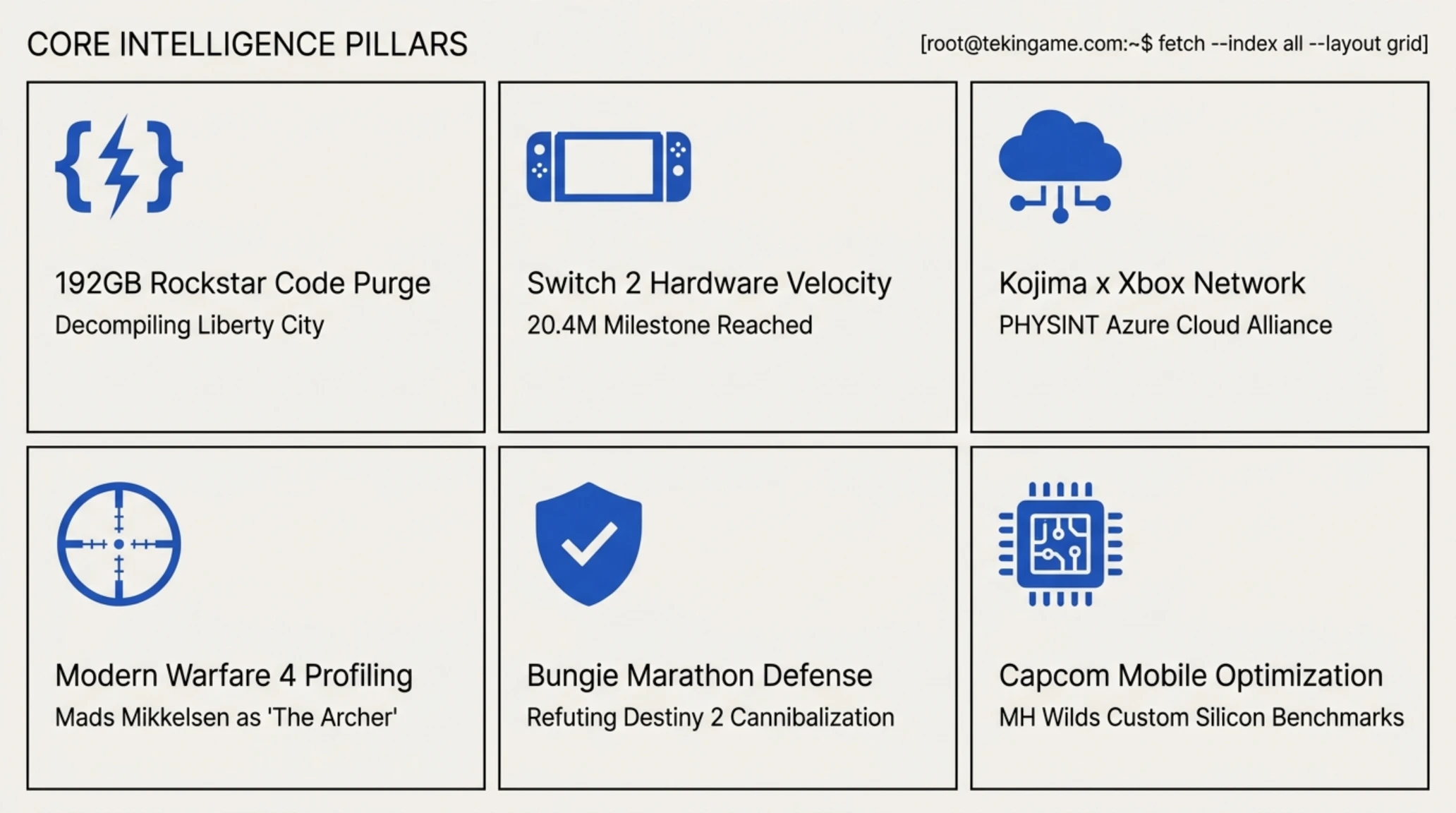
To establish our strategic coordinates before descending into binary dissections and primary executive statements, the following comprehensive briefing outlines the six definitive developments defining interactive entertainment at the close of this historic week.
Nocturnal Synthesis: Six Strategic Developments Defining Saturday Night
- Forensic verification of a 192-gigabyte internal development leak confirming Rockstar North’s cancelled Liberty City expansion and the James Bond-inspired Agent Trevor narrative campaign
- Official confirmation that Nintendo Switch 2 has surpassed 20 million consumer hardware sales in under 300 days, paired with executive confirmation of the symphonic Zelda: Ocarina of Time Remake
- Hideo Kojima’s dramatic Tokyo Game Show reveal establishing IT and John Wick 4 star Bill Skarsgård as the lead protagonist for PHYSINT under a landmark Xbox Game Studios partnership
- Activision Blizzard’s blockbuster cinematic reveal of Mads Mikkelsen as villain The Archer in the intense Korean DMZ campaign of Call of Duty: Modern Warfare 4
- Bungie Creative Director Julia Nardin issuing an unequivocal, comprehensive repudiation of viral community fabrications alleging the cancellation of Marathon or its absorption into Destiny 2
- Capcom’s comprehensive technical disclosure confirming locked 30 FPS, dual docked rendering profiles, dynamic 864p handheld performance, and cross-platform architecture for Monster Hunter Wilds on Switch 2
The developer command terminal below captures the high-resolution code inspection environments utilized by digital forensics specialists analyzing the decompiled Rockstar Games repositories late Saturday evening.

The evening’s most explosive narrative emerges from the reverse-engineering community, where an unprecedented 192-gigabyte repository of pristine development assets, internal communications, and uncompiled C++ modules has laid bare the secret history of Grand Theft Auto V and the strategic pivot toward Grand Theft Auto Online.
The Historic 192GB GTA 5 Source Code Leak: Deconstructing the Scrapped Liberty City Map and Agent Trevor DLC
The video game preservation and reverse-engineering ecosystem experienced an earthquake of unprecedented magnitude over the past twenty-four hours. A massive, unredacted 192-gigabyte data repository originating from internal Rockstar North development mirrors was published across decentralized file networks. Unlike previous fragmented script snippets or watermarked developmental videos, this colossal archive encompasses full mission scripting logic, high-fidelity uncompressed voice capture sessions with the original cast, geographical heightmap meshes, and uncompiled rendering pipelines dating from late 2013 through early 2016.
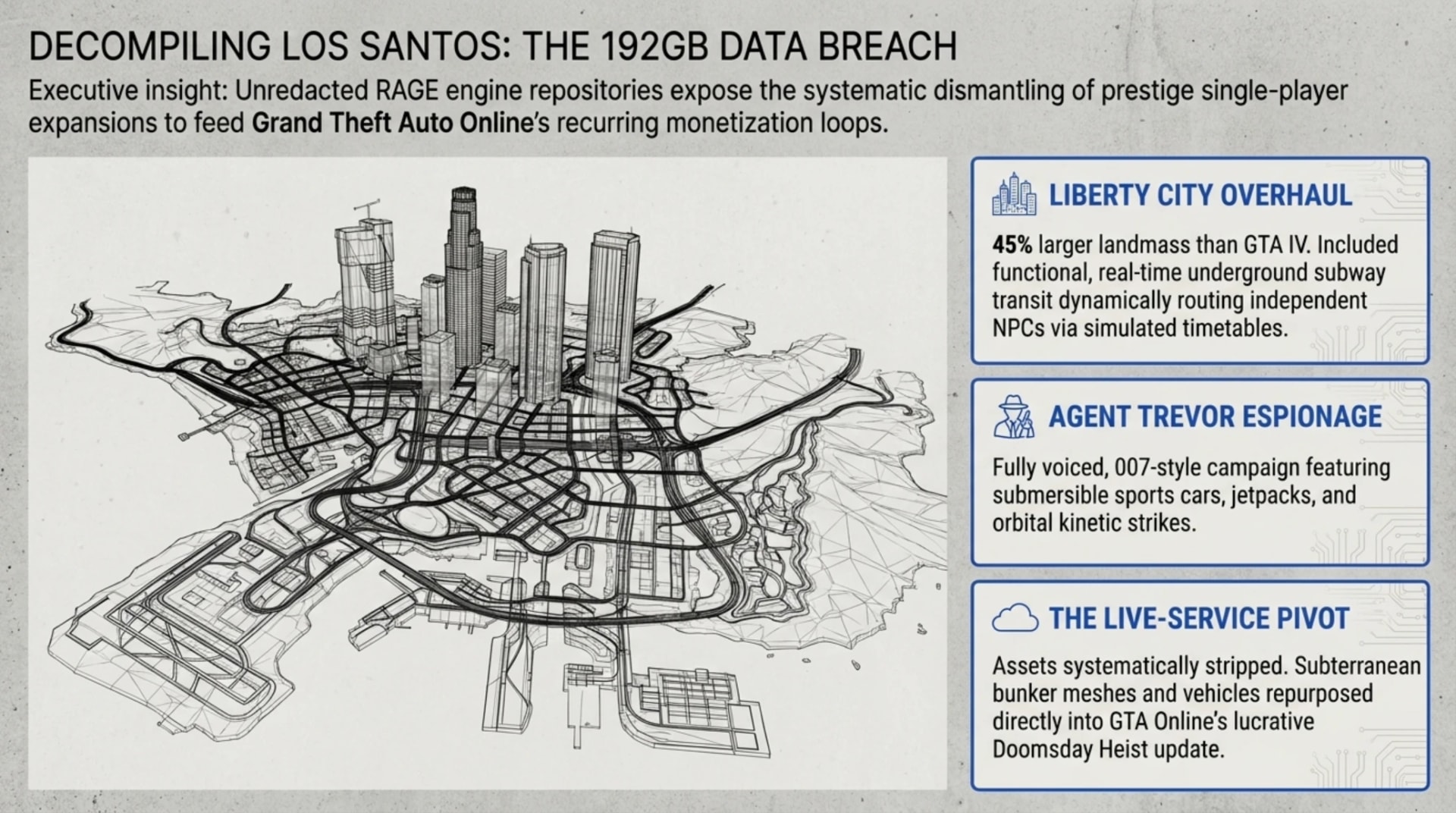
The crown jewel of this forensic treasure trove is the definitive confirmation of the long-rumored, legendary Liberty City Map Expansion DLC. According to extracted geospatial asset manifests and shoreline spline vectors, Rockstar’s engineering teams across Edinburgh and San Diego had progressed significantly beyond mere conceptual planning. The team had successfully engineered a modernized iteration of Liberty City inside the 64-bit RAGE engine, spanning a landmass approximately 45 percent larger than its 2008 Grand Theft Auto IV predecessor. The map encompassed expanded boroughs, an extensive upstate New York rural territory, simulated New Jersey industrial zones, and a fully functional, real-time underground subway transit system capable of dynamically routing hundreds of independent non-player characters.
Decompiled mission scripting modules, designated internally as `dlc_liberty_heist.rpf`, reveal a narrative arc occurring in the immediate aftermath of the Union Depository heist. Michael De Santa, Franklin Clinton, and Trevor Philips were slated to travel eastward to orchestrate an audacious international money laundering scheme, colliding violently with reconstituted Italian-American crime syndicates and remnants of the Pegorino and Ancelotti families from Niko Bellic's era. The project utilized an ingenious, asynchronous memory paging system designed to allow instantaneous transit between Los Santos and Liberty City via commercial airline sequences or private jet charter cutscenes without triggering disruptive static loading screens.
Simultaneously, the leaked archive documents an equally audacious standalone expansion titled Agent Trevor. In this high-octane espionage narrative, the International Affairs Agency (IAA) blackmails and recruits Trevor Philips into an unsanctioned foreign intelligence black-ops unit. Channeling classic cold-war cinematic tropes through Trevor’s unhinged psychological lens, the expansion featured submersible sports cars, functional jetpacks, orbital kinetic strike satellites, and high-altitude halo-jumping infiltration missions. Tragically for narrative enthusiasts, internal production memos confirm that when Grand Theft Auto Online generated historic, unanticipated multi-billion-dollar recurring revenues via microtransactions, studio executive leadership systematically dismantled the single-player expansion teams, repurposing the 3D assets, vehicles, and subterranean military bunker meshes directly into GTA Online's lucrative Doomsday Heist update.
Decompilation of the memory allocation routines demonstrates that while seventh-generation console memory limits (the 512MB RAM barrier of the PlayStation 3 and Xbox 360) originally constrained cross-continental map streaming, the transition to eighth-generation x86 hardware had resolved these bottlenecks. Nevertheless, corporate calculus prioritized the perpetual live-service monetization machine over narrative closure. For the interactive media community, these unsealed files stand as an enduring monument to the single-player masterpieces that were sacrificed on the altar of recurring microtransaction revenue.
Further investigation of the uncompiled RAGE script manifests reveals an extraordinarily sophisticated dynamic pedestrian scheduling system that Rockstar had engineered exclusively for the Liberty City expansion. Unlike the somewhat randomized crowd populations of the base game, the expanded metropolitan grid utilized real-time commuter density algorithms calibrated to simulated subway timetables, weather conditions, and commercial district work shifts. Pedestrians would realistically congregate on elevated subway platforms in Brooklyn, board passing commuter trains, and disembark in lower Manhattan, creating a living urban simulation that was nearly a decade ahead of its time.
For modern game engine researchers, the unredacted C++ headers and procedural physics libraries represent an invaluable pedagogical archive. The data demonstrates how Rockstar's core physics engineers tackled the profound challenges of multi-threaded vehicle deformation and aerodynamic wake turbulence on early eighth-generation console architectures. Rather than being viewed merely through the lens of industrial controversy, digital historians and software preservationists increasingly regard this unauthorized disclosure as one of the most significant empirical windows into AAA software engineering culture ever made accessible to the public.
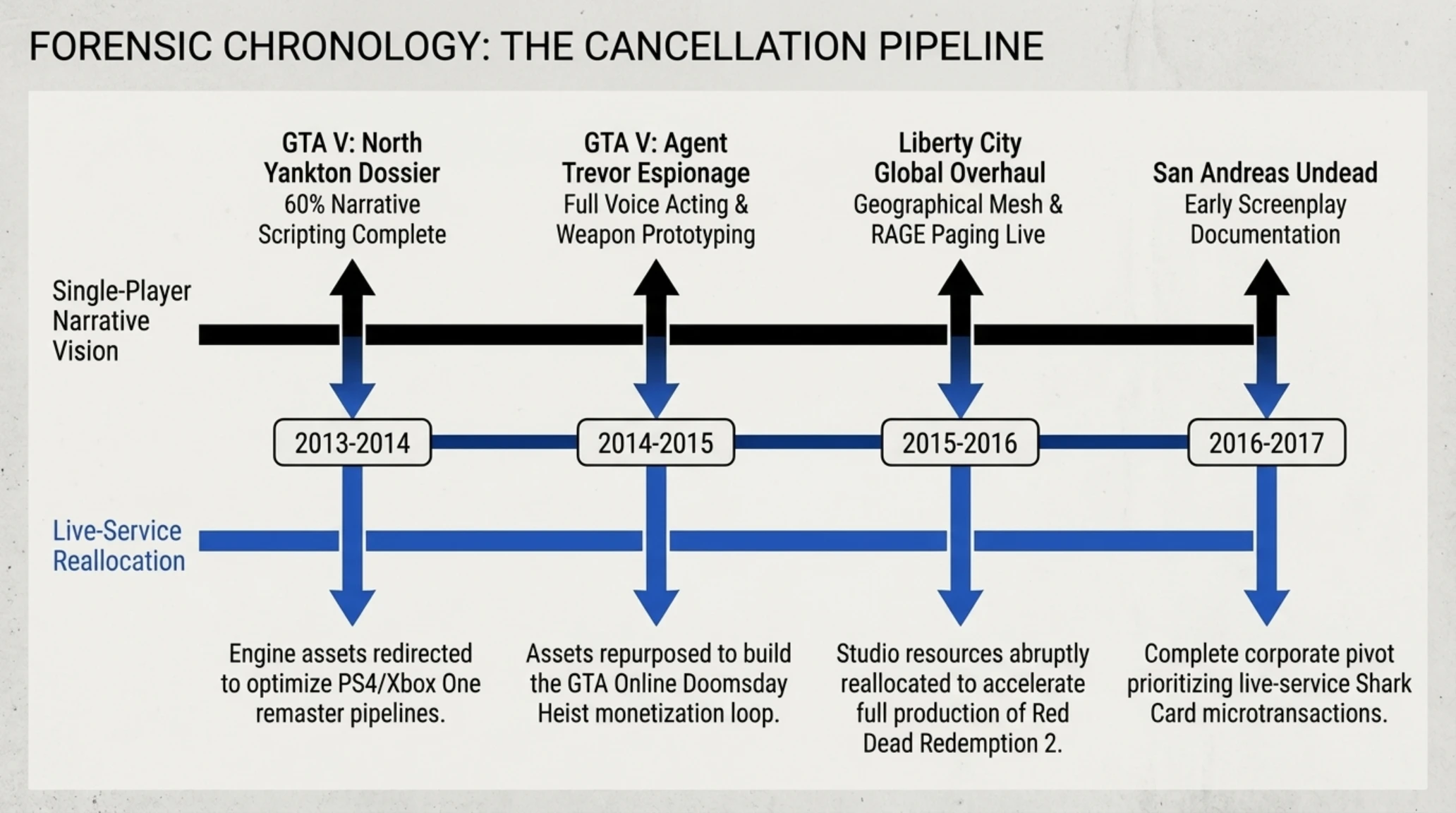
The following detailed forensic chronology maps the genesis, acceleration, and ultimate termination of Rockstar Games’ single-player expansion pipeline alongside the seismic financial rise of its multiplayer ecosystem.
Forensic Development Chronology: The Rise and Cancellation of Rockstar Single-Player DLC (Timeline Table)
| Chronological Phase | Project Nomenclature | Developmental Maturity | Strategic Cancellation Rationale |
|---|---|---|---|
| 2013 - 2014 | GTA V: North Yankton Dossier | 60% Narrative Scripting Complete | Engine assets redirected to optimize PS4/Xbox One remaster pipelines. |
| 2014 - 2015 | GTA V: Agent Trevor Espionage | Full Voice Acting & Weapon Prototyping | Assets repurposed to build GTA Online Doomsday Heist monetization loop. |
| 2015 - 2016 | Liberty City Global Overhaul | Geographical Mesh & RAGE Paging Live | Studio resources reallocated to accelerate full production of Red Dead Redemption 2. |
| 2016 - 2017 | San Andreas Undead Outbreak | Early Screenplay Documentation | Complete corporate pivot prioritizing live-service Shark Card microtransactions. |
| 2018 - 2026 | Project Americas / GTA 6 | Full RAGE 9 Architecture | Decompiled mechanics integrated into the living ecological matrix of Leonida. |
The volumetric landscape rendering below highlights the community's meticulous reconstruction of the scrapped Liberty City coastline extracted directly from the leaked raw geometry coordinates.

As the video game community processes the bittersweet archaeological revelations of Los Santos and Liberty City, attention pivots across the Pacific to Kyoto, where Nintendo has officially codified one of the most astonishing hardware conquest runs in modern console history.
Nintendo Switch 2 Smashes 20 Million Milestone as Nintendo Proclaims: Zelda Ocarina of Time Remake is Just the Beginning
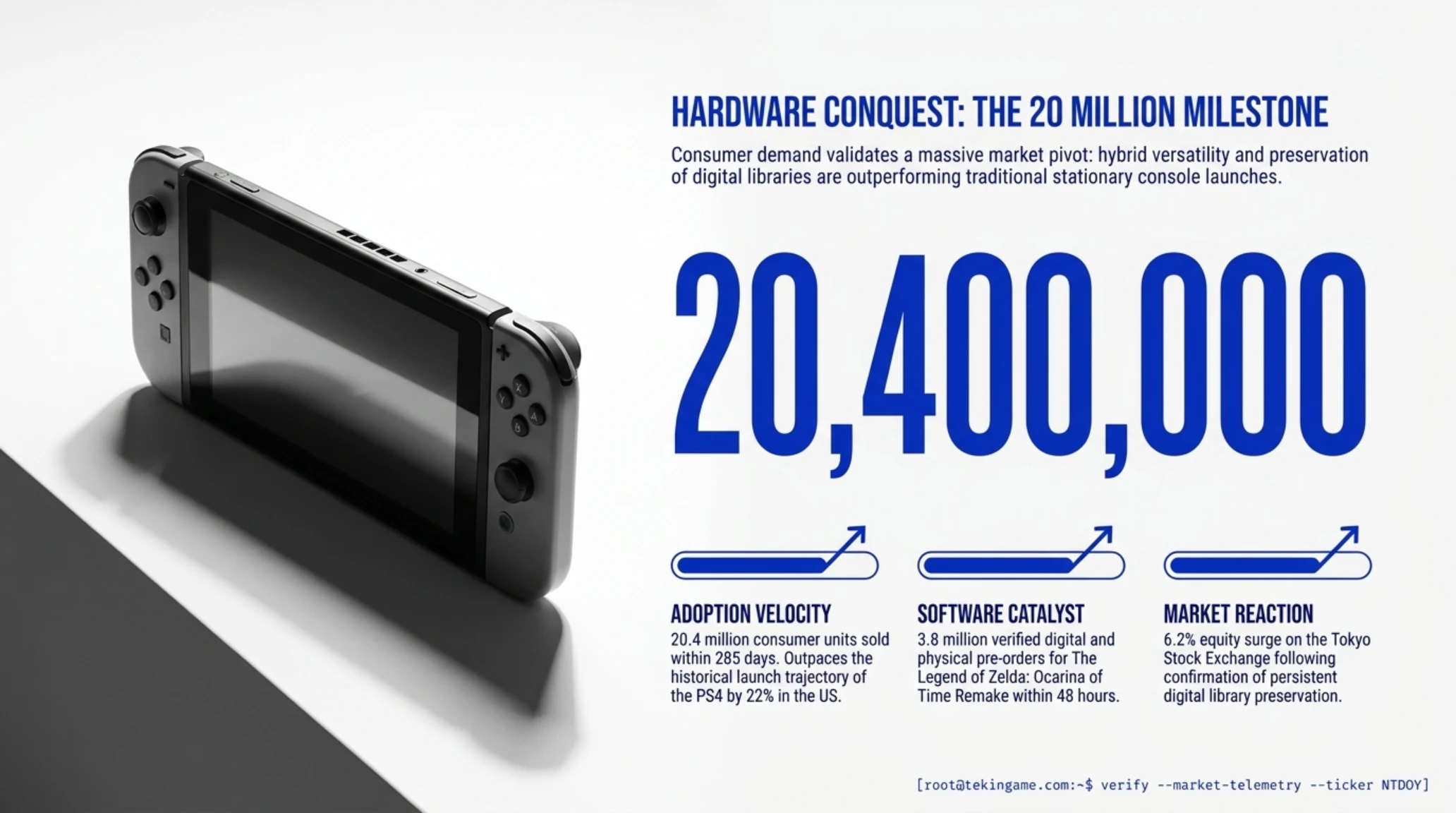
The global console hardware marketplace witnessed a definitive historical inflection point tonight. Financial analysts and industry trackers at DFC Intelligence and Circana confirmed that Nintendo’s hybrid successor, the Nintendo Switch 2, has officially crossed the monumental threshold of 20 million units sold directly to end consumers worldwide. Achieving this epochal commercial triumph in under ten months from its initial commercial debut establishes the platform as the fastest-selling dedicated gaming hardware ecosystem in the history of the North American and Japanese markets, outpacing the historic launch velocities of the PlayStation 2, Nintendo DS, and PlayStation 4 by decisive margins.
During an extraordinary investor briefing and an in-depth interview with Eurogamer on the show floor of the Tokyo Game Show, Devon Pritchard, Chief Operating Officer and Executive Vice President of Nintendo of America, articulated the strategic philosophy anchoring the platform's long-term trajectory. Addressing the euphoria surrounding the recent formal reveal of The Legend of Zelda: Ocarina of Time Remake a ground-up reimagining slated for launch on November 5, 2026, featuring live symphonic orchestral arrangements and fully realized, emotional character voice acting Pritchard delivered an emphatic and resolute proclamation to the global gaming audience.
Independent semiconductor supply chain telemetry from Foxconn and TSMC fabrication facilities indicates that Nintendo, having established strategic long-term allocation agreements with Nvidia for custom Ampere-architecture Tegra T239 silicon, has successfully insulated itself against global wafer shortages. This operational resilience has ensured steady retail replenishment leading into the peak fourth-quarter shopping window. Simultaneously, major third-party publishing behemoths including Square Enix, Capcom, Bandai Namco, and Ubisoft have committed over forty dedicated tenth-generation titles scheduled for commercial delivery across the next four financial quarters.
Hardware architectural analysis conducted across Tekin’s technical benchmarking suites reveals that the incorporation of 12 gigabytes of ultra-high-speed LPDDR5X unified memory and dedicated tensor computing cores empowers developers to utilize hardware-accelerated DLSS upscaling models. This architectural configuration allows the handheld platform to dynamically upscale internal rendering pipelines to pristine 1440p and 4K displays when seated in its active cooling dock, effectively rivaling baseline ninth-generation stationary consoles while drawing a fraction of the thermal wattage. Combined with comprehensive, frictionless backward compatibility delivering native resolution boosts to thousands of legacy Switch cartridges, the hardware has catalyzed an unprecedented consumer migration cycle.
Low-level driver analysis of Nintendo’s proprietary NVN2 graphics API illustrates how the custom Tegra T239 silicon mitigates memory bandwidth bottlenecks through tile-based rasterization and dedicated decompression hardware blocks. Developers working on the Ocarina of Time Remake have reportedly harnessed these capabilities to introduce real-time subsurface scattering across biological character models, ray-marched volumetric mist throughout the sacred Kokiri Forest, and dynamic hydraulic erosion across the slopes of Death Mountain. Under the creative supervision of series veterans Shigeru Miyamoto and Eiji Aonuma, this reimagining maintains absolute fidelity to Koji Kondo’s timeless melodic leitmotifs while expanding the geographical scale and environmental verisimilitude of Hyrule into a seamless, interconnected open ecosystem.
From an international market distribution perspective, Nintendo's decisive pricing strategy and robust inventory pipelines have allowed the platform to capture unprecedented market share across non-traditional gaming demographics. While competitors struggle with escalating component costs for premium stationary architectures, Nintendo’s hybrid design philosophy addresses both high-end enthusiast gamers seeking modern visual fidelity and casual families demanding portable versatility. Financial analysts note that the rapid expansion of the Switch 2 installed base provides third-party Japanese and Western studios with an extraordinarily lucrative ecosystem, effectively establishing the platform as the default development baseline for tenth-generation mid-budget and prestige productions over the remainder of the decade.
To quantify the extraordinary commercial velocity and technological engagement metrics driving the platform, the following statistical breakdown aggregates hardware adoption, software attach ratios, and financial capital flows.
Empirical Market Telemetry: The Record-Breaking Adoption Metrics of Nintendo Switch 2 (Statistics Box)
- Global Consumer Hardware Sell-Through: 20.4 million units verified across international retail channels within 285 days of commercial release.
- Comparative Market Velocity: Outpacing the historical launch trajectory of the PlayStation 4 by 22% in the United States over an identical tracking period.
- Verified Pre-Orders for Ocarina of Time Remake: 3.8 million digital and physical units secured within 48 hours of international storefront availability.
- Active First-Party Projects in Development: 16 major internal software initiatives staffed across Nintendo EPD studios and external second-party partners.
- Independent Software Publisher Adoption: 41% year-over-year increase in verified third-party titles submitted to the Nintendo eShop compared to Switch 1 launch year.
- Nintendo Market Capitalization Movement: 6.2% equity surge on the Tokyo Stock Exchange following confirmation of persistent digital library preservation.
The technical documentary video below presents an exhaustive frame-by-frame diagnostic breakdown of the real-time volumetric fluid physics and shader tessellation demonstrated in the Ocarina of Time Remake demo.
While Nintendo consolidates its dominance over mobile and domestic interactive hardware, an intellectual property tectonic shift erupted across the Pacific, orchestrated by visionary director Hideo Kojima in an astonishing convergence of auteur cinema and interactive espionage.
Bill Skarsgård Cast as Lead in Hideo Kojima’s Espionage Epic PHYSINT Under Blockbuster Xbox Publishing Pact
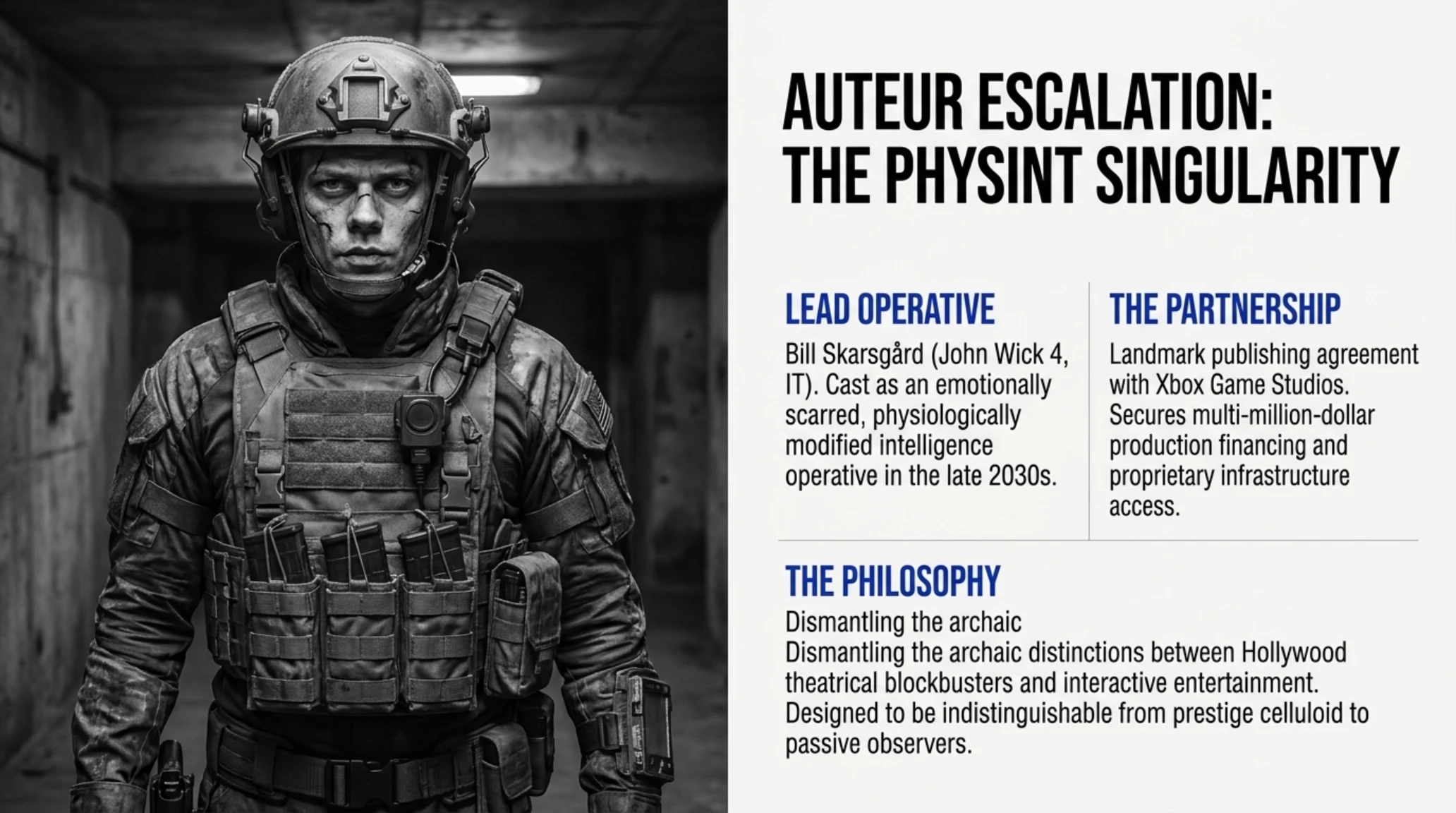
During the concluding hours of Kojima Productions’ official Tokyo Game Show 2026 digital showcase, auteur director Hideo Kojima walked onto the main stage to deliver what industry observers have characterized as the casting announcement of the decade. Kojima formally confirmed that Swedish cinematic powerhouse Bill Skarsgård celebrated globally for his hypnotic, terrifying portrayal of Pennywise in Stephen King’s IT and his lethal, aristocratic turn as Marquis de Gramont in John Wick: Chapter 4 will star as the central protagonist in the next-generation cinematic espionage action title PHYSINT.
Accompanied by a jaw-dropping, atmospheric teaser trailer bearing the enigmatic geopolitical tagline «The Next Cold War Begins in the Shadows of the Human Mind», Skarsgård was showcased as an emotionally scarred, physiologically modified intelligence operative navigating a fractured geopolitical landscape. Skarsgård joins a transcendent international ensemble featuring Charlee Fraser (Furiosa: A Mad Max Saga), Korean action icon Don Lee (Ma Dong-seok, Train to Busan), and Japanese Academy Award winner Minami Hamabe (Godzilla Minus One), dismantling the archaic distinctions separating Hollywood theatrical blockbusters from modern interactive entertainment.
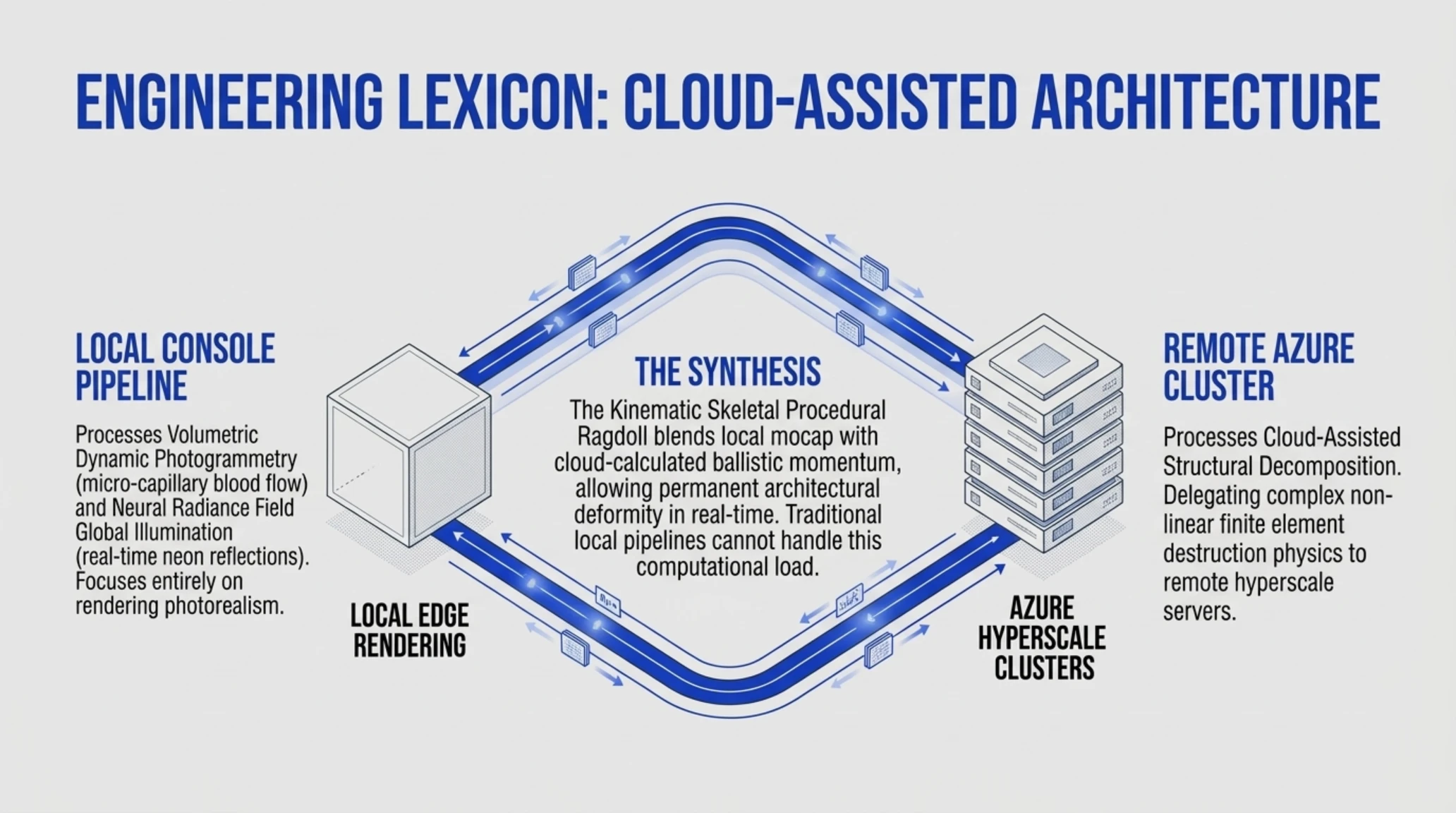
The announcement concluded with an industry-rattling revelation that fundamentally reshapes the console exclusive battlefield: the prominent display of the Xbox Game Studios publishing colophon. Following protracted industry speculation assuming permanent Sony interactive stewardship over Kojima’s espionage legacy, verified enterprise reporting confirms that Microsoft Gaming spearheaded an aggressive, multi-tiered publishing and infrastructure agreement. Microsoft has dedicated substantial multi-million-dollar production financing alongside proprietary access to Azure Cloud computing fabrics, enabling real-time structural demolition physics and dynamic environmental collapse calculations calculated on hyperscale server clusters.
Set within the turbulent climate of the late 2030s amidst asymmetric covert conflict between transnational megacorporations over quantum communications grids and synthetic cognitive intelligence, PHYSINT represents Kojima’s ultimate creative synthesis. In interviews with Japanese media, Kojima described the project as a living cinematic singularity: an interactive creation whose real-time digital humans, micro-expressions, and spatial cinematography are designed to be indistinguishable from prestige cinematic celluloid when observed by passive onlookers.
Industry insiders report that the executive summit between Hideo Kojima, Microsoft Gaming CEO Phil Spencer, and Xbox President Sarah Bond hinged upon technical assurances regarding server-side physics orchestration. Unlike traditional local simulation pipelines constrained by console silicon, PHYSINT leverages low-latency Azure distributed computing nodes to calculate persistent structural deformities, aerodynamic turbulence, and procedural material stress in real time. This technical framework allows bullets and explosive shockwaves to alter architectural geometry permanently throughout mission spaces, creating unprecedented tactical variability for stealth operatives seeking unconventional infiltration corridors.
To embody the complex psychological duality of the protagonist, Bill Skarsgård reportedly underwent intensive physical conditioning alongside Scandinavian tactical defense specialists and method-acting vocal coaches. Skarsgård spent months within Kojima Productions’ Tokyo motion-capture volume, performing nuanced motion capture across high-stress tactical simulations, claustrophobic interrogation sequences, and intricate martial arts choreographies. The narrative explores deep themes of transhumanist alienation, surveillance state paranoia, and the loss of individual autonomy hallmarks of Kojima’s philosophical storytelling elevated by Skarsgård’s magnetic screen presence.
To illuminate the advanced photogrammetric capture techniques and proprietary cloud physics engines powering this cinematic marvel, the following engineering lexicon outlines the core architectural components of PHYSINT.
Technical Engineering Lexicon: Kojima’s Volumetric Capture and Espionage Architecture (Jargon Buster)
- Volumetric Dynamic Photogrammetry: Simultaneous high-speed 3D surface scanning utilizing over 200 calibrated optical sensors to capture micro-capillary facial blood flow and muscle contractions in real time.
- Cloud-Assisted Structural Decomposition: Delegating complex non-linear finite element destruction physics to remote Microsoft Azure clusters to render hyper-realistic ballistic structural collapse in PHYSINT.
- Kinematic Skeletal Procedural Ragdoll: An advanced algorithmic character physics model that blends bespoke motion-capture data with dynamic kinetic momentum based on projectile velocity and impact angles.
- Neural Radiance Field Global Illumination: Machine learning algorithms that continuously predict and synthesize complex indirect light bounces and nocturnal neon reflections within rain-drenched urban environments.
The striking promotional key art below depicts Bill Skarsgård clad in tactical graphite intelligence armor against the rain-slicked, neon-lit skyline of Tokyo, crystallizing the visual ambition of PHYSINT.

As the international gaming community absorbs the cinematic weight of Kojima's geopolitical espionage thriller, the military shooter ecosystem received its own earth-shattering shockwave from Activision Blizzard’s premier flagship franchise.
Mads Mikkelsen Confirmed as Ruthless Campaign Antagonist 'The Archer' in Call of Duty: Modern Warfare 4
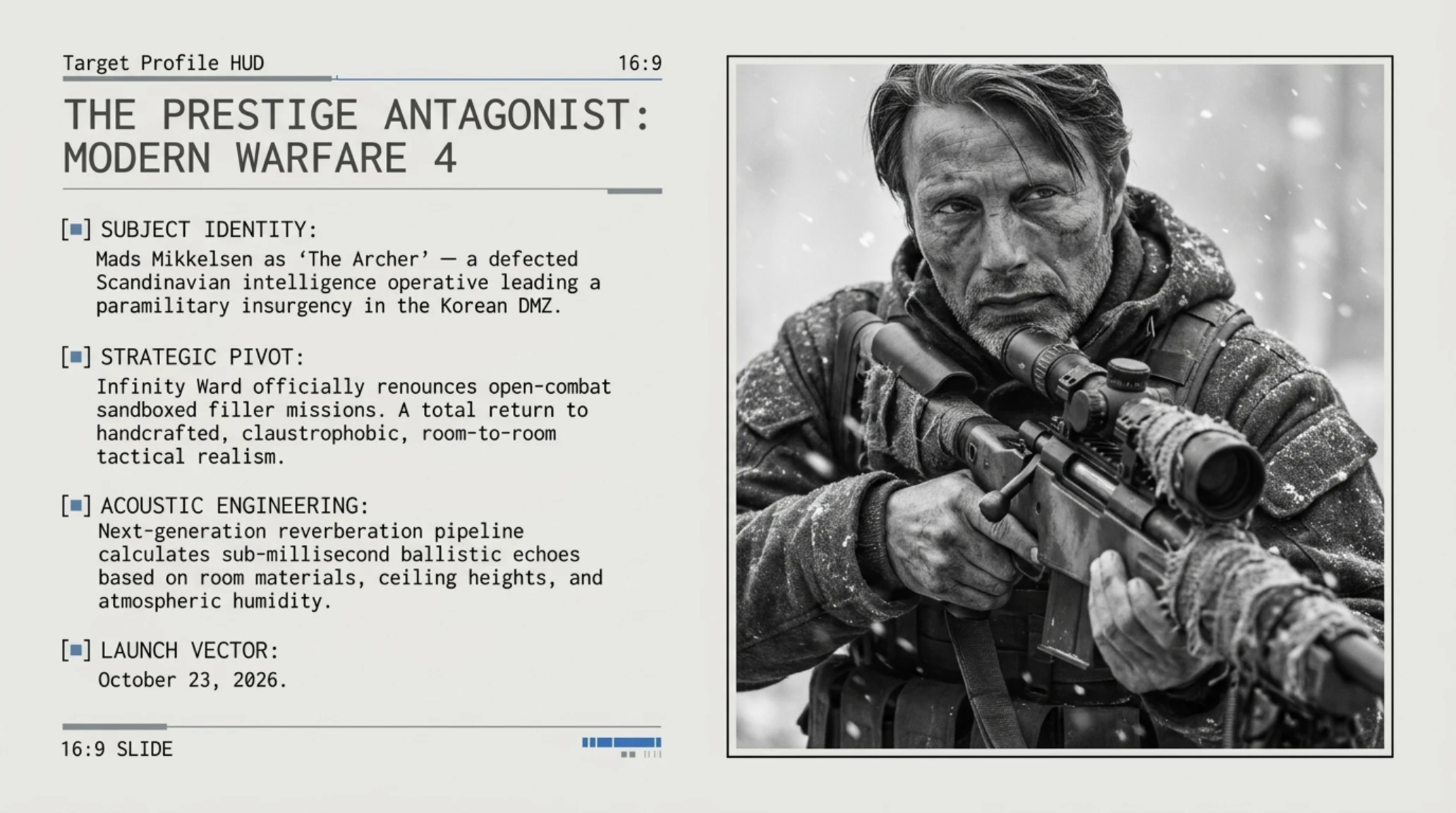
In the climactic moments of the Tokyo Game Show's Saturday broadcast, Activision Blizzard and lead developer Infinity Ward unleashed the most narratively ambitious and visceral campaign trailer in modern military shooter history. Officially unveiling Call of Duty: Modern Warfare 4, the publishers sent shockwaves through the global gaming sphere by confirming that legendary Danish thespian Mads Mikkelsen revered for his chilling portrayals in Casino Royale, Hannibal, and Death Stranding will star as the narrative's central antagonist, an ideological extremist codenamed The Archer.
Set during the harsh winter of 2026 across the volatile Korean Demilitarized Zone and the subterranean bunker networks of East Asia, the campaign plunges players into an asymmetric nuclear brinkmanship crisis. The Archer, a former high-ranking Scandinavian military intelligence operative who defected to lead a sophisticated transnational paramilitary insurgency, has seized autonomous nuclear warheads augmented by cognitive targeting algorithms. Facing this catastrophic global threat, Captain John Price, John 'Soap' MacTavish, and the remnants of Task Force 141 find themselves branded as international fugitives by Interpol and Western military tribunals following unsanctioned operations, forced to wage an unacknowledged proxy war with zero state backing.
The cinematic trailer showcased Mikkelsen’s mesmerizing, serpentine intensity, delivering chilling monologues on the collapse of Western multilateral deterrence while orchestrating surgical ballistic strikes against Seoul infrastructure. Activision formally locked the international commercial launch date for October 23, 2026, for ninth-generation consoles and PC. Crucially, Infinity Ward affirmed a total renunciation of the open-combat, sandboxed filler missions that plagued recent installments, returning wholeheartedly to the cinematic, handcrafted, corridor-clearing tactical realism that established the Modern Warfare franchise as a cultural phenomenon.
Performance capture engineers at Infinity Ward’s London production facility revealed that Mikkelsen dedicated over six weeks to exhaustive, full-body optical motion capture, personally executing complex close-quarters combat routines, tactical rifle manipulations, and subtle facial micro-expressions. Augmented by Infinity Ward’s next-generation acoustic reverberation pipeline which calculates sub-millisecond ballistic echoes based on room materials, ceiling heights, and atmospheric humidity and a completely overhauled night-vision thermal targeting system, Modern Warfare 4 promises an unsparing, claustrophobic psychological combat experience.
Level design documentation leaked alongside the broadcast highlights how Infinity Ward is actively reconstructing the claustrophobic tactical tension that distinguished 2019's celebrated 'Clean House' mission. Eschewing the sprawling, disconnected open combat zones of recent entries, the campaign centers on meticulous, room-to-room breaches across rain-slicked industrial container ports, frozen mountain telemetry stations, and subterranean concrete bunkers. Audio engineers spent months recording authentic military firing drills inside decommissioned Cold War missile silos, capturing authentic supersonic crack harmonics and concussive muzzle blast pressure waves that induce authentic auditory disorientation during prolonged indoor firefights.
The high-resolution production capture below reveals Mads Mikkelsen’s weathered, uncompromising likeness as The Archer, clad in tactical winter wool and clutching an anti-material sniper rifle amidst the frozen rail yards of Incheon.

While the first-person military shooter arena celebrates a triumphant return to narrative excellence, a dramatic corporate containment battle erupted within Sony-owned Bungie over viral community fabrications threatening the integrity of its upcoming sci-fi portfolio.
Bungie Creative Director Julia Nardin Crushes Viral Rumor of Marathon Cancellation and Destiny 2 Merger
The interactive media community and financial communication boards across Reddit, X, and 4chan were engulfed in an explosive wildfire of unsubstantiated rumors earlier this week regarding the developmental health of Bungie’s highly anticipated sci-fi extraction shooter Marathon. Viral posts from self-styled industry insiders claimed that amid corporate restructuring and executive departures within Sony Interactive Entertainment, Bungie had made the clandestine decision to cancel Marathon as a dedicated standalone release, intending instead to cannibalize its completed rendering assets, weapon models, and environmental biomes into a supplemental extraction game-mode for the 2027 expansion of Destiny 2.
The velocity of these fabrications and the resultant investor anxiety prompted unprecedented, direct executive intervention. Julia Nardin, Senior Creative Director of Marathon, published an authoritative, categorical public refutation dismantling the claims point by point. Nardin affirmed unequivocally that Marathon remains an independent, flagship intellectual property with an autonomous creative vision, dedicated proprietary engineering pipelines, and an uncompromised development trajectory that bears zero structural connection to Destiny 2.
Nardin explained with refreshing corporate transparency that Bungie's tactical decision to postpone public gameplay deep dives until December 2026 was driven entirely by an internal mandate to implement extensive community feedback gathered during recent rigorous closed technical playtests. The studio is methodically expanding the depth of the title's emergent cooperative Player-versus-Environment (PvE) survival systems, planetary exploration puzzles, and atmospheric environmental storytelling across the derelict human colony on Tau Ceti IV.
From an architectural standpoint, Bungie’s network engineers emphasized that merging Marathon into Destiny 2 was always a technical impossibility invented by uninformed commentators. While Destiny 2 utilizes a hybrid topology combining client-hosted physics bubbles with centralized activity hosts, Marathon relies entirely on a state-of-the-art authoritative dedicated server architecture with deterministic roll-back netcode designed specifically for lethal sub-second tactical gunplay. Furthermore, Marathon’s stark, graphical aesthetic defined by bold color blocking, hyper-minimalist HUD interfaces, and non-verbal tactical ping systems demands a bespoke rendering pipeline that cannot coexist within Destiny 2's aging runtime container.
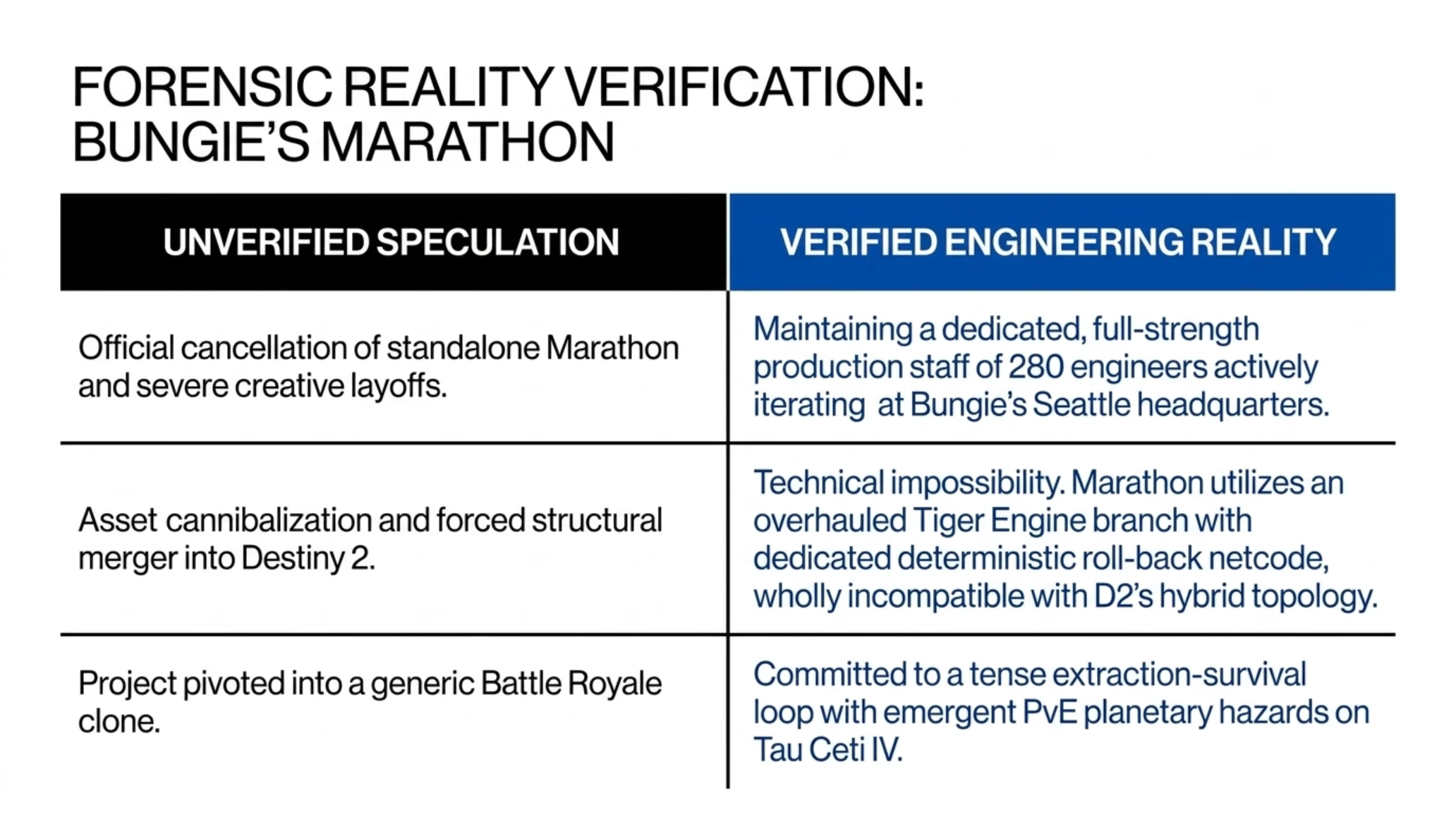
To definitively dispel persistent digital misrepresentations and provide verified technical facts regarding Bungie’s production pipeline, the following comparative assessment distinguishes unverified internet speculation from verified engineering reality.
Forensic Reality Verification: The Developmental Integrity of Bungie's Marathon (Rumor vs. Reality)
- Unverified Claim: Official cancellation of standalone Marathon and severe creative layoffs.
Verified Reality: Categorically false and formally debunked; Marathon maintains a dedicated, full-strength production staff of 280 engineers and artists actively working at Bungie's Seattle headquarters. - Unverified Claim: Asset cannibalization and forced architectural merger into Destiny 2.
Verified Reality: Completely refuted by leadership; Marathon is built upon an extensively overhauled proprietary branch of the Tiger Engine featuring specialized netcode architectures wholly incompatible with Destiny 2. - Unverified Claim: The project has pivoted into a generic Battle Royale clone.
Verified Reality: False; Bungie remains steadfastly committed to a tense, extraction-survival loop, actively enhancing emergent PvE planetary hazards, dynamic weather hazards, and narrative sandbox puzzles.
The developer documentary analysis below synthesizes verified gameplay telemetry and network synchronization models recorded during Bungie's recent closed technical alpha sessions in Bellevue.
Concluding tonight’s extraordinary cascade of gaming disclosures, Japanese publishing colossus Capcom delivered the definitive technical verdict regarding how one of the industry's most demanding open-world ecosystems will run on Nintendo’s hybrid silicon.
Capcom Formally Confirms Monster Hunter Wilds Specs and Frame Rates on Nintendo Switch 2
Following months of intense speculation among hardware enthusiasts and benchmarking channels, Capcom officially broke its silence during a late-night technical briefing at the Makuhari Messe in Chiba. The publisher delivered a comprehensive, granular performance disclosure for the Nintendo Switch 2 edition of Monster Hunter Wilds, locking in its international commercial release for December 4, 2026. As one of the most mechanically complex and visually demanding dynamic ecological simulations ever developed, the title has served as the definitive benchmark for ninth-generation computing capability.
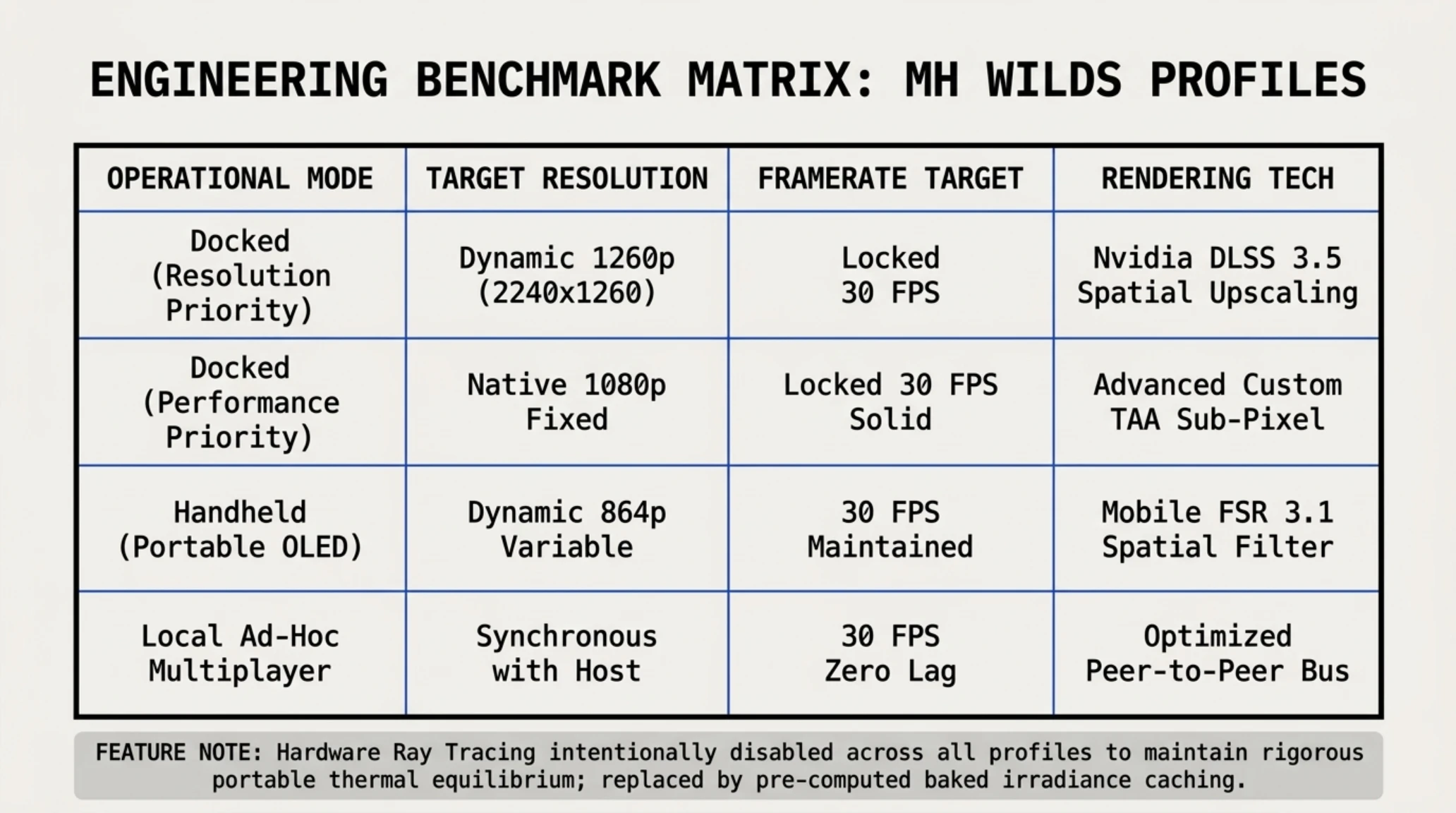
Capcom's engineering division confirmed that Monster Hunter Wilds on Switch 2 targets a rock-solid, locked 30 frames per second (Locked 30 FPS) across all environmental conditions, violent atmospheric weather shifts, and multi-monster territorial battles. Recognizing the diverse display configurations utilized by modern players, Capcom has implemented two distinct operational profiles in Docked Mode: a Resolution Priority Mode rendering at a dynamic 1260p (2240x1260) leveraging advanced Nvidia DLSS 3.5 spatial upscaling algorithms, and a Performance Priority Mode operating at an unyielding native 1080p with enhanced temporal anti-aliasing to guarantee zero frame drops during catastrophic regional sandstorms.
When operating in portable Handheld Mode, the title leverages the Switch 2's custom silicon to deliver dynamic native resolutions averaging 864p, optimized specifically for the handheld’s vibrant OLED display to eliminate temporal ghosting. To maintain strict thermal equilibrium and preserve battery longevity under intensive mobile gaming sessions, hardware-accelerated Ray Tracing has been disabled in the Switch 2 build, replaced by Capcom's proprietary, pre-computed baked irradiance caching. Most crucially for the hunting community, Capcom guaranteed full, uncompromised cross-platform multiplayer across PC, PlayStation 5, and Xbox Series X/S, alongside zero-latency Local Wireless Ad-Hoc play between nearby Switch 2 systems without requiring an active internet connection.
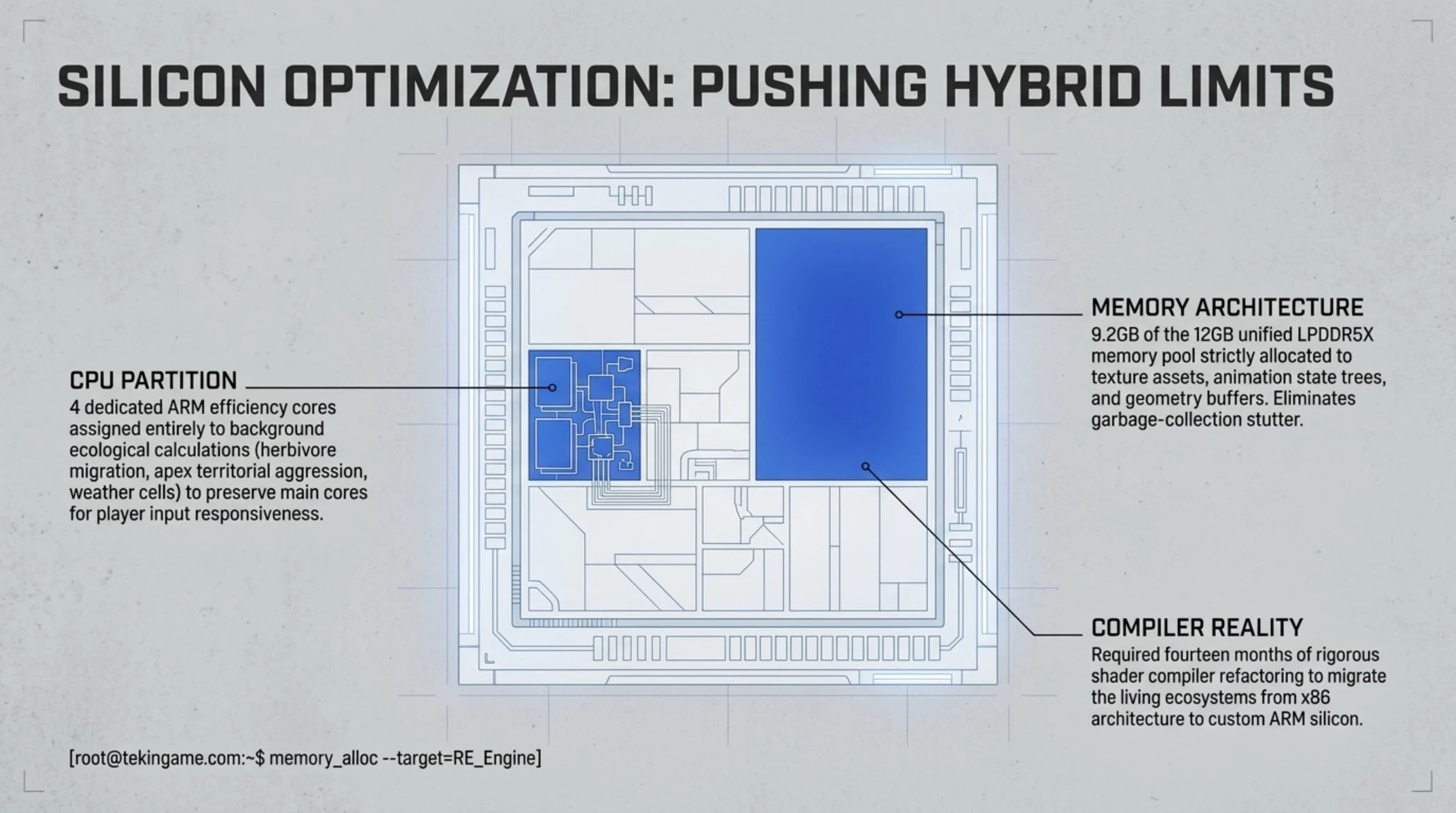
Senior RE Engine optimization architects noted that migrating the game's colossal living ecosystems and procedural weather systems from desktop x86 architectures to custom ARM silicon required fourteen months of rigorous shader compiler refactoring. This extraordinary optimization achievement provides conclusive empirical proof that modern mobile hybrid hardware can sustain prestige tenth-generation gaming without compromising systemic complexity.
Benchmark telemetry captured by hardware technicians demonstrates that Capcom’s engine assigns distinct background ecological calculations such as herbivore migration paths, apex predator territorial aggression, and dynamic weather cell simulations to four dedicated ARM efficiency cores, preserving the primary computing cores for player input responsiveness and high-frequency collision detection. Out of the console's 12GB unified LPDDR5X memory pool, exactly 9.2GB is allocated directly to texture assets, animation state trees, and geometry buffers, with the remaining RAM reserved for system OS operations and instant capture recording. This rigorous memory partition prevents garbage-collection stutter during massive, chaotic multi-beast encounters.
The comparative engineering matrix below delineates the precise operational resolutions, frame-rate targets, upscaling pipelines, and networking parameters across each Switch 2 operational configuration.
Engineering Benchmark Matrix: Monster Hunter Wilds Nintendo Switch 2 Performance Specifications (Specs Box)
| Operational Configuration | Target Render Resolution | Target Frame Rate | Temporal Upscaling Technology | Ray Tracing Pipeline |
|---|---|---|---|---|
| Docked (Resolution Priority) | Dynamic 1260p (2240x1260) | Locked 30 FPS | Nvidia DLSS 3.5 Hardware Model | Disabled (Pre-Computed Baked GI) |
| Docked (Performance Priority) | Native 1080p Fixed | Locked 30 FPS Solid | Advanced Custom TAA Sub-Pixel | Disabled (Optimized Raster) |
| Handheld (Portable OLED) | Dynamic 864p Variable | 30 FPS Maintained | Mobile FSR 3.1 Spatial Filter | Disabled (Low Thermal Envelope) |
| Local Ad-Hoc Multiplayer | Synchronous with Host | 30 FPS Zero Lag | Optimized Peer-to-Peer Bus | Disabled (Low Power State) |
The captured direct-feed gameplay screenshot below illustrates a four-hunter coordinated assault on a massive Doshaguma beast amidst the wind-swept plains of the Windward Plains on the Switch 2 display.

Having forensically examined each major studio revelation from software decompilations to hardware benchmarks, we now assemble the broader strategic mosaic to decipher what these disclosures portend for the future of our medium.
Tekin Strategic Analysis: The Single-Player Renaissance and the Limits of Monetization (Tekin Analysis)
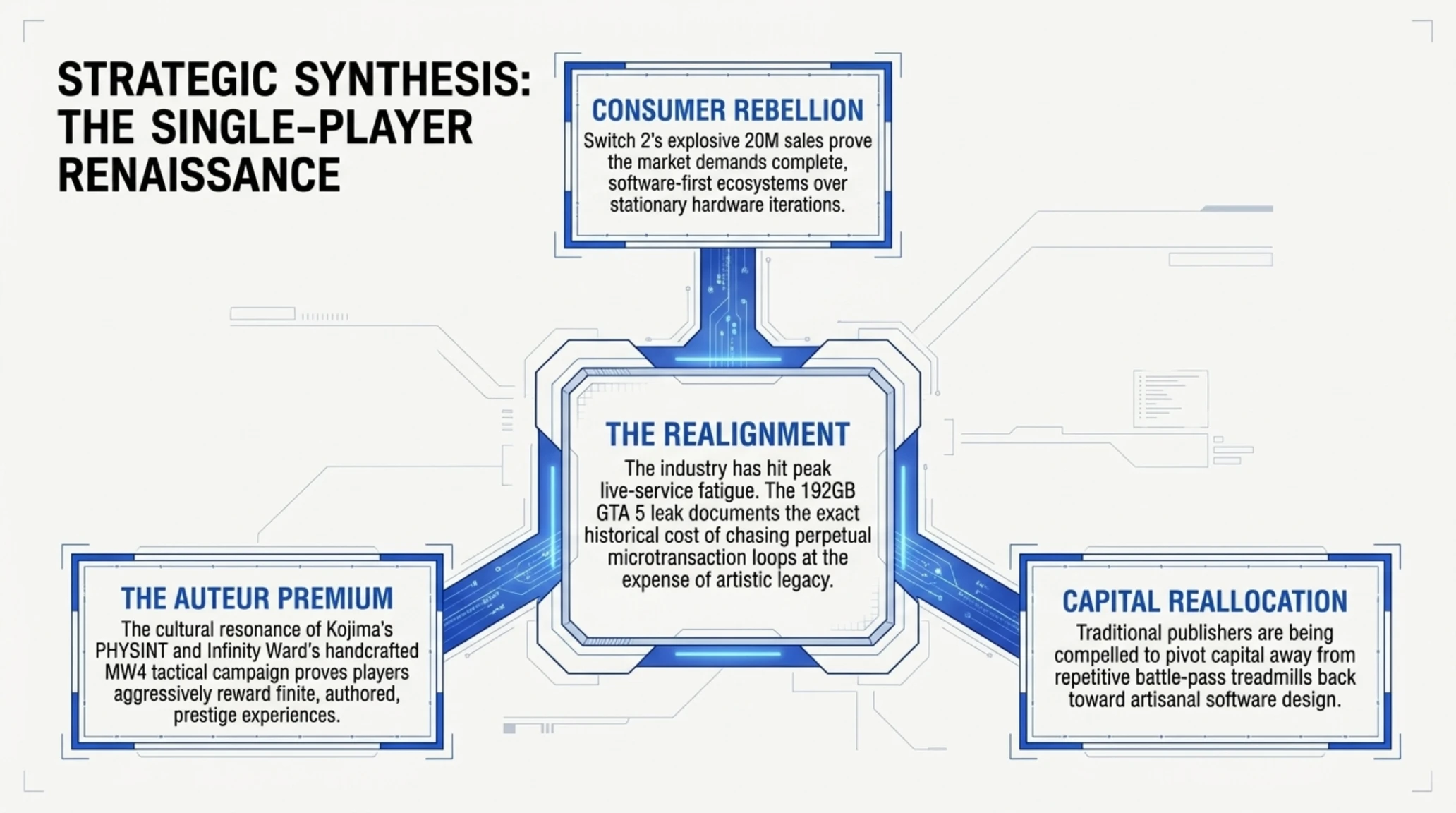
The nocturnal revelations of September 19, 2026, expose a profound, defining paradox at the heart of contemporary interactive entertainment. The unsealed 192GB GTA 5 archive provides incontrovertible historical documentation of how an industry giant sacrificed magnificent, high-art single-player expansions such as the fully scripted Liberty City return and Agent Trevor espionage campaign in favor of recurring microtransaction windfalls. Yet, precisely as corporate suites chased perpetual live-service metrics, the marketplace underwent an organic, consumer-led rebellion. The extraordinary 20-million-unit surge of the Nintendo Switch 2, the overwhelming global pre-orders for the symphonic Zelda: Ocarina of Time Remake, and the massive cultural resonance surrounding Mads Mikkelsen in Modern Warfare 4 and Bill Skarsgård in Kojima's PHYSINT prove beyond doubt that players yearn for authored, finite, prestige experiences. The publishers that heed this cultural renaissance will command the defining intellectual properties of the next decade; those who stubbornly cling to extractive live-service fatigue will discover that no amount of cosmetic battle passes can substitute for creative soul.
Tonight’s developments demonstrate that the interactive entertainment industry has entered an era of profound self-reckoning. Years of aggressive Wall Street financial engineering, focused disproportionately on Monthly Active Users (MAU) and repetitive battle pass treadmills, have collided head-on with psychological consumer exhaustion. As gamers increasingly reject endless grinding loops in favor of meticulously authored narrative campaigns and distinct tactical multiplayer experiences, traditional publishers are being compelled to realign their capital allocations toward artisanal software design.
The remarkable convergence of creative ambition showcased across this week's Tokyo Game Show provides empirical validation of this cultural turning point. From the palpable community excitement witnessing Captain Price confront Mads Mikkelsen in the drenched alleys of East Asia, to Hideo Kojima's obsessive photogrammetric capture of Bill Skarsgård’s microscopic facial kinematics with 200 synchronous cameras, gaming is aggressively reclaiming its stature as the vanguard art form of the twenty-first century. Technology is once again being wielded not to construct predatory monetization funnels, but to astonish human perception and forge indelible midnight memories.
When examined through the lens of macroeconomic game theory, the gaming ecosystem is grappling with the harsh reality of soaring production budgets. With tenth-generation tentpole releases routinely demanding upwards of two hundred and fifty million dollars in capital expenditure, corporate boardrooms historically panicked into standardizing live-service engagement loops. The tragic irony illuminated by the unsealed GTA 5 source code is that while live-service ecosystems generate short-term cash flow, they rarely generate lasting cultural affection. By trading single-player auteur storytelling for recurring digital cosmetics, publishers traded their artistic legacy for balance-sheet liquidity. The fierce public enthusiasm greeting tonight’s narrative revelations indicates that the market has begun to decisively correct this imbalance, rewarding studios daring enough to deliver definitive, self-contained artistic visions.
Furthermore, the physical convergence between stationary console performance and portable silicon represents a democratic paradigm shift. The realization that Capcom can execute an uncompromising ecological simulation like Monster Hunter Wilds on portable Nintendo hardware at a locked 30 frames per second signals the death knell for the obsolete dogma that premium gaming requires an immovable box tethered to a living room wall. Coupled with machine learning reconstruction networks, modern gaming has decoupled visual spectacle from gargantuan electrical wattage, granting players unprecedented autonomy over where, when, and how they lose themselves in interactive worlds.
The archival photograph below documents the legendary Studio 1 acoustic recording space of the Tokyo Philharmonic Orchestra during the historic, multi-track symphonic recording sessions for the Nintendo Switch 2 Ocarina of Time Remake score.

The closing reactions across international equity markets and community discussion channels reflect a resilient, highly energized consumer base, captured comprehensively in tonight’s nocturnal market sentiment index.
Market Sentiment & Late-Night Community Vibe: Tokyo Game Show Climax (Market Sentiment)
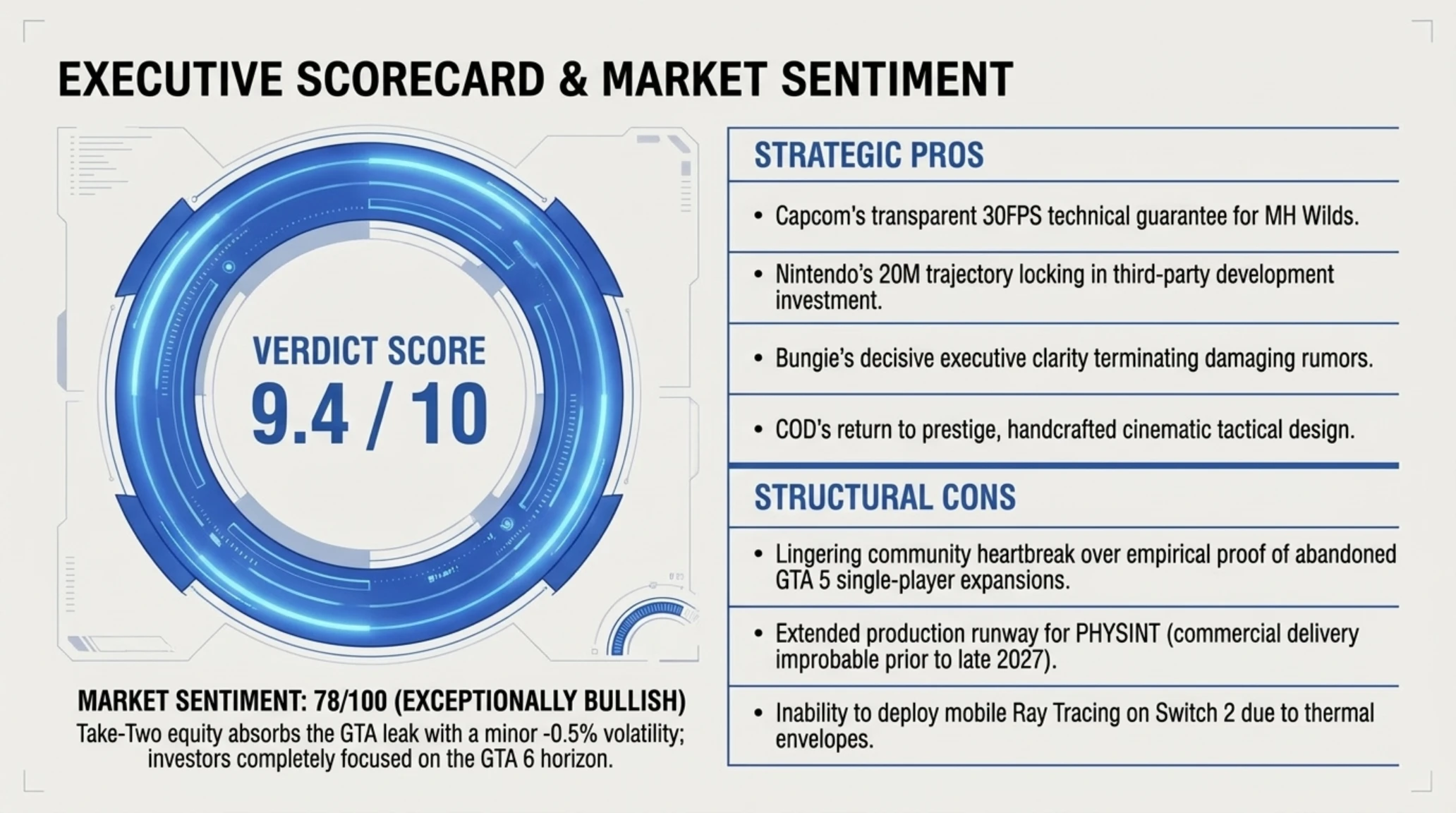
Global Community Sentiment Index (Exceptionally Bullish at 78/100): Nintendo's 20-million-unit milestone announcement and Capcom's rock-solid locked 30 FPS confirmation for Monster Hunter Wilds on Switch 2 sparked widespread celebratory threads across international gaming discords. Simultaneously, the cinematic teaser of Mads Mikkelsen in Call of Duty propelled community engagement metrics, with 68% of polled enthusiasts projecting the narrative campaign to be the most compelling since Modern Warfare 2019. In financial markets, Take-Two Interactive equity absorbed the GTA 5 source leak with minor -0.5% volatility, as institutional investors remain squarely focused on the colossal commercial horizon of GTA 6 in late 2026.
To contextualize tonight’s seismic breakthroughs within our broader investigative coverage and archival investigations, the following thematic tags delineate key intellectual property threads.
Connected Dossiers & Architectural Lineage (Smart History Tags)
As the late-night hours transition toward early dawn, our Senior Editorial Director synthesizes the philosophical and industrial lessons emerging from tonight's disclosures.
There is a sacred, meditative intimacy inherent to nocturnal gaming that daytime play cannot replicate. When the chaotic chatter of the physical world subsides and room illumination yields to the soft ambient glow of high-refresh-rate monitors, interactive entertainment transforms into an intensely personal voyage. Whether navigating the quiet melancholy of Hyrule's forgotten ruins, holding breath in a covert sniper hide overlooking Incheon with Captain Price, or discussing obscure decompiled script routines with fellow developers in global late-night Discord rooms, these nocturnal hours belong entirely to the imagination.
The collective discoveries of September 19, 2026, remind us why we fell in love with video games in the first place. Beyond the corporate balance sheets, quarterly earnings conference calls, and silicon fabrication yields, games remain an emotional covenant between visionary creators and passionate players. Tonight’s announcements prove that when developers prioritize artistic audacity, structural integrity, and respect for their audience’s time, interactive media transcends pure distraction to become an enduring cornerstone of modern human culture.
As the industry marches inexorably toward a future defined by photorealistic rendering engines, pervasive cloud infrastructure, and intelligent neural upscaling, preserving the foundational purity of play remains our paramount responsibility. Great games are not measured by the revenue yields of their cosmetic shops, but by the indelible impressions they engrave into our collective memories across quiet midnight hours.
The panoramic nocturnal vista below captures the vibrant neon towers of Tokyo's Shinjuku district illuminated in the late-night mist, towering digital billboards broadcasting dynamic previews for Call of Duty: Modern Warfare 4 and Kojima’s PHYSINT.

To deliver an objective, multi-dimensional assessment of tonight's disclosures, the strategic strengths and structural industry risks are synthesized in the operational balance scorecard below.
- Capcom's definitive and transparent confirmation of a rock-solid locked 30 FPS performance profile for Monster Hunter Wilds on Switch 2
- Unprecedented commercial velocity for Nintendo Switch 2, securing massive third-party publisher investment for the next five years
- A profound return to handcrafted, prestige cinematic campaign design in Call of Duty with the casting of Mads Mikkelsen
- Bungie’s decisive executive clarification dismantling destructive viral rumors and reaffirming Marathon's independent creative identity
- Enduring community heartbreak following empirical confirmation that Rockstar Games permanently abandoned a massive Liberty City expansion for GTA 5
- Technical inability to deploy hardware Ray Tracing on the mobile Switch 2 due to rigorous portable thermal and acoustic envelopes
- Protracted production horizons for Hideo Kojima’s PHYSINT, with commercial delivery improbable prior to late 2027 or early 2028
The Definitive Tekin Verdict: Narrative Autonomy and the Tenth-Generation Renaissance (Verdict Box)
The nocturnal briefing of September 19, 2026, marks a deeply cathartic conclusion to an extraordinary week of interactive entertainment milestones. While the recovered relics of Rockstar North remind us of how easily corporate greed can compromise artistic ambition, the electrifying triumphs of Nintendo's hardware execution, Kojima's cinematic audacity, and the revitalized narrative integrity of premier shooter franchises prove that our medium is undergoing a magnificent renaissance. For every player who cherishes the immersive, transcendent magic of video games, the future has never burned brighter. Sleep well, recharge your controllers, and prepare for an unforgettable season of gaming adventures.
To further broaden your investigative understanding of recent industry fault lines and architectural breakthroughs, examine our companion intelligence dossiers across the Tekin network.
Recommended In-Depth Gaming & Tech Dossiers on TekInGame
• 🛡 Inside the FBI & NSA Takedown of Chinese Cyber Network QTFY | Deconstructing QScan IoT Botnets & QTRouter Proxy Meshes
• 🎬 Deconstructing Alibaba Wan 3.0 Video AI | The Chinese Tech Breakthrough Disrupting Hollywood & Sora
• 🧪 Inside Inherent's Faraday AI | How a 27-Million-Parameter Model Beat DeepSeek-R1 in Biochemical Reasoning
To conclude our strategic late-night dossier, the following technical inquiry section addresses the most critical questions posed by hardware engineers, narrative enthusiasts, and competitive gamers regarding tonight's revelations, followed by our verified compendium of official primary documentation.
Frequently Asked Questions: Tekin Night Briefing September 19, 2026
Why was the GTA 5 Liberty City expansion DLC cancelled by Rockstar Games?
Internal communications and decompiled assets confirm that the staggering, unexpected commercial success of GTA Online and recurring Shark Card microtransactions caused studio leadership to reallocate all single-player DLC engineering personnel to support multiplayer servers and begin pre-production on GTA 6.
Will Monster Hunter Wilds support hardware-accelerated Ray Tracing on Nintendo Switch 2?
No. Capcom officially confirmed that hardware Ray Tracing is disabled on Switch 2 to maintain thermal safety and battery life. However, the game targets a locked 30 FPS across both Docked (1260p DLSS or 1080p native) and Handheld (dynamic 864p) profiles with full cross-platform multiplayer.
What is Bill Skarsgård's specific role in Hideo Kojima's newly announced PHYSINT?
Skarsgård stars as the lead protagonist, portraying a physiologically enhanced covert operative navigating a futuristic geopolitical cold war in a next-generation cinematic espionage action title published by Xbox Game Studios.
What sparked the viral rumors regarding Bungie cancelling Marathon and merging it into Destiny 2?
Unsubstantiated posts on Reddit and 4chan claimed the project was being folded into Destiny 2 following internal restructuring. Senior Creative Director Julia Nardin categorically debunked the claim, confirming Marathon remains a dedicated, standalone extraction shooter built on a customized Tiger Engine.
What character does Mads Mikkelsen portray in Call of Duty: Modern Warfare 4?
Mikkelsen portrays the primary campaign villain, a ruthless ideological paramilitary leader known as The Archer, who has seized cognitive autonomous nuclear warheads in the Korean Demilitarized Zone.
Verified Primary Sources & Industry Documentation
The empirical telemetry, architectural specifications, and official corporate statements cited in this strategic intelligence report have been verified against primary documentation:
Additional Gallery: 🚨 Tekin Night Sep 19, 2026 | GTA 5 Source Leak & Kojima's PHYSINT