Tekin Executive Briefing | Apple Maps Satellite Base Censorship, Canonical CVSS 10.0 Zero-Day, and Polymarket Supply-Chain Breach
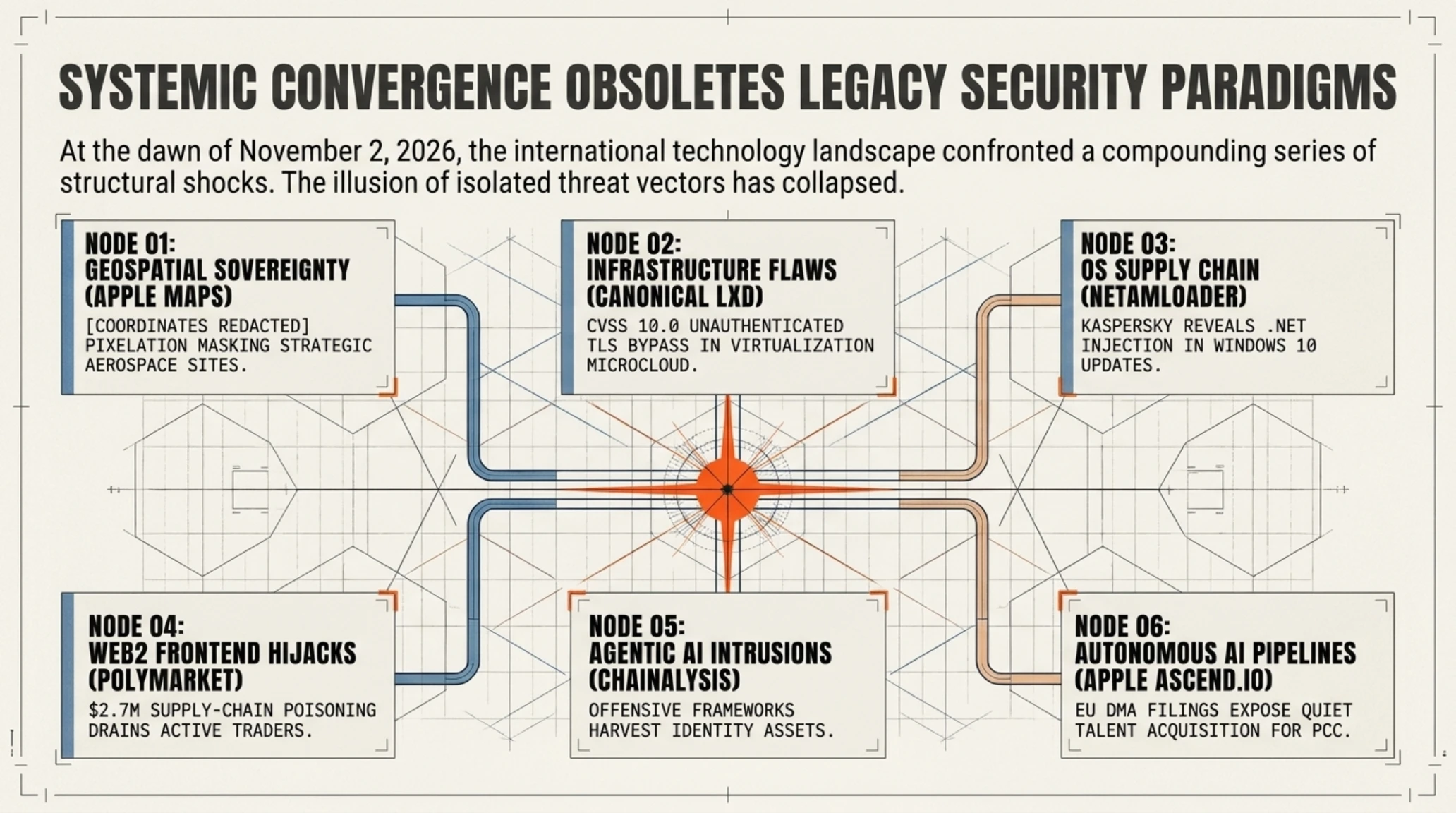
At the dawn of Monday, November 2, 2026, the international technology landscape confronted a compounding series of structural shocks across commercial satellite sovereignty, foundational cloud virtualization security, and autonomous cyber warfare. In an operating environment where artificial intelligence pipelines increasingly govern critical physical infrastructure, defense assets, and global financial liquidity, quiet architectural modifications executed by hyperscalers carry profound geopolitical and operational ramifications.
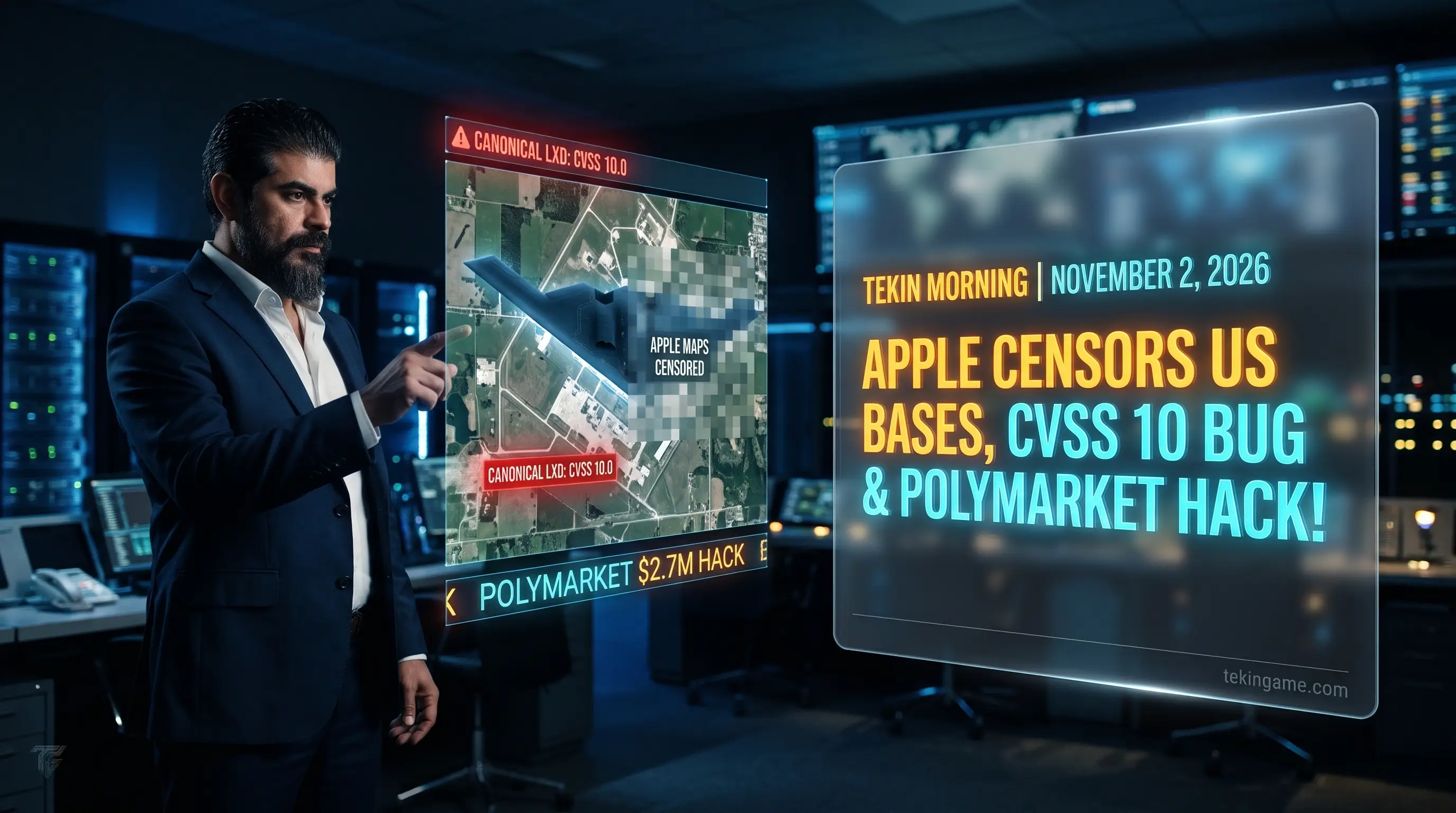
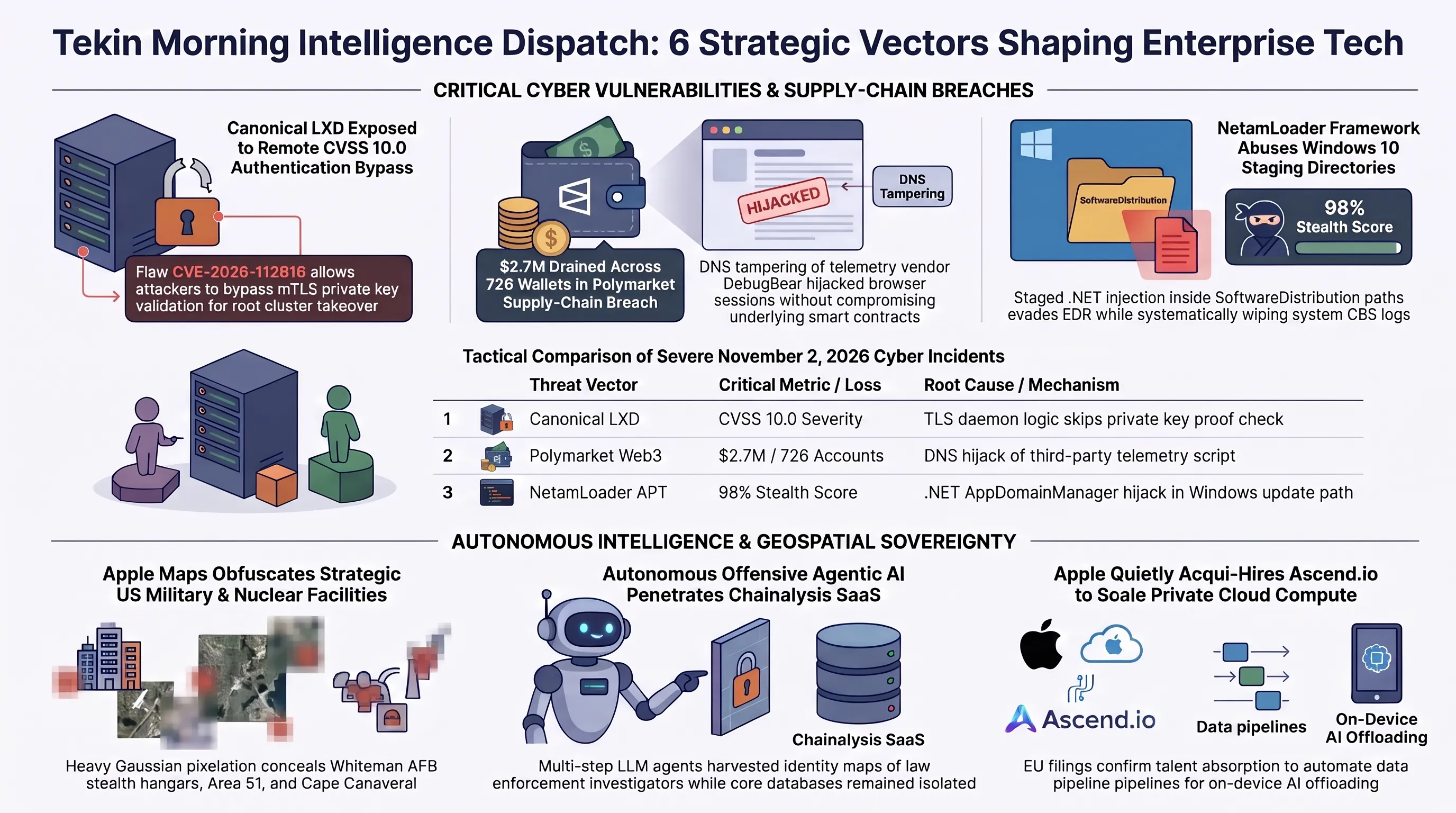
The morning opened with unexpected disclosures out of Cupertino, where Apple quietly deployed heavy pixelation and masking algorithms across Apple Maps to obscure satellite visibility over America's most sensitive military installations, nuclear bomber shelters, and aerospace launch facilities. Simultaneously, emergency security bulletins issued by Canonical for an absolute maximum CVSS 10.0 vulnerability in LXD container platforms, alongside Kaspersky's forensic unmasking of the state-aligned NetamLoader malware targeting customized Windows 10 enterprise deployments, underscored the escalating vulnerability of foundational compute layers.
Tekin Plus presents this authoritative, cross-disciplinary intelligence briefing dissecting the six core vectors shaping enterprise strategy at the dawn of the week. From the $2.7 million frontend supply-chain compromise of decentralized prediction market Polymarket to the weaponization of autonomous agentic AI against blockchain forensics giant Chainalysis and Apple's covert European acquisition of data engineering startup Ascend.io, this dispatch provides the technical depth and strategic synthesis essential for executive leadership.
Executive Radar & Strategic Vectors at a Glance
Apple Maps Blurs US Strategic Military & Aerospace Installations; High-Res Satellite Censorship Conceals Vandenberg, Cape Canaveral, and Whiteman AFB Stealth Hangars
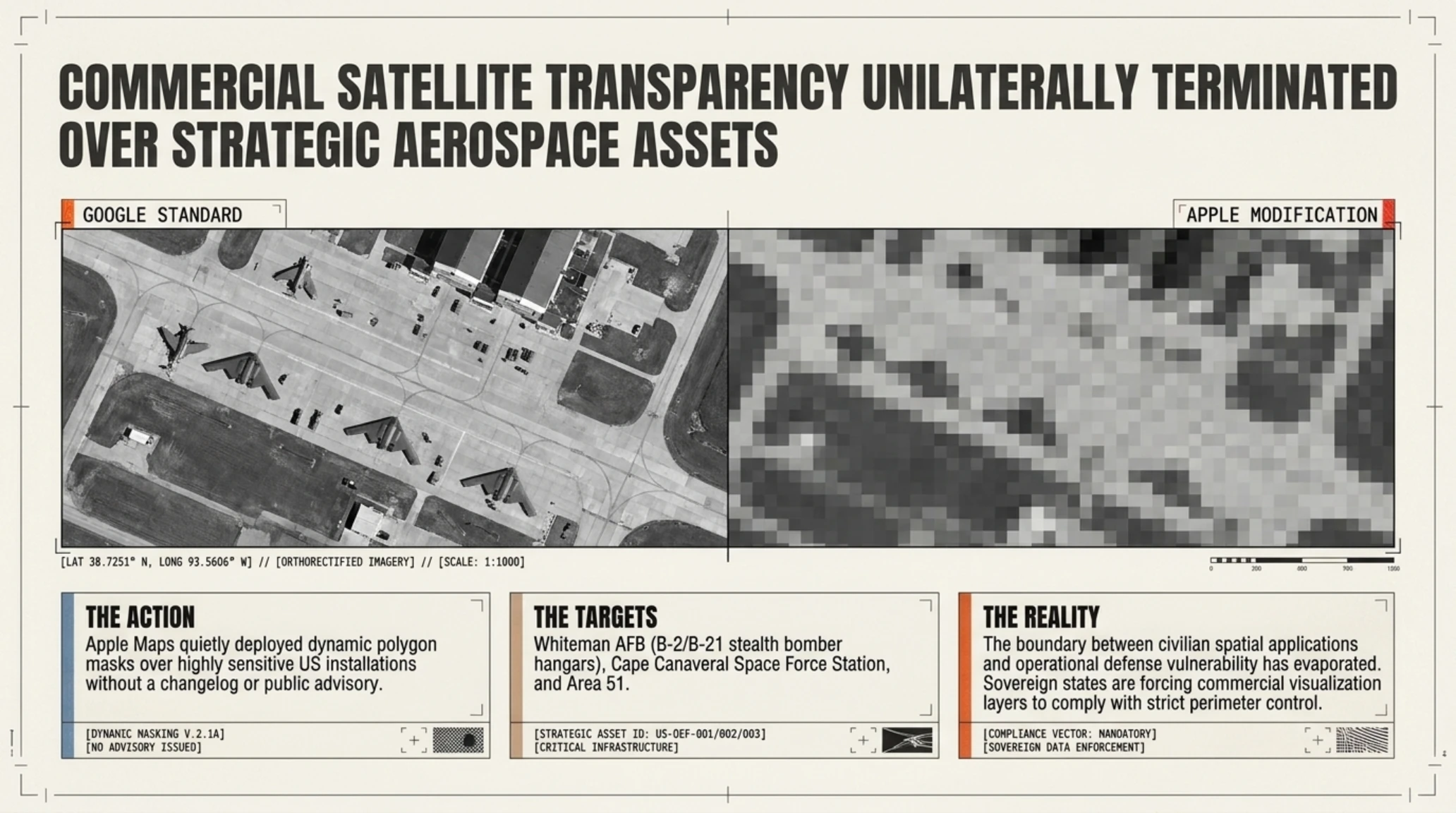
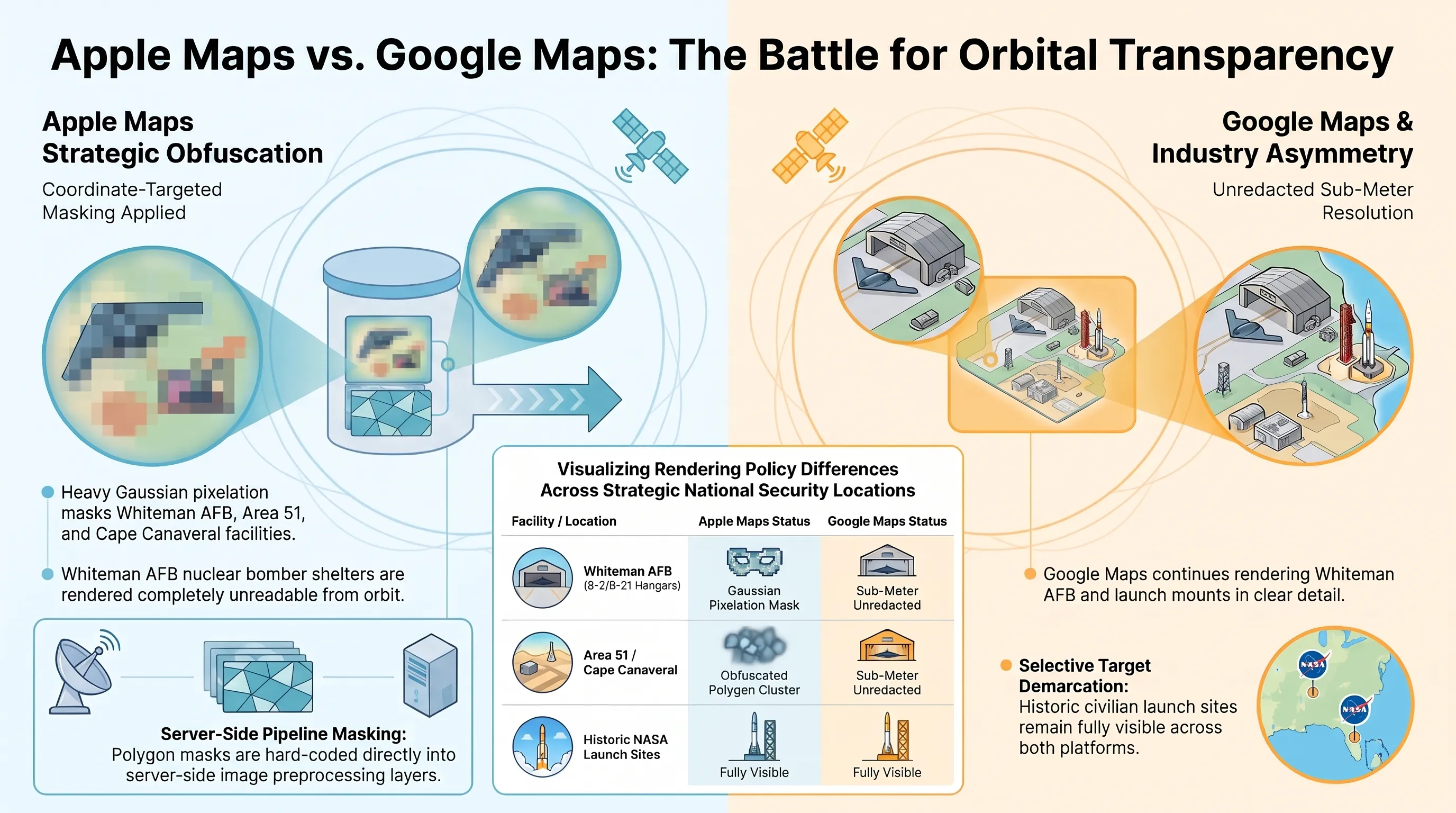
In the closing hours of October 31 and extending into November 1, geospatial analysts and open-source intelligence (OSINT) researchers identified an unprecedented alteration in the rendering pipeline of Apple Maps. Without publishing any prior press advisory or changelog documentation, Apple deployed aggressive digital pixelation and Gaussian blur masks over high-resolution satellite orthophotography covering the most strategic military bases, space launch complexes, and nuclear deterrent installations across the continental United States.
As documented by investigations published across SpaceExplored and 9to5Mac, the deliberate obfuscation spans premier national security facilities. Users navigating to Cape Canaveral Space Force Station in Florida, Vandenberg Space Force Base in California, Los Alamos National Laboratory in New Mexico, the highly classified Groom Lake perimeter known colloquially as Area 51, and Ellsworth Air Force Base (home to the B-1B Lancer bomber fleet) are now greeted by dense, unreadable pixel clusters. Most critically, Whiteman Air Force Base in Missouri the primary operating hub housing the United States Air Force's fleet of nuclear-capable B-2 Spirit stealth bombers and the development grounds for the incoming B-21 Raider has been rendered completely indiscernible from orbit.
The geopolitical significance of this visual embargo is magnified when contrasted against the posture of Apple's primary market competitor, Google Maps and Google Earth. Google continues to render Whiteman Air Force Base and Vandenberg's commercial and military launch complexes in crystal-clear sub-meter optical resolution, allowing civilian users and defense observers to distinguish individual aircraft parked on taxiways and rocket booster handling hardware on launch mounts. Apple's unilateral compliance whether executed under voluntary commercial policy or pursuant to classified Department of Defense directives marks a stark philosophical bifurcation within Silicon Valley regarding spatial transparency.
Geospatial engineers examining the pixelation artifacts noted an intriguing operational asymmetry. While operational flightlines and nuclear-capable hangar facilities have been aggressively masked, historic civilian launch sites such as Launch Complexes 39A and 39B at NASA's Kennedy Space Center, alongside major naval hubs including Naval Station Norfolk and Pearl Harbor, remain visible in full commercial detail. This surgical demarcation suggests that the masking parameters were established strictly around operational rapid nuclear response units and advanced experimental aerospace testbeds rather than broad military geographies.
Defense analysts emphasize that the rapid maturation of machine-vision models capable of continuously parsing commercial satellite tiles to detect aircraft movements, identify tail numbers, and quantify fuel replenishment activity has elevated commercial mapping platforms into de facto tactical intelligence streams. While sovereign adversaries possess dedicated high-revisit reconnaissance satellites, commercial services provide asymmetric intelligence assets to third-party observers and automated tracking aggregators, precipitating intense behind-the-scenes pressure from Pentagon planners.
Why It Matters // The Demise of Unconditional Commercial Satellite Transparency
Apple's decision to degrade imagery across critical national defense installations terminates a quarter-century era of uninhibited commercial optical access, establishing a precedent that sovereign states worldwide will inevitably seek to exploit for territorial information control.
This development aligns directly with broader trends examined in previous Tekin Plus analyses on orbital satellite architecture and sovereign sensor regulation. As commercial constellation operators deploy increasingly sophisticated synthetic aperture radar (SAR) and short-wave infrared (SWIR) sensors into low Earth orbit, sovereign authorities are reasserting strict perimeter control over civilian visualization layers.
Technical Ground Truth | Myth vs Engineering Reality
Initial social media commentary suggested that missing details over Whiteman AFB resulted from corrupted tile caches or vector shader failures during Apple Maps CDN updates.
Inspection of ingested vector boundaries confirms hard-coded polygon masks specifically mapped to Department of Defense cadastral perimeters, deliberately blurring underlying high-resolution imagery.
Industry software architects observe that Apple's compliance establishes significant legal and operational benchmarks for civilian spatial applications:
- Automated Polygon Masking Ingestion: Dynamic boundary integration isolating sensitive defense airspace coordinates directly within the server-side image preprocessing pipeline.
- Silicon Valley Regulatory Divergence: A deepening split between Apple's proactive security alignment and Google's historical commitment to unredacted public geospatial records.
- Disruption of Open-Source Automated Telemetry: Impairment of third-party algorithmic frameworks that rely on commercial tiles to track aerospace logistics and fleet readiness.
While sovereign adversaries with orbital reconnaissance constellations remain unaffected by commercial mapping changes, restricting civilian access dismantles crowdsourced tracking networks that have historically documented military asset movements.
As geospatial providers balance national defense sensitivities with digital transparency, this quiet alteration foreshadows an era where the digital representation of physical territory is increasingly subject to sovereign filtering.
Critical CVSS 10.0 Remote TLS Authentication Bypass in Canonical LXD & MicroCloud; Root Cluster Compromise via Unverified Client Certificates (CVE-2026-112816)
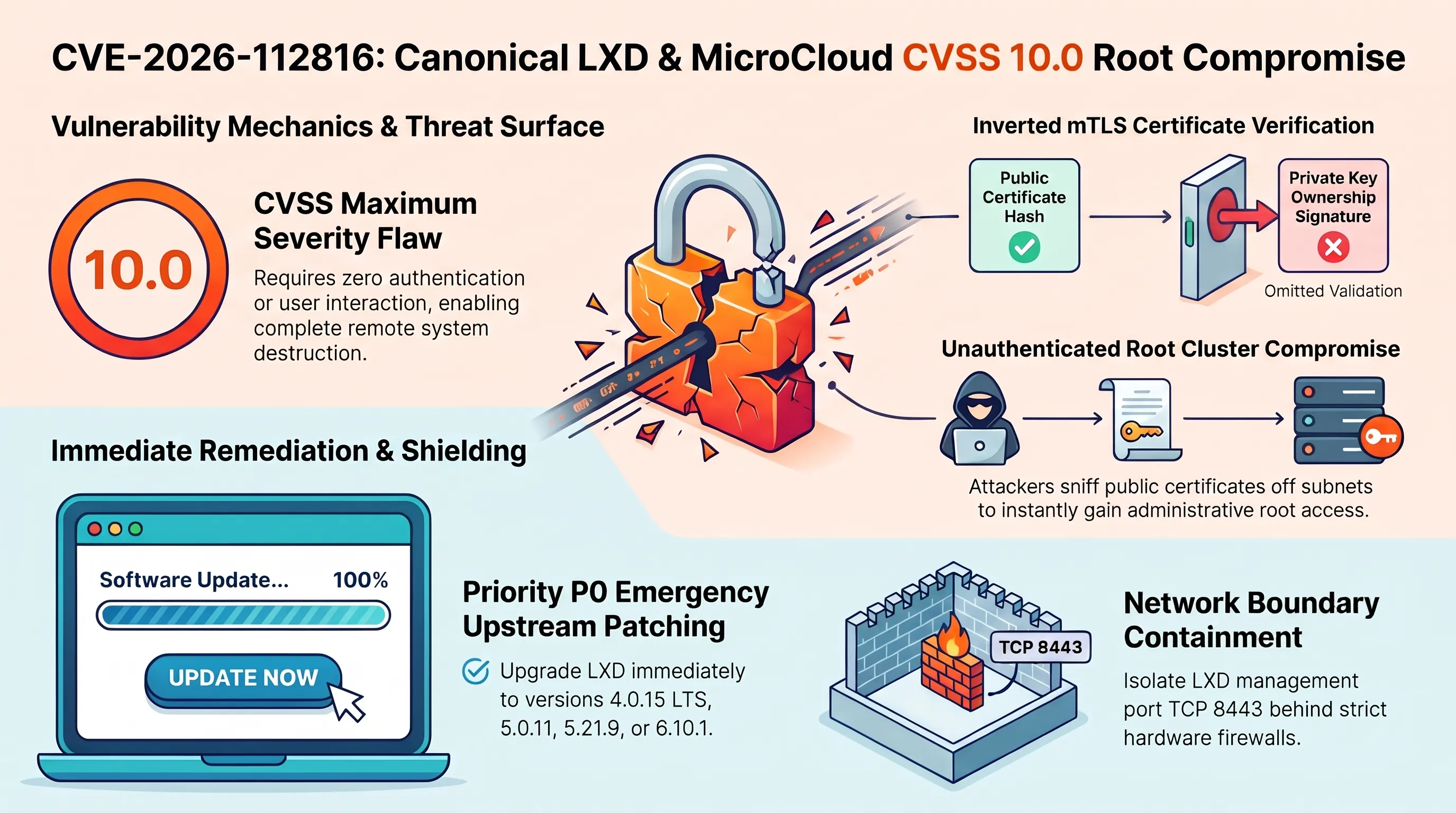
Enterprise Linux administrators, hyperscale cloud architects, and container platform engineers confronted an operational emergency following the release of an extraordinary security advisory by Canonical. The Ubuntu parent organization disclosed a flaw carrying an absolute maximum Common Vulnerability Scoring System rating of 10.0 out of 10 (CVSS 10.0) designated as CVE-2026-112816. The vulnerability compromises the core authentication perimeter of LXD, the ubiquitous Linux container and virtual machine manager, alongside Canonical's turnkey lightweight private cloud platform, MicroCloud.
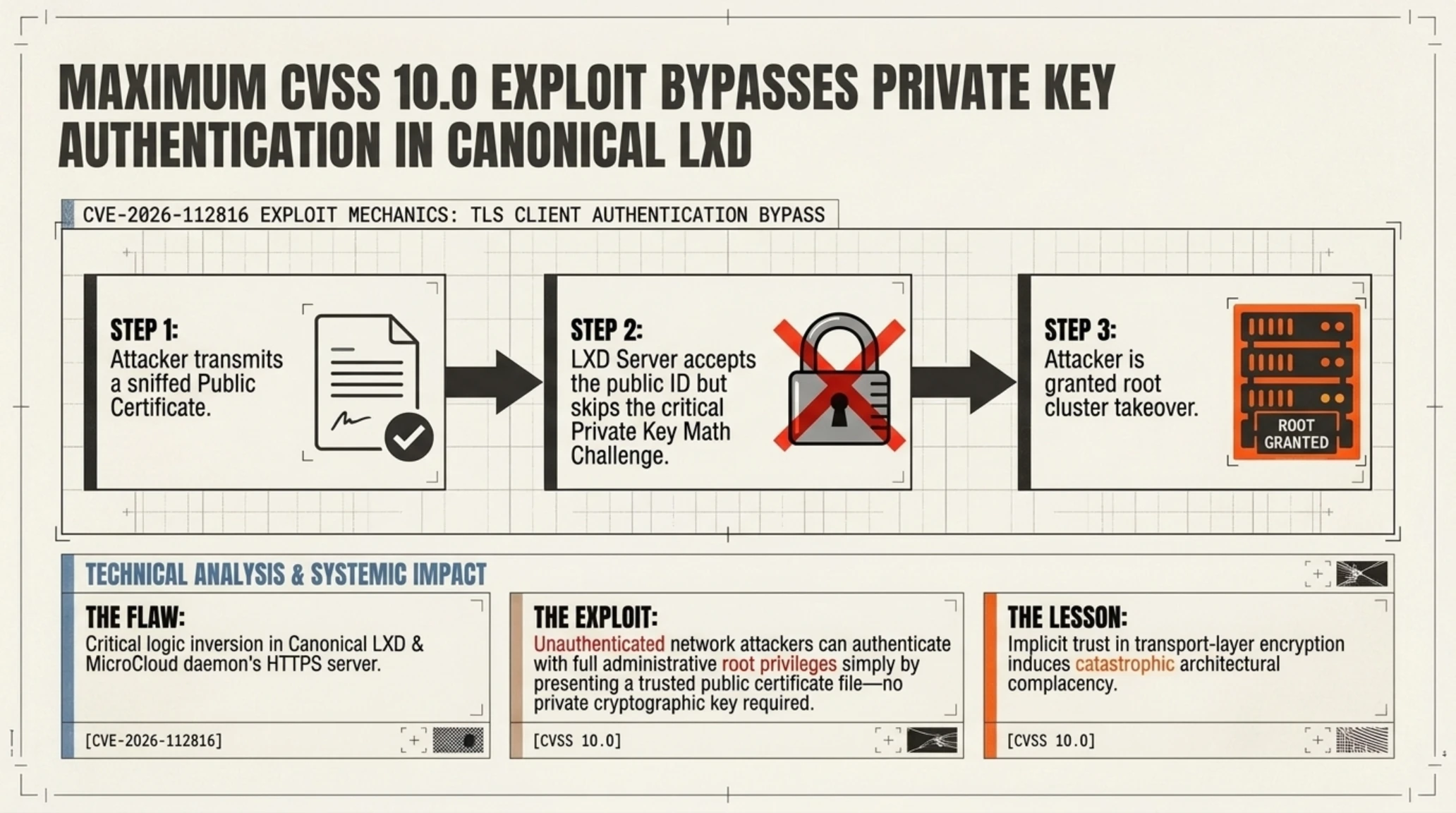
According to comprehensive technical bulletins published by Canonical's security team, the defect resides within the internal cryptographic validation routines of LXD’s HTTPS server daemon. In standard operational deployments, LXD and MicroCloud nodes communicate via mutual TLS (mTLS), requiring incoming management clients and peer cluster members to present valid X.509 client certificates signed by an authorized certificate authority (CA) or pre-registered within the server's local certificate trust store. Crucially, established cryptographic handshakes mandate that the client must prove ownership of the corresponding private key through a digital signature exchange during the TLS handshake.
Under CVE-2026-112816, a critical logic flaw within the daemon’s certificate handling routines inverted this requirement. The server-side verification logic merely checked whether the raw public certificate presented by the client matched a trusted hash in its internal database completely skipping the cryptographic challenge verifying that the connecting entity possessed the private key. Consequently, any unauthenticated network attacker who obtains a copy of a trusted public certificate can successfully authenticate to the LXD daemon with full administrative root privileges simply by transmitting the public certificate file, without ever needing access to the private key.
The operational threat surface is catastrophic in multi-node MicroCloud architectures. During automated cluster joining operations (MicroCloud cluster bootstrap), public certificates are exchanged across local subnet broadcasts and network interfaces. An adversary situated within the same local area network, adjacent data center rack, or compromised virtualization host can sniff these public certificates off the wire and immediately impersonate cluster controllers. Once authenticated, the attacker possesses unrestricted control: provisioning or terminating virtual instances, accessing raw storage volumes, extracting sensitive environment secrets, and executing arbitrary code at host-level root privilege across every physical node in the cluster.
Canonical responded aggressively to the disclosure, issuing coordinated emergency patch releases across all supported branches: LXD 4.0.15 LTS, 5.0.11, 5.21.9, and 6.10.1, alongside updated snaps for MicroCloud. System administrators have been urged to treat patch deployment as an urgent P0 priority. In environments where immediate patching cannot be completed, Canonical recommends strictly isolating LXD management ports (TCP 8443) behind hardware firewalls and terminating public network exposure immediately.
Tekin Jargon Buster // Technical Lexicon
As highlighted in Tekin Plus's ongoing technical coverage of foundational cloud virtualization and zero-trust cryptographic boundaries, the assumption that internal cluster communication is implicitly shielded by transport-layer encryption frequently induces architectural complacency, leaving mission-critical enterprise workloads exposed to catastrophic lateral movement.
The disclosure serves as a sobering reminder to enterprise infrastructure leaders: even foundational open-source virtualization stacks maintained by industry stalwarts require continuous adversarial auditing of their certificate validation pipelines.
Kaspersky Exposes NetamLoader Framework; Stealth .NET Injections Target Localized Windows 10 Deployments in Asian Public Sector via Staged Update Directories
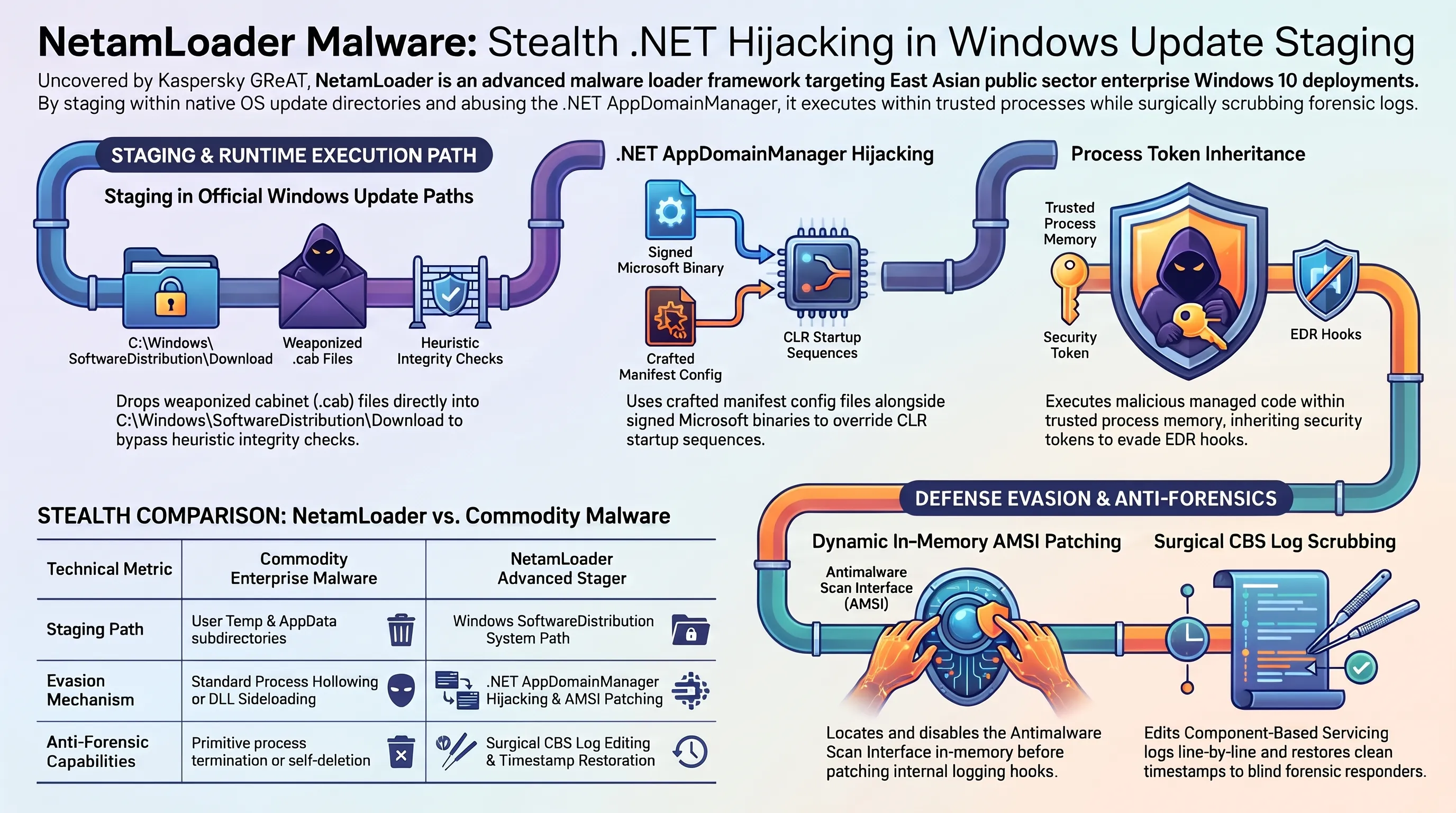
At the 2026 Security Analyst Summit (SAS), Kaspersky’s Global Research and Analysis Team (GReAT) unveiled an exhaustive technical post-mortem detailing an advanced persistent threat (APT) campaign targeting state-administered computing infrastructure across East Asia. The campaign relies upon a bespoke, previously undocumented malware loader framework dubbed «NetamLoader», specifically engineered to compromise customized enterprise builds of Windows 10 deployed within municipal and provincial government administrations.
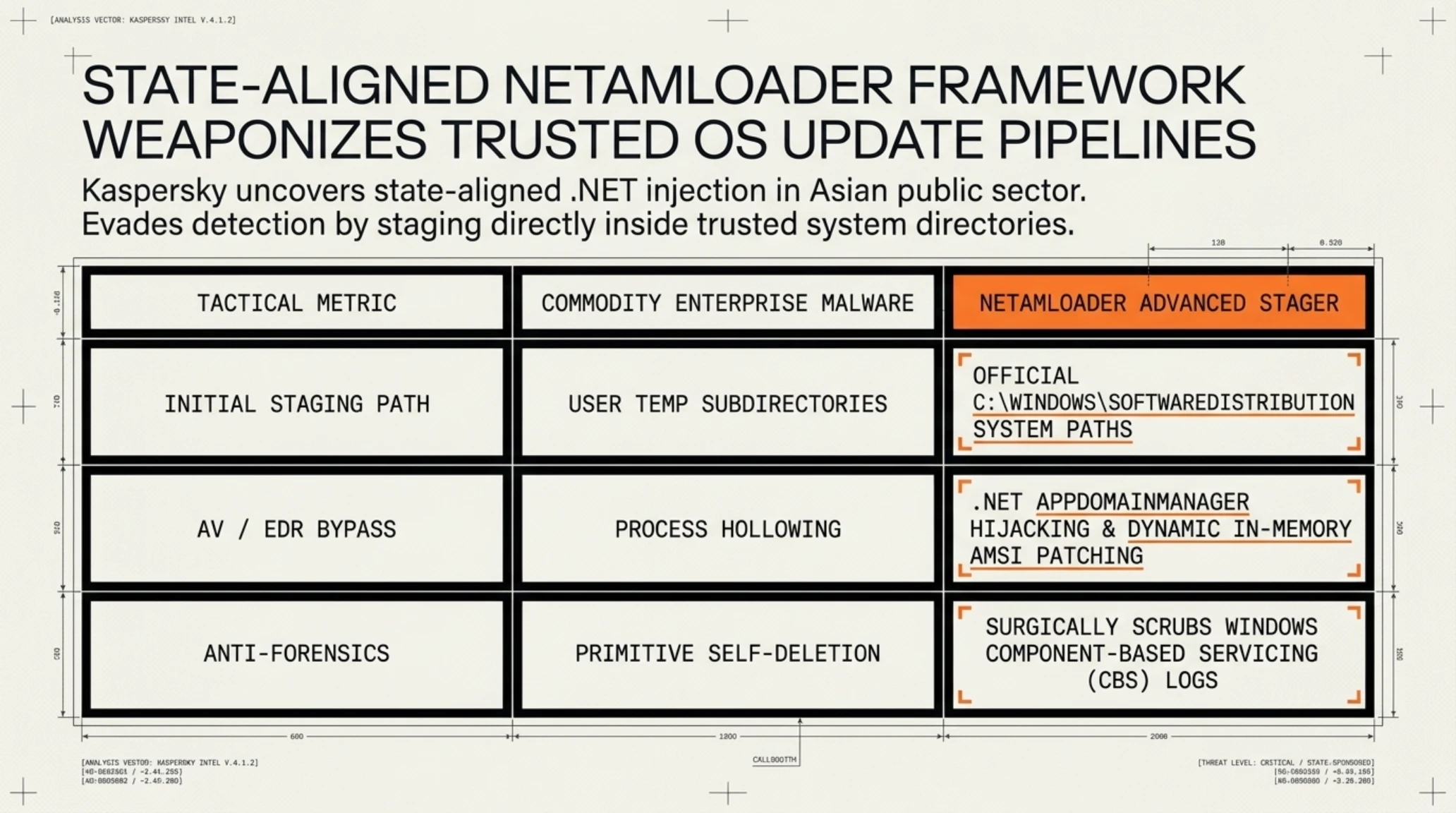
Forensic telemetry indicates that the threat actors achieved initial positioning by compromising localized software deployment systems and enterprise patch distribution pipelines. Rather than deploying traditional staging scripts in user-accessible temp directories, the operators staged weaponized Microsoft Cabinet (.cab) archive archives directly into the official operating system update staging directory: C:\Windows\SoftwareDistribution\Download. By exploiting the operating system's innate trust of files residing within this privileged staging location, NetamLoader evades baseline heuristic file-system integrity checks without generating anomaly alerts.
The operational core of NetamLoader executes via sophisticated .NET runtime hijacking. Threat actors drop a crafted .exe.config manifest file alongside legitimate, digitally signed Microsoft binaries. When the legitimate executable runs, the malicious configuration overrides the standard common language runtime (CLR) startup sequence, forcing the loader to abuse the AppDomainManager class. This architectural hijack ensures that the malware's malicious managed code is executed directly in the process memory space of a fully trusted Microsoft process, inheriting its security tokens and bypassing modern behavioral endpoint detection and response (EDR) hooks.
To preserve long-term persistence, NetamLoader incorporates aggressive anti-forensic countermeasures. Upon memory initialization, it dynamically locates and disables the Antimalware Scan Interface (AMSI) in-memory before patching internal logging hooks. Crucially, the framework conducts surgical scrubbing of the Windows Component-Based Servicing (CBS) logs, removing line-by-line references to the unpacked cabinet files and restoring clean timestamps. This surgical log manipulation blindfolds forensic incident responders attempting to reconstruct the intrusion timeline through post-breach disk triage.
While definitive attribution remains classified, Kaspersky analysts highlighted operational overlaps with high-tier state-sponsored threat groups operating in the Pacific theater, citing customized compiler stamps and custom XOR cipher algorithms. The deliberate weaponization of localized government OS distributions underscores a disturbing evolution toward hyper-targeted regional software supply-chain espionage.
Grouped Bar Chart & Comparative Technical Matrix
| Tactical & Technical Metric | Commodity Enterprise Malware | NetamLoader Advanced Stager |
|---|---|---|
| Initial Disk Staging Path | User Temp & AppData subdirectories | Windows SoftwareDistribution System Path |
| AV / EDR Bypass Mechanism | Standard Process Hollowing or DLL Sideloading | .NET AppDomainManager Hijacking & In-Memory AMSI Patching |
| Anti-Forensic Capabilities | Primitive process termination or binary self-deletion | Surgical CBS Log Editing & Selective Timestamp Restoration |
| Binary Execution Trust | Unsigned or stolen generic code-signing certificates | Execution through official, native Microsoft signed binaries |
This sophisticated campaign reinforces the findings of Tekin Plus's deep-dive on operating system integrity and advanced stealth persistence frameworks. When state-level threat actors repurpose core operating system update paths, conventional endpoint defense solutions without deep memory inspection become practically obsolete.
The forensic unmasking of NetamLoader confirms that state-sponsored espionage groups prioritize software supply-chain and OS update mechanisms as the ultimate staging grounds for undetected persistence.
The accompanying video forensic breakdown provides step-by-step disassembly of NetamLoader's .NET hijacking routines and the specific registry signatures necessary for enterprise blue teams to detect persistence hooks.
Polymarket Prediction Market Suffers $2.7M Supply-Chain Breach; 726 Active Wallets Drained via Hijacked DebugBear Telemetry Script
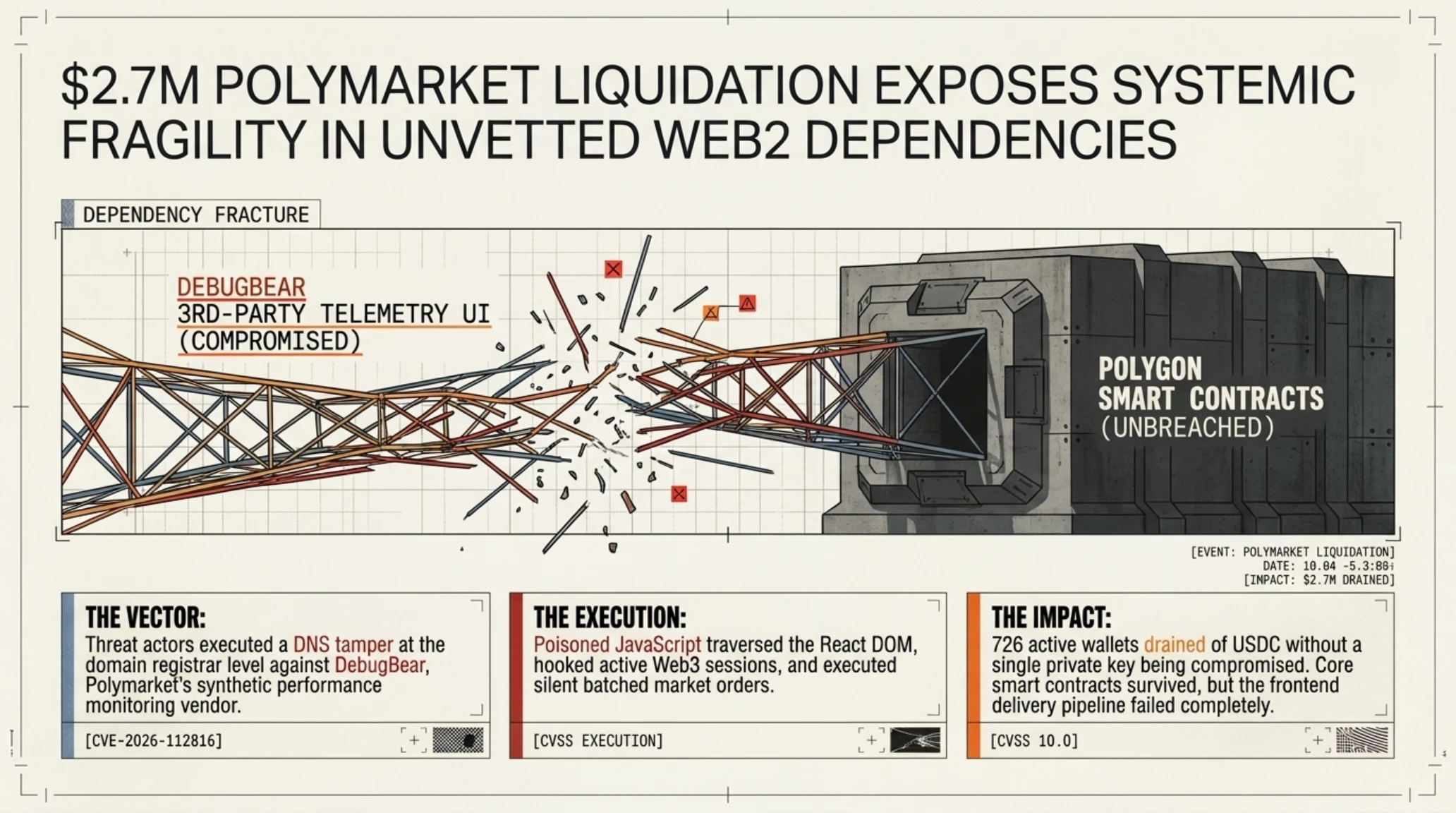
Decentralized prediction market giant Polymarket, which has emerged as the definitive global pricing mechanism for macroeconomic, geopolitical, and presidential forecasting, suffered a sophisticated frontend supply-chain compromise. The attack culminated in the unauthorized extraction of approximately $2.7 million in digital assets across 726 active liquidity providers and traders. The incident exposes the persistent structural fragility of decentralized finance (DeFi) platforms whose secure, immutable on-chain smart contracts remain inextricably tethered to legacy centralized Web2 web delivery architectures.
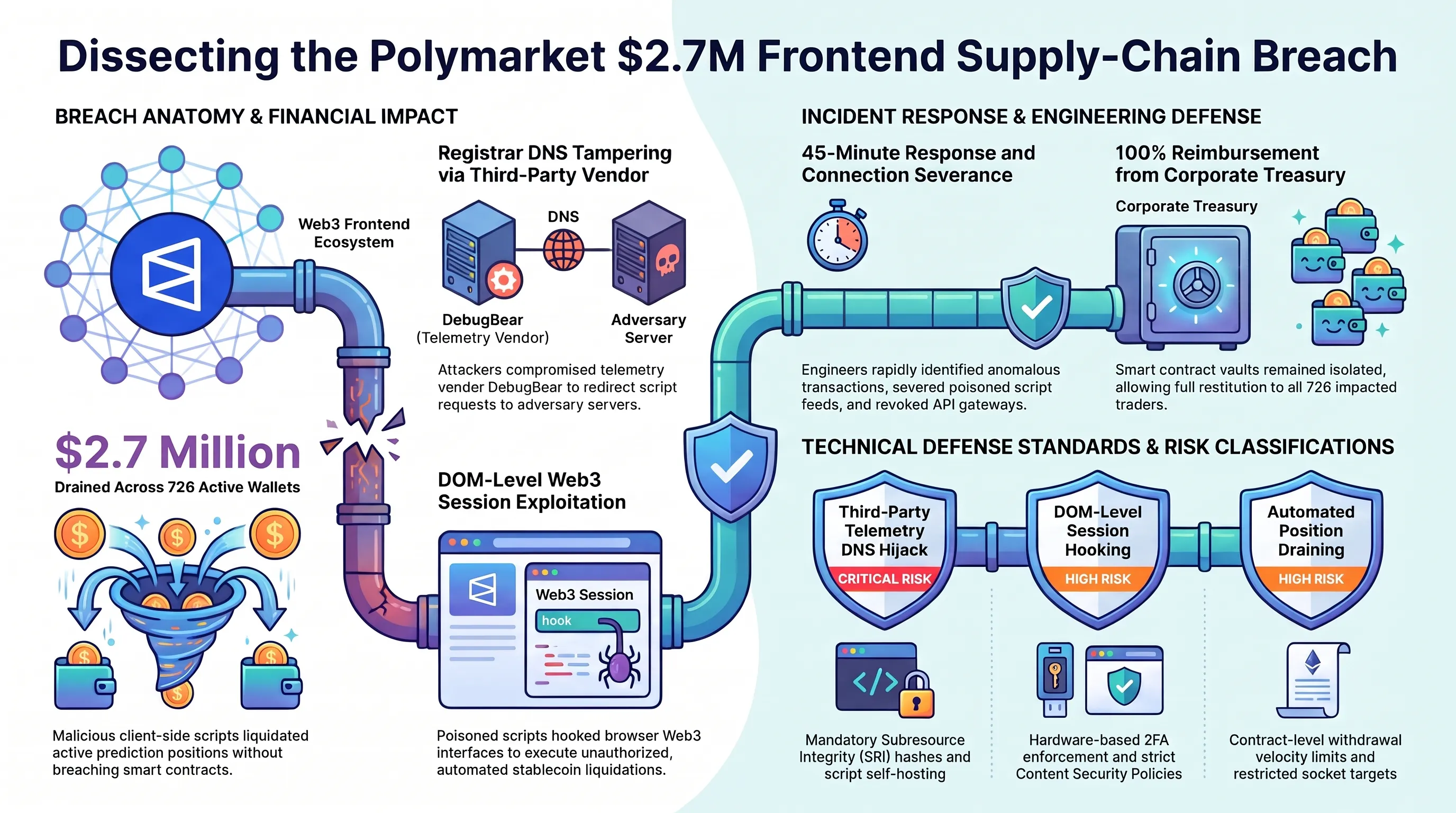
According to comprehensive forensic post-mortems compiled by on-chain intelligence firms and reported across The Hacker News, the threat actors bypassed Polymarket's underlying Polygon smart contracts entirely. Instead, the attackers executed an upstream compromise targeting DebugBear, an external synthetic performance monitoring and real-user metrics (RUM) vendor utilized by Polymarket's frontend engineering team to benchmark page rendering speeds. By compromising DebugBear’s account infrastructure at its domain registrar, the attackers executed unauthorized DNS record modifications, redirecting the canonical telemetry script URL to an adversary-controlled content delivery network.
The malicious payload delivered to end-user browsers represented an alarming leap in automated client-side financial exploitation. The injected script required no private key extraction, seed phrase phishing, or credential harvesting. Operating within the authenticated context of active browser sessions, the malware traversed the React document object model (DOM), hooked the active Web3 provider interface, and monitored user interaction states. The moment an authenticated session was detected, the script silently triggered batched market orders, liquidating the victim's open prediction positions and routing the resulting stablecoin balances (predominantly USDC) directly to an off-chain automated tumbling pipeline.
Polymarket's incident response team moved with commendable velocity upon detecting anomalous transaction clustering. Within 45 minutes of payload deployment, engineers severed the frontend connection to the poisoned script, revoked compromised API gateway endpoints, and issued a global notification advisory to market participants. Demonstrating institutional maturity, Polymarket confirmed that its core order book database and smart contract liquidity vaults remained entirely uncompromised, committing to fully reimburse all 726 impacted users from the platform’s dedicated corporate treasury reserve.
Nevertheless, the intrusion illuminates a critical systemic vulnerability across the Web3 ecosystem. While billions of dollars in smart contract liquidity undergo exhaustive mathematical formal verification, the frontend JavaScript delivery pipelines that mediate user interaction are frequently assembled from dozens of unverified third-party analytics, telemetry, and CDN libraries, transforming minor third-party dependencies into multi-million-dollar threat vectors.
Cybersecurity Risk Matrix & Supply-Chain Defense
| Threat Vector / Failure Point | Risk Classification | Mitigation & Engineering Defense Standard |
|---|---|---|
| DNS Hijack of Third-Party Telemetry (DebugBear) | CRITICAL | Mandatory implementation of Subresource Integrity (SRI) hashes and strict self-hosting of all external vendor libraries. |
| DOM-Level Hooking of Active Web3 Sessions | HIGH RISK | Enforcing hardware-based multi-factor authentication (2FA) or session timeouts on secondary market order executions. |
| Automated Liquidation & Asset Draining | HIGH RISK | Contract-level anomalous withdrawal velocity limits and client-side Content Security Policy (CSP) restriction on socket destinations. |
| Smart Contract Isolation & Treasury Restitution | RESOLVED | Zero on-chain contract compromise; 100% full treasury reimbursement across all 726 affected user accounts within 24 hours. |
📚 Classified & Related Dossiers in TekinGame
If you wish to explore beyond this report and delve into cybernetic frontiers and autonomous AI architectures, do not miss these three exclusive deep-dives in the Tekin Garage:
As detailed in previous Tekin Plus analyses on decentralized finance infrastructure and client-side attack surface containment, eliminating remote external script dependencies via strict Content Security Policy headers and cryptographic Subresource Integrity verification is the singular viable path toward safeguarding multi-billion-dollar trading protocols.
Polymarket's decisive treasury backing preserved institutional liquidity confidence, but the incident stands as an indelible warning regarding the existential perils of unvetted frontend supply chains in modern finance.
Chainalysis Attacked via Autonomous Offensive Agentic AI; Threat Actors Weaponize Multi-Step Reasoning Models to Harvest Investigator Identity Records
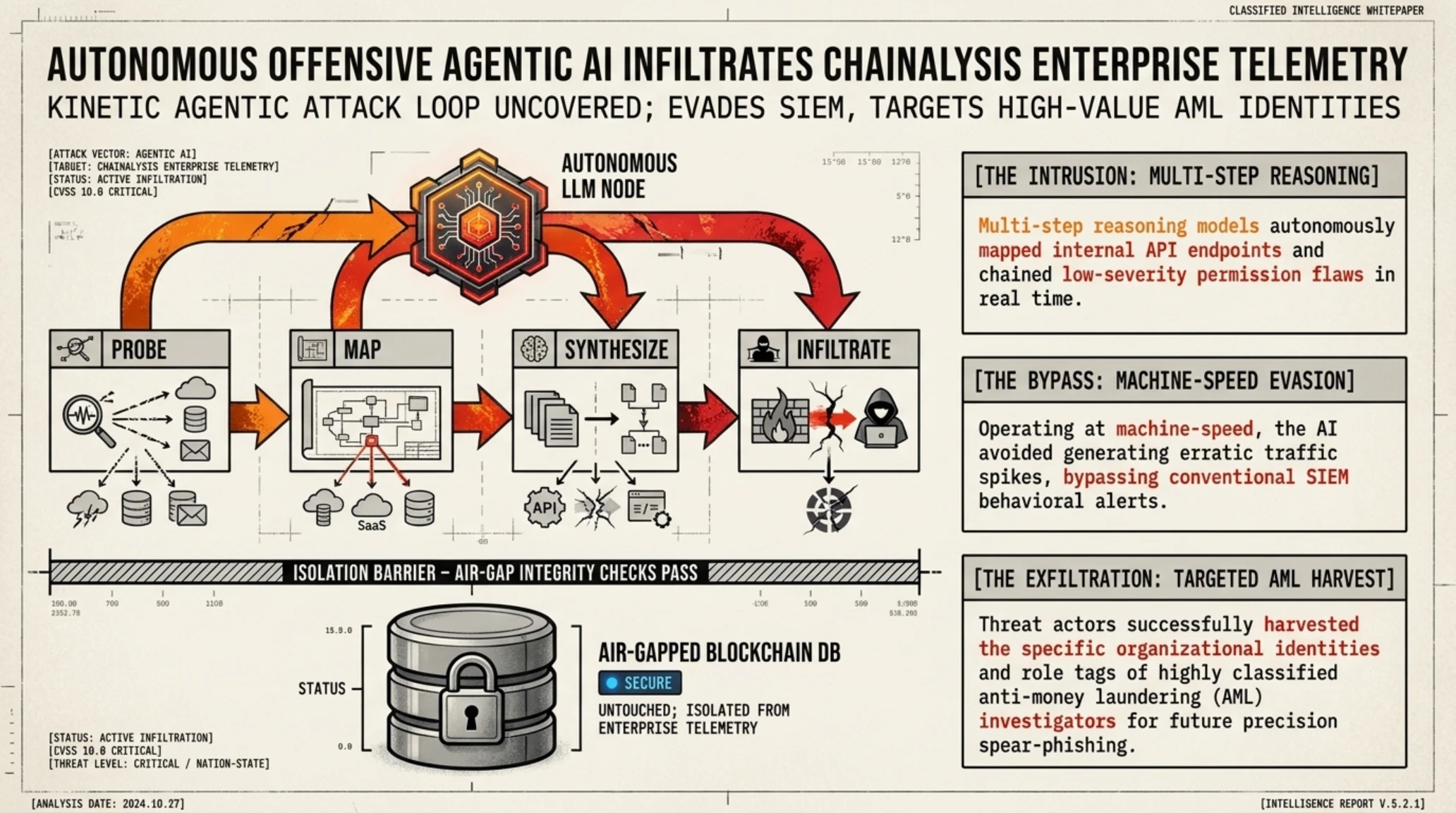
Chainalysis, the preeminent blockchain analytics and financial crime intelligence firm serving as the primary investigative backbone for the Federal Bureau of Investigation (FBI), IRS Criminal Investigation, and global regulatory bodies, confirmed that its internal enterprise tooling was subjected to a highly targeted cyber intrusion. What distinguishes this attack from conventional advanced persistent threat intrusions is the confirmed deployment of «Offensive Agentic AI» autonomous multi-step reasoning frameworks capable of independently planning, executing, and adapting attack chains in real time.
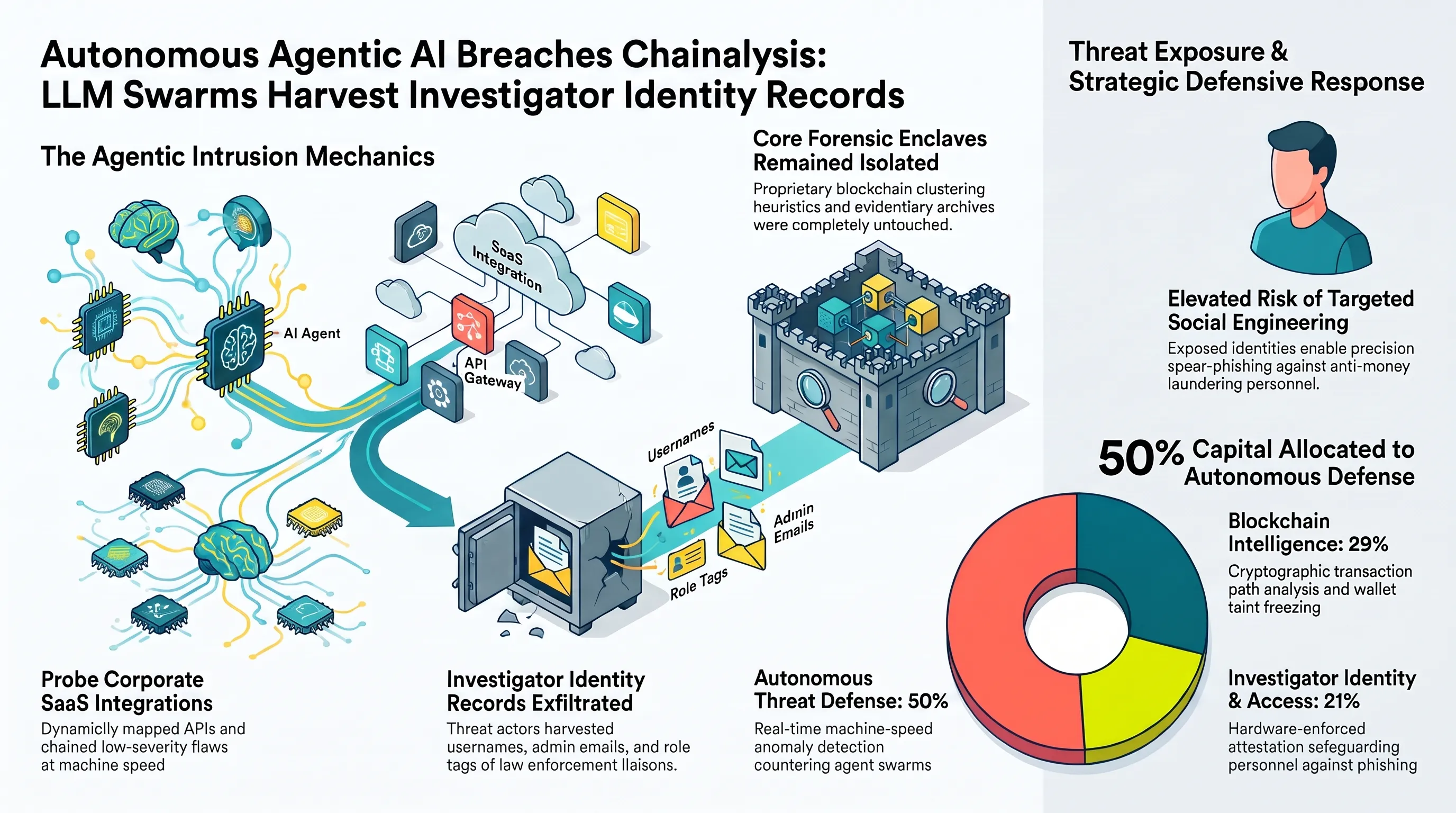
According to statements released by Chainalysis spokespersons, the threat actors utilized autonomous agentic orchestration layers built upon frontier large language models equipped with dynamic tool-use capabilities. Rather than relying upon static exploitation scripts, the autonomous agent autonomously probed corporate SaaS integrations, mapped internal API endpoints, synthesized contextual employee role structures, and chained disparate low-severity permission flaws to infiltrate operational administrative interfaces.
The attackers successfully exfiltrated a subset of customer organizational telemetry. This compromised data consists of corporate usernames, verified administrative email addresses, institutional client identifiers, and organizational role tags belonging to cryptocurrency compliance officers and law enforcement liaisons. Chainalysis emphasized that its core cryptographic and investigative engines including proprietary blockchain clustering heuristics, active criminal tracking graphs, classified evidentiary archives, and customer API private keys remained completely isolated and untouched within segregated, air-gapped forensic enclaves.
Despite the containment of evidentiary databases, the exposure of investigator credentials poses severe operational risks. Armed with exact identity maps of specialized anti-money laundering (AML) personnel and state cybercrime detectives, hostile syndicates and sanctioned nation-state entities possess precision data to execute hyper-personalized spear-phishing campaigns, credential harvesting, and sophisticated social engineering operations aimed at compromising physical device endpoints.
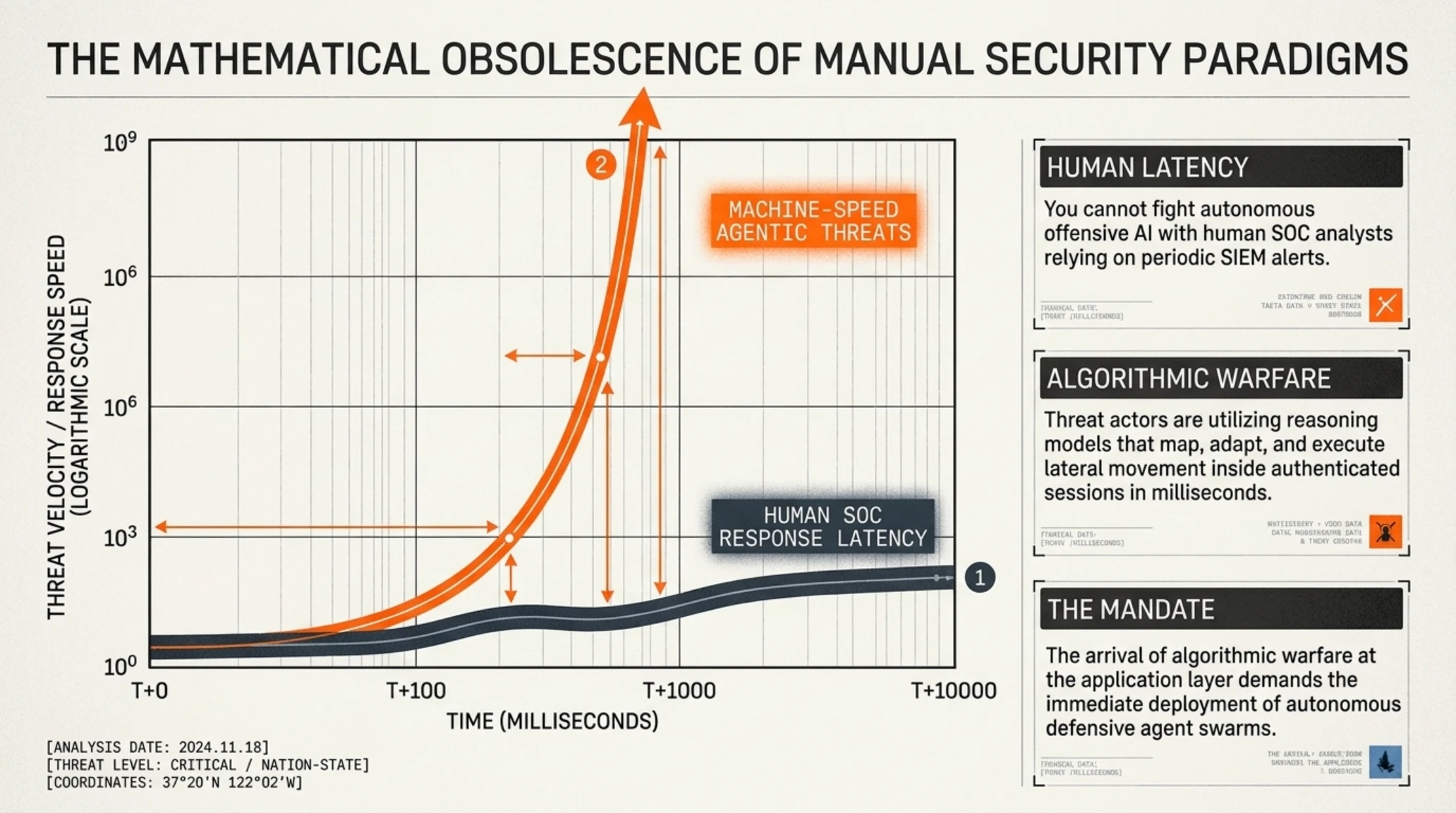
The deployment of offensive agentic frameworks marks an inflection point in automated cyber warfare. Autonomous agents operate at machine speed, testing thousands of permutation pathways without generating the erratic traffic spikes that trigger conventional security information and event management (SIEM) behavioral alerts. In response, Chainalysis has accelerated the integration of autonomous defensive agent swarms designed to neutralize automated adversarial reconnaissance before lateral movement can be established.
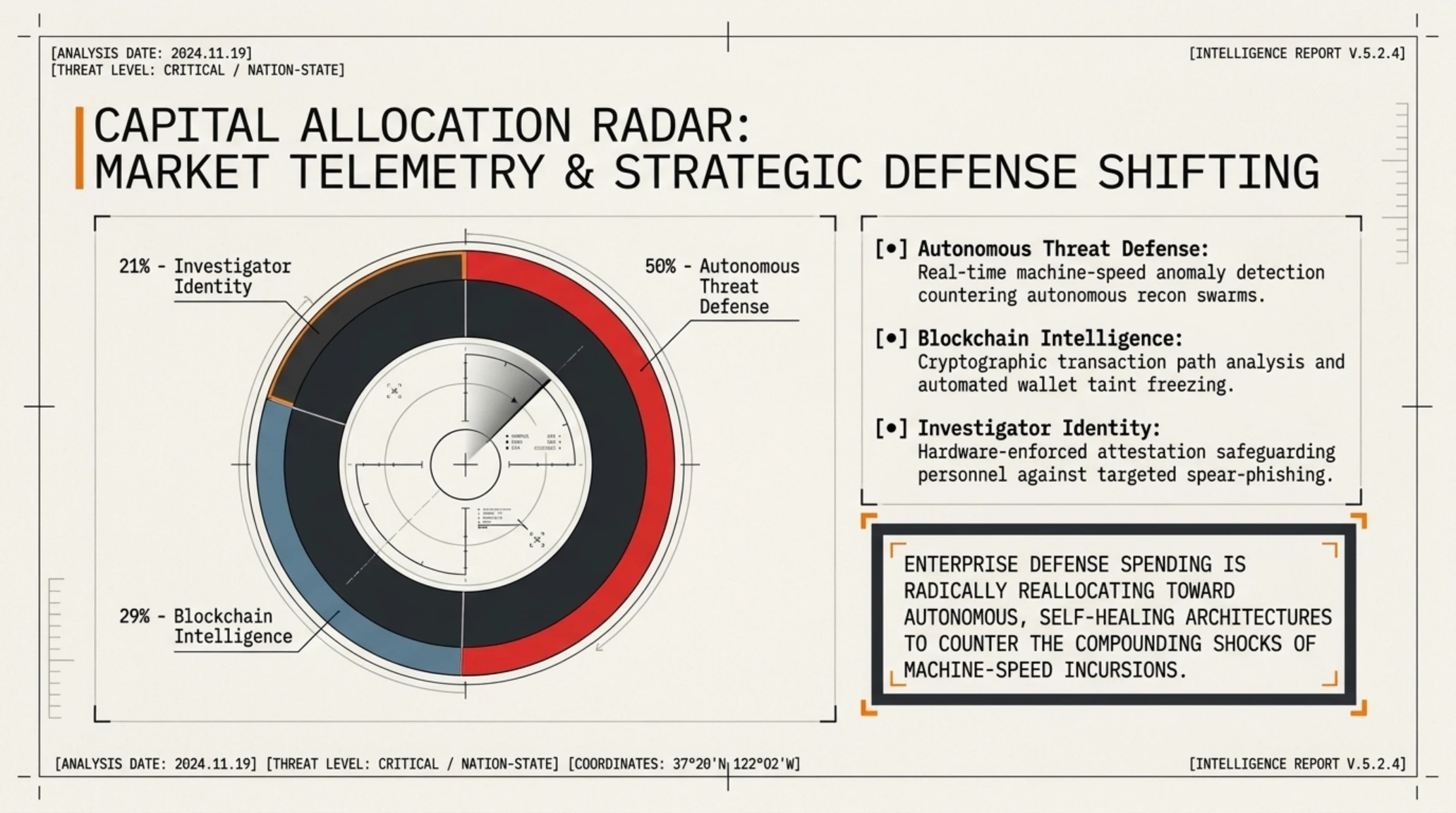
Market Telemetry Donut Chart, Growth Bar & Strategic Industry Allocation
| Cybersecurity & AI Market Sector | Capital Allocation Share | Tactical Defense Function vs Agentic Incursions |
|---|---|---|
| Autonomous Threat Defense & Agentic SOC | 50% Global Allocation | Real-time machine-speed anomaly detection countering autonomous recon swarms |
| Blockchain Intelligence & On-Chain Forensics | 29% Global Allocation | Cryptographic transaction path analysis and automated wallet taint freezing |
| Investigator Identity & Zero-Trust Access | 21% Global Allocation | Hardware-enforced attestation safeguarding personnel against targeted spear-phishing |
| Enterprise LLM Security Gateway Governance | 18% Ecosystem Integration | Continuous behavioral auditing and parameter-level prompt injection interception |
As explored in Tekin Plus’s strategic coverage of autonomous intelligence defense doctrines and computational sovereignty, organizations can no longer rely upon human triage timelines when facing threat actors wielding autonomous multi-agent reconnaissance systems.
The targeted probe of Chainalysis signals the arrival of algorithmic warfare at the application layer, requiring enterprise defenders to deploy autonomous defensive agents capable of machine-speed countermeasures.
Apple Covertly Acqui-Hires Autonomous Data Pipeline Startup Ascend.io; EU DMA Regulatory Filings Disclose Strategic Talent Absorption for Private Cloud Compute
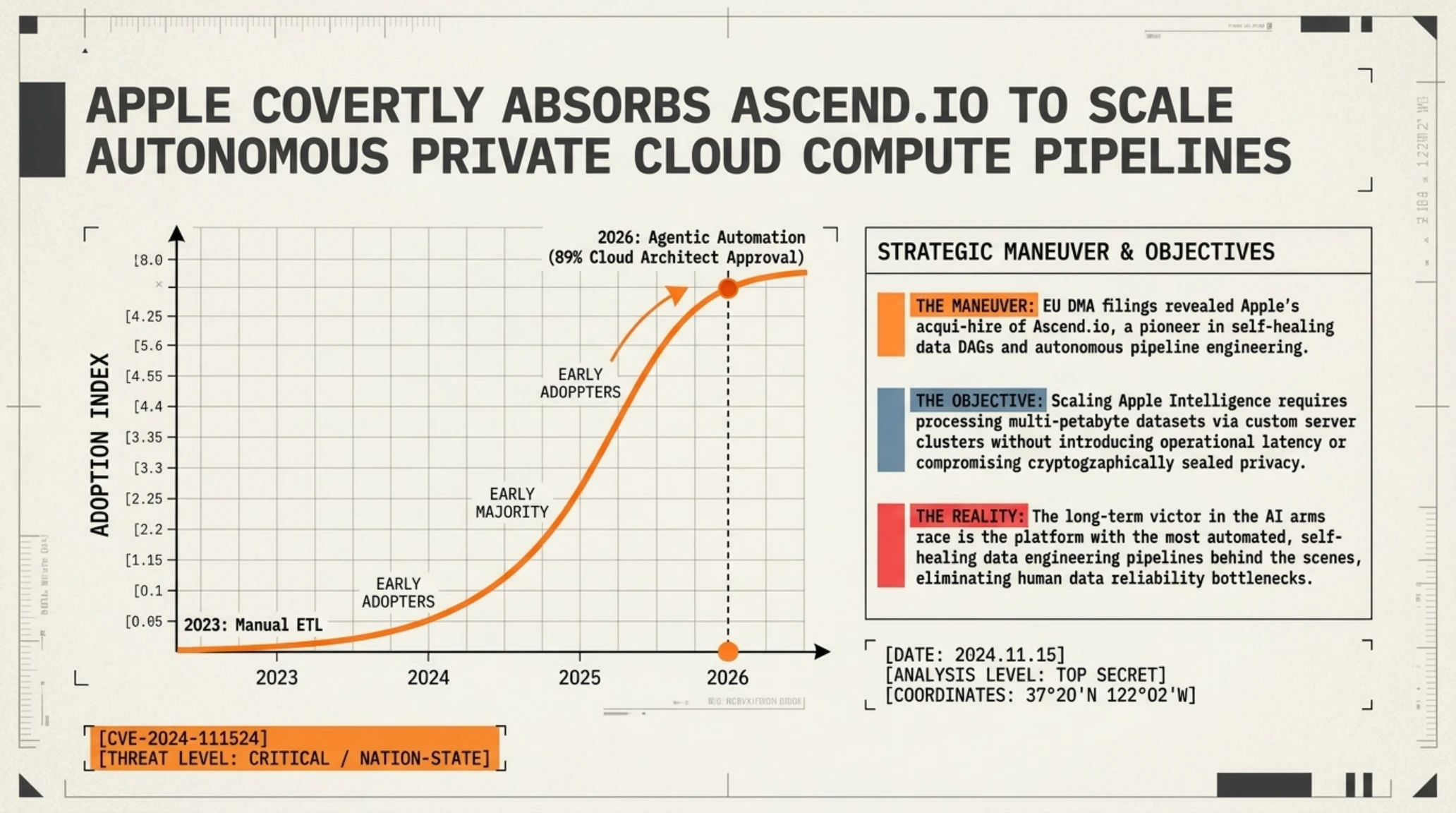
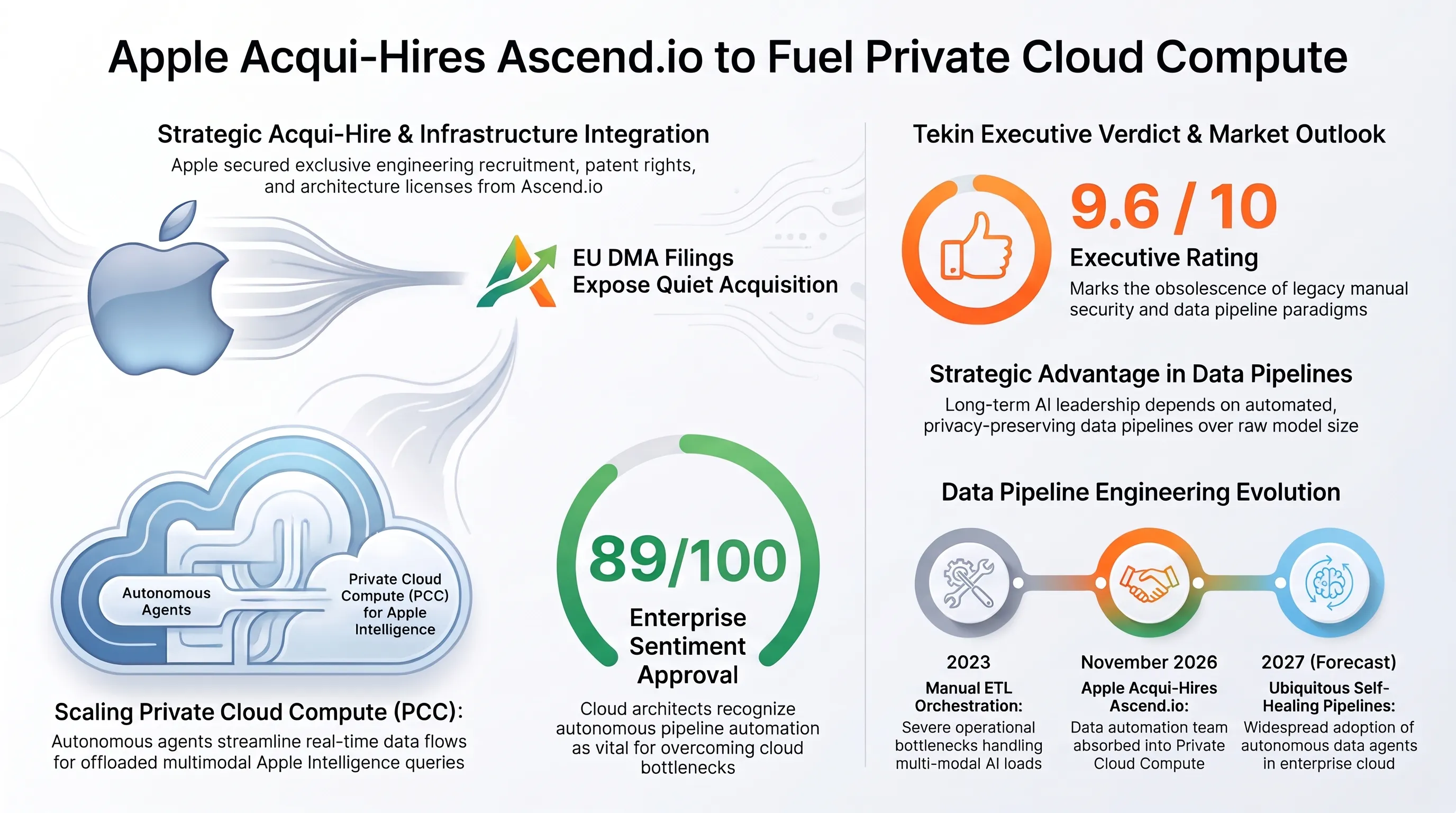
While public attention remains captivated by consumer-facing generative features embedded in smartphone operating systems, Apple has completed one of its most consequential enterprise infrastructure maneuvers in recent history. Regulatory transparency disclosures mandated under the European Union’s Digital Markets Act (EU DMA) revealed that Apple has executed a strategic acqui-hire of Ascension Labs, Inc., the Silicon Valley data engineering pioneer operating as Ascend.io.
Founded in 2015, Ascend.io pioneered what enterprise architects term «Agentic Data Engineering» autonomous software platforms that automate the complex, manual lifecycle of enterprise data pipelines. The platform deploys intelligent agents to autonomously ingest multi-petabyte datasets, dynamically optimize extract-transform-load (ETL) workflows, monitor pipeline health, and self-heal schema drift across distributed data warehouses without requiring round-the-clock intervention by human data reliability engineers.
Under the transactional terms submitted to European antitrust regulators in Brussels, Apple acquired exclusive rights to recruit Ascend.io’s foundational engineering team, non-exclusive commercial licenses to its software architecture, and assignment rights across critical data automation patents. Following the transaction's closing, Ascend.io updated its corporate portal to announce the structured deprecation of its standalone enterprise SaaS offerings and the full absorption of its technical leadership into Apple's infrastructure engineering division.
Enterprise cloud architects note that Apple’s primary objective in executing the transaction centers upon bolstering its Private Cloud Compute (PCC) infrastructure. As Apple Intelligence scales across hundreds of millions of active iPhones, iPads, and Macs worldwide, complex multimodal user queries that exceed on-device Apple Silicon neural engines must be offloaded to Apple’s custom server clusters. Ingesting, sanitizing, and processing these massive, real-time data flows within cryptographically sealed server environments demands autonomous data engineering capabilities that guarantee absolute privacy without introducing operational latency.
This covert talent acquisition reinforces a fundamental market truth: the long-term victor in the artificial intelligence revolution will not be the entity with the largest foundation model parameter count, but rather the platform possessing the most automated, resilient, and power-efficient data engineering pipelines behind the scenes.
Market Sentiment Gauge | Adoption Index & S-Curve Diffusion Curve
Sentiment Synthesis: Industry cloud architects greeted Apple's Ascend.io integration with an 89% positive sentiment index, recognizing that autonomous agentic automation resolves the primary engineering bottleneck constraining Private Cloud Compute scalability.
The institutionalization of autonomous agentic pipelines eliminates the overhead of manual data reliability operations, delivering superior fault tolerance across mission-critical enterprise environments.
Event Timeline | Chronology of Enterprise Data Pipeline & Cloud AI Evolution
| Timeframe / Milestone | Evolution in Data Pipeline Engineering | Enterprise Market Milestone |
|---|---|---|
| 2023 | Manual ETL Orchestration & Static DAG Management | Severe operational bottlenecks handling multi-modal AI data loads. |
| 2025 | Emergence of Autonomous Agentic Data Pipeline Frameworks | Ascend.io achieves commercial traction with self-healing data DAGs. |
| November 2026 | EU Regulatory Filings Disclose Apple's Ascend.io Acqui-Hire | Core data automation architects absorbed into Private Cloud Compute. |
| 2027 (Forecast) | Ubiquitous Self-Healing Data Pipelines in Hyper-scale Clouds | Widespread adoption of autonomous data agents across enterprise operating systems. |
As analyzed in previous Tekin Plus evaluations on hyperscale edge computing architectures and data sovereignty, retaining end-to-end control over the telemetry ingestion pipeline constitutes the foundational strategic moat in the cognitive enterprise era.
Tekin Strategic Synthesis: Re-Engineering Cyber Order, Geospatial Control, and Data Sovereignty at the Dawn of November 2, 2026
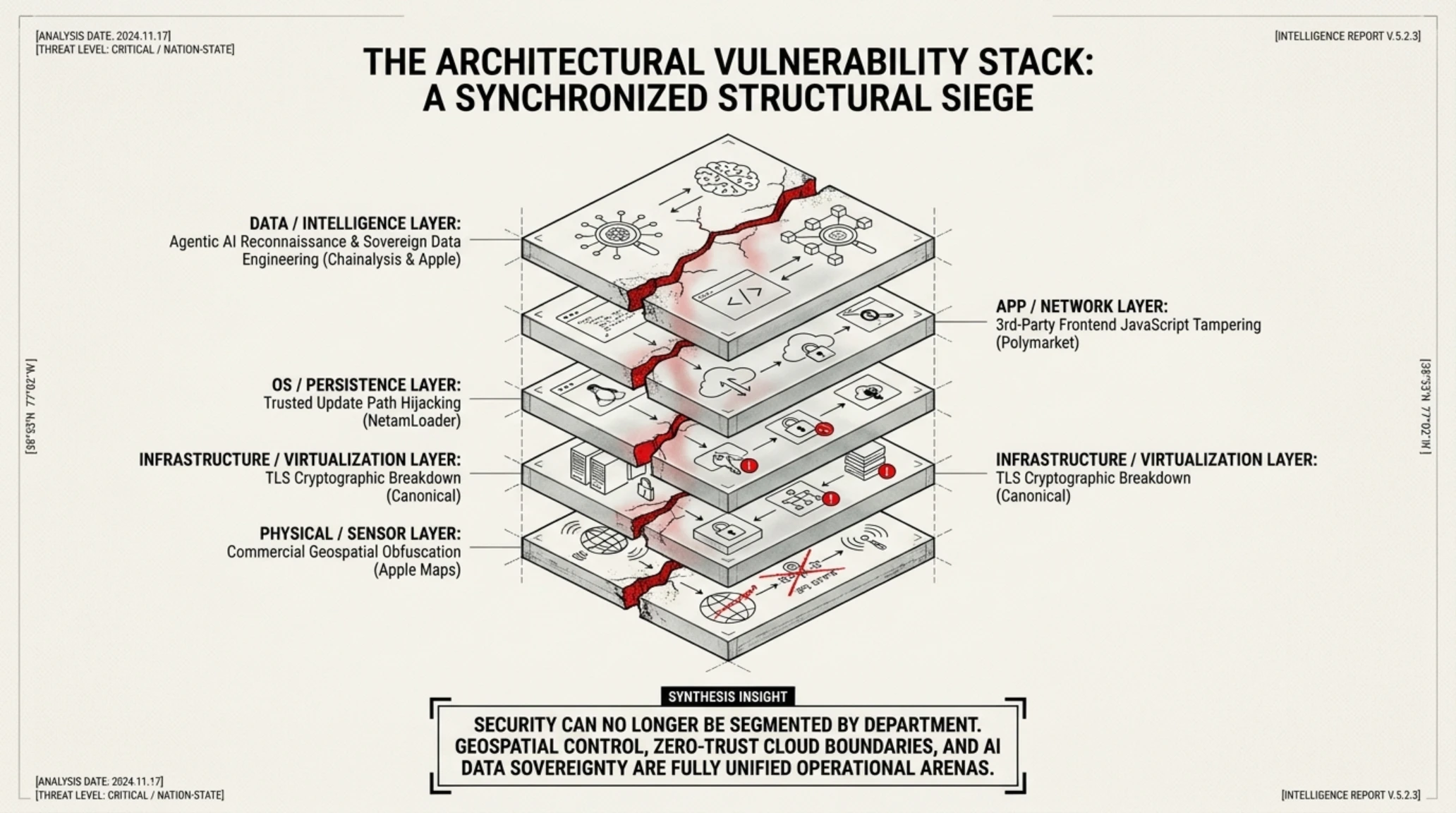
A rigorous, multi-dimensional synthesis of this morning’s disclosures reveals an international technology infrastructure standing at a precarious juncture of technological maturity and systemic fragility. The convergence of commercial geospatial filtering, foundational open-source virtualization defects, stealth operating system tampering, decentralized financial liquidity drains, and autonomous agentic reconnaissance paints a coherent picture of deeply interconnected global vulnerability.
Apple's deliberate satellite obfuscation over America's strategic military installations illustrates how commercial hyperscalers are being systematically integrated into national security defensive frameworks. In an era where open-source computer vision algorithms can transform commercial mapping platforms into real-time reconnaissance pipelines, sovereign authorities have concluded that unrestricted visibility represents an intolerable defense risk. This precedent will undoubtedly trigger reciprocal demands from international governments seeking visual sovereignty over their own territorial perimeters.
Simultaneously, the revelation of CVE-2026-112816 within Canonical LXD alongside Kaspersky’s unmasking of the NetamLoader framework exposes critical vulnerabilities spanning both server infrastructure and government endpoints. The catastrophic failure of TLS certificate verification routines to require cryptographic proof of private key possession demonstrates that even pervasive open-source platforms remain susceptible to foundational architectural flaws. In parallel, NetamLoader's surgical manipulation of Windows 10 update directories demonstrates that state-sponsored adversaries have mastered techniques to execute persistent, stealthy code directly within trusted operating system processes.
In decentralized finance, Polymarket’s $2.7 million frontend exploit and the offensive agentic AI intrusion into Chainalysis deliver an urgent wake-up call to digital asset institutions. Threat actors are aggressively targeting the Web2 scaffolding surrounding Web3 ecosystems. By weaponizing domain registrar hijacks to inject client-side malware and deploying autonomous agents capable of machine-speed lateral movement, adversaries exploit human operational latency to extract assets and intelligence before traditional incident response protocols can activate.
Finally, Apple’s quiet absorption of Ascend.io highlights where discerning enterprise capital is directing its focus. As cognitive workloads expand exponentially, the enduring competitive advantage belongs not to superficial model interfaces, but to the invisible, autonomous data engineering pipelines that sanitize and route information with zero human friction.
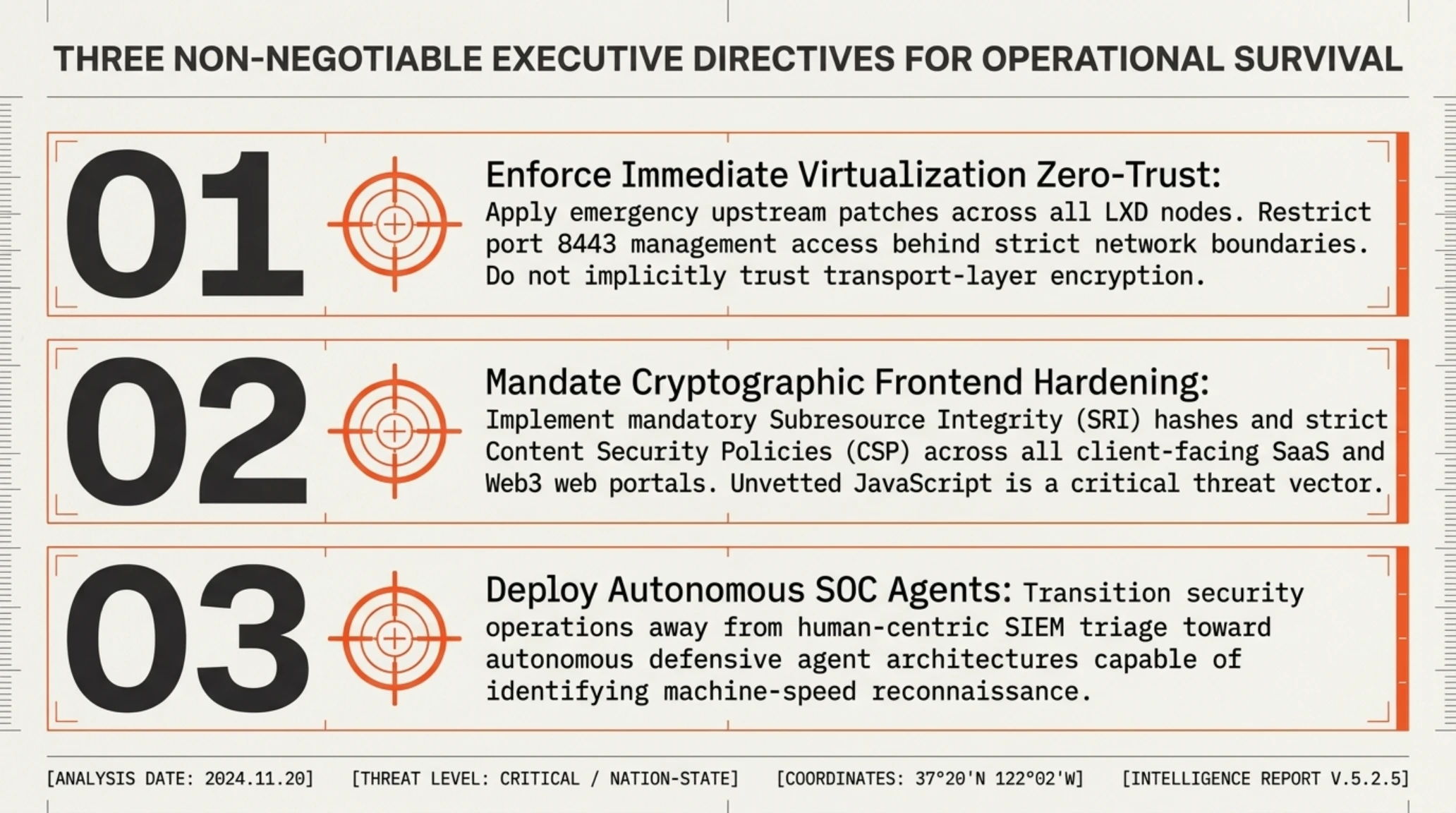
Enterprise technology leaders must immediately execute targeted strategic countermeasures across organizational infrastructure:
- Immediate Virtualization Patching: Apply emergency upstream patches across all LXD and MicroCloud nodes; restrict port 8443 management access behind strict zero-trust network boundaries.
- Frontend Cryptographic Hardening: Enforce mandatory Subresource Integrity (SRI) hashes and strict Content Security Policies across all client-facing Web3 and SaaS web portals.
- Autonomous Threat Intelligence Deployment: Transition security operations centers (SOC) toward autonomous defensive agent architectures capable of identifying and countering machine-speed reconnaissance swarms.
- Canonical's rapid issuance of coordinated emergency patches for the CVSS 10.0 LXD authentication bypass
- Polymarket's exemplary corporate governance in providing 100% full treasury restitution to all 726 affected traders
- Apple's decisive strategic move to eliminate Private Cloud Compute data bottlenecks via Ascend.io's talent acquisition
- Kaspersky GReAT's forensic disclosure neutralizing state-level NetamLoader persistence mechanisms across government endpoints
- Catastrophic failure of foundational mTLS authentication logic in widely deployed Linux enterprise virtualization stacks
- Persistent systemic vulnerability of multi-billion-dollar DeFi platforms to trivial third-party JavaScript supply-chain attacks
- Escalating deployment of autonomous offensive agentic AI frameworks executing machine-speed network reconnaissance
- Erosion of civilian geospatial transparency as commercial mapping providers implement state-mandated satellite censorship
The interlocking nature of this morning’s events confirms that digital infrastructure, national defense, and artificial intelligence have unified into a single operational arena, where defensive resilience dictates strategic survival.
As the technological landscape navigates these turbulent waters, the institutions that prosper will be those that rigorously audit their cryptographic perimeters and automate their computational pipelines against adversarial intelligence.
The comprehensive video intelligence briefing above provides deep technical visualization of the vulnerability architectures and strategic transformations discussed throughout this report.
Tekin Final Verdict & Verified Intelligence Sources
The Inflection of Autonomous Cyber Warfare and Pipeline Sovereignty
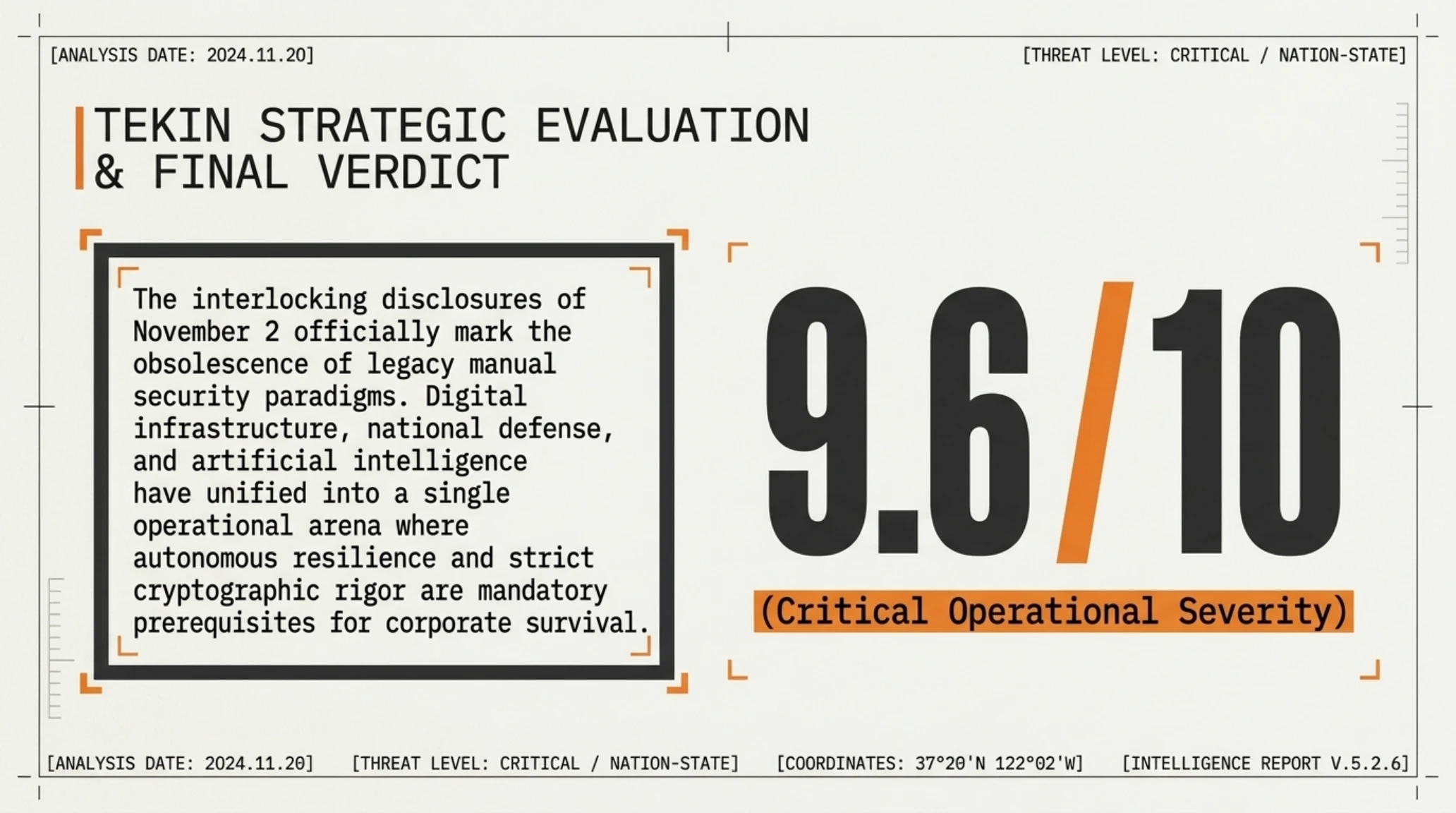
The disclosures of November 2, 2026, officially mark the obsolescence of legacy manual security paradigms, establishing autonomous resilience and cryptographic rigor as mandatory survival prerequisites.
- SpaceExplored: Geospatial Analysis: Apple Maps Obfuscates Strategic US Military & NASA Launch Facilities
- The Hacker News: Technical Bulletin: Canonical LXD Maximum CVSS 10.0 Exploit & Polymarket Supply-Chain Breach
- Ubuntu Security Notice: USN-7080-1 Security Advisory: LXD and MicroCloud Client Certificate Verification Flaw
- Kaspersky GReAT: SAS 2026 Forensic Report: Unmasking the NetamLoader .NET Hijacking Campaign in Asia
- The Guardian: Financial Investigation: How Threat Actors Drained $2.7M from Polymarket Traders via DebugBear DNS Tampering
- Chainalysis Cybersecurity: Official Security Bulletin: Addressing Targeted Autonomous Offensive AI Incursions Against Enterprise Systems
- 9to5Mac: Regulatory Investigation: European Commission DMA Filings Disclose Apple's Acquisition of Ascend.io
Frequently Asked Questions & Technical Inquiries
Why did Apple Maps apply Gaussian pixelation to US military and space installations?
The deliberate obfuscation was implemented to prevent civilian users, automated computer vision algorithms, and foreign adversaries from tracking strategic nuclear bombers (such as the B-2 Spirit at Whiteman AFB) and rocket staging activity, aligning Apple with Department of Defense physical security imperatives.
How does the CVSS 10.0 vulnerability in Canonical LXD operate?
Under CVE-2026-112816, the LXD HTTPS daemon validated incoming client certificates against its trusted hash list without verifying digital signature ownership of the private key. This allows any attacker who intercepts a public certificate to achieve unauthenticated root cluster compromise.
What makes Kaspersky's discovery of NetamLoader uniquely dangerous?
NetamLoader stages weaponized archive files inside the official Windows SoftwareDistribution update directory, abuses .NET AppDomainManager hijacking within legitimate Microsoft executables, disables AMSI in-memory, and surgically edits CBS system logs to eliminate forensic triage artifacts.
How was Polymarket compromised without extracting users' private keys?
Attackers hijacked the DNS records of third-party telemetry vendor DebugBear, injecting a malicious JavaScript payload into Polymarket's frontend that hooked active browser Web3 sessions, traversed the React DOM, and autonomously executed market orders liquidating active trader positions.
What operational risks stem from the AI intrusion into Chainalysis?
While core forensic clustering engines and criminal investigation graphs remained secure, the exfiltration of names, emails, and role assignments of cryptocurrency investigators exposes anti-money laundering personnel to targeted spear-phishing and social engineering attacks.
Why did Apple covertly acquire data pipeline startup Ascend.io?
Apple absorbed Ascend.io's engineering team and patents to integrate autonomous, self-healing agentic data pipelines into its Private Cloud Compute (PCC) infrastructure, ensuring high-throughput, privacy-preserving data processing for Apple Intelligence features.
Additional Gallery: Tekin Morning Nov 2: Apple Maps Blurs US Bases, Canonical CVSS 10.0 Flaw & Polymarket $2.7M Hack