🎬 Alibaba Wan 3.0 AI Video Model Review
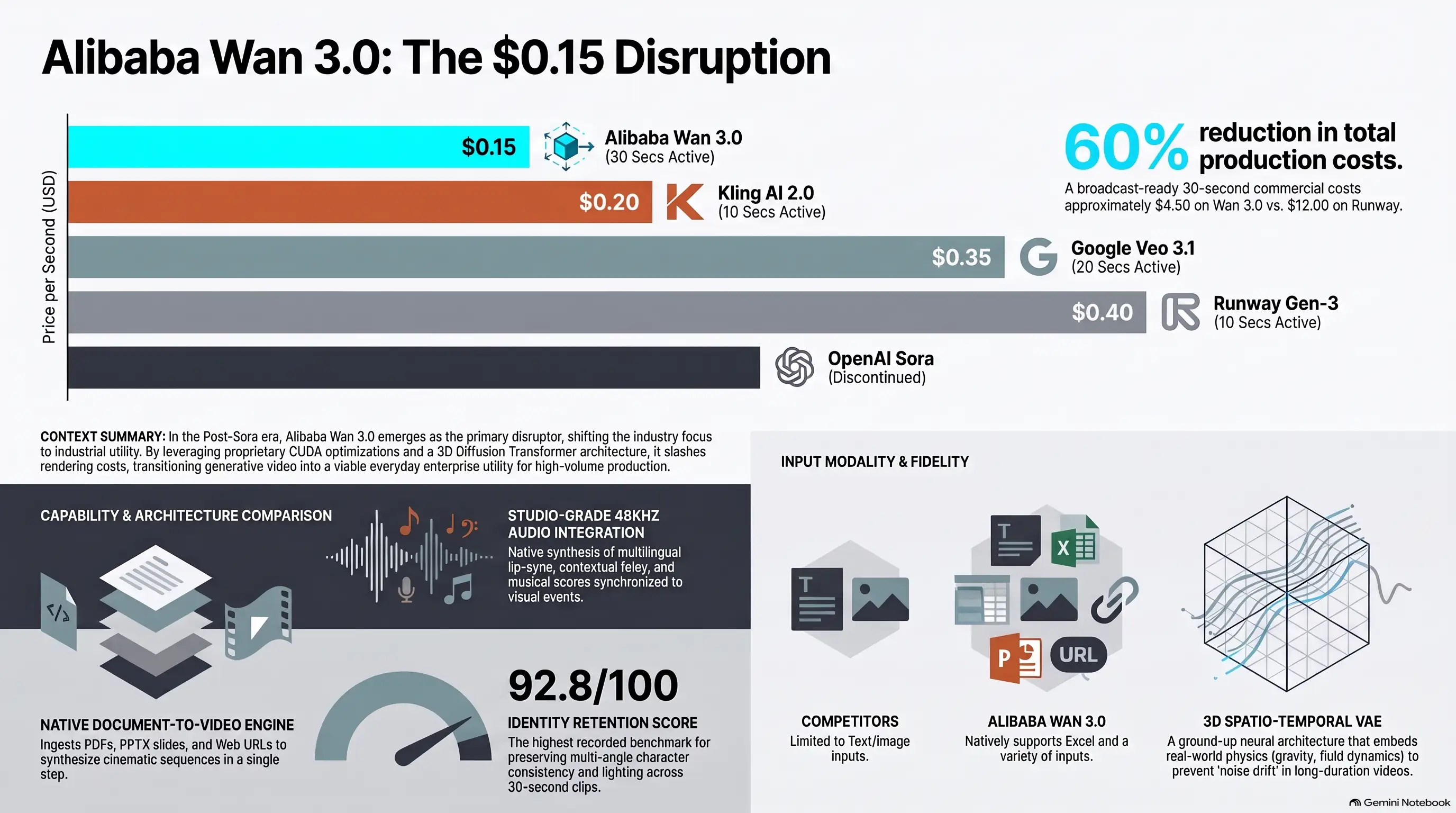
- 🎮Document-to-Video Engine- Native ingestion of PDFs, PPTX slides, and web URLs
- 🎧30-Second 1080p Coherence- Doubled duration with character facial and lighting retention
- 🚀Integrated 48kHz Audio- Studio-grade stereo sound with multilingual lip synchronization
- 🗡️50% Price Deflation- Rendering costs halved compared to Google Veo 3.1 ($0.15/s)
- 📰Director-Level Camera Control- 3D Cartesian trajectory mapping for cinematic dolly and pan moves
- ⚔️3D Diffusion Transformer- Scalable DiT backbone embedding real-world intuitive physics
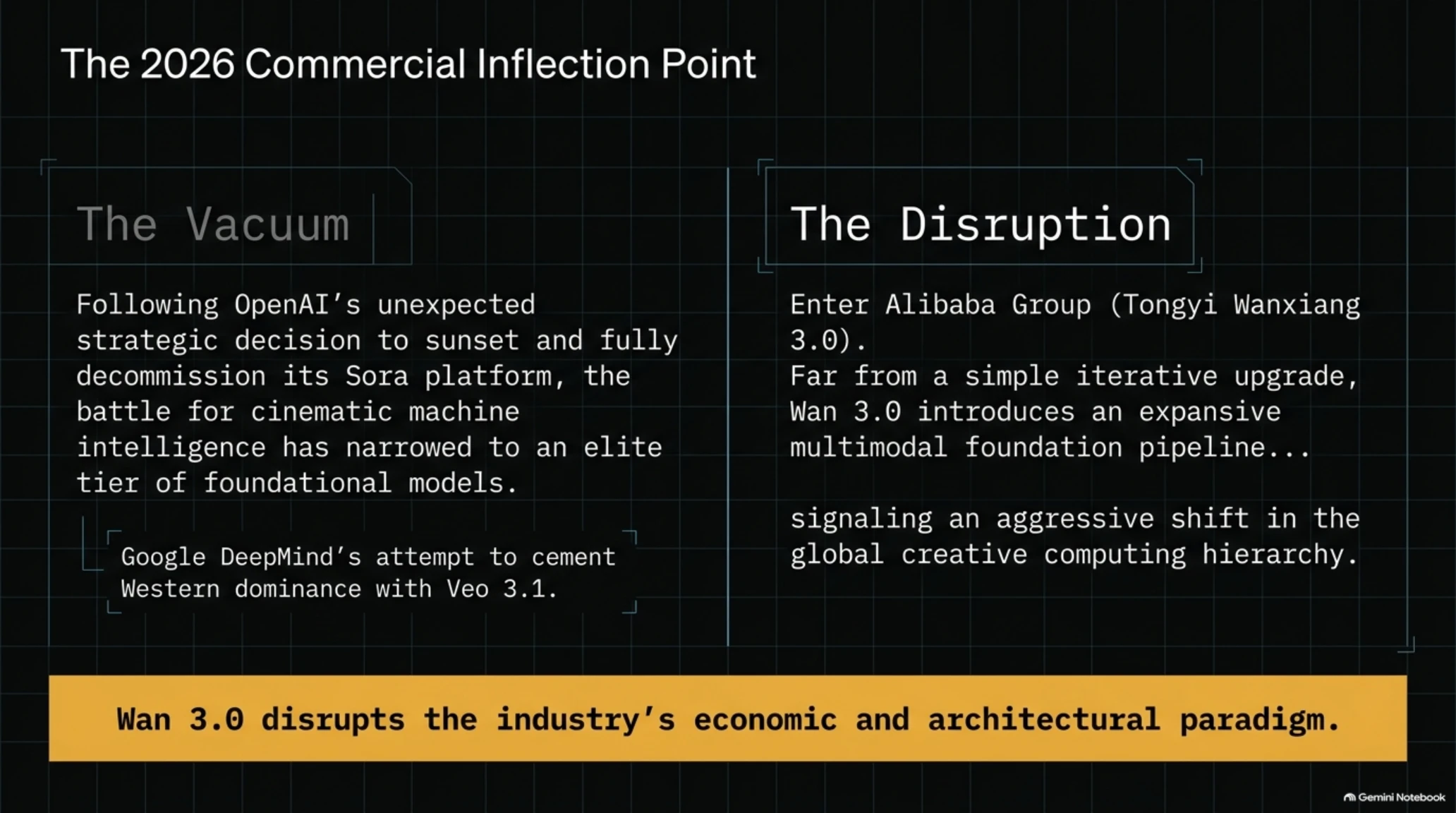
The generative video artificial intelligence landscape in late 2026 has arrived at a critical commercial inflection point. Following OpenAI's unexpected strategic decision to sunset and fully decommission its Sora platform, the battle for cinematic machine intelligence has narrowed to an elite tier of foundational models. While Google DeepMind sought to cement Western dominance with the deployment of Veo 3.1, Chinese cloud and AI titan Alibaba Group has fundamentally disrupted the industry's economic and architectural paradigm with the general availability release of Wan 3.0 (Tongyi Wanxiang 3.0).
Far from a simple iterative upgrade, Wan 3.0 introduces an expansive multimodal foundation pipeline engineered to ingest complex enterprise collateral including multipage PDF dossiers, PowerPoint presentations, Excel financial models, and live web page URLs and synthesize them directly into coherent, high-fidelity 30-second cinematic sequences in a single operational step. By combining 1080p full HD fidelity, integrated 48kHz audio generation, and pricing that undercuts American frontier models by more than 50%, Alibaba has signaled an aggressive shift in the global creative computing hierarchy.
AT A GLANCE | ARCHITECTURAL HIGHLIGHTS OF ALIBABA WAN 3.0
- Native Document-to-Video engine converting complex corporate files into structured narrative video reels
- 30-second continuous temporal generation window (doubling Wan 2.1 limits) with unified physical lighting
- Flawless multi-character facial consistency and director-level 3D camera trajectory controls
- Studio-grade 48kHz stereo audio synthesis with synchronized multilingual lip movement and contextual foley
- Aggressive enterprise pricing of approximately $0.08 to $0.15 per second of 1080p generation
1. Paradigm Shift in Media Ingestion: Direct Document-to-Video Synthesis
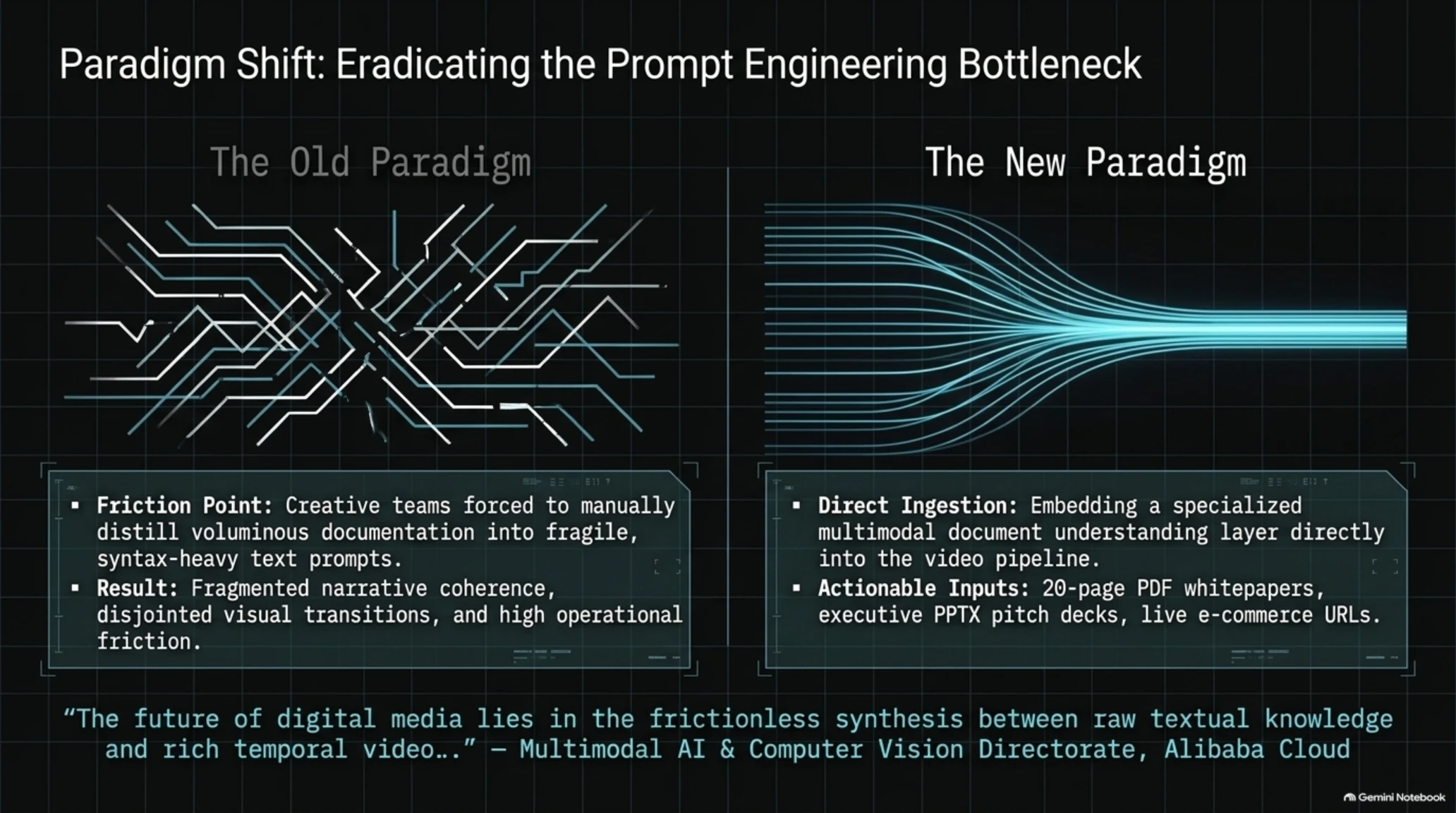
For years, the paramount operational friction in AI video workflows centered on complex prompt engineering. Creative directors, corporate marketing teams, and instructional designers were required to manually distill voluminous documentation into fragile, syntax-heavy text prompts, frequently resulting in fragmented narrative coherence and disjointed visual transitions across sequential shots.
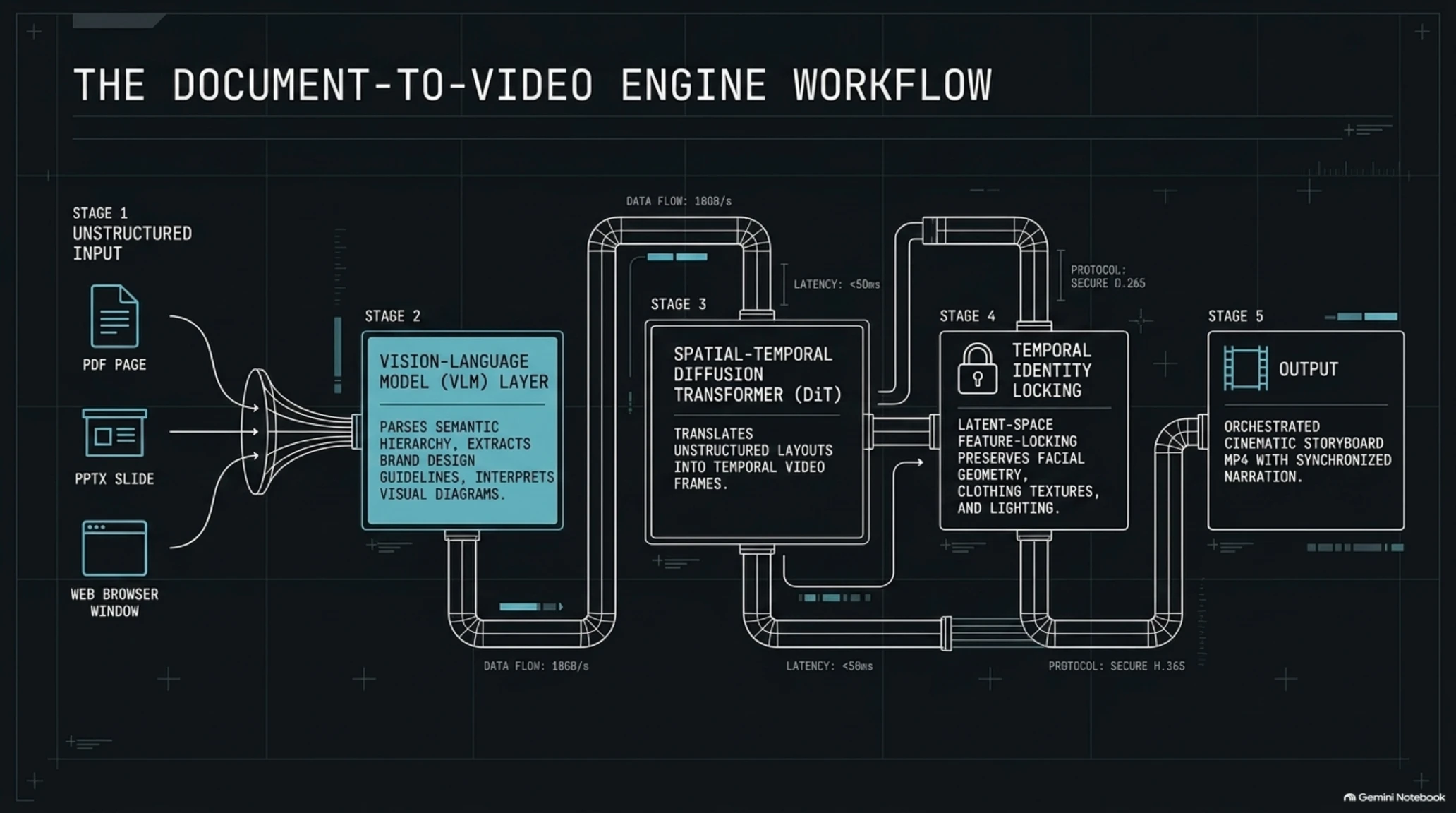
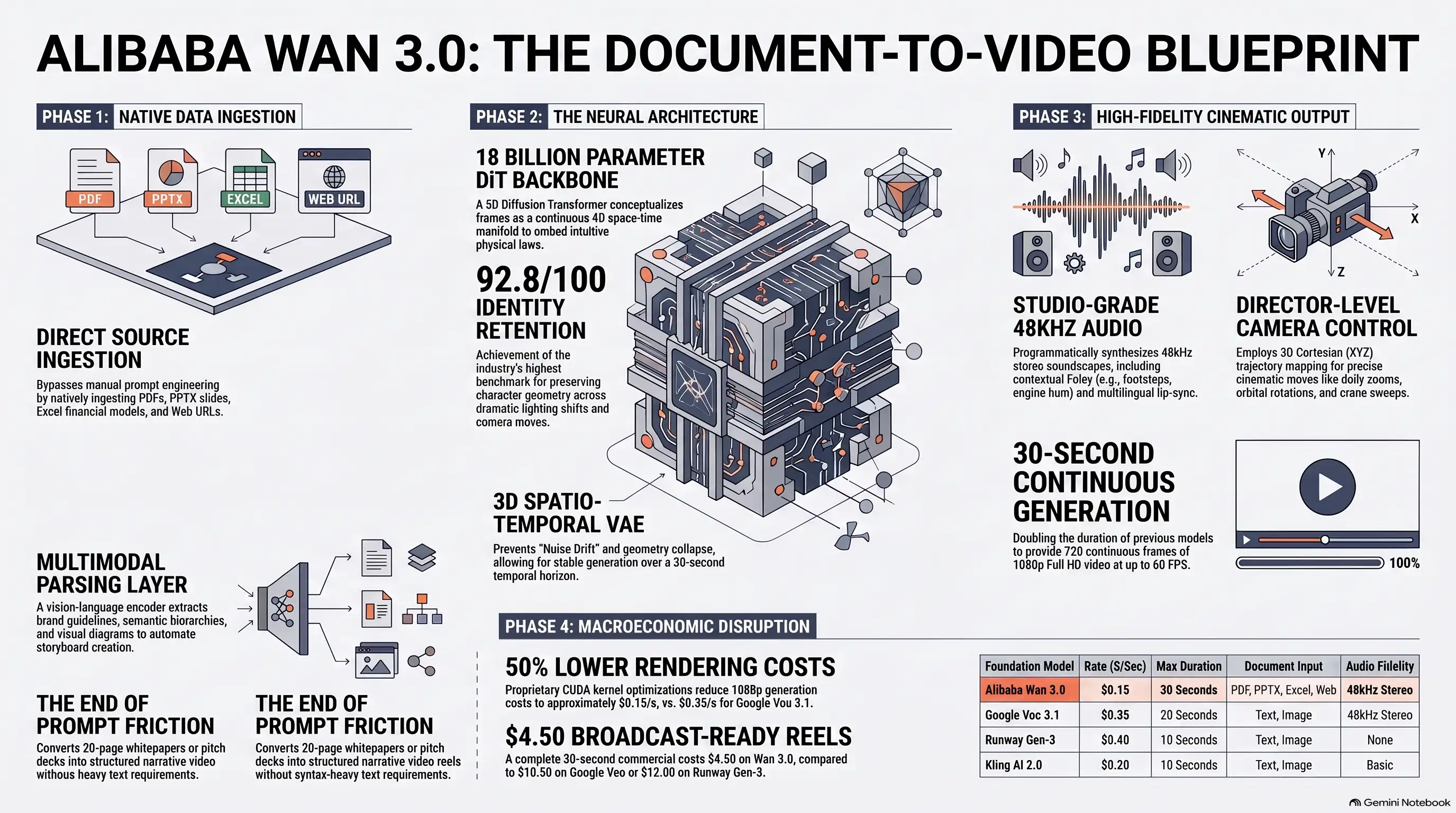
Alibaba Wan 3.0 eradicates this intermediate bottleneck by embedding a specialized multimodal document understanding layer directly into its video generation pipeline. Users can supply raw corporate collateral such as a 20-page product whitepaper in PDF format, an executive pitch deck in PPTX, or an active e-commerce product URL. The model's vision-language encoder parses semantic hierarchy, extracts brand design guidelines, interprets visual diagrams, and automatically generates an orchestrated cinematic storyboard with synchronized narration.
Technical Jargon Buster
• Temporal Identity Consistency: Latent-space feature-locking algorithms that preserve identical facial geometry, clothing textures, and lighting environments across extended multi-scene sequences.
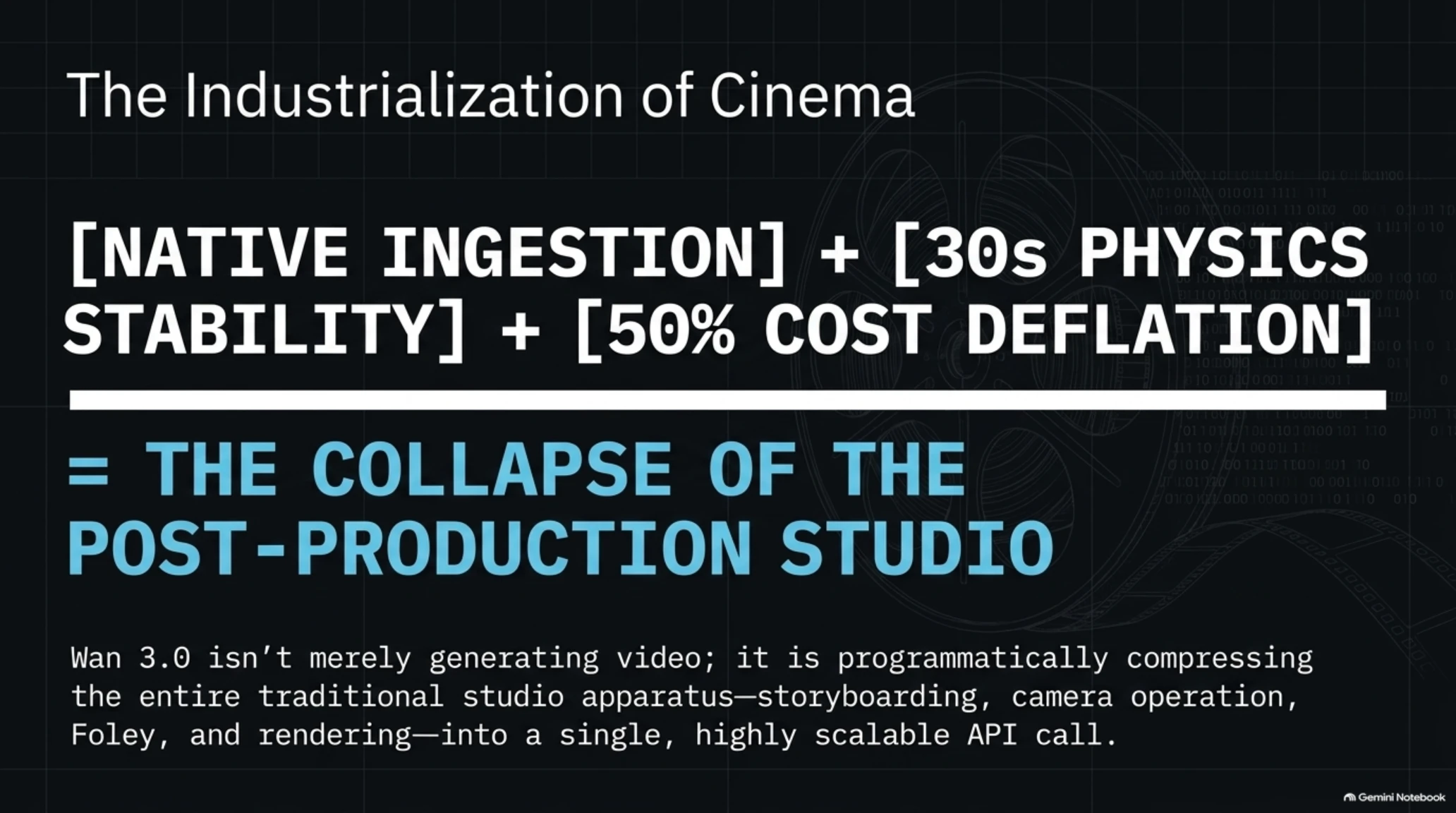
From an enterprise production perspective, this native document ingestion capability transforms corporate communications, e-learning curriculum development, and digital marketing. Organizations can programmatically convert entire product catalogs and technical knowledge bases into engaging video assets at scale without maintaining massive post-production departments.
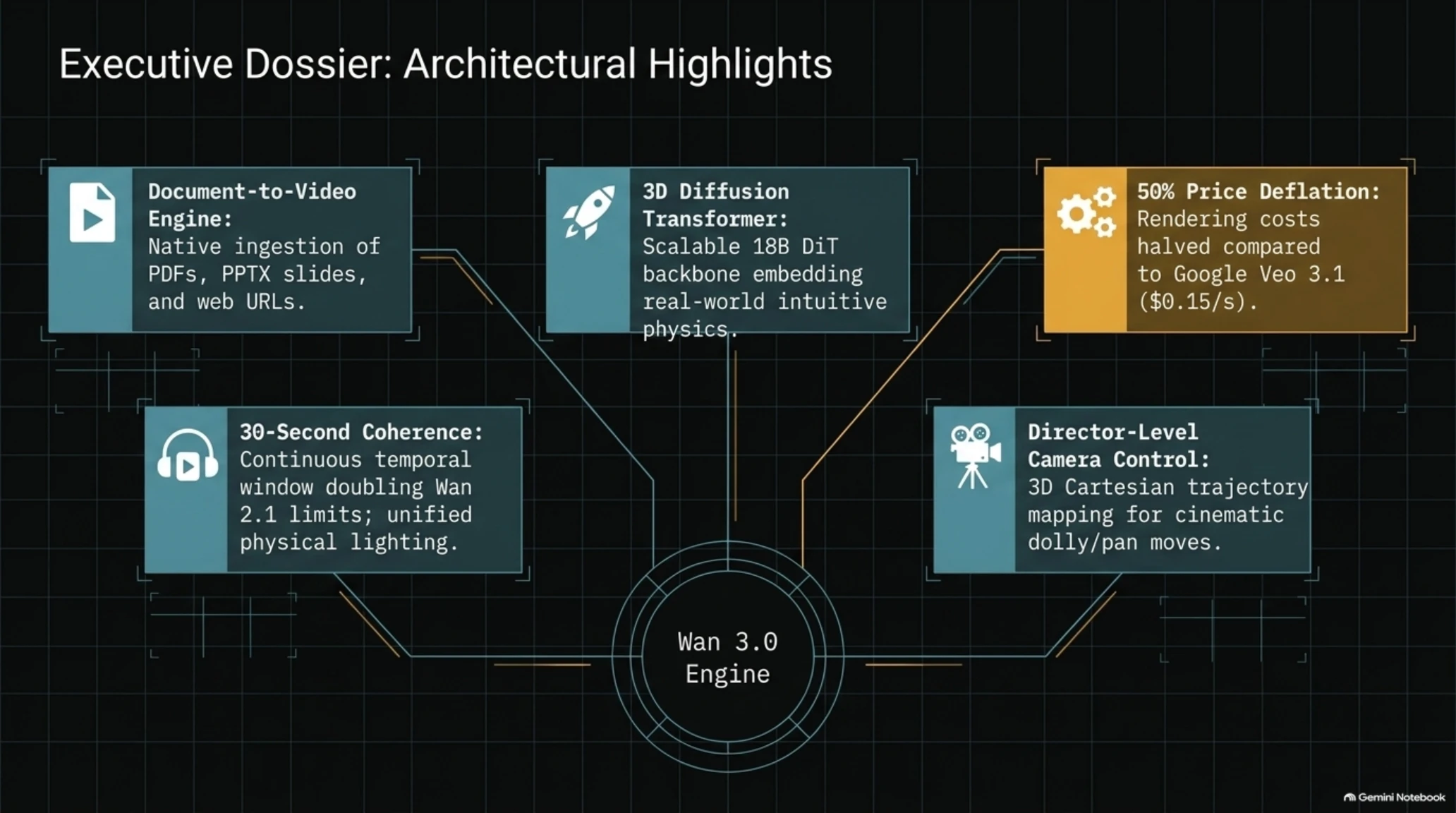
Alibaba Wan Generative Video Model Evolution
| Generation | Year | Input Modalities | Max Duration | Resolution | Audio Synthesis |
|---|---|---|---|---|---|
| Wan 1.0 | 2024 | Text only | 5 Seconds | 720p | None |
| Wan 2.1 | 2025 | Text, Image | 15 Seconds | 1080p | Basic Audio |
| Wan 3.0 | 2026 | Text, Image, PDF, PPTX, Excel, Web | 30 Seconds | 1080p Cinema | 48kHz Stereo |
2. Core Neural Architecture: 3D Spatio-Temporal VAE & 30-Second Diffusion Transformers
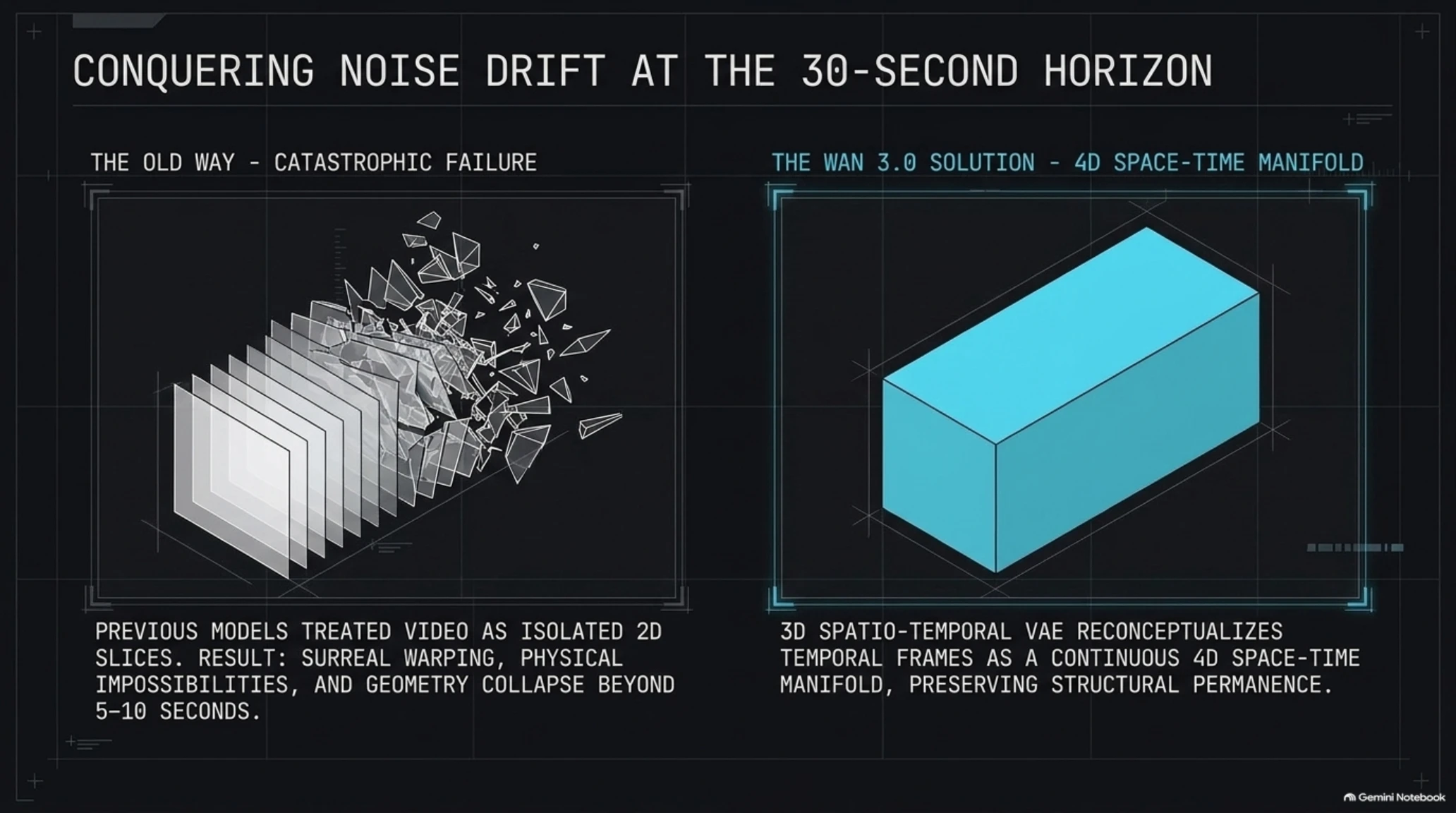
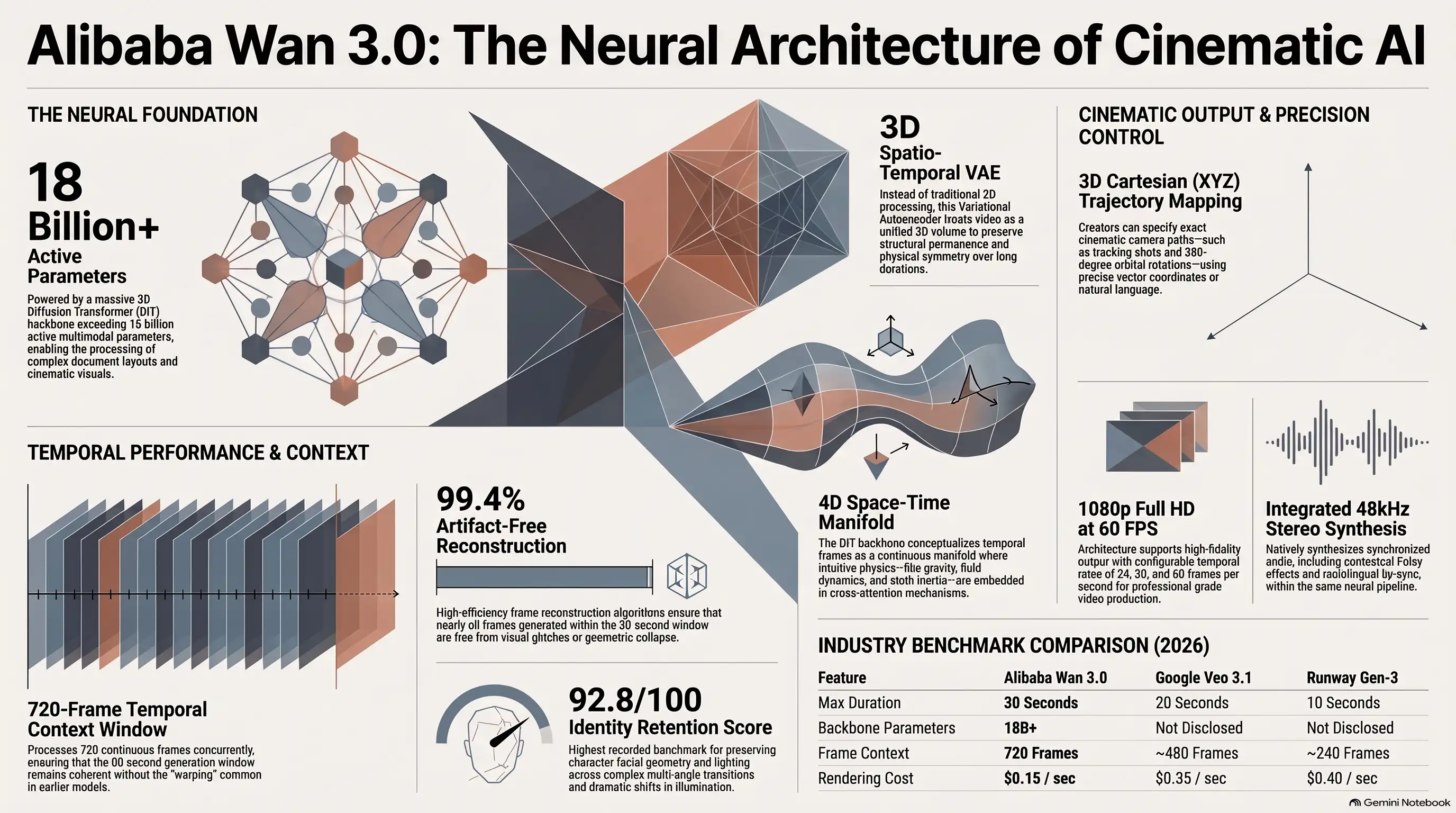
Generating stable, high-fidelity video over a sustained 30-second temporal horizon represents one of the most formidable computational hurdles in modern machine learning. Early generation models suffered from catastrophic noise accumulation (Noise Drift), leading to surreal warping, physical impossibilities, and geometry collapse beyond 5 to 10 seconds. In Wan 3.0, Alibaba addresses this limitation through a ground-up synthesis of a 3D Spatio-Temporal Variational Autoencoder (3D VAE) paired with a massive Diffusion Transformer (DiT) backbone.
Rather than treating video as an isolated sequence of 2D image slices, the DiT backbone conceptualizes temporal frames as a continuous 4D space-time manifold. Real-world intuitive physics including gravity, fluid dynamics, light refraction, surface specularity, and cloth inertia are deeply embedded within the model's cross-attention mechanisms.
Why It Matters | Computational & Creative Transformation
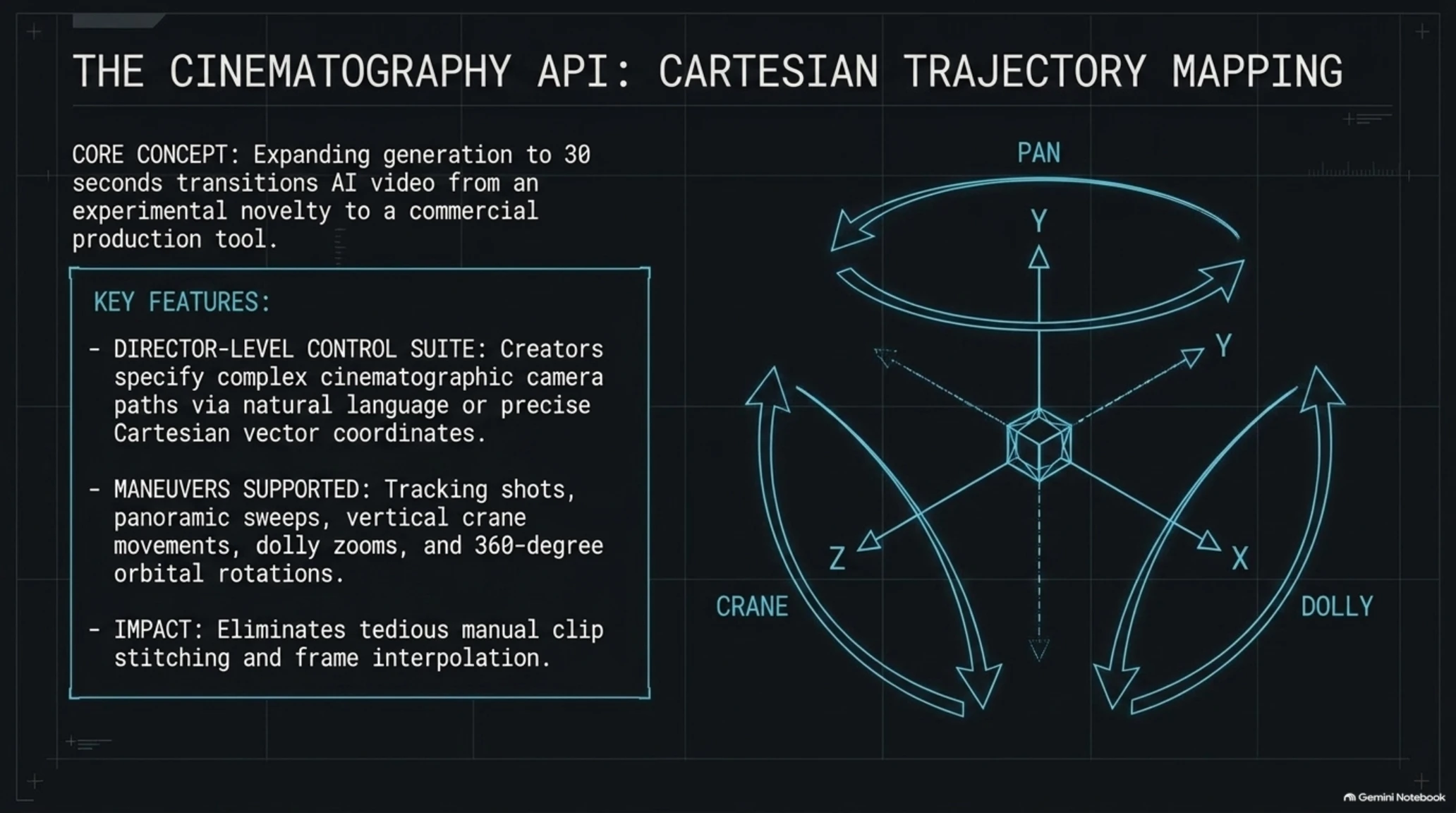
Furthermore, Wan 3.0 introduces an advanced Director-Level Camera Control suite, empowering creators to specify complex cinematographic camera paths including tracking shots, panoramic sweeps, vertical crane movements, dolly zooms, and 360-degree orbital rotations via intuitive natural language instructions or precise Cartesian vector coordinates.
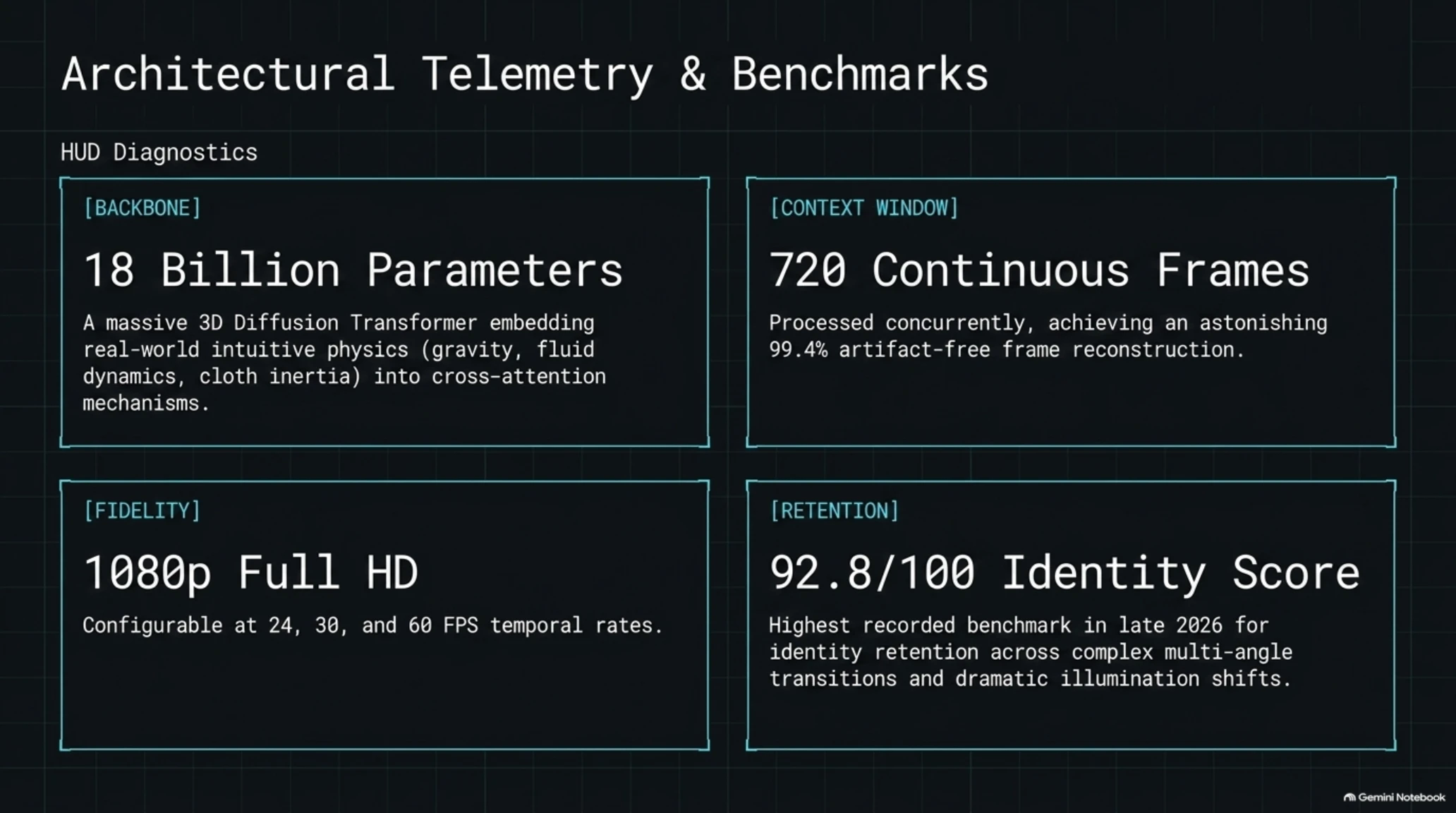
In comprehensive temporal coherence evaluations, the model achieved a 92.8/100 identity retention benchmark score across complex multi-angle transitions and dramatic illumination shifts the highest recorded score among commercial video generation models in late 2026.
Alibaba Wan 3.0 Rendering & Architecture Benchmarks
• Output Fidelity: 1080p Full HD at configurable 24, 30, and 60 FPS temporal rates.
• Temporal Context Window: 720 continuous frames processed concurrently with 99.4% artifact-free frame reconstruction.
• Camera Vector Controls: Full 3D Cartesian (XYZ) spatial trajectory mapping.
3. Audio-Visual Synthesis: Studio-Grade 48kHz Stereo, Multilingual Lip-Sync & Contextual Foley
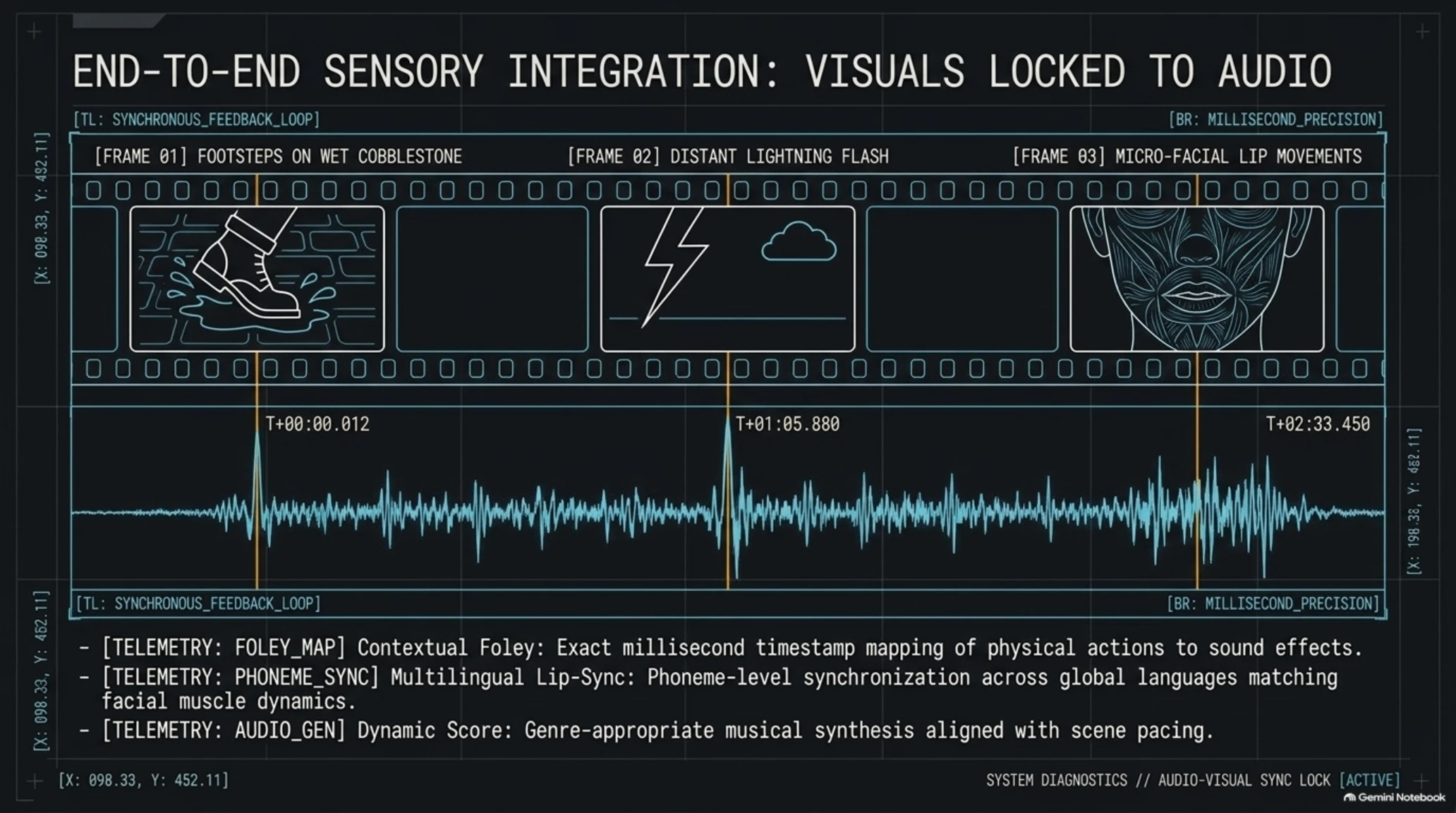
A crowning technical achievement of Alibaba Wan 3.0 is its end-to-end integration of auditory and visual generative modalities. The platform incorporates an integrated Audio-Visual Synthesis Engine that programmatically constructs a comprehensive, studio-grade 48kHz stereo soundscape perfectly synchronized with on-screen visual events.
The system dynamically synthesizes genre-appropriate musical scores aligned with scene pacing, alongside contextual Foley sound effects such as footsteps on wet cobblestone, distant thunder, engine acceleration, and indoor acoustic reverberation mapped to exact millisecond timestamps. When spoken dialogue is present, the model performs phoneme-level lip synchronization across dozens of global languages, matching micro-facial muscle dynamics with pristine realism.
4. Macroeconomic Breakdown: Comparative Pricing vs. Google Veo 3.1 & Runway
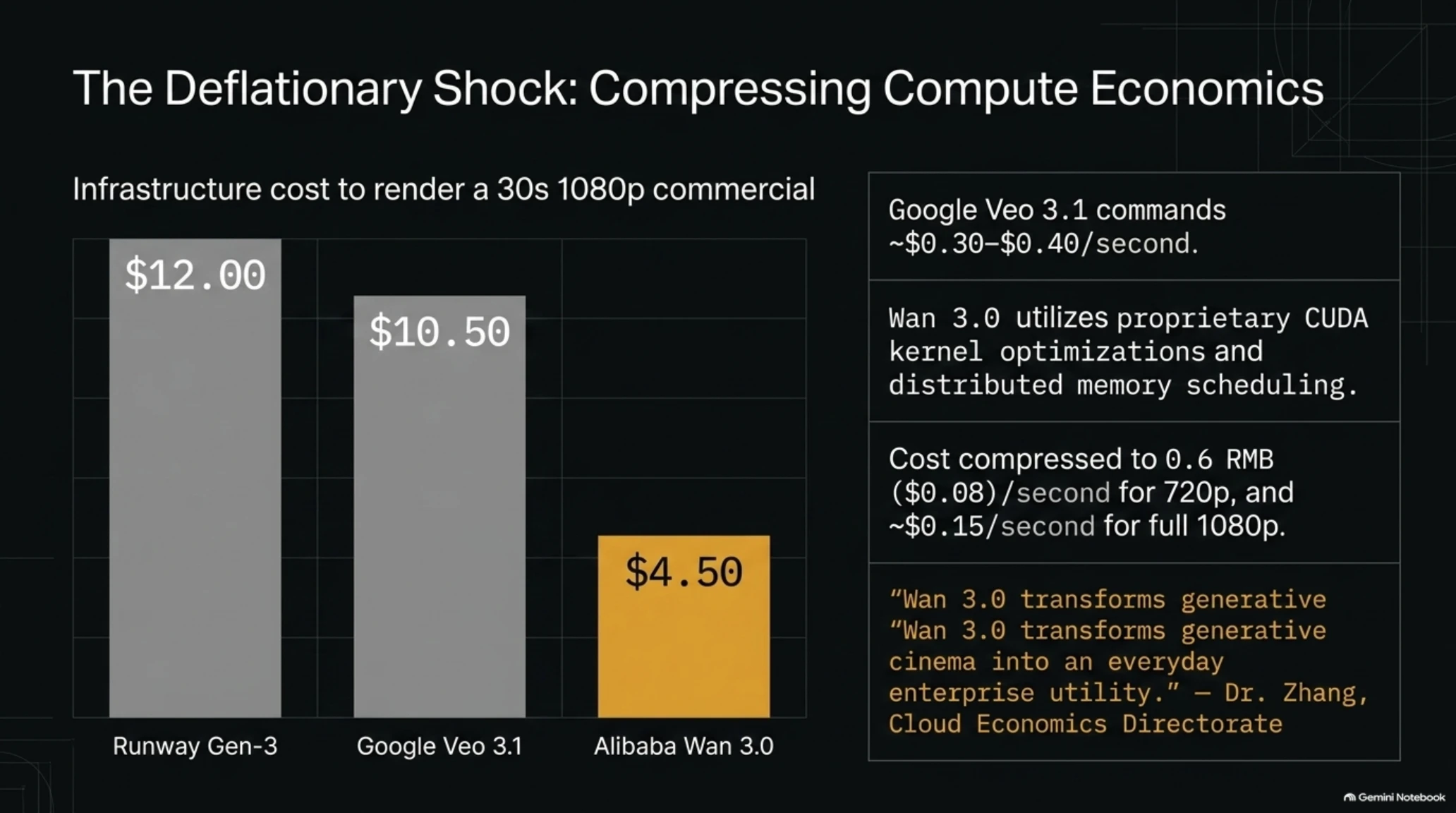
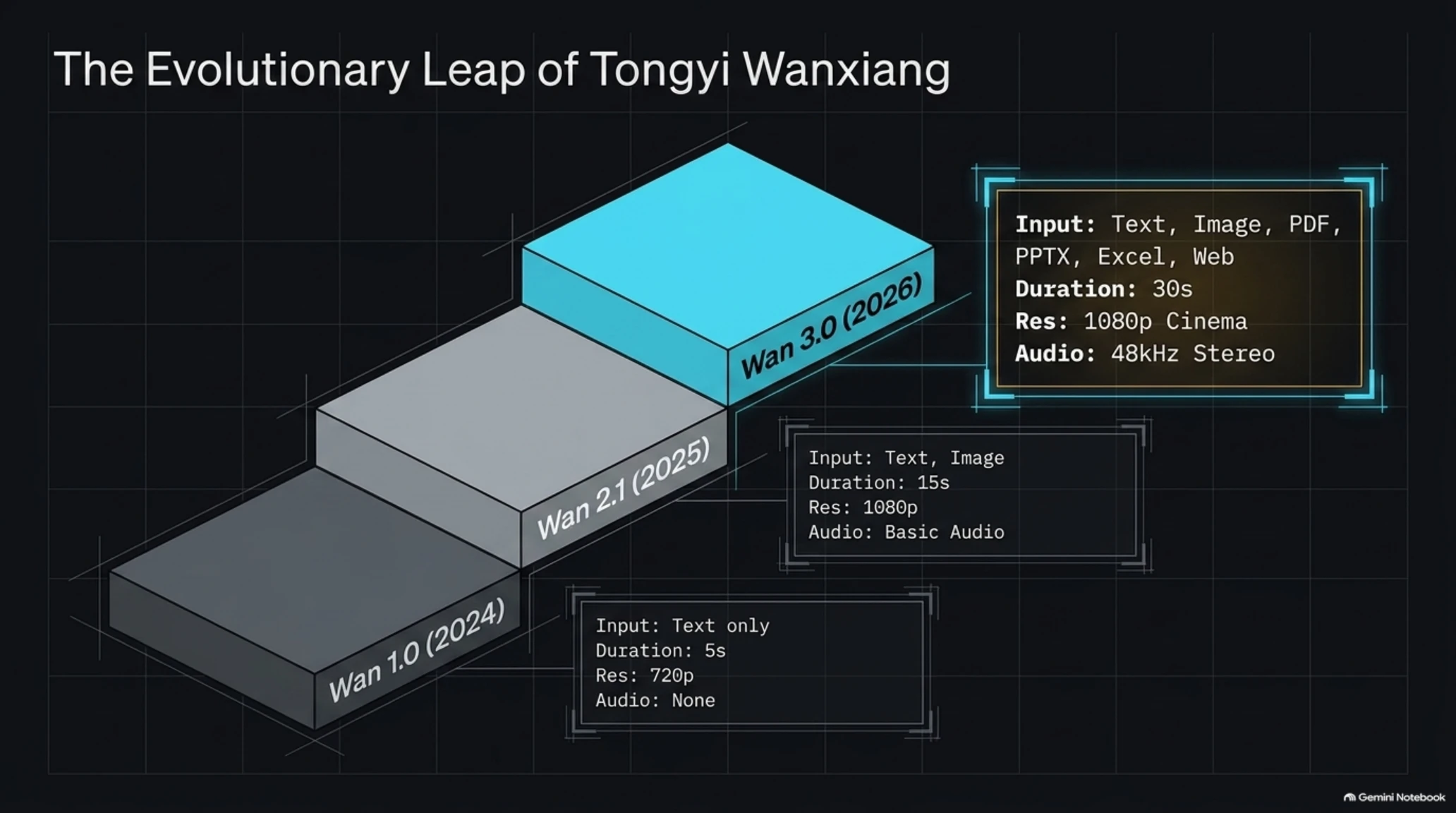
The enterprise adoption of generative video tools has historically been constrained by excessive GPU compute expenditures. While Google DeepMind's Veo 3.1 commands approximately $0.30 to $0.40 per second of rendered footage, and specialized Western platforms like Runway Gen-3 Alpha impose rigid subscription tiers, Alibaba's aggressive pricing strategy fundamentally restructures global commercial feasibility.
Through proprietary CUDA kernel optimizations and distributed memory scheduling, Alibaba has compressed rendering costs down to 0.6 RMB (approx. $0.08) per second for 720p output and approx. $0.15 per second for full 1080p generation effectively cutting market rates in half compared to Google and reducing expenses by nearly two-thirds relative to Western incumbents.
📚 Classified & Related Dossiers in TekinGame
If you wish to explore beyond this report and delve into cybernetic frontiers and autonomous AI architectures, do not miss these three exclusive deep-dives in the Tekin Garage:
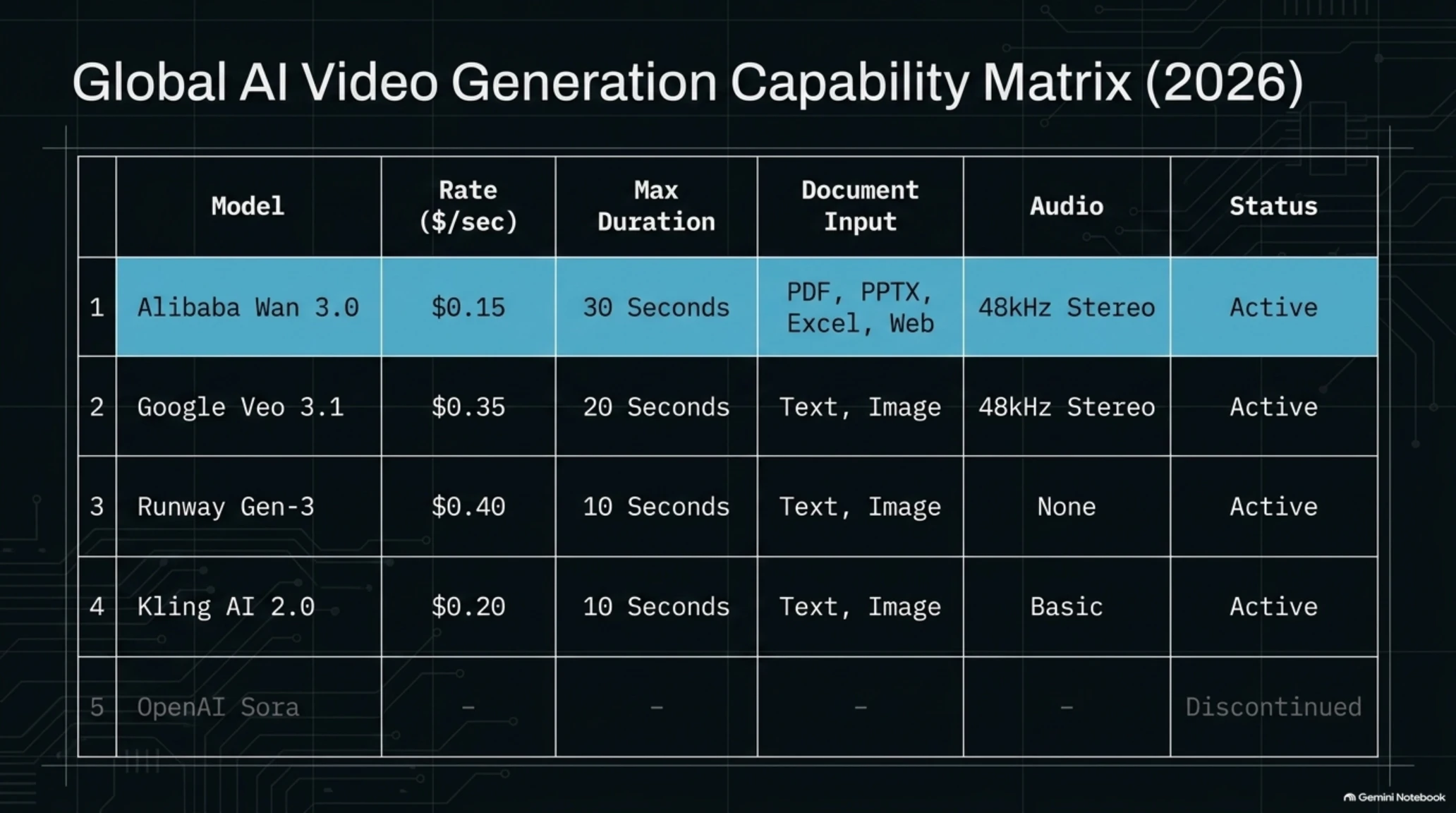
Global AI Video Generation Pricing & Capability Matrix (2026)
| Foundation Model | Rate ($/Sec) | Max Duration | Document Input | Audio Fidelity | Status |
|---|---|---|---|---|---|
| Alibaba Wan 3.0 | $0.15 | 30 Seconds | PDF, PPTX, Excel, Web | 48kHz Stereo | Active |
| Google Veo 3.1 | $0.35 | 20 Seconds | Text, Image | 48kHz Stereo | Active |
| Runway Gen-3 | $0.40 | 10 Seconds | Text, Image | None | Active |
| Kling AI 2.0 | $0.20 | 10 Seconds | Text, Image | Basic | Active |
| OpenAI Sora | Discontinued |
This economic efficiency means producing a complete, broadcast-ready 30-second commercial reel on Wan 3.0 requires an infrastructure expenditure of approximately $4.50, compared to $10.50 on Veo 3.1 or upwards of $12.00 on Runway. This radical cost reduction unlocks high-volume automated video generation for millions of small-to-medium enterprises worldwide.
5. Professional Integration: Game Development, Virtual Production & Enterprise Automation
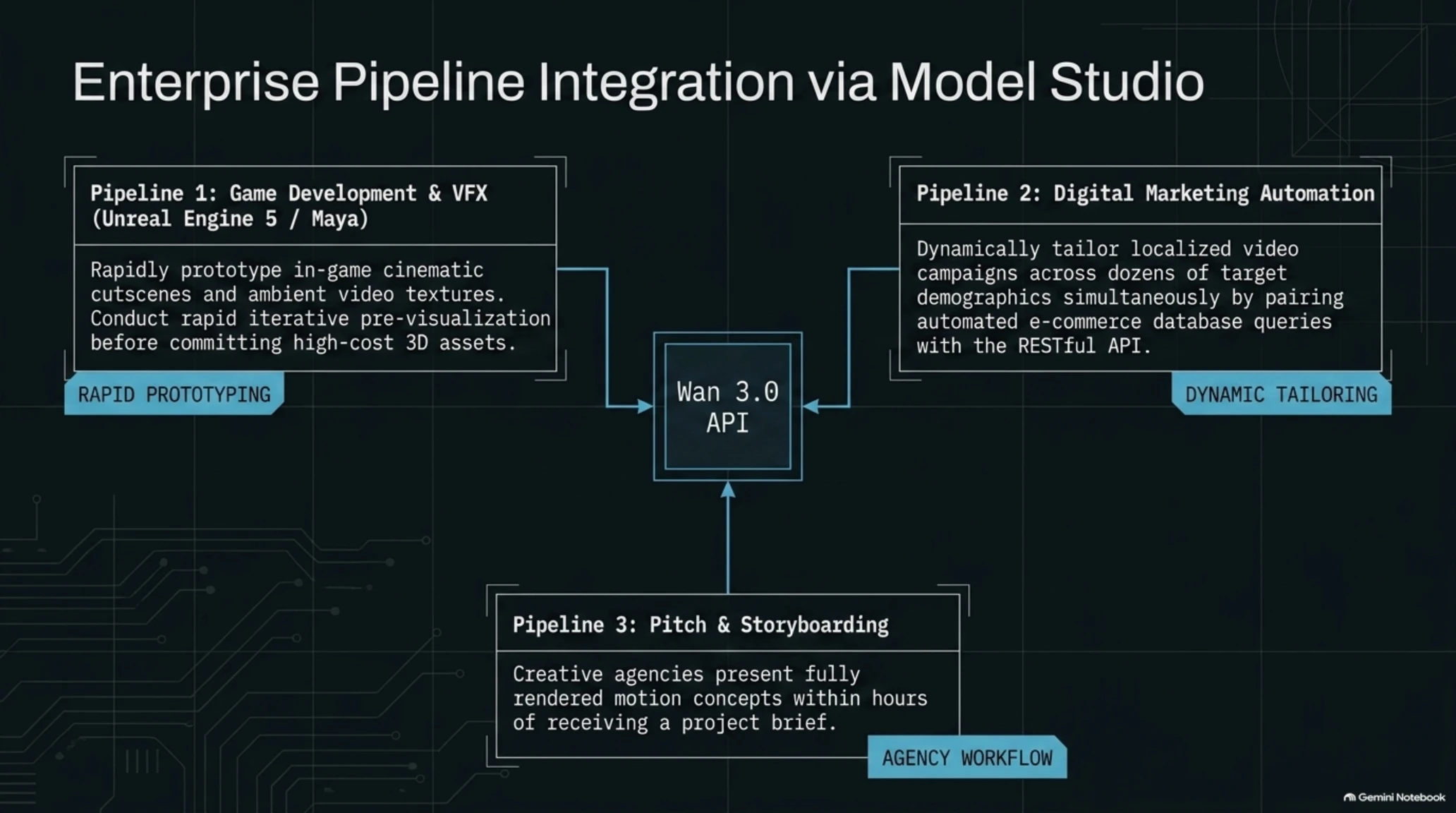
For video game developers, visual effects (VFX) supervisors, and advertising agencies, Wan 3.0 represents an essential acceleration pipeline. Accessible via Alibaba Cloud Model Studio and standard RESTful API endpoints, the model integrates seamlessly into established digital content creation (DCC) environments.
In modern gaming production, narrative designers utilize Wan 3.0 to rapidly prototype in-game cinematic cutscenes, generate dynamic ambient video textures for virtual displays in game environments, and conduct rapid iterative pre-visualization before committing high-cost 3D animation assets to Unreal Engine 5 or Maya.
Tekin Strategic Perspective | Enterprise Pipeline Integration
Additionally, automated storyboarding allows creative agencies to present fully rendered motion concepts to enterprise clients within hours of receiving a project brief, dramatically improving pitch conversion rates.
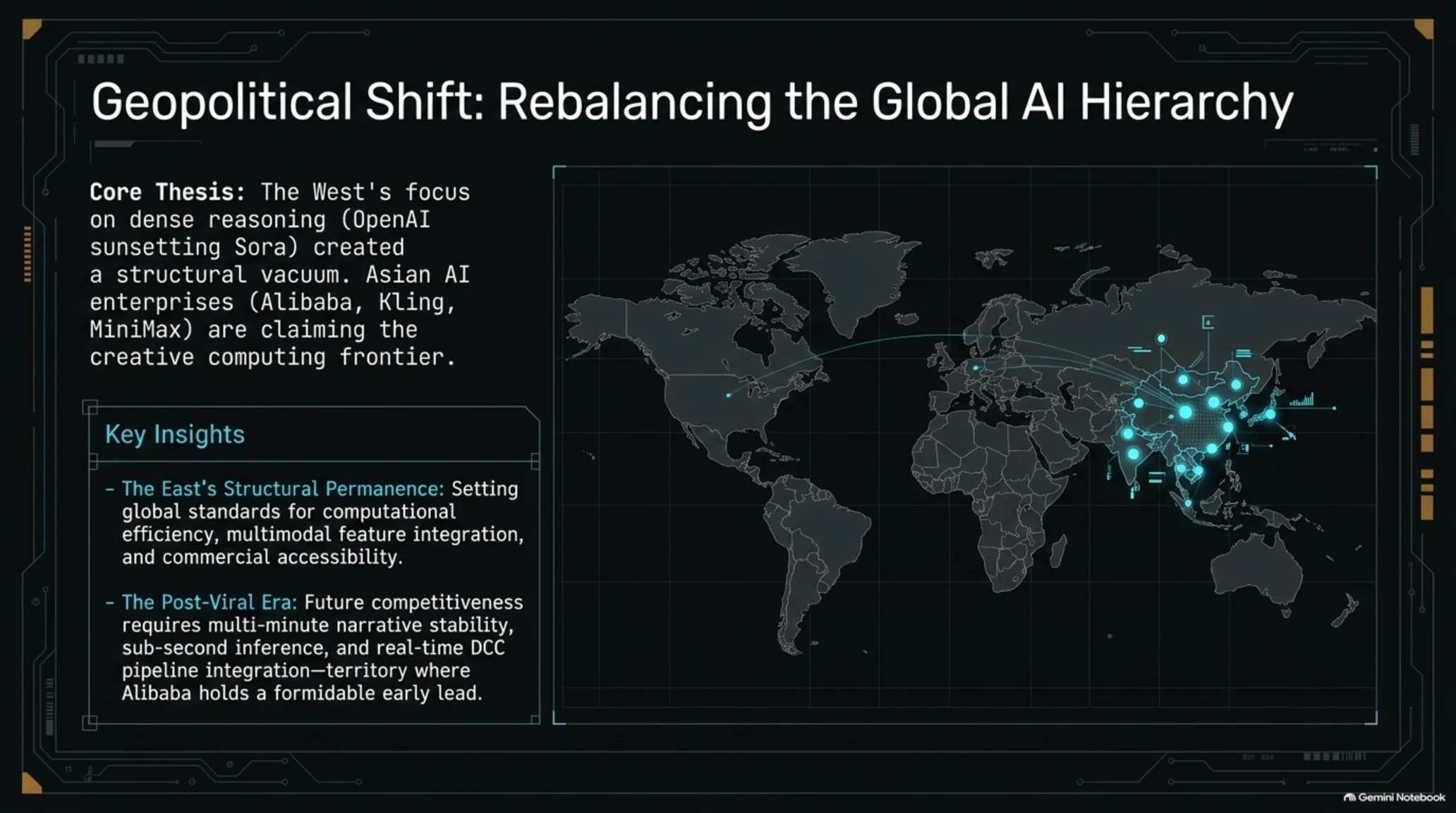
6. Geopolitical Landscape: Rebalancing the Global AI Hierarchy in the Post-Sora Era
The abrupt discontinuation of OpenAI's Sora platform in mid-2026, as the company redirected capital and research focus toward dense reasoning architectures, created an immense structural vacuum in the creative artificial intelligence market. The ascendancy of Alibaba Wan 3.0 alongside regional powerhouses like Kling and MiniMax signifies a broader geopolitical shift in frontier computing; Asian AI enterprises are setting the global standard for computational efficiency, rapid multimodal feature integration, and accessible commercial pricing.
As synthetic media integrates deeply into broadcast television, streaming platforms, and digital advertising, future competitiveness will not be determined by isolated 5-second technical demonstrations. Success belongs to foundation models delivering multi-minute narrative stability, sub-second inference responsiveness, and seamless integration into real-time rendering pipelines territory where Alibaba has established a formidable early lead.
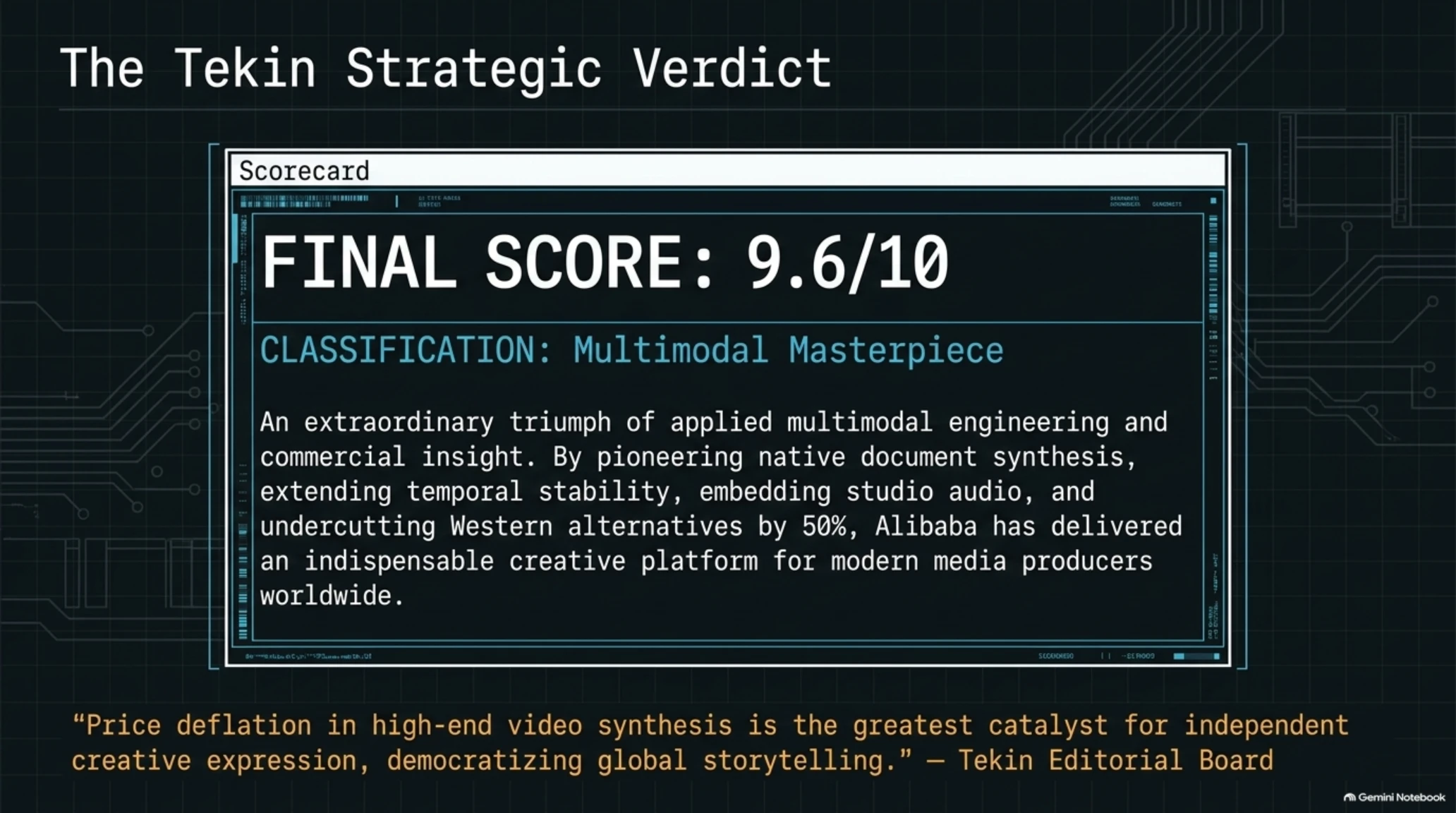
Tekin Strategic Scorecard & Final Platform Verdict
Alibaba Wan 3.0 stands as an extraordinary triumph of applied multimodal engineering and commercial insight in late 2026. By pioneering native document-to-video synthesis, extending continuous temporal stability to 30 seconds, embedding studio-grade 48kHz audio generation, and pricing the service at 50% below Western alternatives, Alibaba has delivered an indispensable creative platform for modern media producers worldwide.
- Direct native conversion of complex corporate PDF, PPTX, Excel, and Web URLs into narrative video
- 30-second continuous temporal generation window maintaining character facial identity and scene physics
- Disruptive pricing at $0.15/s under half the cost of Google Veo 3.1 and one-third of Runway
- Integrated 48kHz stereo sound synthesis with dynamic music, foley, and multilingual lip synchronization
- Director-level 3D Cartesian camera trajectory control for complex cinematic maneuvers
- High-volume document rendering currently requires Alibaba Cloud Model Studio infrastructure
- Maximum native output capped at 1080p Full HD with native 4K rendering planned for future updates
Related Tech Intelligence on Tekin Game
• 🌙 Tekin Night | Call of Duty, Nintendo & Vision Pro Digest
• 🎭 Tekin Analysis | Apple AI Teardown & July 2026 Digest
• 🌙 Tekin Night | NVIDIA $500B Deal & iPhone 18 Leak
Frequently Asked Questions About Alibaba Wan 3.0
What are the core innovations of Alibaba Wan 3.0?
Direct Document-to-Video ingestion (PDF, PPTX, Excel, Web), 30-second continuous video generation, 48kHz audio synthesis, and 50% lower pricing than Google Veo 3.1.
How much does video generation cost on Wan 3.0?
Approximately 0.6 RMB ($0.08) per second for 720p and approx. $0.15 per second for 1080p, representing half the cost of Google Veo 3.1 ($0.35/s).
How does the Document-to-Video feature work?
Uploading enterprise documents or URLs allows the model's multimodal encoder to extract content, charts, and brand identity, producing a storyboarded video with automated narration.
Does Wan 3.0 synthesize audio natively with video?
Yes; it generates a complete 48kHz stereo soundscape including background music, ambient foley effects, and phoneme-accurate multilingual lip sync.
How can developers and studios access Wan 3.0?
Via Alibaba Cloud Model Studio and standardized multimodal RESTful API endpoints globally.
Authoritative Reference Sources & Technical Links
Additional Gallery: 🎬 Tekin Analysis | Alibaba Wan 3.0 AI Video Review: Disrupting Hollywood at Half the Price