Tekin Night Executive Briefing | Switch 2 MW4 Input Lag Debacle, Activision Itaewon Apology, and PlayStation Dynamic Pricing Uproar
As the international gaming and digital entertainment sectors converged upon the evening of Monday, November 2, 2026, the industry confronted a complex tapestry of engineering compromises, ethical reckonings, and defensive publishing maneuvers. In an ecosystem where next-generation mobile silicon interfaces with multi-platform competitive esports, the microscopic mechanics of input latency and frame-buffer pipelines dictate commercial viability just as decisively as visual fidelity.
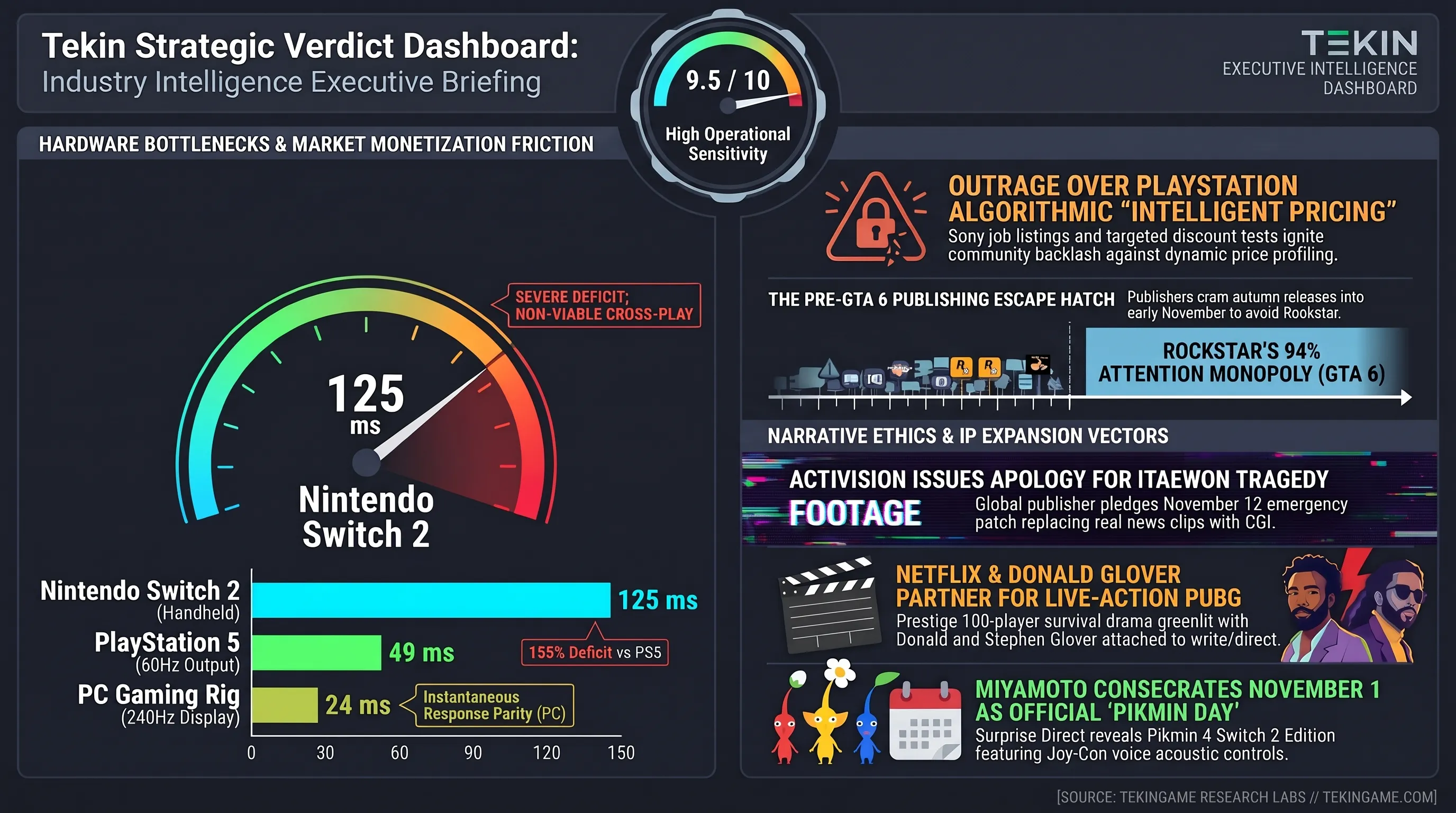
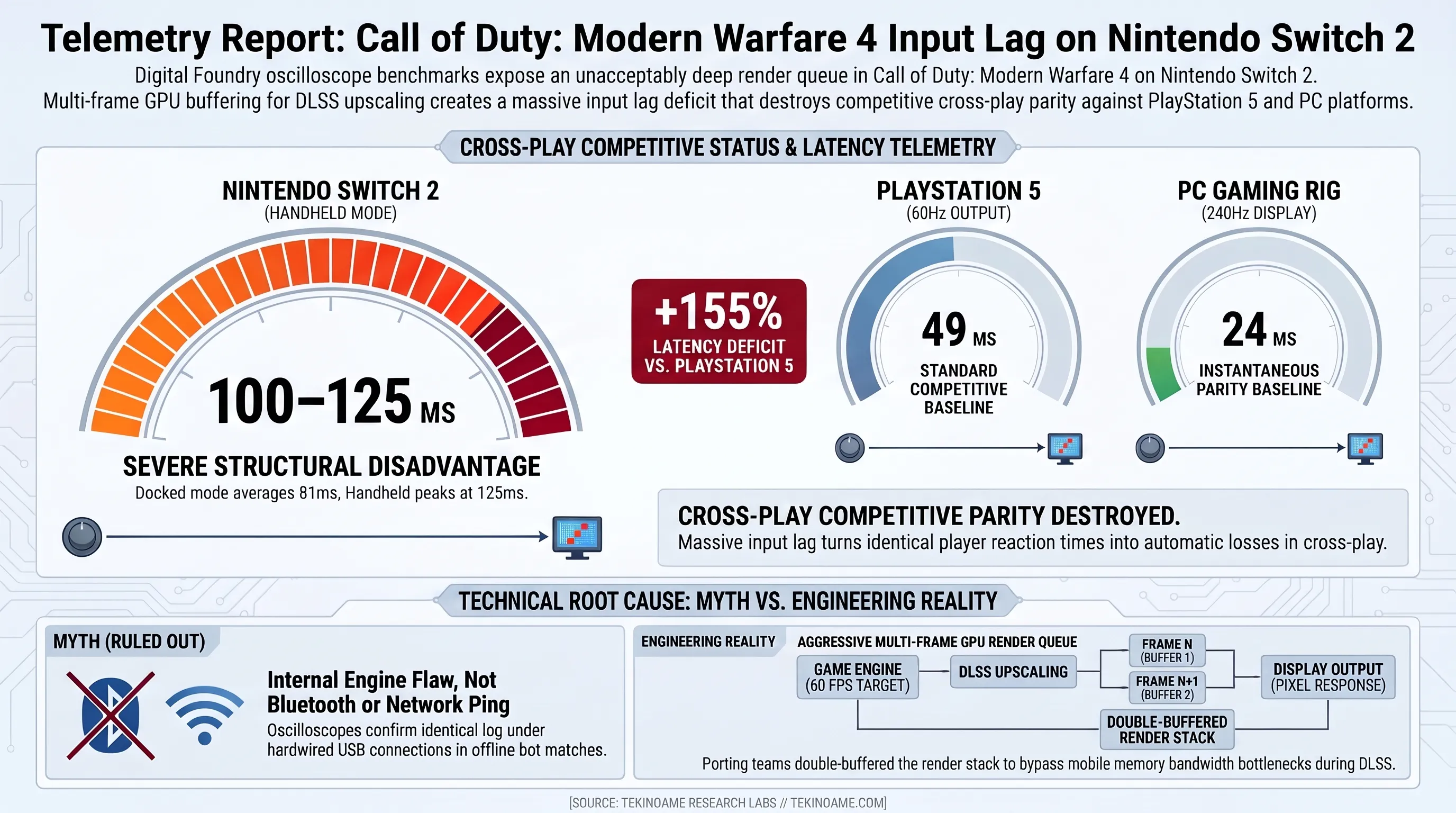
The evening was dominated by revelations out of the testing labs of Digital Foundry, where empirical oscilloscope benchmarks proved that Activision’s flagship shooter, Call of Duty: Modern Warfare 4, suffers from severe 100-to-125ms input lag on the newly launched Nintendo Switch 2. This crippling latency creates an insurmountable competitive disadvantage in cross-play lobbies, exposing the hidden architectural costs of running dense modern game engines on constrained mobile silicon.
Simultaneously, Activision found itself embroiled in diplomatic and ethical condemnation following outrage from victims' families in South Korea over the use of real news footage from the deadly 2022 Itaewon crowd crush in Modern Warfare 4’s introductory cinematic. Paired with Shigeru Miyamoto’s surprise declaration of official «Pikmin Day», Netflix’s blockbuster greenlight for a live-action PUBG adaptation helmed by Donald Glover, PlayStation’s controversial exploration of algorithmic dynamic pricing, and the unprecedented rush of publishers crowding the early November release window ahead of Grand Theft Auto VI, this dispatch delivers comprehensive executive analysis across the interactive landscape.
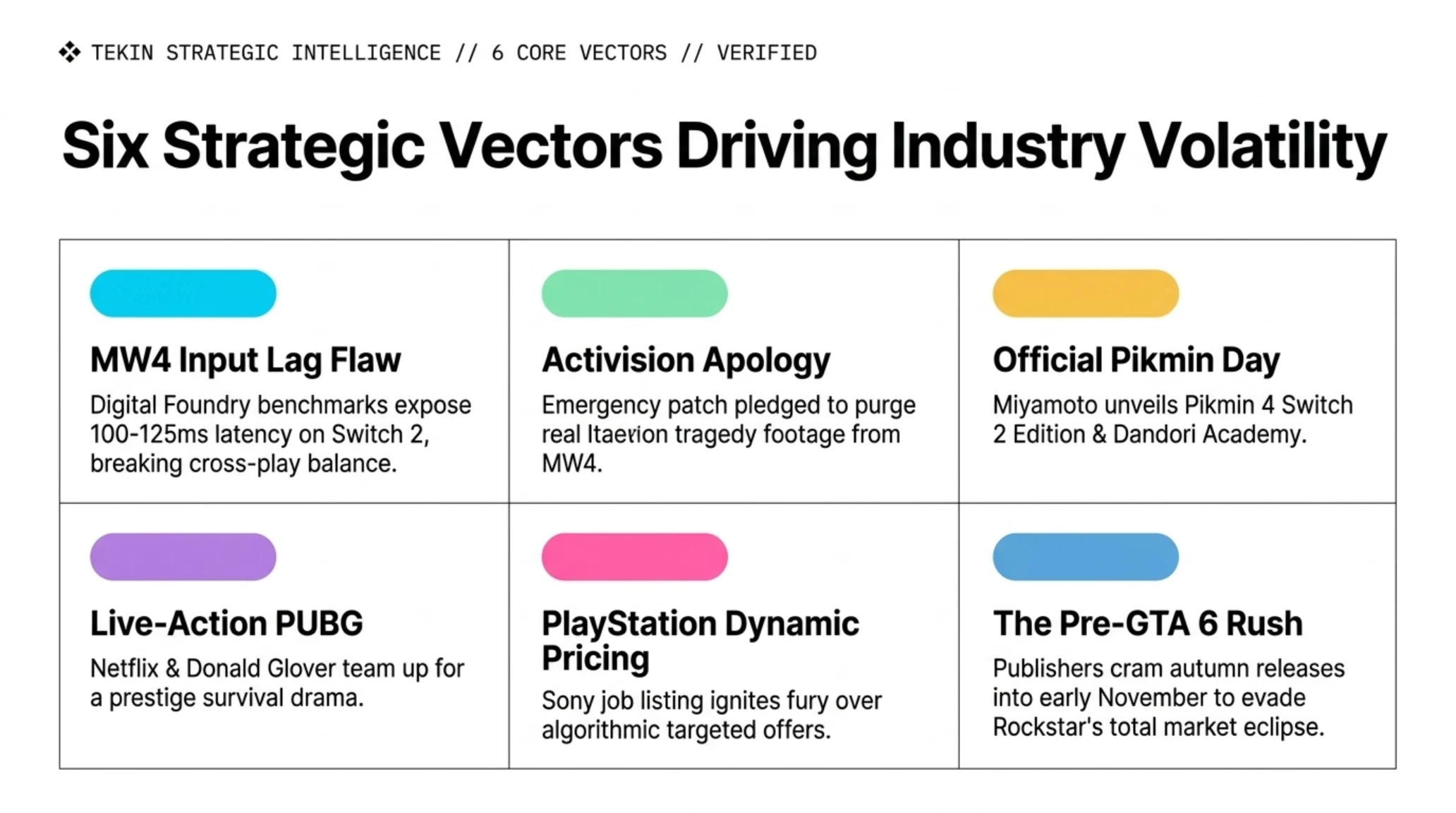
Executive Radar & Strategic Vectors at a Glance
Call of Duty: Modern Warfare 4 Input Lag Debacle on Nintendo Switch 2; Digital Foundry Benchmarks Reveal Crippling 100-125ms Latency and Severe Cross-Play Disadvantage
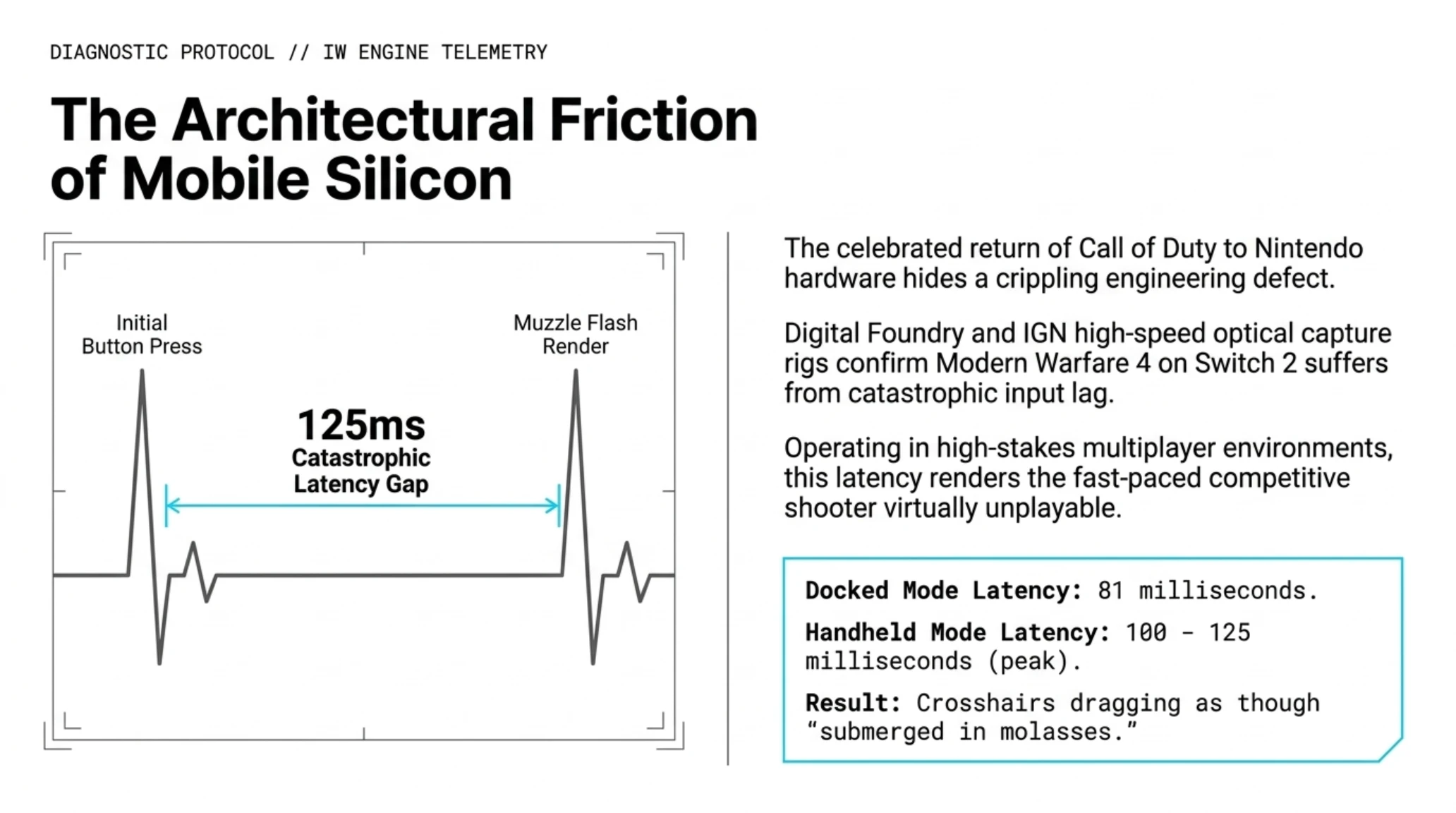
The long-awaited, commercially celebrated return of the Call of Duty franchise to Nintendo hardware was hailed as the definitive proof that Nintendo Switch 2 possessed the architectural muster to compete alongside home consoles. However, rigorous hardware benchmarks conducted by Digital Foundry and corroborated across IGN have exposed a crippling engineering defect: Modern Warfare 4 on Switch 2 suffers from catastrophic input lag, rendering the fast-paced competitive shooter virtually unplayable in high-stakes multiplayer environments.
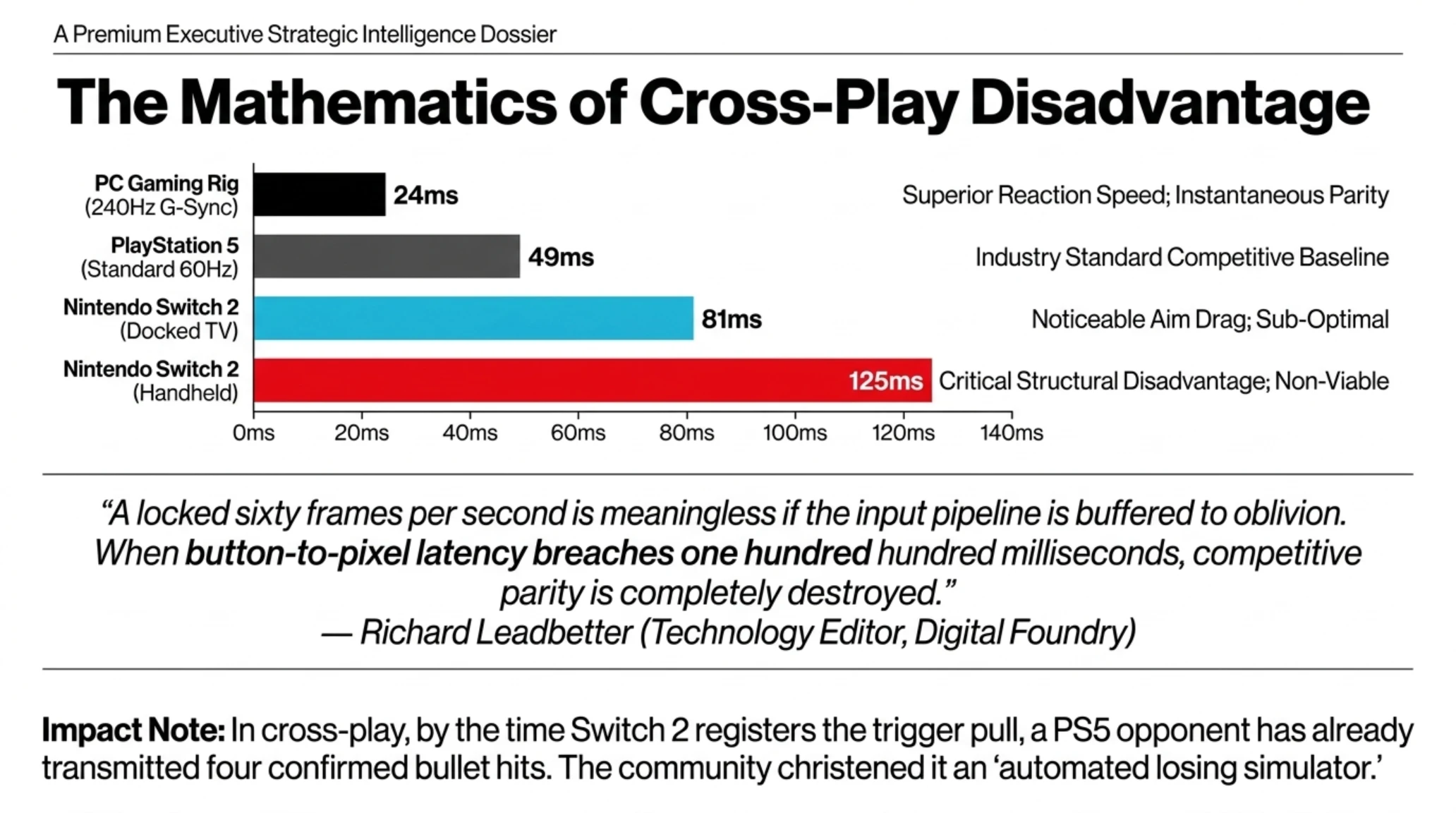
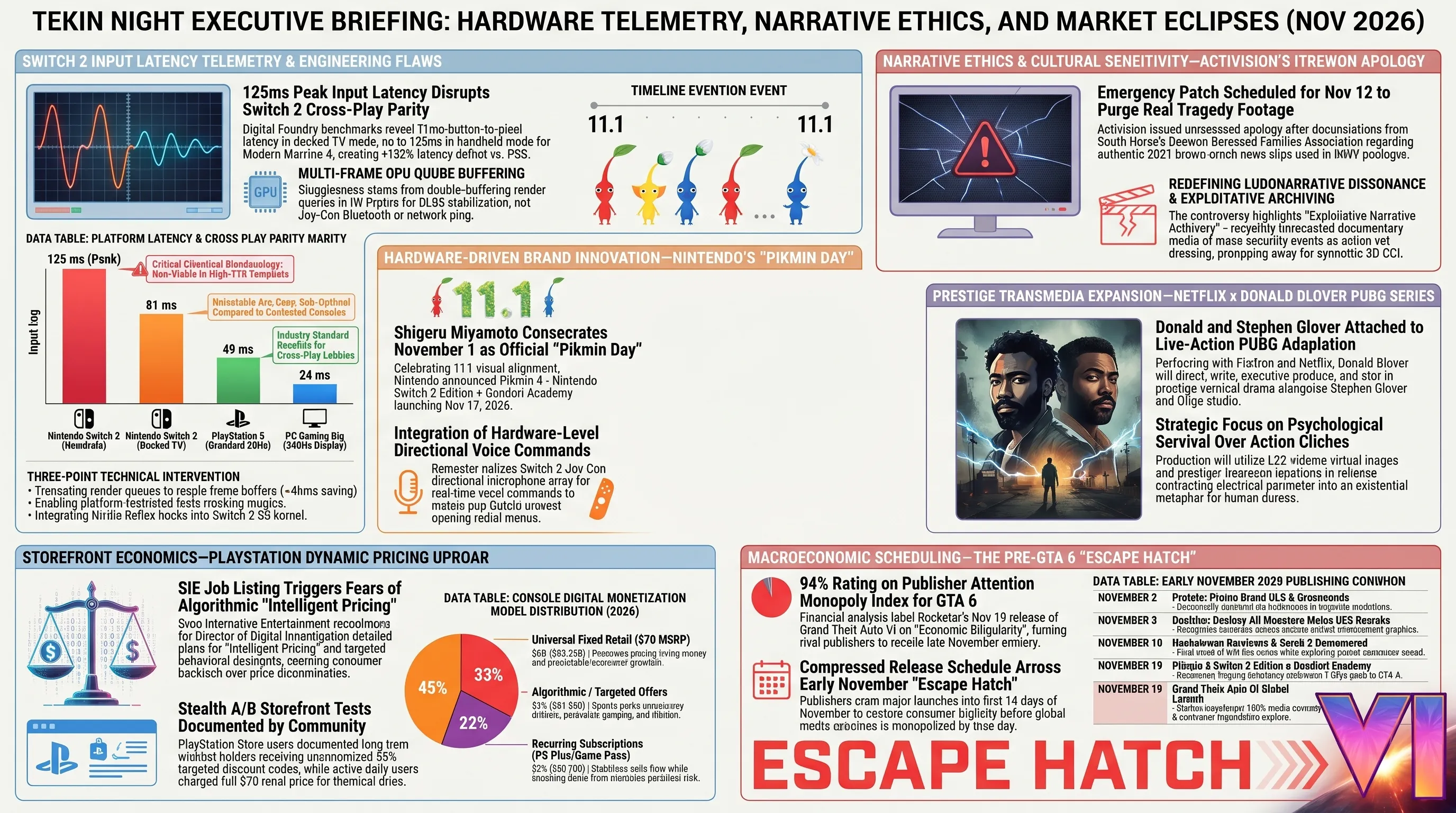
According to empirical data collected using high-speed optical capture rigs and oscilloscope triggers, while the IW Engine achieves an ostensibly respectable target of 60 frames per second on the Switch 2’s custom Nvidia silicon, it does so by introducing an unacceptably deep render queue. In docked television mode, button-to-pixel latency averages 81 milliseconds. In handheld mode, where the console downclocks memory bus frequencies and optimizes power envelopes, latency deteriorates catastrophically, hovering between 100 milliseconds and an alarming peak of 125 milliseconds.
To place this latency in operational perspective, the identical build of Modern Warfare 4 running on PlayStation 5 registers an input latency of 49 milliseconds, while high-refresh PC gaming rigs operating at 240Hz register latency beneath 24 milliseconds. In a hyper-reactive first-person shooter where time-to-kill (TTK) parameters are measured in fractions of a second, an input latency deficit exceeding 60 to 100 milliseconds places Switch 2 users at an absolute structural disadvantage. Players attempting to snap-aim or react to flanking adversaries find their crosshairs dragging as though submerged in molasses.
The competitive consequence is immediate and devastating within cross-play multiplayer ecosystems. In mixed lobbies where Switch 2 owners are matched against PlayStation 5 or PC competitors, identical reaction speeds result in automatic losses for the Nintendo player; by the time the Switch 2 registers the trigger pull and renders the muzzle flash, the opponent has already transmitted four confirmed bullet hits across the server network. The online community has cynically christened the Switch 2 version an «automated losing simulator».
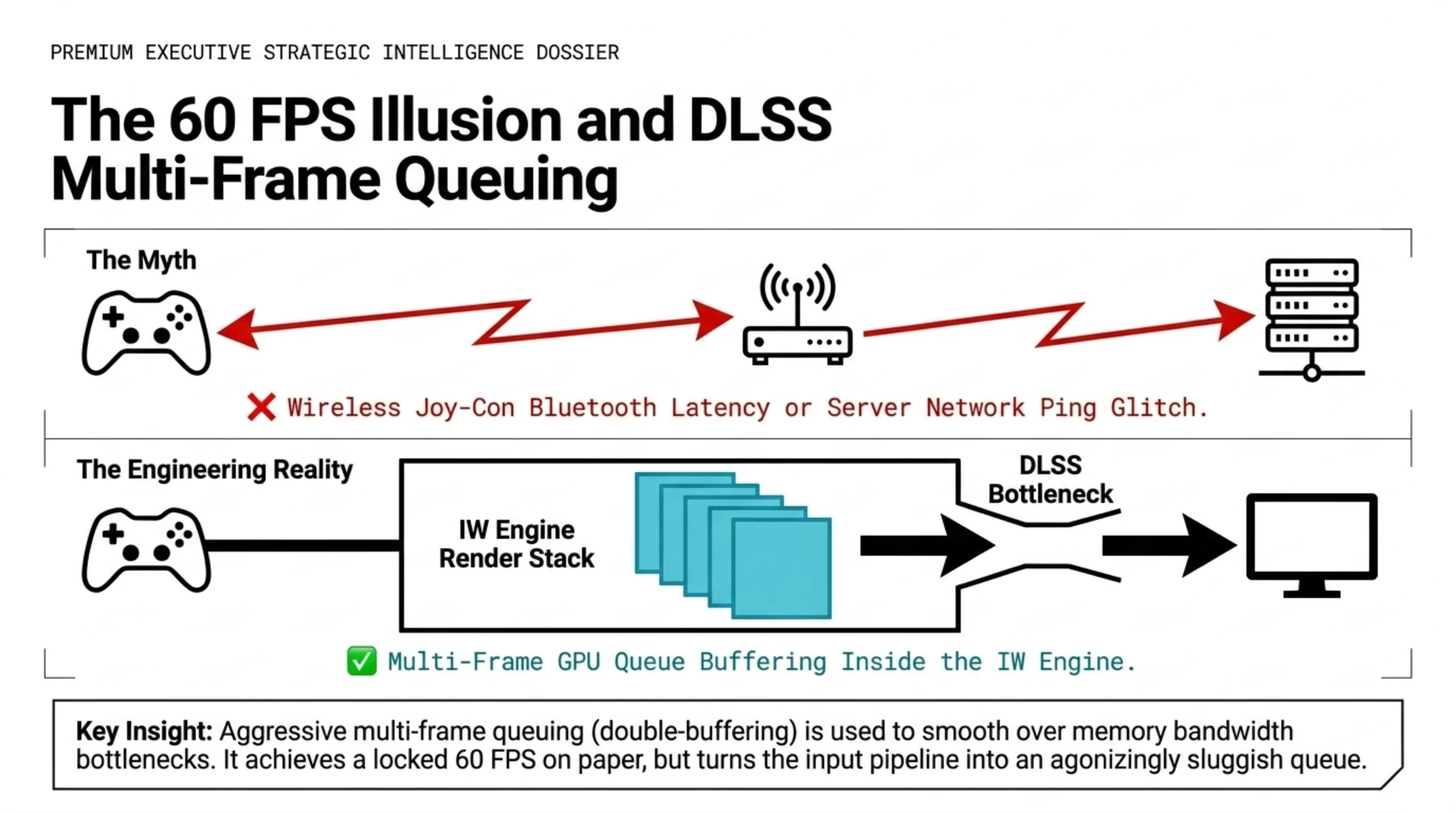
Hardware disassembly of the rendering pipeline reveals that Activision’s porting team relied upon aggressive multi-frame queuing (double-buffering the render pipeline) to smooth over memory bandwidth bottlenecks associated with DLSS upscaling on mobile silicon. While this technique prevents jarring frame-rate drops on paper, it turns the input pipeline into an agonizingly sluggish queue.
Why It Matters // The Illusion of 60 FPS in Mobile Competitive Gaming
The Modern Warfare 4 benchmark establishes that raw graphical parity and framerate metrics are insufficient; without rigorous low-latency input pipeline engineering, competitive cross-platform multiplayer becomes structurally untenable on hybrid hardware.
This technical failure echoes warnings articulated in previous Tekin Plus analyses on hybrid console system architectures and mobile GPU bandwidth saturation, demonstrating that mobile silicon cannot simply execute heavy desktop rendering pipelines without fundamental driver-level latency mitigations.
Technical Ground Truth | Myth vs Engineering Reality
Early online player complaints speculated that aim sluggishness resulted from poor Wi-Fi connectivity or radio interference in the new Switch 2 Joy-Con wireless protocol.
High-speed oscilloscope measurements confirm identical 100ms+ input latency persists even under hardwired USB controller connections in offline bot matches, pinpointing internal GPU queue buffering.
Enterprise game engine architects highlight the urgent technical interventions required to salvage competitive integrity on the platform:
- Render Queue Truncation: Forcing a single-frame buffer model within the IW Engine, accepting marginal dynamic resolution dips in exchange for shaving 40ms off input latency.
- Platform-Restricted Matchmaking: Implementing a mandatory matchmaking toggle enabling Switch 2 owners to restrict lobbies exclusively to peer hybrid console hardware.
- Driver-Level Reflex Integration: Working directly with Nvidia to implement low-latency hardware synchronization hooks directly into the Nintendo Switch 2 OS kernel.
As competitive players voice exasperation across social platforms, pressure mounts upon Activision to deliver an emergency optimization patch before competitive seasonal leagues commence.
The Modern Warfare 4 input lag crisis serves as an indelible case study: in the high-stakes arena of modern competitive gaming, raw frame rates mean nothing if the latency pipeline is compromised.
Activision Formally Apologizes and Pledges to Remove Real Itaewon Crowd Crush Tragedy Footage from Modern Warfare 4 Cinematic Following Public Outcry
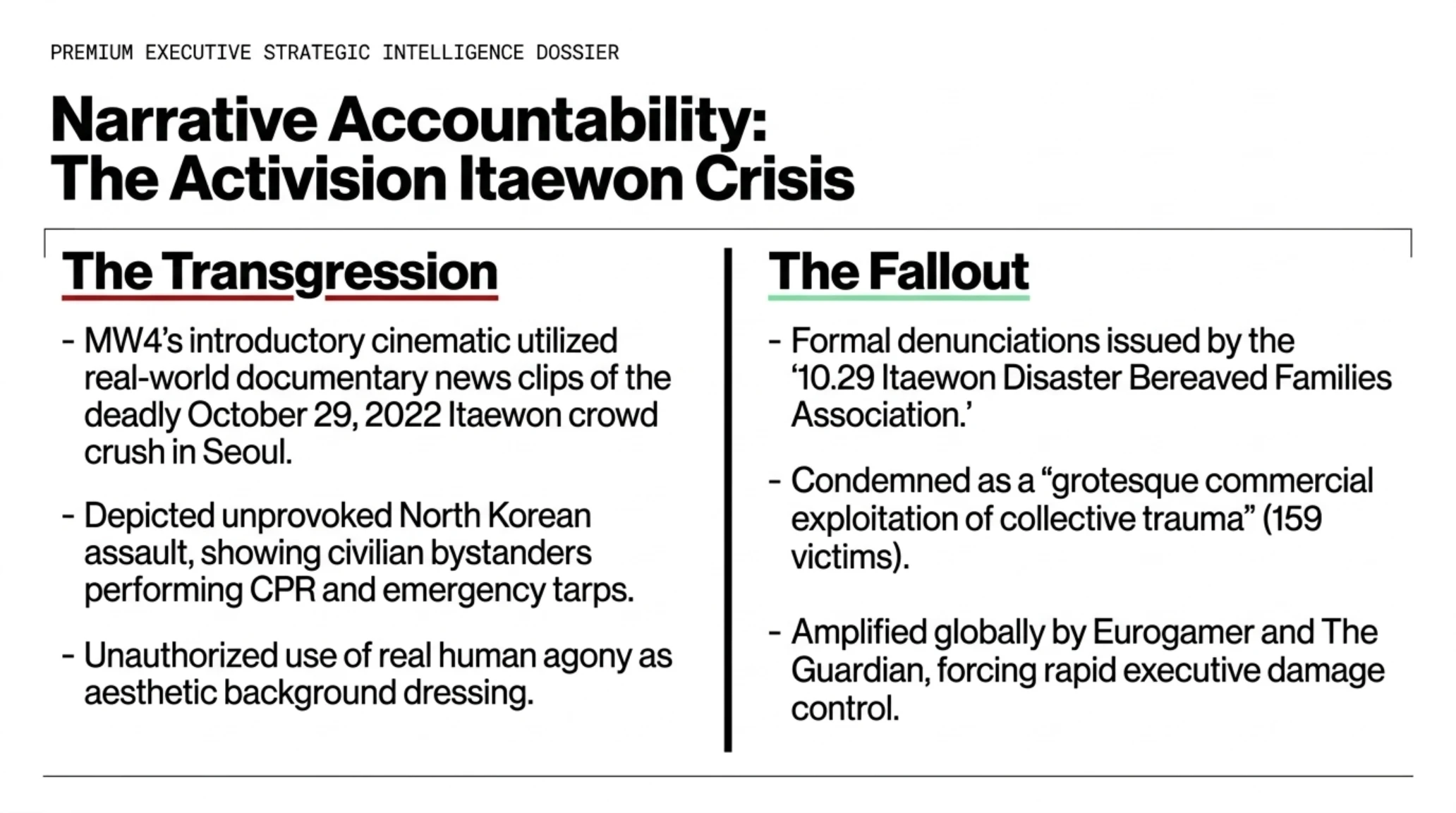
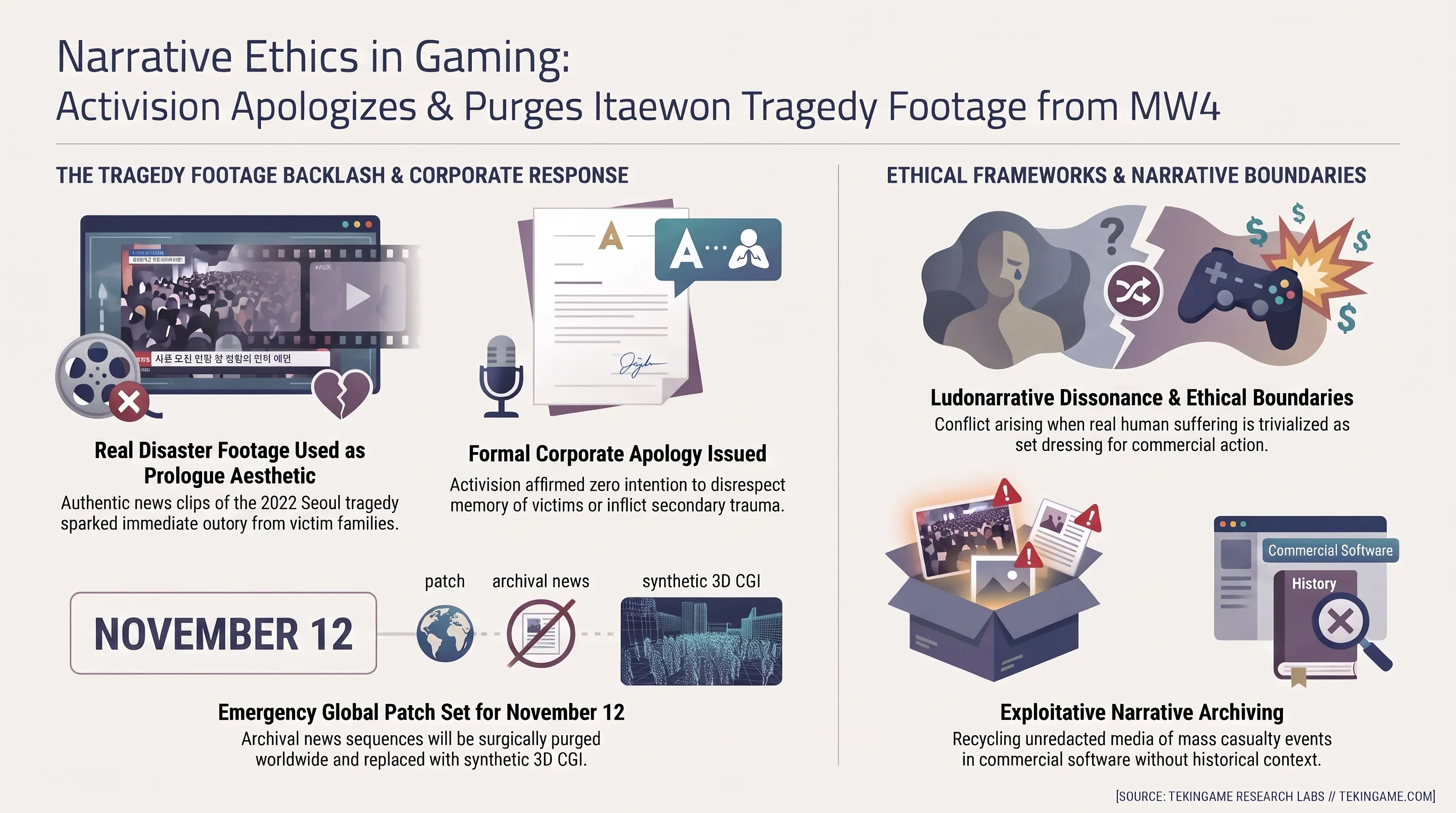
Amidst the multi-million-dollar global marketing campaign accompanying the worldwide launch of Call of Duty: Modern Warfare 4, publisher Activision found itself engulfed in profound ethical and diplomatic controversy. Following sustained public outrage and formal denunciations issued by the «10.29 Itaewon Disaster Bereaved Families Association» in South Korea, Activision issued an unreserved corporate apology, pledging to permanently excise genuine broadcast news footage of the catastrophic 2022 Seoul crowd crush from the game’s introductory cinematic.
The controversy ignited when players discovering the campaign's prologue observed that developers had integrated real-world documentary news clips into a cinematic depicting an unprovoked, surprise military assault on metropolitan Seoul by North Korean armed forces. To cultivate visceral urban chaos, the prologue incorporated authentic archival news footage recorded during the October 29, 2022 Halloween tragedy in Seoul's Itaewon district—including harrowing scenes of civilian bystanders performing emergency CPR on crowded sidewalks, emergency vehicle sirens, and emergency tarps covering deceased victims.
The unauthorized use of real human agony as aesthetic background dressing for commercial entertainment provoked widespread fury across South Korea. Civic organizations and survivor advocacy groups condemned the decision as «an intolerable desecration of human dignity and a grotesque commercial exploitation of collective trauma» that claimed the lives of 159 predominantly young victims. As international publications including Eurogamer and The Guardian amplified the protest, diplomatic and commercial pressure forced Activision's executive leadership into rapid damage control.
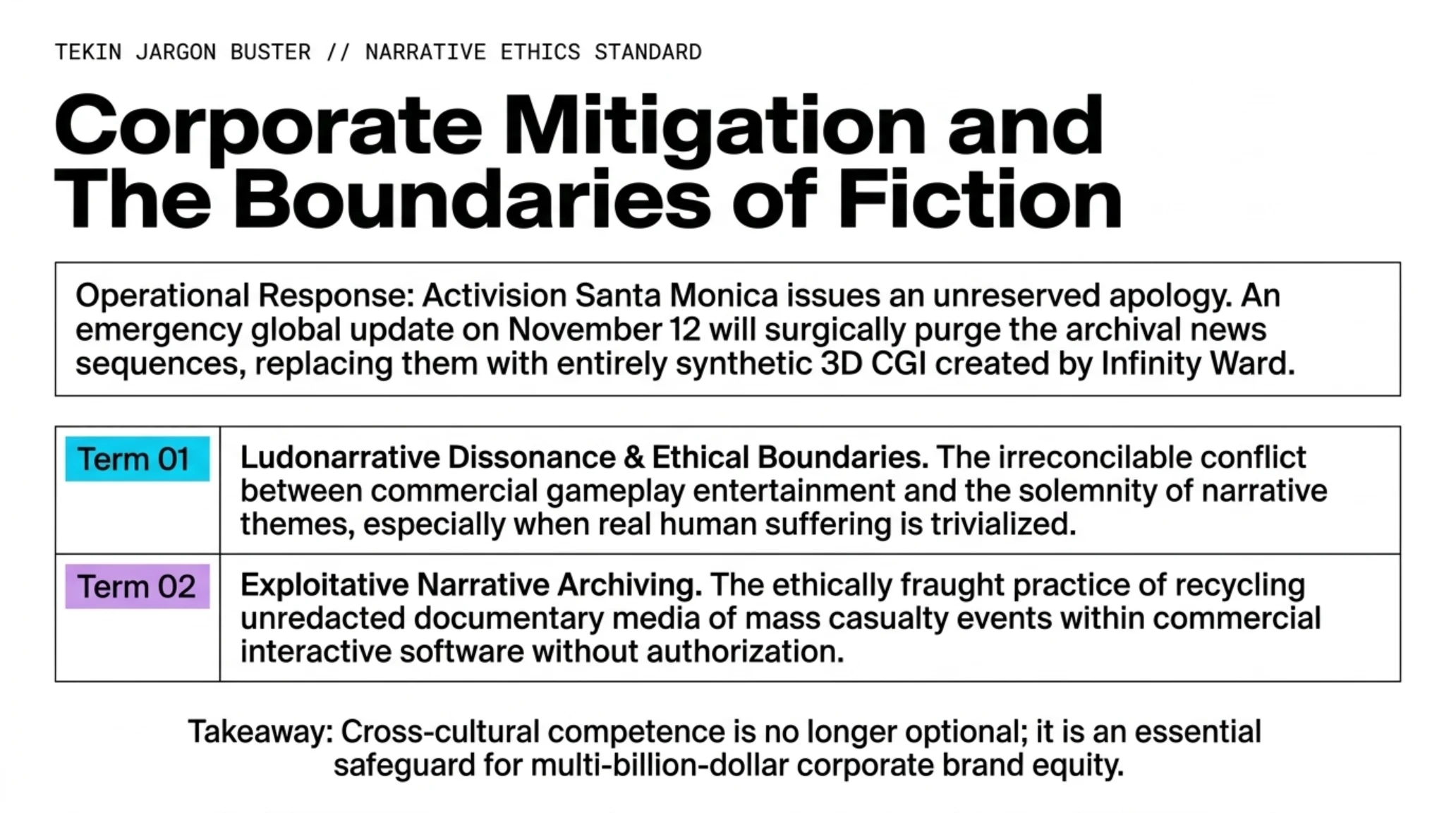
In an official statement released by Activision’s Santa Monica headquarters, the publisher expressed profound regret, affirming that the creative team harbored zero intention to disrespect the memory of the victims or inflict secondary trauma upon grieving families. Activision confirmed that an emergency global update scheduled for deployment on November 12 will surgically purge the archival news sequences across all worldwide SKUs, replacing them with bespoke, entirely synthetic 3D CGI sequences created by Infinity Ward artists.
The incident has reignited profound academic and critical discourse surrounding narrative ethics in military entertainment, establishing clear red lines against the exploitative repurposing of real-world civilian casualties in interactive fiction.
Tekin Jargon Buster // Technical Lexicon
As explored in Tekin Plus's ongoing coverage of interactive storytelling ethics and cultural sensitivity in global software publishing, cross-cultural competence is no longer an optional public relations consideration; it is an essential safeguard protecting corporate brand equity.
Activision’s decisive concession demonstrates that in the hyper-connected digital landscape of 2026, global gaming communities possess the collective leverage to enforce ethical accountability upon multi-billion-dollar conglomerates.
Shigeru Miyamoto Declares November 1 Official 'Pikmin Day': Surprise Direct Unveils Pikmin 4 Switch 2 Edition and Dandori Academy
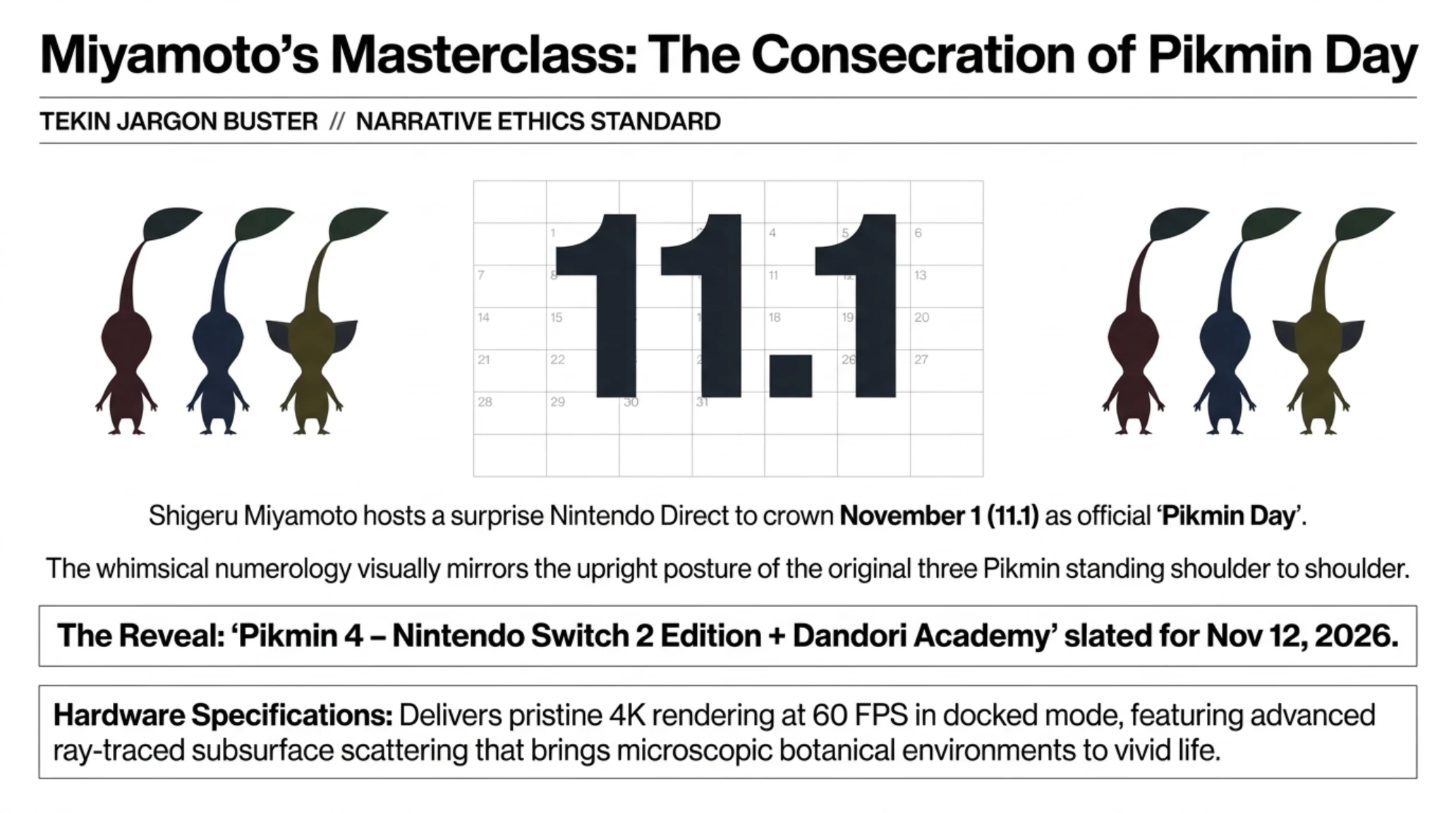
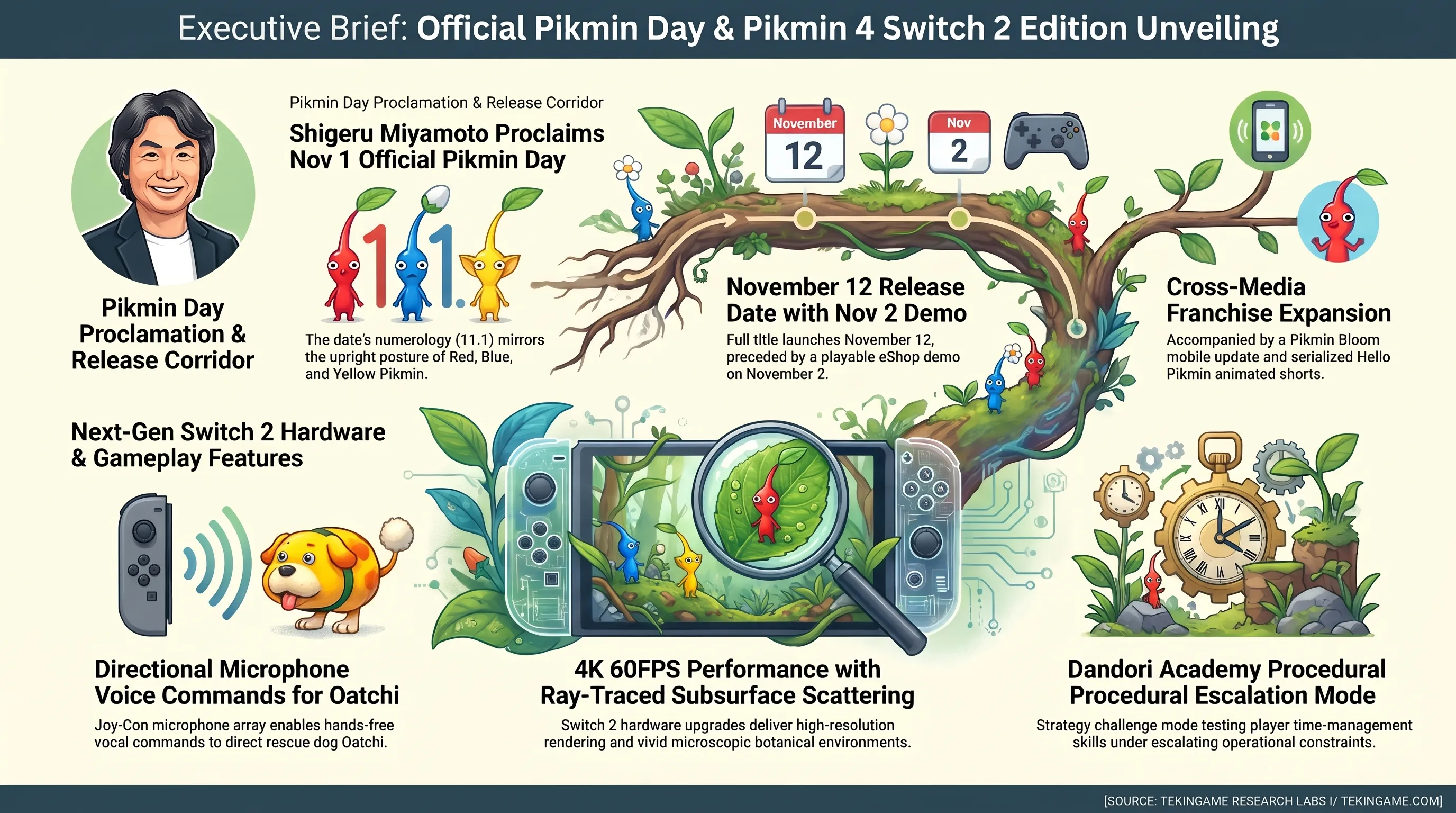
In a delightfully unannounced broadcast that energized Nintendo enthusiasts worldwide, legendary game creator Shigeru Miyamoto hosted a surprise Nintendo Direct to formally consecrate November 1 (11.1) as official «Pikmin Day» across Nintendo’s global branding calendar. Miyamoto explained the whimsical numerology behind the holiday, noting that the three consecutive numerals in 11.1 visually mirror the iconic upright posture of the original Red, Blue, and Yellow Pikmin standing shoulder to shoulder.
The substantive centerpiece of the broadcast, however, was the unveiling of a premier next-generation remaster: «Pikmin 4 – Nintendo Switch 2 Edition + Dandori Academy», slated for release on November 12, 2026. Leveraging the expanded hardware capabilities of the Switch 2, the remaster delivers pristine 4K rendering at 60 frames per second in docked mode, complemented by advanced ray-traced subsurface scattering that brings microscopic botanical environments to vivid life.
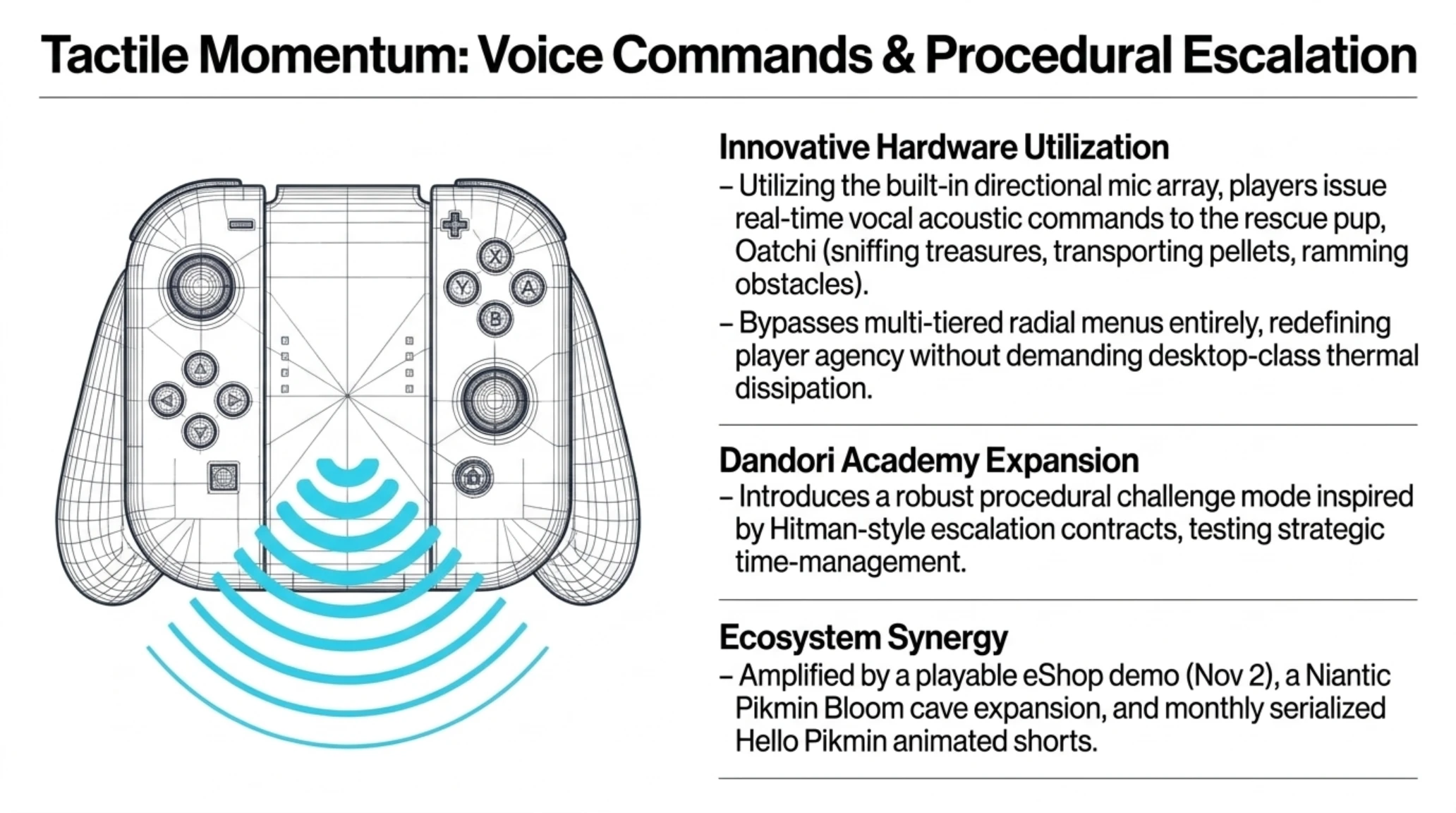
From an interactive design perspective, Miyamoto showcased innovative hardware features that utilize the built-in directional microphone array embedded in the new Switch 2 Joy-Con controllers. Players can now issue real-time vocal acoustic commands directly to their two-legged rescue pup, Oatchi, directing him to sniff out buried treasures, transport heavy nectar pellets, or ram defensive obstacles without navigating multi-tiered radial menus. Furthermore, the expansion introduces «Dandori Academy», a robust procedural challenge mode inspired by Hitman-style escalation contracts that tests players' strategic time-management acumen under escalating operational constraints.
To cultivate immediate consumer momentum, Nintendo confirmed that a comprehensive playable demo will launch on the eShop on November 2. Simultaneously, Niantic announced an expansive autumn cave expansion for the mobile augmented reality title Pikmin Bloom, accompanied by the announcement of monthly serialized Hello Pikmin animated shorts, cementing the franchise's ascension into Nintendo’s tier-one commercial pantheon.
Miyamoto’s strategic masterclass highlights Nintendo’s peerless capability to cultivate evergreen intellectual properties through tactile hardware innovation and celebratory brand rituals.
Grouped Bar Chart & Comparative Technical Latency Matrix
| Platform / Execution Mode | Button-to-Pixel Latency (Input Lag) | Cross-Play Competitive Parity Classification |
|---|---|---|
| Nintendo Switch 2 (Handheld Mode) | 125 Milliseconds (Peak) | Critical Structural Disadvantage; Non-Viable in High-TTK Gunfights |
| Nintendo Switch 2 (Docked TV Mode) | 81 Milliseconds | Noticeable Aim Drag; Sub-Optimal Compared to Dedicated Consoles |
| PlayStation 5 (Standard 60Hz Output) | 49 Milliseconds | Industry Standard Competitive Baseline for Cross-Play Tournaments |
| PC Gaming Rig (240Hz G-Sync Display) | 24 Milliseconds | Superior Reaction Speed; Instantaneous Hit Registration Parity |
As explored in Tekin Plus’s deep-dive on game engine optimization pipelines and input telemetry architecture, maintaining razor-sharp latency margins remains the ultimate differentiator separating premier competitive platforms from casual consumer hardware.
Nintendo’s tactile voice integration in Pikmin 4 demonstrates how thoughtful hardware utilization can redefine player agency without demanding desktop-class thermal dissipation.
The forensic video benchmark above features high-speed optical capture comparing the input latency of Modern Warfare 4 against the acoustic voice response systems of Pikmin 4 on Switch 2 hardware.
Netflix Developing High-Budget Live-Action PUBG Series: Donald Glover Set to Direct, Write, and Star alongside Stephen Glover
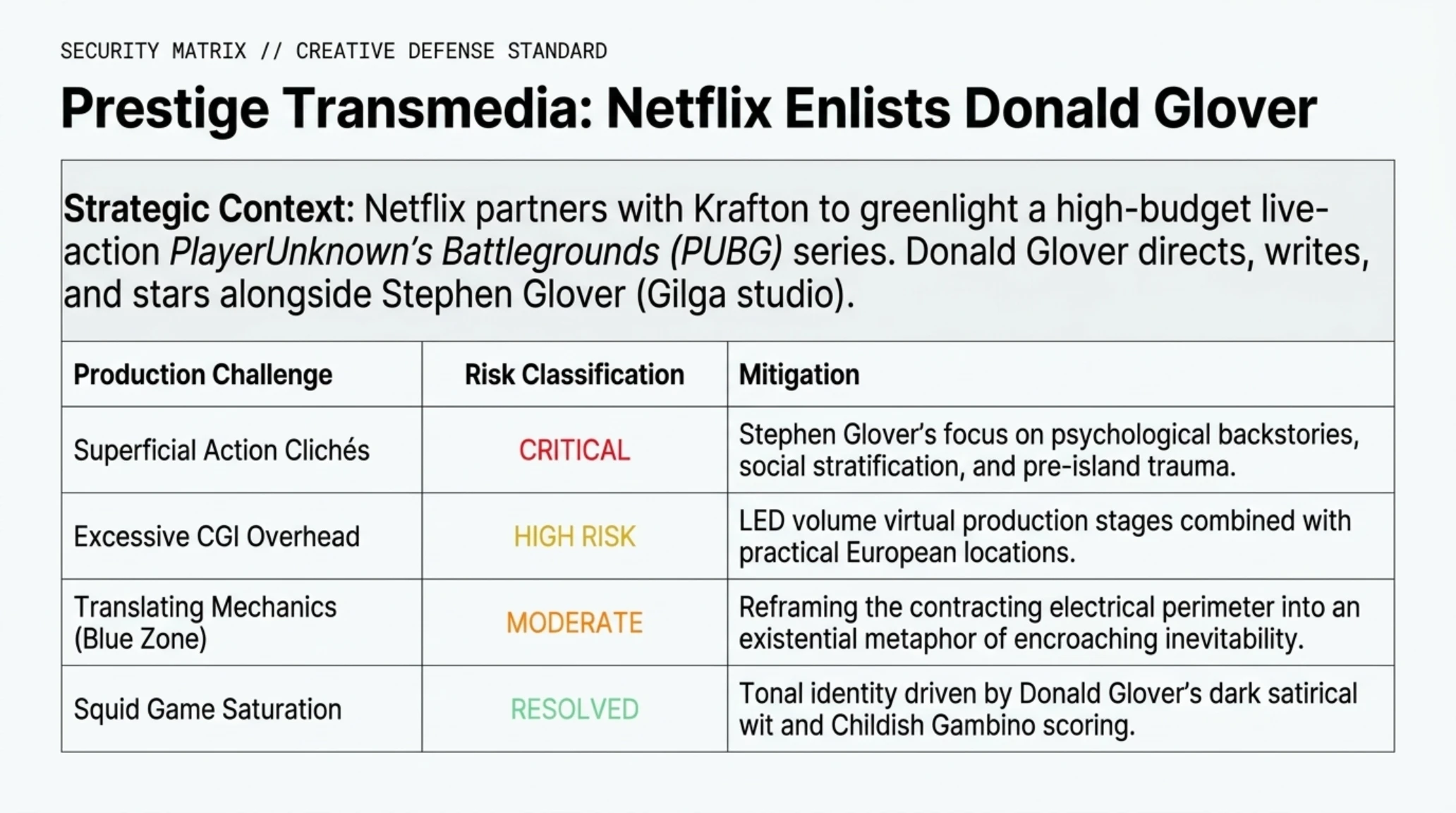
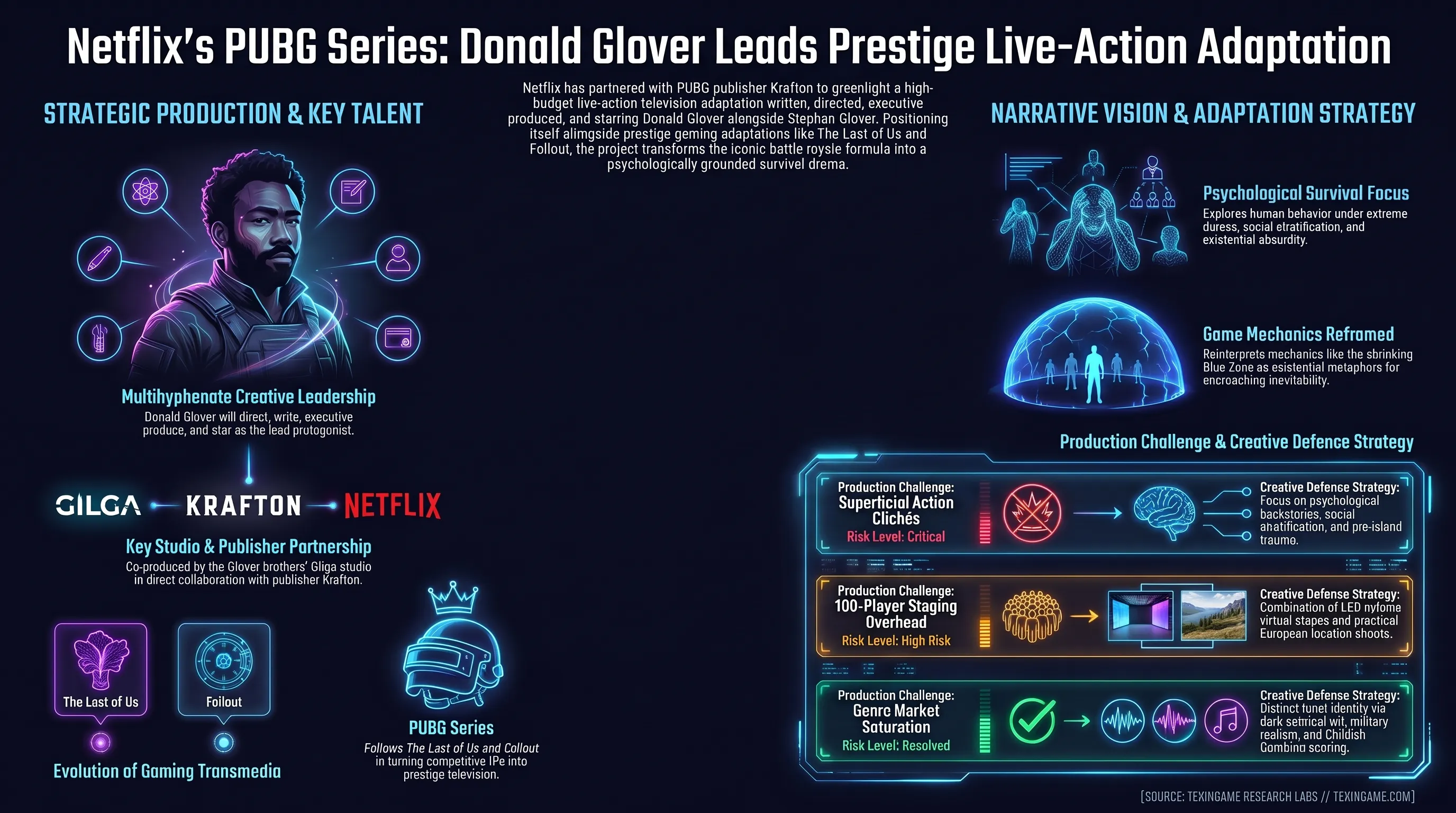
In a watershed development signaling Hollywood's aggressive consolidation of premier interactive gaming intellectual properties, Netflix has partnered with South Korean publisher Krafton to officially greenlight a high-budget live-action television series adaptation of PlayerUnknown's Battlegrounds (PUBG). What elevates the project into an undeniable cultural event is the confirmed attachment of multi-hyphenate creative visionary, Emmy winner, and Grammy recipient Donald Glover.
According to exclusive disclosures confirmed across Eurogamer, Gizmodo, and Hypebeast, Donald Glover has signed on to direct, write, executive produce, and star as the lead protagonist within the survival series. Collaborating directly with him is his longtime creative partner and brother, Stephen Glover—celebrated for his razor-sharp satirical writing on the critically acclaimed series Atlanta—alongside their boutique creative studio, Gilga. The involvement of the Glover brothers signals that Netflix is pursuing a nuanced, psychologically grounded character study exploring systemic survival and existential absurdity rather than an empty, pyrotechnic exercise in military gunplay.
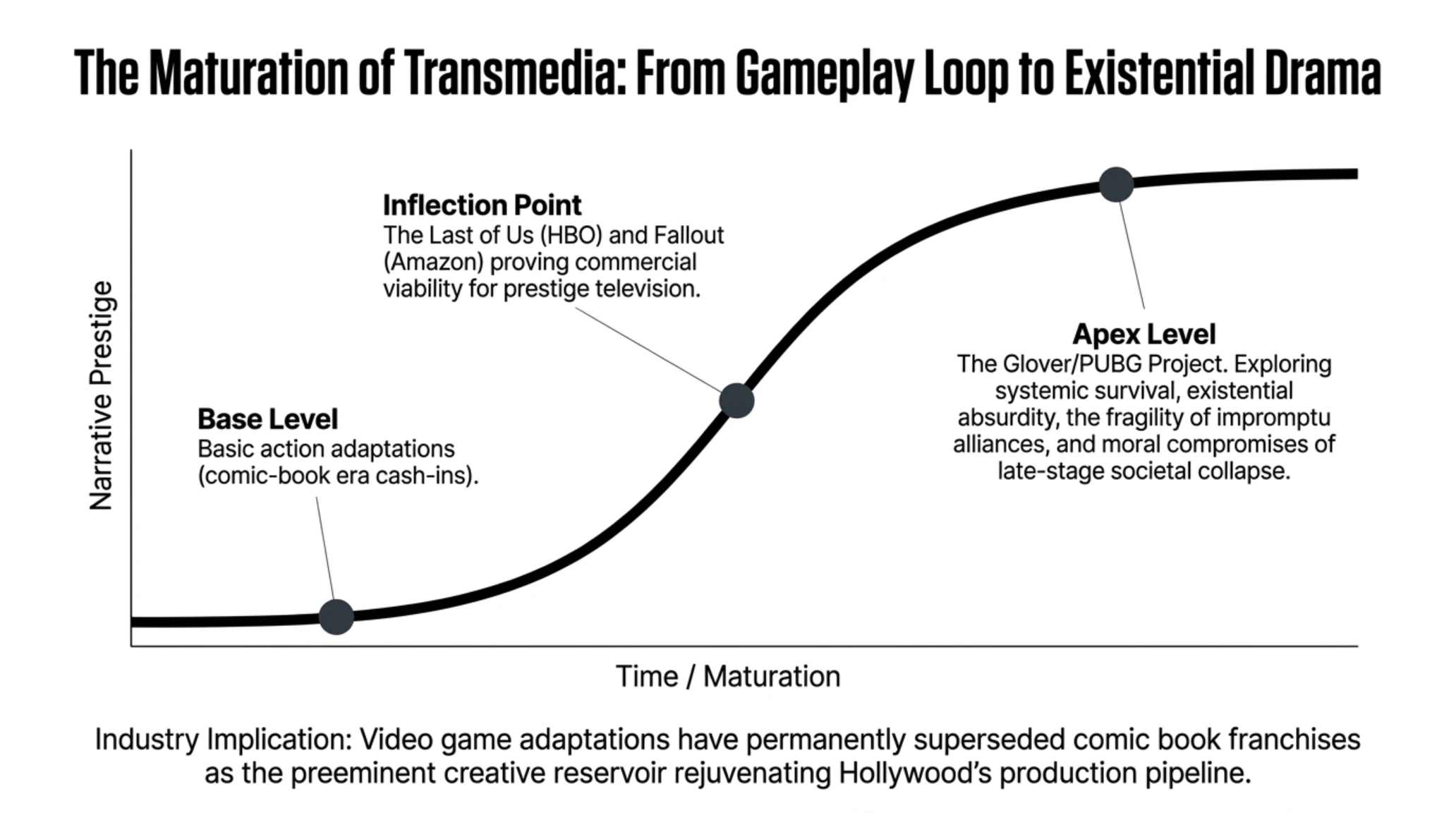
Following the transformative cultural and commercial triumph of HBO’s The Last of Us and Amazon’s Fallout, premier streaming networks have recognized that contemporary gaming narratives offer fertile ground for sophisticated prestige television. The core mechanics of PUBG—dropping one hundred desperate strangers onto an abandoned, militarized island mandated to slaughter one another until a solitary survivor remains—provides an extraordinary canvas to interrogate human behavior under extreme duress, the fragility of impromptu alliances, and the moral compromises inherent in late-stage societal collapse.
For Krafton, which has spent years methodically constructing lore anthologies around the «PUBG Universe» through animated shorts and live-action Korean docudramas, this collaboration represents the ultimate vehicle to elevate the battle royale progenitor into a cross-media entertainment juggernaut on par with global cinematic franchises. Combining Netflix’s global distribution apparatus with Donald Glover’s subversive artistic voice positions the series as a potential genre-defining cultural touchstone.
Entertainment industry analysts emphasize that securing the Glover brothers constitutes a major coup for Netflix, immediately conferring high-art prestige upon a franchise historically defined by pure competitive gameplay.
Cybersecurity Risk Matrix & Narrative Adaptation Defense
| Production & Artistic Challenge | Risk Classification | Mitigation & Creative Defense Standard |
|---|---|---|
| Superficial Action Clichés Devoid of Character Depth | CRITICAL | Stephen Glover's narrative focus on psychological backstories, social stratification, and pre-island trauma. |
| Excessive CGI Overhead in 100-Player Staging | HIGH RISK | Utilization of LED volume virtual production stages combined with practical European architectural location shoots. |
| Translating Gaming Mechanics (Blue Zone & Airdrops) | MODERATE | Reframing the contracting electrical perimeter into a potent existential metaphor representing encroaching inevitability. |
| Market Saturation Following Squid Game Proliferation | RESOLVED | Distinctive tonal identity driven by Donald Glover’s dark satirical wit, military realism, and Childish Gambino scoring. |
📚 Classified & Related Dossiers in TekinGame
If you wish to explore beyond this report and delve into cybernetic frontiers and autonomous AI architectures, do not miss these three exclusive deep-dives in the Tekin Garage:
As documented in previous Tekin Plus analyses on interactive entertainment IP transmedia ecosystems, video game adaptations have superseded comic book franchises as the preeminent creative reservoir rejuvenating Hollywood's production pipeline.
The PUBG adaptation confirms that the battle royale framework has matured from an exhilarating gameplay loop into a profound dramatic metaphor resonant with global audiences.
Sony PlayStation Store Under Fire Over 'Intelligent Pricing' and Targeted Offers: Fear of Dynamic Game Pricing Resurfaces
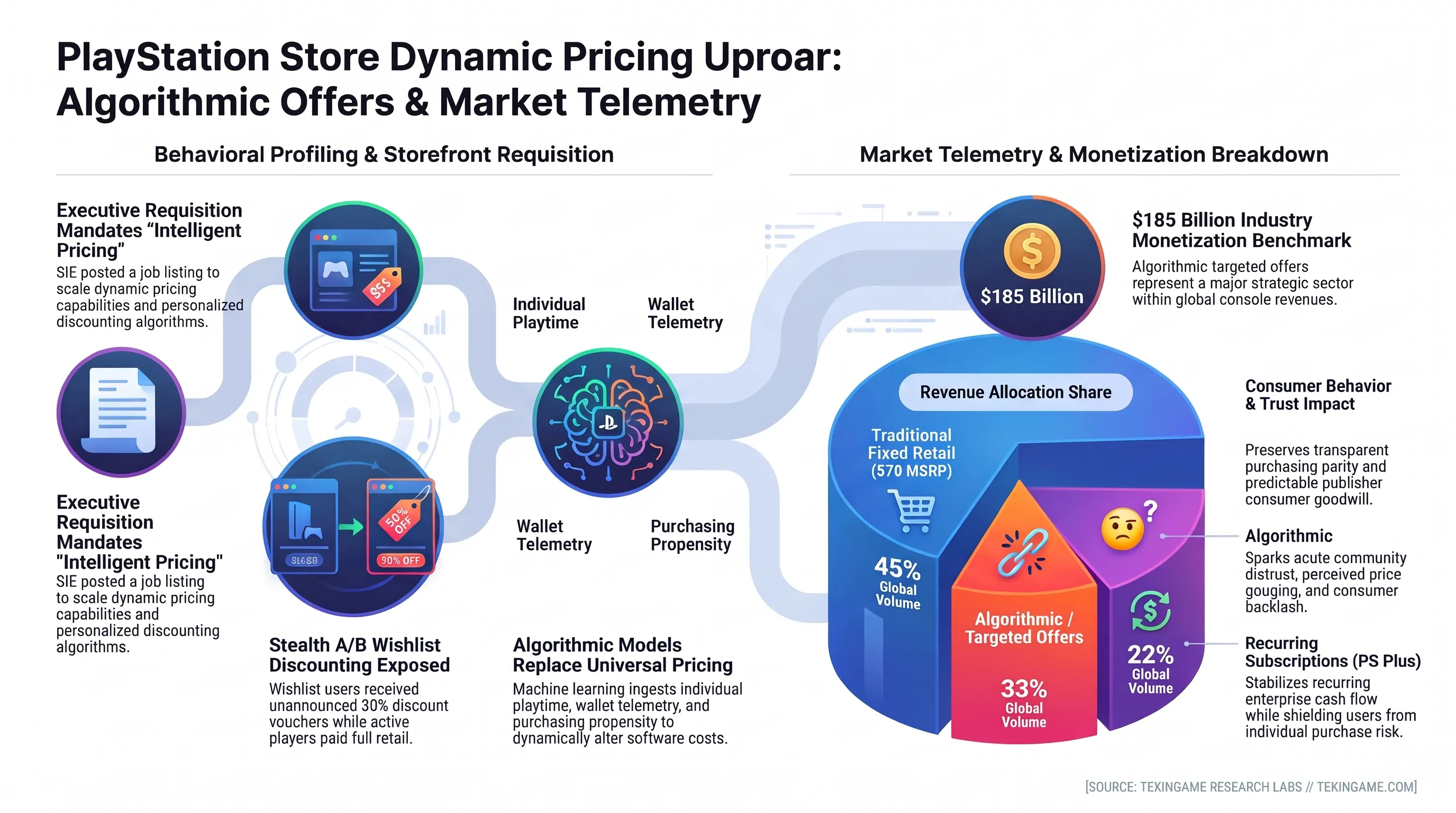
A seemingly routine executive job listing published by Sony Interactive Entertainment (SIE) at the opening of November ignited a firestorm of controversy across the global PlayStation gaming community. The Tokyo and San Mateo-based gaming giant is actively recruiting a Director of Digital Monetization for the PlayStation Store, but it was the explicitly detailed operational mandates in the job requisition that sent shockwaves through social forums and consumer advocacy groups.
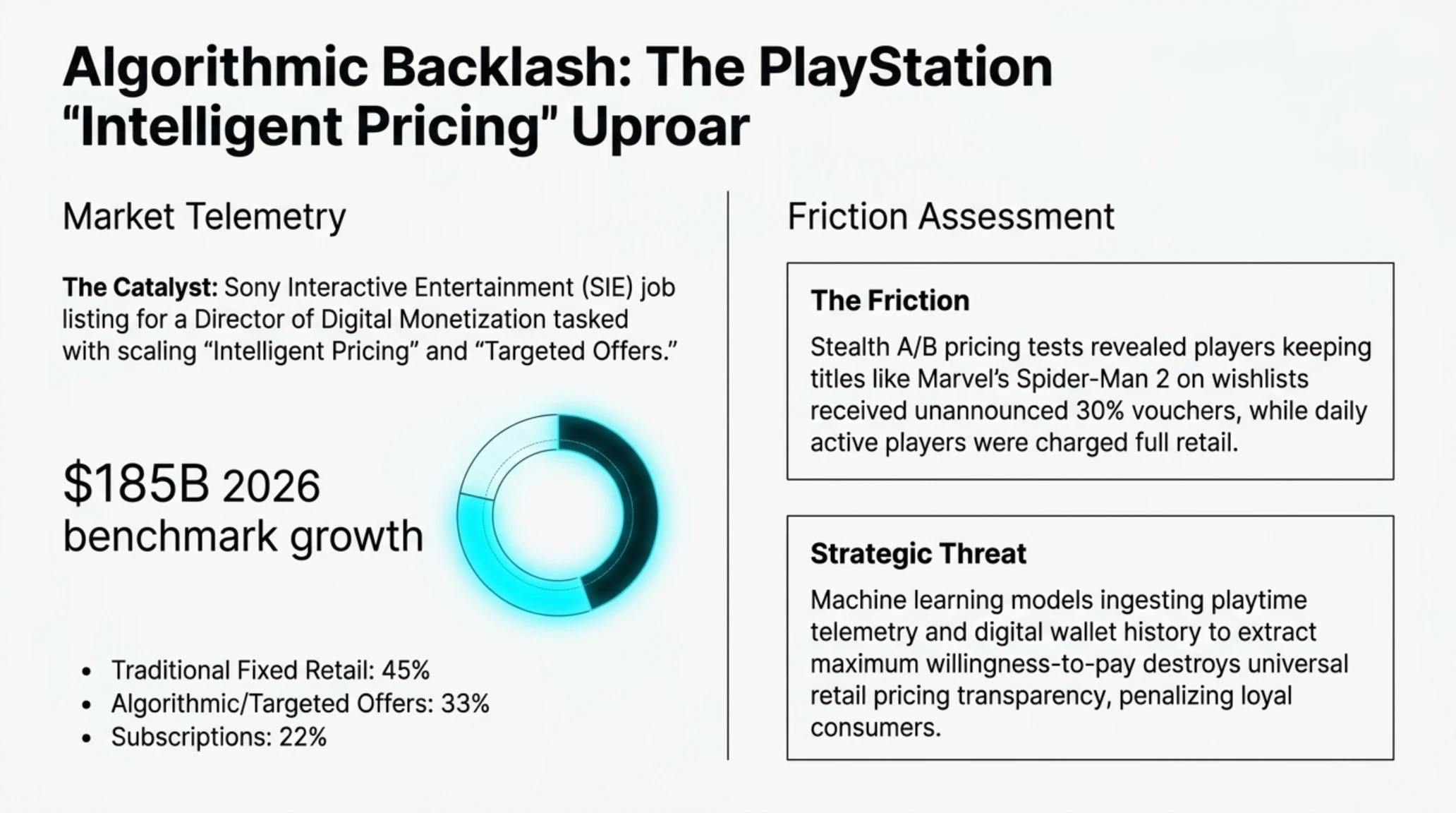
The official job description tasks the prospective executive with «defining and scaling Intelligent Pricing capabilities across global digital storefronts» alongside «advancing personalized Targeted Offers and bespoke consumer discounting programs». This corporate rhetoric surfaced immediately following months of grassroots community documentation, where Reddit and Twitter users discovered stealth A/B pricing tests conducted on the PlayStation Network. Users comparing storefront listings simultaneously revealed that players who had kept titles like Marvel's Spider-Man 2 or Helldivers 2 on their digital wishlists for extended periods were receiving unannounced, personalized 30% discount vouchers, while active daily players browsing the same store page were charged full retail price.
Consumer rights advocates and gaming enthusiasts swiftly sounded alarms over the latent deployment of algorithmic «Dynamic Pricing»—a controversial yield-management model long prevalent in airline ticketing and ride-hailing services. Under such an algorithmic paradigm, machine learning models continuously ingest telemetry on individual playtime patterns, digital wallet transaction history, geographical affluence, and purchasing propensity to dynamically alter software prices. In practice, this dismantles universal retail pricing transparency, effectively penalizing loyal, engaged consumers while weaponizing consumer behavioral data to extract maximum willingness-to-pay.
Industry legal analysts warn that individualized dynamic pricing introduces deep ethical and regulatory friction. If established across console ecosystems, standardized seasonal sales events would be rendered obsolete, replaced by opaque algorithmic price discrimination engineered to manipulate individual purchasing psychology.
While Sony has maintained strategic silence regarding the mounting public backlash, the intense community outrage demonstrates that interactive entertainment consumers draw a rigid boundary between fair commercial monetization and invasive behavioral surveillance.
Market Telemetry Donut Chart, Growth Bar & Strategic Industry Allocation
| Console Digital Monetization Model | Revenue Allocation Share | Consumer Behavior & Trust Friction Assessment |
|---|---|---|
| Universal Fixed Retail Pricing ($70 MSRP) | 45% Global Volume | Preserves transparent purchasing parity and predictable publisher consumer goodwill. |
| Algorithmic Behavioral & Targeted Offers | 33% Global Volume | Sparks acute community distrust, perceived price gouging, and consumer backlash. |
| Recurring Subscription Tiers (PS Plus / Game Pass) | 22% Global Volume | Stabilizes recurring enterprise cash flow while shielding users from individual purchase risk. |
| Seasonal Global Sales (Black Friday & Holiday Events) | 15% Seasonal Surge | Drives concentrated transaction spikes through uniform, transparent percentage markdowns. |
As analyzed in Tekin Plus’s continuing coverage of digital storefront economics and behavioral pricing architecture, compromising price transparency to extract short-term margin expansion inevitably incurs severe long-term reputational degradation.
The PlayStation pricing controversy exposes that the fiercest upcoming battles in the console sector will be fought not over teraflop metrics, but over the ethical governance of commercial consumer data.
The Biggest Video Game Releases of November 2026: The Final Showcase Before Rockstar's GTA 6 Rewrites Industry History
November has historically served as the preeminent revenue-generating crucible across the interactive software industry, but the commercial dynamics governing November 2026 diverge sharply from any seasonal release cycle in modern memory. A definitive market investigation published by GameSpot demonstrates that global publisher scheduling behavior is dominated by an overwhelming, singular gravity: the global release of Rockstar Games' Grand Theft Auto VI on November 19, 2026.
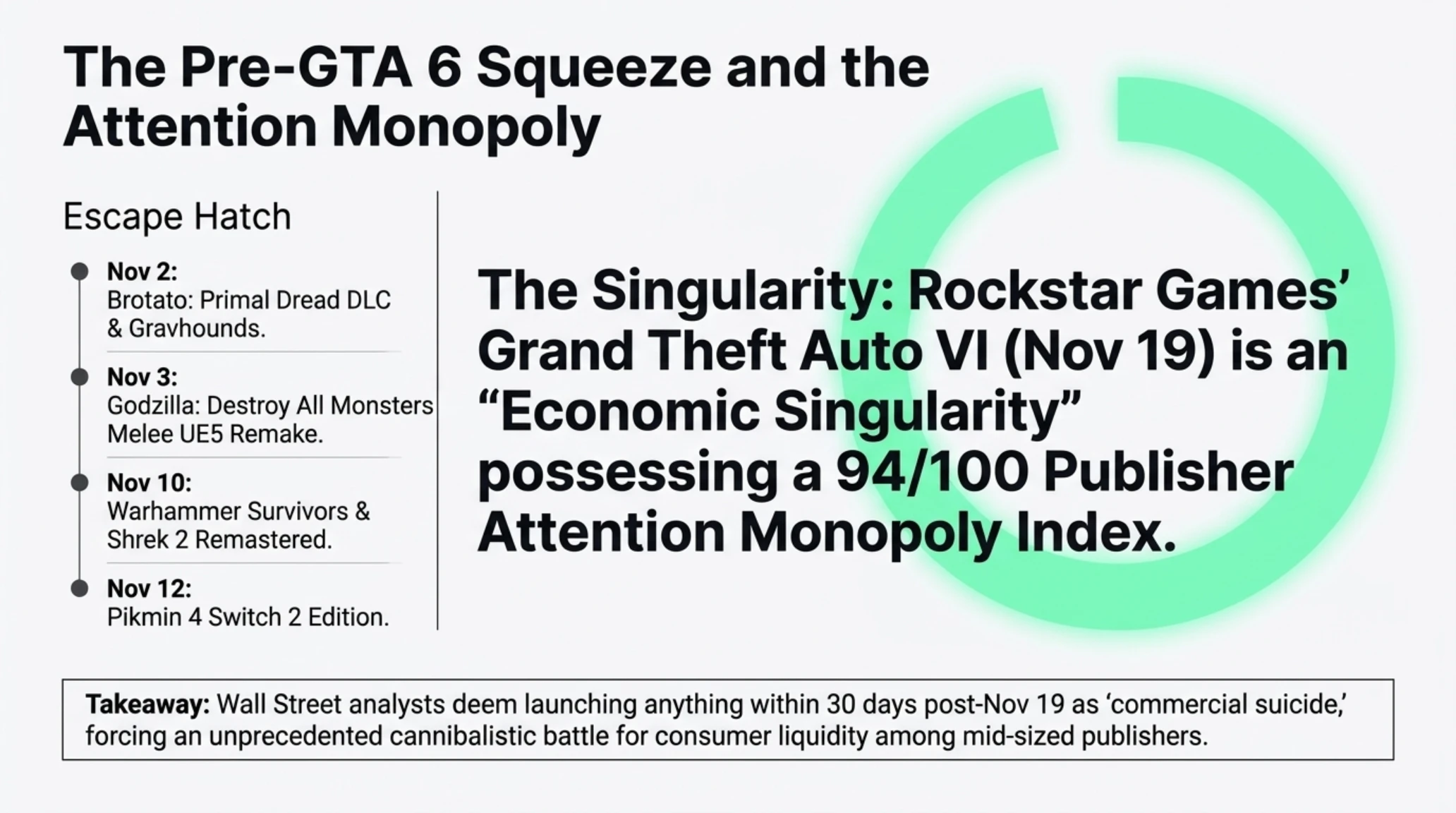
Among enterprise publishing executives and retail distribution leads, the arrival of GTA 6 is analyzed not merely as a blockbuster product release, but as an «Economic Singularity»—an unprecedented commercial vortex destined to monopolize 100% of mainstream media headlines, capture global Twitch and YouTube gaming viewership, and exhaust consumer entertainment expenditure for months on end. Attempting to launch a mid-tier or even major AAA title within thirty days following November 19 is widely characterized by Wall Street entertainment analysts as commercial suicide. Consequently, the industry has executed an unprecedented operational retreat dubbed the «November 1–14 Escape Hatch», aggressively cramming dozens of high-profile releases into the first two weeks of the month.
This intense release barrage commences immediately on November 2 with the simultaneous launch of the highly anticipated Brotato: Primal Dread DLC alongside the tactical space co-op shooter Gravhounds. On November 3, retro fighting enthusiasts receive the physics-heavy Unreal Engine 5 remake of Godzilla: Destroy All Monsters Melee. Blizzard steps into the fray on November 4, deploying permanent progression legacy servers via World of Warcraft: Forever. The pacing accelerates on November 10 with the dual drops of the grimdark roguelite Warhammer Survivors and Shrek 2 Remastered, culminating on November 12 with Nintendo’s flagship Pikmin 4 Switch 2 Edition—exactly seven days before Vice City claims complete dominion over global culture.
While this compressed window delivers an unprecedented feast of entertainment for gamers during the opening fortnight of the month, it precipitates an intensely cannibalistic battle for consumer attention among mid-sized publishers. Securing viable returns during this brief 14-day window represents the sole opportunity to secure liquidity before the holiday calendar is permanently eclipsed.
This unprecedented scheduling phenomenon confirms that in contemporary interactive entertainment, rigorous strategic calendar engineering is just as critical to commercial survival as production quality.
Market Sentiment Gauge | Attention Monopoly Index & S-Curve Diffusion Curve
Sentiment Synthesis: Measuring an extraordinary 94% on the publisher attention monopoly index, the release calendar illustrates total industry retreat, with publishers frantically securing consumer liquidity before Rockstar's singular cultural event reshapes entertainment history.
The institutionalization of this release corridor confirms how singular monolithic entertainment products can fundamentally reorganize the macroeconomic calendar of the entire interactive sector.
Event Timeline | Chronology of Key Releases & Publishing Maneuvers in November 2026
| Release Target in November | Premier Title & Target Platform | Strategic Commercial Significance |
|---|---|---|
| November 2 | Brotato: Primal Dread DLC & Gravhounds Co-Op Action | Opening the race for roguelite and indie co-op mindshare in early November. |
| November 3 | Godzilla: Destroy All Monsters Melee UE5 Remake | Revitalizing nostalgic arcade brawlers with modern physics and destructive fidelity. |
| November 10 | Warhammer Survivors & Shrek 2 Remastered | Final wave of independent mid-tier action titles capturing casual consumer spend. |
| November 12 | Pikmin 4 Switch 2 Edition + Dandori Academy | Nintendo’s premier autumn first-party showcase immediately preceding GTA 6. |
| November 19 | Global Launch of Rockstar Games' Grand Theft Auto VI | Historic entertainment singularity; total capture of global attention and consumer capital. |
As documented in previous Tekin Plus analyses on entertainment platform economics and attention monopoly management, the commercial entities that thrive are those that synchronize release cadences around major cultural tidal waves.
Tekin Strategic Synthesis: Re-Mapping the Interactive Entertainment Landscape at the Dawn of November 2, 2026
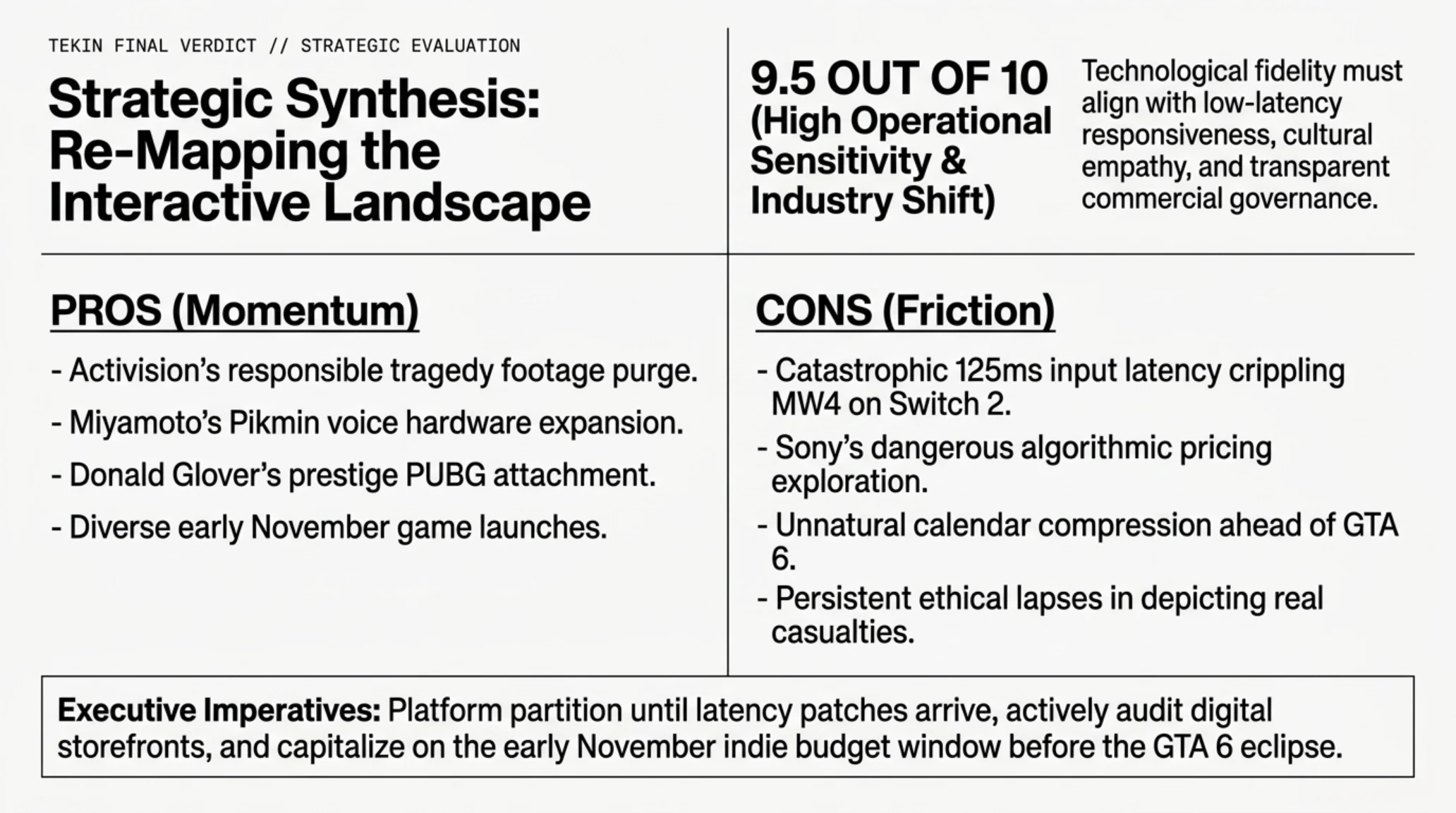
A rigorous, multi-dimensional synthesis of this evening’s disclosures reveals an interactive entertainment industry operating at a critical intersection of hardware engineering trade-offs, narrative accountability, and macroeconomic consolidation. The convergence of Switch 2 input latency challenges, corporate narrative retreats, celebratory brand engineering, prestige television adaptations, behavioral storefront surveillance, and release calendar compression paints a coherent portrait of a mature global sector under intense structural pressure.
The Call of Duty: Modern Warfare 4 input lag benchmark delivers an urgent architectural lesson: porting dense multi-platform engines to hybrid mobile hardware requires deep, end-to-end latency minimization. Sacrificing input responsiveness to maintain an artificial 60fps framerate compromises competitive parity, demonstrating that platform holders and publishers must re-engineer render queues to preserve cross-play integrity.
Ethically, the swift resolution of the Itaewon controversy marks a vital triumph for global consumer advocacy. Commercial interactive media must recognize that the ethical boundaries separating artistic drama from the exploitative co-optation of living trauma are absolute. Activision's prompt apology and patching commitment establish an essential industry precedent for cultural respect.
In transmedia entertainment, Netflix’s collaboration with Donald and Stephen Glover on PUBG signals that Hollywood's treatment of video game IP has permanently moved beyond cynical cash-ins. By entrusting battle royale lore to celebrated dramatic visionaries, the project aspires to transform tactical gaming mechanics into compelling existential drama.
Simultaneously, the gaming community’s fierce backlash against PlayStation’s «Intelligent Pricing» confirms that algorithmic yield management models face fierce ideological resistance within the gaming ecosystem. Storefront operators attempting to introduce variable pricing algorithms risk alienating their core, highly engaged demographic.
Finally, the desperate publisher rush across early November provides empirical validation of Rockstar’s singular market power. By packing the calendar ahead of November 19, the industry acknowledges that when GTA 6 arrives, all other commercial interactive software must temporarily yield the floor.
Industry leadership and informed players should prioritize decisive operational responses:
- Competitive Platform Partitioning: Exercise caution when engaging in cross-play multiplayer shooters on Switch 2 until official low-latency pipeline patches are verified.
- Digital Storefront Transparency Monitoring: Actively audit digital storefront pricing across community channels to resist algorithmic pricing discrimination.
- Strategic Autumn Library Budgeting: Capitalize on the early November release window to support innovative indie and mid-tier titles before GTA 6 monopolizes attention.
- Activision's swift, responsible apology and commitment to purge real tragedy footage from MW4
- Nintendo and Shigeru Miyamoto's creative expansion of the Pikmin brand with Switch 2 voice hardware
- Donald and Stephen Glover's prestige creative attachment guaranteeing artistic depth for live-action PUBG
- An extraordinary diversity of high-quality titles launching across the concentrated early November corridor
- Catastrophic 125ms input latency flaw crippling Modern Warfare 4 competitive parity on Switch 2
- Sony Interactive Entertainment's troubling exploration of algorithmic dynamic pricing in the PS Store
- Total industry paralysis ahead of GTA 6 forcing unnatural, cannibalistic calendar compression
- Persistent systemic lapses in narrative judgment regarding the depiction of real-world human casualties
The convergence of these events confirms that interactive entertainment in late 2026 demands not only technological ambition, but unwavering respect for ethical boundaries, competitive fairness, and consumer trust.
As the industry steps into this historic holiday corridor, the creators who triumph will be those who honor the delicate balance between technical mastery and human connection.
The investigative video briefing above delivers comprehensive technical visualization of the Switch 2 latency data, the early November publishing squeeze, and the transmedia production scope of Donald Glover’s PUBG series.
Tekin Final Verdict & Verified Intelligence Sources
The Convergence of Hardware Parity, Narrative Ethics, and Attention Monopolies
The disclosures of November 2, 2026, demonstrate that technological fidelity must align with low-latency responsiveness, cultural empathy, and transparent commercial governance to endure in modern interactive entertainment.
- Digital Foundry: Hardware Telemetry: Call of Duty: Modern Warfare 4 Input Latency Benchmarks on Nintendo Switch 2
- IGN: Competitive Investigation: Switch 2 Input Lag Disadvantage & Nintendo Direct Pikmin Day Coverage
- Eurogamer: Industry Reporting: Activision Itaewon Footage Apology & Netflix Live-Action PUBG Series Greenlight
- The Guardian: Investigative Journalism: South Korean Bereaved Families Protest Itaewon Depiction in Modern Warfare 4
- GameSpot: Retail Analysis: The November 2026 Video Game Release Rush Preceding Grand Theft Auto VI
- Insider Gaming: Storefront Investigation: Sony PlayStation Explores Intelligent Pricing and Targeted Offer Systems
- Gizmodo: Entertainment Feature: Donald Glover and Stephen Glover Partner with Krafton for Netflix PUBG Series
Frequently Asked Questions & Technical Inquiries
Why does Call of Duty: Modern Warfare 4 exhibit severe input lag on Nintendo Switch 2?
Developers implemented aggressive double-buffering in the IW Engine GPU render queue to maintain a locked 60fps with dynamic resolution upscaling on mobile Tegra silicon, which creates an input queue backlog inflating latency to 125ms in handheld mode.
Will Activision permanently delete the real-world Itaewon footage from Modern Warfare 4?
Yes. Following public apologies to bereaved families in South Korea, Activision confirmed an emergency update scheduled for November 12 will surgically replace all real documentary disaster clips with synthetic in-engine CGI sequences worldwide.
What features distinguish Pikmin 4 Nintendo Switch 2 Edition?
The upgraded release features 4K 60fps visual polish, microphone-based vocal acoustic commands to direct rescue pup Oatchi via the Joy-Con microphone array, and the new Dandori Academy strategic challenge mode.
What is the creative direction for Netflix's live-action PUBG series with Donald Glover?
Spearheaded by Donald Glover and his brother Stephen alongside Gilga studio, the series is being developed as a dark, existential character drama exploring human survival psychology, social satire, and military realism within the 100-player battle royale premise.
Why are gamers alarmed by PlayStation's 'Intelligent Pricing' job posting?
The job description indicates Sony is exploring algorithmic dynamic pricing and behavioral targeted discounts, which players fear will eliminate transparent universal pricing and penalize loyal customers based on data-mined willingness-to-pay telemetry.
Why are so many major video games releasing in the first two weeks of November 2026?
Publishers are actively escaping the commercial shadow of Rockstar Games' Grand Theft Auto VI (launching November 19), attempting to capture holiday gaming budgets before GTA 6 monopolizes global consumer attention and streaming bandwidth.
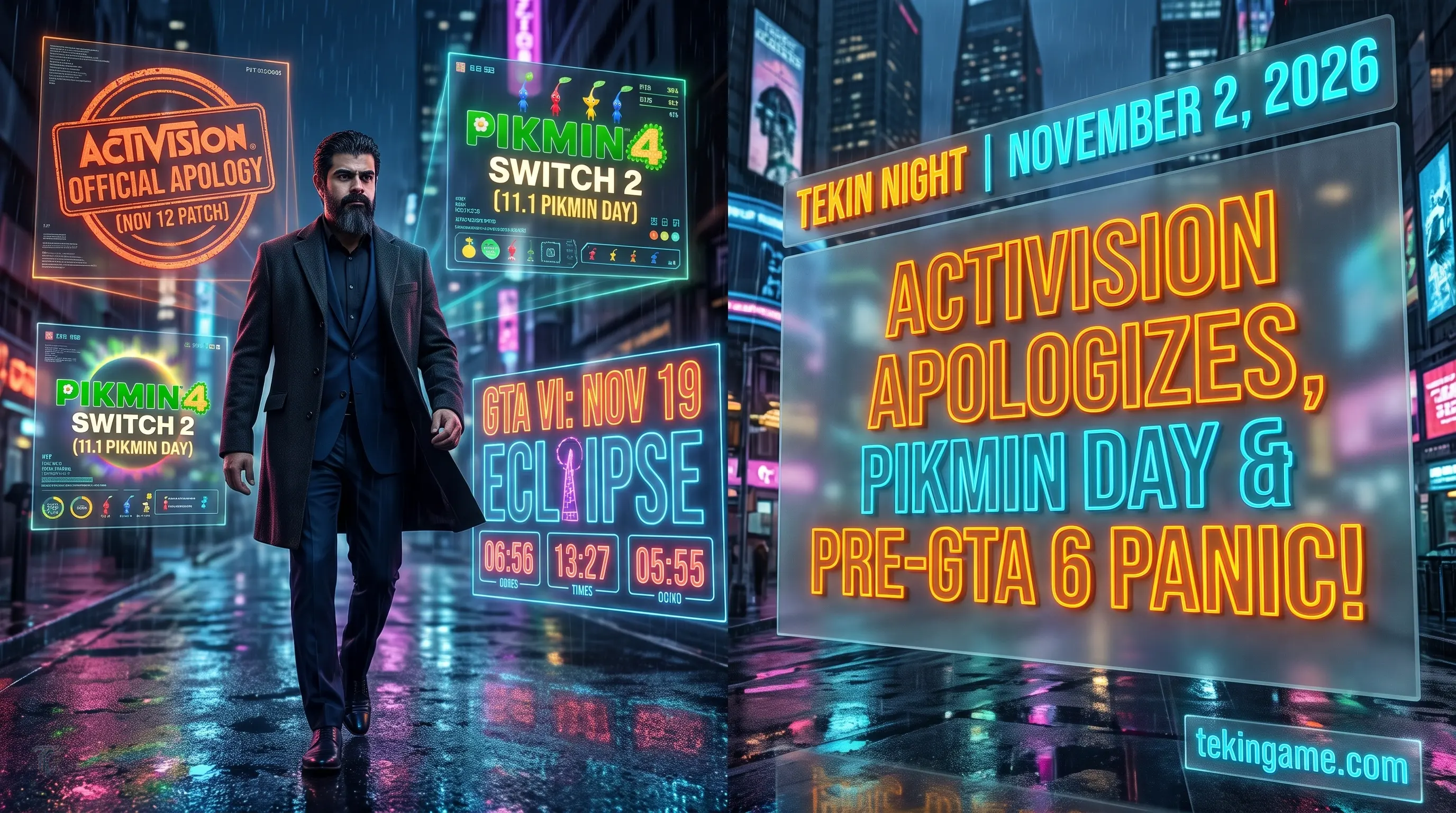
Additional Gallery: Tekin Night Nov 2: Switch 2 MW4 125ms Input Lag, Activision Apology & Netflix PUBG