Tekin Morning | Tuesday, November 3, 2026
Rocket Lab's 99th Mission 'The Sea God Surveys' Launches Japanese QPS-SAR-20 Radar Satellite into Low Earth Orbit
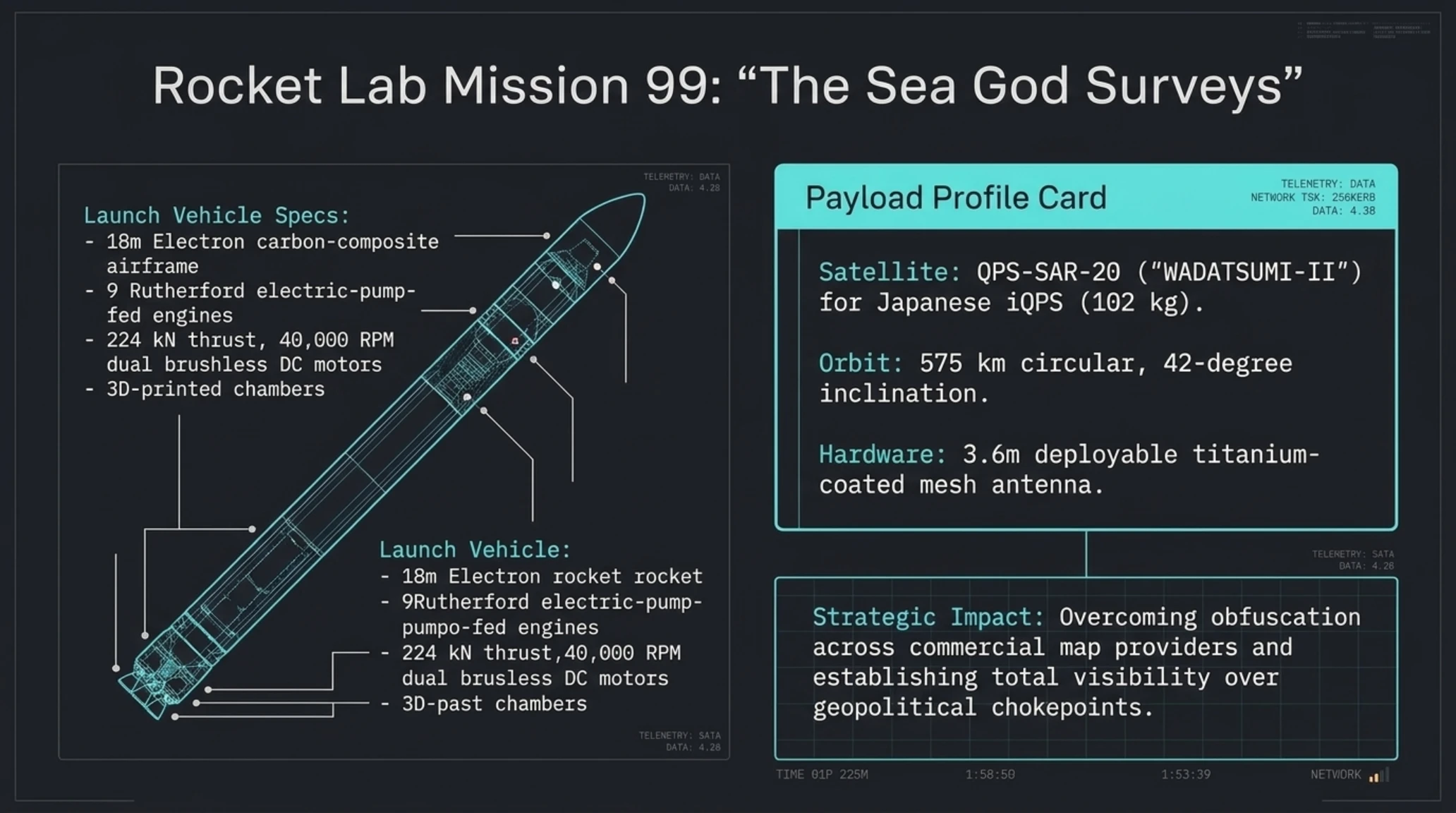
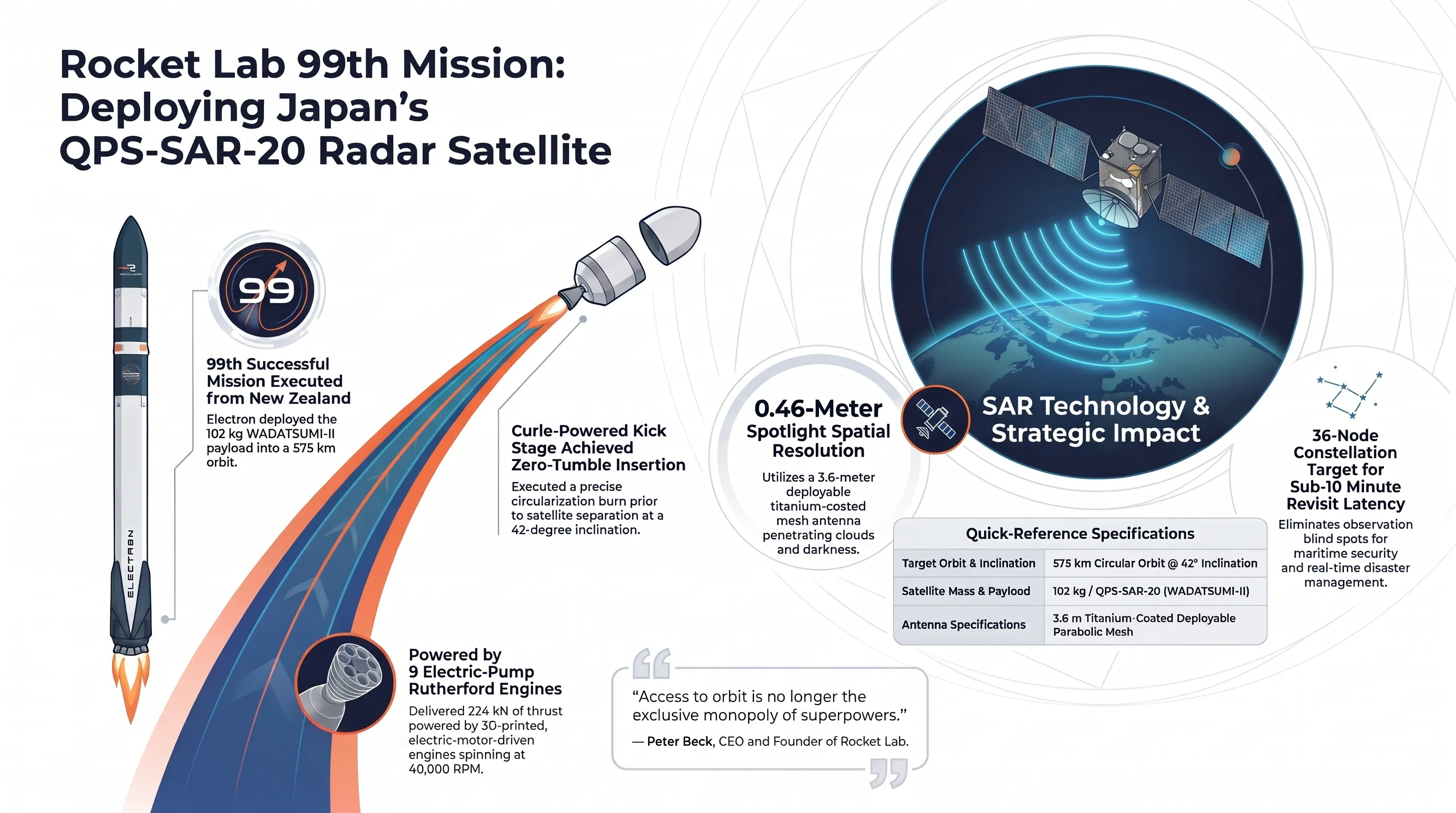
The commercial aerospace sector marked a critical operational milestone as Rocket Lab successfully executed its 99th mission, designated 'The Sea God Surveys', from Launch Complex 1 on the Mahia Peninsula in New Zealand. The two-stage Electron launch vehicle lifted off with pristine telemetry, executing a high-precision orbital insertion that successfully deployed the QPS-SAR-20 Earth-observation satellite internally named 'WADATSUMI-II' into a 575-kilometer circular orbit at a 42-degree inclination for the Japanese space company Institute for Q-shu Pioneers of Space (iQPS).
Strategic Assessment and Executive Takeaways
Standing 18 meters tall with an advanced carbon-composite airframe, Electron remains the gold standard for dedicated small-satellite orbital transportation. The first stage was powered by nine proprietary Rutherford engines utilizing an innovative electric-pump-fed cycle that delivers 224 kilonewtons of liftoff thrust. Unlike conventional turbopump architectures that burn precious propellants in gas generators, Rutherford engines utilize dual brushless DC electric motors powered by high-capacity lithium-polymer battery packs spinning at 40,000 RPM. This architecture simplifies engine complexity, eliminates hot-gas plumbing, and allows the entire combustion chamber and injector assembly to be 3D printed via selective laser melting in under 24 hours.
Following first-stage separation at an altitude of 65 kilometers, Electron's vacuum-optimized second stage took over propulsion duties, followed by the deployment of the highly maneuverable Curie-powered Kick Stage. The Kick Stage performed a precise circularization burn, neutralizing orbital eccentricities before deploying the 102-kilogram WADATSUMI-II payload into its targeted orbital plane with zero angular tumbling.
Tekin Strategic Analysis: Synthetic Aperture Radar Domination in Asia-Pacific Aerospace
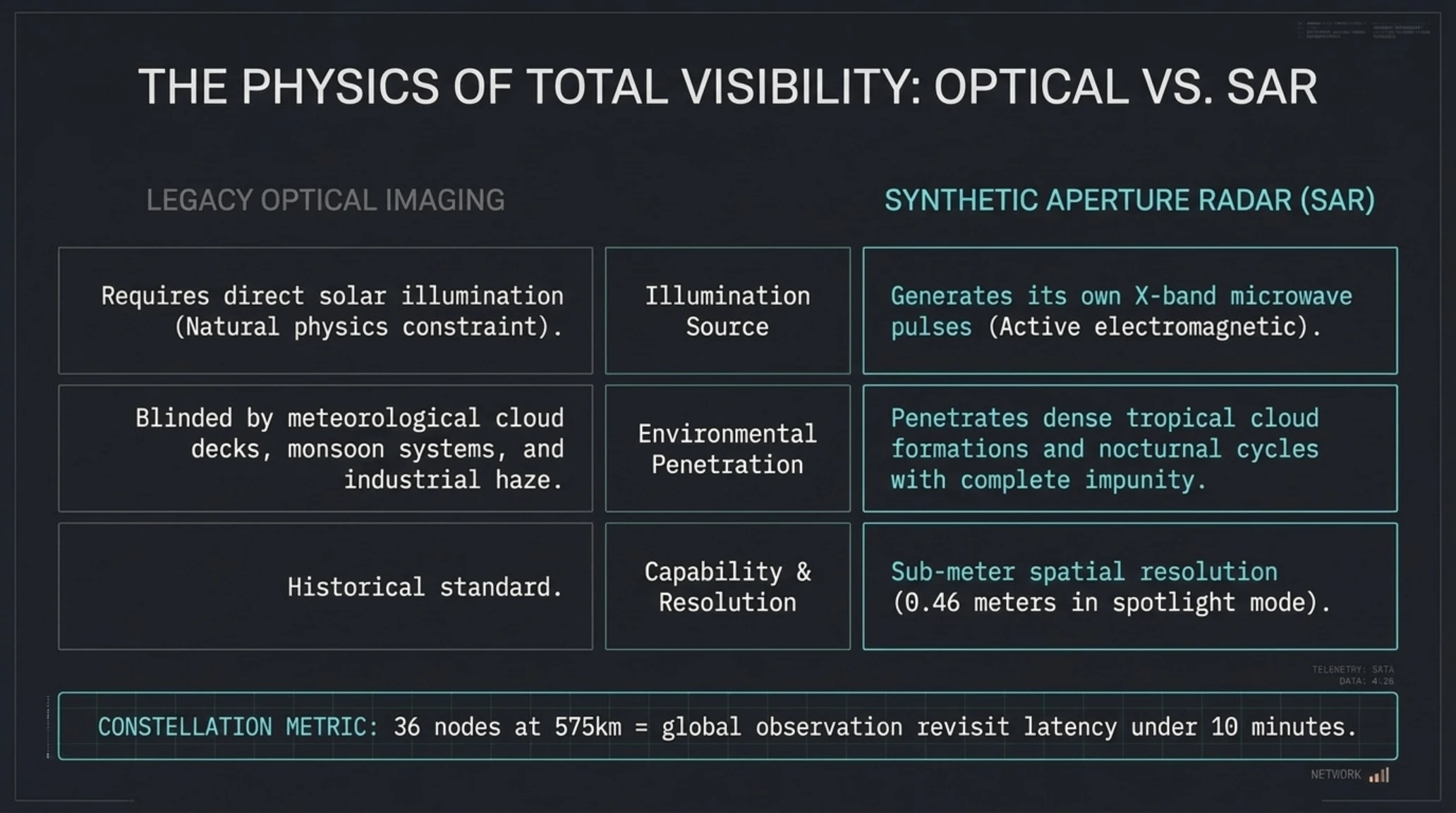
The deployment of WADATSUMI-II represents a fundamental transition in commercial orbital intelligence. Traditional optical imaging constellations, such as those operated by Maxar and Planet Labs, remain severely constrained by natural physics: they require direct solar illumination and are completely blinded by meteorological cloud decks, persistent monsoon systems, atmospheric haze, or dense industrial pollution. In contrast, synthetic aperture radar (SAR) instruments generate their own electromagnetic illumination by transmitting directed X-band microwave pulses toward the Earth's surface and mathematically processing the amplitude and phase of backscattered echoes.
WADATSUMI-II carries an ultra-lightweight deployable parabolic mesh antenna spanning 3.6 meters in diameter made from titanium-coated foil. This antenna yields sub-meter spatial resolution (0.46 meters in spotlight mode), capable of penetrating dense tropical cloud formations and pitch-black nocturnal cycles with complete impunity. This capability is pivotal for maritime domain awareness across the East and South China Seas, tracking illicit ship-to-ship oil transfers, mapping tectonic fault lines, and conducting real-time disaster management across the Pacific Rim.
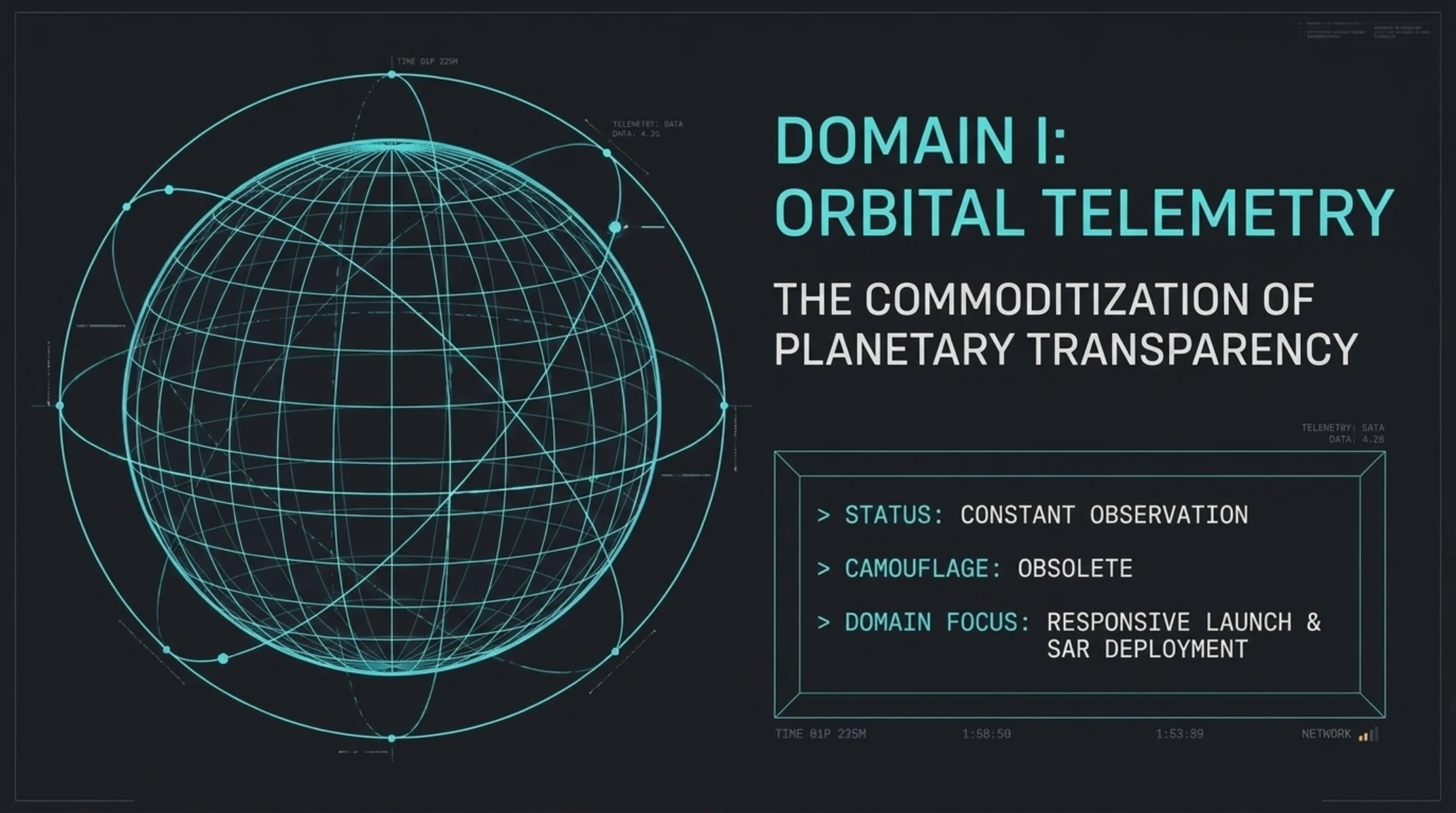
By completing this 99th mission, Rocket Lab further consolidates its market moat against rideshare alternatives. While SpaceX's Transporter missions offer lower per-kilogram pricing, commercial satellite operators requiring specific orbital inclinations and non-standard LTAN (Local Time of Ascending Node) configurations increasingly rely on dedicated Electron launches. Building upon our forensic coverage in Tekin Morning November 2 regarding satellite obfuscation across commercial map providers, the expansion of private SAR constellations renders physical camouflage obsolete, establishing total visibility over contested geopolitical chokepoints.
Why This Transformation Alters Industry Economics
Deploying 36 high-frequency SAR satellites reduces global observation revisit latency to under ten minutes, eradicating blind spots across international logistics and maritime security corridors.
China's Central Committee and State Council Mandate Anti-Corruption Crackdown on Illicit Crypto and Blockchain Concealment
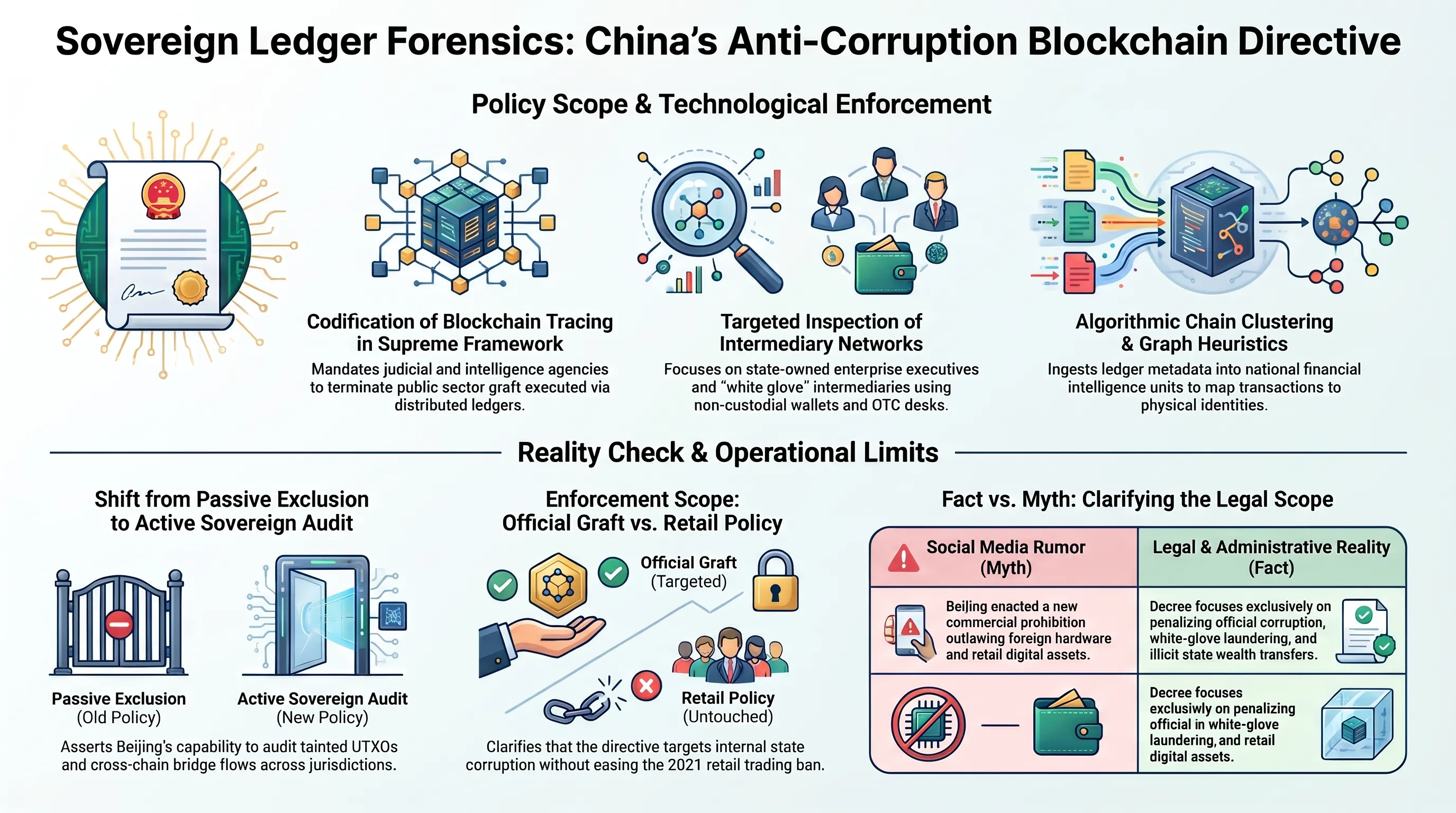
In a coordinated policy directive published via state news agency Xinhua, the Central Committee of the Chinese Communist Party and the State Council have formally codified cryptocurrency transactions, decentralized finance (DeFi), and cross-border digital rails into the nation's supreme anti-corruption framework. Ratified during the Fifth Plenary Session of the 20th Central Committee, the resolution mandates judicial, disciplinary, and intelligence agencies to aggressively terminate public sector graft executed via distributed ledgers and offshore non-bank channels.
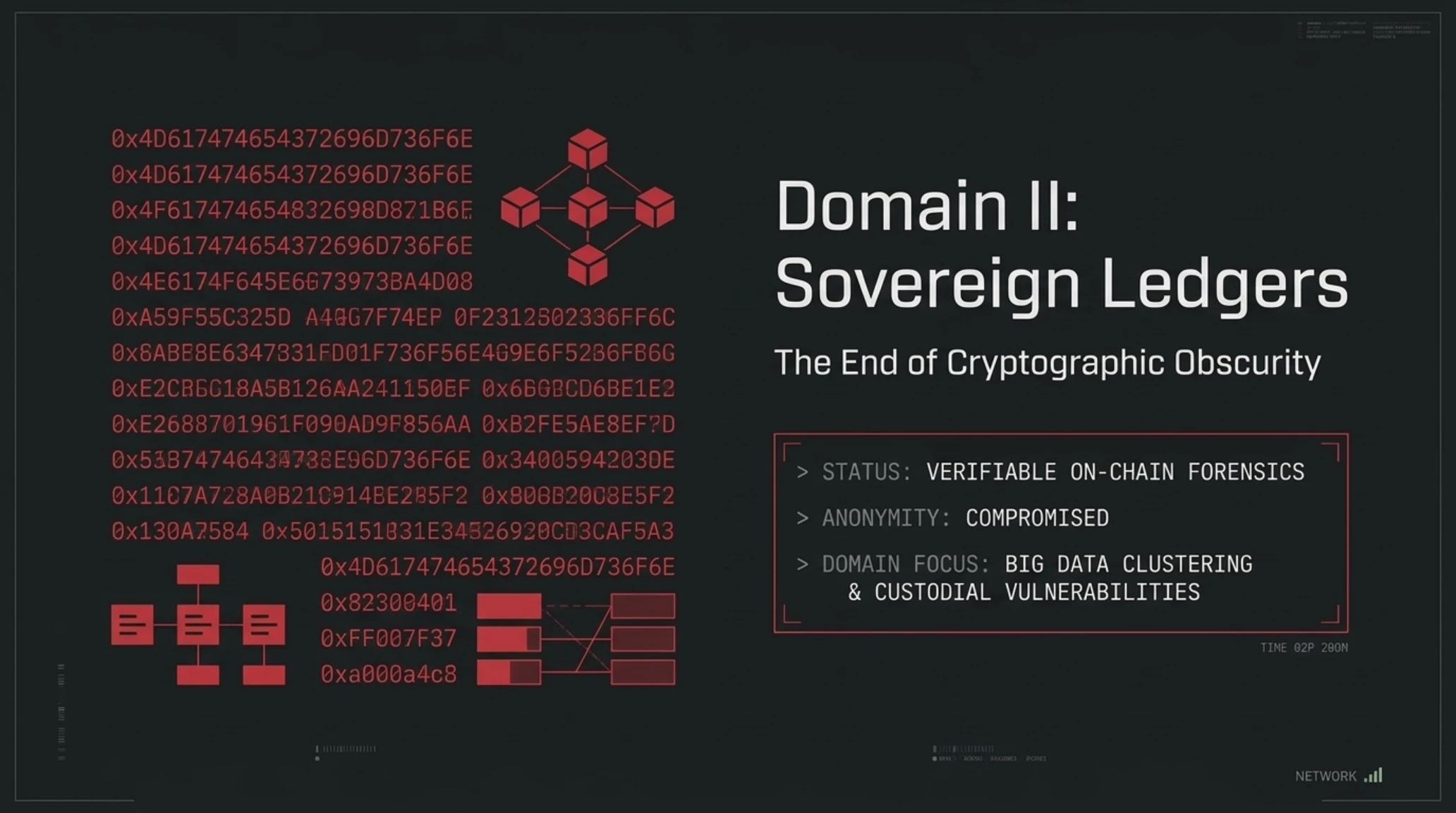
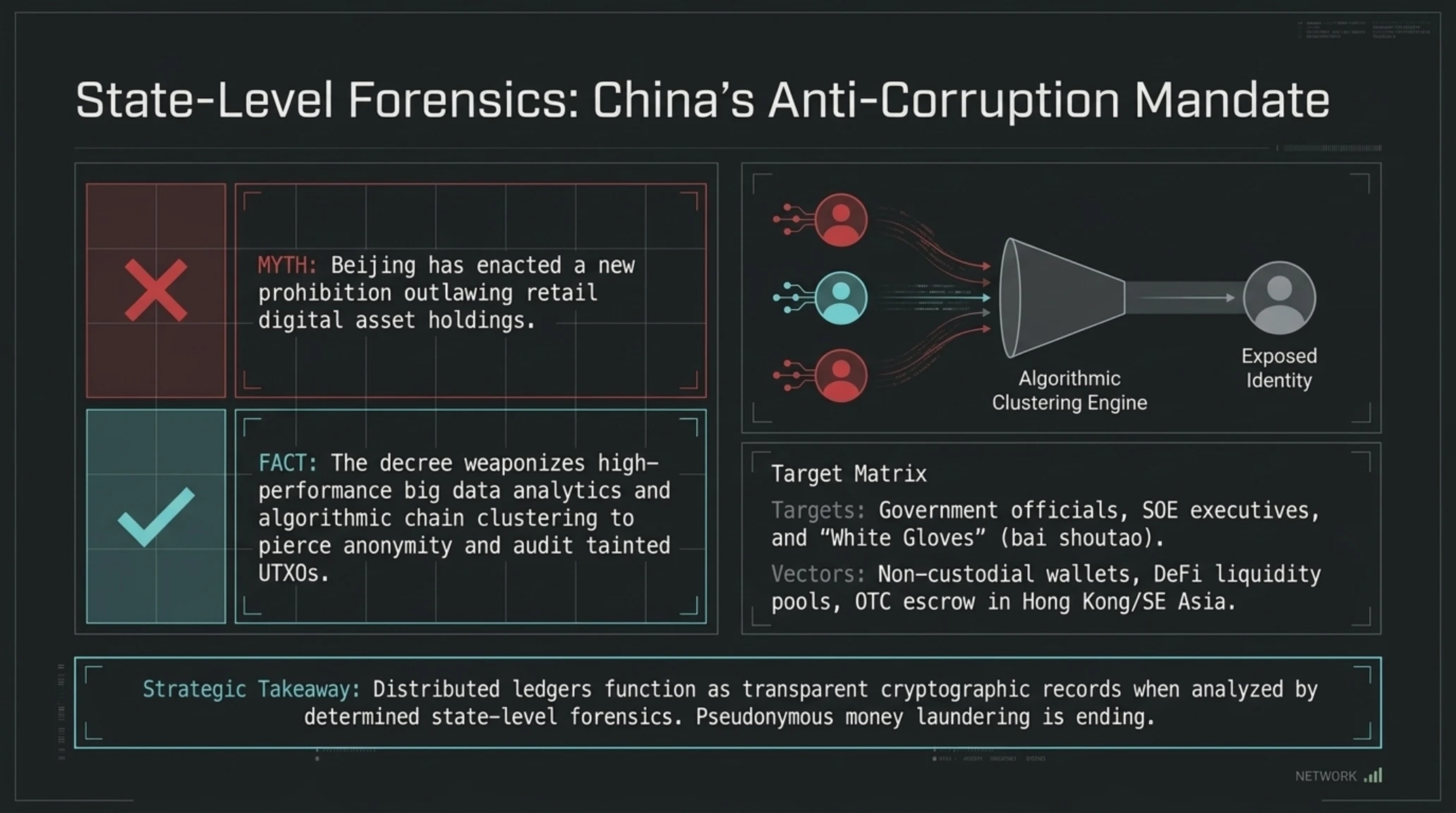
Section VII of the strategic decree, titled 'Taking Firm and Integrated Action Against Corruption', instructs state investigators to weaponize high-performance big data analytics and algorithmic chain clustering to pierce anonymity mechanisms. The enforcement directive specifically targets government officials, state-owned enterprise (SOE) executives, direct family members, and intermediary networks colloquially termed 'white gloves' (bai shoutao) facilitators who leverage non-custodial wallets, decentralized liquidity pools, and over-the-counter (OTC) escrow desks in Hong Kong and Southeast Asia to conceal bribery proceeds.
Legal and regulatory analysts across the Asia-Pacific region note that this resolution does not signify an easing of mainland China's comprehensive 2021 ban on retail cryptocurrency trading or domestic industrial mining. Rather, it represents an institutional escalation from passive market exclusion toward active sovereign surveillance over blockchain topologies. By ingesting public ledger metadata into national financial intelligence units (FIUs), Beijing is asserting its capability to audit tainted UTXOs and cross-chain bridge flows regardless of geographic jurisdictions.
This development aligns with broader international enforcement trends. As state-sponsored actors and cyber syndicates increasingly rely on privacy mixers and algorithmic stablecoins to obfuscate capital flight, sovereign governments are deploying machine-learning clustering engines that map transaction graph heuristics directly to physical human identities, signaling the end of pseudonymous money laundering in major commercial corridors.
Cross-jurisdictional intelligence evaluations confirm that the aggressive operationalization of state-level forensic clustering algorithms dismantles traditional laundering conduits, establishing clear boundaries between sensational online rumors and formal administrative mandates.
Technical Fact-Check | Myth vs Engineering Reality
Beijing has enacted a new commercial prohibition outlawing foreign hardware ownership and retail digital asset holdings.
The decree focuses exclusively on penalizing official corruption, white-glove money laundering, and illicit wealth transfers within state organs.
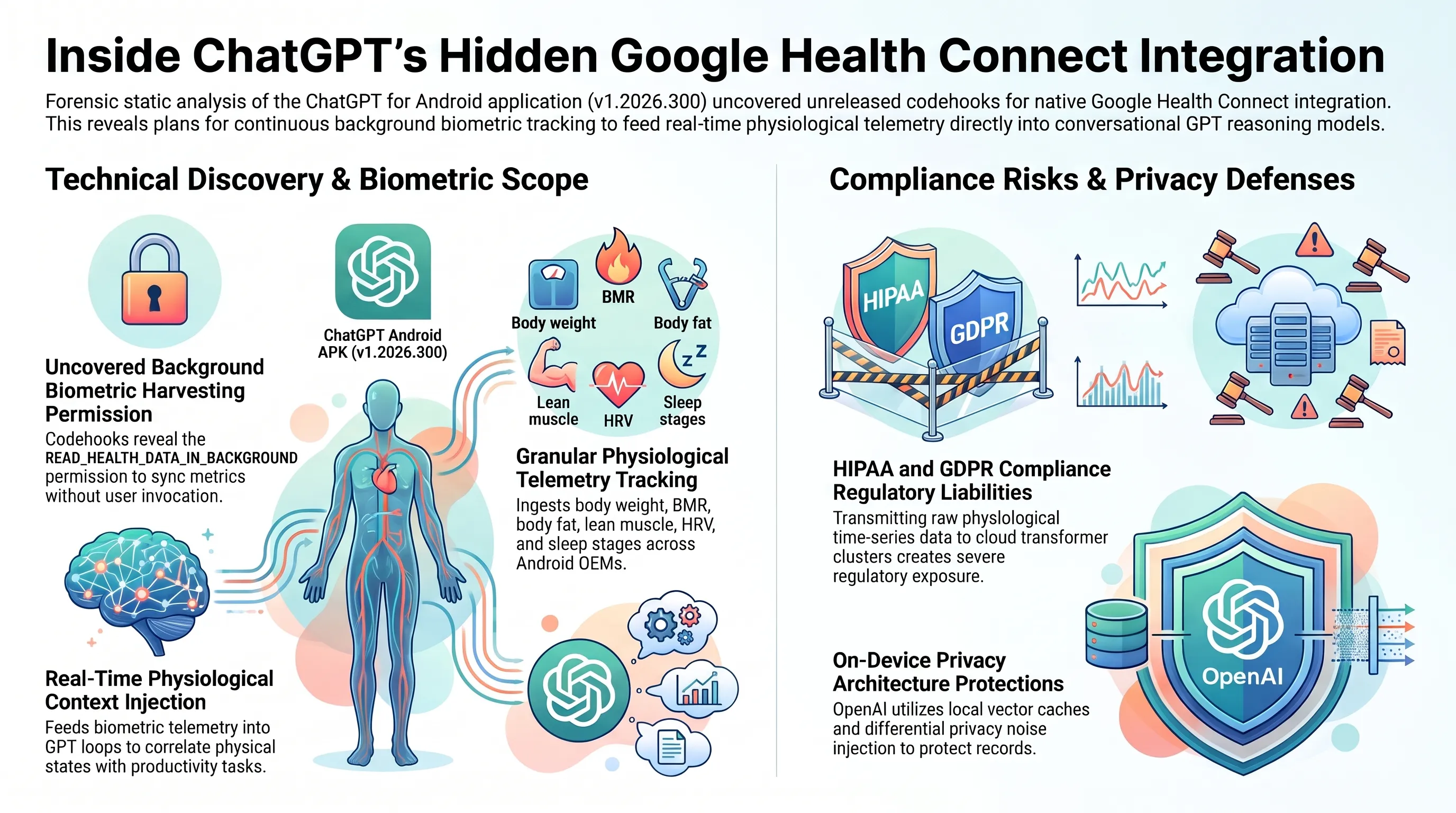
ChatGPT Android APK Teardown Reveals Native Google Health Connect Integration: Background Biometrics and Body Mass Tracking
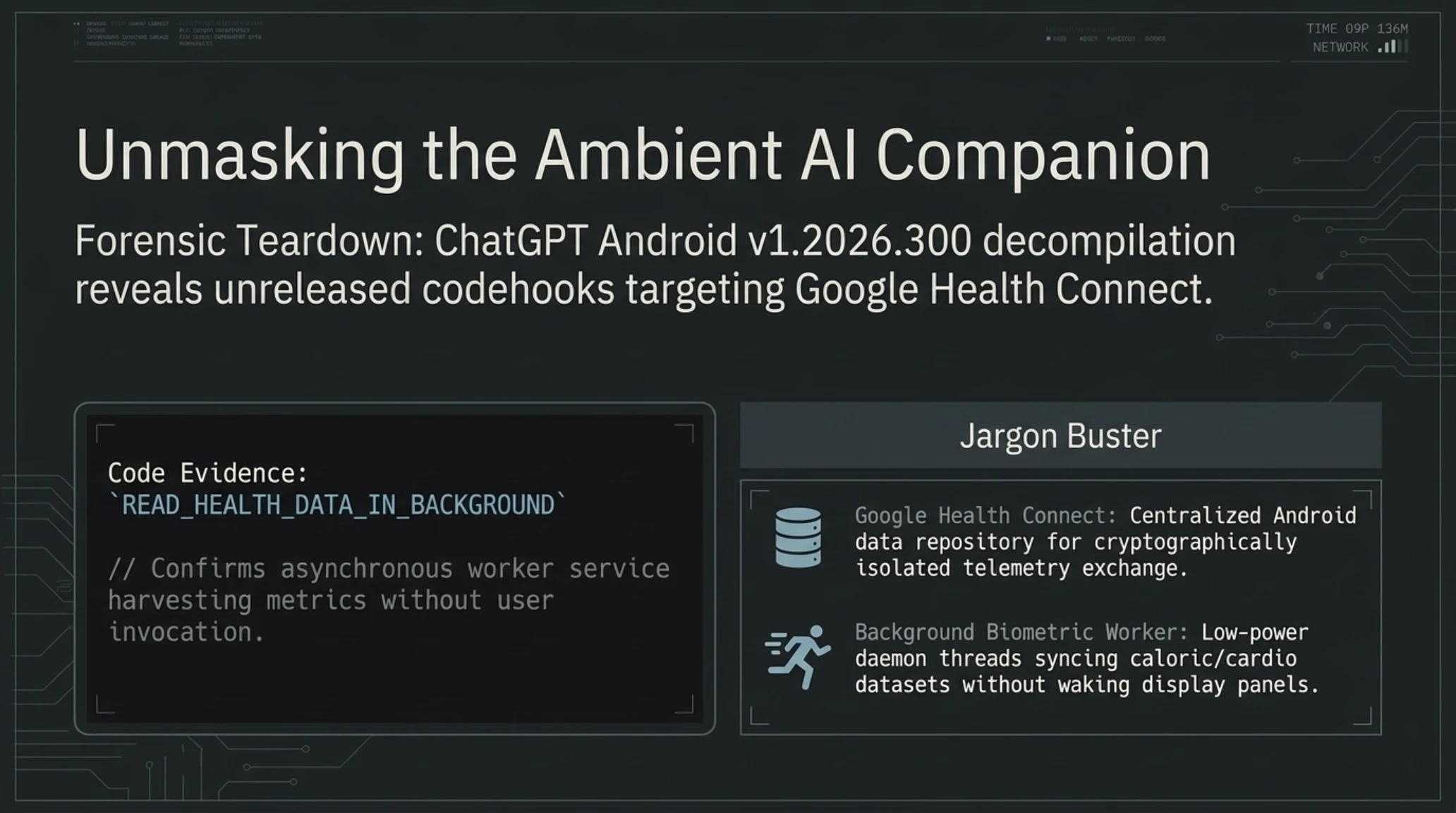
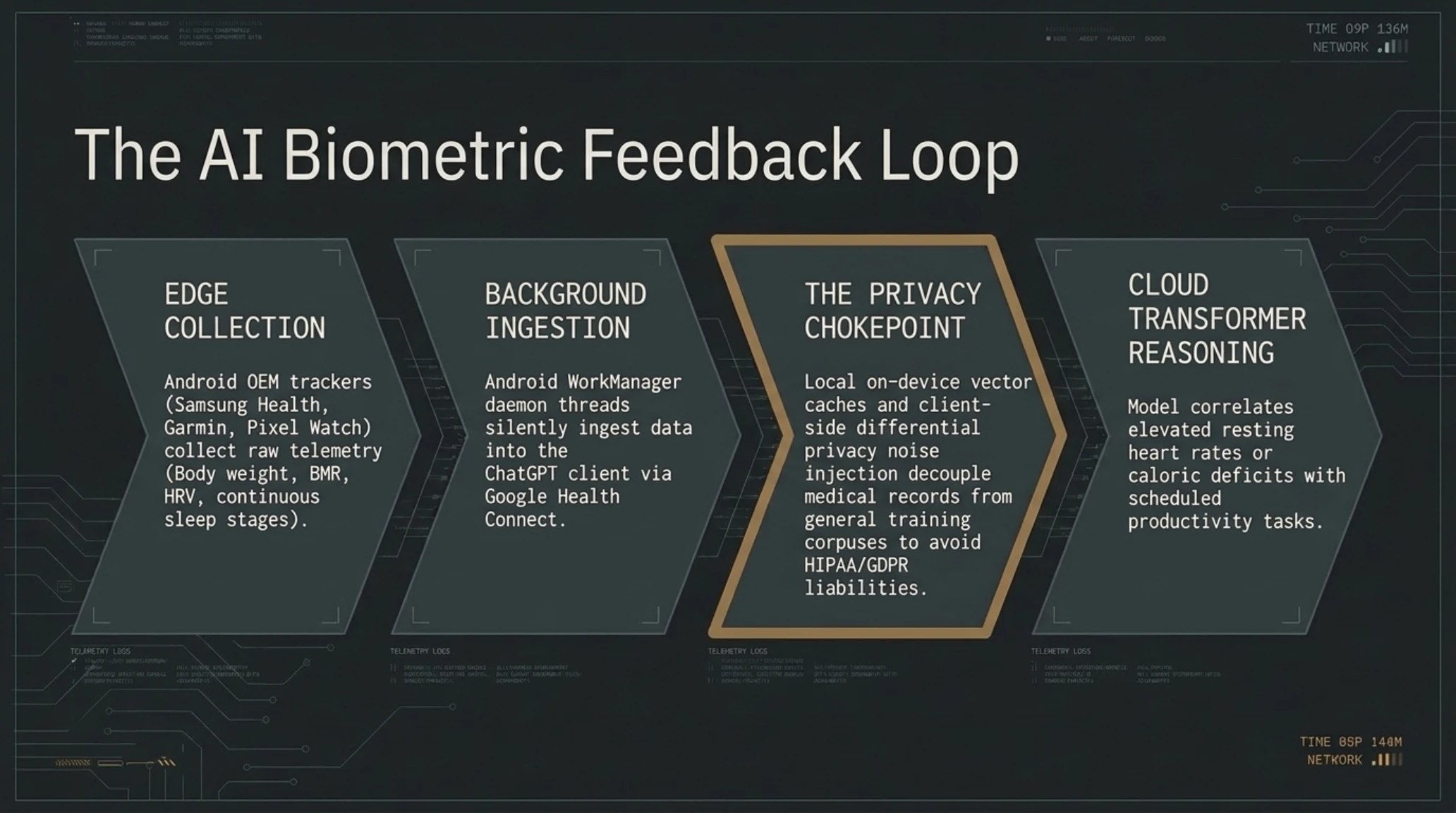
Decompilation and forensic static analysis of the official ChatGPT for Android package (v1.2026.300) conducted by reverse-engineering researchers has exposed deep, unreleased codehooks targeting the native Google Health Connect framework. This architecture confirms that OpenAI is aggressively transforming its flagship conversational agent into an autonomous, ambient biometric reasoning engine capable of ingesting raw physiological data directly from connected wearable ecosystems.
The extracted manifest permissions and internal class declarations reveal planned read access to critical health telemetry, including body weight, basal metabolic rate (BMR), body fat percentages, lean muscle mass, heart rate variability (HRV), and continuous sleep stages. Crucially, the discovery of the specialized READ_HEALTH_DATA_IN_BACKGROUND permission verifies that the application will operate an asynchronous worker service capable of harvesting health metrics without requiring explicit user invocation.
While iOS users have enjoyed basic conversational queries via Apple HealthKit synchronization, integrating natively with Google Health Connect provides OpenAI access to a decentralized mesh of Android OEM trackers spanning Samsung Health, Garmin Connect, Withings, and Google Pixel Watch. This enables real-time physiological context injection into GPT reasoning loops, allowing the model to correlate elevated resting heart rates or caloric deficits with scheduled productivity tasks.
However, the revelation has immediately triggered scrutiny regarding biomedical data governance. Routing granular physiological time-series data to cloud-hosted transformer clusters introduces severe regulatory liabilities under HIPAA and European GDPR frameworks. To navigate these hurdles, enterprise leaks indicate OpenAI is developing local on-device vector caches and client-side differential privacy noise injection to ensure medical records remain decoupled from general training corpuses.
Rigorous decompilation of these native operating system components underscores the imperative for software developers to master the specific architectural definitions and privacy frameworks governing biometric telemetry integration.
Tekin Technical Jargon Buster
BTCPay Server Issues Emergency Advisory: Self-Hosted Node Operators Urged to Shut Down Servers Following Critical Hot Wallet Drains
The open-source BTCPay Server project the backbone of decentralized, non-custodial cryptocurrency merchant processing across thousands of global e-commerce portals issued an emergency security advisory urging self-hosted server administrators to immediately take instances offline. The alert followed authenticated forensic reports detailing unauthorized administrative takeovers that systematically drained funds from internet-connected hot wallets.
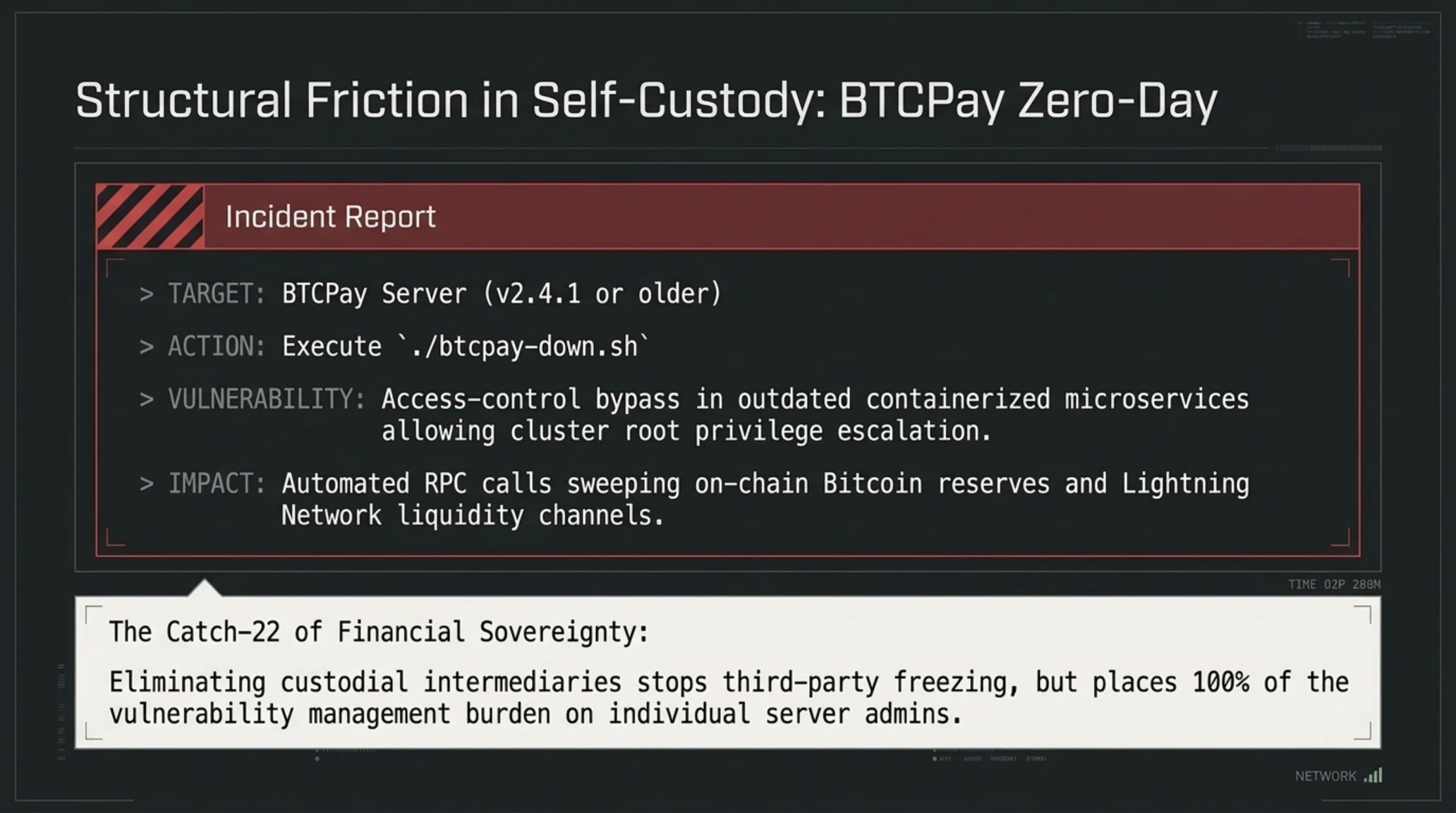
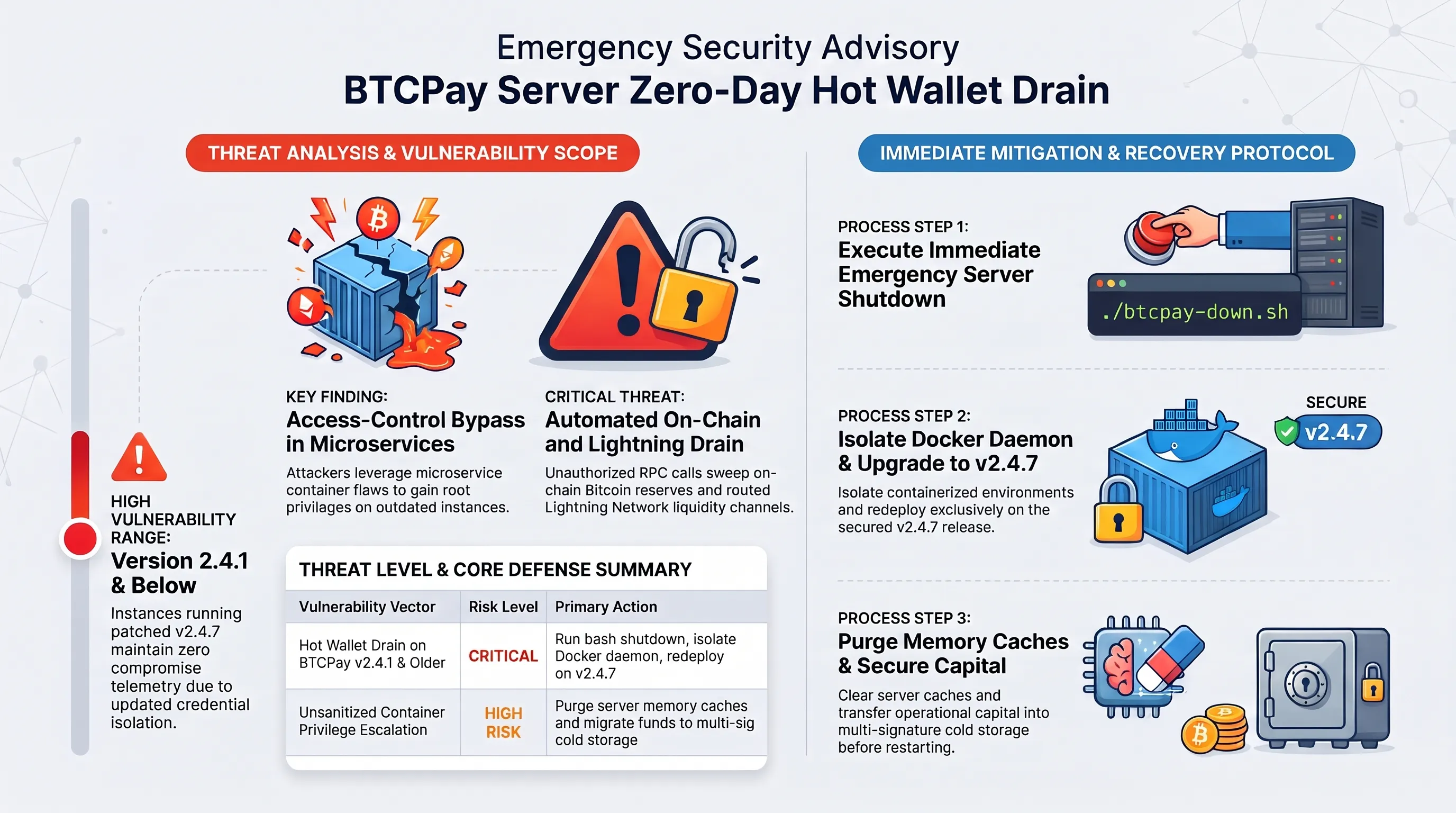
Co-founder and lead architect Nicolas Dorier issued an urgent bulletin across developer channels instructing operators running version 2.4.1 or older to execute the immediate server shutdown script via ./btcpay-down.sh. Preliminary vulnerability triage established that threat actors leveraged an access-control bypass in outdated containerized microservices to elevate privileges to cluster root, enabling automated RPC calls that swept both on-chain Bitcoin reserves and routed Lightning Network liquidity channels into attacker-controlled addresses.
While instances operating the patched 2.4.7 release have demonstrated zero compromise telemetry due to updated Lightning Network Daemon (LND) credential isolation, the decentralized nature of self-hosted infrastructure prevented any global killswitch. Third-party cloud providers, including LunaNode, initiated automated network disconnection for unpatched merchant droplets to mitigate ongoing exploitation vectors.
This critical incident exposes the persistent structural friction inherent to self-sovereign financial infrastructure. While eliminating custodial intermediaries protects merchants from third-party freezing orders, it places the entire burden of vulnerability management and container isolation upon individual server administrators. Security specialists advise operators to purge server memory caches and transition operational capital into multi-signature cold storage before redeploying services.
Systematic monitoring of these emerging threat vectors demonstrates that self-hosted sovereign architectures demand formalized, multi-tiered defensive matrices to respond decisively to zero-day microservice vulnerabilities.
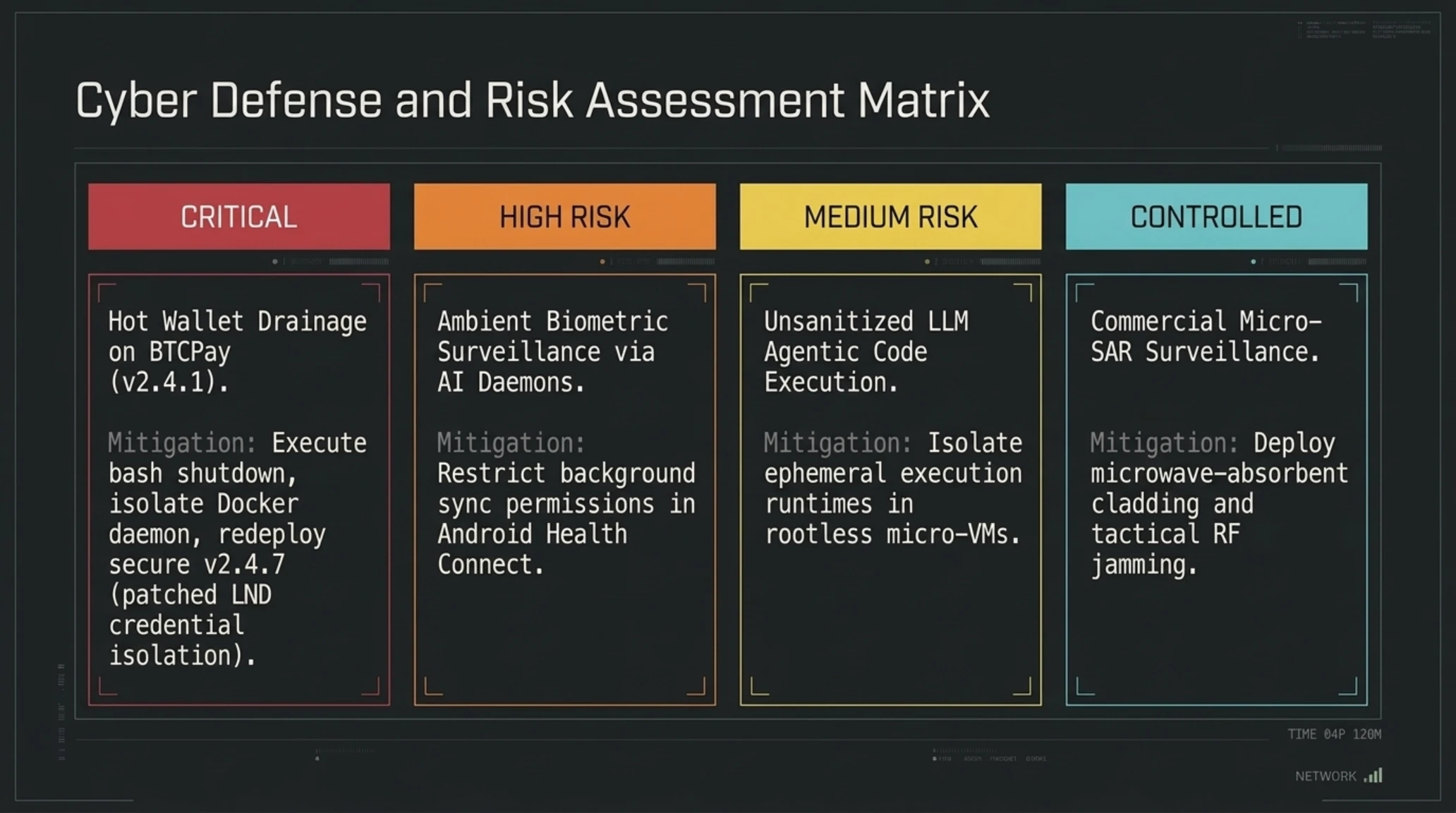
Cyber Defense and Risk Assessment Matrix
| Threat Vector & Vulnerability Node | Risk Level | Mitigation & Hardening Procedure |
|---|---|---|
| Hot Wallet Drainage on BTCPay Server v2.4.1 and Earlier | CRITICAL | Execute immediate bash shutdown, isolate Docker daemon, and redeploy on secure v2.4.7 release. |
| Ambient Biometric Surveillance via Consumer AI Background Daemons | HIGH RISK | Restrict background synchronization permissions in Android Health Connect and disable cloud storage sync. |
| Commercial Micro-SAR Surveillance over Sensitive Critical Sites | CONTROLLED | Deploy microwave-absorbent structural cladding and tactical RF jamming over terrestrial infrastructure. |
| Unsanitized LLM Agentic Code Execution in Autonomous Environments | MEDIUM RISK | Isolate ephemeral execution runtimes in rootless micro-VMs with deterministic capability bounding. |
NASA Reaches Out to Commercial Spaceflight Industry to Boost Orbit and Save Iconic Hubble Space Telescope from Re-Entry Decay
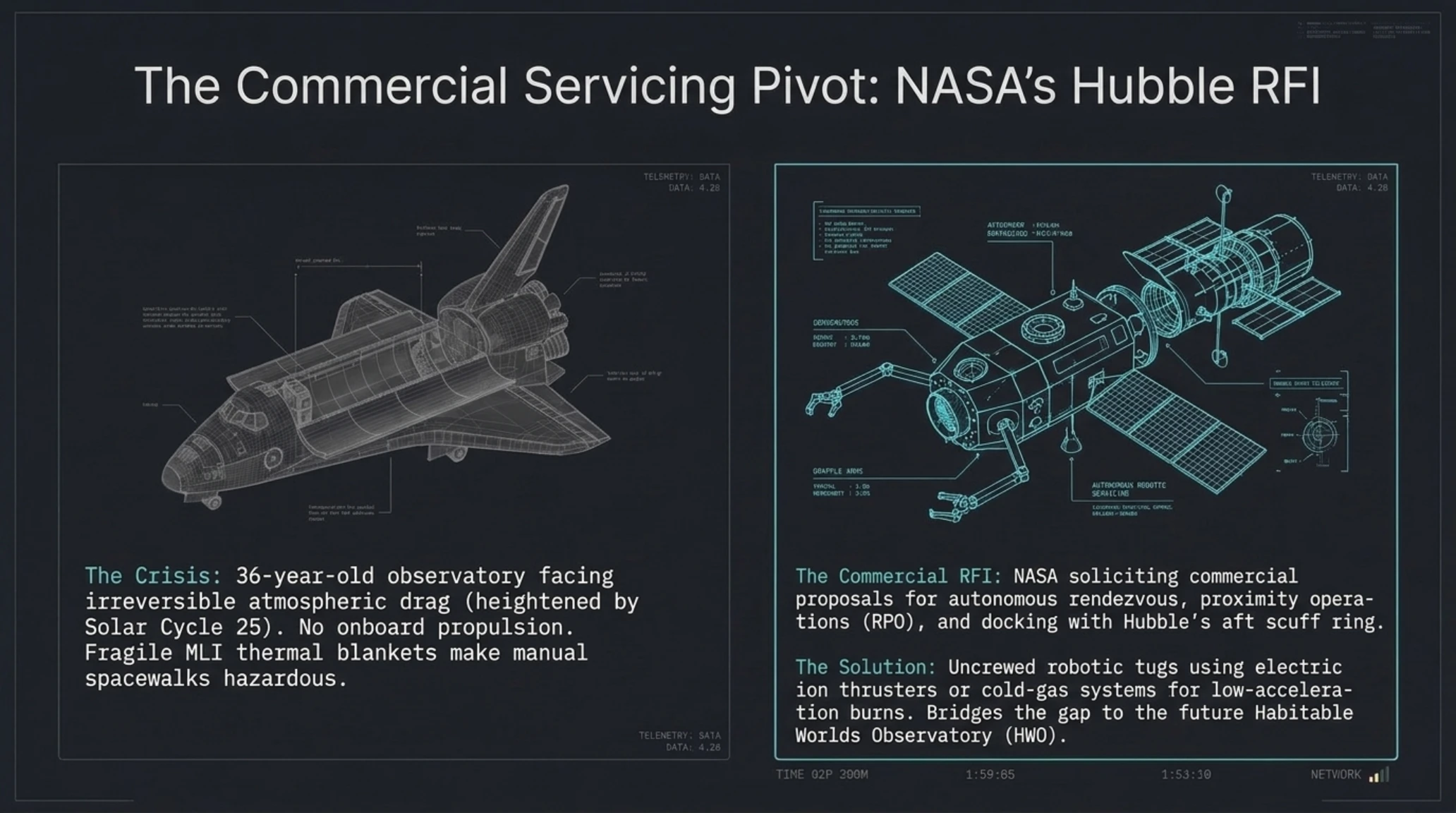
The National Aeronautics and Space Administration (NASA) has officially issued a Request for Information (RFI) soliciting technical concepts and commercial proposals from the private aerospace sector to execute an autonomous in-space servicing and orbital re-boost mission for the legendary Hubble Space Telescope. Deployed into low Earth orbit aboard Space Shuttle Discovery in 1990, the iconic 36-year-old observatory has delivered foundational astronomical discoveries but faces an irreversible existential threat due to cumulative atmospheric drag.
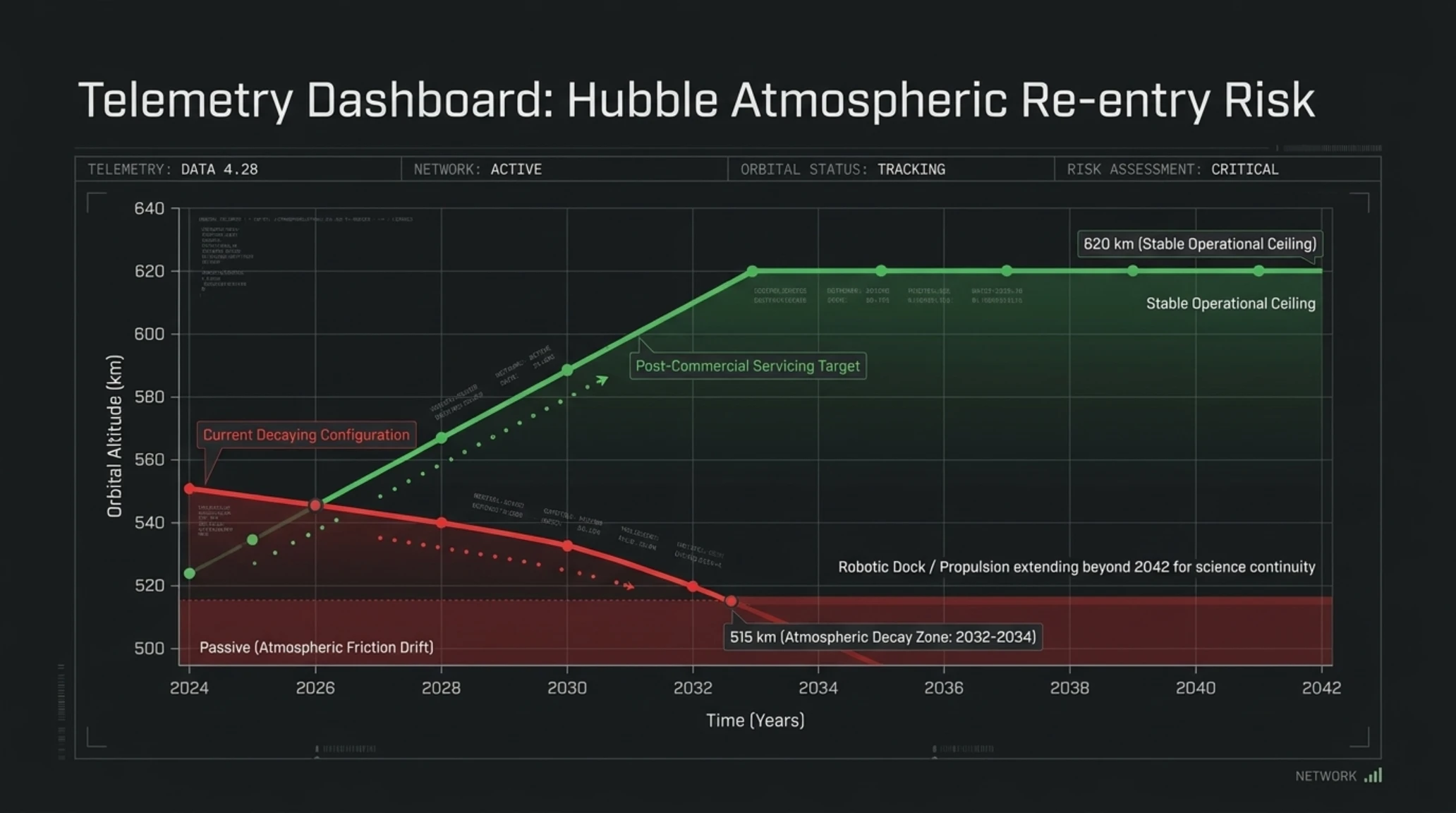
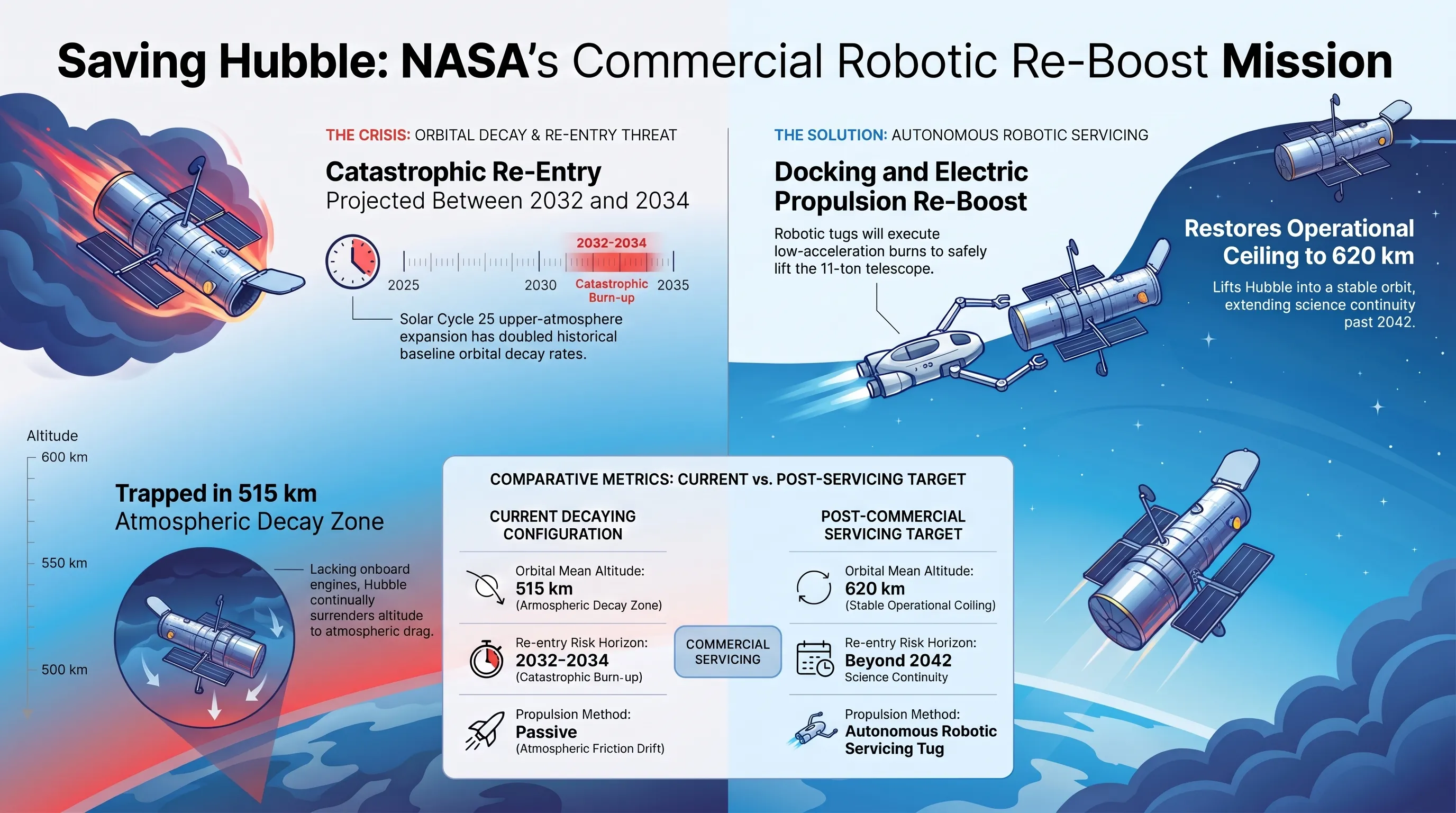
Operating without any onboard propulsion systems, Hubble has steadily surrendered orbital altitude since the final Space Shuttle servicing mission (STS-125) in 2009. Precision orbital degradation modeling updated by NASA's Goddard Space Flight Center indicates that under current solar-cycle atmospheric expansion, Hubble will experience uncontrolled ballistic decay into the dense atmosphere between 2032 and 2034 without external intervention. The RFI, open through November 30, 2026, seeks commercial aerospace proposals capable of rendezvous, autonomous proximity operations (RPO), and docking with Hubble's aft scuff ring to elevate its operating ceiling to at least 620 kilometers.
While preliminary feasibility studies previously examined human-rated Commercial Crew missions utilizing SpaceX Crew Dragon capsules, NASA leadership has pivoted toward uncrewed robotic servicing tugs. The extreme age and fragility of Hubble's multi-layer insulation (MLI) thermal blankets, structural latches, and high-gain antennas make manual spacewalks exceptionally hazardous. Robotic tugs utilizing electric ion thrusters or cold-gas reaction systems can execute smooth, low-acceleration burns over several months, minimizing structural vibration while safely hoisting the 11-ton telescope out of the atmospheric drag corridor.
Aerospace astrophysicists emphasize that heightened upper-atmosphere inflation during Solar Cycle 25 has amplified orbital decay rates to double initial historical baselines. Commercial satellite servicing encompassing On-Orbit Servicing, Assembly, and Manufacturing (ISAM) represents an emerging multi-billion-dollar space subsector. Proving commercial capability by extending Hubble's operational science timeline past 2040 bridges the critical ultraviolet-optical imaging gap until NASA's future Habitable Worlds Observatory (HWO) achieves flight readiness.
Astrodynamic flight modeling conducted across international aerospace consortiums highlights that resetting Hubble's operational ceiling requires benchmarking decay parameters directly against commercial robotic servicing capabilities.
Grouped Bar Chart and Engineering Specifications Matrix
| Aerospace Engineering Metric | Current Decaying Configuration | Post-Commercial Servicing Target |
|---|---|---|
| Orbital Mean Altitude | 515 km (Atmospheric Decay Zone) | 620 km (Stable Operational Ceiling) |
| Atmospheric Re-entry Risk Horizon | 2032–2034 (Catastrophic Burn-up) | Beyond 2042 Science Continuity |
| Attitude & Orbit Propulsion | Passive (Atmospheric Friction Drift) | Autonomous Robotic Servicing Tug |
| Science Instrument Pointing Accuracy | Degraded Single-Gyro Operating Mode | Restored Fine-Guidance Gyro Redundancy |
📚 Classified & Related Dossiers in TekinGame
If you wish to explore beyond this report and delve into cybernetic frontiers and autonomous AI architectures, do not miss these three exclusive deep-dives in the Tekin Garage:
OpenAI Doubles Pro & Business Usage Limits and Unifies "Work" Agentic Workspaces into Core ChatGPT Interface
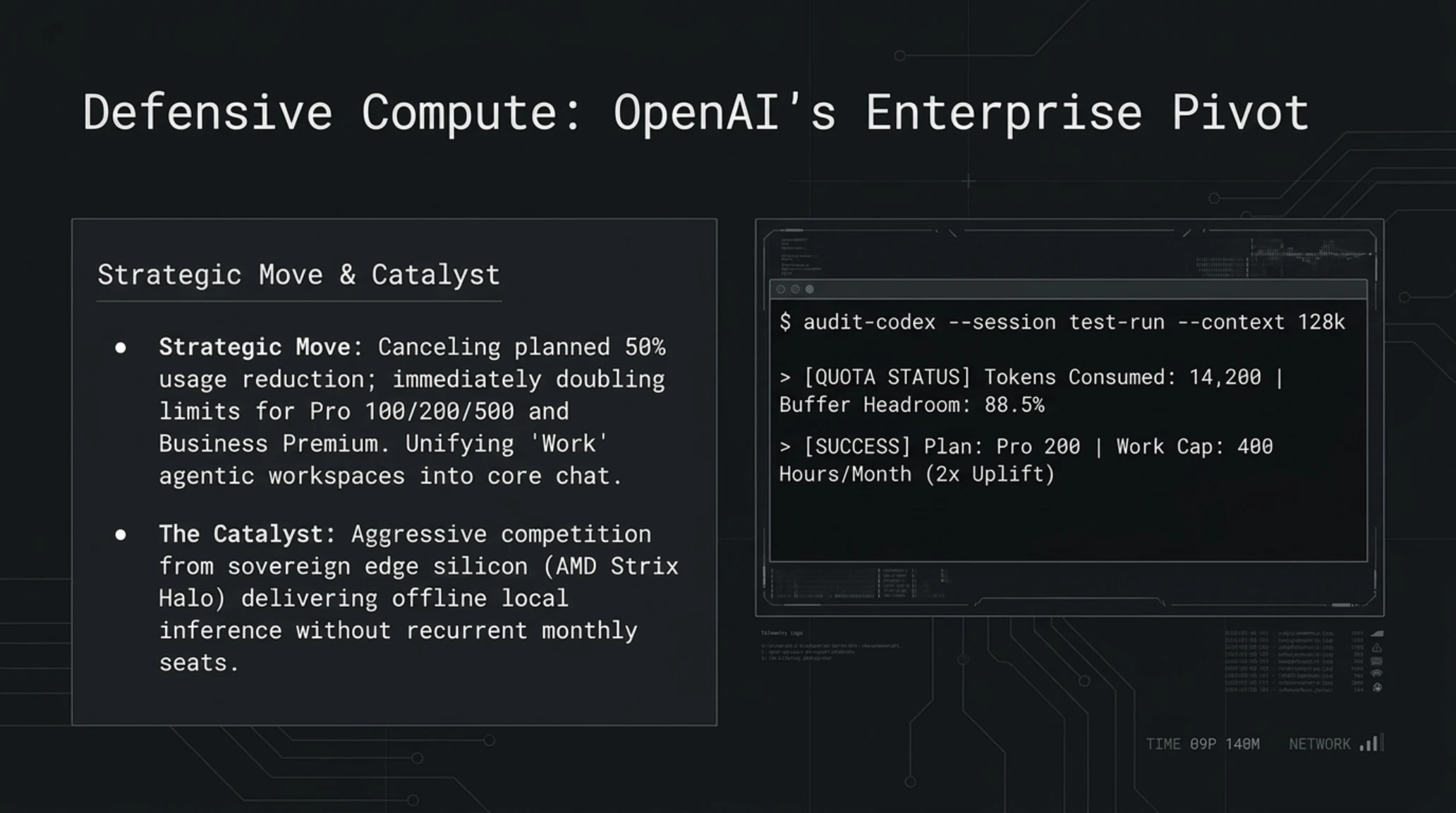
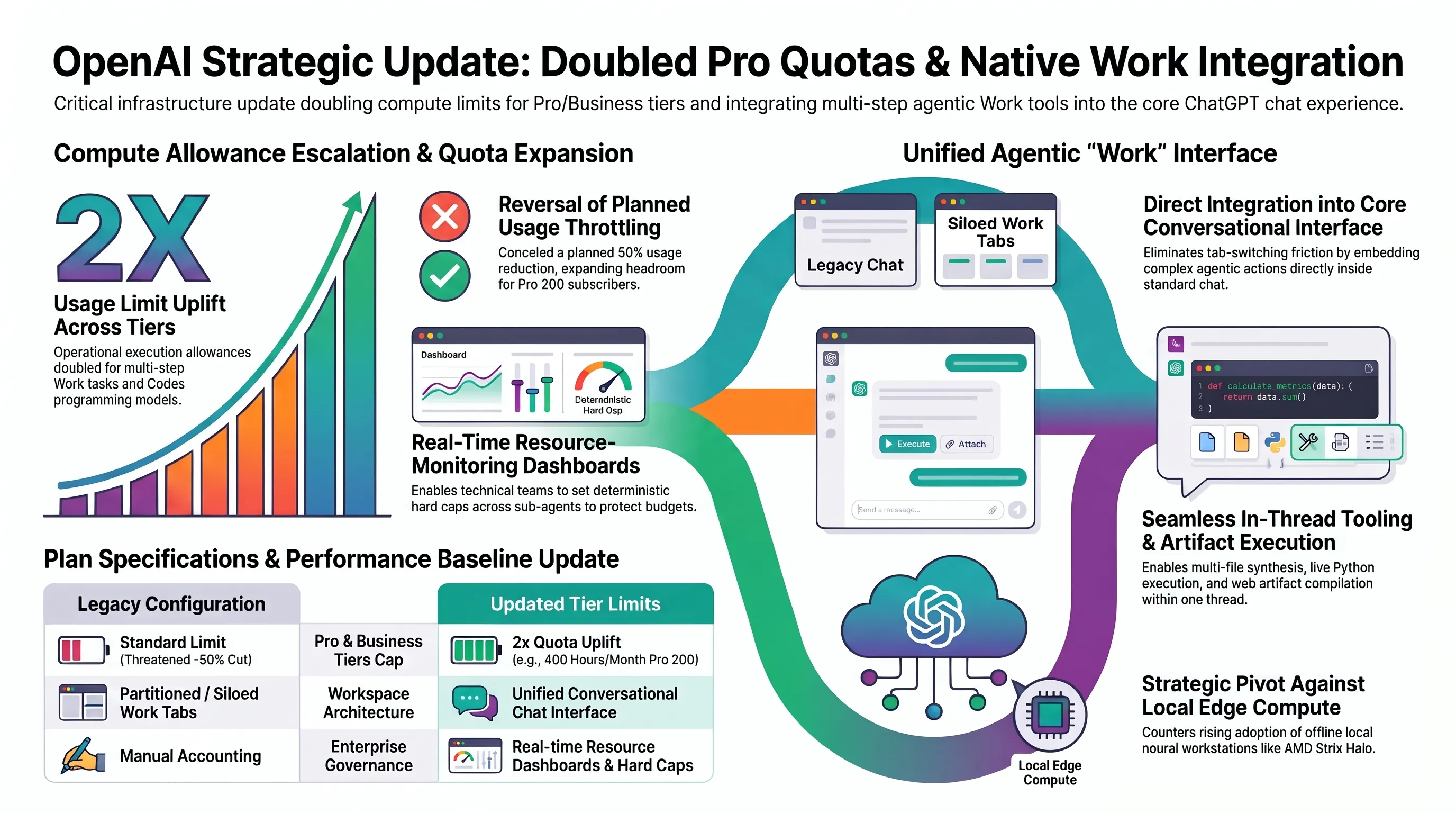
Facing aggressive competitive pressure from open-weight model architectures and local neural accelerator workstations, OpenAI has rolled out two strategic counter-measures across its enterprise and developer tiers. The company officially announced the immediate cancellation of a planned 50% usage reduction for Pro 200 subscribers, simultaneously doubling the operational execution allowances for multi-step Work capabilities and Codex programming models across Pro 100, Pro 200, Pro 500, and Business Premium accounts.
Alongside the quota expansion, OpenAI began testing the direct architectural unification of 'ChatGPT Work' capabilities into the standard consumer conversational interface. Rather than partitioning complex multi-step actions into siloed tabs, users can now initiate multi-file synthesis, live execution of containerized Python environments, web artifact compilation, and deep document manipulation within a unified conversational thread. This eliminates context-switching friction and anchors agentic autonomy directly within mainstream workflows.
As explored in our technical autopsy on AI Subscription Economics and Enterprise Cloud Surcharges, OpenAI's policy recalibration represents a calculated defensive pivot. Enterprise customers increasingly scrutinize compute pricing models as sovereign edge silicon such as AMD Strix Halo workstations delivers offline local inference without recurrent monthly seats. By doubling the compute headroom ahead of December's universal token-accounting pool, OpenAI aims to prevent an exodus of technical subscribers toward open ecosystems.
From an infrastructure perspective, OpenAI's upcoming December transition to shared token pools requires rigorous telemetry transparency. Consuming shared developer allowances for trivial conversational banter poses friction for software engineering teams. In response, OpenAI has introduced real-time resource-monitoring dashboards under workspace account settings, allowing developers to set deterministic hard caps across sub-agents to safeguard mission-critical engineering pipelines.
Continuous monitoring of computational allocations and inference token throughput demonstrates that live telemetry consoles represent indispensable assets for technical teams controlling cloud expenditures.
Cybernetic Terminal and Benchmark Telemetry Log
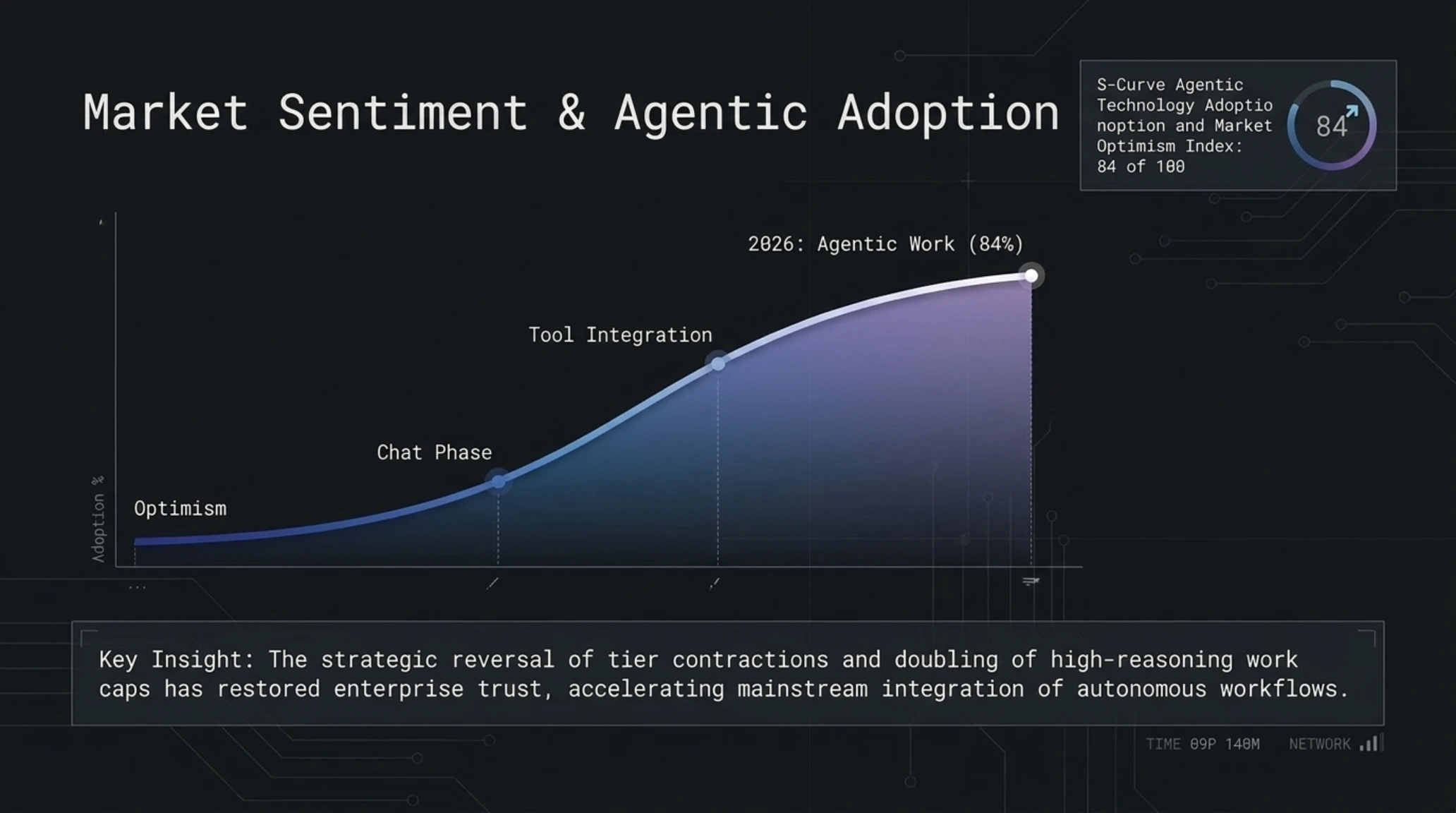
Market Sentiment Thermometer and S-Curve Adoption Metric
Market Sentiment Thermometer: The strategic reversal of planned tier contractions and the immediate doubling of high-reasoning work caps has restored enterprise trust, accelerating mainstream integration of autonomous workflows across technical teams.
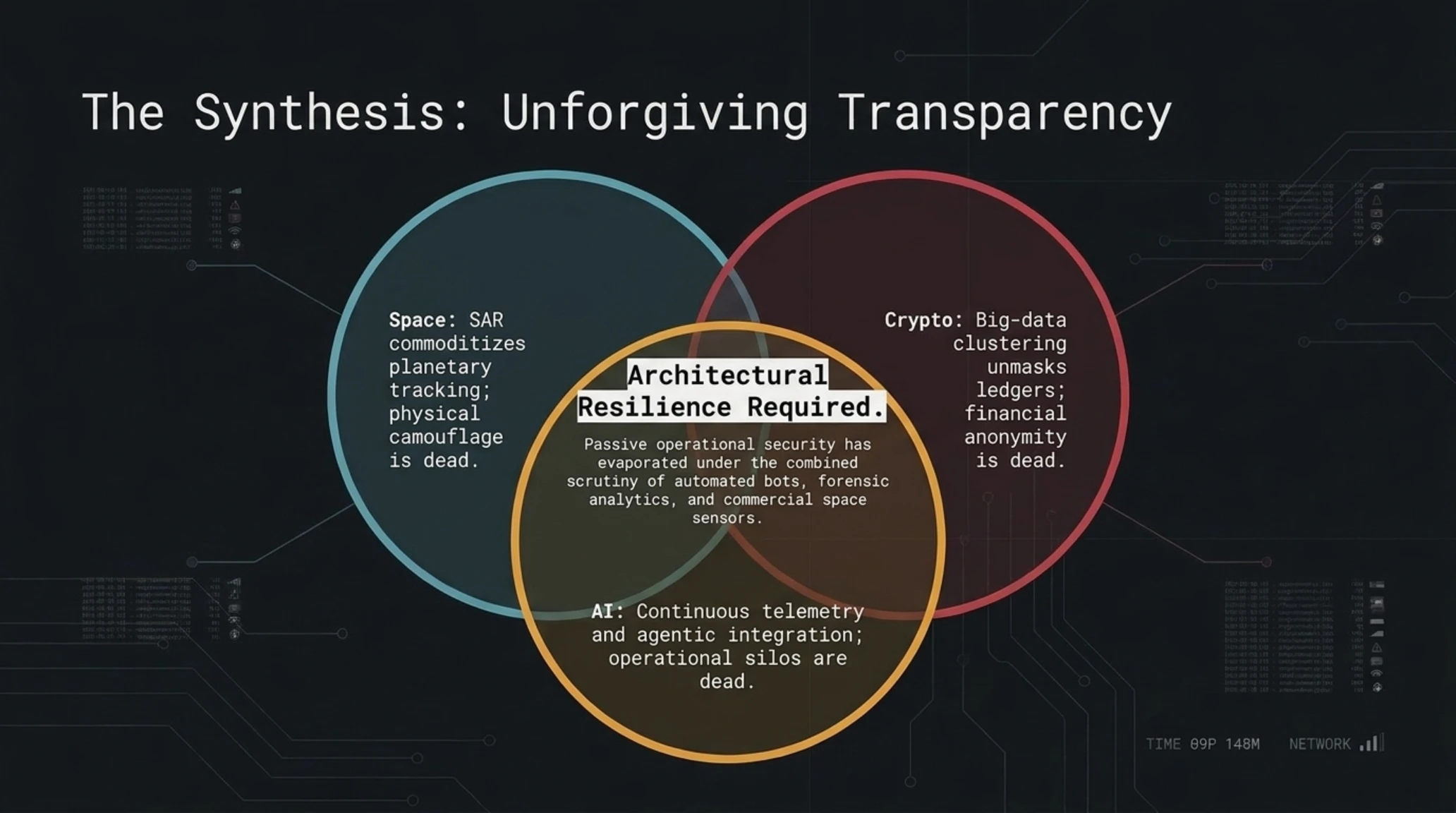
Strategic Synthesis: The Cyber, Space, and Cognitive Battlefield of November 2026
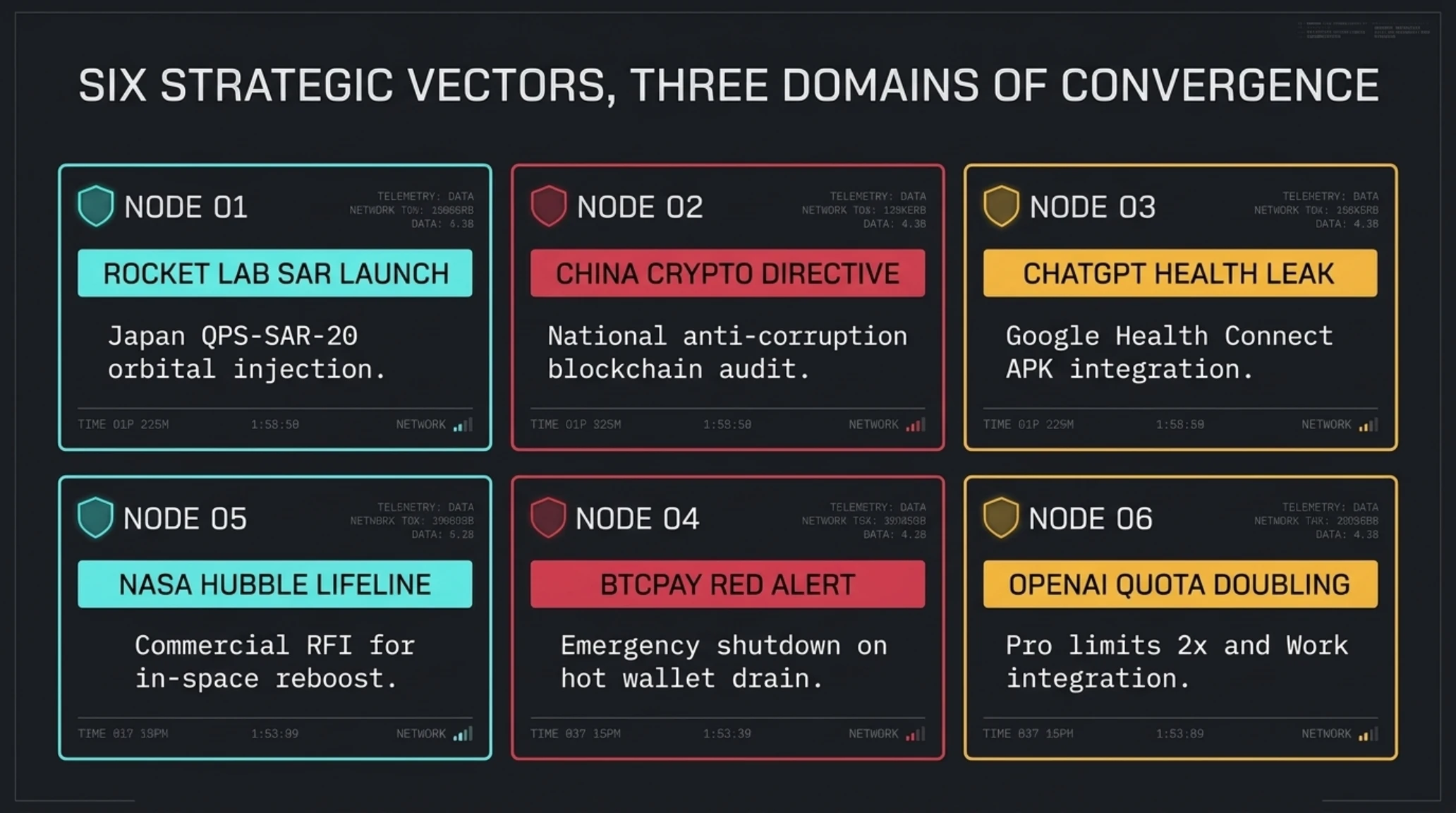
The dawn of Tuesday, November 3, 2026, illuminates an unprecedented structural convergence across commercial orbital telemetry, sovereign cryptographic security, and cognitive computing ecosystems. Rather than existing as isolated verticals, modern technological infrastructure has coalesced into an interdependent mesh where real-time orbital intelligence, verifiable on-chain financial settlement, and autonomous machine learning workflows constantly reinforce or expose one another. The triumphant 99th orbital flight of Rocket Lab's Electron rocket and the successful deployment of Japan's QPS-SAR-20 satellite mark a definitive departure from the historical era wherein high-resolution earth observation remained the exclusive sovereign domain of superpowers. Sub-meter synthetic aperture radar imagery, delivered with sub-hourly revisit frequencies by nimble commercial constellations, has effectively commoditized planetary transparency for enterprise logistics, maritime tracking, and geopolitical risk assessment.
Simultaneously, within the digital financial architecture, Beijing's sweeping anti-corruption resolution establishes a powerful technological milestone. By formally mandating the deployment of big-data clustering platforms, machine learning pattern-recognition models, and coordinated financial intelligence units to track illicit cryptographic kickbacks, the Chinese government has shattered the persistent fiction of blockchain anonymity. Distributed ledgers, designed as trustless settlement layers, function as transparent cryptographic records when analyzed by determined state-level forensics. This regulatory and forensic maturation intersects directly with the alarming zero-day exploitation of unpatched BTCPay Server nodes, creating a stark dichotomy between the theoretical resilience of cryptographic networks and the operational vulnerabilities of negligent host configurations. Merchants and autonomous organizations that champion financial sovereignty must recognize that self-custody without rigorous cryptographic key isolation, hardware air-gapping, and proactive patch management is merely an open invitation to catastrophic capital depletion.
On the cognitive frontier, two concurrent announcements underscore the relentless embedding of artificial intelligence into critical infrastructure. The discovery of native Google Health Connect bindings within the ChatGPT Android runtime demonstrates that generative AI is transitioning from passive conversational chatbots into persistent, context-aware physiological companions. By synthesizing heart rate variability, sleep cycles, and metabolic telemetry within local client contexts, AI models are assuming real-time advisory responsibilities that carry profound ethical and regulatory dimensions. Concurrently, OpenAI's rapid capitulation regarding compute throttling doubling Pro usage quotas and uncoupling workspace automation from restrictive silos reflects the acute competitive pressure exerted by sovereign local edge inference, such as AMD Strix Halo workstations, and open-weights reasoning architectures. Hyperscalers can no longer afford to impose unpredictable constraints on technical enterprises whose daily software delivery pipelines depend upon unthrottled cognitive compute.
These foundational shifts converge to establish the operational doctrine for the remainder of 2026 and the impending transition into 2027. Technological sovereignty is no longer defined merely by owning compute or deploying satellites; it is governed by the defensive discipline applied to every layer of the organizational stack. Whether safeguarding self-hosted cryptographic payment gateways, securing biometric data pipelines against cloud leakage, or managing the algorithmic dependencies of enterprise workflows, organizations must construct verifiable, hardened architectures. The myth of passive operational security has evaporated under the combined scrutiny of automated exploit bots, advanced forensic analytics, and commercial space sensors.
Furthermore, NASA's historic decision to issue an open commercial solicitation for the robotic re-boost and life extension of the Hubble Space Telescope symbolizes a permanent realignment in government-industry partnerships. Rather than maintaining expensive, dedicated public fleets, space agencies are increasingly leveraging commercial robotic capture mechanisms, high-efficiency electric thrusters, and autonomous rendezvous algorithms developed by private ventures. This symbiotic model preserves invaluable scientific legacy assets while driving capital and technical validation into the burgeoning commercial on-orbit servicing and logistics market.
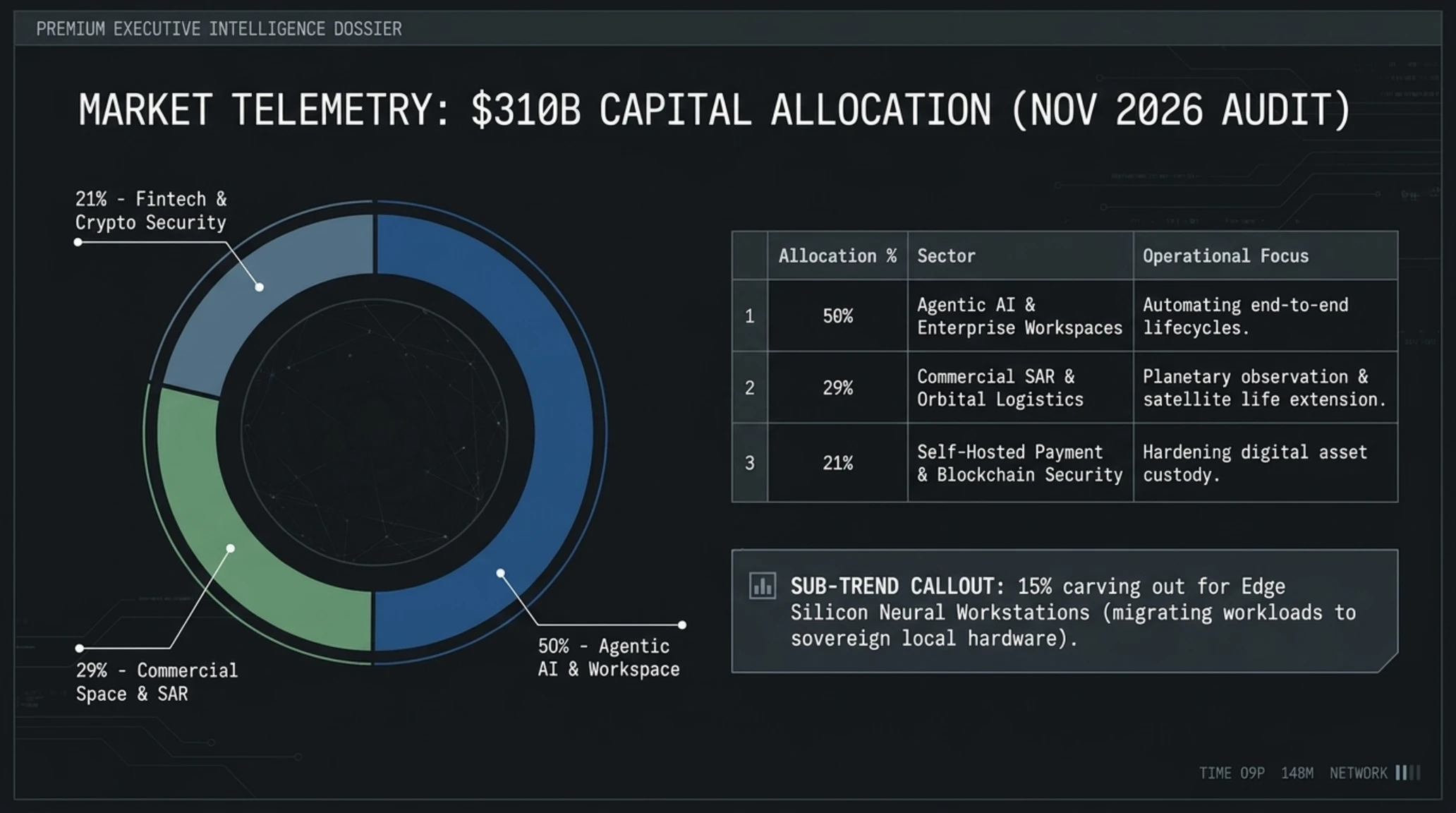
Macro-level tracking of global capital allocations in the fourth quarter of 2026 reveals that venture liquidity has coalesced around the pivotal intersection of cognitive automation, orbital reconnaissance, and hardened digital settlement layers.
Market Capitalization Donut, Growth Progression, and Sector Liquidity Telemetry
| Strategic Technology Domain | Current Capital Allocation Share | Key Operational Role in November 2026 |
|---|---|---|
| Agentic AI & Enterprise Workspaces | 50% | Automating end-to-end development lifecycles and document intelligence |
| Commercial SAR & Orbital Logistics | 29% | Continuous planetary earth observation and critical satellite life extension |
| Self-Hosted Payment & Blockchain Security | 21% | Hardening digital asset custody and preventing automated liquidity drainage |
| Edge Silicon Neural Workstations | 15% | Migrating compute workloads from cloud seats to sovereign local hardware |
As commercial capital pours into orbital logistics and private space operations, the boundaries between military-grade intelligence and civilian industrial tooling are permanently blurring. Supply chain directors, insurance actuaries, and climate resilience planners can now license the exact same synthetic aperture radar telemetry once restricted to national defense ministries. When coupled with automated cloud analytics pipelines, these continuous radar scans can trigger automated inventory rebalancing or maritime rerouting without human intervention, illustrating the compounding power of cross-domain integration.
Ultimately, navigating the technological landscape of November 2026 requires an unwavering commitment to architectural resilience. Organizations that thrive will be those that embrace the immense productivity dividends of autonomous AI agents and responsive space assets while maintaining uncompromising cryptographic defense and local execution sovereignty. Blind trust in cloud providers or single-point payment software is a liability that modern threat actors and regulatory engines will relentlessly exploit.
This unbroken operational continuity between low Earth orbit constellations and ground-level enterprise networks compels technology leaders to fundamentally rethink legacy assumptions regarding infrastructure perimeter security.
- Flawless deployment of the QPS-SAR-20 radar satellite, solidifying commercial responsive orbital access.
- Immediate 2x compute headroom expansion for enterprise and Pro AI subscribers, removing workflow friction.
- NASA open-market solicitation creating high-margin orbital servicing opportunities for private space ventures.
- Decisive state-level forensic action enhancing long-term blockchain transparency and institutional legitimacy.
- Catastrophic balance drainage risks on unpatched self-hosted BTCPay Server merchant nodes.
- Expanding cloud capture and potential privacy leakage of continuous biometric health telemetry.
- Severe technical hazards involved in autonomous robotic docking with fragile, legacy orbital hardware.
Rigorous synthesis of this operational balance sheet confirms that strict adherence to engineering standards and sovereign execution capabilities remains the prerequisite for harvesting the dividends of agentic AI and commercial space.
Grounding these morning developments within authoritative technical documentation and primary verified sources delineates the future strategic trajectory across the global technology ecosystem.
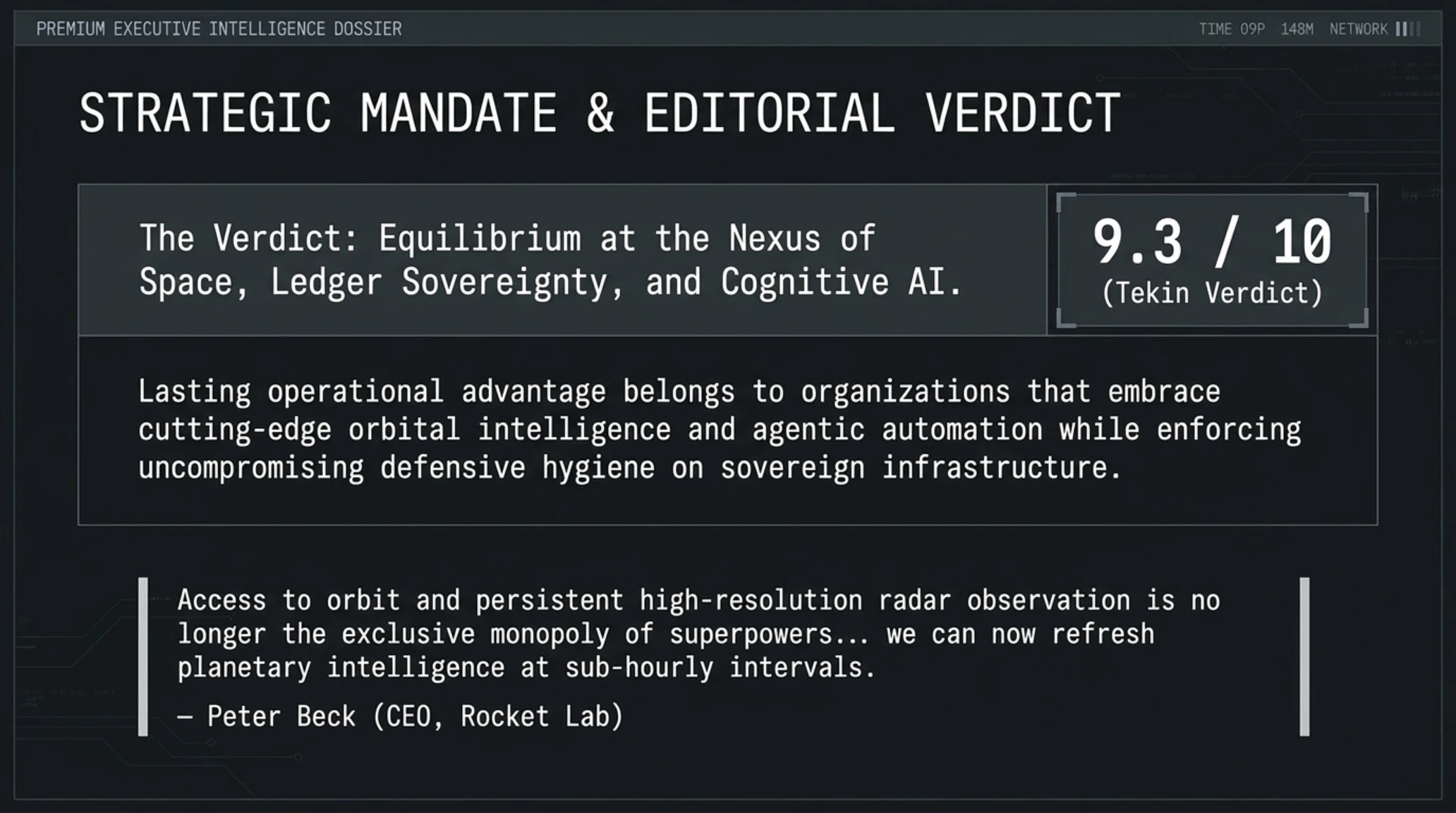
Editorial Verdict and Verified Primary Sources
Equilibrium at the Nexus of Space, Ledger Sovereignty, and Cognitive AI
The morning of November 3 confirms that lasting operational advantage belongs to organizations that embrace cutting-edge orbital intelligence and agentic automation while enforcing uncompromising defensive hygiene on sovereign infrastructure.
- Space.com: Live coverage of Rocket Lab's 99th mission and successful QPS-SAR-20 satellite deployment
- CoinDesk: Chinese Central Committee anti-corruption blockchain directive and BTCPay hot wallet advisory
- Android Authority: Comprehensive APK teardown of ChatGPT Android v1.2026.302 Health Connect integration
- The Verge: NASA issues industry RFI for private robotic re-boost of Hubble Space Telescope
- BleepingComputer: OpenAI reverses compute quotas and doubles Pro usage allowances ahead of December pool update
Technical Frequently Asked Questions
How does Synthetic Aperture Radar (SAR) differ from traditional optical orbital imaging?
Unlike passive optical sensors that rely on ambient sunlight and are completely blind at night or through cloud cover, Synthetic Aperture Radar (SAR) actively transmits microwave pulses and measures the backscatter reflections. By mathematically synthesizing the antenna motion along the orbital flight path, the satellite constructs sub-meter radar imagery regardless of weather conditions, smoke, precipitation, or darkness.
What caused the critical vulnerability and balance drainage in BTCPay Server?
Security audits identified an authorization bypass vulnerability in BTCPay Server versions prior to 2.4.2 that allowed unauthenticated remote attackers to trigger administrative API endpoints. This enabled attackers to export wallet credentials and initiate automated withdrawals from online hot wallets linked to merchant stores. Developers urged immediate shutdown until upgrading to patched version 2.4.7.
Does China's latest anti-corruption decree signal a ban on individual cryptocurrency users?
No. The official joint resolution issued by the Central Committee and State Council focuses specifically on curbing public-sector corruption, illicit kickbacks, official bribery, and systemic cross-border capital flight by state-owned enterprise executives. It does not introduce new criminal penalties for regular personal cryptocurrency holders, but establishes sophisticated on-chain forensic tracking by financial intelligence units.
How will ChatGPT utilize Google Health Connect data in everyday workflows?
Upon explicit user authorization, the ChatGPT Android application requests read-only permissions to local Health Connect repositories storing sleep architecture, heart rate variability, workout duration, and metabolic metrics. This biometric context is injected into real-time prompt generation, enabling personalized wellness advice, adaptive training regimens, and contextual productivity scheduling.
Why is the Hubble Space Telescope at urgent risk of atmospheric re-entry?
Hubble orbits in low Earth orbit at an altitude of approximately 515 kilometers, where heightened solar activity in Solar Cycle 25 has expanded upper atmospheric density. Without active onboard propulsion, atmospheric drag steadily strips orbital velocity. Without a commercial robotic re-boost mission to elevate its orbit above 600 kilometers, orbital models forecast uncontrolled re-entry between 2032 and 2034.
What concrete operational benefits does OpenAI's doubled Pro limit provide to technical teams?
Technical subscribers across Pro 100, Pro 200, and Business tiers receive a 100% expansion in high-reasoning model execution windows, uninterrupted Codex automated code refactoring, and multi-hour document batch workflows within ChatGPT Work. This eliminates midday throttling and ensures deterministic completion for complex agentic pipelines.
Additional Gallery: Tekin Morning Nov 3: Rocket Lab SAR Launch, BTCPay Wallet Drain & OpenAI 2x Quota