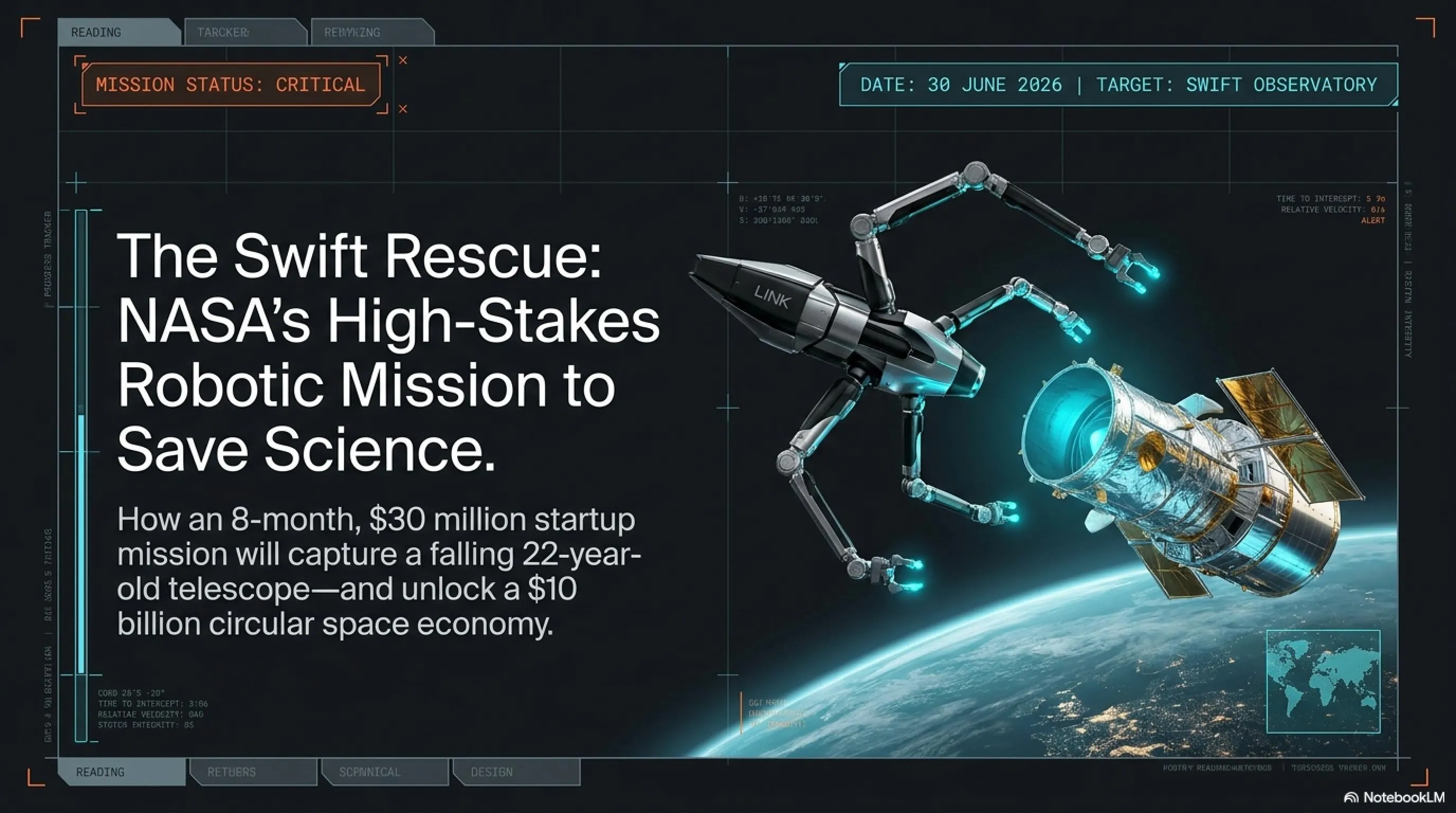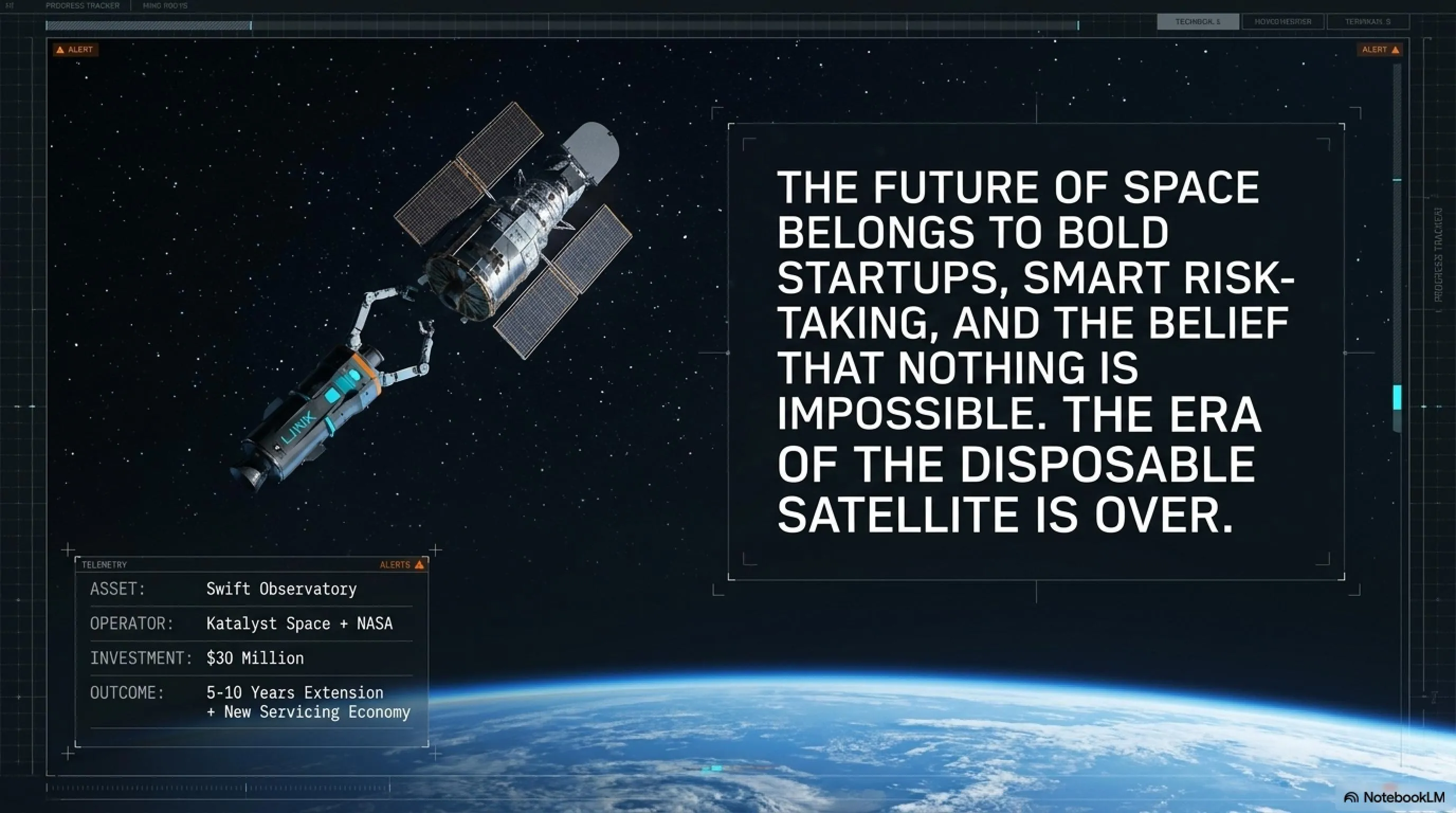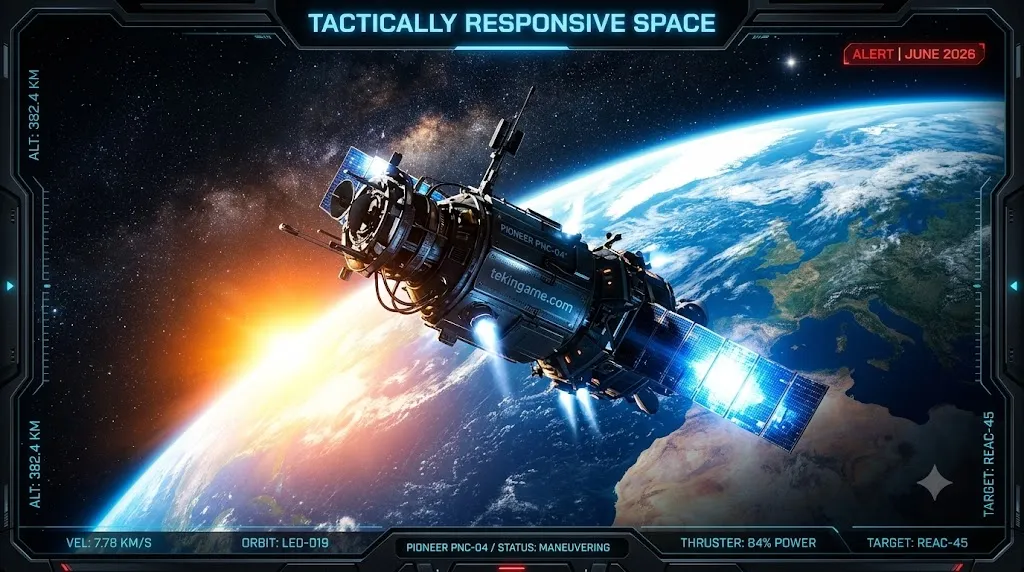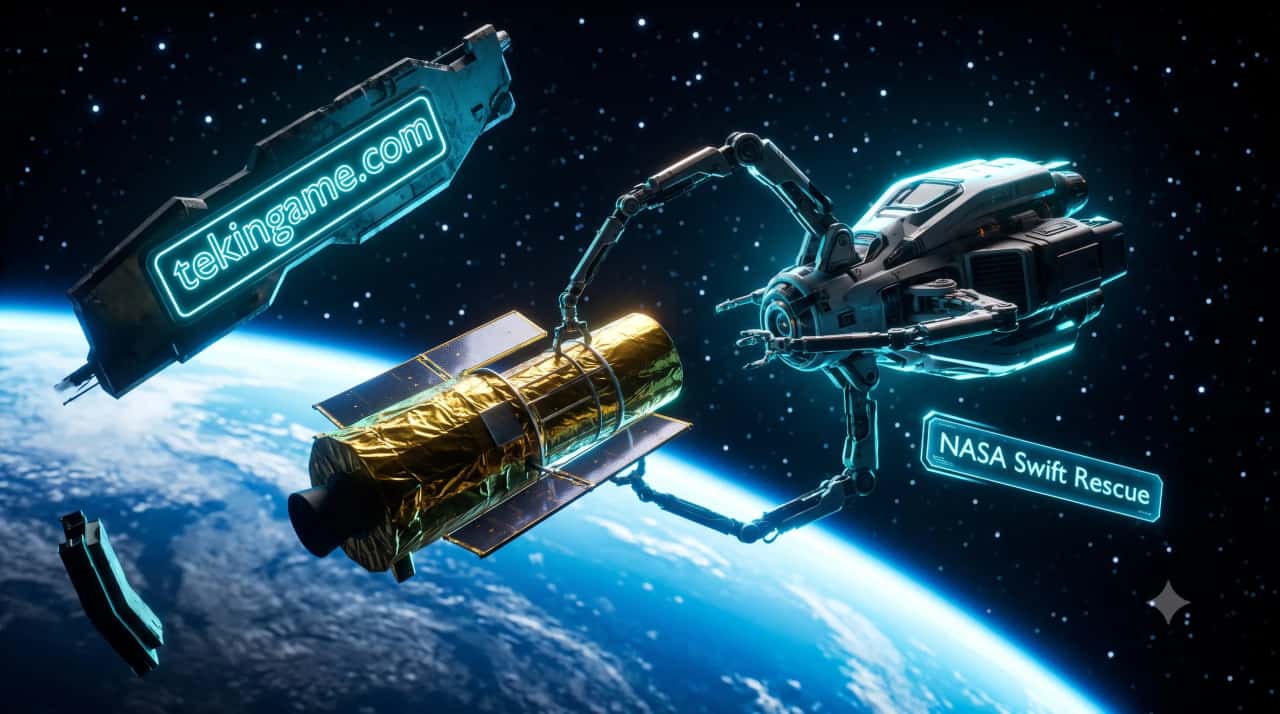
Today, June 30, 2026, NASA begins the first robotic rescue mission of a space telescope. The Swift telescope, which has observed the universe's most powerful explosions for 22 years, is falling due to unprecedented solar activity. An Arizona startup built the LINK spacecraft in just 8 months to save this legendary observatory from burning up in the atmosphere.
🚀 NASA's Unprecedented Mission
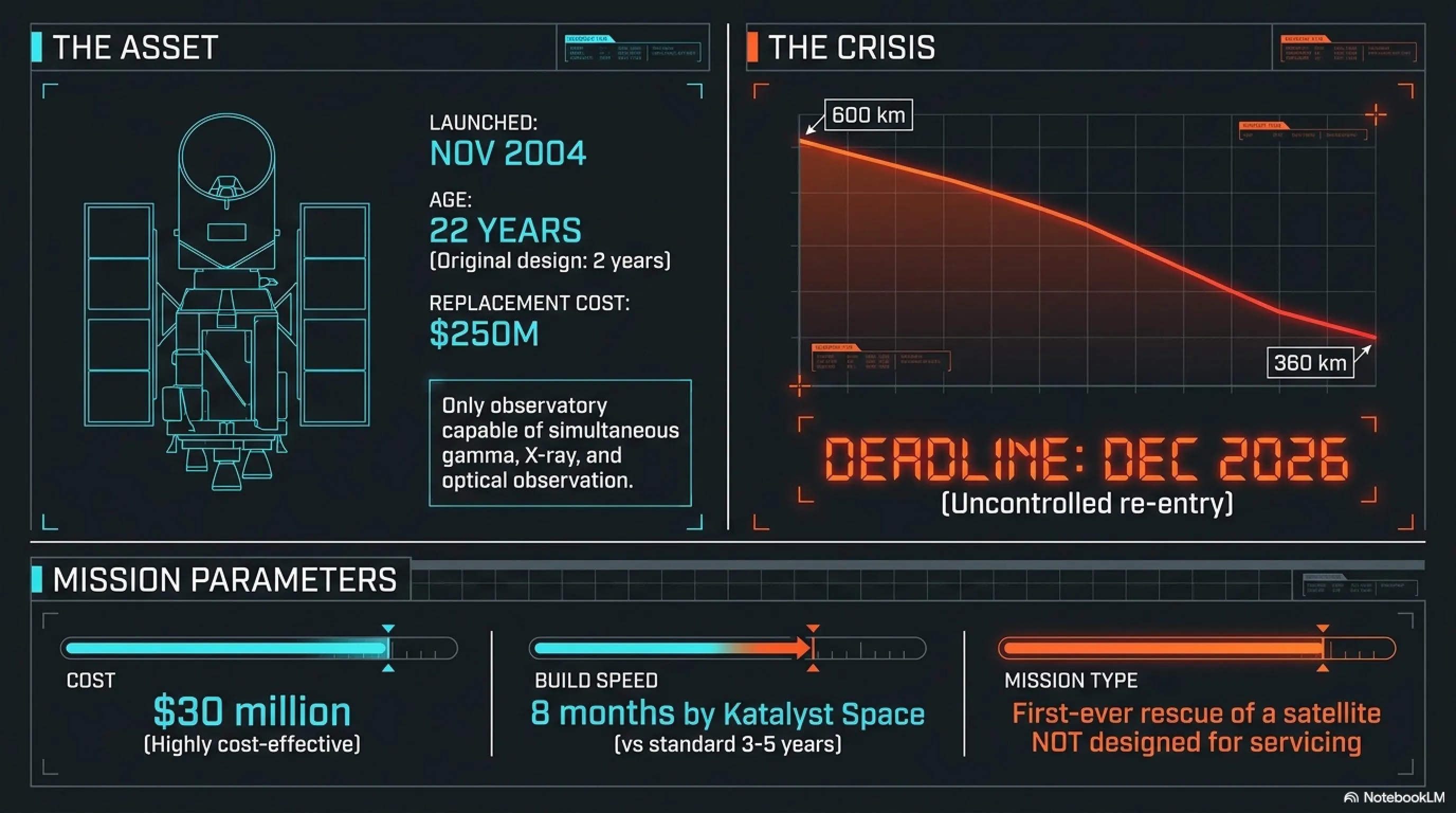
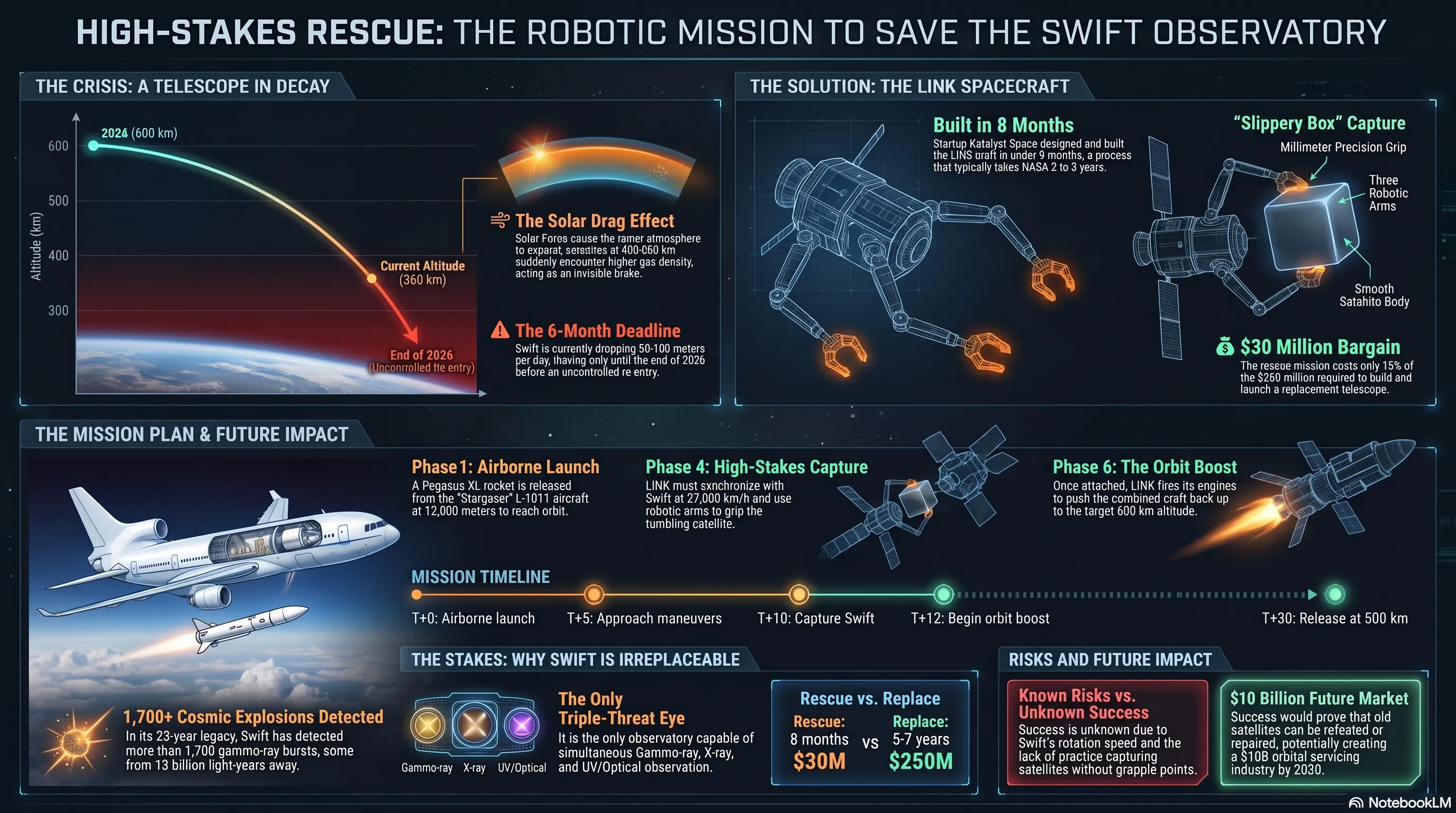
Today, June 30, 2026, NASA begins the first robotic rescue mission of a space telescope. The Swift telescope, which has observed the universe's most powerful explosions for 22 years, is falling due to unprecedented solar activity. Its orbit has dropped from 600 km to 360 km, with only 6 months until re-entry. An Arizona startup built the LINK spacecraft in 8 months to launch from an airplane and capture Swift with three robotic arms. Cost: $30 million. Chance of success: unknown.
- 🎮Critical Status- Swift has fallen from 600 km to 360 km altitude
- 🎧Time Remaining- Only until end of 2026 before uncontrolled re-entry
- 🚀Cost-Effective- $30 million vs. $250 million to build new
- 🗡️Build Speed- Katalyst Space built LINK spacecraft in 8 months
- 📰Launch Method- Pegasus XL rocket from L-1011 Stargazer aircraft
- 🎮Unprecedented- First rescue of satellite not designed for servicing
Why This Mission Matters So Much
The Neil Gehrels Swift Observatory, launched in November 2004, is one of humanity's most unique scientific instruments. This space observatory uses three telescopes simultaneously—gamma-ray, X-ray, and UV/optical—to do something no other observatory can, not even the legendary Hubble or James Webb telescopes: real-time observation of gamma-ray bursts (GRBs).
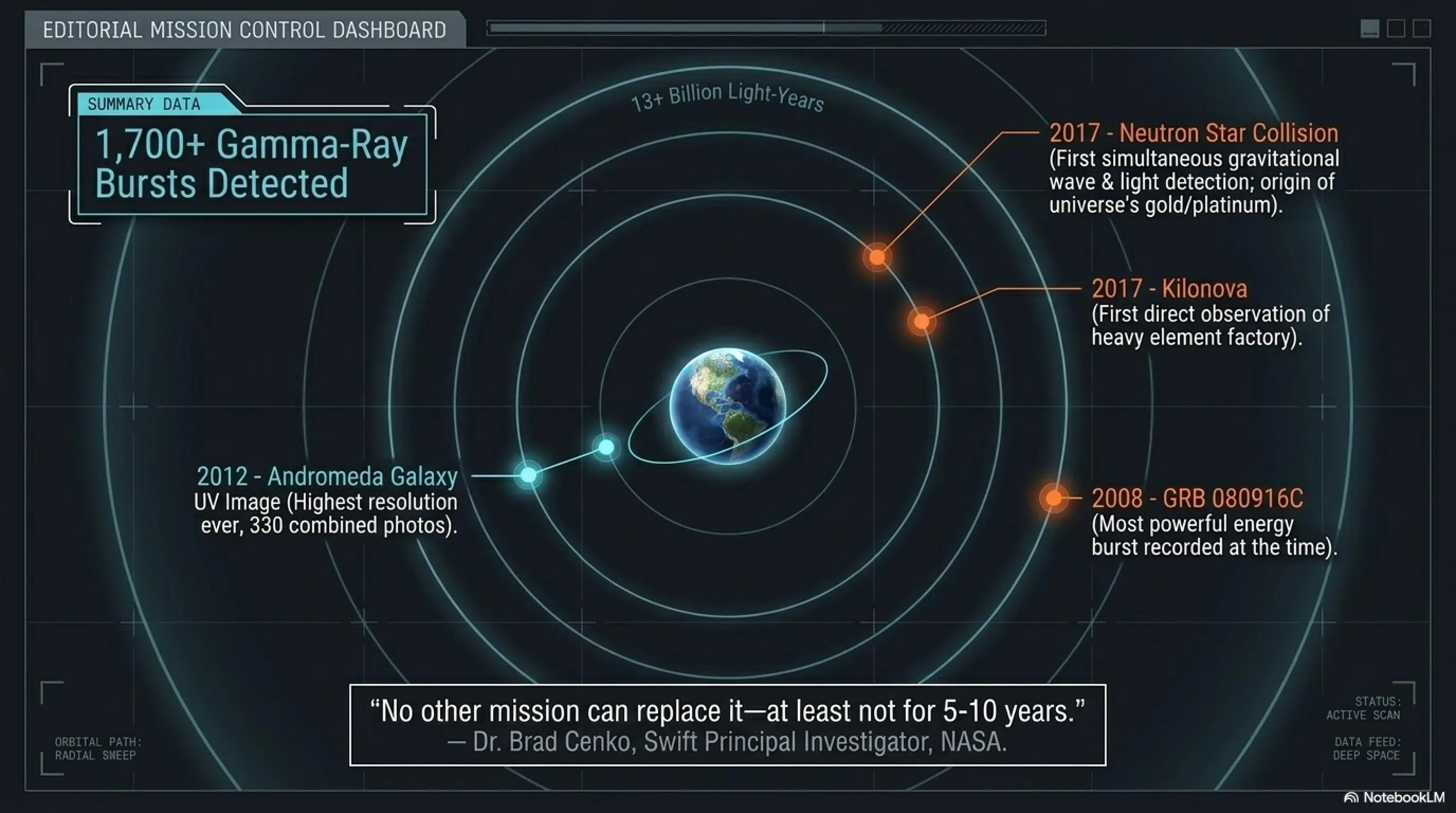
Gamma-ray bursts are the most powerful events in the universe. These explosions originate from black hole births or neutron star collisions, releasing more energy in seconds than our sun will produce in its entire lifetime. Over 22 years, Swift has detected more than 1,700 gamma-ray bursts, some from the observable edge of the universe—light that has traveled more than 13 billion light-years.
Dr. Brad Cenko, Swift's Principal Investigator at NASA, explains: "Swift is a unique telescope that has reinvented itself over the years. Building a new and improved Swift would cost around $250 million, while this rescue mission is only $30 million—an exceptional bargain for science."
Swift's 22-Year Legacy
- Observed over 1,700 gamma-ray bursts across the cosmos
- Discovered bursts from 13+ billion light-years away
- Only observatory capable of simultaneous gamma, X-ray, and optical observation
- Operational lifetime: 22 years (original design: 2 years)
- Construction cost: $250 million (in 2026 dollars)
- Irreplaceable: No other telescope has similar capabilities
The Solar Activity Problem: Why Swift Is Falling
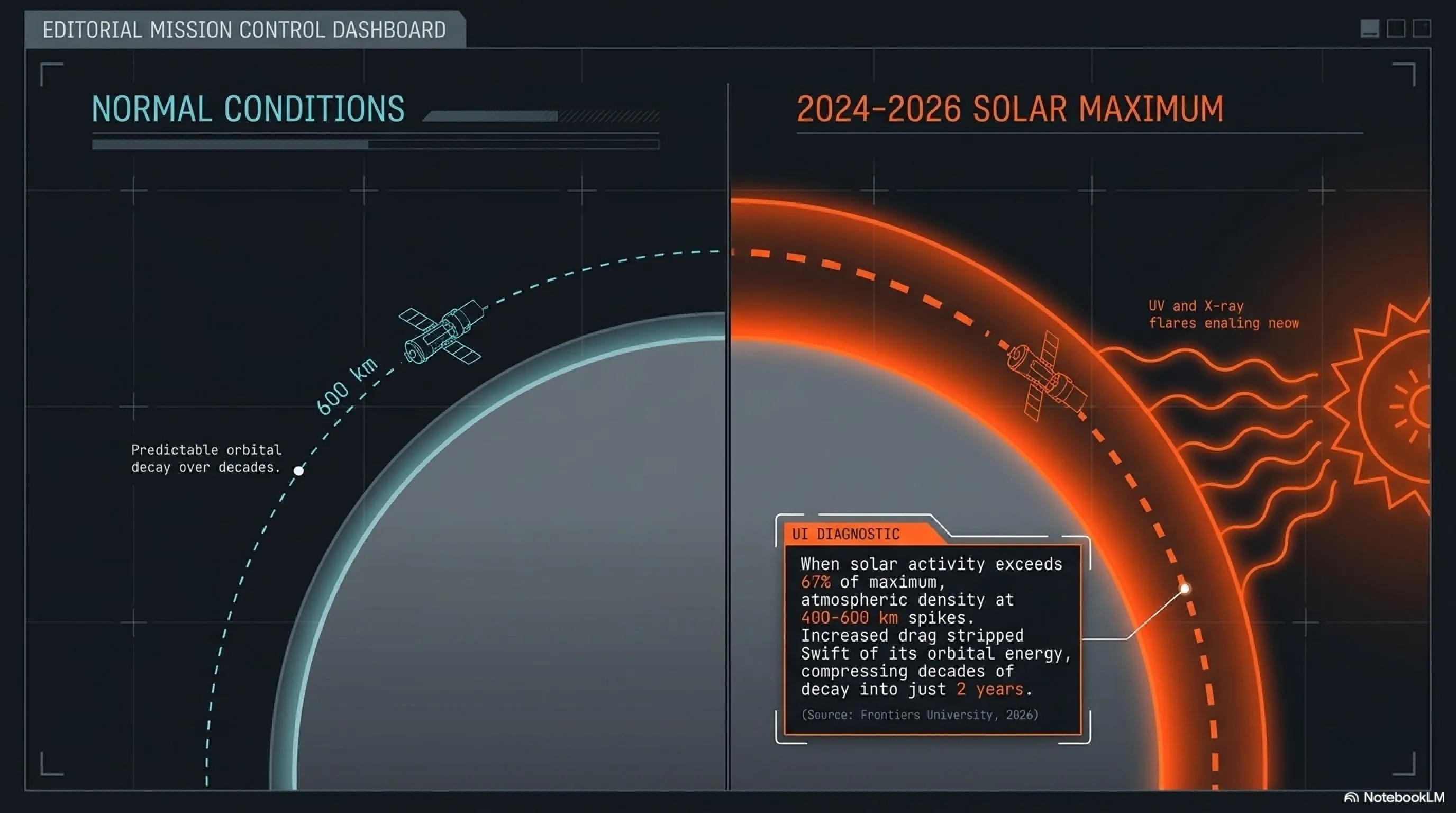
All low Earth orbit satellites face an invisible enemy: atmospheric drag. Even at altitudes of 400 to 600 kilometers, Earth's upper atmosphere is so thin it's nearly a vacuum, yet enough particles remain to create a very weak drag force. This force gradually reduces a satellite's orbital energy, causing it to fall.
Under normal conditions, this process is extremely slow. Swift was placed at approximately 600 kilometers altitude in November 2004 and was expected to remain in orbit for decades. But an unexpected factor changed everything: the solar activity cycle.
The sun reaches peak activity every 11 years—a time when sunspots, solar flares, and coronal mass ejections reach their maximum. In 2024-2026, the sun reached an unprecedented activity peak that exceeded even scientific predictions.
How the Sun Is Killing Swift
When the sun reaches peak activity, intense ultraviolet radiation and X-rays cause Earth's upper atmosphere to heat up. This heat causes atmospheric expansion—gas layers reach higher altitudes.
The result? Satellites at 400-600 km altitude suddenly encounter higher atmospheric density.
Researchers at Frontiers University showed in a 2026 study that when solar activity exceeds 67% of its maximum, satellite decay rates increase significantly.
Swift fell right into this critical zone: its orbit dropped from 600 km to 360 km—a fall predicted to take decades, but happened in just 2 years.
The LINK Spacecraft: An Engineering Marvel in 8 Months
When NASA realized in late 2025 that Swift was falling faster than expected, the decision window was very short. The space agency contacted several companies, but only one agreed to take on such a difficult mission in an impossible timeframe: Katalyst Space Technologies, a small startup based in Arizona.
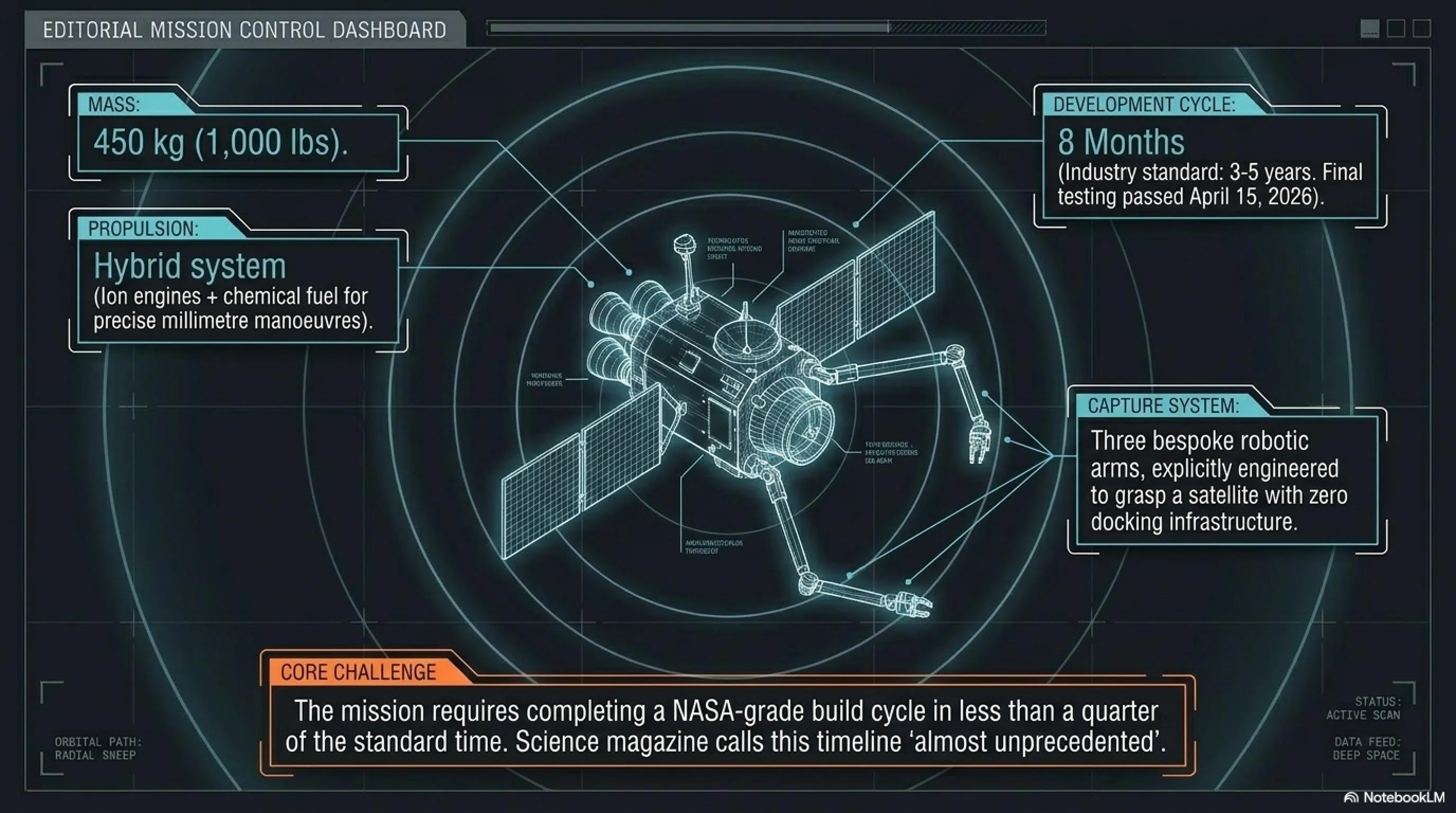
The challenge? Design, build, test, and launch a completely new robotic spacecraft in less than 9 months. For comparison, similar NASA missions typically take 3 to 5 years. Science magazine described this timeline as "almost unprecedented for a NASA mission."
LINK Spacecraft Technical Specifications
Name: LINK (Katalyst Space Robotic Servicing Spacecraft)
Total Weight: Approximately 450 kg (1,000 lbs)
Capture System: Three robotic arms to grasp Swift
Propulsion: Ion engines and chemical fuel for precise maneuvers
Development Time: 8 months (typically 3-5 years)
Final Testing: April 15, 2026 at NASA Goddard Center
Major Challenge: Capturing a satellite not designed for servicing
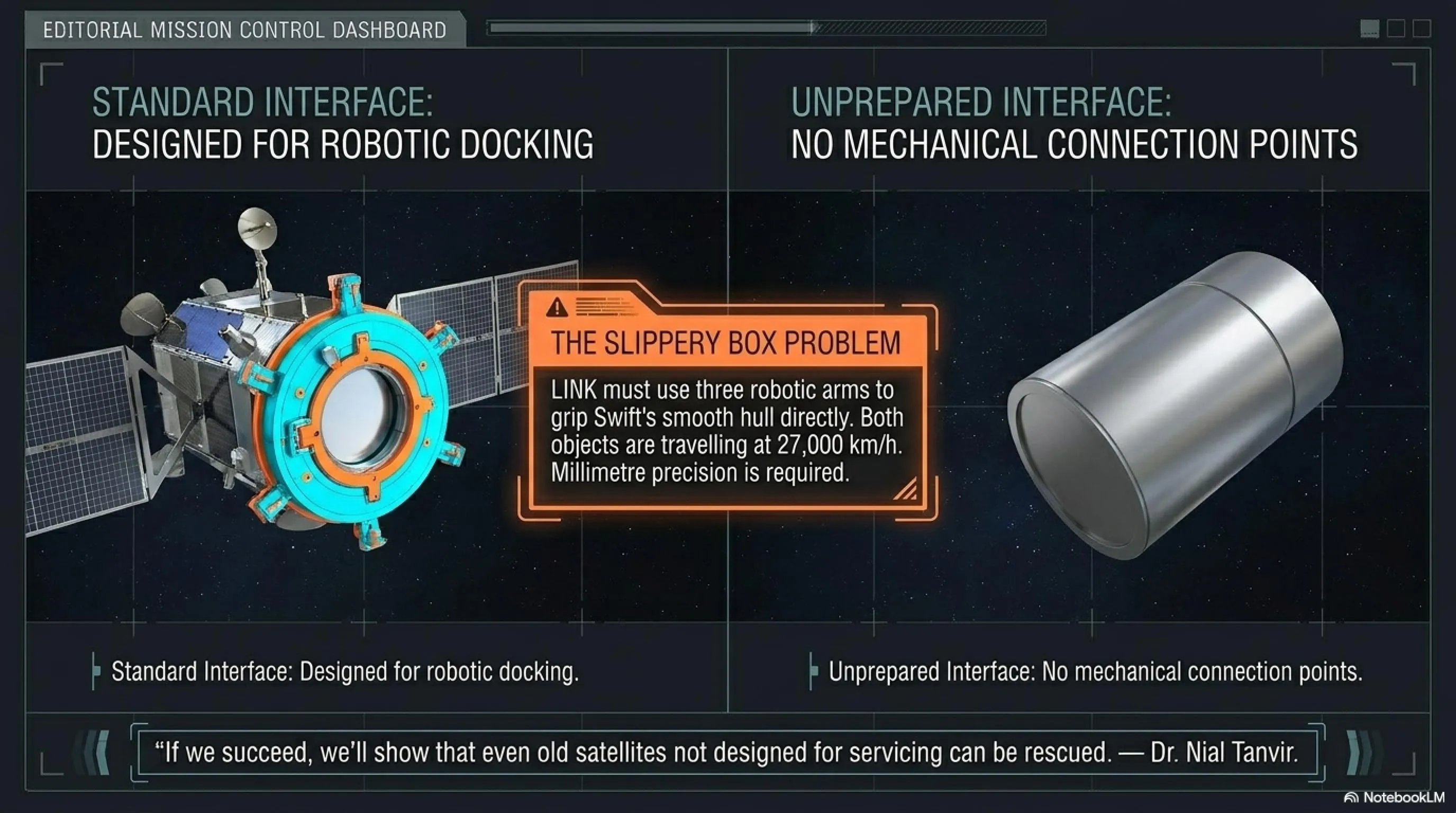
The biggest technical challenge is that Swift was never designed for servicing. Unlike modern satellites with standard grapple points, Swift has no mechanical interface for connecting to another spacecraft. LINK must use three advanced robotic arms to directly grip Swift's body—like catching a slippery box with no handles.
This must be done in space, while both spacecraft are moving at approximately 27,000 kilometers per hour, with millimeter precision. One small mistake could destroy both spacecraft.
Airborne Launch: Pegasus XL and the Legendary Stargazer
One of the most fascinating aspects of this mission is its launch method. Unlike most space missions that launch from ground pads, LINK will go to space using an air-launch system—a method that only Northrop Grumman possesses worldwide.
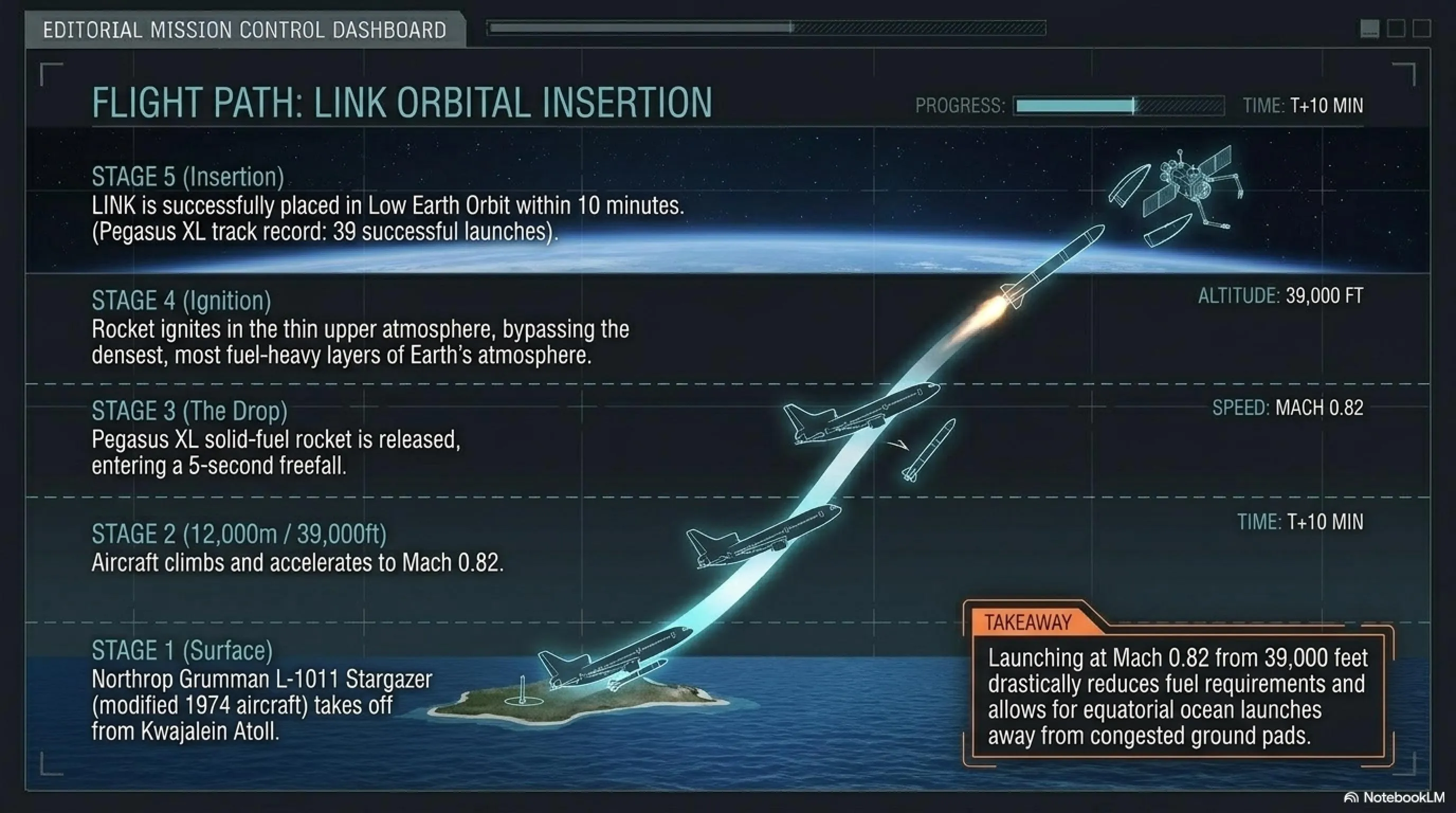
The Pegasus XL is a three-stage solid-fuel rocket that drops from beneath a Lockheed L-1011 TriStar aircraft named Stargazer. This aircraft, built in 1974 and modified in 1994 for this specific mission, is the last operational L-1011 in the world—a true flying legend.
How Air Launch Works
Stage 1: Stargazer with Pegasus attached underneath takes off from Kwajalein Atoll (Marshall Islands).
Stage 2: Aircraft climbs to 12,000 meters (39,000 feet) and reaches speed of Mach 0.82.
Stage 3: Pegasus is released from beneath and free-falls for 5 seconds.
Stage 4: Pegasus engine ignites and the rocket accelerates rapidly toward space.
Stage 5: In less than 10 minutes, LINK is placed in low Earth orbit.
What's the advantage? Launching from high altitude and the aircraft's initial speed means the rocket needs less fuel to reach space. Also, this method allows launching from any point over the ocean—flexibility that ground launches lack.
Mission Scenario: 7 Critical Phases
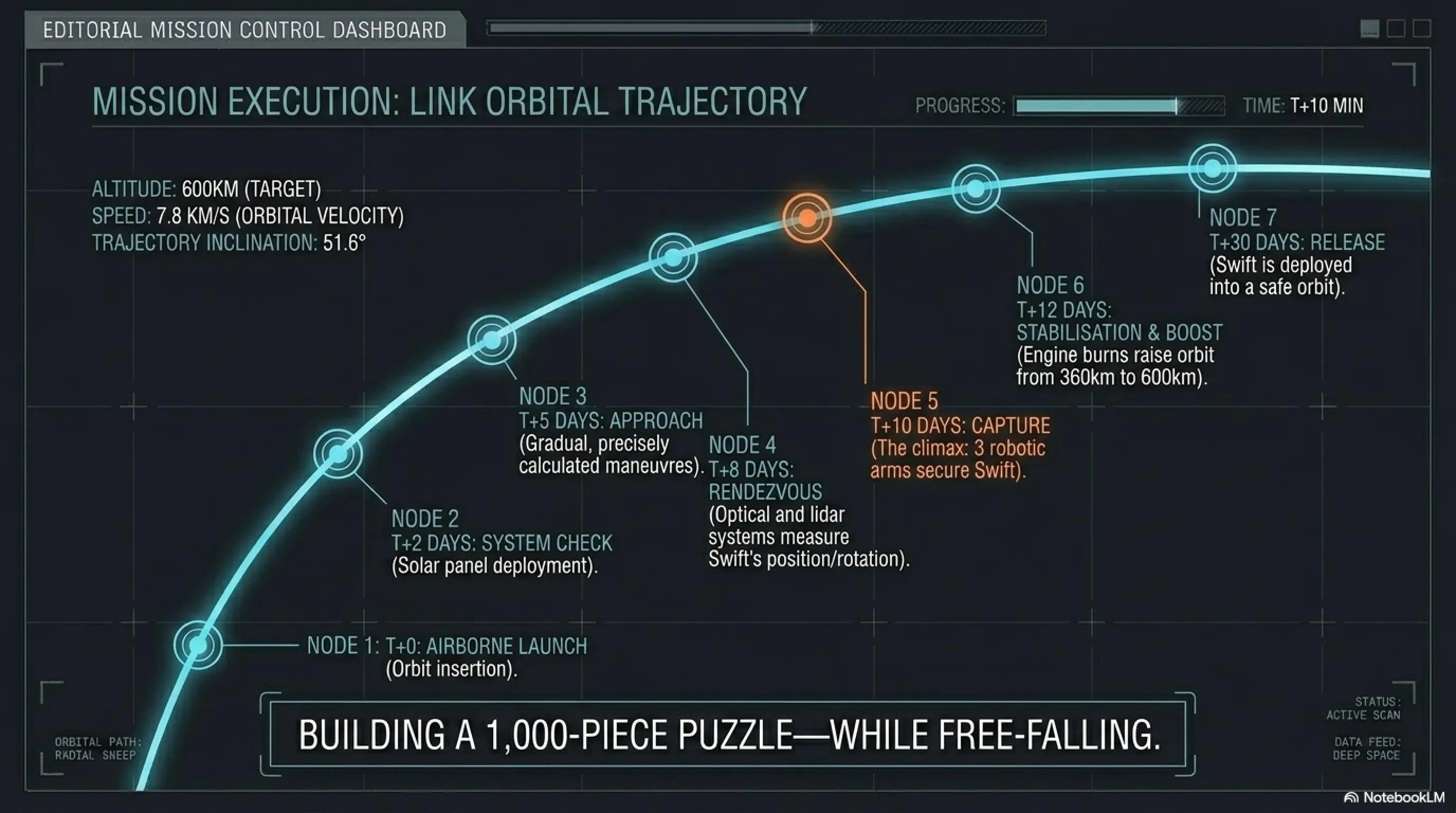
After successful launch, LINK must perform a series of highly precise maneuvers to reach Swift and rescue it. This process is divided into seven critical phases, each with its own technical challenges:
Swift Boost Mission Timeline
| T+0 days | Airborne launch - LINK placed in orbit |
| T+2 days | Deploy solar panels and check systems |
| T+5 days | Begin approach maneuvers to Swift |
| T+8 days | Rendezvous phase with Swift |
| T+10 days | Capture Swift with three robotic arms |
| T+12 days | Begin orbit boost maneuver |
| T+30 days | Release Swift at 600 km orbit |
Phase 1 - Launch and Orbit Insertion: This is the simplest phase. Pegasus XL has had 39 successful launches to date with a high success rate.
Phase 2 - Gradual Approach: LINK must slowly approach Swift. This process takes several days because each maneuver must be precisely calculated to avoid collision.
Phase 3 - Rendezvous: When LINK reaches a few meters from Swift, its optical and lidar systems must precisely measure Swift's position, orientation, and rotation speed.
Phase 4 - Capture: This is the most dangerous phase. LINK's three robotic arms must simultaneously grip Swift's body without causing damage. One slip could end in disaster.
Phase 5 - Stabilization: After capture, LINK must stop Swift's rotation and turn both spacecraft into a single integrated unit.
Phase 6 - Orbit Boost: This is the longest phase. LINK must fire its engines multiple times to gradually raise orbit altitude from 360 km to 600 km.
Phase 7 - Separation: Once Swift is in a safe orbit, LINK releases it and continues to its own orbit, ready for future missions.
Technical Challenges and Mission Risks
No space mission is without risk, but Swift Boost faces unique challenges that make it one of the most dangerous satellite servicing missions ever attempted.
5 Major Mission Risks
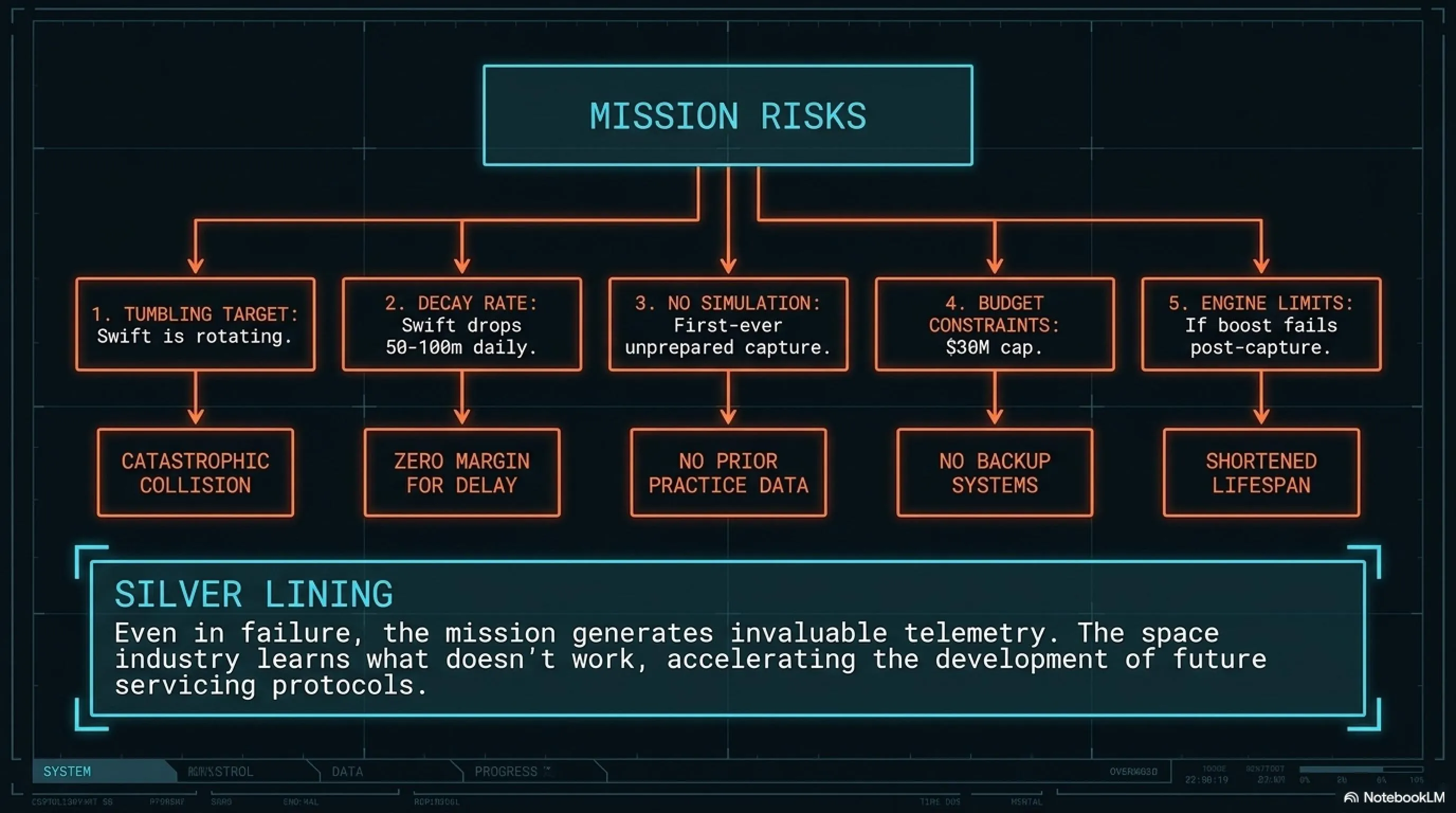
1. Swift Is Tumbling:
The telescope is rotating at unknown speed. If LINK can't capture it, collision occurs.
2. Limited Time:
Swift drops 50-100 meters per day. Any delay makes the mission impossible.
3. No Prior Practice:
This is the first time anyone has captured a satellite without standard grapple points. No accurate simulation exists.
4. Limited Budget:
$30 million is very little for such a mission. Katalyst can't build backup systems.
5. If It Fails?
Swift falls to Earth, 22 years of science is lost, and the satellite servicing industry takes a hit.
Despite these risks, NASA decided it was worth the attempt. If this mission succeeds, it shows that even old satellites can be rescued—a major shift for the space industry.
Impact on the Future of Satellite Servicing
The Swift Boost mission goes beyond rescuing one telescope. It's a test for an entirely new industry: robotic satellite servicing in orbit. If successful, it opens doors to new possibilities.
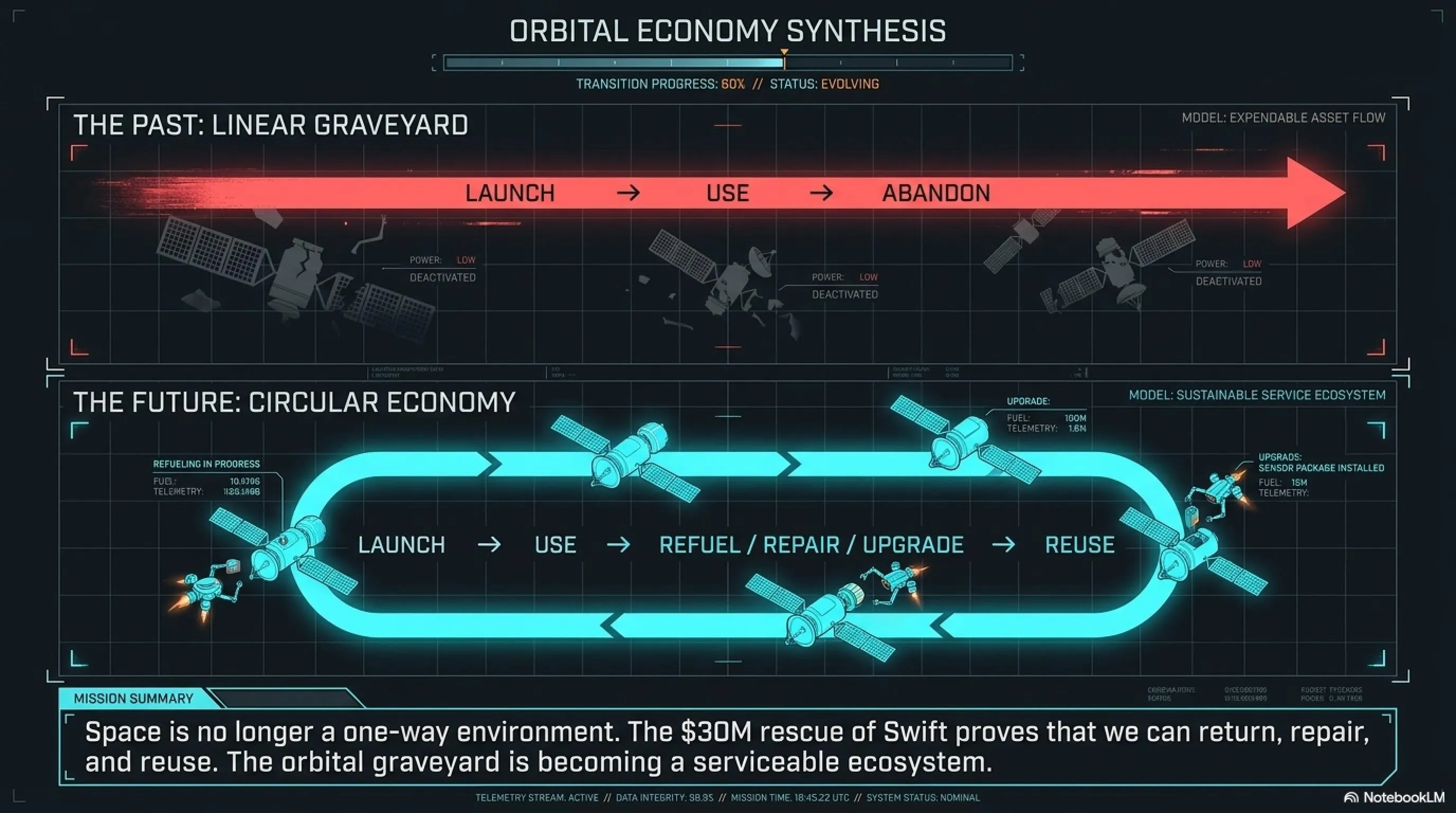
Currently, thousands of satellites orbit Earth. Many still work but have been deactivated due to fuel shortage or minor failures. Until now, there was no way to repair or replace their components. But missions like Swift Boost show this is possible.
Future of Satellite Servicing Industry
Scenario 1 - Refueling:
Expensive communications satellites that ran out of fuel can be refueled and work another 10 years.
Scenario 2 - On-Orbit Repair:
Replace batteries, sensors, or broken antennas without returning to Earth.
Scenario 3 - Technology Upgrade:
Install newer sensors on old satellites to increase capabilities.
Scenario 4 - Space Debris Cleanup:
Remove defunct satellites and dangerous debris from crowded orbits.
Potential Market: By 2030, satellite servicing industry could become a $10 billion market.
Katalyst Space sees this mission as a technology demonstration. If LINK can capture Swift, the company can sell the same technology for dozens of other satellites. This could turn small companies like Katalyst into major space industry players.
Mission Economics: Is $30 Million Worth It?
A natural question arises: Is spending $30 million to rescue a 22-year-old telescope logical? To answer this, we need to look at two different perspectives: scientific and economic.
Scientifically, Swift is irreplaceable. No other observatory in Earth orbit can detect gamma-ray bursts with the same speed and precision. James Webb can see infrared, but can't quickly react to a gamma-ray burst. Hubble has similar limitations.
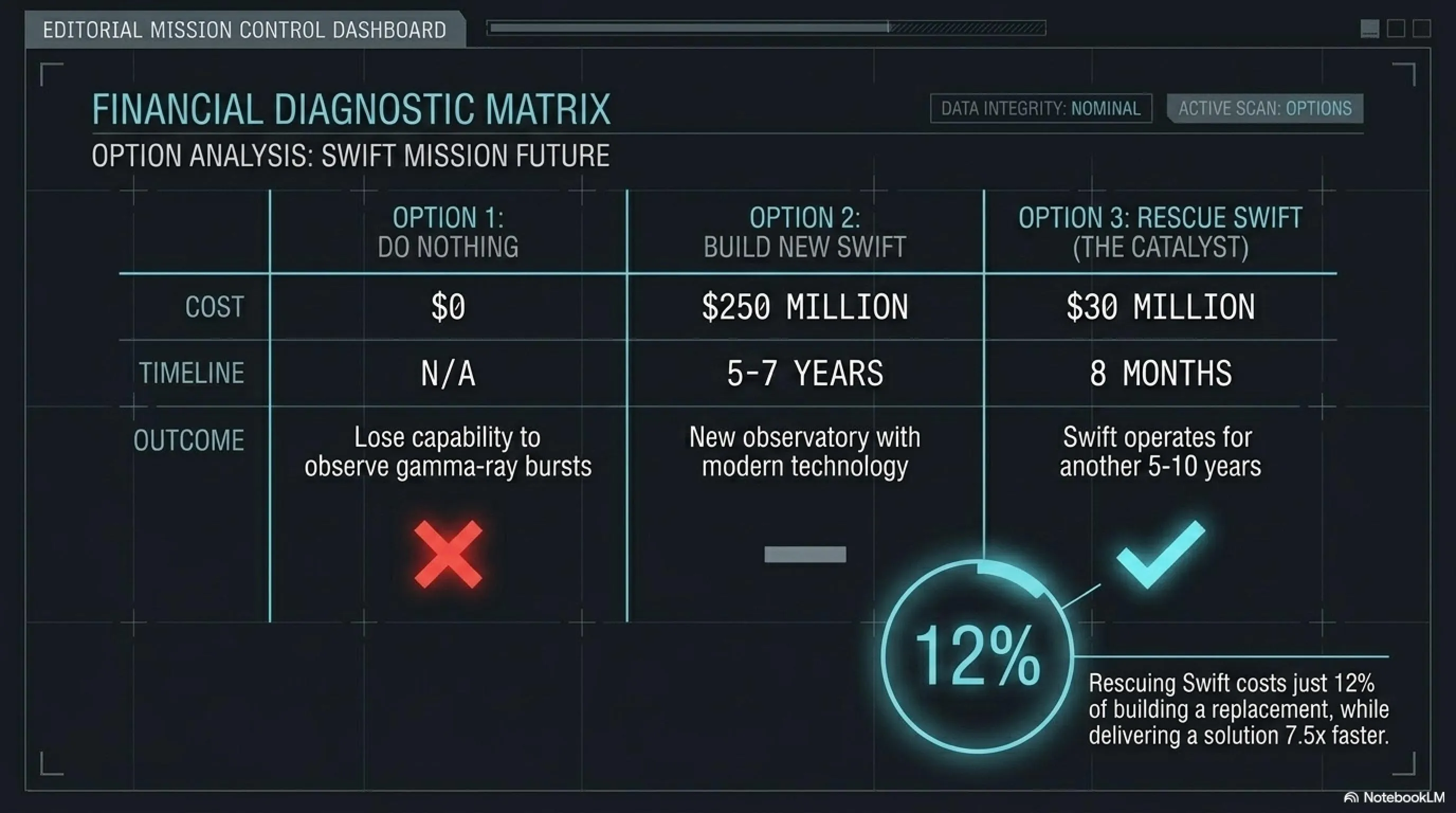
Cost Comparison: Rescue vs. Build New
| Option | Cost | Time | Result |
| Rescue Swift | $30 million | 8 months | Swift works another 5-10 years |
| Build New Swift | $250 million | 5-7 years | A new observatory with better technology |
| Do Nothing | $0 | - | Lose capability to observe gamma-ray bursts |
Conclusion: Rescuing Swift is far more cost-effective, especially considering $30 million is only 12% of the cost to build a new observatory.
Economically, the calculation is also interesting. Building a similar telescope with today's technology costs around $250 million and takes 5 to 7 years. In contrast, $30 million is only 12% of that cost and took just 8 months. Even if Swift only works another 5 years, this investment is worthwhile.
Dr. Brad Cenko explains: "Of course we could build a new and better Swift, but its cost would be much higher than this rescue mission. This could be a very good deal."
- Cost is 12% of building new
- Execution time 8 months vs. 5-7 years
- Swift is irreplaceable
- Tests satellite servicing technology
- Creates new robotic servicing industry
- Preserves 22 years of scientific data and experience
- High risk of failure
- Limited budget for backup systems
- Swift must eventually be retired
- 22-year-old technology is limited compared to today
Swift's Scientific Discoveries: Why Losing It Would Be a Tragedy
To understand why losing Swift matters, we need to look at its scientific achievements. Over 22 years, this telescope has detected more than 1,700 gamma-ray bursts and contributed to dozens of major scientific discoveries.
One of Swift's most important discoveries came in 2017: detection of gravitational waves from two colliding neutron stars accompanied by a gamma-ray burst. This was the first time scientists saw both gravitational waves and light from a cosmic event—a historic moment for astrophysics.
Swift's Top 5 Discoveries
1. GRB 080916C Burst - Energy Record (2008):
Most powerful explosion observed until then, from 12.2 billion light-years away.
2. Simultaneous Gravitational Wave and Light Detection (2017):
Neutron star collision that led to discovering the origin of gold and platinum in the universe.
3. Kilonova - Heavy Element Factory (2017):
First direct observation of a Kilonova where heavy elements like gold are produced.
4. Andromeda Galaxy Ultraviolet Image (2012):
Highest resolution ultraviolet image of a galaxy, comprising 330 combined photos.
5. Discovery of Short Gamma-Ray Bursts (2005):
Proof that short bursts originate from neutron star collisions, not massive star deaths.
Swift has also helped scientists understand where gamma-ray bursts come from. Before Swift, scientists didn't know how powerful these explosions were or why they occurred. Now we know there are two main types: long bursts (from massive star deaths) and short bursts (from neutron star collisions).
Who Else Is Working on Satellite Servicing?
Katalyst Space isn't the only player in this emerging industry. Several other companies are developing robotic satellite servicing technologies, each with different approaches.
Competitors and Partners in Satellite Servicing
| Company | Country | Specialty | Status |
| Northrop Grumman (MEV) | USA | Refueling | 2 successful missions (2020, 2021) |
| Astroscale | Japan | Space debris cleanup | Successful test missions |
| Orbital Sidekick | USA | Satellite inspection | In development |
| Katalyst Space | USA | Orbit boost and repair | First mission (Swift) |
| ClearSpace | Switzerland | Debris removal | ESA contract for 2027 |
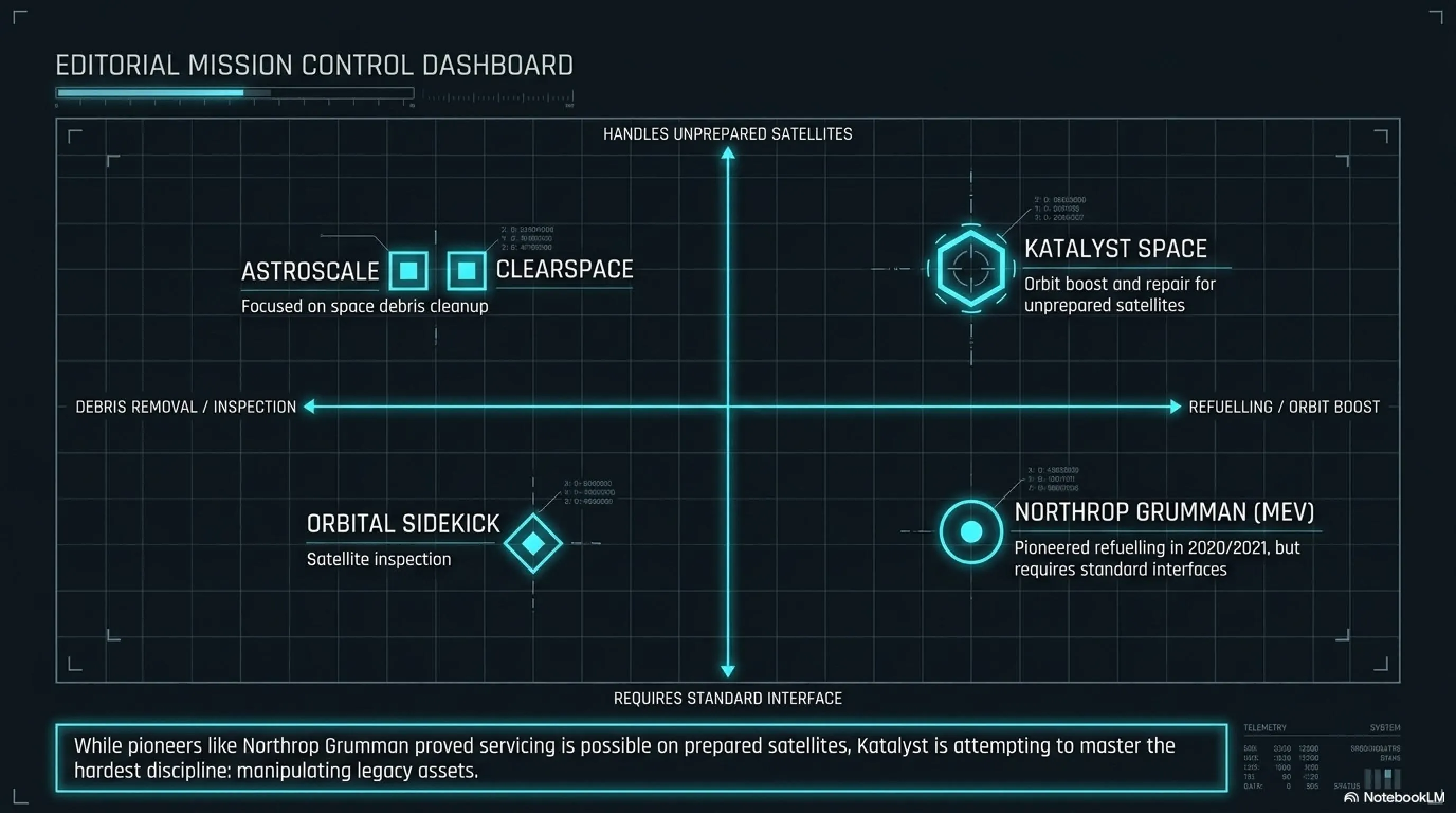
Northrop Grumman is the industry pioneer. In 2020 and 2021, the company launched two MEV (Mission Extension Vehicle) satellites that docked with communications satellites and refueled them. These missions proved that robotic servicing in orbit is possible.
But Katalyst's mission is different. MEV was designed for satellites with standard interfaces. LINK must capture a satellite with no attachment points—a much harder challenge.
What If the Mission Fails?
This is an unpleasant question but must be asked. If LINK can't capture Swift or if a collision occurs during the process, what happens?
The pessimistic scenario: Swift falls to Earth, probably in late 2026 or early 2027. Parts of the telescope burn up in the atmosphere, but larger pieces like mirrors and metal structure might reach Earth's surface. NASA will try to guide it to a safe point in the ocean, but precise control is impossible.
Failure Scenarios and Consequences
Scenario 1 - LINK Can't Capture Swift:
LINK spacecraft remains intact but Swift continues falling. NASA must prepare for controlled re-entry.
Scenario 2 - Collision During Capture:
Both spacecraft are damaged and become space debris. This is the worst scenario.
Scenario 3 - LINK Engines Insufficient:
LINK can capture Swift but can't raise it high enough. Swift only lives a few more years.
Failure Consequences:
- Loss of $30 million investment
- End of 22 years of scientific observation
- Blow to satellite servicing industry confidence
- Lower likelihood of similar missions in future
But even if the mission fails, the data obtained will be extremely valuable. Katalyst and NASA will learn what didn't work and how to do it better in the future. In the space industry, even failures teach lessons.
The Future of Space: From Rescue to Industrialization
The Swift Boost mission signals a major transformation in the space industry. Until 10 years ago, the idea of robotic satellite servicing was something we only saw in science fiction films. Today, private companies are turning it into reality.
The key difference is that costs have dropped enough to make commercial missions logical. $30 million to rescue Swift seems expensive, but for a communications satellite company whose satellite cost $500 million and still works but lacks fuel, paying $50 million for refueling makes perfect sense.
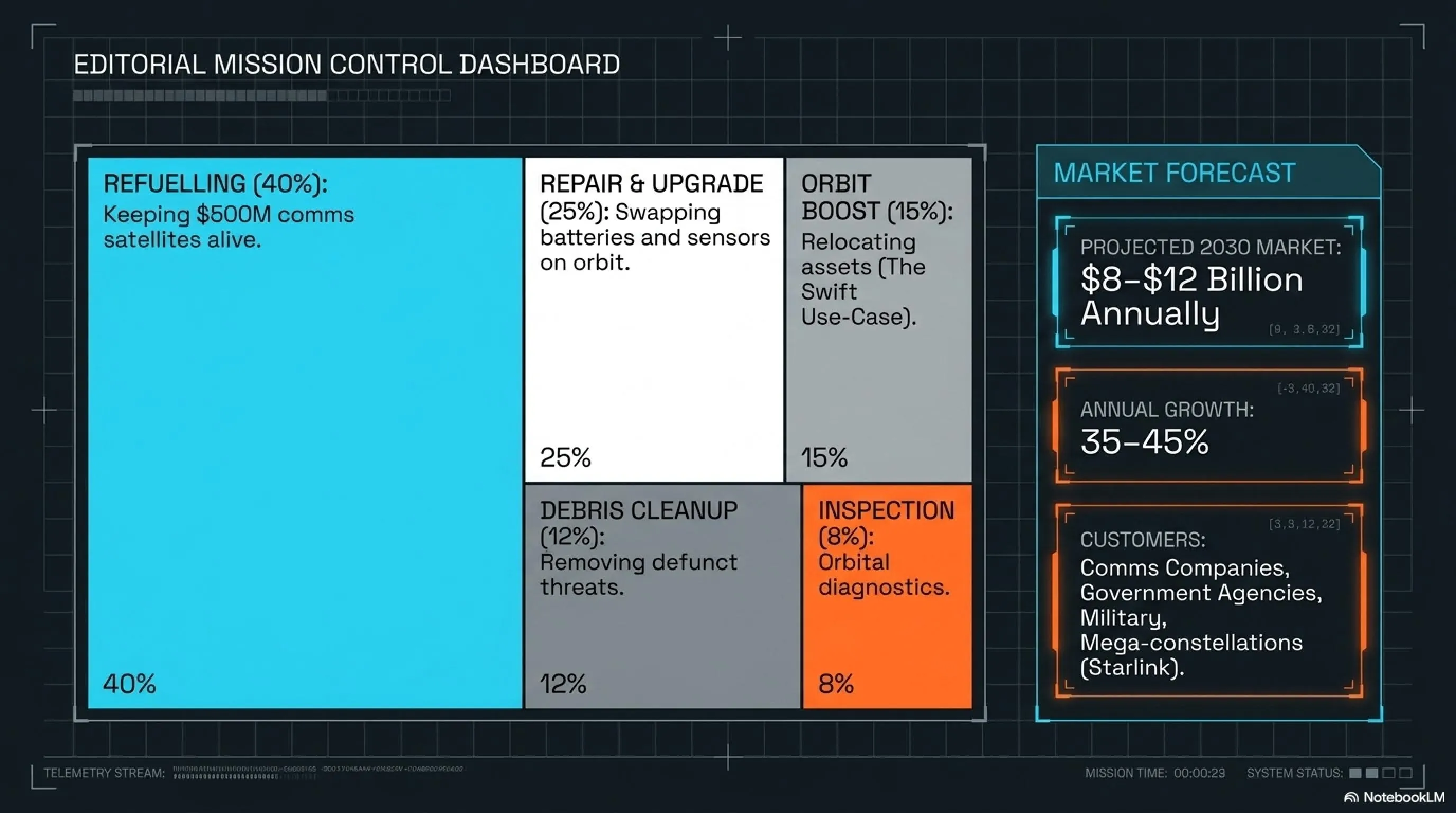
Satellite Servicing Market Forecast to 2030
Market Size: $8-12 billion annually
Key Services:
- Refueling: 40% of market
- Repair and upgrade: 25% of market
- Orbit boost: 15% of market
- Space debris cleanup: 12% of market
- Inspection and diagnostics: 8% of market
Main Customers:
- Communications satellite companies
- Government space agencies
- Satellite network operators (Starlink, OneWeb)
- Military (spy and communications satellites)
Projected Annual Growth: 35-45%
In the next 10 years, we'll likely see a complete ecosystem of satellite servicing companies. Some will specialize in refueling, some in repair, and some in debris cleanup. It's like having repair shops and gas stations in space—something that hasn't existed until now.
Key Lessons from the Swift Mission
Even before the mission is complete, we can learn several important lessons:
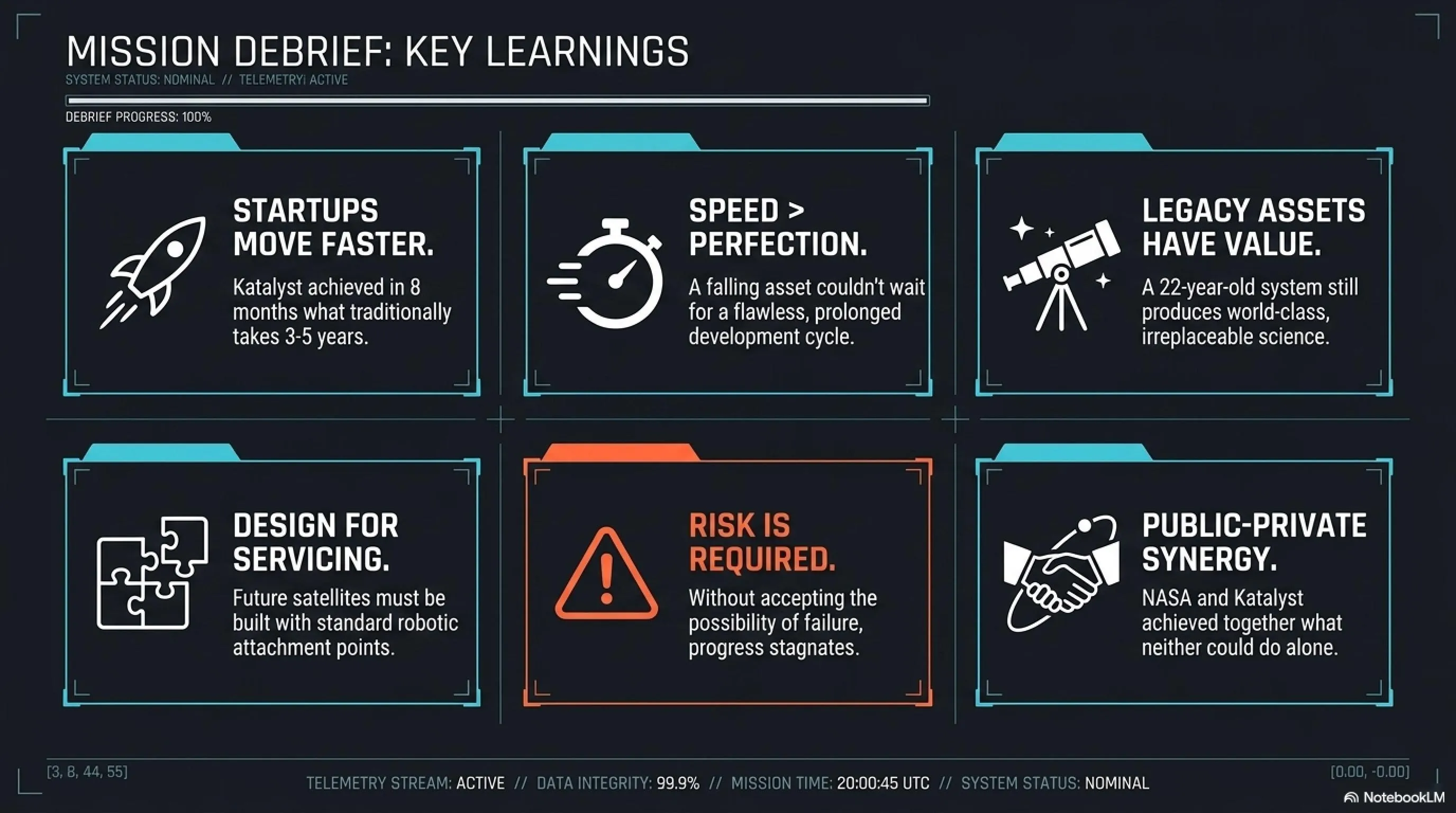
6 Key Lessons for the Space Industry
- Startups can do big things - Katalyst did in 8 months what typically takes 3-5 years
- Speed matters more than perfection - Swift couldn't wait, so quick solution beat perfect solution
- Old satellites are worth saving - Even a 22-year-old telescope still produces valuable science
- Design for servicing is critical - Future satellites must be designed with standard attachment points
- Risk-taking is necessary - Without risk, there's no progress
- Public-private partnership works - NASA and Katalyst built something together that was impossible alone
One of the most interesting points is that Swift was never designed for servicing. This reminds us that future satellites must be designed more intelligently—with standard attachment points, sensors to help with rendezvous, and modules that are replaceable.
Conclusion: A Beginning, Not an End
The Swift telescope rescue mission is more than a scientific mission—it's a test for the future of the space industry. If Katalyst Space succeeds, it shows that even old satellites not designed for servicing can be rescued. This opens doors to an entirely new industry: robotic satellite servicing.
But beyond the commercial aspect, this is a human story. It's the story of a group of young engineers at an Arizona startup who did in 8 months what typically takes 5 years. It's the story of a government agency willing to risk on a small company. And it's the story of a 22-year-old telescope that still produces valuable science and deserves a second chance.
Mission Summary
What: Rescue Swift telescope from falling to Earth
How: LINK robotic spacecraft with airborne launch
When: Launch June 30/July 1, 2026, completion by August 2026
Why: Swift is irreplaceable and building new is 8x more expensive
Who: Katalyst Space Technologies + NASA
Cost: $30 million
Success Chance: Unknown (first attempt of its kind)
If Successful: Swift works another 5-10 years, satellite servicing industry is proven
If It Fails: Swift falls, but valuable data obtained for future missions
In the coming weeks, the science world will wait with bated breath to see if LINK can capture and rescue Swift. But regardless of the outcome, this mission has already proven something: the future of space belongs to bold startups, smart risk-taking, and the belief that nothing is impossible.
We'll soon know whether a 22-year-old telescope gets its second chance. But one thing is certain: the story of Swift's rescue, whether successful or not, will be written in the history books of the space industry.
Sources and References
- NASA to launch rescue mission to save Swift space telescope (June 29, 2026)
- NASA prepares to launch unprecedented mission to save dying space telescope (June 29, 2026)
- Rescue mission for NASA's $500 million space telescope passes key testing milestone (May 8, 2026)
- NASA and Katalyst Space Technologies finalize launch preparations (June 29, 2026)
- Solar activity and satellite orbital decay research (2026)
- Neil Gehrels Swift Observatory - NASA Official Site (Accessed June 2026)
Supplementary Image Gallery: 🚀 Swift Telescope Rescue: NASA's $30M Mission to Save a Legend