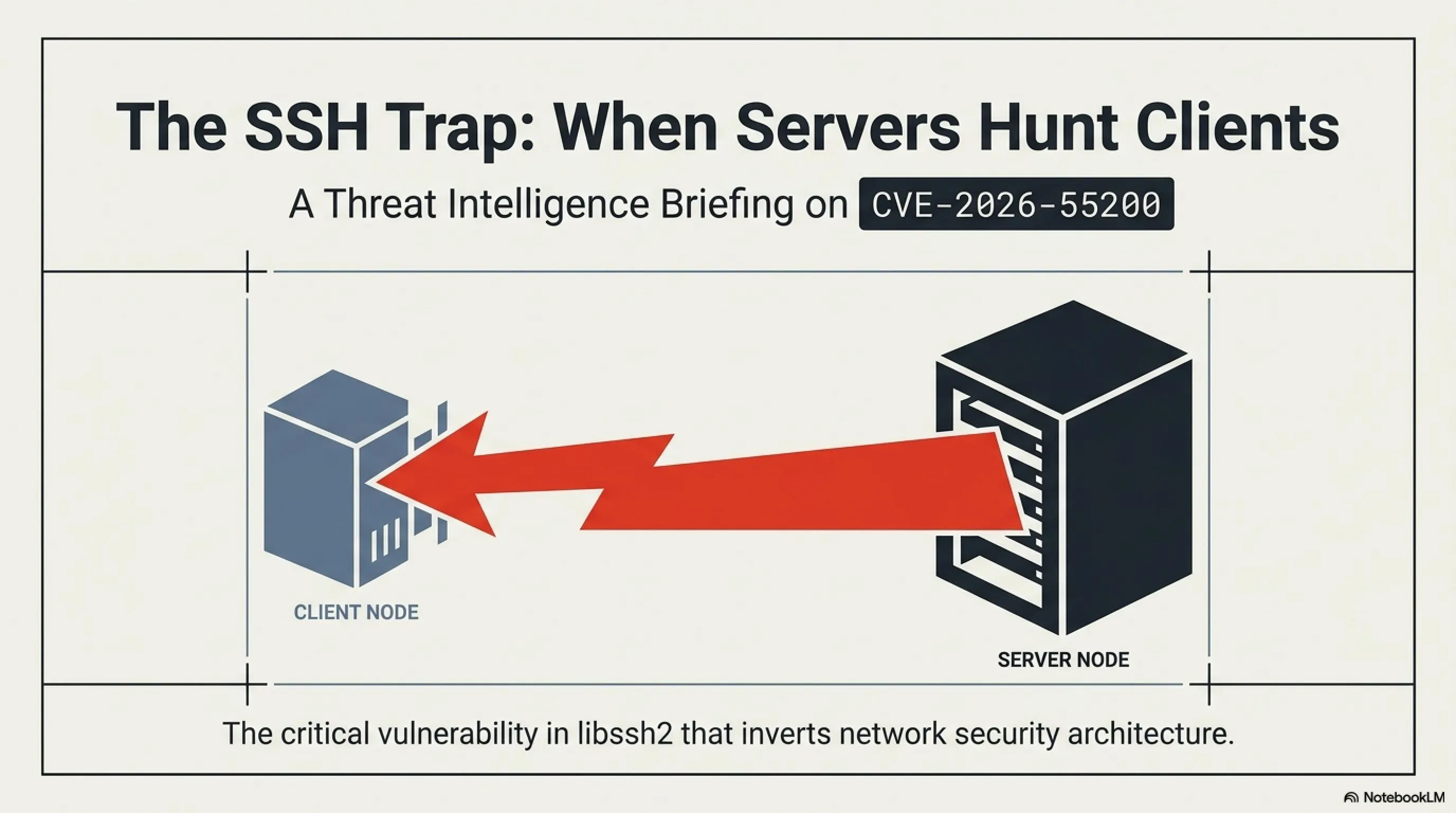
The SSH Trap: When Servers Hunt Clients
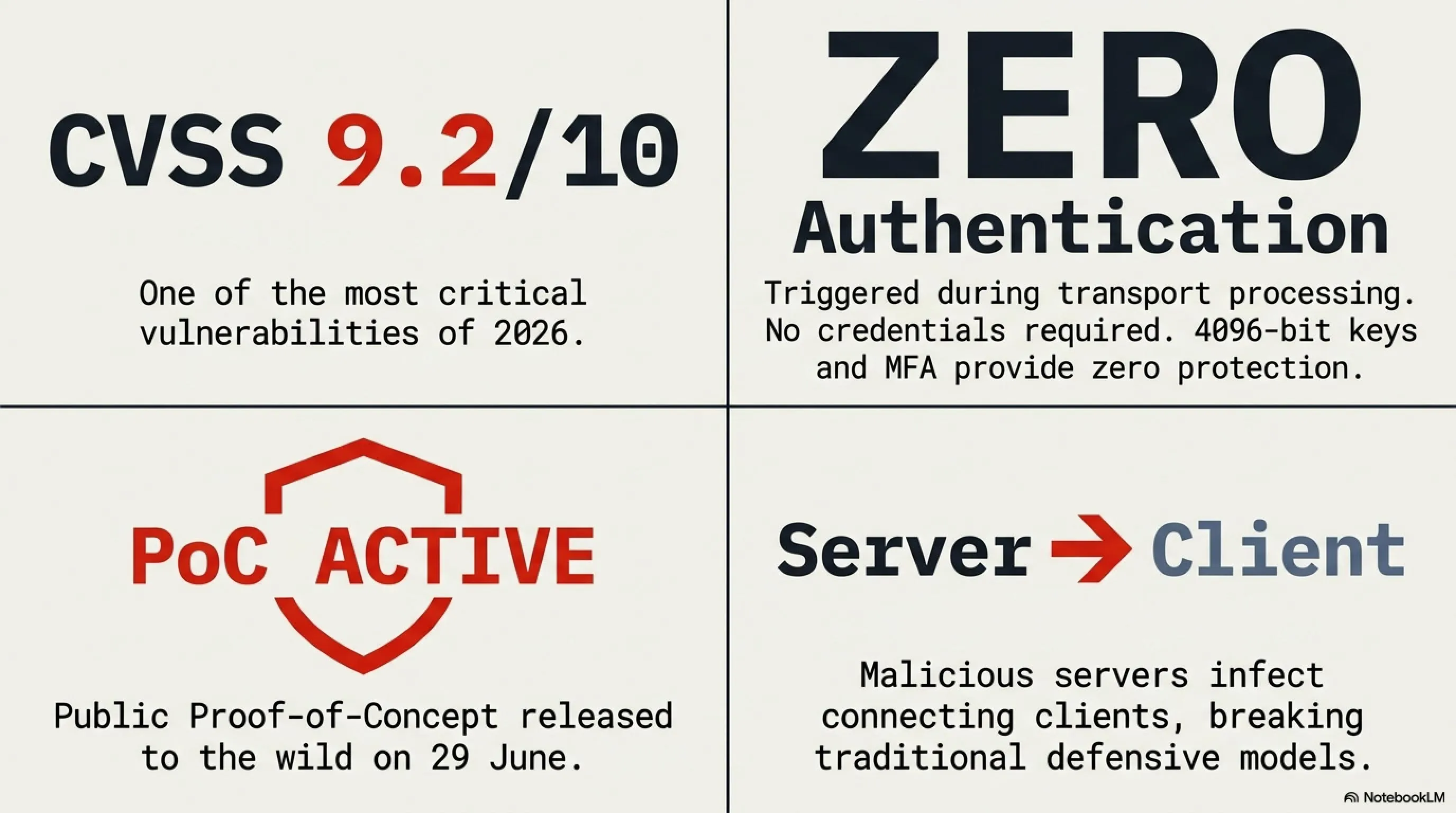
- 🎮CVSS 9.2/10- One of the most critical bugs of the year
- 🎧PoC Released- Public proof-of-concept code now available
- 🚀No Authentication- Zero credentials required for exploitation
- 🗡️Target: Clients- Malicious servers can infect connecting clients
On June 29, 2026, the cybersecurity community confronted an uncomfortable truth. One of the most fundamental SSH libraries powering the internet, libssh2, contains a critical vulnerability that completely inverts traditional security assumptions. This time, it's not the servers under attack—it's the clients.
CVE-2026-55200 is the designation for this bug. An out-of-bounds write flaw in the ssh2_transport_read() function, scoring 9.2 out of 10 on the CVSS v4.0 scale, positioning it among the most dangerous vulnerabilities discovered this year. But what makes this bug truly terrifying isn't just its severity—it's the direction of the attack vector.
At a Glance
- Critical vulnerability in libssh2 discovered with CVSS score of 9.2
- Malicious SSH servers can infect clients without any authentication
- Public Proof-of-Concept code has been released to the wild
- Millions of systems including cURL, IoT devices, and DevOps tools are at risk
The Inverted Attack Architecture
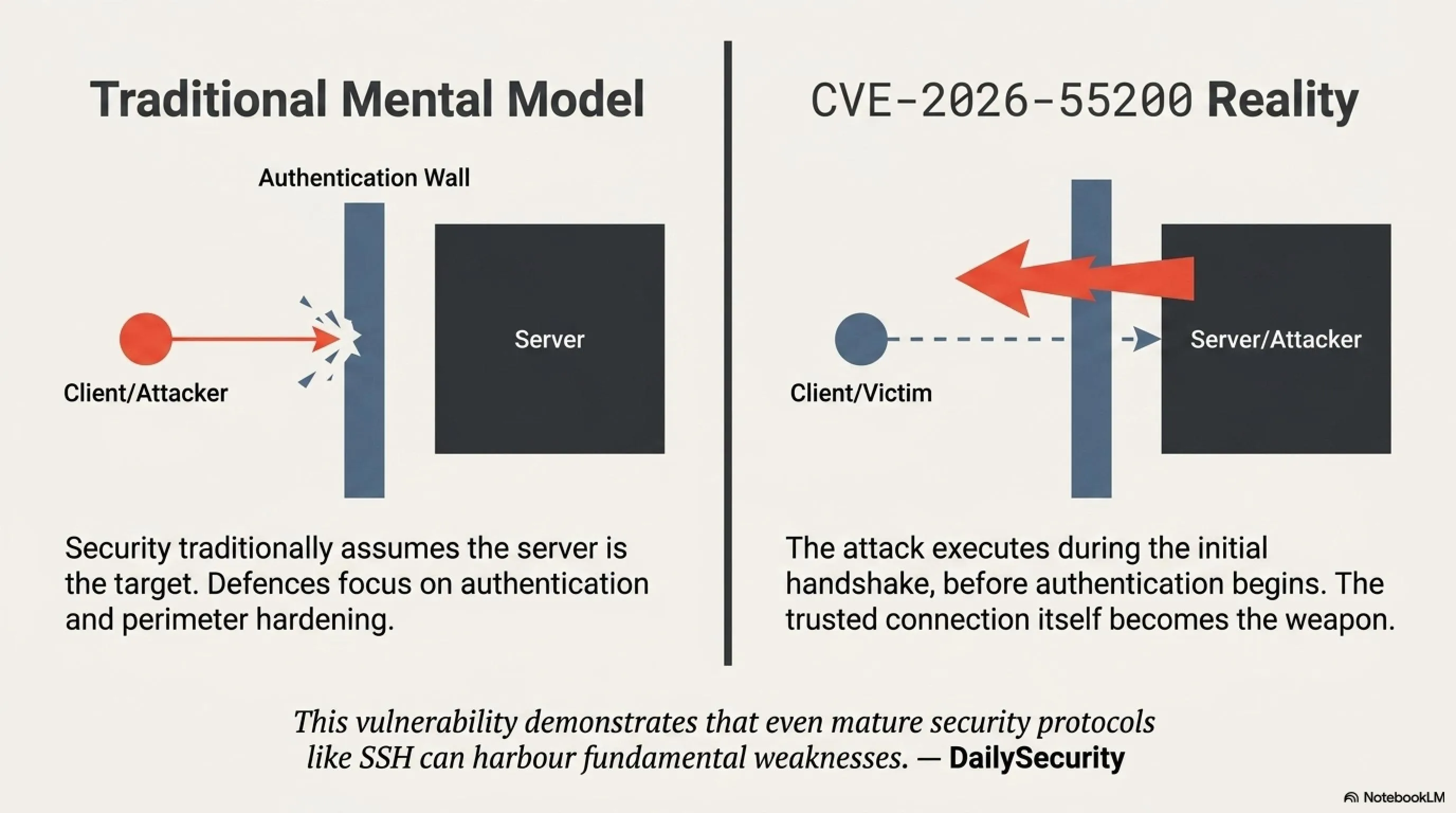
Traditional security models have always operated on a fundamental assumption: servers are the targets, and clients are the vulnerable parties seeking protection. CVE-2026-55200 obliterates this assumption entirely.
This vulnerability allows a malicious or compromised SSH server to infect any client that connects to it by sending specially crafted SSH packets. Research from DailySecurity reveals that the attack exploits a 32-bit integer overflow vulnerability.
When a server sends an excessively large packet_length value, the unchecked input causes integer wraparound, resulting in an undersized heap allocation. Subsequent write operations overflow this small allocation, leading to memory corruption and potential remote code execution on the connecting client.
Jargon Buster: Integer Overflow

Zero Authentication, Zero Interaction Required
Perhaps the most terrifying characteristic of this vulnerability is its exploitation simplicity. According to Cyberkendra's analysis, the attack requires absolutely no authentication. No username, no password, no SSH keys, no two-factor authentication.
The only requirement for a successful attack is that a victim connects to the attacker's malicious server. This means even if you maintain stringent security configurations, even if you use 4096-bit SSH keys, even if you have MFA enabled everywhere—the moment you execute that ssh command to an untrusted server, the game is over.
OSG-HTC research emphasizes that this vulnerability triggers during SSH transport processing—meaning it occurs before the authentication phase even begins. The attacker can infect the client within the first few seconds of the handshake, before any credentials are exchanged.
Why This Matters
The Scope of Exposure
The question everyone should be asking: who is at risk? The answer is straightforward and sobering: virtually everyone. libssh2 is a client-side library silently embedded in millions of systems worldwide.
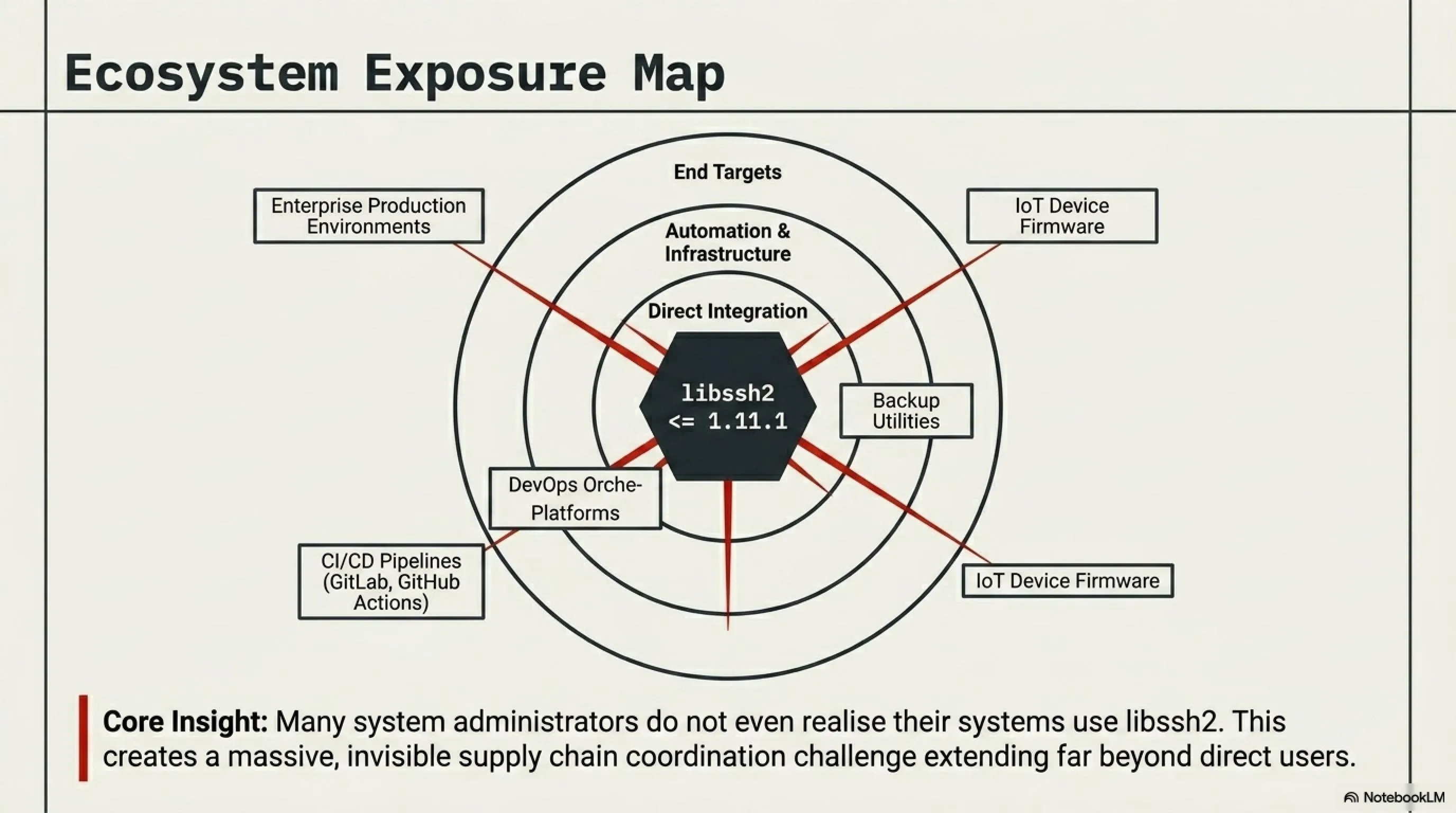
According to the GitHub Advisory Database, this vulnerability affects all versions of libssh2 up to and including 1.11.1. This represents years of accumulated vulnerable code deployed across production systems globally.
Cyberkendra's report notes that this library is silently embedded in software like cURL, backup utilities, and IoT device firmware across the planet. Many system administrators don't even realize their systems use libssh2.
Critical Infrastructure at Risk
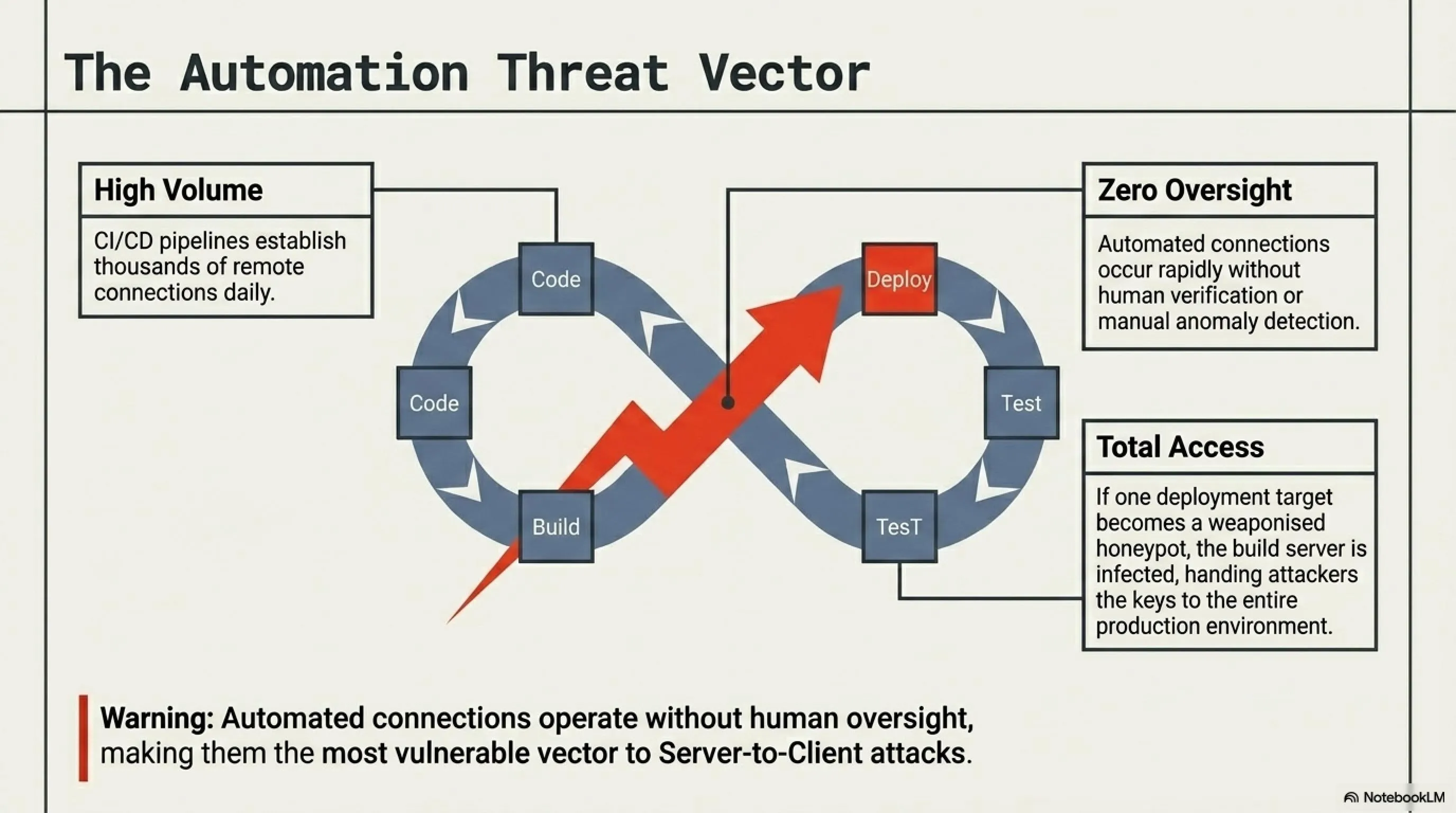
Data transfer tools like cURL, which leverage libssh2 for SCP and SFTP protocols, sit on the front lines of this threat. CI/CD systems that establish thousands of remote connections daily face serious exposure.
IoT devices using SSH for firmware updates may represent the most vulnerable targets. These devices typically receive infrequent updates and may operate with vulnerable versions for years.
Enterprise backup systems, DevOps automation tools, and orchestration platforms all face potential compromise. Any system that automatically connects to remote servers via SSH without human oversight represents a high-value target for exploitation.
PoC Released: From Theory to Active Threat
On June 29, the situation deteriorated significantly. A public proof-of-concept exploit for this vulnerability was released into the wild. This transforms the threat from a theoretical concern into an immediate, actionable danger that any moderately skilled attacker can leverage.
SentinelOne's analysis confirms that the PoC demonstrates how a malicious SSH server can send crafted SSH packets containing oversized packet_length values to corrupt heap memory and achieve remote code execution within the context of any application linked against the vulnerable library.
VulnCheck rates this vulnerability at CVSS v4.0 score of 9.2. For perspective, this places it in the same severity tier as notorious bugs like Heartbleed and Log4Shell—vulnerabilities that caused industry-wide security incidents.
Comparison with Historical Vulnerabilities
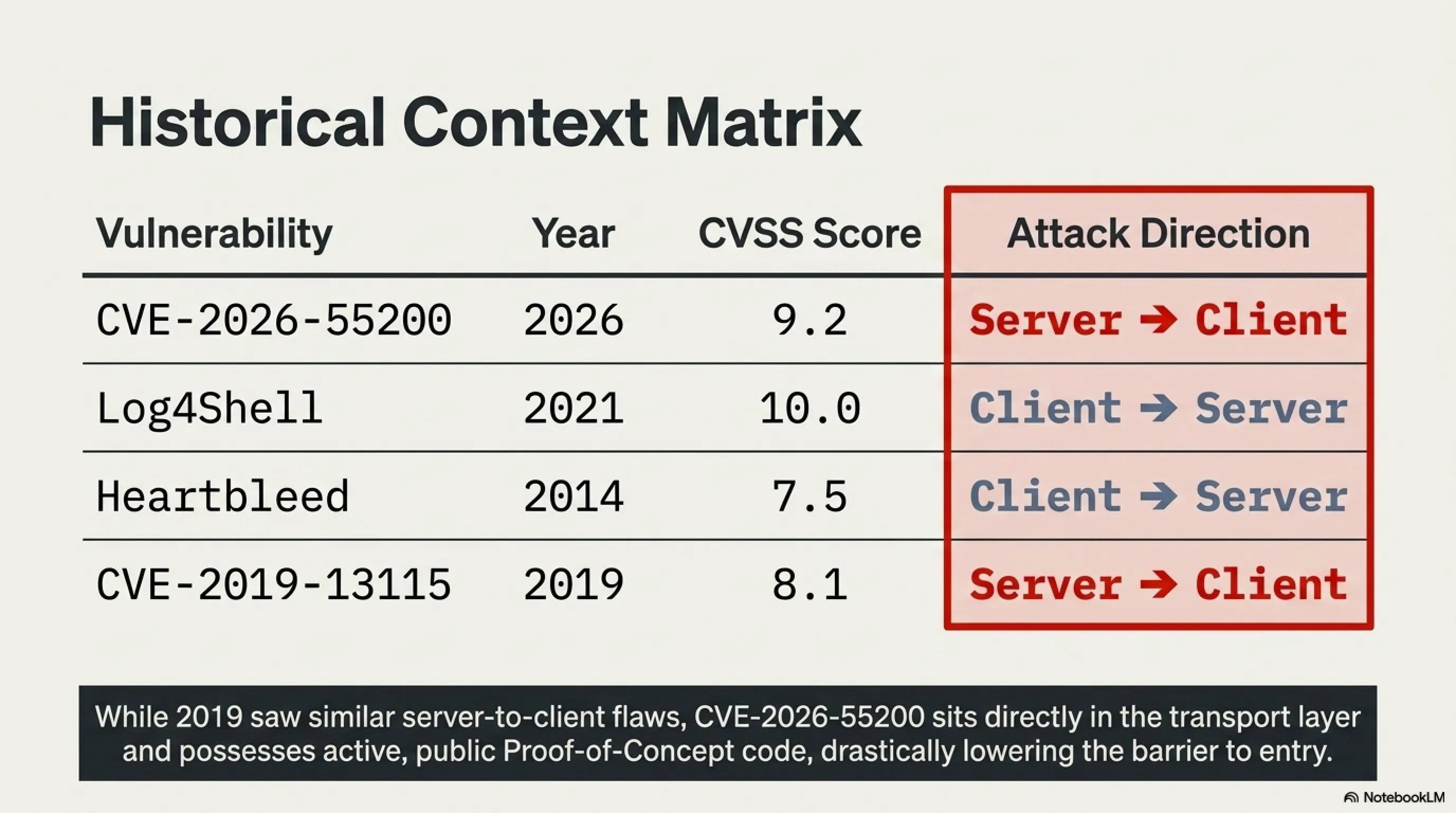
| Vulnerability | CVSS | Year | Attack Direction |
|---|---|---|---|
| CVE-2026-55200 | 9.2 | 2026 | Server → Client |
| Log4Shell | 10.0 | 2021 | Client → Server |
| Heartbleed | 7.5 | 2014 | Client → Server |
| CVE-2019-13115 | 8.1 | 2019 | Server → Client |
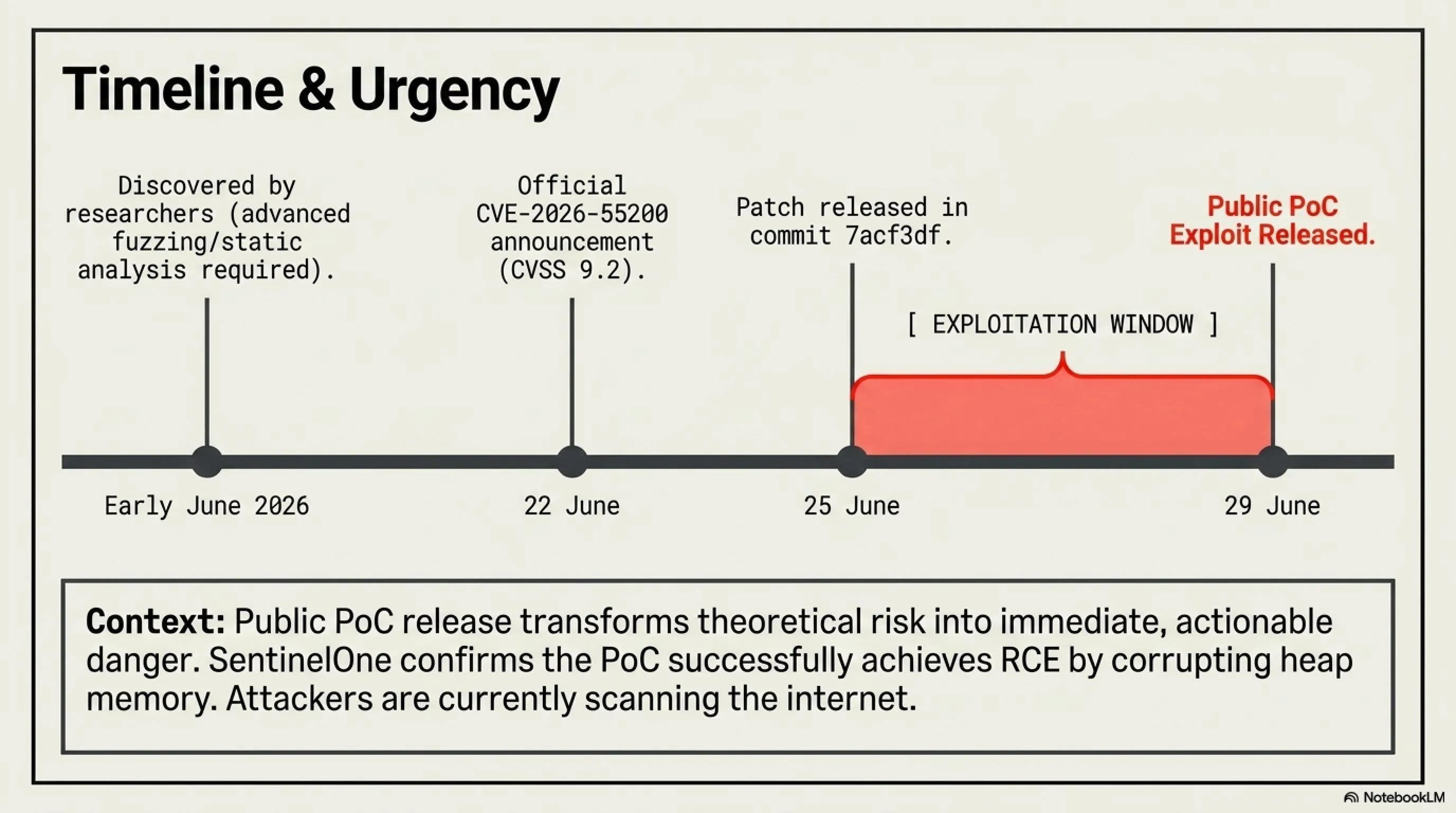
Timeline: From Discovery to Public Disclosure
- June 2026: Vulnerability discovered by security researchers
- June 22: Official CVE-2026-55200 announcement with CVSS 9.2 rating
- June 25: Patch released in commit 7acf3df
- June 29: Public release of Proof-of-Concept exploit code
📚 Classified & Related Dossiers in TekinGame
If you wish to explore beyond this report and delve into cybernetic frontiers and autonomous AI architectures, do not miss these three exclusive deep-dives in the Tekin Garage:
Real-World Attack Scenarios
Understanding how this vulnerability translates into practical attacks helps illustrate its danger. Multiple attack scenarios exist, each presenting unique risks to different environments.
Scenario One: SSH Server Honeypots
An attacker establishes a malicious SSH server masquerading as a legitimate service. When users or automated systems attempt connection, they're immediately compromised. This scenario poses exceptional danger to CI/CD tools that automatically connect to remote servers without human oversight.
Consider a typical DevOps pipeline: a build server connects to multiple deployment targets throughout the day. If even one of those targets becomes compromised and weaponized with this exploit, the entire build infrastructure falls.
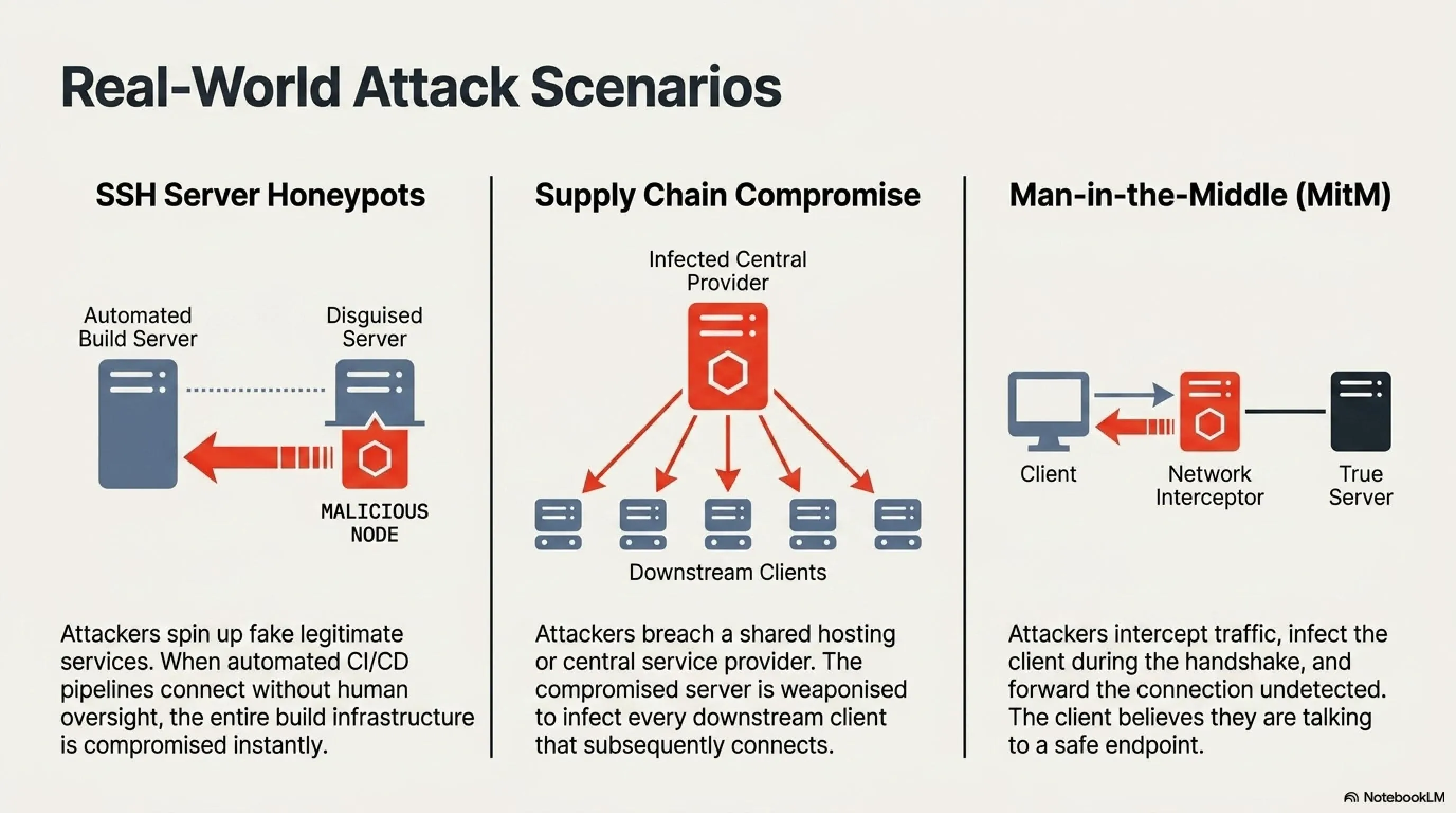
Scenario Two: Legitimate Server Compromise
If an attacker compromises a legitimate SSH server, they can weaponize it to infect every client that connects. This represents a classic supply chain attack—one compromised server can cascade into dozens or hundreds of compromised clients.
This scenario particularly threatens shared hosting environments or service providers where multiple clients connect to central servers. A single breach propagates across the entire customer base.
Scenario Three: Man-in-the-Middle Attacks
On insecure networks, attackers can position themselves as the SSH server and intercept traffic. Even if the client expects connection to a legitimate server, the attacker can infect the client before forwarding the connection, remaining undetected throughout the session.
Technical Deep Dive: Attack Anatomy
To fully comprehend this vulnerability's danger, we must examine its technical details. The flaw resides in the ssh2_transport_read() function, responsible for reading and processing incoming SSH packets.
This function should validate that received packet sizes fall within acceptable limits. While libssh2 defines an upper bound for received packet sizes, this limit isn't properly enforced—a subtle but catastrophic oversight.
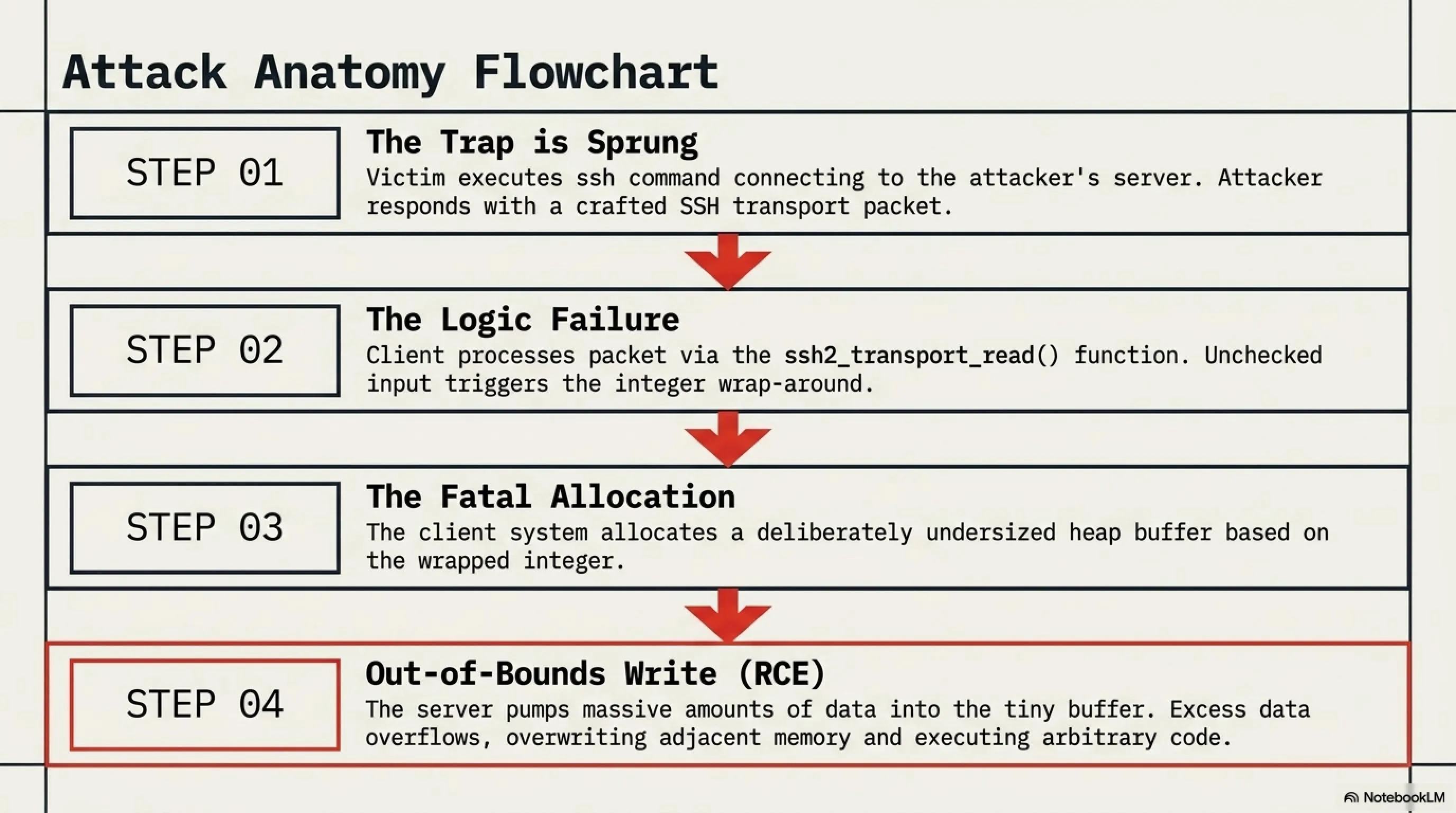
Step-by-Step Attack Progression
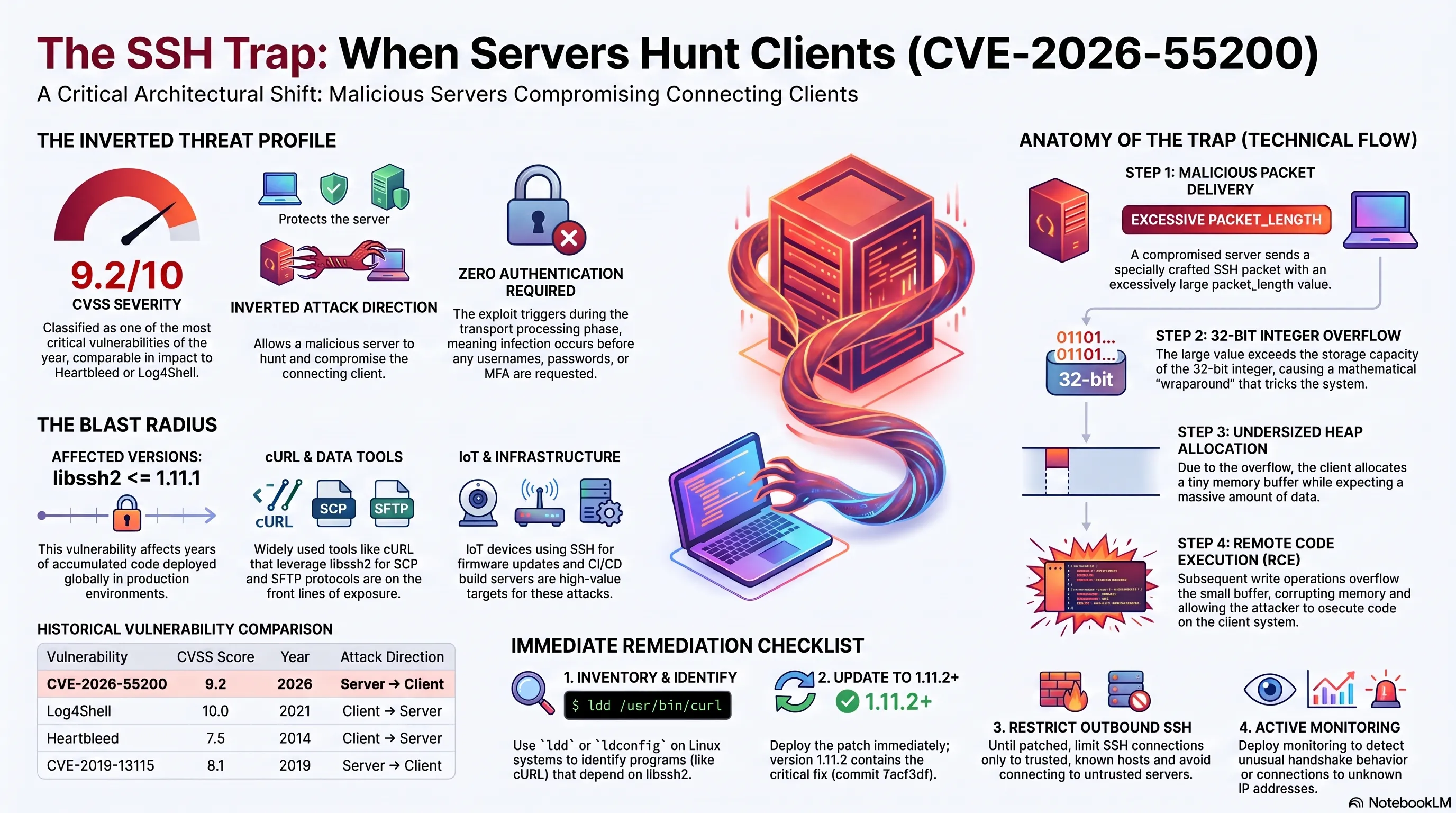
The attacker crafts an SSH packet with an excessively large packet_length field. When the vulnerable client receives this packet, ssh2_transport_read() attempts to allocate memory based on this value.
Here's where the critical failure occurs. The packet_length field uses a 32-bit integer. When an extremely large value approaches 4 gigabytes, the mathematical calculations determining actual buffer size trigger integer overflow.
The result: instead of allocating a large buffer, the system allocates a tiny one. The code then attempts writing massive amounts of data into this small buffer, triggering the out-of-bounds write that enables memory corruption and code execution.
What makes this particularly insidious is the subtlety of the bug. During normal operation, packet sizes remain well within safe bounds. Only when confronted with deliberately malicious input does the vulnerability manifest—making it nearly impossible to detect through standard testing.
Tekin Analysis: Why This Bug Remained Hidden
Historical Context: Comparing Similar Vulnerabilities
This isn't the first time an SSH library has suffered a critical vulnerability. Examining similar historical cases provides valuable perspective on the recurring nature of these security challenges.
In 2019, libssh2 experienced two other integer overflow vulnerabilities—CVE-2019-13115 and CVE-2019-17498. Both were triggerable during early connection stages and required no authentication. GitHub Security Lab discovered and reported both cases.
However, CVE-2026-55200 proves more dangerous than its predecessors because it sits directly in the transport layer and benefits from publicly available PoC code, significantly lowering the barrier to exploitation.
The pattern reveals itself: SSH libraries repeatedly struggle with input validation during initial connection phases. This suggests fundamental architectural reviews of handshake procedures across all SSH implementations may be warranted.
Impact on the Broader Ecosystem
This vulnerability isn't just a bug—it's a wake-up call for the entire industry. Numerous open-source projects depend on libssh2, and all must now undergo immediate updates.
cURL, one of the world's most widely deployed data transfer tools, uses libssh2 for SFTP and SCP protocols. The cURL development team immediately warned that all users must migrate to newer versions with updated libssh2.

GitLab, GitHub Actions, and other CI/CD platforms must also audit their systems. Any system that automatically connects to remote servers via SSH faces exposure.
Supply Chain Implications
The dependency chain extends far beyond direct libssh2 users. Applications that depend on cURL indirectly depend on libssh2. This creates cascading vulnerability where a single library flaw propagates across thousands of downstream projects.
Package managers and dependency scanning tools must now identify all affected packages and trigger security advisories across the entire ecosystem. This represents a massive coordination challenge affecting countless organizations worldwide.
Looking Forward: What to Expect
Public PoC release typically precedes a rapid surge in attacks over subsequent weeks. Security researchers anticipate that malicious groups will soon begin scanning the internet for vulnerable systems.
Conversely, this incident will likely prompt other SSH projects to audit their code more carefully. OpenSSH and libssh will probably conduct comprehensive security audits.
Security organizations like CISA and NIST may publish new guidelines for secure coding in cryptographic libraries. This vulnerability demonstrated that input validation in low-level protocol layers proves absolutely critical.
Immediate Actions for System Administrators
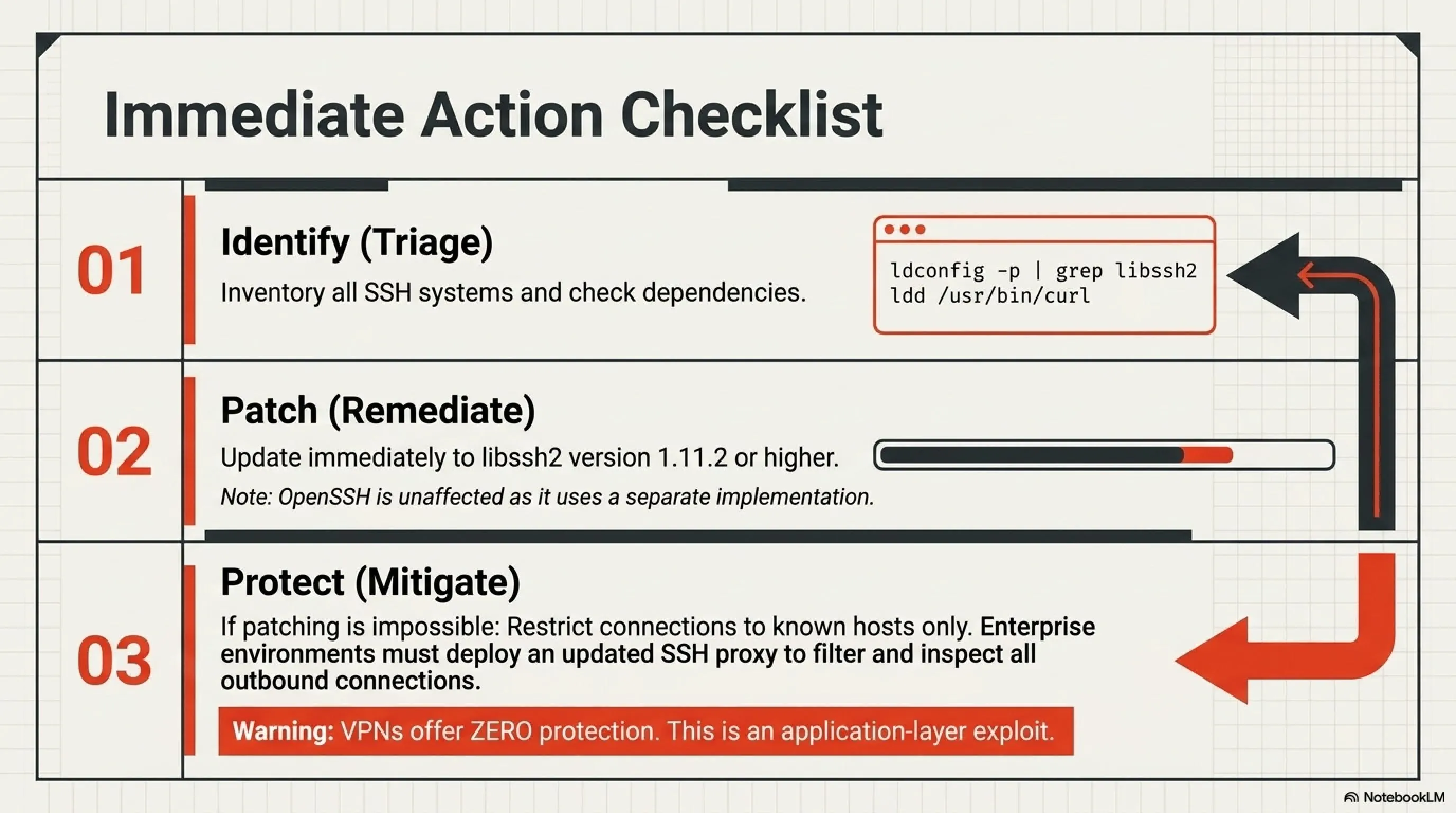
The first step involves identifying all systems using libssh2. On Linux systems, you can use ldd to check which programs depend on this library.
Next, update immediately to version 1.11.2 or higher. For systems where immediate updates aren't feasible, restrict SSH connections to trusted servers only and avoid connecting to unknown hosts.
For enterprise environments, consider deploying an SSH proxy that filters and inspects all connections. Implement active monitoring on all SSH connections to identify suspicious behavior.
Security Checklist
First, inventory all systems using SSH. Then check their libssh2 versions. If running version 1.11.1 or lower, you're vulnerable.
For production servers where immediate updates aren't possible, a temporary solution involves routing all outbound SSH connections through a proxy running the updated version.
Deploy rigorous monitoring on all SSH connections. Any attempts to connect to unknown IPs or unusual handshake behavior should immediately trigger alerts.
Final Thoughts
CVE-2026-55200 serves as a sobering reminder that cybersecurity remains a perpetual battle. This vulnerability demonstrated that even mature, widely-used protocols like SSH can harbor dangerous weaknesses.
The fascinating aspect is how this attack inverts traditional security architecture. We've always learned to protect servers, but this time clients are the targets. This paradigm shift should compel us to rethink our security models fundamentally.
The public PoC release transforms this threat from theoretical risk into immediate, actionable danger. Every organization using SSH—which practically means everyone—must act immediately.
The security community must adapt to this new reality where trust assumptions work in reverse. Defense-in-depth strategies must account for malicious infrastructure, not just malicious clients.
This incident also highlights the critical importance of rapid security response. The window between disclosure and exploitation shrinks constantly. Organizations that delay updates or dismiss advisories expose themselves to catastrophic risk.
Frequently Asked Questions
How do I know if my system is vulnerable?
On Linux, run <code>ldconfig -p | grep libssh2</code> to check the installed version. If it's version 1.11.1 or lower, you're vulnerable. You can also use <code>ldd /usr/bin/curl</code> to see if your cURL depends on libssh2.
Will using a VPN or proxy protect me?
No. This vulnerability exists at the application layer, not the network layer. Even through a VPN, if you connect to a malicious server, you're vulnerable. The only protection is updating to the patched version.
Are only manual connections at risk?
No, all SSH connections are vulnerable, including automated ones. CI/CD tools, automated backup systems, and cron scripts using SSH are all at risk. In fact, automated connections may be more dangerous because they operate without human oversight.
Why wasn't this bug discovered earlier?
Integer overflows typically require specific conditions to trigger. This bug probably existed in the code for years, but nobody ran the necessary tests to discover it. Only advanced fuzzing and deep static analysis reveal these types of bugs.
Is OpenSSH also vulnerable?
No. OpenSSH doesn't use libssh2 and has its own implementation. This vulnerability only affects the libssh2 library. However, clients using OpenSSH should still check if they have libssh2 installed for other purposes.
What should I do if compromised?
Immediately disconnect the system from the network. Revoke all SSH keys and stored credentials. Perform a complete forensic analysis to determine what data was compromised. Then rebuild the system from a clean backup and redeploy with the patched version.
Sources & References
- The Hacker News - Public PoC Released for Critical libssh2 CVE-2026-55200
- GitHub Advisory Database - CVE-2026-55200
- SentinelOne - libssh2 Remote Code Execution Vulnerability
- Daily Security Review - Public PoC Drops for Critical libssh2 Flaw
- CyberKendra - Critical libssh2 Flaw Enables Zero-Auth RCE
- Cybernews - Critical security flaw found in popular SSH library
- National Vulnerability Database - CVE-2026-55200
- OSG-HTC - Critical libssh2 RCE Vulnerability
Additional Gallery: 🚨 The SSH Trap: CVE-2026-55200 Flaw Lets Servers Hunt Clients