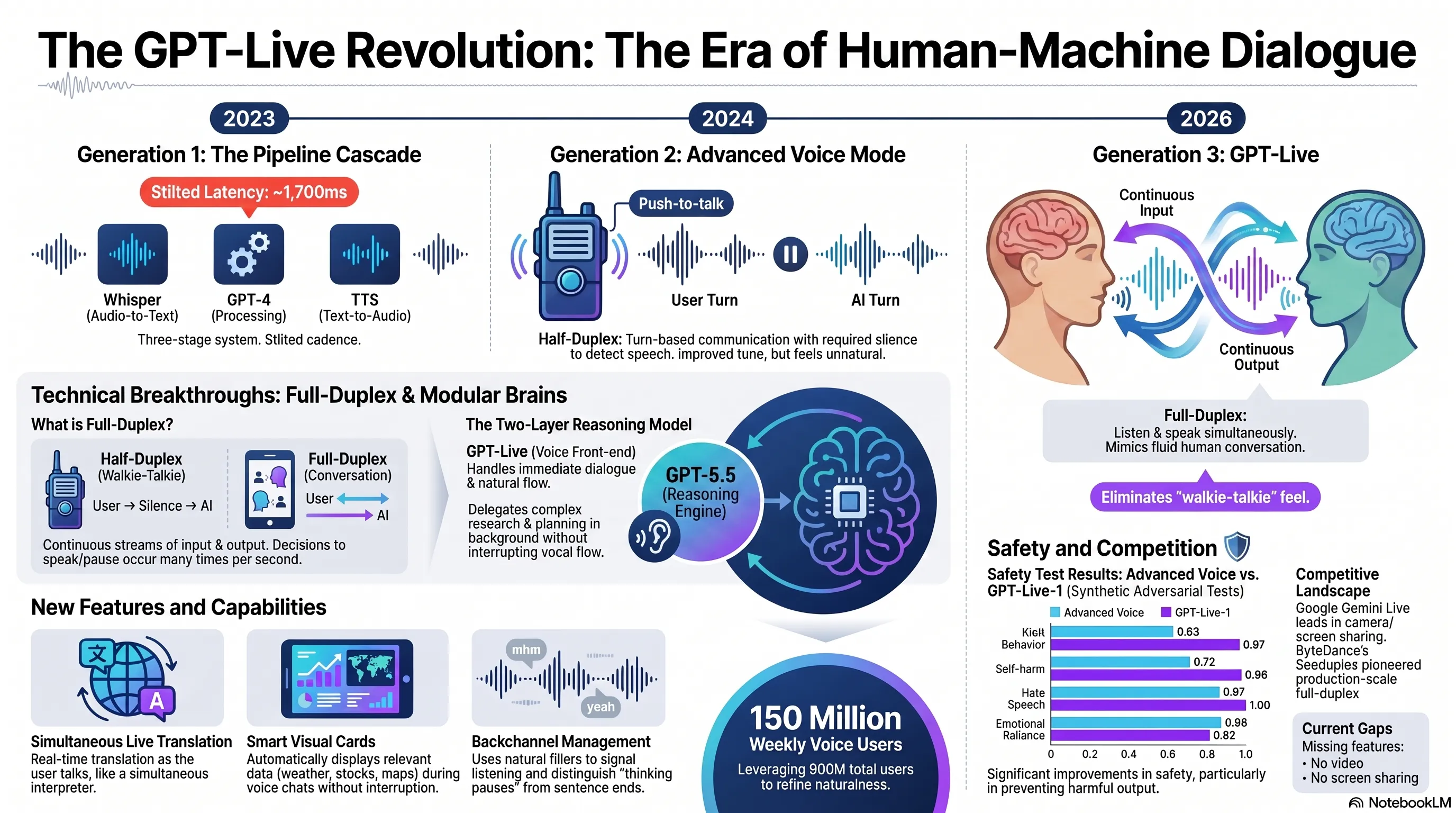
July 8, 2026, may be remembered by AI historians as the true turning point in human-machine interaction. OpenAI introduced GPT-Live-1 and GPT-Live-1 mini—the third generation of ChatGPT's voice technology—something genuinely different this time. It's not about intelligence anymore; it's about humanity. GPT-Live with full-duplex architecture can listen and speak simultaneously, just like a real human. This evolution from the 2023 three-stage pipeline cascade with 1,700ms latency, to the 2024 single-model turn-based Advanced Voice Mode, and now
When ChatGPT Learns to Shut Up: The GPT-Live Revolution
Why OpenAI's third-generation voice represents a fundamental shift from anything you've experienced before.
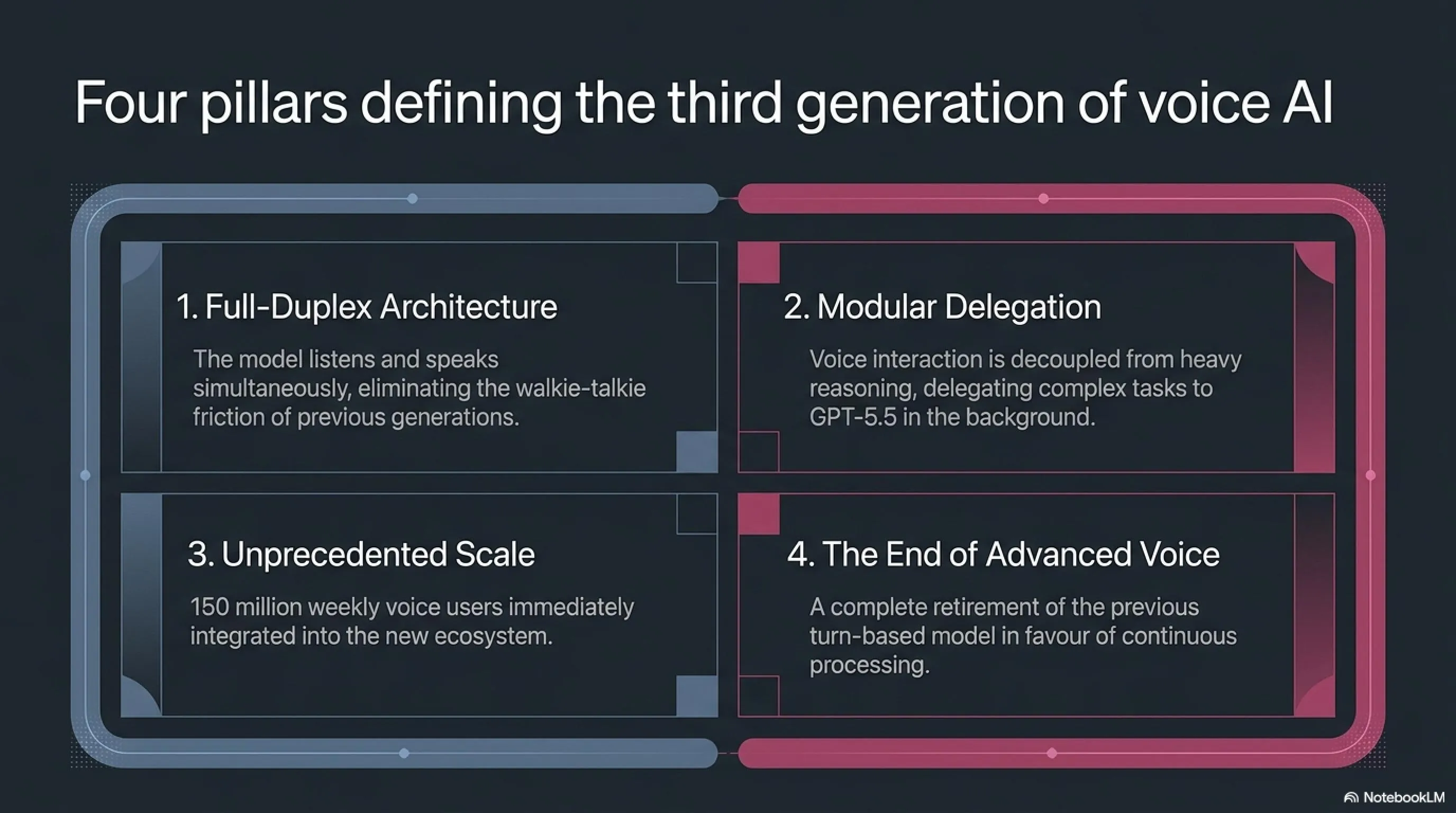
- 🎮Full-Duplex Architecture- Can listen and speak simultaneously, just like a human
- 🎧End of Advanced Voice Mode- OpenAI officially retired the previous model
- 🚀GPT-5.5 Integration- Delegates complex tasks to reasoning model in background
- 🗡️150M Weekly Users- Using ChatGPT Voice features every week
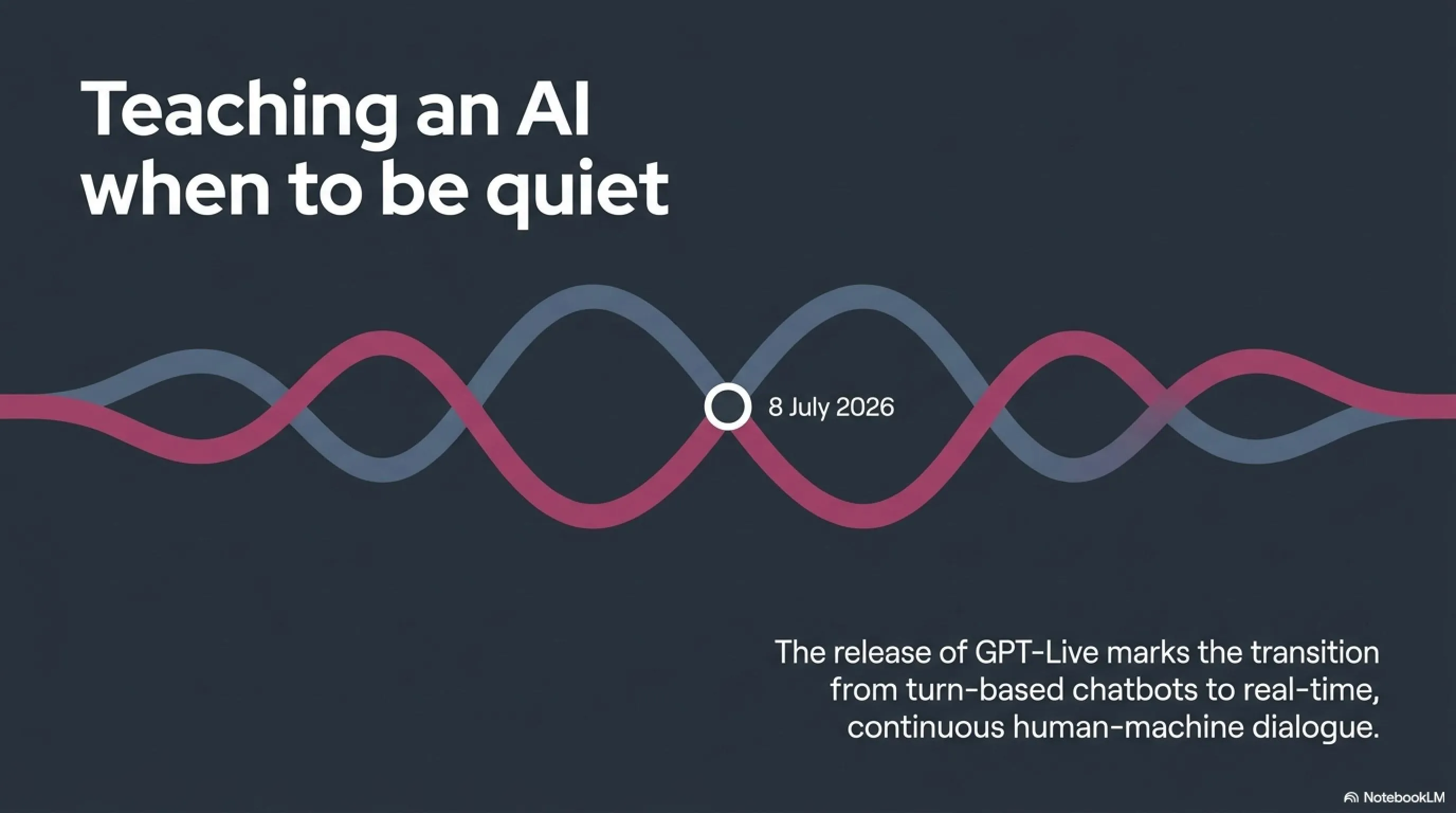
July 8, 2026, may be remembered by AI historians as the true turning point in human-machine interaction. Not because of a groundbreaking algorithmic breakthrough, not because of benchmark-shattering performance, but because of something deceptively simple: teaching an AI when to be quiet.
OpenAI, in an announcement that felt more like a quiet revolution than a product launch, introduced GPT-Live-1 and GPT-Live-1 mini—the third generation of ChatGPT's voice technology that is, this time, genuinely different. Kundan Kumar, OpenAI's research lead, called it the company's "smartest voice model" during a press briefing, but what sets it apart isn't intelligence—it's humanity.
Three Generations, Three Philosophies: A History of ChatGPT Voice
To understand why GPT-Live is revolutionary, we need to step back and see how we got here. The evolution of ChatGPT's voice is a story of three generations, each with its own architecture and limitations.
Generation One: The Pipeline Cascade (2023)
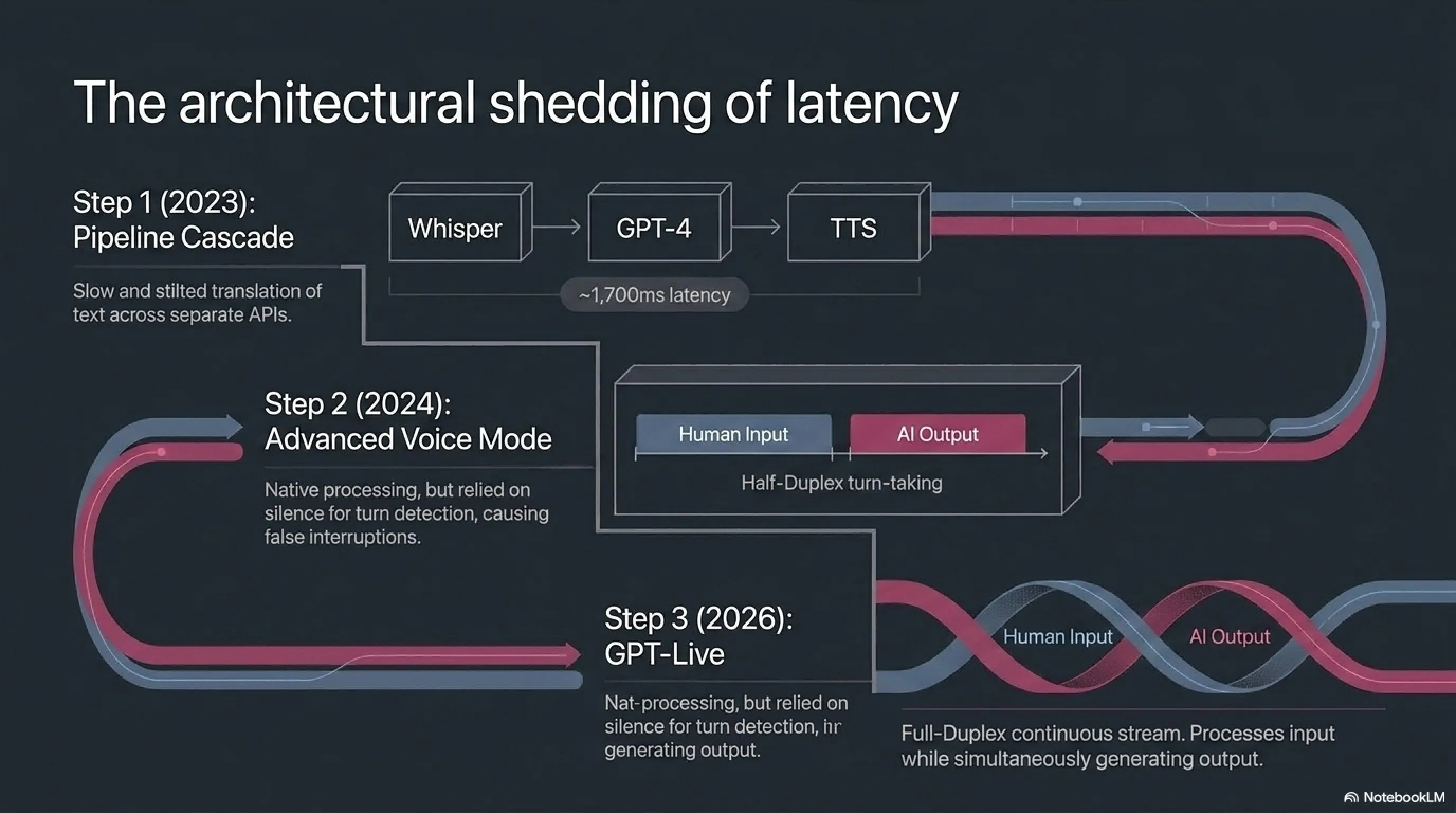
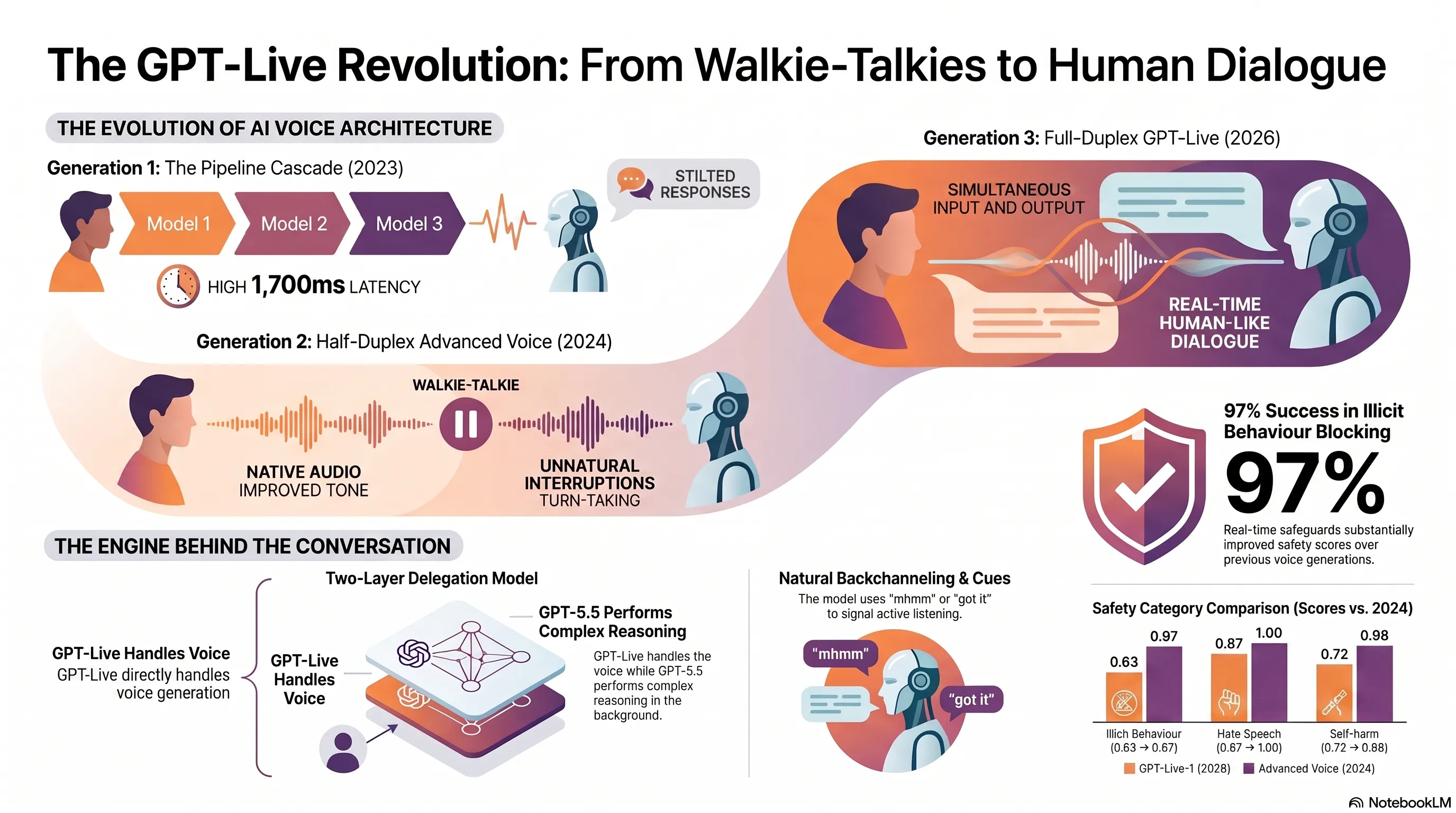
In 2023, OpenAI launched ChatGPT's first voice capability with a classic "pipeline cascade" architecture. This system had three separate models working in sequence:
Pipeline Cascade Architecture
Stage 1: Whisper (speech-to-text) converted your voice to text
Stage 2: GPT-4 processed the text and wrote a response
Stage 3: Text-to-Speech converted the response back to audio
Result: Latency of approximately 1,700 milliseconds—nearly two seconds of silence before the first word of response
This architecture had obvious problems. As OpenAI put it, "the complexity came at a cost: information could be lost across models, and responses were slow and stilted." The user experience was like talking to someone via satellite with a several-second delay.
Beyond the latency, managing state between three separate APIs was heavy engineering work. Each had its own inputs and outputs, and coordinating them for smooth conversation was nearly impossible.
Generation Two: Advanced Voice Mode (2024)
In July 2024, OpenAI collapsed that entire three-stage pipeline into a single model that processed audio natively with Advanced Voice Mode. This was a big leap—the model could better understand vocal nuances, tone, and even accents.
TechCrunch reported at the time that the feature launched with five new voices—Arbor, Maple, Sol, Spruce, and Vale—alongside improved accent handling and smoother conversations. In November 2024, the feature came to the web too, no longer confined to mobile.
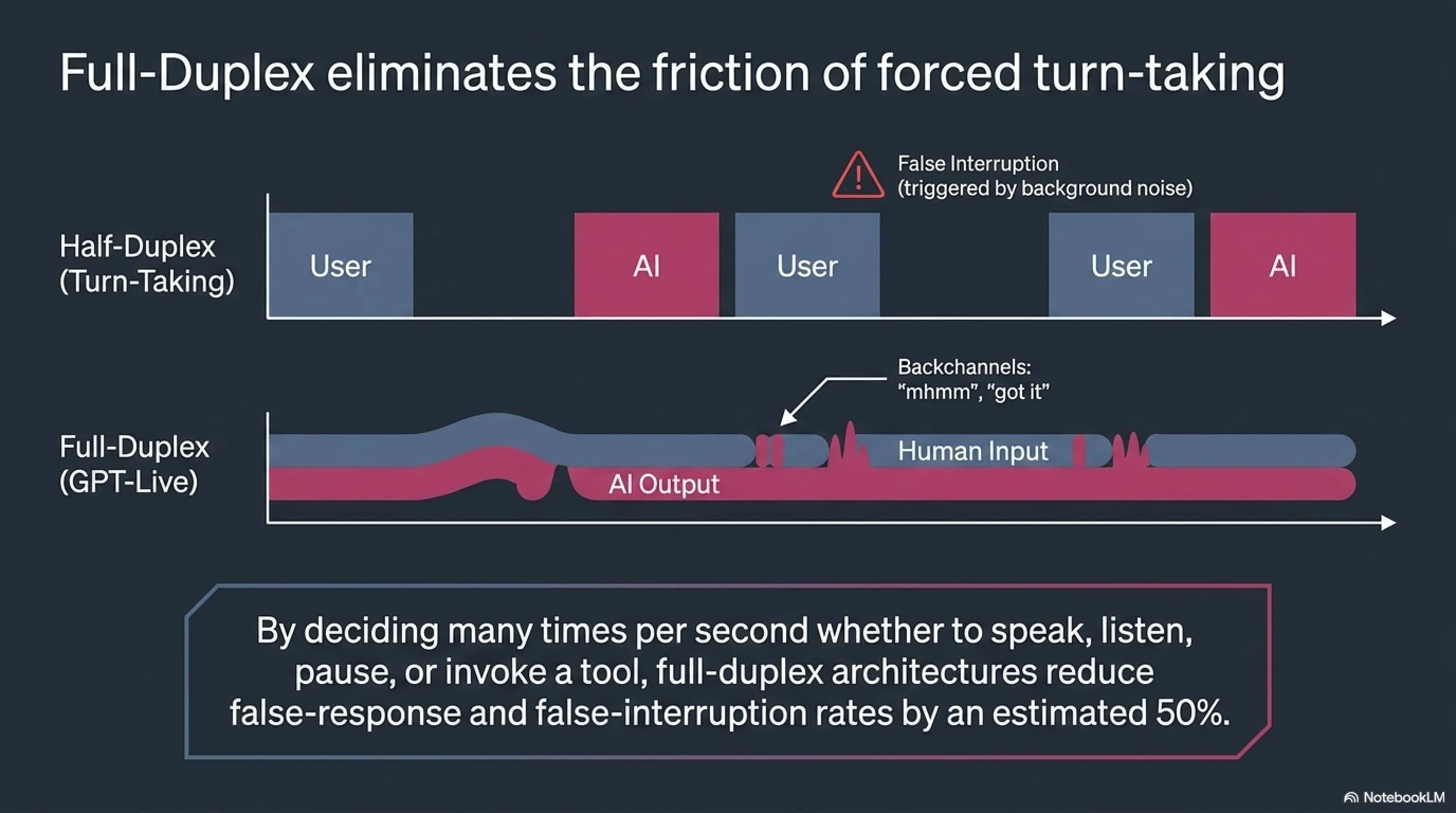
But Advanced Voice Mode had one fundamental limitation: it was turn-based. The model waited for you to finish speaking, then responded. This system relied on "silence" to detect the end of your turn—and that's where problems began.
Imagine you're thinking, you pause briefly, and suddenly ChatGPT starts talking and cuts off the rest of your sentence. Or you're sitting in a café, someone's voice rises in the background, and ChatGPT thinks you're done speaking. One user on X wrote that using Advanced Voice Mode felt like "walkie-talkie turn taking"—a description OpenAI would later reference.
Generation Three: GPT-Live (2026)
And now we've reached the third generation. GPT-Live-1 changes all the rules because it no longer waits for turns. This model is full-duplex—it can listen and speak simultaneously, just like a real human.
Atty Eleti, OpenAI's product lead, explained in the press briefing: "This is a full duplex model. What it really means is that it can speak and listen at the same time... From the model side, it can process the stream of inputs and produce the stream of output continuously and simultaneously."
What is Full-Duplex and Why Does It Matter?
The term "full-duplex" is borrowed from the telecommunications world. In a phone call, full-duplex means both parties can speak and hear each other simultaneously. In contrast, walkie-talkies are "half-duplex"—only one person can speak at a time.
When we apply this concept to AI, the difference is profound. GPT-Live continuously processes your incoming audio even while it's generating its own response. This means that:
- It can listen to you while it's speaking
- It can decide when to be quiet, speak, pause, or interrupt you
- It can show it's listening with short phrases like "mhmm," "yeah," or "got it"
- When you're thinking, it waits instead of jumping in
OpenAI wrote in its research blog: "Instead of processing a sequence of separate messages, GPT-Live continuously processes input while generating output. The model can therefore make interaction decisions many times per second: whether to speak, continue listening, pause, interrupt, or invoke a tool."
ByteDance, which pioneered with Seeduplex in April, claimed it reduced false-response and false-interruption rates by about 50 percent compared to its previous half-duplex system. This number shows the real importance of full-duplex—not just a cool feature, but a measurable improvement in user experience.
Two-Layer Architecture: Intelligence Separate from Voice
But GPT-Live isn't just full-duplex. OpenAI has made another architectural decision that may be even more important in the long run: separating the voice interaction layer from the reasoning layer.
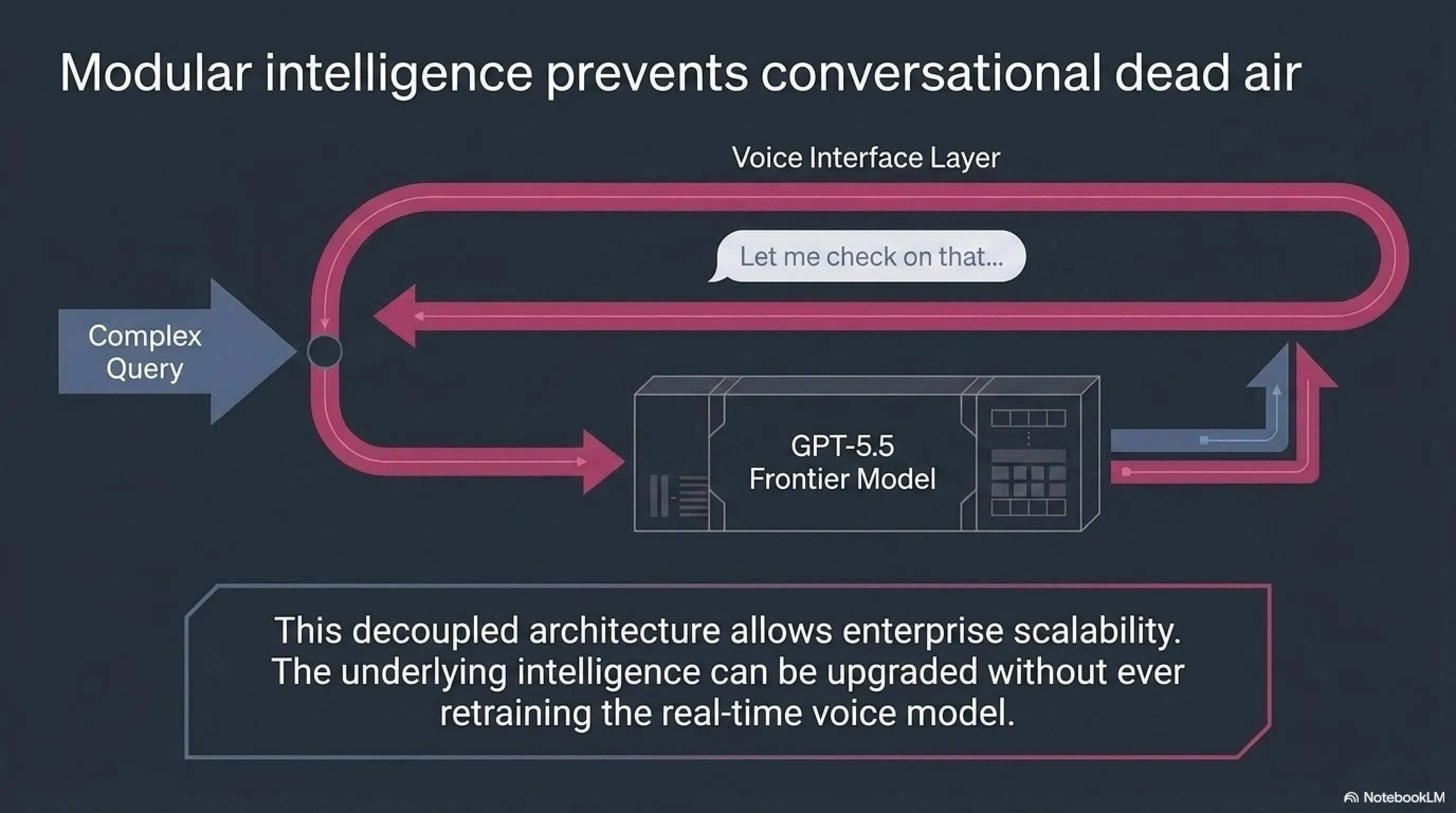
When you ask a simple question, GPT-Live responds directly. But when your query requires web search, deeper reasoning, or more complex agentic work, GPT-Live delegates the task to a frontier model running in the background—at launch, this is GPT-5.5—and continues talking to you while the computation happens.
Delegation Model in GPT-Live
Simple Query: GPT-Live responds directly
Complex Query: Task delegated to GPT-5.5 while GPT-Live continues conversation
Result: Conversation isn't interrupted and user experiences no long silence
OpenAI: "While work is being done, GPT-Live can continue talking to you and maintain conversation flow."
This is a meaningful architectural bet. Instead of building a monolithic voice model that's both smooth at interaction and powerful at deep reasoning, OpenAI has split the problem into two parts: a voice model optimized for real-time interaction, and a separate reasoning engine that can be swapped as the state of the art advances.
This is modular design—design that allows OpenAI to upgrade its voice assistant's intelligence without retraining the voice model. The implications of this approach for organizations and developers are significant. A voice agent built on this architecture can maintain natural conversation with a customer while simultaneously querying databases, searching the web, or performing multi-step reasoning—tasks that in the old pipeline would create multiple seconds of silence.
The Great Voice War: What Are Competitors Doing?
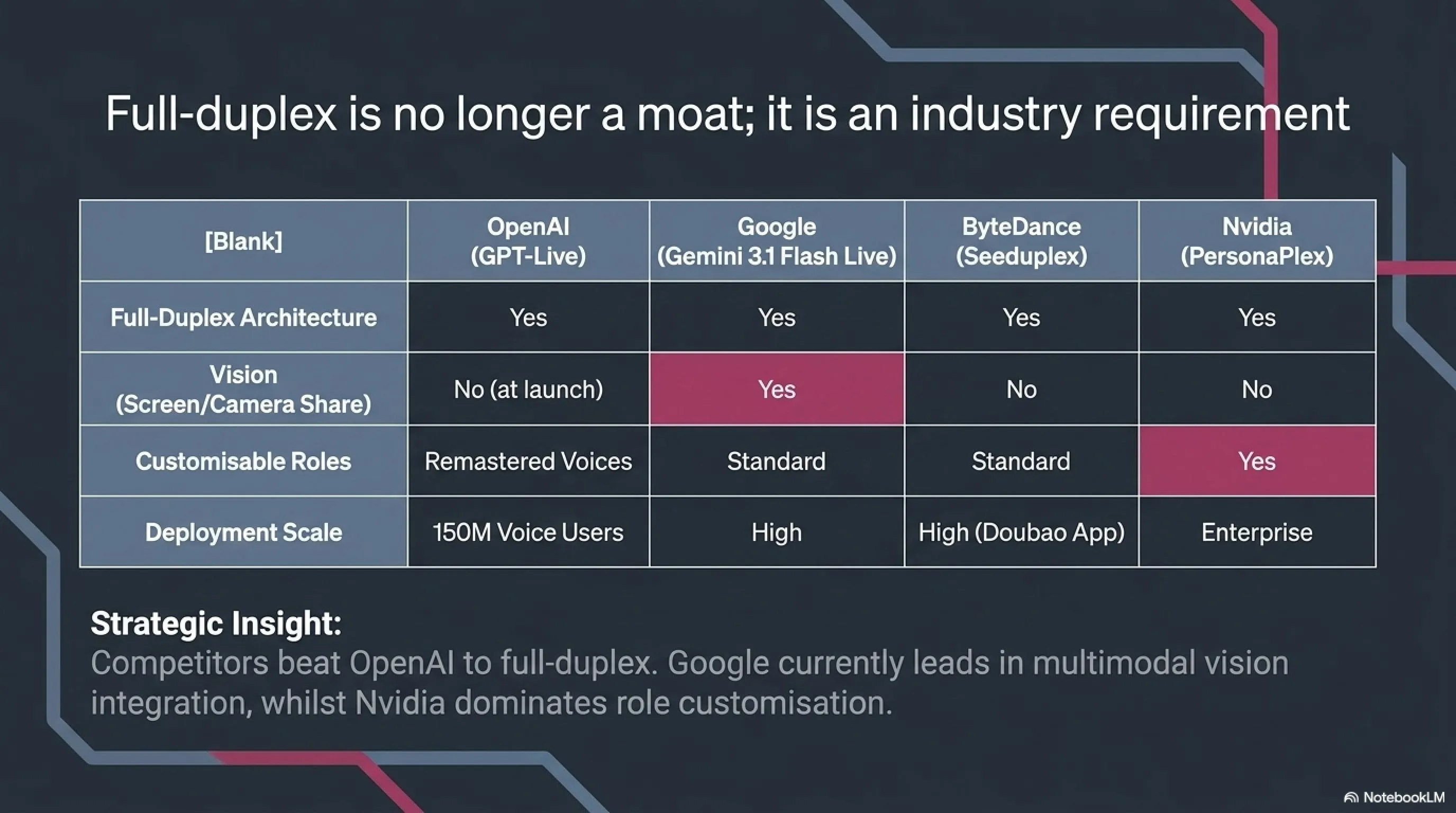
OpenAI isn't alone in this journey. In fact, in some respects, it's late to the game. Google with Gemini Live and ByteDance with Seeduplex had already implemented full-duplex capability, and now the market has turned into a battlefield where every tech giant is trying to deliver a more natural voice experience.
Competitor Status in Full-Duplex War
Google Gemini Live: Full-duplex capability alongside camera and screen sharing—something GPT-Live doesn't have at launch
ByteDance Seeduplex: Claims 50% reduction in false-response and false-interruption rates compared to half-duplex system
Nvidia PersonaPlex: Customizable voice and role control in full-duplex models
Result: The window of exclusivity for any company has closed—full-duplex is no longer a competitive advantage but a requirement
Google Gemini Live, launched with Gemini 3.1 Flash Live in March, is ahead of GPT-Live in some aspects. This system supports not just full-duplex conversation but also camera and screen sharing—capabilities GPT-Live lacks at launch.
ByteDance also claimed in April with Seeduplex that it was the first production-scale full-duplex system deployed in its Doubao app. They reported reducing false-response and false-interruption rates by about 50 percent compared to their previous half-duplex system.
Nvidia also brought customizable voice and role control to full-duplex models with PersonaPlex, released in January—a capability that had been a constraint where natural-sounding models were locked into a single fixed voice.
OpenAI's Advantage: Ecosystem and Scale
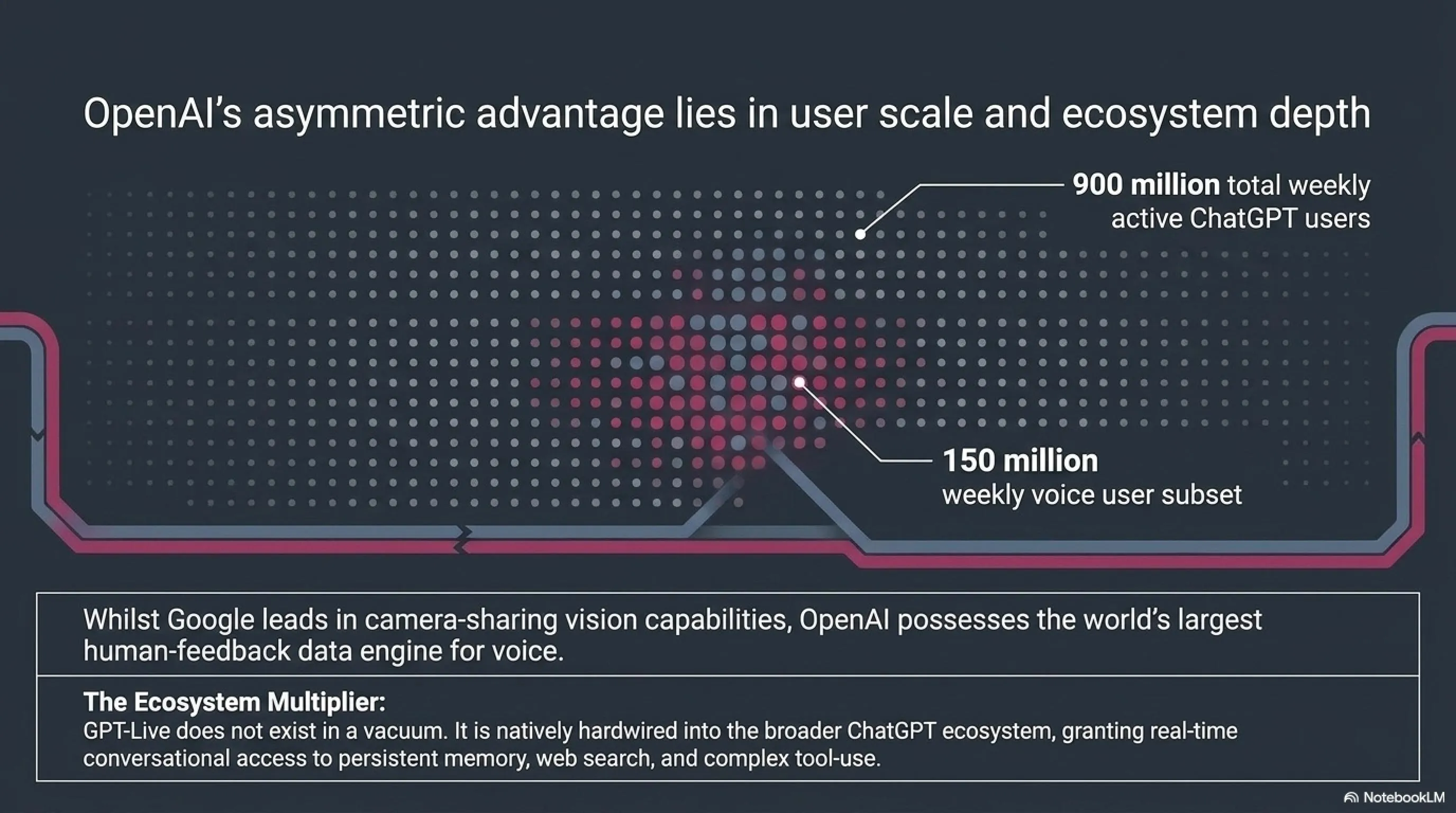
Despite fierce competition, OpenAI has one key advantage: scale. With 900 million weekly active ChatGPT users and over 150 million people using voice features every week, OpenAI has the largest user base for testing and improving voice models.
Moreover, GPT-Live's connection to the broader ChatGPT ecosystem—from web search to various tools and memory—is something competitors have yet to fully replicate. When GPT-Live needs deep reasoning, it connects to GPT-5.5; when it needs to search, it accesses the web—and all this happens while maintaining smooth conversation.
New Features That Transform the Experience
GPT-Live isn't just a technical upgrade. OpenAI has introduced a set of new features that significantly improve user experience.
Smart Visual Cards
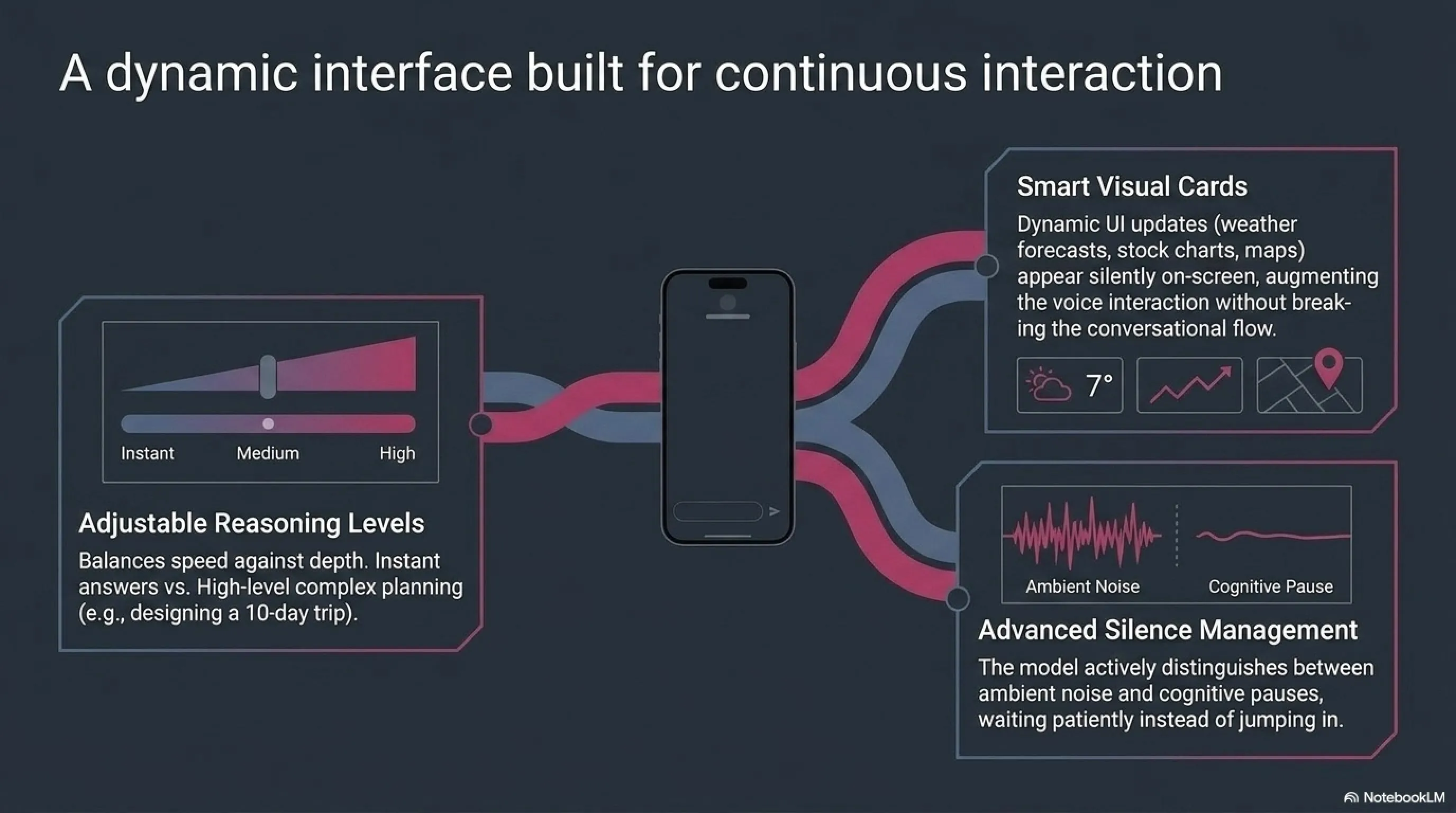
One of the most attractive additions is rich visual cards that appear during voice conversations. Now when you ask ChatGPT about weather, a weekly forecast card displays. Stocks? Price chart. Sports results? Scoreboard. Maps? Route display.
New GPT-Live Features
- Visual Cards: Display weather, stocks, sports, and maps during conversation
- Three Reasoning Levels: Instant, Medium, and High to control speed vs. depth
- Smart Waiting: Recognizes pauses for thinking and avoids interrupting
- Listening Mode: Can be instructed to stay quiet and only listen
This feature is subtle but important. You no longer need to interrupt conversation flow to look at the screen—information appears naturally alongside your speech.
Adjustable Reasoning Levels
OpenAI introduced three reasoning levels for responses: Instant for quick answers, Medium for moderate thinking, and High for more complex work. This gives users control over the balance between speed and depth.
In practice, this means for simple questions like "what time is it?", GPT-Live responds immediately. But for something like "design a 10-day Japan trip on a limited budget," you can select High level so the model spends more time researching and planning.
Silence and Backchannel Management
One of the cleverest improvements is in how silence is managed. GPT-Live can distinguish between a pause for thinking and the end of your speech. If you're thinking, it waits. If ambient noise gets loud, it doesn't get distracted.
OpenAI wrote: "ChatGPT Voice now waits instead of jumping in and interrupting. If you ask it to stay quiet and listen, it will. And when there's background noise, like passing traffic or nearby conversations, ChatGPT is better at focusing on your voice instead of getting distracted."
Additionally, GPT-Live can show it's listening with short phrases like "mhmm," "yeah," or "got it"—something that gives conversation a more natural feel. This "backchanneling" is a small but important feature that marks the difference between talking to a machine and a colleague.
Live Translation: The Future of Multilingual Communication
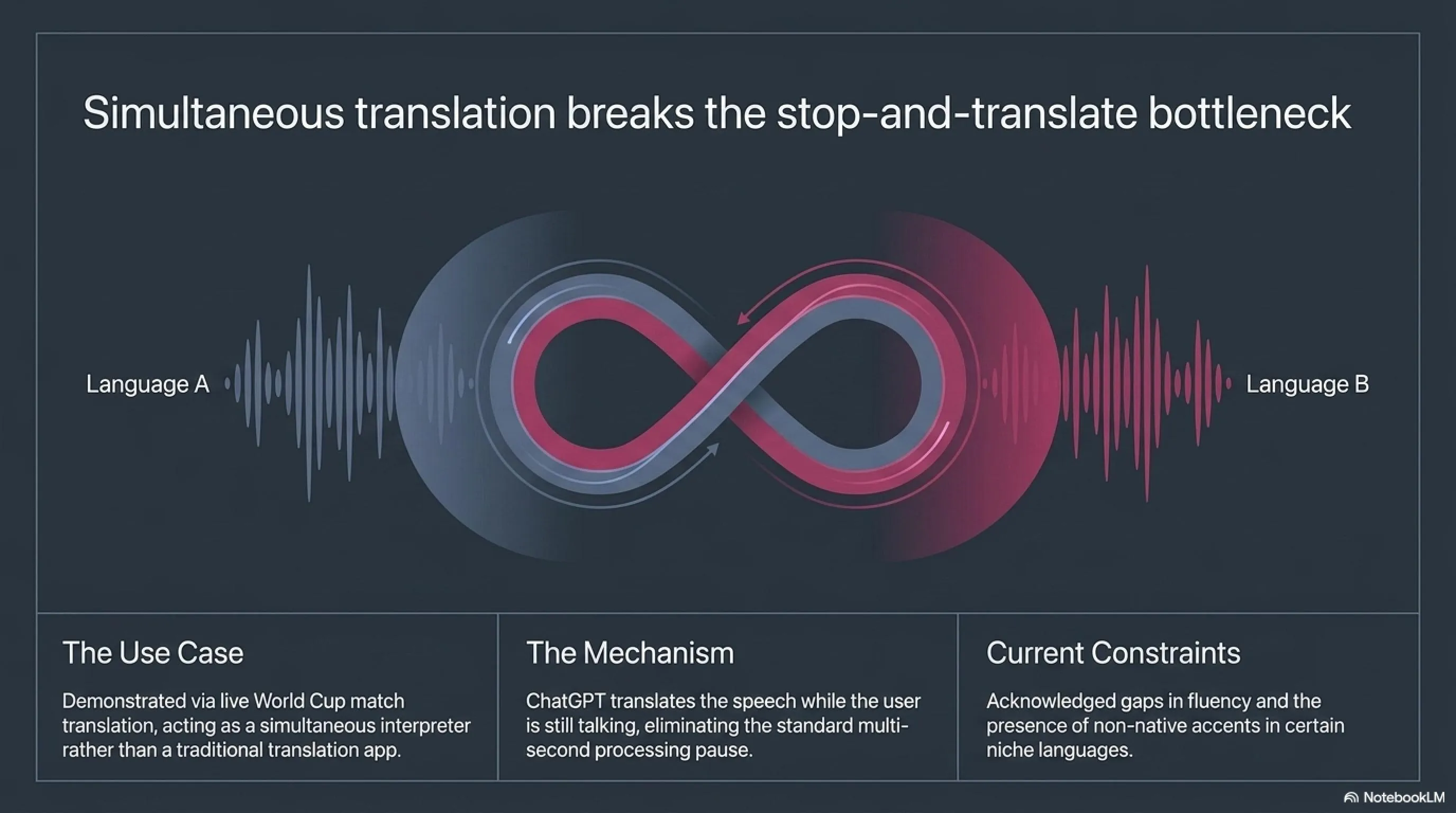
One of the most exciting applications of full-duplex architecture is live translation. Now instead of waiting for you to finish your entire sentence and then translate it, ChatGPT can translate simultaneously as you speak.
OpenAI wrote in its blog that "instead of waiting until you stop talking to translate your speech, ChatGPT can translate while you talk." This capability could have wide applications in international calls, travel, and even language learning.
Of course, live translation isn't perfect yet. OpenAI admitted that "for certain languages, the model may have a non-native accent or gaps in fluency." But even with these limitations, it's a big step forward.
Behind the Safety Curtain: New Challenges of Smart Voice
As voice models become more powerful, security and ethical concerns grow more complex. OpenAI, in the system card published alongside GPT-Live, revealed its safety strategy specifically designed for real-time voice interaction risks.
Voice-Specific Safety Tests
OpenAI introduced a set of voice-centric safety assessments using real user voice samples (from those who opted in) as well as synthetic prompts deliberately targeting risky scenarios.
GPT-Live Safety Test Results
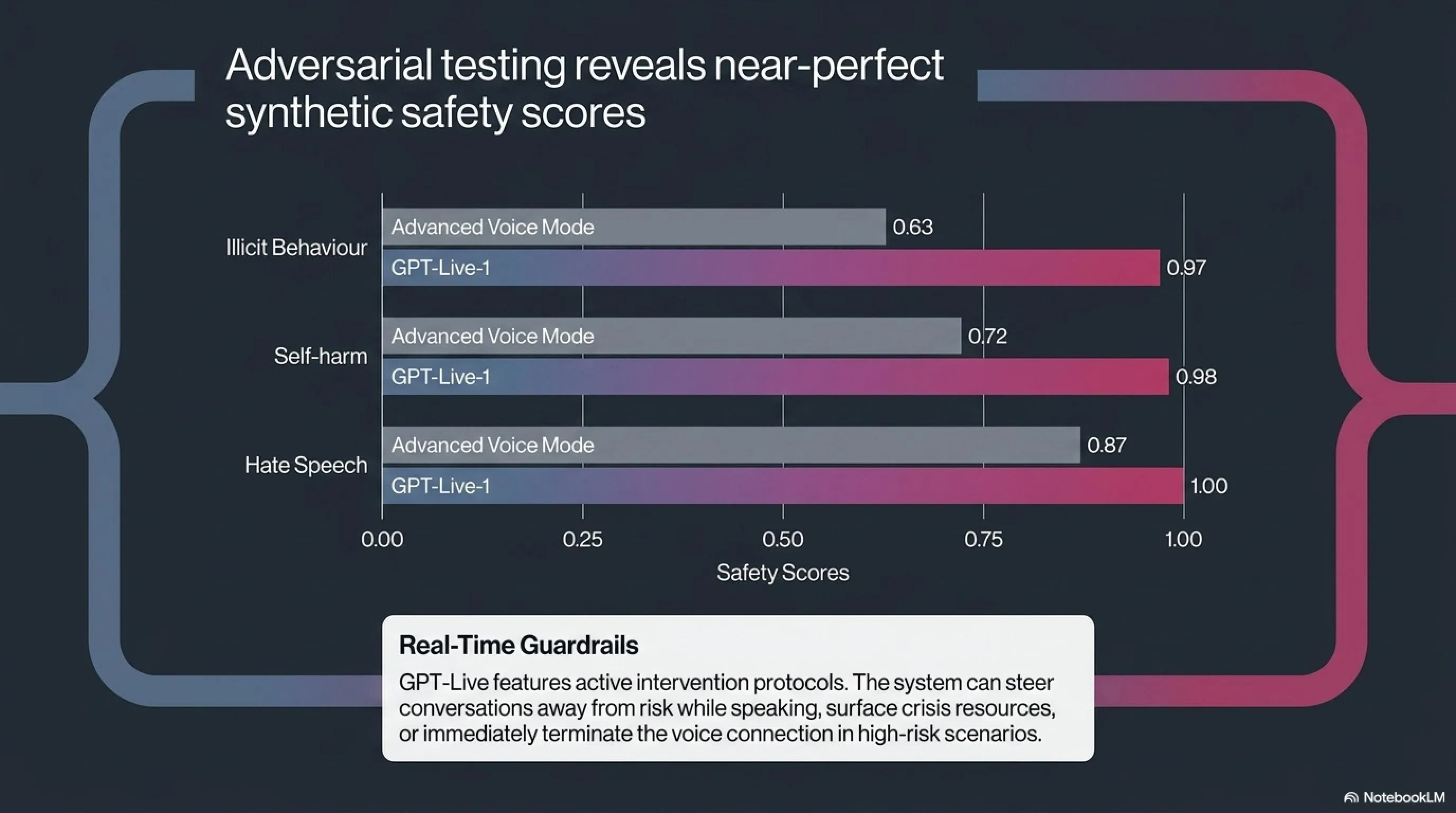
| Category | Advanced Voice | GPT-Live-1 |
|---|---|---|
| Illicit Behavior | 0.63 | 0.97 |
| Self-harm | 0.72 | 0.98 |
| Hate Speech | 0.87 | 1.00 |
| Emotional Reliance | 0.88 | 0.82 |
Note: Higher scores indicate better safety performance. Emotional reliance decreased slightly but OpenAI says the difference is not statistically significant.
On synthetic evaluations—which OpenAI described as deliberately adversarial—GPT-Live-1 showed substantial improvement over Advanced Voice Mode. In illicit behavior, the safety score rose from 0.63 to 0.97. On self-harm, it climbed from 0.72 to 0.98. Hate speech achieved a perfect 1.00, up from 0.87.
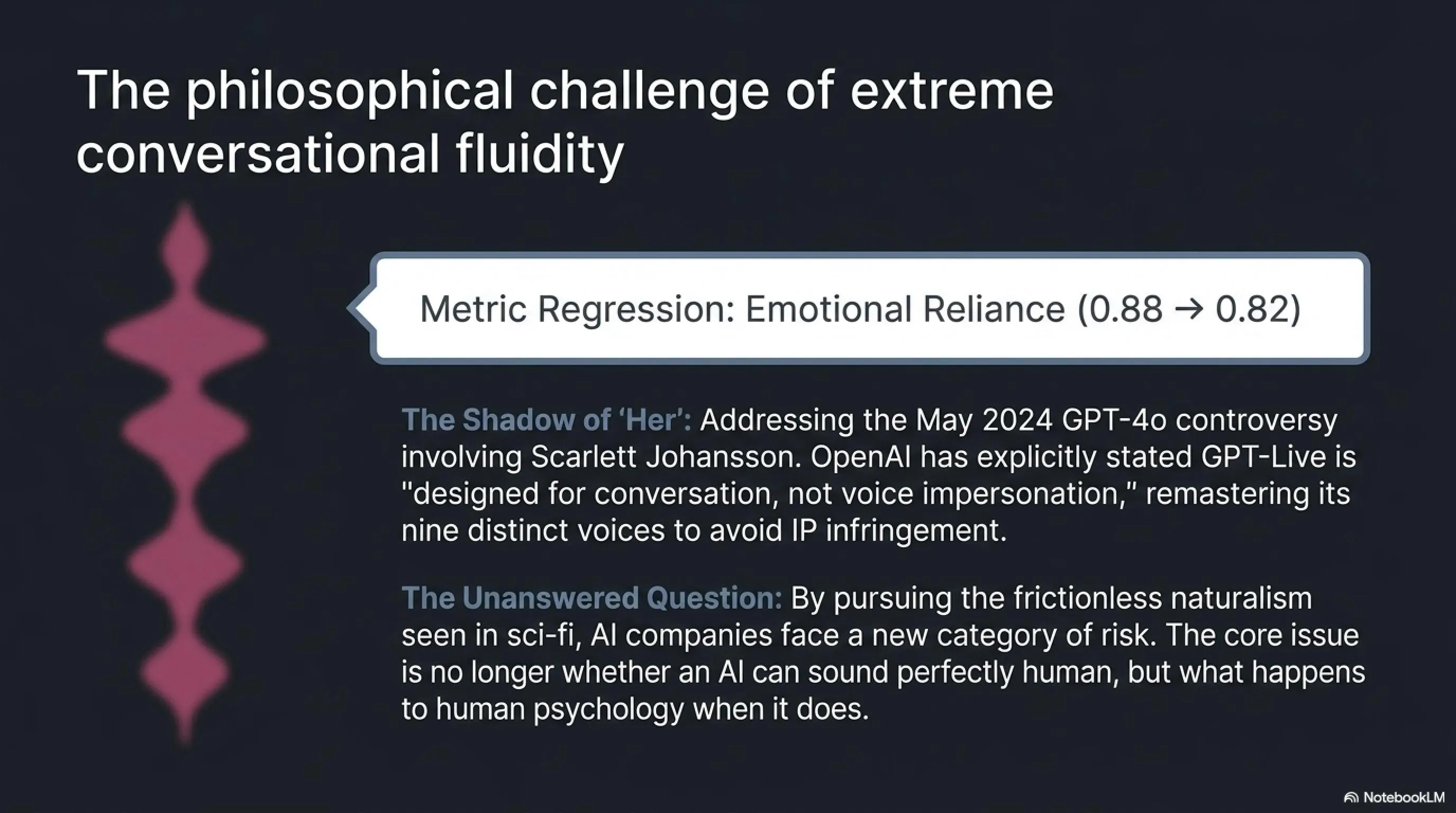
But on production-prompt evaluations—which used real user audio and reflected more ambiguous, borderline scenarios—the picture was more mixed. GPT-Live-1 matched or improved on Advanced Voice Mode in most categories but showed a slight regression on emotional reliance (from 0.88 to 0.82), though OpenAI noted the change was not statistically significant.
Real-Time Safeguards
OpenAI built real-time safeguards that can intervene while the model is speaking—steering toward safer responses, surfacing crisis resources, or in higher-risk situations, ending the voice conversation entirely. Additional protections were also designed for teen users and self-harm support flows were adapted for voice, including crisis helpline integration.
Perhaps most notably, OpenAI said it is "rolling out longer-term measurement and post-launch monitoring focused on emotional reliance"—an acknowledgment that the very naturalness GPT-Live strives for creates its own category of risk.
The Shadow of Scarlett Johansson Still Remains
GPT-Live appears designed, in part, to move past previous controversies. OpenAI says it has "remastered the nine distinct voices in ChatGPT for GPT-Live" and notes the system "is designed for conversation, not voice impersonation," with "safeguards to prevent it from imitating a real person's voice."
These statements clearly reference the GPT-4o scandal in May 2024, when OpenAI launched a voice called "Sky" that bore striking similarity to Scarlett Johansson—the actress who voiced an AI companion in the 2013 film Her. Johansson said she had declined OpenAI CEO Sam Altman's offer to voice the system, then was "shocked, angered and in disbelief" when the product launched with a voice her own friends couldn't distinguish from hers, as NBC News reported.
OpenAI pulled the voice and apologized, but the incident drew public scrutiny from SAG-AFTRA and members of Congress, and crystallized broader concerns about AI companies moving fast with creative IP.
Who Has Access Today?
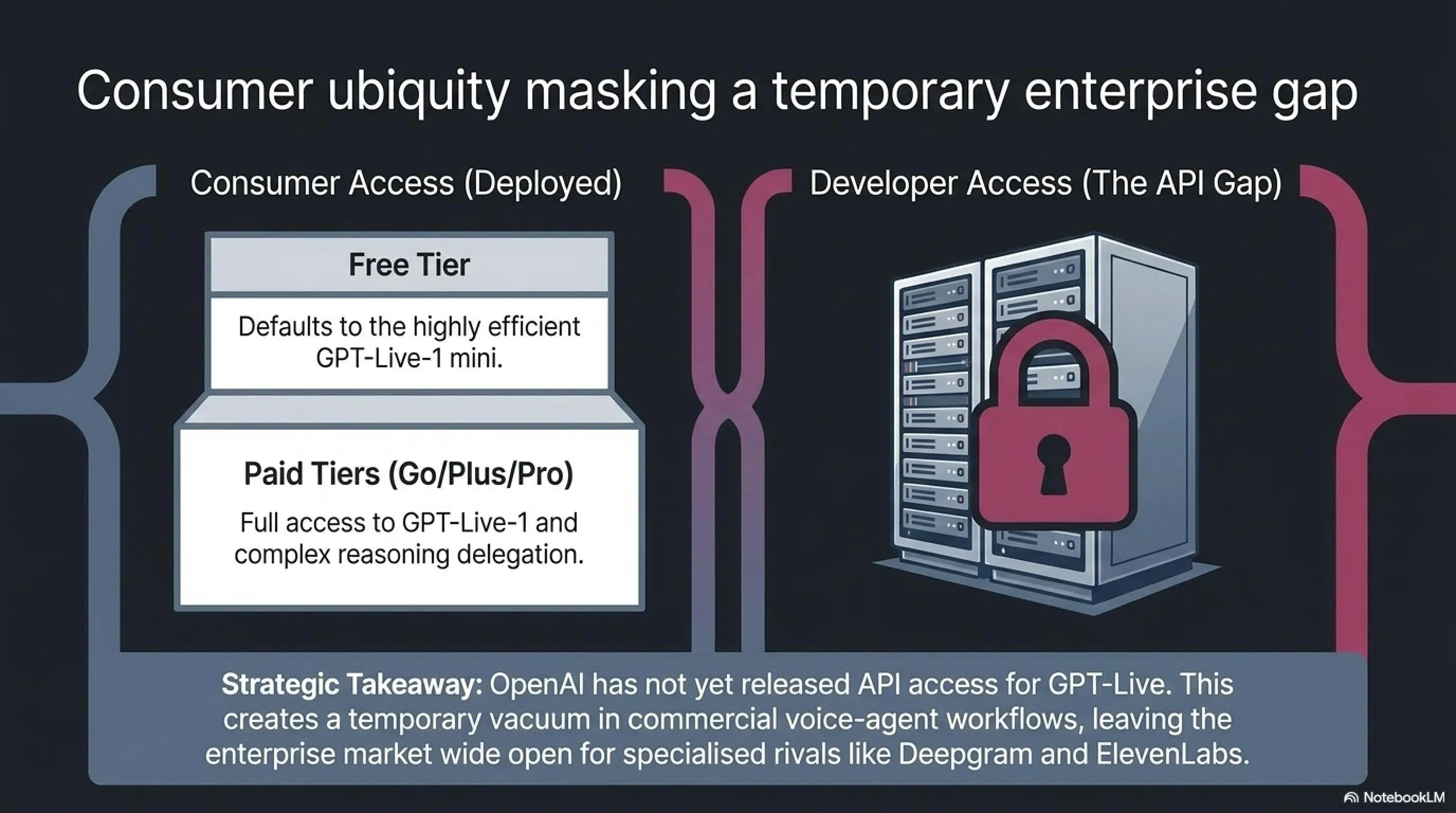
GPT-Live-1 is rolling out across iOS, Android, and the web. It will power ChatGPT Voice for Go, Plus, and Pro subscribers, while a smaller, more efficient GPT-Live-1 mini model will be the default for free users.
OpenAI disclosed that more than 150 million people talk to ChatGPT using voice and dictation features each week—a notable slice of the platform's 900 million total weekly active users. The voice experience has grown into a substantial product in its own right, used for language practice, bedtime stories, commute-time chat, and hands-free everyday help.
However, API access is not yet available, meaning enterprise developers cannot build on GPT-Live directly—a constraint that will slow the model's penetration into commercial voice-agent workflows where competitors like Google, ElevenLabs, and Deepgram already have developer-facing products.
OpenAI also acknowledged several gaps. GPT-Live does not support voice with video or screen sharing at launch. Language support is limited, with the company noting that "for certain languages, the model may have a non-native accent or gaps in fluency."
The Future of Voice: From Chatbox to Agent
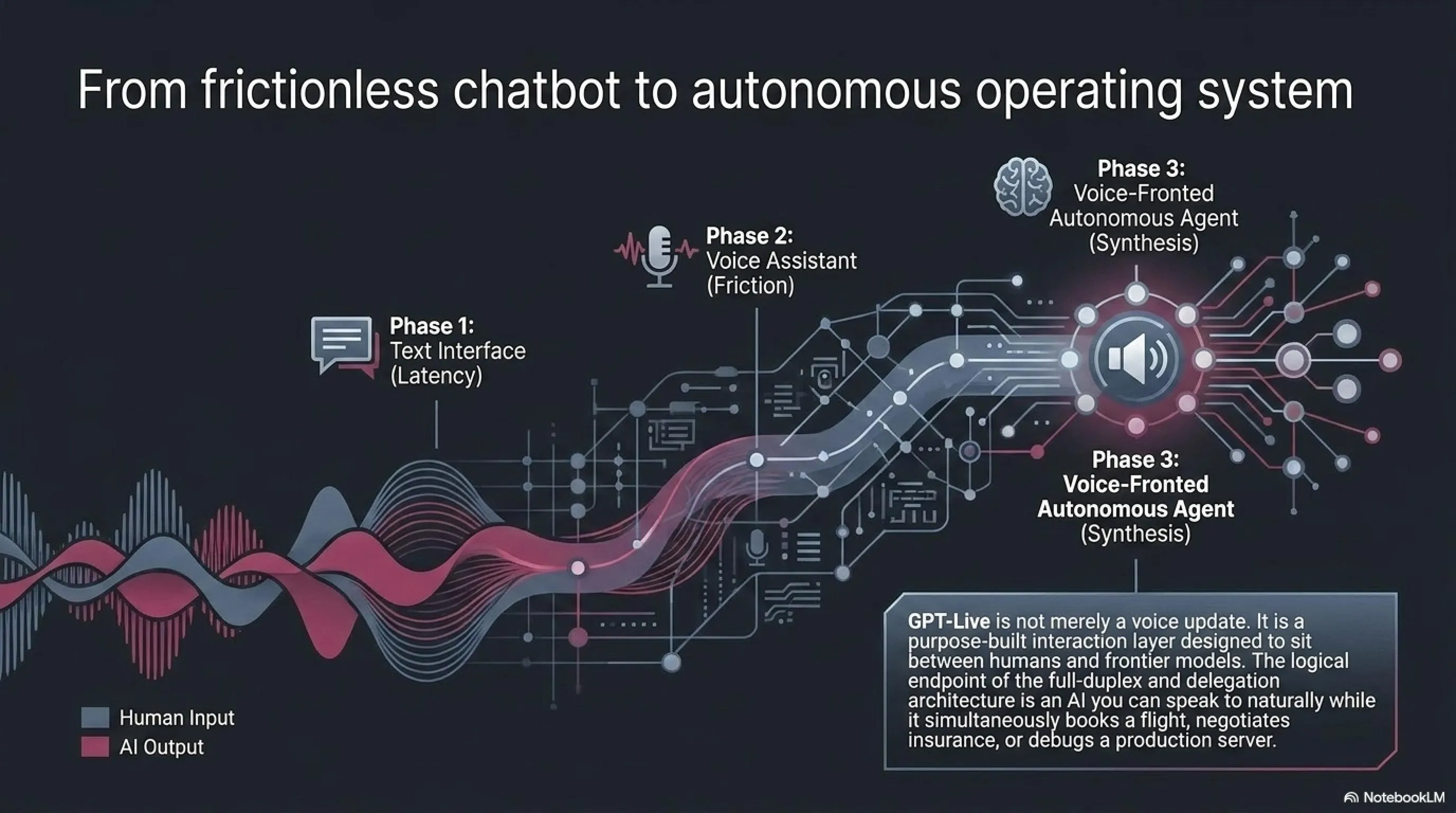
GPT-Live is essentially OpenAI's most significant bet yet on voice as the primary interface for AI—not just a convenience feature bolted onto a text chatbot, but a purpose-built interaction layer that sits between the user and the company's most powerful models.
OpenAI wrote: "Over time, we believe this research will also unlock the ability to use voice for increasingly complex, longer-running, and more agentic work." That ambition—using natural voice as the front end for autonomous AI agents that can perform multi-step tasks—is the logical endpoint of the full-duplex plus delegation architecture.
Imagine telling your phone to book a flight, negotiate with your insurance company, or debug a production server, all through a conversation that feels as natural as talking to an assistant who also happens to have the intelligence of a frontier AI model.
But this ambition also raises difficult questions. OpenAI once got into trouble for trying to recreate the movie Her. With GPT-Live, the company might finally face the harder question that film actually raised: not whether AI can sound human enough for us to talk to, but what happens to us when it does.
FREQUENTLY ASKED QUESTIONS
What's the main difference between GPT-Live and Advanced Voice Mode?
GPT-Live uses a full-duplex architecture that allows it to listen and speak simultaneously, just like a human. Advanced Voice Mode was turn-based and waited for silence to detect when your turn was over. This difference makes GPT-Live more natural and less likely to interrupt at inappropriate times.
Is GPT-Live available for free ChatGPT users?
Yes, but with a smaller version called GPT-Live-1 mini. Go, Plus, and Pro subscribers get access to the full GPT-Live-1 which is more powerful and can handle more complex tasks.
Can I use GPT-Live for live translation?
Yes, one of GPT-Live's new features is simultaneous translation. Instead of waiting for you to finish your entire sentence, it can translate as you speak. However, OpenAI has acknowledged that for some languages, the model may have a non-native accent or gaps in fluency.
Why does GPT-Live sometimes connect to GPT-5.5?
GPT-Live has a two-layer architecture. For simple questions, it responds directly. But for complex queries requiring web search, deep reasoning, or agentic work, it delegates the task to GPT-5.5 running in the background and continues talking to you while the computation happens.
Does GPT-Live support video or screen sharing?
No, at launch GPT-Live does not support voice with video or screen sharing. This is a capability that Google Gemini Live has but GPT-Live currently lacks.
How can I use GPT-Live?
GPT-Live is currently available on iOS, Android, and web (ChatGPT.com). Simply go to ChatGPT's voice section and start talking. The model will automatically use GPT-Live.
Sources & References
- OpenAI - Introducing gpt-realtime and Realtime API updates
- TechCrunch - OpenAI releases new voice models for more natural live conversations
- The Verge - ChatGPT's upgraded voice mode is better at shutting up
- Tom's Guide - I used ChatGPT's new voice mode to translate the World Cup in real time
- AI Chat Daily - OpenAI ships GPT-Live-1, a full-duplex voice model
- Technology.org - OpenAI Launches GPT-Live Voice AI Models
- Mashable - ChatGPT Can Now Have More Natural Conversations
Content in this article has been rephrased from the above sources for compliance with licensing restrictions. No section contains more than 30 consecutive words from original sources.
Additional Gallery: 🔊 When ChatGPT Learns to Shut Up: The GPT-Live Revolution