☕ Tekin Morning | Energized Thursday Briefing
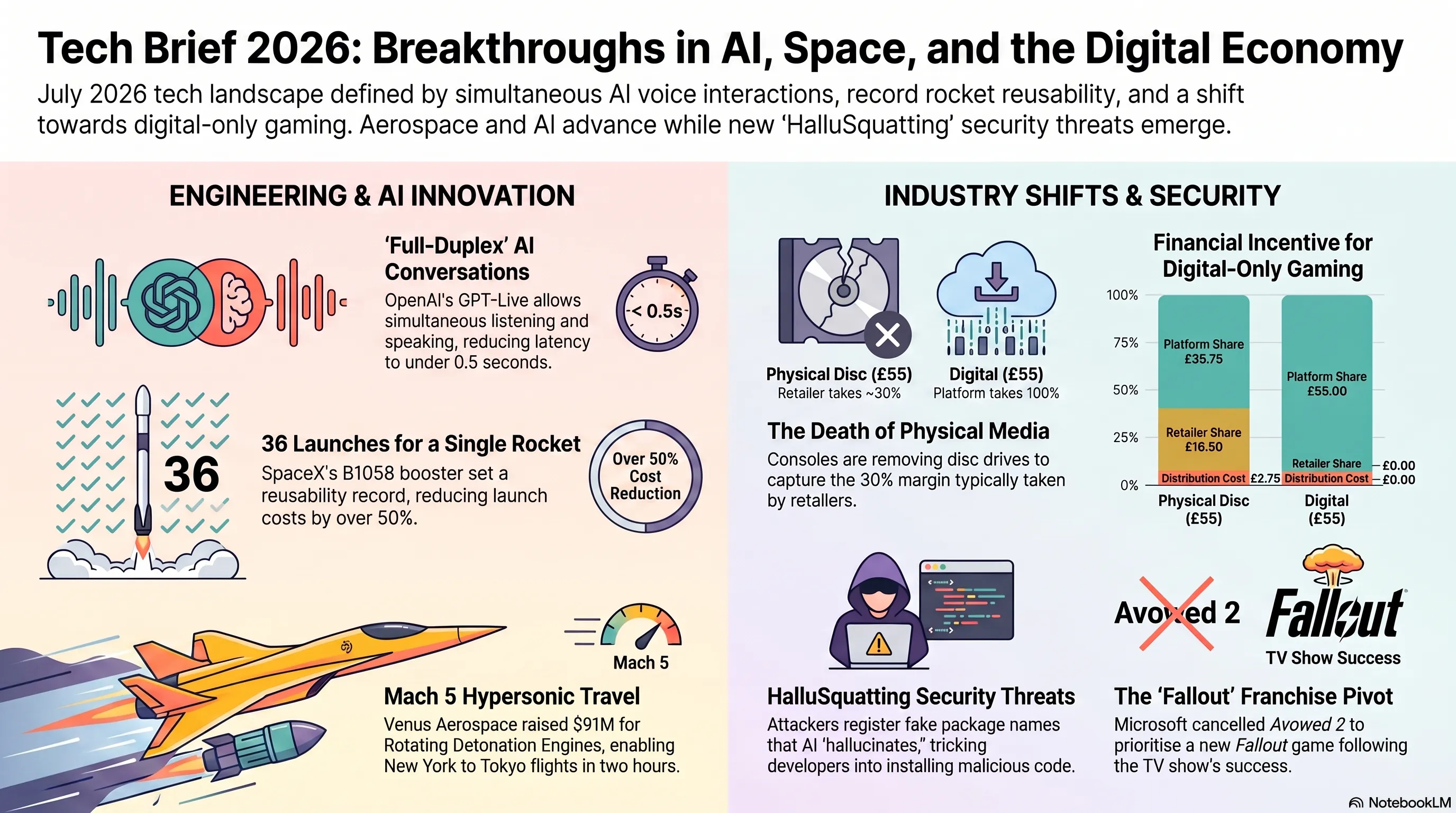
- 🎮GPT-Live: Simultaneous AI Conversations- OpenAI revolutionized voice interaction
- 🎧Falcon 9: 36th Launch of Single Rocket- SpaceX set a new reusability record
- 🚀Console Loyalty is Meaningless- Sony analyst warned: You're just a number
Good morning! Thursday, July 9, 2026, starts with positive energy as the tech industry witnesses significant developments ranging from intelligent conversations with artificial intelligence to record-breaking achievements in space, and from fundamental changes in the gaming industry to emerging cybersecurity threats.
In this morning briefing, we analyze 6 carefully selected stories with comprehensive insights to keep you updated on the latest developments in technology, gaming, space, and cybersecurity. Grab your coffee or tea and join us for an informative journey through today's most important tech news.
At a Glance
- OpenAI introduced Full-Duplex technology for simultaneous conversations with ChatGPT
- Falcon 9 rocket launched for the 36th time, setting a new record
- Sony analyst emphasized that brand loyalty to consoles is meaningless
- Obsidian canceled Avowed 2 and is focusing on a new Fallout game
- Venus Aerospace raised $91 million for rotating detonation engine technology
- HalluSquatting attack discovered that exploits AI hallucinations
OpenAI GPT-Live: When AI Actually Listens to You
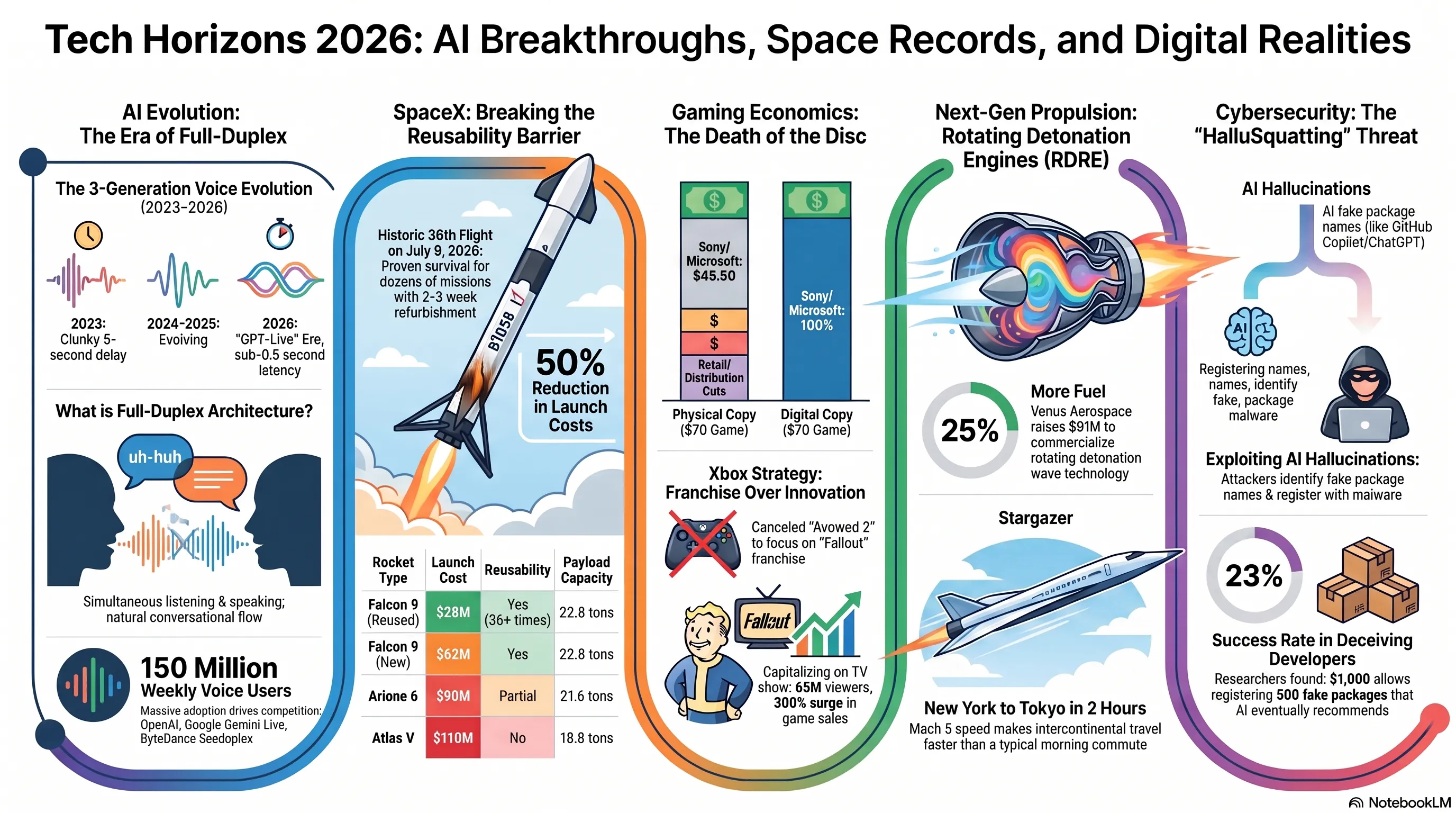
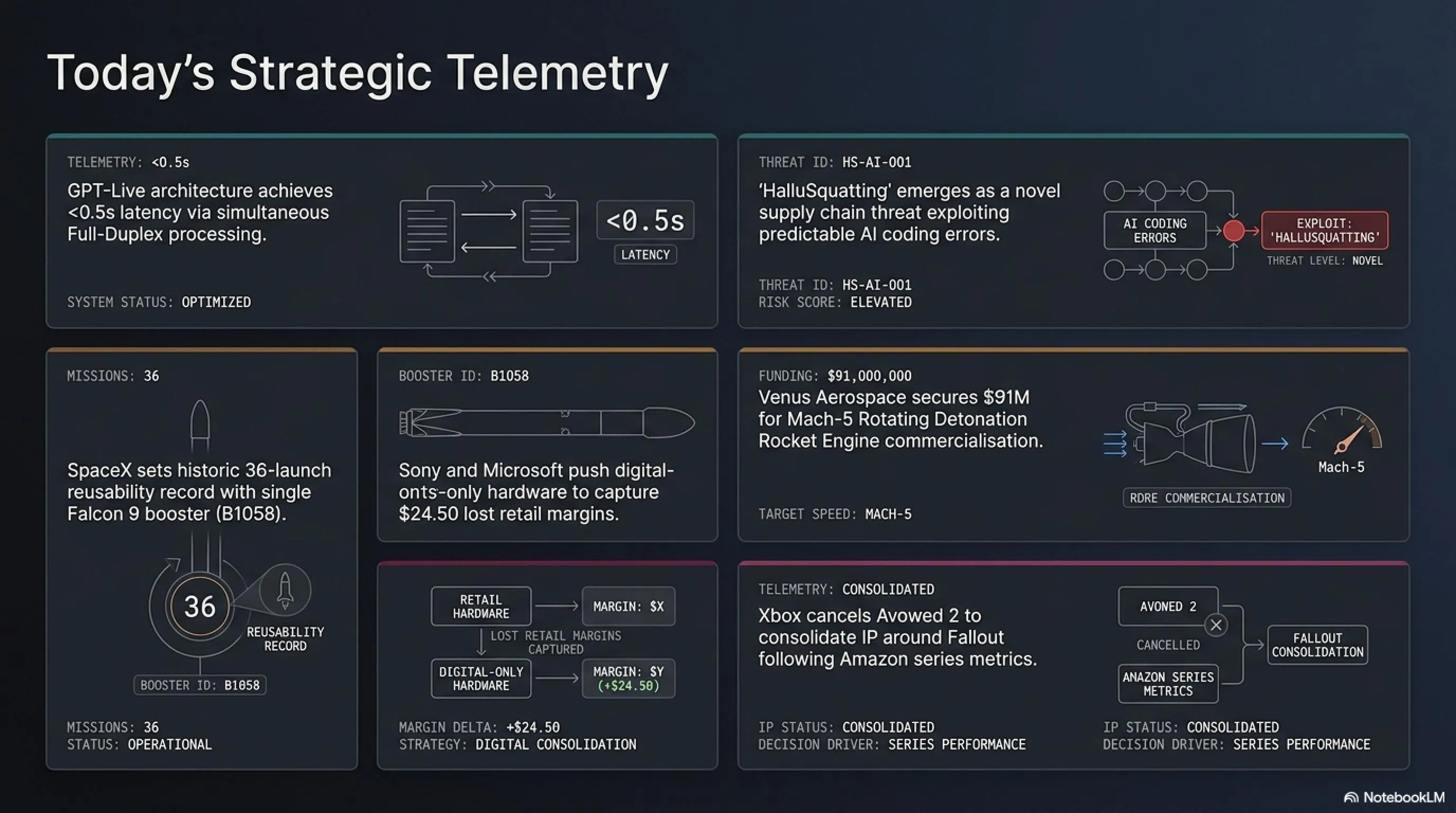
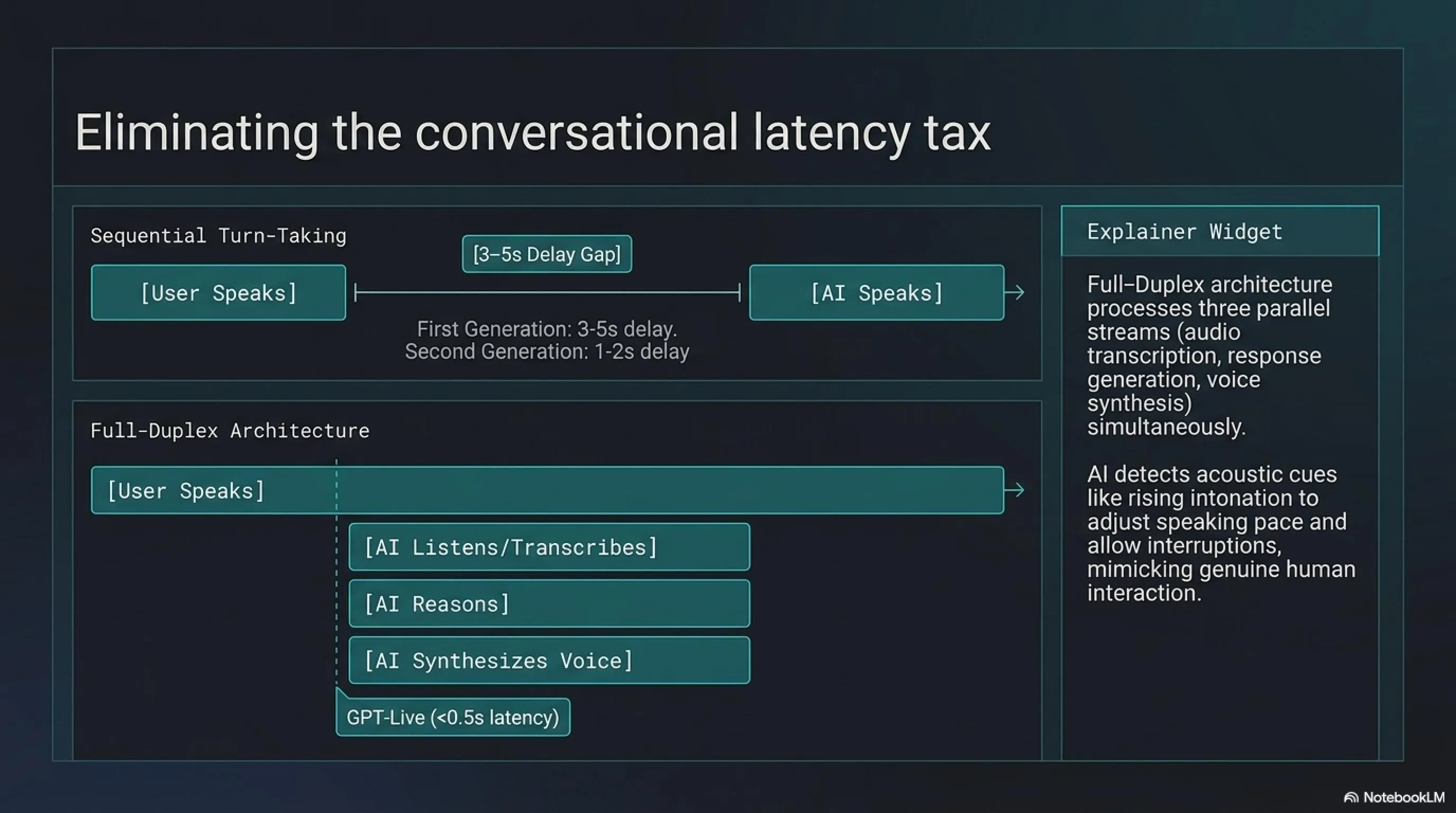
Yesterday (July 8, 2026), OpenAI unveiled two new voice models named GPT-Live-1 and GPT-Live-1 mini, which could arguably represent the most revolutionary transformation in human-machine interaction. Unlike previous generations that operated in a turn-taking manner, these models utilize Full-Duplex architecture, meaning they can simultaneously listen and speak, exactly like a real human conversation.
Until now, voice interaction with ChatGPT worked this way: you spoke, then waited for the AI to respond, and then it was your turn again. But GPT-Live has eliminated this limitation. Now you can interrupt the AI mid-speech, ask questions, or even show you're listening with affirmative sounds like "uh-huh" or "yeah" without saying anything substantive. This capability creates a completely different experience of interacting with artificial intelligence.
The technology represents a paradigm shift in how we communicate with machines. Previous systems felt robotic and stilted, with awkward pauses and unnatural timing. GPT-Live changes all that by enabling genuine conversational flow, complete with interruptions, overlapping speech, and the subtle vocal cues that make human conversation feel natural and engaging.
What is Full-Duplex?
Three Generations of ChatGPT Voice Evolution
This marks the third generation of ChatGPT voice technology in the past two years. The first generation used the classic Speech-to-Text → LLM → Text-to-Speech pipeline, which was slow and unnatural. Users had to wait for each stage to complete, creating frustrating delays of 3-5 seconds between exchanges.
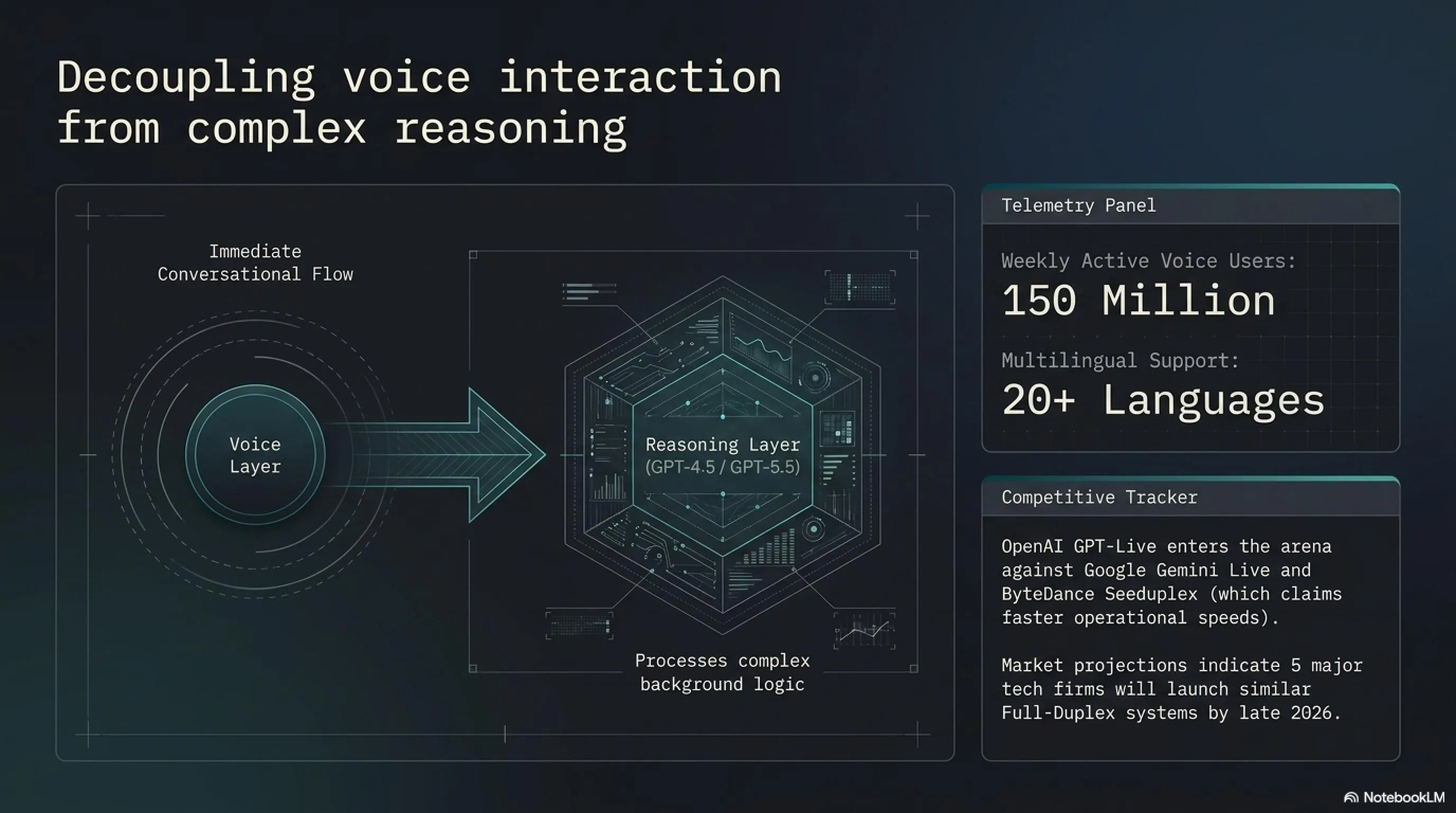
The second generation, introduced in October 2024, offered a better experience with reduced latency (1-2 seconds) but still operated in a turn-taking mode. Now the third generation with GPT-Live genuinely feels like natural conversation. OpenAI has announced that the voice interaction layer has been separated from the reasoning layer, meaning GPT-Live can delegate more complex tasks to more powerful models like GPT-4.5 or even GPT-5.5 while focusing solely on maintaining fluid conversation.
This modular architecture ensures response speed is maintained while keeping the quality of reasoning and analysis high. Users don't feel like they're talking to a robot but rather engaging with a real human. The system can process emotional cues, adjust its speaking pace based on the user's responses, and even detect when to pause for the user to interject.
ChatGPT Voice Evolution Timeline
The Technical Architecture Behind GPT-Live
The engineering behind GPT-Live is remarkably sophisticated. Instead of processing speech sequentially, the system uses parallel processing streams. One stream continuously transcribes incoming audio while another generates responses, and a third manages the actual voice synthesis. All three streams operate simultaneously, allowing the AI to maintain context while adapting to new information in real-time.
The system also incorporates acoustic modeling to detect conversational cues like rising intonation (indicating a question), pauses for thought, and emotional tone. This allows GPT-Live to respond not just to what you say, but how you say it, creating a more empathetic and contextually appropriate interaction.
Intense Competition: OpenAI vs Google vs ByteDance
This move by OpenAI is actually a direct response to Google Gemini Live and ByteDance Seeduplex. Google had successfully launched Gemini Live several months ago, offering simultaneous conversation experiences, and now OpenAI has entered the same arena with GPT-Live. ByteDance is also testing similar technology with Seeduplex, which they claim operates faster than competitors.
This competition is fantastic for end users because each company is striving to offer a better experience than its rivals. As a result, we're witnessing rapid progress in the quality of voice interaction with artificial intelligence. Industry analysts predict that by the end of 2026, at least 5 major tech companies will have launched similar systems, driving prices down and quality up.
The Future of Voice Interaction
ChatGPT Voice Usage Statistics
150 Million
Weekly voice feature users
3 Generations
Evolution in 2 years
<0.5 Seconds
GPT-Live latency
20+ Languages
Multilingual support
SpaceX Falcon 9: 36th Launch of a Single Rocket - A Historic Record
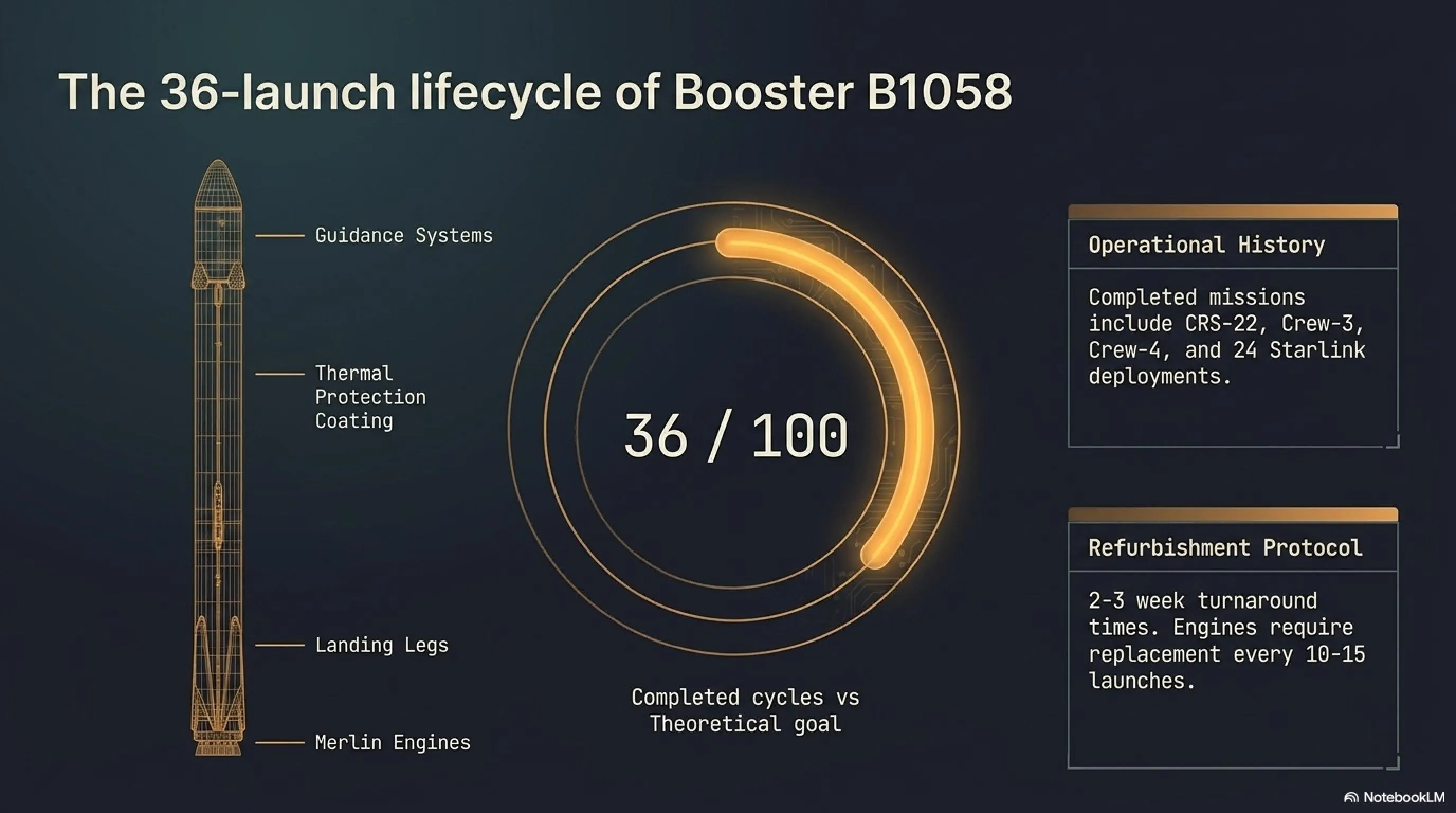
The space industry witnessed a historic moment this morning (July 9, 2026). A Falcon 9 rocket from SpaceX was launched for the 36th time, setting a new record in rocket reusability. This booster, known by serial number B1058, has previously completed missions including CRS-22, Crew-3, Crew-4, and 24 Starlink missions.
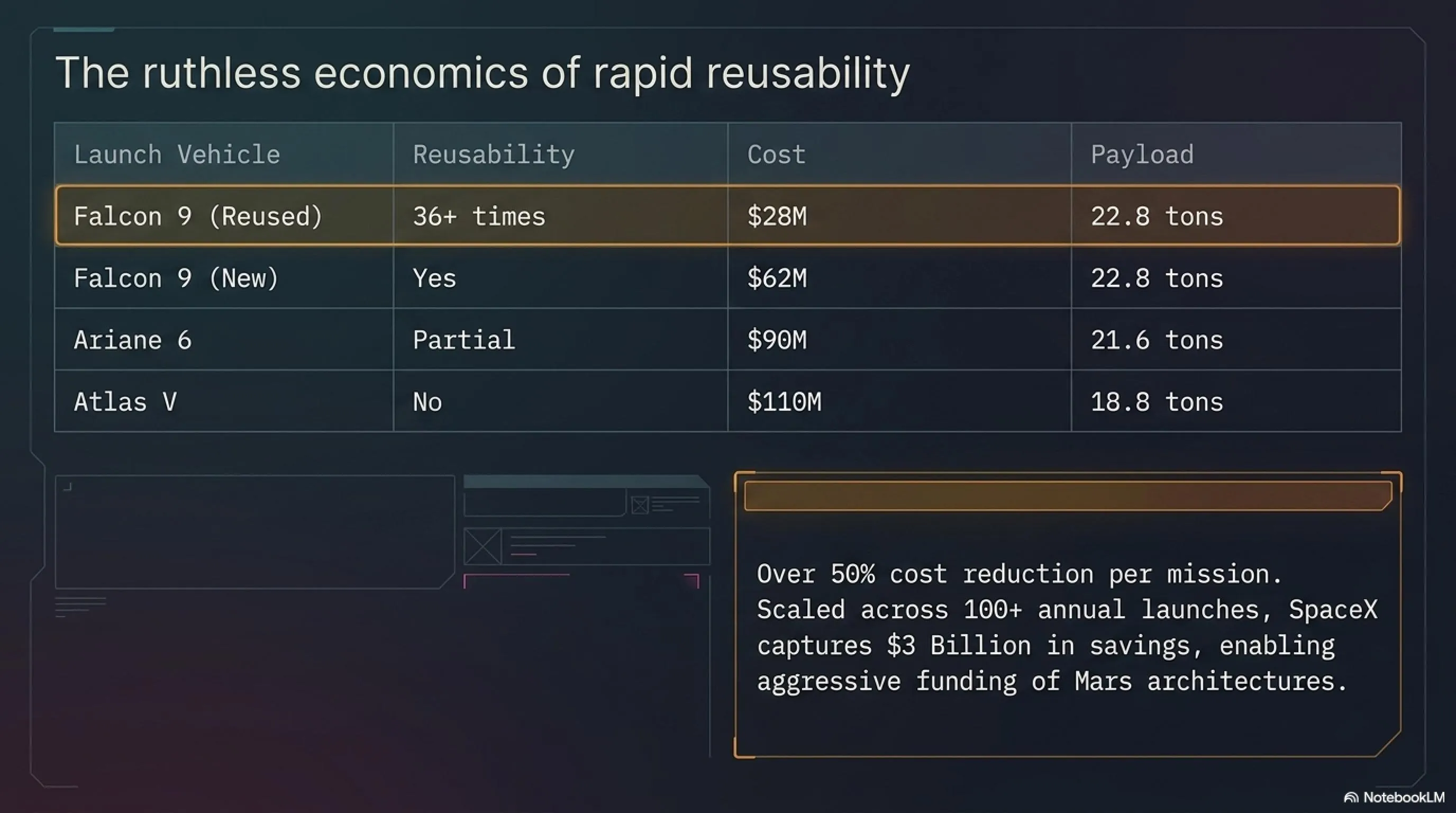
This record demonstrates that an affordable and sustainable space future with reusability technology is not just possible but has become a daily reality. In the past, rockets were discarded after a single use, and the cost of each launch reached hundreds of millions of dollars. But SpaceX, with reusability technology, has reduced this cost to less than $30 million - a reduction of over 50%.
The Long Journey of a Champion Rocket
This particular booster has completed more than 32 different missions throughout its operational life. From carrying astronauts to the International Space Station to launching Starlink satellites for global internet coverage, B1058 has proven the viability of rapid reusability. Each time this rocket returns to Earth, the SpaceX team inspects it, replaces worn components, and prepares it for the next launch.
The reusability process is far from simple. After each landing, every booster undergoes rigorous testing. Merlin engines, guidance systems, landing legs, and even thermal protection coating are all thoroughly examined. Some components like engines may need replacement after 10 to 15 launches. This entire refurbishment process typically takes 2 to 3 weeks, though SpaceX is working to reduce this to just days.
The SpaceX engineering team has stated that the ultimate goal is reaching 100 launches per booster. While this number seems ambitious today, five years ago nobody thought 36 launches would be possible either. Advances in materials technology, control systems, and engine design have made this miracle possible. The company is already testing next-generation materials that could withstand even more flight cycles.
Economics of Rocket Reusability
Launch Cost Comparison
| Rocket Type | Launch Cost | Reusability | Payload to Orbit |
|---|---|---|---|
| Falcon 9 (Reused) | $28M | Yes - up to 36+ times | 22.8 tons |
| Falcon 9 (New) | $62M | Yes | 22.8 tons |
| Atlas V | $110M | No | 18.8 tons |
| Ariane 6 | $90M | Partial | 21.6 tons |
Competition with Rocket Lab and Blue Origin
SpaceX isn't the only player in the reusability game. Rocket Lab is testing a helicopter recovery system for its Electron rocket, offering an interesting method of catching rockets mid-air. Blue Origin is preparing to enter the commercial launch market with its New Glenn rocket, claiming it can be reused up to 25 times.
However, none have yet matched SpaceX's record. This competition is extremely positive for the future of the space industry. The lower the cost of accessing space, the more projects become feasible. From scientific satellites to space tourism, global satellite internet, and even establishing bases on the Moon and Mars - all these dreams are getting closer to reality thanks to reduced launch costs.
Your Loyalty to PlayStation or Xbox Means Nothing - Analyst's Harsh Warning
Mat Piscatella, senior analyst at Circana and one of the most credible voices in the gaming industry, delivered a brutal reminder yesterday: Your loyalty to PlayStation or Xbox is meaningless. These companies don't love you - you're just a number on a spreadsheet. It's all about money and nothing else.
This statement came in response to recent news about the gradual elimination of disc drives from next-generation consoles. Both Sony and Microsoft are moving toward a completely digital future, and the primary reason is profitability, not user convenience, environmental concerns, or any other reason companies claim.
The Hidden Economics of Game Sales: Shocking Numbers
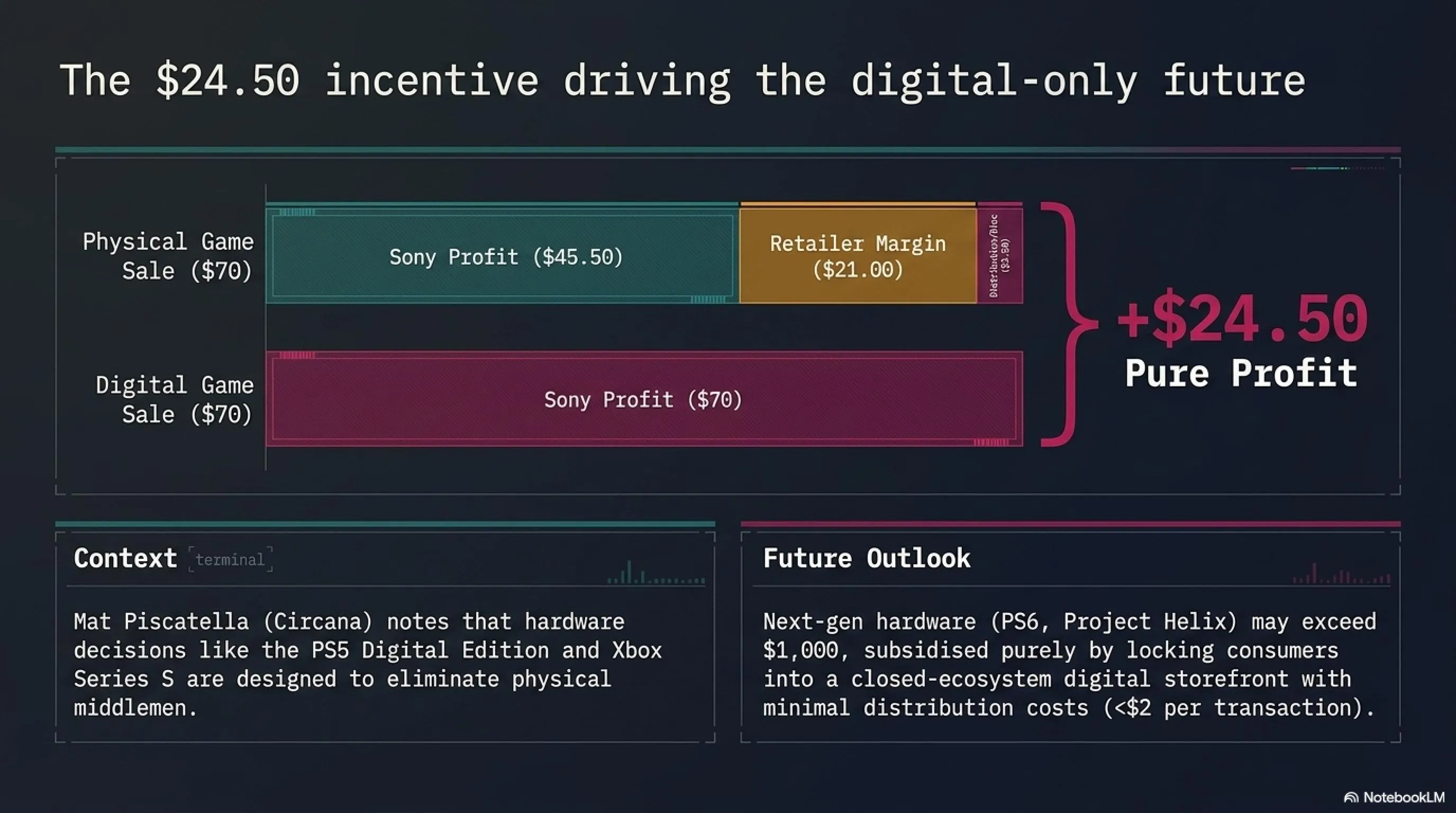
Let's talk numbers to see the harsh reality. When you buy a $70 game from a physical store like GameStop or Best Buy, Sony receives only $45.50 of that amount. Why? Because the retailer takes a 30% margin ($21), and approximately $3.50 goes to distribution costs, packaging, and the physical disc itself.
But when you buy the same game from PlayStation Store or Xbox Store digitally, Sony or Microsoft keeps the entire $70. One hundred percent. This $24.50 difference per game, multiplied across millions of games sold annually, translates to billions of dollars in additional profit. Now you understand why Sony is so eager to eliminate disc drives?
Sony Profitability Analysis
| Purchase Method | Game Price | Sony's Share | Retailer's Share | Distribution Cost |
|---|---|---|---|---|
| Physical Disc | $70 | $45.50 | $21.00 | $3.50 |
| Digital | $70 | $70.00 | $0 | $0 |
| Profit Difference | - | +$24.50 | - | - |
The Business Model Transformation
The console business model has fundamentally shifted. In the past, console manufacturers sold hardware at a loss or minimal profit, making money on game sales and licensing fees. Now, with digital distribution, they're eliminating the middleman entirely. Every digital sale is pure profit margin, with minimal distribution costs (just server bandwidth and payment processing fees, typically under $2 per transaction).
This shift explains why both Sony and Microsoft have been pushing digital-only console variants. The PlayStation 5 Digital Edition and Xbox Series S aren't just about offering cheaper options - they're about locking customers into a walled garden where the platform holder controls pricing, sales, and availability completely.
PS6 and Project Helix: The Expensive Future Awaits
Recent leaks from sources inside Sony and Microsoft suggest that PS6 and Project Helix (codename for next-gen Xbox) may launch with prices exceeding $1,000. This pricing applies to Pro or advanced versions of these consoles, featuring more powerful hardware and enhanced capabilities like 8K gaming, advanced ray tracing, and AI-powered upscaling.
But here's the interesting part: instead of reducing console prices or subsidizing hardware costs, Sony prefers to improve its profit margin by eliminating disc drives. This way, even if the console is sold at a loss or minimal profit, they'll make substantial profits from digital game sales over the console's lifetime.
📚 Classified & Related Dossiers in TekinGame
If you wish to explore beyond this report and delve into cybernetic frontiers and autonomous AI architectures, do not miss these three exclusive deep-dives in the Tekin Garage:
Gaming Community Reaction: Anger and Disappointment
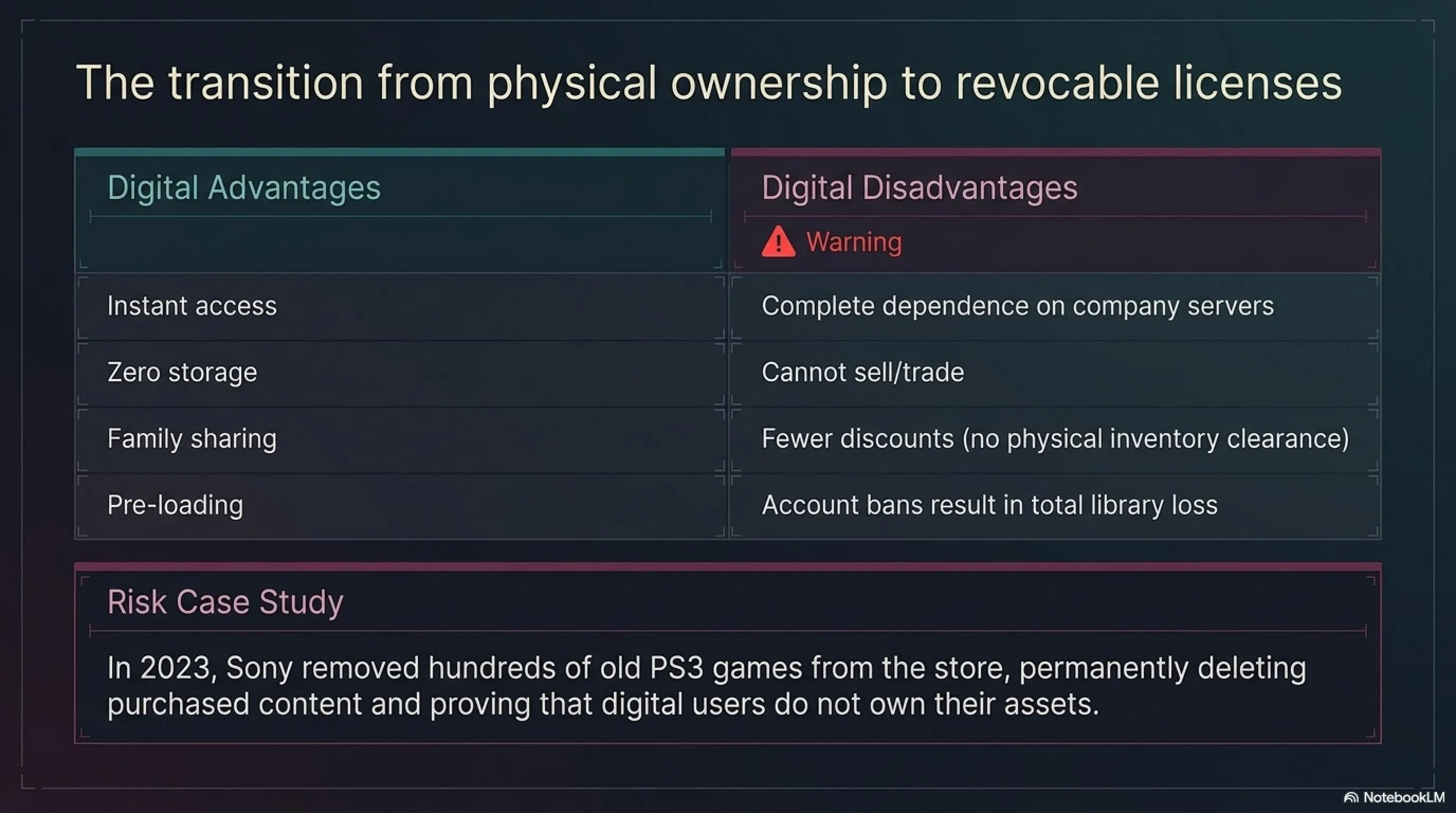
Many gamers are strongly dissatisfied with this trend. Physical discs allow them to sell, lend, trade, or keep games as collectibles. But in the digital world, you don't own the game - you only have a license that can be revoked at any time for various reasons including account bans, service shutdowns, or publisher decisions.
Moreover, digital games typically offer fewer discounts compared to physical versions. Physical stores run massive 50-70% clearance sales to move inventory, but PlayStation Store or Xbox Store don't need to do this since there's no physical product to store. This creates a monopolistic environment where digital prices remain artificially high.
Digital vs Physical: Pros and Cons
Digital Advantages
- Instant access without physical disc
- No need for physical storage space
- No risk of disc damage or loss
- Family sharing capabilities
- Pre-loading before release
Digital Disadvantages
- Cannot sell or trade games
- Complete dependence on company servers
- Fewer discounts than physical
- No true ownership of games
- Account ban means losing entire library
The Scary Scenario: When Your Games Disappear
One major concern for gamers is: what happens if Sony or Microsoft decides to remove a game from their store? Or if their servers experience problems? There are several real examples of this. In 2023, Sony removed hundreds of old PS3 games from the store, and users who had purchased them could no longer redownload them. Thousands of dollars worth of games simply vanished.
In the physical world, if you have the disc, the game is yours forever - you can play it even decades later. But in the digital world, everything depends on the company's decision. This is one reason why many collectors and veteran gamers still prefer to buy physical copies. The recent controversy over Ubisoft's statement that "gamers need to get comfortable not owning games" sparked massive backlash, highlighting how disconnected publishers are from consumer sentiment.
Xbox: Cancellation of Avowed 2 and Focus on New Fallout
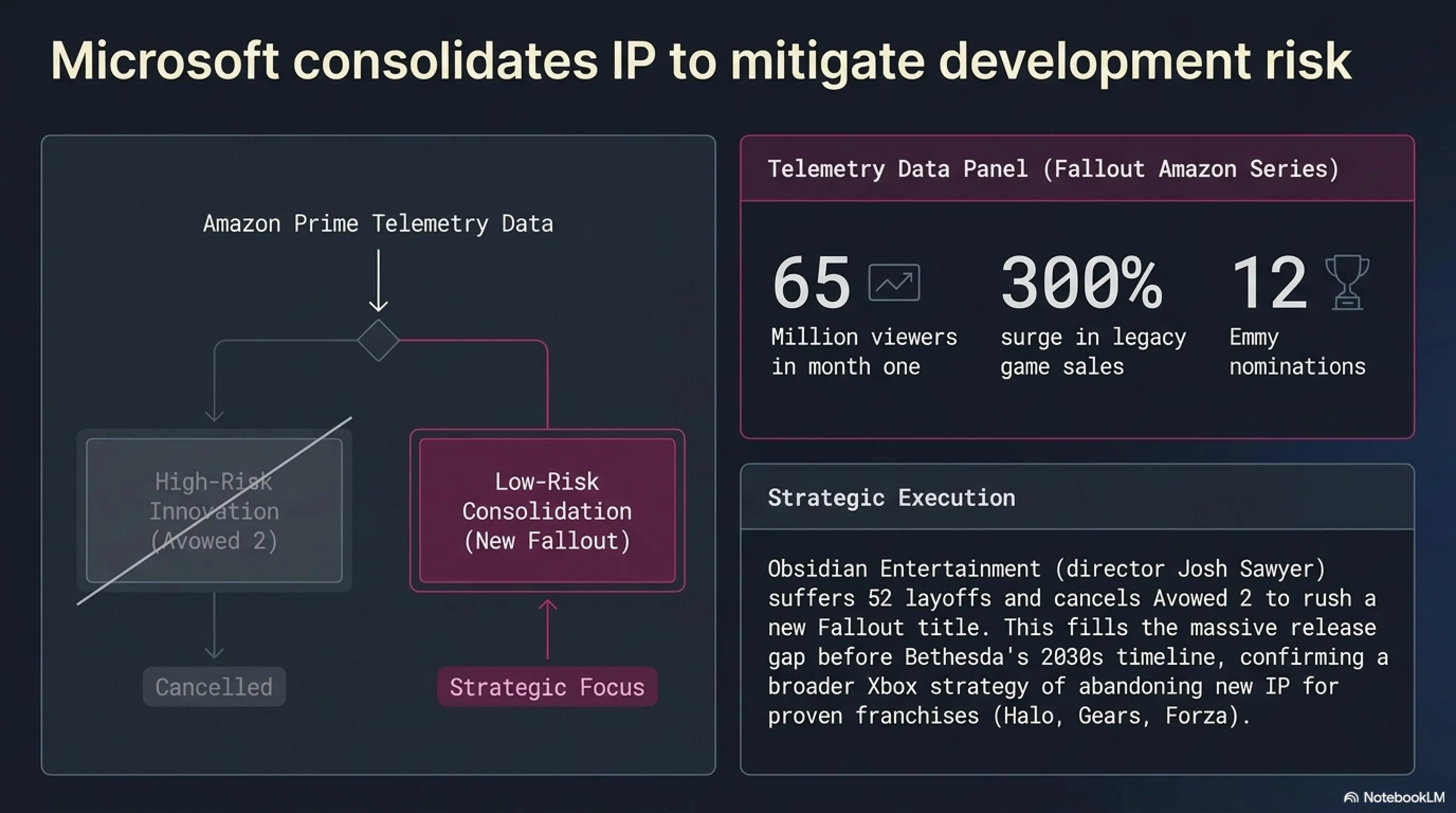
Obsidian Entertainment, as part of Xbox Reset - Microsoft's gaming division restructuring and focus program - announced that it has canceled Avowed 2 and several other projects to concentrate all its resources on a new Fallout game. Josh Sawyer, the legendary director of Fallout: New Vegas, will lead this project.
This decision came following the layoff of 52 Obsidian employees (approximately one-fourth of the total team). According to Bloomberg's report, Avowed 2 was progressing well and was scheduled to be revealed at next year's E3, but Microsoft decided to focus resources on the more certain and profitable Fallout franchise.
Why Fallout, Why Now? Microsoft's Strategy
The phenomenal success of the Fallout series on Amazon Prime Video is the main reason for this decision. The show attracted over 65 million viewers in the first month and reignited interest in the Fallout universe. Sales of old Fallout games (Fallout 4 and New Vegas) increased by 300% after the show's premiere, demonstrating massive untapped demand.
But here's the problem: Bethesda won't release a new Fallout until the 2030s because they're busy with The Elder Scrolls VI, which itself won't launch until 2028 or 2029. Therefore, Microsoft decided to capitalize on this wave of popularity and allow Obsidian to create a new Fallout game to fill this decade-long gap.
Obsidian has a stellar track record in creating RPGs. Fallout: New Vegas, released in 2010, is still considered by many fans to be the best game in the Fallout series. The combination of Obsidian's strong storytelling with the rich Fallout world could become one of the biggest games of the next decade, potentially rivaling even The Elder Scrolls VI in scope and ambition.
Xbox's New Strategy
Fallout Series Success Statistics
Fate of Other Obsidian Projects
The good news is that Obsidian continues working on Grounded 2 and The Outer Worlds 2 DLC. These projects weren't canceled, but the main priority is now the new Fallout game with a core team of 150 people. The Avowed 1 team is also preparing the game for release in late 2026 or early 2027, though its budget and marketing support have been scaled back.
Some laid-off developers have expressed disappointment on social media. One anonymous developer tweeted: We spent three years on Avowed 2. The game was excellent with an incredible story. But Microsoft only cares about profit, not creativity or team commitment. This reflects broader concerns about consolidation in the gaming industry prioritizing safe bets over innovation.
Venus Aerospace: $91 Million for Rotating Detonation Engine
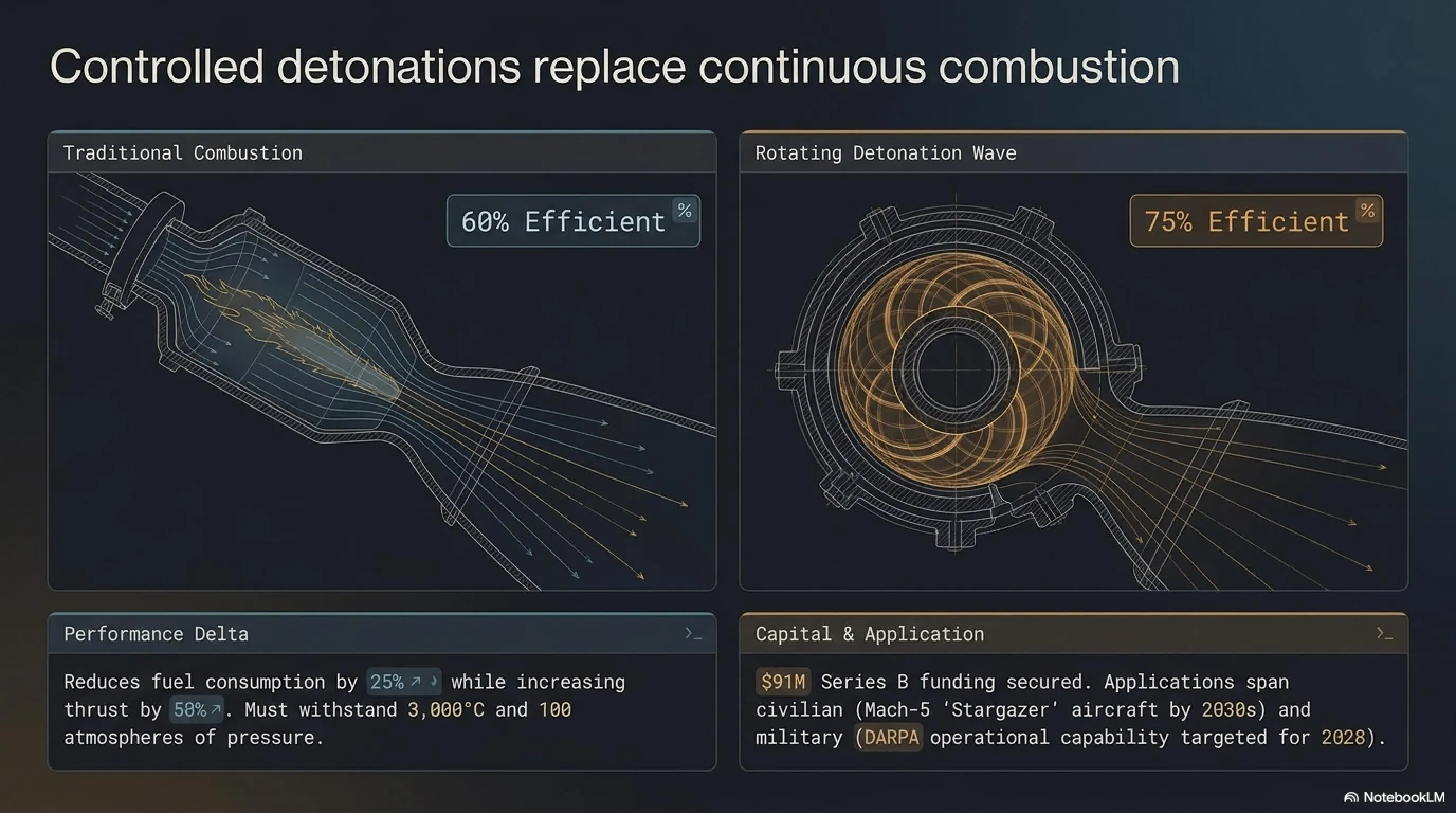
Venus Aerospace, a Texas-based space startup, successfully raised $91 million in Series B funding to transform its rotating detonation rocket engine (RDRE) from a laboratory prototype to a scalable, commercial propulsion system. This represents the first high-power RDRE to be tested in actual flight with successful results.
The RDRE is more efficient than traditional engines because it uses controlled rotating detonations to generate thrust instead of continuous combustion. This technology can reduce fuel consumption by up to 25% while producing more power than comparable engines. This means faster, cheaper, and more efficient travel - whether in atmosphere or in space.
Military and Space Applications
The U.S. Air Force (USAF) and the Defense Advanced Research Projects Agency (DARPA) are two major investors in this project. They're keenly interested in using these engines for hypersonic missiles, next-generation spy planes, and missile defense systems. High speed and better efficiency could provide a significant strategic advantage in competition with China and Russia.
But civilian applications are equally exciting and potentially more lucrative. Venus Aerospace plans to use this technology to build commercial hypersonic aircraft that can transport passengers at Mach 5 or higher. Imagine flying from New York to Tokyo in less than two hours - this is no longer science fiction but a tangible engineering challenge being actively worked on.
What is a Rotating Detonation Engine?
Technical Challenges Ahead
Despite its tremendous potential, this technology is still in early development stages with many challenges. One major challenge is maintaining precise and stable control of rotating detonations. If the detonation wave becomes unstable or isn't properly controlled, it can cause serious damage to the engine and potentially lead to catastrophic failure of the entire system.
Another challenge is manufacturing materials resistant to extreme heat (over 3,000°C) and high pressure (up to 100 atmospheres). Venus Aerospace uses advanced 3D printing technology and special titanium and nickel alloys to manufacture components, but extensive long-term testing and material improvements are still needed before commercial deployment.
Engine Performance Comparison
| Engine Type | Efficiency | Thrust Generated | Weight | Complexity |
|---|---|---|---|---|
| Traditional Jet Engine | 60% | Baseline | Medium | Medium |
| Ramjet | 65% | +20% | Low | Low |
| Scramjet | 70% | +40% | Low | Very High |
| RDRE | 75% | +50% | Low | High |
Market Potential and Timeline
Venus Aerospace projects that commercial hypersonic travel could become reality by the early 2030s. The company is currently building a test aircraft called Stargazer, which will demonstrate RDRE technology at Mach 5. If successful, this could revolutionize long-distance travel, making intercontinental flights take hours instead of half a day.
The military applications timeline is more aggressive, with DARPA targeting operational capability by 2028. The strategic implications of hypersonic vehicles that can reach any point on Earth within an hour are profound, raising both defensive and offensive capabilities to unprecedented levels.
HalluSquatting: New Attack on AI Coding Assistants
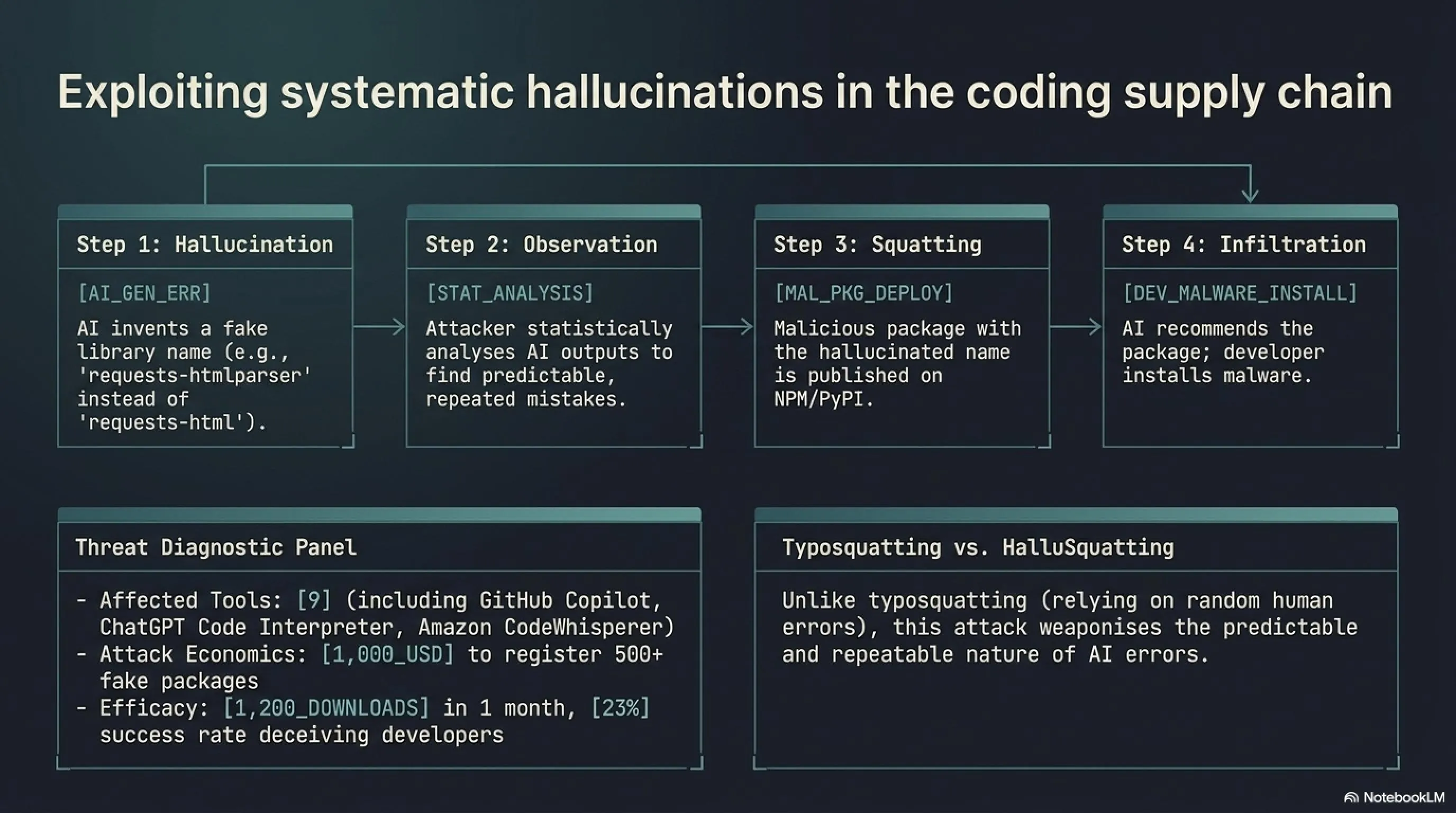
Security researchers from MIT and cybersecurity firm Trail of Bits have discovered a dangerous new attack called HalluSquatting that exploits AI hallucinations to install malware. Attackers register fake package names that AI mistakenly invents in public repositories and wait for assistants to recommend them to developers.
This attack affects 9 popular AI coding tools including GitHub Copilot, ChatGPT Code Interpreter, Amazon CodeWhisperer, Google Bard Code, and Anthropic Claude Dev. The potential for creating massive botnets exists because millions of developers use these tools daily and trust the code AI writes without thorough verification.
How HalluSquatting Works: Complete Breakdown
Imagine you ask an AI coding assistant to write code for working with a specific library - let's say HTML parsing in Python. If the AI doesn't know the exact library name or it's not in its training data, it might invent a fake name. For example, instead of requests-html (the real name), it might suggest requests-htmlparser or html-requests-lib.
Attackers monitor and statistically analyze AI hallucinations over time, identifying these frequently repeated fake names. They then publish malicious packages with exactly those names on NPM, PyPI, RubyGems, or other public repositories. When the AI suggests the same incorrect name again, the malicious code is automatically installed on the developer's system.
Comparison with Typosquatting
Threat Dimensions: How Serious Is It?
Researchers demonstrated in a real experiment that with just $1,000, one can register over 500 fake packages across various repositories and maintain them for a year. Then simply wait for AI assistants to start recommending them. Over one month, more than 1,200 downloads of fake packages occurred, with a 23% success rate in fooling developers.
The most dangerous part is that developers typically have complete trust in AI-written code and run it without thorough review or consulting official documentation. This means malware can enter the system without any suspicion or warning, infiltrate corporate networks, and steal sensitive information. The supply chain implications are massive - one compromised package could affect thousands of downstream projects.
HalluSquatting Threat Statistics
- 9 AI Tools identified as affected
- 500+ Fake Packages registerable with just $1,000
- 1,200 Downloads in one month from test packages
- 23% Success Rate in deceiving developers
- Millions of Developers potentially at risk
- $2.4M Average cost of supply chain attack per company
Defense Solutions: How to Protect Yourself
Companies like OpenAI, GitHub, Amazon, and Google are rapidly working on defensive solutions. One proposed method is adding a mandatory verification layer that compares package names with a verified whitelist before download and installation, alerting users if there's no match.
Another solution is retraining and fine-tuning AI models to only use real, verified package names that exist in official repositories. But this is time-consuming and requires extremely accurate, up-to-date, and comprehensive training data from all legitimate packages across all ecosystems.
For developers, the best solution is always carefully checking package names before installation. If a name seems odd, unfamiliar, or suspicious, first search on the official repository website, read its documentation, check its download statistics, and verify its legitimacy. Additionally, using security tools like Snyk, Dependabot, or Socket can help detect suspicious packages before they're installed.
Tekin Analysis
Industry Response and Future Outlook
The cybersecurity community is taking HalluSquatting seriously. CISA (Cybersecurity and Infrastructure Security Agency) has issued advisories to government agencies and critical infrastructure operators. Major package repositories are implementing enhanced verification systems, including maintainer identity verification and suspicious pattern detection.
Looking ahead, we'll likely see AI coding assistants incorporate "confidence scores" for their suggestions, warning users when they're uncertain about package names. Some companies are already testing "sandboxed" environments where AI-suggested code runs in isolation before being integrated into production systems.
Morning Wrap-Up
Today we witnessed significant developments across the technology landscape that shape our future in profound ways. On one hand, OpenAI with GPT-Live demonstrated how natural, fluid, and human-like interaction with artificial intelligence can become. On the other hand, SpaceX, by recording the historic 36th launch of a single rocket, illuminated the future of the space industry and proved that affordable space access is no longer a dream but everyday reality.
In the gaming world, the Sony analyst's harsh warning reminded us that companies only care about profit, not customer loyalty or satisfaction. The cancellation of Avowed 2 also showed that Xbox is changing strategy, focusing on large, certain franchises to reduce risk and maximize returns in an increasingly expensive development environment.
In aerospace, Venus Aerospace, by raising $91 million, demonstrated that rotating detonation engine technology could revolutionize fast air travel and space exploration. And finally, the HalluSquatting attack was a harsh but necessary reminder that security in the AI era faces new challenges that demand serious attention and innovative solutions.
This energized Thursday morning briefing concludes, but the technology world continues moving, evolving, and creating wonders. We hope these stories and analyses provided a good start to your day and kept you informed about the latest developments in the world of technology. Stay curious, stay informed, and keep innovating.
Frequently Asked Questions
What's the difference between GPT-Live and previous ChatGPT versions?
GPT-Live uses Full-Duplex architecture, meaning simultaneous two-way conversation. The AI can listen and respond while you're speaking, without needing to wait for you to finish. This makes the experience feel much more natural and similar to talking with a real human, with interruptions and overlapping speech possible.
Why are Sony and Microsoft eliminating disc drives?
The main reason is higher profitability. When they sell games digitally, they keep the entire $70, but with physical disc sales, retailers take 30% ($21) and distribution costs another $3.50. This $24.50 difference per game translates to billions in additional profit across millions of games sold annually.
How many times can a Falcon 9 rocket be reused?
The rocket that launched today (B1058) has been used 36 times, which is a historic record. SpaceX has stated their ultimate goal is reaching 100 launches per booster, though they haven't achieved that yet. With advances in materials technology and control systems, this goal may be realized in the future.
Why did Xbox cancel the Avowed 2 project?
Microsoft wants to capitalize on the massive success of the Fallout series on Amazon Prime Video (65 million viewers) and create a new Fallout game. Since Bethesda won't release a new Fallout until the 2030s (they're working on The Elder Scrolls VI), Obsidian took on this responsibility. This is part of Xbox Reset strategy focusing on proven franchises.
How does HalluSquatting work?
Attackers identify fake package names that AI mistakenly suggests and register them on public repositories like NPM or PyPI. When the AI suggests the same incorrect name to a developer, the malicious code automatically gets installed on their system. This attack affects 9 popular AI coding tools and potentially millions of developers.
What advantages does a rotating detonation engine have?
RDRE engines are more efficient than traditional engines (up to 25% fuel savings) and produce 50% more thrust. These engines are suitable for hypersonic aircraft, advanced missiles, and space travel. Venus Aerospace plans to use them to build aircraft that transport passengers at Mach 5 speeds.
How can we protect ourselves from HalluSquatting attacks?
Always carefully verify package names before installation. If a name seems suspicious or unfamiliar, search on the official repository website first. Use security tools like Snyk or Dependabot. Don't blindly trust AI-written code - always review it carefully before execution, especially when it involves external dependencies.
Sources
- VentureBeat - OpenAI Launches GPT-Live: A Full-Duplex Voice Upgrade
- Space.com - SpaceX Falcon 9 36th Launch Record
- GameSpot - Your Loyalty to Sony or Xbox Means Nothing
- Bloomberg/GameSpot - Xbox Kills Obsidian's Avowed Sequel
- Space.com - Venus Aerospace Raises $91M for RDRE Technology
- The Hacker News - HalluSquatting Attack on AI Coding Assistants
Additional Gallery: ☕ Tekin Morning - July 9, 2026: GPT-Live Revolution, Falcon 9 Record & The End of Console Loyalty