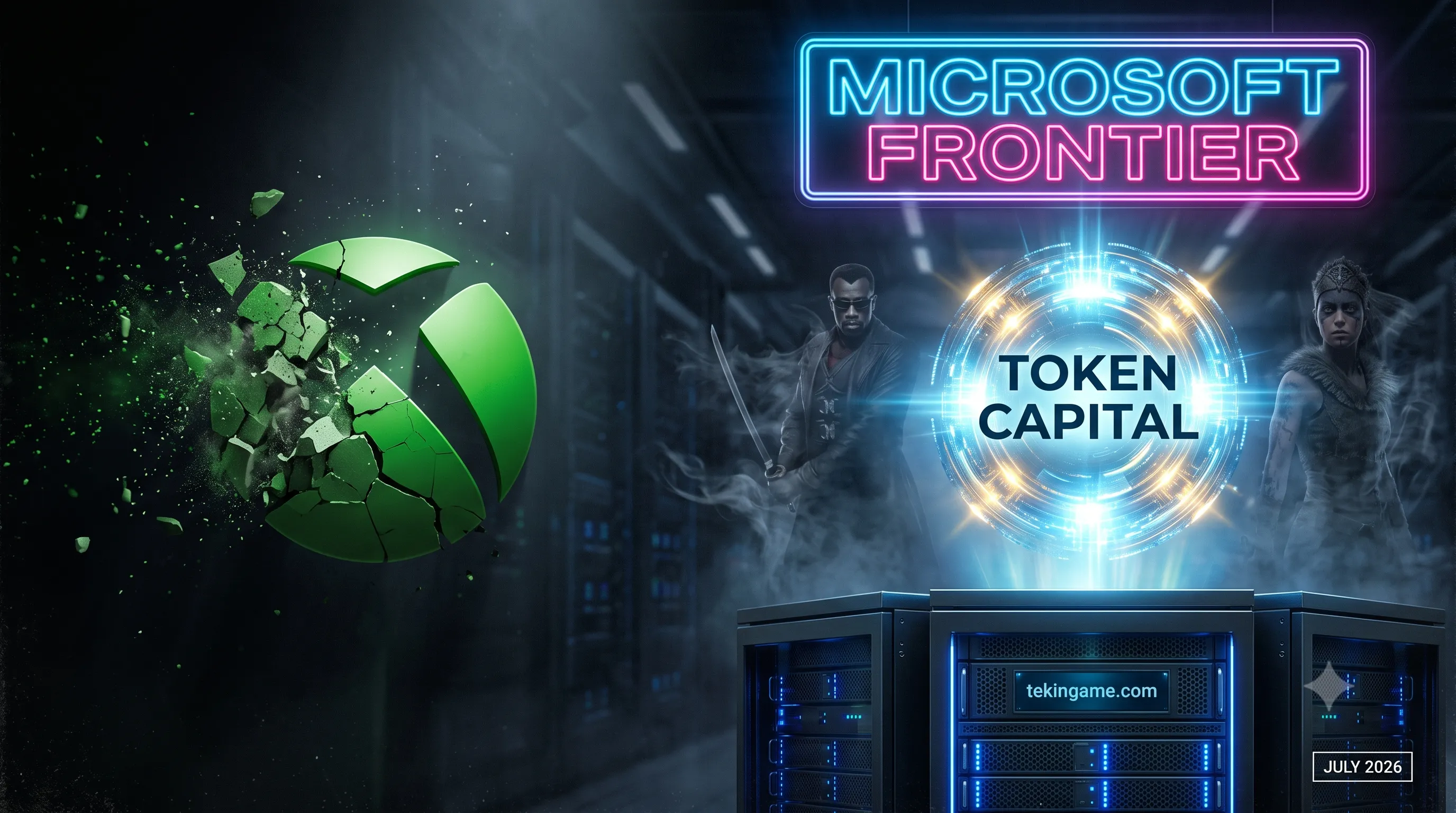
Human Capital vs. Token Capital
- 🎮5 Studios at Risk- Arkane, Ninja Theory, Double Fine in negotiations
- 🎧Marvel's Blade Cancelled- Over budget, delayed from 2026 to 2027
- 🚀Microsoft Frontier Company- $2.5B AI investment announced
- 🗡️Controversial Quote- Human capital and token capital compound
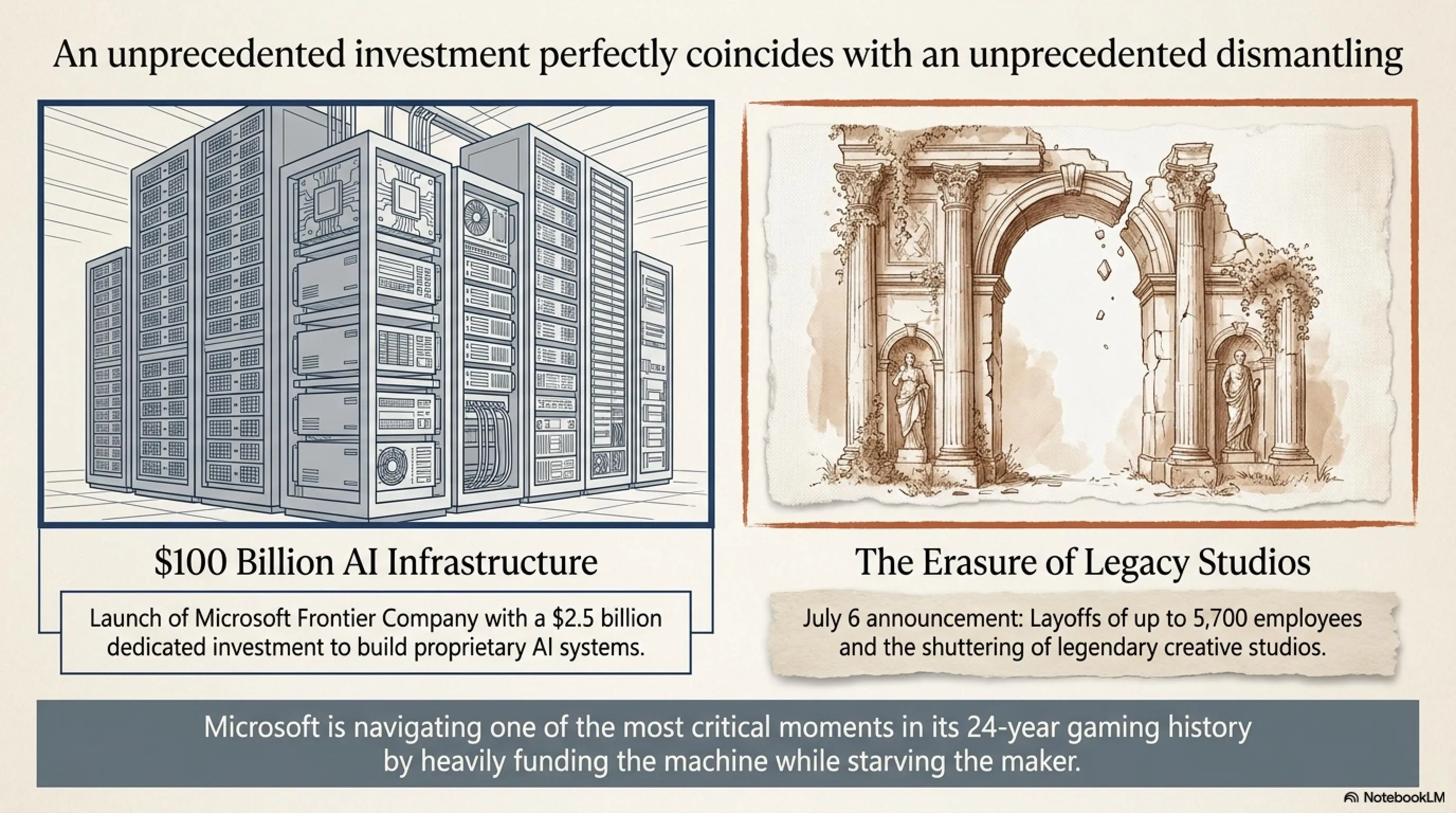
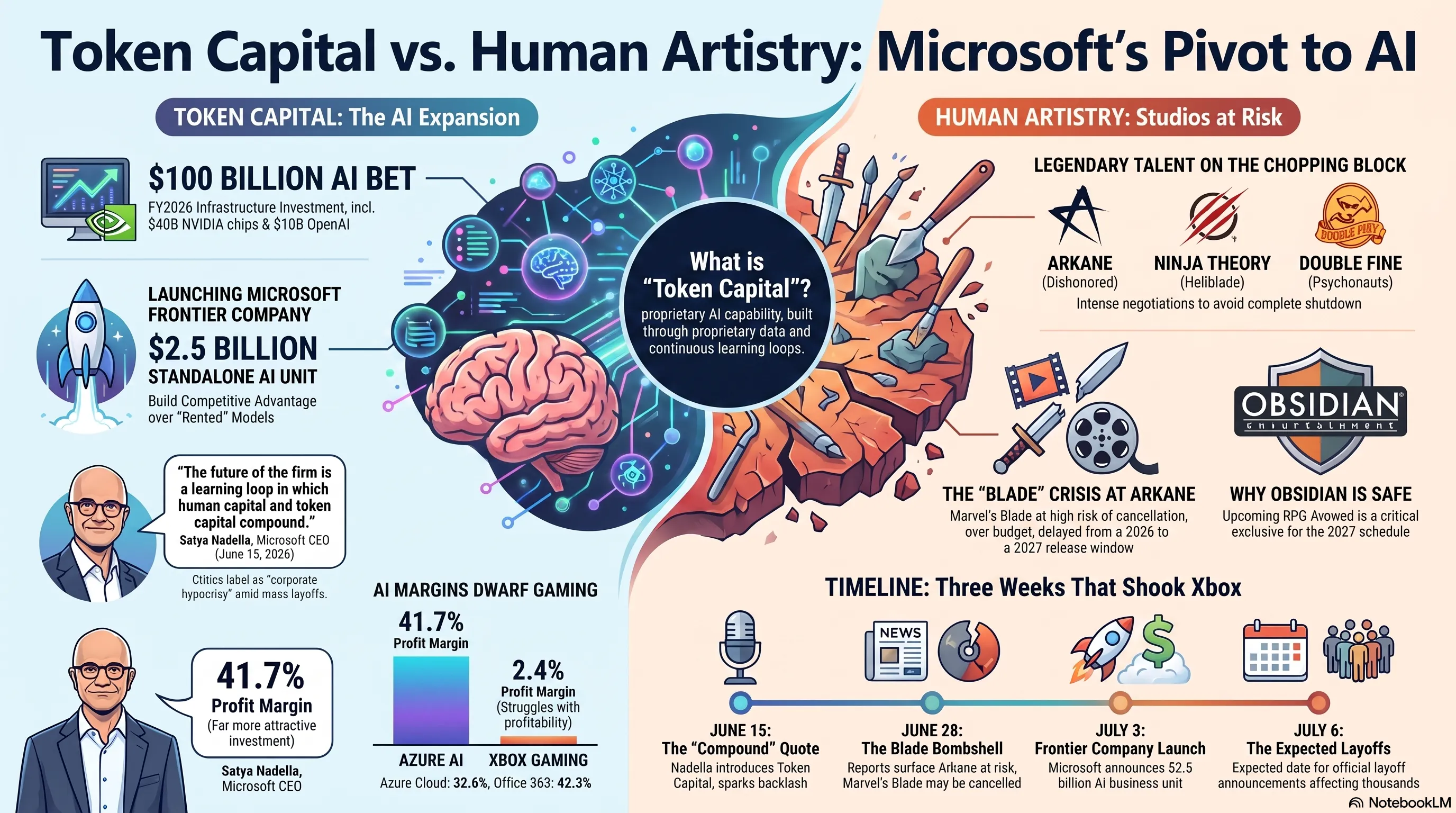
In the first week of July 2026, Microsoft is navigating one of the most critical moments in its 24-year history in the gaming industry. According to reports from Bloomberg, The Verge, and Business Insider, the software giant is preparing to lay off thousands of employees across its sales, consulting, and prominently, Xbox divisions starting July 6th. At least five legendary game development studios — including Arkane (makers of Dishonored and Deathloop), Double Fine (Psychonauts), Ninja Theory (Hellblade), and Obsidian (Fallout: New Vegas) — are reportedly in intense negotiations to avoid complete shutdown.
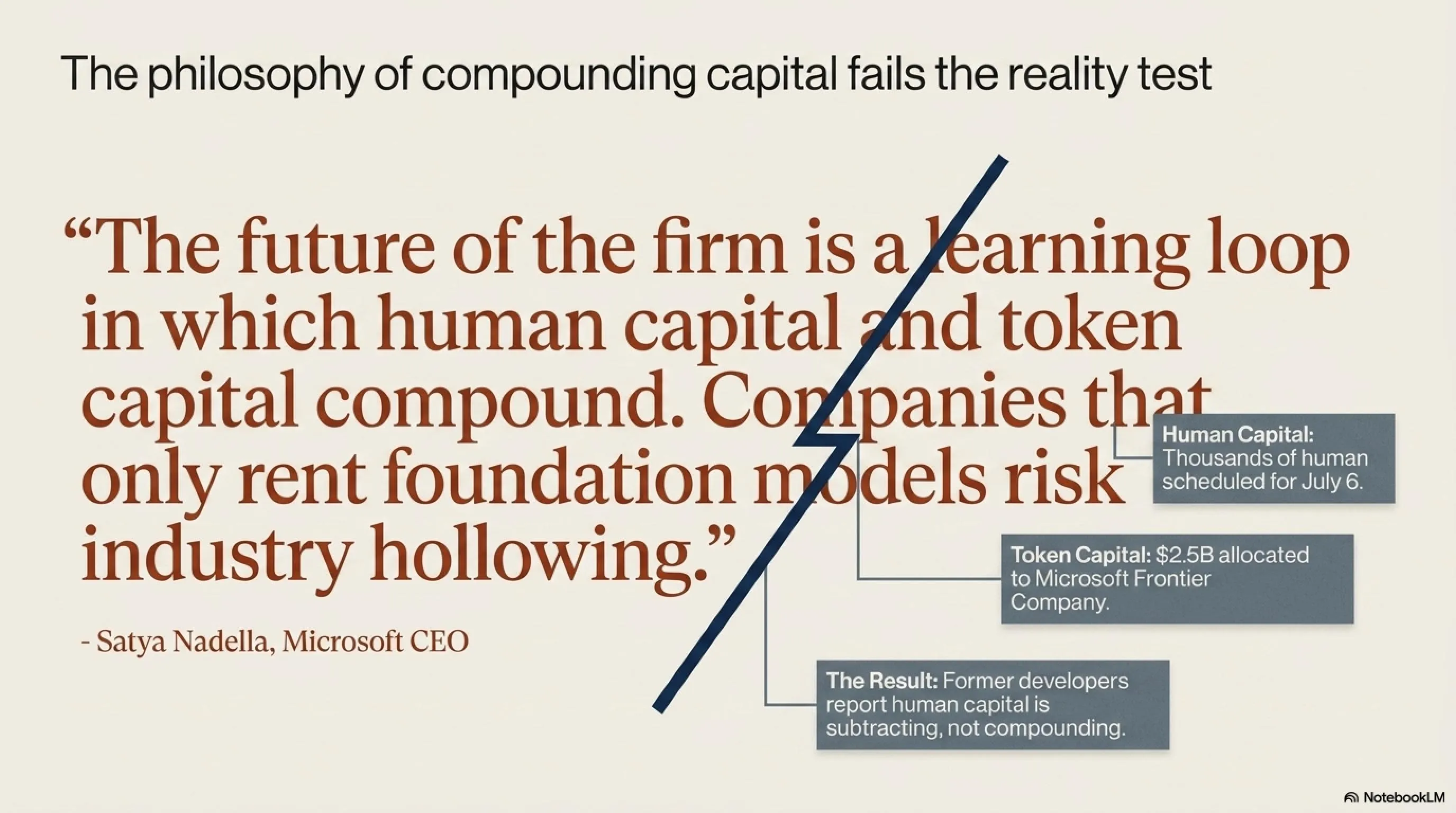
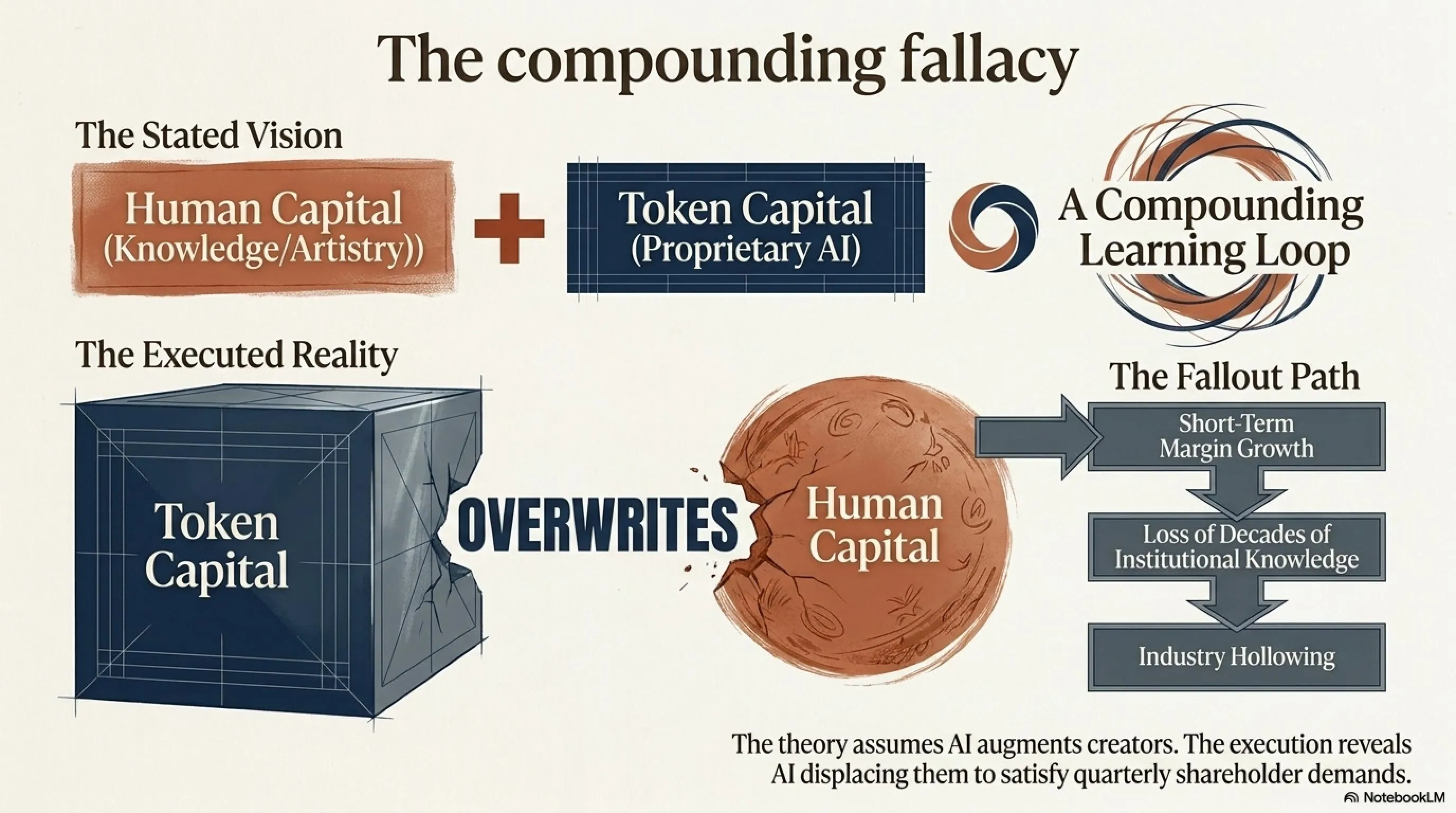
Meanwhile, just days before announcing these mass layoffs, Microsoft unveiled Microsoft Frontier Company — a new standalone AI-focused business unit backed by $2.5 billion in investment. The contradiction peaked when Microsoft CEO Satya Nadella posted on X (formerly Twitter) that "the future of the firm is a learning loop in which human capital and token capital compound" — a phrase that has quickly become one of the most notorious quotes of the year in the tech industry.
Timeline of the Crisis: From Rumors to Reality
This saga didn't start with rumors — it started with an 18-month pattern. Microsoft executed two waves of mass layoffs in 2025: 6,000 people in May and another 9,000 in July, totaling 15,000 employees from its 220,000-person workforce. In early 2026, the company ran its first voluntary retirement program to mitigate further forced layoffs. But it wasn't enough.
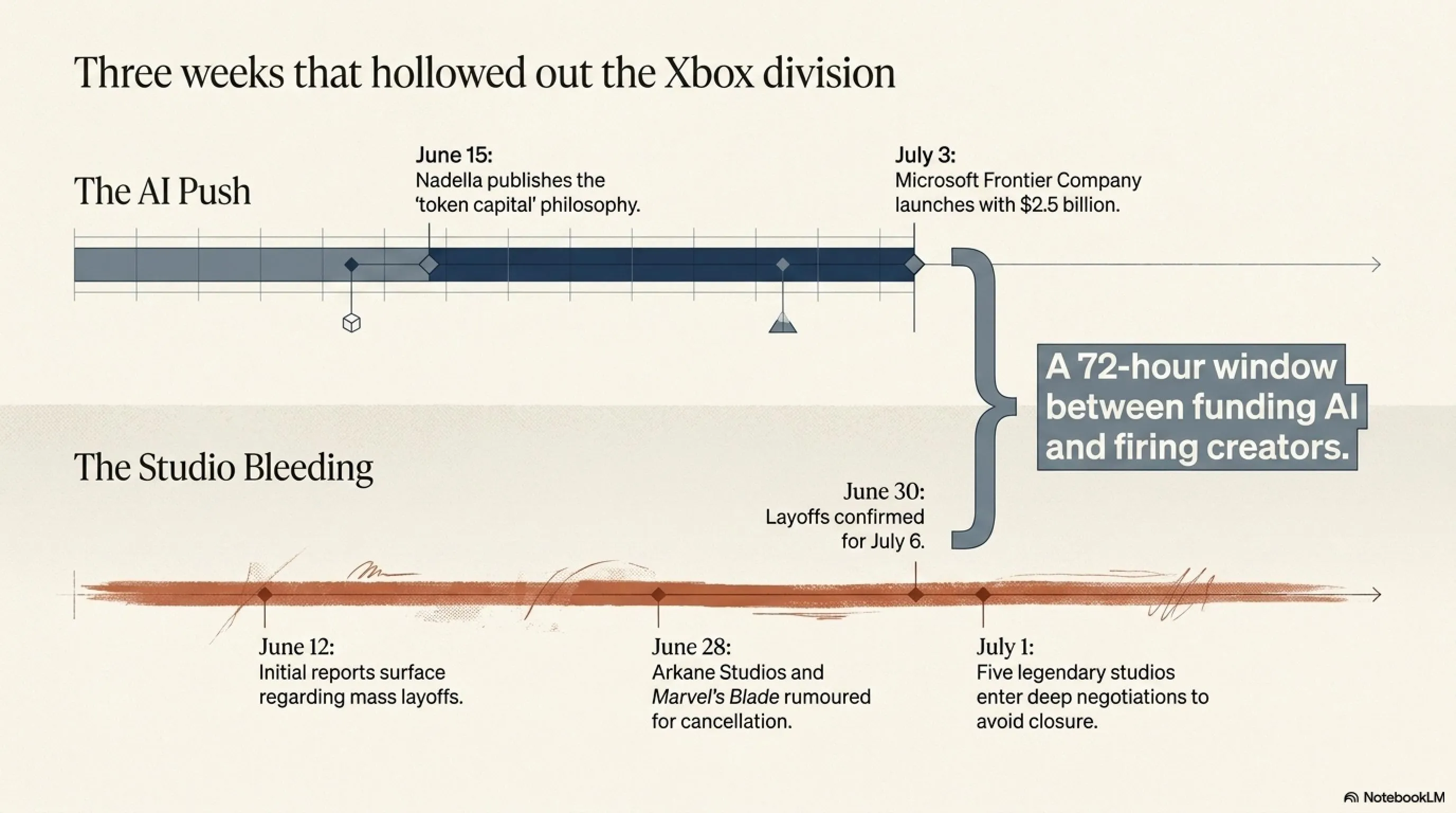
⏰ Timeline: Three Weeks That Shook Xbox
- June 12, 2026: Business Insider first reports Microsoft is planning a new wave of layoffs
- June 28: The Verge reports Arkane Studios and Marvel's Blade game are at risk of cancellation
- June 30: Bloomberg confirms layoffs will begin July 6 (first day of Microsoft's new fiscal year)
- July 1: Chris Dring from GamesIndustry.biz reports Obsidian, Double Fine, Ninja Theory and others are in negotiations to avoid closure
- July 2: Jason Schreier from Bloomberg confirms Obsidian is actually safe — but other studios remain at risk
- July 3: People Matters reports Microsoft Frontier Company launched with $2.5 billion investment
- July 6 (expected): Official layoff announcement
On June 28, Tom Warren from The Verge dropped the next bombshell: Microsoft is considering shutting down Arkane Studios and canceling Marvel's Blade — a big-budget action game that has been in development since late 2023. The game, originally slated for a late 2026 release, has been internally delayed to late 2027 and is over budget. Blade is one of five studios Microsoft is considering closing or selling, according to Warren's report.
On July 1, Chris Dring from GamesIndustry.biz — a highly reliable source in European industry coverage — reported that Obsidian, Double Fine, Ninja Theory, Compulsion, and Undead Labs are all "in deep negotiations with Microsoft to avoid closure." This is a horrifying list of legendary talent: Obsidian made Fallout: New Vegas, The Outer Worlds, and the upcoming Avowed. Double Fine made Psychonauts and Brütal Legend. Ninja Theory made Hellblade: Senua's Sacrifice and its 2024 sequel Senua's Saga.
Why Is This Happening? Xbox Is "Unprofitable"
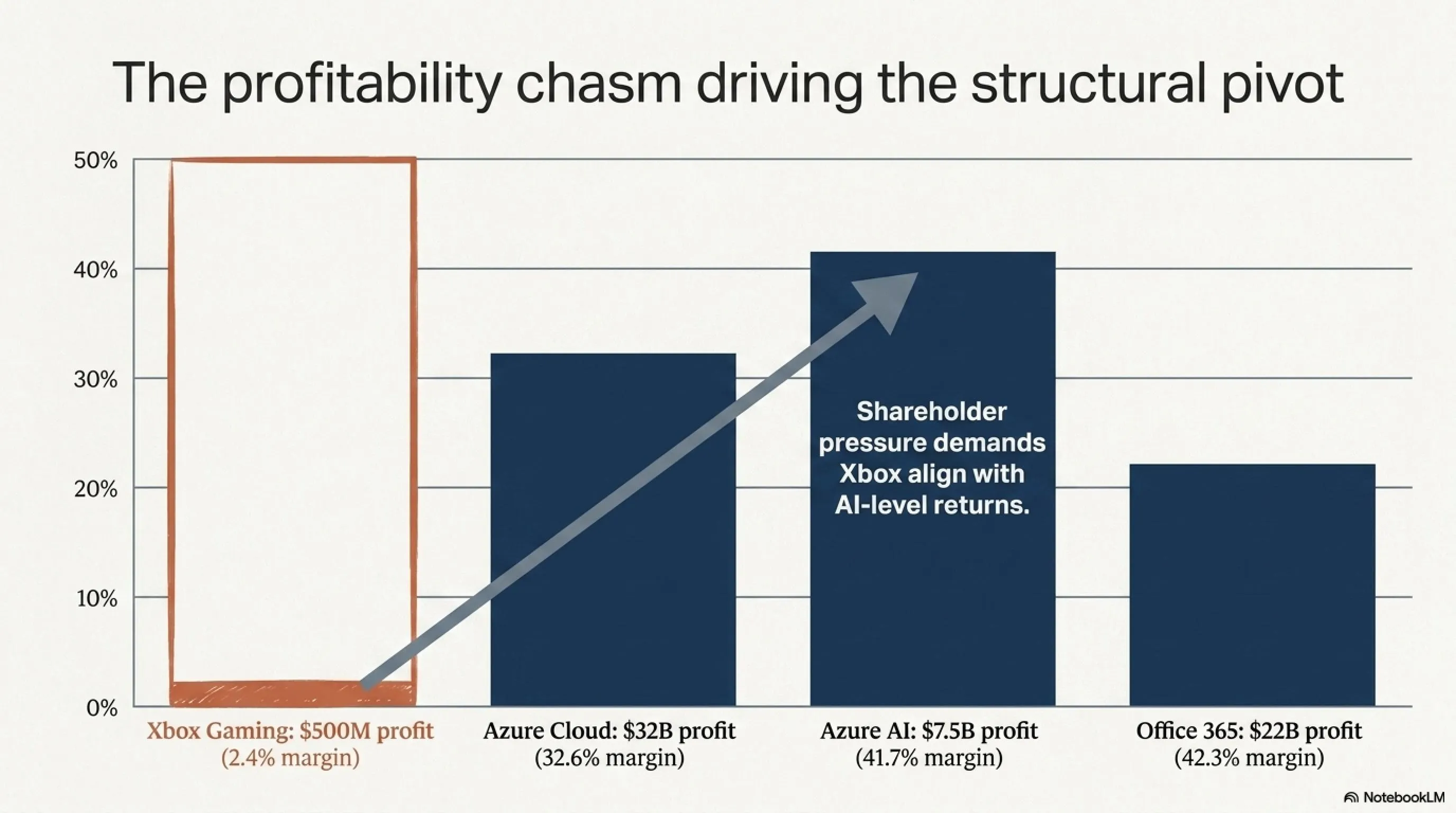
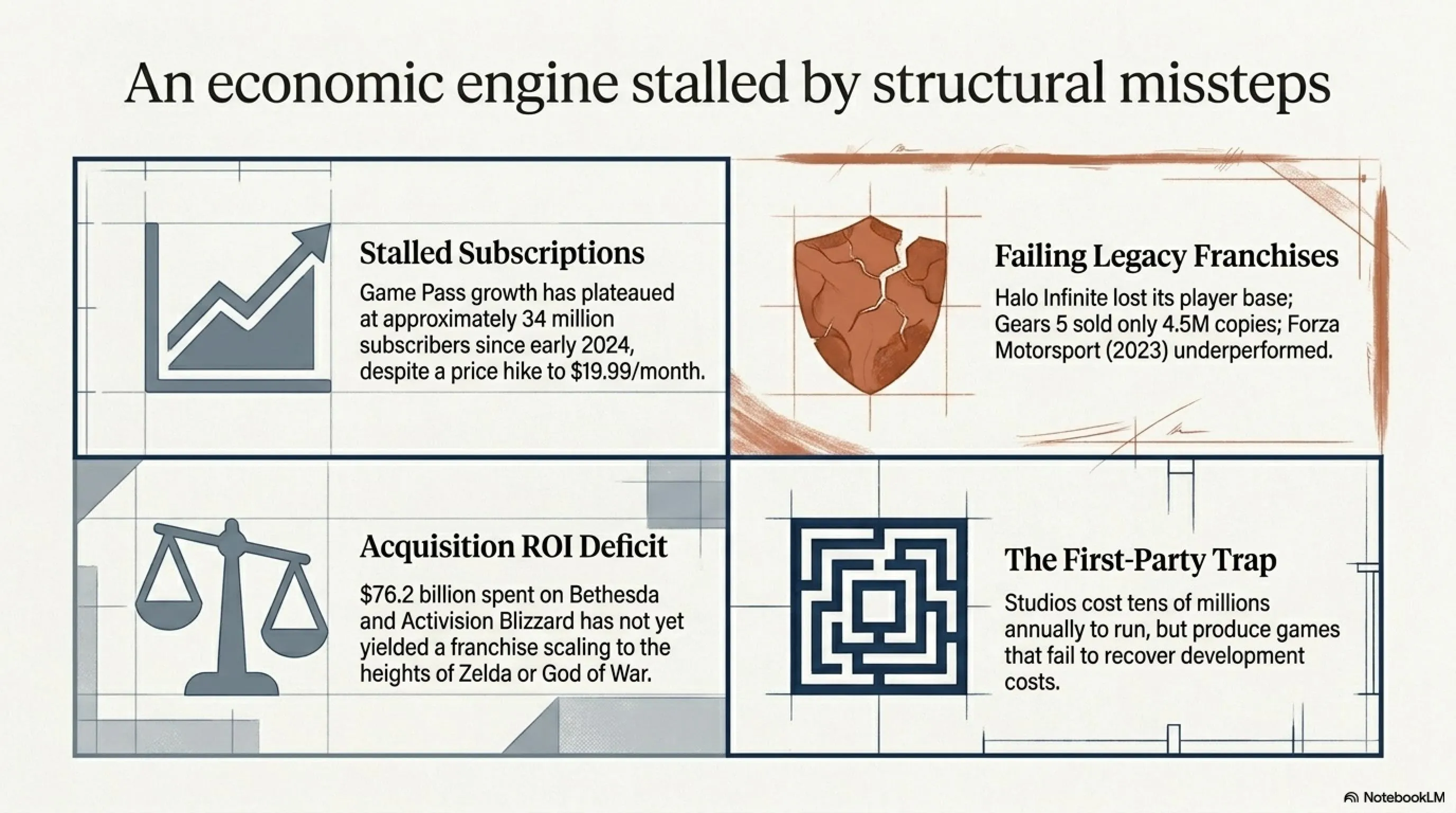
Microsoft has never transparently disclosed Xbox's profitability — and there are good reasons for that. Based on financial analysis by Ampere Analysis published by IGN, Microsoft's gaming division generated approximately $21 billion in revenue in fiscal year 2025 (ending June 30, 2025) but only about $500 million in operating profit — a 2.4% profit margin. For comparison, Microsoft's Azure Cloud division has margins of 30-35%, and Azure AI delivers margins exceeding 40%.
The core problem is that the vast majority of Xbox revenue comes from subscription services (Game Pass) and third-party software sales through the Xbox Store — not from first-party games. Despite acquiring Bethesda in 2021 for $7.5 billion and Activision Blizzard in 2023 for $68.7 billion, Microsoft has still failed to build a profitable first-party franchise at the scale of Sony's God of War, Nintendo's Legend of Zelda, or Rockstar's Grand Theft Auto.
💡 The Xbox Economic Problem
- ❌ <strong>$21B revenue, only $500M profit:</strong> 2.4% margin compared to 30-35% for Azure
- ❌ <strong>No successful first-party franchise:</strong> Halo, Gears, and Forza no longer have their former sales
- ❌ <strong>Acquired studios underperforming:</strong> Bethesda and Activision have not yet delivered positive ROI
- ❌ <strong>Game Pass growth stalled:</strong> Around 34 million subscribers, flat since early 2024
- ✅ <strong>Microsoft's solution:</strong> Close underperforming studios, focus on multi-platform
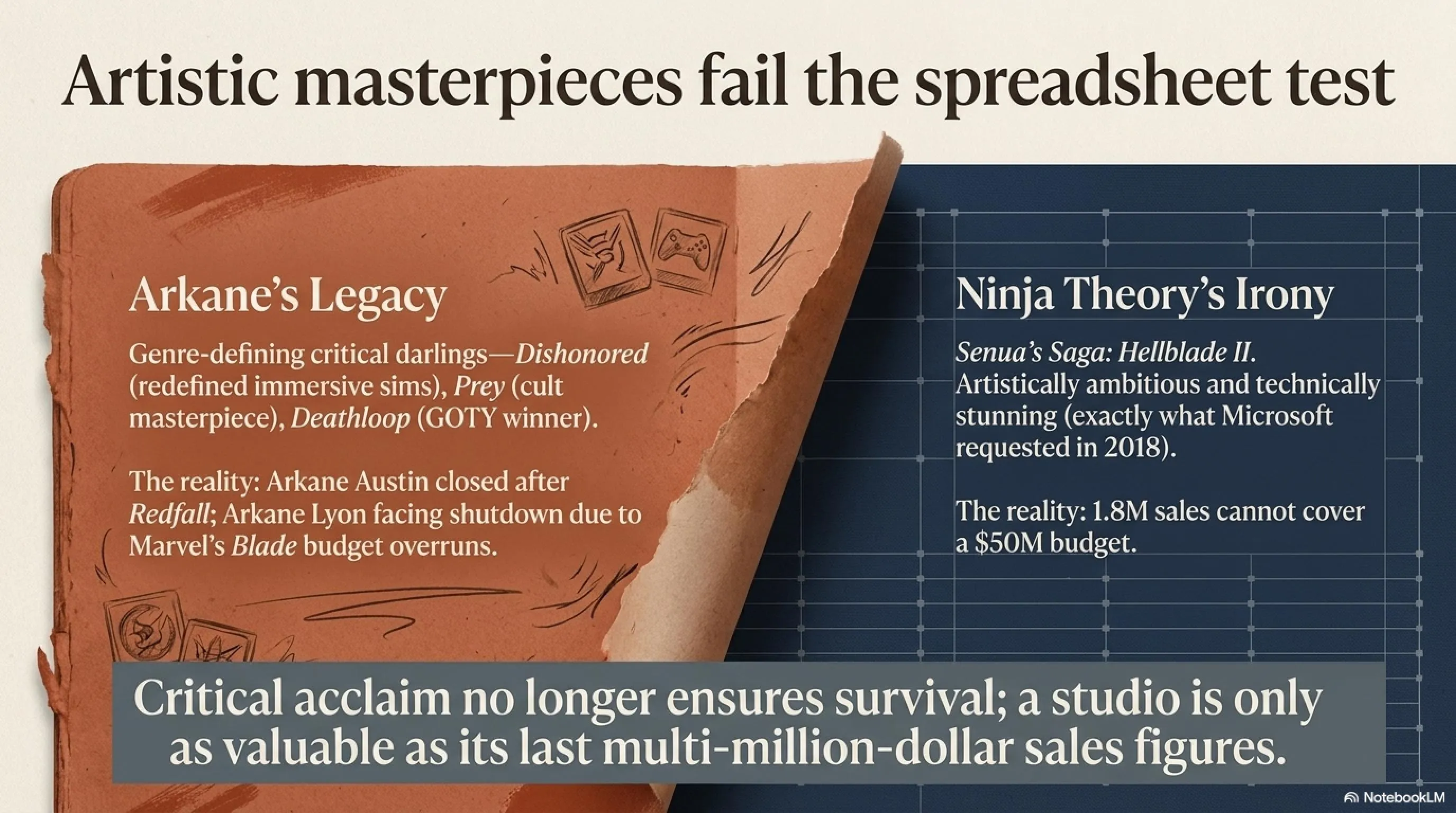
This means Microsoft has studios that cost tens of millions of dollars annually but produce games that can't even cover their development costs. Arkane Austin (Redfall) and Tango Gameworks (Hi-Fi Rush) were shut down in May, despite Hi-Fi Rush being called a "hit" with over 3 million players. Redfall was a complete commercial and critical failure. Now it's Arkane Lyon's turn (Blade), Ninja Theory (Hellblade 2), and Double Fine (Psychonauts 3).
But What About the $100+ Billion AI Investment?
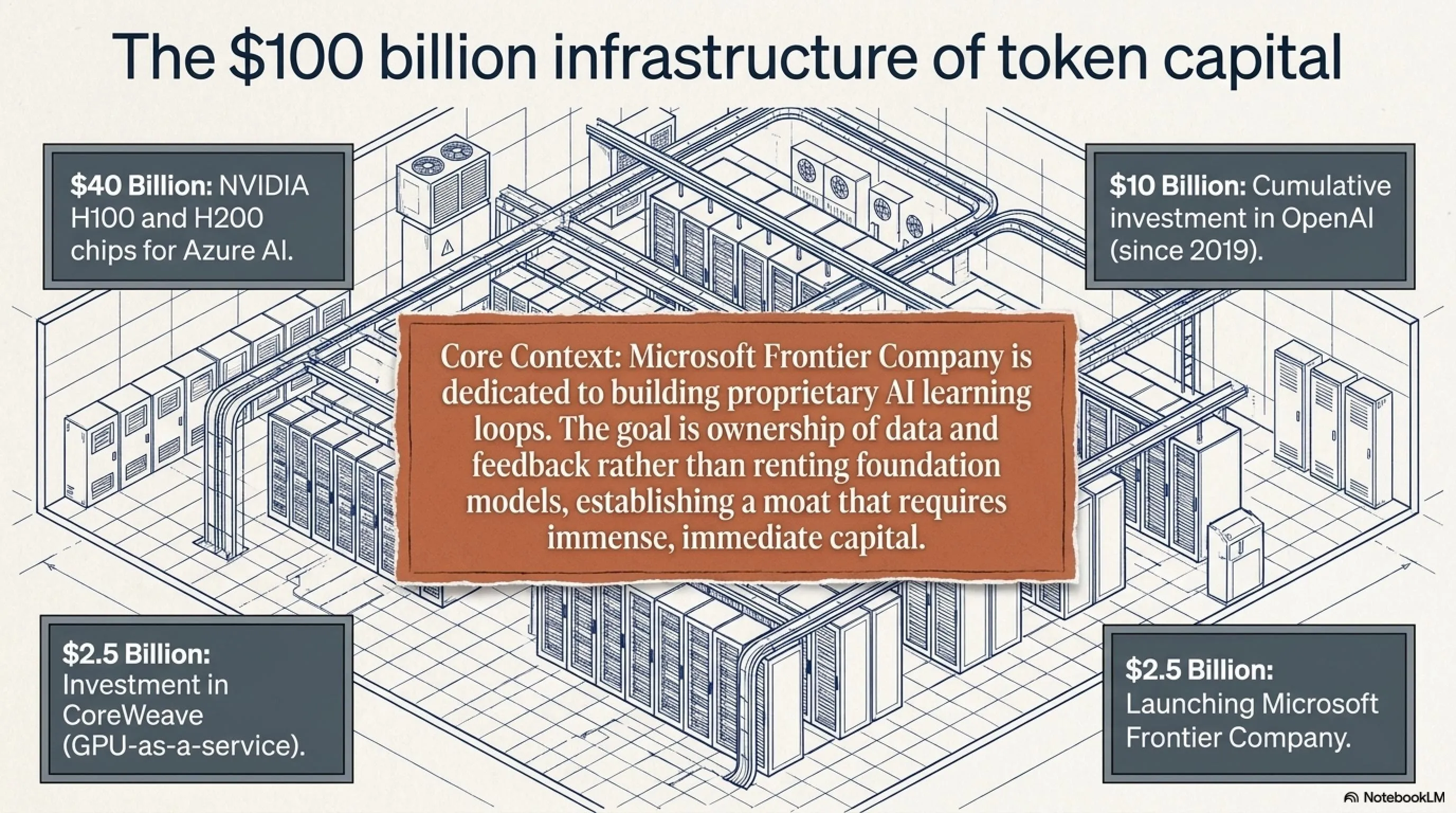
In the same period Microsoft is closing game studios, the company is spending over $100 billion on AI and cloud infrastructure in fiscal year 2026, according to TechStory. This includes:
- $40 billion on NVIDIA H100 and H200 chips for Azure AI data centers
- $10 billion cumulative investment in OpenAI (to date, since 2019)
- $2.5 billion new investment in CoreWeave (GPU-as-a-service infrastructure provider)
- $2.5 billion to launch Microsoft Frontier Company (new AI company)
Microsoft Frontier Company, officially announced on July 3, is a standalone business unit focused on "proprietary AI learning loops" — a concept Nadella calls "token capital." The company's goal is to build AI systems that use proprietary data, employee feedback, and continuous learning to create a competitive advantage that cannot be replicated by simply renting foundation models.
The Quote That Sparked Outrage: "Human Capital and Token Capital Compound"
On June 15, 2026, Satya Nadella published a LinkedIn post introducing the concept of "token capital" — a term he coined for a company's proprietary AI capability. He paired it with "human capital" (employee knowledge, judgment, and relationships) and argued that the future of companies lies in building learning loops where these two types of capital compound together.
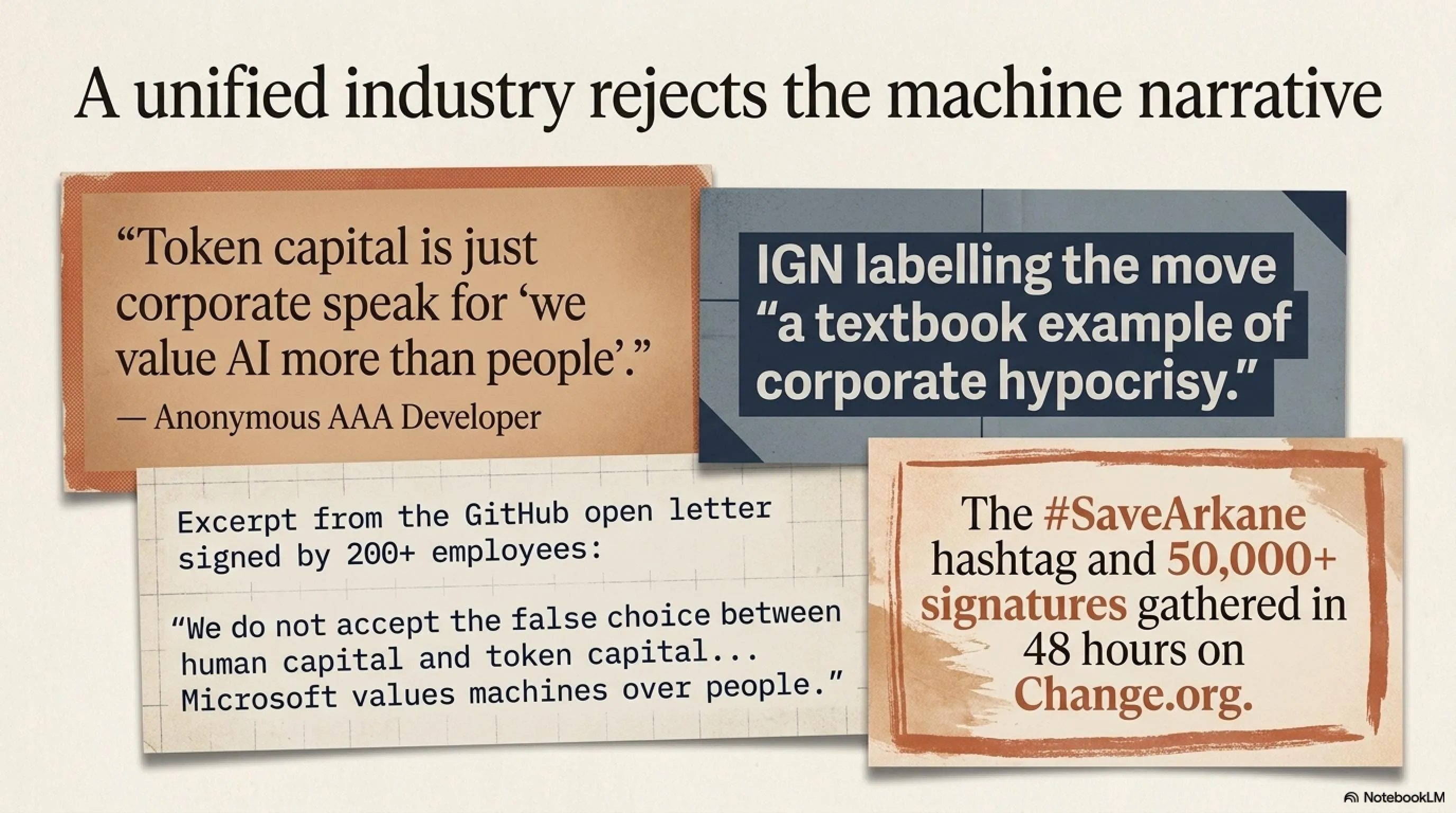
The phrase went viral quickly — but not for the reasons Nadella hoped. Game developers, former Microsoft employees, and industry critics immediately pointed out the contradiction: Microsoft is talking about "human capital" while actively laying off thousands of humans. A former Arkane developer wrote on X (Twitter): "Apparently my human capital didn't compound enough."
The reactions were brutal. Kotaku headlined: "Microsoft Announces New AI Company Days Before Mass Layoffs — A Learning Loop In Which Human Capital And Token Capital Compound." The Verge wrote: "Microsoft's token capital is replacing human capital — literally." And IGN called it "a textbook example of corporate hypocrisy."
What makes the quote particularly tone-deaf is the timing. Nadella introduced "token capital" on June 15. Microsoft Frontier Company was announced on July 3. And the Xbox layoffs and studio closures are expected to be announced on July 6. Within three weeks, Microsoft went from philosophizing about human capital to eliminating thousands of humans.
Which Studios Are at Risk? A Look at the Black List
Based on confirmed reports from The Verge, Bloomberg, and GamesIndustry.biz, at least five major Xbox studios are currently either facing complete shutdown or in intense negotiations to prevent it. This list includes some of the most acclaimed names in game development.
🎮 Studios at Risk of Closure
| Studio | Notable Works | Status |
|---|---|---|
| Arkane Studios | Dishonored, Prey, Deathloop | High risk of closure |
| Ninja Theory | Hellblade, DmC | In negotiations |
| Double Fine | Psychonauts, Brütal Legend | In negotiations |
| Compulsion Games | We Happy Few, Contrast | In negotiations |
| Undead Labs | State of Decay | In negotiations |
| Obsidian Entertainment | Fallout New Vegas, The Outer Worlds | Saved (Schreier confirmed) |
Arkane Studios: From Dishonored to Downfall
Arkane Lyon (the French branch) is developing Marvel's Blade — a big-budget action-adventure game based on the Marvel character. The game was announced in December 2023 with a teaser trailer but since then, no gameplay or substantial information has been released. Tom Warren from The Verge reports that Blade has been internally delayed from a late 2026 release window to late 2027 and is over budget.
This is the second time an Arkane project has hit a crisis. Arkane Austin (the American branch) was shut down in May 2024, right after releasing Redfall — a loot-based shooter that failed both commercially and critically. Now Arkane Lyon is likely facing the same fate, this time because of Blade.
What makes this particularly tragic is Arkane's legacy. Dishonored (2012) and Dishonored 2 (2016) were critical darlings that redefined the immersive sim genre. Prey (2017) was a masterpiece that sold poorly but built a cult following. Deathloop (2021) won multiple Game of the Year awards. And now, because of one troubled Marvel project, the entire studio could be shut down.
Ninja Theory: Hellblade 2 Wasn't Enough
Ninja Theory released Senua's Saga: Hellblade II in May 2024 — one of the most visually stunning and immersive games of the year. The game was met with critical acclaim (Metacritic 81) but didn't have strong commercial sales. Based on estimates by Ampere Analysis, the game sold only 1.8 million copies — a figure that can never cover its $50 million development budget.
Microsoft acquired Ninja Theory in 2018, right after the success of the first Hellblade. But now, after the sequel was a commercial failure, the studio is negotiating to stay alive. Chris Dring reports that Ninja Theory is one of several studios "in deep negotiations to avoid closure."
The irony is brutal. Hellblade II was exactly the kind of game Microsoft said it wanted: artistically ambitious, critically acclaimed, and technically impressive. But in Microsoft's financial view, that's not enough. If it doesn't sell millions of copies and generate hundreds of millions in revenue, it's expendable.
Double Fine: The Psychonauts Makers in Danger
Double Fine Productions, the legendary studio of Tim Schafer, maker of Psychonauts, Brütal Legend, and Grim Fandango, is another studio "in negotiations." Microsoft acquired Double Fine in 2019 and released Psychonauts 2 in 2021 — a game that received widespread critical acclaim (Metacritic 87) but again, didn't have strong commercial sales.
If Double Fine closes, one of the most influential names in game development will be lost — a studio that has spent over two decades producing creative and artistic games. Schafer himself, a game design legend who worked on classics like Monkey Island and Full Throttle, would lose his studio.
Obsidian Saved — But Why?
Amid this crisis, there's one piece of good news: Jason Schreier from Bloomberg confirmed on July 2 that Obsidian Entertainment — maker of Fallout: New Vegas, The Outer Worlds, and Avowed — is safe. The company is not only not being shut down but isn't even in negotiations to prevent closure.
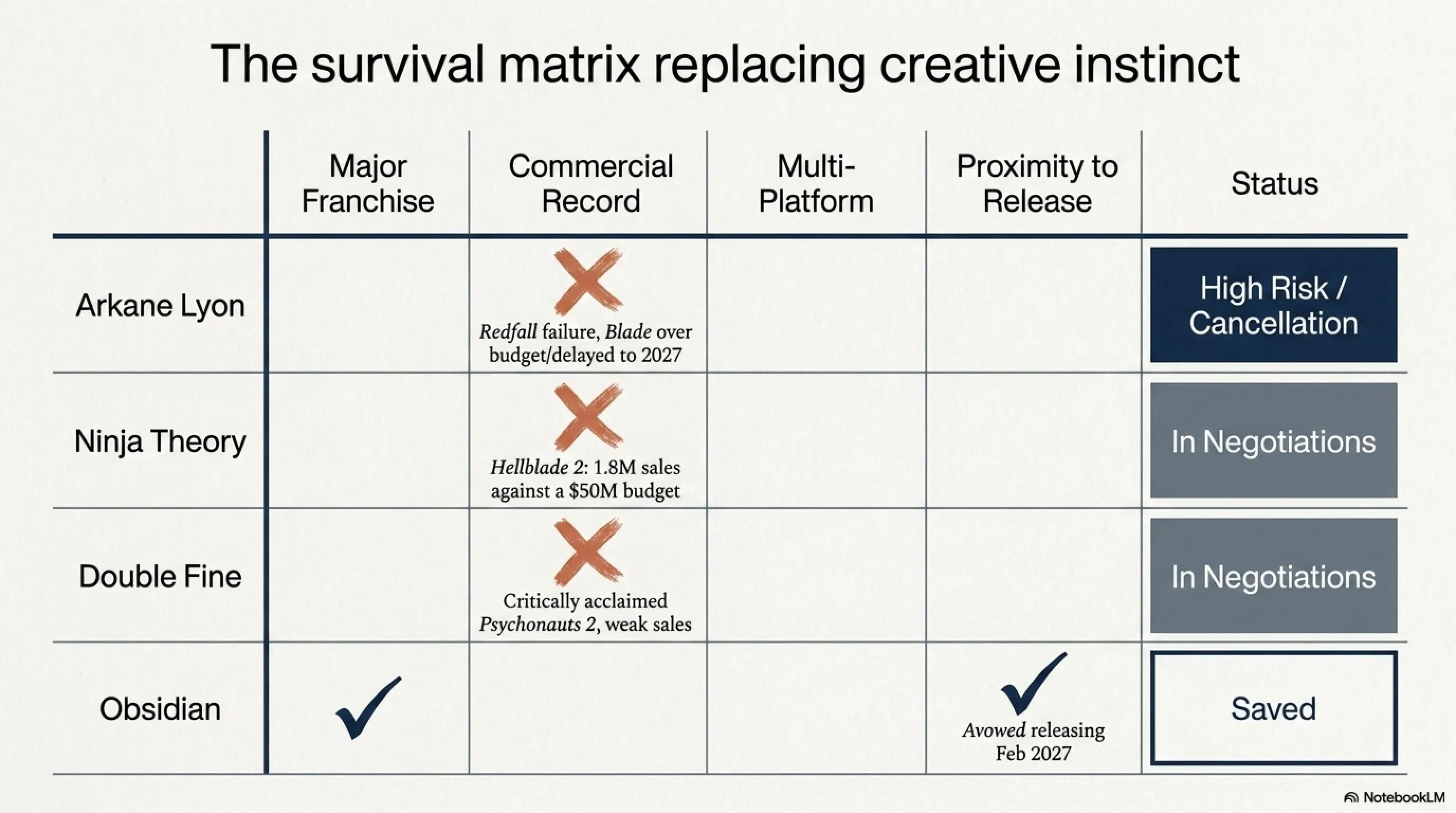
Why was Obsidian saved but Arkane wasn't? The answer is simple: Avowed. Obsidian's first-person RPG, scheduled to release in February 2027, is one of the few major Xbox exclusives in the next two years. Microsoft can't cancel it without seriously damaging its release schedule.
💡 Why Are These Studios Being Closed?
- Critically successful but commercially weak games (Hellblade 2, Psychonauts 2)
- High budgets without justifiable ROI (Blade over budget)
- Microsoft wants studios that can build multi-billion dollar franchises
- Game Pass has low margins - exclusives must be multi-platform
- Shareholder pressure to improve gaming division profitability
📚 Classified & Related Dossiers in TekinGame
If you wish to explore beyond this report and delve into cybernetic frontiers and autonomous AI architectures, do not miss these three exclusive deep-dives in the Tekin Garage:
The Broken Economics of Xbox: Why $21 Billion Revenue Only Generates $500 Million Profit
To understand why Microsoft is closing studios, we need to look at Xbox's economics. Microsoft has never transparently disclosed Xbox profitability — and the reason is obvious.
Based on Ampere Analysis published by IGN, Microsoft's gaming division generated approximately $21 billion in revenue in fiscal year 2025 (ending June 30, 2025) but only around $500 million in operating profit — a 2.4% profit margin. For comparison, Microsoft's Azure Cloud division has margins of 30-35%, and Azure AI delivers margins exceeding 40%.
💰 Profitability Comparison: Microsoft Divisions
| Division | Annual Revenue | Operating Profit | Profit Margin |
|---|---|---|---|
| Xbox Gaming | $21 billion | $500 million | 2.4% |
| Azure Cloud | $98 billion | $32 billion | 32.6% |
| Azure AI | $18 billion | $7.5 billion | 41.7% |
| Office 365 | $52 billion | $22 billion | 42.3% |
The core problem is that the vast majority of Xbox revenue comes from subscription services (Game Pass) and third-party software sales through the Xbox Store — not from first-party games. Despite acquiring Bethesda in 2021 for $7.5 billion and Activision Blizzard in 2023 for $68.7 billion, Microsoft has still failed to build a profitable first-party franchise at the scale of Sony's God of War or Nintendo's Zelda.
Game Pass: Successful But Stalled
Game Pass, Xbox's subscription service, now has approximately 34 million subscribers — a figure that has remained roughly flat since early 2024. Microsoft raised Game Pass Ultimate pricing from $16.99 to $19.99 per month in June 2026 to try to improve profitability, but growth has slowed significantly.
The biggest problem is that Xbox's first-party games — Halo Infinite, Gears 5, Forza Motorsport — no longer have their former sales. Halo Infinite launched with a crippling start and has since lost its player base. Gears 5 sold only 4.5 million copies — less than half of Gears of War 3. And Forza Motorsport (2023) with a Metacritic score of 84 is one of the weakest games in the series.
This means Microsoft has studios that cost tens of millions of dollars annually but produce games that can't even cover their development costs. And from a shareholder perspective, that's unacceptable.
The Industry Reacts: From Outrage to Action
The gaming industry's reaction to Microsoft's moves has been swift and harsh. Developers, journalists, and fans have all expressed outrage at the contradiction between Microsoft's words and actions.
Several high-profile game developers have spoken out. One anonymous AAA developer told Kotaku: "Microsoft spent $70 billion on Activision but won't spend $10 million to keep Double Fine alive. That tells you everything about their priorities." Another developer tweeted: "Token capital is just corporate speak for 'we value AI more than people.'"
The hashtag #SaveArkane began trending on X (Twitter) within hours of The Verge's report. Fans organized petitions, with one Change.org petition to "Save Arkane Studios" gathering over 50,000 signatures in two days. Similar petitions for Ninja Theory and Double Fine have also gained traction.
Industry analysts have been equally critical. Michael Pachter from Wedbush Securities told CNBC: "Microsoft is making a strategic mistake. Game development is about creativity and talent, not spreadsheets. If they close these studios, they're not just losing employees — they're losing decades of institutional knowledge."
But What About the $100+ Billion AI Investment?
In the same period Microsoft is closing game studios, the company is spending over $100 billion on AI and cloud infrastructure in fiscal year 2026. This includes $40 billion on NVIDIA H100 and H200 chips for Azure AI data centers, $10 billion cumulative investment in OpenAI, $2.5 billion for CoreWeave, and $2.5 billion to launch Microsoft Frontier Company.
Microsoft Frontier Company: Token Capital in Practice
Microsoft Frontier Company, officially announced on July 3, is a standalone business unit focused on "proprietary AI learning loops." The company's goal is to build AI systems that use proprietary data, employee feedback, and continuous learning to create a competitive advantage that cannot be replicated by simply renting foundation models.
Nadella calls this concept "token capital" — the proprietary AI capability that a company builds and owns, not a model it rents. He pairs it with "human capital" (employee knowledge and judgment) and argues that these two must compound together.
But the contradiction is glaring. How can you talk about compounding human capital while actively laying off thousands of humans? How can you claim that "companies that only rent foundation models risk industry hollowing" while hollowing out your own gaming division?
The Harsh Industry Reaction to the "Compound" Quote
The reaction to Nadella's "human capital and token capital compound" phrase was brutal. One former Arkane developer wrote on X: "Apparently my human capital didn't compound enough." Another tweeted: "If token capital compounds, why does human capital subtract?"
Gaming journalist Jason Schreier commented: "It's remarkable that Microsoft can announce a $2.5 billion AI company and thousands of layoffs in the same week and not see the irony." The Verge's Tom Warren wrote: "Microsoft is literally replacing human capital with token capital."
And perhaps most damning, an open letter signed by over 200 current and former Microsoft employees was published on GitHub, stating: "We do not accept the false choice between human capital and token capital. Companies should invest in both, not sacrifice one for the other. Closing game studios while launching AI companies sends a clear message: Microsoft values machines over people."
Why Obsidian Was Saved But Arkane Wasn't
Amid this crisis, one piece of good news emerged: Jason Schreier from Bloomberg confirmed on July 2 that Obsidian Entertainment is safe. The studio is not being shut down and isn't even in negotiations to prevent closure.
Why was Obsidian saved but Arkane wasn't? The answer is simple: Avowed. Obsidian's first-person RPG, scheduled to release in February 2027, is one of the few major Xbox exclusives in the next two years. Microsoft can't cancel it without seriously damaging its release schedule.
🎯 Survival Criteria at Microsoft
- Major franchise in development: Obsidian (Avowed) saved, Arkane (Blade) cancelled
- Multi-platform potential: Games that can sell on PS5 have more value
- Commercial track record: Ninja Theory (Hellblade 2 commercial failure) at risk, The Coalition (Gears) still safe
- Lower budget: Smaller studios like Moon Studios have better chances
- Proximity to release: The closer to launch, the less likely to cancel
But for other studios, the future is uncertain. Arkane Lyon will likely be shut down and Blade cancelled. Ninja Theory and Double Fine are still in negotiations but the outcome is unclear. And Compulsion Games and Undead Labs are in the same situation.
The Future of Xbox: From First-Party to Multi-Platform
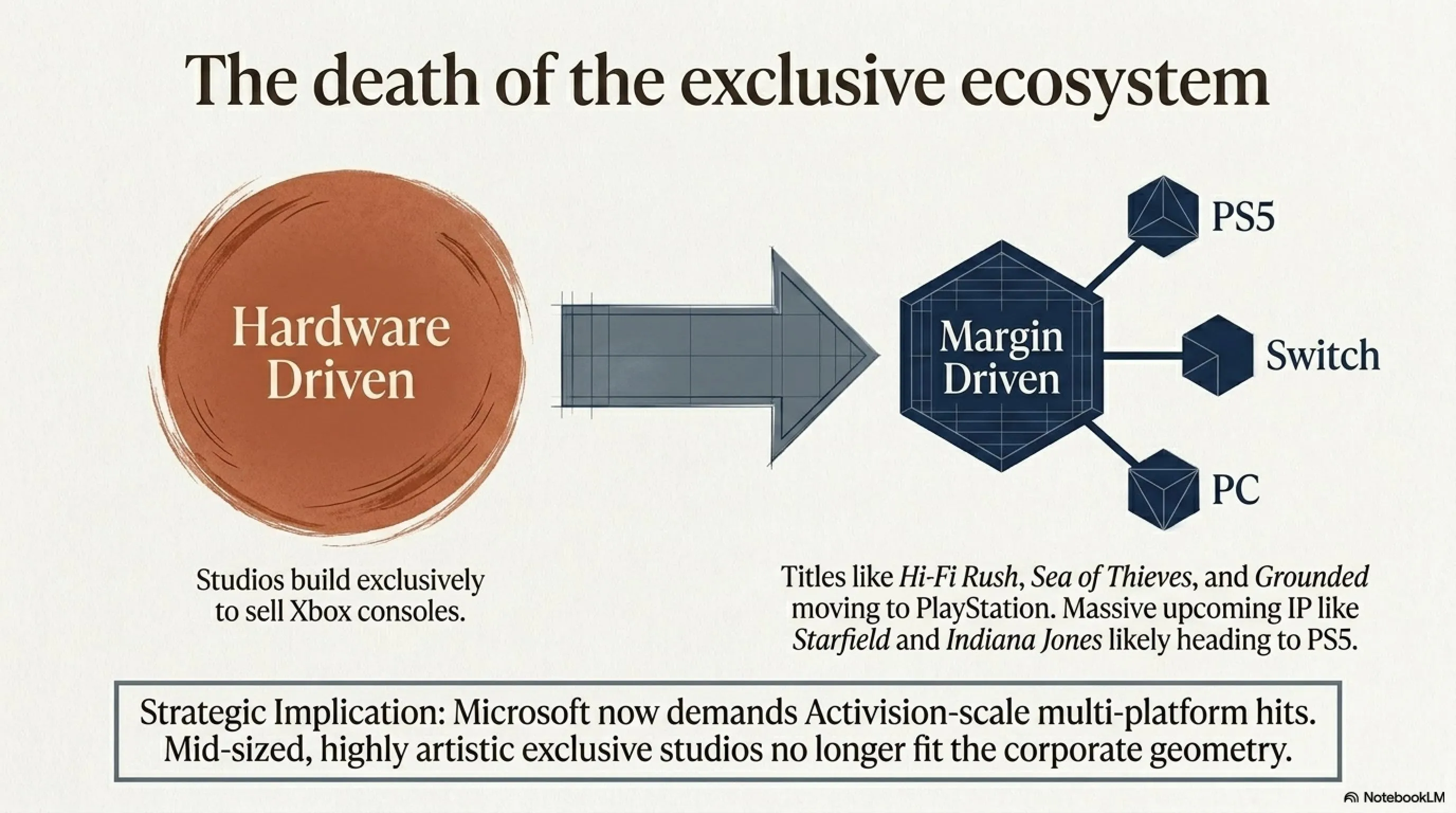
These layoffs and studio closures are part of a larger strategy. Microsoft is transforming Xbox from an exclusive platform to a multi-platform service. The company recently confirmed that four Xbox exclusives — Hi-Fi Rush, Pentiment, Sea of Thieves, and Grounded — will move to PlayStation. And according to Bloomberg reports, bigger games like Starfield and Indiana Jones and the Great Circle will also come to PS5.
This strategic shift means Microsoft no longer wants studios that only make games for Xbox. The company wants studios that can build big multi-platform games — games that can sell on Xbox, PlayStation, PC, and even Nintendo Switch.
This means small and medium studios that make artistic and creative games — like Arkane, Ninja Theory, and Double Fine — no longer fit into Microsoft's strategy. The company wants Activision Blizzard (Call of Duty), not Double Fine (Psychonauts).
The Hidden Cost: Losing Decades of Talent and Creativity
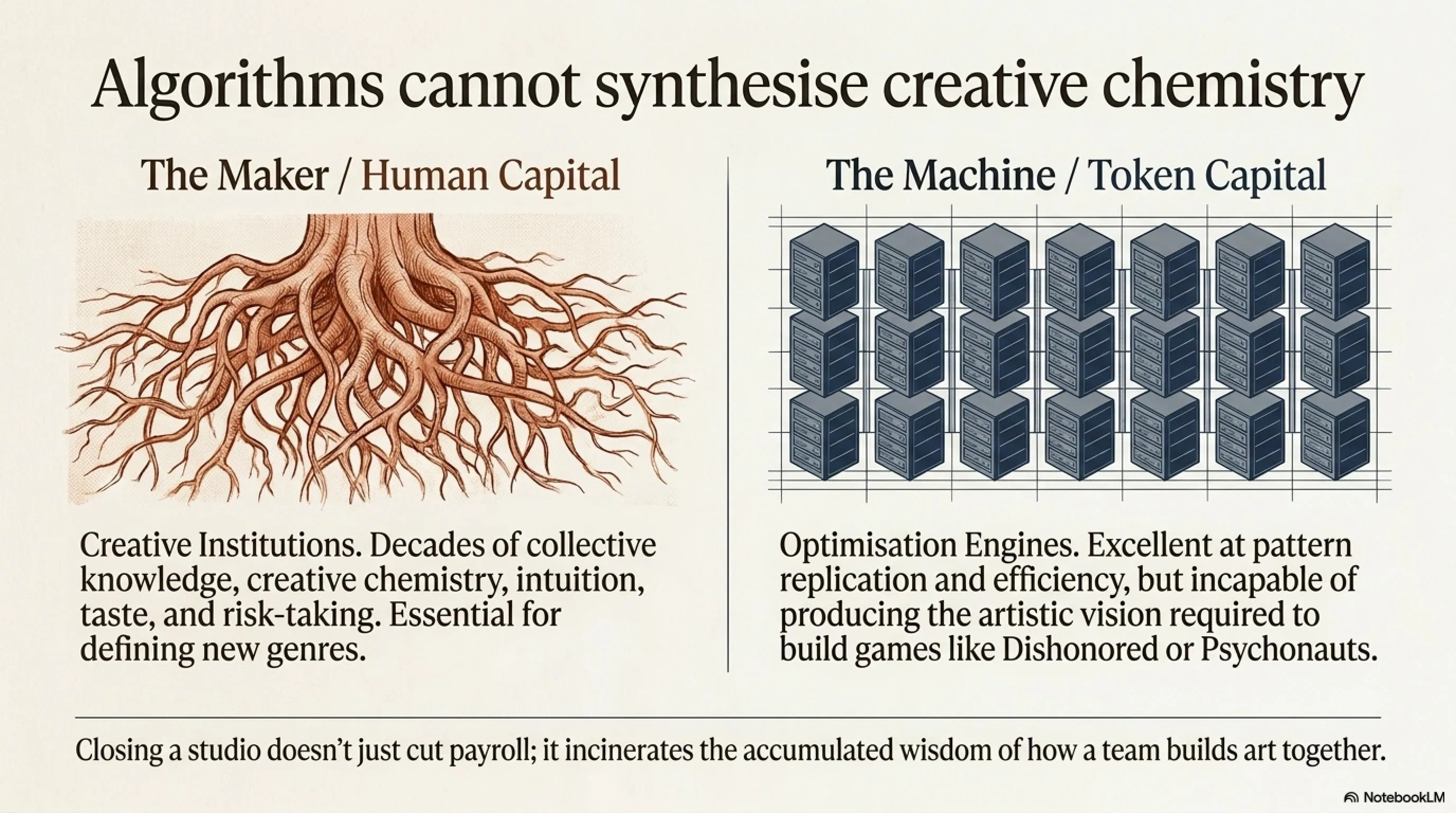
What Microsoft seems to miss in its financial calculations is the intangible value these studios represent. Arkane, Ninja Theory, and Double Fine aren't just businesses that produce games — they're creative institutions that have defined genres and inspired generations of developers.
Arkane pioneered the modern immersive sim with Dishonored. Ninja Theory revolutionized storytelling in action games with Hellblade. Double Fine has been a beacon of creativity and artistic vision for over 20 years. These studios have decades of collective knowledge, relationships, and creative vision that cannot be quantified on a balance sheet.
When you close a studio, you don't just lose employees. You lose the accumulated wisdom of how that team works together, the creative chemistry that produces unique games, and the institutional knowledge of what works and what doesn't. No AI model, no matter how advanced, can replicate that.
This is the fundamental flaw in Nadella's "token capital" philosophy. He assumes that AI can replace or augment human creativity. But game development isn't a process that can be optimized by algorithms. It's an art form that requires intuition, taste, risk-taking, and vision — qualities that are inherently human.
What Should Be Done? Tekin's Recommendations for Gamers and the Industry
Given recent developments, we offer the following recommendations for gamers, developers, and investors:
For Gamers: Direct Support for Creators
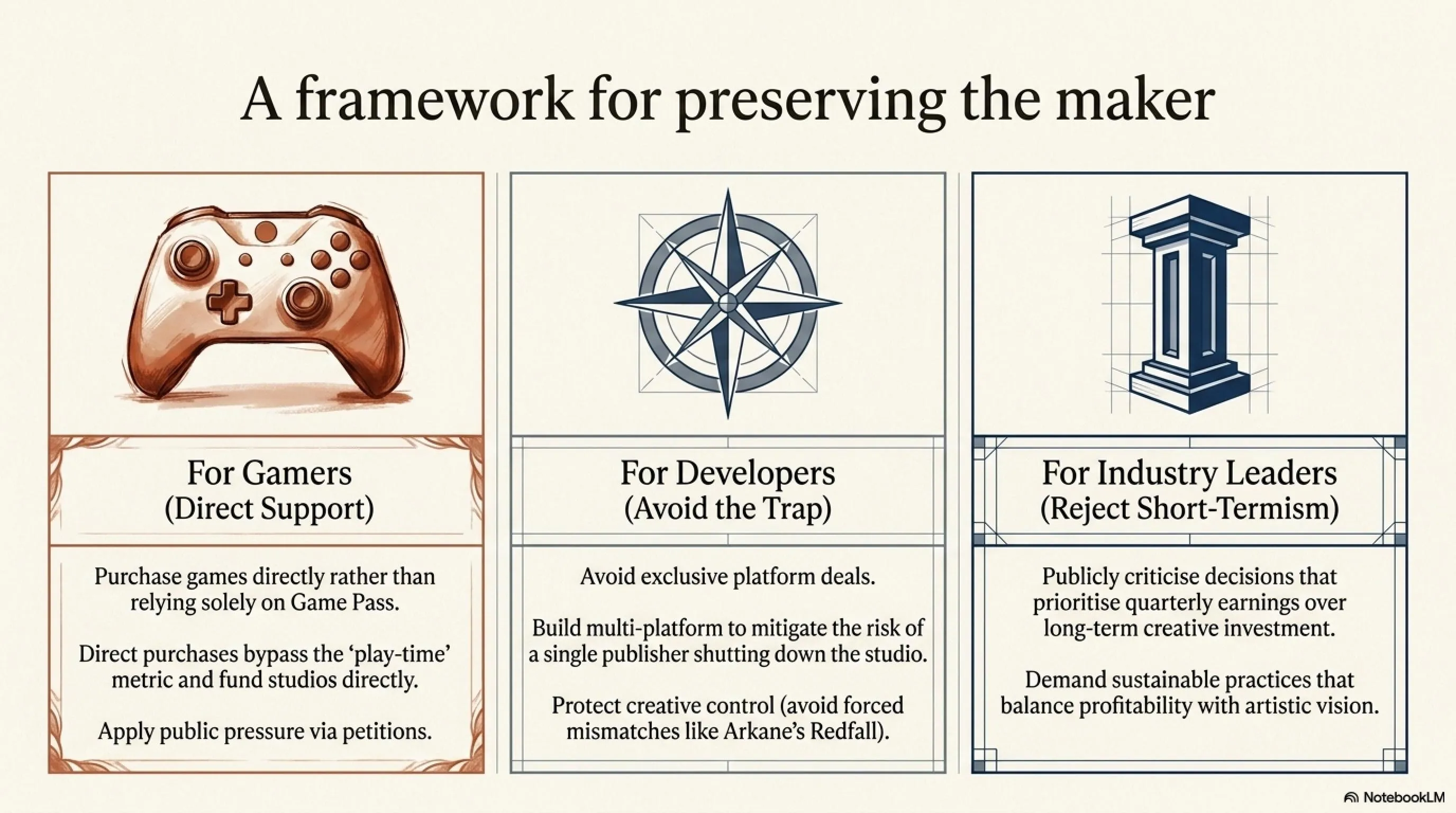
If you want independent and creative studios to survive, the best thing you can do is buy their games directly — not just through Game Pass. Hellblade II, Psychonauts 2, and Deathloop are all excellent games that deserve direct support. Direct purchases give studios more revenue than Game Pass subscriptions, which pay developers based on play time rather than sales.
Additionally, make your voice heard. Sign petitions, tweet at Microsoft executives, and let the company know that you value creative studios. Corporate decisions are often driven by public perception, and a strong community response can make a difference.
For Developers: Avoiding Exclusive Deals
The lesson for independent studios is clear: exclusive deals with big platforms can be dangerous. While Microsoft, Sony, and Nintendo offer good money, if your game isn't successful, your studio can be shut down. The best strategy is multi-platform — build for everywhere, not just one platform.
Additionally, maintain creative control. Don't let a publisher dictate your vision or force you to work on projects that don't align with your strengths. Arkane was forced to make a multiplayer looter shooter (Redfall) when their specialty is single-player immersive sims. That mismatch led to disaster.
For the Industry: Criticizing Short-Term Thinking
The gaming industry must criticize this short-term approach. Game development is an art, not just a business. Arkane, Ninja Theory, and Double Fine have decades of experience and creativity that cannot be replaced by any AI model. Closing these studios is harmful not only for their employees but for the entire industry.
Industry leaders should speak out against this trend. When major publishers prioritize quarterly earnings over long-term creative investment, the entire medium suffers. We need more voices advocating for sustainable game development practices that value both profitability and artistic vision.
Conclusion: A Future Where Human Capital Is Sacrificed for Token Capital
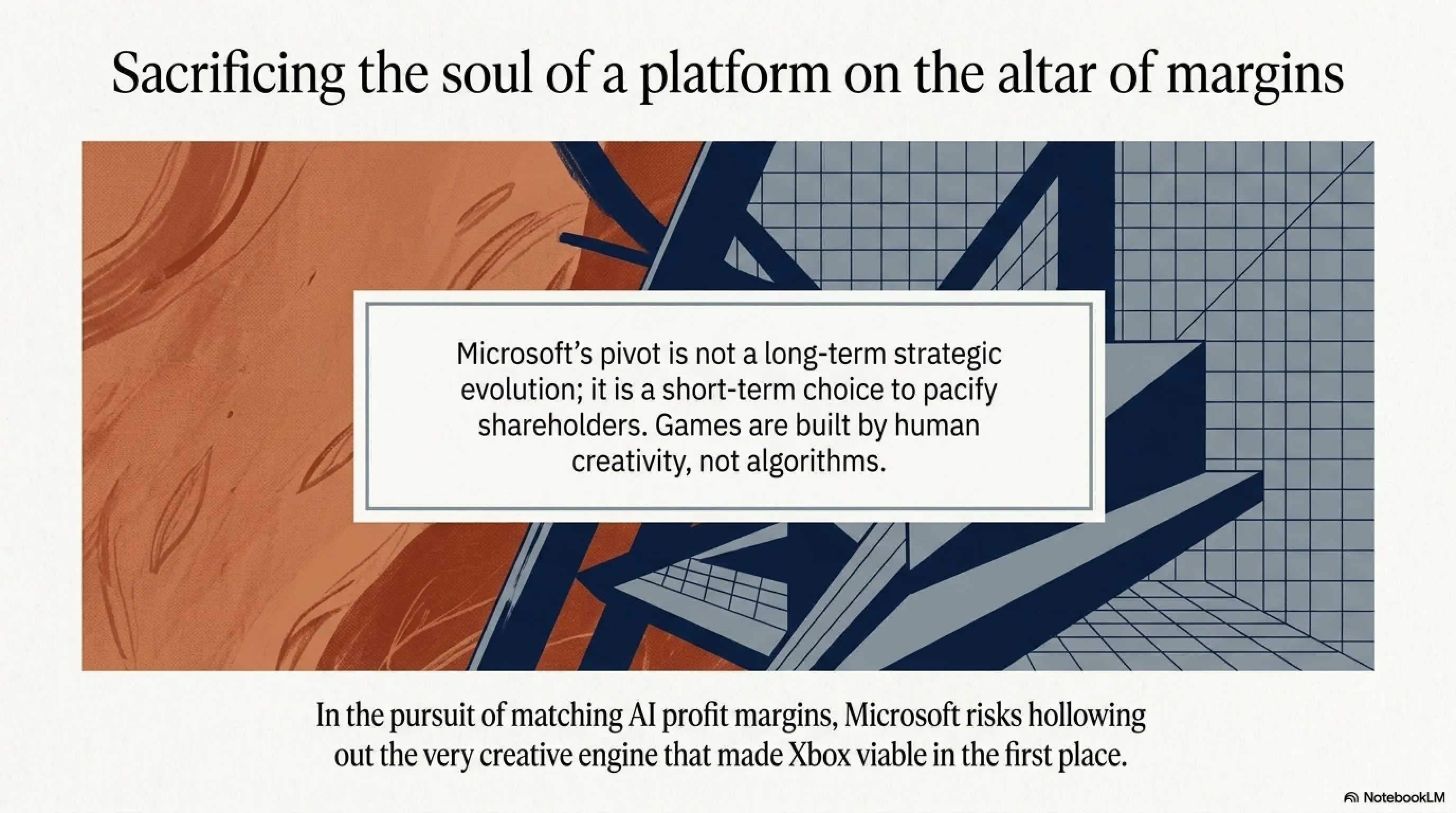
The launch of Microsoft Frontier Company while simultaneously closing game studios is a textbook example of prioritizing shareholders over employees. Microsoft has sent a clear message: investing in AI is more important than investing in humans.
Nadella's phrase — "human capital and token capital compound" — was meant to be inspiring, but instead it became a symbol of corporate hypocrisy. How can you talk about compounding human capital while actively laying off thousands of humans? How can you claim to value both when your actions clearly show you only value one?
For Arkane, Ninja Theory, Double Fine, and other studios, this is an existential moment. They've spent decades making creative and artistic games — games that defined the industry. But in Microsoft's financial view, these studios are just numbers that don't generate enough profit.
And for the employees of these studios, who are currently waiting for the final decision, Microsoft's message is clear: you are replaceable.
But the reality is that no AI model can replace human creativity, passion, and experience. Dishonored, Hellblade, Psychonauts — these games weren't made by algorithms. They were made by humans who loved their work. And if Microsoft forgets that, it will lose not just studios but the very soul of Xbox.
The gaming industry is at a crossroads. Will we continue down a path where creativity is sacrificed for profit margins, where studios are closed because they don't generate enough revenue, where human capital is replaced by token capital? Or will we push back and demand that companies value both profitability and artistic vision?
The answer will shape the future of gaming. And right now, Microsoft is showing us the wrong path.
Frequently Asked Questions
Why is Microsoft closing game studios?
Xbox has a very low profit margin (2.4%) compared to other Microsoft divisions like Azure (32%) and Azure AI (41%). The company is looking to cut costs and focus on studios that can build multi-billion dollar multi-platform franchises.
Which studios are at risk of closure?
Arkane Studios (maker of Dishonored and Deathloop) has the highest risk. Ninja Theory (Hellblade), Double Fine (Psychonauts), Compulsion Games, and Undead Labs are all in negotiations to avoid closure. Obsidian Entertainment (Fallout New Vegas) has been confirmed safe by Jason Schreier.
What will happen to Marvel's Blade?
Marvel's Blade, being developed by Arkane Lyon, will likely be cancelled. The game is over budget and has been delayed from a late 2026 release window to late 2027. The Verge reported that Microsoft is considering complete cancellation of the project.
What is Microsoft Frontier Company?
Microsoft Frontier Company is a new standalone business unit launched on July 3, 2026 with $2.5 billion in investment. The company's goal is to build proprietary AI systems that use proprietary data and continuous learning to create competitive advantage — what Satya Nadella calls 'token capital.'
Why was Obsidian saved but Arkane wasn't?
Obsidian is developing Avowed — a major first-person RPG scheduled to release in February 2027 and one of the few major Xbox exclusives in the next two years. Microsoft can't cancel it without seriously damaging its release schedule. In contrast, Arkane's Blade was over budget and delayed.
What does 'human capital and token capital compound' mean?
This phrase from Satya Nadella, Microsoft CEO, on June 15, 2026 refers to two types of capital. Human capital is employee knowledge and skills, and token capital is a company's proprietary AI capability. Nadella argues they should compound together. But the phrase became controversial because Microsoft was laying off thousands of humans at the same time.
How many people will be laid off?
Microsoft is planning to lay off under 2.5% of its 228,000-person workforce — approximately 5,000 to 5,700 people. The layoffs will affect sales, consulting, and Xbox divisions. Official announcement is expected on July 6, 2026.
Is this the end of Xbox exclusives?
Not completely, but Microsoft is transforming Xbox from an exclusive platform to a multi-platform service. The company has confirmed that games like Hi-Fi Rush, Sea of Thieves, and Grounded will move to PlayStation. Reports suggest Starfield and Indiana Jones will also come to PS5. The new strategy focuses on selling games across all platforms, not just Xbox.
📚 Sources and References
- IBTimes - Microsoft Layoffs Affecting Thousands Could Be 'The Largest in Gaming History'
- Games.gg - Arkane Studios Reportedly Facing Closure in Microsoft Xbox Reset
- The Verge - Xbox's 'reset': all the news about Microsoft's looming layoffs and studio closures
- PCGamesN - Rumors claim Xbox wants to close Obsidian, but Jason Schreier says otherwise
- Kotaku - Microsoft Announces New AI Company Days Before Mass Layoffs
- People Matters - Microsoft unveils $2.5 billion AI business after latest round of layoffs
- TechStory - Microsoft Plans Fresh Round Of Layoffs As AI Spending Surges Past $100 Billion
- PureXbox - Journalist Claims Xbox Is 'Keeping' Obsidian Following Rumours Of Potential Closure
Additional Gallery: 🚨 Microsoft's Massive Gamble: Sacrificing Xbox for a $2.5B AI Empire