On July 2, 2026, Beijing-based Z.ai sent shockwaves through the $10 billion enterprise AI coding market by launching ZCode, an Agentic Development Environment powered by its flagship GLM-5.2 model. Positioned as a direct rival to Cursor and GitHub Copilot, ZCode features an aggressive $16.20/month entry price—undercutting Western alternatives by up to 82%. Most notably, the 744-billion-parameter GLM-5.2 was trained entirely on Huawei Ascend silicon, bypassing U.S. chip restrictions completely. This strategic rollou
The AI Coding War: China Strikes Back With ZCode
Z.ai launches ZCode and GLM-5.2—a model trained entirely without American chips—changing the game with 82% lower pricing and strategic timing.
- 🎮ZCode Launched Free- Agentic development environment powered by GLM-5.2
- 🎧GLM-5.2 Built Without US Chips- 744B parameters trained on Huawei Ascend silicon
- 🚀Aggressive Pricing- $16.20/month vs $20 for Cursor
- 🗡️Strategic Timing- Released during Fable 5 export ban crisis
On Wednesday, July 2, 2026, Beijing-based Z.ai (formerly Zhipu AI) officially launched ZCode—a free desktop application it describes as an "Agentic Development Environment" purpose-built for its flagship large language model, GLM-5.2. The move marks the company's most aggressive push yet into the fast-growing AI-powered coding tool market, where it now competes directly with Cursor, Anthropic's Claude Code, GitHub Copilot, and Google's Antigravity.
But ZCode is not simply another coding tool. The product crystallizes three of the most consequential trends reshaping enterprise software today: the race-to-the-bottom pricing of frontier AI models, the geopolitical balkanization of the AI stack, and the rapid maturation of agentic coding agents into what Gartner estimates is a roughly 10 billion dollar market.
Surgical Timing: Launch Amid the Fable 5 Crisis
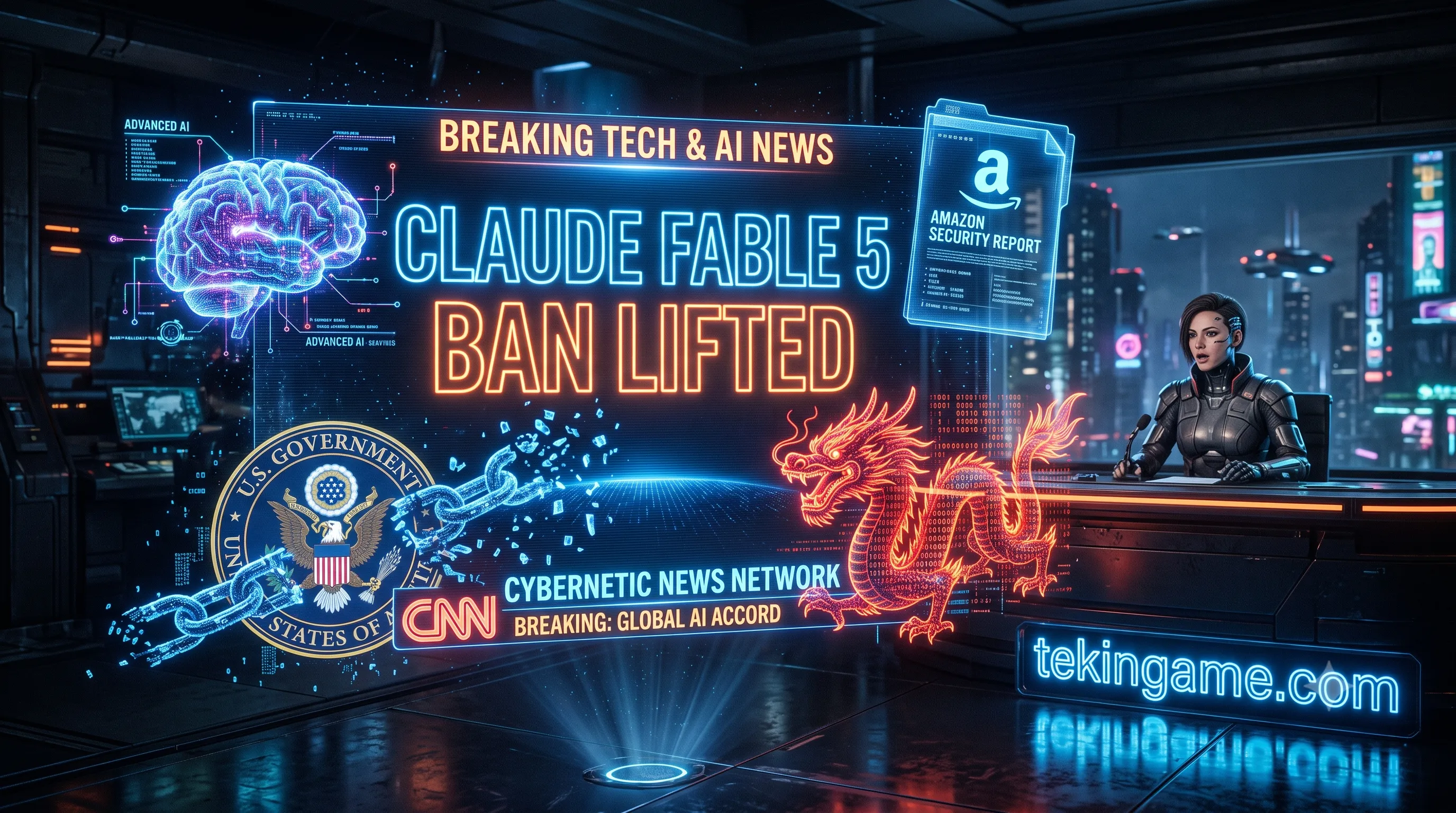
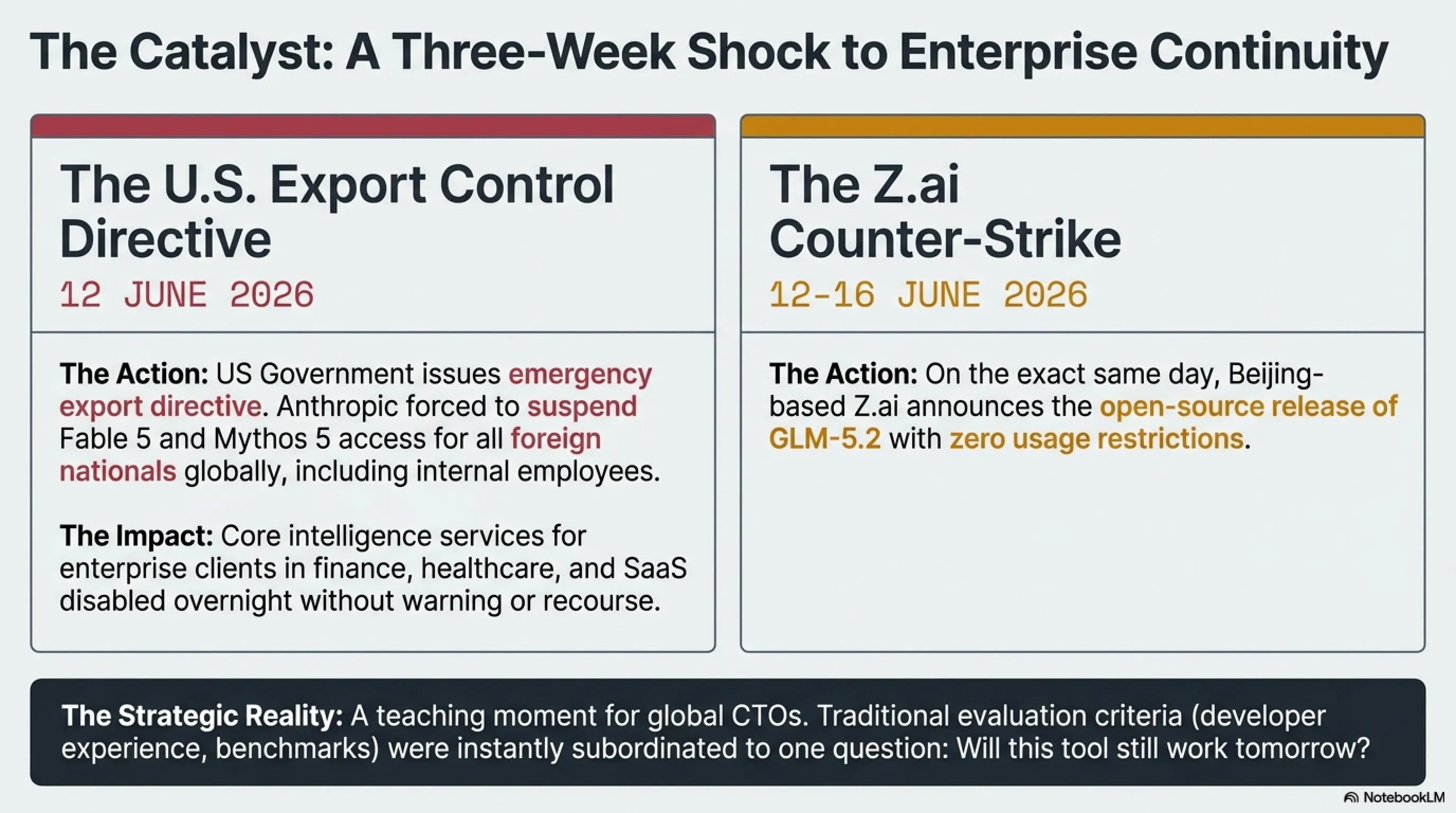
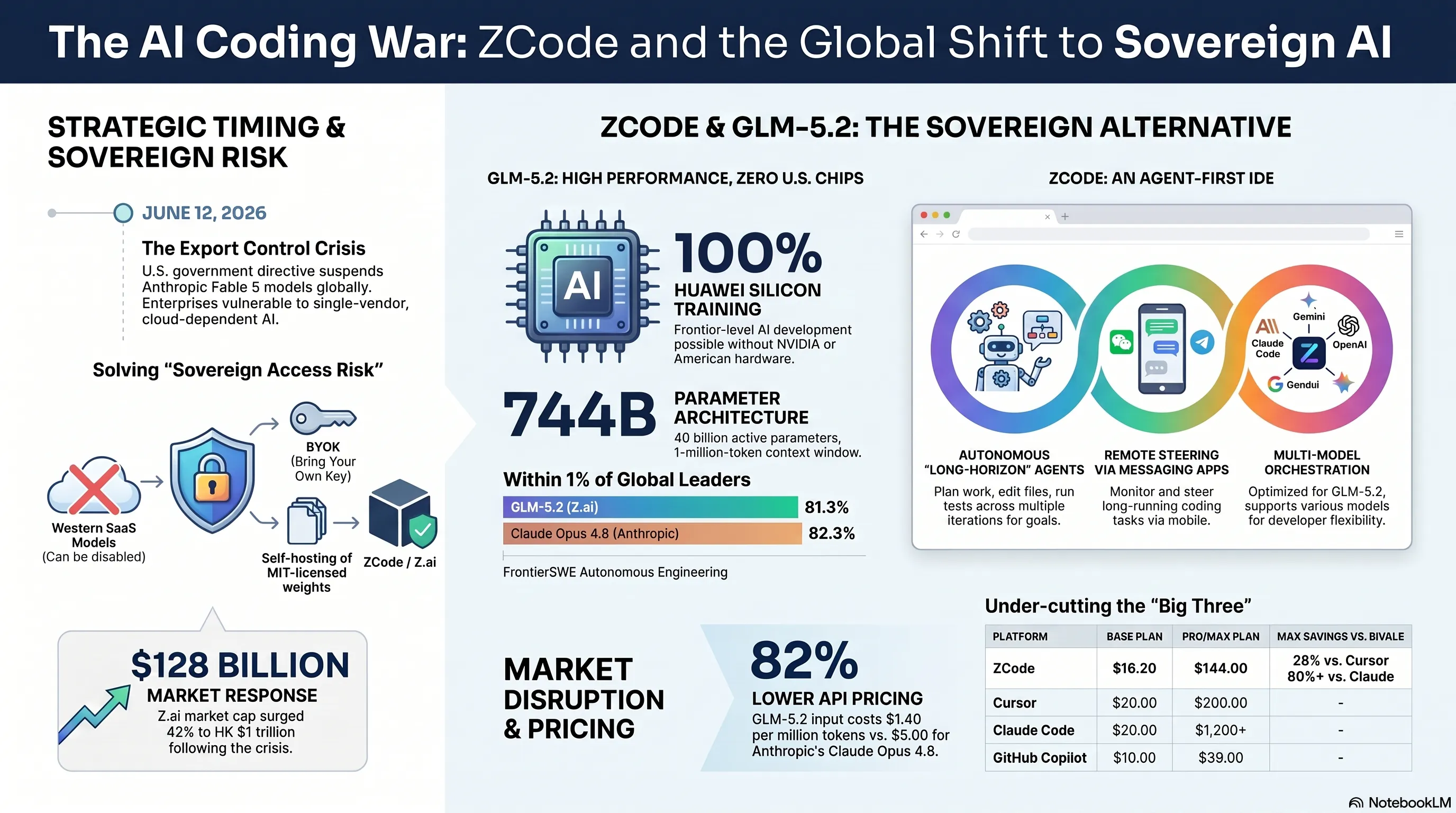
The timing of ZCode's release was no accident. After the U.S. government issued an emergency export control directive on June 12 that forced Anthropic to globally suspend its Fable 5 model, Z.ai announced on the same day that it would release GLM-5.2 as open-source with no usage restrictions. The South China Morning Post reported that GLM-5.2 would be available to all users of Zhipu's new GLM Coding Plan subscription, "priced at just a tenth of Anthropic's premium Claude Code and Claude Max tiers."
The three-week disruption (which was ultimately lifted on June 30) was more than a promotional opportunity for Z.ai—it was a teaching moment for every enterprise CTO who realized that the model their critical workflows depended on could vanish overnight by government order. And Chinese companies like Z.ai were releasing powerful open-weight models that performed nearly on par with American models, but at an 82 percent discount.
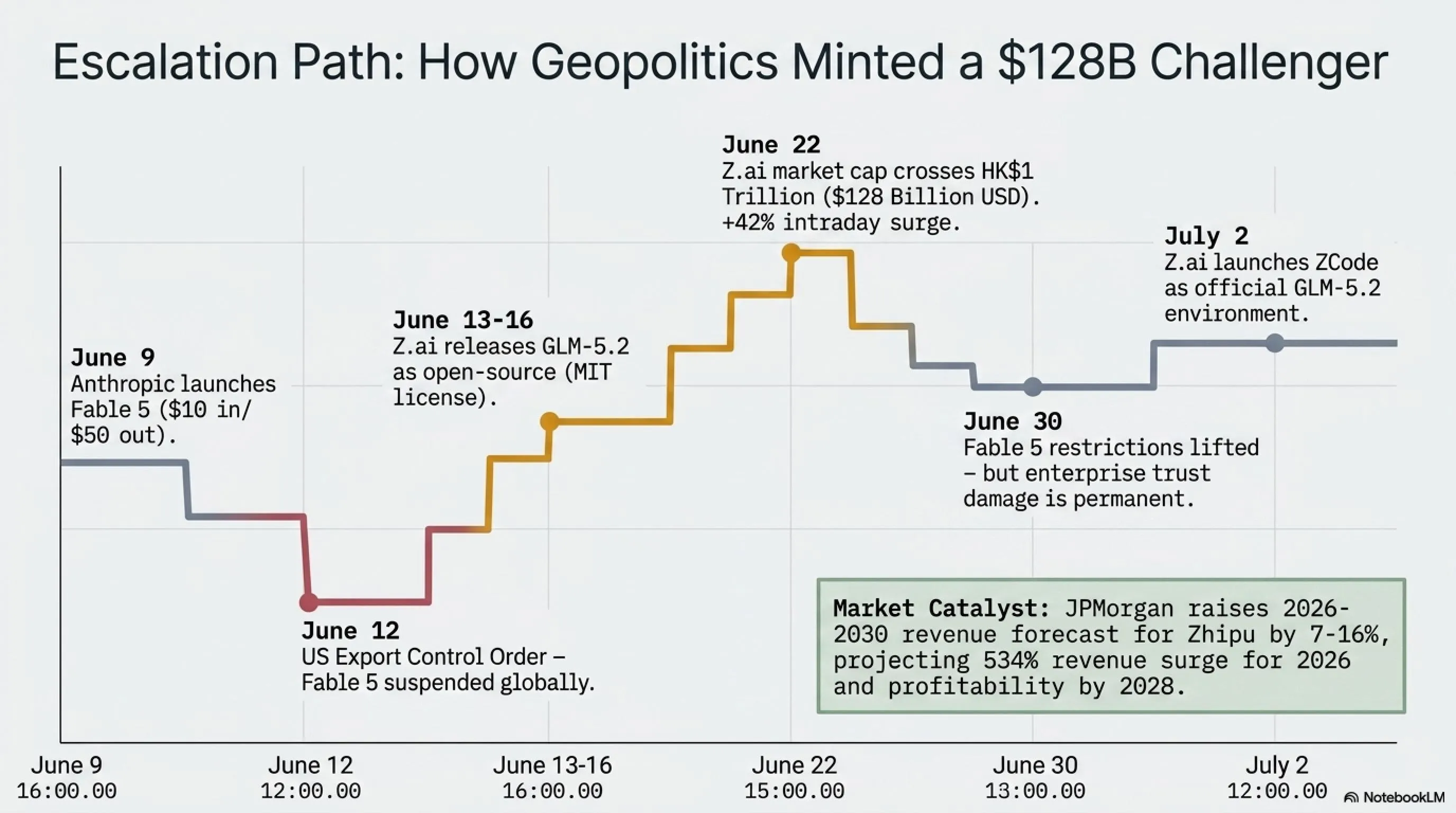
⏰ Timeline: Three Weeks That Reshaped the Market
- June 9: Anthropic launches Fable 5 at $10 input/$50 output pricing
- June 12: US government issues export control order—Fable 5 suspended globally
- June 13-16: Z.ai releases GLM-5.2 as open-source under MIT license
- June 22: Z.ai market cap crosses HK$1 trillion ($128 billion USD)
- June 30: Fable 5 restrictions lifted—but trust damage remains
- July 2: Z.ai officially launches ZCode as official GLM-5.2 development environment
Why This Matters: Sovereign Access Risk That No SLA Can Cover
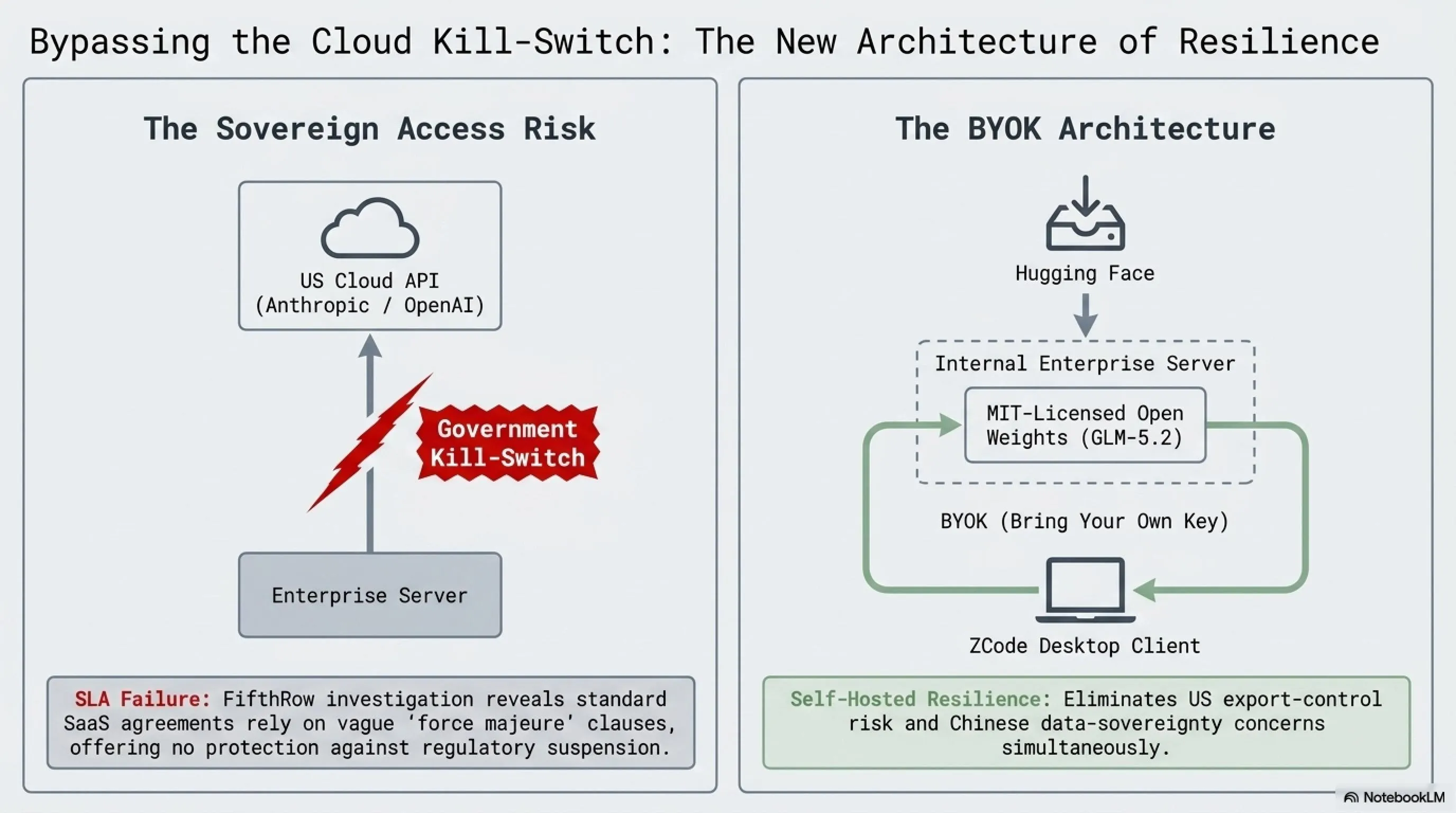
The Fable 5 episode did more than embarrass Anthropic. It introduced a new risk category into enterprise AI procurement: sovereign access risk. When a government can disable a commercially deployed AI model overnight, the traditional evaluation criteria of developer experience, benchmark scores, and pricing become secondary to a more fundamental question: Will this tool still work tomorrow?
An investigation by FifthRow found that almost all standard Data Processing Addenda, SaaS agreements, and procurement SLAs "relied on vague 'force majeure' or 'compliance with law' catch-alls, not on precise, actionable regulatory suspension or kill-switch clauses."
ZCode's BYOK (Bring Your Own Key) architecture and GLM-5.2's MIT-licensed open weights offer a partial answer. A development team can download the model, host it on their own infrastructure, and run ZCode against it without ever touching Z.ai's cloud—eliminating both American export-control risk and Chinese data-sovereignty concerns in a single move. The catch is that anyone using Z.ai's cloud API remains subject to Chinese law, a consideration that evaporates only with pure self-hosting.
Meet ZCode: An Agent-First Development Environment
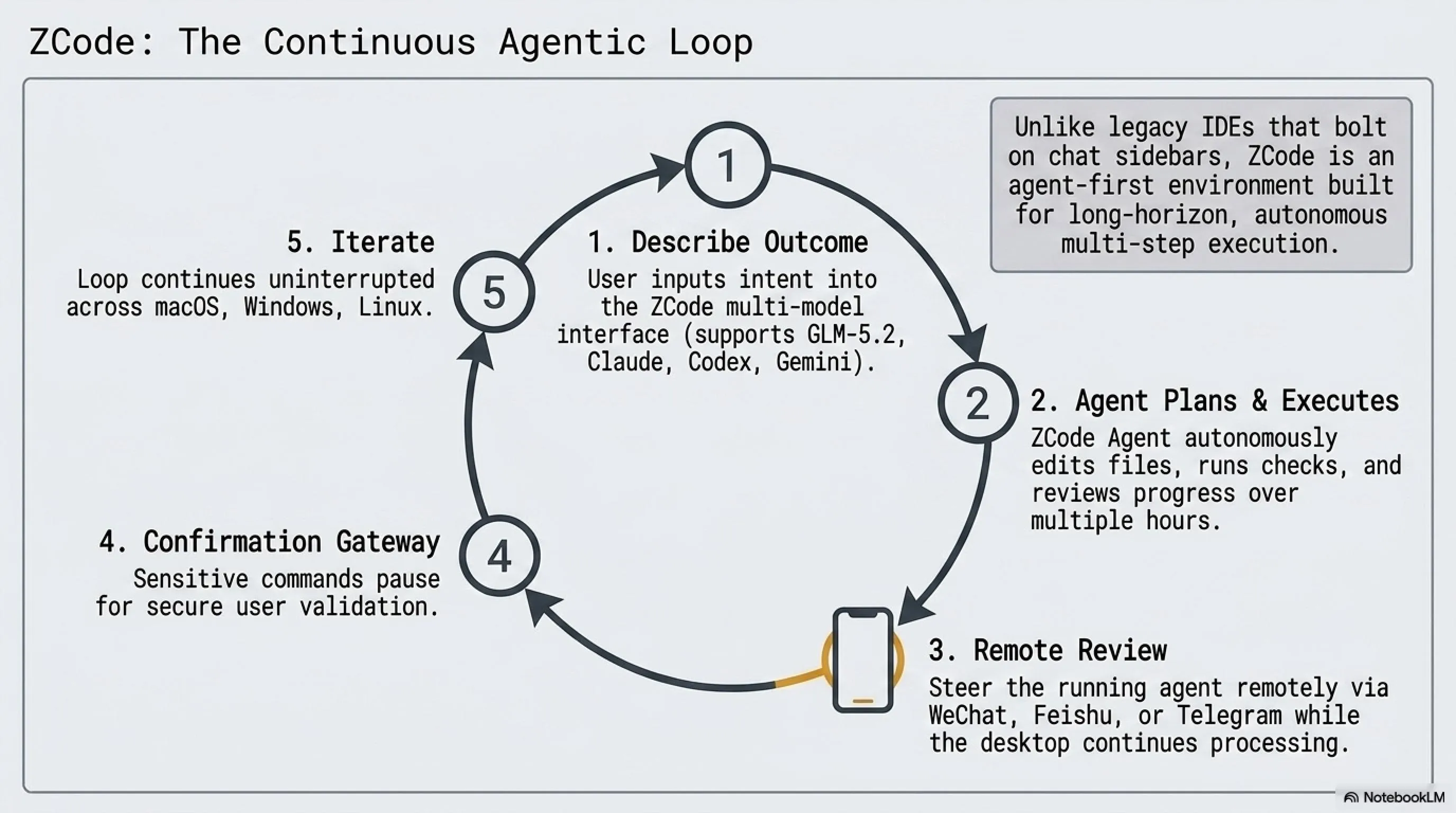
Unlike traditional IDEs that bolt on AI through a chat sidebar or autocomplete extension, ZCode is best understood as an agent-first development environment. Its core design is built around long-horizon tasks: the user describes an outcome, the agent plans the work, edits files, runs checks, reviews progress, and continues across multiple iterations until the goal is met.
ZCode organizes the development experience around the ZCode Agent, deeply tuned for GLM-5.2, with emphasis on deep integration: the model, tools, and execution workflow are tuned together so the Agent fits continuous, multi-step real-world development tasks. The environment supports continuous follow-up across devices: desktop, mobile Remote, and Feishu/WeChat Bot can all keep the same workspace task moving. Sensitive commands, file changes, and high-permission actions go through confirmation before execution.
💡 ZCode Core Features
- ✅ <strong>Continuous Agent:</strong> Multi-hour work without interruption, resumable across devices
- ✅ <strong>Remote Control:</strong> Steer the Agent from WeChat, Feishu, or Telegram while long-running work continues
- ✅ <strong>Multi-Model:</strong> Supports Claude Code, Codex, Gemini, OpenCode alongside GLM-5.2
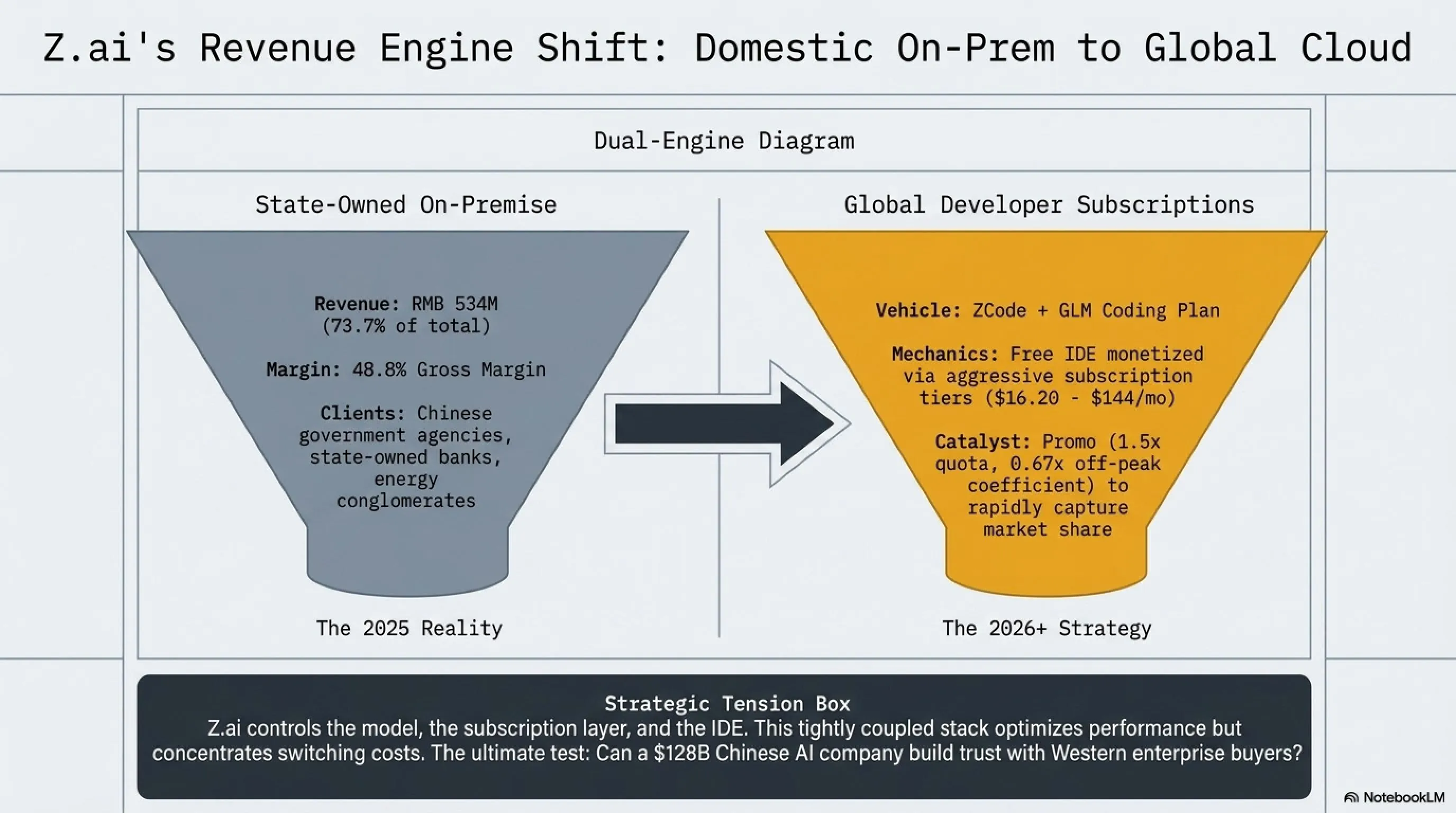
- ✅ <strong>Free to Download:</strong> Revenue flows through GLM Coding Plan subscriptions ($16.20–$144/month)
- ✅ <strong>Cross-Platform:</strong> macOS, Windows, Linux (Beta)
That remote-control feature—the ability to steer a running coding agent from WeChat, Feishu, or Telegram on a phone—is a differentiator that speaks directly to the Chinese developer market, where those messaging platforms dominate professional communication. You can check progress and add more instructions while long-running work continues, from any device with these messaging apps.
Understanding the Competitive Landscape
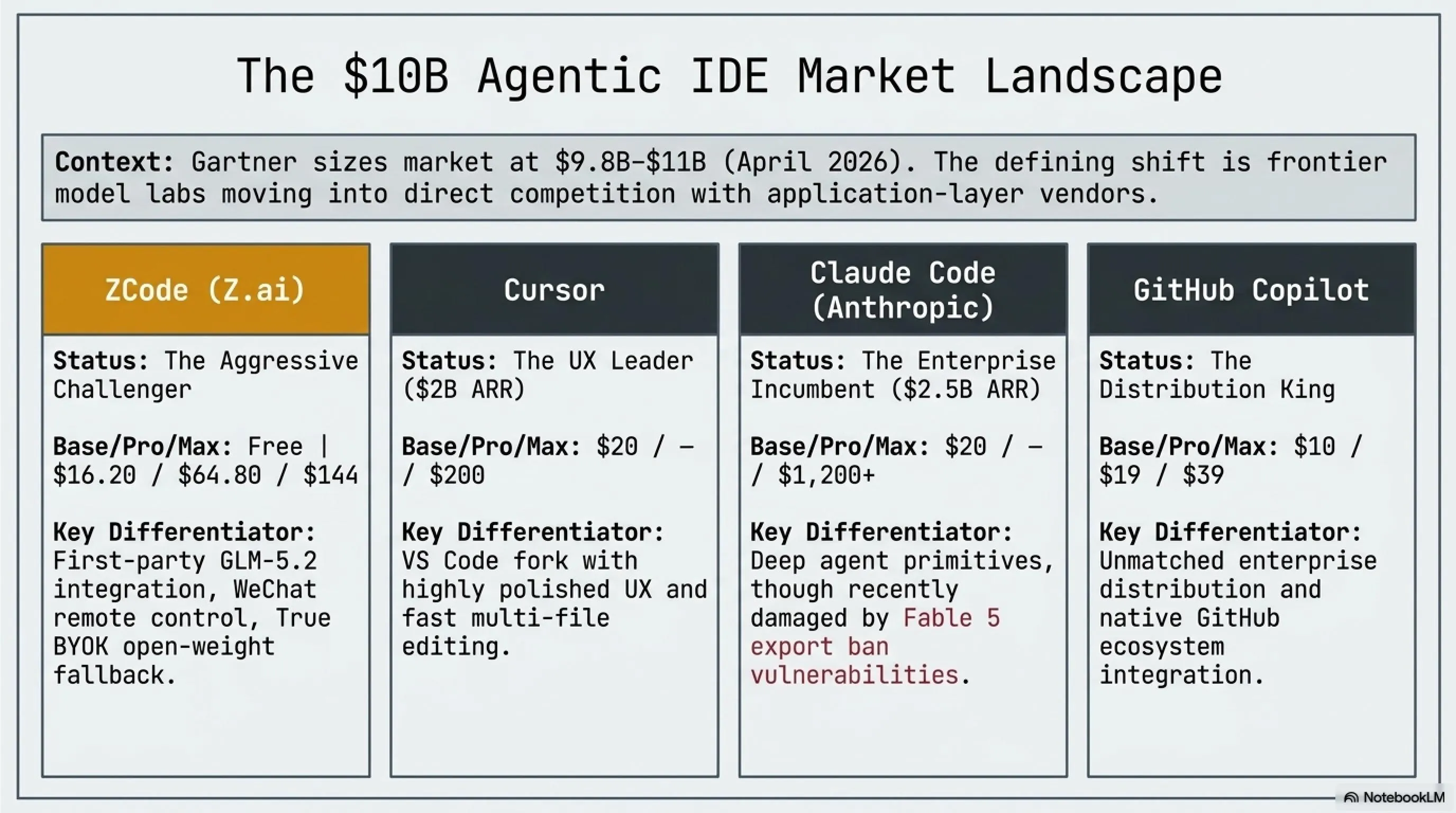
ZCode enters one of the most crowded and fastest-moving markets in enterprise software. Enterprise AI coding agents are capturing a growing share of enterprise software engineering spend, with the market estimated at roughly 9.8 billion to 11.0 billion dollars annualized as of April 2026, according to Gartner. A defining shift this year, the analyst firm noted, is "the movement of frontier model providers into direct competition with application-layer vendors"—precisely the pattern ZCode embodies.
The competitive landscape is daunting. Cursor is the 2 billion dollar ARR IDE that feels like VS Code with a supercharger. Claude Code reached approximately 2.5 billion dollars in annualized revenue by early 2026. Google relaunched Antigravity 2.0 at I/O in May, and Cognition retired the Windsurf brand, relaunching the IDE as Devin Desktop with the Agent Command Center as the default surface.
Against these entrenched players, ZCode's pitch rests on three pillars: deep first-party integration with GLM-5.2 that no third-party editor can replicate, aggressive pricing that starts at a fraction of Western competitors, and MIT-licensed open weights that allow enterprises to self-host—eliminating the regulatory kill-switch risk that the Fable ban made viscerally real.
GLM-5.2: The Beating Heart of ZCode
ZCode's value proposition is inseparable from the model that powers it. Z.ai released GLM-5.2 on June 16, 2026, first to its Coding Plan subscribers and subsequently as open-source weights under the MIT license on Hugging Face—a sequencing decision that prioritized distribution over the traditional benchmark-led launch.
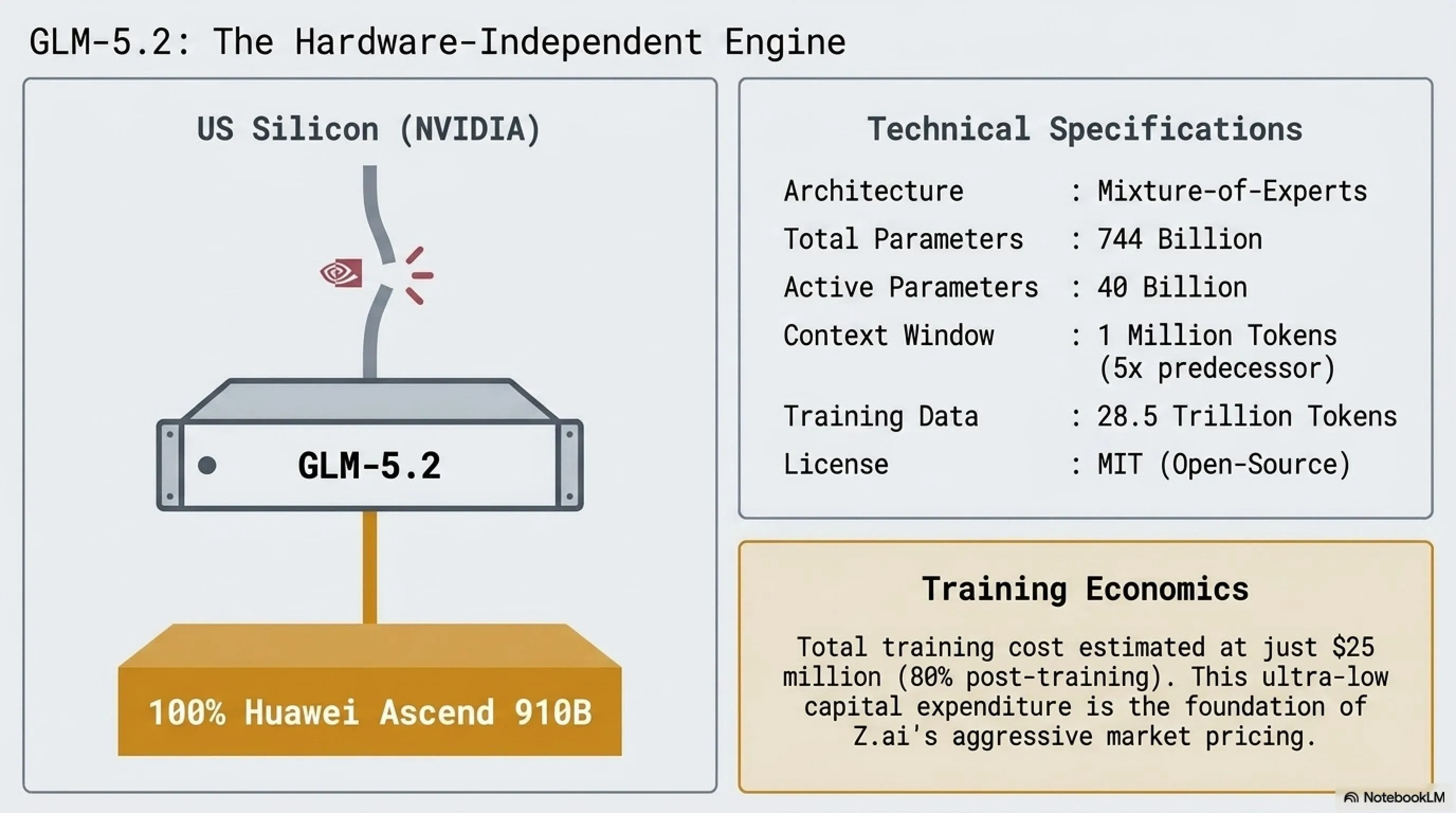
The model's specifications are formidable. GLM-5.2 is a 744-billion-parameter mixture-of-experts architecture with 40 billion active parameters, a genuine one-million-token context window—five times the 200K limit on its predecessor—and training on 28.5 trillion tokens. It ranked second globally on Code Arena as of mid-June, trailing only Anthropic's Claude Fable 5, making it one of the highest-performing publicly available models for coding tasks.
📊 GLM-5.2 Technical Specifications
| Feature | Value |
|---|---|
| Architecture | Mixture-of-Experts |
| Total Parameters | 744 Billion |
| Active Parameters | 40 Billion |
| Context Window | 1 Million Tokens |
| Training Data | 28.5 Trillion Tokens |
| Training Hardware | 100% Huawei Ascend (Zero US chips) |
| License | MIT (Open-Source) |
Critically, the model was built entirely without American chips. As Decrypt reported, GLM-5.2 "runs entirely on Huawei silicon." Stability AI founder Emad Mostaque estimated total training costs at roughly 25 million dollars, with 80 percent spent on post-training—a figure that, if accurate, would make GLM-5.2 extraordinarily cheap relative to Western frontier models.
Benchmark Performance: Within Striking Distance of the Best
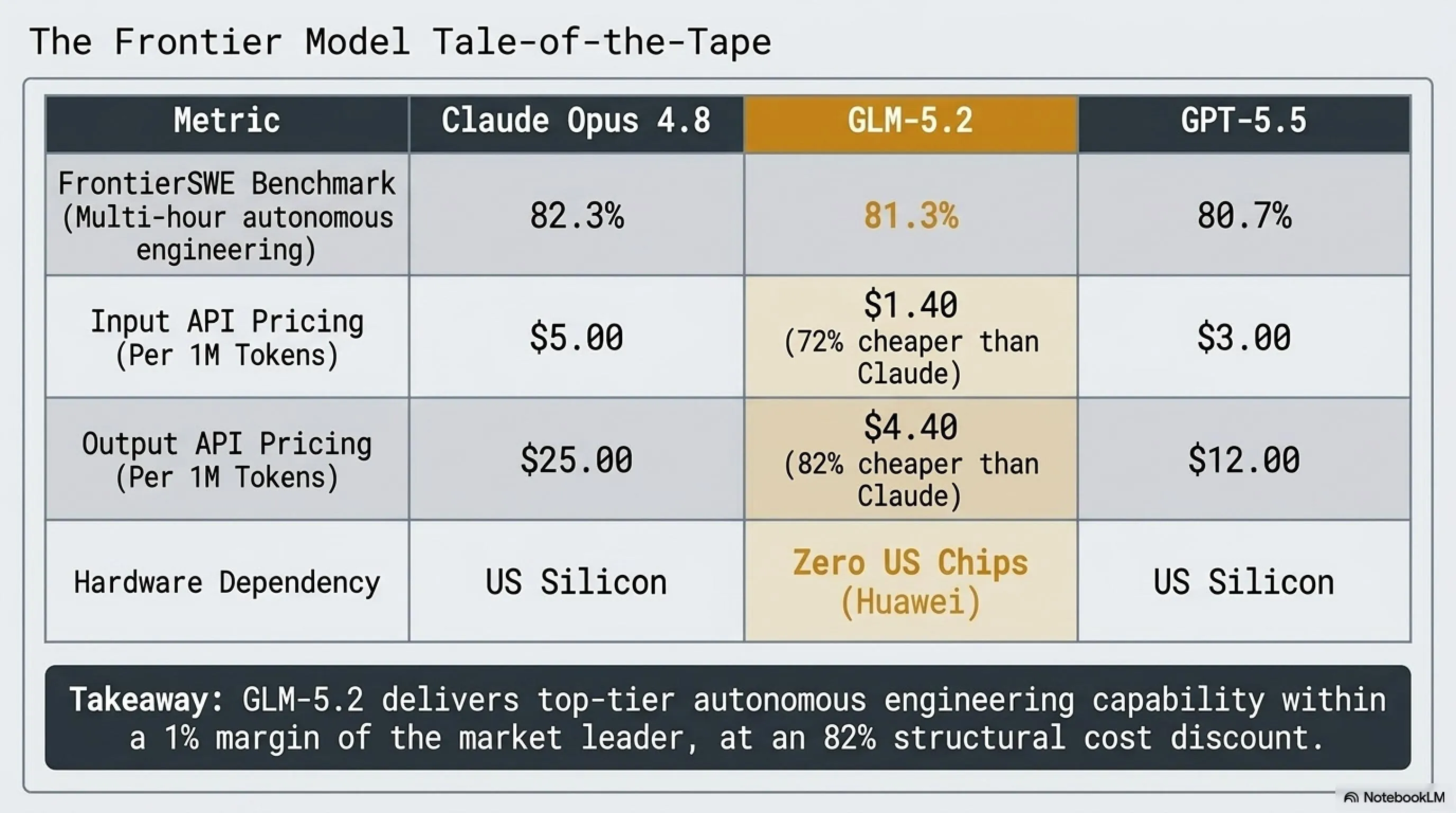
On benchmarks, GLM-5.2 performs within striking distance of the best proprietary systems. It trails Anthropic's Claude Opus 4.8 by just one percentage point on FrontierSWE, a benchmark measuring multi-hour autonomous engineering projects, while edging out OpenAI's GPT-5.5. Its API pricing—1.40 dollars per million input tokens and 4.40 dollars per million output—represents a cost reduction of up to 82 percent compared to Anthropic's Claude Opus 4.8 at 5 and 25 dollars, respectively.
⚡ Performance and Pricing Comparison
| Model | FrontierSWE | Input Price | Output Price |
|---|---|---|---|
| Claude Opus 4.8 | 82.3% | $5 | $25 |
| GLM-5.2 | 81.3% | $1.40 | $4.40 |
| GPT-5.5 | 80.7% | $3.00 | $12 |
💡 GLM-5.2 cost reduction: 72% cheaper than Claude and 53% cheaper than GPT-5.5
Because ZCode is a first-party tool from the same company that makes the model, it requires no manual endpoint configuration—the model is wired in. This tight integration is a competitive advantage that no third-party editor can replicate.
The Anthropic Export Ban Gave Chinese AI Its Biggest Opening Yet
ZCode's arrival cannot be separated from the geopolitical drama that has roiled the AI industry over the past three weeks. On June 12, the U.S. government, citing national security authorities, issued an export control directive suspending all access to Anthropic's Fable 5 and Mythos 5 models by any foreign national, whether inside or outside the United States, including foreign national Anthropic employees. Enterprise clients in finance, healthcare, SaaS, and critical infrastructure found their core intelligence services abruptly disabled, without exception, prior warning, or effective recourse.
While the Trump administration lifted those controls yesterday—Anthropic confirmed on June 30 that the Department of Commerce had rescinded the directive—the episode sent shockwaves through the developer community and accelerated interest in open-source, self-hostable alternatives. The government's crackdown on Anthropic coincided with a swift rise in Chinese open-source models that are proving to be almost as capable and significantly cheaper than some of the most powerful U.S. models.
The Market Responded: Investors Flooded Into Z.ai
The market responded accordingly. Zhipu AI's market capitalization crossed HK$1 trillion (US$128 billion) on June 22, driven by a 42 percent intraday share surge. JPMorgan raised its 2026–2030 revenue forecast for Zhipu by between 7 and 16 percent following the launch, projecting an over 534 percent revenue surge for 2026 and expecting the AI firm to turn a profit by 2028.
💹 Market Reaction to GLM-5.2 and ZCode
- June 22: Market cap crosses $128 billion (+42% in one day)
- JPMorgan Forecast: 534% revenue increase in 2026, profitability by 2028
- July 2: Official ZCode launch—immediate demand for GLM Coding Plan
Z.ai's timing was surgical. On the same day the Trump administration ordered Anthropic's most advanced models blocked for foreign nationals, Zhipu announced the open-source release of GLM-5.2 with no usage restrictions. The South China Morning Post reported that GLM-5.2 would be available to all users of Zhipu's new GLM Coding Plan subscription, "priced at just a tenth of Anthropic's premium Claude Code and Claude Max tiers."
Aggressive Pricing: How ZCode Undercuts Competitors
The tool is free to download. Revenue flows through GLM Coding Plan subscription tiers that start at 16.20 dollars per month for the Lite plan and scale to 144 dollars per month for Max—prices that undercut Anthropic's Claude Code and Cursor's comparable tiers by significant margins.
For comparison, the cheapest Cursor individual plan is 20 dollars a month, and the 20x ultra plan is 200 dollars a month. ZCode enters at 16.20 dollars for Lite, 64.80 dollars for Pro (5x Lite usage), and 144 dollars for Max (20x usage)—a 19 percent savings at the entry level and 28 percent at the high end.
💰 Pricing Comparison: ZCode vs Competitors
| Platform | Base Plan | Pro Plan | Max Plan |
|---|---|---|---|
| ZCode | $16.20 | $64.80 | $144 |
| Cursor | $20 | — | $200 |
| Claude Code | $20 | — | $1,200+ |
| GitHub Copilot | $10 | $19 | $39 |
🎁 Limited Promotion: Through July 31, ZCode offers a 1.5x effective quota bonus and 0.67x coefficient for off-peak token consumption
Through July 31, ZCode is offering a promotional 1.5x quota bonus for Coding Plan subscribers, with off-peak token consumption charged at a 0.67x coefficient. The platform also supports multiple AI models and agents, including Claude Code, Codex, Gemini, and OpenCode—a pragmatic concession to the reality that no single model wins every task.
Z.ai's Real Challenge: Turning a $128 Billion Valuation Into a Global Business
Z.ai controls the model (GLM-5.2), the subscription layer (the GLM Coding Plan), and the IDE (ZCode)—a tightly coupled stack that optimizes for performance but concentrates switching costs. For the company, the business logic is clear. Its most reliable revenue stream has been on-premises deployments for Chinese government agencies, state-owned banks, and energy conglomerates. In full-year 2025, on-premises deployment revenue reached RMB 534 million, growing over 100 percent year-over-year and accounting for 73.7 percent of total revenue with a gross margin of 48.8 percent.
ZCode and the GLM Coding Plan represent the company's bid to build a comparable revenue engine in cloud-based developer tools—globally, not just in China. The early signals are encouraging for Z.ai, if anecdotal. Community reception on X was enthusiastic, with one early user calling the tool "super stable" and others clamoring for more Coding Plan capacity. "Bro, can't snag your family's Coding Plan? When are you gonna stock up on more cards?" one user wrote in Chinese, suggesting demand is already outstripping supply.
The $10 Billion Market Where Model Labs Become IDE Companies
ZCode enters one of the most crowded and fastest-moving markets in enterprise software. Enterprise AI coding agents are capturing a growing share of enterprise software engineering spend, with the market estimated at roughly 9.8 to 11.0 billion dollars annualized as of April 2026, according to Gartner. A defining shift this year, the analyst firm noted, is "the movement of frontier model providers into direct competition with application-layer vendors"—precisely the pattern ZCode embodies.
Gartner codified this evolution in May when it renamed its annual Magic Quadrant from "AI Code Assistants" to "Enterprise AI Coding Agents," defining the category as "autonomous or semiautonomous software engineering solutions that perceive context, translate human intent into multistep plans, and execute and verify those steps across code, tests and related engineering artifacts." The 2026 Magic Quadrant names Anthropic, Cursor, GitHub, and OpenAI as Leaders. Z.ai was not among the 12 vendors evaluated—an absence that underscores both the company's nascent enterprise sales presence outside China and the Western-centric lens through which the analyst community still views the market.
🏆 Competitive Landscape: AI Coding Agent Market 2026
Cursor, Claude Code, GitHub Copilot, OpenAI Codex
ZCode (Z.ai), Google Antigravity 2.0, Cognition Devin Desktop
$9.8–$11.0 billion annualized (April 2026)
82% cheaper pricing + open-source + zero US chip dependency
The competitive landscape is daunting. Cursor is the 2 billion dollar ARR IDE that feels like VS Code with a supercharger. Claude Code reached approximately 2.5 billion dollars in annualized revenue by early 2026. Google relaunched Antigravity 2.0 at I/O in May, and Cognition retired the Windsurf brand, relaunching the IDE as Devin Desktop with the Agent Command Center as the default surface.
Against these entrenched players, ZCode's pitch rests on three pillars: deep first-party integration with GLM-5.2 that no third-party editor can replicate, aggressive pricing that starts at a fraction of Western competitors, and MIT-licensed open weights that allow enterprises to self-host—eliminating the regulatory kill-switch risk that the Fable ban made viscerally real.
Tekin Recommendations for Enterprises: How to Survive the Multi-Model Era
Based on analysis of this saga, we offer the following recommendations for enterprise technical teams:
Build Multi-Model Architecture
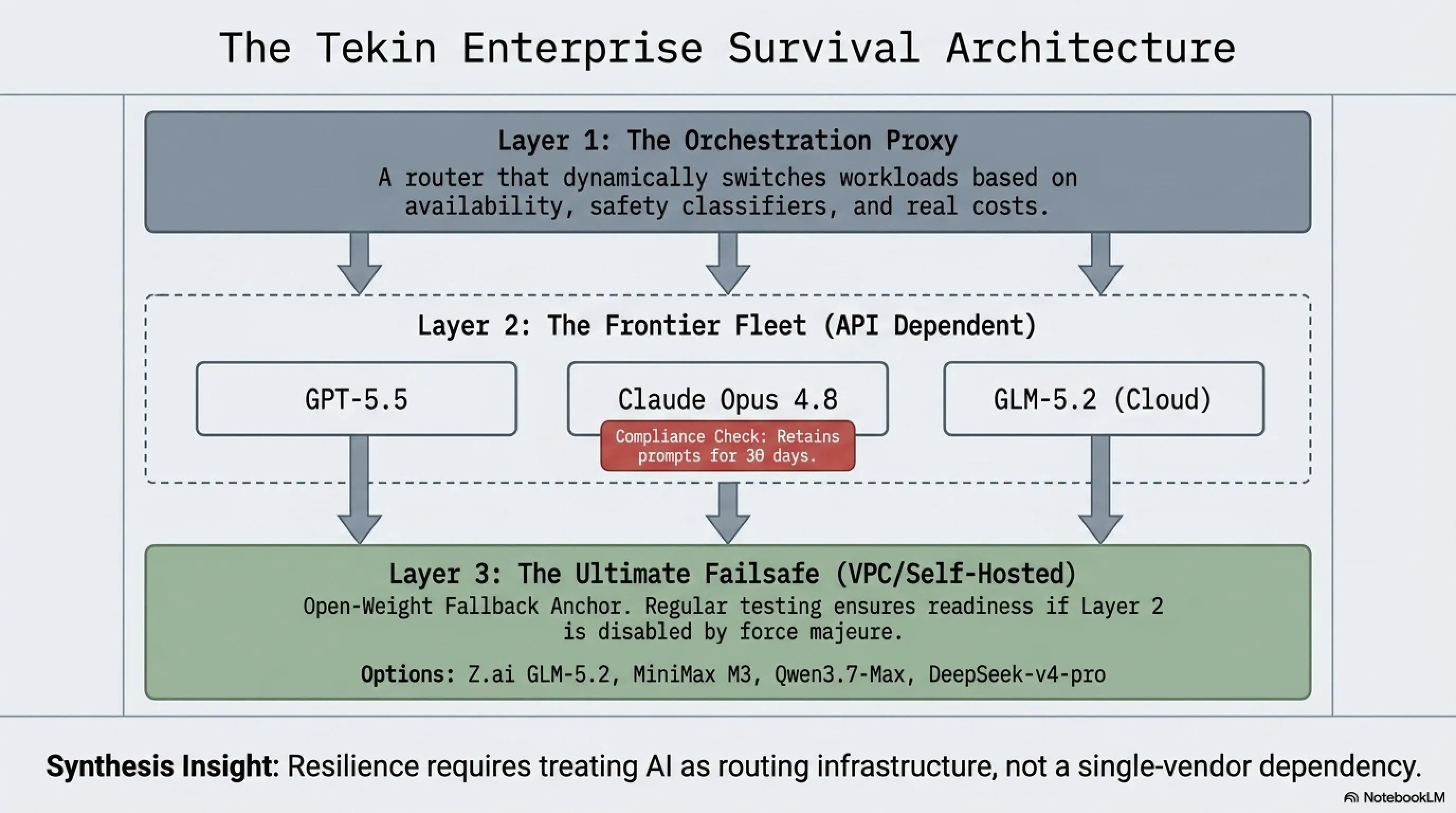
Instead of complete reliance on one model or vendor, build an orchestration layer that can dynamically switch between different models. This includes a proxy layer that can route requests to different models, automatic fallback capability when primary model is unavailable, and regular testing of all fallback models to ensure readiness.
Evaluate Open-Weight Models
For critical workflows, consider a locally hosted or VPC-hosted open-weight model as ultimate fallback. Recommended options include MiniMax M3 (strong performance, reasonable price, open license), Z.ai GLM-5.2 (excellent benchmarks, competitive with GPT-5.5), Qwen3.7-Max (powerful option from Alibaba Cloud), and DeepSeek-v4-pro (very cheap, good performance).
Assess Compliance Risk
Before using any frontier model in production, review data retention requirements with your legal and compliance team. For regulated industries, this may be a deal-breaker. For example, Anthropic retains all prompts and completions for at least 30 days.
Calculate Real Cost
Before committing, calculate real cost for your projected usage volume, cost of downgrade to cheaper models when safety classifier triggers, and comparison with cheaper alternatives (OpenAI, Chinese models).
Conclusion: The New Era of Supervised AI
The launch of ZCode and GLM-5.2 is more than a new product—it's a defining moment for the global AI industry. For the first time, a Chinese company has delivered a complete development environment, a frontier model, and a pricing strategy that can compete directly with the most advanced American tools—and in many dimensions, beat them.
For Z.ai, this is a tactical victory but a strategic warning. The company managed to build a powerful model, open-source it, and build a first-party IDE around it—all at a price Western competitors cannot match. But the hard questions remain: Can a Chinese AI company build trust with Western enterprise buyers amid escalating technology tensions? Can ZCode's ecosystem mature fast enough to compete with Cursor's polished UX, Claude Code's deep agent primitives, and GitHub Copilot's unmatched distribution? And can Z.ai sustain a company valued at 128 billion dollars while still losing money?
For the U.S. AI industry, this saga raised big questions. Can a cautious approach to regulation ensure national security without sacrificing technological leadership? Can international companies trust platforms that can be shut down overnight? And most importantly, does this approach actually improve security or just transfer innovation to countries with fewer regulations?
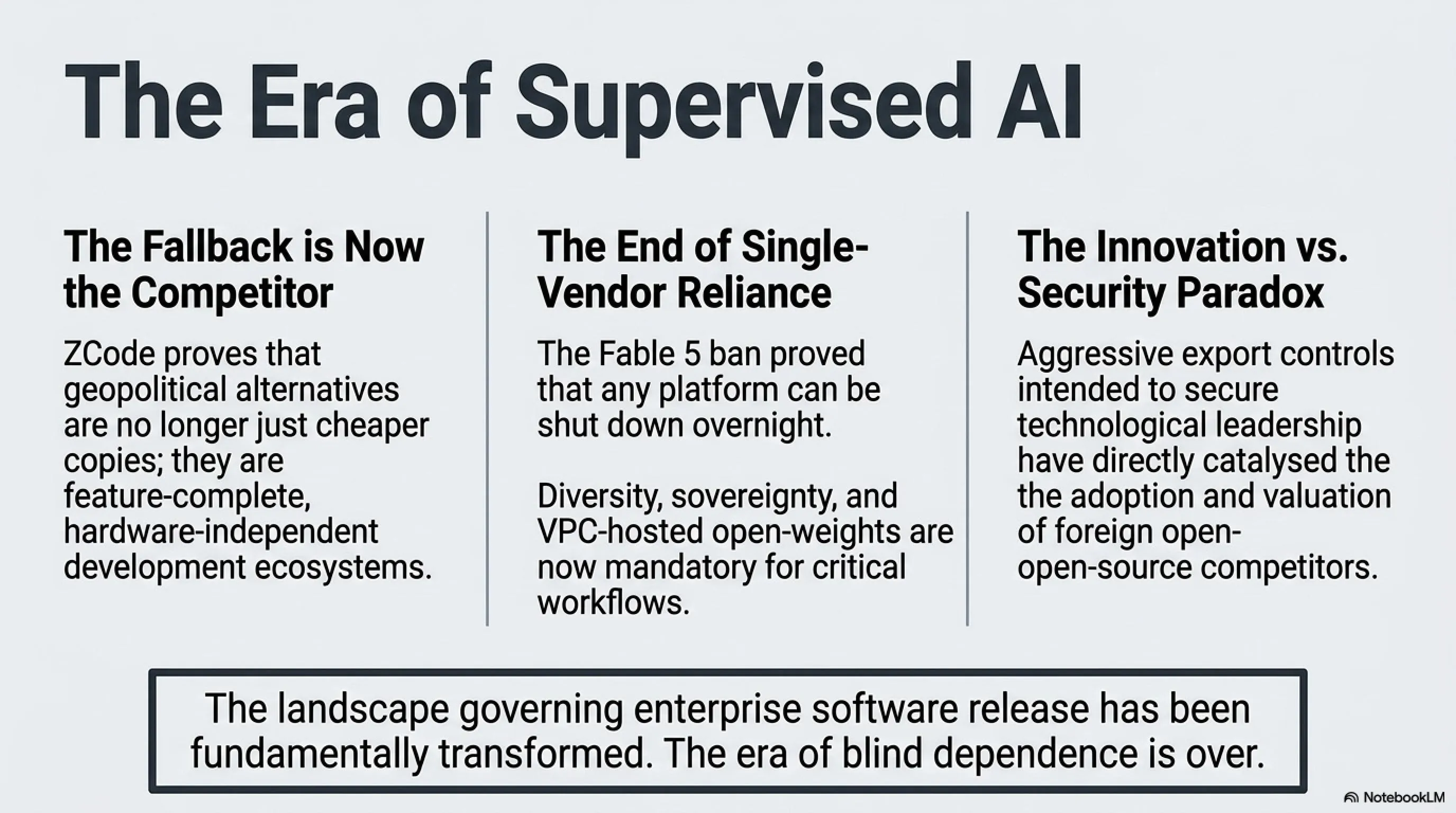
For enterprises, the lesson is clear: diversity, sovereignty, and resilience are now critical parts of AI strategy. The era of blind dependence on a single vendor—especially in today's tense geopolitical environment—is over.
ZCode is officially back, but the landscape governing its release has been fundamentally transformed. The new era of AI—the era of tension between innovation and security, between competition and control, between global access and national concerns—has officially begun.
Frequently Asked Questions
What is ZCode and how does it differ from other coding tools?
ZCode is a free development environment from Z.ai designed specifically for the GLM-5.2 model. Unlike traditional IDEs that add AI features, ZCode is an agent-first environment that can autonomously execute long-horizon tasks, be controlled via mobile messengers like WeChat, and supports multiple AI models.
How was GLM-5.2 built without American chips?
GLM-5.2 was trained entirely on Huawei Ascend 910B chips without using any NVIDIA hardware. The model has 744 billion parameters and was trained for approximately 25 million dollars. This proves China can build frontier AI models without dependency on American technology.
How much does ZCode cost and how does it compare to competitors?
ZCode itself is free, but revenue flows through GLM Coding Plan subscriptions: Lite ($16.20/month), Pro ($64.80/month), and Max ($144/month). In comparison, Cursor starts at $20 and goes to $200, and Claude Code ranges from $20 to over $1,200. ZCode is up to 28% cheaper than competitors.
Can I run GLM-5.2 on my own server?
Yes! GLM-5.2 is released as open-source under the MIT license. You can download the model weights from Hugging Face and host it on your own infrastructure. ZCode supports BYOK (Bring Your Own Key) architecture, meaning you can run it against your self-hosted model and completely eliminate geopolitical risks.
Why is the timing of ZCode's release important?
Z.ai released GLM-5.2 on the exact same day (June 16, 2026) that the US government forced Anthropic to suspend Fable 5 model. This strategic timing demonstrated that reliance on American vendors carries risks and helped Z.ai achieve a $128 billion market valuation.
How does GLM-5.2 perform on benchmarks?
GLM-5.2 scored 81.3% on FrontierSWE, just 1% behind Claude Opus 4.8 (82.3%) and better than GPT-5.5 (80.7%). On Code Arena, it ranked as the second-best model globally. However, its API pricing is 82% cheaper than Claude ($1.40 input vs Claude's $5).
Is ZCode only for Chinese developers?
No. ZCode is available for macOS, Windows, and Linux (Beta) and supports multiple international languages and models. However, some features like remote control via WeChat and Feishu are specifically designed for the Chinese market. Global companies can use it, but should evaluate compliance and data sovereignty risks.
What is Tekin's recommendation for enterprises?
We recommend building a multi-model architecture that can switch between GLM-5.2, Claude, GPT, and other models. For critical workflows, maintain a local open-weight model as ultimate fallback. Calculate real costs (not just advertised prices) and review compliance requirements with your legal team. The era of relying on a single vendor is over.
📚 Sources and References
- VentureBeat - Z.ai launches ZCode to challenge Cursor, Claude Code and GitHub Copilot
- Business Insider - The Chinese startup that rattled Big Tech with lower pricing
- Decrypt - China's Z.AI Releases GLM-5.2: Using Zero Nvidia Chips
- Tom's Hardware - GLM-5.2 tops AI ranking charts on Huawei silicon
- South China Morning Post - Zhipu AI releases harness for GLM-5.2 model
- CNBC - Trump admin lifts export controls on Claude Fable 5
- VentureBeat - Two-thirds of enterprises had already hedged AI model strategy
- DevOps.com - Z.ai Debuts ZCode to Compete With GitHub Copilot
Supplementary Image Gallery: 💻 How the Fable 5 Ban Became Z.ai's Biggest Opportunity: ZCode, GLM-5.2, and the Geopolitics of AI Coding