Tekin Night Oct 6, 2026: Skydance Born & PS5 Emulated
Tuesday evening brought massive Hollywood mergers, full PS5 emulation on PC, Ubisoft's AI shift, and severe memory shortages.
- 🎮Paramount-Warner Merger- $110B deal officially closes, forming Skydance Corporation.
- 🎧Demon's Souls on PC- KytyPS5 emulator achieves full start-to-finish playability.
- 🚀Ubisoft's AI Evolution- Motherbrain generative AI elevated to an independent division.
- 🗡️DRAM Shortage to 2028- Micron warns AI demand will heavily restrict consumer RAM.
- 📰RTX 5090 Export Ban- Micro Center mandates ID checks to prevent GPU smuggling.
- ⚔️Modders Revolt Against AI- Nexus Mods community rejects low-effort Claude Opus mashups.
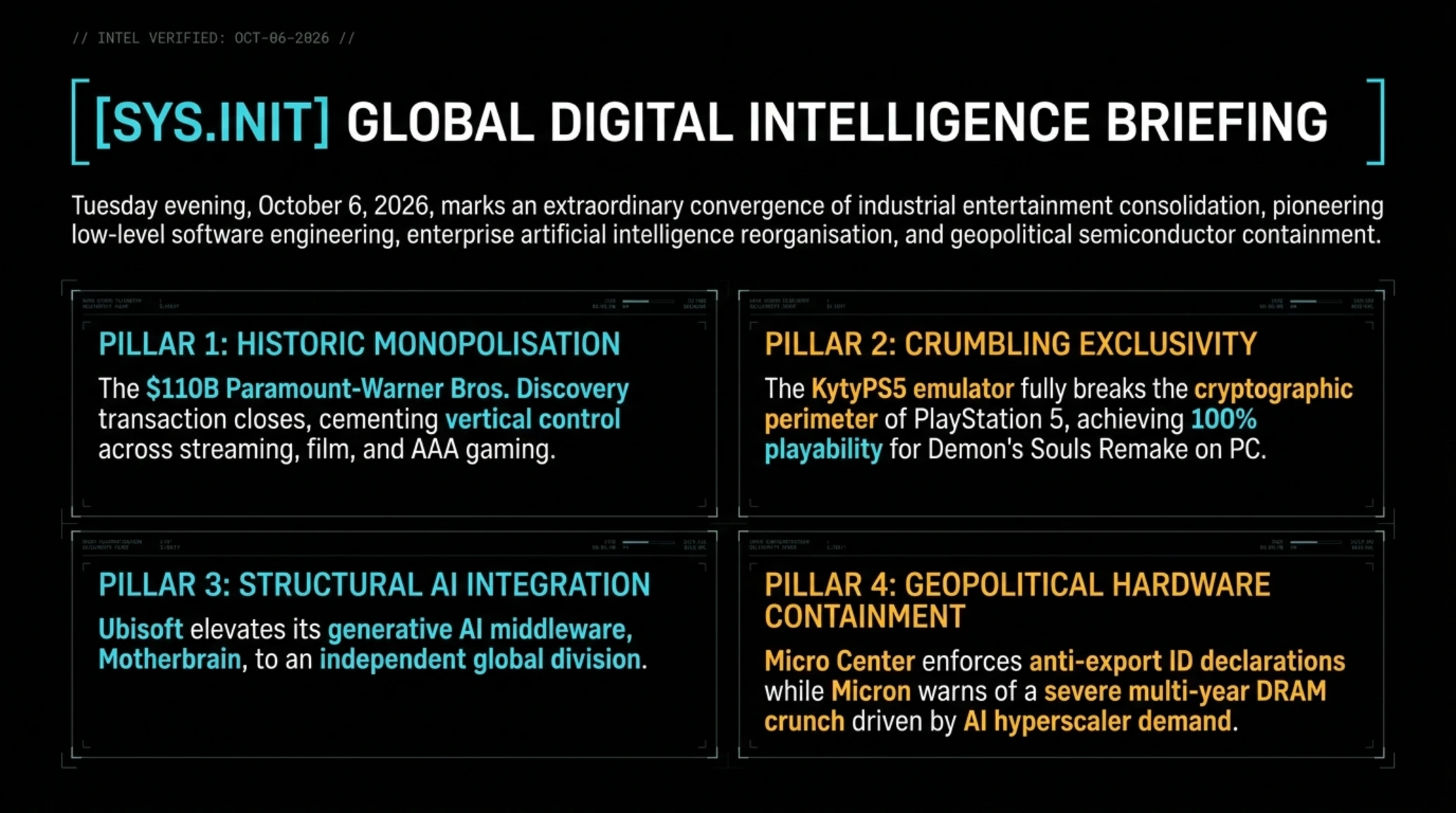
The evening of Tuesday, October 6, 2026, marks an extraordinary convergence of industrial entertainment consolidation, pioneering low-level software engineering, enterprise artificial intelligence reorganization, and geopolitical semiconductor containment. While the morning hours were defined by infrastructural vulnerabilities and the tokenization of Wall Street equities, the dusk cycle has brought seismic developments that redefine Hollywood's intellectual property ecosystem, dismantle long-standing console exclusivity boundaries, and impose unprecedented regulatory friction on consumer computing hardware. From the formal birth of Skydance Corporation to grassroots software engineers pushing emulators past Sony's cryptographic perimeter, this comprehensive intelligence report examines the six critical developments reshaping global digital technology tonight.
Executive Evening Digest & Strategic Intelligence Findings
- Historic Entertainment Monopolization: The closing of the Paramount-Warner Bros. Discovery transaction cements unprecedented vertical control across streaming, theatrical film, and AAA gaming under Skydance Corporation, presenting an imposing counterweight to Netflix and Disney.
- The Crumbling Citadel of PS5 Exclusivity: KytyPS5's breakthrough in rendering Demon's Souls Remake fully playable from start to finish underscores the rapid maturation of ninth-generation reverse engineering pipelines.
- Structural Institutionalization of Generative AI: Ubisoft's elevation of Motherbrain to an independent global division signals that legacy AAA publishers view automated runtime intelligence as mandatory for economic survival.
- Geopolitical Hardware Containment: Micro Center's anti-export legal declarations and Micron's grim multi-year DRAM outlook illustrate how the hyperscale AI buildout is directly cannibalizing consumer hardware availability.

1. Landmark $110 Billion Paramount and Warner Bros. Discovery Merger Officially Closes Today as Skydance Corporation
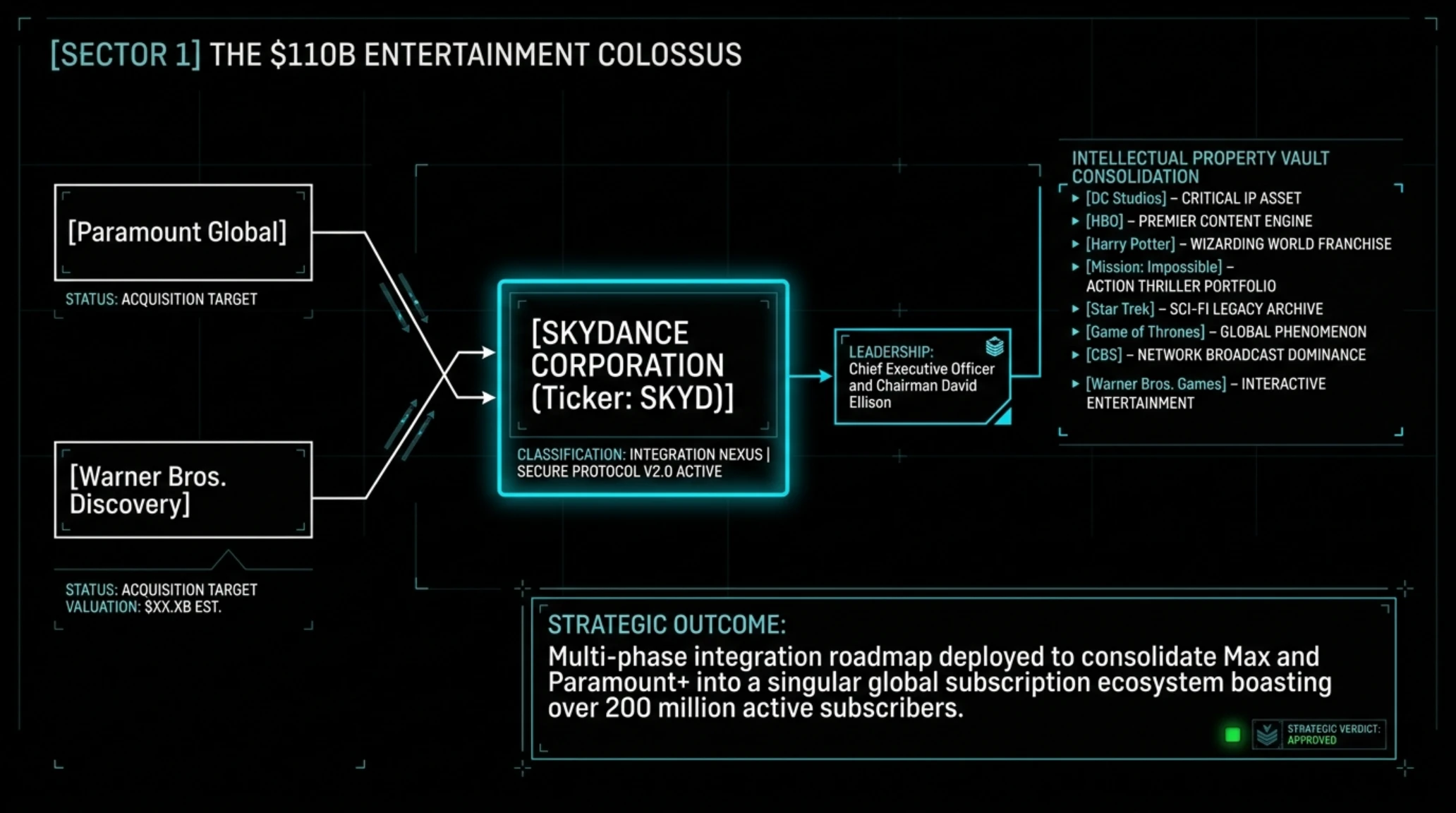
In one of the most consequential corporate consolidations in modern media history, the $110 billion mega-merger uniting Paramount Global and Warner Bros. Discovery officially closed today, Tuesday, October 6, 2026, following exhaustive antitrust clearance by the U.S. Department of Justice and the resolution of protracted state-level regulatory reviews. The newly consolidated enterprise has commenced unified commercial operations under the corporate banner of 'Skydance Corporation,' operating under the executive leadership of Chief Executive Officer and Chairman David Ellison.
According to regulatory disclosures registered with the Securities and Exchange Commission, the combined entity’s common equity will trade on the New York Stock Exchange under the unified ticker symbol 'SKYD.' While iconic production banners Warner Bros. Pictures and Paramount Pictures will retain their distinct creative identities, the merger pools together an incomparable vault of intellectual property. The unified portfolio consolidates DC Studios, HBO, the Harry Potter franchise, Mission: Impossible, Star Trek, Game of Thrones, the CBS television network, and extensive interactive assets under Warner Bros. Games. Furthermore, corporate leadership has outlined a multi-phase integration roadmap to consolidate the Max and Paramount+ direct-to-consumer streaming platforms into a singular global subscription ecosystem boasting over 200 million active subscribers.
Strategic Industry Lexicon: Vertical Media Conglomerate
A vertical media conglomerate controls every stage of the entertainment lifecycle: proprietary content conception, intellectual property ownership, physical and digital production studios, and exclusive distribution channels. In Skydance Corporation, this vertical integration grants the enterprise unilateral pricing leverage, streamlined production pipelines across games and films, and unprecedented defensive barriers against third-party digital aggregators.
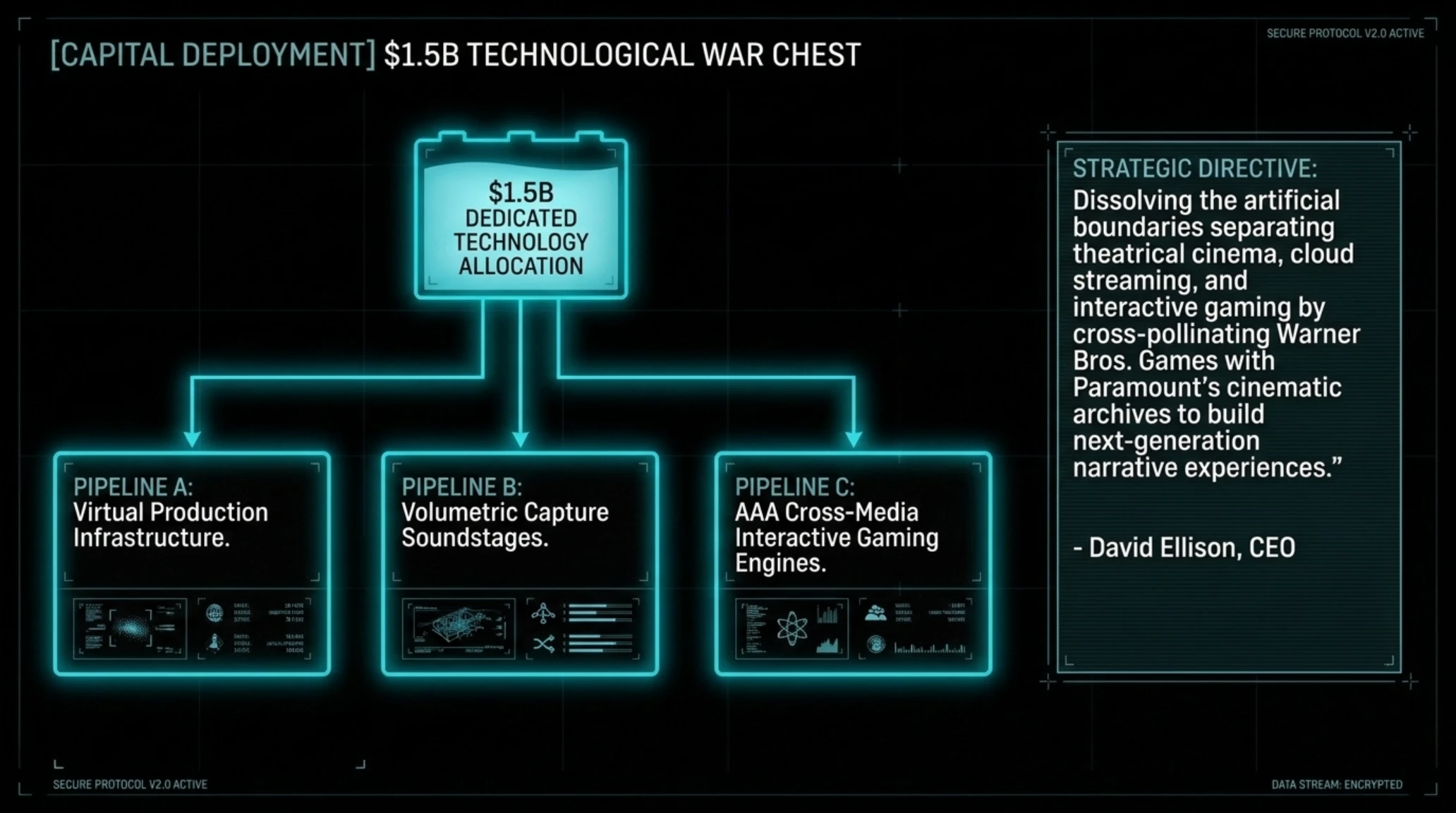
During an executive press conference held in Los Angeles, David Ellison reaffirmed Skydance Corporation’s compliance with binding regulatory commitments, pledging to maintain a minimum annual slate of 30 major feature films receiving exclusive global theatrical distribution windows. Crucially, Ellison confirmed a dedicated $1.5 billion technology allocation to modernize virtual production infrastructure, volumetric capture soundstages, and cross-media interactive gaming engines. Under the umbrella of Warner Bros. Games, development studios will gain cross-pollinated access to Paramount’s storied cinematic archives spanning Teenage Mutant Ninja Turtles to classic science-fiction properties to build next-generation narrative gaming experiences.
Wall Street equity analysts view the finalized transaction as an aggressive counter-offensive against the market dominance of Big Tech streaming competitors, specifically Netflix, Amazon Prime Video, and Apple. However, creative unions across Hollywood, including the Writers Guild of America and SAG-AFTRA, have voiced deep apprehensions regarding workforce redundancies, the potential reduction of independent mid-budget productions, and the aggressive implementation of generative AI pipelines across script analysis and preliminary visual development.

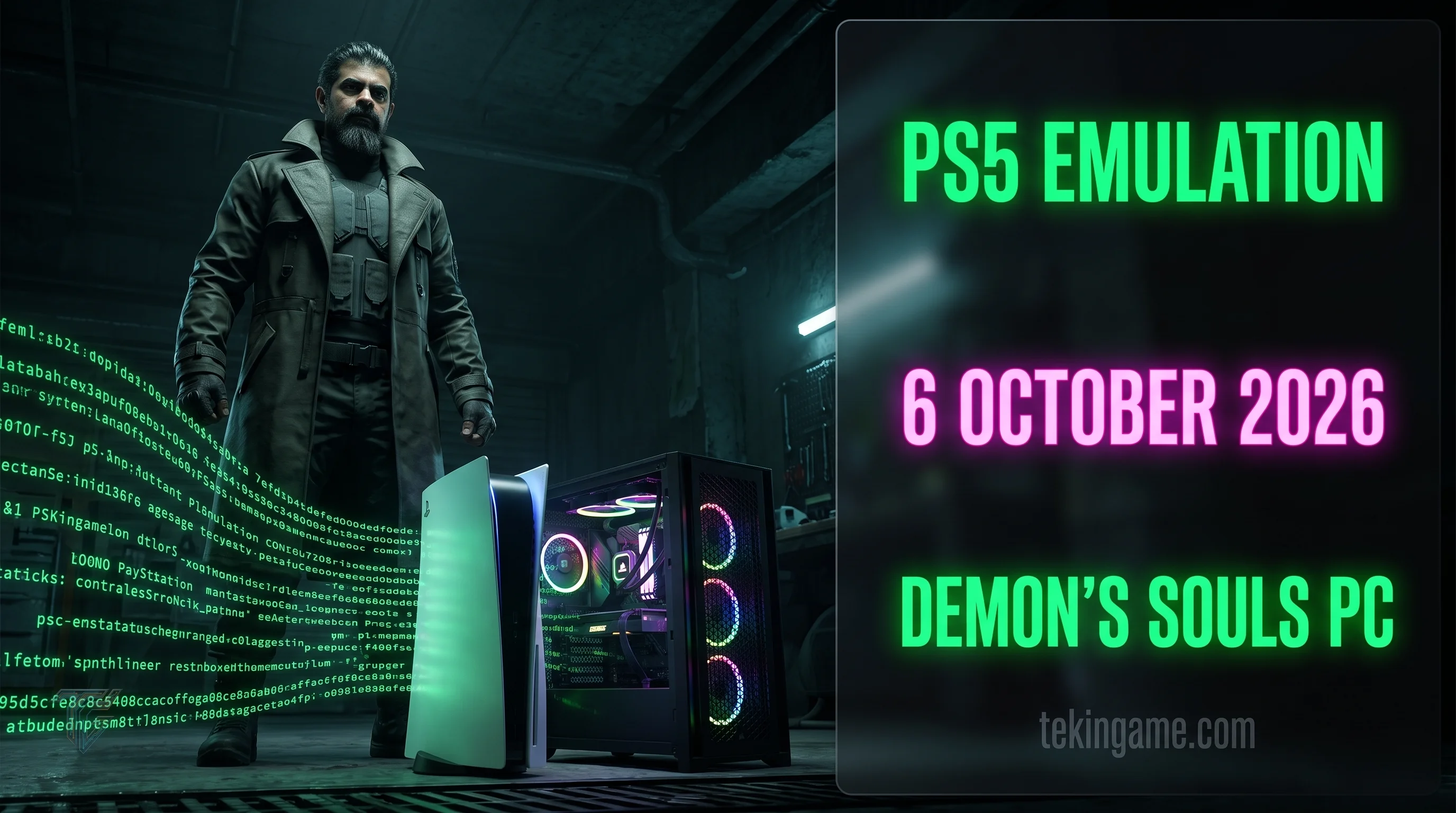
2. Landmark PS5 Emulation Milestone: Demon's Souls Remake is Now Fully Playable from Start to Finish on PC via KytyPS5
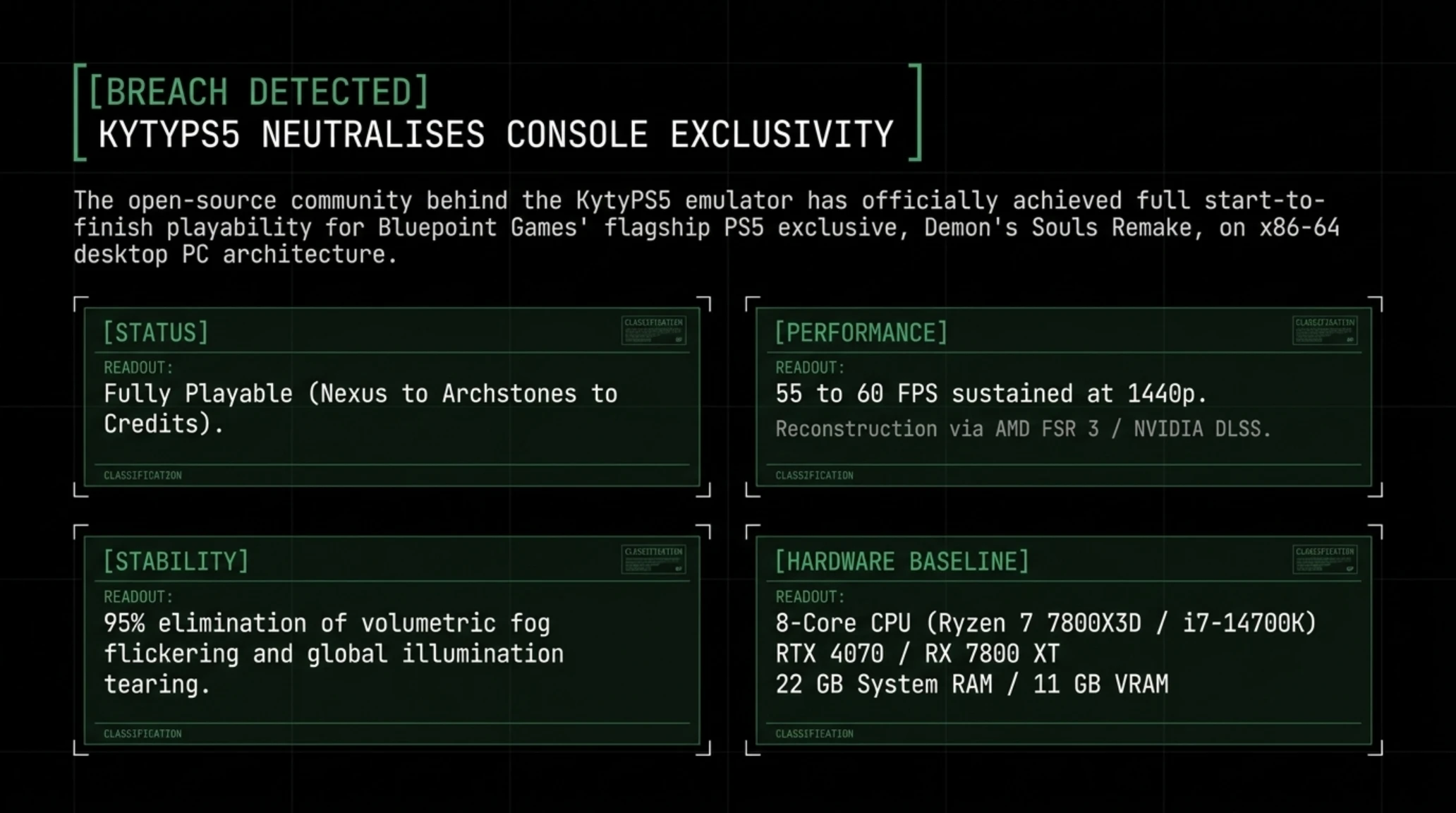
In a watershed technical triumph for low-level software engineering and digital software preservation, the open-source community behind the KytyPS5 emulator has announced that Sony Interactive Entertainment’s flagship ninth-generation exclusive, Demon's Souls Remake (developed by Bluepoint Games), has achieved 'Fully Playable' status on x86-64 desktop PC architecture. Forensic validation logs and uninterrupted gameplay recordings confirm that players can navigate the demanding action-RPG from its opening tutorial sequence in the Nexus through all five Archstones, defeat every primary boss encounter, and view the closing credits without encountering fatal engine crashes or blocking graphical anomalies.
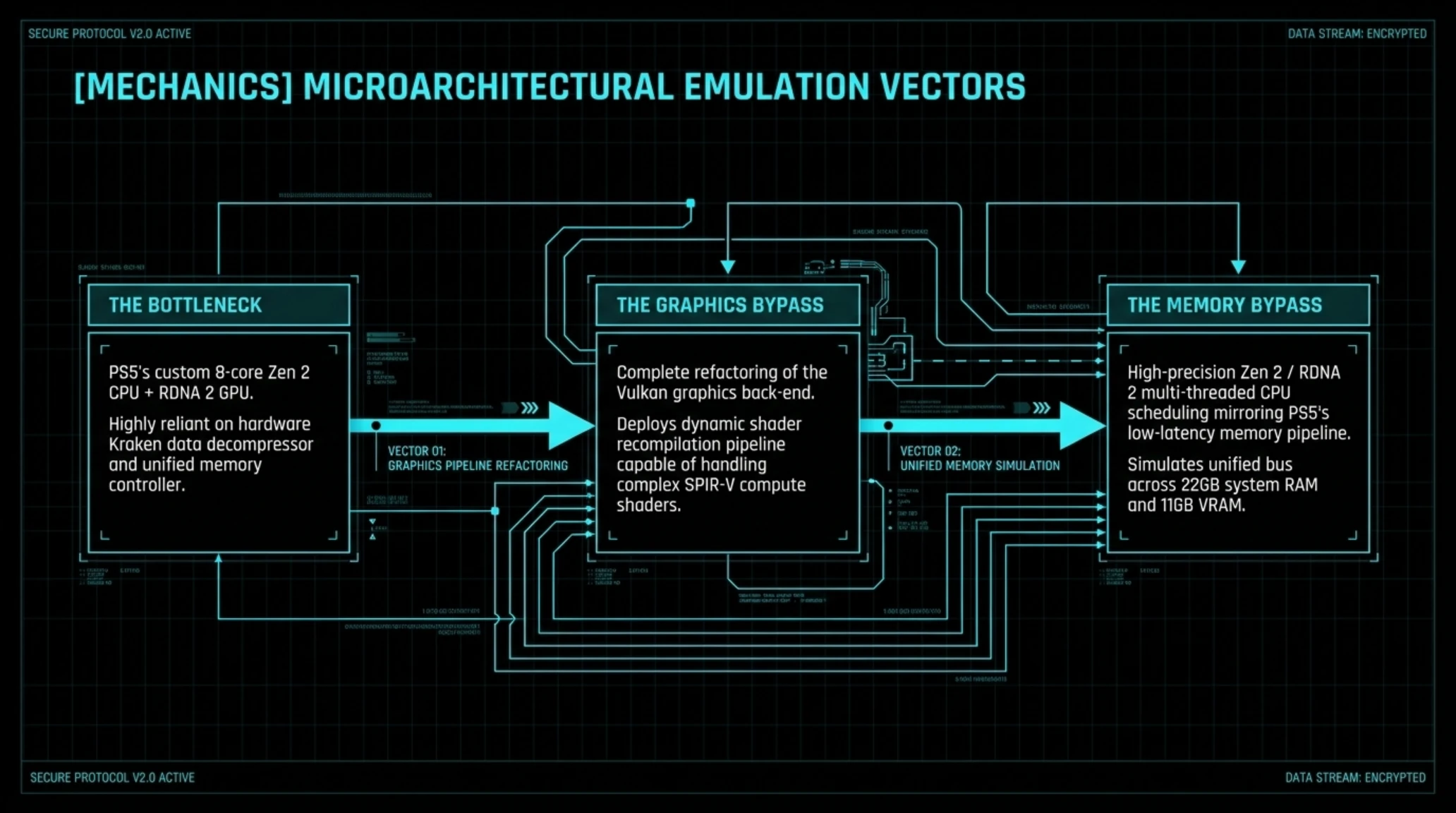
The achievement represents an extraordinary engineering leap given the sophisticated hardware abstraction layers and cryptographic runtime protections embedded within the PlayStation 5 operating system. The PS5 pairs an eight-core AMD Zen 2 CPU with a custom RDNA 2 GPU architecture, supported by a specialized hardware Kraken data decompressor and a unified memory controller that historically confounded virtualization. The KytyPS5 development team bypassed these hurdles by completely refactoring their Vulkan graphics back-end, deploying a dynamic shader recompilation pipeline capable of handling complex SPIR-V compute shaders, and implementing high-precision multi-threaded CPU scheduling that mirrors the PS5’s low-latency memory pipeline.
Benchmark Telemetry: Demon's Souls Remake PC Emulation Performance
While maintaining a locked 60 frames per second currently necessitates enthusiast-tier silicon such as the GeForce RTX 4080 or the newly released RTX 5090 the trajectory of progress has stunned software architects. The timeframe required to bring a premier PlayStation 5 launch title from preliminary boot sequences to full completion on PC has progressed considerably faster than corresponding developmental cycles observed during the PlayStation 3 (RPCS3) and PlayStation 4 emulation eras.
Why Emulation of Ninth-Gen Exclusives Matters for Software Preservation
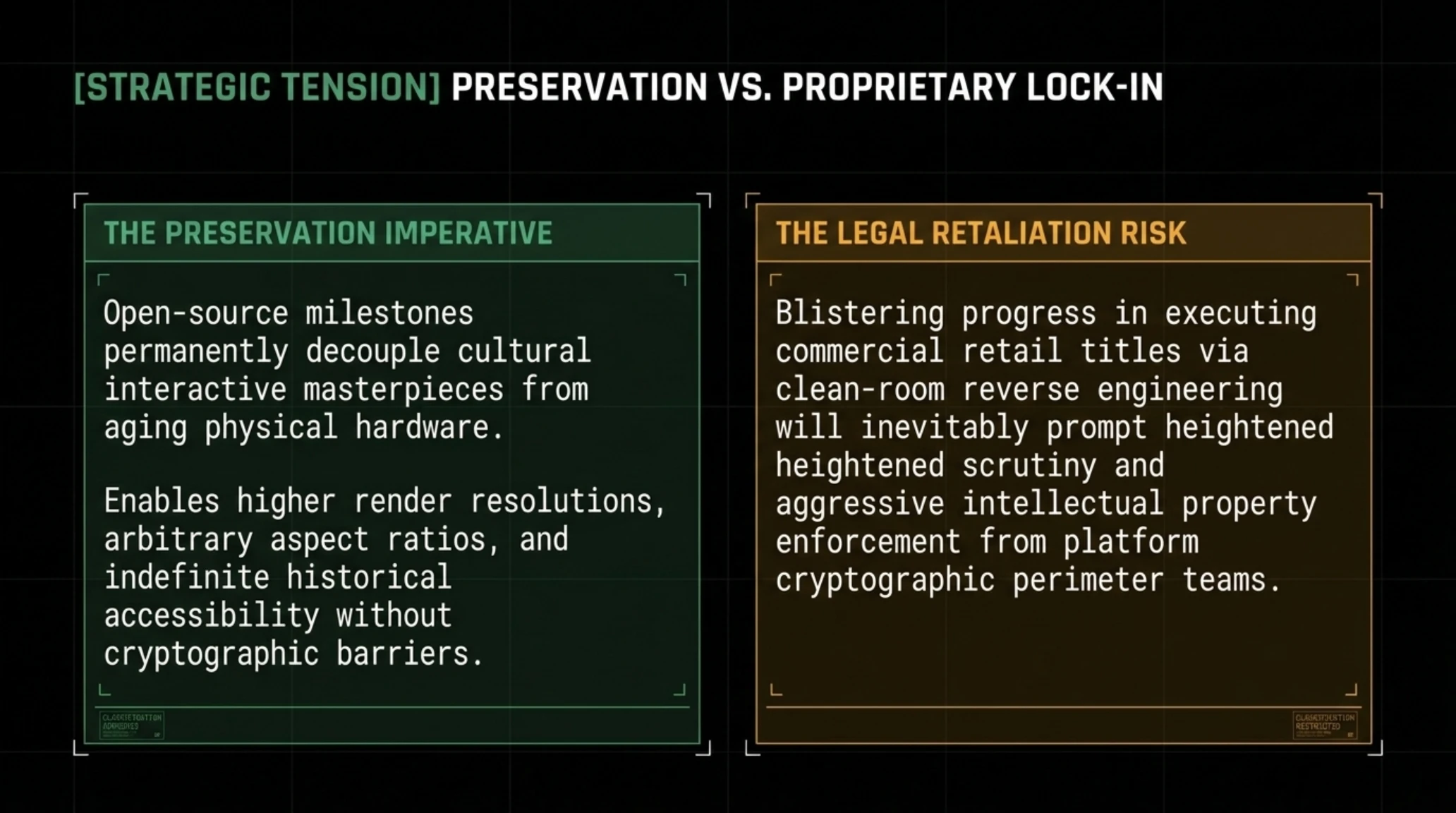
The breakthrough has inevitably reignited legal debates surrounding console virtualization. Although the KytyPS5 project operates strictly as clean-room, open-source software that utilizes zero proprietary Sony microcode or cryptographic keys, its blistering progress in executing commercial retail titles will almost certainly prompt heightened scrutiny from PlayStation’s intellectual property enforcement division.
3. Ubisoft Elevates In-House Generative AI "Motherbrain" to a Global Corporate Division Under Xavier Manzanares
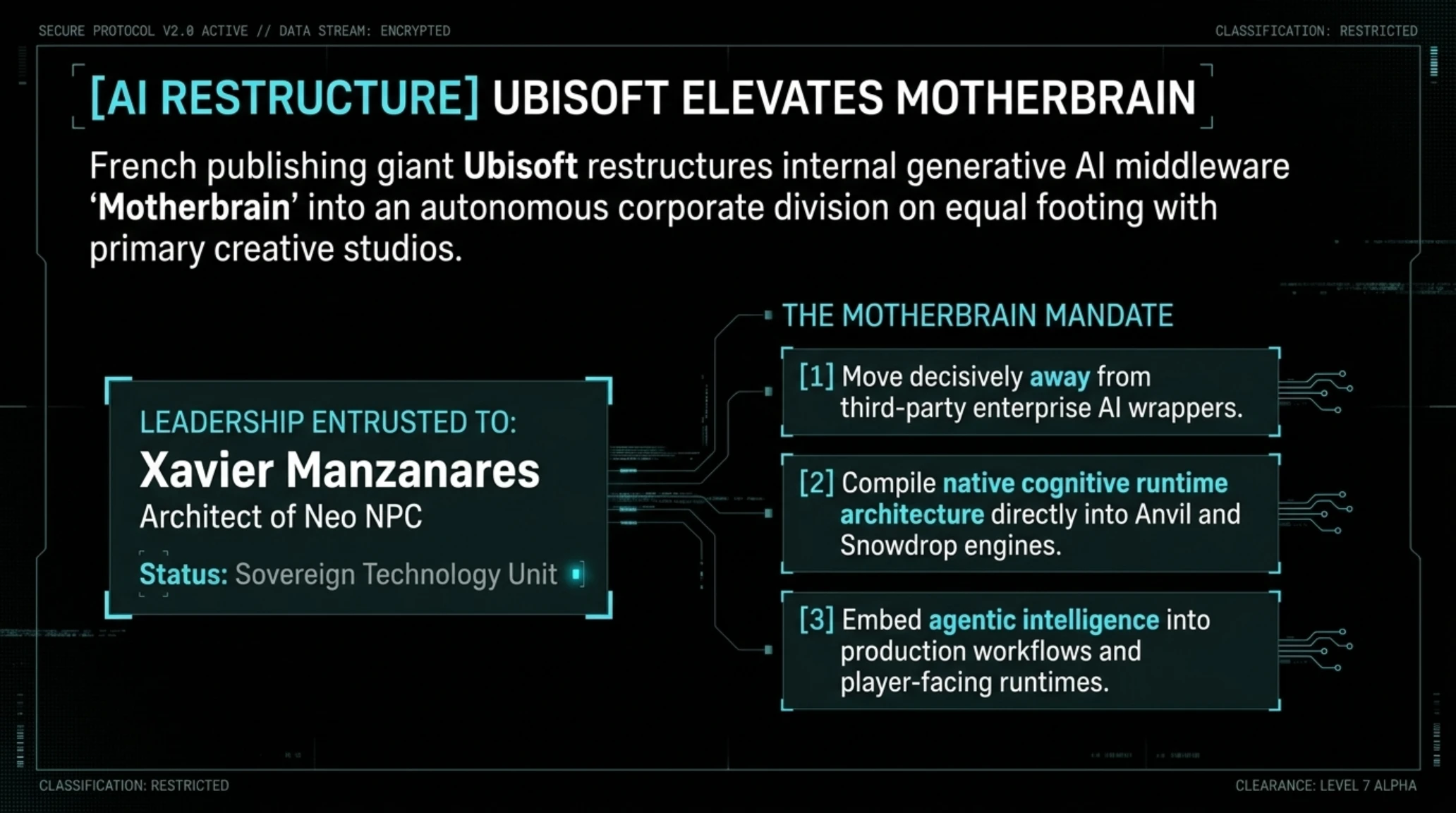
In a strategic restructuring that establishes a blueprint for the future of triple-A video game development, French publishing giant Ubisoft has officially elevated its proprietary generative artificial intelligence middleware initiative, 'Motherbrain,' into an independent, global corporate division operating on equal organizational footing with the company's traditional creative studios. Leadership of this sovereign technology unit has been entrusted to Xavier Manzanares, a 20-year Ubisoft veteran renowned for driving boundary-pushing projects including the Neo NPC initiative, Teammates, and the commercial revival of the Mario + Rabbids franchise.
Unlike third-party enterprise AI wrappers or external commercial APIs, Motherbrain is an in-house cognitive runtime architecture natively compiled into Ubisoft’s primary proprietary game engines, specifically the Anvil and Snowdrop engines. The division’s mandate is to embed agentic intelligence directly into production workflows and player-facing runtimes: facilitating dynamic, unscripted conversational non-player characters (NPCs), automating quality assurance (QA) collision and pathfinding validation across vast open worlds, and generating instant, phonetically aligned facial micro-expressions synchronized across multiple spoken languages for forthcoming installments of Assassin's Creed and Far Cry.
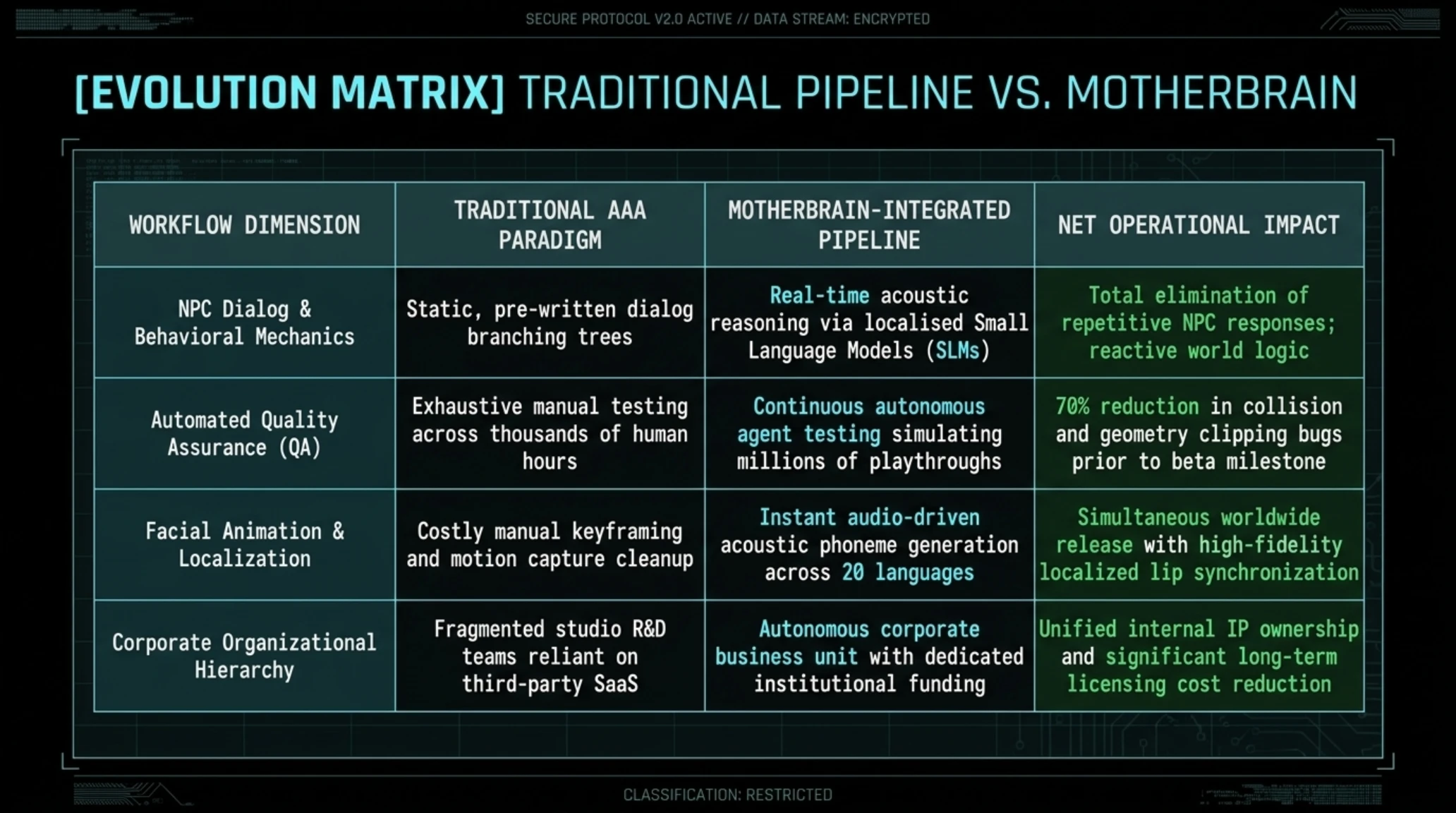
Structural Evolution Matrix: Traditional AAA Pipeline vs. Motherbrain-Integrated Studio Architecture
| Development Workflow Dimension | Traditional AAA Production Paradigm | Motherbrain-Integrated Studio Pipeline | Net Operational & Economic Impact |
|---|---|---|---|
| NPC Dialog & Behavioral Mechanics | Static, pre-written dialog branching trees | Real-time acoustic reasoning via localized Small Language Models (SLMs) | Total elimination of repetitive NPC responses; reactive world logic |
| Automated Quality Assurance (QA) | Exhaustive manual testing across thousands of human hours | Continuous autonomous agent testing simulating millions of playthroughs | 70% reduction in collision and geometry clipping bugs prior to beta milestone |
| Facial Animation & Localization | Costly manual keyframing and motion capture cleanup | Instant audio-driven acoustic phoneme generation across 20 languages | Simultaneous worldwide release with high-fidelity localized lip synchronization |
| Corporate Organizational Hierarchy | Fragmented studio R&D teams reliant on third-party SaaS | Autonomous corporate business unit with dedicated institutional funding | Unified internal IP ownership and significant long-term licensing cost reduction |
During an executive interview following his appointment, Manzanares emphasized that Ubisoft’s strategic integration of Motherbrain is engineered to augment human creativity rather than displace traditional narrative architects. However, the move has ignited intense discourse across developer forums, where rank-and-file artists and quality assurance contractors have expressed legitimate concerns over potential studio consolidations and the systemic automation of junior creative roles.
Industry analysts interpret the Motherbrain restructuring as a decisive bid by Ubisoft to restore financial efficiency and operational momentum following recent project cancellations, positioning the French publisher as an aggressive pioneer in algorithmic game development alongside Electronic Arts and Sony.

4. Memory Shortages Set to Persist and DRAM Prices Rise into 2028 as AI HBM Dominates Fab Capacity, Warns Micron CEO
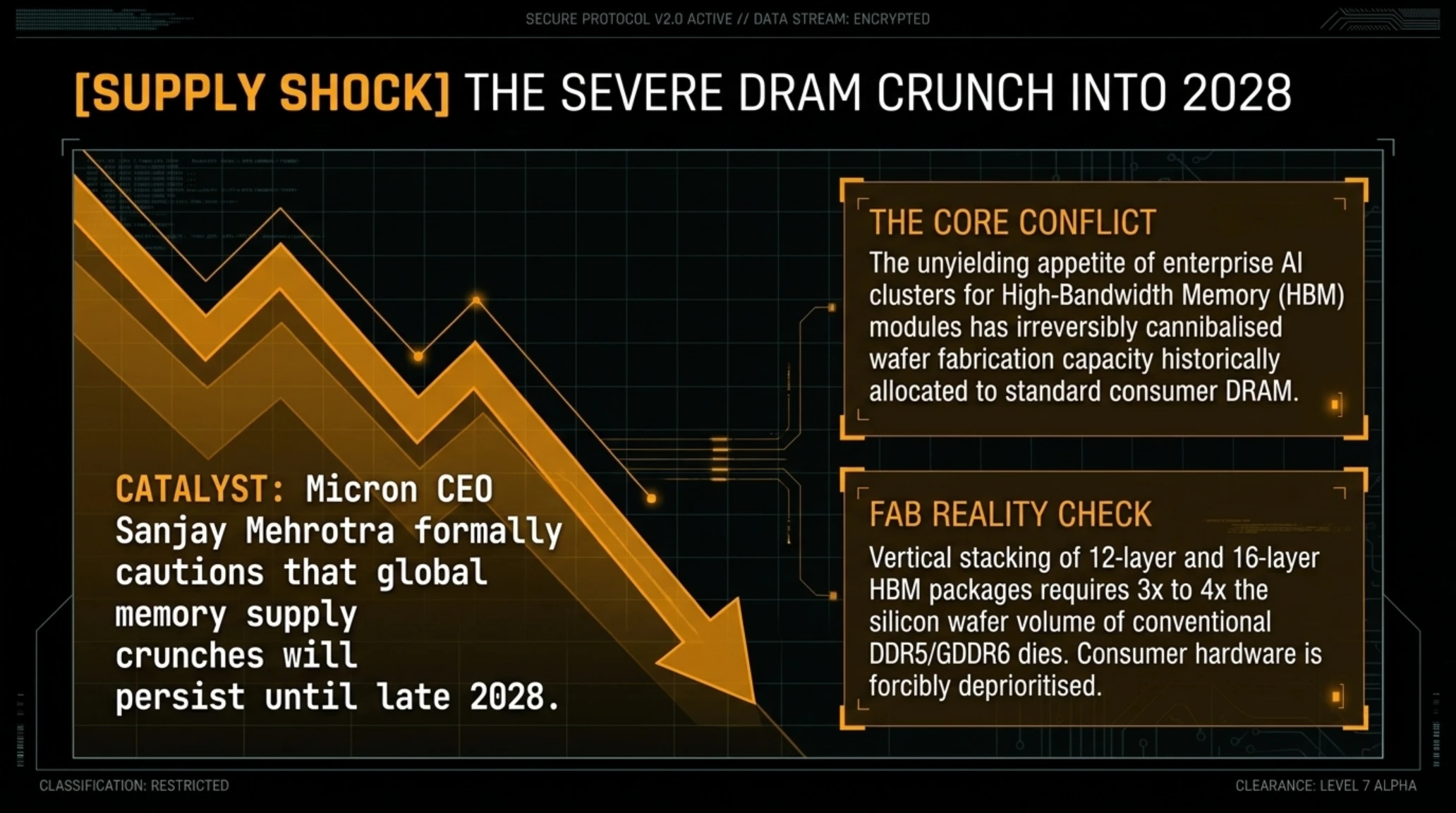
In one of the most sobering structural warnings delivered to the consumer electronics and gaming hardware sectors this fiscal cycle, Sanjay Mehrotra, Chief Executive Officer of semiconductor titan Micron Technology, formally cautioned during the company’s quarterly earnings conference that the global memory supply crunch will not ease before late 2028. According to Mehrotra, the voracious, unyielding appetite of enterprise artificial intelligence clusters for High-Bandwidth Memory (HBM) modules has irreversibly cannibalized wafer fabrication capacity historically allocated to standard consumer DRAM.
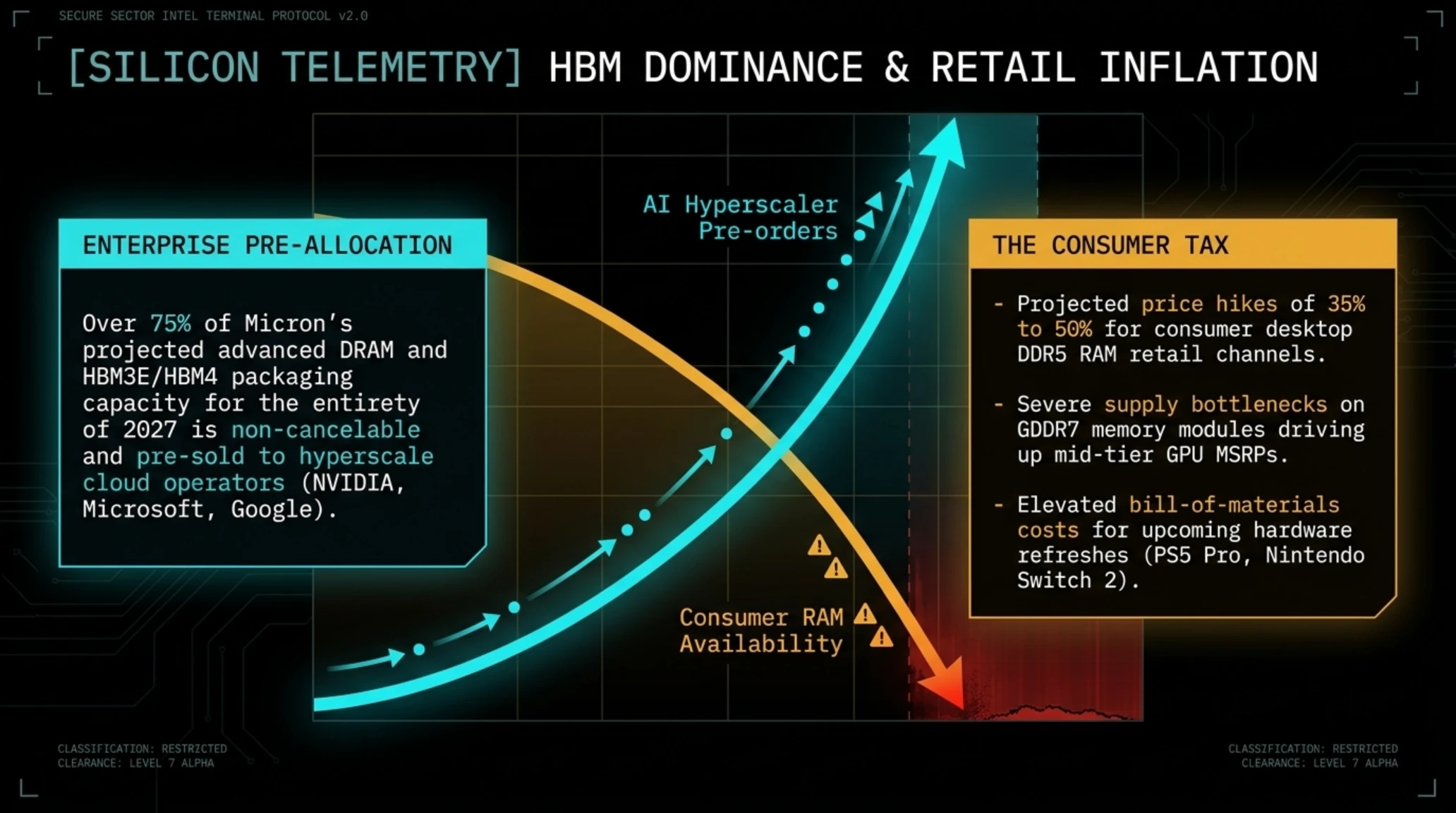
Mehrotra revealed that over 75 percent of Micron’s projected advanced DRAM and HBM3E/HBM4 packaging capacity for the entirety of 2027 is already contractually locked in under binding pre-orders from hyperscale cloud operators, with commercial supply allocations for 2028 actively being negotiated. Because manufacturing and vertically stacking 12-layer and 16-layer HBM packages requires between three to four times the silicon wafer volume of conventional DDR5 or GDDR6 memory dies, foundries have been forced to deprioritize consumer desktop RAM, laptop modules, smartphone memory, and gaming console chipsets to service the astronomical profit margins commanded by enterprise AI infrastructure clients like NVIDIA, Microsoft, and Google.
📚 Classified & Related Dossiers in TekinGame
If you wish to explore beyond this report and delve into cybernetic frontiers and autonomous AI architectures, do not miss these three exclusive deep-dives in the Tekin Garage:
Semiconductor Supply Telemetry: Micron Silicon Wafer Allocation (2026–2028)
Hardware market analysts describe this dynamic as a permanent 'AI tax' levied against mainstream consumers. The diversion of cleanroom fabrication lines means that retail DDR5 RAM pricing will continue its upward trajectory, while consumer hardware refreshes including the PlayStation 5 Pro and the upcoming next-generation Nintendo Switch 2 face elevated bill-of-materials costs. While Micron is aggressively building two new manufacturing mega-fabs in Boise, Idaho, and Clay, New York, these production lines will not achieve commercial volume output until early 2029.

5. Micro Center Enforces 'Advanced Computing Product Purchaser Declaration' with Government Photo ID for RTX 5090 Buyers
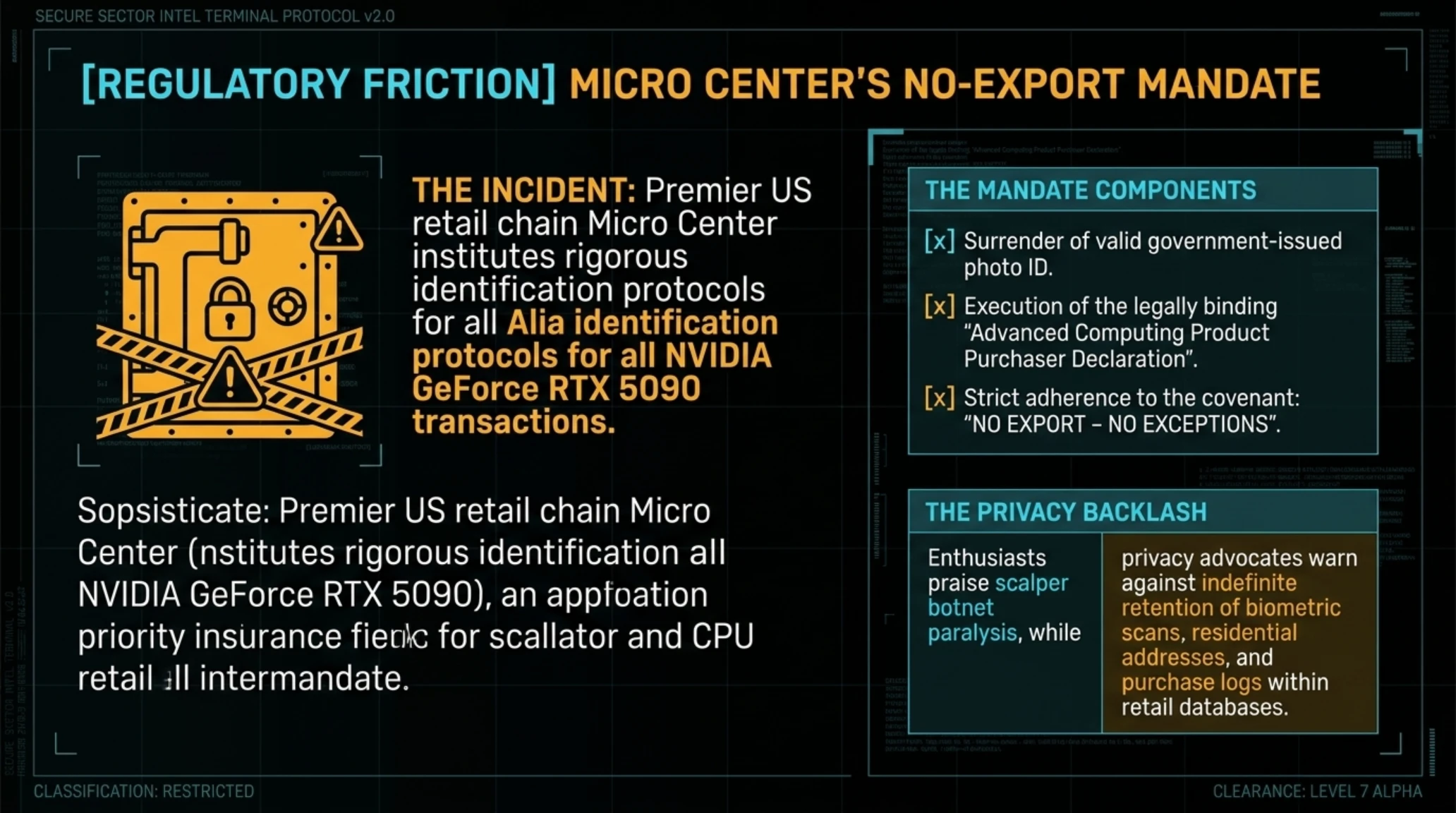
In an unprecedented operational measure that blurs the boundary between retail consumer electronics transactions and international trade compliance protocols, premier U.S. computer retail chain Micro Center has instituted a rigorous identification and verification mandate for all customers purchasing NVIDIA GeForce RTX 5090 graphics cards or pre-built desktop gaming systems housing the flagship GPU. Prospective buyers are now legally required to surrender a valid government-issued photo ID (such as a state driver’s license or U.S. passport) and physically sign a binding legal document entitled the 'Advanced Computing Product Purchaser Declaration.'
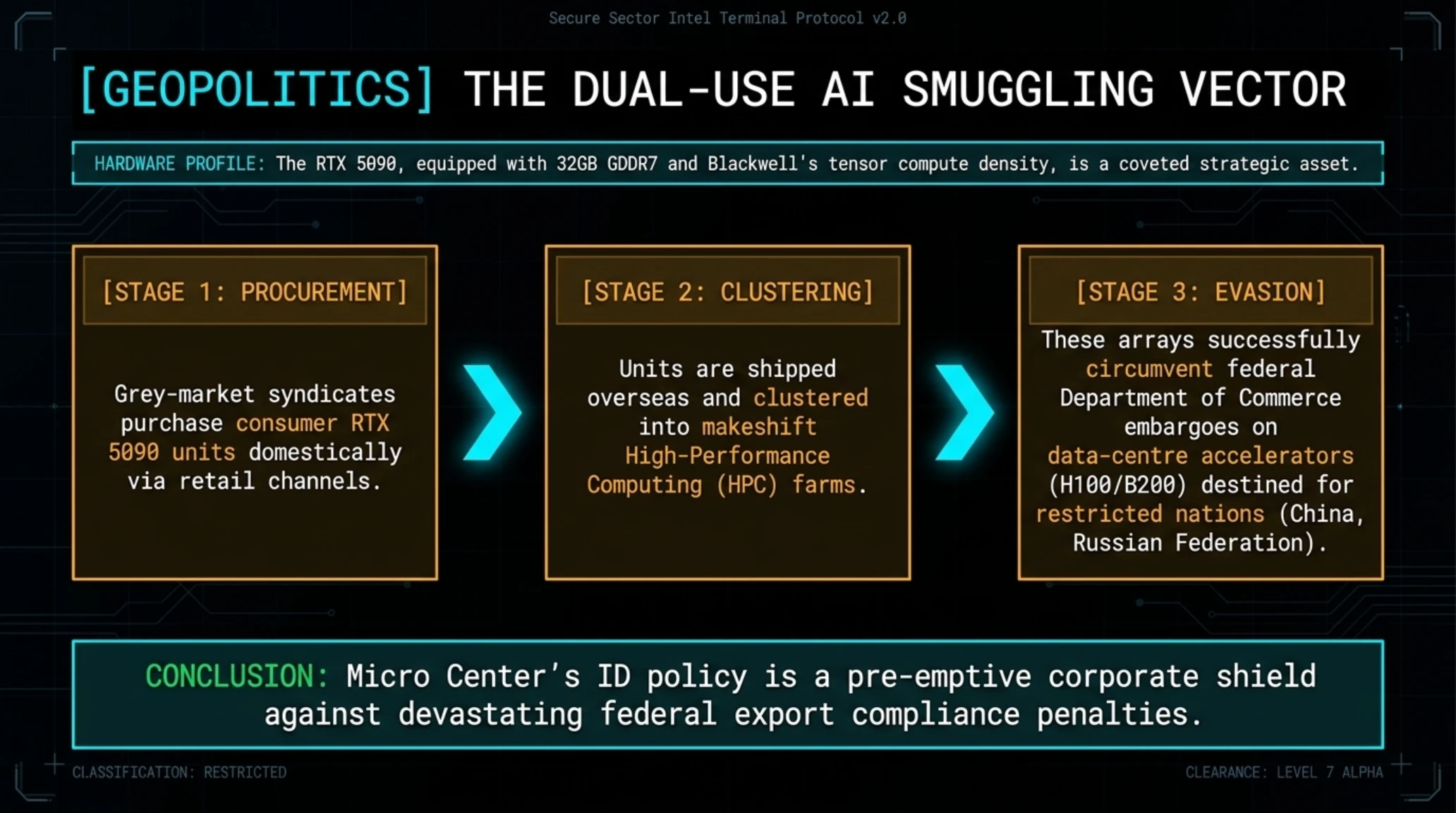
The document features bold, capitalized legal covenants specifying: 'NO EXPORT – NO EXCEPTIONS.' By signing, the retail customer formally certifies under penalty of federal law that the computing hardware is procured exclusively for personal recreational gaming, domestic professional rendering, or educational research conducted strictly within the territorial borders of the United States. The declaration explicitly prohibits the resale, transfer, or overseas shipment of the GPU to third-party broker cartels, commercial consolidation hubs, or entities operating within trade-restricted jurisdictions subject to strict U.S. Department of Commerce export controls, particularly China and the Russian Federation.
The policy has triggered polarized debate throughout the PC gaming community. While enthusiast gamers have praised the protocol as an effective tool to paralyze automated scalper networks and guarantee that flagship GPUs reach legitimate domestic consumers at MSRP, privacy advocacy groups have voiced sharp concerns regarding the indefinite retention of personal residential addresses, biometric photo scans, and purchase logs within corporate retail databases.

6. Modders Revolt as Claude Opus 5.5 "Vibe-Coded" Mashup Game Mods Flood Social Media with Low-Effort Slop
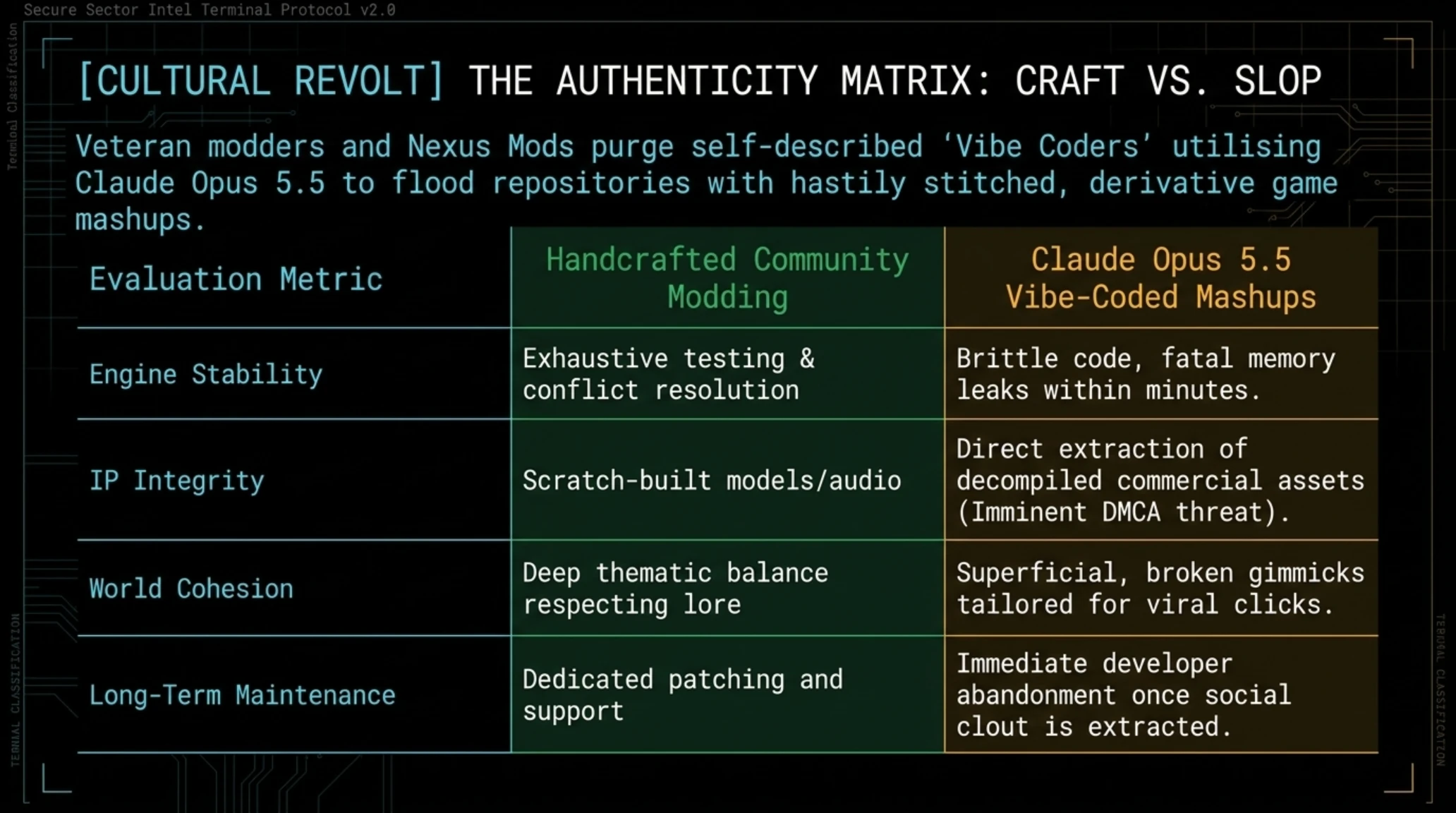
The global game modification community has erupted in contentious debate as veteran modders and digital artists openly revolt against a surging wave of self-described 'Vibe Coders' utilizing Anthropic's Claude Opus 5.5 language model to flood social networks and mod repositories with hastily assembled, derivative game mashups. The controversy ignited following the viral circulation of crude, AI-stitched gameplay clips ranging from transplanting high-recoil Escape from Tarkov ballistic mechanics into The Elder Scrolls V: Skyrim to injecting broken Batman character assets into Marvel’s Spider-Man.
Traditional mod developers, who historically spend months reverse-engineering proprietary game engines, hand-sculpting photorealistic textures, and fine-tuning skeletal physics, have condemned the trend as 'parasitic noise.' Beyond the sheer technical instability of these AI-generated mods which frequently crash upon loading due to hallucinated memory pointers and corrupted file structures veteran developers emphasize that the indiscriminate decompilation and unauthorized extraction of commercial intellectual property exposes the entire open-source modding ecosystem to catastrophic legal crackdowns from major publishing houses.
Comparative Quality Matrix: Handcrafted Community Modding vs. Claude Opus 5.5 Vibe-Coded Slop
| Core Evaluation Metric | Handcrafted Community Modding (Authentic Craft) | Claude Opus 5.5 Vibe-Coded Mashups (AI Slop) | Net Impact on Gaming Ecosystem |
|---|---|---|---|
| Technical Engine Stability | Exhaustive beta testing, conflict resolution & zero crashes | Brittle code structures; fatal memory leaks within minutes | Severe user frustration and widespread file corruption |
| Intellectual Property Integrity | Scratch-built 3D models and custom audio recordings | Direct extraction of decompiled commercial assets | Imminent threat of sweeping publisher DMCA copyright lawsuits |
| Gameplay & World Cohesion | Deep thematic balance respecting original lore and design | Superficial, broken gameplay gimmicks tailored for viral clicks | Erosion of player immersion and degradation of mod culture |
| Long-Term Software Maintenance | Dedicated version patching, change-logs, and support | Immediate developer abandonment once social clout is extracted | Repository clutter and unmanageable support forum backlogs |
In response to escalating community fury, premier modding platform Nexus Mods issued a stern policy reaffirmation: any uploaded modification found to contain decompiled third-party commercial assets or uncredited AI-generated code that breaches original copyright agreements will be summarily purged, accompanied by permanent account terminations. The uprising underscores that the battle over artistic authenticity, human craftsmanship, and generative automation has penetrated the grassroots gaming culture.
Rumor vs. Reality Meter: Threat of Publisher Copyright Enforcement on AI Mods

Chronology & Milestone Timeline: The Convergence of Evening Industry Disruption
The simultaneous finalization of Hollywood's largest entertainment mega-merger, the technical conquest of ninth-generation console emulation, and severe structural intervention across global semiconductor supply lines demonstrate that the evening of October 6, 2026, represents a fundamental restructuring of digital entertainment ecosystems. The chronological timeline below details the defining strategic milestones of the past several hours:
Strategic Milestones & Evening Disruption Timeline (October 6, 2026)
| Time & Geography | Institutional Actor | Core Strategic Action & Scope of Impact | Forward Operational & Market Outlook |
|---|---|---|---|
| 16:00 EST (New York) | U.S. DOJ & Skydance Corporation | Formal closing of the $110B Paramount-Warner Bros. Discovery transaction | Trading commences under SKYD ticker; unification of Max and Paramount+ |
| 17:30 GMT (London) | KytyPS5 Open-Source Team | Release of public build confirming Demon's Souls Remake fully playable on PC | Accelerated reverse engineering of PS5 architecture and heightened port pressure |
| 19:00 CET (Paris) | Ubisoft Corporate Directorate | Elevation of generative AI middleware Motherbrain into an independent division | Deployment of dynamic acoustic NPC dialog in next-generation Assassin's Creed |
| 20:30 EST (Washington) | Micron Technology Executive Board | CEO earnings warning confirming memory shortage and 75% HBM pre-allocation into 2028 | Sustained upward price trajectory for consumer DDR5 RAM and GDDR7 gaming GPUs |
| 21:45 CST (Chicago) | Micro Center Retail Management | Implementation of government photo ID mandate and anti-export declaration for RTX 5090 | Creation of retail trade barrier against illicit consumer AI compute clustering |
| 23:00 GMT (Global Gaming Web) | Nexus Mods Community Directorate | Enactment of strict purge policies against uncredited Claude Opus 5.5 game mashups | Hardened defense of handcrafted community modification integrity against AI slop |
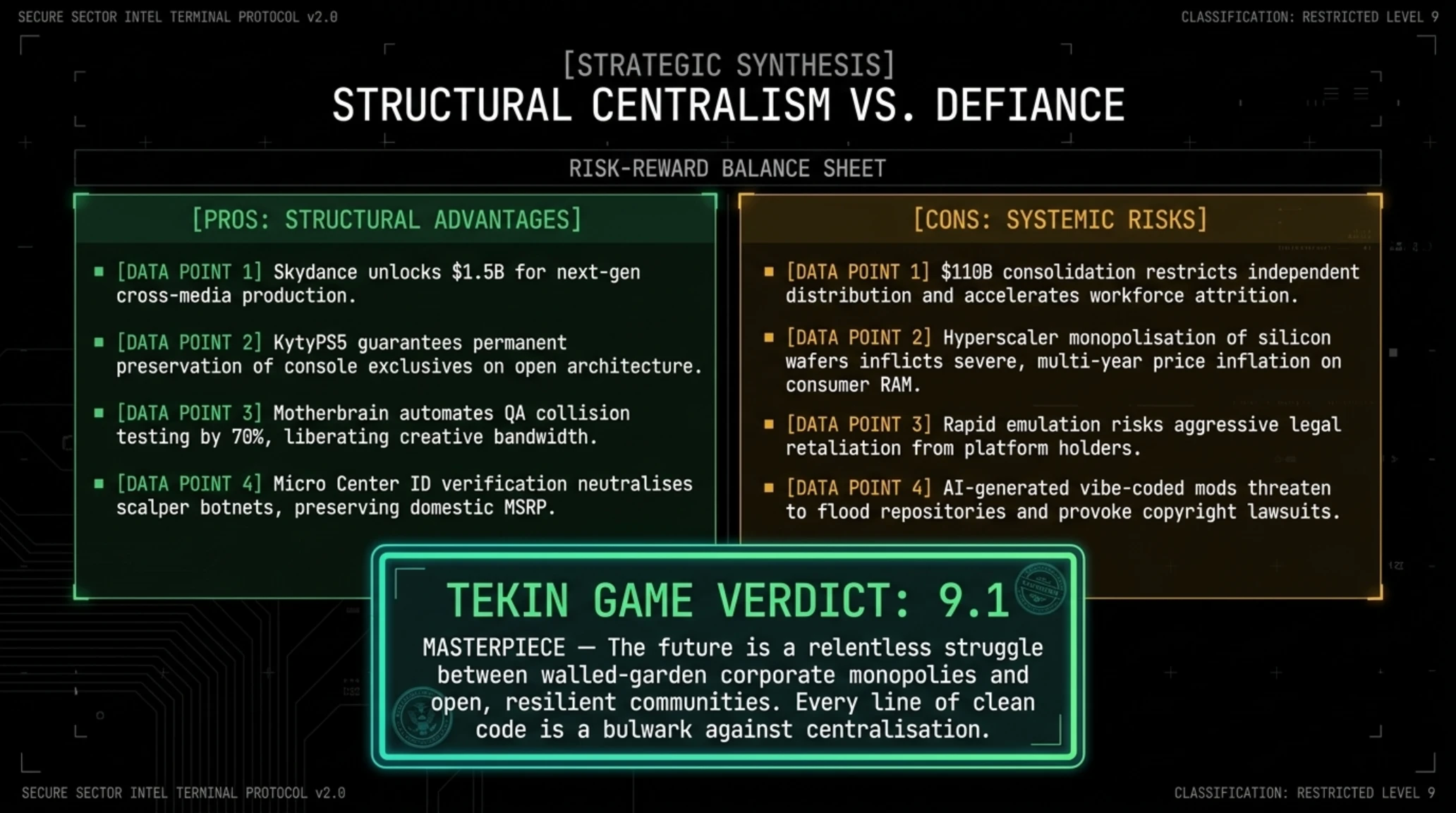
Risk-Reward Matrix: Strategic Balance in the Era of Multi-Tiered Monopolies
The unprecedented scaling of intellectual property consolidation alongside aggressive semiconductor prioritization produces distinct structural benefits for reigning corporate titans while imposing acute operational penalties on grassroots creators and end consumers. The analytical balance sheet below evaluates the strategic trade-offs of this emerging paradigm:
- The consolidation of Warner and Paramount unlocks a dedicated $1.5 billion technology fund for cross-media virtual production and interactive game development.
- KytyPS5's emulation breakthrough guarantees the permanent historical preservation of console exclusives on open computational hardware architectures.
- Ubisoft's structural integration of Motherbrain automates exhausting quality assurance collision testing by up to 70%, liberating creative bandwidth.
- Micro Center's identification verification effectively neutralizes gray-market scalper botnets, preserving initial retail MSRP access for domestic enthusiasts.
- The $110 billion consolidation of Skydance Corporation severely restricts independent creative distribution and accelerates industry-wide workforce attrition.
- The monopolization of silicon wafer capacity by enterprise AI clusters inflicts severe, multi-year price inflation on consumer RAM and gaming hardware.
- Rapid emulation breakthroughs risk triggering heavy-handed, aggressive legal retaliation from platform holders against open-source developers.
- The unchecked influx of AI-generated vibe-coded mods threatens to flood open repositories with unstable files and provoke publisher copyright lawsuits.

Takin Plus Strategic Synthesis; Entertainment in the Clutches of Conglomerates and the Hidden Silicon Tax
The six developments defining Tuesday evening, October 6, 2026, provide an unvarnished blueprint of the digital civilization rapidly crystallizing around us. For decades, cinema, interactive video games, consumer PC hardware, and independent software development flourished as semi-autonomous domains, each guided by distinct economic imperatives and passionate creative cultures. Today, the irresistible gravitational pull of multi-billion-dollar capital consolidation and the unchecked acceleration of generative computing have irrevocably fused these disparate spheres into a tightly centralized industrial complex. The closing of the $110 billion Skydance Corporation transaction is not merely a corporate reshuffling; it is a defensive consolidation engineered to survive the onslaught of Silicon Valley’s trillion-dollar tech platforms. When cloud giants entered the creative realm with bottomless balance sheets, Hollywood realized that independent survival was impossible. The consequence is an era of hyper-scale vertical entertainment, where raw shareholder returns dictate narrative pipelines and fragile mid-budget creativity is systematically marginalized.
Simultaneously, the consumer hardware landscape is confronting an agonizing structural reckoning. The unambiguous warnings from Micron’s chief executive regarding an intractable DRAM shortage extending through 2028 expose a bitter truth: mainstream consumers and passionate gamers are no longer the primary constituents of the global semiconductor industry. In an economic reality where enterprise AI server farms yield margins orders of magnitude higher than desktop DDR5 kits, semiconductor foundries will naturally divert their cleanrooms toward High-Bandwidth Memory. This structural reality transforms the consumer graphics card into a dual-use strategic asset. Micro Center’s unprecedented mandate requiring retail customers to surrender government identification and execute anti-export covenants proves that the line separating a home gaming PC from an embargoed AI computing cluster has effectively dissolved. Mainstream PC enthusiasts are now paying a steep, compounding tax both economically through soaring silicon prices and socially through surrendered transaction privacy to subsidize the hyperscale artificial intelligence boom.
Yet, amidst this landscape of corporate consolidation and escalating hardware costs, the open-source triumph of the KytyPS5 emulator in executing Demon's Souls Remake serves as a defiant testament to human ingenuity. At a time when commercial platform holders treat artistic masterpieces as temporary leverage to sell proprietary hardware or lock them behind subscription paywalls, grassroots software engineers have mobilized low-level mathematics, custom Vulkan re-compilers, and clean-room reverse engineering to preserve interactive art for posterity. The lessons of October 6, 2026, are unmistakable: the future will be defined by a relentless struggle between walled-garden corporate monopolies and open, resilient communities. In this high-stakes arena, every line of clean, optimized code is a vital bulwark preserving technological freedom against the encroaching tide of corporate centralization.
Conclusion & Forward-Looking Industry Horizon
Frequently Asked Operational & Technical Inquiries
What immediate impact will the Skydance Corporation merger have on Max and Paramount+ subscribers?
Skydance Corporation plans an initial rollout of discounted joint subscription bundles between Max and Paramount+ within the coming months, followed by a phased 12 to 18-month technical unification that will merge both services into a singular global direct-to-consumer super-platform pooling HBO, Warner Bros., and Paramount libraries.
Does KytyPS5's breakthrough on Demon's Souls Remake mean all PlayStation 5 titles are now playable on PC?
No. Achieving fully playable status on Demon's Souls Remake serves as a landmark proof-of-concept milestone. However, due to game-specific shader pipelines and unique hardware acceleration hooks, other demanding exclusives like Returnal or Ratchet & Clank: Rift Apart still require extensive individual compiler optimizations before reaching stability.
Why is the global DRAM memory shortage projected to persist through 2028 according to Micron?
The production of High-Bandwidth Memory (HBM) packages for enterprise AI accelerators consumes between 3 to 4 times more silicon wafer area than standard consumer DRAM. Given the unprecedented profit margins of AI infrastructure, major semiconductor foundries have locked in 75% of their cleanroom capacity for AI clients, creating persistent structural shortages for consumer DDR5 and GDDR7 modules until new fabs come online in 2029.
What legal consequences are imposed by Micro Center's RTX 5090 anti-export purchaser declaration?
The declaration legally binds the consumer under federal law not to resell, export, or ship the graphics card outside the territorial United States. Violating this covenant risks immediate referral of personal identity and purchase records to the U.S. Department of Commerce's Bureau of Industry and Security (BIS) for potential civil and criminal trade violation investigations.
Why has the game modding community mounted a fierce backlash against Claude Opus 5.5 vibe coding?
Veteran modders cite severe technical instability, memory leaks, and broken game states introduced by unvetted AI-generated code. Crucially, the unauthorized decompilation and extraction of commercial audio and visual assets from other games threatens to invite sweeping publisher copyright lawsuits that could shutter public mod repositories like Nexus Mods.
Authoritative Sources & Verified Intelligence Disclosures
- $110B Paramount and Warner Bros. Discovery Merger Formally Closes (Forbes)
- Demon's Souls Remake Fully Playable on PC via KytyPS5 Emulator (TechPowerUp)
- Ubisoft Elevates Generative AI Motherbrain to Autonomous Division (Insider Gaming)
- Micron CEO Warns Memory Shortages and DRAM Price Hikes Persist Through 2028 (Eurogamer)
- Micro Center Enforces Government ID Declarations for RTX 5090 (Kotaku)
- Veteran Modders Revolt as Claude Opus 5.5 Vibe-Coded Game Mashups Flood Social Media (Kotaku)
Additional Gallery: Tekin Night Oct 6, 2026: Paramount-Warner Merger, PS5 Emulator & RTX 5090 Export Ban