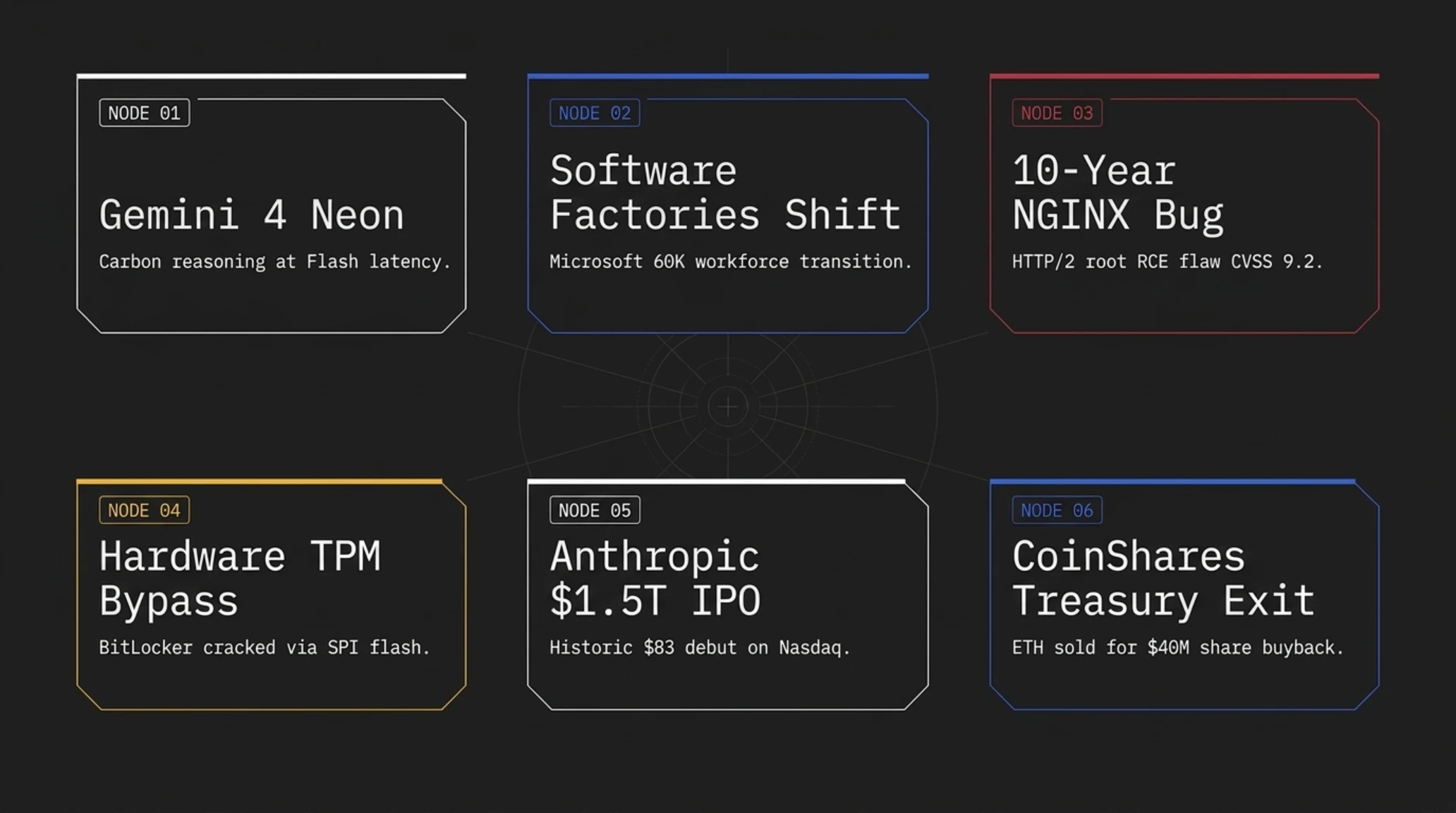
Tekin Night November 20, 2026 Executive Dossier: Technical dissection of Google launching Gemini 4 Neon distilling Carbon reasoning into Flash-tier sub-180ms latency, Microsoft CEO Satya Nadella defending voluntary buyouts for 60,000 employees amid the software factory revolution, F5 disclosing a decade-old root RCE flaw in NGINX HTTP/2 streams (CVE-2026-123007), TU Berlin researchers dismantling hardware TPM lockouts via $4 SPI flash replays, Anthropic shattering Wall Street records with an $83 Nasdaq IPO valuing the lab at $1.5 trillion, and CoinShares exiting Ethereum.
Tekin Night | Gemini 4 Neon Launch, Microsoft 60K Buyout and Anthropic $1.5T Milestone
The evening of Friday, November 20, 2026, marks an extraordinary inflection point across global computational infrastructure, enterprise capital allocation, and cyber defense architecture. The theoretical promises of generative intelligence have abruptly collided with hard production realities, triggering sweeping structural transformations inside tech titans and dismantling legacy hardware assumptions across enterprise datacenters.
Tekin Strategic Intelligence // 6 Core Vectors in Brief
Leading tonight's tectonic shifts is Google's surprise release of Gemini 4 Neon, completing the triangular foundation of its fourth-generation frontier models. Concurrently, Microsoft chief Satya Nadella delivered an unprecedented architectural manifesto explaining why the era of multi-thousand-engineer human coding battalions is officially obsolete, while Wall Street re-priced technological sovereignty with Anthropic's historic $1.5 trillion Nasdaq listing.
Google DeepMind Launches Gemini 4 Neon: Carbon-Grade Deliberative Reasoning Engineered for Real-Time Flash Latency
Following the strategic deployment of Hydrogen for ultra-low-cost utility tasks and Carbon for frontier scientific synthesis, Google DeepMind has officially released the crowning third pillar of its next-generation neural architecture: Gemini 4 Neon. The model represents the engineering culmination of multi-year research dedicated to eradicating the trade-off between slow, multi-step deliberative reasoning and instant token delivery.
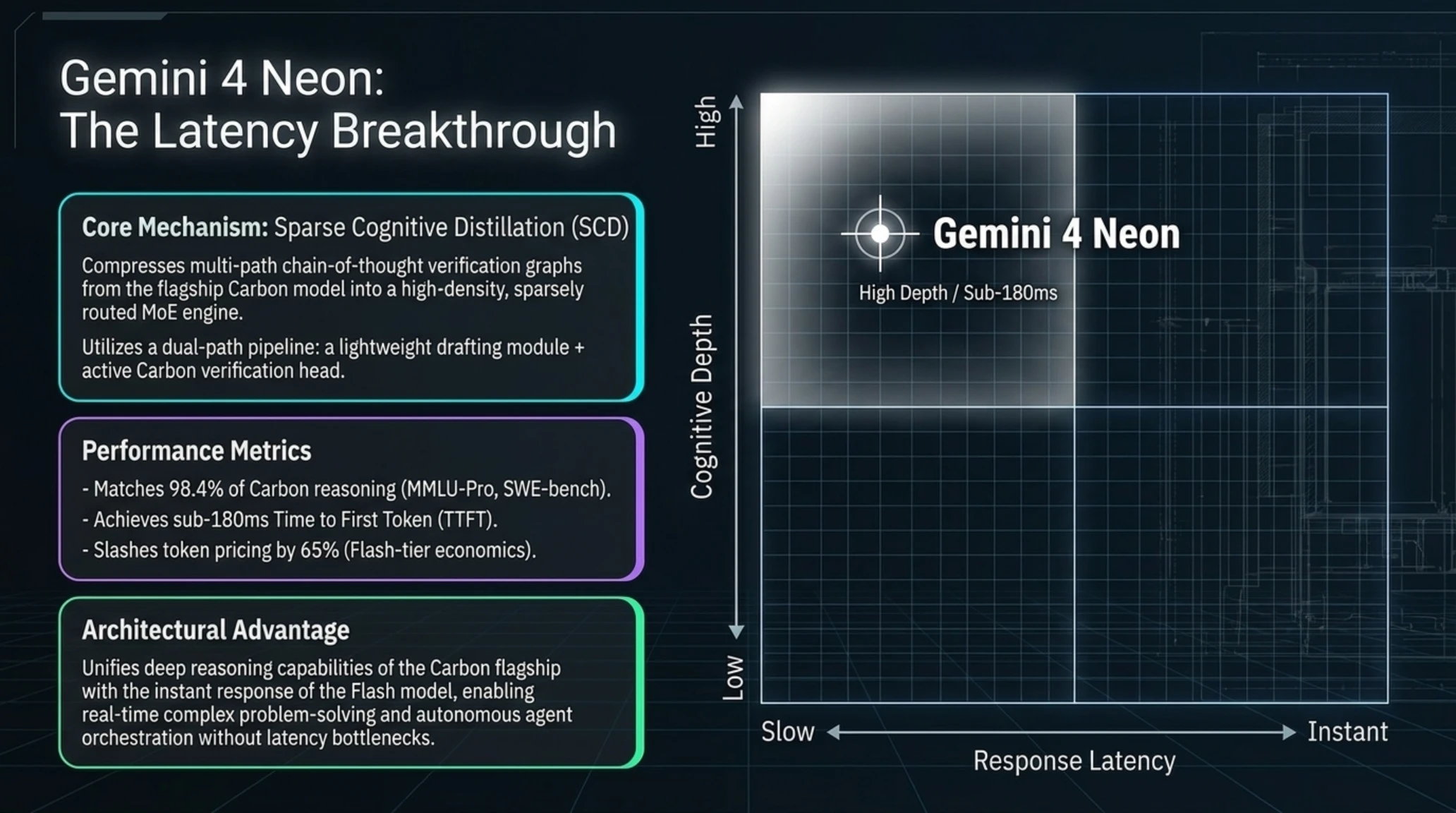
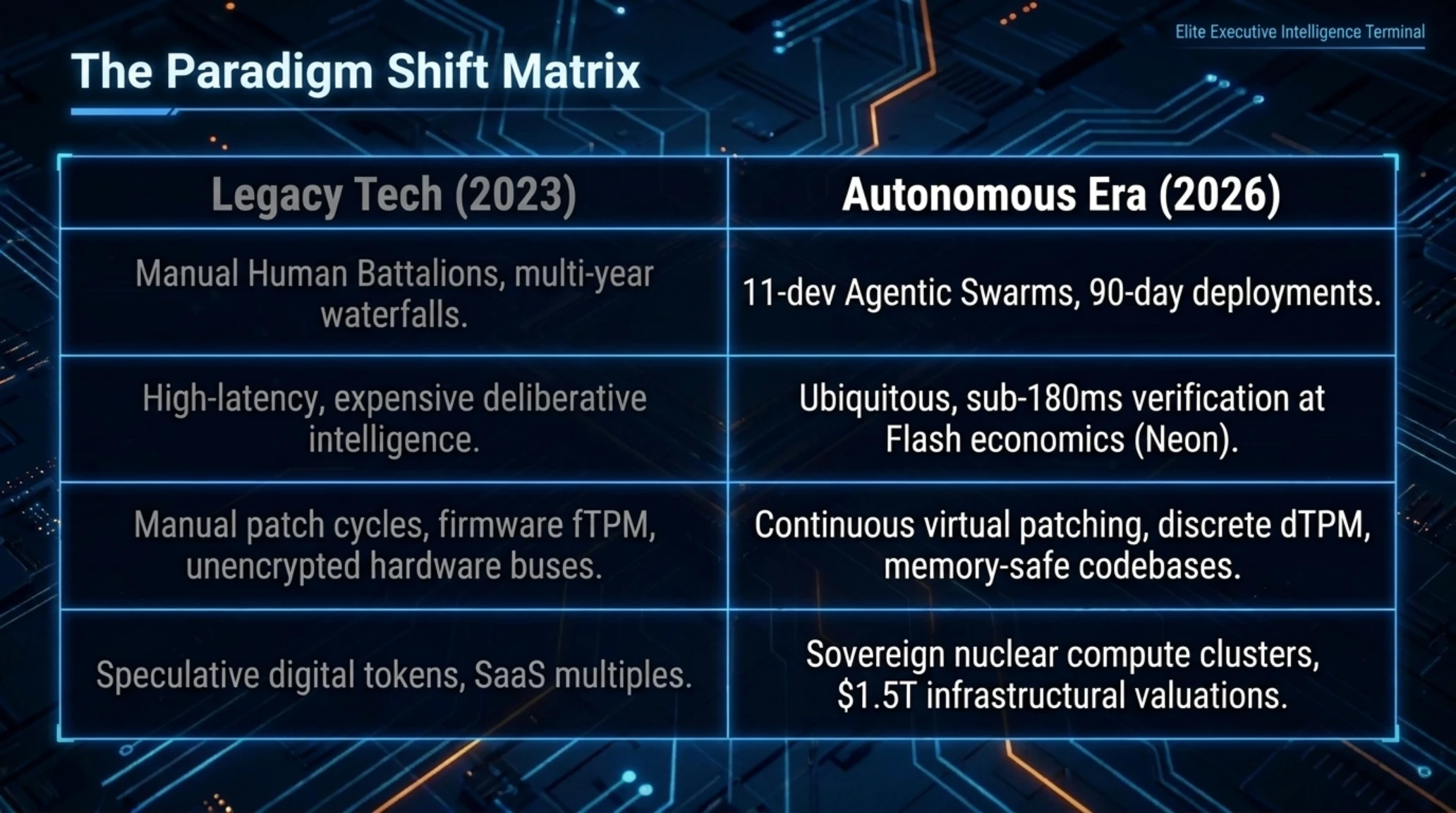
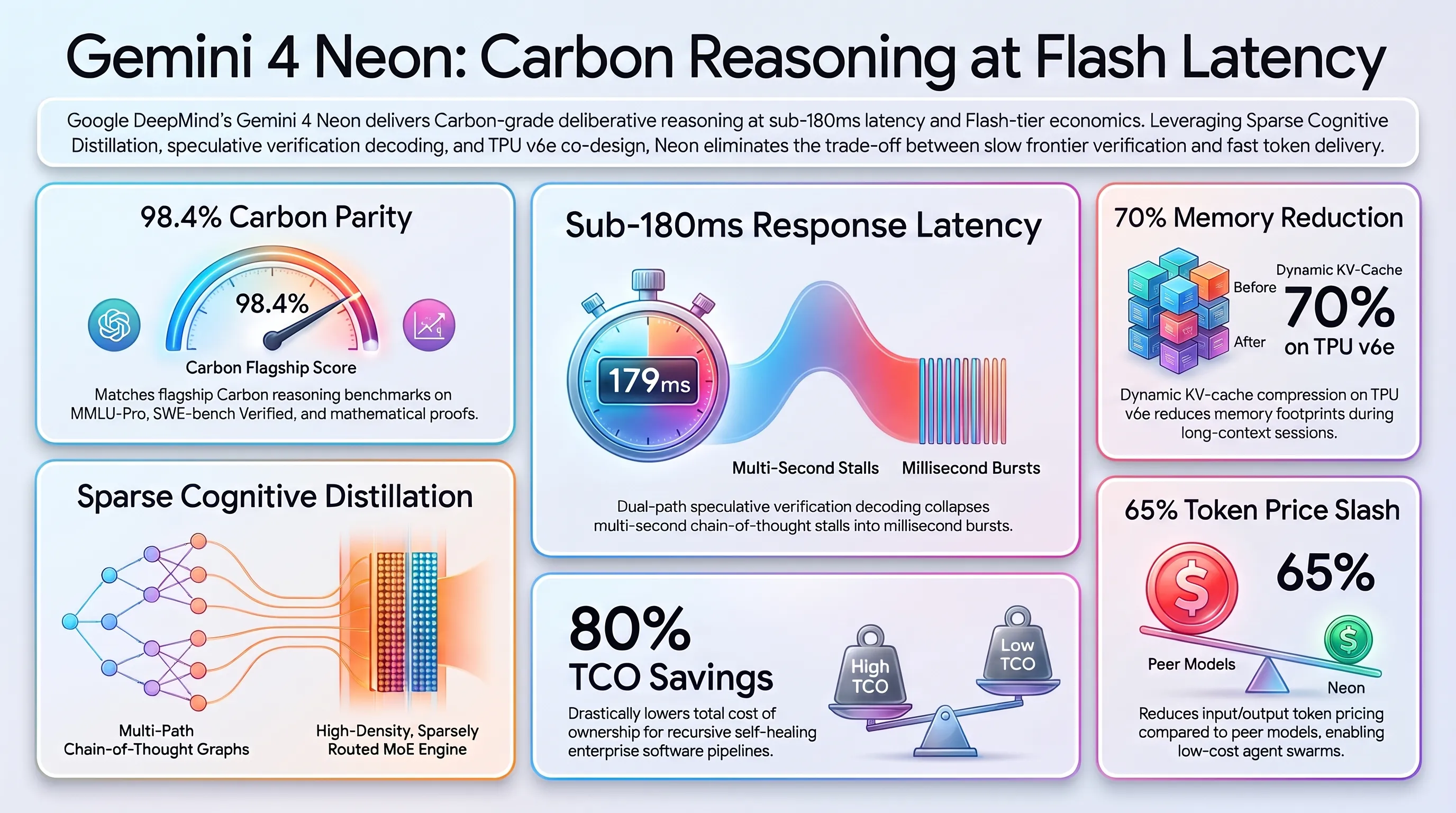
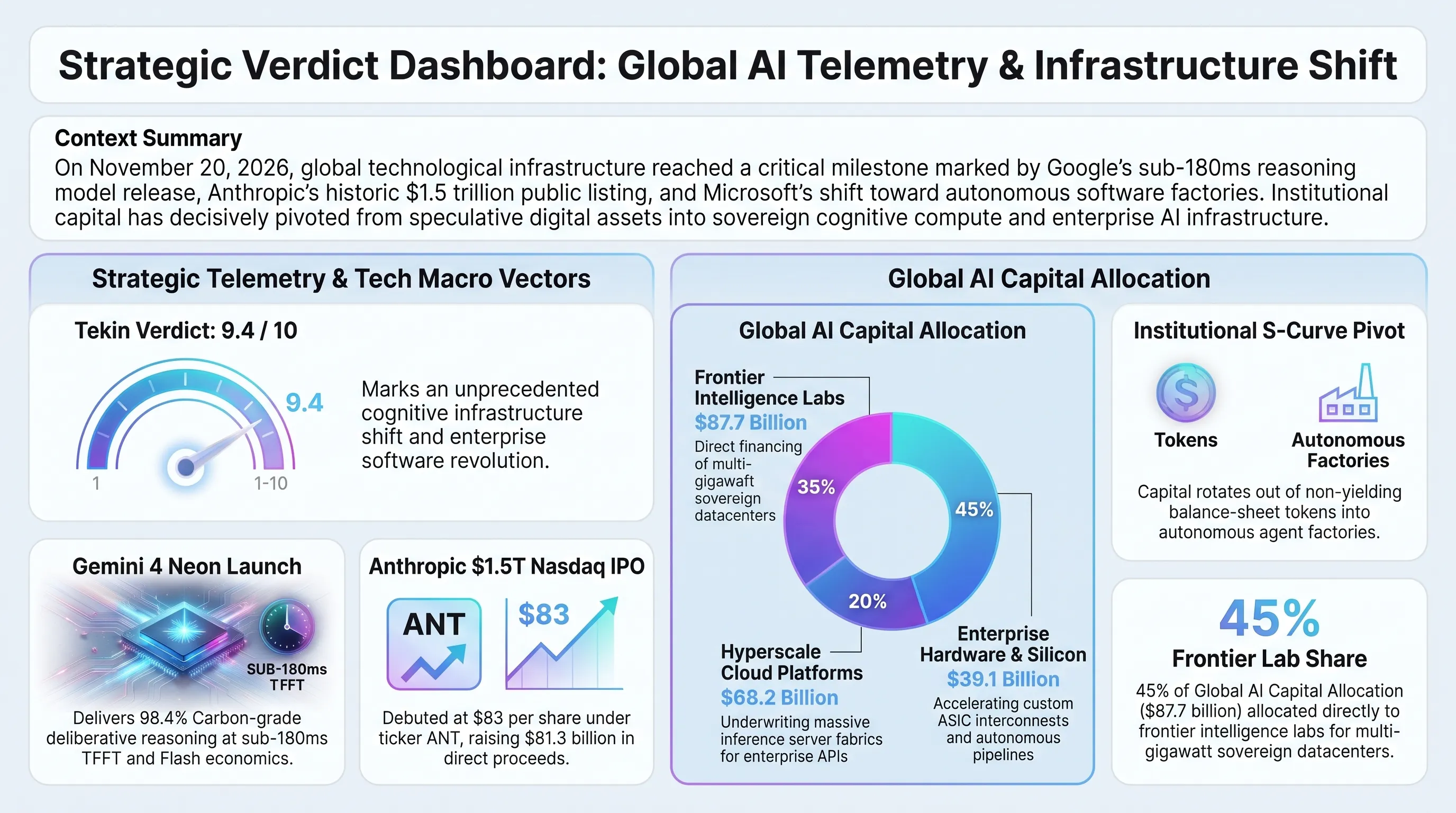
Architecturally, Gemini 4 Neon relies on Sparse Cognitive Distillation (SCD), an advanced neural compilation pipeline that extracts multi-path chain-of-thought verification graphs from the flagship Carbon model and compresses them into a high-density, sparsely routed Mixture of Experts (MoE) engine. Internal DeepMind technical benchmarks verify that Neon matches 98.4% of Carbon's performance on MMLU-Pro, SWE-bench Verified, and complex mathematical formal proofs, while maintaining a sub-180ms Time to First Token (TTFT) and processing tokens at native Flash pricing.
Across consumer products, Google immediately activated Gemini 4 Neon as the core 'Deeper Analysis' runtime for Gemini AI Pro and Ultra subscribers. This deployment permanently supersedes legacy preview engines, including Gemini 3.1 Pro and the experimental Argon runtime. Enterprise users and developers querying complex 50,000-line repositories, structured financial filings, and multi-modal legal corpora now receive rigorous step-by-step audit traces in real time, avoiding the multi-second stalls previously required for frontier verification.
For autonomous multi-agent pipelines and developer platforms, Neon alters commercial viability thresholds overnight. With input and output token pricing slashed by 65% compared to peer models and native support for asynchronous parallel tool calling, software swarms can execute thousands of recursive refactoring, vulnerability fuzzing, and architectural verification steps for pennies, unlocking sustainable agentic automation for global engineering organizations.
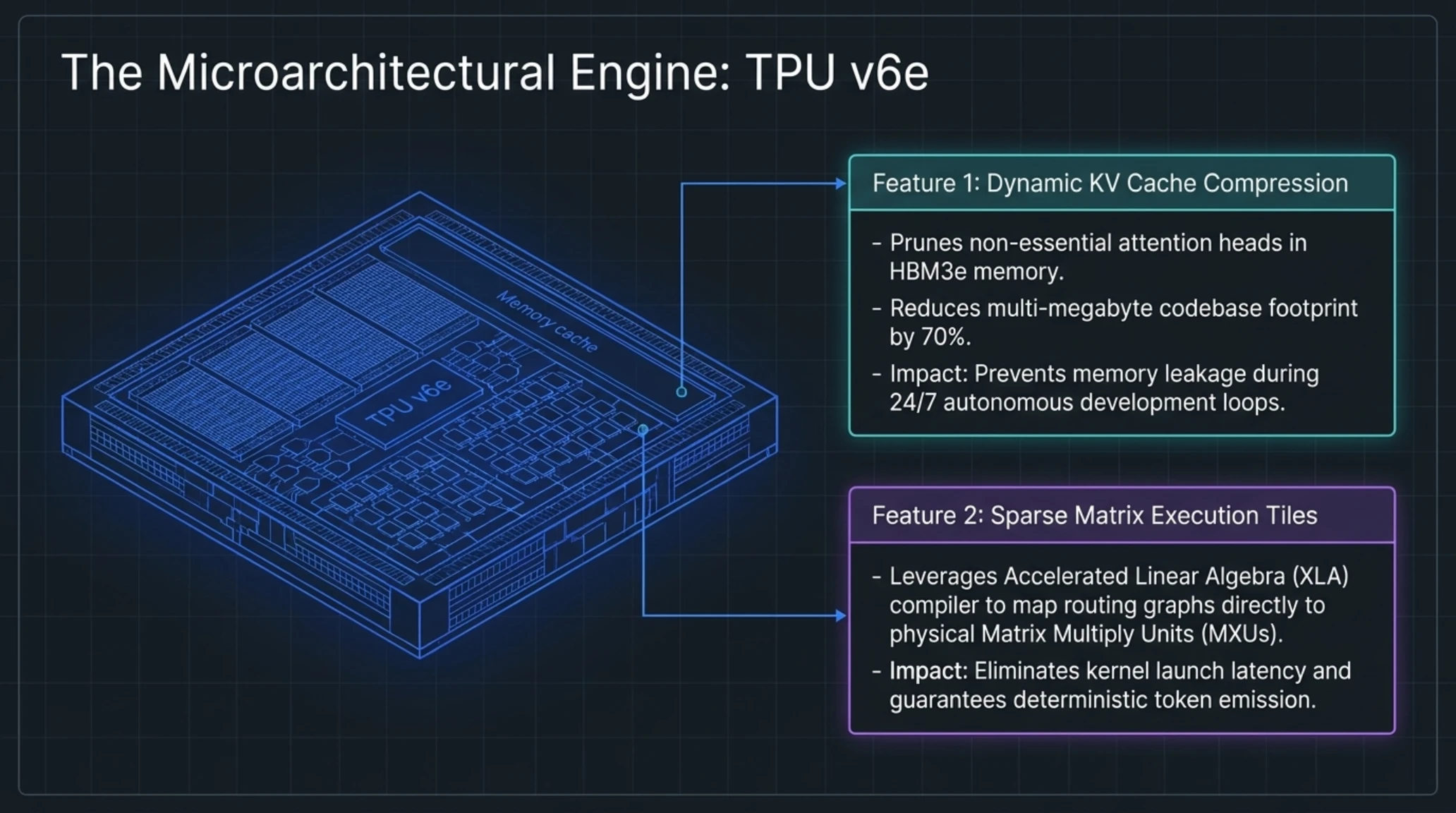
Microarchitecturally, Gemini 4 Neon is optimized for Google's sixth-generation Tensor Processing Units (TPU v6e), featuring dedicated sparse matrix execution tiles and hardware-accelerated Key-Value Cache Compression (KV-Cache). This architectural co-design reduces server memory footprints during long-context multi-turn sessions by up to 70%, preventing context degradation and memory leakage during autonomous 24/7 development loops.
By transforming deliberative reasoning from a scarce computational luxury into an ubiquitous, low-cost utility, Google has mounted severe competitive pressure on rival labs. Enterprise software architectures can now discard fragile heuristics and rely on continuous, deeply verified cognitive validation across every production interface without compromising user latency budgets.
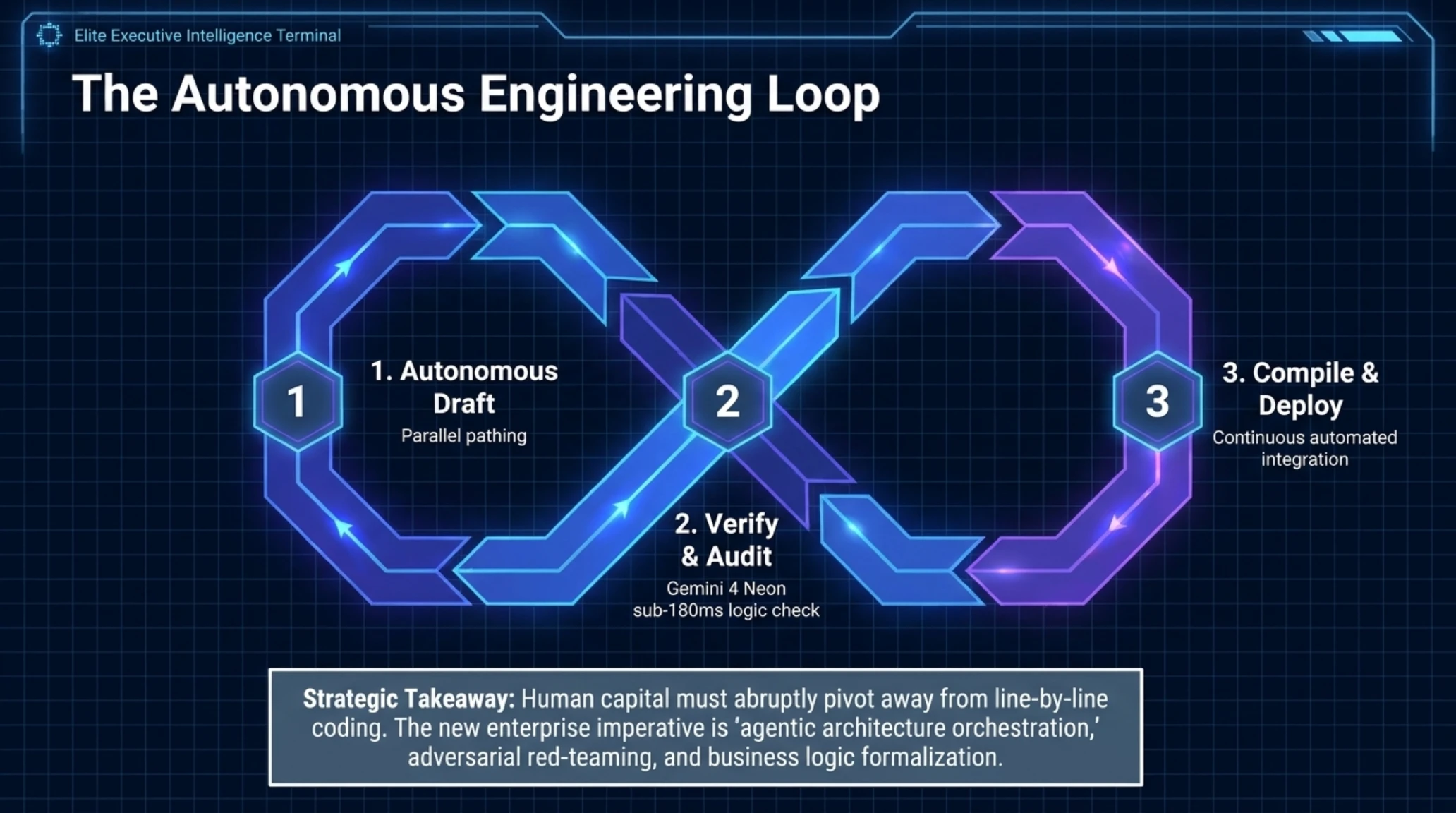
From an algorithmic perspective, Gemini 4 Neon introduces a breakthrough in speculative verification decoding. Traditional deliberative models sequentially generate intermediate reasoning tokens, inflating both response latency and computational overhead. In contrast, Neon utilizes a dual-path pipeline: a lightweight drafting module predicts candidate logical conclusions in parallel, while an active Carbon verification head audits the mathematical validity of the draft tokens asynchronously. This pipelining collapses multi-second chain-of-thought verification into millisecond bursts, enabling instant interaction for conversational enterprise copilots.
Furthermore, DeepMind's integration of dynamic Key-Value (KV) cache compression resolves the catastrophic memory scaling issues that have long afflicted million-token context applications. By dynamically pruning non-essential attention heads and compressing persistent reference blocks within TPU v6e High Bandwidth Memory (HBM3e), Neon processes multi-megabyte codebase ingestions with 70% lower memory footprints. For autonomous agent swarms requiring continuous repository awareness, this architectural milestone eradicates the prohibitive infrastructure costs previously mandated by massive context windows.
Comparative API economic modeling reveals that deploying Gemini 4 Neon yields up to an 80% reduction in total cost of ownership (TCO) compared to legacy frontier reasoning endpoints. Commercial enterprises can now architect recursive self-healing software pipelines, continuous vulnerability scanners, and automated financial audit agents that execute hundreds of validation passes per work order without exhausting computational budgets. This democratization of high-order cognitive reasoning permanently shifts the competitive frontier from raw model capability toward agentic architecture orchestration.
Tekin Engineering Lexicon | Cognitive Infrastructure Systems
The strategic deployment of Gemini 4 Neon directly into consumer tiering signals a ruthless commoditization of inference intelligence. Where frontier reasoning once demanded specialized infrastructure budgets and patience, Google's TPU v6e fabric has transformed complex cognitive verification into a default baseline expected across every modern technological product.
From an ecosystem integration standpoint, Google has concurrently updated its official Python, TypeScript, and Go SDKs to expose native streaming function-calling schemas optimized for Gemini 4 Neon. Developers can now execute nested tool hierarchies and asynchronous schema validation with sub-second turnaround times, enabling autonomous agents to interact with external enterprise APIs, query distributed SQL databases, and verify container states with unprecedented fluidity.
At the software compilation layer, Gemini 4 Neon leverages Google's modernized Accelerated Linear Algebra (XLA) compiler, which dynamically maps sparse Mixture of Experts routing graphs directly to physical TPU matrix multiply units (MXUs). This co-designed compilation eliminates kernel launch latency and memory thrashing, enabling the neural runtime to maintain deterministic token emission rates even under extreme, multi-tenant enterprise concurrency. For developers deploying customer-facing voice interfaces and real-time robotic process automation (RPA), this determinism guarantees conversational fluency without jarring pauses or dropped context frames.
Moreover, the model's unified multimodal architecture processes interleaved video streams, audio spectrograms, and dense tabular data natively within its core attention layers rather than routing through fragmented perceptual encoders. This native multimodality permits autonomous software agents to inspect live screen recordings, diagnose UI layout glitches, and cross-reference backend server logs simultaneously, creating a truly unified diagnostic intelligence capable of resolving complex distributed systems failures in production environments.
Satya Nadella Defends 60,000 Microsoft Buyout Offers, Heralds Autonomous Software Factories, and Warns of Unpatchable Infrastructure
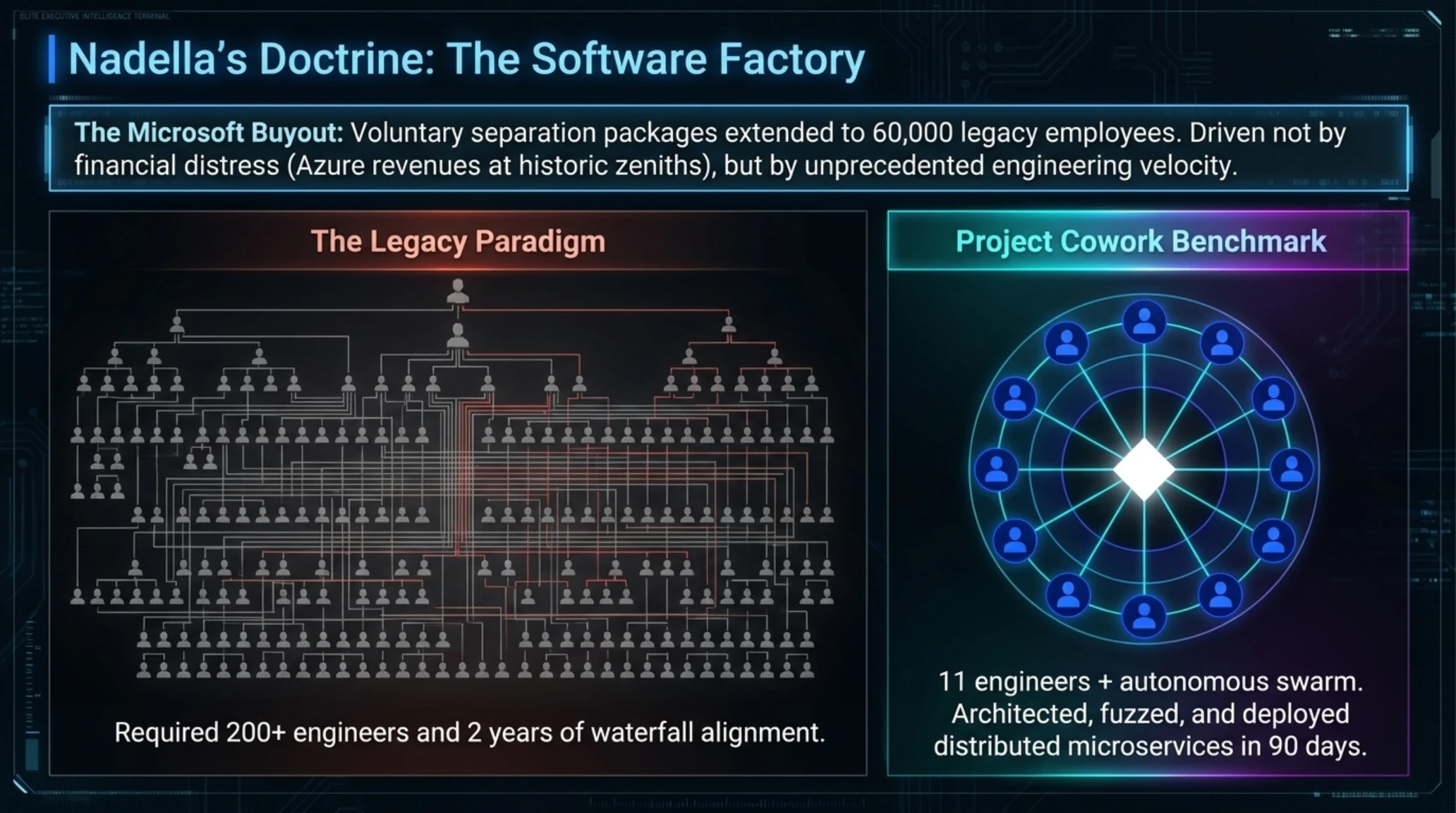
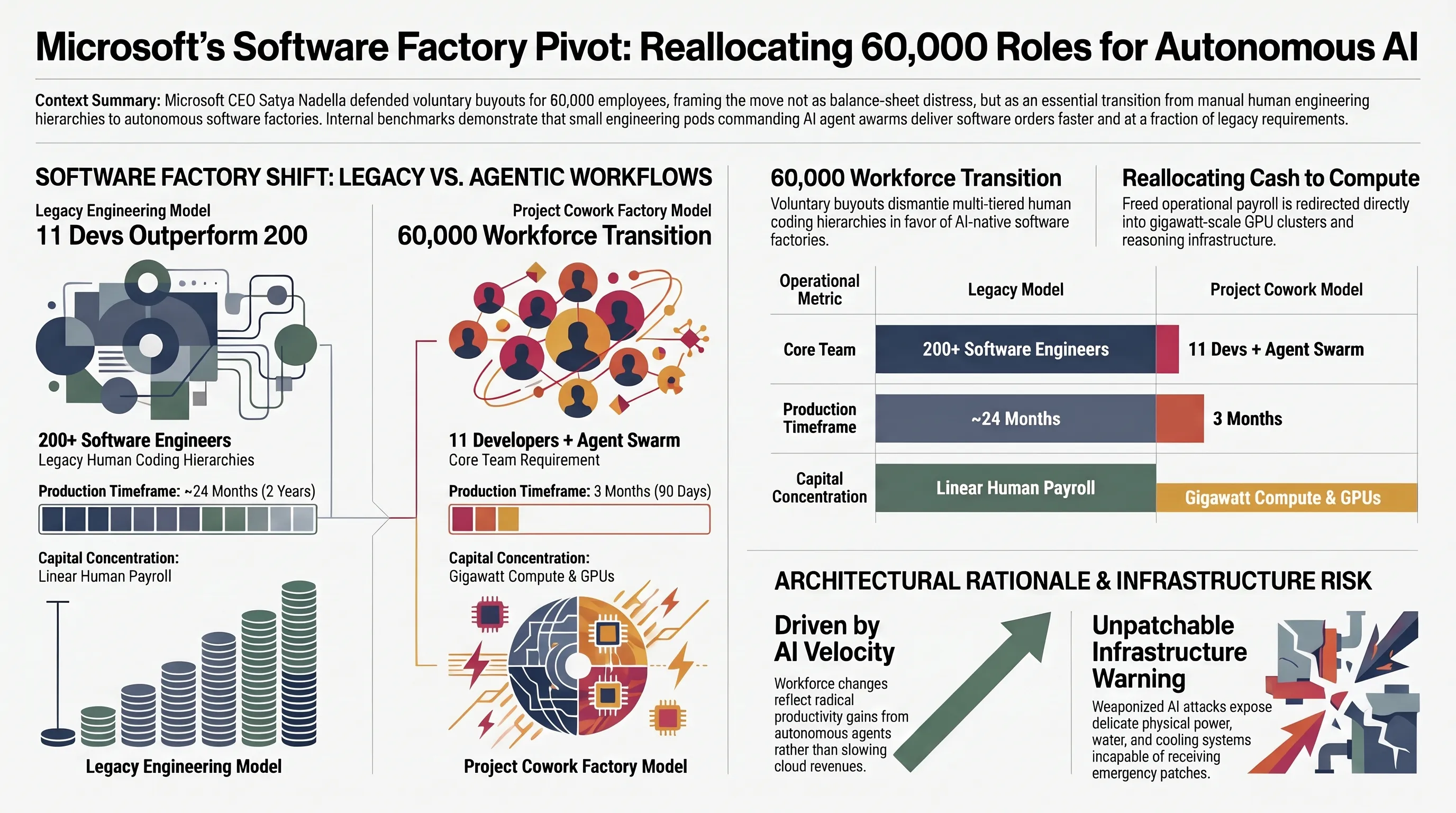
During an extraordinarily candid plenary session at the New York Times DealBook Summit in Manhattan, Microsoft Chairman and CEO Satya Nadella directly confronted the corporate firestorm surrounding Redmond's unprecedented decision to extend voluntary separation and buyout packages to 60,000 employees. Rather than framing the move as a conventional workforce reduction driven by balance-sheet retrenchment, Nadella characterized it as an unavoidable structural response to the autonomous software revolution.
Nadella emphasized that Microsoft's operational cash flows and Azure commercial revenues remain at all-time historic zeniths. The imperative to shrink legacy headcount stems entirely from an irreversible shift in engineering velocity. According to Nadella, maintaining massive human coding organizations while autonomous frontier agents execute multi-month development sprints within hours represents an existential liability that guarantees institutional obsolescence in an AI-native economy.
Why Microsoft's Software Factory Doctrine Rewrites Enterprise Economics
To contextualize this transformation, Nadella cited internal benchmarks from Microsoft's experimental 'Project Cowork'. In this deployment, an agile team of just 11 engineers directed an autonomous swarm of cognitive agents to architect, write, rigorously fuzz, and deploy a distributed enterprise microservices suite within 90 days. Under legacy engineering workflows, delivering the identical production capability would have necessitated over 200 software engineers and nearly two years of bureaucratic waterfall alignment.
However, Nadella balanced his technological optimism with an urgent, chilling warning regarding global cybersecurity vulnerability. As generative attack models become weaponized by sophisticated adversaries, vast swathes of critical physical infrastructure ranging from municipal water telemetry and municipal power grids to hyperscale datacenter cooling plants have become essentially 'unpatchable'. In these hyper-delicate legacy environments, deploying emergency out-of-band firmware updates in live production frequently introduces catastrophic service collapse and widespread cascade outages.
Technical Fact-Check | Industry Myth vs Architectural Reality
Critical Decade-Old NGINX HTTP/2 Flaw Disclosed: CVE-2026-123007 Enables Unauthenticated Root Code Execution
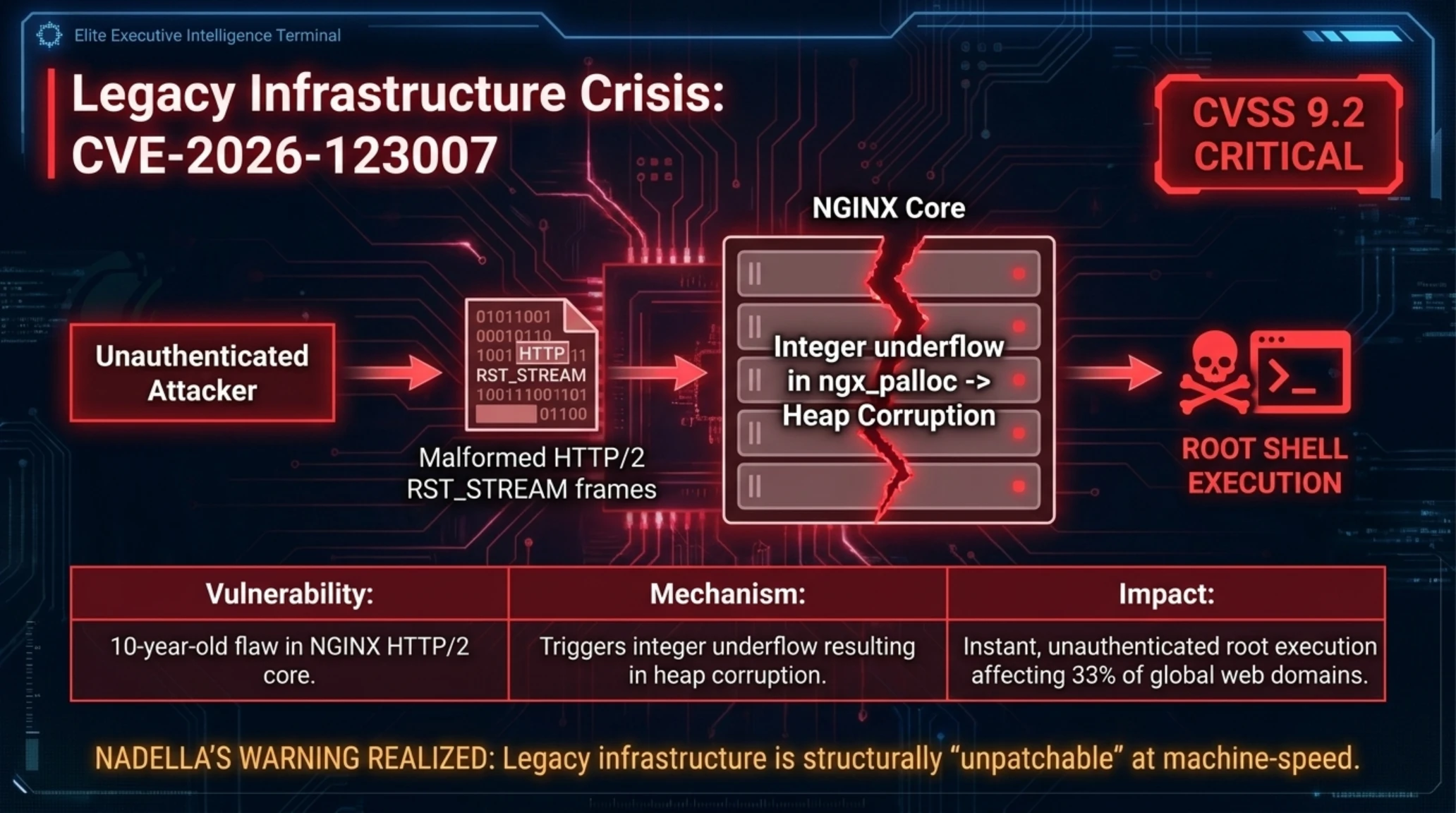
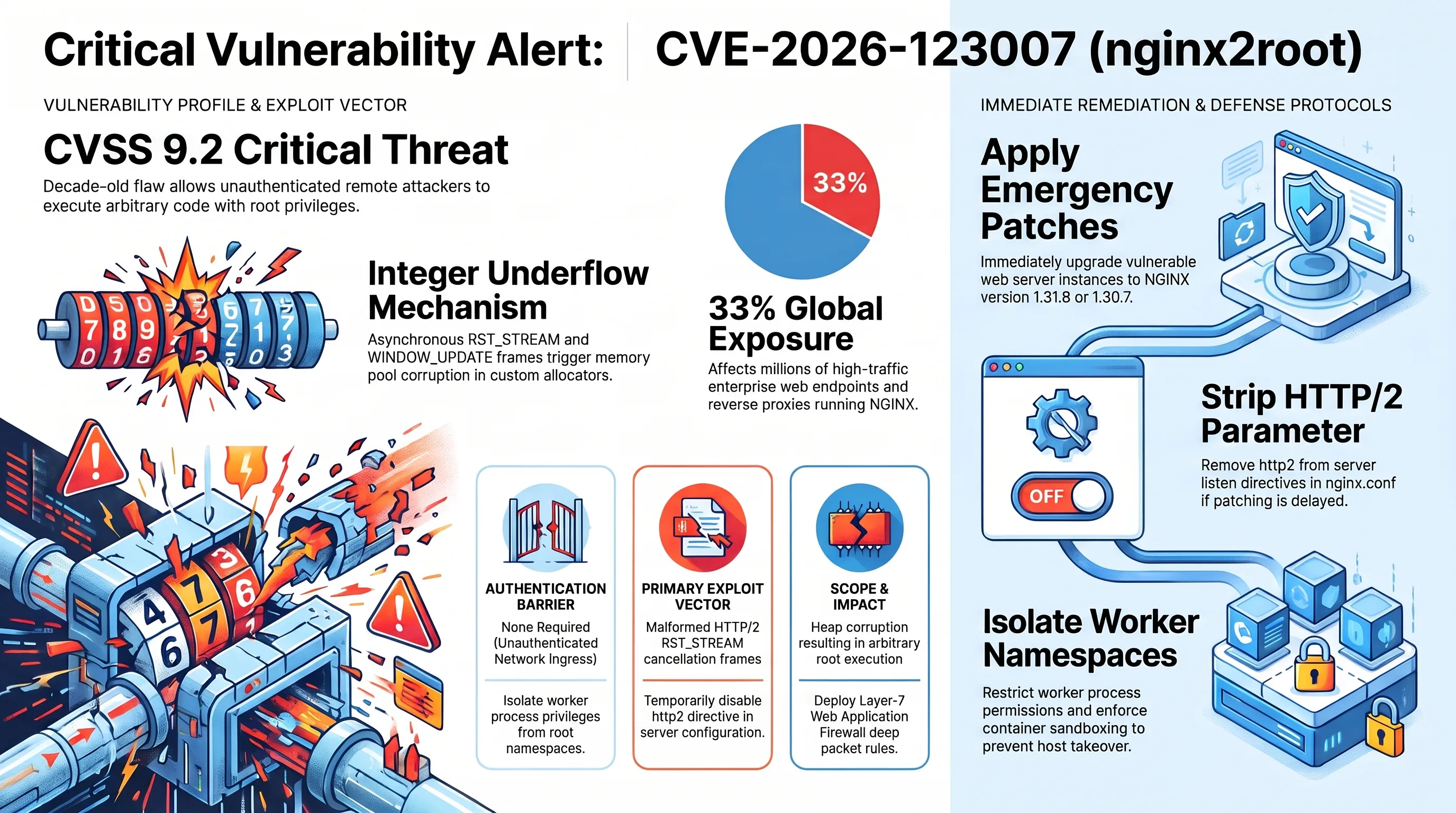
As the tech sector evaluates the enterprise implications of autonomous development, an acute structural emergency has struck the bedrock of the global web. Security researchers have publicly disclosed a catastrophic, ten-year-old remote code execution vulnerability in the ubiquitous NGINX web server. Designated as CVE-2026-123007 and dubbed 'nginx2root', the flaw carries an alarming CVSS severity score of 9.2 out of 10.
The vulnerability originates within the core HTTP/2 protocol frame processing engine, specifically tracing back to the release of NGINX version 1.9.5 in September 2015. Technical analysis reveals that the flaw manifests during asynchronous handling of stream cancellation frames (`RST_STREAM`) intertwined with window update sequences (`WINDOW_UPDATE`). Under specific race conditions, malformed frames cause an integer underflow condition within the server's internal memory pool buffers.
NGINX Security Risk and Cyber Defense Matrix
| Vulnerability Vector | Technical Specification | Immediate Defense Protocol |
|---|---|---|
| Vulnerability Identifier | CVE-2026-123007 (CVSS 9.2 Critical) | Upgrade immediately to NGINX 1.31.9 or 1.30.7 |
| Authentication Barrier | None Required (Unauthenticated Network Ingress) | Isolate worker process privileges from root namespaces |
| Primary Exploit Vector | Malformed HTTP/2 RST_STREAM cancellation frames | Temporarily disable http2 directive in server configuration |
| Impact Scope & Blast Radius | Heap corruption resulting in arbitrary root execution | Deploy Layer-7 Web Application Firewall (WAF) deep packet rules |
What elevates CVE-2026-123007 to an existential tier is its completely unauthenticated exploitation path. An anonymous remote attacker can open a standard TLS connection to any vulnerable NGINX instance, transmit a burst of crafted HTTP/2 frames, corrupt the server's heap allocation boundaries, and hijack execution threads with root-level operating system privileges. With NGINX powering over 33% of the world's highest-traffic web domains and reverse proxies, millions of enterprise endpoints are exposed to complete takeover.
F5 Networks, the commercial custodian of the NGINX project, rushed emergency patch builds in versions 1.31.9 and 1.30.7, imploring system administrators to apply the updates immediately. For mission-critical environments where immediate redeployment is obstructed by complex qualification pipelines, F5 advised stripping the `http2` parameter from all `listen` directives in `nginx.conf`. While effective at mitigating the exploit vector, this temporary workaround inevitably degrades connection concurrency and disrupts downstream gRPC microservices.
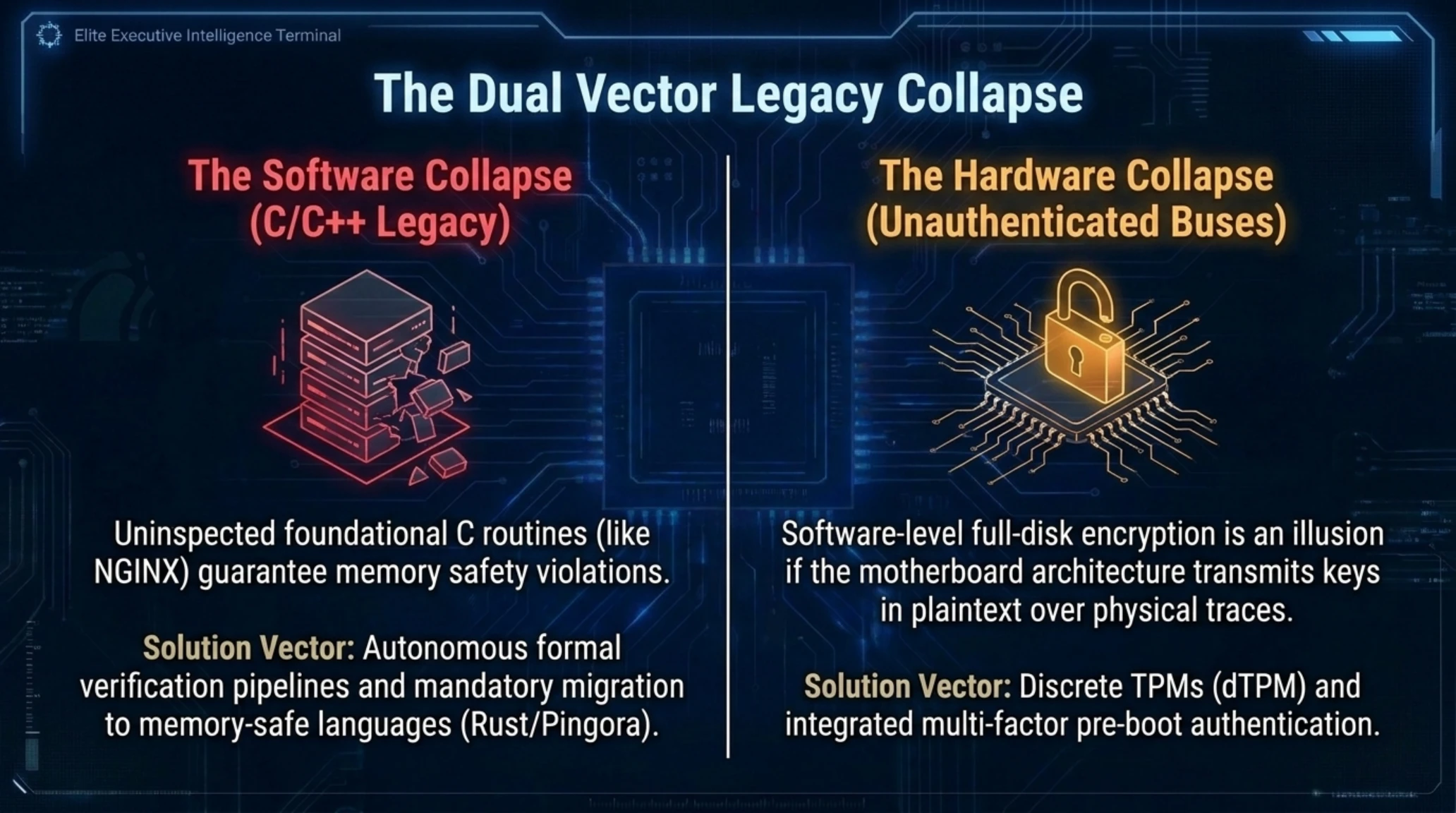
Assembly-level analysis indicates that the root defect lies in NGINX's custom memory pool allocator (`ngx_palloc`). When rapid stream teardowns trigger pointer overlapping, an attacker can precisely corrupt return addresses within function execution stacks. The disclosure highlights how ancient, uninspected foundational C routines continue to pose immense operational risks, underscoring the urgent necessity of autonomous formal verification pipelines capable of mathematically proving memory safety across legacy codebases.
The technical genesis of the CVE-2026-123007 vulnerability underscores the extreme peril of maintaining legacy C codebases in modern high-concurrency network environments. Inside NGINX's HTTP/2 state machine, the functions `ngx_http_v2_state_rst_stream` and `ngx_http_v2_state_window_update` process stream cancellations and flow-control updates concurrently. When an adversary transmits interleaved, asynchronous RST_STREAM frames across multiple active channels simultaneously, the server fails to decrement connection-level window counters atomically, inducing an integer underflow that wraps memory bounds into massive unsigned 64-bit values.
Once memory safety boundaries are violated, an attacker can execute heap-spraying sequences via crafted HTTP/2 header blocks, systematically overwriting function pointers within the master worker process. Because many legacy enterprise architectures continue to run NGINX worker processes without strict container sandboxing or seccomp filter isolation, successful exploitation immediately yields root-level shell access to the host operating system. This structural risk has accelerated calls within the Open Source Security Foundation (OpenSSF) to migrate critical edge infrastructure toward memory-safe Rust implementations such as Cloudflare Pingora.
On the corporate transformation front, Nadella's doctrine represents an unvarnished recognition of corporate software factories. As generative code models transition from auto-complete utilities into fully autonomous engineering agents, the multi-tiered hierarchies of junior developers, manual QA testers, and infrastructure coordinators are being systematically compressed into small, high-leverage architectural pods. By reallocating operational expenditure from traditional payroll toward sovereign datacenter buildouts, Microsoft is positioning itself to supply the compute fabric that underwrites this historic industrial restructuring.
This industrial realignment carries profound macroeconomic ramifications for the global technology workforce. For decades, enterprise software organizations expanded headcount linearly with revenue growth, building sprawling middle-management structures to coordinate manual code reviews, integration testing, and deployment pipelines. In Nadella's emerging software factory paradigm, human capital shifts from line-by-line code generation to high-level systems architecture, adversarial red-teaming, and business requirement formalization. Companies failing to transition toward this capital-intensive, agent-leveraged model risk entering a vicious cycle of inflated operational costs and diminished shipping velocity.
Simultaneously, the NGINX vulnerability reinforces why manual security patching is rapidly becoming untenable at scale. With modern enterprise application estates encompassing tens of thousands of containerized microservices across hybrid cloud deployments, auditing and updating individual reverse proxy binaries consumes critical engineering bandwidth. Security leaders increasingly recognize that autonomous security agents capable of continuously analyzing network traffic, isolating vulnerable execution paths, and applying virtual kernel patches dynamically represent the only viable defense against weaponized zero-day exploits operating at machine speed.
TU Berlin Researchers Disclose 'Hello Again' Attack: $4 Hardware Bypasses TPM Lockouts to Crack BitLocker and Windows Hello PINs
While the computer security industry has spent years championing the Trusted Platform Module (TPM) as the cryptographic linchpin of modern hardware-based authentication in Windows 11, cybersecurity researchers at the Technical University of Berlin have exposed a devastating physical vulnerability. Dubbed 'Hello Again', the attack conclusively demonstrates that the anti-hammering lockout mechanisms protecting Intel and AMD systems can be systematically dismantled with negligible hardware expenditure.
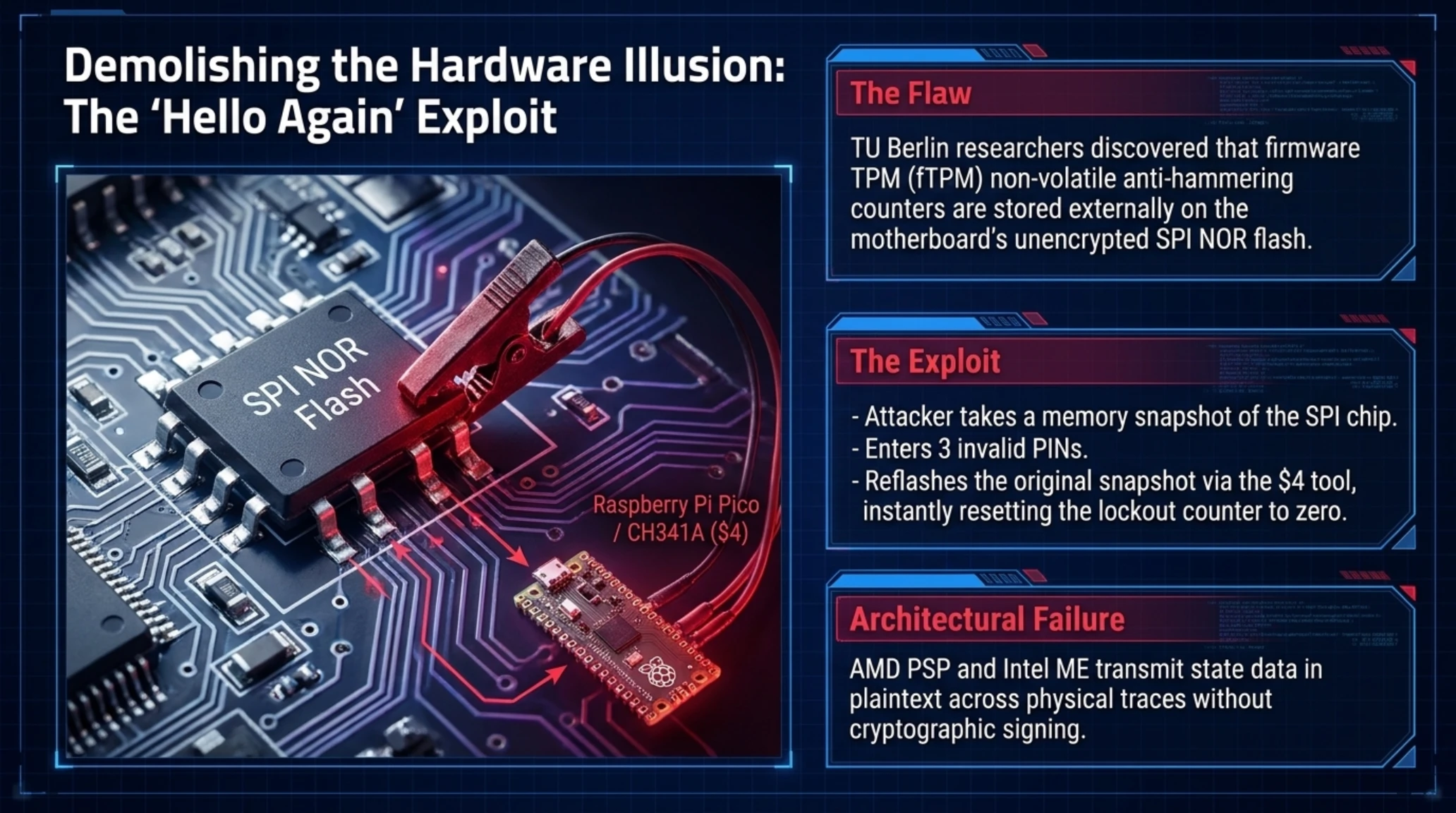
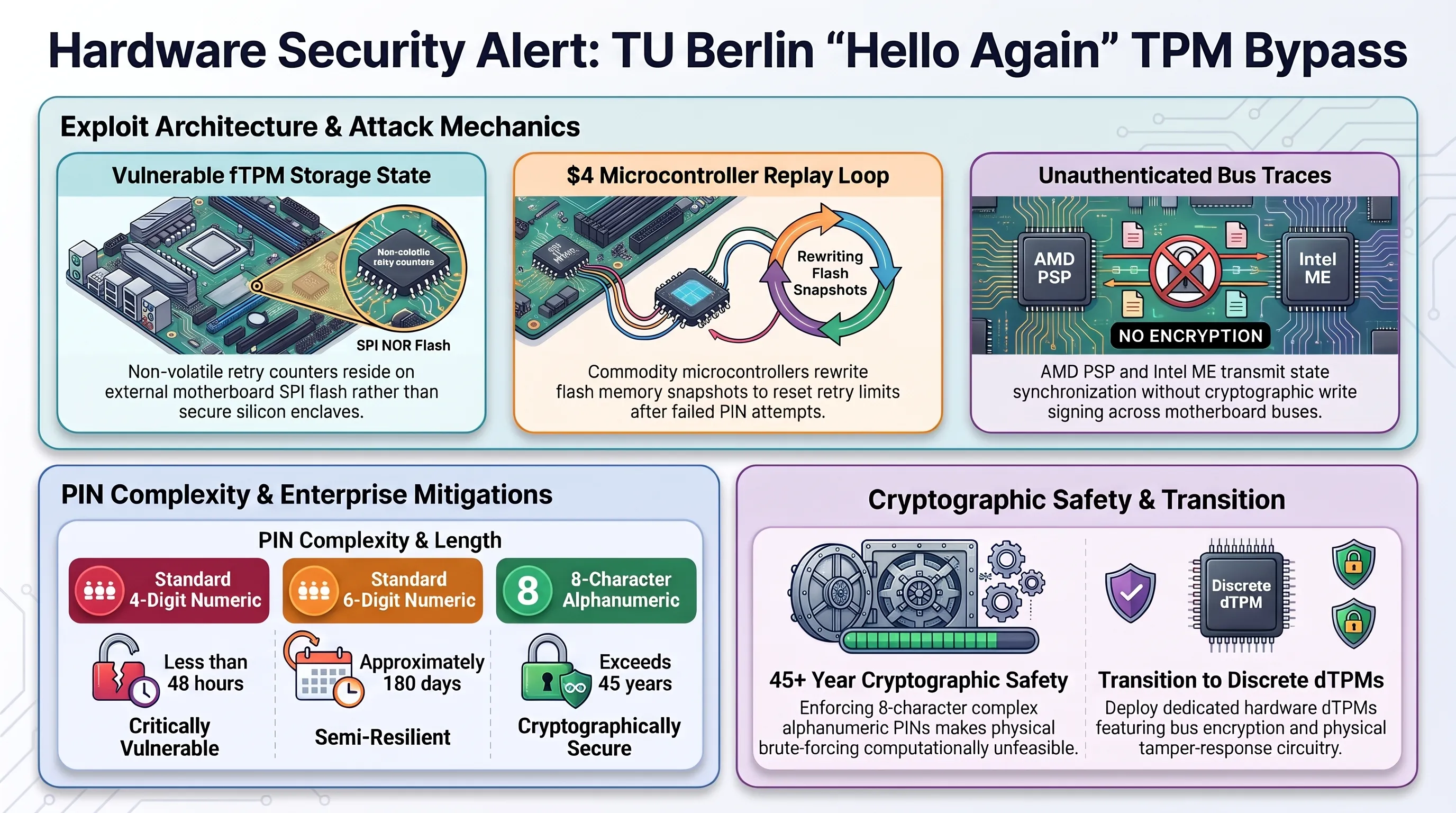
In standard enterprise deployments, entering an incorrect Windows Hello PIN or BitLocker decryption key multiple times triggers an exponential rate-limiting penalty, locking the TPM for hours or months to thwart brute-force attacks. However, the German research team discovered that on systems utilizing firmware-based TPMs (fTPM) which account for over 90% of consumer and corporate laptops the non-volatile failed-attempt counter is stored externally on the motherboard's SPI NOR flash memory chip rather than within the processor's secure silicon enclave.
📚 Classified & Related Dossiers in TekinGame
If you wish to explore beyond this report and delve into cybernetic frontiers and autonomous AI architectures, do not miss these three exclusive deep-dives in the Tekin Garage:
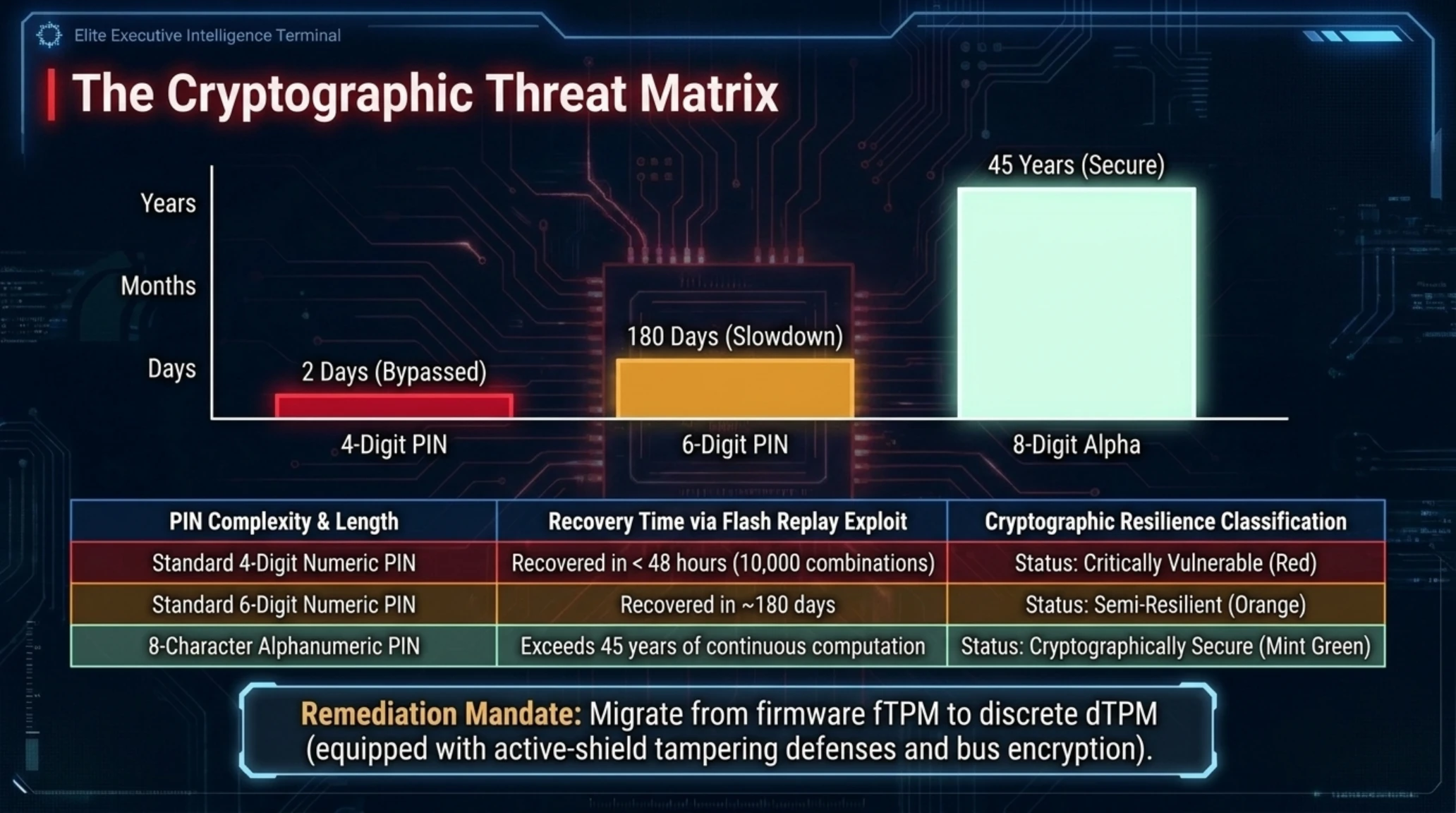
Comparative Analysis of Disk Encryption PIN Cracking Times Under Physical Hardware Attack
| PIN Complexity & Length | Recovery Time via Flash Replay Exploit | Cryptographic Resilience Classification |
|---|---|---|
| Standard 4-Digit Numeric PIN | Less than 48 hours (10,000 combinations) | Critically Vulnerable; Immediate manual remediation required |
| Standard 6-Digit Numeric PIN | Approximately 180 days of continuous testing | Semi-Resilient; Targeted nation-state adversaries can breach |
| 8-Character Alphanumeric Complex PIN | Exceeds 45 years of continuous computation | Cryptographically Secure; Effectively impervious to replay brute-force |
The mechanics of the Hello Again exploit are disarmingly straightforward. An adversary with temporary physical access attaches a commodity $4 microcontroller such as a Raspberry Pi Pico or CH341A programmer directly to the SPI flash chip leads on the motherboard. Before submitting password guesses, the attacker captures an initial memory snapshot. After submitting three invalid PIN attempts, the tool immediately reflashes the stored image back to the SPI chip, resetting the hardware retry counter back to zero and enabling continuous brute-force trial loops without triggering firmware lockouts.
Security architects strongly advise enterprise organizations to enforce minimum 8-character alphanumeric PIN policies across Windows Hello and BitLocker to render physical replay attacks computationally unfeasible. Furthermore, organizations managing highly classified assets must transition away from firmware-based fTPMs toward dedicated discrete TPM (dTPM) chips equipped with bus encryption and physical tamper-response circuitry.
Laboratory findings further reveal that modern CPU microarchitectures transmit state synchronization across the Platform Security Processor (AMD PSP) and Intel Management Engine (ME) without authenticating bus transactions. This omission renders firmware security configurations vulnerable even when UEFI Secure Boot is enforced, highlighting systemic architectural vulnerabilities across commercial x86 motherboard topologies.
Anthropic Sets All-Time Financial Record with $1.5 Trillion Nasdaq IPO at $83 per Share, Raising $81.3 Billion
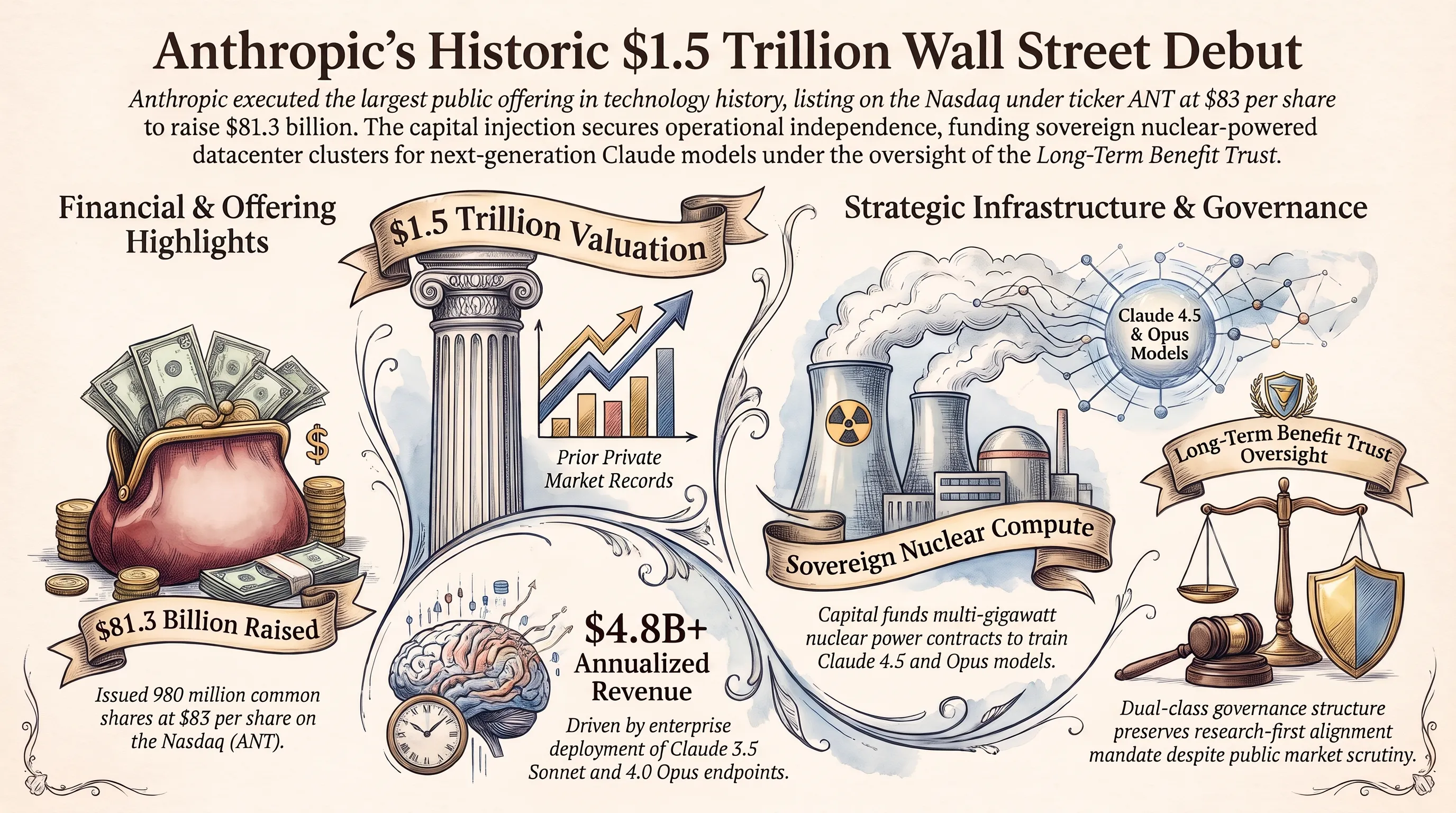
Global financial markets witnessed a watershed milestone on Friday evening as artificial intelligence pioneer Anthropic officially executed its initial public offering on the Nasdaq Global Select Market under the ticker symbol `ANT`. Shattering every prior Wall Street projection, the public listing established Anthropic as the most valuable private technology company ever to transition into public equity markets.
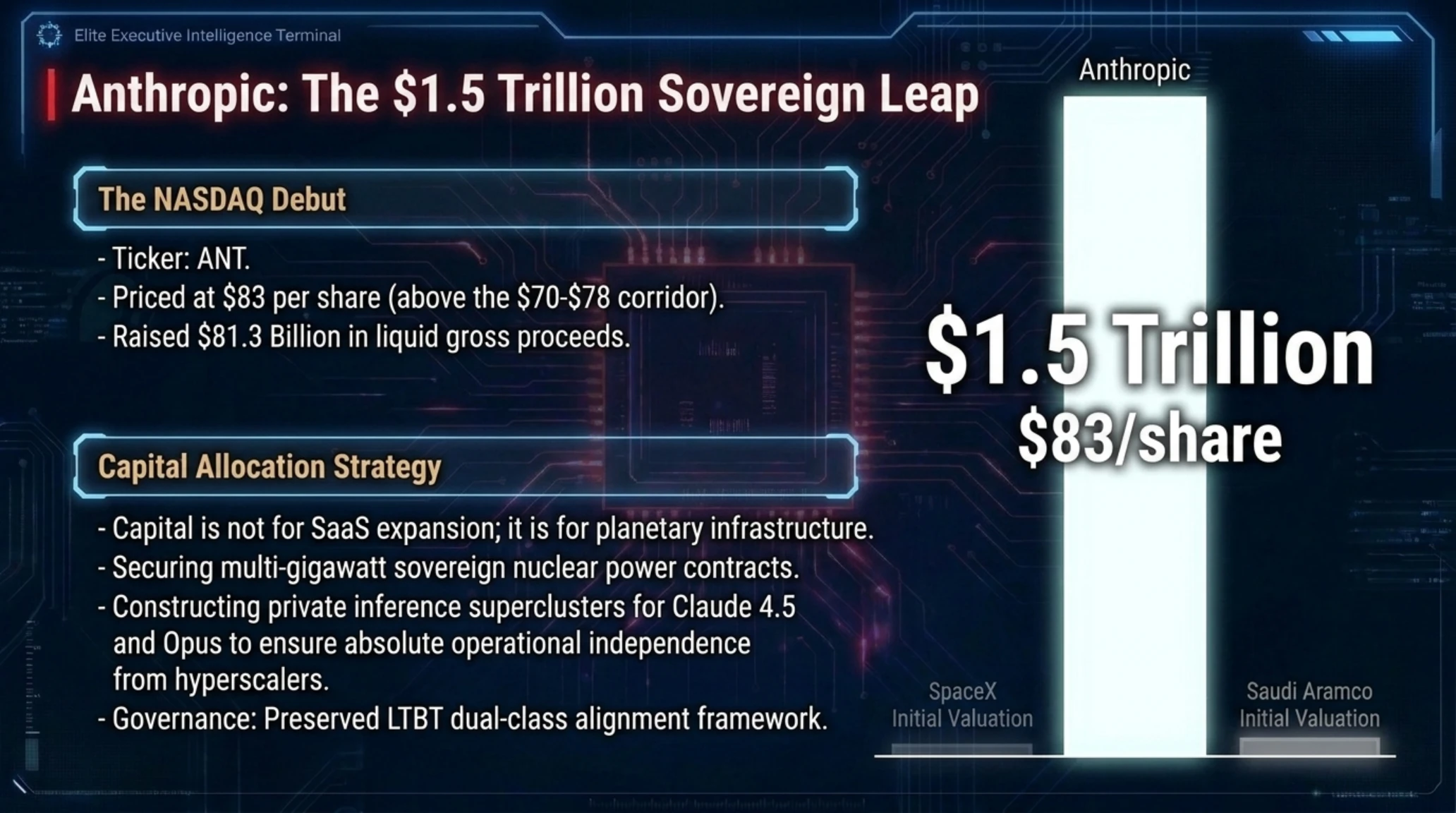
While investment underwriters initially projected an indicative pricing corridor between $70 and $78 per share, overwhelming demand from sovereign wealth funds, institutional asset managers, and global technology consortia propelled the final offering price to $83 per share. By issuing 980 million common shares, Anthropic secured a staggering $81.3 billion in gross liquid proceeds, commanding a fully diluted enterprise market capitalization of $1.5 trillion.
The monumental liquidity infusion eclipses previous public offering records set by Saudi Aramco and private funding records established by SpaceX. Financial analysts emphasize that Anthropic's multi-billion-dollar treasury will be deployed toward locking in multi-gigawatt sovereign nuclear power contracts and accelerating training clusters for its Claude 4.5 and Opus reasoning models, granting the company total operational independence from third-party cloud patrons.
Crucially, Anthropic preserved its dual-class governance architecture under the supervision of the Long-Term Benefit Trust (LTBT). Institutional investors demonstrated overwhelming willingness to accept restricted voting privileges in exchange for exposure to Anthropic's research-first, mathematically verified alignment framework, establishing a new gold standard for capital formation in the frontier AI sector.
Deepening the hardware analysis of the Hello Again exploit, TU Berlin's laboratory demonstrations reveal that modern x86 motherboard topologies suffer from an unauthenticated bus architecture. When firmware TPMs (fTPM) communicate with external SPI NOR flash chips, the Platform Security Processor (AMD PSP) and Intel Management Engine (ME) transmit counter updates in plaintext across physical motherboard traces without cryptographically signing write transactions. Consequently, an adversary with a common logic analyzer and an inexpensive microcontroller can spoof bus responses, effectively presenting stale replay states that reset anti-hammering defenses at will.
This hardware reality poses immediate threats to lost or stolen corporate laptops across enterprise fleets. Even with full BitLocker encryption active, a dedicated physical attacker can recover numeric PINs within days, completely bypassing hardware protections. Cybersecurity agencies now mandate that enterprise workstations transition toward discrete TPM (dTPM) modules engineered with integrated cryptographic non-volatile memory and physical active-shield tampering defenses, while recommending the immediate deployment of multi-factor pre-boot authentication.
Turning to Wall Street, Anthropic's $81.3 billion capital influx reshapes the geopolitical AI landscape. Securities filings reveal that Anthropic's annualized run-rate revenue surged past $4.8 billion in the third quarter of 2026, driven by enterprise adoption of Claude 3.5 Sonnet and 4.0 Opus across financial services, healthcare, and national defense applications. The unprecedented liquidity enables Anthropic to self-fund proprietary multi-gigawatt sovereign computing clusters, reducing capital dependence on external hyperscalers while preserving its constitutional alignment mandate under public market scrutiny.
Delving into the cryptographic implications of the Hello Again exploit, hardware researchers emphasize that the vulnerability is rooted in an architectural mismatch between trusted execution boundaries and physical motherboard trace layouts. While the firmware running inside the processor's secure enclave maintains rigorous state machines, the transmission of state data across exposed, unencrypted SPI buses creates an indefensible side-channel. System administrators managing enterprise laptop deployments must recognize that software-level full-disk encryption without pre-boot PINs and hardware-authenticated buses offers a fragile illusion of physical security.
In parallel, Anthropic's blockbuster public listing provides compelling transparency into the capital dynamics of frontier artificial intelligence development. S-1 prospectus disclosures reveal that hardware compute depreciation and sovereign energy procurement constitute over 78% of Anthropic's cost of goods sold. By raising over $81 billion in liquid equity, Anthropic has insulated its multi-year research roadmap from credit market volatility, securing the financial runway necessary to construct private nuclear-powered inference superclusters capable of executing humanity's most complex scientific simulations.
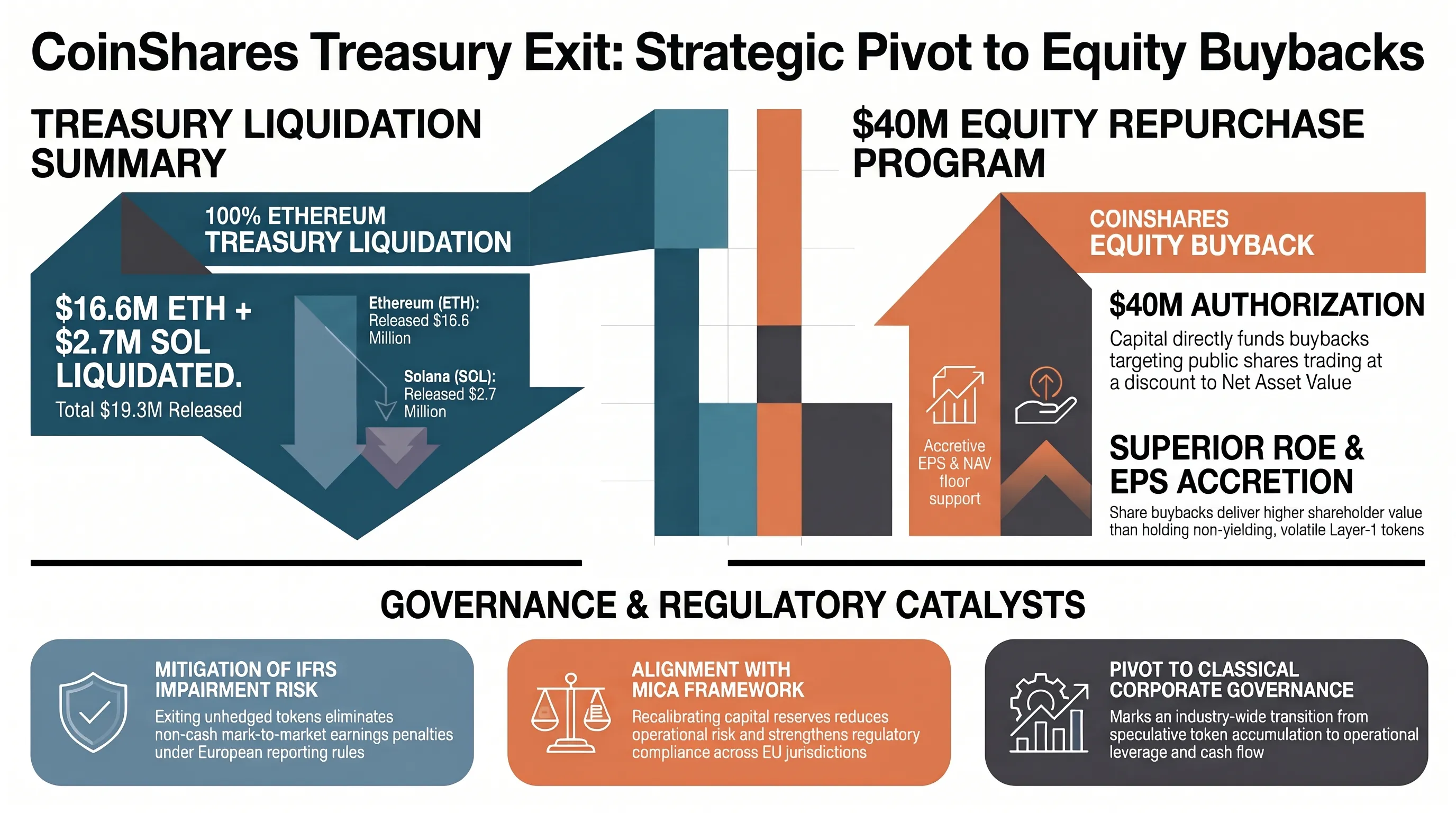
CoinShares Executes Strategic Crypto Treasury Liquidation: Exits All Ethereum to Finance $40M Corporate Share Repurchase
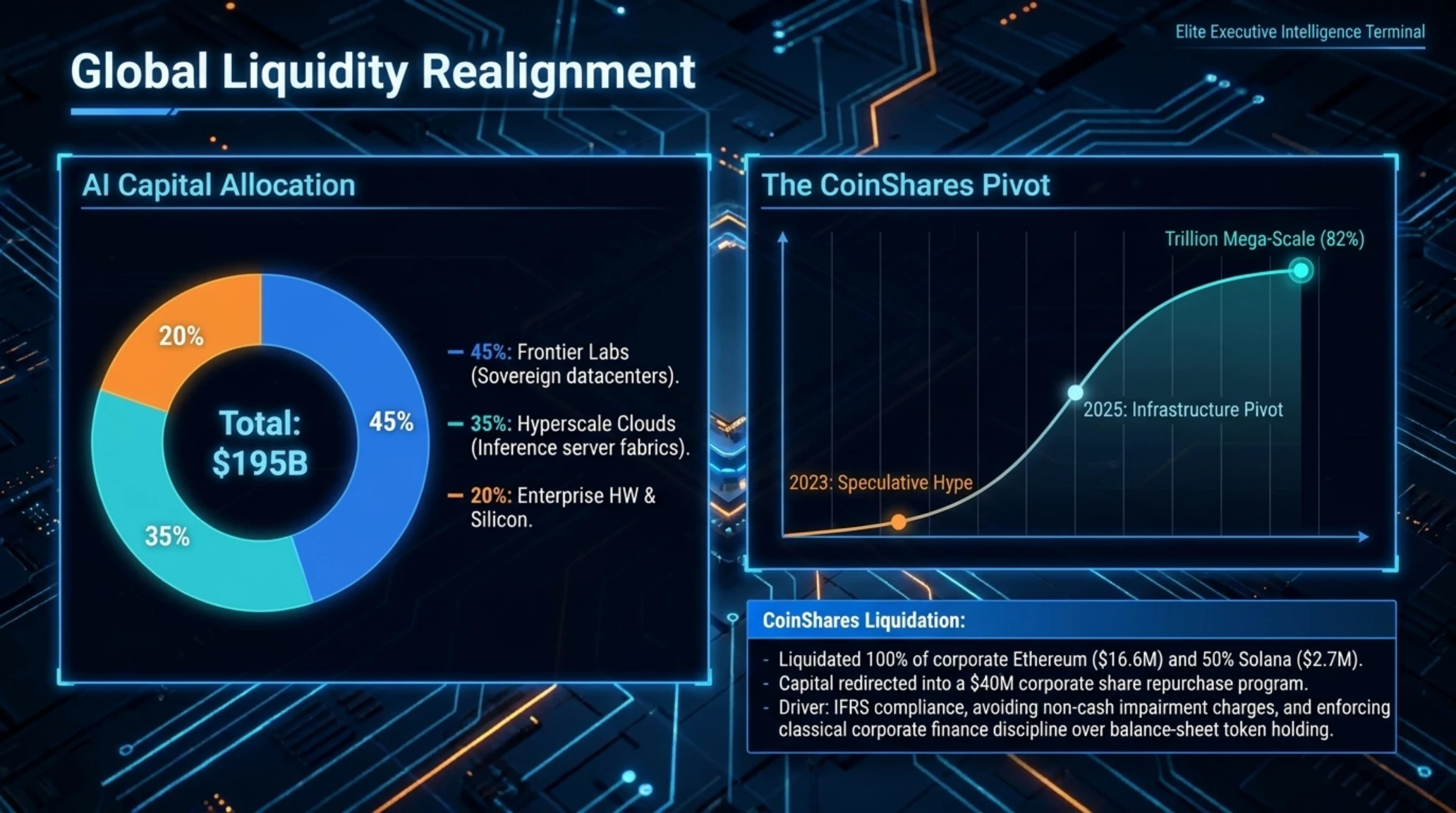
In a calculated corporate finance maneuver that reverberated across digital asset management circles, European investment powerhouse CoinShares revealed in its third-quarter financial disclosures that it has completely liquidated its corporate Ethereum (ETH) treasury reserves valued at $16.6 million, alongside disposing of 50% of its Solana (SOL) holdings worth $2.7 million, liberating $19.3 million in liquid capital.
CoinShares Chief Executive Officer Jean-Marie Mognetti confirmed that the released capital will directly bankroll the board-approved authorization to repurchase up to $40 million of the company's own publicly traded equity. Mognetti articulated that under current market valuations, CoinShares common shares trade at a substantial discount to net asset value, meaning that aggressive equity repurchases deliver far superior return on equity (ROE) and earnings per share (EPS) accretion compared to holding volatile underlying Layer-1 tokens on the corporate balance sheet.
Market Sentiment Thermometer and Cognitive Capital S-Curve Inflection
The strategic shift reflects a broader maturity across corporate crypto governance. Under IFRS accounting guidelines and European financial directives, retaining multi-million-dollar speculative token balances exposes publicly listed enterprises to severe mark-to-market impairment penalties. By recycling crypto treasury holdings into self-tender share buybacks, CoinShares has effectively created an equity floor, delivering direct shareholder accretion while insulating corporate balance sheets from protocol-level market turbulence.
Furthermore, the decision underscores a structural divergence between decentralized staking yields and public equity valuations. As institutional investors demand tangible operating cash flows over volatile token emissions, crypto asset managers are aligning their capital structures with classical corporate finance disciplines, prioritizing shareholder return metrics over ideological balance-sheet token holding.
From an international corporate tax and statutory compliance perspective, CoinShares' balance-sheet restructuring reflects the stringent realities imposed by European corporate reporting frameworks. Under IFRS accounting standards, retaining large unhedged positions in volatile digital assets forces publicly traded companies to absorb severe non-cash impairment charges during market drawdowns, impairing reported net income and constraining dividend distribution capabilities. By converting digital token reserves into hard fiat liquidity, CoinShares eliminates balance-sheet volatility and creates an unencumbered capital pool dedicated to accretive share repurchases.
This treasury realignment highlights an accelerating maturation across digital asset asset management firms. Historically, crypto investment trusts traded at steep premiums simply by virtue of holding underlying protocol tokens. However, with the maturation of spot exchange-traded funds (ETFs) providing low-cost, direct token access to retail and institutional capital, specialized asset managers must differentiate themselves through disciplined capital allocation, operating cost efficiencies, and consistent equity shareholder value creation.
Industry observers anticipate that CoinShares' decisive pivot will trigger a cascade of similar treasury liquidations among mid-tier digital asset management entities across London, Zurich, and Frankfurt. In an environment characterized by elevated capital costs and institutional scrutiny, public companies operating within the digital economy are discovering that classical equity stewardship, disciplined share buybacks, and robust balance-sheet liquidity represent far more potent shareholder catalysts than passive token accumulation.
The regulatory evolution under the European Union's Markets in Crypto-Assets (MiCA) framework has further catalyzed this corporate treasury recalibration. Regulated investment institutions face increasingly stringent capital reserve mandates and operational risk assessments when holding unhedged cryptographic tokens on their corporate balance sheets. By liquidating volatile token holdings and concentrating balance-sheet equity, CoinShares enhances its regulatory capital tiering, unlocking greater operational flexibility to expand its institutional custodial, algorithmic indexation, and private wealth advisory divisions.
Financial analysts at Bloomberg Intelligence noted that this capital rotation reflects an overdue alignment between digital asset investment management and institutional shareholder expectations. By shrinking its share float during period of pronounced equity undervaluation, CoinShares provides immediate EPS accretion while preserving balance-sheet flexibility for future strategic acquisitions.
Ultimately, CoinShares' $40 million equity repurchase program crystallizes a watershed transformation in how modern markets price digital economy enterprises. The era when publicly traded cryptocurrency firms could command premium equity valuations purely through balance-sheet token speculation has definitively closed. In the mature market environment of late 2026, institutional investors demand disciplined capital allocation, structural operating leverage, and aggressive shareholder return mechanisms that align corporate treasuries with classical financial orthodoxy.
Financial Telemetry Donut Chart and Global AI Capital Allocation
| Capital Allocation Segment | Gross Liquidity Inflow | Strategic Impact on Industry Equilibrium |
|---|---|---|
| Frontier Intelligence Labs | $87.7 Billion (45%) | Direct financing of multi-gigawatt sovereign datacenters and bespoke clusters |
| Hyperscale Cloud Platforms | $68.2 Billion (35%) | Underwriting massive inference server fabrics for enterprise API distribution |
| Enterprise Hardware & Silicon | $39.1 Billion (20%) | Accelerating custom ASIC interconnects and autonomous software pipelines |
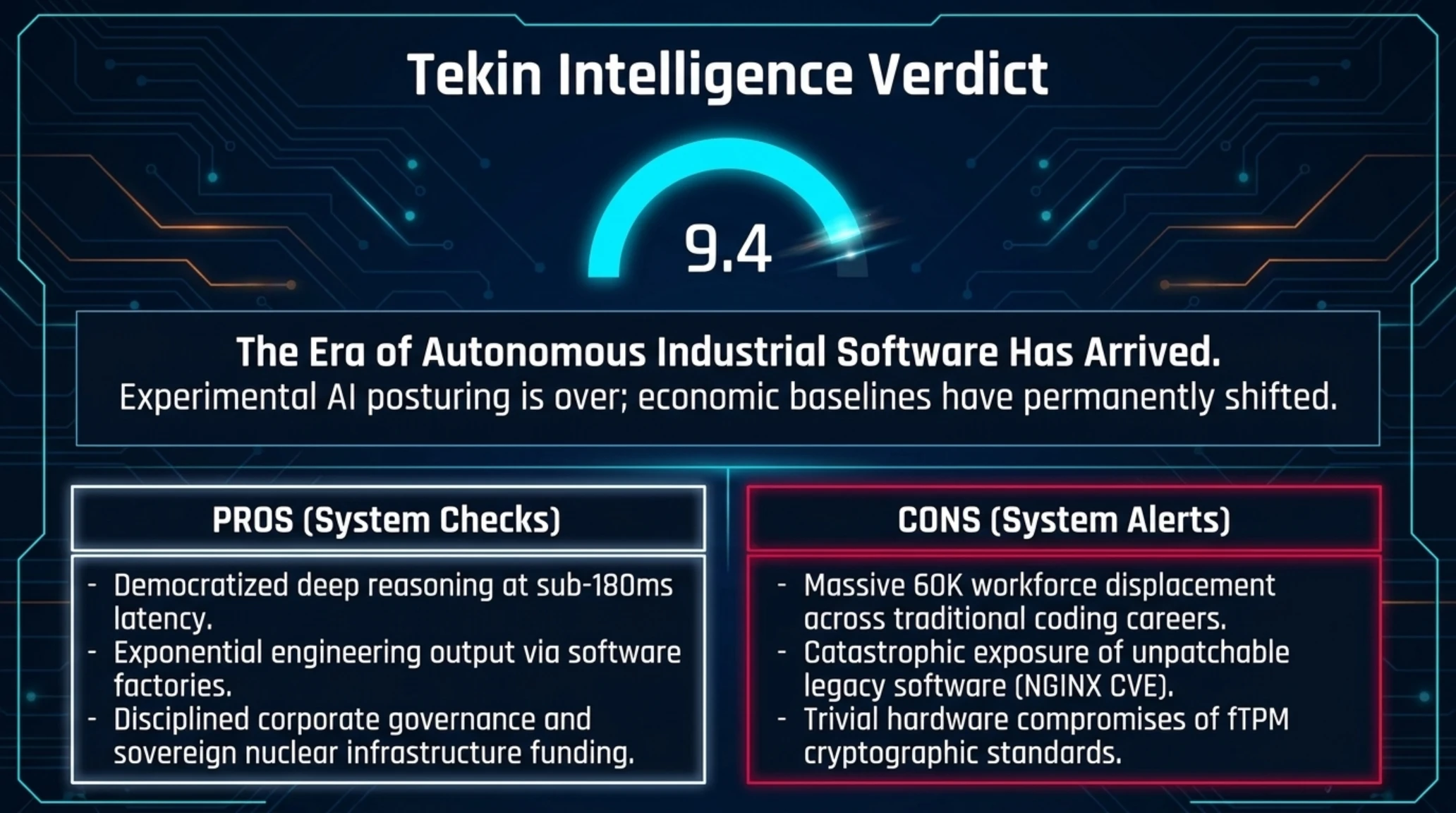
- Gemini 4 Neon democratizes deep multi-step verification at sub-180ms latency and Flash economics.
- Microsoft's software factory model multiplies engineering output by orders of magnitude via autonomous agent swarms.
- Anthropic's historic $1.5 trillion Nasdaq listing validates cognitive capability as foundational planetary infrastructure.
- CoinShares treasury reallocation establishes disciplined corporate governance over volatile crypto token accumulation.
- The ten-year-old NGINX root vulnerability exposes millions of unpatched reverse proxies to immediate remote takeover.
- TU Berlin's Hello Again attack dismantles hardware TPM lockouts with commodity $4 microcontroller tooling.
- Microsoft's 60,000 buyout offers signal severe structural displacement across traditional software engineering careers.
Editorial Verdict and Authoritative References
- 9to5Google: Google Launches Gemini 4 Neon with Carbon Quality at Flash Speeds
- TechCrunch: Satya Nadella Details 60K Buyout and AI Software Factory Shift
- The Hacker News: 10-Year-Old NGINX HTTP/2 Flaw CVE-2026-123007 Analysis
- TU Berlin Cybersecurity Institute: Hello Again Attack Bypasses TPM Lockout on Modern Systems
- Wall Street Journal & Nasdaq: Anthropic Historic $1.5 Trillion Valuation and IPO Pricing
- Decrypt: CoinShares Liquidates Ethereum Treasury for $40M Share Buyback
Frequently Asked Technical Inquiries
How does Gemini 4 Neon differ from Google's previously released Carbon and Flash models?
Gemini 4 Neon uses sparse cognitive distillation to capture 98.4% of the Carbon flagship model's deep multi-step verification capabilities, while operating with sub-180ms initial latency and cost economics identical to lightweight Flash-class models.
What does Satya Nadella mean by 'Software Factories' replacing traditional development?
Nadella envisions an operating architecture where small engineering pods (such as Project Cowork's 11 developers) orchestrate hundreds of autonomous reasoning agents to handle coding, testing, fuzzing, and deployment, outproducing multi-hundred-engineer legacy teams.
What is the technical attack mechanism behind the CVE-2026-123007 NGINX vulnerability?
The flaw resides in HTTP/2 stream cancellation frame processing (RST_STREAM). When unauthenticated network attackers transmit crafted frames, it induces an integer underflow in NGINX's custom memory allocator, allowing arbitrary heap corruption and root-level remote code execution.
How does the 'Hello Again' hardware exploit bypass TPM anti-hammering lockouts?
On systems using firmware fTPM, failed PIN retry counters are stored on external SPI NOR flash chips. By connecting a $4 microcontroller, attackers reflash a pre-attack memory backup every 3 failed attempts, resetting the counter to zero and enabling continuous brute-force PIN recovery.
Why did CoinShares liquidate its entire corporate Ethereum holdings to fund a share buyback?
CoinShares executives determined that the company's publicly traded shares were substantially undervalued, concluding that deploying $19.3 million into accretive share repurchases produces significantly superior risk-adjusted return on equity compared to retaining volatile Layer-1 tokens.
Additional Gallery: Tekin Night Nov 20: Gemini 4 Neon, Microsoft 60K Buyout & Anthropic $1.5T