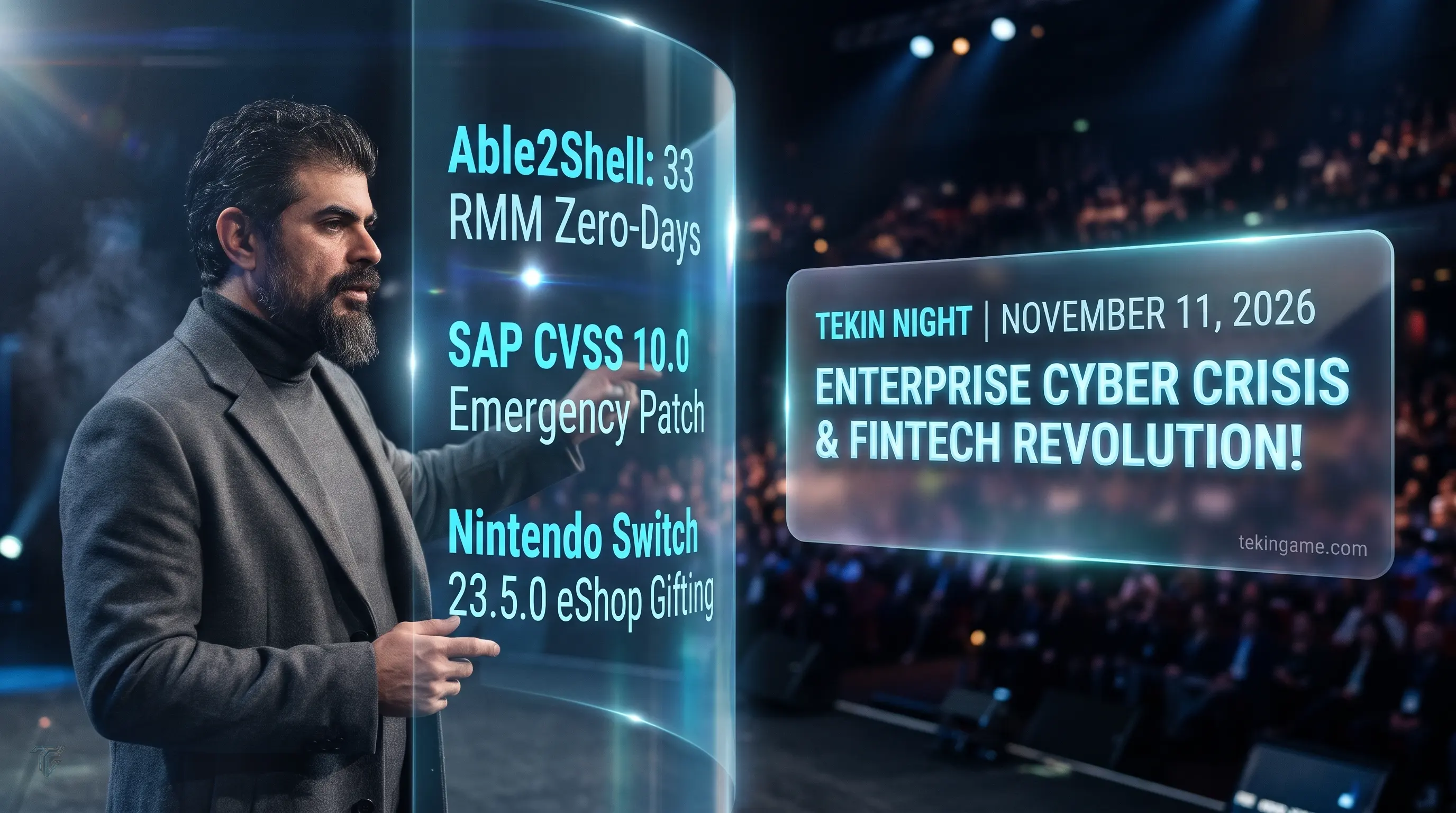
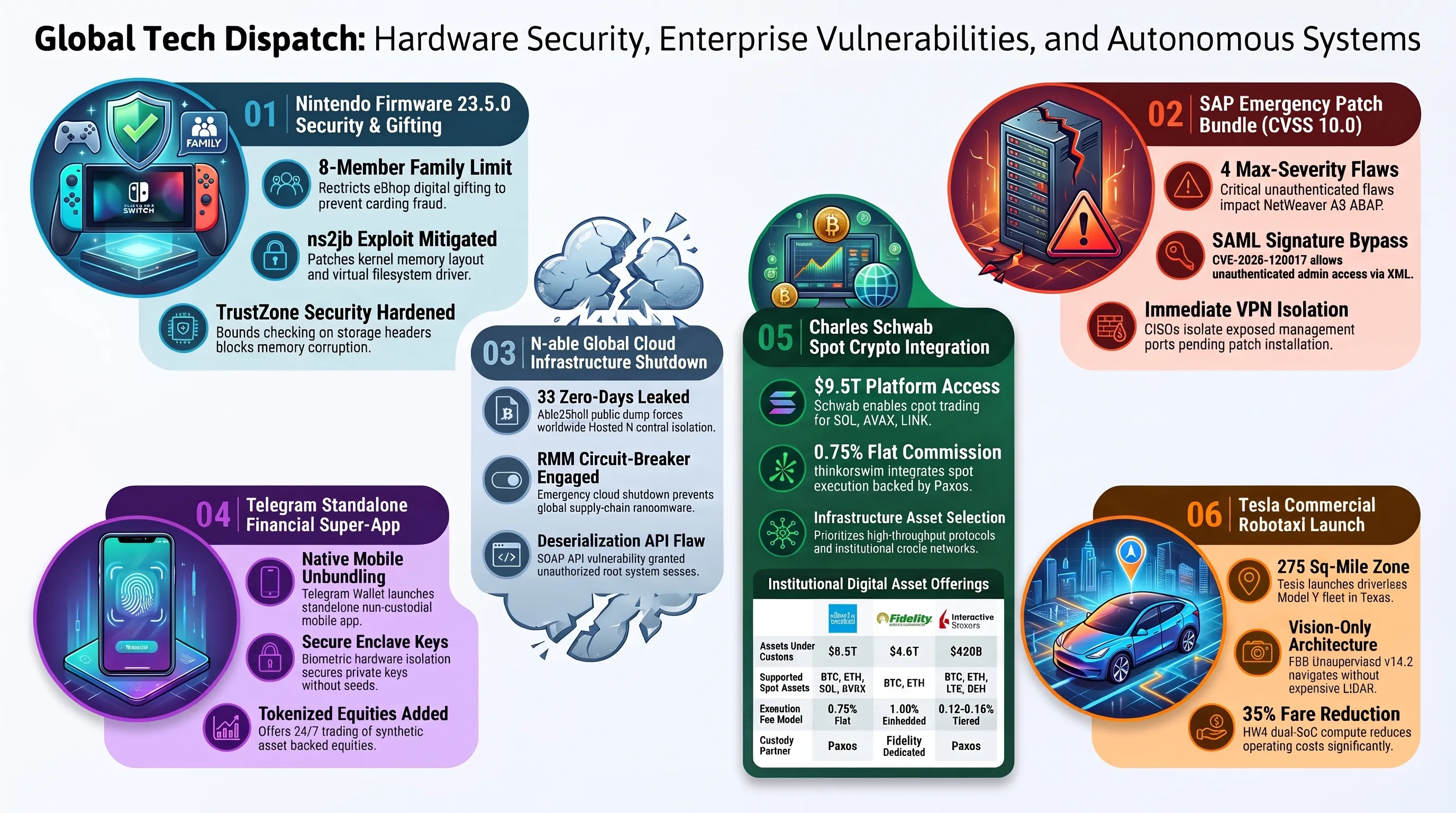
Tekin Night for Nov 11, 2026 dissects six major shifts: (1) Nintendo firmware 23.5.0 restoring eShop Family Gifting while patching Switch 2 ns2jb jailbreak exploits; (2) SAP patching four maximum CVSS 10.0 flaws in NetWeaver and Web Dispatcher; (3) N-able taking Hosted N-central offline after 33 Able2Shell zero-days dropped on GitHub; (4) Telegram Wallet launching a standalone super-app; (5) Charles Schwab adding SOL, AVAX, and LINK; and (6) Tesla Robotaxi in San Antonio.
Tekin Night // Executive Strategic Intelligence Briefing: Wednesday, November 11, 2026
The convergence of events on Wednesday evening, November 11, 2026, presents an intricate case study of modern technology interdependencies. While the morning hours as dissected in Tekin Morning November 11 covering Chrome's eighth zero-day patch and the Fireworks AI supply-chain breach exposed critical vulnerabilities across browser endpoints and inference clouds, tonight's ledger reveals how maximum-severity exploits have reached core enterprise ERP servers at SAP and remote management gateways at N-able.
Simultaneously, building upon the gaming and decentralized consensus evolutions we analyzed in Tekin Night November 10 regarding Epic Games' native SteamOS port and Solana's SIMD-0311 upgrade, Nintendo has fortified the Switch 2 microkernel with firmware 23.5.0, Telegram Wallet and Charles Schwab have dismantled barriers between Wall Street equities and Web3 rails, and Tesla has deployed hundreds of vision-only driverless robotaxis across San Antonio.
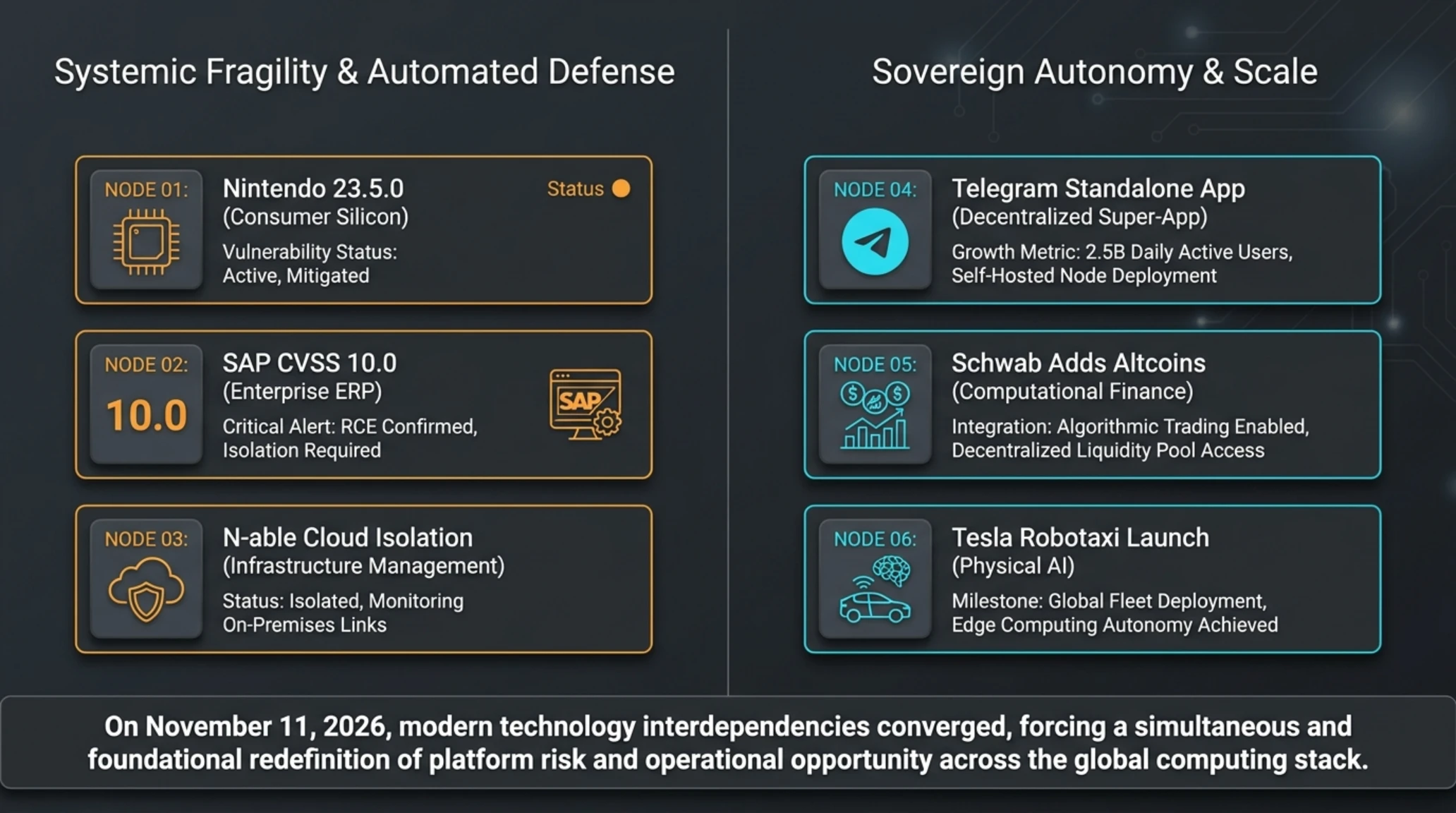
Strategic Vectors and Core Intelligence Highlights
Before dissecting the specific engineering mechanics governing each individual development, the following operational matrix outlines the threat surfaces, capital flows, and autonomous domains intersecting on this date:
The simultaneous arrival of consumer platform enhancements, enterprise infrastructure emergencies, and commercial artificial intelligence deployments highlights how architectural resilience has become the paramount metric across modern engineering teams.
Node 1: Nintendo Switch and Switch 2 System Update 23.5.0; eShop Gifting Infrastructure and Preemptive Jailbreak Mitigation
Consumer electronics pioneer Nintendo unexpectedly published system firmware update version 23.5.0 for both its legacy Nintendo Switch hardware ecosystem and its anticipated next-generation Nintendo Switch 2 platform. The headline public feature of the release was the official return of digital game gifting via the Nintendo eShop, an eagerly requested capability slated to go live globally on November 17, 2026, ahead of the lucrative holiday shopping season.
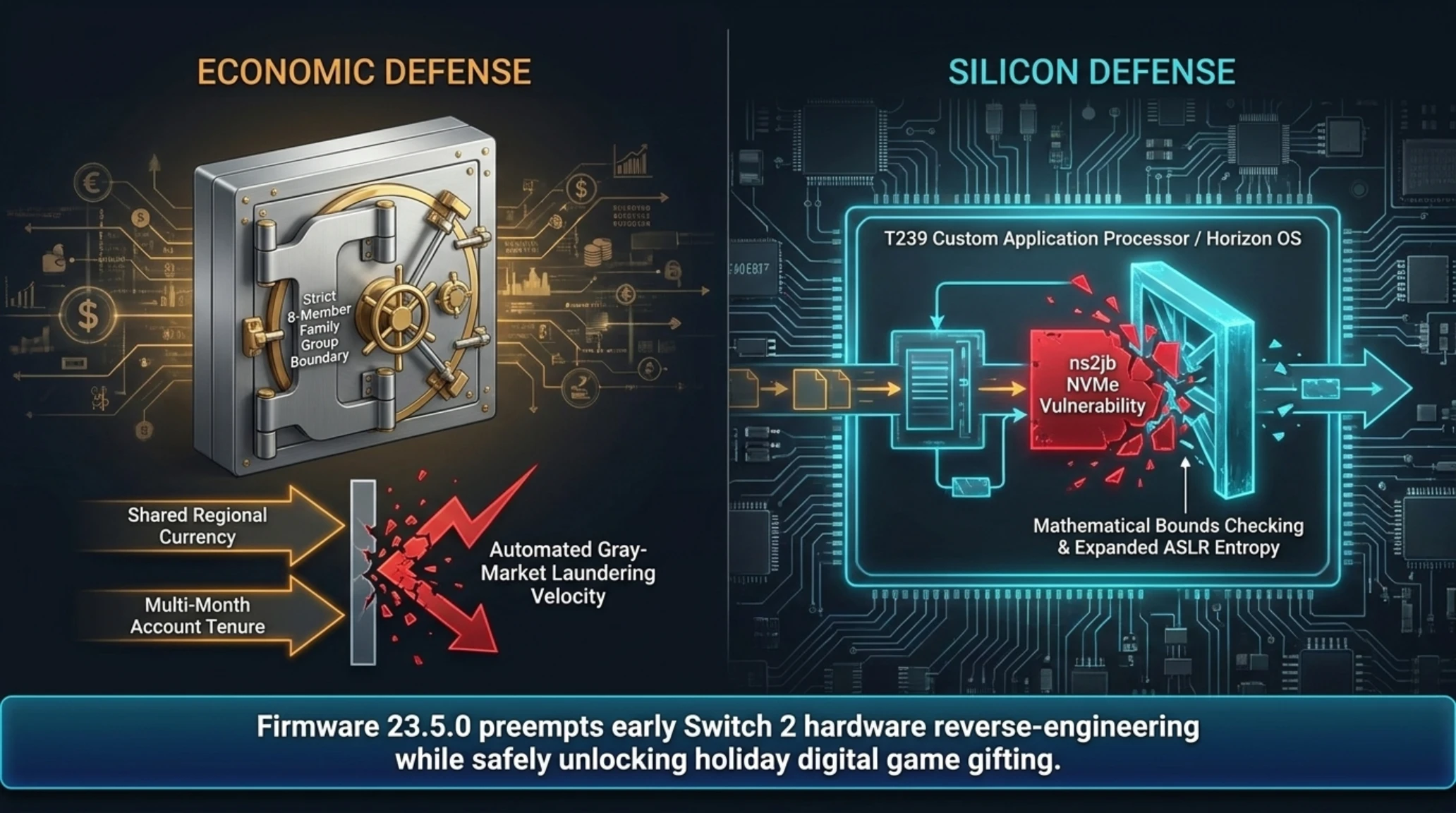
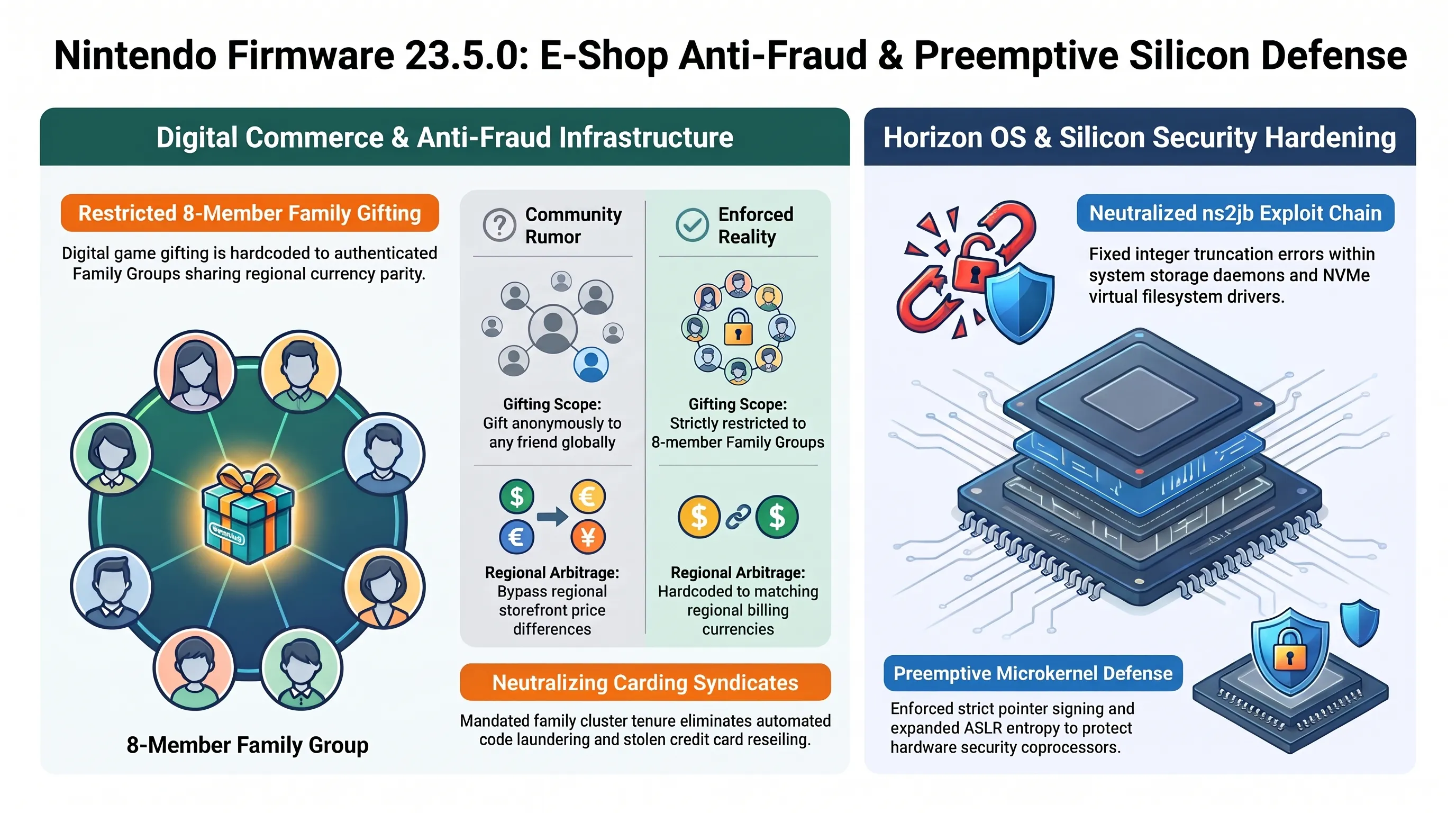
However, forensic examination of Nintendo licensing policies reveals a deliberate anti-fraud restriction: users cannot freely purchase and transmit digital game licenses to arbitrary contacts on their broader Friends List. To counteract illicit credit card monetization, account takeover abuse, and black-market digital code laundering, Nintendo strictly restricted gifting exclusively to pre-established members of an authenticated Family Group (maximum 8 user accounts). Furthermore, both the purchasing account and recipient account must share the same billing currency and regional marketplace jurisdiction, preventing cross-border price arbitrage between discounted regional currencies.
Simultaneously, the release contains critical defensive engineering updates within the Nintendo proprietary Horizon OS microkernel. Security researchers dissecting the 23.5.0 binary blobs discovered that Nintendo patched critical memory layout vulnerabilities within the system storage daemon and NVMe virtual filesystem driver. These flaws formed the core of the proof-of-concept ns2jb software exploit chain, which was being developed within the hardware reverse-engineering community to achieve early privilege escalation on Switch 2 devkits and retail silicon. By enforcing strict pointer signing and expanding Address Space Layout Randomization (ASLR) entropy, Nintendo effectively neutralized the attack surface before commercial exploitation could materialize.
Architecturally, the Nintendo Switch 2 relies on a customized Nvidia system-on-chip incorporating dedicated hardware security coprocessors operating in TrustZone execution levels. The patched filesystem vulnerability involved an integer truncation error when parsing corrupted metadata tables from external solid-state storage. By tricking the filesystem daemon into allocating undersized heap buffers, researchers could stage contiguous out-of-bounds write primitives to overwrite kernel dispatch vectors. Firmware 23.5.0 introduces rigorous mathematical bounds checking on all storage header lengths, rejecting malformed partition descriptors at the bootloader and microkernel boundary.
Hardware security researchers probing the silicon boundary discovered that the T239 custom application processor integrates a dedicated hardware cryptographic engine featuring physically unclonable functions (PUFs) and hardened one-time-programmable (OTP) eFuses. In earlier engineering revisions, the handoff protocol between the secondary bootloader (Package2) and the userland filesystem service contained an unchecked race window during memory descriptor initialization. The ns2jb vulnerability chain leveraged precise voltage glitching combined with malformed MicroSD partition tables to trigger heap memory alignment faults, thereby bypassing the kernel memory management unit (MMU) protections. By closing this attack surface with firmware 23.5.0, Nintendo demonstrated that its platform security engineering team has adopted an aggressive, preemptive defense-in-depth doctrine.
From an economic standpoint, the strict enforcement of the 8-member Family Group boundary for eShop digital gifting represents an essential bulwark against organized cybercrime syndicates. In historical console generations, unconstrained digital gifting mechanisms were rapidly co-opted by transnational carding rings, which utilized stolen credit card dumps to purchase activation codes at wholesale scale and resell them on gray-market digital storefronts at heavy discounts. By mandating that gift recipients must belong to an established family cluster with shared billing currency parity and multi-month account tenure, Nintendo eliminated the automated laundering velocity that carding syndicates rely upon, preserving the integrity of digital retail margins while expanding holiday transaction velocity.
Gaming industry analysts emphasize that Nintendo preemptive posture represents a dramatic shift from the early Switch era, reflecting a zero-trust console lifecycle philosophy designed to safeguard lucrative digital software revenues throughout the console lifespan.
Why This Development Matters: Nintendo Digital Commerce & Silicon Security
By restricting eShop gifting to authenticated family groups while silently patching low-level filesystem vulnerabilities, Nintendo executed a masterclass in risk management unlocking holiday transaction volume while neutralizing gray-market code reselling cartels and early Switch 2 jailbreak initiatives.
To differentiate verified technical architecture from viral claims circulating across gaming forums, the comparative assessment below delineates confirmed engineering facts from speculative community theories:
Technical Fact-Check | Rumor vs. Reality in Firmware 23.5.0
Social media forums claimed Nintendo eliminated all regional store restrictions, allowing players to gift titles anonymously to any friend worldwide regardless of regional pricing tiers.
Nintendo confirmed that transactions are hardcoded to established Family Groups with matching regional currencies to satisfy strict banking compliance and prevent value extraction loops.
Understanding modern console firmware security demands visualizing the runtime handshake between encrypted flash memory blocks and microkernel system daemons, captured in the following technical animation:
While consumer gaming ecosystems navigated firmware hardening, the global enterprise software sector faced an existential crisis in its core business automation layers as German multinational SAP confronted catastrophic remote execution vulnerabilities.
Node 2: SAP Issues Emergency Patch Bundle Addressing Four Maximum CVSS 10.0 Vulnerabilities in NetWeaver AS and Web Dispatcher
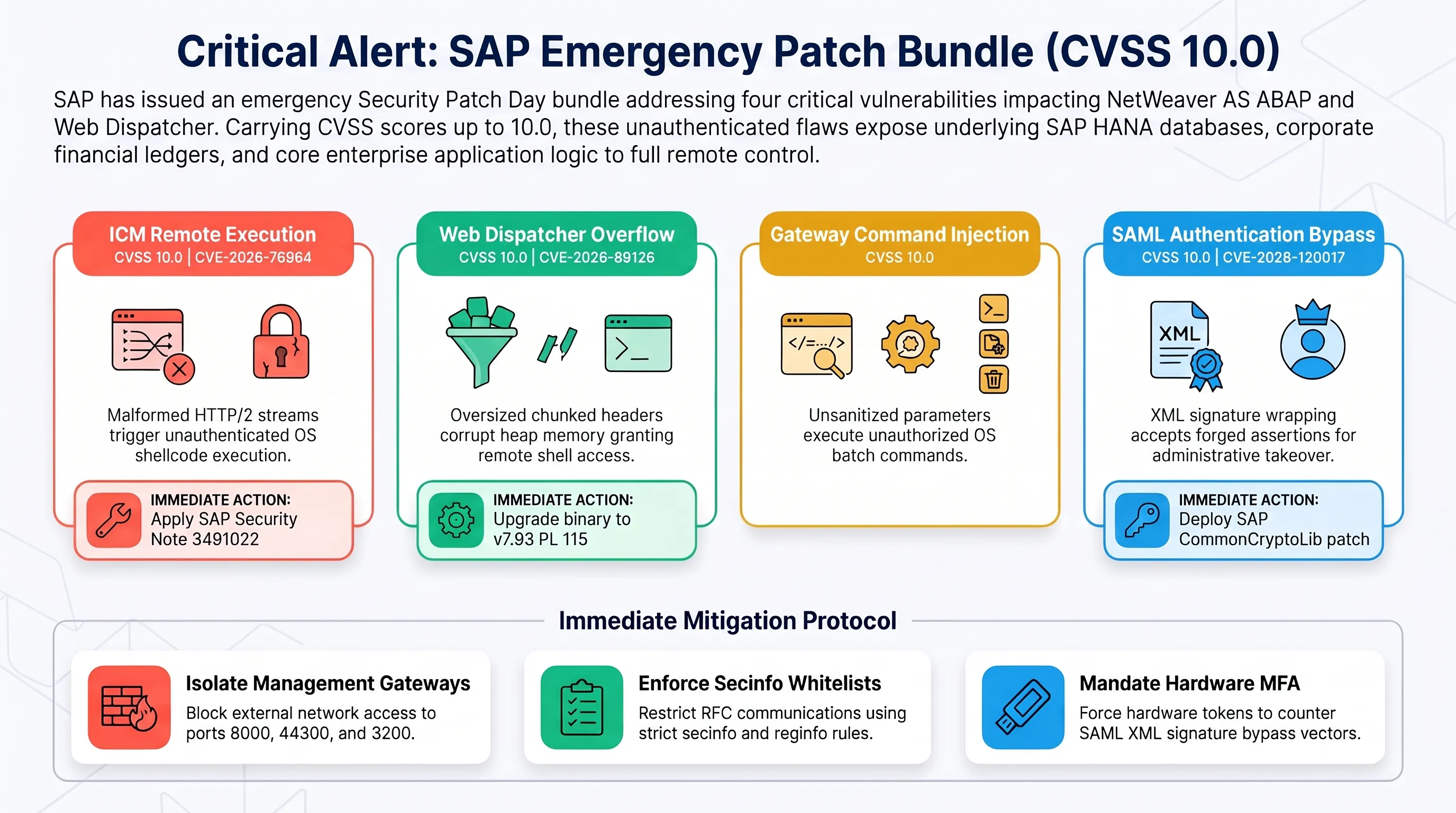
Enterprise software superpower SAP released its November 2026 Security Patch Day bulletin, delivering an unprecedented emergency maintenance bundle addressing four separate vulnerabilities carrying a maximum CVSS 10.0 severity rating. The flaws impact the foundational NetWeaver Application Server (AS) ABAP runtime and the SAP Web Dispatcher reverse proxy, which serve as the central nervous system for supply chains, financial general ledgers, human resource systems, and inventory operations across more than 94 percent of Fortune 500 multinationals.
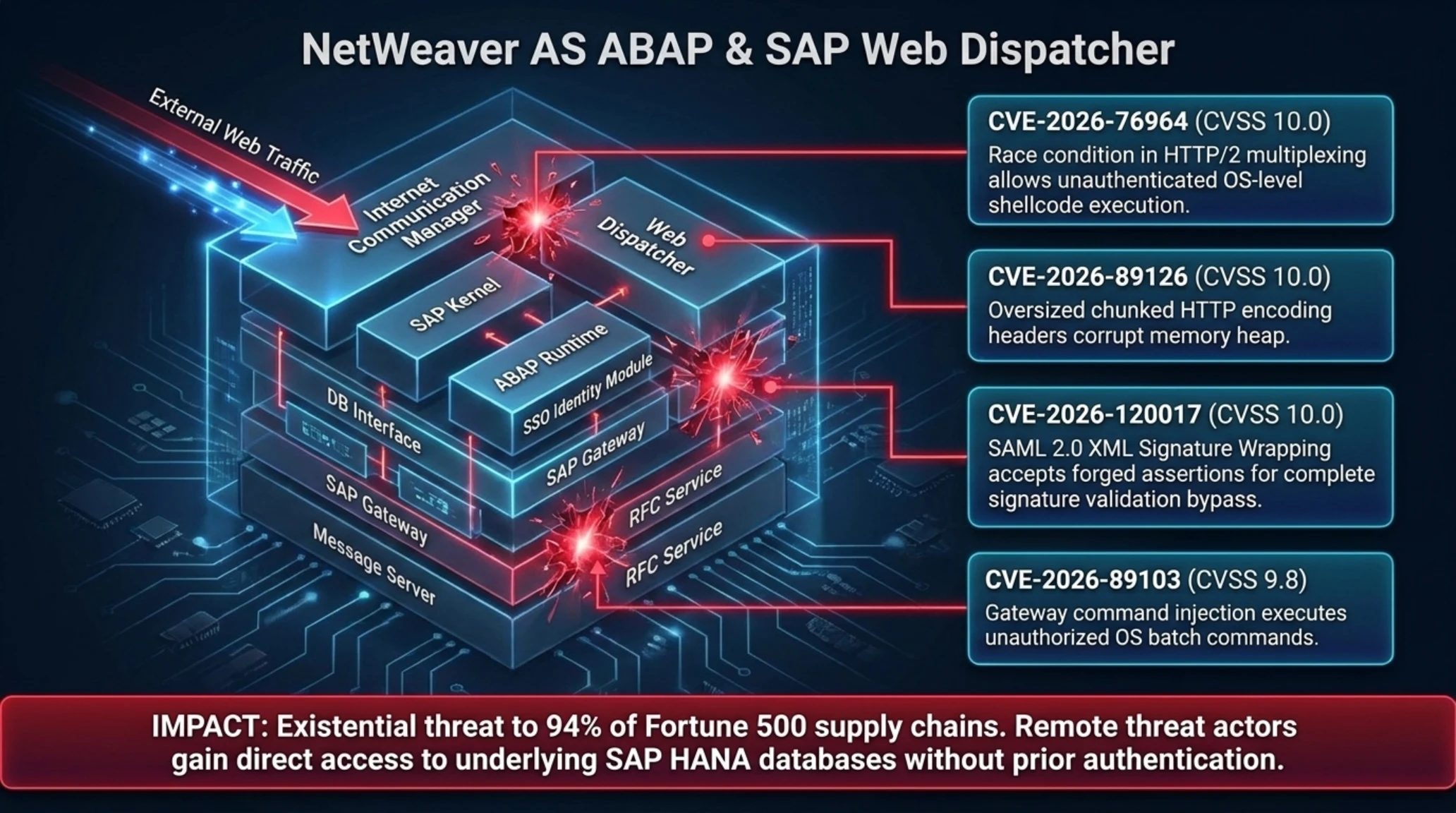
The four maximum-severity Common Vulnerabilities and Exposures are cataloged as: CVE-2026-76964 (Remote Code Execution in the Internet Communication Manager), CVE-2026-89126 (Heap-Based Buffer Overflow in SAP Web Dispatcher), CVE-2026-89103 (Unauthenticated OS Command Injection in SAP Gateway Services), and CVE-2026-120017 (Complete Signature Validation Bypass in the SAML 2.0 Service Provider Implementation). Because these interfaces are routinely exposed to internal corporate networks and perimeter ingress firewalls to facilitate employee remote access and supplier portal integration, their exploitation requires zero prior authentication or user interaction.
The operational danger posed by these flaws cannot be overstated. By dispatching crafted HTTP requests containing malformed chunked transfer bodies or forged XML signatures to TCP ports 8000, 44300, or 3200, remote threat actors can achieve immediate arbitrary code execution under the privileges of the operating system service account (such as sidadm or SYSTEM). From this beachhead, attackers can execute direct queries against underlying SAP HANA in-memory columnar databases, exfiltrate proprietary manufacturing specifications, alter automated wire transfers, or deploy destructive data-wiping payloads directly into enterprise production pipelines.
In-depth technical dissection reveals that CVE-2026-76964 stems from a race condition within the ICM asynchronous worker pool when processing HTTP/2 multiplexed streams over encrypted TLS channels. When a client abruptly terminates a stream during header decompression, the worker thread deallocates the associated memory context without clearing pointer references in the global session table. Subsequent inbound requests reallocate this memory chunk, allowing an attacker to spray the heap with executable shellcode and redirect the instruction pointer to system-level calls, bypassing all application-level role-based access controls.
From an architectural standpoint, the Internet Communication Manager (ICM) serves as the primary ingress gateway for all HTTP, HTTPS, and RFC-over-HTTP communications entering the SAP application server stack. When processing high-concurrency connections across enterprise portals, ICM relies on an internal memory pool optimized for low-latency header parsing. The vulnerability designated CVE-2026-76964 manifests when malformed HTTP/2 frame sequences carrying contradictory content-length headers are parsed across parallel worker threads. The memory manager deallocates the underlying buffer structure while an asynchronous logging hook retains a dangling pointer, creating an exploitable use-after-free condition that permits deterministic heap manipulation without triggering operating system exception handlers.
Equally devastating is the SAML 2.0 authentication bypass cataloged under CVE-2026-120017. Modern enterprise cloud architectures rely heavily on Single Sign-On (SSO) federated identity providers (such as Microsoft Entra ID, Okta, or PingFederate) to authenticate corporate users into SAP systems. The vulnerability lies in the XML Signature Wrapping (XSW) verification engine within SAP CommonCryptoLib. By inserting a secondary, unsigned assertion element into the XML message body while preserving the cryptographic signature over an arbitrary benign assertion, an attacker can manipulate the XML Document Object Model (DOM) tree. The verification engine validates the signed block, but the application logic extracts the user identity from the forged, unsigned block allowing an unauthenticated remote attacker to instantly assume the identity of an administrative account with complete access to financial general ledgers, corporate payroll, and confidential mergers-and-acquisitions documentation.
Chief Information Security Officers (CISOs) across petrochemical, pharmaceutical, aerospace, and banking institutions have initiated emergency change-management protocols, isolating internet-facing SAP gateways pending deployment of kernel patches. Given that multi-cloud enterprise deployments frequently bridge on-premises SAP environments with hyperscale infrastructure on AWS GovCloud, Microsoft Azure, and Google Cloud, failure to remediate these vulnerabilities exposes entire corporate hybrid cloud fabrics to automated adversary lateral movement.
Technical Jargon Buster // Enterprise ERP Vulnerability Nomenclature
To assist incident response teams in categorizing and prioritizing these critical enterprise vulnerabilities, the threat matrix below maps each defect to its operational impact and remediation mandate:
Cybersecurity Risk Assessment Matrix: Enterprise ERP Infrastructure
| Vulnerability Identifier & Mechanism | Risk Severity | Immediate Mitigation Protocol |
|---|---|---|
| ICM Remote Code Execution (CVE-2026-76964) | CRITICAL (10.0) | Apply SAP Security Note 3491022 and isolate management ports behind private VPN tunnels. |
| Web Dispatcher Buffer Overflow (CVE-2026-89126) | CRITICAL (10.0) | Upgrade Web Dispatcher binaries to version 7.93 Patch Level 115 immediately. |
| SAML 2.0 Authentication Bypass (CVE-2026-120017) | CRITICAL (10.0) | Deploy SAP CommonCryptoLib update and mandate hardware MFA token enforcement. |
| SAP Gateway Command Injection (CVE-2026-89103) | HIGH RISK (9.8) | Restrict RFC communications using strict secinfo and reginfo firewall whitelists. |
The fragility of enterprise infrastructure was further demonstrated by a simultaneous catastrophe in the remote IT management sector, where hundreds of thousands of managed corporate endpoints were abruptly severed from the cloud.
Node 3: N-able Implements Emergency Global Shutdown of Hosted N-central Cloud After GitHub Drop of 33 Chainable Zero-Days
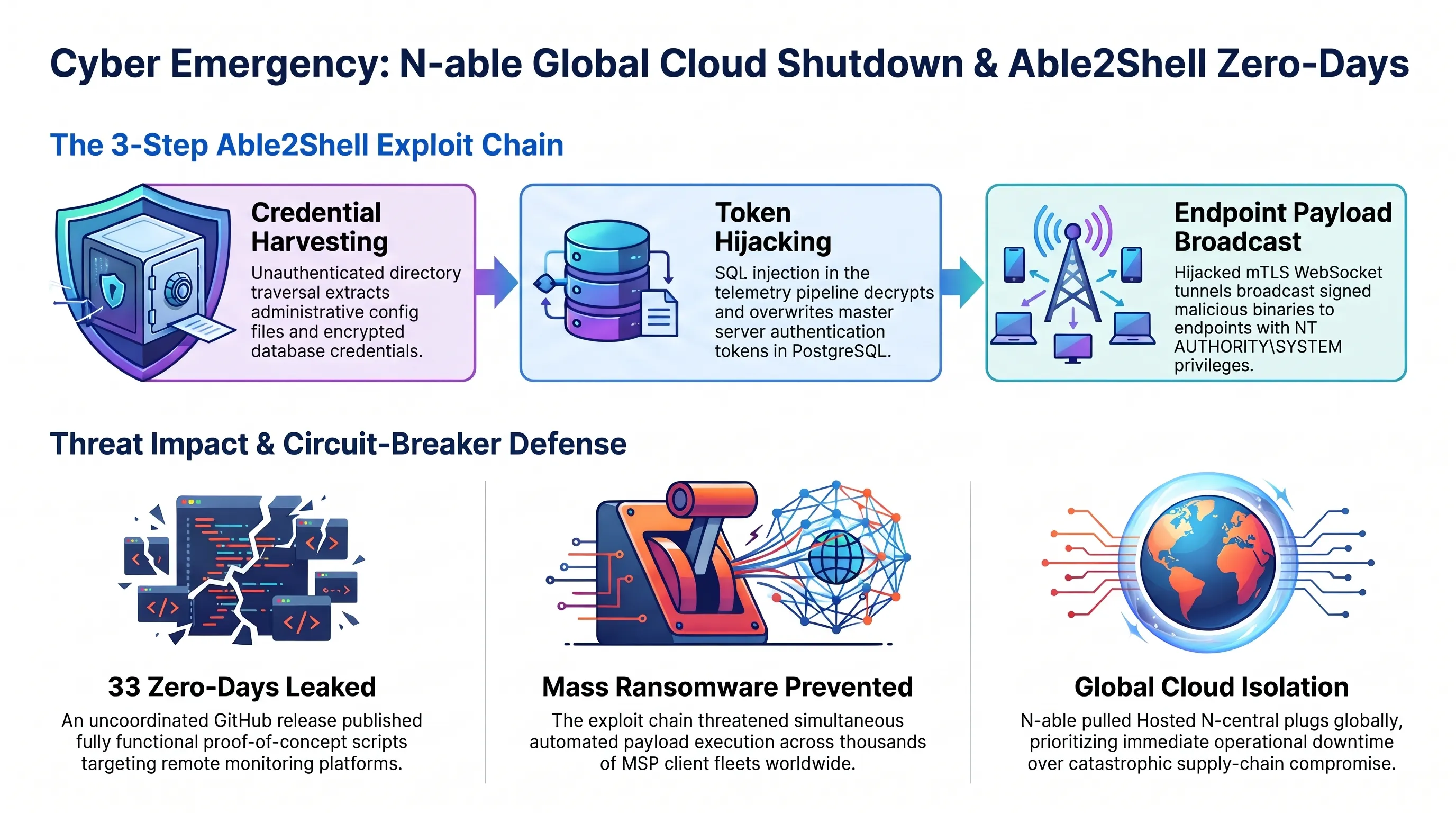
In one of the most drastic protective actions taken by an enterprise cloud provider in recent memory, managed service provider (MSP) software giant N-able took its flagship Hosted N-central cloud infrastructure offline worldwide. Connections across North America, Europe, and Asia-Pacific data centers were abruptly severed, while thousands of managed service providers operating on-premises installations were issued urgent advisories to physically isolate their servers from external networks.
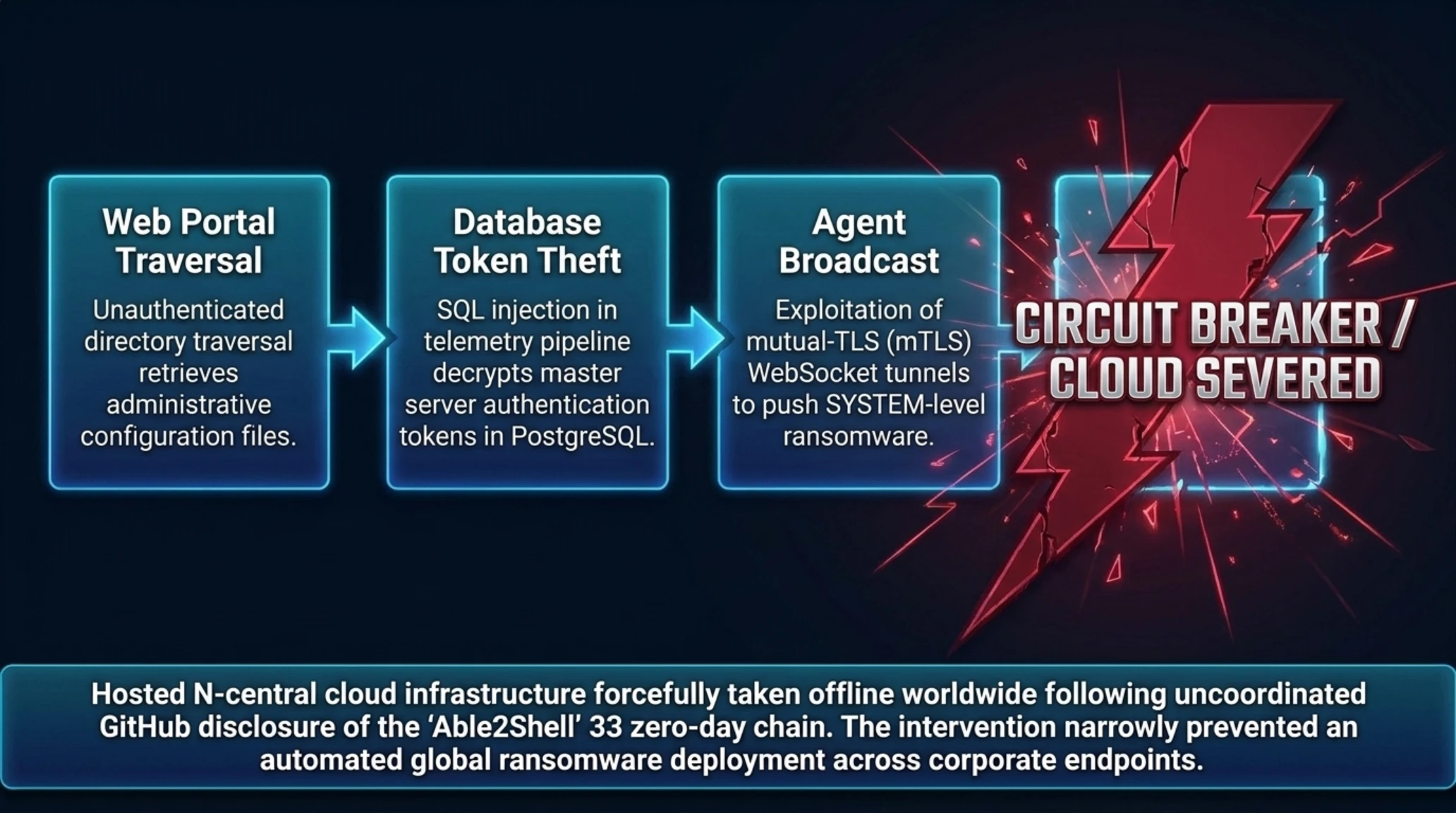
The precipitating trigger was the uncoordinated public release of a repository dubbed Able2Shell by an independent security researcher on GitHub. The disclosure contained fully functional proof-of-concept exploit scripts documenting 33 interconnected zero-day vulnerabilities. When chained together, these flaws enabled an unauthenticated remote attacker to traverse the N-central web management portal, bypass administrative session tokens, execute arbitrary SQL commands against backend PostgreSQL databases, and abuse remote agent communication sockets to push malicious executable payloads to every connected endpoint device.
The systemic ramifications of an RMM breach are staggering. Remote Monitoring and Management platforms like N-central serve as the master key to corporate computing fleets. Specialized background agents installed on millions of laptops, domain controllers, healthcare terminals, and point-of-sale workstations maintain persistent encrypted connections to the central N-central server, executing administrative scripts and security updates with SYSTEM-level authority. Had threat actors weaponized the Able2Shell chain before N-able intervention, they could have orchestrated an automated ransomware deployment across tens of thousands of client businesses simultaneously in a disaster rivaling the 2021 Kaseya supply chain assault.
Telemetry analysis indicates that the Able2Shell exploit chain leveraged an unauthenticated endpoint in the N-central SOAP API designed for legacy mobile device management registration. By feeding serialized Java payloads with malformed class paths into this endpoint, attackers triggered a remote deserialization flaw that spawned an interactive shell on the underlying Linux host. From there, local privilege escalation scripts exploited a misconfigured sudoers entry in the system backup utility, granting root access. The attacker could then craft signed agent broadcast messages, instructing millions of endpoint agents to execute ransomware payloads without raising endpoint detection alarms.
A comprehensive forensic audit of the Able2Shell exploit repository reveals a masterclass in chained software vulnerabilities targeting distributed remote management architectures. The intrusion sequence begins with an unauthenticated directory traversal flaw in the N-central web portal asset-reporting module, which allows an external attacker to retrieve administrative configuration files containing encrypted database credentials. In step two, the attacker leverages a secondary SQL injection vulnerability within the background telemetry ingestion pipeline to decrypt and replace the master server authentication tokens stored in the PostgreSQL database tier.
Once administrative session sovereignty was achieved, the third and most dangerous component of the Able2Shell chain came into play: weaponization of the centralized RMM agent communication protocol. N-central client agents installed across hundreds of thousands of customer endpoints utilize persistent mutual-TLS (mTLS) WebSocket tunnels to poll the central server for administrative jobs, remote PowerShell scripts, and automated software deployment packages. The exploit scripts demonstrated that an attacker controlling the central server could broadcast signed, encrypted task payloads instructing every connected agent to download and execute arbitrary binaries with SYSTEM privileges, completely bypassing local endpoint detection and response (EDR) agents. Had N-able delayed its global cloud disconnection by even a few hours, threat actors could have weaponized this broadcast mechanism to trigger the simultaneous mass-encryption of global enterprise infrastructure.
Incident response specialists worldwide lauded N-able rapid decision to pull the physical plugs on its hosted cloud clusters, acknowledging that short-term operational downtime was vastly preferable to an unmitigated global ransomware catastrophe. The event underscores the immense systemic risk concentrated within remote IT management vendors, proving that managed service provider platforms have become prime targets for state-sponsored advanced persistent threat (APT) actors and commercial ransomware cartels seeking maximal downstream leverage.
To demonstrate the operational sequence of the intrusion detection and circuit-breaker response, the terminal telemetry capture below reflects the automated defensive containment protocols engaged during the incident:
Cyber Terminal & Able2Shell Cloud Containment Telemetry
📚 Classified & Related Dossiers in TekinGame
If you wish to explore beyond this report and delve into cybernetic frontiers and autonomous AI architectures, do not miss these three exclusive deep-dives in the Tekin Garage:
While centralized server architectures struggled with vulnerability management, decentralized financial platforms achieved an historic operational milestone by transitioning from lightweight messaging bots to sovereign financial infrastructure.
The unbundling of financial tools from monolithic social platforms marks a structural evolution in consumer wealth management, bridging the speed of mobile operating systems with decentralized cryptographic verification.
Node 4: Telegram Wallet Unbundles from Messenger to Launch Independent Non-Custodial Super-App with Tokenized Equities and Derivatives
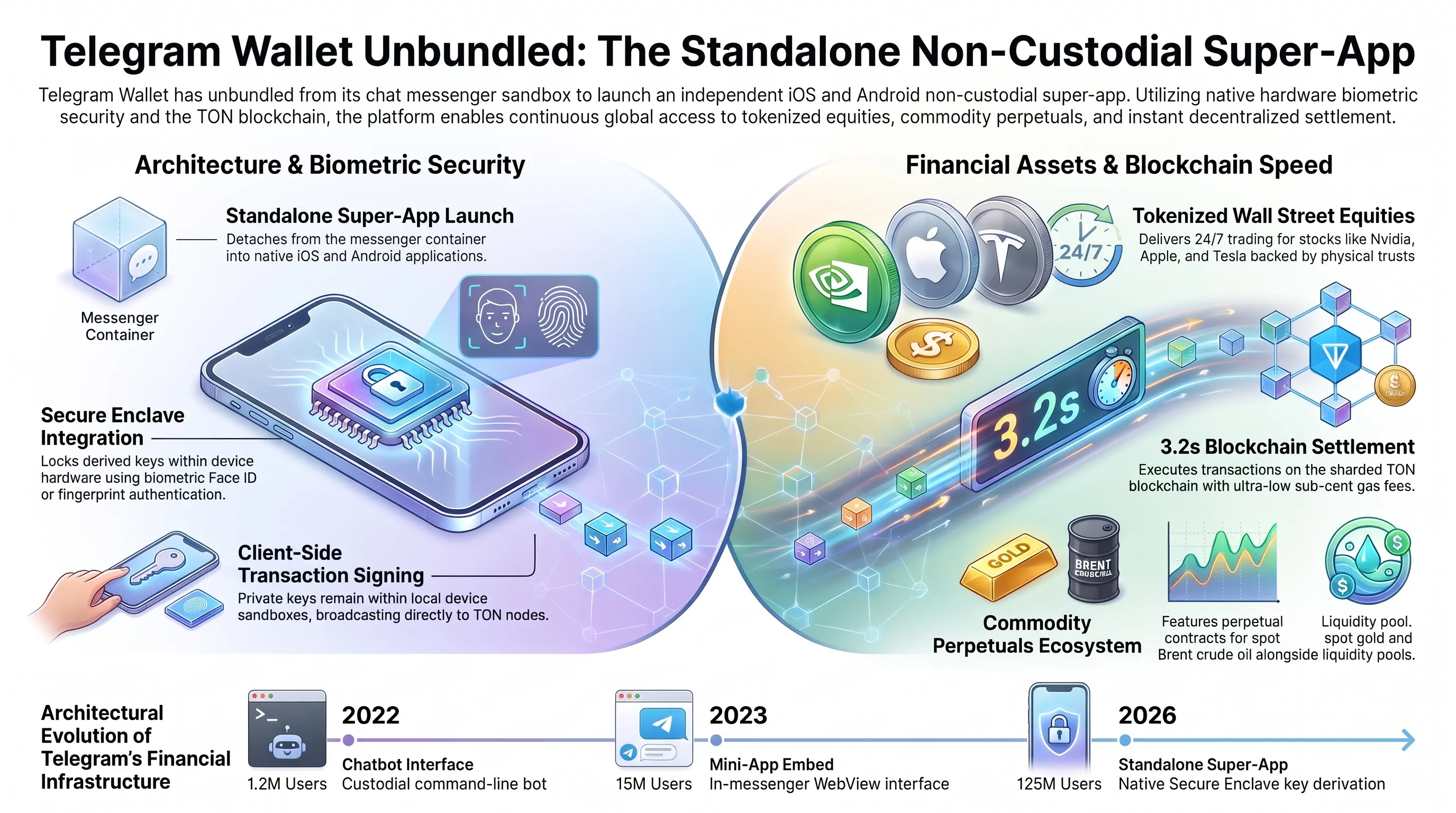
Digital payments and self-custody ecosystem Telegram Wallet (supported by the TON Foundation) completed a transformative architectural evolution by officially publishing a standalone mobile super-app for iOS and Android, detaching its core financial engine from the messaging client sandbox. Having previously amassed over 100 million active wallet users as an embedded Telegram Mini App, the project achieved full operational sovereignty as an independent financial platform.
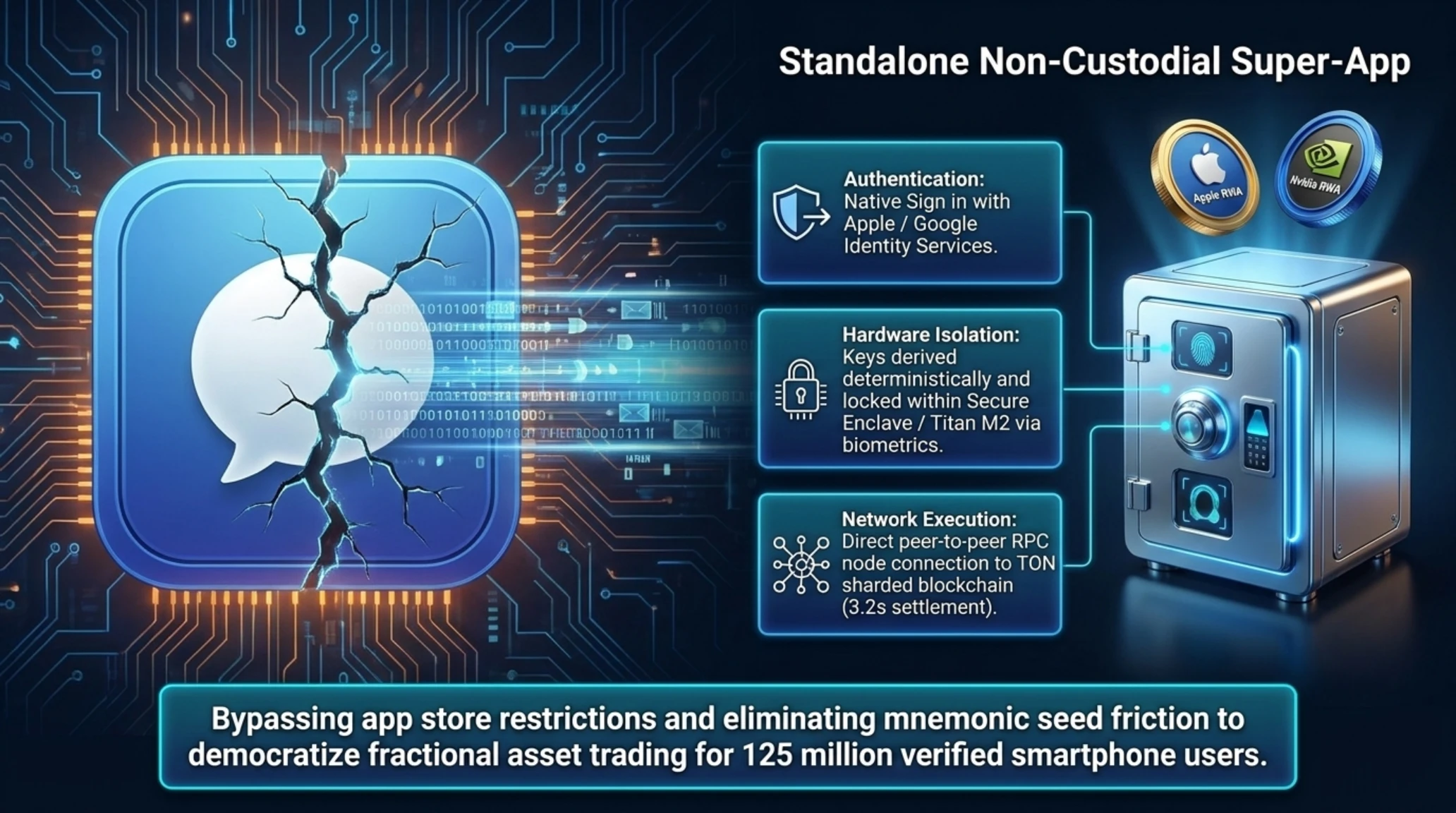
The standalone application introduces an overhauled onboarding paradigm designed to eliminate crypto onboarding friction while preserving cryptographic self-custody. Users can provision new non-custodial accounts using native Sign in with Apple or Google Identity Services, with private keys derived deterministically and secured within the smartphone hardware-isolated Secure Enclave or Android Keystore via biometric authentication (Face ID or fingerprint sensors). This eliminates the mandatory mnemonic seed phrase backup requirement for novice users without exposing private keys to centralized servers.
Crucially, the independent application expands far beyond baseline peer-to-peer cryptocurrency transfers to position itself as a global decentralized financial super-app. Through direct integrations with licensed regulated asset-tokenization protocols, users gain 24/7 access to tokenized US equities (including Apple, Nvidia, Tesla, and Microsoft) backed 1:1 by real-world shares held in European institutional trusts. Furthermore, the platform integrates perpetual futures contracts on physical commodities (spot gold and Brent crude oil) and permissionless interest-bearing liquidity pools on the TON blockchain, establishing a direct competitor to traditional brokerages like Robinhood and Revolut.
From an architectural standpoint, the application functions as a decentralized portal executing high-throughput transactions across the TON sharded blockchain. When a user executes a fractional share purchase of an equity like Nvidia, the application mints an asset-backed synthetic token via automated smart contracts, simultaneously securing custody through an audited depository trust. Settlement occurs within 3.2 seconds with sub-cent gas fees, sidestepping the antiquated T+2 settlement delays inherent to legacy Wall Street clearinghouses. This hybrid architecture democratizes international market exposure for millions of global smartphone users.
From a software engineering and cryptography perspective, the unbundled Telegram Wallet application represents a sophisticated implementation of client-side key derivation and hardware-isolated security. In contrast to the legacy messaging bot which operated as a custodial or semi-custodial webview container, the standalone iOS and Android applications utilize the native operating system security architecture. When a user authenticates via Sign in with Apple or Google Identity Services, the client leverages zero-knowledge identity proofs to derive an initial cryptographic master seed. This seed is immediately passed into the device hardware Secure Enclave (Apple A-series/M-series chips) or Titan M2 hardware security module (Google Pixel devices), where private keys are generated and locked behind biometric authorization gates (Face ID or capacitive biometric sensors).
Crucially, private keys never traverse external telecommunications networks or centralized cloud databases. Transactions are constructed and signed entirely within the isolated client sandbox before being broadcast directly to the decentralized TON blockchain network via peer-to-peer RPC nodes. The integration of tokenized real-world assets (RWAs) is facilitated through audited smart contracts that interface with regulated European asset depositories. When an international user purchases fractional shares of Nvidia or Apple stock, the smart contract mints corresponding synthetic tokens backed by physical shares held in bankruptcy-remote legal trusts, streaming real-time valuation updates via decentralized oracle networks. This decentralized plumbing enables continuous 24/7 liquidity and instant secondary market settlement, completely bypassing the restrictive geographic payment gateways and banking sanctions that traditionally disenfranchised billions of emerging-market mobile consumers.
Financial technology strategists observe that Telegram unbundling strategy effectively shields its burgeoning financial ecosystem from potential messaging-app regulatory penalties and regional app store restrictions, while positioning the TON network as a premier decentralized alternative to legacy retail brokerage giants.
To trace the evolution of Telegram financial infrastructure from a rudimentary chat command bot into an international multi-asset brokerage powerhouse, the timeline below outlines key architectural milestones:
Chronological Milestones: The Evolution of Telegram Financial Infrastructure
| Chronological Era | Developmental Milestone | Software Architecture & Market Significance |
|---|---|---|
| 2022 - 2023 | Inception of @wallet Bot & Mini-App | Embedded WebView wallet inside Telegram settings, scaling to 15 million active chat accounts. |
| 2024 | Native Tether (USDT-TON) Launch | Sub-cent stablecoin transfers across 85 million users, positioning TON as a global remittance rail. |
| Nov 2026 | Standalone Super-App Rollout | Native iOS/Android unbundled app with Secure Enclave keys and 24/7 tokenized US equities for 125M users. |
As decentralized mobile applications expanded into traditional financial instruments, the largest legacy institutional brokerages in the United States completed their own capitulation to layer-one digital assets.
Node 5: Charles Schwab Opens Direct Spot Trading for Solana, Avalanche, and Chainlink Across $9.5 Trillion Platform
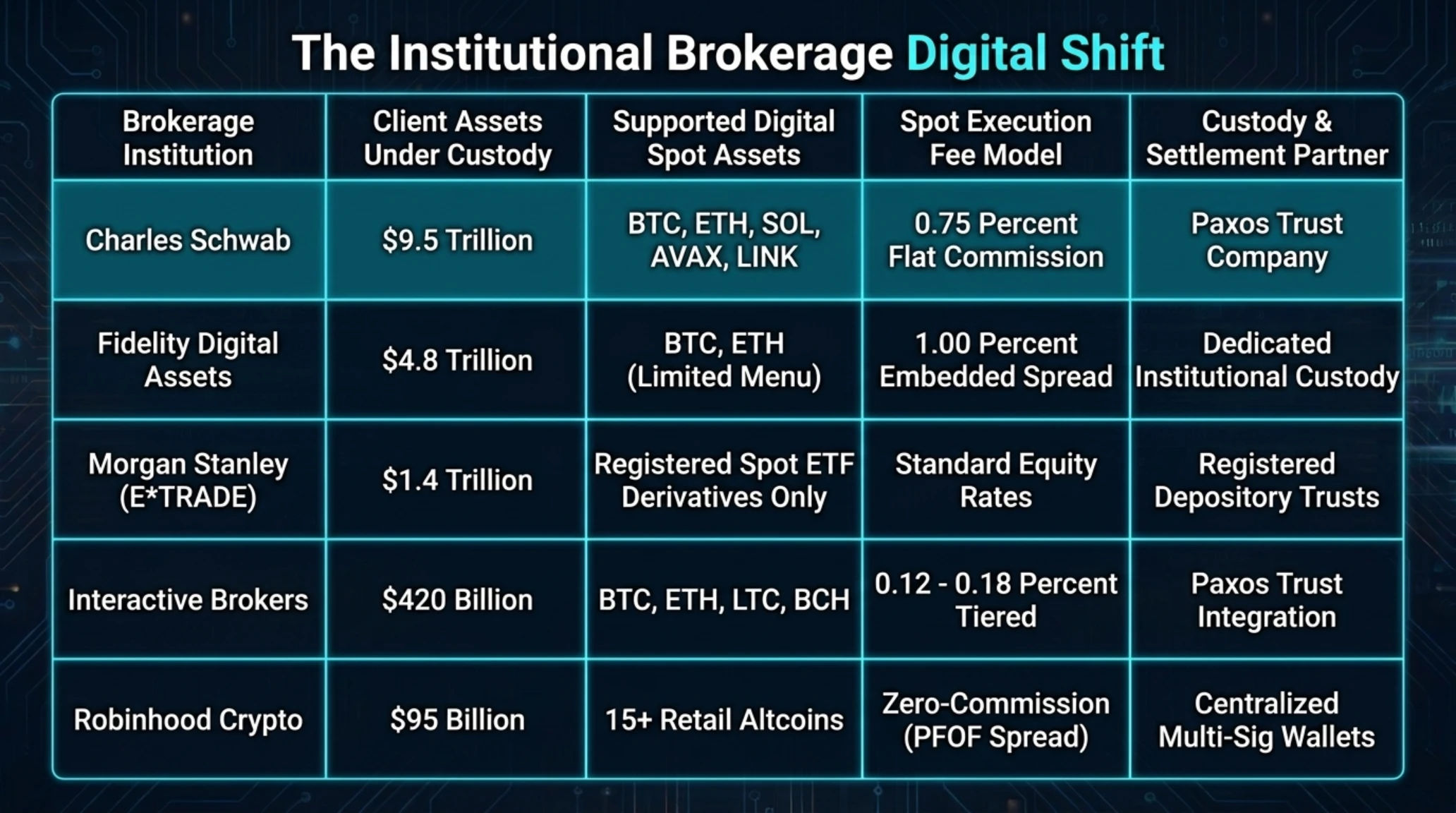
In a monumental validation of decentralized computing infrastructure by Wall Street old guard, brokerage giant Charles Schwab, which oversees $9.5 trillion in client assets across 50 million active brokerage accounts, officially expanded its digital asset trading capabilities. Schwab announced that beginning immediately, self-directed retail and institutional clients can buy, hold, and sell spot Solana (SOL), Avalanche (AVAX), and Chainlink (LINK) directly within their primary brokerage portfolios alongside traditional equities, mutual funds, and Treasury bills.
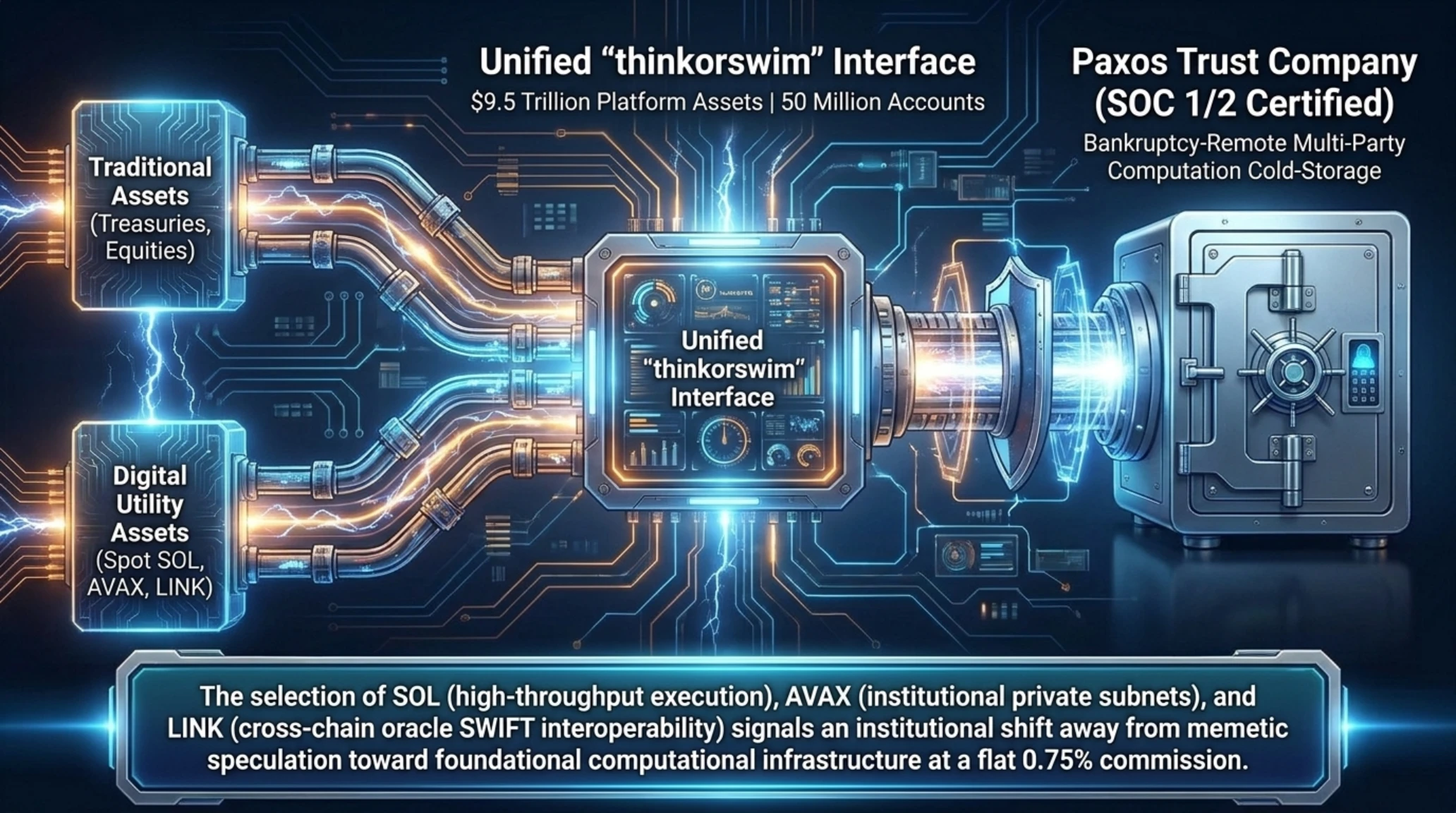
Trading is fully integrated across the Schwab website, standard mobile applications, and its flagship professional active-trader platform thinkorswim. Clients can execute trades at a flat 0.75 percent commission with zero hidden spread markups. Execution, liquidity routing, and regulatory custody are managed in partnership with qualified custodian Paxos Trust Company, ensuring that all digital asset holdings comply strictly with Securities and Exchange Commission (SEC) reserve ratio requirements and institutional bankruptcy-remoteness standards.
The selection of these three specific tokens reflects institutional recognition of differentiated computational utility: Solana serves as the premier high-throughput, sub-second execution engine for consumer decentralized applications; Avalanche represents the leading framework for institutional private subnets and asset tokenization favored by global banks; and Chainlink acts as the de facto decentralized oracle standard and Cross-Chain Interoperability Protocol (CCIP) powering institutional communications between legacy SWIFT banking networks and public blockchains. This decisive deployment affirms that institutional asset managers view these protocols as permanent pillars of global capital markets.
On thinkorswim, active institutional traders gain access to advanced technical charting, algorithmic thinkScript automation, and custom volatility metrics for SOL, AVAX, and LINK pairs against the US dollar. Furthermore, wealth advisors managing retirement accounts (such as Traditional and Roth IRAs) can now allocate strategic portfolio percentages to high-performance crypto infrastructure without forcing clients to manage external hardware wallets or navigate unregulated offshore exchanges. This institutional bridge is anticipated to channel tens of billions in retail retirement capital into public blockchain ecosystems over coming quarters.
From an institutional custody and clearing perspective, Charles Schwab partnership with Paxos Trust Company establishes a rigorous regulatory benchmark for mainstream financial services. Paxos operates under a specialized trust charter granted by the New York State Department of Financial Services (NYDFS), subjecting its digital asset custody operations to the same stringent capital reserve, anti-money laundering (AML), and customer protection statutes that govern tier-one international commercial banks. All client assets are segregated within bankruptcy-remote multi-party computation (MPC) cold-storage vaults, ensuring that in the theoretical event of corporate insolvency, client digital asset holdings cannot be encumbered by general creditors.
Moreover, the strategic selection of Solana, Avalanche, and Chainlink signals an institutional shift away from speculative memetic tokens toward high-utility computational infrastructure. Solana provides the ultra-low-latency execution throughput necessary for institutional high-frequency algorithmic trading strategies; Avalanche multi-subnet framework offers customizable compliance environments tailored to regulated banking consortia; and Chainlink provides the vital cross-chain oracle infrastructure that enables Wall Street smart contracts to ingest verified macroeconomic data, interest rate indices, and foreign exchange feeds. By embedding these foundational network tokens directly into the thinkorswim execution pipeline, Charles Schwab has effectively normalized layer-one blockchain assets as standard portfolio diversifiers for conservative wealth managers.
To analyze the positioning of Charles Schwab against rival Wall Street and digital-native brokerage platforms, the benchmark chart and institutional matrix below detail fee structures, custody partnerships, and asset coverage:
Benchmark Bar Chart & Institutional Brokerage Crypto Matrix
| Brokerage Institution & AUM | Supported Digital Spot Assets | Spot Fee Model & Custody Partner |
|---|---|---|
| Charles Schwab ($9.5 Trillion) | BTC, ETH, SOL, AVAX, LINK | 0.75% Flat Commission (Paxos Trust Custody) |
| Fidelity Digital Assets ($4.8 Trillion) | BTC, ETH (Limited Asset Menu) | 1.00% Embedded Spread (Fidelity Internal Custody) |
| Interactive Brokers ($420 Billion) | BTC, ETH, LTC, BCH | 0.12% to 0.18% Tiered (Paxos Trust Integration) |
While software codebases and financial ledgers experienced rapid transformation, the frontier of autonomous artificial intelligence achieved its most tangible physical triumph on the highways of North America as Tesla expanded commercial driverless transport.
Node 6: Tesla Launches Commercial Driverless Robotaxi Operations Across 275 Square Miles in San Antonio, Texas
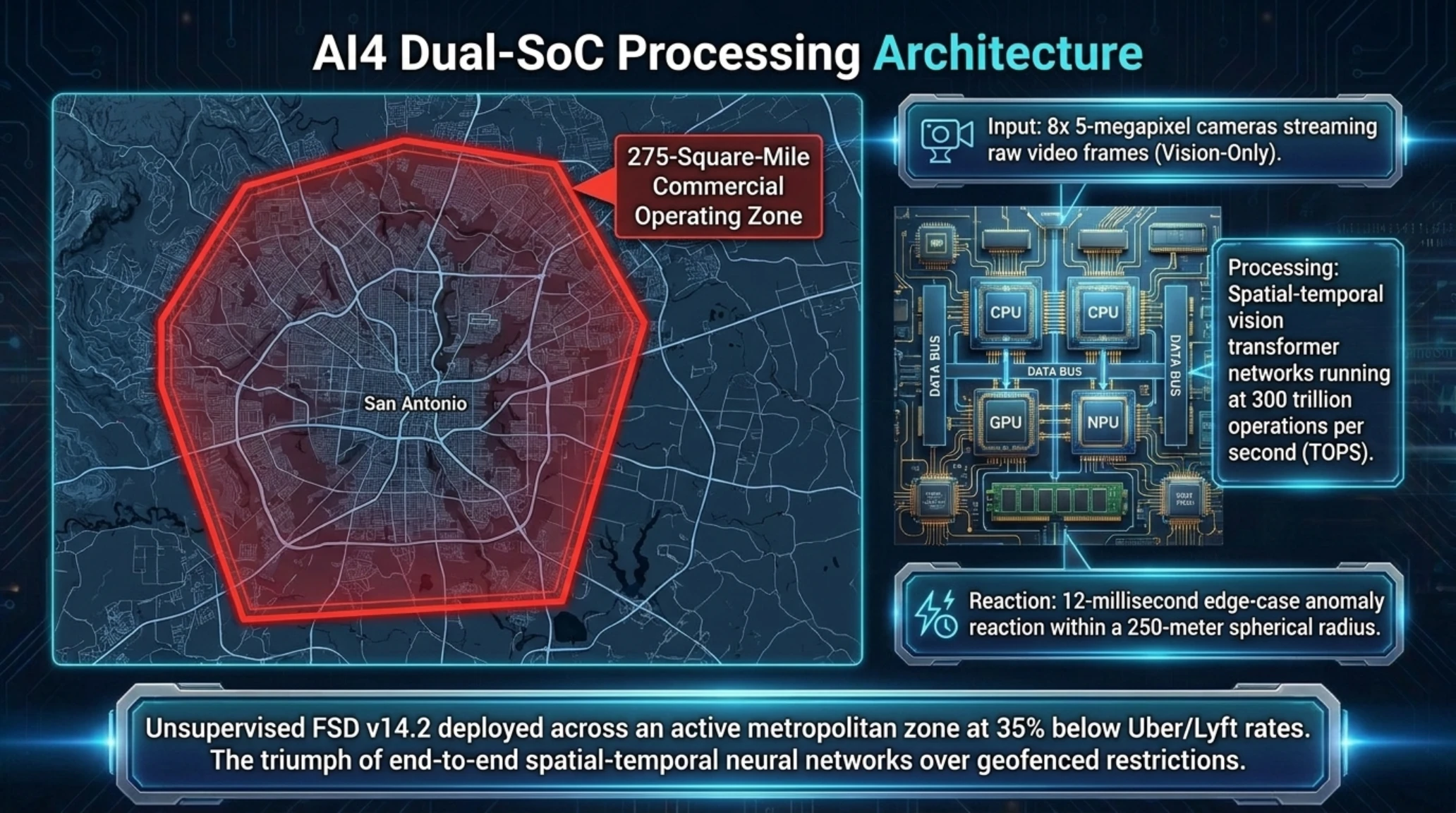
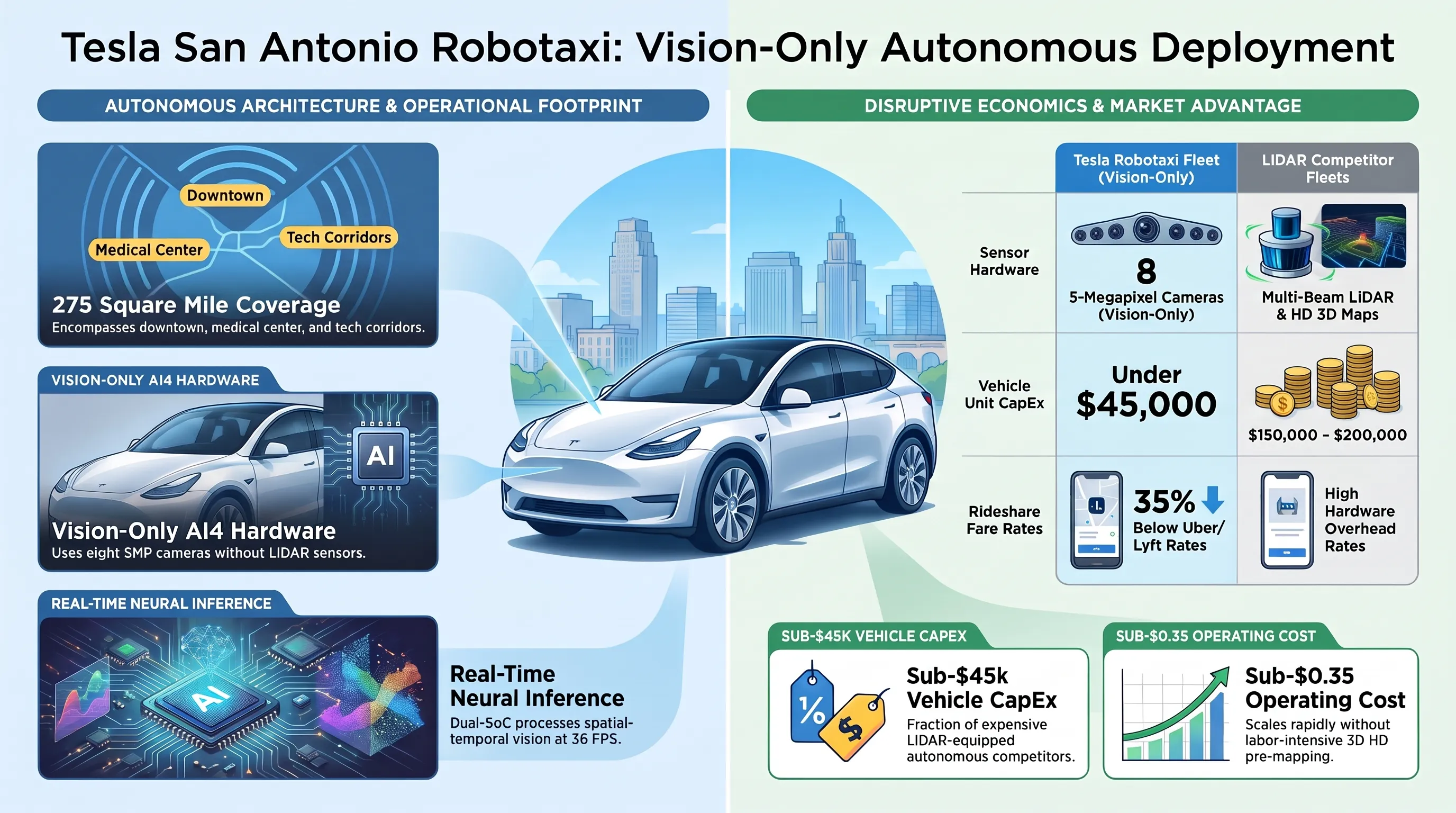
Electric vehicle and physical artificial intelligence pioneer Tesla, under the direction of Elon Musk, officially launched commercial driverless ride-hailing operations for the public in San Antonio, Texas. Operating without human safety drivers in the vehicles, the commercial service immediately unlocked an operational coverage footprint spanning 273 to 275 square miles across the central downtown, Pearl District, medical center, and northern technology corridors of the seventh most populous city in the United States.
The initial commercial fleet consists of hundreds of customized Tesla Model Y vehicles equipped with the latest Hardware 4 (AI4) dual-SoC vehicle computing architecture running production Full Self-Driving (FSD) Unsupervised v14.2. Members of the public can summon autonomous rides through the updated Tesla Rideshare application, with passenger fares averaging approximately 35 percent below prevailing Uber and Lyft rates. San Antonio marks Tesla fifth operational robotaxi market in Texas, following staged expansions in Austin, Dallas-Fort Worth, Houston, and Corpus Christi.
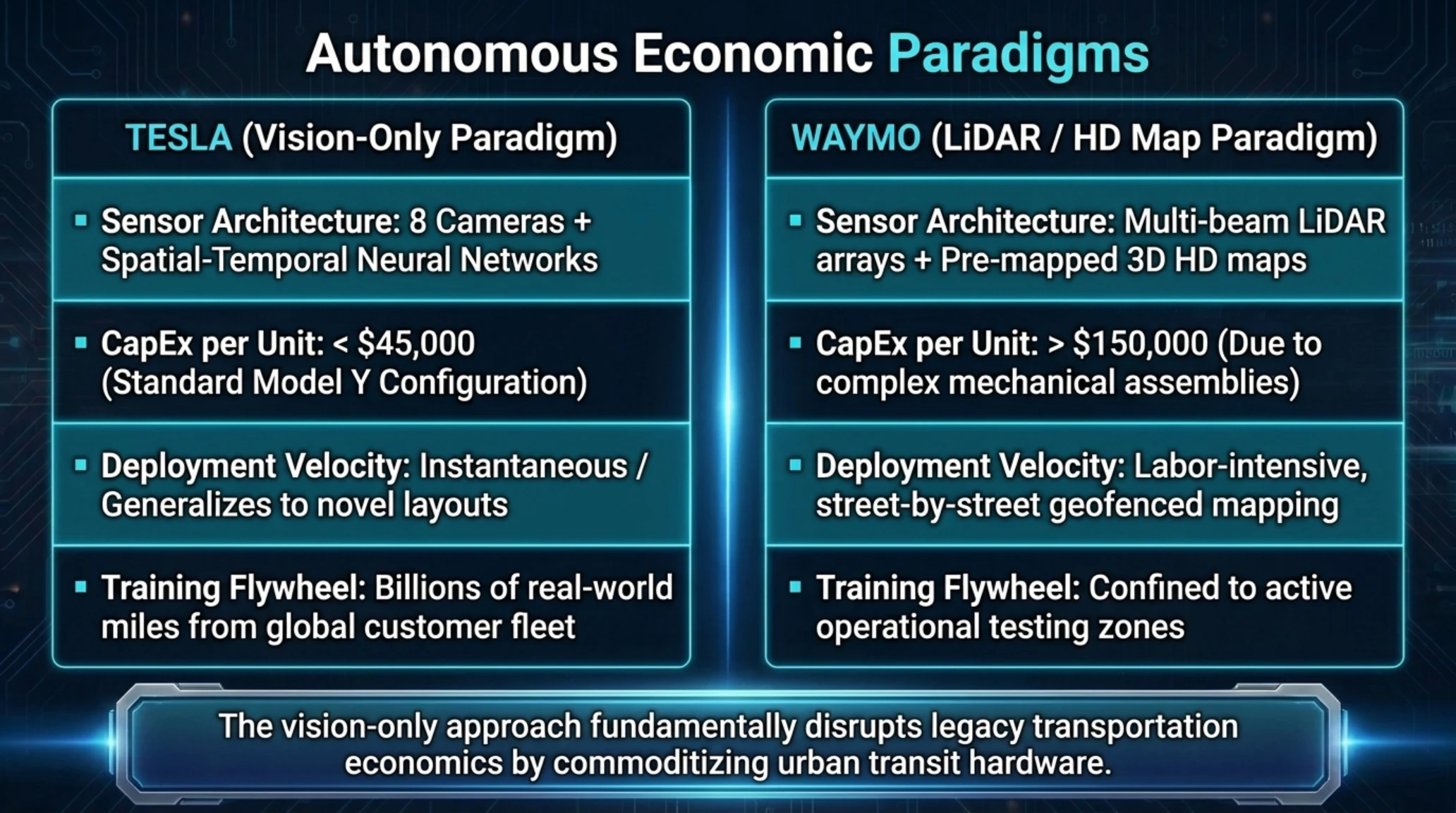
Crucially, Tesla 275-square-mile operating zone represents a dramatic expansion beyond the geofenced operating footprints maintained by rival Alphabet subsidiary Waymo. While Waymo relies on expensive vehicle sensor suites including multi-beam roof-mounted LiDAR arrays and centimeter-accurate pre-mapped 3D HD maps, Tesla navigates exclusively using its vision-only end-to-end neural network architecture. Eight 5-megapixel cameras stream raw video frames directly into spatial-temporal vision transformer networks running locally on the vehicle dual AI chips, translating raw photons directly into steering, acceleration, and braking control outputs.
The vehicle inference engine executes neural models at 36 frames per second, processing 300 trillion operations per second with total redundancy across both independent silicon dies. The occupancy networks maintain a continuous volumetric 3D reconstruction of every dynamic actor, pedestrian, debris fragment, and emergency vehicle within a 250-meter spherical radius, reacting to edge-case anomalies in under 12 milliseconds. By eliminating expensive LiDAR hardware and costly pre-mapping logistics, Tesla has driven the capital hardware expenditure of its robotaxi units to a fraction of rival autonomous vehicles, unlocking unprecedented commercial scalability across new metropolitan regions.
Under the hood of the San Antonio commercial fleet, Tesla Model Y vehicles are powered by the custom Hardware 4 (AI4) computing platform, designed from the silicon die level to execute spatial-temporal vision transformer networks with ultra-low thermal dissipation. The compute architecture features two independent system-on-chip assemblies running in active-active lockstep redundancy, with each SoC incorporating 16 CPU cores, a high-throughput neural processing engine, and dedicated image signal processors (ISPs). Operating in the intense thermal environment of southern Texas where ambient highway temperatures regularly exceed 100 degrees Fahrenheit, the AI4 enclosure is integrated directly into the vehicle liquid glycol cooling loop, ensuring sustained neural inference without thermal throttling.
The operational economics of Tesla vision-only fleet are fundamentally disrupting legacy transportation models. While competing autonomous vehicle platforms incur capital expenditures exceeding $150,000 to $200,000 per unit due to complex mechanical LiDAR assemblies and redundant sensor pods, a production Tesla Model Y configured for commercial robotaxi service carries a capital equipment cost below $45,000. Furthermore, because Tesla neural networks are trained on billions of real-world driving miles collected from customer vehicles globally, the system generalizes instantaneously to novel urban roadway layouts, dynamic construction zones, and unexpected traffic detours without requiring months of tedious pre-mapping surveys. At an operating cost projected below $0.35 per vehicle mile, Tesla commercial deployment in San Antonio establishes a scalable economic model capable of undercutting human-driven rideshare services while maintaining extraordinary operational gross margins.
Market Sentiment Thermometer | Circular Gauge & Robotaxi Adoption S-Curve
Adoption Thermometer Analysis: Eliminating mechanical LiDAR arrays and undercutting legacy rideshare fares by 35% has propelled Tesla's autonomous unit-economic efficiency index to 89% across Texas metropolitan corridors.
Transportation economists project that Tesla aggressive rollout will accelerate the commoditization of urban transportation, initiating profound shifts in commercial fleet economics and individual vehicle ownership patterns across North America and global automotive markets.
Node 7: Strategic Synthesis and Architectural Horizon: The Intersection of Silicon Security, Cloud Resilience, and Physical Autonomy
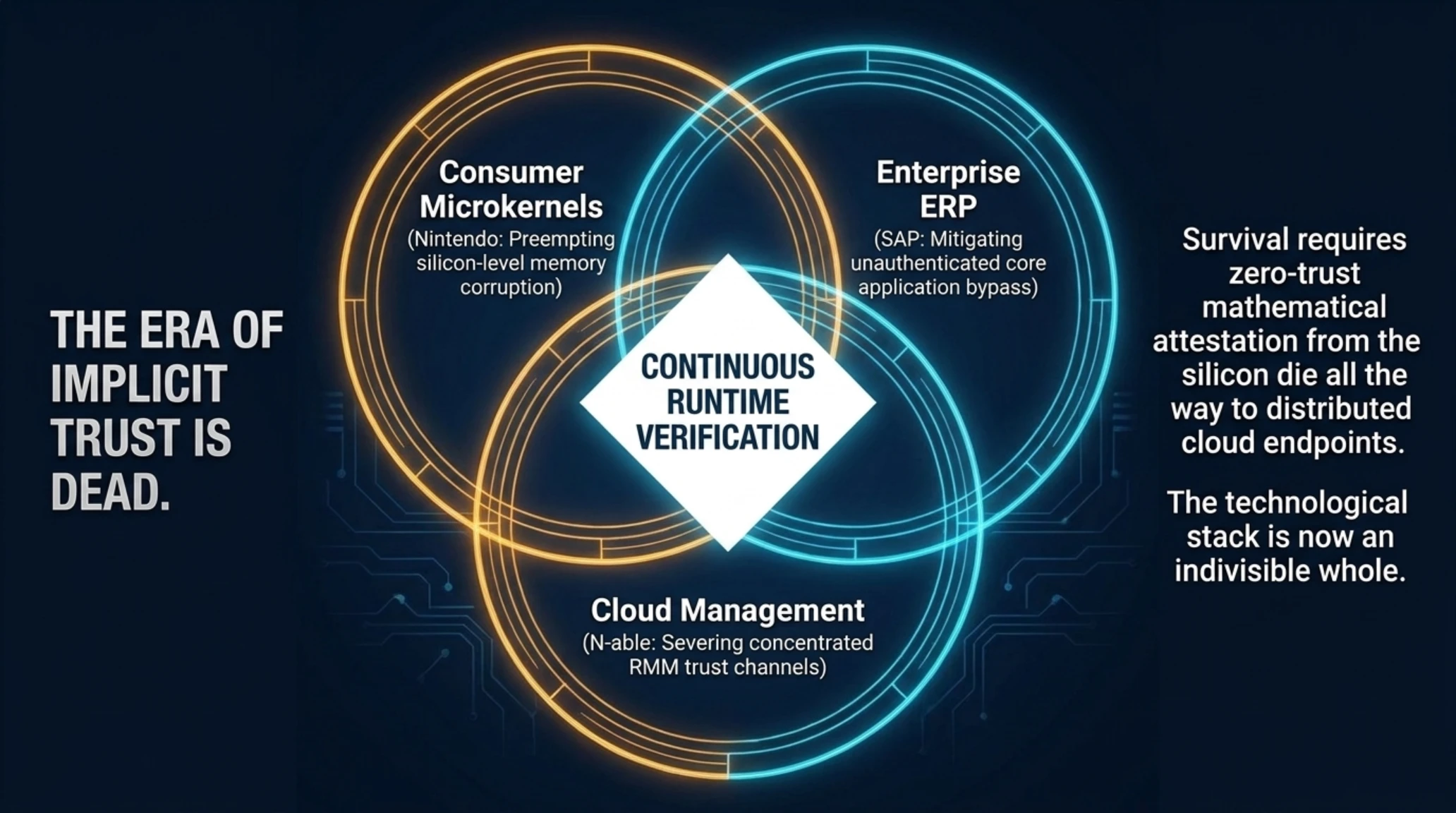
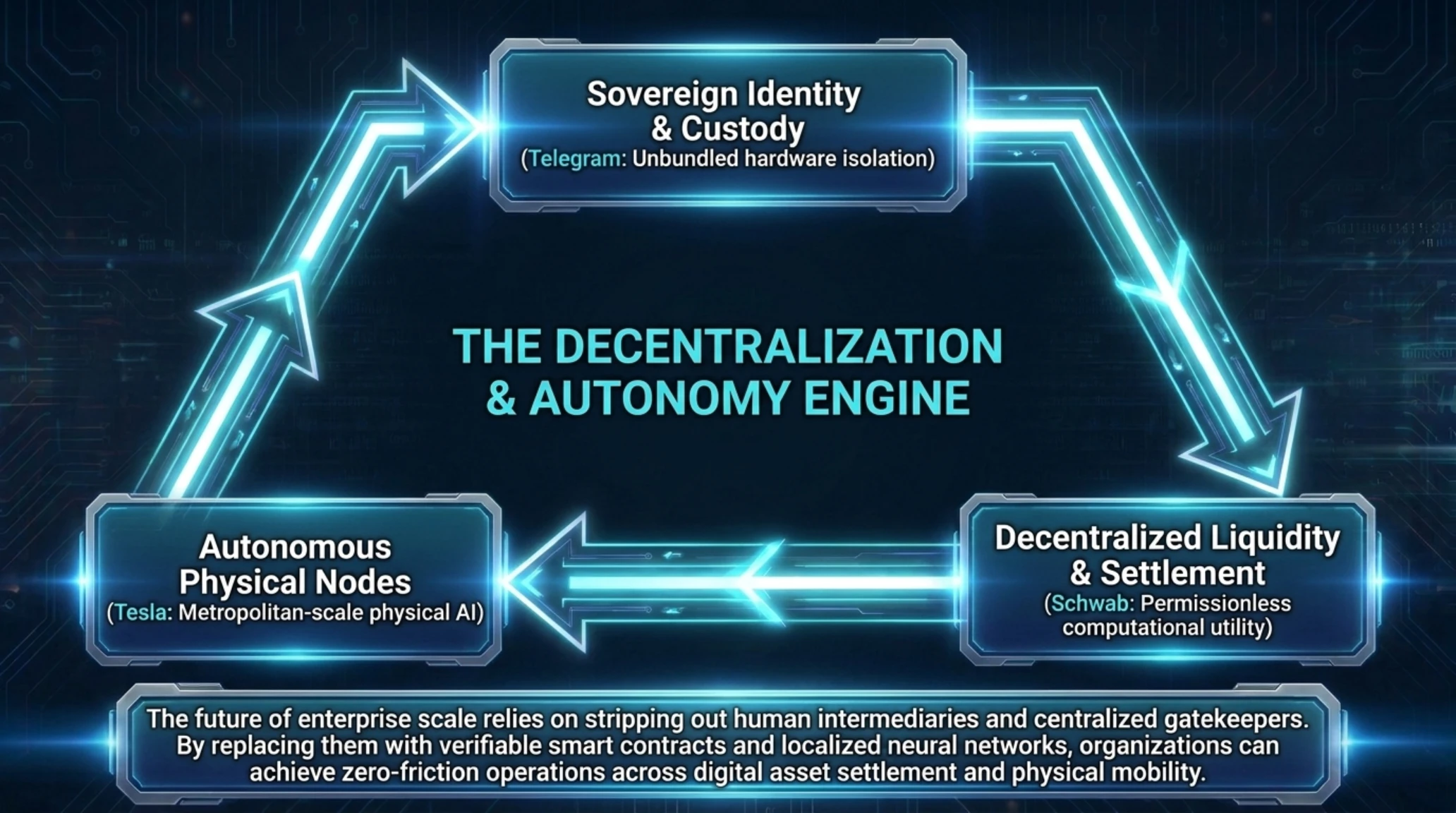
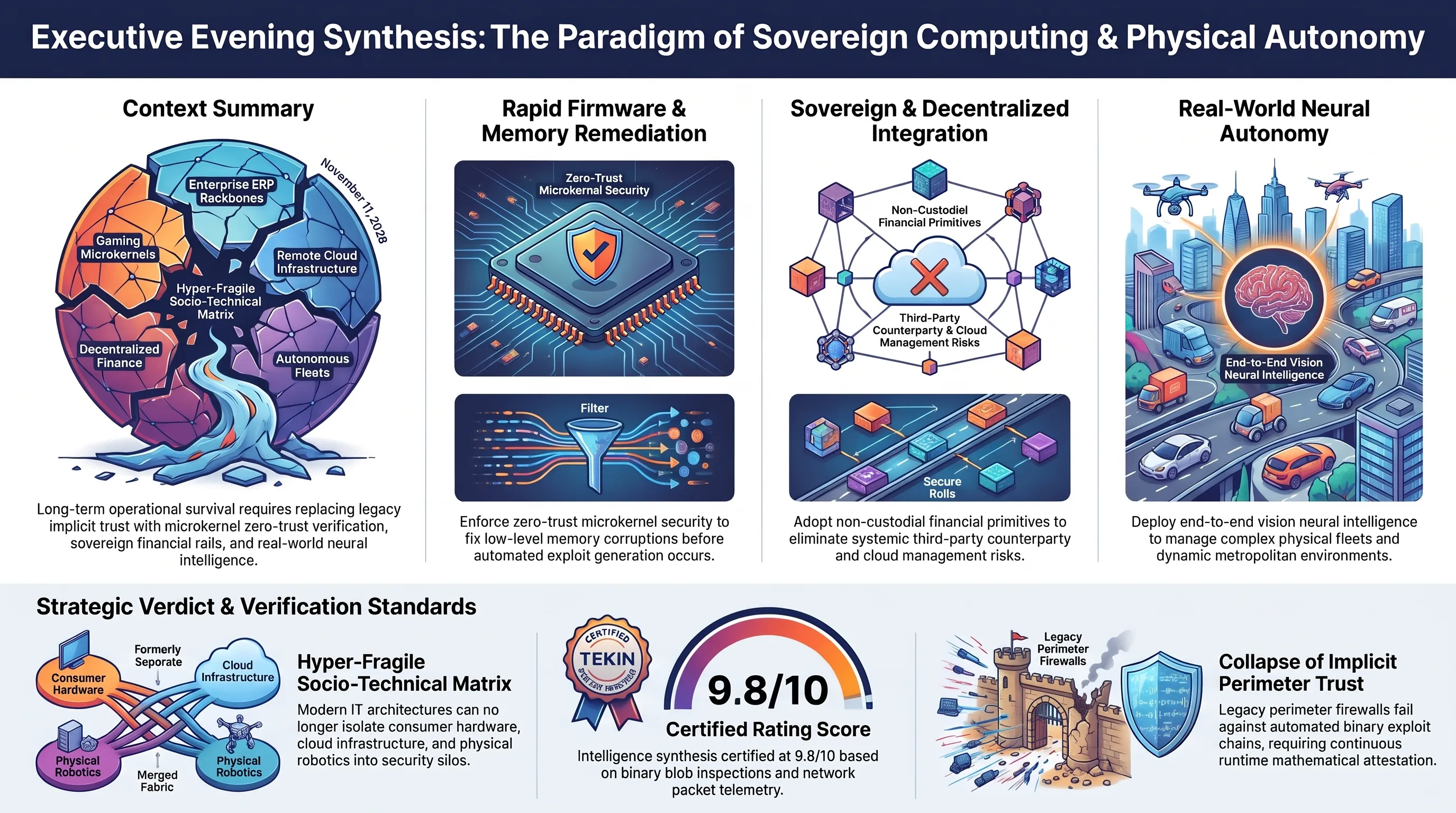
Synthesizing the six critical developments of Wednesday evening, November 11, 2026, illuminates a profound architectural reality: the modern computing paradigm has evolved beyond isolated software silos into an organically unified, hyper-fragile socio-technical matrix. When low-level filesystem vulnerabilities within consumer gaming consoles are evaluated under the exact same zero-trust mathematical disciplines that govern enterprise ERP system-level vulnerabilities, it becomes evident that silicon security and firmware integrity have become universal currencies across modern engineering.
Concurrently, the emergency cloud shutdown executed by N-able delivers a stark warning regarding the perils of concentrated third-party remote management trust. In response to these vulnerabilities, the technological zeitgeist is rapidly driving autonomy: Telegram Wallet unbundled its architecture to grant sovereign cryptographic custody to smartphone users; Charles Schwab capitulated to institutional demand for decentralized settlement rails; and Tesla liberated vehicles from human cognitive reaction constraints to deploy scalable autonomous intelligence across physical metropolitan roadways.
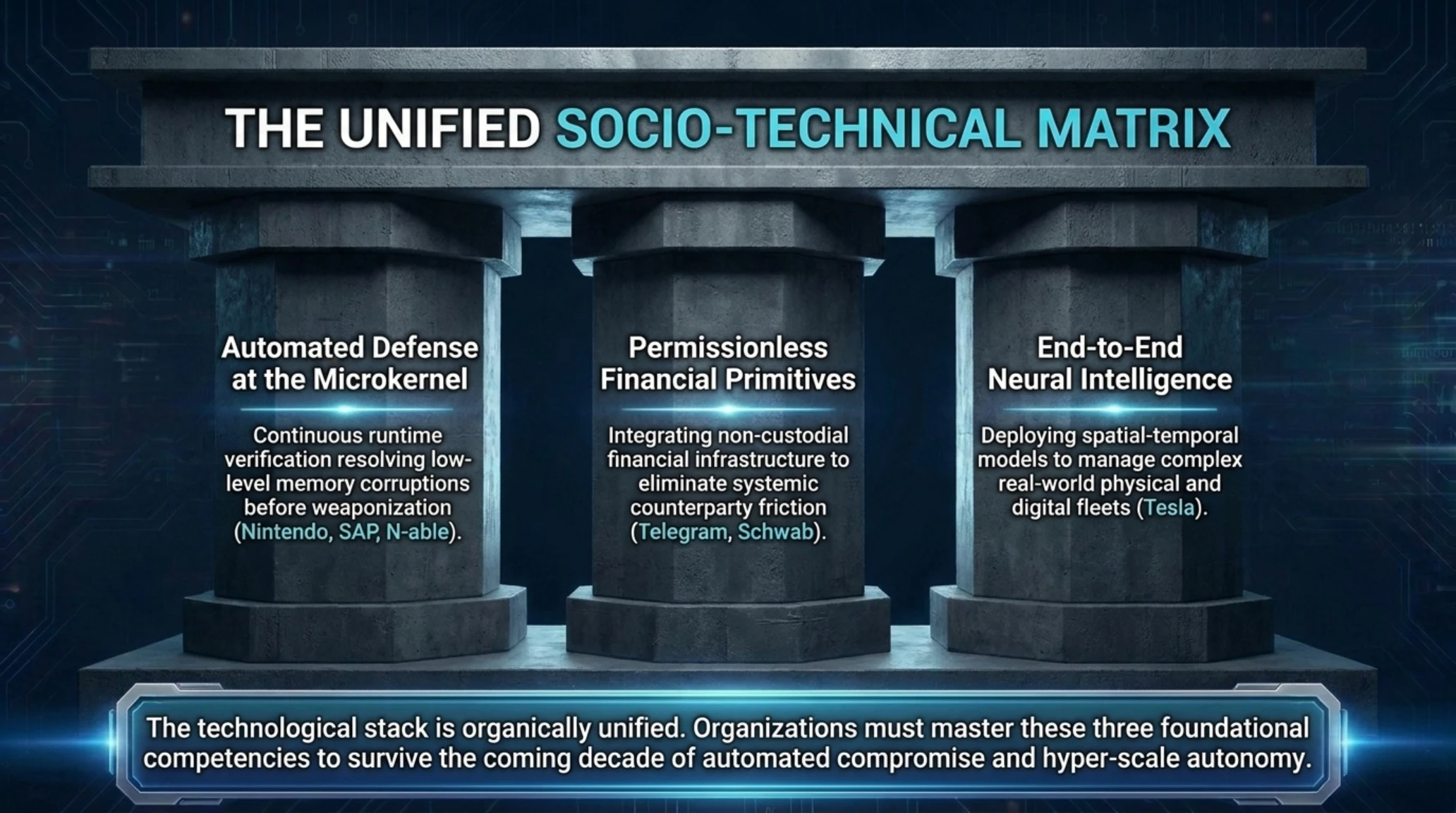
The enterprise winners of the coming decade will be organizations that master three foundational competencies: the velocity to remediate low-level firmware and software memory corruptions before weaponization; the strategic foresight to integrate decentralized, non-custodial financial infrastructure that eliminates systemic counterparty friction; and the technical bravery to deploy end-to-end neural intelligence across real-world physical operations.
Financial Telemetry, Growth Projections & Market Share Dashboard
| Strategic Market Sector | Capital Flow Share | Primary Q4 2026 Growth Catalyst |
|---|---|---|
| Institutional Crypto & Web3 Super-Apps | 45 Percent | Charles Schwab spot altcoin launch and Telegram Wallet unbundling |
| Autonomous Mobility & Vision AI Fleets | 32 Percent | Tesla 275-square-mile driverless Robotaxi expansion in San Antonio |
| Enterprise ERP & RMM Zero-Trust Hardening | 23 Percent | Emergency remediation of SAP CVSS 10.0 flaws and N-central isolation |
Moreover, the simultaneous convergence of these events underscores that architectural resilience is no longer an isolated discipline confined to the server room or software quality assurance team. As autonomous neural networks increasingly govern both digital value transfers and real-world physical transit, organizations must implement continuous runtime verification across every tier of their infrastructure.
- Preemptive Switch 2 filesystem jailbreak mitigation paired with eShop Family Group gifting.
- Decisive N-able cloud circuit-breaker containment preventing a global MSP ransomware catastrophe.
- Democratization of tokenized equities and spot altcoins via Telegram Wallet and Charles Schwab.
- 35% reduction in urban ride-hailing fares across 275 square miles via Tesla's vision-only Robotaxi fleet.
- Acute enterprise exposure from four unauthenticated CVSS 10.0 vulnerabilities in SAP NetWeaver.
- Severe operational disruption for thousands of MSPs following N-central's emergency cloud shutdown.
- Restriction of Nintendo eShop digital gifting exclusively to pre-established 8-member Family Groups.
Editorial Verdict and Verified Reference Index
The Fusion of Microkernel Security and Autonomous Economics
The events of November 11, 2026 prove that long-term operational survival belongs to enterprises that embed zero-trust verification at the microkernel layer, embrace permissionless financial primitives, and harness localized machine intelligence across physical fleets.
- IGN: Official Release Documentation for Nintendo Switch & Switch 2 Firmware 23.5.0 and eShop Gifting
- The Hacker News: November 2026 SAP Security Patch Day Bulletin Analyzing Four Maximum CVSS 10.0 Flaws
- BastionZero: Forensic Disclosure of Able2Shell 33 Zero-Day Exploit Chain and N-central Cloud Shutdown
- Decrypt: Telegram Wallet Unbundles into Standalone Non-Custodial Super-App with Tokenized Equities
- CryptoSlate: Charles Schwab Launches Direct Spot Trading for Solana, Avalanche, and Chainlink
- Mashable: Operational Coverage of Tesla Commercial Driverless Robotaxi Launch Across 275 Sq Mi in Texas
Technical Frequently Asked Questions and Evening Intelligence Briefing
Can digital games be gifted to any friend on the eShop following Nintendo firmware 23.5.0?
No. To mitigate credit card fraud, stolen credential laundering, and regional currency arbitrage, Nintendo strictly restricted digital game gifting exclusively to members of an authenticated Family Group (maximum 8 members) with identical store currencies, active starting November 17, 2026.
Why were the four SAP vulnerabilities assigned the maximum possible CVSS 10.0 severity rating?
These flaws allow unauthenticated remote attackers to execute arbitrary system-level code or bypass SAML 2.0 digital signature verification without requiring valid credentials or user interaction, granting complete administrative control over core corporate NetWeaver and Web Dispatcher servers.
What is the Able2Shell exploit repository and why did N-able take Hosted N-central offline?
Able2Shell was a public GitHub release containing 33 chainable zero-day exploits impacting N-central. Because compromised RMM servers could allow attackers to distribute automated ransomware across tens of thousands of corporate client endpoints, N-able immediately severed cloud connectivity to protect tenant networks.
How does the standalone Telegram Wallet application differ from the embedded messaging bot?
The standalone app runs as a native iOS/Android mobile application independent of Telegram, uses Apple and Google biometrics to secure private keys inside hardware Secure Enclaves, and introduces 24/7 trading for tokenized real-world Wall Street equities and perpetual commodity futures.
Which cryptocurrencies are supported in Charles Schwab's spot trading rollout and what are the fees?
Alongside Bitcoin and Ethereum, Charles Schwab enabled direct spot trading for Solana (SOL), Avalanche (AVAX), and Chainlink (LINK) across thinkorswim and standard accounts at a flat 0.75% commission, with regulated custody managed by Paxos Trust Company.
What territory does the Tesla Robotaxi service cover in San Antonio and how does its sensor architecture compare to Waymo?
The commercial service covers a vast 275-square-mile zone across central and northern San Antonio. Unlike Waymo, which relies on costly roof-mounted LiDAR sensors and centimeter-accurate 3D HD maps, Tesla navigates exclusively using eight 5-megapixel cameras and end-to-end spatial-temporal neural networks.
Additional Gallery: Tekin Night Nov 11: Switch 2 Patch, SAP 10.0 Flaws & Tesla