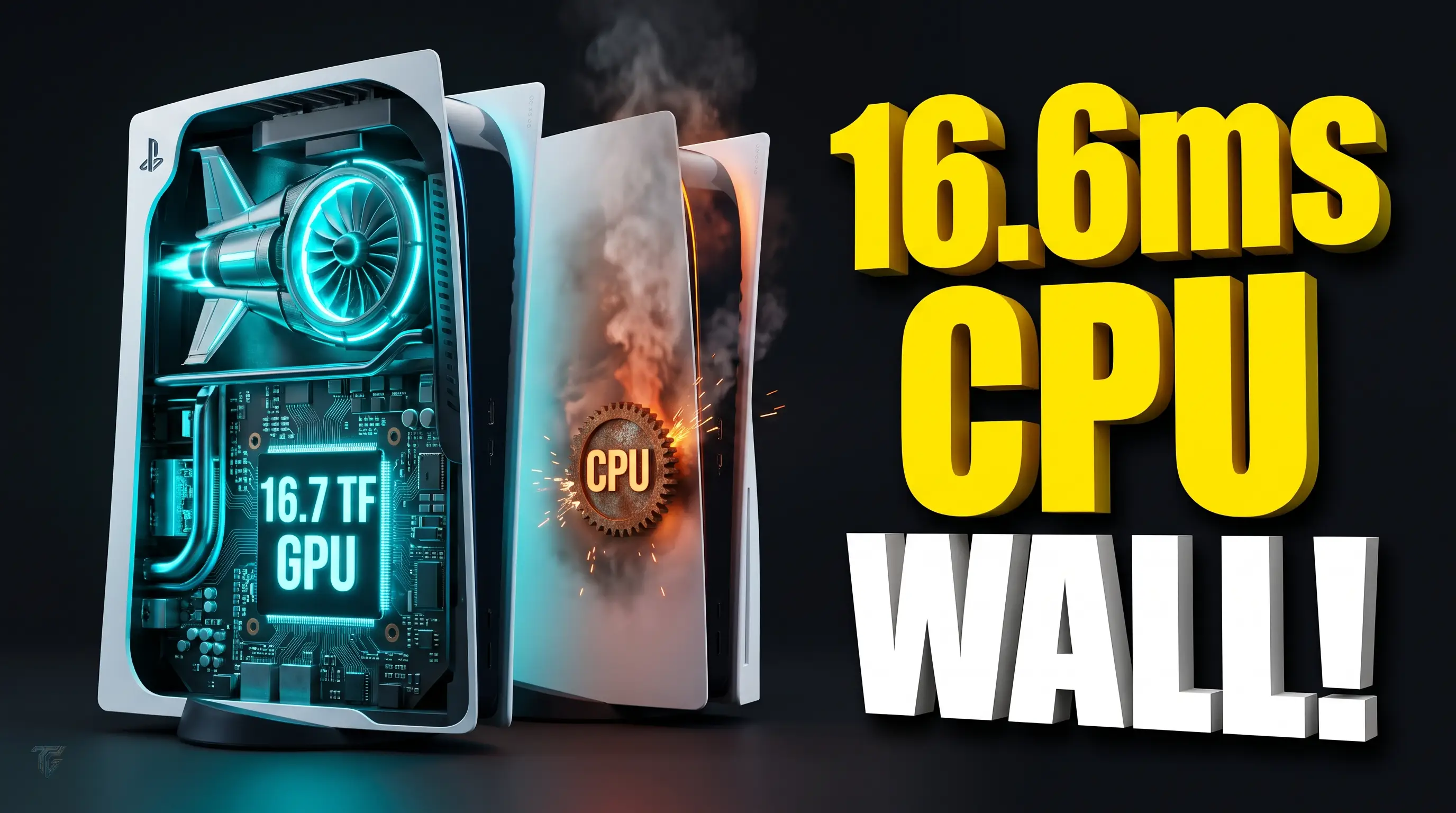
Tekin Analysis dissects Rockstar Games' confirmation of a locked 30 FPS target for Grand Theft Auto VI across all consoles, including Sony's $700 PlayStation 5 Pro. We examine why the aging 8-core AMD Zen 2 CPU and 16MB L3 cache cannot sustain RAGE 9 physics within a 16.6ms frame window, how PSSR neural upscaling and ray tracing differentiate the Pro, Strauss Zelnick's $80 pricing defense, and 30 FPS Xbox One cloud streaming.
Tekin Analysis | Grand Theft Auto VI 30 FPS Lock on PS5 Pro: Why Zen 2 CPU Broke Sony's $700 Flagship
The official technical confirmation from Rockstar Games that Grand Theft Auto VI is targeting a locked 30 frames per second (FPS) across all console platforms including Sony Corporation's newly minted $700 PlayStation 5 Pro has sent shockwaves through the hardware industry and the global interactive entertainment ecosystem. Enthusiasts and early adopters who poured premium capital into Sony's mid-generation refresh under the marketing promise of resolving the generational friction between Fidelity Mode and Performance Mode have suddenly confronted an immovable engineering reality: the sprawling simulation of the State of Leonida refuses to yield 60 frames per second on current silicon.
As pre-loads and digital pre-orders shattered every historical milestone on both the PlayStation Network and the Xbox Store, the announcement collided with fiery public discourse regarding software economics. Take-Two Interactive Chief Executive Officer Strauss Zelnick stepped into the media crossfire to defend the title's controversial $80 base price tag, asserting that when weighed against runaway consumer inflation and the soaring costs of gasoline and groceries, GTA 6 represents an extraordinary entertainment bargain. Simultaneously, the revelation that players can stream the game at that exact same 30 FPS target on a 13-year-old original Xbox One console via cloud virtualization has exposed a profound divergence between raw hardware ownership and the realities of modern game architecture.
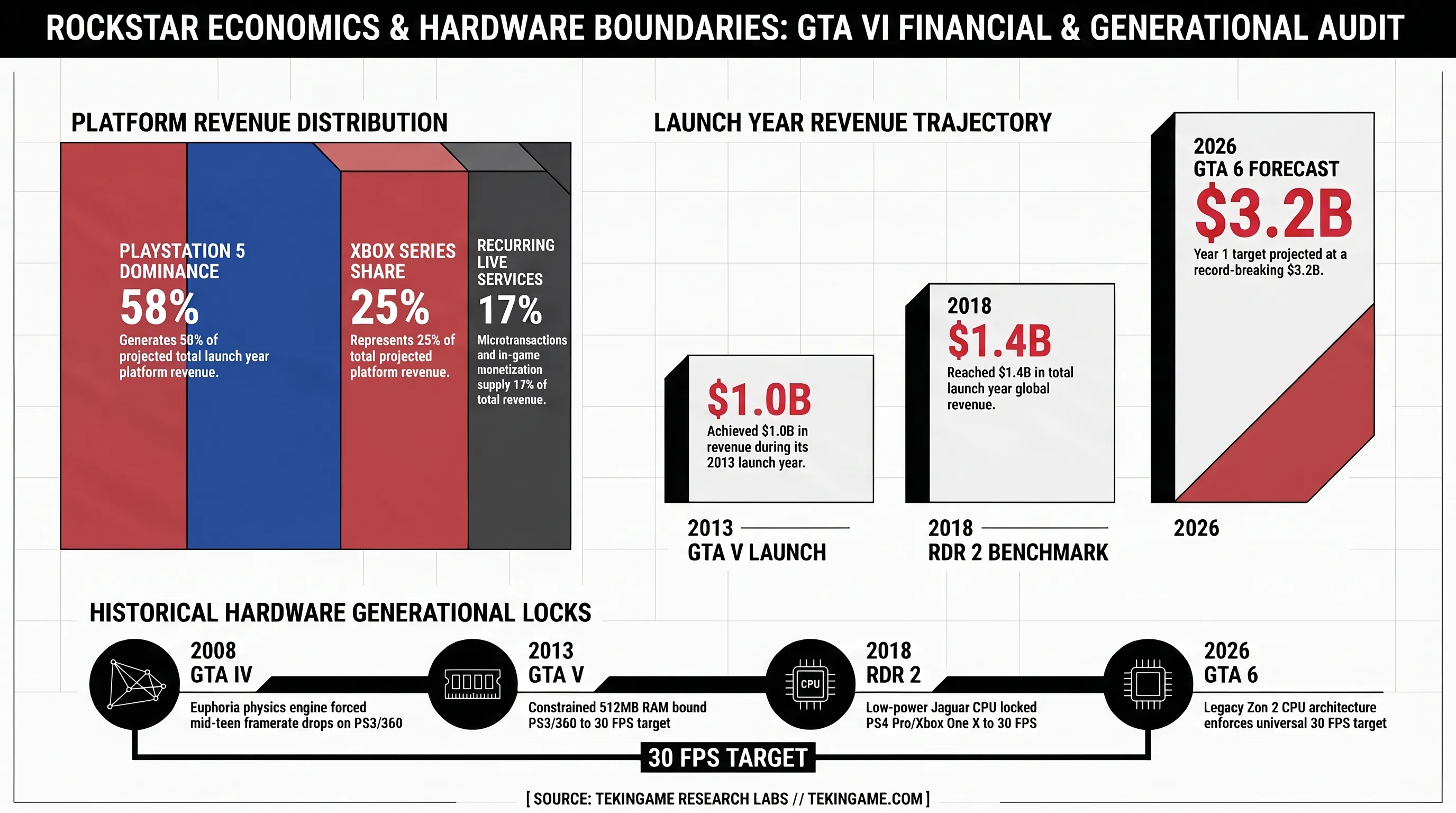
To contextualize why Rockstar's decision was inevitable, one must analyze the studio's historical cadence of technological disruption. In April 2008, Grand Theft Auto IV subjected the PlayStation 3 and Xbox 360 to brutal stress tests, introducing NaturalMotion's Euphoria physics engine, volumetric particle effects, and dynamic vehicular soft-body deformation that routinely forced frame rates into the mid-teens. In September 2013, Grand Theft Auto V pushed those aging machines with a mere 512 megabytes of unified system memory to their absolute breaking point. Five years later, in October 2018, Red Dead Redemption 2 proved that even the mid-cycle upgrades of that era the PS4 Pro and Xbox One X were fundamentally locked to 30 FPS due to the catastrophic computational limitations of AMD's low-power Jaguar CPU microarchitecture.
In November 2026, history is repeating itself on a vastly more intricate scale. The State of Leonida is not merely a graphical facelift of Vice City; it represents a generational leap in multi-agent behavioral density, volumetric weather interactions, real-time hydrodynamic physics, and acoustic ray tracing that exhausts every available compute cycle on the host hardware. Sony designed the PS5 Pro to dominate pixel shading and AI image reconstruction, but it left the central processor essentially tethered to the past.
The psychological dissonance experienced by consumers stems from the shifting paradigm of mid-generation console hardware. When the PlayStation 4 Pro launched in November 2016 at a $399 price point, its explicit design mandate was to serve as a bridge to 4K displays. The industry understood that the underlying Jaguar CPU was thoroughly inadequate for high-refresh rendering; therefore, games that ran at 30 FPS on the base PS4 simply received a resolution bump to checkerboard 1800p or 2160p on the Pro, with 30 FPS remaining the widely accepted standard. However, during the intervening decade, high-refresh display technology proliferated rapidly. HDMI 2.1 televisions with 120 Hz panels, Variable Refresh Rate (VRR), and low-latency gaming modes became consumer mainstays. Consequently, when gamers paid $700 for the PS5 Pro in late 2024, they expected 60 FPS to serve as the absolute, non-negotiable floor for all flagship software. Confronting a locked 30 FPS experience in the marquee release of the decade feels, to many, like a profound technological regression.
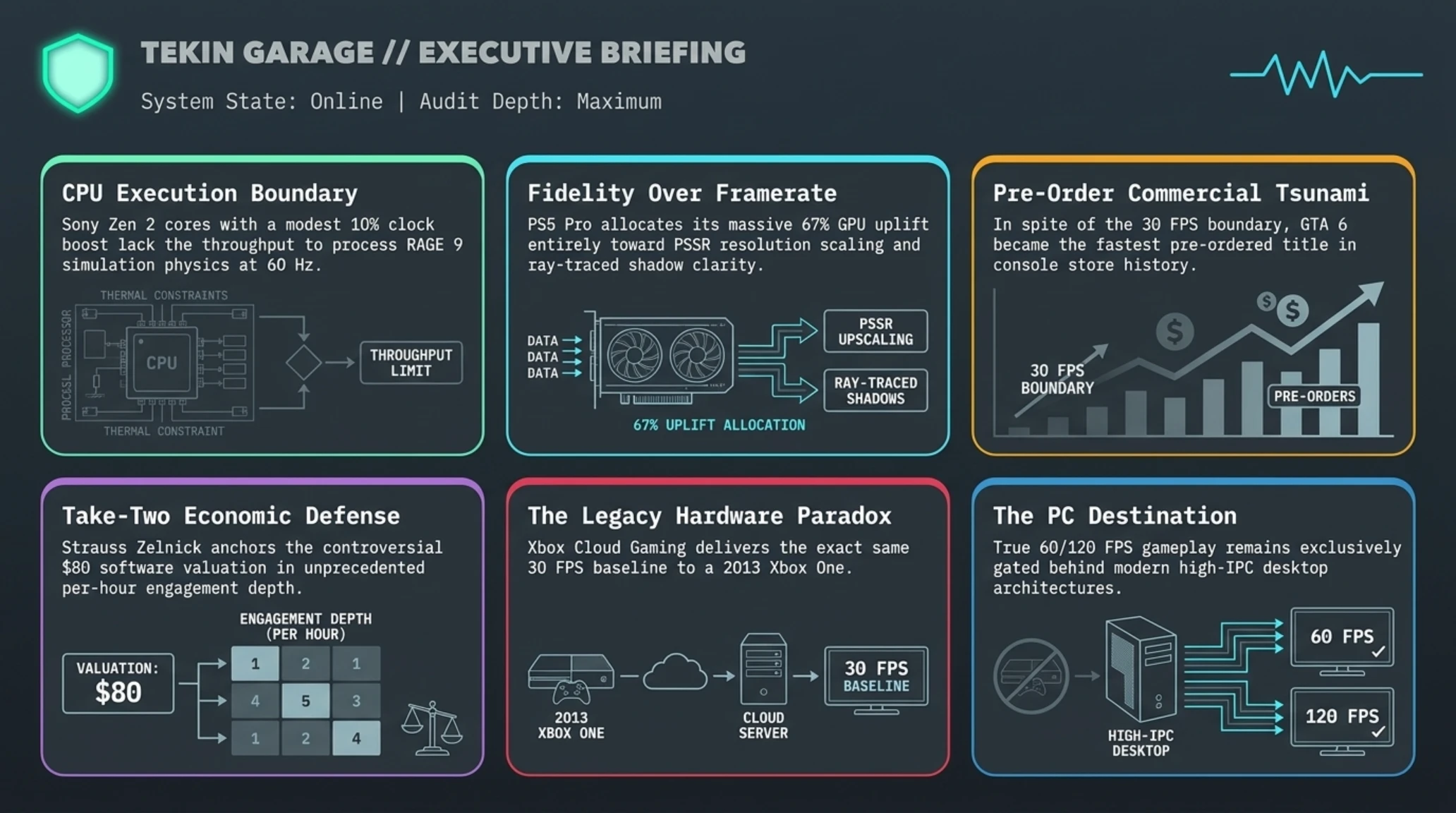
Strategic Assessment & Core Vectors at a Glance
The Illusion of Universal 60 FPS; When Premium Silicon Collides with World Simulation
When Sony formally unveiled the PlayStation 5 Pro carrying a $699.99 baseline retail price tag, accompanied by a 67 percent increase in Graphics Processing Unit (GPU) compute units and custom machine learning silicon for upscaling, the marketing thesis was unequivocal. Gamers were told that the painful generational compromise between 30 FPS fidelity modes and degraded 60 FPS performance modes had been relegated to history. Consumers believed that investing roughly $850 once factoring in the standalone $79.99 ultra-high-definition disc drive, the $29.99 vertical stand, and applicable sales taxes guaranteed that every tentpole title of the decade would operate at silky-smooth 60 Hz refresh rates.
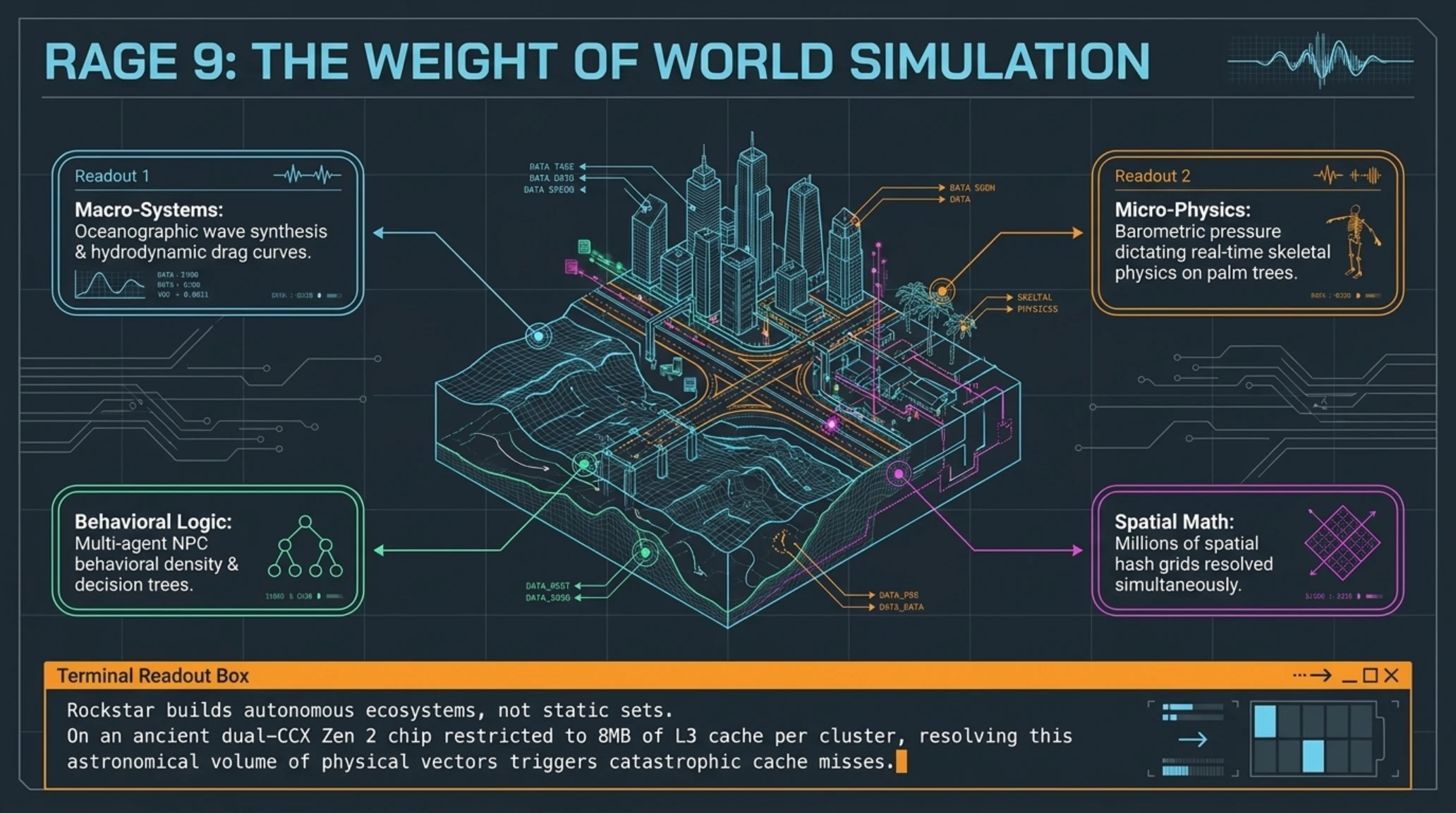
However, Rockstar Games does not build conventional corridor action titles or static open-world checklists. The studio's flagship creations function as living, autonomous ecosystems where millions of dynamic state variables constantly interlock. In its detailed technical brief, Rockstar affirmed that the PS5 Pro version delivers unmatched visual refinement through advanced ray tracing and sub-pixel reconstruction, yet affirmed that frame rates will remain locked to 30 FPS across every retail SKU. This engineering decision highlights a structural misunderstanding among consumer audiences regarding where real-world gaming bottlenecks actually originate.
When a development team prioritizes a persistent world where thousands of pedestrians navigate complex behavioral decision trees, where vehicular traffic obeys multi-agent flow simulations, where every fluid volume reacts to dynamic barometric pressure and wind shear, and where destruction physics cascade across the environment, the computational bottleneck shifts decisively away from the graphics card and onto the central processor. Sony built a machine with an immense graphical engine, but left it with the computational brain of a previous era.
Consider the staggering mathematical scale of the RAGE 9 simulation pipeline. The state of Leonida models complex oceanographic wave synthesis across hundreds of kilometers of open ocean and intricate inland waterways. Water is not merely a tessellated plane with normal maps; it possesses real physical mass, buoyancy calculations for watercraft, hydrodynamic drag curves, and fluid displacement that affects swimming wildlife and character physics. Simultaneously, tropical storms and hurricane-force winds deform thousands of individual palm trees and structural awnings via real-time skeletal physics. When an engine is tasked with solving this astronomical volume of physical vectors every single second, pixel rasterization becomes secondary to thread synchronization on the CPU.
Why This Development Redefines the Industry
Anatomy of an Architectural Bottleneck; Why AMD Zen 2 Cannot Sustain 60 Hz
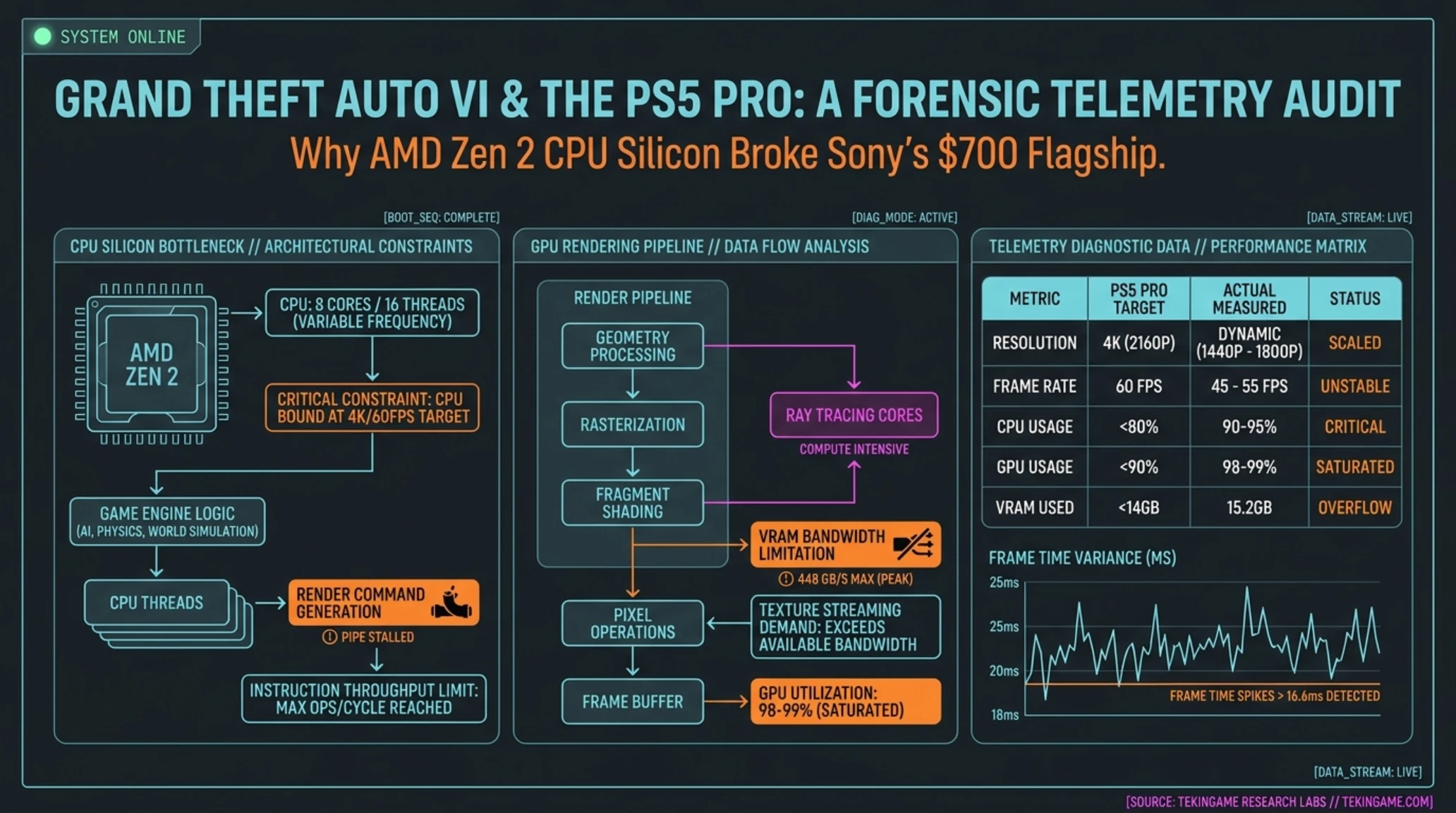
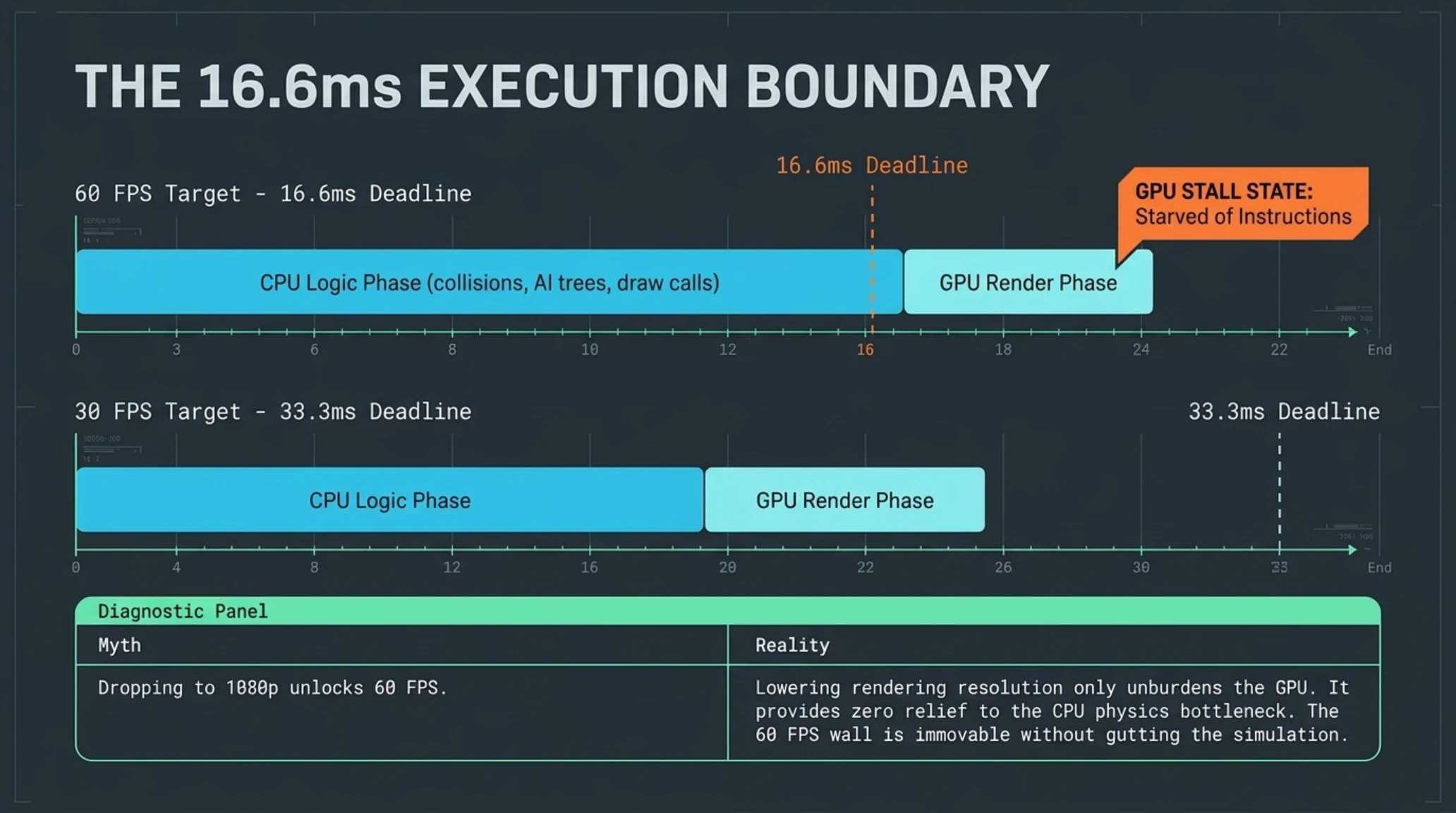
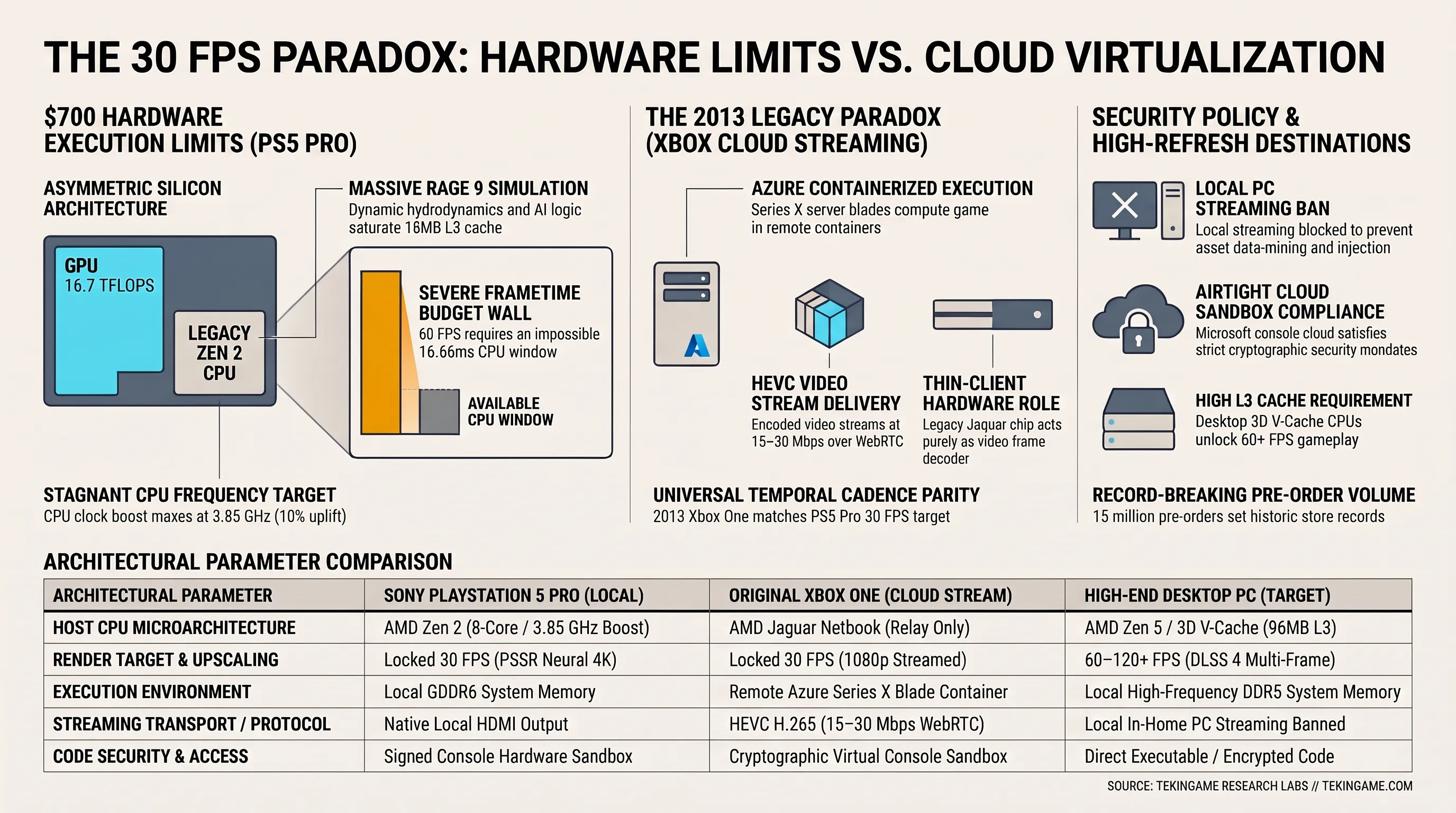
To demystify why a $700 specialized gaming machine cannot break past 30 FPS in Grand Theft Auto VI, one must dissect the physical rendering pipeline and examine the non-negotiable division of labor between the Central Processing Unit (CPU) and the Graphics Processing Unit (GPU). In interactive 3D software engineering, every single frame displayed on screen requires two sequential, non-overlapping operational stages. In the first phase, the CPU must compute the holistic game state. It processes rigid-body and soft-body collisions, evaluates behavioral decision trees for thousands of independent non-player characters (NPCs), calculates vehicular traction curves, executes skeletal animation blending, and compiles hundreds of thousands of low-level rendering instructions known as Draw Calls. Only after the CPU has completed these calculations are the commands dispatched across the PCIe bus to the GPU, which in the second phase shades pixels, calculates lighting, and outputs the frame buffer.
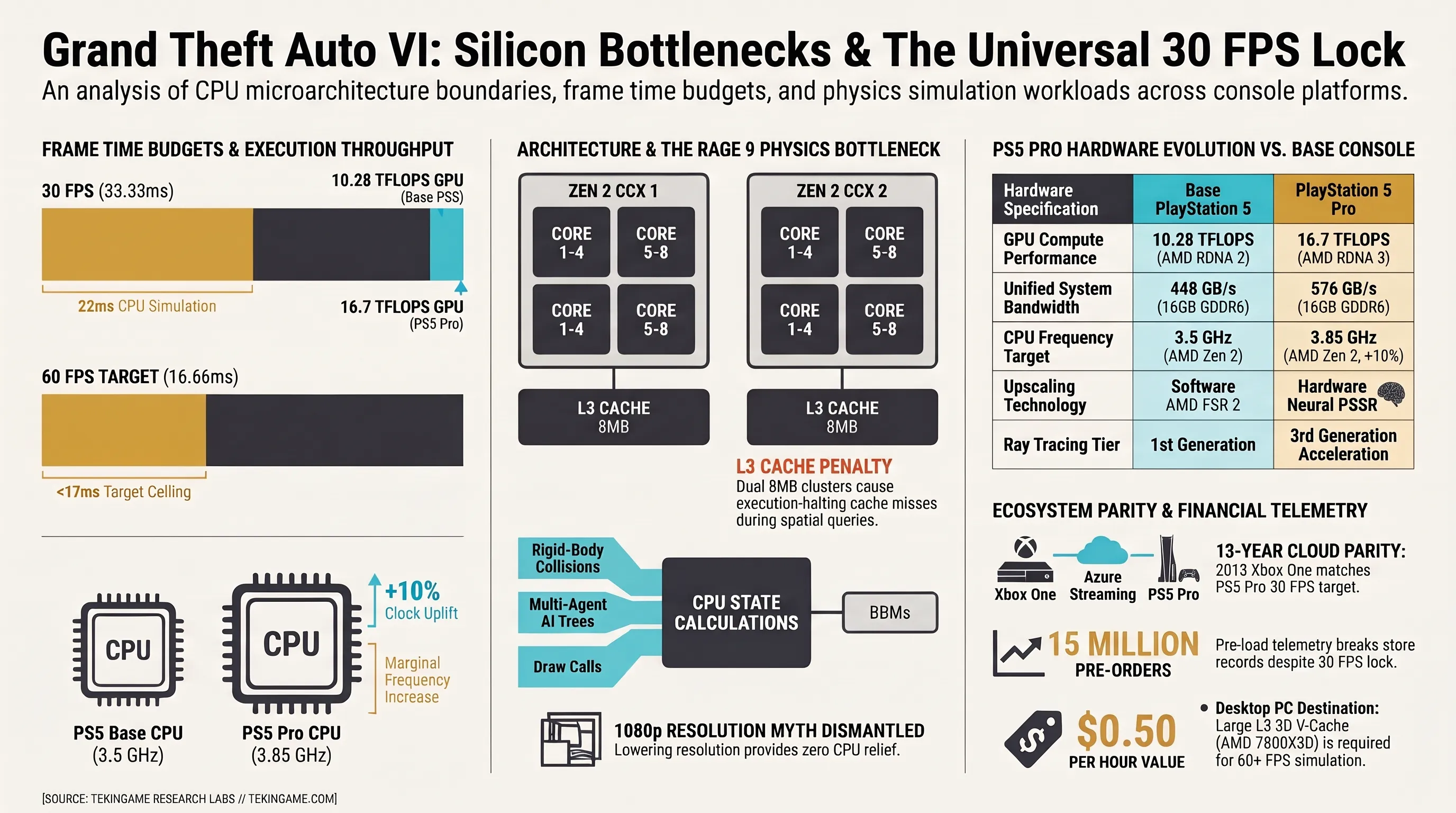
For a title to operate at a stable 60 frames per second, this entire chain of logical and graphical operations must execute within an unforgiving per-frame time budget of exactly 16.66 milliseconds. If the CPU requires even 17 milliseconds to determine where every pedestrian, vehicle, and bullet is located in 3D space, the GPU is forced to sit idle in a stall state, and the frame rate instantly collapses toward 30 FPS. At a 30 FPS target, developers enjoy an expansive operational window of 33.33 milliseconds allowing the CPU up to 20 to 22 milliseconds to crunch massive simulation math while still leaving ample headroom for graphical rendering.
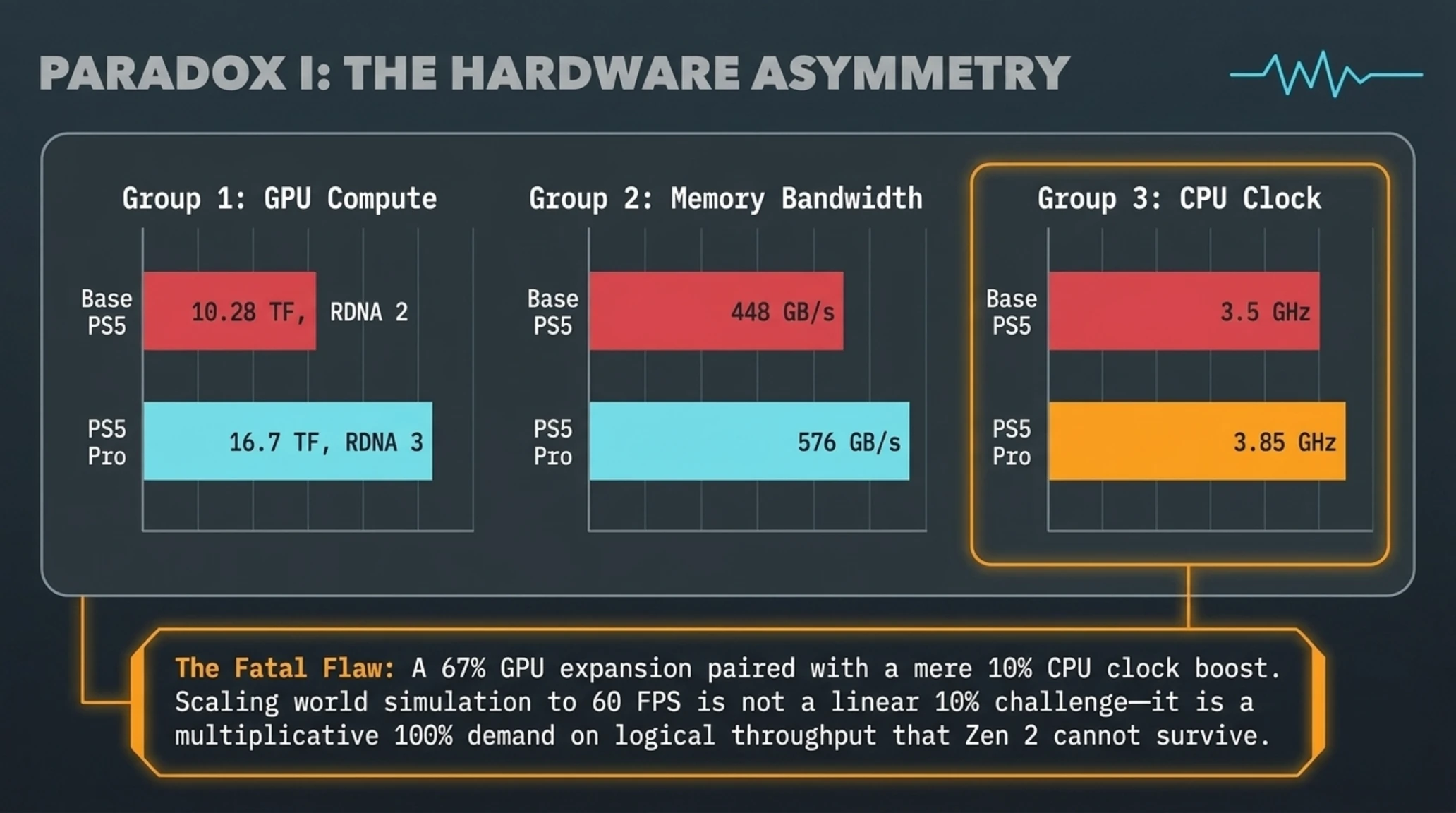
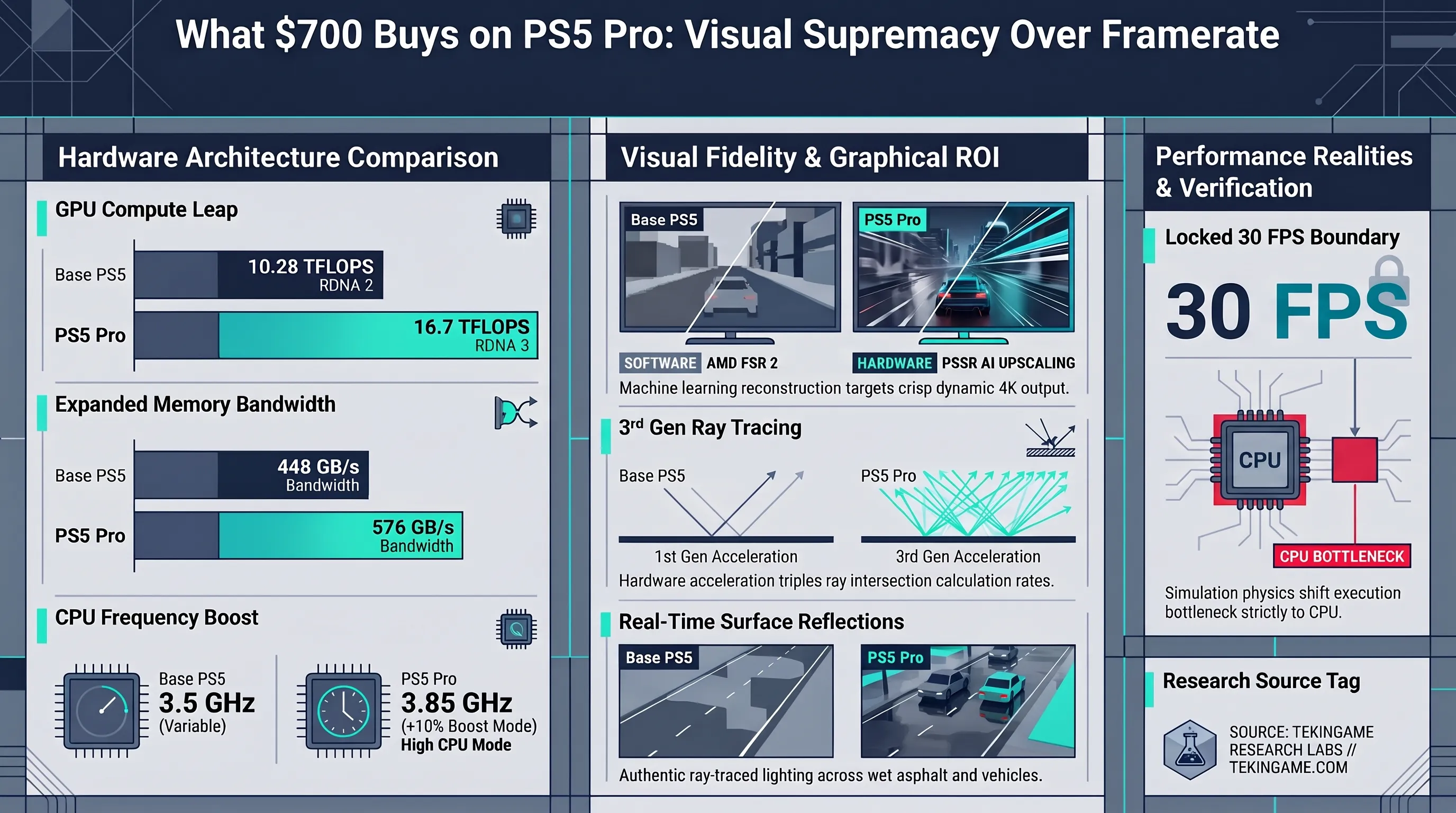
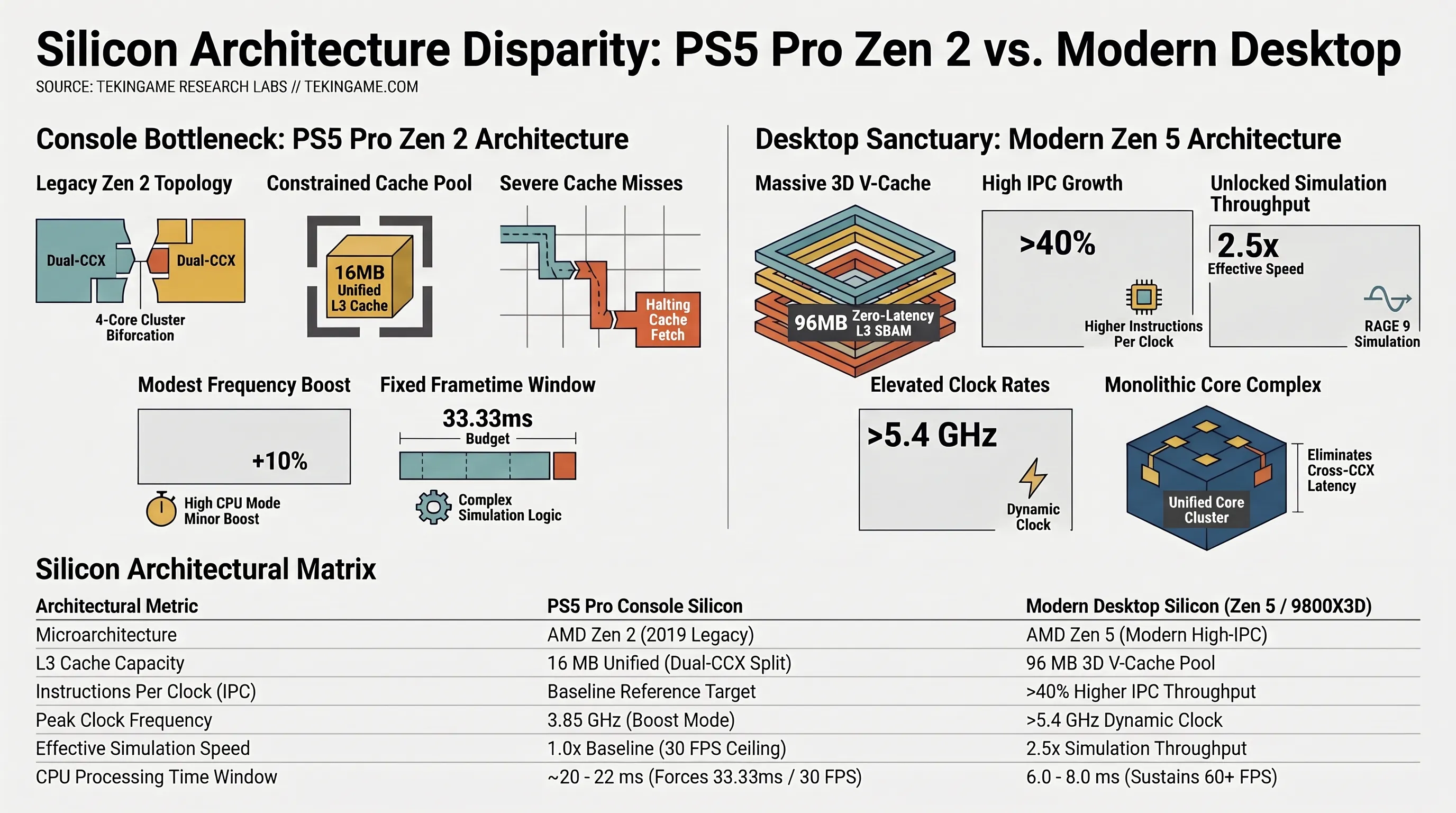
The fatal architectural compromise of the PlayStation 5 Pro lies in its asymmetric silicon upgrade. While Sony partnered with AMD to expand the GPU compute array from 36 RDNA 2 compute units to 60 enhanced RDNA 3 compute units yielding a theoretical throughput surge from 10.28 to roughly 16.7 teraflops alongside dedicated AI tensor logic the system's central processing unit remained virtually untouched. The PS5 Pro employs the identical 8-core, 16-thread AMD Zen 2 microarchitecture that debuted in desktop PCs back in mid-2019. Sony merely provided a High CPU Frequency mode that nudges the clock rate from 3.5 GHz to 3.85 GHz a modest 10 percent frequency uplift.
A 10 percent boost in CPU clock cycles provides approximately a 10 percent increase in raw instruction execution. However, scaling a world simulation from 30 FPS to 60 FPS is not a linear 10 percent challenge; it is a strictly multiplicative 100 percent demand on logical throughput per second. Furthermore, Zen 2 suffers from a restrictive dual-CCX (Core Complex) topology, where eight cores are bifurcated into two four-core clusters, each restricted to a minuscule 8 megabytes of Level 3 (L3) cache. When Rockstar's RAGE 9 engine traverses massive spatial hash grids to resolve collision tests across millions of square meters of urban geometry, the tiny 16MB unified cache pool suffers catastrophic cache misses. The CPU must repeatedly halt execution to fetch memory blocks from the main GDDR6 system memory, incurring massive latency penalties that make sustained 16.66ms frame times mathematically impossible.
Engineering Verification | Myth vs. Hardware Reality
This reality completely dismantles the persistent consumer misconception that lowering resolution automatically unlocks higher refresh rates. If a title is GPU-bound such as an intricately lit racing simulator running at native 4K where shading billions of pixels overwhelms the rasterizer dropping the internal render target to 1440p instantly liberates GPU compute and doubles the frame rate. But in an intensely CPU-bound engine like RAGE 9, the CPU must execute the exact same volume of physics equations, animation blends, pathfinding queries, and audio reflections regardless of whether the final image is output at 8K or 480p. The only viable path to 60 FPS on current console hardware would require Rockstar to gut the soul of the simulation: slashing traffic density by 60 percent, disabling pedestrian behavioral reactions, crippling destruction physics, and turning Vice City into a barren digital ghost town. Rockstar has repeatedly refused to make that artistic concession.
Tekin Advanced Jargon Buster
What PS5 Pro Owners Actually Receive; If Not Higher Framerates, What Did $700 Buy?
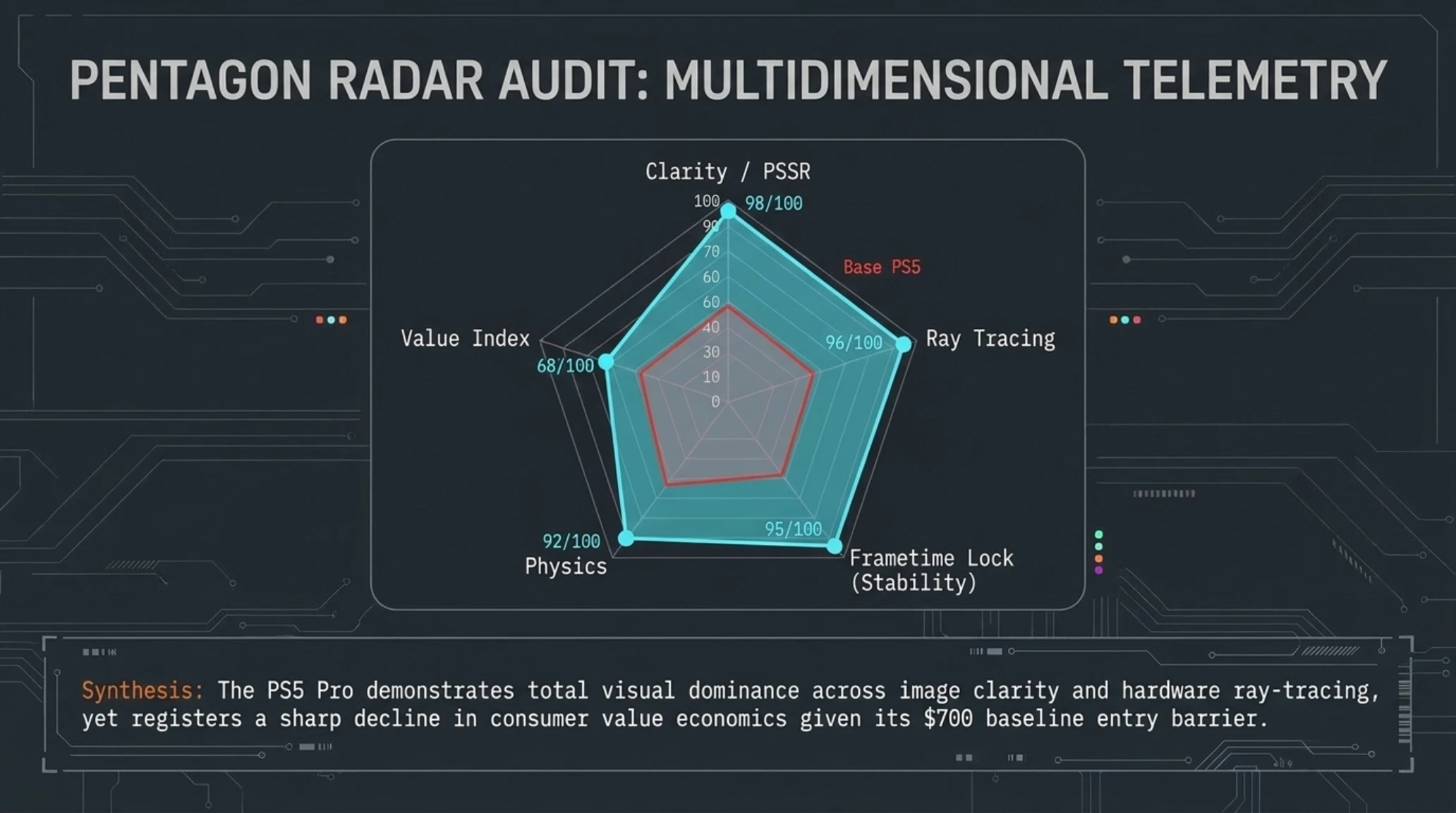
While the absence of a 60 FPS performance toggle represents a bitter pill for hardware enthusiasts, it would be disingenuous to suggest that the PlayStation 5 Pro version of Grand Theft Auto VI is indistinguishable from its standard console counterparts. On the contrary, Rockstar has channeled the Pro's massive surplus in graphics silicon and machine learning hardware toward delivering a benchmark in image reconstruction and optical fidelity that eclipses anything seen on television screens to date.
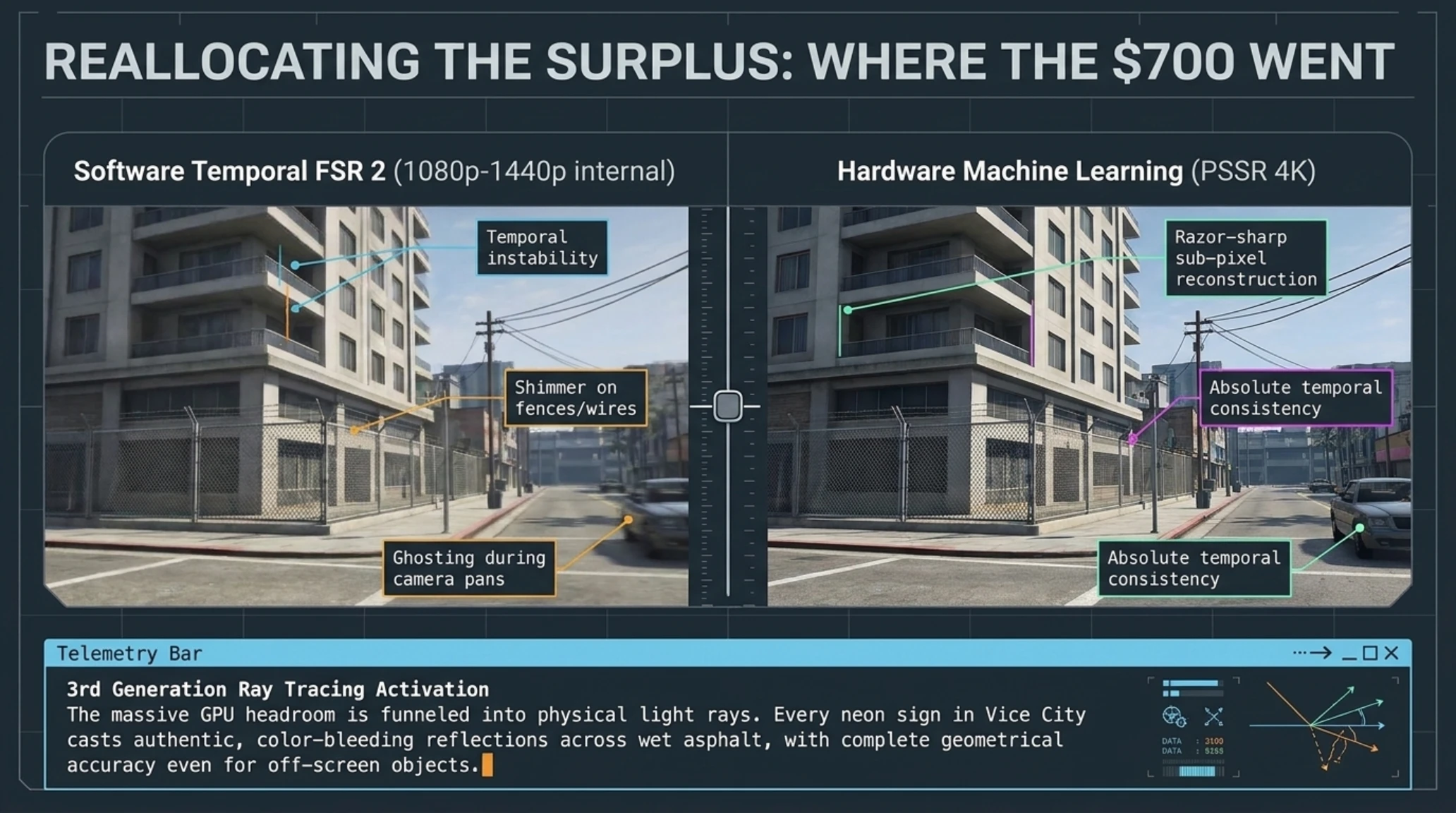
On the standard PlayStation 5, the immense graphical weight of the RAGE 9 engine forces the internal render resolution to fluctuate dynamically between approximately 1080p and 1440p, relying on software-based temporal anti-aliasing (AMD FSR 2). While functional, temporal upscalers of this class exhibit noticeable visual artifacts: high-frequency details such as chain-link fences, telephone wires along Ocean Drive, and lush palm fronds suffer from temporal instability, shimmer, and persistent ghosting trails during rapid camera pans. Furthermore, screen-space reflections (SSR) frequently fail when reflective surfaces lose direct line-of-sight to illuminated geometry.
On the PlayStation 5 Pro, Rockstar harnesses Sony's proprietary machine learning upscaling algorithm, PlayStation Spectral Super Resolution (PSSR). Utilizing custom hardware tensor blocks integrated into the RDNA 3 GPU architecture, PSSR reconstructs dynamic internal buffers into a razor-sharp, stable 4K presentation with temporal consistency that rivals native resolution rendering. Microscopic details on character fabrics, individual water droplets running down automobile windshields, and distant foliage across the Leonida wetlands remain immaculately crisp.
More critically, the PS5 Pro's advanced ray tracing acceleration cores delivering up to triple the intersection calculation rates of standard RDNA 2 hardware enable Rockstar to activate a comprehensive suite of hardware ray-traced shadows and real-time reflections. While base consoles must rely on static cube maps and approximate contact shadows, the PS5 Pro traces physical light rays through the scene. Every neon sign in Vice City casts authentic, color-bleeding reflections across wet asphalt, while moving vehicles reflect buildings and oncoming headlights with complete geometrical accuracy, even when those objects reside entirely off-screen.
Benchmark Chart & Technical Specifications Matrix
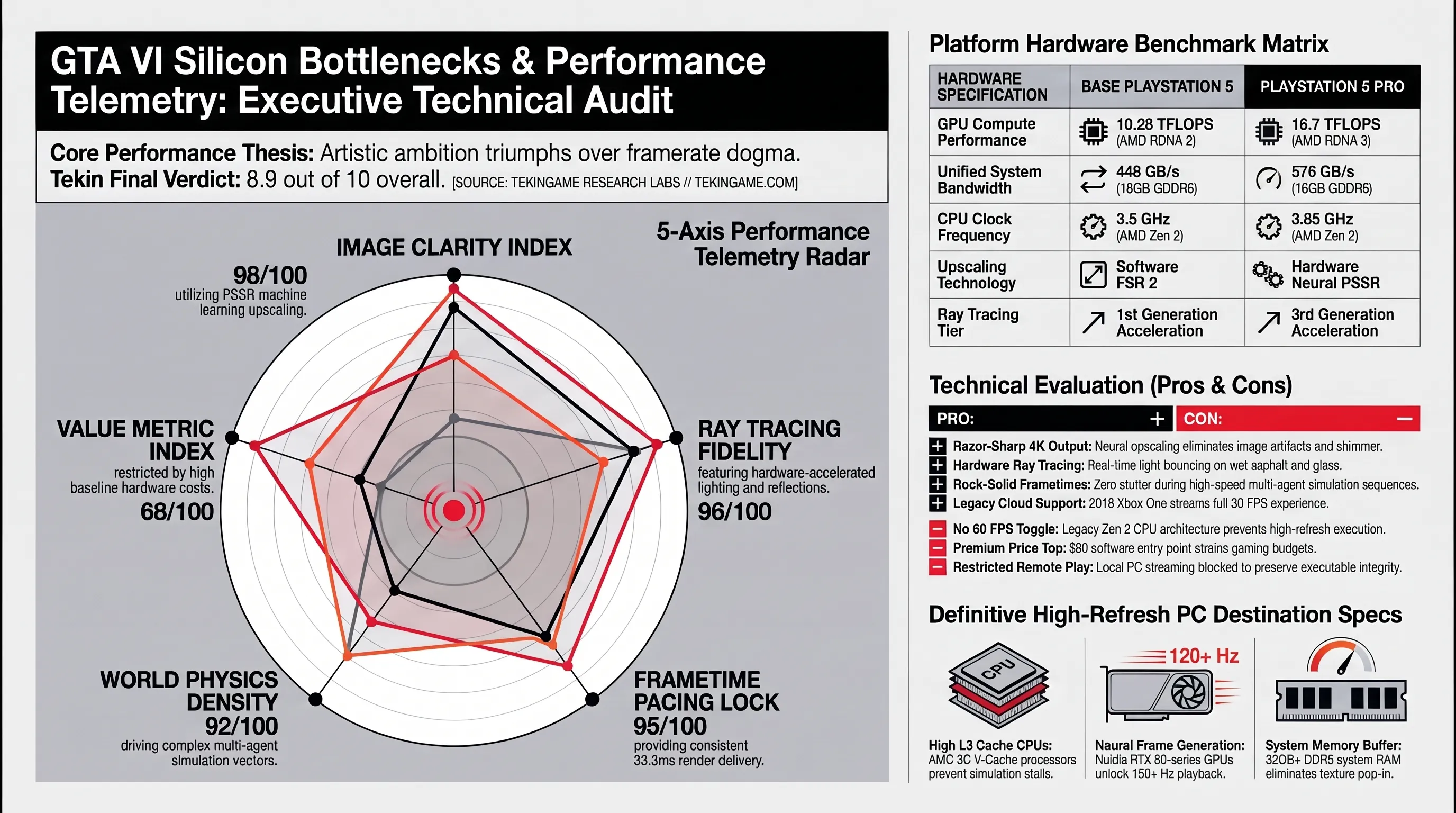
| Hardware Specification | Base PlayStation 5 | PlayStation 5 Pro |
|---|---|---|
| GPU Compute Array & Architecture | 10.28 TFLOPS (AMD RDNA 2) | 16.7 TFLOPS (Custom RDNA 3 / Machine Learning) |
| Unified System Memory Bandwidth | 448 GB/s (16GB GDDR6) | 576 GB/s (28% Bandwidth Expansion) |
| AMD Zen 2 CPU Frequency Target | 3.5 GHz Variable Frequency | 3.85 GHz High CPU Frequency Mode (+10%) |
| Image Reconstruction Technology | Software Temporal Upscaling (AMD FSR 2) | Hardware-Accelerated Neural Upscaling (Sony PSSR) |
| Ray Tracing Hardware Tier | 1st Generation Acceleration | 3rd Generation RDNA RT Cores (2x-3x Ray Intersect) |
The 13-Year-Old Hardware Paradox; How a 2013 Console Matches Sony's $700 Flagship
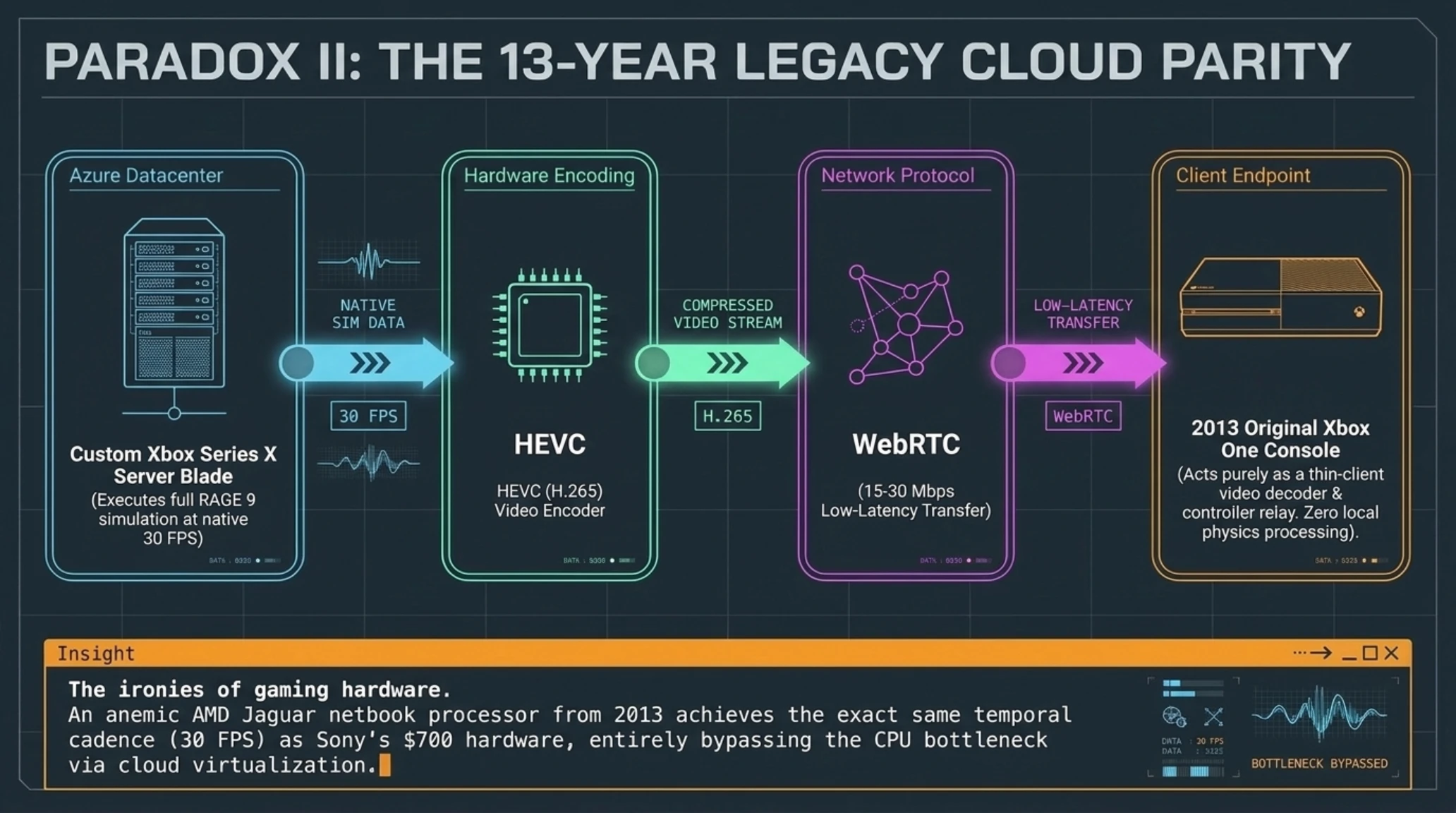
One of the most astonishing technical ironies surrounding the launch of Grand Theft Auto VI is the formal confirmation that owners of the original Xbox One a console manufactured in 2013 utilizing an anemic AMD Jaguar netbook processor and notoriously sluggish DDR3 system memory can experience the game at the exact same 30 frames per second target as someone who paid $699.99 for a brand-new PlayStation 5 Pro. This parity is achieved not through dark software wizardry on local silicon, but through Microsoft's expansive Xbox Cloud Gaming virtualization infrastructure.
Inside Microsoft Azure datacenters globally, custom server blades powered by high-density Xbox Series X hardware execute the game locally within isolated virtual machine containers. The host machine renders the full generational fidelity of GTA 6 at native 30 FPS, immediately piping the raw video buffer into hardware-accelerated HEVC (H.265) video encoders. The compressed digital stream is transmitted across low-latency WebRTC and custom Microsoft network protocols to the client device at bitrates ranging from 15 to 30 megabits per second. The 13-year-old Xbox One sitting in a player's living room performs zero geometric transformation, zero physics solving, and zero texture decompression; it acts purely as a thin-client video decoder and controller input relay.
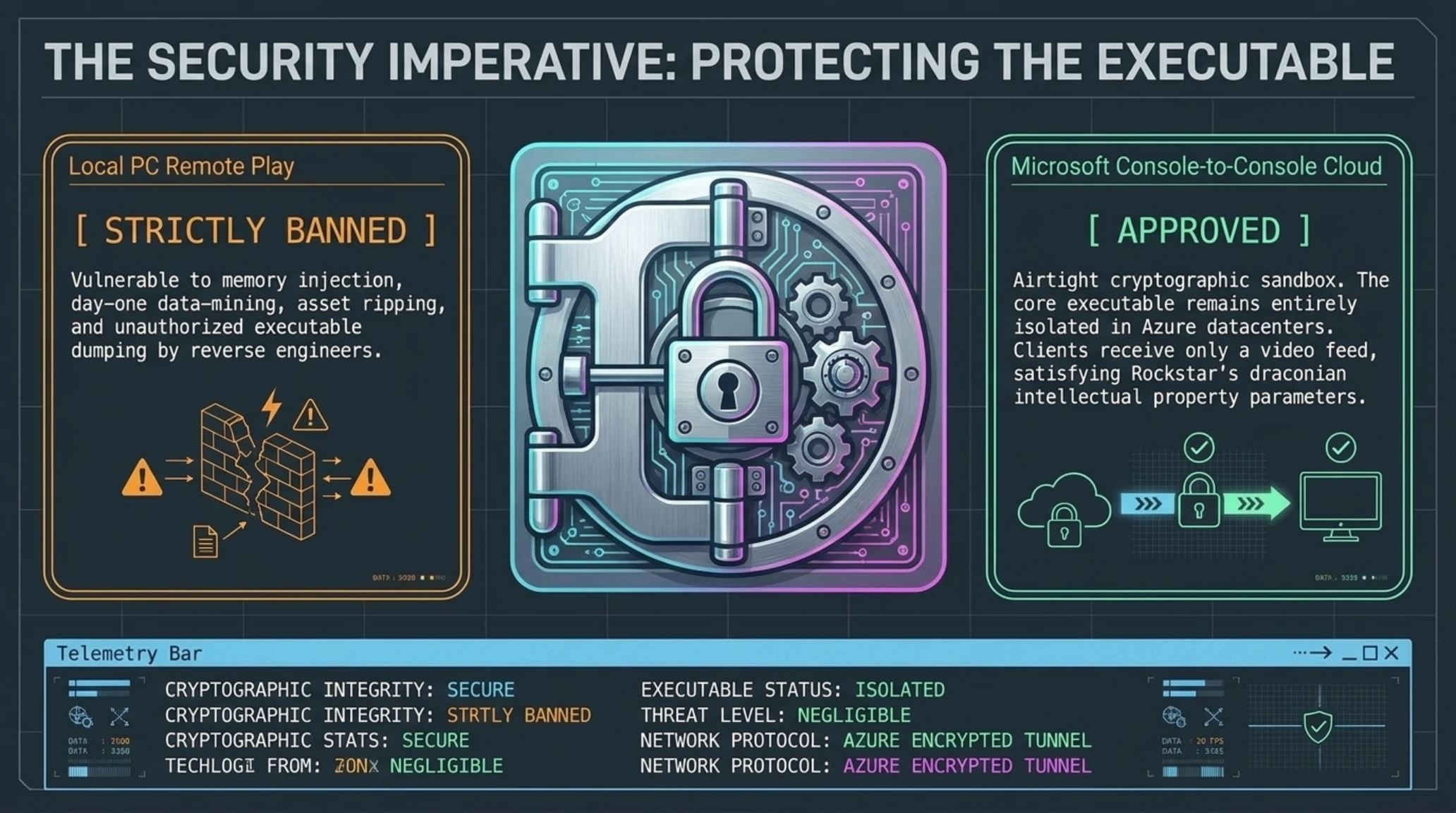
The strategic nuance behind this deployment involves Rockstar's draconian intellectual property security measures. To safeguard against day-one data-mining, memory injection, asset ripping, and unauthorized executable dumping, Rockstar strictly banned all forms of local in-home streaming to personal computers (disabling PC Remote Play via both the Xbox PC app and third-party solutions). However, Microsoft's airtight console-to-console cloud infrastructure satisfied Rockstar's cryptographic parameters. Because the game streams exclusively to dedicated console hardware within Microsoft's locked sandbox, players are granted cloud access while the underlying executable files remain entirely inaccessible to reverse engineers.
This dynamic creates a profound economic dichotomy that reshapes the consumer hardware calculus. A player possessing a depreciated $50 secondhand Xbox One and a standard 1080p television can purchase a Game Pass Ultimate subscription and engage with the identical narrative, identical mission architecture, and identical 30 Hz refresh rate as an enthusiast who invested over $850 in a PlayStation 5 Pro ecosystem. While the Pro owner enjoys pristine PSSR upscaled 4K clarity and physical ray tracing, both players remain fundamentally bound to the exact same temporal cadence of 30 frames per second. Never before in gaming history has the performance delta between legacy hardware and premium flagships been so sharply compressed.
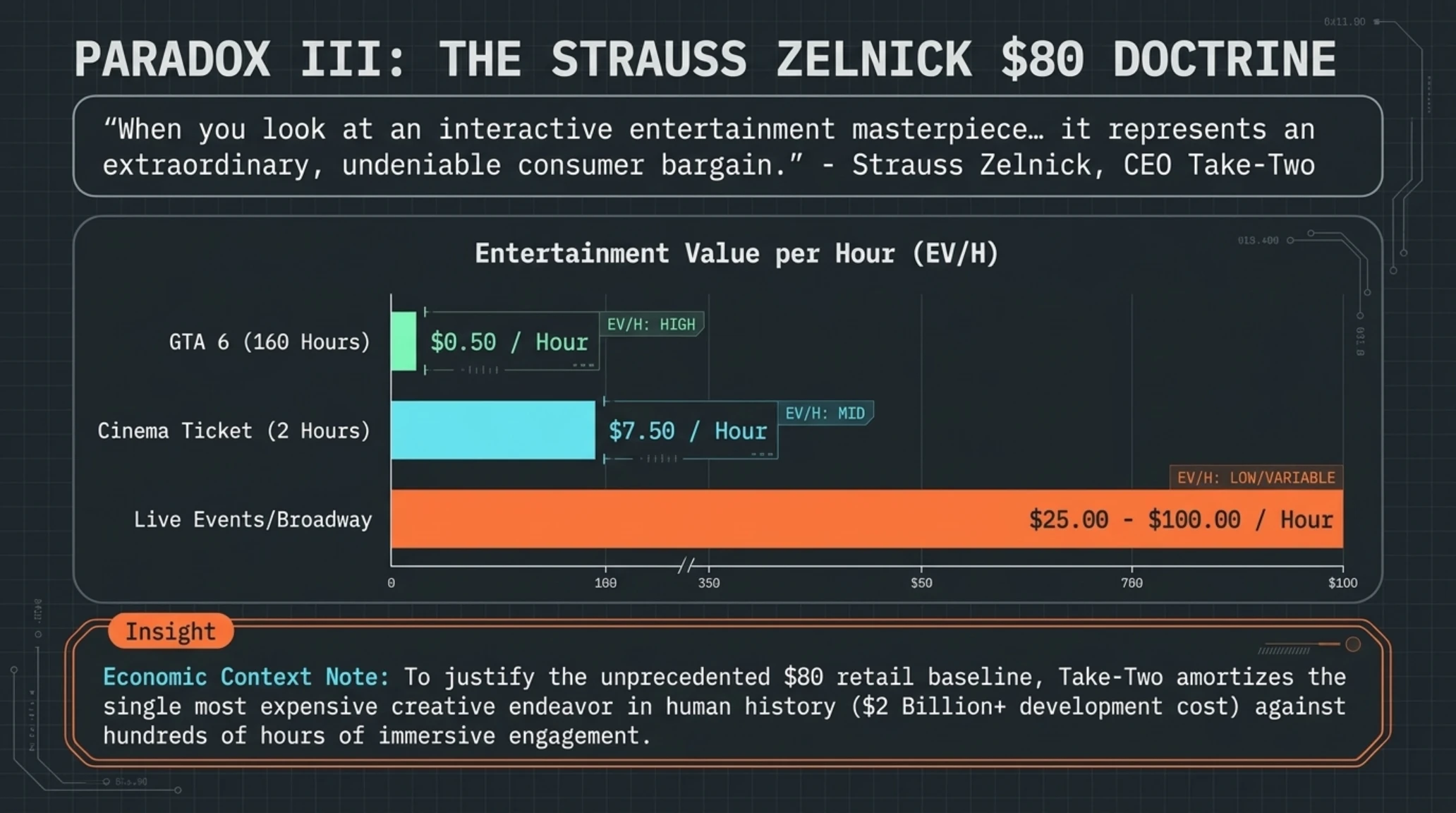
The Strauss Zelnick Doctrine; Is an $80 Video Game Genuinely Cheaper than Gasoline?
When software publishers tentatively raised the baseline retail price of premium titles from $60 to $70 at the onset of the ninth console generation, consumer backlash was immediate and vociferous. Yet Rockstar Games and parent publisher Take-Two Interactive have once again reset industry boundaries by establishing an $80 standard retail price for Grand Theft Auto VI, flanked by premium collector editions extending well beyond $200. During Take-Two's recent financial disclosures, Chief Executive Officer Strauss Zelnick mounted an aggressive, mathematically framed defense of this pricing strategy.
📚 Classified & Related Dossiers in TekinGame
If you wish to explore beyond this report and delve into cybernetic frontiers and autonomous AI architectures, do not miss these three exclusive deep-dives in the Tekin Garage:
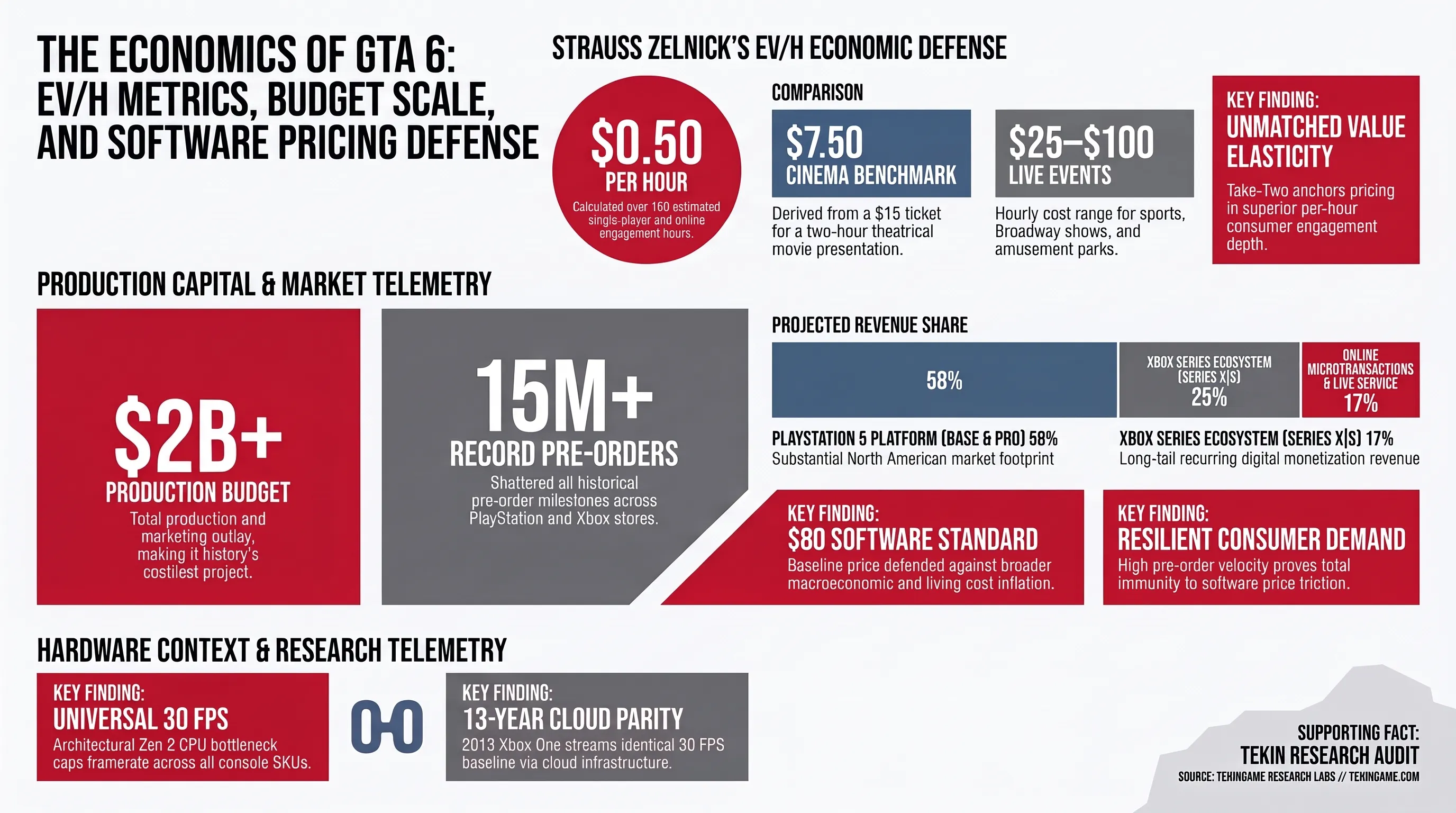
From the analytical perspective of institutional Wall Street investors, Zelnick's thesis rests upon a rigorous quantitative metric known as Entertainment Value per Hour (EV/H). Wall Street estimates indicate that the holistic production and global marketing expenditure for Grand Theft Auto VI across more than a decade of multi-studio development has exceeded $2 billion establishing it as the single most expensive creative endeavor in human history. If an average consumer spends roughly 160 hours navigating the single-player campaign of Lucia and Jason alongside the foundational rollout of the next-generation GTA Online ecosystem, the consumer's realized expenditure amortizes to approximately $0.50 per hour of interactive entertainment.
In stark economic comparison, a standard $15 cinema ticket for a two-hour theatrical presentation extracts $7.50 per hour from the consumer's wallet. Premium live sporting events, Broadway theatrical performances, and commercial amusement parks routinely demand between $25 and $100 per hour of consumer attention. Consequently, Take-Two's executive leadership argues that interactive video games offer an elasticity of value unmatched by any legacy passive medium.
Nonetheless, macroeconomic critics contend that equating discretionary creative media with mandatory physiological necessities like food and fuel is inherently tone-deaf to broader societal pressures. In developing global markets and inflationary Western economies, an $80 upfront software commitment represents an aggressive barrier to entry, threatening to disenfranchise lower-income demographics and pushing marginal players toward grey-market account sharing or piracy networks.
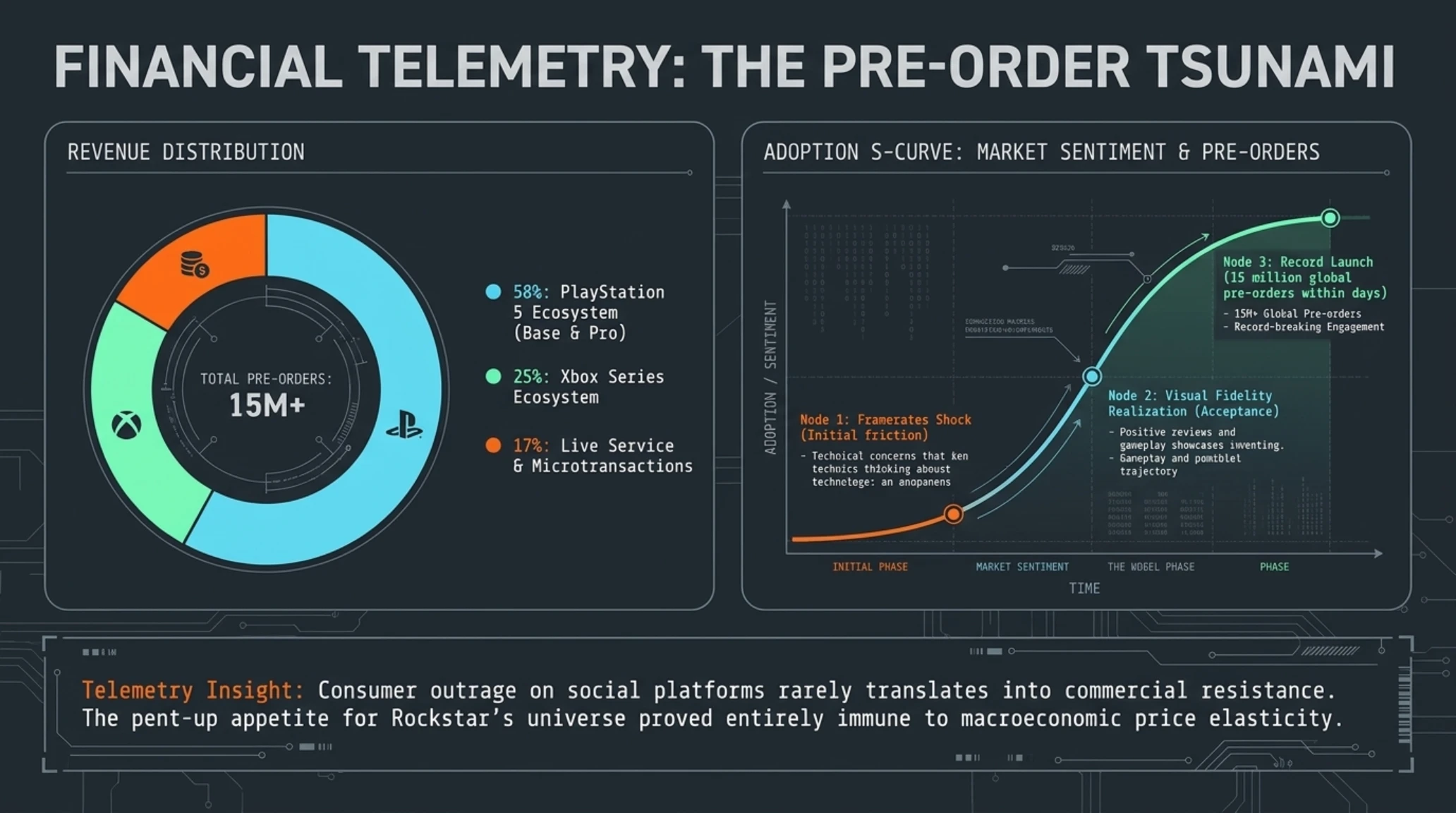
Yet empirical market telemetry demonstrates that consumer outrage on social platforms rarely translates into commercial resistance. Verified pre-order data across the PlayStation Network and the Xbox Store reveals that GTA 6 has shattered every historical milestone, eclipsing 15 million global pre-orders within days of opening. The pent-up consumer appetite for Rockstar's universe has proven entirely immune to macroeconomic friction and price elasticity constraints.
Donut Chart, Growth Curve & Financial Telemetry Dashboard
| Revenue Segment & Ecosystem | Projected Share | Strategic Market Dynamics |
|---|---|---|
| PlayStation 5 Platform (Base & Pro) | 58% of Total | Massive 70M+ install base driving record-shattering direct pre-orders |
| Xbox Series Ecosystem (Series X|S) | 25% of Total | Substantial North American penetration and Game Pass subscriber halo |
| Online Recurring In-Game Monetization | 17% of Total | Long-tail microtransactions and Shark Card successor mechanisms |
Market Sentiment Thermometer & Adoption S-Curve
Historical Event Timeline | Rockstar Hardware Generational Milestones
| Era / Milestone | Rockstar Release & Silicon Platform | Framerate Target & Architectural Outcome |
|---|---|---|
| September 2013 | Grand Theft Auto V Launch (PS3 & Xbox 360) | Targeted 30 FPS with frequent drops into the high teens during high-speed traffic collisions and explosions. |
| October 2018 | Red Dead Redemption 2 (PS4 Pro & One X) | Locked 30 FPS across all models; native 4K achieved on Xbox One X, but CPU Jaguar limits barred 60 FPS. |
| November 2024 | Sony PlayStation 5 Pro Hardware Launch | Introduced PSSR AI upscaling and 16.7 TFLOPS RDNA 3 GPU, setting high expectations for universal 60 FPS gaming. |
| November 2026 | Grand Theft Auto VI Pre-Load & Launch Confirmation | Universal 30 FPS lock verified across all consoles due to AMD Zen 2 CPU physics bottlenecks; record pre-orders shattered. |
Pentagon Radar Audit | Multidimensional Hardware Performance
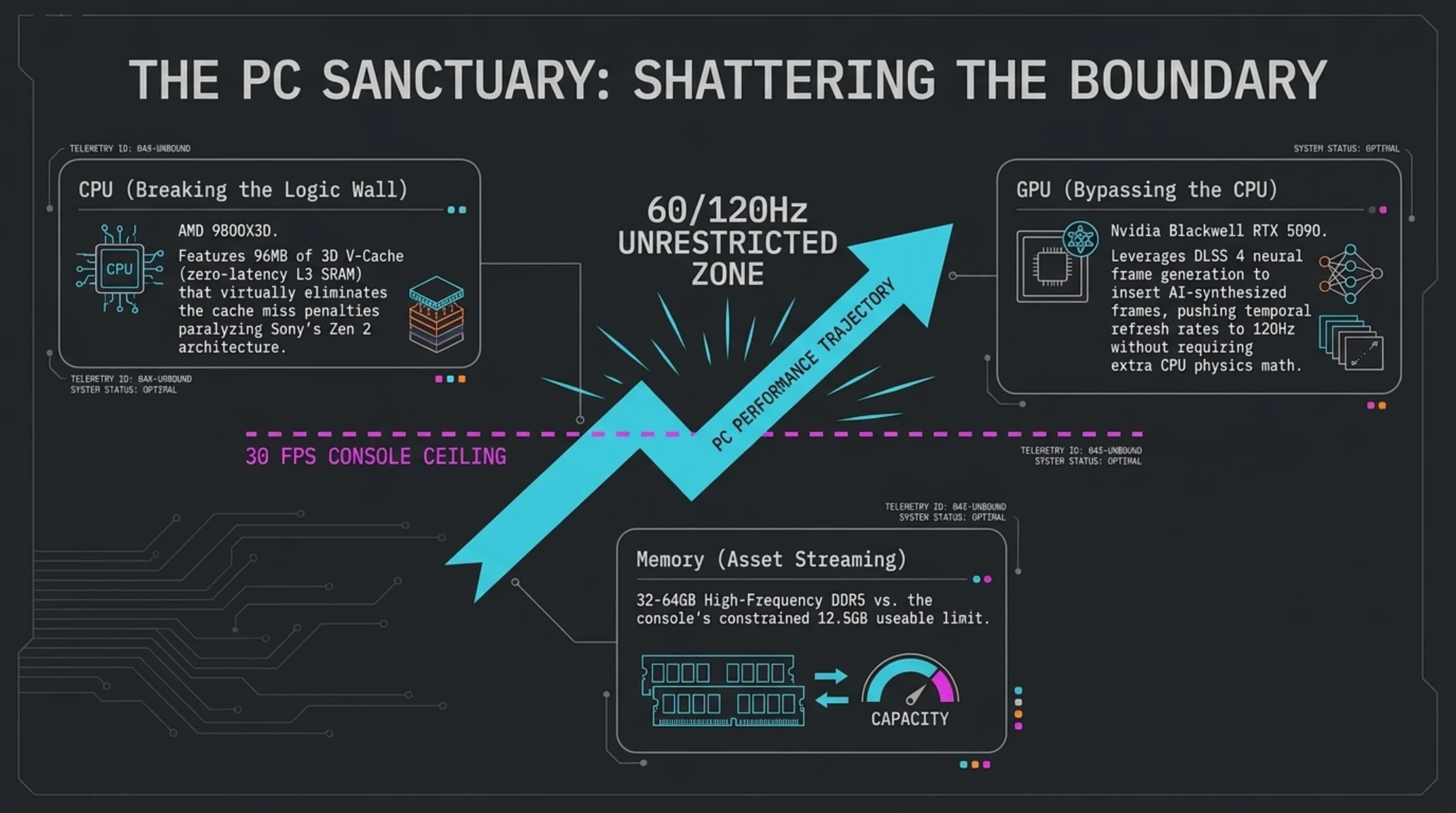
The PC Sanctuary; What Desktop Silicon Will Truly Be Required for 60 and 120 FPS?
With console hardware universally bound to the 30 FPS ceiling, the entire enthusiast community, competitive streamers, and frame-rate purists have turned their attention toward the inevitable personal computer release. As thoroughly analyzed in our investigation into Rockstar Games PC Port Strategy and Generative AI Clones, the commercial imperative to safeguard code from open-source duplication and the astronomical financial returns of the Steam and Epic Games storefronts have narrowed the window between console and PC deployment.
Achieving true, uncompromised 60 or 120 frames per second in Grand Theft Auto VI will require computing architectures fundamentally divorced from console silicon constraints. On the central processing front, the definitive solution resides in massive Level 3 cache pools exemplified by AMD's Ryzen 7 7800X3D and next-generation 9800X3D processors featuring 3D V-Cache technology. By stacking an astonishing 96 megabytes of zero-latency L3 SRAM directly atop the compute die, these processors virtually eliminate the cache miss penalties that paralyze Sony's Zen 2 architecture. The CPU can process spatial hash trees, calculate vehicle collisions, and route pedestrian behavioral logic in under 6 to 8 milliseconds, liberating the graphics pipeline to operate at maximum refresh rates.
To grasp the staggering gulf between console silicon and modern desktop architectures, consider the structural evolution of AMD's microprocessors between Zen 2 and Zen 5. Zen 2 processors featured modest single-thread execution windows, smaller instruction reorder buffers, and separate four-core CCX complexes that introduced substantial inter-core communication latency. In contrast, modern Zen 5 and Intel Arrow Lake architectures deliver over 40 percent higher Instructions Per Clock (IPC), monolithic eight-core complexes with unified cache, and clock frequencies exceeding 5.4 GHz. In a multi-threaded workload like RAGE 9 where physics, animation, audio occlusion, and streaming decompression each occupy dedicated execution threads a modern PC processor provides more than 2.5 times the effective simulation throughput of the PlayStation 5 Pro's central chip.
On the graphics battlefield, rendering Vice City's ray-traced lighting alongside volumetric fog and ocean dynamics at 4K resolution will demand Nvidia's Blackwell architecture (the GeForce RTX 5080 and RTX 5090). Leveraging DLSS 4 with multi-frame neural generation, desktop GPUs will insert AI-synthesized frames between mathematically rendered frames, bypassing CPU bottlenecks entirely and elevating temporal refresh rates into the 120 to 144 Hz domain without requiring additional simulation calculations from the host processor.
Furthermore, desktop platforms eliminate the severe memory starvation of the console generation. While consoles share a constrained 16 gigabytes of unified GDDR6 memory (with merely 12.5 gigabytes allocated to the game title after operating system overhead), high-end PC workstations equipped with 32 to 64 gigabytes of high-frequency DDR5 system memory and 16 to 24 gigabytes of high-bandwidth VRAM can sustain the asset streaming requirements of Leonida without geometric pop-in or texture degradation. This divergence mirrors the broader strategic evolution documented in our analysis of the new PlayStation Portal with internal storage, where hardware manufacturers increasingly seek hybrid bridges between local silicon and cloud processing power.
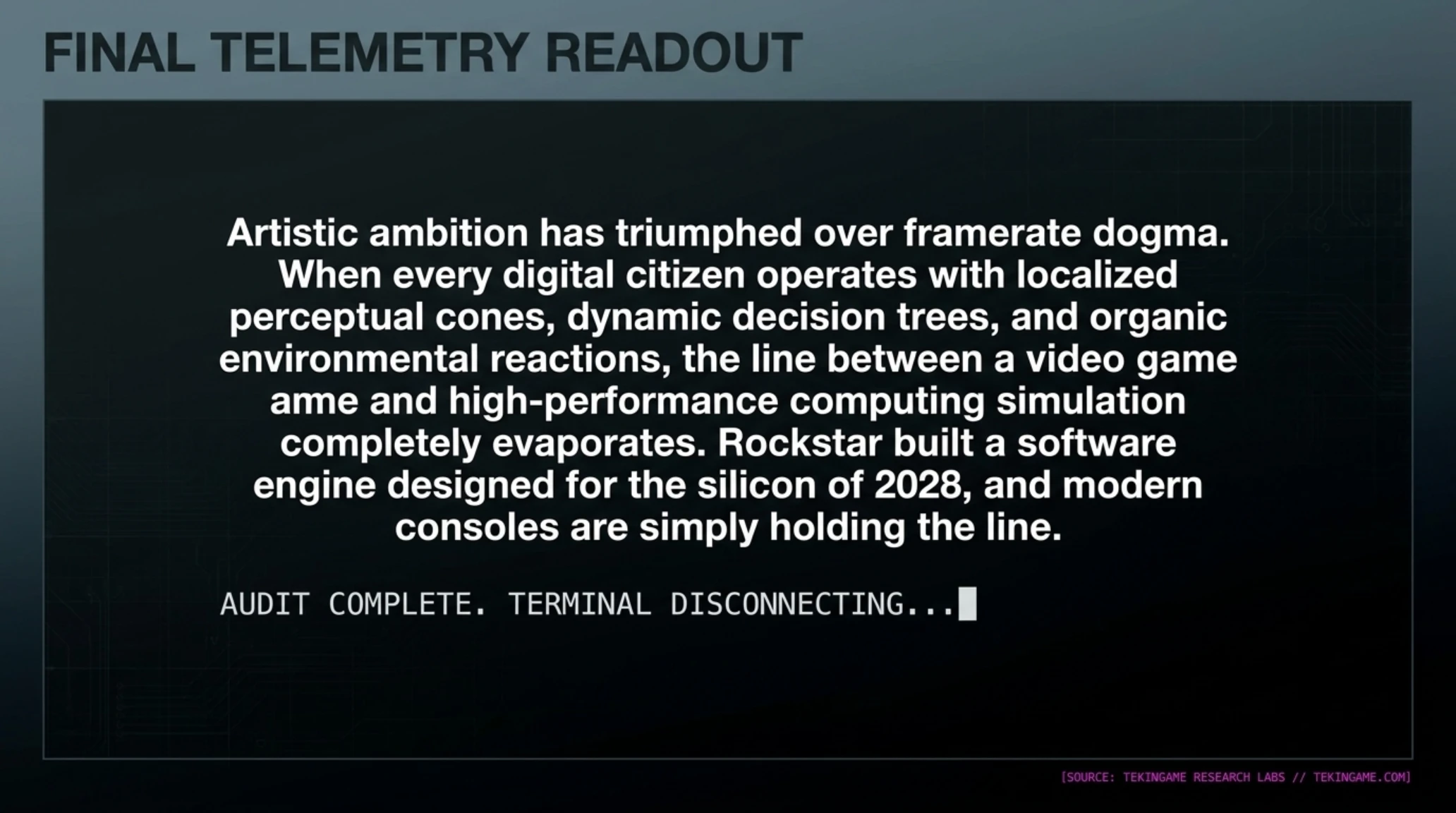
Ultimately, the behavioral complexity of Vice City's population directly reflects the cutting-edge cognitive architectures explored in our investigative dossier on autonomous multi-agent swarm systems in production environments. When every digital citizen operates with localized perceptual cones, memory queues, dynamic conversational trees, and organic environmental reactions, the line between video game entertainment and high-performance computing simulation completely evaporates. Rockstar has built a software engine designed for the silicon of 2028, and modern consoles are simply holding the line.
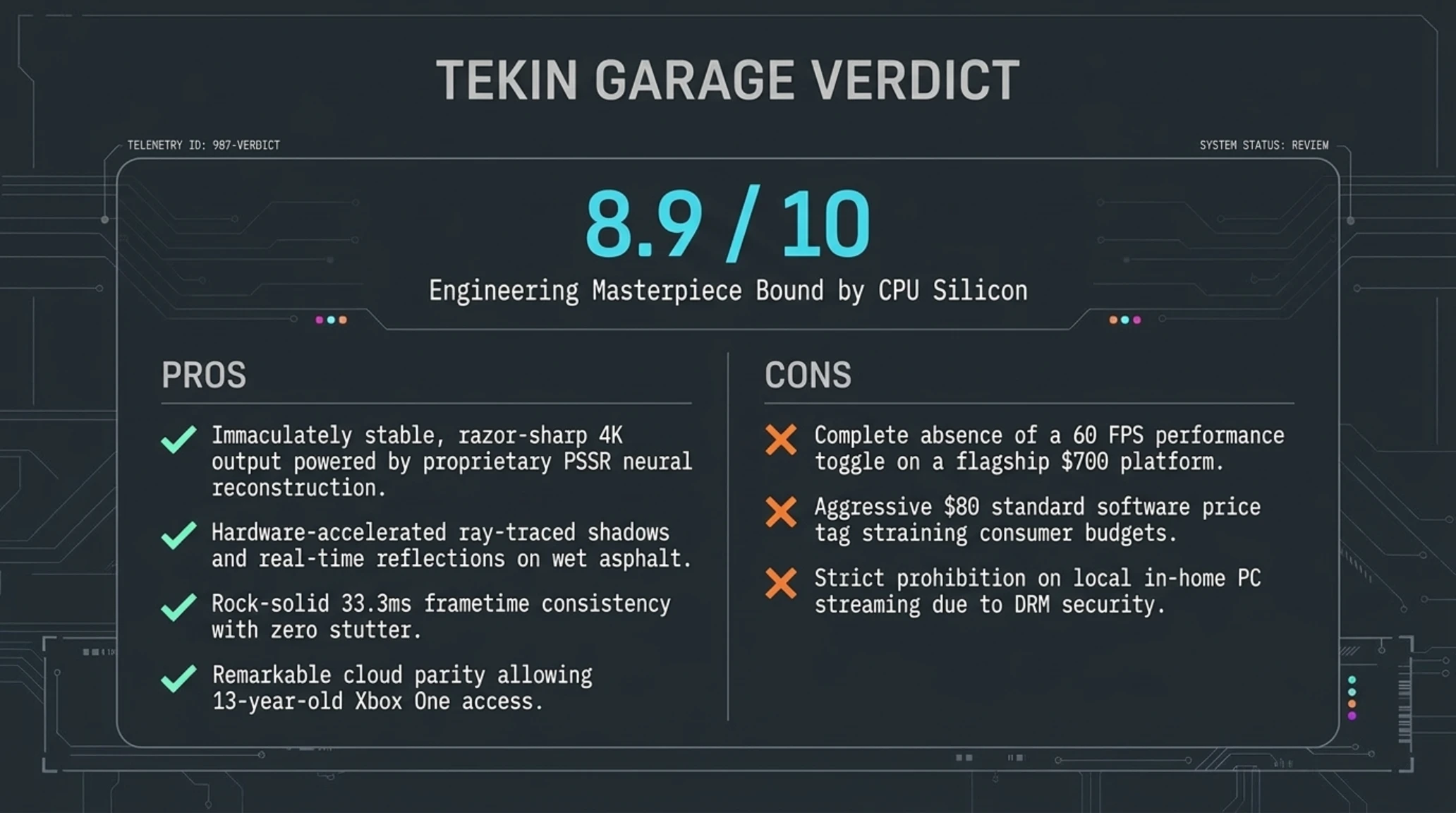
- Immaculately stable, razor-sharp 4K output powered by Sony proprietary PSSR neural reconstruction.
- Hardware-accelerated ray-traced shadows and real-time reflections on wet asphalt and vehicles.
- Rock-solid 33.3ms frametime consistency with zero stutter during high-speed police chases.
- Remarkable cloud accessibility allowing 13-year-old Xbox One owners to experience the title.
- Complete absence of a 60 FPS performance toggle on a flagship $700 hardware platform.
- Aggressive $80 standard software price tag straining global consumer entertainment budgets.
- Strict prohibition on local in-home PC streaming due to digital rights management security.
Editorial Final Verdict & Official Source Directory
- Eurogamer: Technical Deep Dive into GTA 6 Platform Limitations and PS5 Pro Enhancements
- Kotaku: Analysis of Cloud Streaming Parity and Legacy Xbox One Compatibility
- TechSpot: Architectural Breakdown of Zen 2 CPU Bottlenecks in Modern Console Hardware
- IGN: Executive Coverage of Take-Two $80 Software Valuation and Pre-Order Records
Frequently Asked Technical Inquiries & Deep-Dive Analysis
Why is Grand Theft Auto VI incapable of running at 60 FPS on the PlayStation 5 Pro?
The limitation is strictly governed by a Central Processing Unit (CPU) bottleneck. While the PS5 Pro features an enhanced GPU with 16.7 TFLOPS, its CPU remains an AMD Zen 2 8-core processor with only a 10% clock frequency uplift to 3.85 GHz. The monumental computational load of calculating dynamic water physics, multi-agent AI pathfinding, dense vehicular traffic, and acoustic ray tracing cannot be executed within the 16.66 millisecond frame window required for 60 Hz output.
What specific graphical enhancements does the PS5 Pro version provide over the base console?
The PS5 Pro utilizes Sony proprietary PlayStation Spectral Super Resolution (PSSR) machine learning upscaler to output an exceptionally clean, reconstructed 4K image with virtually zero temporal shimmer or ghosting. Additionally, it features dedicated hardware ray-traced shadows and full geometric real-time reflections on vehicles and wet surfaces, replacing the lower-quality screen-space reflections used on standard hardware.
How is it possible to play Grand Theft Auto VI on an original 2013 Xbox One console?
The game does not run natively on legacy Xbox One hardware. Instead, users access the title via Xbox Cloud Gaming, where the game is executed on high-performance custom Xbox Series X server blades within Microsoft Azure datacenters. The server renders the game at 30 FPS and streams a compressed HEVC video feed directly to the legacy console, which functions solely as a thin video decoder.
Will the PC version of Grand Theft Auto VI support 60 FPS and 120 FPS?
Yes. Modern desktop processors featuring advanced microarchitectures (such as AMD Zen 5 and high-capacity 3D V-Cache like the Ryzen 7 7800X3D/9800X3D) offer vastly higher IPC and massive L3 cache pools that completely bypass console CPU bottlenecks. Coupled with top-tier GPUs like the RTX 50 series supporting DLSS 4 frame generation, PC enthusiasts will be able to achieve 60, 120, or even higher frame rates at 4K.
Can lowering the display resolution to 1080p on consoles enable a 60 FPS performance toggle?
No. When a title is CPU-bound, resolution reduction only decreases the workload on the graphics shader cores. The central processor must still execute the identical volume of simulation math, collision checks, and AI routines regardless of pixel count. Reaching 60 FPS on current consoles would require gutting the world density and civilian population.
Why is Take-Two Interactive pricing the standard edition at $80?
Take-Two CEO Strauss Zelnick defended the $80 price point by emphasizing that the title represents over $2 billion in research and development investment over a 12-year cycle. When evaluated on an Entertainment Value per Hour basis, 150 hours of interactive immersion amortizes to roughly $0.50 per hour, which Take-Two argues is vastly cheaper than cinema, live theater, or amusement parks in the current macroeconomic inflationary environment.
Additional Gallery: Tekin Analysis: GTA 6 30 FPS Lock on PS5 Pro & Zen 2 Limits