Tekin Morning November 20, 2026 Executive Dossier: Microarchitectural analysis of Rockstar confirming PS5 Pro's 30 FPS ceiling for GTA 6 due to AMD Zen 2 CPU bottlenecks, Ampere Analysis revealing Microsoft's cloud streaming alliance expanding addressable market by 30% across 10M active Xbox One consoles, Apple staggering iPhone 18 and Air 2 releases to March 2027 to stabilize OLED yields, Google and Samsung re-introducing native App Lock in Android 17 and One UI 9.5, Eurogamer vindicating 28 terminated developers in GTA 6 credits, and 43 US soldiers reenlisting for launch passes.
Tekin Morning | PS5 Pro CPU Limit in GTA 6, Xbox Cloud Expansion & iPhone 18 Strategy
The morning of Friday, November 20, 2026, marks a watershed moment across interactive entertainment, enterprise consumer silicon, and cloud distribution platforms. As the global gaming community stands on the precipice of Grand Theft Auto VI's definitive launch, long-simmering debates surrounding ninth-generation console capabilities have collided with cold hardware realities. For months, enthusiast forums and hardware analysts speculated whether Sony's premium $700 PlayStation 5 Pro could leverage its upgraded RDNA GPU and machine-learning silicon to deliver an elusive 60 FPS performance mode in Rockstar's flagship title.
Those hopes were decisively dismantled this morning as Rockstar Games executives broke their silence, confirming that ninth-generation hardware architecture faces fundamental computational boundaries. At the same time, Microsoft executed an audacious strategic counter-move through Xbox Cloud Gaming, dismantling traditional console barriers to capture millions of legacy players. Across the broader consumer tech landscape, Apple is fundamentally reorganizing its iPhone launch cadence, while Google and Samsung have united to deploy long-demanded kernel-level security primitives.
Strategic Assessment and Key Intelligence Vectors
Rockstar Games Confirms PS5 Pro Is Not Powerful Enough to Run GTA 6 at 60FPS or 40FPS Due to CPU Limitations
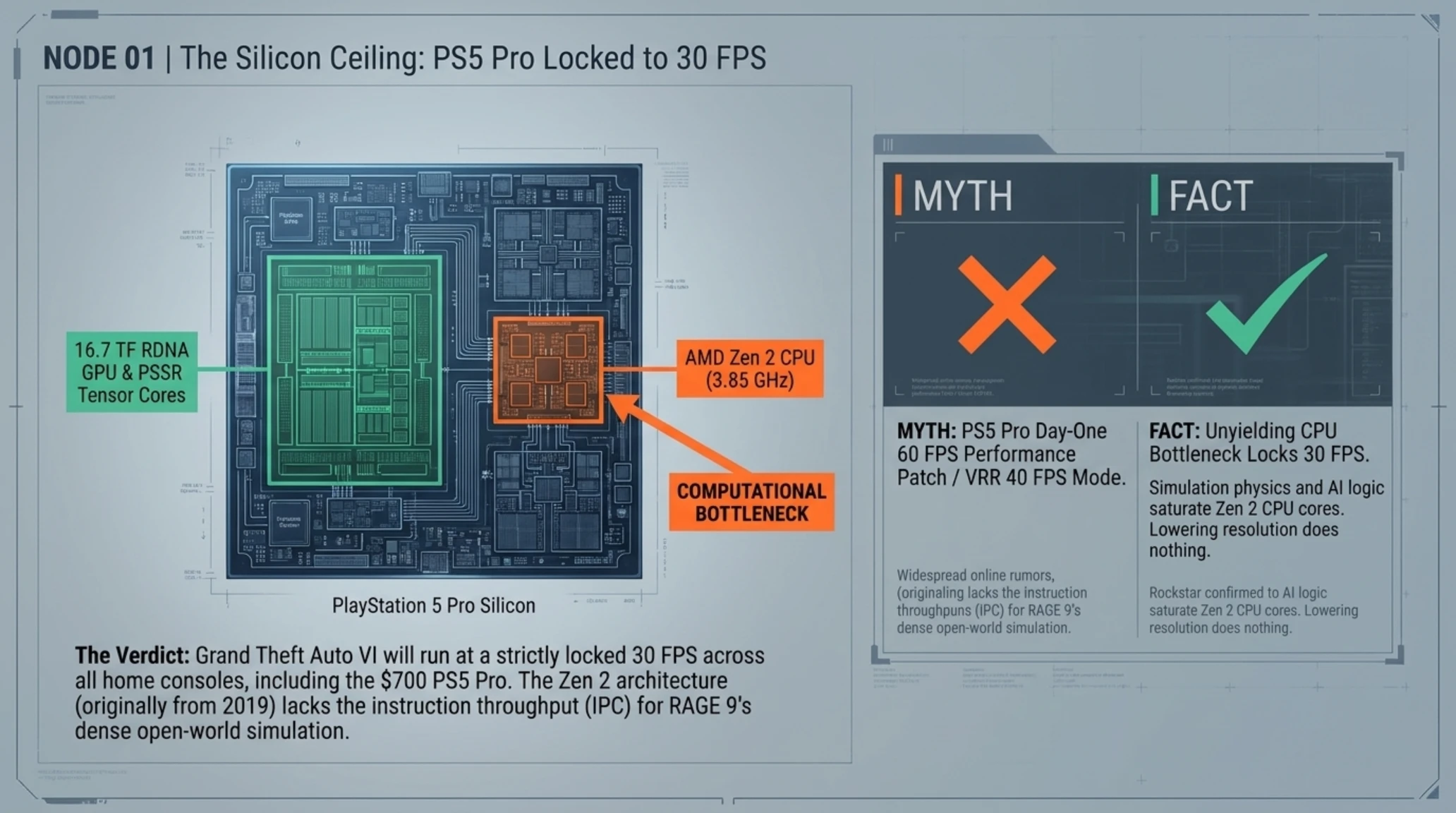
In an unusually candid technical debrief with European and American media outlets, Rockstar Games established a definitive technical verdict that will define this console generation: Grand Theft Auto VI will run at a strictly locked 30 frames per second across every home console on the market, including Sony's flagship PlayStation 5 Pro. The announcement puts an end to widespread speculation that a post-launch performance patch or variable refresh rate (VRR) 40 FPS fidelity mode could be deployed on mid-generation hardware.
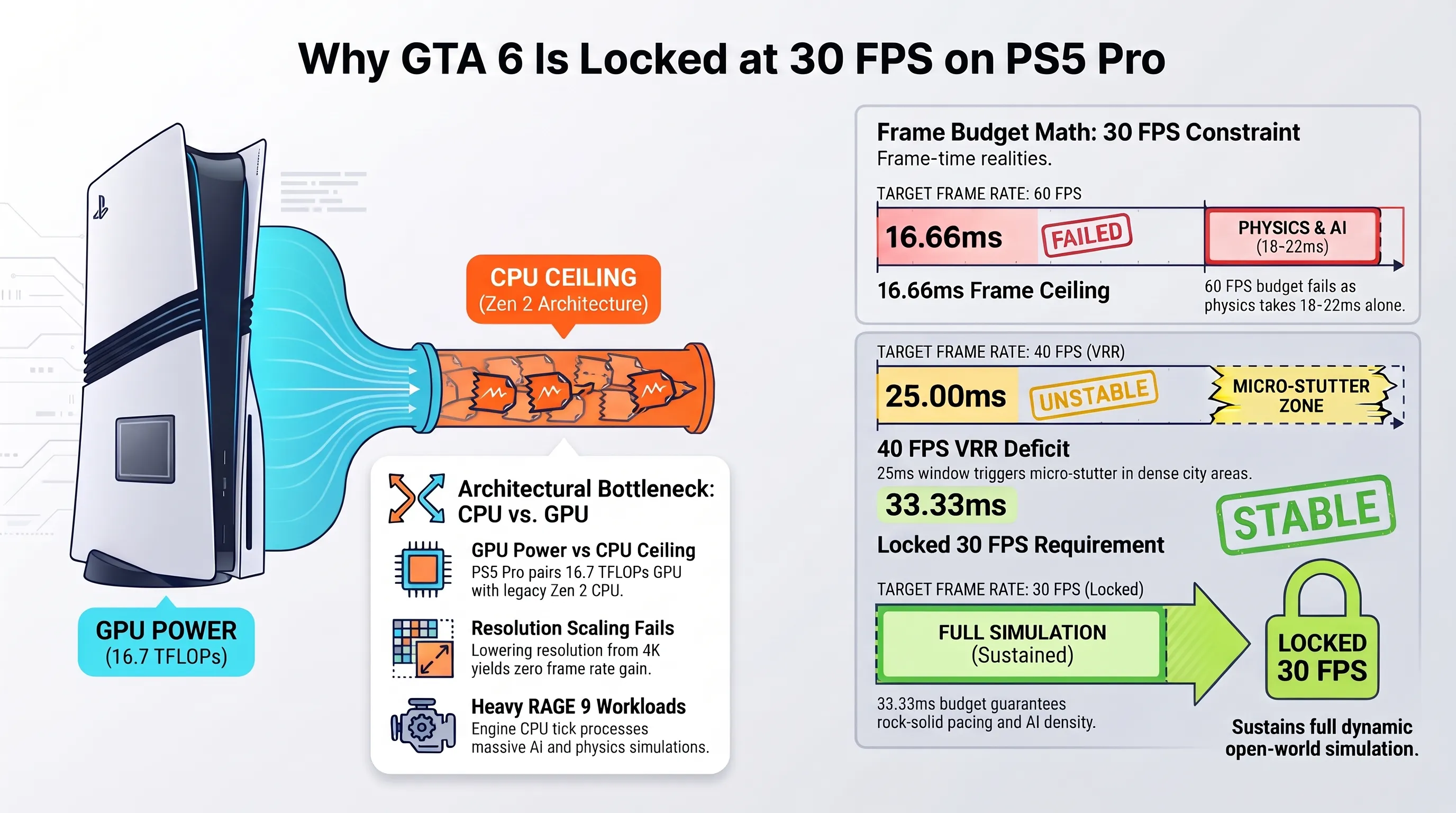
Marc Chambers, technology production director at Rockstar Games, dissected the engineering rationale behind the decision. While the PlayStation 5 Pro boasts a substantially enhanced graphics compute engine delivering 16.7 teraflops of raw FP32 compute alongside dedicated machine-learning silicon its central processing unit remains rooted in AMD's Zen 2 microarchitecture. Despite a modest 10 percent clock boost bringing top frequencies to 3.85 GHz, the processor's fundamental throughput cannot service the colossal demands of the game's simulation engine at higher frame rates.
Rob Nelson, co-studio head at Rockstar Games, emphasized that modern open-world game engines cannot simply scale graphics settings downward to double frame rates when the computational bottleneck resides in the simulation tick rate. The RAGE 9 engine orchestrates a living, dynamic ecosystem across Leonida: thousands of autonomous pedestrian behavioral state machines, dense vehicular pathfinding, volumetric microclimates, dynamic fluid simulations, and continuous structural deformation calculations. Every single one of these tasks must be calculated on the CPU prior to graphics draw call dispatching.
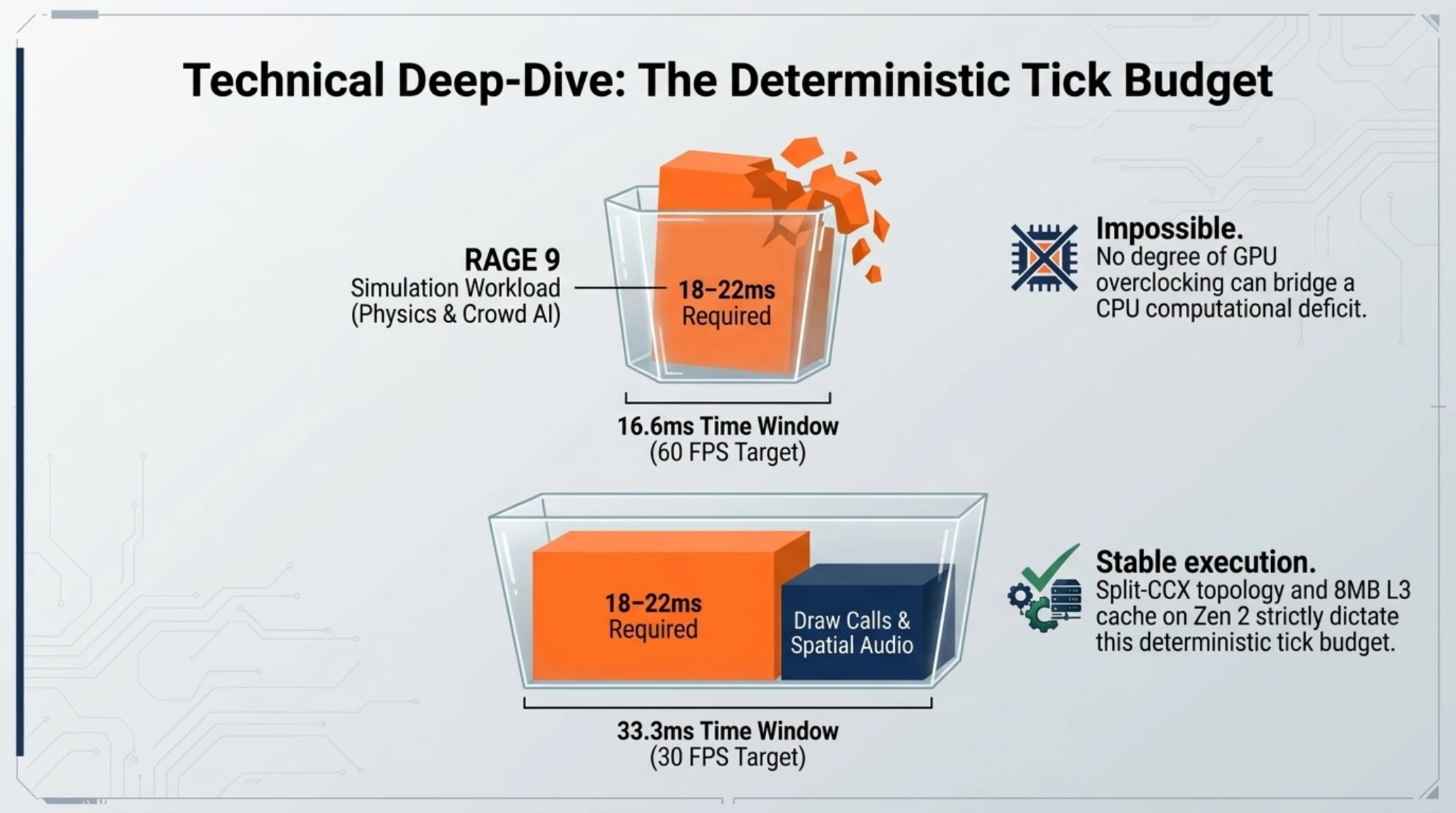
Digital Foundry's independent hardware audit corroborates Rockstar's claims. When a title is strictly CPU-bound, lowering rendering resolution from 4K to 1080p yields zero increase in frame delivery, as the graphics card merely sits idle waiting for the CPU to dispatch instructions. While Sony's proprietary PlayStation Spectral Super Resolution (PSSR) reconstructs an ultra-crisp near-4K presentation with rock-solid frame pacing, the underlying computational tick is fixed at 33.3 milliseconds per frame. For enthusiast gamers demanding high-framerate action, true 60 FPS gameplay must await future personal computer releases or next-generation hardware architectures, as previously explored in our deep-dive analysis on PS5 Pro CPU bottlenecks and console economics.
To grasp the engineering reality underlying this bottleneck, one must scrutinize the microarchitecture of Sony's custom Oberon and Viola system-on-chips. Both the standard PS5 and the PS5 Pro utilize an eight-core, sixteen-thread CPU based on AMD's Zen 2 architecture, originally deployed in commercial desktop processors back in mid-2019. While desktop computing has progressed through Zen 3, Zen 4, and Zen 5 yielding cumulative IPC gains exceeding 65 percent alongside massive increases in unified L3 cache the console space remains tethered to split-CCX Zen 2 topology with modest 8MB L3 cache clusters. In a CPU-heavy title, inter-core communication latency and limited cache capacity severely constrain instruction throughput when evaluating hundreds of interacting dynamic entities.
In Rockstar's proprietary RAGE 9 engine, simulation processing operates on a deterministic tick budget. For a 30 FPS target, the CPU is granted a 33.33-millisecond frame budget to compute world state updates, resolve ragdoll kinematic constraints, process spatial audio occlusion, and package graphics draw calls. Doubling output to 60 FPS cuts this frame window down to an uncompromising 16.66 milliseconds. When baseline physics routines and crowd artificial intelligence alone consume 18 to 22 milliseconds on Zen 2 cores, no degree of graphics scaling or GPU overclocking can mathematically bridge that computational deficit without gutting core world mechanics.
Furthermore, early hopes that modern display technologies such as Variable Refresh Rate (VRR) or 40 FPS balanced modes could serve as a middle ground have encountered structural impediments. A 40 FPS target inside a 120Hz container expands the frame window to 25.0 milliseconds still insufficient to accommodate Leonida's peak simulation workload in dense metropolitan hubs like Downtown Vice City. Digital Foundry tests confirmed that attempting to uncap frame rates merely introduces erratic frame pacing and micro-stuttering, affirming Rockstar's decision to enforce a locked 30 FPS ceiling with tight frame-time synchronization.
Tekin Technical Jargon Buster | Silicon Architecture
The strategic ramifications for Sony's hardware division are nuanced. While early marketing positioning suggested the PS5 Pro would resolve the compromises of this generation, the reality of high-density open-world software reveals that generational leap in graphics silicon cannot compensate for stagnant CPU architectures. The PS5 Pro remains the undisputed definitive platform for visual fidelity, ray-traced ambient lighting, and image stability, but it operates firmly within the mechanical confines of a 30 FPS experience.
When evaluated against modern personal computer configurations, the architectural disparity becomes starkly apparent. Contemporary enthusiast gaming PCs leverage processors such as AMD's Ryzen 7 9800X3D featuring stacked second-generation 3D V-Cache, delivering an astounding 96 megabytes of zero-latency L3 cache alongside single-core boost clocks exceeding 5.2 GHz on the Zen 5 architecture. In contrast, the monolithic system-on-chip powering the PS5 Pro is restricted by living-room thermal design envelopes, capped at roughly 220 to 240 watts total system board power. This strict acoustic and thermal ceiling precludes aggressive CPU clock scaling, permanently limiting instruction throughput until true next-generation architectural shifts occur.
Consequently, Rockstar's engineering disclosure serves as an essential recalibration of industry expectations. While previous mid-generation consoles most notably the PS4 Pro and Xbox One X often offered unlocked 60 FPS performance toggles by leveraging simple resolution downscaling on straightforward software, modern ninth-generation game engines are fundamentally simulation-driven. For millions of PlayStation owners preparing for launch day, the takeaway is unambiguous: the PS5 Pro delivers the most opulent, razor-sharp 4K visual fidelity and pristine frame pacing achievable in modern console gaming, but true high-refresh 60 FPS gameplay remains an engineering frontier reserved for future hardware cycles.
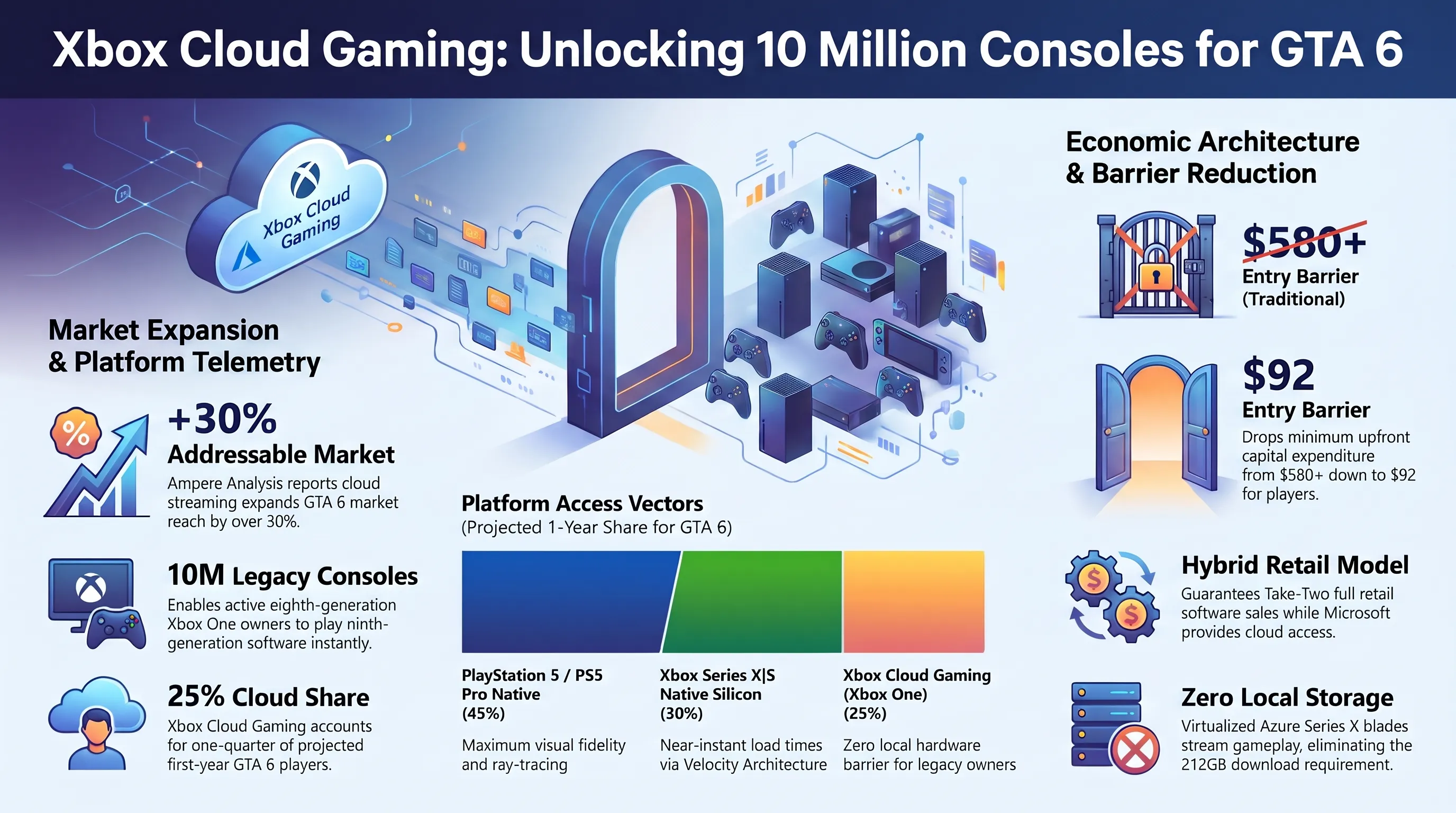
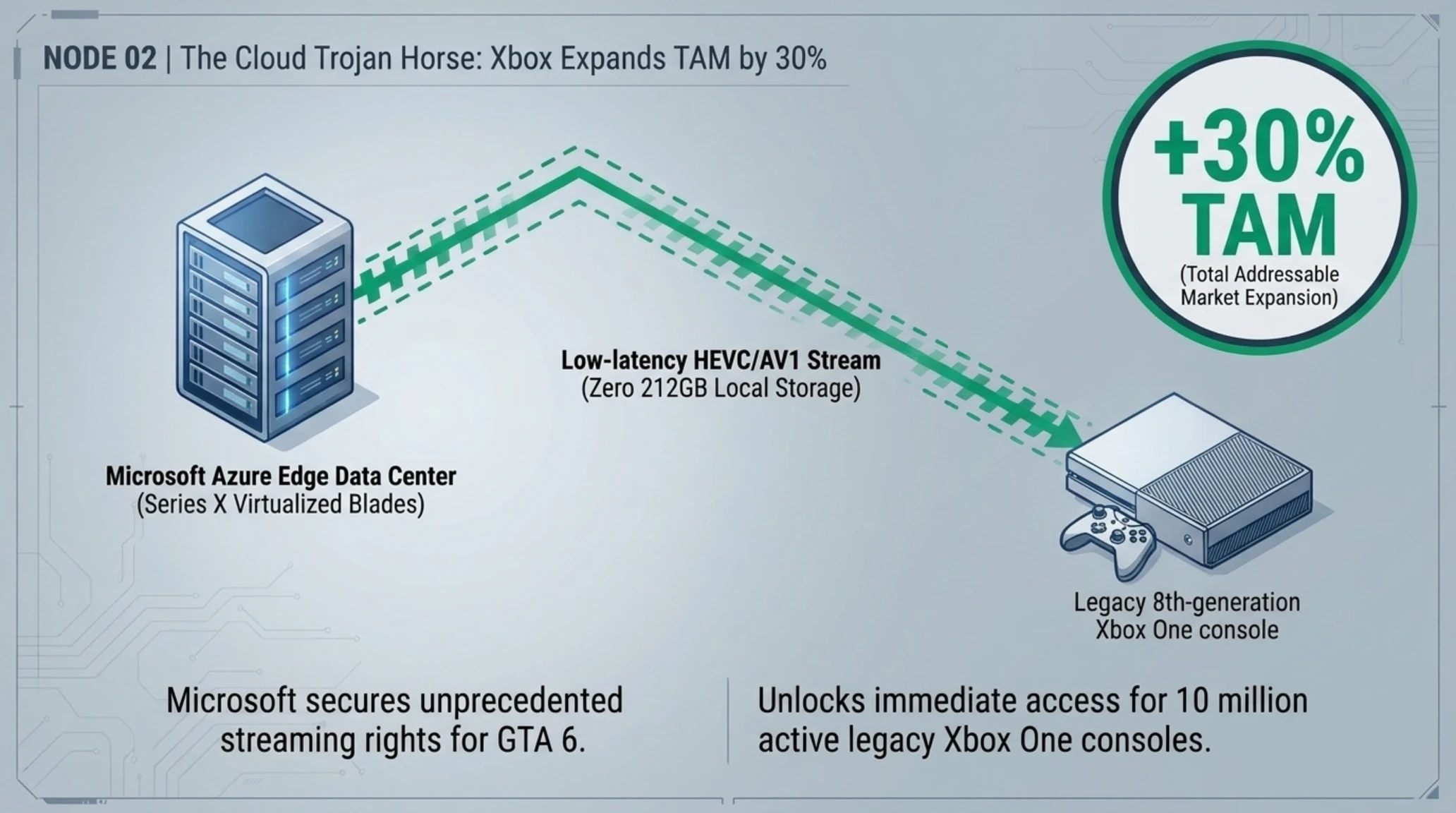
How Xbox’s Cloud Gaming Agreement For GTA 6 Expands Its Addressable Market By 30%
While Sony Interactive Entertainment anchored its holiday campaign around positioning Grand Theft Auto VI as a system-seller for premium $500 to $700 hardware, Microsoft executed a brilliant asymmetric counter-offensive. Through an unprecedented cloud distribution agreement with Take-Two Interactive, Microsoft secured the rights to stream Rockstar's magnum opus directly through Xbox Cloud Gaming, dismantling traditional generational hardware boundaries.
A comprehensive research report published this morning by Ampere Analysis details the profound market implications of this distribution pact. According to senior analyst Piers Harding-Rolls, Microsoft's cloud arrangement expands the total addressable market (TAM) for GTA 6 across the Xbox ecosystem by over 30 percent. Crucially, the agreement unlocks immediate access for an estimated 10 million active eighth-generation Xbox One consoles that were previously locked out of native ninth-generation software releases.
Why Microsoft's Cloud Strategy Alters Console Economics
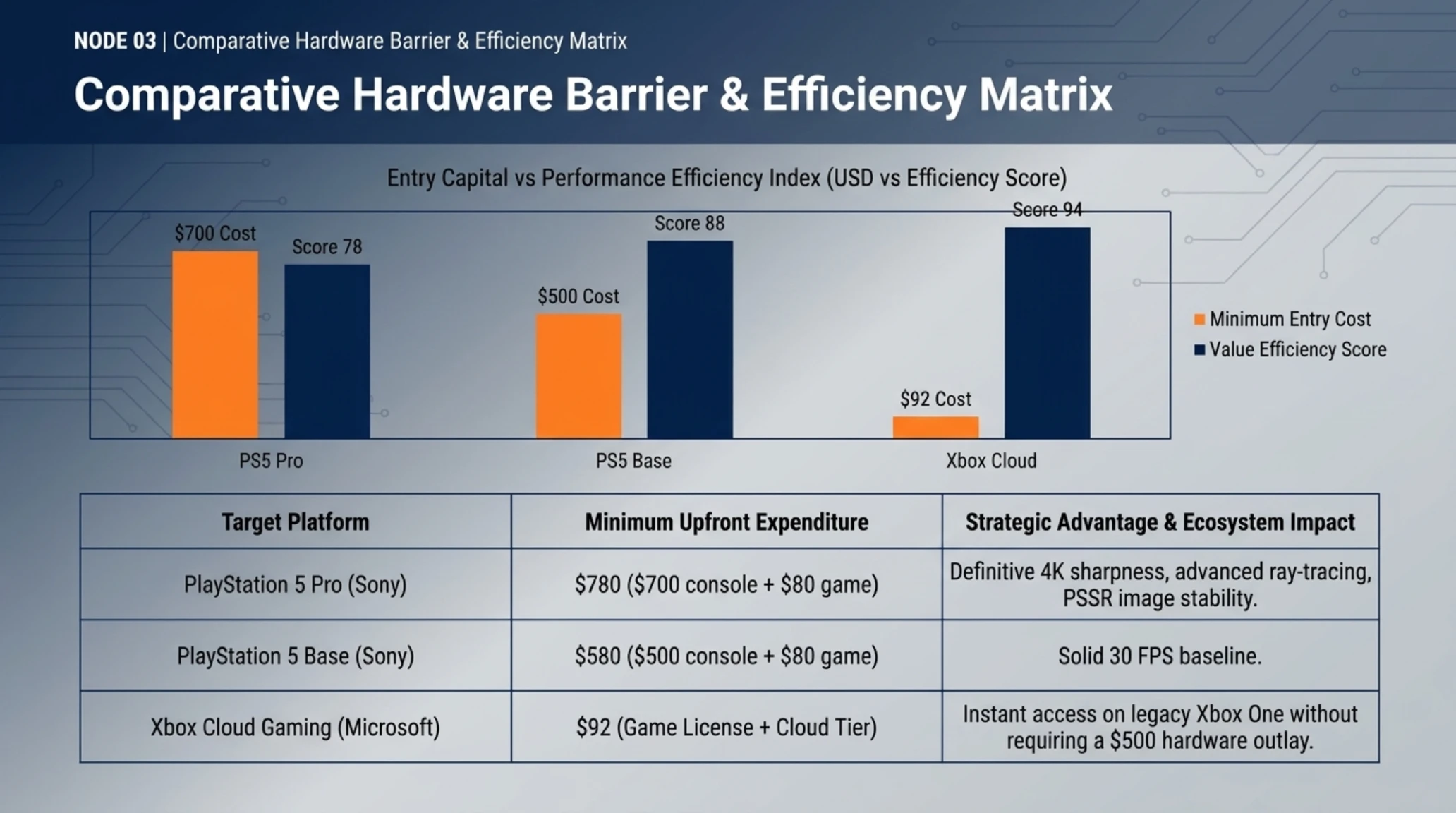
The operational mechanics of this model represent a sophisticated commercial compromise. Unlike subscription-first Game Pass releases that arrive on Day One without separate purchase requirements, players streaming GTA 6 must purchase the digital game license while maintaining an active Game Pass Ultimate tier or purchasing hourly cloud playtime packs. This hybrid framework guarantees Take-Two its coveted $70 to $80 upfront retail revenue while slashing consumer capital expenditure from roughly $580 to just $92.
Sony's corporate strategy remains staunchly opposed to such broad cloud concessions. In recent investor calls, PlayStation leadership pointed out that native PS5 users monetize at a significantly higher rate across digital add-ons, battle passes, and virtual currency than legacy PS4 owners. For Sony, GTA 6 is the definitive sledgehammer designed to compel the final holdout cohort of 40 million PS4 owners into upgrading their living-room silicon. Microsoft's cloud maneuver, detailed extensively in our analysis on Xbox Project Helix and cross-ecosystem gaming, circumvents hardware friction entirely.
From a network architecture and cloud infrastructure perspective, Microsoft's execution leverages high-density custom server blades installed throughout Microsoft Azure edge data centers. Each custom server rack runs virtualized instances of Xbox Series X hardware, paired with hardware-accelerated HEVC and AV1 video encoding pipelines. By processing the heavy 212GB software footprint locally inside the data center and streaming low-latency video feeds to end devices, Microsoft eliminates both storage constraints and local silicon limitations. For players on eighth-generation hardware with constrained mechanical hard drives or solid-state SATA interfaces, the elimination of a multi-hour download and zero storage footprint represents an enormous quality-of-life advantage.
However, the cloud approach introduces its own operational prerequisites. Sustaining a visually pristine 1080p stream at low latency demands an unthrottled broadband connection delivering at least 35 to 50 Mbps down, coupled with low round-trip ping times to local Azure edge nodes. While network jitter and minor compression artifacts in high-motion vehicular sequences remain inherent realities of remote rendering, Ampere Analysis highlights that for millions of casual and cost-conscious consumers across North America, Europe, and Latin America, bypassing a $500 hardware upgrade easily outweighs minor visual trade-offs.
Furthermore, Take-Two Interactive's willingness to embrace cloud streaming signals a pragmatic recognition of shifting macroeconomic realities. With global consumer electronics experiencing persistent hardware inflation and household budgets constrained by rising living expenses, relying exclusively on high-end console adoption to achieve record-breaking launch figures carried quantifiable revenue risks. By establishing a cloud conduit on Xbox, Take-Two secures upfront digital game sales while allowing Microsoft to fund the cloud infrastructure and bandwidth overhead, establishing a precedent that could permanently alter blockbuster release models.
Apple Reorganizes iPhone Roadmap: Standard iPhone 18 and iPhone Air 2 Slated for March 2027 Debut
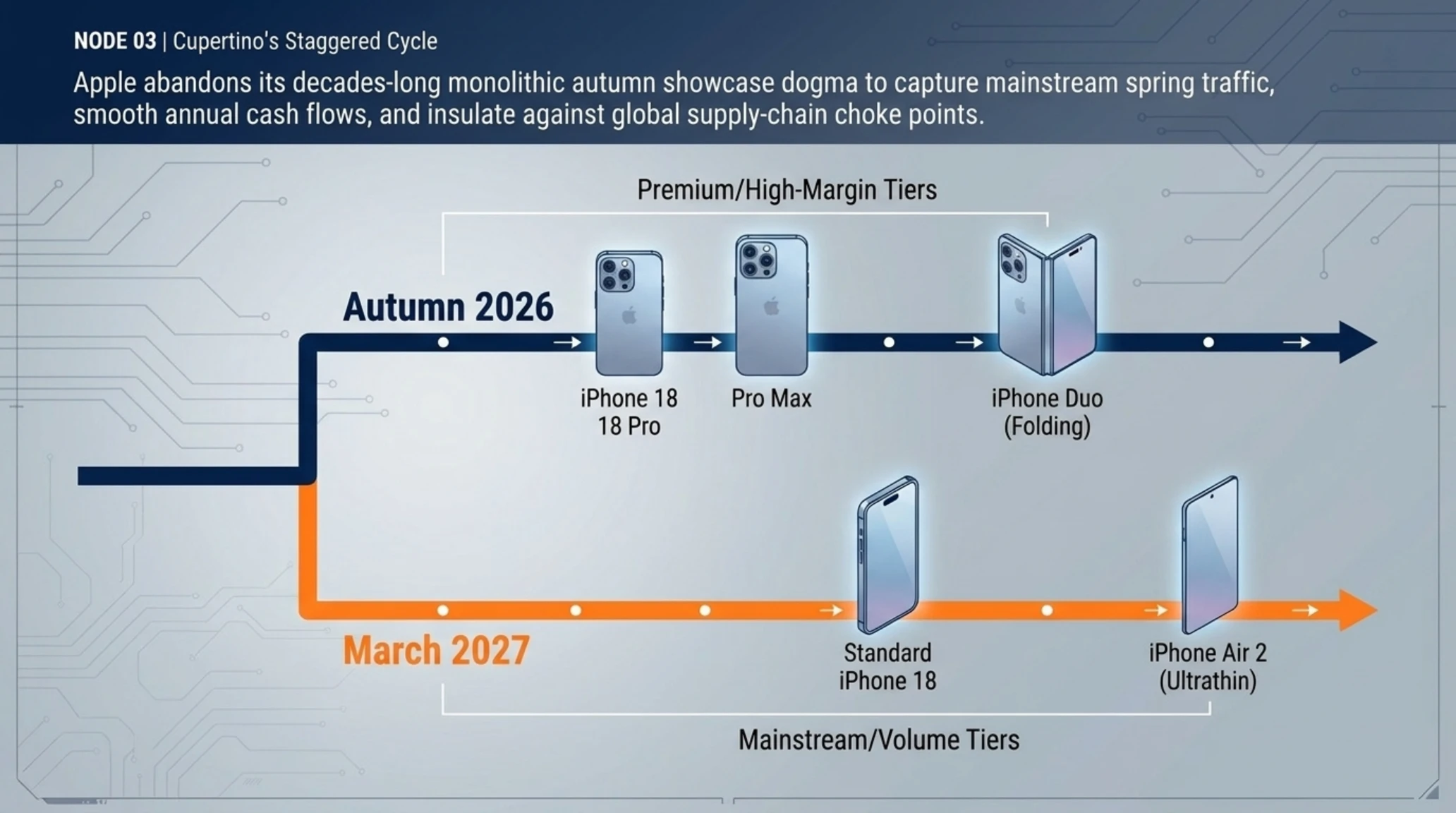
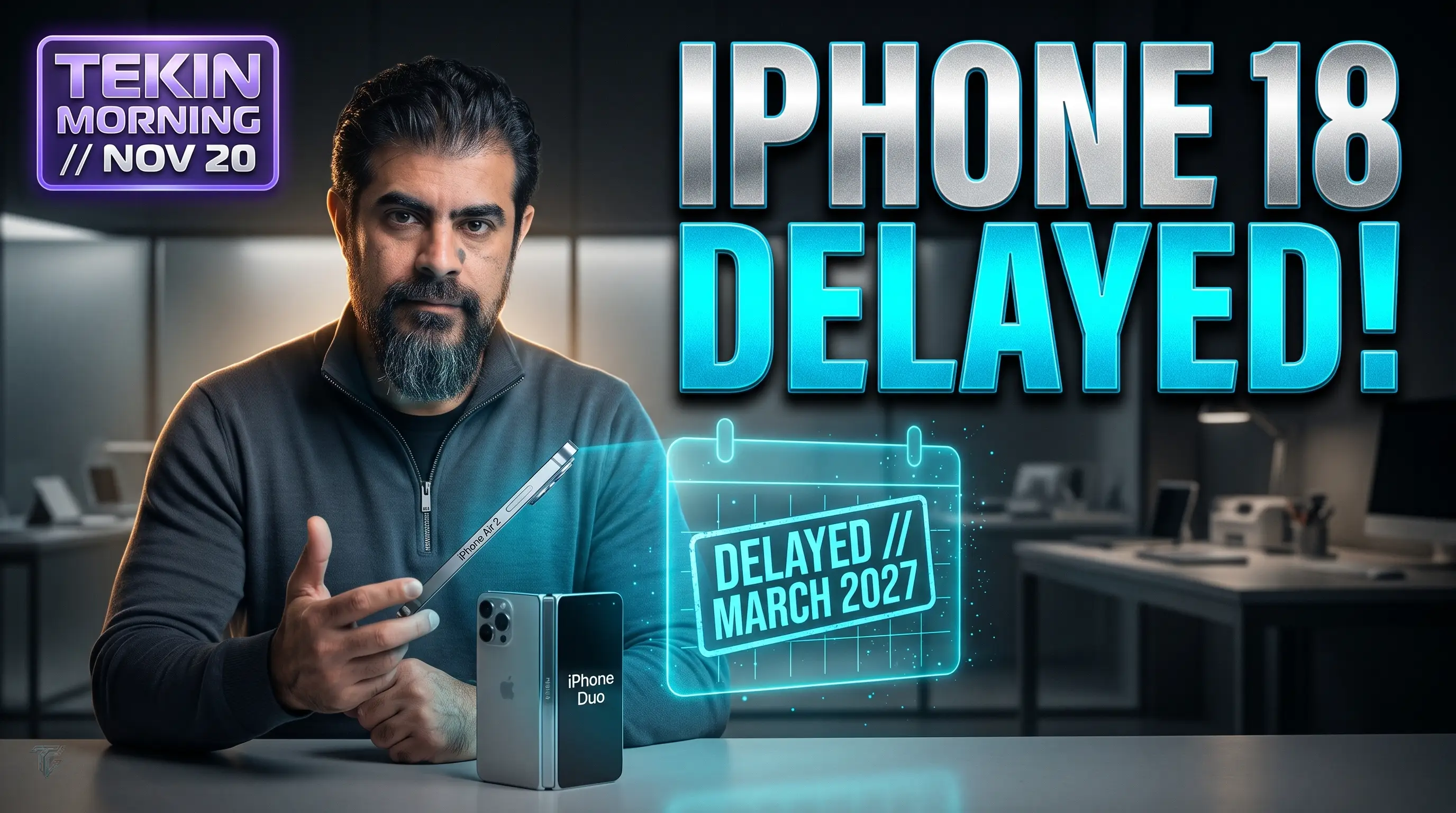
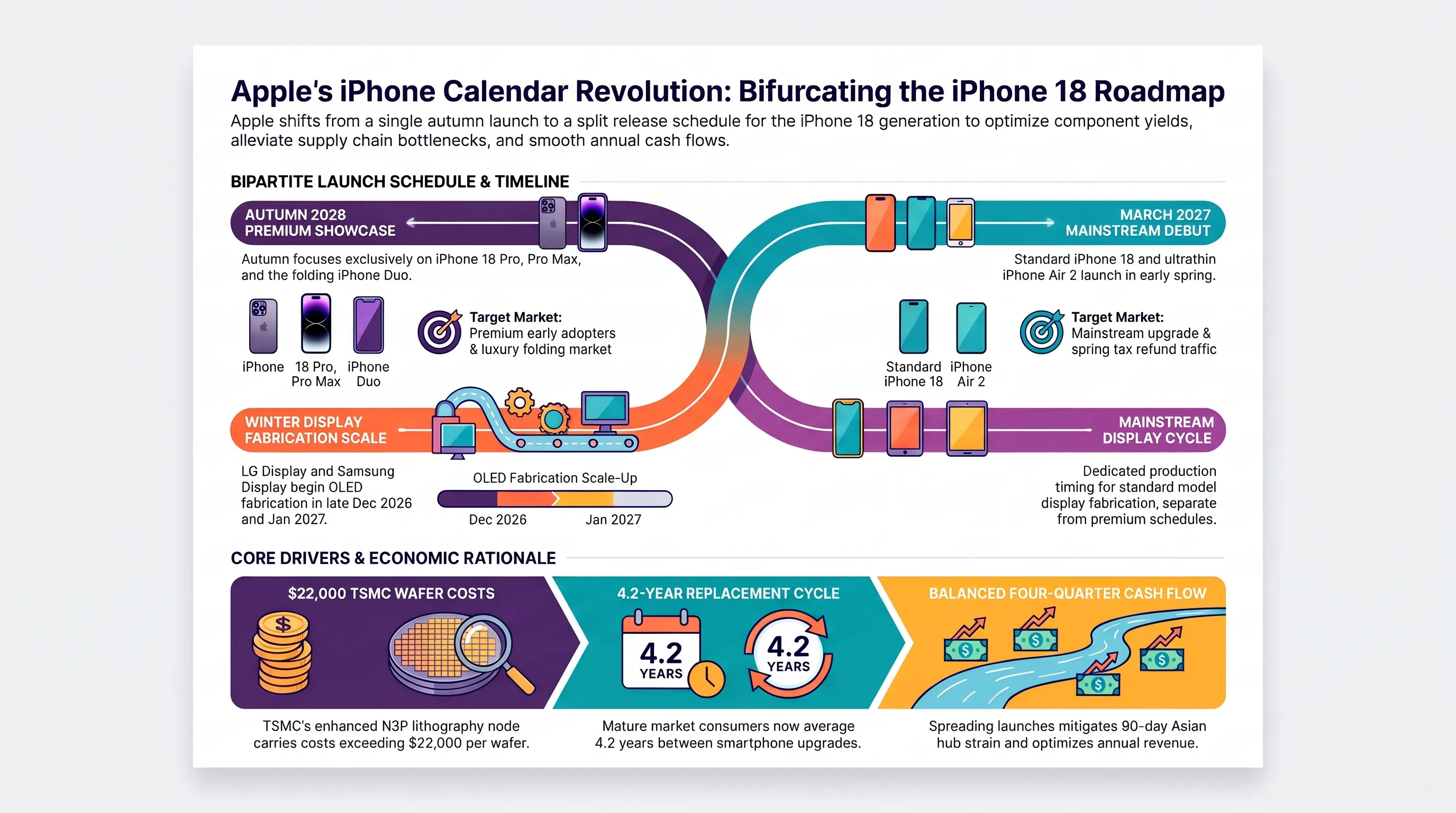
Apple has officially abandoned its decades-long dogma of releasing the entire consumer iPhone family in a single, monolithic autumn showcase. According to highly credible supply chain disclosures from South Korea's ETNews and substantiated by 9to5Mac, Apple has formally bifurcated its product cycle, moving the standard iPhone 18 and the second-generation ultrathin iPhone Air 2 to an early spring launch in March 2027.
The strategic shift leaves Apple's autumn 2026 window dedicated exclusively to premium, high-margin tiers: the flagship iPhone 18 Pro, iPhone 18 Pro Max, and the inaugural folding handset, iPhone Duo. This phased cadence is already dictating manufacturing schedules across East Asian display fabrication lines. LG Display is slated to initiate high-volume OLED panel fabrication in late December 2026, while Samsung Display will scale commercial output in early January 2027.
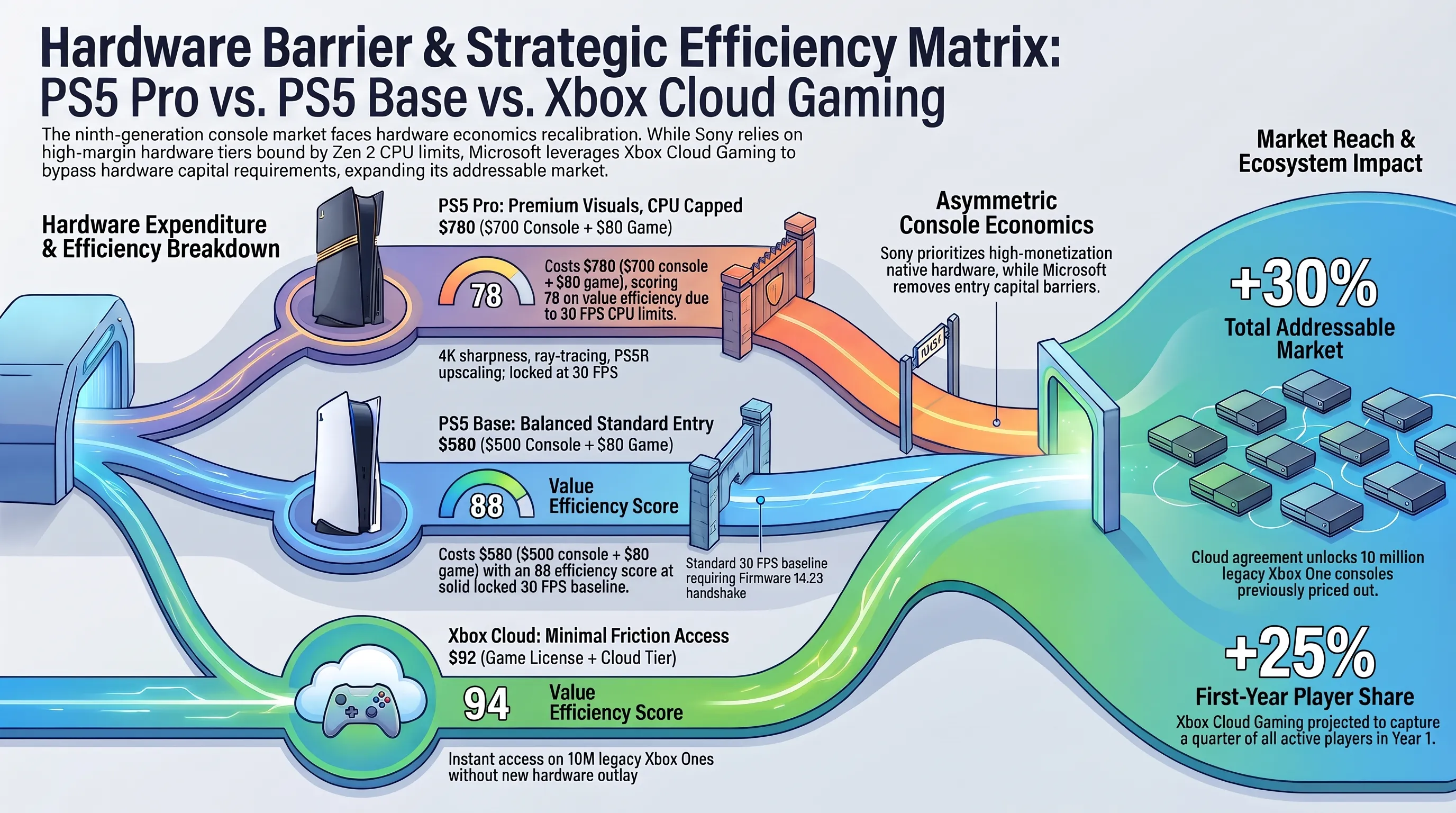
Comparative Hardware Barrier and Strategic Efficiency Matrix
| Target Platform | Minimum Upfront Expenditure | Strategic Advantage & Ecosystem Impact |
|---|---|---|
| PlayStation 5 Pro (Sony) | $700 Console + $80 Game | Definitive 4K sharpness, advanced ray-tracing and PSSR image stability |
| PlayStation 5 Base (Sony) | $500 Console + $80 Game | Solid 30 FPS baseline requiring mandatory Firmware 14.23 token handshake |
| Xbox Cloud Gaming (Microsoft) | $92 (Game License + Cloud Tier) | Instant access on legacy Xbox One without requiring $500 hardware outlay |
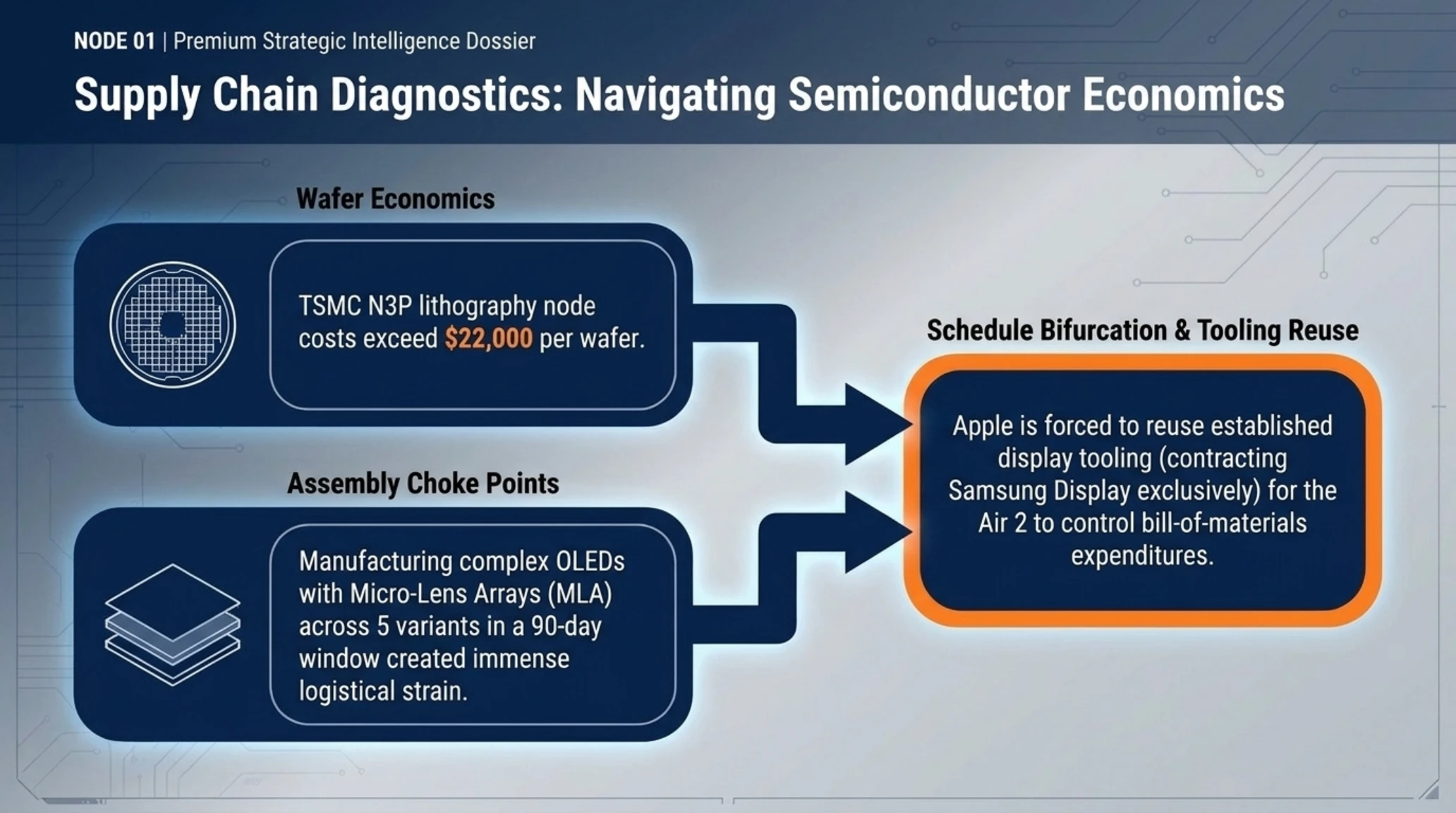
Samsung Display has reportedly been contracted as the exclusive panel supplier for the iPhone Air 2. To control bill-of-materials expenditures following subdued demand for first-generation ultra-slims, Apple will reuse established display tooling while integrating internal architectural upgrades: an upgraded 3nm application processor, expanded silicon thermal dissipation chambers, and a second rear optical sensor. Staggering hardware launches across spring and autumn windows insulates Apple from global supply-chain choke points while optimizing cash-flow predictability throughout the fiscal year.
The structural rationale driving Cupertino's calendar revolution stems directly from macro-level semiconductor economics and manufacturing bottlenecks. Fabricating modern Apple Silicon at scale on TSMC's enhanced N3P lithography node carries staggering wafer costs exceeding $22,000 per wafer. Simultaneously attempting to manufacture millions of complex, multi-layered OLED displays featuring micro-lens array (MLA) brightness enhancers across four to five distinct product variants within a tight 90-day autumn window created immense logistical strain across Asian assembly hubs, frequently triggering launch-window supply shortages.
Moreover, global smartphone replacement cycles have extended to an unprecedented average of 4.2 years among premium consumers. In mature markets across the United States, Europe, and Japan, consumers no longer feel compelled to replace standard handsets on an annual cadence. By bisecting the lineup dedicating September to affluent early adopters demanding bleeding-edge Pro camera systems and luxury folding displays, and deploying standard models in March to capture mainstream tax-refund and spring upgrade traffic Apple achieves sustained commercial momentum across all four fiscal quarters.
For the broader mobile industry, Apple's calculated divergence is set to disrupt rival release strategies. Android original equipment manufacturers, including Samsung, Xiaomi, and Google, traditionally synchronized their mainstream flagship announcements during the late winter and early spring windows (coinciding with events like Mobile World Congress) to avoid Apple's autumn media monopoly. With Apple now anchoring a major commercial hardware beachhead in March with the standard iPhone 18 and iPhone Air 2, competition in the $799 to $999 smartphone tier will reach an unprecedented fever pitch.
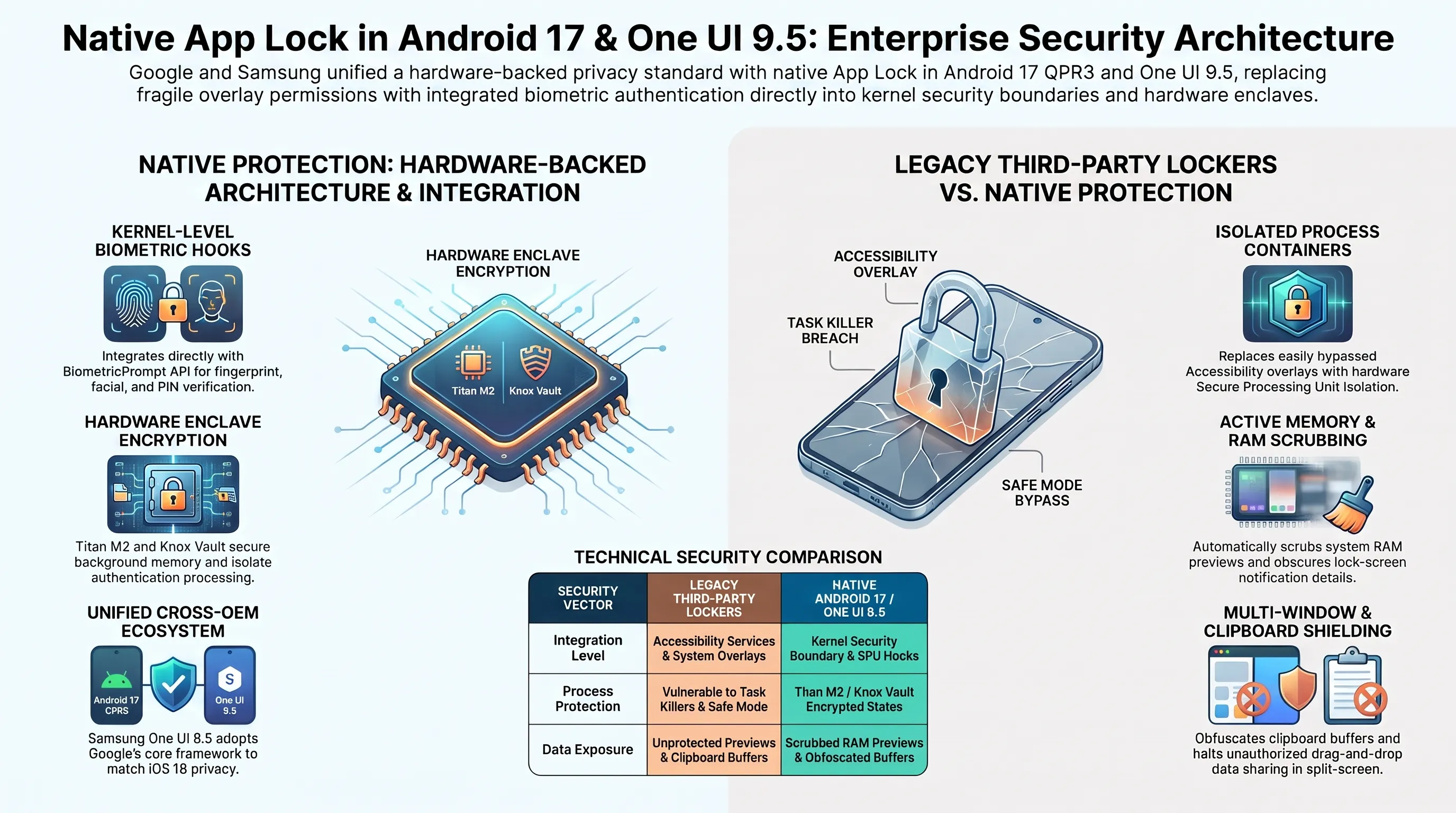
Google Pixel Re-Releases Native App Lock in Android 17 QPR3 Beta; Samsung Adopts Architecture for One UI 9.5
Following substantial enterprise and consumer feedback highlighting vulnerability gaps in mobile privacy, Google has officially reintroduced its native App Lock architecture within the Android 17 QPR3 Beta channel. Simultaneously, Samsung has integrated the underlying Android framework directly into its One UI 9.5 beta deployment, creating a unified cross-OEM privacy standard across hundreds of millions of Android smartphones.
Google initially tested native app locking during early Android 17 QPR2 preview builds, but abruptly withdrew the feature prior to commercial release to resolve memory-leak anomalies and notification leakage vectors. In this finalized QPR3 release, App Lock functions at the kernel security boundary through direct hooks into Google's BiometricPrompt API, allowing users to secure sensitive applications via fingerprint authentication, facial recognition, or an isolated PIN.
Technical Fact-Check | Industry Myth vs Architectural Reality
📚 Classified & Related Dossiers in TekinGame
If you wish to explore beyond this report and delve into cybernetic frontiers and autonomous AI architectures, do not miss these three exclusive deep-dives in the Tekin Garage:
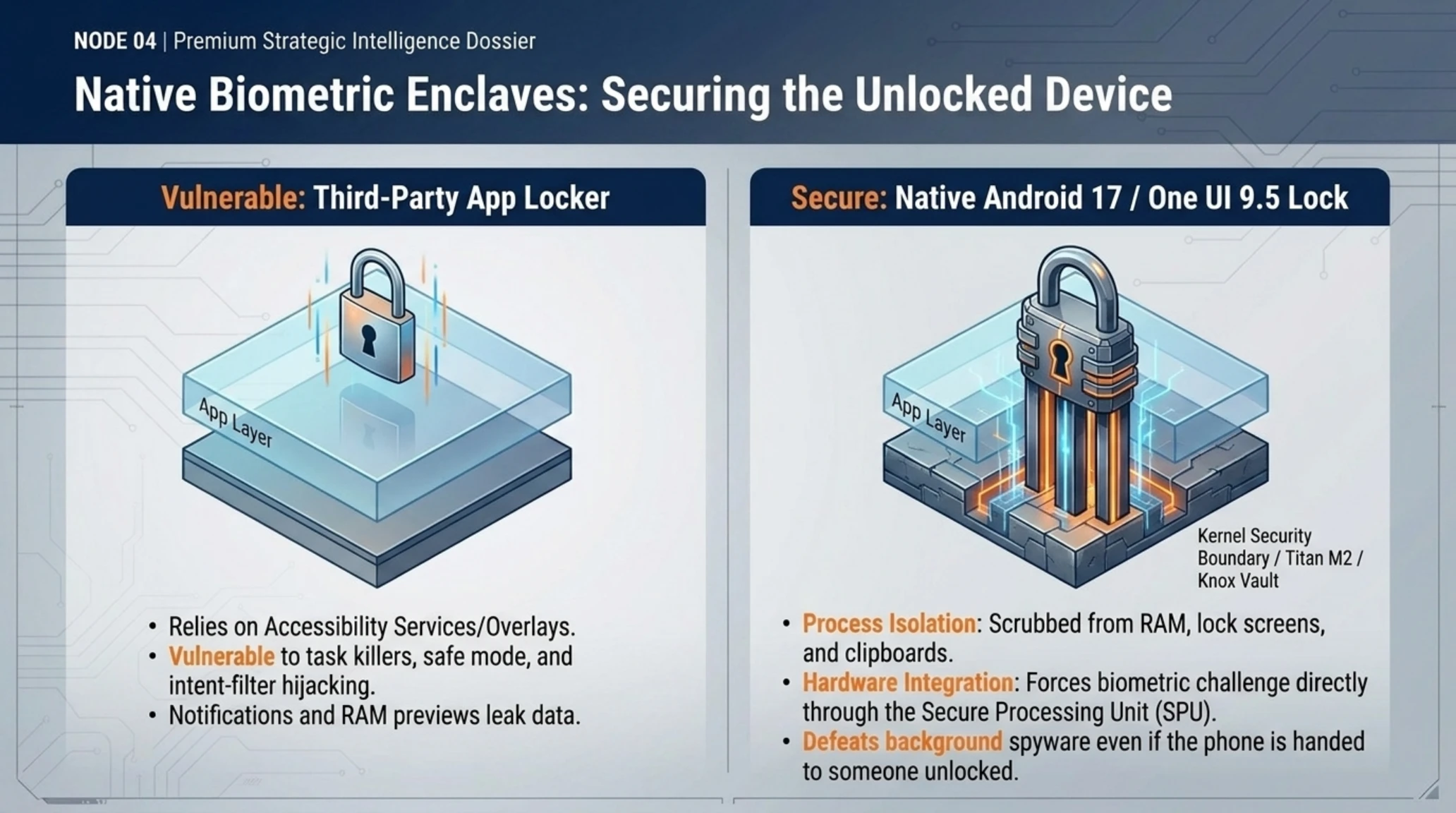
The crucial architectural breakthrough separating native App Lock from fragile third-party Play Store utilities lies in process isolation. Third-party lockers typically relied on Accessibility Services and system overlay permissions mechanisms frequently bypassed via task killers, safe mode restarts, or intent-filter hijacking. In Android 17 QPR3, when an app is locked, its contents are scrubbed from system RAM previews, notifications on the lock screen are obscured, and background memory states are encrypted via the device's Titan M2 or Knox Vault hardware enclave.
This implementation addresses a persistent vulnerability in modern mobile security: the "unlocked device" scenario. While biometric lock screens protect devices from physical intrusion when left idle, they offer zero protection once a device is unlocked and handed to a friend, colleague, or service technician. Under Android 17's native security framework, each designated application is treated as an isolated biometric security container. Opening a locked app forces an immediate biometric challenge directly through the hardware Secure Processing Unit (SPU), completely preventing malicious screen-recording software or background spyware from intercepting sensitive banking portals or encrypted messenger chats.
For Samsung users, the integration into One UI 9.5 establishes seamless parity with its enterprise-grade Knox platform. The architecture ensures that locked applications automatically obfuscate their clipboard buffers, prevent unauthorized drag-and-drop data sharing in multi-window split-screen modes, and immediately terminate running processes upon screen lock. By elevating app-level locking from an afterthought third-party script to a standardized, hardware-backed Android subsystem, Google and Samsung have closed one of the longest-standing privacy discrepancies separating the Android operating system from Apple's native Face ID app protection in iOS 18.
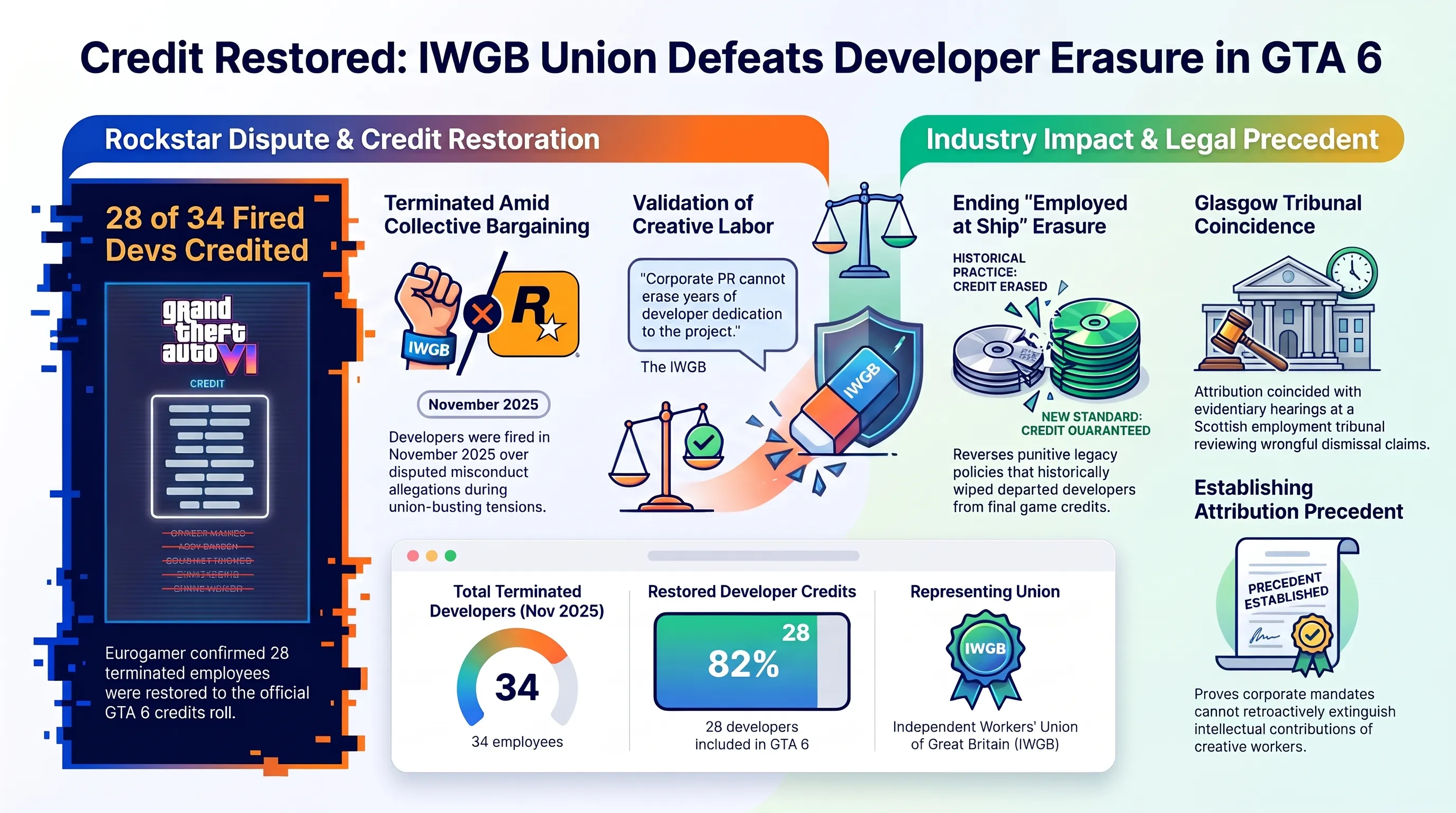
Eurogamer Investigation Confirms 28 of 34 Fired Rockstar Developers Are Credited in GTA 6
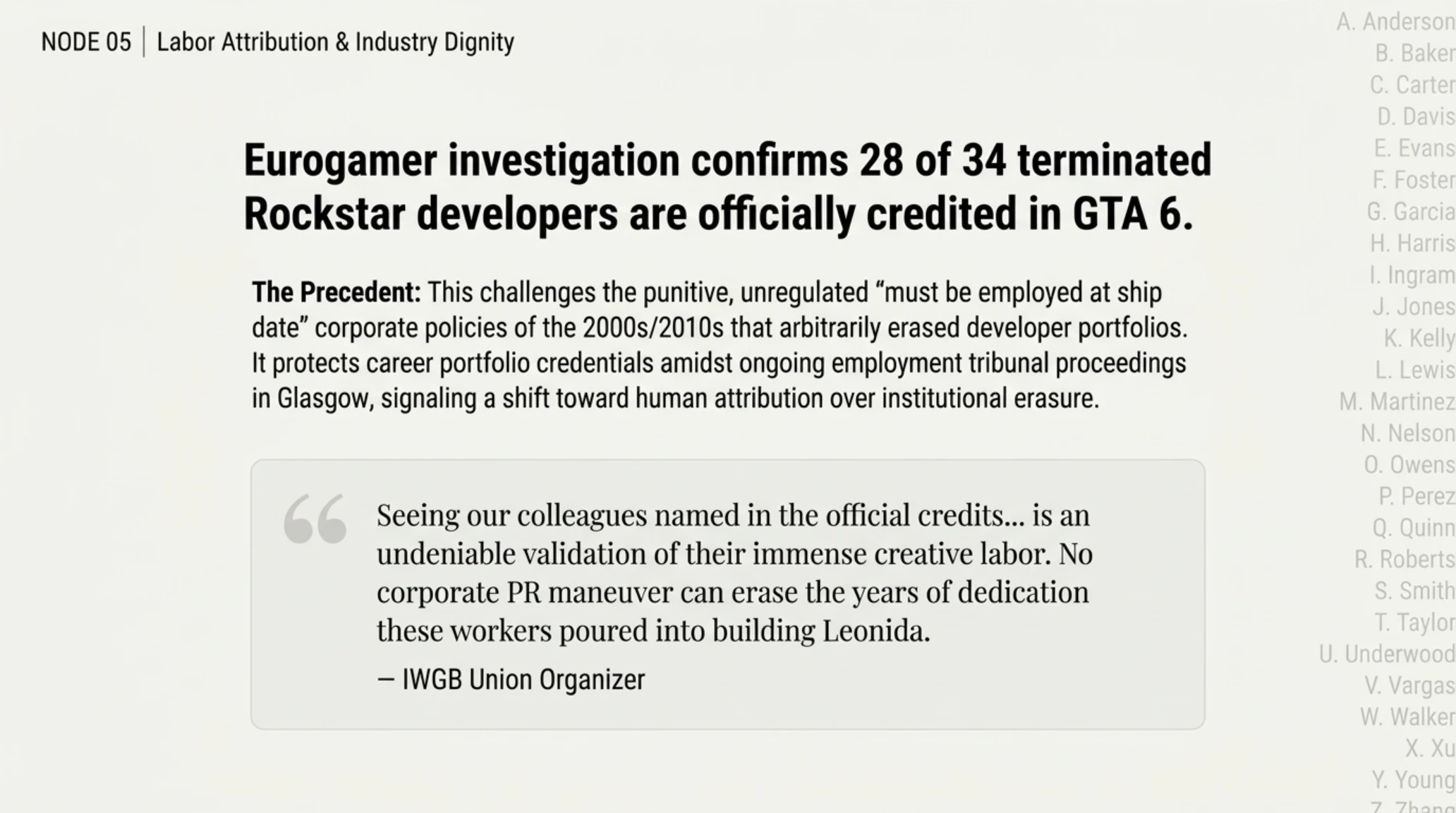
In a profound vindication of developer labor rights during one of the most contentious disputes in modern gaming history, an investigative report published this morning by Eurogamer revealed that Rockstar Games has officially included at least 28 of the 34 employees it terminated late last year in the final credits roll of Grand Theft Auto VI. The revelation emerged after cross-referencing official rosters provided by the Independent Workers' Union of Great Britain (IWGB) with early retail verification discs.
The developers were abruptly terminated in November 2025 during the critical final push of project development, with Rockstar leadership alleging gross misconduct regarding the unauthorized sharing of confidential development materials. The IWGB union vehemently countered those claims, asserting that the terminations were an aggressive act of union-busting aimed at destabilizing collective bargaining efforts within Rockstar's Scottish and English studios. The timing of their credit inclusion directly coincides with final evidentiary hearings at an employment tribunal in Glasgow, Scotland.
Despite the acrimonious legal battle, the terminated developers demonstrated extraordinary professionalism by repeatedly urging the gaming public not to boycott GTA 6, emphasizing that the game represents the collective passion of hundreds of their former colleagues. The inclusion of their names marks an important legal and ethical benchmark in game development history, establishing that creative attribution must endure even in the wake of acrimonious corporate separation.
Historically, videogame crediting has suffered from a pervasive lack of statutory regulation, operating largely at the arbitrary discretion of publishing executives. Throughout the 2000s and 2010s, developers across major studios who departed mid-production whether due to burnout, medical emergencies, or contract disputes were routinely erased from final project credits under punitive "must be employed at ship date" corporate policies. This systematic omission not only inflicted emotional harm on creative teams but inflicted tangible career damage, depriving junior and mid-level artists, animators, and software engineers of verifiable portfolio credentials required for subsequent employment.
The successful intervention by the IWGB and the public restoration of these 28 developers reflects the accelerating unionization movement transforming interactive entertainment across Europe and North America. Following major organizing victories across Activision Blizzard, ZeniMax, and independent European studios, developers are increasingly leveraging legal frameworks and public transparency to dismantle exploitative labor practices. While Rockstar's Glasgow tribunal continues to evaluate wrongful dismissal claims and potential financial restitution, the public attribution of their work in what is projected to be the highest-grossing entertainment launch in history establishes an indelible precedent: intellectual contribution cannot be retroactively extinguished by corporate mandate.
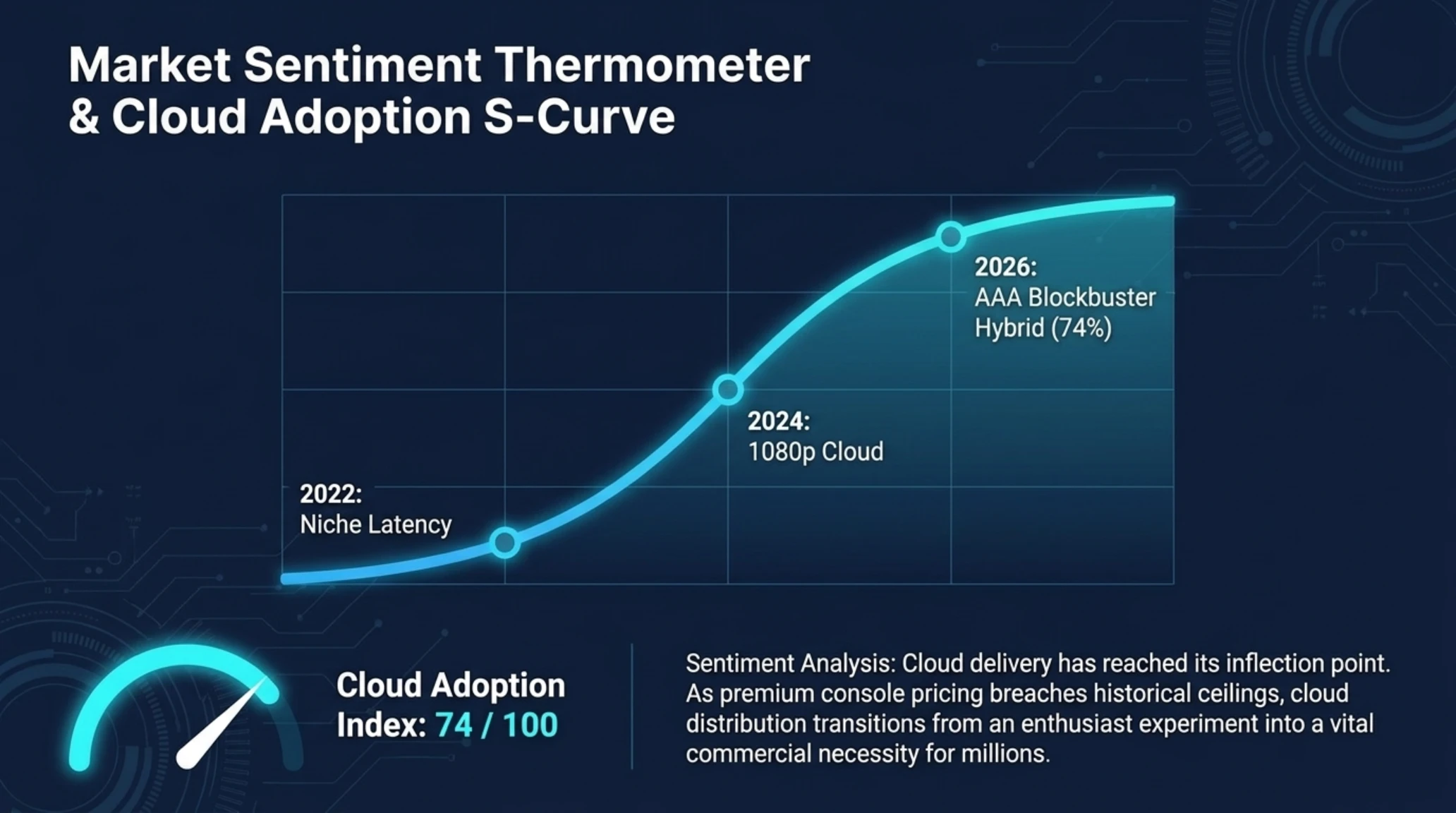
Market Sentiment Thermometer and Cloud Adoption S-Curve in Interactive Entertainment
43 U.S. Army Soldiers Reenlist in Viral Retention Campaign in Exchange for 4-Day GTA 6 Launch Pass
The cultural gravity of modern gaming franchises increasingly bleeds into public institutions and military governance. In one of the most unconventional viral human-resource stories of the decade, a U.S. Army battalion successfully combated stubborn personnel retention deficits by leveraging the global hype surrounding Grand Theft Auto VI.
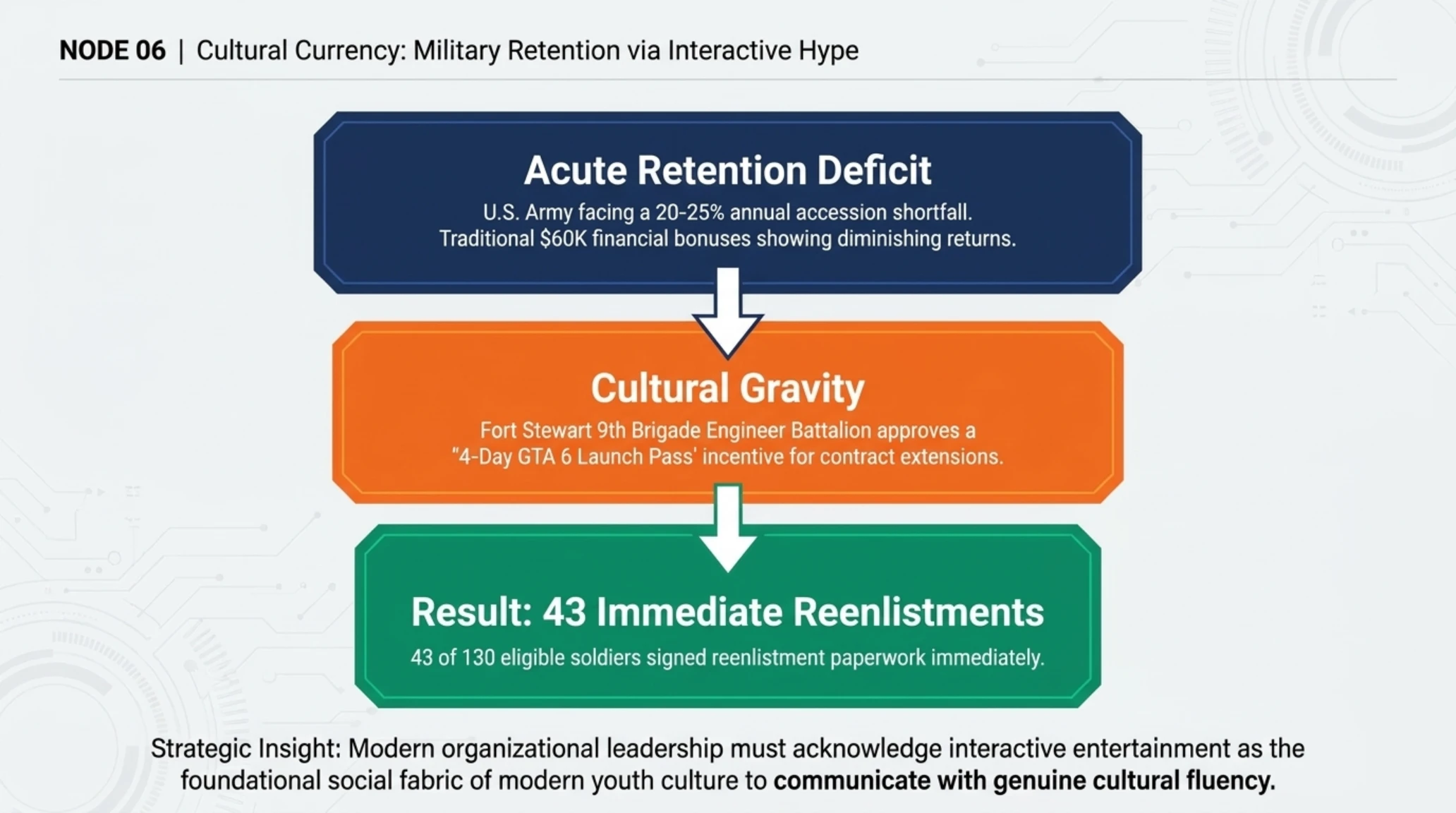
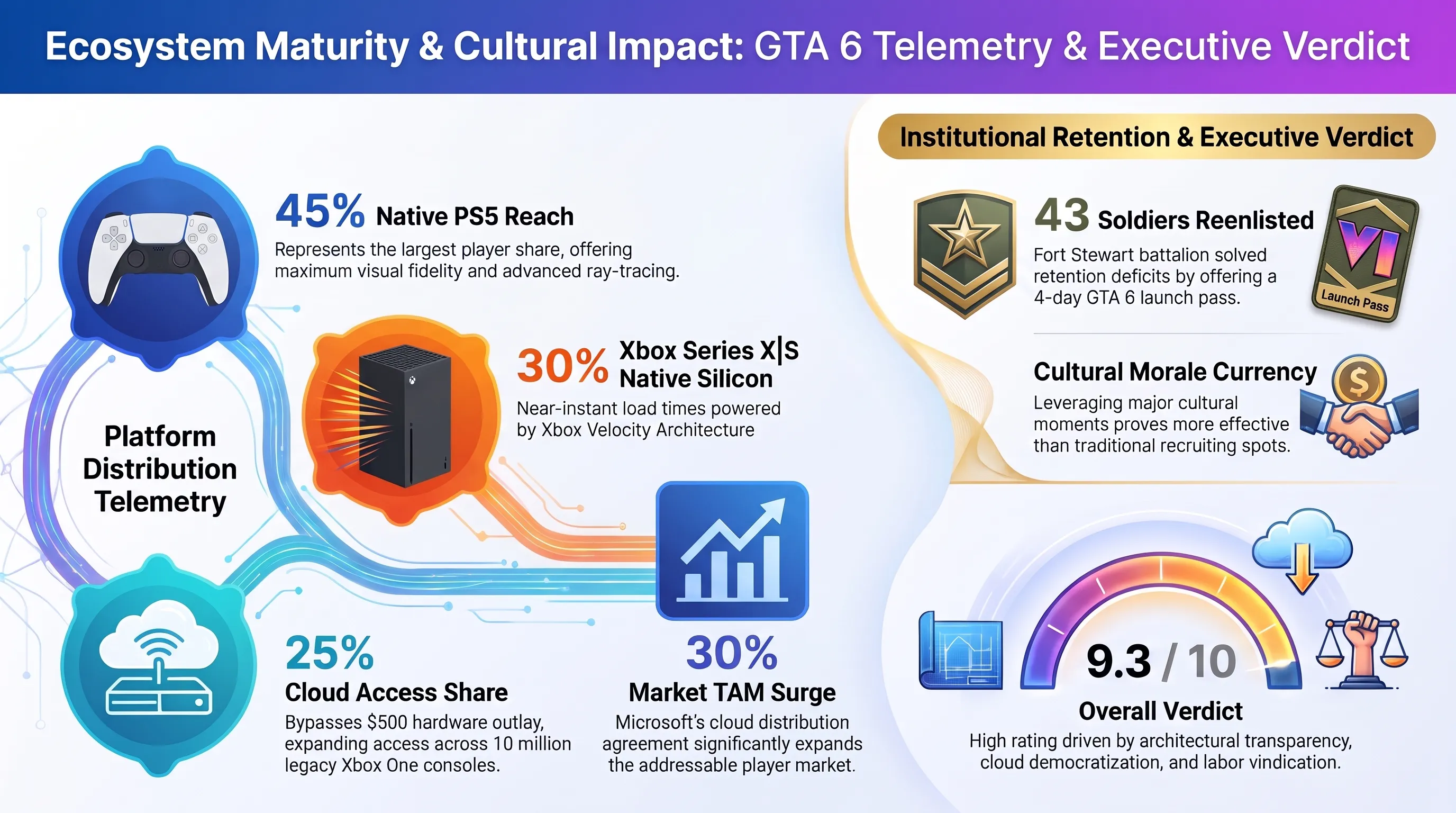
Lieutenant Colonel Ryan Hodgson, commander of the 9th Brigade Engineer Battalion stationed at Fort Stewart, Georgia, signed an official administrative memo approving a 'Special Reenlistment Incentive'. Under the directive, any active service member agreeing to extend their military contract by two to six years was guaranteed an authorized four-day pass with full pay specifically scheduled around the worldwide launch of GTA 6. Out of 130 eligible soldiers within the battalion, 43 immediately executed their reenlistment paperwork.
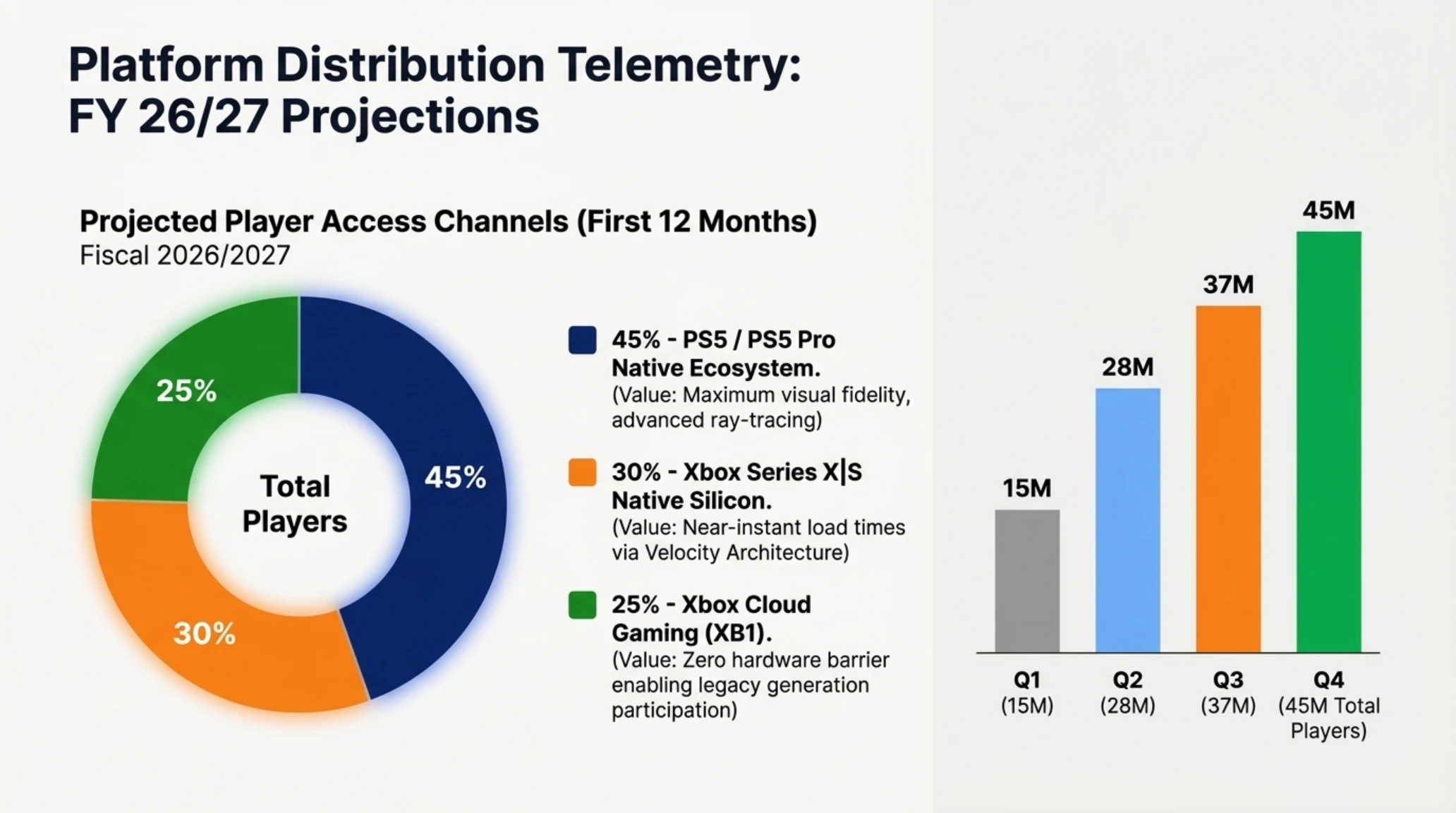
Platform Distribution Donut Chart and Global Player Base Telemetry
| Platform Access Vector | Projected First-Year User Share | Core Architectural Value Proposition |
|---|---|---|
| PlayStation 5 / PS5 Pro Ecosystem | 45% of Total Player Cohort | Maximum visual fidelity, advanced ray-tracing and DualSense haptics |
| Xbox Series X|S Native Silicon | 30% of Total Player Cohort | Near-instant load times powered by Xbox Velocity Architecture |
| Xbox Cloud Gaming (Xbox One) | 25% of Total Player Cohort | Zero hardware barrier enabling legacy generation participation |
Sociological researchers analyzing defense workforce dynamics noted that while standard financial retention bonuses (often exceeding $60,000 for critical technical specialties) remained the primary economic driver, the cultural currency of guaranteed launch-day leave proved extraordinarily potent. In an era where military branches struggle with youth recruitment targets, aligning organizational policies with authentic generational subcultures demonstrates that modern leadership must acknowledge the massive cultural footprint of interactive entertainment.
Over the past four years, the United States Armed Forces and several NATO allies have wrestled with an acute recruitment deficit, regularly missing annual accession benchmarks by 20 to 25 percent. The shortfall stems from profound cultural shifts: younger generations are increasingly distrustful of traditional institutional messaging, and conventional marketing campaigns utilizing polished television spots or static recruiting kiosks produce diminishing returns. In contrast, interactive digital entertainment represents the foundational social fabric of modern youth culture. Acknowledging that an entertainment event like Grand Theft Auto VI is a national social happening rather than an idle distraction allowed military leadership at Fort Stewart to communicate with genuine cultural fluency.
This operational pivot parallels broader institutional integrations of gaming culture across global defense forces. From the formal deployment of competitive esports teams by the U.S. Army, Navy, and Air Force to the utilization of commercial game controllers in unmanned aerial vehicle (UAV) piloting and naval submarine periscopes, interactive entertainment technology and military engineering have become inextricably intertwined. By treating launch-window access as a high-value morale currency, military commanders transformed an otherwise routine reenlistment cycle into an extraordinarily viral human-capital victory, generating millions of dollars in earned media coverage and establishing an administrative template that other civilian and government institutions are now studying closely.
The broader commercial implications of this cultural resonance underline why entertainment platforms are aggressively competing for consumer leisure time in late 2026. Within the subscription sphere, Microsoft's Xbox Game Pass Ultimate, Sony's PlayStation Plus Extra and Premium tiers, and Nintendo's Switch Online Expansion Pack represent three radically distinct philosophies of digital distribution. While Sony continues to rely on high-cost hardware sales anchored by prestige narrative blockbusters, Microsoft is actively constructing a cross-device cloud network unburdened by silicon ownership. Nintendo, meanwhile, thrives in its own self-contained orbit, shattering physical cartridge sales records with nostalgic remakes on Switch 2 while resisting industry pressures toward hyper-realistic visual inflation.
As these competing philosophies collide during the historic holiday shopping season of 2026, the real victor is consumer diversification. Players are no longer forced down a single, cost-prohibitive corridor of $700 hardware acquisitions to participate in defining cultural moments. Whether through premium local silicon, seamless cloud virtualization, or agile mobile ecosystems, modern technology has created an unprecedented mosaic of access points, ensuring that the next chapter of digital entertainment reaches the widest and most diverse global audience in human history.
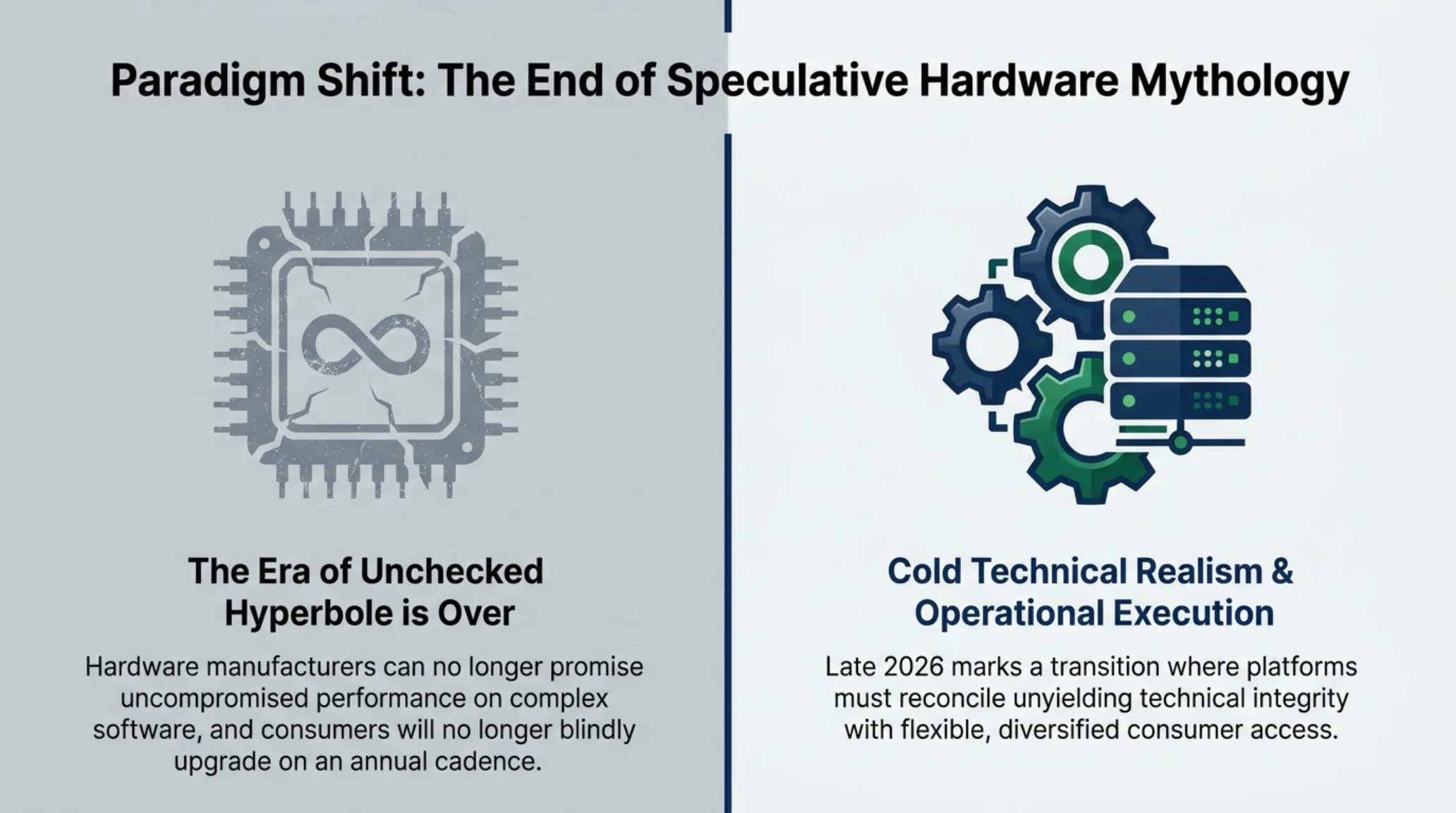
The collective trajectory of this Friday morning dispatch presents a comprehensive portrait of an industry arriving at sober operational maturity. The era of unchecked hyperbole where hardware manufacturers promised uncompromised 60 FPS performance on complex software, and tech conglomerates assumed consumers would blindly upgrade hardware on an annual cadence has been decisively supplanted by cold technical realism. Whether through Rockstar's unyielding adherence to architectural limits, Microsoft's calculated cloud democratization, Apple's recalibrated manufacturing rhythm, or the legal vindication of creative workers, the global interactive landscape in late 2026 is forging a resilient, transparent foundation designed to endure the computational and economic demands of the next decade.
The convergence of today's developments illustrates an industry maturing beyond speculative hype into calculated operational execution. From Rockstar's honest acknowledgement of Zen 2 silicon boundaries to Microsoft's aggressive cloud democratization, technology leaders are adapting to economic constraints with unprecedented agility. As hardware upgrade intervals extend and software architectures grow infinitely more complex, sustainable growth belongs to platforms capable of reconciling technical integrity with flexible consumer access.
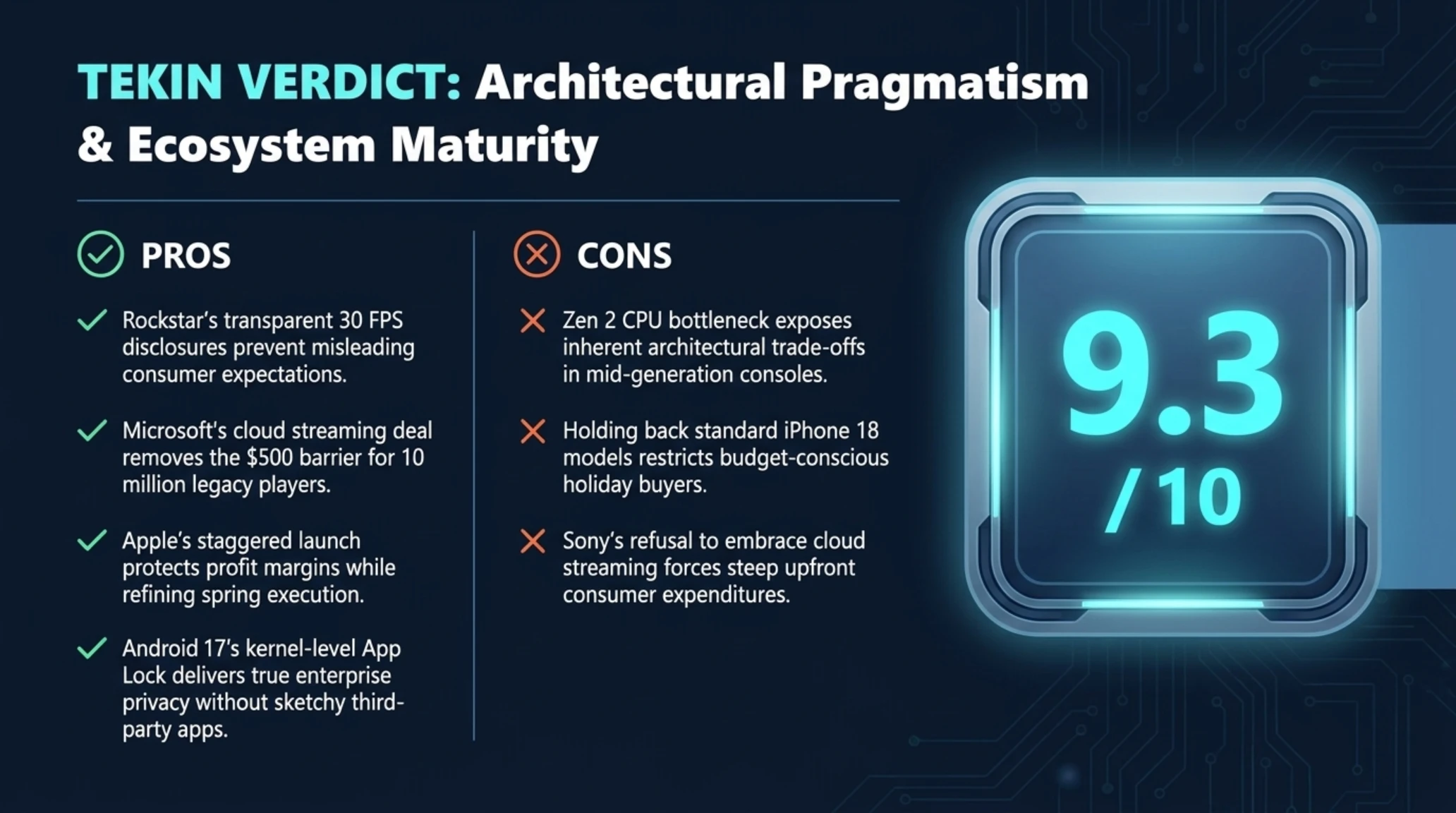
- Rockstar's transparent 30 FPS disclosure prevents misleading consumer expectations.
- Microsoft's cloud streaming deal removes the $500 barrier for 10 million legacy players.
- Apple's staggered launch protects profit margins while refining spring product execution.
- Android 17's kernel-level App Lock delivers true enterprise privacy without sketchy third-party apps.
- The Zen 2 CPU bottleneck exposes inherent architectural trade-offs in mid-generation consoles.
- Holding back standard iPhone 18 models restricts budget-conscious holiday buyers.
- Sony's refusal to embrace cloud streaming forces steep upfront expenditures on PlayStation owners.
Editorial Verdict and Authoritative References
- Eurogamer: PS5 Pro CPU Technical Analysis and Fired Devs Credits Investigation
- GameSpot: Ampere Analysis GTA 6 Cloud Gaming Market Coverage
- 9to5Mac: Apple iPhone 18 OLED Production Roadmap and Supply Chain Timing
- 9to5Google: Android 17 QPR3 App Lock Architecture and Samsung Galaxy Rollout
- IGN: U.S. Army Battalion GTA 6 Reenlistment Pass Analysis
Frequently Asked Technical Inquiries
Why can't the PS5 Pro run GTA 6 at 60 FPS despite its powerful GPU?
The primary computational bottleneck is the AMD Zen 2 CPU. While the GPU is heavily upgraded, complex city-wide AI, vehicular pathfinding, and physics simulation must be computed sequentially on CPU cores, which lack the clock throughput for 60 FPS tick rates.
Do players need to own an Xbox Series console to stream GTA 6 on Xbox One?
No. The streaming agreement between Take-Two and Microsoft allows Xbox One owners to purchase the digital license and stream the title directly from Azure server blades via Xbox Cloud Gaming with an active subscription.
Why has Apple delayed the standard iPhone 18 and iPhone Air 2 to March 2027?
Apple is transitioning to a bi-annual release cadence to optimize display panel yields at LG and Samsung, reduce component inflation pressure on entry-level models, and focus autumn demand entirely on premium Pro tiers.
How does native Android 17 App Lock differ from third-party app lockers?
Native App Lock operates at the kernel level via the BiometricPrompt API and hardware secure enclaves (Titan M2 / Knox Vault), completely obscuring lock screen notifications, recent app previews, and memory dumps.
Will the 28 terminated Rockstar developers receive financial compensation from the credits inclusion?
The inclusion of their names in the credits represents intellectual and moral vindication of their labor, while claims for financial compensation and severance remain subject to ongoing hearings at the employment tribunal in Glasgow.
Additional Gallery: Tekin Morning Nov 20: PS5 Pro 30FPS GTA 6 Lock, Xbox Cloud 30% Surge & iPhone 18 Delay