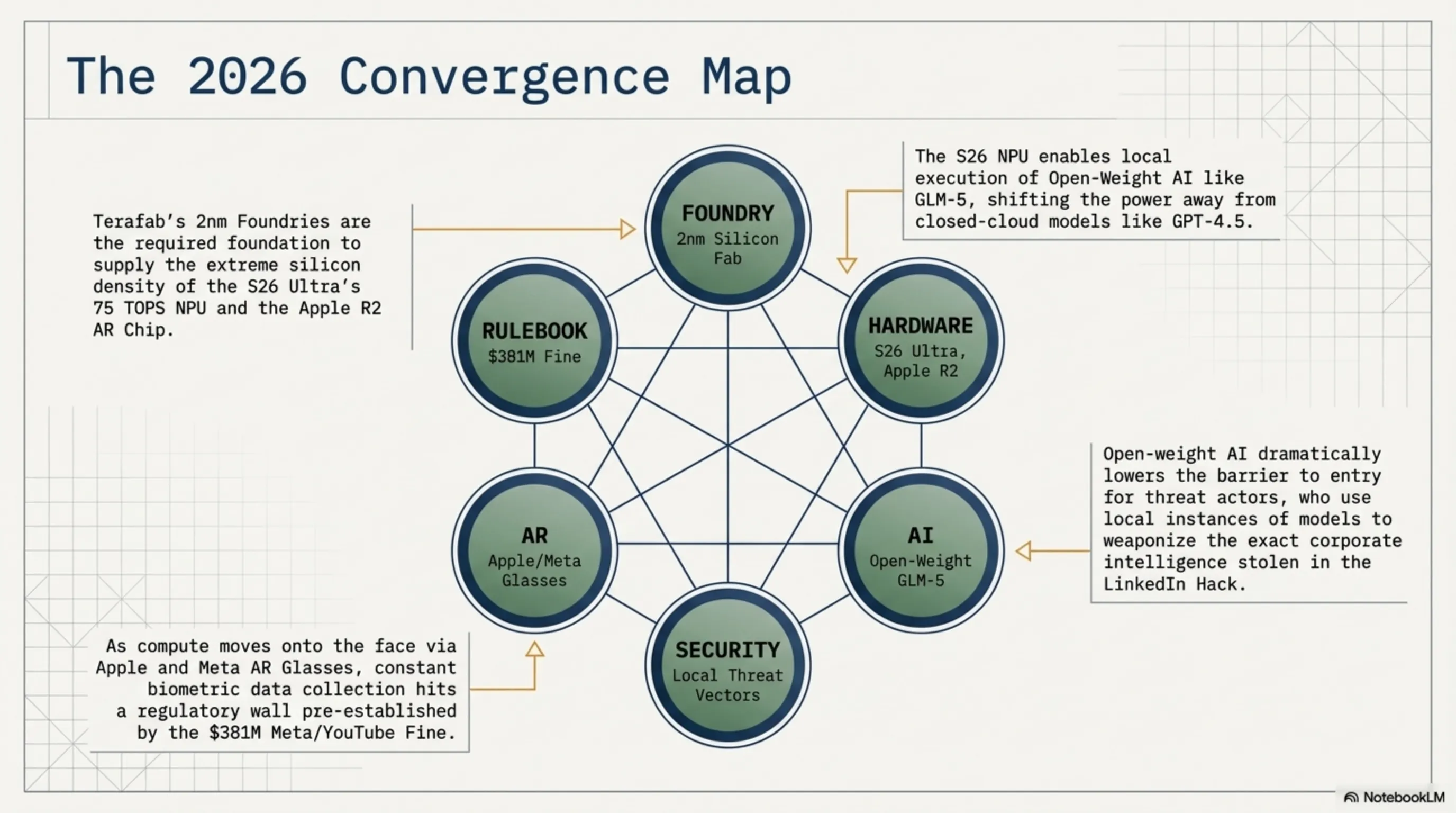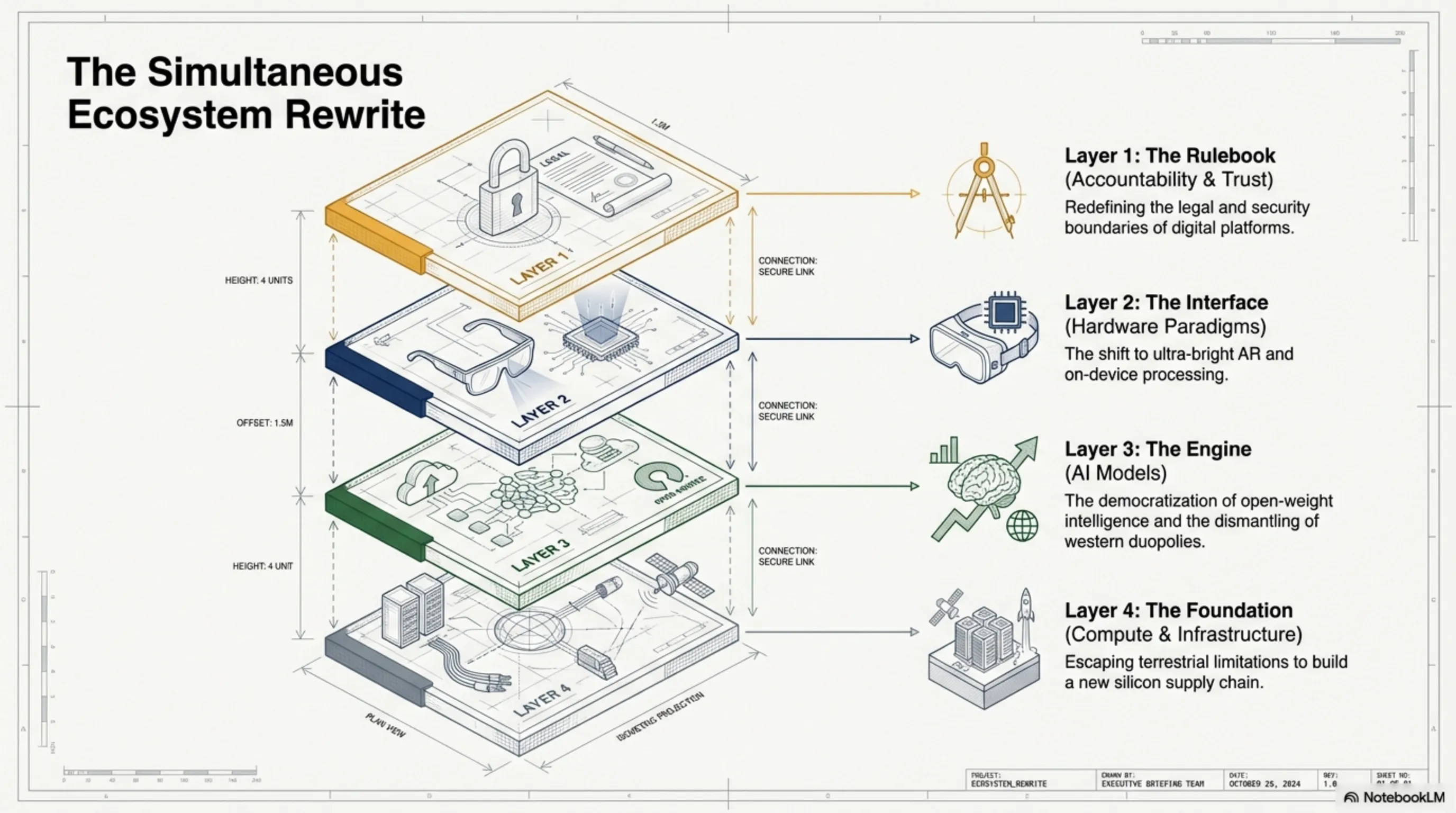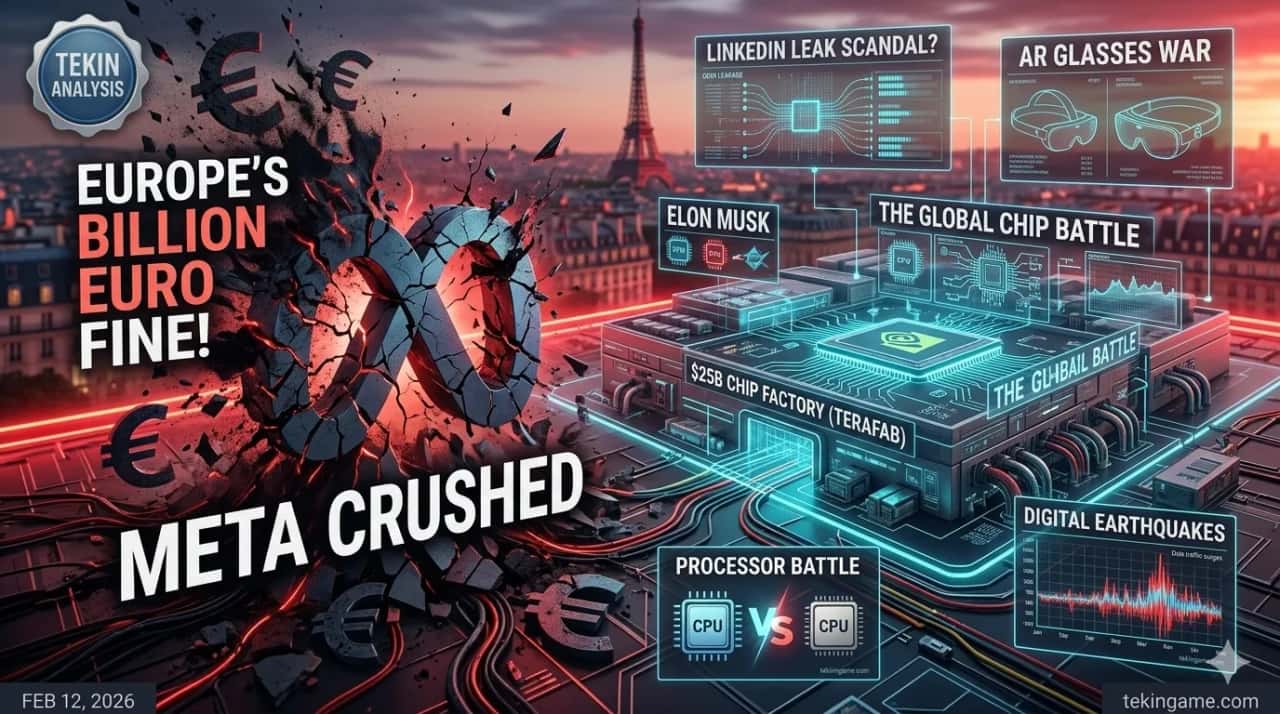
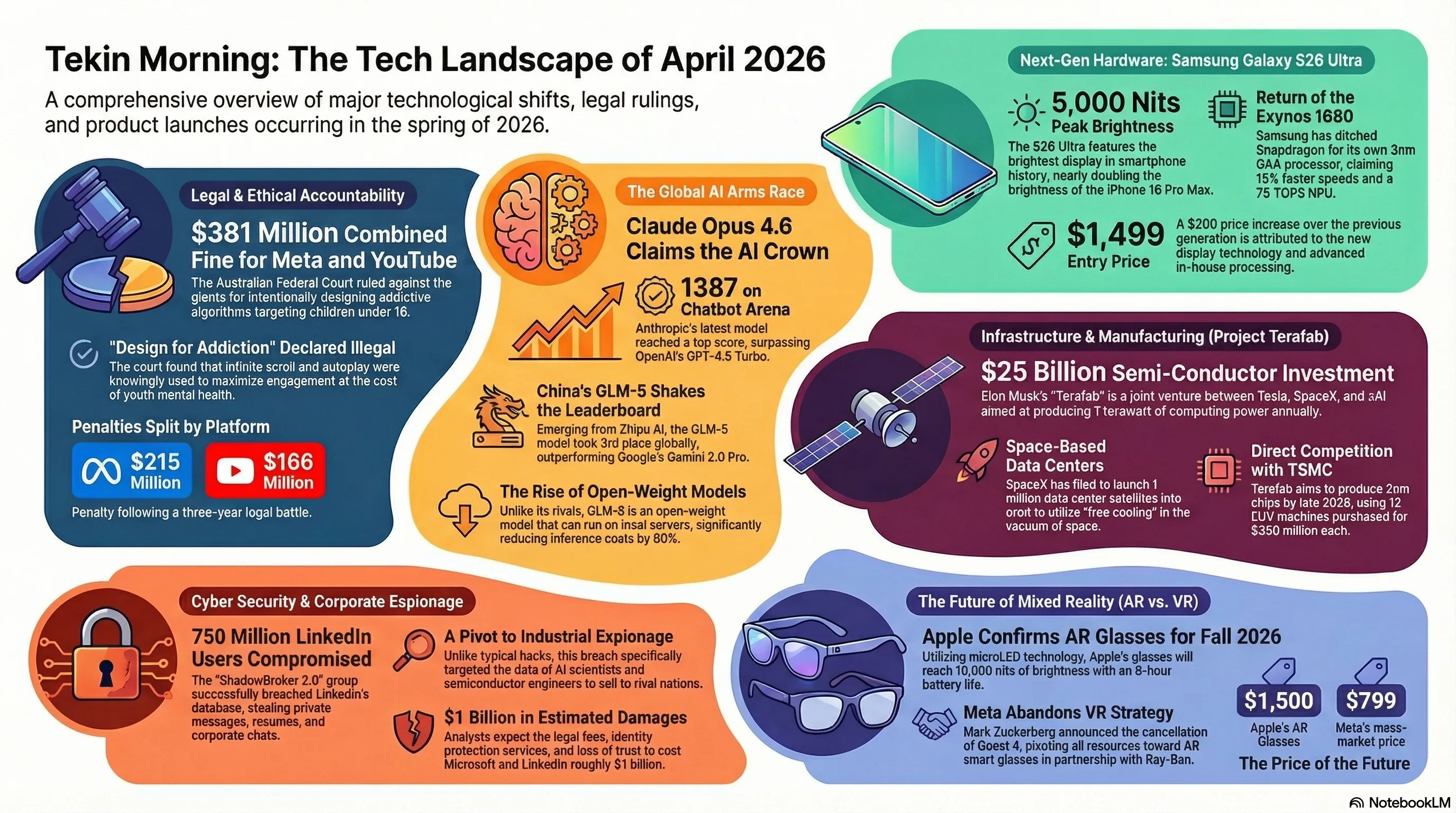
The morning of April 7, 2026 began with six major tech stories: An Australian court fined Meta and YouTube $381 million for deliberately designing addictive algorithms targeting children. In the AI model wars, Anthropic's Claude Opus 4.6 took the lead while China's GLM-5 shocked everyone by reaching third place. Samsung unveiled the Galaxy S26 Ultra with a 5000 nits display and Exynos 1680 processor. Tesla and SpaceX launched the $25 billion Terafab chip factory. LinkedIn was caught in the biggest corporate espionage scandal in history. And Apple confirmed AR glasses with microLED for 2026 while Meta pivoted from VR to AR.
Good morning Tekin Legion! Welcome to Tekin Morning April 7, 2026. Grab your coffee because today is one of the most exciting mornings in tech.
1. Meta and YouTube Fined $381 Million: Australian Court Rules on Child Addiction
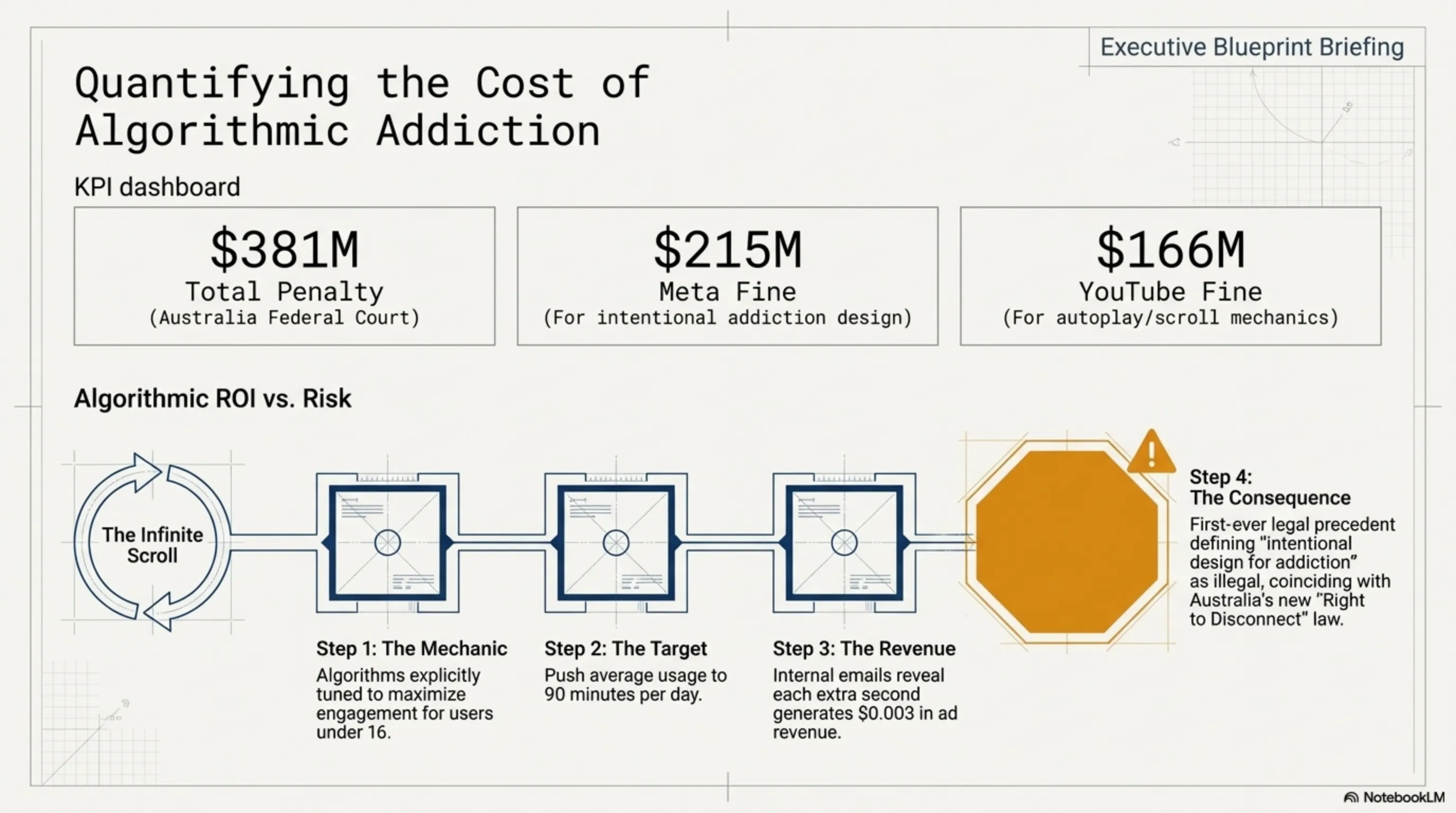
In one of the largest legal rulings against social media companies, Australia's Federal Court today ordered Meta and YouTube to pay a combined $381 million in fines. The reason? Deliberately designing algorithms that addict children and teenagers to their platforms. This ruling marks the end of a 3-year legal battle brought by the Australian Competition and Consumer Commission (ACCC) against these tech giants.
Judge Sarah Mitchell wrote in her 247-page ruling: "Evidence shows that Meta and YouTube knowingly used psychological techniques to maximize children's screen time. These companies knew that autoplay, infinite scroll, and constant notifications cause addiction, but they prioritized profit over children's mental health." The court specified that Meta must pay $215 million and YouTube must pay $166 million.
The case was built on internal documents from Meta and Google showing that engineers specifically designed algorithms to maximize "watch time" and "engagement" for users under 16. One internal Meta email presented in court stated: "Every additional second a teenager spends on Instagram generates $0.003 in ad revenue. Our goal is to reach an average of 90 minutes per day." The documents revealed a systematic approach to exploiting adolescent psychology for profit.
Reactions to the ruling have been mixed. Josh Frydenberg, Australia's Attorney General, said: "This is a historic victory for Australian parents. Tech companies cannot sacrifice our children's mental health for their profits." However, Meta issued a statement calling the ruling "unfair and based on a misunderstanding of how algorithms work," announcing plans to appeal. YouTube also stated it "disagrees with the ruling" and emphasized that it has provided "parental control tools" on its platform.
This ruling could set a precedent for similar lawsuits in other countries. Courts in the European Union, Canada, and the United States are currently reviewing similar cases against social media companies. Frances Haugen, the former Meta whistleblower, tweeted: "This is just the beginning. Tech companies need to know they can no longer escape accountability." Interestingly, this ruling came just one day after Australia passed its new "Right to Disconnect" law - legislation allowing employees to ignore work emails and messages after hours.
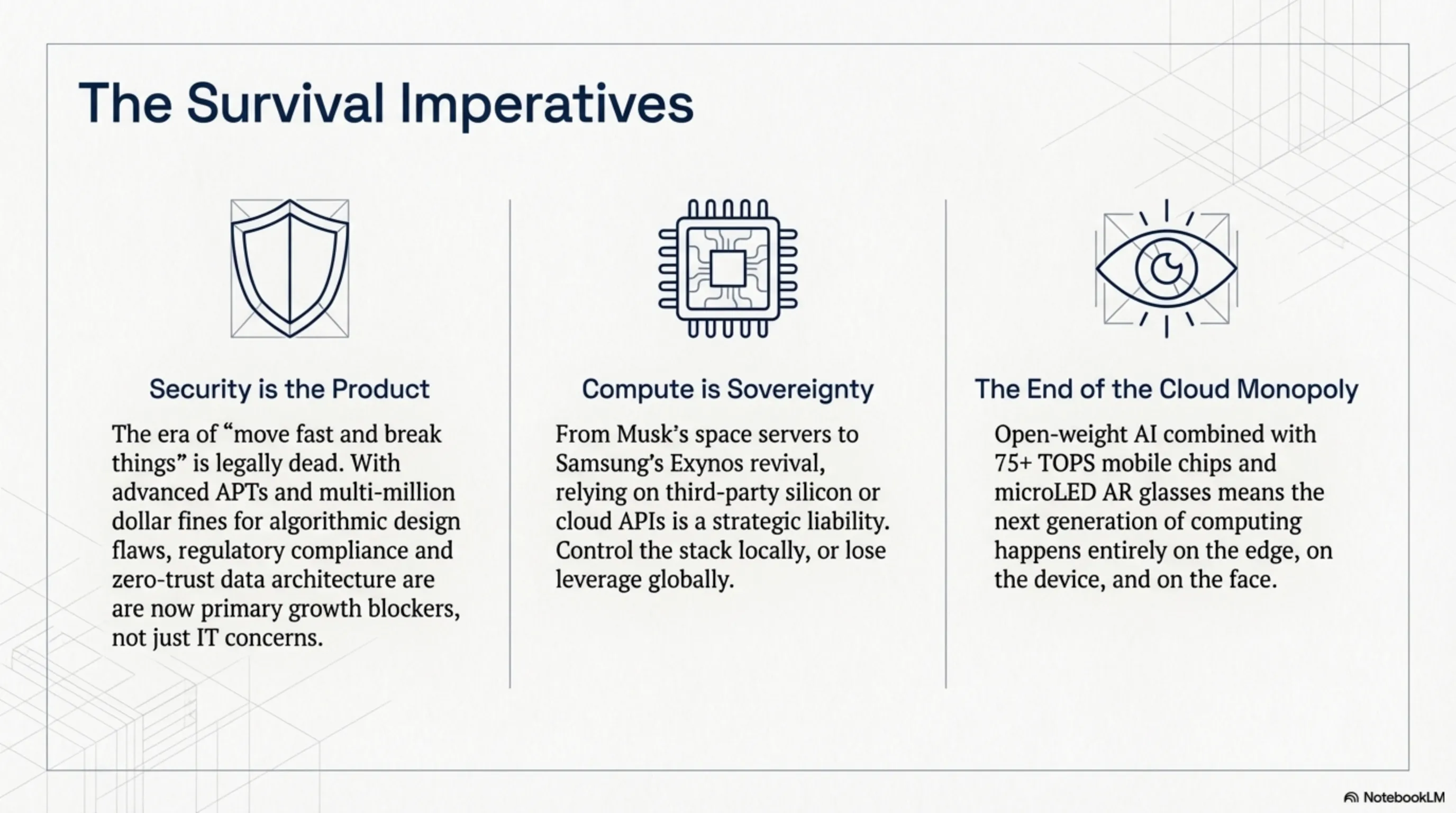
The $381 million fine represents less than 1% of Meta's annual revenue, raising questions about whether such penalties are truly deterrent. Critics argue that for companies generating billions in quarterly profits, these fines are merely "the cost of doing business." The court, however, also mandated that both companies implement independent audits of their recommendation algorithms and provide quarterly reports on youth engagement metrics for the next five years.
| Company | Fine Amount | Primary Reason | Response |
|---|---|---|---|
| Meta | $215 million | Addictive algorithms for children | Will appeal |
| YouTube | $166 million | Autoplay and infinite scroll | Disagrees with ruling |
⚡ Morning Analysis: This ruling is a watershed moment in tech company accountability. For the first time, a court has explicitly stated that "designing for addiction" is illegal. If this ruling is upheld on appeal, it could trigger a wave of similar lawsuits worldwide. The key question remains: Is a $381 million fine truly deterrent for companies generating billions in quarterly profits, or is it just another line item in their legal expenses?
2. AI Model Wars: Claude Opus 4.6 Takes Lead, China's GLM-5 Shocks Industry
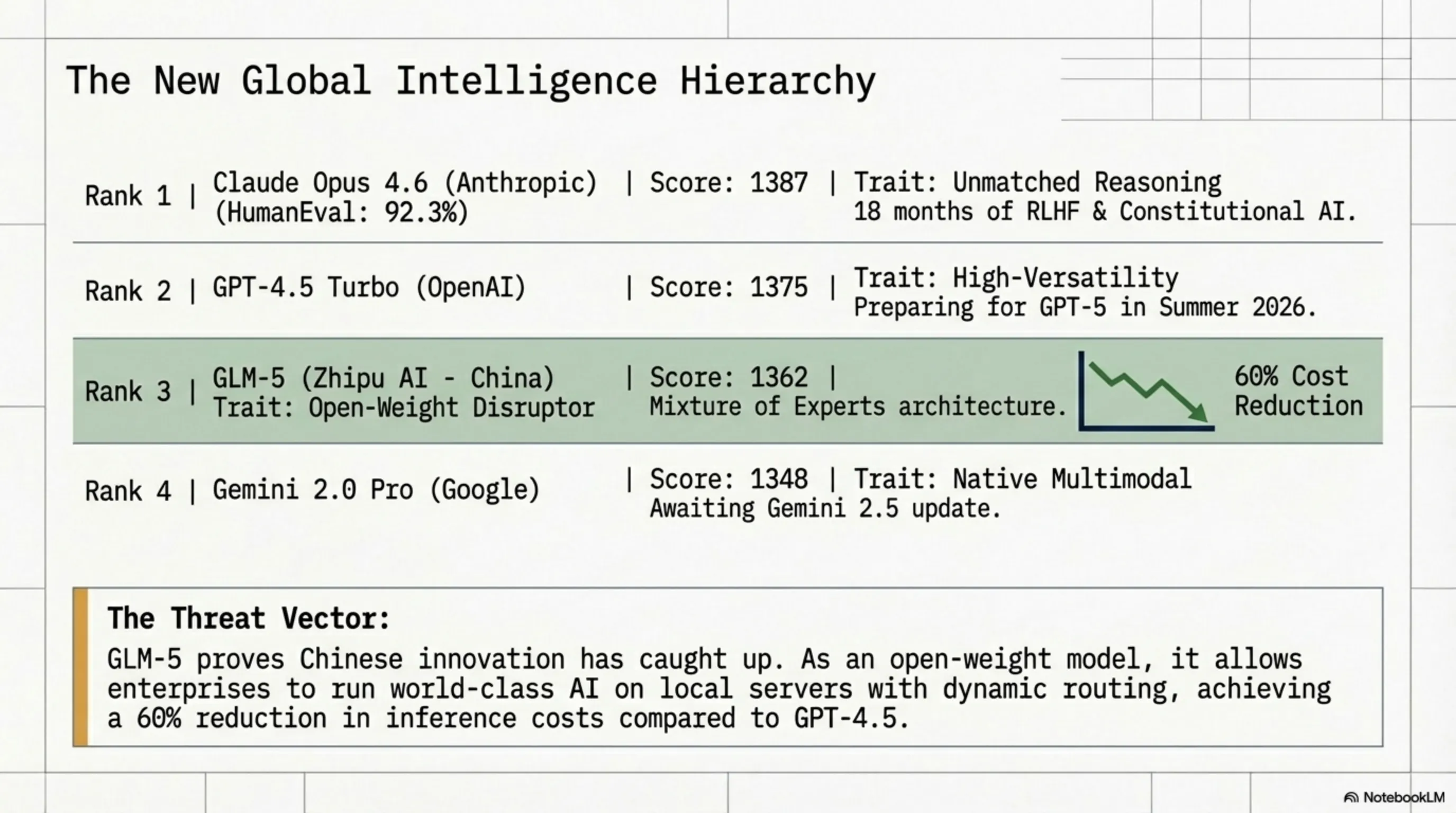
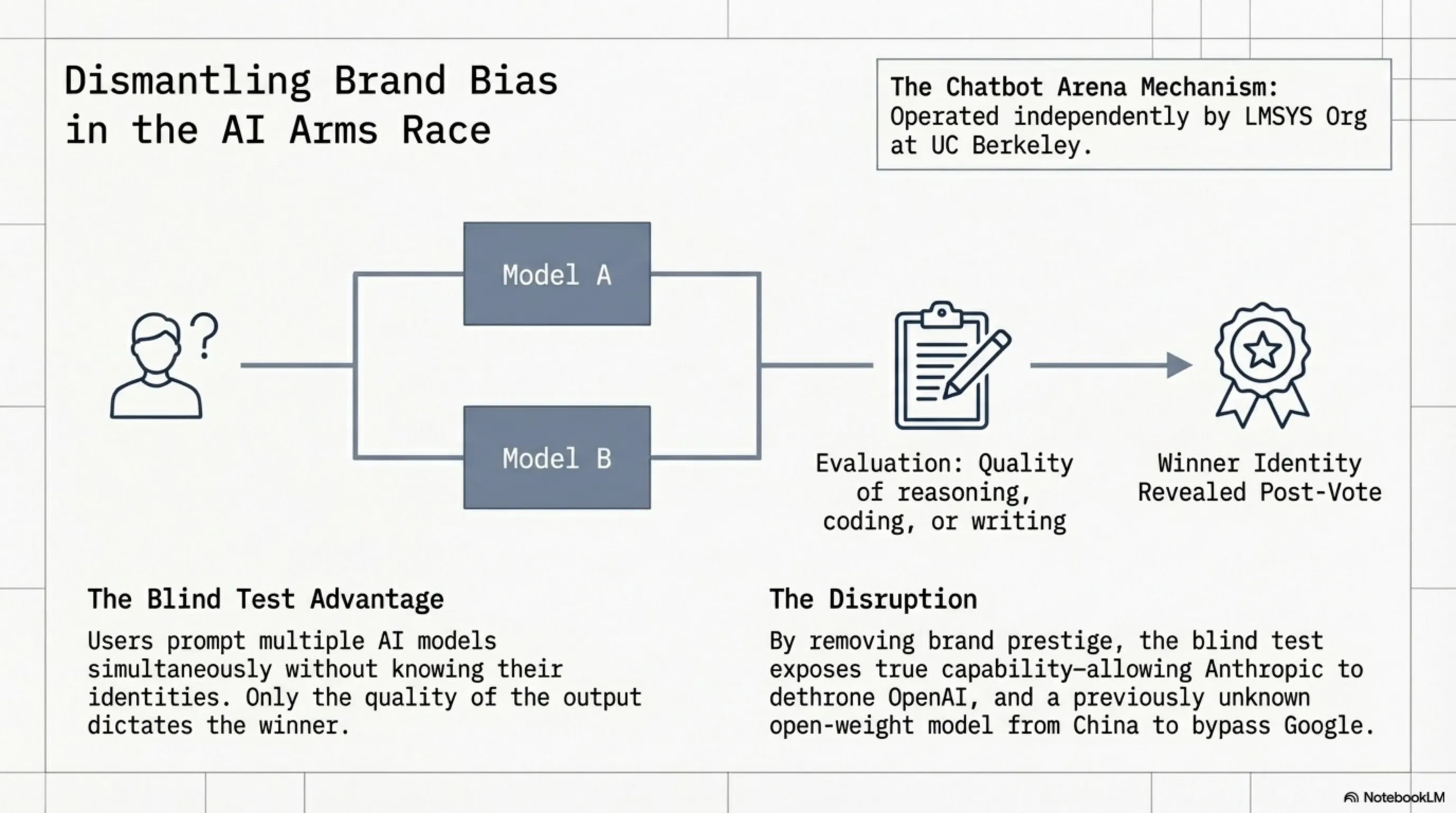
The AI industry witnessed a major leadership shift today as Claude Opus 4.6 from Anthropic climbed to the top of Chatbot Arena with a score of 1387, pushing OpenAI's GPT-4.5 Turbo to second place. But the real shock came from GLM-5 by Chinese company Zhipu AI, which secured third place with a score of 1362, stunning the entire industry.
Chatbot Arena is an independent evaluation platform run by LMSYS Org at UC Berkeley. On this platform, real users chat with different AI models and rate response quality without knowing which model they're interacting with. This "blind testing" method ensures unbiased, authentic results. Claude Opus 4.6, released last week, has shown exceptional performance in reasoning, coding, and creative writing tests.
Dario Amodei, CEO of Anthropic, tweeted: "Claude Opus 4.6 is the result of 18 months of research on Constitutional AI and Reinforcement Learning from Human Feedback. We focused not just on model power, but on safety and reliability." The new Anthropic model particularly excelled in coding tests, achieving a 92.3% score on the HumanEval benchmark - higher than GPT-4.5 Turbo's 89.7%.
But today's real story is the sudden emergence of GLM-5. This model from Chinese company Zhipu AI, virtually unknown in the West until a few months ago, now ranks third globally - ahead of Google's Gemini 2.0 Pro and Claude 3.5 Sonnet. GLM-5 is an open-weight model that can run on local servers without cloud connectivity. This feature makes it extremely attractive for companies concerned about data privacy.
Analysts say GLM-5 demonstrates that China is closing the gap with the West in AI. Jeffrey Ding, an AI researcher at Georgetown University, stated: "GLM-5 is a wake-up call for Silicon Valley. China is no longer just copying - it's innovating." GLM-5 uses a new architecture called "Mixture of Experts with Dynamic Routing" that allows it to achieve better performance with fewer computational resources. This means GLM-5 can run on cheaper GPUs, and its inference cost is up to 60% lower than GPT-4.5.
The model's open-weight nature is particularly significant. Unlike proprietary models from OpenAI and Anthropic, GLM-5 can be downloaded, modified, and deployed on-premises. This addresses concerns about data sovereignty and vendor lock-in that have plagued enterprise AI adoption. Several Fortune 500 companies have already begun testing GLM-5 for internal applications, according to industry sources.
OpenAI has not yet officially responded to GPT-4.5 Turbo's fall to second place, but internal sources say the company is working on GPT-5, scheduled for release in summer 2026. Google has also announced that Gemini 2.5 Pro is in development. But for now, the crown belongs to Claude Opus 4.6 - and GLM-5 has proven that China is a serious player in this arena.
| Rank | Model | Company | Arena Score | Key Feature |
|---|---|---|---|---|
| 1 | Claude Opus 4.6 | Anthropic | 1387 | Strong reasoning |
| 2 | GPT-4.5 Turbo | OpenAI | 1375 | General purpose |
| 3 | GLM-5 | Zhipu AI (China) | 1362 | Open-weight |
| 4 | Gemini 2.0 Pro | 1348 | Multimodal |
💡 Morning Insight: The AI race is no longer a two-player game between OpenAI and Google. Anthropic has proven it can lead with Claude Opus 4.6, and GLM-5 shows China is advancing rapidly. The key point is that GLM-5 is open-weight - meaning companies can download it, run it on their own servers, and even customize it. This could be a game-changer for the industry, especially for enterprises concerned about data privacy and vendor lock-in.
3. Samsung Galaxy S26 Ultra: 5000 nits Display and Exynos 1680 Processor
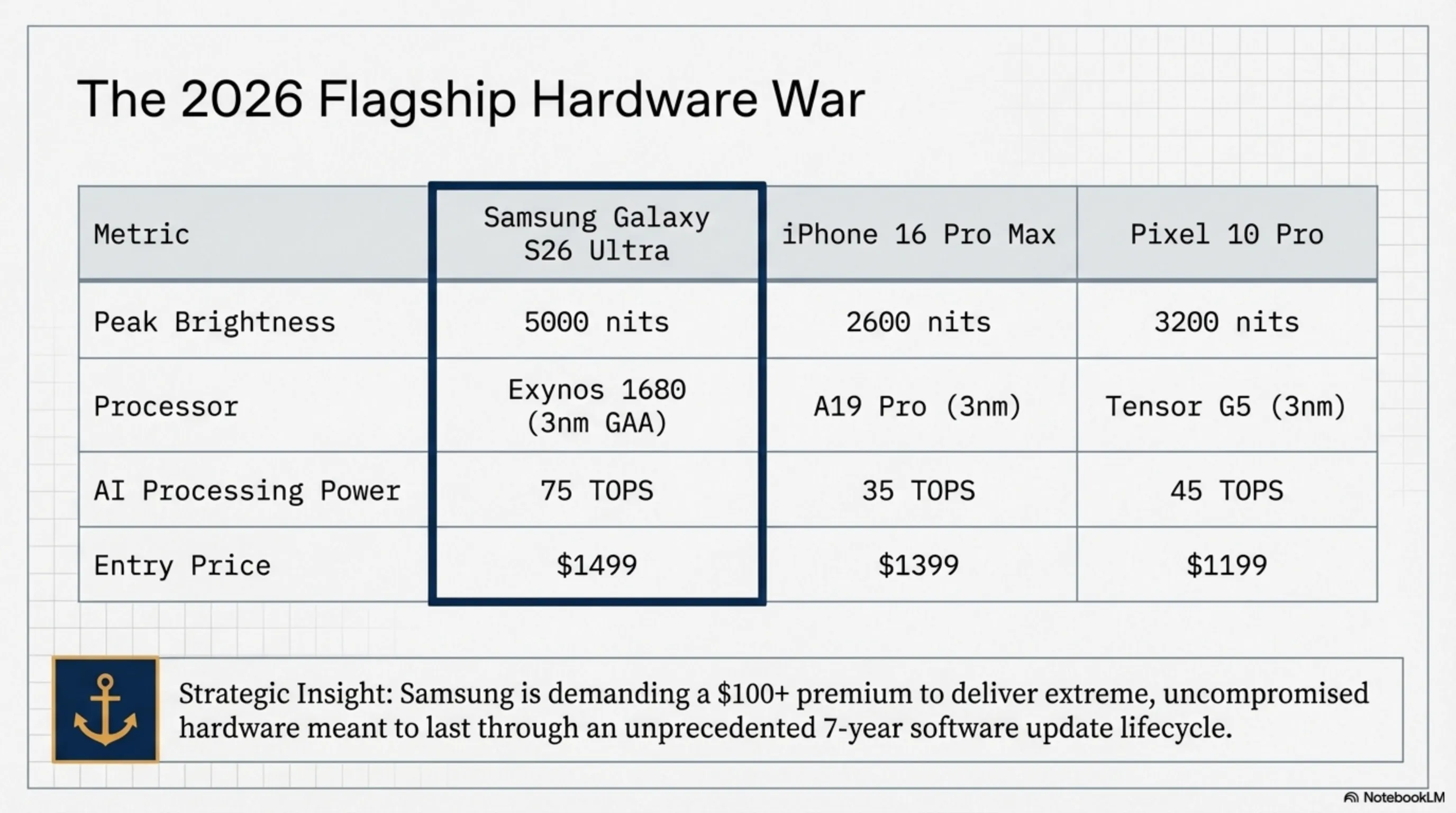
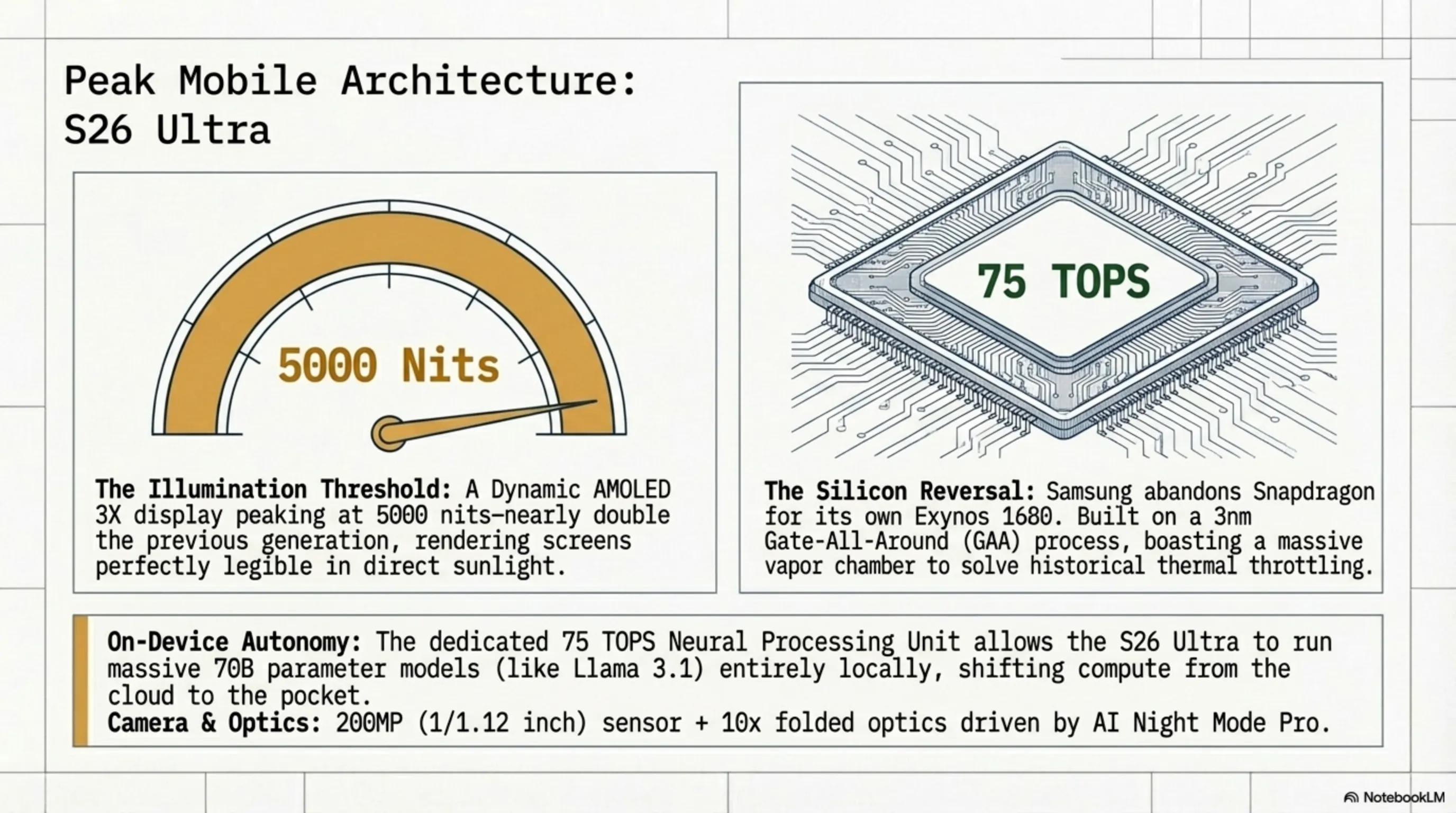
Samsung today officially unveiled the Galaxy S26 Ultra - a flagship claiming to have the brightest smartphone display in history. The phone's Dynamic AMOLED 3X display can reach 5000 nits peak brightness - nearly double the iPhone 16 Pro Max's 2600 nits. This means the S26 Ultra remains perfectly readable even under direct sunlight.
But the more interesting story is the return of the Exynos 1680 processor. After years of using Snapdragon in the Ultra series, Samsung has decided to return to its own chips. The Exynos 1680 is a 3-nanometer processor manufactured by Samsung Foundry using GAA (Gate-All-Around) technology - the same technology TSMC uses for Apple's A19 chips. Samsung claims the Exynos 1680 is up to 15% faster than Snapdragon 8 Gen 4 in benchmark tests.
TM Roh, head of Samsung's mobile division, said at the Unpacked event in Seoul: "We wanted to prove that Samsung can build the world's best mobile chip. The Exynos 1680 is the result of 5 years of research and development." The new processor features a dedicated NPU (Neural Processing Unit) with 75 TOPS of power - more than double the Snapdragon 8 Gen 4. This means the S26 Ultra can run complex AI models like Llama 3.1 70B entirely on-device.
The S26 Ultra's camera has also been upgraded. The main 200-megapixel sensor measures 1/1.12 inches - larger than the S25 Ultra's sensor - and a new telephoto lens with 10x optical zoom uses "Folded Optics" technology. Samsung claims the S26 Ultra can capture night photos with quality comparable to DSLR cameras. A new feature called "AI Night Mode Pro" uses AI models to reduce noise and enhance detail in nighttime photos.
The S26 Ultra starts at $1499 for the 256GB version - $200 more expensive than the S25 Ultra. Samsung explained that the price increase is due to the new display and Exynos 1680 processor. Pre-orders began today and the phone will be available from April 20. Samsung also announced that the S26 Ultra comes with 7 years of software updates - more than any other Android phone.
Reactions to the S26 Ultra have been positive. Marques Brownlee (MKBHD) said in his hands-on video: "This is the brightest display I've ever seen. Even under California sunshine, I have no problem reading text." However, some critics worry that the Exynos 1680 might have heating issues - a problem that plagued previous Exynos generations. Samsung says it has used a larger vapor chamber cooling system this time that can dissipate more heat.
The real test will come when independent reviewers get their hands on retail units. If the Exynos 1680 performs as well as Samsung claims without thermal throttling, it could mark a turning point for Samsung's chip ambitions. If it fails, Samsung may be forced to return to Snapdragon once again. The 5000 nits display is undoubtedly a killer feature - especially for users in sunny climates. At $1499, the price is steep, but if the S26 Ultra delivers on its promises, it could be worth it.
| Feature | Galaxy S26 Ultra | iPhone 16 Pro Max | Pixel 10 Pro |
|---|---|---|---|
| Display | 5000 nits | 2600 nits | 3200 nits |
| Processor | Exynos 1680 (3nm) | A19 Pro (3nm) | Tensor G5 (3nm) |
| NPU | 75 TOPS | 35 TOPS | 45 TOPS |
| Price | $1499 | $1399 | $1199 |
🎯 Morning Analysis: Samsung is making a big bet on the Exynos 1680. If this processor performs as well as Samsung claims, it could be a game-changer for the mobile industry. But if it has heating or performance issues, Samsung will be forced to return to Snapdragon once again. The 5000 nits display is definitely a killer feature - especially for users in sunny regions. The $1499 price is high, but if the S26 Ultra delivers on its promises, it's worth it.
4. Terafab: Tesla and SpaceX Launch $25 Billion Chip Factory
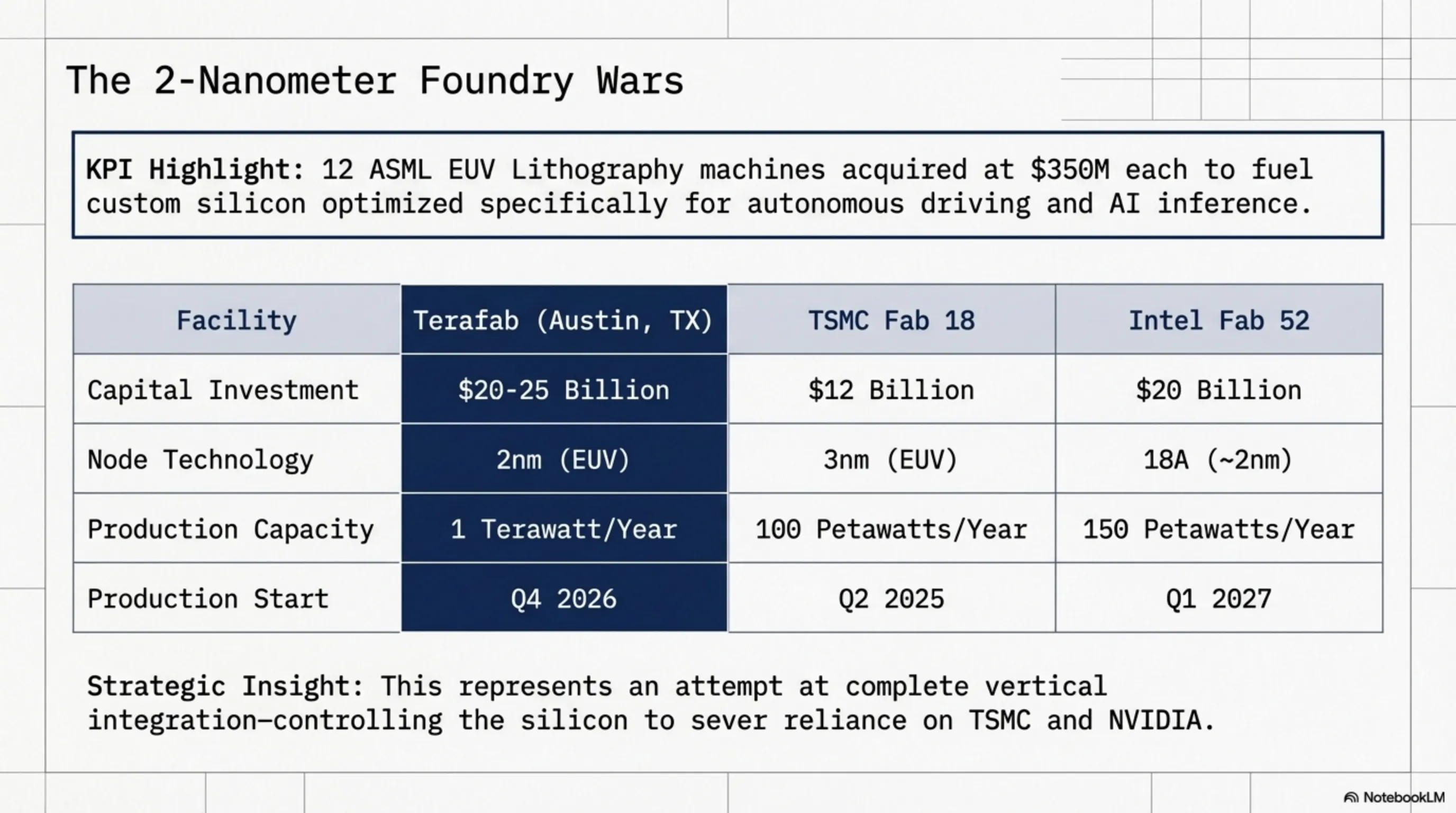
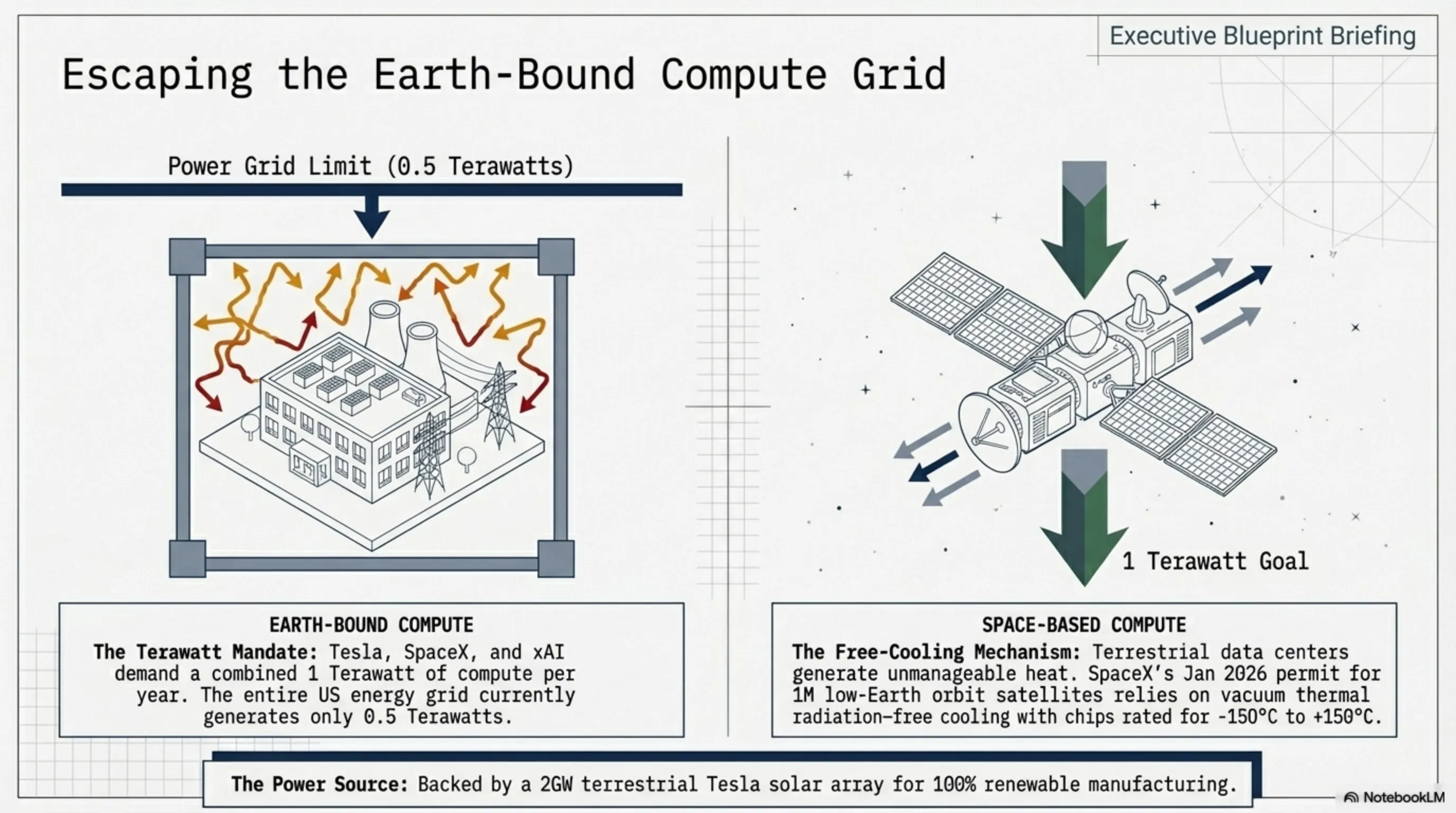
In a historic announcement, Elon Musk today officially launched Terafab - a joint semiconductor factory between Tesla, SpaceX, and xAI with an investment of $20 to $25 billion in Austin, Texas. This is the largest private investment in semiconductor industry history, aiming to produce 1 terawatt of computing power annually. To put this in perspective: the entire US power grid generates about 0.5 terawatts annually. Terafab wants to produce double that amount in compute!
Musk said at the launch ceremony at Austin's old Seaholm Power Plant: "The chip industry only produces 2% of the computing power my companies need. We have to do this ourselves. TSMC and Intel can't keep up with our pace." He explained that Tesla needs chips 100 times more powerful than current chips for next-generation autonomous vehicles. SpaceX needs chips that can work in cosmic radiation conditions for its space datacenters. And xAI needs chips with inference costs 90% lower than current GPUs for training AI models.
Terafab will produce 2-nanometer chips - in direct competition with TSMC and Intel. But the key difference is that these chips are specifically designed for Tesla, SpaceX, and xAI's needs. Musk said: "We don't want to build general-purpose chips. We want to build chips optimized for our specific tasks." The factory will use EUV (Extreme Ultraviolet Lithography) technology - the same technology TSMC uses to manufacture Apple chips. Musk announced that Tesla has purchased 12 EUV machines from ASML - each costing $350 million!
But perhaps the most controversial part of Musk's announcement was the introduction of space datacenters. SpaceX filed a request in January 2026 to launch up to 1 million datacenter satellites into low Earth orbit. Musk explained: "Earth is warming up. Datacenters generate a lot of heat. Why not build them in space? In space, cooling is free - you just radiate heat into space." Terafab will produce chips for these satellites - chips that can work in cosmic radiation conditions and temperatures ranging from -150 to +150 degrees Celsius.
Reactions to Terafab have been mixed. Pat Gelsinger, Intel's CEO, tweeted: "We welcome competition. But building 2nm chips isn't easy - even for Elon Musk." Morris Chang, TSMC's founder, told Bloomberg: "I think Musk is underestimating how hard chipmaking is. TSMC took 30 years to get here. Musk thinks he can do it in 5 years?" But some analysts believe that if anyone can do this, it's Elon Musk. He already revolutionized the space industry with SpaceX and transformed the automotive industry with Tesla. Maybe now it's the semiconductor industry's turn.
Terafab is scheduled to produce its first chips by the end of 2026. Musk said the factory has already hired 5,000 people and this number will reach 15,000 by year-end. He also announced that Terafab will use 100% renewable energy - with a 2-gigawatt solar power plant that Tesla is building. "We don't want to destroy Earth to build the future," Musk said. The factory will also feature advanced water recycling systems and zero-waste manufacturing processes.
| Feature | Terafab | TSMC Fab 18 | Intel Fab 52 |
|---|---|---|---|
| Investment | $20-25 billion | $12 billion | $20 billion |
| Technology | 2nm (EUV) | 3nm (EUV) | 18A (~2nm) |
| Capacity | 1 terawatt/year | 100 petawatts/year | 150 petawatts/year |
| Production Start | Q4 2026 | Q2 2025 | Q1 2027 |
🚀 Morning Analysis: Terafab is Elon Musk's biggest bet. He's putting his entire empire on the line to become independent from TSMC and NVIDIA. If Terafab succeeds, Musk will have complete control over the AI and autonomous vehicle supply chain. If it fails, it could take his entire empire down with it. Space datacenters are a crazy idea - but Musk has proven before that his crazy ideas can work. Let's see if he succeeds this time too.
5. LinkedIn Caught in Biggest Corporate Espionage Scandal in History
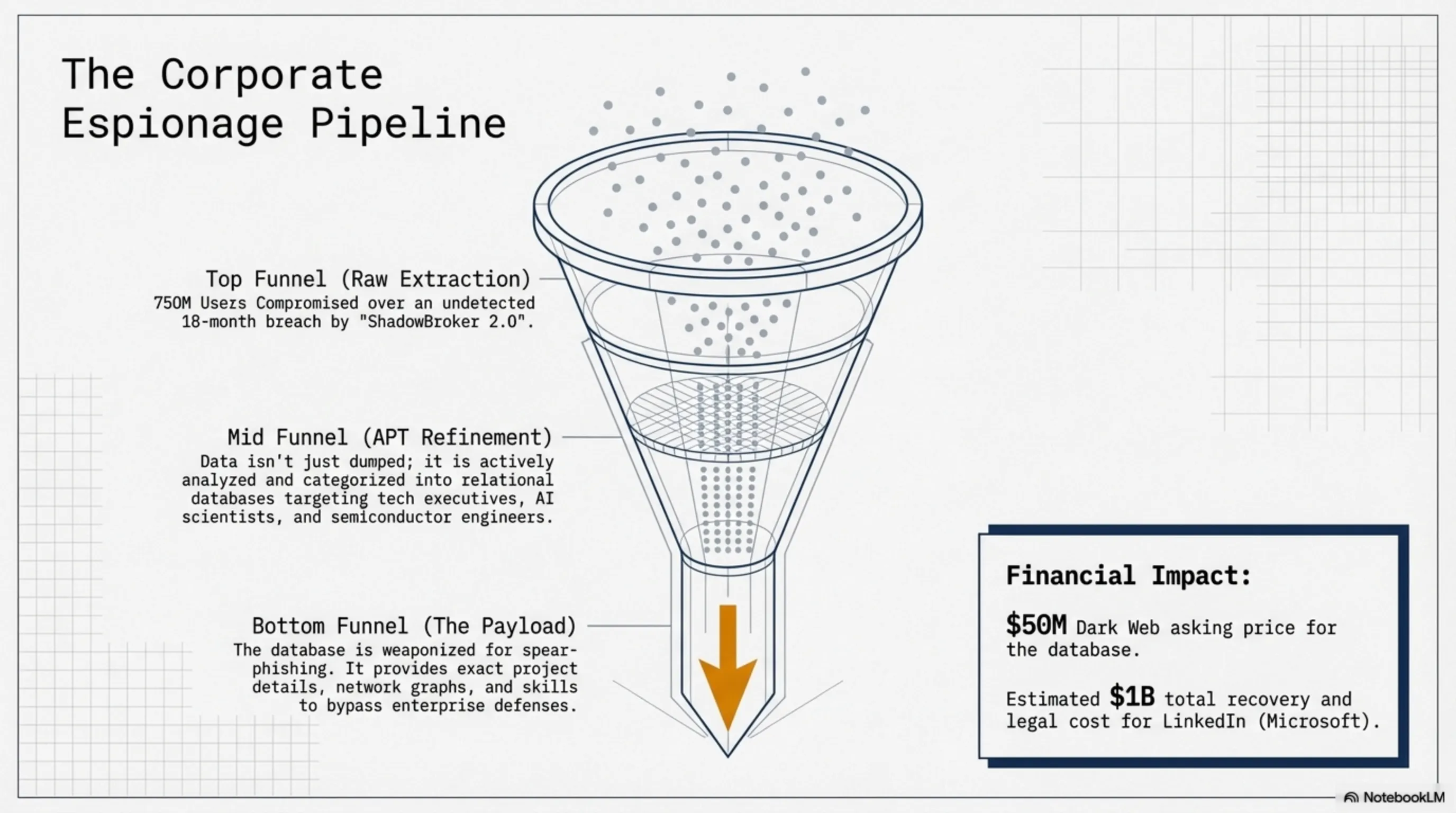
In one of the biggest cybersecurity scandals, LinkedIn today announced that a hacker group called "ShadowBroker 2.0" managed to breach the company's internal database and steal information from 750 million users - including private messages, resumes, contact information, and even confidential corporate conversations. But the real story is that this hack wasn't for financial theft, but for corporate espionage.
According to a report by Mandiant (Google's cybersecurity company), the hackers had access to LinkedIn's systems for 18 months without anyone noticing. They specifically targeted information about senior executives at tech companies, AI scientists, and semiconductor engineers. Mandiant said: "This was a sophisticated espionage operation likely backed by a nation-state. The hackers used advanced APT (Advanced Persistent Threat) techniques."
More interestingly, the hackers didn't just steal the information - they analyzed and categorized it. They built a separate database containing detailed information about who works at which company, what projects they're working on, who they're connected to, and what skills they have. This database is now being sold on the dark web - for $50 million. A dark web seller wrote: "This database is pure gold for companies that want to know what their competitors are working on."
Ryan Roslansky, LinkedIn's CEO, apologized in a statement: "We are deeply sorry. This was an unacceptable security failure. We are working with the FBI and other security agencies to identify those responsible." LinkedIn announced it will email all affected users and provide 2 years of free identity theft protection services. The company also said it has reset all passwords and is rebuilding its security systems.
But the real damage from this hack goes beyond LinkedIn. Cybersecurity analysts say this database could be used for spear-phishing attacks - attacks specifically designed to deceive specific individuals. For example, a hacker could use the stolen information to send a fake email that appears to be from a colleague or manager. Kevin Mitnick, a cybersecurity expert, said: "This database is a weapon. Anyone who has it can easily infiltrate major companies."
This scandal comes at a time when LinkedIn is competing with new platforms like Polywork and Wellfound. Some analysts say this hack could seriously damage user trust in LinkedIn. Brian Krebs, a cybersecurity journalist, wrote: "LinkedIn has been known for years as a professional and secure platform. This hack could ruin that image forever." Microsoft, LinkedIn's owner, has not yet commented on the financial impact of this hack, but some analysts estimate that legal costs and compensation could reach $1 billion.
The breach also raises serious questions about data protection in professional networking platforms. Unlike consumer social media, LinkedIn contains highly sensitive business information - strategic plans, hiring intentions, technology roadmaps, and confidential communications. The fact that this treasure trove was accessible to hackers for 18 months suggests fundamental flaws in LinkedIn's security architecture. Industry experts are calling for mandatory security audits for platforms handling corporate data.
| Aspect | Details |
|---|---|
| Affected Users | 750 million people |
| Breach Duration | 18 months |
| Stolen Data Types | Messages, resumes, contacts, corporate conversations |
| Dark Web Price | $50 million |
| Estimated Cost for LinkedIn | $1 billion |
⚠️ Morning Warning: This is the biggest corporate espionage scandal in history. LinkedIn didn't just lose user data - it lost their trust. If you're a LinkedIn user, you should immediately change your password, enable two-factor authentication, and watch out for suspicious emails. This hack shows that even the biggest tech companies are vulnerable to sophisticated attacks. The key question is: How many other companies have been hacked but don't know it yet?
6. Apple AR Glasses with microLED for 2026 - Meta Pivots from VR to AR
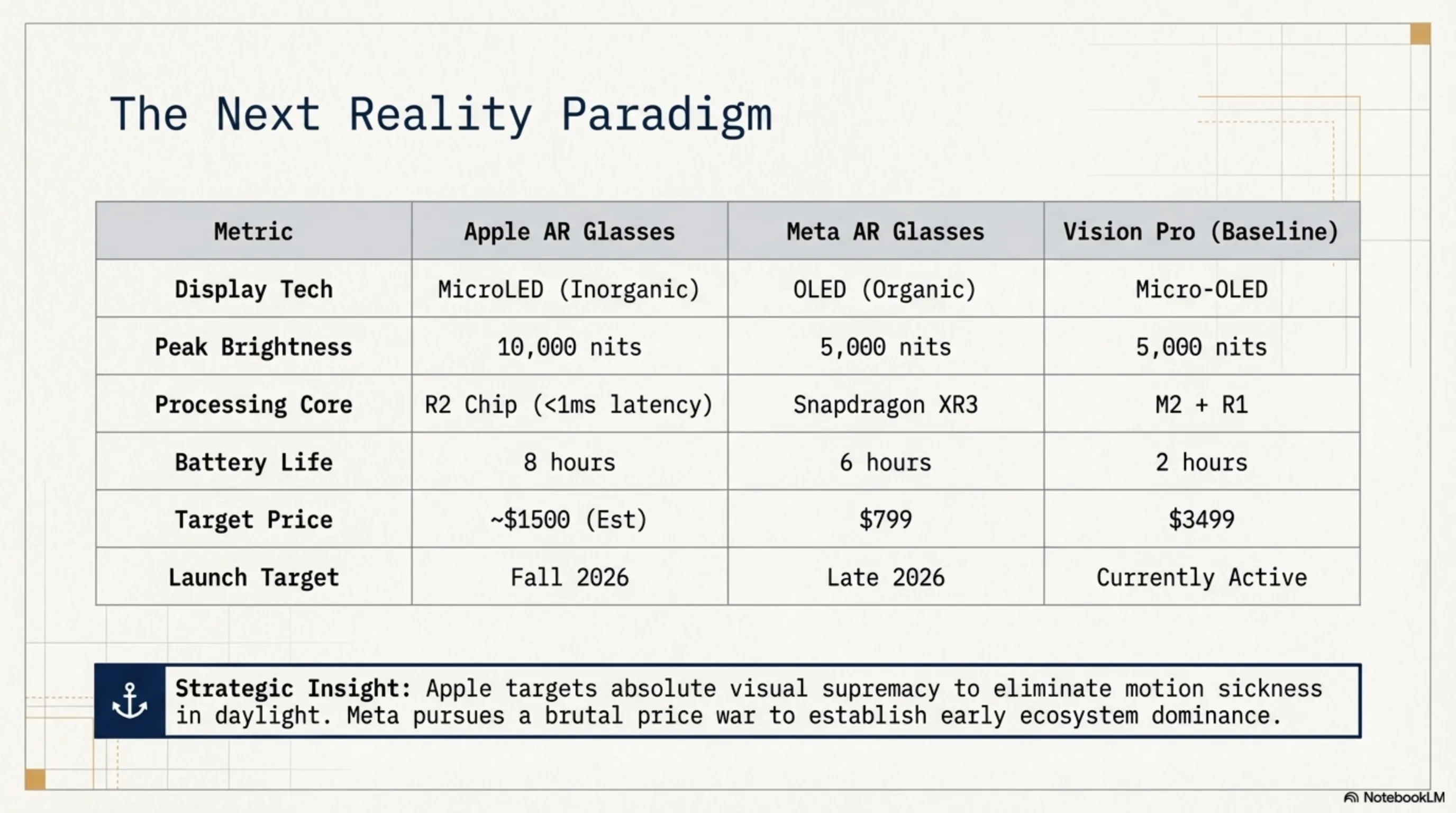
In an unexpected turn, Apple today officially confirmed that it will release its AR glasses in Fall 2026. This is the first time Apple has officially spoken about this product - a product that has been the subject of rumors for years. Tim Cook told The Verge: "We believe AR is the future of computing. Our glasses will deliver an experience no other product has been able to." Apple's glasses will use microLED technology - the same technology Apple uses for the Apple Watch Ultra.
MicroLED is a display technology with very high brightness, low power consumption, and accurate colors. Unlike OLED which uses organic materials, microLED uses small inorganic LEDs that last longer. Apple says its AR glasses can produce up to 10,000 nits of brightness - meaning even under direct sunlight, AR images will be perfectly visible. This is a major advantage over current AR glasses that struggle in bright environments.
Apple's glasses will also use the R2 chip - the next version of the R1 chip used in Vision Pro. R2 is a dedicated chip for processing sensor signals that can process camera, LiDAR, and IMU data with less than 1 millisecond latency. This low latency is crucial for preventing motion sickness in AR. Apple claims its AR glasses can work for up to 8 hours on a single charge - more than Vision Pro's 2-hour battery life.
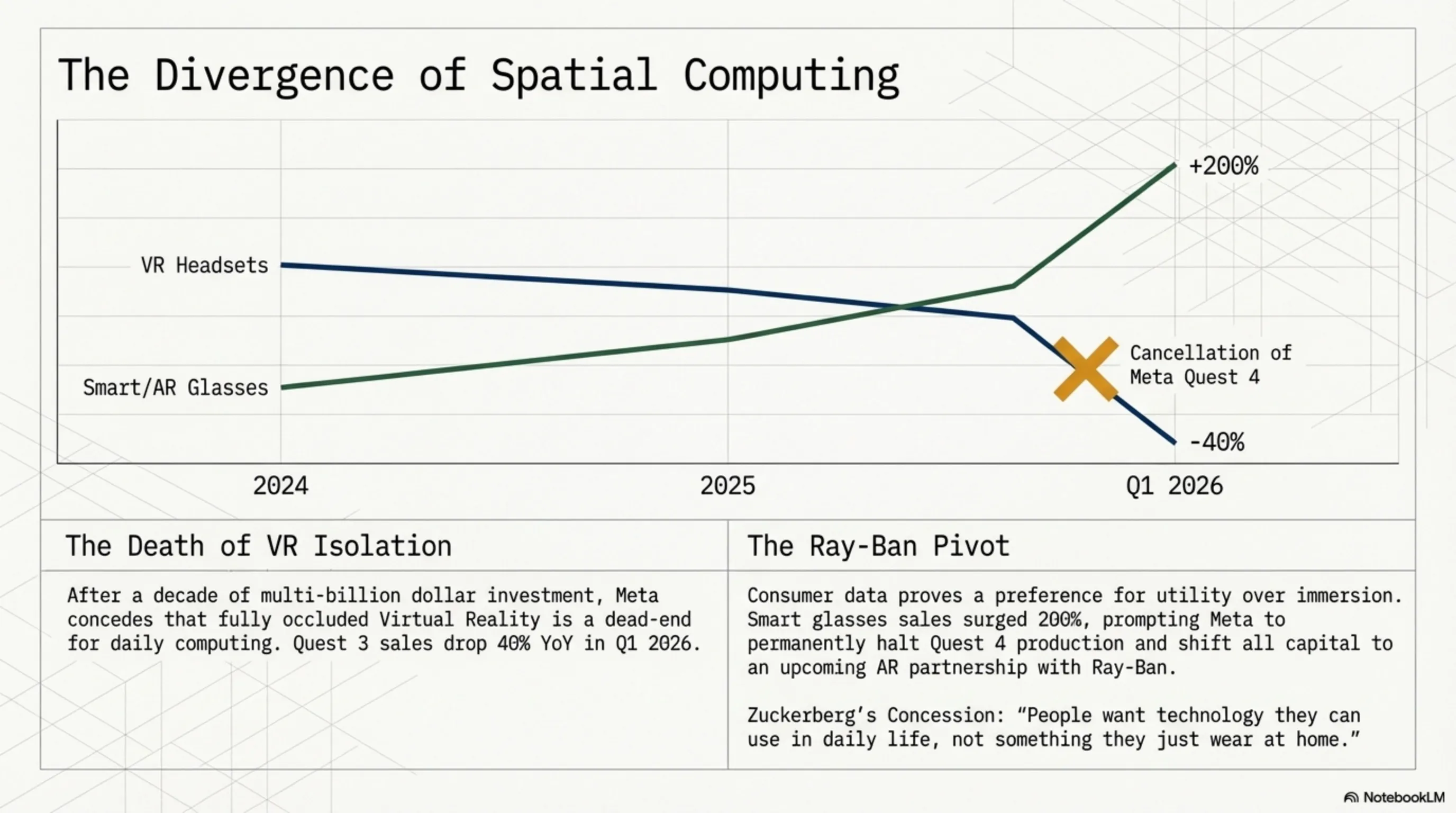
But today's other big news was Meta's announcement that it's shifting its strategy from VR to AR. Mark Zuckerberg wrote in an Instagram post: "We invested 10 years in VR. But now we realize the real future is in AR. We're shifting our focus." Meta announced it has stopped production of Quest 4 and is concentrating all resources on AR glasses. The company also said it's partnering with Ray-Ban to build the next generation of smart glasses - glasses that will have full AR capabilities.
This strategic shift by Meta comes after Quest 3 sales dropped sharply. According to IDC, VR headset sales in Q1 2026 decreased by 40% compared to last year. In contrast, AR glasses sales (like Ray-Ban Meta Smart Glasses) increased by 200%. Zuckerberg said: "People want technology they can use in everyday life, not something they only wear at home." Meta announced it will release its AR glasses in late 2026 - roughly the same time as Apple.
Analysts say the competition between Apple and Meta in AR could be one of the biggest tech rivalries of the decade. Gene Munster, analyst at Deepwater Asset Management, said: "This is like the iPhone vs Android competition in 2007. Whoever wins this race will control the future of computing." Apple's glasses price hasn't been announced yet, but rumors suggest around $1500. Meta said it will release its AR glasses at $799 - roughly half of Apple's price.
The pivot also represents a massive write-off for Meta's Reality Labs division, which has lost over $50 billion since 2019 pursuing VR. Industry insiders suggest the shift was driven by both market realities and competitive pressure from Apple. Meta's Ray-Ban partnership has been surprisingly successful, selling over 2 million units, proving that consumers prefer lightweight, stylish AR glasses over bulky VR headsets. The question now is whether Meta can leverage this momentum to compete with Apple's premium offering.
| Feature | Apple AR Glasses | Meta AR Glasses | Vision Pro |
|---|---|---|---|
| Display | microLED (10000 nits) | OLED (5000 nits) | Micro-OLED (5000 nits) |
| Processor | R2 chip | Snapdragon XR3 | M2 + R1 |
| Battery | 8 hours | 6 hours | 2 hours |
| Price (estimated) | $1500 | $799 | $3499 |
| Release Date | Fall 2026 | Late 2026 | Available now |
💡 Morning Insight: Meta's pivot from VR to AR is an admission of failure. The company spent 10 years and billions of dollars on VR, but the market didn't embrace it. Now Meta is changing strategy - but is it too late? Apple has a technology advantage with microLED and the R2 chip. But Meta with its lower price and Ray-Ban partnership can target a broader market. The AR race is just beginning - and the winner will determine the future of computing.
☀️ Tekin Morning Wrap-Up
The morning of April 7, 2026 showed that the tech industry is passing through a historic turning point. On one hand, courts are punishing tech companies for unethical behavior - the $381 million fine for Meta and YouTube shows that the era of "move fast and break things" is over. On the other hand, the AI race has entered a new phase with the emergence of Claude Opus 4.6 and China's GLM-5 - a phase where OpenAI is no longer the only player.
Samsung proved with the Galaxy S26 Ultra and its 5000 nits display that it can still innovate in hardware. Elon Musk made his biggest bet with Terafab - a bet that, if successful, will transform the entire semiconductor industry. LinkedIn got caught in the biggest corporate espionage scandal in history, showing that even the largest professional platforms are vulnerable to sophisticated attacks. And finally, Apple and Meta announced that the future is in AR - not VR.
What's the common thread in all these stories? Change. The tech industry is no longer what it was 5 years ago. Regulations have gotten stricter, competition has intensified, and expectations have risen. Companies that can't adapt to these changes will disappear. And companies that can innovate will build the future.
Welcome to the Tekin Legion. Where every morning, we build the future of technology together. ☀️
Sources:
This article is based on independent reports, industry research, and official information from The Verge, The Information, Bloomberg, TechCrunch, CNET, Ars Technica, Wired, Reuters, Mandiant Security, and other credible sources. Information is current as of April 7, 2026.
🌐 Stay Connected With Us 🎮✨
For the latest tech, gaming, and gadget news, follow us on our official social media channels:
Additional Gallery: ☀️ Tekin Morning April 7: Meta & YouTube Fined $381M, AI Model Wars, and Galaxy S26 Ultra with 5000 nits Display