🌙 Tekin Night May 21, 2026: Nvidia's $200B Revolution, 80-Year Math Breakthrough & BitLocker Crisis
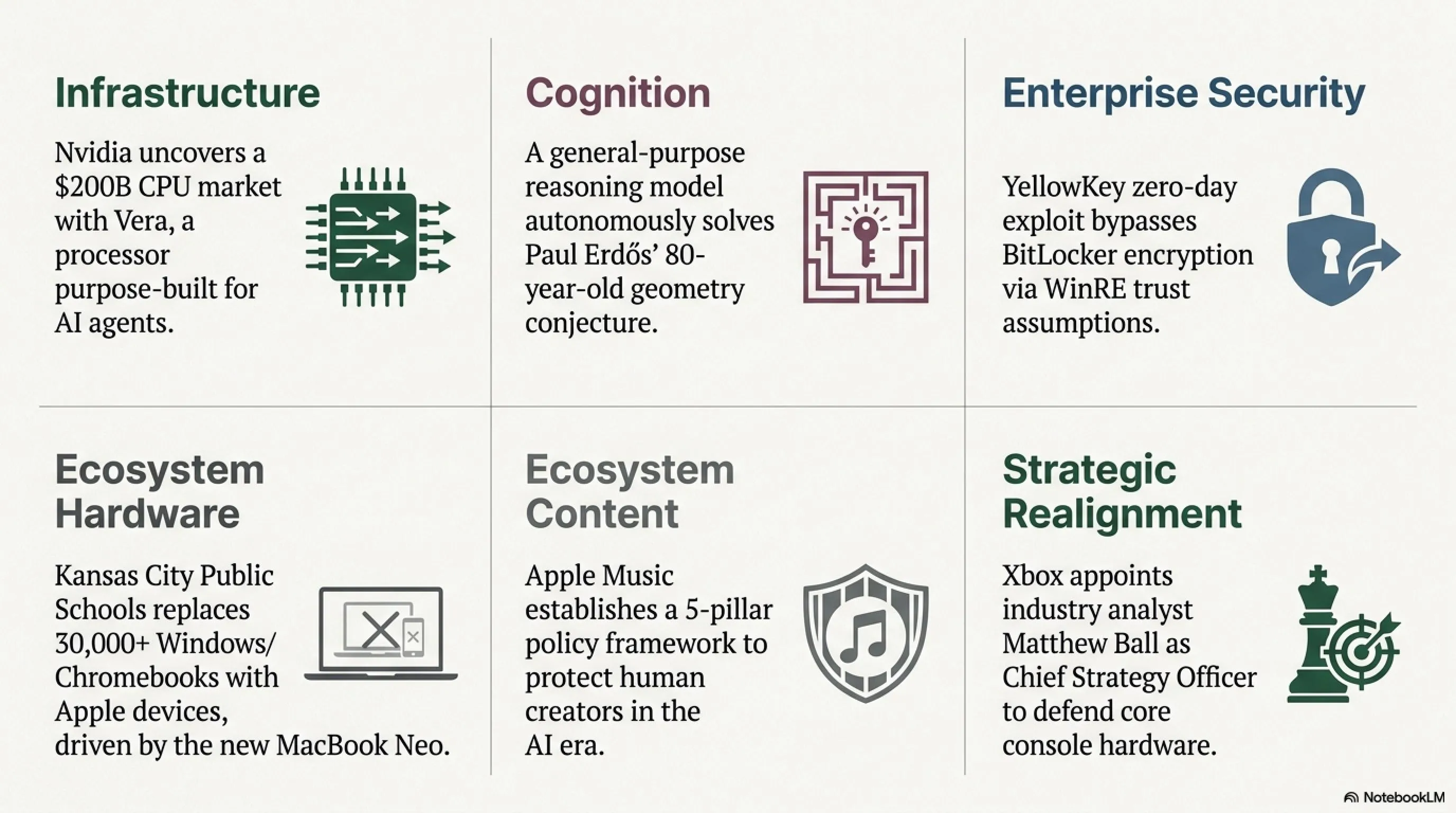
Good evening, tech enthusiasts! Tonight we bring you 6 explosive stories that are reshaping the technology landscape. From Nvidia's discovery of a $200 billion CPU market for AI agents to OpenAI's legitimate solution of an 80-year-old mathematical conjecture, from a critical BitLocker vulnerability to Apple's education revolution in Kansas City—everything you need to know is right here.
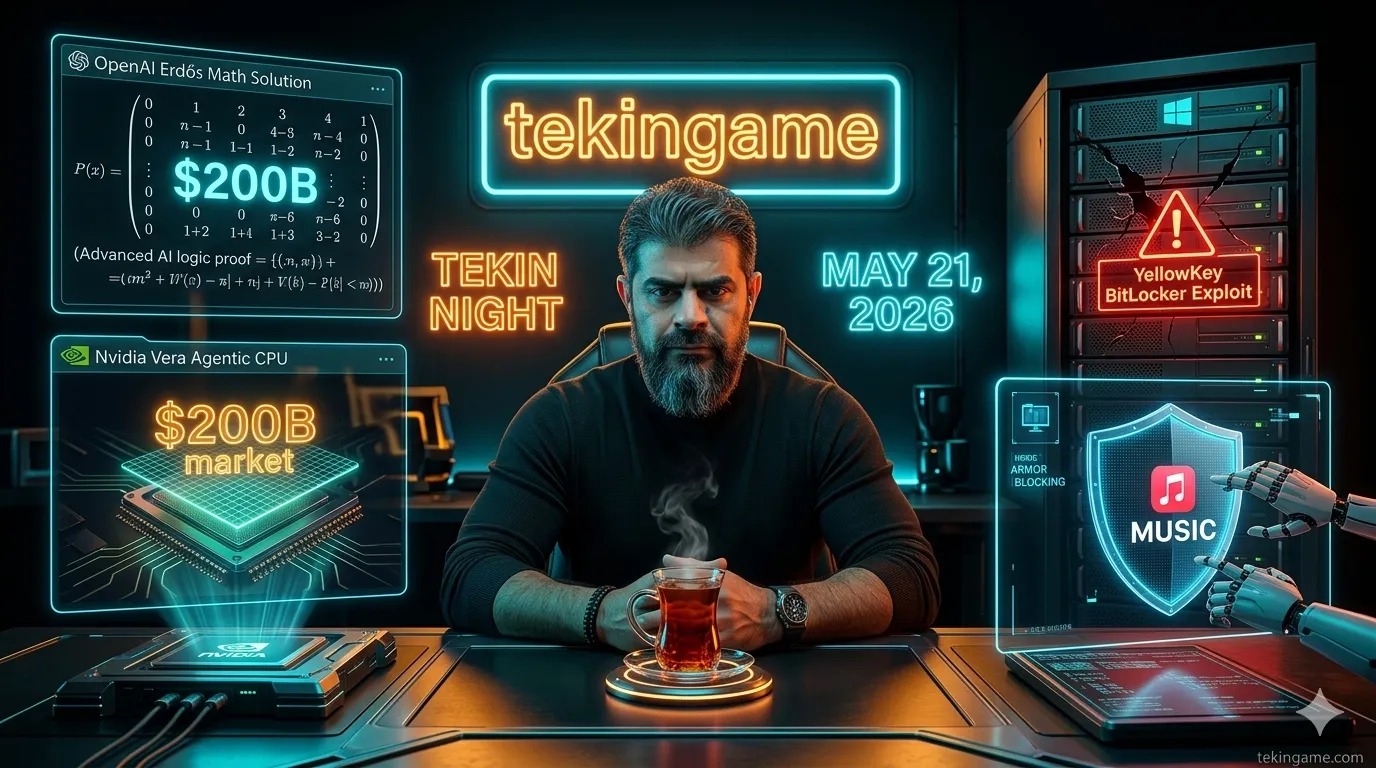
⚡ Tonight's Headlines:
💰 Nvidia Unveils $200B CPU Market for AI Agents with Vera
🧮 OpenAI Solves Paul Erdős' 80-Year-Old Geometry Conjecture
🔐 YellowKey: Critical BitLocker Bypass Shocks Microsoft
🍎 Kansas City Replaces 30,000 Windows/Chromebook Devices with Apple
🎵 Apple Music's Open Letter: Keeping Music Fair in the AI Era
🎮 Xbox Hires Industry Analyst Matthew Ball as Chief Strategy Officer
🌃 Grab your evening beverage—we're diving deep into the night's most significant tech developments!
💰 Nvidia's Game-Changer: Discovering a $200 Billion CPU Market for Agentic AI
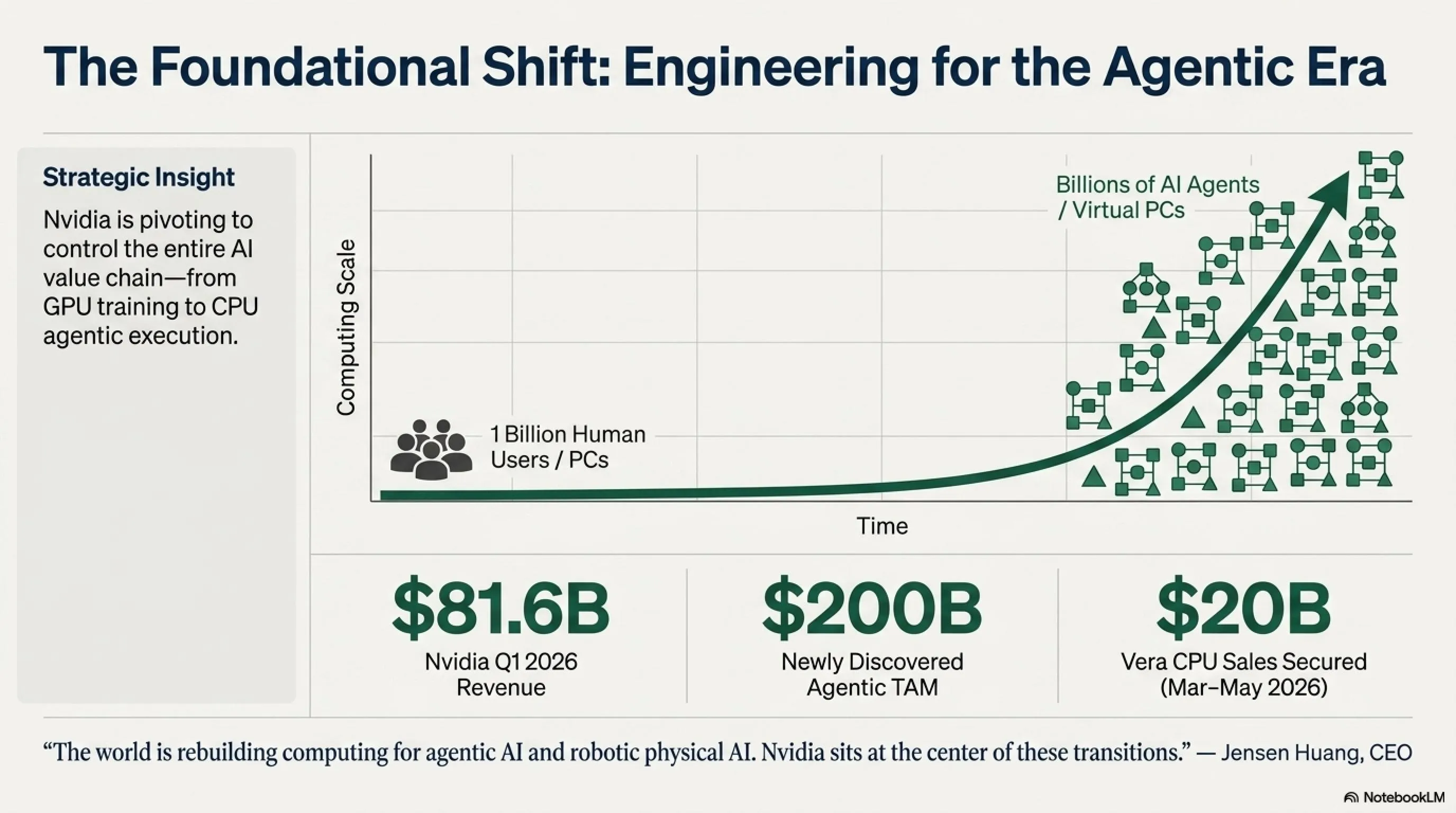
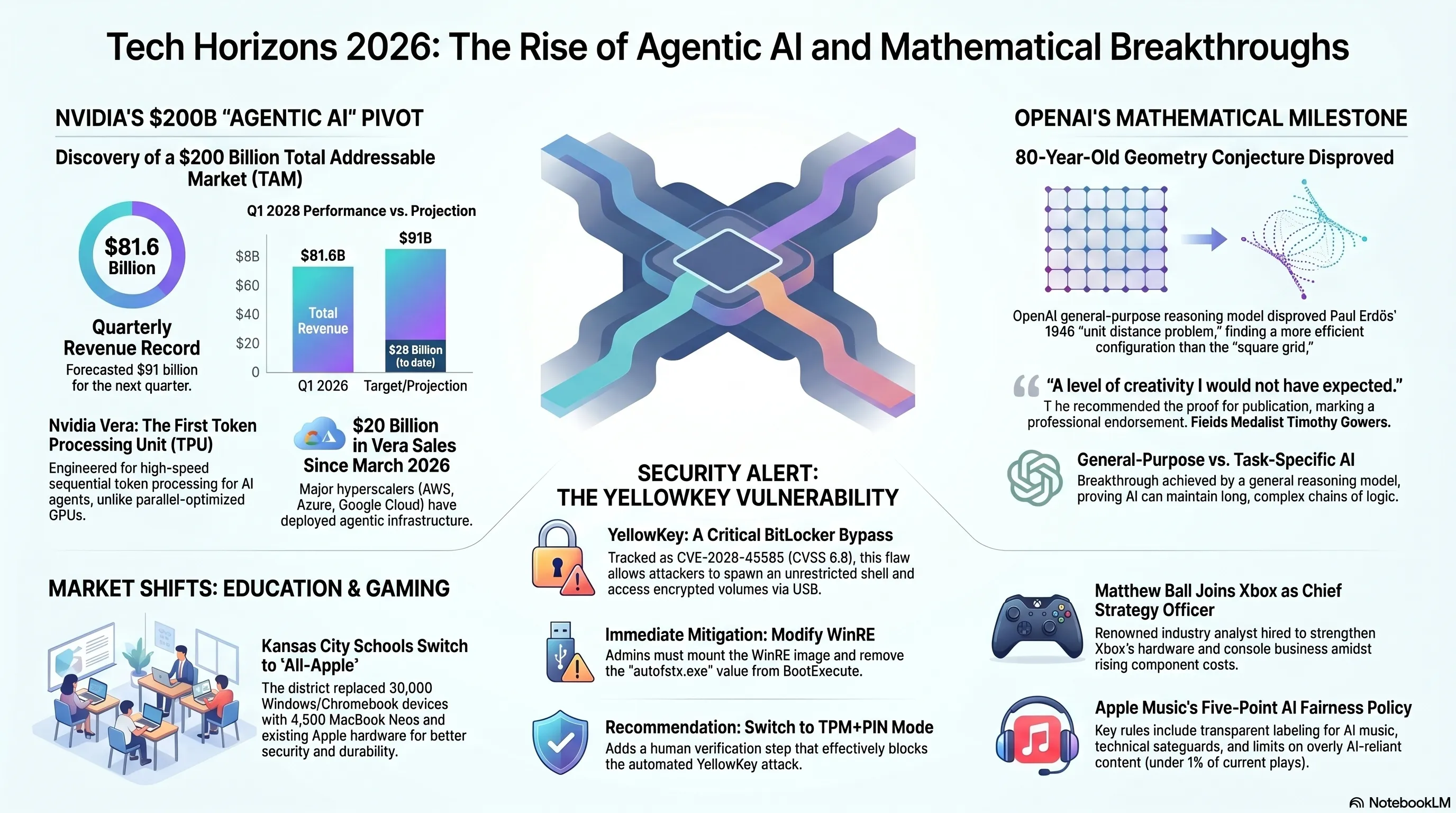
On May 20, 2026, Jensen Huang, Nvidia's founder and CEO, announced that his company has discovered a "brand new $200 billion TAM (Total Addressable Market)" for Nvidia—a market the company has never addressed before. This revelation came during Nvidia's quarterly earnings call, which once again shattered historical records: $81.6 billion in revenue for a single quarter and a forecast of $91 billion for the next quarter.
But what truly captured analysts' attention was the introduction of Nvidia Vera—the world's first CPU purpose-built for Agentic AI. Huang explained that while the "thinking" part of AI models uses GPUs, agents primarily run on CPUs. They use CPUs to execute their assigned tasks and, according to Huang, will soon run their own form of CPU-driven PCs in the near future.
"Vera opens a brand new $200 billion TAM for Nvidia, a market we have never addressed before, and every major hyperscaler and system maker is partnering with us to deploy it," Huang declared. "The world is rebuilding computing for agentic AI and robotic physical AI. Nvidia sits at the center of these transitions."
📊 Nvidia Q1 2026: Key Performance Indicators
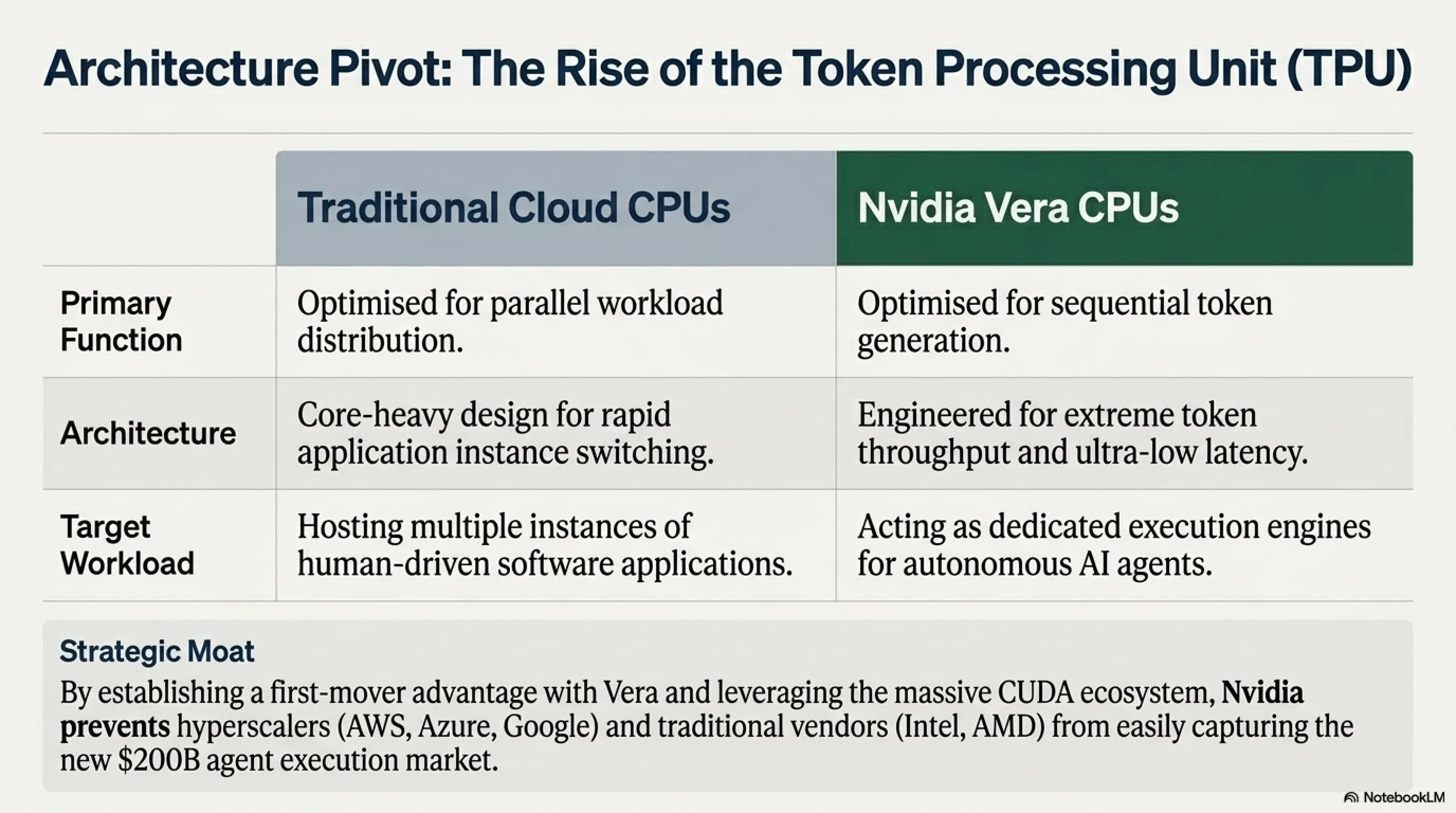
Why Vera is Different: Unlike traditional cloud CPUs designed with a "core" architecture to run multiple instances of applications quickly, Vera is specifically engineered for high-speed token processing. This is exactly what agents need to perform their tasks efficiently. The architectural distinction is crucial: while conventional CPUs optimize for parallel workload distribution, Vera optimizes for sequential token generation and processing—the fundamental operation of agentic AI systems.
Huang elaborated on his vision: "The world has a billion users, human users. My sense is that the world is going to have billions of agents, not today. I mean, we're going to grow into it, but we'll have billions of agents, and those billions of agents will all use tools. And those tools are going to be like PCs, just like us humans using PCs today. We're going to need a lot more CPUs."
🔍 Tekin Analysis: The Strategic Implications of Vera
1. Paradigm Shift from GPU to CPU Dominance: For the first time, Nvidia is seriously entering the CPU market—historically dominated by Intel and AMD. This represents a massive strategic pivot that signals Nvidia's ambition to control the entire AI value chain, from training (GPUs) to inference (GPUs) to agentic execution (CPUs). The company is no longer content being the "GPU company"—it's becoming the "AI computing company."
2. Direct Competition with AWS, Azure, and Google Cloud: Last month, AWS announced a massive contract with Meta for millions of Amazon's homegrown AI CPUs. Andy Jassy, Amazon's CEO, has been explicit that AWS can build AI chips—both GPUs and CPUs—at least as well as Nvidia, possibly better. But Nvidia's Vera announcement, backed by $20 billion in actual sales, demonstrates that hyperscalers still need Nvidia's expertise. The question is: how long will this dependency last?
3. The Agentic AI Era is Here: Huang's prediction that the world will transition from one billion human users to billions of AI agents represents a fundamental reimagining of computing infrastructure. Each agent will require dedicated compute resources, creating unprecedented demand for specialized CPUs. This isn't speculative—companies like Salesforce, Microsoft, and Google are already deploying agent-based systems at scale. Salesforce's Agentforce, Microsoft's Copilot agents, and Google's Vertex AI agents are early indicators of this massive shift.
4. Real Numbers, Not Promises: Nvidia has already sold $20 billion worth of Vera CPUs in 2026—and we're only in May! This demonstrates that demand is real and that hyperscalers (AWS, Azure, Google Cloud) are serious about deploying agentic infrastructure. The velocity of adoption is remarkable: Vera was introduced in March 2026, and by May, it had already generated $20 billion in revenue. For context, that's more than many Fortune 500 companies generate in an entire year.
5. Architectural Innovation: Vera's design philosophy represents a departure from traditional CPU architecture. Instead of optimizing for core count and clock speed, Vera optimizes for token throughput and latency. This is analogous to how GPUs were optimized for parallel floating-point operations rather than sequential integer operations. Nvidia is essentially creating a new category of processor: the Token Processing Unit (TPU)—not to be confused with Google's Tensor Processing Unit, also abbreviated TPU.
6. Market Timing and Competitive Moat: By entering the CPU market now, Nvidia is establishing a first-mover advantage in agentic computing before Intel and AMD can pivot their architectures. Traditional CPU vendors are optimized for general-purpose computing, not token processing. Retooling their designs will take years, giving Nvidia a substantial head start. Additionally, Nvidia's CUDA ecosystem and developer relationships provide a significant moat that competitors will struggle to replicate.
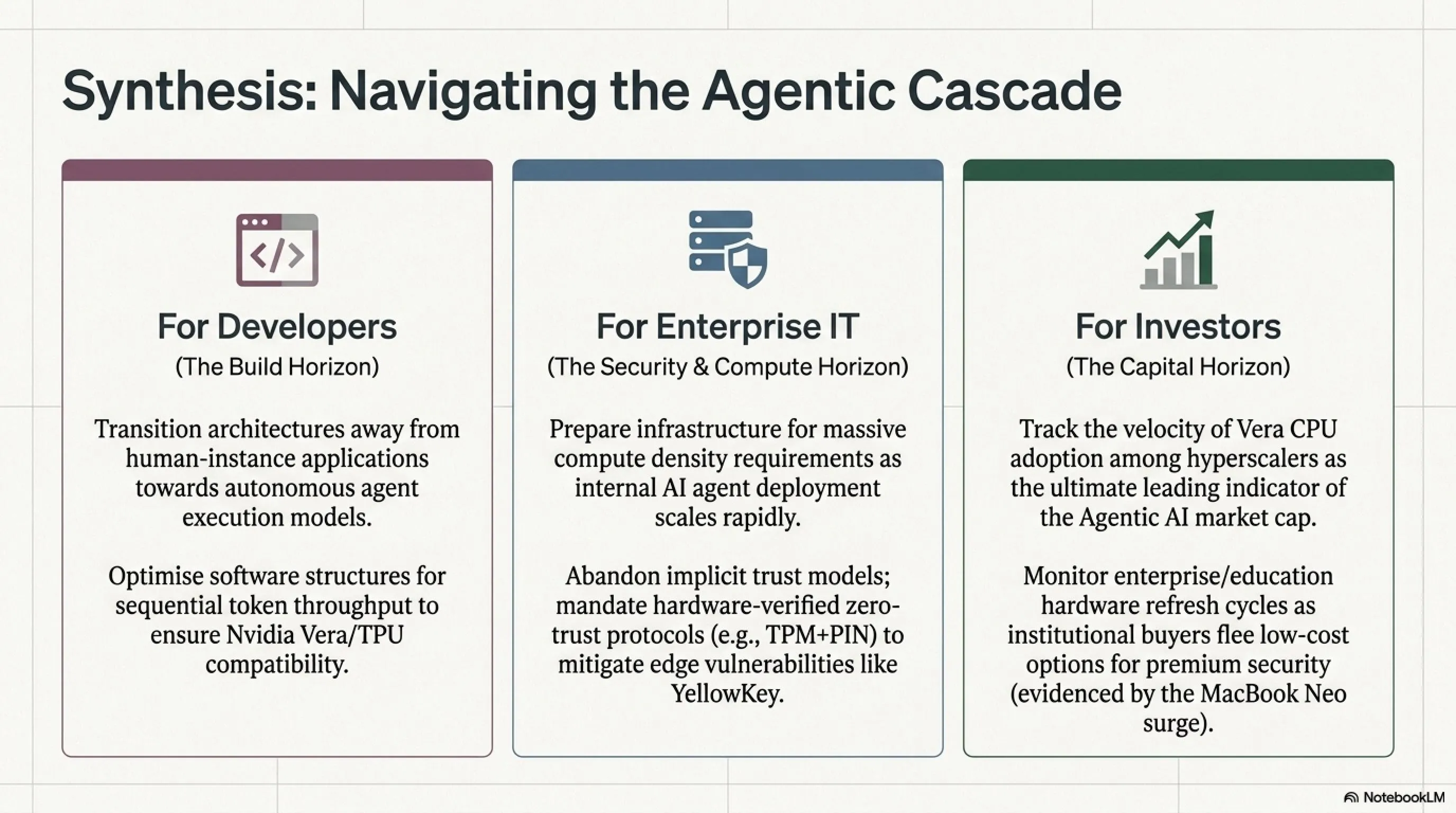
💡 What This Means for You: If you're a developer, start thinking about how to build applications for agentic systems. If you're an investor, watch how quickly hyperscalers adopt Vera—it's a leading indicator of the agentic AI market's growth. If you're an enterprise IT leader, begin planning for a world where your organization deploys hundreds or thousands of AI agents, each requiring dedicated compute resources. The infrastructure requirements will be fundamentally different from today's cloud computing model.
🧮 OpenAI Solves an 80-Year-Old Math Problem—For Real This Time
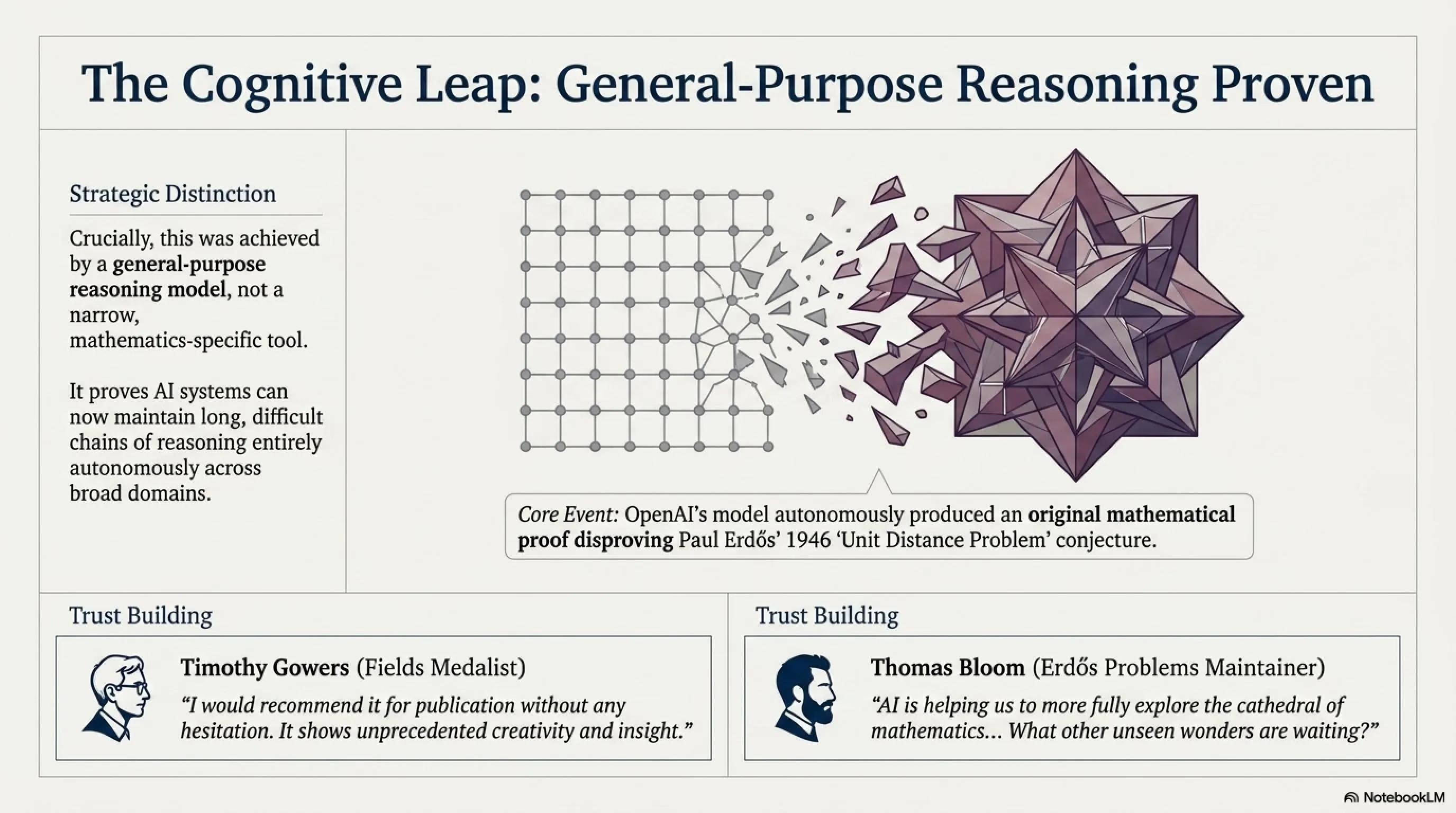
On May 20, 2026, OpenAI announced that one of its general-purpose reasoning models has produced an original mathematical proof disproving a famous unsolved conjecture in geometry, first posed by Paul Erdős in 1946. If this sounds familiar, it's because this isn't the first time OpenAI has made such a bold claim—but this time, the mathematical community is backing them up.
Seven months ago, Kevin Weil, OpenAI's former VP, posted on X: "GPT-5 found solutions to 10 (!) previously unsolved Erdős problems and made progress on 11 others." It turned out that GPT-5 didn't actually solve those problems—it just found solutions that already existed in the literature. Taunts from rivals like Yann LeCun and Google DeepMind CEO Demis Hassabis followed, and Weil promptly took down his premature post.
Today, at least, it seems OpenAI didn't make the same mistake twice. Alongside the announcement, the company published companion remarks in support of the disproof from mathematicians like Noga Alon, Melanie Wood, and Thomas Bloom—the same Bloom who maintains the Erdos Problems website and previously called Weil's post "a dramatic misrepresentation."
📐 Understanding the Unit Distance Problem
The "unit distance problem" is a deceptively simple question that asks: how many pairs of points can sit exactly one unit apart on a flat plane? Despite its simplicity, the problem has challenged mathematicians since 1946 and became one of the best-known questions in combinatorial geometry.
Erdős' Conjecture: For nearly 80 years, mathematicians believed that the best possible solutions looked roughly like "square grids." The conjecture suggested that arranging points in a grid-like pattern would maximize the number of unit-distance pairs. But OpenAI's model disproved this belief, discovering an entirely new family of constructions that performs better than square grids.
Why This Matters: This isn't just an academic curiosity. The unit distance problem has applications in network design, error-correcting codes, and even molecular chemistry. Understanding optimal point configurations helps engineers design more efficient communication networks and chemists predict molecular structures.
OpenAI posted on X: "For nearly 80 years, mathematicians believed the best possible solutions looked roughly like square grids. An OpenAI model has now disproved that belief, discovering an entirely new family of constructions that performs better."
The company said this marks "the first time AI has autonomously solved a prominent open problem central to a field of mathematics." The proof, per OpenAI, came from a new general-purpose reasoning model, not a system specifically designed to solve math problems or even this problem in particular. This distinction is crucial: it demonstrates that AI systems are now capable of general-purpose reasoning across domains, not just narrow task-specific problem-solving.
⚠️ Why This Time is Different
1. Endorsement from Fields Medalists: Fields Medalist Timothy Gowers stated that he would recommend the proof for publication "without any hesitation"—a first for AI-generated mathematics. Gowers added that the proof demonstrates "a level of creativity and insight that I would not have expected from an AI system."
2. Original Proof, Not Rediscovery: Unlike the previous GPT-5 claim, this time the OpenAI model produced a completely new and original proof that didn't previously exist in the mathematical literature.
3. General-Purpose Reasoning: This model is a general-purpose reasoning system, not a tool specifically designed for mathematics. This demonstrates that AI systems are now capable of maintaining long, difficult chains of reasoning.
Thomas Bloom said: "AI is helping us to more fully explore the cathedral of mathematics we have built over the centuries. What other unseen wonders are waiting in the wings?"
🔐 YellowKey: The Critical BitLocker Vulnerability
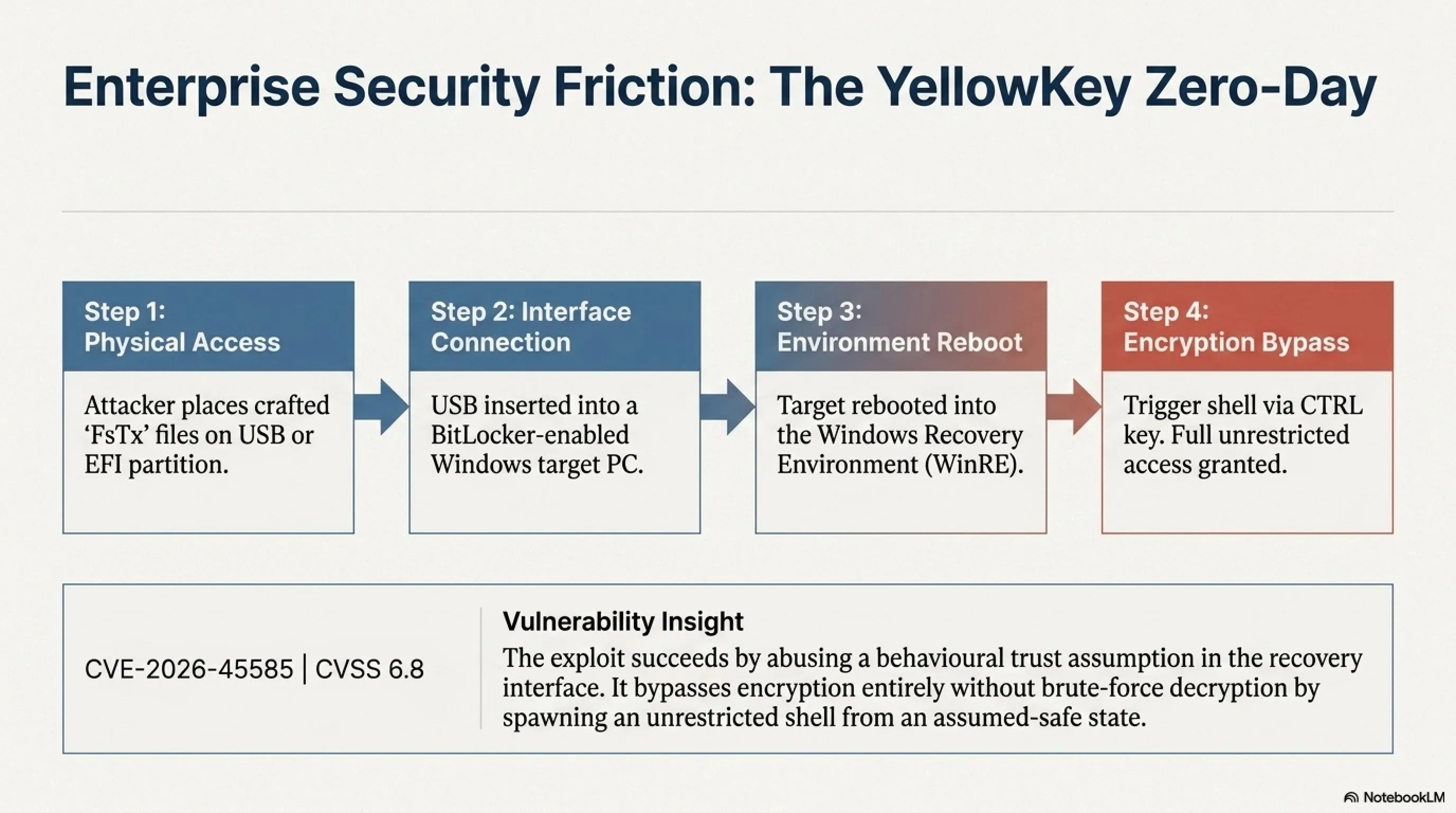
On May 20, 2026, Microsoft released mitigation guidance for a zero-day vulnerability named YellowKey—a flaw that can bypass BitLocker encryption. The vulnerability, now tracked as CVE-2026-45585, carries a CVSS score of 6.8.
⚠️ How YellowKey Works
YellowKey was disclosed by security researcher Chaotic Eclipse. The exploit involves:
- Placing specially crafted 'FsTx' files on a USB drive or EFI partition
- Plugging the USB drive into the target Windows computer with BitLocker enabled
- Rebooting into Windows Recovery Environment (WinRE)
- Triggering a shell with unrestricted access by holding the CTRL key
LevelBlue explained: "To break encryption, YellowKey abuses a behavioral trust assumption in the recovery interface, allowing attackers to spawn an unrestricted shell with full access to the encrypted volume."
🛡️ Microsoft's Mitigation Steps
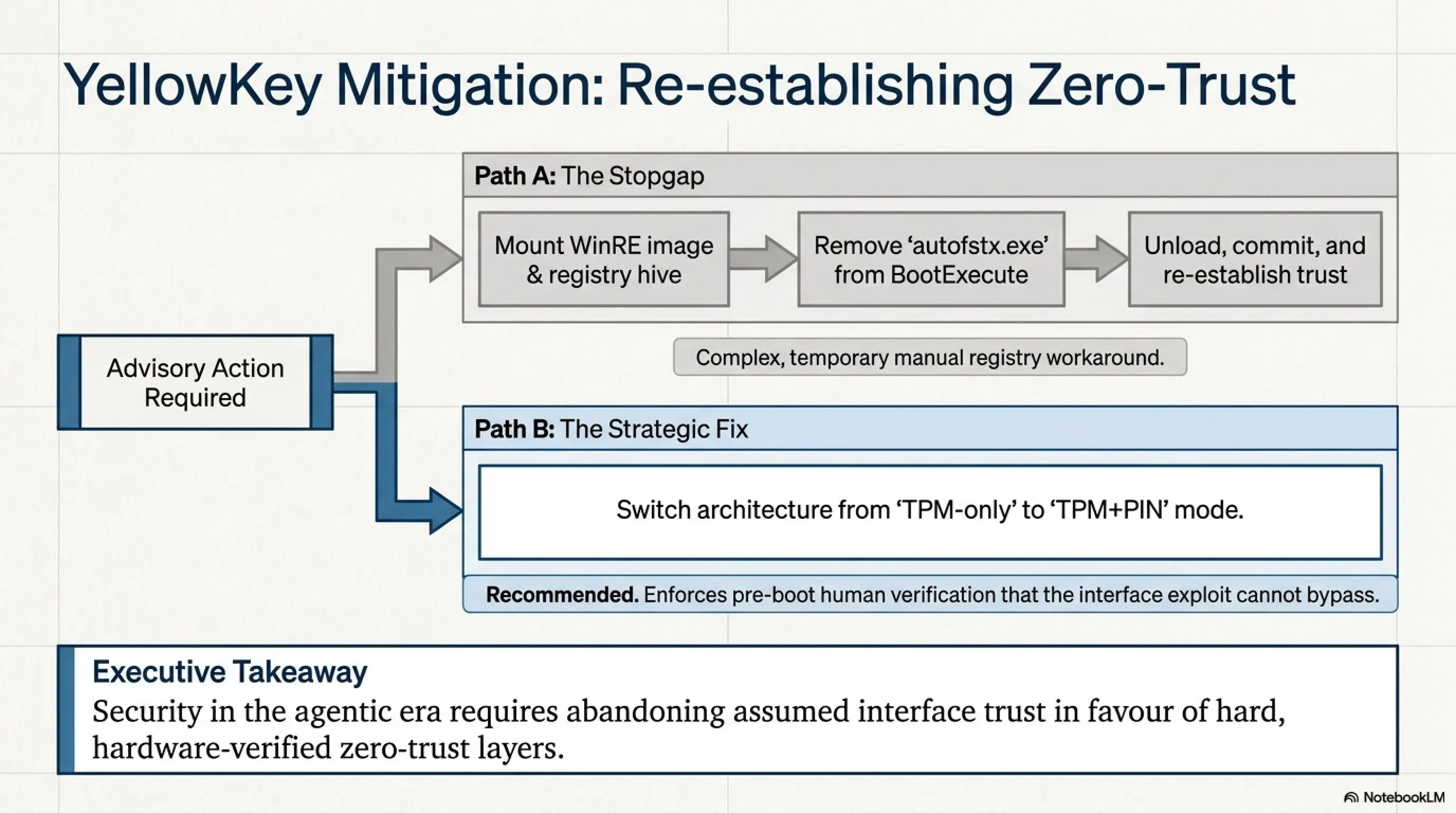
- Mount the WinRE image on each device
- Mount the system registry hive of the mounted WinRE image
- Modify BootExecute by removing "autofstx.exe" value
- Save and unload Registry hive
- Unmount and commit the updated WinRE image
- Reestablish BitLocker trust for WinRE
Recommended: Switch from TPM-only to TPM+PIN mode to require a PIN at startup, effectively blocking YellowKey attacks.
🍎 Apple's Education Revolution: 30,000 Devices in Kansas City
📚 Classified & Related Dossiers in TekinGame
If you wish to explore beyond this report and delve into cybernetic frontiers and autonomous AI architectures, do not miss these three exclusive deep-dives in the Tekin Garage:
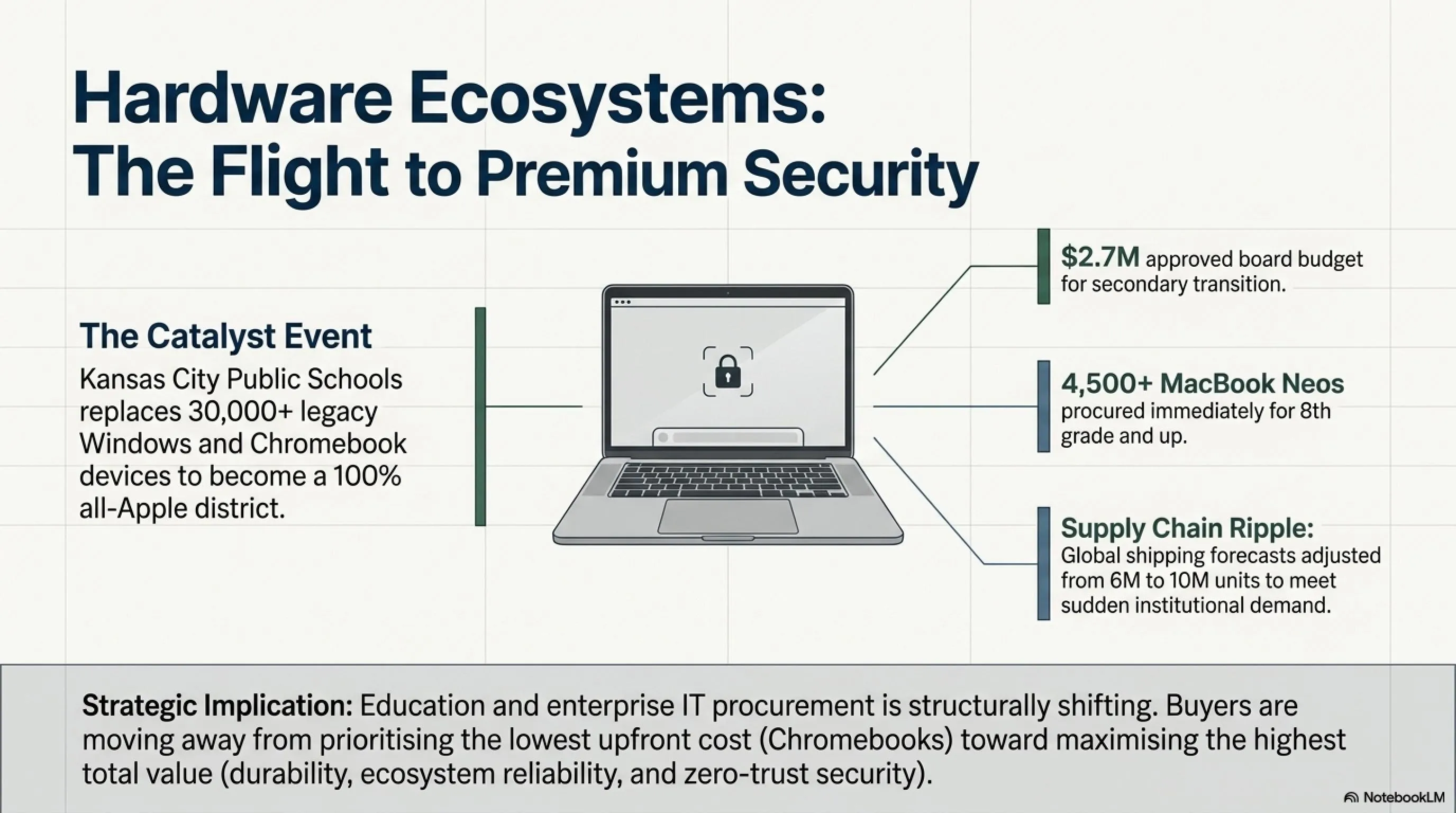
On May 20, 2026, Kansas City Public Schools released details of its plan to become an "all-Apple district." According to the district's website, they will replace more than 30,000 Windows PCs and Chromebooks with more secure, durable, and reliable Apple devices.
This announcement followed a quick comment during Apple's Q2 2026 earnings call, where CFO Kevan Parekh mentioned: "Kansas City Public Schools is switching their high school students from Windows laptops and Chromebooks to MacBook Neo, completing their transition to an all-Apple district."
📊 Kansas City Transition: By the Numbers
According to reports, more than 4,500 MacBook Neos have been procured for students in 8th grade and up, while lower grades have access to the district's existing iPads and MacBook Airs. The Kansas City Public Schools board unanimously approved $2.7 million last month to replace secondary students' iPads with devices identified as Apple Neos, while teachers and staff receive MacBooks.
🔍 Tekin Analysis: Strategic Implications
1. Major Win for Apple in Education: The education market has historically been dominated by Google Chromebooks—affordable devices ideal for budget-conscious schools. But Kansas City demonstrates that schools are willing to pay more for quality, security, and durability.
2. MacBook Neo: The Key Player: MacBook Neo, Apple's new entry-level laptop, plays a crucial role in this transition. With an unprecedented combination of quality, value, and industry-leading security, Neo is designed for enterprise and education markets.
3. High Demand for Neo: Tim Cook said during Apple's Q2 2026 earnings call that the company was caught by surprise with MacBook Neo demand. While Apple initially expected to ship around 6 million units, it's now planning for a number closer to 10 million.
🎵 Apple Music: Open Letter for Fairness in the AI Era
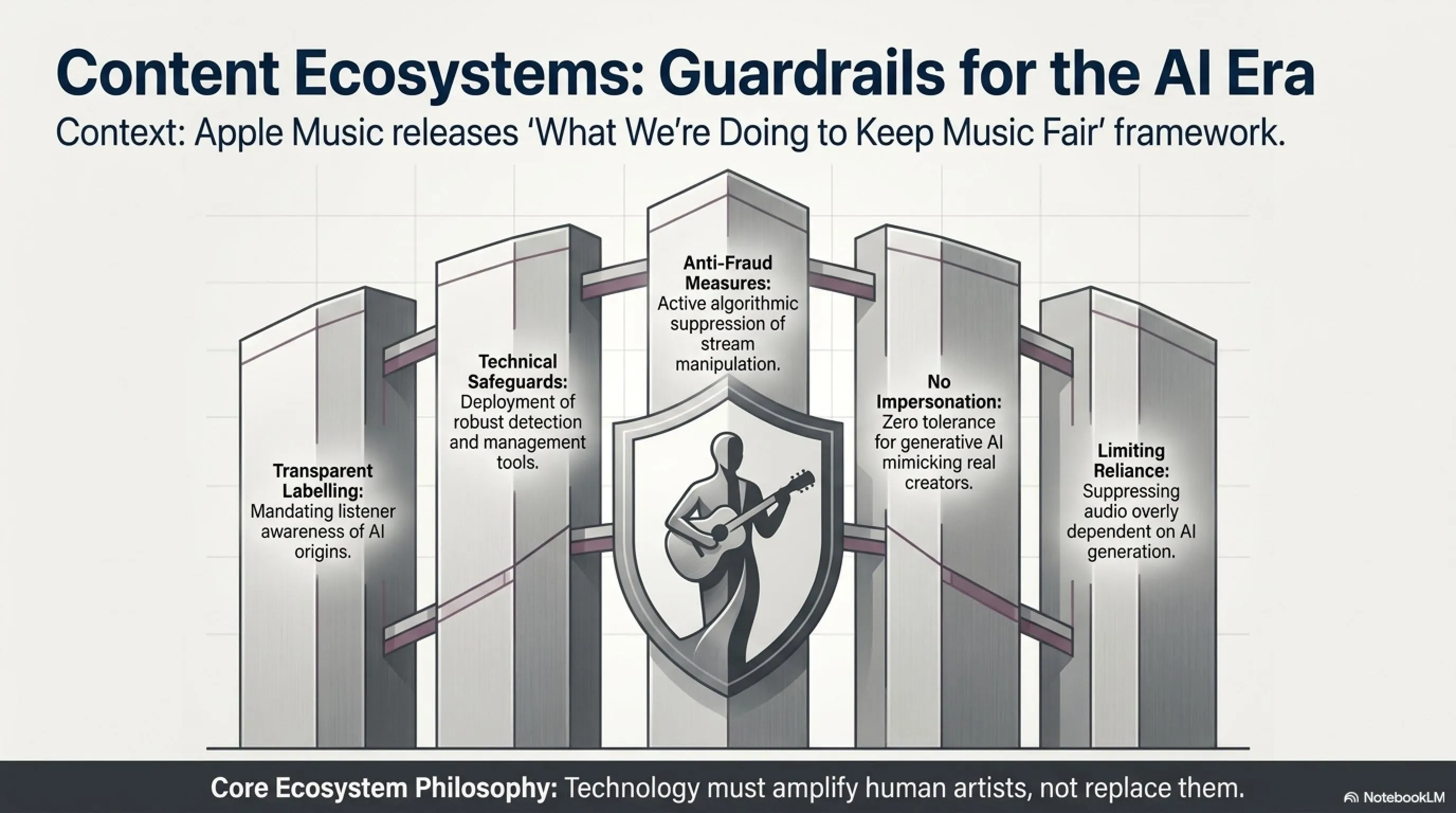
On May 20, 2026, Apple Music shared an open letter with music labels and industry partners entitled "What We're Doing to Keep Music Fair," reaffirming its commitment to help the music business navigate the use of AI responsibly.
The company said it believes technology should amplify artists, not replace them. Apple says AI music represents significantly less than 1% of all plays on the service, but it is being proactive to keep a fair, level playing field for all creators.
📋 Apple Music's Key Policies
1. Transparent Labeling: AI-generated music must be clearly labeled so listeners know what they're hearing.
2. Technical Safeguards: Apple Music uses technical tools to identify and manage AI content.
3. Anti-Fraud Measures: The platform actively fights stream manipulation and inauthentic behavior.
4. No Impersonation: Apple Music absolutely does not accept behaviors where AI is used to impersonate real creators and mislead listeners.
5. Limiting Overly AI-Reliant Content: Audio that relies too heavily on AI-generated sound won't be on Apple Music.
🎮 Xbox Hires Matthew Ball: New Chief Strategy Officer
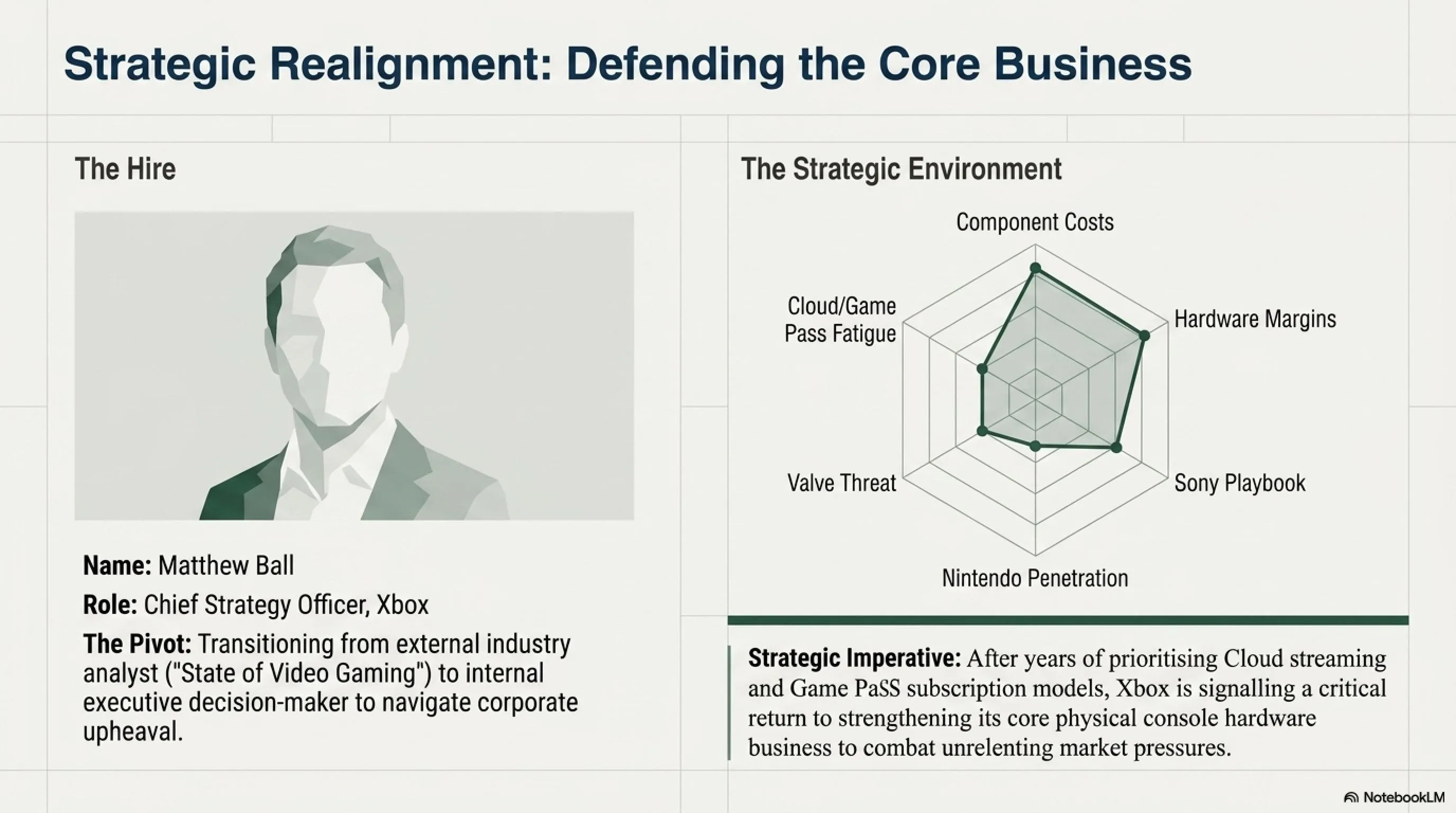
On May 20, 2026, Microsoft announced that Matthew Ball, a prominent game industry analyst, has been hired as Xbox Chief Strategy Officer. Ball is known for his popular annual "State of Video Gaming" report, which is widely read across the game industry.
Asha Sharma, Xbox CEO, commented that Ball is "widely respected across gaming, media, and technology" and a "longtime gamer" who has actually been advising her since day 10 of her tenure. Ball's first task will be strengthening Xbox's console business, especially in light of rising component costs, recent corporate upheaval at Microsoft, and unrelenting competition from Sony, Nintendo, and soon, Valve.
🔍 Tekin Analysis: Why This Hire Matters
1. From Analyst to Decision-Maker: Ball has analyzed the gaming industry from the outside for years. Now he's directly inside one of the industry's biggest players. This is a rare and powerful move.
2. Strategic Perspective: Ball has deep knowledge of industry trends, consumer behavior, and competition. He can help Xbox develop long-term strategies—not just short-term reactions.
3. Focus on Console: While Microsoft has focused on Game Pass and cloud gaming in recent years, Ball must strengthen the console business. This shows Microsoft still cares about hardware.
💭 Final Thoughts: A Night of Major Transformations
Tonight we witnessed 6 explosive stories, each significant enough to be a headline on its own. From Nvidia's discovery of a $200 billion CPU market for AI agents to OpenAI's legitimate solution of an 80-year-old mathematical conjecture, from a critical BitLocker vulnerability to Apple's education revolution in Kansas City—all of these demonstrate that the technology world is rapidly transforming.
Key Takeaways:
- Nvidia showed that the Agentic AI era has just begun and a massive market lies ahead
- OpenAI proved that AI can play a real role in solving complex scientific problems
- Microsoft reminded us that security is always a challenge—even for tech giants
- Apple is dominating the education market with quality and security
- Apple Music demonstrated responsible leadership in the AI era
- Xbox is preparing for the future by hiring top talent
🌙 Good night, and see you tomorrow morning with Tekin Morning!
❓ Frequently Asked Questions (FAQ)
1. Why is Nvidia's Vera CPU important for AI agents?
Vera CPU is specifically designed for high-speed token processing—exactly what agents need to perform their tasks. Unlike traditional CPUs designed with a "core" architecture, Vera is optimized for the Agentic AI era. Jensen Huang predicts that the world will transition from one billion human users to billions of AI agents, and each agent will need dedicated CPUs. This represents a $200 billion market that Nvidia has never addressed before. The architectural innovation is significant: Vera optimizes for token throughput and latency rather than core count and clock speed, making it fundamentally different from traditional CPUs.
2. Did OpenAI really solve the 80-year-old problem, or is this another false claim?
This time it's real! Unlike the previous GPT-5 claim that only found existing solutions, this time OpenAI's model produced a completely new and original proof. Fields Medalist Timothy Gowers said he would recommend the proof for publication "without any hesitation"—a first for AI-generated mathematics. Thomas Bloom, who maintains the Erdos Problems website and previously rejected the GPT-5 claim, has also verified this proof. The OpenAI model disproved Erdős' conjecture about the Unit Distance Problem and discovered an entirely new family of constructions that perform better than square grids. The mathematical community's endorsement is what makes this achievement legitimate and significant.
3. How can I protect my system from the YellowKey BitLocker bug?
Microsoft has provided two main solutions: (1) Manual mitigation steps: Mount the WinRE image, remove autofstx.exe from BootExecute, and reestablish BitLocker trust. (2) Switch from TPM-only to TPM+PIN: This will require a PIN to decrypt the drive at startup, effectively blocking YellowKey attacks. Note that these are workarounds, not a complete patch. Microsoft is working on a full update but hasn't announced a release date yet. For detailed instructions, refer to Microsoft's official advisory for CVE-2026-45585. The TPM+PIN approach is the most effective immediate protection, as it adds a human verification step that the exploit cannot bypass.
4. Why did Kansas City switch from Windows and Chromebook to Apple?
Kansas City Public Schools decided to become an "all-Apple district" because Apple devices are more secure, durable, and reliable. Scott Jones, KCPS Chief Technology Officer, said students "are now proud of their schools because they have the best products." MacBook Neo, Apple's new entry-level laptop, plays a crucial role in this transition with an unprecedented combination of quality, value, and industry-leading security. More than 4,500 MacBook Neos have been procured for students in 8th grade and up, while lower grades have access to existing iPads and MacBook Airs. This is part of a broader investment in student technologies that meet today's needs and grow alongside future needs. The decision reflects a shift in education technology priorities from lowest cost to best total value, considering security, durability, and student engagement.
5. What is Apple Music's policy on AI music?
Apple Music published an open letter reaffirming its commitment to "keep music fair" in the AI world. Key policies include: (1) Transparent labeling for AI-generated music, (2) Technical safeguards to identify and manage AI content, (3) Active fight against stream manipulation and inauthentic behavior, (4) No acceptance of behaviors where AI is used to impersonate real creators, and (5) Limiting content that relies too heavily on AI-generated sound. Apple says AI music represents less than 1% of all plays, but it's being proactive to keep a level playing field for all creators. The company believes technology should amplify artists, not replace them. This balanced approach allows artists to use AI as a tool while preventing abuse and maintaining authenticity in the music ecosystem.
📚 Sources
Primary Sources: TechCrunch, The Hacker News, The Verge, 9to5Mac, Mashable, Forbes, AppleInsider, Variety, Windows Central, GameIndustry.biz, Interesting Engineering, The Print, Indian Express
Verification Sources: Nvidia Official Blog, OpenAI Announcement, Microsoft Security Advisory CVE-2026-45585, Kansas City Public Schools Website, Apple Music Open Letter, Xbox Leadership Announcement
Analysis and Research: Tekin Editorial Team - Tekin Night May 21, 2026
Mathematical Verification: Fields Medalist Timothy Gowers, Thomas Bloom (Erdos Problems), Noga Alon, Melanie Wood
Security Sources: LevelBlue Security Analysis, Will Dormann Security Research, Chaotic Eclipse (Nightmare-Eclipse) GitHub
🌐 Stay Connected With Us
For the latest tech, gaming, and gadget news, follow us on social media:
🌐 Stay Connected With Us 🎮✨
For the latest tech, gaming, and gadget news, follow us on our official social media channels:
Additional Gallery: 🌙 Tekin Night May 21, 2026: Nvidia's $200B Revolution, OpenAI's Math Breakthrough & BitLocker Crisis