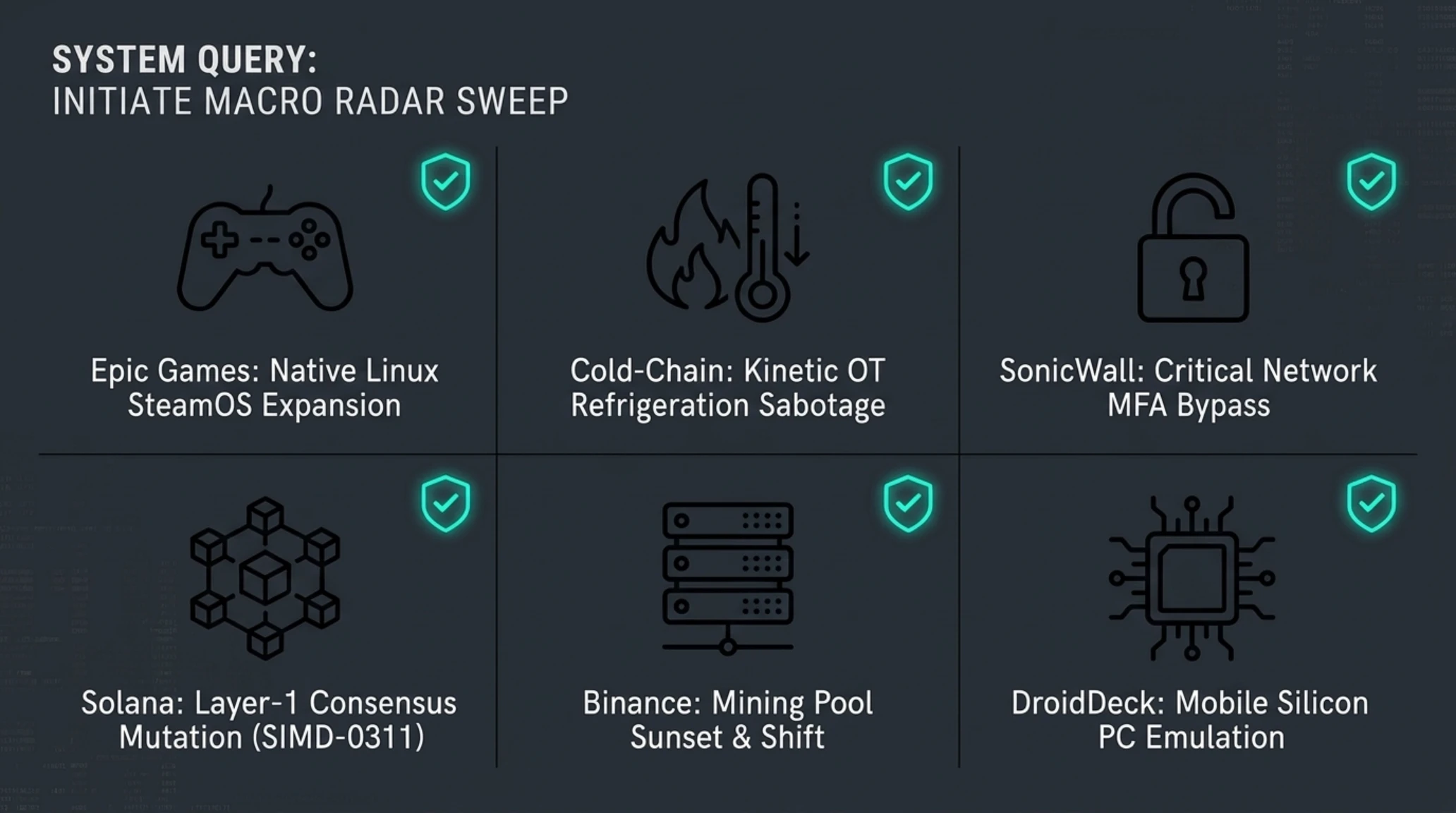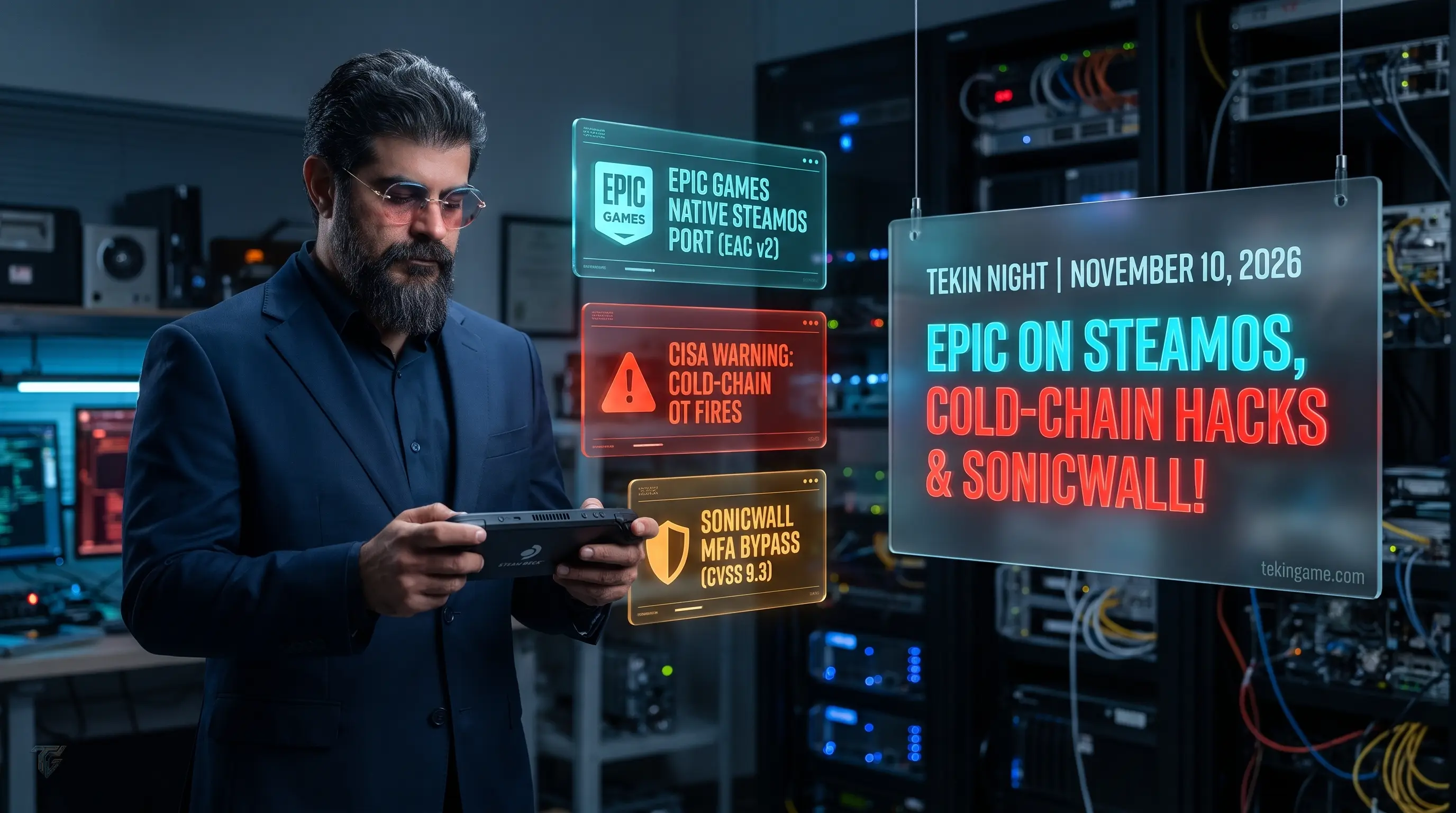
Tekin Night for Nov 10, 2026 dissects six major shifts: (1) Epic Games confirming a native launcher port for SteamOS and Linux with GE-Proton and EAC v2; (2) CISA and FBI warning of cyber-physical attacks on cold-chain refrigeration PLCs causing compressor fires; (3) SonicWall CVE-2026-19868 (CVSS 9.3) bypassing SMS MFA; (4) Solana passing SIMD-0311 to deprecate Durable Nonces post-$270M Drift exploit; (5) Binance shutting down its mining pool; and (6) DroidDeck on Tensor and Exynos.
Tekin Analysis | Strategic Intelligence Executive Briefing
Enterprise technology leaders must navigate a rapidly fragmenting perimeter. From the dismantling of Microsoft Windows hegemony in PC gaming by handheld Linux architectures to the weaponization of industrial refrigeration controllers into physical fire hazards, today's developments underscore the urgent requirement for architectural sovereignty, hardware-rooted verification, and rigorous protocol-level defenses.
As digital supply chains expand into autonomous edge runtimes and decentralized cryptographic networks, organizational exposure is no longer bounded by corporate firewalls. The strategic events documented across this Tuesday evening illustrate that software design choices have direct, quantifiable consequences on industrial infrastructure, hardware lifecycles, and institutional capital reserves.
Strategic Assessment & Key Vectors at a Glance
1. Epic Games Launcher Officially Confirms Native SteamOS and Linux Distribution Support
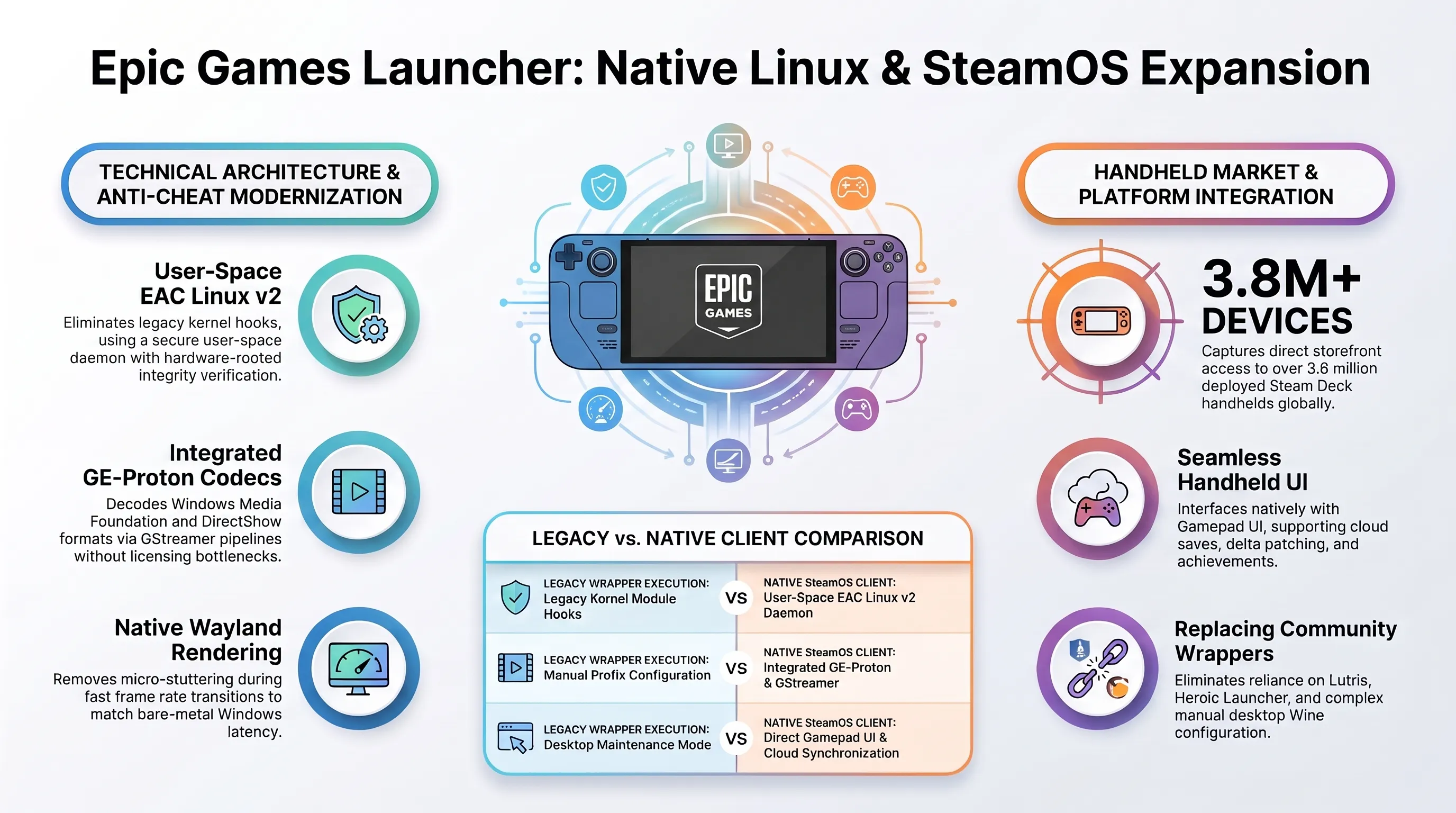
In a milestone development for handheld gaming hardware and open-source operating environments, Epic Games Communications Director Jake Jones officially confirmed in an exclusive interview with GamingOnLinux that an engineered native port of the Epic Games Launcher is actively under development for SteamOS and major Linux distributions including Fedora, CachyOS, and Bazzite. This landmark confirmation concludes years of friction for players who previously relied on third-party community wrappers such as Heroic Games Launcher, Lutris, and custom Wine prefixes to execute purchased software.
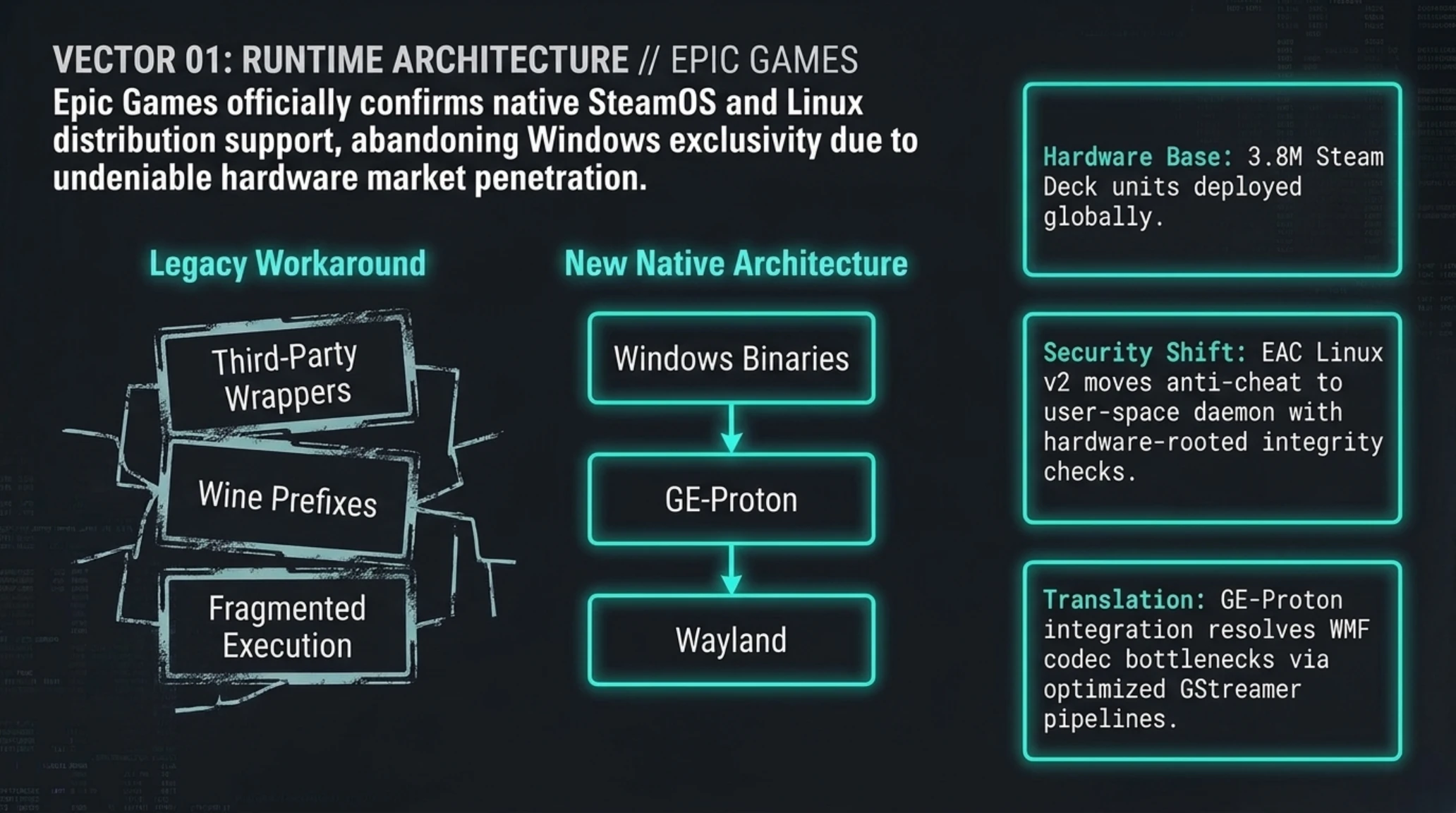
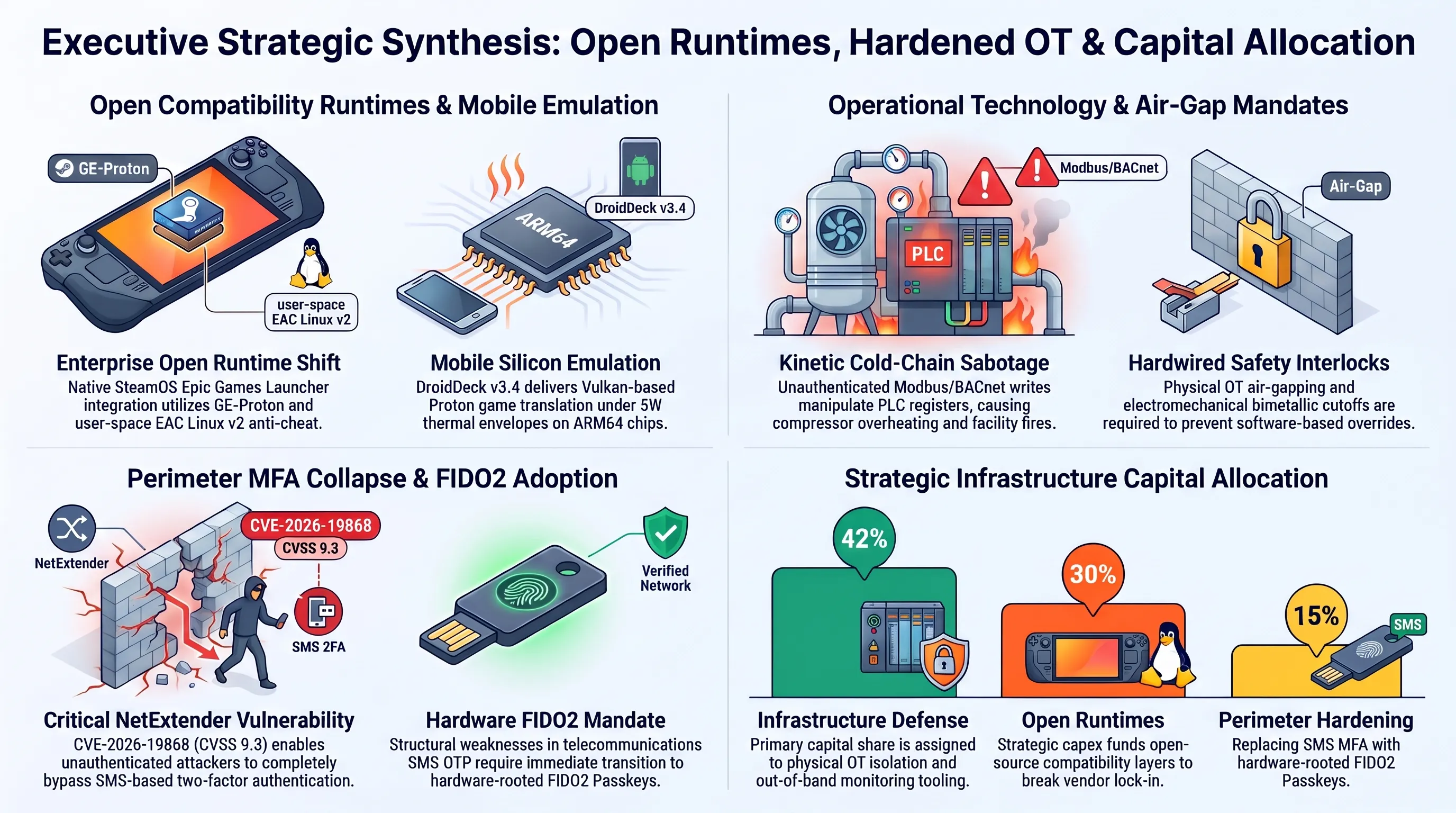
The native launcher architecture directly runs Windows-compiled binaries utilizing integrated GE-Proton compatibility runtimes. Users across Valve's Steam Deck ecosystem and competing Linux-based handheld hardware will no longer need to enter cumbersome desktop maintenance modes. The application interfaces cleanly with Gamepad UI controllers, featuring seamless cloud save synchronization, automated delta patching, and unified achievement unlocks directly within the native handheld session.
A critical engineering breakthrough disclosed by Jones centers on Epic Games collaborating directly with Valve's upstream kernel developers to modernize Easy Anti-Cheat (EAC). The forthcoming EAC Linux v2 framework eliminates outdated kernel module hooks, transitioning security verification into a secure user-space daemon with hardware-rooted integrity checks. This pivotal modernization allows competitive multiplayer flagships including Fortnite and Fall Guys to run smoothly on SteamOS without compromising system stability or triggering spurious account suspensions.
Under the hood, the integration of GE-Proton (the celebrated GloriousEggroll branch of Proton) resolves long-standing media codec bottlenecks. Proprietary video formats encoded in Windows Media Foundation (WMF) and DirectShow now decode via optimized GStreamer pipelines without legal licensing roadblocks. Furthermore, native Wayland rendering integration ensures micro-stutter is eliminated during fast frame rate transitions, bringing latency parity with bare-metal Windows environments.
From a commercial vantage point, Epic's strategic retreat from Windows exclusivity reflects the undeniable market penetration of handheld gaming PCs. With more than 3.8 million Steam Deck devices deployed globally and hardware makers such as ASUS and Lenovo releasing Linux-optimized variants, Epic Games recognized that refusing native support was directly alienating millions of active paying players. By delivering a first-party store client, Epic cements its presence on open operating systems while challenging Valve's virtual monopoly on handheld digital game sales.
Why It Matters // Strategic Dimensions of the Linux Handheld Shift
Industry analysts emphasize that this official endorsement of SteamOS signals an irreversible transformation in gaming runtime standards. As independent hardware vendors adopt Linux-based operating systems to circumvent Windows licensing overhead and telemetry bloat, software publishers who fail to deliver native compatibility runtimes risk complete platform irrelevance.
Furthermore, developers building on Unreal Engine 5 now possess a seamless testing harness where Linux build targets can be validated natively on hardware without maintaining dual-boot workstations, accelerating release cadences for indie and AAA studios alike.
2. U.S. Cyber Agencies Warn Hackers Target Cold-Chain Refrigeration Controllers Causing Equipment Fires & Massive Spoilage
In a joint emergency cybersecurity advisory issued on Tuesday evening, the Cybersecurity and Infrastructure Security Agency (CISA) and the Federal Bureau of Investigation (FBI) sounded an urgent alarm regarding state-sponsored and criminal cyber intrusions targeting commercial and industrial refrigeration systems across North America. The targeted operational technology (OT) controllers regulate cold-storage warehouses, pharmaceutical supply chains, chemical logistics depots, and regional food distribution hubs.
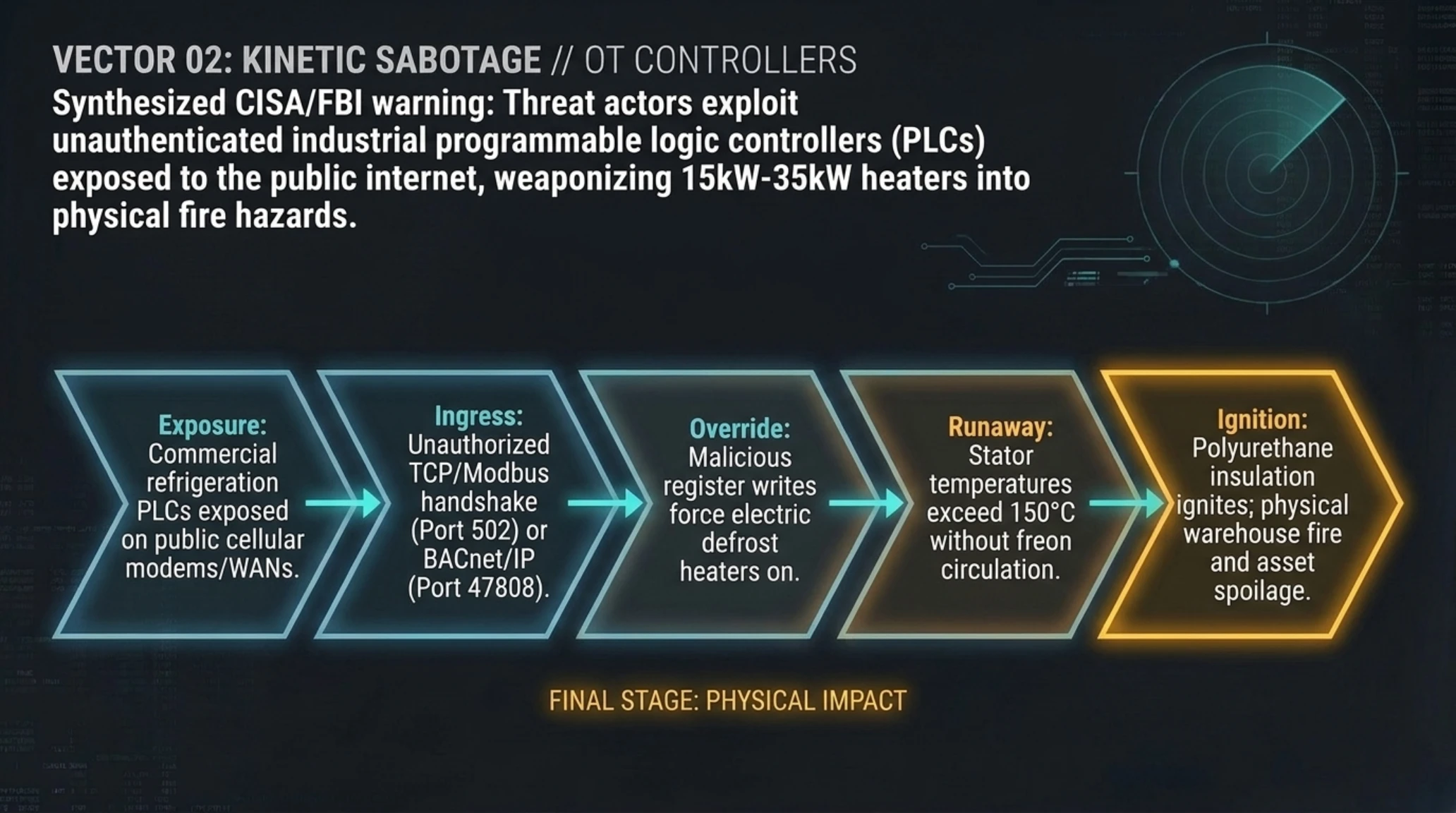
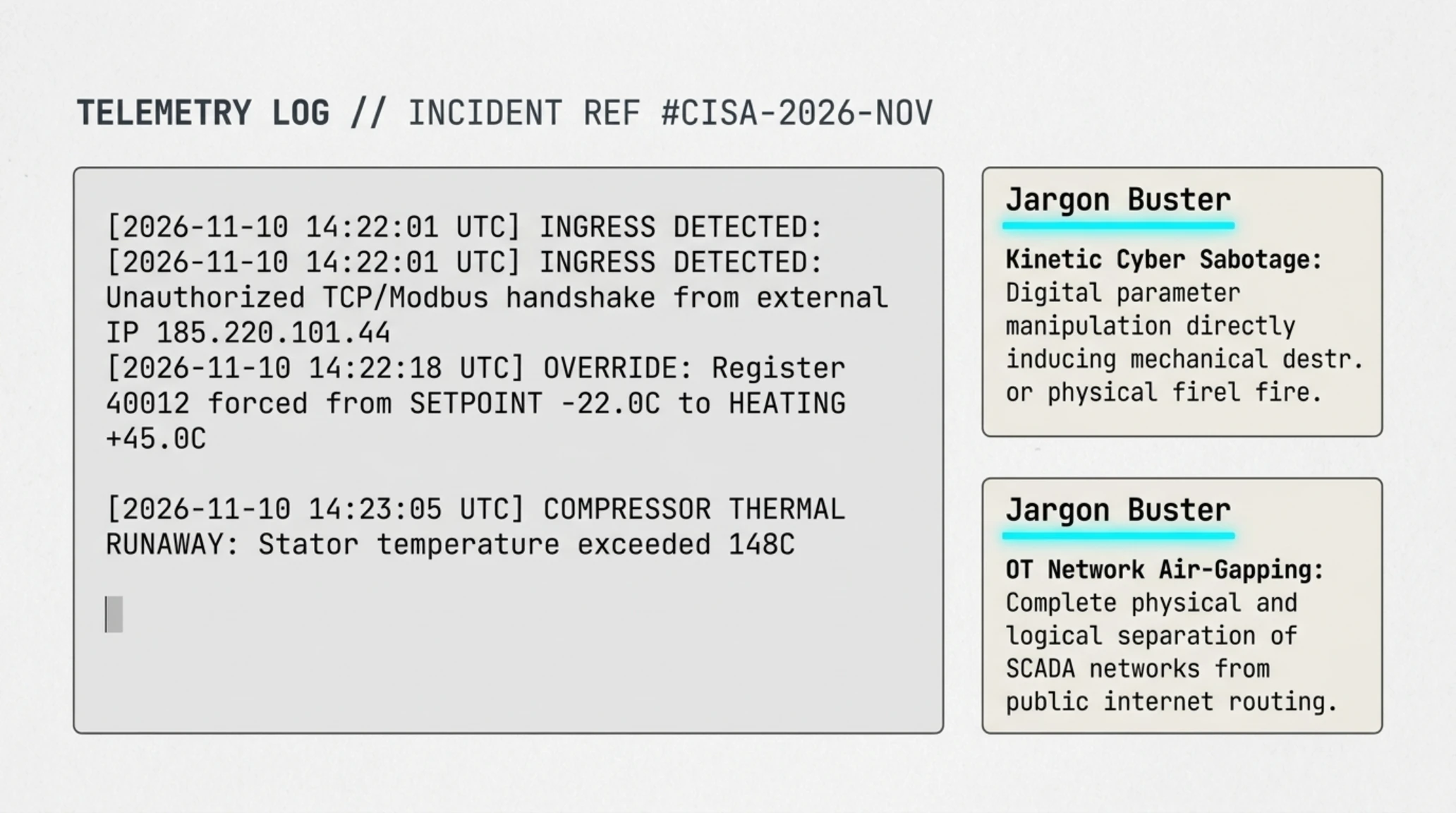
Forensic investigations reveal that threat actors exploit poorly secured industrial programmable logic controllers (PLCs) and supervisory control and data acquisition (SCADA) telemetry interfaces exposed directly to the public internet. By transmitting malicious register writes, attackers disable primary refrigeration cycles while simultaneously forcing multi-kilowatt electric defrost heating elements into continuous, unthrottled operation. This engineered thermal runaway causes catastrophic stator overheating, compressor ignition, structural facility fires, and multi-million-dollar spoilage of refrigerated pharmaceuticals, blood plasma banks, and agricultural food stockpiles.
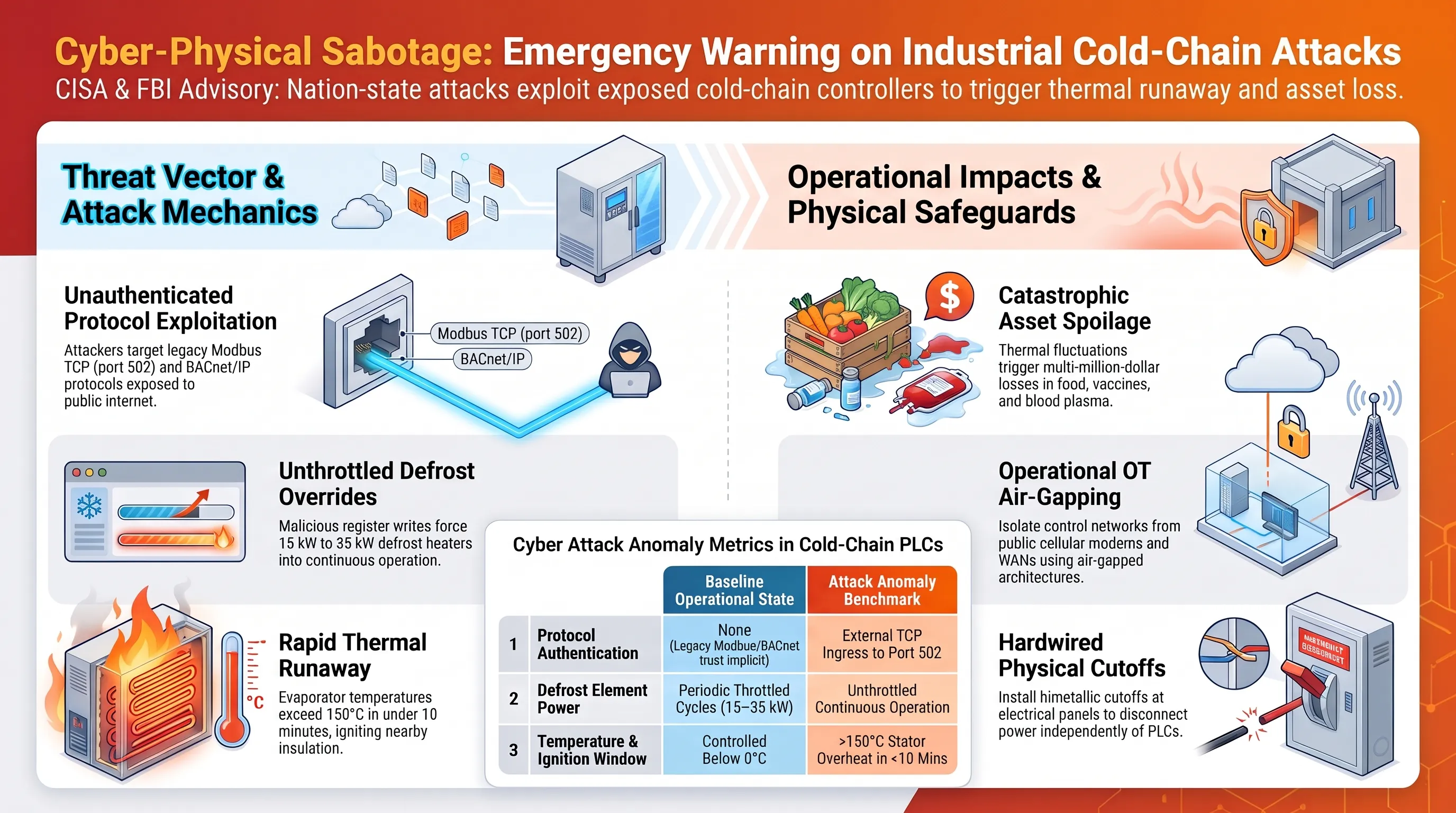
The compromised installations predominantly involve commercial refrigeration control units connected to public cellular modems or corporate WANs by local contractors for remote telemetry, frequently lacking firewall isolation or factory credential rotation. This operational negligence has permitted threat actors to execute scripted mass commands across hundreds of distribution facilities simultaneously.
Technical telemetry gathered from affected logistics sites indicates that attackers exploit the intrinsic absence of cryptographic authentication in legacy fieldbus protocols such as Modbus TCP (port 502) and BACnet/IP (port 47808). Because these operational protocols trust all command packets implicitly, any threat actor capable of routing TCP packets to an exposed port can issue coil overrides without supplying passwords or administrative tokens.
When electric defrost heaters rated between 15 kW and 35 kW remain energized for hours without active freon circulation, ambient evaporator temperatures exceed 150 degrees Celsius. In several investigated incidents, polyurethane insulation foam adjacent to cooling coils ignited, setting entire warehouse roofs ablaze before local municipal fire services could intervene.
Cyber Terminal & Industrial Telemetry Log // Incident Ref #CISA-2026-NOV
Industrial telemetry benchmarks demonstrate that without hardwired electromechanical safety interlocks, the duration between initial unauthorized register manipulation and kinetic compressor fire can be under ten minutes. Software safeguards implemented purely in programmable logic are inherently bypassed when attackers overwrite PLC firmware or alter setpoint thresholds directly.
The financial ramifications extend far beyond equipment replacement costs. In agricultural cold storage facilities, single-degree temperature fluctuations during multi-month fruit storage break dormancy cycles, ruining entire seasonal harvests. In pharmaceutical hubs storing temperature-sensitive monoclonal antibodies and vaccines, minor thermal spikes render batches biologically inactive, requiring mandatory destruction under FDA regulatory mandates.
Tekin Technical Jargon Buster // Core Cyber-Physical Concepts
Federal cybersecurity authorities strongly mandate that enterprise logistics providers immediately conduct asset discovery via OT visibility tooling, decouple control networks from public IP address blocks, and deploy hardware-enforced out-of-band monitoring.
This stark assessment reflects the evolving reality of contemporary warfare: operational technology compromises now generate immediate kinetic consequences that surpass conventional network breaches.
Security architects are urged to implement hardwired bimetallic thermal cutoffs that physically disconnect electric heaters at the electrical panel, completely bypassing software and PLC instructions during over-temperature anomalies.
The forensic simulation video illustrates how malicious remote register overwrites induce compressor stator runaway and subsequent ignition within industrial cold storage facilities.
3. SonicWall Discloses Critical CVE-2026-19868 Authentication Bypass in NetExtender Remote VPN Gateway
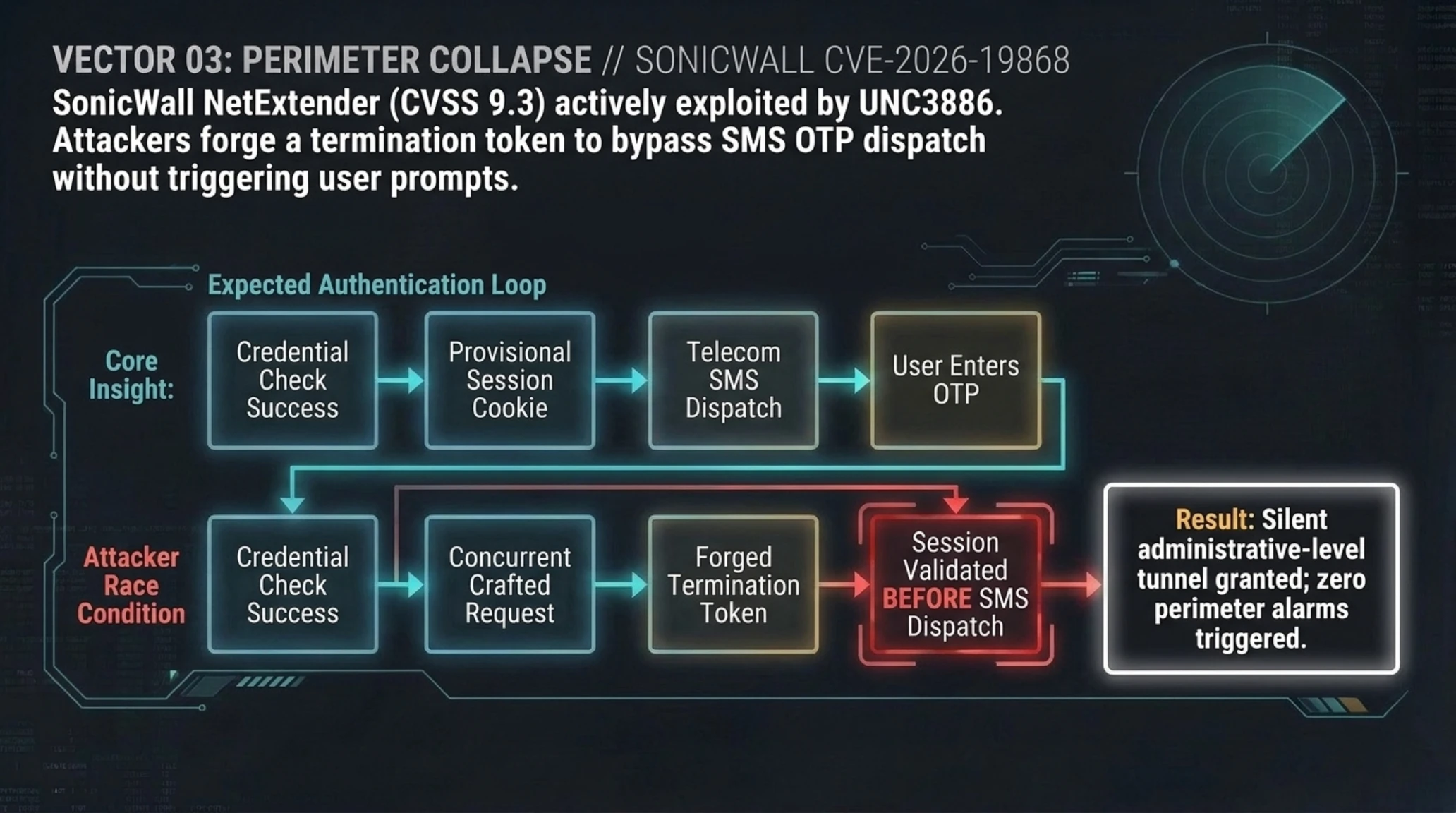
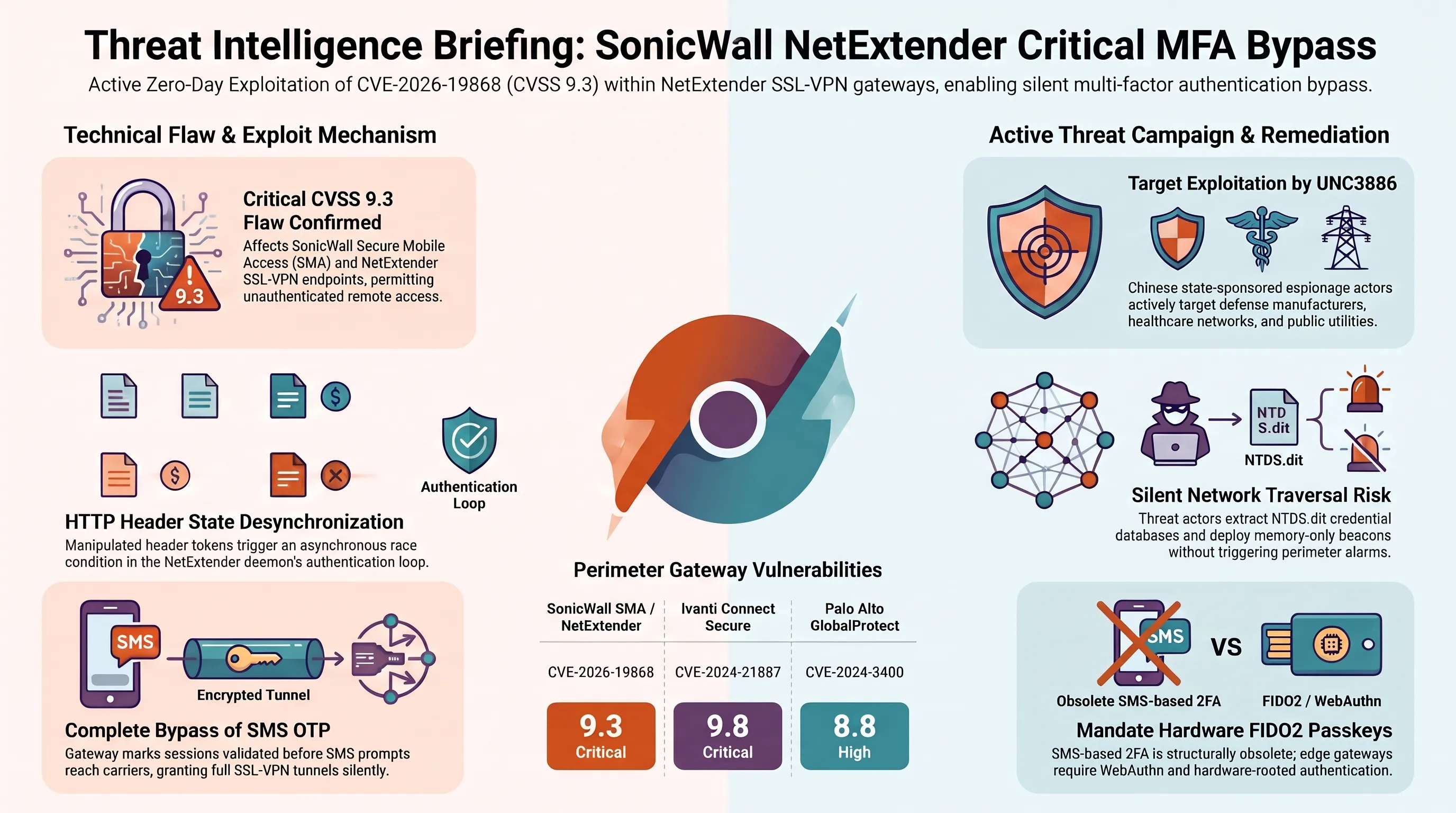
Network security appliance vendor SonicWall officially confirmed active in-the-wild exploitation of a critical vulnerability, cataloged under CVE-2026-19868 with a CVSS v3 severity rating of 9.3 out of 10. The flaw impacts SonicWall Secure Mobile Access (SMA) appliances and NetExtender SSL-VPN endpoints, permitting remote unauthenticated adversaries to bypass multi-factor authentication (MFA) mechanisms completely.
Detailed technical audits demonstrate an architectural flaw in how the gateway's session state machine validates SMS-based one-time password (OTP) verification responses. By manipulating specific HTTP client header tokens and crafting spoofed acknowledgment payloads, attackers trick the gateway daemon into establishing an authenticated SSL-VPN tunnel without forwarding any SMS prompt to the legitimate administrator. Threat intelligence researchers at Mandiant have linked active intrusion campaigns to Chinese state-sponsored espionage cluster UNC3886.
Dozens of enterprise organizations across defense industrial manufacturing, healthcare delivery networks, and public utilities have suffered silent perimeter penetration. Because the exploit yields a legitimate VPN session token, standard intrusion detection systems generate zero perimeter alarms while attackers execute lateral traversal and credential dumping across internal subnets.
Under forensic scrutiny, the root cause traces back to an improper handling of HTTP header state transitions in the NetExtender daemon's asynchronous authentication loop. When an initial credential check succeeds, the appliance generates a provisional session cookie tagged with an authentication status enum. By sending a concurrent crafted request containing a forged termination token, threat actors trigger a race condition where the state machine marks the session as fully validated before the SMS one-time password challenge has even been dispatched to the telecommunications carrier.
The attacker is consequently granted an administrative-level tunnel into the internal corporate network without entering any secondary verification code. From this foothold, espionage operators deploy memory-only beaconing agents, dump Active Directory NTDS.dit credential databases, and pivot silently toward engineering CAD archives and proprietary intellectual property.
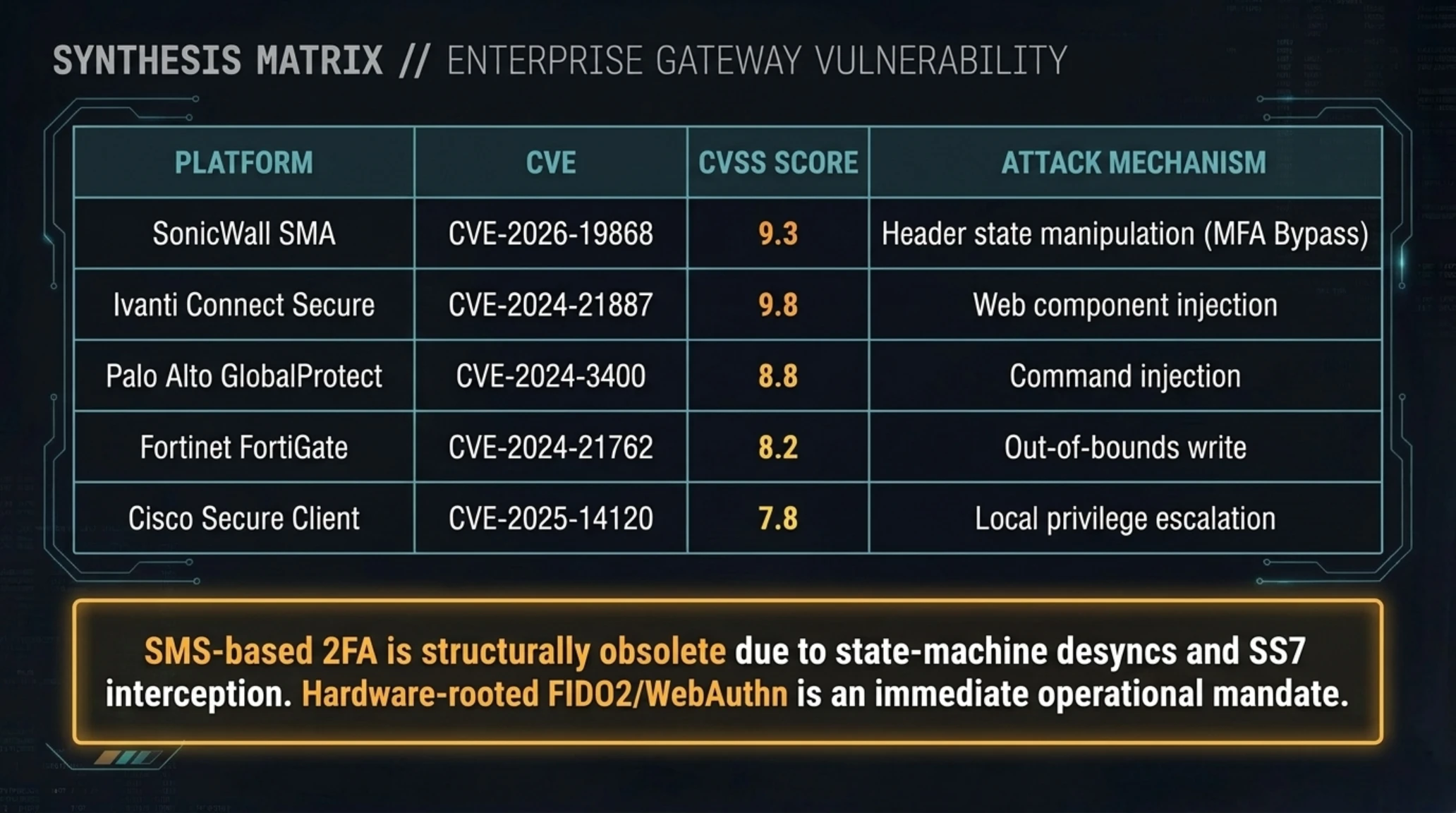
Perimeter Gateway Vulnerability Matrix & Benchmarks
| Security Platform | CVE Identifier | Severity (CVSS) | Attack Mechanism & Impact |
|---|---|---|---|
| SonicWall SMA / NetExtender | CVE-2026-19868 | 9.3 Critical | Header state manipulation bypassing SMS OTP verification |
| Fortinet FortiGate | CVE-2024-21762 | 8.2 High | Out-of-bounds write in SSL-VPN enabling remote code execution |
| Palo Alto GlobalProtect | CVE-2024-3400 | 8.8 High | Command injection in telemetry pipeline granting root shell |
| Ivanti Connect Secure | CVE-2024-21887 | 9.8 Critical | Web component command injection for full appliance takeover |
| Cisco Secure Client | CVE-2025-14120 | 7.8 High | Local privilege escalation via installer DLL preloading |
The vulnerability matrix illustrates how enterprise boundary gateways remain the premier attack vector for sophisticated threat actors seeking uninhibited internal network traversal.
This critical incident provides undeniable proof that SMS-based two-factor authentication is structurally obsolete. Because SMS channels are vulnerable to SS7 interception, SIM swapping, and state-machine desynchronization attacks on edge appliances, organizations must urgently mandate hardware-rooted FIDO2 Passkeys and WebAuthn authenticators across all external entry points.
4. Solana Consensus Overhaul; Validators Approve SIMD-0311 to Deprecate Durable Nonces Post-$270M Drift Exploit
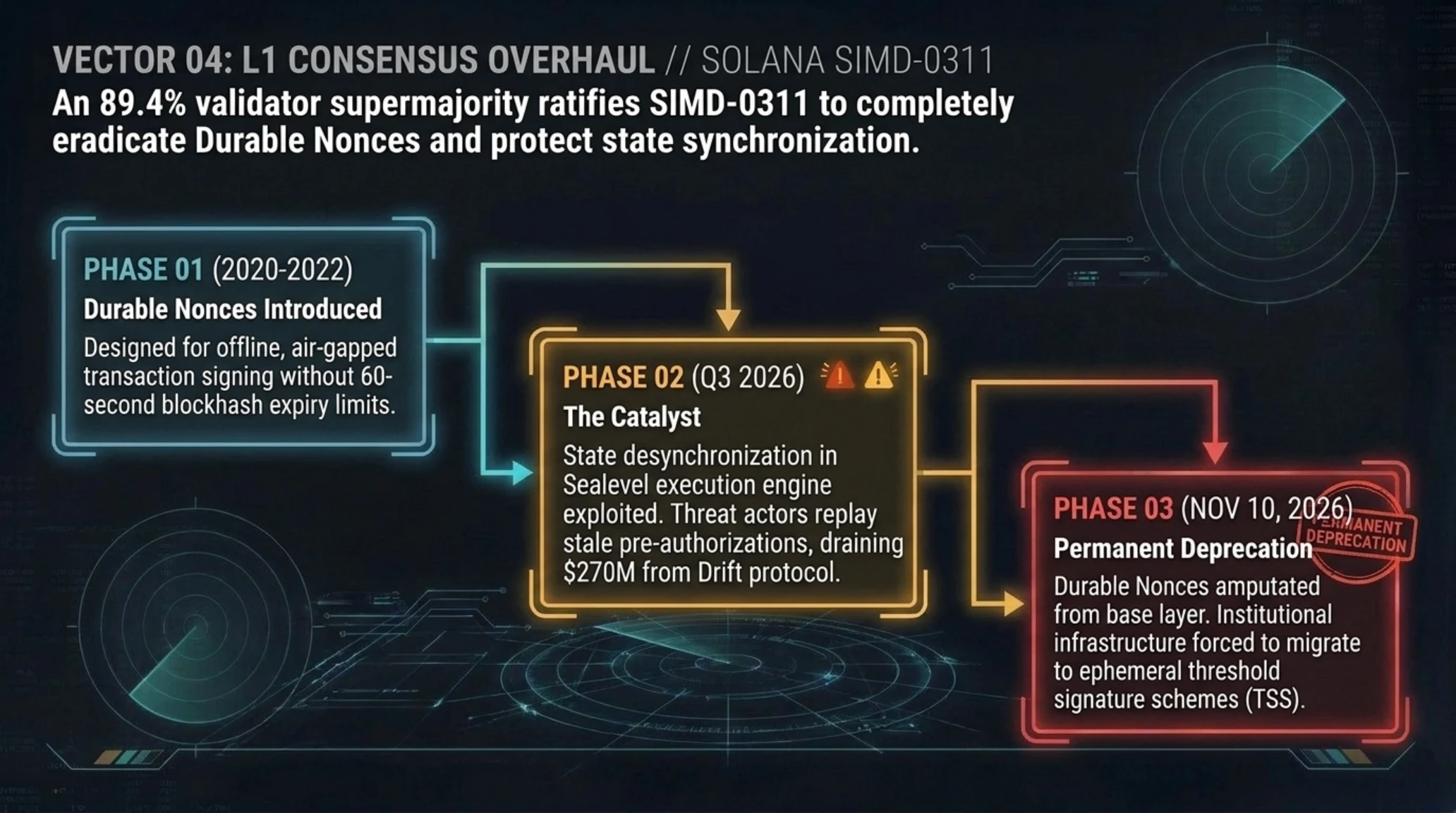
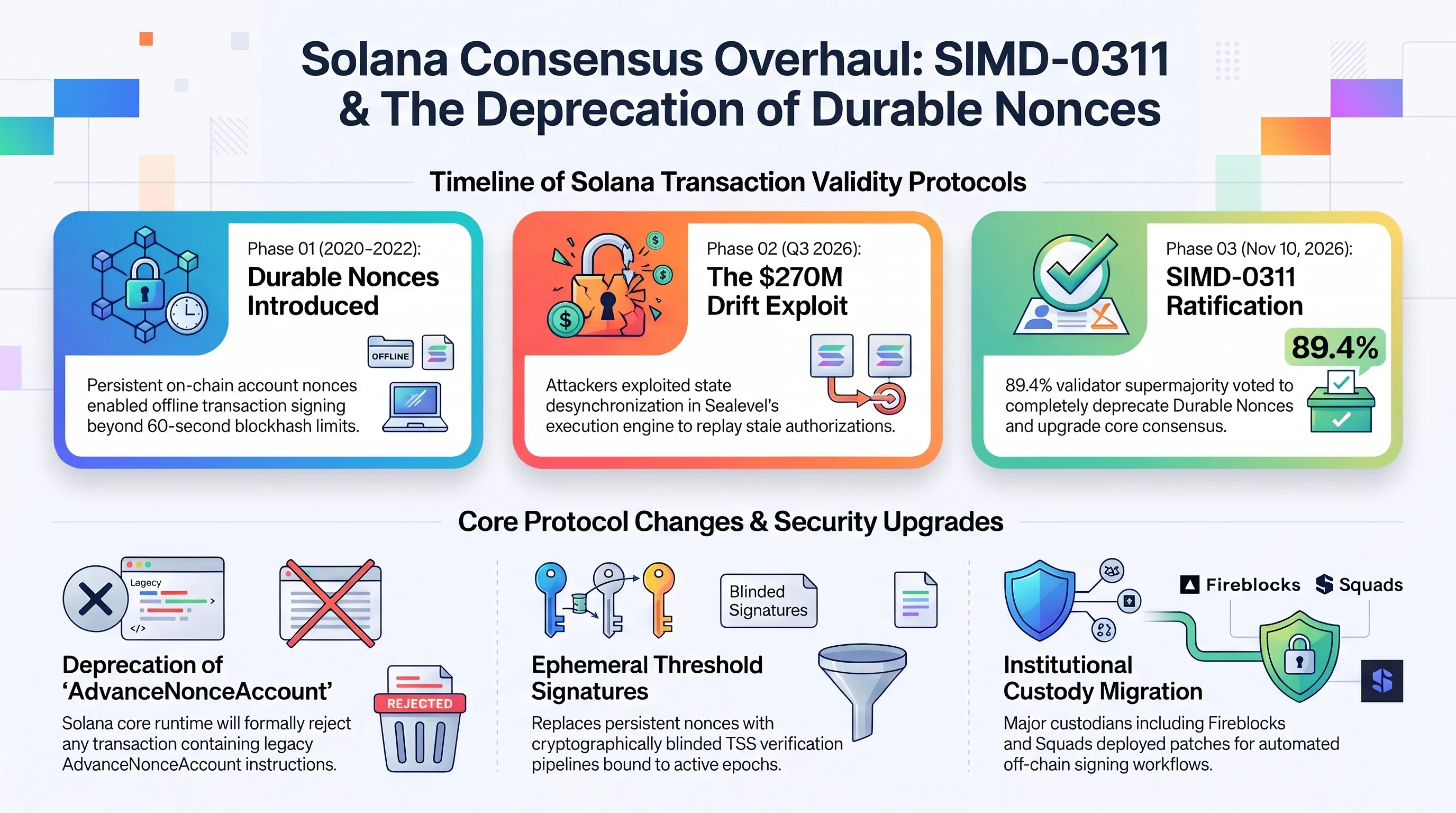
The Solana validator ecosystem took decisive consensus action on Tuesday evening, voting with an overwhelming 89.4% supermajority to ratify Solana Improvement Document SIMD-0311. The protocol upgrade completely deprecates and phases out Durable Nonces from the Solana core consensus runtime, permanently eradicating an architectural mechanism that catalyzed the catastrophic $270 million Drift protocol derivative exploit.
Durable Nonces were originally introduced to enable offline transaction signing by replacing the network's strict 150-block (~60 second) recent blockhash expiration window with a persistent on-chain account nonce. However, security researchers discovered that concurrent transaction pipelining in Solana's Sealevel execution engine could cause state desynchronization. Attackers exploited this latency to execute stale transaction pre-authorizations multiple times, artificially inflating collateral balances and draining protocol liquidity pools.
While the deprecation safeguards ledger integrity against complex asynchronous replay exploits, it imposes immediate friction upon institutional digital asset custodians, multi-signature vaults, and cold-storage signing services that relied on Durable Nonces to coordinate off-chain signers without time pressure. Protocols are now mandated to migrate to ephemeral signature schemes and real-time transaction broadcast pipelines before the epoch boundary upgrade activates.
Under the technical specifications of SIMD-0311, the Solana runtime instruction set will formally reject any transaction containing the 'AdvanceNonceAccount' instruction. In its place, the core development team is rolling out an optimized ephemeral signature verification pipeline that allows multi-signature participants to pre-authorize state transitions via cryptographically blinded threshold signature schemes (TSS).
This structural change guarantees that transactions remain bound to active, verifiable network epochs, preventing any possibility of malicious actors resurfacing signed authorizations months after market conditions have diverged. Major institutional custody solutions including Fireblocks and Squads have already announced compatibility patches to ensure zero disruption to automated treasury workflows.
📚 Classified & Related Dossiers in TekinGame
If you wish to explore beyond this report and delve into cybernetic frontiers and autonomous AI architectures, do not miss these three exclusive deep-dives in the Tekin Garage:
Architecture Evolution Timeline // Solana Transaction Validity Protocols
| Epoch / Period | Key Technical & Security Event | Consensus & Architectural Impact |
|---|---|---|
| 2020 - 2021 | Introduction of Durable Nonces | Durable Nonce accounts implemented to assist air-gapped cold-storage vaults with offline transaction authorization, bypassing strict 60-second blockhash expiry limits. |
| 2022 - 2024 | Widespread Custodial Adoption | Institutional custodians and decentralized multisig protocols integrate nonces as default architectural primitive for asynchronous multi-party approvals. |
| Q3 2026 | The Drift Exploit Catalyst | Sophisticated threat actors exploit state synchronization delays in concurrent nonce validation, replaying transactions to siphon $270M from derivative lending pools. |
| Nov 10, 2026 | SIMD-0311 Ratification | Validators approve total deprecation with 89.4% supermajority; institutional digital asset custody infrastructure migrates to ephemeral threshold signature schemes. |
The timeline highlights Solana's aggressive protocol governance model: when an architectural feature poses an unresolvable attack surface to the base layer, validators prioritize state finality and settlement safety over legacy backward compatibility.
This willingness to prune high-risk cryptographic constructs demonstrates the growing maturity of high-throughput blockchain networks, proving that long-term enterprise adoption requires ruthless elimination of design liabilities.
5. Binance Sunsets Historic Bitcoin Mining Pool on November 10 as Weekly Output Collapses to a Single Block
In a historic retrenchment highlighting the brutal economics of post-halving digital asset mining, global cryptocurrency exchange Binance officially ceased all operations of its Bitcoin mining pool, Binance Pool, on November 10, 2026. The exchange instructed all remaining institutional and retail mining participants to redirect their SHA-256 hashrate to alternative independent mining pools immediately to prevent disruption to payouts.
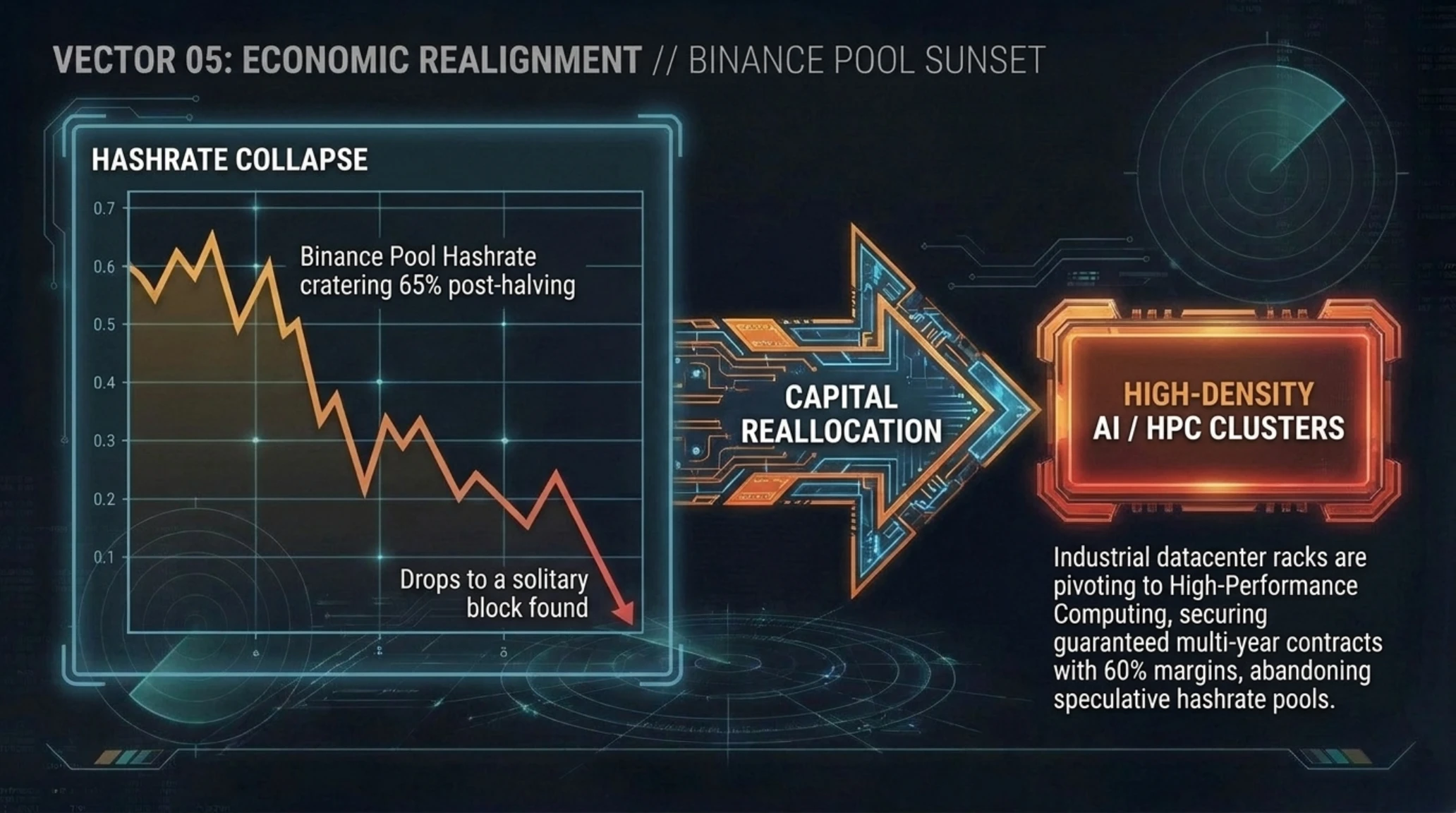
The shutdown follows a catastrophic multi-quarter operational decline. Binance Pool's global hashrate share, which once commanded over 11% of the worldwide Bitcoin network in 2021, cratered by more than 65% over the past eighteen months. During the final week of operations, the entire pool discovered a solitary Bitcoin block, yielding insufficient transaction fees and block rewards to offset enterprise server hosting, stratum proxy bandwidth, and round-the-clock engineering overhead.
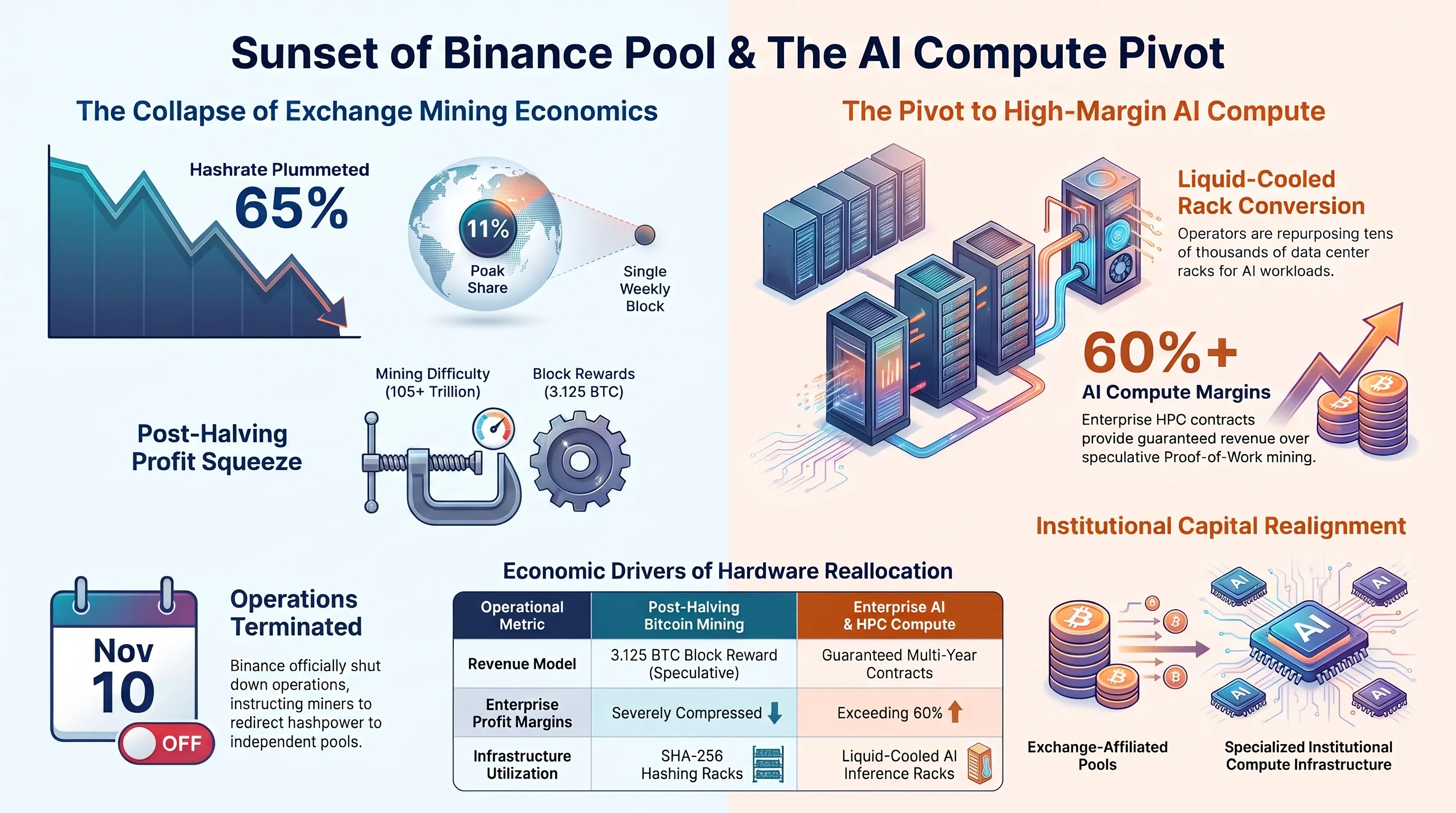
Industry analysts point to structural macroeconomic headwinds as the primary catalyst. Following the fourth Bitcoin halving, mining difficulty surged past 105 trillion hashes, compressing profit margins for miners burdened by high pool fee structures. Simultaneously, giant vertically integrated mining corporations such as Marathon Digital and CleanSpark consolidated immense proprietary hashrate pools, outcompeting exchange-affiliated pools that historically relied on fragmented retail hashpower.
Furthermore, major mining enterprises have dramatically pivoted their capital allocation strategies. Faced with reduced block rewards of 3.125 BTC, North American operators have repurposed tens of thousands of advanced liquid-cooled data center racks to host high-density AI inference workloads and High-Performance Computing (HPC) clusters. This infrastructure transition delivers guaranteed multi-year enterprise compute contracts with profit margins exceeding 60%, drawing institutional capital away from speculative Proof-of-Work mining.
With retail mining participation squeezed out by skyrocketing hardware costs and industrial scale advantages, exchange-affiliated pools that served as onboarding funnels for trading platforms are no longer economically viable.
- Dismantles centralized exchange control over base-layer transaction hashing
- Accelerates institutional migration toward transparent zero-fee mining pools
- Incentivizes miners to anchor operations to dedicated green energy grids
- Increases short-term hashrate concentration among North American mega-pools
- Eliminates streamlined direct-to-exchange liquidity for retail mining operators
- Forces smaller miners to absorb additional stratum proxy re-routing fees
The sunset of Binance Pool marks the end of an era in cryptocurrency infrastructure, symbolizing the transition from opportunistic exchange-operated mining services to hyper-specialized, institutional-grade compute operations.
As decentralized mining protocols like Stratum V2 gain traction, miners regain direct authority over transaction selection, strengthening Bitcoin's censorship resistance and platform resilience against centralized exchange hegemony.
6. DroidDeck Open-Source PC Emulator Expands to Google Pixel Tensor & Samsung Exynos Chips
The open-source mobile virtualization community achieved an extraordinary engineering breakthrough on Tuesday evening as the development team behind DroidDeck unveiled its landmark v3.4 release. Expanding far beyond its initial optimization for Qualcomm Snapdragon platforms, DroidDeck now features native execution support for Google Tensor processors (Pixel 8 and Pixel 9 series) and Samsung Exynos chips powered by AMD RDNA-derived Xclipse GPUs.
Unlike fragile translation wrappers such as Mobox or Winlator that require manual system environment tweaking, DroidDeck boots directly into a polished Steam Big Picture user experience. Users log into verified Steam, GOG, or Epic Games accounts to download and launch legitimate game libraries using optimized Proton compatibility translation layers without requiring pirated packages or cracked binaries.
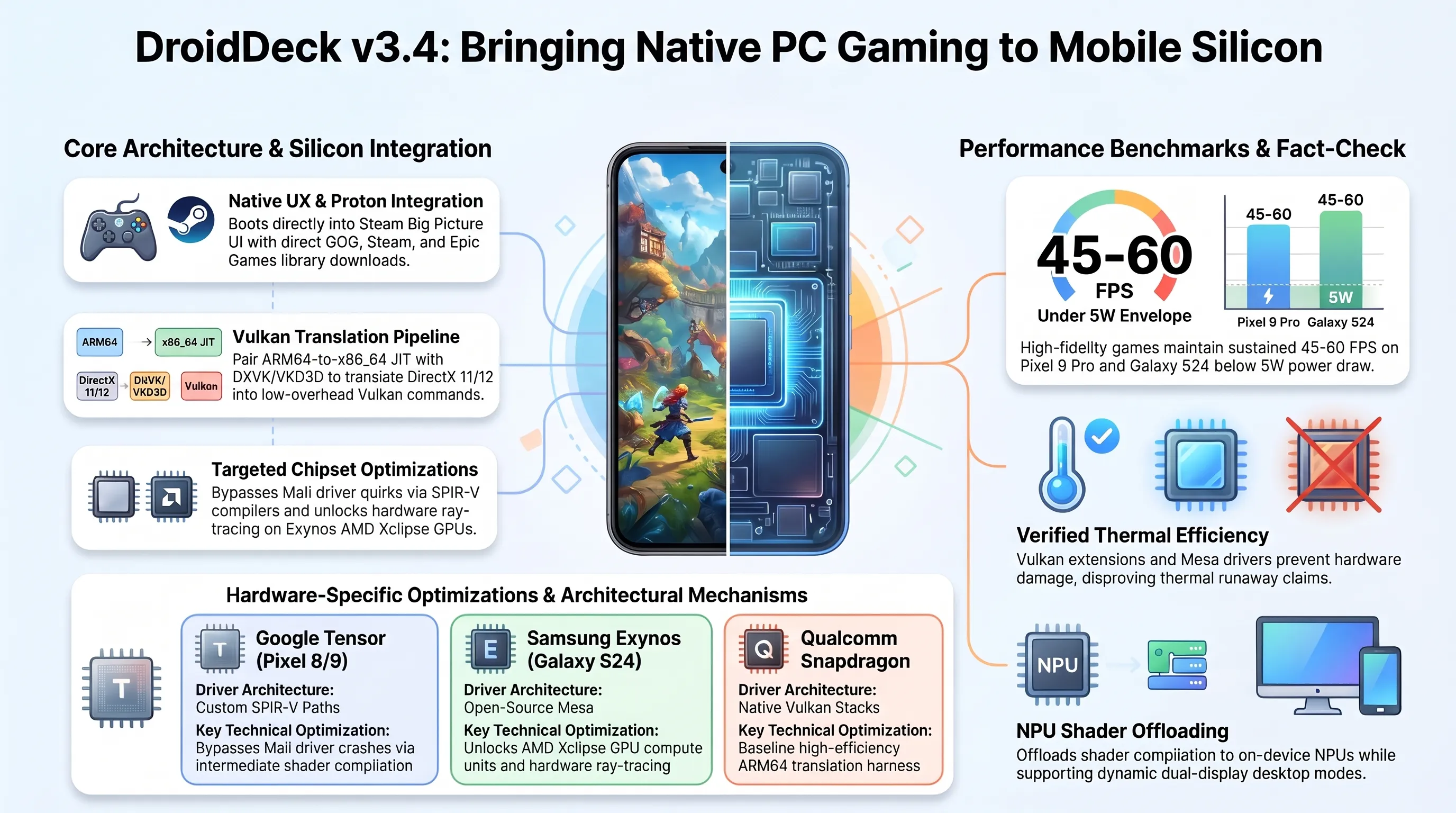
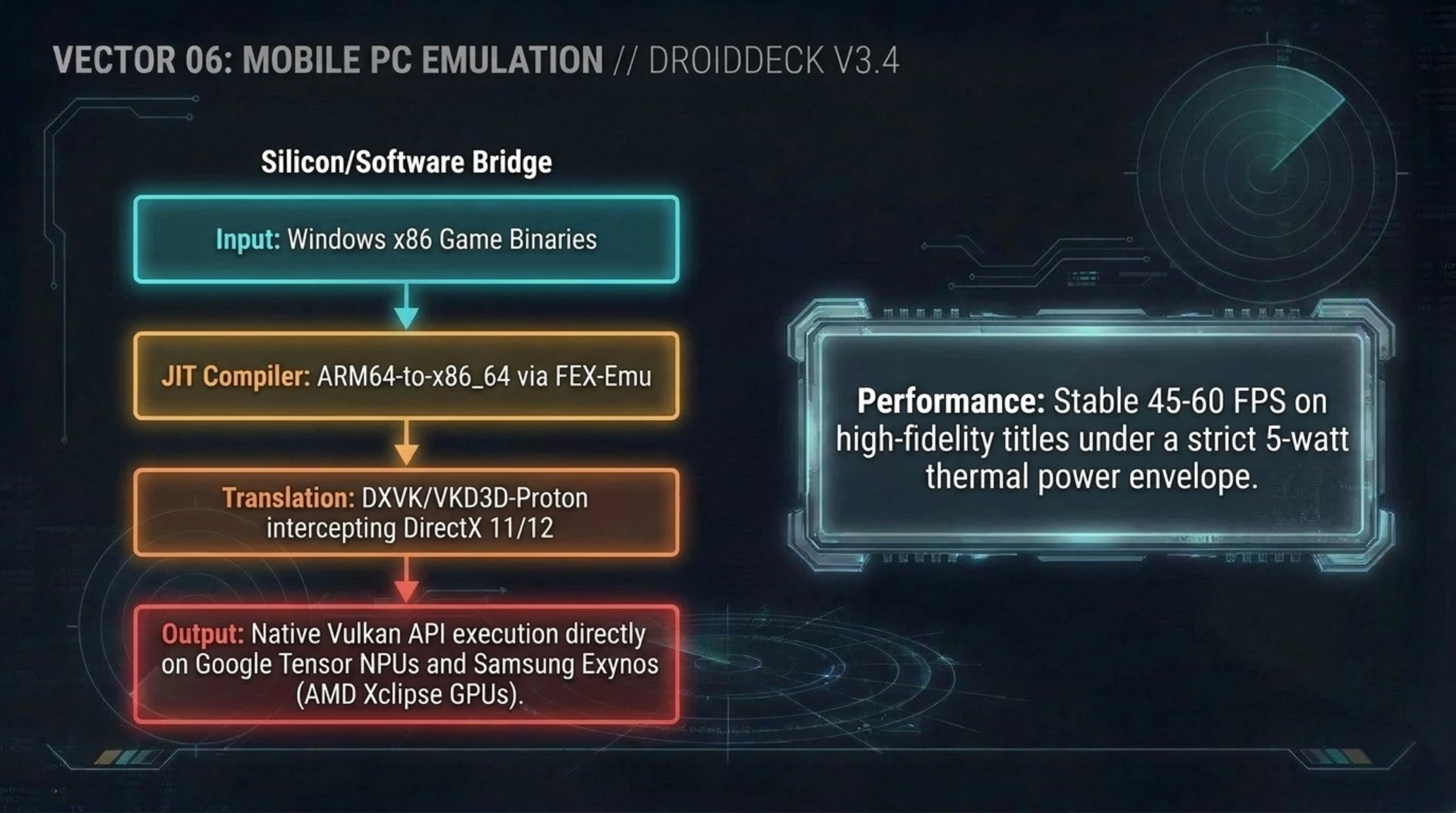
The latest build implements dynamic dual-display desktop modes and leverages on-device neural processing units (NPUs) to offload shader compilation overhead. High-fidelity titles including Hades II, Hollow Knight: Silksong, and Fallout 4 maintain sustained 45 to 60 FPS performance profiles on Pixel 9 Pro and Galaxy S24 hardware with thermal power envelopes contained under 5 watts.
The technical architecture of DroidDeck represents a tour de force in modern binary translation. The emulator integrates an ARM64-to-x86_64 Just-In-Time (JIT) compiler based on custom FEX-Emu core optimizations, paired with a specialized DXVK and VKD3D-Proton translation pipeline. This framework intercept DirectX 11 and DirectX 12 graphics draw calls and converts them directly into low-overhead Vulkan API commands that mobile GPUs can execute with minimal latency.
On Google Tensor silicon, DroidDeck engineers resolved longstanding driver crashes by developing custom SPIR-V intermediate shader compilation paths, bypassing Mali/Immortalis driver quirks. On Samsung Exynos processors, the engine taps directly into AMD's Xclipse hardware architecture via open-source Mesa drivers, unleashing hardware ray-tracing and compute units previously inaccessible to mobile applications.
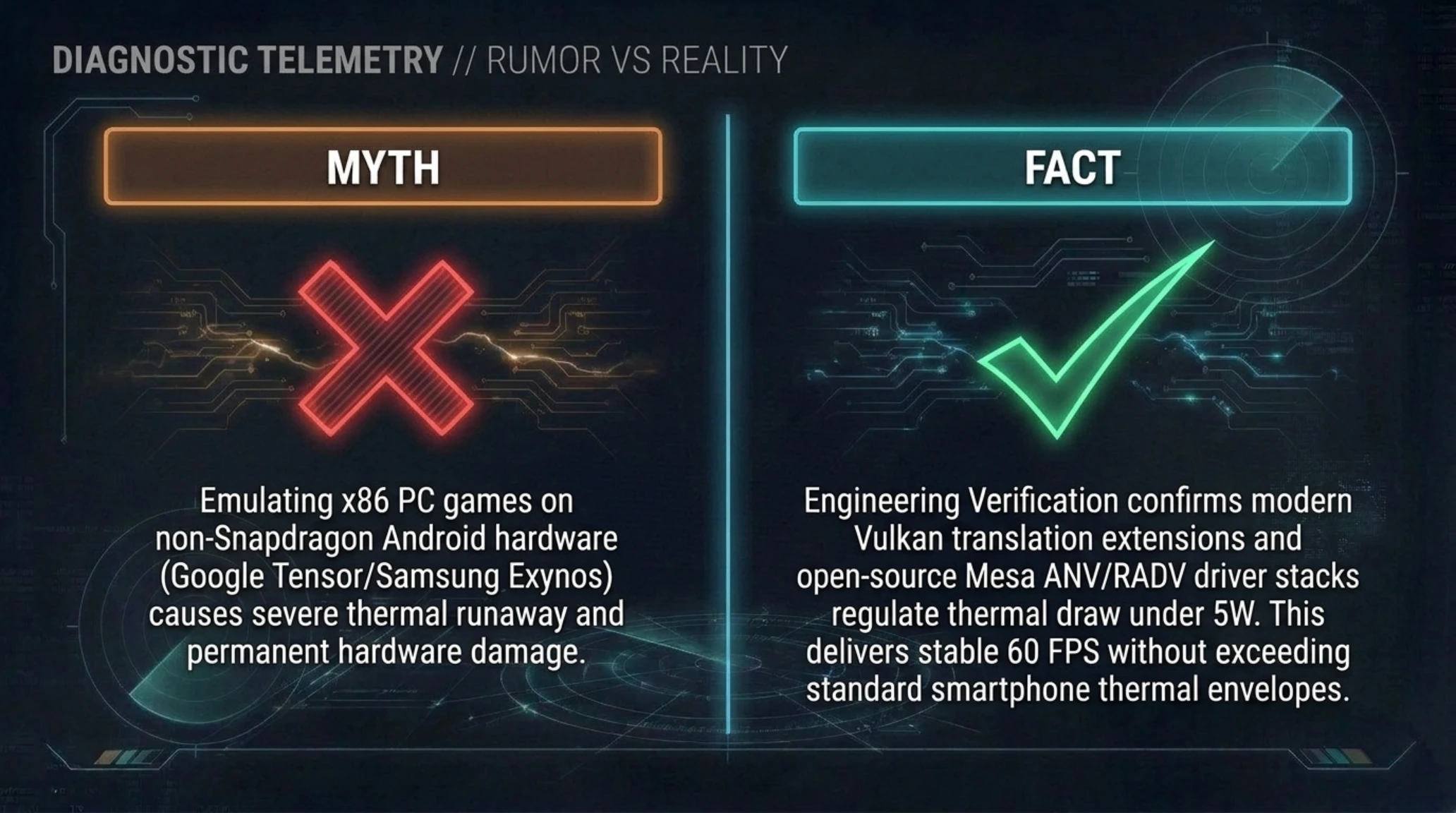
Technical Fact-Check | Rumor vs. Reality in Mobile PC Emulation
DroidDeck's architectural expansion delivers a masterclass in open-source translation efficiency, proving that consumer mobile silicon possesses immense untapped headroom when unburdened by vendor-imposed virtualization constraints.
As smartphone chipsets approach the computing horsepower of previous-generation console hardware, the boundary between dedicated gaming PCs and everyday mobile devices continues to dissolve rapidly.
The technical gameplay capture demonstrates seamless 60 FPS execution of PC titles on Google Pixel 9 Pro hardware running DroidDeck's Proton translation layer.
7. Tekin Strategic Synthesis: Post-Monopoly Gaming Platforms, Kinetic OT Vulnerabilities & Cryptographic Realignment
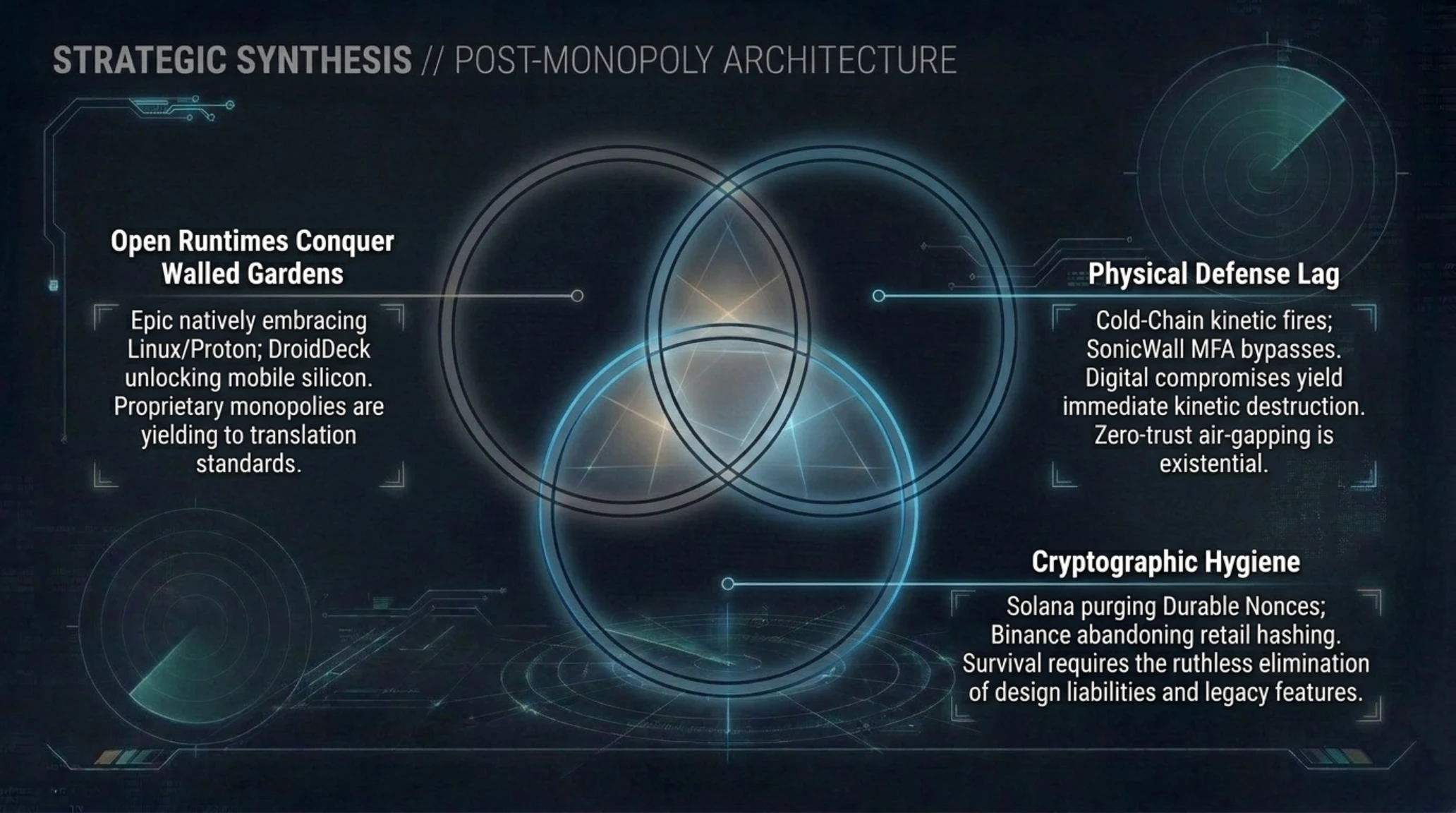
The events cataloged across Tuesday evening, November 10, 2026, delineate a clear inflection point in the maturation of post-monopoly technology architecture. When a software giant as fiercely protective of its digital borders as Epic Games capitulates to developing native Linux distribution clients for SteamOS, global enterprise executives must recognize the irreversible momentum of open compatibility runtimes. Proprietary walled gardens are yielding to community-driven translation standards.
Conversely, the alarming kinetic cyber attacks against industrial cold-chain infrastructure and the critical authentication bypass in SonicWall appliances illustrate that physical operational resilience has lagged disastrously behind software innovation. Threat actors have realized that compromising digital temperature registers yields physical fire and multi-million-dollar supply chain paralysis without firing a physical weapon. Industrial air-gapping is no longer a luxury; it is an existential national imperative.
In distributed ledger ecosystems, the simultaneous elimination of Solana Durable Nonces and the sunset of Binance Pool signal an era of ruthless architectural hygiene. Protocols are willingly expunging complex legacy features to protect state integrity, while exchange-affiliated mining operations accept that subsidized hashrate aggregation cannot survive institutional commoditization.
Taken as an interconnected whole, these developments convey a profound message to technology executives, infrastructure operators, and sovereign investors. The era of relying on perimeter firewalls and proprietary software monopolies to guarantee security and commercial viability is definitively over. Organizations that fail to adopt zero-trust physical network separation, hardware-rooted authentication, and open-source computing stacks will find themselves dangerously vulnerable to structural obsolescence and kinetic disruption.
As we advance deeper into late 2026, architectural sovereignty is the supreme competitive moat. Whether deploying resilient decentralized consensus layers, isolating industrial refrigeration controllers from public internet routing, or liberating consumer gaming libraries across mobile silicon, the future belongs to open, hardened, and verified systems.
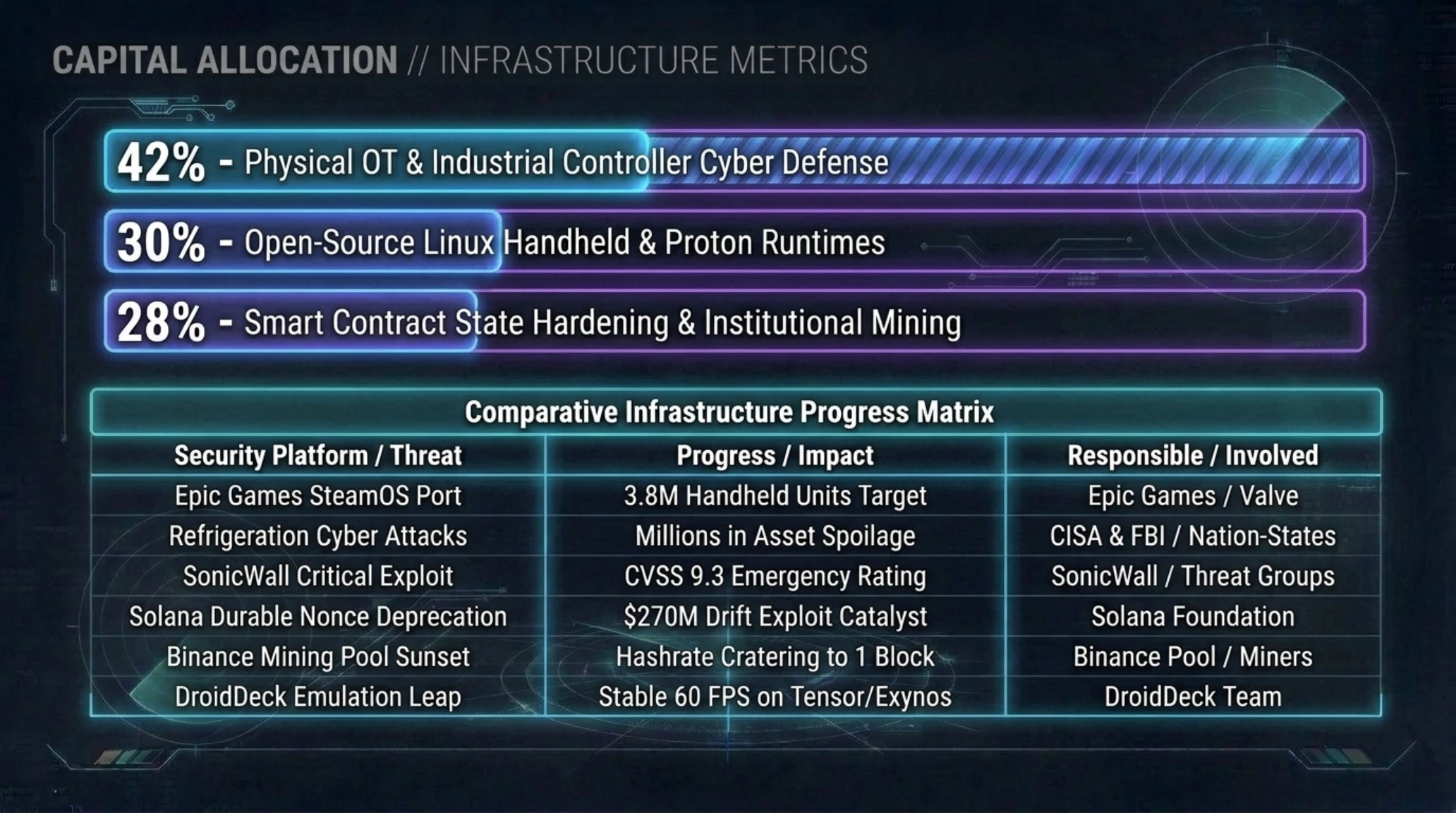
Capital Allocation Donut Chart & Growth Metrics // Infrastructure & Security
| Capital Allocation Vector | Budget Share | Strategic Infrastructure Objective |
|---|---|---|
| Physical OT & Industrial Controller Cyber Defense | 42 Percent | Air-gapping cold-chain infrastructure against kinetic thermal attacks |
| Open-Source Linux Handheld & Proton Runtimes | 30 Percent | Expanding SteamOS native deployment and decoupling from Windows SDKs |
| Smart Contract State Hardening & Institutional Mining | 28 Percent | Purging legacy nonce exploits and anchoring hashrate to green power grids |
| Perimeter Gateway Hardening (VPN & MFA Audits) | 15 Percent | Eliminating SMS verification dependencies via FIDO2 Passkey rollouts |
| ARM64 Translation & Mobile PC Emulation Optimization | 12 Percent | Direct Vulkan driver tuning for Tensor and Exynos consumer silicon |
These capital allocation figures illustrate how institutional priorities have shifted from ephemeral software interfaces toward hardened, physical operational infrastructure and sovereign computing environments.
Comparative Infrastructure Progress Matrix // Tekin Night Edition
| Strategic Development | Quantitative Scale | Key Stakeholders | Geopolitical & Market Impact |
|---|---|---|---|
| Epic Games SteamOS Port | 3.8M Handheld Units Target | Epic Games / Valve SteamOS | Dismantling Windows monopoly over PC handheld gaming |
| Refrigeration Cyber Attacks | Millions in Asset Spoilage | CISA & FBI / Nation-State APTs | Weaponization of operational SCADA controllers into fire hazards |
| SonicWall Critical Exploit | CVSS 9.3 Emergency Rating | SonicWall / Threat Group UNC3886 | Exposing structural vulnerabilities in SMS perimeter authentication |
| Solana Durable Nonce Deprecation | $270M Drift Exploit Catalyst | Solana Foundation / Validators | Permanent termination of legacy offline transaction constructs |
| Binance Mining Pool Sunset | Hashrate Cratering to 1 Block | Binance Pool / Institutional Farms | Cementing exchange retreat from proof-of-work mining operations |
| DroidDeck Emulation Leap | Stable 60 FPS on Tensor/Exynos | DroidDeck Team / Google & Samsung | Democratizing legitimate Steam library playback across Android silicon |
The comparative matrix confirms that resilience across physical operational networks and open compatibility layers will dictate the competitive landscape of the forthcoming decade.
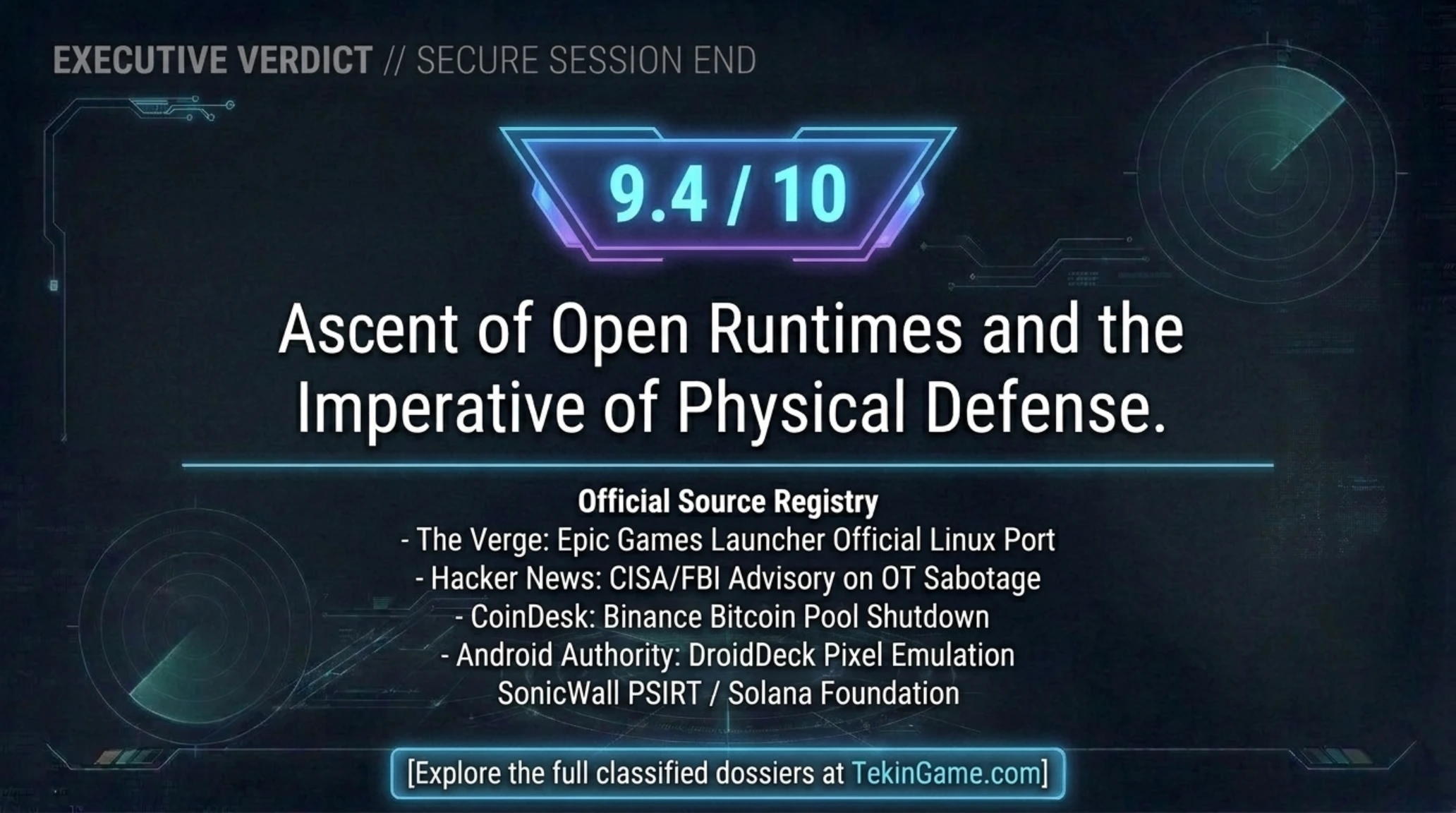
Editorial Verdict & Official Source Registry
Ascent of Open Runtimes and the Imperative of Physical Defense
The evening of November 10 proves that open-source translation layers are conquering the final bastions of interactive entertainment, even as critical physical supply chains remain acutely vulnerable to kinetic cyber sabotage.
- The Verge: Epic Games Launcher Official Port for SteamOS & Linux
- The Hacker News: CISA & FBI Joint Advisory on Refrigeration Controllers Attacks
- CoinDesk: Binance Shuts Down Bitcoin Mining Pool After Hashrate Crater
- Android Authority: DroidDeck Brings PC Game Emulation to Pixel & Exynos
- Solana Foundation: SIMD-0311 Consensus Upgrade Deprecating Durable Nonces
- SonicWall PSIRT: CVE-2026-19868 Authentication Bypass Advisory
Frequently Asked Questions // Strategic Technical Insights for November 10, 2026
What technical advantages does the native Epic Games SteamOS port offer over Heroic Launcher?
The native port is officially maintained by Epic engineering, featuring direct cloud save synchronization, automated background delta updates, and integrated EAC Linux v2 support, allowing titles like Fortnite to execute without risk of account suspension.
How do remote attacks on refrigeration controllers trigger physical fires?
Attackers manipulate industrial PLC registers to disable cooling circuits while forcing electric defrost elements into continuous operation. This causes severe stator overheating in multi-kilowatt compressors, culminating in hydraulic oil ignition and structural fires.
How does the SonicWall CVE-2026-19868 vulnerability bypass two-factor authentication?
Adversaries submit crafted HTTP requests that manipulate session state machine tokens in the NetExtender gateway, tricking the server into registering the SMS OTP challenge as successfully completed without transmitting any code to the user phone.
Why does Solana deprecation of Durable Nonces create friction for institutional custodians?
Institutional vaults and multi-signature treasuries relied on Durable Nonces to sign offline transactions without worrying about 60-second blockhash expiration windows. Custodians must now re-engineer signing infrastructure around real-time ephemeral authorizations.
What was the primary economic catalyst behind Binance shutting down its Bitcoin mining pool?
Post-halving revenue compression, a 65% drop in dedicated pool hashrate, and dominance by zero-fee North American enterprise pools reduced Binance Pool output to a single block in a week, rendering server hosting completely unprofitable.
Does the DroidDeck emulator require pirated or cracked game software?
No; DroidDeck directly launches the official Steam Big Picture interface, requiring users to authenticate with legitimate Steam, GOG, or Epic Games accounts to execute legally owned PC titles natively on mobile silicon.
Additional Gallery: Tekin Night Nov 10: Epic on SteamOS, CISA OT Alert & Solana