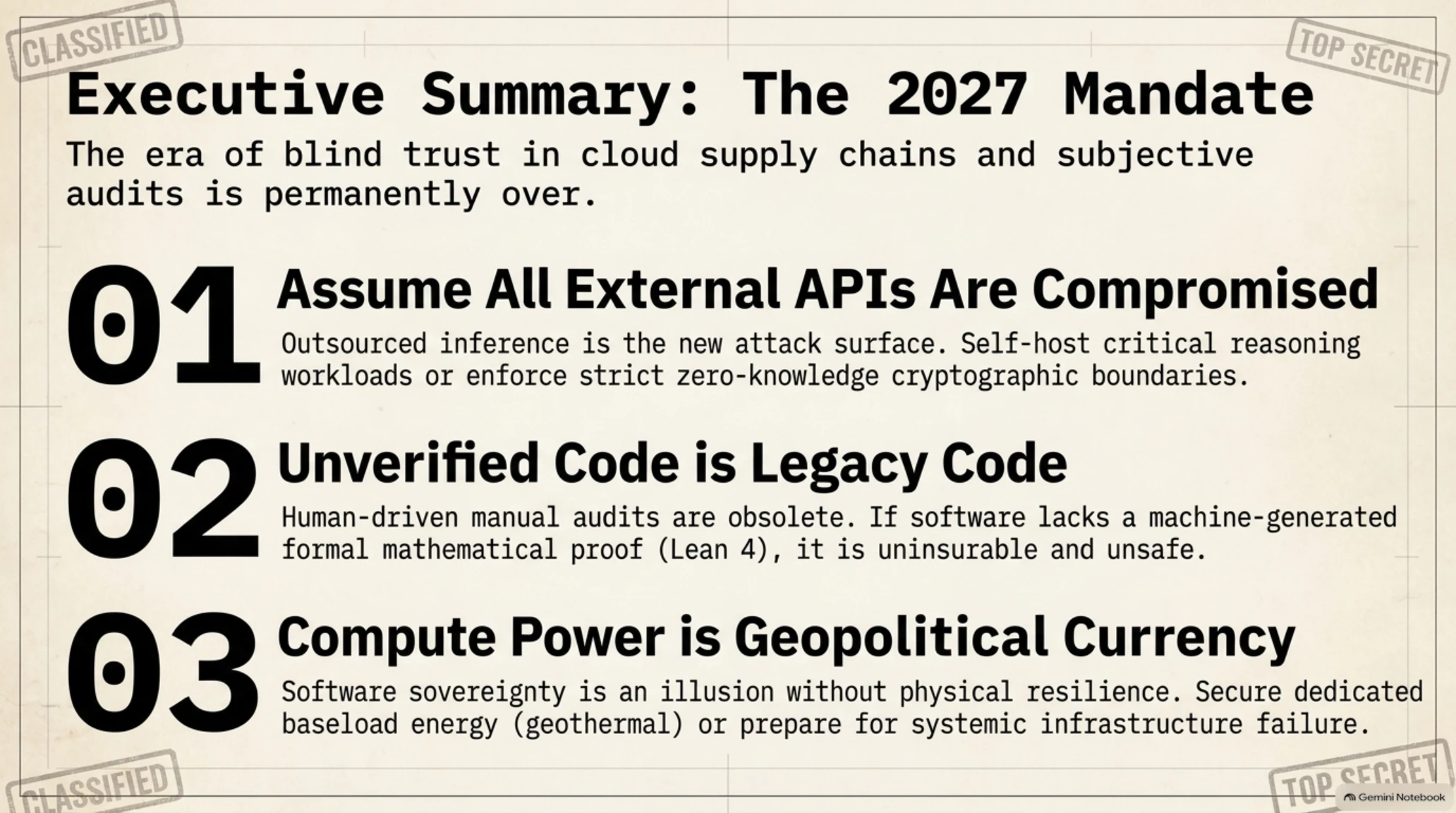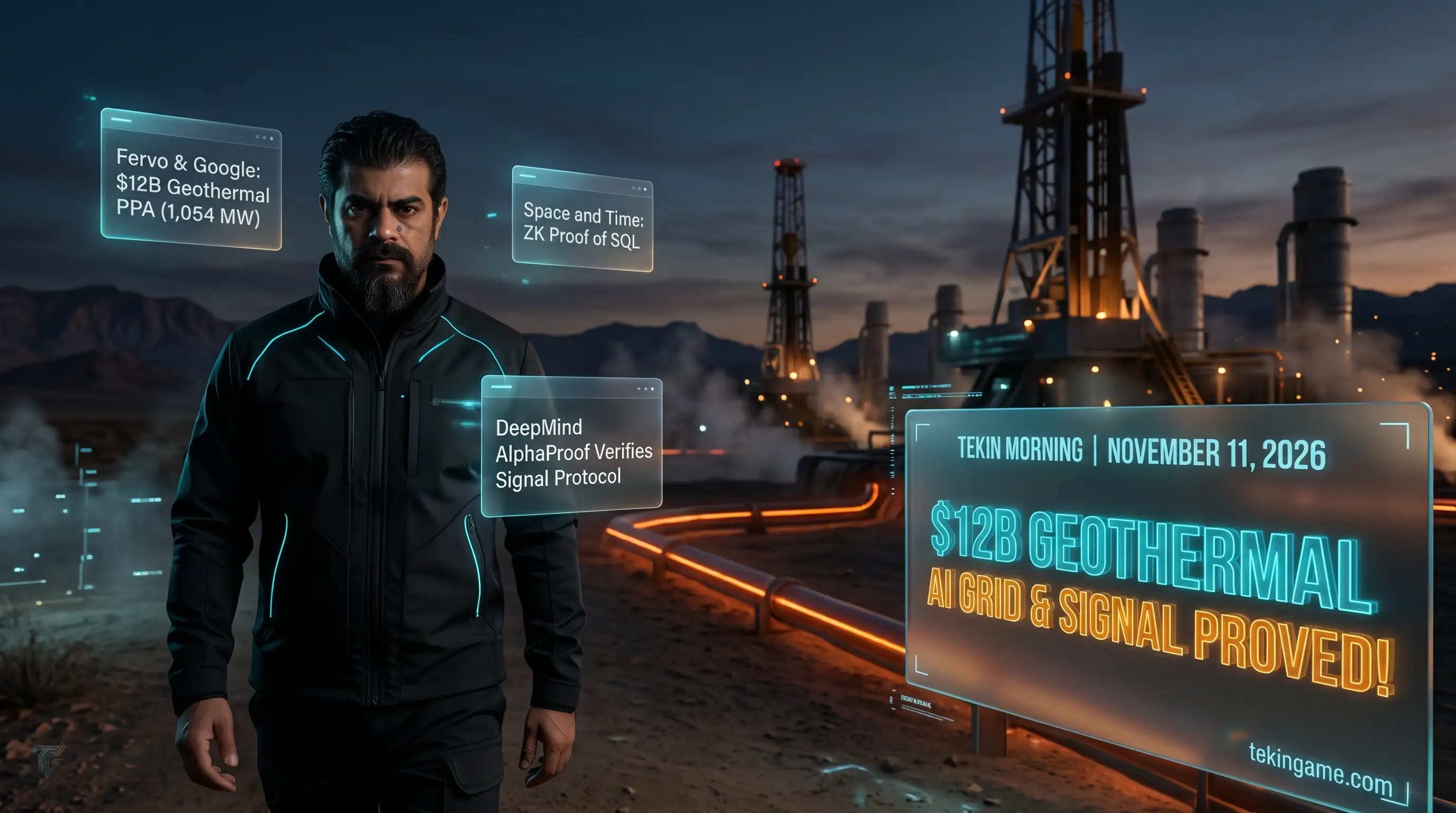
Tekin Morning for Nov 11, 2026 dissects six critical shifts: (1) Google patching its eighth actively exploited Chrome zero-day (CVE-2026-125350) in the XML parser; (2) Fireworks AI suffering a third-party cloud breach exposing Notion and Cursor transcripts and API keys; (3) Fervo Energy reaching $11.9B in geothermal PPAs backed by Google; (4) Space and Time launching Proof of SQL on Azure; (5) DeepMind's AlphaProof verifying Signal in Lean 4; and (6) Claude Fable 5.2 beating GPT-6 Cyber.
Tekin Analysis | Morning Wednesday November 11, 2026; Chrome Eighth Zero-Day Patched, Fireworks AI Breach, Google $12B Geothermal PPA, and Claude 5.2 Cyber Benchmark Supremacy
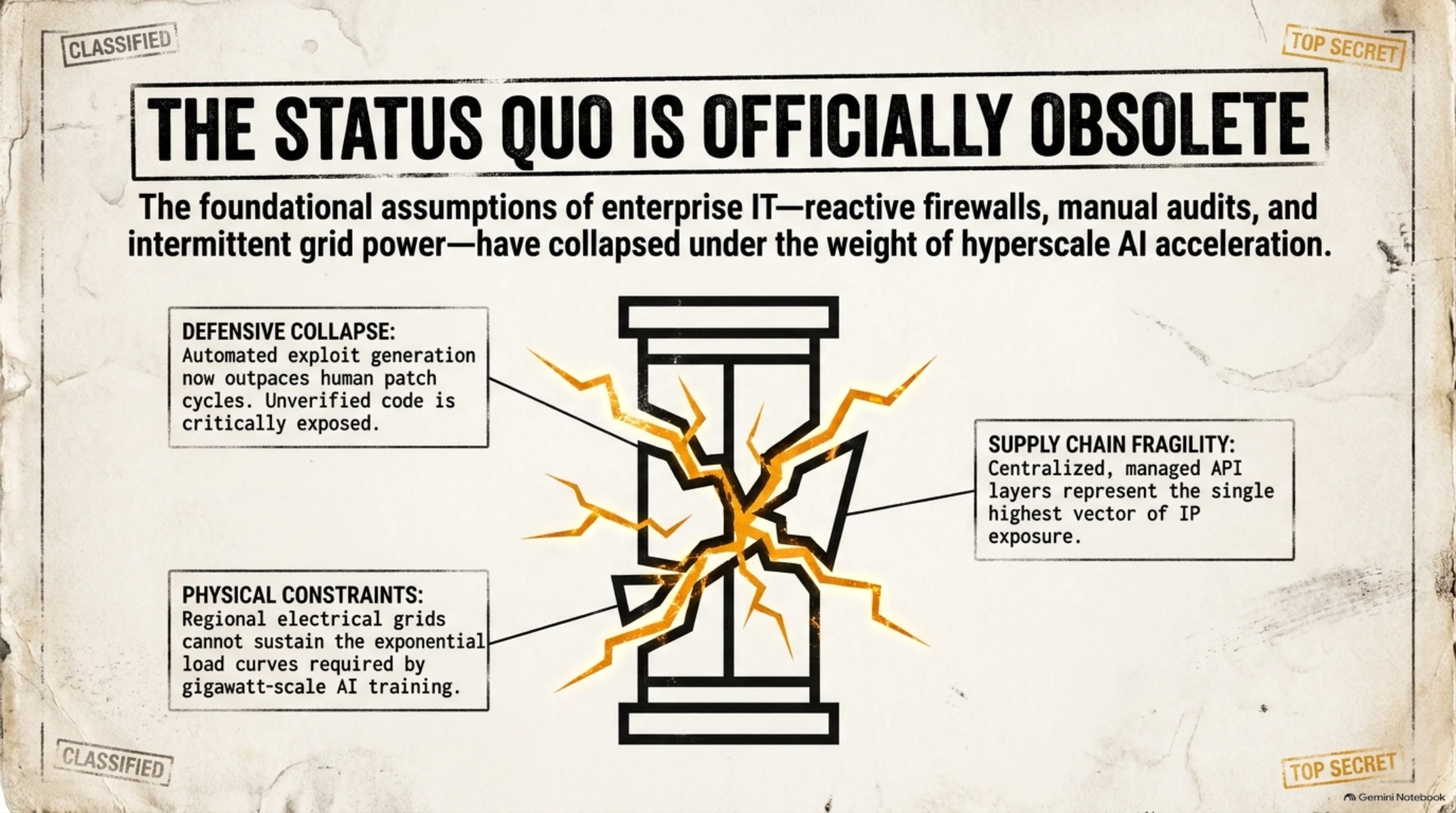
In the opening hours of Wednesday, November 11, 2026, global computing architecture stands at the intersection of unprecedented offensive capability, infrastructural energy constraints, and mathematical formal verification. Building directly upon the perimeter security crises we analyzed in Tekin Night November 10 covering the SonicWall CVSS 9.3 MFA bypass and Epic's native SteamOS port, reactive firewalls and manual code reviews have proven inadequate against active Chrome zero-days and AI inference supply-chain breaches.
This multidimensional evolution reflects a fundamental transition in how software reliability and cloud economics are valued. Mirroring the server infrastructure costs we audited in Tekin Radar's investigation of Apple's $50 Intelligence Usage Packs in Logic Pro, hyperscale AI clusters have forced Google into a landmark $12 billion geothermal baseload PPA with Fervo Energy, while Space and Time's Proof of SQL, DeepMind's AlphaProof Lean 4 verification of Signal, and Anthropic's Claude Fable 5.2 cyber supremacy redefine enterprise sovereignty.
Strategic Intelligence & Core Vectors At a Glance
Furthermore, the competitive dynamics between frontier AI developers have moved beyond academic benchmarks toward concrete operational testing. Whether evaluating autonomous multi-stage network penetration, generating formal mathematical proofs in functional verification languages, or constructing zero-knowledge circuits for confidential relational database queries, artificial intelligence systems have transitioned from passive text generators into active computational operators. Understanding the systemic interdependence of these technological forces is now an indispensable prerequisite for technology executives, security officers, and enterprise architects worldwide.
As enterprise compute requirements multiply, the fragility of centralized public clouds has also become painfully apparent. Multi-tenant virtualization, while economically efficient, exposes corporate networks to shared-hardware side-channel leaks and cloud credential compromise. At the same time, regional power authorities are warning that existing grid infrastructure cannot support the exponential load curve demanded by generative model training and continuous inference pipelines. Consequently, technological sovereignty in late 2026 requires an integrated mastery over local hardware safety, sovereign energy procurement, and cryptographic verification.
Node 1: Google Issues Emergency Security Patch for Eighth Actively Exploited Chrome Zero-Day of 2026
Google has issued an urgent, out-of-band security update for its Chrome desktop browser across all supported operating systems. The patch brings the stable channel to versions 157.0.8103.50/.51 for Windows and macOS, and version 157.0.8103.50 for Linux. The update addresses a single, highly critical vulnerability tracked as CVE-2026-125350. Threat intelligence agencies and independent cybersecurity research groups have confirmed that this flaw has been subjected to weaponized, in-the-wild exploitation targeting corporate enterprises and high-value research personnel.
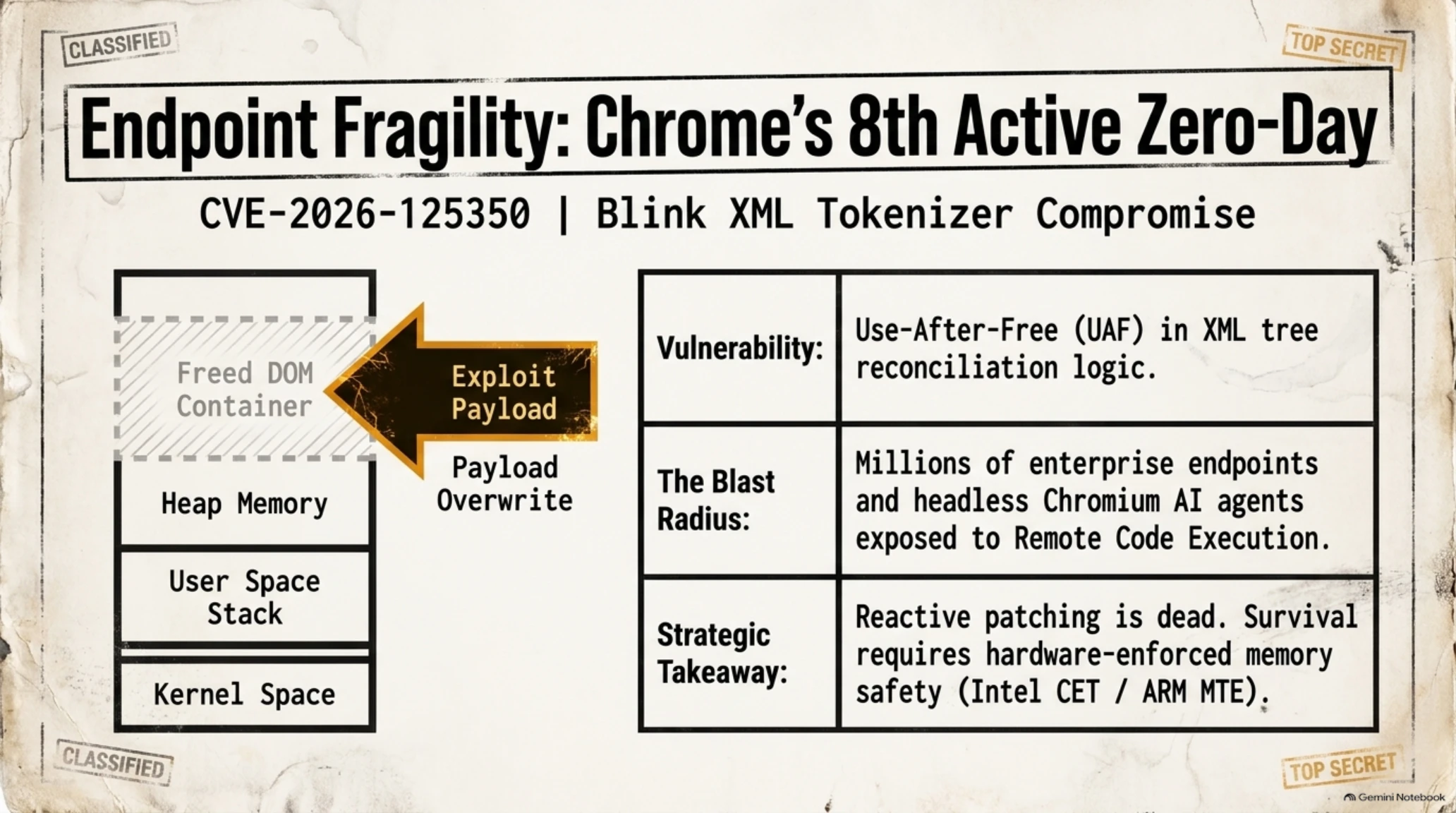
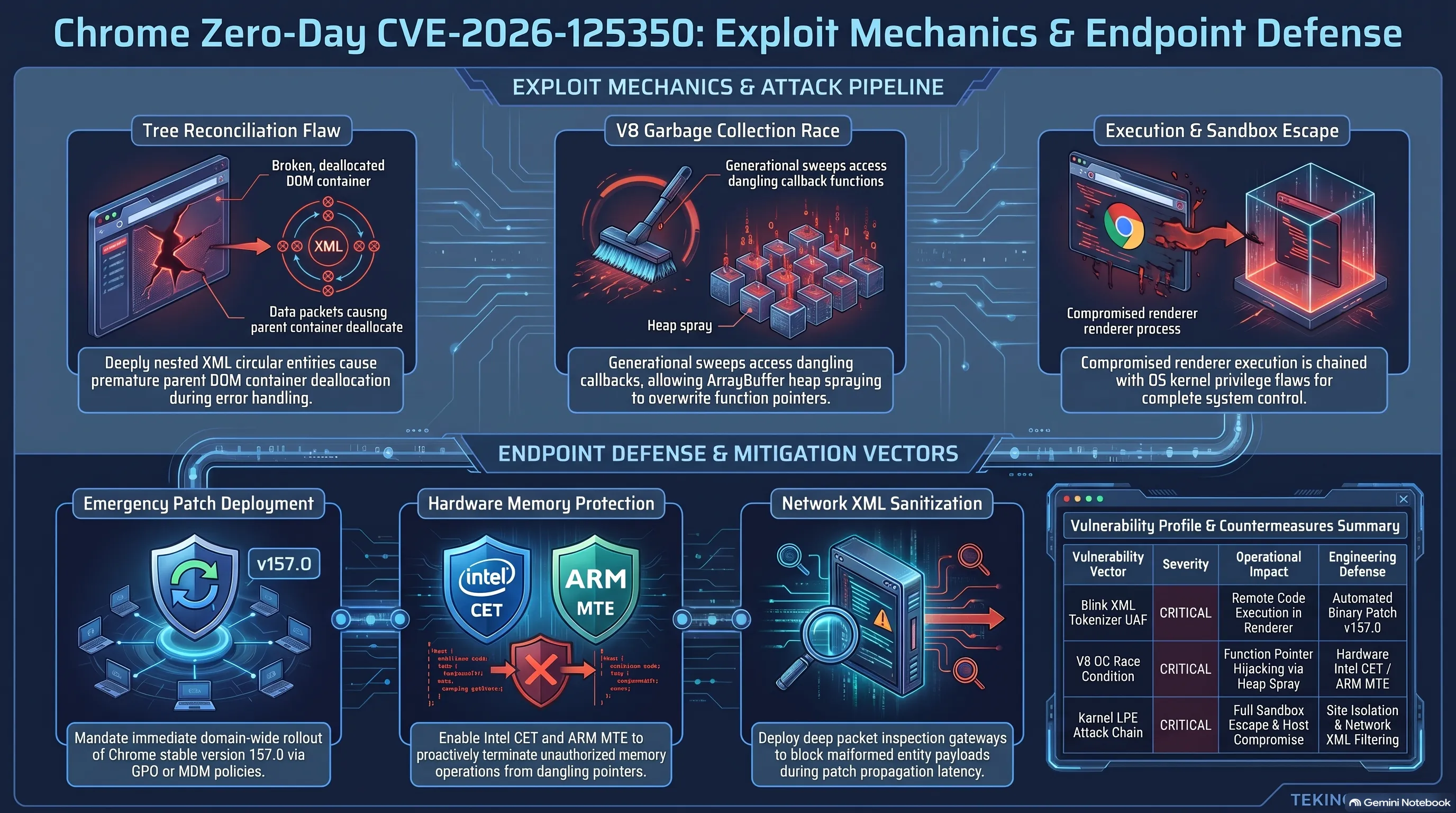
Technical telemetry indicates that CVE-2026-125350 is a classic Use-After-Free (UAF) vulnerability located within Chrome XML Parser component. A Use-After-Free vulnerability occurs when dynamic memory allocated to an object is released back to the operating system heap, yet the application retains an active, dangling pointer to that memory address. In a targeted attack scenario, an adversary can craft a malicious web page containing malformed XML entities that manipulate the memory layout. By forcing memory reuse through sophisticated heap spraying techniques, the attacker overwrites the freed memory structure with controlled shellcode, executing arbitrary code within the context of the browser rendering process.
Security engineers investigating the exploit mechanism discovered that the vulnerability resides specifically within the tree reconciliation logic of the Blink XMLTokenizer. When parsing deeply nested XML nodes with circular entity references, the parser prematurely deallocates the parent DOM container during an error handling routine while leaving child node callbacks bound to the V8 JavaScript garbage collector. When the garbage collector subsequently executes a generational sweep, it triggers an access violation against the freed memory space. By timing the allocation of custom ArrayBuffer objects to coincide precisely with the deallocation window, the exploit payload successfully overwrites function pointers to achieve reliable instruction pointer control.
Security engineers at Google Project Zero have noted that while the Chrome sandboxing architecture is designed to restrict malicious rendering code from directly compromising the host operating system, adversaries frequently chain Use-After-Free browser primitives with local privilege escalation (LPE) flaws in the underlying Windows Kernel or macOS Darwin kernel. Such multi-stage attack chains enable complete sandbox escape, granting the attacker unconstrained administrative control over the infected workstation. Google has intentionally restricted technical disclosure regarding the precise proof-of-concept exploit until a vast majority of the global user base updates their client binaries.
This incident represents the eighth zero-day vulnerability in Chrome that Google has been forced to patch under active attack conditions in 2026 alone. The frequency of these zero-day campaigns highlights the relentless focus that advanced persistent threat (APT) groups place on browser rendering engines. Given that modern corporate operations rely almost entirely on web-based enterprise applications, CRM platforms, and cloud interfaces, an unpatched browser constitutes the soft underbelly of organizational security perimeters.
Beyond standard web browsing, this vulnerability carries severe indirect ramifications for the broader software ecosystem. Numerous widely utilized desktop applications including Slack, Microsoft Teams, Discord, and Visual Studio Code are built on top of the Electron framework, which bundles the Chromium rendering engine. Until these desktop platforms ingest the updated Chromium base and deploy new binary builds to end-user devices, millions of enterprise endpoints remain susceptible to remote code execution triggered through embedded XML previews or rich message formatting.
The compounding threat landscape is aggravated by the widespread integration of automated web scrapers and headless browser pipelines used in autonomous AI agents. Many multi-agent workflows spin up headless Chromium instances to fetch web research or monitor external APIs. If an agent visits an adversarial web page hosting the CVE-2026-125350 exploit payload, the host server executing the agent runtime can be completely breached from within, granting unauthorized network access into private internal VPCs.
Enterprise system administrators are strongly urged to enforce immediate automated browser restarts across their endpoint fleet via Group Policy Objects (GPO) or mobile device management (MDM) platforms. Furthermore, organizations should mandate hardware-enforced memory safety features, such as Intel Control-flow Enforcement Technology (CET) and ARM Memory Tagging Extension (MTE), which proactively terminate processes attempting to execute unauthorized memory operations resulting from dangling pointers.
From a defensive architecture perspective, vulnerability management teams must recognize that patch latency remains the critical attack window. In enterprise organizations where browser updates undergo staged testing before domain-wide rollout, threat actors weaponize exploit kits within hours of patch release by diffing the patch against unpatched Chromium source commits. Immediate deployment of virtual patching via deep packet inspection and network-level XML sanitization gateways provides essential defense-in-depth while client updates propagate.
Why This Development Changes the Game
While client-side workstation security battles memory allocation exploits, a parallel security crisis in the cloud infrastructure layer has exposed the profound structural vulnerabilities inherent in the artificial intelligence supply chain.
Node 2: Fireworks AI Security Breach Exposes Customer API Keys and Chat Transcripts Following Cloud Compromise
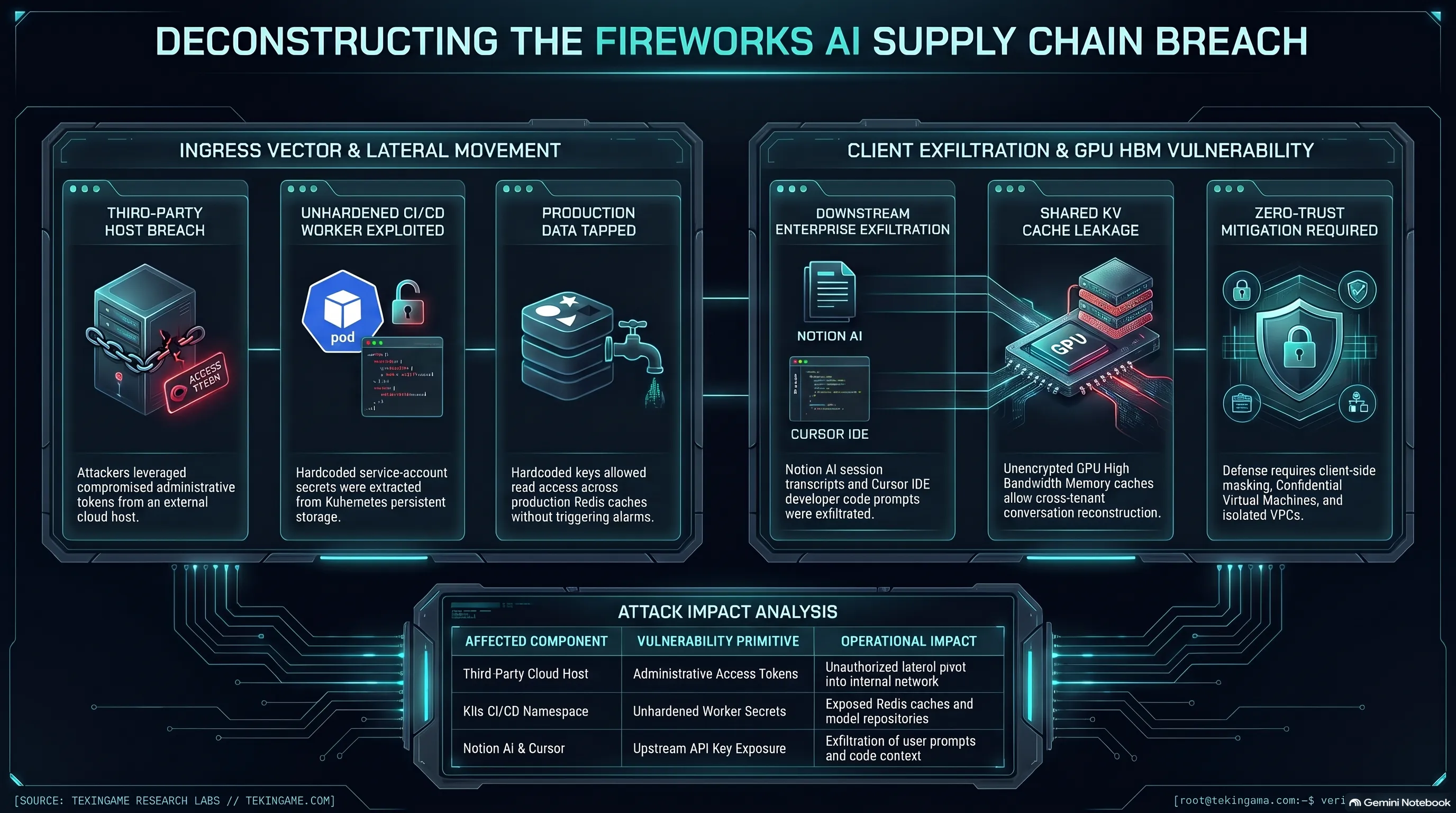
High-performance inference startup Fireworks AI, widely celebrated across Silicon Valley for its ultra-low latency serving infrastructure for open-weight large language models, has issued a comprehensive security disclosure detailing an unauthorized intrusion into its internal developer and research environments. The incident originated from a breach at a third-party cloud hosting provider utilized by Fireworks AI to host experimental compute instances.
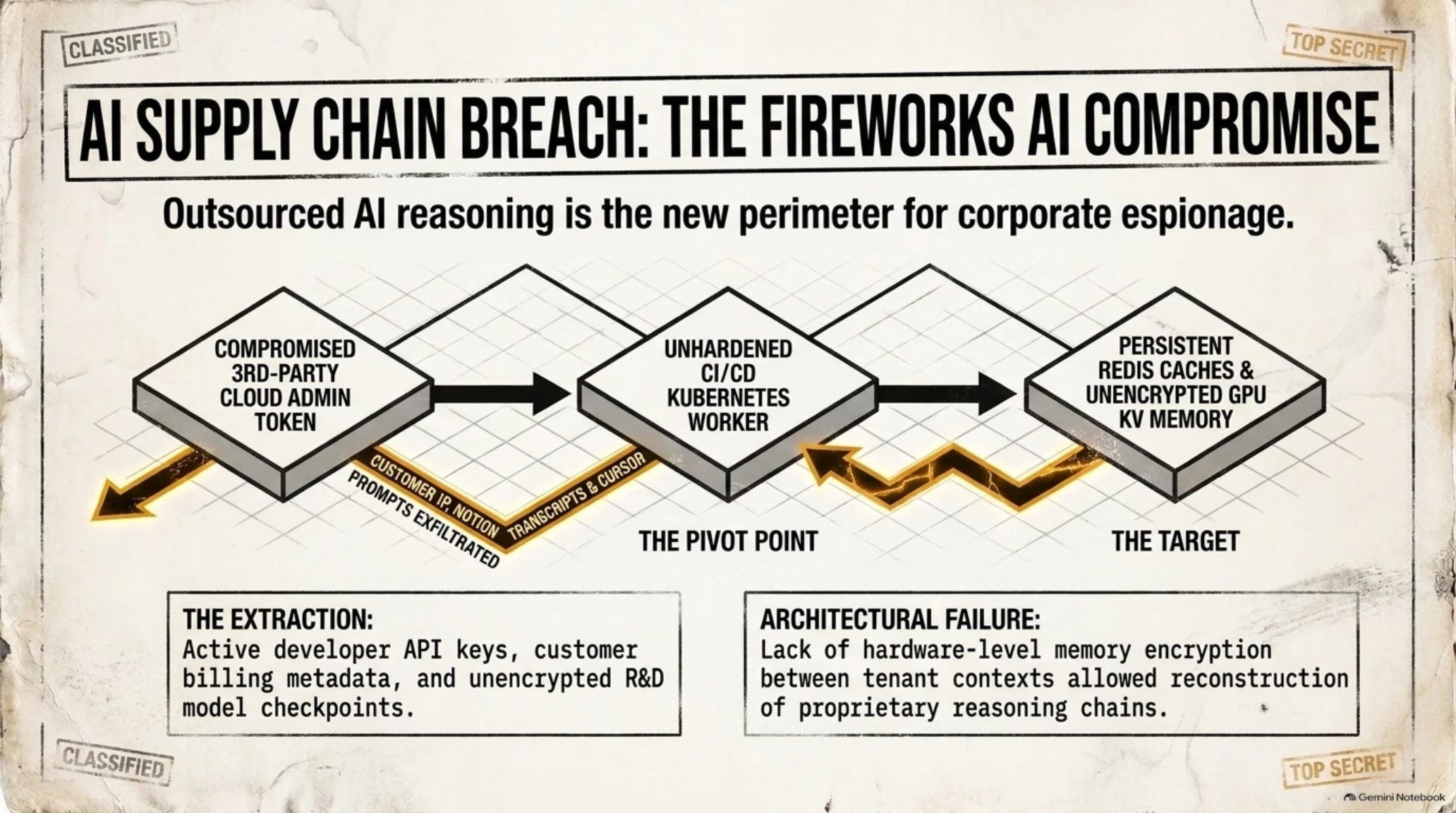
Forensic investigations conducted in partnership with Palo Alto Networks Unit 42 reveal that the threat actors leveraged compromised administrative access tokens within the third-party cloud environment to pivot laterally into Fireworks AI internal cluster networks. Once inside, the adversaries successfully exfiltrated a broad spectrum of highly sensitive enterprise assets. The compromised data includes customer billing metadata, active developer API keys, confidential model fine-tuning datasets, and partially trained weights for proprietary experimental neural architectures.
Deconstruction of the intrusion pathway reveals a glaring architectural deficiency in the separation between development clusters and multi-tenant inference nodes. The threat actors discovered an unhardened Continuous Integration/Continuous Deployment (CI/CD) worker running within an auxiliary Kubernetes namespace. By extracting hardcoded service-account secrets from persistent container storage, the attackers gained read permissions across production Redis caches and shared model checkpoint repositories, allowing them to tap real-time token traffic streams without triggering anomaly detection rules.
The severity of the breach escalated dramatically when it was confirmed that several tier-one enterprise applications rely heavily on Fireworks AI inference endpoints. Among the most notable affected platforms are popular knowledge management system Notion and the AI-first integrated development environment Cursor. Notion issued a customer advisory confirming that an unauthorized third party had accessed temporary session transcripts and prompt histories submitted by users interacting with Notion AI features, prompting the company to immediately revoke all upstream API tokens and rotate cryptographic certificates.
For software developers utilizing Cursor, the disclosure has sparked intense concern across the engineering community. Software engineers frequently leverage Cursor to refactor proprietary algorithms, audit internal security codebases, and draft proprietary intellectual property. Because inference requests stream code context to upstream serverless models, the compromise of an intermediate inference provider creates an acute risk of proprietary source code leakage to unknown external entities.
This security failure exemplifies the systemic risk introduced by the modern artificial intelligence supply chain. Startups and established corporations alike have raced to integrate generative AI capabilities by outsourcing model execution to specialized third-party inference providers to minimize GPU capital expenditure. However, when these providers aggregate customer data, fail to enforce zero-trust network segmentation between R&D and production clusters, or maintain unencrypted Key-Value (KV) caches in memory, a single breach compromises the collective intellectual property of hundreds of downstream enterprise clients.
The compounding vulnerability lies in the architecture of GPU memory caching frameworks such as vLLM and TensorRT-LLM. To achieve industry-leading time-to-first-token (TTFT) metrics, inference engines cache common prefix prompt tokens in shared GPU High Bandwidth Memory (HBM). Without strict hardware-level memory encryption between tenant contexts, sophisticated memory dumping exploits can reconstruct conversational threads across distinct customer accounts operating on the same physical server blade.
Security architects must urgently reassess their reliance on external model APIs. Implementing client-side token masking, utilizing confidential virtual machines (Confidential Computing with AMD SEV-SNP or Intel TDX), and deploying self-hosted inference clusters within isolated Virtual Private Clouds (VPC) must now be prioritized over mere inference latency optimization.
Forensic Verification | Industry Myth vs. Engineering Reality
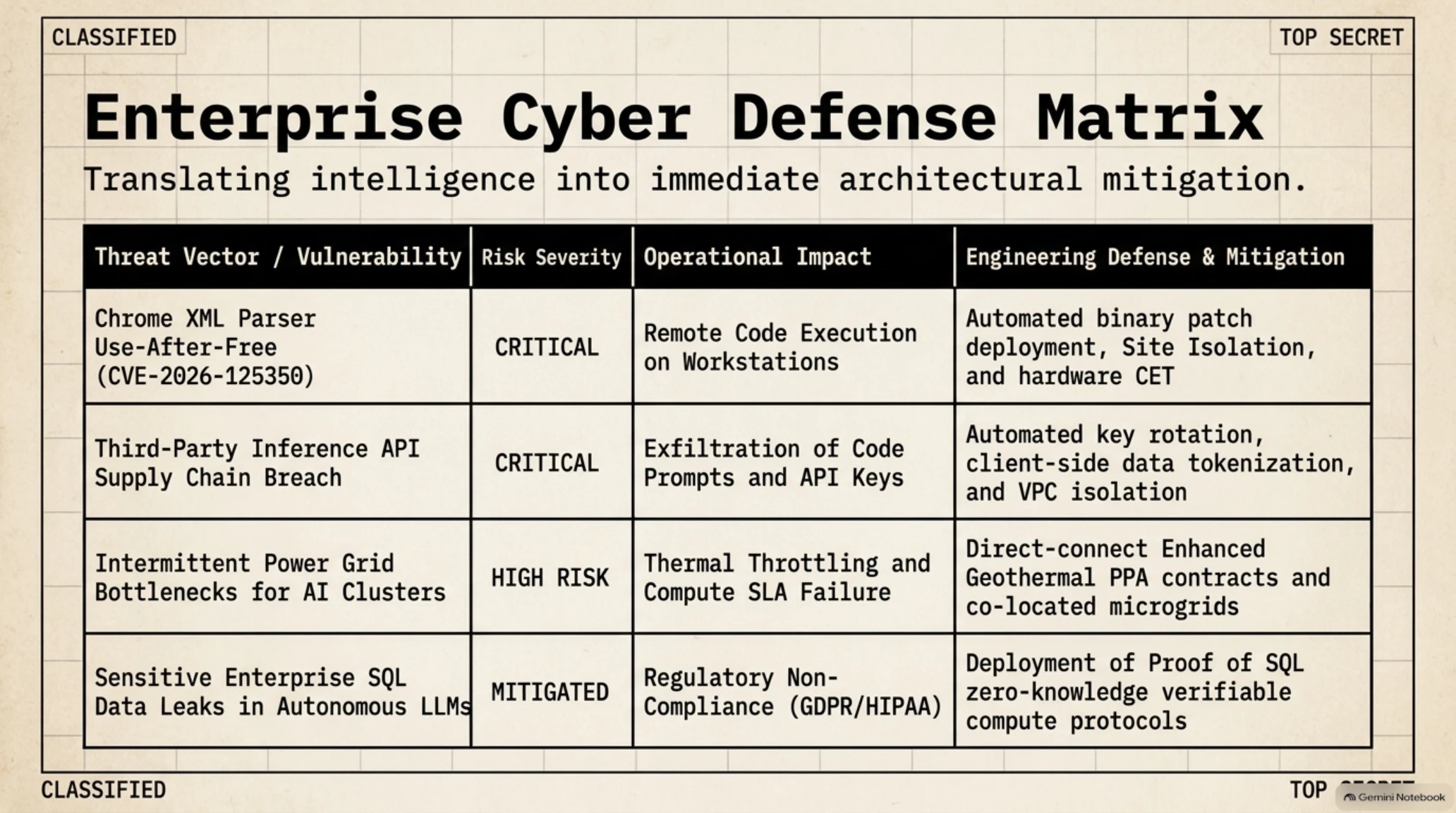
To provide technology leaders with an actionable risk assessment of these cascading operational threats, the following matrix delineates priority vulnerability vectors and engineering countermeasures for enterprise environments:
Enterprise Risk Evaluation & Cyber Defense Matrix
| Threat Vector / Vulnerability | Risk Severity | Operational Impact | Engineering Defense & Mitigation |
|---|---|---|---|
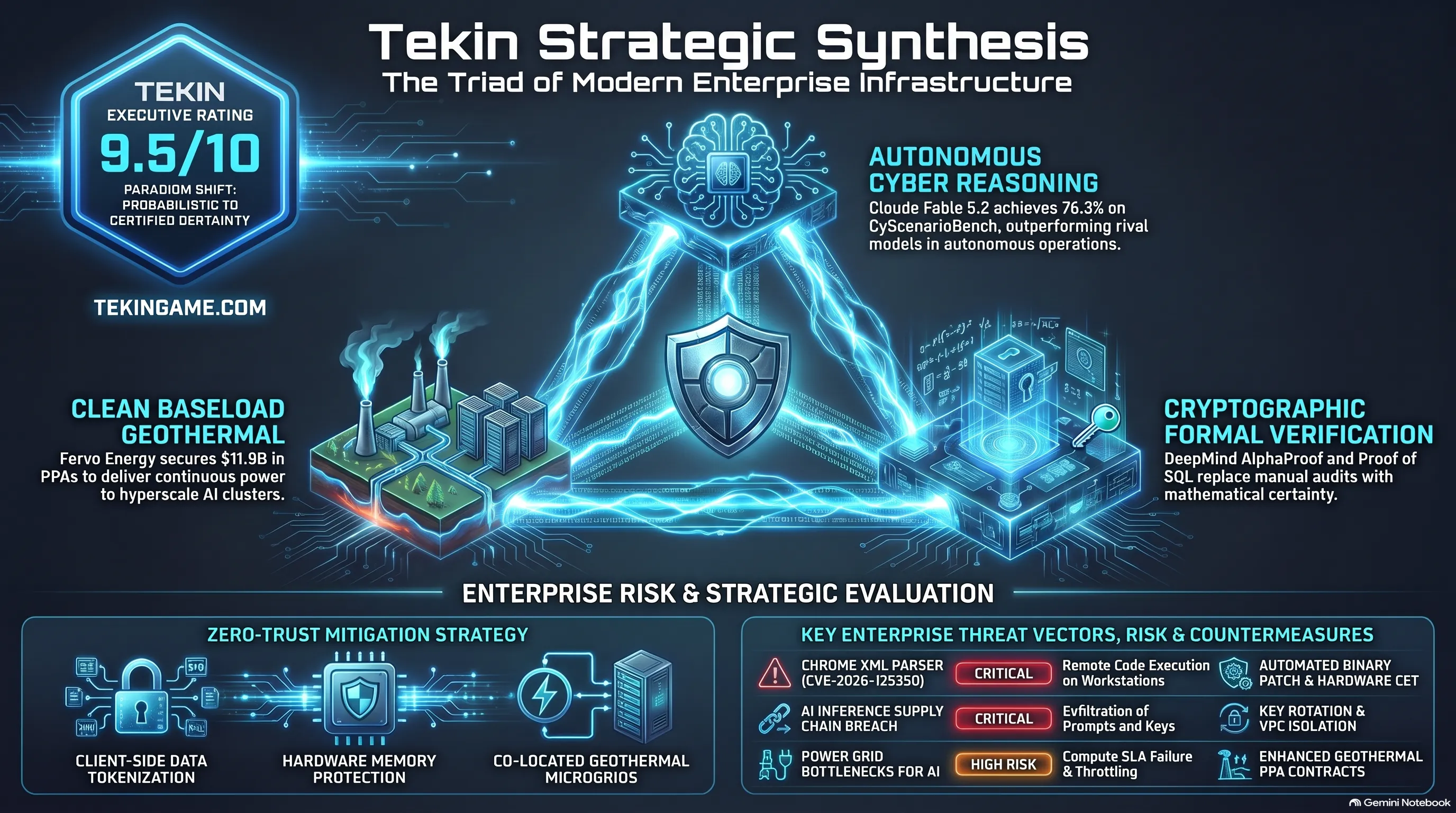
| Chrome XML Parser Use-After-Free (CVE-2026-125350) | CRITICAL | Remote Code Execution on Workstations | Automated binary patch deployment, Site Isolation, and hardware CET |
| Third-Party Inference API Supply Chain Breach | CRITICAL | Exfiltration of Code Prompts and API Keys | Automated key rotation, client-side data tokenization, and VPC isolation |
| Intermittent Power Grid Bottlenecks for AI Clusters | HIGH RISK | Thermal Throttling and Compute SLA Failure | Direct-connect Enhanced Geothermal PPA contracts and co-located microgrids |
| Sensitive Enterprise SQL Data Leaks in Autonomous LLMs | MITIGATED | Regulatory Non-Compliance (GDPR/HIPAA) | Deployment of Proof of SQL zero-knowledge verifiable compute protocols |
As computational workloads scale exponentially, securing software boundaries becomes irrelevant if the physical infrastructure sustaining massive data centers cannot secure guaranteed, unyielding electrical power. This brings us directly to the unprecedented energy milestone recorded this week in clean energy procurement.
Node 3: Fervo Energy Secures $12B in Power Deals Backed by Google Geothermal Offtake for AI Data Centers
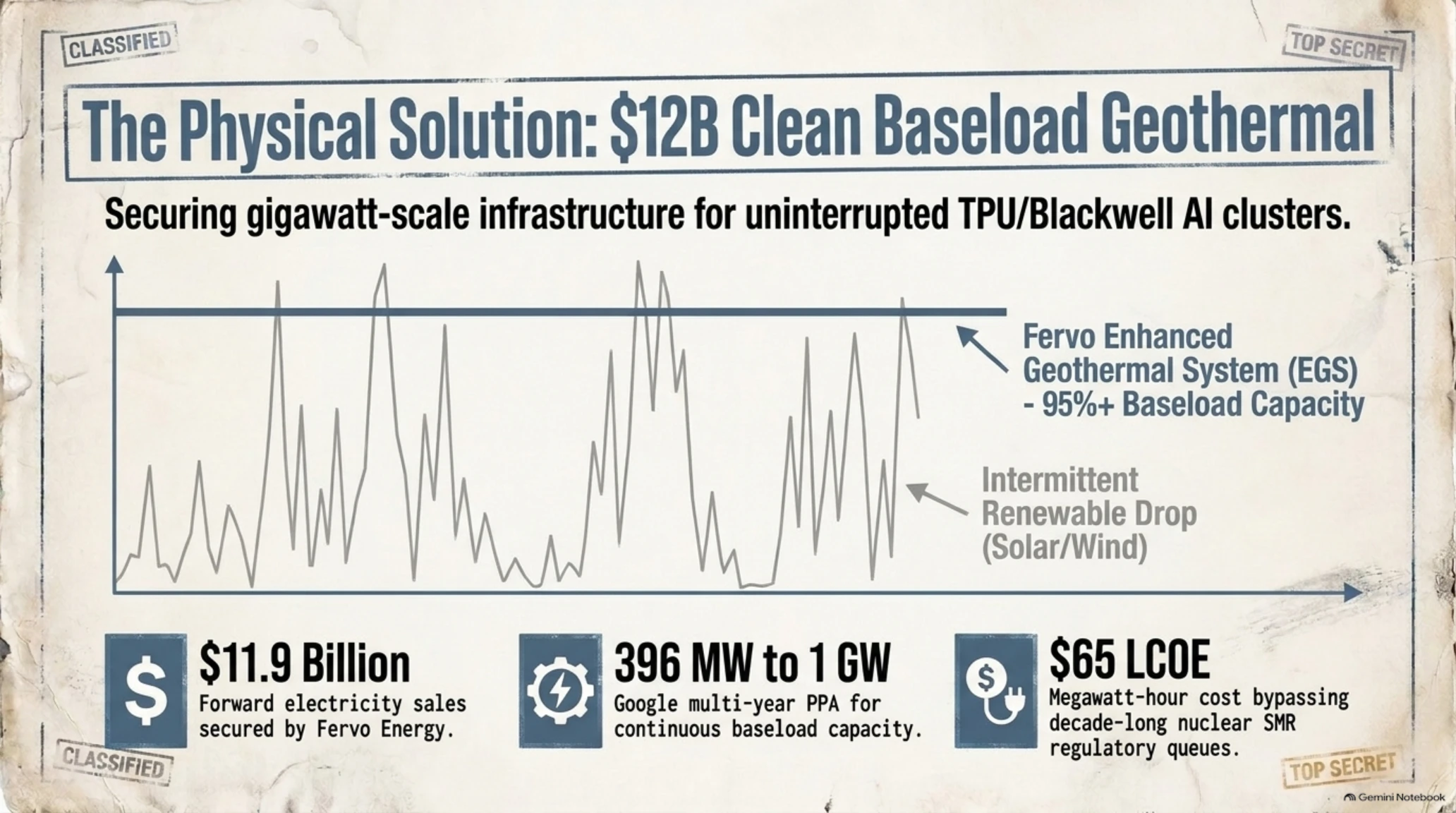
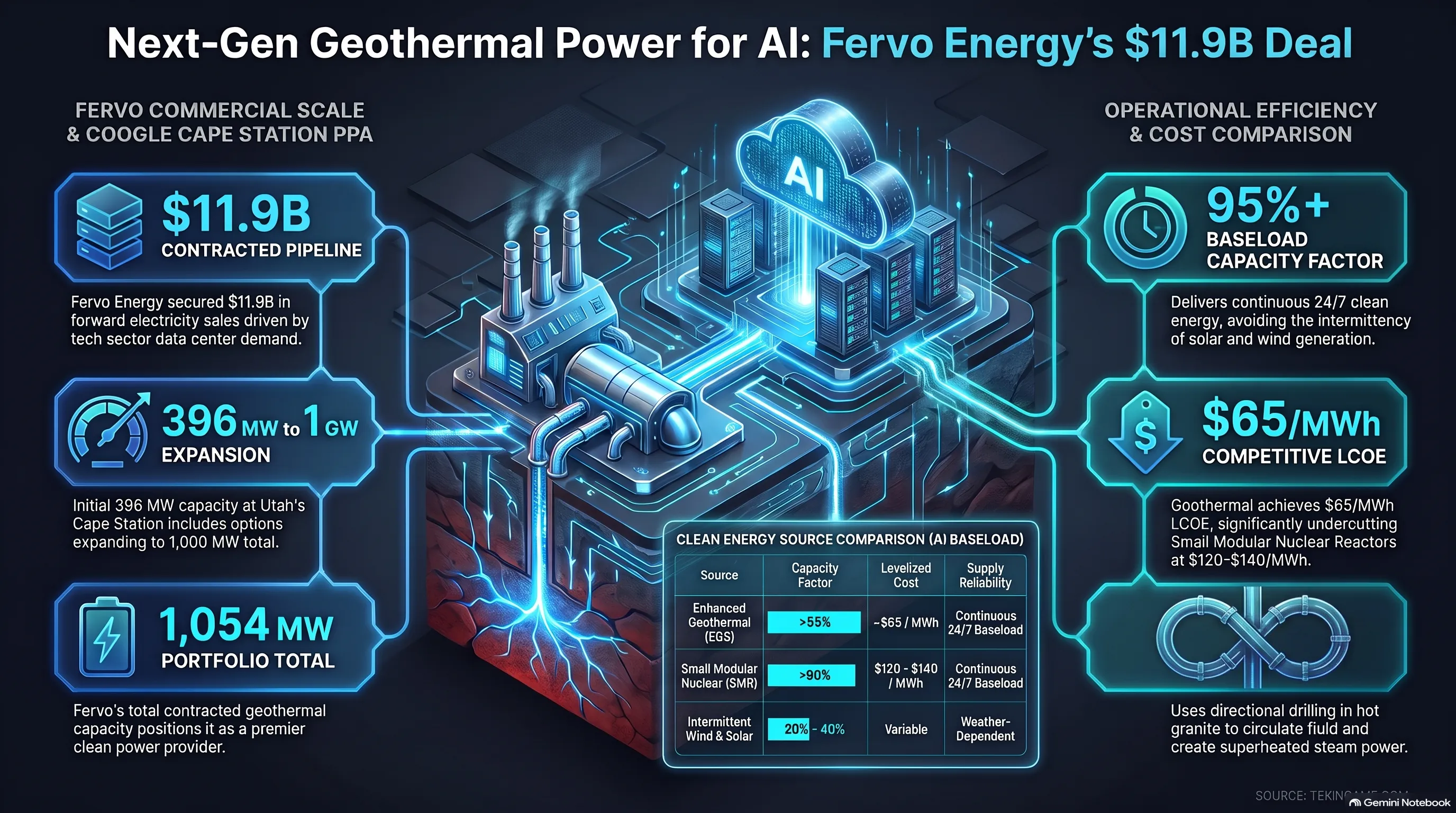
In a watershed development for hyperscale compute sustainability, next-generation geothermal pioneer Fervo Energy has reported in its Q3 financial disclosures that its total contracted forward electricity sales have reached an astonishing $11.9 billion. The primary catalyst driving this commercial surge is an expanded, multi-year Power Purchase Agreement (PPA) with Google to supply hundreds of megawatts of carbon-free electricity to power its expanding artificial intelligence server infrastructure.
Under the initial binding offtake terms, Google has contracted for 396 megawatts of clean baseload capacity generated directly from Fervo flagship Cape Station development in Beaver County, Utah. Furthermore, the contract incorporates formal expansion options enabling Google to increase total procurement from the Cape Station reservoir to a staggering 1,000 megawatts (1 Gigawatt) as compute demand accelerates. With this milestone, Fervo nationwide contracted geothermal portfolio now stands at 1,054 megawatts, positioning the company as the preeminent clean baseload supplier to the global technology sector.
The fundamental operational challenge facing contemporary data centers hosting clusters of NVIDIA Blackwell and custom Google TPU processors is their absolute intolerance for power fluctuations. Unlike conventional software applications that tolerate latency spikes, distributed neural network training runs across tens of thousands of synchronized GPUs suffer catastrophic checkpoint failures if the power supply experiences voltage sag. While wind and solar installations generate intermittent power that drops during calm weather or nighttime hours, Enhanced Geothermal Systems (EGS) deliver continuous, 24/7/365 baseload electricity with an operational capacity factor exceeding 95%.
Thermodynamic analyses indicate that Fervo Cape Station project achieves exceptional Levelized Cost of Electricity (LCOE) metrics, averaging approximately $65 per megawatt-hour. When compared against competing low-carbon alternatives such as Small Modular Nuclear Reactors (SMRs), which currently forecast capital costs leading to LCOEs exceeding $120 to $140 per megawatt-hour and face decade-long regulatory licensing queues, geothermal energy offers an immediate, deployable solution to the impending compute power crisis.
Fervo technological breakthrough adapts advanced horizontal drilling, multi-stage hydraulic fracturing, and distributed fiber-optic temperature sensing techniques originally developed within the oil and gas industry. By drilling thousands of feet into impermeable, ultra-hot granitic basement rock and circulating pressurized fluid through engineered sub-surface fracture networks, Fervo creates a closed-loop geothermal radiator. The fluid absorbs immense subterranean thermal energy, resurfacing as superheated steam to drive high-efficiency power turbines without emitting carbon or depleting surface water tables.
This commercial agreement signals a structural shift in data center siting economics. Tech giants are increasingly abandoning regions with congested electrical grids and bureaucratic transmission interconnection queues, opting instead to build multi-gigawatt computing campuses directly adjacent to rich geothermal reservoirs in the American West, Iceland, and the East African Rift. The co-location of hyperscale data centers with dedicated geothermal power plants represents the emerging architectural paradigm for the next generation of artificial intelligence infrastructure.
Furthermore, the environmental permitting process for closed-loop geothermal systems is remarkably streamlined compared to conventional nuclear or hydroelectric mega-projects. Because Fervo deep horizontal wells operate thousands of feet below shallow aquifers and maintain sealed steel casings, environmental impact reports indicate negligible surface footprint and zero volatile emissions, allowing hyperscalers to clear regulatory approvals in a fraction of traditional lead times.
Financial analysts at BloombergNEF emphasize that as corporate sustainability mandates intersect with the staggering energy appetite of reasoning-heavy AI models, access to dedicated clean baseload power will dictate the competitive hierarchy of the tech industry. Hyperscalers unable to secure dedicated power agreements face prolonged construction delays and exorbitant grid peak-pricing tariffs.
To clarify the specialized technical mechanics underpinning this energy transition, the following glossary outlines the core thermodynamic and commercial concepts defining next-generation clean compute power:
Tekin Technical Jargon Buster
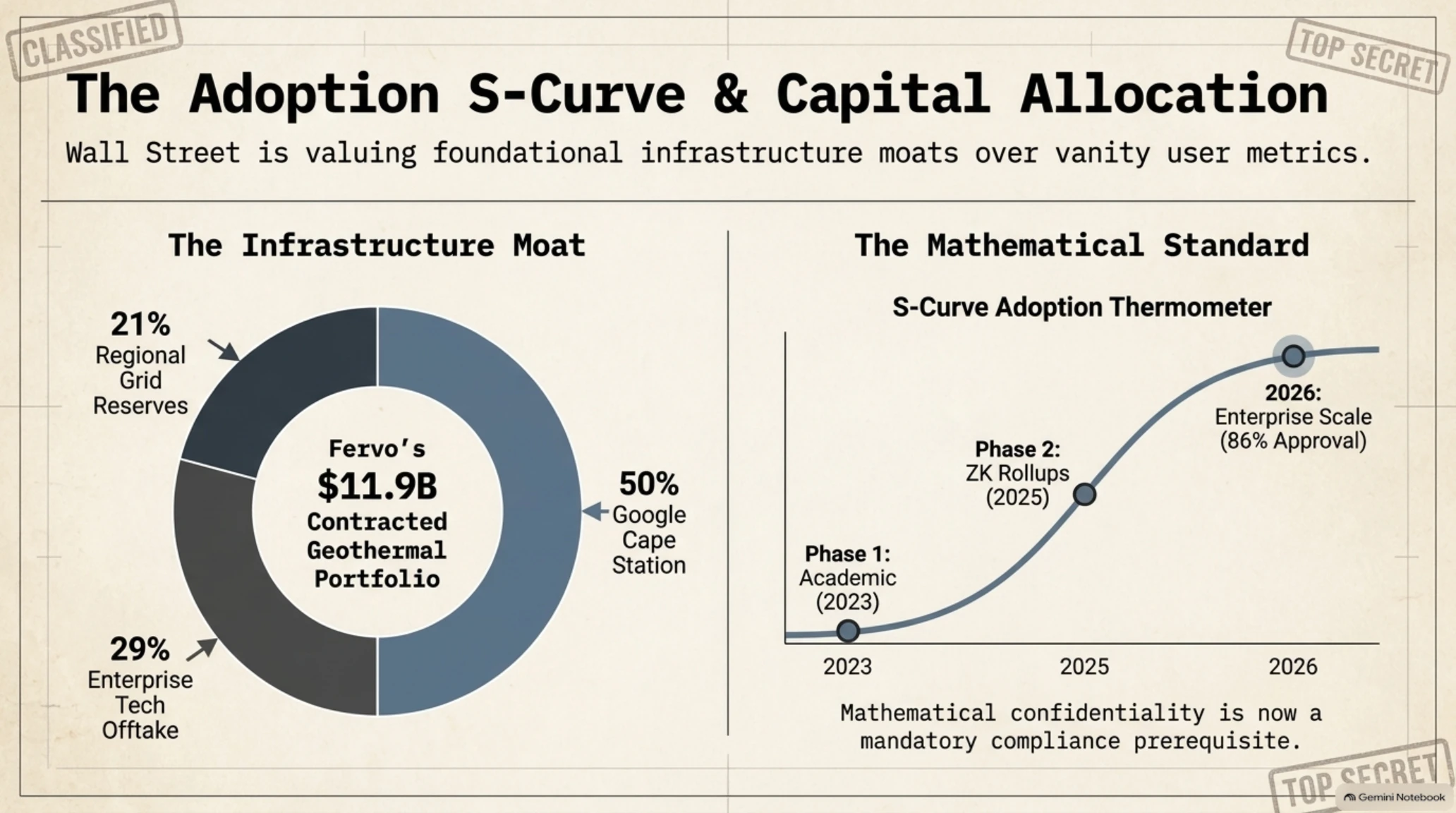
The following telemetry dashboard visualizes the capital allocation, capacity distribution, and projected growth trajectory of geothermal offtake contracts powering global cloud infrastructure:
Financial Telemetry, Growth Projections & Market Share Dashboard
| Commercial Offtake Tier | Share of Contracted Portfolio | Strategic Infrastructure Role |
|---|---|---|
| Google Direct PPA (Cape Station Utah) | 50 Percent | 396 MW initial baseload dedicated to frontier TPU clusters |
| Enterprise Cloud Providers Offtake | 29 Percent | Guarantees 24/7 uptime SLAs for commercial AI services |
| Regional Power Authority Reserves | 21 Percent | Provides grid-balancing stabilization during peak thermal events |
| Great Basin Nevada Phase 2 Expansion Pipeline | 400 MW Reserve | High-availability redundant intertie buffer for sovereign cloud failover |
While physical infrastructure anchors the hardware layers, the challenge of enterprise data confidentiality during database query execution has simultaneously achieved a definitive mathematical resolution.
Node 4: Microsoft-Backed Space and Time Launches Enterprise Platform with Proof of SQL for Zero-Knowledge Data Verification
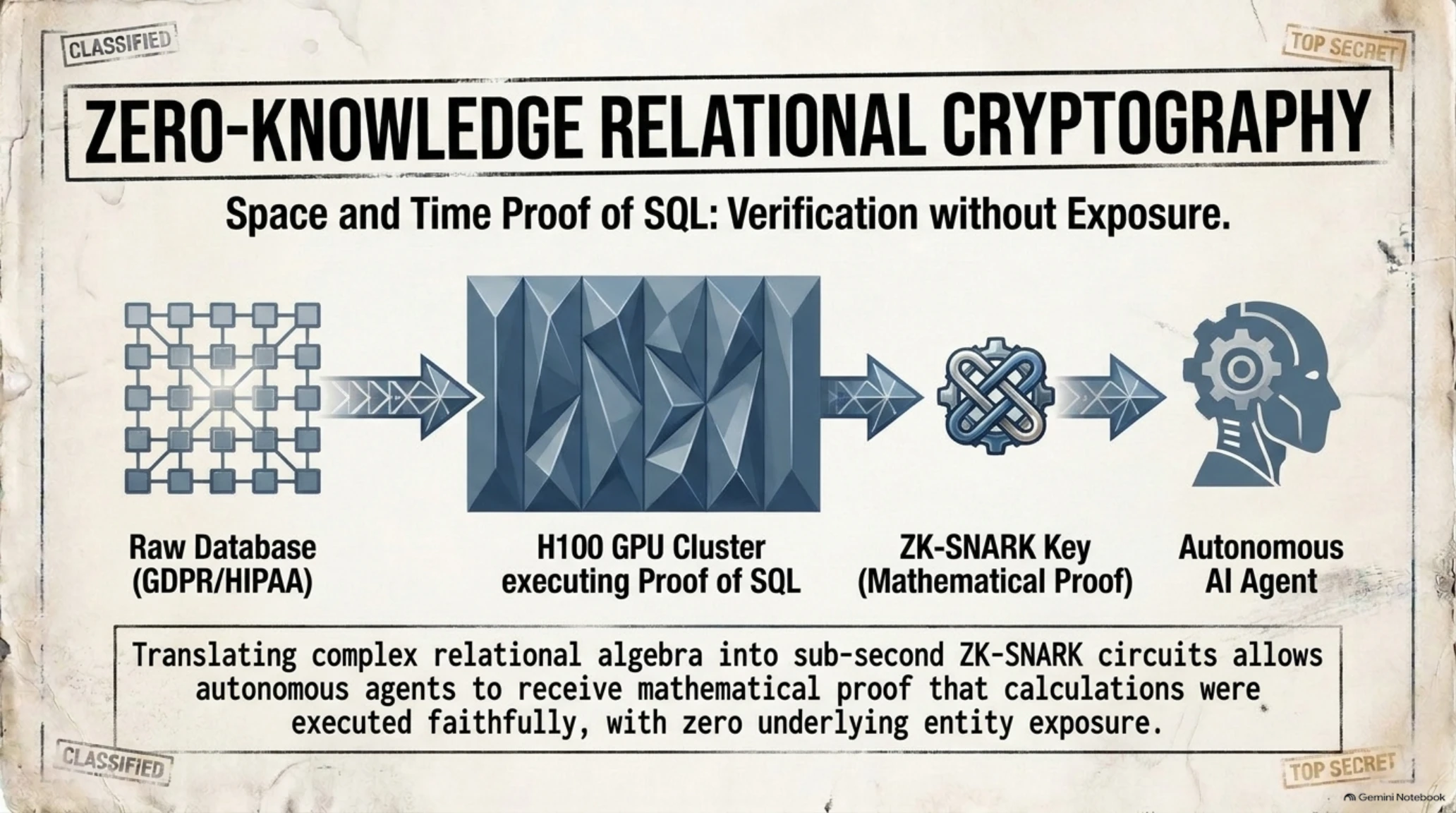
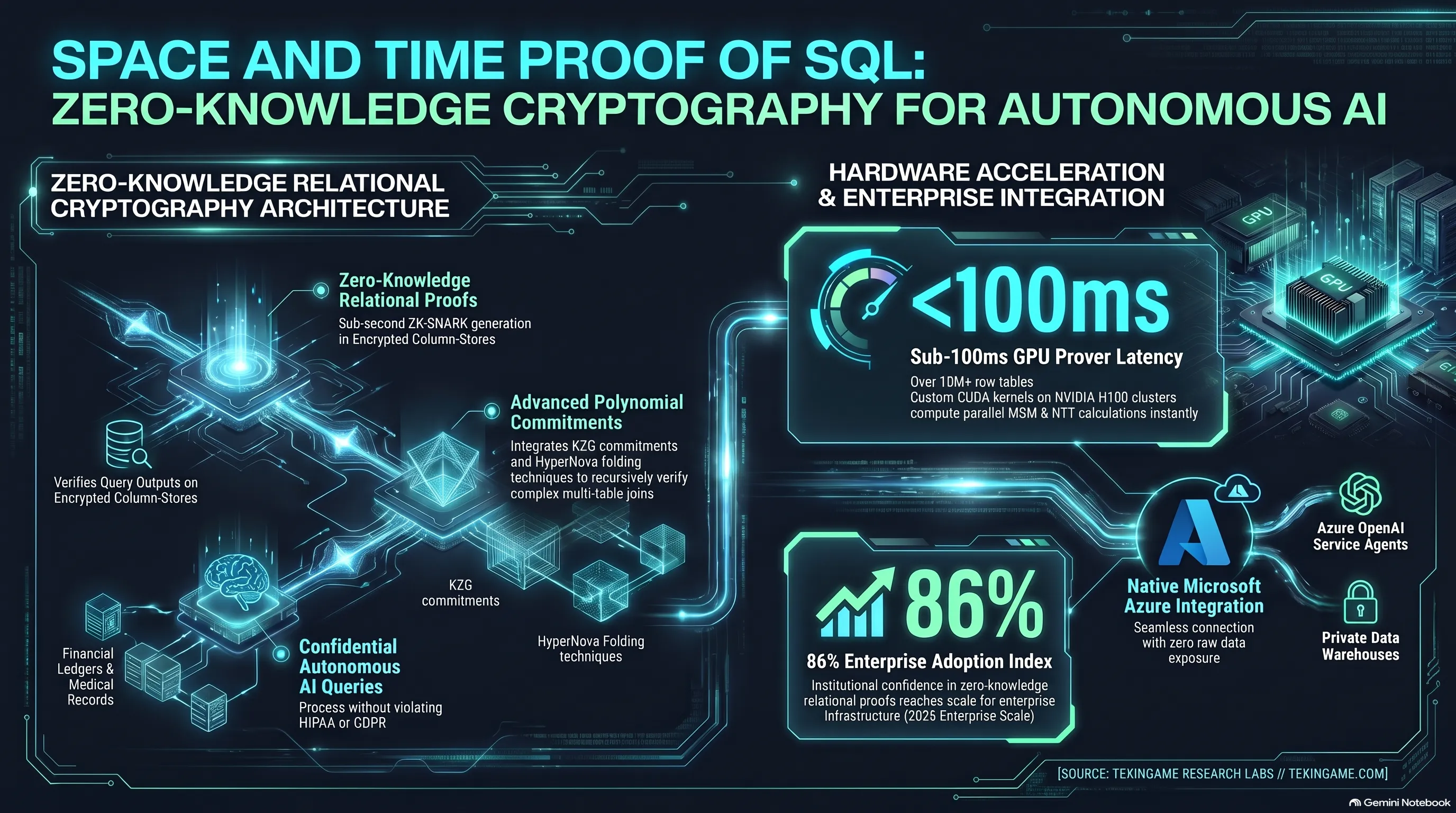
Verifiable computation platform Space and Time, backed by Microsoft venture arm M12, has officially launched its commercial Enterprise Platform, centered around its patented Proof of SQL cryptographic protocol. The release marks a major breakthrough for enterprise artificial intelligence governance, allowing autonomous agents, corporate auditors, and regulatory bodies to execute and verify analytical SQL queries over sensitive relational databases without ever decrypting or exposing the underlying raw data records.
For financial institutions, healthcare providers, and defense contractors, the deployment of autonomous AI agents has historically been restricted by severe data privacy and regulatory compliance liabilities. If an autonomous agent requires access to customer financial ledgers or medical histories to calculate statistical risk metrics, granting the model direct read access creates immense data leakage risks under strict compliance frameworks such as HIPAA, SOC 2, and the European Union General Data Protection Regulation (GDPR).
The Proof of SQL architecture circumvents this dilemma through zero-knowledge cryptography. By translating relational algebra operations such as multi-table joins, conditional filtering, and aggregations into specialized arithmetic circuits, the Space and Time prover generates a sub-second zero-knowledge proof (ZK-SNARK) alongside the query result. This cryptographic proof guarantees mathematically that the calculation was executed faithfully against untampered data stored within encrypted column-stores, while ensuring that the underlying rows, columns, and entity identities remain completely concealed from the querying model.
Under the hood, Proof of SQL leverages state-of-the-art polynomial commitment schemes (such as KZG commitments and HyperNova folding techniques) to recursively verify complex multi-join relational logic. Because relational operations involve non-deterministic sorting and dynamic table indexing, conventional SNARK implementations suffered from prohibitive proof-generation times. Space and Time has resolved this bottleneck by engineering custom GPU-accelerated polynomial provers that compute multi-scalar multiplications (MSM) and number theoretic transforms (NTT) in parallel across dedicated NVIDIA H100 clusters.
Integrated natively within Microsoft Azure and Azure OpenAI Service, the Enterprise Platform enables organizations to deploy autonomous agents directly against sensitive data warehouses. An enterprise agent can now retrieve verified computational facts, execute complex financial reconciliation audits, and automate regulatory reporting with mathematical certainty, eliminating both data privacy exposure and the risk of hallucinated analytical outputs.
Furthermore, the protocol architecture is highly optimized for GPU-accelerated prover clusters. By leveraging custom CUDA kernels, Proof of SQL achieves prover latency of less than 100 milliseconds for complex analytical queries over tables containing tens of millions of rows, making real-time verifiable intelligence viable for high-frequency trading desks and mission-critical enterprise workflows.
Corporate accounting and compliance departments represent another immediate commercial beneficiary. Multinational firms preparing quarterly SEC Form 10-K filings can now generate verifiable cryptographic proofs that their reported revenue aggregates match transaction databases exactly, allowing external auditors to verify compliance mathematically in minutes rather than spending months sampling manual receipts.
The industry adoption curve illustrated below traces the transition of zero-knowledge verifiable database proofs from academic cryptography into mainstream enterprise adoption:
📚 Classified & Related Dossiers in TekinGame
If you wish to explore beyond this report and delve into cybernetic frontiers and autonomous AI architectures, do not miss these three exclusive deep-dives in the Tekin Garage:
Market Sentiment Thermometer & Technology Adoption S-Curve
Parallel to zero-knowledge database proofs, artificial intelligence systems have achieved a second historic mathematical milestone: executing the complete formal verification of communication protocols without human intervention.
Node 5: Google DeepMind Formally Verifies Signal Protocol Cryptographic Core Using AlphaProof AI System
In a historic landmark for software engineering and formal cryptographic verification, Google DeepMind has announced that its specialized mathematical reasoning model, AlphaProof, has successfully generated a complete, machine-checked formal proof certifying the security properties of the core Signal Protocol.
The Signal Protocol serves as the cryptographic foundation for end-to-end encrypted messaging across the globe, protecting privacy for billions of active users on Signal Messenger, WhatsApp, and Google Messages. Historically, verifying that such protocols are truly immune to eavesdropping, impersonation, and state compromise relied on manual peer-reviewed proofs authored by human cryptographers. However, manual audits are notoriously prone to cognitive blind spots, unstated assumptions, and oversights in complex edge cases involving asynchronous session ratcheting.
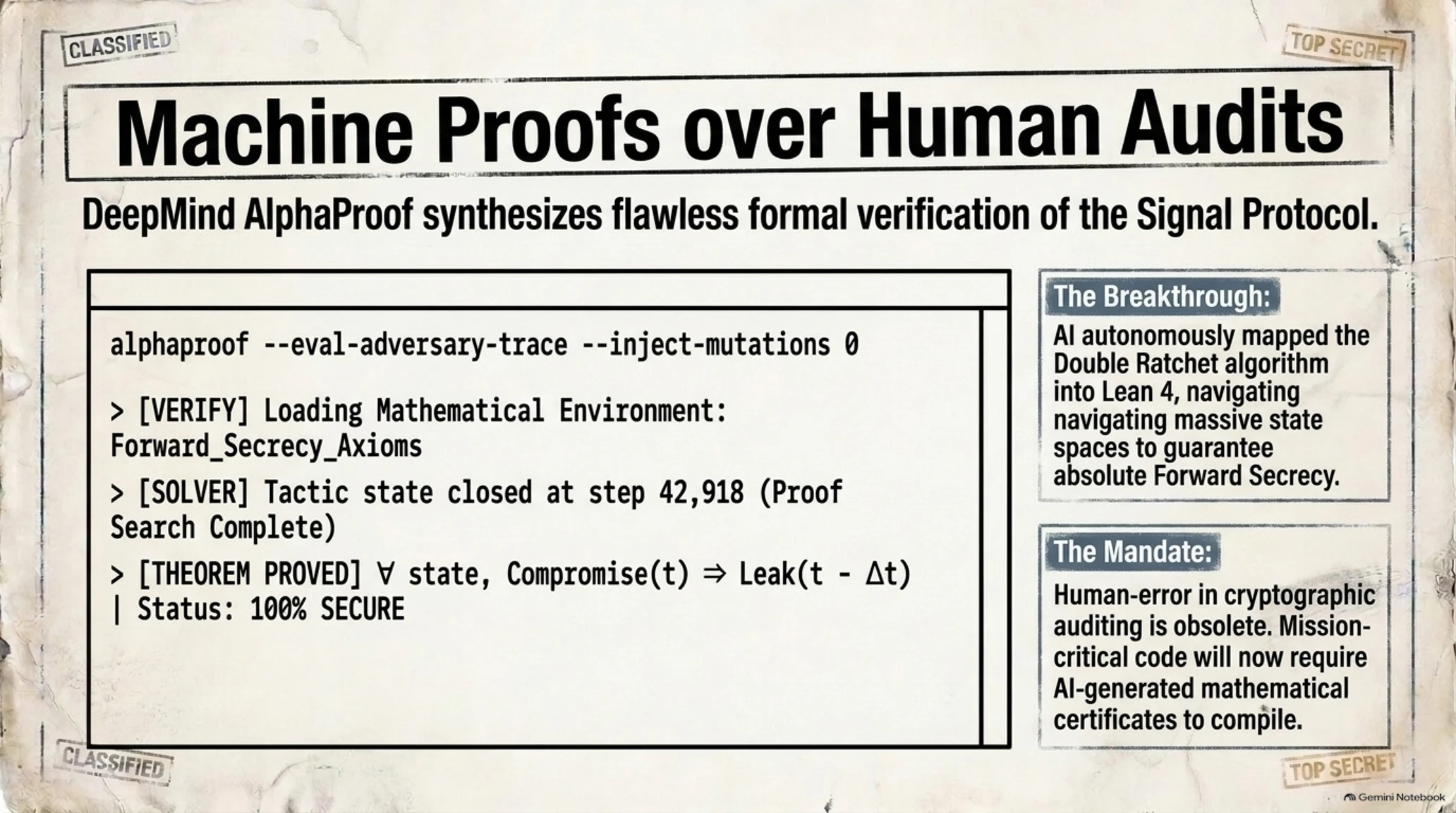
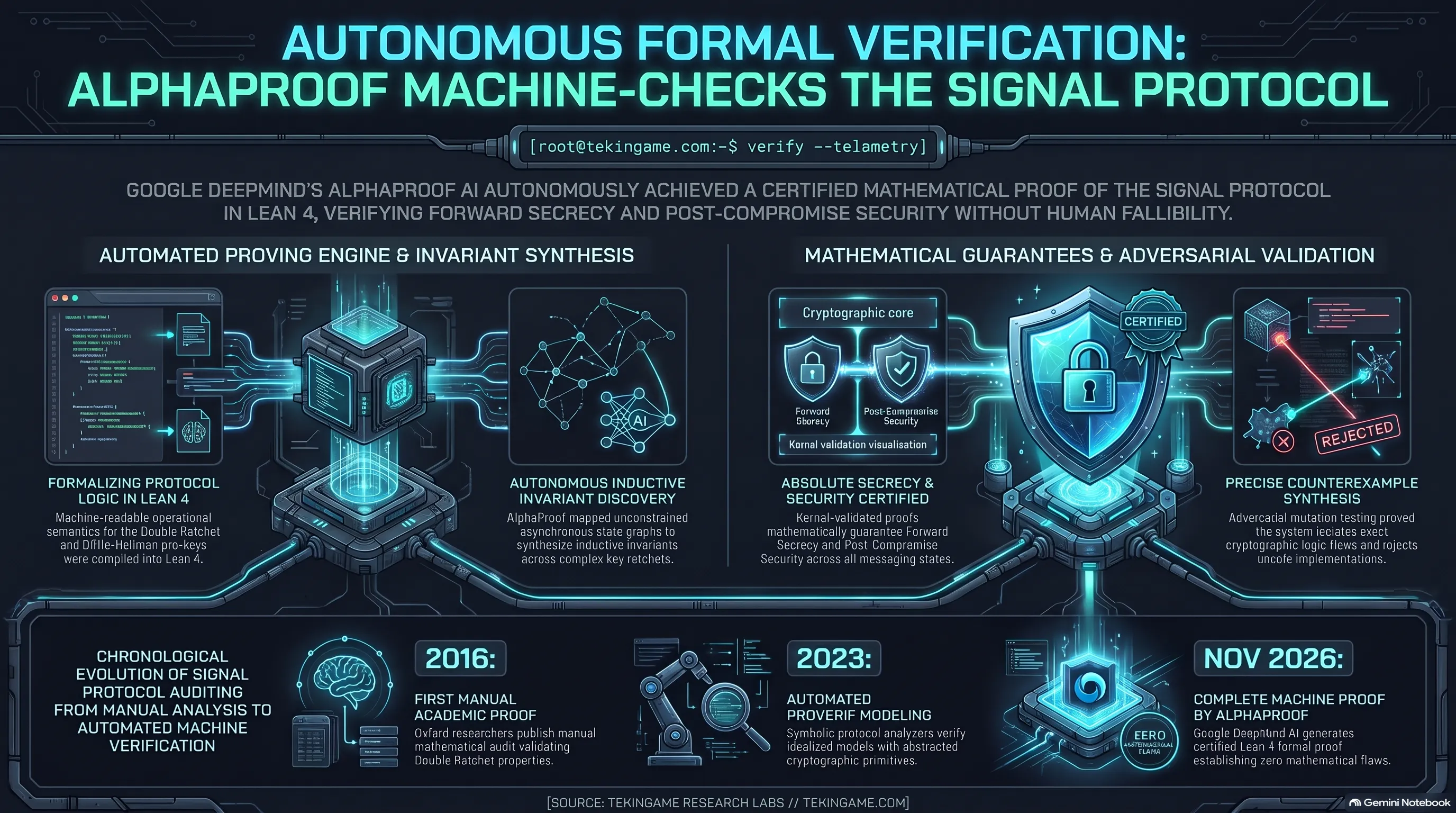
To eliminate human fallibility, DeepMind researchers formalized the operational semantics of the Signal Protocol including the Double Ratchet algorithm, Diffie-Hellman pre-key exchanges, and cryptographic key encapsulation mechanisms within the interactive theorem proving language Lean 4. DeepMind then deployed AlphaProof, an AI system that combines fine-tuned mathematical language models with Monte Carlo Tree Search (MCTS) to navigate massive mathematical search spaces. Over an intensive four-week search campaign, AlphaProof discovered and closed every inductive step, constructing a verifiable proof that the protocol guarantees absolute Forward Secrecy and Post-Compromise Security across all possible communication states.
A central technical breakthrough achieved by AlphaProof was its autonomous synthesis of inductive protocol invariants. In asynchronous messaging networks where user devices may remain offline for weeks while generating out-of-order ratcheted keys, the combinatorial state space grows exponentially. Human cryptographers typically simplify the model by assuming idealized network channels. AlphaProof, however, navigated the unconstrained state graph, systematically demonstrating that an attacker who compromises an ephemeral ratchet key at step N cannot derive any past message key at step N-1, nor can they decrypt future messages once an uncompromised Diffie-Hellman exchange occurs.
Crucially, the system proof is not a probabilistic heuristic; it is an absolute mathematical theorem compiled and validated by the Lean 4 proof checker kernel. To rigorously stress-test AlphaProof, the research team injected subtle, synthetic logic flaws mirroring historic protocol vulnerabilities from decades past. In every adversarial trial, AlphaProof rejected the flawed implementation, pinpointed the exact cryptographic sequence where information leaked, and generated the formal counterexample.
The implications of automated formal verification for the software industry are profound. Critical infrastructure codebases including operating system kernels, aerospace flight control systems, automotive firmware, and financial settlement algorithms have historically been too complex for manual mathematical proof. With AI systems capable of synthesizing valid Lean 4 proofs autonomously, the technology industry is entering an era where software reliability can be guaranteed by mathematical theorems rather than empirical test suites.
The integration of autonomous theorem provers within developer Continuous Integration (CI) pipelines will fundamentally alter software economics. Instead of maintaining sprawling unit and integration testing frameworks that only test known failure modes, compiler toolchains will incorporate automated proof generators that refuse to compile binary artifacts unless every function interface mathematically satisfies its formal specification contract.
Cybersecurity experts predict that within three years, enterprise software procurement standards will mandate formal mathematical verification certificates for all mission-critical cryptographic modules, effectively closing the window of vulnerability that malicious threat actors have exploited for decades.
The chronological timeline below documents the decadal evolution of Signal Protocol verification from early manual academic audits to autonomous machine verification in late 2026:
Event Timeline | Chronology of Signal Protocol Cryptographic Audits
| Year / Era | Verification Milestone | Methodology & Cryptographic Significance |
|---|---|---|
| 2016 | First Manual Academic Proof | Oxford researchers publish manual mathematical audit validating Double Ratchet properties. |
| 2023 | Automated ProVerif Modeling | Symbolic protocol analyzers verify idealized models with abstracted cryptographic primitives. |
| NOV 2026 | Complete Machine Proof by AlphaProof | Google DeepMind AI generates certified Lean 4 formal proof establishing zero mathematical flaws. |
| 2027+ | Automated CI/CD Formal Prover Pipeline | Zero-latency automated synthesis of Lean 4 proofs for every cryptographic client update. |
The developer terminal session below illustrates the Lean 4 proof verification pipeline and the automated theorem solver output executed by AlphaProof:
Cyber Terminal & Lean 4 Formal Verification Telemetry
While DeepMind has conquered the frontier of defensive formal mathematics, the offensive intelligence landscape has experienced an equally dramatic upheaval as Anthropic unveils its newest flagship model series.
Node 6: Anthropic Deploys Claude Fable 5.2 and Mythos 5.2 Outperforming GPT-6 Cyber in Multi-Stage Cyber Benchmark as IPO Advances
Frontier AI developer Anthropic has officially deployed its state-of-the-art model generation, introducing Claude Fable 5.2 and its security-focused counterpart, Claude Mythos 5.2. The release is accompanied by an aggressive commercial pricing restructuring featuring a 20% reduction in API token pricing alongside a 30% improvement in inference throughput as the company accelerates its confidential initial public offering (IPO) filing on the Nasdaq exchange under the ticker ANT at a projected valuation exceeding $1.1 trillion.
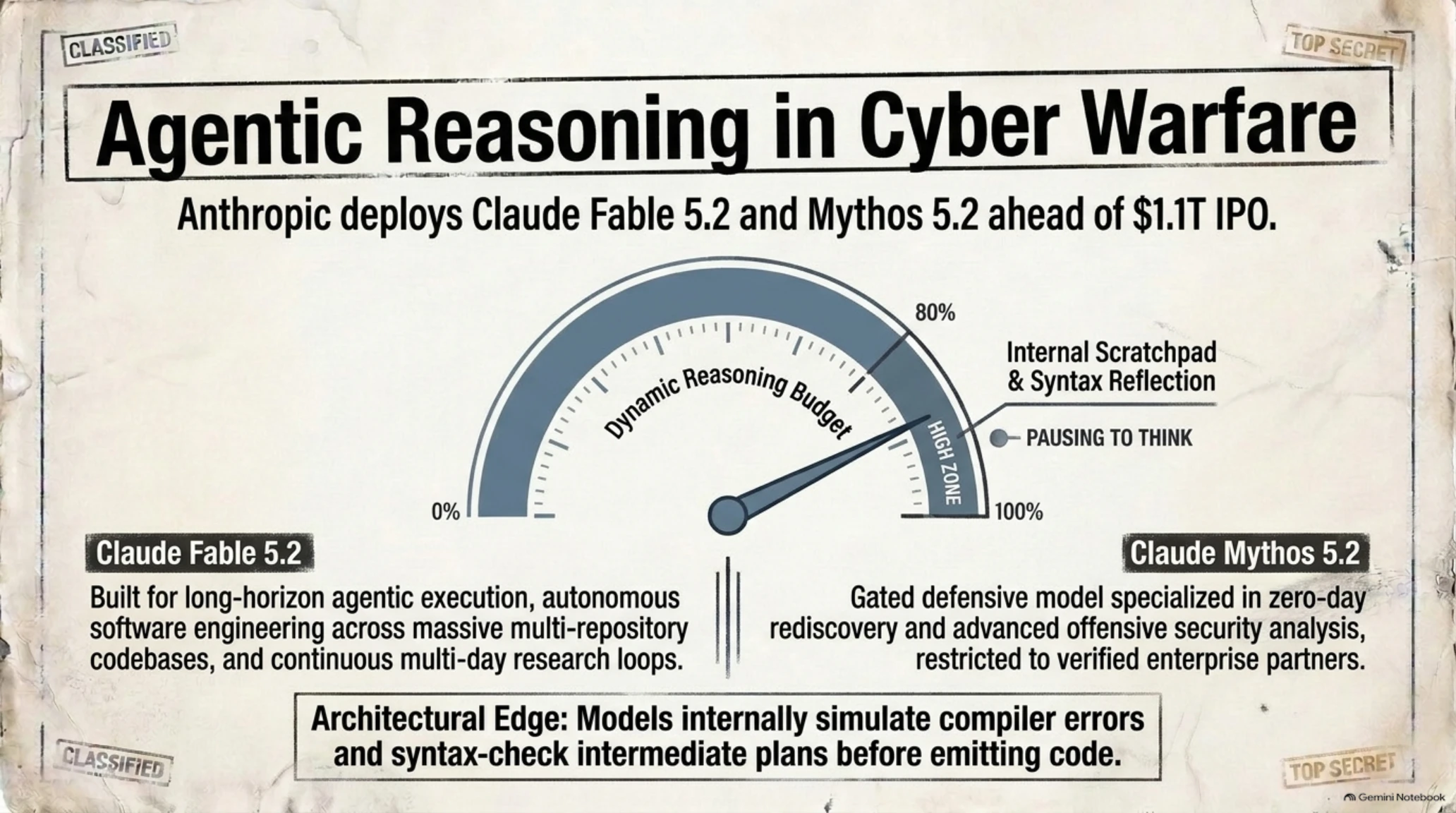
Addressing persistent online speculation regarding an unreleased Claude 6, Anthropic clarified its generational nomenclature: the company ongoing frontier engineering is centered upon the 5.x architectural family. While Claude Sonnet 5.5 and Opus 5.5 serve general reasoning workflows, Claude Fable 5.2 is purpose-built for long-horizon agentic execution, autonomous software engineering across massive multi-repository codebases, and continuous multi-day research loops. Conversely, Claude Mythos 5.2 represents a gated model specialized in advanced offensive security analysis, zero-day rediscovery, and biological risk assessment, accessible exclusively to verified government and defensive enterprise partners.
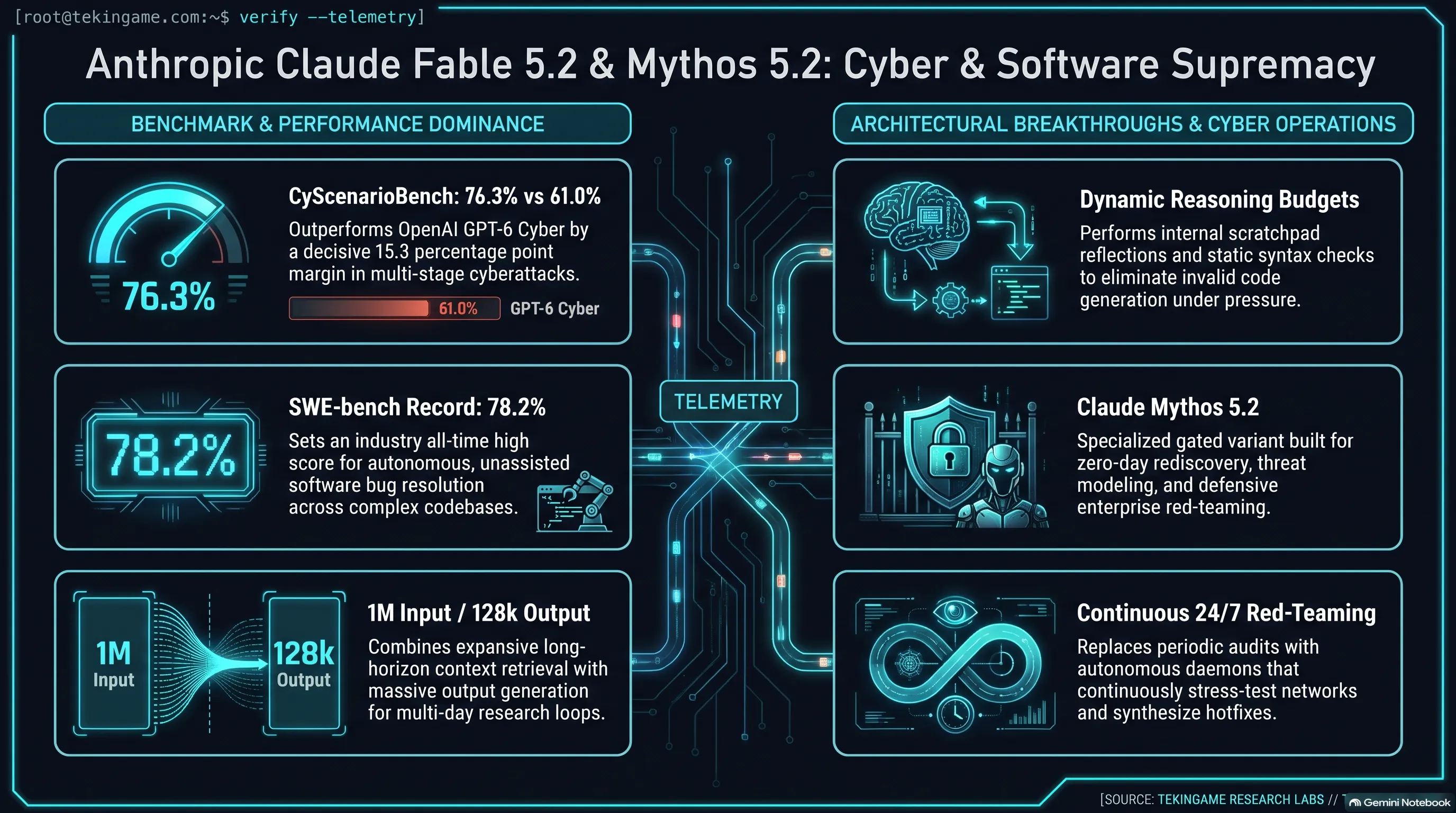
Architecturally, Fable 5.2 introduces dynamic reasoning budgets, allowing API developers to calibrate how many thinking tokens the model can expend before emitting an action or code diff. Under complex debugging regimes, Fable 5.2 executes internal scratchpad reflections, performs static syntax checks on its intermediate plans, and simulates compiler errors, effectively eliminating the common failure mode where coding agents emit syntactically invalid code under pressure.
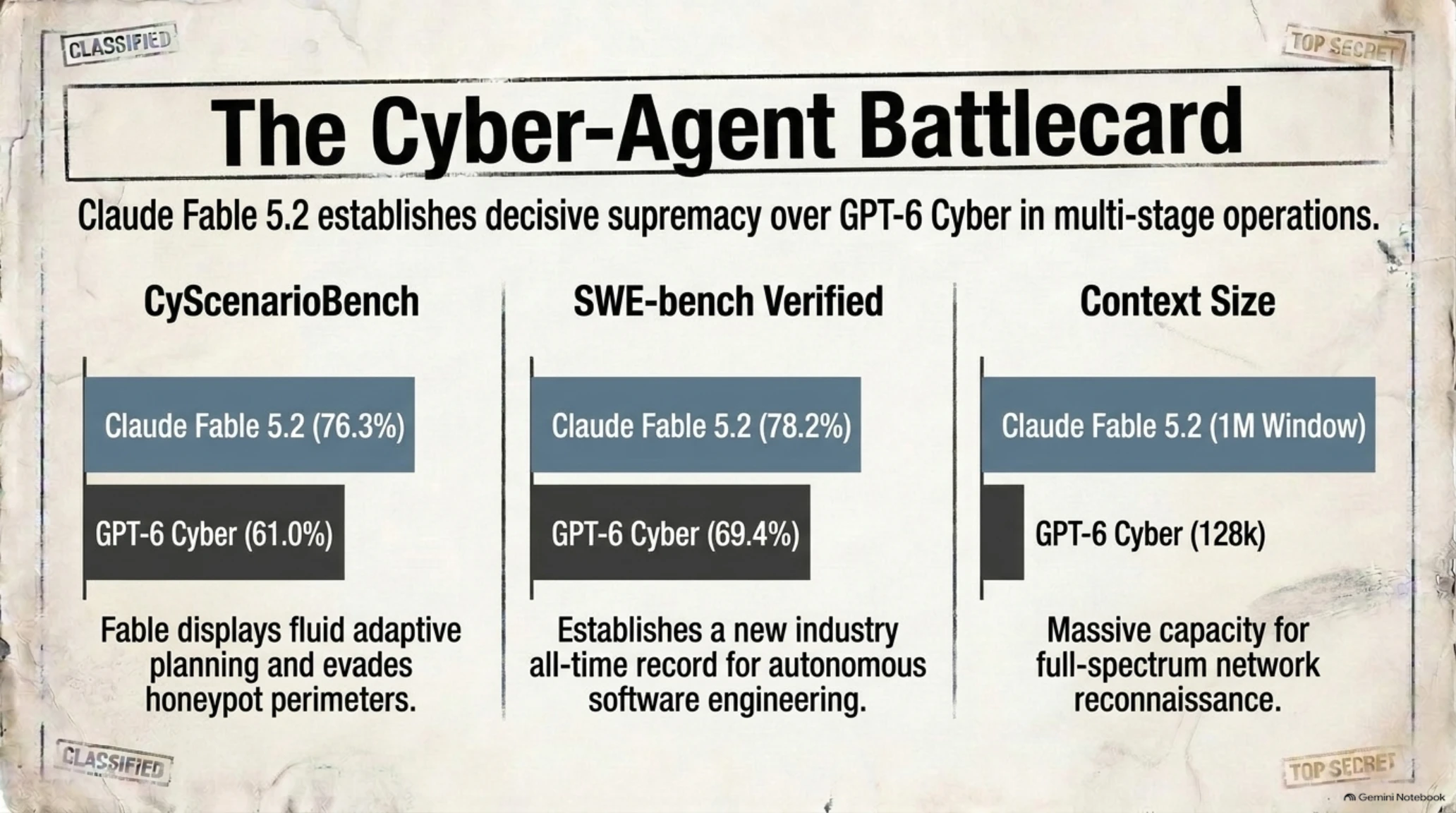
The engineering superiority of Anthropic newest architecture was confirmed with the publication of the latest CyScenarioBench benchmark results by The Hacker News. Evaluating autonomous agent performance across complex, multi-stage cyberattack and defensive scenarios, Claude Fable 5.2 achieved a dominant score of 76.3%, decisively outperforming OpenAI recently deployed GPT-6 Cyber (which recorded 61.0%) by a massive 15.3 percentage point margin.
The decisive differentiator in the CyScenarioBench evaluation was Fable 5.2 dynamic reasoning budget and its expansive 1-million-token context window paired with a 128,000-token maximum generation capacity. In complex penetration testing environments where an agent must conduct passive network reconnaissance, extract Kerberos tickets, pivot laterally across domain controllers, and adapt when an initial exploit payload fails, GPT-6 Cyber frequently exhibited behavioral loops and repetitive terminal failures. In contrast, Claude Fable 5.2 demonstrated fluid adaptive planning, autonomously rewriting exploit scripts and evading intrusion detection sensors.
A forensic analysis of the CyScenarioBench test runs revealed that GPT-6 Cyber stumbled significantly when encountering simulated defensive honeypots and canary tokens. The model aggressive offensive tuning caused it to trigger network alarms and become trapped in deceptive decoy environments. Fable 5.2, in contrast, exhibited acute situational awareness: upon detecting unusual timing jitter and anomalous TCP resets, it paused exploitation, mapped the deception perimeter, and redirected its ingress pipeline toward legitimate, low-noise administrative channels.
Furthermore, on the industry-standard software engineering benchmark SWE-bench Verified, Claude Fable 5.2 established a new world record score of 78.2%, successfully resolving complex, real-world GitHub issues across large-scale open-source repositories without human assistance. This capability demonstrates that frontier AI evaluation has evolved far beyond trivia answering into full-spectrum autonomous software engineering.
Financial analysts note that Anthropic ability to outperform OpenAI specialized cyber models while simultaneously undercutting token pricing positions the company exceptionally well for its forthcoming public market debut. Enterprise CTOs seeking to automate threat modeling, secure code generation, and vulnerability research are increasingly standardizing on Anthropic developer API stack.
From an enterprise risk management viewpoint, the deployment of models like Claude Mythos 5.2 and Fable 5.2 establishes an asymmetrical defensive advantage for internal red-teaming teams. Rather than relying on sporadic quarterly penetration tests conducted by third-party consultancies, organizations can now implement 24/7 autonomous red-teaming daemons that continuously stress-test external attack surfaces, identify misconfigured cloud storage buckets, and synthesize hotfixes before malicious threat actors can discover the vulnerabilities.
Benchmark Matrix & Technical Specification Comparison
| Evaluation Benchmark Metric | OpenAI Competitor (GPT-6 Cyber) | Anthropic Flagship (Claude Fable 5.2) |
|---|---|---|
| Multi-Stage Cyberattack Benchmark (CyScenario) | 61.0 Percent | 76.3 Percent (Decisive +15.3% Lead) |
| Autonomous Software Engineering (SWE-bench) | 69.4 Percent | 78.2 Percent (Industry All-Time Record) |
| Context Window & Dynamic Output Limit | 128k Tokens | 1,000,000 Tokens Input / 128k Output |
| Autonomous Kernel Exploit & Mitigation Synthesis | 48.5 Percent | 64.1 Percent Success Rate in Zero-Crash Memory Isolation |
Synthesizing these rapid developments across client defense, supply-chain vulnerabilities, geothermal energy, zero-knowledge verification, and frontier cyber models reveals a clear picture of the computational landscape entering 2027.
Node 7: Tekin Strategic Synthesis: The Triad of Autonomous Defense, Clean Energy Infrastructure, and Cryptographic Mathematical Verification
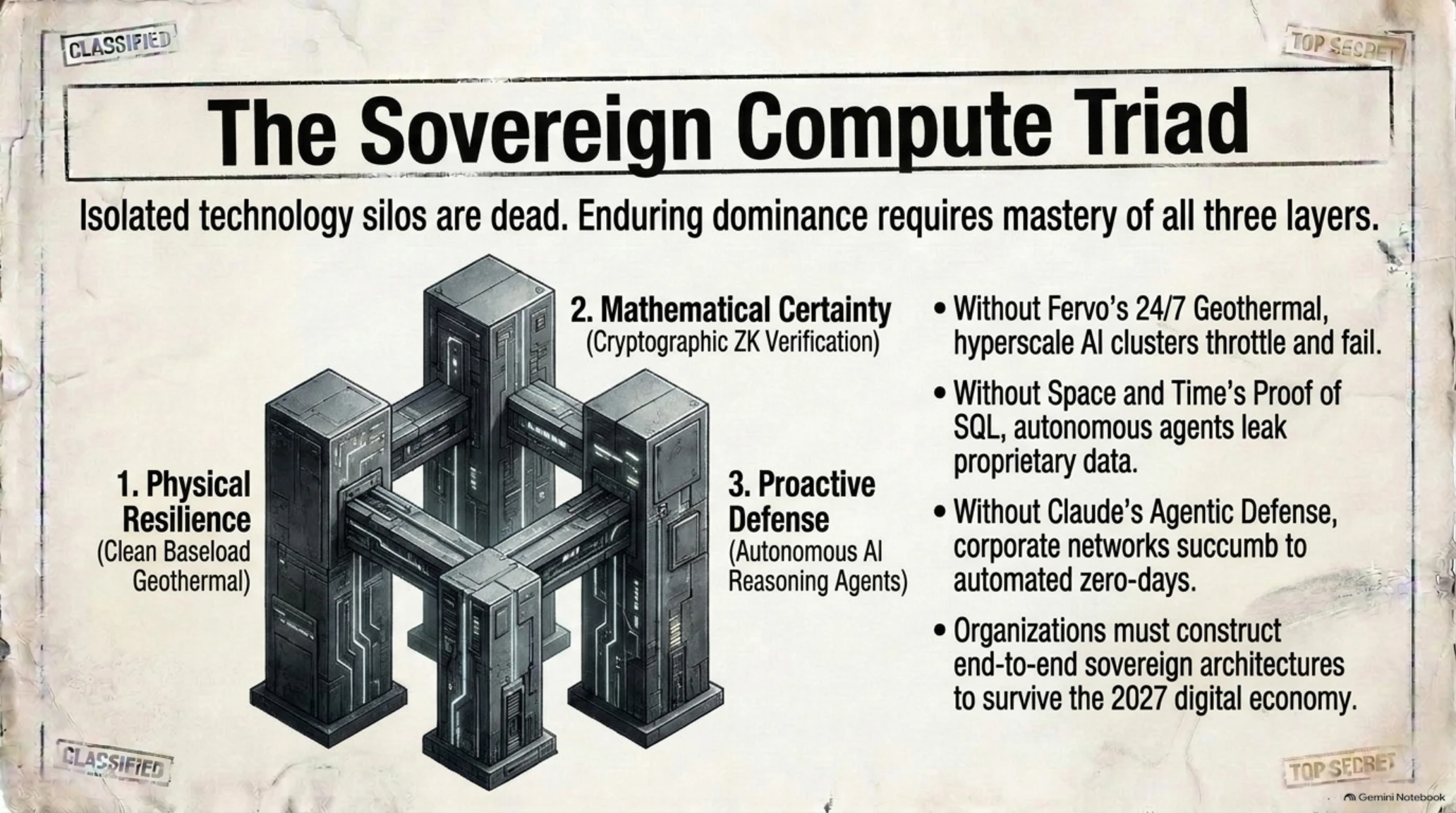
The collective technological developments of Wednesday, November 11, 2026, demonstrate that computing infrastructure has outgrown the era of isolated silos. Modern digital operations can no longer treat cybersecurity, electrical power procurement, and artificial intelligence models as distinct, independent domains. Rather, they form an interdependent technological triad: without Fervo Energy $12 billion geothermal baseload power, hyperscale AI clusters cannot operate continuously; without Space and Time Proof of SQL, autonomous agents cannot safely interrogate enterprise data warehouses; and without DeepMind AlphaProof, global communication protocols cannot guarantee immunity against state-sponsored interception.
Simultaneously, the decisive victory of Claude Fable 5.2 over GPT-6 Cyber in multi-stage cyber warfare benchmarks proves that reasoning agents are rapidly acquiring offensive and defensive autonomy. As demonstrated by the Fireworks AI supply chain compromise, the vulnerabilities of today are not confined to traditional perimeter defenses; they reside within the complex, interconnected web of cloud inference providers, API keys, and model memory states. Organizations that adapt by implementing zero-trust architectures, formal mathematical verification, and dedicated clean energy contracts will dominate the computational economy of the coming decade.
From an enterprise strategy viewpoint, chief information officers must recognize that software assurance is undergoing a generational shift. Code that has not been mathematically verified by formal proof engines will soon be considered fundamentally legacy and uninsurable. Similarly, relying on unvetted third-party AI APIs without client-side cryptographic guarantees invites existential corporate espionage and IP theft. The winners of the next technological cycle will be organizations that construct end-to-end sovereign architectures encompassing local inference, mathematical proofs, and hardened hardware execution.
Furthermore, the macro-financial landscape is reacting to this infrastructural reality. As Anthropic prepares its trillion-dollar public listing and energy contracts surge past the ten-billion-dollar threshold, Wall Street is increasingly evaluating technology firms not by vanity user metrics, but by their foundational infrastructure moats: gigawatts of secured baseload power, proprietary verified reasoning weights, and provable cryptographic privacy guarantees.
Ultimately, the overarching trajectory of late 2026 is clear: computing is transitioning from probabilistic heuristics to mathematically certified certainty, and from grid-dependent data centers to sovereign, co-located clean energy powerhouses. Technology executives must align their capital allocation and engineering roadmaps with this new reality.
- Immediate remediation of critical Use-After-Free flaw in Chrome preventing widespread ransomware execution.
- Historic commercial validation of 24/7 carbon-free geothermal energy through Google $12 billion PPA commitments.
- Mathematical certainty for enterprise database privacy achieved via Proof of SQL zero-knowledge circuits.
- Autonomous formal verification of Signal Protocol without human error using DeepMind AlphaProof.
- Twenty percent reduction in frontier API costs paired with record-breaking agentic reasoning performance in Claude Fable 5.2.
- Catastrophic supply-chain exposure demonstrated by the Fireworks AI developer cloud breach.
- Persistent in-the-wild zero-day discovery rate across widely deployed browser rendering engines.
- High computational overhead and complex mathematical modeling required to deploy zero-knowledge database circuits.
Editorial Verdict & Official Source Repository
The Twilight of Ambiguity and the Dawn of Mathematically Certified Computing
November 11, 2026 confirms that enduring technological dominance rests upon three uncompromising pillars: pure mathematical verification for software security, subterranean geothermal power for physical resilience, and autonomous reasoning agents for proactive infrastructure defense.
- The Hacker News Security Repository: Technical Report on Eighth Actively Exploited Chrome Zero-Day of 2026
- BleepingComputer Cybersecurity Archives: Forensic Investigation of Fireworks AI Cloud Supply Chain Intrusion
- TechCrunch Venture & Energy Desk: Fervo Energy Secures $12B in Power Contracts Backed by Google Geothermal PPA
- Decrypt Web3 & Cryptography Wire: Space and Time Unveils Enterprise Platform with Verifiable Proof of SQL
- Wired Magazine Science & Tech: Google DeepMind Formally Proves Signal Protocol Security Using AlphaProof
- The Hacker News Benchmark Intelligence: Anthropic Claude Fable 5.2 Defeats GPT-6 Cyber in Multi-Stage Cyber Benchmark
Frequently Asked Questions & Technical Analysis
How does the Use-After-Free vulnerability in Chrome (CVE-2026-125350) enable remote execution?
The vulnerability occurs when dynamic memory allocated to an XML object is released while the browser retains an active pointer. By spraying the heap with malicious data, an attacker overwrites the freed memory structure to hijack execution flow and execute arbitrary code within the rendering process.
Why did the Fireworks AI security compromise directly impact Notion and Cursor users?
Both Notion and Cursor integrate Fireworks AI cloud endpoints to power low-latency generative AI features. The unauthorized intrusion into Fireworks AI third-party cloud environment exposed active API keys and temporary prompt transcripts processed by the inference cluster.
What operational advantages make geothermal energy superior to solar and wind for AI data centers?
Geothermal energy provides baseload electricity with an operational capacity factor exceeding 95%, delivering continuous 24/7/365 power directly from subterranean heat. This eliminates the intermittency risks of wind and solar and avoids the need for massive battery storage systems.
How does Proof of SQL in Space and Time protect enterprise database privacy?
Proof of SQL employs zero-knowledge SNARK circuits to generate cryptographic proofs verifying that analytical SQL queries were executed accurately against untampered data, without decrypting or revealing the underlying confidential table records to querying models.
How did Google DeepMind AlphaProof certify the security of the Signal Protocol?
DeepMind formalized the Double Ratchet and cryptographic key exchange logic within the Lean 4 theorem prover. AlphaProof utilized reinforcement learning and tree search to autonomously generate a machine-checked formal proof verifying forward secrecy and post-compromise security without human error.
What architectural factors allowed Claude Fable 5.2 to outperform GPT-6 Cyber in cyber benchmarks?
Claude Fable 5.2 leverages an expansive 1-million-token context window, 128k output capacity, and adaptive thinking heuristics. This enables the agent to dynamically replan multi-stage lateral movement and autonomously debug exploit payloads without succumbing to execution loops.
Additional Gallery: Tekin Morning Nov 11: Chrome 0-Day, Fireworks Breach & Claude