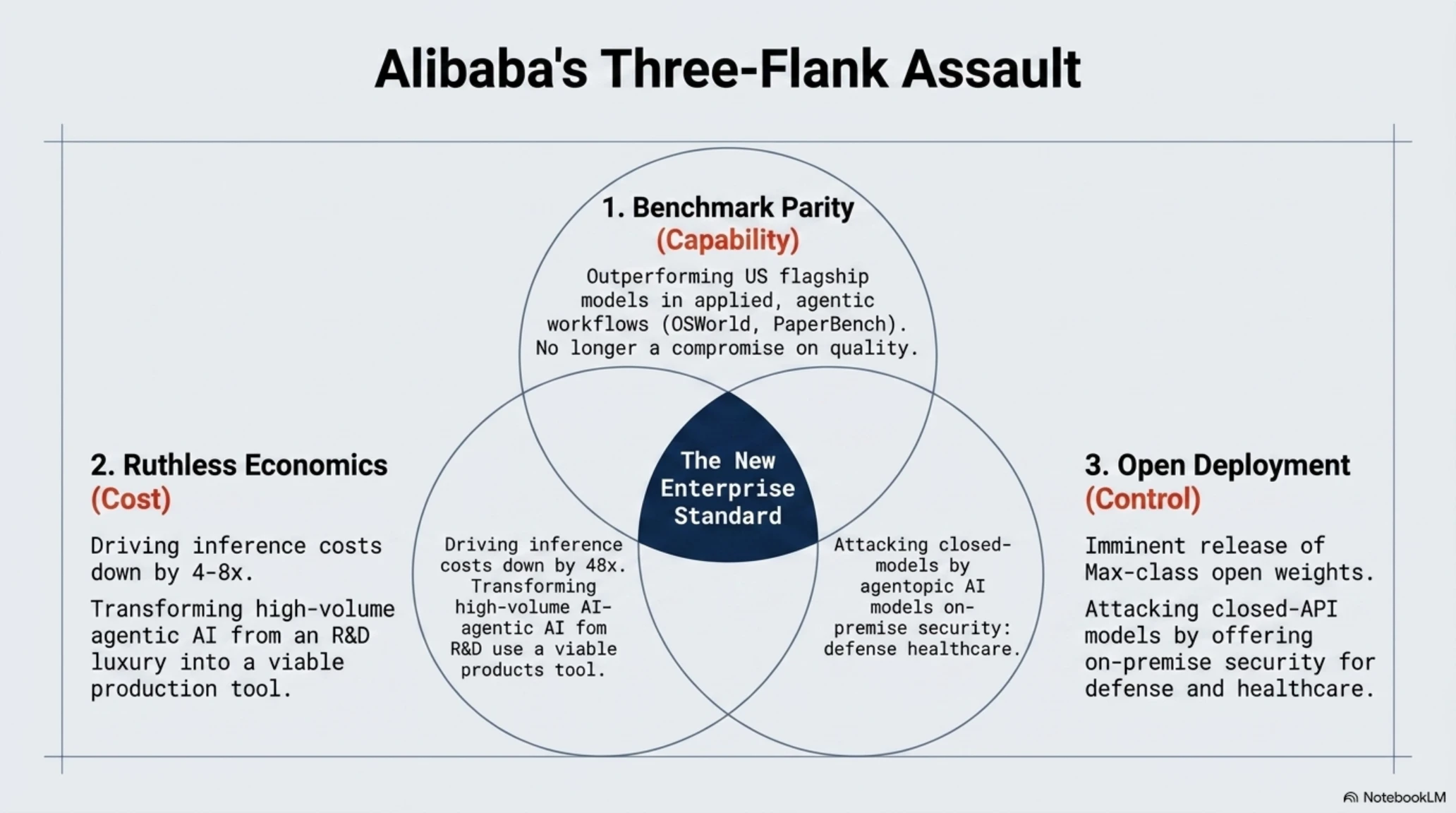
On August 3, 2026, Alibaba disrupted the AI industry by unveiling Qwen3.8-Max. Outperforming GPT-5.6 and Claude Fable 5 on key benchmarks like OSWorld, this 2.4-trillion parameter model is 4-8x cheaper than US alternatives. With open weights releasing soon, Qwen3.8-Max is set to democratize enterprise AI and challenge Silicon Valley's monopoly.
The AI War Just Got Real
Alibaba's Qwen3.8-Max proves China is no longer following—it's leading, and doing so at a fraction of the cost.
- 🎮Benchmark Victories- Qwen3.8-Max scores 86.1 on OSWorld, beating GPT-5.6 Sol Max and Fable 5
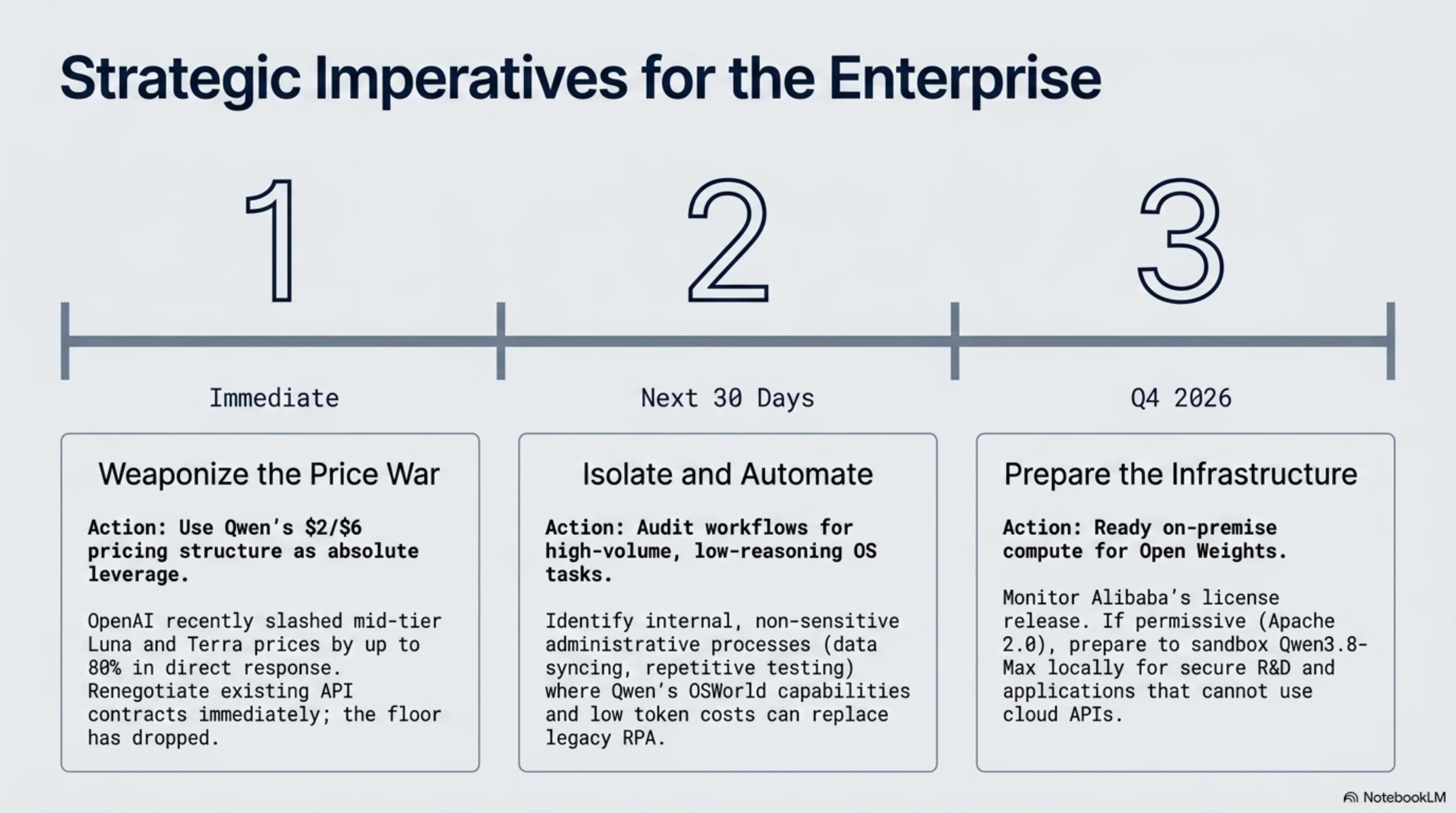
- 🎧Aggressive Pricing- At $2/$6 per million tokens, it's 4-8x cheaper than US competitors
- 🚀Open Weights Coming- First time a Max-class Qwen model will be publicly released
China Officially Enters the AI Premier League
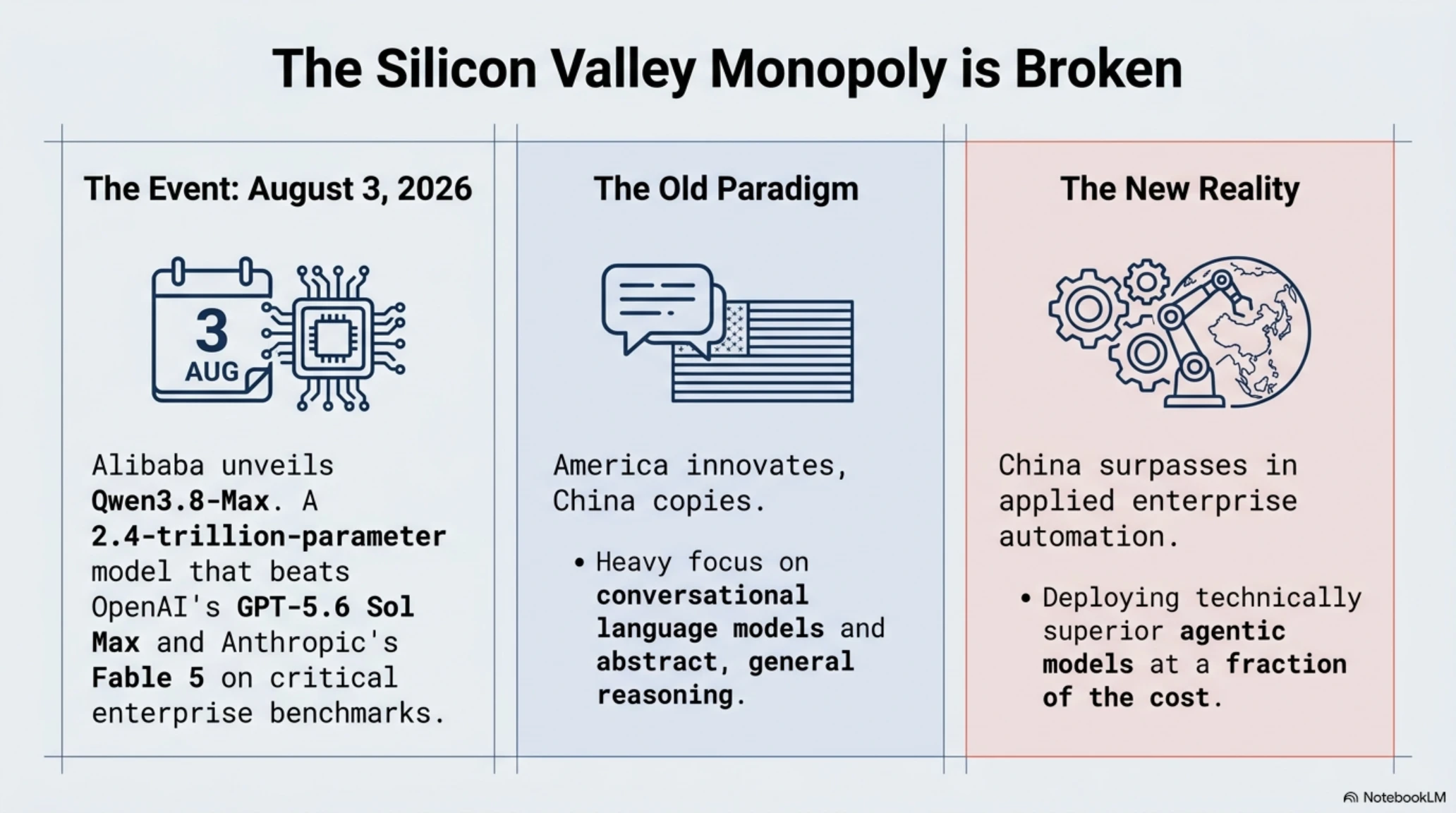
August 3, 2026, may go down in AI history as a pivotal moment. The reason is simple: Alibaba unveiled Qwen3.8-Max, a 2.4-trillion-parameter model that outperformed leading American models like OpenAI's GPT-5.6 Sol Max and Anthropic's Fable 5 on several critical benchmarks. This isn't just a technical achievement—it represents a profound geopolitical shift in the AI arms race.
For years, Silicon Valley was the beating heart of AI innovation. OpenAI with its GPT series, Anthropic with Claude, and Google with Gemini dominated the market. But China, through massive investments, global talent acquisition, and a relentless focus on practical applications, has rapidly closed the gap. Qwen3.8-Max exemplifies this strategy: a model that's not only technically competitive but also positioned to disrupt the enterprise market with aggressive pricing.
At a Glance: What is Qwen3.8-Max?
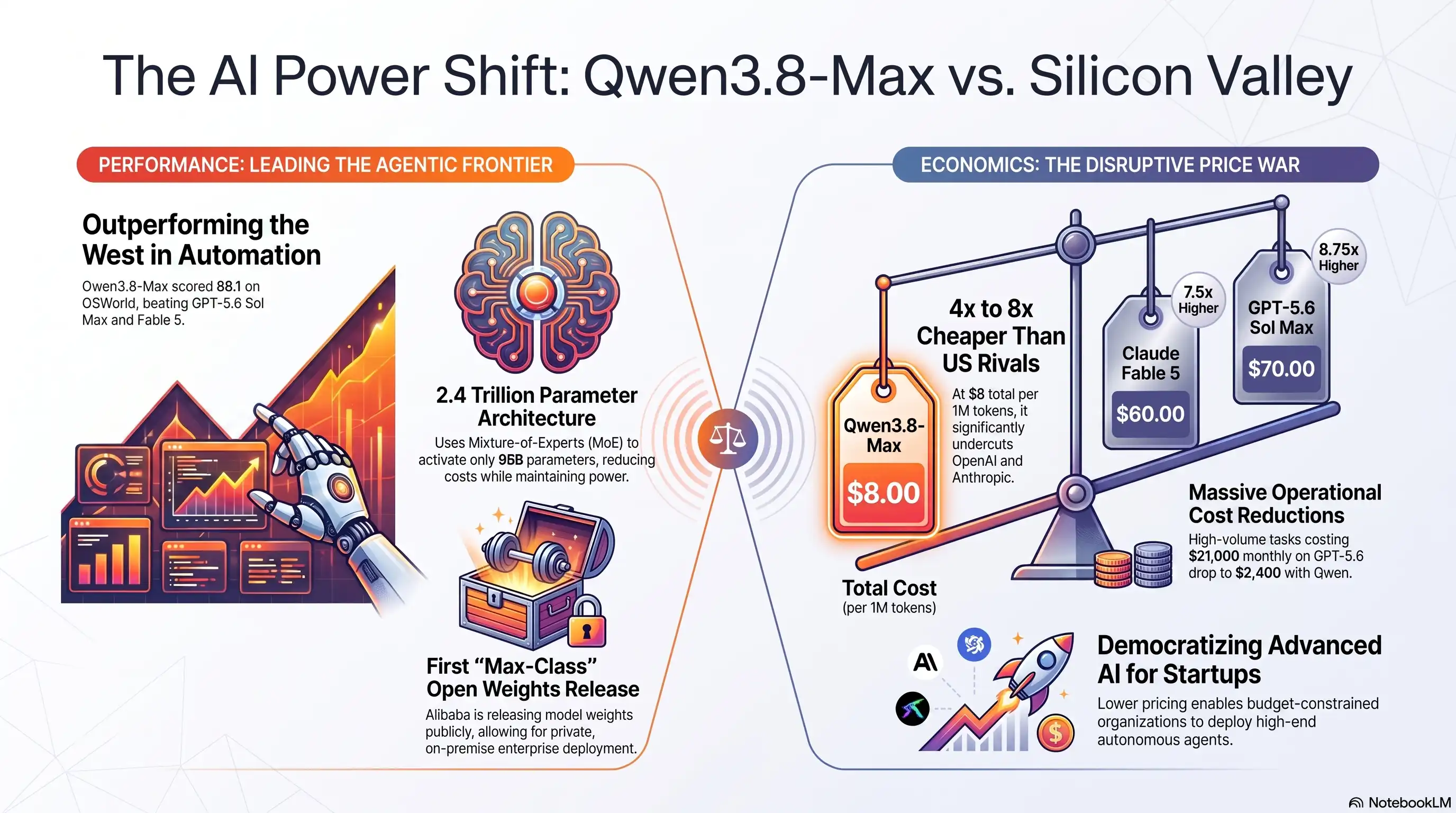
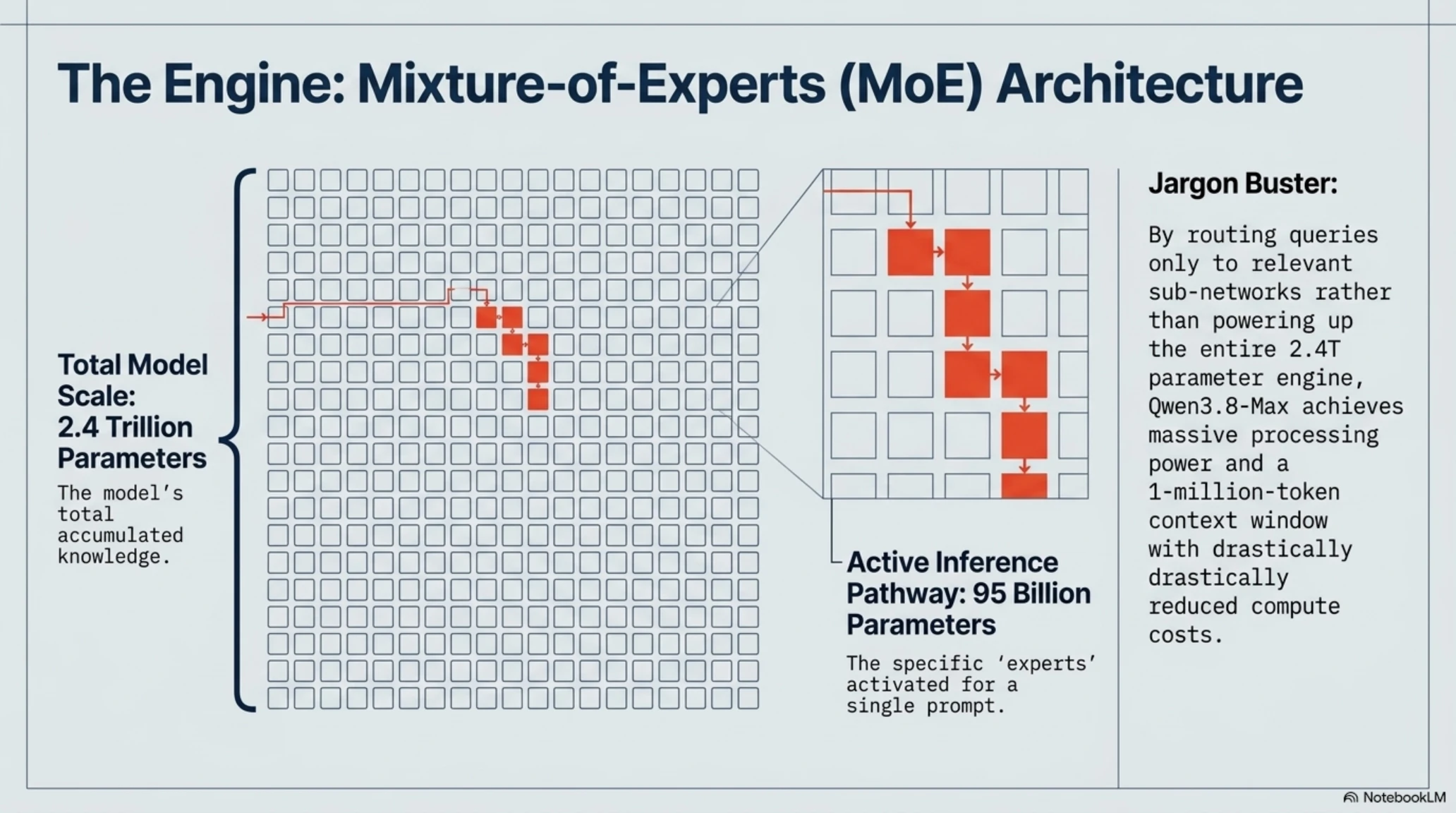
- MoE model with 2.4 trillion total parameters and 95 billion active parameters
- Supports text, image, and video input with 1 million token context window
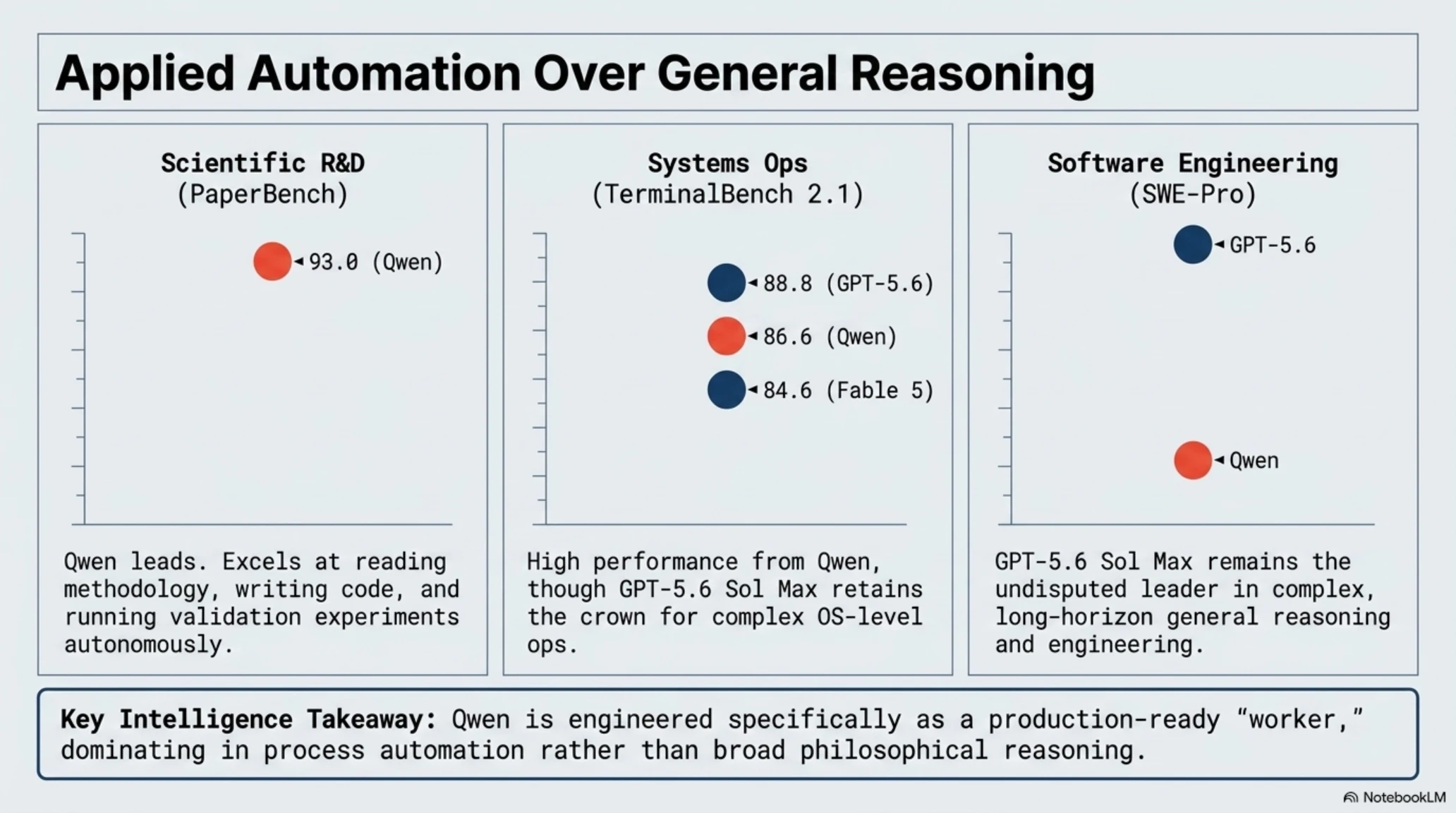
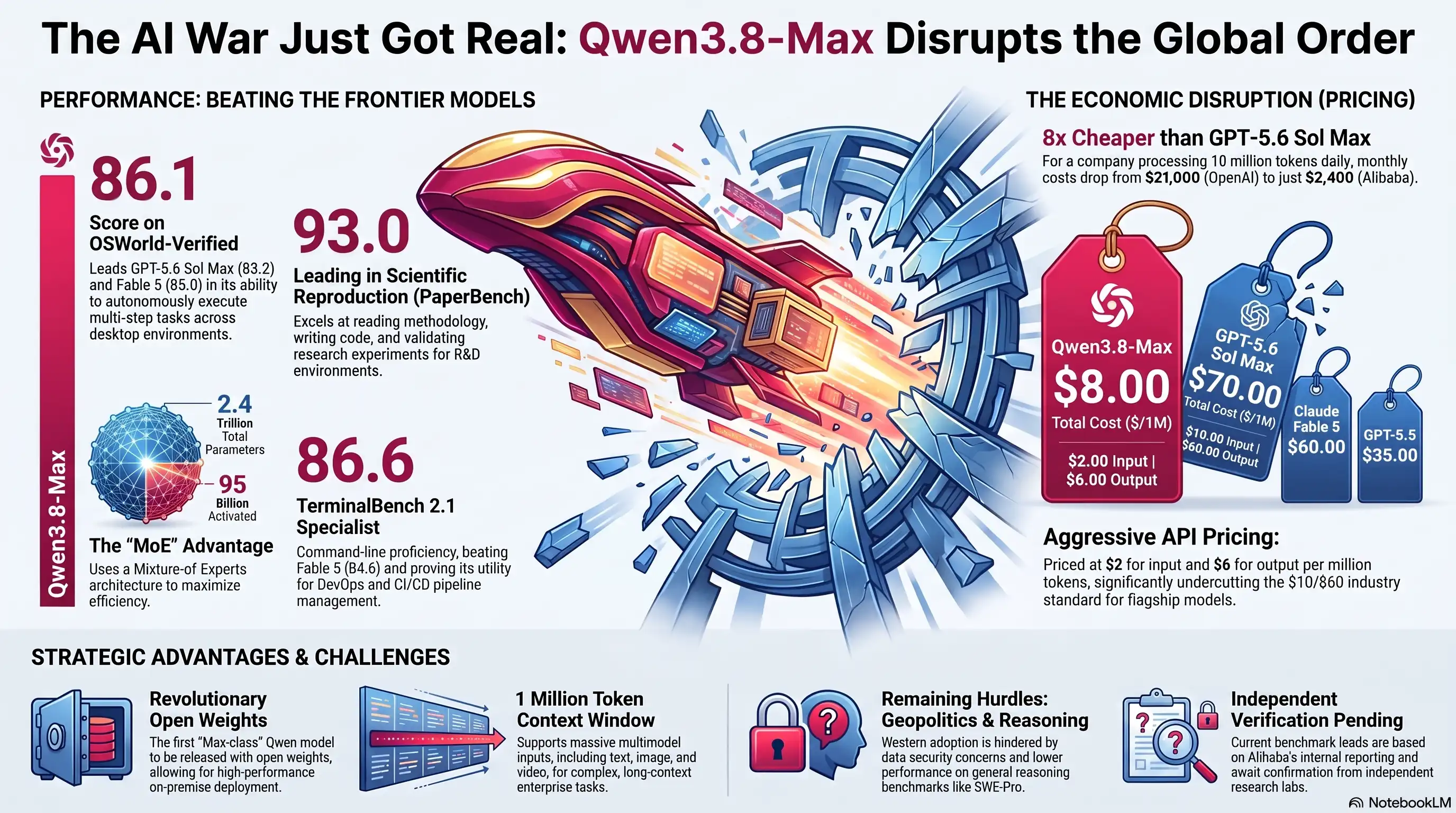
- Leads on OSWorld-Verified (86.1), PaperBench (93.0), and TerminalBench 2.1 (86.6)
- API pricing: $2 input / $6 output per million tokens
- Open weights releasing next week, first time for a Max-class Qwen model
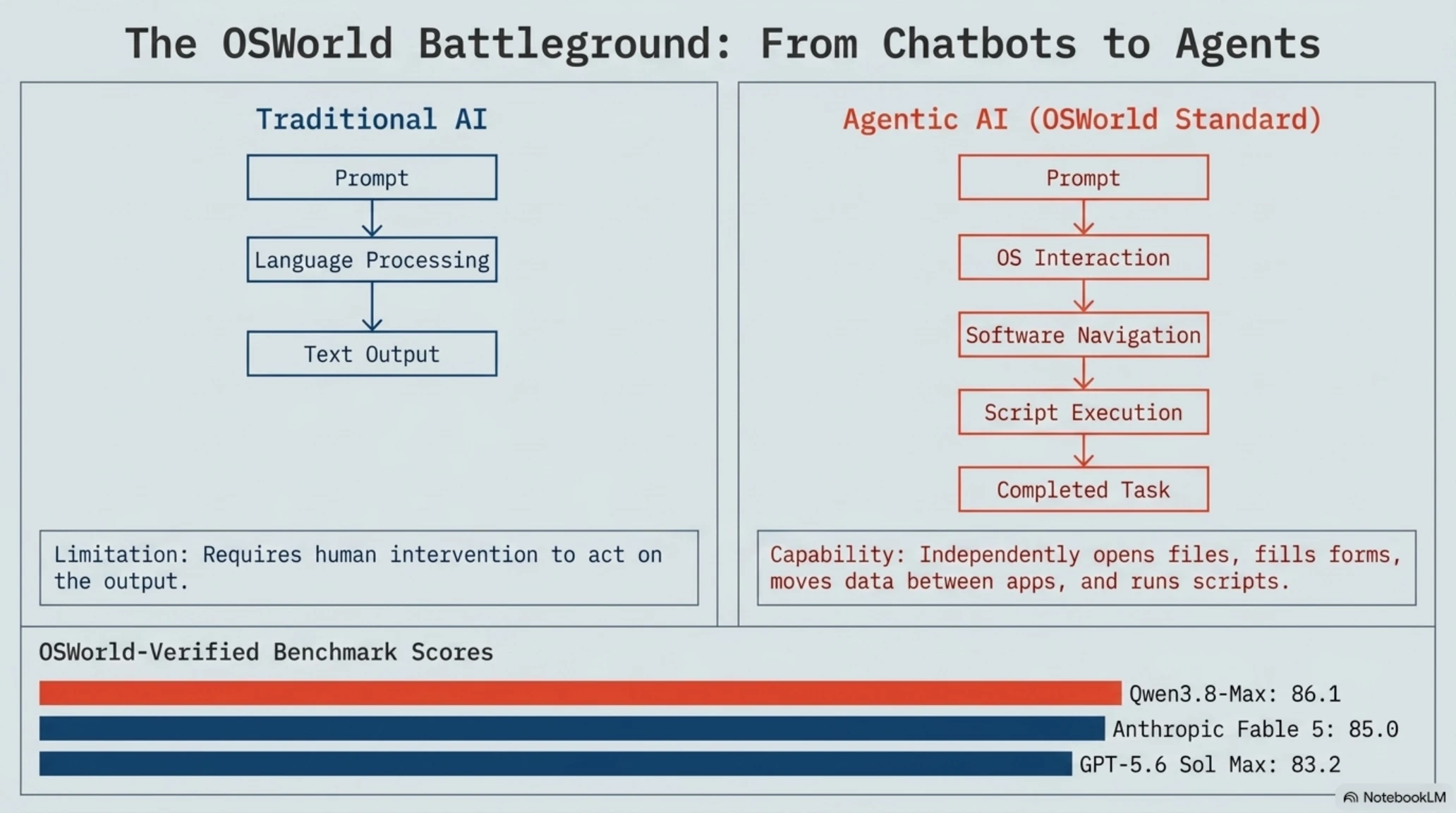
OSWorld: The New Battleground for AI Models
To understand why Qwen3.8-Max matters, look at the OSWorld-Verified benchmark. This test doesn't just measure a model's ability to answer questions—it evaluates how well a model can autonomously interact with desktop environments, execute software, and complete complex multi-step tasks without human intervention.
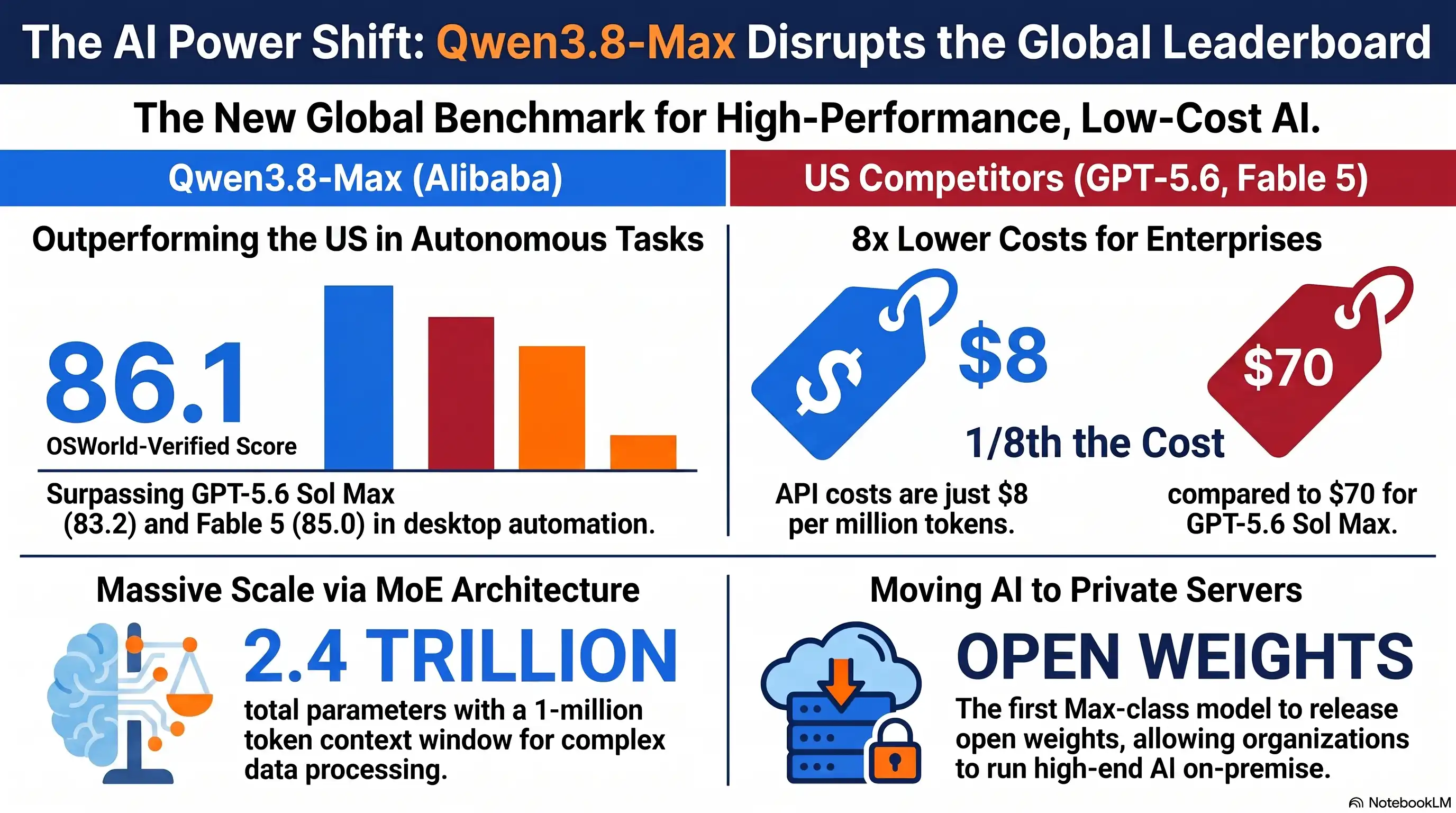
On this test, Qwen3.8-Max scored 86.1, surpassing GPT-5.6 Sol Max (83.2) and Fable 5 (85.0). What does this mean? It means Qwen can independently open files, fill forms, copy-paste data between applications, and even run scripts. This is precisely what enterprises need for automating repetitive processes.
Jargon Buster: What is MoE?
MoE (Mixture-of-Experts) is a model architecture that activates only a small subset of the network (experts) for each input, rather than using all parameters. Qwen3.8-Max has 2.4 trillion total parameters but activates only 95 billion simultaneously. This approach reduces inference costs while maintaining performance.
Why OSWorld Matters
Until recently, AI benchmarks focused primarily on language skills, math, or coding. But these metrics couldn't tell you how useful a model is in the real world. OSWorld simulates actual work environments (like Windows or macOS) and evaluates the model's ability to perform everyday tasks, providing a more accurate picture of its capabilities.
Qwen3.8-Max's dominance on this benchmark shows that Alibaba has focused on something enterprises truly value: automation. Imagine an AI agent that can automatically categorize emails, generate reports, sync data between systems, and make decisions when errors occur. That's what Qwen3.8-Max promises, and OSWorld results suggest this promise is realistic.
PaperBench and TerminalBench: Where Qwen Shines
Beyond OSWorld, Qwen3.8-Max also demonstrated impressive performance on two other benchmarks:
- PaperBench (93.0): This benchmark measures a model's ability to reproduce scientific research. It includes reading papers, understanding methodology, writing thousands of lines of code, and running experiments to validate results. Qwen3.8-Max leads here with a score of 93.0, showing strong potential for R&D environments, academic labs, and pharmaceutical companies.
- TerminalBench 2.1 (86.6): This benchmark evaluates how well a model can work with command line and OS-level tools. Qwen3.8-Max scored 86.6, beating Fable 5 (84.6), though GPT-5.6 Sol still leads with 88.8. This capability is invaluable for developers and DevOps teams, as it means the model can automate complex system tasks.
Why This Matters
Many organizations no longer want models that just answer questions. They want models that can do work: write code, test it, fix bugs, generate documentation, and even manage CI/CD pipelines. Qwen3.8-Max, by focusing on these practical capabilities, positions itself as a production-ready tool, not just an advanced chatbot.
Alibaba's Price War: The Real Blow to America
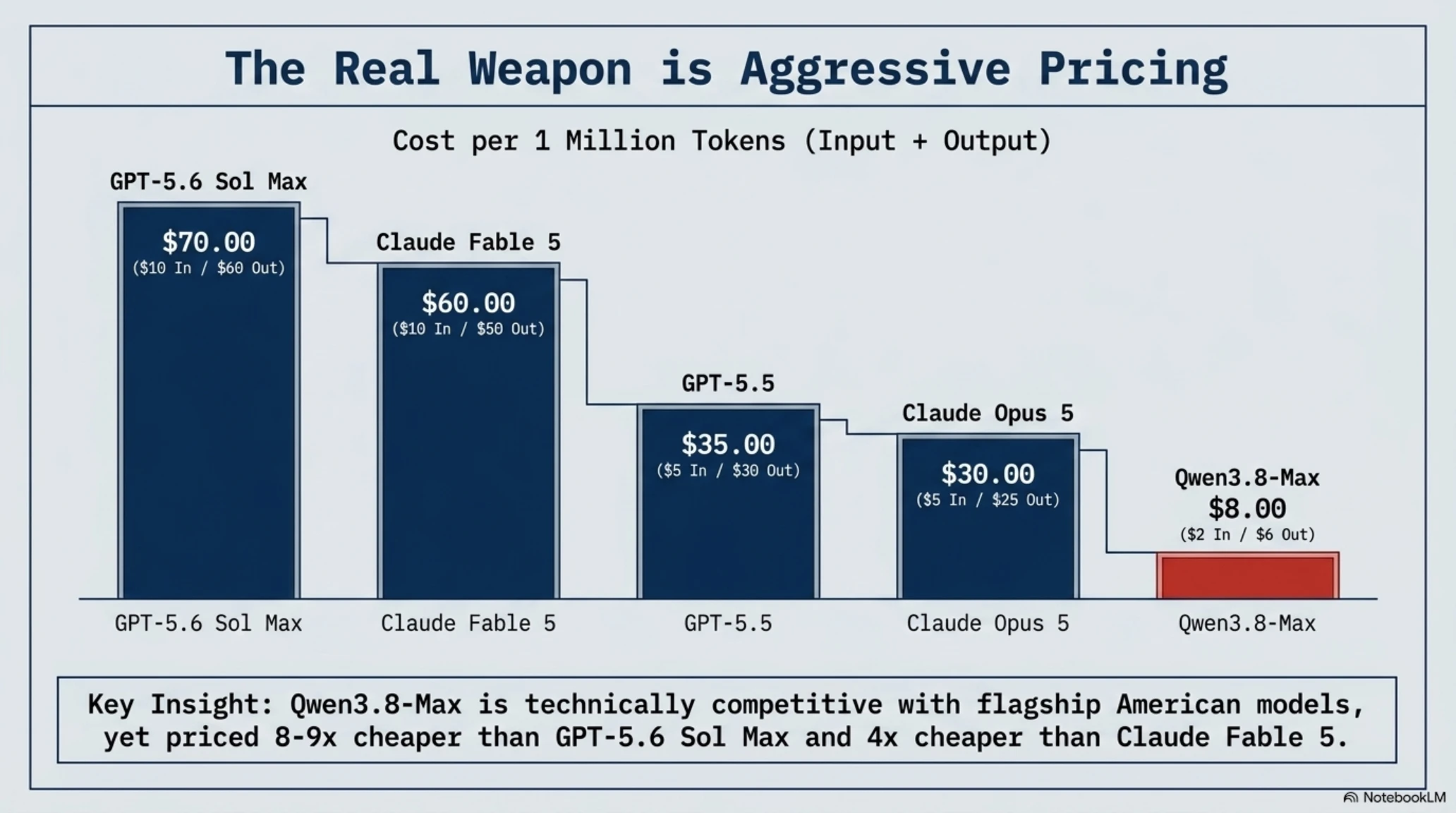
If you think technical superiority is what sets Qwen3.8-Max apart, you're missing the bigger picture. Alibaba has a more devastating weapon: aggressive pricing. The model's API on QwenCloud (China-based servers) costs $2 per million input tokens and $6 per million output tokens. Let's compare this with American competitors:
Frontier Model API Pricing Comparison
| Model | Input ($/1M) | Output ($/1M) | Total |
|---|---|---|---|
| Qwen3.8-Max | $2.00 | $6.00 | $8.00 |
| GPT-5.6 Sol Max | $10.00 | $60.00 | $70.00 |
| Claude Fable 5 | $10.00 | $50.00 | $60.00 |
| Claude Opus 5 | $5.00 | $25.00 | $30.00 |
| GPT-5.5 | $5.00 | $30.00 | $35.00 |
Source: QwenCloud, OpenAI, and Anthropic API documentation (August 2026)
As you can see, Qwen3.8-Max is roughly 4x cheaper than Claude Fable 5 and about 8-9x cheaper than GPT-5.6 Sol Max. Yet in terms of performance, it's not only competitive but actually leads on several benchmarks. What does this mean?
Why Pricing Matters So Much
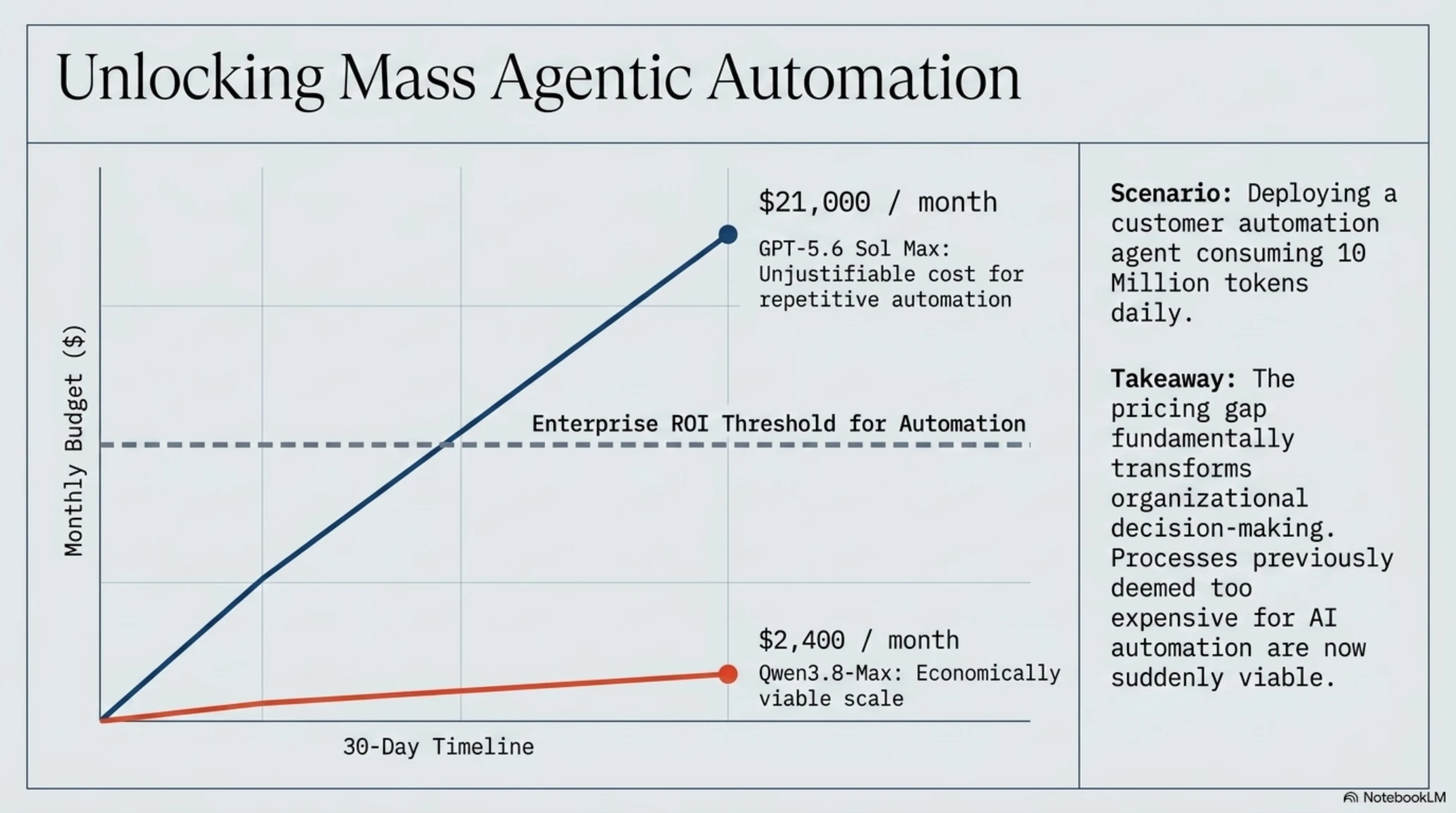
In the AI world, inference costs can quickly become one of the largest operational expenses, especially for agentic systems that consume millions of tokens per task. Suppose a company wants to deploy a customer automation system that processes 10 million tokens daily. With GPT-5.6 Sol Max, monthly costs could easily exceed $21,000. With Qwen3.8-Max, the same work costs only $2,400 per month.
This price difference can completely transform organizational decision-making. Many companies have avoided deploying AI agents because the costs seemed unjustifiable. But with Qwen3.8-Max, the equation has changed. Now more processes can be automated without exploding the IT budget.
Open Weights: Alibaba's Long Game
One of Alibaba's most controversial announcements was that Qwen3.8-Max open weights will be released next week. This marks the first time a Max-class model from the Qwen family will be publicly available. Previously, only smaller Qwen models (like Qwen3.8-27B) were released as open source.
Why This Is Revolutionary
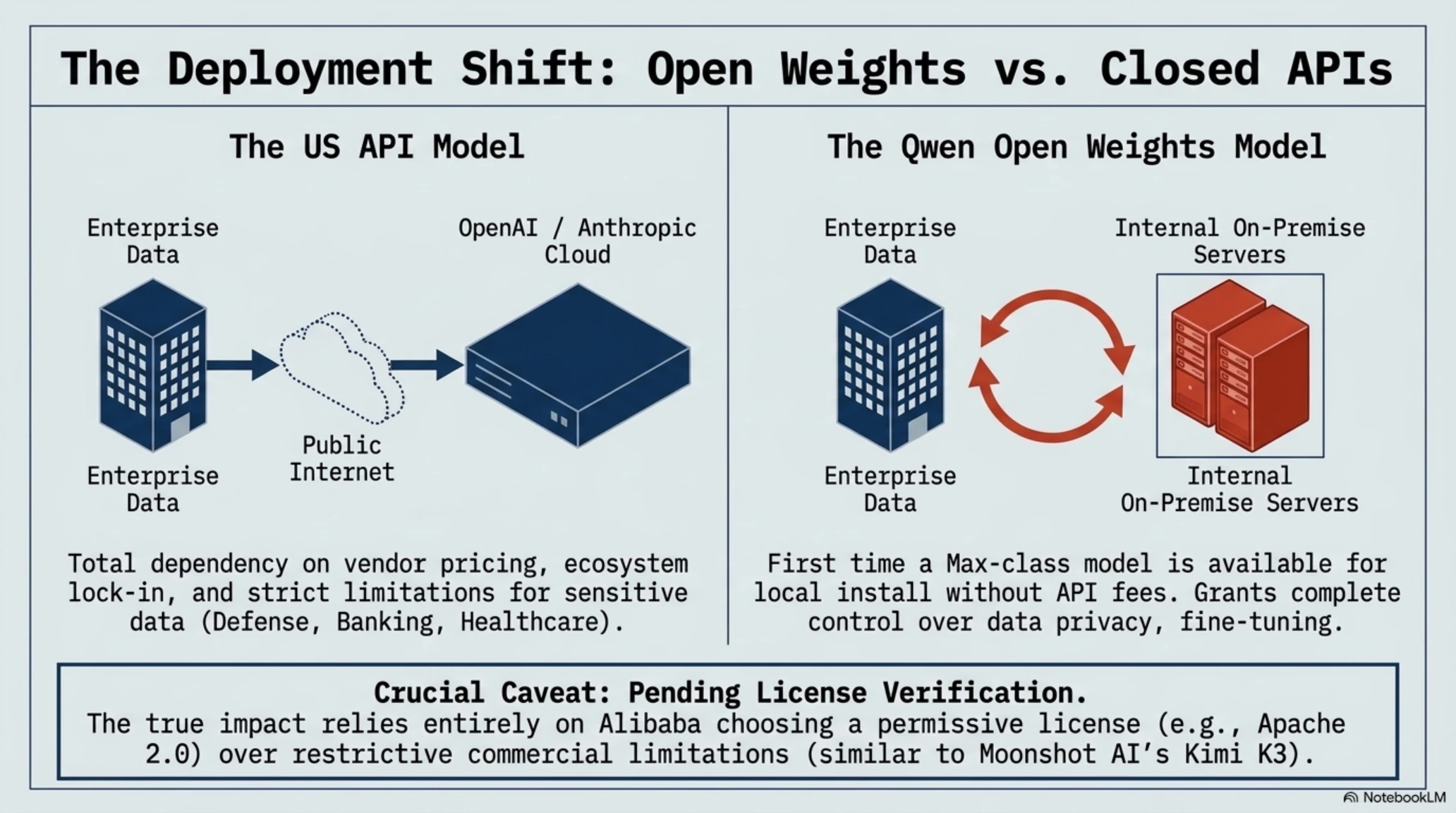
When a model is released as open weight, organizations can install it on their own servers, fine-tune it, and use it without paying API fees. This is invaluable for companies concerned about privacy or wanting complete control over their data. For example, banks, hospitals, and defense contractors that can't send sensitive data to cloud APIs can now use Qwen3.8-Max in their on-premise environments.
However, one important ambiguity remains: Alibaba hasn't yet disclosed the license details. If the license is permissive (like Apache 2.0), this will be a true game-changer. But if the license has restrictions (like prohibiting commercial use or requiring disclosure of modifications), its appeal will diminish. Moonshot AI recently released its Kimi K3 model as open weight, but with a custom license that had restrictions on commercial usage. We'll have to see which path Alibaba chooses.
Challenges Facing Qwen3.8-Max
Despite all the advances, Qwen3.8-Max still faces challenges that can't be ignored:
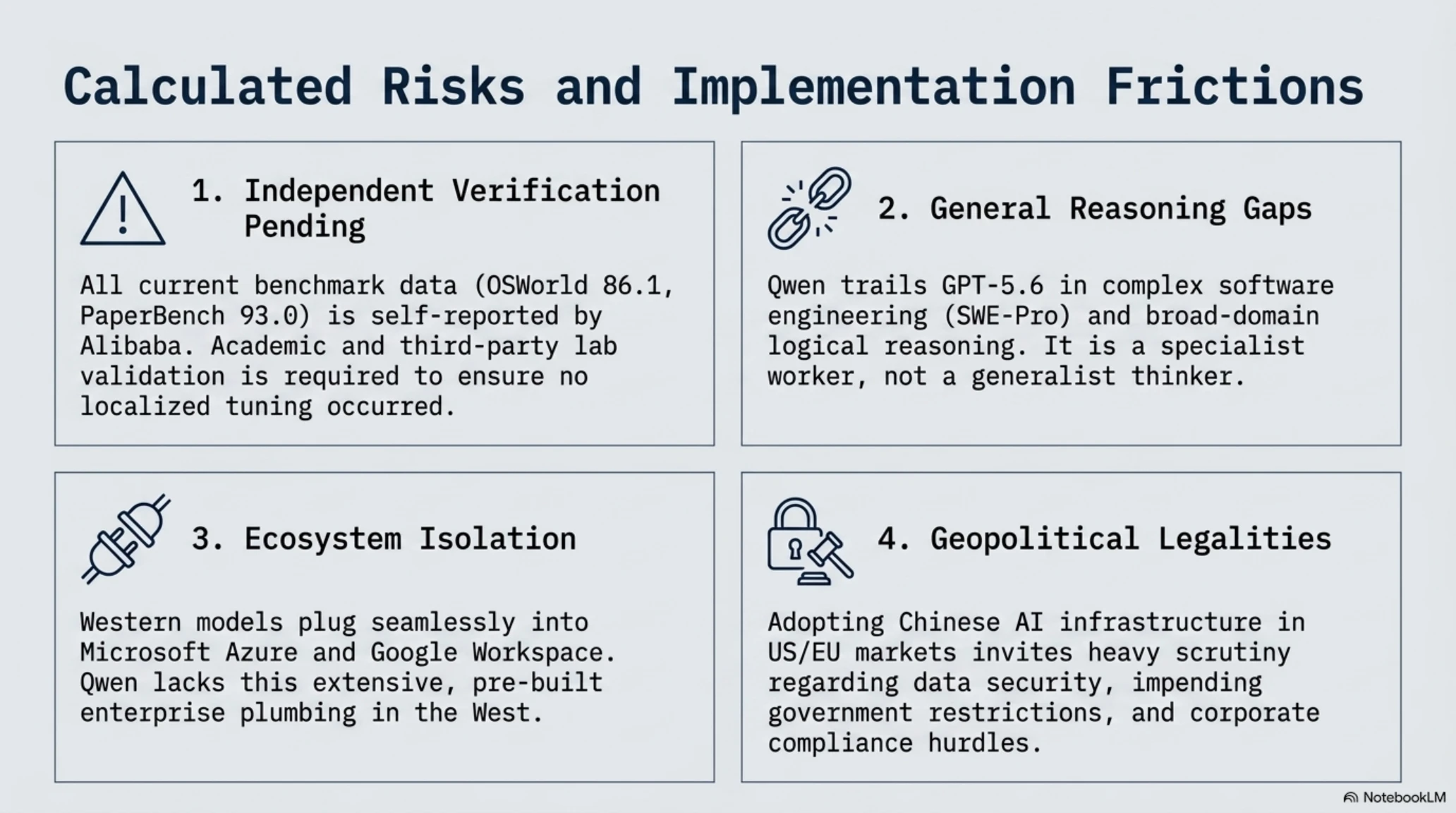
1. Independent Verification Still Pending
All benchmarks published by Alibaba were conducted by the company itself. Until independent teams (like universities or research labs) validate these results, they should be viewed with caution. History shows that companies sometimes tune benchmarks to make their models look better.
2. Performance Issues in General Reasoning
While Qwen3.8-Max excels at specific tasks (like coding and multimodal reasoning), it still trails American models on some general reasoning benchmarks. For example, on SWE-Pro (which measures software engineering skills), GPT-5.6 Sol Max holds the highest score. This shows Qwen isn't superior across all domains.
3. Ecosystem and Integration
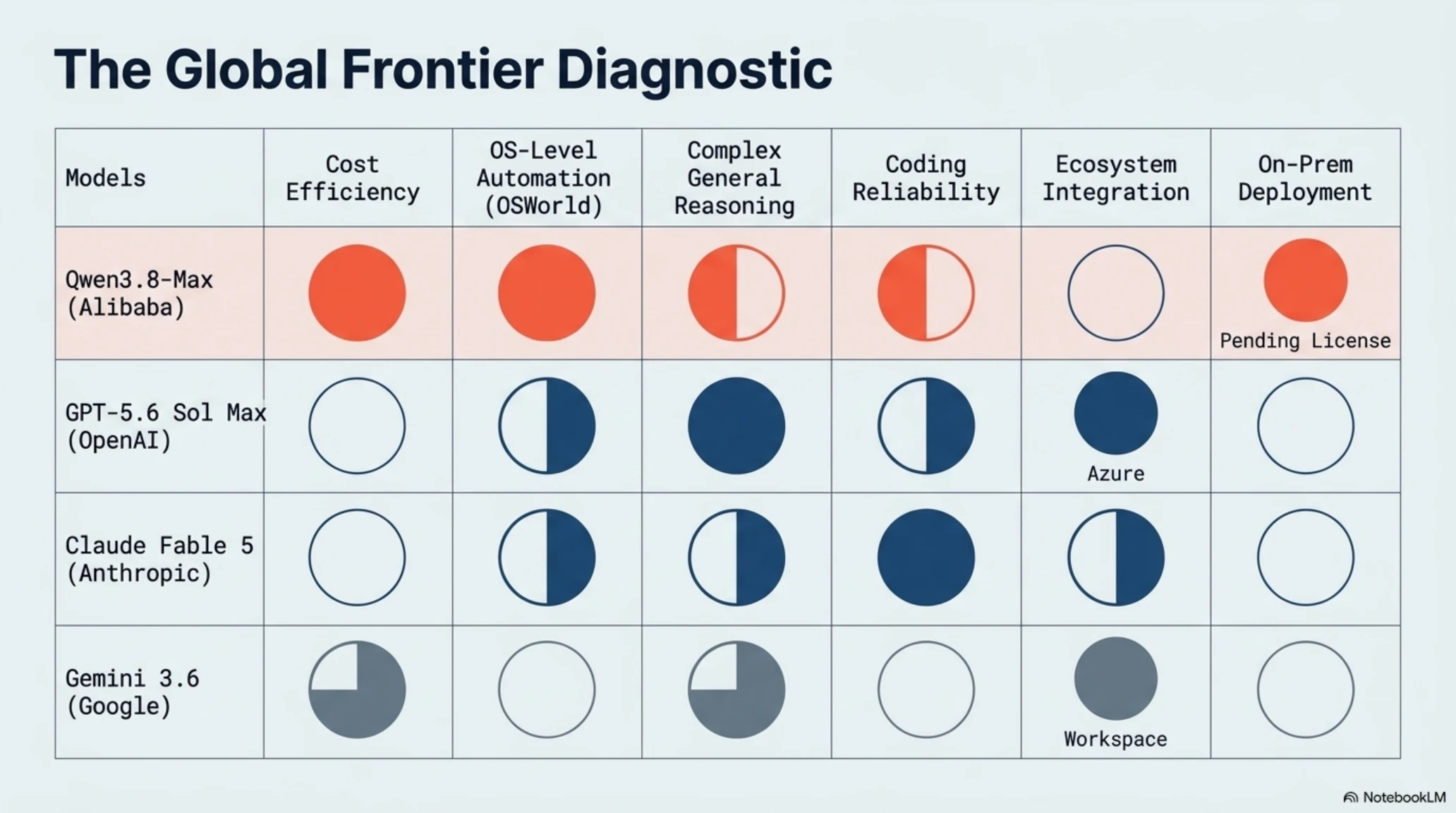
One of OpenAI and Anthropic's major advantages is their extensive ecosystem. GPT integrates well with Microsoft Azure, and Claude works with many tools. Qwen3.8-Max is still weaker in this area. Organizations using Microsoft or Google Cloud tools will likely prefer models with easier integration.
4. Geopolitical Challenges
Using a Chinese model for American and European organizations can raise legal and security issues. Some governments may impose restrictions on using Chinese technology, and companies worry about data security. This is a serious barrier to widespread Qwen3.8-Max adoption in the West.
Qwen3.8-Max vs American Competitors: Deep Comparison
To better understand where Qwen3.8-Max stands in this competition, we need a more detailed comparison with leading models. Each of these models has its specific strengths and weaknesses, and choosing the best model depends on your needs.
GPT-5.6 Sol Max (OpenAI): The Reasoning King
GPT-5.6 Sol Max still leads on many general reasoning benchmarks. If you're looking for a model that can solve complex problems, perform multi-step reasoning, and maintain consistency in long conversations, GPT-5.6 Sol Max remains the top choice. Additionally, OpenAI's ecosystem is very rich: from Azure to ChatGPT Enterprise, integration with Microsoft tools, and extensive third-party support.
But price is a serious problem. At $10 input and $60 output, this model is prohibitively expensive for agentic applications with high token consumption. OpenAI recently reduced prices on its mid-tier models in response to Chinese competition, but flagship models remain pricey.
Claude Fable 5 (Anthropic): The Coding Champion
Claude Fable 5 is known for its exceptional coding abilities. Many developers prefer Claude for its accuracy, reliability, and ability to understand long context. Claude also excels in safety and predictable behavior, making it suitable for sensitive environments.
However, Claude Fable 5, at $10 input and $50 output, is nearly as expensive as GPT-5.6 Sol Max. For organizations with limited budgets, this cost can be a significant barrier.
Gemini 3.6 (Google): Workspace Integration
Gemini 3.6's main advantage lies in its integration with Google's ecosystem. If your organization uses Google Workspace, Gmail, Google Drive, and other Google services, Gemini can work seamlessly with these tools. Gemini is also strong in multimodal reasoning and can work well with images, videos, and documents.
But Gemini lags behind Qwen3.8-Max and other competitors on some agentic benchmarks. On OSWorld-Verified, Gemini 3.1 Pro scored only 76.2, significantly lower than Qwen3.8-Max's 86.1.
- Superior performance on OSWorld and PaperBench
- Much lower price than competitors (4-8x cheaper)
- Supports multimodal input (image and video)
- 1 million token context window
- Open weights release coming
- Independent benchmark verification still pending
- Weaker ecosystem and integration than competitors
- Lower performance on some general reasoning benchmarks
- Geopolitical concerns for Western users
- Open weight license not yet specified
Real-World Use Cases: Who Should Use Qwen3.8-Max?
Given Qwen3.8-Max's strengths and weaknesses, let's examine what types of applications this model is best suited for:
1. Autonomous Software Development
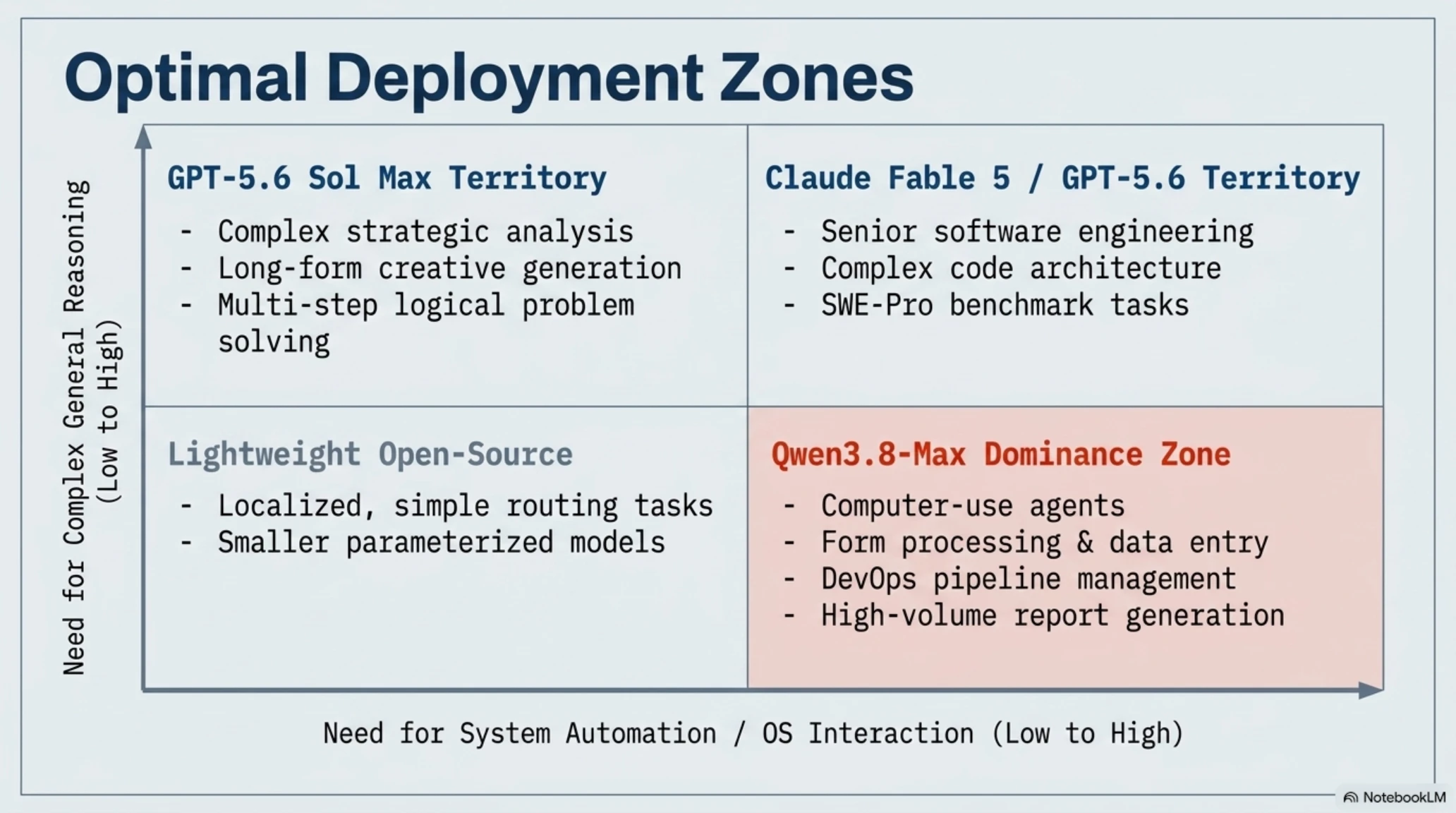
If you're looking for a model that can independently write code, test it, find and fix bugs, Qwen3.8-Max is an excellent choice. Alibaba claims this model can work autonomously on a project for up to 16 days, writing code, testing it, and improving it. This is highly attractive for DevOps teams and CI/CD workflows.
2. Computer-Use Agents
Qwen3.8-Max's dominance on OSWorld shows this model is very strong at interacting with operating systems and desktop software. Organizations wanting to automate repetitive administrative processes (like form processing, data entry, or report generation) can benefit from this capability.
3. Scientific Research and R&D
Qwen3.8-Max's leadership on PaperBench shows this model is suitable for research environments. Academic labs, pharmaceutical companies, and R&D teams can use Qwen for reproducing research, analyzing data, and running computational experiments.
4. Budget-Constrained Organizations
If inference cost matters to you, Qwen3.8-Max at $2/$6 instead of $10/$50 or $10/$60 can reduce your budget by 4-8x. This is very attractive for startups, small companies, and nonprofits.
5. Organizations Requiring On-Premise Deployment
With open weights release, organizations that can't send their data to the cloud (like banks, hospitals, and defense contractors) can install Qwen3.8-Max on their own servers and maintain complete control over their data.
Rumor vs. Reality
Rumor: Qwen3.8-Max beats GPT-5.6 on all benchmarks.
Reality: No. Qwen3.8-Max leads on specific benchmarks (OSWorld, PaperBench, TerminalBench), but still trails on some general reasoning and software engineering benchmarks (like SWE-Pro) where GPT-5.6 holds the top score. The best model choice depends on your application.
The Future: What Lies Ahead?
Qwen3.8-Max's unveiling marks a turning point in the AI war between China and America. But this story isn't finished yet. What lies ahead?
1. Price Competition Will Intensify
With models like Qwen3.8-Max offering competitive performance at much lower prices, OpenAI and Anthropic will be forced to reduce their prices further. We've already seen this trend: OpenAI recently reduced GPT-5.6 Terra and Luna prices by 20% and 80%, respectively. This is likely just the beginning.
2. More Open Weight Models Coming
Qwen3.8-Max and Kimi K3 show that China is moving toward opening its models. This could put significant pressure on American companies to either open their models or at least reduce their prices.
3. Independent Verification of Results
In the coming weeks and months, independent researchers will start testing Qwen3.8-Max. If Alibaba's results are confirmed, this model could be rapidly adopted. But if discrepancies are found, its credibility will be damaged.
4. Political and Legal Reactions
Western governments will likely react to China's rapid AI progress. More restrictions on using Chinese models may be imposed, or support programs for domestic companies may be launched.
Tekin Analysis: Why This Is a Game Changer
At Tekin editorial, we believe Qwen3.8-Max represents a genuine turning point, not just a technical advancement. Here's why:
Tekin Analysis
For years, Silicon Valley told the story: America innovates, China copies. But Qwen3.8-Max shows this narrative is no longer accurate. China didn't just catch up—it surpassed in some areas. And most importantly, it did so at a price that fundamentally changes the competition.
The biggest shift is pricing. With aggressive pricing, Alibaba can shake up the enterprise market and enable small and medium businesses to use advanced AI. This is democratization of AI.
Challenges remain, of course. Independent verification, geopolitical issues, and licensing questions all need answers. But one thing is certain: the game has changed, and no one can ignore China anymore.
Three Main Reasons Why Qwen3.8-Max Matters:
- Breaking America's Monopoly: For the first time, a Chinese model has surpassed American models on key benchmarks. This shows the technology gap has closed.
- Changing Economic Equations: At 4-8x lower pricing, Qwen3.8-Max can disrupt the market and put massive pressure on competitors.
- Democratizing Advanced AI: With open weights release, even smaller organizations can use high-end models without massive budgets.
Conclusion: The Beginning of a New Era in AI
Qwen3.8-Max isn't the end, but the beginning of a new era. An era where China is not just a player but a potential leader. An era where price matters as much as performance. And an era where open weights can return power from big companies to the community.
But this story isn't complete yet. Many questions remain: Will Qwen3.8-Max's license be permissive? Will benchmark results be confirmed by independent teams? Will Western companies trust using a Chinese model? And most importantly, how will OpenAI and Anthropic respond?
One thing is certain: the AI war has entered a new phase, and this is just the beginning. If you're a developer, a CTO, or a technology decision-maker, you can't ignore Qwen3.8-Max. Whether you use it or not, you need to take it seriously.
Frequently Asked Questions
Is Qwen3.8-Max really better than GPT-5.6?
It depends on your application. Qwen3.8-Max performs better than GPT-5.6 on specific benchmarks like OSWorld, PaperBench, and TerminalBench, but still trails on some general reasoning benchmarks. For agentic work and long-term coding, Qwen is excellent, but for complex reasoning, GPT-5.6 may be better.
Why is Qwen3.8-Max so cheap?
Several reasons: 1) MoE architecture reduces inference costs, 2) Alibaba's strategy to capture market share with aggressive pricing, 3) Lower infrastructure and labor costs in China. Alibaba wants to rapidly gain enterprise market share, even if initial profits are lower.
Is using a Chinese model safe?
This is a complex question that depends on your use case. If you use the API, your data is processed on Chinese servers, which may raise privacy concerns. But if open weights are released and you install it on-premise, this concern is reduced. For sensitive data, we recommend waiting until license and more details are clarified.
When will Qwen3.8-Max open weights be released?
Alibaba announced that Qwen3.8-Max open weights will be released next week (after August 3, 2026). However, license details are not yet specified. We suggest following the official Qwen website and GitHub repositories to be informed of the exact release date.
Is Qwen3.8-Max suitable for small startups?
Yes, especially if you have a limited budget. At $2/$6 vs $10/$50 or $10/$60 for competitors, you can reduce costs by 4-8x. This could be the difference between implementing an AI feature or not. However, make sure the model's performance meets your specific needs.
How will American models respond to this competition?
We've already seen initial responses: OpenAI reduced mid-tier model prices by up to 80%. We'll likely see more price reductions in coming months. American companies may also focus on unique features (like safety, reliability, or better integration) to differentiate themselves.
Sources and References
- VentureBeat: Qwen3.8-Max arrives with bold benchmark claims
- Forbes: Alibaba Unveils Qwen3.8-Max Model
- Qubrid: Qwen 3.8 Max API Benchmarks & Pricing
- Quartz: Alibaba launches Qwen3.8-Max
- InfoWorld: Alibaba takes aim at OpenAI with Qwen3.8-Max
Content is based on information released by Alibaba, reputable media reports, and independent analysis. Some benchmark data was provided by Alibaba and has not yet received full independent verification.
Additional Gallery: Tekin Analysis | AI War 2026: Qwen3.8-Max Dethrones GPT-5.6