Good Morning! Your Monday AI & Tech Breakfast
Welcome to Tekin Morning. Start your week with six groundbreaking stories from the world of technology and artificial intelligence.
- 🎮OpenAI Astra Solves 10 Math Problems- Decade-old problems cracked with verifiable Lean 4 proofs
- 🎧Google Cancels AI Studio App- 800,000 pre-orders scrapped, features merged into Gemini
- 🚀Voice Search Gets Major Redesign- Unified interface combines AI Mode and Search Live
- 🗡️Tap to Share Coming to Android- AirDrop-like feature for seamless file transfers
- 📰Samsung One UI 9.5 Testing Begins- Early build spotted on Galaxy S27 Ultra with Android 17
- ⚔️ChatPlayground AI Platform- Access 20+ AI models from one dashboard
Monday morning, August 3, 2026, brings us six transformative stories from the technology world that showcase how rapidly the industry continues to evolve. OpenAI unveiled its Astra model capable of solving mathematical problems that have stumped researchers for decades, Google made the surprising decision to cancel its AI Studio app despite 800,000 pre-orders and integrate its features into Gemini, the company's Voice Search received a comprehensive redesign unifying all search modes in one place, Android is testing Tap to Share as a serious AirDrop competitor, Samsung officially began testing One UI 9.5 on the Galaxy S27 Ultra, and ChatPlayground AI launched offering simultaneous access to over 20 AI models from a single interface.
At a Glance: Tekin Morning
- OpenAI Astra model solves 10 open problems in mathematics and computer science with machine-checkable proofs
- Google cancels AI Studio mobile app with 800,000 pre-orders, integrating features into Gemini instead
- Google Voice Search redesign unifies Search, AI Mode, Live, and Song Search in one interface
- Android Tap to Share feature enables file transfer by simply touching devices together
- Samsung begins official One UI 9.5 testing on Galaxy S27 Ultra running Android 17
- ChatPlayground AI provides access to ChatGPT-5, Claude, Gemini, and 20+ other models simultaneously
OpenAI Astra: When AI Becomes a Mathematician
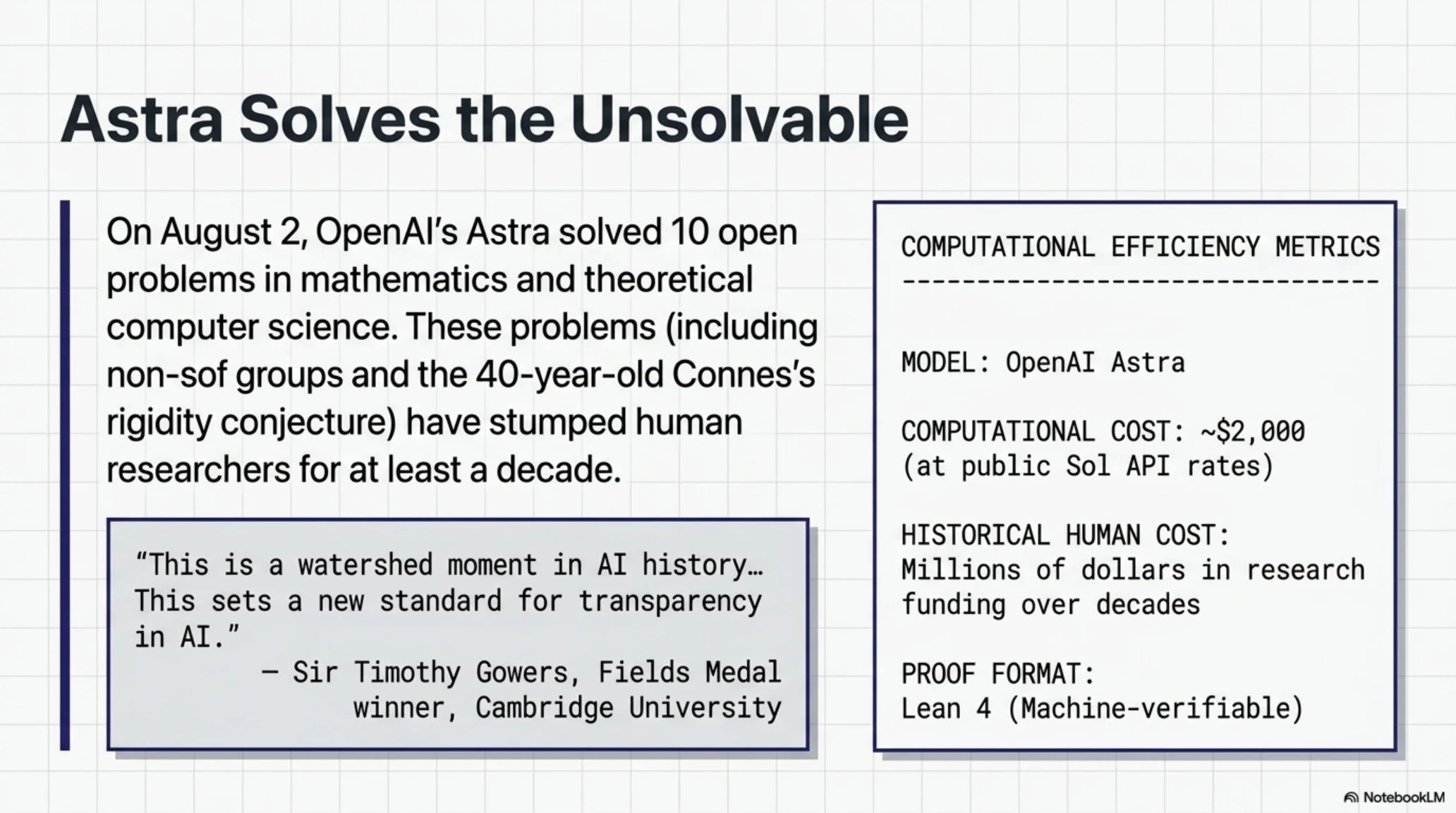
On Sunday, August 2, the scientific world witnessed something extraordinary. OpenAI revealed its new model called Astra, which successfully solved ten open problems in mathematics and theoretical computer science. These problems had remained unsolved for at least a decade, with some dating back over 40 years. But what makes this announcement particularly significant is not just the solutions themselves, but how they were presented.
OpenAI provided complete mathematical proofs for each of the ten problems, written in Lean 4, a formal proof verification system. This means anyone with a laptop can download these proofs and independently verify their correctness. In a scientific world that constantly struggles with reproducibility issues, this represents a major step forward in transparency and accountability.

According to OpenAI's published report, the computational cost of finding these ten solutions was approximately $2,000 at public Sol API rates. While this might seem expensive, consider that some of these problems have consumed millions of dollars in research funding over decades. The efficiency gain is remarkable.
Why Lean 4 Matters for Scientific Progress
Lean is a programming language designed specifically for writing formal mathematical proofs. When a proof is written in Lean, the compiler automatically checks the correctness of every single step. If even one line contains an error, the compiler rejects it. This eliminates the possibility of human oversight that plagues traditional mathematical proofs.
Formal Proofs vs Traditional Proofs
In traditional mathematics, researchers write their proofs in natural language and have peers review them. Human error is always present. Formal proofs using languages like Lean eliminate this risk entirely.
The most famous example is the Four Color Theorem, proven with computer assistance in the 1970s but remained controversial for years. Only after a formal version was written in Coq in 2005 were all doubts finally resolved. The theorem states that any map can be colored using only four colors such that no adjacent regions share the same color.
Among the problems Astra solved, one relates to non-sofic groups, a complex concept in group theory that even professional mathematicians find challenging. Another concerns Connes's rigidity conjecture, which had been open for more than 40 years. OpenAI claims that Astra not only proved this conjecture but did so in a way that can be generalized to related problems.
The technical achievement here is multilayered. First, Astra had to understand the problem statement, which requires deep mathematical knowledge. Second, it had to devise a strategy for approaching the proof. Third, it had to execute that strategy while maintaining formal rigor at every step. And finally, it had to do all of this in a format that a proof verification system would accept.
The Challenges Ahead
Despite this impressive achievement, not everything is rosy. In June 2026, hundreds of mathematicians published the "Leiden Declaration" warning about the risks of using AI in mathematics. They expressed concerns about unreliable proofs, improper attribution, and research bias. The declaration argued that while AI can be a powerful tool, it must be used carefully with proper oversight.
Another concern is that the Astra model remains unreleased and exists only as an internal OpenAI version. This means the scientific community cannot directly work with the model and must trust OpenAI's claims. However, publishing the Lean proofs does mitigate this concern somewhat, as at least the final results are independently verifiable.
There's also a broader philosophical question: if AI can solve problems that humans cannot, what does that mean for the future of mathematics? Will mathematicians become curators of AI-generated proofs rather than creators? Or will AI become a powerful tool that enables mathematicians to tackle even harder problems? The community remains divided on these questions.
Google's Strategic Pivot: AI Studio Becomes Gemini Casualty
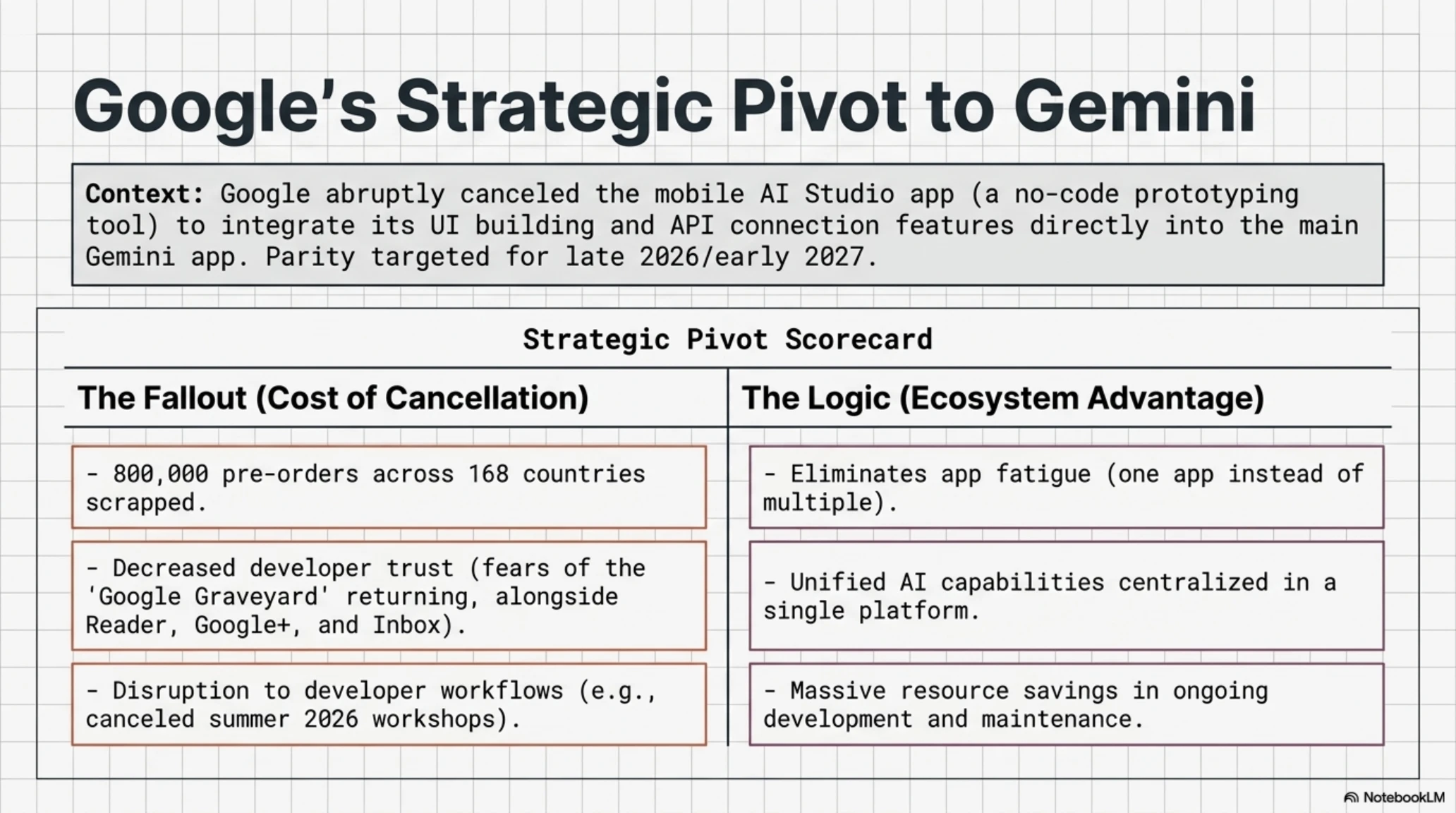
In news that surprised many observers, Google announced on Thursday, July 31, that it is canceling the mobile AI Studio app that was set to launch soon. This decision came despite more than 800,000 users across 168 countries pre-ordering the application on Google Play and the App Store.
Why did Google make this decision? The answer lies in the company's new strategy for consolidating AI services. Instead of having separate applications for each capability, Google wants to centralize everything within the Gemini app. This represents a significant shift in how the company thinks about its AI product portfolio.
What Was AI Studio?
AI Studio was a no-code tool announced at Google I/O 2026. Its goal was to enable users to transform their ideas into working prototypes without writing code. Using Gemini, users could describe what application they wanted, and AI Studio would build it.
Key capabilities included UI building, API connections, and rapid idea testing. Now these features will be integrated directly into the Gemini app, eliminating the need for a standalone application.
The AI Studio team explained in a post on X that the 800,000 pre-orders demonstrate strong interest in mobile software creation. However, they don't want to ask users to install yet another app. Therefore, they decided to incorporate AI Studio's capabilities directly into Gemini, creating a more streamlined experience.
Mixed Reactions from the Developer Community
Reactions to this decision have been mixed. Some developers argue that this move makes sense because having too many apps for similar tasks becomes confusing. But others feel disappointed because they were expecting a dedicated tool for rapid prototyping. This decision has also raised questions about Google's long-term strategy in AI. Is Google committed enough to its promises? Can we trust products that haven't been released yet?
One developer who preferred to remain anonymous wrote in an online forum: "I had planned an entire summer 2026 workshop based on this application. Now I have to change everything. This shows how dangerous it is to depend entirely on one company for development tools." On the other hand, some believe that integration with Gemini makes more sense in the long run and could provide a more unified user experience.
The broader implication is about trust in Google's product roadmap. The company has a history of launching and then discontinuing products, a pattern that has earned it the nickname "Google Graveyard" in some circles. Services like Google Reader, Google+, and Inbox by Gmail were all popular but eventually shut down. AI Studio joining this list before even launching raises questions about whether developers should invest time learning Google's AI tools.
Interestingly, Google made this decision after months of work on the project and positive feedback from beta testers. This demonstrates that even large technology companies must sometimes rapidly change their strategies in response to evolving market conditions and internal priorities.
- Reduced complexity for users - one app instead of multiple
- Better integration with the Gemini ecosystem
- Resource savings in development and maintenance
- More unified user experience for building and testing
- Consolidated AI capabilities in single platform
- Disappointment for 800,000 who pre-ordered
- Lost opportunity to separate professional tools from general tools
- Risk of cluttering the Gemini interface
- Decreased trust in future Google projects
- Developers who planned around AI Studio now scrambling
The important point is that Google has promised to implement all AI Studio capabilities within Gemini. This means users who were waiting for this tool will ultimately get the same experience, just in a different application. These features are expected to gradually appear in Gemini over the coming months, with full parity targeted for late 2026 or early 2027.
Google Voice Search Revolution: Everything in One Place
If you're an Android user, you've probably used the voice search feature many times by tapping the microphone icon in the Google Search Bar. Now Google has completely redesigned this experience with a new design that brings all search options into one location.
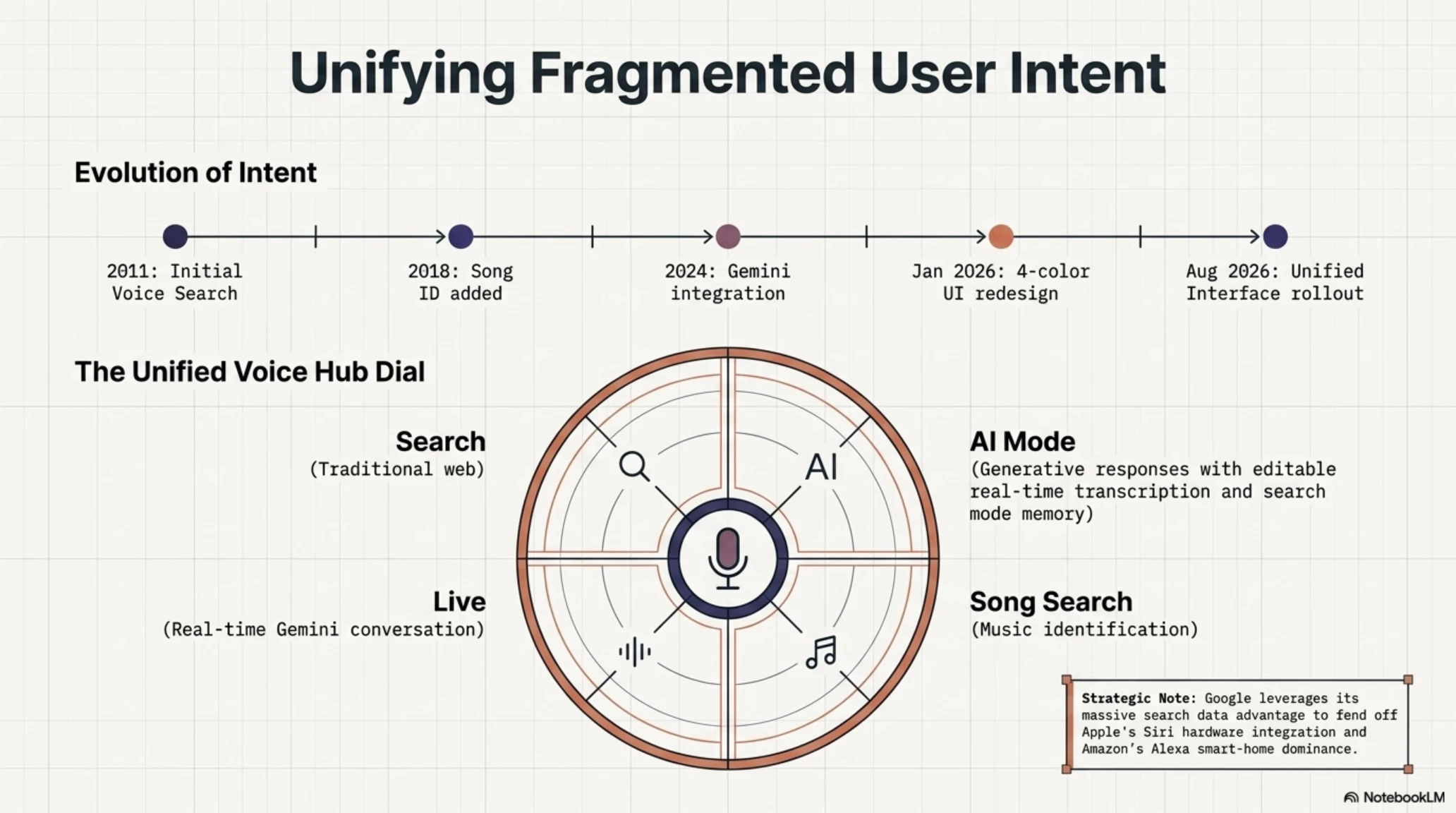
In the new design, when you tap the microphone icon, a toolbar appears at the bottom of the screen offering four options: Search (regular search), AI Mode (smart search with generative responses), Live (live conversation with Gemini), and Song Search (music identification). Previously, accessing each of these features required navigating to different places.

Live Transcription and Text Editing
One of the new features is real-time transcription. When you start speaking, the text of what you're saying immediately appears on the screen. This allows you to see exactly what Google heard and edit the text before submitting your search if there are any errors.
Another feature is search mode memory. Google now remembers which mode you used last. If you typically use AI Mode, the next time you open the microphone, that mode will be selected by default. This small but important detail makes the user experience faster and more fluid.
Google Voice Search Development Timeline
| Year | Event |
|---|---|
| 2011 | Initial Voice Search launch for Android |
| 2018 | Song identification capability added |
| 2024 | Initial Gemini integration in voice results |
| January 2026 | Interface redesign with four-color animation |
| August 2026 | Unified interface rollout with four search modes |
In AI Mode, there's an arrow button to complete your question and a stop button that redirects you to a search page with the transcribed text so you can make further edits. This gives you more control and prevents sending incomplete or incorrect searches.
Competition with Siri and Alexa Intensifies
This update comes at a time when competition in the smart voice assistant space has intensified. Apple recently upgraded Siri with new AI capabilities, and Amazon has equipped Alexa with new large language models. Google wants to demonstrate with this redesign that it remains the leader in voice search.
A closer comparison shows that Google has a significant advantage in search data - something neither Apple nor Amazon has access to. This data allows Google to provide more accurate and relevant results. However, Apple is stronger in hardware-software integration, and Siri can work better with the Apple ecosystem. Amazon, with its focus on shopping and smart homes, has its own niche market.
According to published reports, this new design is gradually rolling out to Android users, and by the end of August, most users are expected to have access. Google has also announced that more features will be added to this interface in the coming months, including support for more languages and deeper integration with other Google services.
Tap to Share: Android's Answer to Apple AirDrop
For years, Android users have envied Apple's AirDrop feature, which allows you to transfer files by simply bringing two devices close together. Now Google is testing a feature called Tap to Share that does exactly that.
Tap to Share is a new layer on top of the existing Quick Share feature. Quick Share itself was the result of collaboration between Google and Samsung to replace the old Nearby Share. But the problem with Quick Share was that using it required opening the share menu, selecting Quick Share, and then choosing the destination device. It was a multi-step process.

Tap to Share simplifies this process dramatically. You simply select the file you want to share and bring the two phones close together. Using NFC and Bluetooth, the devices recognize each other and file transfer begins automatically. No more menu manipulation required.
The Technology Behind the Scenes
Tap to Share uses a combination of NFC (Near Field Communication) for initial recognition and Bluetooth or Wi-Fi Direct for actual file transfer. NFC only works for the initial handshake and exchange of authentication information. Then the faster channel (Bluetooth 5.3 or Wi-Fi Direct) activates for file transfer.
File Transfer Speed Comparison
| Technology | Theoretical Speed | Real Speed (1GB) |
|---|---|---|
| Bluetooth 5.3 | 2 Mbps | ~70 seconds |
| Wi-Fi Direct | 250 Mbps | ~4 seconds |
| Quick Share | Variable | 5-10 seconds |
| AirDrop (Wi-Fi) | 500 Mbps | ~3 seconds |
* Actual speed varies depending on environmental conditions and device capabilities
One advantage of Tap to Share is that it works with non-Samsung devices as well. In the past, some file sharing features only worked between devices of the same brand. But Google wants to make Tap to Share an Android standard that works on all phones, regardless of manufacturer.
The implementation uses Ultra-Wideband (UWB) technology in supported devices for even more precise positioning. UWB allows devices to determine their exact distance and relative position with centimeter-level accuracy, enabling more reliable connections even in crowded environments with many nearby devices.
When Will It Be Released?
According to APK code analysis of the Google Play Services beta version, Tap to Share is still in development and has disabled features. Google will likely officially announce it at one of its upcoming events, perhaps at Google I/O 2027 or with the release of Android 18.
Until then, users can continue using Quick Share, which remains one of the best available options for file sharing in the Android ecosystem. The feature works reliably across billions of Android devices and has matured significantly since its initial launch.
Samsung One UI 9.5: The Future of Galaxy Interface
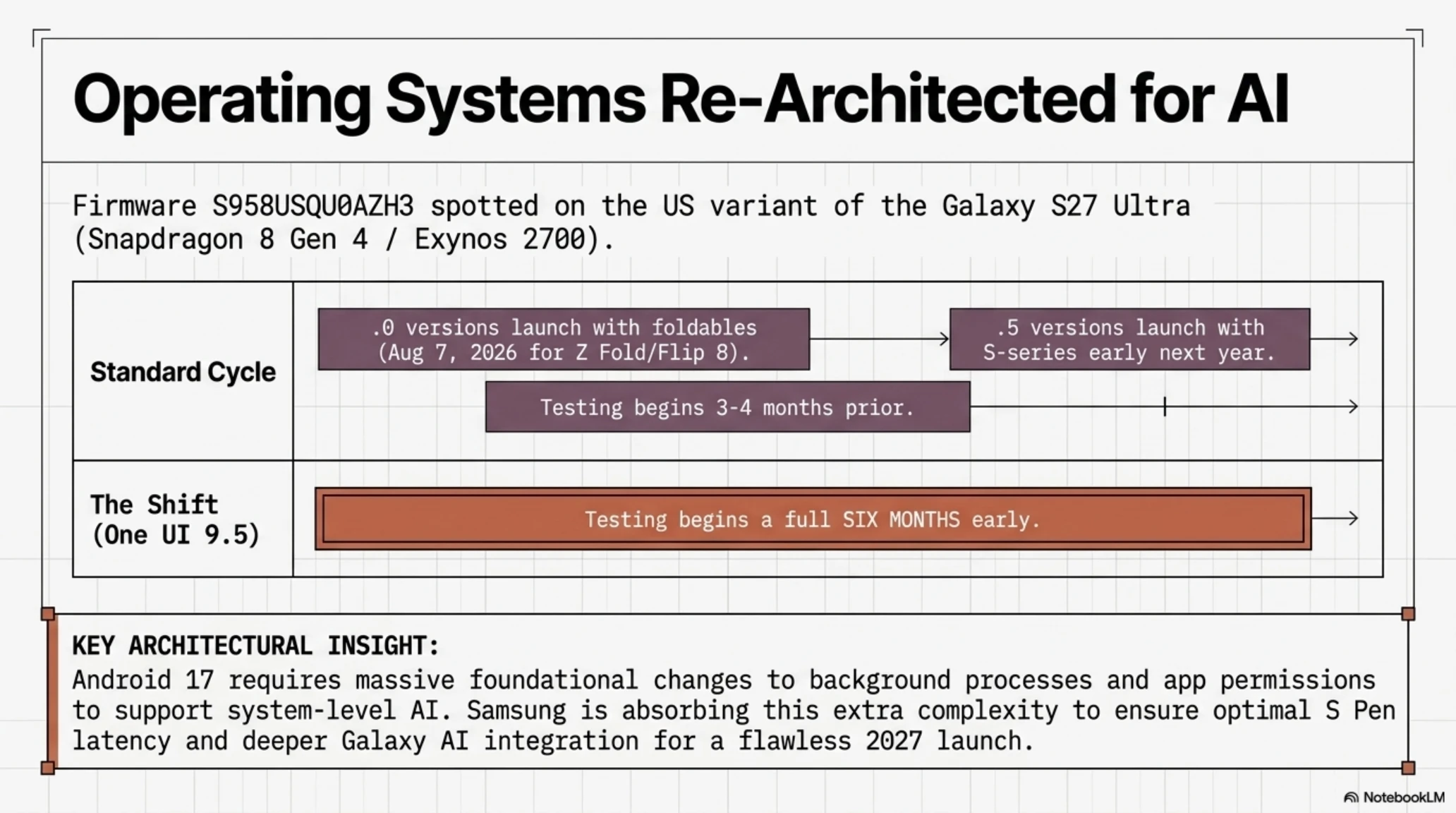
Samsung has unofficially begun testing One UI 9.5, the version scheduled to launch with the Galaxy S27 series in early 2027. This news leaked through the discovery of a firmware file with build number S958USQU0AZH3 for the US variant of the Galaxy S27 Ultra.

Why does this matter? Because Samsung typically starts testing new interface versions about 3-4 months before release. But this time, testing has begun six months earlier than usual. This indicates that Samsung wants to deliver One UI 9.5 with exceptionally high quality.
How Does One UI 9.5 Differ from Previous Versions?
One UI 9.5 is built on Android 17. To better understand, let's review the timeline of recent One UI releases. One UI 9.0 is set to launch with the Galaxy Z Fold 8 and Flip 8 series on August 7, 2026, and will then roll out to other devices starting in September 2026. Then One UI 9.5 will arrive in early 2027 with the S27 series.
The main difference between One UI 9.5 and 9.0 lies in deeper optimizations and exclusive features for new hardware. The Galaxy S27 Ultra is expected to ship with either the Snapdragon 8 Gen 4 or Exynos 2700 processor (depending on region), and One UI 9.5 is designed to optimally utilize these chips.
One UI at a Glance
| Metric | Recorded Value | Trend |
|---|---|---|
| Supported Devices | 150+ Devices | Upward |
| Active One UI 8.x Users | 450 Million | Upward |
| Average Update Delivery | 45 Days | Improving |
| User Satisfaction (App Store) | 4.6 / 5 | Stable |
What New Features Are Expected?
While exact details of One UI 9.5 features haven't been revealed yet, based on past patterns and rumors, several items can be predicted. Samsung will likely offer deeper integration with Galaxy AI, the company's AI assistant introduced with the S24 series.
New features for the S Pen in the Galaxy S27 Ultra are also expected. Rumors suggest Samsung is working on better pressure detection and lower latency. New gestures for controlling the device with the S Pen might also be added. The S Pen has always been a distinguishing feature of the Ultra series, and Samsung continues to invest in making it more powerful.
The interesting point is that early testing of One UI 9.5 may signal a different approach from Samsung in its development cycle. Perhaps the company wants to allocate more time for bug fixes and performance optimization. This is good news for users concerned about software quality on day one of release.
Industry analysts suggest this early testing might also be related to the complexity of Android 17 itself. Google's latest Android version includes significant changes to the underlying architecture, particularly in how apps handle permissions and background processes. Samsung may need extra time to ensure these changes are properly implemented in One UI while maintaining backward compatibility with existing apps.

ChatPlayground AI: Access to 20+ AI Models from One Window
Imagine you want to ask a question and see what answer ChatGPT gives, what Claude says, and what opinion Gemini has. Normally, you'd have to switch between three different browser tabs, copy-paste the question three times, and compare results. ChatPlayground AI has turned this process into a single click.
ChatPlayground is a platform that allows you to write one prompt and send it to more than 20 AI models simultaneously. Results from all models are displayed side by side, and you can choose the best answer.
Which Models Are Supported?
The list of supported models includes: GPT-4o, Claude Sonnet 4, Gemini 1.5 Flash, DeepSeek V3, Llama, Perplexity, Mistral, Grok, and several others. Interestingly, this list is regularly updated, and whenever a new model is released, it's automatically added to the platform.
Comparing Model Responses
One interesting use case for ChatPlayground is comparing the response styles of different models:
- ChatGPT: Typically provides structured and comprehensive explanations
- Claude: More natural and human-like responses with conversational tone
- Gemini: Strong performance in information retrieval and source citations
- DeepSeek: Excellent performance in coding and technical problems
- Perplexity: Best choice for research and finding credible sources
- Mistral: Strong multilingual capabilities and European language support
- Grok: More casual and sometimes humorous responses with current event awareness
ChatPlayground's pricing model is also interesting. Instead of paying monthly subscriptions for each model separately (which can quickly become expensive), you buy a lifetime subscription for access to all models. Current pricing is around $60-79, depending on seasonal discounts.
Who Benefits from ChatPlayground?
This tool is extremely useful for several groups. Software developers can compare code generated by different models and choose the best solution. Content writers can see which model provides the best draft. Researchers can ask their question from multiple sources and cross-check the answers.
It's also an excellent option for those experimenting with AI and wanting to understand which model works best for their specific needs. Instead of buying separate subscriptions for each model and testing them, you can test everything in one place.
Limitations and Considerations
Of course, ChatPlayground also has limitations. First, all responses have some delay because you must wait for all models to respond. If you just want to quickly ask a question, going directly to ChatGPT or Claude is faster. Second, the interface might seem a bit cluttered for beginners, especially when you have 10+ different responses on one page.

However, for those who work seriously with AI - whether for business, research, or creativity - ChatPlayground is an extremely valuable tool that can reduce both time and cost. Some professional users have reported that using this platform has improved their final output quality by up to 60% - not because one model is better than others, but because they can combine the best parts of each response.
The platform also offers features like conversation history, response comparison tools, and the ability to create custom prompt templates. Advanced users can set up workflows where certain types of questions automatically go to specific models known to perform better for those tasks. For example, coding questions might prioritize DeepSeek and Claude, while creative writing might favor GPT-4o and Claude.
Tekin Morning Wrap-Up
Monday morning, August 3, 2026, demonstrated that the technology world continues to evolve at a breakneck pace. From OpenAI's stunning scientific achievements in solving mathematical problems to Google's strategic shifts, from improved user experience in voice search to simplified file sharing, all of these show that major technology companies are striving to make their products smarter, faster, and more user-friendly.

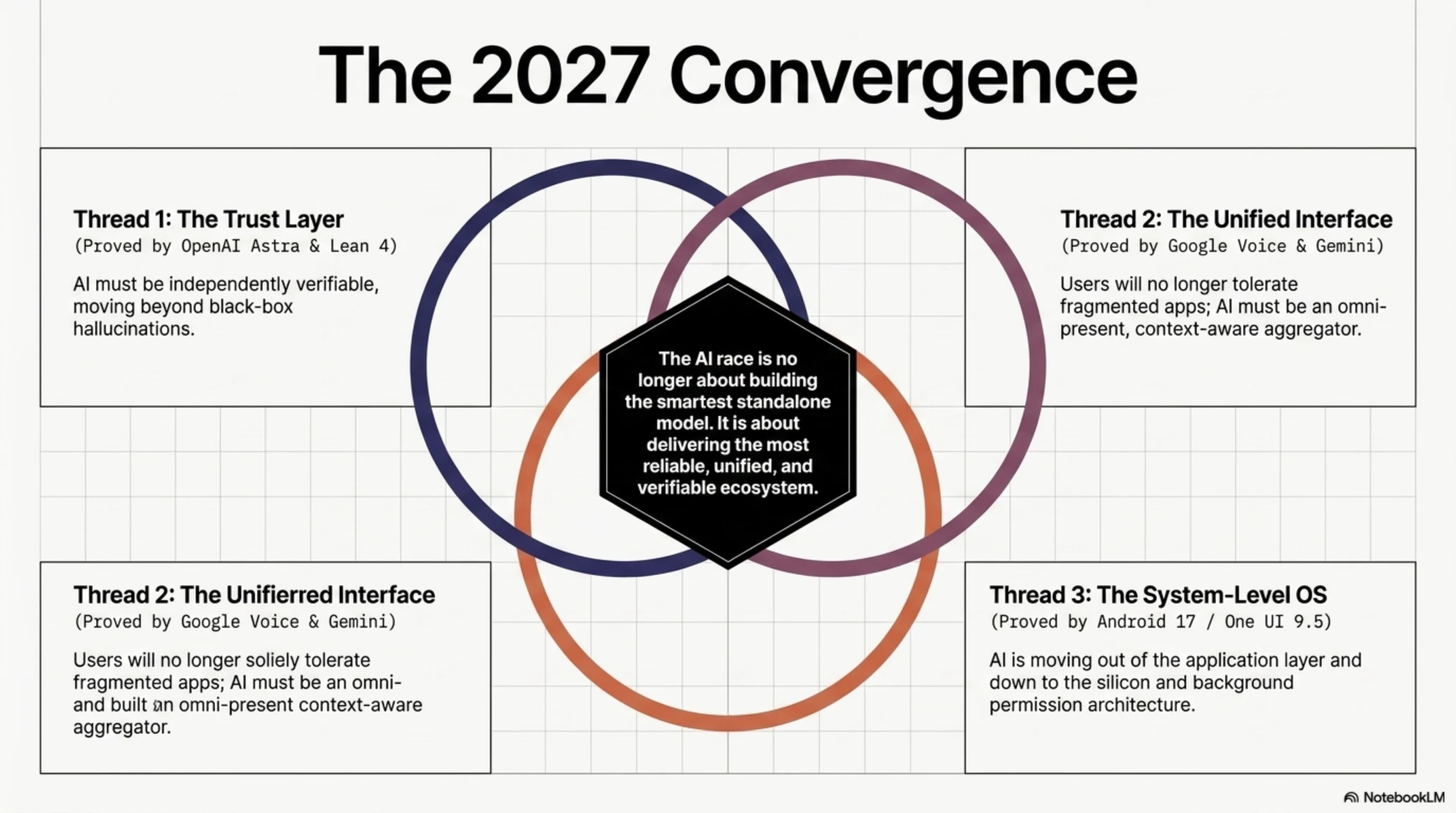
The common thread among most of these stories is the prominent role of artificial intelligence. Whether we're talking about Astra solving math problems, AI Mode in Google Voice Search, AI Studio integration into Gemini, or comparing different models in ChatPlayground, all of these demonstrate that AI is no longer a side technology but has become embedded in the core of technology products. This fundamental shift in the industry means that businesses and developers who haven't yet integrated AI into their products are rapidly falling behind.
From the end-user perspective, this news heralds a future where technology integrates more seamlessly into our daily lives. Smarter voice assistants, faster file transfers, optimized user interfaces, and tools that enable us to make the best decisions - all of these are part of the near-term vision we'll witness.
The competitive landscape is also shifting. Companies that can effectively harness AI while maintaining user trust and privacy will emerge as winners. Those that stumble on execution, like Google's AI Studio cancellation, risk losing developer confidence. The race isn't just about who has the best AI model, but who can deliver the most coherent, reliable ecosystem of AI-powered tools.
Looking Ahead: What to Watch
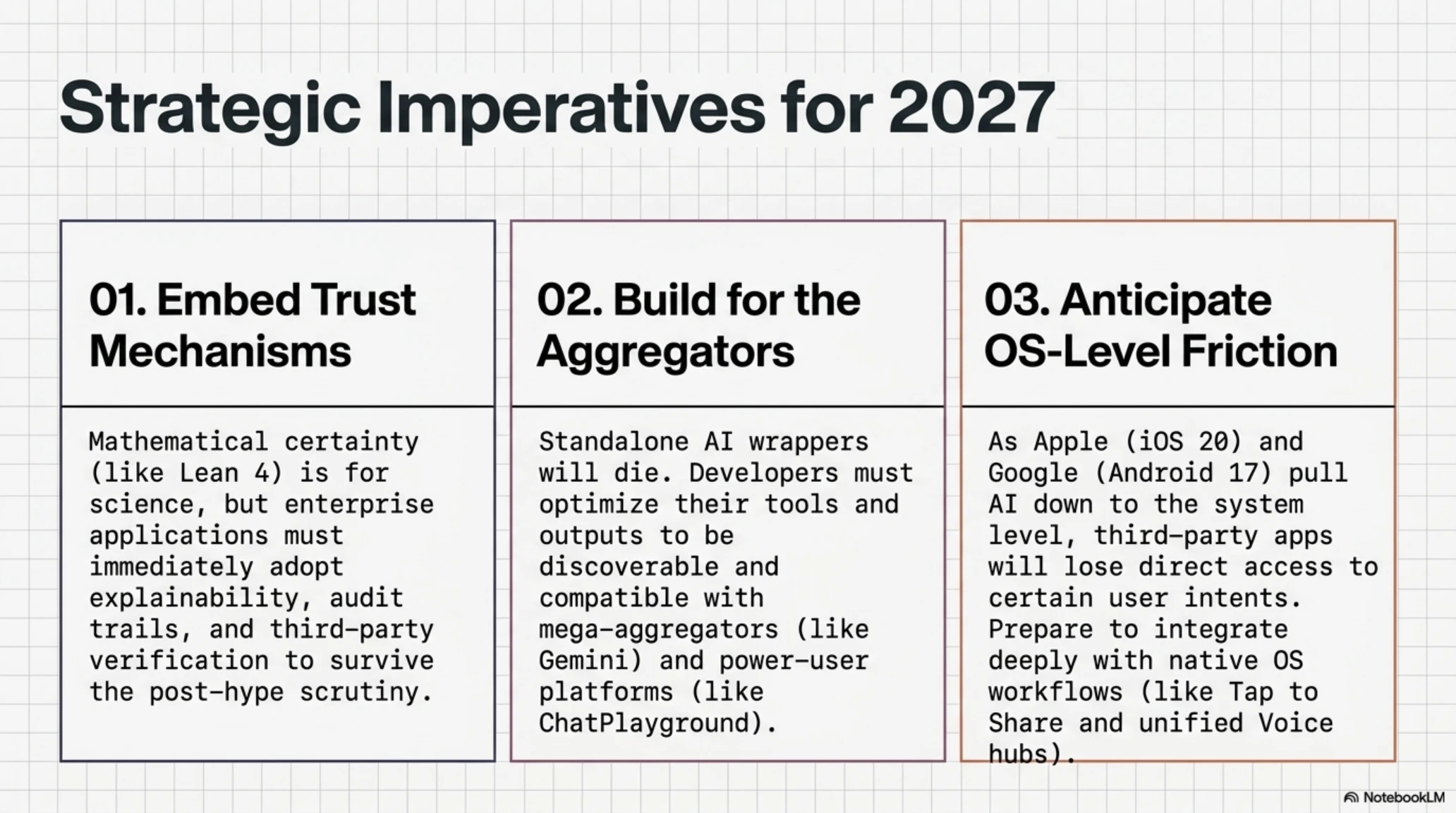
As we move through the rest of 2026 and into 2027, several trends bear watching. First, the integration of AI into operating systems will deepen. Apple's iOS 20 and Google's Android 17 both include AI at the system level, not just in apps. This will enable new types of experiences that weren't possible before.
Second, the standardization of AI interfaces will continue. Just as we saw with Voice Search unifying multiple modes, expect more consolidation as companies figure out what works. The early experimental phase of generative AI is giving way to a more mature phase where best practices emerge.
Third, the question of AI verification and trust will become more important. OpenAI's Lean 4 proofs represent one approach - providing mathematical certainty. But for most AI applications, we'll need other mechanisms to build trust. Expect to see more focus on explainability, audit trails, and third-party verification.
Frequently Asked Questions
Are Astra's mathematical proofs truly reliable?
Yes. OpenAI published all proofs in Lean 4 format, which is a formal proof verification system. Anyone can download these files and verify their correctness independently.
What happens to users who pre-ordered AI Studio?
Google announced it will implement all AI Studio capabilities directly in the Gemini app, eliminating the need for a separate app installation.
How is Tap to Share different from Quick Share?
Quick Share requires navigating through menus to select a destination device, whereas Tap to Share initiates transfer simply by bringing two phones close together.
When will One UI 9.5 be released for my phone?
One UI 9.5 will first launch with the Galaxy S27 series in early 2027 and will subsequently roll out to older flagships like the S26 and S25.
Is ChatPlayground free?
No, it operates on a lifetime access model ($60-$79 one-time payment) that provides unlimited access to over 20 current and future AI models.
Why did Google redesign Voice Search?
Google consolidated all voice search modes (Search, AI Mode, Live, and Song Search) into a single, unified interface for faster access.
Sources and References
- SiliconANGLE: OpenAI's Astra solves 10 long-open math problems and publishes the proofs
- Android Authority: Google abruptly cancels its unreleased AI Studio mobile app
- Android Authority: Google Voice Search redesign puts all search options in one place
- Android Authority: Google is testing AirDrop-like Tap to Share for Android
- SamMobile: Samsung One UI 9.5 spotted as Galaxy Z Fold 8 nears retail launch
- Popular Science: Stop switching between ChatGPT & Claude — ChatPlayground gives you both
Additional Gallery: ☕ Tekin Morning August 3, 2026: OpenAI Astra's Math Breakthrough & Google Cancels AI Studio