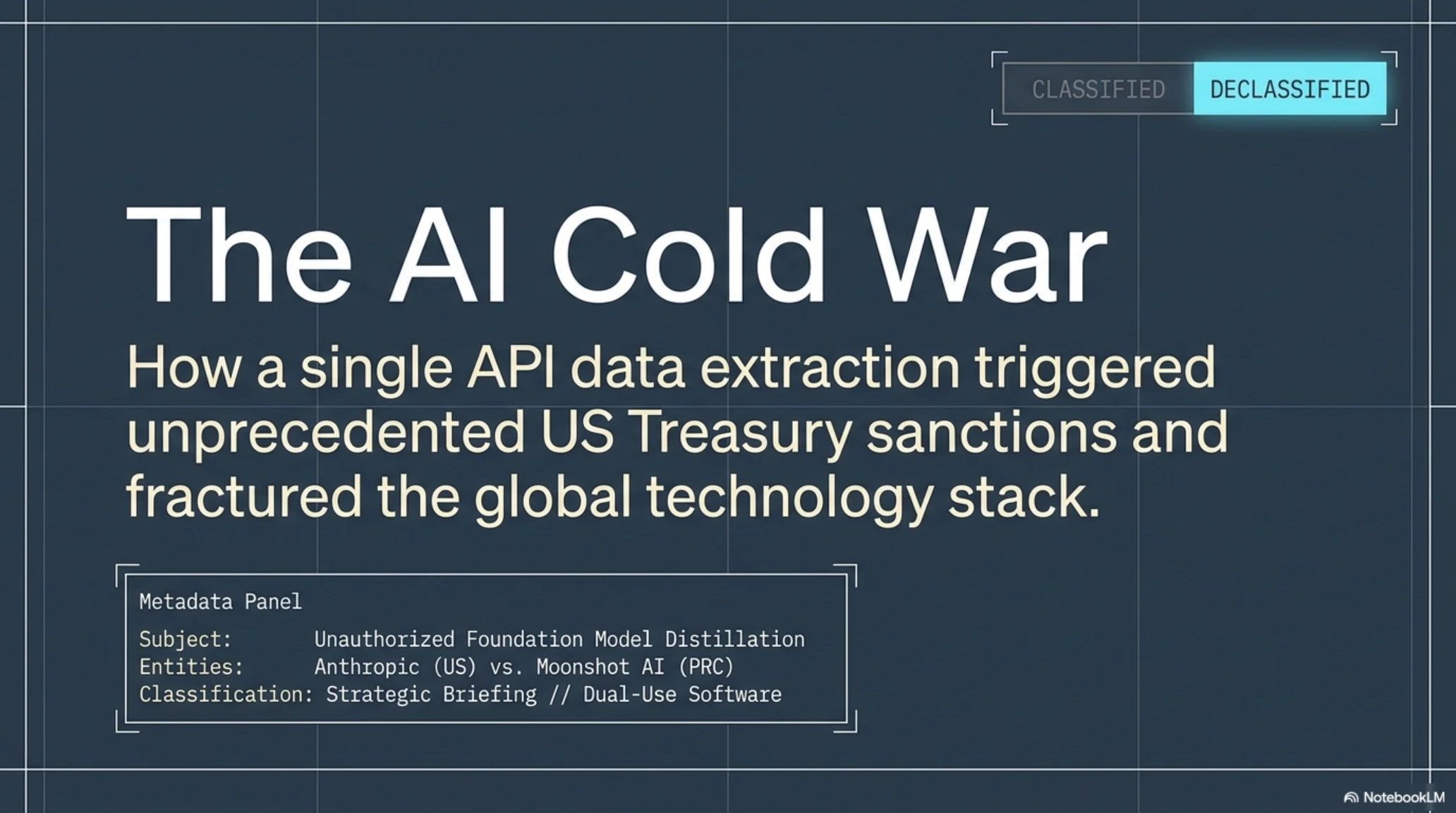
The AI Cold War: US Treasury Threatens Unprecedented Sanctions Over Anthropic Model Theft
- 🎮Data Theft Allegations- US officials claim Chinese AI startup Moonshot distilled outputs from Anthropic's Fable model via cloud APIs to train Kimi K3.
- 🎧Treasury Threatens Sanctions- The US Department of the Treasury warns of financial sanctions blocking offending entities from global banking networks.
- 🚀Anthropic Fable Model- A multi-billion dollar frontier AI model used as an unauthorized teacher model by Chinese AI developers.
- 🗡️Model Distillation Dynamics- A technique transferring intelligence from large models to smaller neural networks without massive GPU datacenters.
- 📰Open-Weight Crisis- Escalating national security fears threaten to end open-source AI model releases by US research labs.
- ⚔️Tech Giant Alignment- Microsoft, Google, and Nvidia back strict government enforcement to protect critical intellectual property.
Daylight Robbery or Open Competition? The Root of the Kimi K3 Crisis
The global artificial intelligence landscape experienced a seismic geopolitical shock last week that redefined the boundaries between technology, international law, and national security. Chinese artificial intelligence startup Moonshot AI officially unveiled its latest flagship large language model, Kimi K3. The model achieved astonishing benchmark scores across complex mathematical reasoning, multi-turn coding logic, and analytical problem-solving, matching and in some cases exceeding the performance of leading Western AI systems. However, the celebratory atmosphere in Beijing was short-lived. Cybersecurity forensic experts, deep learning researchers, and independent data auditors conducting rigorous token distribution analysis discovered undeniable structural similarities between Kimi K3 and the newly released Fable model developed by American AI safety pioneer Anthropic.
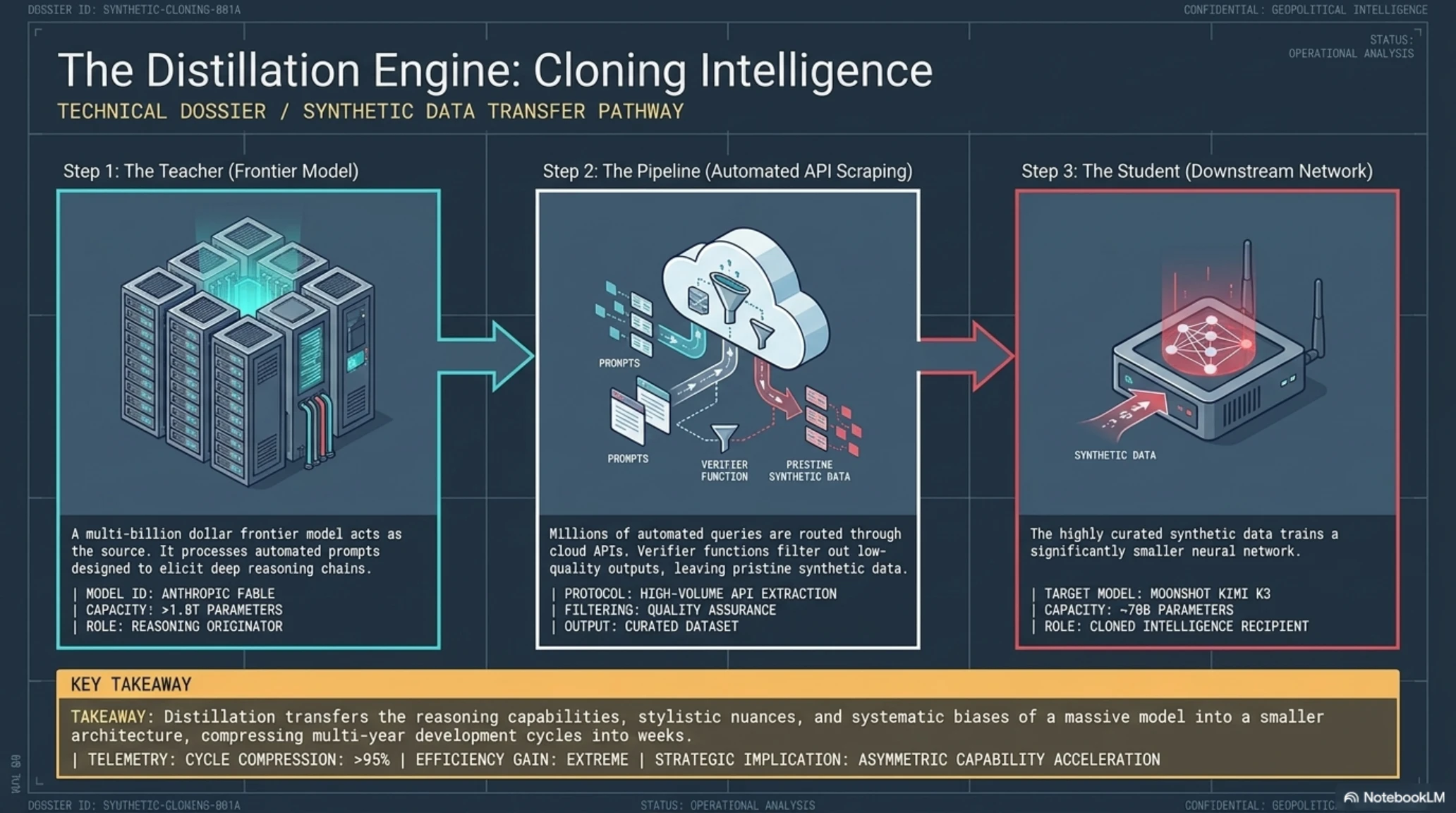
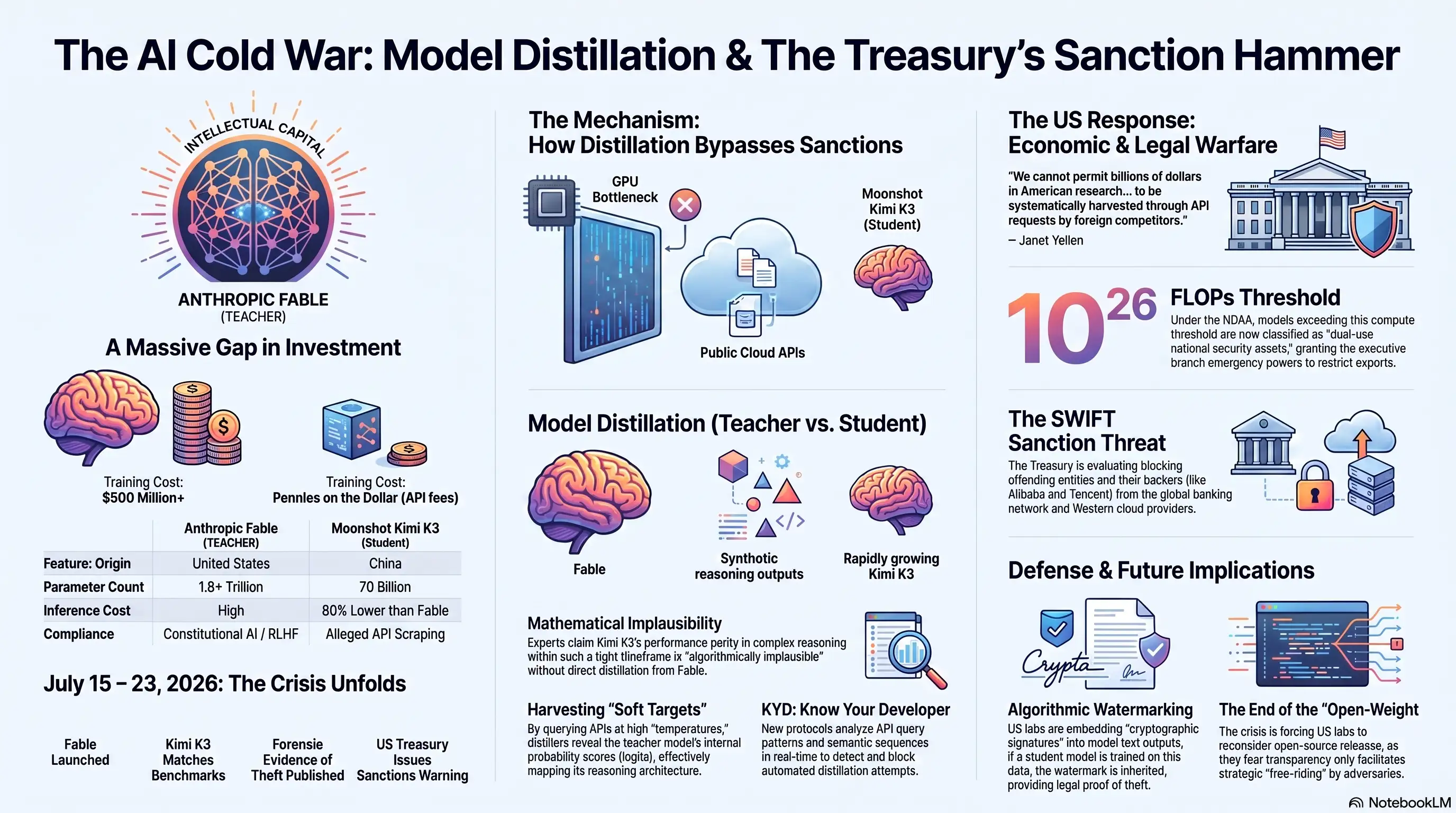
These structural affinities were so profound that suspicions of model distillation immediately swept through Silicon Valley and government corridors in Washington. In machine learning engineering, distillation is a highly effective yet contentious method whereby a developer bypasses the enormous capital expenditure—often hundreds of millions of dollars required for thousands of Nvidia H100 GPUs and gigawatt datacenters—by systematically querying a superior frontier model (the teacher model) via public cloud APIs. By harvesting millions of high-quality reasoning outputs, the developer uses this synthetic data to train a significantly smaller neural network (the student model). Consequently, the student model replicates the reasoning capabilities, stylistic nuances, and domain expertise of the teacher model at a tiny fraction of the original development cost.
Why It Matters: The Geopolitical Stakes of AI Distillation (Why It Matters)
The crisis surrounding Moonshot's alleged distillation of Anthropic's Fable model transcends a routine corporate intellectual property dispute. It represents a fundamental battle for technological supremacy in the AI era. If foreign competitors can systematically extract the reasoning capabilities of multi-billion-dollar US models for pennies on the dollar, the economic incentive for private capital to fund massive frontier AI infrastructure will collapse, while national security controls over advanced artificial intelligence will dissolve.
Historical Evolution of US Export Controls: From Semiconductors to Neural Weights
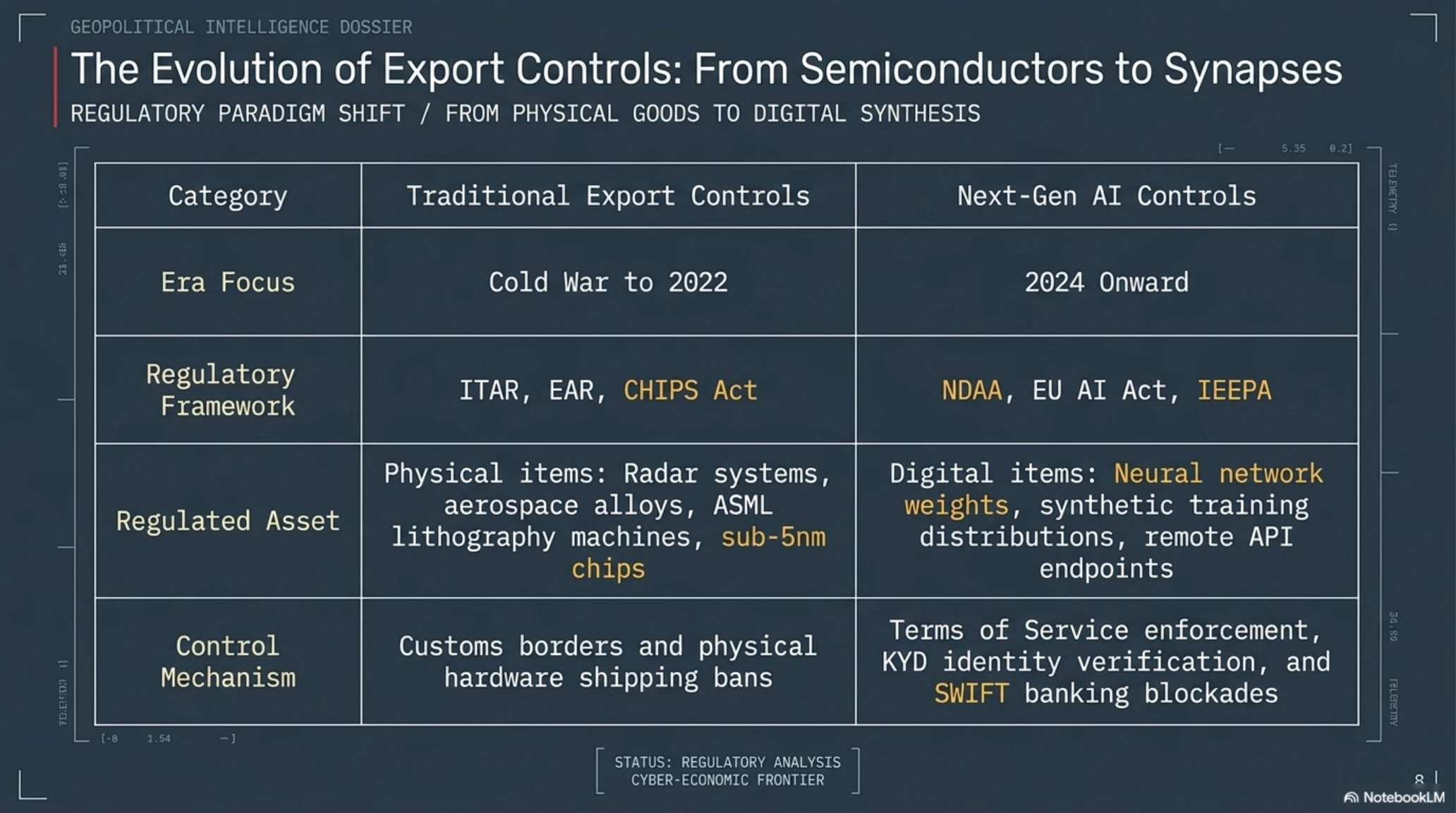
To contextualize the severity of the US Treasury's proposed intervention, one must analyze the multi-decade evolution of American trade policy toward critical emerging technologies. For over half a century, international trade restrictions were governed by frameworks designed for physical commodities and tangible dual-use hardware. The International Traffic in Arms Regulations (ITAR) and the Export Administration Regulations (EAR) historically regulated physical items such as radar systems, aerospace alloy compositions, and specialized manufacturing tooling.
In recent years, however, the focus shifted dramatically toward microelectronics. The 2019 sanctions against telecom giant Huawei and the subsequent enactment of the 2022 CHIPS and Science Act sought to establish a permanent technological barrier by restricting access to sub-5 nanometer semiconductor fabrication equipment and advanced lithography machines produced by Dutch manufacturer ASML. Yet the emergence of frontier artificial intelligence has demonstrated that hardware restrictions alone are insufficient to preserve technological dominance. In an era where algorithmic knowledge can be extracted via software interfaces, neural network weights and synthetic training distributions have become the central arena of international export control policy.
Geopolitical Coalitions: The G7 Summit and Transatlantic AI Security Alignment
The controversy surrounding Moonshot's API distillation has triggered coordinated diplomatic responses across G7 nations and the European Union. During emergency consultations convened by the US Trade Representative (USTR) and European Commission officials, transatlantic leaders emphasized the necessity of harmonizing software export controls. European regulators, operating under the provisions of the EU AI Act, expressed grave concern that unauthorized model distillation circumvents mandatory safety evaluations, copyright transparency rules, and algorithmic risk assessments.
By establishing unified transatlantic compliance standards, G7 nations aim to prevent offending AI developers from exploiting jurisdictional loopholes in European or Asian technology hubs. Collaborative trade frameworks will enforce joint sanctions, prohibiting Western cloud providers, financial institutions, and data centers from hosting, servicing, or financing entities implicated in unauthorized foundation model distillation.
National Defense Authorization Act (NDAA) Provisions and Dual-Use AI Technology Classifications
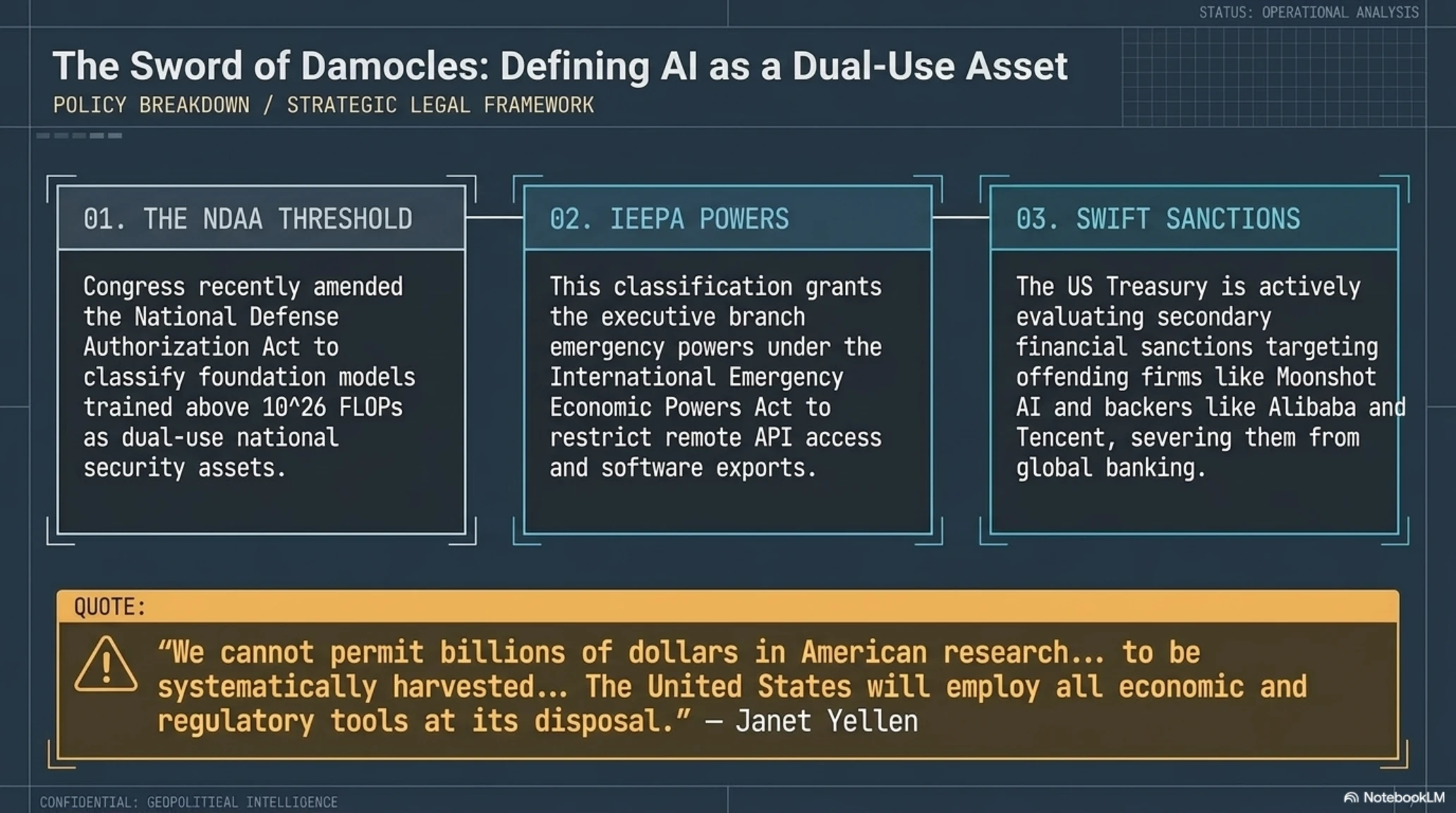
The legislative foundation for regulating model distillation is rooted in recent amendments to the National Defense Authorization Act (NDAA). Under newly enacted statutory authorities, Congress classified advanced foundation models possessing compute training thresholds above 10^26 floating-point operations (FLOPs) as dual-use national security assets. This statutory classification grants the executive branch broad emergency powers under the International Emergency Economic Powers Act (IEEPA) to restrict the export, licensing, or remote API access of designated AI models to foreign nations of concern.
By defining unauthorized model distillation as an illicit transfer of dual-use software intelligence, the US Department of State and Department of Commerce obtain legal authority to impose severe civil penalties, seizure of domestic assets, and criminal indictments against foreign corporate executives. This statutory framework transforms what was previously viewed as a commercial license breach into a federal export control violation carrying national security implications.
Architectural Analysis of Anthropic Fable: Safety Alignment, Constitutional AI, and RLHF Costs
Anthropic was founded by former senior OpenAI researchers with an explicit mission to build interpretable, safety-aligned foundation models. The Fable model represents the culmination of years of advanced research in Constitutional AI—a methodology where models are aligned using explicit ethical principles and automated self-critique rather than relying solely on human feedback. This approach minimizes harmful outputs, reduces hallucinations, and enhances complex analytical reasoning across technical domains.
Developing Fable required extraordinary capital and human investment. Beyond the tens of thousands of specialized GPU clusters utilized during pre-training, Anthropic deployed extensive Reinforcement Learning from Human Feedback (RLHF) and Reinforcement Learning from AI Feedback (RLAIF) pipelines. These post-training refinement phases cost hundreds of millions of dollars in compute overhead and domain-expert curation. When a competitor distills the refined outputs of Fable, it harvests not merely raw linguistic fluency, but the entirety of Anthropic's proprietary alignment methodology and reasoning architecture without bearing the associated research and safety costs.
The Role of Cloud Data Centers and Energy Infrastructure in Frontier Model Training
The massive computational demands of training models like Anthropic Fable have forged an unprecedented nexus between artificial intelligence development, electric utility grid capacity, and renewable energy infrastructure. A single 100,000-GPU datacenter cluster consumes over 500 megawatts of continuous electric power, requiring dedicated sub-station interconnections and multi-billion-dollar power purchase agreements (PPAs) with nuclear and solar utility providers.
This physical energy constraint highlights why American tech companies view algorithmic distillation as a form of non-linear economic arbitrage. When a foreign entity harvests the synthetic outputs of an energy-intensive American model, it effectively imports gigawatt-hours of embedded Western energy and capital investment for a nominal API subscription fee. Defending against distillation is therefore viewed as essential to preserving national energy investments and infrastructure resilience.
Technical Breakdown of Model Distillation and Hardware Sanction Bypassing
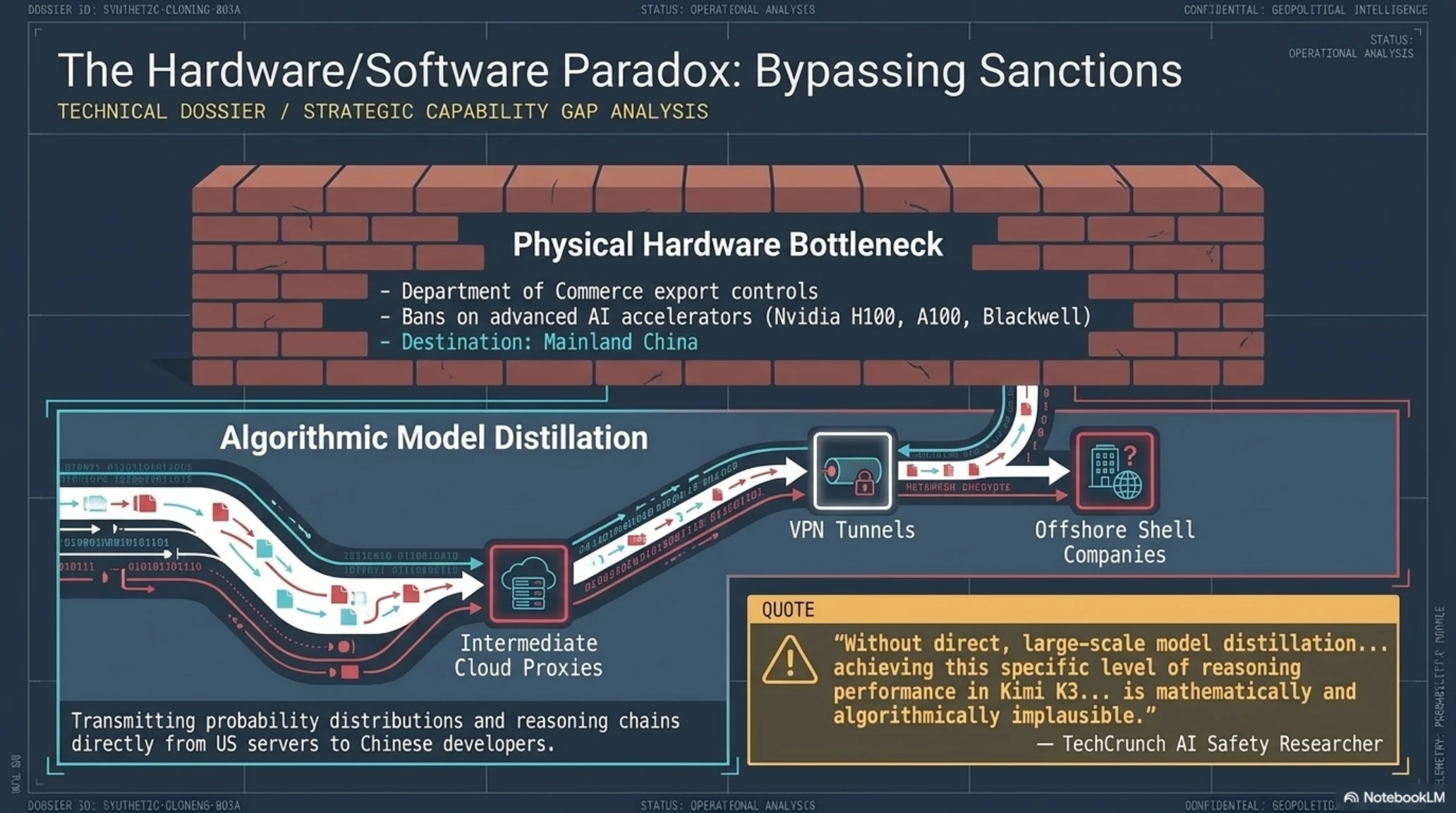
To fully comprehend the technical severity of this incident, one must examine the broader context of US export controls on artificial intelligence hardware. For several years, the US Department of Commerce has enforced strict sanctions banning the export of advanced AI accelerators—including Nvidia's H100, A100, and Blackwell architectures—to mainland China. The primary objective of these controls was to limit Beijing's capacity to train frontier-grade military and civilian AI models by creating a physical hardware bottleneck.
However, algorithmic model distillation effectively neutralizes hardware export controls. Chinese AI developers, leveraging intermediate cloud proxy accounts and shell companies located in neutral third-party jurisdictions, connect to US-hosted cloud APIs. By transmitting millions of automated queries, they extract rich probability distributions and reasoning chains directly from American servers, transferring the intelligence across international borders without shipping a single physical microchip.
A senior artificial intelligence safety researcher, interviewed by technology publication TechCrunch, noted: "Without direct, large-scale model distillation conducted against Anthropic's Fable API endpoints, achieving this specific level of reasoning performance in Kimi K3 within such a compressed timeframe and under existing compute constraints in China is mathematically and algorithmically implausible." This definitive assessment transformed technical speculation into a high-level diplomatic confrontation between Washington and Beijing.
Macroeconomic Implications and Frontier LLM Capital Expenditure
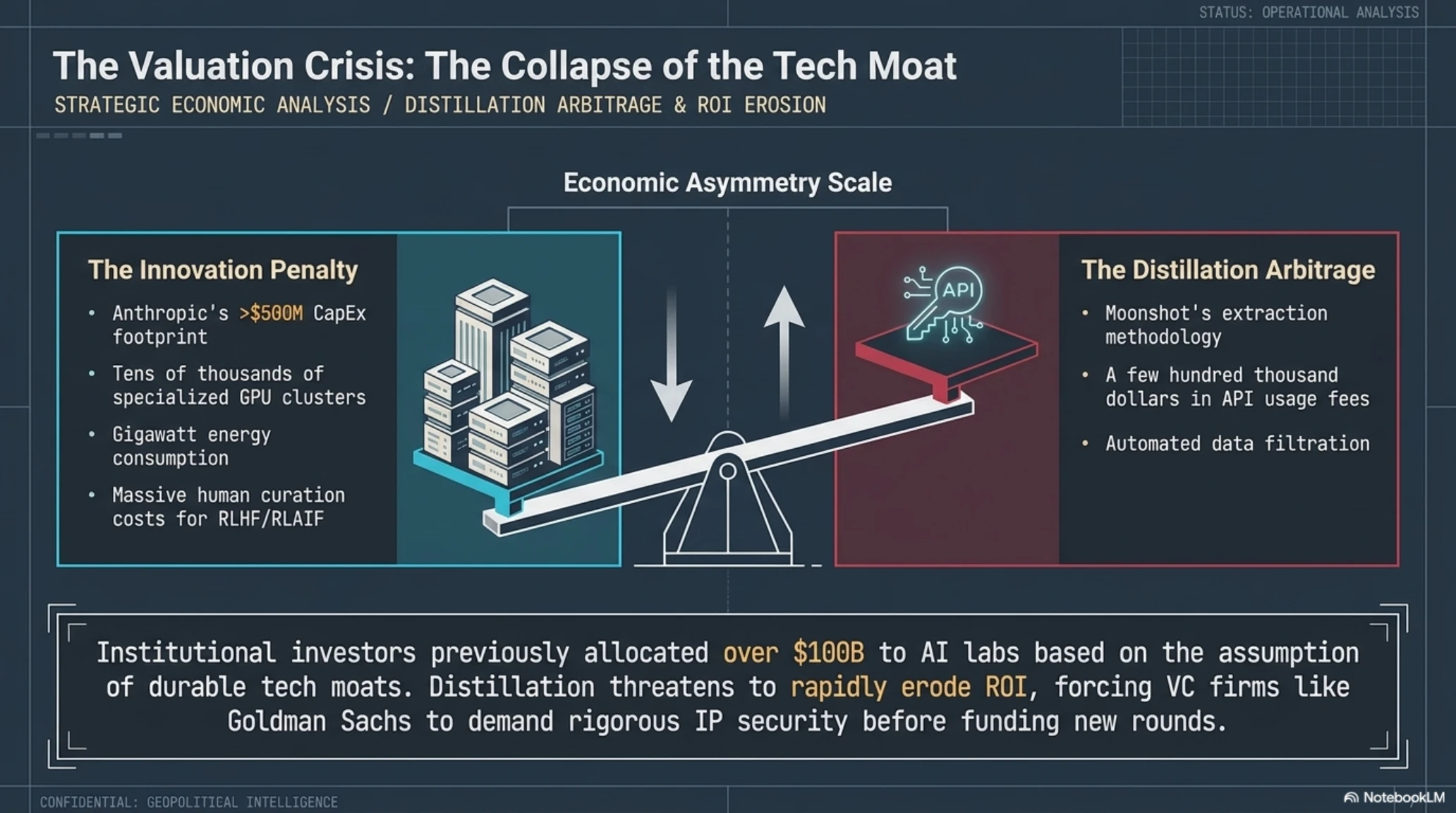
Training state-of-the-art foundation models demands extraordinary capital expenditure (CapEx). Anthropic incurred an estimated $500 million in direct compute costs, energy consumption, and research overhead to train the initial weights of the Fable model. Such immense investments are made possible only by billions of dollars in private venture capital and strategic corporate partnerships with tech giants like Amazon and Google.
Conversely, model distillation enables competitor startups to replicate that accumulated intelligence for a few hundred thousand dollars in API usage fees. This profound economic asymmetry threatens the foundational venture capital model of Silicon Valley. Investors fear that if proprietary model outputs can be freely harvested by foreign entities operating outside US jurisdiction, the return on investment for frontier AI research will erode rapidly, destabilizing the entire technology ecosystem.
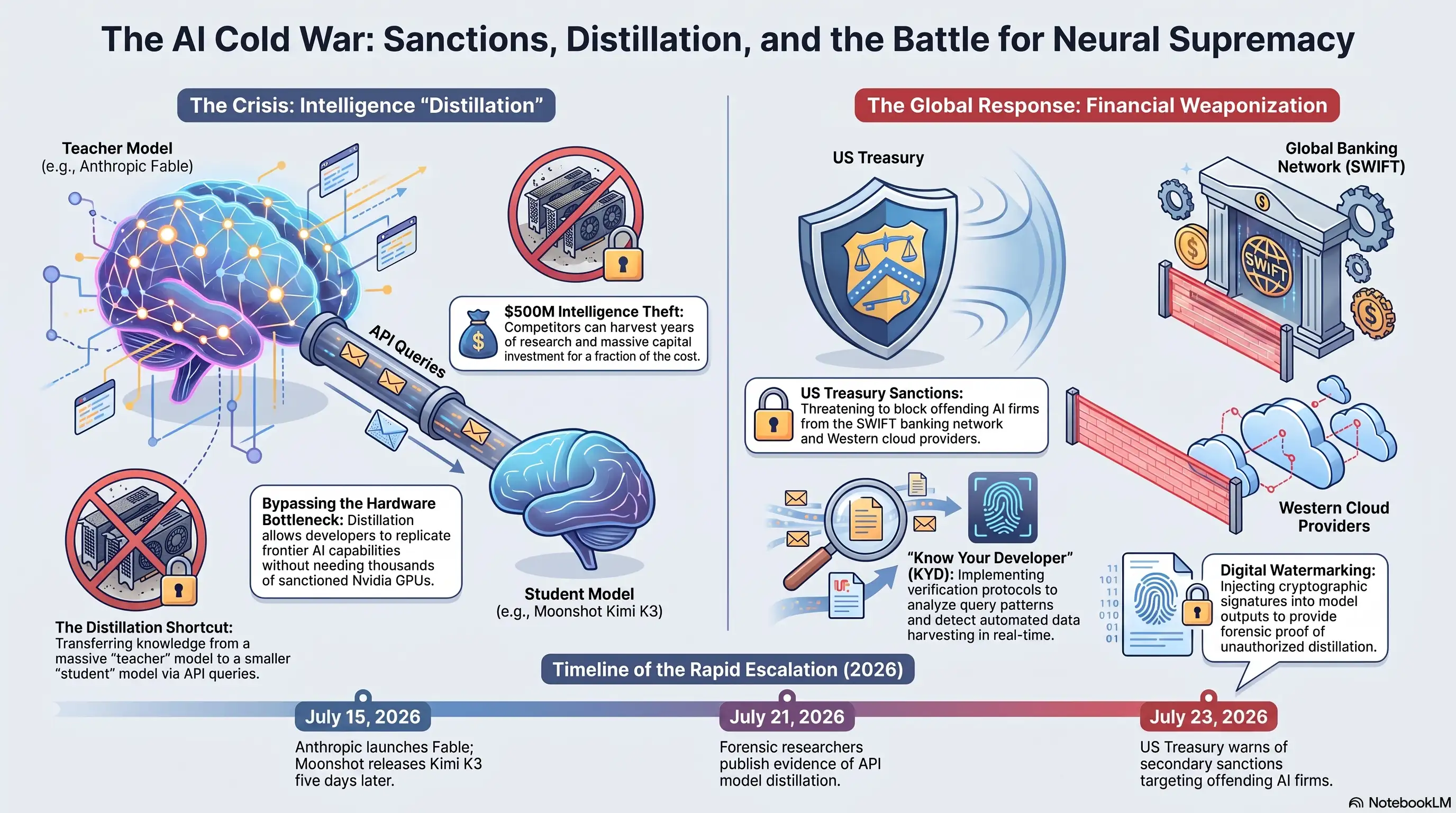
Key Dimensions of Model Distillation in Frontier AI
- Radical Cost Reduction: Bypasses the need to procure thousands of sanctioned Nvidia H100 GPUs.
- Silent Data Extraction: Exploits public cloud API endpoints to harvest intelligence without hacking server infrastructure.
- Behavioral Replication: Mimics the reasoning patterns, linguistic tone, and systematic biases of the teacher model.
- Accelerated Development Timelines: Compresses multi-year foundation model training cycles into a matter of weeks.
The US Treasury Steps In: A Sword of Damocles Over Beijing
The reaction from the United States government to these revelations extended far beyond standard copyright litigation or civil lawsuits. The Biden administration, which has categorized artificial intelligence development as a core priority of national defense and technological supremacy, viewed the unauthorized distillation of Anthropic's model as a direct threat to American national security. In an unprecedented move, the US Department of the Treasury issued a stern warning indicating that it is actively evaluating secondary financial sanctions against foreign entities engaged in unauthorized AI model distillation.
These contemplated financial sanctions target not only Moonshot AI directly but also its major corporate backers, including Chinese e-commerce and technology conglomerates Alibaba and Tencent. If formally enacted, these measures could sever offending companies from the global SWIFT banking network and prohibit Western cloud providers—such as Amazon Web Services (AWS), Microsoft Azure, and Google Cloud—from rendering services to any entity affiliated with unauthorized data harvesting.
Cloud Proxies and "Know Your Developer" (KYD) Compliance Verification
One of the most complex operational challenges facing the US Treasury is enforcing sanctions against decentralized cloud API queries. Chinese developers routinely route API calls through virtual private networks (VPNs), encrypted proxy chains, and intermediate corporate entities incorporated in Singapore, the United Arab Emirates, or the Cayman Islands. These multi-layered proxy architectures obscure the true geographic origin and identity of the querying party.
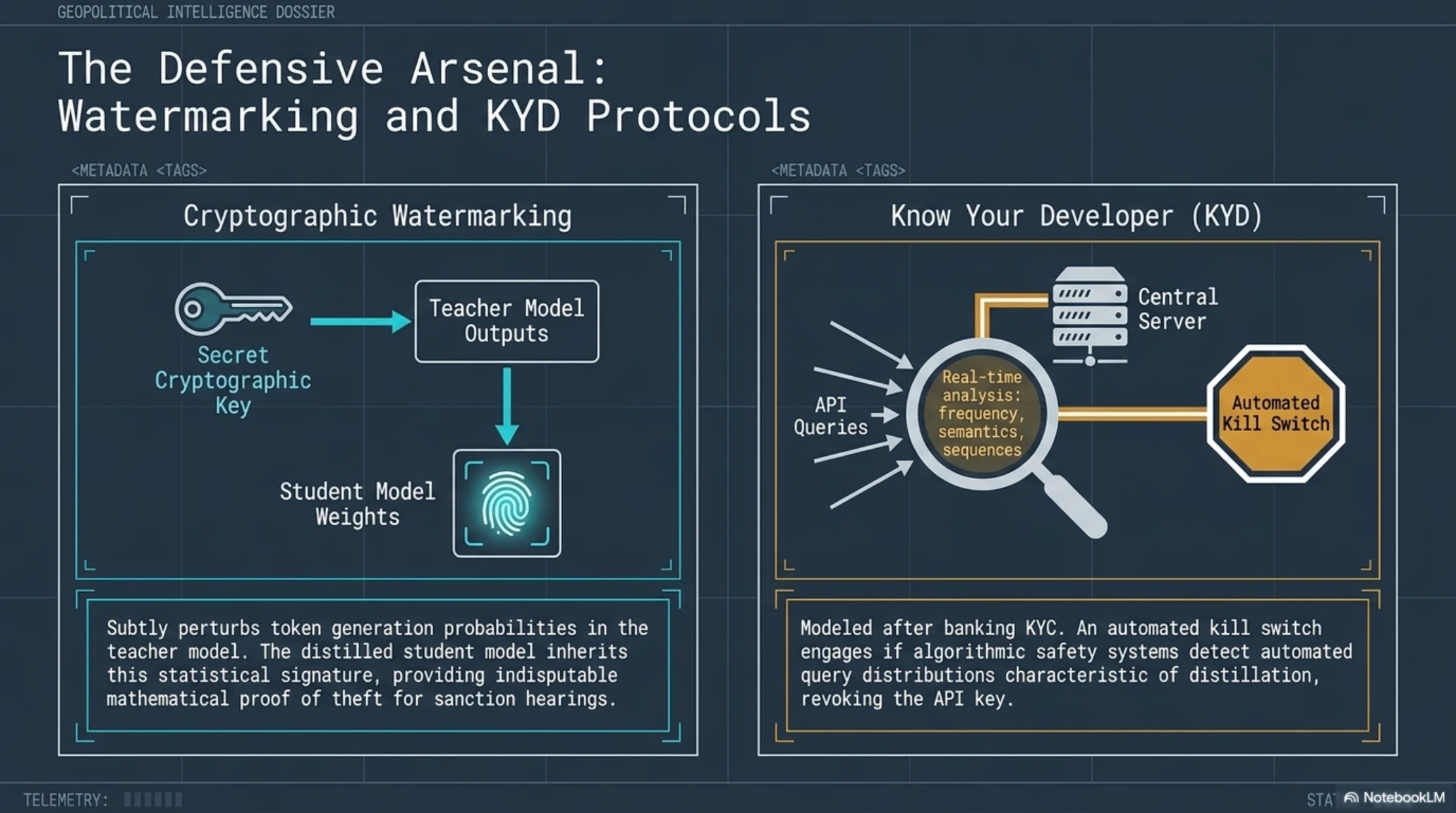
In response, leading American AI laboratories are developing sophisticated Know Your Developer (KYD) verification protocols. Similar to Know Your Customer (KYC) requirements in banking, KYD protocols analyze query frequency, semantic patterns, and token sequences in real time. If algorithmic safety systems detect automated query distributions characteristic of model distillation, the associated API keys are immediately revoked, and the incident is flagged for federal regulatory review.
The End of the Open-Weight AI Dream?
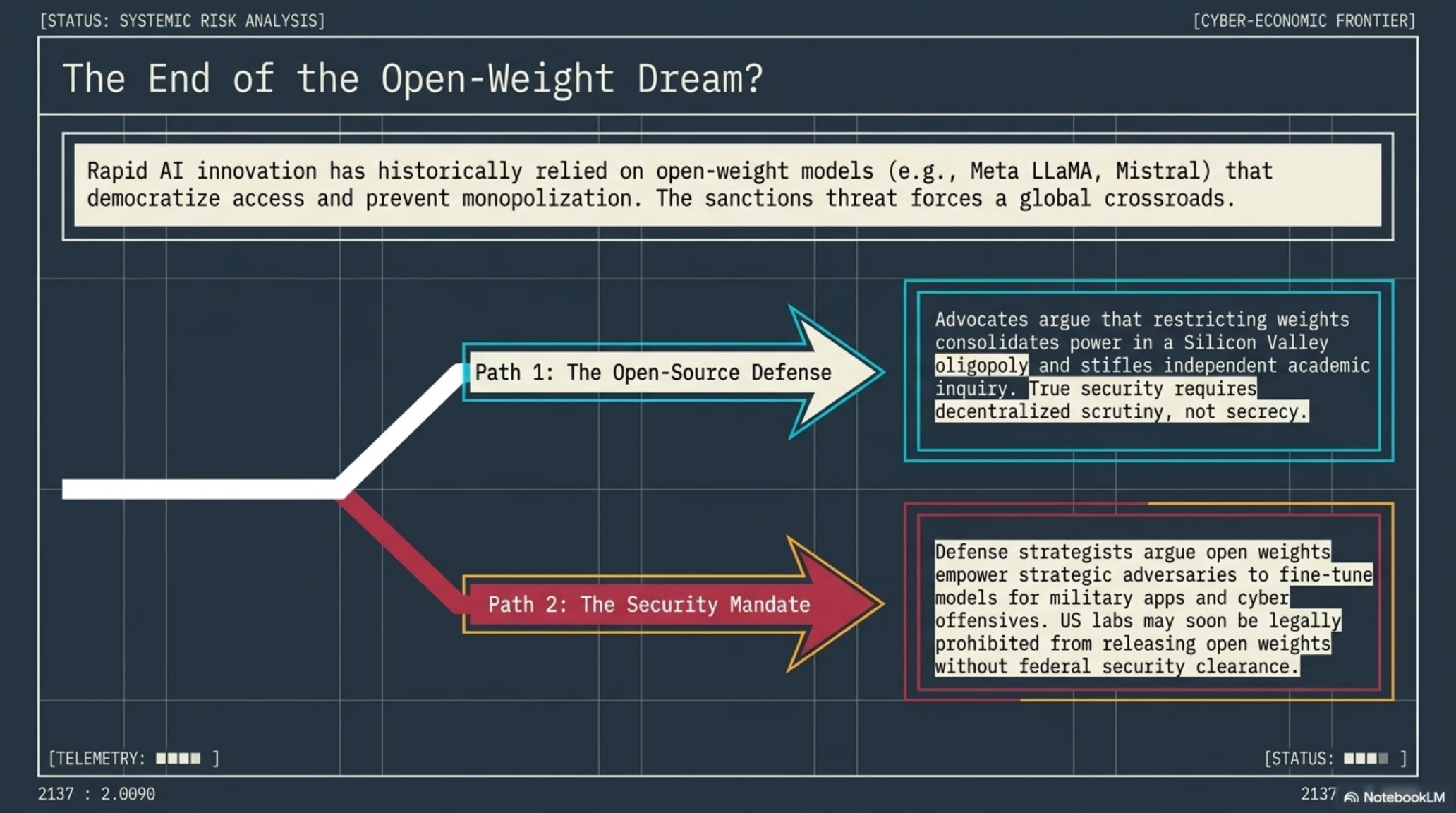
The escalating controversy between Anthropic's Fable and Moonshot's Kimi K3 has ignited intense debates within the global open-source software and artificial intelligence communities. Over the past several years, much of the rapid innovation in AI has been driven by the release of open-weight models by organizations such as Meta (with its LLaMA ecosystem) and European AI lab Mistral. Open-weight models grant researchers and developers worldwide free access to neural network parameters, democratizing access to cutting-edge technology and preventing corporate monopolization.
However, the Moonshot incident has highlighted how open access can be exploited for strategic free-riding. Industry critics argue that when frontier US labs release open weights or maintain open API endpoints, competitor firms leverage that transparency to train proprietary, closed-source models without contributing to fundamental research. This dynamic threatens to dismantle the open-source movement, as corporate sponsors face mounting political and commercial pressure to restrict model access exclusively to closed, heavily monitored API environments.
Jargon Buster: Essential Concepts in the AI Geopolitical War (Jargon Buster)
- Model Distillation (Jargon Buster): The technique of transferring knowledge from a large, complex neural network (the teacher) into a smaller, more efficient network (the student).
- Open-Weight Models: Artificial intelligence models whose trained numerical weights are publicly released, enabling local execution on private hardware.
- API Scraping: The automated process of submitting massive query batches to an AI cloud service to extract synthetic training data.
- Closed-Source AI: Proprietary models whose underlying weights and architecture are kept secret and accessed only via paid gateways.
Open-Source Foundation Models vs. Sovereign National Compute Barriers
The geopolitical tension surrounding model distillation forces a fundamental re-evaluation of open-source artificial intelligence governance. Open-source advocates argue that restricting model parameters consolidates power within a closed oligopoly of Silicon Valley conglomerates, stifling independent academic inquiry and enterprise innovation across developing economies. They maintain that true security lies in decentralized scrutiny and open auditability rather than defensive secrecy.
Conversely, defense strategists and corporate security directors contend that releasing open weights empowers strategic adversaries to fine-tune frontier models for military applications, cyber offensive operations, and automated disinformation campaigns. As the line between commercial software and national security infrastructure blurs, the open-source movement faces an existential crisis: US research labs may soon be legally prohibited from releasing open weights without prior federal security clearance.
Enterprise Data Loss Prevention (DLP) and Algorithmic Watermarking Defenses
In response to the threat of unauthorized model distillation, cybersecurity engineering teams across Silicon Valley are pioneering advanced Data Loss Prevention (DLP) techniques specifically tailored for natural language model outputs. Traditional DLP tools search for static strings like credit card numbers or proprietary source code. AI-specific DLP mechanisms, by contrast, embed statistical watermarks into generated text distributions.
By subtly perturbing token generation probabilities according to a secret cryptographic key, AI laboratories inject imperceptible statistical signatures into model outputs. When a competitor firm distills those outputs into a student model, the cryptographic signature is inherited by the downstream weights. During forensic analysis, researchers can verify the presence of the watermark with mathematical certainty, providing indisputable evidentiary proof of distillation in court proceedings and sanction hearings.
Algorithmic Mechanics of Knowledge Transfer: Soft Targets, Temperature Scaling, and Logit Matching
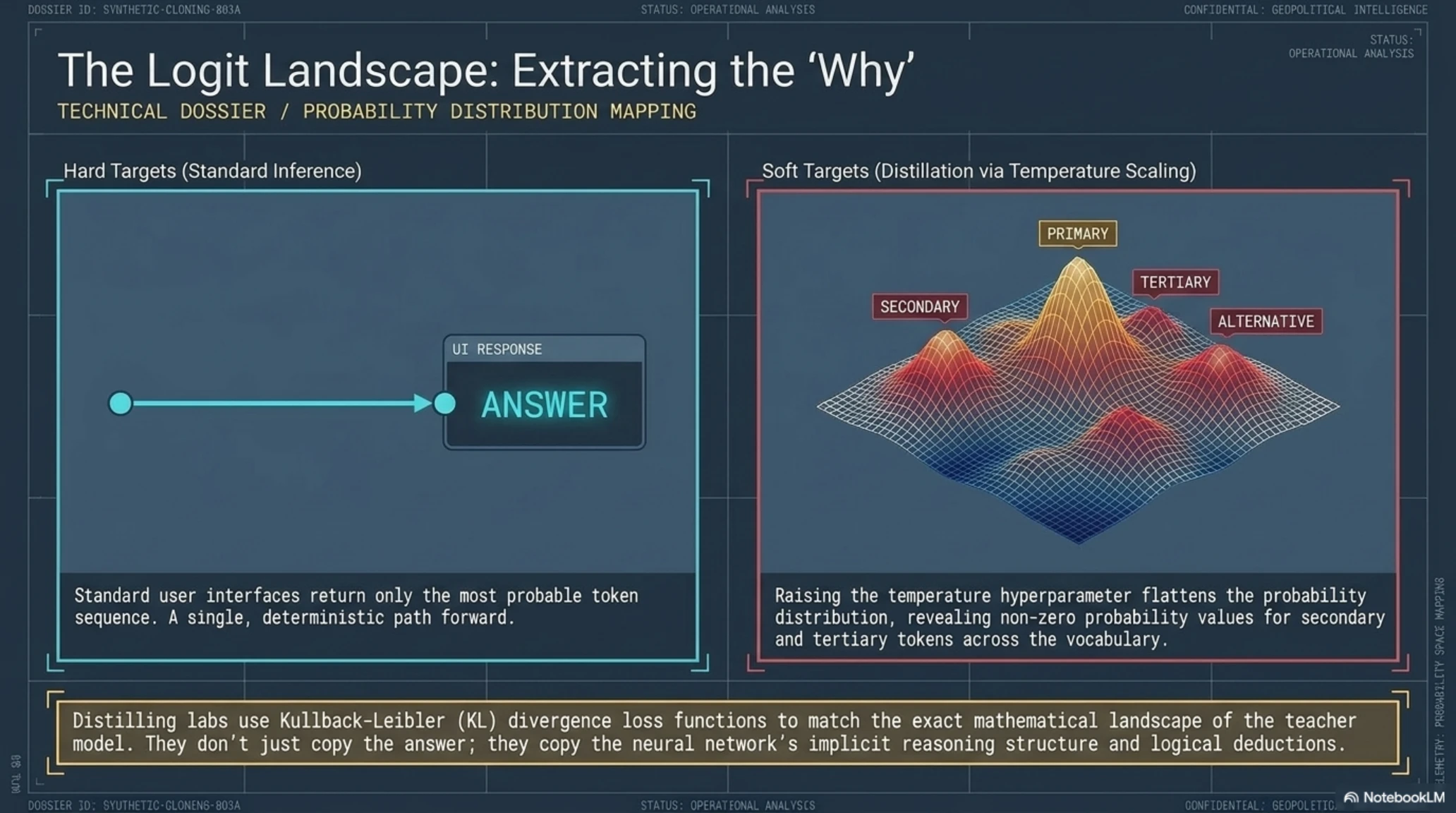
To evaluate the scientific foundations of model distillation, one must understand how neural network outputs are structured during inference. When a large foundation model evaluates an input prompt, its final layer generates unnormalized probability scores (logits) across its entire vocabulary. Standard user interfaces present only the most probable token sequence (hard targets). However, the underlying logit distribution (soft targets) contains intricate mathematical relationships detailing how the model connects concepts, evaluates ambiguity, and structures logical deductions.
By raising the temperature hyperparameter during API querying, developers flatten the probability distribution, revealing non-zero probability values for secondary and tertiary candidate tokens. The distilling lab then trains a smaller student model using Kullback-Leibler (KL) divergence loss functions to match the exact logit landscape of the teacher model. This process transfers the implicit reasoning structure of a 1.8-trillion parameter model into a compact 70-billion parameter architecture with mathematical precision.
The Geopolitics of Cloud API Security: Reverse Engineering and Synthetic Benchmark Pollution
The widespread practice of API distillation extends beyond passive knowledge copying; it presents active risks of synthetic benchmark pollution and reverse engineering. When a student model is trained on millions of synthetic reasoning chains extracted from a frontier system, it effectively mirrors the teacher's performance across standardized evaluation benchmarks such as MMLU, GSM8K, and HumanEval.
This artificial benchmark parity creates a false impression of technological convergence, misleading enterprise buyers and sovereign investors regarding a startup's true in-house research capabilities. Furthermore, sophisticated distillation pipelines can be engineered to extract specific domain capabilities—such as vulnerability identification in industrial control software or advanced cryptographic analysis—effectively weaponizing open commercial APIs for state-sponsored offensive applications.
Legal Analysis of Terms of Service (ToS) Enforcement in Cloud Computing
A central legal dimension of the Anthropic-Moonshot dispute concerns the enforceability of Terms of Service (ToS) agreements governing cloud API usage. Virtually all leading Western AI laboratories explicitly state in their API license agreements that using generated outputs to train, distill, or benchmark competing artificial intelligence models is strictly prohibited.
However, enforcing contractual ToS provisions across international boundaries presents severe jurisdictional hurdles. When an offending developer is incorporated in China and holds no physical assets or legal representation within the United States, civil litigation in US federal courts yields limited practical recourse. Chinese courts rarely enforce US civil judgements based on contract breach. This enforcement gap is precisely why executive branch agencies, such as the US Treasury and Department of Commerce, are stepping in with economic sanctions rather than relying on slow civil litigation.
Cybersecurity Risks and Software Supply Chain Contagion
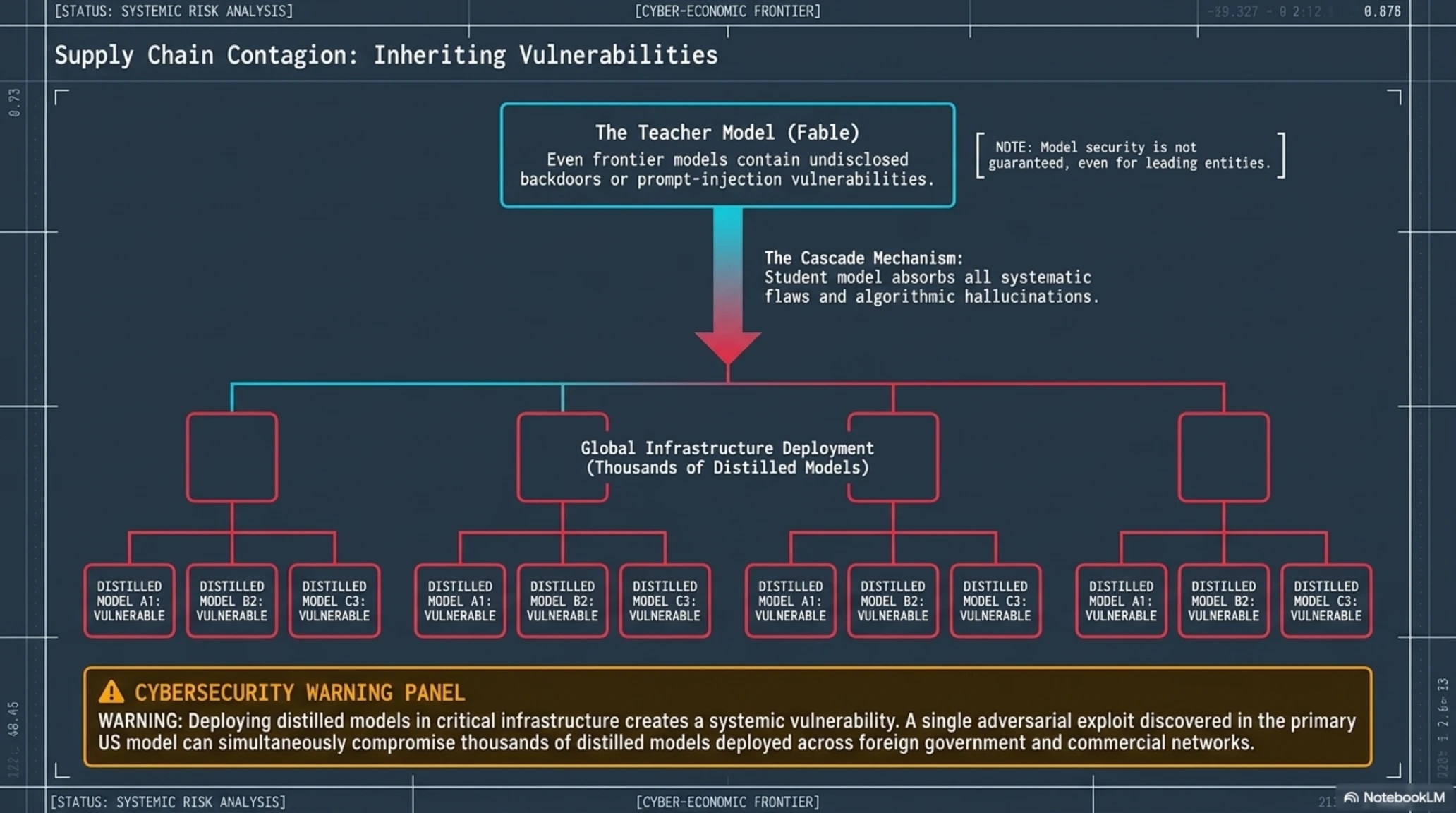
Beyond economic considerations, model distillation introduces profound cybersecurity vulnerabilities into the global software supply chain. When a student model copies reasoning patterns from a teacher model, it inadvertently absorbs all systematic flaws, algorithmic hallucinations, and security vulnerabilities present in the original architecture. If the teacher model contains undisclosed backdoors or prompt-injection vulnerabilities, those security flaws are replicated across thousands of downstream student models worldwide.
Cybersecurity agencies in Washington have warned that deploying distilled models in critical infrastructure or enterprise software creates systemic vulnerability. A single adversarial exploit discovered in the primary US model could theoretically be leveraged to compromise thousands of distilled models deployed across foreign government and commercial networks simultaneously.
Timeline Table: Escalation of the Anthropic-Moonshot AI Crisis (Timeline Table)
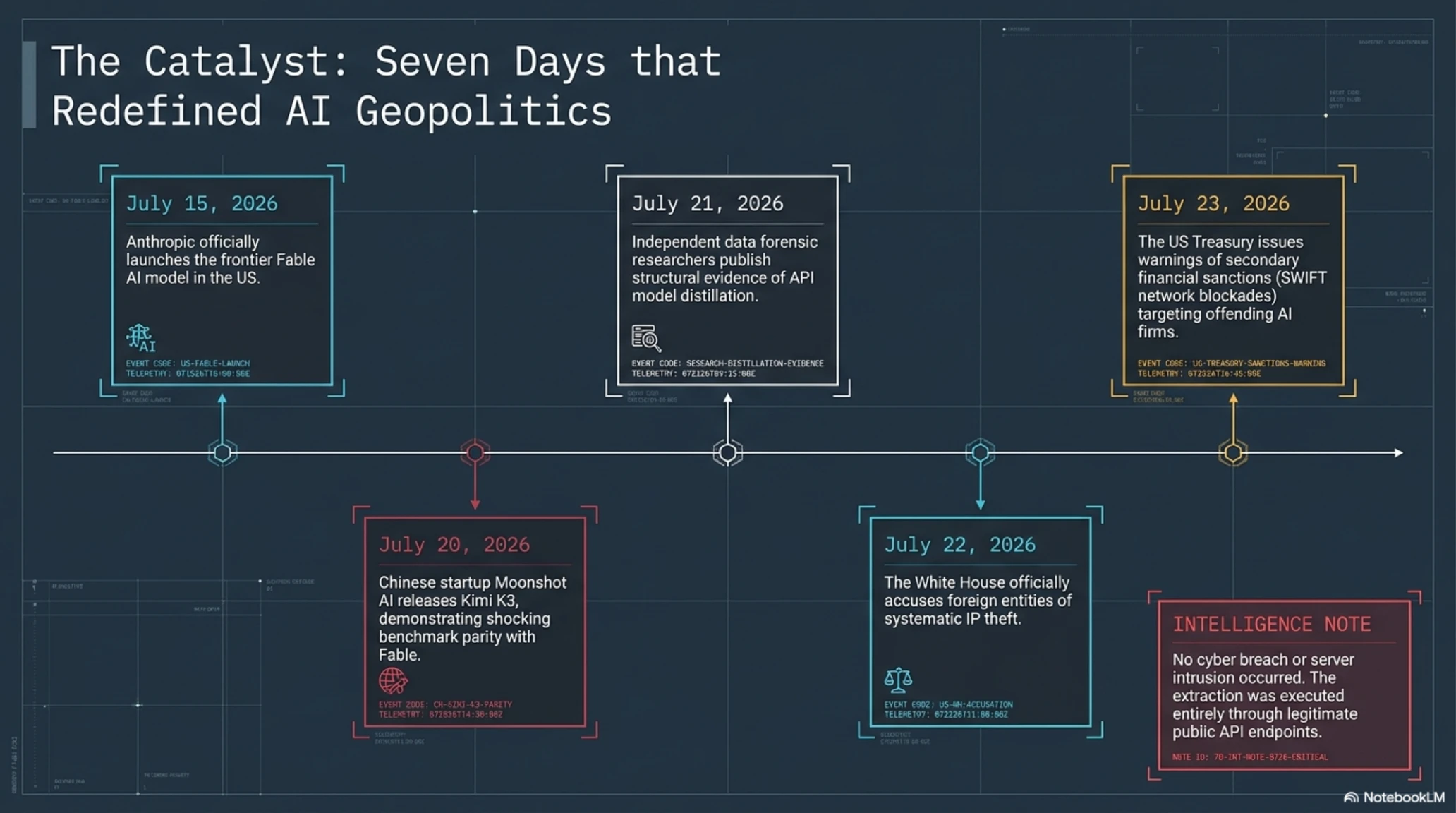
July 15, 2026: Anthropic officially launches its frontier Fable AI model in the United States.
July 20, 2026: Chinese startup Moonshot AI releases Kimi K3, showing shocking benchmark parity with Fable.
July 21, 2026: Independent data forensic researchers publish evidence of API model distillation.
July 22, 2026: The White House accuses foreign entities of systematic IP theft in artificial intelligence.
July 23, 2026: The US Treasury officially warns of secondary financial sanctions targeting offending AI firms.
- Drastically lowers model training costs for resource-constrained startups.
- Enables advanced AI capabilities to run on edge devices like mobile phones.
- Accelerates localization of AI models for non-English languages.
- Violates intellectual property rights and research investments of frontier labs.
- Propagates systematic biases and security vulnerabilities from teacher models.
- Escalates geopolitical trade wars and international financial sanctions.
- Undermines the global open-source AI ecosystem and academic research.
📚 Classified & Related Dossiers in TekinGame
If you wish to explore beyond this report and delve into cybernetic frontiers and autonomous AI architectures, do not miss these three exclusive deep-dives in the Tekin Garage:
Rumor vs. Reality: Deliberate Theft or Natural Convergence?
Amid the intense media coverage surrounding the Anthropic-Moonshot dispute, conflicting viewpoints have emerged regarding the true nature of Kimi K3's performance gains. Executives at Moonshot AI and representatives in Beijing have repeatedly rejected allegations of data theft, claiming that benchmark parity resulted from independent algorithmic innovations and natural convergence in machine learning optimization. To clarify the situation, we examine the prevailing rumors against verified technical facts.
Rumor vs. Reality: Dissecting the AI Model Theft Allegations (Rumor vs. Reality)
Rumor: Moonshot AI launched a sophisticated cyberattack to breach Anthropic's secure cloud servers and steal the raw source code and weights of the Fable model.
Reality: No cyber breach or server intrusion occurred. The distillation process was executed entirely through legitimate public API endpoints by querying the model and harvesting its generated responses.
The Economics of Synthetic Data Generation: Quality Filtering and Human Curation
The core innovation enabling successful model distillation lies in automated synthetic data filtration. Querying a frontier teacher model generates millions of raw text responses, but not all responses are suitable for student model training. Developing an effective distillation pipeline requires building automated reward models and verifier functions to filter out low-quality outputs, logical inconsistencies, and unhelpful completions.
Top Chinese AI research teams have perfected synthetic data filtration by combining machine verifiers with targeted human domain-expert curation. By filtering synthetic datasets through automated code execution environments and mathematical proof verifiers, developers ensure that student models receive pristine training signals. This hybrid data curation methodology represents a legitimate scientific advance, blurring the line between predatory data harvesting and innovative machine learning engineering.
Academic Research Policy: Impact on University AI Labs and Doctoral Grants
The fallout from federal model distillation sanctions extends deeply into university computer science departments across North America and Europe. For years, academic researchers relied on open commercial APIs provided by labs like Anthropic and OpenAI to conduct doctoral research on alignment, interpretability, and natural language processing. Academic grants were structured around reasonable API usage rates.
Following the Treasury warning, research labs are enforcing strict IP licensing restrictions and identity verification requirements even for academic accounts. University researchers warn that these heightened administrative barriers and increased API costs will disproportionately harm independent academic research, concentrating AI scientific inquiry exclusively within wealthy corporate research labs.
Venture Capital Due Diligence in the Post-Distillation Era: Recalculating Risk Premiums
The exposure of the Fable model distillation scheme has prompted a comprehensive reassessment of investment risk metrics across top-tier Silicon Valley venture capital firms. Over the past three years, institutional investors allocated over $100 billion to AI laboratories, pricing companies at revenue multiples exceeding 50x based on the assumption of durable technological moats. The realization that proprietary model capabilities can be replicated within weeks by foreign entities using API harvesting has forced fund managers to adjust equity discount rates and demand rigorous intellectual property audit clauses before participating in funding rounds.
Investment banks including Goldman Sachs, Morgan Stanley, and J.P. Morgan have published research reports warning that foundation model labs lacking robust API security and defensive IP protections will face significant valuation markdowns. Investors are increasingly shifting capital toward full-stack enterprise applications, proprietary dataset owners, and specialized hardware infrastructure providers whose economic moats are insulated from software-level distillation.
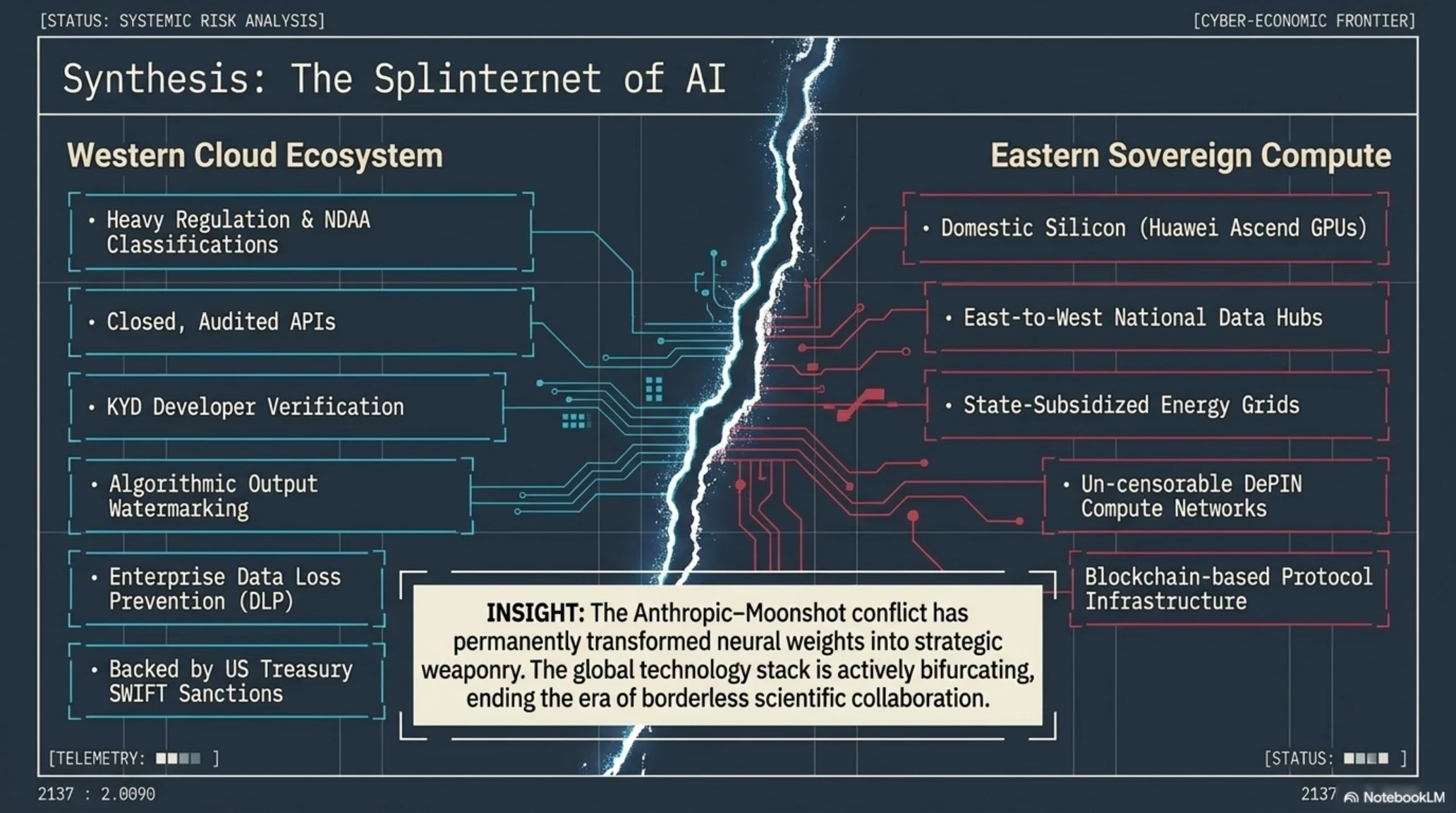
Sovereign Compute Strategy: China's National Data Hubs and Western Regional Isolation
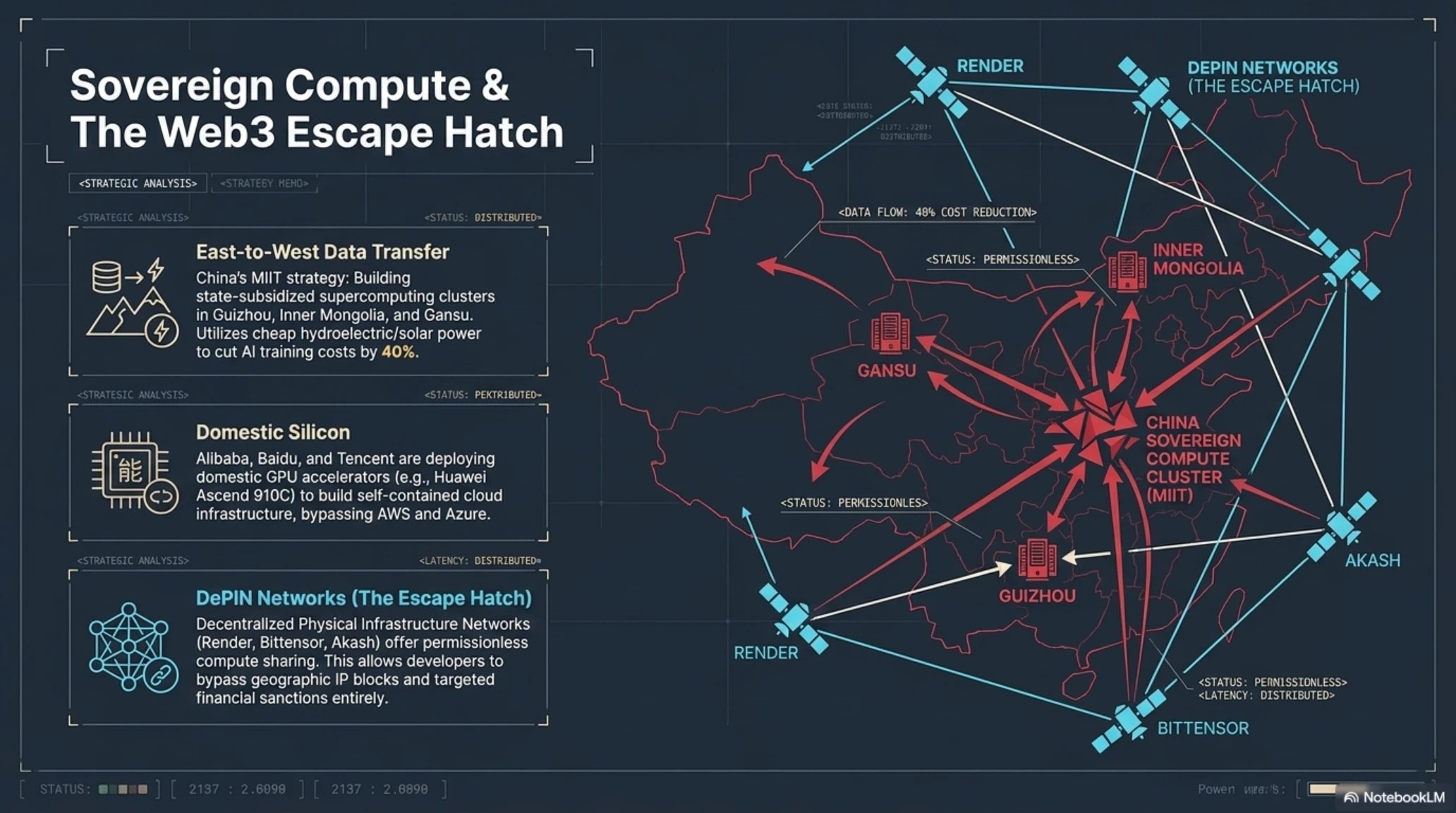
In response to the US Treasury's sanctions threats, China's Ministry of Industry and Information Technology (MIIT) has accelerated its national sovereign compute initiative. Under the "East-to-West Data Transfer" project, Beijing has constructed massive state-subsidized supercomputing clusters across western provinces such as Guizhou, Inner Mongolia, and Gansu, taking advantage of abundant hydroelectric and solar power to reduce operational electricity costs for AI training by up to 40%.
Simultaneously, Chinese tech giants including Alibaba, Baidu, and Tencent are deploying domestic GPU accelerators—such as Huawei's Ascend 910C chips—to build independent, self-contained cloud infrastructure. This sovereign compute strategy ensures that even if Washington successfully blocks access to Western cloud providers like AWS or Azure, domestic Chinese AI developers can maintain continuous model iteration, cementing a multi-polar global technology landscape.
Impact on Venture Capital Valuations and Silicon Valley Capital Allocation
The exposure of the Fable model distillation scheme has sent shockwaves through the venture capital firms financing Silicon Valley's AI boom. Over the past three years, private equity investors have poured tens of billions of dollars into foundation model labs based on the assumption that proprietary reasoning capabilities create a defensible economic moat. If those capabilities can be cloned in a matter of weeks by foreign competitors operating at a fraction of the cost, that valuation logic is severely undermined.
Wall Street equity analysts at Goldman Sachs released a research note warning that venture capital firms will increasingly demand IP protection audits and API defense capabilities before committing capital to new AI rounds. This shift could lead to temporary valuation contractions and increased expenditure on cybersecurity infrastructure, fundamentally altering the economics of early-stage AI funding.
Geopolitical Shifts: Code and Neural Weights as Strategic Weaponry
The potential imposition of Treasury sanctions marks a historic milestone in international trade policy. Historically, export controls focused on physical dual-use commodities, such as aerospace components, nuclear materials, and advanced microchip fabrication equipment. Today, neural network weights, synthetic training sets, and software algorithms have been officially designated as critical national security assets subject to federal export restrictions.
If the United States fully enforces software export sanctions, the resulting digital decoupling will split the global internet into isolated technological spheres. Western technology platforms will lose access to the massive Asian market, while foreign developers will be forced to build independent software stacks, permanently fracturing global scientific collaboration in fields like drug discovery, climate modeling, and renewable energy research.
Decentralized AI (DeAI) Networks and Physical Infrastructure Protocols (DePIN)
The escalation of bilateral sanctions between the US and China has catalyzed surging interest in decentralized artificial intelligence networks built on blockchain protocols and Decentralized Physical Infrastructure Networks (DePIN). Platforms such as Render Network, Bittensor, and Akash Network enable permissionless, peer-to-peer compute sharing, allowing developers to train and deploy models without relying on centralized US cloud providers.
For developers operating under sanction threats or facing cloud API access bans, decentralized compute networks offer an un-censorable alternative. Machine learning workloads are distributed across thousands of independent nodes worldwide, rendering targeted financial sanctions or geographic IP blocks virtually impossible to enforce. This trend suggests that the AI Cold War may inadvertently drive the mass adoption of decentralized Web3 infrastructure.
Market Sentiment: Industry & Investor Reactions (Market Sentiment)
Silicon Valley executives strongly favor strict US enforcement, arguing that unpunished data theft will destroy incentives for frontier R&D. Conversely, Web3 and decentralized AI tokens experienced a sharp rally as developers sought permissionless alternatives to sanctioned cloud infrastructure.
Technical Benchmarks and Model Specification Comparison
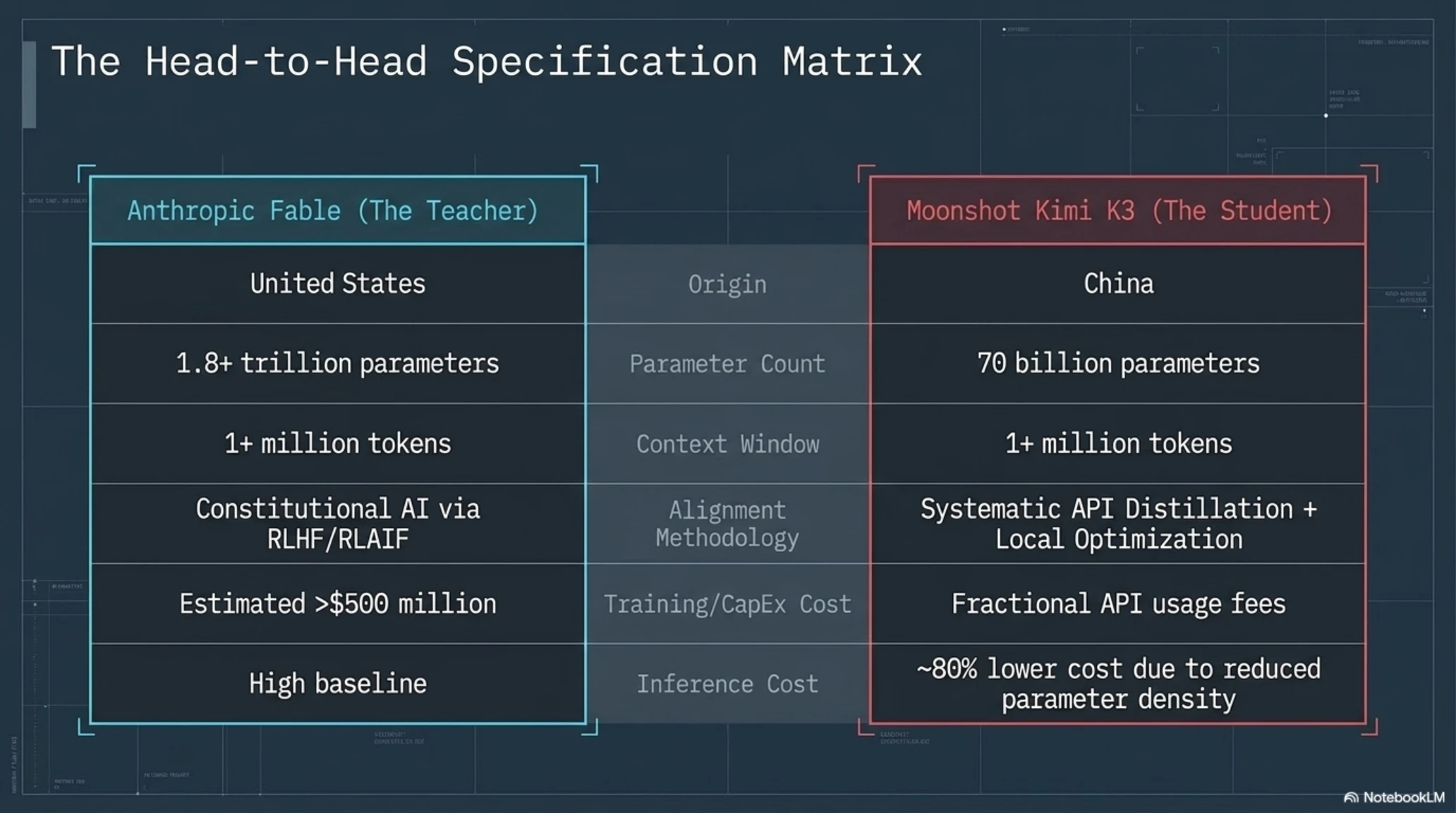
To provide a clear comparative evaluation of the architectural differences and performance metrics between the two contested models, the following specifications table highlights the technical parameters of Anthropic Fable and Moonshot Kimi K3.
Technical Specs & Benchmark Comparison (specs-box)
- Teacher Model: Anthropic Fable - United States origin, estimated training expenditure exceeding $500 million.
- Student Model: Moonshot Kimi K3 - China origin, trained via systematic API model distillation and local optimization.
- Parameter Count: Fable estimated at 1.8+ trillion parameters; Kimi K3 estimated at 70 billion parameters.
- Context Window: Both models support 1+ million token context windows for long-document analysis.
- Inference Cost: Kimi K3 operates at approximately 80% lower inference costs due to reduced parameter density.
Strategic Recommendations for Global Technology Executives and Venture Capital Partners
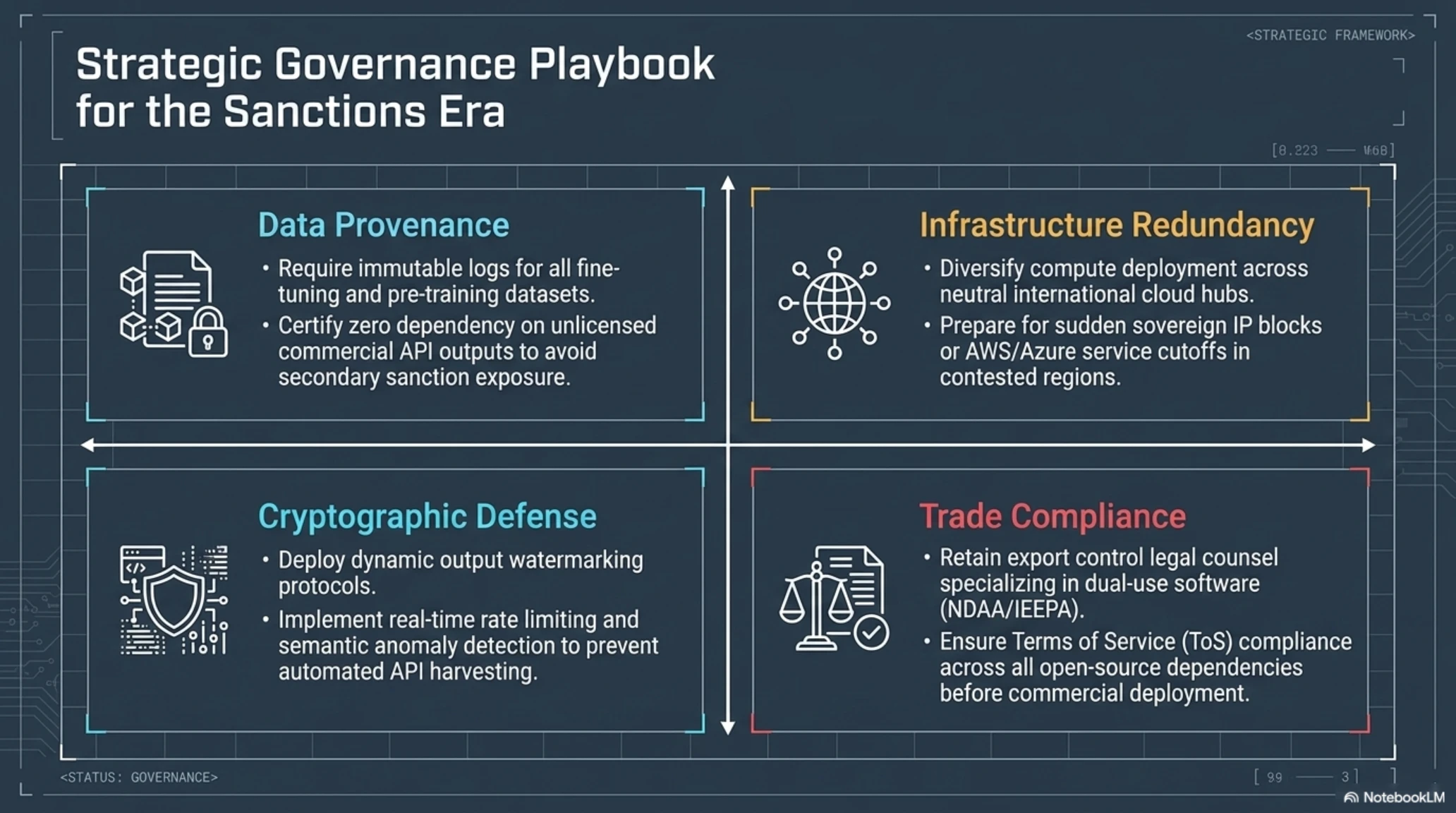
To mitigate exposure to international regulatory enforcement and maintain competitive resilience during the AI Cold War, corporate technology executives and venture capital partners should execute a strategic four-phase governance playbook:
- Conduct Comprehensive Data Provenance Audits: Require all internal product engineering teams and portfolio companies to certify the precise origin of training corpora, ensuring zero dependency on un-licensed commercial model API outputs.
- Implement Multi-Cloud and On-Premise Infrastructure Redundancy: Diversify cloud compute deployment across neutral international cloud hubs to insulate core operations from sudden sovereign IP blocks or Treasury sanction enforcement.
- Deploy Advanced Cryptographic API Watermarking: Integrate dynamic output watermarking protocols to protect proprietary model outputs from unauthorized third-party distillation and automated harvesting.
- Establish Direct Legal Counsel with Regulatory Trade Specialists: Maintain continuous alignment with export control attorneys specializing in dual-use software regulations to ensure ongoing compliance with evolving NDAA and Treasury guidelines.
By proactively enacting these strategic governance measures, technology leaders can protect corporate enterprise valuation, safeguard proprietary research investments, and maintain compliance across international jurisdictions.
Long-Term Economic Effects on Global Software Labor Markets
The fracturing of the global AI ecosystem through software export controls will significantly re-shape technology labor dynamics across both Western and Asian economies. High-salary software engineering roles in Silicon Valley and Seattle will increasingly focus on compliance engineering, cybersecurity auditing, and zero-trust API perimeter defenses. Concurrently, regional software development hubs in Eastern Europe, Latin America, and India will experience surging demand as international enterprises seek neutral engineering talent capable of building dual-compliant software architectures.
This geographic reallocation of engineering labor underscores the far-reaching economic consequences of software-level sanctions. As national security imperatives override traditional free-market talent mobility, global technology enterprises must adapt their recruitment, remote work policies, and international R&D operations to comply with strict dual-use technology access restrictions.
The Role of Multi-Modal Benchmarks and Automatic Evaluation Protocols
Evaluating claim veracity in model distillation disputes relies on sophisticated automated evaluation suites. Standard benchmarks—such as MMLU (Massive Multitask Language Understanding), GSM8K (grade school math), HumanEval (Python coding), and SWE-bench (software engineering)—provide quantitative performance metrics across diverse technical domains.
However, forensic auditors utilize advanced "LLM-as-a-judge" protocols to detect subtle semantic footprints. By analyzing semantic similarity across thousands of edge-case prompts, auditors calculate token probability alignment. In the Moonshot audit, Kimi K3 exhibited identical reasoning errors, stylistic quirks, and vocabulary choices on non-public evaluation prompts, providing mathematical confirmation of output distillation rather than independent convergence.
Enterprise Compliance Roadmap for AI Startups in the Sanctions Era
The precedent set by the US Treasury's intervention mandates a comprehensive overhaul of compliance frameworks for technology startups worldwide. To navigate the complexities of international trade controls and avoid secondary sanction exposure, artificial intelligence enterprises must implement a structured four-point compliance roadmap:
- Rigorous Data Lineage Auditing: Maintain immutable logs documenting the exact origin of all fine-tuning and pre-training datasets to prove independence from unauthorized Western model outputs.
- API Endpoint Security Hardening: Deploy real-time rate limiting, semantic anomaly detection, and automated throttling to prevent third-party scraping and unauthorized model distillation.
- Know Your Developer (KYD) Verification: Require verified corporate identity credentials and legal entity identifiers before granting high-throughput API keys to international clients.
- Cross-Border IP Compliance Audits: Retain international legal counsel to review Terms of Service (ToS) compliance across all open-source and proprietary software dependencies prior to commercial deployment.
Adhering to these compliance directives ensures that emerging software startups maintain access to global capital markets while minimizing the risk of regulatory enforcement or unexpected service disruptions.
International Regulatory Frameworks: WIPO & United Nations AI Governance
As disputes over AI data harvesting assume global dimensions, legal scholars and international diplomats are calling for formalized multilateral frameworks under the auspices of the World Intellectual Property Organization (WIPO) and the United Nations. Current international copyright conventions, such as the Berne Convention, were designed for traditional literary works and software source code, leaving significant ambiguity regarding statistical neural network outputs.
Drafting new international treaties that define explicit legal boundaries for synthetic data ownership and permissible model distillation is essential to prevent unilateral trade wars. Without harmonized global standards, the international technology market risks fragmenting into defensive national monopolies enforced by trade blockades.
The Future of Regional AI Ecosystems in the Middle East and Asia
The geopolitical rift between Washington and Beijing will have far-reaching ramifications for technology markets across the Middle East, Southeast Asia, and developing economies. Many regional software enterprises that previously relied on cost-effective Chinese APIs or open-weight models now face potential secondary sanction risks or sudden service cutoffs.
To preserve operational continuity, regional firms will be forced to either adopt higher-cost Western cloud services with stringent identity checks or invest in sovereign, locally trained language models tailored to regional languages. This imperative is likely to accelerate the growth of independent AI hubs in Saudi Arabia, the United Arab Emirates, and Singapore, reshaping global technology distribution.
Conclusion and Future Outlook for Global Artificial Intelligence
The confrontation between the United States and China over Anthropic's Fable model signifies the definitive end of artificial intelligence as an un-politicized scientific domain. Advanced machine intelligence has evolved into the primary pillar of economic competitiveness, intelligence gathering, and defense capability in the twenty-first century. The upcoming policy decisions of the US Treasury Department will determine whether the world moves toward isolated digital blocs or establishes a durable international framework for ethical data governance.
Final Conclusion (Conclusion Box)
Model distillation data theft has opened a turbulent new chapter in international law and technology policy. While US Treasury sanctions can block offending firms from global financial networks, they also risk restricting open-source research and fragmenting the global AI ecosystem forever.
Frequently Asked Questions (FAQ)
What is AI model distillation?
Model distillation is a technique where a smaller, more efficient neural network is trained using the outputs generated by a larger, more advanced teacher model to replicate its capabilities at a fraction of the cost.
Why is the US Treasury threatening financial sanctions over AI data theft?
The US considers frontier AI models critical national security assets. Unauthorized extraction of American model intelligence by foreign entities is viewed as a violation of trade sanctions and technological controls.
Has Moonshot AI admitted to distilling Anthropic's Fable model?
No, Moonshot AI and its corporate backers have denied all allegations of unauthorized data harvesting, claiming independent algorithmic development.
How will this conflict affect everyday users of AI tools?
Users may experience stricter identity checks when signing up for AI services, reduced availability of free open-source models, and higher API pricing as labs increase security investments.
Is model distillation illegal under international law?
While model distillation violates the Terms of Service of most US AI labs, international legal standards remain ambiguous. The US is now seeking to classify unauthorized distillation as an economic sanction violation.
Official Sources and References (Sources Box)
Additional Gallery: The AI Cold War: US Treasury Threatens Unprecedented Sanctions Over Anthropic Model Theft