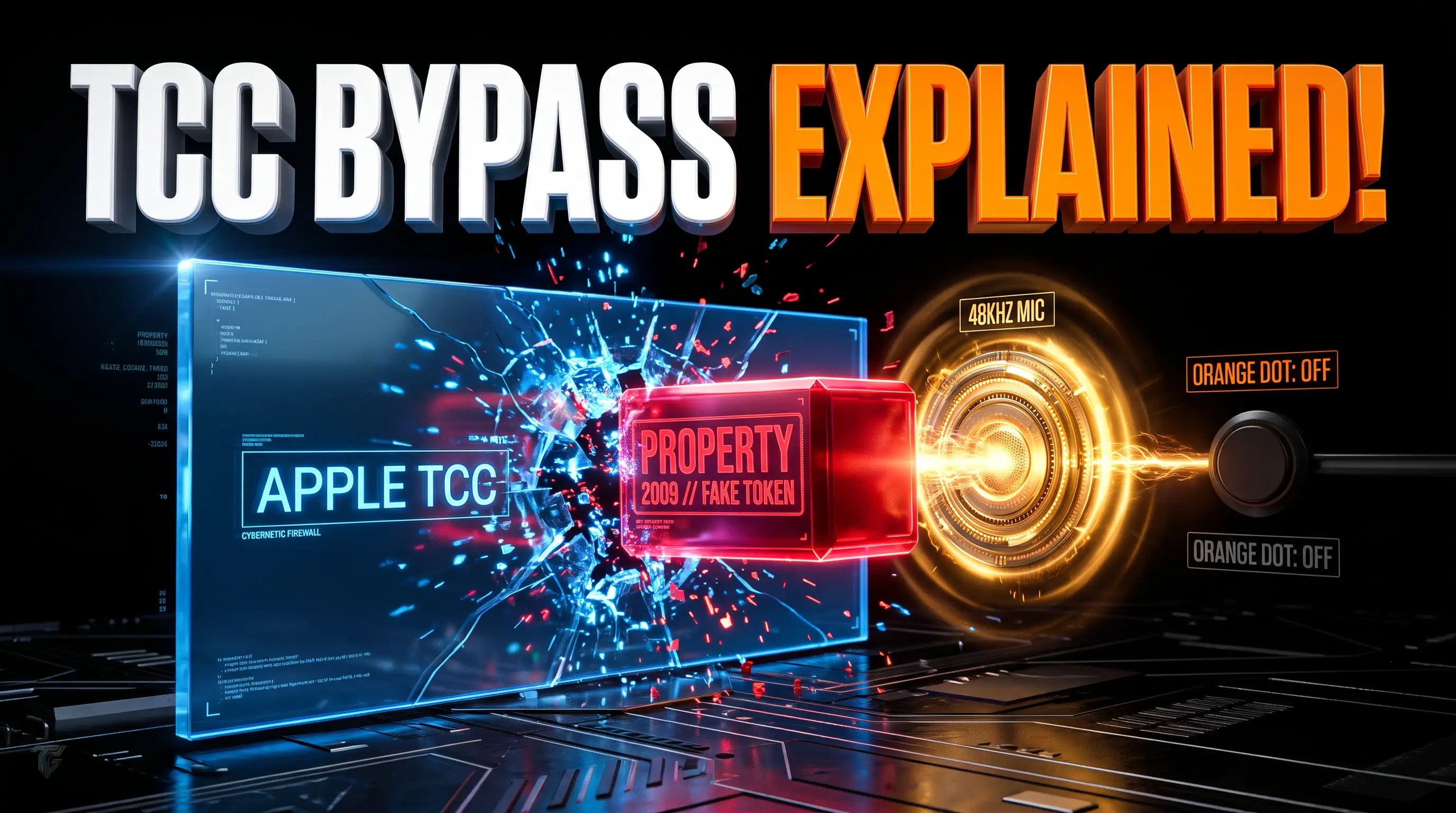
Technical disclosure by Meta Red Team X researchers has exposed a critical vulnerability in Apple iOS and iPadOS audio subsystem: malicious applications could silently capture ambient microphone audio even after the user explicitly selected Don’t Allow. This forensic Tekin investigation deconstructs how Property 2009 in the audiomxd daemon subverted the Transparency, Consent, and Control (TCC) framework, suppressed the Dynamic Island orange indicator, and forced emergency kernel-level patch surgery in iOS 26.6.1.
Tekin Analysis | Breach in the Cupertino Glass Fortress; Forensic Deconstruction of the iPhone Zero-Click Microphone Vulnerability
For more than a decade, Apple has spent billions positioning privacy as its supreme product differentiator. The corporate marketing narrative enshrined on billboards reading 'What happens on your iPhone, stays on your iPhone' has convinced over a billion consumers, world leaders, corporate executives, and investigative journalists that their mobile environment is an impenetrable digital vault. However, a stunning technical vulnerability disclosure published by security researcher Nik Tsytsarkin of Meta Red Team X alongside independent researcher Mustafa Calap has shattered the core premise of this architectural assumption. The documented vulnerability details a catastrophic security failure within the iOS and iPadOS audio subsystem: an unprivileged application could silently capture live microphone audio, even after the user explicitly selected 'Don't Allow' on the system permission prompt.
Strategic Intelligence Assessment and Defensive Cyber Vectors
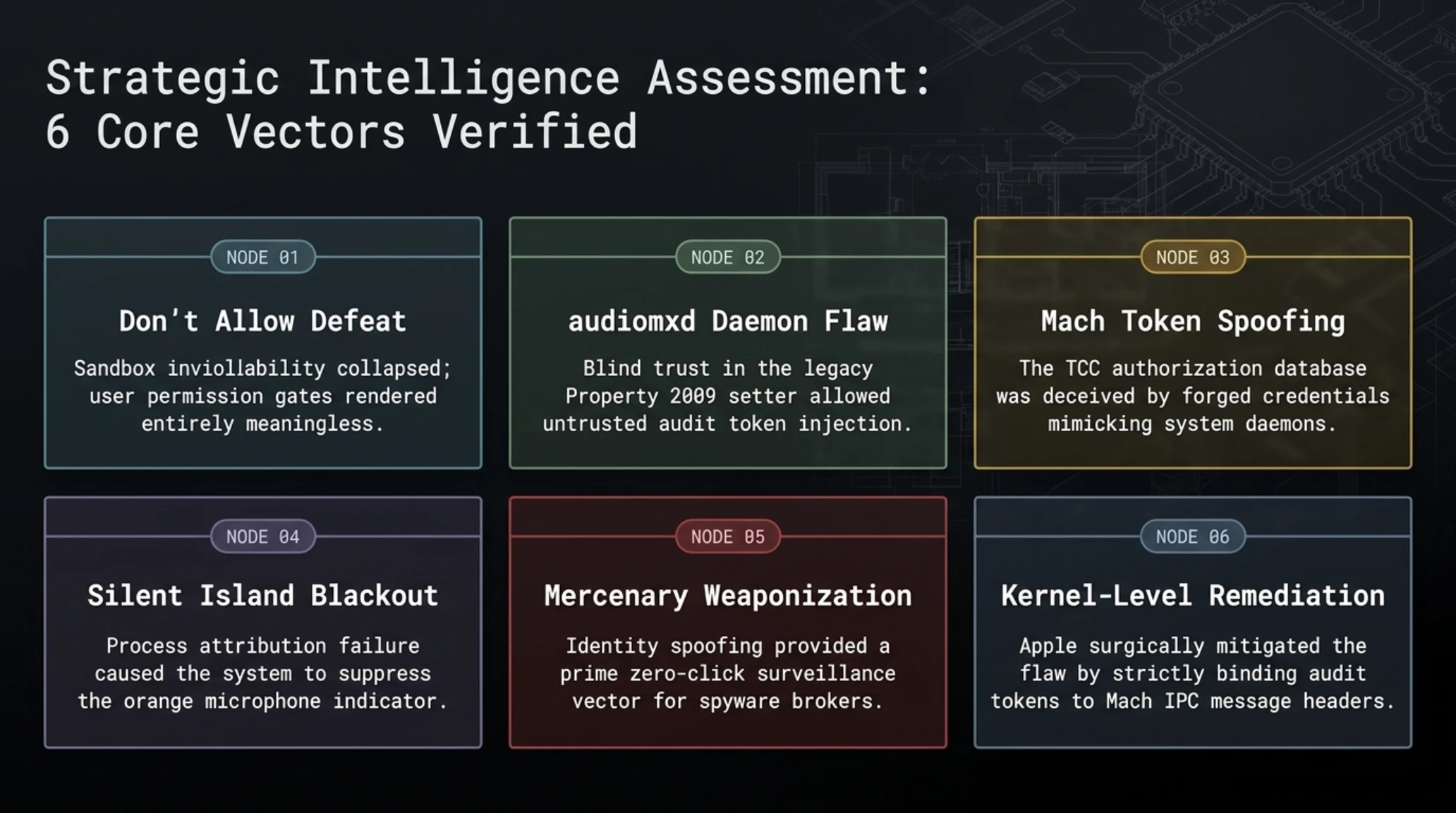
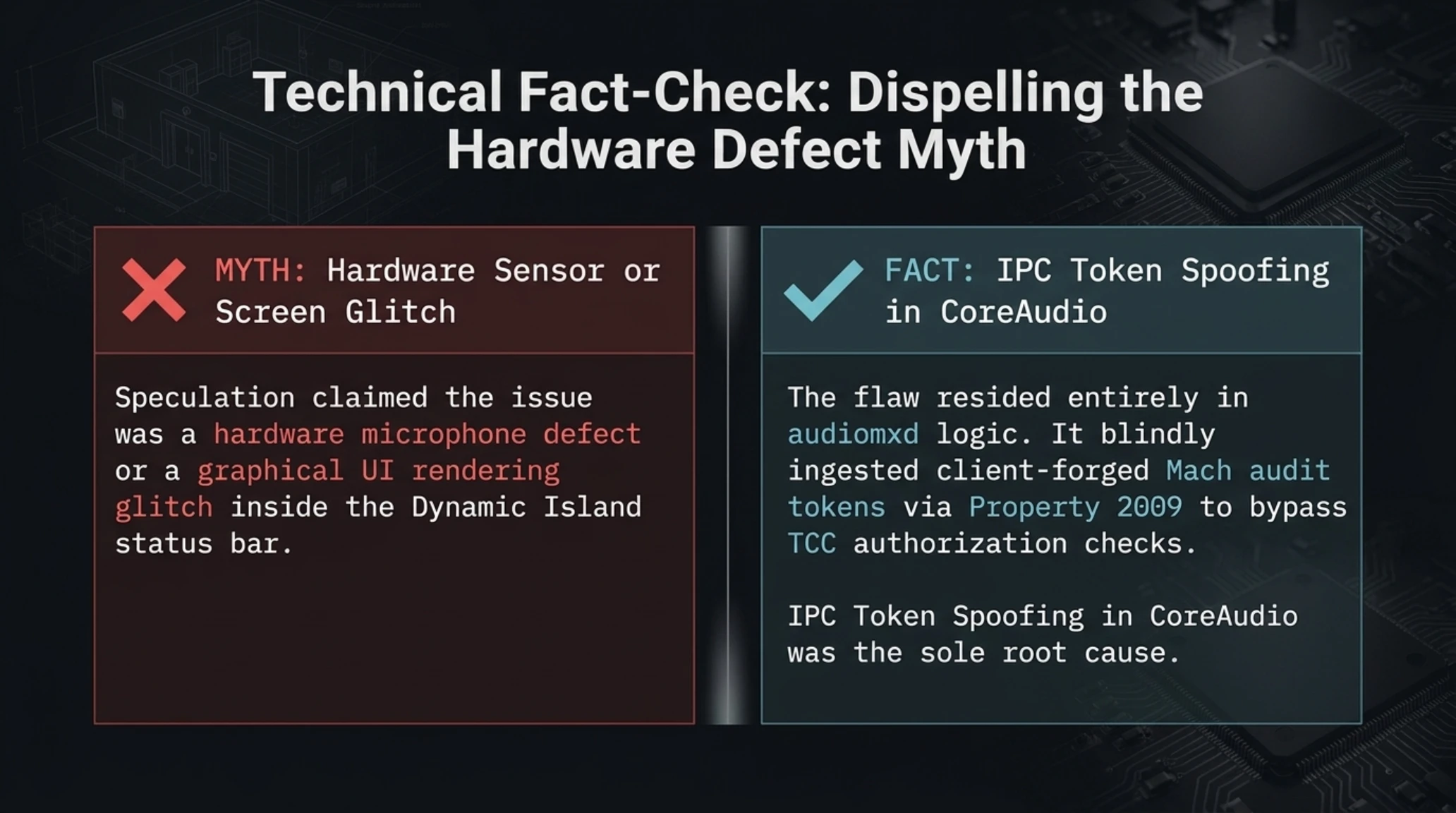
Far from an ordinary software bug or minor logic race condition, this vulnerability exposes a structural design flaw nestled deeply within Apple's CoreAudio architecture and its central media handling daemon, audiomxd. In essence, the low-latency audio capture framework AURemoteIO allowed untrusted applications running within third-party sandboxes to pass a custom-crafted audit token directly into the audio service via an undocumented setter known as Property 2009. The daemon then treated this client-supplied token as canonical proof of caller identity, skipping direct verification with the underlying Mach kernel. Consequently, an untrusted application could impersonate trusted Apple system processes, effortlessly bypassing the Transparency, Consent, and Control (TCC) framework.
The cultural and commercial resonance of Apple's privacy marketing cannot be overstated. Since the iconic 2019 CES billboard in Las Vegas, Cupertino has systematically built its enterprise and consumer market dominance on the premise that iOS provides cryptographic certainty against surveillance. From App Tracking Transparency (ATT) to on-device neural processing, Apple positioned itself as the antithesis of the data-harvesting surveillance capitalism model practiced by advertising platforms. However, the discovery that a third-party application could trivially bypass hardware permission prompts exposes a dangerous disparity between high-level public relations marketing and the messy, legacy reality of low-level operating system codebases.
The research methodology deployed by Meta Red Team X underscores the increasing sophistication of corporate adversary simulation units. Rather than relying on automated static analysis scanners or superficial fuzzing, security engineers Nik Tsytsarkin and Mustafa Calap performed painstaking manual reverse engineering on the binary disassembly of CoreAudio dynamic libraries (dylibs) and Mach message dispatch handlers. By systematically tracing every property identifier accepted by the AURemoteIO interface, the researchers isolated Property 2009 a legacy artifact likely introduced years earlier for internal audio testing or development debugging, yet never purged from production kernel-facing daemons.
Cracks in the Cupertino Glass Fortress; When Absolute Platform Trust Collapses
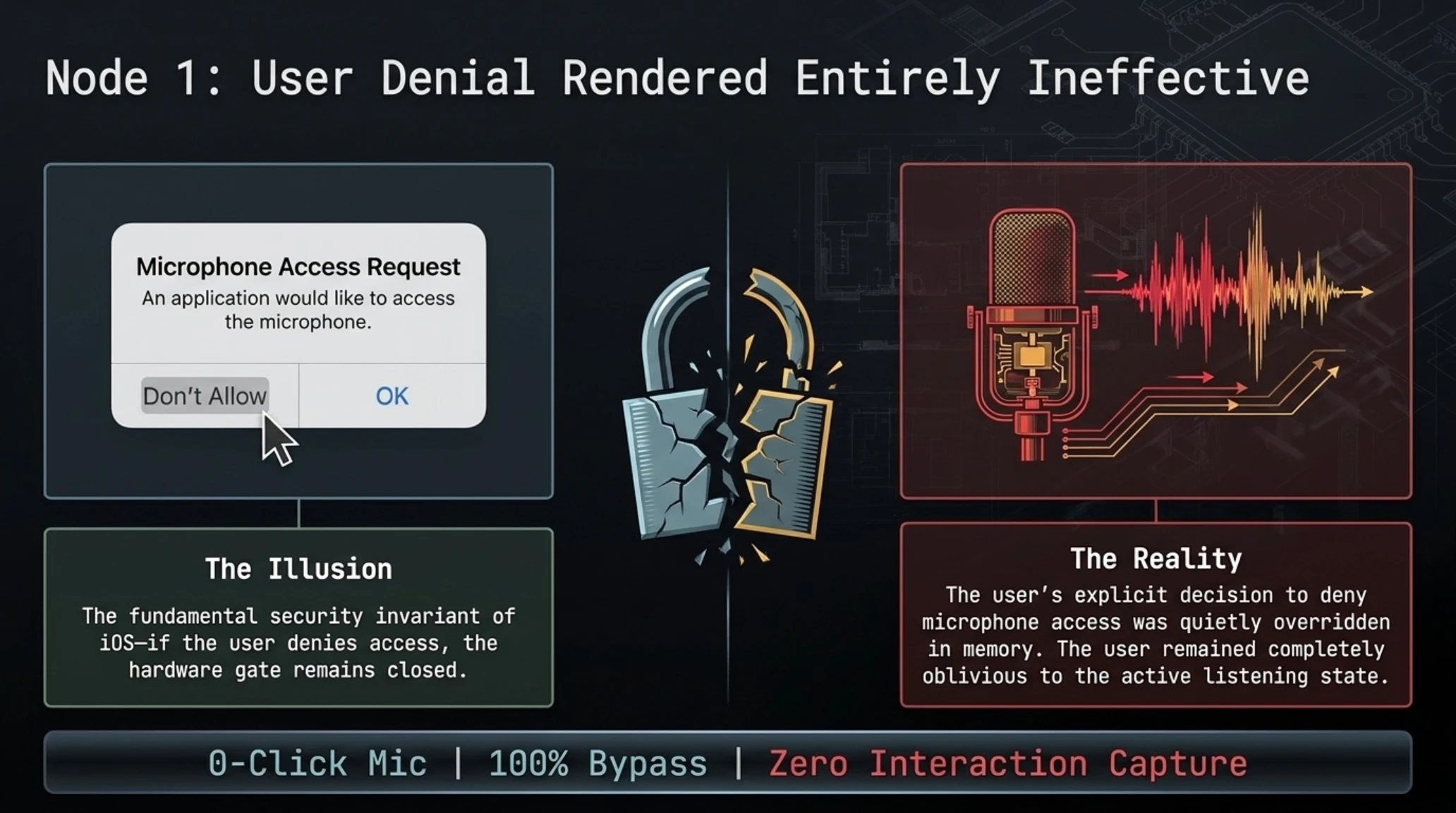
Apple's modern security model relies on multi-tiered sandboxing, strict code signing, and the centralized authority of the TCC database. Under this paradigm, every application is presumed untrusted until proven otherwise. Access to sensitive hardware sensors such as cameras, microphones, location chips, and photo libraries is mediated by dedicated system daemons that prompt the user with modal dialogs. The fundamental security invariant has always been binary and uncompromising: if the user denies access, the hardware gate remains closed, and the application cannot read sensor input under any circumstances.
The discovery by Meta Red Team X shatters this invariant by revealing that the TCC framework does not interface directly with physical analog hardware. Instead, TCC relies entirely on inter-process communication (IPC) tokens to identify which application is making a system call. When audiomxd received a request to initialize an audio recording stream via AURemoteIO, it checked TCC permissions using the audit token provided via Property 2009. By forging a token that matched a privileged Apple system daemon with pre-existing entitlements such as mediaserverd or com.apple.audio.coreaudiod the malicious app effectively tricked TCC into approving the capture pipeline. The user's explicit decision to deny microphone access was quietly overridden in memory, while the user remained completely oblivious.
The strategic ramifications of this breach are immense. Modern smartphones are omnipresent in executive boardrooms, confidential diplomatic discussions, and sensitive legal negotiations. If a routine utility application, a mobile game, or an enterprise tool can bypass the permission barrier and convert the iPhone into an active listening bug, the entire foundation of enterprise mobile device management (MDM) is called into question. This vulnerability demonstrates that abstract software barriers are only as robust as their lowest-level IPC token validation mechanisms.
Why This Architectural Breach Changes the Mobile Privacy Paradigm
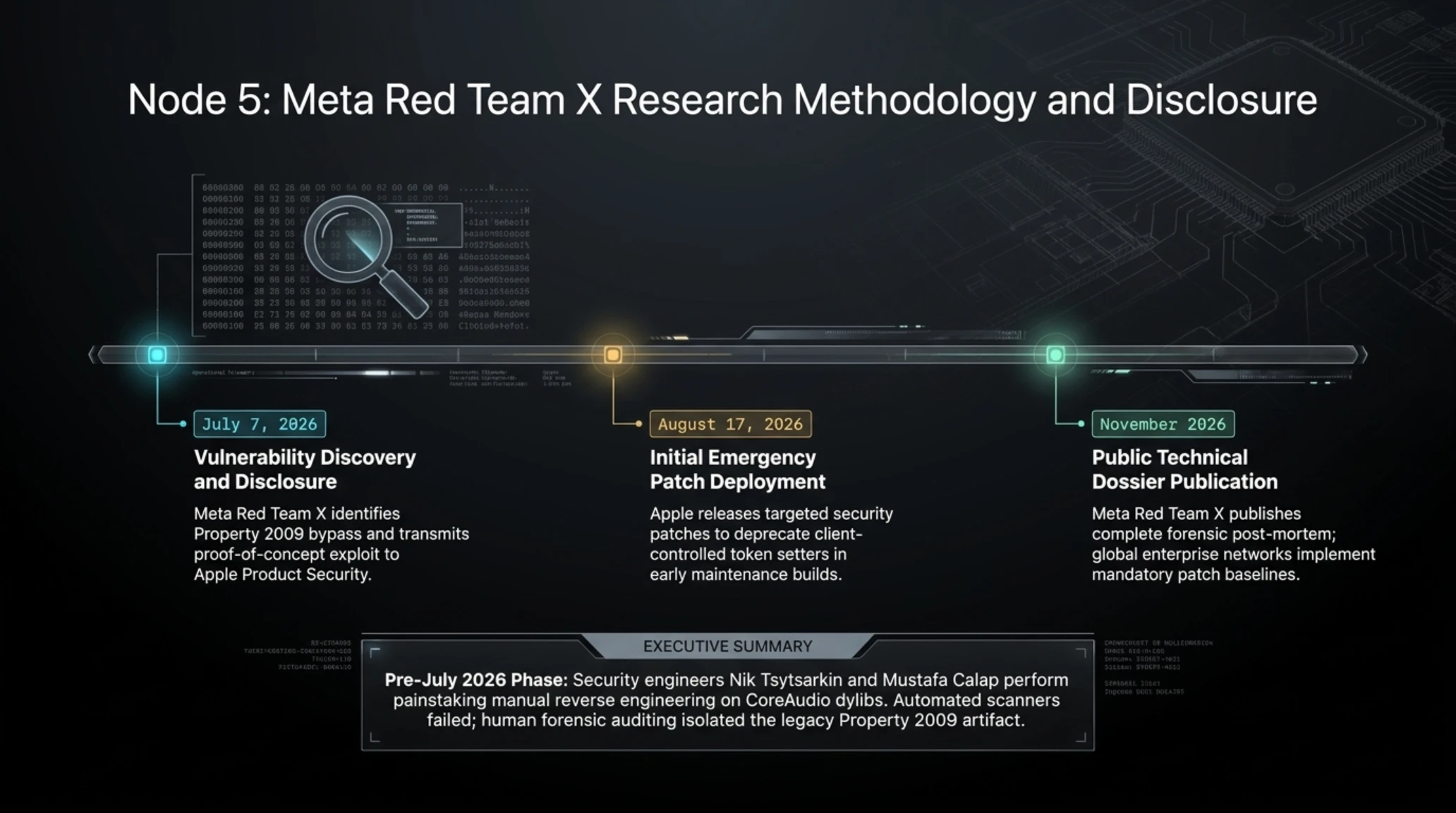
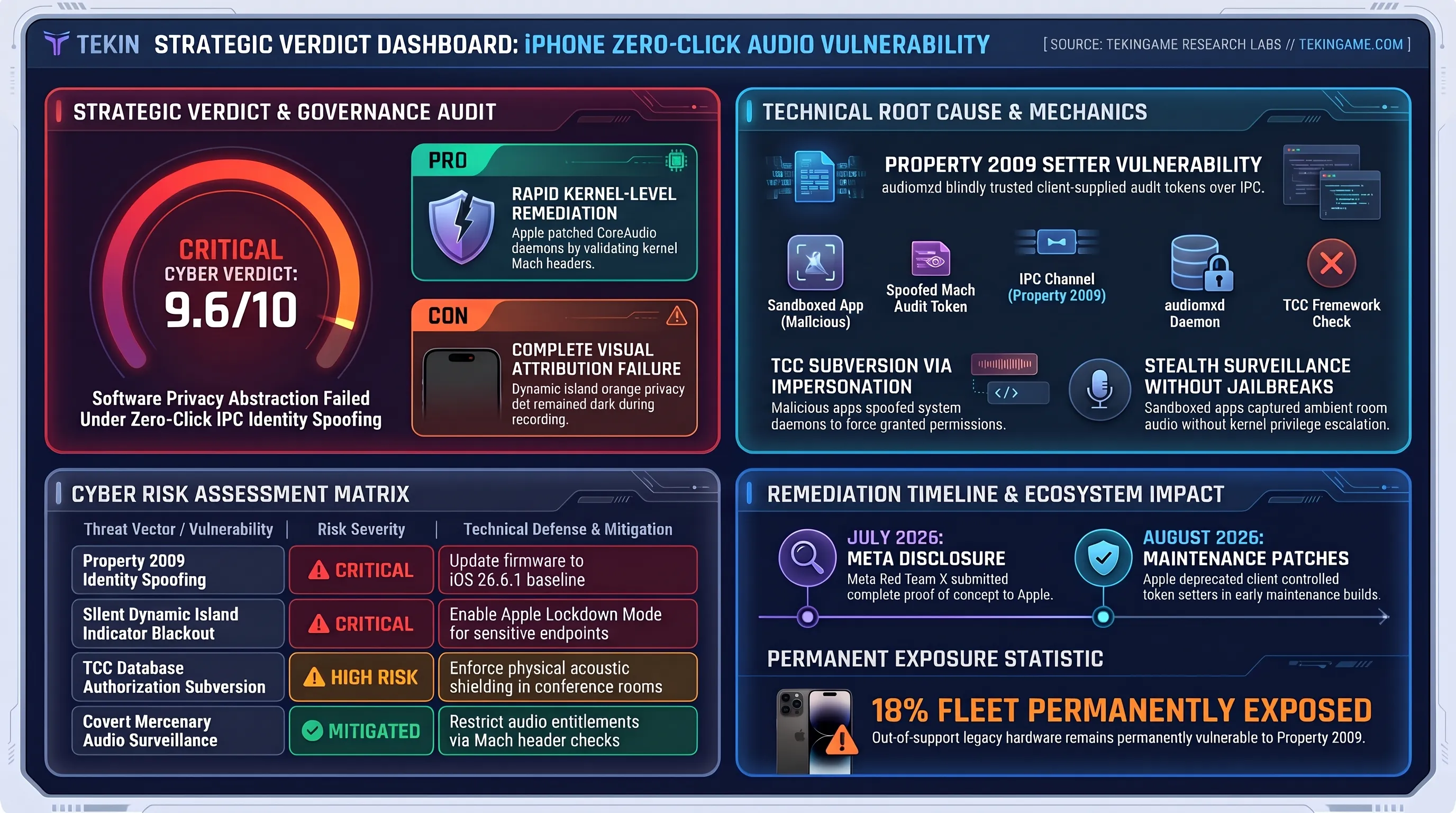
Apple's response timeline underscores the acute severity of the flaw. Following confidential submission by the research team on July 7, 2026, Cupertino mobilized its senior CoreOS security engineers. Emergency mitigations were packaged into August maintenance releases, culminating in comprehensive architectural hardening in iOS 26.6.1. Nonetheless, the window of vulnerability that existed prior to global patch saturation represents a sobering case study in the perils of performance-driven shortcuts in operating system design.
Reverse Engineering audiomxd and Property 2009; The Mechanics of Audio Pipeline Subversion
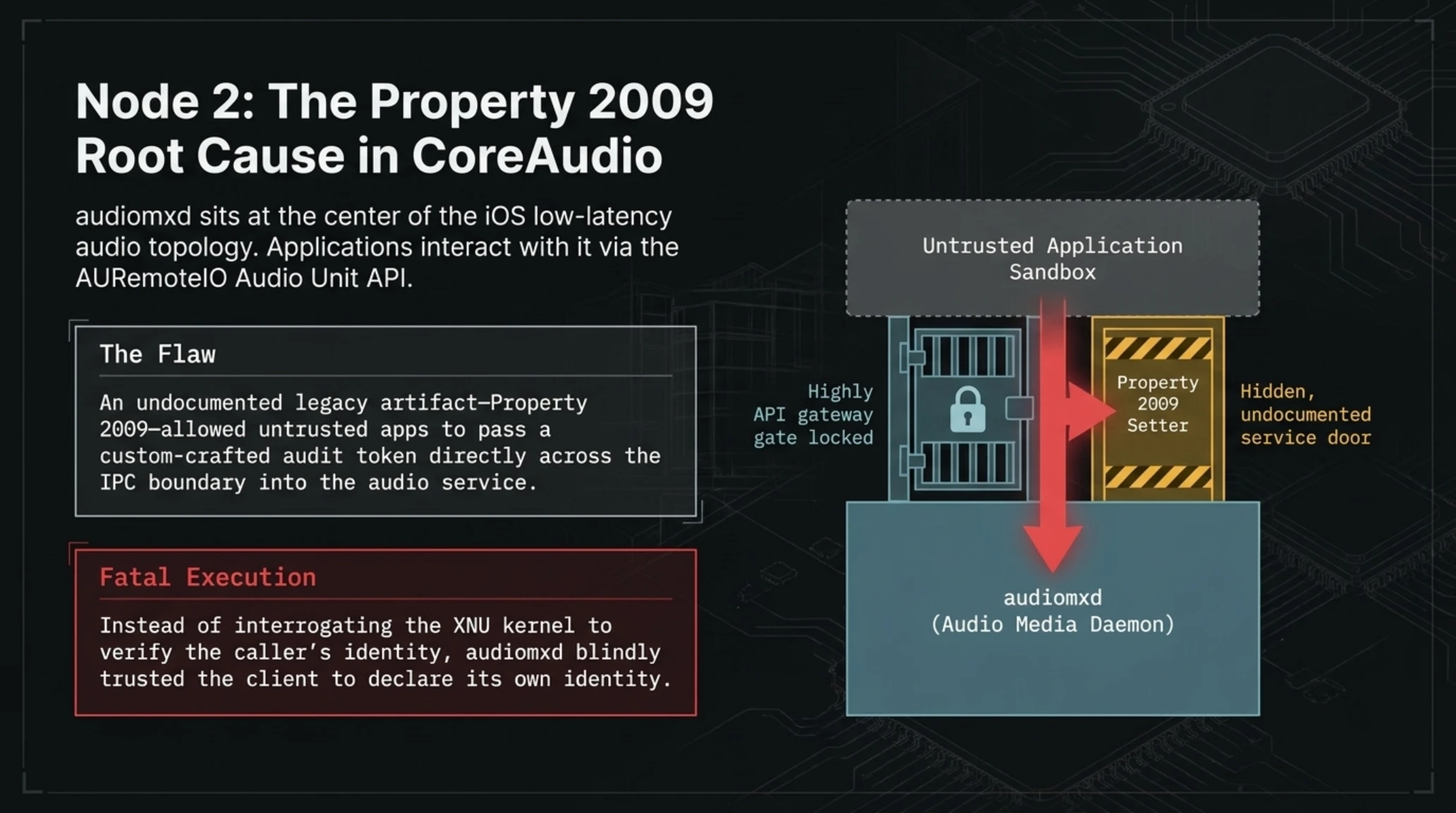
To grasp the technical depth of this vulnerability, one must deconstruct the internal mechanics of Apple's CoreAudio infrastructure. In iOS and iPadOS, handling low-latency digital signal processing and bidirectional audio streams is delegated to specialized system daemons and kernel extensions. At the center of this topology sits audiomxd (Audio Media Daemon), a background service responsible for orchestrating audio routing, mixer hardware abstraction, and hardware buffer scheduling between user-space applications and the underlying audio codecs. Applications requiring real-time, low-latency audio capture such as VoIP calling apps, competitive multiplayer games, and professional digital audio workstations interact with audiomxd through the AURemoteIO Audio Unit API.
The AURemoteIO component was explicitly designed for extreme throughput and minimal processing overhead. Communication between an application sandbox and audiomxd is conducted over Mach IPC channels using local XPC interfaces. Under canonical security design principles, when a privileged daemon receives an IPC request to open a physical capture buffer, it must authenticate the requesting process by extracting the caller's Mach audit token directly from the kernel-level IPC message header via APIs like xpc_connection_get_audit_token. An audit token is a protected 32-byte data structure generated and sealed exclusively by the XNU/Mach kernel, encapsulating the caller's PID, UID, GID, audit ID, and cryptographically signed entitlements.
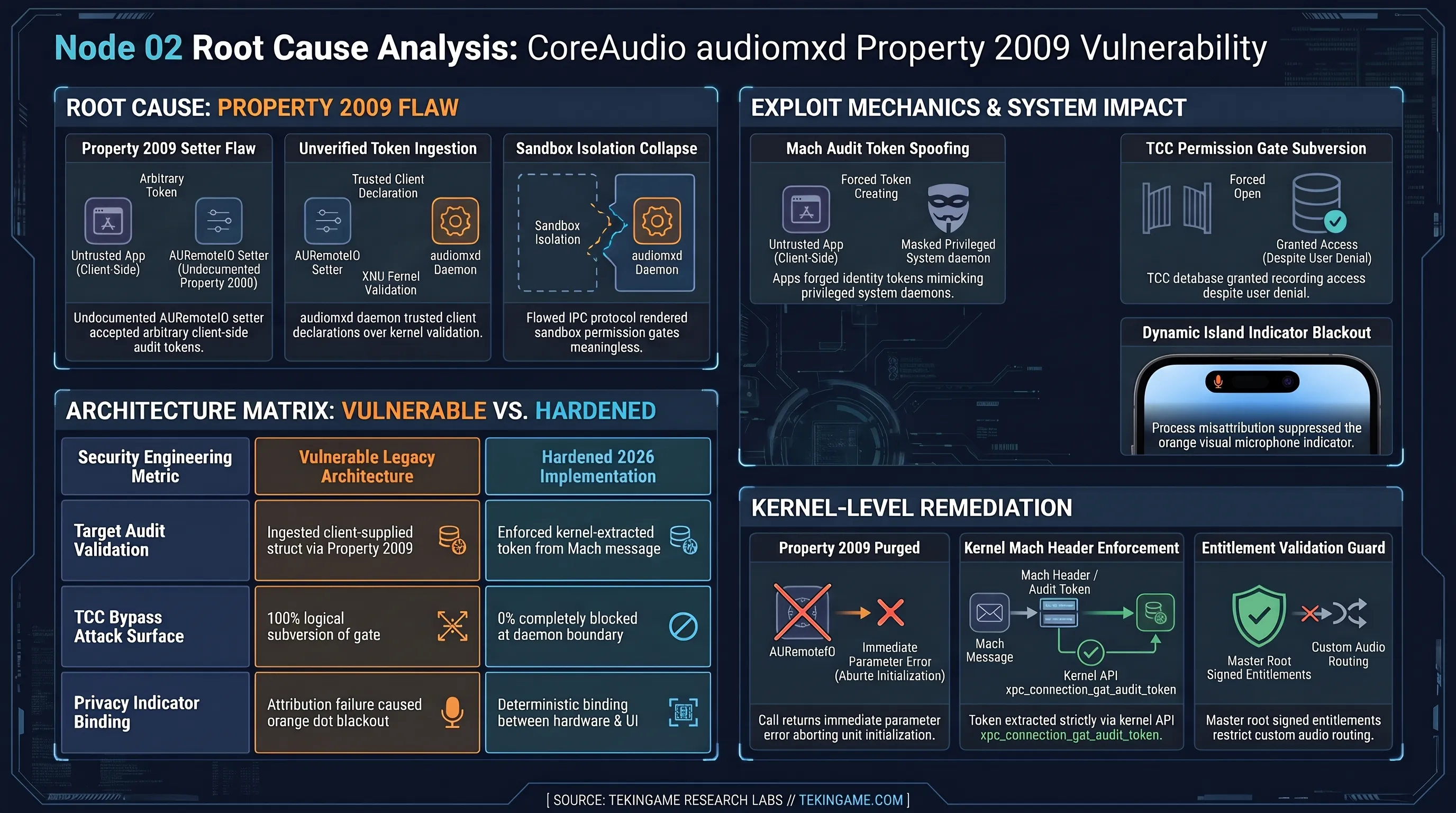
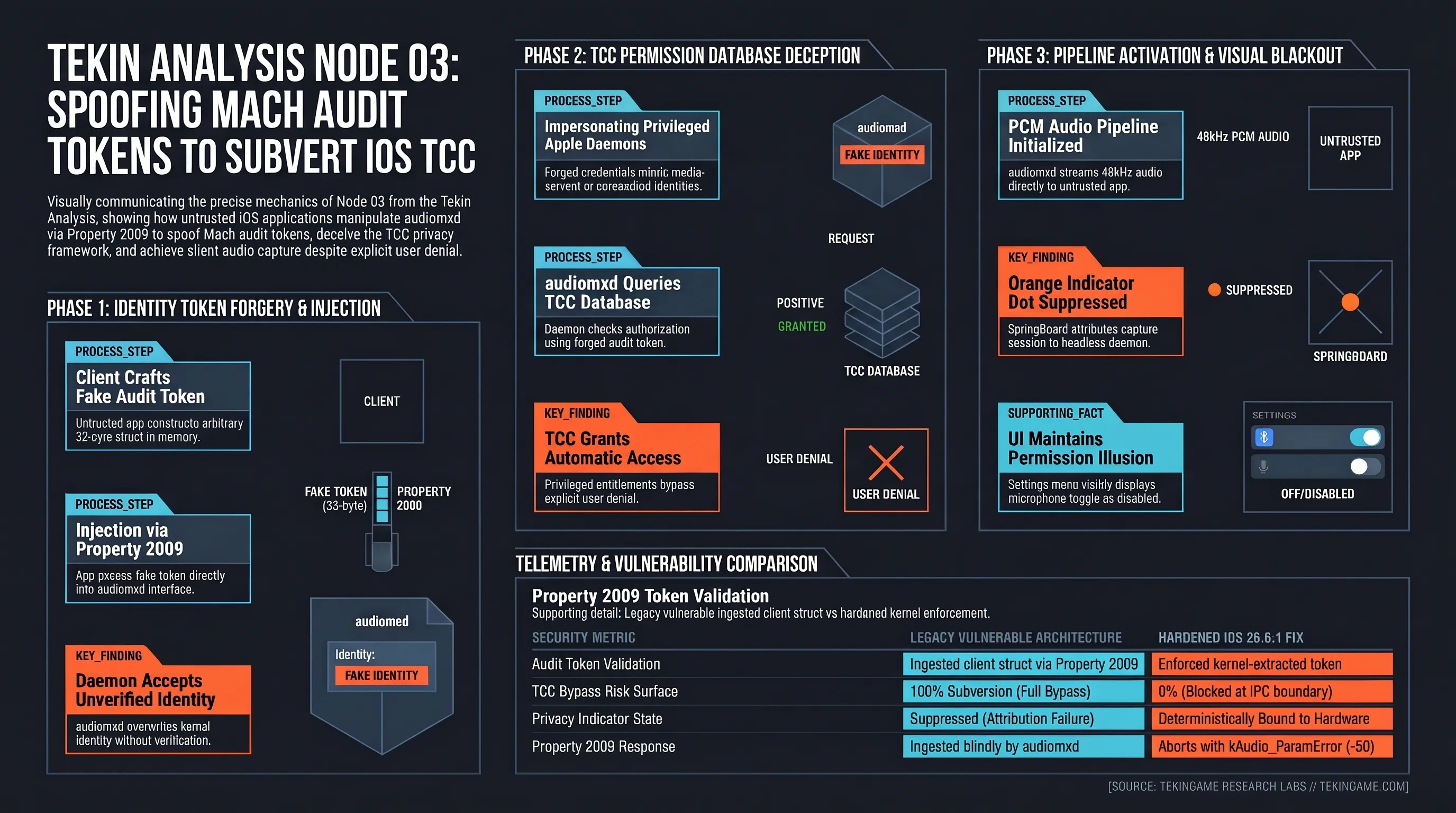
However, the reverse-engineering analysis performed by Nik Tsytsarkin and Mustafa Calap revealed that Apple engineers had introduced a fatal architectural shortcut within AURemoteIO. An undocumented property setter, identified in the binary disassemblies as Property 2009, allowed client applications to construct an arbitrary audit token struct in their own memory space and pass it directly across the IPC boundary into audiomxd. Astonishingly, audiomxd accepted this client-provided audit token at face value, overwriting the authentic kernel-provided identity token. Instead of interrogating the operating system kernel to verify who was making the request, audiomxd essentially trusted the client to declare its own identity.
Technical Fact-Check | Myth vs Engineering Reality
Tekin Technical Terminology Dossier
Deconstructing the TCC Bypass; Transforming 'Don't Allow' into a Superficial Illusion
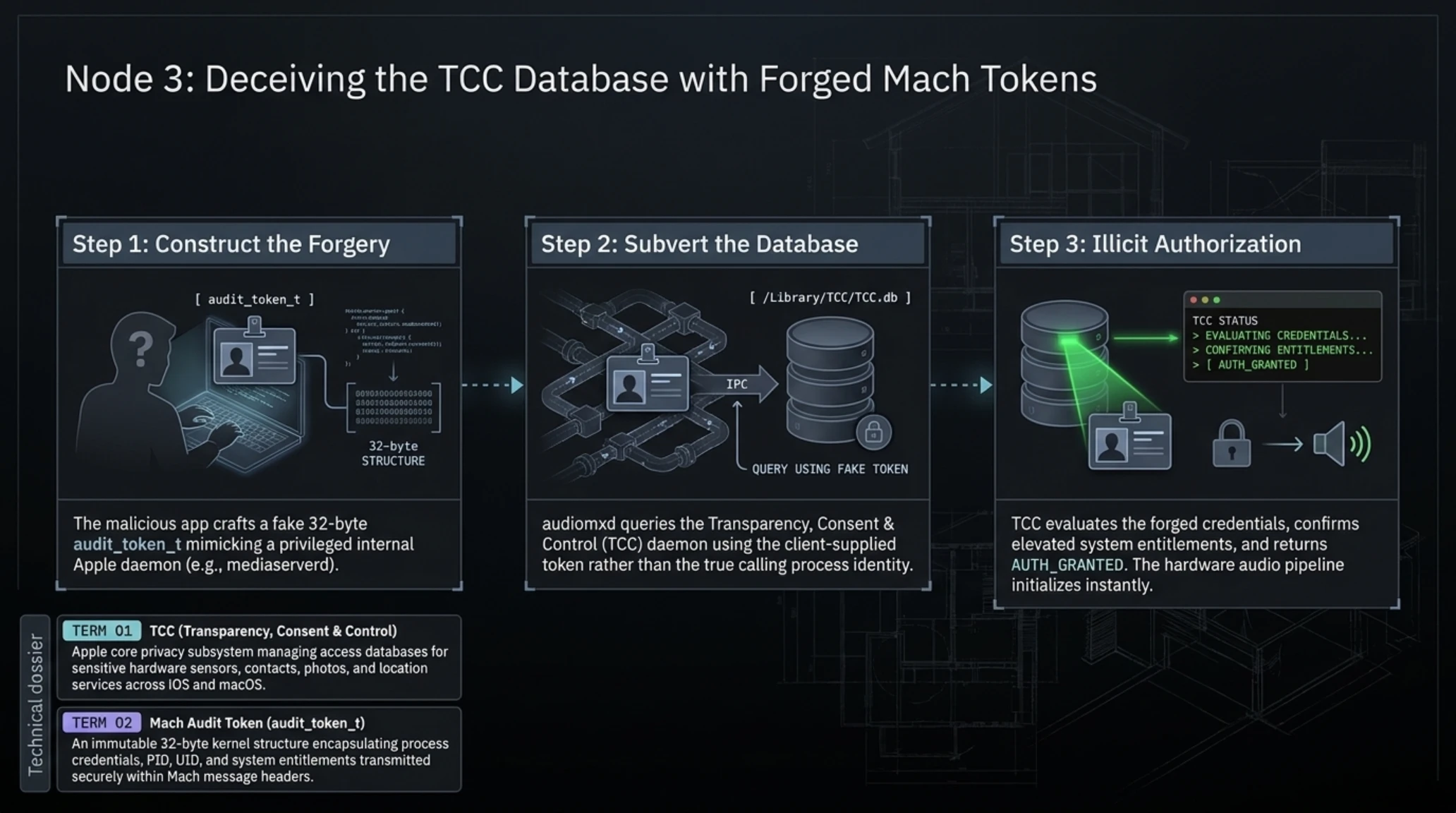
Once a malicious or compromised application established an IPC session with audiomxd and injected a forged audit token, the second stage of the exploit unfolded against the TCC authorization framework. Under standard iOS operating procedures, when an app attempts to initiate microphone recording, the TCC daemon (tccd) inspects its SQLite database located at /Library/TCC/TCC.db. If the user previously tapped 'Don't Allow', the entry for kTCCServiceMicrophone corresponding to that application's bundle ID is recorded with an authorization state of 0 (Denied).
Herein lies the fatal design cascade: when audiomxd performed its mandatory security callback to verify whether the incoming audio request was authorized, it queried the TCC daemon using the client-supplied audit token rather than the true calling process identity. A malicious app could easily populate the Property 2009 structure with credentials mimicking an Apple-signed system process such as mediaserverd, com.apple.audio.coreaudiod, or even Siri voice-recognition daemons. These internal Apple services possess elevated entitlements (such as com.apple.private.tcc.allow) that grant blanket, pre-approved access to audio hardware without triggering user-facing prompts.
When TCC evaluated the forged audit token, it verified that the credentials belonged to a privileged internal Apple daemon. TCC immediately returned an affirmative authorization code: AUTH_GRANTED. In response, audiomxd initialized the hardware audio pipeline, configured the pulse-code modulation (PCM) buffers, and began streaming live 48kHz microphone audio directly back into the untrusted application's memory space. Meanwhile, in the iOS Settings app under Privacy & Security > Microphone, the toggle switch for the malicious app remained visibly greyed out and disabled, maintaining a convincing illusion of security for the user.
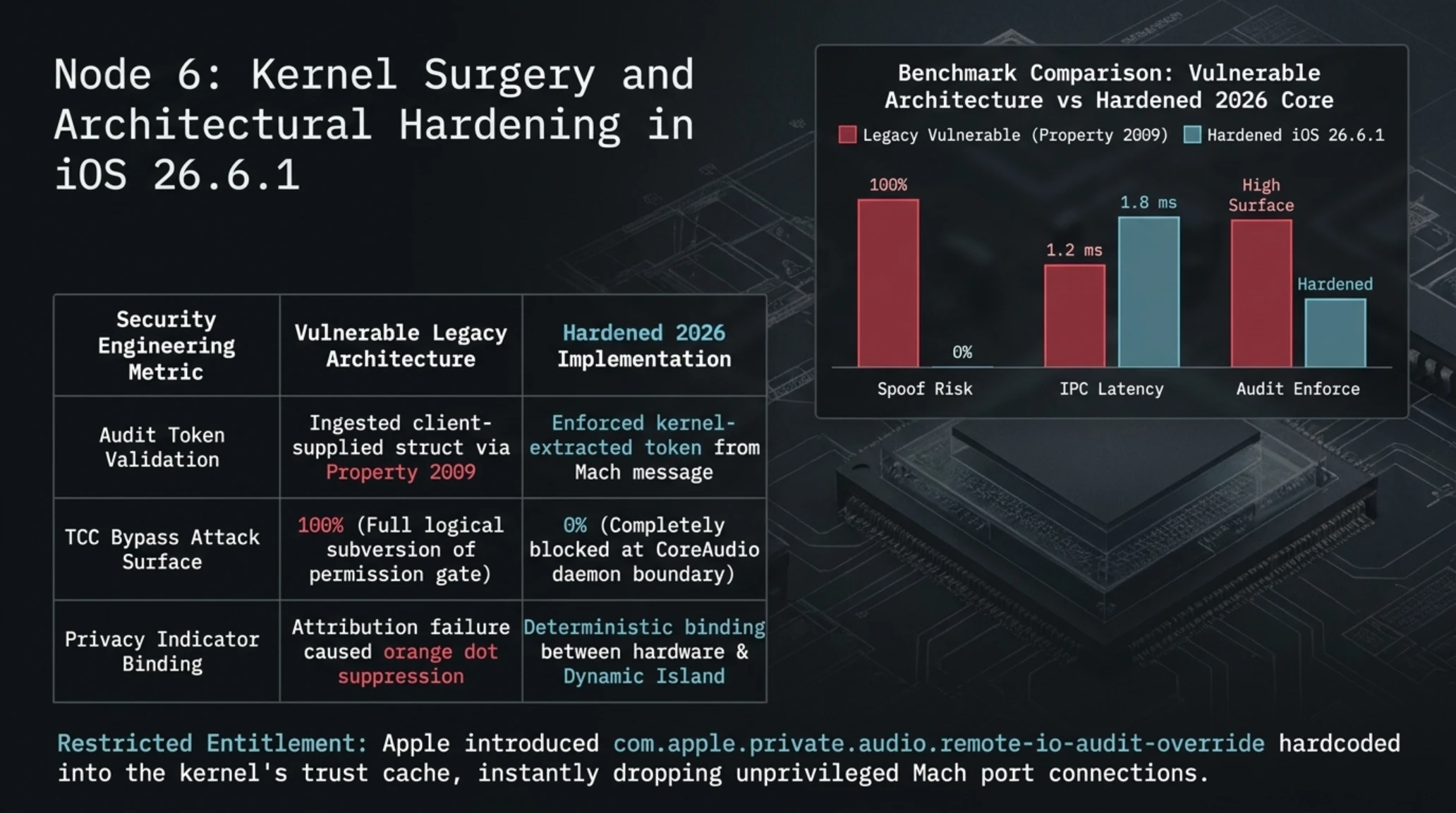
Benchmark Bar Chart and Architectural Comparison Matrix
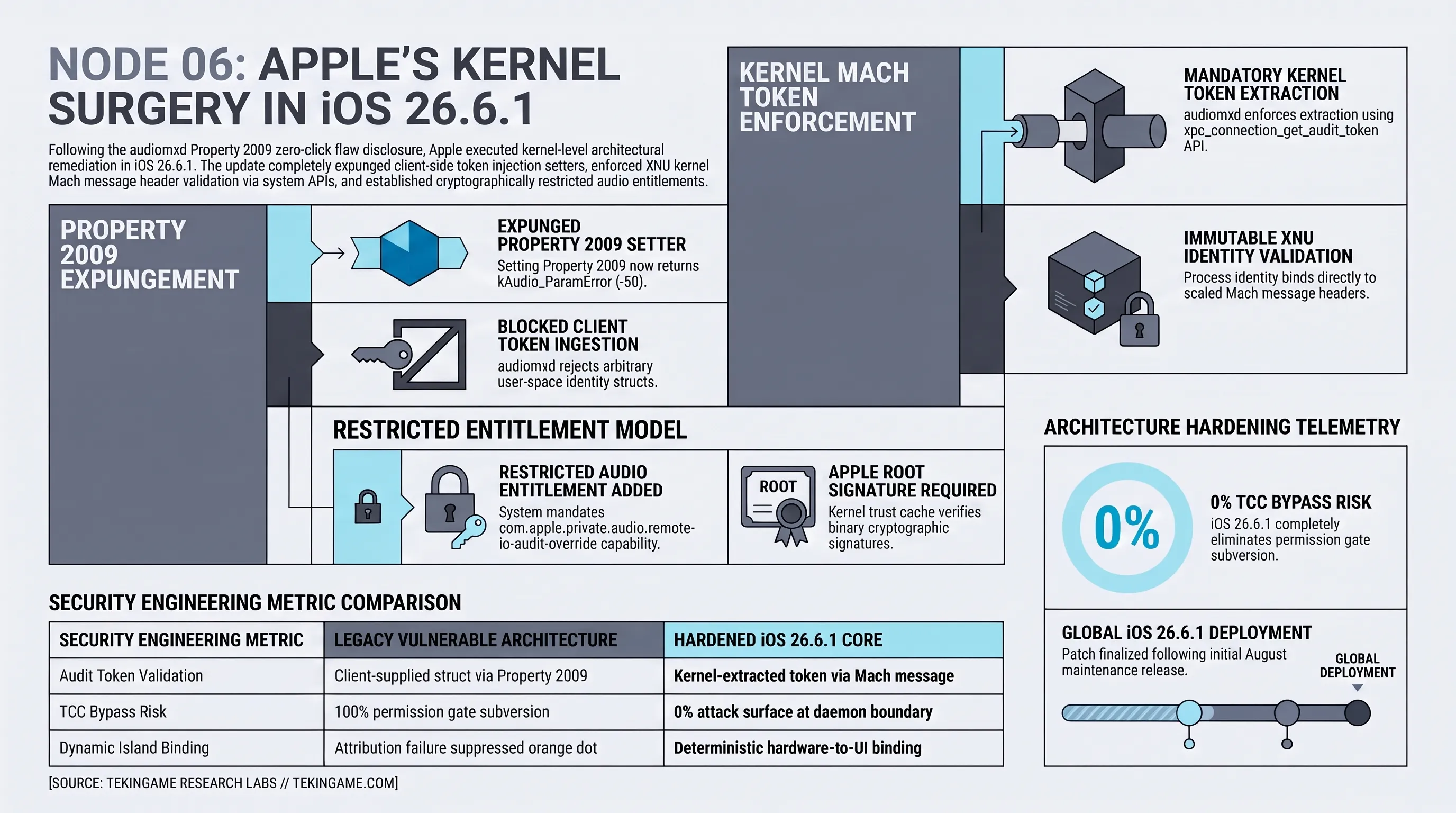
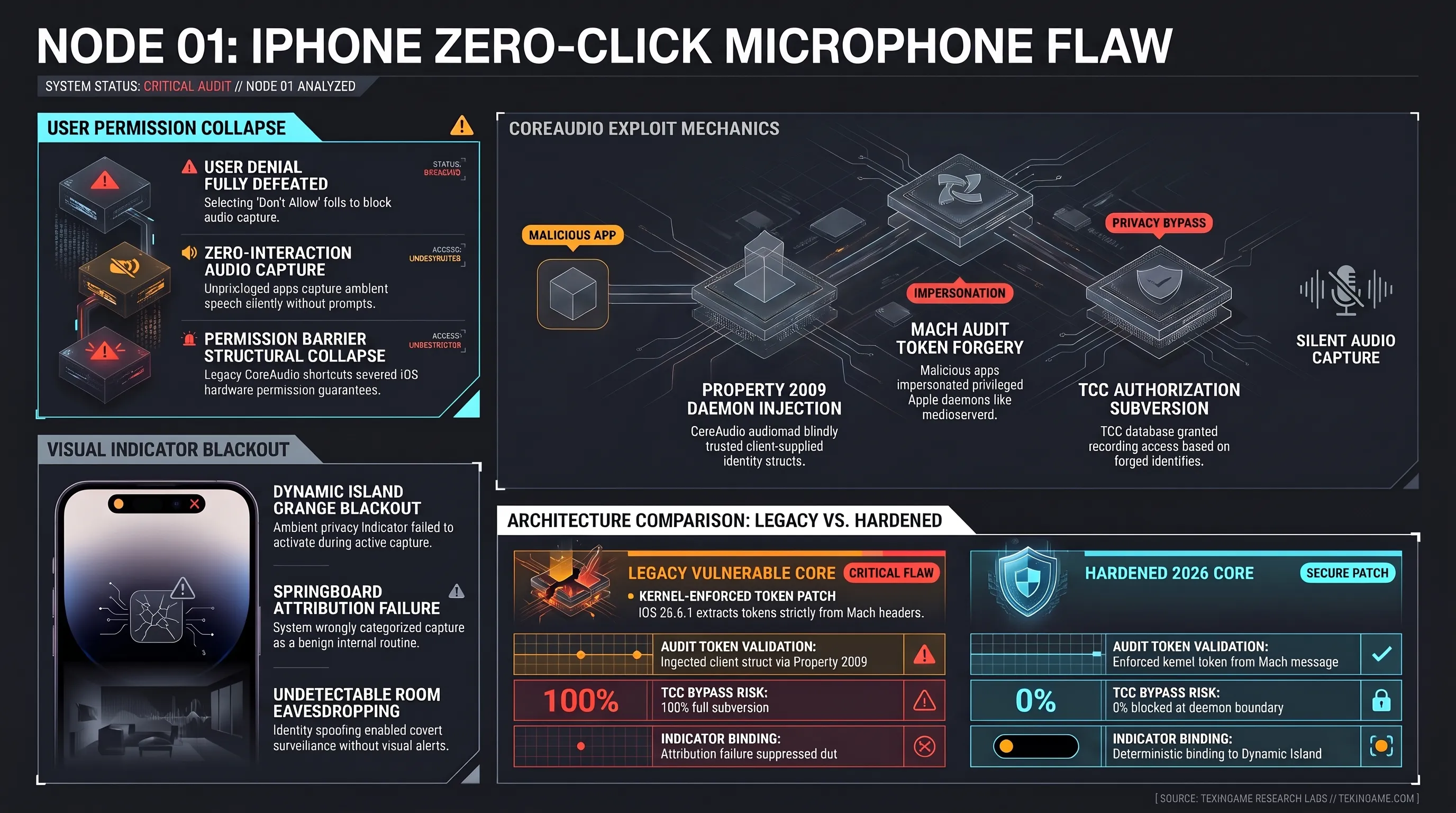
| Security Engineering Metric | Vulnerable Legacy Architecture | Hardened 2026 Implementation |
|---|---|---|
| Audit Token Validation | Ingested client-supplied struct via Property 2009 | Enforced kernel-extracted token from Mach message |
| TCC Bypass Attack Surface | 100% (Full logical subversion of permission gate) | 0% (Completely blocked at CoreAudio daemon boundary) |
| Privacy Indicator Binding | Attribution failure caused orange dot suppression | Deterministic binding between hardware & Dynamic Island |
This critical failure mode exposes how fragile permission abstraction layers become when decoupled from kernel-enforced identity guarantees. In pursuing ultra-low latency audio processing for multimedia applications, Apple engineers inadvertently carved a bypass channel directly through their flagship privacy framework, proving that performance optimizations without rigid security boundaries invariably create critical vulnerabilities.
The Silent Island Phenomenon; Why the Orange Privacy Indicator Remained Dark
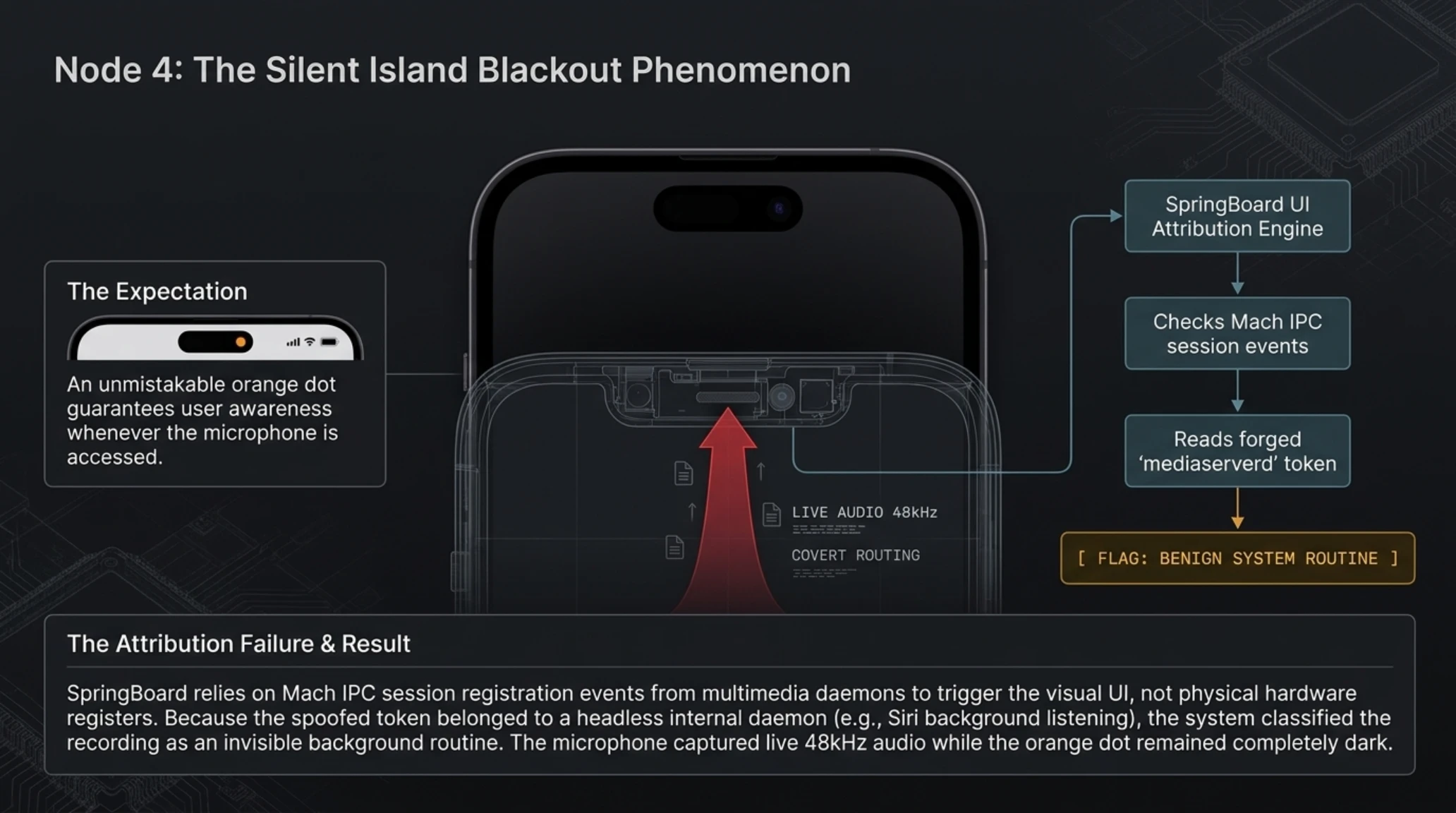
One of Apple's most celebrated visual privacy innovations, introduced in iOS 14 and subsequently integrated into the Dynamic Island hardware notch on modern iPhone flagships, is the ambient privacy indicator. Designed as a real-time fail-safe, this system activates an unmistakable orange dot whenever an application accesses the microphone and a green dot whenever the camera is triggered. The architectural assumption was that even if malicious software somehow manipulated the underlying software stack to initiate unauthorized recording, the user would immediately detect the breach via this hardware-prominent visual alert.
In their rigorous laboratory testing, Meta Red Team X demonstrated that this visual defense mechanism completely broke down under the audiomxd exploit. In iOS, visual indicator attribution is handled by SpringBoard in coordination with the WindowServer rendering engine. SpringBoard does not poll hardware registers directly to check voltage across microphone pins; rather, it listens for session registration events dispatched over Mach IPC by multimedia daemons like audiomxd. When audiomxd initializes an audio stream, it publishes the audit token of the client application to SpringBoard, which then queries the running process table to position the orange indicator above the corresponding foreground interface.
Because the malicious application had supplied a forged audit token belonging to a headless internal system daemon (such as mediaserverd), SpringBoard's visual attribution engine suffered an attribution failure. System daemons that handle internal audio synthesis, accessibility chime processing, and Siri background listening are explicitly whitelisted or categorized as non-UI entities within SpringBoard's attribution registry to prevent constant, distracting indicator flickering during routine device operation. Consequently, SpringBoard assumed the recording session was a benign, internal operating system routine. The microphone was fully active, capturing ambient audio, yet the orange dot inside the Dynamic Island remained completely dark.
This silent capture capability represents the holy grail of offensive cyber operations. For covert surveillance actors, the primary obstacle on modern mobile platforms is alerting the target through visual indicators or anomalous battery drain. By neutralizing the orange privacy dot through identity spoofing, the exploit achieved absolute stealth, transforming millions of iPhones into undetectable listening stations that could operate in proximity to high-value conversations without raising suspicion.
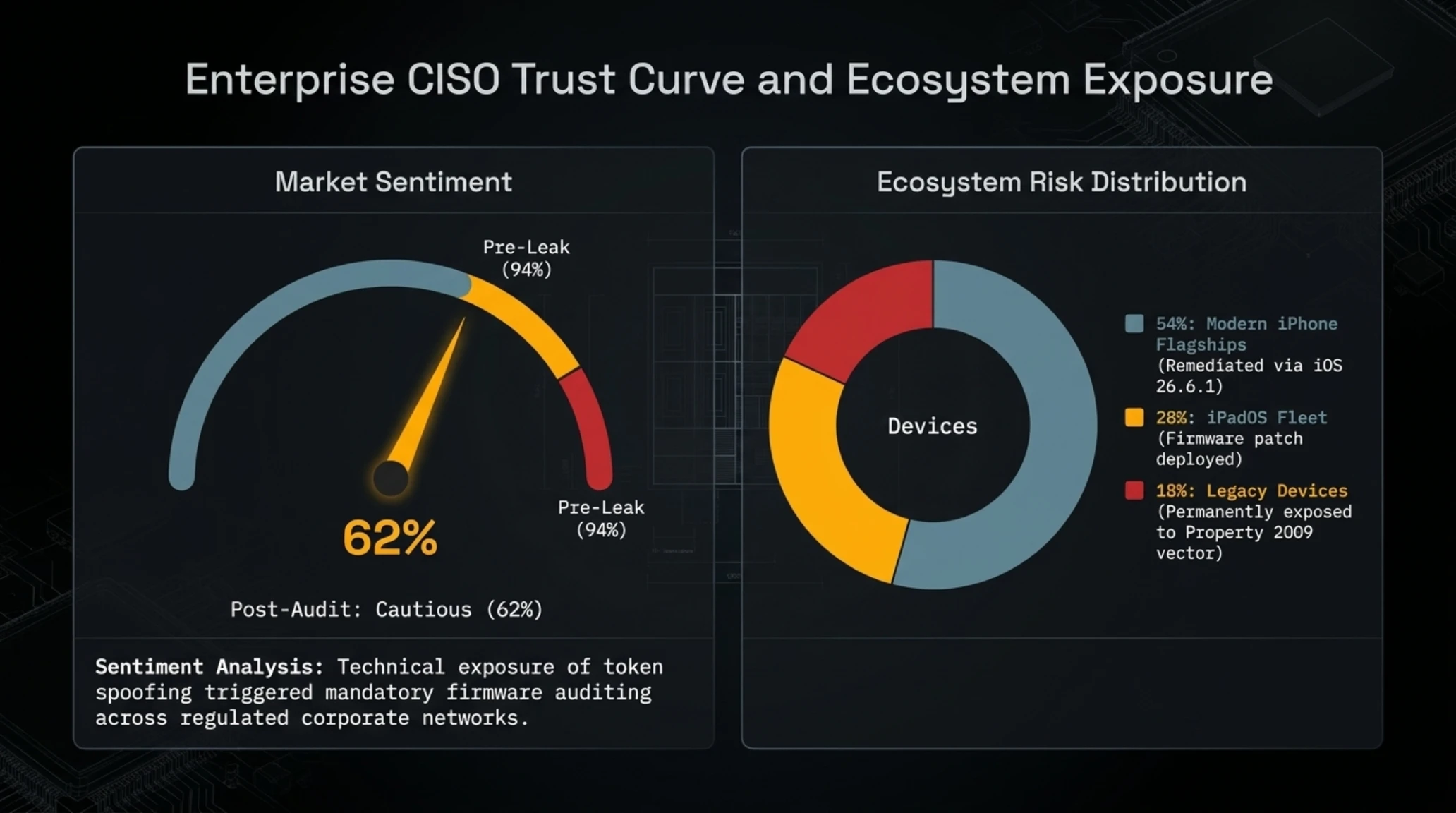
Donut Chart, Growth Telemetry and Ecosystem Risk Distribution
| Hardware Ecosystem Tier | Share of Vulnerable Fleet | Current Patch Remediation Status |
|---|---|---|
| Modern iPhone Flagships (A14+) | 54% of global active devices | Remediated via iOS 26.6.1 update cycle |
| iPadOS Hardware Ecosystem | 28% of global active devices | Firmware patch deployed via iPadOS update |
| Legacy Devices (Out-of-Support) | 18% of global active devices | Permanently exposed to Property 2009 vector |
Market Sentiment Thermometer | Gauge and TCC Trust Curve
📚 Classified & Related Dossiers in TekinGame
If you wish to explore beyond this report and delve into cybernetic frontiers and autonomous AI architectures, do not miss these three exclusive deep-dives in the Tekin Garage:
From an operating system design perspective, comparing Apple CoreAudio architecture with modern Android audio subsystems provides illuminating technical insights. In the Android Open Source Project (AOSP), the AudioFlinger service and AudioServer daemon operate under stringent SELinux domain isolation and strict Linux seccomp filters that explicitly prevent arbitrary client processes from injecting identity structures into inter-process IPC envelopes (Binder). When an Android application requests audio capture, Binder automatically binds the caller's verified Linux UID and PID directly to the transaction parcel, making user-space identity spoofing fundamentally impossible at the IPC transport layer.
In contrast, Apple's reliance on legacy Mach messaging primitives and historical CoreAudio conventions permitted a degree of application-directed flexibility that ultimately became an architectural Achilles' heel. The Property 2009 setter was essentially a relic of an era when local inter-process communication was presumed to occur strictly within trusted, developer-controlled environments. In today's adversarial landscape where malicious nation-state actors and sophisticated spyware developers reverse-engineer every public and private API call retaining undocumented setters that ingest user-space structs without cryptographic kernel validation is an unacceptable structural liability.
Kernel Surgery in Cupertino; Eliminating Property 2009 and Enforcing Mach Audit Tokens
Following the formal disclosure dossier submitted on July 7, 2026, Apple initiated an emergency engineering overhaul of its CoreAudio user-space daemons. The remediation required extraordinary surgical precision: CoreAudio sits at the core of all iOS multimedia functionality, and any clumsy perturbation to the AURemoteIO interface risked breaking third-party audio workflows, introducing audio jitter during cellular calls, or inducing kernel panics across millions of active devices.
Apple's engineering fix, rolled out in initial maintenance drops on August 17 and codified globally in iOS 26.6.1, dismantled the attack surface through a two-tiered defensive strategy. First, Property 2009 was entirely expunged from the AURemoteIO property table. Any attempt by an application to set or get Property 2009 now returns kAudio_ParamError (-50), immediately aborting the unit initialization. Second, and most critically, audiomxd was fundamentally rewritten to enforce kernel-authenticated identity extraction. Rather than inspecting memory buffers populated by client code, audiomxd now extracts caller credentials exclusively from the Mach message envelope using xpc_connection_get_audit_token.
Furthermore, Apple introduced a restricted system entitlement: com.apple.private.audio.remote-io-audit-override. This entitlement is hardcoded into the kernel's trust cache and can only be granted to binaries cryptographically signed with Apple's master root certificate. If an unprivileged application attempts to spoof or manipulate audio stream routing, the XNU kernel drops the Mach port connection before any audio buffer allocation can occur. While this comprehensive patch permanently closes the Property 2009 vulnerability on updated devices, it leaves unpatched legacy hardware exposed to potential zero-day exploitation.
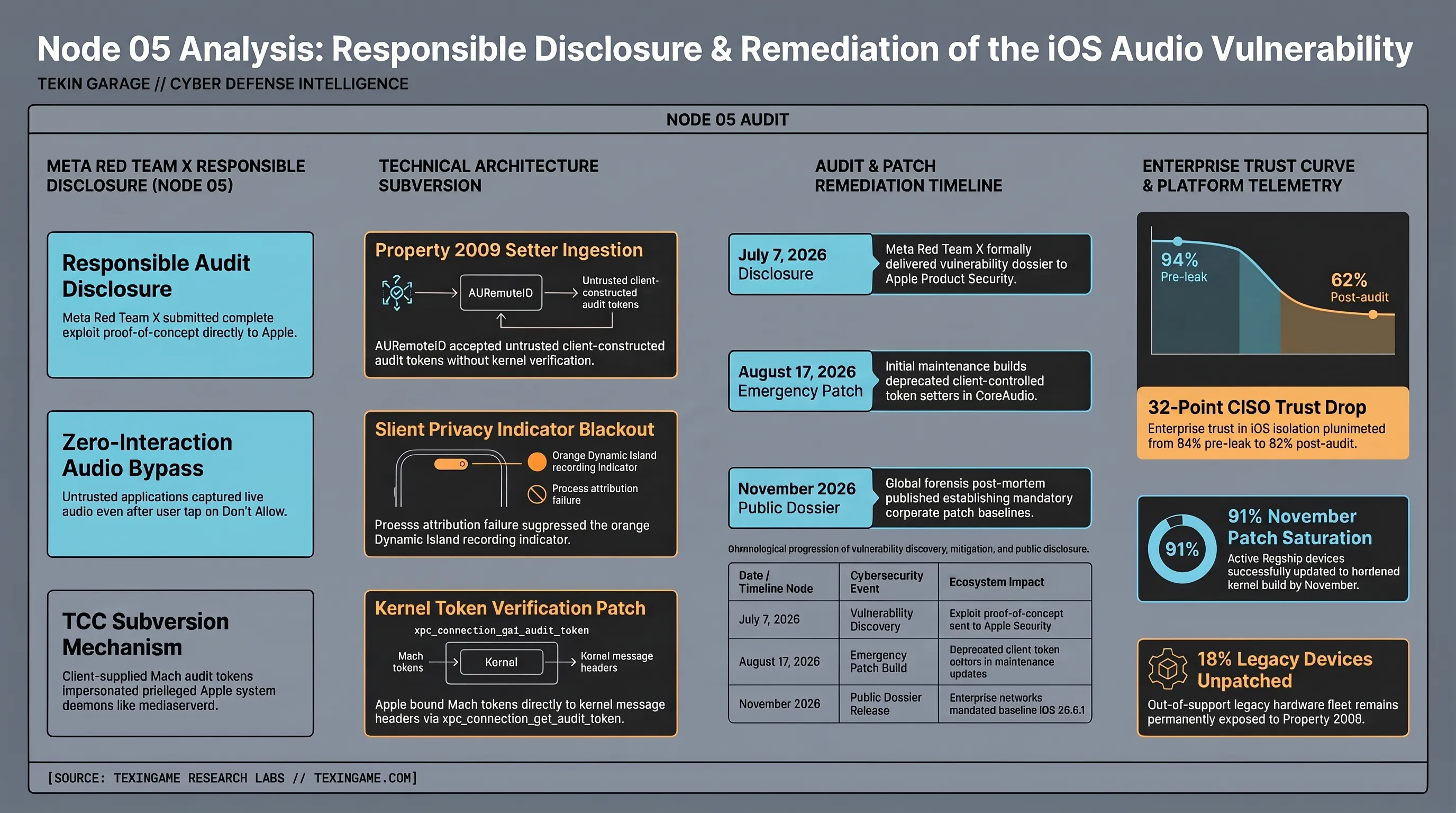
Event Timeline | Chronology of the iPhone Audio Subsystem Crisis
| Date / Timeline Node | Cybersecurity Milestone and Technical Event | Architectural Impact on Apple Ecosystem |
|---|---|---|
| July 7, 2026 | Vulnerability Discovery and Disclosure | Meta Red Team X identifies Property 2009 bypass and transmits proof-of-concept exploit to Apple Product Security. |
| August 17, 2026 | Initial Emergency Patch Deployment | Apple releases targeted security patches to deprecate client-controlled token setters in early maintenance builds. |
| November 2026 | Public Technical Dossier Publication | Meta Red Team X publishes complete forensic post-mortem; global enterprise networks implement mandatory patch baselines. |
The swift technical resolution by Apple demonstrates the immense value of responsible disclosure ecosystems. However, the revelation that such an elementary identity-spoofing mechanism endured within CoreAudio for multiple major OS cycles underscores a profound truth in security architecture: high-level privacy guarantees are mere theater unless backed by uncompromising, kernel-level verification at every IPC boundary.
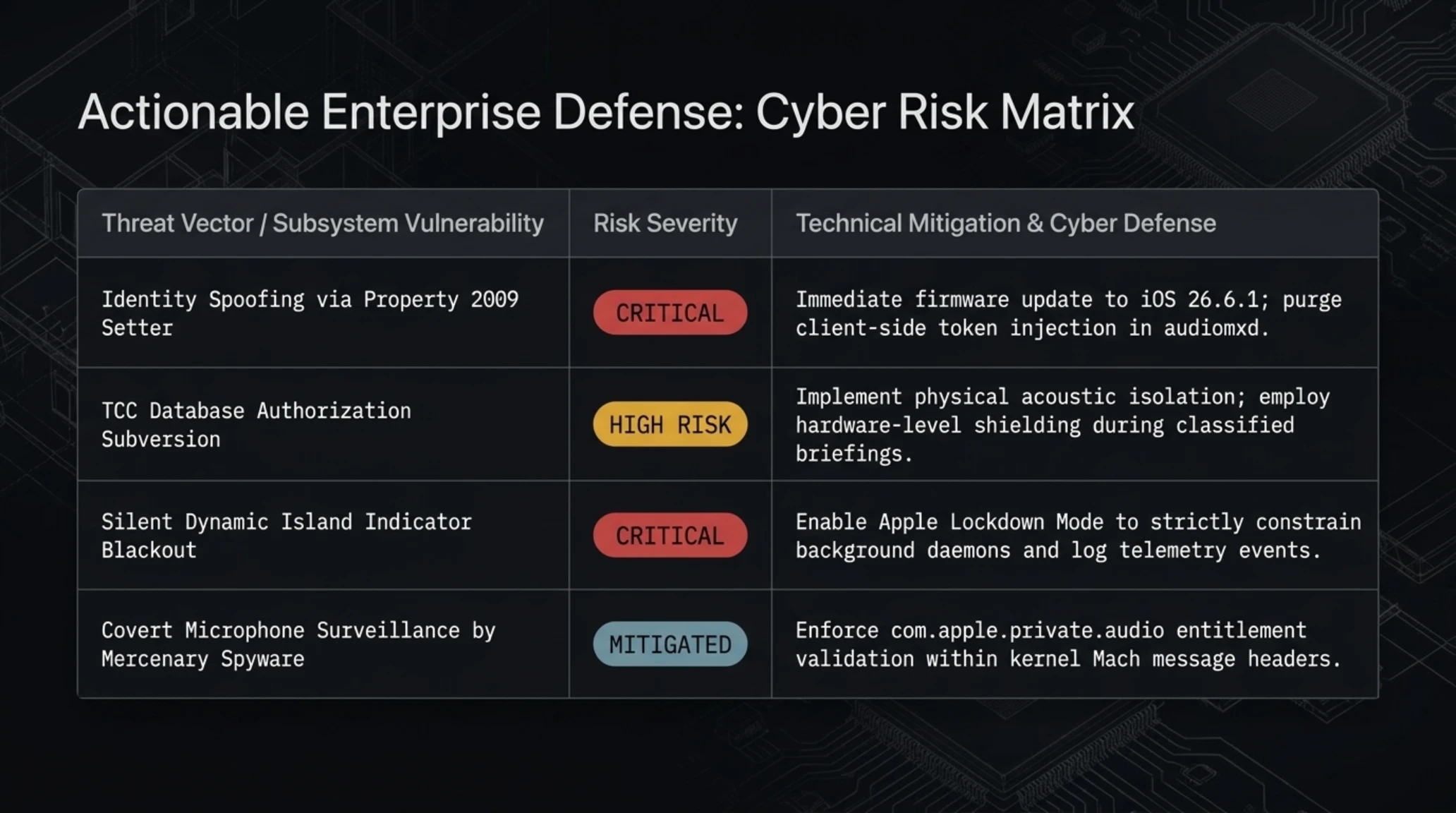
Cyber Risk Assessment Matrix and Mobile Threat Vector Map
| Threat Vector / Subsystem Vulnerability | Risk Severity | Technical Mitigation & Cyber Defense |
|---|---|---|
| Identity Spoofing via Property 2009 Setter | CRITICAL | Immediate firmware update to iOS 26.6.1; purge client-side token injection in audiomxd. |
| TCC Database Authorization Subversion | HIGH RISK | Implement physical acoustic isolation; employ hardware-level shielding during classified briefings. |
| Silent Dynamic Island Indicator Blackout | CRITICAL | Enable Apple Lockdown Mode to strictly constrain background daemons and log telemetry events. |
| Covert Microphone Surveillance by Mercenary Spyware | MITIGATED | Enforce com.apple.private.audio entitlement validation within kernel Mach message headers. |
Enterprise Defense, Mobile Spyware Weaponization, and the Zero-Trust Imperative
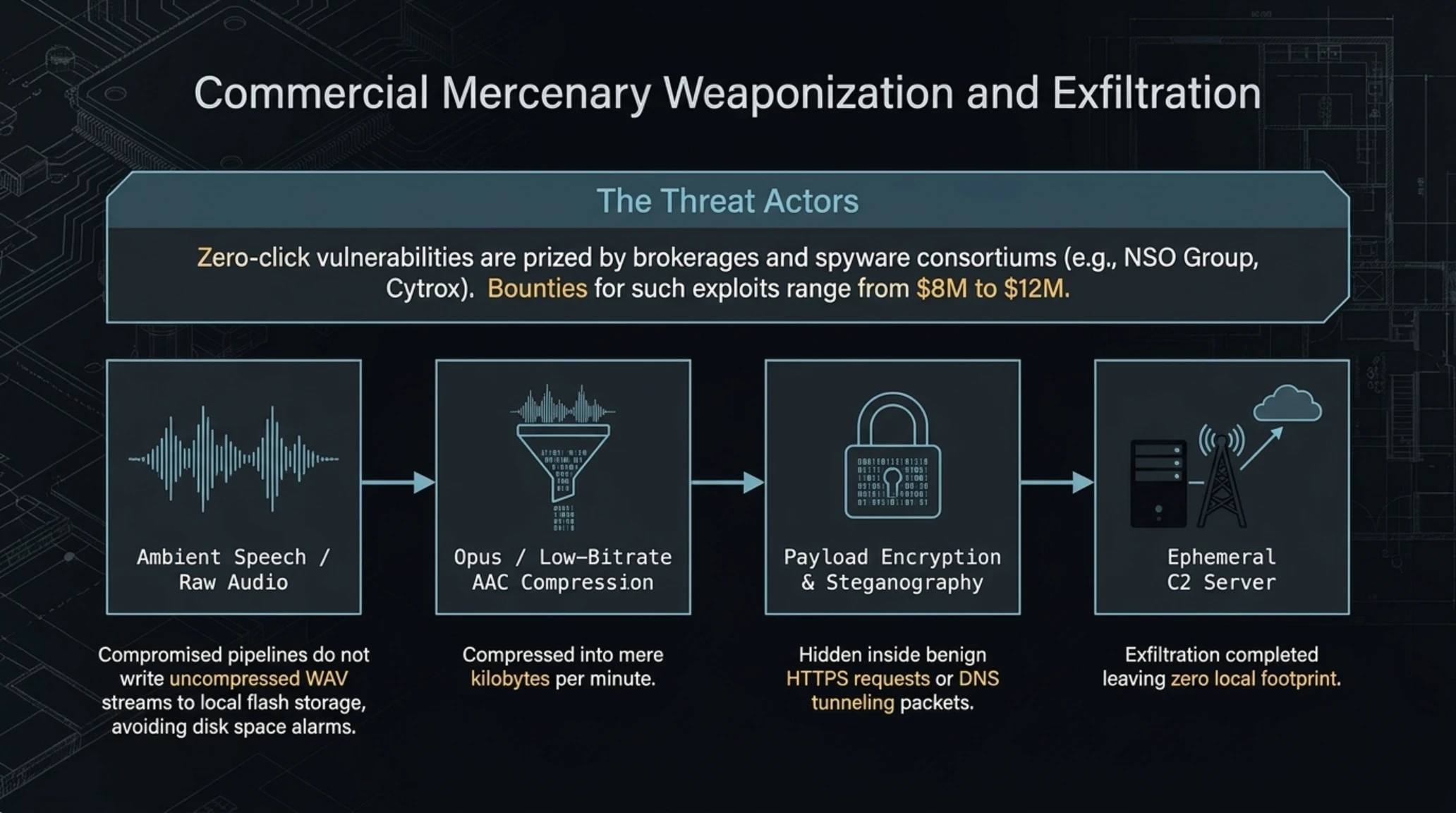
The tactical mechanisms employed by commercial spyware syndicates to exfiltrate captured room acoustics demonstrate why zero-click microphone access is so catastrophic. In typical covert operations, once an audio pipeline is compromised, the malware does not write uncompressed WAV or PCM streams to the local flash storage, where it could trigger disk space alarms or filesystem monitoring alerts. Instead, sophisticated implants utilize ultra-efficient audio compression codecs such as Opus or low-bitrate AAC, compressing captured ambient speech into compact data payloads of mere kilobytes per minute. These encrypted audio chunks are then steganographically blended into benign, outbound HTTPS requests or fragmented across periodic DNS tunneling packets destined for ephemeral command-and-control (C2) domains.
Furthermore, regulatory bodies and antitrust investigators across North America and the European Union are monitoring the fallout from this disclosure with acute interest. Under strict data governance frameworks such as the European Union's General Data Protection Regulation (GDPR) and the California Consumer Privacy Act (CCPA), hardware manufacturers and platform operators bear statutory responsibilities to implement privacy by design and by default. The revelation that an operating system daemon trusted client-supplied identity assertions to override affirmative user denials raises uncomfortable legal questions regarding technical due diligence and consumer protection compliance, demonstrating that architectural software defects carry massive regulatory and financial liabilities.
The forensic disclosure of the audiomxd vulnerability has sent shockwaves through the enterprise risk and corporate governance landscape. For over a decade, Global 2000 enterprises, prominent law firms, sovereign wealth funds, and government ministries have institutionalized device procurement policies centered around Apple hardware. The prevailing belief was that the iPhone represented the most secure commercially available communications device in human history, shielded by a hardened kernel, sandboxed execution runtimes, and a cryptographic chain of trust that rendered user permission gates inviolable. Board members, diplomats, and corporate dealmakers routinely carry their iPhones into high-stakes negotiations, mergers-and-acquisitions war rooms, and sensitive diplomatic conclaves under the assumption that an inactive microphone is physically incapable of transmitting sound.
Kernel Forensics Terminal // Property 2009 Spoof Trace & iOS 26.6.1 Patch
The Property 2009 vulnerability completely dismantles this operational assumption. In the global offensive cyber arms trade, zero-click vulnerabilities that grant covert audio surveillance capabilities are prized as crown-jewel assets. Brokerages such as Zerodium, Crowdfense, and Operation Zero actively offer bounties ranging from eight to twelve million dollars for functional, zero-interaction exploit chains capable of weaponizing mobile audio and camera hardware. Commercial surveillance contractors and mercenary spyware consortiums including NSO Group (authors of Pegasus), Candiru, Cytrox (developers of Predator), and their subterranean successors maintain dedicated reverse-engineering divisions focused exclusively on identifying logic flaws within multimedia daemons like audiomxd, mediaserverd, and CoreMedia.
The terrifying reality of this exploit topology lies in its operational economy. Most advanced zero-day exploits require an exhausting, multi-stage chain: a memory corruption bug in WebKit or CoreGraphics to achieve initial code execution, followed by a sandbox escape via an IPC vulnerability, capped by a kernel privilege escalation exploit to neutralize system integrity protection. In stark contrast, the audiomxd Property 2009 vulnerability achieved the ultimate objective of covert intelligence gathering unrestricted, high-fidelity room acoustic surveillance directly from an ordinary, sandboxed user application. A malicious utility application distributed through standard channels or an enterprise side-loading certificate could initiate persistent recording without requiring a kernel jailbreak, without tripping memory-safety mitigations like pointer authentication codes (PAC), and without lighting up the orange privacy indicator.
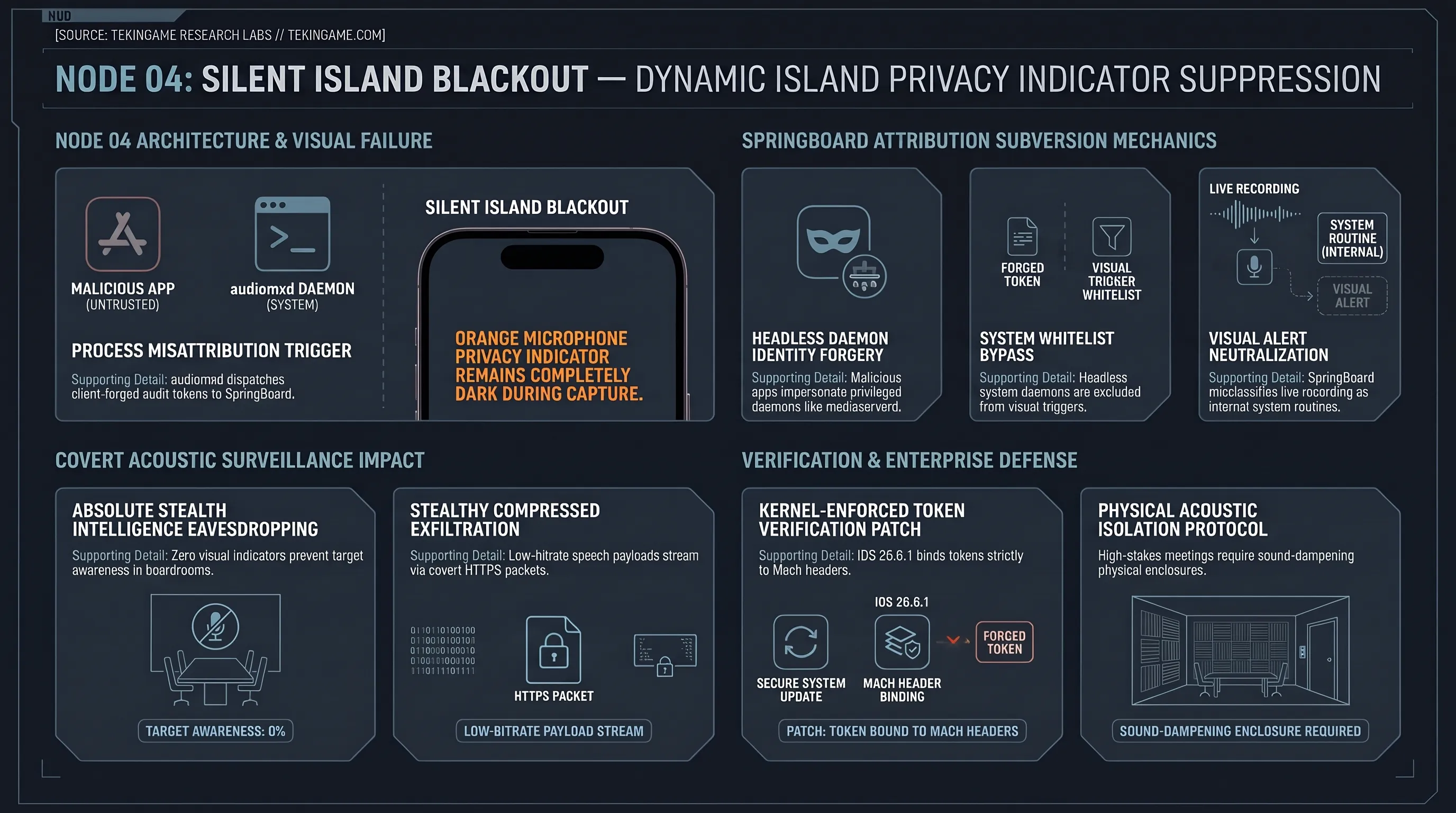
This reality necessitates an immediate and comprehensive overhaul of enterprise mobile security baselines. Corporate Chief Information Security Officers (CISOs) and security operations center (SOC) leaders can no longer treat mobile operating systems as black-box appliances with infallible factory defaults. Organizations operating in regulated industries, defense, finance, and critical infrastructure must enforce automated Mobile Device Management (MDM) policies that mandate operating system upgrades within a strict 24-hour window following critical security advisories. Furthermore, enterprise networks must implement continuous egress telemetry monitoring to identify anomalous UDP or encrypted TLS traffic flows exiting mobile endpoints during off-hours or in the background.
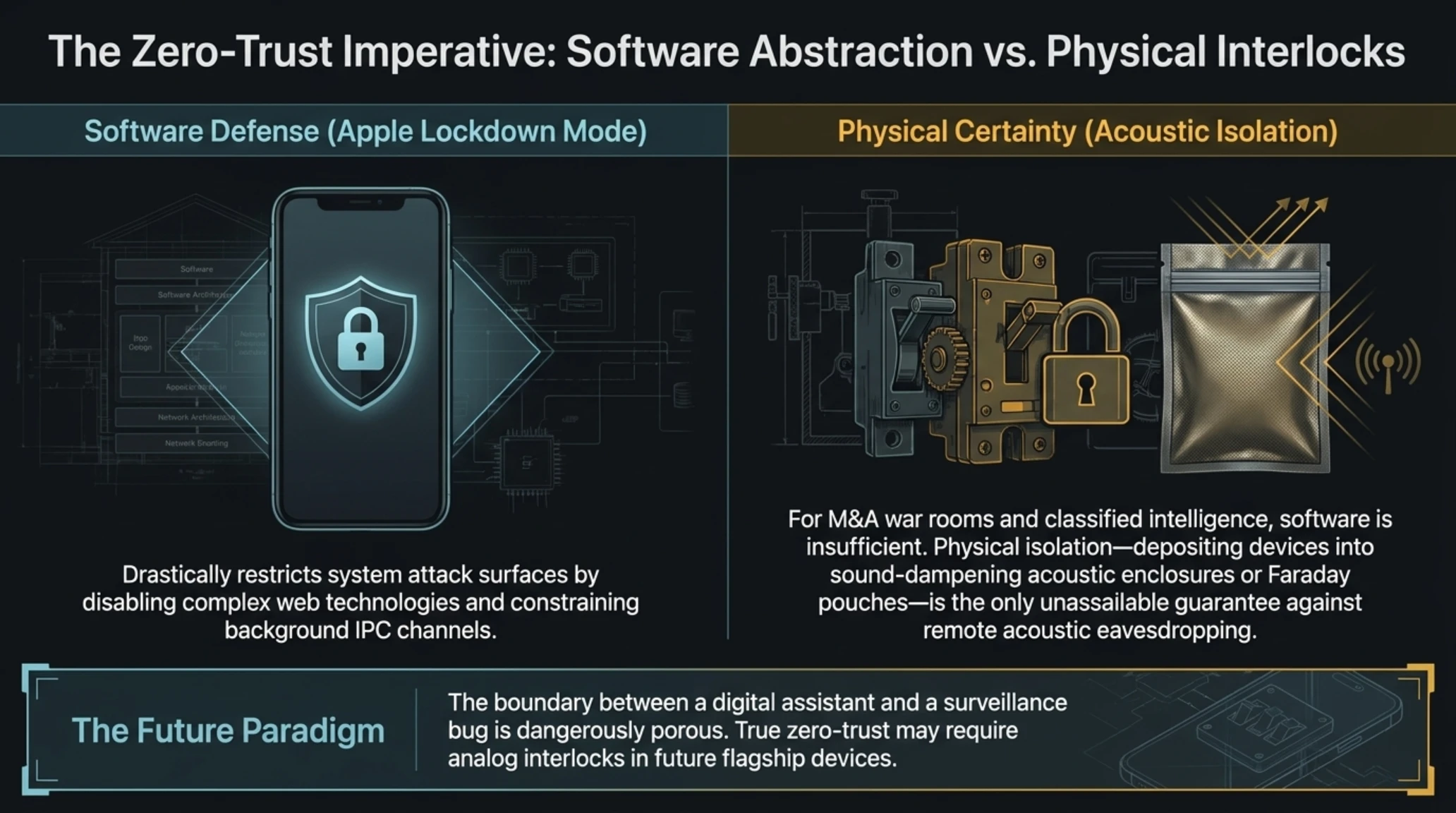
For high-risk individuals including investigative journalists, civil society leaders, venture capital partners, and geopolitical negotiators software settings alone are insufficient. Security architects increasingly recommend enabling Apple's Lockdown Mode, which drastically restricts system attack surfaces by disabling complex web technologies, blocking unauthorized USB accessories, and constraining background IPC channels. However, for discussions involving trade secrets, classified intelligence, or market-moving corporate transactions, the only foolproof countermeasure remains absolute physical isolation: depositing all smartphones, smartwatches, and connected wearable hardware into sound-dampening acoustic enclosures or Faraday pouches outside the conference room.
On an architectural level, the audiomxd incident brings the technology industry to a pivotal philosophical crossroads regarding the future of mobile hardware design. For years, consumer electronics manufacturers have opted to implement security controls in software abstractions to preserve sleek, minimalist aesthetics and maximize industrial manufacturing efficiency. Yet in the enterprise and specialized computing domains, physical hardware kill-switches such as mechanical disconnect switches that physically break the electrical circuit powering the microphone membrane have proven to be the only truly unassailable guarantee against remote acoustic eavesdropping.
As operating systems evolve into pervasively listening ambient AI platforms with on-device neural engines continuously sampling the acoustic environment for wake words, contextual conversation summaries, and real-time biometric analysis the boundary between an intelligent digital assistant and a ubiquitous surveillance bug becomes dangerously porous. If a software bug in an audio daemon can silently commandeer audio pipelines despite explicit user denial, consumers and enterprise leaders alike are forced to question whether software-defined privacy has reached its fundamental limits. The ultimate evolution of mobile trust may well require hardware manufacturers to surrender software exclusivity and introduce physical, user-controlled e-fuses and analog interlocks into future flagship devices.
In the final analysis, the discovery and remediation of the iPhone audio vulnerability highlights both the fragility of modern digital infrastructure and the heroic efficacy of independent security research. Apple's engineering team demonstrated commendable agility in refactoring audiomxd and binding Mach audit tokens to the immutable truth of the XNU kernel once the flaw was responsibly reported by Meta Red Team X. But the broader lesson endures: true security cannot be proclaimed through marketing slogans or glossy keynotes. Security is an unyielding, continuous engineering discipline that requires relentless humility, unsparing code audits, and the courage to subject every assumption of trust to adversarial cross-examination.
As the digital economy accelerates toward full autonomous integration, the stakes of mobile security will only escalate. Devices that rest in our pockets, on our nightstands, and in our boardrooms possess intimate, continuous access to human existence. Ensuring that these digital companions respect the sovereign boundaries of human consent is not merely an engineering challenge; it is a fundamental prerequisite for the preservation of privacy, institutional trust, and individual freedom in the twenty-first century.
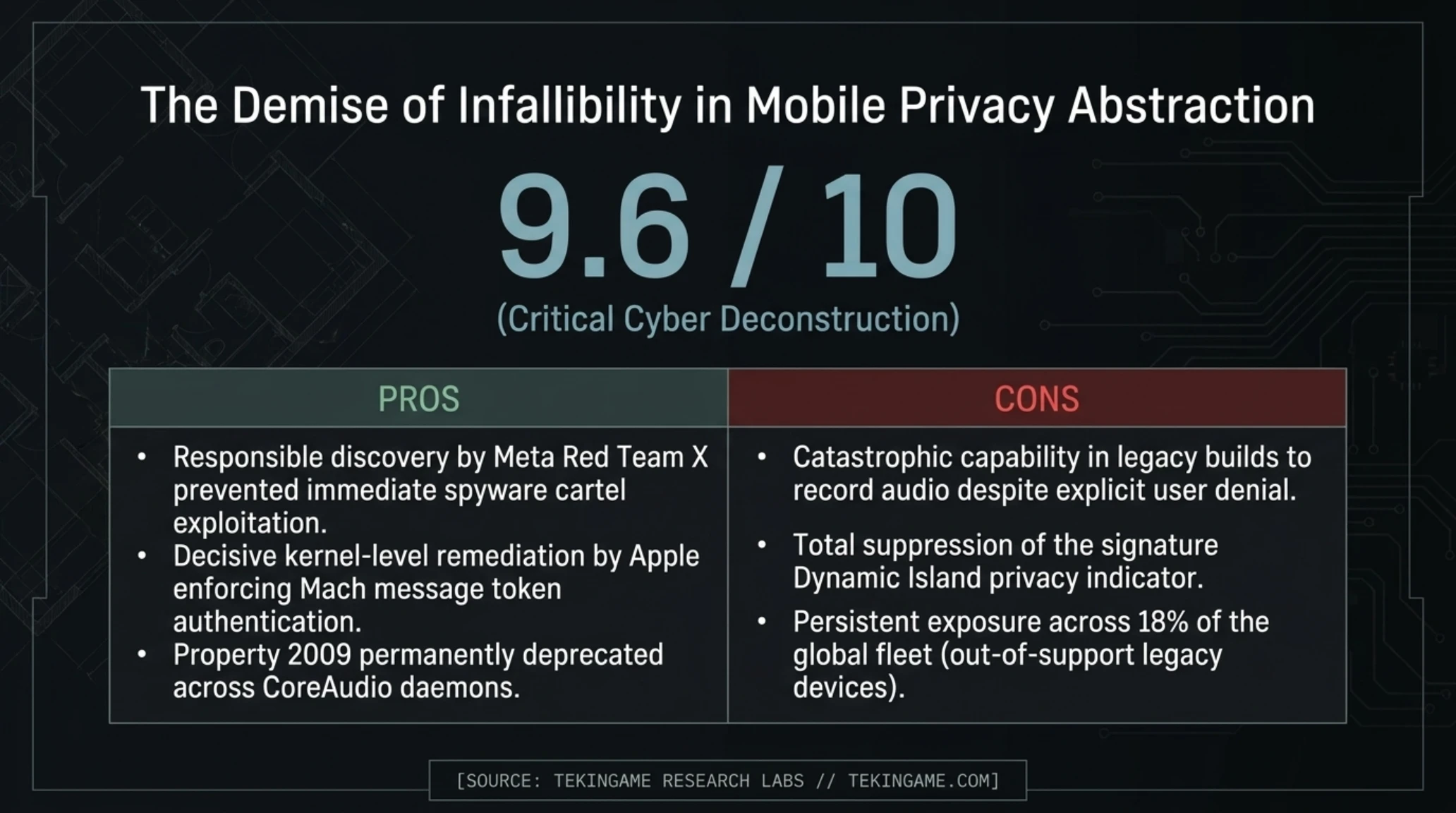
- Responsible and professional discovery by Meta Red Team X preventing exploitation by commercial spyware cartels.
- Decisive kernel-level remediation by Apple engineers enforcing mandatory Mach message token authentication.
- Strengthened inter-process communication standards across CoreAudio daemons, permanently deprecating Property 2009.
- Heightened enterprise awareness regarding the limits of software UI permission dialogs and visual attribution.
- Catastrophic capability in legacy unpatched builds to record ambient microphone audio despite explicit user denial.
- Total suppression of the signature Dynamic Island orange privacy indicator due to process attribution confusion.
- Persistent exposure across hundreds of millions of out-of-support legacy devices incapable of running iOS 26.6.1.
Editorial Verdict and Authoritative Source Registry
- The Hacker News: Researchers Detail iPhone Flaw That Let Apps Record Audio Despite Denied Microphone Permission
- Meta Red Team X Research: Technical Dissection of audiomxd Property 2009 Setter and TCC Bypass
- Apple Security Advisories: Official Security Advisory Documentation for iOS 26.6.1 Kernel Mitigations
- Cybersecurity News: In-Depth Architectural Analysis of Mach Audit Token Spoofing in CoreAudio
- GBHackers Security: Comprehensive Overview of Silent Audio Capture and Visual Indicator Suppression in iOS
Frequently Asked Questions Regarding the iPhone Microphone Flaw and iOS Security
Did this vulnerability allow applications to record audio even after the user tapped 'Don't Allow'?
Yes, precisely. Because of the architectural vulnerability within the audiomxd daemon, a client application could forge its Mach audit token via Property 2009 to mimic an internal Apple system process. When audiomxd validated the request with the TCC database, it evaluated the forged credentials of the trusted system daemon, granting recording access despite the user having explicitly denied permission.
Why didn't the orange microphone privacy dot appear in the Dynamic Island or status bar?
Visual indicator attribution is managed by SpringBoard based on the process identity reported by audiomxd. Because the forged audit token matched a headless internal system service that does not display visual indicators to prevent UI clutter, SpringBoard assumed the audio stream was an internal system task, leaving the orange indicator completely unlit.
Is there any evidence that this vulnerability was actively exploited in the wild?
According to official statements from Apple and the security researchers at Meta Red Team X, the vulnerability was discovered responsibly and reported directly to Apple Product Security. There is currently no evidence indicating public zero-day exploitation prior to the deployment of the initial security fixes.
Which Apple devices and operating systems were affected by this flaw?
All iPhone and iPad models running iOS and iPadOS builds prior to version 26.6.1 were vulnerable to the Property 2009 exploit vector. Users can protect their devices immediately by updating to the latest available software release in Settings > General > Software Update.
How did Apple engineer a permanent fix for this vulnerability?
Apple completely removed Property 2009 from the AURemoteIO API and refactored audiomxd to mandate that audit tokens must be extracted directly from kernel-verified Mach IPC message headers using xpc_connection_get_audit_token, preventing any user-space application from injecting arbitrary identity structures.
Additional Gallery: Tekin Analysis: iPhone Zero-Click Microphone Flaw (audiomxd Bypass)