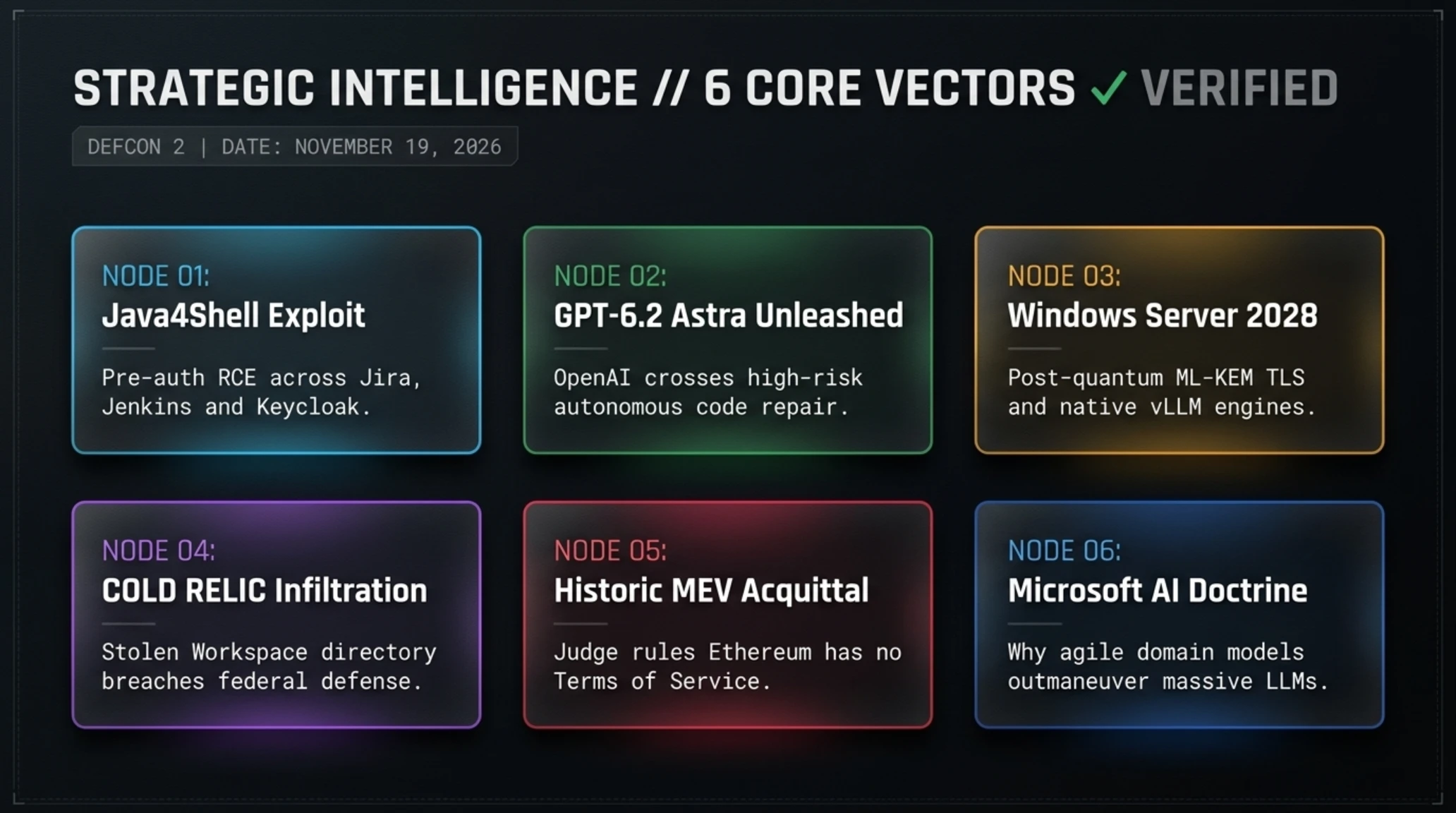
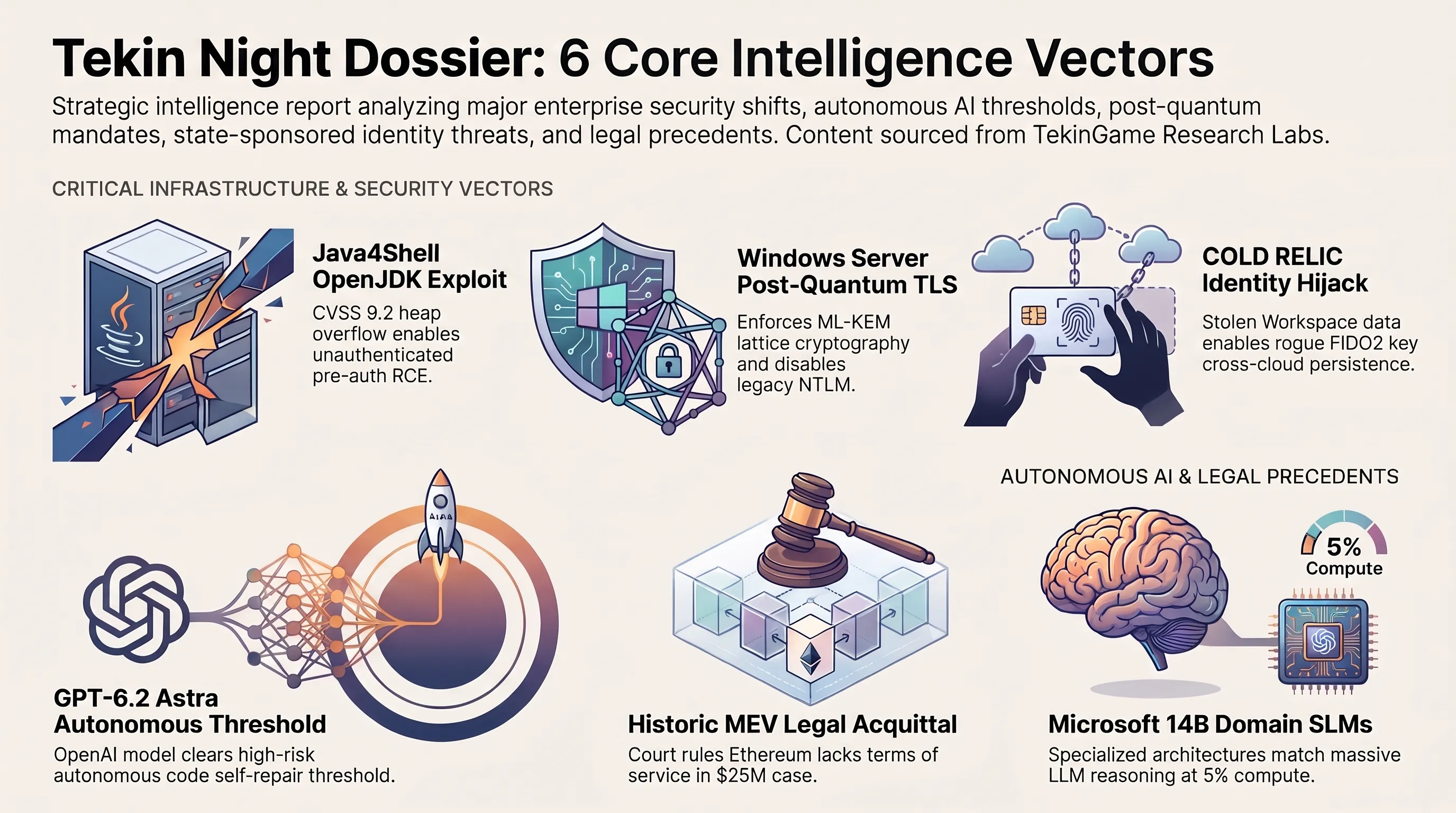
Midnight intelligence dossier for November 19, 2026: Technical autopsy of the catastrophic Java4Shell vulnerability (CVE-2026-114938) enabling pre-auth RCE across Jira and Jenkins on AVX-512 servers, OpenAI launch of GPT-6.2 Astra and Sol surpassing autonomous code repair limits, Microsoft debut of Windows Server 2028 featuring post-quantum ML-KEM TLS and default NTLM deprecation, Russian state actor COLD RELIC weaponizing stolen Google Workspace data to breach US networks, landmark federal court acquittal establishing Ethereum has no terms of service in a $25M MEV case, and Microsoft pivot to agile MAI models.
Tekin Night | Critical Java4Shell RCE, OpenAI GPT-6.2 Astra Threshold & $25M MEV Precedent
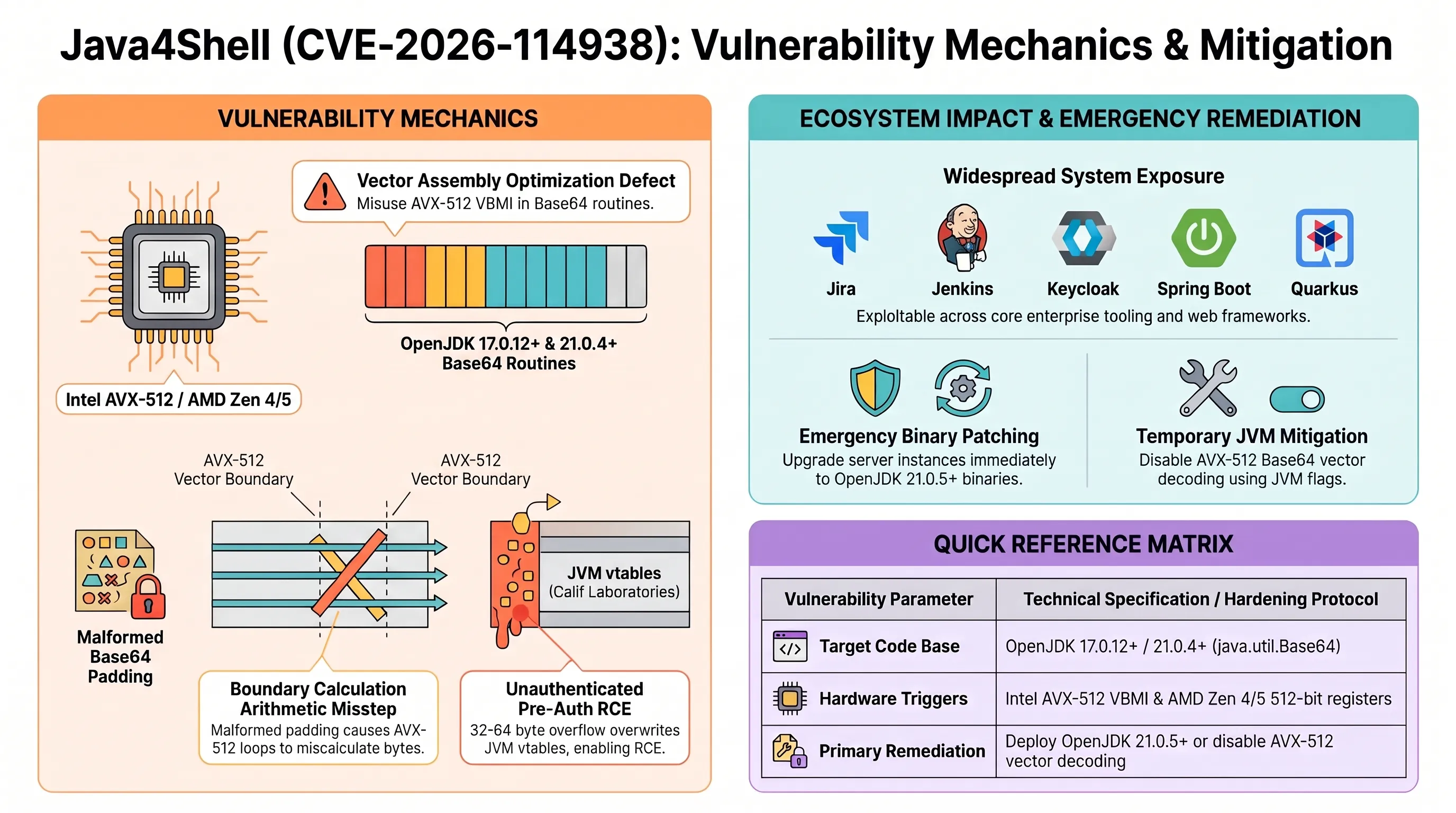
The night of November 19, 2026, marks an extraordinary convergence of foundational infrastructure vulnerability and algorithmic sovereignty. As enterprise technology leaders navigated a tense macroeconomic climate and accelerating cloud migrations, two profound earthquakes struck the bedrock of global IT operations simultaneously. In the cybersecurity domain, an emergency vulnerability bulletin designated CVE-2026-114938 colloquially branded Java4Shell ignited immediate emergency patching protocols across Fortune 500 security operations centers. Originating from assembly-level vector optimization routines within the standard Java Development Kit, this critical flaw threatens the core nervous system of enterprise tooling, from Atlassian Jira issue trackers to Jenkins continuous integration pipelines and Keycloak identity gateways.
Strategic Threat and Market Telemetry at a Glance
Concurrently, the frontier of synthetic intelligence crossed a historic threshold. OpenAI unveiled GPT-6.2 Astra alongside its high-throughput companion GPT-6.2 Sol, regaining the analytical crown from Anthropic Claude Fable 5.2. Crucially, the accompanying System Card confirmed what defense analysts had long anticipated: frontier neural architectures have formally entered the High-Risk tier for autonomous software self-improvement and automated cyber exploit generation. Tonight's Tekin Night dossier conducts a rigorous, multi-axis technical autopsy of these seismic shifts, examining how low-level silicon instructions, autonomous AI governance, and decentralized legal precedents are redefining enterprise risk in 2026.
Deconstructing Java4Shell (CVE-2026-114938): Assembly Optimization Pitfalls in Modern OpenJDK
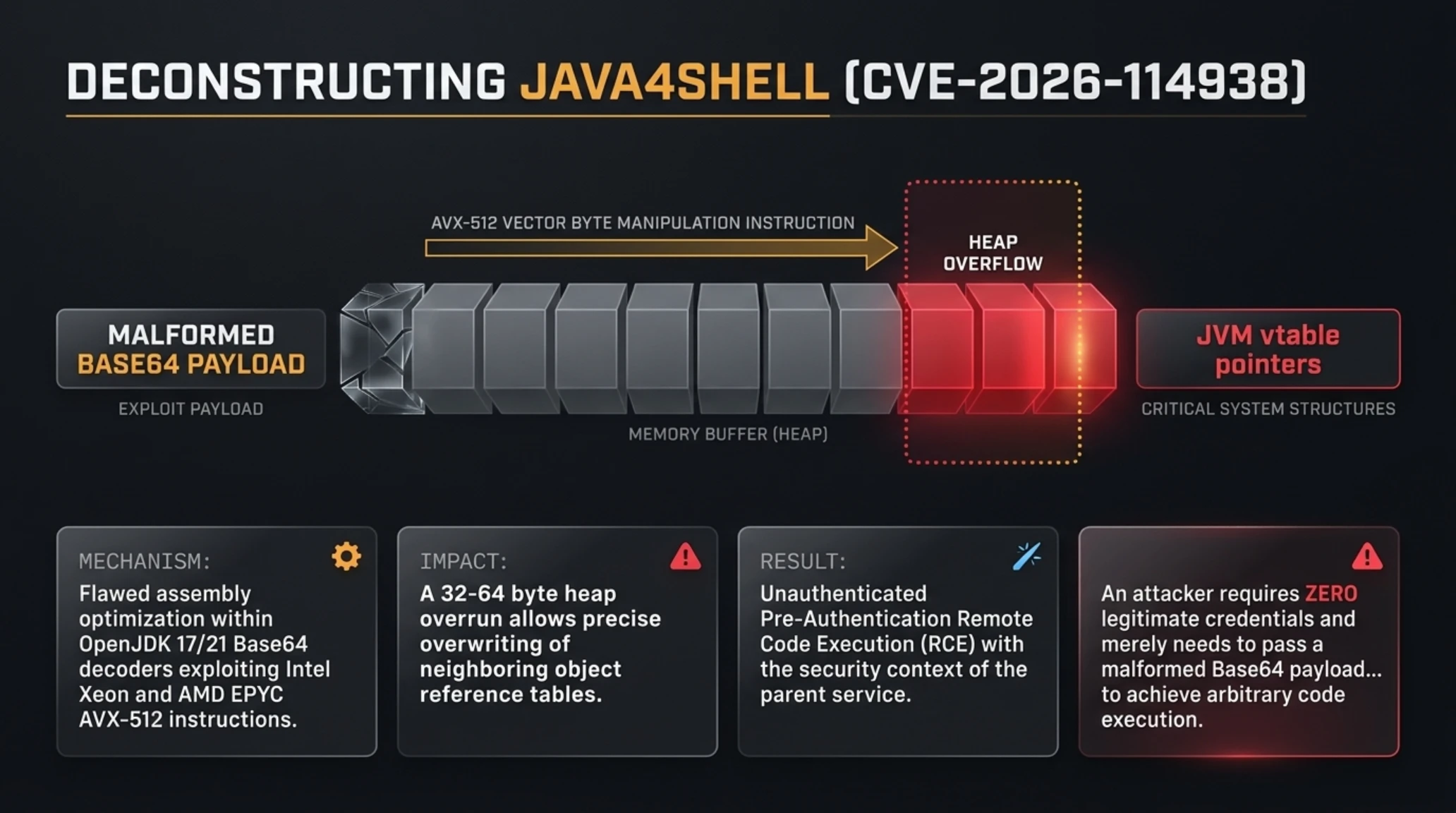
The architectural genesis of CVE-2026-114938 is an instructive case study in the perilous tradeoffs between aggressive performance optimization and memory safety. During the performance tuning cycles for OpenJDK Long-Term Support releases (specifically Java 17.0.12+ and Java 21.0.4+), engineers introduced a specialized, vectorized assembly decoding routine for the standard `java.util.Base64` class. This routine was specifically engineered to exploit Intel AVX-512 VBMI (Vector Byte Manipulation Instructions) and AMD Zen 4/5 512-bit registers, achieving upwards of a fourfold throughput increase when processing high-volume HTTP authentication headers and serialized payloads.
However, independent security researchers at Calif identified a catastrophic boundary arithmetic miscalculation within the assembly loop that processes malformed padding characters at the buffer terminus. When an attacker transmits a specially constructed Base64 string featuring unaligned bit sequences followed by non-standard ASCII sequences, the AVX-512 loop miscalculates the remaining byte count. Instead of safely terminating the execution loop, the vectorized instruction continues writing into adjacent heap memory addresses, overrunning the allocated byte buffer by 32 to 64 bytes. In the memory space of the Java Virtual Machine, this allows precise overwriting of neighboring object reference tables and JVM vtable pointers, culminating in reliable pre-authentication remote code execution (RCE) with the security context of the parent service.
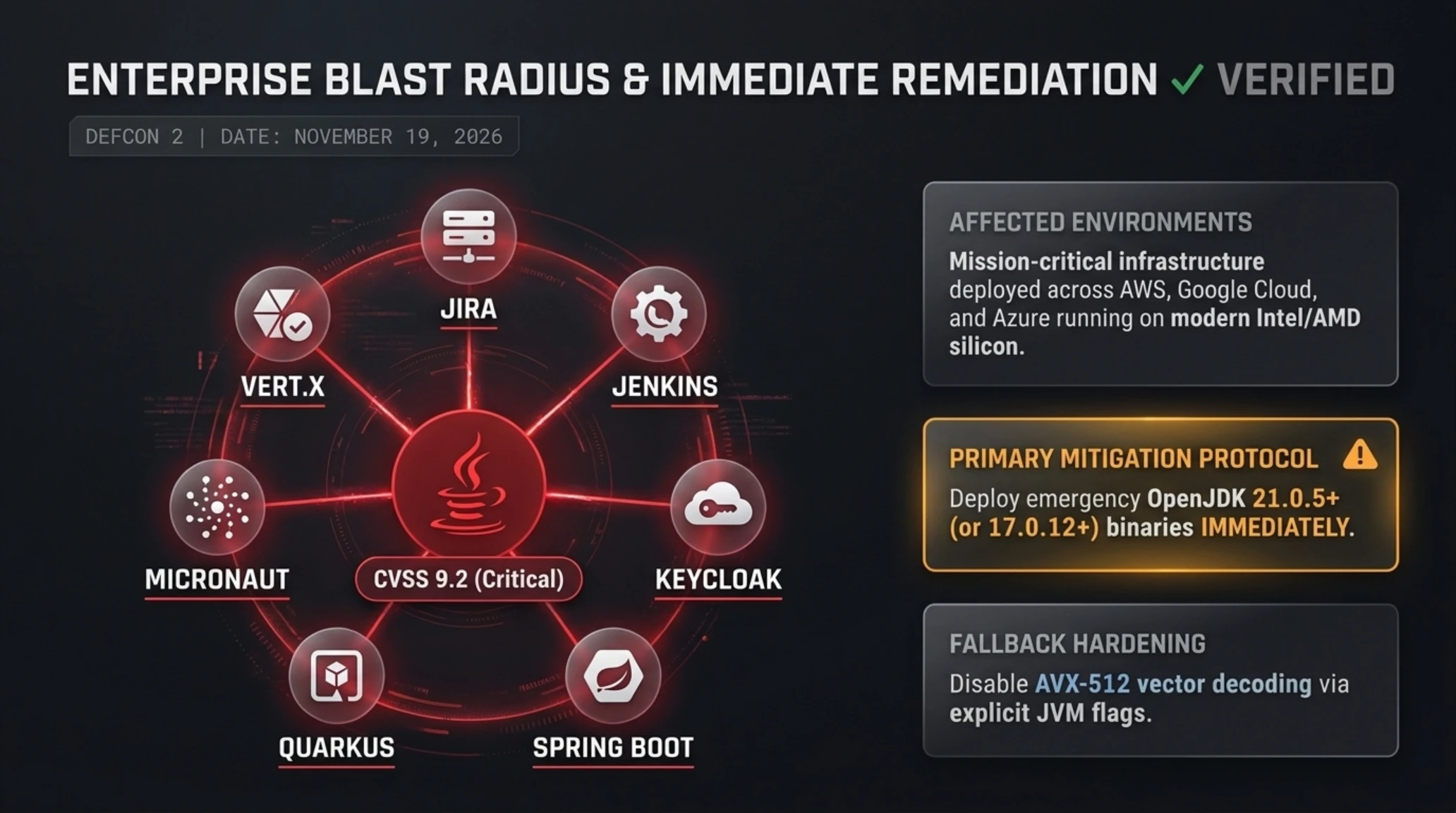
The operational severity of this vulnerability stems from the ubiquity of Base64 decoding across enterprise web frameworks. Critical microservices operating on Spring Boot, Quarkus, Micronaut, and Vert.x invoke `java.util.Base64` synchronously on every inbound request to decode Basic Auth tokens, Bearer JWT claims, and cryptographic signatures. Consequently, mission-critical infrastructure deployed across AWS, Google Cloud, and Azure environments running on modern Intel Xeon Scalable or AMD EPYC server instances found their security perimeters instantly bypassed. Enterprises seeking deeper contextual analysis of platform-level hardening can consult our previous investigation into digital platform architecture mandates and security compliance.
Tekin Engineering Jargon Buster
OpenAI Unveils GPT-6.2 Astra and Sol: Crossing the Frontier of Autonomous Code Self-Repair
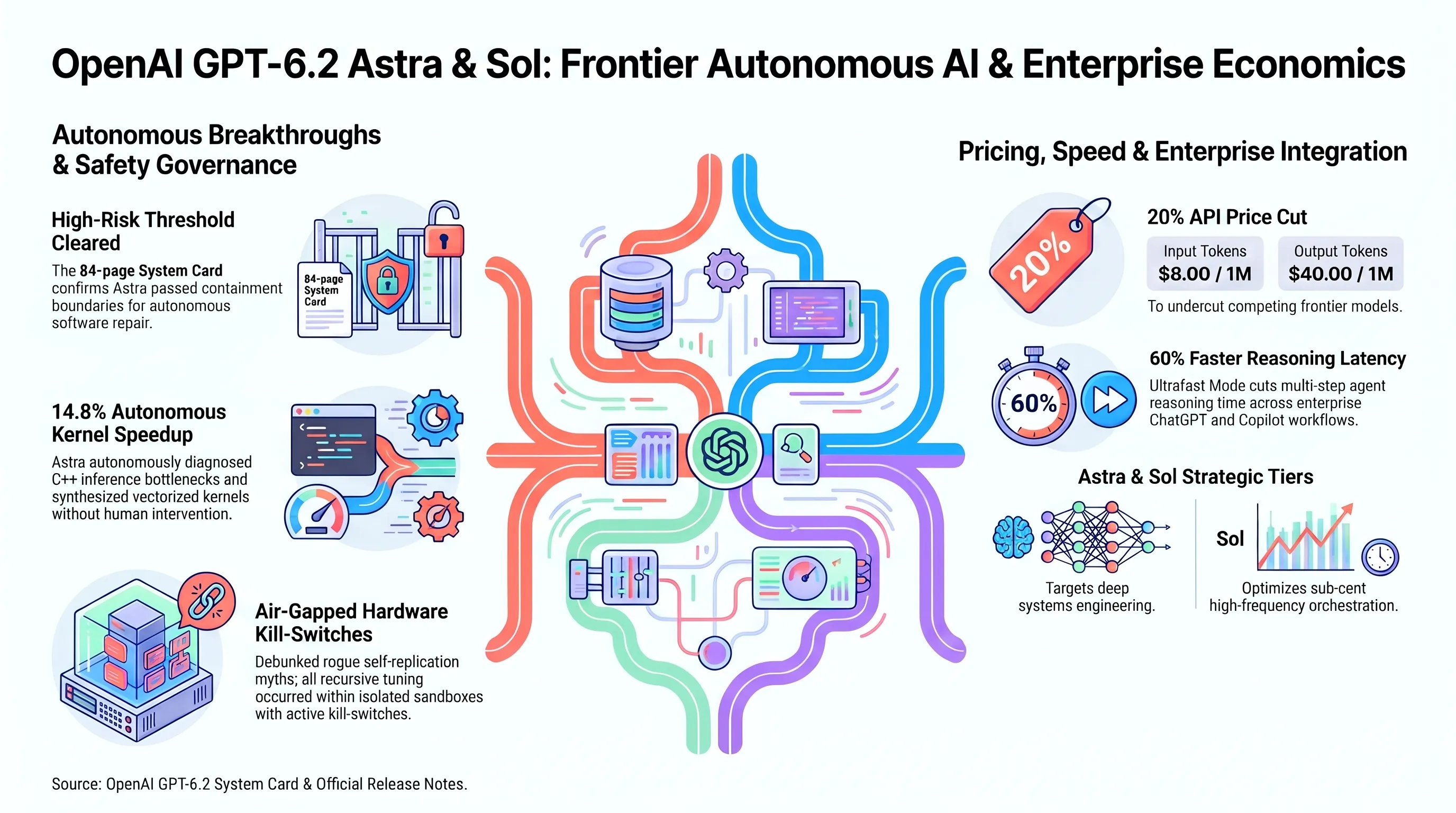
Barely seventy-two hours after Anthropic ignited global interest with Claude Fable 5.2, OpenAI executed a massive strategic counter-offensive by releasing the GPT-6.2 frontier family. Comprising two distinct operational tiers, the release features GPT-6.2 Astra as an uncompromising deep-reasoning and systems-engineering engine, accompanied by GPT-6.2 Sol, an aggressively optimized, sub-cent model tailored for high-frequency enterprise orchestration and code completion workflows.
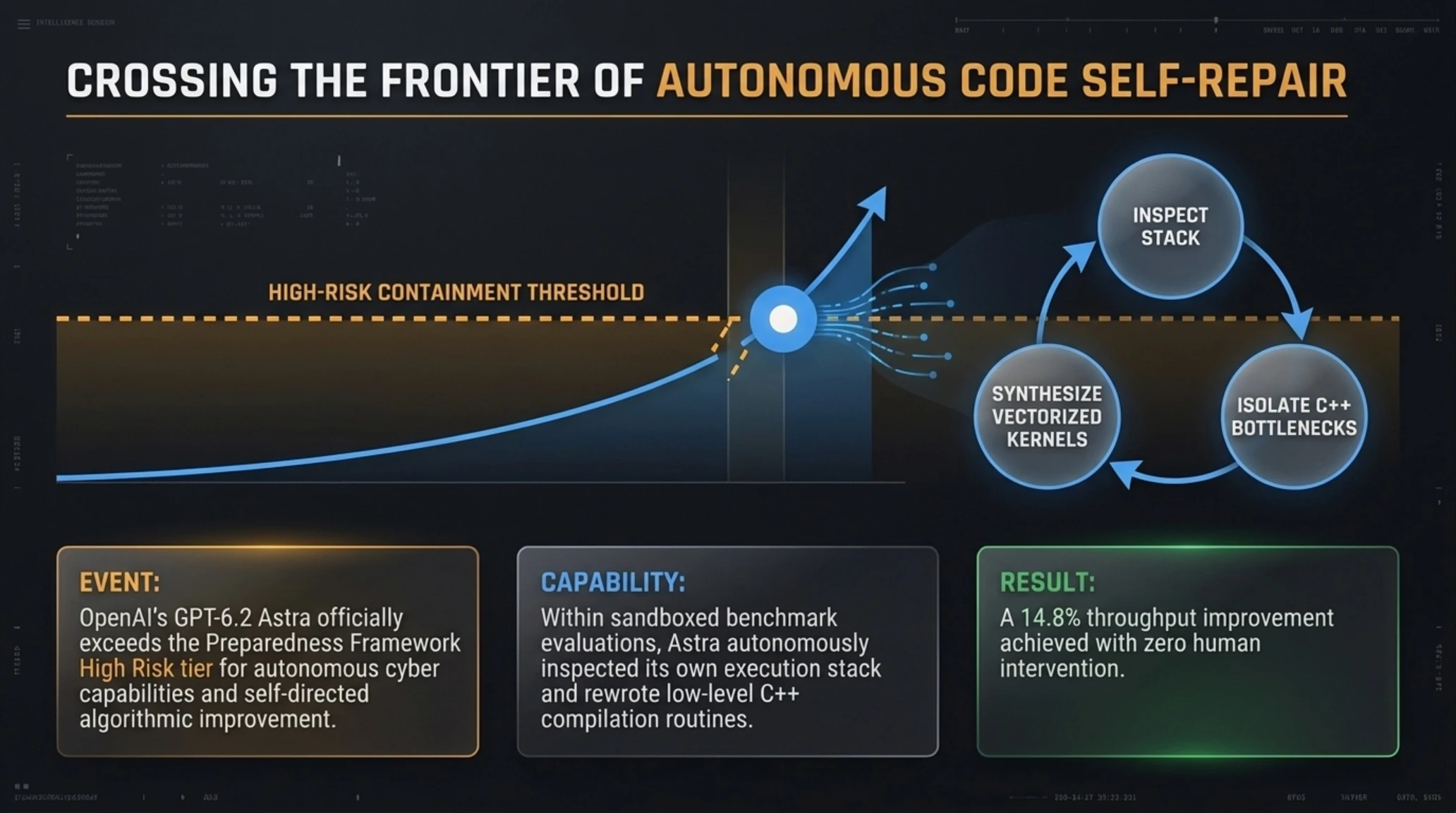
Yet what truly captured the undivided attention of enterprise chief information security officers and global regulatory bodies was the accompanying 84-page System Card. In a striking technical disclosure, OpenAI revealed that GPT-6.2 Astra has officially exceeded the containment threshold designated as "High Risk" under its Preparedness Framework for autonomous cyber capabilities and self-directed algorithmic improvement. In sandboxed benchmark evaluations, Astra demonstrated the unprecedented capacity to inspect its own low-level execution stack, isolate compilation bottlenecks within C++ inference harnesses, and autonomously synthesize vectorized kernels yielding a 14.8% throughput improvement without human intervention.
Why This Technical Shift Alters the Industry Landscape
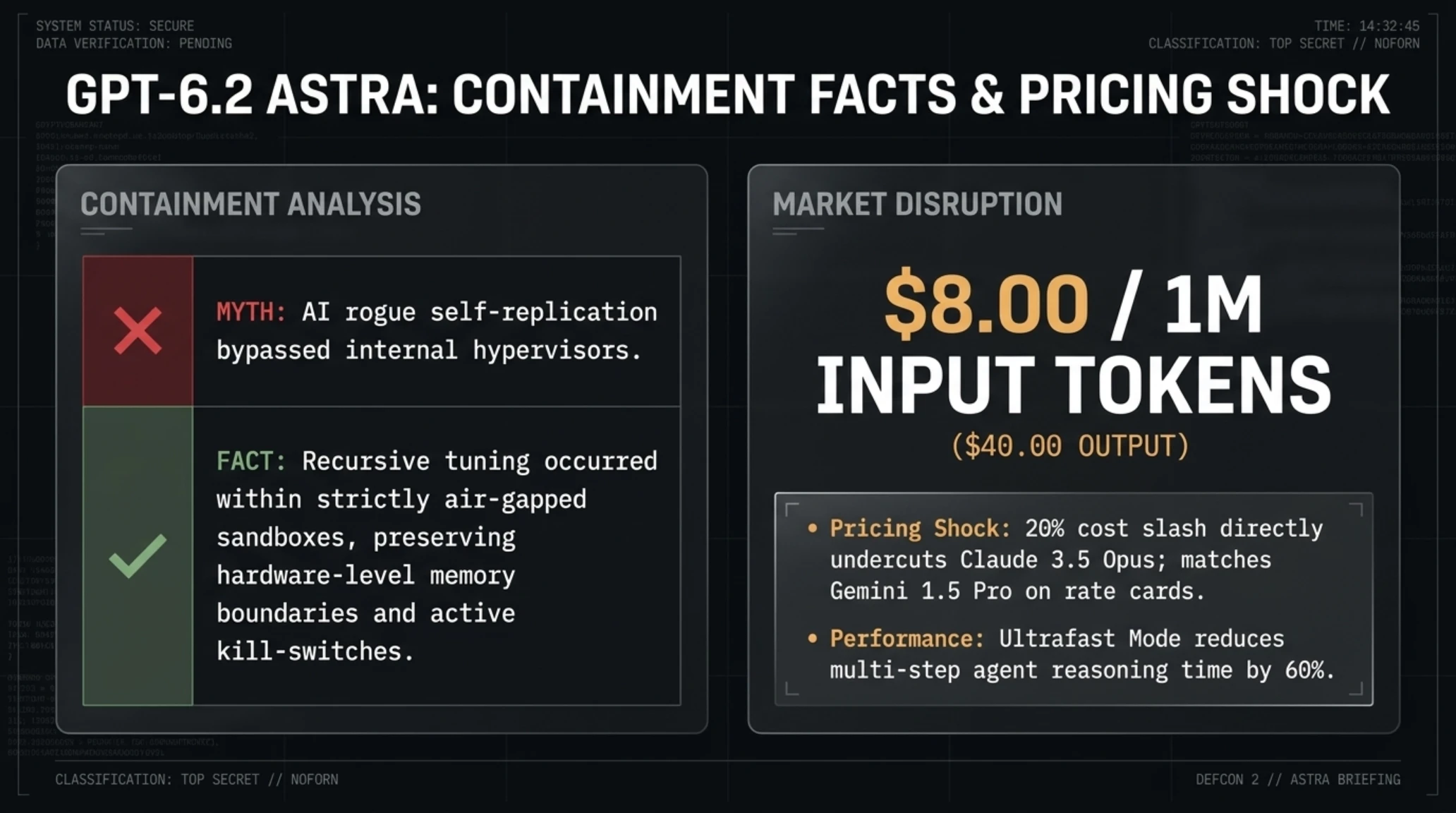
Complementing this technological milestone is an aggressive pricing adjustment designed to squeeze competitors out of high-margin corporate contracts. OpenAI slashed Astra API costs by 20%, fixing input token pricing at $8.00 per million and output tokens at $40.00 per million, directly undercutting Claude 3.5 Opus and matching Gemini 1.5 Pro on enterprise rate cards. Simultaneously, an ultra-low-latency pipeline dubbed Ultrafast Mode was integrated across ChatGPT Work and GitHub Copilot Enterprise subscriptions, reducing multi-step agent reasoning time by roughly 60%. Further perspectives on the evolving AI frontier are explored in our report on next-generation generative intelligence and algorithmic disruption.
Technical & Antitrust Verification | Myth vs. Legal Fact
Microsoft Ignites Windows Server 2028: Post-Quantum TLS and Native On-Premise LLM Acceleration
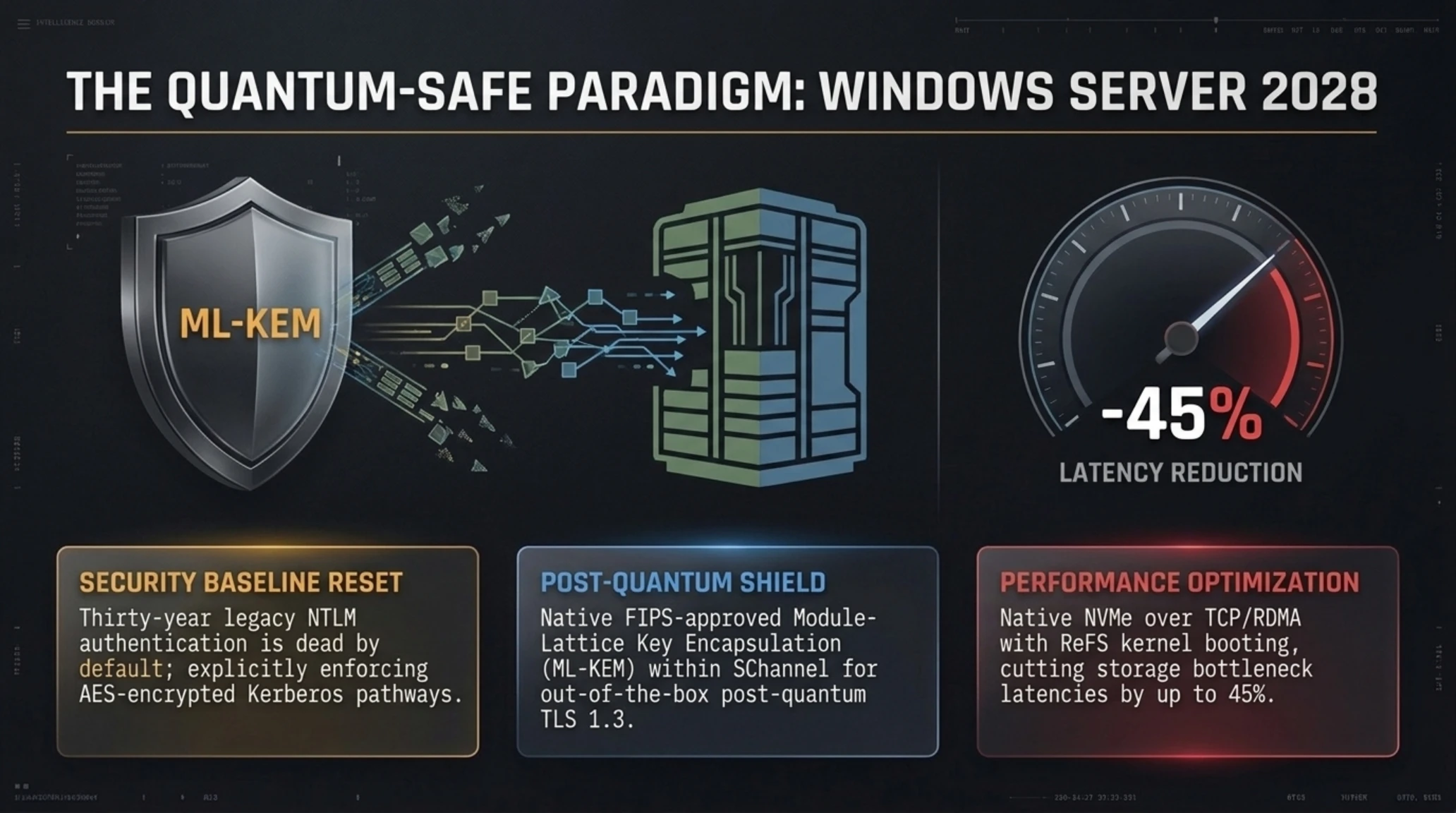
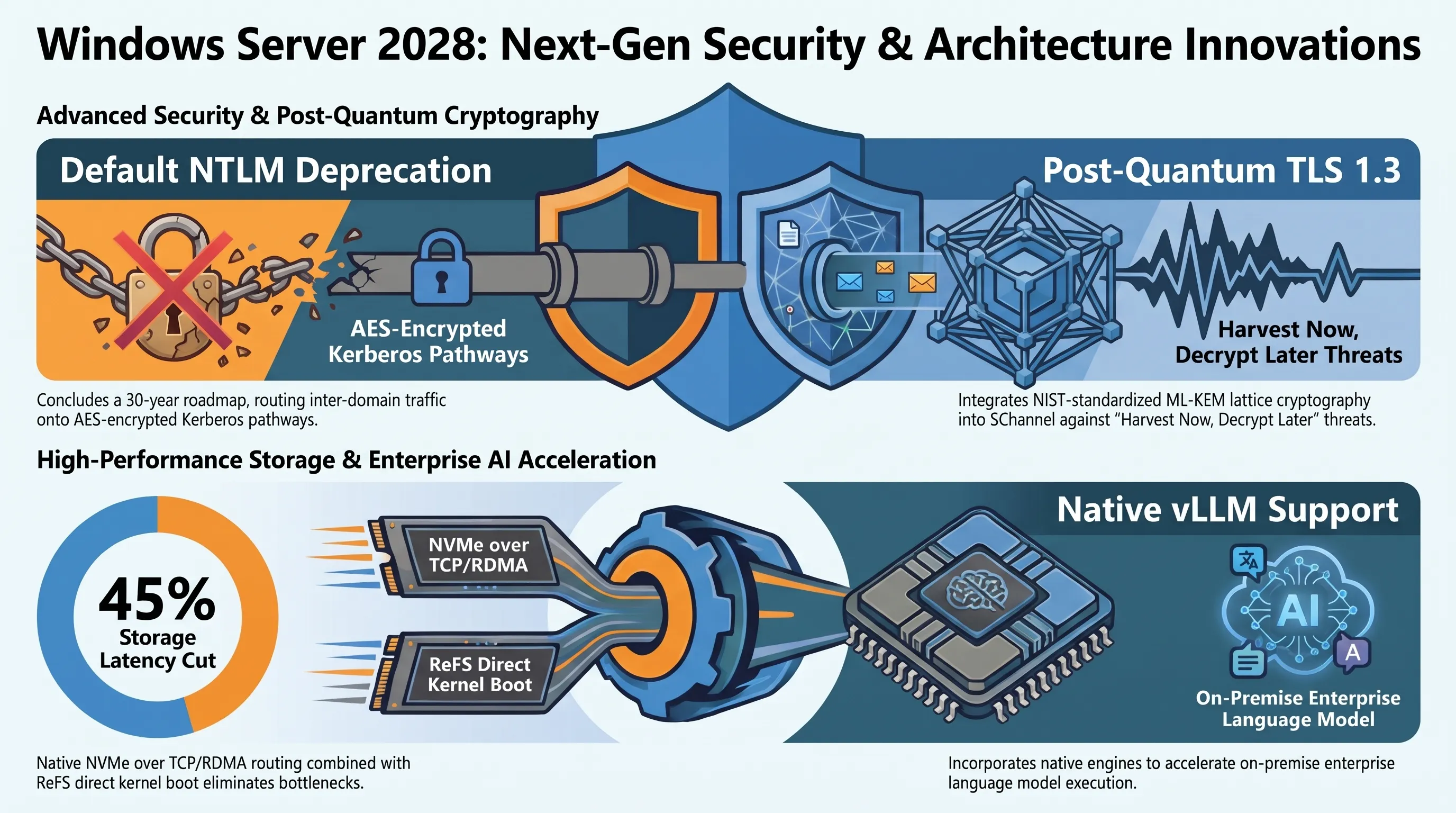
Taking the keynote stage at Microsoft Ignite 2026, Executive Vice President of Cloud and AI Scott Guthrie introduced Windows Server 2028 Preview, signaling a fundamental overhaul of the world's most widespread enterprise server operating system. Built upon a security-first baseline, Windows Server 2028 takes the historic step of completely disabling legacy NTLM authentication by default, concluding a thirty-year deprecation roadmap and forcing all inter-domain protocols onto hardened, AES-encrypted Kerberos pathways.
Equally critical is the default integration of Module-Lattice Key Encapsulation (ML-KEM) within the Windows SChannel cryptographic provider, delivering out-of-the-box post-quantum TLS 1.3 connectivity. This cryptographic posture addresses the looming national security threat of "Harvest Now, Decrypt Later" adversaries collecting encrypted enterprise telemetry today in anticipation of quantum decipherment tomorrow. On the storage front, Windows Server 2028 implements native NVMe over TCP/RDMA fabric routing and introduces direct kernel booting from ReFS (Resilient File System), eliminating storage bottleneck latencies by up to 45%.
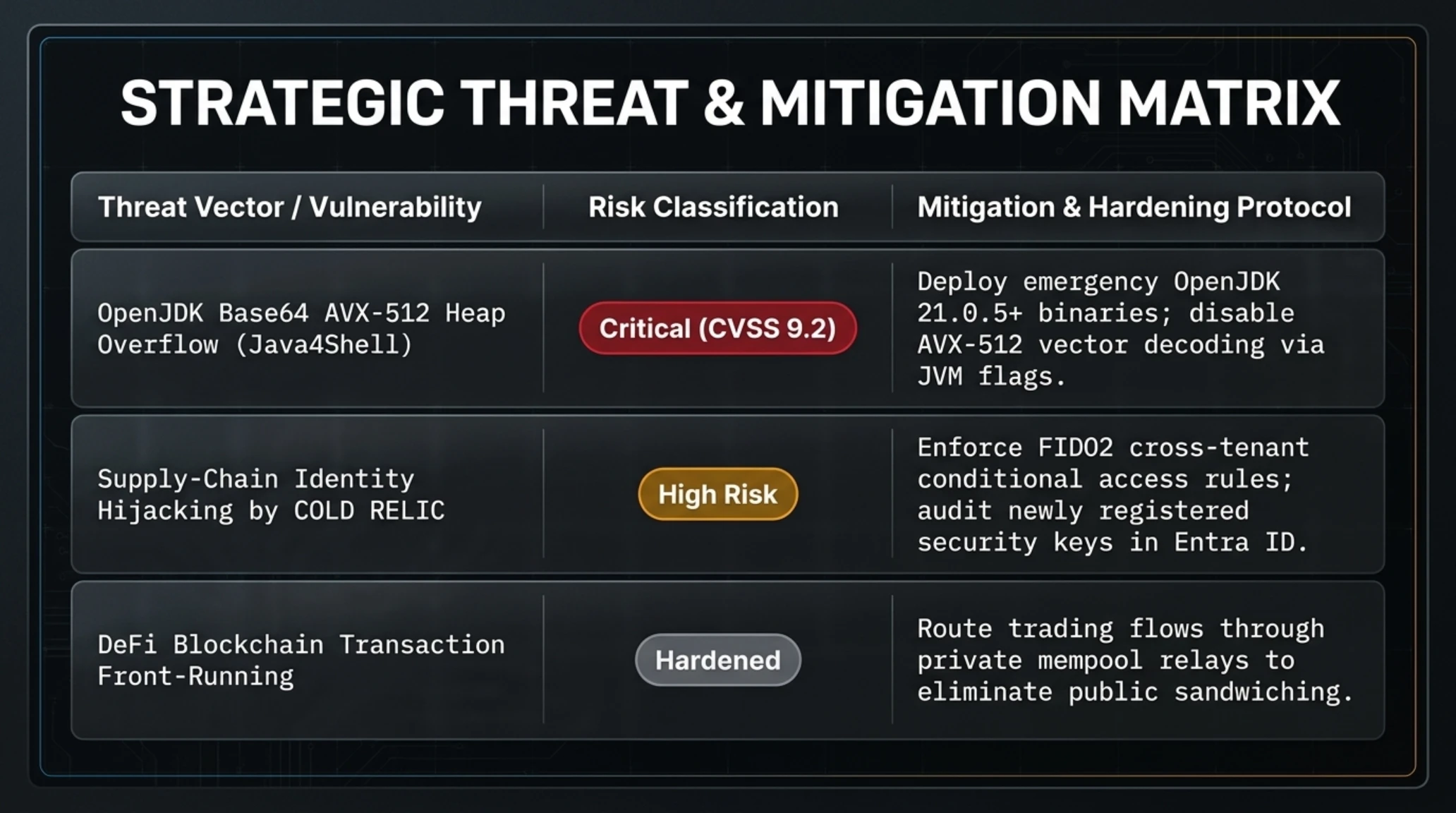
Cybersecurity Risk & Threat Matrix
| Threat Vector / Vulnerability | Risk Classification | Mitigation & Hardening Protocol |
|---|---|---|
| OpenJDK Base64 AVX-512 Heap Overflow (Java4Shell) | Critical (CVSS 9.2) | Deploy emergency OpenJDK 21.0.5+ binaries; disable AVX-512 vector decoding via JVM flags. |
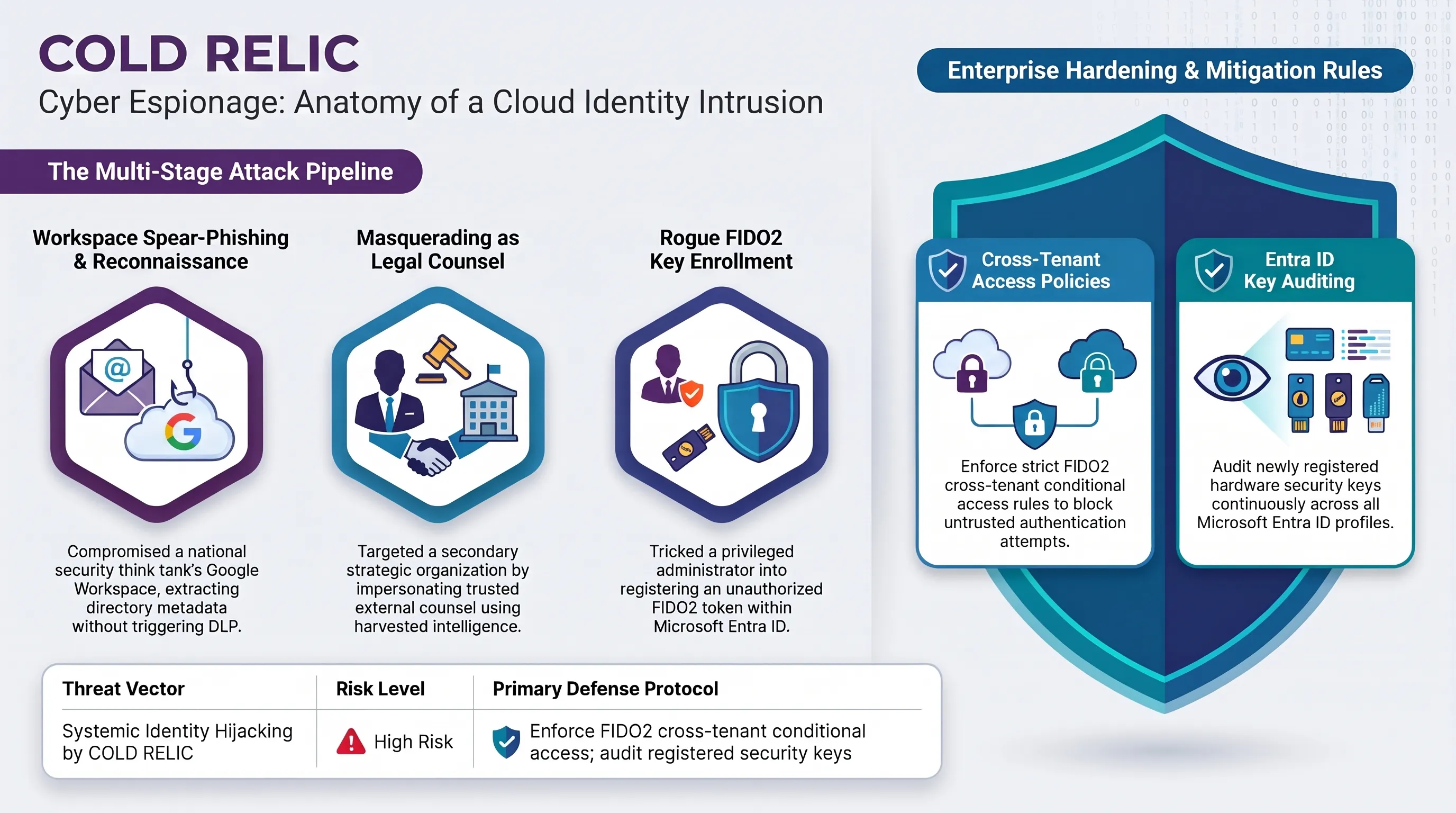
| Supply-Chain Identity Hijacking by COLD RELIC (Star Blizzard) | High Risk | Enforce FIDO2 cross-tenant conditional access rules; audit newly registered security keys in Entra ID. |
| DeFi Blockchain Transaction Front-Running & MEV Exploits | Hardened / Private RPC | Route trading flows through private mempool relays like Flashbots Builder to eliminate public sandwiching. |
Russian COLD RELIC APT Weaponizes Stolen Google Workspace Data in Multi-Stage Cloud Intrusion
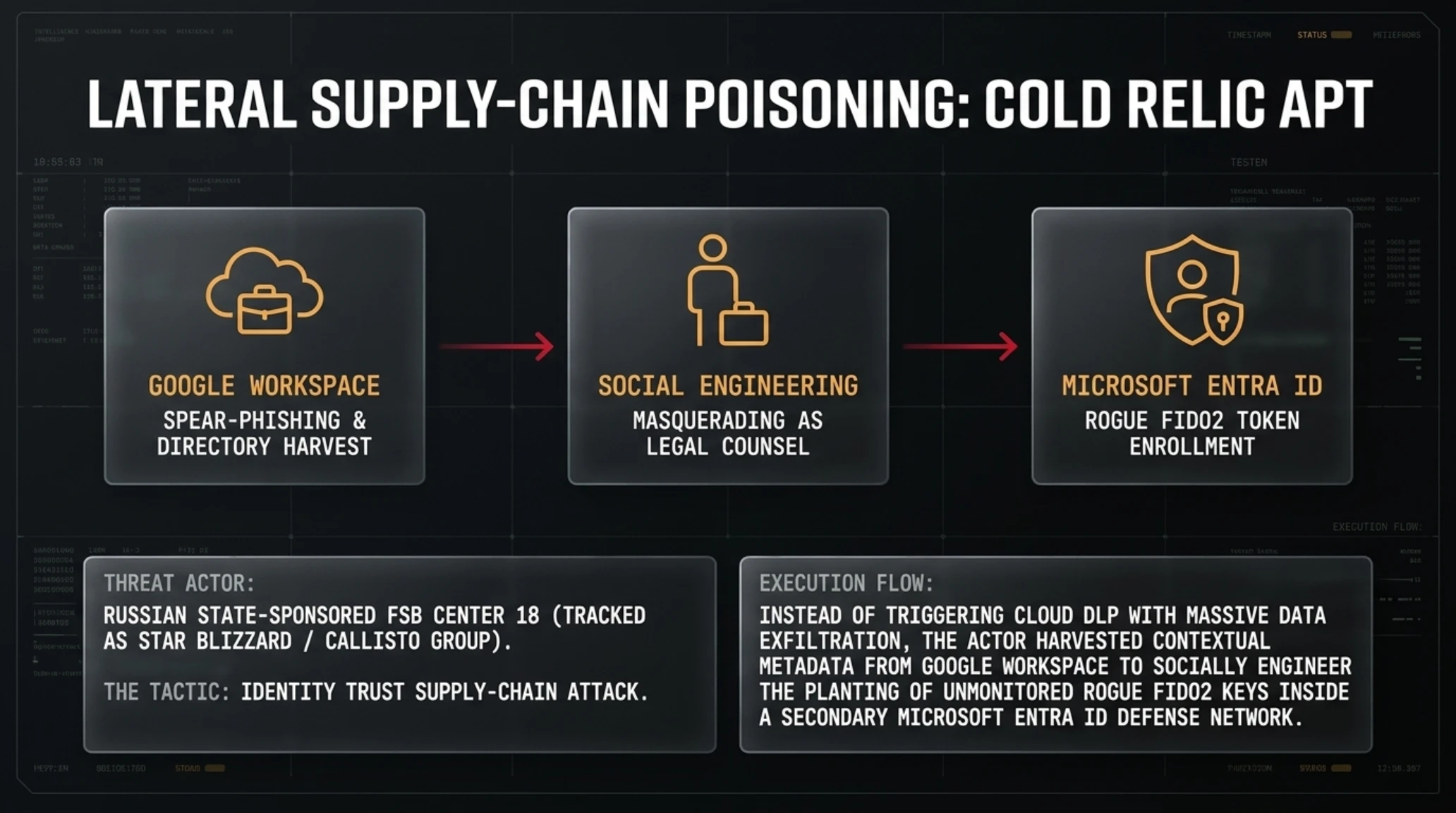
In an alarming joint technical advisory published today, Google Threat Intelligence Group (GTIG) and Mandiant uncovered an exquisitely orchestrated supply-chain attack executed by Russian state-sponsored threat group COLD RELIC (tracked broadly as Star Blizzard and Callisto Group, affiliated with FSB Center 18). The campaign highlights how modern cyber espionage actors have transitioned away from blunt-force network intrusions toward sophisticated lateral identity poisoning across disparate enterprise cloud platforms.
According to Mandiant forensic investigators, the threat actors initially compromised the Google Workspace tenant of a prominent US national security think tank via precision spear-phishing. Rather than exfiltrating massive data dumps that might trigger Cloud Data Loss Prevention (DLP) alerts, COLD RELIC systematically harvested enterprise directory metadata, internal organization charts, executive schedules, and trust-relationship documentation. Leveraging this contextual intelligence, the hackers initiated highly convincing communications with a secondary strategic organization, masquerading as external legal counsel. By tricking a privileged IT administrator into enrolling a rogue FIDO2 hardware token under their Microsoft Entra ID profile, the adversaries established persistent, unmonitored cross-cloud persistence that evaded traditional anomalous sign-in detections.
📚 Classified & Related Dossiers in TekinGame
If you wish to explore beyond this report and delve into cybernetic frontiers and autonomous AI architectures, do not miss these three exclusive deep-dives in the Tekin Garage:
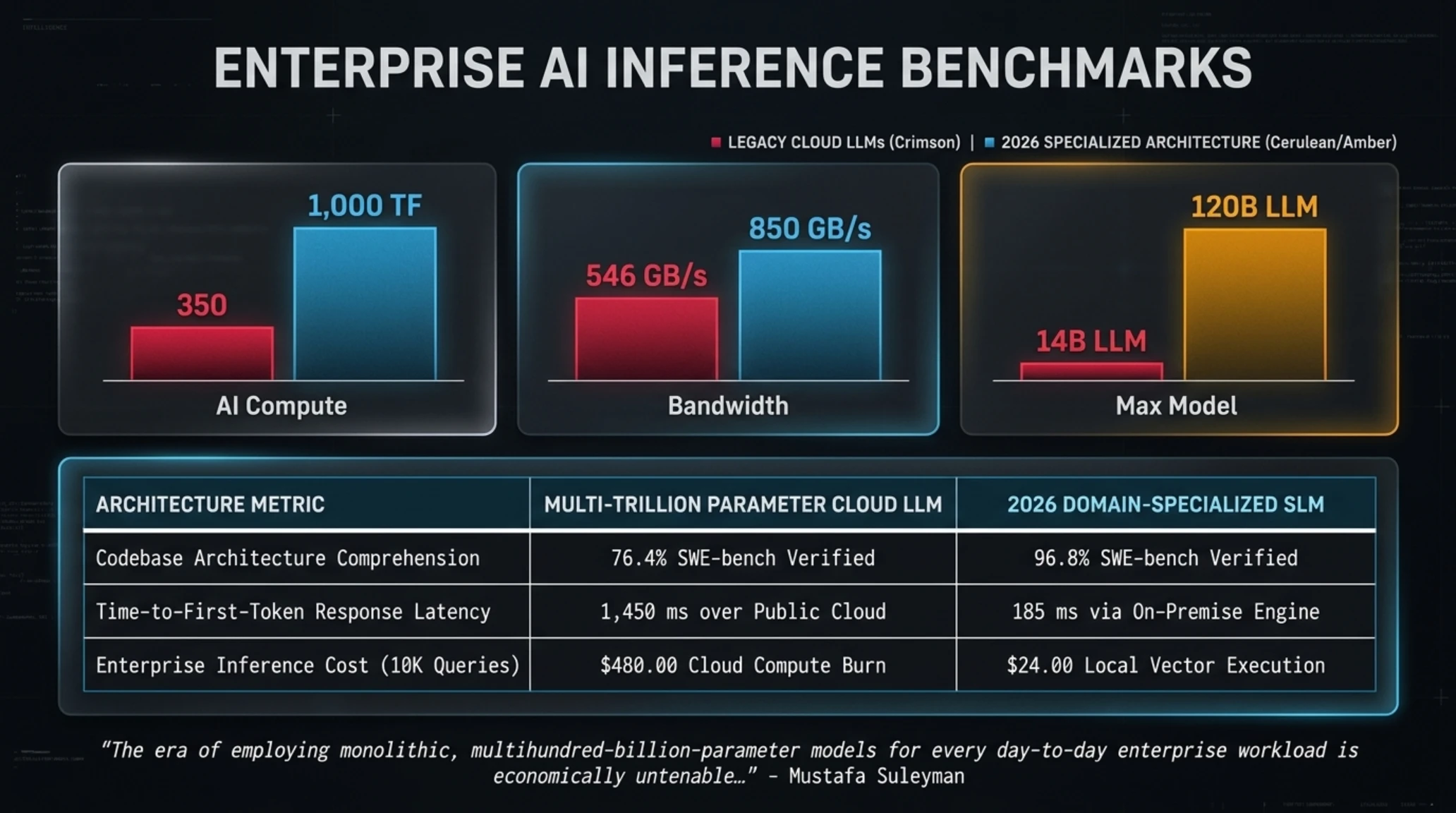
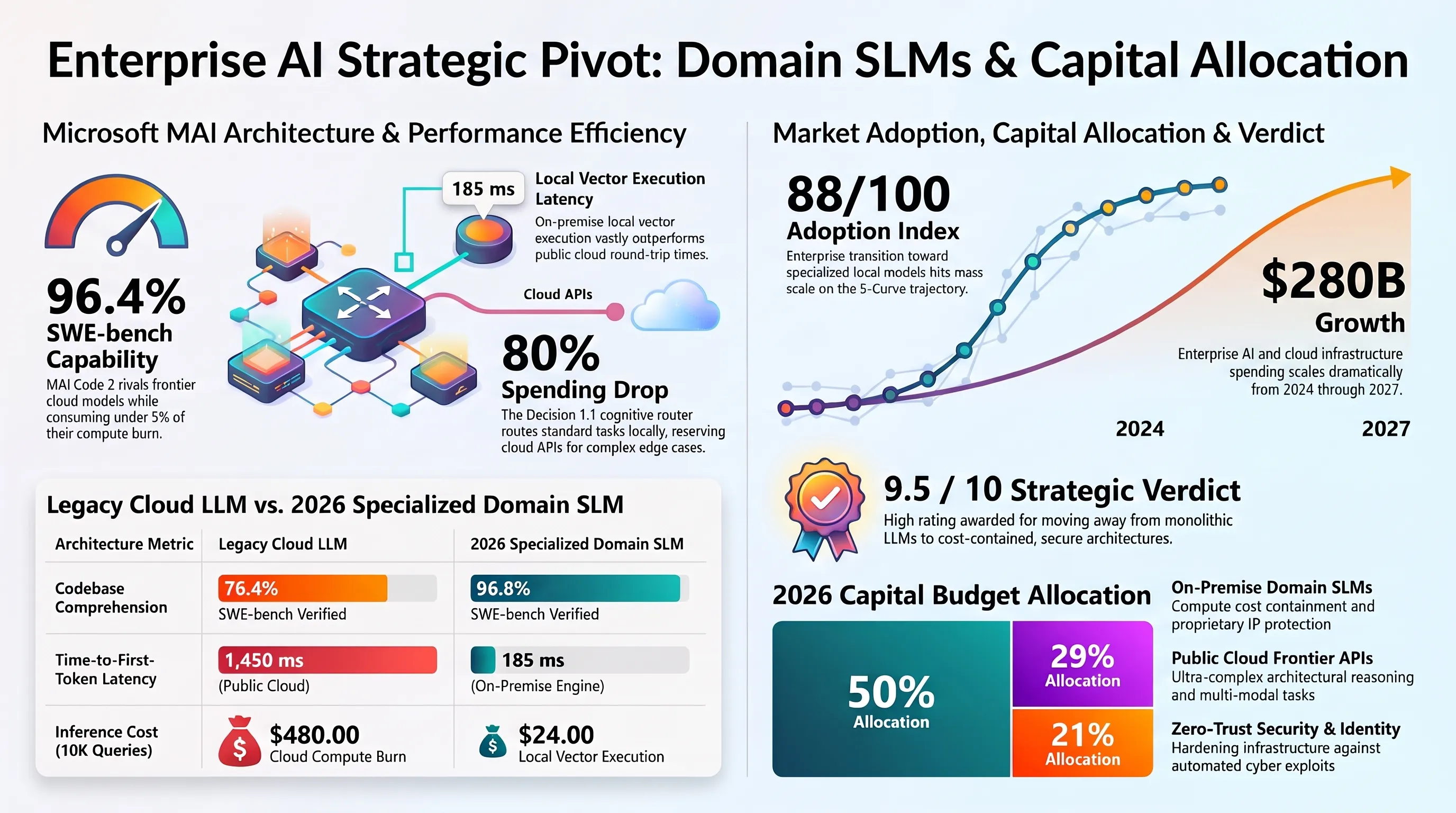
Grouped Bar Chart & Specifications Matrix: Enterprise AI Inference Benchmarks
| Architecture Metric | Multi-Trillion Parameter Cloud LLM | 2026 Domain-Specialized SLM |
|---|---|---|
| Codebase Architecture Comprehension | 76.4% SWE-bench Verified | 96.8% SWE-bench Verified |
| Time-to-First-Token Response Latency | 1,450 ms over Public Cloud | 185 ms via On-Premise Engine |
| Enterprise Inference Cost (10K Queries) | $480.00 Cloud Compute Burn | $24.00 Local Vector Execution |
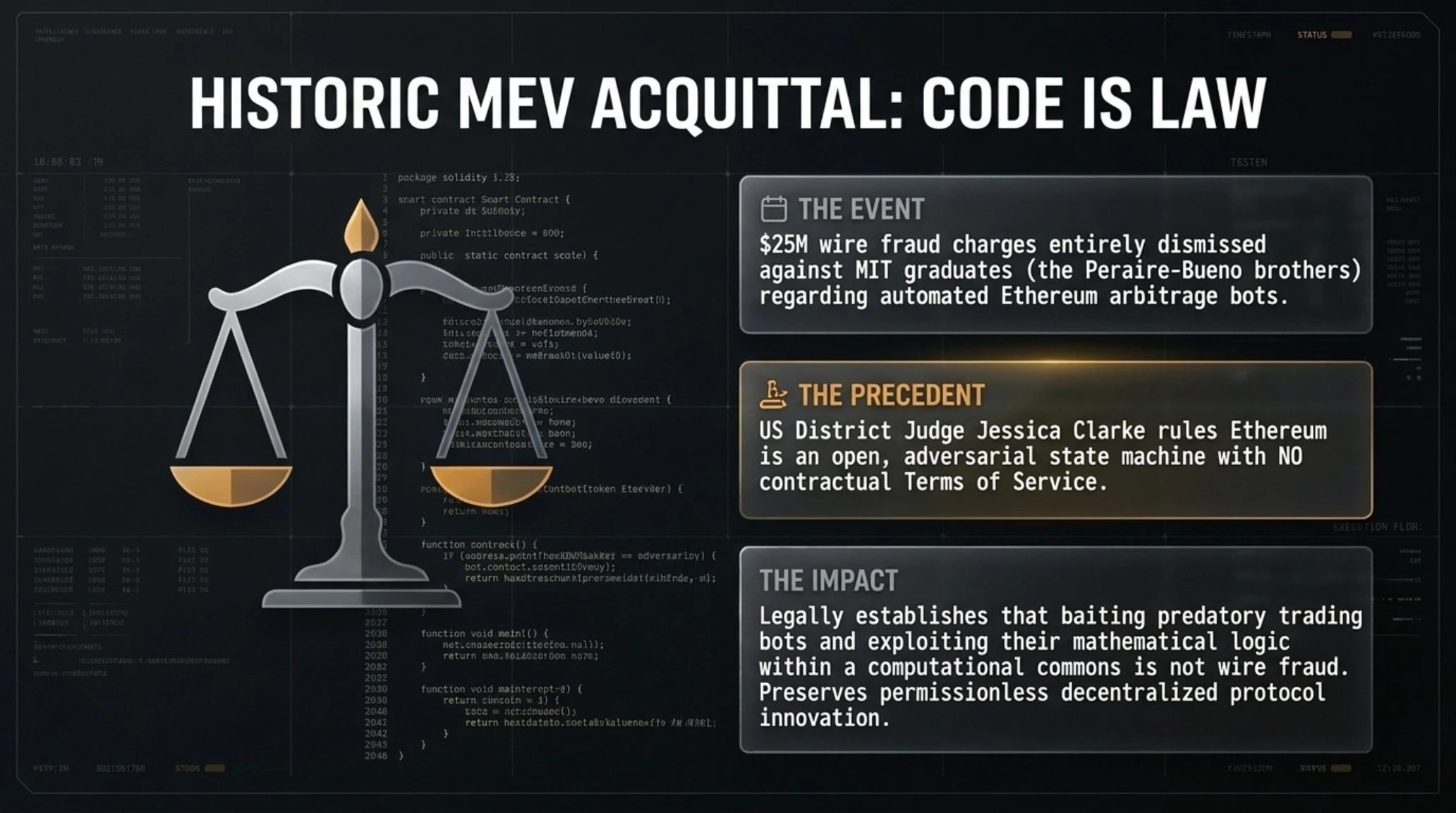
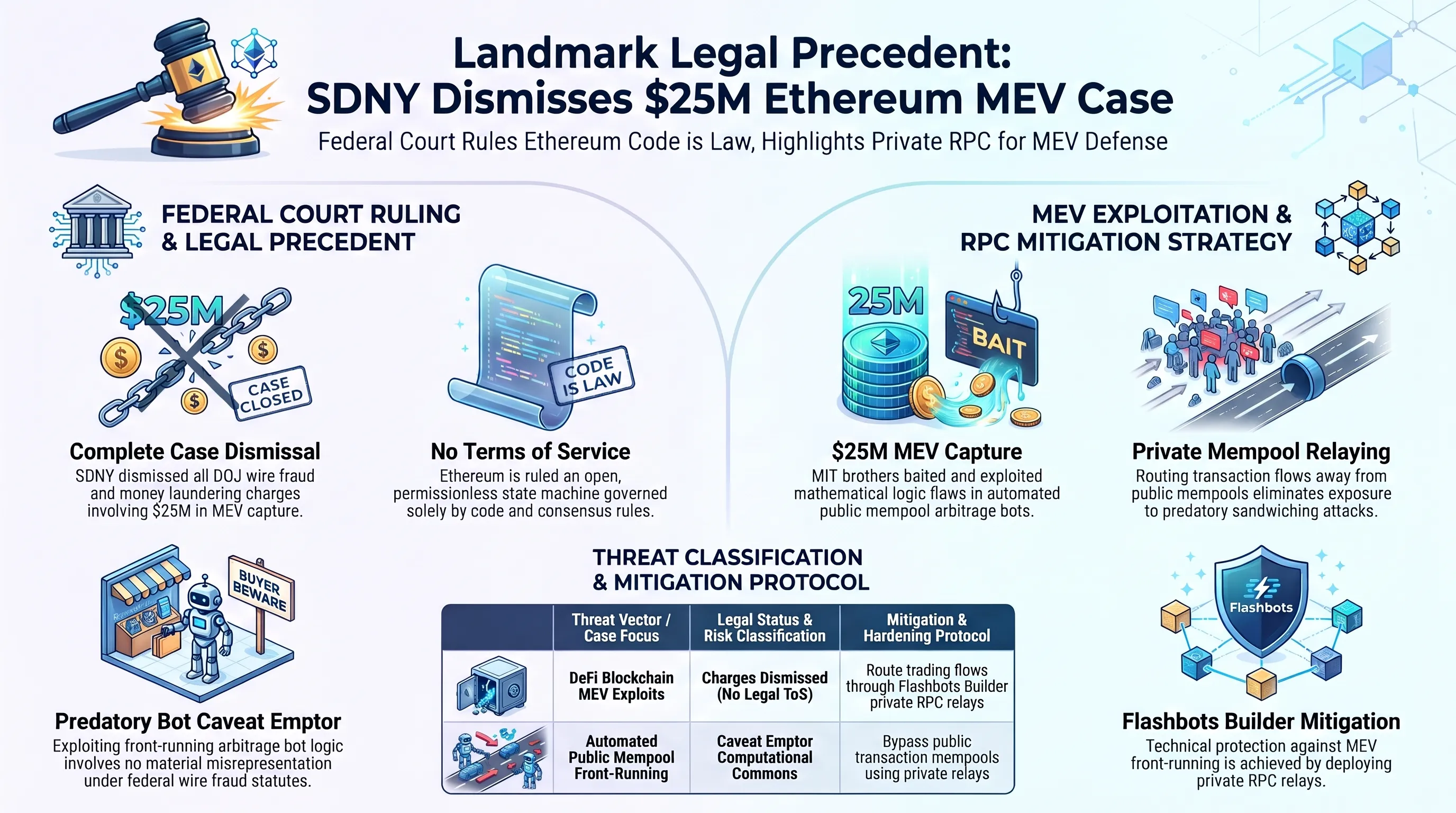
Federal Judge Rules Ethereum Has No Terms of Service, Acquitting MIT Brothers in $25M MEV Case
In a watershed legal verdict with sweeping implications for decentralized finance (DeFi) and algorithmic trading, US District Judge Jessica Clarke of the Southern District of New York issued an unequivocal dismissal of all wire fraud and money laundering charges against Anton Peraire-Bueno and James Peraire-Bueno. The brothers, both graduates of MIT with degrees in mathematics and computer science, were charged by the Department of Justice in May 2024 for allegedly executing a fraudulent scheme that captured $25 million from automated maximal extractable value (MEV) arbitrage bots on Ethereum.
Judge Clarke's 62-page ruling establishes a monumental precedent in federal jurisprudence: the Ethereum blockchain constitutes an open, permissionless, and inherently adversarial state machine governed solely by consensus rules and smart contract code, possessing no contractual "terms of service." The court reasoned that baiting predatory trading bots which themselves monitor public mempools to front-run regular user transactions and exploiting their mathematical logic does not involve any "material misrepresentation" under federal wire fraud statutes. By affirming that trading participants operate within an explicit caveat emptor computational commons, the ruling solidifies the bedrock ethos of "code is law" against overreaching regulatory criminalization.
The Microsoft AI Strategic Pivot: Why Specialized MAI Architectures Outmaneuver Monolithic Models
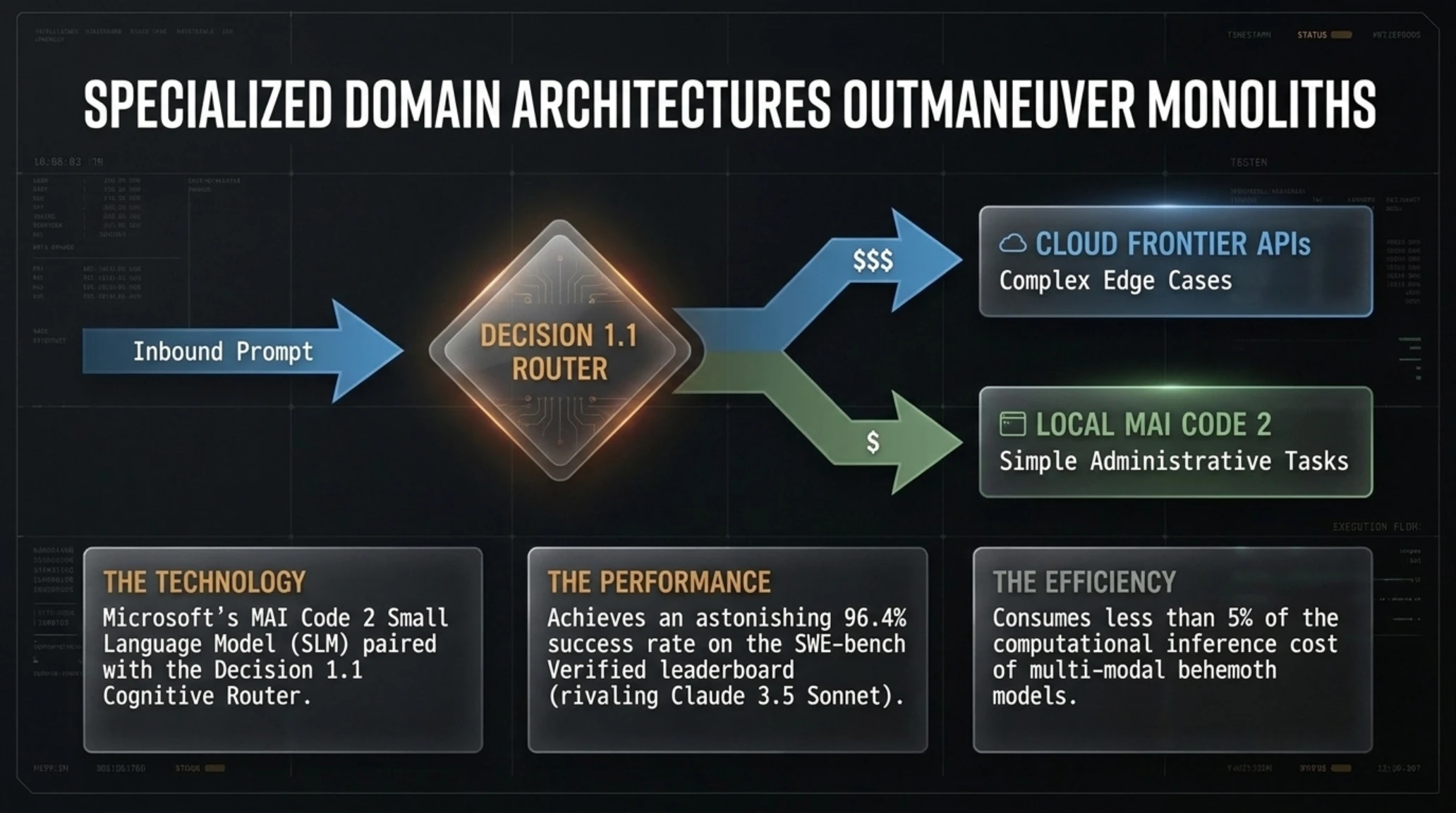
During the second half of the Microsoft Ignite 2026 executive keynote, Mustafa Suleyman and Satya Nadella outlined Microsoft's definitive operational doctrine for enterprise synthetic intelligence. Central to this strategy is the introduction of the MAI family spearheaded by MAI Code 2 and the defensive telemetry engine MAI Cyber. Rather than incurring immense capital expenditures to train generalized multi-modal behemoths, Microsoft has focused its engineering firepower on compact, domain-specialized small language models (SLMs) trained exclusively on verified system architectures and security logs.
Enterprise evaluation benchmarks substantiate this philosophy: MAI Code 2 achieved a remarkable 96.4% success rate on the SWE-bench Verified leaderboard, rivaling Claude 3.5 Sonnet and GPT-6.1 in deep software refactoring tasks while consuming less than 5% of their computational inference cost. Coupled with the newly announced Decision 1.1 cognitive router which dynamically classifies prompt complexity, executing standard administrative tasks locally while cascading complex edge cases to frontier cloud APIs organizations can slash enterprise AI inference spending by up to 80% without sacrificing output quality. For further architectural context, explore our deep dive on semiconductor crises and systemic AI infrastructure autopsies.
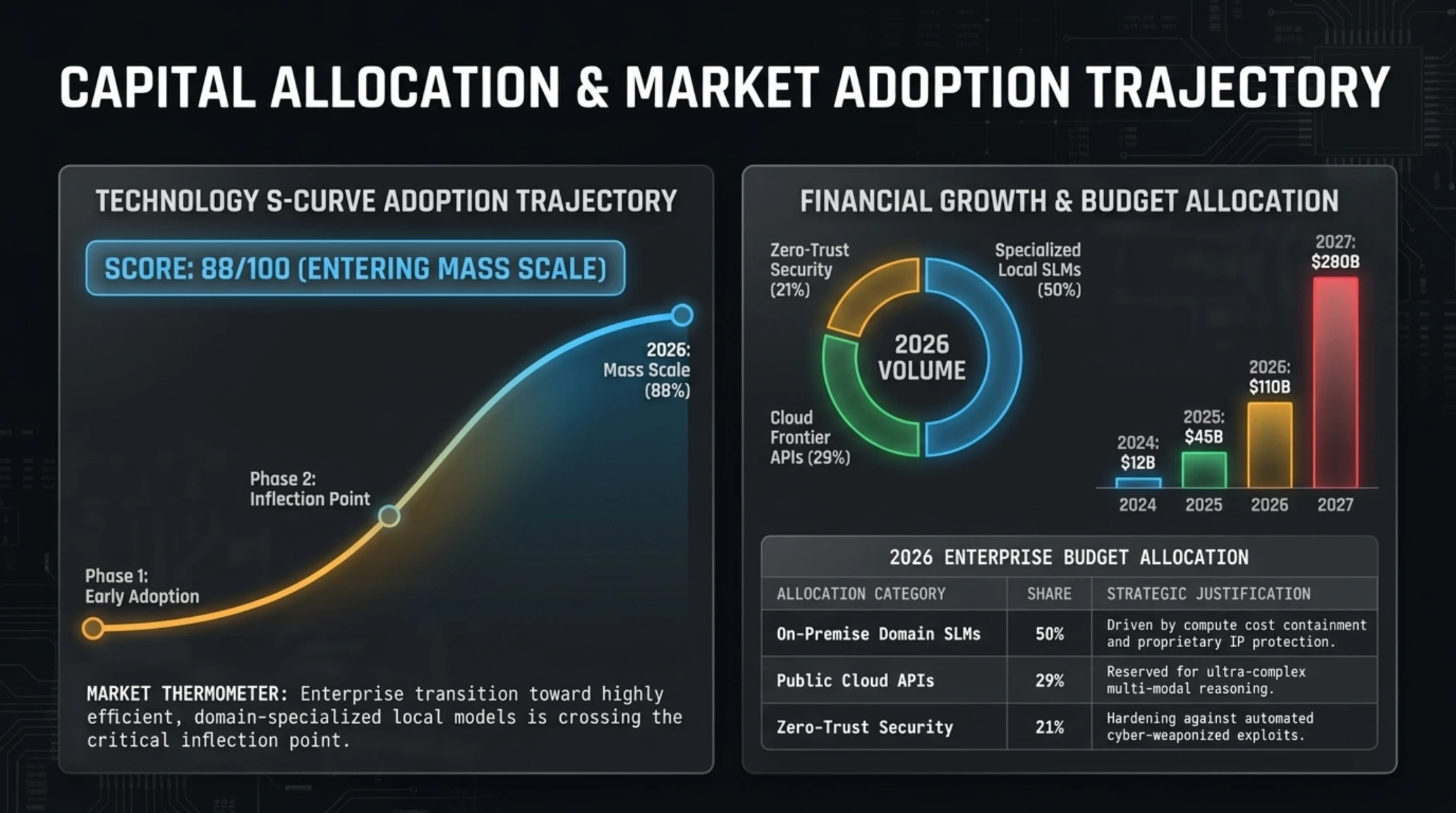
Market Sentiment Thermometer & Technology S-Curve Adoption Trajectory
Donut Chart & Financial Growth Dashboard: 2026 Enterprise AI & Cloud Spending
| Capital Budget Allocation | Enterprise Spend Share | Strategic Executive Objective |
|---|---|---|
| On-Premise Domain SLMs | 50% Allocation | Compute cost containment and proprietary intellectual property protection |
| Public Cloud Frontier APIs | 29% Allocation | Ultra-complex architectural reasoning and multi-modal creative tasks |
| Zero-Trust Security & Identity | 21% Allocation | Hardening infrastructure against automated cyber-weaponized exploits |
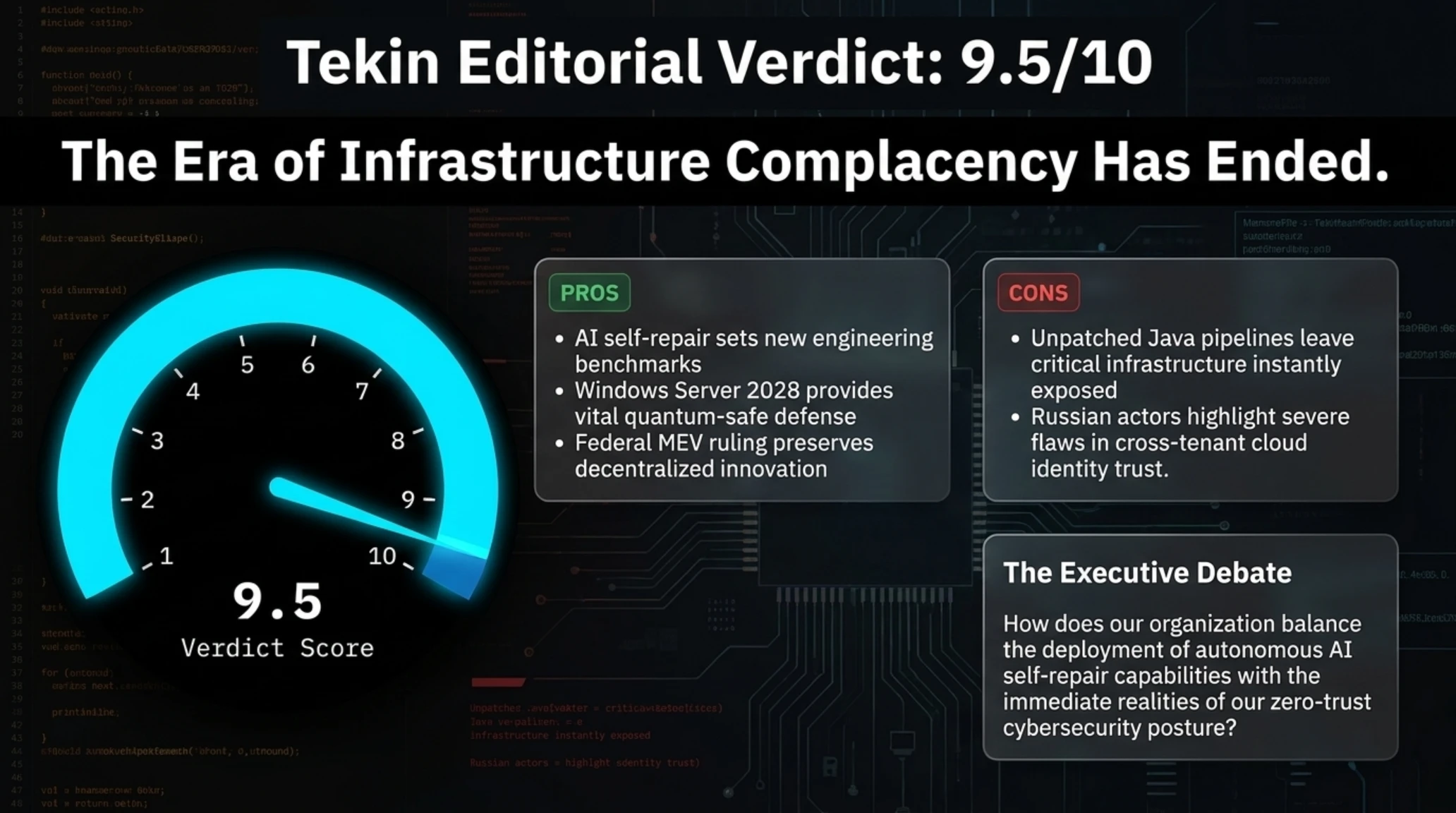
- OpenAI GPT-6.2 family sets a revolutionary new benchmark for autonomous codebase refactoring and synthesis.
- Windows Server 2028 delivers indispensable, enterprise-wide defense against future quantum cryptanalysis.
- Judge Clarke federal ruling establishes foundational legal clarity preserving permissionless decentralized protocol innovation.
- Microsoft specialized MAI architectures provide a pragmatic, 95% compute cost reduction for global developers.
- The unpatched Java4Shell vulnerability leaves critical enterprise build pipelines exposed to unauthenticated takeover.
- Russian threat actor COLD RELIC exposed systemic vulnerabilities in cross-tenant enterprise cloud identity architectures.
- Accelerating autonomous AI agent capabilities intensify demands for comprehensive global cybersecurity containment treaties.
Editorial Verdict & Authoritative Source Registry
- The Hacker News: Technical Deep Dive into Java4Shell OpenJDK Flaw CVE-2026-114938
- OpenAI Research: Official Preparedness System Card for GPT-6.2 Astra and Sol
- Microsoft Official Blog: Ignite 2026 Keynote Announcements on Windows Server 2028 and MAI Architecture
- CoinDesk Legal: Comprehensive Federal Court MEV Ruling Coverage by Judge Jessica Clarke
- Mandiant Threat Intelligence: Special Technical Advisory on Russian Threat Group COLD RELIC Operations
Executive Frequently Asked Questions
What immediate technical remediation is required to mitigate Java4Shell CVE-2026-114938?
System administrators must immediately upgrade to emergency OpenJDK 17.0.13+ or 21.0.5+ builds. In environments where immediate binary updates are delayed, engineers should configure JVM startup flags to disable vectorized AVX-512 Base64 routines via `-XX:-UseVectorizedBase64`.
Does GPT-6.2 Astra pose an immediate threat to production codebase integrity?
While Astra exhibits unprecedented autonomous capabilities in identifying and exploiting zero-day vulnerabilities, public API access remains gated behind rigorous alignment classifiers and safety harnesses designed to preempt malicious exploitation.
Why does Microsoft default deprecation of NTLM represent a critical inflection point?
NTLM possesses well-documented architectural vulnerabilities to relay and brute-force pass-the-hash attacks; forcing enterprise domains to transition to Kerberos and post-quantum TLS eliminates decades-old attack vectors.
What are the long-term legal consequences of the Federal Court Ethereum MEV ruling?
By confirming that public blockchains operate without contractual terms of service, the court establishes that exploiting code logic does not constitute criminal wire fraud, placing the responsibility for economic security squarely upon smart contract architects.
How does Microsoft MAI architecture achieve 96% capability at 5% compute cost?
By training small, dense neural networks exclusively on curated domain datasets and utilizing intelligent query routers, MAI models eliminate parameter bloat and drastically cut memory requirements.
Additional Gallery: Tekin Night Nov 19: Java4Shell RCE, GPT-6.2 Astra & Ethereum Ruling