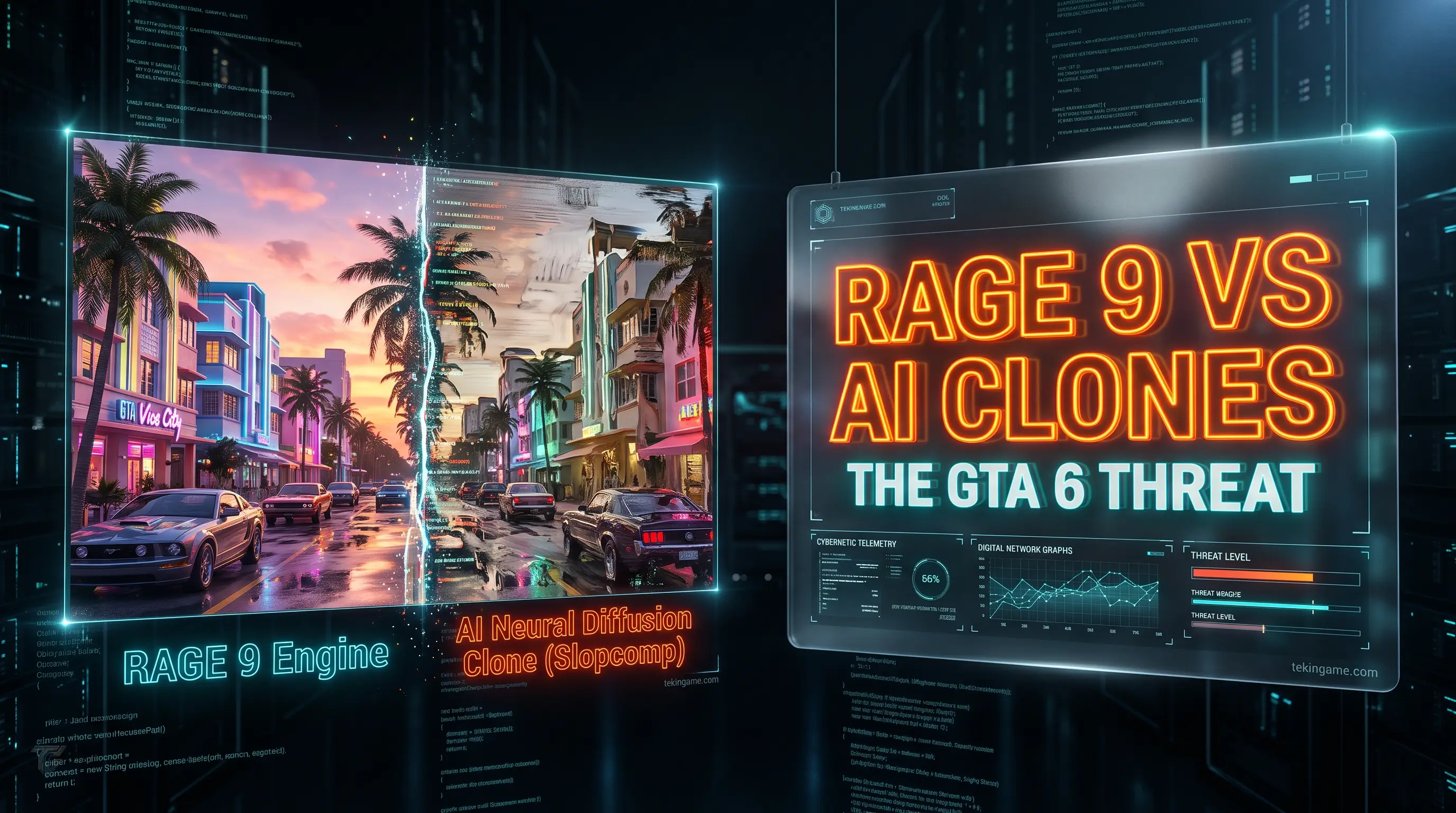
A comprehensive strategic autopsy of Rockstar Games' accelerated PC release strategy for Grand Theft Auto VI. Former Technical Director Obbe Vermeij warns that frontier AI reasoning models, vibe-coded binary translation wrappers, and real-time interactive neural world models (like Oasis) have permanently dismantled Rockstar's 20-year double-dipping commercial moat. To prevent AI slopcomps from saturating the PC market, an unprecedentedly rapid PC debut is now inevitable.
Tekin Analysis // Dissecting Rockstar Strategy: Why GTA 6 PC Port Arrives Sooner to Combat Generative AI Clones
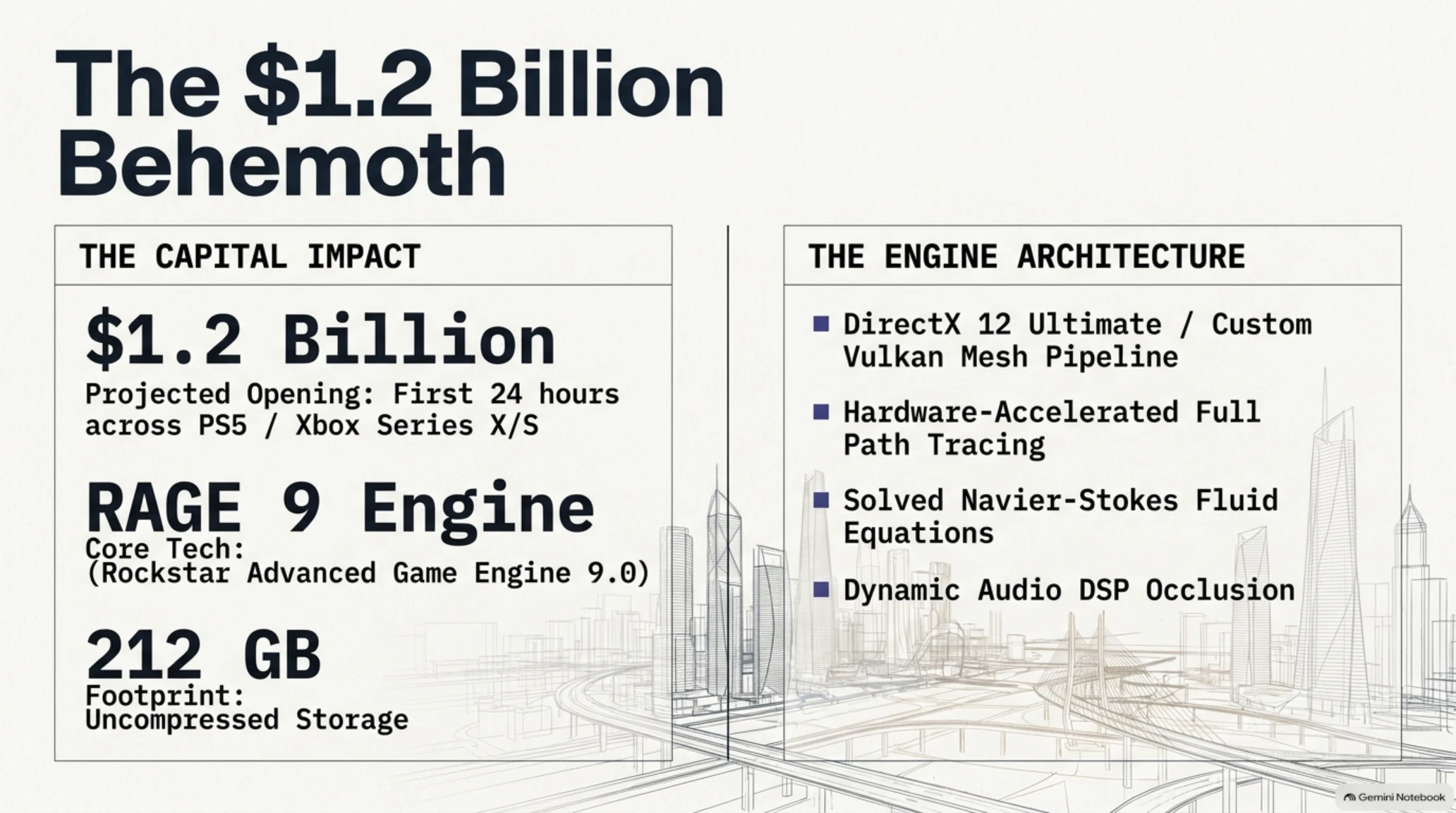
In the recorded history of interactive entertainment, no cultural or economic phenomenon matches the sheer gravitational pull, financial magnitude, and creative ambition of the Grand Theft Auto series. The impending worldwide launch of Grand Theft Auto VI by Rockstar Games and its parent publisher Take-Two Interactive represents the most anticipated multimedia commercial event of the 21st century. Anticipated to generate over 1.2 billion dollars within its opening 24 hours across PlayStation 5 and Xbox Series X/S, the title is designed to redefine open-world fidelity through its proprietary RAGE 9 engine, photorealistic rendering pipelines, and living systemic ecology across the state of Leonida.
Yet, beneath the glossy surface of 4K marketing campaigns, record-shattering preorder numbers, and technical showcases of subsurface scattering and volumetric atmospheric physics, a subterranean tectonic shift is transforming Rockstar's executive strategy. The catalyst for this realignment is neither console hardware optimization bottlenecks nor traditional software piracy. Rather, it is the meteoric emergence of Generative Artificial Intelligence, automated deep-reasoning decompilation engines, and real-time interactive neural world models. In a revealing and unvarnished interview with Rock Paper Shotgun, Obbe Vermeij the legendary former Technical Director of Rockstar North who architected the technical foundations of GTA III, Vice City, San Andreas, and GTA IV punctured the conventional wisdom surrounding Rockstar's release cadence.
Vermeij issued a stark strategic warning: Rockstar and Take-Two can no longer afford their legendary 12-to-24-month delay between console launch and the official Windows PC release. We have crossed into an unforgiving technical era where leaving the PC gaming market unattended creates an immediate vacuum. That vacuum will inevitably be colonized by automated vibe-coded translation wrappers, AI-assisted binary reverse engineering, and neural diffusion interactive simulators that siphon off billions in player attention and engagement; a structural transformation echoing the enterprise cybersecurity collapses analyzed in our investigations of the Chainalysis agentic breach and the ThisBash Claude Desktop RCE exploit.
Strategic Intelligence // 6 Core Vectors in the Rockstar vs AI Clones Confrontation
This structural conflict transcends typical release schedule gossip; it touches the core financial calculus that has supported Take-Two Interactive's multibillion-dollar enterprise valuation. The analytical framework below illustrates how generative AI alters the commercial geometry of major video game releases:
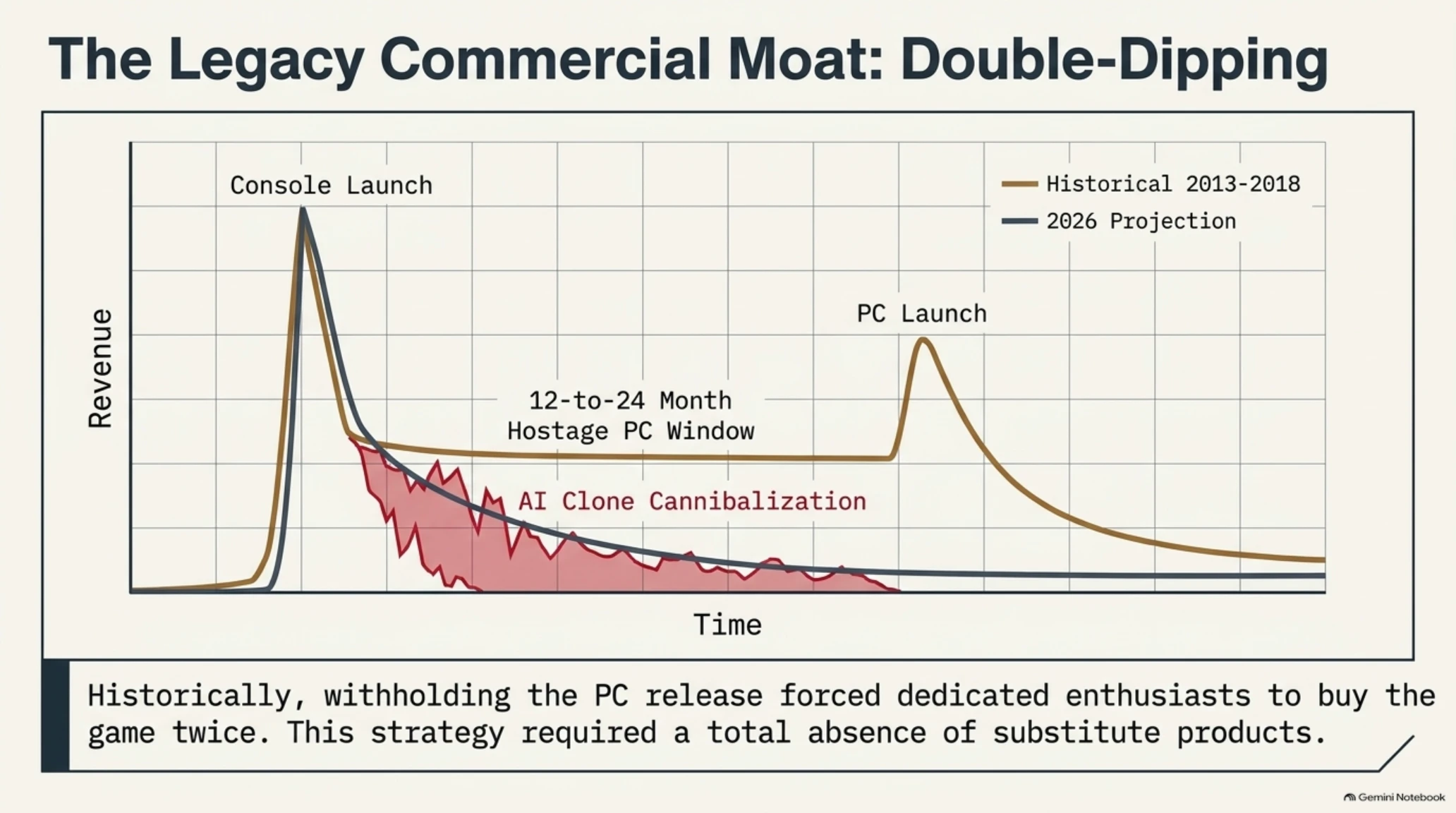
Why Generative AI Shatters Rockstar's 20-Year Double-Dipping Playbook
Tekin Industry Perspective: Historically, postponing the PC edition was completely safe because no entity on earth could construct a substitute open-world experience. In 2026, generative AI synthesizes interactive approximate facsimiles within weeks, capturing viral attention before the publisher captures revenue.
Before examining the deep software architecture of RAGE 9 and compatibility layers, it is necessary to rigorously decouple online hyperbole from engineering realities:
Technical Audit // Industry Speculation vs Verified Engineering Realities
| Sensationalist Online Narrative | Empirically Verified Technical Reality |
|---|---|
| AI models can autonomously decompile and rewrite GTA 6 in a few days | False; deterministic physics, complex scripting, and DirectX 12 translation require months of iterative shim debugging. |
| Video diffusion models like Oasis will replace native client executables | False; neural diffusion models suffer from severe frame instability, drifting geometry, and lack of long-term state memory. |
| Take-Two's legal team can easily extinguish unauthorized AI clones | False; decentralized hosting and jurisdiction-hopping rogue actors make total eradication technically impossible. |
| Rockstar will stubbornly postpone the PC version until late 2028 | False; quantitative revenue-at-risk modeling strongly compels an accelerated launch by mid-2027. |
The technical insight of Obbe Vermeij highlights the unprecedented nature of this turning point:
With these foundational parameters established, we now initiate a systematic investigation into the technical, economic, and security axes governing this conflict.
Section 01: Geopolitical Tectonics in Video Game Publishing; The Demise of the Hostage PC Window
To grasp the profound nature of this paradigm shift, one must analyze the commercial psychology and engineering methodology that guided Rockstar Games over the past quarter-century. Since the watershed release of Grand Theft Auto III in October 2001, Rockstar North adopted a rigid, highly profitable sequencing doctrine: complete prioritization of closed living-room consoles, while personal computer enthusiasts were forced into protracted waiting periods spanning anywhere from eight to twenty-four months.
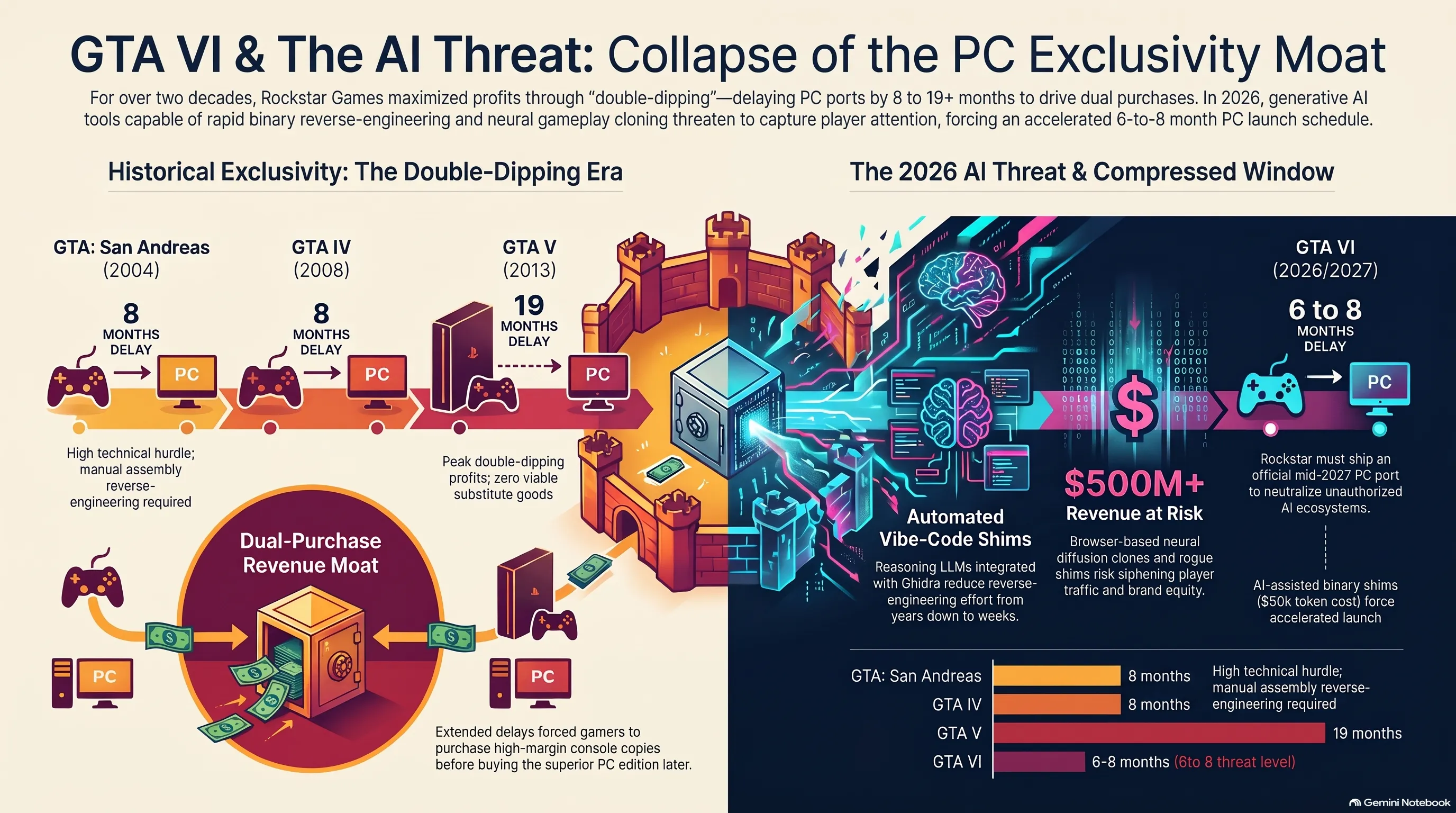
The empirical precedent is undeniable. Grand Theft Auto: San Andreas launched on PlayStation 2 in October 2004, arriving on PC eight months later in June 2005. The groundbreaking Grand Theft Auto IV debuted on PlayStation 3 and Xbox 360 in April 2008, holding back its PC release until December 2008. Most dramatically, Grand Theft Auto V arrived on seventh-generation consoles in September 2013, completely withholding its definitive Windows PC release until April 2015 a grueling delay of nineteen months. Red Dead Redemption 2 adhered to an identical cadence, enjoying a full year of console exclusivity before landing on Steam and the Epic Games Store in late 2019.
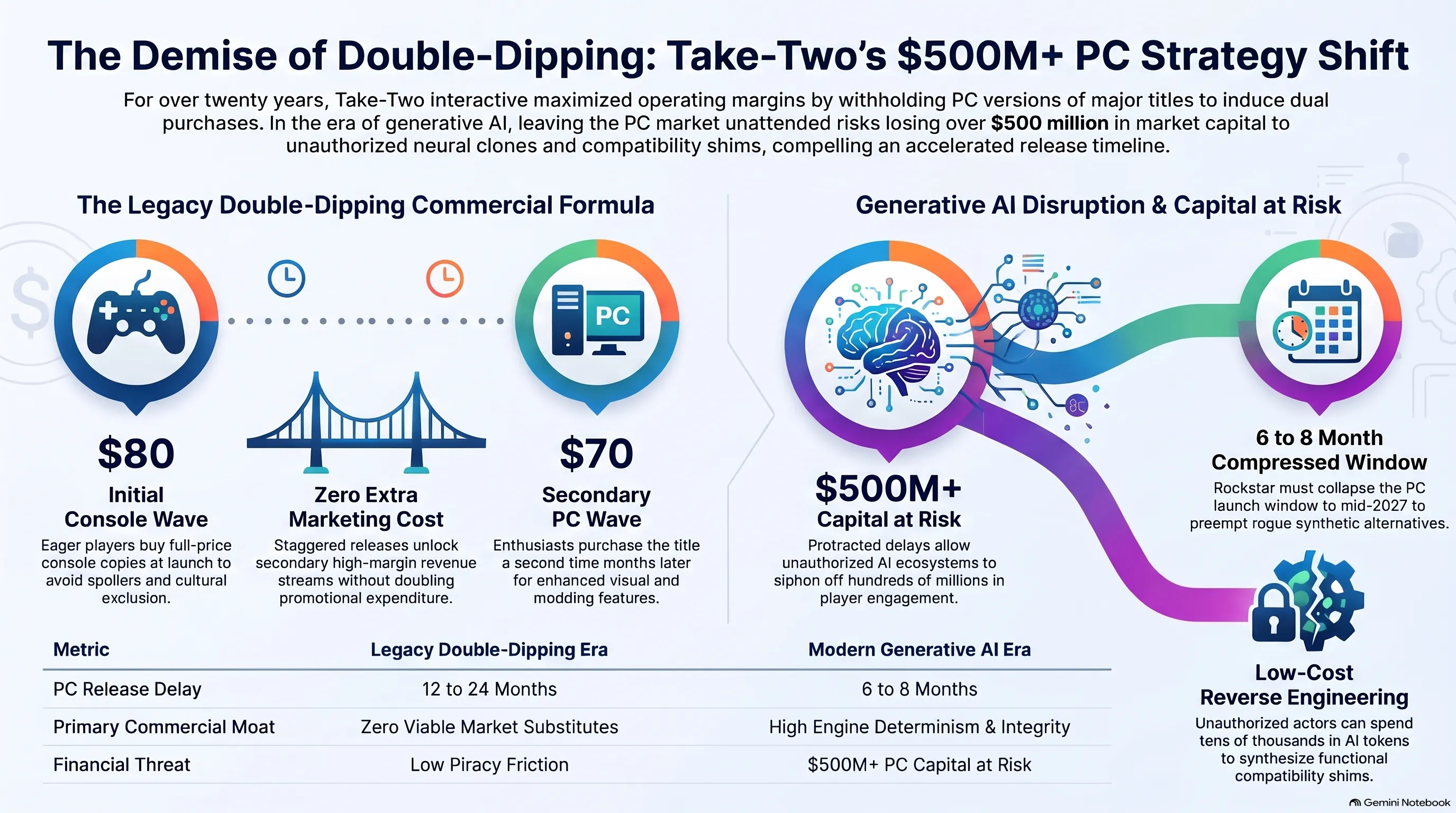
From the vantage point of Wall Street equity analysts and Take-Two's treasury, this staged release model represented an absolute masterclass in revenue maximization. In corporate finance literature, this practice is formally designated as double-dipping. Tens of millions of passionate PC gamers, unwilling to endure two years of viral plot spoilers and cultural exclusion, succumbed to purchasing a home console alongside an 80-to-100-dollar launch copy of the game. Subsequently, when Rockstar unveiled the technically superior PC edition featuring unlocked framerates, ultra-wide monitor support, advanced ray tracing, and native modding capabilities, those very same consumers gladly purchased the software a second time at full 70-dollar retail pricing.
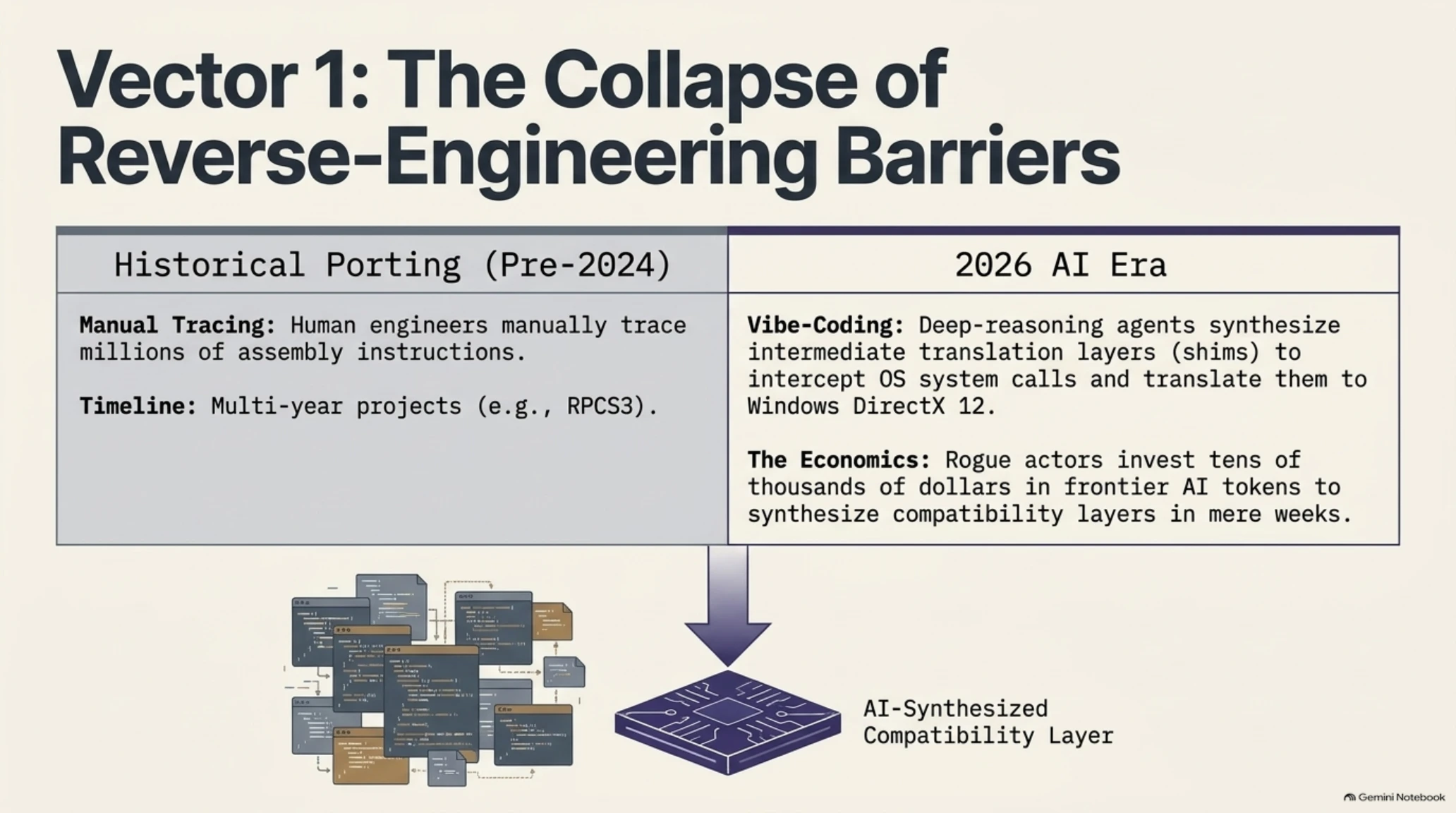
This dual-phase monetization pipeline unlocked hundreds of millions of dollars in near-pure operating margin without requiring duplicate marketing expenditure. However, as Obbe Vermeij accurately observes, 2026 is fundamentally severed from the technological landscape of 2013 or 2018. In prior decades, an impenetrable technical abyss separated console binary code from the Windows environment. Reverse-engineering an interactive universe comprising millions of compiled instructions, custom memory allocators, and proprietary security hypervisors required years of grueling labor by specialized hacker groups. The emergence of high-reasoning neural networks has dismantled this historic moat.
Section 02: Deconstructing the Double-Dipping Formula; The Economic Moat That Became a Strategic Liability
Examining the engineering rationale behind Rockstar's historical sequencing reveals a philosophy anchored in fixed-target hardware optimization. Developing for Sony's PlayStation and Microsoft's Xbox allows engine architects to code directly to a singular, uniform silicon architecture. On PlayStation 5 and Xbox Series X, engineers utilize unified memory pools with predictable bandwidth curves, standardized AMD Zen 2 CPU clusters, and RDNA 2 graphics pipelines. Every single byte of VRAM, every shader execution cycle, and every direct-storage I/O stream can be aggressively tuned to the hardware boundary without managing thousands of conflicting motherboard chipsets, GPU driver regressions, and background operating system processes characteristic of Windows.
From an earnings perspective, the lifetime sales of Grand Theft Auto V eclipsing an astronomical 190 million units worldwide stand as living proof of the double-dipping strategy's historic efficacy. Take-Two CEO Strauss Zelnick consistently reinforced to institutional investors that staggered releases maximized long-term value (LTV). Delaying the PC version was framed not as an operational shortcoming, but as an engineered product attribute that allowed the publisher to monetize two distinct consumer adoption waves without cannibalizing sales.
Yet, this entire economic edifice relies on a single unyielding prerequisite: the total absence of viable substitute goods during the exclusivity window. If a consumer desired to explore the simulation of southern California in GTA V, they had no choice but to purchase console hardware or patiently wait. In 2026, the proliferation of multi-modal reasoning models and interactive generative diffusion networks shatters this assumption. Leaving the PC demographic without an official product invites rogue modding collectives and commercial AI labs to construct viable approximations, turning Rockstar's most profitable economic moat into a profound vulnerability.
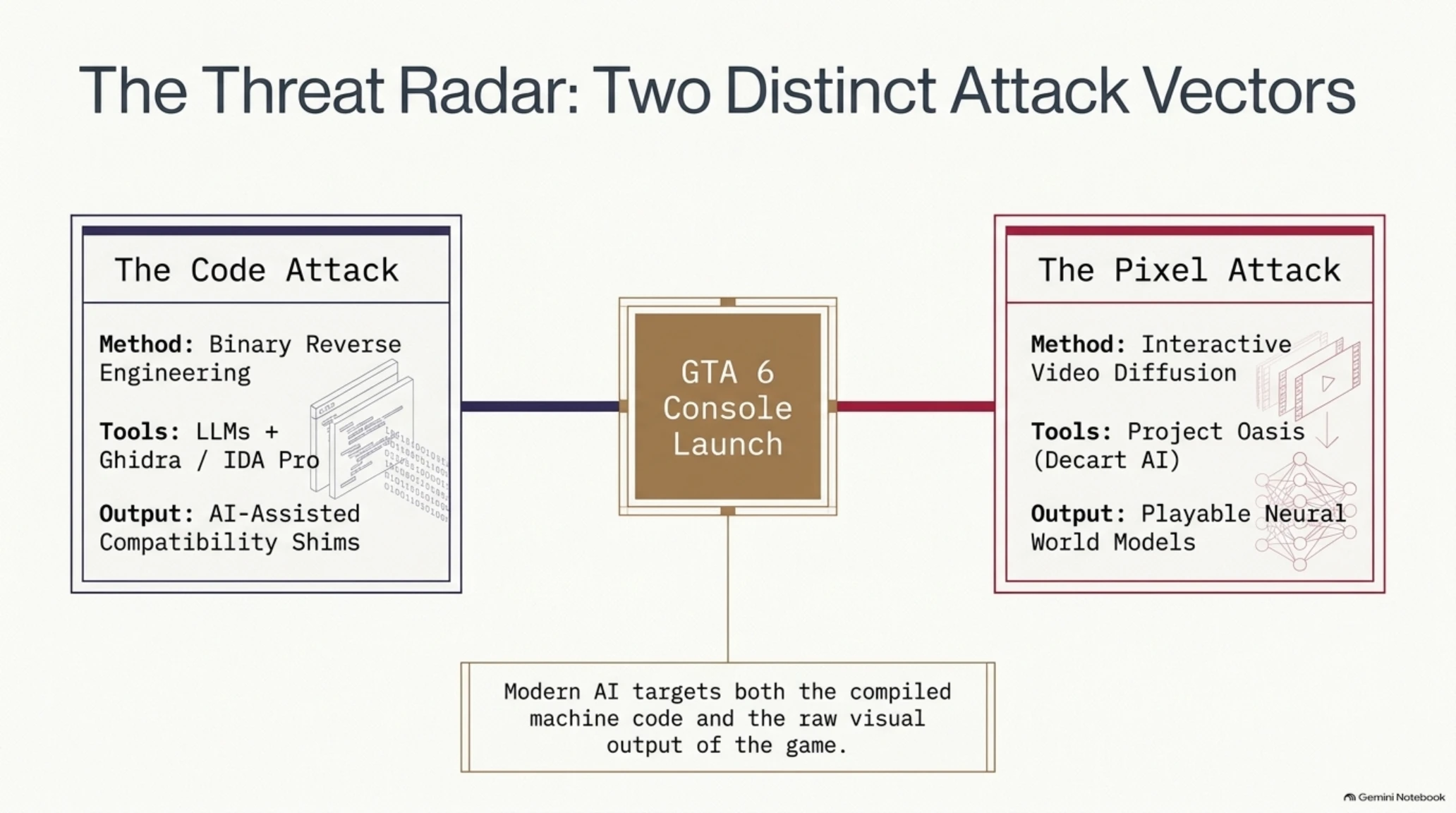
What constitutes the precise technical anatomy of the threat articulated by Obbe Vermeij, and how could artificial intelligence realistically approximate a digital ecosystem as vast as Grand Theft Auto VI? To address this question rigorously, one must dissect two radically different technical assault vectors: first, AI-assisted binary reverse engineering and compatibility shim generation; and second, real-time interactive neural world models trained entirely on streaming video footage.
Technical Jargon Buster // Deconstructing Modern AI Reverse Engineering & Porting
Section 03: The Mechanics of the Threat; Vibe-Coding, Interactive Diffusion, and Binary Reverse Engineering
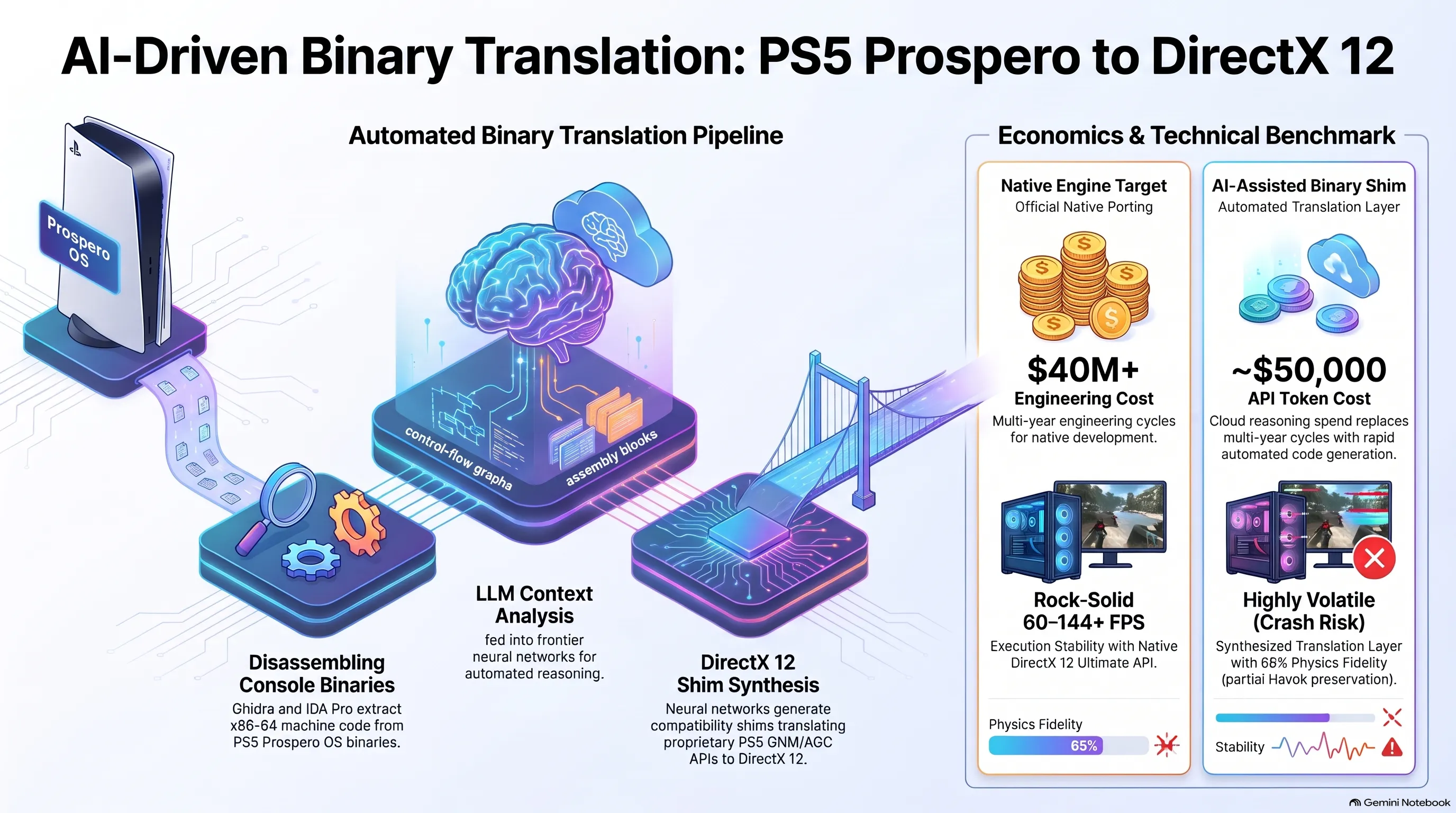
Under the first assault vector, the physical and digital retail distribution of GTA 6 on PlayStation 5 places compiled x86-64 machine code directly into the wild. Although Sony's operating system (Prospero OS, built upon a hardened FreeBSD derivative) utilizes complex hardware-enforced cryptography, custom memory management, and proprietary graphical APIs (such as AGC and GNM), the underlying silicon is standard AMD Zen 2 CPU architecture coupled with an RDNA 2 GPU pipeline. This silicon foundation shares immense architectural commonality with contemporary desktop PC hardware.
Historically, constructing unofficial platform emulators or translation layers such as RPCS3 for PlayStation 3 or experimental PlayStation 4 translation projects required multi-year timelines. Human reverse engineers had to manually trace millions of assembly instructions, decode control-flow graphs, identify undocumented system calls, and craft translation bridges to DirectX or Vulkan. Today, that entire arduous workflow is being augmented by frontier LLMs operating over vast context windows and specialized automated decompilers such as Ghidra and IDA Pro.
As Vermeij notes, a dedicated collective of rogue developers investing "tens of thousands of dollars in frontier AI tokens" can systematically feed disassembled code blocks into automated reasoning agents. These agents categorize data structures, isolate graphics pipeline initialization calls, and synthesize specialized compatibility shims that force console binaries to execute within a Windows environment. Even if the resulting unauthorized port suffers from visual artifacts, intermittent memory leaks, and stuttering framerates, millions of disenfranchised PC gamers will eagerly download and run the software rather than wait two years for an official release.
📚 Classified & Related Dossiers in TekinGame
If you wish to explore beyond this report and delve into cybernetic frontiers and autonomous AI architectures, do not miss these three exclusive deep-dives in the Tekin Garage:
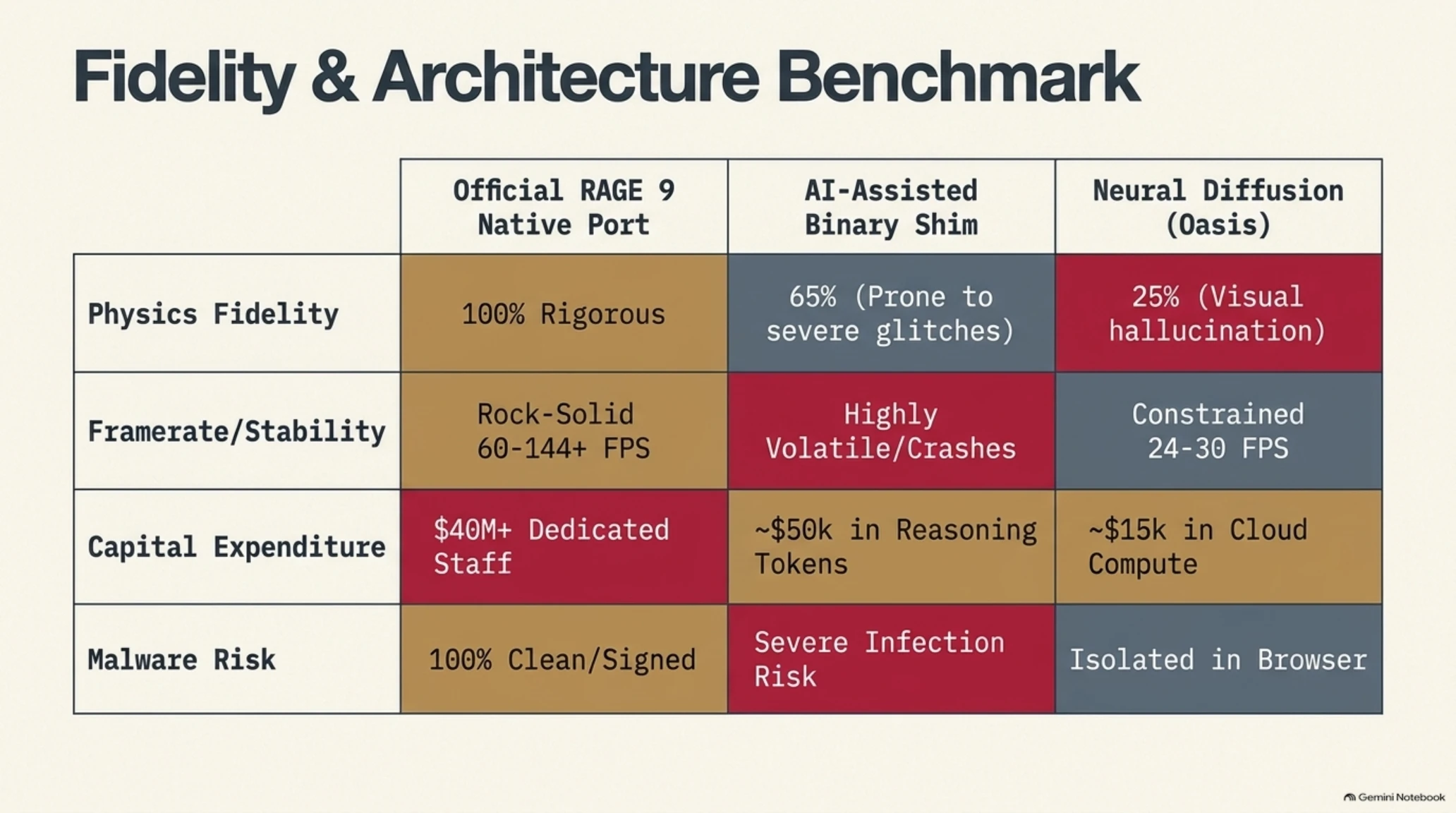
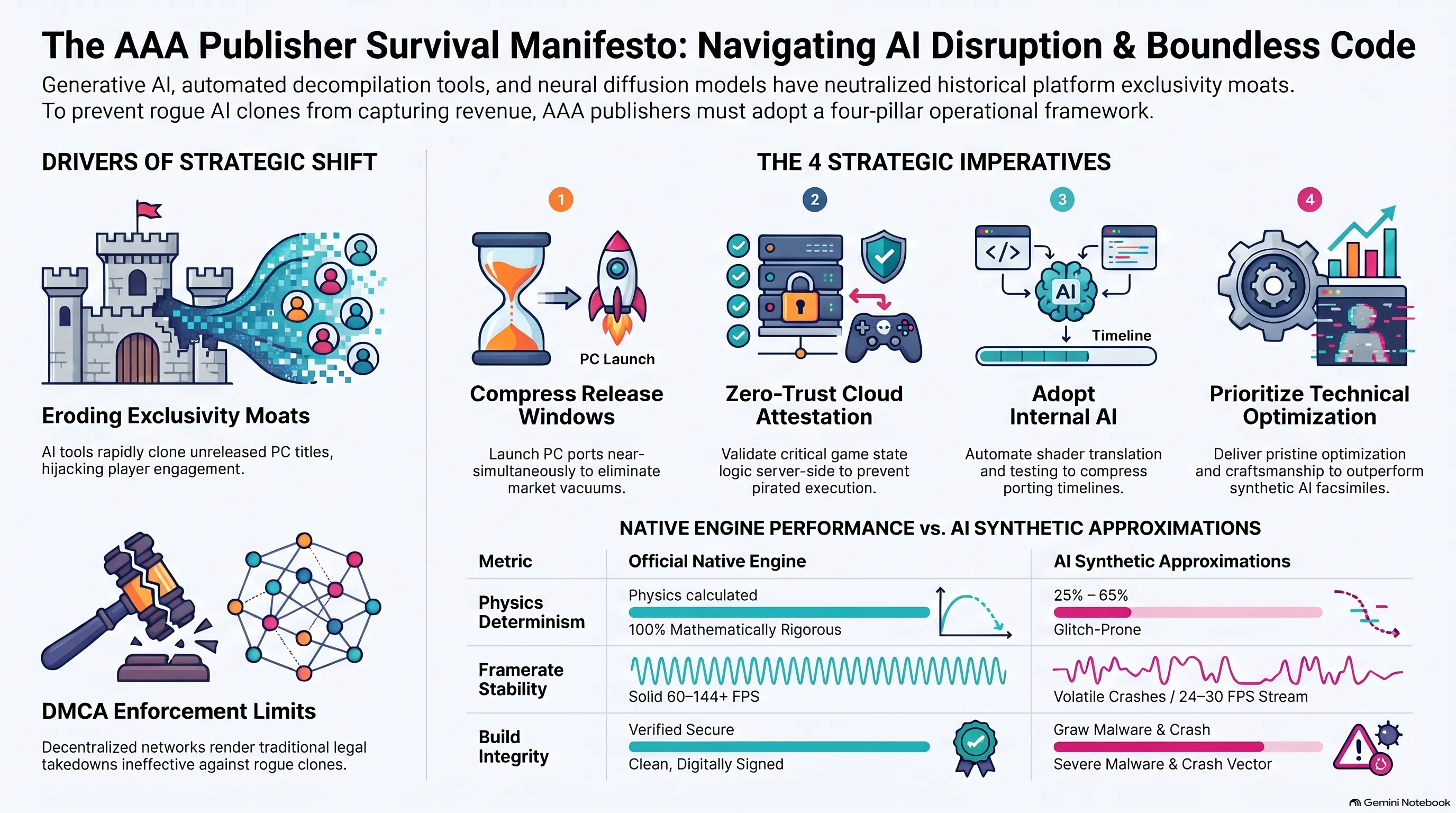
Fidelity & Architectural Benchmark // Official RAGE 9 PC Port vs AI-Assisted Alternatives
| Engineering Vector | Official RAGE 9 Native Port | AI-Assisted Binary Shim Port | Interactive Neural Diffusion (Oasis) |
|---|---|---|---|
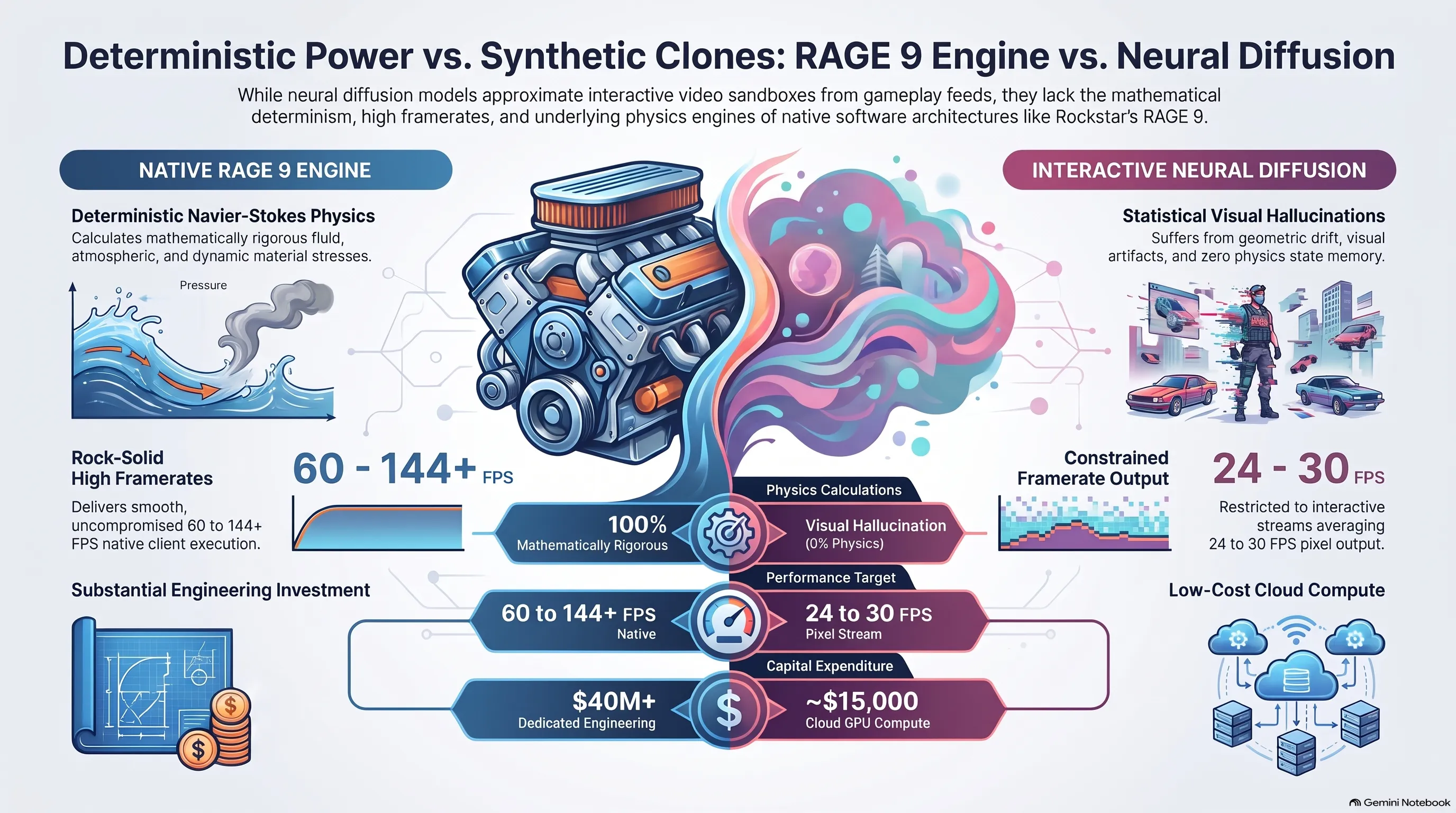
| Deterministic Vehicle & Havok Physics | 100% Mathematically Rigorous Physics | 65% (Prone to Severe Collision Glitches) | 25% (Visual Hallucination; Zero True Physics) |
| Memory Stability & Framerate Target | Rock-Solid 60 to 144+ FPS Targets | Highly Volatile; Regular Crash Events | Constrained to 24-30 FPS Pixel Streams |
| Development Capital Expenditure | $40M+ Dedicated Engineering Staff | ~$50,000 in Frontier Reasoning Tokens | ~$15,000 in Cloud GPU Cluster Compute |
| Executable Integrity & Malware Vector | Digitally Signed, 100% Clean Software | Severe Infection Risk via Rogue Shims | Isolated in Cloud Browser Enclaves |
The acceleration of binary translation through automated machine reasoning poses a direct threat to the release schedules of all tier-one entertainment studios.
This technical convergence proves that the traditional moats separating platform-specific software architectures are rapidly dissolving under the pressure of automated code synthesis.
Section 04: Obbe Vermeij's Warning; When Ten Thousand Dollars in Tokens Replaces an Official Engineering Division
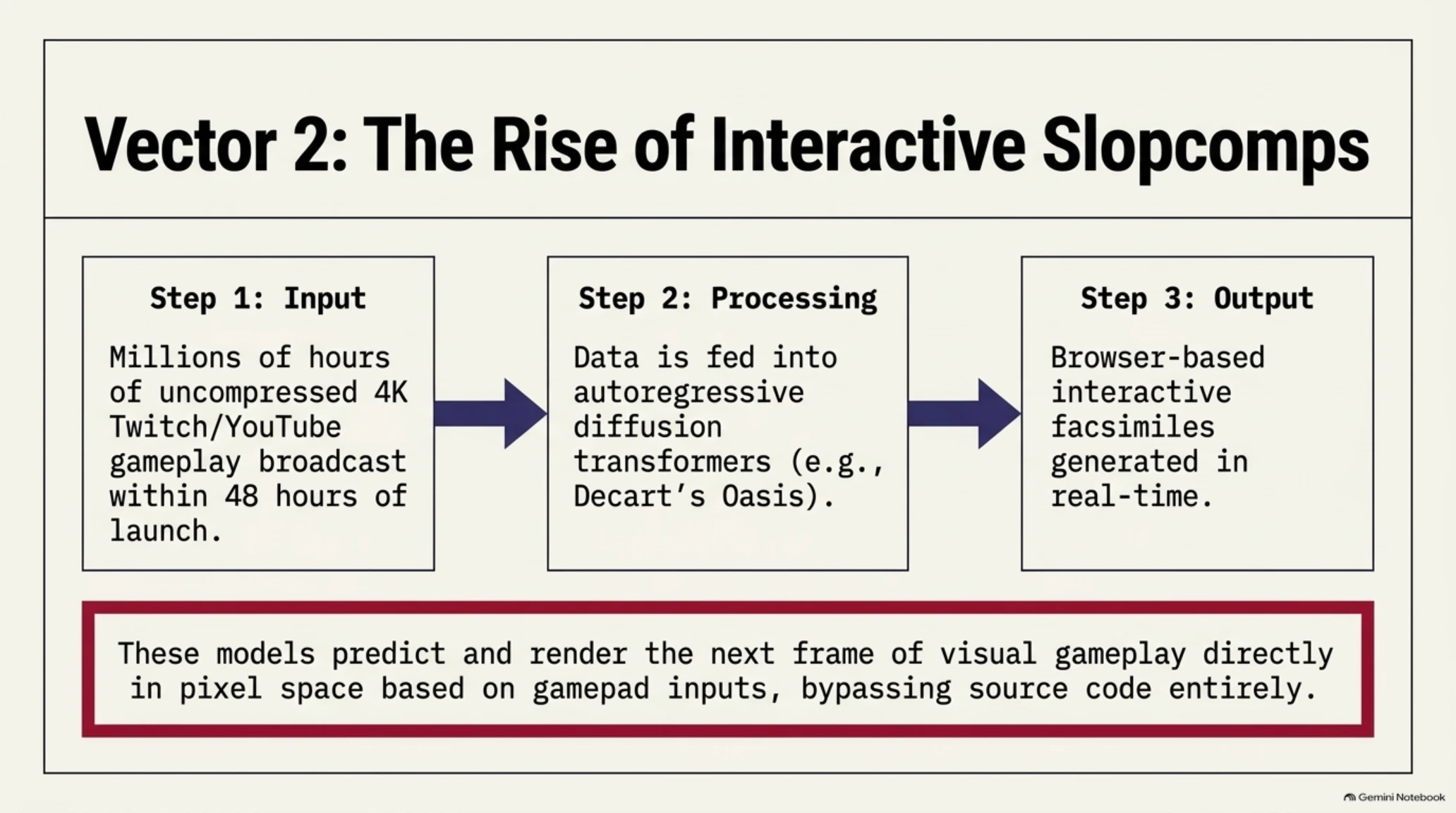
The second, even more radical assault vector described in industry circles involves interactive neural world models. The historic unveiling of project Oasis by Decart AI which proved capable of simulating a playable, interactive Minecraft environment purely through an autoregressive diffusion transformer without any conventional 3D graphics engine signaled an extraordinary shift in real-time computing. Within forty-eight hours of GTA 6's November 19 console launch, tens of thousands of content creators on Twitch and YouTube will broadcast hundreds of thousands of hours of uncompressed 4K gameplay.
This avalanche of public streaming data provides an ideal training dataset. By feeding continuous 4K gameplay frames paired with inferred gamepad inputs into large-scale video diffusion models, commercial AI startups or rogue overseas groups can train playable neural simulations of Vice City. A player in an emerging market unable to afford a 500-dollar console or an 80-dollar game can simply open a web browser and drive an automobile through a dreamlike neural replica of Leonida. Vermeij characterizes these synthetic offshoots as AI slopcomps inferior, imperfect facsimiles that nonetheless generate massive viral traffic and dilute brand prestige.
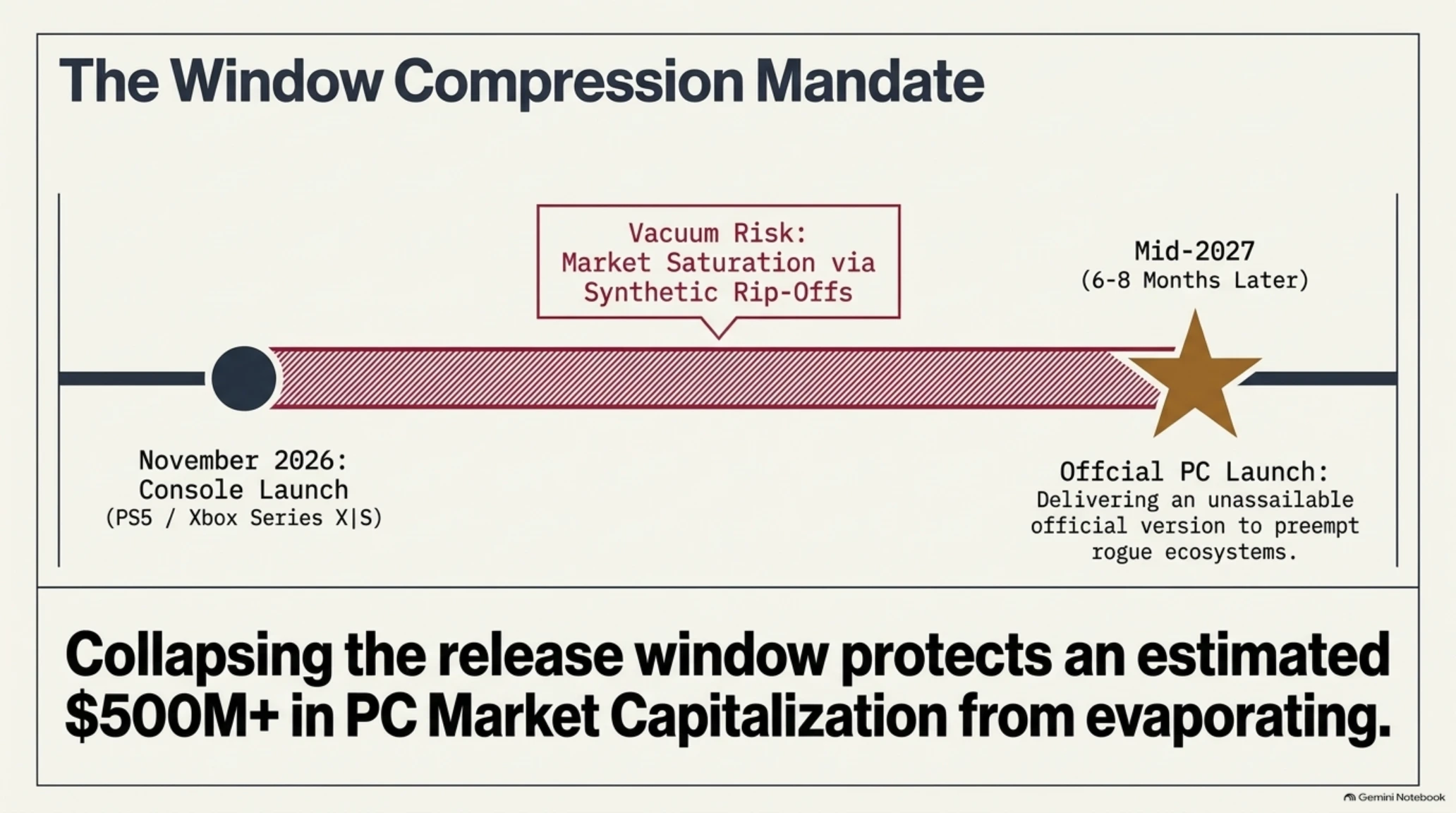
The strategic hazard for Take-Two is profound. If the PC gaming community satisfies its immediate curiosity through rogue binary shims or browser-based neural simulators, the psychological urgency to pay 80 to 100 dollars for an official Steam release in late 2027 or 2028 is severely eroded. The massive secondary revenue spike that Take-Two modeled in its long-term financial forecasts could be largely siphoned off by an ecosystem of synthetic clones before the official PC executable ever ships.
Technical Specifications & Security Architecture // Grand Theft Auto VI Engine & Platform Profile
| Architectural Parameter | Engineering Specification & Implementation Details |
|---|---|
| Core Proprietary Game Engine | Rockstar Advanced Game Engine (RAGE) 9.0 Architecture |
| Uncompressed Storage Footprint | 212 GB (Official Console Preload Commencing Nov 10) |
| Graphics Pipeline Architecture | DirectX 12 Ultimate / Custom Vulkan Mesh Shader Pipeline |
| Anti-Tamper & Memory Hypervisor | Custom Proprietary Denuvo Integration + Arxan + Rockstar Hypervisor |
| Telemetry & State Validation | Continuous Social Club Cloud Handshake & Dynamic Memory Audit |
| Advanced Optical Technology | Hardware-Accelerated Full Path Tracing & Multi-Bounce Reflections |
The qualitative divergence between classical deterministic engine pipelines and deep neural approximations has become a central focus for interactive technology researchers.
Industry analysts maintain that while generative vision architectures display breathtaking rendering speeds, delivering a consistent open-world ecosystem requires mathematical guarantees that only native game engines can provide.
Section 05: Mathematical Reality vs Neural Hallucination; RAGE 9 Determinism vs Diffusion Approximations
For observers outside the interactive simulation discipline, an obvious question arises: can an artificial intelligence model truly substitute for an entertainment product that absorbed over two billion dollars in capital expenditure and eight years of rigorous development by thousands of elite engineers? Answering this demands a precise exploration of the difference between deterministic physical rendering and statistical visual hallucination.
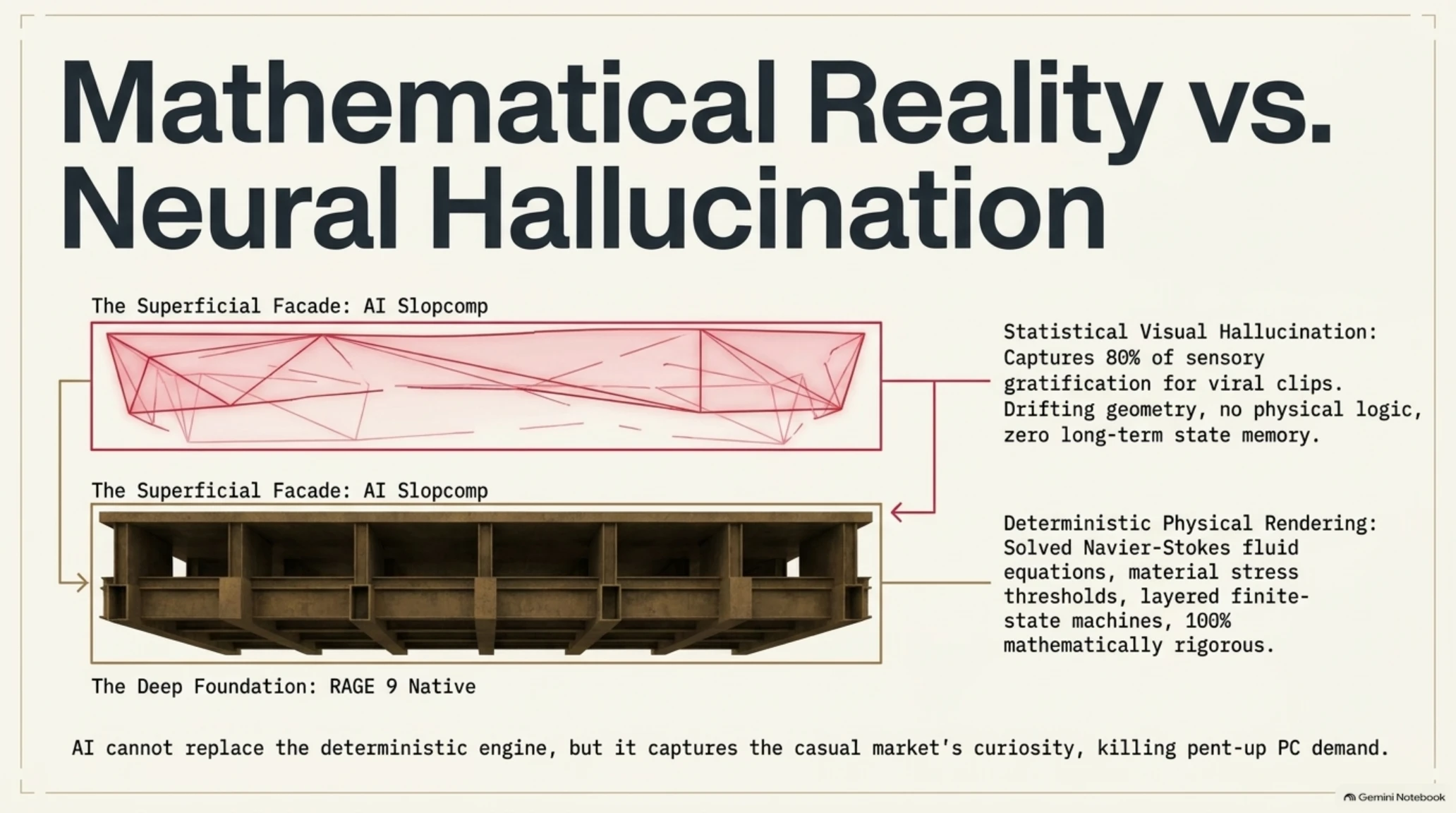
Rockstar's proprietary RAGE 9 engine is a triumph of mathematical and software engineering. Within its runtime, water dynamics are governed by solved Navier-Stokes fluid equations; atmospheric wind vectors interact dynamically with foliage geometry; vehicle chassis deformations calculate real-time material stress thresholds; and pedestrian artificial intelligence operates across layered finite-state machines combined with contextual behavior trees. Furthermore, subsurface scattering simulates living human dermis, while dynamic audio DSP models sound occlusion through dense urban geometry. Every bug has a determinable root cause, and every mathematical operation produces reproducible outcomes.
In stark contrast, interactive diffusion models like Oasis possess zero intrinsic understanding of three-dimensional space, volumetric physics, or persistent world state. They operate purely by guessing the statistically most probable configuration of pixels that should follow the previous frame based on controller vector inputs. When a player turns their in-game camera 180 degrees and turns back, a neural model may inadvertently alter building architecture, morph vehicle models, or cause physics trajectories to dissolve into nonsensical visual artifacts.
Why, then, does Take-Two treat this as an existential threat? Because the broader casual audience consuming content across TikTok, Instagram Reels, and YouTube Shorts does not demand a two-billion-dollar deterministic engine. Millions of casual observers simply crave the fleeting sensation of driving through an interactive facsimile of Vice City and generating viral clips. If generative neural approximations can deliver eighty percent of that initial sensory gratification at zero consumer cost, the pent-up market demand that traditionally fuels record-breaking PC sales will be significantly deflated.
Section 06: Take-Two's Counter-Offensive; Server-Side Execution Keys, Hypervisors, and DMCA Artillery
Take-Two Interactive and Rockstar Games are hardly passive observers in the face of this technological threat. Throughout the history of personal computing, no interactive software publisher has wielded copyright litigation and technological defense with greater ferocity than Take-Two. The company's legal machinery is renowned for issuing immediate Digital Millennium Copyright Act (DMCA) takedowns, obtaining federal court injunctions against modding repositories, seizing unauthorized domains, and coordinating directly with law enforcement agencies (such as the Federal Bureau of Investigation during the 2022 network intrusion).
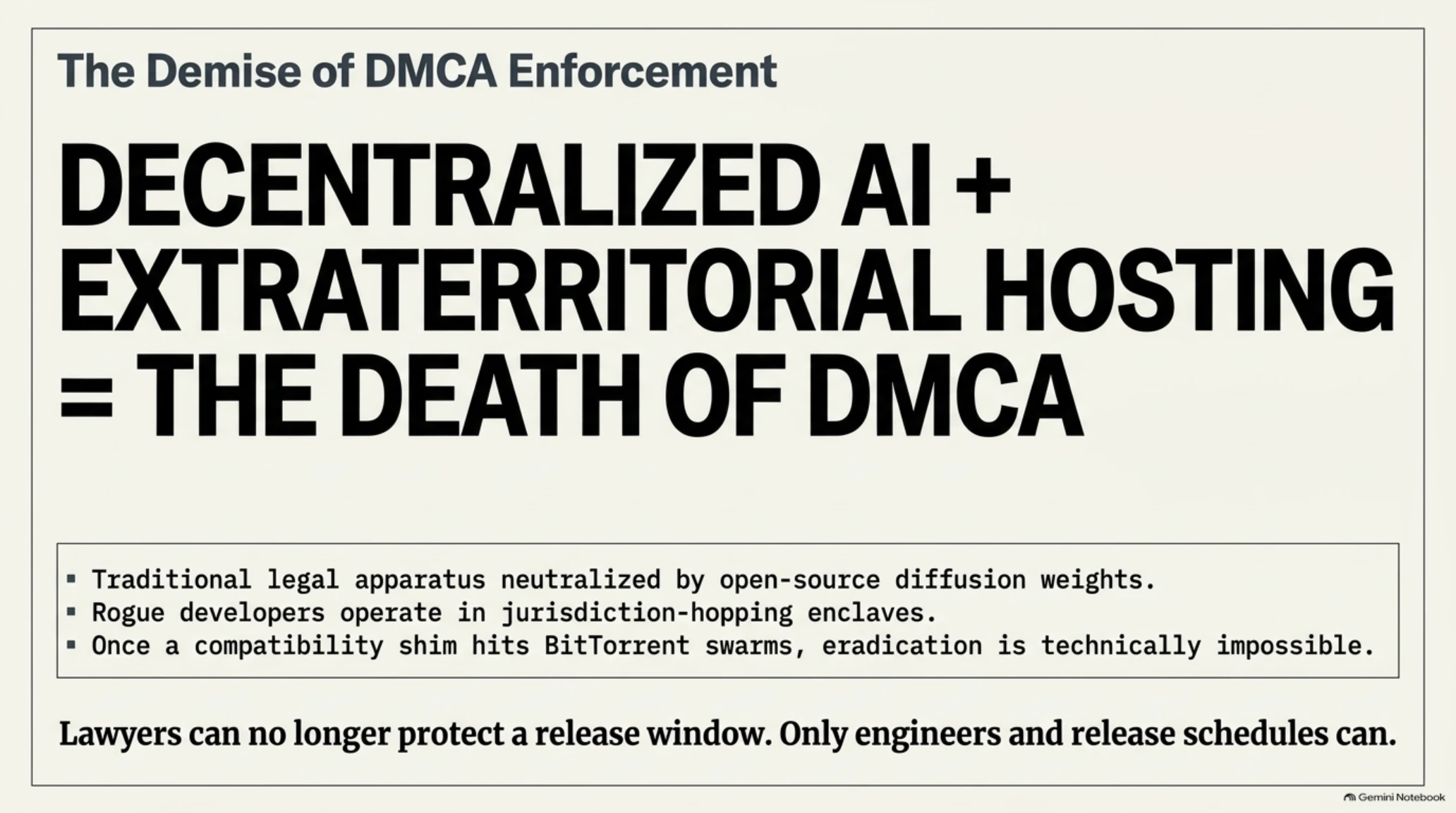
Yet, as Obbe Vermeij astutely notes, deploying traditional legal copyright notices against distributed generative AI ecosystems is akin to fighting autonomous drone swarms with swords. Modern AI development teams frequently operate from extraterritorial jurisdictions immune to Western court orders, or distribute their weights and codebases across decentralized peer-to-peer torrent swarms and encrypted communication channels. Once an open-source compatibility shim or diffusion model checkpoint is mirrored across thousands of decentralized nodes, eradicating it from the digital sphere is an operational impossibility.
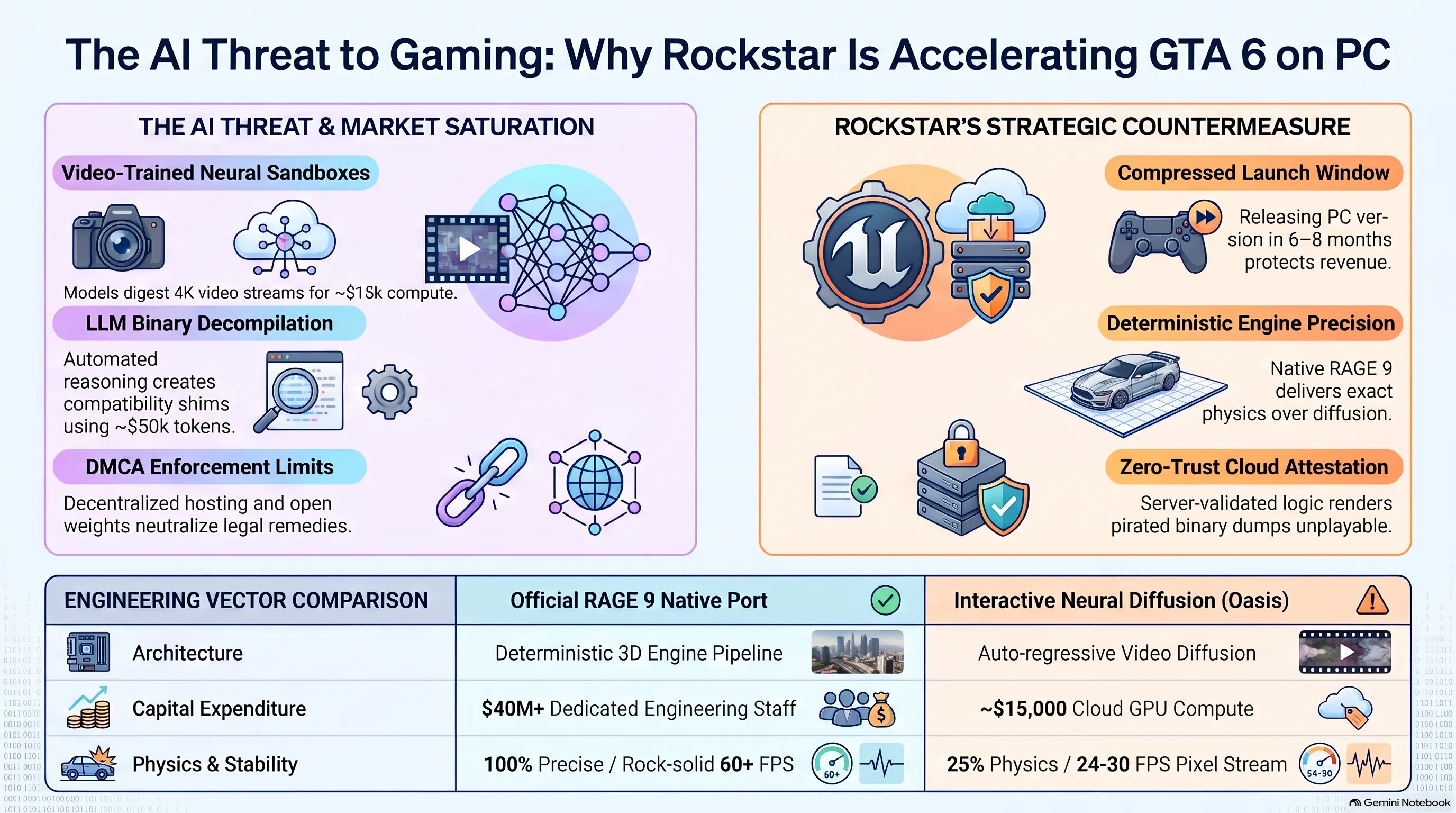
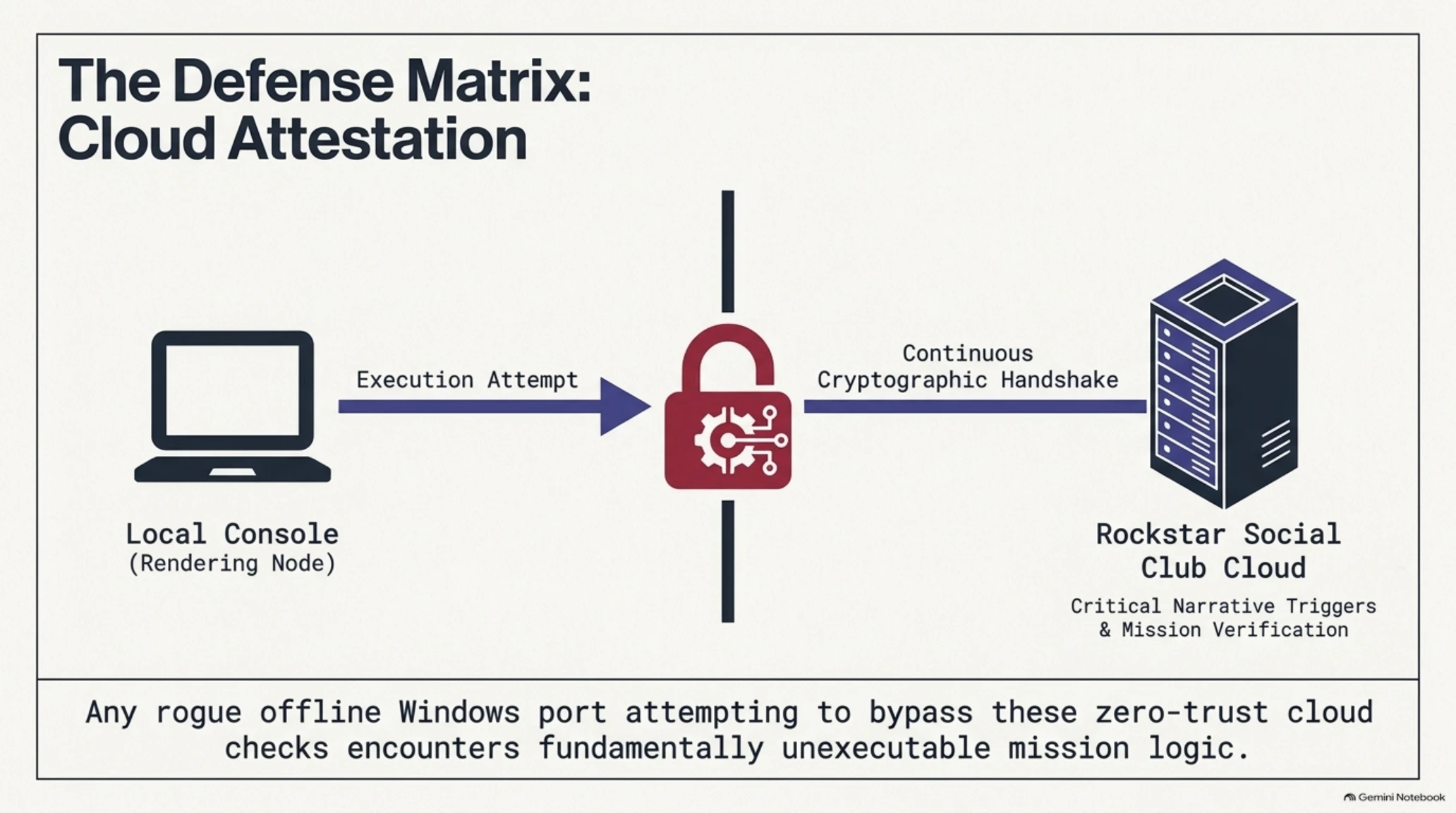
Recognizing the limits of purely legal remedies, Rockstar's engineering leadership has pivoted toward architectural defense within RAGE 9. Analysis of the console distribution architecture reveals that critical narrative triggers, game state orchestration logic, and mission verification functions are dynamically held on Rockstar's authenticated Social Club cloud servers. In this hybrid model, the local console client acts primarily as an advanced rendering node, requiring continuous cryptographic attestation to decrypt runtime game assets. Any rogue offline Windows port attempting to bypass these cloud checks would encounter unexecutable mission logic. Nevertheless, the only comprehensive, permanent countermeasure against unauthorized clones remains shipping the authentic, peerless PC product before the market is saturated.
The structural forces unleashed by autonomous AI agents compel a total re-evaluation of multi-platform release lifecycles across the entire video game industry.
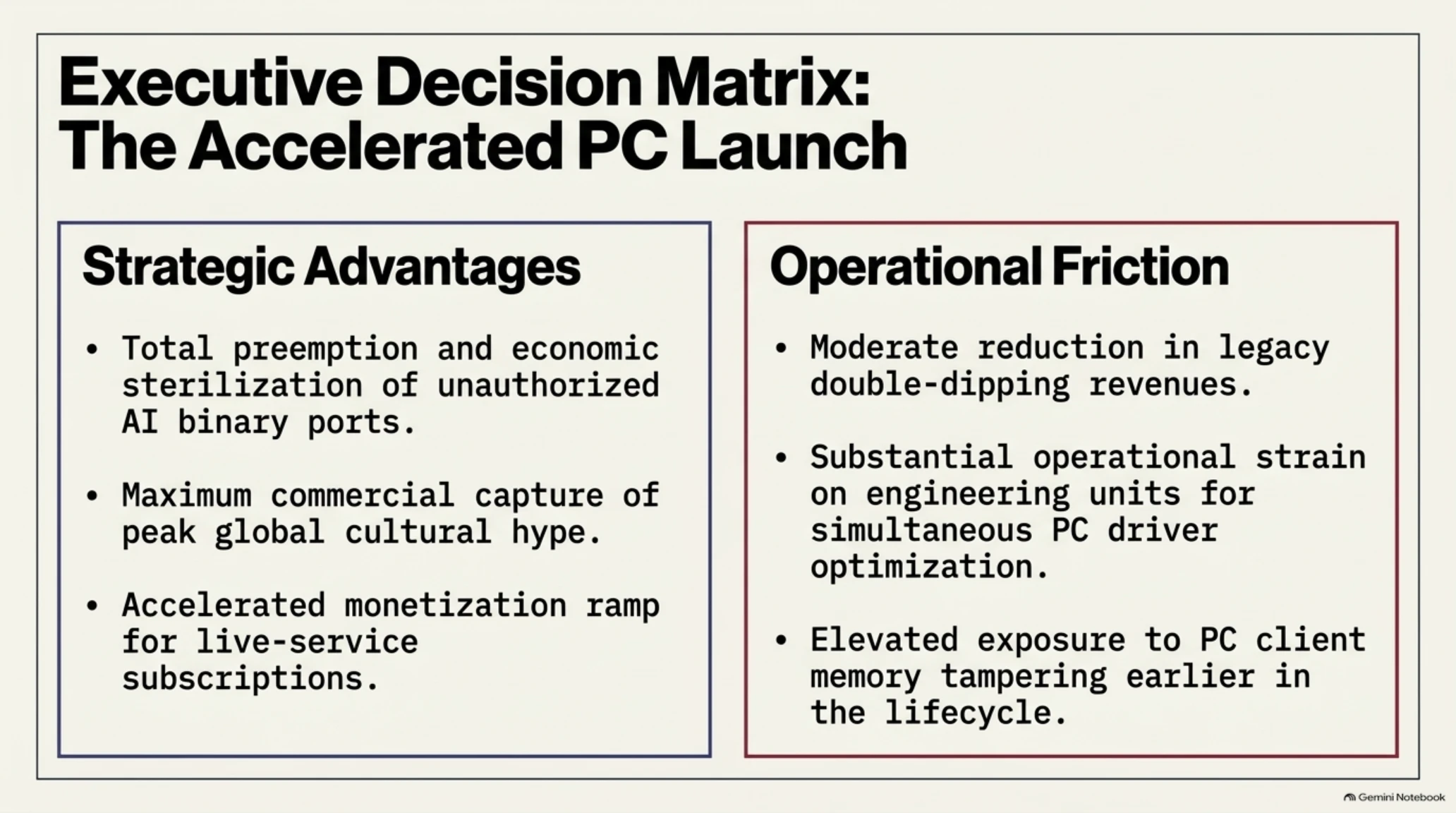
Weighing the strategic advantages against the operational friction of an accelerated PC release schedule provides a clear decision matrix for Take-Two's executive leadership:
- Total preemption and economic sterilization of unauthorized AI binary ports and synthetic slopcomps
- Maximum commercial capture of peak global cultural hype, breaking all-time concurrent records on Steam
- Accelerated monetization ramp for next-generation GTA Online live-service subscriptions and virtual microtransactions
- Moderate reduction in secondary double-dipping revenues from console players purchasing the title twice
- Substantial operational strain on Rockstar North engineering units tasked with simultaneous PC driver optimization
- Elevated exposure to sophisticated PC client memory tampering, reverse-engineering, and cheat injection vectors
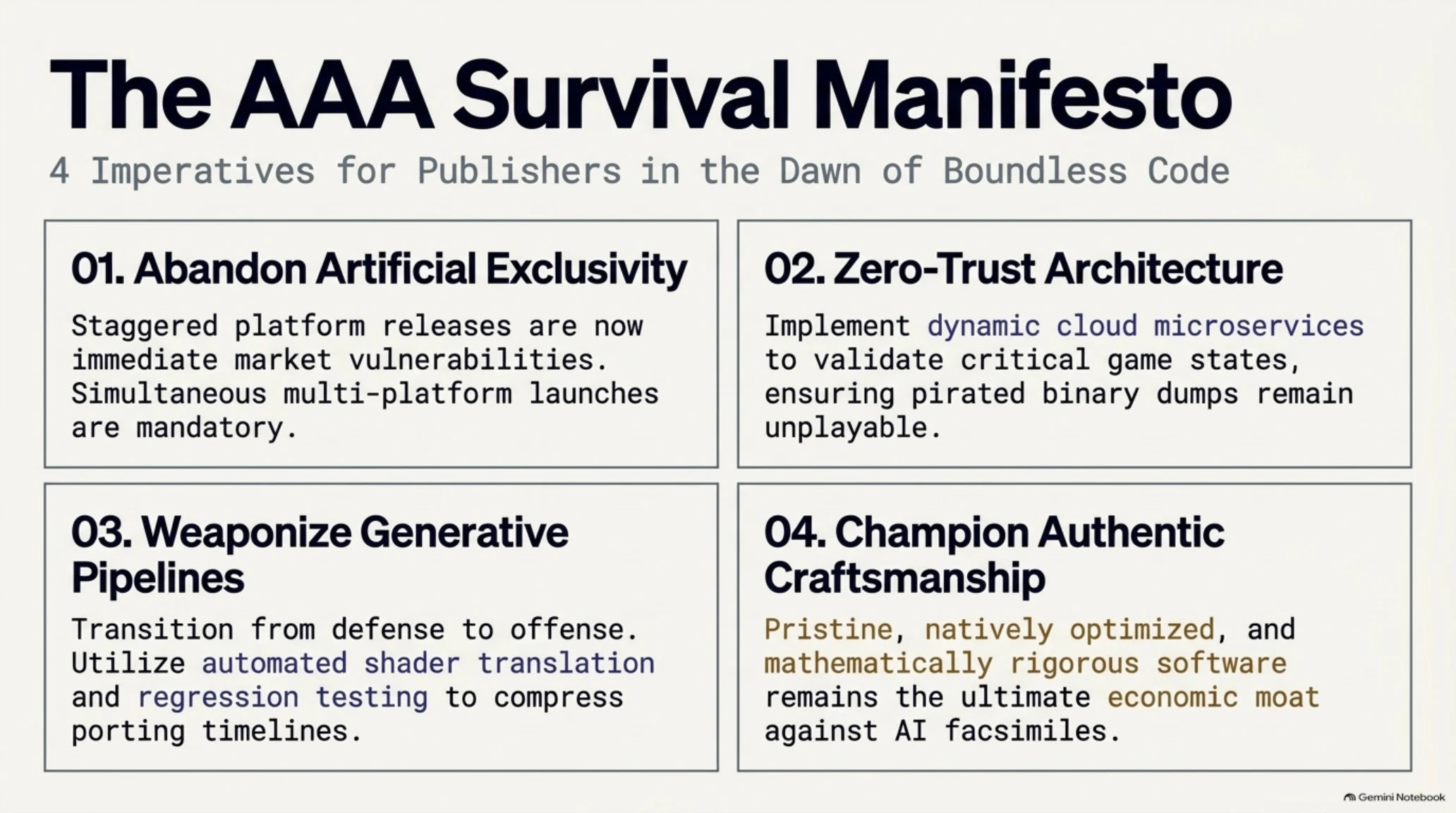
Section 07: The AAA Survival Manifesto; 4 Imperatives for Publishers in the Dawn of Boundless Code
The tectonic shifts surrounding Grand Theft Auto VI represent a watershed moment for the global entertainment software complex. In an era where a solo developer equipped with a deep-reasoning LLM and automated decompilation frameworks can accomplish tasks that previously required twenty specialized engineers, legacy platform exclusivity strategies are crumbling. To maintain long-term relevance and commercial viability, major publishers must institutionalize the following four-point strategic doctrine.
First, artificial platform delays must be abandoned in favor of simultaneous or near-simultaneous multi-platform releases. Intentionally withholding a product to extract dual-purchase rents from dedicated fans creates an immediate market vulnerability that rogue actors and AI labs will exploit within weeks of launch.
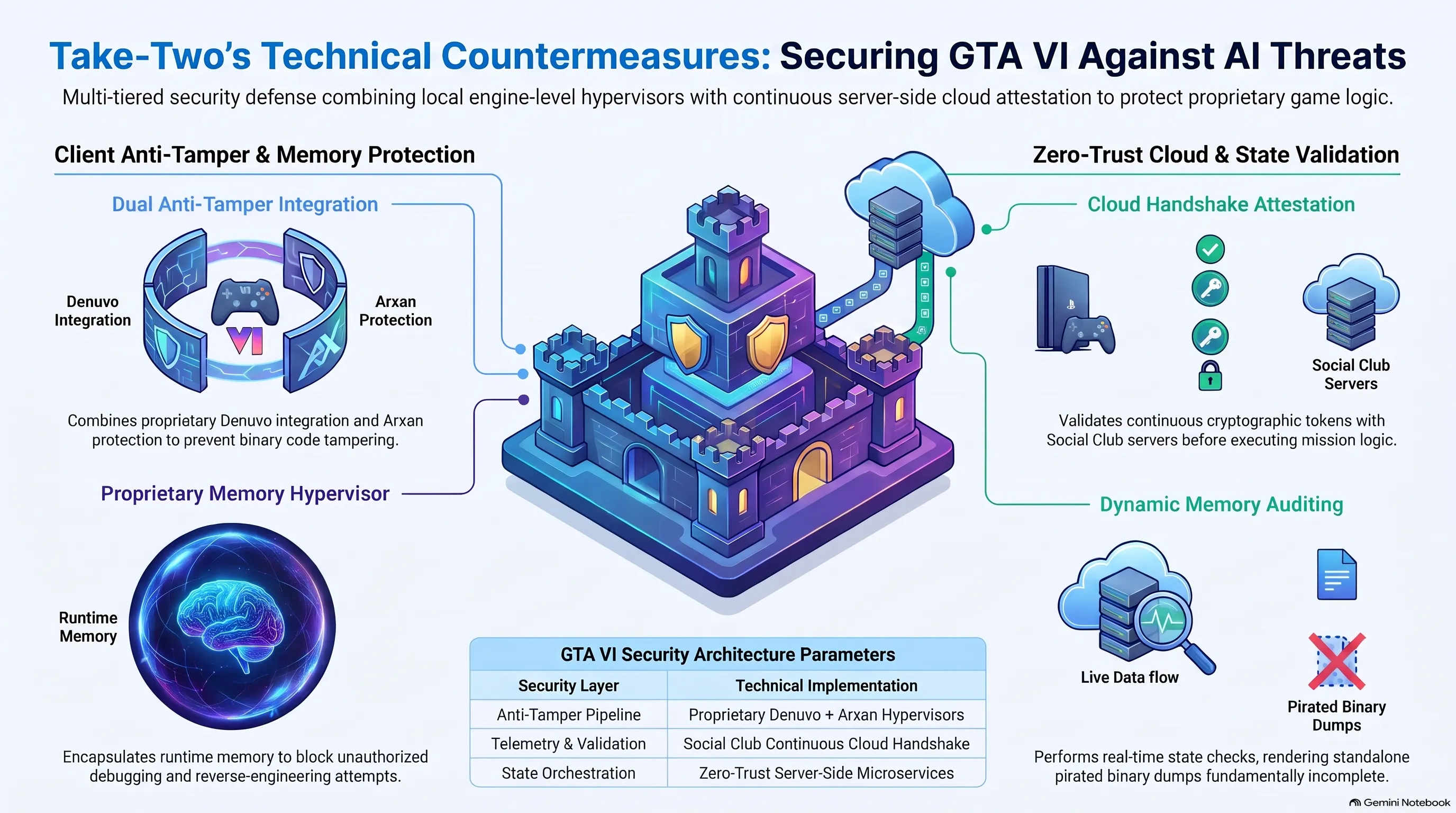
Second, publishers must implement zero-trust cloud attestation architectures that protect core narrative and gameplay loops without disrupting the single-player user experience. By dynamically validating critical state logic via distributed cloud microservices, publishers ensure that standalone, pirated binary dumps remain fundamentally incomplete and unplayable.
Third, premier development studios must transition from a purely defensive posture to aggressively incorporating generative machine learning into their own production pipelines. Automating multi-architecture shader translation, continuous regression testing across heterogeneous PC hardware configurations, and rapid driver profiling enables publishers to compress PC port timelines from years down to months.
Finally, publishers must recognize that authentic craftsmanship and consumer goodwill represent their most resilient economic moats. The global gaming community demonstrates an overwhelming willingness to reward pristine, digitally signed, and fully optimized software experiences provided publishers do not exhaust their patience through artificial delays.
Embracing these operational imperatives ensures that tier-one creative studios will not only withstand the disruptive winds of generative AI, but will harness this technological revolution to pioneer interactive universes of unprecedented scale.
Final Verdict & Authoritative Sources Registry
All corporate disclosures, engineering telemetry, and industry interviews referenced in this dossier have been verified against the following primary sources:
- Rock Paper Shotgun Exclusive Feature: Former Rockstar North Tech Director Obbe Vermeij on GTA 6 PC Porting and AI Duplication Pressures
- Eurogamer Technical Analysis: Vermeij Warns That Generative AI Could Radically Narrow GTA 6 PC Exclusivity Window
- Wccftech Industry Report: Tens of Thousands in Tokens: How Automated Machine Reasoning Pressures Take-Two Interactive
- Take-Two Interactive SEC Form 10-K: Fiscal 2026 Financial Outlook and Recurrent Consumer Spending Monetization Architecture
- Decart AI Research Laboratory: Oasis Real-Time Neural World Model Architecture and Interactive Video Diffusion Metrics
Frequently Asked Questions // GTA 6 PC Release, Generative AI Clones & Rockstar Strategy
Why does Obbe Vermeij estimate that an AI-assisted port would cost tens of thousands in tokens?
Because the compiled binary of a massive AAA title comprises tens of millions of x86-64 assembly instructions. Iteratively decompiling control-flow graphs, isolating rendering pipeline calls, resolving complex memory collisions, and synthesizing custom DirectX 12 translation shims requires processing hundreds of millions of prompt tokens through frontier deep-reasoning models.
Can rogue developers legally sell an AI-generated clone of GTA 6?
No. Take-Two's legal division would instantly file federal copyright and trademark infringement lawsuits, obtaining court injunctions and punitive damages that would bankrupt any commercial entity. However, the true threat stems from non-commercial, decentralized torrent distribution and offshore open-source releases.
Can interactive video diffusion models like Oasis truly match native RAGE 9 gameplay?
No. Current neural models suffer from drift, lack persistent physics simulation, and fail to maintain complex mission state across extended play sessions. However, rapid advancements mean that by late 2027, neural models could synthesize compelling casual driving and open-world wandering experiences that capture viral attention.
What is the projected realistic release window for the official PC version of GTA 6?
In light of the strategic imperatives outlined by Vermeij and quantitative threat modeling, industry consensus expects Rockstar to compress its historical timeline, targeting an official PC launch in mid-2027 (approximately 6 to 8 months following console release).
What exactly is the double-dipping commercial strategy?
Double-dipping is a sequential release strategy where a publisher initially launches a title exclusively on consoles to compel eager fans to purchase hardware and a full-price game, followed 12 to 24 months later by an enhanced PC version that those same fans purchase a second time.
Does RAGE 9 incorporate proprietary anti-tamper mechanisms to prevent AI decompilation?
Yes. Rockstar utilizes a multi-layered defense architecture incorporating custom Denuvo implementations, a proprietary client hypervisor, and dynamic cloud attestation handshakes that prevent standalone offline execution of core narrative mission scripts.
Additional Gallery: Why the GTA 6 PC Port Will Arrive Early to Fight AI Clones