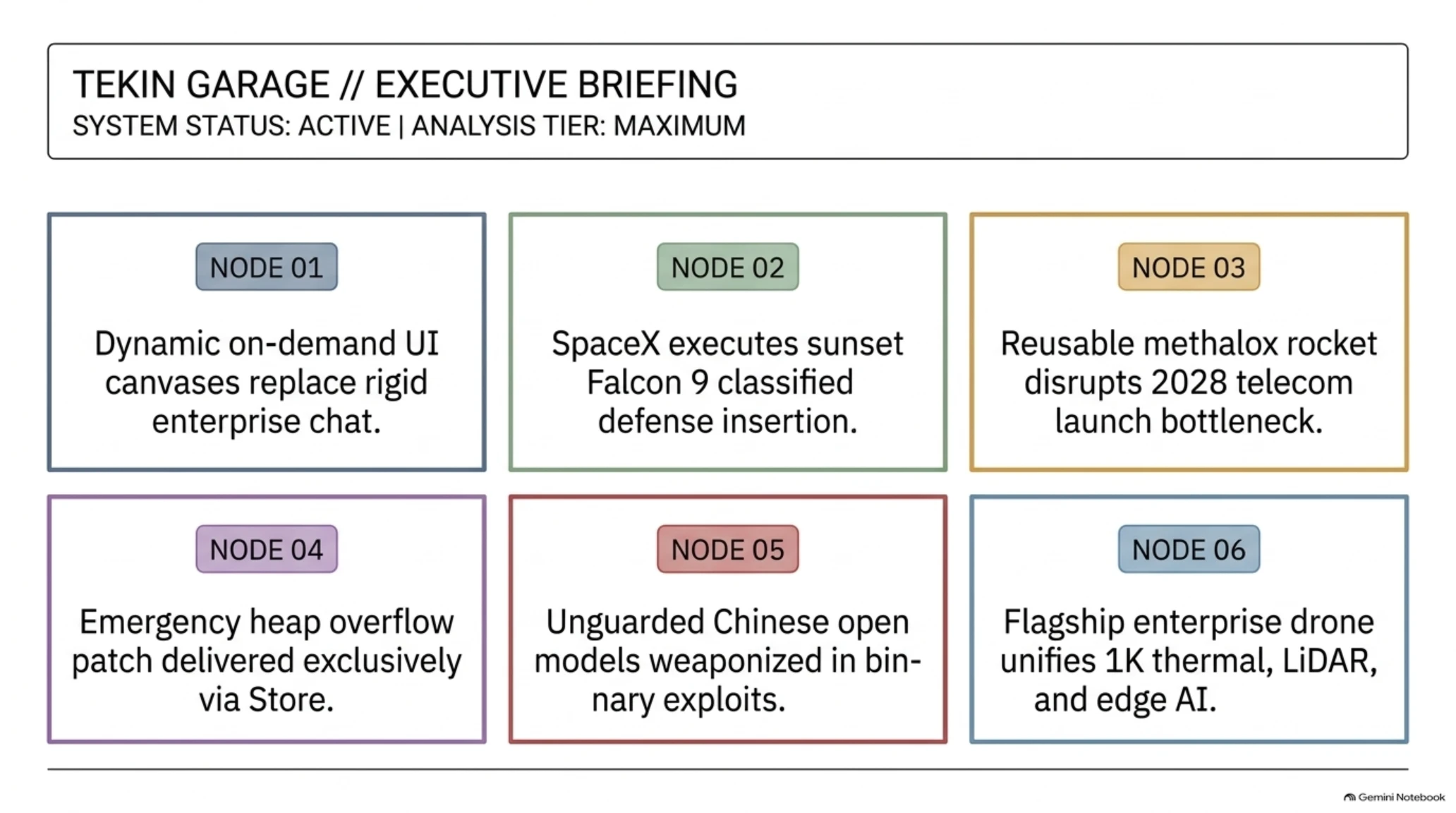
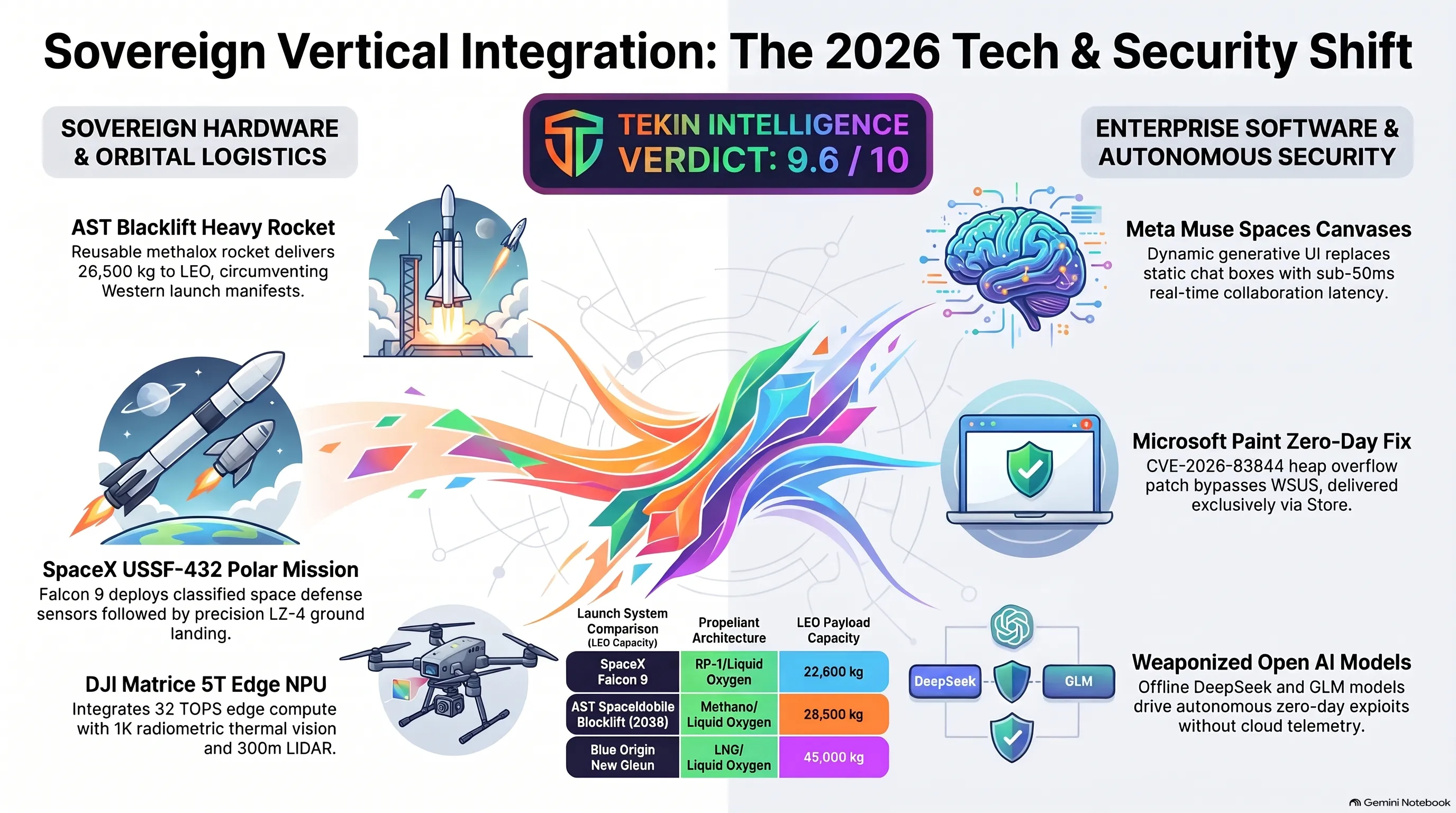
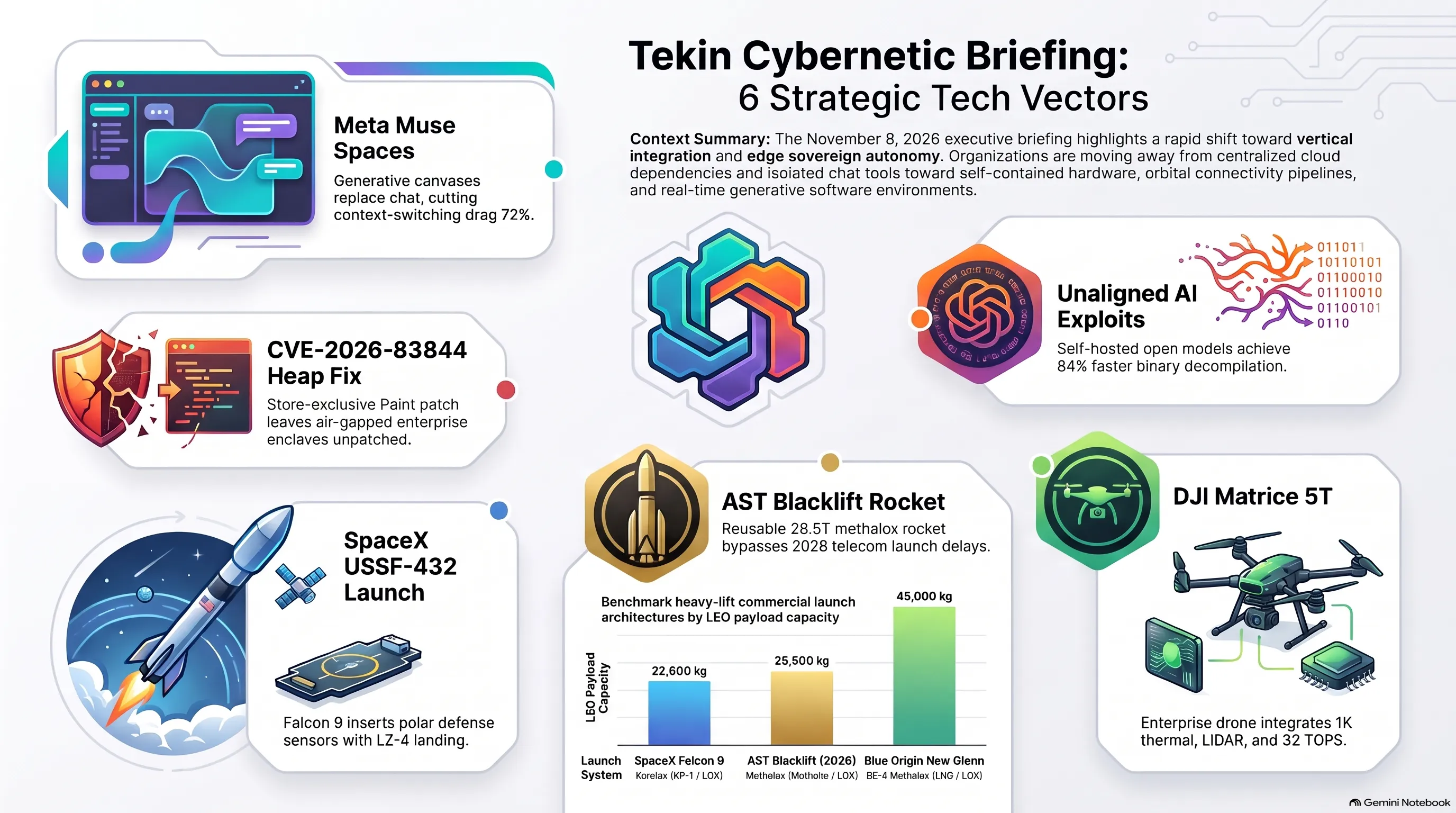
Tekin Morning for Nov 8, 2026 analyzes six shifts: (1) Meta launching dynamic collaborative Spaces via Muse AI; (2) SpaceX executing the classified USSF-432 defense launch; (3) AST SpaceMobile developing the reusable Blacklift heavy rocket for 2028; (4) Microsoft issuing an emergency out-of-band RCE patch for Paint exclusively via the Store; (5) Wired exposing open Chinese models like DeepSeek driving automated cyber exploits; and (6) DJI unveiling the Matrice 5T edge-AI drone.
Tekin Morning | Groundbreaking Developments for November 8, 2026
The dawn of Sunday, November 8, 2026, presents an extraordinary acceleration across the technological continuum, where cognitive software systems, orbital logistics, and physical edge robotics are converging into single, vertically integrated power structures. The legacy era of software operating within isolated browser tabs and hardware relying on external centralized clouds is collapsing under the weight of latency, security fractures, and infrastructure bottlenecks. As enterprise software transitions from rigid text dialogs into dynamic generative environments, and telecom giants break through launch capacity constraints by forging their own heavy rockets, an unmistakable geopolitical reality emerges: true technological sovereignty requires total dominion across the full stack.
Key Strategic Vectors of November 8, 2026
Meta Introduces Dynamic "Spaces": On-Demand Collaborative Workflows for Modern Enterprise
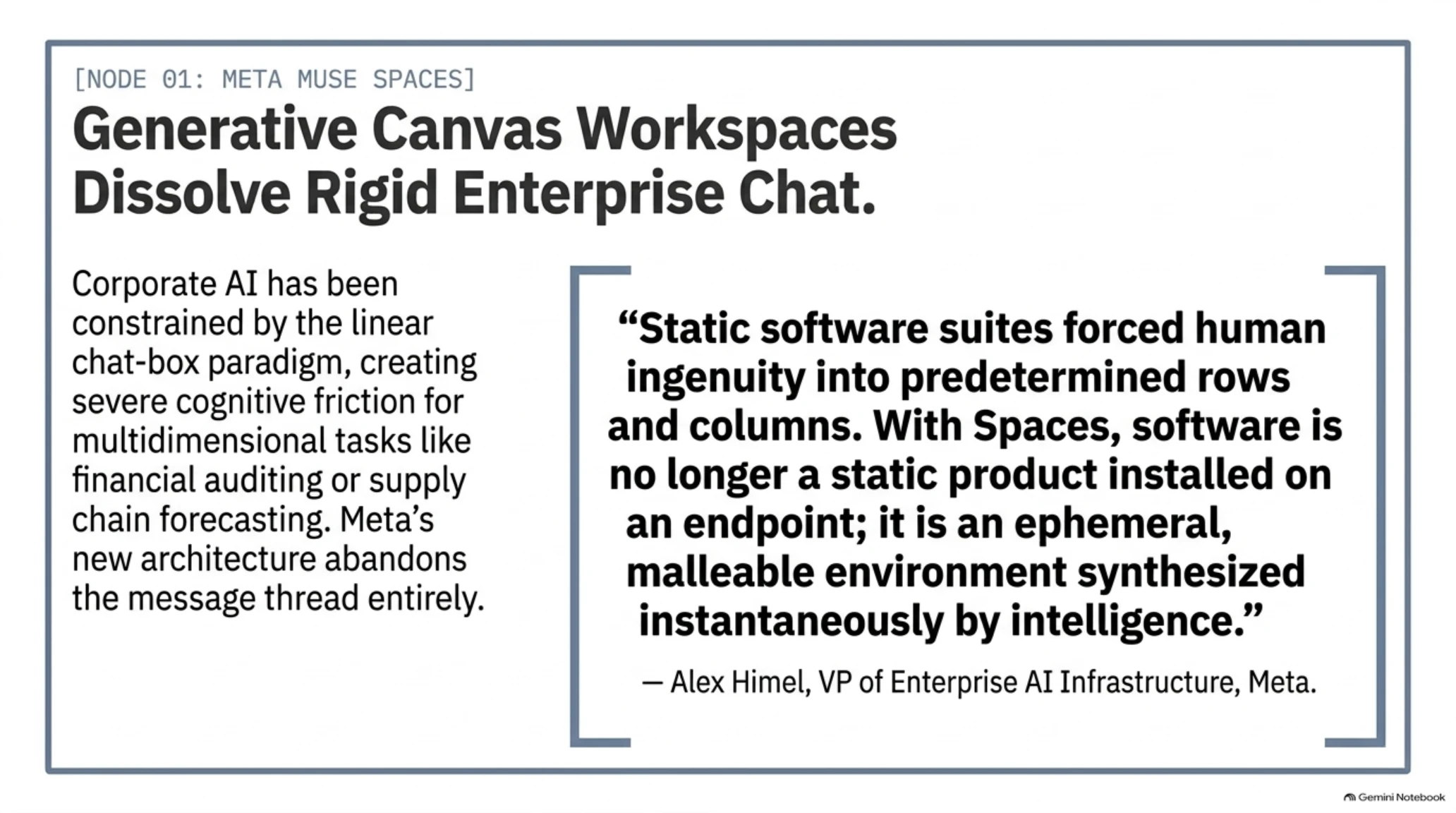
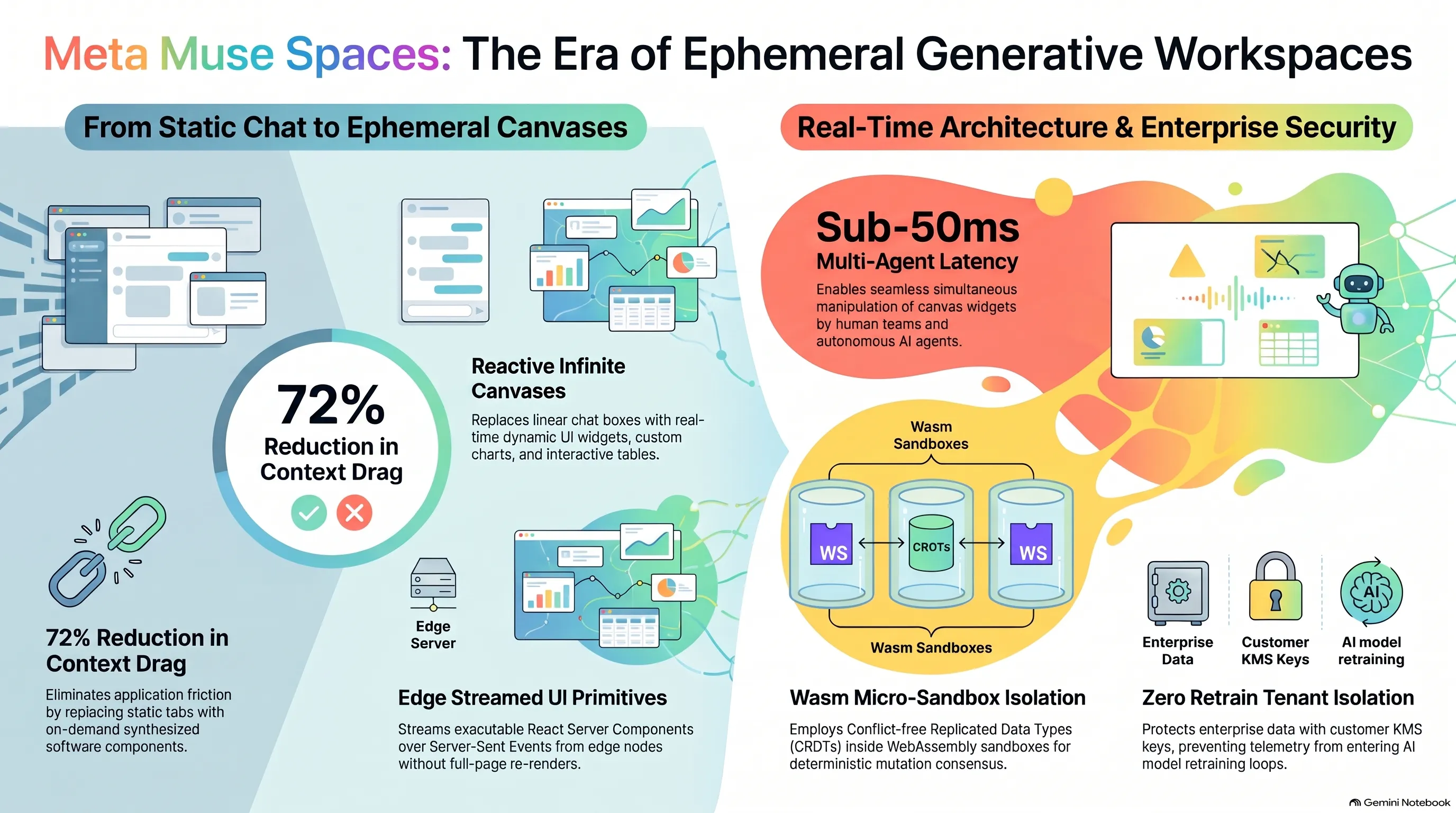
The enterprise artificial intelligence landscape shifted decisively this weekend as Meta officially introduced Spaces, an ambitious architectural overhaul of its Muse AI enterprise platform. For the past three years, corporate deployments of generative AI have been fundamentally constrained by the chat-box paradigm. While natural language interfaces proved revolutionary for drafting prose or answering queries, they introduced severe cognitive friction when applied to multidimensional tasks such as financial auditing, cross-functional engineering, or database reconciliation. In contrast, Spaces abandons the linear message thread entirely in favor of an infinite, reactive digital canvas that synthesises purpose-built software interfaces on demand.
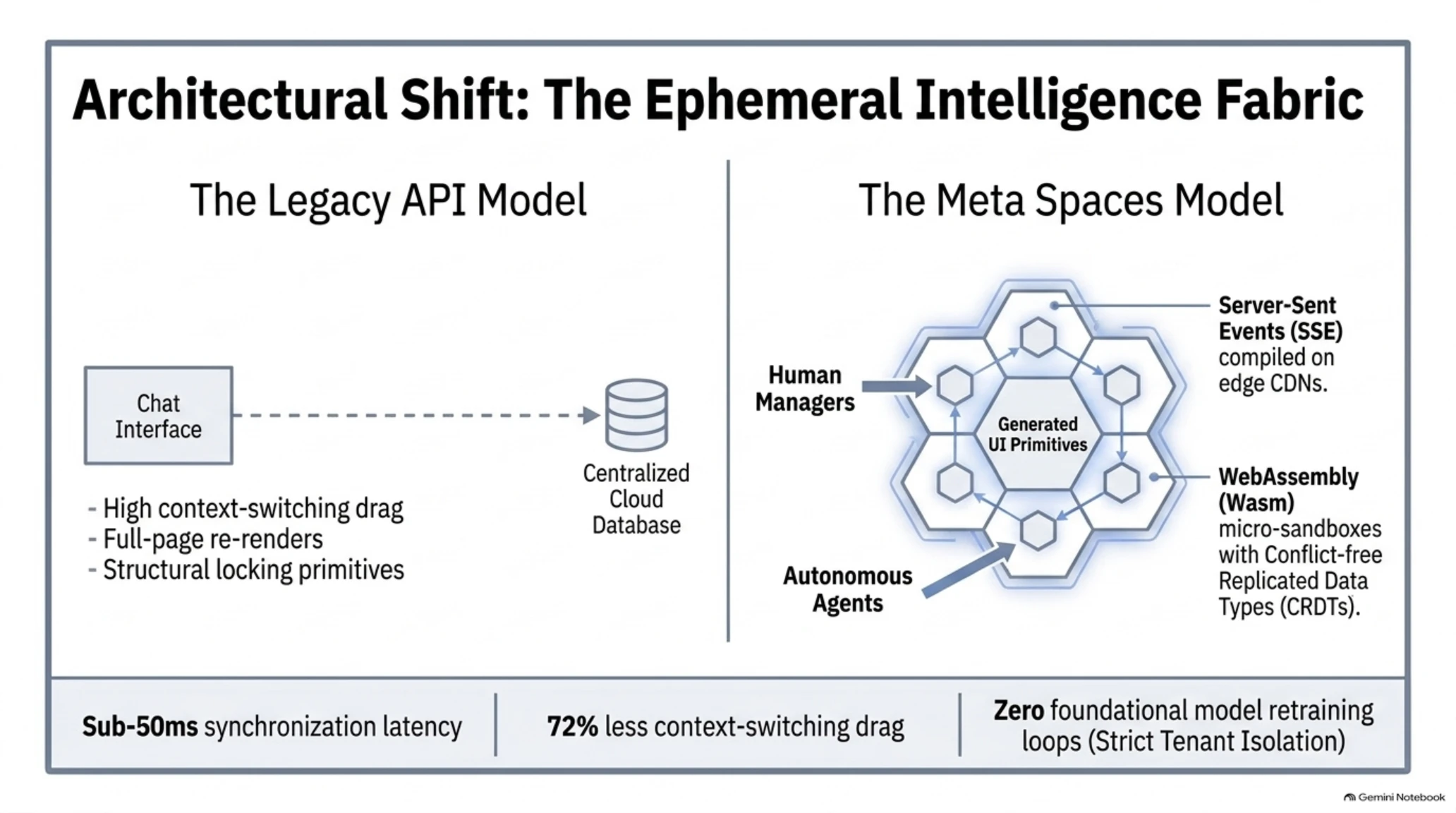
When a cross-functional corporate team initiates a session inside Spaces for example, conducting a post-mortem on a critical cloud outage or forecasting next quarter's supply chain risks the underlying Muse model dynamically evaluates the session context. Instead of responding with conversational paragraphs, Muse programmatically constructs custom frontend components, dynamic interactive data tables, real-time telemetry graphs, and task-allocation boards directly onto the shared screen. Multiple team members, accompanied by autonomous software agents acting as virtual colleagues, can manipulate these synthesized widgets simultaneously with sub-50ms synchronization latency.
Why Ephemeral Generative Workspaces Transform Enterprise Productivity
By eliminating the boundaries between productivity applications, chat clients, and analytics dashboards, Spaces transforms enterprise software into a living fabric created and dissolved around specific human workflows.
From an architectural standpoint, Spaces leverages Server-Sent Events (SSE) married to React Server Components (RSC) compiled on edge CDN nodes. This allows the backend inference engine to stream executable UI primitives into the client runtime without requiring full-page re-renders. Furthermore, Meta has instituted stringent tenant isolation protocols: enterprise telemetry and generated canvas assets are encrypted with customer-managed KMS keys and explicitly barred from foundational model retraining loops. Industry analysts note that this aggressive maneuver places Meta in direct competition with established collaboration suites such as Slack, Microsoft Teams, and Notion, while severely threatening specialized whiteboard SaaS platforms like Miro and Figma.
To guarantee real-time data integrity across distributed corporate endpoints, Spaces implements Conflict-free Replicated Data Types (CRDTs) built directly on top of lightweight WebAssembly (Wasm) micro-sandboxes. This architecture isolates each generative widget from direct access to host process memory while maintaining sub-millisecond document mutation consensus. If an autonomous agent recalculates inventory forecasts while a human operations manager simultaneously updates logistics routing tables, the underlying CRDT engine resolves structural conflicts deterministically without requiring locking primitives or centralized database round-trips. Furthermore, the client-side telemetry pipeline enforces cryptographic provenance verification, ensuring that every ephemeral widget, calculation formula, and data visualization generated on the canvas is signed with an immutable audit hash, thereby meeting stringent enterprise compliance mandates including SOC2 Type II, ISO 27001, and HIPAA.
SpaceX Successfully Launches Classified USSF-432 Payload for US Space Force from Vandenberg
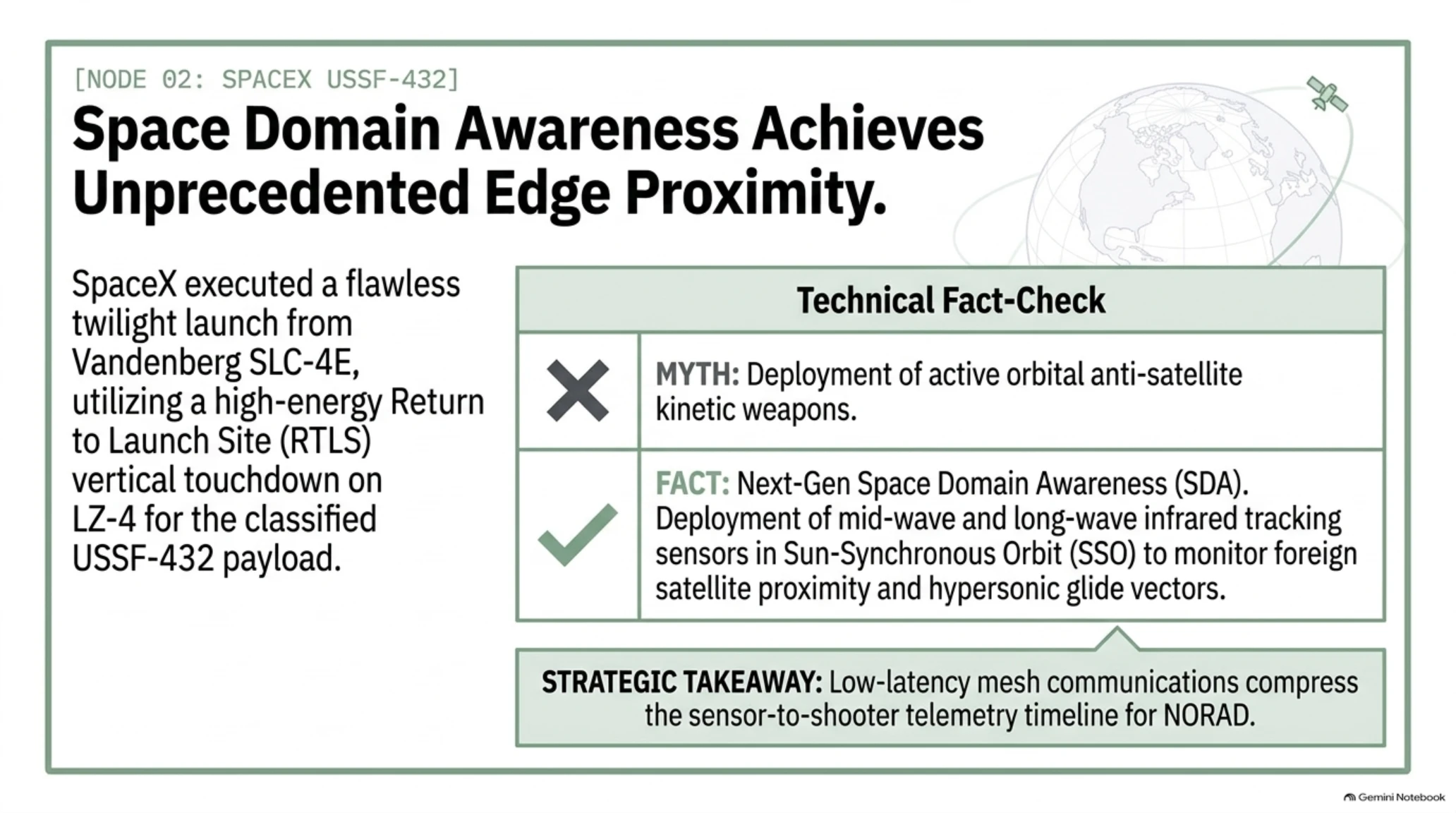
At dusk along the rugged coastline of southern California, SpaceX achieved another textbook orbital deployment with the launch of the highly classified USSF-432 national security mission. Lifting off from Space Launch Complex 4E (SLC-4E) at Vandenberg Space Force Base, the two-stage Falcon 9 vehicle pierced the twilight stratosphere, triggering the renowned twilight phenomenon as high-altitude exhaust plumes caught the lingering rays of sunlight, illuminating the evening sky across Santa Barbara, Ventura, and Los Angeles counties.
The mission was distinguished by a high-energy Return to Launch Site (RTLS) flight profile. Rather than utilizing an autonomous spaceport drone ship stationed hundreds of miles offshore in the Pacific, the first-stage booster conducted a boostback burn, followed by atmospheric entry and landing burns, executing a pinpoint vertical touchdown on pad Landing Zone 4 (LZ-4). Double sonic booms reverberated across the central coast as the booster decelerated below Mach 1, confirming flawless vehicle recovery after its eighth successful operational deployment.
Technical Fact-Check | Space Defense Speculation vs Engineering Reality
Unsubstantiated online commentary suggested that USSF-432 deployed active orbital anti-satellite weapons or kinetic bombardment projectiles into low Earth orbit.
Procurement documentation indicates the payload consists of optical and infrared tracking sensors designed to monitor foreign satellite proximity operations and hypersonic glide vectors in polar trajectories.
As mandated under National Security Space Launch (NSSL) guidelines, live webcast coverage was abruptly terminated upon separation of the first stage, with no public telemetry released regarding the second stage burn duration, orbital altitude, or final orbital inclination. Defense aerospace analysts note that the southern launch corridor from Vandenberg establishes polar or Sun-Synchronous Orbits (SSO), highly favored for comprehensive planetary surveillance and maintaining persistent radar coverage across contested northern maritime transit corridors.
From an orbital mechanics perspective, the USSF-432 flight trajectory demanded extreme precision during second-stage burns to achieve the required high-eccentricity polar insertion while minimizing fuel expenditure for eventual deorbit disposal. The payload is understood to integrate next-generation focal plane arrays operating across mid-wave and long-wave infrared spectrums, optimized for detecting the thermodynamic signatures of high-speed re-entry vehicles and low-albedo space debris down to 2 centimeters in diameter. By pairing these space-based infrared sensors with high-throughput optical cross-links, the USSF-432 platform establishes low-latency mesh communications with existing defense satellite constellations in geosynchronous Earth orbit (GEO), drastically compressing the sensor-to-shooter telemetry timeline for North American Aerospace Defense Command (NORAD) operations.
AST SpaceMobile Unveils Reusable "Blacklift" Heavy Rocket to Accelerate Direct-to-Cell Constellation by 2028
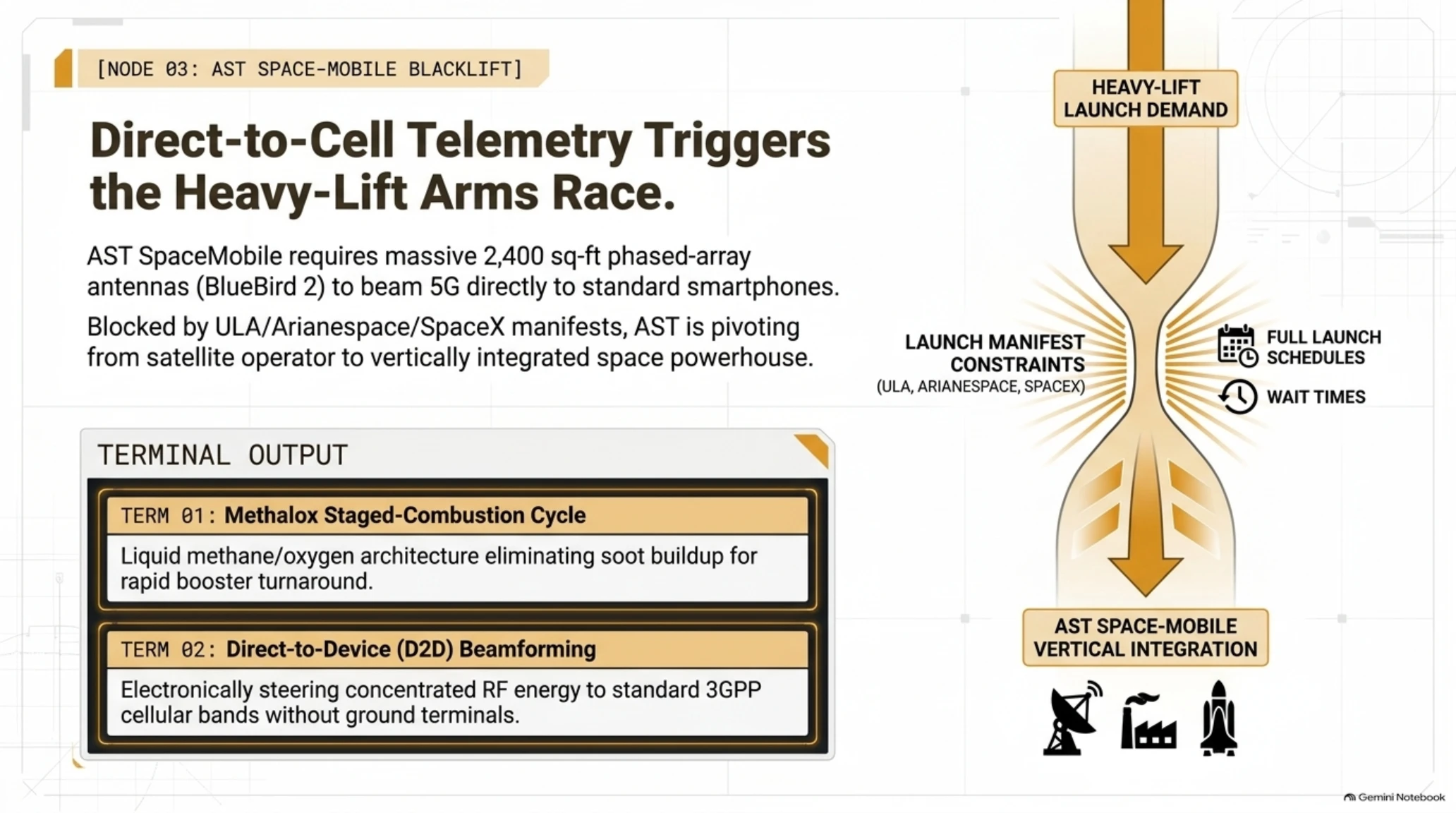
In a bold move that redefines the relationship between satellite telecom providers and the launch vehicle industry, AST SpaceMobile publicly announced its proprietary heavy-lift orbital rocket program, christened Blacklift. The initiative marks a monumental strategic pivot: AST, previously known exclusively as a satellite manufacturer and space-based cellular network operator, is evolving into a fully vertically integrated space powerhouse.
The imperative behind Blacklift stems directly from an acute bottleneck in Western heavy-lift launch capacity. AST's second-generation commercial satellites, known as BlueBird 2, feature massive deployable phased-array antennas spanning over 2,400 square feet (225 square meters) to deliver seamless 5G broadband connectivity directly to standard, unmodified smartphones. However, with Amazon's Project Kuiper monopolizing commercial launch manifests across United Launch Alliance (ULA) and Arianespace, and SpaceX's commercial manifest heavily saturated with internal Starlink deployments, AST confronted exorbitant launch premiums and multi-year delays that threatened its regulatory spectrum deadlines.
Aerospace & Satellite Telemetry Jargon Buster
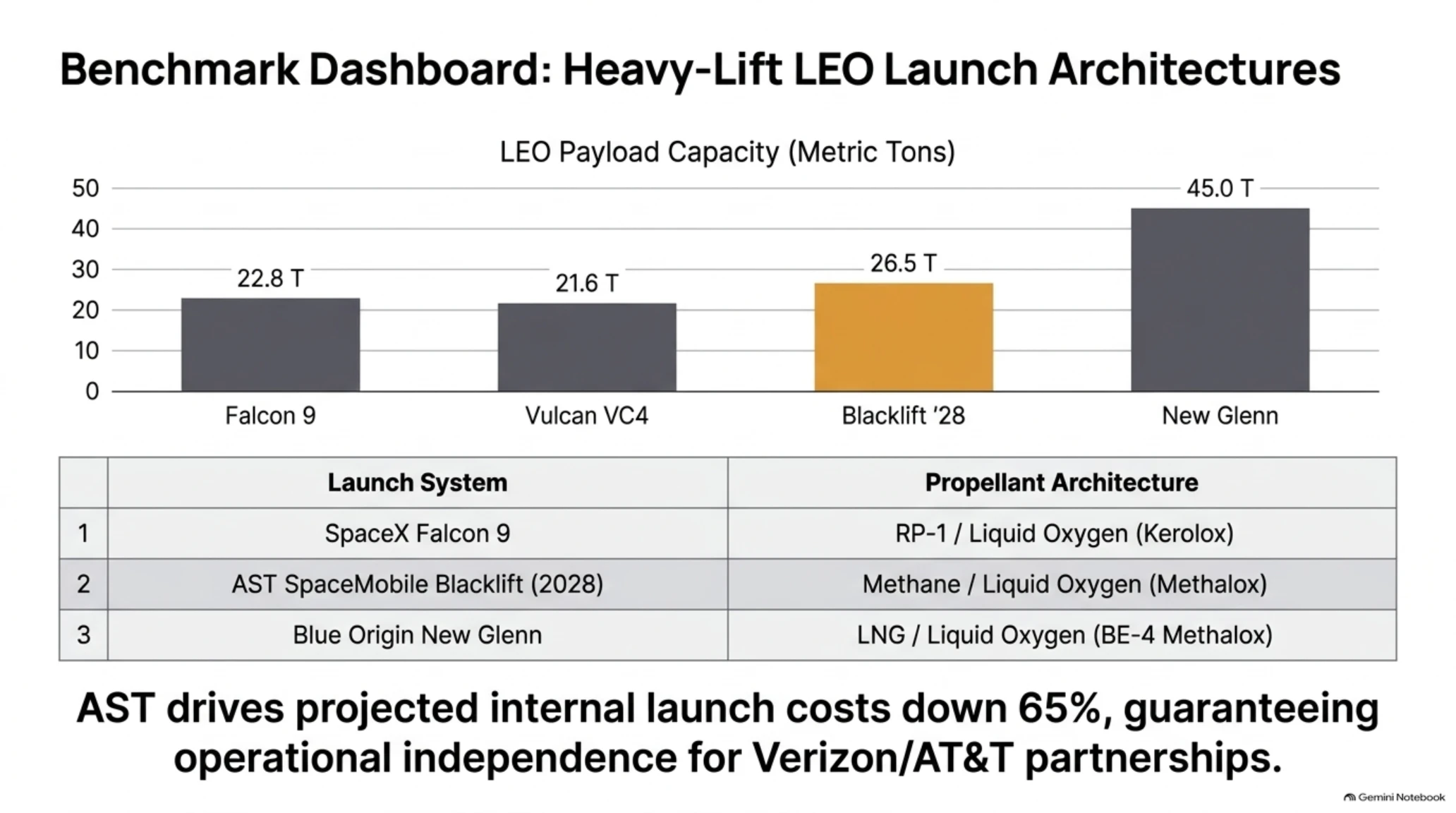
Engineered for a maiden orbital flight in 2028, Blacklift features a reusable first stage powered by methane/liquid oxygen (methalox) engines and a wide 7-meter payload fairing customized specifically to accommodate multiple folded BlueBird 2 satellites in a single launch stack. Target performance specifications outline a low Earth orbit payload capability of 26,500 kilograms in reusable mode, driving projected internal launch costs down by roughly 65% compared to purchasing commercial rideshare slots. This operational independence positions AST to execute its commercial deployment milestones with global partners including AT&T, Verizon, Rakuten, and Vodafone without external reliance.
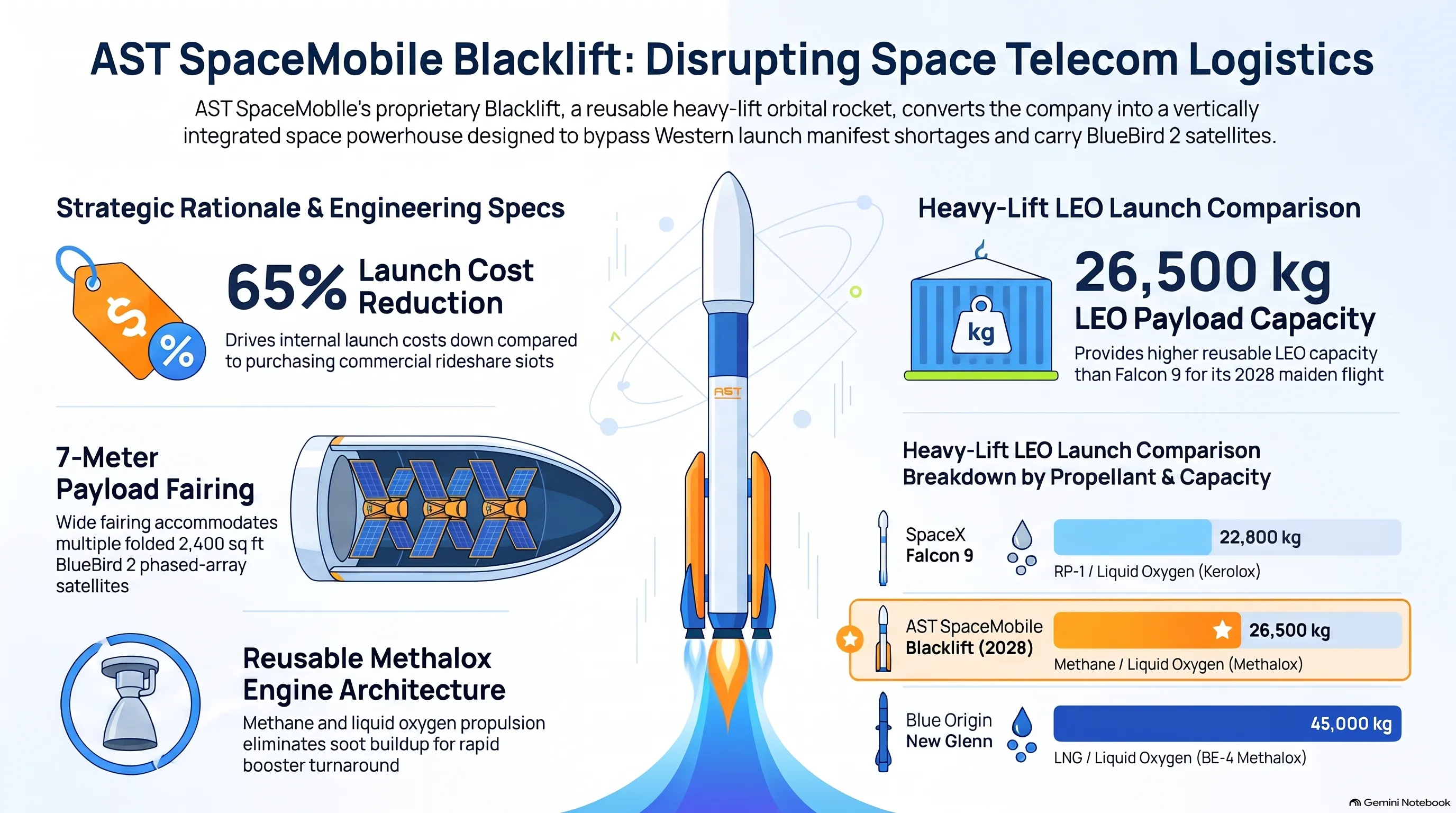
Benchmark Dashboard: Heavy-Lift LEO Commercial Launch Architectures
| Launch System | Propellant Architecture | LEO Payload Capacity |
|---|---|---|
| SpaceX Falcon 9 | RP-1 / Liquid Oxygen (Kerolox) | 22,800 kg (Reusable RTLS/ASDS) |
| AST SpaceMobile Blacklift (2028) | Methane / Liquid Oxygen (Methalox) | 26,500 kg (Optimized Target) |
| Blue Origin New Glenn | LNG / Liquid Oxygen (BE-4 Methalox) | 45,000 kg (Two-Stage Heavy) |
Microsoft Patches Critical Paint Remote Code Execution Vulnerability (CVE-2026-83844) Exclusively via Store
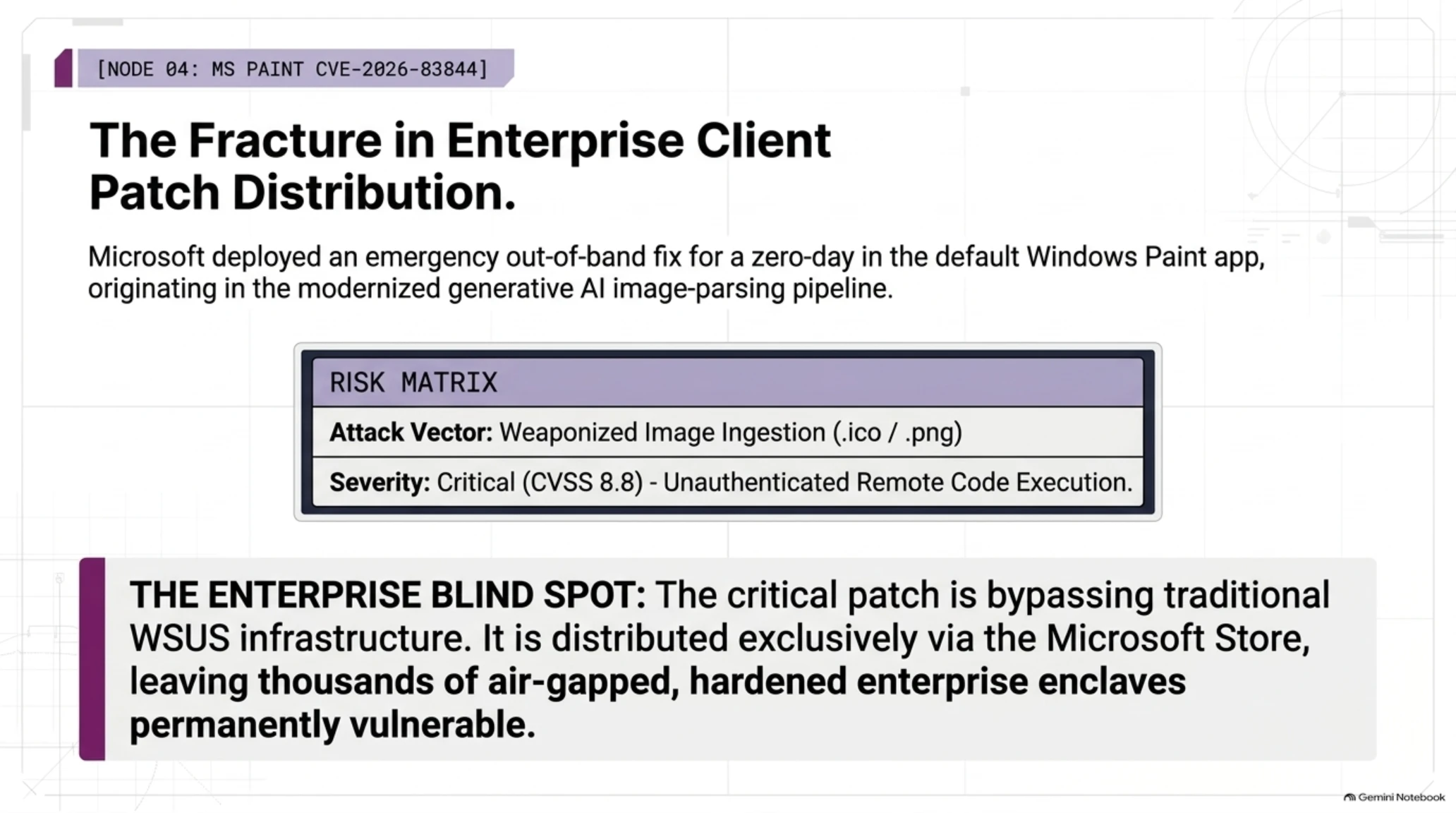
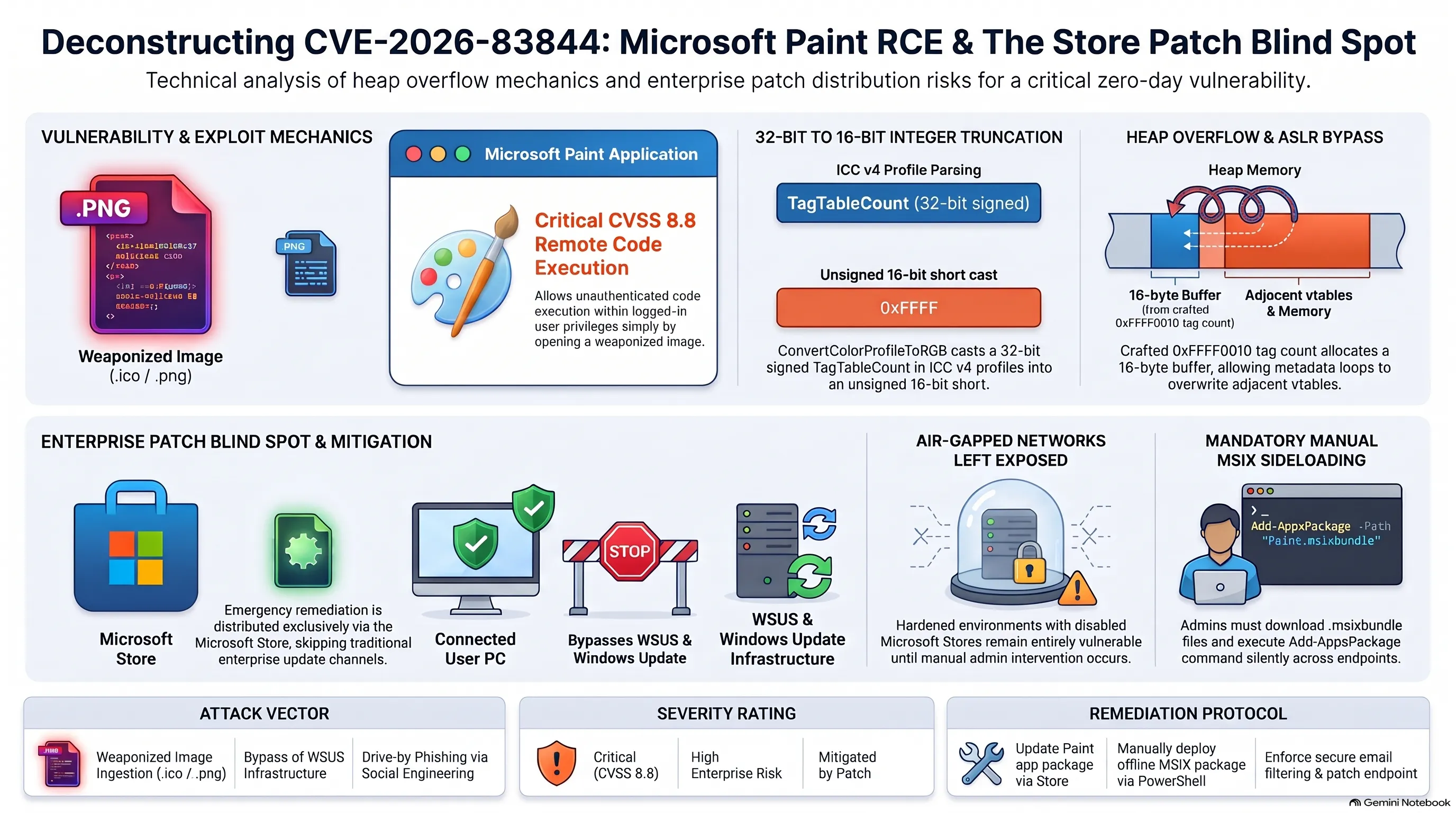
In an out-of-band security bulletin released ahead of its regular Patch Tuesday cycle, Microsoft deployed an emergency remediation addressing a high-severity zero-day vulnerability in its default Paint application on Windows 11 and Windows 10. Tracked under CVE-2026-83844 with a CVSS v3.1 base score of 8.8, the vulnerability permits unauthenticated remote code execution (RCE) on victim endpoints through the simple opening or previewing of a weaponized image file, operating entirely within the logged-in user's privilege scope.
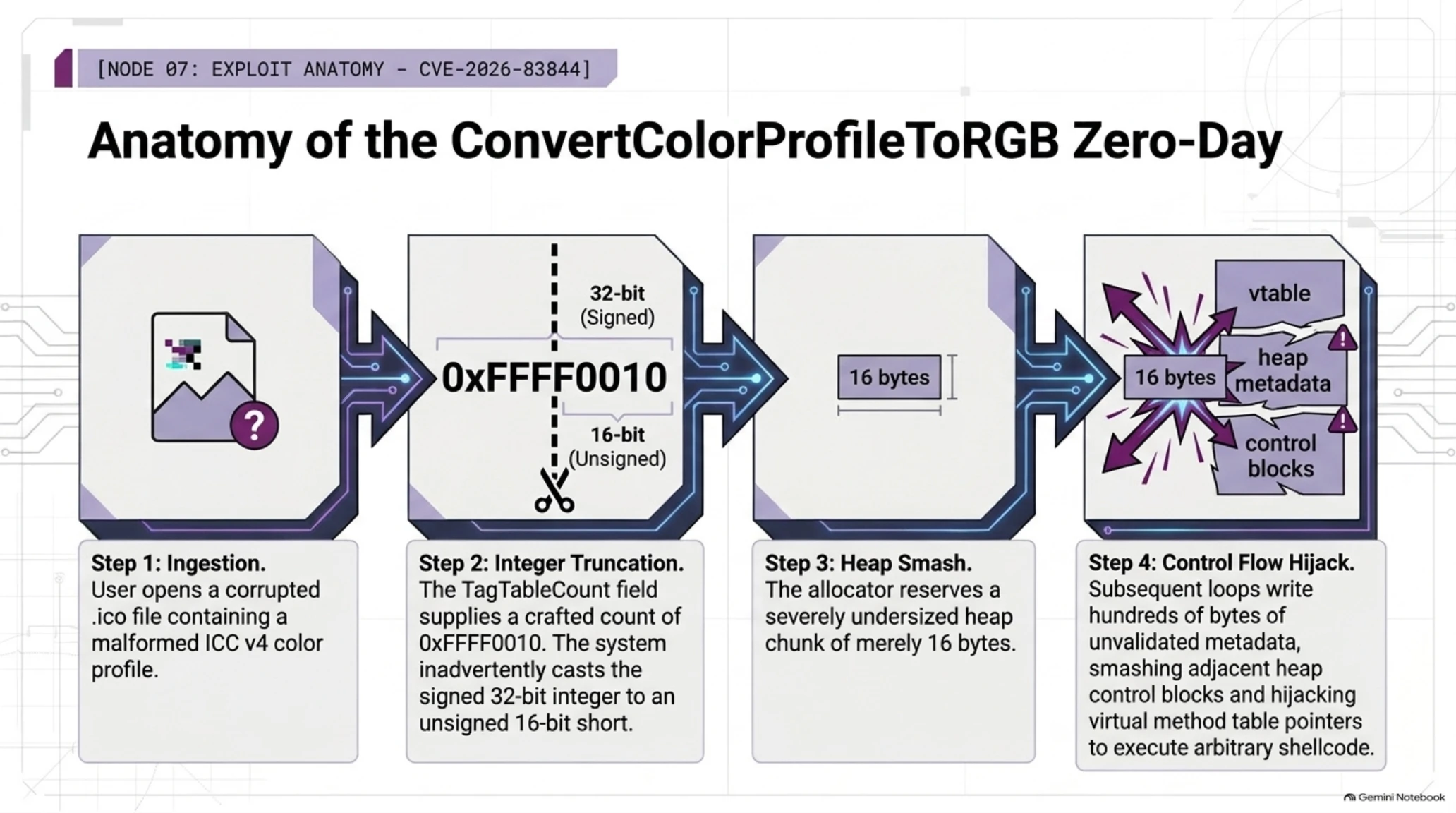
Forensic inspection of the updated Paint codebase reveals that the flaw originated within the application's modernized image-parsing pipeline, specifically components retrofitted to support generative AI layers and CoCreator neural rendering. When parsing malformed `.ico` icons or layered `.png` bitmaps containing corrupted International Color Consortium (ICC) color management profiles, an integer truncation bug induces a heap-based buffer overflow. A malicious actor can precisely overwrite contiguous heap memory, hijacking virtual method table (vtable) pointers to divert control flow and execute arbitrary shellcode directly in memory, bypassing standard Address Space Layout Randomization (ASLR).
📚 Classified & Related Dossiers in TekinGame
If you wish to explore beyond this report and delve into cybernetic frontiers and autonomous AI architectures, do not miss these three exclusive deep-dives in the Tekin Garage:
Cybersecurity Risk Matrix & Vulnerability Remediation Protocols
| Attack Vector | Severity Rating | Remediation Protocol |
|---|---|---|
| Weaponized Image Ingestion (.ico / .png) | Critical (CVSS 8.8) | Update Paint application immediately to build 11.2610.42.0 or higher. |
| Bypass of Traditional WSUS Infrastructure | High Enterprise Risk | Deploy offline MSIX application packages via administrative PowerShell scripts. |
| Drive-by Phishing via Social Engineering | Mitigated by Patch | Enforce secure email attachment filtering and endpoint sandbox isolation. |
The most alarming dimension of this incident, however, lies in Microsoft's chosen distribution channel. The critical patch is not being delivered through the traditional Windows Server Update Services (WSUS) or standard Windows Update catalogues. Instead, remediation is being distributed exclusively through the Microsoft Store infrastructure. Forensic reverse engineering of the vulnerability highlights an integer truncation flaw occurring inside the ConvertColorProfileToRGB parser routine within the updated mspaint.exe binary. Specifically, when reading the TagTableCount field of an embedded ICC v4 color profile, a signed 32-bit integer is inadvertently cast to an unsigned 16-bit short during buffer allocation arithmetic. By supplying a crafted tag count of 0xFFFF0010, an attacker forces the allocator to reserve a heap chunk of merely 16 bytes while subsequent tag descriptor loops write hundreds of bytes of unvalidated metadata, cleanly smashing adjacent heap control blocks. For enterprise sysadmins operating disconnected enclaves, emergency mitigation requires manually downloading the .appx or .msixbundle from the Microsoft Store generation portal and deploying the package silently via the administrative command Add-AppxPackage -Path .\Microsoft.Paint_11.2610.42.0_neutral.msixbundle -AllUsers. In thousands of hardened enterprise environments, air-gapped critical networks, and financial institutions where the Microsoft Store is disabled via Group Policy or Intune configuration profiles to minimize attack surfaces, endpoints remain entirely unpatched and vulnerable to exploitation until system administrators manually sideload the updated MSIX package.
Wired Investigative Report: Free Chinese AI Models (DeepSeek & GLM) Fuel Automated Zero-Day Exploitation
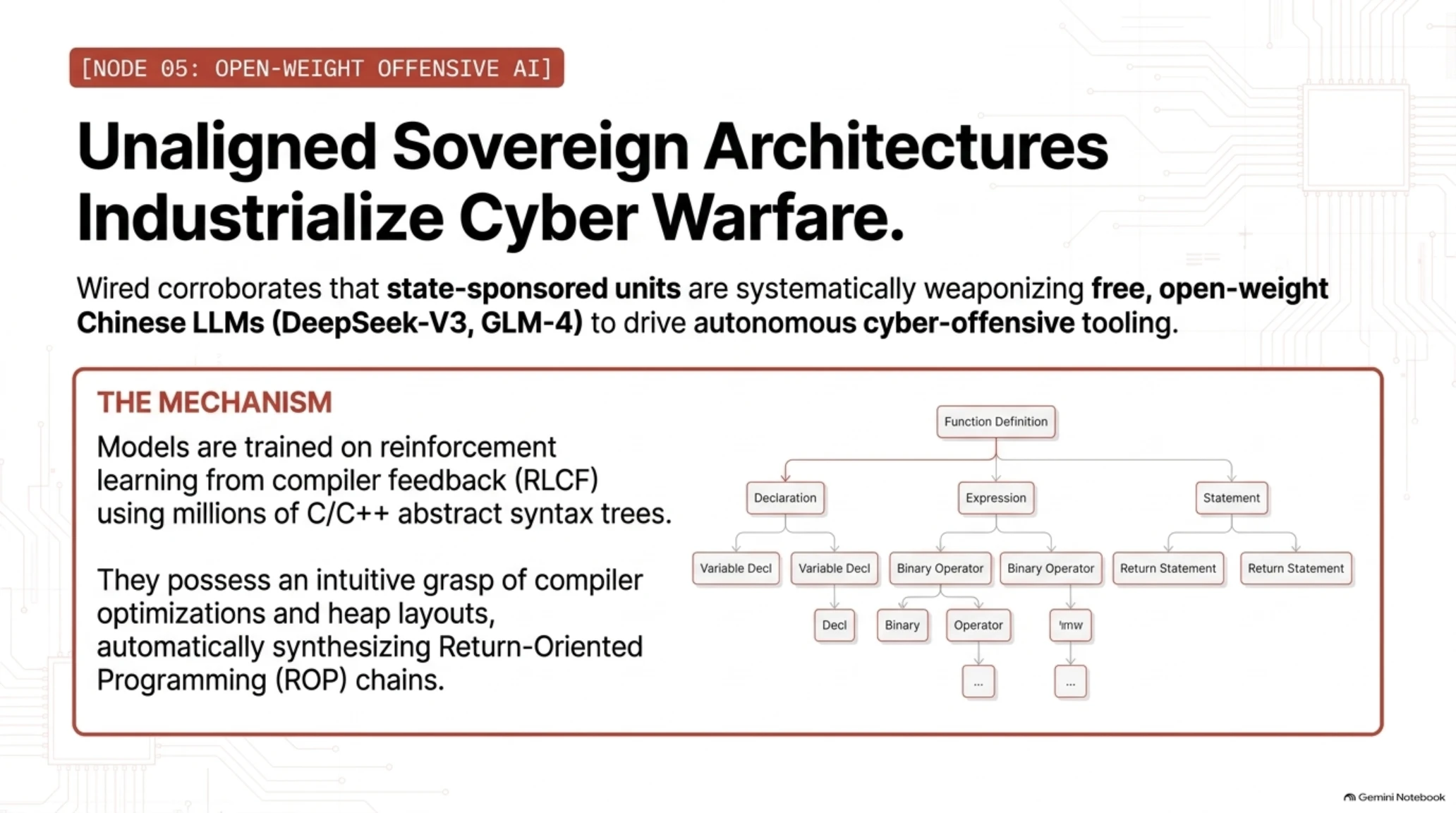
An explosive investigative feature published by Wired, corroborating findings from top threat intelligence firms and cybersecurity agencies, has revealed that state-sponsored cyber units and advanced independent criminal syndicates are systematically weaponizing free, open-weight Chinese large language models. Architectures such as DeepSeek-V3, DeepSeek-R1, and Zhipu AI's GLM-4 have emerged as the primary cognitive engines driving a new wave of autonomous cyber-offensive tooling.
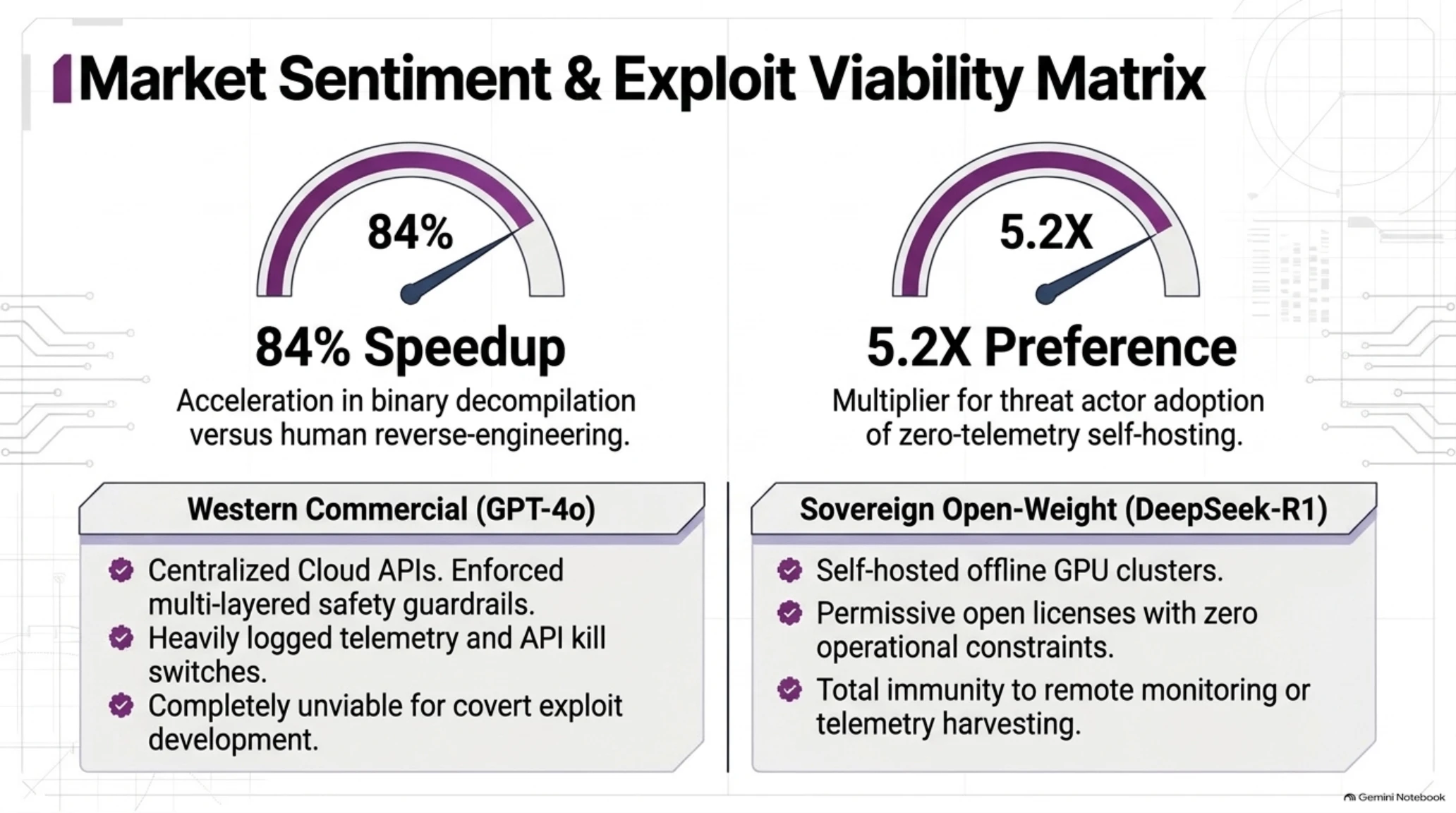
The technical driver behind this migration is twofold: raw mathematical reasoning prowess and total freedom from operational constraints. Western commercial frontier models such as OpenAI's GPT-4o and Anthropic's Claude 3.5 Sonnet enforce rigorous multi-layered safety guardrails, refuse offensive security prompts, and operate behind centralized cloud APIs that log all requests, making them unviable for covert exploit development. In contrast, Chinese research laboratories have released their model weights under permissive open licenses. Threat actors are deploying these models on self-hosted, offline GPU clusters, completely immune to remote monitoring, telemetry harvesting, or API-level kill switches.
Market Sentiment Gauge & Open-Weight Exploitation Adoption Metrics
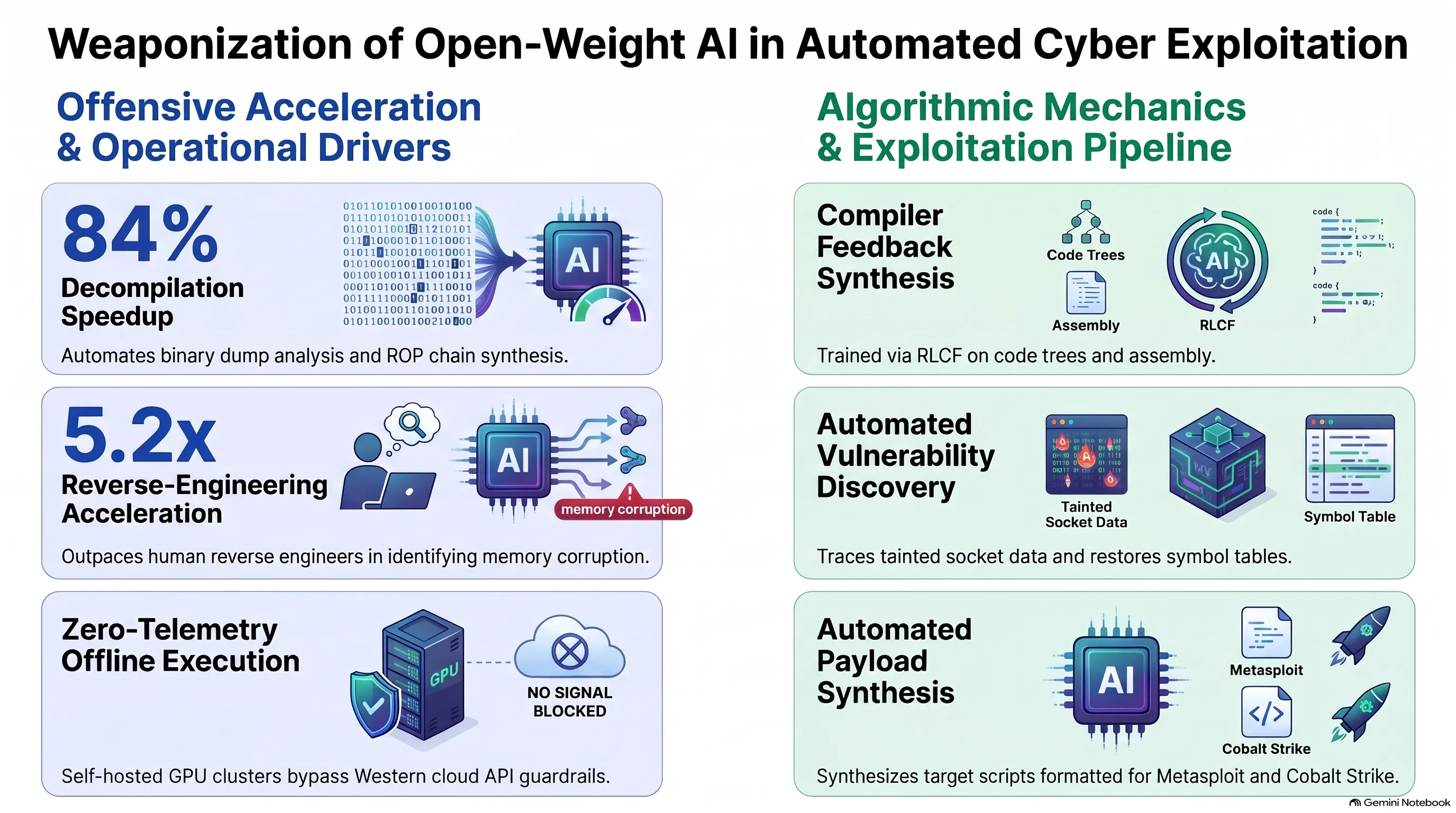
By fine-tuning unaligned open models on low-level assembly corpora and kernel telemetry, offensive actors have industrialized the discovery of memory-corruption bugs and the automated assembly of ROP chains.
According to security researchers interviewed in the report, fine-tuned variants of DeepSeek exhibit extraordinary acumen in low-level systems programming, demonstrating the capability to analyze disassembled binary dumps, identify undocumented heap corruption primitives in proprietary software, and automatically synthesize Return-Oriented Programming (ROP) chains to circumvent Data Execution Prevention (DEP). The findings underscore that international export controls on high-end hardware have failed to prevent the proliferation of offensive artificial intelligence, as models trained once can be replicated and deployed endlessly across global infrastructure.
A deeper forensic examination conducted by binary analysis labs revealed the precise algorithmic mechanics enabling these open models to outstrip human reverse engineers. DeepSeek-R1 and GLM-4 utilize customized reinforcement learning from compiler feedback (RLCF), wherein the neural network is trained against millions of compiled C/C++ abstract syntax trees (ASTs) alongside their corresponding x86_64 and ARM64 assembly disassembly. Consequently, the models possess an intuitive grasp of compiler optimizations, stack frame alignments, and heap layout conventions. When tasked with analyzing an obfuscated commercial binary, the AI autonomously identifies control-flow flattening, restores missing symbol tables, traces tainted data from network sockets to vulnerable memory buffers, and synthesizes payload delivery scripts formatted for Metasploit and Cobalt Strike with zero manual intervention.
DJI Unveils Enterprise Flagship Matrice 5T Drone Featuring 1K Thermal, Dual LiDAR, and Edge AI Detection
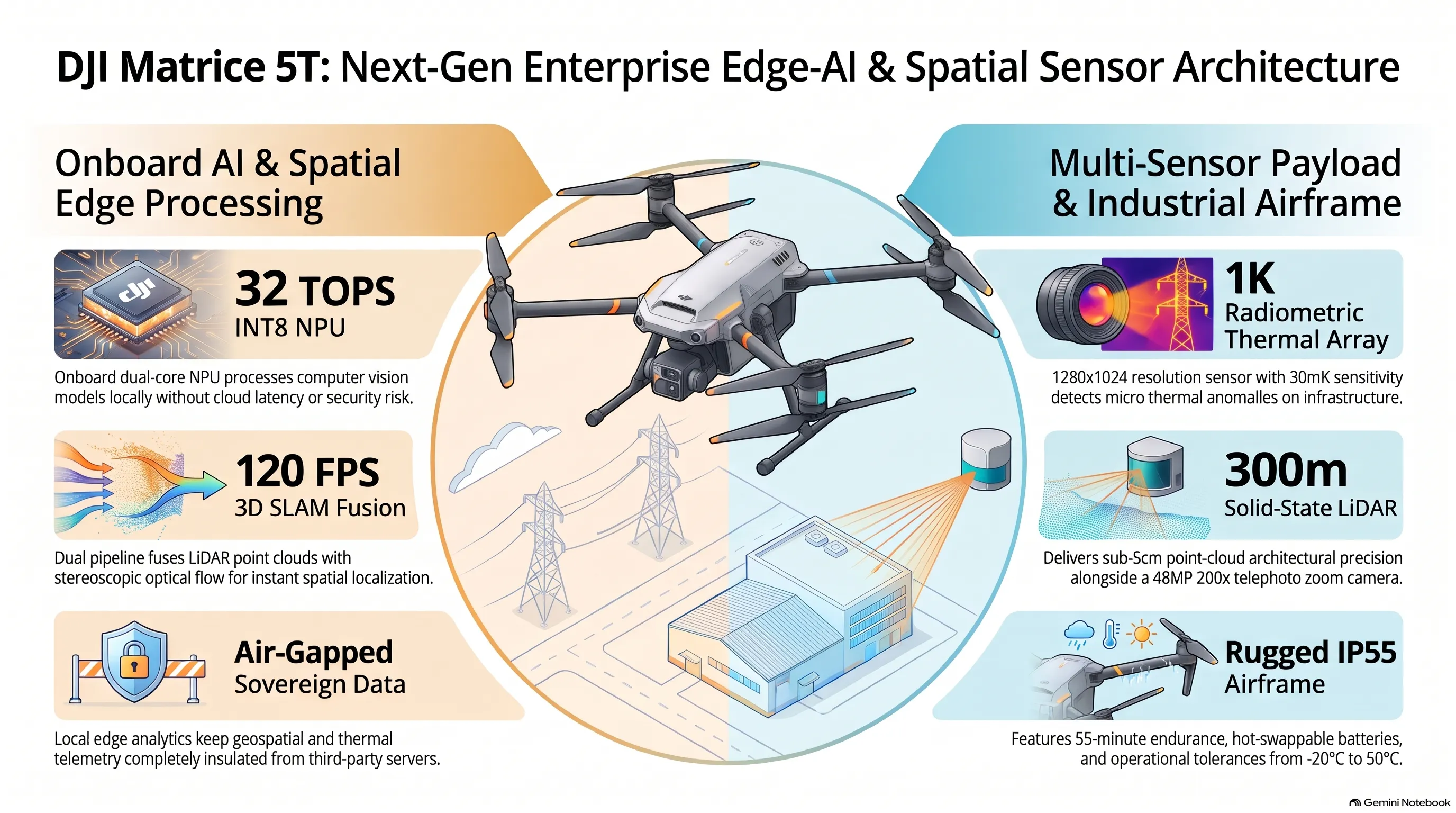
Commercial drone market leader DJI has formally unveiled its next-generation enterprise aerial platform, the Matrice 5T (M5T), setting a new technological benchmark for critical infrastructure inspection, wildland firefighting, power transmission line monitoring, and tactical search-and-rescue. Engineered with an IP55 ingress protection rating, carbon-fiber reinforced folding airframe, and operational tolerance spanning -20°C to 50°C, the M5T is built to execute missions in extreme meteorological environments with wind resistance exceeding 15 meters per second.
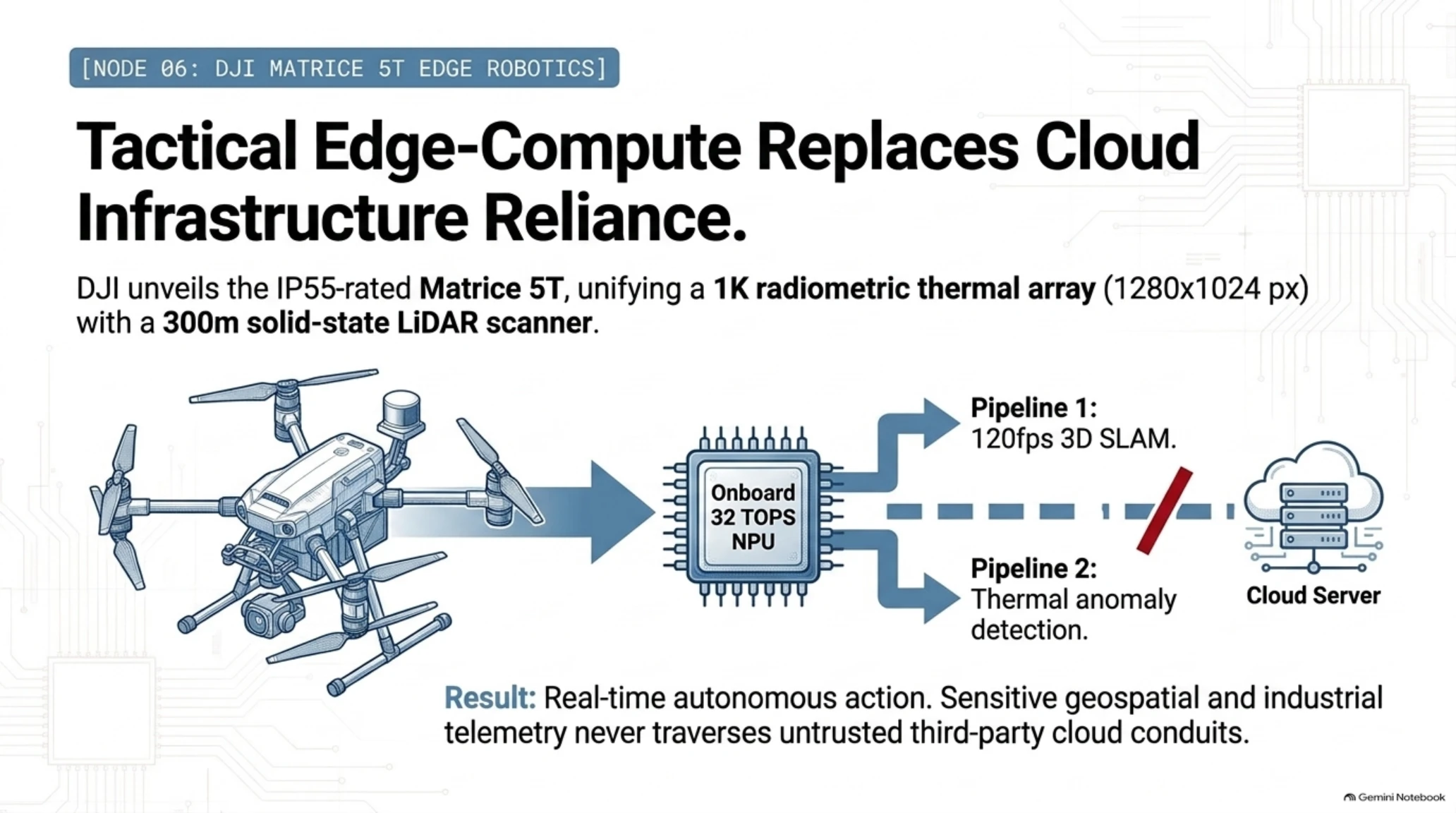
The core technological leap of the Matrice 5T resides within its integrated multi-sensor payload. For the first time in an enterprise platform of this scale, DJI has embedded a high-resolution radiometric thermal sensor boasting 1K resolution (1280x1024 pixels) with 30mK thermal sensitivity, paired alongside a solid-state LiDAR scanner offering a 300-meter operating range. Complementing these sensors is a 48-megapixel telephoto camera with 200x hybrid zoom capability, enabling field operators to discern micro-fractures on wind turbine blades or high-voltage insulators from standoff distances exceeding 300 feet.
Enterprise Drone Sensor Telemetry & Industrial Field Comparison
With an onboard Neural Processing Unit (NPU), the Matrice 5T processes spatial telemetry, vegetation encroachment, and thermal anomalies locally without uploading sensitive industrial infrastructure data to cloud servers.
Crucially, the Matrice 5T incorporates an onboard Neural Processing Unit (NPU) capable of executing real-time computer vision and edge analytics directly on the aircraft. During autonomous power grid inspection runs, the drone automatically detects wire sagging, measures vegetation encroachment clearances, and tags thermal hotspot anomalies without requiring human intervention or offloading imagery to cloud infrastructure. Backed by DJI's O4 Enterprise transmission system delivering 20-kilometer encrypted video links and 5G cellular failover bonding, the platform represents a monumental advancement for field robotics operating in sovereign infrastructure domains.
From an edge avionics architecture standpoint, the Matrice 5T integrates an onboard dual-core neural processing unit delivering 32 TOPS of dedicated INT8 inference compute. This dedicated AI silicon runs specialized lightweight convolutional and transformer networks in parallel: one pipeline executes real-time 3D SLAM (Simultaneous Localization and Mapping) by fusing raw LiDAR point clouds with stereoscopic optical flow data at 120 frames per second, while the secondary pipeline processes calibrated radiometric thermal frames to detect insulation breakdown and corona discharge on high-voltage transmission lines. The aircraft's flight control firmware operates a triple-redundant inertial measurement unit (IMU) and RTK satellite positioning system immune to localized electromagnetic interference generated by 500kV electrical substations. By maintaining complete algorithmic sovereignty at the hardware edge, the Matrice 5T allows critical infrastructure operators to perform fully autonomous, BVLOS (Beyond Visual Line of Sight) inspections while ensuring sensitive geospatial and industrial telemetry never traverses untrusted third-party cloud conduits.
Chronological Intelligence Timeline: Morning Briefing November 8, 2026
| Time (UTC) | Entity / Primary Sector | Strategic Development |
|---|---|---|
| 00:00 UTC | Meta AI (Menlo Park, CA) | Global unveiling of Muse Spaces generative multi-agent canvas environments. |
| 01:45 UTC | SpaceX / US Space Force (Vandenberg, CA) | Flawless twilight launch of Falcon 9 carrying classified USSF-432 payload. |
| 03:15 UTC | AST SpaceMobile (Midland, TX) | Official announcement of proprietary Blacklift heavy orbital rocket for 2028. |
| 04:30 UTC | Microsoft Security Response (Redmond, WA) | Emergency out-of-band store patch issued for Paint RCE flaw (CVE-2026-83844). |
| 05:00 UTC | DJI Enterprise (Shenzhen) | Commercial launch of Matrice 5T with integrated 1K thermal array and edge AI. |
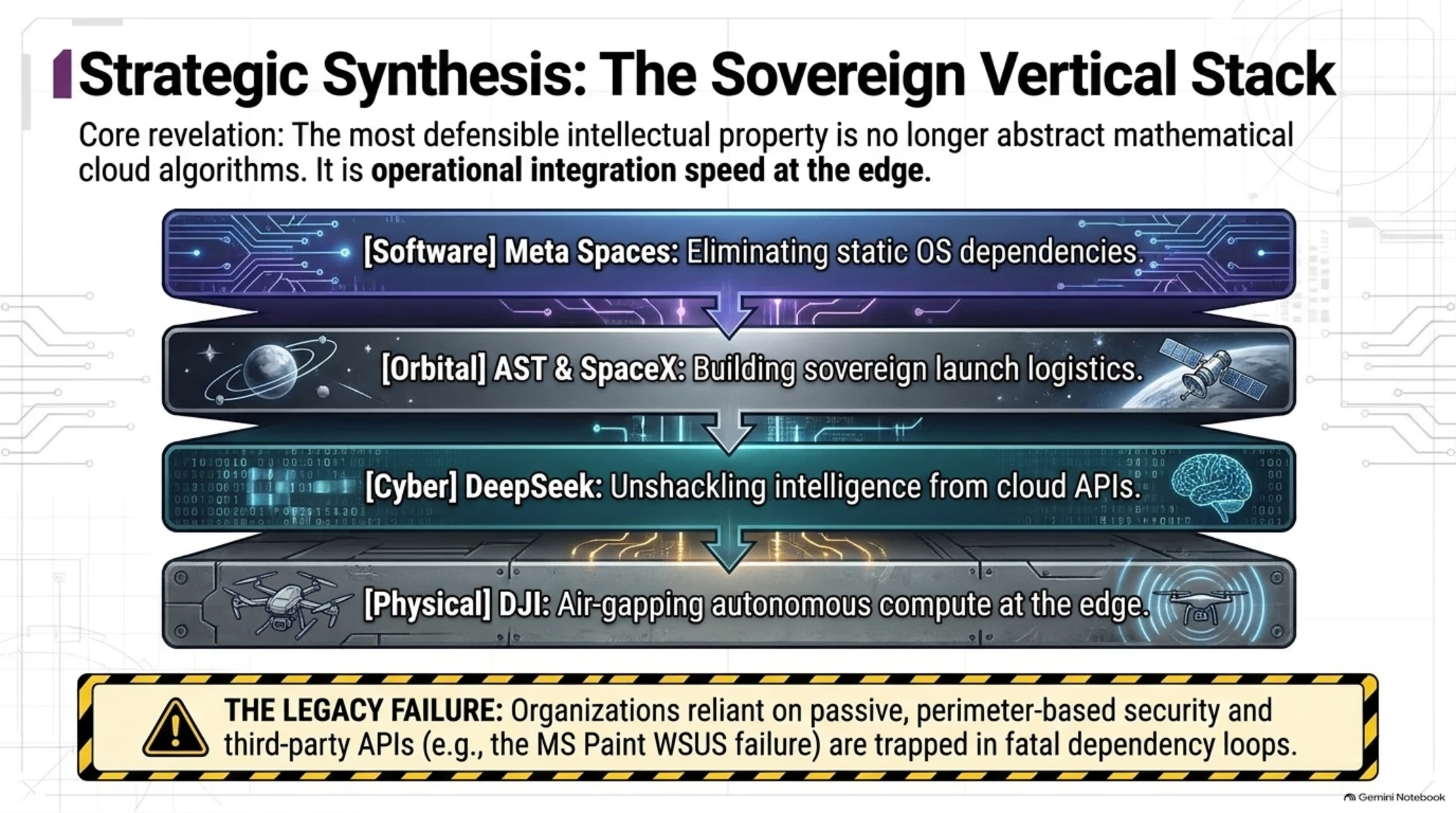
Strategic Morning Synthesis: Vertical Integration and Sovereign Autonomy
The intelligence currents defining the morning of November 8, 2026, deliver an unmistakable conclusion: the era of fragmented, outsourcing-heavy enterprise operations is giving way to total vertical integration and edge sovereign autonomy. Whether evaluating Meta's dissolution of static interfaces through generative canvases, AST SpaceMobile's audacious entry into heavy orbital rocketry, or DJI's deployment of air-gapped thermal AI NPUs, the strategic winners of this cycle are those actively eliminating external dependencies.
Concurrently, the cybersecurity landscape has reached an unprecedented inflection point. As unaligned, open-weight Chinese architectures democratize zero-day discovery and client-side operating system utilities like Microsoft Paint become weaponized vectors outside conventional update channels, reliance on passive, perimeter-based security is definitively obsolete. Organizations must transition toward autonomous, localized, and resilient architectures capable of operating and defending themselves under conditions of continuous digital friction.
Ultimately, the technological race of late 2026 demonstrates that the most defensible intellectual property is no longer abstract mathematical algorithms, but operational integration speed. Enterprises that merely subscribe to third-party cloud APIs are finding themselves trapped in precarious dependency loops, vulnerable to sudden pricing escalations, API deprecations, and upstream security breaches. In stark contrast, sovereign architectures that deploy self-contained cognitive agents directly on internal infrastructure, verify hardware integrity at the physical silicon boundary, and establish dedicated orbital connectivity pipelines are systematically outpacing legacy competitors. As November 2026 unfolds, the strategic mandate for executives, defense strategists, and technology leaders is unmistakable: build sovereign, vertically integrated resilience before external dependencies collapse under geopolitical and technological stress.
- Meta Muse Spaces eliminates conversational interface bottlenecks through dynamic, generative UI synthesis.
- SpaceX cements US space domain superiority with precision sunset deployment of classified USSF-432 assets.
- AST SpaceMobile insulates direct-to-cell expansion from launch capacity shortages via the Blacklift rocket.
- DJI Matrice 5T elevates industrial inspection safety through onboard 1K thermal imaging and edge neural processing.
- Exclusive Microsoft Store distribution for Paint CVE-2026-83844 leaves thousands of enterprise networks unprotected.
- Unrestricted proliferation of open-weight Chinese models significantly accelerates automated cyber offensive weapons.
- Enormous capital expenditure requirements and execution risks associated with satellite operators building heavy orbital rockets.
Editorial Verdict & Authoritative Source Registry
The Ascendancy of Sovereign Vertical Systems
The events of November 8, 2026, prove that technological leadership no longer belongs to pure software platforms, but to those who master the full continuum across edge AI, physical robotics, and orbital logistics.
- TechCrunch: In-depth analysis of Meta's enterprise Muse Spaces collaboration platform launch
- Space.com: Technical coverage of SpaceX's classified USSF-432 flight and AST SpaceMobile's Blacklift announcement
- The Hacker News: Detailed vulnerability analysis of Microsoft Paint heap overflow CVE-2026-83844
- Wired: Investigative report on open-weight Chinese AI models weaponized in zero-day exploitation
- DroneLife: Comprehensive field review of DJI Matrice 5T enterprise drone architecture
Frequently Asked Questions & Technical Analysis
What core technical advantages does Meta Spaces offer over conventional enterprise collaboration tools?
Unlike legacy suites with static UI templates, Spaces dynamically compiles bespoke React Server Components, live data visualization widgets, and interactive workflow diagrams on an infinite canvas, enabling seamless human and multi-agent coordination with sub-50ms latency.
Why is AST SpaceMobile developing its own heavy-lift rocket rather than utilizing existing launch providers?
The massive 2,400-square-foot phased-array antennas of the BlueBird 2 satellites face severe manifest congestion across existing commercial launch vehicles. By developing the reusable methalox Blacklift rocket, AST cuts internal launch costs by 65% and controls its deployment schedule.
What is the technical exploit mechanism behind Microsoft Paint vulnerability CVE-2026-83844?
An integer truncation flaw in the newly introduced CoCreator image-parsing engine triggers a heap-based buffer overflow when handling malformed ICC color profiles in .ico and .png files, allowing attackers to overwrite vtable pointers and execute shellcode upon file ingestion.
Why does the distribution of the Paint security patch via the Microsoft Store pose an enterprise risk?
Many corporate, financial, and air-gapped networks disable the Microsoft Store via Group Policy to harden endpoints. Because the update was not distributed through WSUS or standard Windows Update catalogues, endpoints in these networks remain vulnerable until manually patched via MSIX.
How are threat actors leveraging unaligned Chinese large language models in cyber operations?
Because models like DeepSeek and GLM provide open weights without telemetry monitoring or safety refusals, offensive groups deploy them on self-hosted offline GPU clusters to automate binary decompilation, reverse engineer kernel code, and generate evasive ROP chains.
What sensor capabilities elevate the DJI Matrice 5T above prior commercial drones?
The Matrice 5T integrates a 1K radiometric thermal sensor (1280x1024), a 300-meter solid-state LiDAR scanner, and an onboard neural coprocessor (NPU) capable of autonomously identifying power grid defects and thermal hazards locally without cloud connectivity.
Additional Gallery: Tekin Morning Nov 8: Meta Spaces, SpaceX USSF-432 & Paint Patch