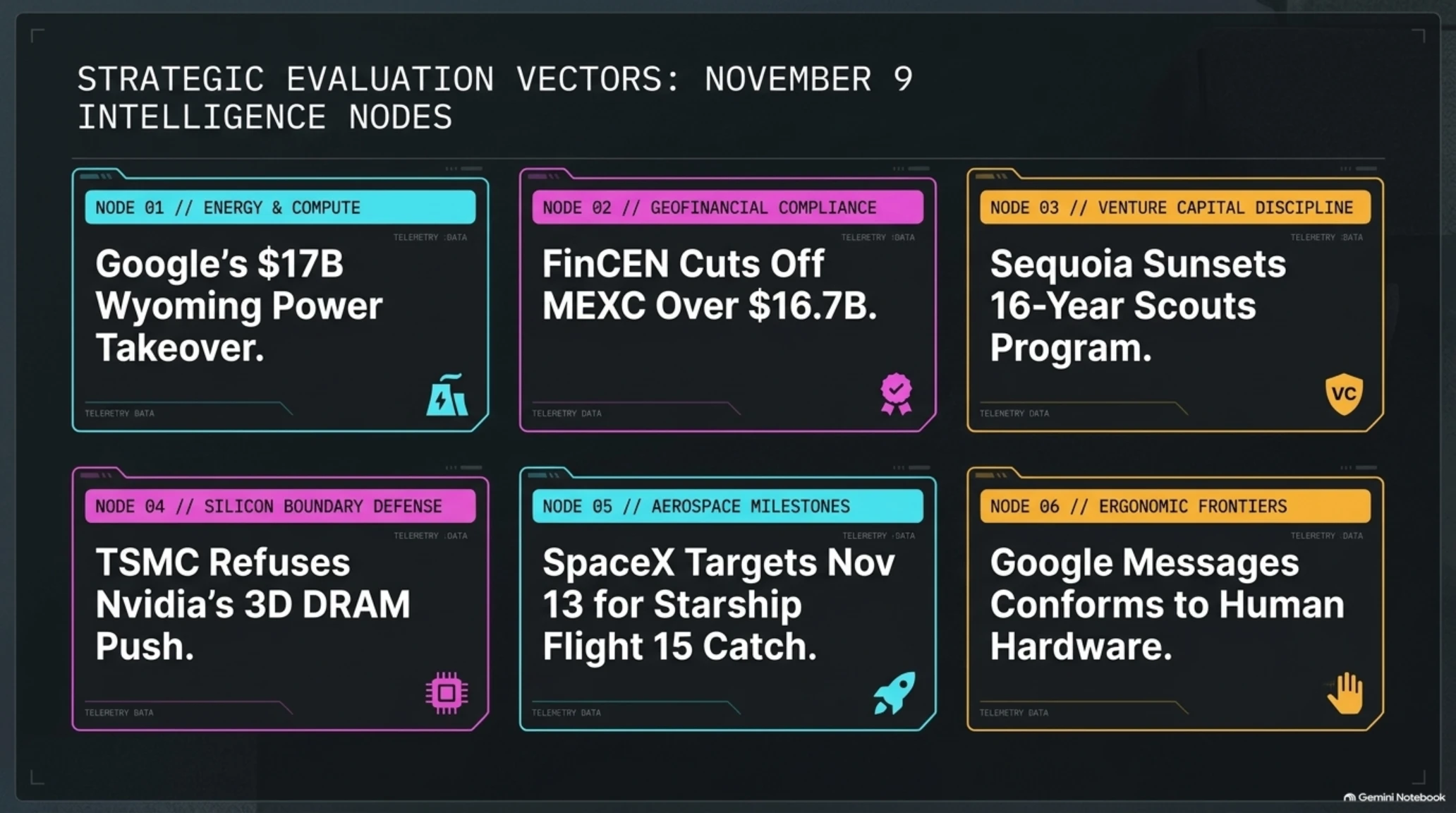
Tekin Morning for Nov 9, 2026 analyzes six major shifts: (1) Google acquiring Crusoe's 1.8GW Wyoming datacenter in a $17B expansion; (2) FinCEN severing banking access to crypto exchange MEXC over $16.7B in illicit flows; (3) Sequoia Capital shutting down its 16-year Scouts program; (4) TSMC rebuffing Nvidia's push into 3D DRAM; (5) SpaceX targeting Nov 13 for Starship Flight 15's mid-air catch; and (6) Google Messages redesign.
TEKIN MORNING // EXECUTIVE BRIEFING NOVEMBER 9, 2026
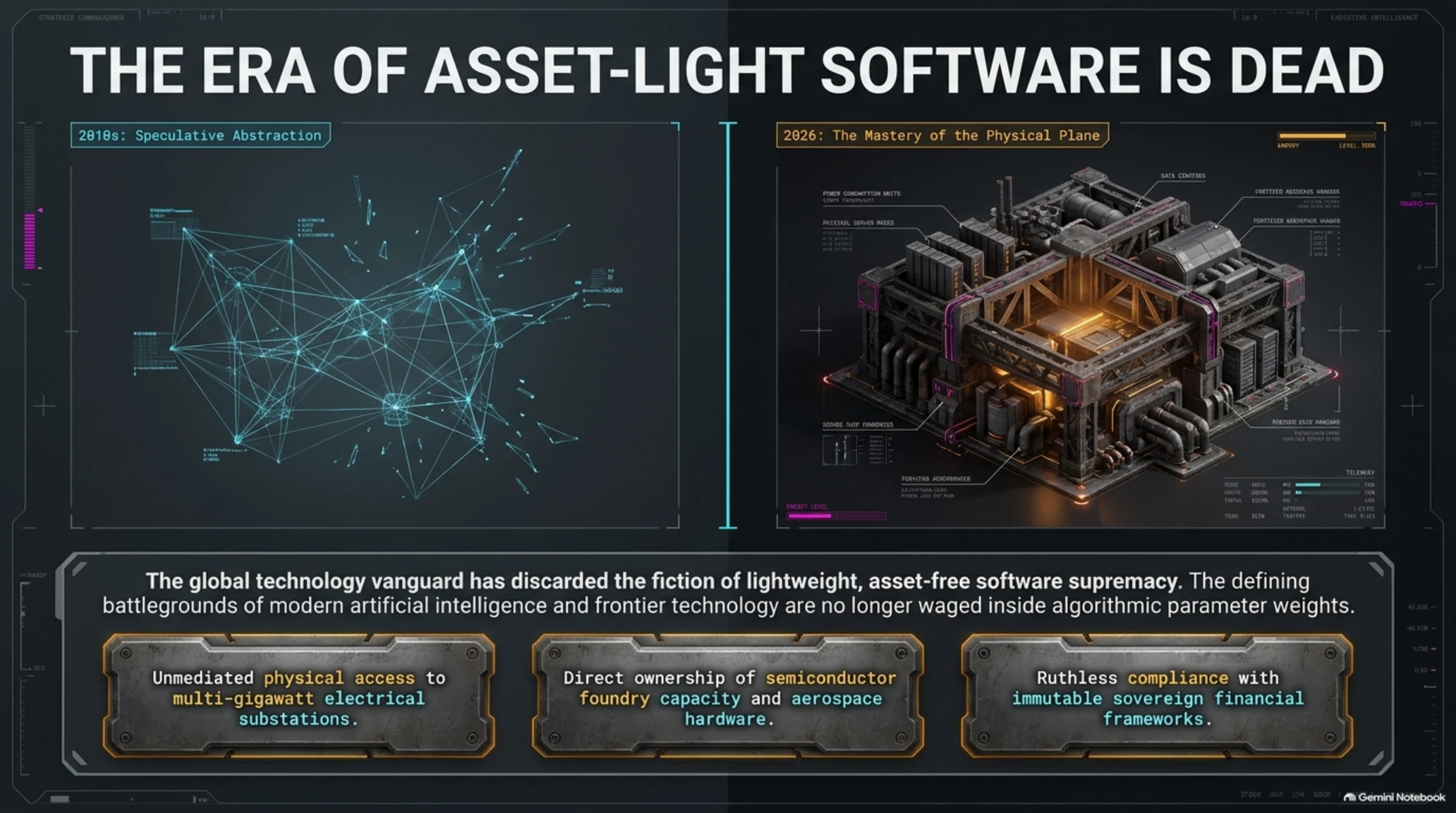
The opening of the second full business week of November 2026 reveals a fundamentally restructured technological ecosystem. The romantic era of speculative venture capital characterized by loose seed rounds, inflated user acquisition metrics, and ungrounded software promises has formally given way to an uncompromising regime of heavy infrastructure ownership, energy sovereignty, and rigorous cross-border regulatory enforcement. Technology leaders across the world have come to recognize that the defining battlegrounds of modern artificial intelligence are no longer waged merely inside algorithmic parameter weights; they are decided by physical access to multi-gigawatt electrical substations, direct ownership of semiconductor foundry capacity, and compliance with immutable sovereign financial frameworks.
This morning's strategic intelligence digest uncovers six monumental tectonic shifts. Leading our coverage, Google has dramatically escalated its physical AI scaling strategy by paying billions to take direct ownership of Crusoe's multi-gigawatt Wyoming data center campus, backing the acquisition with a staggering $17 billion regional infrastructure expansion. Simultaneously, Washington has demonstrated the uncompromising reach of its financial architecture, as the U.S. Department of the Treasury's Financial Crimes Enforcement Network (FinCEN) issued an emergency order effectively cutting off offshore cryptocurrency exchange MEXC from dollar clearing channels following the revelation of over $16.7 billion in suspected illicit and sanctions-evading transactions.
Across Silicon Valley, the venture capital paradigm underwent an historic earthquake as legendary firm Sequoia Capital published its manifesto 'The Sequoia of Tomorrow', announcing the permanent shutdown of its 16-year-old Scouts seed program, the sunsetting of its Arc accelerator, and the closure of its London office in order to concentrate massive capital into high-conviction frontier AI bets. In Taiwan, semiconductor titan TSMC firmly rebuffed pressure from its largest customer, Nvidia, refusing to enter the 3D DRAM memory fabrication space to safeguard its pure-play logic foundry neutrality. Down in Starbase, Texas, SpaceX locked in November 13 for Starship Flight 15, setting the stage for the first-ever attempt to catch the returning upper-stage spacecraft in mid-air with the launch tower's mechanical 'chopsticks'. Finally, Google delivered a comprehensive ergonomic overhaul to Google Messages, bringing iMessage-style pinned avatar bubbles, bottom-docked search navigation, and integrated Gemini access to Android users worldwide.
Key Strategic Vectors of November 9, 2026 Morning Briefing
1. Crusoe Sells Multi-Gigawatt Wyoming AI Data Center Site to Google in $17B Campus Expansion
In one of the most consequential infrastructure consolidations of the cloud computing era, artificial intelligence infrastructure developer Crusoe officially confirmed the transfer of its pre-developed data center site in southeast Wyoming (Laramie County) to Google. The transaction follows closely on the heels of Google's announcement of a staggering $17 billion capital investment to construct its premier artificial intelligence data center campus in Wyoming a state rapidly ascending to the forefront of global compute geography thanks to abundant wind corridors, clean natural gas reserves, and direct access to regional geologic carbon capture formations.
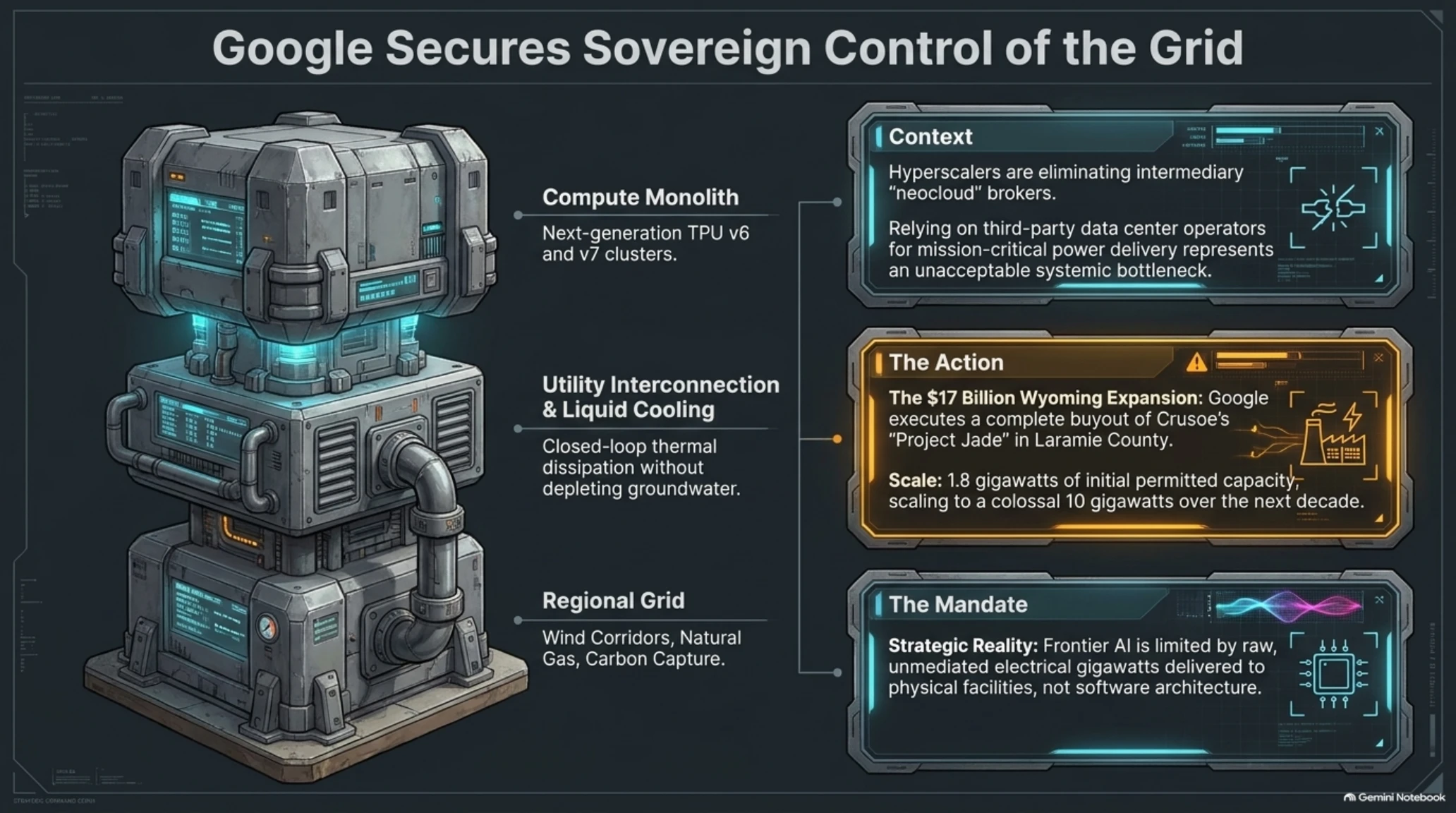
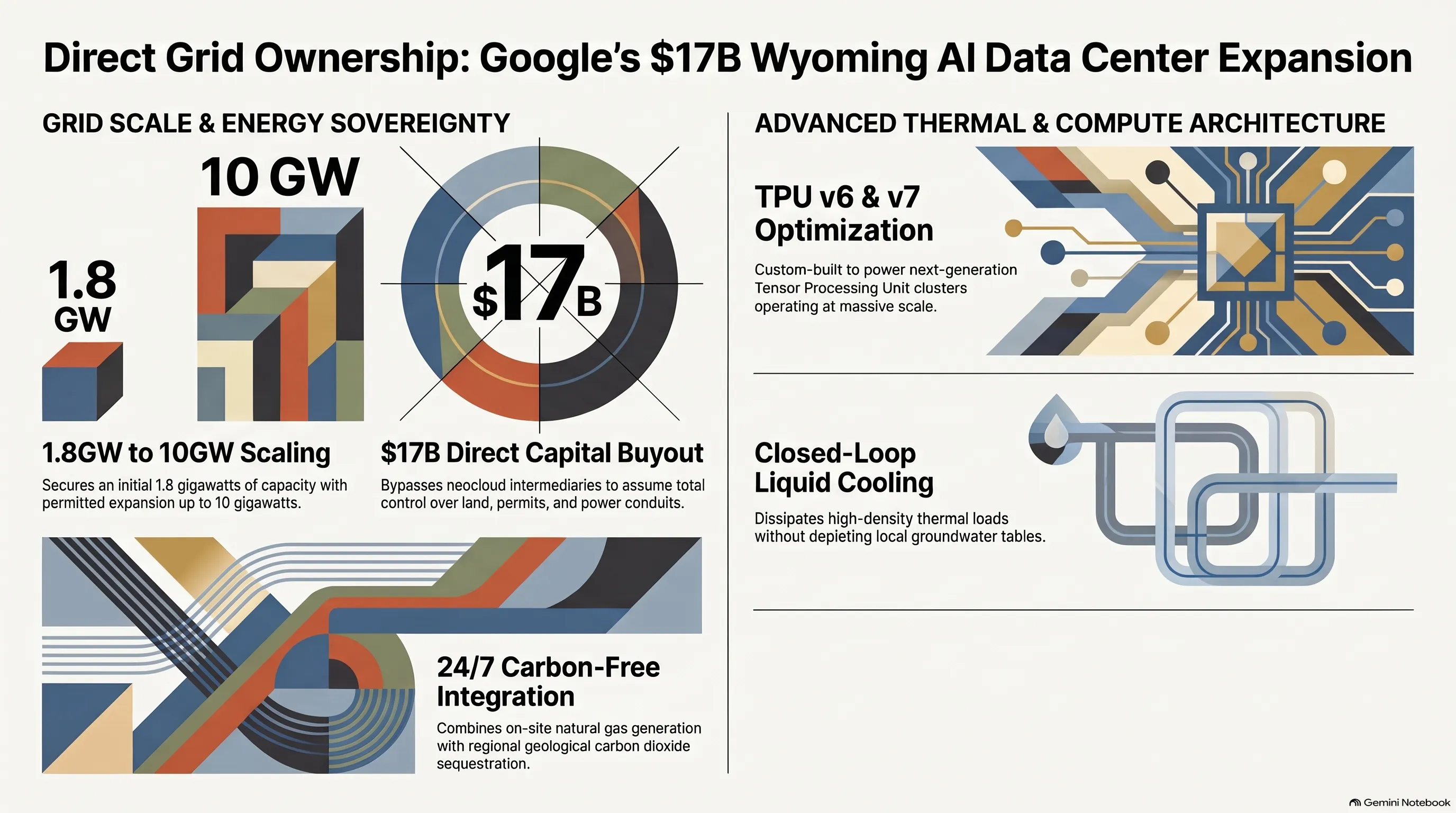
The asset acquired by Google, historically developed under the moniker 'Project Jade' in partnership with Tallgrass Energy, represents one of the largest permitted electrical power footprints on the North American continent. The site was engineered with an initial operating capacity of 1.8 gigawatts, with legally secured pathways to scale upward to a colossal 10 gigawatts over the next decade. While Crusoe initially originated the project to de-risk permitting, coordinate complex fuel-cell and natural gas hybrid power grids, and lease capacity to external hyperscalers, industry insiders report that schedule friction, equipment procurement bottlenecks, and escalating third-party development costs prompted Google to intervene directly. Rather than leasing server capacity from an intermediary, Google executed a complete buyout of the unfinished development, seizing direct operational control over the real estate, utility interconnection agreements, and environmental permits.
Engineering blueprints reveal that Google plans to deploy advanced closed-loop liquid cooling loops capable of dissipating high-density thermal loads generated by next-generation TPU v6 and TPU v7 clusters without depleting local groundwater tables. Furthermore, by pairing on-site gas generation with regional geological carbon dioxide sequestration reservoirs, the facility will maintain continuous uptime while adhering to Google's strict 24/7 carbon-free energy milestones. This direct infrastructure stewardship eliminates the operational risk of multi-tenant power rationing during peak grid stress.
This massive acquisition signals a fundamental transformation in hyperscale AI operations. In late 2026, technology behemoths have recognized that relying on intermediary 'neocloud' brokers for mission-critical power delivery represents an unacceptable systemic bottleneck. With next-generation AI training clusters requiring hundreds of thousands of specialized accelerators operating synchronously, power delivery cannot tolerate third-party delays. By taking direct ownership of the Wyoming campus, Google secures the dedicated power conduits necessary to deploy its cutting-edge TPU v6 and TPU v7 clusters at unprecedented scale. While Crusoe and Google continue to collaborate on separate initiatives including an ongoing campus development in Armstrong County, Texas the Wyoming transaction establishes an aggressive new benchmark for vertical integration between hyperscale technology giants and electrical utility infrastructure.
Why Direct Power Plant Ownership Redefines Hyperscaler Sovereignty
2. U.S. Treasury (FinCEN) Moves to Cut Off Crypto Exchange MEXC Over $16.7 Billion in Suspected Illicit Transactions
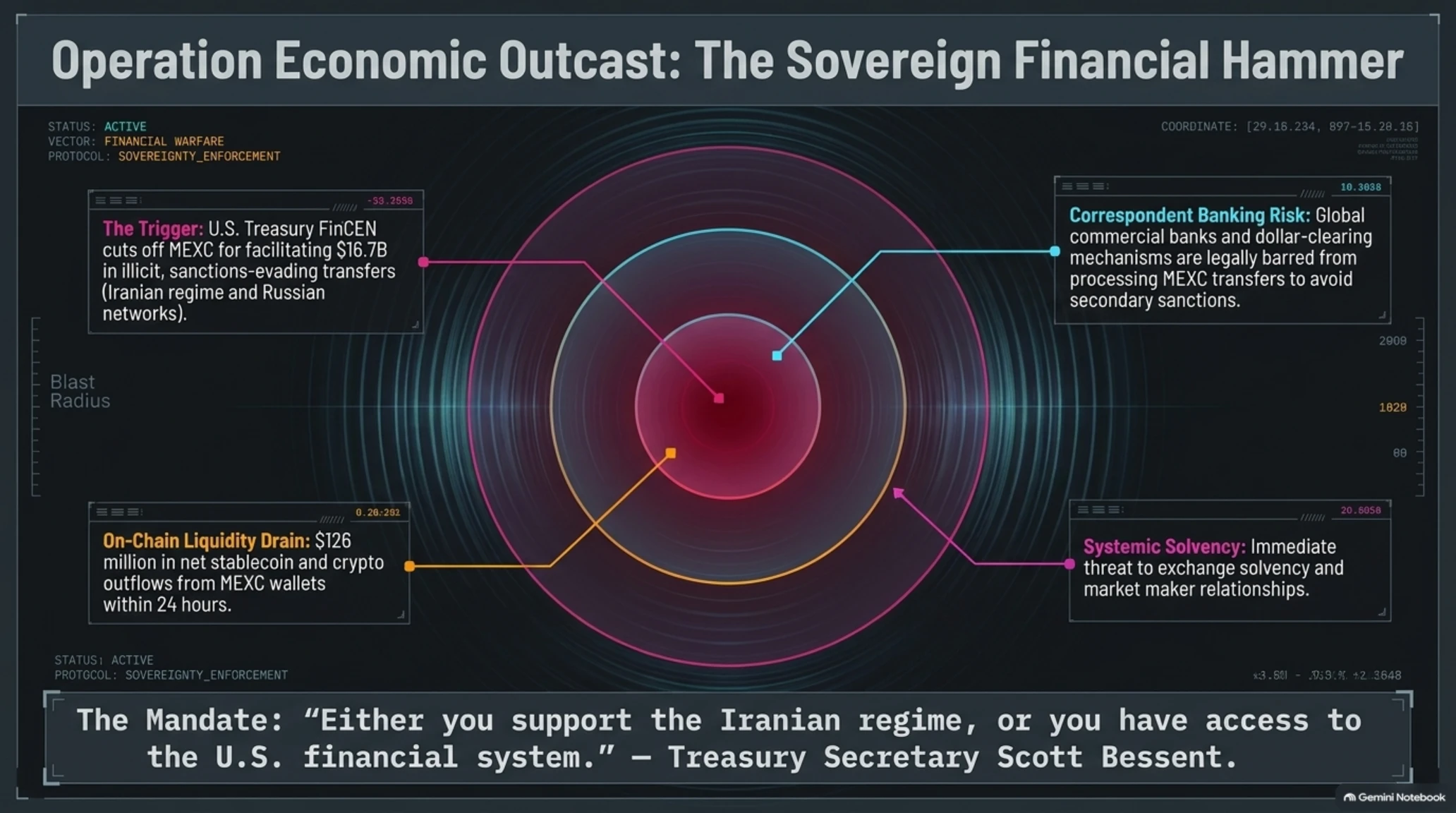
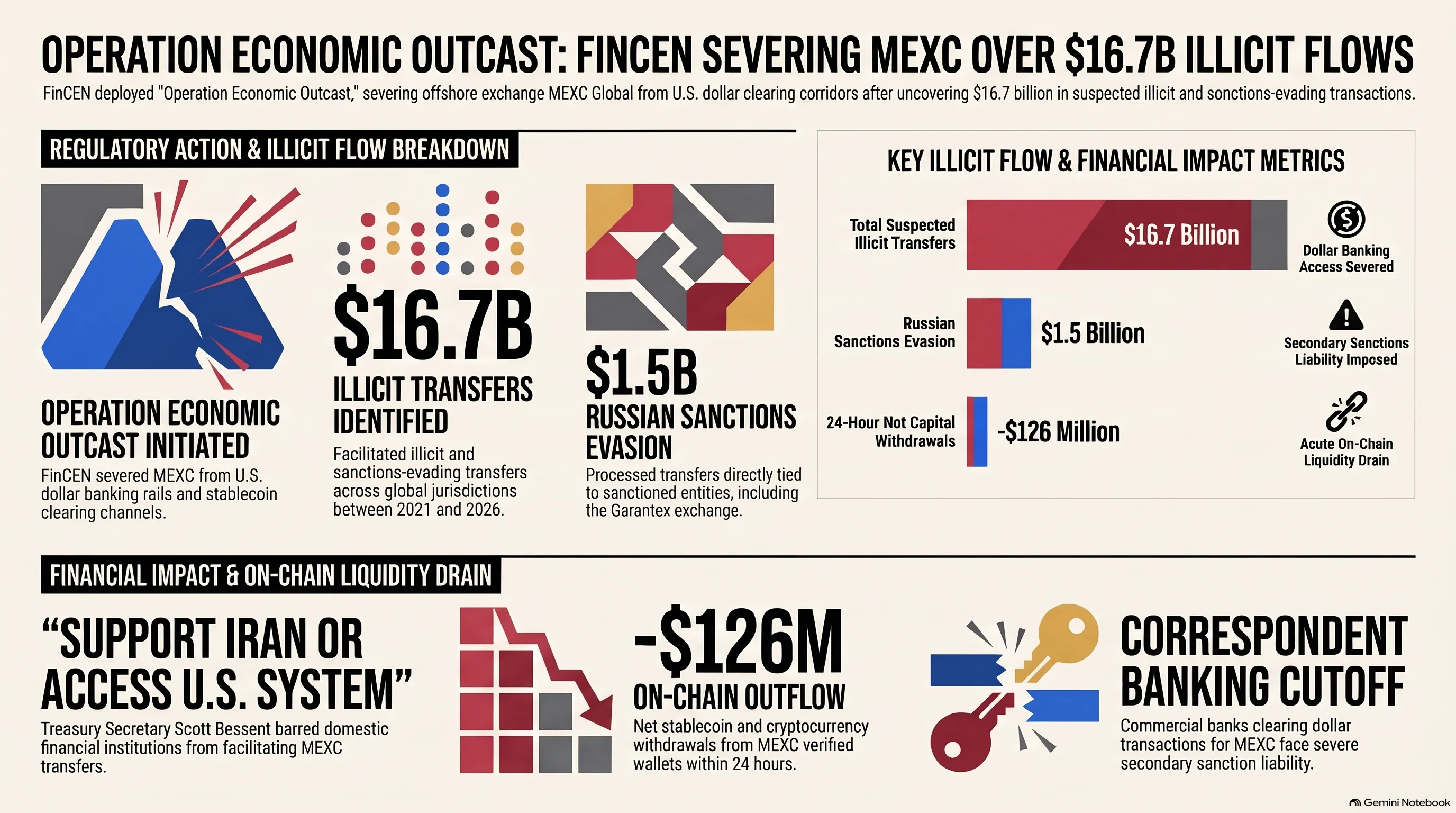
In an enforcement action that sent shockwaves across global digital asset markets, the United States Department of the Treasury's Financial Crimes Enforcement Network (FinCEN) issued an aggressive order under its newly launched 'Operation Economic Outcast', effectively cutting offshore cryptocurrency exchange MEXC Global off from the United States financial system. The comprehensive regulatory action follows an extensive multi-year investigation revealing that between May 2021 and May 2026, MEXC facilitated at least $16.7 billion in suspicious, illicit, and sanctions-evading fund transfers across international jurisdictions.
Treasury Secretary Scott Bessent articulated the administration's unyielding posture during an emergency briefing, issuing an explicit warning to offshore digital asset venues: 'Financial institutions cannot have it both ways: Either you support the Iranian regime, or you have access to the U.S. financial system.' Under the FinCEN order, domestic financial institutions, correspondent banks, and dollar-clearing mechanisms are legally barred from processing or facilitating fund transfers involving MEXC. While the order does not represent a global asset freeze seizing customer accounts directly, it inflicts acute structural damage on MEXC's ability to maintain dollar liquidity, partner with regulated stablecoin issuers, or maintain commercial banking bridges.
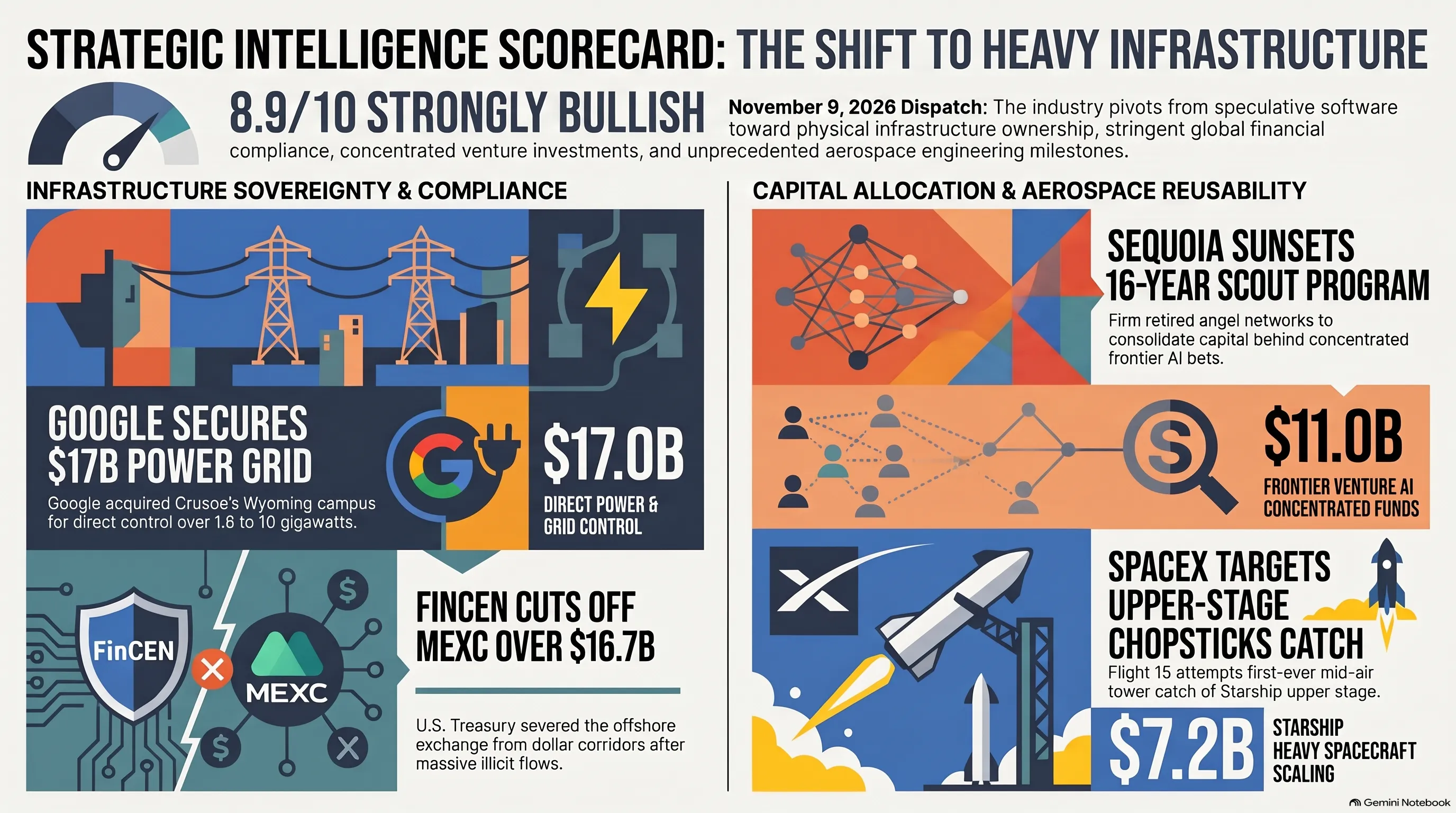
According to FinCEN's evidentiary findings, MEXC operated as a vital global clearinghouse for prohibited state entities, processing nearly $1.5 billion in transactions tied to Russian sanctions evasion (including direct counterparties associated with the sanctioned Garantex exchange) and approximately $1 billion linked to dozens of illicit currency exchange networks. Despite MEXC's public claims of maintaining robust Anti-Money Laundering (AML) filters and restricting users from high-risk territories, investigators discovered deliberate loopholes permitting sanctioned actors to freely execute anonymous, high-volume transactions. The regulatory shock triggered an immediate on-chain liquidity drain, with blockchain intelligence trackers recording over $126 million in net stablecoin and cryptocurrency outflows from MEXC's verified wallets within twenty-four hours, threatening the exchange's solvency and market maker relationships.
Technical Lexicon: Geopolitical Sanctions and Exchange Risk
3. Sequoia Capital Shuts Down 16-Year-Old Scouts Seed Program and London Office in Sweeping Overhaul
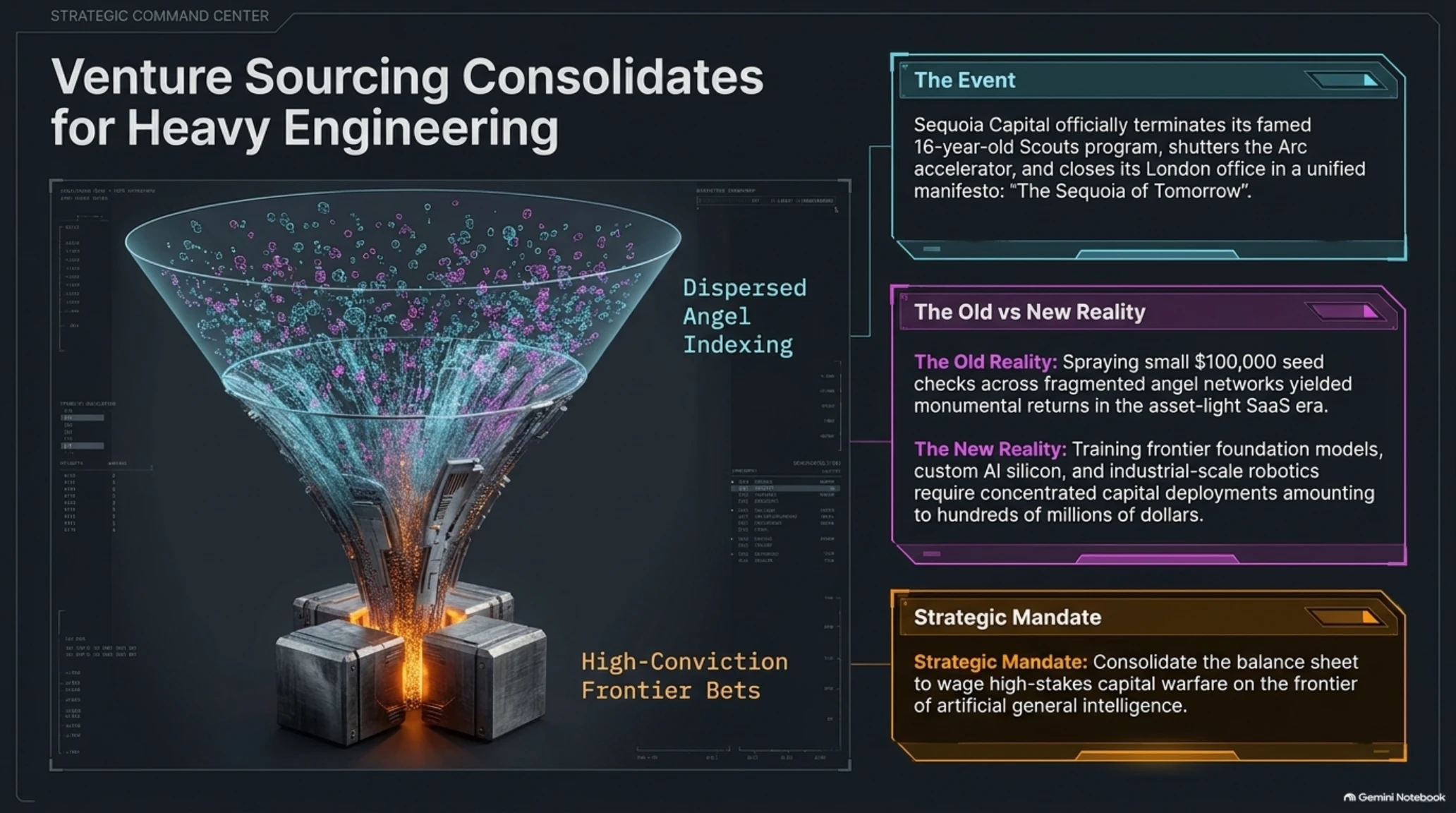
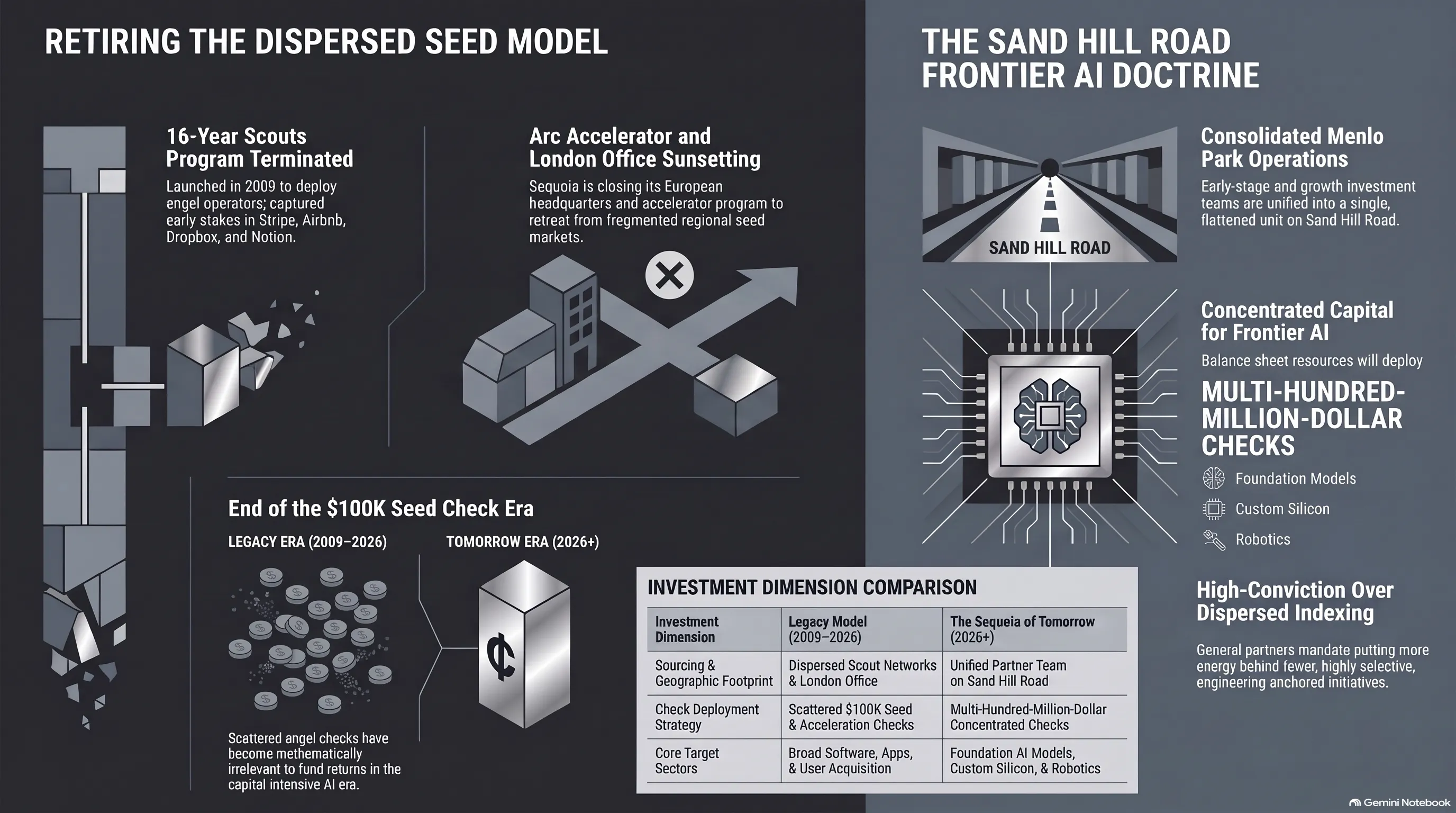
Sequoia Capital, universally regarded as the premier venture capital institution in Silicon Valley history, has sent tremors through the early-stage technology market by officially terminating its famed Scouts program after sixteen years of continuous operation. The historic pivot was detailed in a public memorandum titled 'The Sequoia of Tomorrow', signed collectively by the firm's general partners. The restructuring also encompasses the complete shutdown of Sequoia's pre-seed and seed-stage accelerator program, Arc, as well as the formal closure of its European headquarters in London.
Inaugurated in 2009, Sequoia's Scout program served as the foundational blueprint for modern venture capital sourcing networks. By deploying hundreds of external angel operators, serial founders, and technical executives armed with Sequoia capital, the firm gained proprietary, ground-floor access to transformative startups long before rival institutional funds caught wind of them. The Scout mechanism directly yielded monumental investment returns, capturing foundational equity stakes in generation-defining giants including Stripe, Airbnb, Dropbox, and Notion. However, Sequoia's leadership acknowledged that the economics of technology creation have irrevocably shifted in the era of artificial intelligence.
Under the new strategic doctrine, Sequoia is consolidating its early-stage and growth investment teams into a unified, flattened operational unit, returning squarely to its historic roots on Sand Hill Road in Menlo Park. The firm's partners emphasized that the contemporary technology landscape demands 'high-conviction, highly selective venture capital investing' rather than dispersed angel indexing. Training frontier foundation models, building custom AI silicon, and deploying industrial-scale robotics require concentrated checks amounting to hundreds of millions of dollars, rendering scattered $100,000 seed checks mathematically irrelevant to fund returns. By consolidating resources and retreating from the fragmented European market, Sequoia is retooling its entire balance sheet to wage high-stakes capital warfare on the frontier of artificial general intelligence.
4. TSMC Rejects Nvidia's Push for 3D DRAM Production, Reaffirming Pure-Logic Foundry Monopoly
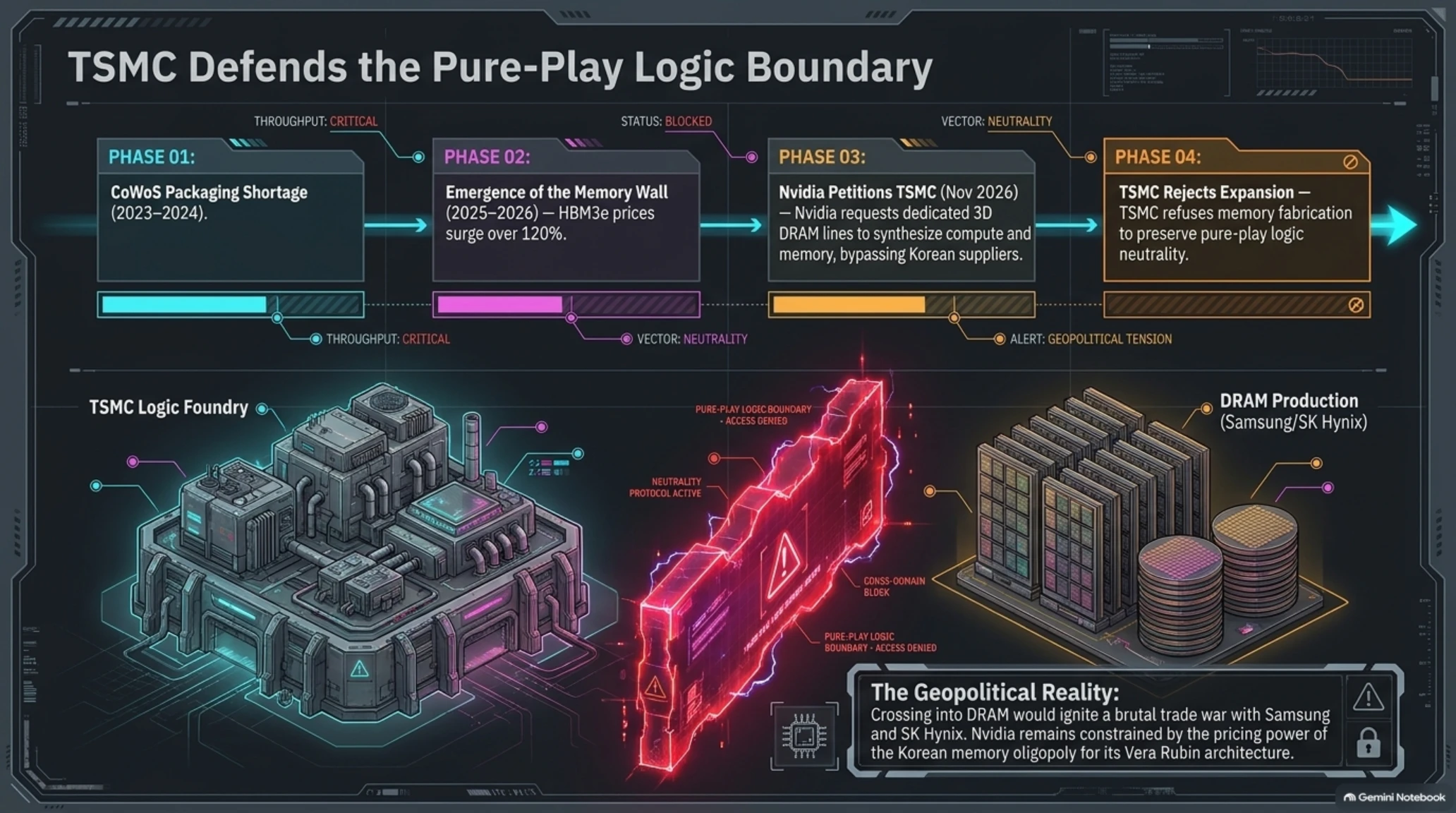
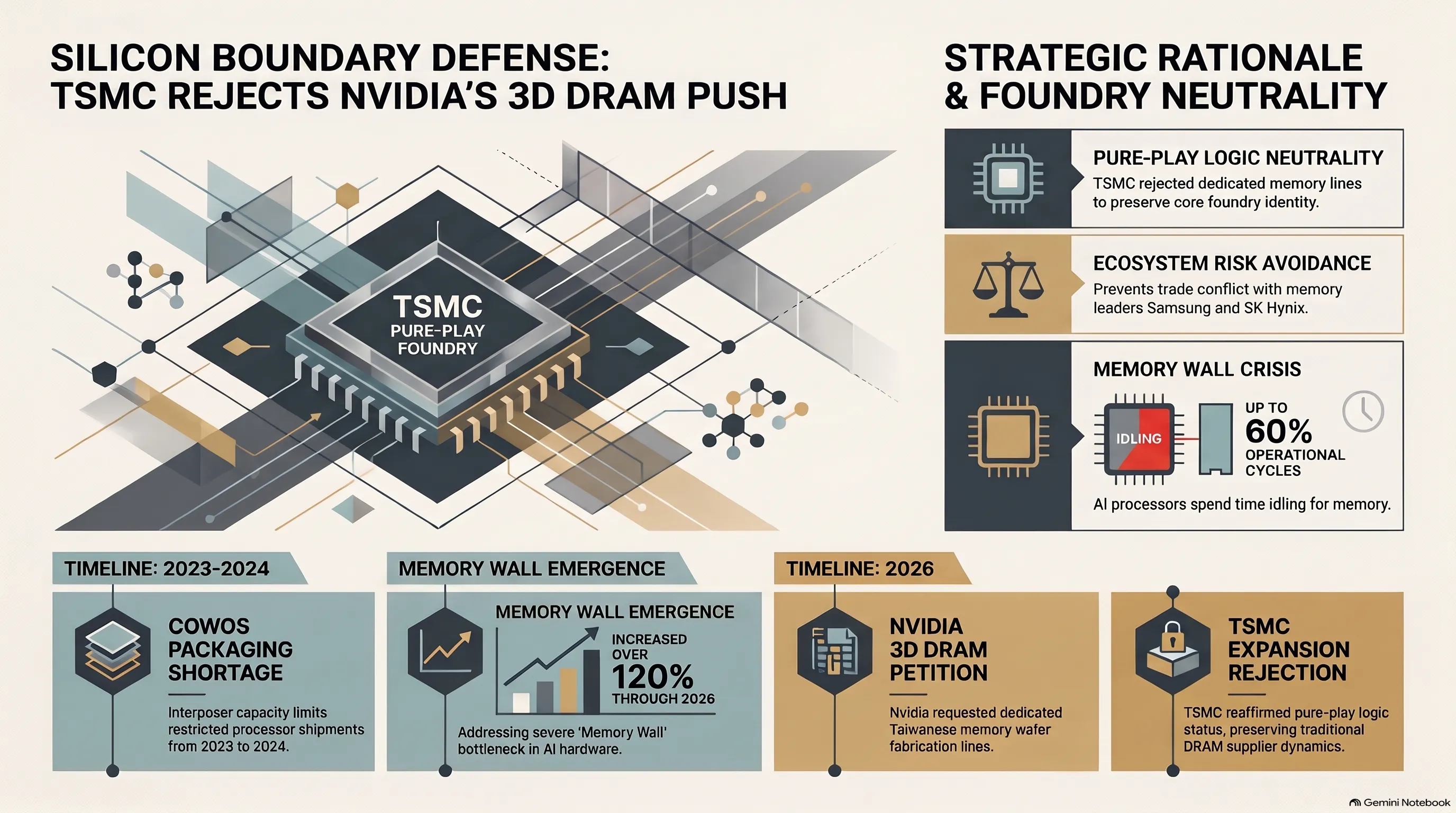
The escalating 'Memory Wall' the severe physical latency and bandwidth bottleneck separating compute processors from volatile memory has evolved into the single most critical structural constraint facing generative AI hardware. Over the weekend, reports surfaced via The Information alleging that Nvidia had formally petitioned its primary manufacturing partner, Taiwan Semiconductor Manufacturing Company (TSMC), to establish dedicated fabrication lines for advanced 3D DRAM (three-dimensional dynamic random-access memory), seeking an integrated manufacturing pipeline to overcome acute memory shortages in next-generation AI accelerators.
In contemporary foundation model training and inference pipelines, memory throughput dictates actual floating-point compute utilization. While modern GPU clusters boast theoretical petaflops of matrix computation, processors spend up to sixty percent of their operational cycles idling while waiting for memory busses to fetch parameter weights across wide interconnects. Nvidia's technological vision was to compress this latency by fabricating vertically stacked 3D DRAM cells directly onto the base logic silicon using TSMC's state-of-the-art wafer-to-wafer hybrid bonding techniques, effectively synthesizing compute and memory into a single physical monolith.
This morning, TSMC decisively shattered those speculations, issuing an unambiguous public declaration reiterating its corporate boundaries. Speaking to industry analysts, TSMC executives reaffirmed that the Taiwanese giant has no intention of entering the memory fabrication sector, standing firmly behind its identity as the world's premier, independent 'pure-play logic integrated circuit foundry'. While TSMC will continue aggressive technological leadership in advanced multi-die packaging including its proprietary Chip-on-Wafer-on-Substrate (CoWoS) and System-on-Integrated-Chips (SoIC) technologies it will strictly refrain from manufacturing raw DRAM silicon cells, leaving memory fabrication exclusively to conventional memory specialists.
TSMC's refusal represents a masterclass in geopolitical and commercial risk management. By maintaining strict neutrality, TSMC avoids alienating its major memory partners primarily South Korea's SK Hynix and Samsung Electronics, alongside Micron Technology who supply the High Bandwidth Memory (HBM3e and HBM4) stacks integrated into TSMC's CoWoS packaging. Had TSMC entered the DRAM market to appease Nvidia, it would have ignited a brutal trade war with Samsung and jeopardized its trusted position across the broader semiconductor ecosystem. For Nvidia, however, the refusal means Jensen Huang remains constrained by the pricing power and manufacturing capacity of the Korean memory oligopoly, forcing Nvidia to absorb astronomical HBM premium costs for its upcoming Vera Rubin architecture.
Chronology of the AI Memory Bottleneck Crisis
5. SpaceX Targets November 13 for Starship Flight 15: First Historic Upper-Stage Chopsticks Catch Attempt
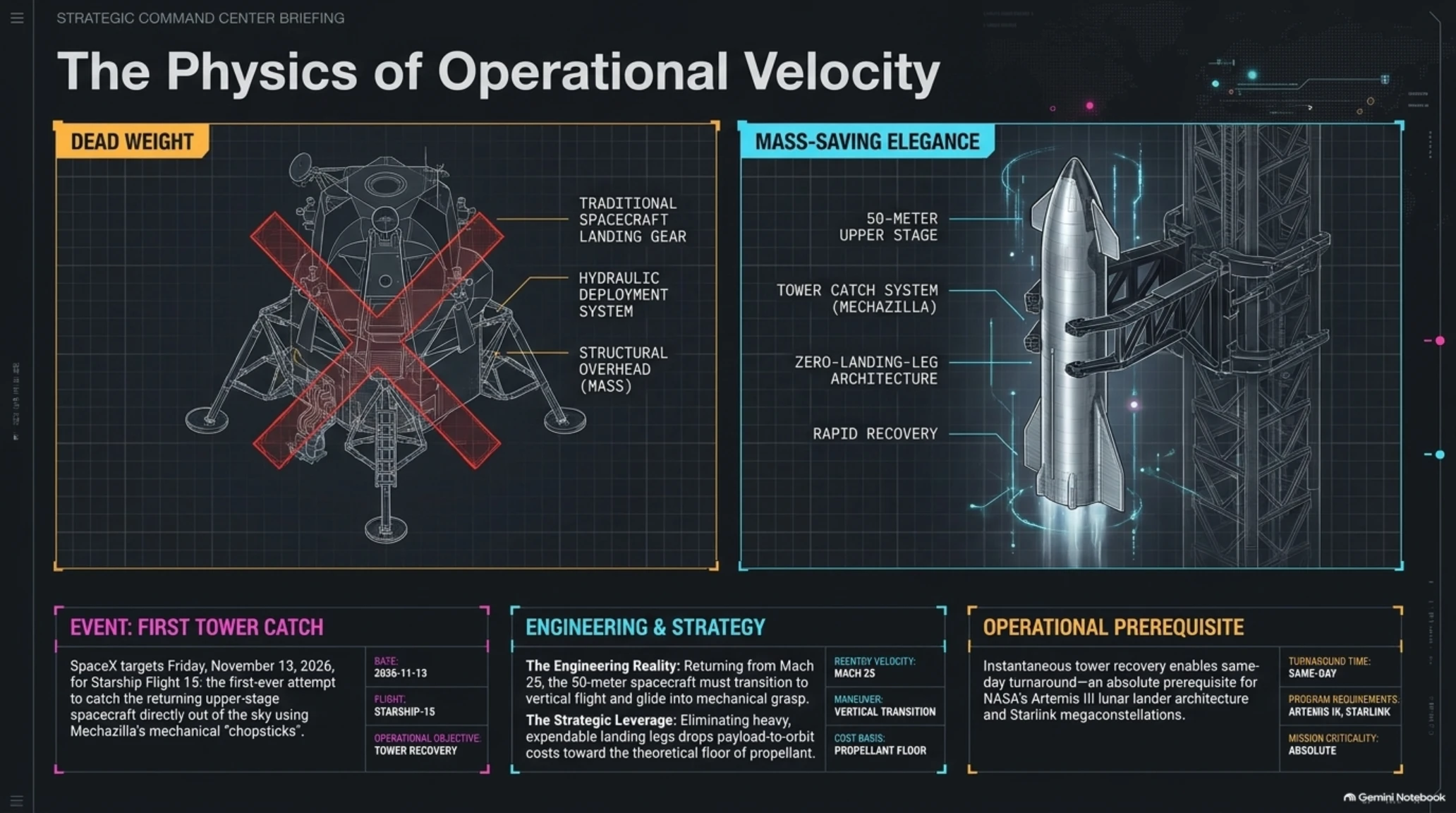
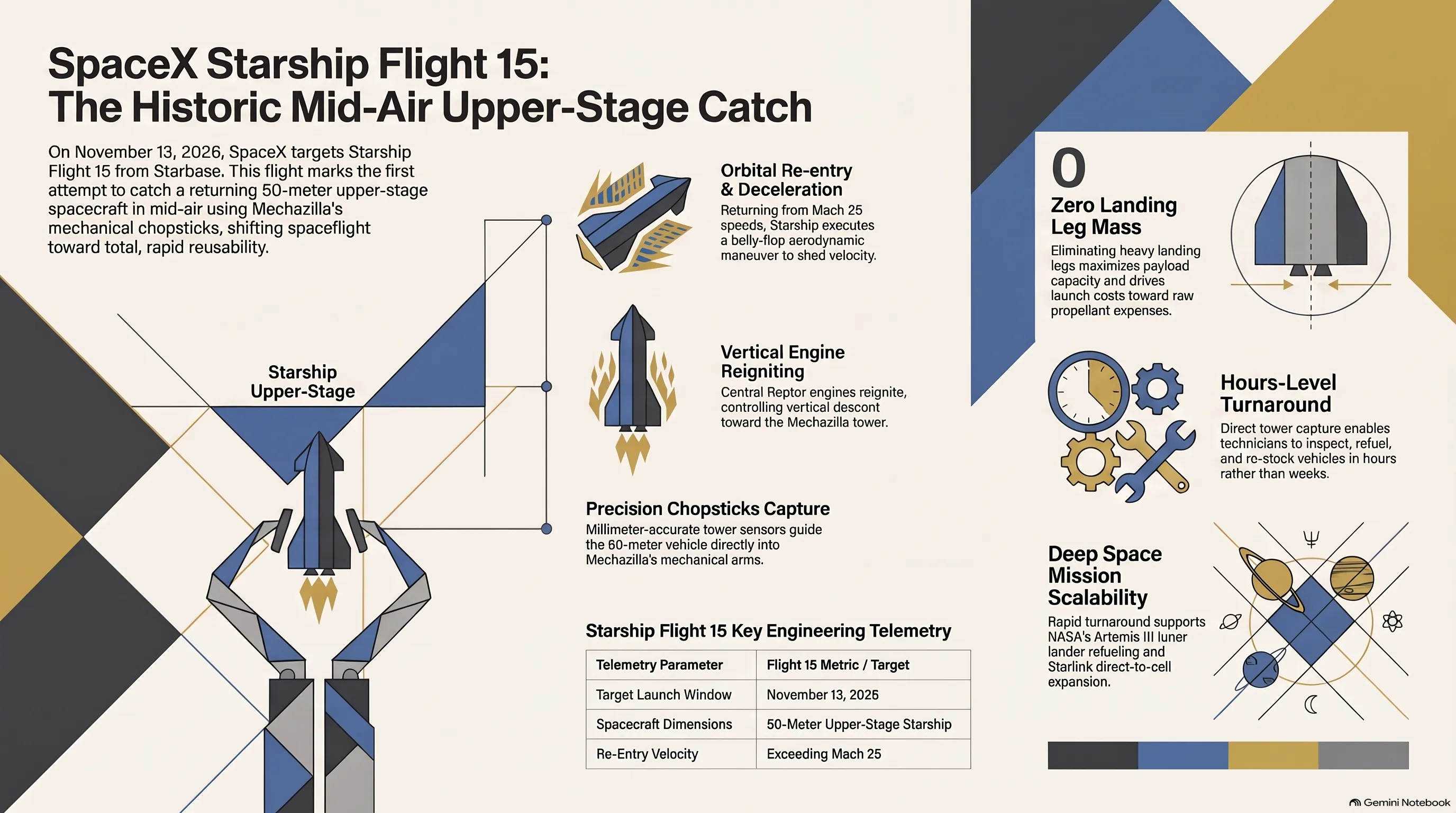
The space launch sector is on the brink of an historic technological milestone as SpaceX officially targets Friday, November 13, 2026, for the 15th integrated flight test (IFT-15) of its revolutionary Starship launch vehicle from Starbase in Boca Chica, Texas. Subject to final regulatory sign-off from the Federal Aviation Administration (FAA), the upcoming flight test represents the culmination of Elon Musk's decades-long pursuit of total, instantaneous aerospace reusability.
While SpaceX previously stunned the aerospace community by successfully executing precision catches of the massive Super Heavy first-stage booster using the Mechazilla launch tower's dual mechanical 'chopsticks', Flight 15 will feature an audacious first-ever attempt to catch the returning upper-stage Starship vehicle itself directly out of the sky. Returning from orbital velocities exceeding Mach 25, the 50-meter-tall spacecraft must endure blistering atmospheric re-entry temperatures before performing an intricate belly-flop aerodynamic deceleration, reigniting its central Raptor engines, transitioning to vertical flight, and gliding into the mechanical grasp of the tower arms.
Achieving upper-stage catch capability eliminates the need for heavy, expendable landing legs and vulnerable offshore sea recovery platforms, driving payload-to-orbit launch costs down toward the theoretical floor of propellant expenses alone. Instantaneous tower recovery allows technicians to immediately inspect, refuel, and re-stack the Starship vehicle on top of the Super Heavy booster within a matter of hours rather than weeks. This operational velocity is an absolute prerequisite for executing NASA's Artemis III lunar lander refueling architecture, scaling Starlink's direct-to-cell megaconstellation, and establishing continuous orbital freight supply chains.
📚 Classified & Related Dossiers in TekinGame
If you wish to explore beyond this report and delve into cybernetic frontiers and autonomous AI architectures, do not miss these three exclusive deep-dives in the Tekin Garage:
Aerospace Verification | Myth vs. Reality in Starship Tower Catches
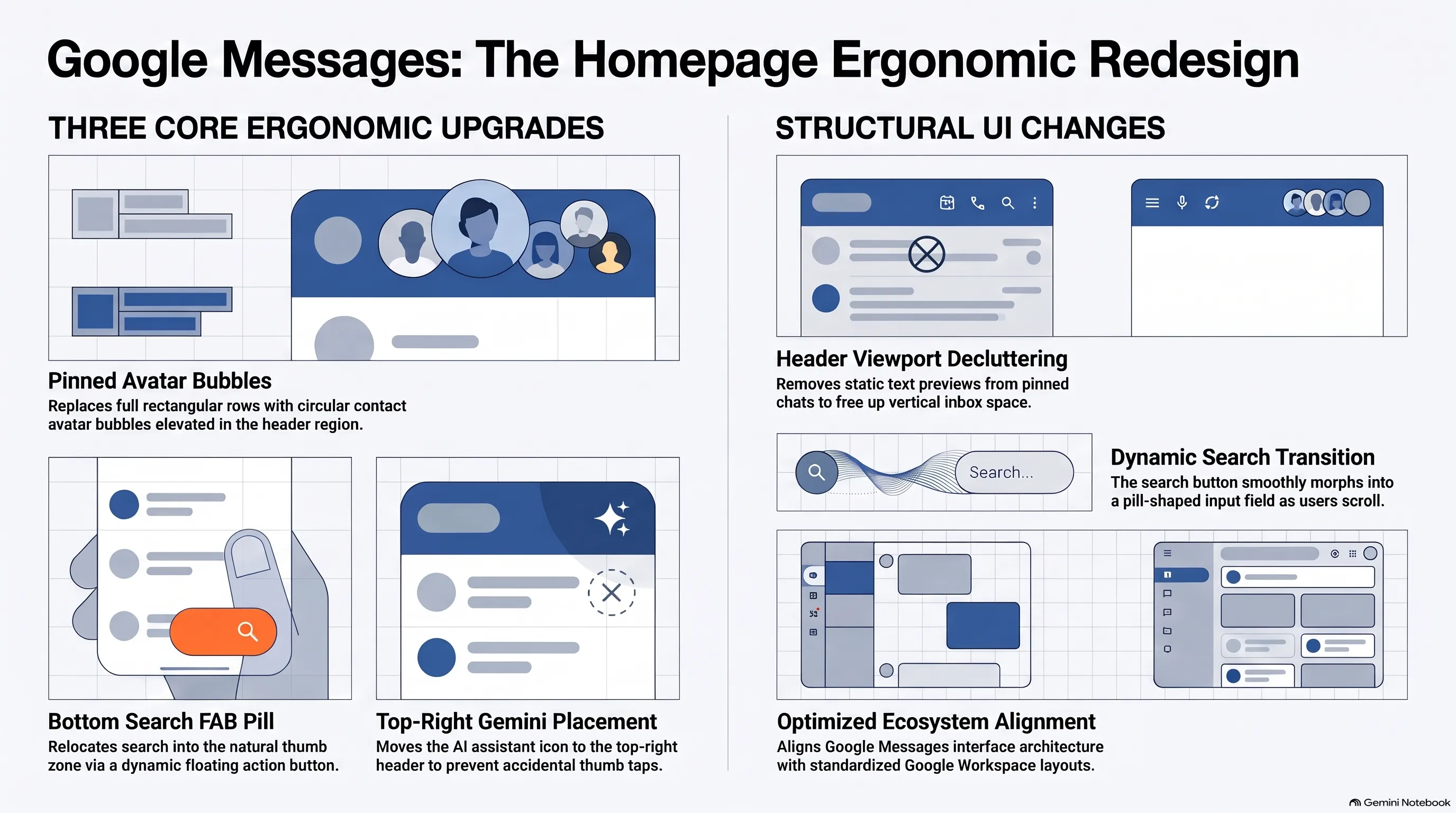
6. Google Messages Rolls Out Homepage Redesign: Pinned Avatar Bubbles, Bottom Search Pill, and Corner Gemini
In the consumer operating system and mobile communications arena, Google has commenced the broad beta deployment of a major structural homepage overhaul for Google Messages. The redesign represents the culmination of extensive ergonomic research into modern smartphone interaction patterns, delivering a sophisticated visual and functional upgrade to Android's default communication platform.
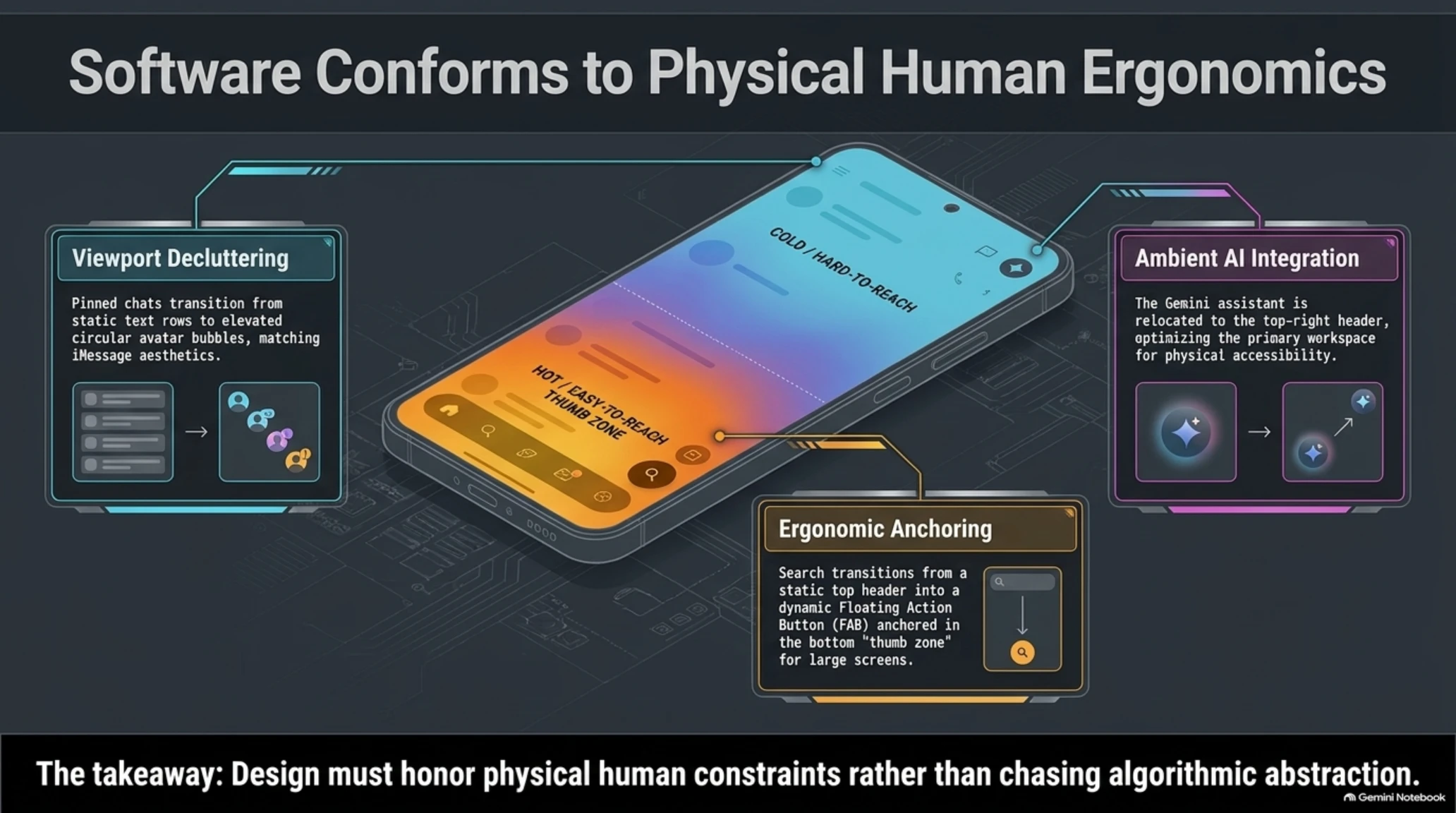
The overhaul is anchored by three prominent structural transformations. First, pinned conversations have been completely reimagined: rather than displaying full rectangular message rows with static text previews, pinned chats now appear as prominent circular contact avatar bubbles elevated in the header region above the main inbox stream an elegant aesthetic directly mirroring Apple's iMessage interface that significantly declutters the primary viewport.
Second, Google has resolved a longstanding ergonomic frustration on large-screen smartphones by relocating the search interface into the natural 'thumb zone' at the bottom of the display. Search has transitioned from a static top header bar into a dynamic Floating Action Button (FAB) that morphs smoothly into an accessible pill-shaped search input as the user scrolls through conversation histories. Finally, with the bottom of the screen dedicated to fluid search and conversation creation, the persistent Gemini assistant icon has been relocated to the top-right header adjacent to the user profile avatar, aligning Google Messages with the interface architecture of other Google Workspace applications while eliminating accidental thumb taps. The redesign underscores Google's commitment to prioritizing human ergonomic comfort alongside the ambient integration of artificial intelligence.
Strategic Metric Telemetry: Monday Infrastructure Indicators
| STRATEGIC EVENT | QUANTITATIVE METRIC | KEY ACTORS | GEOPOLITICAL / MARKET IMPACT |
|---|---|---|---|
| Google Wyoming Data Center Takeover | $17 Billion / 1.8 to 10 GW | Google / Crusoe | Direct corporate ownership of synchronous grid infrastructure |
| FinCEN MEXC Exchange Sanction | $16.7 Billion / -$126M Drain | US Treasury / FinCEN | Uncompromising regulatory enforcement against offshore crypto venues |
| Sequoia Scouts Program Sunsetting | 16-Year Operating Blueprint | Sequoia Capital | Concentration of institutional capital on frontier foundation AI bets |
| TSMC 3D DRAM Memory Denial | Pure-Play Foundry Boundary | TSMC / Nvidia | Preservation of Taiwanese logic neutrality and Korean memory leverage |
| SpaceX Starship Flight 15 | November 13, 2026 Target | SpaceX / NASA | First attempt to catch returning orbital ship with Mechazilla tower |
| Google Messages UI Overhaul | Beta Release November 2026 | Google Android | One-handed thumb zone ergonomics and iMessage-style pinned bubbles |
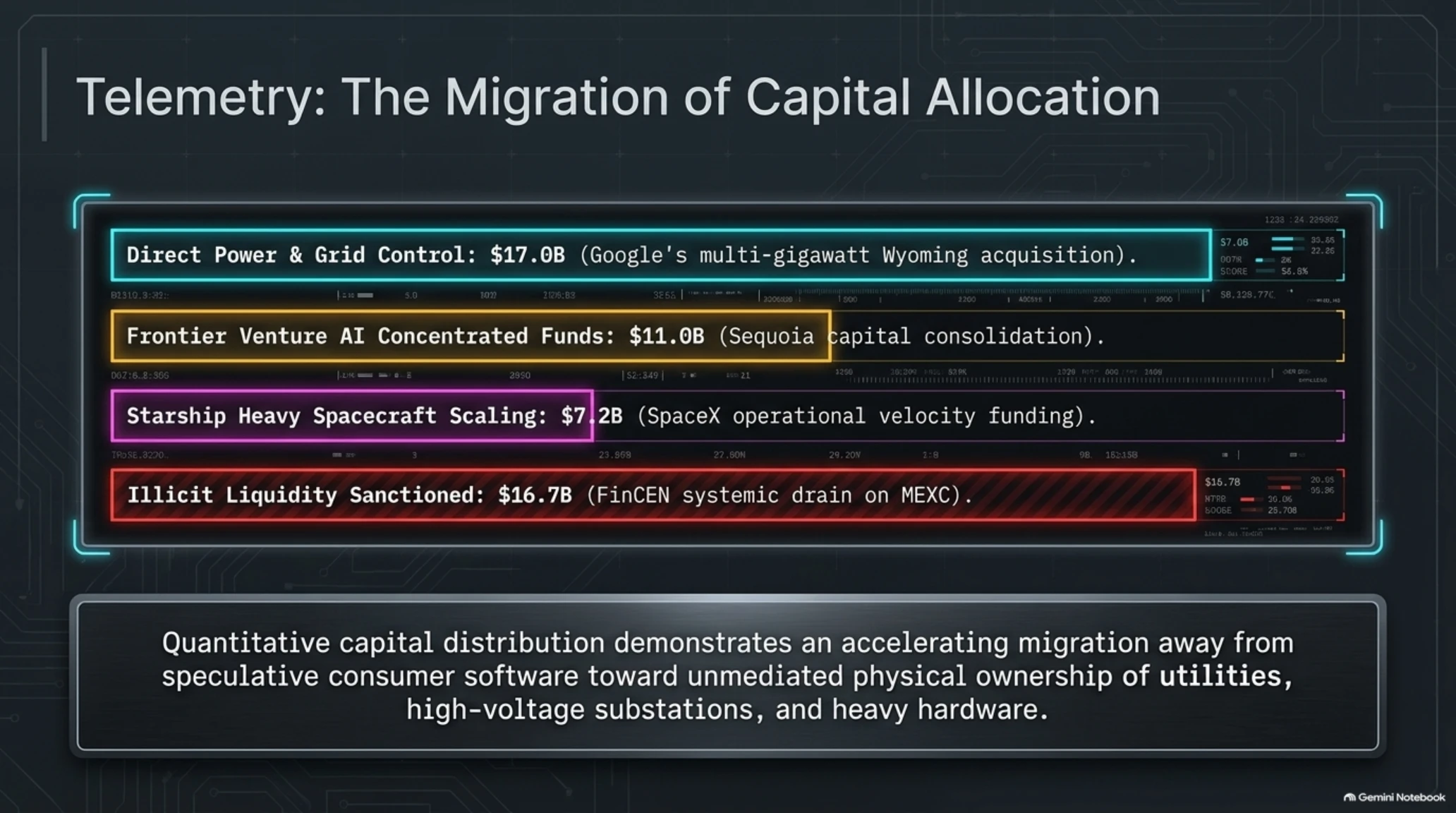
Capital Allocation Shift: Infrastructure vs. Software Scaling
7. Strategic Synthesis: Capital Discipline, Infrastructure Sovereignty, and the Mastery of the Physical Plane
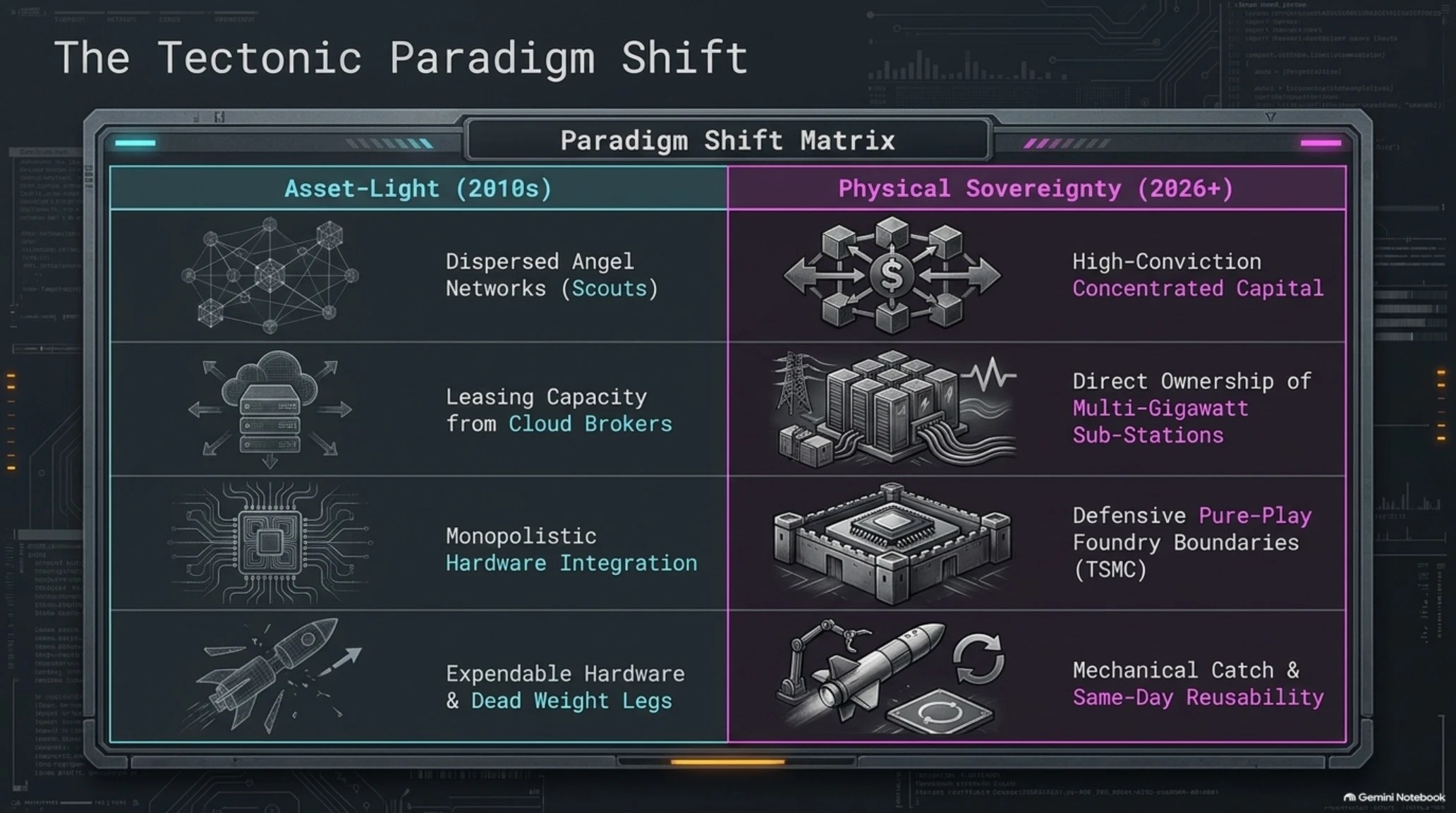
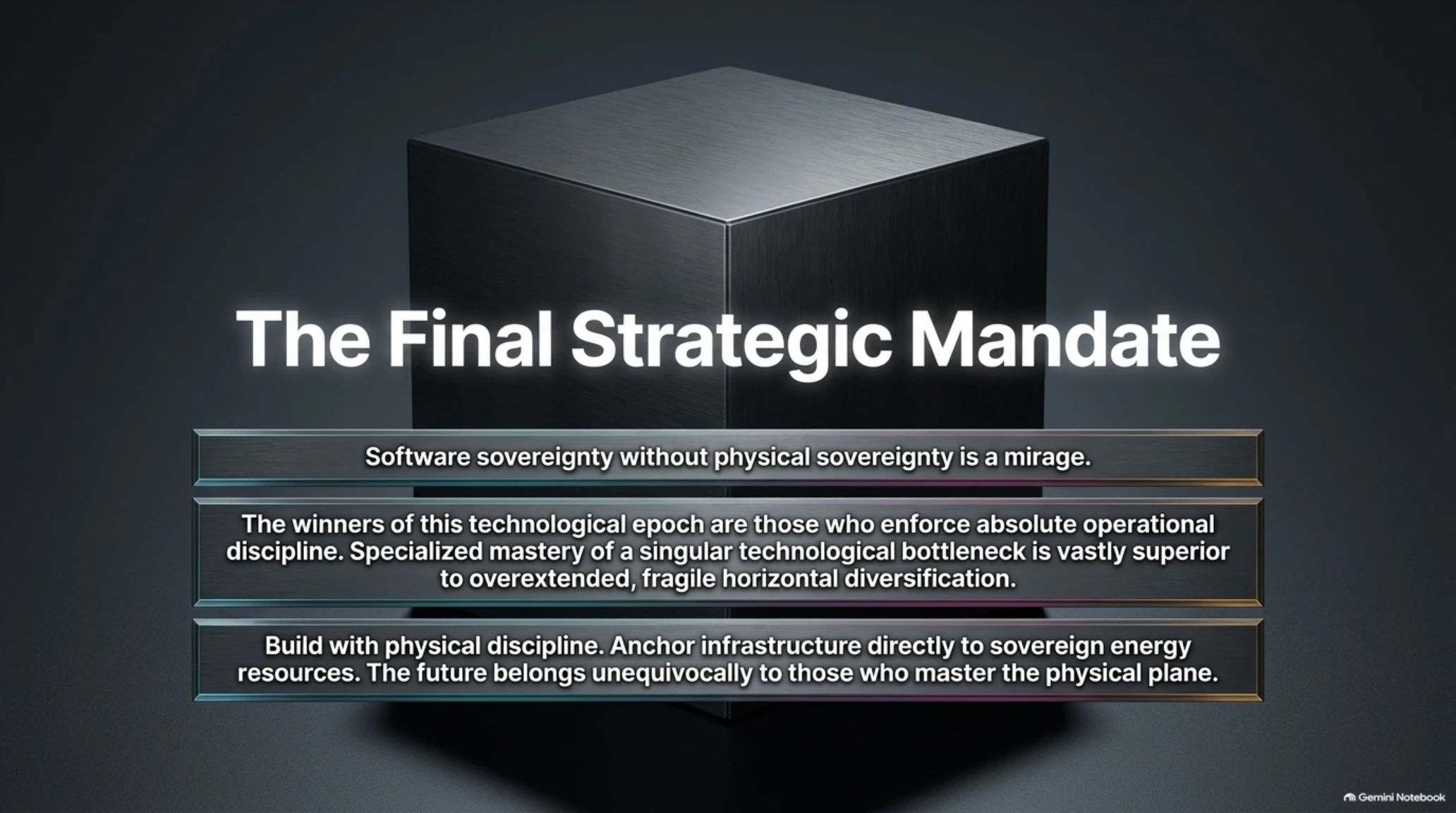
The collective intelligence gathered on the morning of Monday, November 9, 2026, marks the definitive end of technology's romantic era. For the past decade, the tech industry was intoxicated by the illusion of asset-light disruption: the belief that capital could float above physical reality, creating multi-trillion-dollar valuations without engaging in the heavy, complex friction of civil engineering, power generation, or industrial manufacturing. That era is over. The events of this morning prove that software sovereignty without physical sovereignty is a mirage.
When Google commits $17 billion to take direct ownership of gigawatt power lines in Wyoming, when the U.S. Treasury paralyzes an offshore exchange handling $16.7 billion with a single regulatory stroke, and when Sequoia Capital abruptly sunsets a 16-year-old angel scouting apparatus to concentrate massive funds into fewer, deeper frontier bets, a singular lesson emerges: the winners of the next technological epoch are those who enforce absolute operational discipline. TSMC's refusal to breach its logic foundry neutrality further underscores this principle specialized mastery of a singular technological bottleneck is vastly superior to overextended, fragile horizontal diversification.
Meanwhile, on the launch pad at Starbase, SpaceX's impending attempt to catch a 50-meter spacecraft out of the sky with mechanical chopsticks serves as an inspiring reminder that human ambition is once again expanding beyond the screen. As technology leaders navigate the remaining years of this decade, the strategic mandate is clear: build with physical discipline, anchor infrastructure directly to sovereign energy resources, and design user experiences that honor human ergonomics rather than chasing short-lived algorithmic hype.
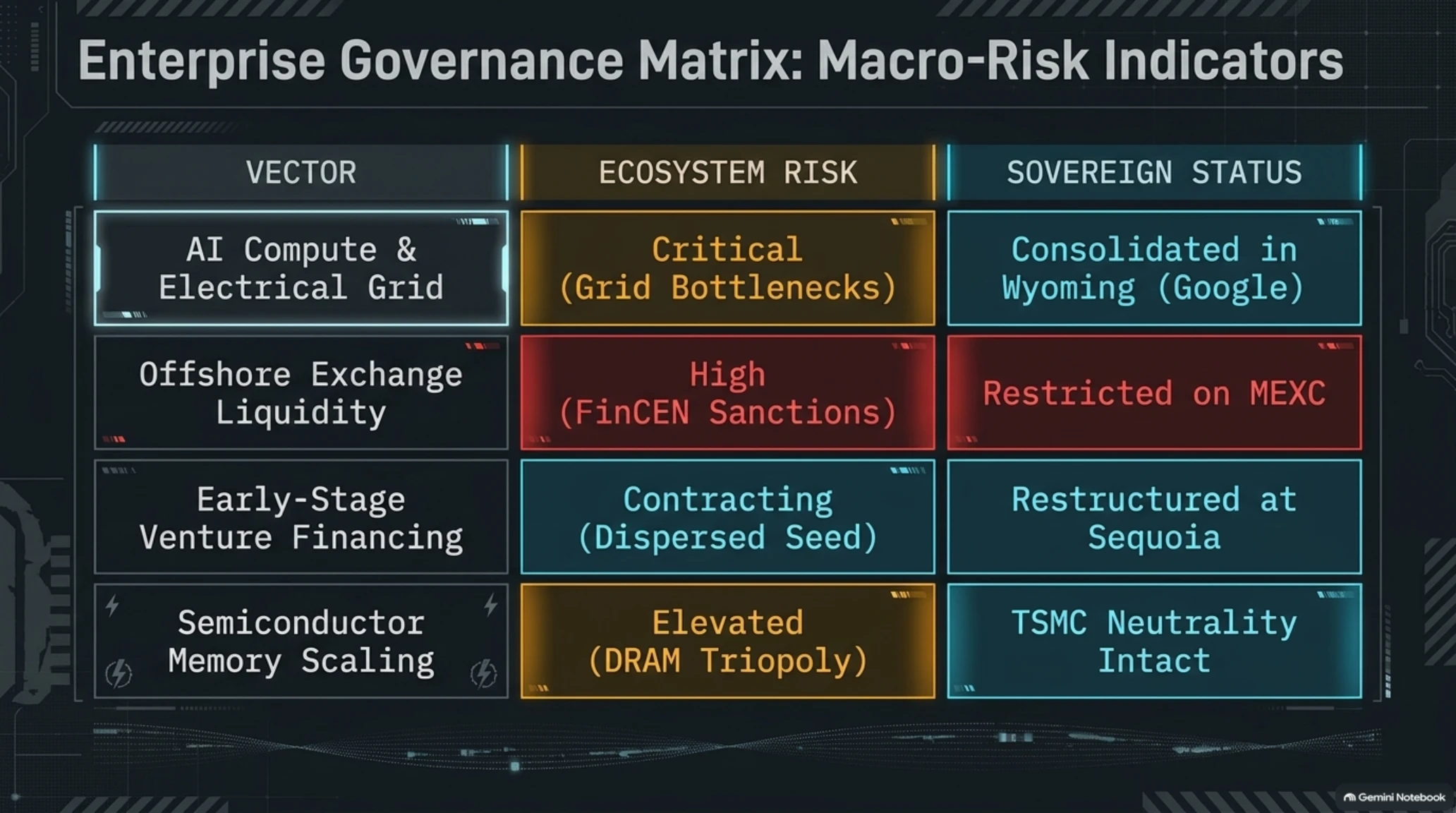
Enterprise Governance Matrix: Geopolitical and Technological Indicators
| INFRASTRUCTURE VECTOR | ECOSYSTEM RISK LEVEL | SOVEREIGN STATUS | RECOMMENDED STRATEGIC POSTURE |
|---|---|---|---|
| AI Compute & Electrical Grid | Critical (Grid Bottlenecks) | Consolidated in Wyoming | Secure direct utility ownership; avoid reliance on third-party neoclouds. |
| Offshore Exchange Liquidity | High (FinCEN Sanctions) | Restricted on MEXC | Migrate corporate treasuries to cold custody and fully audited reserves. |
| Early-Stage Venture Financing | Contracting (Dispersed Seed) | Restructured at Sequoia | Demonstrate concrete revenue unit economics over speculative growth. |
| Semiconductor Memory Scaling | Elevated (DRAM Triopoly) | TSMC Neutrality Intact | Optimize neural model architectures for strict memory footprint efficiency. |
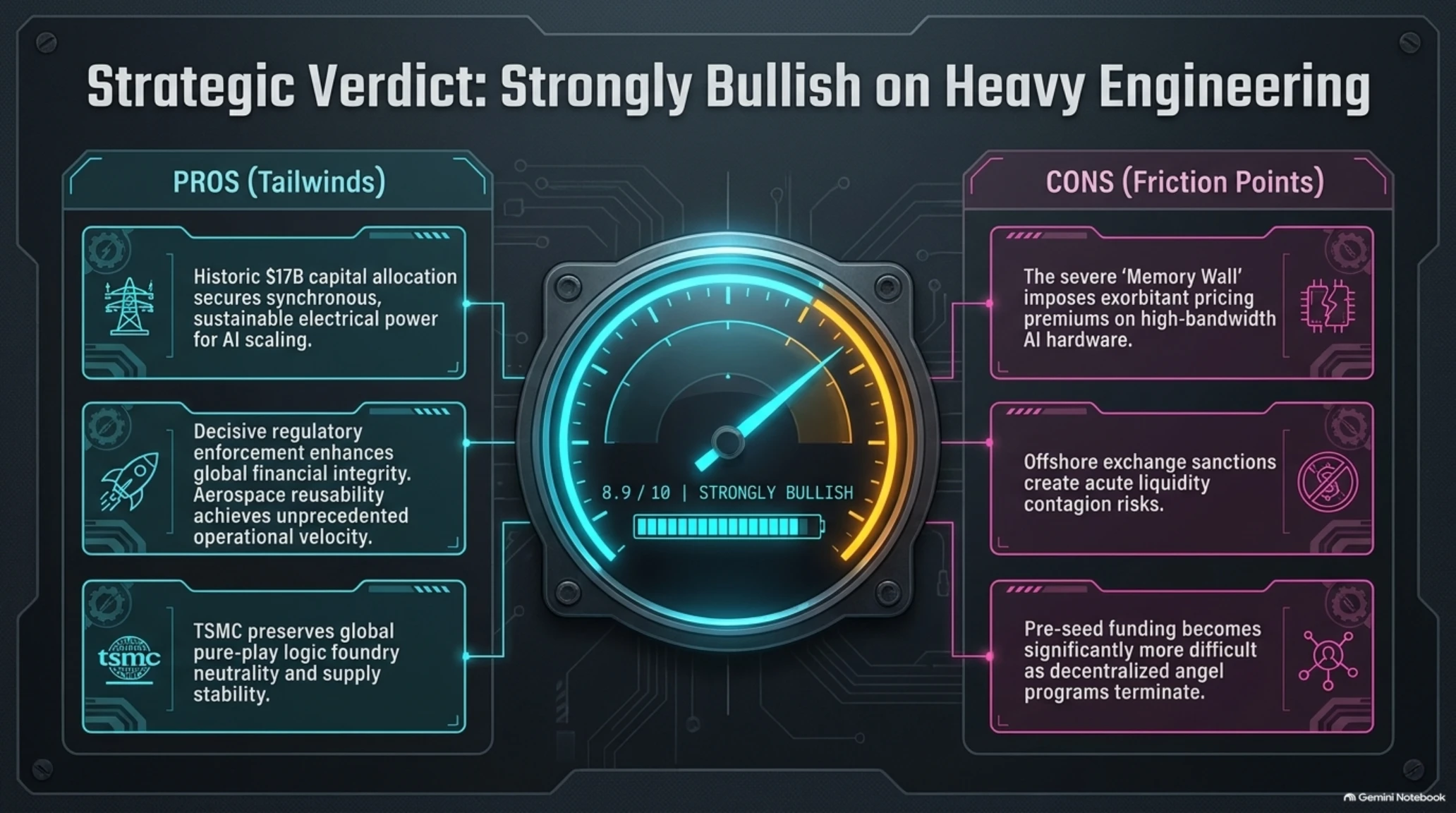
- Google's historic $17 billion investment secures synchronous, sustainable electrical power for AI scaling.
- Decisive regulatory enforcement by FinCEN enhances global financial integrity and curbs illicit finance.
- Strategic restructuring at premier funds like Sequoia refocuses venture capital on profound frontier breakthroughs.
- TSMC's principled refusal to enter 3D DRAM preserves global pure-play logic foundry neutrality and supply stability.
- SpaceX's impending Starship upper-stage tower catch brings total aerospace reusability within operational grasp.
- Google Messages' thoughtful ergonomic redesign optimizes real-world mobile usability on modern large displays.
- The severe 'Memory Wall' continues to impose exorbitant pricing premiums on high-bandwidth AI hardware.
- Offshore exchange sanctions create acute liquidity contagion risks for retail and institutional cryptocurrency traders.
- The termination of decentralized angel programs makes early-stage pre-seed funding significantly more difficult to secure.
Editorial Source Ledger and Verification Citations
- Google & Crusoe Wyoming Data Center: TechCrunch Coverage & Google Blog
- U.S. Treasury FinCEN Order on MEXC: CoinDesk Report & FinCEN Order
- Sequoia Capital 'Sequoia of Tomorrow' Memo: TechCrunch & Sequoia Official Memo
- TSMC 3D DRAM Memory Rebuttal: The Information & GuruFocus
- SpaceX Starship Flight 15 Catch Milestone: Teslarati & SpacePolicyOnline
- Google Messages Ergonomic Beta Update: 9to5Google Beta Analysis
Frequently Asked Questions: Monday, November 9, 2026 Strategic Briefing
Why did Google acquire Crusoe's Wyoming data center project directly instead of leasing capacity?
Google requires dedicated, continuous access to multi-gigawatt electrical infrastructure to fuel its next-generation TPU v6 and TPU v7 clusters. By investing $17 billion directly into the Wyoming project, Google eliminates third-party developer markups, bypasses multi-tenant power rationing risks, and secures full proprietary control over utility interconnections and on-site generation.
What are the practical implications of FinCEN's enforcement action against MEXC?
The FinCEN order legally cuts off MEXC from U.S. dollar clearing rails, domestic correspondent banks, and regulated stablecoin issuers. While the platform continues trading, the immediate loss of dollar connectivity triggered over $126 million in initial on-chain outflows, signaling severe liquidity impairment and substantial operational risk for international traders.
What strategic rationale motivated Sequoia Capital to terminate its Scouts program and London office?
In the era of frontier AI, capital requirements have shifted decisively from small-check seed dispersal to massive, concentrated growth rounds. Disbursing hundreds of $100,000 checks across early-stage startups no longer yields meaningful returns when training foundation models requires hundreds of millions of dollars. Sequoia is concentrating its balance sheet on high-conviction, category-defining founders.
Why did TSMC refuse Nvidia's request to enter 3D DRAM memory fabrication?
TSMC adheres strictly to its founding identity as an independent, pure-play logic semiconductor foundry. Fabricating proprietary DRAM cells would destroy its perceived neutrality, placing TSMC into direct competition with vital commercial partners like Samsung, Micron, and SK Hynix, and exposing the company to the volatile commodity price cycles of the global memory market.
Why is the upper-stage chopsticks catch attempt on Starship Flight 15 considered historic?
Catching the 50-meter Starship spacecraft in mid-air with Mechazilla's launch tower arms eliminates landing legs entirely, saving critical payload mass and avoiding harsh ocean water damage. Successfully validating this maneuver unlocks true rapid reusability, allowing identical vehicles to be inspected, refueled, and re-launched within hours of return.
What key improvements does the latest Google Messages beta introduce?
The update introduces three architectural enhancements: circular contact avatar bubbles for pinned conversations to declutter the viewport, an ergonomic pill-shaped search bar anchored in the bottom thumb zone, and the relocation of the Gemini shortcut to the top-right header to eliminate accidental inputs during typing.
Additional Gallery: Tekin Morning Nov 9: Google's $17B Crusoe Deal, MEXC & TSMC