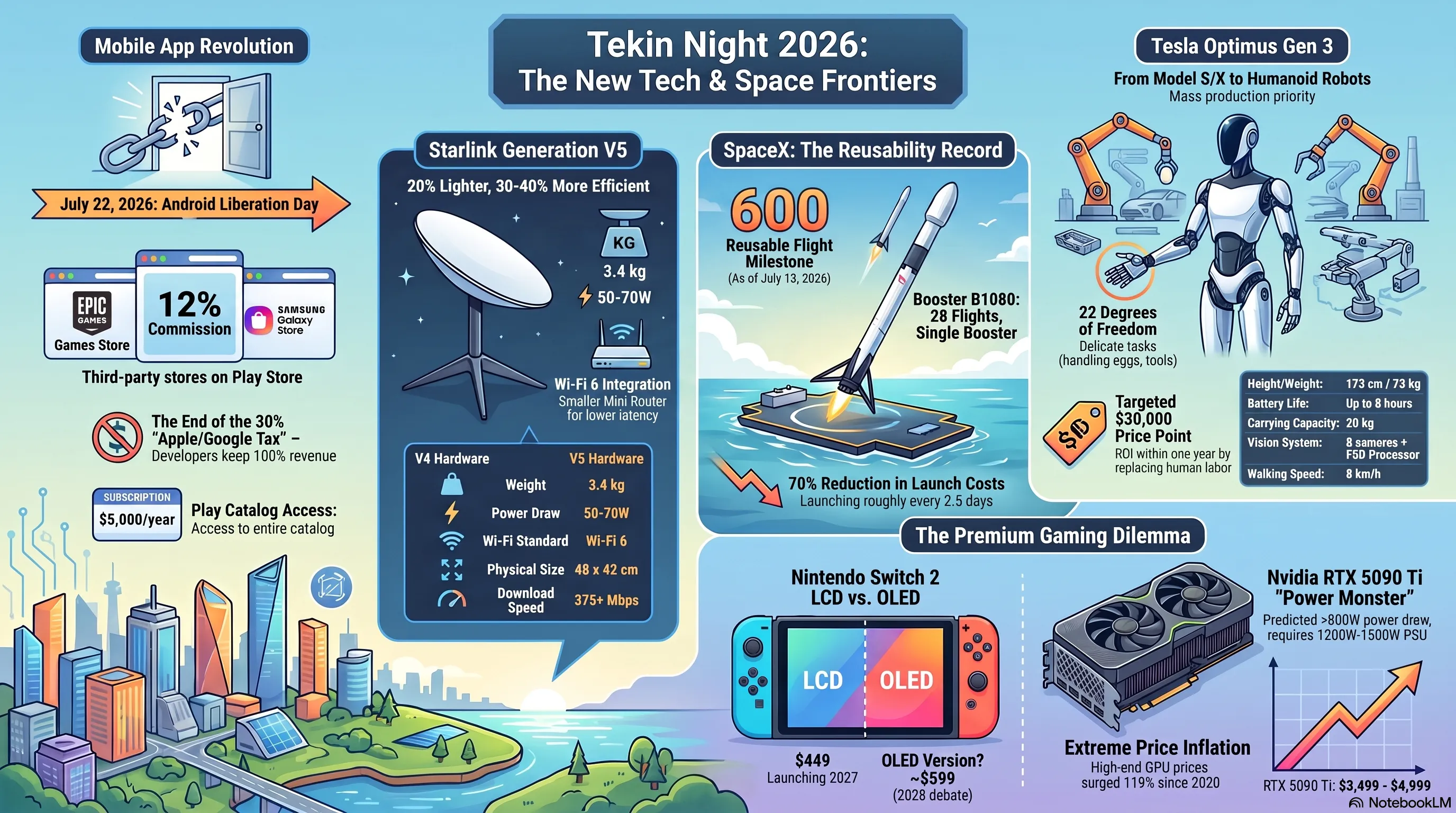
Wednesday night, July 15, 2026, brings monumental tech shifts. Google and Epic Games settled their legal war, opening Android to third-party app stores on July 22. SpaceX unveiled the lighter Starlink V5 dish and celebrated its 600th reusable rocket launch. Meanwhile, Tesla replaced Fremont car production lines with Optimus Gen 3 robot manufacturing. In gaming and hardware, Nintendo evaluates an OLED Switch 2, while Nvidia engineering leaks reveal a monstrous 800W RTX 5090 Ti GPU featuring 32GB of GDDR7 memory.
🌙 Good Night! Tekin Night Wednesday July 15, 2026
Late night energy with the hottest tech, space, and gaming news
- 🎮Third-party app stores are free- Google and Epic ended the war - July 22 is liberation day
- 🎧Starlink V5 smaller and more efficient- Fifth generation dish with 375+ Mbps speeds
- 🚀SpaceX hit 600 flight record- Booster B1080 flew for the 28th time
- 🗡️Tesla Optimus mass production- From Model S/X to humanoid robots
- 📰Switch 2 OLED on the way- Nintendo worried about premium pricing
- 🎮RTX 5090 Ti 1000W monster- 15-20% more powerful than RTX 5090
At a Glance
- Google and Epic settled their fight - third-party app stores coming July 22
- Starlink V5 unveiled with smaller form factor and lower power consumption
- SpaceX reached 600th reusable rocket flight - historic record
- Tesla replaced Model S/X production with Optimus Gen 3 robots
- Nintendo exploring Switch 2 OLED but concerned about pricing
- Nvidia RTX 5090 Ti with 800W+ power draw and 15-20% better performance in Q3 2026
Google and Epic Finally Surrender: Third-Party App Stores Coming Next Week
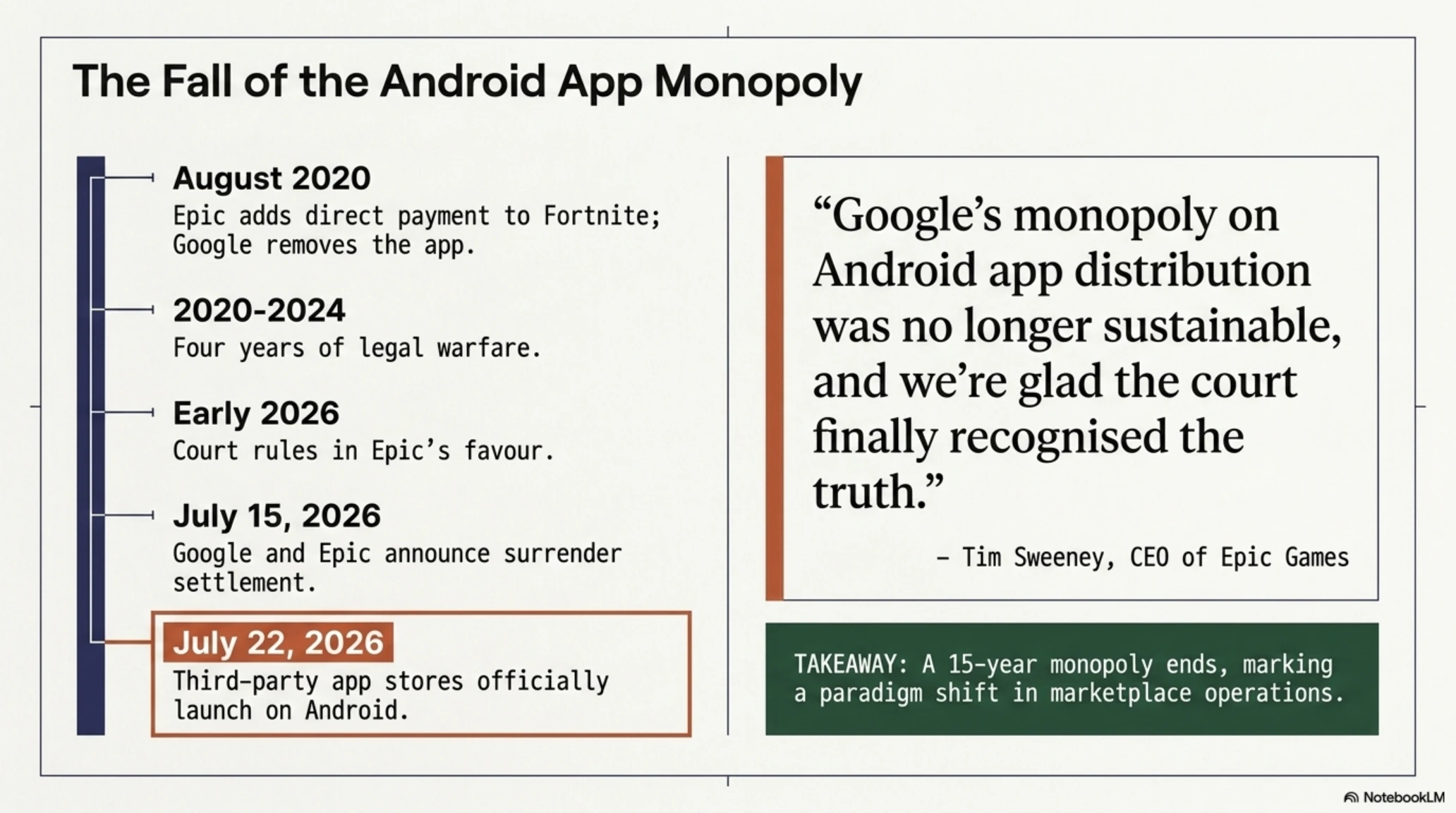
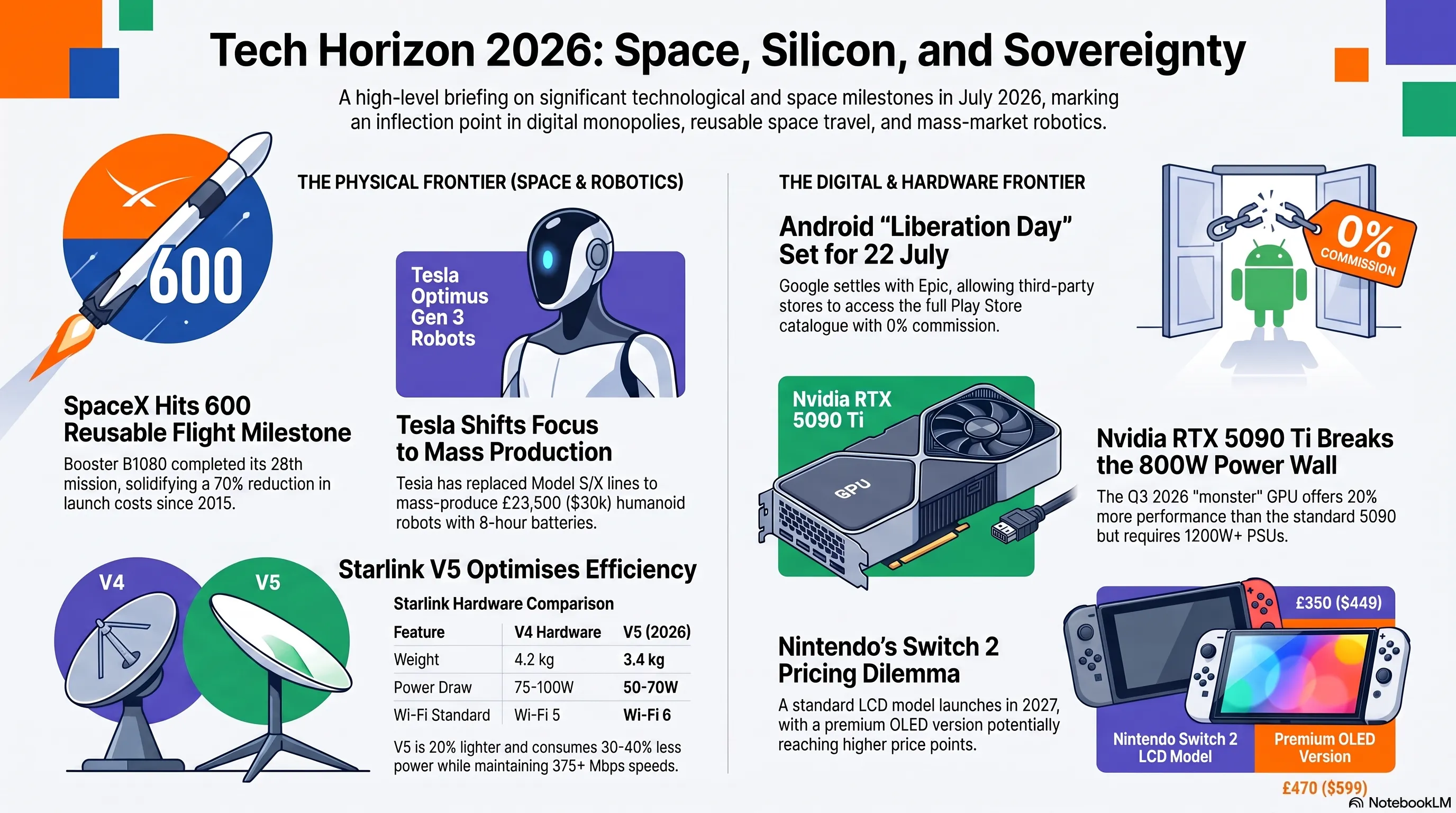
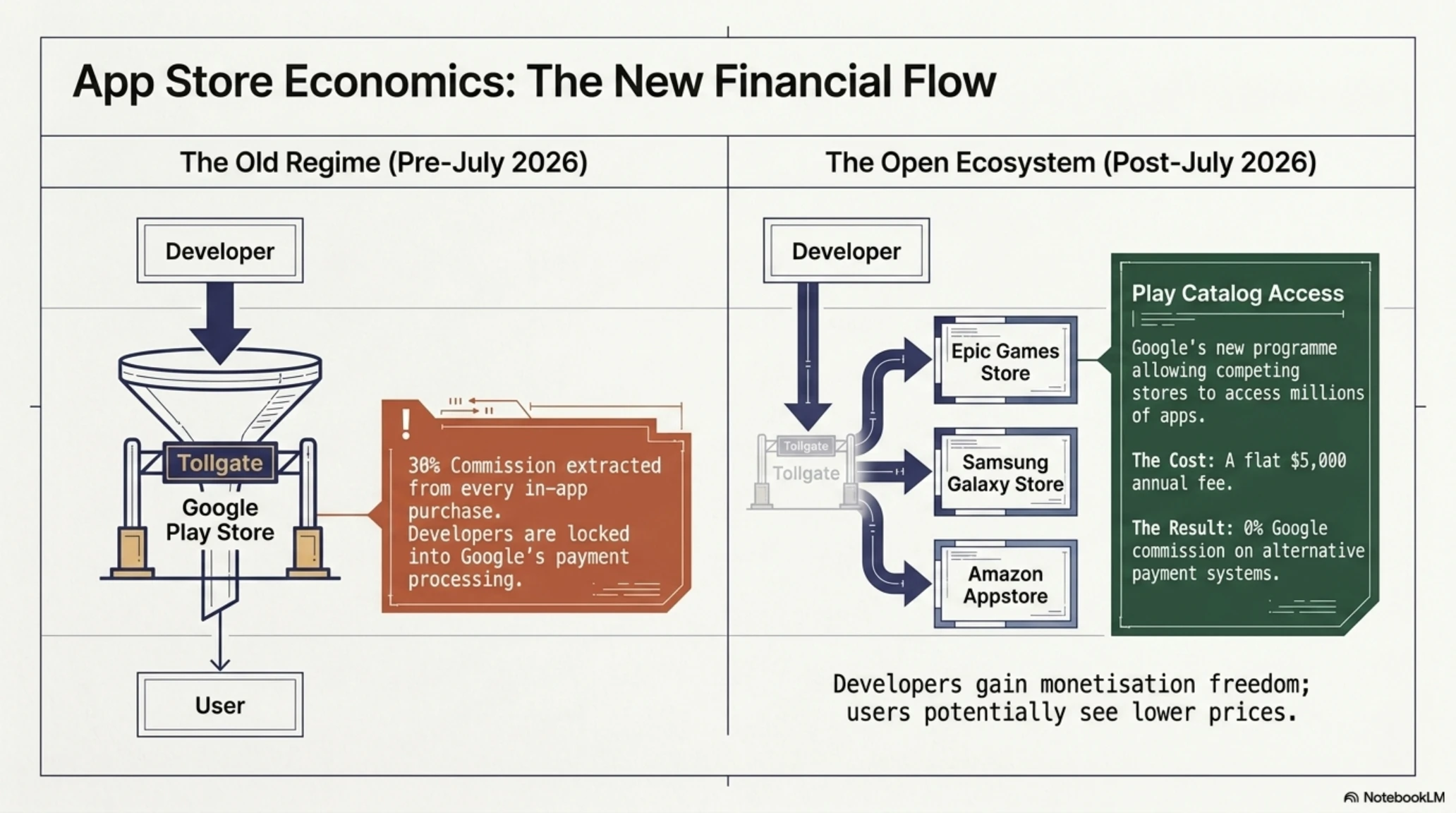
Tonight begins with one of the biggest shifts in Android history. After years of legal warfare, Google and Epic have finally backed down and reached a settlement. The result? Starting July 22, third-party application stores will officially become available on the Play Store. This marks the end of Google's 15-year monopoly on how Android apps are distributed.
According to The Verge's report, Google has launched a program called Play Catalog Access that allows third-party stores to access the complete Play Store catalog without requiring separate permissions from individual developers. Of course, this service isn't free - third-party stores must pay $5,000 annually.
What is Play Catalog Access?
But the truly significant development is the end of Google's 30% commission on in-app purchases. Until now, Google took a 30% cut from every in-app purchase, even when payments were processed through third-party systems. Now this restriction has been lifted, and developers can use any payment system they choose without paying Google any commission.
This change is the direct result of the Epic Games v. Google legal case. Remember how in 2020, Epic Games deliberately updated Fortnite with its own direct payment system to bypass Google's 30% commission? Google immediately removed Fortnite from the Play Store, and Epic sued. After four years of litigation, the court ultimately ruled in Epic's favor and forced Google to open the environment to competing stores.
For ordinary users, this change could mean lower prices for in-app purchases, more choice, and healthier competition. For developers, it means greater freedom in how they distribute and monetize their applications. And for the industry, it represents a paradigm shift in how app marketplaces operate.
Epic vs Google Timeline
- August 2020: Epic added direct payment system to Fortnite
- Same day: Google removed Fortnite from Play Store
- 2020-2024: Four years of litigation and legal warfare
- Early 2026: Court ruled in Epic's favor
- July 15, 2026: Google and Epic announced they're no longer fighting
- July 22, 2026: Third-party app stores officially launch
Which Stores Are Coming?
The first stores likely to take advantage of this opportunity are Epic Games Store and Samsung Galaxy Store. Epic has already announced plans to fully launch its store on Android, with only a 12% commission instead of Google's 30%. Samsung, which has operated its own store for years, can now compete more seriously with Google by accessing the complete Play Store catalog.
Amazon Appstore is another strong candidate. Amazon has operated its own app store for Fire tablets for years, but it's always been limited to its own devices. Now it can expand to all Android devices.
But the interesting development will be the emergence of specialized stores. Imagine stores dedicated exclusively to games, stores focused on local apps, or even stores offering only open-source applications. The variety could be infinite.
Why This Matters
Challenges Ahead
Of course, not everything is smooth sailing. Google can still impose strict security requirements on third-party stores. The annual $5,000 fee for Play Catalog Access could also be a barrier for smaller stores. And users must trust third-party stores and be willing to give up the security of Google's Play Protect.
Another consideration is Apple's reaction. So far, Apple has defended its App Store monopoly even more fiercely and has been reluctant to yield even in Europe. But if this trend continues in America and courts rule against digital monopolies, Apple might be forced to surrender as well.
Tekin Analysis
Starlink Introduces Fifth Generation Dish: Smaller, Lighter, More Efficient
Now we move from courtrooms to space. Starlink, SpaceX's satellite internet service, has unveiled its fifth-generation dish that promises a better experience with a smaller size and lower power consumption. This new dish, known as V5, represents a complete redesign compared to the previous generation.
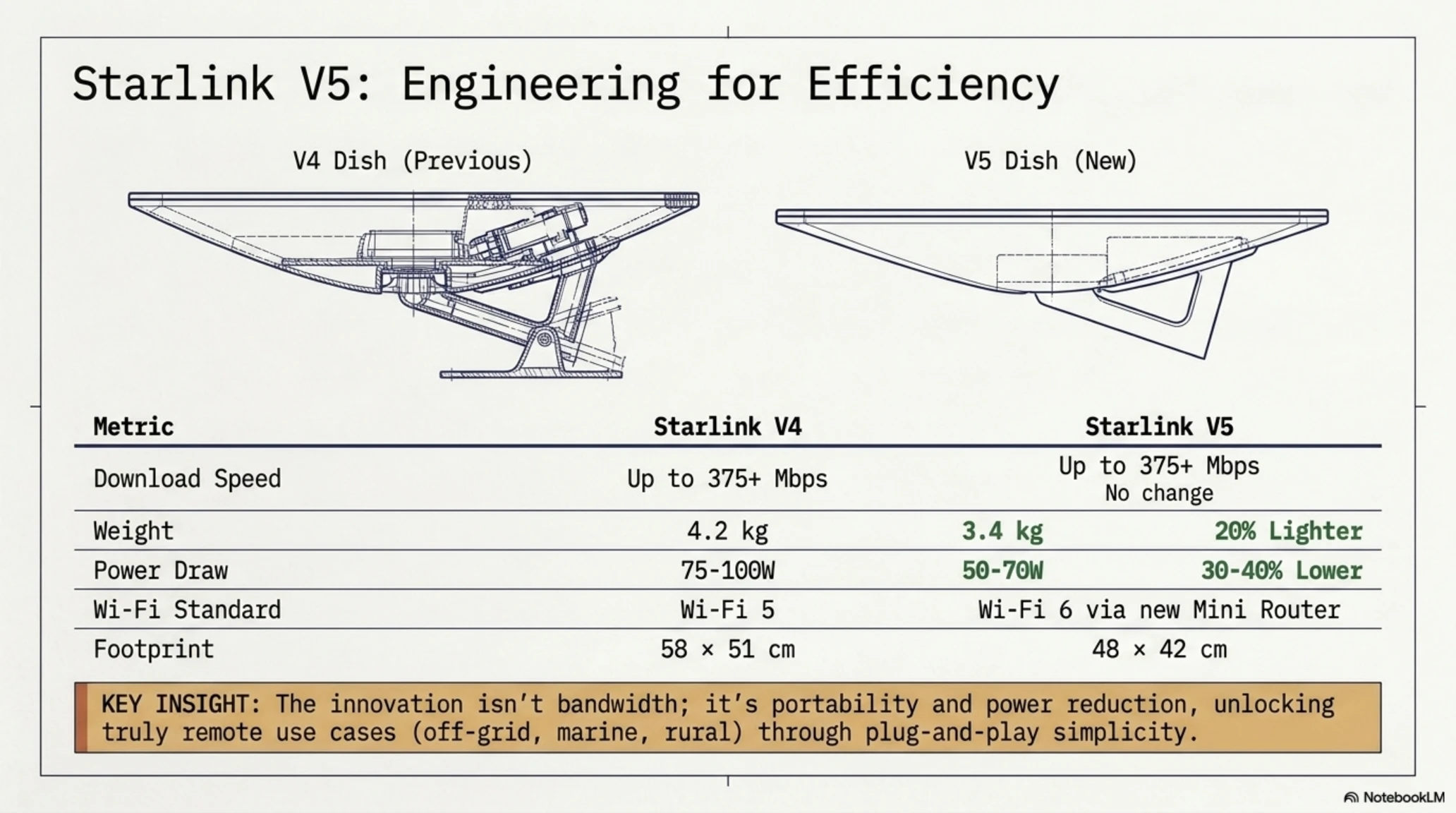
According to ISPreview's report, the V5 dish features a smaller form factor and lighter design compared to V4. Its weight has decreased by approximately 20%, and power consumption has been significantly reduced. This means it can be used in locations with limited power access, such as camping sites, boats, or remote rural areas.
But the interesting part is that Starlink hasn't promised any speed increase over V4. Speeds remain in the 375+ Mbps range, which is more than sufficient for most users. It appears the main focus of this generation has been on improving efficiency, portability, and reducing operational costs.
The V5 dish ships with a new Mini Router that supports Wi-Fi 6. This means better wireless speeds, lower latency, and the ability to connect more devices simultaneously. The new router is also smaller and more power-efficient than the previous generation.
Starlink Generation Comparison
| Feature | V4 | V5 |
|---|---|---|
| Download Speed | Up to 375+ Mbps | Up to 375+ Mbps |
| Weight | 4.2 kg | 3.4 kg |
| Power Draw | 75-100W | 50-70W |
| Wi-Fi | Wi-Fi 5 | Wi-Fi 6 |
| Size | 58 × 51 cm | 48 × 42 cm |
What is Starlink?
One major advantage of V5 is installation simplicity. The new dish is completely plug-and-play, requiring only a power source and clear sky access. No complex configuration or manual calibration is needed. Just install the dish, connect the router, and wait a few minutes for it to find satellites.
Pricing hasn't been announced yet, but V5 is expected to launch at a similar or slightly lower price than V4. Starlink also offers various subscription plans, including portable plans for travelers and business plans for enterprises.
- 20% lighter and smaller than V4
- 30-40% lower power consumption
- Wi-Fi 6 with new Mini Router
- Easy plug-and-play installation
- Suitable for portable use cases
- No speed increase over V4
- Still limitations in congested areas
- Requires clear view of sky
- Monthly subscription still expensive
SpaceX Achieves Historic Milestone: 600th Reusable Rocket Flight
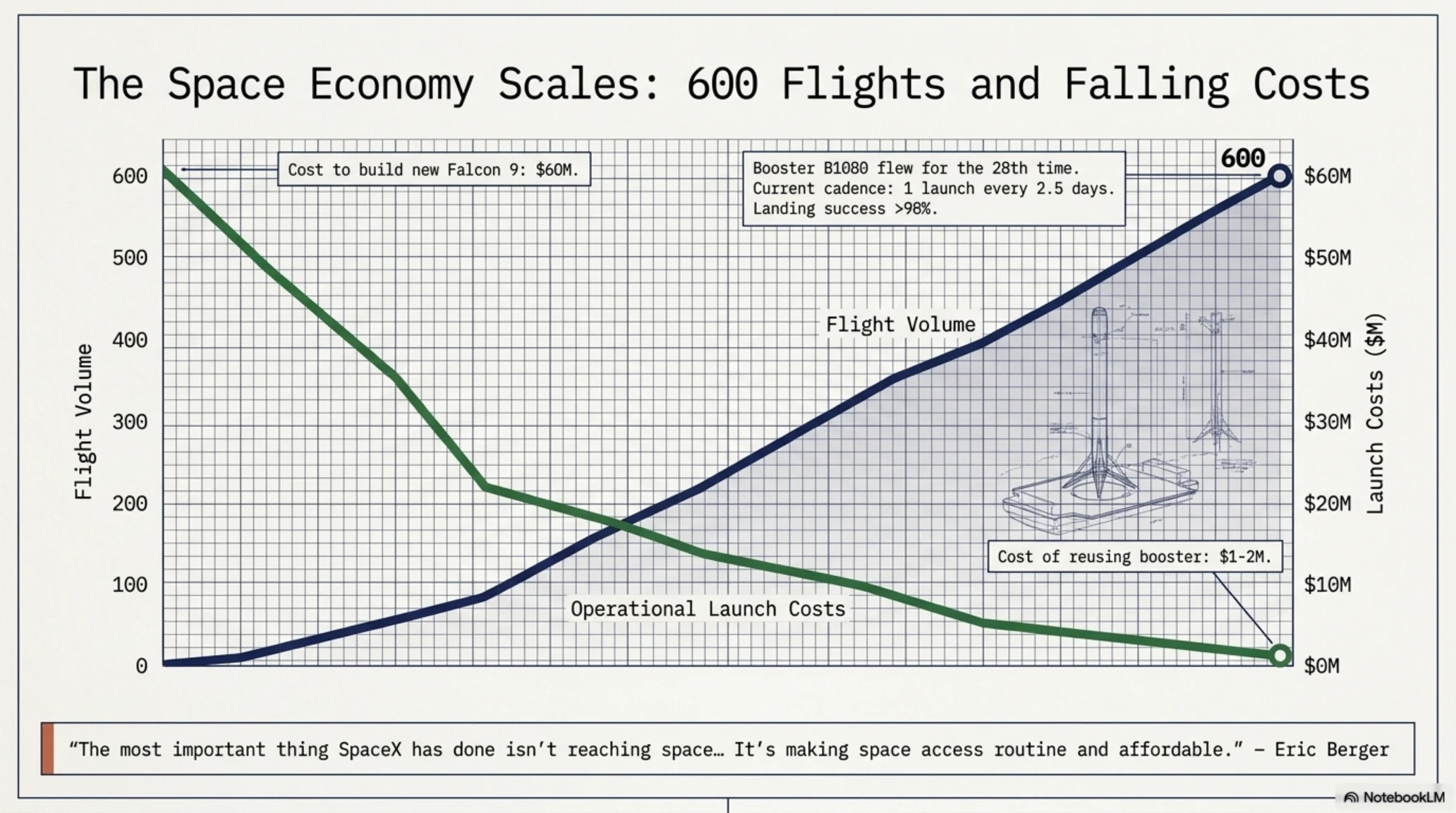
And now we arrive at one of tonight's most exciting news items. SpaceX reached a historic milestone: the 600th flight of a flight-proven Falcon 9 booster. This record was achieved on the morning of July 13 with the Starlink 10-45 mission launch from Cape Canaveral.
Booster B1080, the hero of this story, flew to space for its 28th time and then successfully landed on the droneship Of Course I Still Love You. This means this particular booster has flown more than 27 times before, successfully returning and being relaunched each time. This is something that seemed completely impossible 10 years ago.
To understand the significance of this record, we need to look back. Before SpaceX, rockets were expendable. After each flight, the rocket would fall into the ocean and could never be used again. It was like having to build a new airplane every time you wanted to travel. But SpaceX broke this model and proved that rockets can be reusable like airplanes.
The 600-flight record demonstrates that reusability in space is no longer an experiment - it's an operational reality. SpaceX currently conducts most of its launches with used boosters rather than new ones. This has led to a dramatic reduction in launch costs.
Why Reusability Matters
But the story doesn't end here. SpaceX is working on Starship, a rocket designed to be fully reusable - not just the booster, but the entire spacecraft. Starship can carry 100 tons of cargo to low Earth orbit, which is 3-4 times more than Falcon 9. And because it's fully reusable, the cost per launch could drop below $10 million.
Another interesting point is SpaceX's launch cadence. In 2026, SpaceX is conducting launches approximately every 2-3 days. This means SpaceX alone is launching more than all other countries and companies in the world combined. And most of these launches are with recycled boosters.
SpaceX Stats in 2026
- 600 flights with flight-proven boosters through July 2026
- Booster record: B1080 with 28 successful flights
- Average launch: One launch every 2.5 days
- Landing success rate: Above 98%
- Launch cost: 70% reduction compared to 2015
Tesla Begins Optimus Mass Production: From Model S/X to Robots
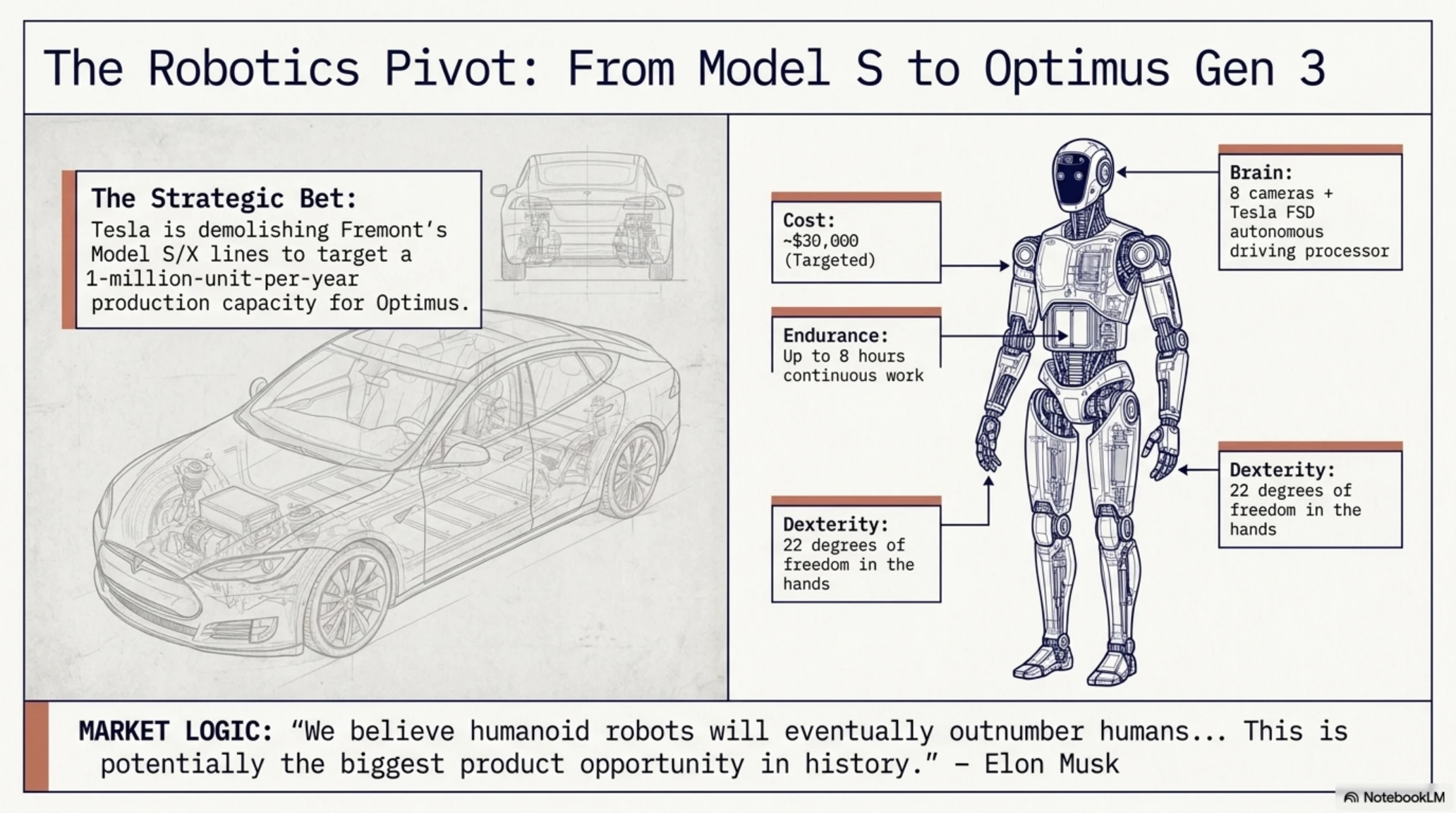
We return from space to Earth, but we're still in Elon Musk's world. Tesla has made a controversial decision: demolishing the Model S and Model X production lines at the Fremont factory and replacing them with production of the Optimus Gen 3 humanoid robot. This means Tesla no longer manufactures its two luxury models in America and has fully shifted focus to robots.
According to Teslarati's report, limited Optimus production will begin in late July or early August 2026. However, Elon Musk has warned that production will initially be "very slow" because Tesla is still learning how to mass-produce complex robots. But the new production line is designed to eventually have a capacity of 1 million units per year.
Optimus Gen 3, Tesla's latest humanoid robot generation, features significant changes from previous generations. Its hands now have 22 degrees of freedom, allowing it to manipulate objects with greater dexterity. Its vision system, with 8 cameras and Tesla's FSD (Full Self-Driving) processor, can understand environments effectively. And most importantly, its battery now provides up to 8 hours of continuous work.
But the question is: why is Tesla building robots instead of cars? The answer is simple: potential market size. Elon Musk believes the humanoid robot market could be larger than the automotive market. Imagine every home, every factory, every restaurant, and every store having one or more robots. This is a multi-trillion dollar market.
What is Optimus Designed For?
- Household tasks: Cleaning, cooking, childcare and elderly care
- Factories: Moving objects, repetitive production line work
- Services: Serving in restaurants, hotels, and stores
- Construction: Simple construction work and carrying loads
- Agriculture: Harvesting crops, planting and plant care
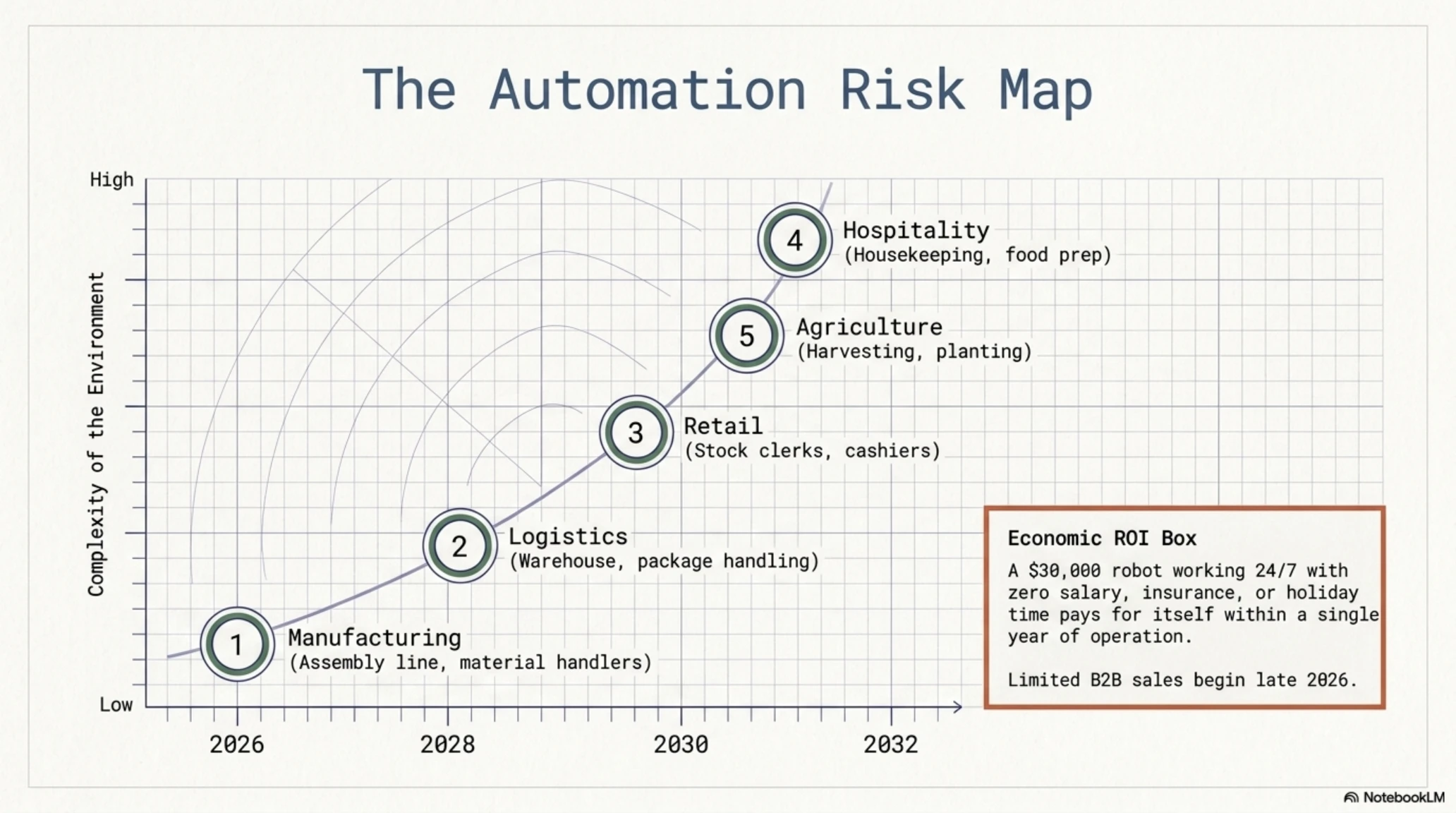
Pricing is also interesting. Tesla plans to bring Optimus to market at approximately $30,000. This is a figure that's justifiable for many businesses. If a robot can work 8 hours a day, 7 days a week, and doesn't require salary, insurance, or vacation, a $30,000 investment could pay for itself within a year.
Of course, many challenges lie ahead. Humanoid robots are still in early development stages and cannot perform complex human tasks. There are also safety concerns - what happens if a 70kg robot malfunctions and injures someone? And of course, the ethical and social issues of replacing human workers with robots.
Nevertheless, Tesla appears determined. The company has already announced that limited sales of Optimus to external customers will begin in late 2026 - likely to businesses and companies wanting to test it in controlled environments. Broader public sales will probably wait until 2027 or 2028.
Tekin Analysis
What Makes Optimus Gen 3 Special?
Compared to previous generations and competitors, Optimus Gen 3 has several key advantages. First, its integration with Tesla's FSD technology. Tesla has spent years developing autonomous driving AI, and now that same technology is being applied to robots. This means Optimus can navigate complex environments, avoid obstacles, and make real-time decisions.
Second, the hands. With 22 degrees of freedom, Optimus hands can perform delicate manipulations like picking up eggs, turning doorknobs, or using tools. This is crucial because most human tasks require fine motor control.
Third, the production infrastructure. Unlike competitors who are still building prototypes in labs, Tesla has actual production lines ready to manufacture robots at scale. This gives Tesla a significant advantage in bringing humanoid robots to market quickly and affordably.
Optimus Gen 3 Technical Specifications
| Specification | Details |
|---|---|
| Height | 173 cm (5'8") |
| Weight | 73 kg (161 lbs) |
| Carrying capacity | 20 kg (45 lbs) |
| Hand DOF | 22 degrees of freedom |
| Vision system | 8 cameras + FSD processor |
| Battery life | Up to 8 hours |
| Walking speed | Up to 8 km/h (5 mph) |
Fourth, the cost structure. By using existing automotive supply chains and manufacturing techniques, Tesla can potentially produce Optimus at a fraction of what specialized robotics companies would charge. This could make humanoid robots accessible to a much broader market.
The Competition
Tesla isn't alone in the humanoid robot race. Boston Dynamics has Atlas, which is incredibly agile and can perform impressive acrobatic movements. However, Atlas is primarily a research platform and isn't designed for mass production. Figure AI has Figure 01, which has already been deployed in BMW factories. And several Chinese companies are developing their own humanoid robots.
But Tesla's advantage is scale and integration. No other company has the manufacturing capacity, AI expertise, and market reach that Tesla has. If Tesla can successfully transition from prototypes to mass production, it could dominate this emerging market.
Nintendo Exploring Switch 2 OLED - But Worried About Price
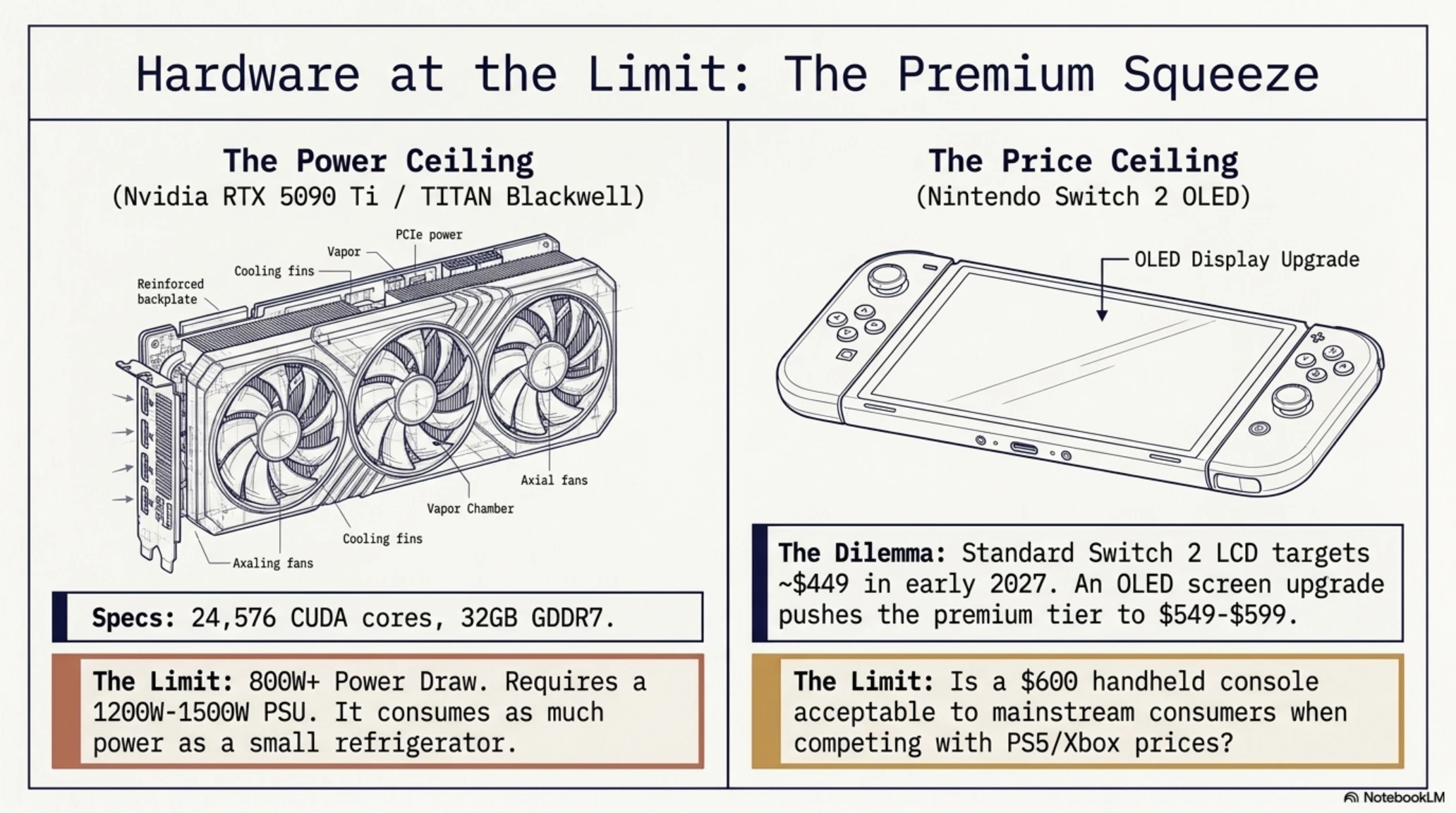
From robots to gaming consoles. According to a report from ZDNet Korea, Nintendo is exploring the possibility of offering an OLED version of the Switch 2. The company is in talks with Samsung Display to supply 1080p OLED panels, but the main concern is the premium price this upgrade would require.
Nintendo has already announced that the standard Switch 2 with an LCD screen will launch in 2027, likely priced around $449. This represents a significant increase from the current Switch price ($299) and even the Switch OLED ($349). Now, if Nintendo wants to offer an OLED version, the price could reach $549 or even $599.
The question is: will gamers pay this much extra for an OLED screen? The current Switch OLED experience has shown that yes, there is a market for better displays. Despite the higher price, Switch OLED has sold well. But $549 for a handheld console is likely at the edge of acceptability for many customers.
According to the report, Nintendo hasn't made its final decision yet. The company is evaluating different options, including launching only the LCD version initially and then adding the OLED version a year later, or launching both versions simultaneously. Another possibility is that Nintendo will abandon the Switch 2 OLED idea entirely and focus only on the LCD version.
What Are the Advantages of OLED?
Another concern is the impact on battery life. OLED screens typically consume more power than LCD, especially when displaying bright content. This could reduce the Switch 2 OLED's battery life compared to the LCD version, which is crucial for a handheld console.
According to the report, even if Nintendo decides to release the Switch 2 OLED, it likely won't be available before 2028. This means gamers would have to wait at least a year after the standard Switch 2 launch before the OLED version becomes available.
Potential Switch 2 Comparison
| Feature | Switch 2 LCD | Switch 2 OLED (Potential) |
|---|---|---|
| Display | LCD 1080p | OLED 1080p |
| Battery life | 6-8 hours | 5-7 hours |
| Price (Estimate) | $449 | $549-599 |
| Release date | Early 2027 | Late 2027 / 2028 |
What This Means for Gamers
If Nintendo does release a Switch 2 OLED, it would represent the premium tier of their handheld gaming ecosystem. Gamers who prioritize display quality and are willing to pay extra would have that option, while budget-conscious consumers could stick with the LCD version.
This two-tier strategy worked well for the current generation Switch. The standard Switch and Switch OLED coexist peacefully in the market, each serving different customer segments. Nintendo likely wants to replicate this success with Switch 2.
However, the higher starting price of Switch 2 ($449 vs Switch's $299) means less room for a premium tier. At $549-599, the Switch 2 OLED would be competing with PlayStation 5 and Xbox Series X in terms of price, which could deter potential buyers.
Nintendo's Pricing Dilemma
Nvidia RTX 5090 Ti Concerns: 800W+ Beast with 15-20% More Performance
And finally, news for gamers and professionals seeking the world's most powerful graphics card. Nvidia is reportedly developing a high-end Blackwell GPU that might be released as the RTX 5090 Ti or even TITAN Blackwell. And this card will be a monster.
According to Engineering Sample leaks from Igor's Lab, this GPU could feature up to 24,576 CUDA cores - 15-20% more than the standard RTX 5090. Its memory would be 32GB GDDR7 at 32Gbps speeds, providing extraordinary bandwidth. But the truly controversial aspect is power consumption: 800W or even more.
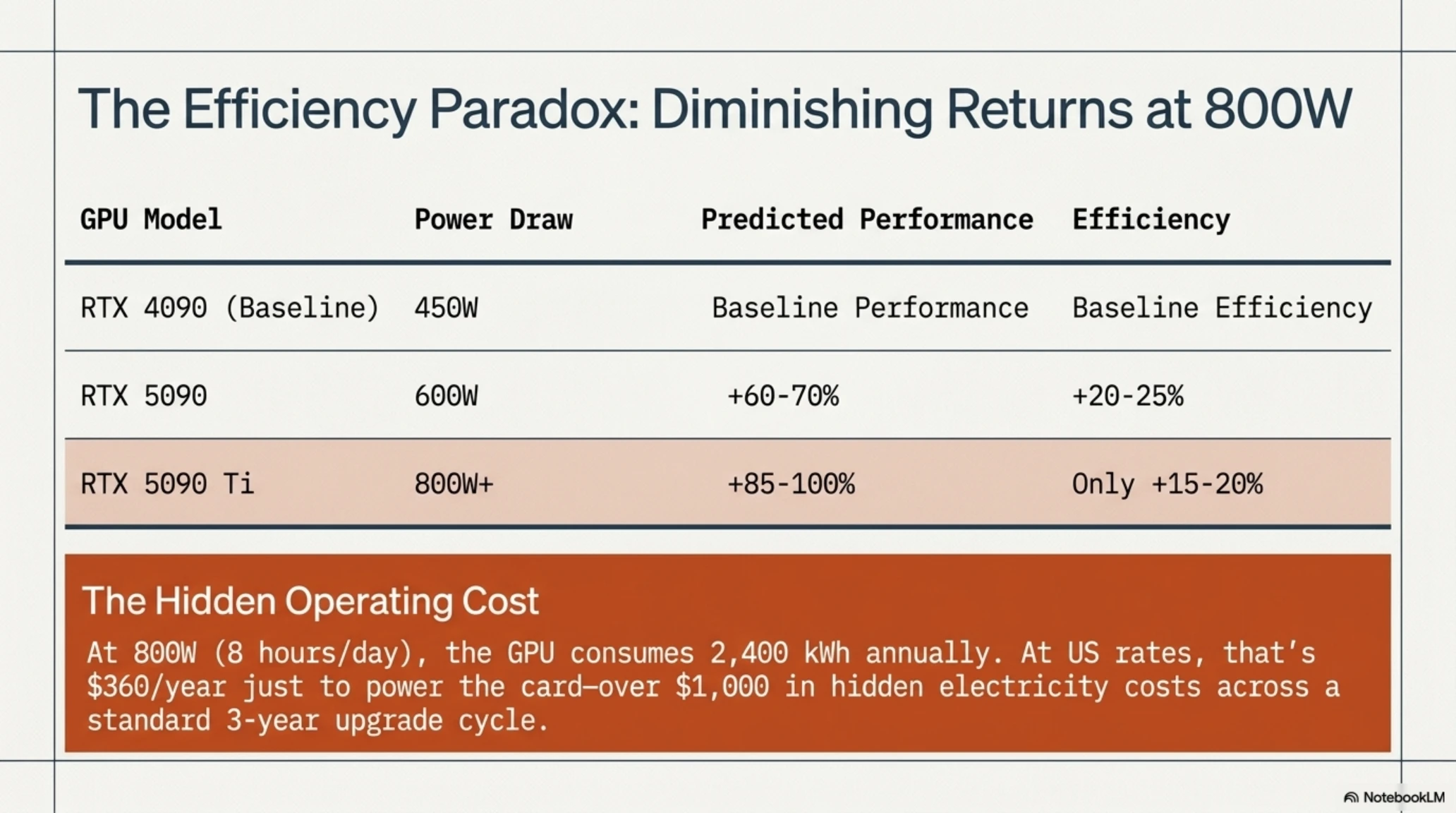
To understand how much 800W is, let's compare: the current RTX 4090 consumes about 450W. The RTX 5090 is predicted to be around 600W. And this new GPU would be 800W+. This means you'll need a power supply of at least 1200-1500W, and the cooling system must be extremely powerful.
But in exchange for this massive power consumption, what do you get? Performance that could be 15-20% better than the RTX 5090, which itself is predicted to be about 60-70% faster than the RTX 4090. This means the RTX 5090 Ti could be nearly twice as fast as the current RTX 4090.
Who Is This For?
- Extreme gaming: 4K at 240Hz or 8K at 120Hz
- Professional rendering: Animation, VFX, and architecture
- Machine learning: Training large AI models
- Scientific simulation: Research and complex calculations
- Cryptocurrency mining: If still profitable
Pricing will also likely be controversial. The RTX 4090 launched at $1,599. The RTX 5090 is predicted to be around $1,999-2,499. And the RTX 5090 Ti or TITAN Blackwell? Probably $3,499-4,999 or more. This card is for people where money is no object and they just want the absolute best.
This GPU is predicted to launch in Q3 2026 (July-September), several months after the standard RTX 5090 release. Nvidia likely wants to first capture the mainstream market with the RTX 5090 and then drop this bomb for enthusiasts and professionals.
RTX 5090 Ti Challenges
- Power consumption: Requires 1200W+ PSU and stable power
- Cooling: Needs powerful cooler and excellent airflow
- Size: Likely 3.5-4 slots, may not fit in small cases
- Price: Several thousand dollars - enthusiasts only
- Availability: Likely scarce initially
One final note: some analysts believe Nvidia might release this card as TITAN Blackwell instead of RTX 5090 Ti, to give the TITAN brand more prestige and justify the very high price. Either way, this will be a niche product for a very specific market.
The Power Consumption Problem
The 800W+ power draw of the RTX 5090 Ti raises serious questions about the sustainability of high-end GPU development. At what point does power consumption become unacceptable? Many countries are implementing stricter energy efficiency standards, and a single graphics card consuming as much power as a small refrigerator could face regulatory challenges.
Nvidia is aware of these concerns. The company has been investing heavily in improving performance per watt, but the demands of cutting-edge gaming, AI, and professional applications continue to push power requirements higher. The RTX 5090 Ti represents the extreme end of this spectrum - maximum performance regardless of power cost.
For users considering this card, the operating cost is non-trivial. At 800W and assuming 8 hours of daily use, the card alone would consume about 2,400 kWh per year. At average US electricity rates of $0.15/kWh, that's $360 annually just in electricity for the GPU. Over a typical 3-year upgrade cycle, that's over $1,000 in operating costs on top of the purchase price.
Performance vs Efficiency Trade-off
| GPU Model | Power Draw | Predicted Performance | Efficiency |
|---|---|---|---|
| RTX 4090 | 450W | Baseline | Baseline |
| RTX 5090 | 600W | +60-70% | +20-25% |
| RTX 5090 Ti | 800W+ | +85-100% | +15-20% |
The Competition Response
AMD and Intel are watching these developments closely. AMD's RDNA 4 architecture is reportedly focusing on efficiency rather than absolute performance, potentially positioning their high-end cards as "reasonable" alternatives to Nvidia's power-hungry monsters. Intel's Battlemage GPUs are targeting the mid-range market, avoiding the high-end power consumption battle entirely.
This could lead to an interesting market segmentation: Nvidia dominates absolute performance for those willing to pay the power and price premium, while AMD and Intel compete on value and efficiency for more practical users.
Summary
The Broader Implications: A Tech Industry at a Crossroads
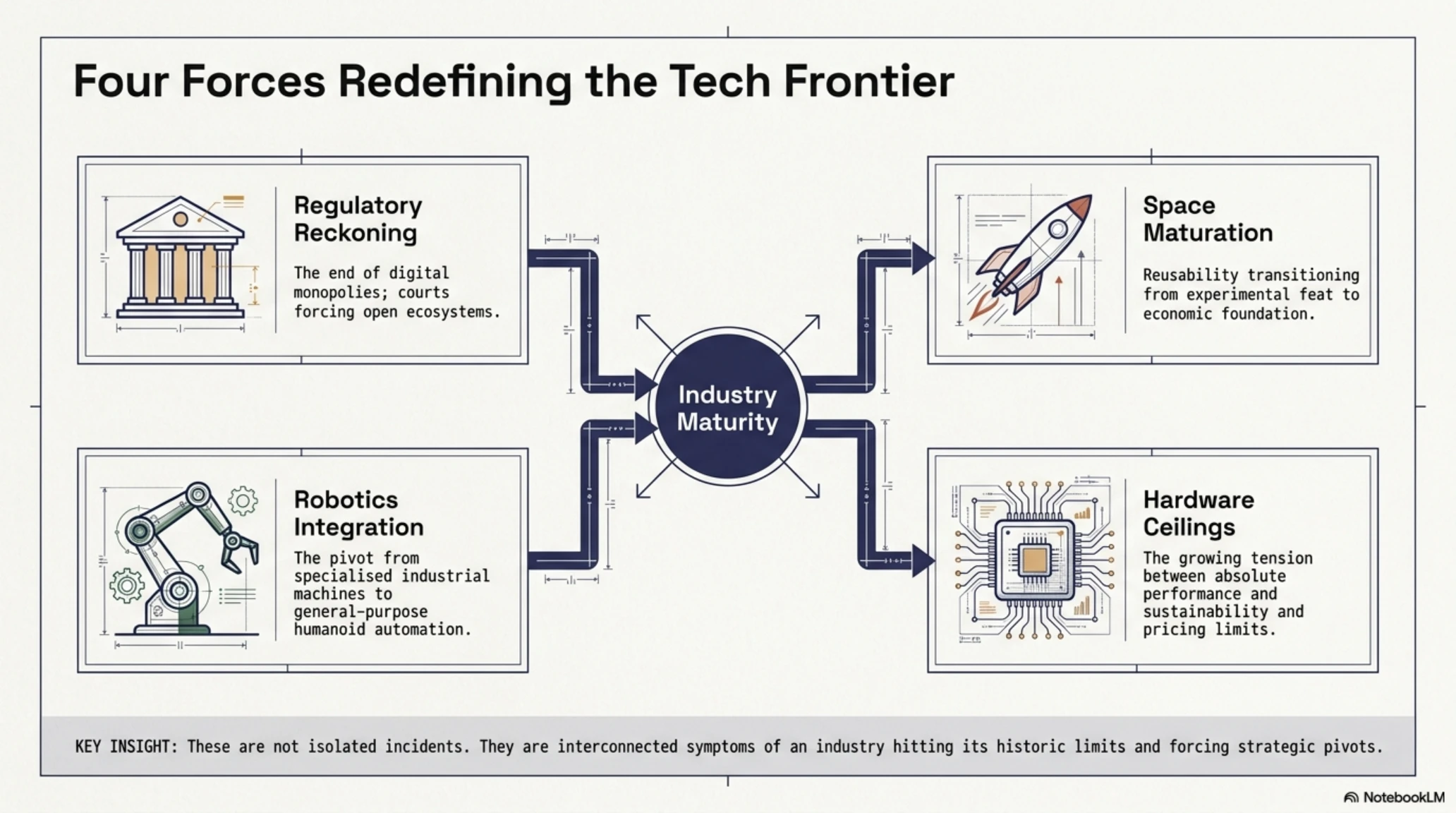
Looking at tonight's news collectively, a clear pattern emerges. The tech industry is reaching several critical inflection points simultaneously. The Google-Epic settlement signals the beginning of regulatory pressure successfully challenging big tech monopolies. SpaceX's reusability achievements prove that transformative innovation can overcome seemingly impossible technical challenges. Tesla's pivot to robotics shows major companies betting on entirely new markets. And the power consumption concerns around high-end GPUs highlight the tension between performance advancement and sustainability.
These aren't isolated incidents - they're interconnected symptoms of an industry maturing and facing its limitations. For years, tech companies operated with minimal oversight, pursuing growth and performance at any cost. Now, courts are enforcing antitrust measures, physics is imposing power consumption limits, and market dynamics are forcing strategic pivots.
The Regulatory Reckoning
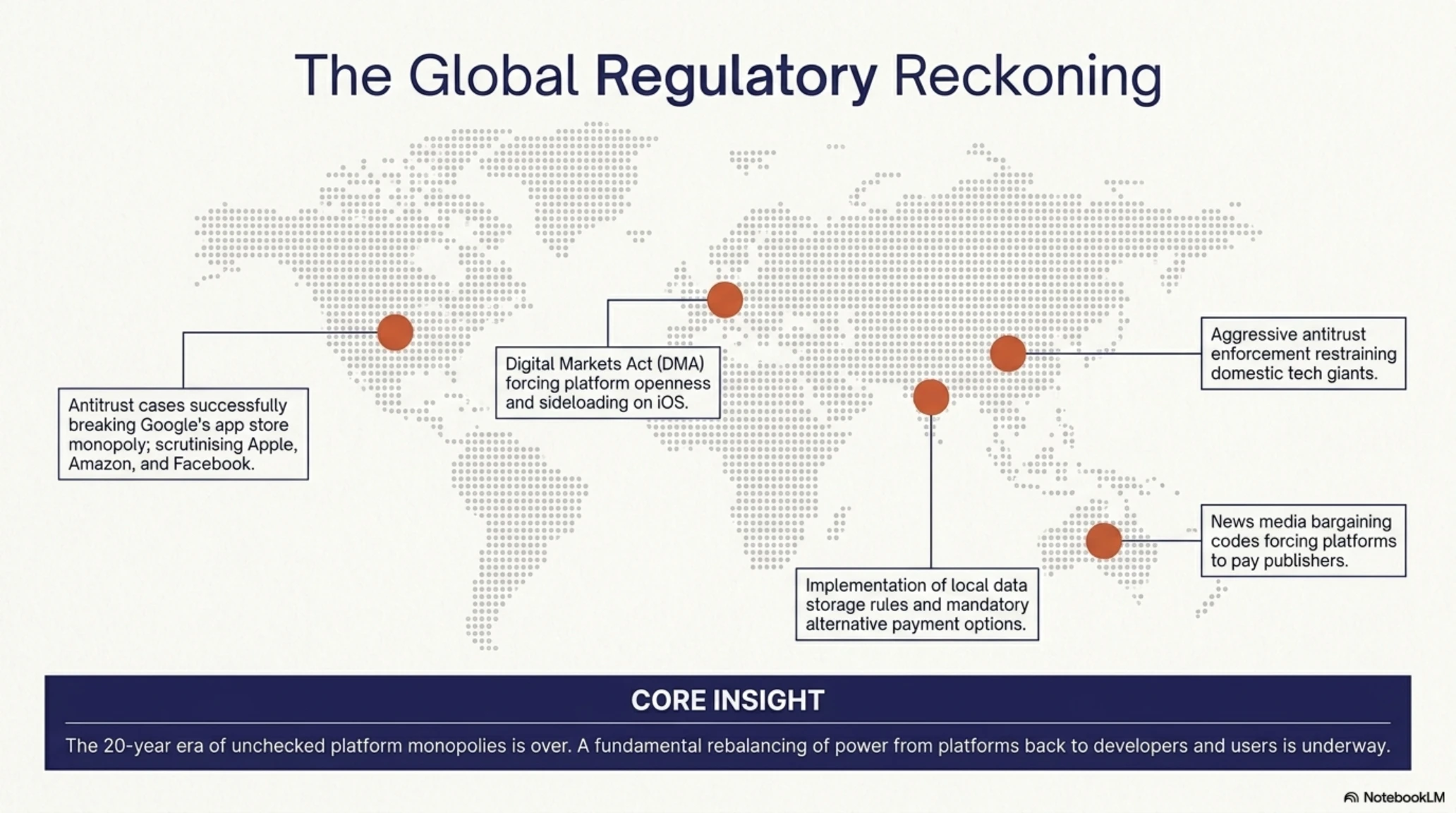
The Google-Epic settlement is just the beginning. Around the world, regulators are scrutinizing big tech with unprecedented intensity. The European Union's Digital Markets Act has already forced Apple to allow sideloading and third-party app stores in Europe. The US Federal Trade Commission is investigating Amazon's marketplace practices. And multiple countries are examining Google and Facebook's advertising dominance.
What we're seeing is a fundamental rebalancing of power. For two decades, tech platforms operated largely unchecked, setting their own rules and capturing enormous value from their ecosystems. Now, governments are asserting that these platforms have become too powerful and must open up to competition.
This shift will have profound implications. Developers and users will have more choice and potentially lower costs. But platforms will face reduced revenue and increased compliance burden. The net effect could be a more diverse, competitive landscape - or a fragmented mess of incompatible standards. We're in uncharted territory.
Global Regulatory Landscape
- European Union: Digital Markets Act forcing platform openness
- United States: Antitrust cases against Google, Apple, Amazon, Facebook
- China: Aggressive antitrust enforcement against domestic tech giants
- India: New rules requiring local data storage and payment options
- Australia: News media bargaining code requiring platforms to pay publishers
The Space Economy Takes Off
SpaceX's 600th reusable rocket flight isn't just a technical milestone - it's an economic revolution. By proving that rockets can be reused dozens of times, SpaceX has fundamentally changed the economics of space access. Launch costs have dropped by more than 10x compared to pre-reusability era, and they're still falling.
This cost reduction is enabling entirely new space-based businesses. Starlink wouldn't be economically viable without cheap launches. The same applies to Earth observation companies providing real-time satellite imagery, space manufacturing experiments, and space tourism. We're witnessing the birth of a genuine space economy.
The implications extend beyond space. Reusability demonstrates that even in capital-intensive, technically challenging industries, radical innovation is possible. If rockets can be reused, what else can we rethink? This mindset is spreading to other transportation sectors, manufacturing, and energy systems.
The Robotics Revolution Begins
Tesla's decision to replace car production with robot production is either visionary or reckless - possibly both. But it reflects a genuine belief that humanoid robots represent a market opportunity larger than automotive. The logic is compelling: there are about 1.5 billion cars in the world, but potentially tens of billions of robots once they become affordable and capable enough.
We're entering an era where physical automation extends beyond factory floors into everyday environments. Current industrial robots are purpose-built for specific tasks in controlled settings. Humanoid robots promise general-purpose automation that can work in human spaces, using human tools, following human instructions.
The economic implications are staggering. Labor represents the largest cost in most service industries. If robots can perform even a fraction of human tasks at a lower cost, the productivity gains could be immense. But so could the social disruption. Millions of jobs in manufacturing, logistics, retail, and hospitality could be automated within a decade.
Society hasn't seriously grappled with these implications. What happens when robots can perform most physical labor? How do we ensure prosperity is broadly shared rather than concentrated among robot owners? These aren't hypothetical future questions - they're immediate policy challenges as companies like Tesla begin mass production.
Jobs at Risk from Humanoid Robots
| Sector | At-Risk Jobs | Timeline |
|---|---|---|
| Manufacturing | Assembly line workers, material handlers | 2026-2028 |
| Logistics | Warehouse workers, package handlers | 2027-2029 |
| Retail | Stock clerks, cashiers | 2028-2030 |
| Hospitality | Housekeeping, food prep | 2029-2031 |
| Agriculture | Harvest workers, farm labor | 2028-2032 |
Gaming's Premium Problem
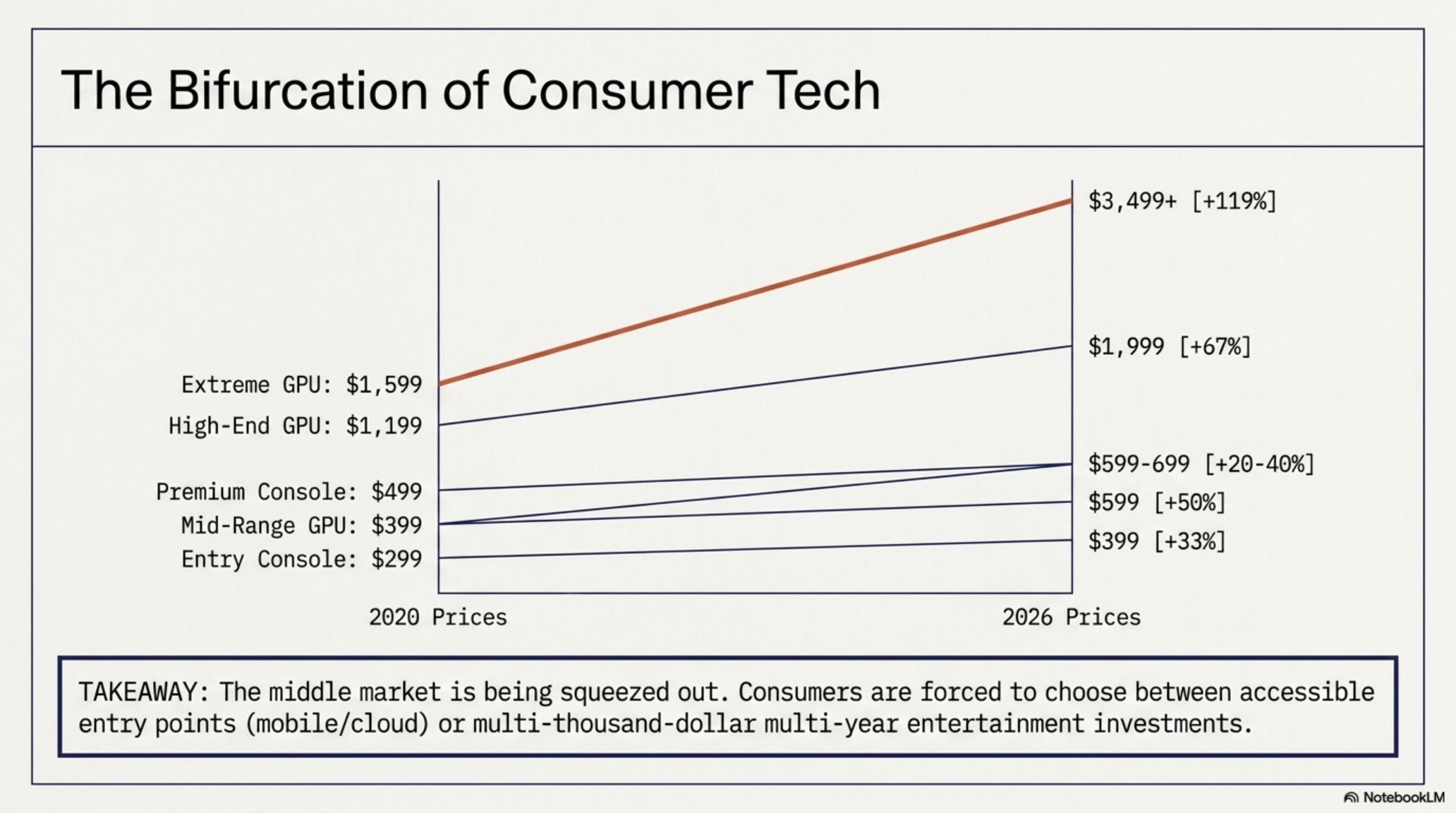
The potential $549-599 price point for Switch 2 OLED and the likely $3,499+ price for RTX 5090 Ti highlight a growing concern in gaming: premium products are becoming prohibitively expensive. This isn't unique to gaming - it reflects broader economic trends of market segmentation and luxury goods proliferation.
What's happening is a bifurcation of the market. At the low end, mobile gaming and cloud gaming offer accessible entry points. At the high end, enthusiast products command ever-higher prices. The middle is being squeezed.
This creates a challenge for game developers. Do you target the mass market with modest graphics requirements, or do you push boundaries for the high-end segment? Increasingly, developers are choosing one or the other, rather than trying to serve both.
We're also seeing a shift in how people think about gaming investments. A $600 console or $4,000 GPU is no longer just a gaming device - it's a multi-year entertainment investment that must justify its cost through extensive use. This changes purchasing psychology and potentially gaming behavior.
Gaming Hardware Price Evolution
| Product Category | 2020 Price | 2026 Price | Change |
|---|---|---|---|
| Entry Console | $299 | $399 | +33% |
| Premium Console | $499 | $599-699 | +20-40% |
| Mid-Range GPU | $399 | $599 | +50% |
| High-End GPU | $1,199 | $1,999 | +67% |
| Extreme GPU | $1,599 | $3,499+ | +119% |
The Sustainability Question
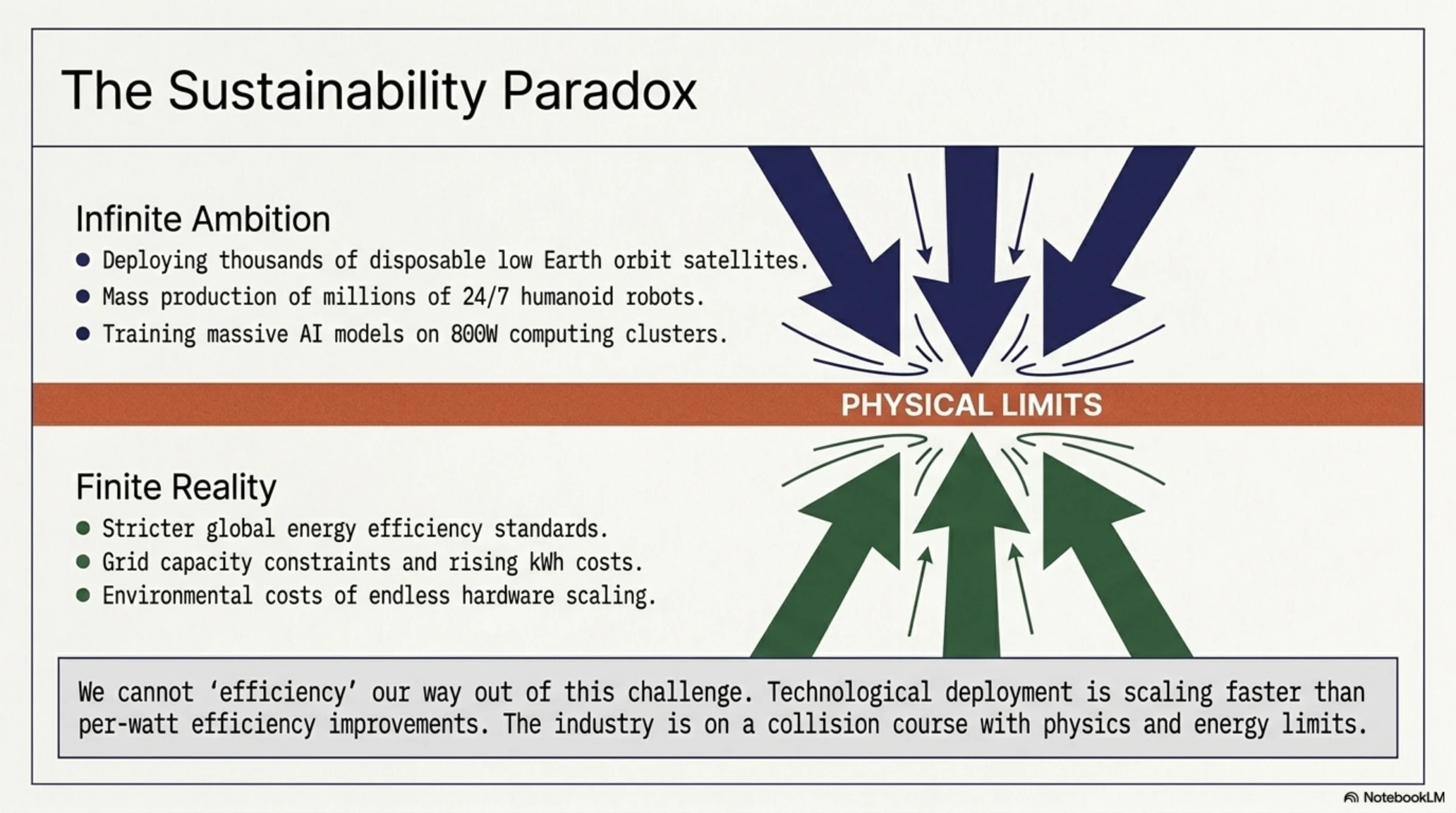
Running through several of tonight's stories is an undercurrent of sustainability concern. An 800W graphics card consuming as much power as a refrigerator. Thousands of satellites requiring regular replacement. Robots consuming electricity continuously. The infrastructure supporting our technological advancement has significant environmental costs.
The industry is aware of these concerns but hasn't found satisfactory solutions. Efficiency improvements help, but they're often overwhelmed by increased deployment scale. A GPU might be more efficient per computation, but if we're performing 10x more computations, total energy consumption still rises.
Some argue that technology will solve its own sustainability problems - better batteries, renewable energy, more efficient architectures. Others argue we need fundamental limits on consumption. This tension will only intensify as technology becomes more pervasive.
What to Watch Next
As we wrap up tonight's coverage, several storylines deserve continued attention. The July 22 launch of third-party app stores on Android will reveal whether users actually embrace alternatives to Google Play, or whether inertia keeps most people in the default ecosystem. Early adoption metrics will be crucial.
SpaceX's continued launch cadence and Starship development will determine whether reusability truly scales to massive payloads. The company aims for multiple Starship launches per week by late 2026 - an audacious target that would completely transform space access economics.
Tesla's Optimus production ramp will show whether humanoid robots can transition from prototypes to practical products. The first external customer deliveries in Q4 2026 will provide real-world validation - or reveal significant limitations.
Nintendo's decision on Switch 2 OLED should become clear in the next few months as supply chain commitments must be made. The choice will signal Nintendo's read on consumer price sensitivity in a challenging economic environment.
And Nvidia's RTX 5090 Ti launch (if it happens) will test the upper bounds of what enthusiasts will pay for graphics performance. Success could establish a new premium tier; failure might force a rethink of high-end GPU strategies.
Key Dates to Remember
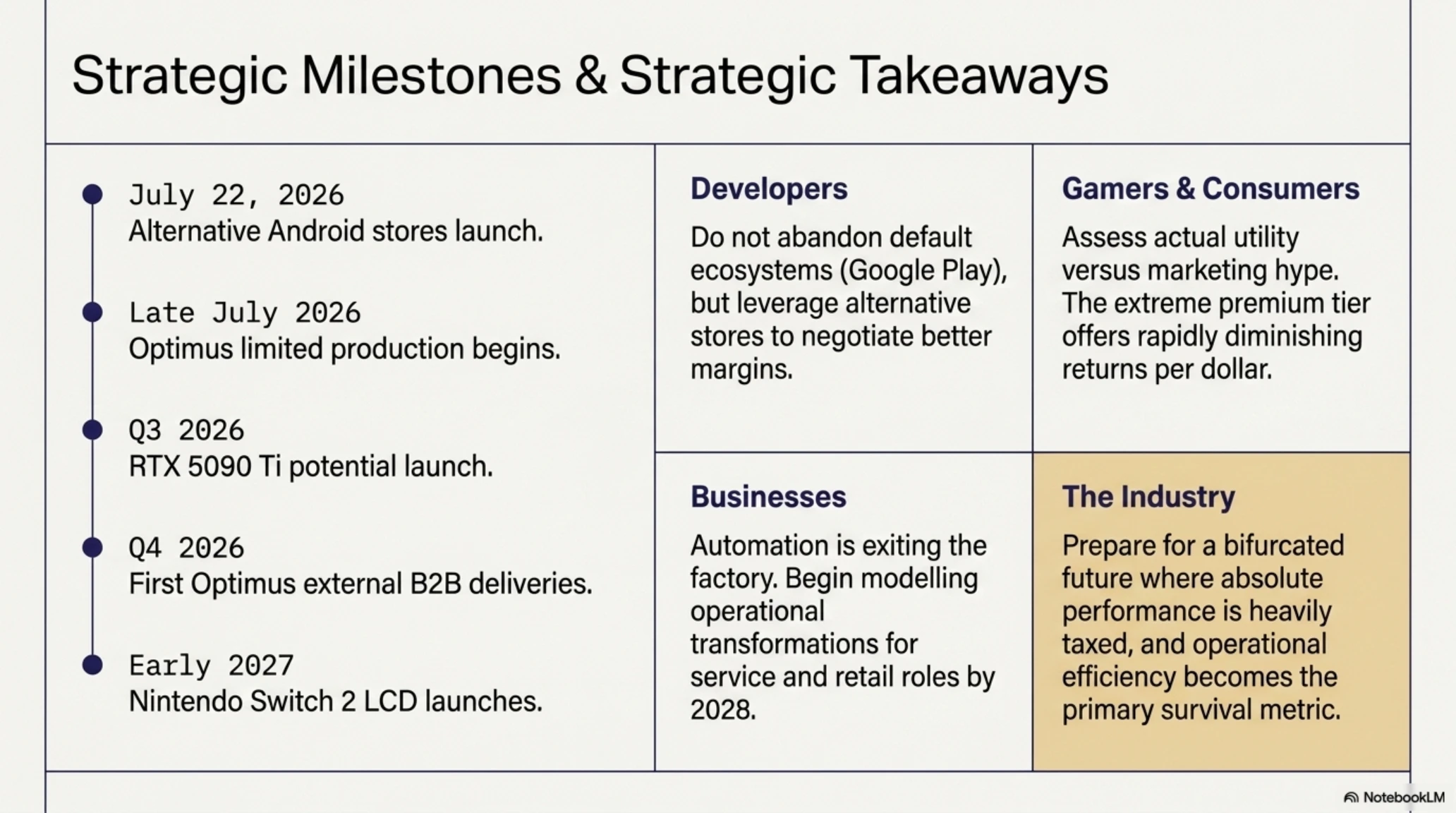
- July 22, 2026: Third-party Android app stores launch
- Late July 2026: Tesla Optimus limited production begins
- Q3 2026: Nvidia RTX 5090 Ti potential launch
- Q4 2026: First Optimus external customer deliveries
- Early 2027: Nintendo Switch 2 LCD launches
- 2028: Potential Switch 2 OLED release
Reader Takeaways
For developers: the opening of Android app distribution creates new opportunities but also new challenges. Consider whether alternative stores align with your strategy, but don't abandon Google Play - most users will remain there.
For space enthusiasts: SpaceX's achievements demonstrate that dramatic progress is possible even in mature industries. Support continued innovation by following developments and advocating for science funding.
For businesses: humanoid robots are transitioning from science fiction to practical tools faster than most expect. Start thinking about how automation could transform your operations - and how to manage the transition responsibly.
For gamers: premium products are getting more expensive, but that doesn't mean you need them. Assess your actual needs versus marketing hype. A mid-range GPU plays games just fine; you're paying extreme premiums for marginal improvements at the high end.
For everyone: the pace of technological change is accelerating, creating both opportunities and challenges. Stay informed, think critically about claims, and consider the broader implications beyond immediate features and benefits.
Tekin Night Philosophy
Frequently Asked Questions
Are third-party app stores safe?
Security depends on the specific store. Major stores like Epic Games Store and Samsung Galaxy Store likely maintain high security standards. But always be cautious with unknown stores. Google has also imposed security requirements for third-party stores.
Is Starlink V5 worth upgrading from V4?
If power consumption and weight matter to you (for example, for portable use or in areas with limited electricity), yes. But if you're only seeking higher speeds, no - V5 and V4 speeds are identical.
How does SpaceX recycle rockets?
Falcon 9 boosters reignite their engines after separating from the second stage and use landing legs to land on droneships or ground pads. This process is fully automated and controlled by onboard computers.
When can I buy a Tesla Optimus?
Limited sales to businesses and companies begin in late 2026. Broader public sales will likely wait until 2027-2028. The price will be around $30,000.
When will Switch 2 OLED be released?
It's not confirmed yet. Nintendo is evaluating this option but is concerned about pricing. Even if they decide to release it, it likely won't be available before 2028.
Is the RTX 5090 Ti worth it for gaming?
For most gamers, no. This card is designed for extreme gaming (4K 240Hz or 8K), professional work, and machine learning. The RTX 5080 or even 5070 will be sufficient for typical gaming.
Additional Gallery: 🌙 Tekin Night July 15, 2026: Historic Google-Epic Settlement & RTX 5090 Ti Beast