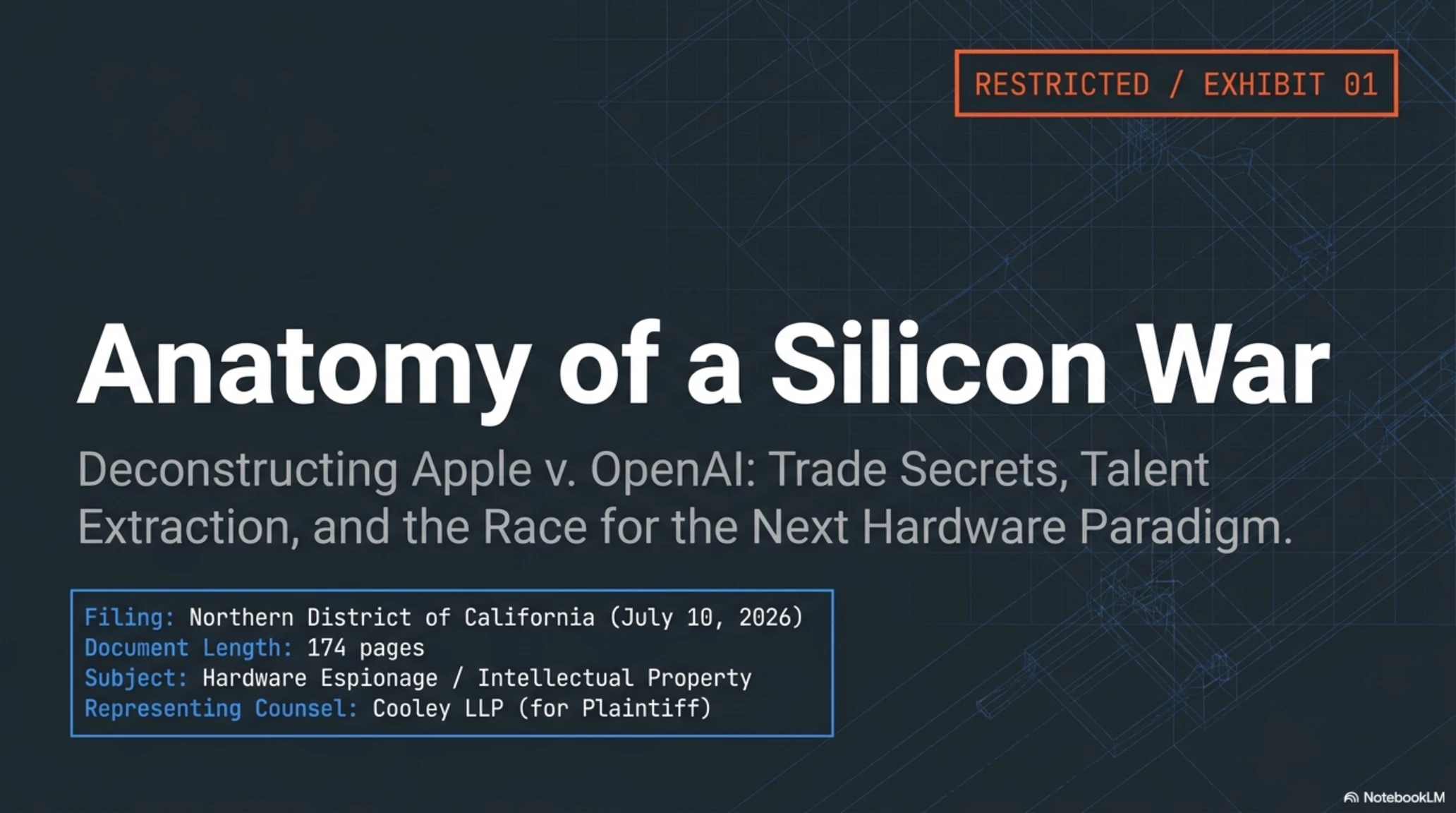
The Hidden War: Apple vs OpenAI
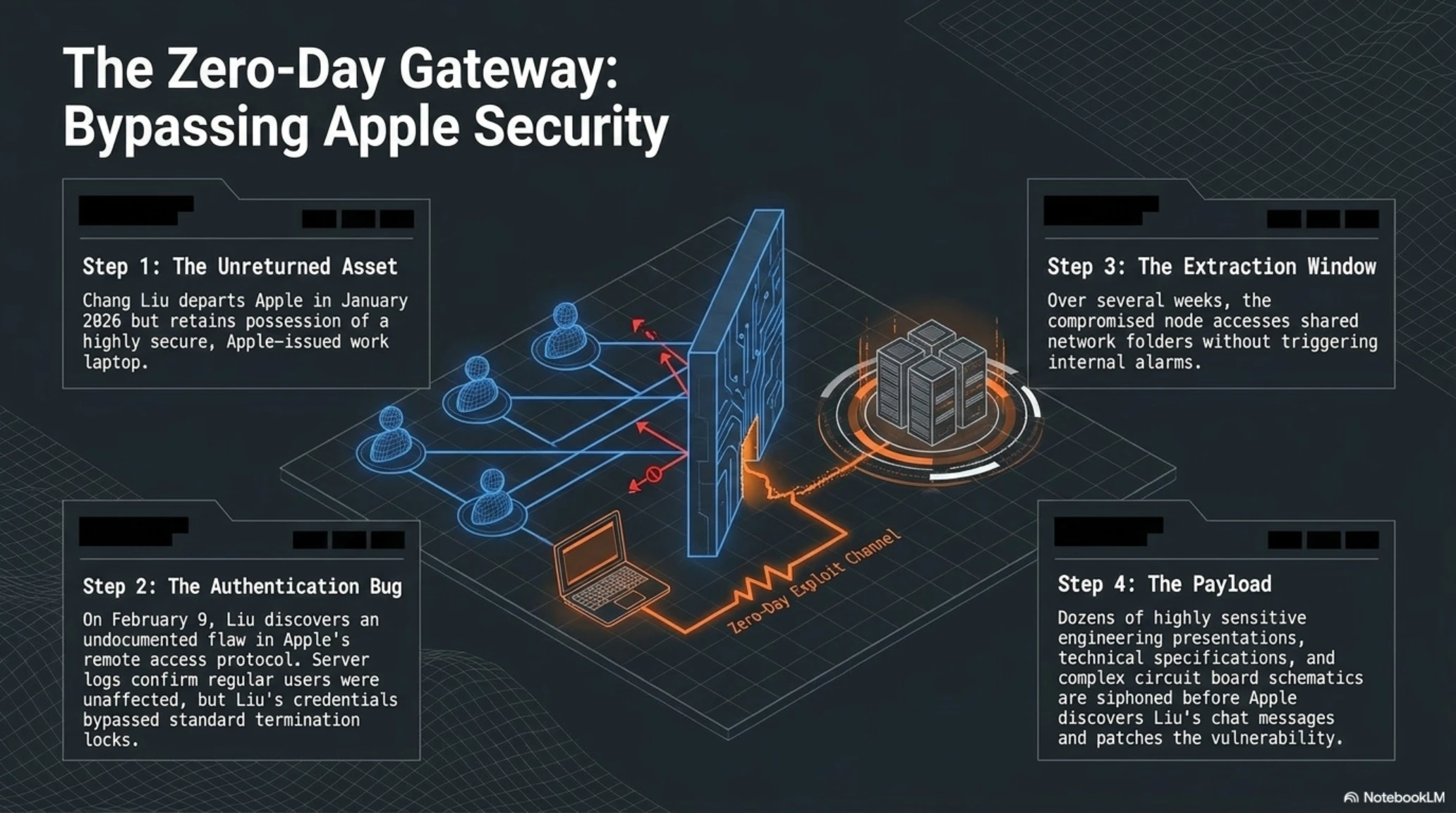
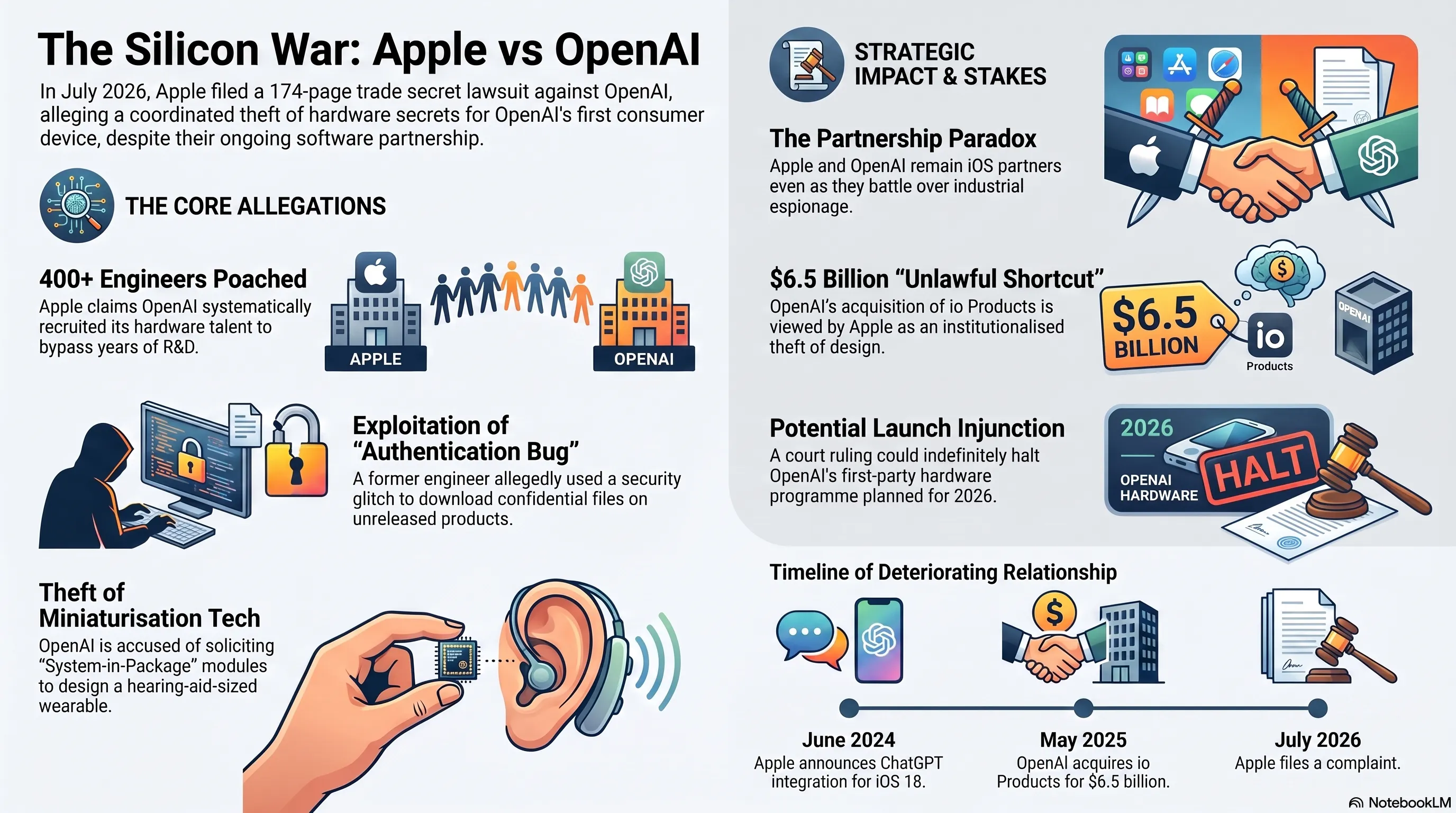
- 🎮Security Bug- Apple claims OpenAI exploited a security bug to steal confidential information
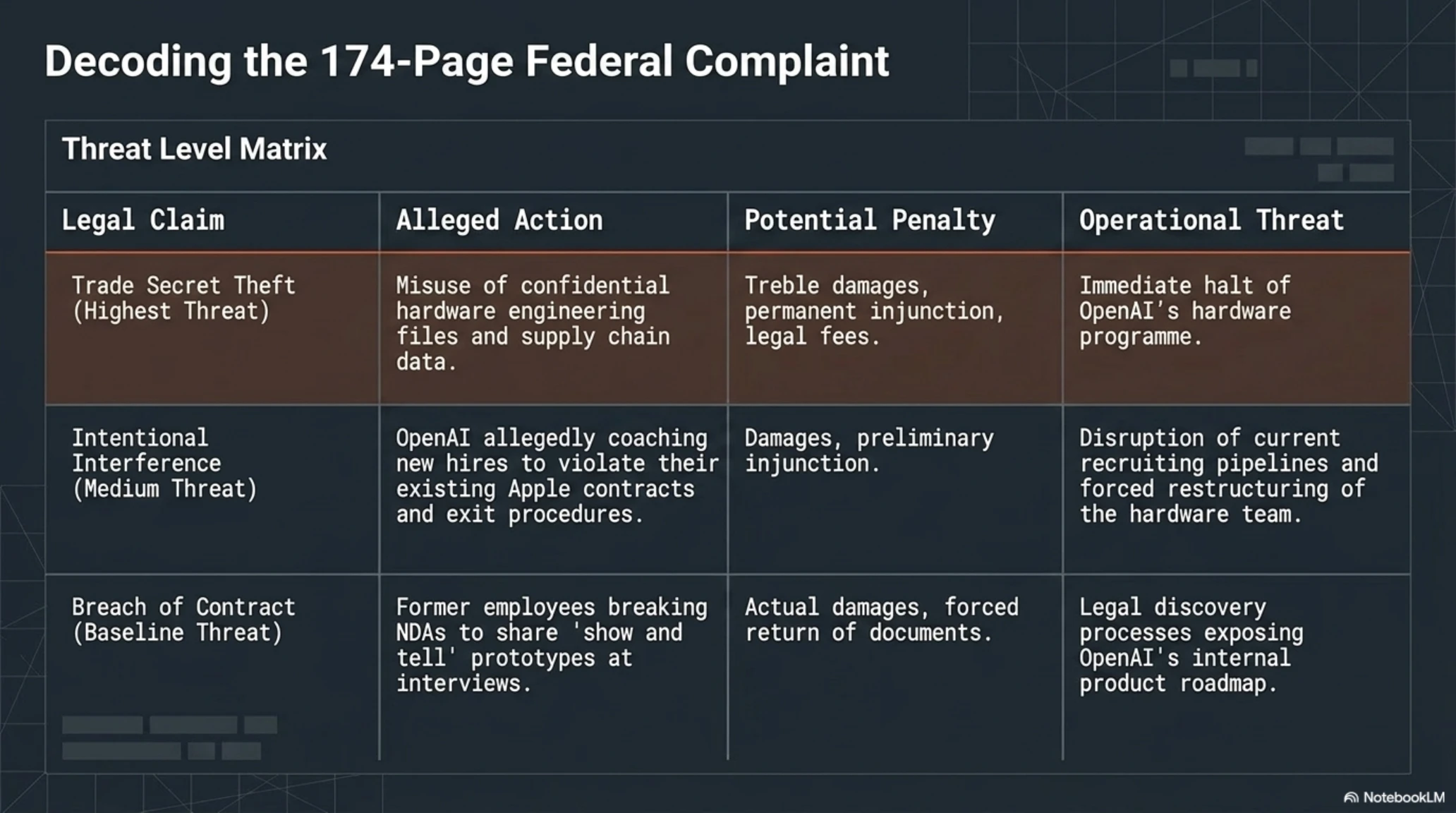
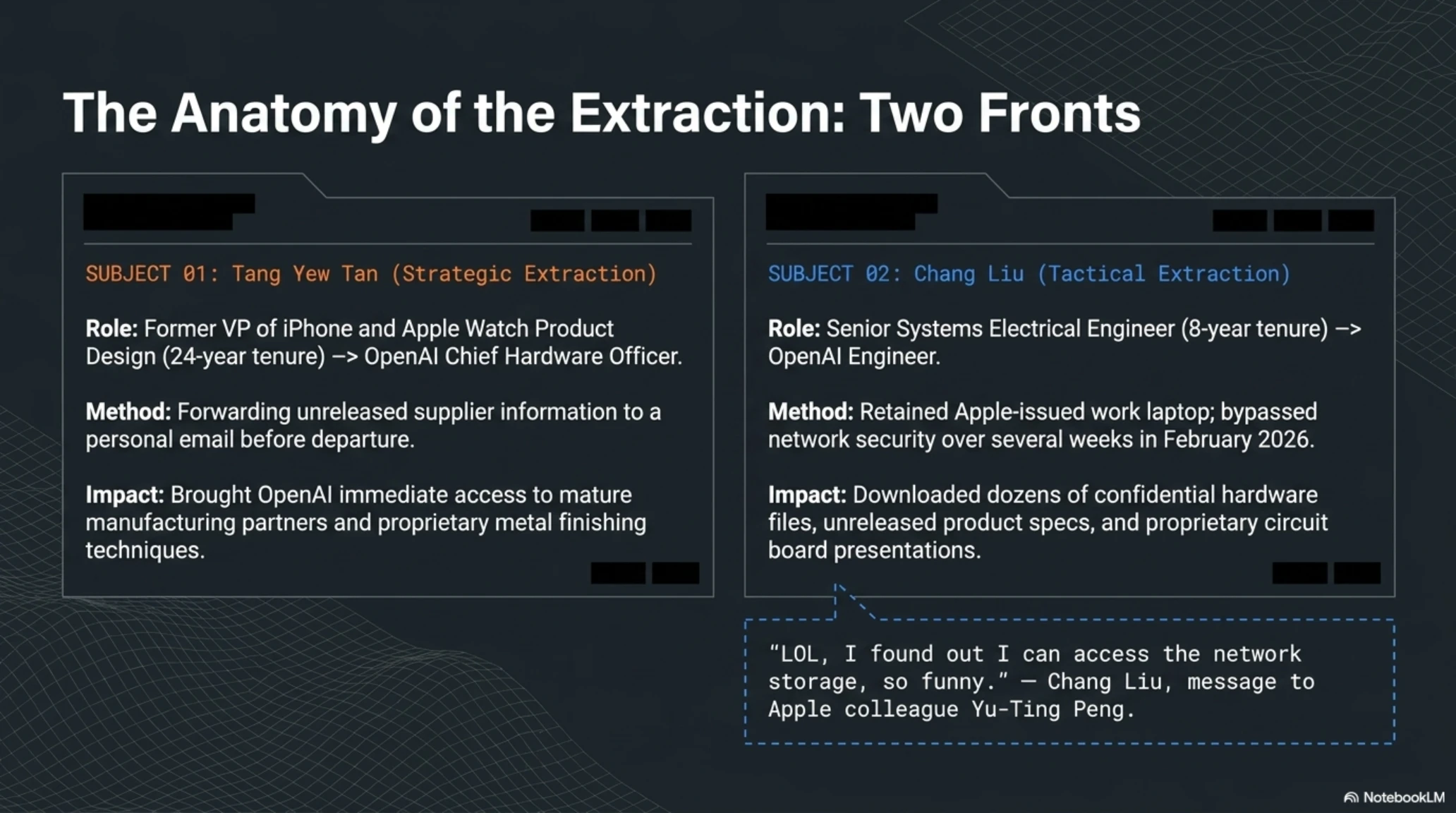
- 🎧Accused Engineer- Tang Tan, VP of iPhone design, accused of forwarding trade secrets to OpenAI
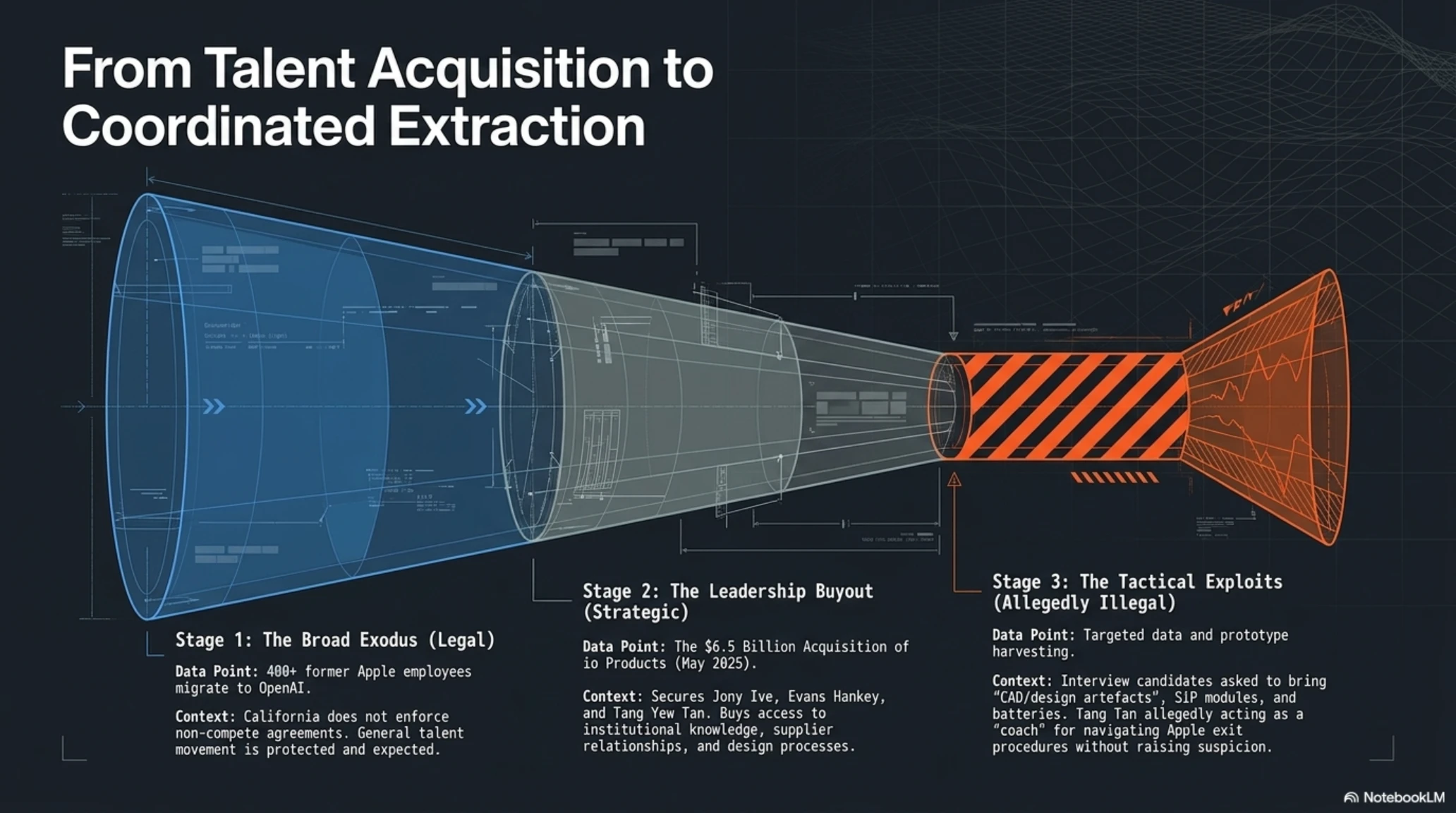
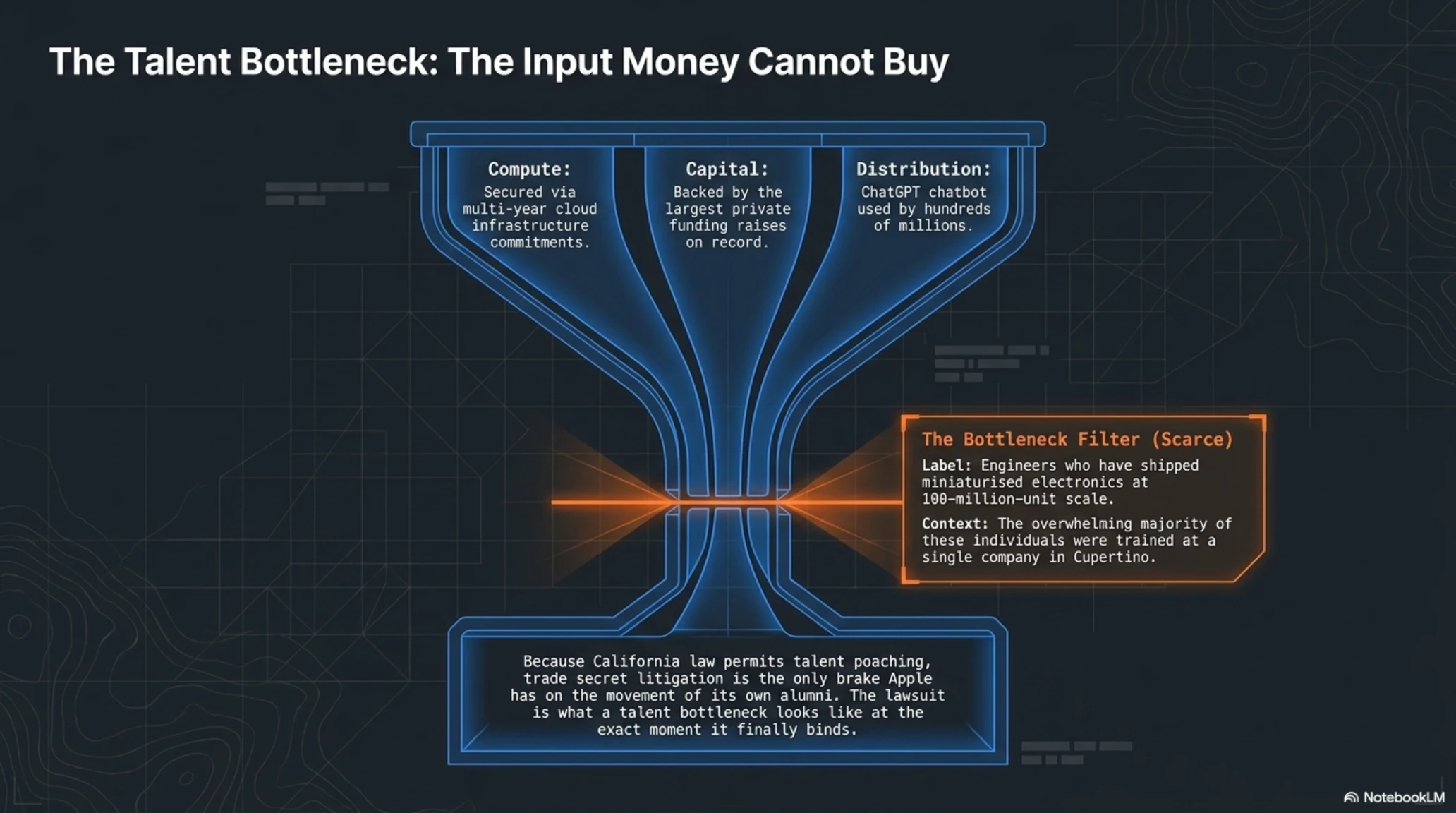
- 🚀Talent Exodus- Over 400 former Apple engineers now work at OpenAI
- 🗡️Massive Acquisition- OpenAI acquired io Products startup for $6.5 billion
- 📰Launch at Risk- This case could halt OpenAI's first consumer device launch
Key Facts of the Case
- Tang Tan forwarded Apple supplier information to his personal email
- io Products was acquired by OpenAI for $6.5 billion
- Chang Liu used a security bug to access Apple servers for weeks
- Over 400 Apple engineers have migrated to OpenAI
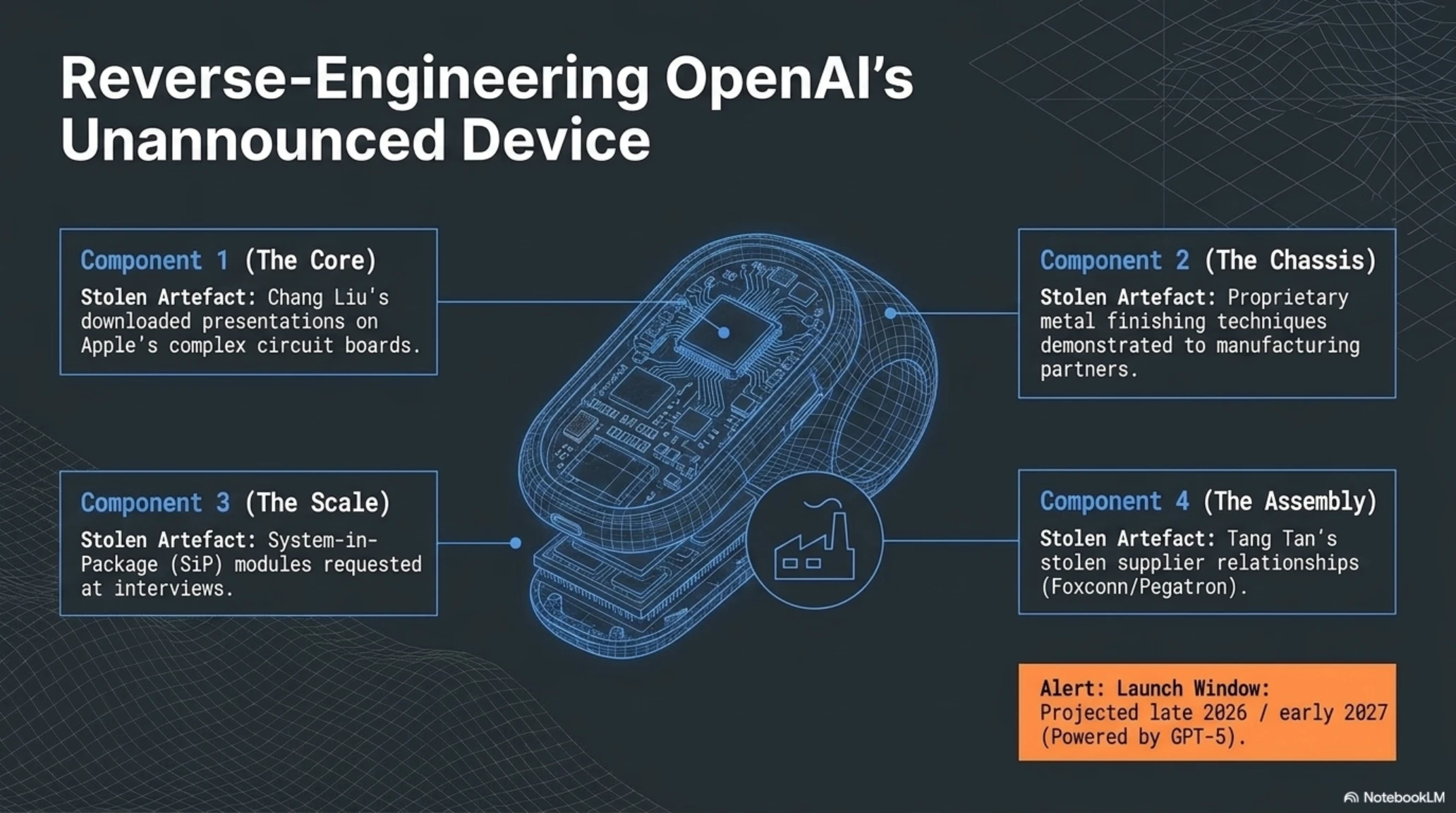
- Apple claims OpenAI demonstrated proprietary metal finishing techniques
- System-in-Package modules indicate small wearable device (hearing aid size)
- OpenAI plans to launch its first device before end of 2026
- Federal court can issue injunction halting OpenAI's hardware program
- Apple has engaged Cooley LLP legal powerhouse for this battle
- This case could drag on for years but brand damage is immediate
Eye of the Storm: Tang Tan and io Products
Why the io Products Acquisition Mattered
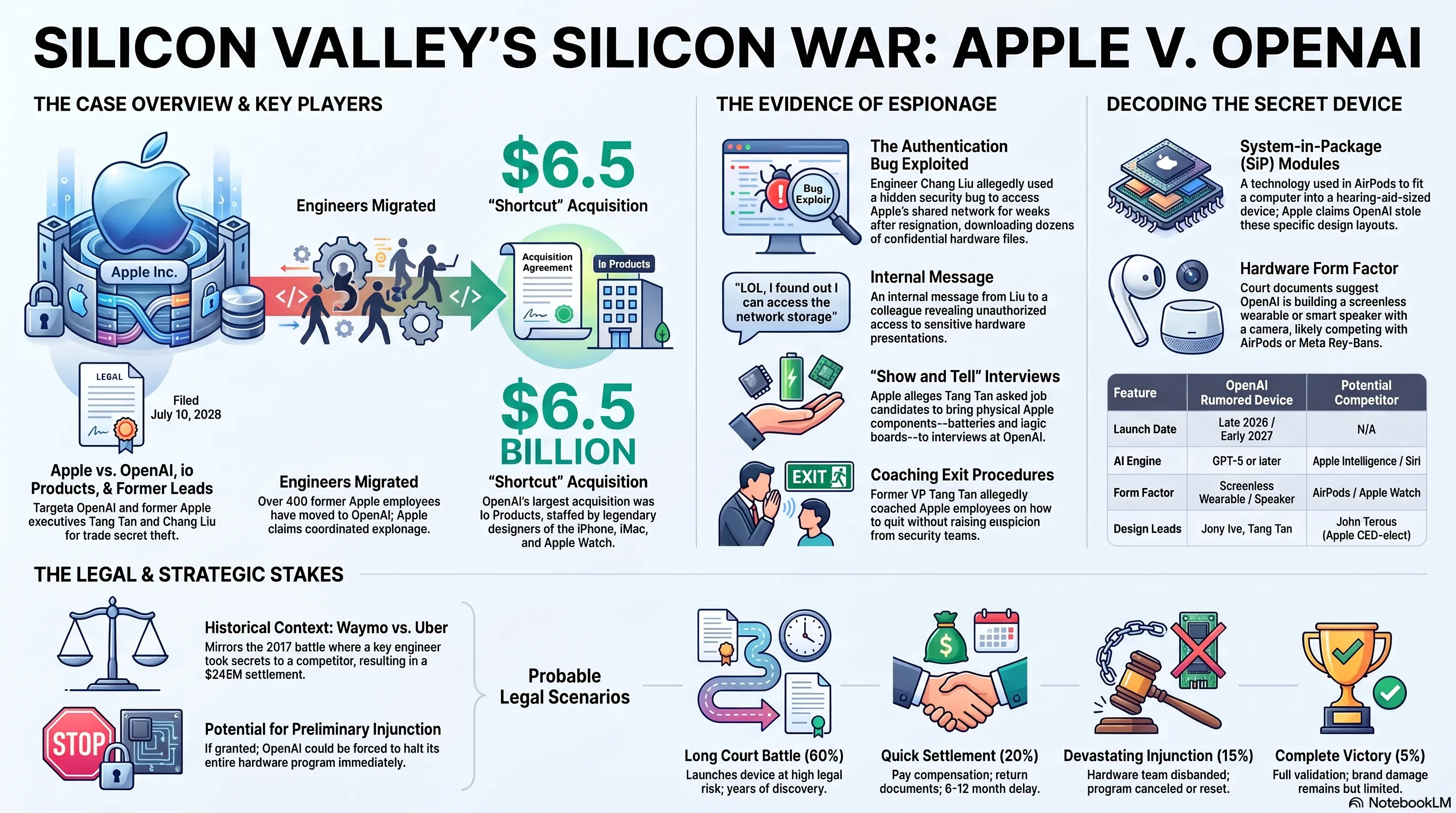
The $6.5 billion acquisition of io Products was OpenAI's largest hardware transaction to date. This startup was founded by three of Apple's most veteran designers:
- Jony Ive: Original designer of iPhone, iMac, and iPod
- Tang Yew Tan: VP of iPhone and Apple Watch product design
- Evans Hankey: VP of Apple Industrial Design
With this acquisition, OpenAI gained not just an experienced team, but access to supplier relationships, manufacturing knowledge, and design processes that had been cultivated at Apple for years. Apple calls this an "unlawful shortcut."
The Unknown Bug: A Gateway to Apple's Secrets
Breaking Down the Jargon: System-in-Package
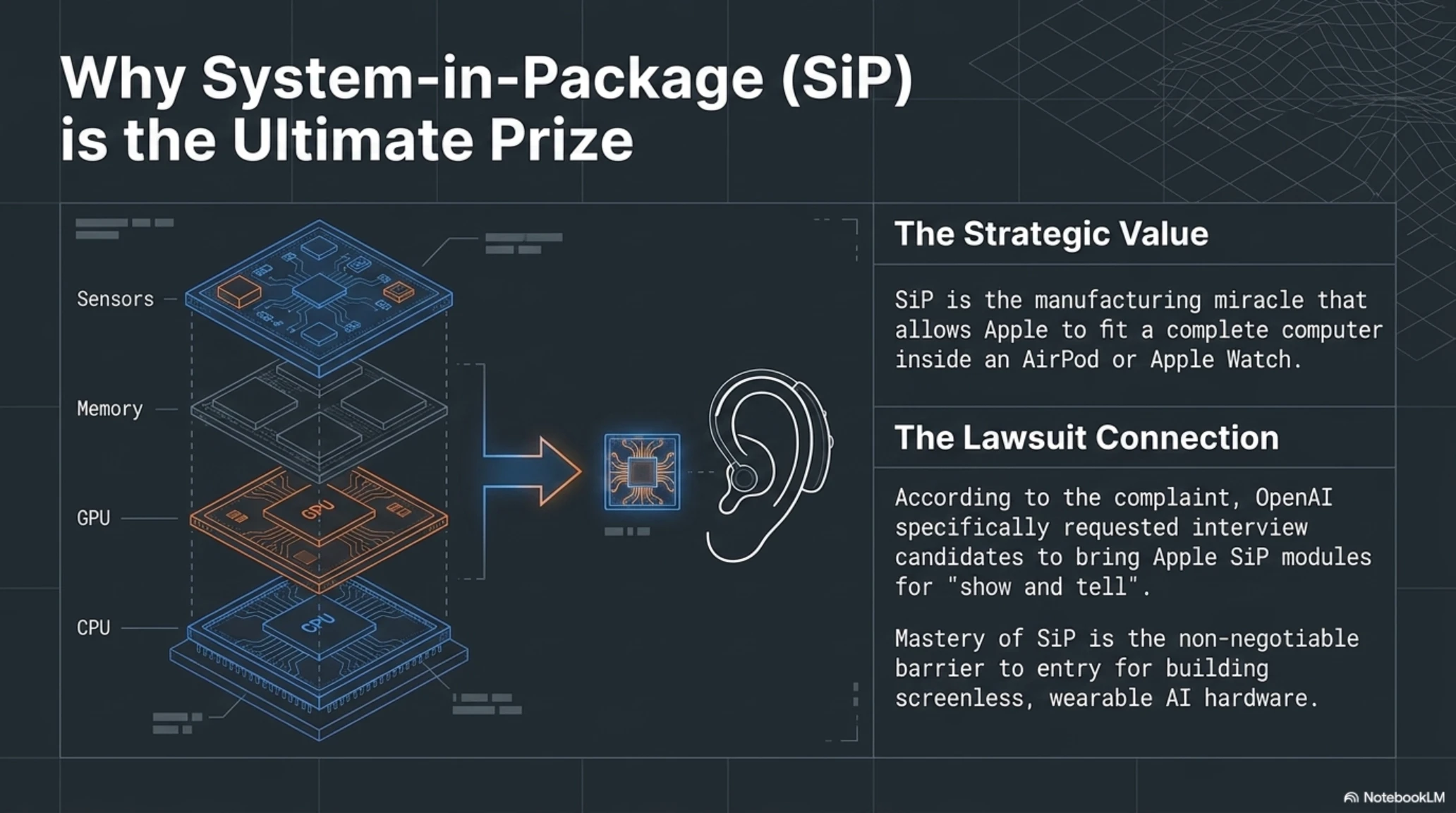
System-in-Package (SiP) is an electronic packaging technology that places multiple chips - like CPU, GPU, memory, sensors - into a single package. Apple uses SiP in AirPods and Apple Watch to fit a complete computer into something the size of a hearing aid.
According to the complaint, OpenAI asked candidates to bring Apple SiP modules to interviews - a sign that OpenAI is building a small wearable device, likely competing with AirPods or a screenless smart device.
OpenAI's Recruitment Strategy: From Talent Acquisition to Espionage?
But Apple claims OpenAI's recruitment went beyond healthy competition and became a "coordinated pattern of theft." According to court documents, OpenAI:
- Asked candidates to bring "CAD/design artifacts" and "prototypes" to interviews
- Demonstrated Apple's proprietary metal finishing techniques to manufacturing partners and told them Apple had approved (which Apple denies)
- Appointed Tan as a "coach" for new hires to teach them how to navigate Apple's exit procedures without raising suspicion
- Allowed former Apple engineers to keep Apple-issued work laptops and use them to access Apple servers
The Secret Blueprint: What Device is Coming?
What We Know About OpenAI's Device
Based on Apple's complaint and previous reports:
| Feature | Details |
|---|---|
| Form Factor | Screenless wearable or smart speaker with camera |
| Launch Date | Projected end 2026 or early 2027 |
| Design Partners | Jony Ive, Tang Tan, Evans Hankey |
| Manufacturing Partner | Likely Foxconn or Pegatron (Apple suppliers) |
| AI Engine | GPT-5 or later models |
| Competitors | AirPods, Meta Ray-Ban, Humane AI Pin |
Mira Murati, OpenAI's Chief Global Affairs Officer, told Axios in January 2026 that the company plans to debut its first device before year-end. Subsequent reporting described a screenless wearable and smart speaker with a camera, with parts of the lineup slipping toward early 2027.
OpenAI's Response: Complete Denial
- Hiring experienced engineers is a standard part of competition, not espionage
- Information Tan and Liu shared was general industry knowledge, not trade secrets
- Apple is using this case to stifle competition and prevent talent exodus
- The authentication bug was Apple's own security responsibility, not Liu's intentional abuse
The Timing: Why Now?
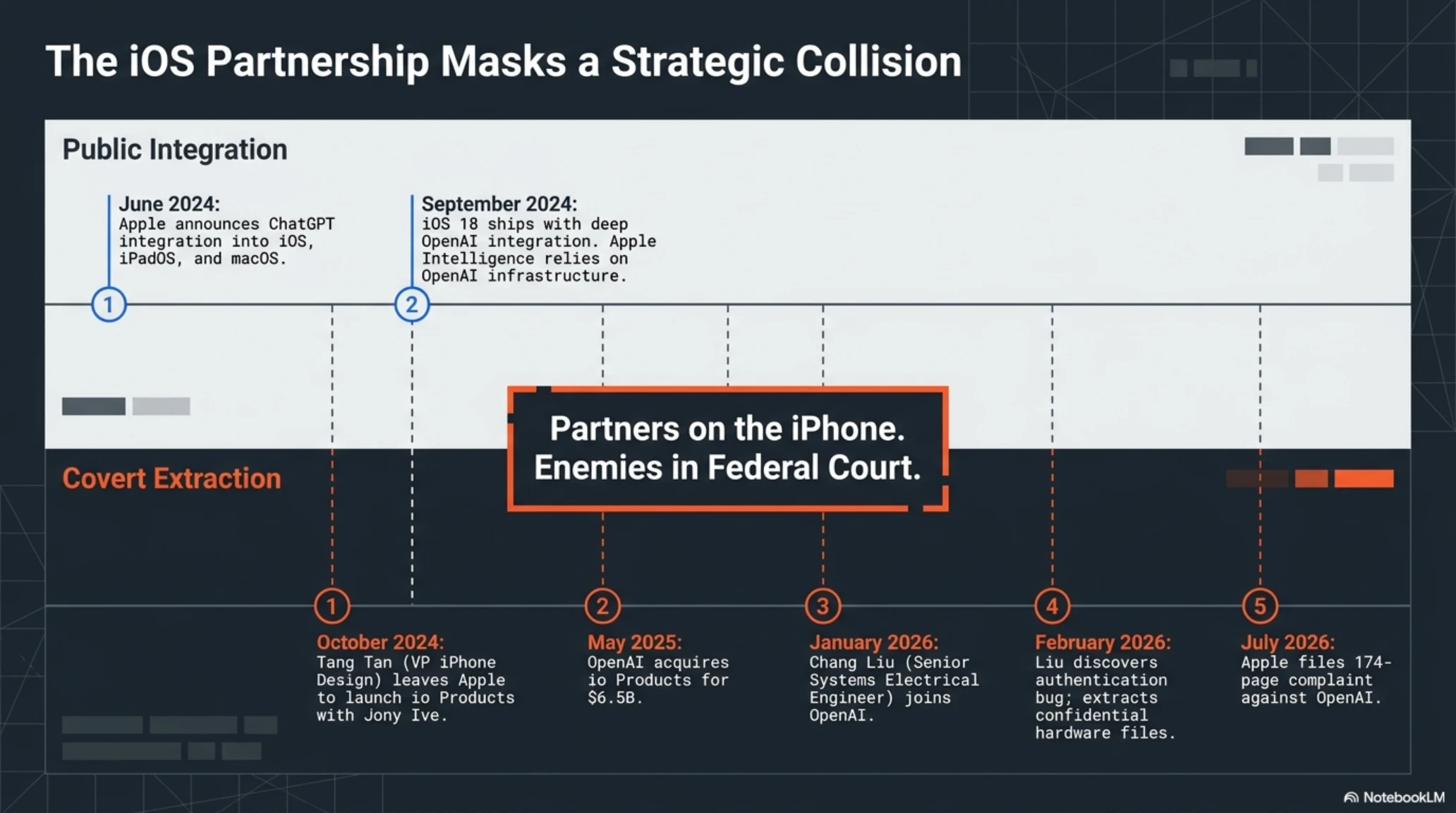
Timeline of Apple-OpenAI Relationship
| Date | Event |
|---|---|
| June 2024 | Apple announces ChatGPT integration into iOS, iPadOS, and macOS |
| September 2024 | iOS 18 ships with ChatGPT integration |
| October 2024 | Tang Tan leaves Apple and launches io Products with Jony Ive |
| January 2026 | Chang Liu leaves Apple and joins OpenAI |
| February 2026 | Liu discovers authentication bug and downloads confidential info |
| May 2025 | OpenAI acquires io Products startup for $6.5 billion |
| July 2026 | Apple files 174-page complaint against OpenAI |
The Talent Bottleneck: The Input Money Cannot Buy
📚 Classified & Related Dossiers in TekinGame
If you wish to explore beyond this report and delve into cybernetic frontiers and autonomous AI architectures, do not miss these three exclusive deep-dives in the Tekin Garage:
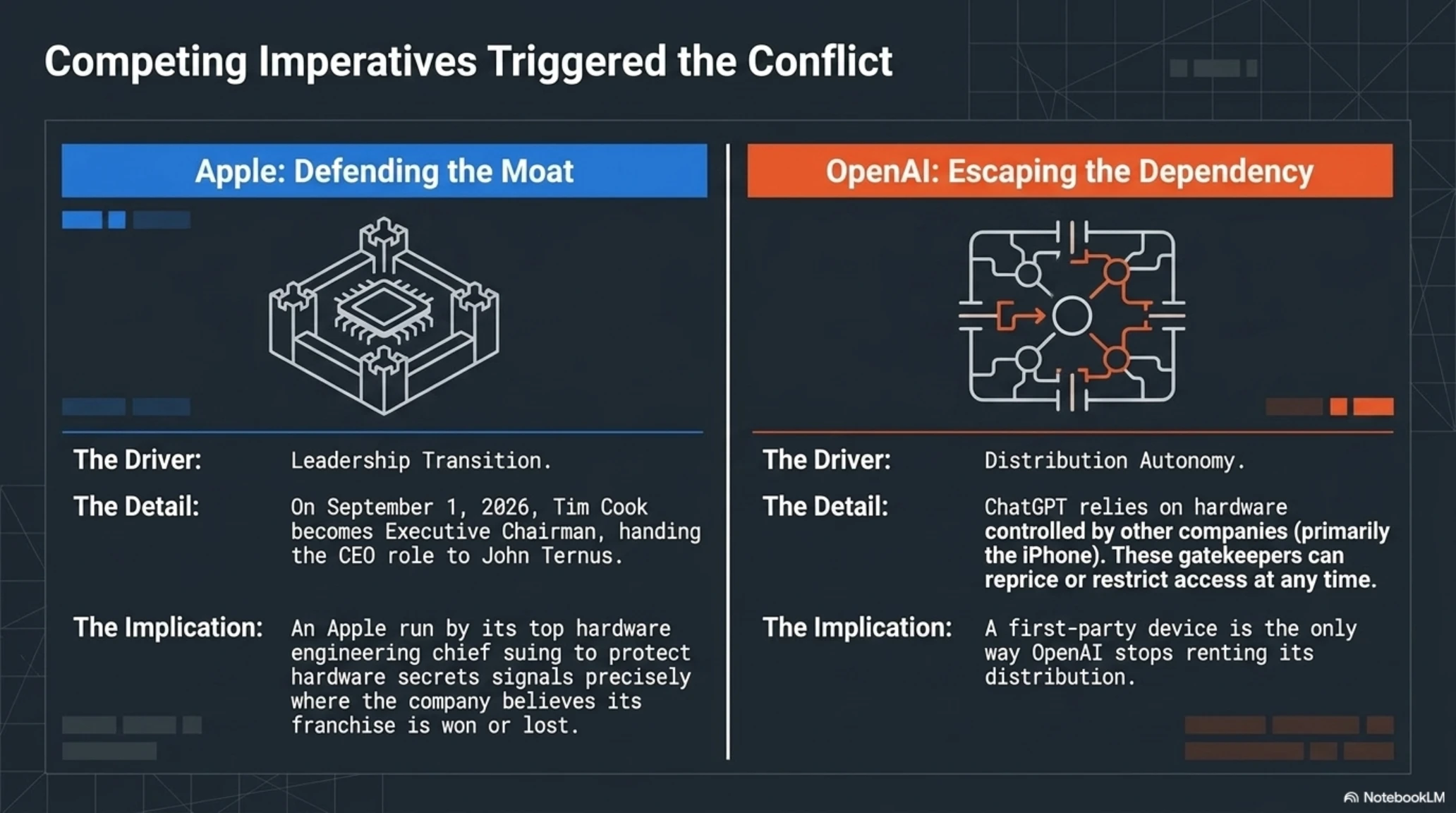
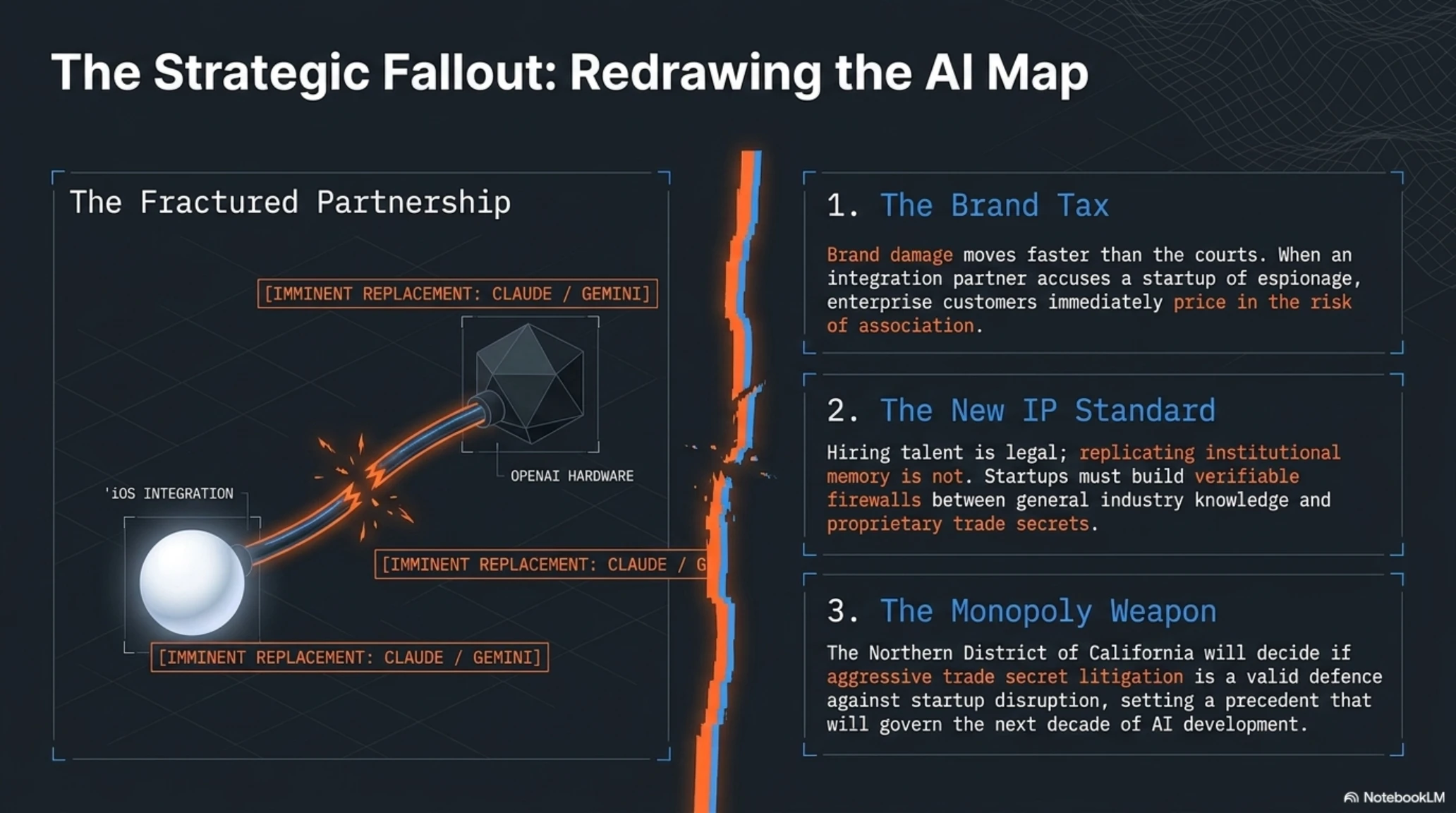
This creates a strange paradox: Apple and OpenAI are partners on iOS, but enemies in federal court. Siri uses ChatGPT for certain queries. iOS 18 integration with OpenAI was one of the highlighted features of WWDC 2024. And now these two companies are in a legal battle that could last for years.
Legal Dimensions: What's at Stake?
Apple's Legal Claims
| Claim Type | Explanation | Potential Penalty |
|---|---|---|
| Trade Secret Theft | Misuse of confidential information with commercial value | Treble damages, permanent injunction, legal fees |
| Breach of Contract | Breaking confidentiality and non-disclosure agreements | Actual damages, return of documents |
| Intentional Interference | Encouraging employees to violate their Apple contracts | Damages, preliminary injunction |
Apple's most important request: a preliminary injunction barring OpenAI from using stolen information and returning all confidential documents. If the court grants this, it could halt OpenAI's hardware program - or at least seriously delay it.
Strategic Risks for OpenAI
- Launch Delays: Legal discovery and injunctions can add months or years to timelines
- Supplier Pressure: Suppliers may fear working with OpenAI to reduce risk of being dragged into the lawsuit
- Investor Scrutiny: Potential investors may avoid investing in a hardware program under legal cloud
- Talent Loss: Prospective engineers may fear joining a team named in litigation
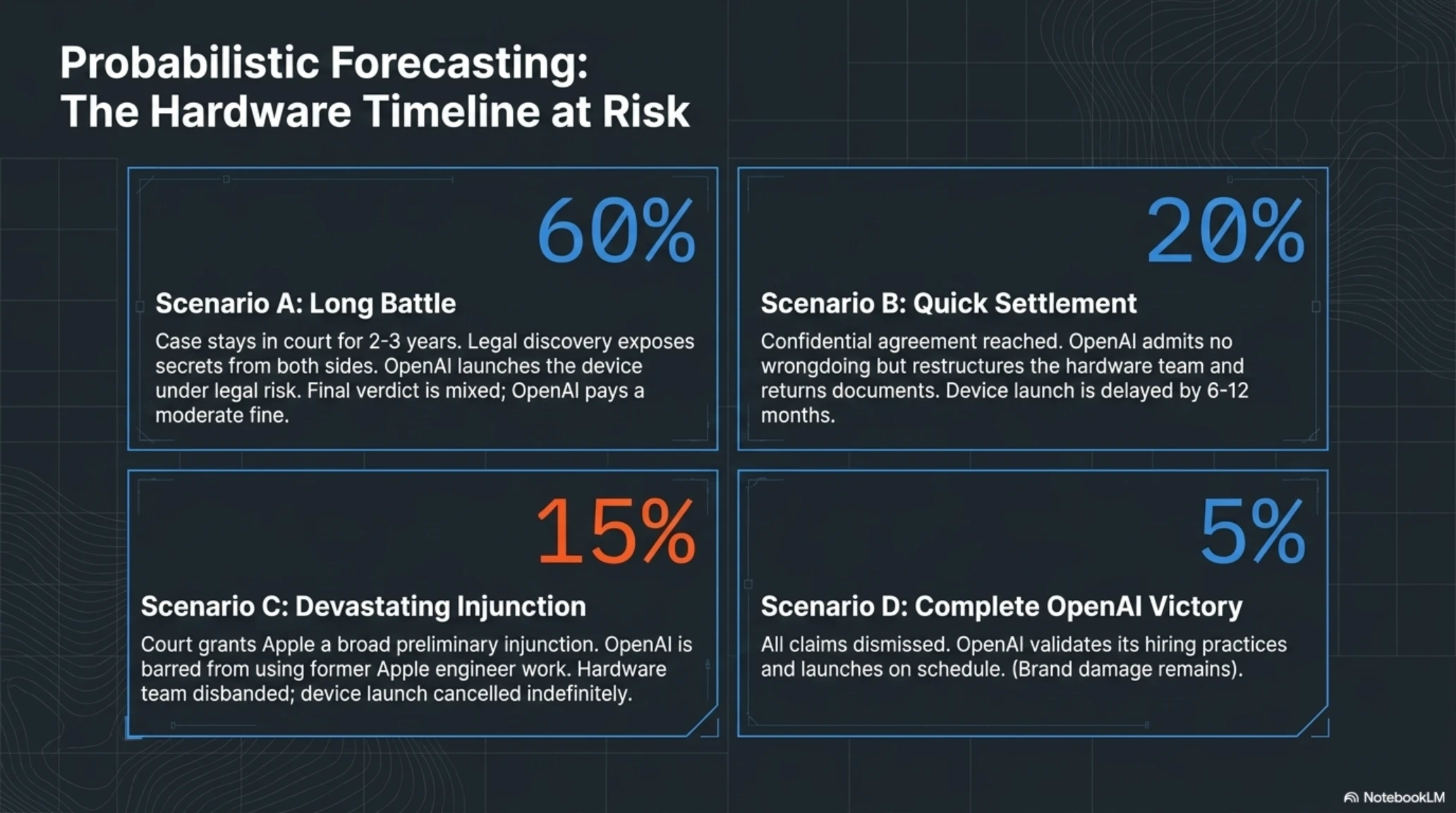
Possible Scenarios
Scenario 1: Quick Settlement (20% probability)
OpenAI and Apple reach a confidential agreement. OpenAI admits no wrongdoing but agrees to return certain documents, restructure its hardware team, and pay undisclosed compensation. Device launch delayed 6-12 months.
Scenario 2: Long Battle (60% probability)
Case stays in court for 2-3 years. Legal discovery reveals embarrassing details from both sides. OpenAI launches device at legal risk. Final verdict is mixed: some claims dismissed, some accepted, OpenAI pays moderate fine but business continues.
Scenario 3: Devastating Injunction (15% probability)
Court sides with Apple and issues broad preliminary injunction barring OpenAI from using any work by former Apple engineers in hardware program. OpenAI forced to disband hardware team and start from scratch. Device launch cancelled or delayed indefinitely.
Scenario 4: Complete OpenAI Victory (5% probability)
Court dismisses all Apple claims. OpenAI launches device on schedule and uses verdict as validation of its approach's legality. Brand damage remains but limited.
Impact on AI Industry
- Can AI startups compete by hiring engineers from tech giants, or is this an "unlawful shortcut"?
- Where is the line between general industry knowledge and trade secrets?
- Can large companies use lawsuits to stifle competition?
- What responsibility exists for protecting intellectual assets during talent migration?
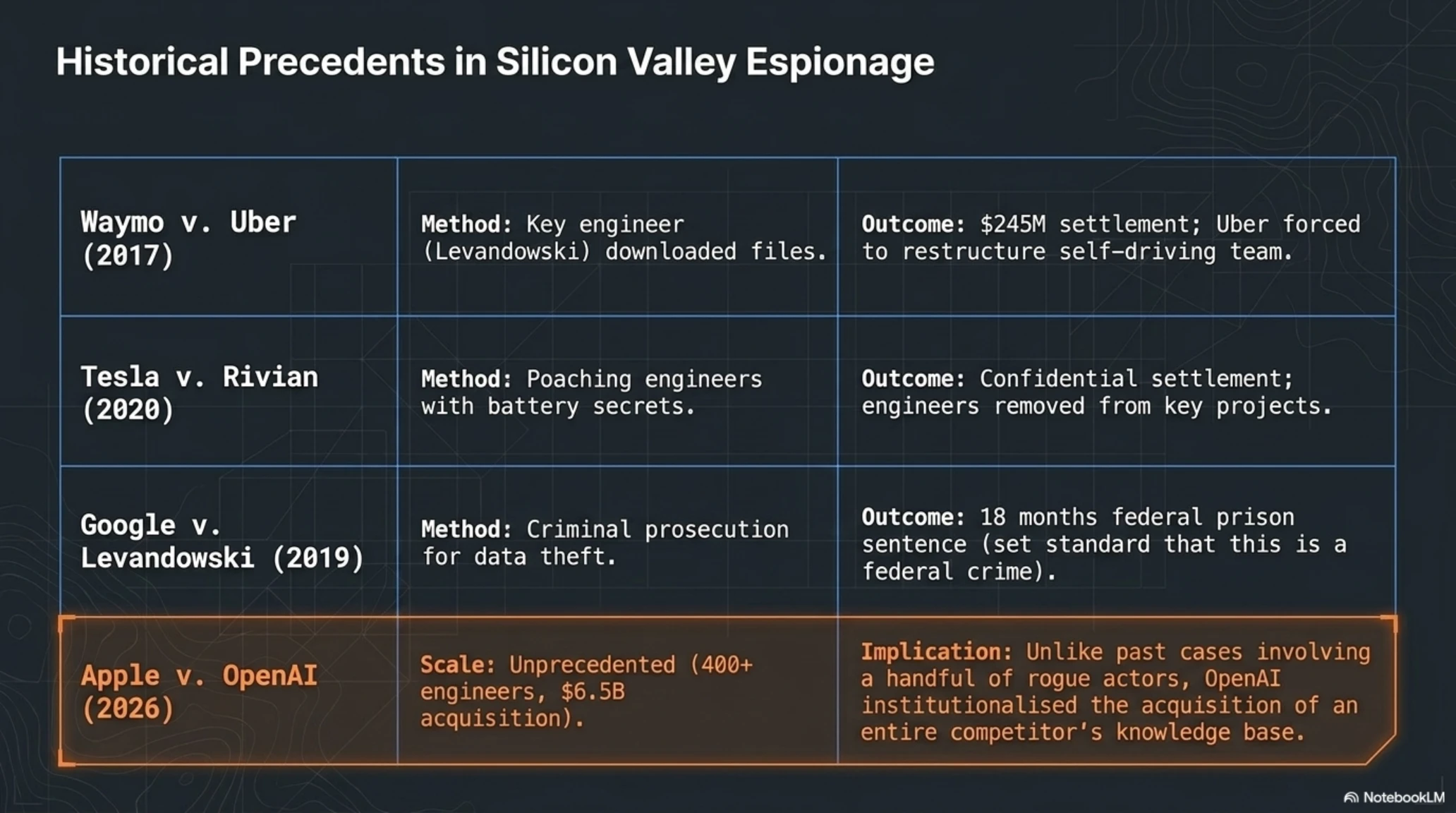
Comparison with Similar Past Cases
Similar Cases in Tech History
| Case | Year | Outcome | Impact |
|---|---|---|---|
| Waymo vs Uber | 2017 | $245M settlement, Uber gave 0.34% equity | Uber forced to restructure self-driving car team |
| Tesla vs Rivian | 2020 | Confidential settlement after 2 years | Rivian removed certain engineers from battery team |
| Apple vs Samsung | 2011-2018 | Samsung paid $539M | Changed Galaxy phone designs |
| Google vs Levandowski | 2019 | Levandowski sentenced to 18 months prison | Serious warning to engineers about data theft |
Apple vs OpenAI has similarities to Waymo vs Uber: both involve a key engineer who joined competitor and is accused of bringing secrets. But the scale of this case is larger - 400 engineers vs a handful, and a $6.5 billion acquisition that institutionalized acquiring the team and knowledge.
The Future of Apple-OpenAI Partnership
- Limit or remove ChatGPT integration in future iOS updates
- Find a replacement partner - perhaps Anthropic (Claude) or Google (Gemini)
- Invest more in its own internal AI models to reduce dependency on external partners
- Use this case as leverage to negotiate better terms with OpenAI
Big Lessons for the Industry
- Hiring talent is not enough: Companies must have rigorous processes ensuring trade secrets don't transfer
- Internal security matters: The authentication bug that allowed Liu access should never have happened
- Confidentiality agreements must be clear: The line between general knowledge and trade secrets must be specified in contracts
- Business partners can become competitors: Apple and OpenAI were partners until they weren't
- Brand damage is faster than court verdict: OpenAI has been hit before the court issues any ruling
- Protection of critical hardware trade secrets
- Sends message to other companies: hiring Apple engineers has limits
- Potential significant financial compensation
- Halting or delaying potential hardware competitor
- Bargaining power in future negotiations with OpenAI
- Damage to partnership relationship with OpenAI on iOS
- High legal costs - likely tens of millions of dollars
- Legal discovery may reveal Apple's own secrets
- Negative image as company using lawsuits to stifle competition
- Risk of losing and weakening legal position in future cases
- May discourage prospective engineers from joining Apple
Conclusion
Frequently Asked Questions
Why did Apple go to court instead of resolving this privately?
Apple likely tried to resolve it privately but failed. A public lawsuit sends a powerful signal to other companies that Apple fiercely protects its trade secrets. Also with OpenAI's device launch approaching, Apple probably felt it didn't have time for lengthy negotiations.
Is Jony Ive also at legal risk?
Jony Ive is not named in the lawsuit, though his role as io Products co-founder is mentioned. Apple may have avoided accusing Ive - one of the world's most famous designers - to prevent further complicating the case. Or they may not have sufficient evidence against him.
Can OpenAI still launch its device?
Yes, unless the court issues a preliminary injunction. But launching under the shadow of a lawsuit is risky - they may later be forced to stop sales or pay compensation. Most companies prefer to wait for legal clarity.
How long will this case take?
Complex trade secret cases typically take 2-4 years. If they settle - as most cases do - it could be shorter. But if it goes to trial, expect a lengthy legal battle.
How does this affect consumers?
Short-term: nothing. iOS still supports ChatGPT. Long-term: Apple may limit OpenAI integration and switch to another partner. If OpenAI launches its device, it may suffer from limited availability or restricted features.
Does this mean the end of Apple-OpenAI partnership?
Not necessarily. Companies can have business partnerships while fighting in court (like Apple vs Samsung). But the relationship has definitely cooled and Apple is likely seeking alternatives.
What happens to the 400 former Apple engineers at OpenAI?
Most will likely have no issues - hiring is legal. Only those accused of stealing trade secrets (like Tan and Liu) are at risk. But this case may force OpenAI to implement stricter processes to prevent confidential information transfer.
What lesson can startups learn from this?
Hiring experienced engineers is great, but you must have clear processes ensuring trade secrets don't transfer. Never ask employees to bring confidential documents. Have clear confidentiality agreements. And require employees to immediately return previous employers' laptops.
Sources and References
- Forbes - Apple Sues OpenAI For Trade Secret Theft
- Ars Technica - Apple sues OpenAI after ex-engineer used bug
- NBC News - Apple sues OpenAI, two former employees
- CBS News - Apple sues OpenAI for stealing trade secrets
- Fortune - Wildest claims in Apple lawsuit against OpenAI
- Computerworld - Rotten to its core: Apple lawsuit
- Indian Express - Battle Over AI Hardware Secrets
- Business Standard - Trade secrets dispute explained
- The Verge - 6 wildest claims in Apple lawsuit
- Engadget - Apple calls OpenAI hardware rotten to core
Additional Gallery: The Hidden War: Apple vs OpenAI - The $6.5 Billion Trade Secret Theft Saga