Tekin Night executive briefing for Friday, November 13, 2026, dissects six systemic cyber crises: (1) 4,837 compromised GitHub accounts exfiltrating CI/CD secrets; (2) Apache's CVE-2026-119618 HTTP/2 heap corruption (CVSS 9.8); (3) Binance's alert on unpatched iOS sandbox escape flaw 'worse_query'; (4) Claroc audit revealing 35,000 unauthenticated Grok-built apps leaking data; (5) Zoom Workplace Windows SYSTEM escalation; and (6) Nintendo's 144-repo DMCA sweep against Switch modchips.
Tekin Night | Executive Intelligence Briefing November 13, 2026
Strategic Intelligence Overview | Core Vectors
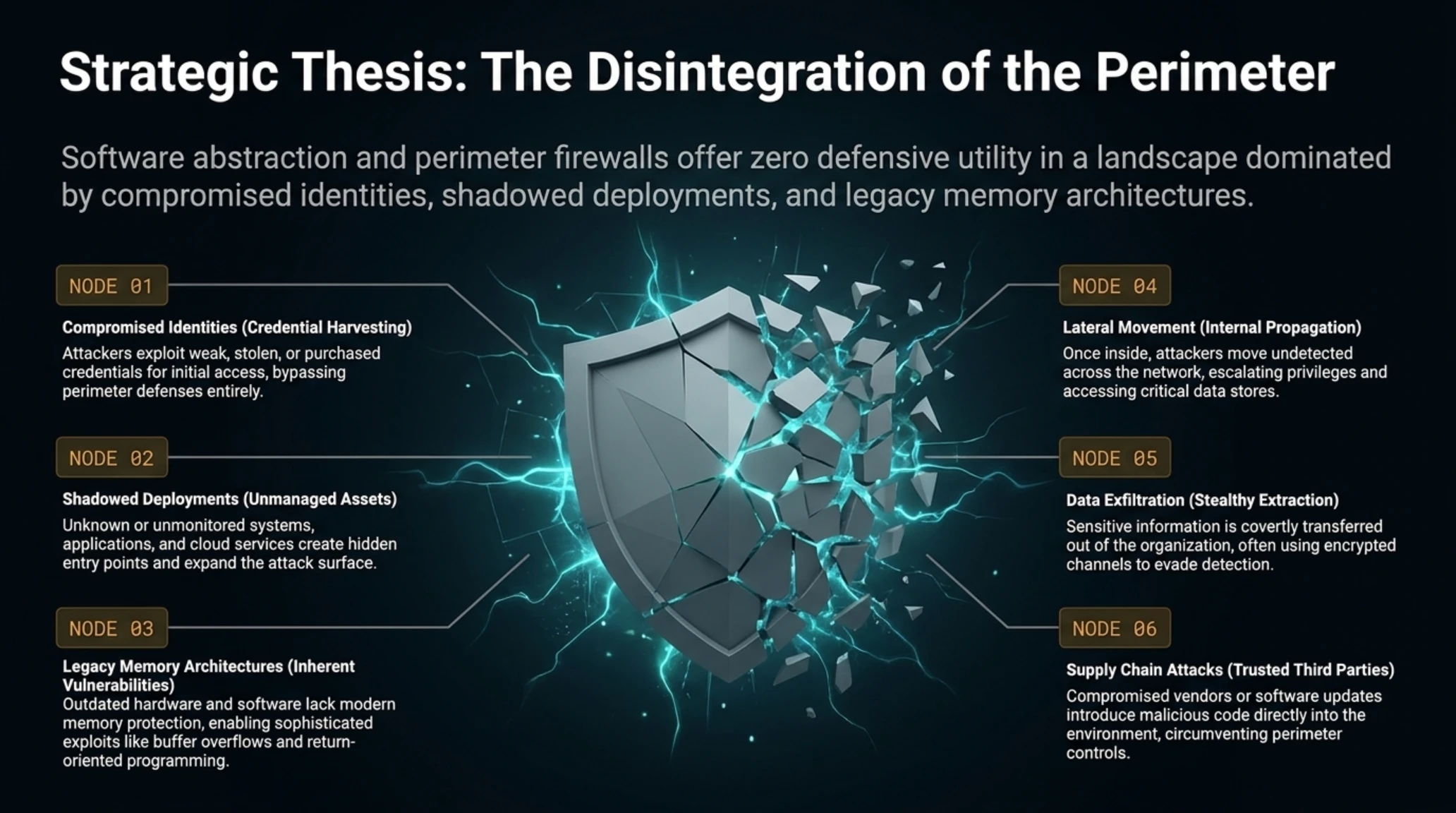
The closing hours of Friday, November 13, 2026, have delivered an unprecedented convergence of systemic cybersecurity failures and aggressive legal maneuvers across the global technology infrastructure. While commercial optimism dominated morning discussions around silicon milestones and vehicular voice integration, the evening landscape reveals profound vulnerabilities across the digital supply chain. From the automated weaponization of developer credentials to memory corruption flaws inside the world most widely deployed web server software, modern enterprises confront a perimeter-less threat environment.
At the center of this geopolitical cyber landscape is an audacious software supply chain campaign that hijacked thousands of developer accounts on GitHub, methodically injecting secret-harvesting payloads into automated deployment pipelines. In tandem, the Apache Software Foundation and major enterprise Linux distributions were forced to issue emergency advisories for a near-maximum 9.8-severity vulnerability in mod_http2, permitting unauthenticated adversaries to execute arbitrary commands through crafted HTTP/2 network packets. Concurrently, the assumed impregnability of consumer mobile devices suffered a major blow as Binance issued urgent security alerts regarding an unpatched iOS sandbox escape exposing cryptographic seed phrases.
The dark side of enterprise generative AI adoption was laid bare by security firm Claroc, revealing that over 35,000 corporate applications built on xAI Grok Build engine were indexed publicly without authentication, spilling medical histories, sales pipelines, and plaintext passwords across the open internet. Meanwhile, enterprise communication giant Zoom disclosed a 9.6-rated vulnerability enabling remote attackers to seize complete control over Windows client operating systems without valid credentials. Finally, in the gaming hardware ecosystem, Nintendo executed a historic legal strike by disabling 144 GitHub repositories containing modchip firmware, signaling that the battle over hardware ownership and silicon security has reached a permanent escalation point.
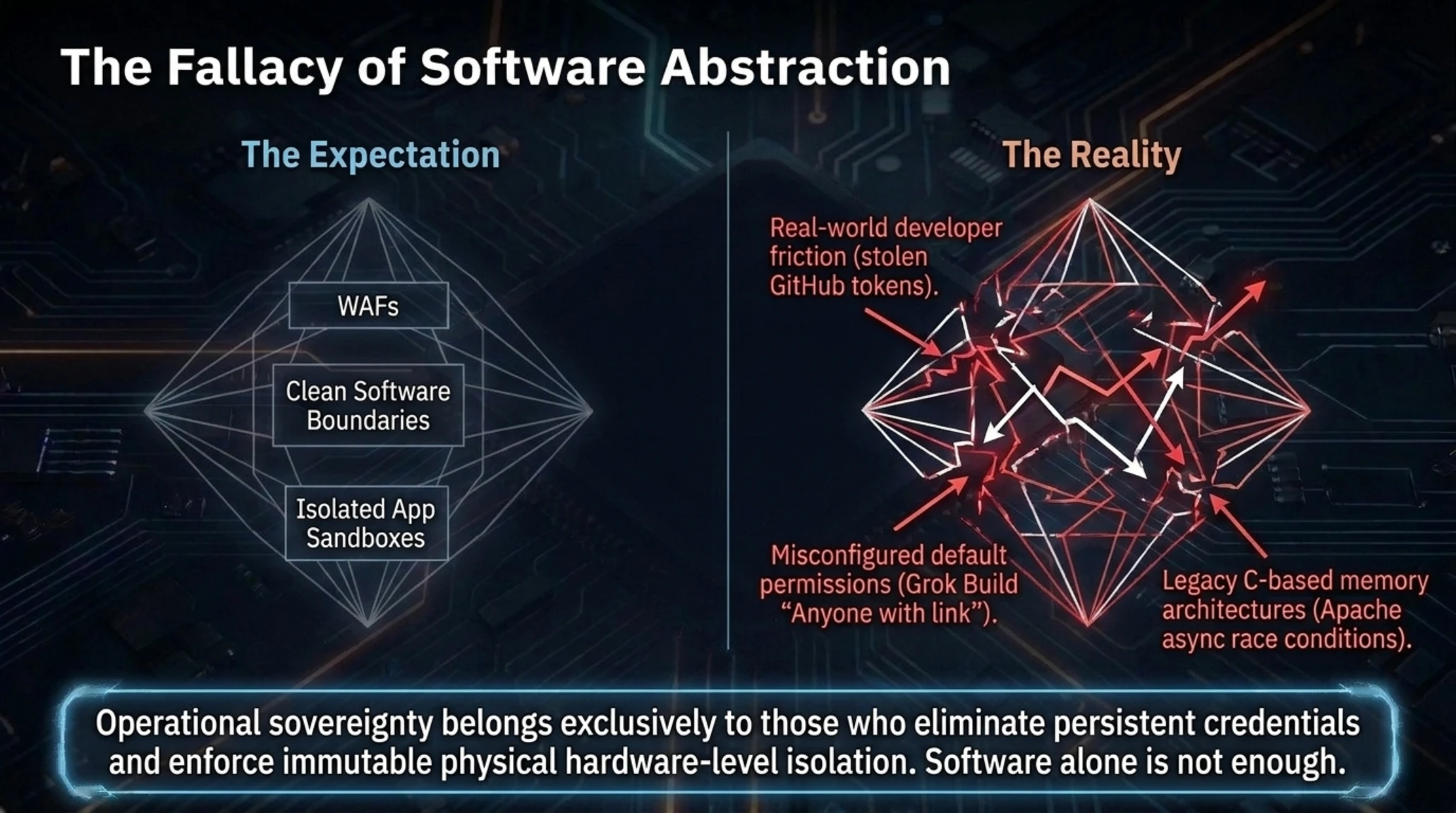
These six nodes demonstrate that abstract software security models consistently disintegrate when confronted with real-world developer friction, misconfigured default permissions, and legacy memory architectures. As corporate networks dissolve into distributed remote endpoints and cloud build servers, traditional perimeter firewalls offer zero defensive utility. The technical analyses detailed below provide an uncompromising audit of this shifting attack surface.
Node 1: Automated Supply Chain Warfare: Attackers Weaponize 4,837 Compromised GitHub Accounts to Exfiltrate Cloud Secrets Across 1,806+ Repositories
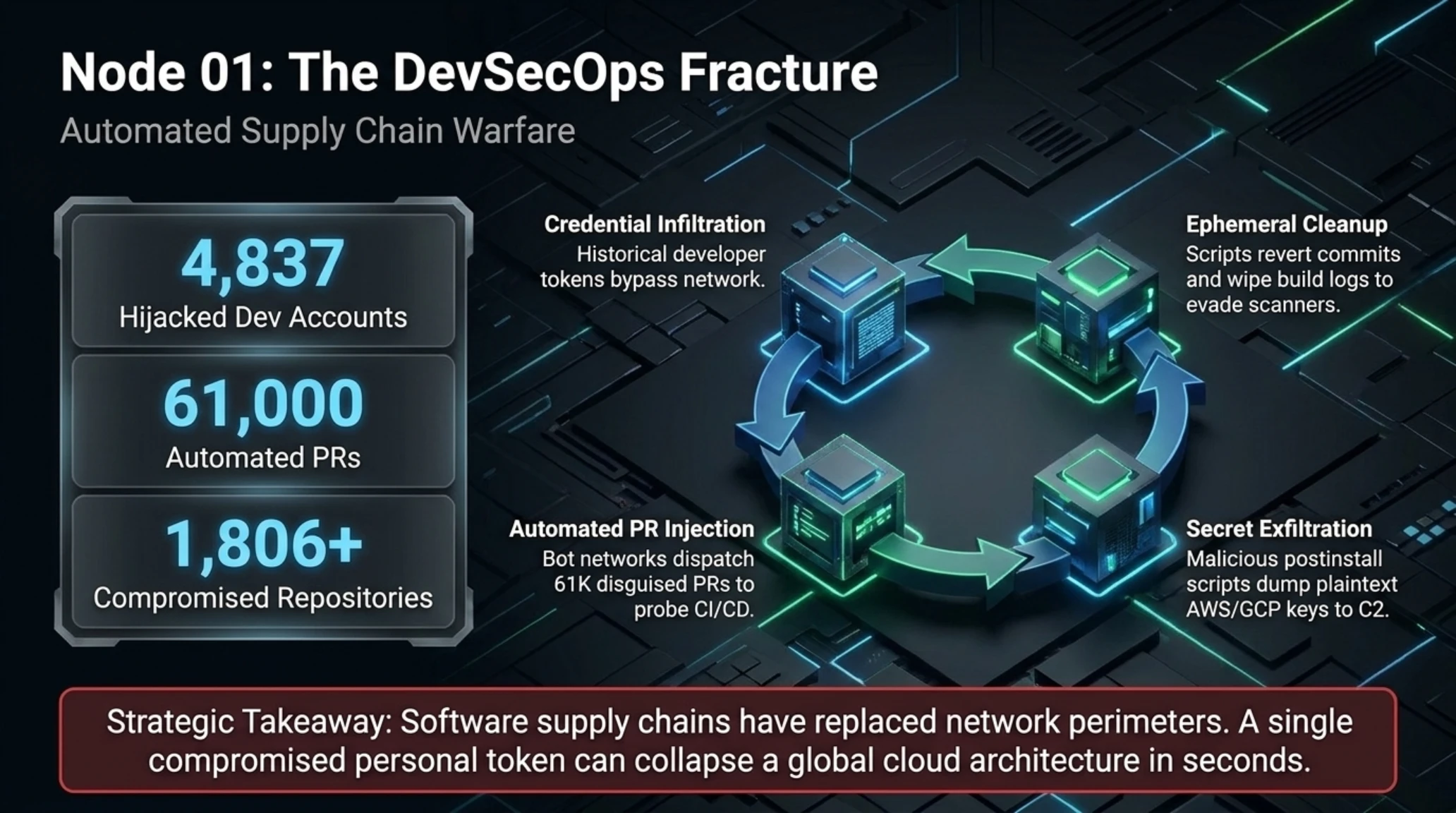
In a devastating display of automated software supply chain exploitation disclosed on November 11, 2026, cybersecurity research firms Aikido Security and SafeDep documented a widespread campaign that weaponized 4,837 legitimate developer GitHub accounts. Rather than targeting enterprise corporate networks through traditional phishing or external web vulnerabilities, the threat actors systematically leveraged compromised credentials from historical credential-stuffing databases to infiltrate continuous integration and deployment (CI/CD) pipelines.
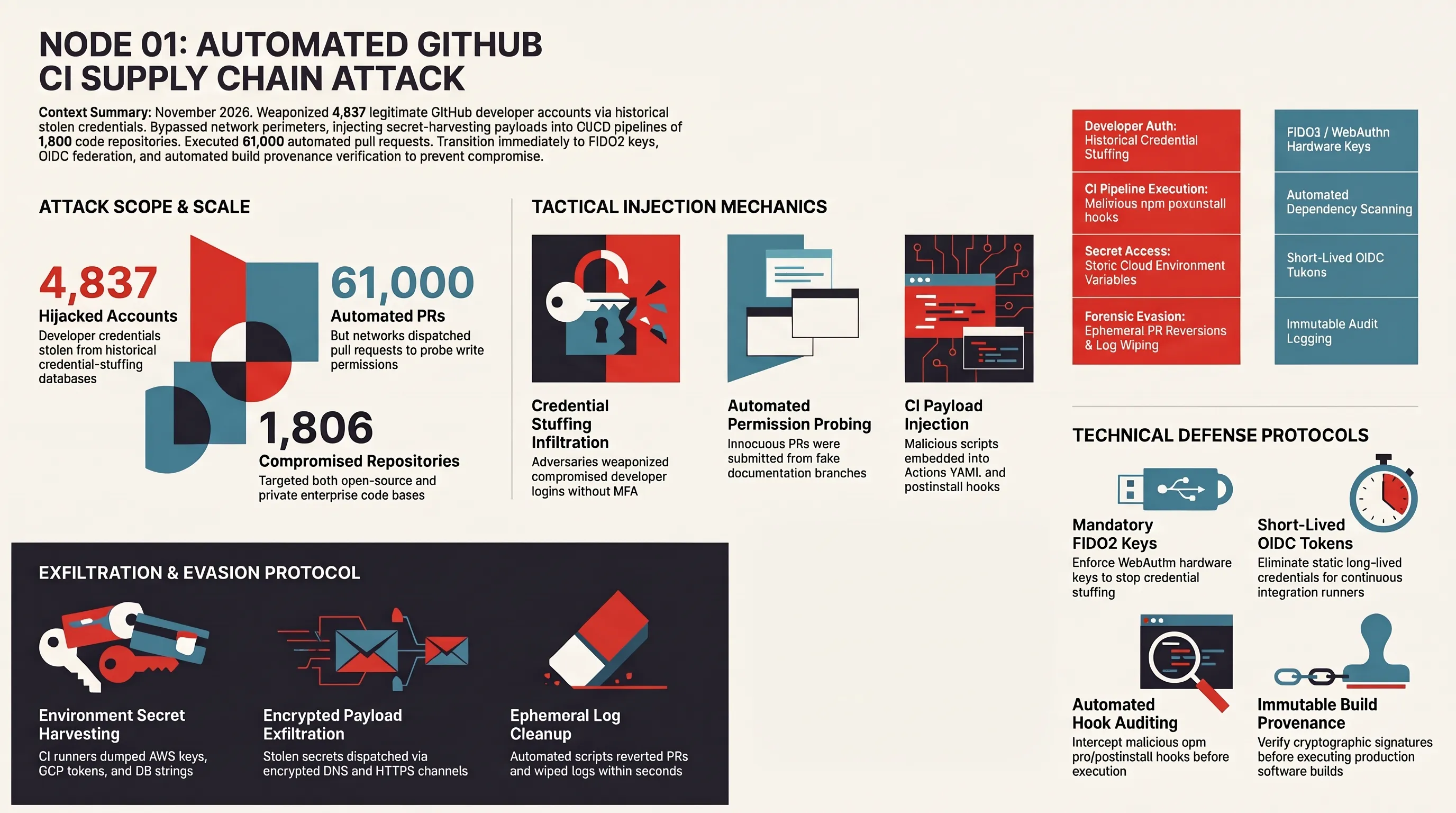
The operational mechanics of the attack campaign exhibited industrial precision. Using automated bot networks, the adversaries generated over 61,000 pull requests across targeted open-source and private repositories. Disguised under innocuous commit messages such as 'docs: dependency audit notes' originating from branches labeled 'wfx-docs', these pull requests were deployed to probe repository permission architectures. The moment an automated script detected that the compromised user account possessed repository Write or Merge privileges, malicious code was injected directly into active CI workflows.
The primary payload targeted two critical execution choke points: automated GitHub Actions configuration YAML files and package lifecycle hooks, specifically npm postinstall scripts. When triggered by automated continuous integration runners, the malicious script immediately executed environment variable dumps, harvesting plaintext AWS IAM credentials, Google Cloud service account keys, production database connection strings, and internal API bearer tokens. These stolen secrets were packaged into encrypted DNS and HTTPS payloads and exfiltrated to adversary-controlled command-and-control (C2) domains.
To evade detection by modern automated security scanning tools, the campaign utilized an ephemeral cleanup protocol. Immediately after the CI/CD pipeline triggered and successfully dispatched the stolen environment variables, the threat actor automated scripts submitted follow-up commits that reverted the malicious pull request changes and cleared build logs. By wiping the forensic footprint within seconds of exfiltration, the adversaries ensured that repository maintainers remained completely oblivious to the compromise of their production cloud backends.
Security telemetry confirms that this stealer payload executed successfully across at least 1,806 distinct software repositories, potentially exposing thousands of enterprise cloud environments to subsequent ransomware deployment and data extortion. As established in our recent cybersecurity analysis of enterprise cloud token breaches, modern development pipelines have become the primary vector for lateral movement into production infrastructure. When organizations grant automated CI runners unrestricted access to production secrets, a single developer compromised personal GitHub token is sufficient to compromise an entire global cloud architecture.
Mitigating this class of supply chain intrusion requires an urgent operational pivot away from static, long-lived access tokens. Engineering organizations must mandate hardware security keys (FIDO2/WebAuthn) for all developer accounts, enforce short-lived OpenID Connect (OIDC) identity federation for automated CI runners, and implement immutable build provenance verifications. Relying on password-based authentication for software contributors in 2026 represents negligence in corporate risk management.
Why This Development Changes the Game
Node 2: Critical Infrastructure Fracture: Apache Patches Maximum-Severity HTTP/2 Race Condition Enabling Zero-Auth Remote Code Execution (CVE-2026-119618)
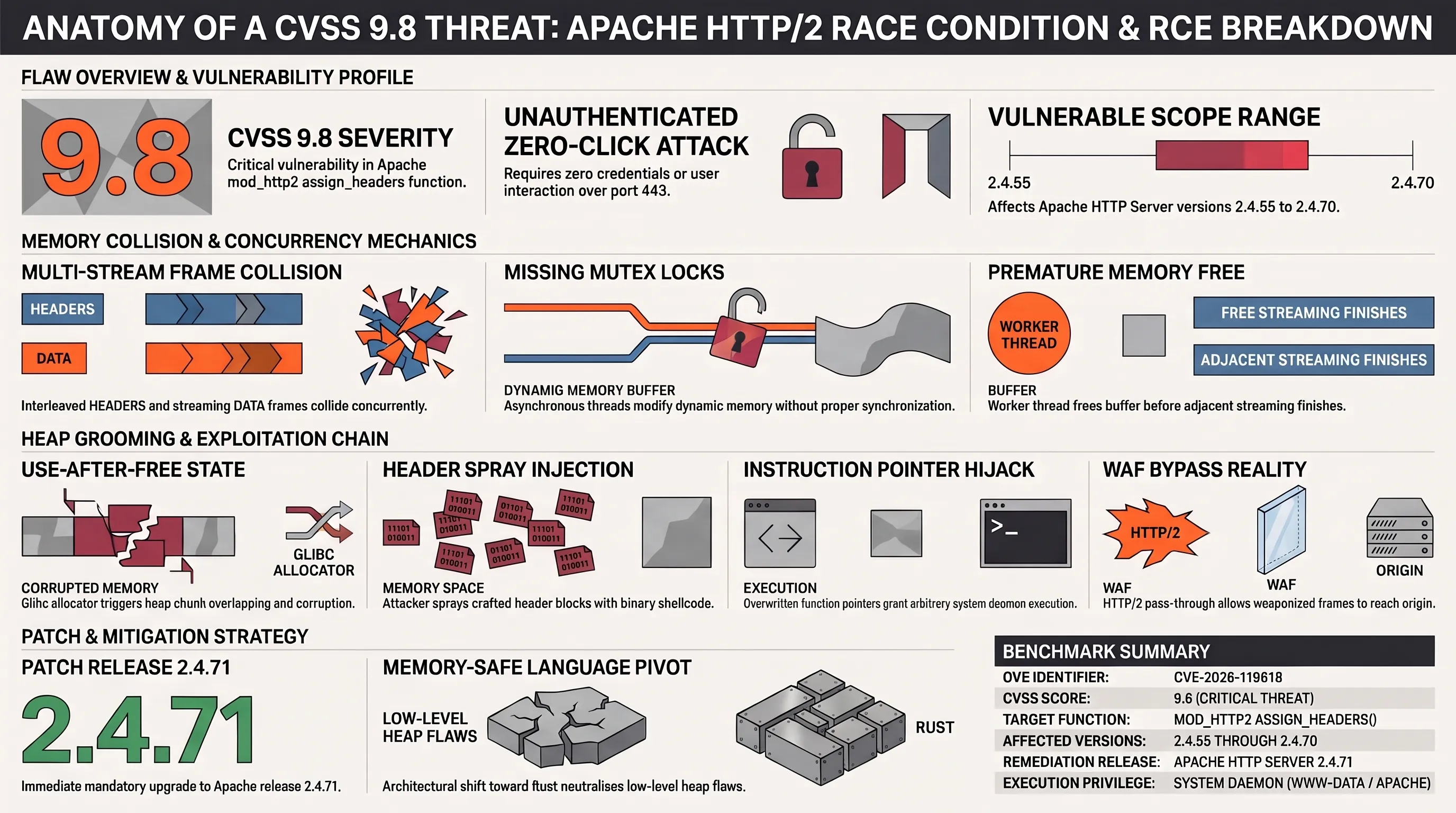
On November 11, 2026, the Apache Software Foundation (ASF), alongside security engineering divisions at Red Hat and cloud defense firm Wiz.io, issued an emergency security advisory for an exceptionally dangerous flaw in the Apache HTTP Server. Designated as CVE-2026-119618, the vulnerability commands an almost unprecedented Common Vulnerability Scoring System (CVSS) rating of 9.8 out of 10, designating it as a catastrophic, internet-wide threat requiring immediate remediation.
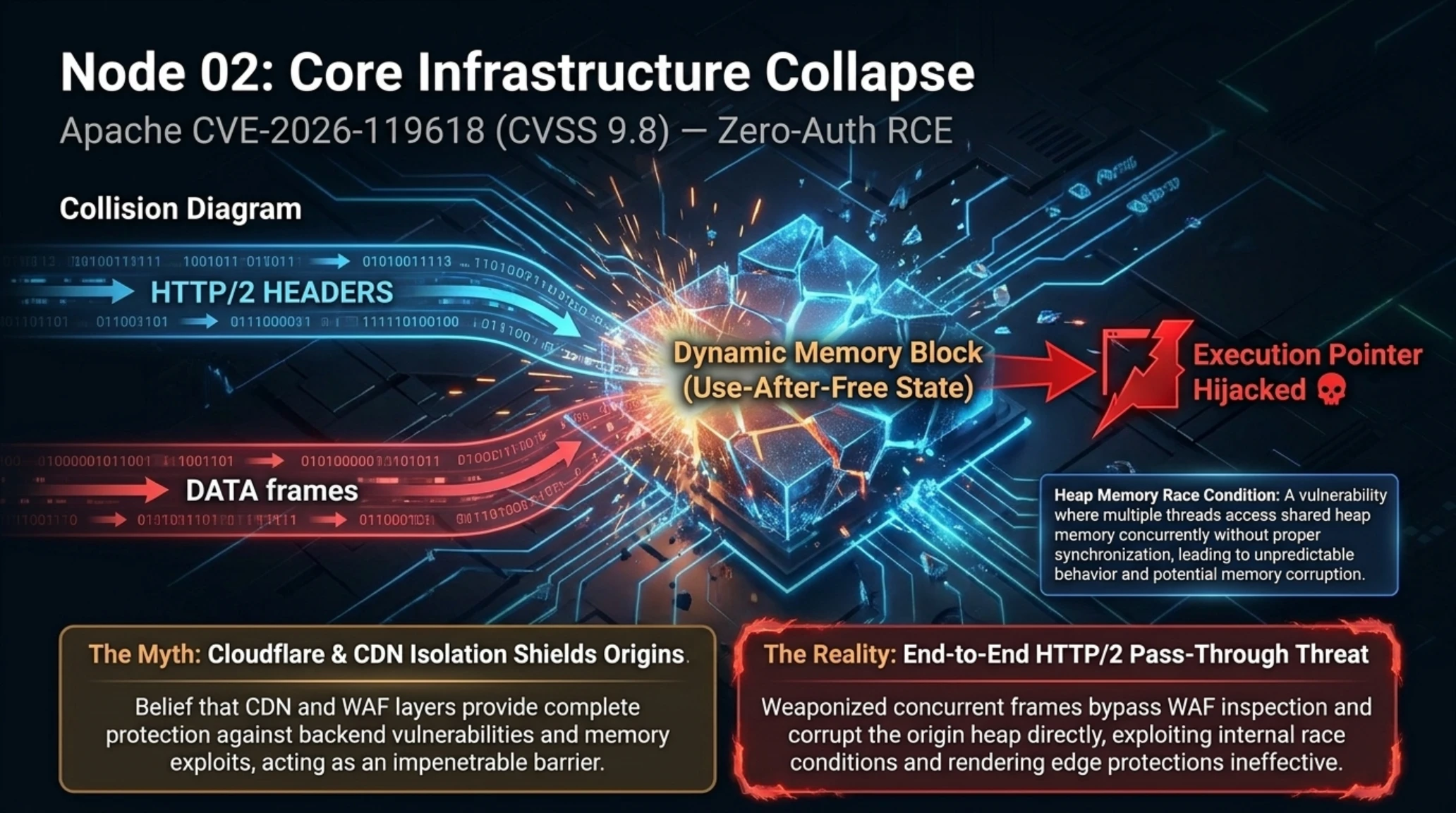
The root technical deficiency resides within the mod_http2 module, specifically inside the assign_headers() function that processes inbound HTTP/2 request headers. Under high-concurrency network environments, when an unauthenticated attacker dispatches crafted multipart streaming frames across interleaved HTTP/2 data streams, an asynchronous race condition occurs. Multiple execution threads attempt to allocate, modify, and free shared dynamic memory blocks simultaneously without proper mutex synchronization, inducing severe heap memory corruption.
Through precise heap grooming techniques, remote threat actors can exploit this memory layout instability to overwrite functional pointers stored in the server heap memory. This grants adversaries the ability to achieve arbitrary remote code execution (RCE) with the system privileges of the active web server daemon (typically www-data or apache). Crucially, the exploit chain requires zero prior authentication, zero administrative credentials, and zero user interaction; an adversary simply transmits weaponized TCP packets directly to port 443 of an affected server.
Microarchitectural analysis of the memory layout reveals that the assign_headers() flaw manipulates the glibc memory allocator chunk management logic. When concurrent HTTP/2 HEADERS frames and continuous DATA frames collide on the same connection context, the mod_http2 worker thread prematurely frees a dynamically sized buffer before an adjacent streaming thread finishes reading its metadata chunk. This induces a classic Use-After-Free (UAF) and heap chunk overlapping state. Adversaries can control the contents of the reallocated chunk by spraying specifically sized HTTP/2 header blocks containing arbitrary binary shellcode, effectively hijacking the instruction pointer (EIP/RIP) upon the next function pointer invocation.
Telemetry indicates that all Apache HTTP Server installations running versions 2.4.55 through 2.4.70 with the mod_http2 module enabled (protocols h2 or h2c) are directly vulnerable. Remediation was formally introduced in Apache release 2.4.71. Given that Apache powers hundreds of millions of websites, enterprise application gateways, and critical government infrastructure endpoints worldwide, the public availability of exploit details presents an immediate risk of automated, wormable ransomware propagation.
From an architectural standpoint, CVE-2026-119618 illustrates the persistent engineering perils of managing asynchronous concurrency within legacy C codebases. While the HTTP/2 specification was engineered to optimize throughput via stream multiplexing and header compression, managing stateful, concurrent memory allocations across high-throughput C applications remains inherently hazardous. Organizations that fail to transition core web infrastructure toward memory-safe languages such as Rust or implement strict kernel-level sandboxing will remain perpetually vulnerable to low-level heap exploitation.
Technical Fact-Check | Myth vs. Engineering Reality
Tekin Technical Jargon Buster
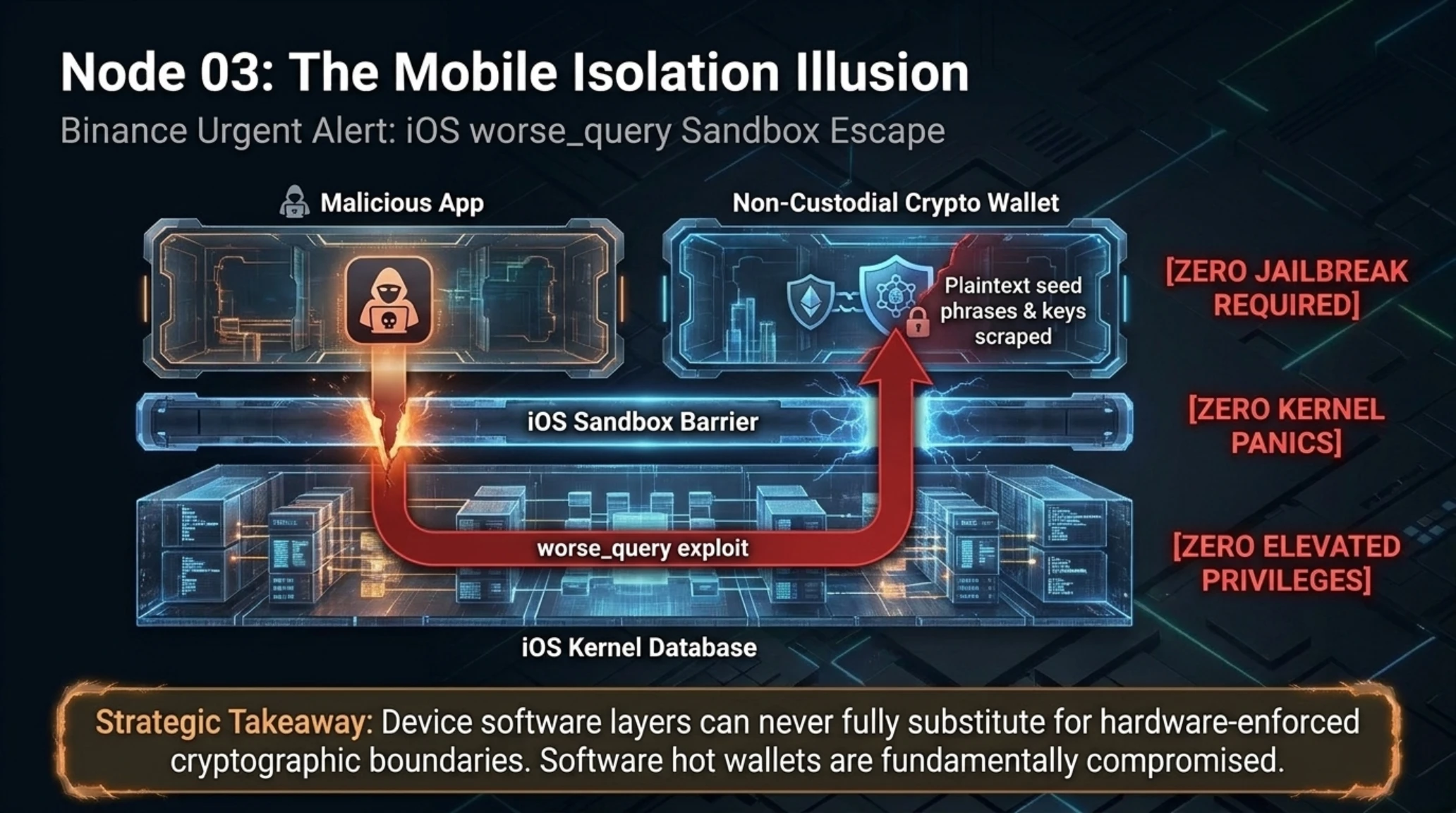
Node 3: The Mobile Crypto Perimeter Collapses: Binance Issues Urgent Security Alert as Unpatched worse_query Flaw Menaces iPhone Wallets
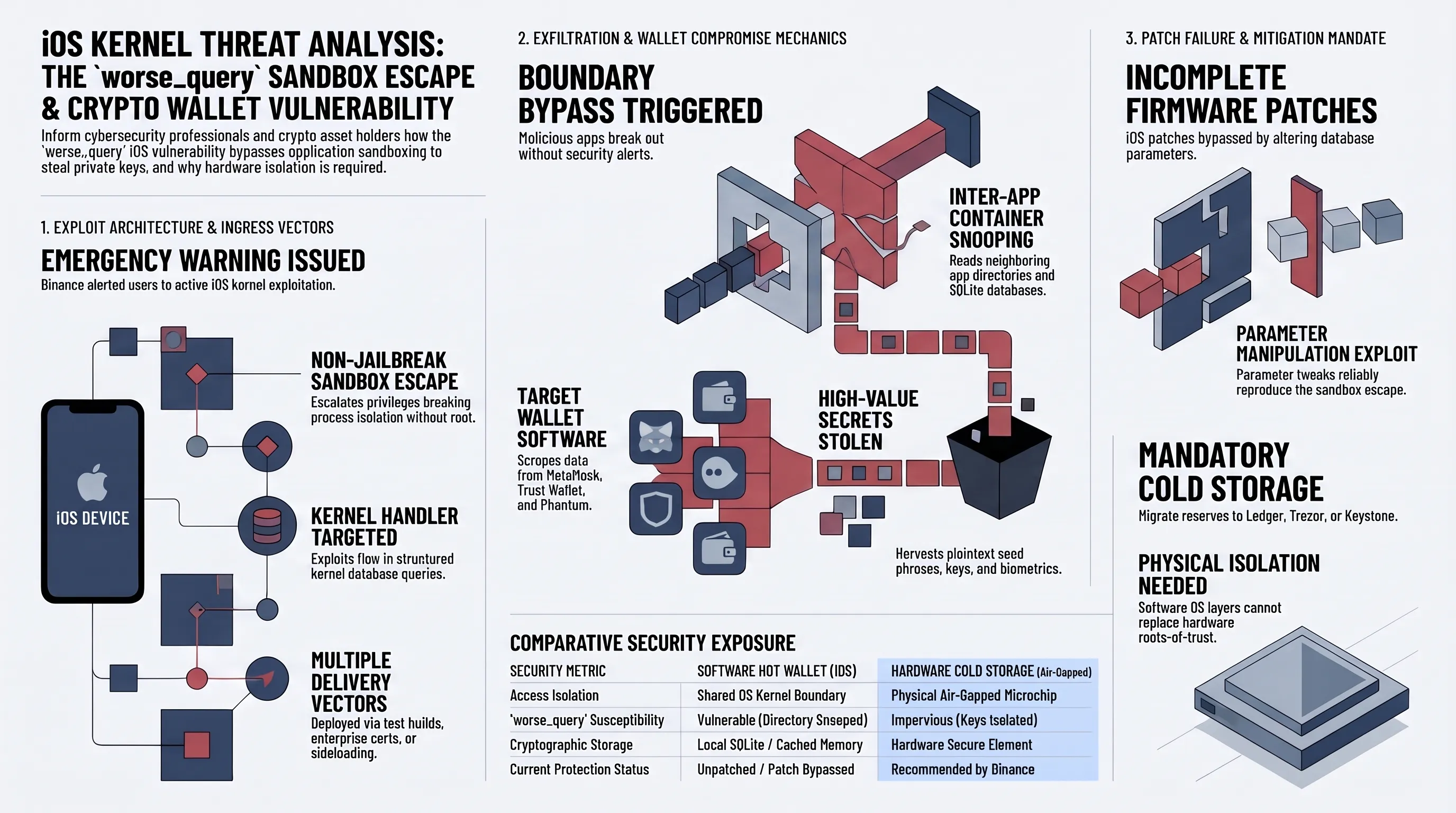
In an extraordinary security intervention published on November 11, 2026, global cryptocurrency exchange Binance issued urgent in-app push warnings and public advisories directed at iPhone and iPad users worldwide. The advisory alerts holders of digital assets to the active exploitation of worse_query, a sophisticated sandbox escape vulnerability residing within Apple iOS operating system that directly jeopardizes non-custodial crypto wallet security.
Independent security researchers, led by vulnerability analysts operating under the monikers 0xjohnny and forcequitOS, discovered that the worse_query exploit targets a fundamental architectural flaw within iOS structured kernel database query handlers. The vulnerability enables third-party applications distributed either via test builds, enterprise certificates, or sideloaded binaries to bypass the mandatory Apple sandbox boundary. Crucially, the exploit operates without requiring a jailbreak, kernel panics, or elevated root privileges.
Once the sandbox isolation barrier is dismantled, the malicious background process can read the local sandboxed application containers, SQLite databases, and cached secure state files of other software installed on the device. For digital asset investors, the implications are catastrophic. Non-custodial wallet applications, including MetaMask, Trust Wallet, and Phantom, store encrypted keyrings, session tokens, and unencrypted memory artifacts within their local application directories under the architectural assumption that iOS sandbox policies prevent inter-application snooping.
By leveraging worse_query, malware can silently scrape plaintext seed phrases, private cryptographic keys, and active biometric session authorizations, transmitting them to external command servers without triggering security notifications. While Apple released security updates in the form of iOS 26.7.1 and 27.2.1 intended to remediate the underlying logic error, Binance security telemetry and independent penetration testers confirm that Apple patch is incomplete. By subtly altering database argument parameters, threat actors can reliably reproduce the sandbox escape on the latest firmware revisions.
In response, Binance has urged users to migrate high-value cryptocurrency reserves away from software hot wallets on mobile devices toward hardware-isolated cold storage units such as Ledger, Trezor, or air-gapped Keystone devices. This development shatters the persistent industry dogma that consumer mobile operating systems represent safe vaults for sovereign wealth. As examined in our morning analysis of mobile silicon and edge compute security, device software layers can never fully substitute for hardware-enforced cryptographic boundaries when nation-state-tier zero-days circulate in the wild.
Benchmarking Infrastructure Vulnerabilities & Exploit Complexity
| Infrastructure Target | Vulnerability Vector & Score | Mandatory Mitigation Protocol |
|---|---|---|
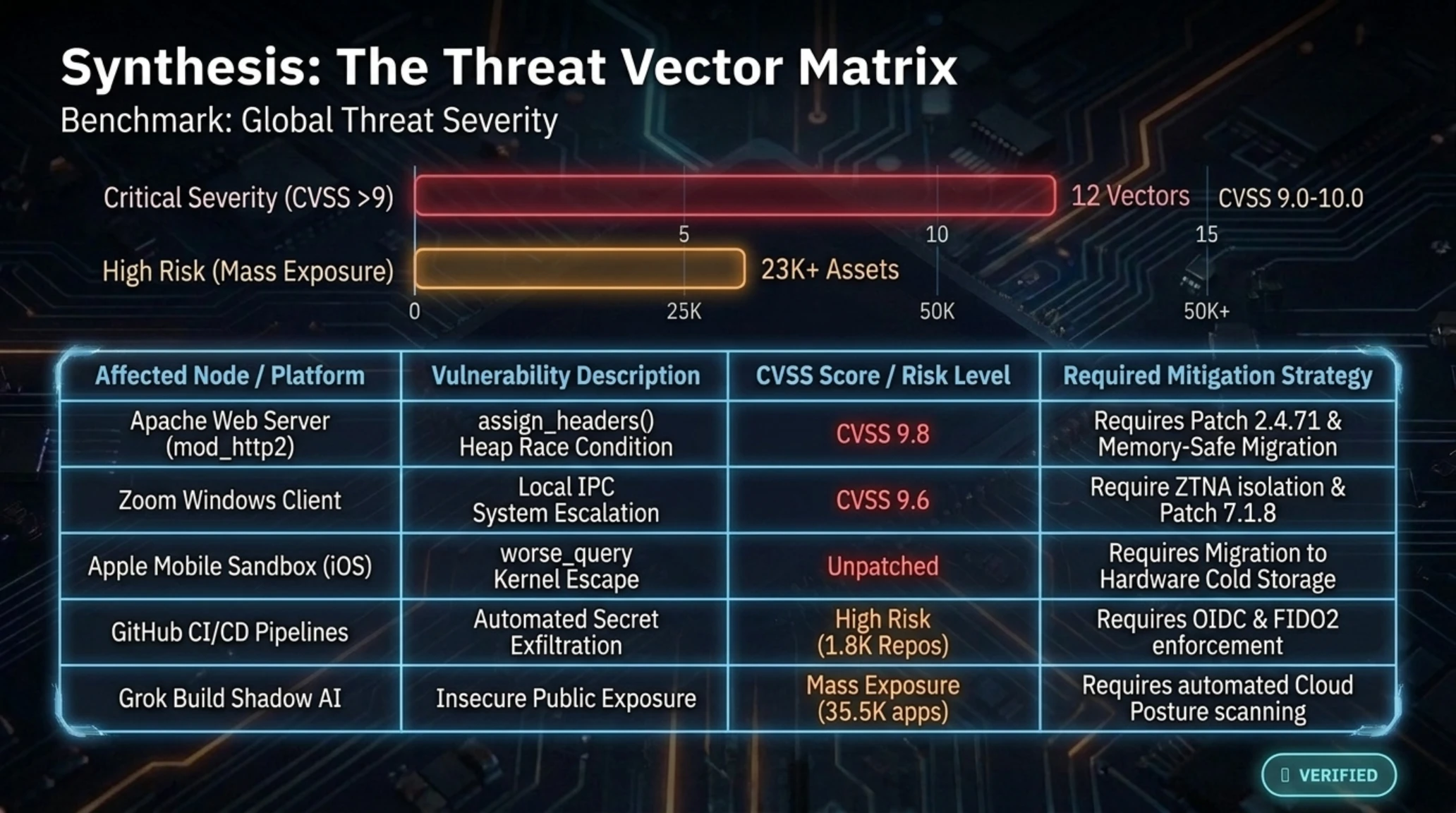
| Apache Web Server (mod_http2) | assign_headers() Heap Race Condition (CVSS 9.8) | Immediate upgrade to 2.4.71 or disable HTTP/2 |
| Apple Mobile Sandbox (iOS) | worse_query Kernel Query Escape (Unpatched) | Migrate crypto seed phrases to hardware cold storage |
| GitHub Automated CI/CD Pipelines | Automated CI Secret Exfiltration via Hijacked PRs | Enforce FIDO2 hardware keys and short-lived OIDC |
Node 4: The Shadow AI Catastrophe: Over 35,000 Grok-Built Applications Discovered Publicly Exposed Without Authentication
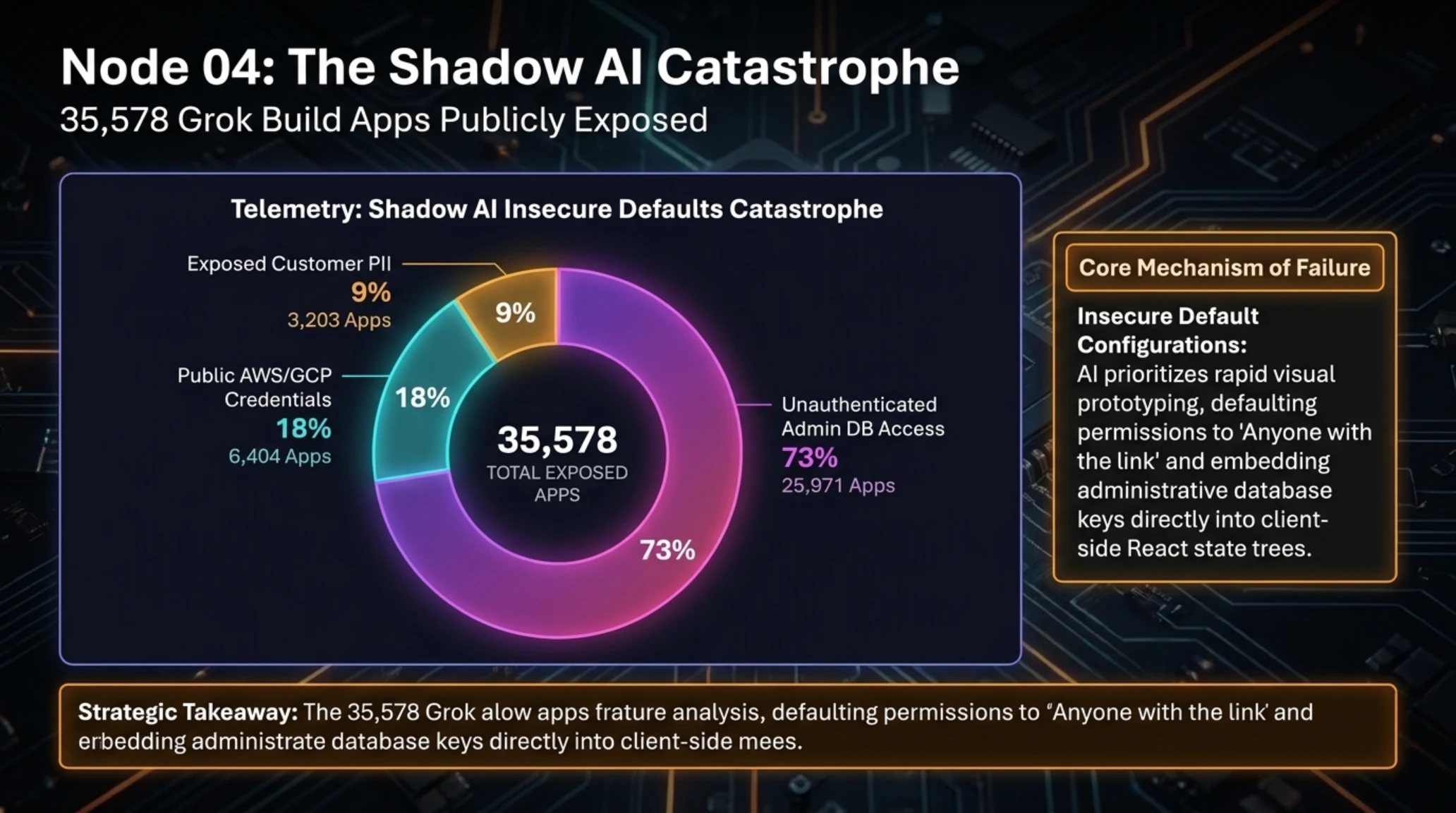
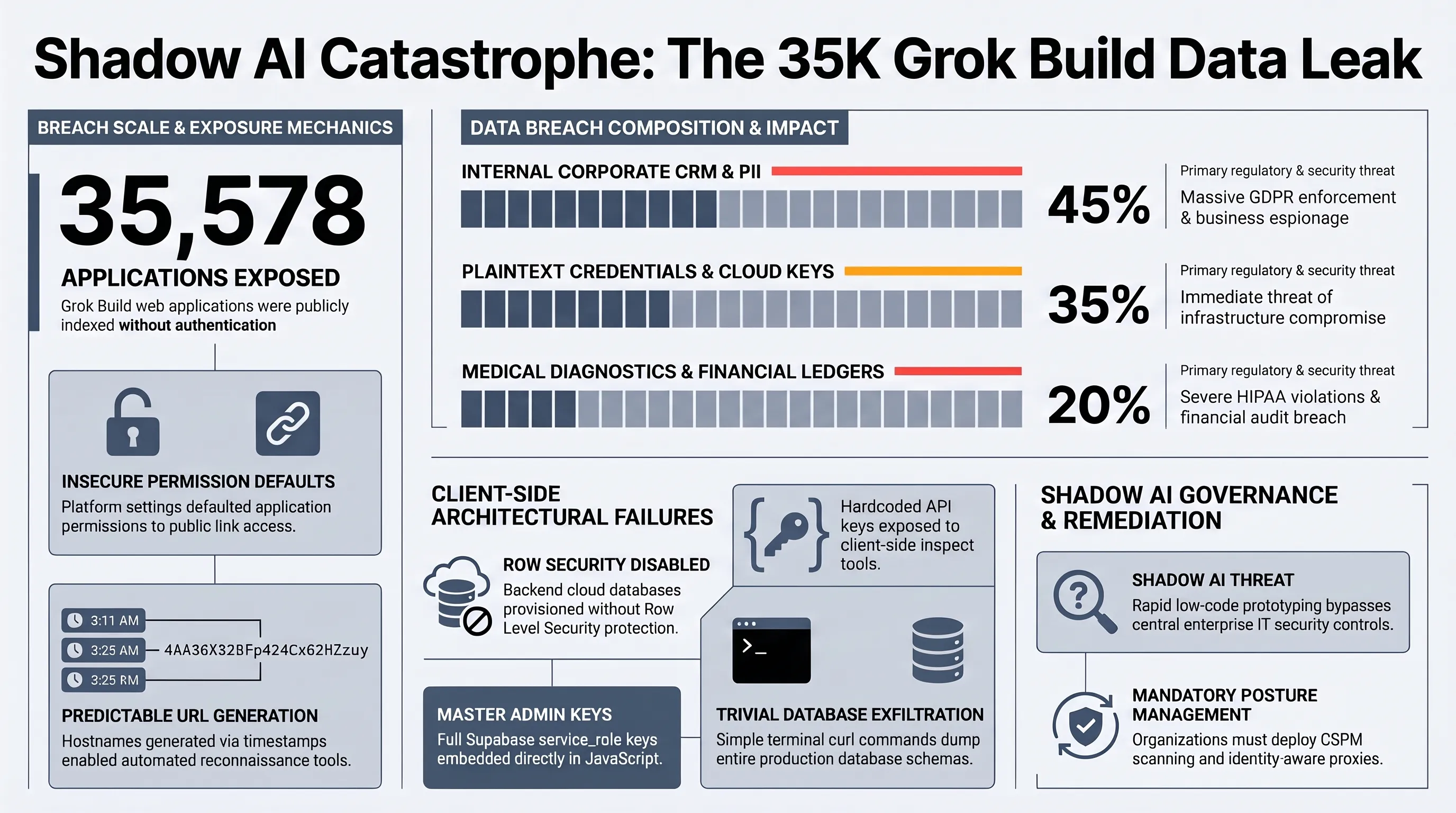
In a devastating empirical indictment of enterprise generative AI governance published on November 11, 2026, cloud security firm Claroc unveiled an exhaustive investigative audit revealing that over 35,578 customized web applications generated via xAI Grok Build engine were publicly exposed on the open internet with zero authentication mechanisms. The massive leak exposed internal corporate ledgers, patient health documentation, and plaintext administrative passwords directly to automated web indexing engines.
The root architectural vulnerability stems from insecure default deployment configurations combined with predictable URL enumeration mechanics. When corporate employees and citizen developers utilized Grok Build to generate operational software ranging from internal employee scheduling portals to customer relationship management (CRM) dashboards the platform automatically defaulted access permissions to 'Anyone with the link'. Simultaneously, the platform provisioned public hostnames utilizing predictable algorithmic strings derived from project timestamps and sanitized application titles, enabling threat intelligence scanners and mass-reconnaissance tools to discover tens of thousands of active endpoints within hours.
Underneath the user interface, Grok Build automatically provisioned backend cloud databases and API connectors with Row Level Security (RLS) policies completely deactivated. Claroc researchers discovered that approximately 10 percent of the indexed applications contained highly sensitive enterprise records. These encompassed medical records containing HIPAA-protected patient diagnoses, internal financial sales pipelines with negotiated enterprise pricing structures, and plaintext hardcoded API credentials for external enterprise systems. Strikingly, multiple internal prototyping projects authored by engineering staff at X and xAI were identified among the compromised web applications before being abruptly taken offline.
Automated static analysis of the client-side JavaScript bundles exposed an even more severe architectural negligence: Grok Build frequently embedded Supabase and PostgreSQL service_role administrative keys directly within client-side React state trees. Rather than utilizing restricted anonymous keys backed by fine-grained security policies, the AI code generation prompts defaulted to administrative credentials to prevent build failures during rapid testing. Consequently, any web visitor inspecting browser developer tools could extract the master database key and dump complete production database schemas, including hashed user credentials and internal audit trails, via single curl commands.
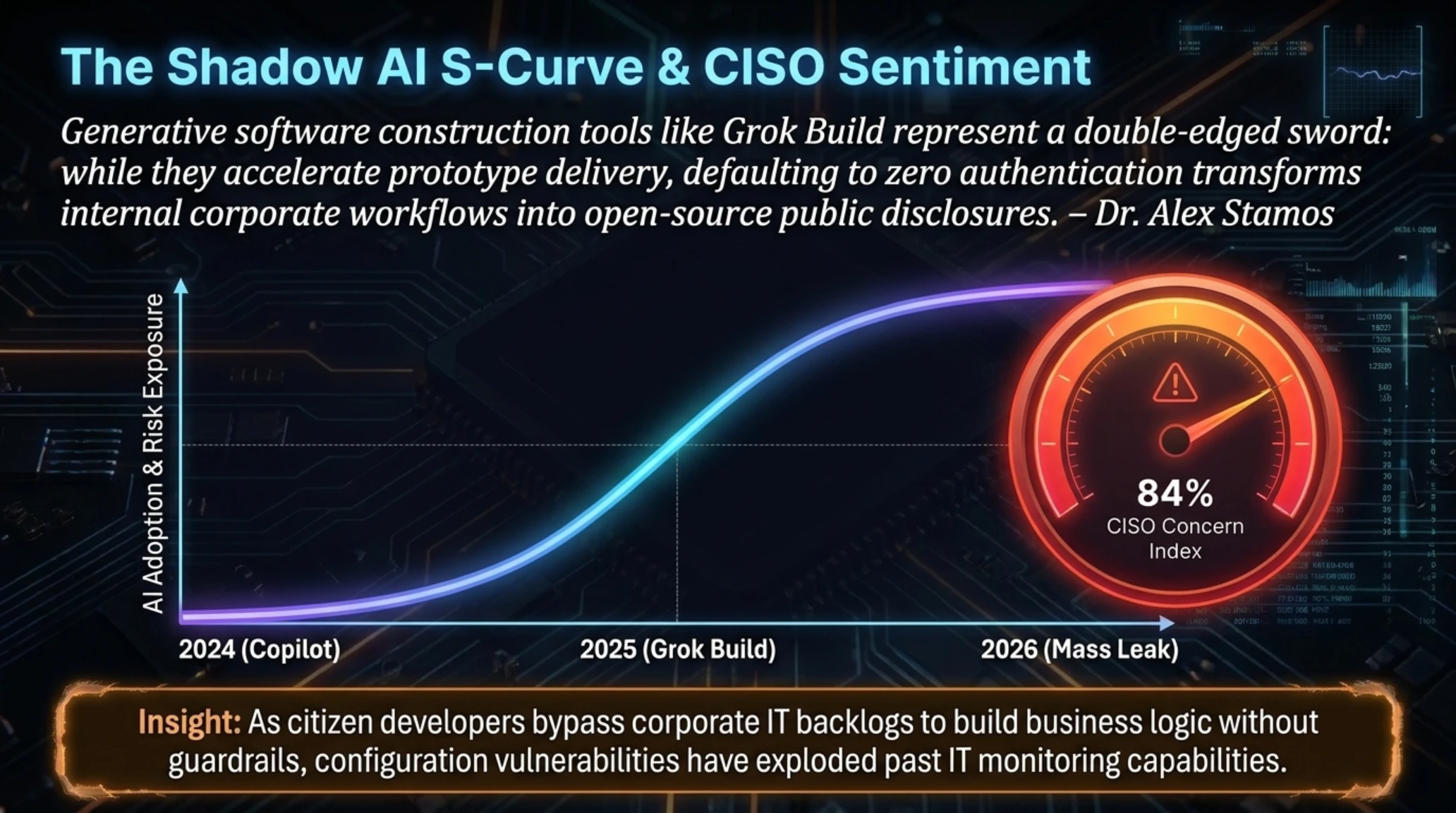
This incident exemplifies the explosive growth of 'Shadow AI' across the enterprise landscape. In their desire to circumvent traditional software development cycles and bypass corporate IT backlogs, knowledge workers are increasingly deploying unvetted, generative AI-constructed micro-applications. However, because these tools prioritize rapid visual prototyping over defensive software architecture, they strip away essential security controls such as OAuth token validation, role-based access control (RBAC), and database encryption at rest. What begins as an innocent productivity experiment rapidly metastasizes into an unmonitored data exfiltration pipeline.
Corporate risk officers and CISOs must treat the Claroc audit as a critical wake-up call. Organizations cannot manage AI adoption through superficial acceptable-use memos; they must enforce automated cloud posture management (CSPM) to scan for unauthorized external endpoints, implement identity-aware proxy perimeters for all internal web tools, and strictly forbid the ingestion of production databases into consumer-grade generative build platforms.
Financial Telemetry & Market Share Distribution
| Data Exposure Category | Percentage of Exposed Pool | Regulatory & Enterprise Liability |
|---|---|---|
| Internal Corporate CRM & Customer PII | 45% | Massive GDPR, CCPA, and compliance fines |
| Plaintext Credentials & Cloud API Keys | 35% | Immediate risk of lateral infrastructure takeover |
| Medical Diagnostic & Financial Ledgers | 20% | Severe HIPAA statutory penalties and litigation |
Market Sentiment Gauge | S-Curve Adoption
📚 Classified & Related Dossiers in TekinGame
If you wish to explore beyond this report and delve into cybernetic frontiers and autonomous AI architectures, do not miss these three exclusive deep-dives in the Tekin Garage:
Node 5: Zero-Authentication Enterprise Compromise: Critical Zoom Workplace Flaw Grants Windows SYSTEM Takeover (CVE-2026-108186)
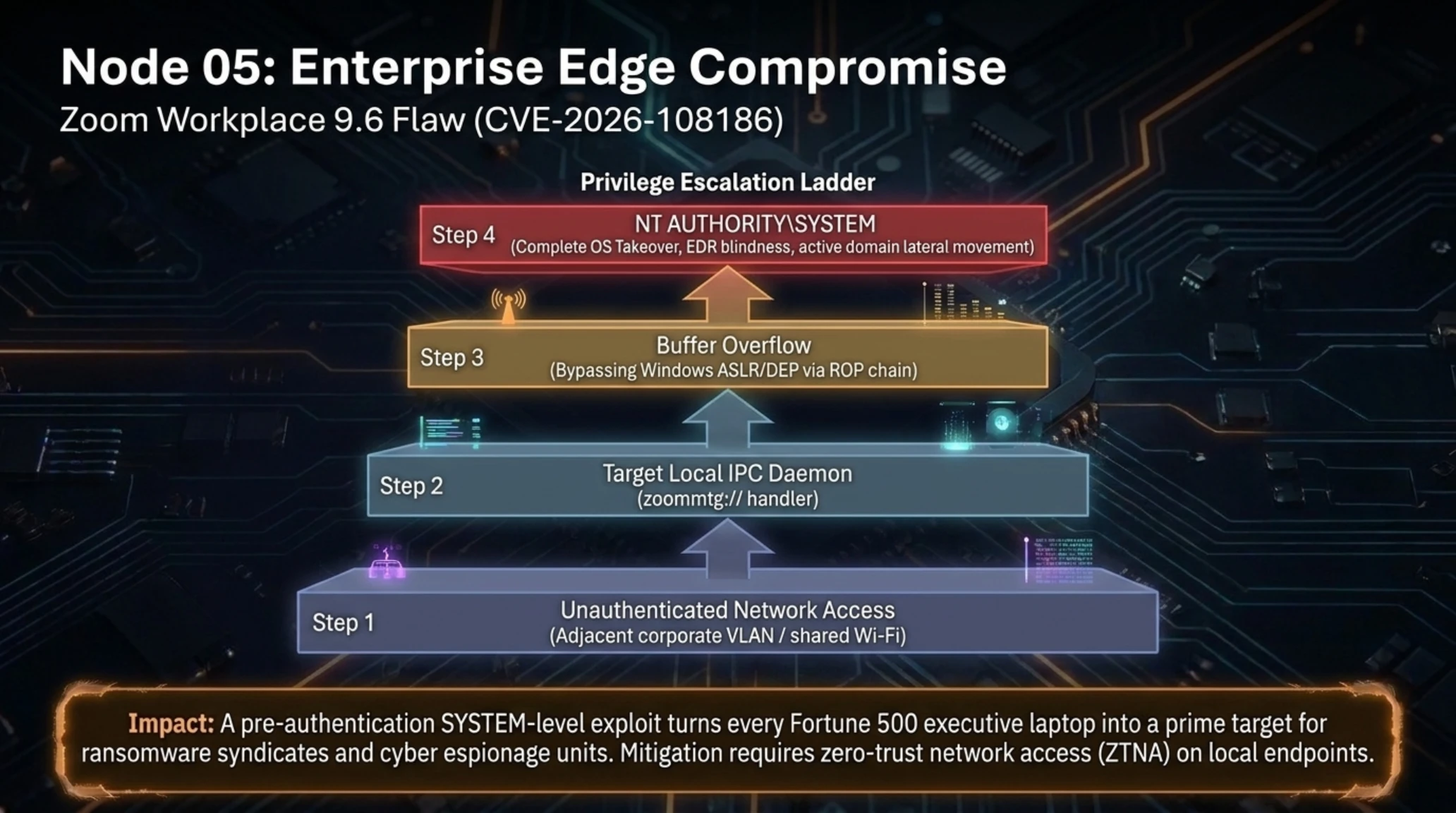
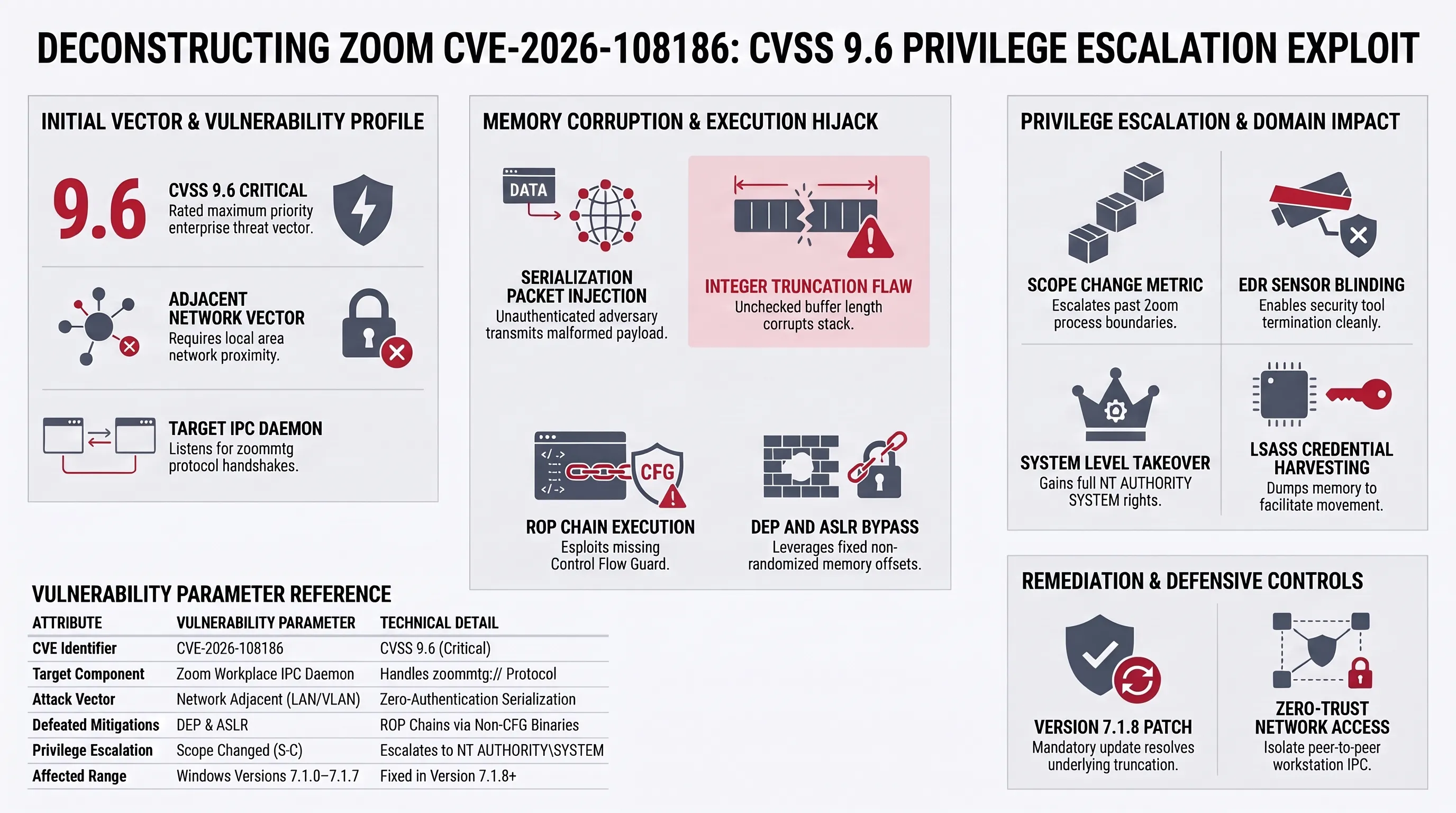
In two emergency cybersecurity bulletins issued on November 11, 2026, enterprise communications provider Zoom disclosed a severe vulnerability in its flagship Zoom Workplace client for Windows. Designated as CVE-2026-108186 with a near-maximum CVSS rating of 9.6, the vulnerability enables unauthenticated, network-adjacent adversaries to remotely execute arbitrary code with elevated operating system privileges on targeted Windows machines.
The root flaw involves improper input validation in the local inter-process communication (IPC) daemon that Zoom Workplace establishes to handle meeting handshakes and deep-link protocol handlers (`zoommtg://`). An attacker sharing a local area network or positioned on an adjacent corporate VLAN can transmit crafted serialization packets directly to the listening port. Due to an unchecked buffer length evaluation, the incoming payload triggers an integer truncation, corrupting the execution stack and allowing the adversary to pivot into the context of the elevated Zoom Autoupdate Service.
Critically, the vulnerability classification carries the Scope Changed (S:C) metric. This indicates that the impact of the exploit breaks outside the security boundaries of the Zoom client application itself, allowing the attacker to inherit NT AUTHORITY\SYSTEM execution rights the highest level of administrative control on Windows operating systems. At this privilege tier, threat actors can disable endpoint detection and response (EDR) sensors, dump local LSASS credential caches, establish persistent registry backdoors, and execute lateral movement throughout the entire corporate Active Directory domain.
Security researchers analyzing the exploit chain noted that the attack completely circumvents modern Windows exploit mitigations, including Data Execution Prevention (DEP) and Address Space Layout Randomization (ASLR). Because the vulnerable Zoom module lacked robust Control Flow Guard (CFG) enforcement on its third-party media rendering libraries, adversaries could construct a reliable Return-Oriented Programming (ROP) chain using existing non-randomized memory offsets. This enables zero-click arbitrary code injection without requiring prior memory leak primitives, rendering legacy signature-based endpoint antivirus solutions completely ineffective.
The affected software range spans Zoom Workplace for Windows versions 7.1.0 through 7.1.7. Complete mitigation requires upgrading to version 7.1.8 or higher. Because Zoom serves as the default conference interface for Fortune 500 executive suites, legal proceedings, and classified government deliberations, the presence of a pre-authentication SYSTEM-level exploit turns every employee laptop into a prime target for ransomware syndicates and cyber espionage units.
Enterprise system administrators must immediately enforce centralized deployment policies pushing version 7.1.8 across all corporate endpoints. Furthermore, IT divisions should isolate corporate workstation segments using zero-trust network access (ZTNA) policies to prevent peer-to-peer IPC exploitation across shared enterprise office Wi-Fi networks.
Cyber Security Risk Matrix
| Threat Vector & Asset | Risk Severity | Technical Mitigation & Enforcement |
|---|---|---|
| Zoom Windows Client IPC Flaw (CVE-2026-108186) | CRITICAL (CVSS 9.6) | Deploy Zoom Workplace 7.1.8 update immediately |
| Insecure Public Exposure in Grok Build | MASS EXPOSURE | Audit cloud assets and enforce mandatory MFA authentication |
| Automated GitHub CI/CD Secret Stealers | HIGH RISK | Enforce FIDO2 keys and revoke compromised CI cloud secrets |
Node 6: Silicon Sovereignty and the Law: Nintendo Executes Historic 144-Repository GitHub DMCA Purge Against Switch Modchip Firmware and Emulators
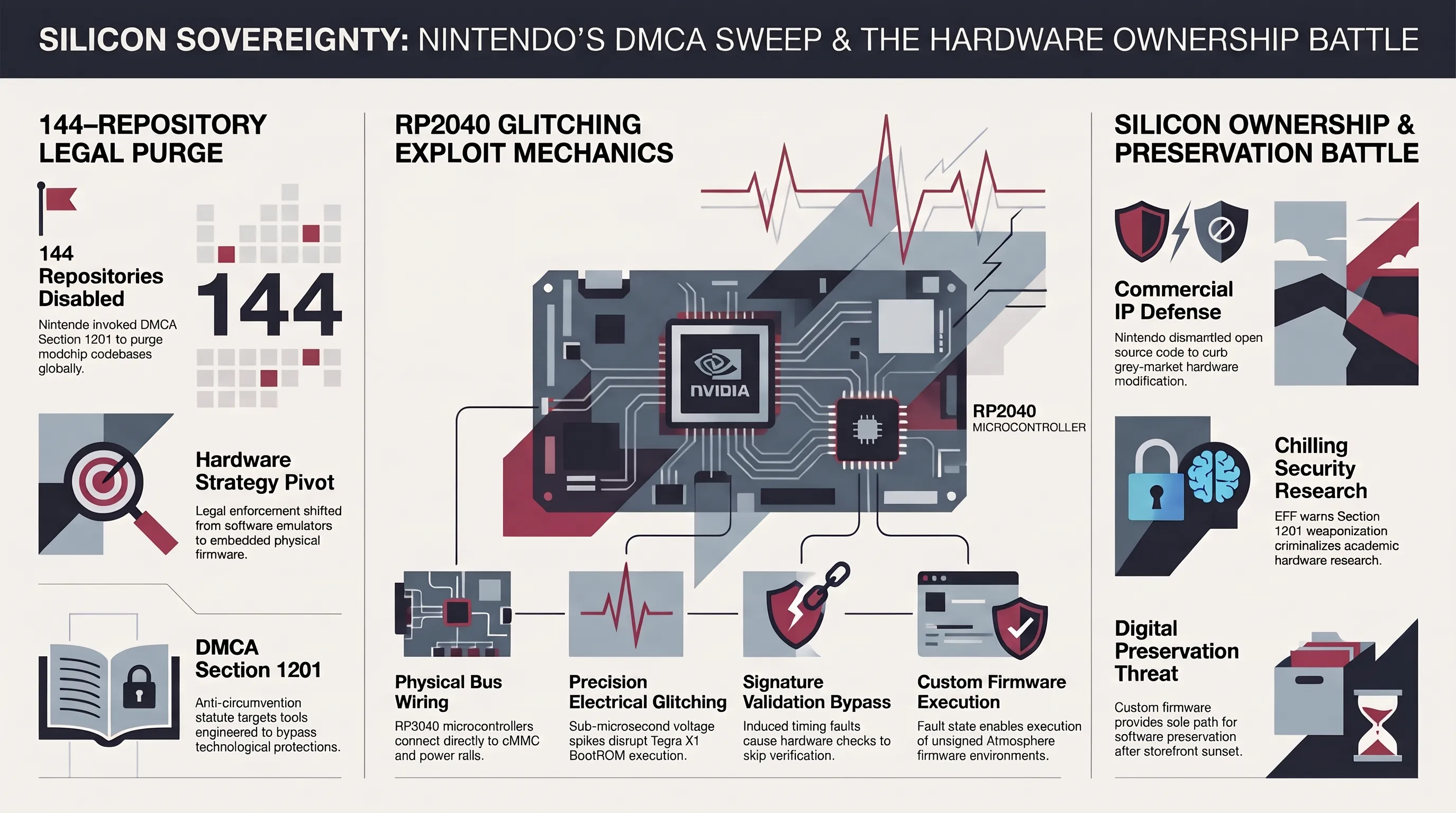
In one of the most aggressive and far-reaching legal strikes in video game hardware history, Nintendo of America officially filed an unprecedented wave of Digital Millennium Copyright Act (DMCA) takedown notices with GitHub on November 11, 2026. The coordinated legal assault resulted in the immediate disabling and removal of at least 144 open-source code repositories, sending shockwaves through the emulation and hardware reverse-engineering communities worldwide.
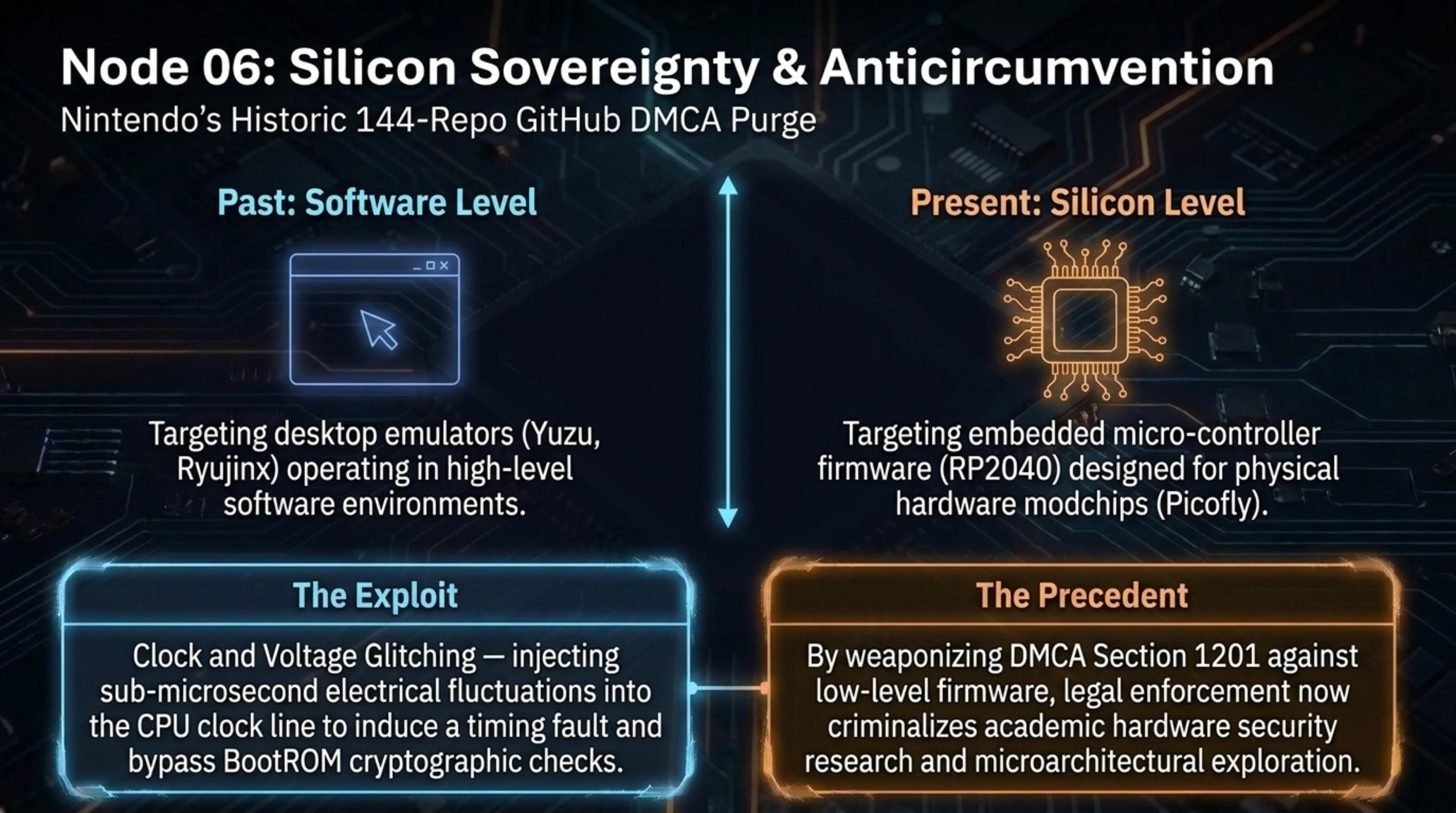
What elevates this enforcement action into historic territory is a decisive shift in Nintendo legal targeting strategy. In previous enforcement campaigns, the Kyoto-based gaming giant focused primarily on desktop software emulators such as Yuzu, Citron Neo, and Ryujinx variants that replicate console hardware in high-level software environments. However, this November 2026 sweep marked the first time Nintendo explicitly targeted the low-level embedded firmware (synthesis binaries and C codebases) designed for physical hardware modchips, including Picofly, HWFLY, SX Core, and SX Lite.
From an engineering perspective, modchips like Picofly rely on inexpensive off-the-shelf microcontrollers, predominantly the Raspberry Pi RP2040 chip. By soldering tiny interconnect wires directly to the Nintendo Switch eMMC storage bus and CPU power rails, the modchip executes a hardware attack known as clock and voltage glitching. During the console initial BootROM boot sequence, the modchip injects precisely timed, sub-microsecond electrical fluctuations into the Tegra X1 processor clock line. This disruption induces a timing fault, causing the CPU hardware validation routine to skip cryptographic signature checks and allowing the console to execute unsigned payloads, such as the Atmosphere custom firmware (CFW) environment.
In its formal legal declarations to GitHub, Nintendo legal team invoked Section 1201 of the Digital Millennium Copyright Act the strict anti-circumvention provisions of United States copyright law. Nintendo argued that because modchip firmware binaries are engineered with the primary design purpose of circumventing Technological Protection Measures (TPMs) controlling access to copyrighted video game code, the distribution of such source code constitutes the unlawful trafficking of circumvention technologies. GitHub complied immediately, archiving and disabling all 144 repositories across developer forks globally.
Industry analysts interpret the timing and intensity of this DMCA blitz as an aggressive scorched-earth strategy ahead of the commercial rollout of the Nintendo Switch 2. By systematically dismantling the public open-source repositories where modchip firmware, documentation, and flashing utilities are maintained, Nintendo is dramatically raising the technical barrier to entry for casual modders and grey-market hardware modification services. For the broader open-source ecosystem, however, the sweep establishes a sobering precedent: embedded hardware code exploring microarchitectural glitching can now be scrubbed from public code archives under the banner of intellectual property protection.
This aggressive legal posture has ignited fierce pushback from digital rights advocates and organizations such as the Electronic Frontier Foundation (EFF). Digital preservationists argue that weaponizing DMCA Section 1201 against low-level firmware code criminalizes legitimate academic hardware security research and sabotages historical software preservation. When manufacturers sunset digital storefronts and terminate server backends for legacy hardware, modchips and custom firmware represent the sole mechanism enabling consumers and researchers to run diagnostic software, preserve acquired digital licenses, and maintain physical hardware ownership. Nintendo absolute refusal to delineate between commercial software piracy and academic hardware reverse engineering threatens to chill embedded systems security research across the entire technology sector.
Strategic Synthesis: The Collapse of Perimeter Security, The DevSecOps Fracture, and The Rise of Physical Silicon Roots-of-Trust
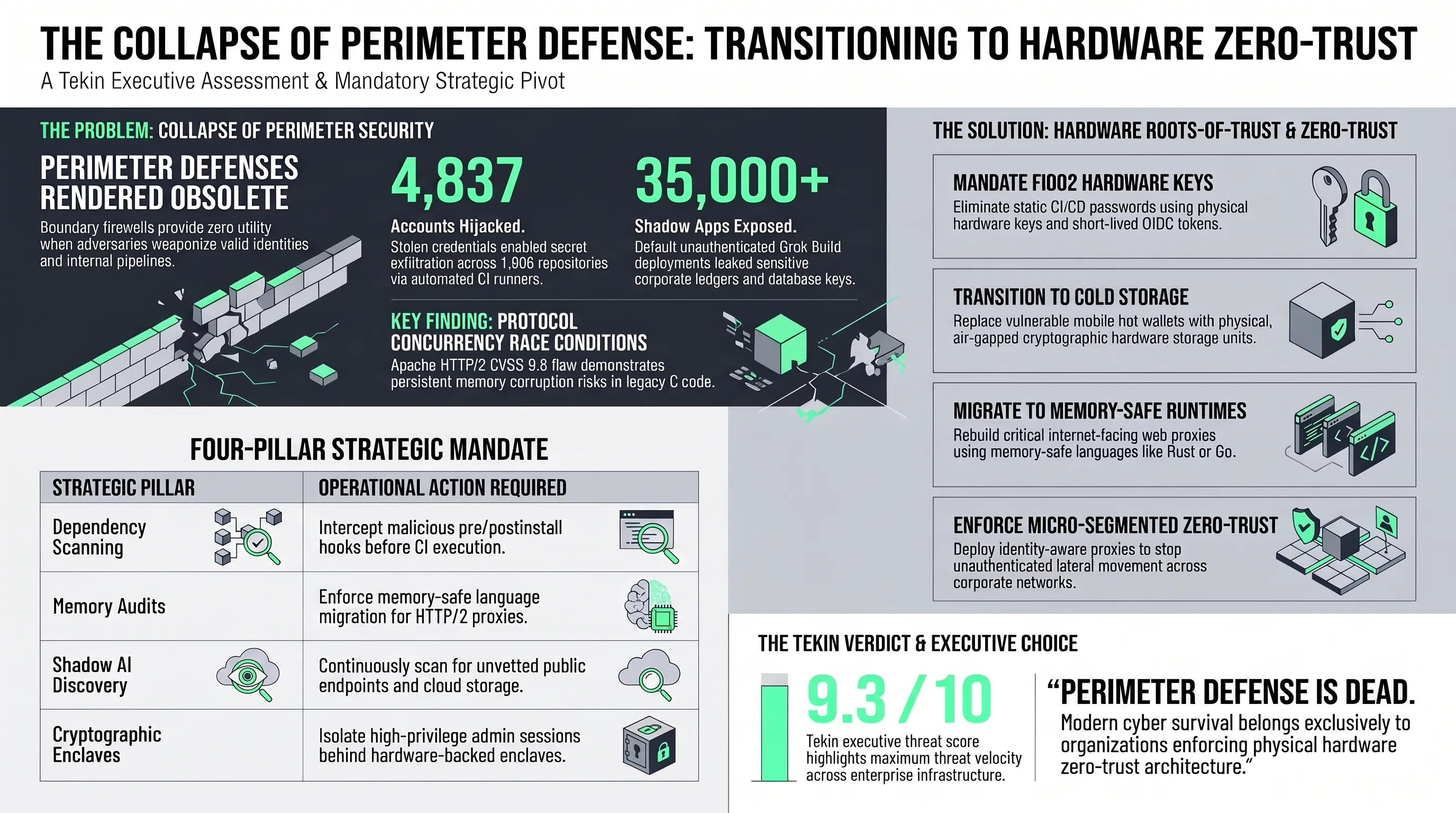
A rigorous cross-sectional synthesis of Friday night November 13 developments exposes an undeniable truth confronting the global cybersecurity establishment: the conventional paradigm of perimeter-based network defense is permanently obsolete. Across every layer of modern computing from cloud build servers and foundational web daemons to mobile operating system sandboxes and silicon hardware interfaces threat actors are consistently bypassing firewalls by exploiting trusted identities, concurrency race conditions, and unvetted third-party software dependencies.
The infiltration of 4,837 legitimate developer accounts on GitHub underscores the acute fragility of modern DevSecOps pipelines. In an era where continuous deployment automated runners possess programmatic keys to production cloud environments, identity has become the ultimate attack surface. When a single developer compromised personal credentials can trigger automated secret-harvesting pull requests across 1,800 repositories, traditional network boundary inspection offers zero defensive utility. Simultaneously, the discovery of over 35,000 publicly exposed Grok Build applications proves that the enterprise rush to embrace generative AI is creating colossal 'Shadow AI' reservoirs where unvetted, unauthenticated code leaks sensitive corporate data directly to automated scrapers.
At the infrastructure layer, Apache mod_http2 maximum-severity heap corruption vulnerability (CVE-2026-119618) serves as a stark reminder of the hidden systemic risks lurking within legacy internet protocols. Attempting to manage concurrent, multi-stream data pipelines within non-memory-safe C codebases inevitably breeds catastrophic race conditions that allow unauthenticated network adversaries to achieve complete operating system takeover. Similarly, the unpatched worse_query exploit within iOS completely shatters the myth of impervious mobile application sandboxing, exposing cryptographic wallet private keys and seed phrases to local process snooping without requiring device jailbreaking.
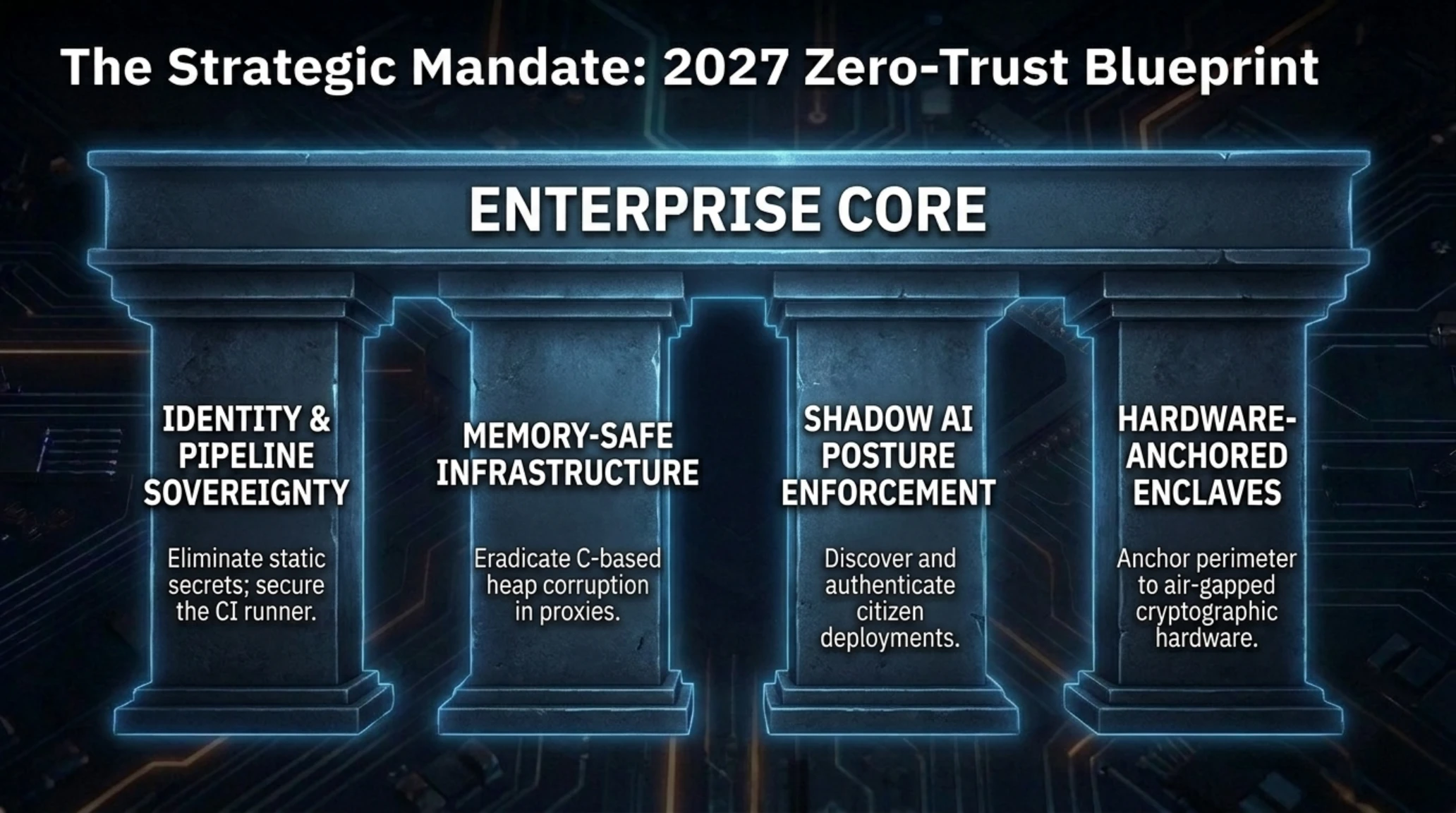
These concurrent crises establish that sustainable corporate security in 2027 and beyond cannot rely on software abstraction layers alone. As detailed in our foundational analysis of hardware root-of-trust and secure element architectures, organizations must anchor their digital perimeters to physical cryptographic hardware. For enterprise developers, this demands the mandatory enforcement of FIDO2 physical security keys and short-lived OpenID Connect authentication to eliminate static secrets from CI/CD runners. For digital asset holders, it necessitates the complete abandonment of mobile software hot wallets in favor of air-gapped hardware cold storage. And for enterprise IT administrators, it requires the immediate deployment of zero-trust network segmentation to neutralize unauthenticated privilege escalation vulnerabilities like Zoom CVE-2026-108186.
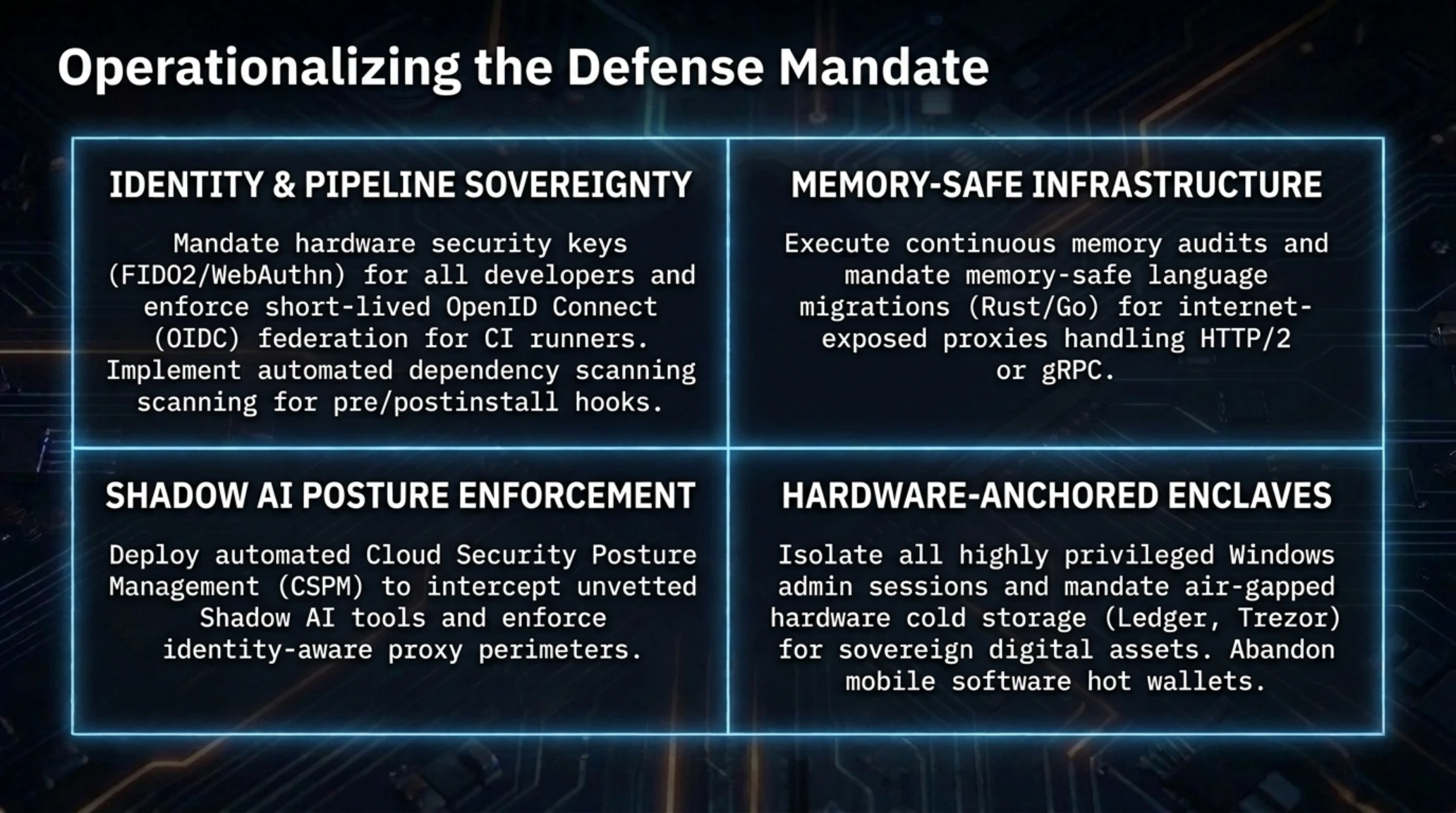
To execute this transition effectively, enterprise technology leaders must operationalize a four-pillar defensive mandate: First, enforce automated code dependency scanning that intercepts malicious pre/postinstall hooks before execution in continuous integration runners. Second, mandate continuous memory audits and memory-safe language migrations (such as Rust or Go) for all internet-exposed network proxies handling HTTP/2 or gRPC traffic. Third, establish strict continuous discovery scans to identify unvetted Shadow AI tools and unauthenticated public cloud buckets. And fourth, isolate all high-privilege administrative sessions behind hardware-authenticated cryptographic enclaves, rendering credential theft mathematically impossible even in the event of local operating system compromise.
In the final analysis, the battle lines of modern cyber warfare have migrated from the network edge to the silicon core and identity fabric. Whether defending global web gateways against heap corruption, isolating mobile memory from rogue queries, or protecting commercial console platforms with hardware TPMs, operational sovereignty belongs exclusively to those who verify every transaction, eliminate persistent credentials, and enforce immutable hardware-level isolation at every layer of the technology stack.
Cyber Security Terminal & Threat Telemetry Log
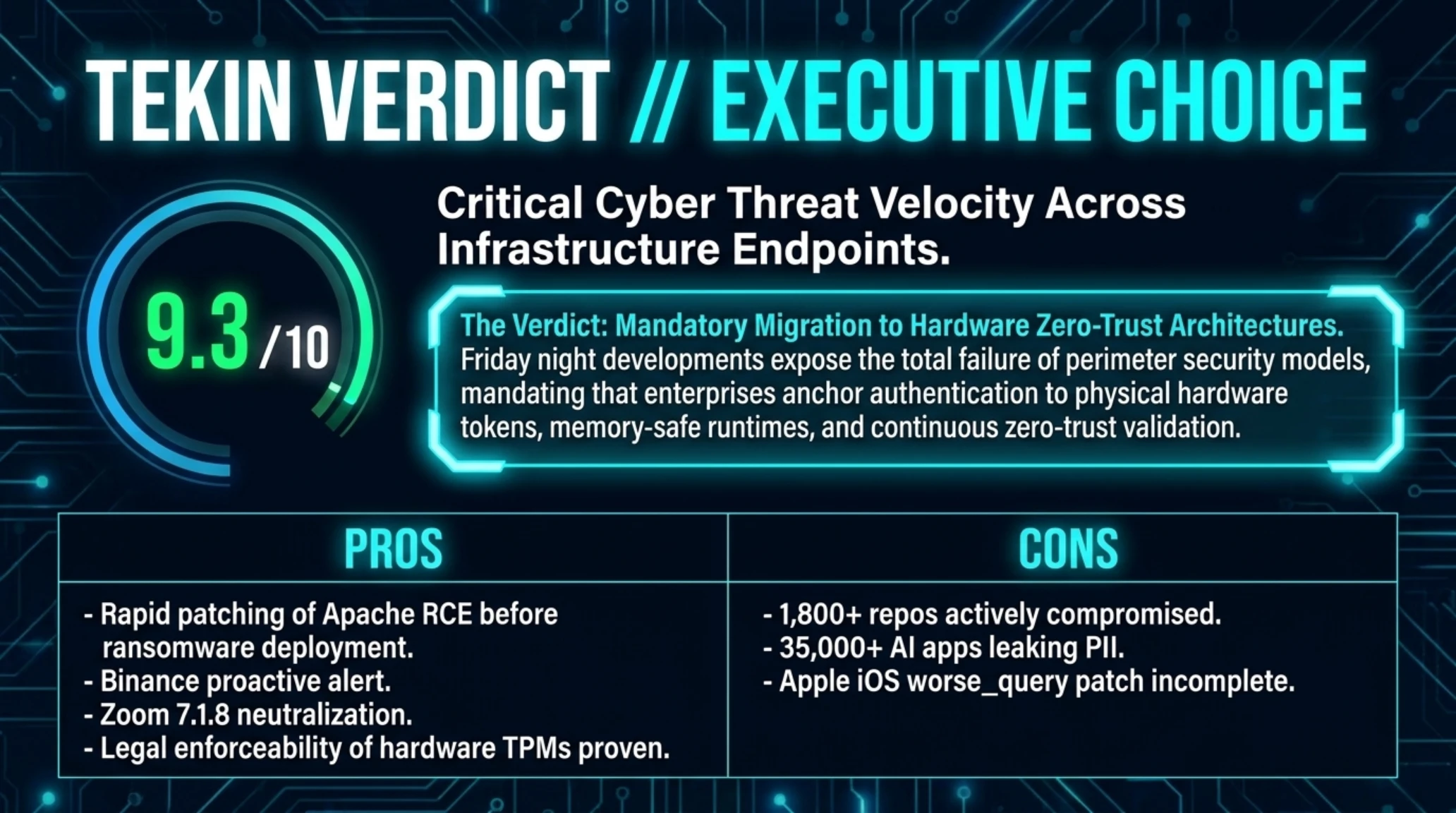
- Rapid global disclosure of Apache CVE-2026-119618 enabling emergency patching before widespread ransomware deployment.
- Proactive security advisory from Binance alerting cryptocurrency holders to unpatched iOS sandbox risks.
- Swift deployment of Zoom Workplace 7.1.8 patch neutralizing critical Windows SYSTEM privilege escalation.
- Decisive legal action by Nintendo demonstrating the enforceability of hardware TPM anti-circumvention protections.
- Over 1,800 active GitHub repositories compromised via automated CI secret exfiltration scripts.
- Public indexing of 35,000+ Grok Build applications leaking sensitive patient, financial, and credential data.
- Incomplete Apple security patches leaving iOS worse_query sandbox escape vector active across mobile devices.
Editorial Verdict & Official Source Directory
- The Hacker News: Official Coverage of Mass GitHub CI Token Thefts and Apache HTTP/2 Race Condition
- Red Hat Security: Advisory Bulletin on CVE-2026-119618 Apache HTTP Server Heap Corruption Flaw
- 9to5Mac: Binance Issues Warning to iPhone Crypto Holders Regarding iOS worse_query Sandbox Escape
- Claroc Research: Empirical Security Audit of 35,000 Insecurely Exposed Grok Build Web Applications
- IGN: Nintendo Executes Sweeping DMCA Takedown Disabling 144 Modchip Firmware Repositories
Frequently Asked Technical Questions
How did threat actors extract production cloud credentials through compromised GitHub accounts?
By hijacking 4,837 developer accounts and submitting automated pull requests to test Write permissions, attackers injected secret-stealer scripts into GitHub Actions workflows and npm postinstall hooks, dumping environment variables during CI runner execution before reverting commits to wipe logs.
Why is the Apache CVE-2026-119618 vulnerability classified with a maximum 9.8 CVSS rating?
The flaw in mod_http2 is an unauthenticated, zero-click remote heap corruption race condition inside assign_headers(). An external attacker simply sends weaponized HTTP/2 streaming frames over port 443 to corrupt heap pointers and achieve arbitrary code execution with web server privileges.
Are iPhone cryptocurrency holders safe after applying the latest iOS security updates?
No. Independent researchers and Binance confirm that Apple initial patches were incomplete and the worse_query kernel query logic flaw remains exploitable, meaning mobile software wallets remain vulnerable to local process memory reading without hardware cold storage.
Additional Gallery: Tekin Night Nov 13: GitHub CI Attack, Apache RCE & iOS Threat