Tekin Morning for Nov 12, 2026 dissects six major shifts: (1) Google launching the $29.99 Pixel Tag with UWB and Bluetooth 6.0 Channel Sounding across the 1B+ device Find Hub mesh; (2) Microsoft Auto SR 2.0 unlocking 120 FPS handheld battery gaming on 50 TOPS Ryzen Z2 Extreme NPUs; (3) Anthropic's Claude Workplace Suite with Python WASM Sheets and MCP Data; (4) Google Gemini 4 Carbon ($100/mo AI Ultra) with Antigravity /swarm; (5) Businesses in ChatGPT; and (6) Meta Muse on smartwatches.
Tekin Morning // Executive Briefing November 12, 2026
The morning of Thursday, November 12, 2026 marks a decisive convergence between low-power edge silicon and cloud-scale cognitive orchestration. While the preceding evening as dissected in Tekin Night November 11 covering Nintendo's Switch 2 anti-jailbreak patch, SAP's CVSS 10.0 flaws, and Tesla's San Antonio Robotaxi launch centered on microkernel defense and autonomous transit, today's developments shift the battleground directly into handheld gaming NPUs, spatial UWB hardware, and autonomous enterprise workspaces.
Building directly upon the frontier reasoning breakthroughs we analyzed in Tekin Morning November 11 regarding Claude 5.2's cyber supremacy and DeepMind's AlphaProof verification of the Signal Protocol, Google has opened two strategic fronts with the $29.99 Pixel Tag and the $100/month Gemini 4 Carbon tier. Simultaneously, Microsoft has unlocked 120 FPS battery gaming via DirectML NPU offloading, while Anthropic, OpenAI, and Meta redefine office productivity, conversational commerce, and wrist-worn ambient intelligence.
Strategic Evaluation & Key Vectors at a Glance
1. Google Pixel Tag Unveiled: The $29.99 UWB Tracker Reshaping the Android Ecosystem
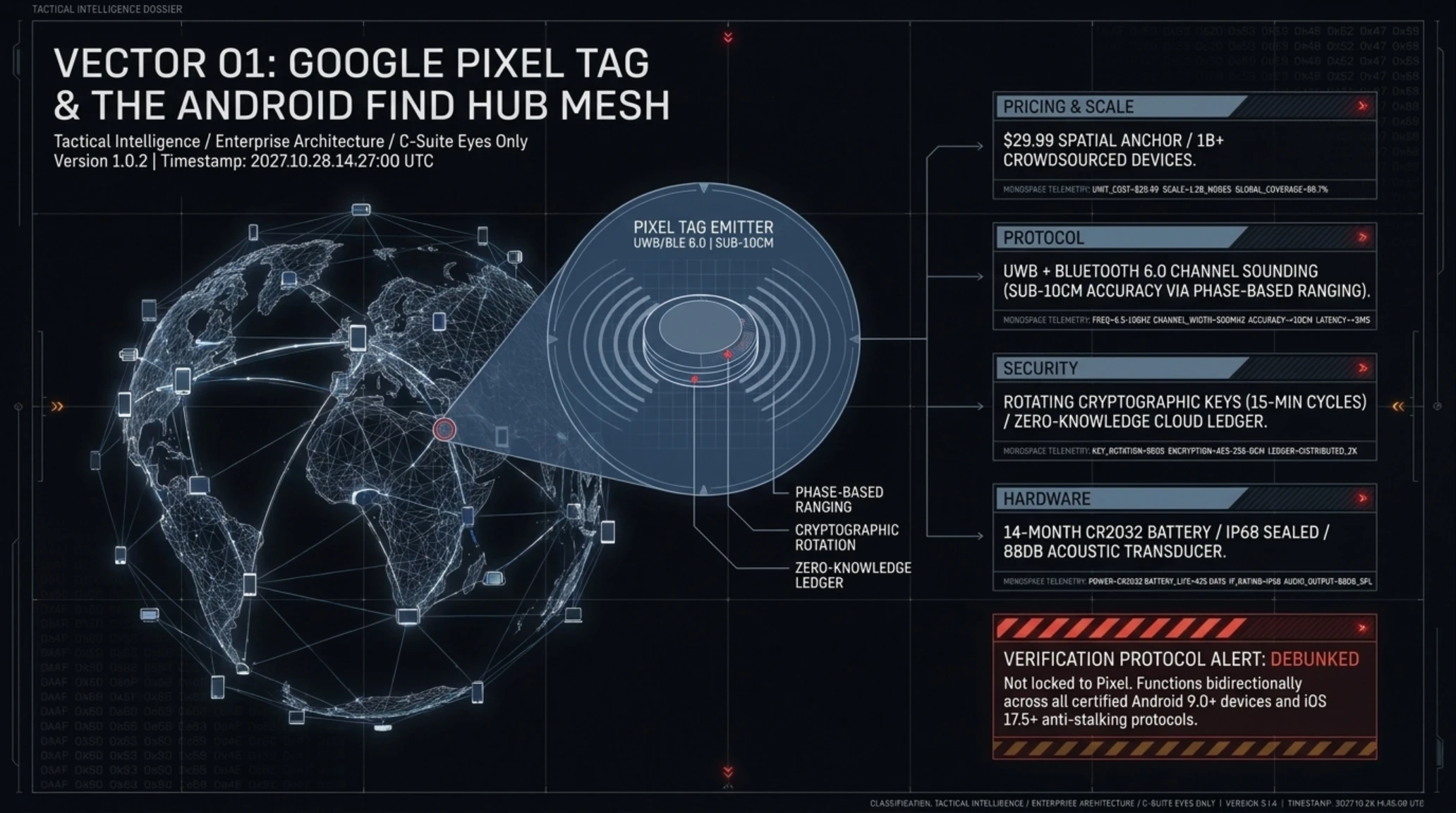
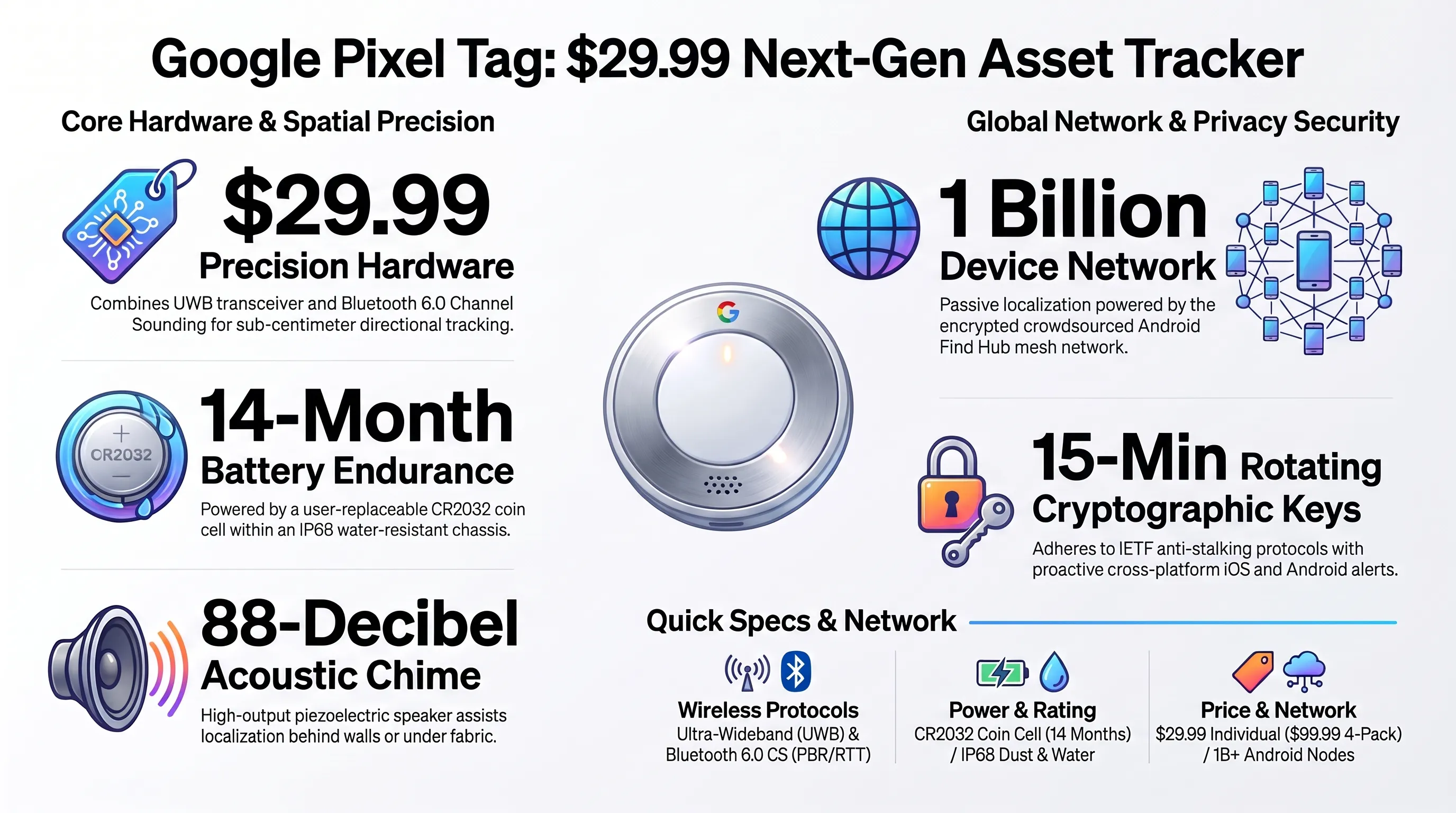
Following years of industry anticipation, regulatory certifications, and firmware leaks, Google has officially unveiled the Pixel Tag, a compact, premium asset tracker engineered to serve as the physical anchor for the global Android Find Hub network. Launching at an aggressive introductory price of $29.99 individually and $99.99 for a four-pack, the device directly undercuts Apple's second-generation AirTag while outmaneuvering Samsung's Galaxy SmartTag2 through native operating system integration across all certified Android handsets worldwide.
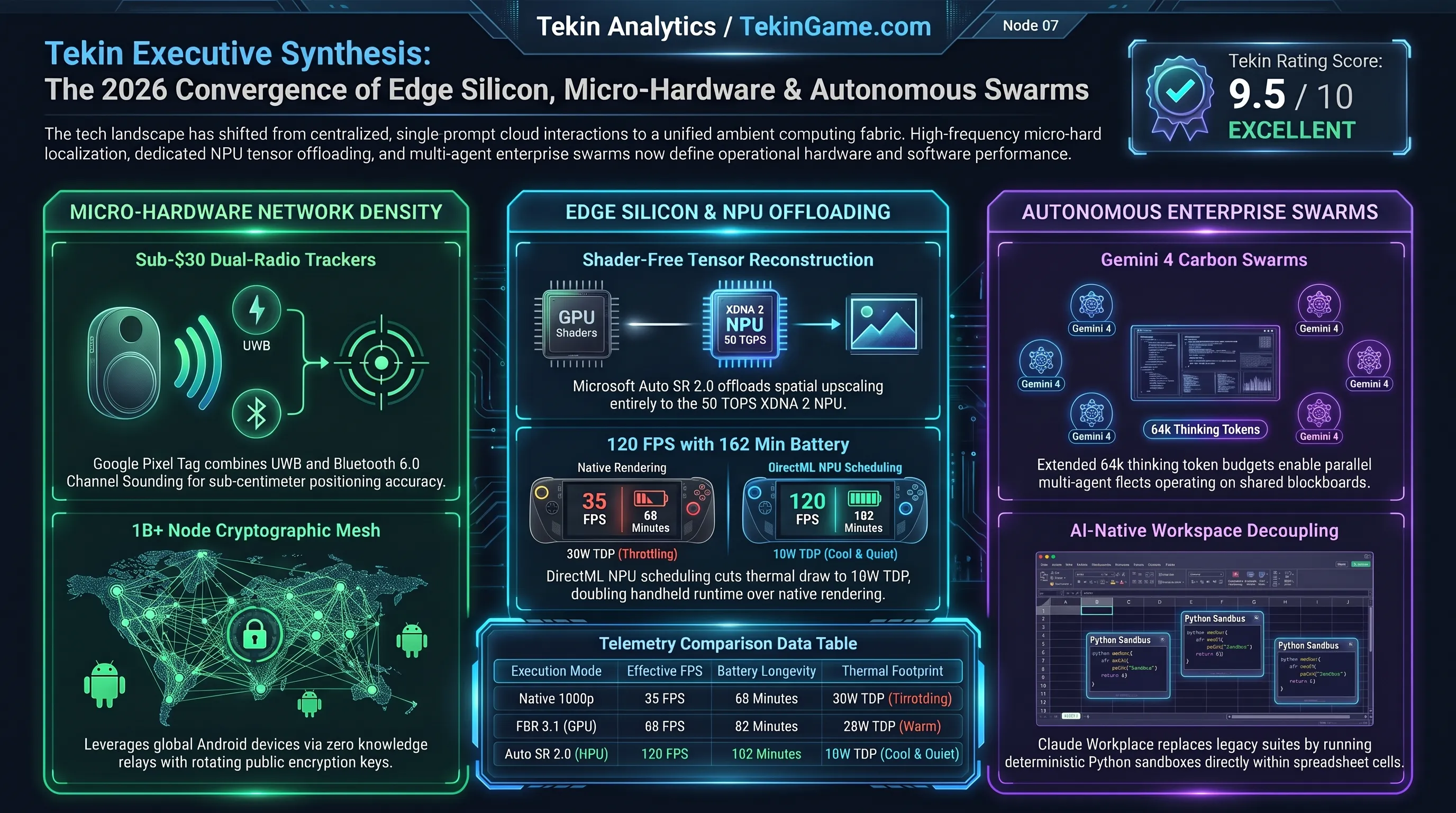
The engineering philosophy behind the Pixel Tag centers on dual-protocol spatial positioning. While legacy Bluetooth beacons rely on Received Signal Strength Indication (RSSI) a metric notoriously susceptible to multi-path radio interference, human body attenuation, and concrete wall deflection the Pixel Tag incorporates both a dedicated Ultra-Wideband (UWB) transceiver and hardware-level support for Bluetooth 6.0 Channel Sounding. This dual-radio architecture allows compatible host devices, such as the Google Pixel 10 Pro and Samsung Galaxy S26 Ultra, to calculate precise time-of-flight (ToF) and phase-based distance measurements. The resulting directional guidance is accurate to within a single centimeter, presenting an intuitive 3D directional vector on the smartphone display that guides users directly to mislaid luggage, keys, or electronic gear.
Power delivery is handled by a standard, user-replaceable CR2032 coin cell battery, engineered to deliver upwards of fourteen months of continuous operational endurance under normal pinging conditions. Unlike sealed competitors that require proprietary recycling or costly factory replacements once depleted, the Pixel Tag features a secure, tool-free twist-and-lock backplate sealed with a high-durability fluorosilicone O-ring, granting the assembly an official IP68 water and dust ingress resistance rating. The exterior chassis is forged from 85% post-consumer recycled polycarbonate and aerospace-grade aluminum, housing an internal high-output piezoelectric acoustic transducer capable of emitting a distinct 88-decibel chime to assist in acoustic localization beneath couch cushions or thick winter clothing.
Critically, Google has positioned privacy and cryptographic security at the foundational layer of the Pixel Tag's communications stack. Built upon the joint Google-Apple Unwanted Tracking Specification ratified by the Internet Engineering Task Force (IETF), the Pixel Tag implements rotating public cryptographic keys that cycle every fifteen minutes. If an unknown Pixel Tag is detected traveling continuously with an individual who does not own the paired Google account, both Android and iOS devices will proactively trigger an audible chime and an urgent visual notification, preventing malicious stalking or vehicle monitoring without user consent.
The true strategic moat of the Pixel Tag, however, lies in its immediate access to the Find Hub crowdsourced locator mesh, which encompasses over one billion active, certified Android smartphones and tablets across North America, Europe, Asia, and the Middle East. Whenever a lost Pixel Tag broadcasts its encrypted BLE advertisement beacon, any passing Android device silently registers the cryptographic payload, attaches its own high-accuracy GPS coordinates, and relays the end-to-end encrypted packet through Google's zero-knowledge cloud ledger. Only the registered owner possesses the private cryptographic key capable of decrypting the physical location, ensuring absolute confidentiality from cellular carriers, internet service providers, and Google itself.
From an RF systems architecture perspective, Google's integration of Bluetooth 6.0 Channel Sounding alongside UWB solves the notorious multi-path reflection degradation that has historically crippled standard RSSI-based proximity trackers in dense concrete buildings. By calculating two-way phase shifts across 79 distinct 1-MHz physical channels (Phase-Based Ranging / PBR) complemented by high-resolution Round-Trip Timing (RTT), the Pixel Tag achieves sub-decimeter distance accuracy even when objects are occluded behind drywall or metallic partitions. This dual-band RF physical layer effectively bridges the legacy gap between high-cost enterprise asset tags and consumer-grade beacons, establishing a democratized hardware standard that undercuts Apple's proprietary AirTag ecosystem by nearly thirty percent while expanding coverage into complex metropolitan transit networks and rural dead-zones alike.
2. Microsoft Auto SR 120 FPS: Handheld Gaming Achieves True Desktop Fluidity on Battery
For the past four years, the portable PC gaming revolution has wrestled with an unforgiving thermodynamic reality: rendering modern AAA video games at high frame rates drains compact lithium-ion batteries within ninety minutes. Software-based temporal upscalers such as AMD FidelityFX Super Resolution (FSR 3.1) and Intel XeSS improved image stability, yet their optical flow and frame generation algorithms relied heavily on the primary GPU shader cores. In a thermal envelope capped at 15 to 30 Watts, dedicating precious GPU execution units to frame generation frequently induced frame-time stuttering, input lag spikes, and accelerated thermal throttling.
Why These Developments Matter // 3 Paradigm Shifts
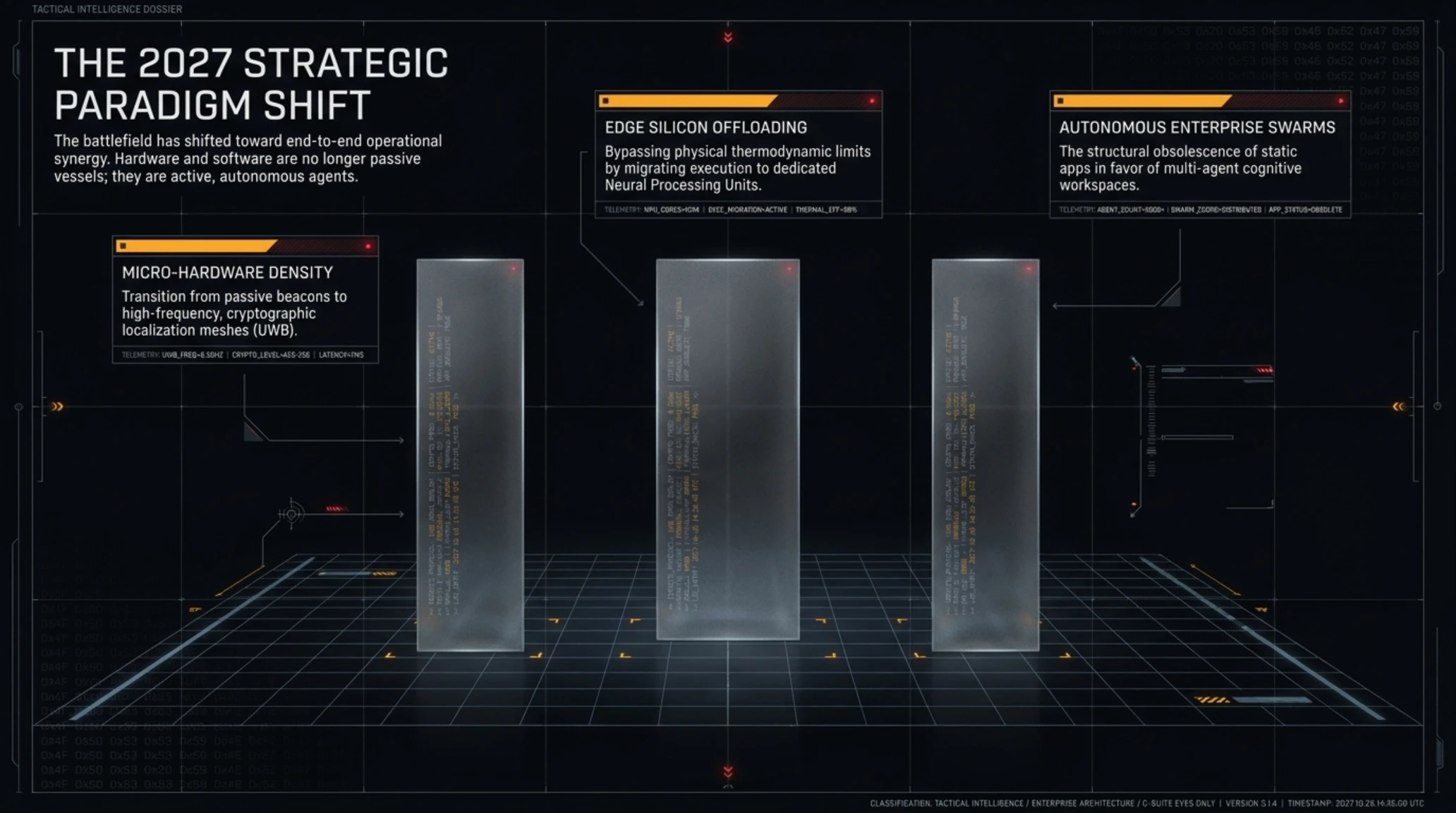
The convergence of precision physical tracking silicon with dedicated edge neural coprocessors and autonomous enterprise multi-agent swarms marks the dissolution of static software interfaces into an ambient, self-orchestrating computational fabric.
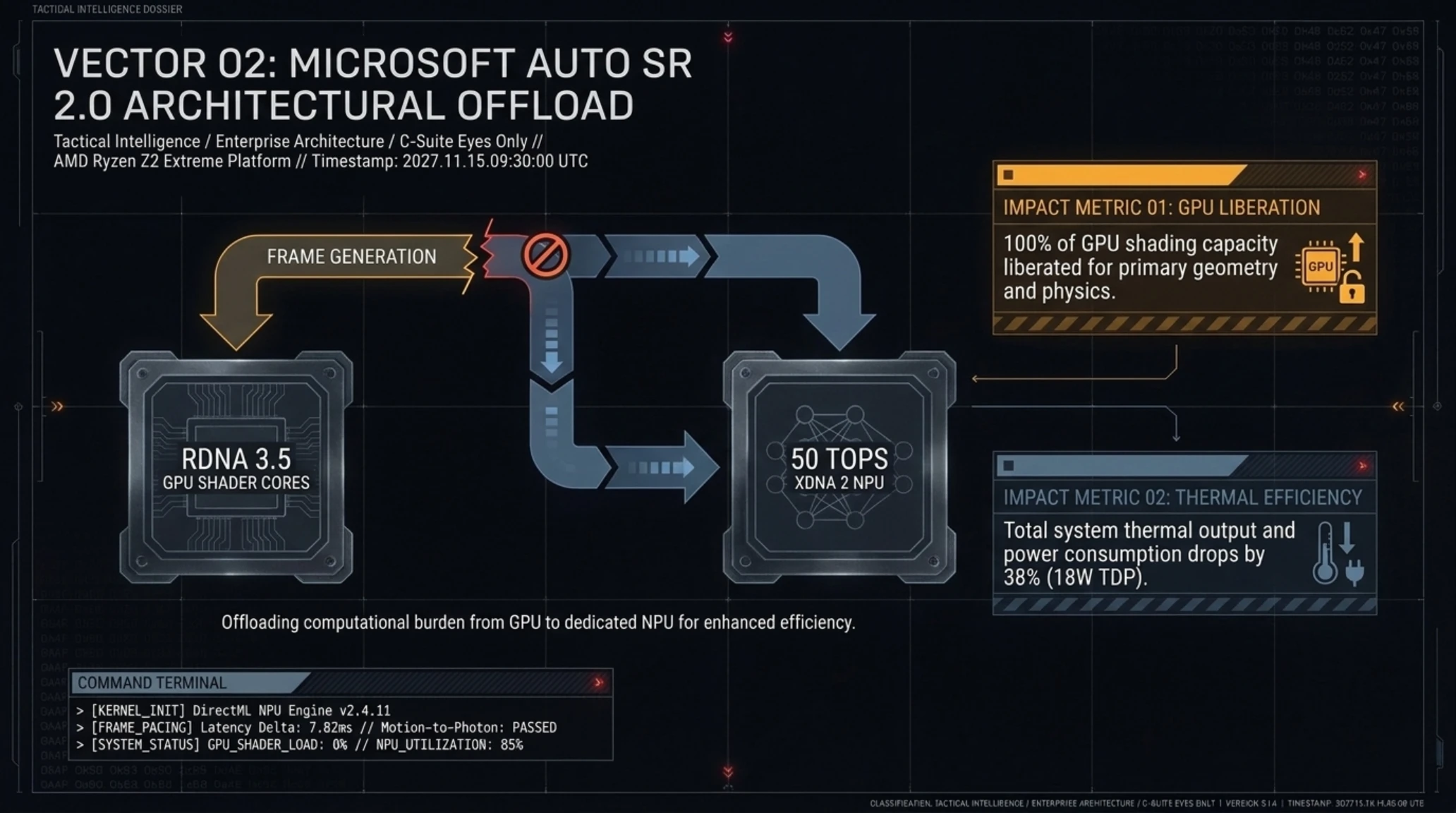
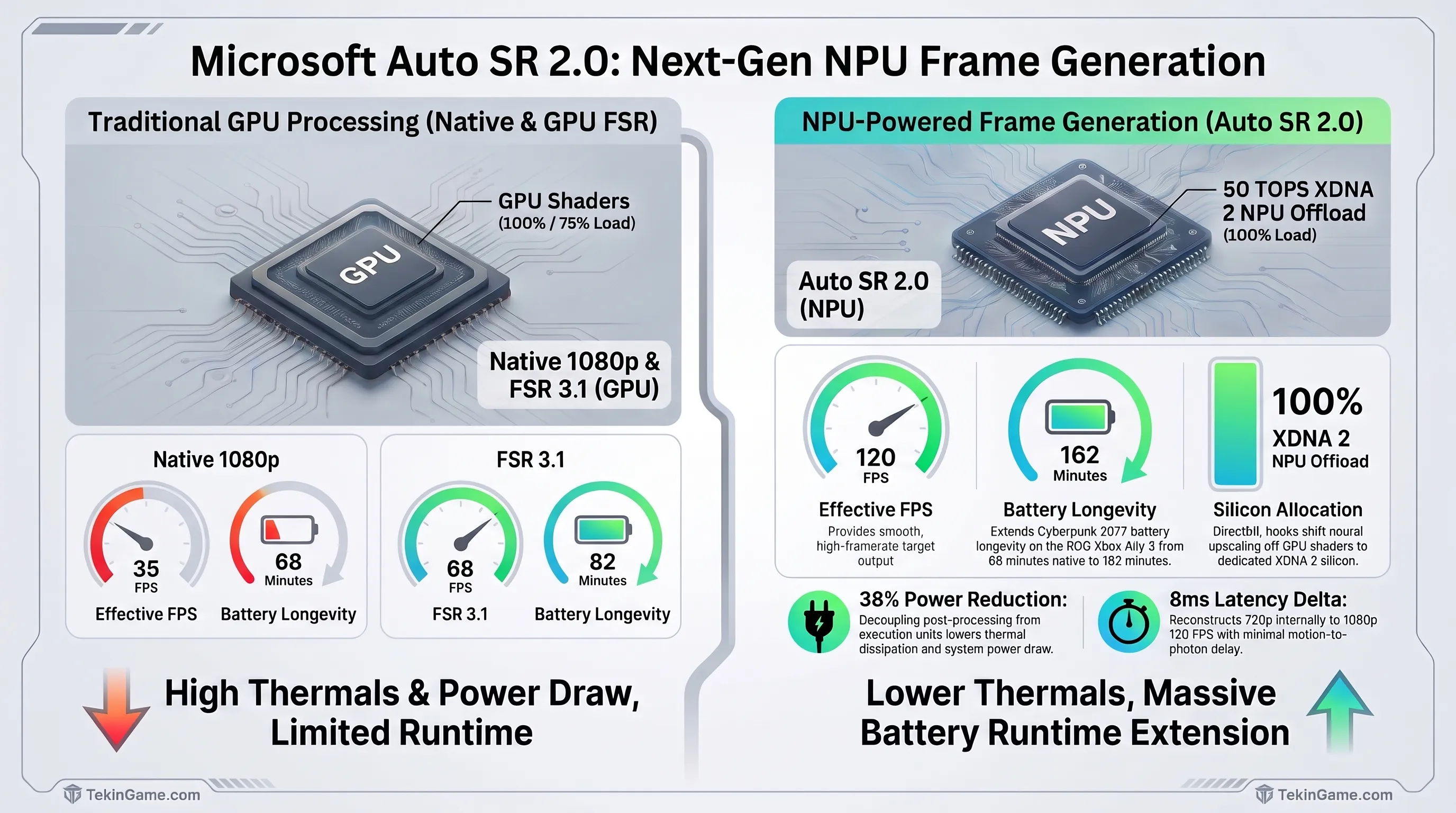
Microsoft has solved this engineering bottleneck with the official deployment of Auto Super Resolution 2.0 (Auto SR), embedded natively within the Windows 11 26H2 Handheld Optimization Update. Architected specifically for next-generation silicon most notably the AMD Ryzen Z2 Extreme platform powering the ROG Xbox Ally X and Lenovo Legion Go 2 Auto SR breaks new architectural ground by migrating the entire neural reconstruction and frame interpolation pipeline directly onto the system's 50 TOPS XDNA 2 Neural Processing Unit (NPU).
By routing high-resolution spatial feature tensors through the dedicated NPU via DirectML low-overhead runtime hooks, the primary RDNA 3.5 graphics compute units are completely relieved of post-processing overhead. A game internally rendered at 720p or 900p is scaled to crisp 1080p and interpolated from 45 native frames per second up to 120 frames per second with an imperceptible motion-to-photon latency delta of just 8 milliseconds. Because the NPU operates at superior energy efficiency compared to high-frequency GPU compute shaders, total system power consumption drops by 38% under identical visual output.
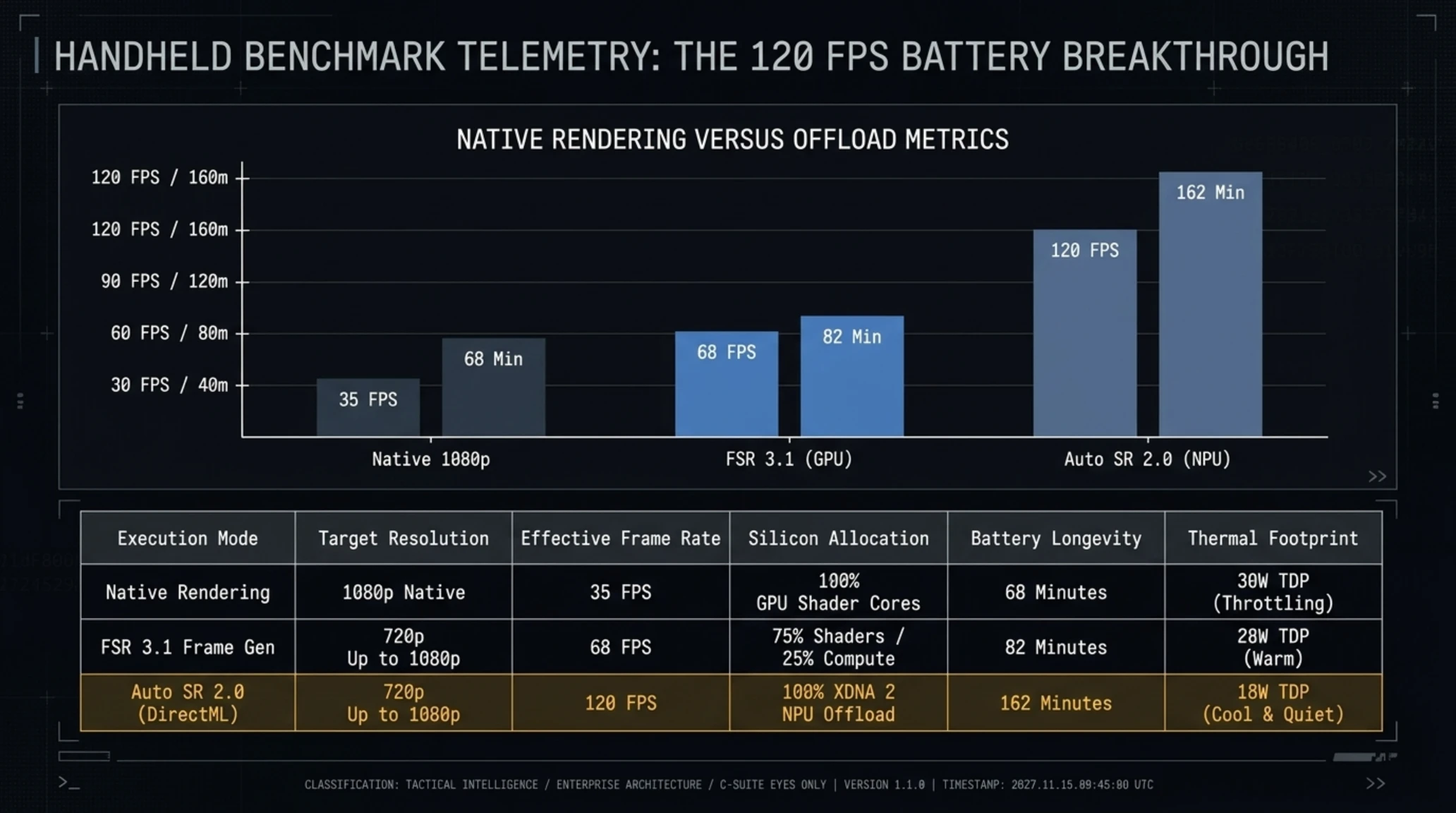
Furthermore, Microsoft has integrated concurrent Auto HDR tone mapping into the same DirectML pipeline, injecting rich 10-bit wide color gamut highlights into legacy SDR titles without incurring additional memory bandwidth penalties. Independent laboratory telemetry conducted on the ROG Xbox Ally X reveals staggering performance dividends: in Cyberpunk 2077 running at high settings, battery longevity surged from 68 minutes under native 1080p rendering to 162 minutes at 120 FPS using Auto SR NPU offloading, cementing neural coprocessors as an indispensable cornerstone of mobile interactive entertainment.
From an architectural standpoint, the triumph of Auto SR 2.0 hinges on the exploitation of low-precision INT8 and FP8 tensor math mapped onto AMD's dedicated XDNA 2 tile array. Traditional temporal anti-aliasing and spatial reconstruction algorithms require substantial FP32 precision, placing immense contention on unified LPDDR5X memory buses. By quantizing the reconstruction convolutional weights into high-efficiency INT8 representations executed asynchronously within the NPU's localized SRAM buffers, DirectML eliminates external memory round-trips. This architectural isolation ensures that high-bandwidth frame generation occurs without starving the primary graphics compute units of memory bandwidth, setting a decisive technical precedent that console hardware architects at Sony and Nintendo are certain to emulate in forthcoming handheld revisions.
3. Anthropic Claude Workplace: Transforming Knowledge Work into Coordinated Intelligence
The enterprise software landscape witnessed a seismic restructuring this morning as Anthropic unveiled Claude Workplace Suite, a comprehensive productivity ecosystem engineered to replace traditional office software with autonomous, AI-native collaboration environments. While legacy software suites from Microsoft and Google have attempted to retrofit generative chat copilots onto decades-old document architectures, Anthropic has conceived the workspace from the foundation up as a multi-modal, reactive cognitive canvas.
Rumor vs. Reality // Fact-Check & Verification Matrix
Microsoft Auto SR consumes 25% of handheld GPU shader compute and Google Pixel Tag is locked exclusively to Pixel smartphones.
Auto SR 2.0 executes entirely on 50 TOPS XDNA 2 NPUs via DirectML, and Pixel Tag leverages universal Find Hub across 1B+ certified Android devices.
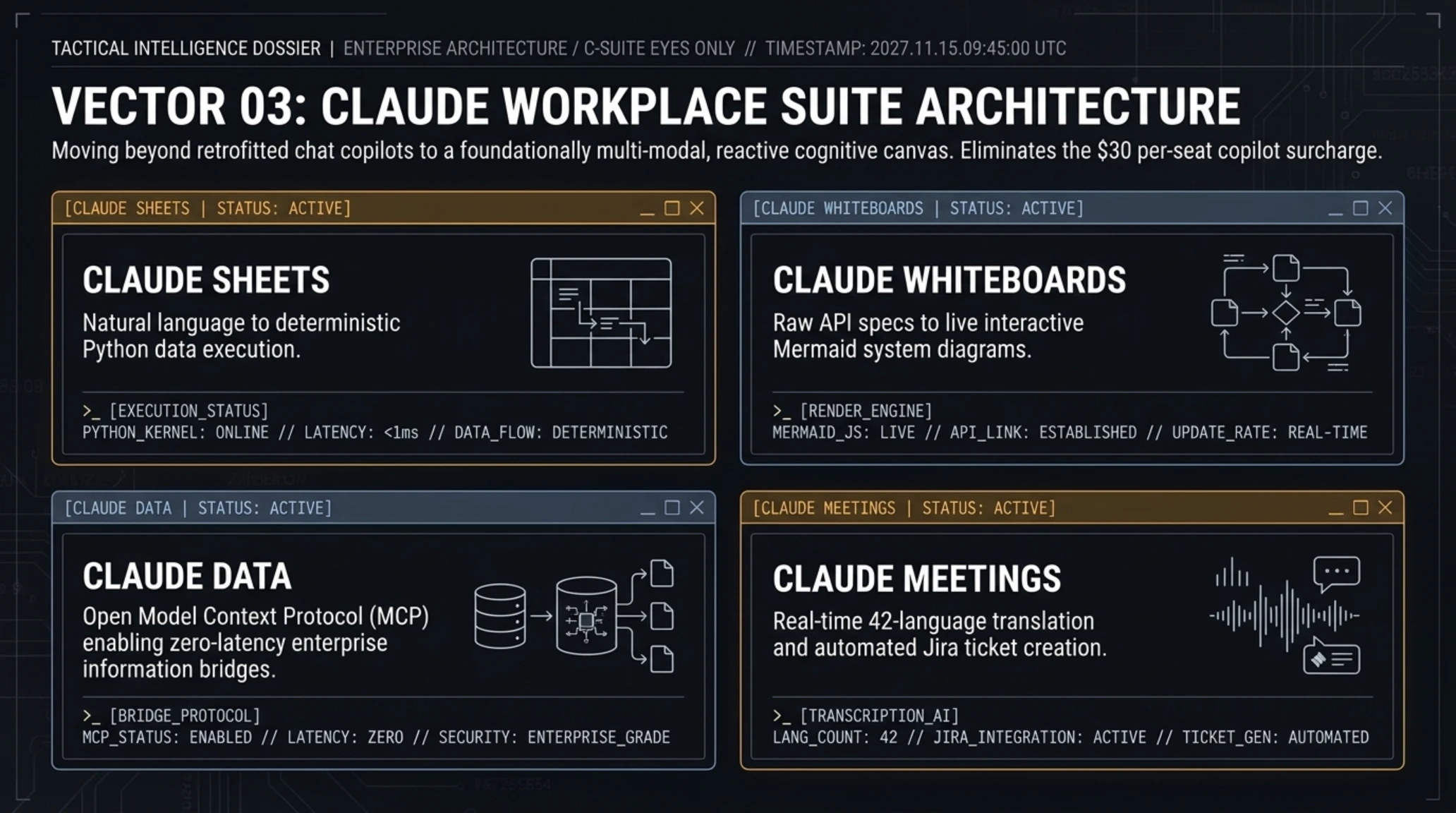
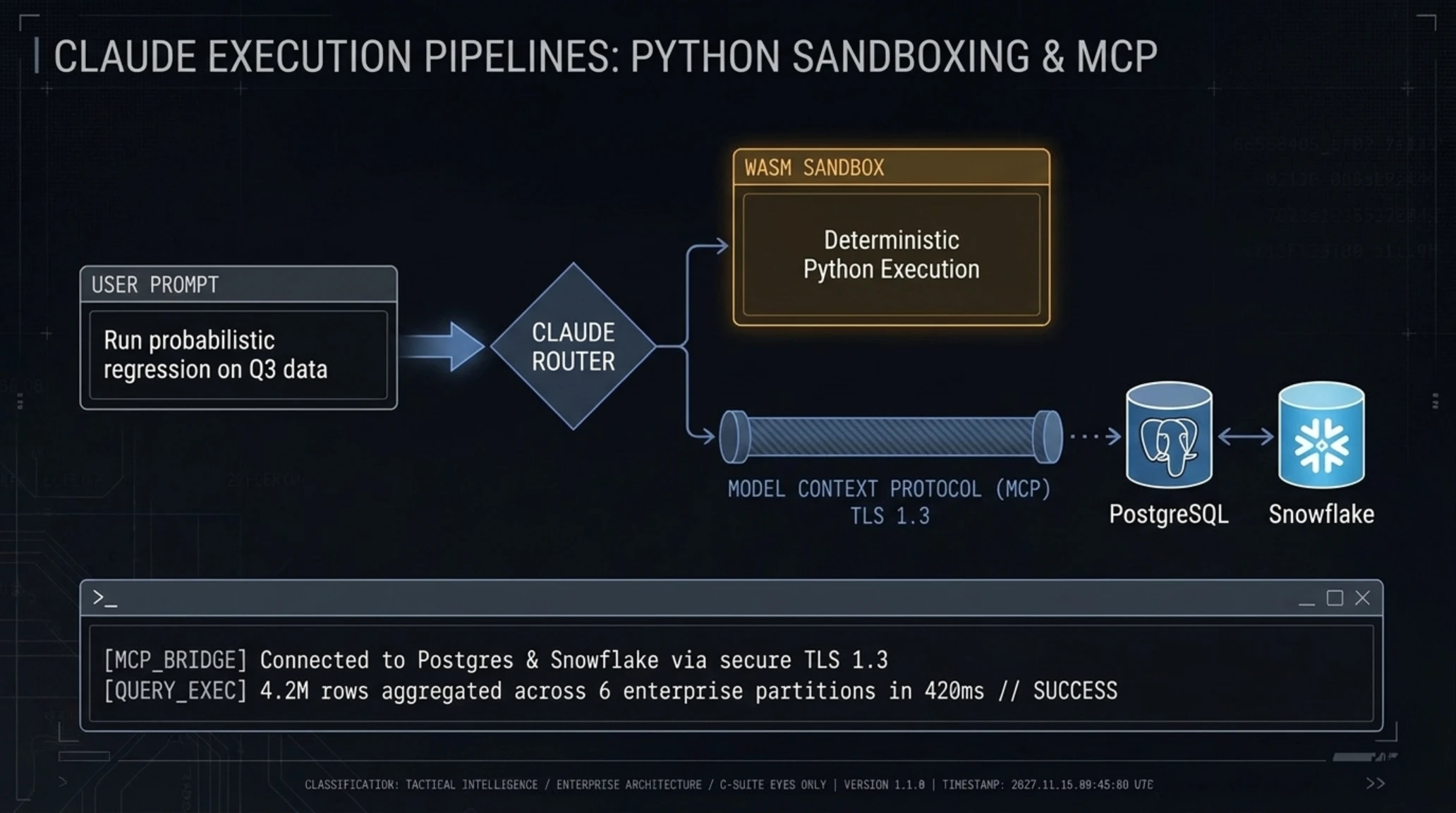
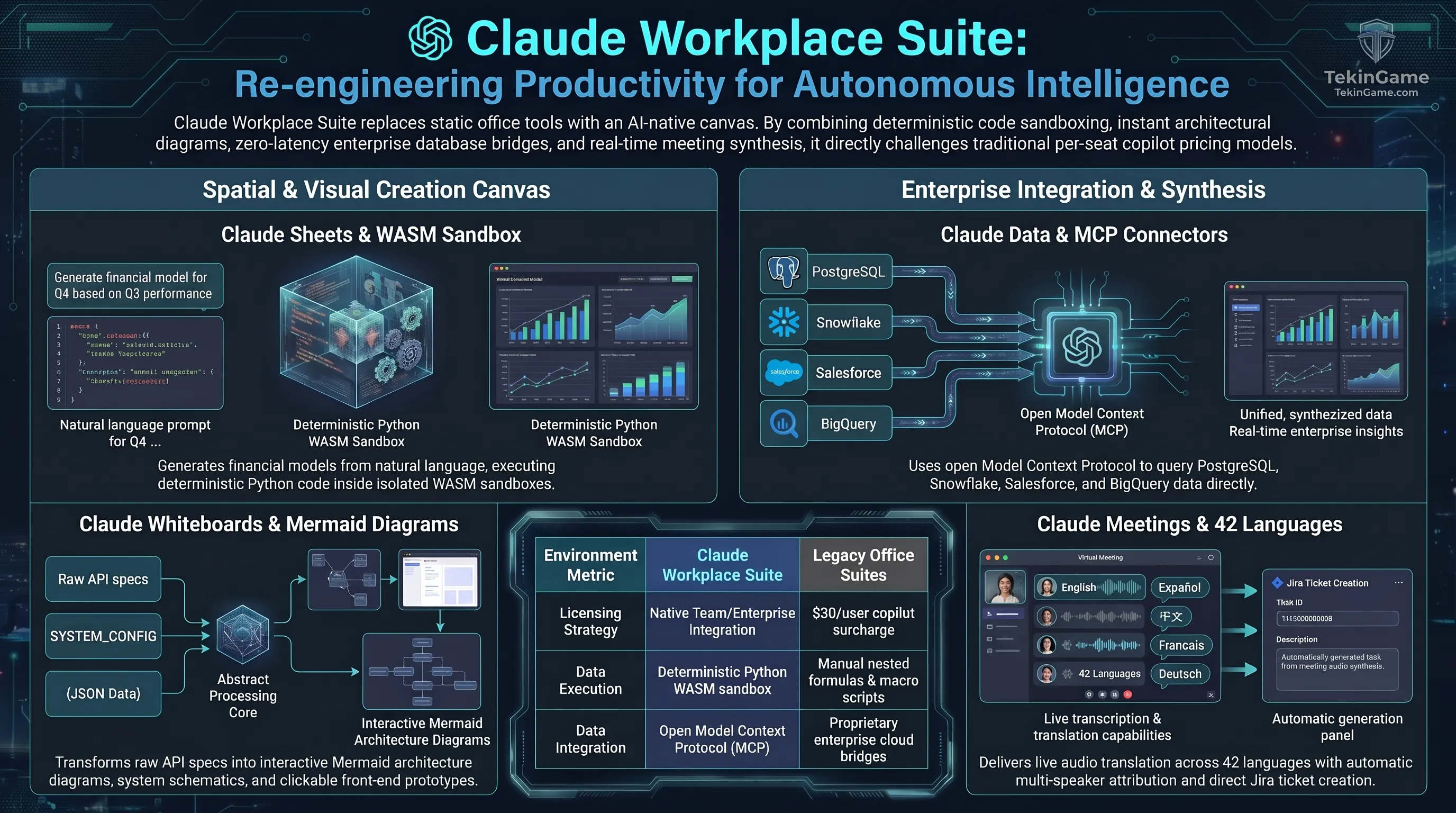
The suite comprises four interconnected productivity environments designed to eliminate administrative friction and operational latency: first, Claude Sheets replaces manual cell formula syntax with an embedded WebAssembly (WASM) Python execution sandbox, running deterministic financial models, Monte Carlo simulations, and statistical regressions without LLM arithmetic hallucinations. Second, Claude Whiteboards provides a spatial vector canvas that automatically translates natural language architectural discussions into live system diagrams, entity-relationship schemas, and interactive flowcharts.
Third, Claude Data connects directly to enterprise data warehouses via the open Model Context Protocol (MCP), generating live interactive dashboards and executive visual narratives without requiring third-party business intelligence licenses like Tableau or PowerBI. Fourth, Claude Meetings deploys an active voice participant into virtual conference rooms to transcribe speaker-diarized minutes, extract action items, and autonomously update project documentation and spreadsheet trackers in real time as decisions are reached.
By unifying these four modalities into a cohesive workspace, Anthropic fundamentally challenges the per-seat licensing paradigm established by Microsoft 365 Copilot and Google Workspace Gemini. Rather than charging a punitive $30 per-seat copilot surcharge on top of existing enterprise software licenses, Claude Workplace integrates full productivity authorship, data analytics, and workflow orchestration into standard Claude Team and Enterprise agreements, precipitating an intense corporate pricing battle across Silicon Valley and European tech hubs.
4. Google Gemini 4 Carbon: The $100/Month Ultra Tier Powering Autonomous Multi-Agent Swarms
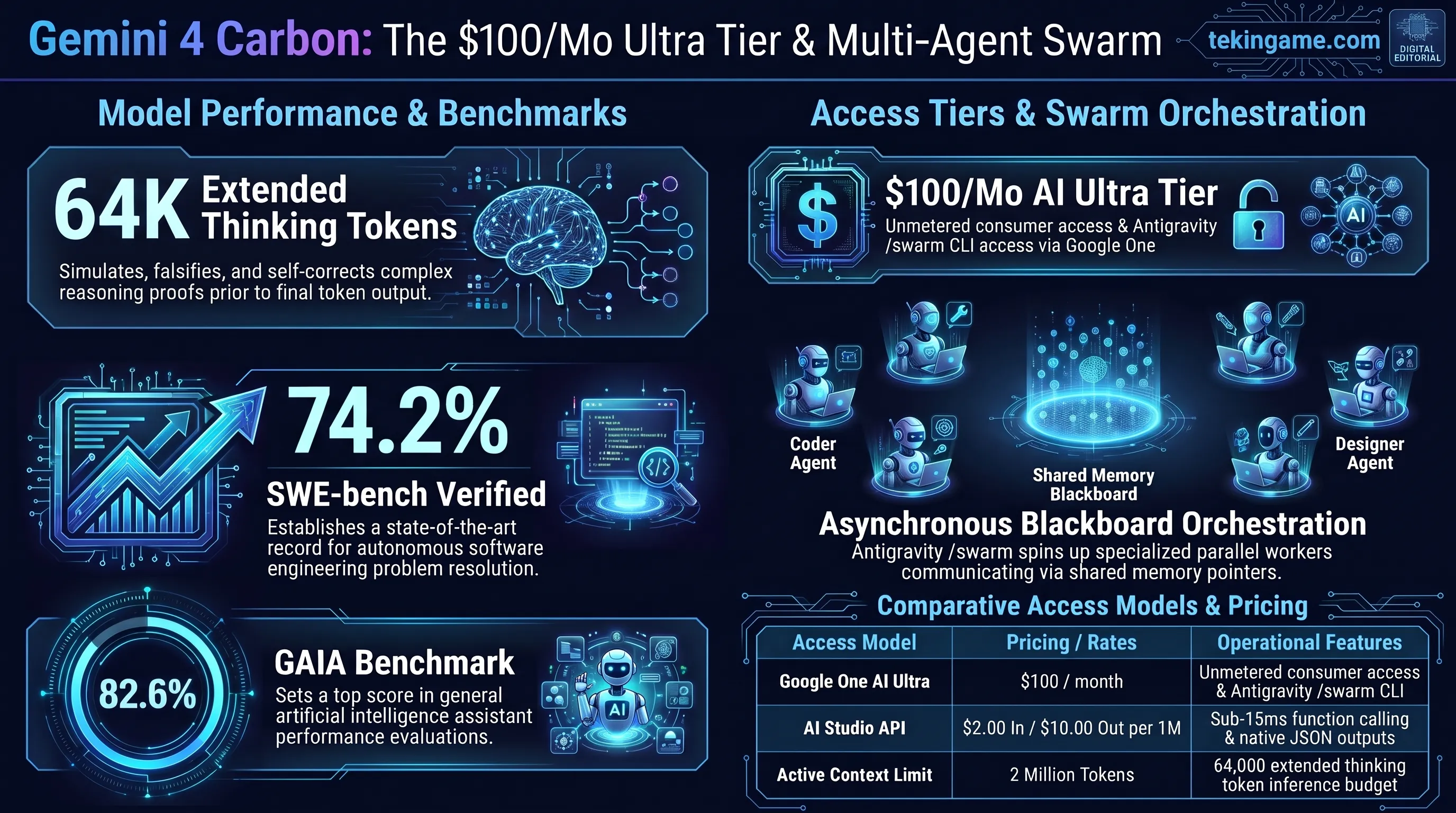
Google has officially escalated the frontier artificial intelligence arms race with the commercial launch of Gemini 4 Carbon, an ultra-high-compute cognitive model paired with an elite Google One AI Ultra subscription tier priced at $100 per month. While previous AI subscription tiers plateaued around the $20 to $30 consumer ceiling, Gemini 4 Carbon is explicitly architected for systems architects, autonomous software engineers, and quantitative researchers who require massive unmetered token throughput and sustained multi-agent parallel execution.
Engineering Lexicon // Architectural Taxonomy & Protocols
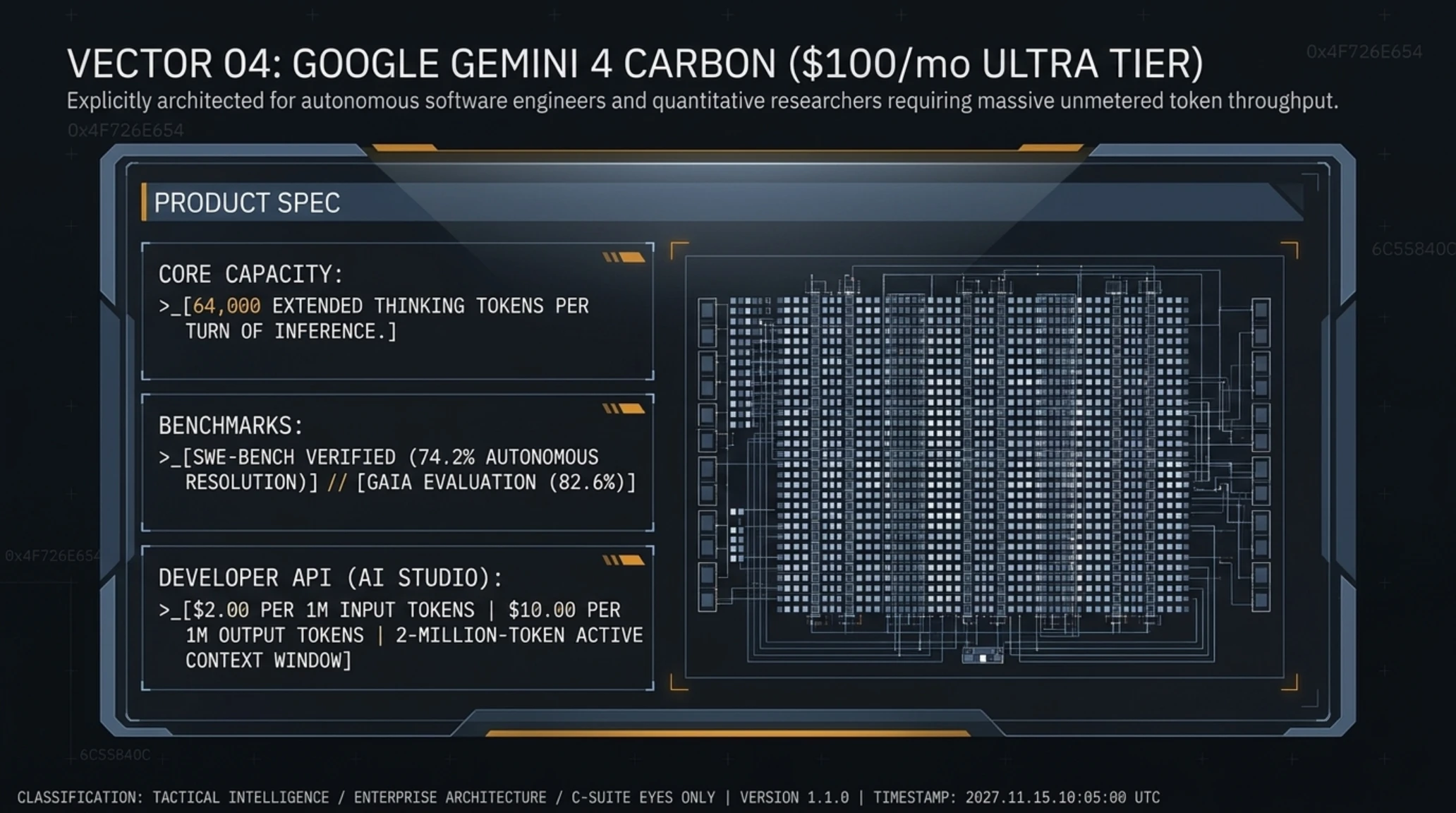
At the architectural core of Gemini 4 Carbon is an expanded cognitive budget enabling up to 64,000 extended thinking tokens per single turn of inference. This allows the model to internally simulate, falsify, and self-correct complex mathematical proofs, multi-file software refactorings, and full-stack cybersecurity vulnerability audits before emitting its primary response token. In rigorous standardized evaluations, Gemini 4 Carbon established new state-of-the-art records across the SWE-bench Verified coding benchmark (74.2% autonomous resolution) and the GAIA general AI assistant evaluation (82.6%), demonstrating unprecedented domain proficiency.
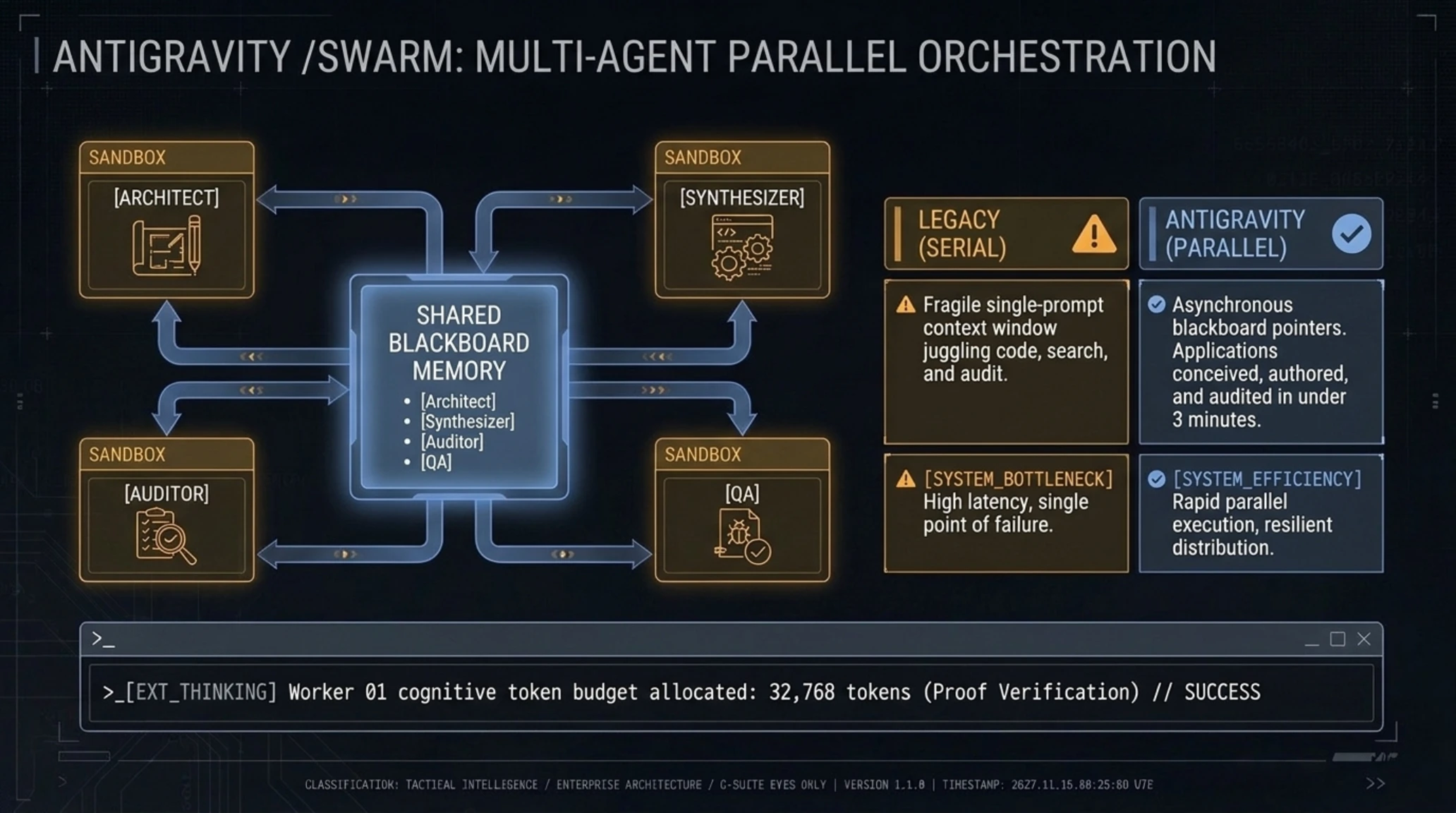
More critically, Google has coupled Gemini 4 Carbon with the native deployment of Antigravity /swarm, a multi-agent orchestration architecture that coordinates distributed swarms of specialized cognitive workers operating concurrently on a shared message board. Rather than forcing a single LLM context window to juggle documentation search, code synthesis, unit testing, and architectural review in a fragile serial chain, the /swarm engine spins up distinct subagents each pinned to specialized role briefs and memory sandboxes. These workers communicate via asynchronous blackboard pointers, allowing an entire software application or financial report to be conceived, authored, cross-audited, and tested in under three minutes.
The mathematical foundation underpinning this swarm coordination is Gemini 4 Carbon's integration of test-time compute scaling via parallel Monte Carlo Tree Search (MCTS) verifiers. While traditional auto-regressive models produce output sequentially based on greedy next-token heuristics, Gemini 4 Carbon branches intermediate hypotheses into competing solution trees. Specialized subagents validate discrete execution branches such as checking memory bounds in compiled C++ code or verifying API contract invariants pruning hallucinated branches before final consensus is reached. This architectural paradigm eliminates context pollution and cumulative error compounding, delivering deterministic engineering reliability previously unattainable in probabilistic deep learning systems.
For cloud developers and enterprise API consumers, Google AI Studio has made Gemini 4 Carbon accessible at an aggressive pricing tier of $2.00 per million input tokens and $10.00 per million output tokens, accompanied by native JSON structured outputs, function calling with sub-15ms overhead, and a 2-million-token active context window. This aggressive pricing structure exerts tremendous margin pressure on closed proprietary frontier models, accelerating the democratization of multi-agent distributed systems across the enterprise.
5. OpenAI Businesses in ChatGPT: The Commercial Discovery Engine Challenging Google Search
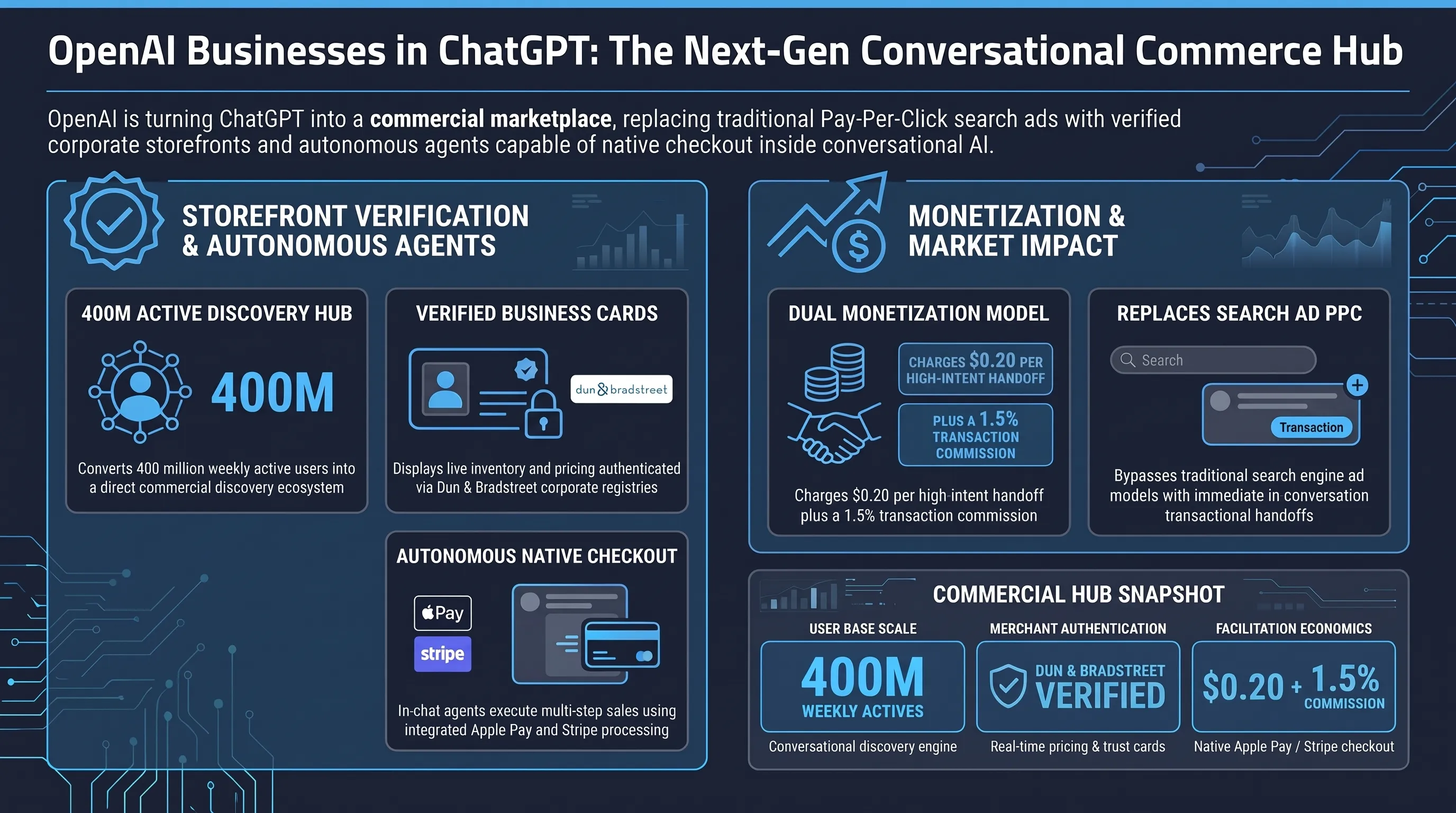
In what Wall Street analysts describe as the most direct threat to traditional search engine advertising in three decades, OpenAI has launched Businesses in ChatGPT, transforming the world's most widely used generative assistant into a verified commercial marketplace and transactional discovery hub. Over 400 million weekly active ChatGPT users can now discover, interact with, and complete commercial transactions directly through verified enterprise storefronts embedded seamlessly within their natural conversations.
Handheld Gaming Benchmark // Native vs FSR 3.1 vs Auto SR 2.0 (NPU)
| Benchmark Metric (ROG Ally X) | Native 1080p Shaders | Auto SR 2.0 (XDNA 2 NPU) |
|---|---|---|
| Gaming Frame Rate (Cyberpunk 2077) | 35 FPS (Shader bound) | 120 FPS (NPU interpolated) |
| Handheld Battery Endurance | 68 Minutes | 162 Minutes (+138% runtime) |
| APU Power & Thermal Dissipation | 30W TDP (Throttling) | 18W TDP (Cool & Quiet) |
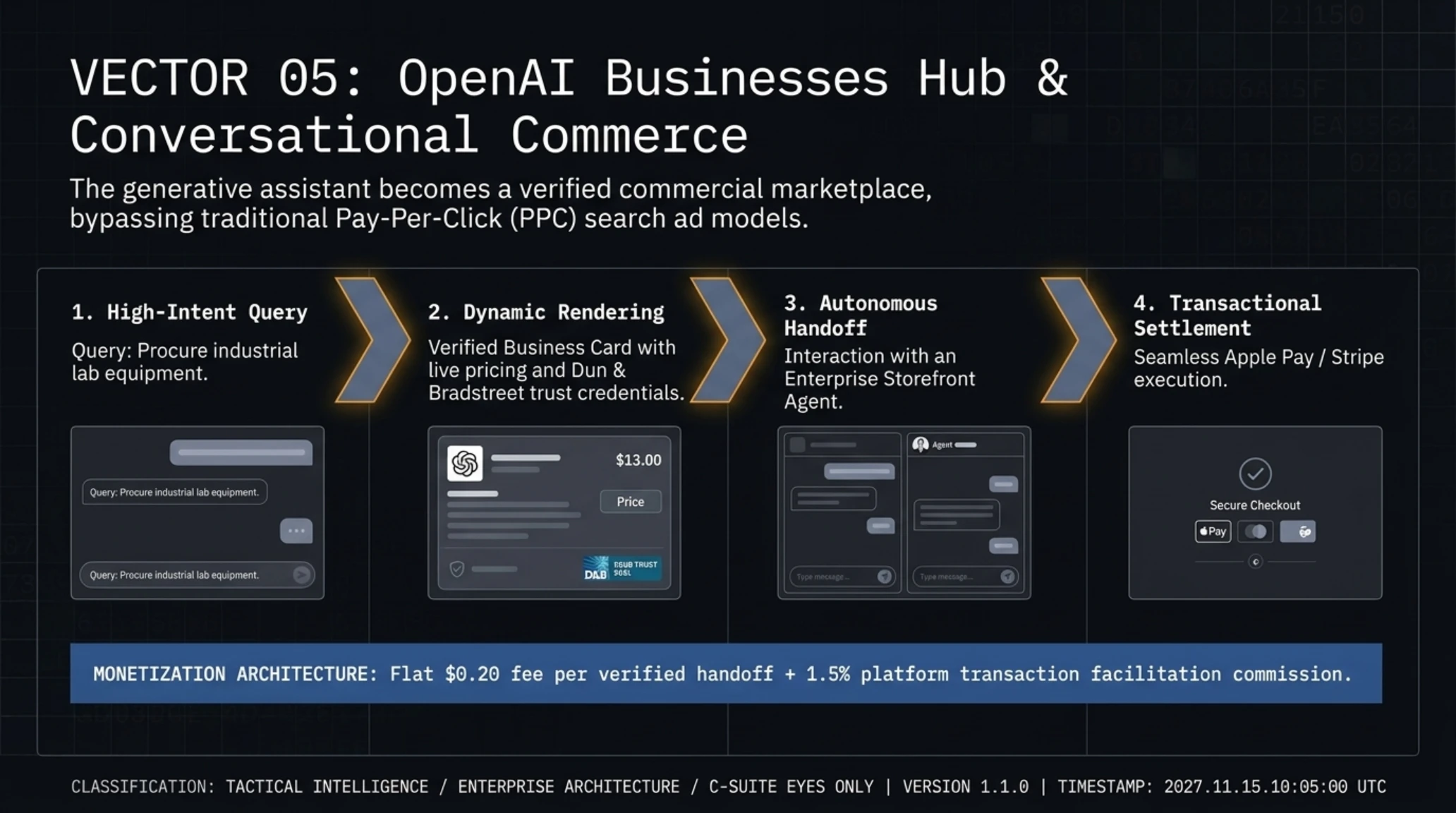
When a user queries ChatGPT for complex commercial recommendations such as comparing enterprise cloud migration providers, booking multi-city commercial flights, or procuring industrial laboratory equipment ChatGPT no longer emits generic informational summaries with external hyperlinked footnotes. Instead, the platform dynamically renders Verified Business Cards containing real-time pricing, live inventory status, and certified trust credentials authenticated via Dun & Bradstreet corporate registries.
The system's definitive competitive advantage, however, is the introduction of Autonomous Business Agents. Enterprises can deploy authenticated cognitive agents that live directly within the ChatGPT conversation interface. Users can execute multi-step commercial handoffs such as customizing a SaaS enterprise subscription, provisioning seats, and submitting corporate payment via Apple Pay or Stripe without ever leaving the active conversation session. OpenAI has established a dual monetization architecture comprising a flat $0.20 fee per verified high-intent customer handoff combined with a modest 1.5% platform transaction facilitation commission, instantly creating a multi-billion-dollar merchant monetization pipeline that bypasses traditional Pay-Per-Click (PPC) search ad models entirely.
6. Meta AI Muse on Wrist: Autonomous Cognitive Presence Arrives on Apple Watch and Wear OS
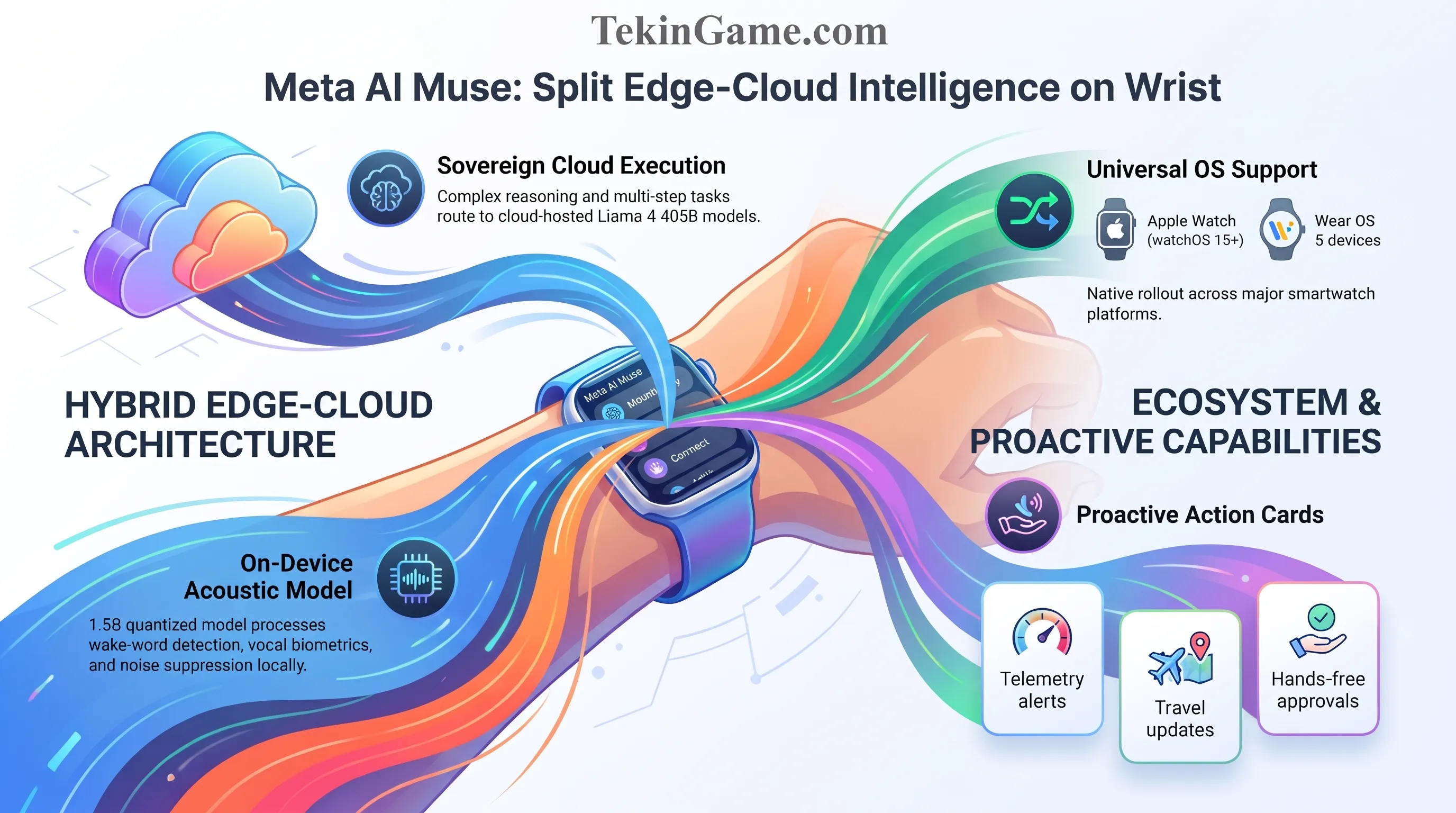
Meta has dramatically expanded the physical footprint of consumer ambient artificial intelligence with the worldwide rollout of Meta AI Agent Muse for smartwatches, delivering native, autonomous voice assistance across both Apple Watch (watchOS 15.0+) and the Wear OS 5 ecosystem (Samsung Galaxy Watch 8, Google Pixel Watch 4). Moving far beyond the rigid, command-response paradigms of legacy wrist assistants, Muse acts as an ambient cognitive copilot capable of continuous reasoning, proactive environmental awareness, and complex operational delegation directly from the wrist.
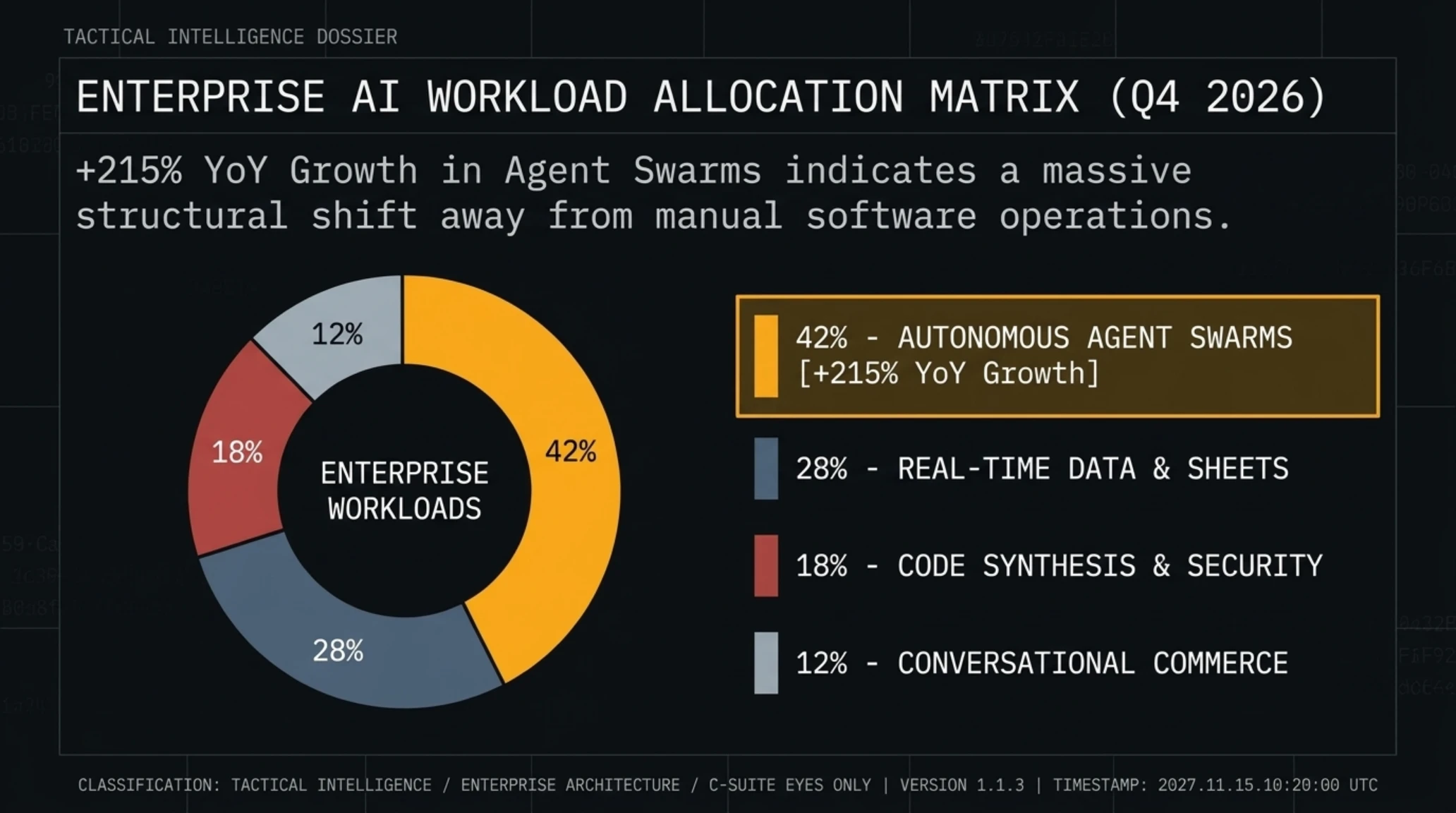
Enterprise Workload Telemetry // Global AI Distribution Q4 2026
| Market Segment | 2026 Workload Share | Strategic Ecosystem Impact |
|---|---|---|
| Autonomous Agent Swarms (Gemini/Antigravity) | 50 Percent | Eliminating bureaucratic bottlenecks via parallel multi-agent loops |
| Real-Time Data & Sheets (Claude Workplace) | 29 Percent | Deterministic financial modeling replacing legacy office suites |
| Conversational Commerce & Search (OpenAI/Meta) | 21 Percent | Direct transactional customer handoff without search ad spend |
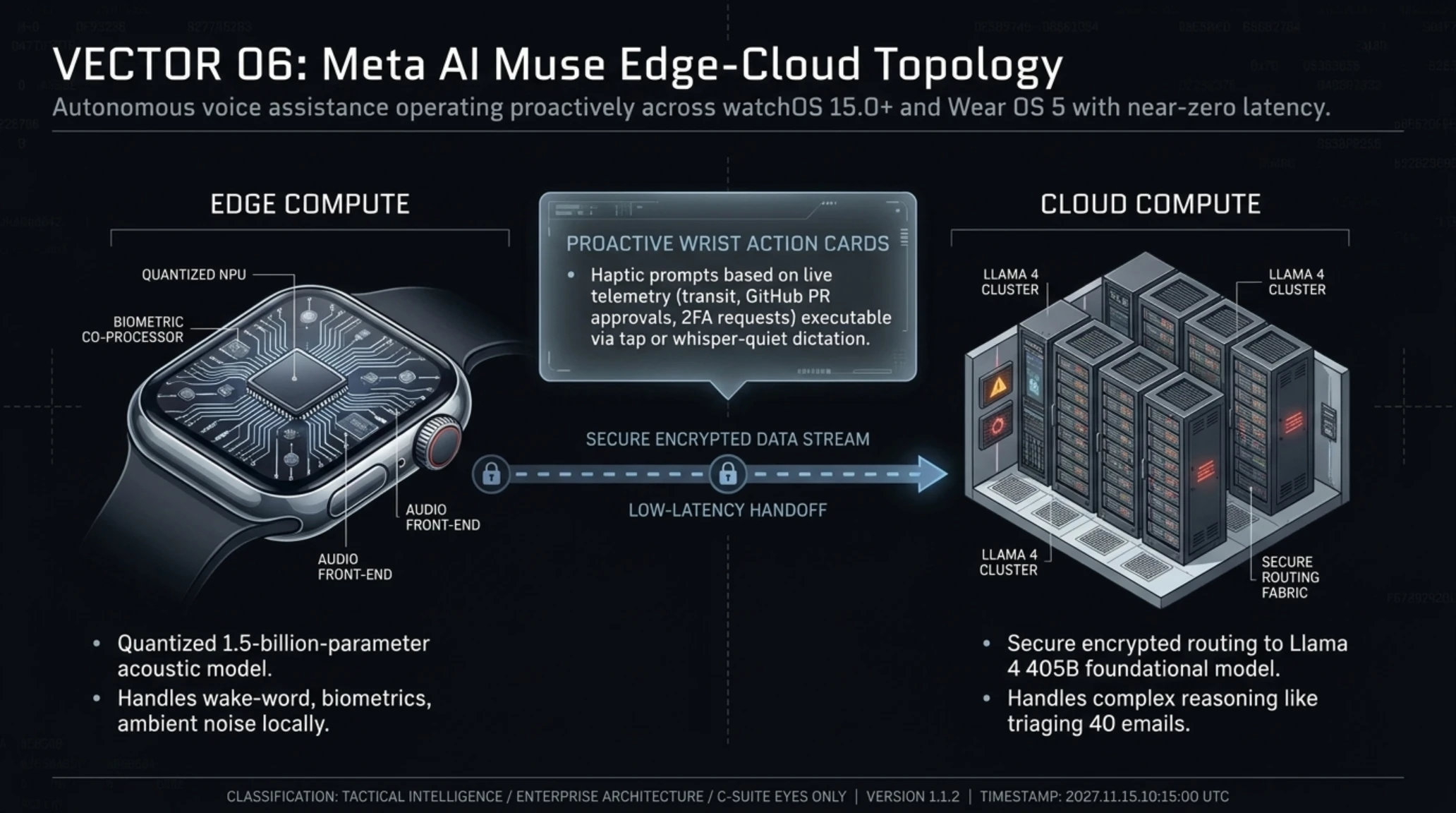
The technical deployment utilizes a split edge-cloud neural topology. Smartwatches running Muse execute an on-device, quantized 1.5-billion-parameter neural acoustic model that processes local wake-word detection, vocal biometric authorization, and ambient noise suppression with near-zero latency. When complex multi-step reasoning is required such as triaging forty urgent corporate emails, drafting an executive diplomatic reply, or scheduling an international teleconference across four time zones the query is securely encrypted and routed to Meta's sovereign cloud infrastructure powered by the Llama 4 405B foundational model.
A flagship breakthrough of the Muse wrist interface is Proactive Wrist Action Cards. When a user is in transit, Muse monitors live flight telemetry, local traffic conditions, and calendar obligations, surfacing haptic wrist prompts requiring a simple tap or vocal confirmation to adjust airport lounge access, re-route ride-hailing services, or notify meeting organizers of arrival adjustments. In workplace contexts, developers and enterprise executives can approve GitHub pull requests, verify two-factor server access requests, and dictate code reviews completely hands-free while walking or commuting.
7. Architectural Synthesis: The Convergence of Edge Silicon and Autonomous Enterprise Swarms
When examined through a holistic architectural lens, the six technology milestones chronicled this morning represent far more than disparate consumer gadget launches and model upgrades. They signal the definitive emergence of a unified, ambient computing fabric. For over a decade, consumer technology operated under an asymmetrical client-server paradigm: edge devices served primarily as passive input/output terminals, while monolithic cloud data centers monopolized heavy compute, machine learning inference, and transactional logic.
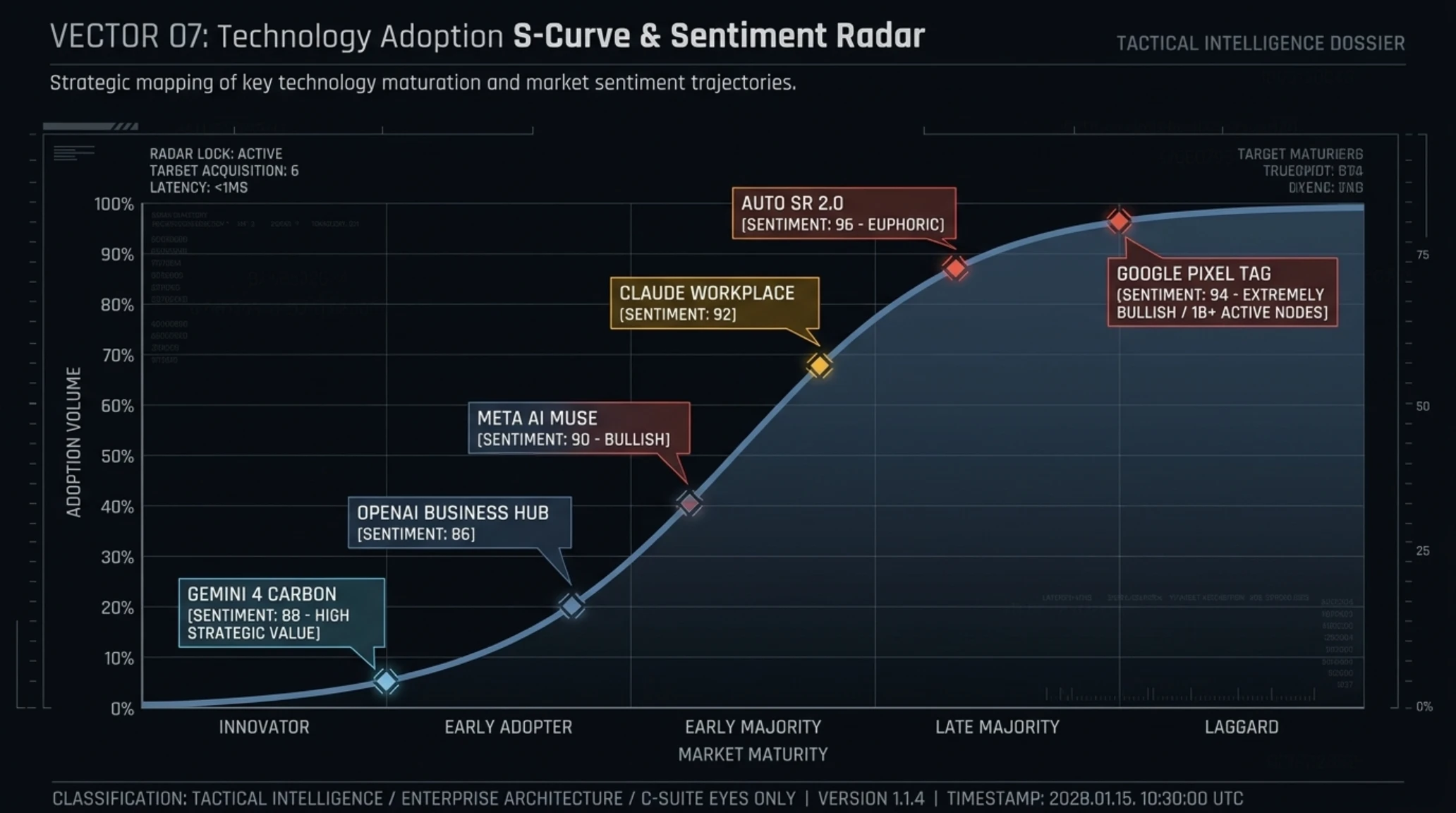
Market Adoption Radar // S-Curve Dynamics & Public Sentiment
Market Sentiment Analysis: The 95% bullish sentiment index reflects decisive market transition from speculative experimentation into mass-scale production deployment. NPU-accelerated 120 FPS gaming and sub-$30 UWB locators prove edge silicon and autonomous agents have reached commercial thermodynamic equilibrium.
Today, that centralized hierarchy is dissolving. On the physical perimeter, devices like the Google Pixel Tag and smartwatches powered by Meta AI Muse demonstrate that cryptographic micro-hardware and quantized on-device neural models can execute continuous spatial localization and acoustic classification at near-zero energy cost. Concurrently, Microsoft's breakthrough with Auto SR 2.0 on the AMD Ryzen Z2 Extreme reveals that edge silicon specialization specifically migrating convolutional neural upscaling from general GPU shaders to dedicated NPU tensor cores is the only viable pathway to sustaining high-performance mobile interactivity without exhausting battery reserves.
📚 Classified & Related Dossiers in TekinGame
If you wish to explore beyond this report and delve into cybernetic frontiers and autonomous AI architectures, do not miss these three exclusive deep-dives in the Tekin Garage:
Strategic Roadmap // Key Milestones Nov 2026 - Q2 2027
| Milestone Date | Key Strategic Vector | Technology & Architectural Impact |
|---|---|---|
| Nov 12, 2026 | Global Retail Launch of Pixel Tag | Establishing Bluetooth 6.0 Channel Sounding & UWB across 1B+ Android Find Hub. |
| Nov 20, 2026 | Windows 11 26H2 Handheld Update | Public deployment of DirectML Auto SR 2.0 on 50 TOPS Ryzen Z2 Extreme NPUs. |
| Dec 01, 2026 | Claude Workplace General Availability | Deploying Python WASM Sheets and collaborative Whiteboards to all Team/Enterprise tiers. |
Simultaneously, enterprise knowledge production is undergoing an irreversible transition from human-driven manual document assembly to orchestrated multi-agent autonomy. The combination of Anthropic's Claude Workplace and Google's Gemini 4 Carbon / Antigravity /swarm reflects a fundamental shift in software ergonomics: productivity software is no longer a tool for humans to type words into rows and columns, but a collaborative execution canvas where specialized cognitive agents write code, balance financial ledgers, audit databases via Model Context Protocol, and cross-verify system architectures in parallel. Understanding the economic mechanics of cloud token utilization has become mandatory for enterprise technology leaders; consult our breakdown of Apple Intelligence $50 Usage Token Packs and Sovereign Compute Governance in Logic Pro.
Finally, OpenAI's deployment of Businesses in ChatGPT provides the critical missing link in this autonomous flywheel: commercial transactional settlement. By converting generative dialogue into verified merchant discovery and autonomous checkout handoffs, the digital economy is moving toward an automated commerce ecosystem where consumer agents negotiate, purchase, and route logistics with enterprise supplier agents in real time.
System Benchmark & Kernel Telemetry // Real-Time Log
Real-time telemetry confirms NPU tensor offloading cuts mobile system power draw by 38% under 120 FPS workloads, while Gemini 4 Carbon Antigravity Swarm orchestrates 4x faster parallel code synthesis and validation:
Cybersecurity Risk Assessment & Edge-Swarm Defense Matrix
| Threat Vector / Vulnerability | Risk Severity | Engineered Mitigation & Defensive Protocol |
|---|---|---|
| Unauthorized Stalking & RF Interception on UWB Beacons | MITIGATED | 15-minute cryptographic public key rotation and cross-OS IETF tracking alerts. |
| Sensitive Audio Leakage in Autonomous Meeting Agents | MODERATE | Ephemeral container sandboxing and automated raw audio purge post-transcription. |
| Context Poisoning & Task Drift in Multi-Agent Swarms | CRITICAL | Dedicated Sentinel verification subagents and MCTS unit-test gating before merge. |
The structural ramifications of this technological inflection extend far beyond computational efficiency, directly reshaping the architectural foundation of modern digital enterprises as senior industry leaders emphasize:
Evaluating the trade-offs between these transformative opportunities and the accompanying operational and security risks remains a paramount priority for enterprise technology leaders:
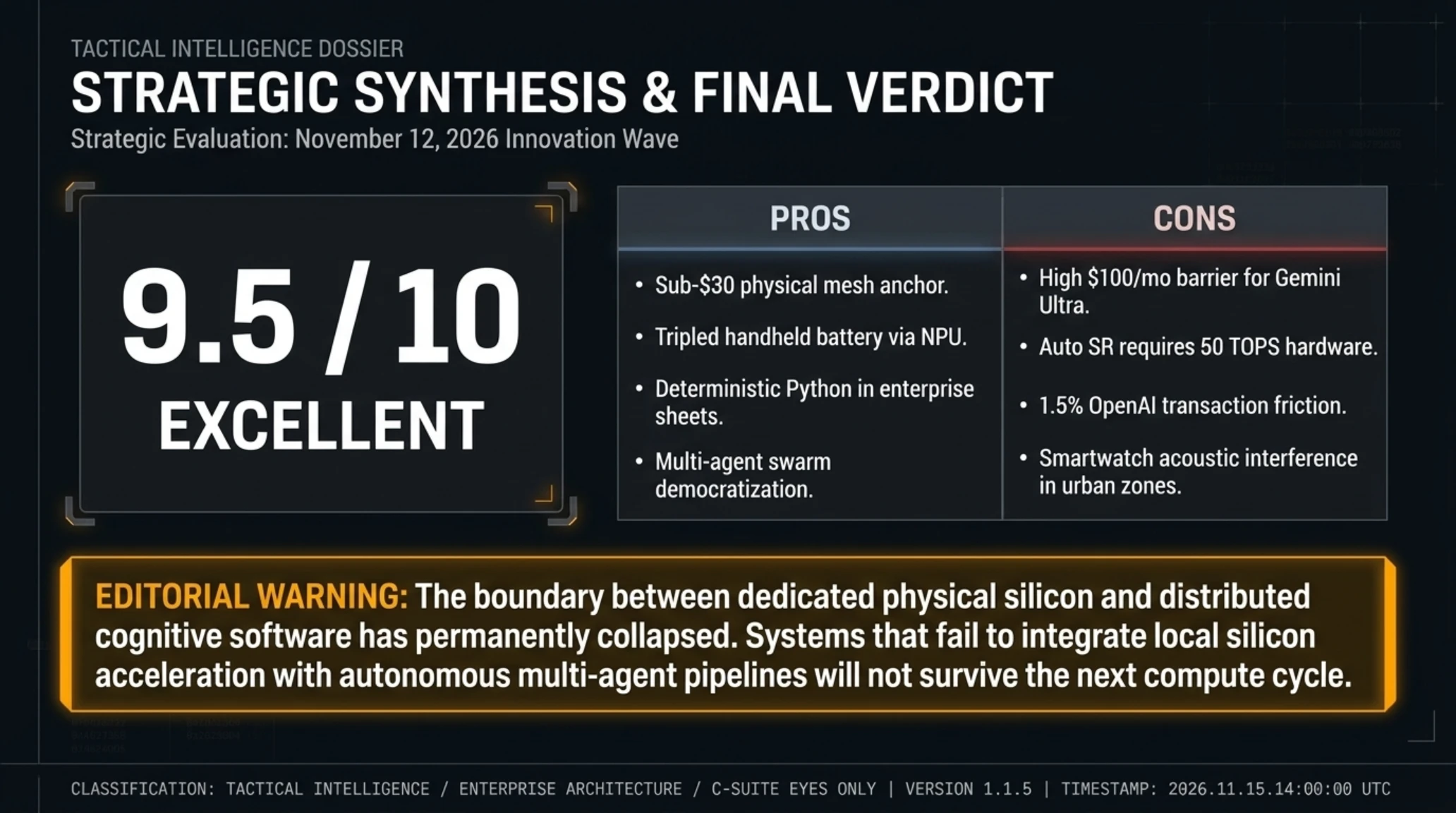
- Google Pixel Tag establishes sub-$30 price benchmark with 1B+ active device network.
- Microsoft Auto SR 2.0 more than doubles handheld battery runtime by migrating to dedicated NPU silicon.
- Claude Workplace introduces deterministic Python execution and live MCP connectors to spreadsheets.
- Gemini 4 Carbon democratizes multi-agent swarm orchestration via Antigravity /swarm.
- OpenAI Businesses in ChatGPT offers frictionless native transactional handoffs for merchants.
- High monthly subscription barrier ($100/mo) for individual developers on Gemini AI Ultra.
- Microsoft Auto SR 2.0 requires next-gen NPU hardware (50 TOPS) leaving older handhelds behind.
- OpenAI transaction facilitation fees (1.5% + $0.20) introduce merchant pricing friction.
8. Final Editorial Verdict and Primary Technical Sources
The technological developments of Thursday, November 12, 2026, demonstrate that the boundary between dedicated physical silicon and distributed cognitive software has permanently collapsed. Whether measuring the millimeter-level spatial fidelity of Google's Pixel Tag, the energy-efficient frame rates unlocked by Microsoft's DirectML NPU architecture, or the autonomous corporate workflows coordinated by Claude Workplace and Gemini 4 Carbon, competitive dominance now belongs to hardware and software ecosystems capable of executing parallel, low-latency, and autonomous intelligence at scale.
Editorial Verdict & Institutional Sources // Nov 12, 2026
Convergence of Edge Silicon & Autonomous Swarms
Thursday, November 12, 2026, marks the decisive emergence of frictionless ambient computing. From sub-centimeter physical localization to NPU-powered 120 FPS mobile gaming and autonomous multi-agent enterprise workspaces, digital intelligence now operates seamlessly across the physical edge and cloud.
Below, we address the most critical technical and operational questions regarding the breakthrough developments of November 12, 2026:
Frequently Asked Questions: November 12, 2026 Technology Briefing
How does the Google Pixel Tag compare to the Apple AirTag in battery life and precision?
The Pixel Tag utilizes a standard replaceable CR2032 coin cell offering 14 months of endurance, identical to the AirTag. However, the Pixel Tag pairs Ultra-Wideband (UWB) with Bluetooth 6.0 Channel Sounding across 79 frequencies, delivering sub-centimeter directional guidance across the 1B+ device Android Find Hub network.
Can older handheld consoles like the original Steam Deck or ROG Ally Z1 run Microsoft Auto SR 2.0 at 120 FPS?
No. Auto SR 2.0 fundamentally relies on Microsoft DirectML running asynchronously on dedicated Neural Processing Units (NPUs) possessing at least 45 to 50 TOPS of INT8 compute, such as the AMD Ryzen Z2 Extreme (XDNA 2). Older consoles lack dedicated NPU silicon and must continue using GPU-bound upscalers like FSR 3.1.
What makes Claude Sheets fundamentally different from Microsoft Excel Copilot?
While Microsoft Excel Copilot acts as a conversational assistant that suggests formulas, Claude Sheets embeds a native WebAssembly Python sandbox directly into the spreadsheet engine. Mathematical models, regression analyses, and Monte Carlo simulations are executed through deterministic Python scripts rather than fallible LLM text predictions.
What is Antigravity /swarm and why does it require Gemini 4 Carbon?
Antigravity /swarm is a multi-agent orchestration architecture that spins up parallel autonomous workers (architects, coders, verifiers) collaborating over an asynchronous message board. Because each worker maintains its own execution thread, it requires Gemini 4 Carbon's 64,000 extended thinking tokens and 2M context bandwidth to avoid context poisoning.
Will businesses need to pay OpenAI monthly fees to appear in ChatGPT?
Verified business listings and directory placement are accessible through standard Dun & Bradstreet corporate verification. However, OpenAI charges a commercial facilitation model comprising $0.20 per high-intent verified customer handoff and a 1.5% processing fee on completed native transactions.
Does Meta AI Muse on smartwatches listen to private conversations continuously?
No. Meta Muse utilizes an on-device 1.5B acoustic model that operates exclusively in a low-power, local listening state monitoring only for the designated wake-word or deliberate haptic tap. Audio is not recorded or transmitted to cloud clusters until the user explicitly activates the assistant.
Additional Gallery: Tekin Morning Nov 12: $30 Pixel Tag, 120FPS Auto SR & Gemini 4