
🏆 TekinMag: The Cyber Olympics; The Astonishing Future of E-Sports in 2026
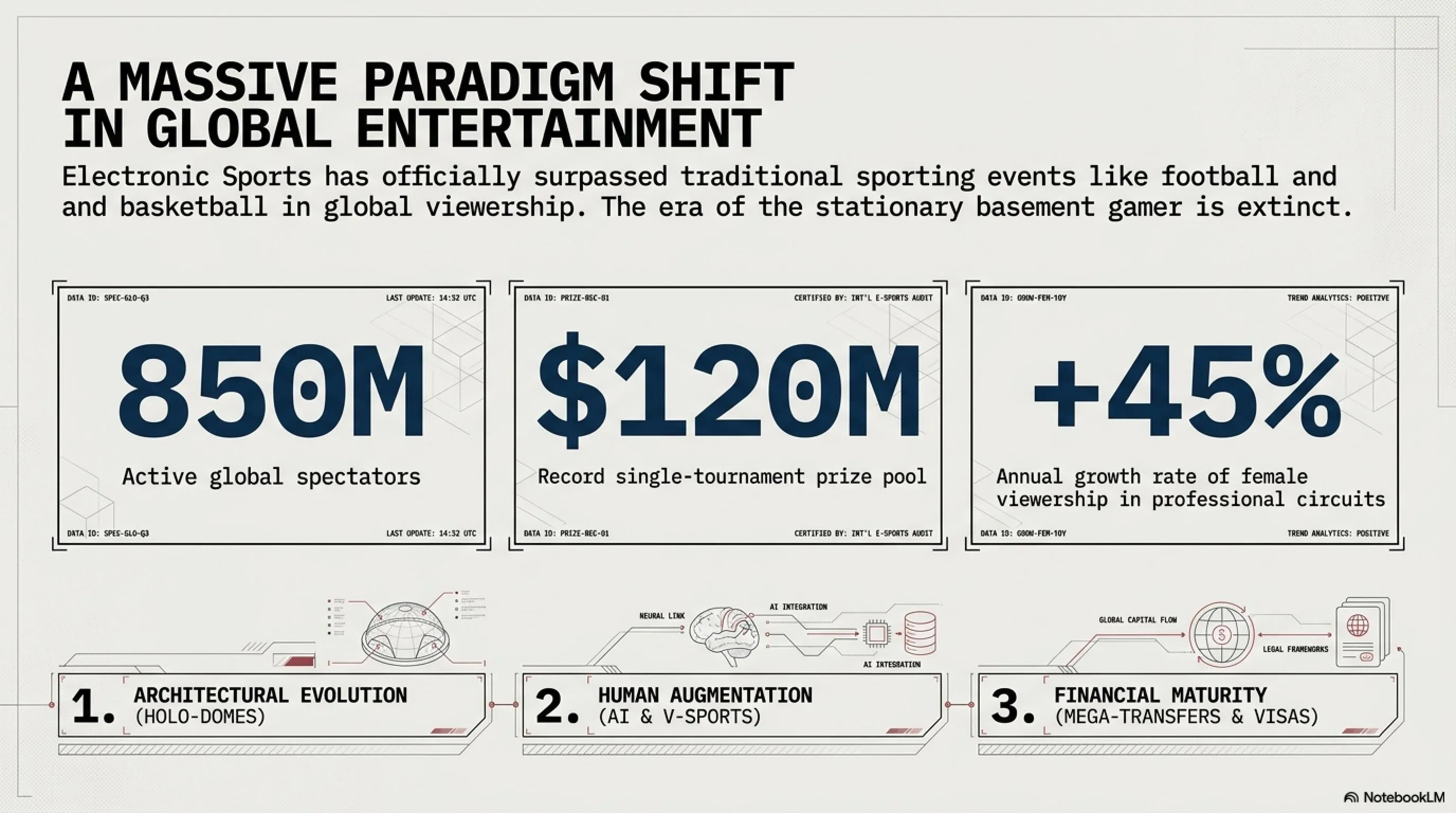
Welcome to the new era of competition, Tekin Army commanders! If you still associate E-sports with a group of teenagers huddled in a basement staring at monitors, you are profoundly mistaken. In 2026, Electronic Sports (E-sports) has officially surpassed traditional sporting events like football and basketball in global viewership. Physical stadiums have evolved into breathtaking Holographic Domes, and gamers are breaking the boundaries of human reaction times through neural training and sanctioned cyber-doping. In this Mega-Article, we delve into the economy, technology, and the future of competitive gaming worldwide.
⚡ What to expect in this exceptional report:
🏟️ Holographic Stadiums and the ultimate spectator experience
🧠 Artificial Intelligence, Neural Analysis, and Sanctioned Cyber-Doping!
🌐 The complete integration of AR and VR in V-Sports
💰 Multi-million dollar contracts and broadcasting rights
⚖️ The physical and psychological challenges facing modern cyber-athletes
☕ Prepare your coffee and equip your headsets; the tournaments of the 21st century have begun!
🏟️ Chapter 1: Holographic Stadiums; A Massive Paradigm Shift in Spectatorship
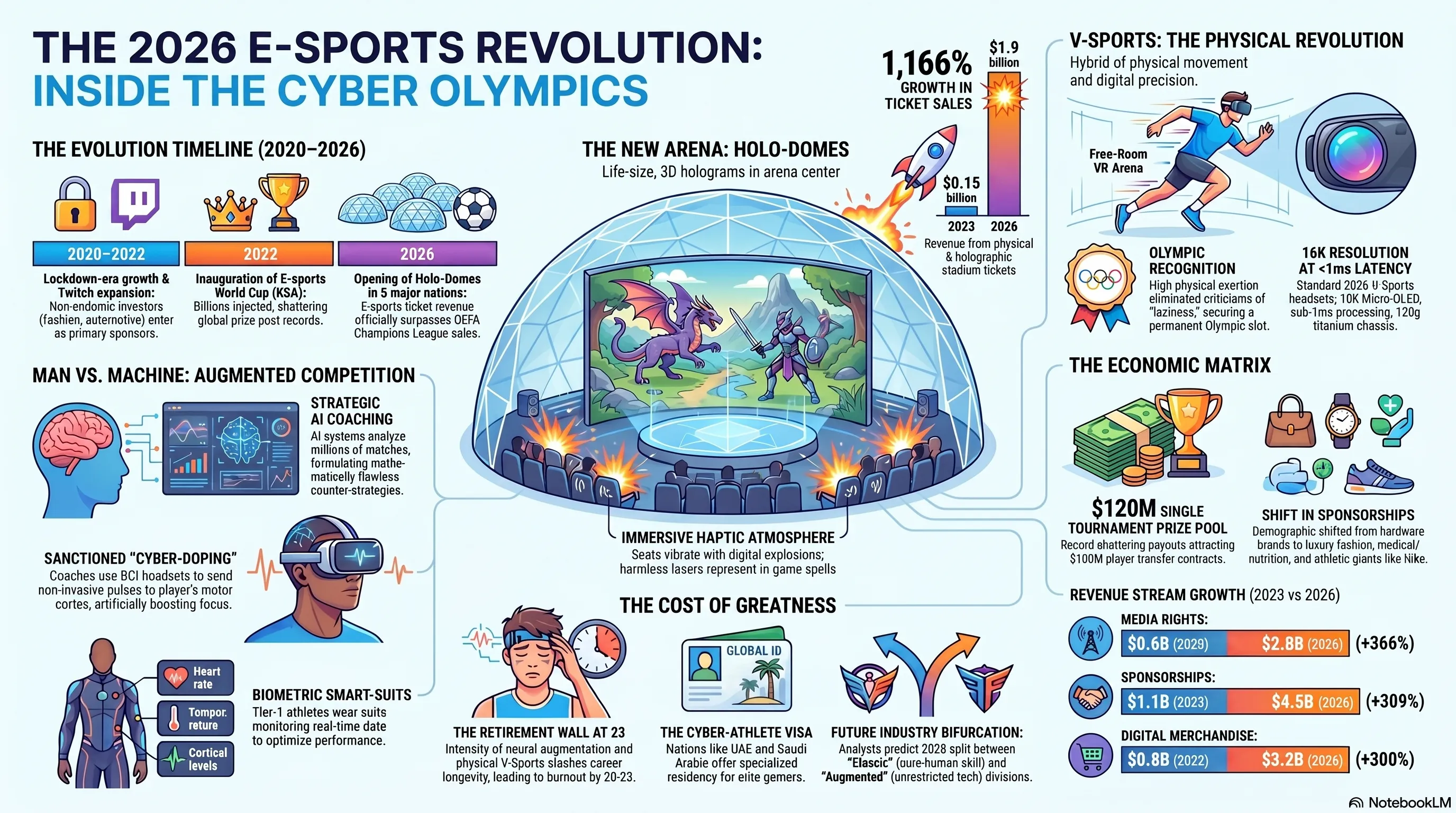
Historically, global tournaments like the League of Legends World Championship or Dota 2's The International were hosted in repurposed basketball arenas with massive flat screens suspended from the ceiling. However, by 2026, these venues have been replaced by dedicated E-sports architectures known as **"Holo-Domes."** Spectators are no longer forced to stare at a 2D surface; instead, the entire game map is rendered in life-size scale as a flawless, three-dimensional hologram right in the center of the arena.
Imagine watching the precise movements of your favorite champions in towering dimensions. Spells cast within the game manifest as harmless, brilliant lasers flashing over the audience's heads, and when a digital explosion rocks the virtual battlefield, the stadium seats vibrate violently thanks to advanced Haptic Feedback technology. It is a visceral, adrenaline-fueled experience that even the physical atmosphere of a FIFA World Cup final struggles to match.
⏳ Timeline: The Evolution of the E-Sports Industry (2020 to 2026)
| Year | Milestone | Market Impact |
|---|---|---|
| 2020 - 2022 | The lockdown era and the explosive growth of Twitch viewership | Non-endemic investors (automotive, fashion brands) enter as primary sponsors. |
| 2024 | The inauguration of the E-sports World Cup (EWC) in Saudi Arabia | Billions of dollars injected into the ecosystem, shattering global Prize Pool records. |
| 2026 | The grand opening of Holo-Dome stadiums across 5 major nations | E-sports ticket revenue officially surpasses UEFA Champions League ticket sales. |
This transformation has been particularly revolutionary for players in the Middle East and emerging markets. The construction of a dedicated gaming city in Riyadh and elite academies in Dubai means teams no longer suffer from high latency connecting to European servers. Achieving a 0ms ping is no longer a localized dream but a global standard.
🧠 Chapter 2: Artificial Intelligence, Neural Analysis, and Sanctioned Cyber-Doping
A few years ago, human coaches spent countless hours manually analyzing their opponents' previous matches. In 2026, this monumental task has been entirely offloaded to **Strategic Artificial Intelligence (Strategic AI)**. Modern AI systems parse through millions of past matches, identifying opponents' subconscious click patterns, eye-tracking habits on the monitor, and the precise cooldown management of specific abilities. The AI then formulates a mathematically flawless counter-strategy for the team to execute.
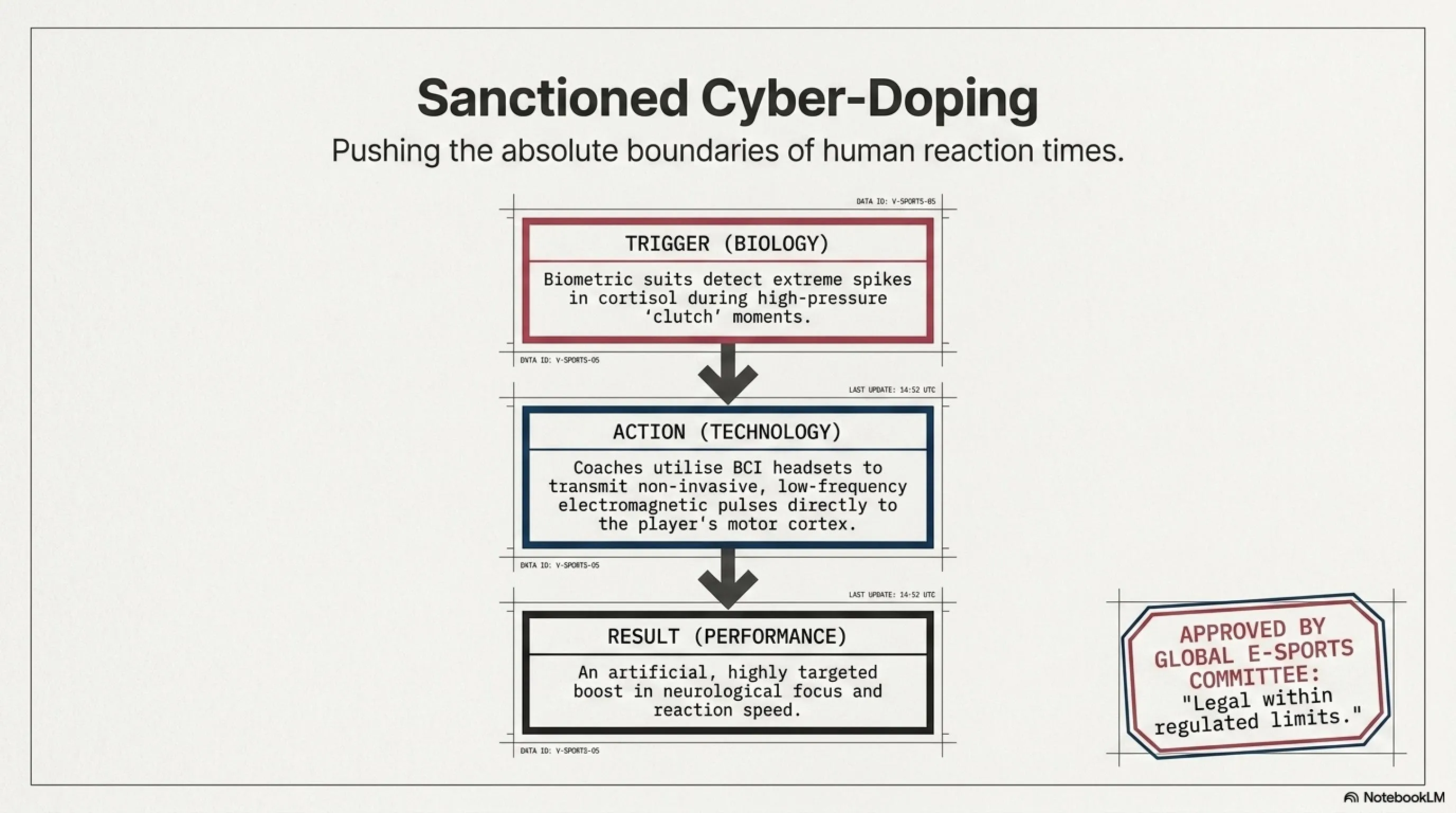
However, the most controversial phenomenon of this year's competitive circuit is the concept of **"Sanctioned Cyber-Doping."** In tier-one professional leagues, players now wear biometric smart-suits that monitor body temperature, heart rate, and cortisol (stress hormone) levels in real-time. Utilizing this data, coaches use Brain-Computer Interface (BCI) headsets to transmit low-frequency, non-invasive pulses to the player's motor cortex, artificially boosting their focus during the game's most critical "clutch" moments. The Global E-sports Committee recently ruled these specific neural pulses as "legal within regulated limits."

🥽 Chapter 3: The Complete Integration of AR and VR (Welcome to V-Sports)
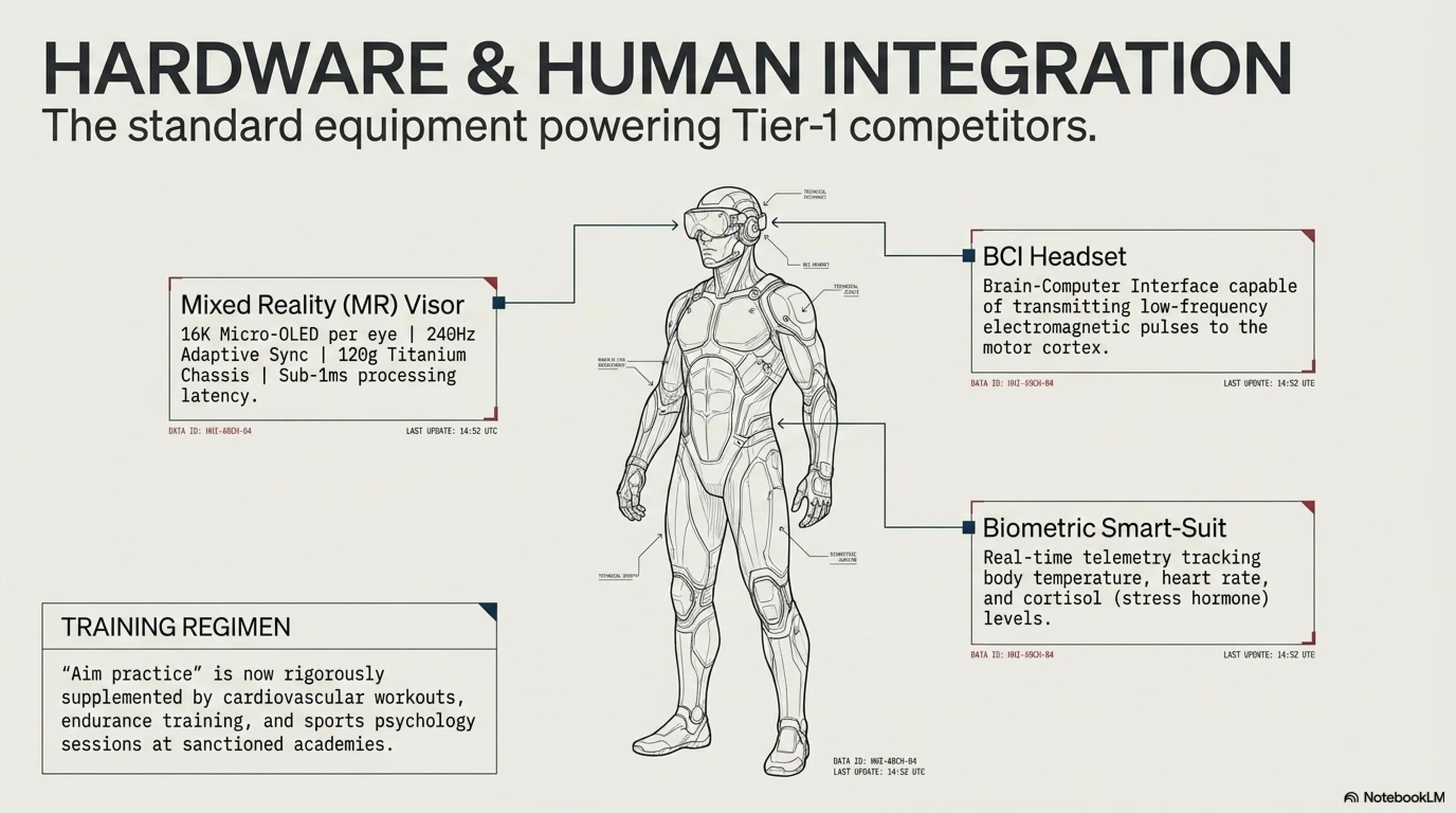
The tactical shooter genre (games akin to Counter-Strike or Valorant) has undergone a fundamental AR/VR revolution in 2026. Grand finals are no longer played by athletes sitting passively in ergonomic gaming chairs. Instead, players equip lightweight Mixed Reality (MR) visors and step into massive, completely empty physical arenas known as "Free-Roam VR Arenas." They physically sprint across the real-world floor, take cover behind virtual barricades, and use authentic physical hand signals to coordinate with teammates.
These competitions, newly branded as **"V-Sports"** (Virtual Sports), demand extraordinary physical conditioning. Modern professional gamers must supplement their daily "aim practice" with rigorous cardiovascular workouts and endurance training at the gym. This hybrid integration of physical movement and digital precision is precisely what finally earned E-sports its permanent, uncontested slot in the official Global Olympic Games, eliminating the decades-old criticism regarding the lack of physical exertion.
⚙️ Standard V-Sports Headset Specifications in 2026
💰 Chapter 4: The Economy, Cyber-Athlete Rights, and the Global E-Sports Market
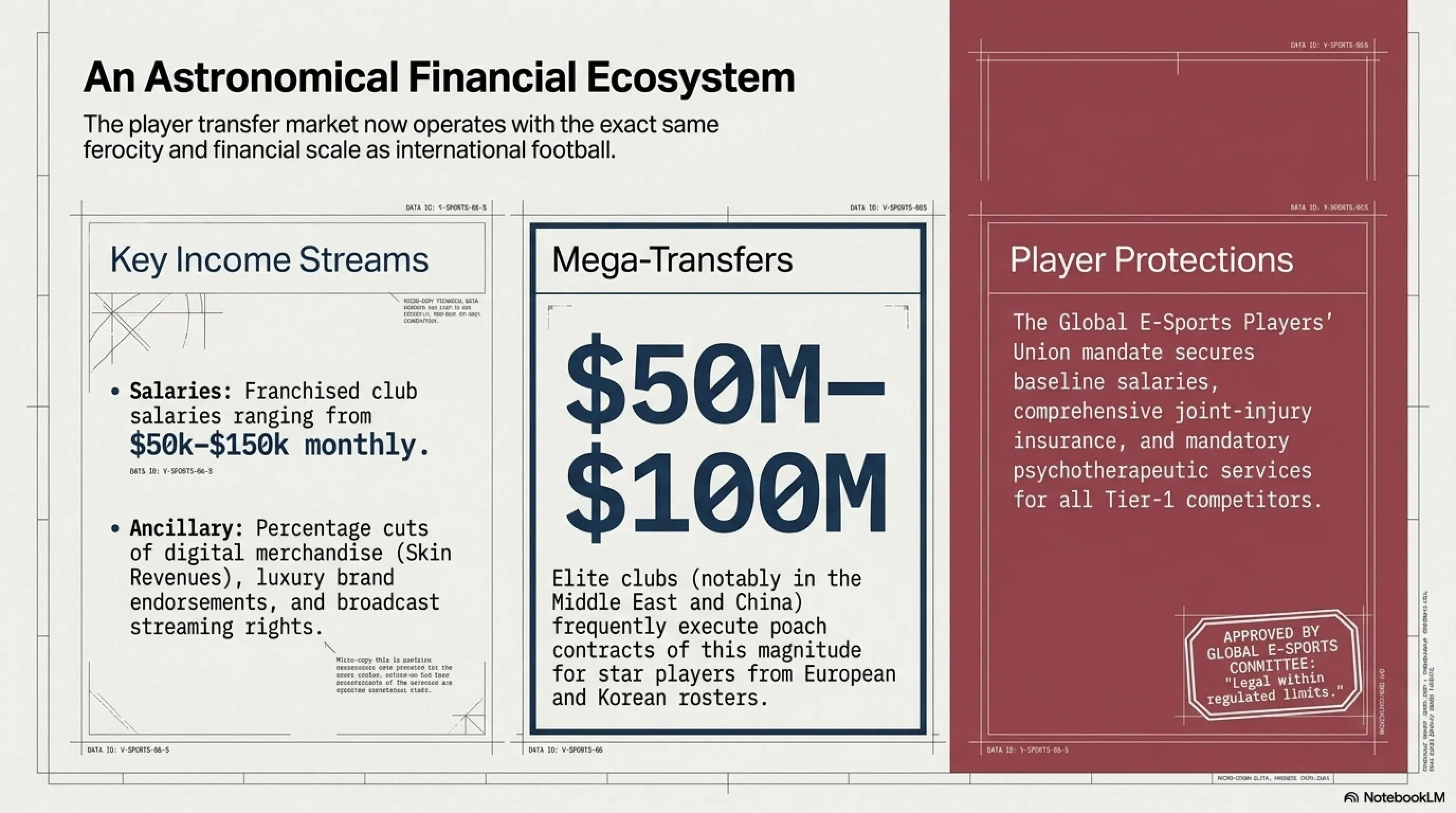
If you are seeking a career with astronomical financial upside in 2026, becoming a professional E-sports athlete is undoubtedly one of the most lucrative paths. The ecosystem's economic maturity has reached a point where top-tier players not only receive massive monthly salaries from their franchised clubs but also secure a substantial percentage of in-game digital merchandise sales (Skin Revenues), lucrative endorsements from luxury brands, and a cut of the broadcasting rights from streaming giants.
The player transfer market now operates with the exact same ferocity and financial scale as international football. Elite clubs from the Middle East and China frequently offer transfer contracts ranging from $50 million to $100 million to poach star players from Korean and European rosters. Furthermore, the Global E-Sports Players' Union recently achieved a monumental victory, mandating baseline salaries, comprehensive joint-injury insurance, and mandatory psychotherapeutic services for all Tier-1 league competitors.
Fascinating Facts from the MENA Market in 2026:
- The Cyber-Athlete Visa: Nations such as the UAE and Saudi Arabia now issue specialized "Cyber-Athlete Visas," allowing professional gamers seamless residency to establish long-term, elite training camps within their borders.
- Esports at the University Level: "Strategic E-sports Management" is now a highly sought-after degree at prestigious regional universities. Graduates are immediately headhunted as roster managers, securing starting base salaries of $120,000 annually.
📊 Financial Matrix: Global E-Sports Revenues (2023 vs. 2026)
| Revenue Stream | Valuation in 2023 (Billion $) | Valuation in 2026 (Billion $) | Growth (%) |
|---|---|---|---|
| Media Broadcasting Rights | $0.6 | $2.8 | +366% |
| Sponsorships & Brand Partnerships | $1.1 | $4.5 | +309% |
| Physical & Holo-Dome Ticket Sales | $0.15 | $1.9 | +1166% 🚀 |
| Digital Merchandise (Team Skins & Assets) | $0.8 | $3.2 | +300% |
Projections compiled by the TekinGame Economic Research Division
🏁 Chapter 5: Challenges, Longevity, and Final Conclusions
Despite the staggering glitz, glamour, and astronomical revenues, the 2026 E-sports landscape is not without its severe challenges. The introduction of highly physical V-Sports and sanctioned cyber-doping has drastically reduced the viable career lifespan of a professional player. The intense psychological pressure of processing thousands of data points per second, combined with the stress of competing live before hundreds of thousands of roaring fans in holographic stadiums, has led to an unprecedented spike in "early career burnout," often affecting athletes as young as 20. Nevertheless, it is undeniable that E-sports represents the definitive future of human entertainment, rapidly replacing physical sports as the primary spectacle for Generation Z and Generation Alpha.
✅ The Brilliance of Modern E-Sports
- ✔ Astronomical incomes and global superstardom for players
- ✔ Unmatched visual spectacle via cutting-edge Holo-Domes
- ✔ High physical exertion demands in Mixed Reality V-Sports
- ✔ Complete eradication of network latency issues (0ms standard)
❌ The Dark Side of the Industry
- ✖ Drastically reduced career longevity (forced retirement by 23)
- ✖ Unknown long-term medical risks of neural "Cyber-Doping"
- ✖ Severe joint, spinal, and ocular injuries from relentless training
- ✖ Over-reliance on AI, threatening the purity of human skill

❓ Gamer FAQ (Frequently Asked Questions)
How do I become a professional E-sports player in 2026?
Raw gaming talent is no longer sufficient. You must enroll in an officially sanctioned E-sports academy. At these institutions, alongside rigorous in-game scrimmages, you are required to complete daily physical conditioning, sports psychology sessions, and neural reaction training to meet the grueling physical and mental standards of modern tournaments.
Is high internet latency (ping) still a competitive issue?
Not at the professional level. With the deployment of regional AWS Edge servers and dedicated gaming fiber-optic infrastructures globally, professional ping sits comfortably below 5 milliseconds. Network latency in tier-one tournaments has effectively been eradicated as an excuse for poor performance.
What exactly is Cyber-Doping, and is it dangerous?
Cyber-doping involves transmitting low-level electromagnetic pulses to the brain via BCI headsets to artificially boost focus. It is currently legal in official tournaments under strict medical supervision, but the long-term neurological effects remain a heavily debated topic.
What is the average income of a Tier-1 player?
Beyond massive tournament prize pools, Tier-1 league players command fixed monthly salaries ranging from $50,000 to $150,000. Digital merchandise sales (custom skins bearing their name) often constitute an even larger portion of their annual income.
Will V-Sports eventually replace classic E-Sports?
No. V-Sports (high-mobility Virtual Reality) has grown into a completely separate category alongside classic E-sports (stationary mouse & keyboard). Both disciplines have their own dedicated fanbases, tournaments, and unique skill requirements.
Verified Sources & Benchmarks
📋 Strategic References (April 2026)
- 🔗 Forbes Annual Report - The Billion-Dollar E-Sports Economy
- 🔗 The Verge - Inside Asia's New Holographic Arenas
- 📊 Tekin Data Center: Analysis and compilation of audience growth metrics within the MENA region.
🌐 Stay Connected With Us 🎮✨
For the latest tech, gaming, and gadget news, follow us on our official social media channels: