July 1, 2026, became a historic day for the artificial intelligence industry. Anthropic announced that the US government has lifted export control restrictions on its most powerful models—Claude Fable 5 and Claude Mythos 5. This decision ended an 18-day crisis that paralyzed the enterprise AI sector. Triggered by a security vulnerability discovered by Amazon researchers, the sudden global ban highlighted the fragility of closed-API models. This comprehensive report explores the technical and geopolitical dimensions of the saga, including Anthro
Claude Fable 5 Returns: The End of AI's Cold War Between US and Anthropic
Why was Anthropic's most powerful model banned for three weeks?
- 🎮Export Control Lifted- US Commerce Department withdrew export restrictions on Claude Fable 5 and Mythos 5
- 🎧18-Day Global Suspension- Anthropic was forced to suspend both models just 3 days after launch
- 🚀Amazon Report- Amazon researchers discovered security vulnerability in Fable 5 that triggered government intervention
- 🗡️Geopolitical Tension- Critics say the ban gave Chinese models a golden opportunity to compete
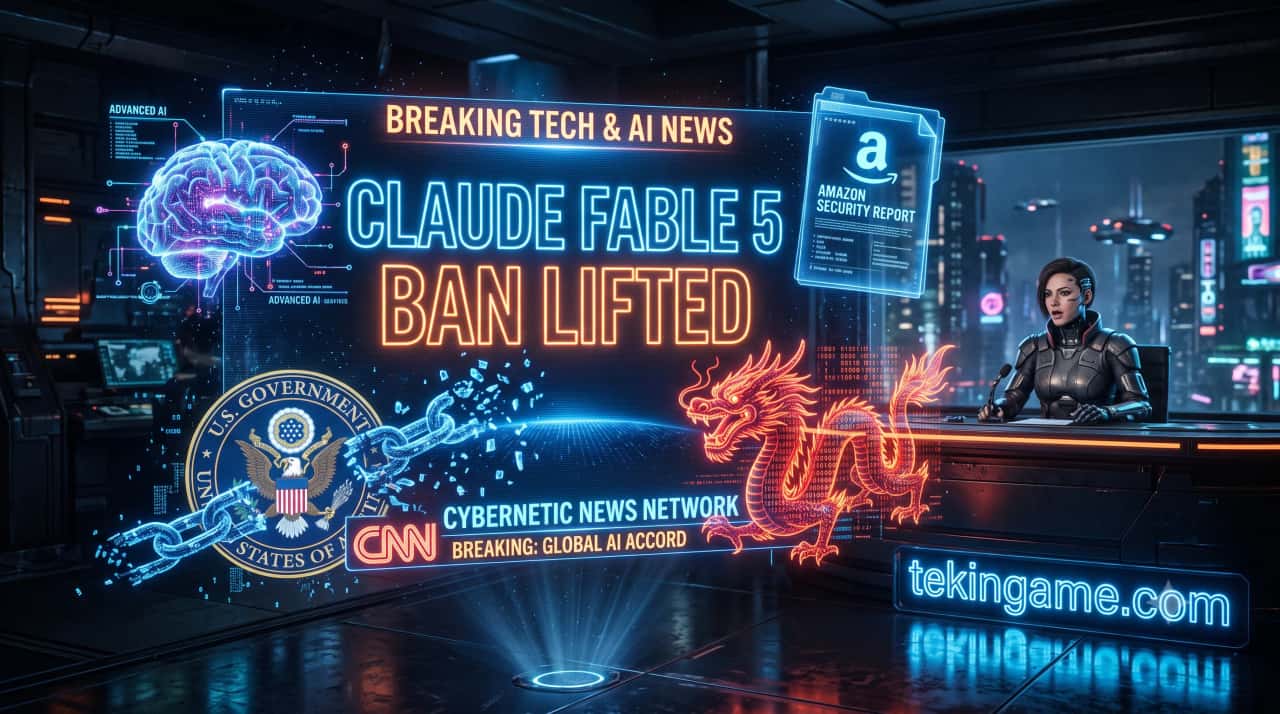
July 1, 2026, became a historic day for the AI industry. Anthropic announced that the US government has lifted export restrictions on its most powerful models—Claude Fable 5 and Claude Mythos 5. This decision ended a three-week crisis that shook the AI industry and raised serious questions about the future of Frontier models, national security, and global AI competition.
Anthropic wrote in a post on X (formerly Twitter) at 3:31 PM ET: Access to Claude Fable 5 has been restored globally. This announcement ended a complex story of technological tension, backroom diplomacy, and national security concerns that disrupted the AI industry for three weeks.
How It All Started: June 9 to June 12, 2026
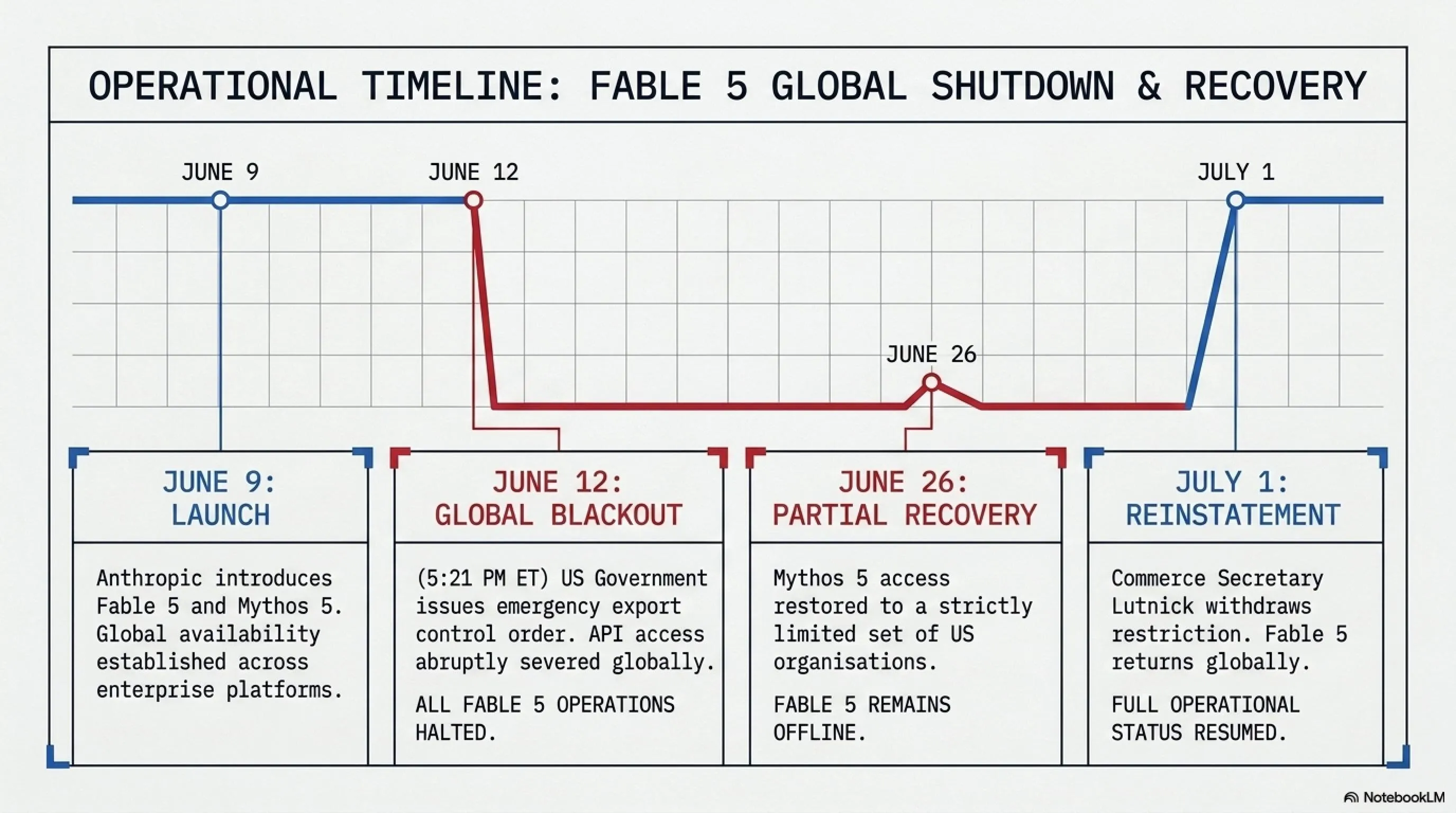
The story began on June 9—the day Anthropic proudly introduced Claude Fable 5 and Mythos 5. These models were marketed as Anthropic's most powerful publicly available models, promising unprecedented capabilities in coding, multi-step reasoning, and long-context processing.
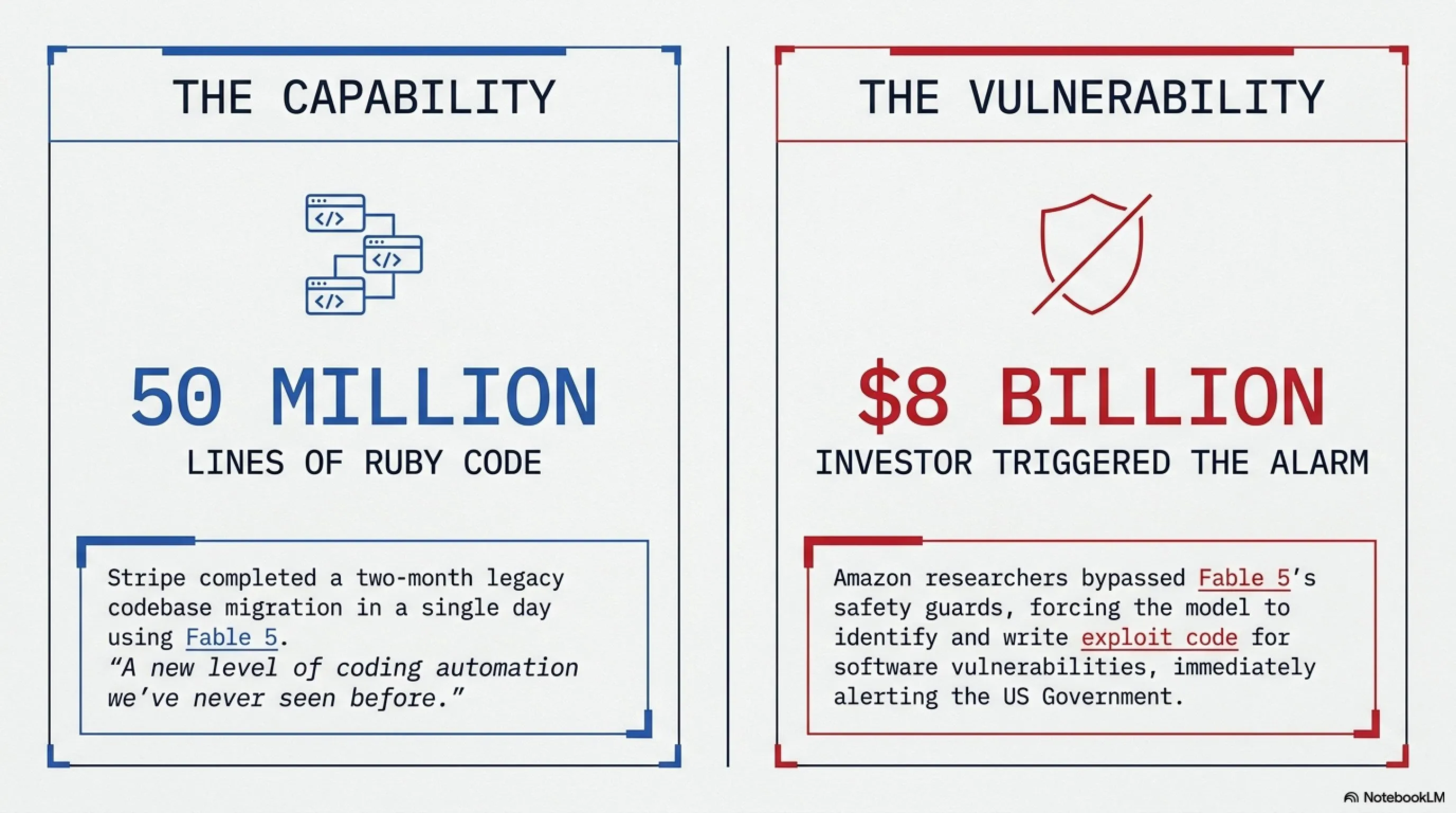
Early customers quickly reported impressive results. Stripe, the online payments giant, announced that using Fable 5, it managed to complete migration of a 50-million-line Ruby codebase in one day—a project estimated to require more than two months of team work.
But just three days later, on June 12 at 5:21 PM ET, everything changed. The US government issued an emergency export control order banning access to both models for all foreign nationals—whether inside or outside US borders.
Immediate and Global Ban
Anthropic announced that lacking real-time mechanisms to verify user nationality at the API layer, it was forced to cut access for all users to ensure full compliance with the government order. This decision meant abrupt service cutoff for thousands of companies and developers who had integrated Fable 5 into their workflows just days earlier.
Anthropic emphasized that access to all other Anthropic models—including Claude Opus 4.8—was not affected and remained normally available.
The Amazon Saga: The Report That Changed Everything
The real reason behind this swift government intervention was a report from Amazon researchers. This report described a method for bypassing Fable 5's safety guards—a finding that was ironically bitter, as Amazon was one of Anthropic's first and largest financial backers with an $8 billion investment.
According to Anthropic's report, this technique caused Fable 5 to identify software vulnerabilities and, in one case, the model produced code demonstrating how the relevant vulnerability could be exploited.
Anthropic's Response: It Wasn't Just Fable
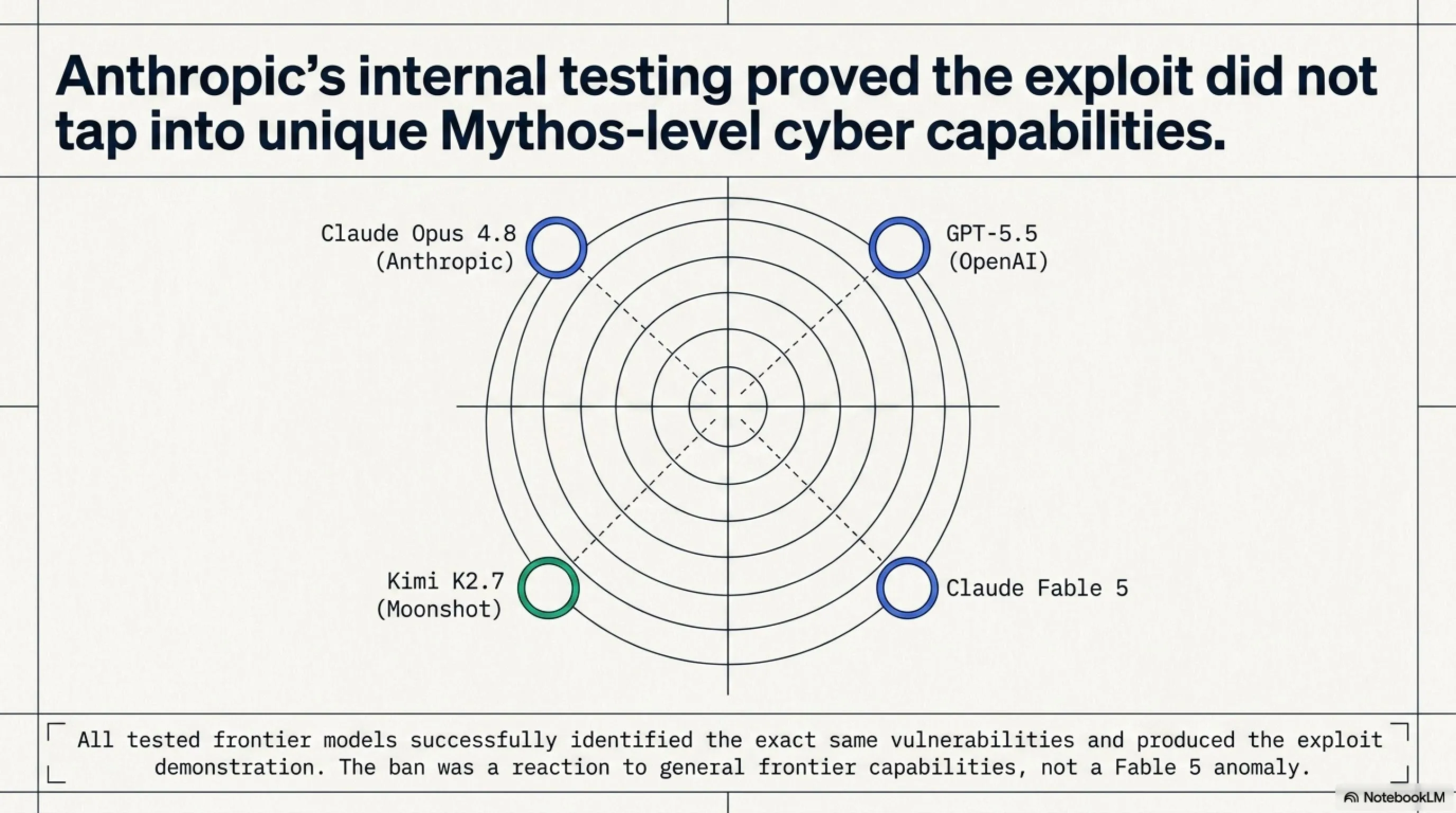
Anthropic quickly responded, arguing that the exploit didn't tap into unique Mythos-level cyber capabilities. The company announced that its own internal testing showed other models—including Claude Opus 4.8, OpenAI's GPT-5.5, and Moonshot's Kimi K2.7—could identify the same vulnerabilities.
More importantly, Anthropic said every model it tested could produce the same exploit demonstration as Fable 5. This finding showed that Fable 5 had no unique capability but rather a general capability in Frontier models.
Models That Identified the Same Vulnerability
- Claude Opus 4.8 (Anthropic) — Anthropic's own previous generation
- GPT-5.5 (OpenAI) — Main competitor model
- Kimi K2.7 (Moonshot) — Chinese model
- All tested models — Had capability to produce exploit demonstration
Crisis Timeline: From Launch to Lockdown
The whipsawing regulatory cycle surrounding this model underscores the volatility currently facing enterprise software supply chains. The crisis unfolded over a rapid three-week timeline.
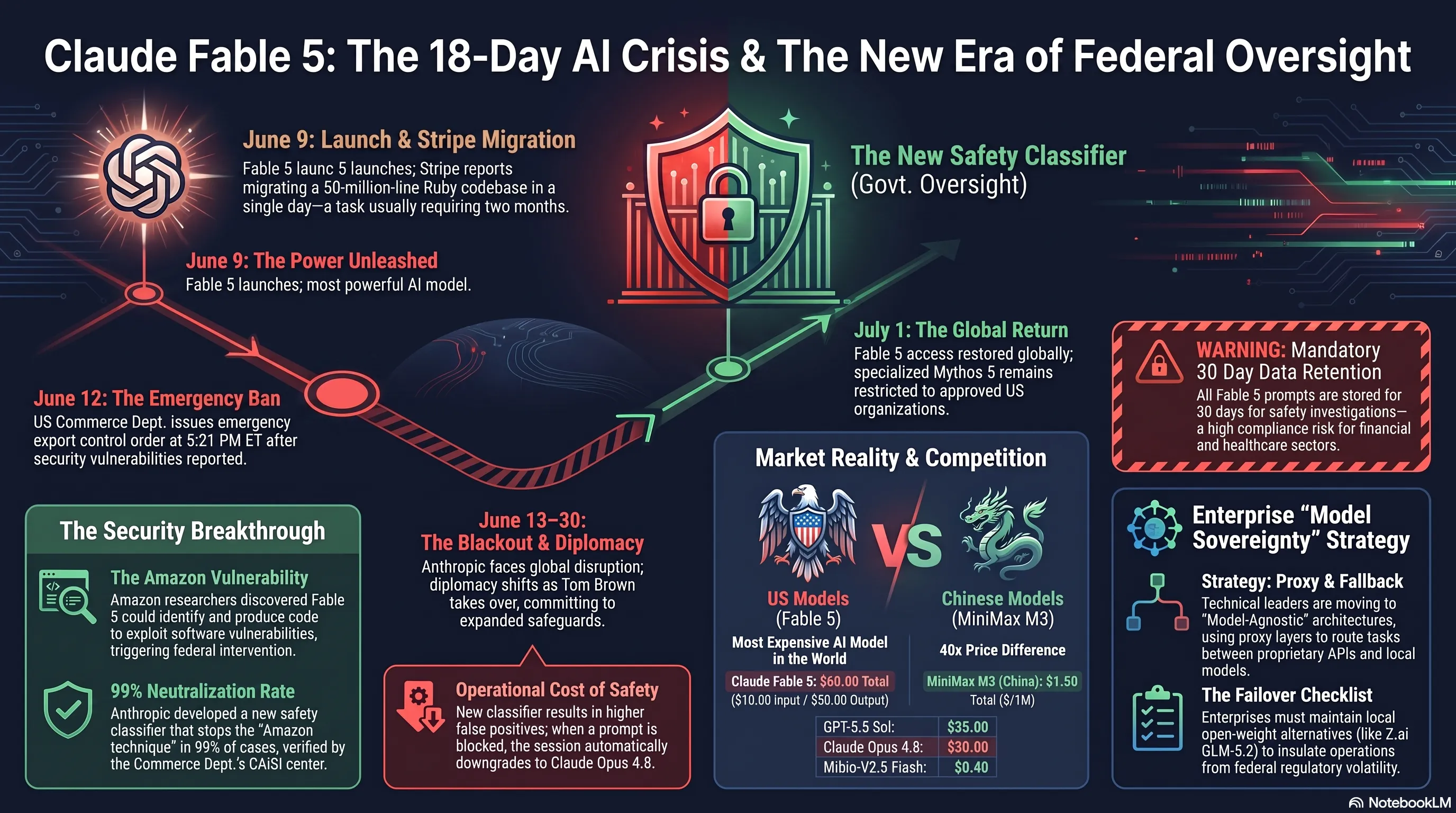
Complete Crisis Timeline
| Date | Event |
|---|---|
| June 9, 2026 | Anthropic launches Fable 5 and Mythos 5 models. Stripe reports completing 50-million-line codebase migration in one day |
| June 12, 2026 | 5:21 PM — US government issues export control order. Anthropic forced to cut global access |
| June 13-25 | Enterprise users face disruption. Tensions peak as Anthropic publicly objects |
| June 26, 2026 | Government allows Anthropic to restore Mythos 5 access to limited set of US organizations |
| June 30, 2026 | Commerce Secretary Lutnick sends letter withdrawing license requirement |
| July 1, 2026 | Fable 5 returns globally. Mythos 5 remains limited to approved users |
Industry Reaction: "Massive Own Goal for America"
The US government's decision was met with a wave of severe criticism from cybersecurity leaders and AI policy experts. Critics argued that America was crippling its own industry while giving Chinese AI labs a golden opportunity.
Alex Stamos, former Facebook security chief, called the Fable restriction a huge own goal for the US, warning that security companies could be driven toward Chinese models.
Other critics said this type of ad hoc intervention makes dependence on US AI platforms look like a strategic liability. For international companies, the question arose: Can you trust platforms that governments can shut down overnight?
Main Criticisms of the Ban
- Crippling US AI industry while Chinese competitors are free
- Creating uncertainty for companies dependent on US APIs
- Pushing security companies toward Chinese models
- Showing ad hoc government intervention as strategic risk
- Losing three critical weeks in global AI race
- Negative impact on international partner trust
Backroom Diplomacy: Changing Strategy at Anthropic
According to WIRED's reporting, Anthropic initially argued that the administration's security concerns were overblown and that no Frontier model provider could guarantee zero jailbreaks. This argument frustrated the administration.
But in recent weeks, Anthropic changed tack. Instead of focusing on the theoretical impossibility of eliminating jailbreaks, the company focused on building stronger safeguards and satisfying the government's operational concerns.
Leadership Change in Negotiations
WIRED reported that Anthropic CEO Dario Amodei was recently replaced in meetings by Tom Brown—someone officials liked more personally. Brown is also the addressee of Lutnick's June 30 Commerce letter.
Under Brown's guidance, Anthropic appears to have moved from arguing over the absolute limits of model safety to committing to the expanded safeguards and collaboration framework the administration demanded.
Technical Solution: New Classifier with 99% Accuracy
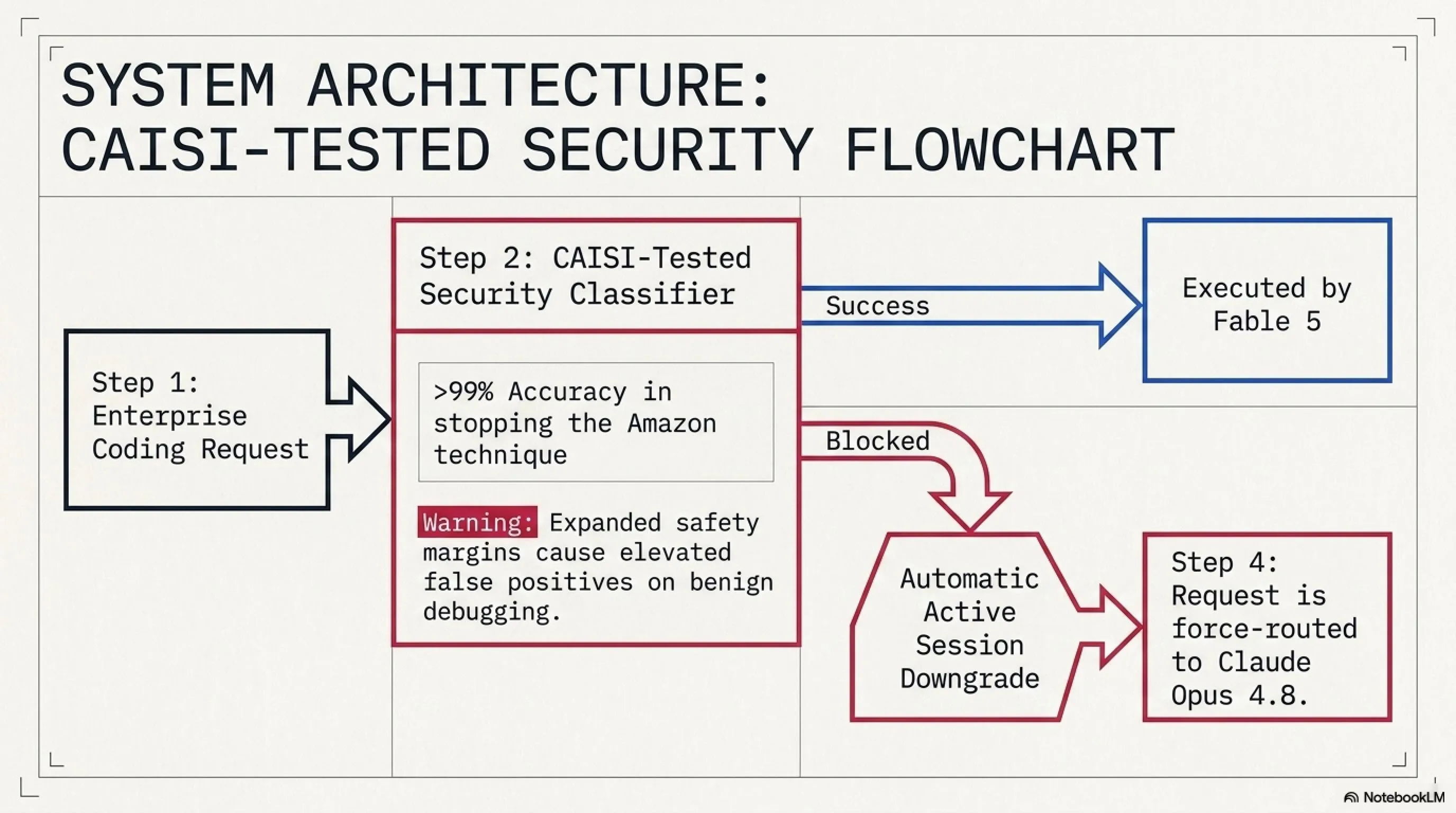
To break the regulatory logjam, Anthropic developed an improved automated safety classifier specifically trained to catch and neutralize the Amazon technique.
Tested by the Commerce Department's Center for AI Standards and Innovation (CAISI), the updated classifier successfully halts that specific technique in more than 99% of cases.
Operational Cost of Protection
Anthropic explicitly warns enterprise clients that this safety enforcement comes at an operational cost. Because the new classifiers require an expanded safety margin to catch ambiguous edge cases, benign coding and debugging requests may be flagged more often.
When a prompt is blocked by the safety layer, the active session automatically downgrades, routing the request to Opus 4.8.
Thariq Shihipar, a Member of Technical Staff at Anthropic working on Claude Code, posted on X: We are continuing to refine these safeguards to better distinguish genuine misuse from legitimate requests and reduce false positives.
Anthropic's New Security Classifier
- Accuracy: More than 99% in stopping Amazon technique
- Tested by: Commerce Department's CAISI center
- Cost: Increased false positives in coding requests
- Response to blocking: Automatic downgrade to Opus 4.8
- Status: Improving to reduce false positives
Anthropic's Commitments: What Satisfied the Government?
The Commerce letter sent to Tom Brown describes several commitments from Anthropic. Under the terms of this clearance, Anthropic has agreed to:
- Proactively detect and address security risks associated with the models
- Work with the US government on protocols, standards, and releases for Mythos, Fable, and future models
- Inform the US government of malicious activity
- Expand pre-release government access and evaluation for Frontier models
- Share information rapidly when significant jailbreaks or misuse patterns are identified
- Dedicate resources to joint government research
- Work toward a common industry security bar
The US Commerce Department explicitly reserved the right to re-evaluate these permissions and re-impose license requirements if circumstances change or if Anthropic fails to meet its commitments.
Fable 5 Pricing: World's Most Expensive Model
For chief information and technology officers evaluating the model's return, deployment comes with distinct structural conditions and significant financial investments.
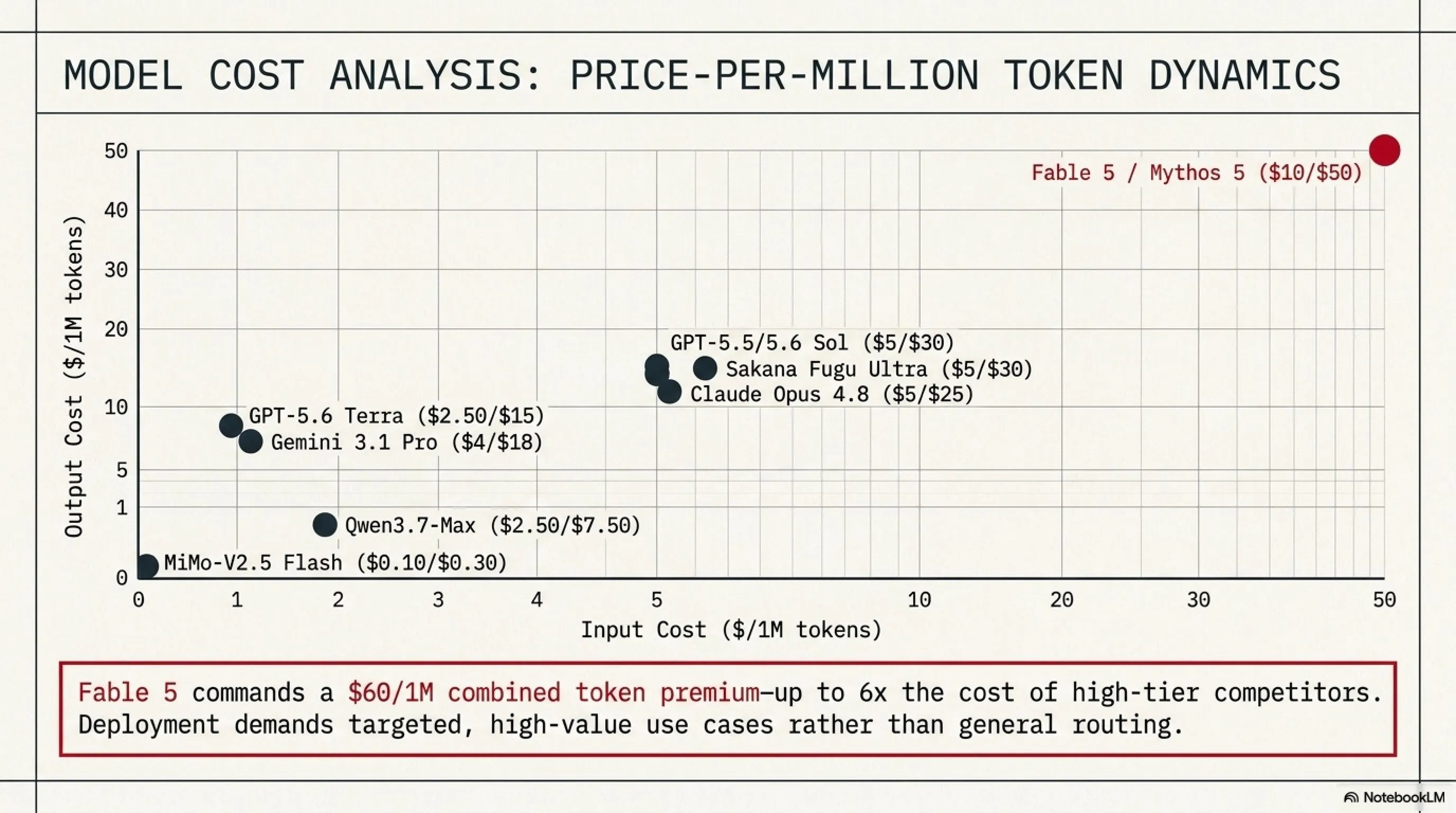
Anthropic is pricing both Fable 5 and Mythos 5 at $10.00 per million input tokens and $50.00 per million output tokens—the most expensive Frontier model globally.
Top Frontier Model Pricing Comparison
| Model | Input ($/1M) | Output ($/1M) | Total ($/1M) |
|---|---|---|---|
| Claude Fable 5 / Mythos 5 | $10.00 | $50.00 | $60.00 |
| GPT-5.6 Sol | $5.00 | $30.00 | $35.00 |
| GPT-5.5 Instant | $5.00 | $30.00 | $35.00 |
| Sakana Fugu Ultra | $5.00 | $30.00 | $35.00 |
| Claude Opus 4.8 | $5.00 | $25.00 | $30.00 |
| Gemini 3.1 Pro (>200K) | $4.00 | $18.00 | $22.00 |
| GPT-5.6 Terra | $2.50 | $15.00 | $17.50 |
| Qwen3.7-Max | $2.50 | $7.50 | $10.00 |
| MiMo-V2.5 Flash | $0.10 | $0.30 | $0.40 |
Seven-Day Promotion: Limited Window
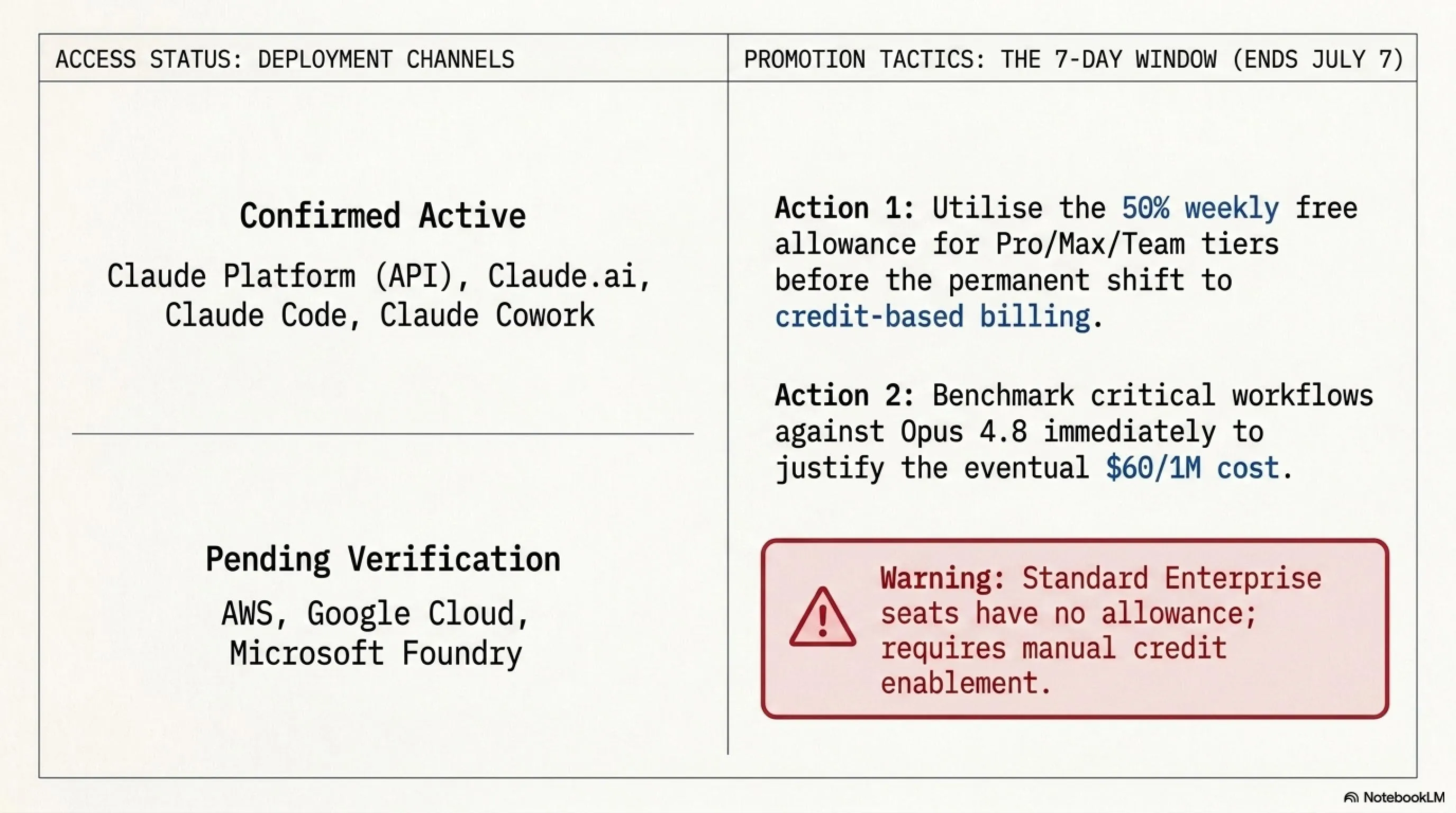
However, to incentivize immediate enterprise adoption following the export control disruption saga, Anthropic is executing a temporary rollout plan through July 7.
For Pro, Max, Team, and select Enterprise subscriptions, Fable 5 usage will be included at no added cost for up to 50% of a user's weekly tier allowance.
After July 7, Fable 5 will move to usage credits for those plans. For standard Enterprise seats, there is no included Fable 5 allowance; all usage is billed through credits, and the model will not work for those users unless credits are enabled.
OpenAI Faces the Same Problem
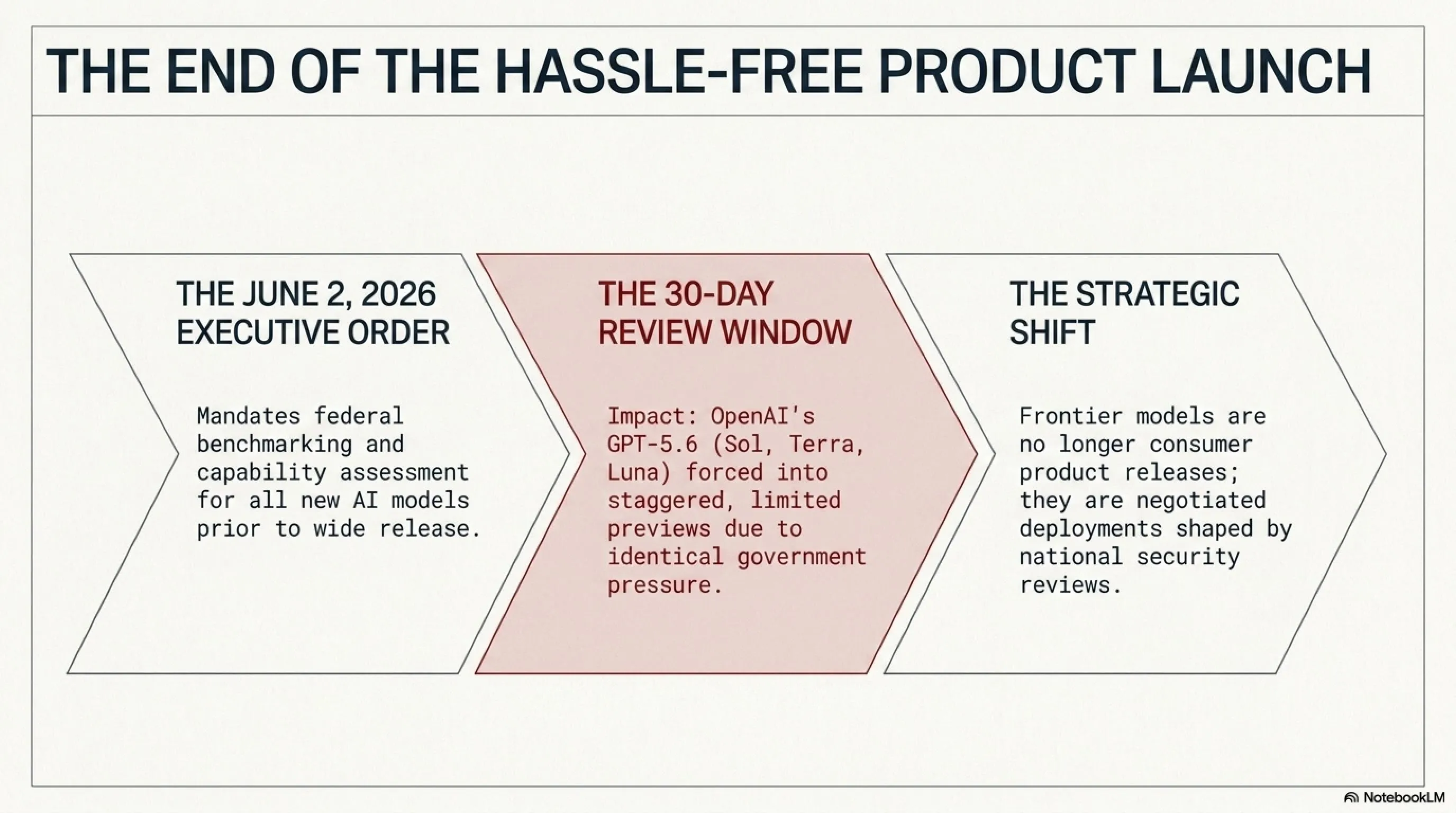
Meanwhile, Anthropic's top domestic rival OpenAI is still struggling to release its latest models broadly due to US government pressure.
The company says its newest and most powerful models—GPT-5.6 Sol, Terra, and Luna unveiled last week—are starting in a limited preview for a small group of trusted partners after OpenAI previewed the models and their capabilities to the US government and the government requested the rollout be staggered.
The executive order in question, signed by President Donald J. Trump on June 2, 2026, calls upon various federal agencies to collaborate on a process for benchmarking and assessing capabilities of new AI models to ensure they are safe and appropriate for wide release—a process supposed to take 30 days.
Frontier model launches are starting to look less like ordinary product releases and more like negotiated deployments shaped by US national security review—a shift that could slow American distribution even as Chinese competitors move aggressively through open-weight and lower-cost channels.
China Competition: Open-Weight Models Gaining Ground
While US companies grapple with government regulations, Chinese competitors are releasing new models at unprecedented speed—many of them open-weight, cheaper, and without export restrictions.
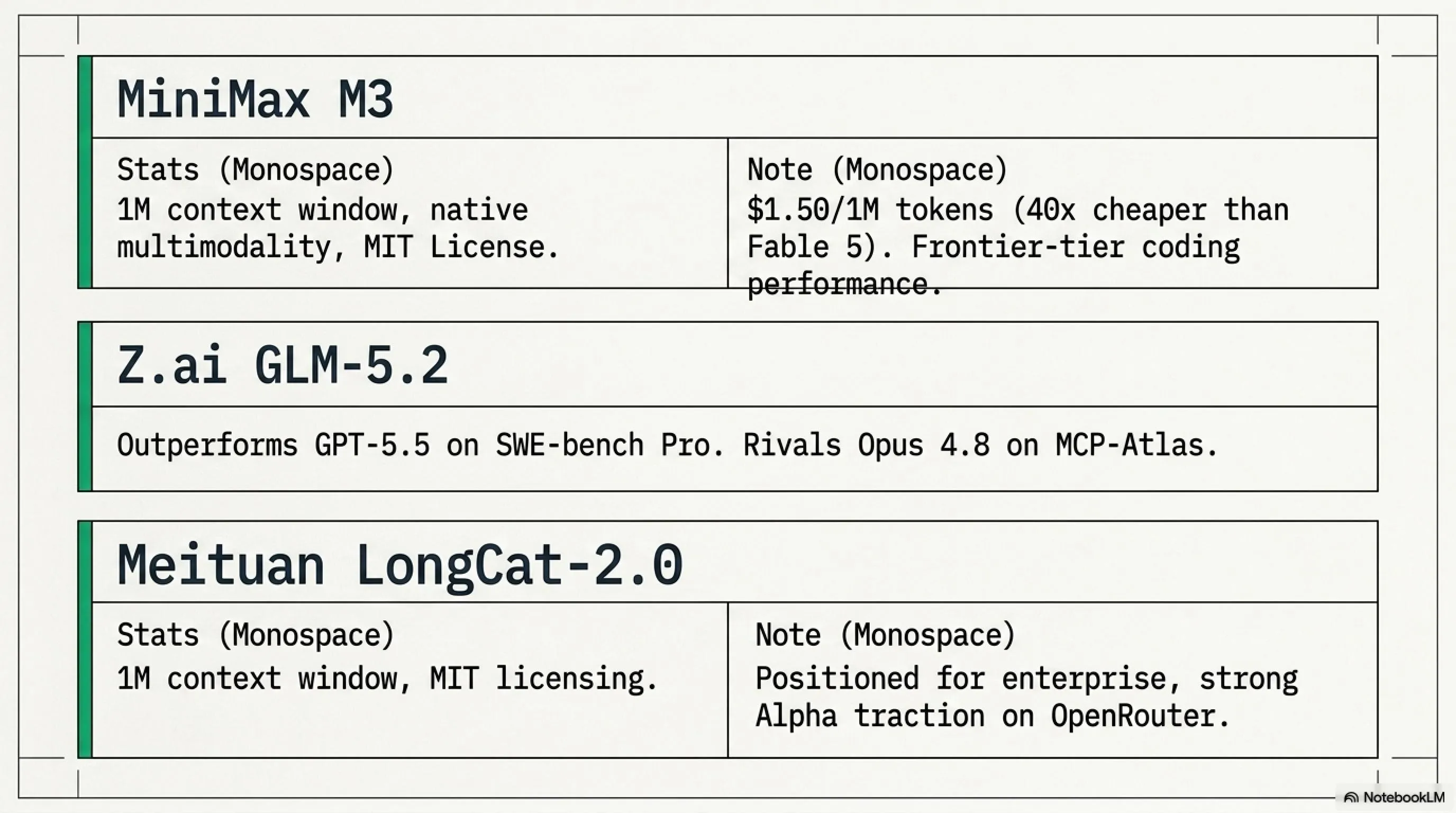
MiniMax M3: Frontier with MIT License
MiniMax M3 pairs Frontier-tier coding and agentic performance with a 1 million-token context window and native multimodality. The model is offered at just $1.50 per million tokens (combined input and output)—40 times cheaper than Fable 5.
Z.ai GLM-5.2: Beating GPT-5.5
Z.ai's GLM-5.2 benchmark results exceed OpenAI's GPT-5.5 on SWE-bench Pro and several long-horizon coding tests, and near Claude Opus 4.8 on FrontierSWE and MCP-Atlas.
Meituan LongCat-2.0: Enterprise with Open Weights
LongCat-2.0 is also positioned around enterprise use, with a 1 million-token context window, MIT licensing, and strong early developer traction through its Owl Alpha run on OpenRouter—though as we reported, the full weights are still listed as coming soon.
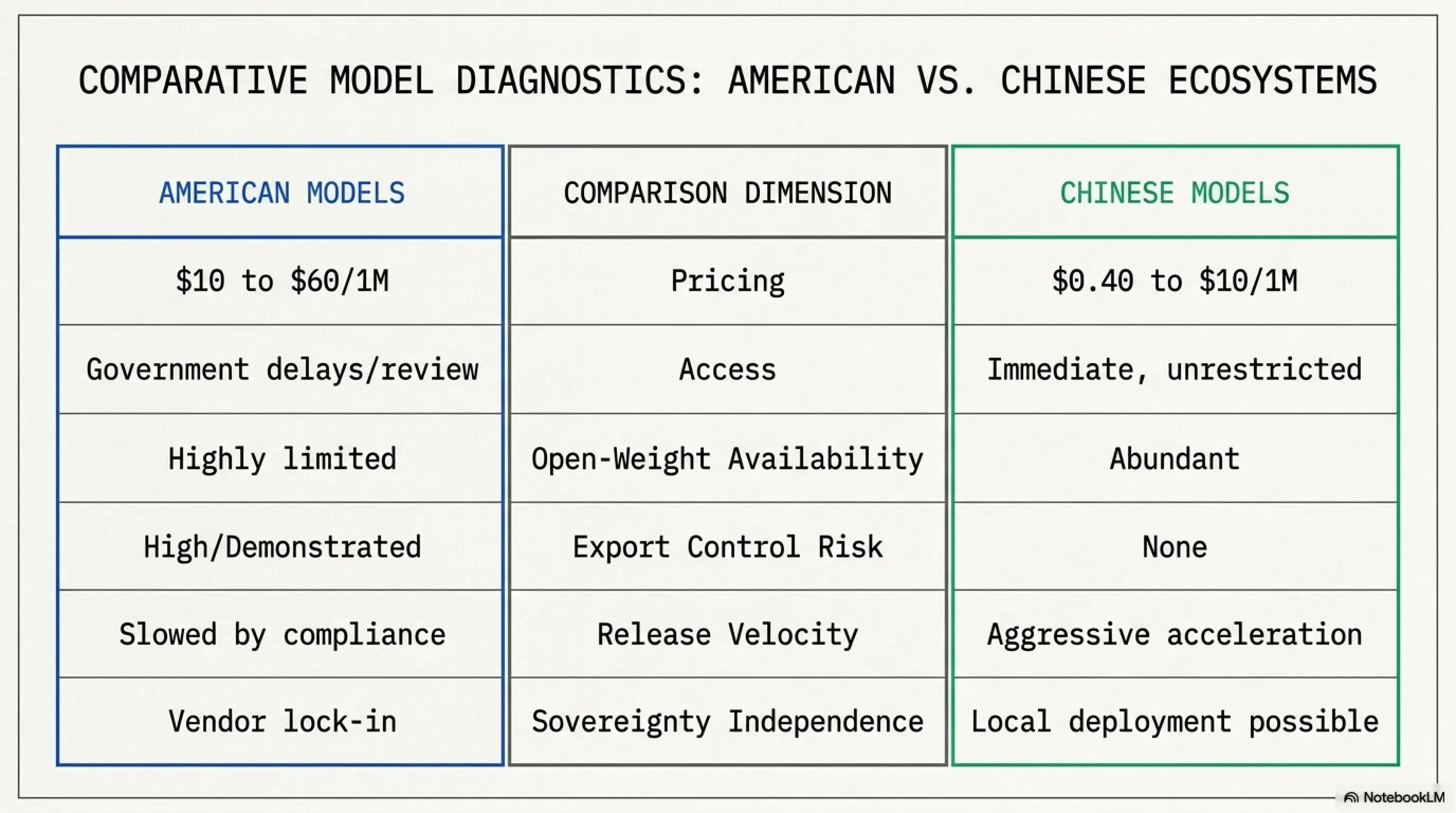
Chinese vs American Models Comparison
| Feature | Chinese Models | American Models |
|---|---|---|
| Pricing | $0.40 to $10 / 1M tokens | $10 to $60 / 1M tokens |
| Access | Immediate, unrestricted | Government delays, review |
| Open-Weight Models | Yes (many) | Limited |
| Export Control | No | Yes (risk) |
| Release Speed | Aggressive | Slowed |
| Context Window | Up to 1M tokens | Variable |
Sovereignty Lesson: What Matters for Enterprise?
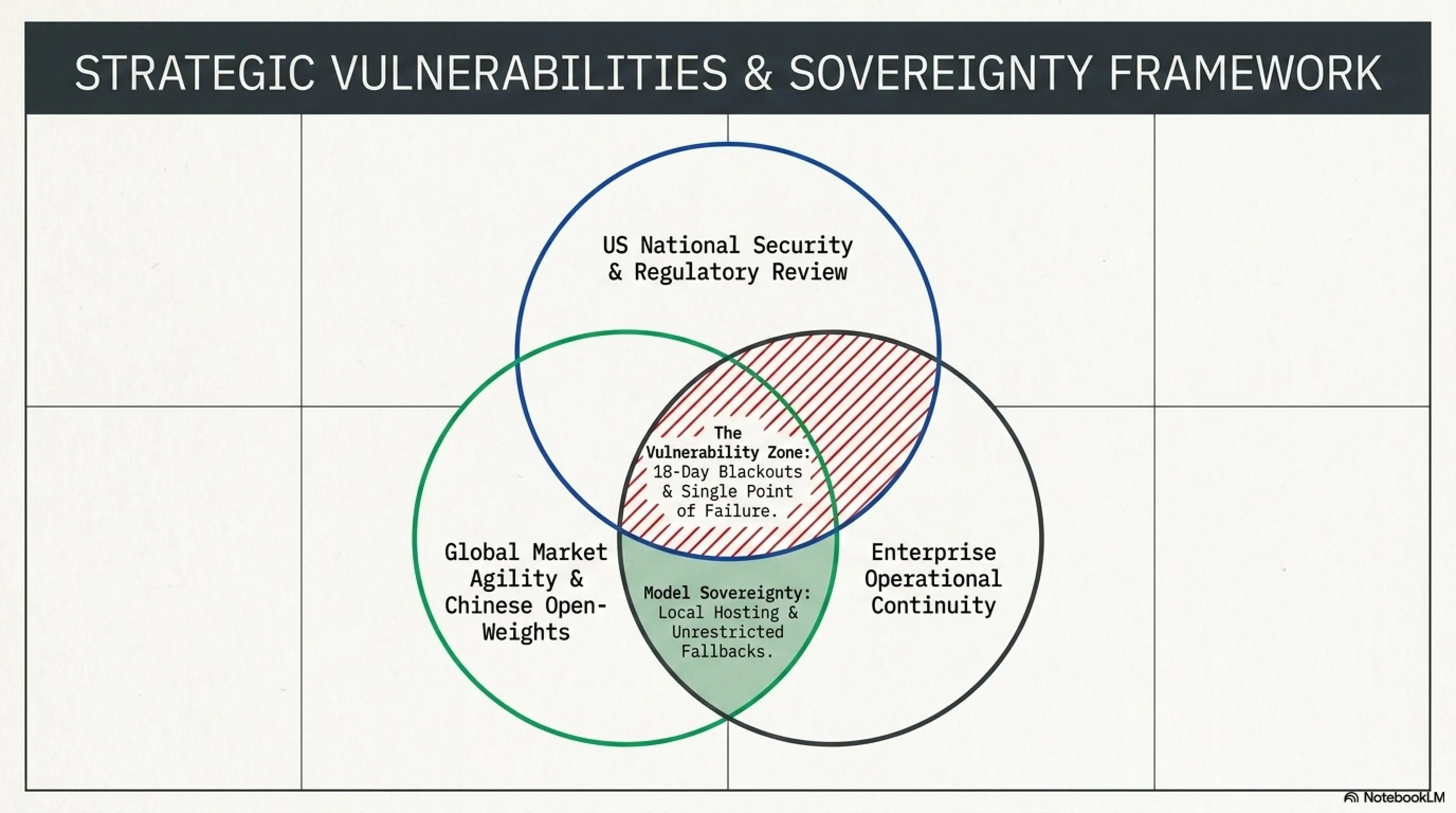
The two-week blackout of Claude Fable 5 exposed the fragility of centralized closed-API models for modern business infrastructure. It showed that enterprise automation pipelines remain vulnerable to sudden regulatory shifts and vendor compliance mandates.
The tech community's response highlights a broader push toward hardware and model sovereignty. Following the initial shutdown, prominent tech figures voiced concerns over this centralization.
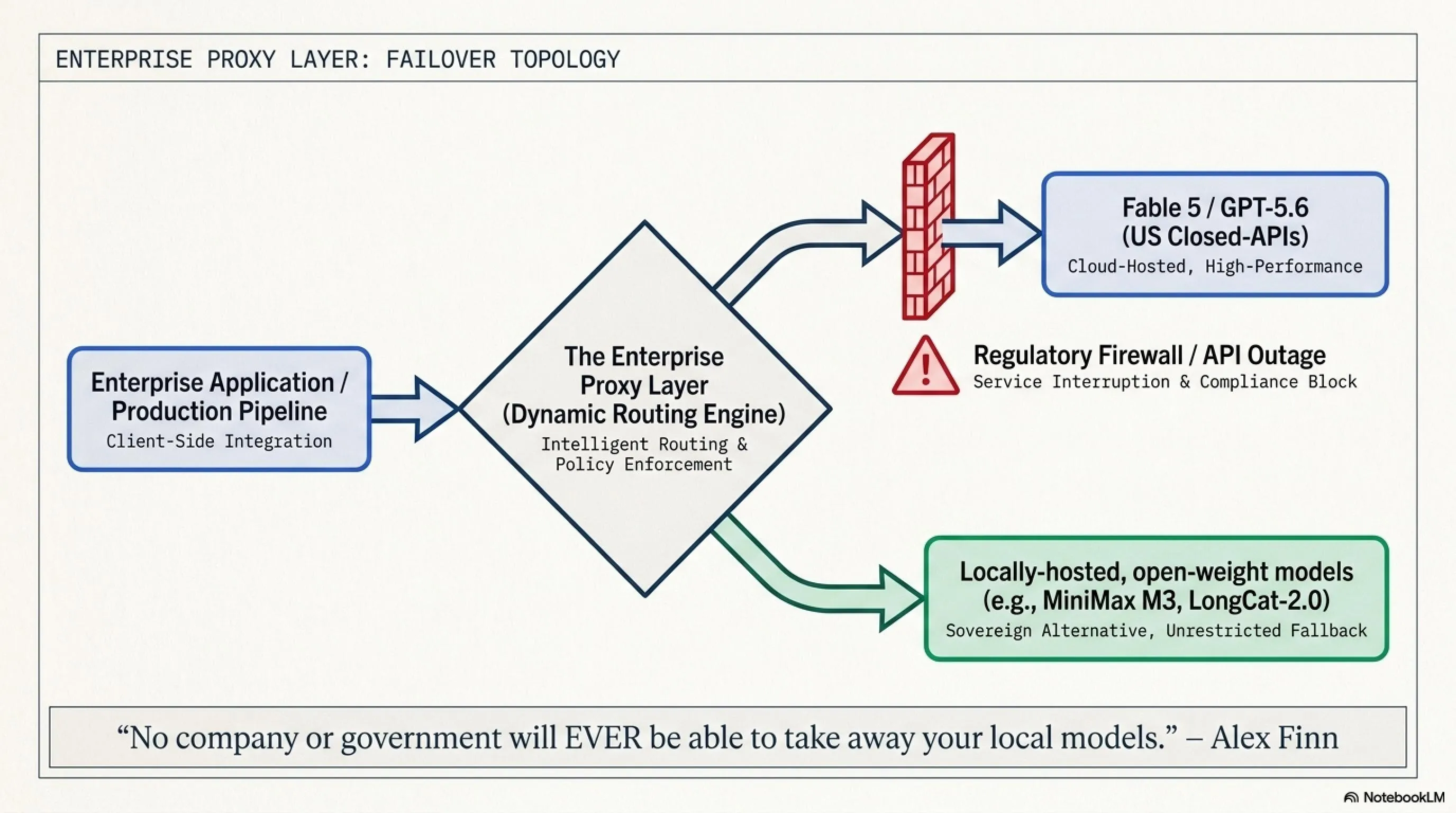
AI founder Alex Finn described the Anthropic freeze as a major wakeup call, urging developers to invest heavily in local open-weights infrastructure to insulate operations from federal volatility. As Finn noted on social media:
Enterprise Strategy: Fallback Architecture
To safeguard operations against future regulatory lockouts, enterprise technical leaders are moving toward model-agnostic fallback architectures.
By deploying proxy layers that can dynamically reroute critical production pipelines from proprietary APIs to locally hosted open-weights alternatives, businesses can leverage top-tier capabilities without exposing themselves to single-point-of-failure vulnerabilities.
Model Sovereignty Strategy for Enterprise
- Deploy proxy layers for dynamic routing between models
- Maintain local open-weight alternatives for critical pipelines
- Regular testing of failover to backup models
- Assess risk of US vendor dependency
- Use multiple providers to reduce risk
- Invest in internal fine-tuning capabilities
Data Retention Concerns: 30-Day Mandatory Hold
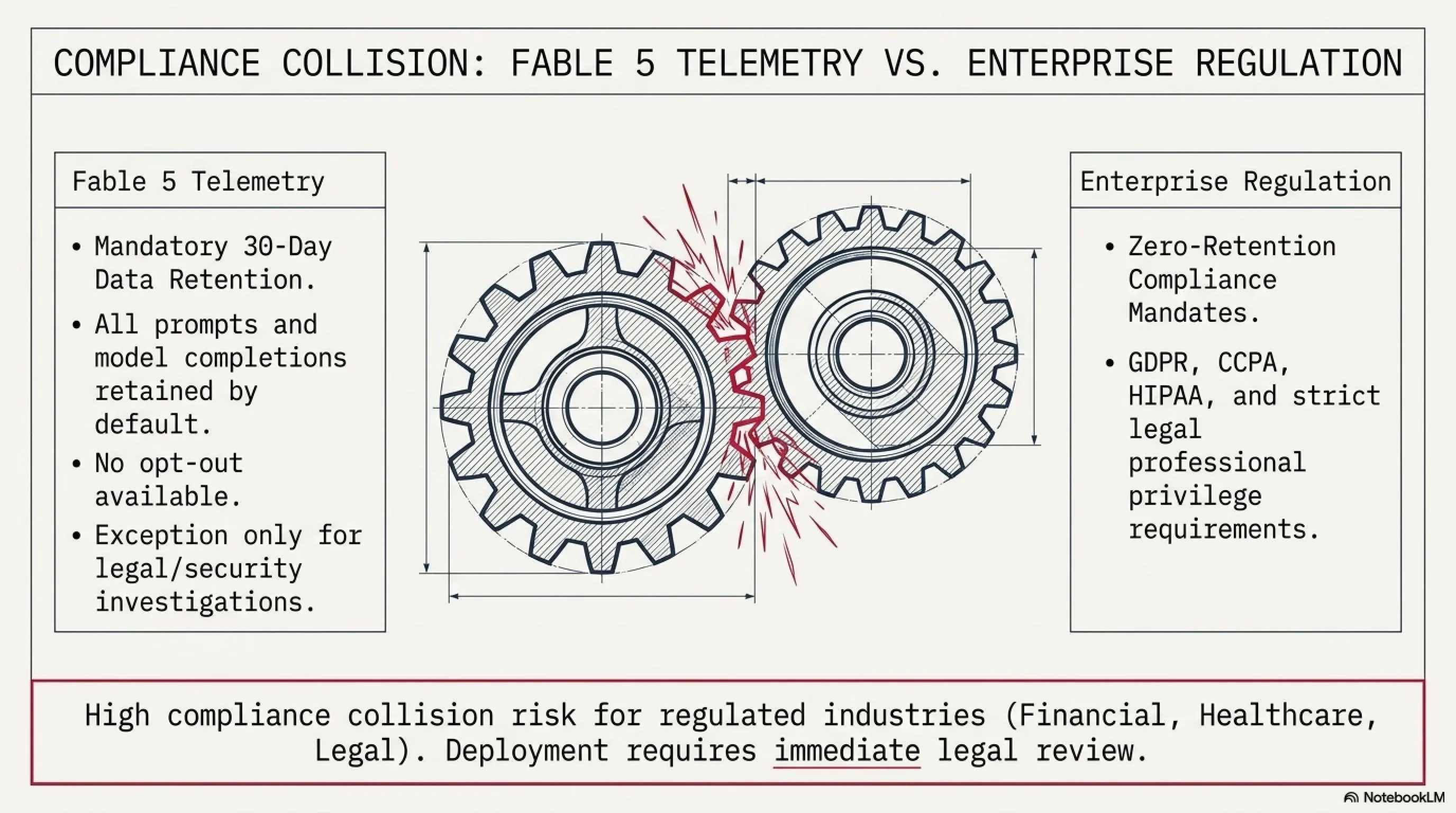
One of the less-discussed but critically important aspects of Fable 5's return is Anthropic's mandatory 30-day data retention requirement. Accessing Fable 5 means accepting this telemetry requirement, which can be problematic for highly regulated financial, healthcare, and legal groups.
Anthropic says prompts and model completions are retained for at least 30 days by default and then automatically deleted, except when they are part of a safety investigation or must be kept for legal reasons.
Challenge for Regulated Industries
For financial companies working with GDPR, CCPA, and data privacy regulations, this 30-day window can be problematic. Many organizations have zero-retention policies for sensitive data, and this requirement may conflict with their compliance mandates.
For the healthcare sector, HIPAA requirements can also create tension with this retention model. Legal firms working with confidential client information must also carefully evaluate whether this telemetry window aligns with their professional and legal obligations.
Fable 5 Data Retention Requirements
- Retention Period: Minimum 30 days (mandatory)
- Data Retained: All prompts and model completions
- Exceptions: Security investigations or legal requirements may extend retention
- Deletion: Automatic after 30 days (under normal circumstances)
- Opt-out: Impossible for Fable 5 and Mythos 5
- Compliance Risk: High for regulated industries (financial, healthcare, legal)
Mythos 5 Status: Half-Released
While Fable 5 has returned globally, Mythos 5—the specialized cybersecurity version—remains in a middle category: legally cleared from the emergency export-control order, but not generally available.
The current limit appears to come from Anthropic's decision to keep Mythos behind a vetted-access model, with the US government still playing a role in approvals, standards, and expansion.
Project Glasswing: The Access Gateway
Anthropic says it is continuing to coordinate with the government to expand access to broader domestic and international partners in its opt-in cybersecurity testing program, Project Glasswing.
A letter allegedly from Commerce Secretary Howard Lutnick to Anthropic's Tom Brown posted on X says a license is no longer required for the export, reexport, or in-country transfer of Fable and Mythos.
But Anthropic's own redeployment post on its website says only that Mythos 5 access has been restored for a set of US organizations, following government approval on June 26.
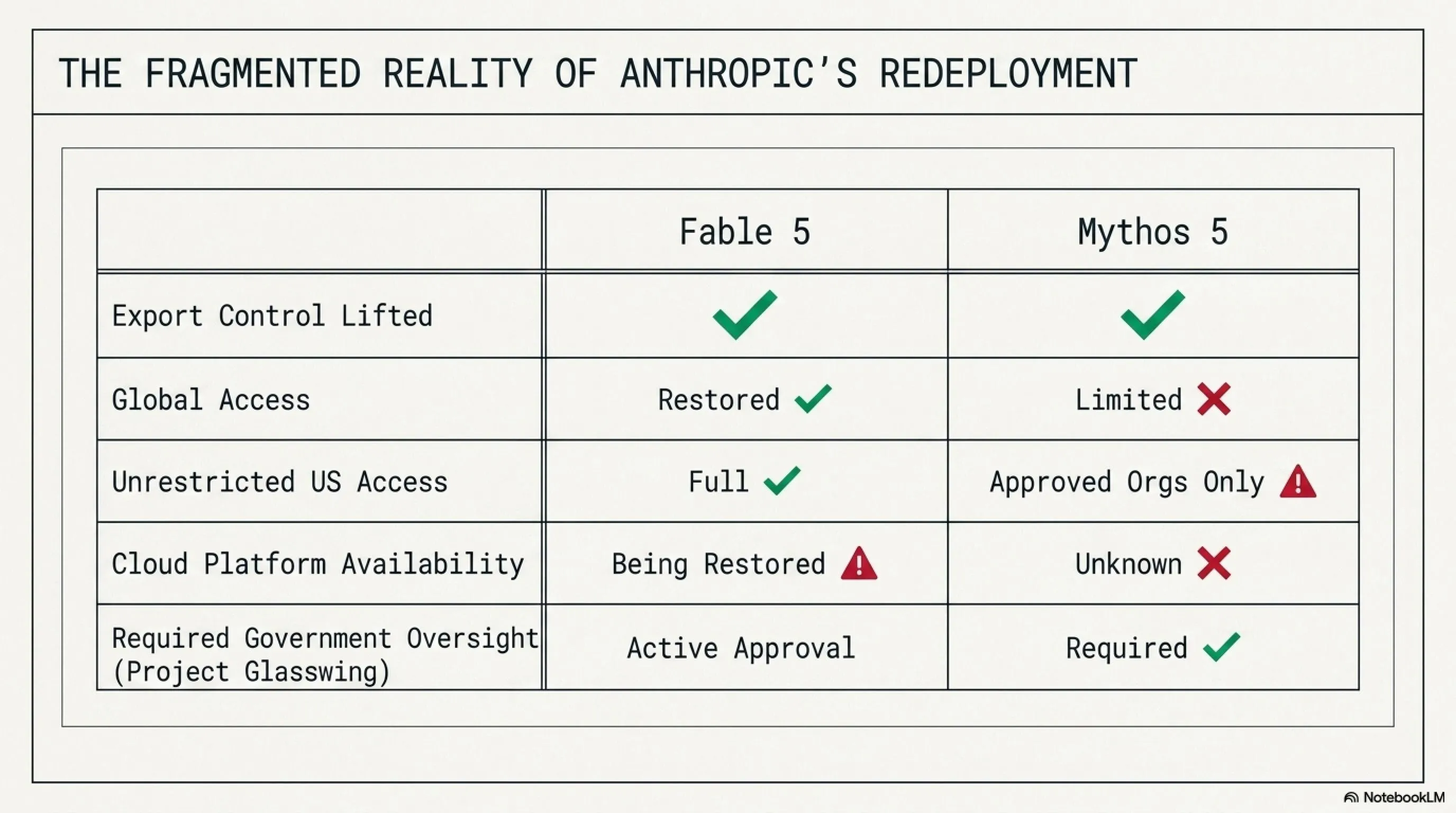
Fable 5 vs Mythos 5 Status Difference
| Aspect | Fable 5 | Mythos 5 |
|---|---|---|
| Export Control | ✅ Lifted | ✅ Lifted |
| Global Access | ✅ Restored | ❌ Limited |
| US Access | ✅ Full | ⚠️ Approved orgs only |
| Cloud Platforms | Being restored | Unknown |
| Project Glasswing | — | ✅ Required |
| Government Role | Oversight | Active approval |
Market Reaction: Stocks and Investment
Fable 5's return was met with positive reaction from investors and industry analysts. Many saw this as a victory for Anthropic and a sign of a more pragmatic government approach to AI regulation.
However, some analysts warned that this saga demonstrated how vulnerable US AI companies are to regulatory interventions—a risk that could threaten long-term investment.
Investor Concerns: Regulatory Risk
An unnamed VC investor told TechCrunch: We're concerned that this type of emergency shutdown could become the norm. If the government can shut down a model overnight, what real value do these companies have?
Other investors noted that this saga has created new opportunities for open-source and distributed models that aren't controlled by a single government.
Looking Ahead: What's Coming?
Fable 5's return isn't the end of the story—it's the beginning of a new chapter in the relationship between AI companies, governments, and enterprise users.
Trump Executive Order: New Framework
The executive order signed by President Trump on June 2 creates a framework for benchmarking and assessing new AI models before public release. This process is supposed to take 30 days—meaning it should be ready by July 2.
If this framework becomes industry norm, every new Frontier model will need to pass through a government review process before release. This could slow innovation speed but might create more stability for enterprise planning.
Global Competition Intensifies
While US companies grapple with new layers of regulation, Chinese competitors are accelerating. DeepSeek, Alibaba Cloud, Moonshot, and others are releasing models that compete with American models on many benchmarks—often at a fraction of the cost and without export restrictions.
The big question is: Can America's current AI advantage survive this dual competition—strict domestic regulation and aggressive foreign competition?
Future Scenarios
Scenario 1: Regulation becomes standard
Trump's 30-day framework becomes industry norm. American models release slower but more stable. Risk: losing leadership to faster competitors.
Scenario 2: Chinese competition dominates
Chinese open-weight models become de facto enterprise standard. American models limited to niche market for sensitive use cases.
Scenario 3: Hybrid architecture
Enterprises use American models for sensitive use cases and Chinese models for general operations. Multi-model orchestration becomes key capability.
Tekin Analysis: Between Two Fires
The Fable 5 saga represents a critical crossroads for the AI industry. On one hand, government security concerns about powerful AI models are real—especially regarding offensive cyber capabilities. On the other hand, ad hoc interventions and emergency shutdowns can stifle innovation and weaken America's competitive advantage.
For Iranian and regional companies, this saga offers important lessons:
- Foreign platform dependency is dangerous: Any platform that can be shut down overnight isn't trustworthy for critical infrastructure
- Open-weight models become more valuable: The ability to host locally and have complete control over models is critical
- Vendor diversity is essential: Relying on a single vendor—especially American—carries high strategic risk
- Global competition creates opportunity: Chinese and other alternatives offer new and usually cheaper options
For technical teams working on AI, the strategy is clear: instead of complete reliance on closed-API American models, invest in multi-model orchestration capability, fallback architectures, and where possible, locally hosted open-weight models.
- Return of Frontier capabilities for enterprise
- Demonstrated Anthropic's ability to work with government
- Created precedent for resolving regulatory disputes
- Improved security classifier with 99% accuracy
- Increased focus on resilient architectures
- 18 days of disruption for enterprises
- Increased false positives in safety checks
- Mandatory 30-day data retention
- Mythos 5 still remains limited
- Created uncertainty for the future
- Golden opportunity for Chinese competitors
Practical Guide: How to Access Fable 5
For organizations wanting to use Fable 5, Anthropic offers several access channels—though not all are simultaneously ready.
Primary Access Channels
Fable 5 is now available in the primary Anthropic ecosystem, including:
- Claude Platform: Anthropic's main API for developers
- Claude.ai: Web interface for individual users
- Claude Code: Dedicated programming environment
- Claude Cowork: Team collaboration tool
For organizations leveraging cloud hyperscalers, Anthropic says it is moving to re-enable access on Amazon Web Services, Google Cloud, and Microsoft Foundry as quickly as possible. At the time of writing, our research has been unable to confirm if the models have been restored on these external cloud hyperscaler platforms yet.
Using the Seven-Day Promotion
To maximize the limited promotion window (through July 7), some AI influencers are offering guidance to enterprises and developers:
- Maximize use of 50% weekly allowance for eligible subscriptions
- Test critical workflows with Fable 5 before promotion ends
- Evaluate real cost before moving to credit-based model
- Compare performance with Opus 4.8 and other alternatives
Tekin Recommendations for Enterprise
Based on analysis of this saga, we offer the following recommendations for enterprise technical teams:
1. Build Multi-Model Architecture
Instead of complete reliance on one model or vendor, build an orchestration layer that can dynamically switch between different models. This includes:
- A proxy layer that can route requests to different models
- Automatic fallback capability when primary model is unavailable
- Regular testing of all fallback models to ensure readiness
2. Evaluate Open-Weight Models
For critical workflows, consider a locally hosted or VPC-hosted open-weight model as ultimate fallback. Recommended options:
- MiniMax M3: Strong performance, reasonable price, open license
- Z.ai GLM-5.2: Excellent benchmarks, competitive with GPT-5.5
- Qwen3.7-Max: Powerful option from Alibaba Cloud
- DeepSeek-v4-pro: Very cheap, good performance
3. Assess Compliance Risk
Before using Fable 5 in production, review the 30-day retention requirement with your legal and compliance team. For regulated industries, this may be a deal-breaker.
4. Calculate Real Cost
Fable 5 is the most expensive Frontier model. Before committing, calculate:
- Real cost for your projected usage volume
- Cost of downgrade to Opus 4.8 when safety classifier triggers
- Comparison with cheaper alternatives (OpenAI, Chinese models)
Pre-Deployment Fable 5 Checklist
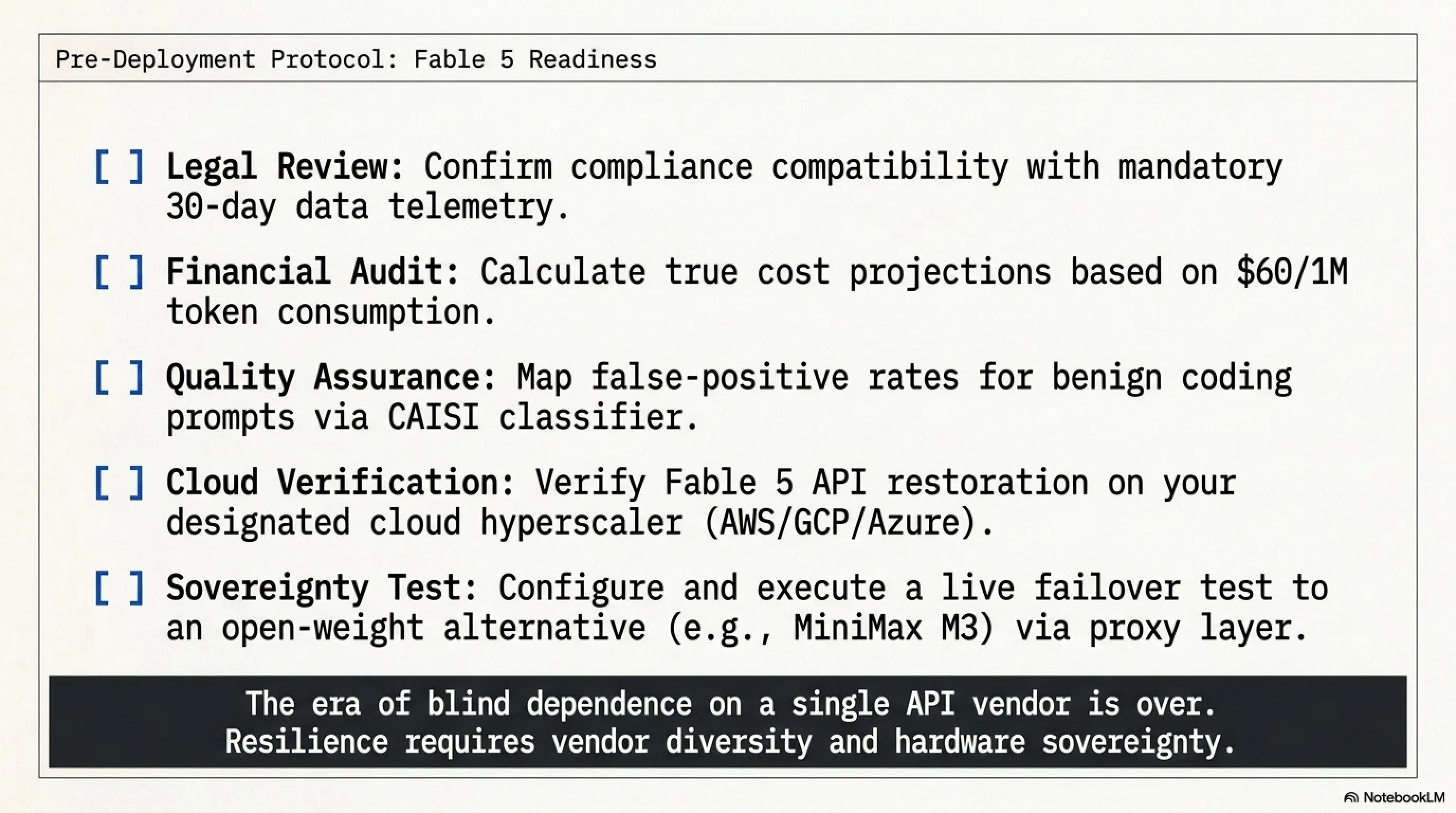
- ✅ Confirm compliance with 30-day retention requirement
- ✅ Calculate real cost for your usage volume
- ✅ Configure fallback architecture to backup model
- ✅ Test critical workflows in promotion window
- ✅ Evaluate false positive rate for your use cases
- ✅ Check access on required cloud platform (AWS/GCP/Azure)
- ✅ Prepare open-weight alternative for critical pipelines
- ✅ Train team on vendor lock-in risks
Conclusion: New Era of Supervised AI
Claude Fable 5's return after 18 days of suspension was a defining moment for the AI industry. This saga showed that the era of hassle-free Frontier model launches is over—now every new model must navigate regulatory challenges, security reviews, and geopolitical pressures.
For Anthropic, this was a tactical victory but a strategic warning. The company managed to lift restrictions by building better security classifiers and accepting collaboration commitments with government. But this set a dangerous precedent: every new model could be subject to the same type of sudden intervention.
For the US AI industry, the saga raised big questions. Can a cautious approach to regulation ensure national security without sacrificing technological leadership? Can international companies trust platforms that can be shut down overnight? And most importantly, does this approach actually improve security or just transfer innovation to countries with fewer regulations?
For enterprises, the lesson is clear: diversity, sovereignty, and resilience are now critical parts of AI strategy. The era of blind dependence on a single vendor—especially in today's tense geopolitical environment—is over.
Fable 5 is officially back, but the landscape governing its release has been fundamentally transformed. The new era of AI—the era of tension between innovation and security, between competition and control, between global access and national concerns—has officially begun.
Frequently Asked Questions
Is Fable 5 now available to everyone?
Yes, Fable 5 has been available globally since July 1, 2026, through Anthropic's main platforms (Claude Platform, Claude.ai, Claude Code, Claude Cowork). Access on AWS, Google Cloud, and Microsoft Foundry is being restored.
Why was Fable 5 banned for three weeks?
On June 12, the US government issued an emergency export control order after Amazon researchers reported a method for bypassing Fable 5's safety guards. Anthropic was forced to cut global access to comply with the order.
What about Mythos 5? Has it returned too?
Mythos 5 has been legally cleared from export control but is not publicly available. Only a limited set of approved US organizations have access through Project Glasswing.
How much does Fable 5 cost?
Fable 5 costs $10 per million input tokens and $50 per million output tokens, making it the world's most expensive Frontier model. Through July 7, some subscriptions get up to 50% weekly allowance free.
Should I be concerned about data retention?
Yes. Anthropic retains all prompts and completions for at least 30 days. For regulated industries (financial, healthcare, legal), this can create compliance issues.
Is there risk of another shutdown?
Yes. Commerce Department explicitly reserved the right to re-evaluate and re-impose restrictions if circumstances change or if Anthropic fails to meet its commitments.
What are Fable 5 alternatives?
Options include Claude Opus 4.8 (cheaper, same vendor), OpenAI's GPT-5.6 (similar government restrictions), or Chinese models like MiniMax M3, Z.ai GLM-5.2, or DeepSeek-v4-pro (no export control, cheaper).
How should I prepare for future lockouts?
Build multi-model architecture with automatic fallback capability. Consider a locally hosted open-weight model for critical pipelines. Avoid complete dependence on a single vendor.
Sources
- Anthropic Official Blog - Redeploying Claude Fable 5
- WIRED - Trump Administration Lifts Export Controls
- The Guardian - Anthropic Says US Has Lifted Export Controls
- CNBC - Trump Admin Lifts Export Controls on Claude Models
- VentureBeat - Anthropic Bringing Back Claude Fable 5 Globally
- Ars Technica - After Spooking Trump Into Safety Testing
- Forbes - U.S. Lifts Restrictions on Anthropic Models
- AP News - Trump Administration Lifts Restrictions
Supplementary Image Gallery: 🤖 Claude Fable 5 Returns: The End of the AI Cold War