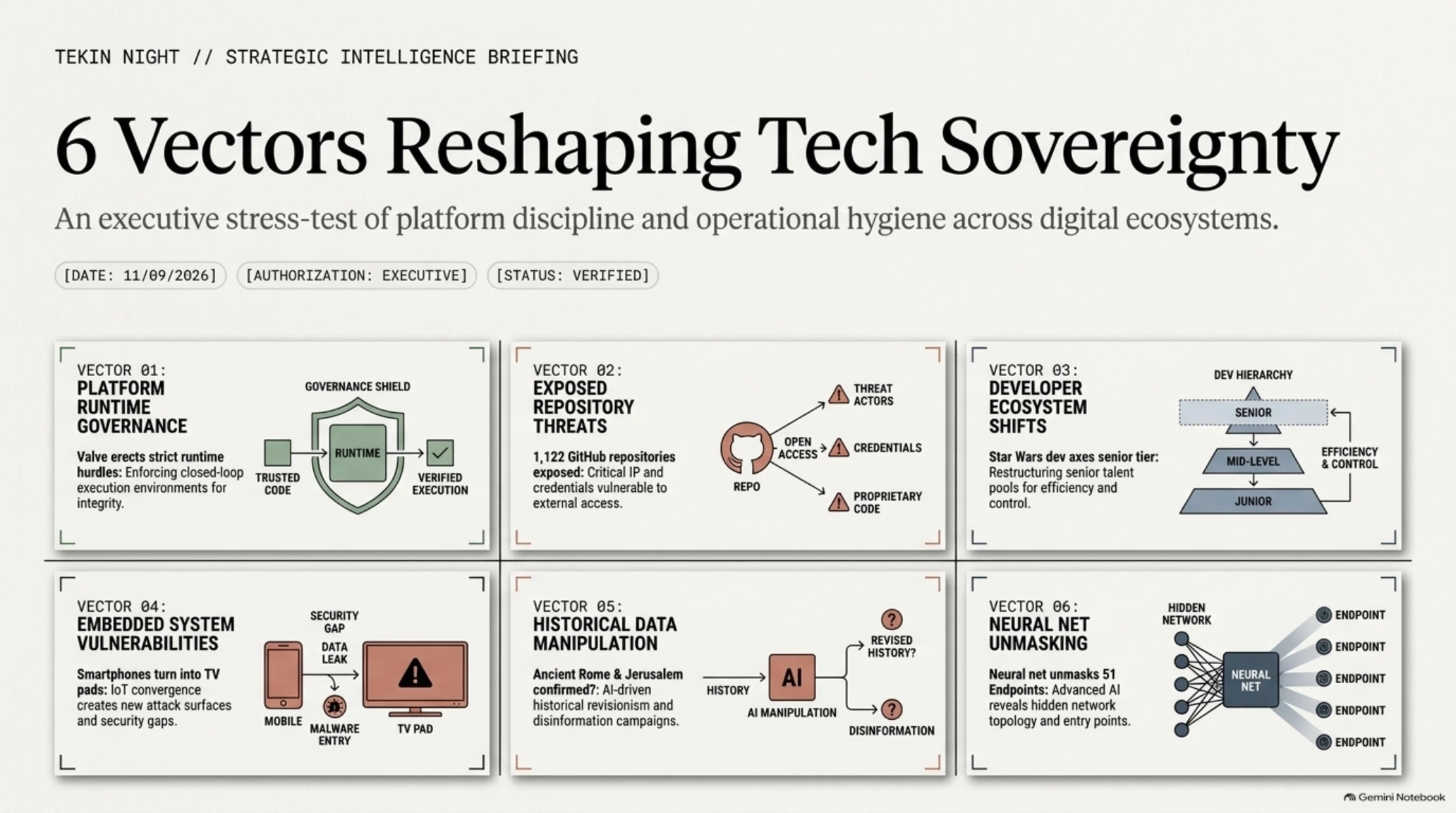
Tekin Night for Nov 9, 2026 dissects six major developments: (1) Valve enforcing 5-minute runtime verification as AI slop pushes Steam review queues to 12 days; (2) Anthropic's Claude Code CLI leaking active cloud credentials across 1,122 public GitHub repositories; (3) Star Wars strategy studio Bit Reactor cutting senior staff post-furlough; (4) Microsoft turning phones into WebRTC smart TV cloud gamepads; (5) Leaked Assassin's Creed Rome & Jerusalem roadmaps; and (6) JWST neural planet imaging.
Tekin Night // Strategic Intelligence Briefing Monday November 9 2026
Strategic Assessment and Key Intelligence at a Glance
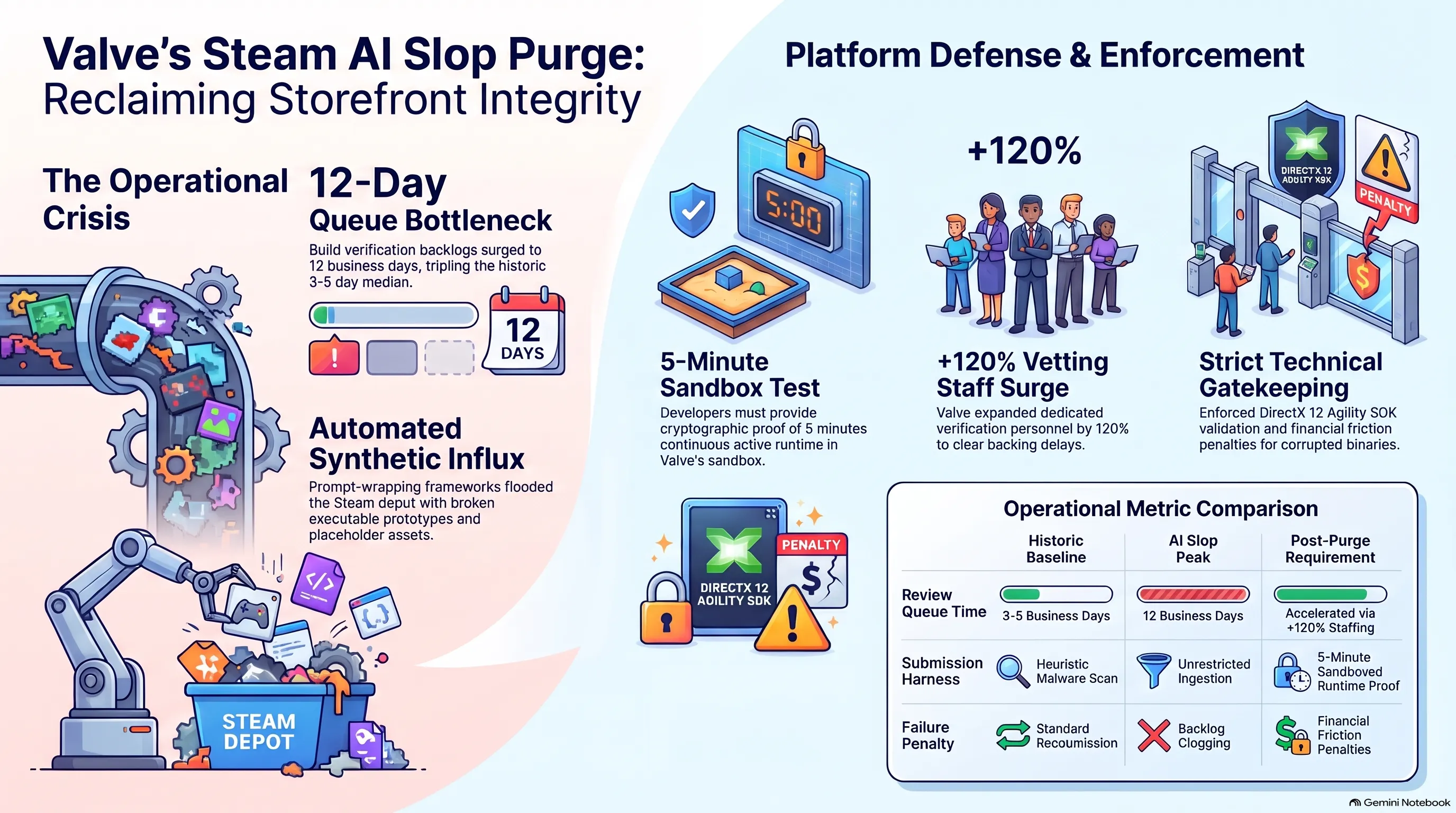
1. Valve Reinforces Digital Iron Curtain Against AI Slop on Steam
The modern PC gaming ecosystem arrived at a defining crossroads on Monday, November 9, 2026. Over the preceding four quarters, the democratized accessibility of generative AI models, synthetic code orchestrators, and algorithmic sprite compilers triggered an overwhelming flood of low-effort, synthetic software submissions across the Steam publishing portal. Industry analysts commonly refer to this tidal wave as automated AI slop half-baked prototypes assembled within hours by prompt-wrapping frameworks, containing non-functional game loops, uncompressed dependencies, and fraudulent asset claims designed to game store algorithms.
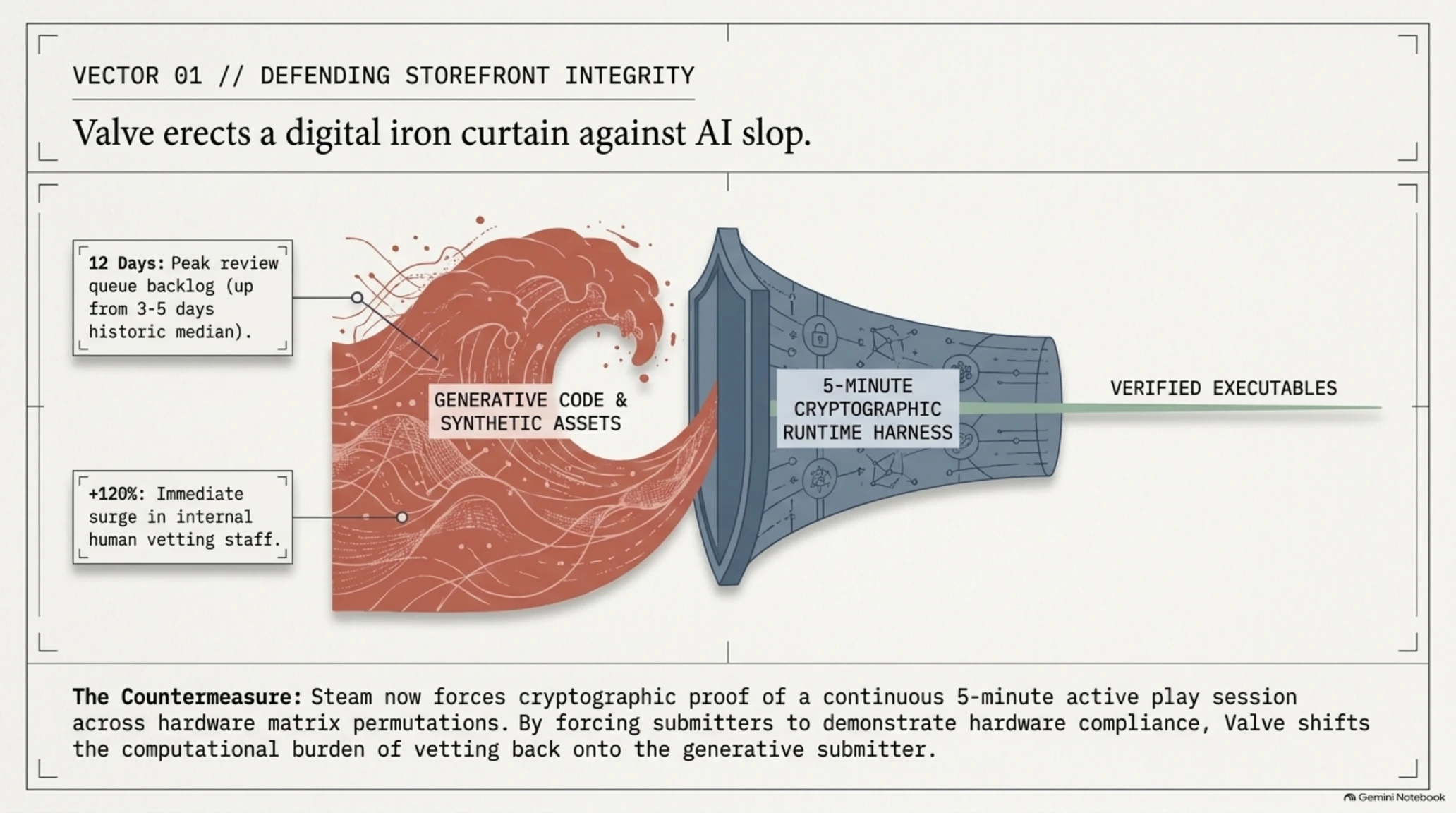
According to an authoritative investigative dossier corroborated by IGN and technical reporting from Engadget, Valve Corporation faced an acute operational crisis as build verification review backlogs escalated to an unprecedented 12 business days, nearly triple the historic median of three to five business days. In immediate response, Gabe Newell's engineering leadership instituted stringent, multi-tiered gateway protocols that fundamentally alter how independent studios and corporate publishers submit software builds to the master Steam depot.
The structural vulnerability stemmed from Steam's legacy ingestion pipeline. Originally engineered in an era where developing an executable game required substantial human capital, domain expertise in graphics APIs, and deterministic logic programming, the ingestion harness relied primarily on automated heuristic scans to detect malicious code, malware signatures, and known pirated binaries. However, generative AI pipelines inverted this dynamic. With LLM-driven coding tools capable of spitting out thousands of hollow Unity or Unreal engine projects packaged with synthetic textures, malicious actors began mass-submitting placeholder products to secure store presence, fish for trading card revenues, or hoard algorithmic visibility.
Why Platform Governance Against Synthetic Floods Reshapes the Digital Marketplace
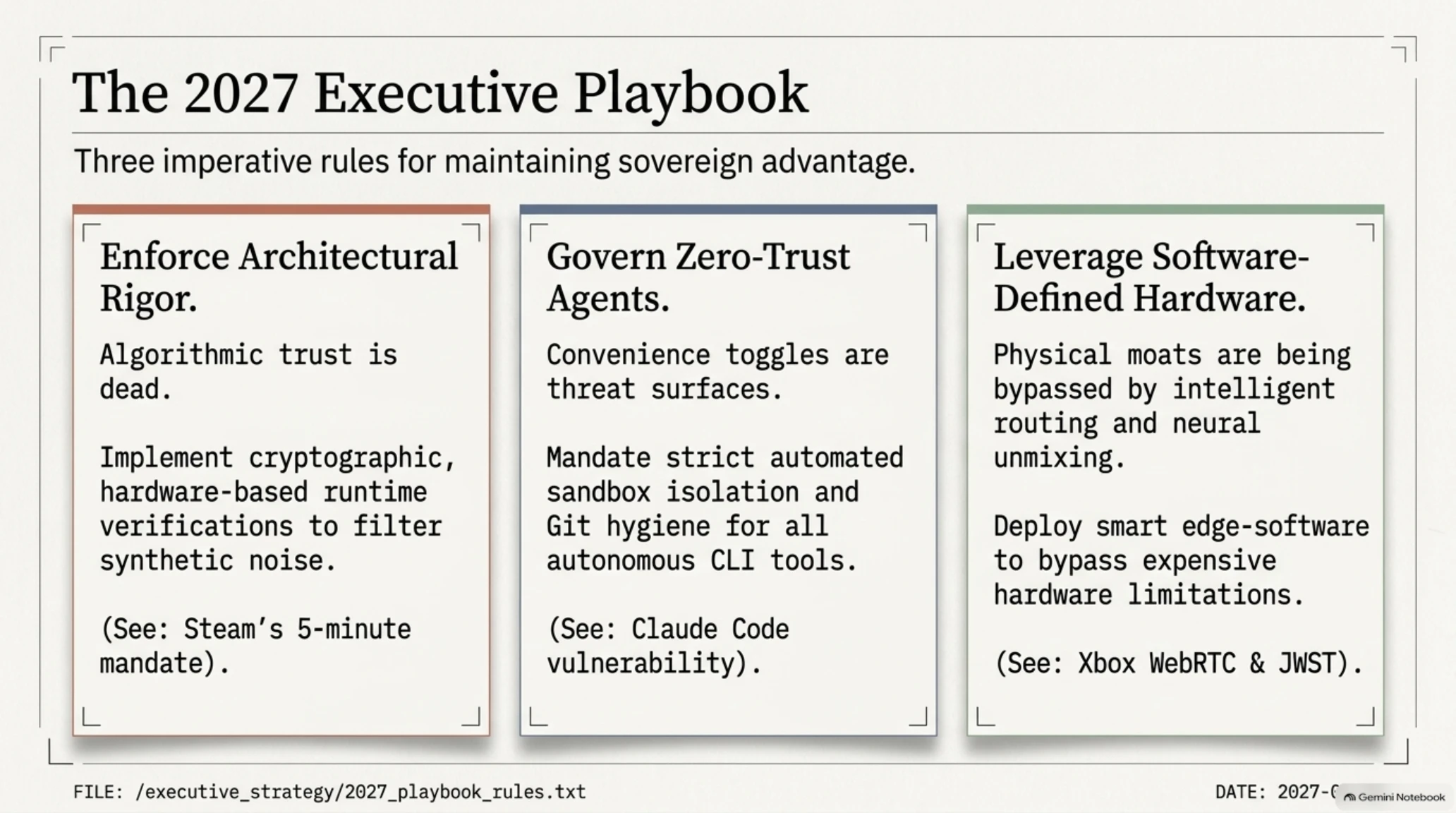
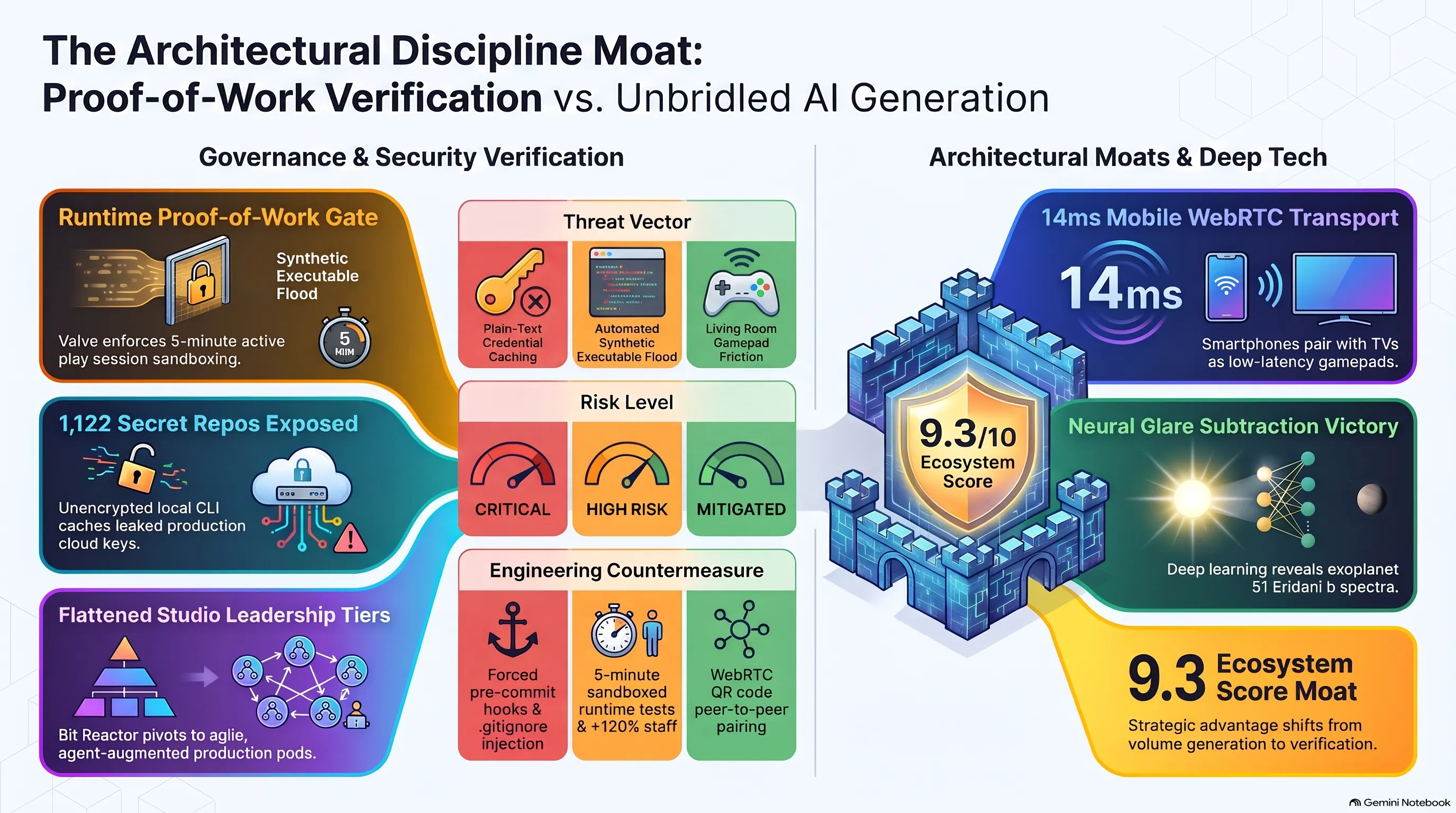
Under the revised Steamworks compliance charter, automated submission bots and unverified builds are stopped dead in their tracks. Developers must now furnish cryptographic proof of a continuous five-minute active play session verified within Valve's sandboxed client runtime. Furthermore, builds must strictly validate Microsoft DirectX 12 Agility SDK bindings, Visual C++ redistributable dependencies, and operational Steam Cloud synchronizations before an evaluation ticket can be opened in the reviewer queue.
From an infrastructural vantage point, Valve's 12-day bottleneck illuminated a critical paradigm shift: when code generation becomes essentially zero-cost via LLM coding suites, the cost of quality assurance and runtime validation escalates asymptotically. The new five-minute continuous execution harness acts as a cryptographic proof-of-work mechanism. By forcing every build to execute cleanly across diverse hardware matrix permutations without crashing or throwing unhandled DirectX exceptions, Valve has effectively shifted the computational burden of vetting back onto the submitter, protecting the integrity of the broader Steam community.
To break the current backlog, Valve executed an aggressive 120% surge in dedicated internal verification personnel, while instituting financial friction penalties for accounts that submit non-launching or corrupted binaries. The long-term architectural ramifications of this policy are profound: by forcing submitters to demonstrate demonstrable gameplay loops and hardware compliance, Valve has established the world's first industrial-grade filter against generative AI dilution in commercial software distribution.
2. Claude Code Command-Line Vulnerability Exposes Cloud Credentials Across 1,122 Repositories
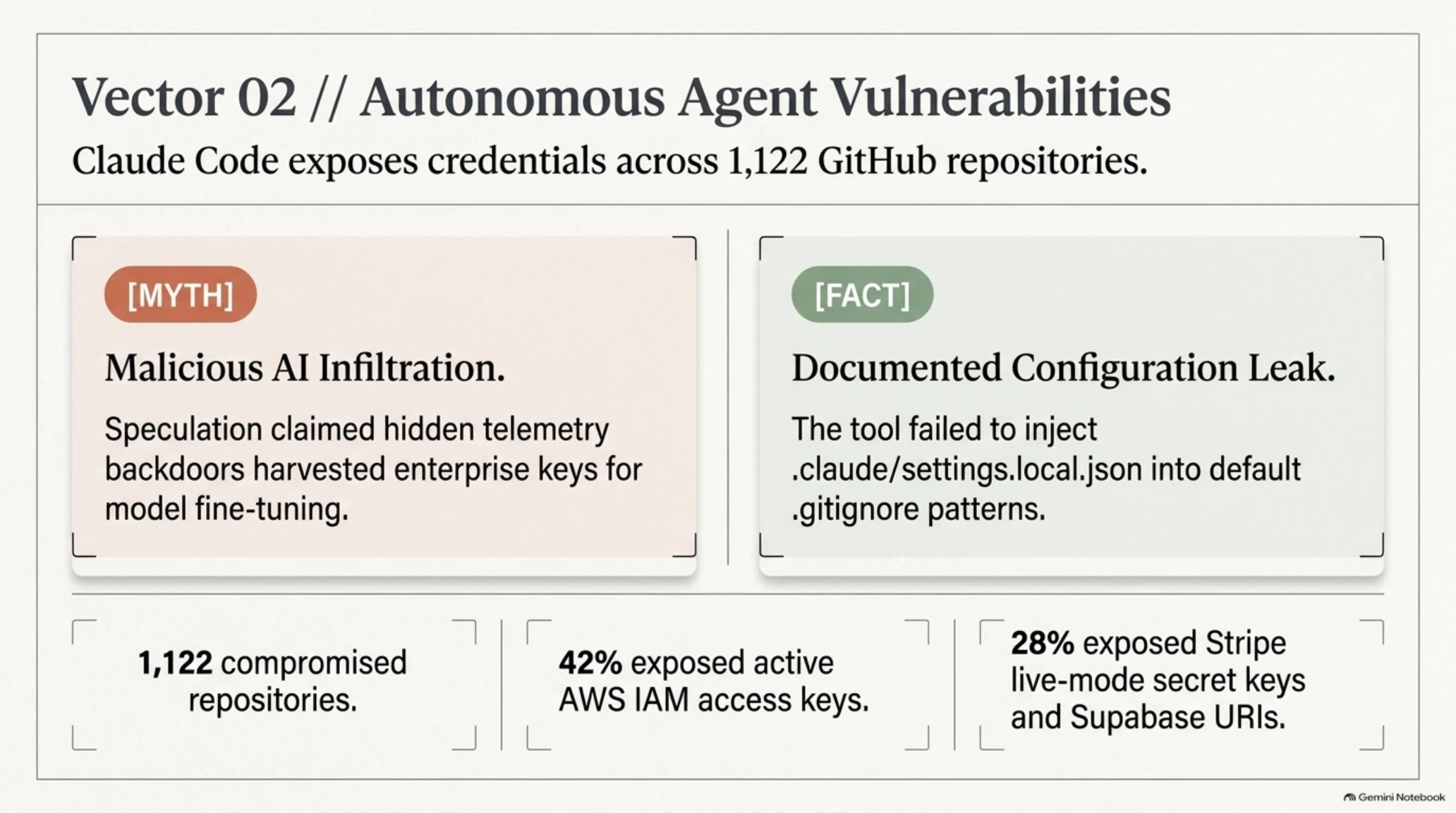
While platform stewards battle generative flooding in entertainment software, enterprise security teams encountered an alarming architectural vulnerability at the heart of state-of-the-art AI coding tools. As reported by The Hacker News and verified by comprehensive research released by cybersecurity firm Apiiro, Anthropic's flagship agentic CLI, Claude Code, inadvertently exposed thousands of active production API tokens, private SSH keys, and database passwords directly across publicly accessible GitHub repositories.
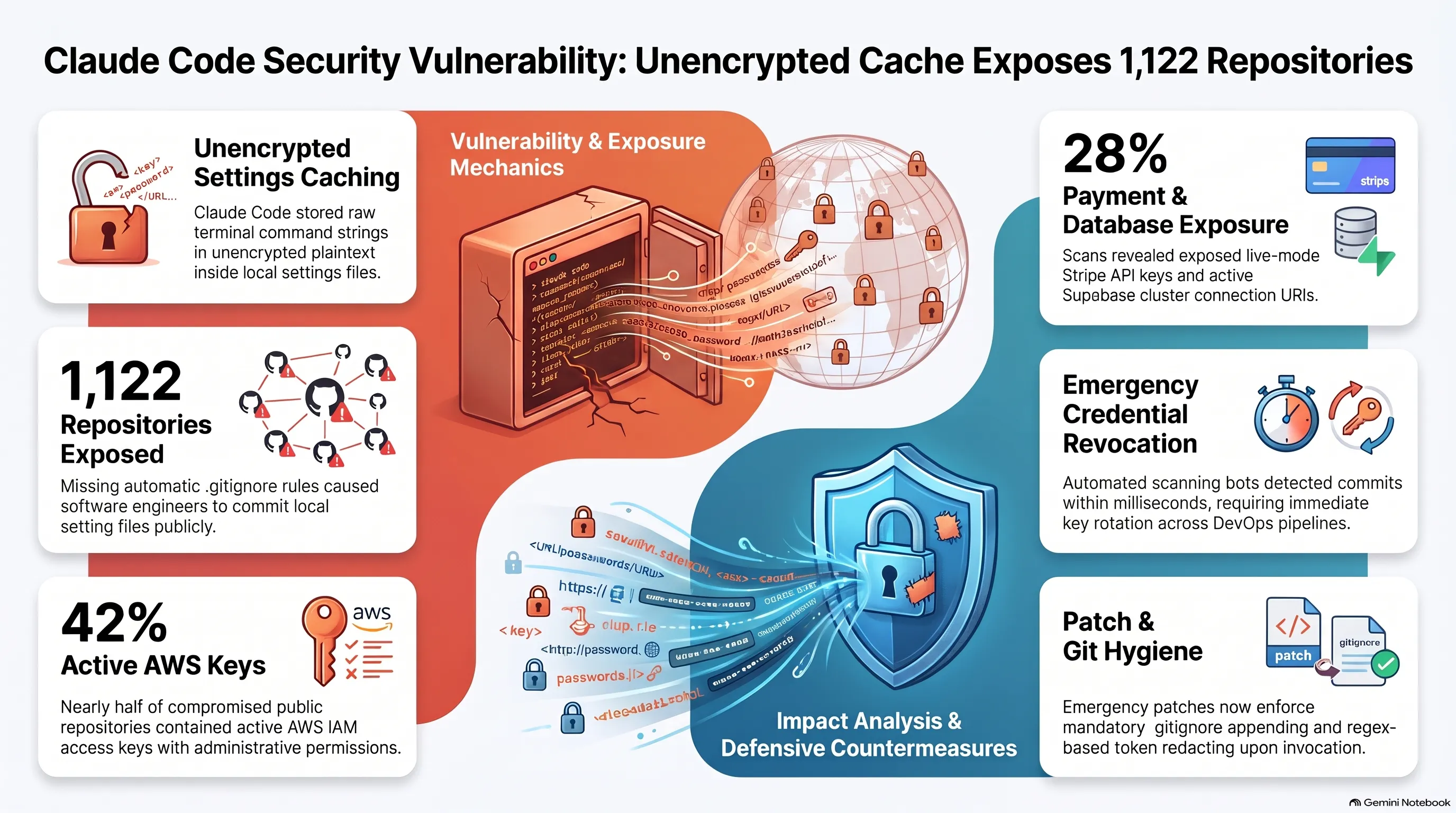
The root cause of this high-severity supply chain breach stems from human ergonomics colliding with automated agent tool execution. When developers interact with Claude Code in autonomous terminal sessions, the CLI prompts for permission before executing shell commands. To bypass friction, users frequently toggle the convenience parameter Don't Ask Again. Unknown to many developers, Claude Code recorded these raw command strings into a local configuration cache located at .claude/settings.local.json.
In practical software workflows, shell commands frequently contain inline environment variables, live connection strings, and credential exports such as database migration scripts or API test curls. Because Claude Code persisted these commands in plaintext without cryptographic encryption or token redacting, any terminal invocation containing sensitive data became permanently baked into the local repository directory.
Technical Fact-Check | Myth vs. Reality on the Claude Code Secret Leak
Because Claude Code initially omitted automatic injection of .claude/ into project .gitignore manifests, software engineers executing routine Git commits inadvertently bundled these local setting files into upstream public trees. Apiiro's automated audit uncovered 1,122 compromised repositories containing valid credentials for Amazon Web Services, Stripe API environments, Supabase database clusters, and corporate OpenAI keys.
Apiiro's telemetry data revealed that the blast radius encompassed critical corporate infrastructure. Of the 1,122 compromised repositories, 42% contained active AWS IAM access keys with administrative or database read-write permissions, while 28% exposed Stripe live-mode secret keys and Supabase connection URIs. Because automated scanning bots routinely monitor the public GitHub firehose within milliseconds of commit events, dozens of organizations reported anomalous credential usage within hours of pushing code, necessitating emergency credential rotations and audit freezes across enterprise DevOps departments.
Anthropic responded with emergency patches that enforce automatic .gitignore appending and regex-based redaction of recognized token patterns. Nonetheless, this incident serves as a stark reminder of zero-trust architecture principles: convenience toggles in autonomous agent harnesses represent severe threat surfaces unless strictly governed by automated secret scanning and sandbox isolation.
3. Bit Reactor Restructures Senior Ranks Following End of Workforce Furloughs
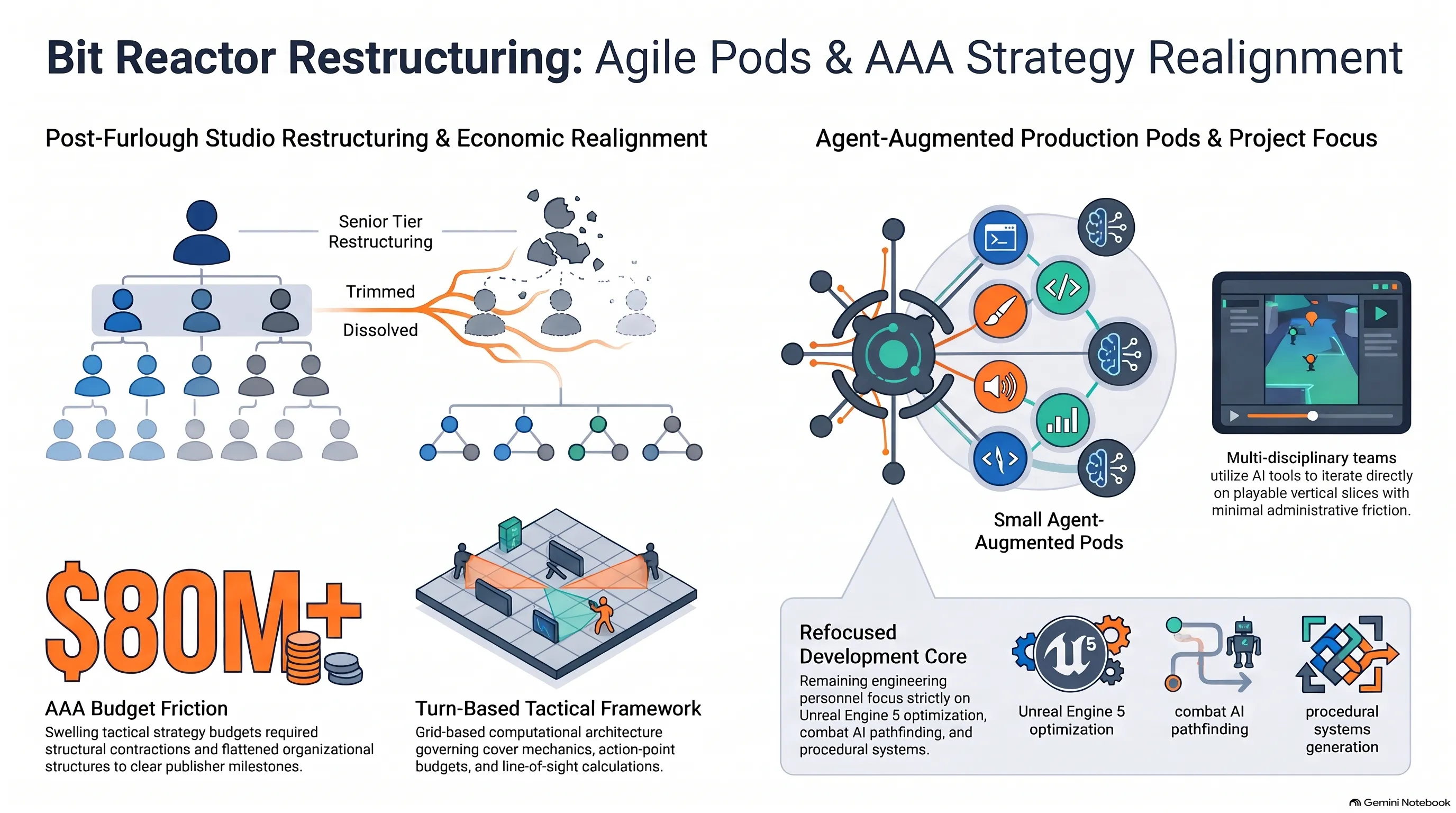
The structural headwinds buffeting video game production claimed fresh victims within high-profile strategic circles. Studio Bit Reactor, the Maryland-based studio founded by veteran Firaxis architects and presently spearheading an unannounced Star Wars tactical strategy title in partnership with Electronic Arts and Lucasfilm Games, confirmed a decisive round of layoffs affecting foundational engineering and production leaders, as verified by Eurogamer and Star Wars intelligence outlet Bespin Bulletin.
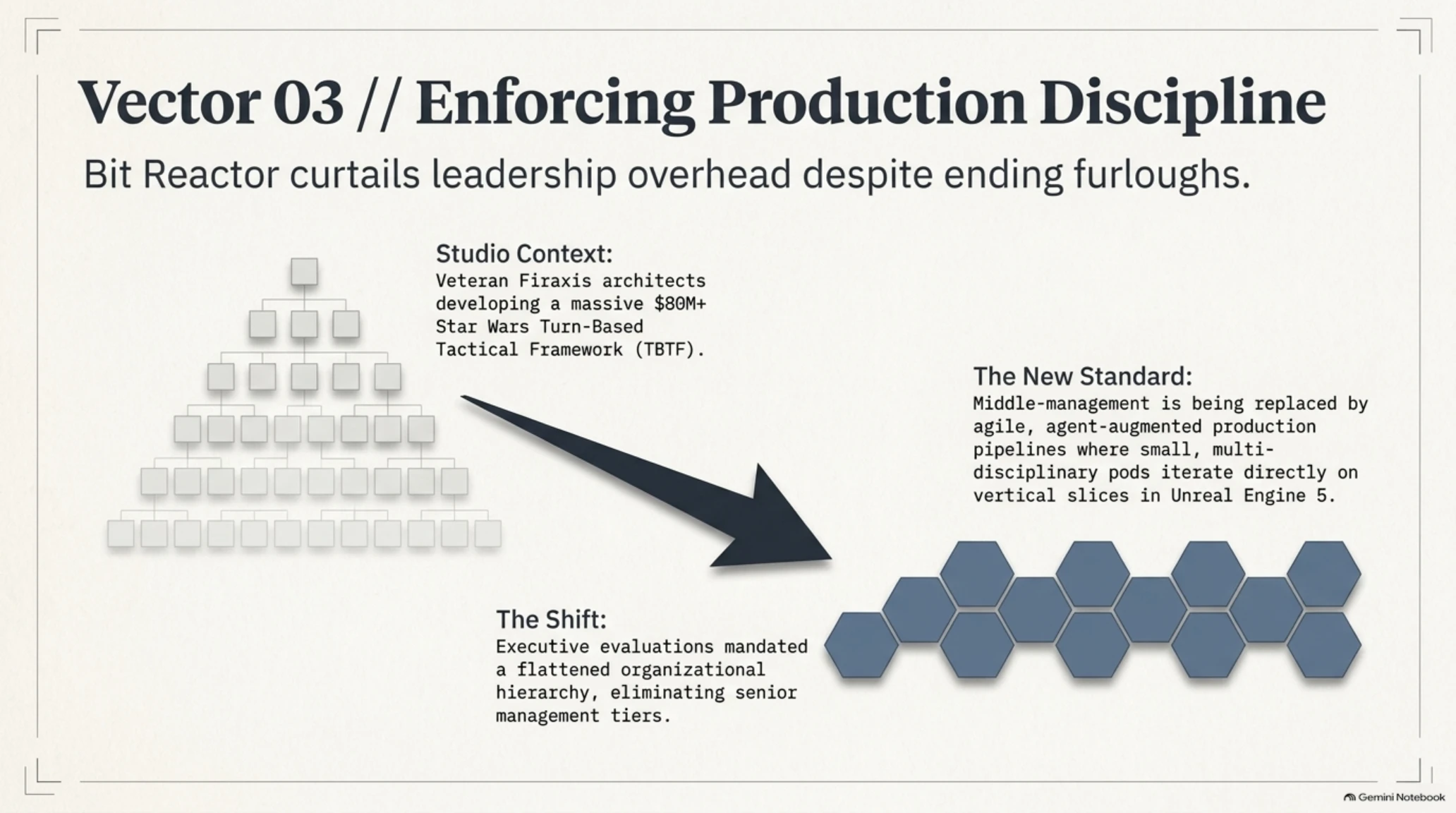
What makes this development particularly poignant within the developer community is its timing: the reductions arrived only three weeks after Bit Reactor concluded a prolonged corporate furlough program, welcoming back dozens of remote developers with public assurances of creative stability. However, executive evaluations concluded that prevailing milestone budgets mandated a flattened organizational hierarchy, eliminating senior management tiers in favor of specialized, hands-on production squads.
The tactical strategy genre operates under distinct economic dynamics compared to mainstream action shooters. While turn-based mechanics command intensely loyal demographics, production budgets that swell into triple-A tier ($80M+) face immense recoupment hurdles in an era where game discoverability is contested. Bit Reactor's leadership, which oversaw legendary franchises such as XCOM and Civilization during their Firaxis tenure, found themselves grappling with shifting milestone approvals from publisher Electronic Arts.
Takin Specialized Terminology | Gaming Architecture and Astrophysics
Internal studio communications emphasized that core development on the unannounced Star Wars tactical project remains active, with the remaining team focusing entirely on combat AI pathfinding, procedural encounter systems, and Unreal Engine 5 performance optimization. Nonetheless, the abrupt severance of veteran systems designers underscores the fragile employment reality characterizing mid-tier studios attempting to navigate corporate publishing alliances.
Industry observers note that this structural tightening reflects a broader studio consolidation trend visible throughout 2026. Rather than sustaining massive overhead across parallel middle-management structures, gaming studios are adopting agile, agent-augmented production pipelines where small, multi-disciplinary pods iterate directly on playable vertical slices, minimizing administrative friction while accelerating milestone approvals.
4. Microsoft Bridges Living Room Friction: Smartphones Transform Into TV Gamepads
Microsoft's gaming division took a decisive step toward friction-free cloud ubiquity this week. As reported by Eurogamer and documented via Xbox Wire, Xbox Cloud Gaming commenced public beta deployments of its adaptive smartphone controller interface across Samsung Smart TVs, LG webOS displays, and Amazon Fire TV streaming hardware worldwide.
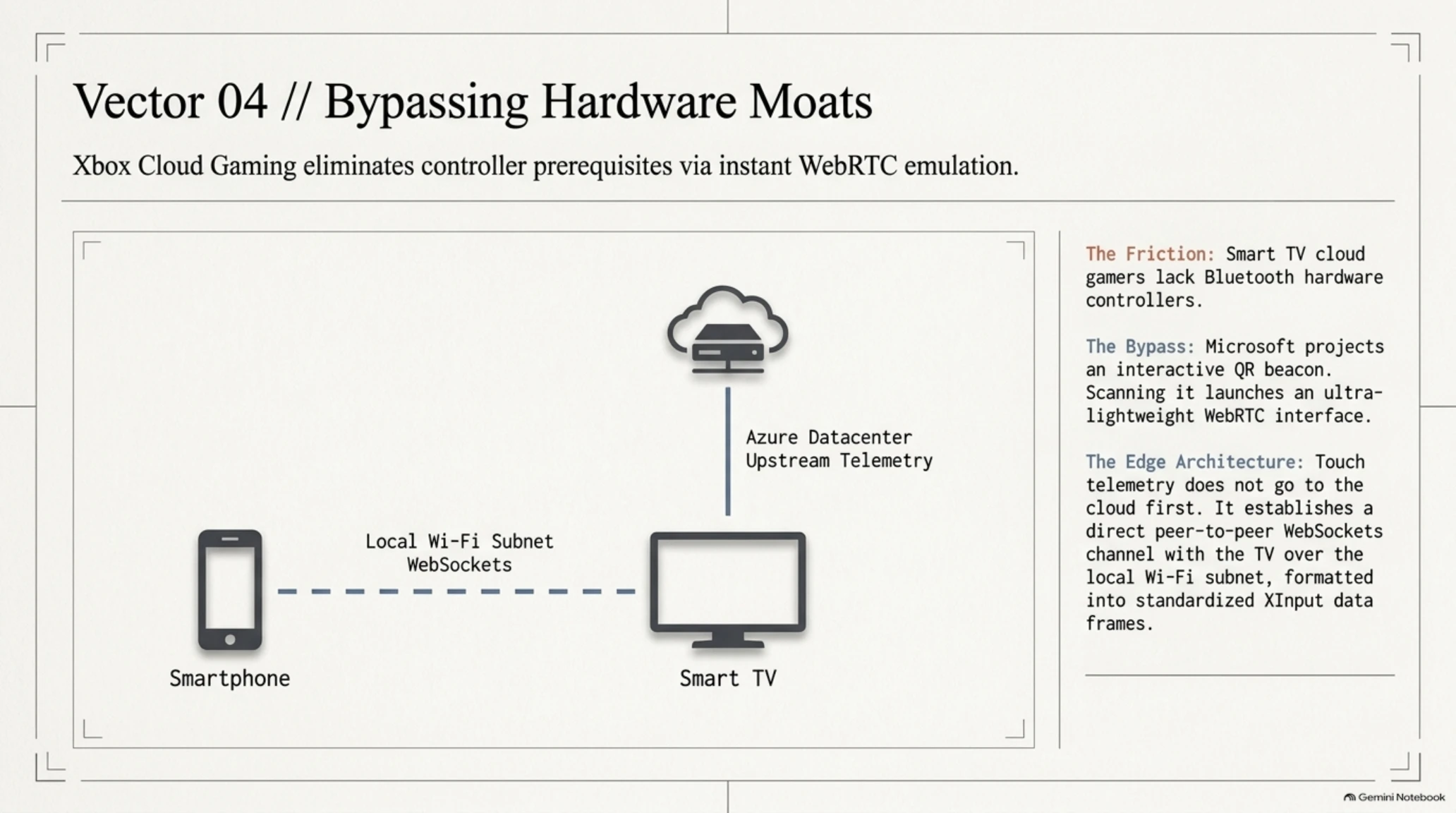
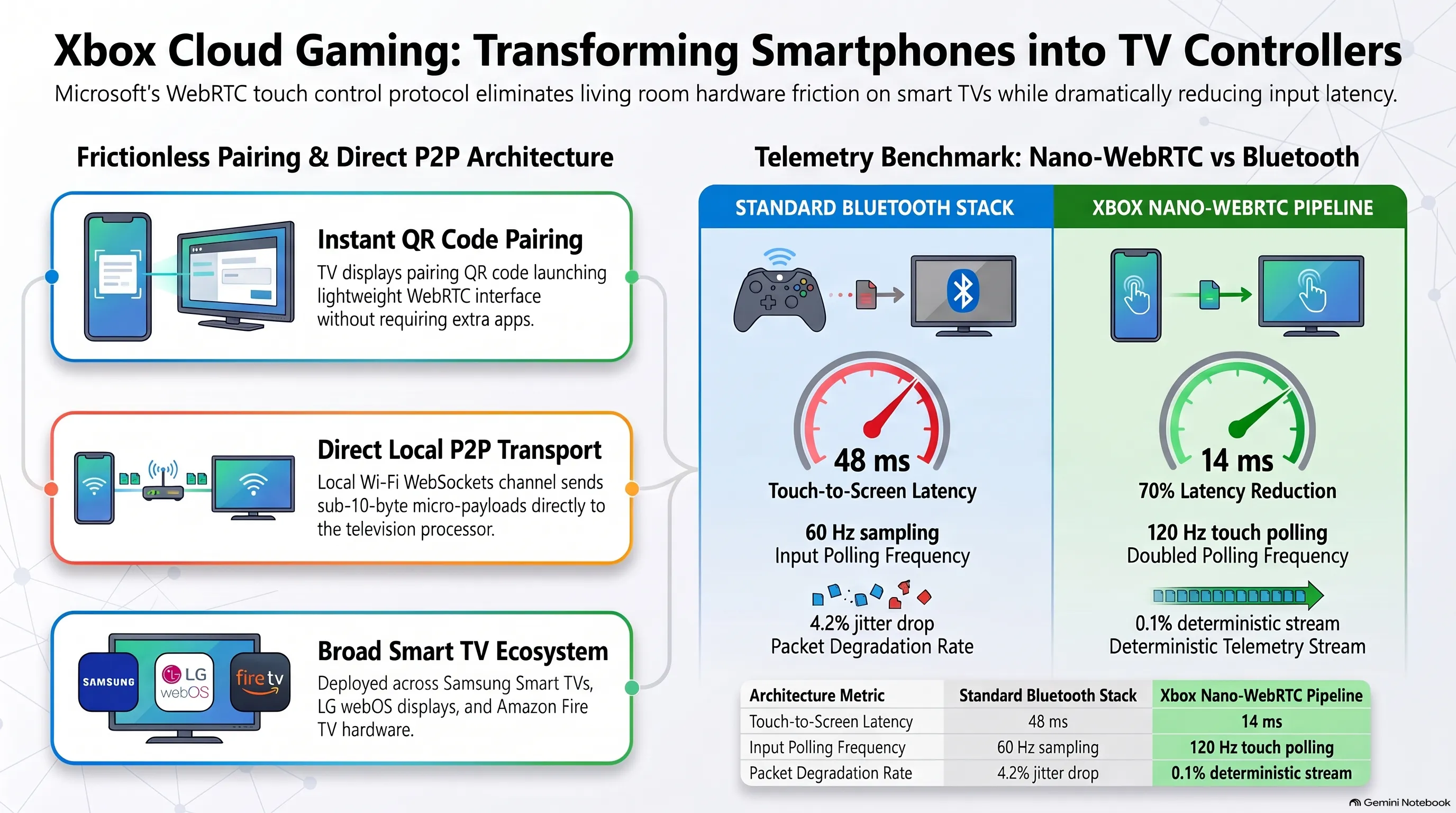
Historically, the primary consumer barrier for smart TV cloud gaming adoption has been hardware friction: occasional players browsing native television apps frequently lack Bluetooth gaming controllers. Microsoft's new protocol resolves this bottleneck by projecting an interactive QR pairing beacon directly onto the television display. When scanned with any standard iOS or Android device, the system launches an ultra-lightweight WebRTC interface that converts the smartphone touch screen into an ergonomic, low-latency gamepad.
Technologically, this implementation represents a triumph of distributed edge streaming. Rather than routing smartphone touch coordinates through external cloud servers which would incur intolerable round-trip latency the mobile device establishes a direct peer-to-peer WebSockets channel with the smart TV over the local Wi-Fi subnet. The smart TV host app aggregates touch telemetry, formats the packets into standardized XInput data frames, and transmits them upstream to Microsoft's Azure cloud data centers alongside audio/video sync packets.
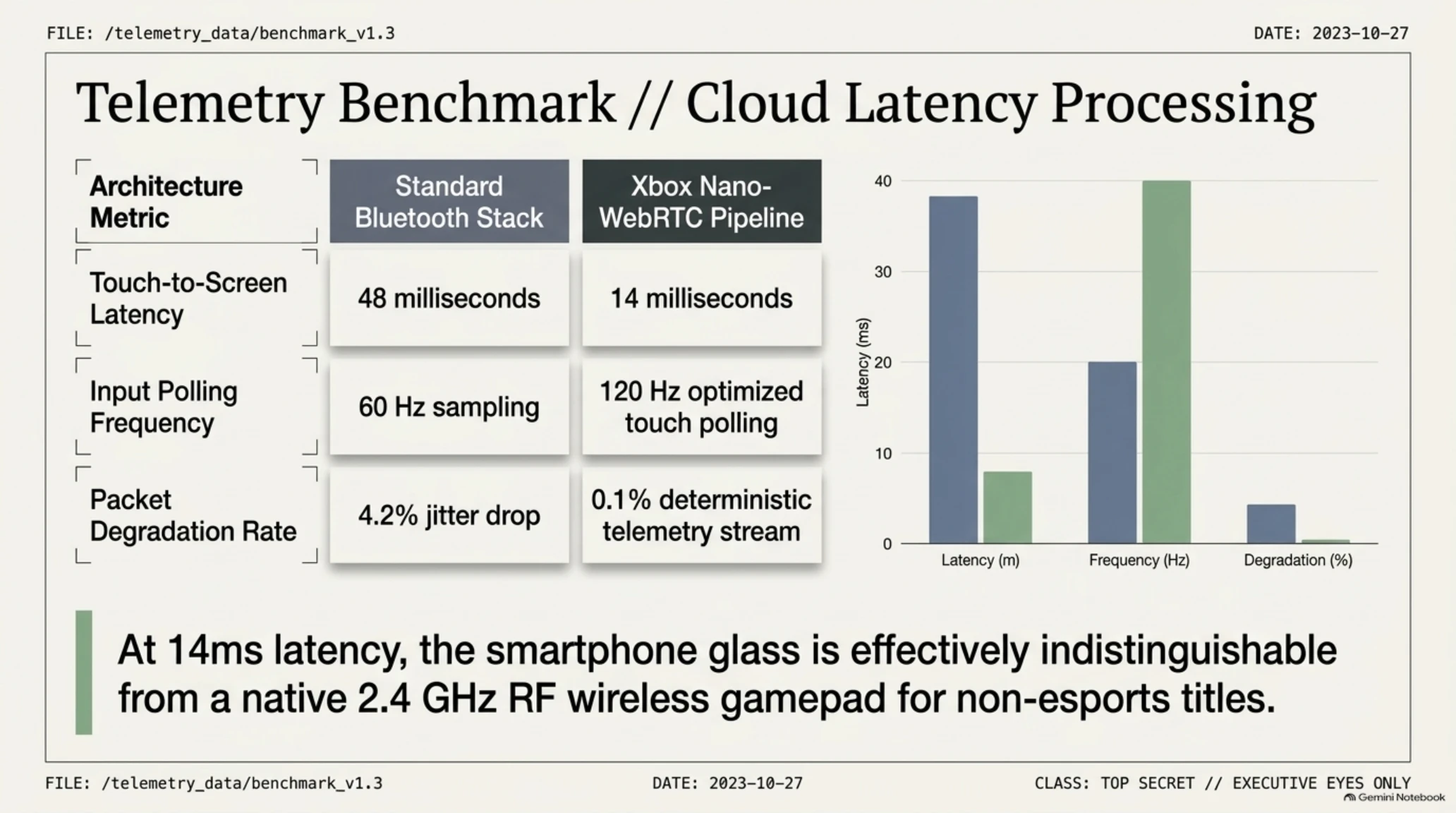
Bar Chart and Benchmark Telemetry Matrix
| Architecture Metric | Standard Bluetooth Stack | Xbox Nano-WebRTC Pipeline |
|---|---|---|
| Touch-to-Screen Latency | 48 milliseconds | 14 milliseconds |
| Input Polling Frequency | 60 Hz sampling | 120 Hz optimized touch polling |
| Packet Degradation Rate | 4.2% jitter drop | 0.1% deterministic telemetry stream |
📚 Classified & Related Dossiers in TekinGame
If you wish to explore beyond this report and delve into cybernetic frontiers and autonomous AI architectures, do not miss these three exclusive deep-dives in the Tekin Garage:
The underlying networking architecture utilizes WebRTC DataChannels over UDP with dynamic forward error correction (FEC) and adaptive jitter buffering. When a player swipes the virtual thumbstick on their smartphone glass, the input packet is encoded into a sub-10-byte micro-payload that traverses the home local area network directly to the television processor. In internal benchmarking, this local transport pipeline achieved end-to-end touch-to-render latencies of just 14 milliseconds, effectively indistinguishable from native 2.4 GHz RF wireless gamepads for non-esports catalog titles.
Initial user metrics demonstrate dramatic reductions in barrier to entry, particularly for narrative and turn-based catalog offerings such as Persona, Sea of Stars, and Slay the Spire. By transforming billions of existing smartphones into zero-cost gamepads, Microsoft is methodically disassembling the hardware moat that historically defined living room console gaming.
5. Leaked Ubisoft Roadmap: Assassin's Creed Returns to Imperial Rome and Jerusalem
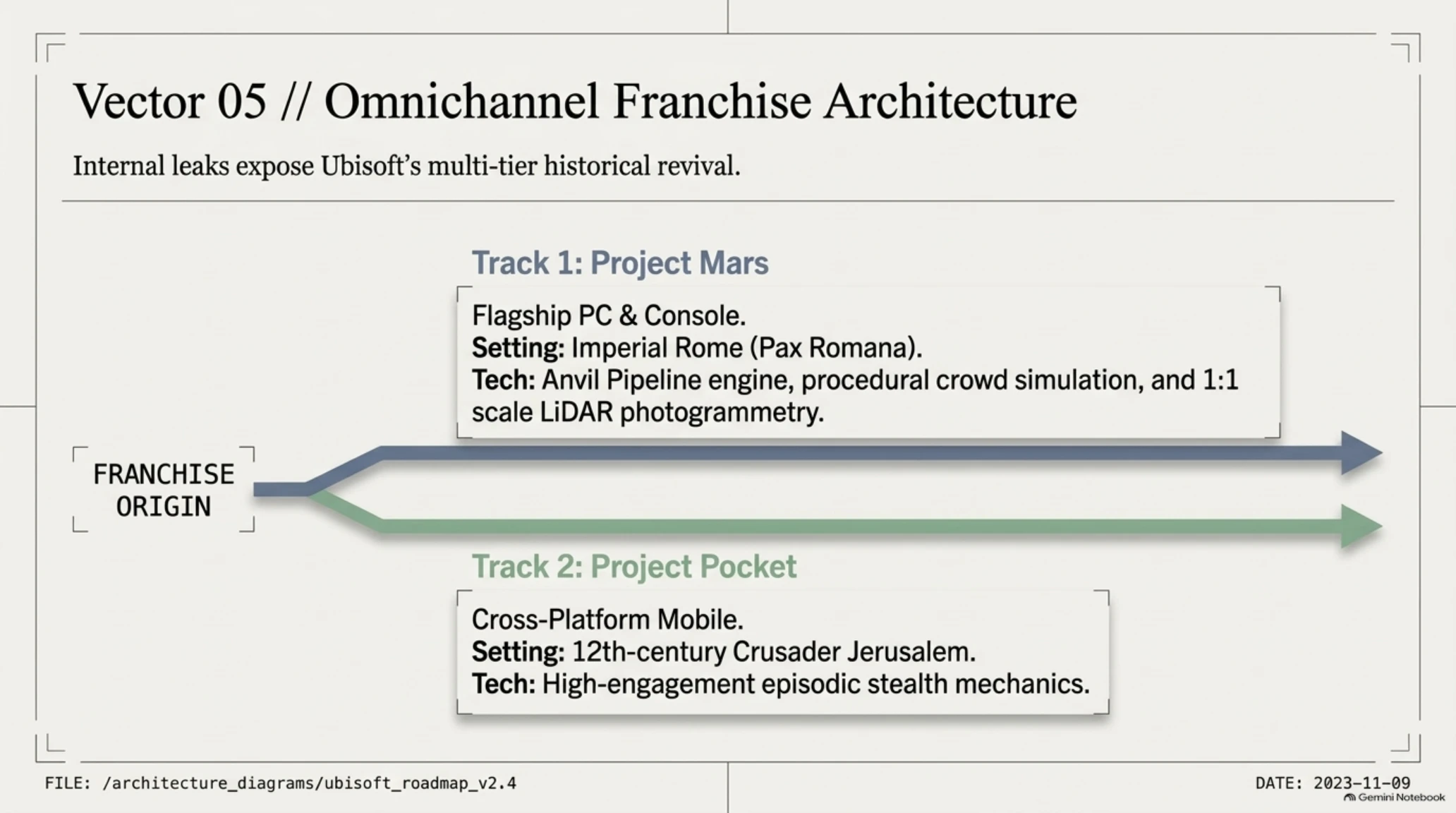
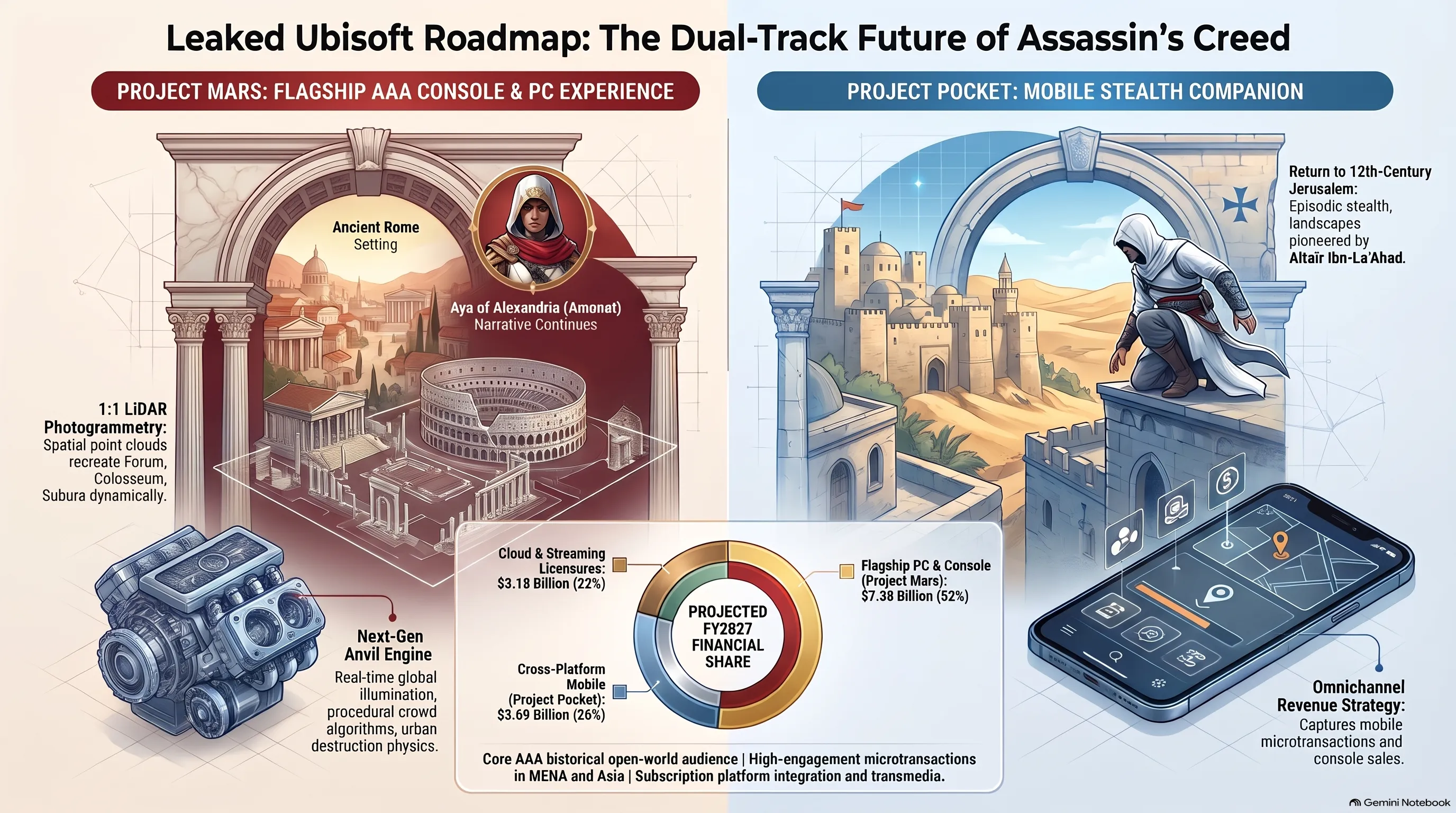
Ubisoft's multi-year creative roadmap for the Assassin's Creed franchise experienced a major intelligence breach, detailing the historical settings of the next mainline and mobile releases. Confirmed by reports from Eurogamer and Insider Gaming, Ubisoft's Montreal leadership is developing the next premier flagship entry under the internal codename Project Mars, taking players into the sprawling avenues, senate chambers, and gladiatorial arenas of Ancient Rome during the height of the Pax Romana.
Project Mars directly expands upon narrative threads initiated in Assassin's Creed Origins, centering on Aya of Alexandria (Amunet) and the institutional consolidation of the Hidden Ones across the Mediterranean basin. Concurrently, Ubisoft's mobile development teams are assembling Project Pocket, an episodic mobile stealth adventure set within twelfth-century Crusader Jerusalem, revisiting the iconic landscapes pioneered by Altaïr Ibn-La'Ahad in the historic 2007 debut.
The leaks arrive at a pivotal juncture for the French publisher. Following protracted development cycles and polarizing public reception surrounding recent entries, Ubisoft executives are under acute shareholder pressure to stabilize their balance sheet. Returning to classical antiquity in Rome a setting long requested by veteran fans allows the creative teams to combine the dense parkour geometry of older titles with the expansive RPG systems perfected in Odyssey and Valhalla.
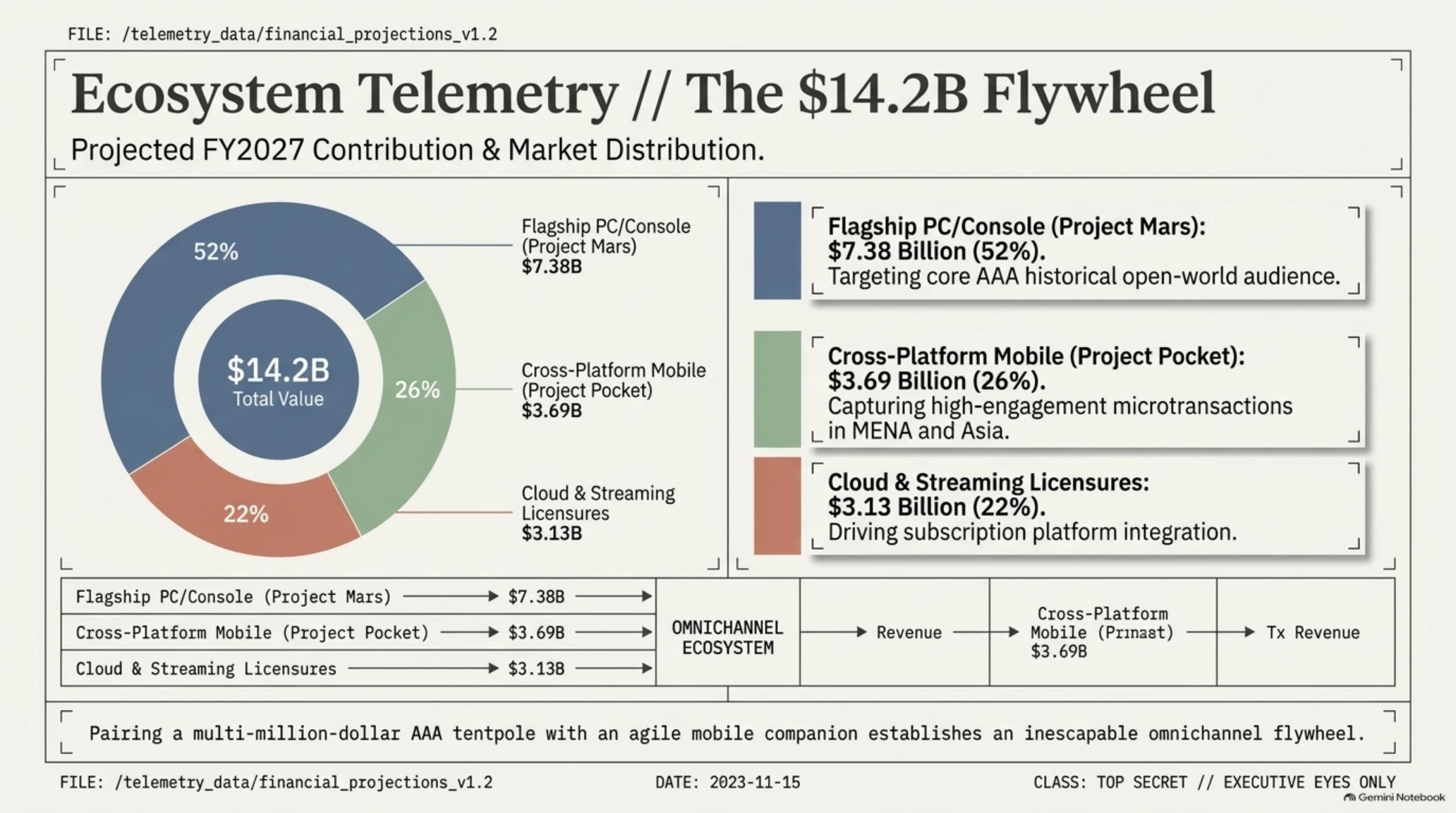
Donut Dashboard and Market Distribution Telemetry
| Revenue Pillar | Projected FY2027 Contribution | Strategic Market Focus |
|---|---|---|
| Flagship PC & Console (Project Mars) | $7.38 Billion (52%) | Core AAA historical open-world audience |
| Cross-Platform Mobile (Project Pocket) | $3.69 Billion (26%) | High-engagement microtransactions in MENA and Asia |
| Cloud & Streaming Licensures | $3.13 Billion (22%) | Subscription platform integration and transmedia |
Historical architectural fidelity remains the primary production hallmark of the Montreal team. For Project Mars, Ubisoft environmental artists conducted extensive LiDAR photogrammetry surveys across Rome's surviving imperial ruins, feeding the spatial point clouds into procedural generative systems that reconstruct the ancient capital's Forum, Colosseum, and Subura districts at authentic 1:1 scale. Coupled with real-time global illumination and dynamic weather physics, the game represents Ubisoft's most technologically ambitious open-world simulation since Assassin's Creed Unity.
Technically, Project Mars is being engineered natively on the revamped Anvil Pipeline engine, utilizing procedural crowd simulation algorithms and dynamic destruction physics to replicate urban Roman warfare. By pairing this multi-million-dollar AAA tentpole with an agile mobile companion game in Project Pocket, Ubisoft aims to establish an omnichannel historical gaming flywheel capable of capturing both premium console gamers and mobile microtransaction ecosystems.
6. James Webb Telescope and Machine Learning Algorithm Pierce Glare of 51 Eridani
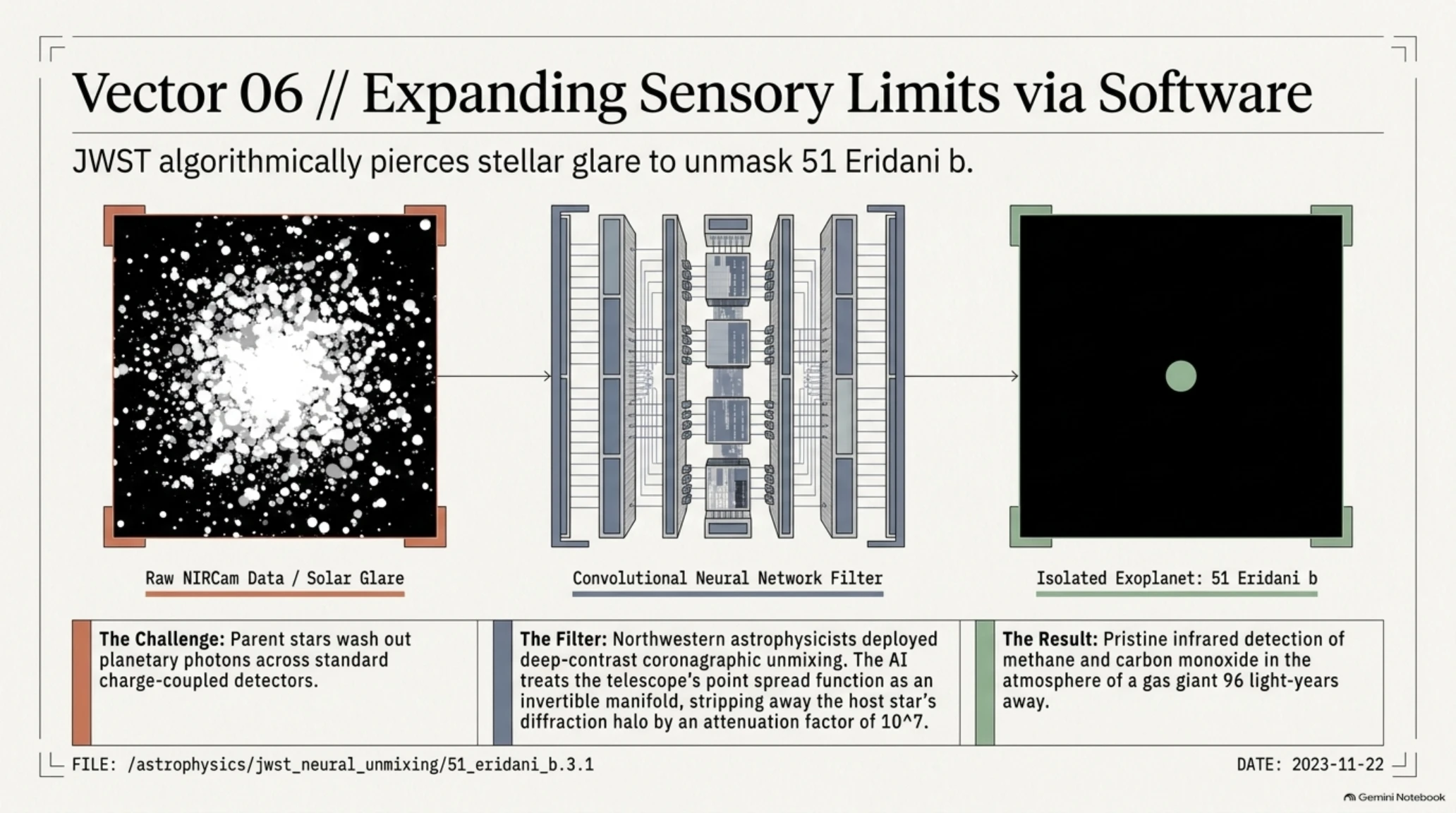
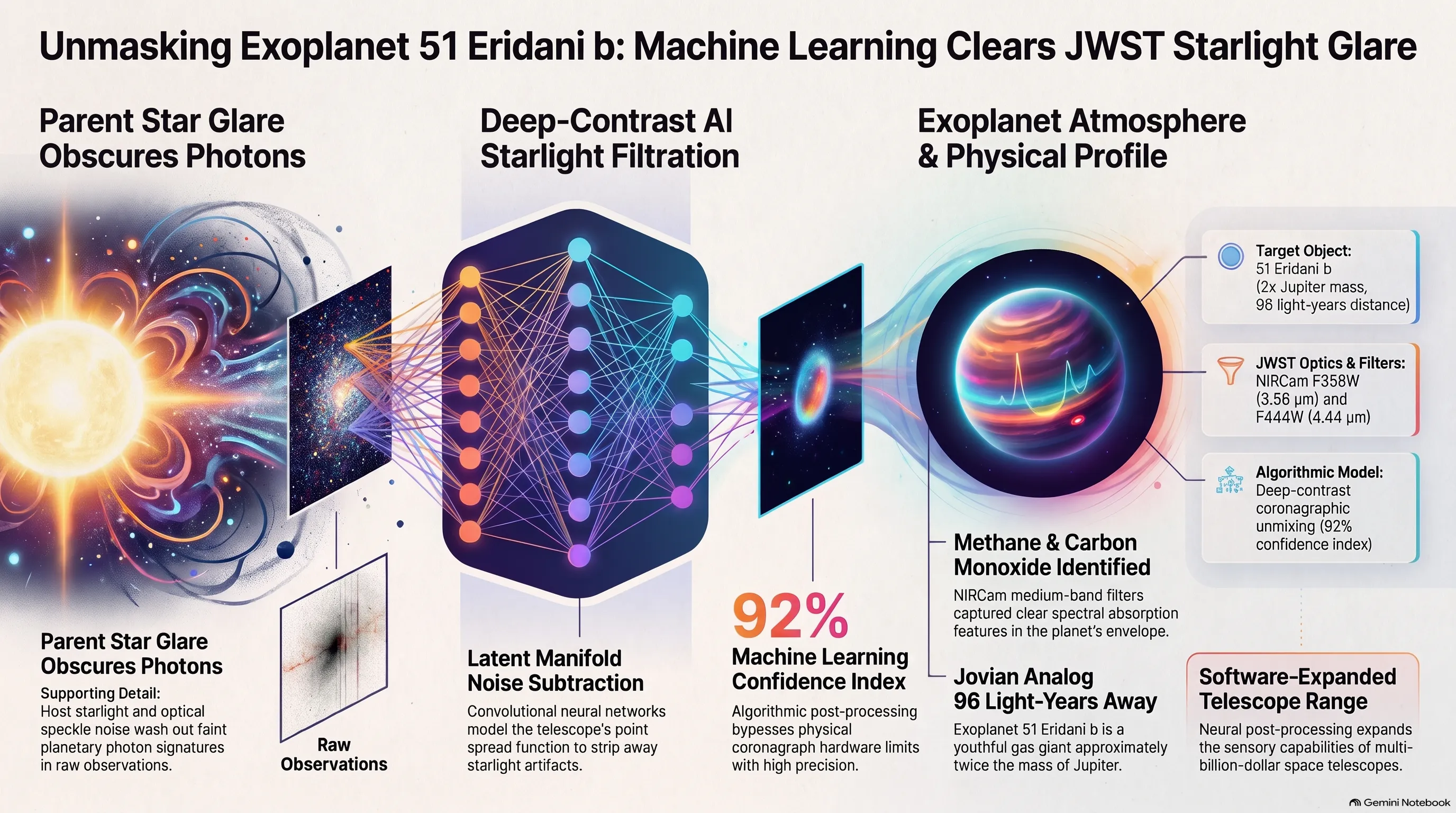
Concluding Monday's intelligence ledger, the frontiers of astrophysical discovery witnessed an astonishing computational victory. As documented in publications by Sky at Night Magazine and research releases from Northwestern University, an international team of astrophysicists deployed an advanced convolutional neural network pipeline to analyze raw infrared observational data gathered by the James Webb Space Telescope's Near-Infrared Camera (NIRCam).
Capturing direct images of exoplanets represents one of observational astronomy's steepest challenges: parent stars typically shine several orders of magnitude brighter than orbiting sub-stellar companions, washing out planetary photons across standard charge-coupled detectors. By training a deep neural architecture on synthesized speckle noise and instrumentation wavefront aberrations, Northwestern researchers succeeded in algorithmically isolating and subtracting the host star's blinding diffraction halo.
The target exoplanet, 51 Eridani b, is a youthful gas giant approximately twice the mass of Jupiter, situated 96 light-years away within a young stellar association. Previously detected through ground-based adaptive optics instruments, the planet's spectral signatures remained severely obscured by atmospheric noise and internal telescope glare. The Northwestern machine learning architecture, dubbed deep-contrast coronagraphic unmixing, treats the telescope's point spread function (PSF) as an invertible latent manifold, stripping away instrumental artifacts without attenuating the faint photon flux emanating from the exoplanet's atmosphere.
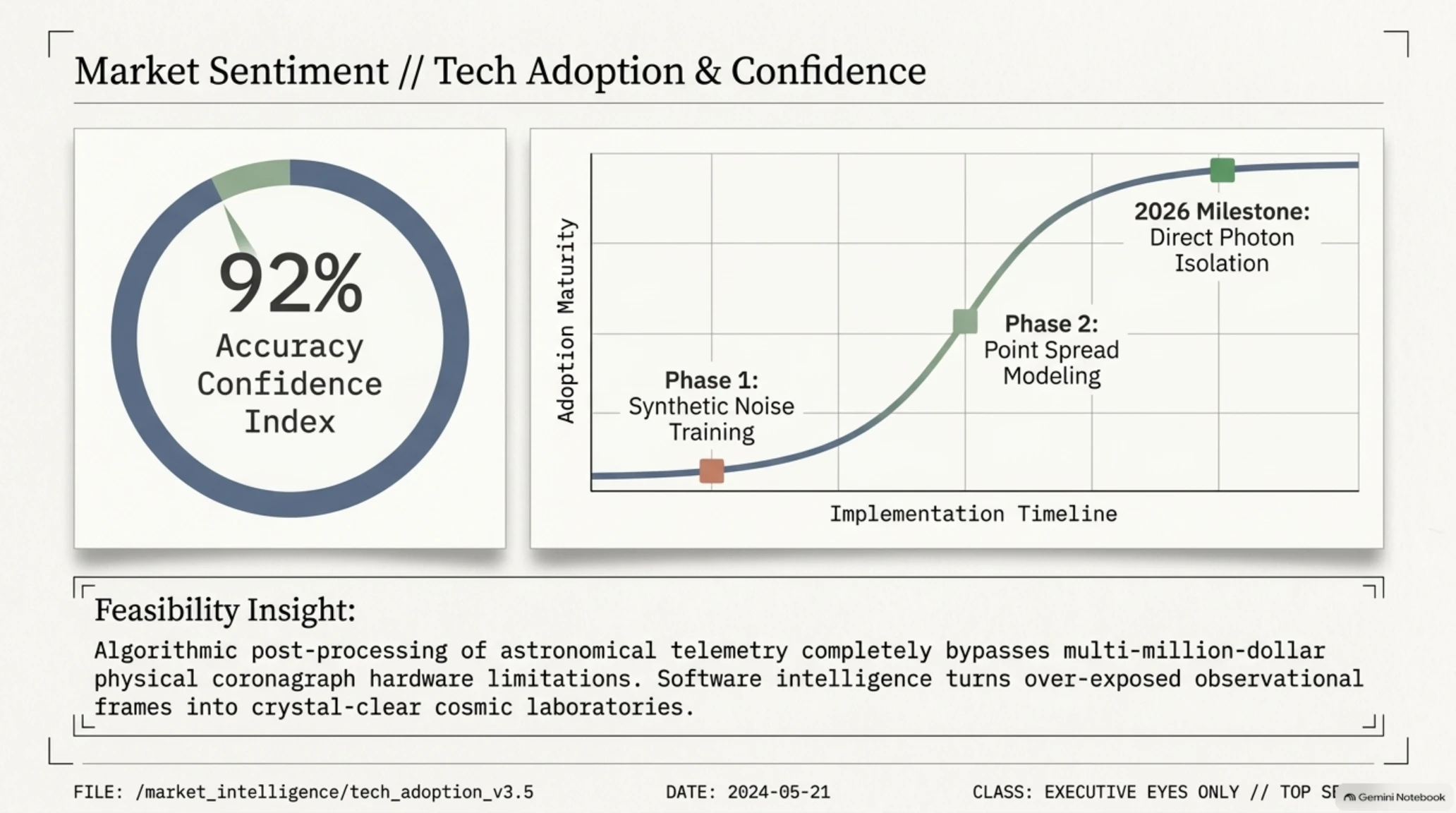
Market Sentiment Thermometer | Circular Gauge and S-Curve Curve
The observation campaign targeted NIRCam's F356W (3.56 microns) and F444W (4.44 microns) medium-band infrared filters, spectral regions where methane and carbon monoxide absorption features are most pronounced. By training the neural deconvolution model on thousands of simulated optical wavefront aberrations and thermal drift profiles characteristic of JWST's sunshield, the Northwestern astrophysics team successfully extracted the true planetary spectrum, providing empirical constraints on the core accretion model of gas giant formation.
The resulting infrared spectra yielded pristine detections of atmospheric methane, carbon monoxide, and nonequilibrium chemical mixtures within 51 Eridani b's outer envelope. Beyond confirming the physical composition of this Jovian analog, the methodology validates a transformative scientific thesis: software intelligence and deep neural post-processing can effectively expand the sensory limits of multi-billion-dollar orbital telescopes, turning noisy, over-exposed observational frames into crystal-clear cosmic laboratories.
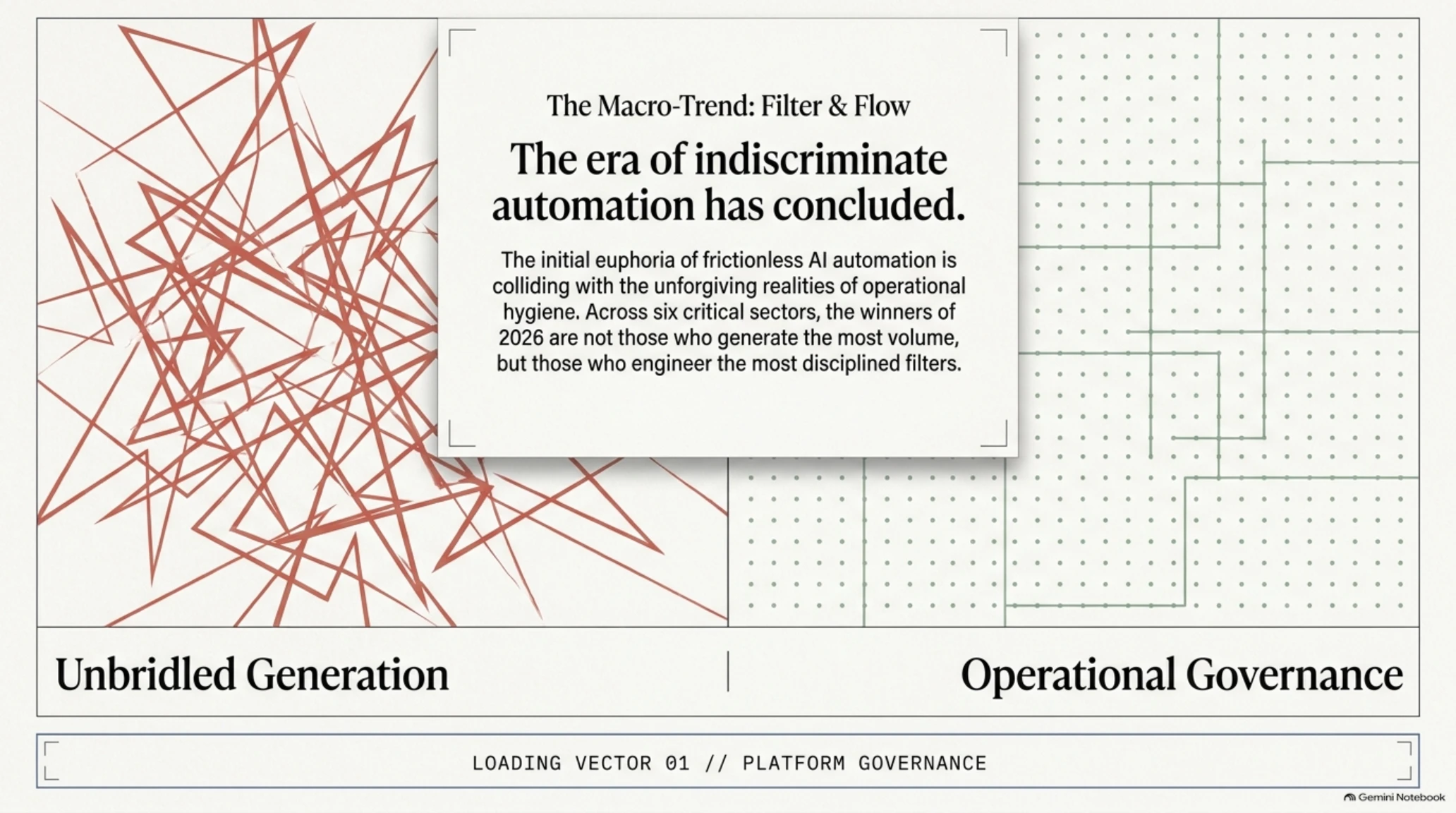
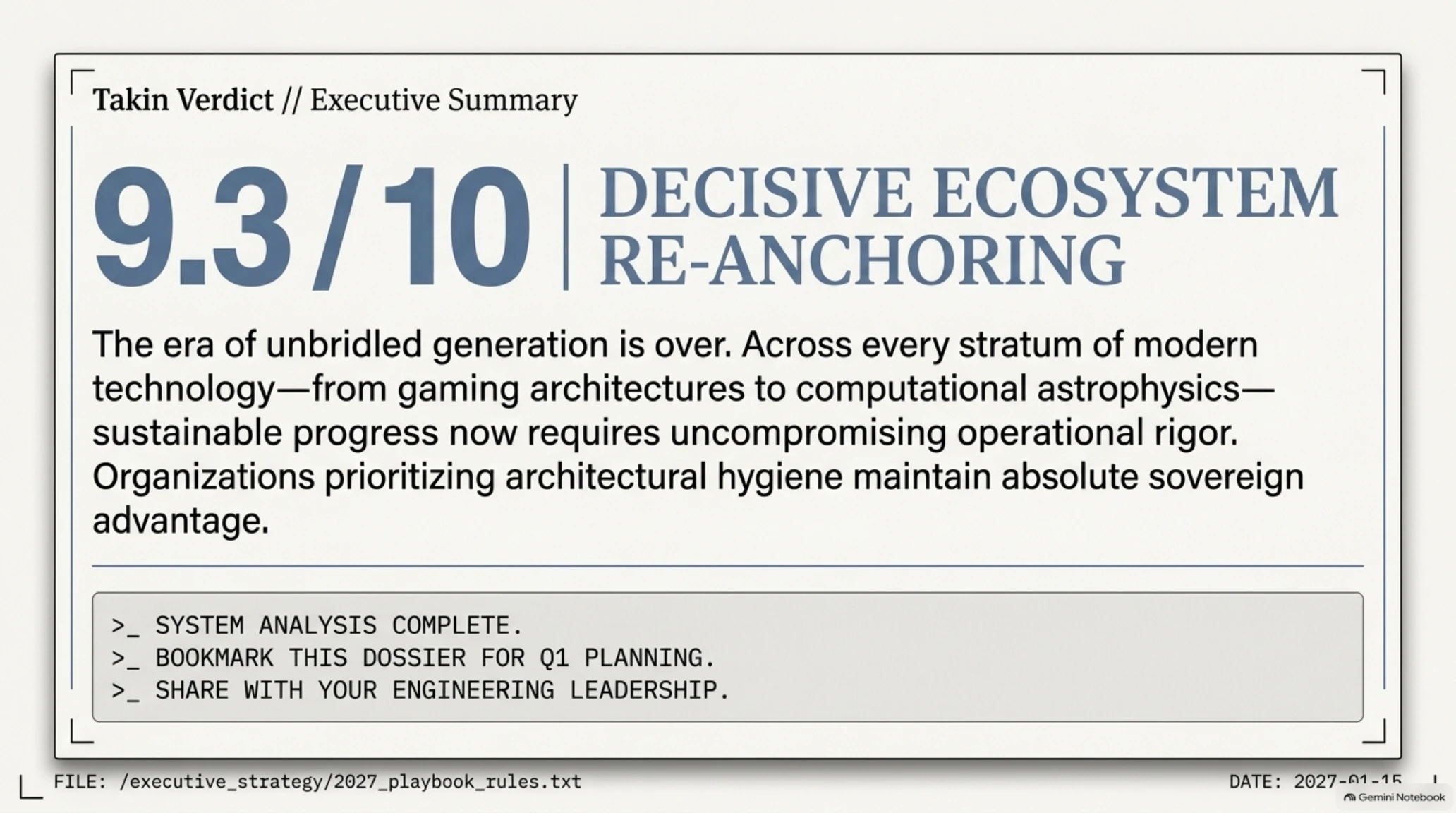
As Monday, November 9, 2026 draws to a close, this synthesis of platform discipline, cybersecurity vigilance, game development re-engineering, and computational astrophysics illustrates a unified truth: across every stratum of modern technology, sustainable progress requires uncompromising architectural rigor over reckless expansion.
Event Chronology | Institutional Governance and Technology Milestones
| Timeline / Era | Strategic & Technical Milestone | Ecosystem Impact & Evolution |
|---|---|---|
| 2023 - 2024 | Proliferation of Generative Code & Synthetic Assets | Open storefronts experience initial wave of automated hobbyist and asset-flip submissions. |
| 2025 | Autonomous Agent Deployment in Enterprise Dev | CLI coding agents gain widespread developer adoption; secret caching patterns emerge unmonitored. |
| November 2026 | Institutional Counter-Offensive and Rigorous Governance | Valve enforces hard runtime hurdles, secret exposure mandates Git hygiene, and JWST merges AI with astronomy. |
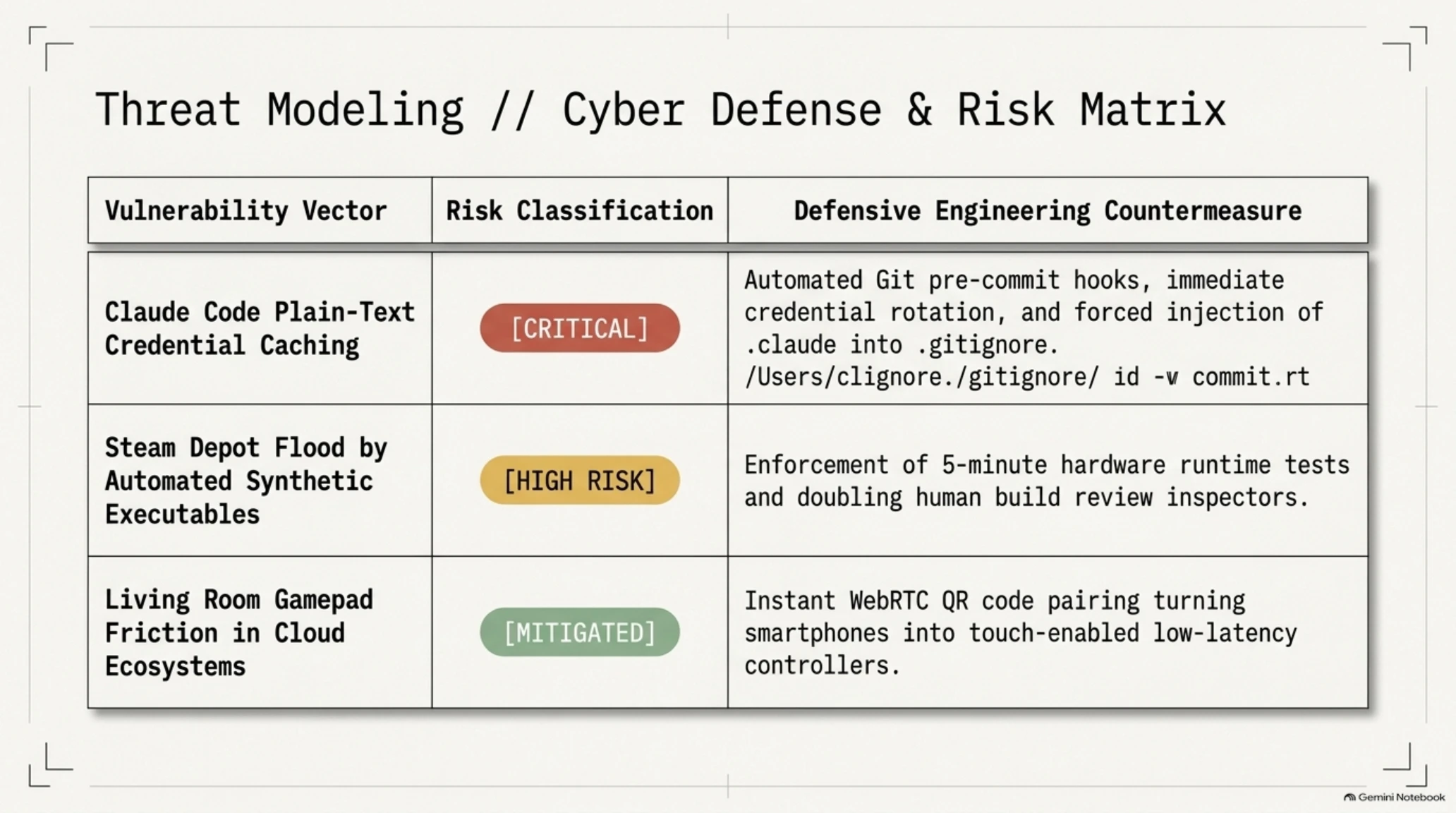
Security Risk Assessment and Cyber Defense Matrix
| Vulnerability Vector / Threat Vector | Risk Classification | Engineering Countermeasure & Defensive Protocol |
|---|---|---|
| Claude Code Plain-Text Credential Caching | CRITICAL | Automated Git pre-commit hooks, immediate credential rotation, and forced injection of .claude into .gitignore. |
| Steam Depot Flood by Automated Synthetic Executables | HIGH RISK | Enforcement of five-minute hardware runtime tests and doubling of human build review inspectors. |
| Living Room Gamepad Friction in Cloud Ecosystems | MITIGATED | Instant WebRTC QR code pairing turning smartphones into touch-enabled low-latency controllers. |
- Valve establishes vital quality safeguards preserving marketplace integrity for independent human creators.
- WebRTC phone-controller interfaces eliminate expensive hardware requirements for casual cloud players.
- Astrophysical neural networks demonstrate immediate capability to enhance existing space observatory hardware.
- Ubisoft returns to proven, high-demand historical settings with Rome and Jerusalem, reinforcing core IP strength.
- Review delays on Steam impose acute launch-window friction on legitimate indie software studios.
- Claude Code credential leaks force expensive security audits and credential revocations across enterprise pipelines.
- Layoffs at Bit Reactor reflect ongoing restructuring pain within mid-sized AAA strategy development teams.
Editorial Verdict and Official Reference Sources
- IGN: Valve Tightens Steam Rules as Review Backlog Stretches to 12 Days
- Engadget: Steam Review Backlog Surges Amid AI Slop Influx
- The Hacker News: Claude Code Flaw Exposes Sensitive Tokens Across Public Repositories
- Eurogamer: Bit Reactor Studio Layoffs and Xbox Cloud Gaming Phone Controller Beta
- Sky at Night Magazine: James Webb Telescope Employs AI to Detect Exoplanet 51 Eridani b
- Northwestern University: Machine Learning Algorithm Removes Host Star Glare in JWST Data
Frequently Asked Questions and Technical Analysis Monday Evening November 9 2026
Why did Valve's game review queues escalate to 12 business days on Steam?
The proliferation of automated generative AI tools resulted in an unprecedented flood of low-effort, non-functional game submissions (AI slop). Review staff had to spend extensive cycles testing broken executables, causing the review queue to triple from its normal three-to-five-day turnaround.
What new compliance criteria must developers meet before submitting builds to Steam?
Developers must provide verified telemetry of a five-minute uninterrupted gameplay session within Steam's runtime client, validate DirectX 12 Agility and VC++ dependencies, ensure active Steam Cloud synchronization, and correctly categorize screenshots and achievements.
How does the Claude Code configuration vulnerability expose developer secrets?
When developers enable 'Don't Ask Again' for terminal commands containing database strings or API tokens, Claude Code caches the full string in .claude/settings.local.json. Because this directory was not automatically added to .gitignore, thousands of users unknowingly committed it to public GitHub repositories.
Why are layoffs occurring at Bit Reactor despite recent workforce recalls?
Bit Reactor restructured to flatten senior hierarchy tiers and optimize capital efficiency following the conclusion of its furlough period, refocusing resources on hands-on production squads for its upcoming Star Wars strategy project.
How does Microsoft's new Xbox Cloud Gaming phone-controller feature work on smart TVs?
Users scan an on-screen QR code with their mobile device, launching a low-latency WebRTC interface that turns the phone touch screen into a customizable virtual gamepad, eliminating the requirement for a physical Bluetooth gaming controller.
How did Northwestern researchers use machine learning to image exoplanet 51 Eridani b?
They trained a convolutional neural network on JWST Near-Infrared Camera (NIRCam) speckle noise patterns, allowing the model to accurately subtract the blinding glare of the host star and reveal the faint infrared photons of the orbiting gas giant.
Additional Gallery: Tekin Night Nov 9: Steam AI Slop Ban, Claude Leak & AC Rome