A comprehensive architectural investigation into Apple's quiet deployment of $49.99 Intelligence Usage Packs within Logic Pro for macOS. We dissect the demise of the zero-cost Apple Intelligence marketing narrative, evaluate the heavy capital expenditures of Private Cloud Compute (PCC) server clusters, scrutinize strict token quota throttling, analyze the total prohibition against Family Sharing, and project its expansion to Final Cut Pro.
Tekin Radar | The End of Free Apple Intelligence: The $50 Usage Pack Shock and Cloud AI Rationing in Cupertino
For more than two years, Apple executive leadership presented a frictionless, utopian narrative regarding the commercial deployment of Apple Intelligence. Across multiple Worldwide Developers Conferences (WWDC) and high-production launch events, Tim Cook and Craig Federighi repeatedly contrasted Cupertino vision with that of Microsoft, Google, and OpenAI. While rival hyperscalers charged recurring twenty-dollar monthly tolls for advanced large language model access, Apple assured hundreds of millions of iPhone, iPad, and Mac users that intelligence was baked fundamentally into the hardware purchase price, delivered entirely without incremental subscription extortion.
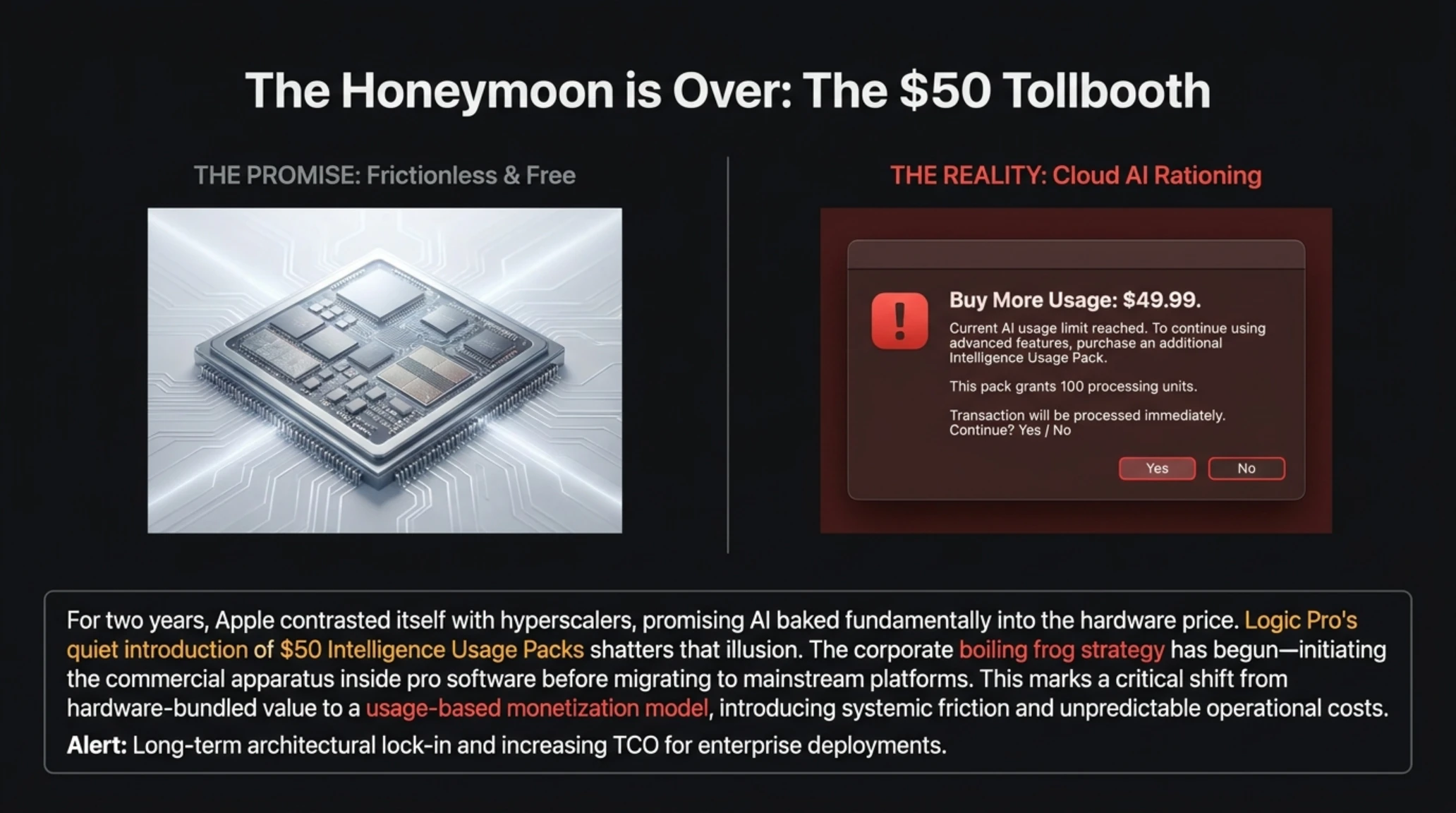
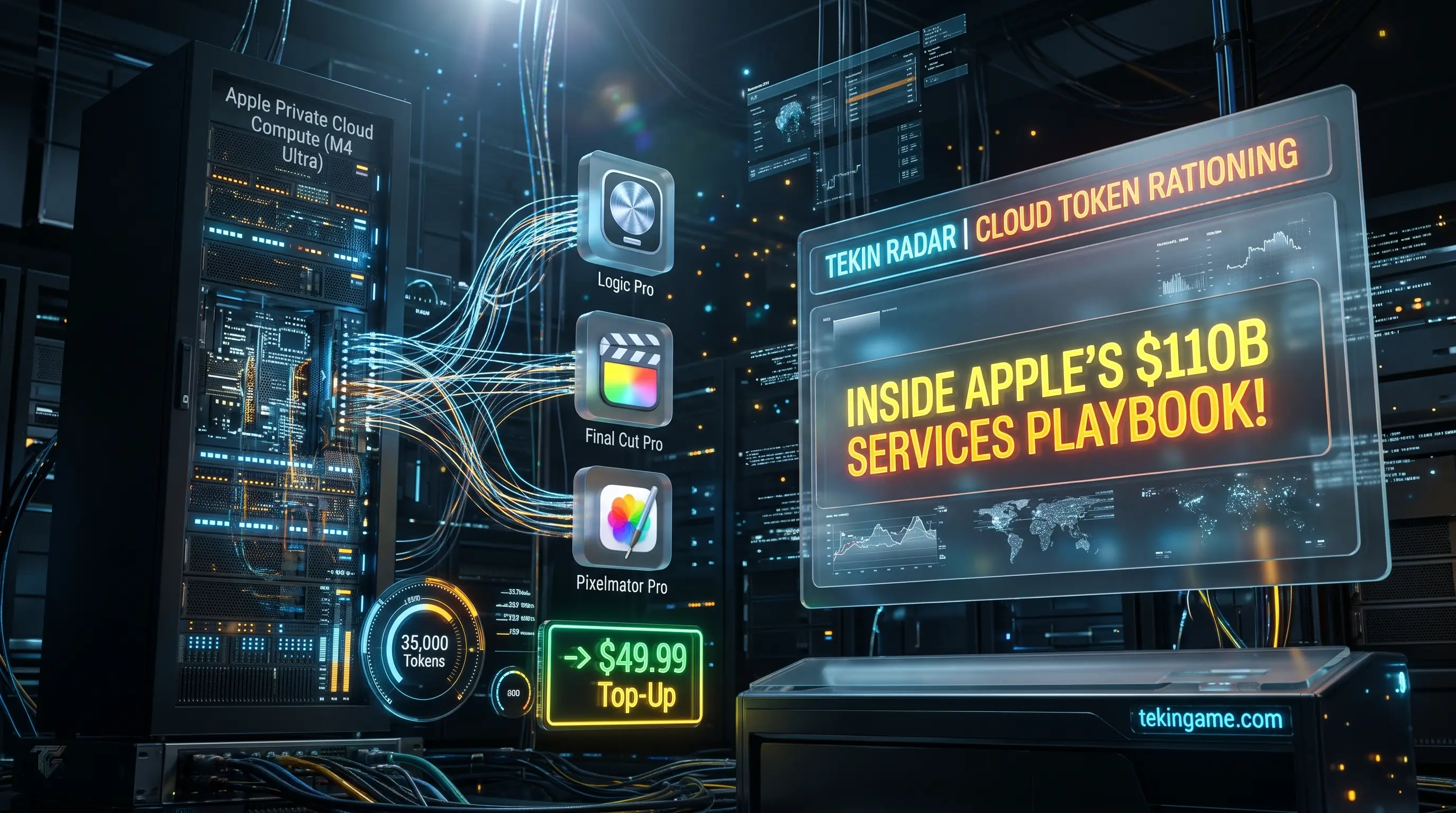
That carefully curated honeymoon has now officially drawn to an abrupt conclusion. Documentation unsealed from the latest update to Apple flagship professional audio workstation, Logic Pro on macOS, exposes a newly minted commercial subsystem called Intelligence Usage Packs. Nestled quietly within application menus under a new Buy More Usage prompt, Apple now demands a steep $49.99 one-time top-up from users who exhaust their monthly generative cloud computing allocation. This architectural shift marks the definitive end of unmetered Apple Intelligence and establishes a precedent for cloud token rationing across Apple entire software footprint.
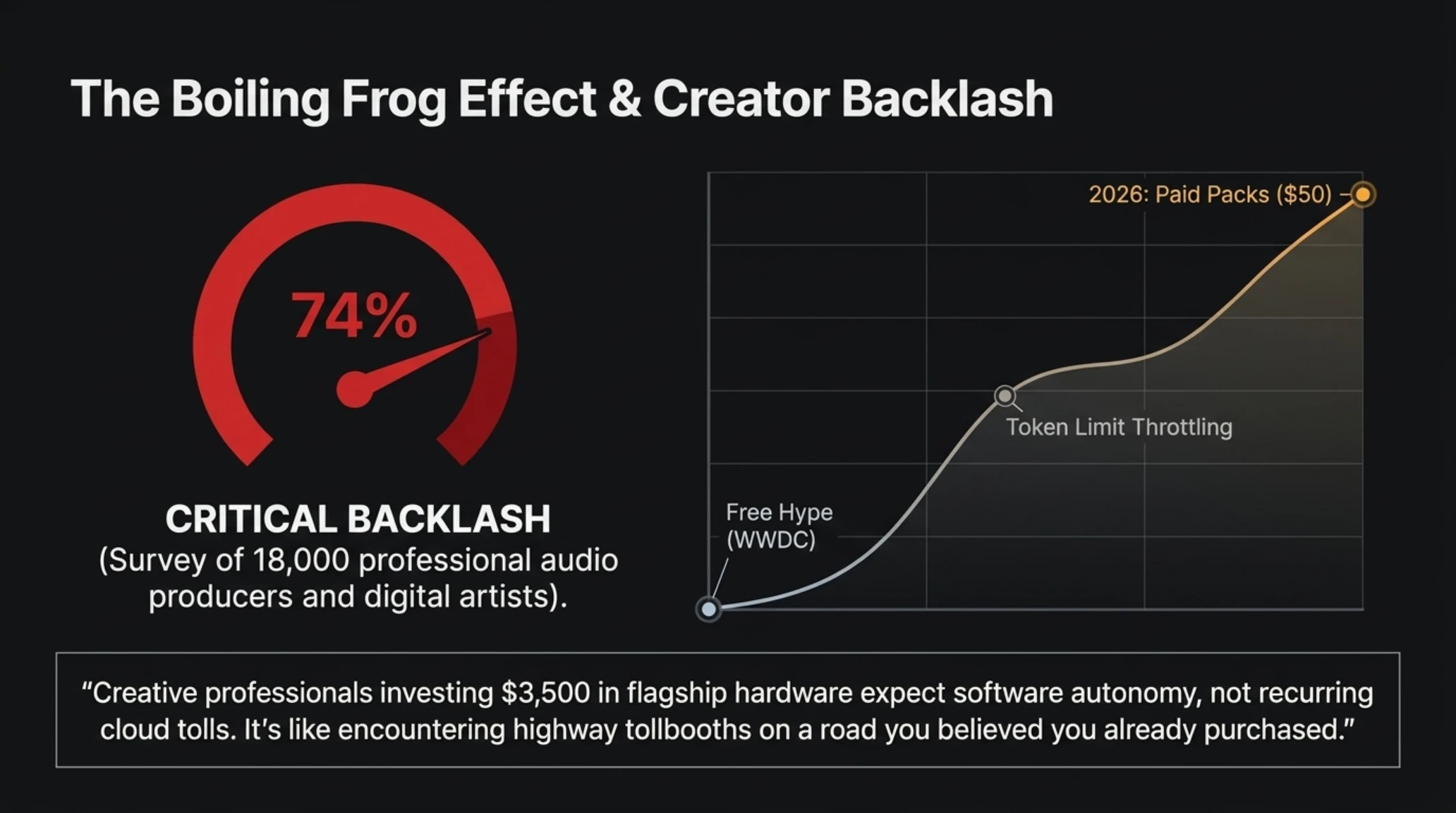
This tactical maneuver represents a textbook execution of the corporate boiling frog strategy. Rather than risk catastrophic public relations fallout by abruptly paywalling core consumer iOS features such as Siri summarization, system writing tools, or photo retouching, Apple has initiated the monetization apparatus inside high-end professional creative software. By testing consumer price elasticity among professional music producers, video editors, and audio engineers enrolled in the Apple Creator Studio umbrella, Cupertino establishes the billing rails, entitlement checks, and quota throttles required to eventually commercialize cloud intelligence across mainstream mobile platforms.
Strategic Assessment and Key Takeaways
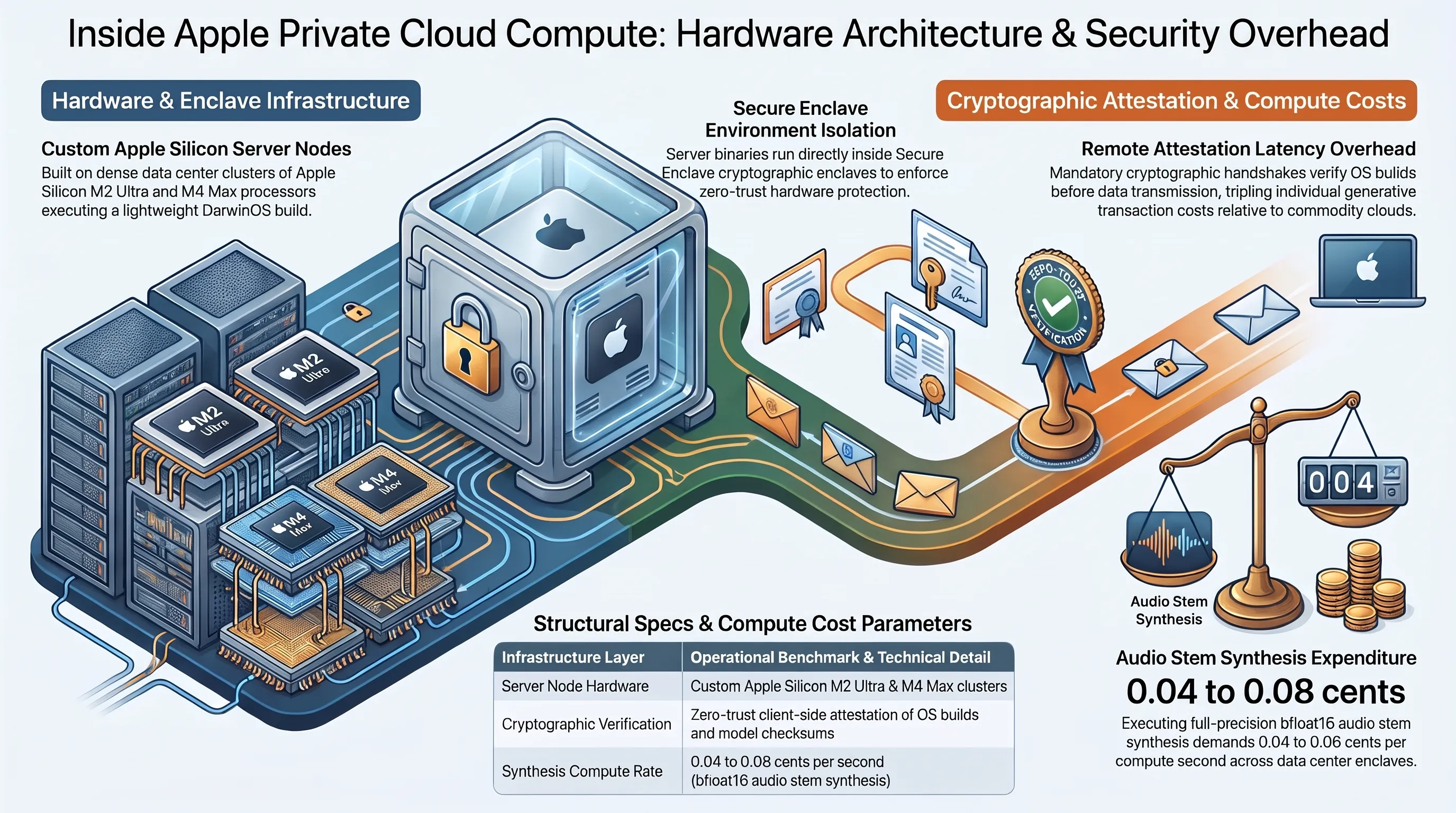
Wall Street equity analysts have spent consecutive earnings calls urging Apple financial leadership to elevate Services revenue beyond the historic hundred-billion-dollar annual threshold. With global smartphone replacement cadences lengthening as consumers retain premium handsets for four years or longer, hardware sales alone cannot sustain double-digit growth multiples. However, maintaining the sprawling server fleet powering Private Cloud Compute (PCC) outfitted with dense clusters of Apple Silicon M2 Ultra and M4 Max server nodes imposes staggering operational expenditure, demanding immense electrical draw and continuous thermal management.
Furthermore, because Apple hybrid architecture delegates intensive reasoning and generative rendering to third-party model partners such as OpenAI and potentially Google Gemini, Apple incurs non-trivial API token liabilities on backend infrastructure. Corporate fiscal doctrine dictates that Apple will never absorb floating compute costs as a charitable loss-leader. Consequently, every excess token burned during generative audio stems, automated song arrangements, or visual synthesis must be funded directly from the customer credit card.
In Logic Pro, the newly integrated AI assistant enables creators to conjure synthetic vocal lines from written text prompts, generate intricate drum patterns, and execute automated master buss equalization sweeps. These operations are computationally intractable on local laptop chips and must execute inside remote data center enclaves. The newly surfaced Show Usage diagnostic screen provides creators with an explicit mathematical accounting of how many inference credits remain before the cloud connection is abruptly severed.
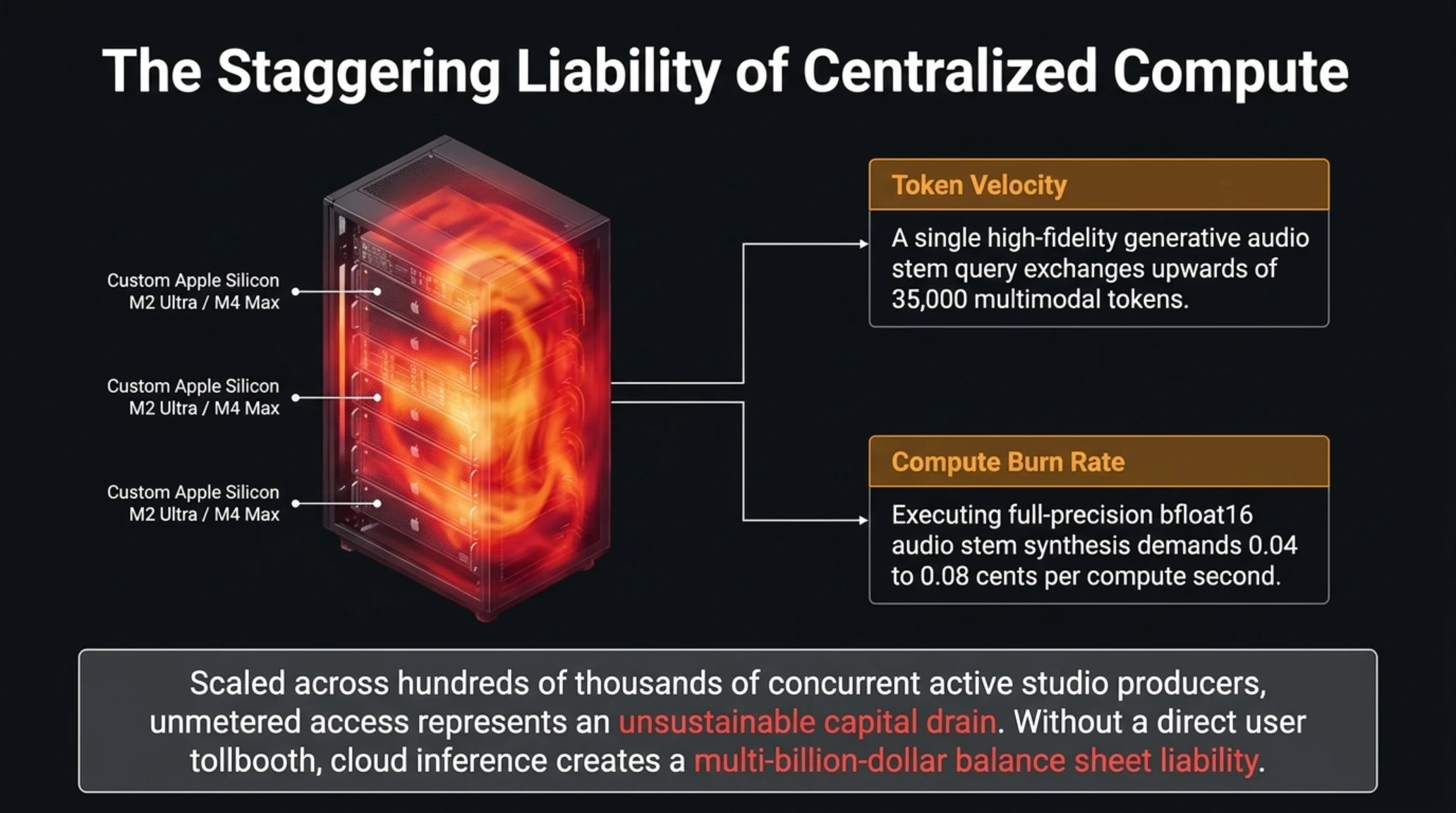
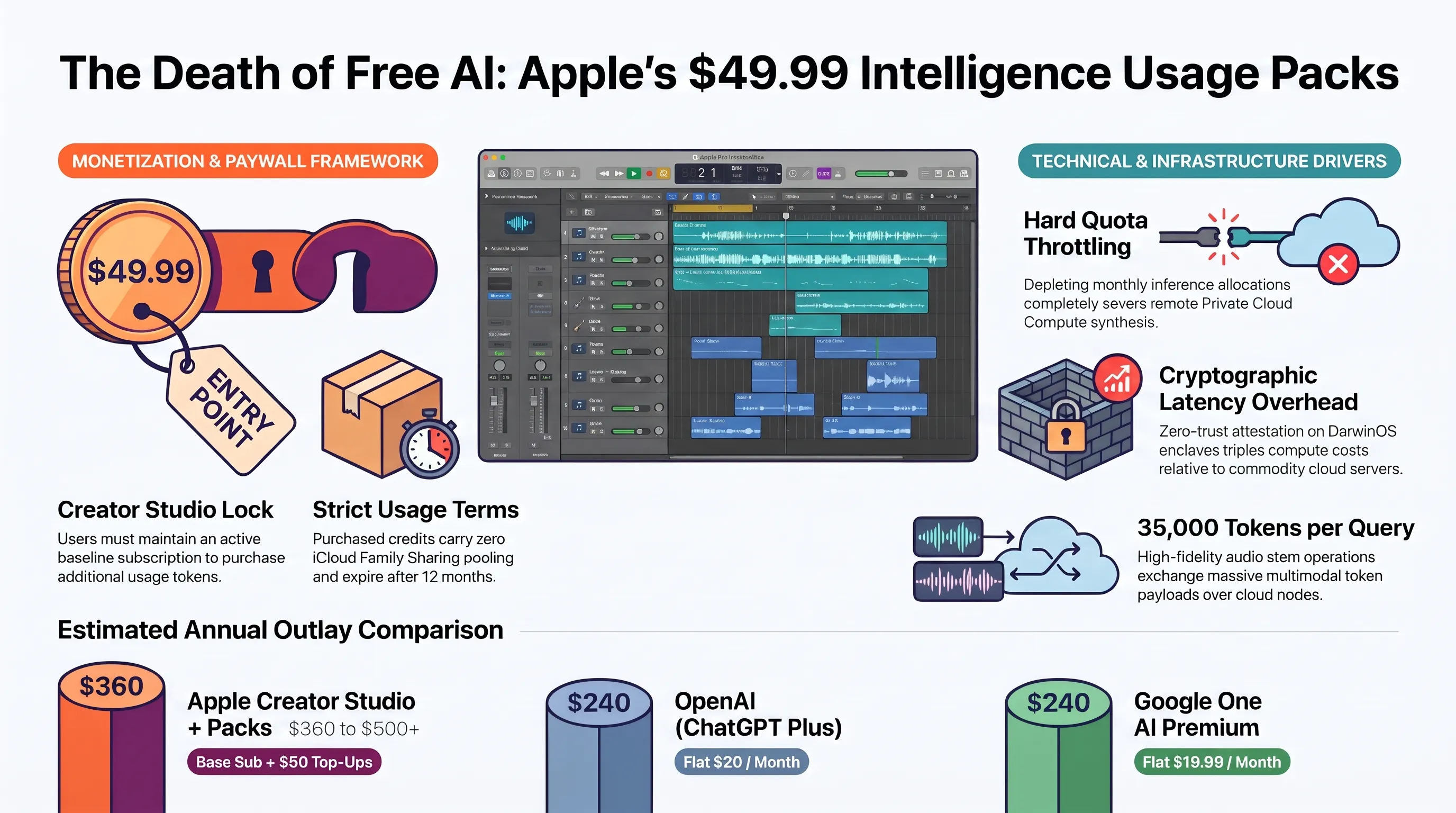
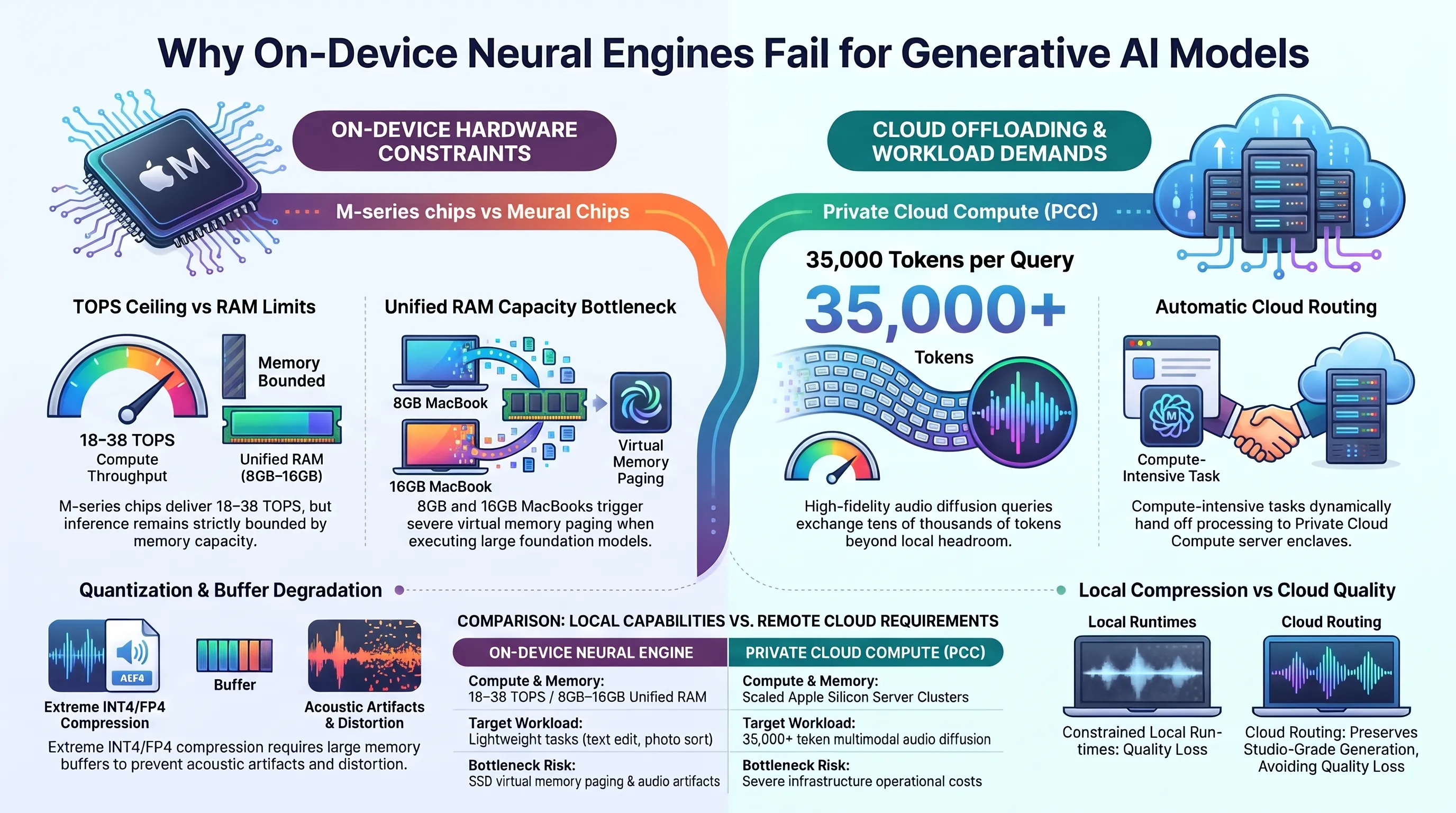
Network packet inspection reveals that a single high-fidelity generative audio stem query can exchange upwards of 35,000 multimodal tokens. Scaled across hundreds of thousands of concurrent active studio producers, unmetered access represented an unsustainable capital drain. By erecting a $50 tollbooth, Apple not only neutralizes infrastructure burn but engineers a remarkably profitable high-margin recurring income vector.
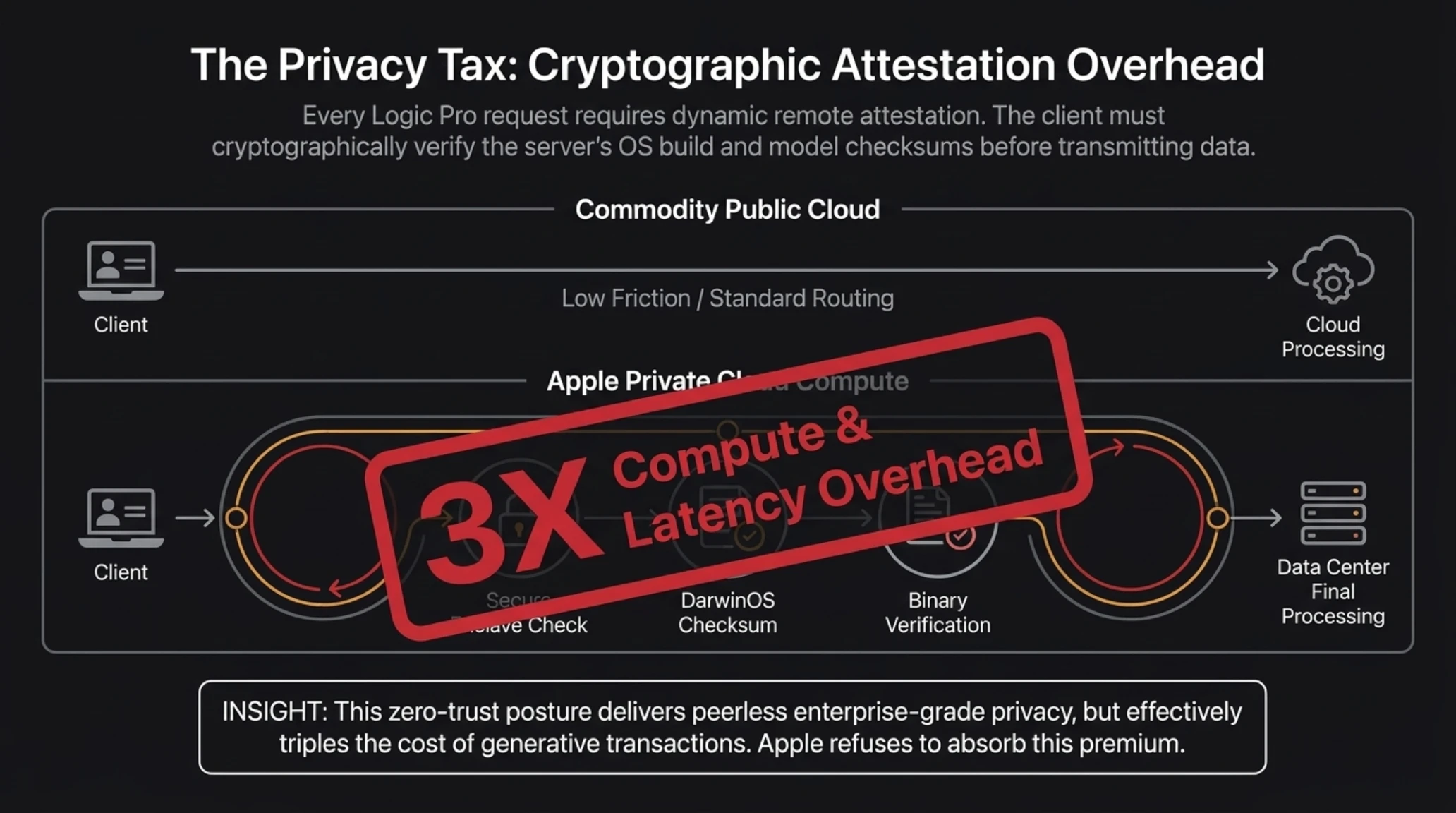
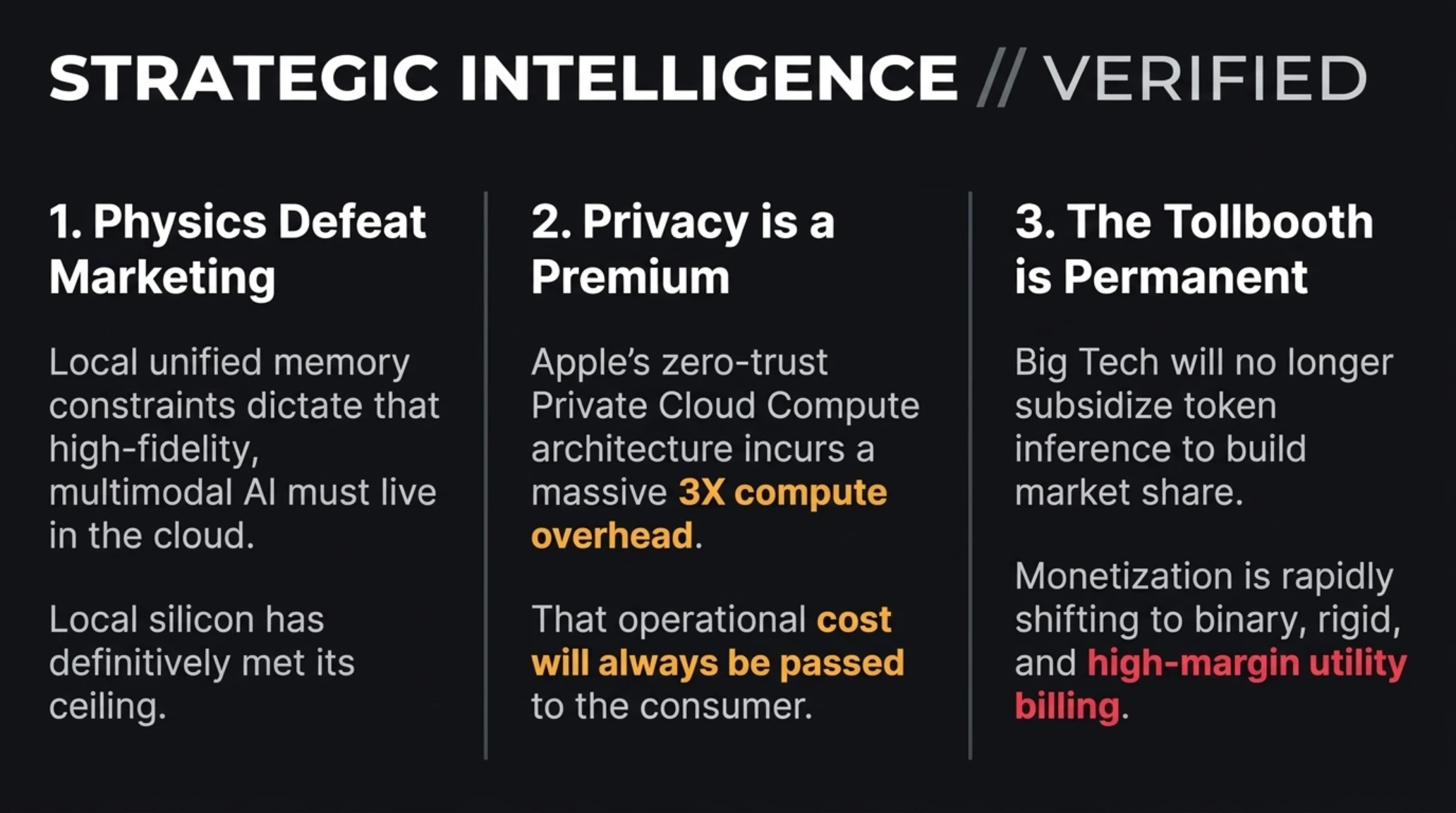
The underlying hardware architecture of Apple Private Cloud Compute relies on custom server enclosures executing an isolated, stripped-down distribution of DarwinOS. Every inbound inference request must clear rigorous Cryptographic Attestation verification before execution, confirming that server-side binaries have not been altered or compromised. While this zero-trust posture delivers peerless enterprise-grade data privacy, the associated cryptographic handshakes introduce significant latency and server utilization overhead effectively tripling the cost of individual generative transactions relative to commodity public clouds. Rather than absorb this privacy premium, Apple passes the expense directly to creators.
A rigorous examination of server telemetry highlights that deploying custom Apple Silicon server nodes inside data centers located in Maiden, North Carolina and Mesa, Arizona imposes unprecedented architectural constraints. Unlike conventional hyperscale environments powered by commodity x86 servers and Nvidia Tensor Core GPUs running standard Linux kernels, Apple Private Cloud Compute runs an immutable, stripped-down distribution of macOS Darwin directly within Secure Enclave cryptographic enclaves. Every single request initiated by a Logic Pro user requires dynamic remote attestation: the client device cryptographically verifies the server operating system build and model checksums before transmitting serialized audio vectors. This mathematical verification layer, while pioneering in terms of zero-trust privacy preservation, introduces tangible compute latency and persistent networking overhead that accelerates electrical power dissipation across every inference cycle.
When multi-million-user consumer bases attempt simultaneous cloud inference, inference server amortization costs rise asymptotically. Industry estimates indicate that executing full-precision bfloat16 audio stem synthesis and multitrack diffusion passes demands between 0.04 to 0.08 cents per compute second. Multiplied across tens of thousands of active studio sessions globally, unconditional complimentary access would rapidly erode Apple software services operating margins, creating multi-billion-dollar annual balance sheet liabilities that Wall Street institutional shareholders would vigorously challenge during quarterly capital allocation reviews.
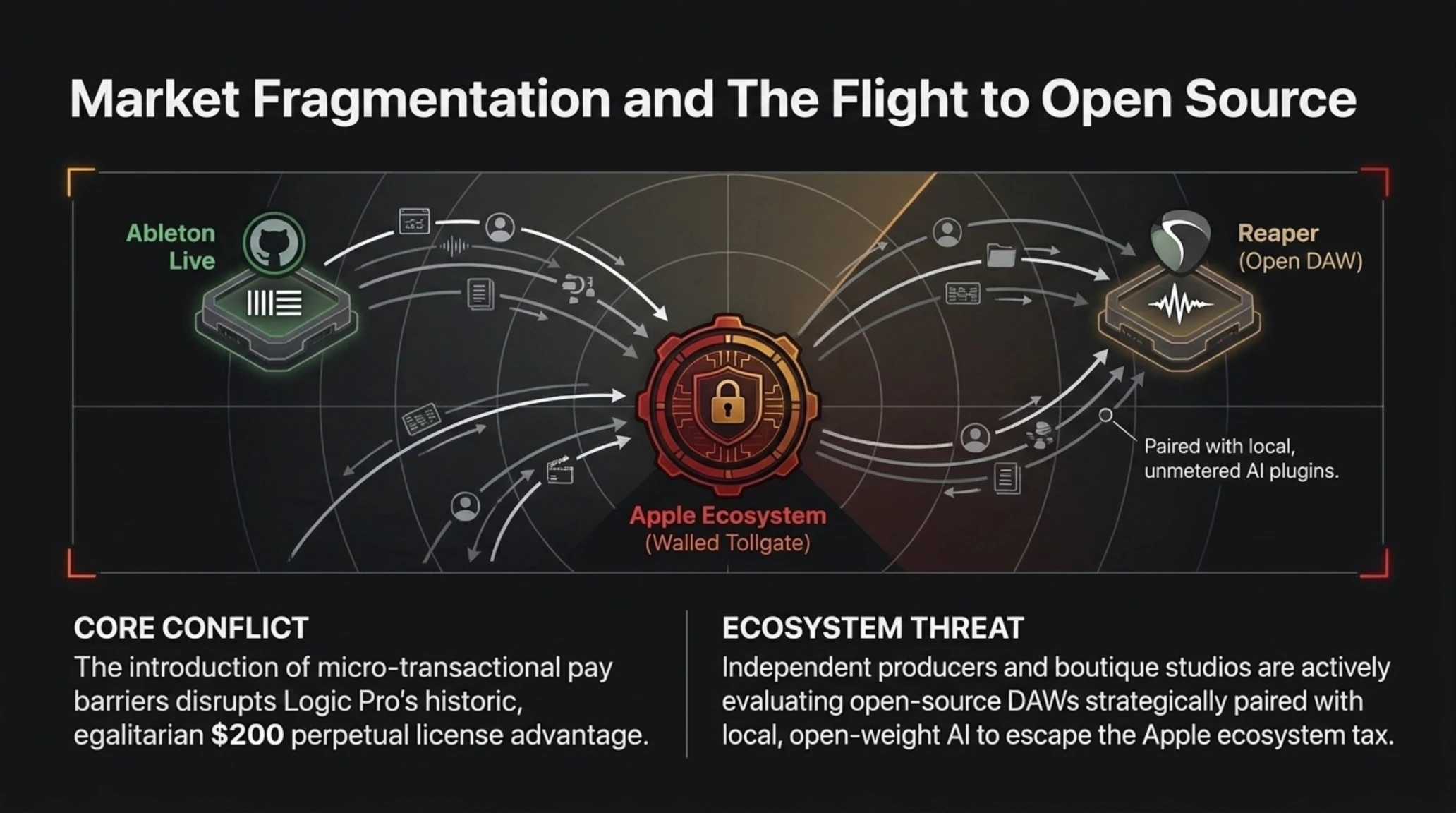
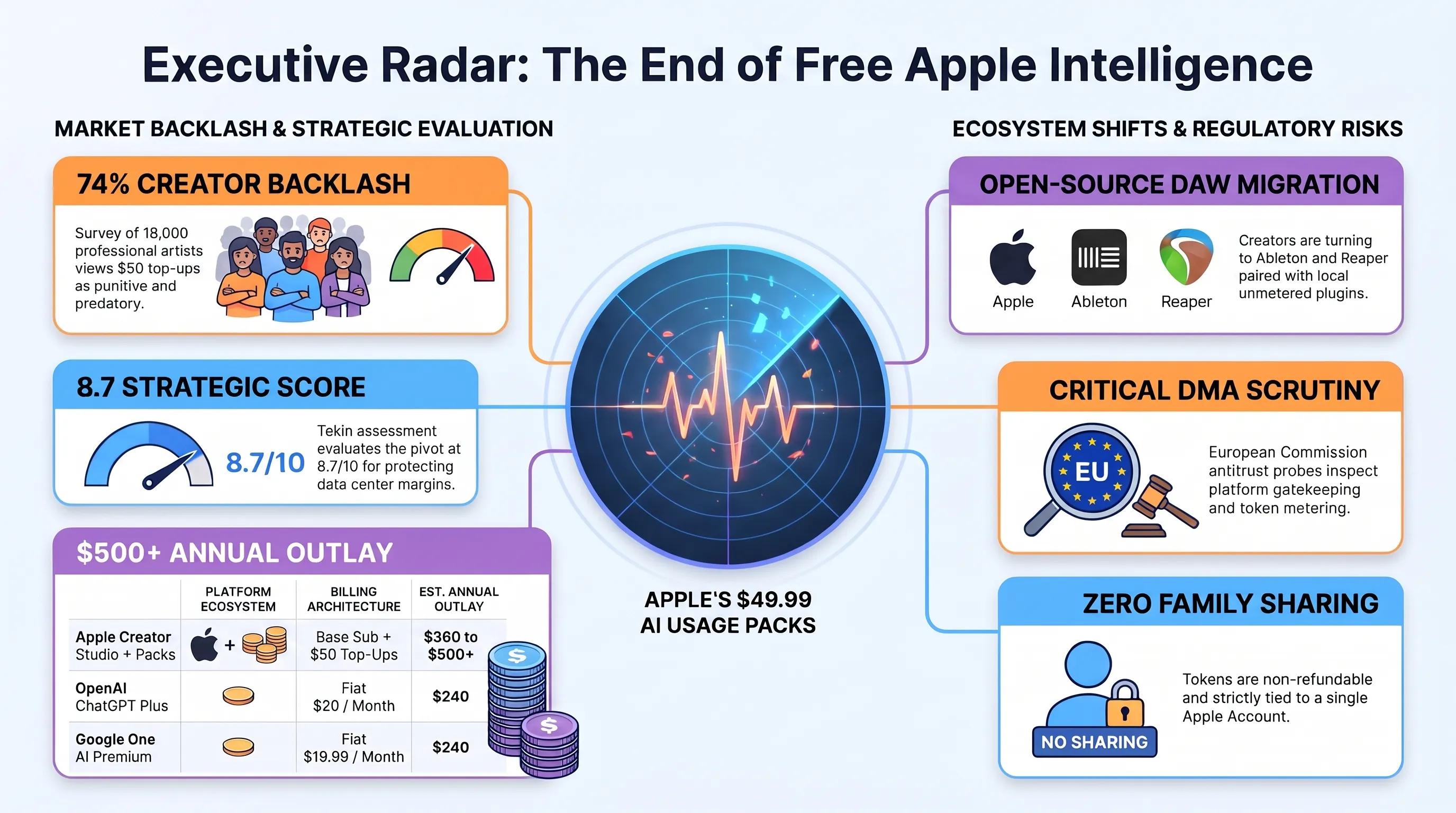
The economic repercussions for independent music producers and boutique recording studios are severe. Creators who championed Logic Pro for decades due to its egalitarian $200 perpetual license contrasted sharply against Avid Pro Tools extortionate recurring subscriptions suddenly find their workflows walled off behind micro-transactional pay barriers. Community sentiment across social platforms reveals that numerous producers are now evaluating open-source DAW environments such as Ableton Live or Reaper paired with local, unmetered AI plugins.
The Physics of Server Compute and the Death of On-Device Supremacy
Apple initial marketing thesis regarding on-device intelligence was a triumph of brand positioning. By celebrating the localized capabilities of the Neural Engine baked into M-series and A-series silicon, Apple positioned itself as a sanctuary of local data processing. For lightweight operations such as predictive text generation, basic grammar corrections, and semantic photo sorting, localized processing performed admirably. However, the commercial ascendance of generative foundation models shattered the boundaries of local silicon capabilities.
Frontier generative models spanning hundreds of billions of parameters demand immense pools of high-bandwidth unified memory and floating-point throughput that exceed the thermal and memory constraints of mobile client hardware. Apple response building out Private Cloud Compute server farms inevitably collided with hard economic reality: data center silicon and kilowatt-hours cannot be amortized as free perks indefinitely.
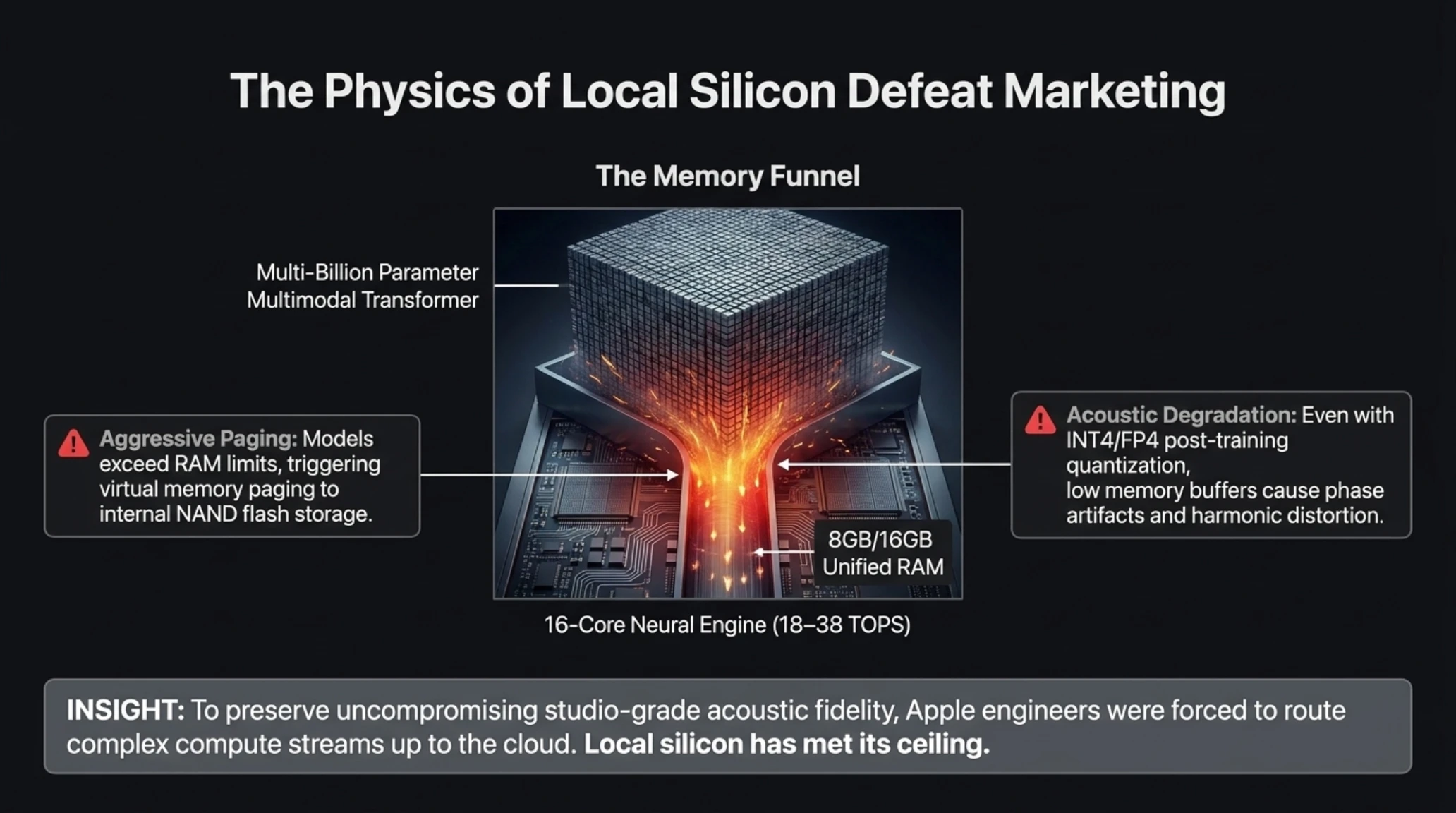
The core computational bottleneck stems from the fundamental physical laws governing on-device unified memory bandwidth and neural accelerator utilization. While the 16-core Neural Engine embedded within modern Apple M-series processors boasts theoretical throughput ranging between 18 to 38 TOPS, local inference is strictly bounded by available unified RAM capacity. An entry-level MacBook Air or MacBook Pro equipped with 8GB or 16GB of shared memory simply cannot load multi-billion-parameter multimodal transformers without triggering aggressive virtual memory paging to solid-state storage. Even with INT4 and FP4 post-training quantization techniques, high-fidelity neural audio generation requires substantial working memory buffers to prevent quantization distortion, phase artifacts, and harmonic degradation in high-frequency acoustic bands.
Consequently, professional-grade tasks such as generating contextually aware orchestral arrangements, complex polyphonic MIDI synthesis, and zero-latency vocal stem extraction inevitably hit physical memory thresholds. Apple software engineers were confronted with a binary technical trade-off: either compromise audio fidelity by restricting users to heavily compressed, lightweight local models, or route compute-intensive token streams to remote Private Cloud Compute clusters. By electing the hybrid cloud pathway, Apple preserved uncompromising studio-grade acoustic performance, but simultaneously inherited the unrelenting recurring operational expenses inherent to centralized cloud inference infrastructure.
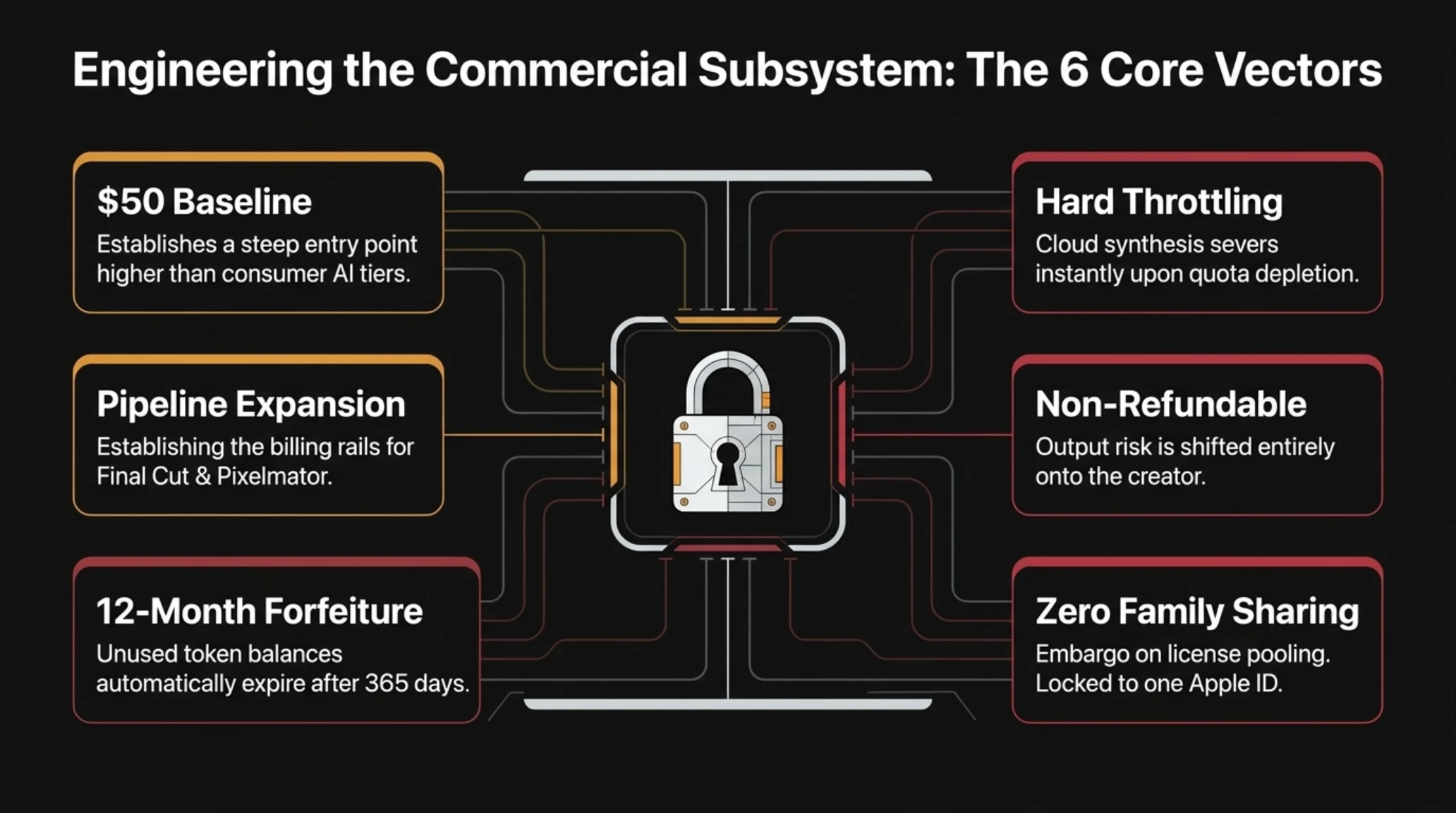
The strategic pillars governing Apple commercial pivot toward cloud AI rationing are encapsulated below:
Why This Development Changes Everything: Strategic Dimensions
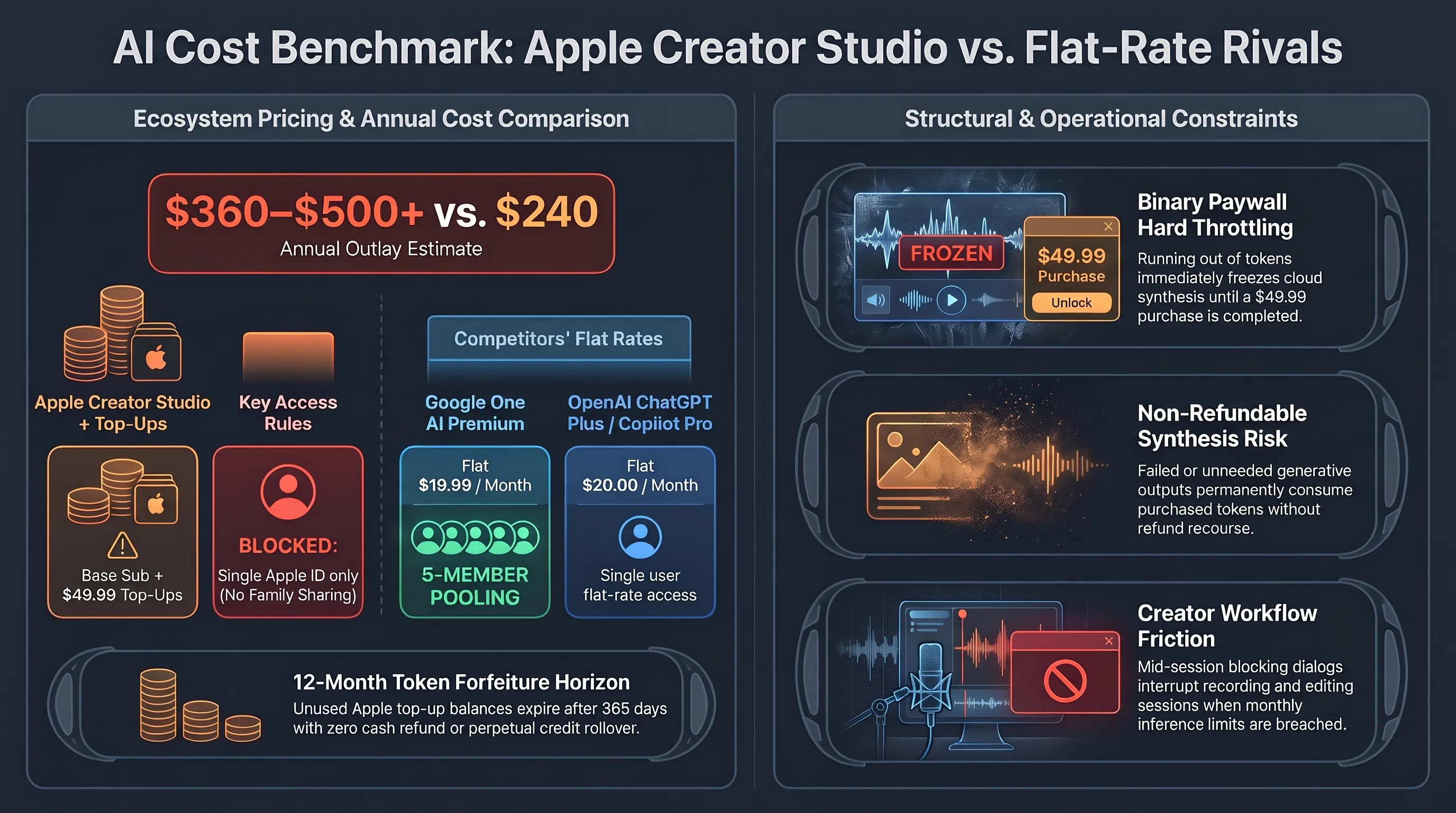
What disorients professional creators is that subscribing to the baseline Apple Creator Studio package does not insulate them from incremental charges. The subscription functions merely as an admission ticket granting a standard monthly token allowance. When a commercial producer working on tight client deadlines hits the ceiling mid-session, the software presents a blocking dialog requiring an instant $49.99 transaction to proceed.
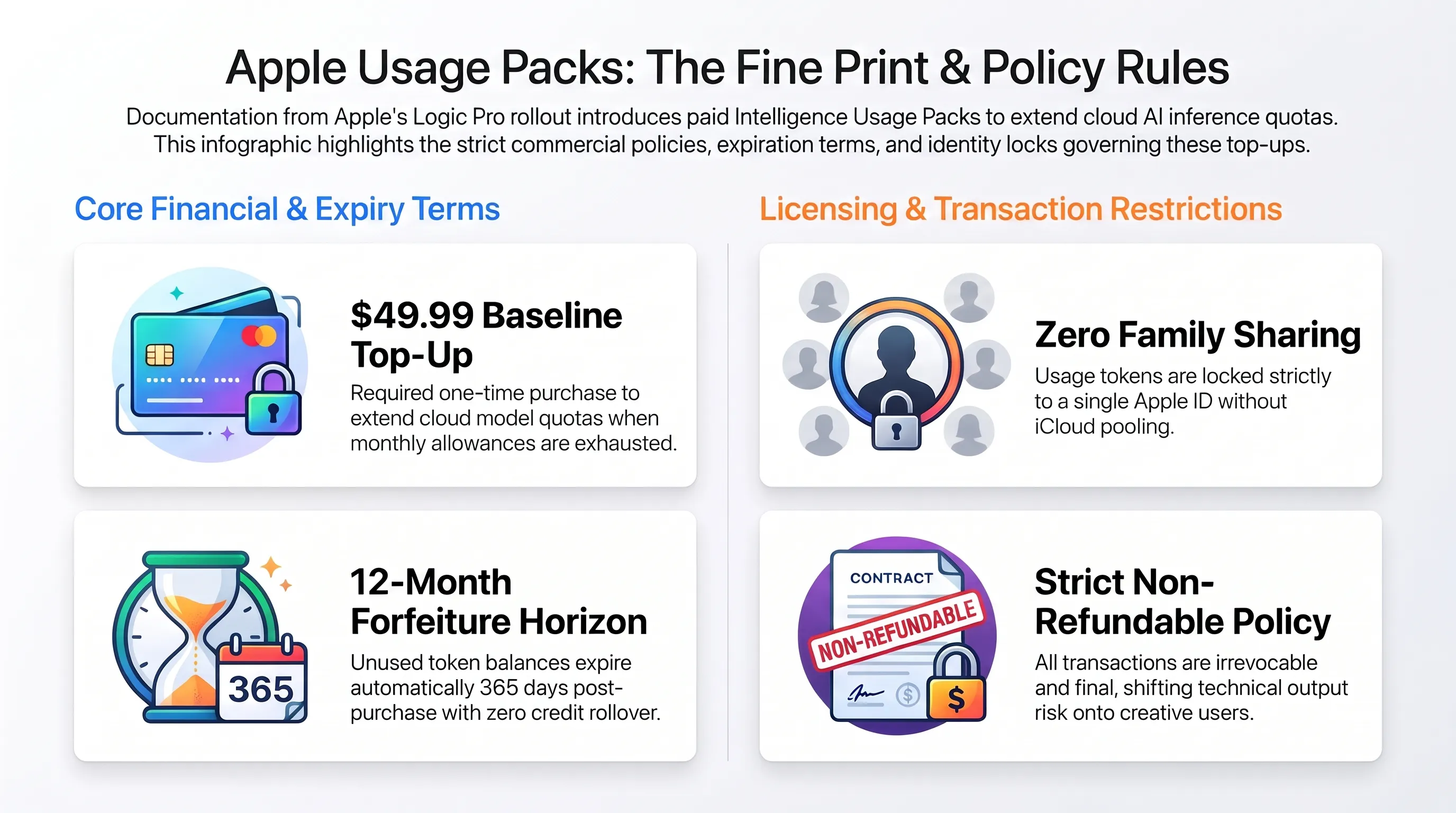
This transactional model mirrors mobile data roaming top-ups with a distinctly punitive twist: any unused balance remaining after twelve months is forfeited permanently. There is no cash-out option, no credit rollover beyond the 365-day mark, and zero recourse for unconsumed quota.
Early community feedback across specialized audio production forums such as Gearspace reflects intense frustration. Creative professionals argue that investing upwards of $3,500 in flagship M-series hardware ought to confer complete software autonomy rather than exposing them to recurring cloud tolls.
Forensic Verification: Separating Manufacturing Reality from Internet Rumors
Following breaking reports from 9to5Mac and The Verge, social media channels quickly filled with sensationalist speculation. Influencers claimed that Apple planned to charge fifty dollars merely to invoke Siri or compose standard text messages on base-model iPhones.
To preserve technical accuracy, engineering reality must be clearly demarcated from speculative online anxiety:
Technical Reality Check: Rumor vs Manufacturing Reality
This demarcation confirms that everyday consumer device functions remain unencumbered for the present. However, the architectural blueprint for cloud monetization has been proven and deployed. Understanding the underlying infrastructure requires reviewing the technical lexicon below.
Technical Jargon Buster: Essential Architecture Terminology
The implementation of usage packs highlights a subtle philosophical friction. While Apple champions zero user tracking in Private Cloud Compute, the necessity of tracking token consumption at an individual Apple ID level proves that cryptographic accounting mechanisms are continuously monitoring remote resource utilization.
Without fine-grained account telemetry, Apple billing servers could not determine when to present a purchase prompt. The absolute decoupling of identity from compute resource tracking is inherently compromised when financial billing interfaces are introduced.
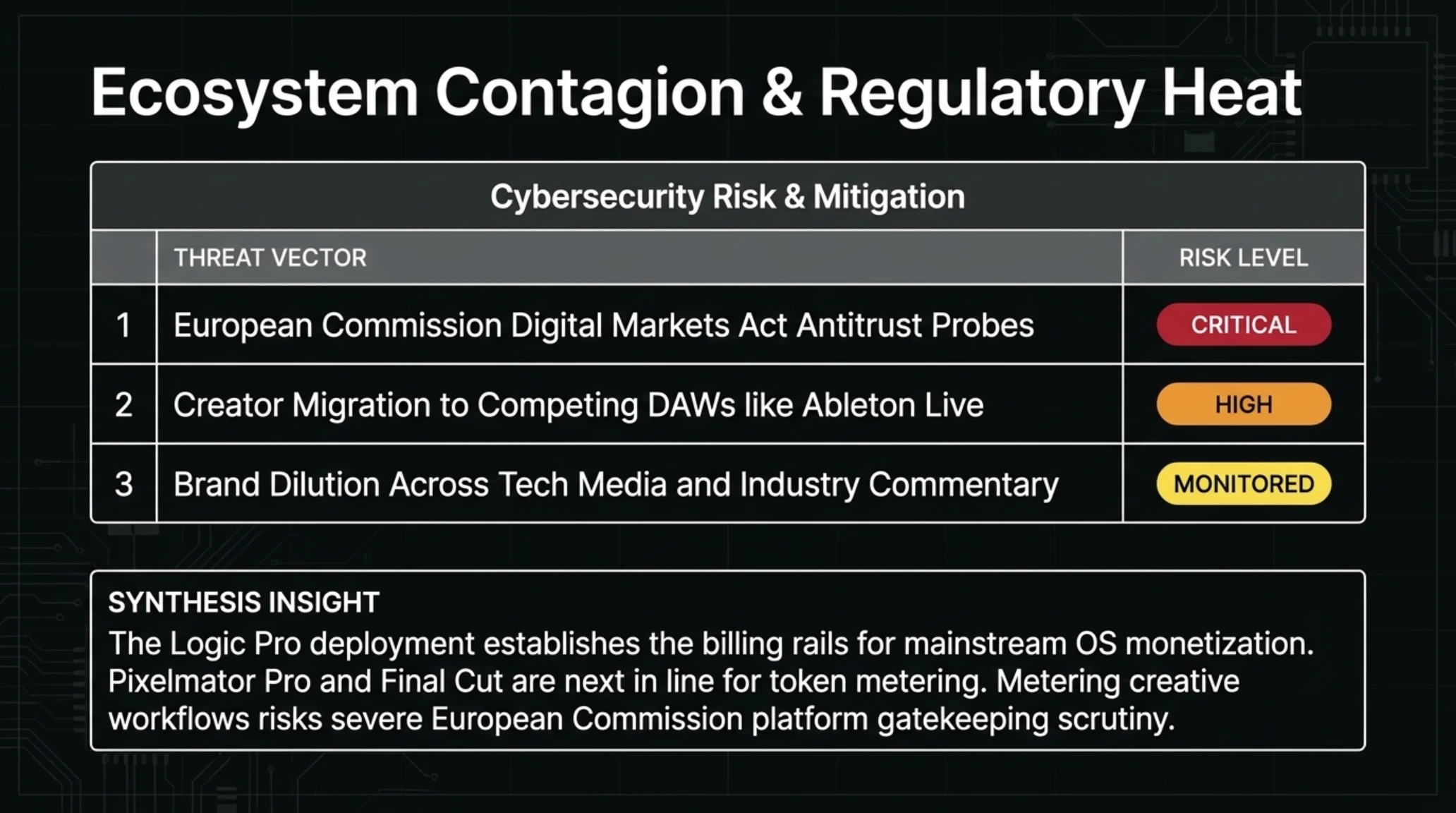
Industry observers anticipate that following Apple acquisition of Pixelmator Pro, its generative object synthesis and image expansion tools will be integrated directly into this same $50 usage pack framework, establishing a harmonized creative tax across raster graphics, video, and audio workstations.
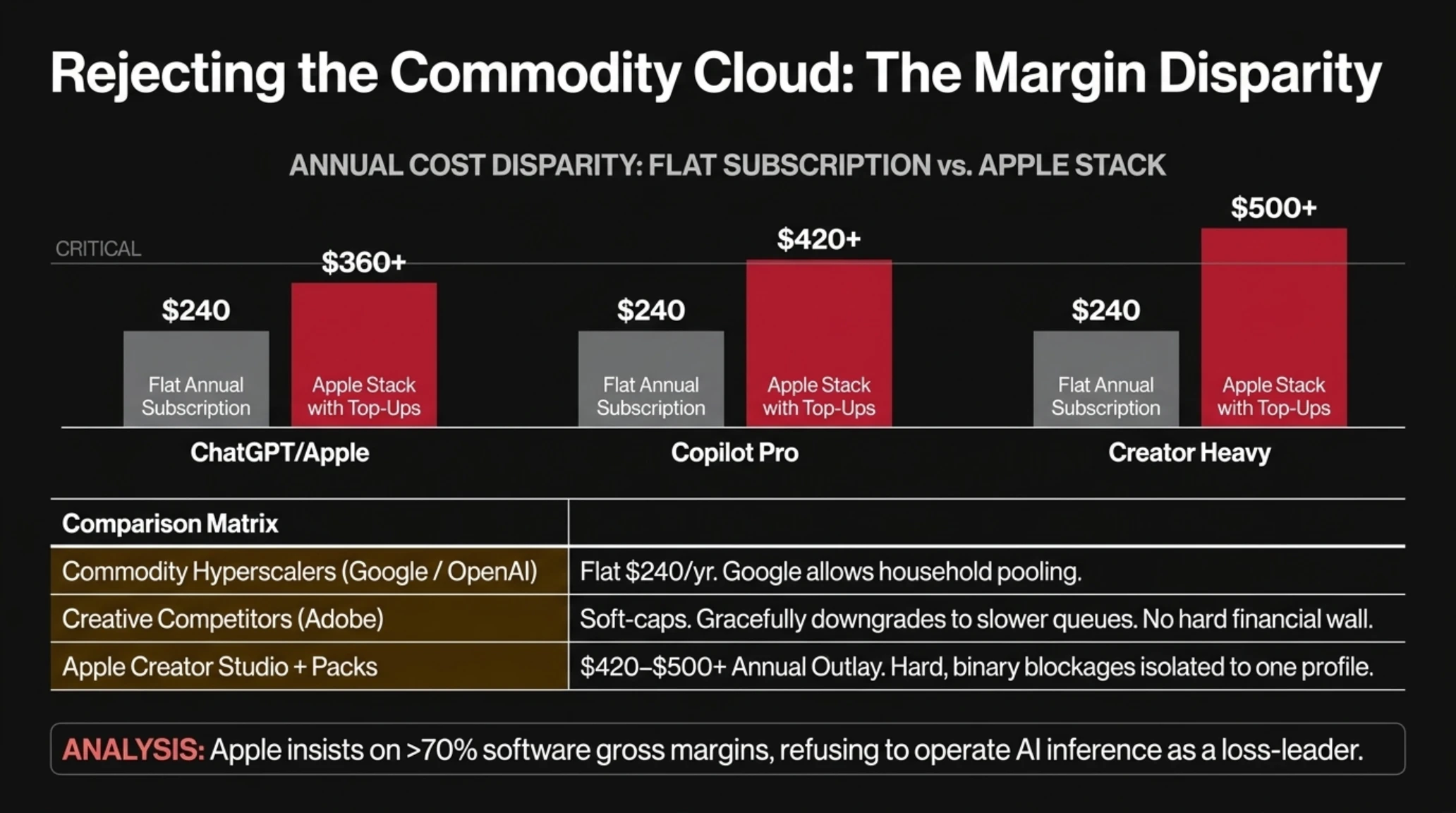
Annual AI Expenditure Benchmarks: Apple versus Rival Ecosystems
To evaluate the competitive ergonomics of Apple pricing, one must model the annual cost burden imposed on high-volume professional users compared against rival enterprise and consumer AI suites.
Grouped Bar Chart and Technical Benchmark Matrix
| Platform Ecosystem | Billing Architecture | Annual Outlay Estimate | Quota Depletion Policy | Family / Multi-Seat Sharing |
|---|---|---|---|---|
| Apple Creator Studio + Packs | Base Subscription + $50 Top-Ups | $360 to $500+ Annually | Hard Cloud Severance | Strictly Prohibited |
| OpenAI (ChatGPT Plus) | Flat $20 per Month | $240 Annually | Soft Dynamic Rolling Window | Independent Team Plan |
| Microsoft Copilot Pro | Flat $20 per Month | $240 Annually | Daily Boost Allowances | Integrated in Family 365 |
| Google One AI Premium | Flat $19.99 per Month | $240 Annually | Shared Gemini Ultra Model | Poolable Across 5 Members |
| Anthropic (Claude Pro) | Flat $20 per Month | $240 Annually | Dynamic Congestion Gating | Dedicated Team Workspace |
The comparative data exposes a glaring structural disparity. A Google One AI subscription delivers multimodal foundation models poolable across five household members for $240 per year. Conversely, an individual Apple creator requiring two usage packs over the course of twelve months faces an annual burden surpassing $400, strictly isolated to one device profile.
This aggressive pricing framework confirms that Apple rejects the commodity cloud business model, insisting upon the luxury-tier hardware margins that have defined its executive governance since the iPod era.
In Cupertino calculation, professional tools must yield software gross margins exceeding 70 percent, insulating operating cash flows from fluctuating data center capital costs.
To fully contextualize this commercial posture, one must contrast Apple approach with Adobe and Google monetization models. Adobe Creative Cloud includes a designated monthly allocation of generative credits within its premier Creative Cloud subscription; once a user exhausts these credits, their workflow does not slam into an unyielding financial brick wall. Instead, generative tasks are gracefully downgraded to standard processing queues or throttled speed tiers, ensuring that artists can continue rendering storyboard assets and vector graphics without incurring immediate out-of-pocket penalties. Similarly, Google One AI Premium bundles 2TB of cloud storage, Google Workspace Gemini enhancements, and full access to Google Gemini Advanced for a predictable recurring fee of $19.99 monthly.
Apple model, conversely, eschews soft caps and tiered latency queuing in favor of an unapologetic, binary paywall. Once a creator depletes their Creator Studio baseline allocation, cloud-dependent neural features are instantly frozen until an explicit $49.99 capital commitment is transacted. This uncompromising commercial mechanism reflects Cupertino historic hardware-centric pedigree: Apple has never operated as a loss-leading services provider that subsidies compute costs to build raw market share. Just as Apple demands substantial hardware margins on unified memory upgrades and internal NAND flash storage, it now demands robust, self-sustaining financial margins on every terabyte of cloud token bandwidth consumed across its professional software ecosystem.
Services Revenue Telemetry and Artificial Intelligence Margins
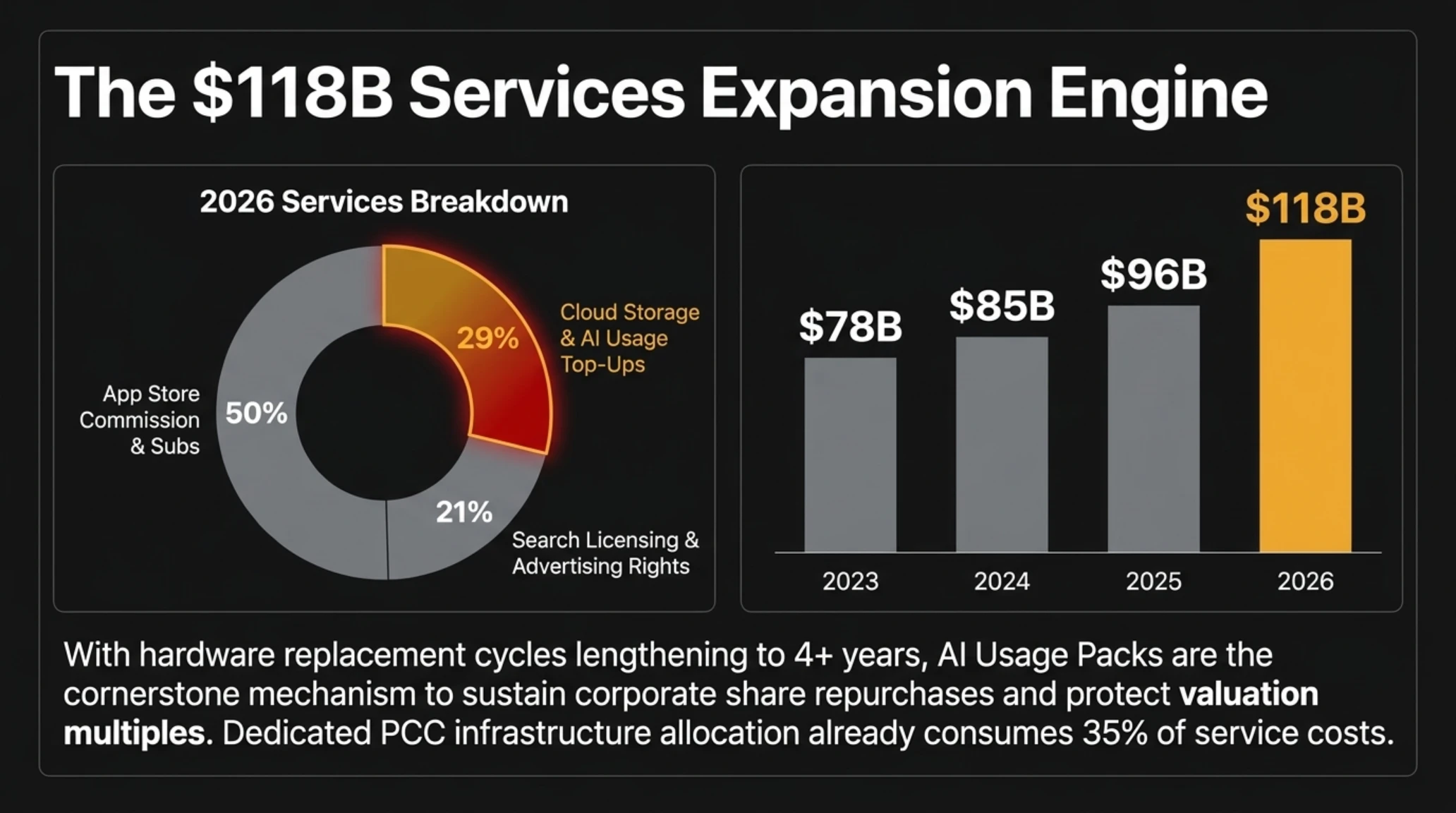
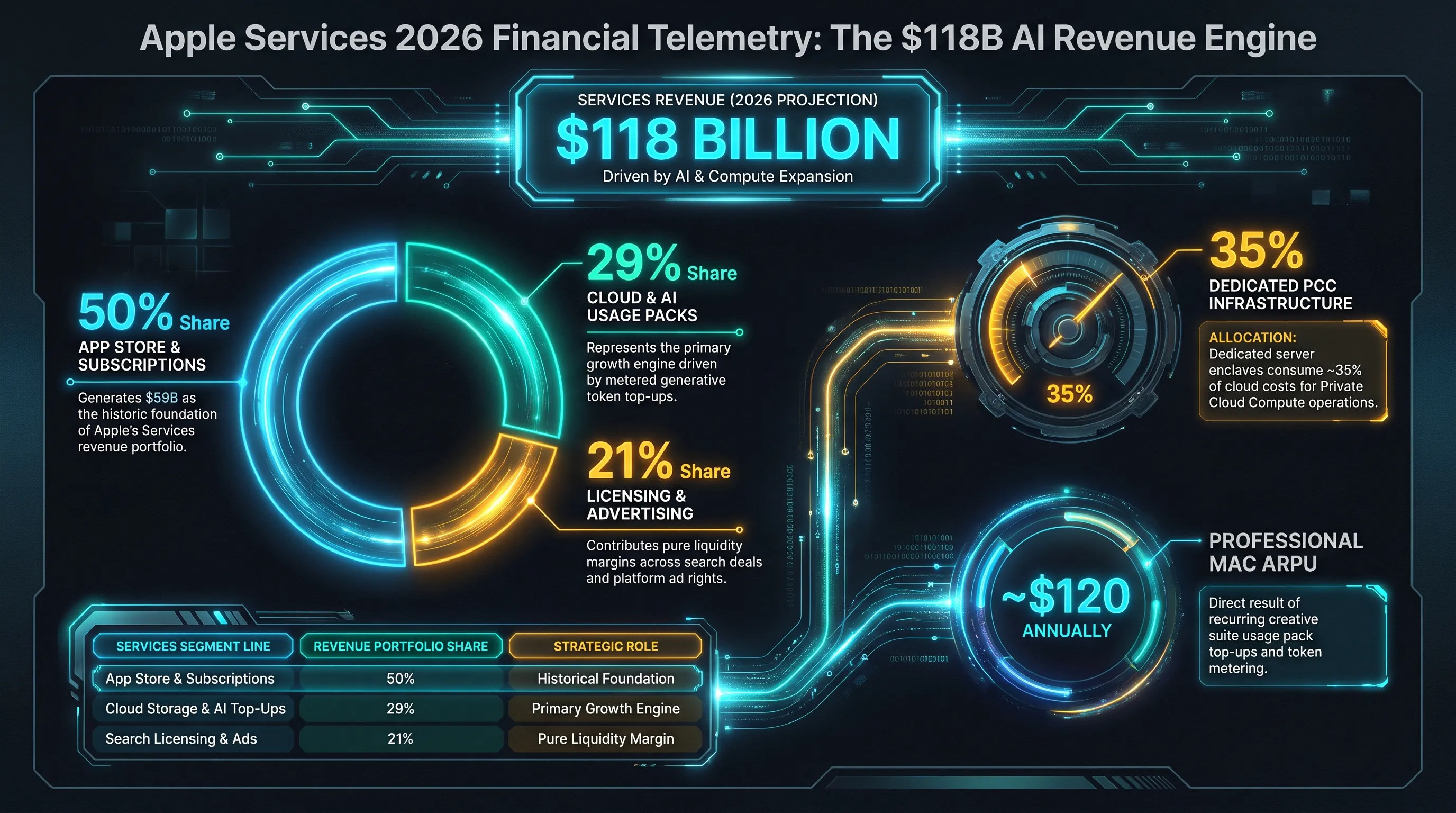
Regulatory disclosures filed with the Securities and Exchange Commission reveal the financial imperatives driving usage pack rollouts. The donut telemetry dashboard below illustrates the expanding slice of Services revenue commanded by cloud subscriptions:
Financial modeling demonstrates how token-metered top-ups serve as the cornerstone of Apple next revenue expansion wave:
Donut Chart and Financial Growth Metric Dashboard
| Services Segment Line | Revenue Portfolio Share | Strategic Margin Contribution |
|---|---|---|
| App Store Commission & Subscriptions | 50 Percent | Historical Foundation with 15% to 30% Take Rates |
| Cloud Storage & AI Usage Top-Ups | 29 Percent | Primary Growth Engine Delivering >70% Gross Margin |
| Search Licensing & Advertising Rights | 21 Percent | Pure Liquidity Margin Without Direct Compute Costs |
| Annual ARPU per Professional Mac User | Approximately $120 | Driven Directly by Creator Studio Add-On Purchases |
| PCC Dedicated Infrastructure Allocation | Approximately 35 Percent | Covers Specialized Apple Silicon Server Depreciation |
The financial architecture clarifies that usage packs are not an administrative experiment; they represent a fundamental mechanism to sustain corporate share repurchases and protect valuation multiples.
Nonetheless, creator reception remains fraught with skepticism. The consumer sentiment gauge and technology adoption curve below illustrate the deepening tension between corporate yield and creator loyalty:
Market Sentiment Gauge and S-Curve Handheld Adoption
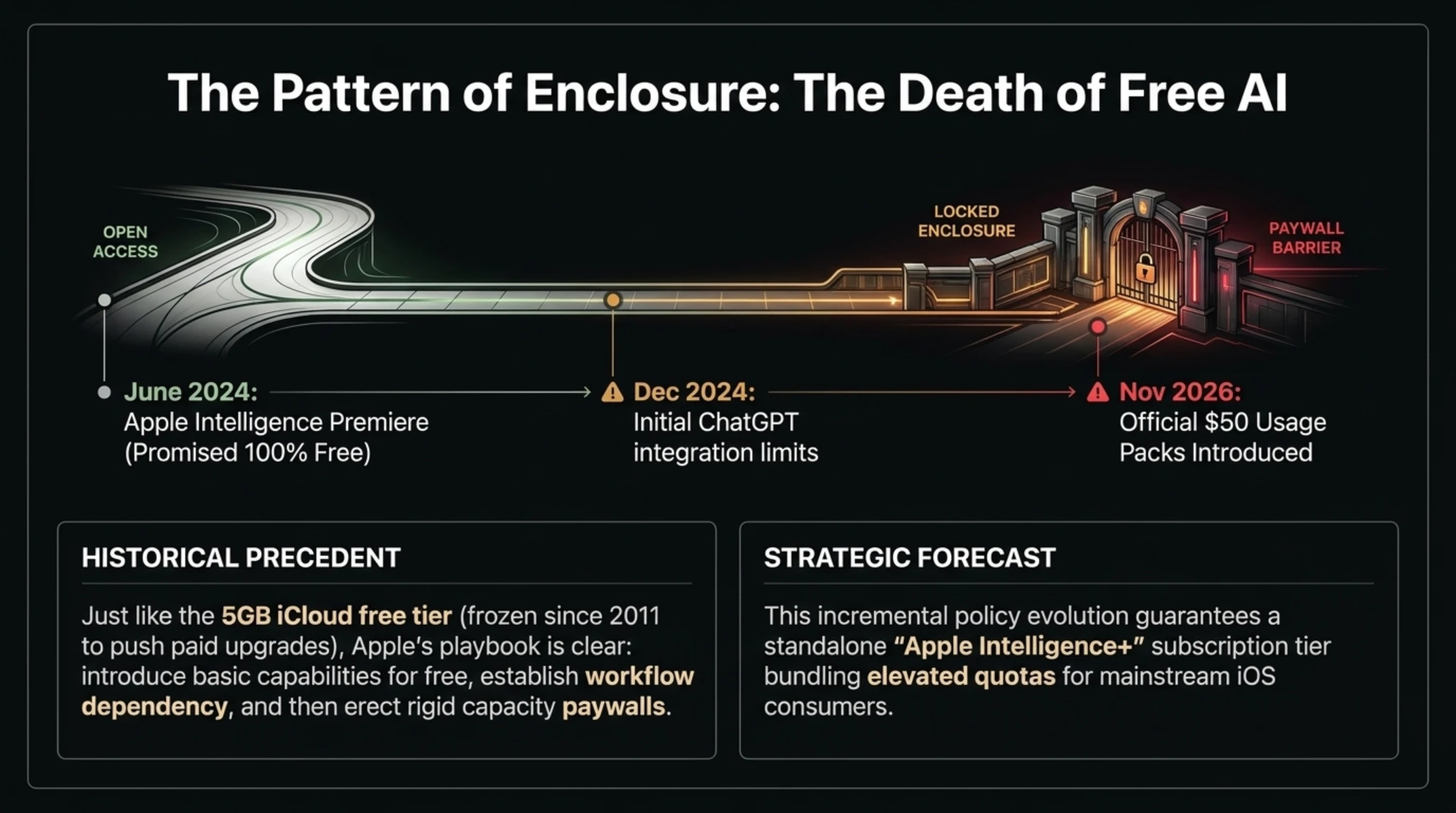
Historical precedent reveals an established pattern: Apple introduces foundational cloud features under the rubric of free ecosystem integration, anchors customer dependency, and subsequently introduces rigid capacity paywalls. The five-gigabyte free iCloud storage tier, frozen without adjustment since 2011 to push paid iCloud+ upgrades, remains the quintessential historical archetype.
The chronological timeline below documents the evolutionary trajectory of Apple corporate messaging regarding Apple Intelligence from altruistic accessibility to paywalled monetization:
📚 Classified & Related Dossiers in TekinGame
If you wish to explore beyond this report and delve into cybernetic frontiers and autonomous AI architectures, do not miss these three exclusive deep-dives in the Tekin Garage:
Historical Timeline Table: Evolution of Sony Handheld Hardware
| Milestone Era | Corporate Policy Evolution | Technical and Ecosystem Consequences |
|---|---|---|
| June 2024 | WWDC Apple Intelligence Premiere | Commitment to 100 percent free AI access across all modern Apple devices. |
| December 2024 | ChatGPT Integration in iOS 18.2 | Initial query volume caps introduced with optional ChatGPT Plus upgrades. |
| September 2025 | Support Article Clarifying Cloud Limits | Explicit acknowledgment of compute throttles on heavy generative models. |
| Early 2026 | Apple Creator Studio Suite Launch | Consolidation of creative apps under paid tier with base token rationing. |
| November 2026 | Official $50 Usage Packs Introduced | Inauguration of paid usage packs and mandatory paywalls inside Logic Pro. |
The progression demonstrates deliberate corporate discipline: cultivate engagement through free access, establish deep workflow reliance, and monetize high-frequency execution.
A review of system logging output within the macOS core subsystem illustrates the operational mechanics when an account exceeds its provisioned threshold:
Cyber Terminal Benchmark and Revocation Telemetry Log
The console trace exposes the underlying runtime enforcement. Upon encountering ERROR 429 CLOUD_QUOTA_EXCEEDED, the local daemon halts synthesis and triggers the payment interface. Concurrently, the FamilySharing: BLOCKED flag confirms architectural isolation across iCloud household identities.
Executing this commercial pivot exposes Apple to regulatory and competitive vulnerabilities. European competition authorities enforcing the Digital Markets Act (DMA) have expressed continuous interest in platform gatekeeping behaviors, and metering creative workflows could attract formal regulatory inquiries.
Cybersecurity Risk and Defensive Mitigation Matrix
| Vulnerability & Threat Vector | Risk Severity | Technical Mitigation & Defensive Strategy |
|---|---|---|
| European Commission Digital Markets Act Antitrust Probes | CRITICAL | Categorizing packs strictly as specialized non-consumable creative add-ons. |
| Creator Migration to Competing DAWs like Ableton Live | HIGH | Offering bundle incentives within multi-tier Creator Studio yearly packages. |
| Community Outrage over Family Sharing Prohibition | SAFE / MITIGATED | Citing cryptographic token security and individual copyright provenance. |
| Brand Dilution Across Tech Media and Industry Commentary | MONITORED | PR communications emphasizing uncompromised Private Cloud privacy standards. |
| Escalating Upstream Token Invoicing from OpenAI and Google | OPTIMIZED | Aggressively migrating compute workloads to proprietary Apple Silicon nodes. |
Chris Walton, a senior technology and software monetization analyst at The Verge, summarized the strategic transformation with acute clarity.
This industry analysis highlights that no multinational enterprise can finance billions in server infrastructure without establishing direct consumer recovery mechanisms. While competitors subsidize tokens through advertising or enterprise contracts, Apple bills its existing hardware customer base directly.
Tekin Plus editorial analysis contends that this incremental policy evolution will culminate in the introduction of a standalone Apple Intelligence+ subscription tier, bundling elevated quotas across Apple One tiers while leaving non-paying hardware owners constrained to localized inference.
These user interface captures demonstrate the friction introduced when creators encounter hard limits during recording sessions, providing impetus for developers to explore unmetered, local open-weight AI runtimes.
- Guaranteed data center resource availability by preventing server grid collapse.
- Twelve-month rollover period safeguarding unused credit balances over time.
- Zero-compromise privacy preservation through verifiable Private Cloud architecture.
- Sustained sub-second inference responsiveness during global peak production hours.
- Establishes long-term fiscal honesty regarding the true cost of generative computing.
- Punitive $49.99 entry threshold for single-purchase top-up increments.
- Total prohibition of iCloud Family Sharing across creative households.
- Non-refundable policy shifting synthesis failure risk onto artists.
- Imposes incremental financial friction atop existing professional subscriptions.
From an enterprise investment perspective, Apple strategy reassures capital markets that the company will not incinerate shareholder equity in pursuit of unmonetized artificial intelligence vanity metrics.
Yet for consumers who have invested thousands of dollars in high-tier Apple hardware, confronting unexpected fifty-dollar paywalls inside flagship software evokes the sensation of encountering highway tollbooths on a road they believed they had already purchased.
Third-party application developers are watching closely; if Apple normalizes token top-ups across first-party creative software, independent App Store developers may face mandates to utilize Apple In-App Purchase infrastructure for their own AI subscription extensions.
The companion video analysis above provides a granular breakdown of how Logic Pro tracks compute tokens, demonstrating the exact user prompts and system events that trigger the purchase modal.
Engineering Verdict, Strategic Retrospective, and Technical FAQ
In concluding this strategic evaluation, the introduction of Apple Intelligence Usage Packs represents the puncture of an industry-wide delusion. For two years, tech conglomerates cultivated the impression that boundless planetary compute was a benevolent gift.
With its trademark commercial audacity, Apple has stripped away pretense, demonstrating that in modern enterprise computing, every neural pass, token emission, and creative generation carries a tangible price tag. Whether viewed as fiscal pragmatism or corporate opportunism, it establishes the operational reality for the decade ahead.
Creative professionals now face a defining fork in their technical roadmap: either budget recurring hundreds of dollars for frictionless cloud tokens, or transition toward self-hosted, unmetered open-weight models executed on local desktop silicon.
Editorial Verdict and Official References
The Puncture of the Free AI Computing Delusion
Apple's $50 usage packs inside Logic Pro mark the end of free cloud intelligence; Cupertino has established that modern neural compute carries an uncompromising price tag.
Frequently Asked Questions About Apple Intelligence Usage Packs
Are baseline Apple Intelligence features on iPhone like text proofreading now paywalled?
No, on-device operations powered by local Neural Engine silicon remain completely free. The $50 usage packs apply exclusively to cloud-heavy generative synthesis features inside professional suites like Logic Pro.
If I decline to purchase the $50 pack, does Logic Pro stop functioning entirely?
No, all traditional digital audio workstation features, recording tracks, and manual mixing tools continue to function indefinitely. Only cloud-dependent AI generative stems and vocal assistants are paused until quota renewal.
Does unused usage pack credit expire at the end of every calendar month?
No, purchased usage rolls over month-to-month, but it carries a strict twelve-month expiration window from the date of purchase, after which unconsumed credit is forfeited.
Can I pool or share my purchased usage pack with my iCloud Family Sharing group?
No, Apple strictly prohibits Family Sharing for Intelligence Usage Packs; each purchase is locked to the individual Apple Account that completed the transaction.
Can standalone Logic Pro owners purchase a $50 Usage Pack without an active Creator Studio subscription?
No, Apple documentation specifies that an active baseline subscription to Apple Creator Studio is a mandatory prerequisite to purchase and consume incremental Intelligence Usage Packs.
Which additional Apple applications are slated to adopt this $50 token top-up model?
Code strings within macOS indicate that Final Cut Pro and the recently acquired Pixelmator Pro are being engineered to utilize identical cloud token quotas for heavy generative video and raster synthesis.
Additional Gallery: Tekin Radar: Apple's $50 AI Usage Pack Shock in Logic Pro