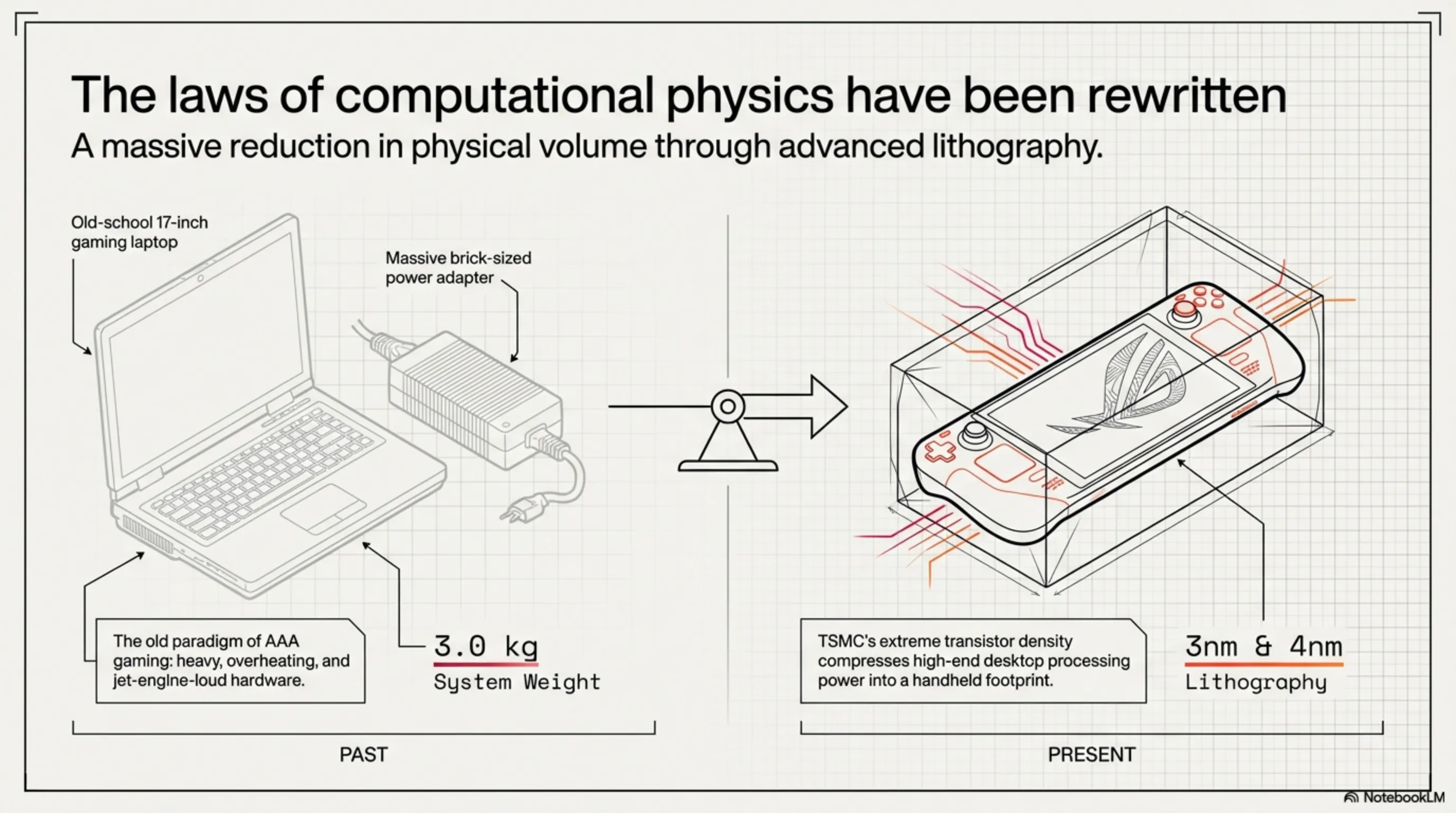
Greetings, Tekin Legion! Just a few years ago, if you wanted to experience jaw-dropping AAA graphics, you were condemned to endure heavy, overheating, and jet-engine-loud gaming laptops. But today, in 2026, the laws of computational physics have been rewritten. Here at Tekin Garage, we have brought two pocket-sized monsters to the autopsy table: the ASUS ROG Ally 2 with its beating Z2 Extreme heart, and the Steam Deck OLED featuring Valve's flawless engineering. Prepare for an atomic debug; this is the battle that determines the future of gaming!
Introduction: The Fall of the Gaming Laptop Empire
The hardware industry is undergoing a terrifying paradigm shift. The era where 3-kilogram gaming laptops and their brick-sized chargers stood as the ultimate symbols of power is rapidly coming to an end. The insane evolution of TSMC's 3nm and 4nm lithography has allowed transistors to become so densely packed that the processing power of a high-end desktop PC can now be compressed into an enclosure the size of a console controller. This is the exact intersection of dream and reality that hardware engineers have chased for decades.
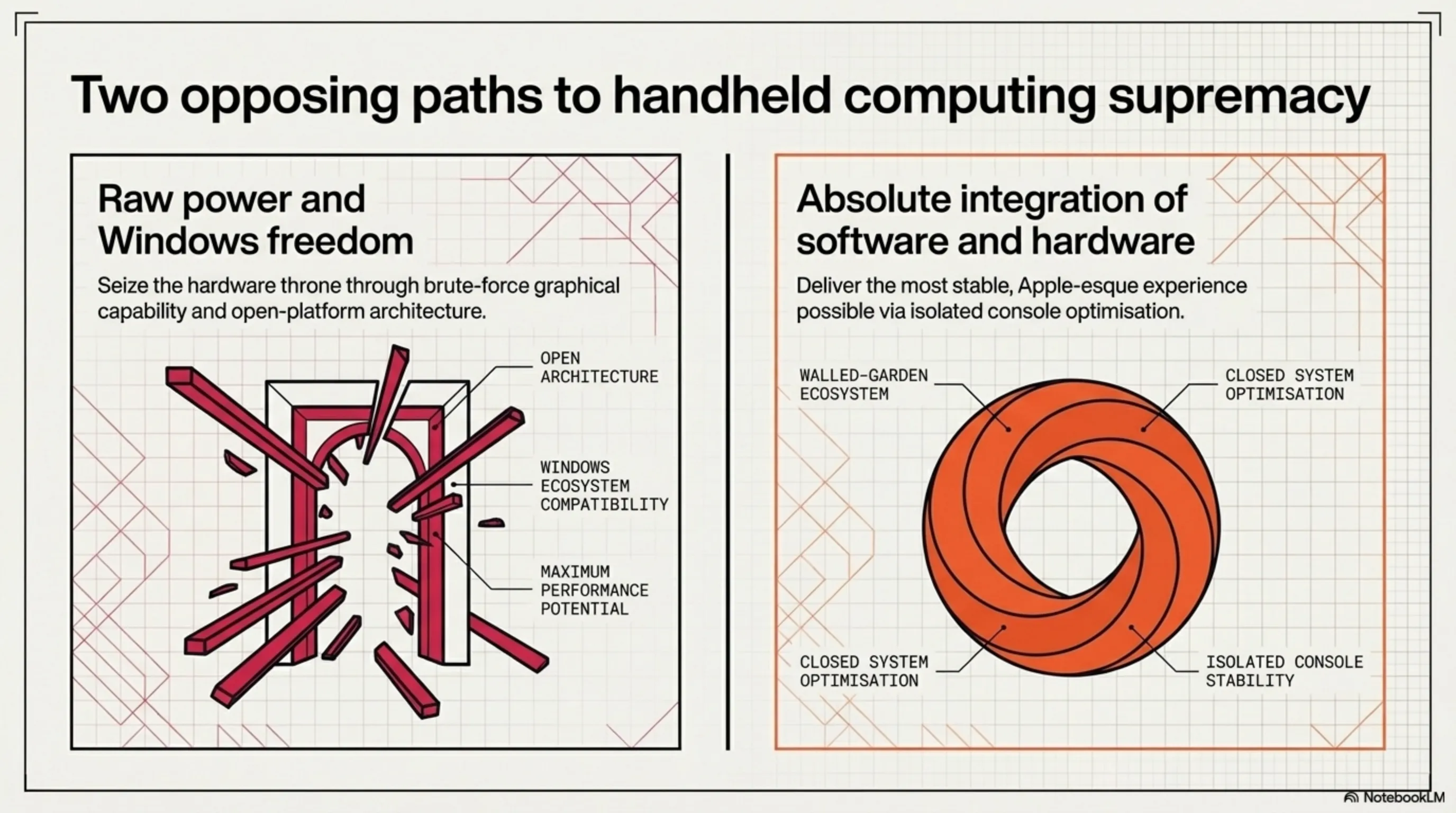
The Handheld PC market has now transformed into Silicon Valley's bloodiest battlefield. On one side, the Taiwanese giant ASUS intends to seize the throne with the second generation of its ROG Ally platform, offering "raw power and Windows freedom." On the other side, Valve (creator of the Steam platform) has adopted an Apple-esque strategy with the Steam Deck OLED: "absolute integration of software and hardware to deliver the most stable experience possible." In this mega-article, we bypass the marketing numbers and place the silicon architectures of these two devices under the Garage's microscope to determine the true champion of gamers' pockets.

Hardware Autopsy: AMD Ryzen Z2 Extreme vs Valve's Custom APU
To truly understand the difference between these two devices, we must pry open their plastic chassis and dive straight into the motherboards. Both devices are powered by AMD architectures, but the engineering philosophy behind these silicons represents the difference between night and day.
ASUS's Nuclear Reactor: The AMD Ryzen Z2 Extreme
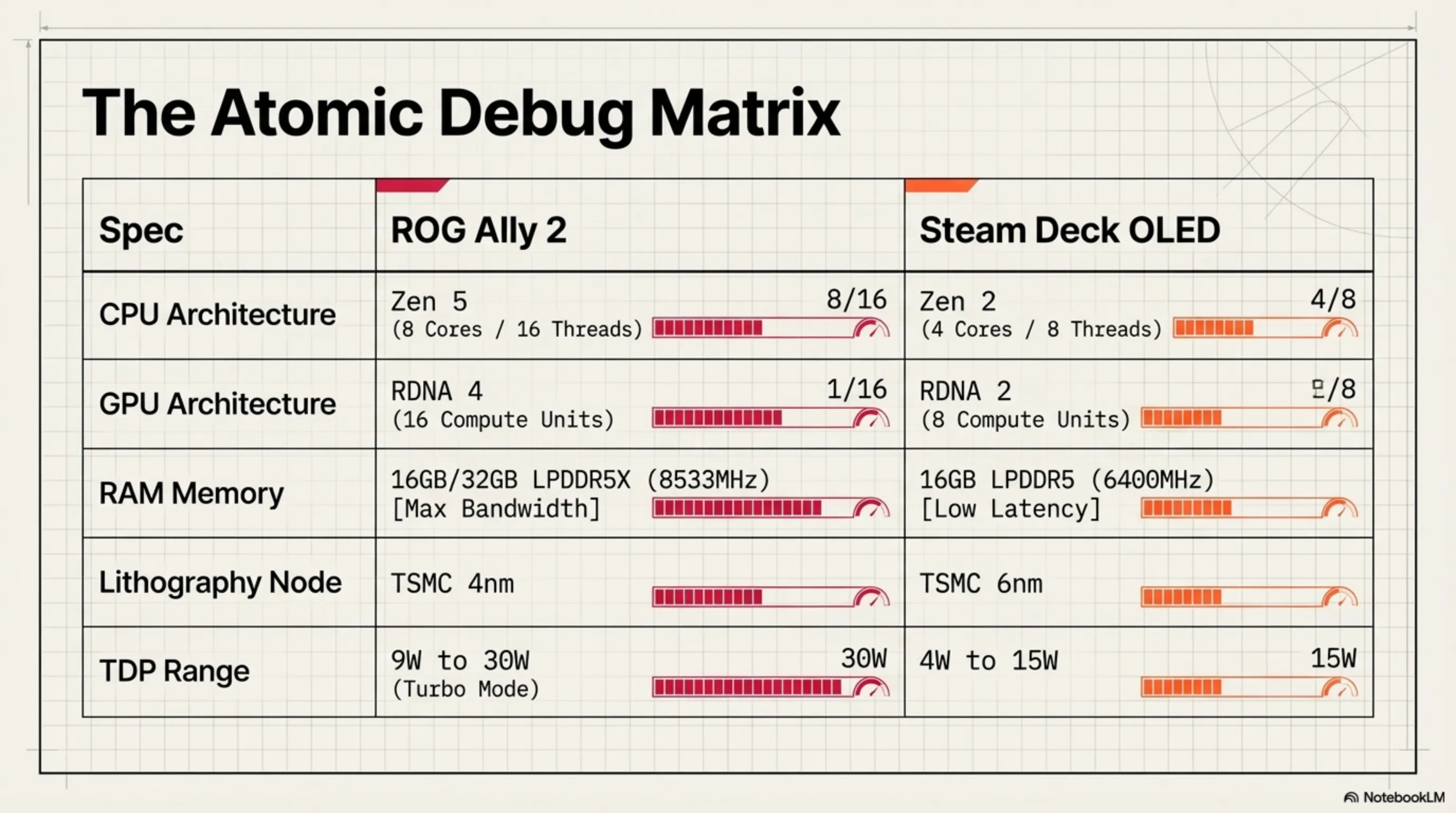
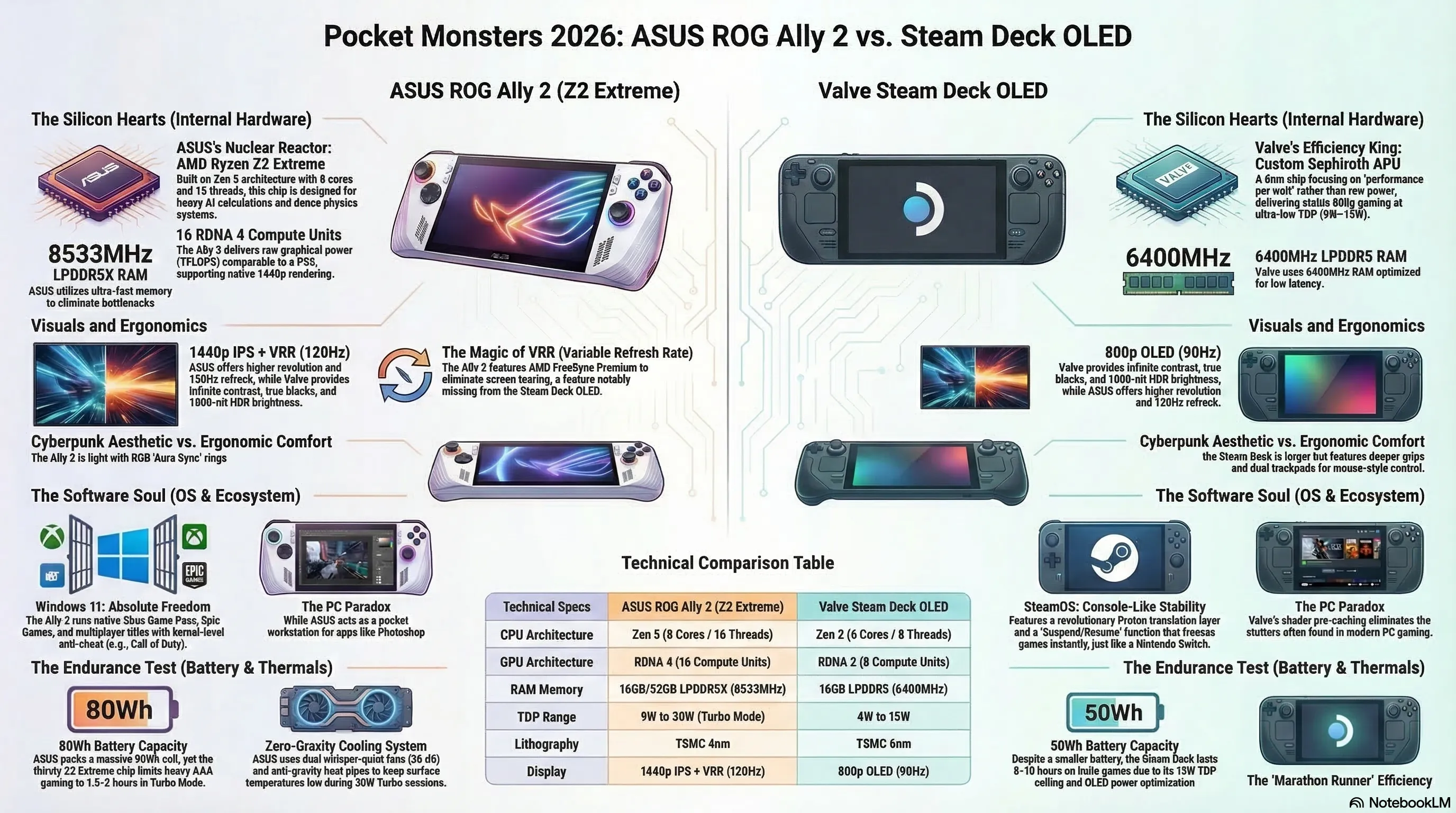
As we previously analyzed in our exclusive breakdown of AMD's new chips, AMD has shattered thermal physics boundaries with the introduction of the Z2 Extreme. This monstrous APU, designed exclusively for flagship handheld PCs, utilizes the Zen 5 architecture for its Central Processing Unit (CPU). With 8 physical cores and 16 processing threads, it can handle the heaviest AI calculations and game physics (like the dense NPC systems in GTA VI) without dropping a single frame.
But the real magic lies in the Graphics Processing Unit (GPU). By utilizing the RDNA 4 architecture with 16 Compute Units (CUs), the raw graphical power (TFLOPS) of this device has reached a territory previously imaginable only in home consoles like the PS5. This architecture allows the Z2 Extreme to natively render heavy titles at 1440p or 1080p resolutions. To feed this thirsty giant, ASUS has equipped it with ultra-fast LPDDR5X RAM clocked at a staggering 8533MHz, ensuring absolutely zero memory bottlenecks.
Valve's Flawless Simulator: The Custom Sephiroth APU (6nm)
On the opposing front, Valve has zero intention of competing in the "raw graphical power" race with the Steam Deck OLED. The device's custom APU (codenamed Sephiroth) is a 6nm chip that combines the older Zen 2 and RDNA 2 architectures. On paper, 4 CPU cores and 8 GPU compute units seem like a joke compared to ASUS's monster; however, in the realm of engineering, paper specs aren't everything.
Valve's strategy is "maximum efficiency at the lowest possible wattage." The Steam Deck's processor is calibrated to deliver stunning, perfectly linear performance within an extremely low Thermal Design Power (TDP) limit (between 5W and 15W). Memory bandwidth is optimized using 6400MHz RAM to minimize latency. Instead of chasing high resolutions, Valve focuses on locking the frame rate at an 800p resolution—a strategy that drastically reduces battery consumption and guarantees system stability.
⚙️ Debug Table: Atomic Hardware Comparison
| Technical Specs | ASUS ROG Ally 2 (Z2 Extreme) | Valve Steam Deck OLED |
|---|---|---|
| CPU Architecture | Zen 5 (8 Cores / 16 Threads) | Zen 2 (4 Cores / 8 Threads) |
| GPU Architecture | RDNA 4 (16 Compute Units) | RDNA 2 (8 Compute Units) |
| RAM Memory | 16GB / 32GB LPDDR5X (8533MHz) | 16GB LPDDR5 (6400MHz) |
| TDP Range | 9W to 30W (Turbo Mode) | 4W to 15W |
| Lithography Node | TSMC 4nm | TSMC 6nm |
Display and Design: 1440p Resolution Battle vs Infinite OLED Contrast
📚 Classified & Related Dossiers in TekinGame
If you wish to explore beyond this report and delve into cybernetic frontiers and autonomous AI architectures, do not miss these three exclusive deep-dives in the Tekin Garage:
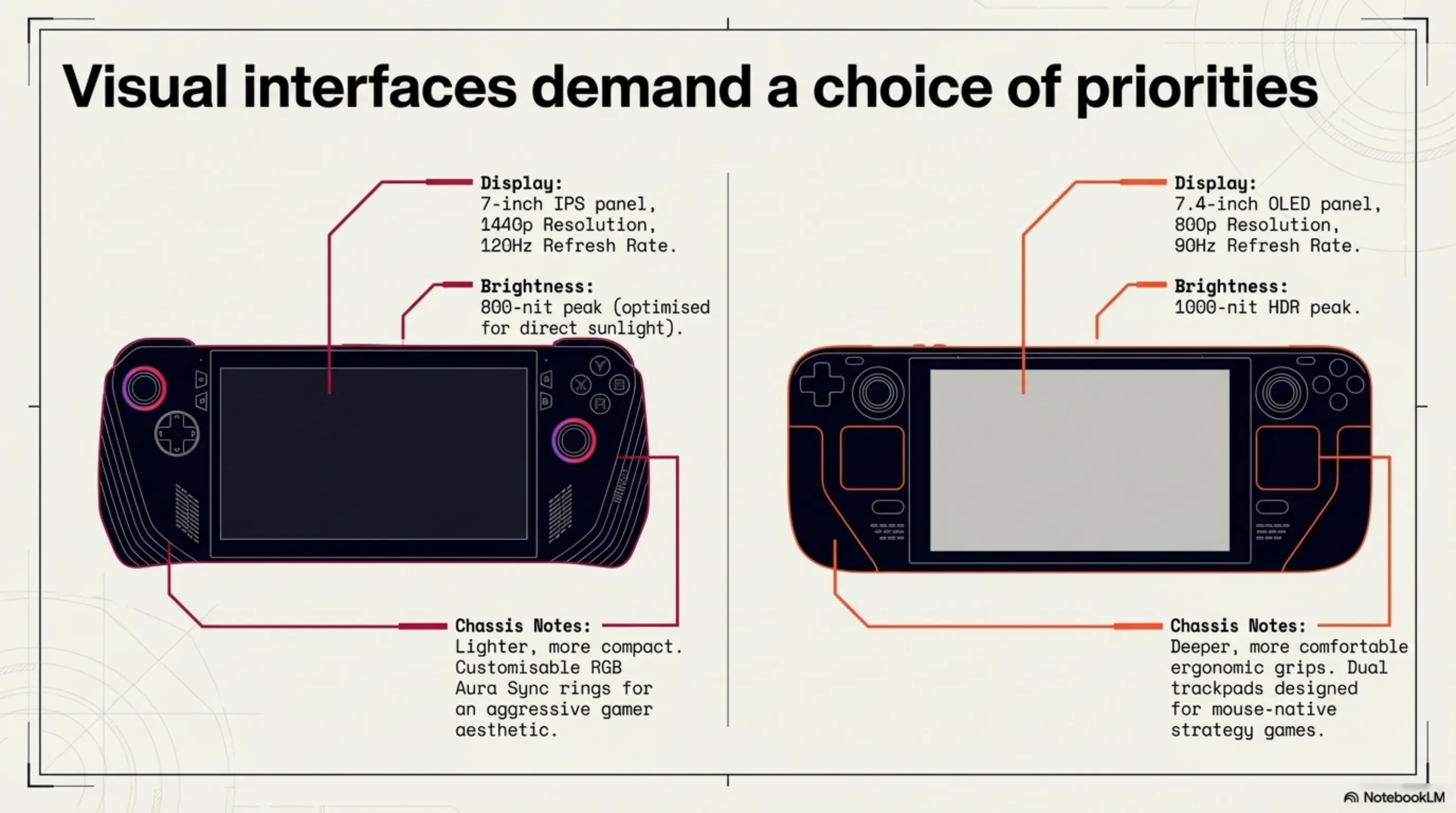
Powerful hardware is practically worthless without a breathtaking visual interface. In this section of our autopsy, we are confronted with two completely opposing ideologies in display panel design. Choosing between them depends entirely on your specific gaming palate.
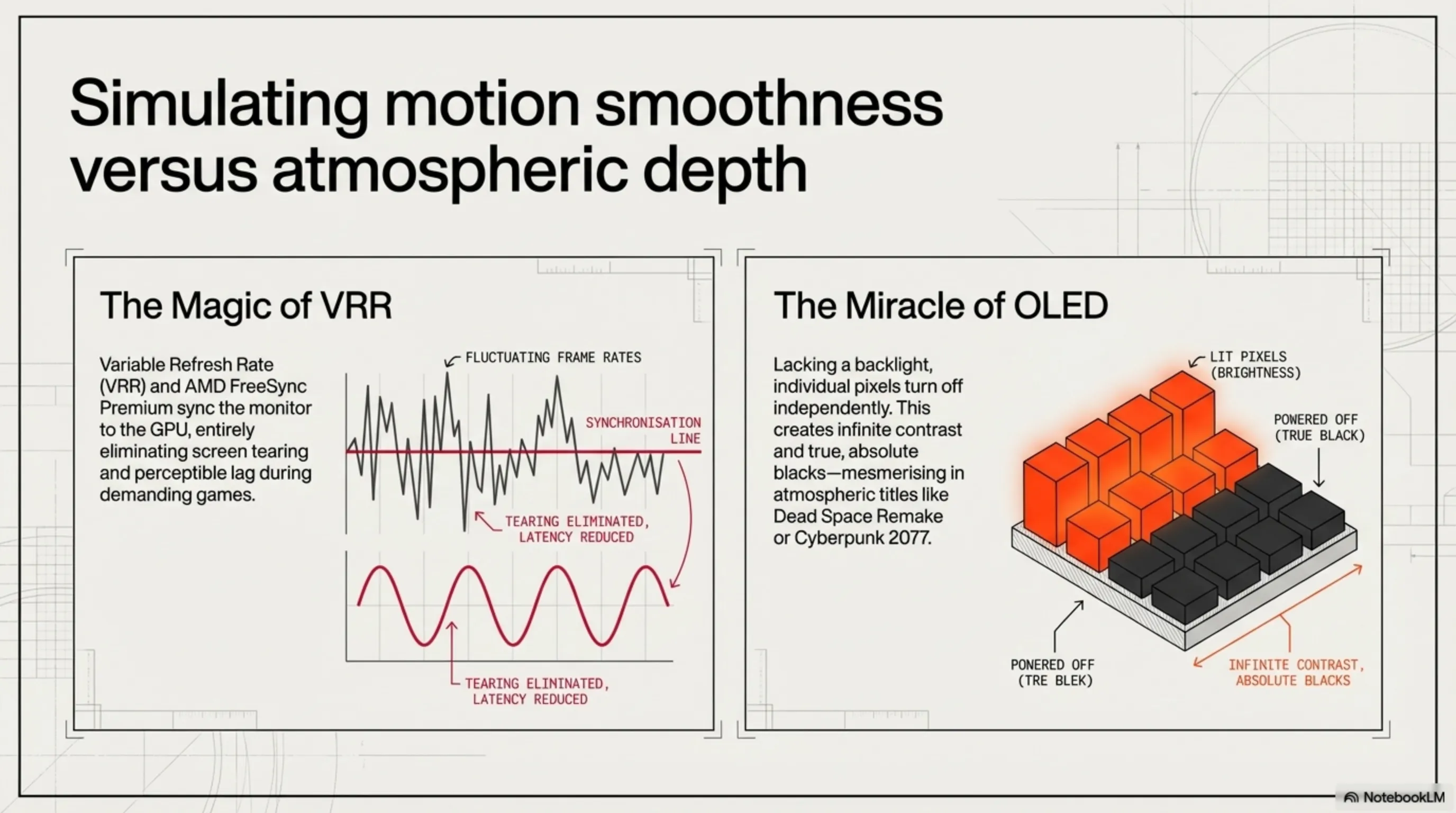
ASUS and the Magic of Variable Refresh Rate (VRR)
In the ROG Ally 2, ASUS has embedded a 7-inch IPS panel boasting a magnificent 1440p resolution capable of supporting a 120Hz refresh rate. However, the absolute killer feature of this display is its support for Variable Refresh Rate (VRR) and AMD FreeSync Premium.
VRR works miracles on handheld PCs. In demanding games where your frame rate constantly fluctuates between 45 and 60 fps, VRR synchronizes the monitor's refresh rate with the GPU's output. This means you will experience zero screen tearing and no perceptible lag. Games on the Ally 2 feel incredibly smooth even at lower frame rates. Furthermore, the 800-nit peak brightness ensures the panel is perfectly responsive for outdoor gaming under direct sunlight.
Valve and the Miracle of Organic Light-Emitting Diodes (OLED)
On the other side of the arena, Valve has deployed a 7.4-inch OLED panel with an 800p resolution and a 90Hz refresh rate. If you only look at the resolution, the Steam Deck might seem like the loser; but make no mistake! On a 7-inch display, an 800p pixel density is perfectly sharp and sufficient.
The Steam Deck's true power lies in its OLED technology. In these panels, there is no backlight; every single pixel turns on and off independently. This means you experience infinite contrast and true, absolute blacks. When playing dark, atmospheric titles like Dead Space Remake or Cyberpunk 2077 on the Steam Deck, the depth of colors and the 1000-nit peak HDR brightness will simply mesmerize your eyes. The only major weakness here is the lack of VRR support, which makes visual stuttering more noticeable than on the ASUS device when frame rates drop.
Cybernetic Design Note: Ergonomically speaking, despite its larger dimensions, the Steam Deck features deeper, more comfortable grips. Its dual Trackpads allow you to easily play strategic games (like Civilization VI) that were originally designed for a mouse. In contrast, the ASUS ROG Ally 2 is lighter, more compact, and features customizable RGB light rings (Aura Sync) that give it a much more aggressive, cyberpunk gamer aesthetic.
OS and Software: Windows 11 Freedom vs SteamOS Integration
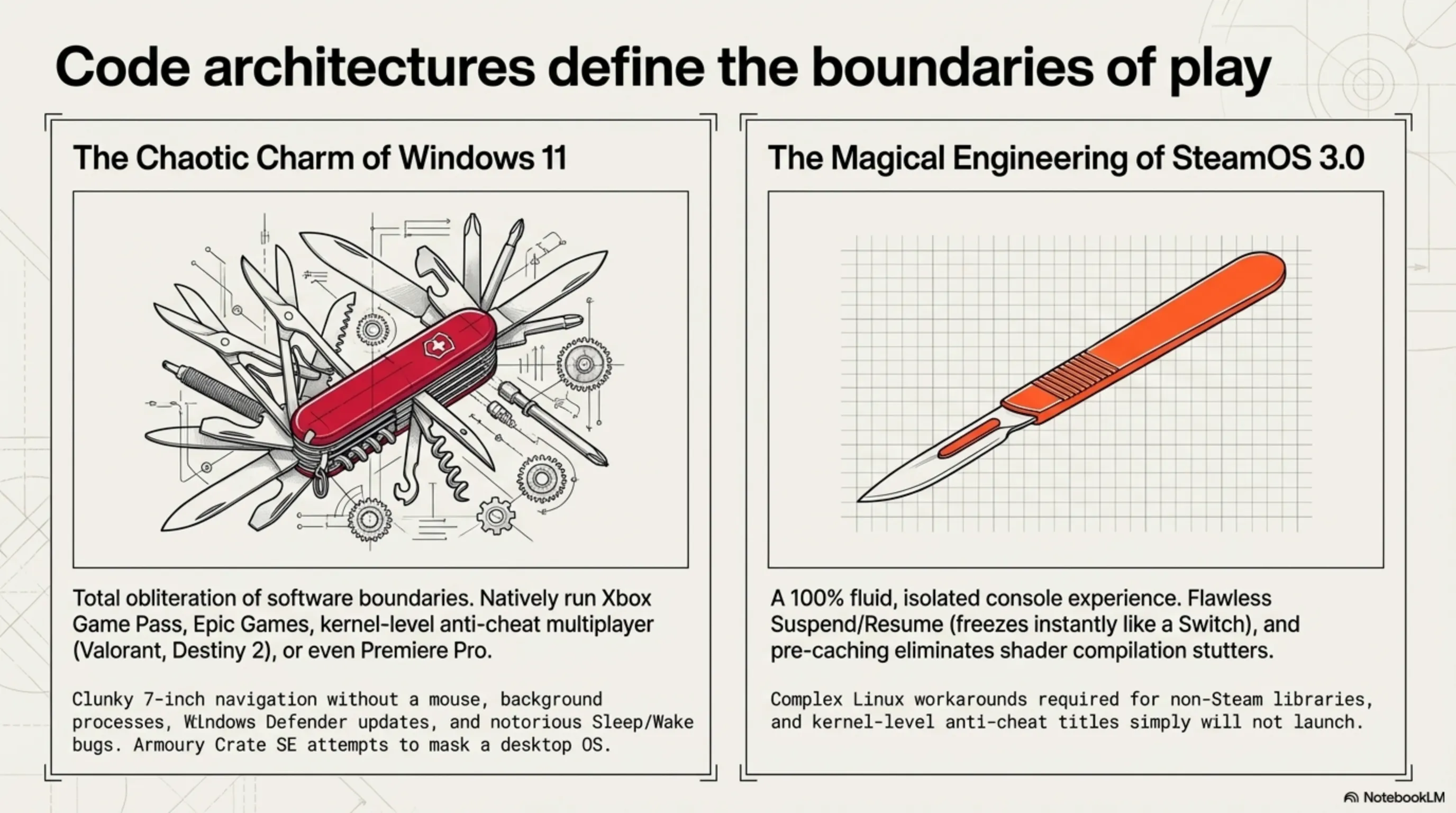
The true war between these two devices is not fought in the silicon, but within the lines of their operating system code. This is where two radically different philosophies clash head-on: the "absolute freedom of an open platform" versus "isolated console optimization."
ASUS and the Chaotic Charm of Windows 11
The ASUS ROG Ally 2 ships natively with a full, unadulterated version of Windows 11. The massive advantage of this approach is the total obliteration of software boundaries. You are not locked into an isolated ecosystem; you can simultaneously run Steam, Epic Games, Ubisoft Connect, and most importantly, Xbox Game Pass natively. Multiplayer games featuring aggressive kernel-level anti-cheat systems (such as Call of Duty, Valorant, and Destiny 2) run flawlessly on this device. Beyond gaming, you have a complete PC in your pocket—you can install Premiere Pro, Photoshop, or Telegram, and connect it to an external monitor to transform it into a desktop workstation.
But this freedom demands a hefty toll. Windows 11 was never designed for a 7-inch handheld device lacking a physical mouse and keyboard. Microsoft has yet to fully optimize the Windows Resource Scheduler for battery-reliant handhelds. Background processes, sudden Windows Defender updates, and notorious Sleep/Wake bugs can occasionally turn the user experience into a nightmare. ASUS has attempted to unify the interface with their updated Armoury Crate SE software, but the core experience still feels like operating a miniaturized desktop PC, not a dedicated console.
Steam Deck and the Magical Engineering of SteamOS
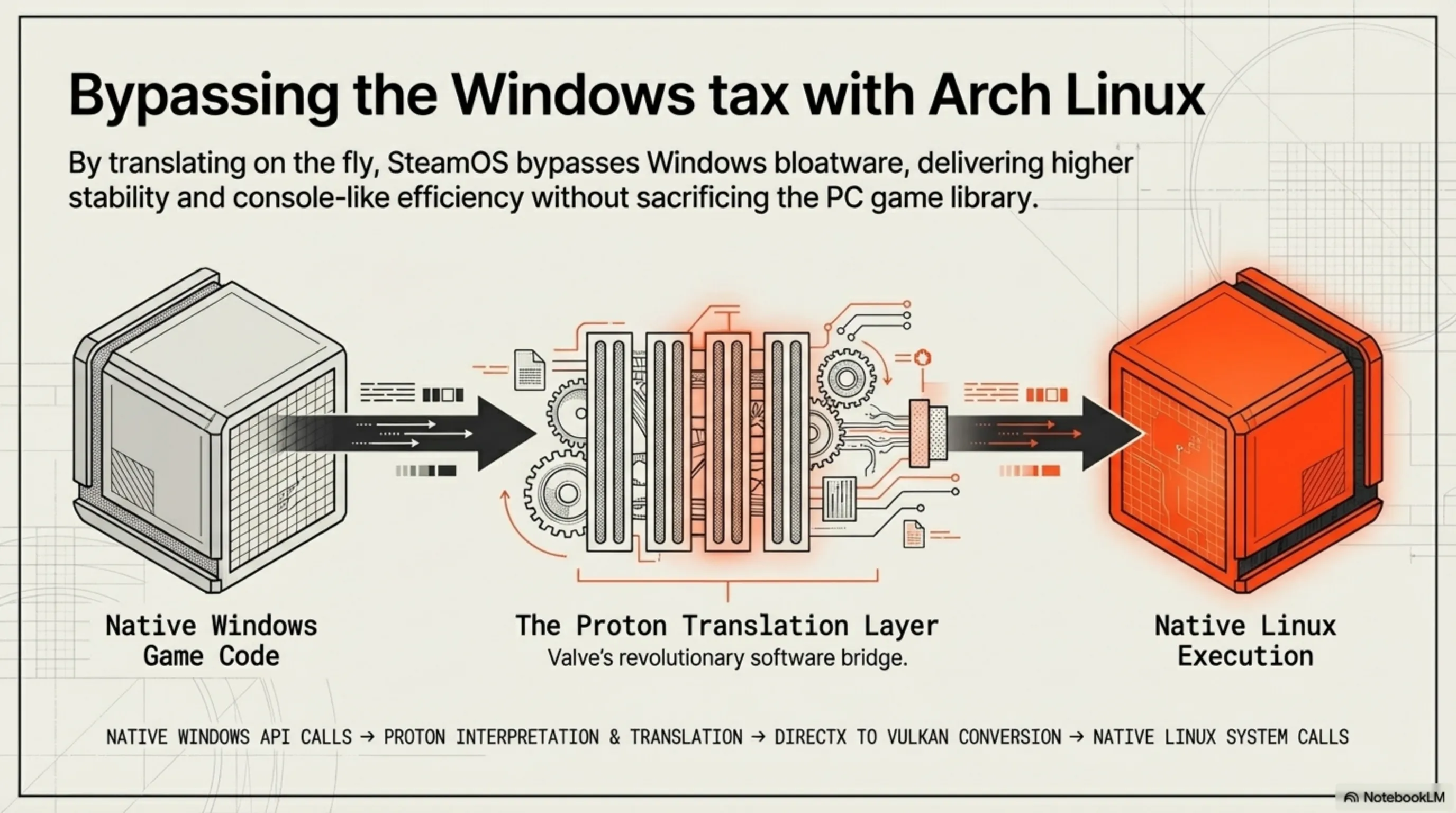
Fully aware of the catastrophes associated with running Windows on handhelds, Valve developed its proprietary operating system, SteamOS 3.0, based on Arch Linux. To execute Windows games on Linux, Valve utilizes a revolutionary translation layer called Proton. The result? A 100% console-like, fluid experience with absolutely zero software bloat.
On the Steam Deck, the Suspend/Resume feature works exactly like a Nintendo Switch: press the power button, the game freezes instantly, and press it again to return to the exact same frame a fraction of a second later (a feat nearly impossible on Windows). Furthermore, SteamOS's shader pre-caching system virtually eliminates shader compilation stutters—a notorious plague in modern PC gaming. The drawback? Running games outside the Steam ecosystem (like Xbox Game Pass) requires complex Linux workarounds, and games with kernel-level anti-cheats simply will not launch.
The Battery Crisis: The Achilles Heel of Pocket PCs
When you cram a desktop-class processor into a plastic chassis only a few centimeters thick, you confront two ruthless enemies of physics: heat generation and rapid battery degradation. Our debug in the Tekin Garage reveals which company has more successfully managed this thermodynamic crisis.
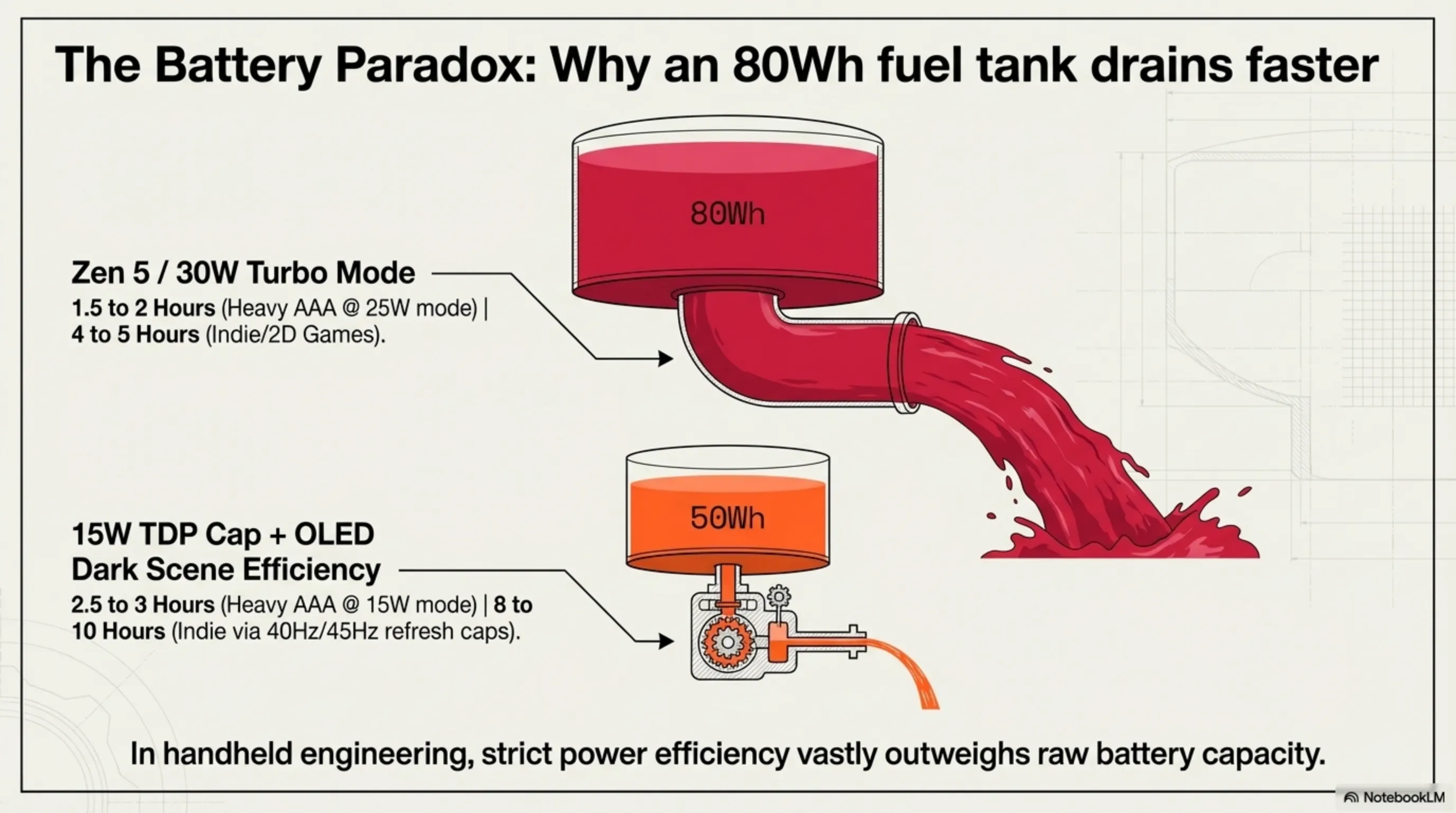
📊 Endurance Benchmark: Battery & Thermals
| Physical Parameter | ASUS ROG Ally 2 | Steam Deck OLED |
|---|---|---|
| Battery Cell Capacity | 80 Watt-hours (80Wh) | 50 Watt-hours (50Wh) |
| Battery Life (Heavy AAA Games) | 1.5 to 2 Hours (@ 25W mode) | 2.5 to 3 Hours (@ 15W mode) |
| Battery Life (Indie/2D Games) | 4 to 5 Hours | 8 to 10 Hours (OLED Optimization) |
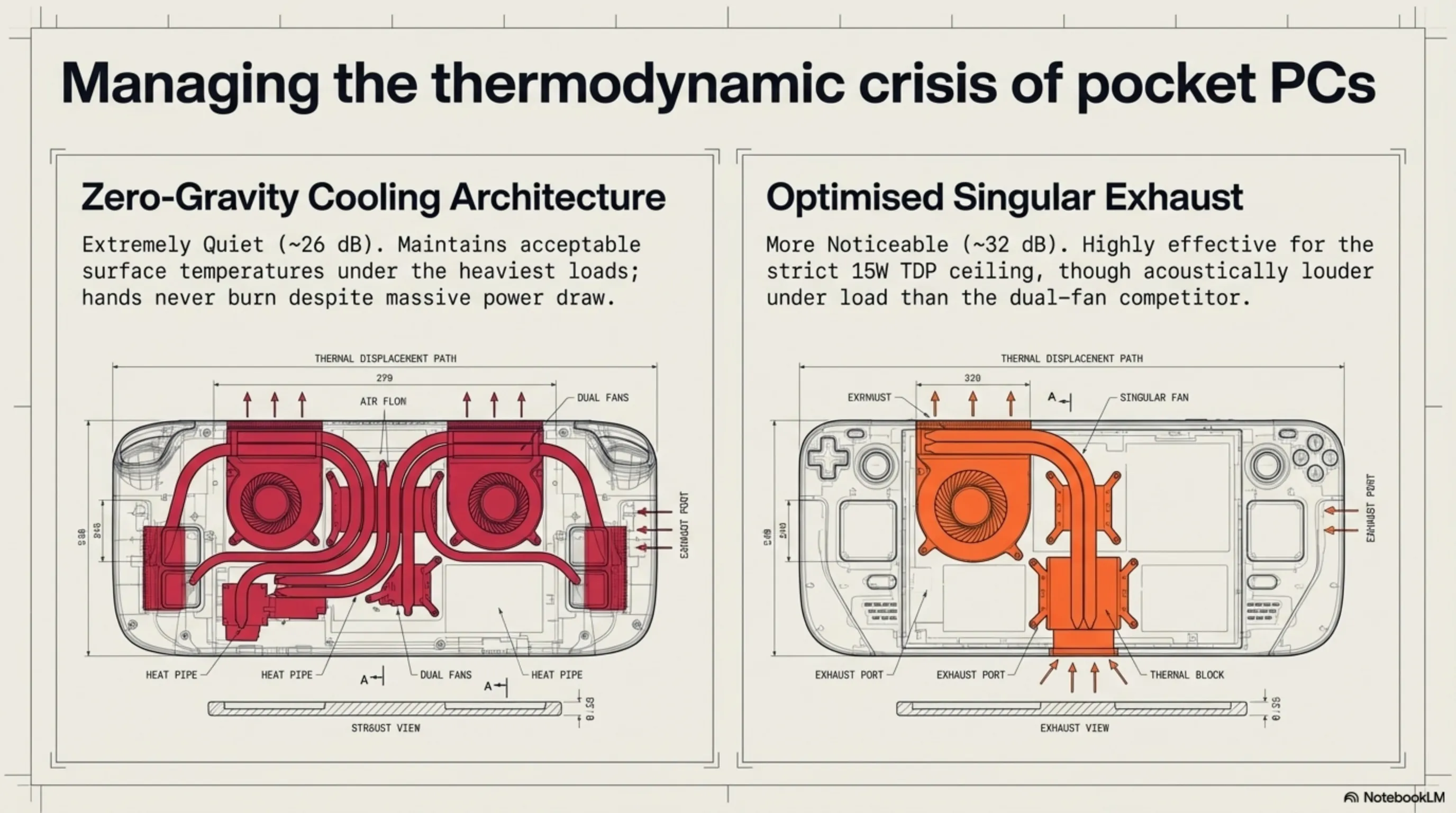
| Cooling Architecture | Dual-Fan (Zero-Gravity system) | Single optimized fan with thick heat pipe |
| Acoustic Noise (Max Load) | Extremely Quiet (~26 dB) | More Noticeable (~32 dB) |
ASUS has insanely increased the battery capacity in this new generation (upgrading to a massive 80Wh), yet the Z2 Extreme chip with its Zen 5 architecture remains an energy-thirsty beast. If you unleash the full power of this processor in Turbo Mode (30W) to run Cyberpunk 2077, the device's giant battery will drop to its knees in under an hour and a half. However, ASUS's engineering masterpiece lies in its Zero-Gravity cooling system. Utilizing two whisper-quiet fans and anti-gravity heat pipes, the device maintains acceptable surface temperatures even under the heaviest loads, ensuring your hands never burn.
On the Steam Deck front, the battery capacity is only 50Wh. Yet, due to the processor's strict 15W TDP ceiling and the extremely low power consumption of the OLED panel in dark scenes, this device is an unrivaled marathon runner. By using SteamOS's smart settings (such as capping the refresh rate to 40Hz or 45Hz), you can exponentially extend battery life. The Steam Deck proves that in the realm of handheld devices, "power efficiency" is vastly more important than "raw processing horsepower."
Inspector's Conclusion: Which Pocket Monster is Yours?
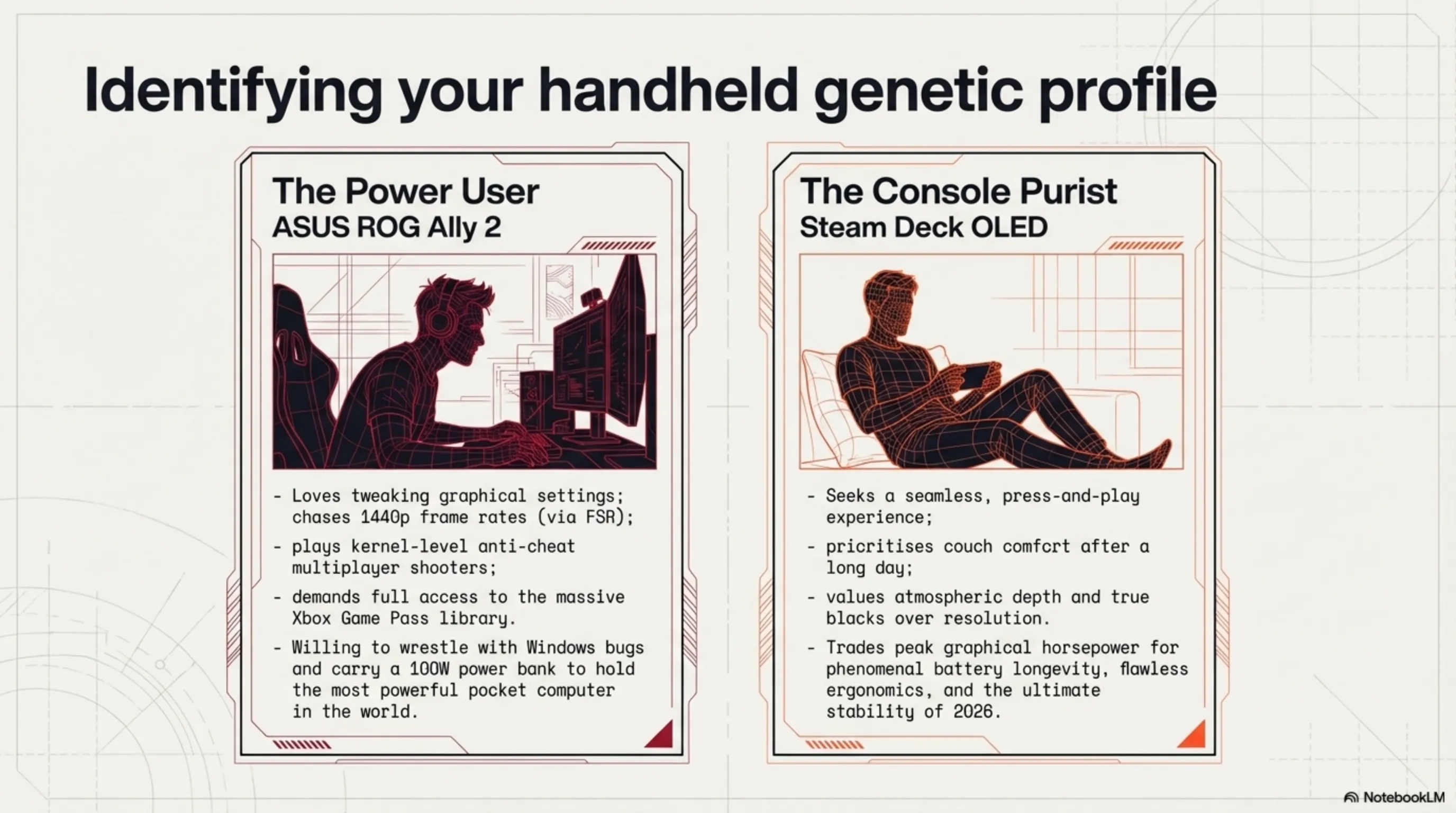
Our autopsy here at Tekin Garage leads to an undeniable cybernetic truth: there is no absolute winner in the handheld PC war. Everything depends entirely on your genetic profile as a gamer.
If you are a "Power User"—someone who loves tweaking graphical settings, demands high frame rates at 1440p (with the help of FSR), enjoys multiplayer online shooters with anti-cheat systems, and absolutely needs access to the massive Xbox Game Pass library—the ASUS ROG Ally 2 with its atomic Z2 Extreme power is built exactly for you. You will have to wrestle with Windows bugs and carry a 100W power bank in your backpack, but in return, you hold the most powerful pocket computer in the world.
Conversely, if you seek a "seamless console experience"—someone who wants to collapse on the couch after an exhausting day, press the power button, and instantly immerse themselves in a visual masterpiece on a mesmerizing OLED monitor with true blacks—the Steam Deck OLED is the undisputed king. The flawless engineering of SteamOS, phenomenal battery longevity, and superior ergonomics make it the monarch of comfort and stability in 2026.
🛠️ Inspector's Recommended Gear
Tekin Legion comrades, I know exactly how confusing and expensive it can be to survive in this ruthless technological jungle and choose between these silicon giants. As your Inspector in this Garage, it is my duty to ensure that you don't just throw your hard-earned money away, but rather invest in gear that will serve as your loyal companion for years to come. Whether you've decided to grasp the absolute freedom of the ROG Ally or immerse yourself in the deep darkness of the Steam Deck's display, we at the TekinGame Shop have sourced these rare cybernetic artifacts for you, guaranteeing authenticity and the best possible configurations. To secure these pocket monsters and upgrade your gaming arsenal, visit our shop with absolute confidence:
Final Note: This article is based on independent testing, industry reports from IDC and Counterpoint Research, and official information from Apple, Qualcomm, MediaTek, and Google. Information is current as of March 13, 2026. Prices and specifications may vary by region.
🌐 Stay Connected With Us 🎮✨
For the latest tech, gaming, and gadget news, follow us on our official social media channels:
Additional Gallery: Handheld PC War 2026: Dissecting ASUS ROG Ally 2 vs Steam Deck OLED