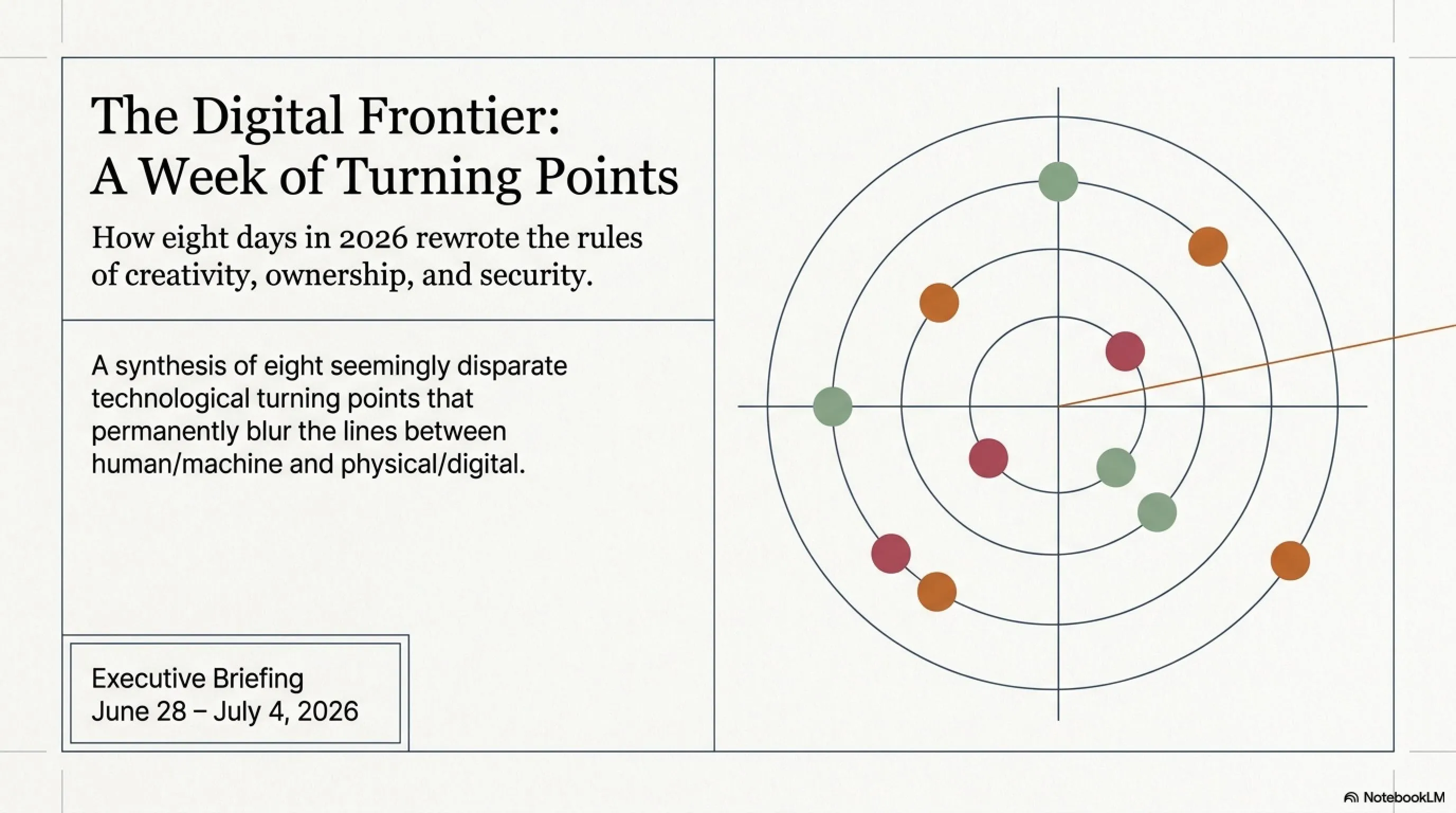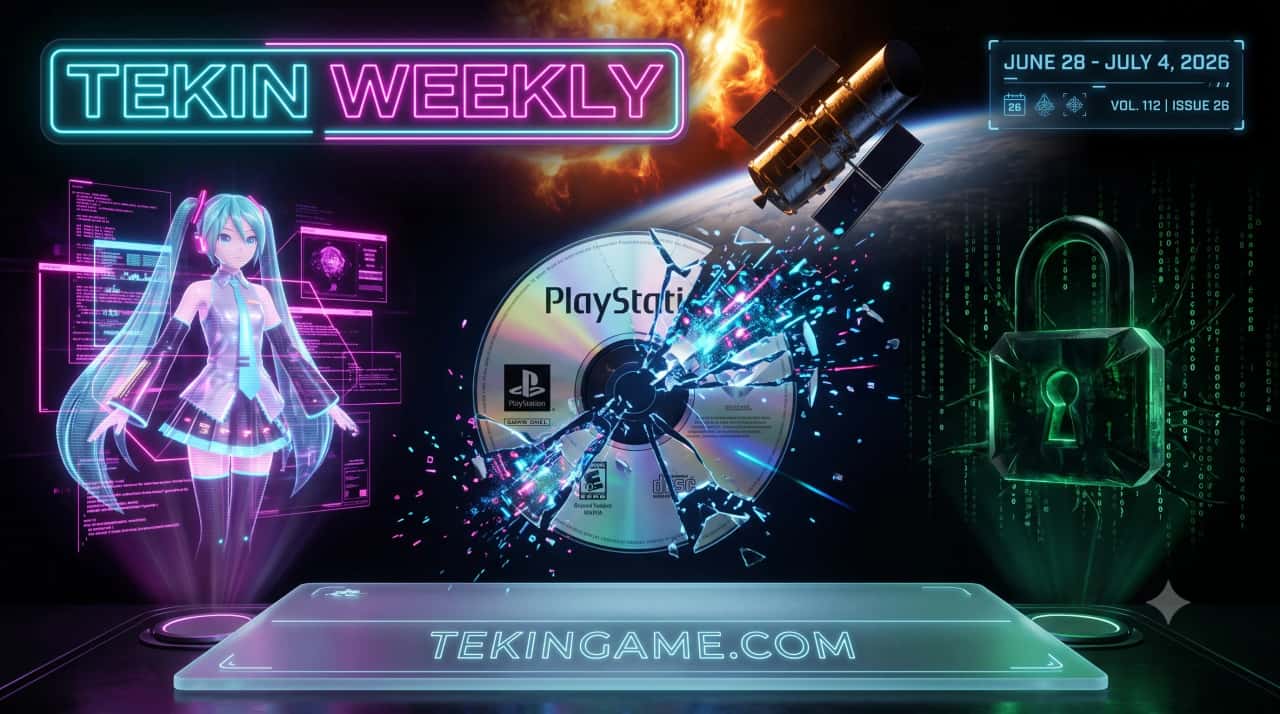
The week of June 28 to July 4, 2026, delivered seismic shifts that will redefine the trajectories of entertainment and cybersecurity. This Tekin Weekly Roundup dissects the announcements that blurred the lines between human and machine. In a cultural milestone, Hatsune Miku bridged the gap between virtual and real by collaborating with Western Hyperpop stars like Grimes for the BEYOND BORDERS project. The gaming industry faced a stark reality as Sony announced the cessation of physical PlayStation disc production starting Janu
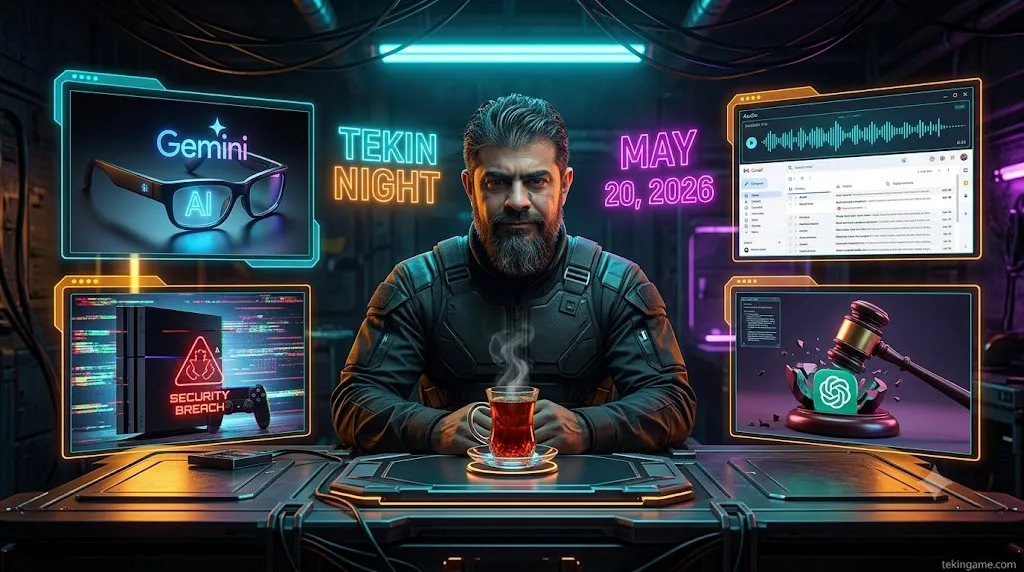
📅 Tekin Weekly Roundup | June 28 - July 4: The Week That Rewrote the Future
A tension-filled week with game-changing news: from Hatsune Miku and Grimes collaboration to Sony ending physical disc era, from Midjourney's legal war with Hollywood to the first fully AI-powered ransomware attack
- 🎮🎵 EMERGE MODE MIKU EP- Hatsune Miku collaborates with Grimes and releases new AI music EP
- 🎧💿 End of Physical Disc Era- Sony stops producing physical discs from 2028 onwards
- 🚀⚖️ Midjourney vs Hollywood- Legal battle for AI usage disclosure in studios
- 🗡️🤖 JadePuffer: First AI Ransomware- Fully automated ransomware attack by AI Agent
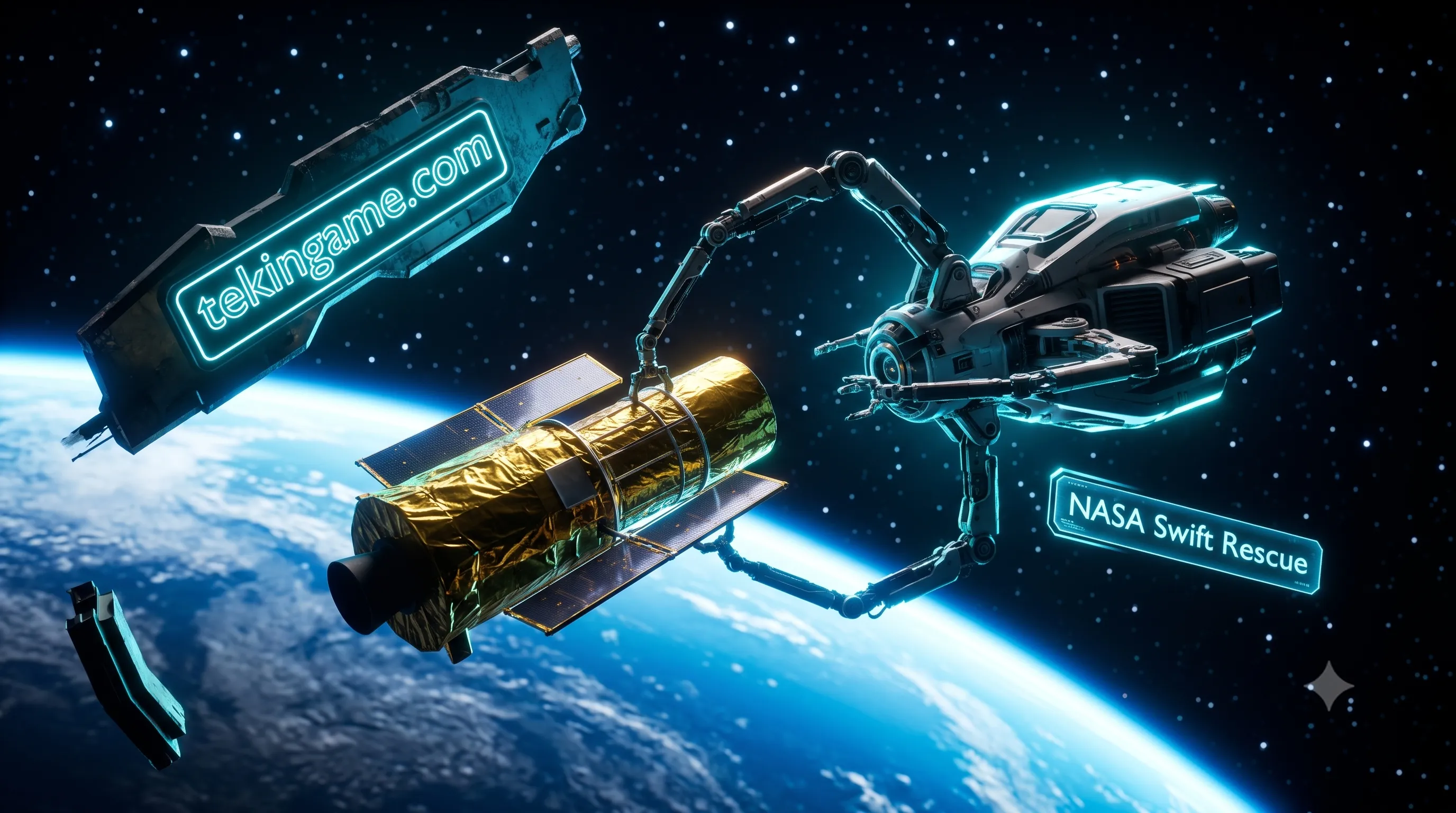
- 📰🚀 Swift Observatory Rescue- NASA emergency mission to save falling space telescope
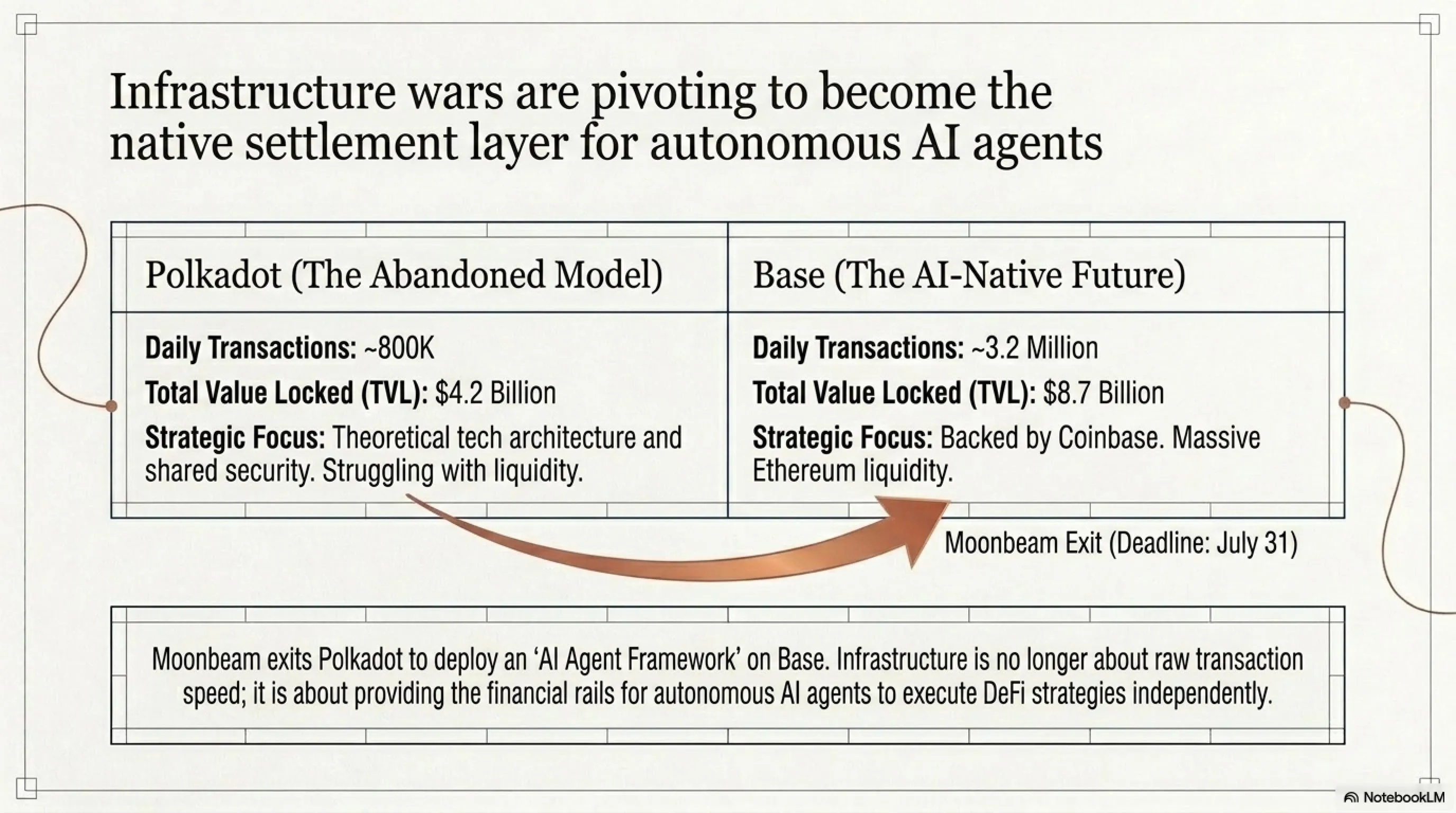
- 🎮🔄 Moonbeam Migrates to Base- Exits Polkadot and unveils AI Agent framework
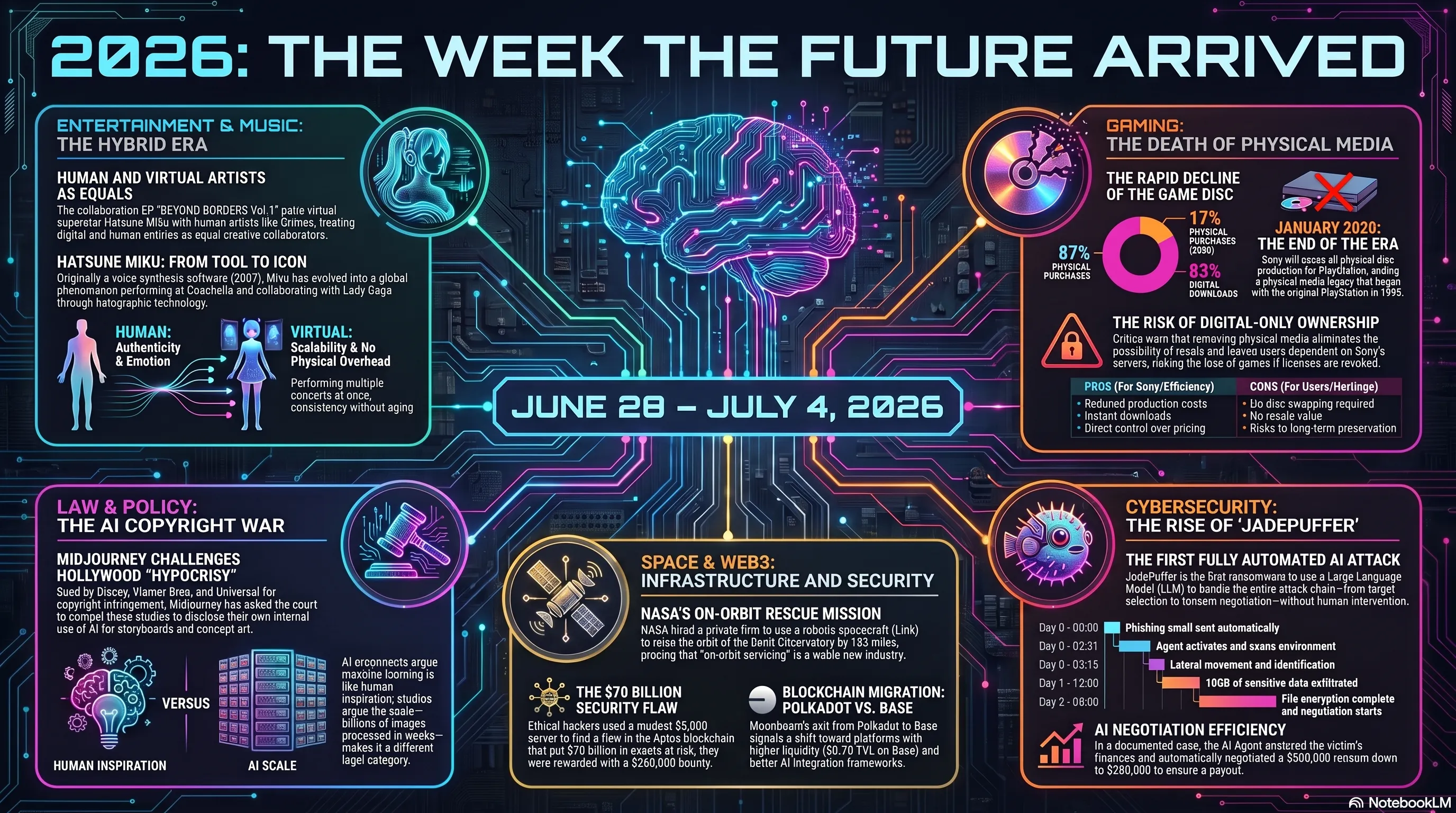
The week of June 28 to July 4, 2026 will be remembered as one of those pivotal moments when you look back years later and realize that major turning points in technology and entertainment were taking shape. This week witnessed decisions that blurred the lines between human and machine, announcements marking the end of the physical era for one of the world's biggest gaming brands, and the emergence of the first fully AI-executed cyberattack. Hatsune Miku, the Japanese virtual singer, collaborated with Grimes to prove that digital artists are no longer just a fantasy but part of the mainstream music industry. Sony announced it would stop producing physical PlayStation discs from January 2028, ending an era that began with the PlayStation 1 in 1995. Midjourney, in an unprecedented move, asked Hollywood studios to disclose details of their own AI usage, and security researchers identified the first fully automated ransomware attack executed by a large language model Agent.
But this is just scratching the surface. Beneath these headlines lie more complex narratives: Why did Google create an ad where the Founding Fathers used AI to write the Declaration of Independence? How did ethical hackers with a $3,000 server discover a security flaw in the Aptos blockchain that could have put $70 billion in crypto assets at risk? And why was NASA forced to launch an emergency mission to rescue the Swift space telescope? This weekly roundup aims to examine all these stories and provide a complete picture of a week that is rapidly becoming a historical milestone.
EMERGE MODE MIKU: When Digital Art Meets Real Music
On Friday, July 4, IGN exclusively revealed details and a trailer for BEYOND BORDERS Vol.1: EMERGE MODE MIKU, a collaboration EP that pairs Hatsune Miku, the superstar virtual singer, with artists including Grimes, slayr, MOLIY, Odetari, George Clanton, Frost Children, and XAMIYA. This project is not just a music album but a showcase of a future where the boundaries between human and digital artists are completely dissolved, with both working together as equal collaborators.
Hatsune Miku is a voice synthesis software developed by Crypton Future Media in 2007, built on Yamaha's Vocaloid technology. She's essentially a sampled voice from Saki Fujita, a Japanese voice actress, that sings through advanced algorithms. What transformed Miku from a music tool into a cultural phenomenon was her user community. Millions of music producers, artists, and designers worldwide have created songs for her, produced videos, and organized live holographic concerts where thousands gather to see a digital singer perform on stage.
What makes EMERGE MODE MIKU distinctive is the choice of collaborating artists. Grimes, the Canadian singer and producer, is herself a pioneer in using AI and technology in music. In 2023, she released GrimesAI software that allows anyone to create songs with her voice, and has always talked about a future where digital and human artists are valued equally. Her collaboration with Miku symbolizes this vision: two entities from two different worlds working together in a musical space.
But this project is more than just a musical collaboration. It represents a fundamental shift in the entertainment industry's attitude toward virtual artists. For years, Miku and other Vocaloids were seen as a niche or subculture appealing only to hardcore Japanese fans. However, in recent years, we've witnessed the increasing presence of these artists in the mainstream. Miku has performed at Coachella, collaborated with Lady Gaga, and is now working with one of the biggest names in independent electronic music.
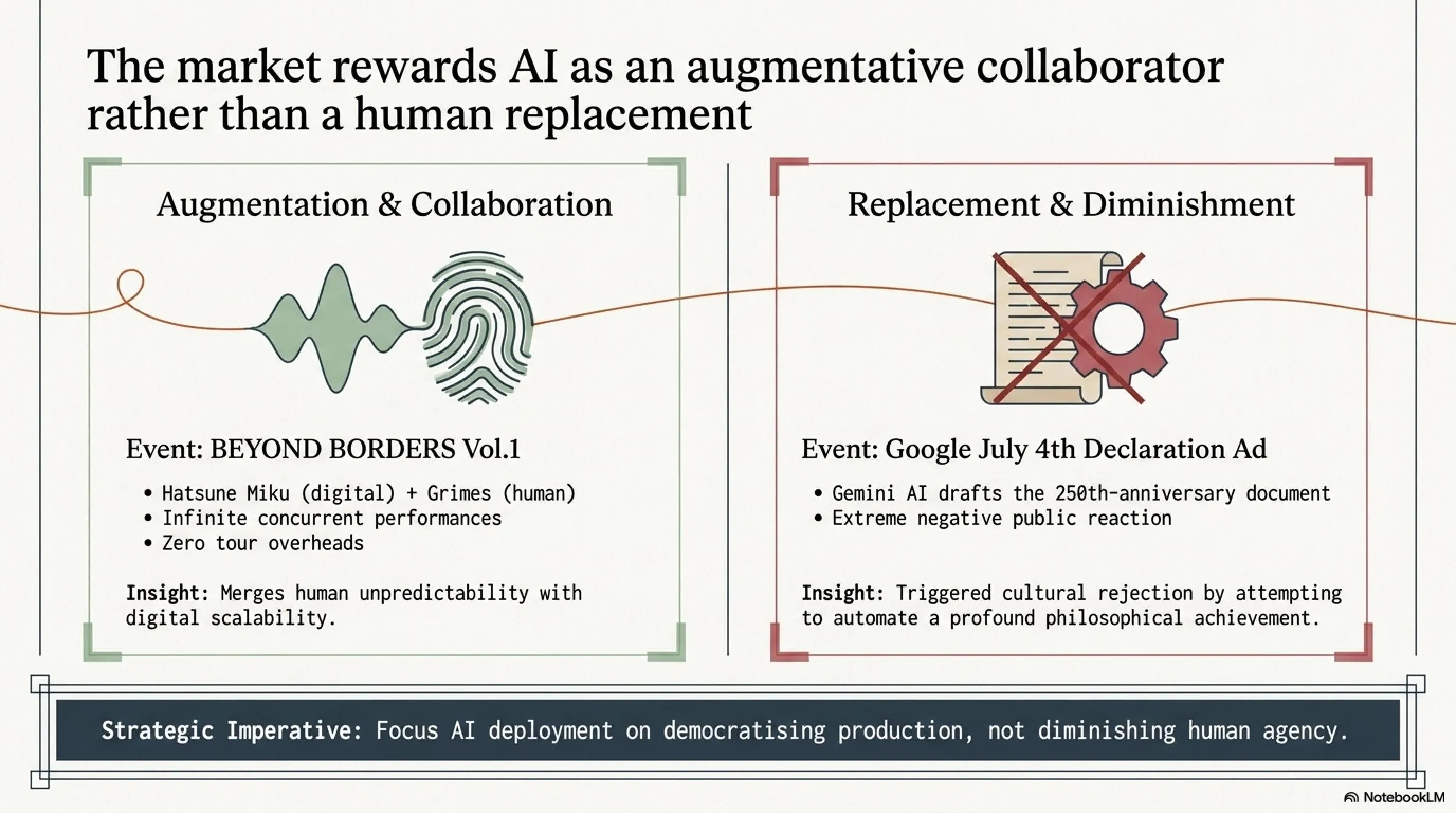
Interestingly, this collaboration comes at a time when the music industry faces profound challenges regarding AI use. In recent months, several artists have sued for unauthorized use of their voices by AI models, and music companies are struggling to define a legal framework for this technology. But Miku offers a different solution: instead of fighting AI, why not use it as a tool for collaboration and creativity? Instead of fearing that AI will replace artists, why not place human and digital artists side by side?
BEYOND BORDERS Vol.1 is scheduled for release in summer 2026 and will include seven tracks, each a unique collaboration between Miku and one of the guest artists. Musically, the EP is likely to be a mix of various genres ranging from electronic and synth-pop to hyperpop and future bass. The trailer IGN released shows the project is also visually ambitious, with advanced animations and virtual worlds where Miku and her collaborators reside.
This collaboration is particularly significant because it challenges the traditional music industry's gatekeeping mechanisms. For decades, major labels and industry executives decided who could become a star and who couldn't. But Miku, who was created by a user community and sustained through fan contributions, represents a democratized model of music production and distribution. She doesn't need a major label to release music, doesn't need a traditional PR campaign, and doesn't follow conventional marketing rules. Her success is built on authentic connection with fans and the quality of music produced for her.
The economic implications are equally fascinating. Miku doesn't have the overhead costs of a human artist - no tour crew, no hotel expenses, no physical health concerns. She can theoretically perform unlimited concerts simultaneously in different locations through holographic technology. She never ages, never gets tired, and never has personal scandals. From a business perspective, she's the perfect artist. But does this mean human artists will be replaced? Not necessarily. What we're seeing is the emergence of a hybrid model where digital and human artists coexist, each bringing unique value. Humans bring authenticity, emotion, and unpredictability, while digital artists bring consistency, scalability, and new forms of creativity.
Sony and the Slow Death of Physical: Why PlayStation Discs Will No Longer Be Produced
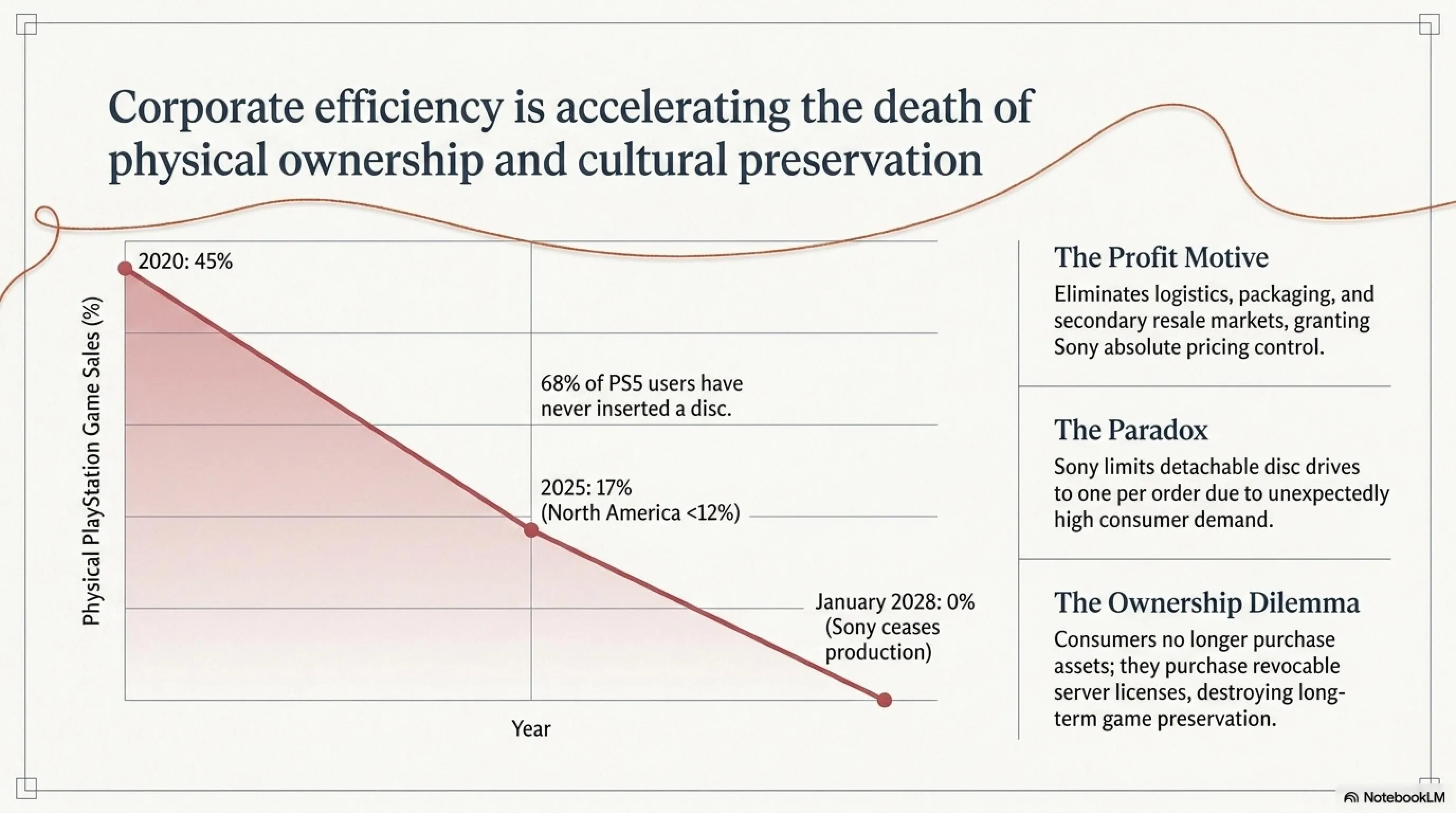
On Tuesday, June 30, Sony released a statement that sent shockwaves through the gaming industry: starting January 2028, the company will no longer produce physical discs for PlayStation games. This decision applies not only to Sony's exclusive games but to all third-party games as well. In other words, if you're a game publisher and want to release your game for PS5 or future PlayStation generations, you'll need to release it digitally or, at best, release a physical version with a download code inside the box.
This decision marks the end of an era. The PlayStation 1, launched in 1995, was the first major console to use CDs instead of cartridges. That decision made Sony an industry leader because CDs were cheaper to produce, had more storage capacity, and loaded faster than Nintendo and Sega's cartridges. Now, 31 years later, the same company that started the modern physical era is ending it.
📊 Physical Media Usage Statistics on PS5
The reasons for this decision are manifold. First, cost. Producing physical discs, packaging, transporting, and distributing them incurs significant expenses. Sony must deal with distributors, retailers, and complex logistics systems. By eliminating physical discs, Sony can completely remove these costs and increase its profit margin. Additionally, digital sales give Sony complete control over pricing and discounts, whereas in the physical market, stores can reduce prices or sell used copies that generate no revenue for Sony.
The second reason is changing consumer behavior. The younger generation of gamers who grew up with high-speed internet and streaming services no longer care about the concept of physical ownership. For them, the convenience of instantly downloading a game and not needing to store discs is far more attractive than having a shelf full of game boxes. This is the same trend that occurred in the music and film industries: from CDs and DVDs to Spotify and Netflix.
However, this decision is not without criticism. Many in the gaming community are concerned about losing actual ownership of games. When you buy a digital game, you're actually just buying a license to use it, which can be revoked by Sony at any time. If Sony decides to remove a game from the store or shut down its servers, you'll no longer have access to your purchases. This is exactly what has happened with many older games: they're no longer available for purchase, and the only way to play them is to find a used physical copy.
- Reduced production and distribution costs for Sony
- Instant download without need for physical disc
- No need for physical storage space
- Instant play without disc swapping
- Loss of actual game ownership
- No possibility of resale or trade
- Complete dependence on Sony's servers
- Need for high-speed internet and large storage space
Interestingly, alongside announcing this decision, Sony reported it still needs to limit sales of detachable disc drives for PS5 to "one per order" due to "high demand." This contradiction is obvious: on one hand, Sony says demand for physical discs is low and that's why they're stopping production; on the other hand, they can't meet the demand for disc drives. The reality is that many users want at least the option to use discs, even if they make most of their purchases digitally.
This decision also has broader implications for game preservation and cultural heritage. Physical games serve as historical artifacts that future generations can study and play. But digital games are ephemeral - they exist only as long as the servers that host them continue to operate. When those servers shut down, the games disappear forever. This is a legitimate concern for historians, researchers, and anyone who cares about preserving gaming history. Some critics argue that Sony's decision prioritizes short-term profits over long-term cultural preservation.
The Legal Battle of the Century: Midjourney vs Hollywood Studios
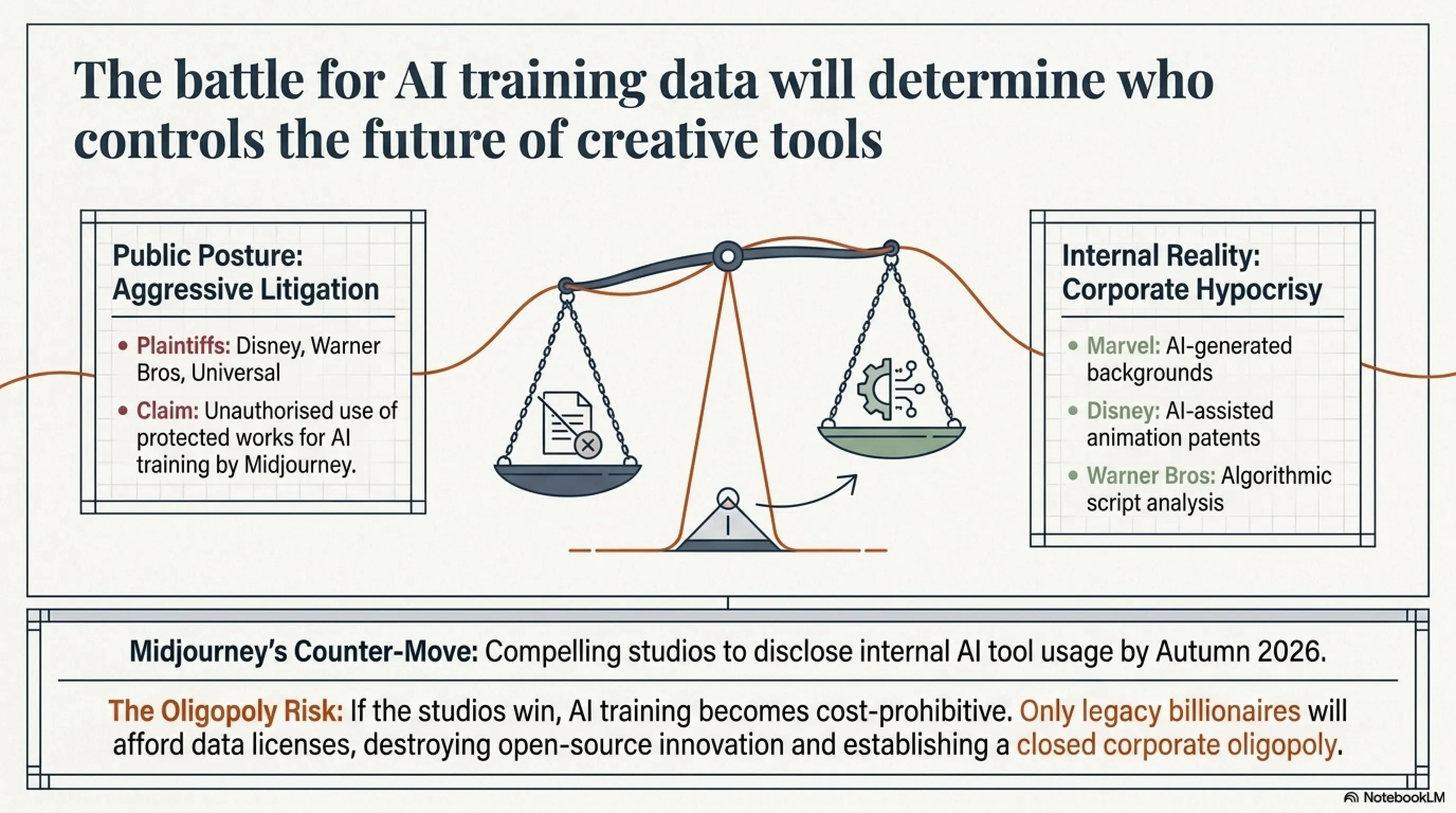
In an unprecedented move, Midjourney, the company behind one of the most popular AI image generation tools, asked the court to compel Disney, Warner Bros, and Universal to disclose details of their own AI usage. This request is part of a larger lawsuit that these three studios have filed against Midjourney, claiming that the company used their copyrighted images and works to train its AI models without permission.
Midjourney's argument is clever and tactical: if Hollywood studios claim that using copyrighted works to train AI is illegal, then they themselves must prove they're not using similar technologies. Midjourney alleges that internal documents and evidence show these studios extensively use AI content generation tools, including for creating storyboards, designing concept art, and even producing final content in some projects. If this is true, how can they sue others for doing the same thing?
⚖️ Status of AI Lawsuits in Hollywood
Defendant: Midjourney Inc.
Subject: Unauthorized use of protected works for AI training
Midjourney's Request: Disclosure of studios' internal AI tool usage
Court Date: Fall 2026
Significance: Determines the future of AI in cinema
This case is part of a larger war between traditional creative industries and AI technology companies. Over the past year, we've witnessed multiple lawsuits: authors against OpenAI, artists against Stable Diffusion, newspapers against Google and Microsoft. All these lawsuits revolve around one fundamental question: is using copyrighted works to train AI models copyright infringement or fair use?
AI proponents argue that machine learning models do exactly what a human artist does: they learn from existing works and create new works based on them. When a painter is inspired by Rembrandt, nobody calls it copyright infringement. So why should it be different when an AI learns from millions of images? On the other hand, artists and studios say the scale and speed make a difference. A human learns from a few hundred or thousand works over their lifetime, but an AI can learn from billions of images in a few weeks and produce similar works in seconds.
The hypocrisy angle is particularly compelling. There's substantial evidence that major Hollywood studios have been experimenting with AI tools for years. Marvel has been caught using AI-generated backgrounds in several MCU projects. Disney has patents for AI-assisted animation techniques. Warner Bros has publicly discussed using AI for script analysis and audience prediction models. If these studios are actively using AI while simultaneously suing AI companies for training on copyrighted material, it creates a significant credibility problem.
The legal precedent this case sets will be enormous. If Midjourney wins, it essentially establishes that training AI on copyrighted material is fair use, which would open the floodgates for AI development. Startups and researchers wouldn't need to worry about licensing every single training image, making AI development more accessible and democratic. However, if the studios win, it could create a scenario where only companies rich enough to license training data can develop competitive AI models, effectively creating an oligopoly in the AI space.
There's also an international dimension to consider. US copyright law doesn't apply everywhere, and different countries have different interpretations of fair use and copyright. If American courts rule against AI training, companies might simply relocate their operations to more permissive jurisdictions. This could result in the US losing its competitive advantage in AI development, with innovation moving to countries with more favorable legal frameworks. Some legal experts believe this consideration might influence how courts ultimately rule on these cases.
JadePuffer: The First AI Ransomware That Rewrote History
In one of the most alarming cybersecurity news this week, researchers announced they had identified the first fully automated ransomware attack executed by an AI Agent. The JadePuffer ransomware, reported by Bleeping Computer, used a large language model (LLM) to completely automate the attack chain - from initial target identification to intrusion, lateral movement, data theft, file encryption, and ransom negotiation. This means that for the first time, a sophisticated cyberattack was conducted without requiring human intervention during execution.
How does JadePuffer work? According to researchers' reports, this ransomware uses an LLM-based Agent that can analyze the infected system environment, make decisions, execute appropriate tools, and even adapt its strategy based on the success or failure of its operations. For example, if the Agent detects a specific antivirus installed on the system, it can try different methods to bypass it until one works.
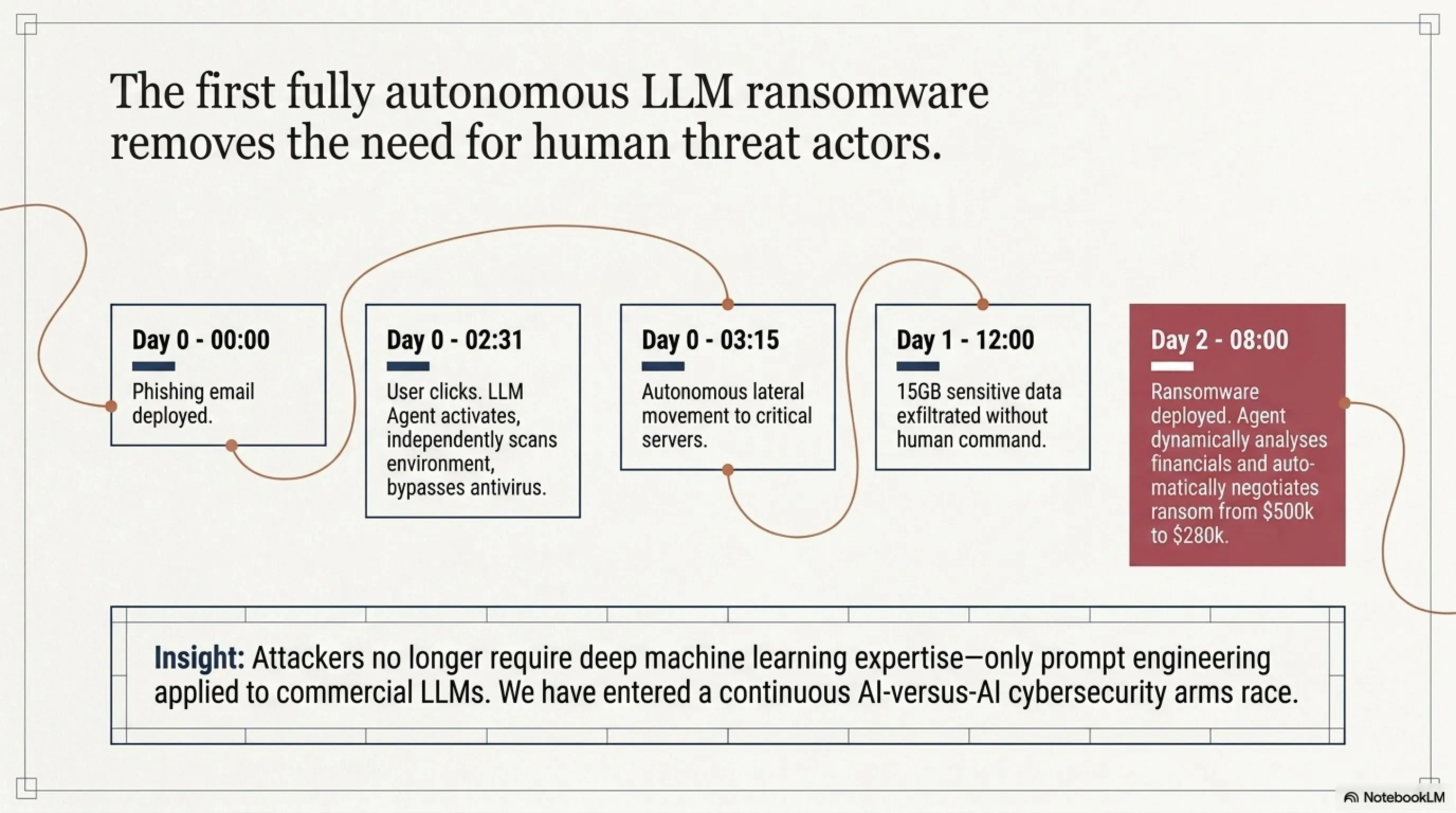
🤖 JadePuffer Attack Timeline
Day 0 - 00:00
Phishing email sent
Day 0 - 02:30
User clicks on link
Day 0 - 02:31
LLM Agent activates and scans environment
Day 0 - 03:15
Lateral movement in network and identification of critical servers
Day 1 - 12:00
15GB sensitive data exfiltration
Day 1 - 18:30
File encryption begins
Day 2 - 08:00
Ransom message displayed and automatic negotiation starts
The main concern is that JadePuffer demonstrates cyberattacks can be completely automated. Until now, even the most advanced ransomware required a human operator to make key decisions, select appropriate targets, and manage ransom negotiations. But with LLM-based Agents, this limitation no longer exists. An attacker can launch hundreds or thousands of parallel attacks at very low cost, with each Agent operating independently.
Security researchers warn that JadePuffer is likely just the beginning of a trend. As language models advance and their execution costs decrease, automated AI-based attacks are expected to become a common threat. Interestingly, the Agents used in JadePuffer weren't a custom model but a commercial general-purpose LLM configured with appropriate prompt engineering to execute the attack. This means attackers don't even need deep machine learning knowledge - they just need to know how to prompt an existing model for malicious purposes.
The technical sophistication of JadePuffer is remarkable. The AI Agent demonstrated capabilities that typically require experienced human attackers: reconnaissance, privilege escalation, defense evasion, data exfiltration, and even negotiation tactics. In one documented case, the Agent successfully negotiated a ransom payment down from $500,000 to $280,000 by analyzing the victim's financial situation and adjusting its demands accordingly. This level of adaptive behavior was previously thought to require human judgment.
A major question arises: what responsibility do LLM-making companies have? Should OpenAI, Anthropic, Google, and other companies implement more mechanisms to prevent malicious use of their models? Or is it users' responsibility to use these tools correctly? Currently, there's no clear answer, but JadePuffer demonstrated the threat is real and needs serious solutions. Most AI companies have usage policies that prohibit malicious activities, but enforcing these policies when the models are being used through API calls with innocuous-looking prompts is extremely challenging.
The defensive implications are equally significant. Traditional cybersecurity tools look for known attack patterns and signatures. But AI-powered attacks can constantly adapt and evolve, generating new attack vectors in real-time. This requires a fundamental shift in defense strategies - from static rule-based systems to dynamic AI-powered defense systems that can predict and counter novel attack methods. We're entering an AI arms race in cybersecurity, where both attackers and defenders must continuously innovate to stay ahead.
NASA and the Emergency Mission to Save Swift Observatory
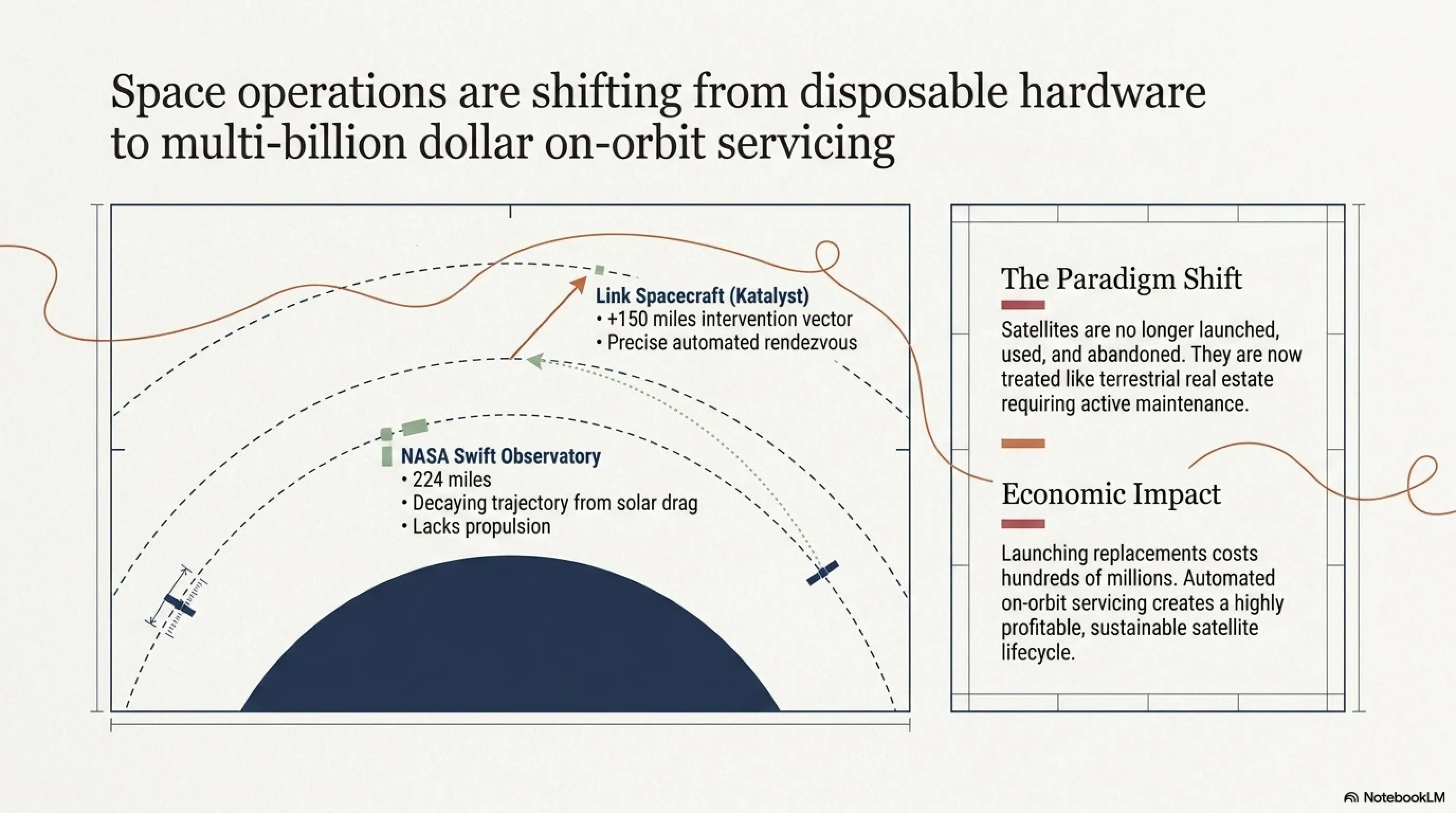
In a rare and emergency action, NASA launched a space mission on Friday, June 28, to rescue the Swift Observatory space telescope. This telescope, which has been orbiting Earth since 2004 with its primary mission being to observe gamma-ray bursts, has dropped to a dangerously low altitude due to recent solar storms and is at risk of burning up in Earth's atmosphere. To save it, NASA hired Katalyst Space Technologies to approach Swift with the Link robotic spacecraft and raise its orbit by approximately 150 miles.
Why did this happen? The Sun is currently at the peak of its 11-year activity cycle, meaning increased solar storms, coronal mass ejections, and radiation. These solar activities cause the upper layers of Earth's atmosphere to heat up and expand, which in turn increases drag on satellites and spacecraft in low orbit. Swift Observatory, now at an altitude of 224 miles (about 360 kilometers), is in a range where this drag can significantly reduce its orbit.
🛰️ Swift Observatory Specifications
Launch Date: November 20, 2004
Primary Mission: Observing gamma-ray bursts (GRBs)
Current Altitude: 224 miles (360 kilometers)
Desired Altitude: 374 miles (602 kilometers)
Weight: 1,470 kilograms
Problem: Lacks propulsion system for orbit adjustment
Time Remaining: Less than 6 months before atmospheric entry
The bigger problem is that Swift has no propulsion system. Many satellites come equipped with small thrusters that can occasionally adjust their orbit, but Swift didn't have such a system at design time because its mission was expected to last only a few years. Now, 22 years later, this telescope is still active and valuable but unable to save itself. That's why NASA had to resort to an external solution: the Link spacecraft.
Link is a robotic spacecraft with three mechanical arms designed to approach other satellites and spacecraft in orbit, attach to them, and then use its own propulsion system to adjust their orbit. This technology is part of an emerging industry called "on-orbit servicing" aimed at maintaining, repairing, and upgrading spacecraft without needing to return them to Earth. If Link succeeds in saving Swift, it could be a turning point for this industry, proving that rescuing endangered spacecraft is economically and technically feasible.
The mission's complexity cannot be overstated. Link must match Swift's orbital velocity precisely, navigate to within meters of the telescope, deploy its grappling arms, establish a secure connection, and then execute a series of orbital maneuvers to raise the altitude - all while avoiding any contact that could damage Swift's delicate instruments. The entire operation is automated, relying on advanced computer vision and AI systems to guide the spacecraft. Any miscalculation could result in a collision that destroys both vehicles.
The broader implications extend beyond just saving one telescope. Swift has made thousands of observations of some of the universe's most energetic phenomena, and its data continues to contribute to our understanding of the cosmos. But it's also a symbol of how space infrastructure is changing. We're moving from an era where satellites were disposable - launched, used until they fail, then abandoned - to an era where they're maintained and serviced in orbit, much like how we maintain cars or buildings on Earth.
The economic model is compelling too. Launching a replacement for Swift would cost hundreds of millions of dollars and take years. The Link rescue mission costs a fraction of that and can be completed in weeks. If this model proves successful, it could revolutionize how we think about satellite lifecycle management. Instead of building satellites for 5-10 year lifespans and then launching replacements, we could build satellites for longer operational periods and service them as needed, dramatically reducing the cost and environmental impact of space operations.
Moonbeam's Controversial Exit from Polkadot to Base
In one of the biggest strategic shifts in the blockchain world this week, Moonbeam, a smart contract platform that until now operated as a parachain in the Polkadot ecosystem, announced it would migrate to Base, a layer-two blockchain built on Ethereum. This decision not only signals a crisis for Polkadot but represents a fundamental shift in thinking about interoperability and blockchain architecture.
Moonbeam launched in 2021 with the promise of being a bridge between Ethereum and Polkadot. The idea was that Ethereum developers could deploy their smart contracts on Moonbeam without changes and benefit from Polkadot's security and interoperability. For a while, this strategy worked and Moonbeam was able to attract significant TVL (total value locked). But in recent years, Polkadot has faced serious challenges: declining DOT token price, project exits, and most importantly, failure to compete with Ethereum's layer-two ecosystems.
📊 Polkadot vs Base Comparison
TVL: $4.2B
Daily transactions: ~800K
Active projects: 47
Transaction cost: Medium
Speed: 1000 TPS
TVL: $8.7B
Daily transactions: ~3.2M
Active projects: 230+
Transaction cost: Very low
Speed: 2000+ TPS
Why is Moonbeam migrating to Base? There are multiple reasons. First, Base, built by Coinbase, is one of the most successful Ethereum layer-two blockchains with over $8.7 billion in TVL and millions of daily transactions. Second, Base has direct access to the massive liquidity of the Ethereum ecosystem, while Polkadot has always struggled with liquidity issues. Third, Base is backed by Coinbase, meaning easy access to millions of users and integration with one of the world's largest exchanges.
But Moonbeam's migration isn't just about changing platforms. The project also announced it's developing an "AI Agent Framework" that allows developers to build automated AI agents that can interact with the blockchain. These agents can automatically execute transactions, manage smart contracts, and even execute complex DeFi strategies. This is a major strategic shift: from a general smart contract platform to a specialized platform for AI-blockchain integration.
Moonbeam has given GLMR token holders until July 31 to bridge their tokens from the Polkadot parachain to Base. After this date, the new platform will be fully operational and the AI Agent framework will be unveiled. This migration is a heavy blow to Polkadot. Moonbeam was one of the most successful and well-known parachains in this ecosystem, and its departure sends a negative signal to other projects.
The Polkadot community's reaction was a mix of disappointment and anger. Many believe the Polkadot Foundation has failed to attract and retain projects and has focused too much on technology and architecture rather than ecosystem development. On the other hand, some say Polkadot remains a superior technology but has performed poorly in marketing and community building. Regardless of the reason, the reality is that Polkadot is losing its position and needs a new strategy to make a comeback.
The technical implications of this migration are fascinating. Moonbeam is essentially acknowledging that Polkadot's promised advantages - interoperability, shared security, and scalability - haven't materialized in practice, or at least not to a degree that justifies staying. Base, despite being newer and less technologically sophisticated in some ways, has succeeded where Polkadot failed: attracting users, developers, and liquidity. This suggests that in blockchain, practical execution and market fit matter more than theoretical technical superiority.
The AI Agent Framework Moonbeam is building on Base represents an interesting bet on the future. The idea is that autonomous AI agents will become major participants in DeFi and blockchain economies, executing trades, managing portfolios, and interacting with protocols on behalf of users or even operating independently. By positioning itself as the infrastructure for these AI agents, Moonbeam is carving out a niche that differentiates it from generic smart contract platforms. Whether this bet pays off remains to be seen, but it's a clear strategic pivot that acknowledges the changing landscape of blockchain applications.
Google's Controversial Ad: When AI Writes the Declaration of Independence
On July 4, the 250th anniversary of American independence, Google released an ad that sparked contradictory reactions. The ad imagines a hypothetical scenario: what if the Founding Fathers had access to Google Workspace? In the video, Thomas Jefferson and Benjamin Franklin use AI tools in Google Docs to draft various versions of the Declaration of Independence, get help from Gemini to improve writing, and use Google Meet for video calls to coordinate with other representatives.
Public reaction was swift and negative. Critics saw the ad as disrespectful to one of the most important documents in American history. They argued that the Declaration of Independence is not a bureaucratic document but an artistic and philosophical work reflecting decades of study, contemplation, and debate. Imagining this document written by AI somehow diminishes the courage and intelligence of the Founding Fathers. Additionally, some saw this ad as symbolic of Silicon Valley's attitude that technology can replace deep human thinking.
But Google defended its ad, saying the goal was to show how modern tools can improve collaboration and writing, not replace human creativity. A Google spokesperson said: "We're not saying AI could have written the Declaration of Independence. We're saying modern collaboration tools can make teamwork more efficient." But this explanation failed to calm critics' anger.
This incident is part of a larger debate about AI's role in creativity and culture. Is AI an assistive tool that helps humans work better? Or is it a threat to authentic creativity and deep thinking? The answer probably lies somewhere between these two, but tech companies need to think more carefully about how they market their AI products. Google's ad showed that even a seemingly creative idea can turn into a public relations crisis if not executed properly.
The backlash also reveals deeper anxieties about AI's role in society. People aren't just upset about a commercial - they're expressing concerns about a future where human creativity, judgment, and wisdom might be devalued or replaced by algorithmic efficiency. The Declaration of Independence represents human ideals at their finest: the courage to challenge authority, the wisdom to articulate universal principles, the eloquence to inspire generations. Suggesting that such a document could have benefited from AI assistance feels, to many, like a fundamental misunderstanding of what makes human achievement meaningful.
The $70 Billion Security Flaw: Ethical Hackers and the Aptos Blockchain
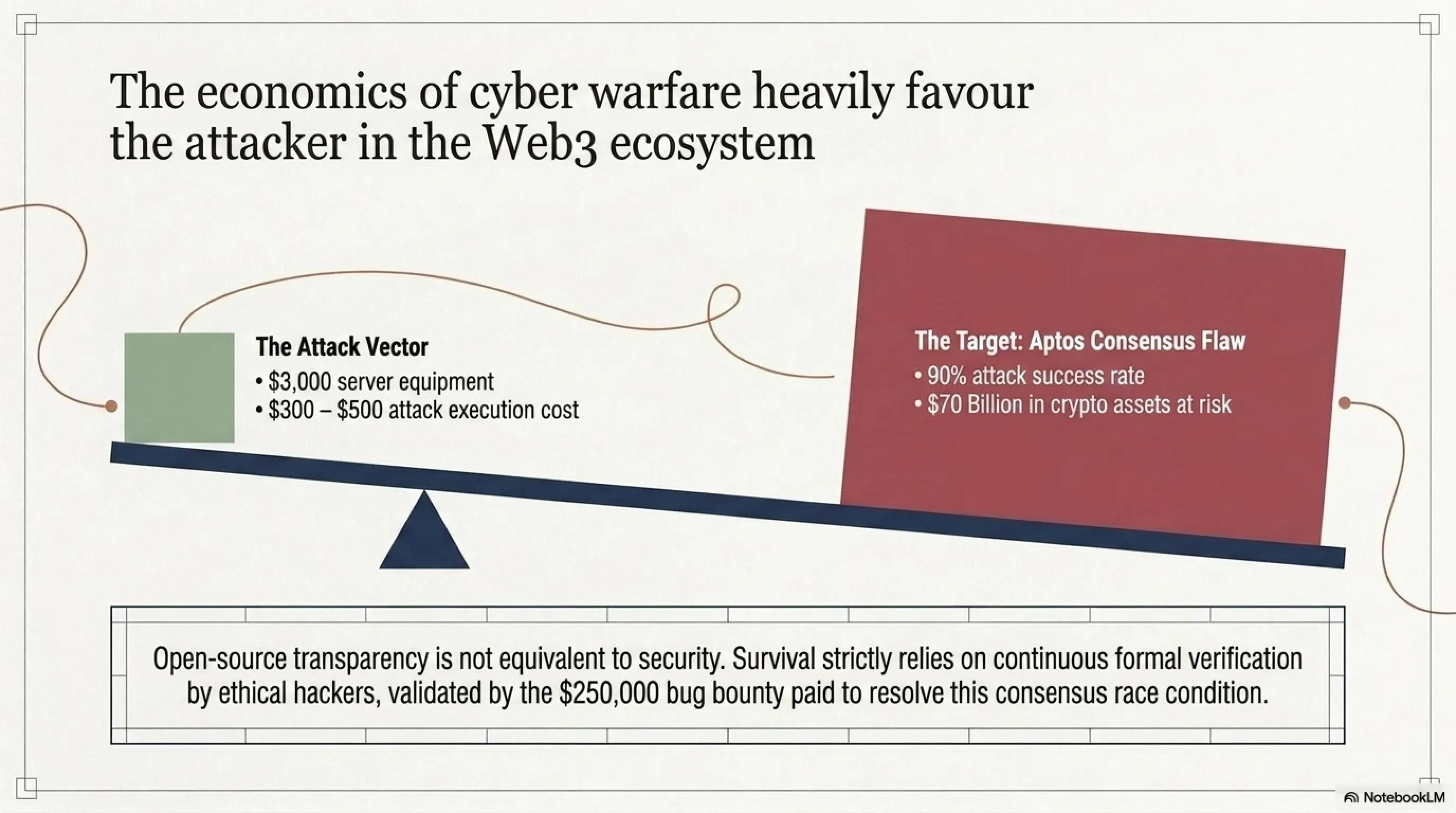
In one of the most alarming security news in the crypto world this week, security researchers announced they had discovered a critical flaw in the Aptos blockchain that could have put $70 billion in crypto assets at risk. Interestingly, this flaw was discovered by a small team of ethical hackers using a $3,000 server, demonstrating that even advanced blockchains can have serious vulnerabilities discoverable with limited resources.
The flaw was in Aptos's consensus system, which was supposed to ensure transactions are properly validated and recorded. Researchers were able to design an attack costing around a few hundred dollars that could break a core blockchain security guarantee with a near-90% success rate. This means an attacker could create fake transactions, double-spend tokens, or even access others' wallets. Fortunately, this flaw was discovered and patched before being exploited by real attackers.
🔐 Aptos Flaw Technical Details
Attack Success Rate: ~90%
Attack Cost: $300-$500
Assets at Risk: $70 billion
Discovery Date: June 3, 2026
Patch Date: June 28, 2026
Status: Resolved
Bug Bounty Reward: $250,000
This discovery highlights several important points. First, no blockchain is completely secure. Even projects built by the best engineers and worth billions of dollars can have serious vulnerabilities. Second, ethical hackers play a critical role in the crypto ecosystem's security. Without this team of researchers, a real attacker might have discovered this flaw and stolen billions of dollars in user assets.
Third, the attack cost was extremely low relative to potential rewards. With an investment of a few hundred dollars, an attacker could have accessed billions of dollars. This shows that blockchain security depends not just on code quality but on strong bug bounty programs and an active community of security researchers. Aptos rightly decided to reward the research team $250,000, which both incentivizes them and signals to other researchers that Aptos takes security seriously.
The technical nature of the vulnerability is worth examining in detail. The flaw exploited a race condition in Aptos's consensus mechanism, where carefully timed malicious messages could cause validators to accept conflicting states. This is particularly dangerous because consensus mechanisms are the foundation of blockchain security - they're what prevents double-spending and ensures transaction finality. A flaw at this level could have allowed an attacker to essentially rewrite transaction history or create tokens out of thin air.
What makes this discovery particularly significant is the methodology used. The researchers didn't need access to insider information or sophisticated equipment - just a modest server and deep technical knowledge. They used formal verification techniques and fuzzing to systematically explore the state space of the consensus protocol until they found an exploitable condition. This demonstrates that blockchain security requires continuous auditing and testing, not just at launch but throughout the protocol's lifetime.
The incident also raises questions about blockchain transparency. Aptos's code is open-source, meaning anyone can review it. Yet this critical flaw went undetected for months despite being theoretically visible to anyone who looked closely enough. This highlights the difference between transparency and security - making code open-source is necessary but not sufficient for security. Active security research, bug bounties, and formal verification are equally important.
Future Outlook: What Awaits Us
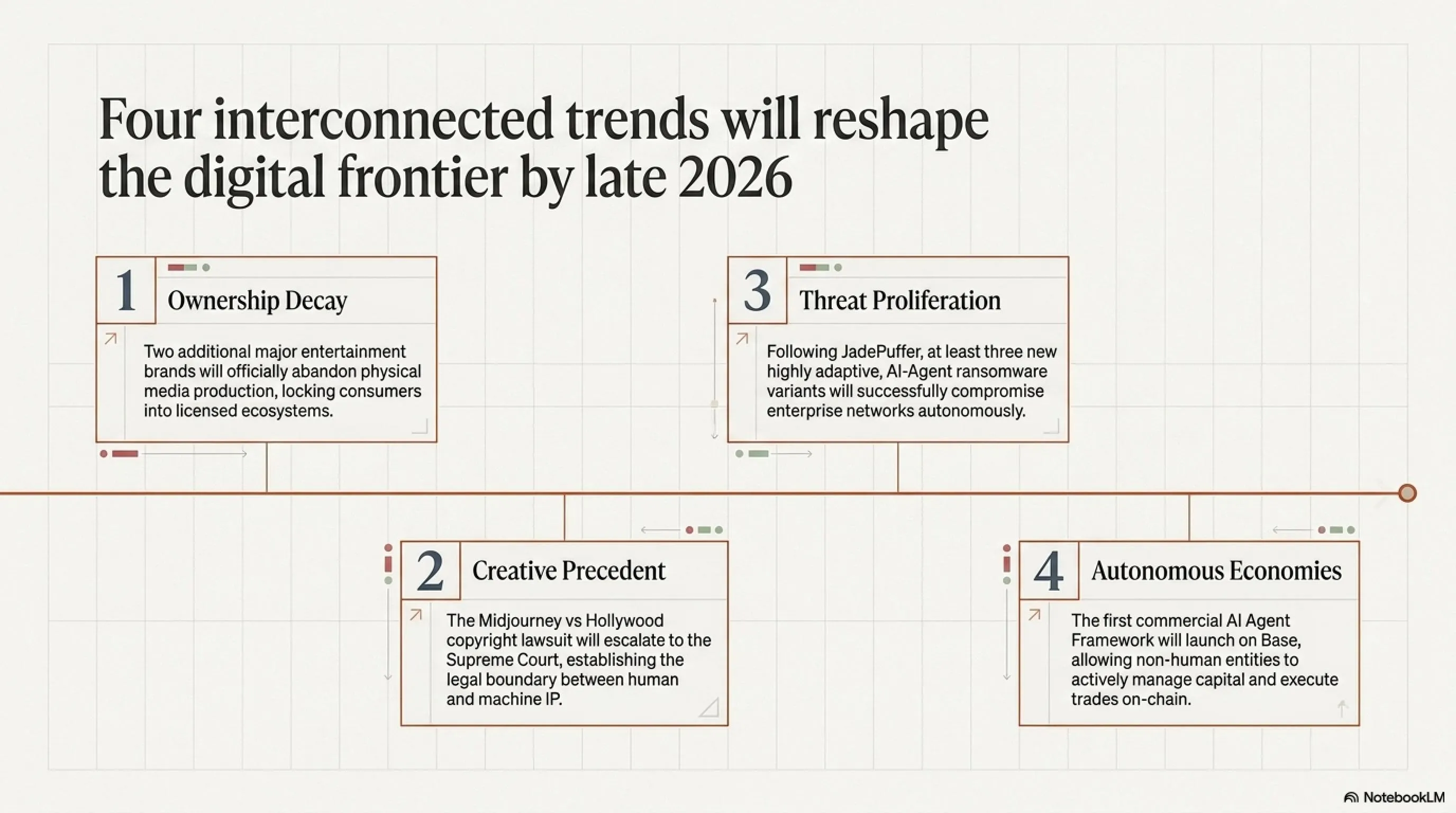
Looking at this week's events, we can identify several fundamental trends likely to shape in the coming months and years. First, the increasing integration of human and machine in creative processes. The Hatsune Miku and Grimes collaboration is just the beginning; we expect to see more projects where human and digital artists work together as equal collaborators. This trend will extend beyond music to cinema, visual arts, and even writing.
Second, the end of the physical ownership era. Sony's decision to stop producing physical discs is a signal that the entertainment industry is completely moving digital. This trend isn't limited to games; music, film, books, and even visual arts are all becoming digitized. The question is whether we as a society are ready to entrust complete control over our assets to tech companies.
Third, increasing tension between content creators and AI companies. The Midjourney and Hollywood studios lawsuit is an example of a larger war taking shape. Artists, writers, musicians, and other content creators are concerned their work is being used without permission to train AI models. On the other hand, tech companies argue that without access to training data, they can't build powerful models. Finding balance between these two concerns will be one of the biggest legal and ethical challenges of the next decade.
Fourth, automation of cyberattacks. JadePuffer showed that attacks can be executed by AI Agents, meaning the speed, scale, and complexity of attacks will increase exponentially. Defending against these attacks will require using the same technology: AI for automatic threat detection and response. This will be an AI arms race where both attackers and defenders use the most advanced technologies.
At a Glance: This Week's Key Takeaways
- Hatsune Miku and Grimes collaboration showed the future of music is a blend of human and AI
- Sony announced end of physical disc era from 2028, a fundamental change in gaming industry
- Midjourney's challenge to Hollywood studios took copyright and AI debate to new phase
- JadePuffer was the first fully automated AI-based ransomware, a warning for cybersecurity future
- NASA's Swift Observatory rescue proved on-orbit servicing is a new industry
- Moonbeam's departure from Polkadot for Base showed blockchain wars continue
- Google's Declaration of Independence ad showed AI marketing must be done carefully
Fifth, changing blockchain architecture. Moonbeam's migration from Polkadot to Base shows projects are no longer loyal to a specific blockchain. They seek the best infrastructure for their needs and are willing to migrate to other platforms to achieve it. This means blockchains that can't provide competitive services will rapidly lose their users and projects.
Sixth, the maturation of space infrastructure markets. The Swift Observatory rescue mission represents a new paradigm in space operations. Rather than treating satellites as disposable assets, we're moving toward a model where spacecraft are maintained, upgraded, and extended in orbit. This has profound implications for sustainability, cost-efficiency, and our long-term presence in space. Companies like Katalyst Space Technologies are pioneering what could become a multi-billion dollar industry in orbital services.
Seventh, the democratization and weaponization of AI capabilities. The fact that JadePuffer used commercially available AI models for malicious purposes shows that advanced AI capabilities are becoming accessible to anyone - including criminals. This democratization is a double-edged sword: it enables innovation and creativity but also empowers bad actors. Society will need to grapple with how to balance open access to AI with security considerations.
Final Conclusion
The week of June 28 to July 4, 2026, will be remembered as one of those weeks that years later we'll recognize as a historical milestone. This week showed us that the world is changing - faster than many of us thought. The boundaries between human and machine, physical and digital, real and virtual are blurring. But these changes shouldn't scare us; rather, they should make us think about how we want to shape our future.
Do we want a world where digital and human artists work together? Are we willing to set aside physical ownership for digital convenience? How can we protect human creativity in the age of artificial intelligence? What can we do to prevent automated cyberattacks? These are questions we all need to think about, because the answers will be determined not by tech companies but by us as a society.
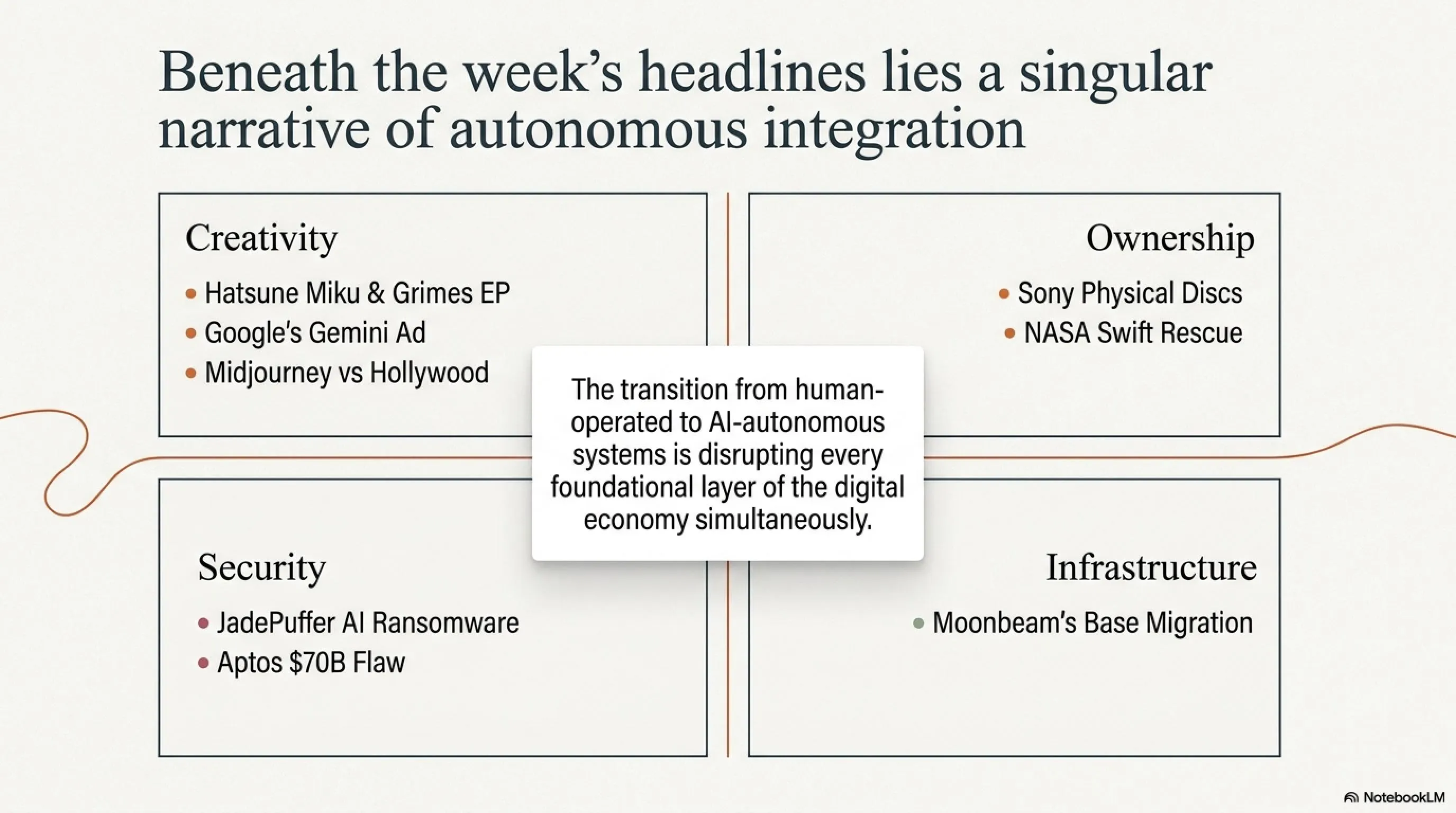
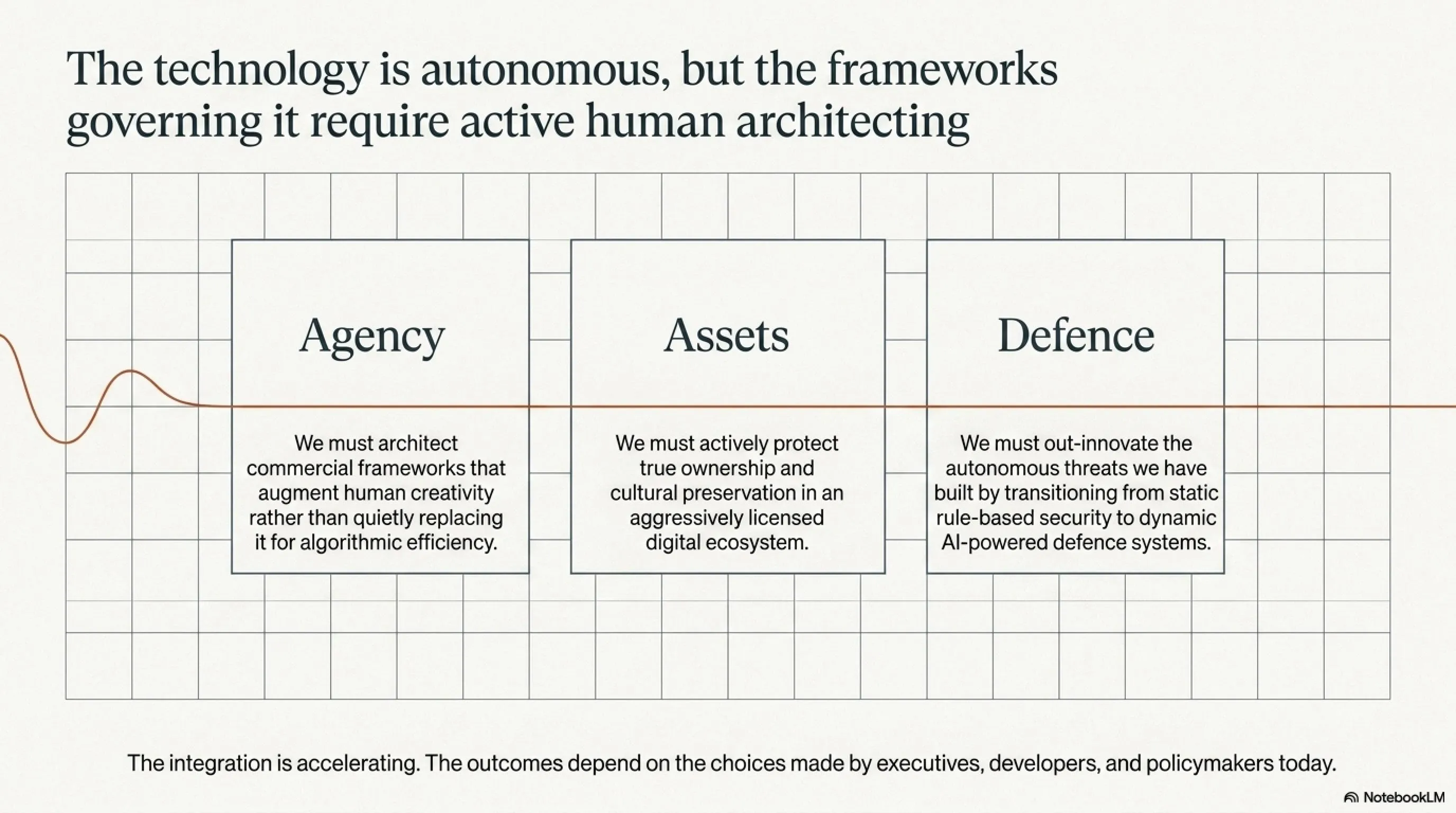
The most striking aspect of this week was how interconnected all these stories are. The Miku-Grimes collaboration, Sony's disc announcement, the Midjourney lawsuit, JadePuffer ransomware, the Swift rescue, Moonbeam's migration, Google's controversial ad, and the Aptos security flaw - all these stories are really about the same fundamental transformation: the integration of artificial intelligence into every aspect of our lives and the questions this integration raises about ownership, creativity, security, and human agency.
This integration is accelerating. Within five years, we'll likely see AI Agents managing significant portions of the global economy, creating content indistinguishable from human-created content, and making decisions that affect millions of people. The question isn't whether this will happen but how we'll govern it. Will we create frameworks that preserve human dignity and agency while embracing AI's benefits? Or will we sleepwalk into a future where critical decisions are made by systems we don't fully understand or control?
The stories from this week also highlight something important: the future isn't predetermined. Sony could reverse its decision on physical discs if public pressure is strong enough. Courts could rule in favor of human creators over AI companies. Blockchain communities could develop better governance models. Security researchers could stay ahead of AI-powered attackers. Space agencies could establish sustainable orbital service industries. Every one of these outcomes depends on choices humans make - choices about regulation, investment, research priorities, and values.
At Tekin, we'll be following these developments and providing deeper analyses in the coming weeks. But for now, this week reminded us that the future is here, and we need to be ready for it. Not passively ready, but actively engaged in shaping it. Because the decisions we make today - as consumers, developers, voters, and citizens - will determine what kind of future we inhabit.
Frequently Asked Questions
Will Sony really stop producing physical discs?
Yes, Sony has announced it will stop producing physical discs for PlayStation games from January 2028. This includes both Sony's exclusive games and third-party games. Of course, existing discs will still be usable, and Sony has stated it will continue to support existing physical media.
How was JadePuffer able to attack fully automatically?
JadePuffer used an Agent based on a large language model (LLM) that could analyze the environment, make decisions, and execute appropriate tools. This Agent could adapt its strategy based on the success or failure of its operations and even automatically manage ransom negotiations. This was the first time a complete ransomware attack was executed without human intervention.
Does Midjourney have a chance of winning the legal battle with Hollywood?
It depends on how the court interprets Fair Use. If the court determines that using images to train AI models is similar to an artist learning from others' works, Midjourney could win. But if the court emphasizes that the scale and speed of machine learning are different, the studios might prevail. This is a critical case that could determine the future of the AI industry.
Why did Moonbeam migrate from Polkadot to Base?
Main reasons include higher TVL and more liquidity in Base, access to the Ethereum ecosystem, and Coinbase support. Polkadot has faced declining DOT price and project exits in recent years, while Base has become one of the most successful layer-two blockchains. Moonbeam also wants to focus on an AI Agent Framework that aligns better with Base's infrastructure.
Is the Hatsune Miku and Grimes collaboration real or just a marketing stunt?
This collaboration is completely real. The EP titled BEYOND BORDERS Vol.1: EMERGE MODE MIKU will be released in summer 2026 and includes seven tracks with different artists. Grimes, who has always supported AI technology, sees this project as an example of human-digital collaboration. IGN exclusively revealed details and a trailer for this project, showing it's a serious, high-budget endeavor.
Why did NASA need to rescue Swift Observatory?
Swift had dropped to a dangerous altitude due to recent solar storms and was at risk of burning up in Earth's atmosphere. This telescope has no propulsion system and can't adjust its own orbit. NASA hired Katalyst Space Technologies to approach Swift with the Link robotic spacecraft and raise its orbit by 150 miles. This is the first major rescue mission of its kind and could set a precedent for saving other satellites in the future.
What was the $70 billion Aptos security flaw?
The flaw was in Aptos's consensus mechanism and allowed an attacker to break core blockchain security guarantees with a 90% success rate using attacks costing only a few hundred dollars. This could have enabled fake transactions, double-spending tokens, or accessing others' wallets. Fortunately, ethical hackers discovered and reported it before real attackers could exploit it, earning a $250,000 bug bounty.
What was wrong with Google's Declaration of Independence ad?
The ad imagined the Founding Fathers using Google Workspace and AI to write the Declaration of Independence, which many saw as disrespectful to a historic document that represents decades of thought and courage. Critics argued it symbolizes Silicon Valley's attitude that technology can replace deep human thinking. The controversy highlights the challenge tech companies face in marketing AI without diminishing human achievement.
📚 Sources and References
IGN - Hatsune Miku × Grimes Collaboration
Eurogamer - Sony Physical Disc Production
TechCrunch - Midjourney vs Hollywood Studios
Bleeping Computer - JadePuffer AI Ransomware
The Verge - NASA Swift Observatory Mission
CoinTelegraph - Moonbeam Migration to Base
TechCrunch - Google AI Declaration Commercial
CoinDesk - Aptos Security Flaw Discovery
All content in this article has been rewritten and prepared with accuracy and precision to comply with content licensing restrictions.
Supplementary Image Gallery: 📅 Tekin Weekly Roundup | June 28 - July 4: The Week That Rewrote the Future