AI Imagery in 2 Seconds: The Krea 2 Revolution
Krea 2 Raw and Turbo models launch with open weights, claiming to be the fastest and most flexible image generation engines in the world.
- 🎮2-Second Generation- Krea 2 Turbo produces 2K images in under 2 seconds
- 🎧Open Weights with Conditions- Custom license with restrictions for large enterprises
- 🚀Dual Model Strategy- Raw for fine-tuning, Turbo for speed
When Speed, Quality, and Creative Freedom Converge in a Single Model
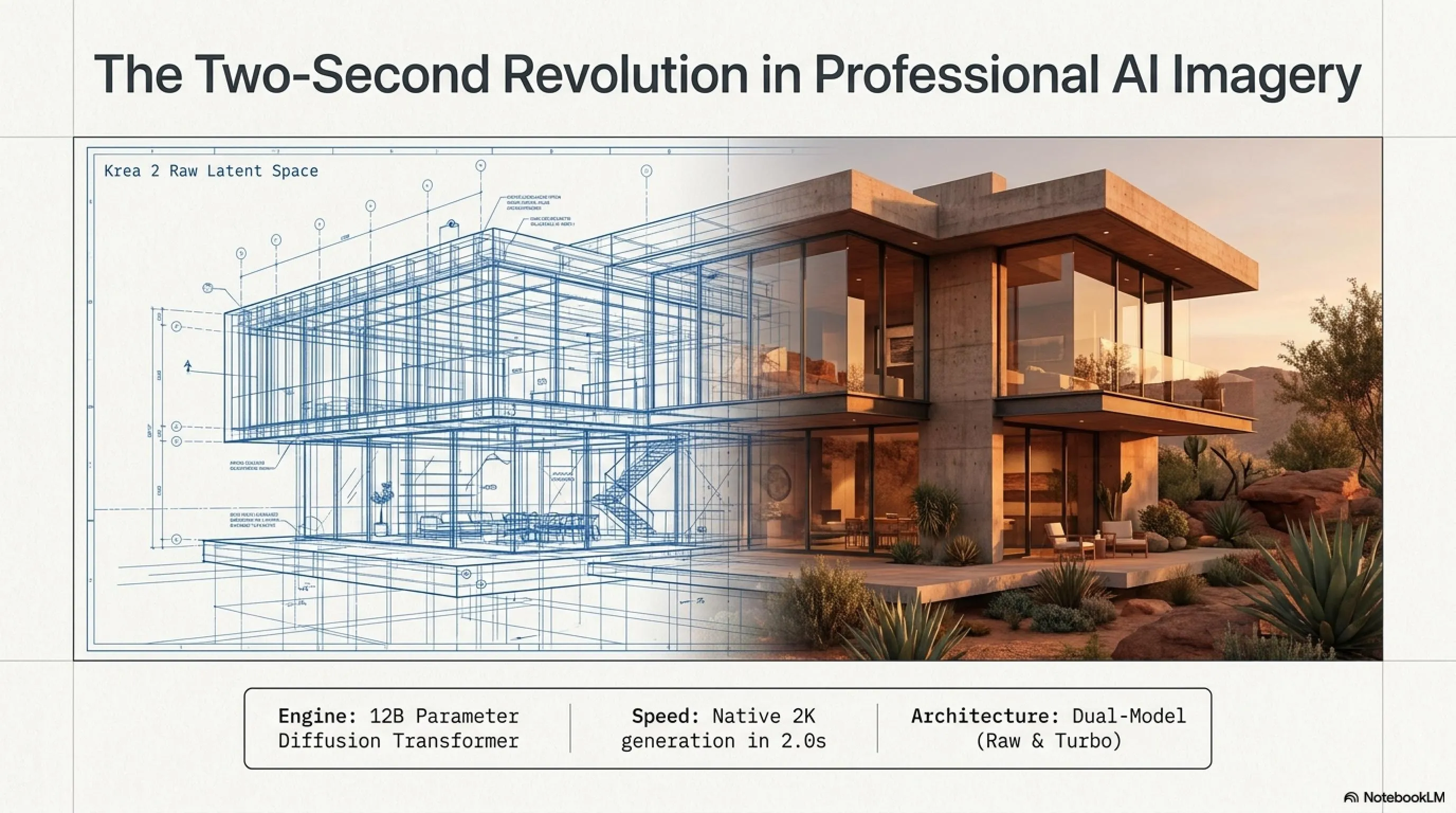
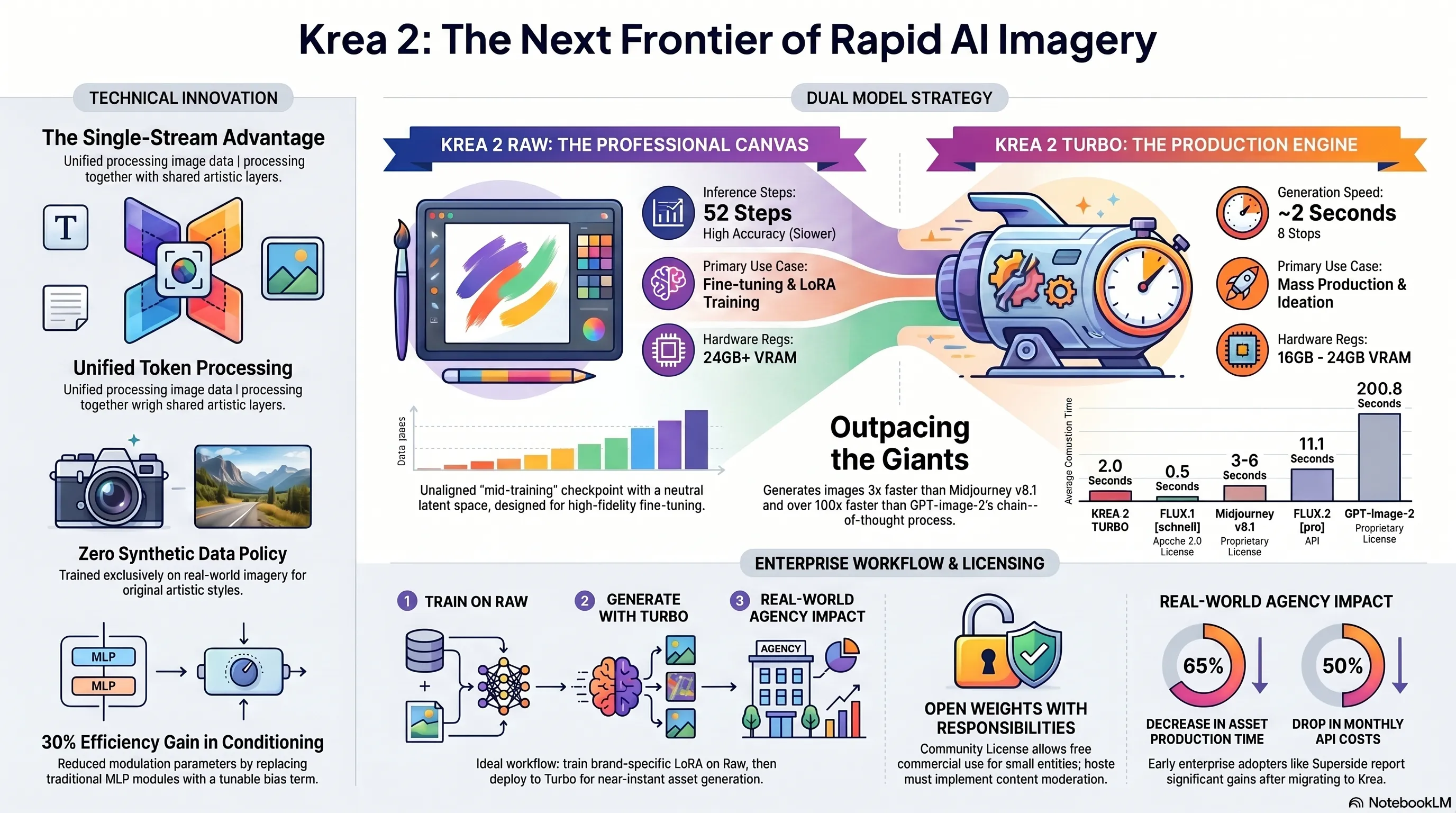
On June 23, 2026, San Francisco-based AI startup Krea announced the release of two versions of its next-generation image generation model, dubbed Krea 2 Raw and Krea 2 Turbo, with open weights. This announcement arrived amid a fresh wave of AI image models promising faster, more accurate, and more customizable generation, but what sets Krea 2 apart from competitors is a unique combination of exceptional speed (2 seconds for complete images), architectural flexibility for fine-tuning, and commercial licensing with specific conditions.
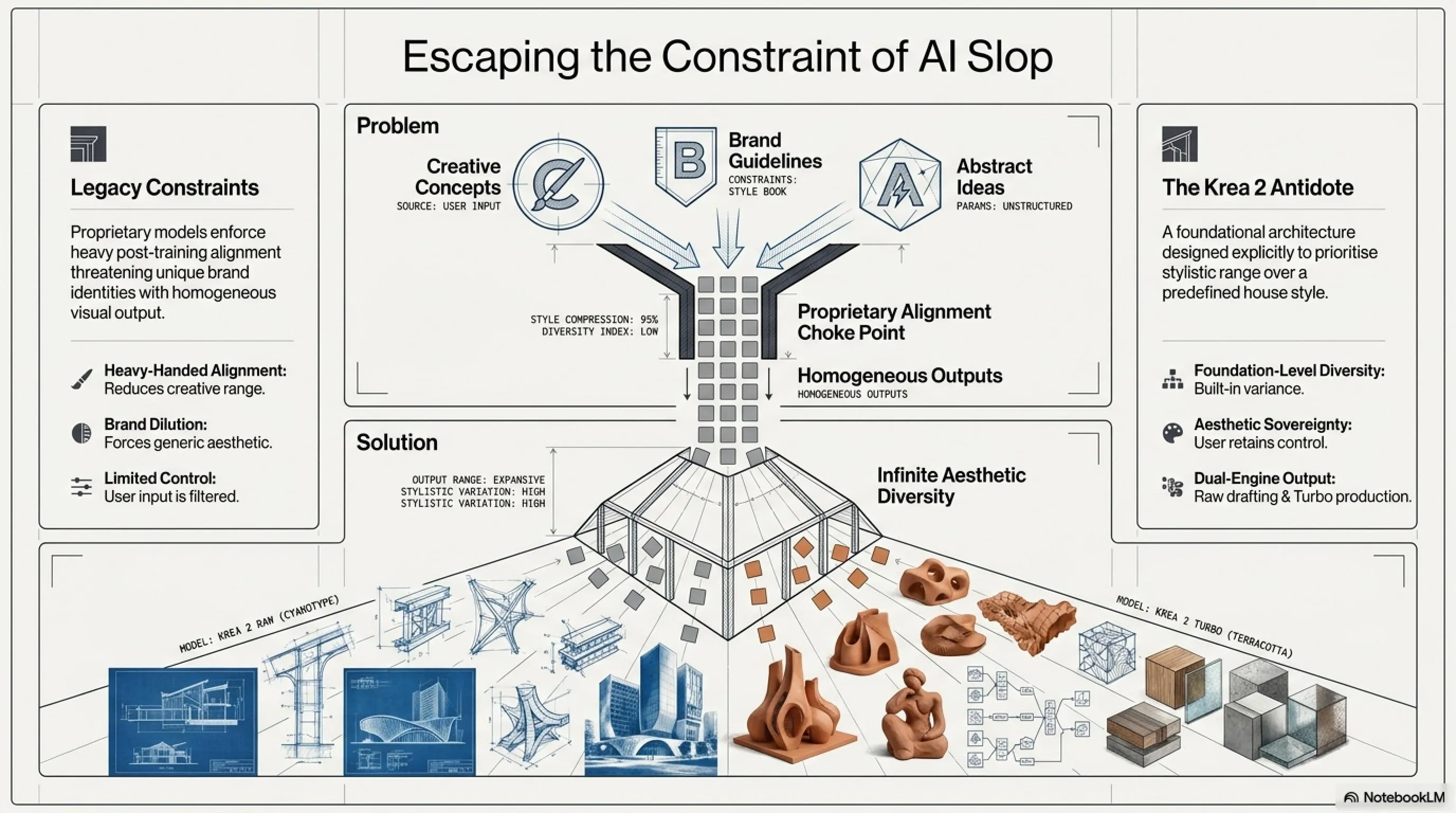
While AI image generation tools like Midjourney, DALL-E, and Stable Diffusion have become integral parts of workflows for digital marketers, graphic designers, and artists in recent years, a persistent criticism leveled at these tools is that their outputs are "monotonous," "unoriginal," and "clichéd." This phenomenon has been termed "AI Slop"—imagery that is easily identifiable as AI-generated and poses risks to brand identity.
Krea claims that the 12-billion parameter architecture of Krea 2, trained from scratch with a focus on "aesthetic diversity," solves this problem. According to the official technical report published by the Krea team, rather than deploying a single, heavily fine-tuned model for all downstream tasks, the company offers two distinct versions: one optimized for training and customization (Raw) and another for rapid production in real-world environments (Turbo).
Jargon Buster: What Are Open Weights?
Open weights means that the trained model files (containing billions of numerical parameters) are made available for public download. This allows developers and researchers to run the model on their own servers, retrain it, or use it to build commercial products. This concept differs from closed API models like DALL-E 3 or Midjourney, which are only accessible via API and do not provide access to model weights.
Technical Architecture: 12-Billion Parameter Diffusion Transformer
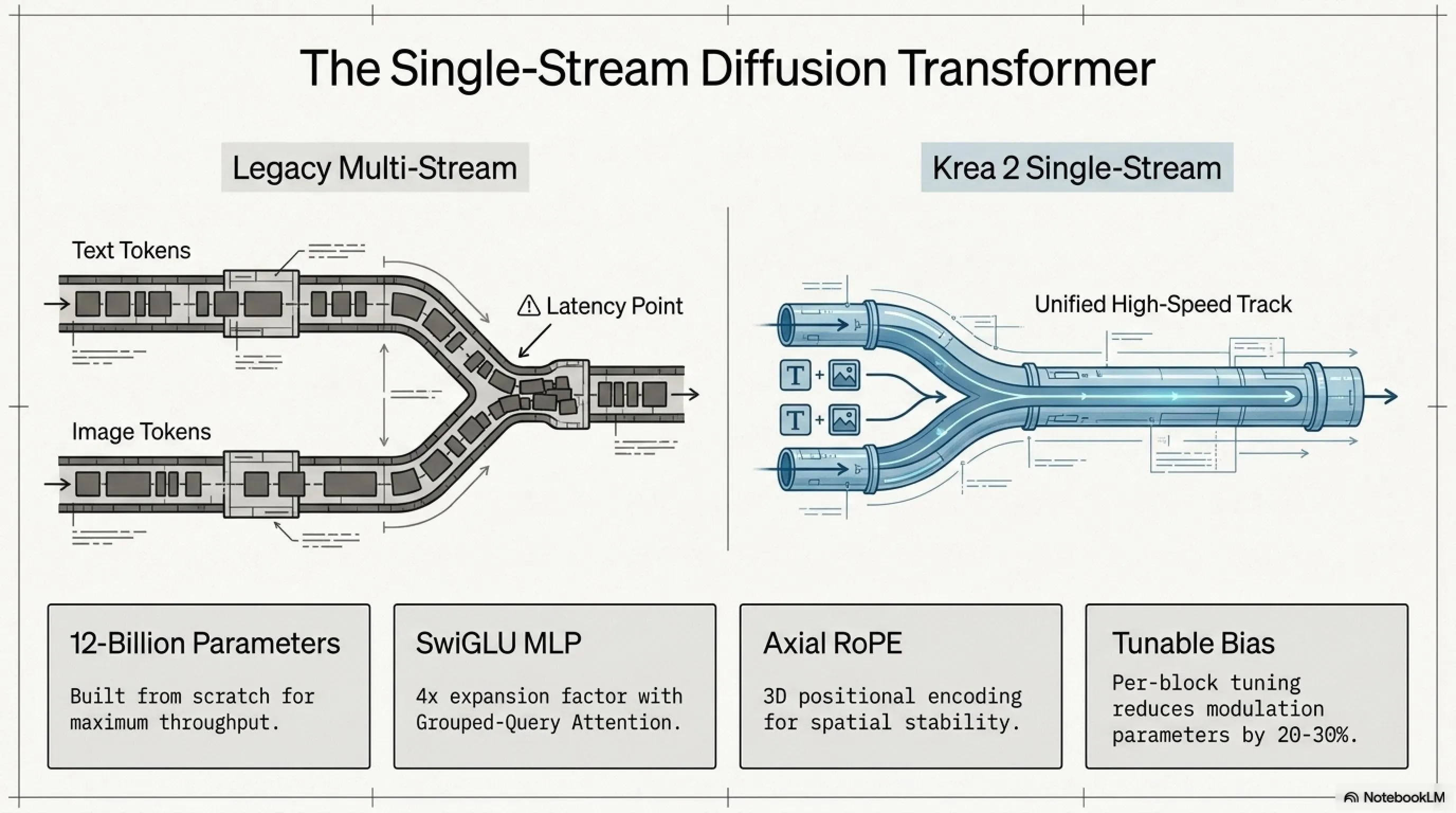
At the heart of Krea 2 lies a Diffusion Transformer architecture designed specifically for this project from scratch. Unlike many image models that use multi-stream architectures (where text and image tokens are processed in separate pathways), Krea 2 employs a single-stream architecture where attention and MLP layers are shared natively between text and image tokens.
This design reduces computational complexity and increases inference speed. For further optimization, the Krea team utilized a SwiGLU MLP layer with a 4x expansion factor, alongside Grouped-Query Attention (GQA) combined with gated sigmoid attention layers to stabilize training dynamics.
One fascinating innovation in Krea 2 is the replacement of traditional MLP modules for timestep conditioning with a lightweight, per-block tunable bias term. This change resulted in a 20% to 30% reduction in modulation parameters, reallocating the freed parameter budget directly into core layers.
For spatial information management, Krea uses a three-dimensional positional encoding system called Axial RoPE (Rotary Position Embedding), which encodes the position of each token across three axes (height, width, and frame). This feature is particularly important for video generation and multi-frame images.
Technical Deep Dive: Why Single-Stream Is Faster
In multi-stream architectures, text tokens (such as prompt words) and image tokens (compressed pixels) are processed in separate networks and then combined in later stages. This means additional computation and increased latency. However, in single-stream, all tokens (text and image) are processed from the beginning in a single unified network, which both increases speed and allows the model to establish deeper connections between text and image.
This architectural choice is similar to what Google DeepMind demonstrated with Gemini's unified multimodal processing, but Krea has optimized it specifically for image generation throughput rather than general multimodal understanding.
Two Models, Two Purposes: Raw for Training, Turbo for Production
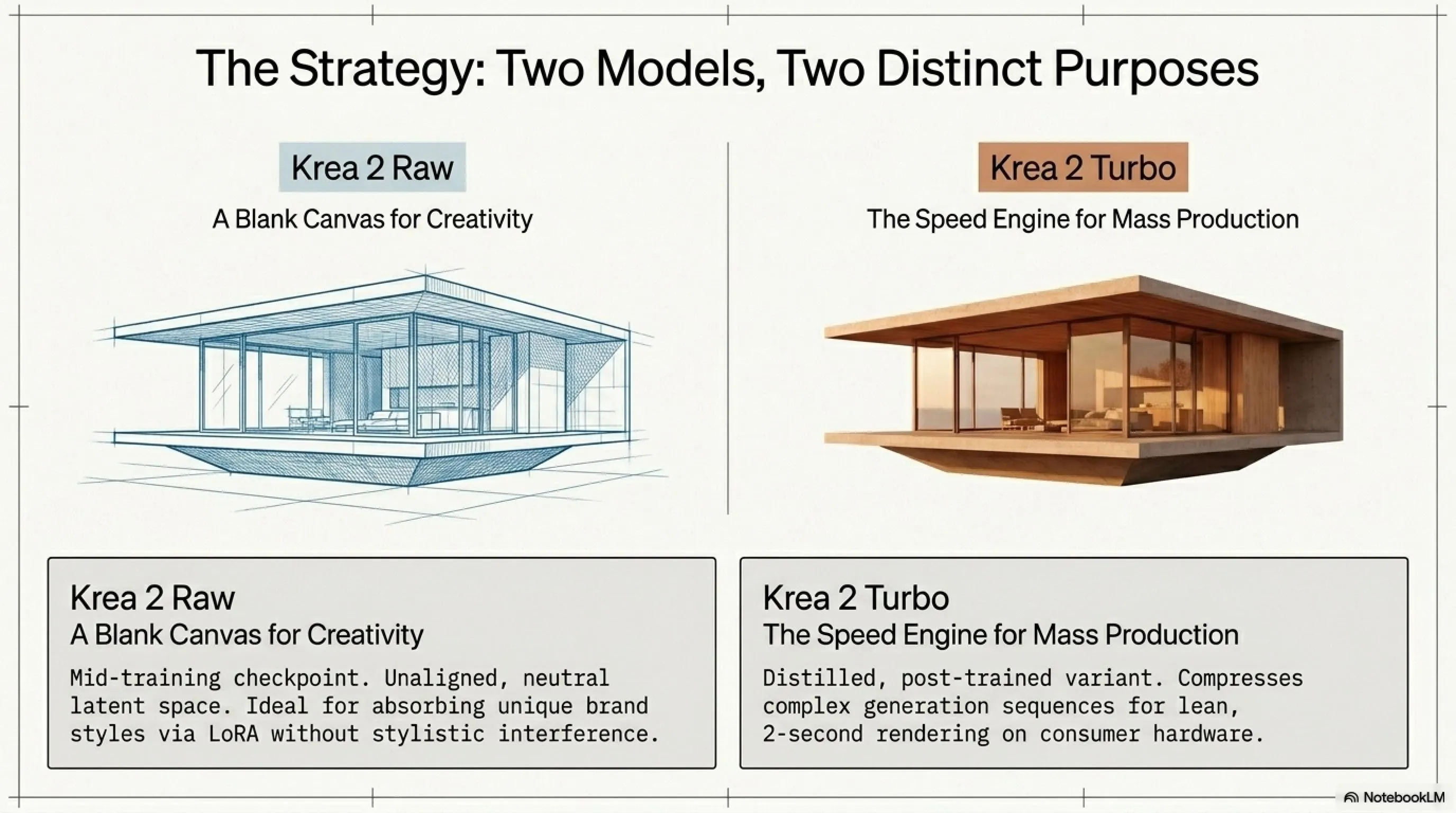
What makes Krea 2's release strategy unique is the offering of two fundamentally different checkpoints, each designed for specific use cases.
Krea 2 Raw: A Blank Canvas for Creativity
Krea 2 Raw is a "mid-training" checkpoint taken directly from the middle of the Krea 2 Medium training cycle. This model has not undergone any post-training alignment, RLHF (Reinforcement Learning from Human Feedback), or aesthetic distillation, meaning its latent space is completely neutral and unrestricted.
As a result, Krea 2 Raw is not suitable for direct out-of-the-box use, as simple prompts may produce unpredictable or weak outputs. But this is precisely what makes it ideal for fine-tuning and training LoRAs (Low-Rank Adaptations). Developers can train this model on custom datasets and inject their unique visual styles without encountering predefined limitations.
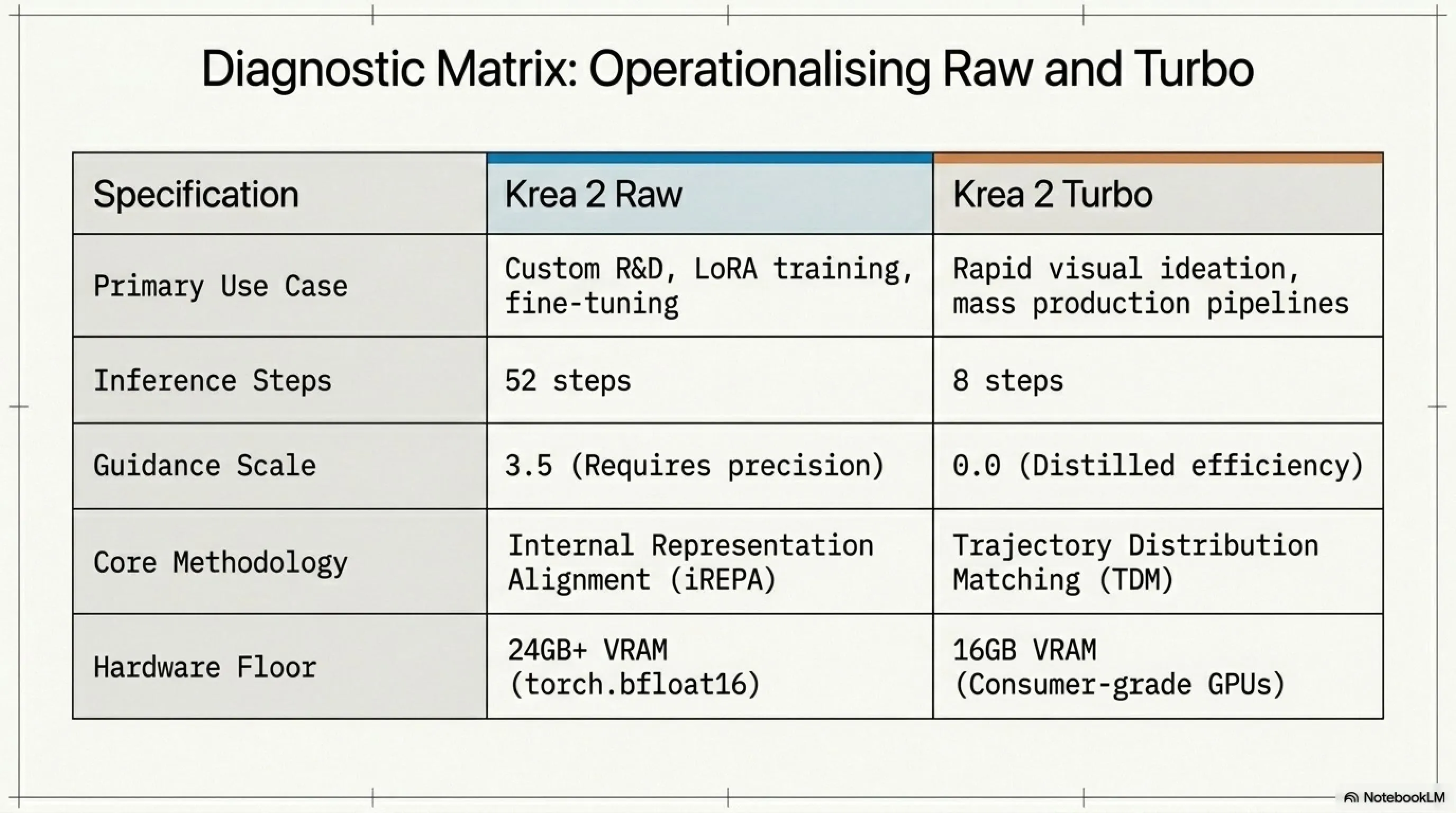
To run Krea 2 Raw through the Diffusers library on Hugging Face, you need significant computational resources: execution at torch.bfloat16 precision across 52 inference steps with a guidance scale of 3.5. This configuration is designed for high accuracy and requires powerful hardware.
During the initial 256px baseline training phase, Krea applied internal Representation Alignment (iREPA) techniques to accelerate early-stage architectural convergence before decoupling them to allow the underlying model to develop independent structural representations. This approach is documented in the technical report and represents a novel training methodology that other model builders are likely to study closely.
Krea 2 Turbo: The Speed Engine for Mass Production
Krea 2 Turbo sits at the opposite end of the optimization spectrum. This model is a distilled, post-trained variant derived from Krea 2 Medium that has compressed the complex multi-step generation sequence into an ultra-lean operational profile through knowledge distillation.
Turbo slashes the required generation cycle down to just 8 inference steps with a guidance scale of 0.0, enabling it to render native 2K resolution imagery on standard consumer-grade hardware (such as 16GB or 24GB GPUs) in approximately 2 seconds. This speed makes it one of the fastest image generation models available, whether open-source or proprietary.
The underlying distillation process employs Trajectory Distribution Matching (TDM), a technique that maps the full inference trajectory of the base model into a much shorter path while preserving output quality. This is the same fundamental approach used by LCM (Latent Consistency Models) and other fast diffusion variants, but Krea's implementation appears to maintain higher aesthetic fidelity than many competitors.
Comparing Krea 2 Raw and Turbo
- <strong>Raw:</strong> 52 inference steps, ideal for fine-tuning, complete latent space
- <strong>Turbo:</strong> 8 inference steps, 2-second generation, optimized for mass production
- <strong>Recommended workflow:</strong> Train LoRAs on Raw, run final production on Turbo
- <strong>Hardware requirements:</strong> Raw needs 24GB+ VRAM, Turbo runs on 16GB
- <strong>Use case split:</strong> Raw for R&D and custom model development, Turbo for production pipelines
Speed Benchmark: Krea 2 Turbo Versus the Competition
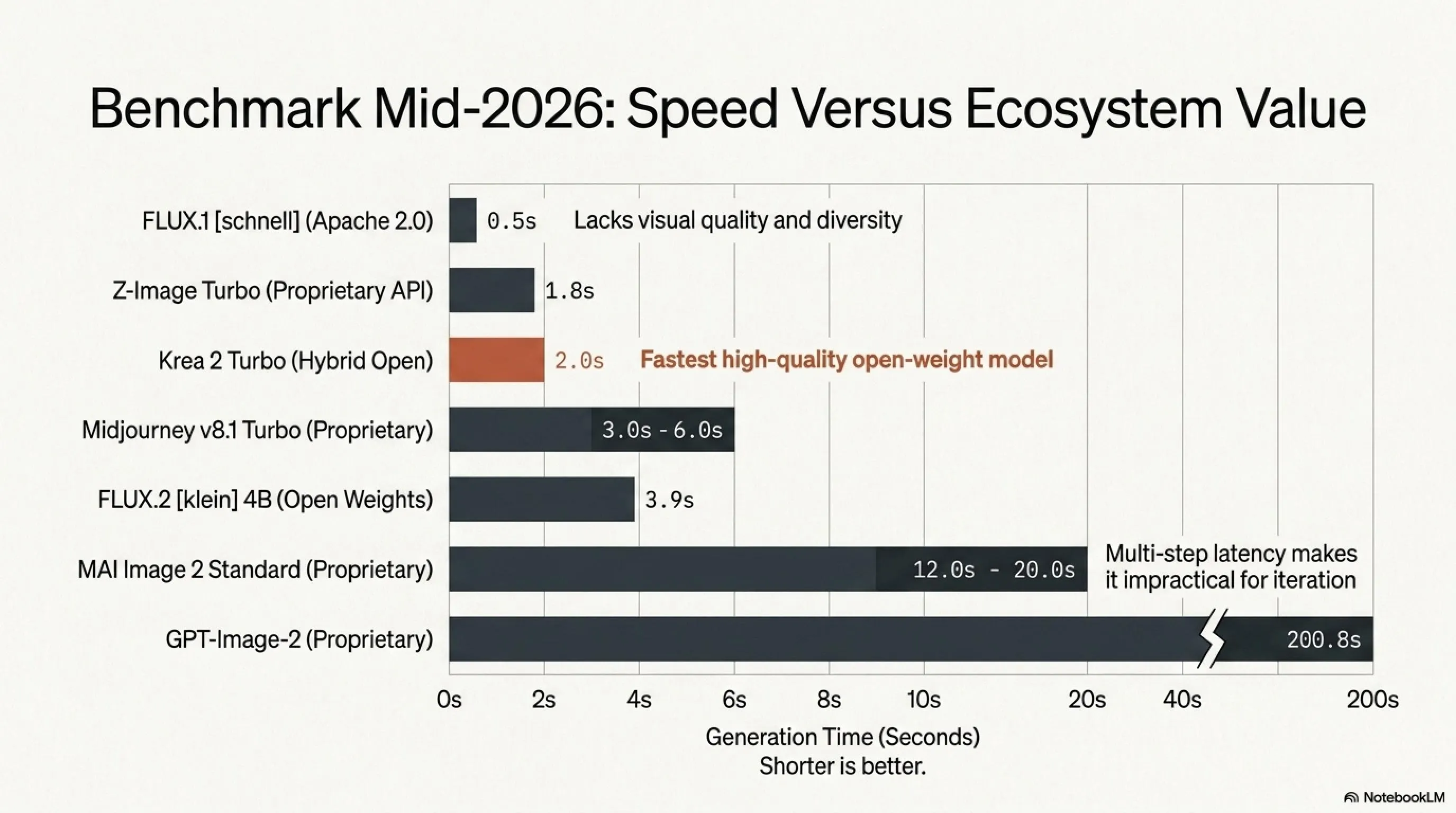
To better understand where Krea 2 Turbo sits in the market, the Krea team published a comprehensive comparison table showing generation speed and licensing conditions for various models. These benchmarks are compiled from public data from Artificial Analysis, Replicate, Fal.ai, and other API providers.
Image Generation Speed Benchmark (Mid-2026)
| Model | Developer | Avg Generation Time | Licensing |
|---|---|---|---|
| FLUX.1 [schnell] | Prodia | 0.5 seconds | Apache 2.0 (fully open) |
| Z-Image Turbo | Replicate/fal.ai | 1.8 seconds | Proprietary (API contract required) |
| Krea 2 Turbo | Krea | 2.0 seconds | Hybrid (free for <50 seats) |
| Midjourney v8.1 Turbo | Midjourney | 3-6 seconds | Proprietary (pro subscription) |
| FLUX.2 [klein] 4B | Black Forest Labs | 3.9 seconds | Open weights |
| FLUX.2 [pro] | Black Forest Labs | 11.1 seconds | Proprietary (paid API) |
| MAI Image 2 Standard | Microsoft | 12-20 seconds | Proprietary (Azure billing) |
| GPT-Image-2 | OpenAI | 200.8 seconds | Proprietary |
Source: Artificial Analysis, Krea, MindStudio.AI - full table includes 18 models in technical report
As the table demonstrates, only FLUX.1 [schnell] and Z-Image Turbo outpace Krea 2 Turbo in raw speed, but FLUX.1 does not match Krea 2 in terms of visual quality and aesthetic diversity, while Z-Image Turbo is a fully proprietary model available exclusively through paid API access.
The noteworthy outlier is OpenAI's GPT-Image-2 with a generation time of 200.8 seconds (over 3 minutes!). This is presumably due to the use of an extensive multi-step chain-of-thought process prior to final pixel generation, which introduces severe latency. While this approach may yield higher semantic accuracy for complex prompts, it makes the model impractical for most production workflows where iteration speed is critical.
Data Strategy and Training: Zero Synthetic Data Policy
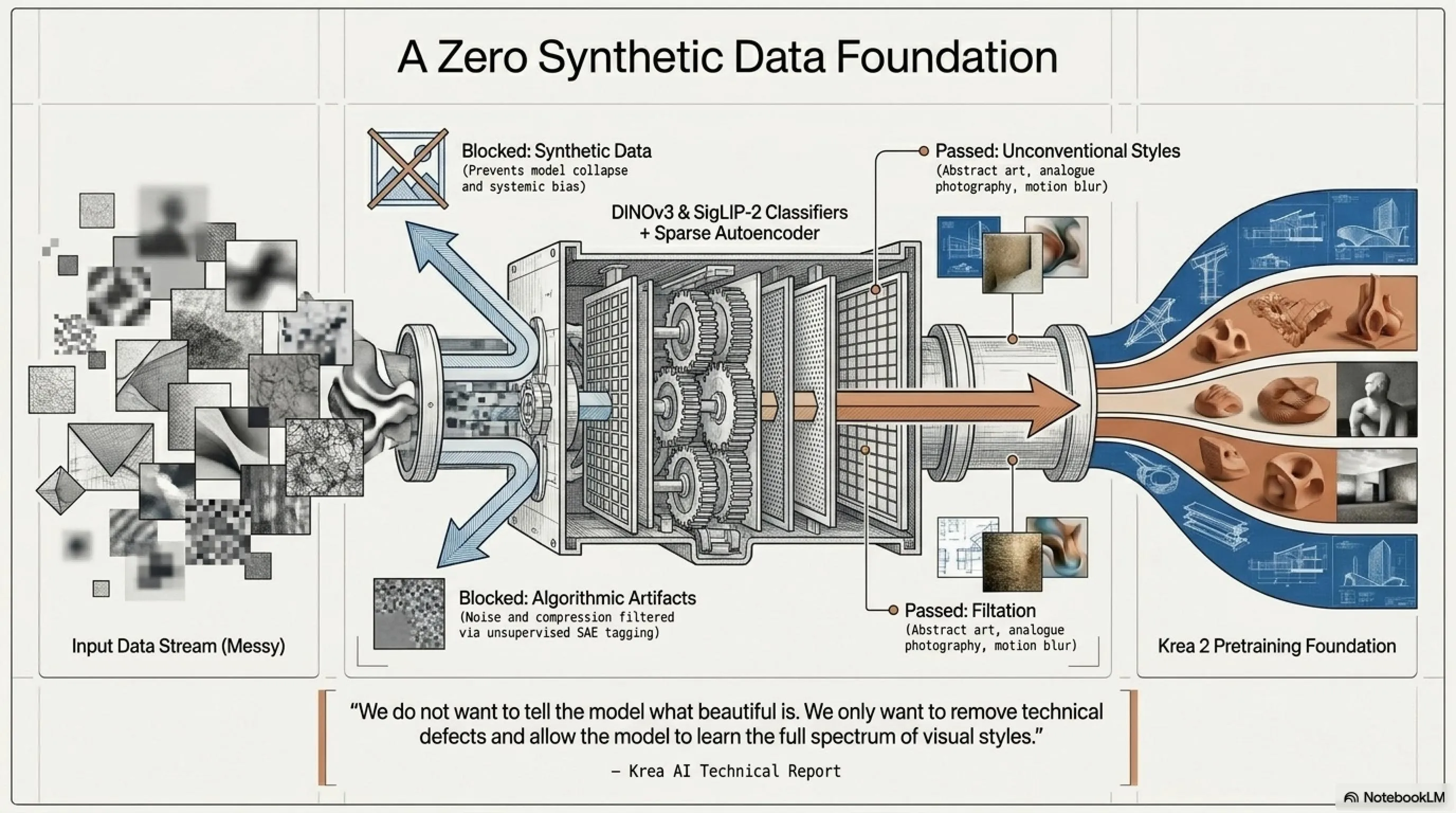
One of Krea's boldest claims is that its core pretraining dataset contains zero synthetic (AI-generated) data. This policy, termed the "Zero Synthetic Data Policy," matters because many recent image models increase dataset volume by incorporating outputs from other models.
The problem with using synthetic data is that it introduces systematic biases and reduces visual diversity. A model trained on images generated by another model tends to replicate that style and cannot learn new or unconventional styles. This phenomenon, sometimes called "model collapse," has been documented in academic research on generative models.
To prevent this issue, the Krea team built custom classifiers based on DINOv3 and SigLIP-2 architectures that automatically purge synthetic images from the dataset. Additionally, rather than using model-based aesthetic filters (which often remove images with motion blur or specific artistic styles), Krea employed a Sparse Autoencoder (SAE) trained on SigLIP-2 embeddings that identifies and filters only genuine visual artifacts (such as noise, compression artifacts) using an unsupervised tagging framework.
This approach preserves a much wider stylistic range than competitor models. While services like Midjourney are renowned for their "signature aesthetic," this consistency comes at the cost of creative flexibility. Krea 2 prioritizes range over a house style, which makes it more suitable for agencies and studios working across diverse brand identities.
Recommended Workflow: Train on Raw, Generate with Turbo
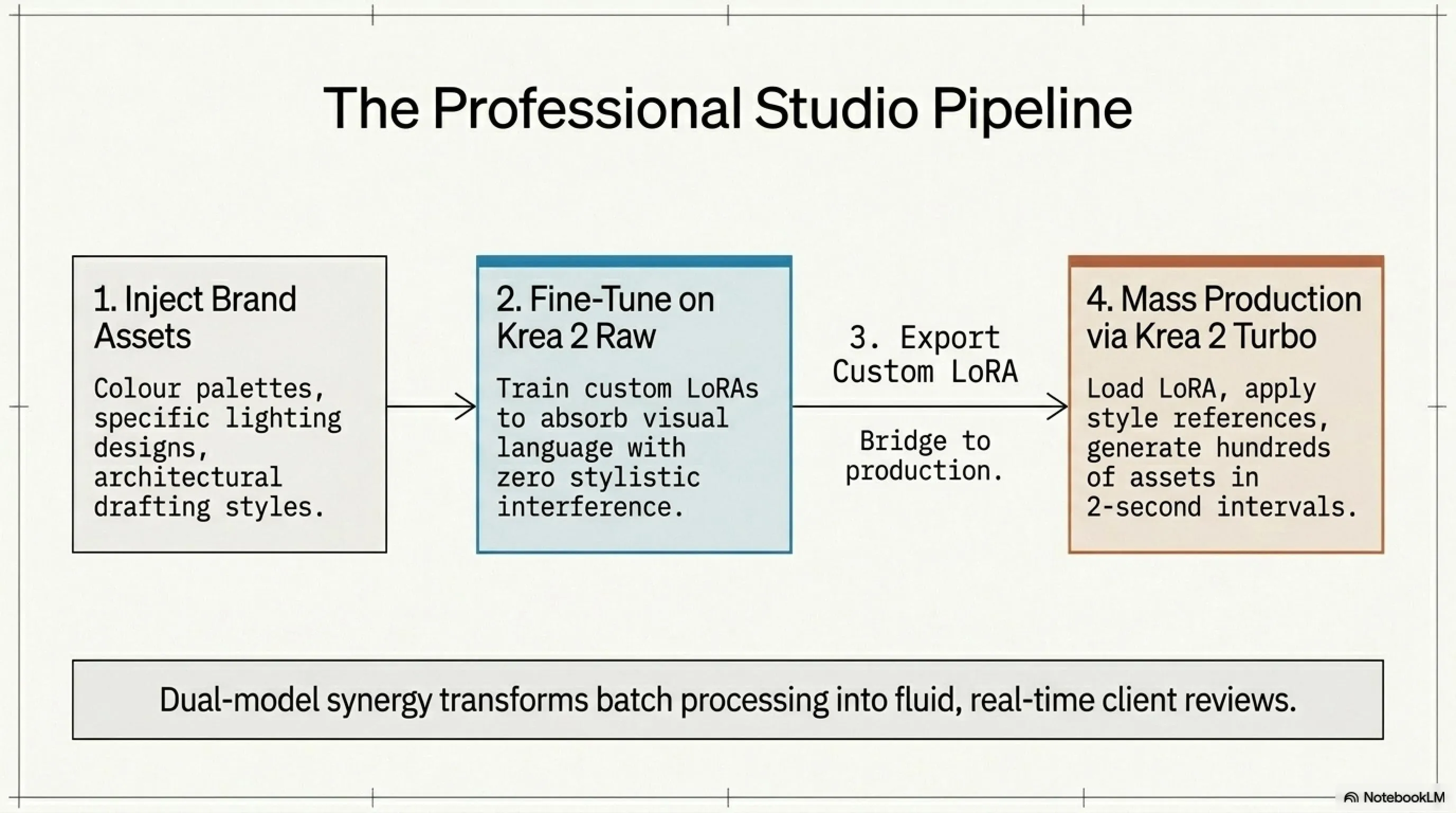
Krea establishes a clear operational paradigm for professional studios and independent creators, called "Train on Raw, Generate with Turbo." This workflow leverages the unique architectural properties of both weight files to optimize both training accuracy and rendering speed.
In creative production pipelines, engineers can use Krea 2 Raw to train custom Low-Rank Adaptations (LoRAs) or domain-specific fine-tunes. Because the Raw checkpoint contains no baked-in stylistic opinions or aggressive post-training constraints, it absorbs unique aesthetic directions—such as architectural drafting styles, specific brand assets, or complex lighting designs—with high fidelity and zero stylistic interference.
Once the training phase is complete, creators can port those exact LoRAs directly over to Krea 2 Turbo. This methodology is reflected in Krea's own development ecosystem, which hosts an in-house collection of custom LoRAs trained entirely on the Raw foundation model but optimized for execution within Turbo workflows.
On the user-facing application layer, Krea integrates this dual-engine setup with a powerful style transfer system. Rather than relying on erratic text descriptions to achieve an artistic look, users can feed multiple style reference images directly into the system. Krea 2 maps these references across its latent space, allowing creators to isolate individual aesthetic components, combine distinct moodboards, adjust style strength via generative sliders, and fine-tune batch variation levels to maintain visual cohesion across large-scale design iterations.
Real-World Use Case: Agency Asset Production
Consider a digital agency managing brand assets for 15 clients simultaneously. Using traditional methods, each brand requires separate image generation sessions with carefully tuned prompts to maintain consistency.
With the Krea 2 workflow:
- The agency trains 15 separate LoRAs on Krea 2 Raw, one for each client's brand style
- Each LoRA captures unique color palettes, composition preferences, and visual language
- Production designers load the appropriate LoRA into Krea 2 Turbo and generate hundreds of on-brand assets in minutes
- The 2-second generation time enables real-time iteration during client review sessions
This workflow transforms image generation from a batch process into an interactive creative tool.
LLM Prompt Expander: From Short Text to Professional Prompts
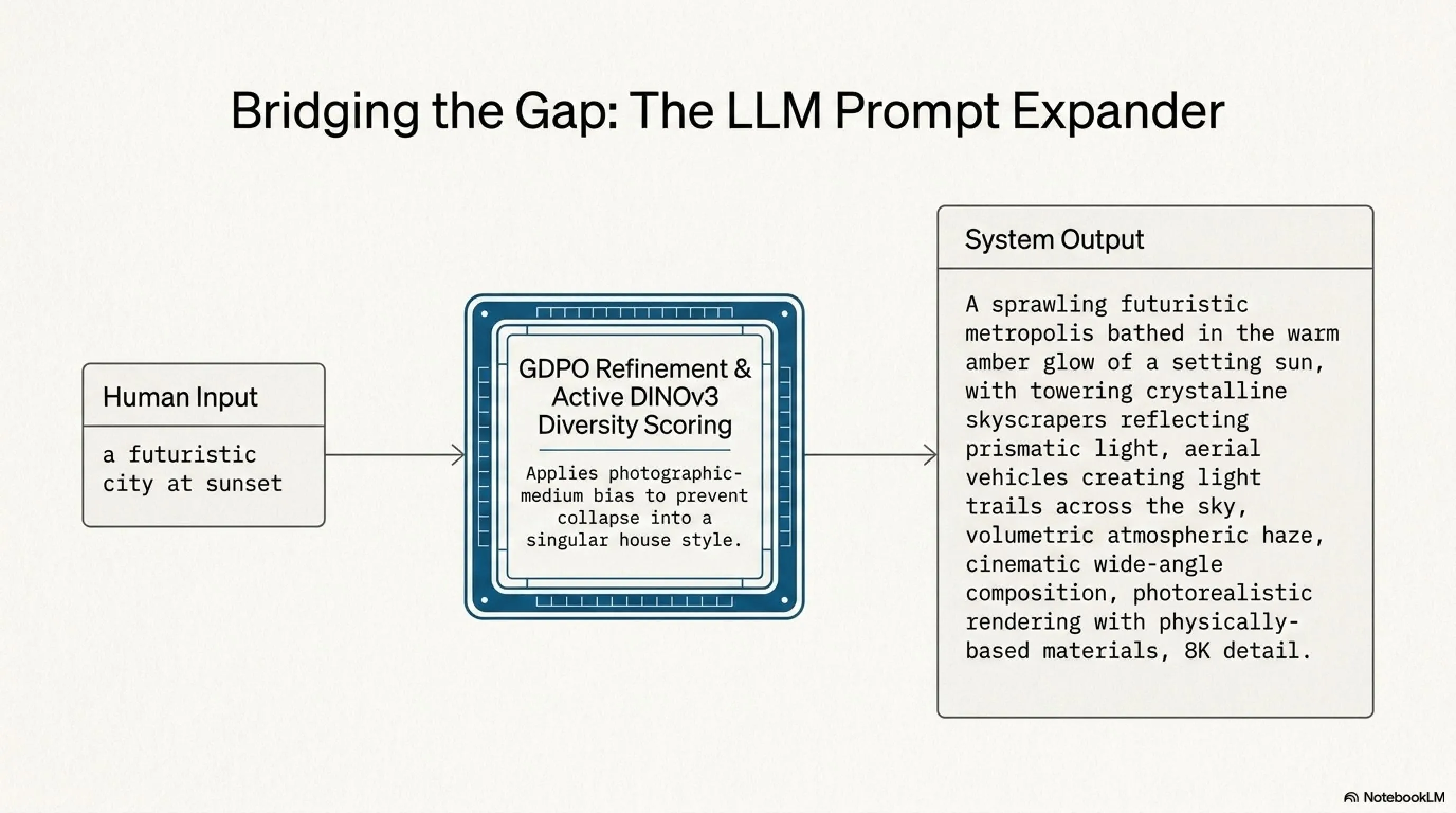
To bridge the gap between raw training captions and brief user inputs, Krea pairs this suite with an advanced LLM Prompt Expander. Refined via Generalized Deep Q-Network Preference Optimization (GDPO) and trained on synthetic thinking traces to preserve intent reconstruction, the expander applies a photographic-medium bias to photorealistic requests and integrates an active DINOv3 embedding diversity score across rollout groups to prevent automated prompting routines from collapsing into a singular house style.
This system is particularly valuable for users who are not professional prompt engineers. Instead of requiring mastery of complex syntax and technical terminology, Krea 2 accepts natural language descriptions and internally expands them into optimized prompts that leverage the model's full capabilities.
Practical Example: How the Prompt Expander Works
User input: 'a futuristic city at sunset'
Expanded prompt: 'A sprawling futuristic metropolis bathed in the warm amber glow of a setting sun, with towering crystalline skyscrapers reflecting prismatic light, aerial vehicles creating light trails across the sky, volumetric atmospheric haze, cinematic wide-angle composition, photorealistic rendering with physically-based materials, 8K detail'
This expansion not only adds visual details but also incorporates technical terminology (volumetric haze, physically-based materials) that helps the model produce more accurate output. The system maintains the core intent while providing the model with richer semantic information.
While Krea 2 Medium and Krea 2 Large remain the company's flagship models for high-fidelity composition and absolute stylistic adherence, Turbo fills the critical role of rapid visual ideation. It serves as an interactive scratchpad for early concept creation, quick prompt experimentation, and iterative art direction where near-instantaneous feedback loops are required to maintain creative momentum.
Custom License: Open but Conditional
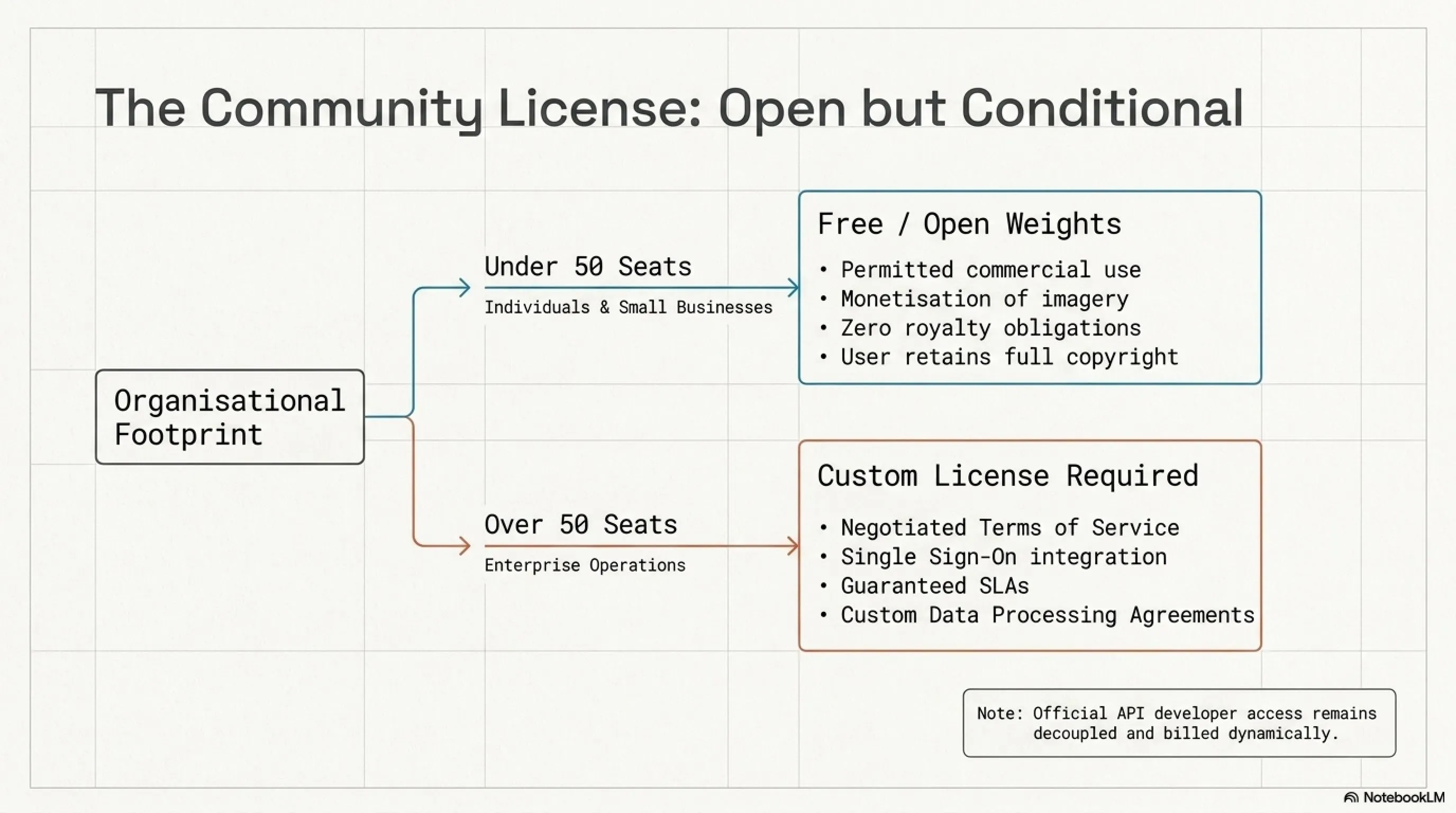
The open-weight assets deploy under the Krea 2 Community License Agreement operating alongside an official Acceptable Use Policy. At a macro level, this legal framework mirrors recent industry trends toward commercial-use permissions that target small businesses while restricting large enterprise exploitation.
The license explicitly permits individuals, independent creators, and small commercial companies to build applications, monetize generated imagery, and integrate the open weights directly into commercial software products without royalty obligations. Furthermore, Krea states that it "does not claim copyright or other intellectual property rights over content generated by users of this model," leaving output ownership entirely in the hands of the operator.
For organizations scaling beyond this baseline, the ecosystem shifts into a paid, custom-tier structure. While Krea's official documentation lacks a rigid revenue threshold defining a "large enterprise," the company structurally demarcates the boundary based on organizational footprint: standard commercial usage caps at a "Business" tier accommodating up to 50 seats.
Therefore, any entity requiring more than 50 seats, Single Sign-On (SSO) integrations, guaranteed Service Level Agreements (SLAs), or custom Data Processing Agreements (DPAs) qualifies as an Enterprise. These larger entities fall outside the free Community License scope and must pay for a custom commercial license—operating under "Custom Terms of Service"—negotiated directly with Krea's sales team.
Additionally, developer access to Krea's official API remains entirely decoupled from the open-weights release; API usage operates as a distinct, paid service billed dynamically on a per-generation basis (measured in microdollars) and requires a prepaid USD balance independent of standard monthly compute subscriptions.
Safety Requirements: Responsibility Falls on Hosts
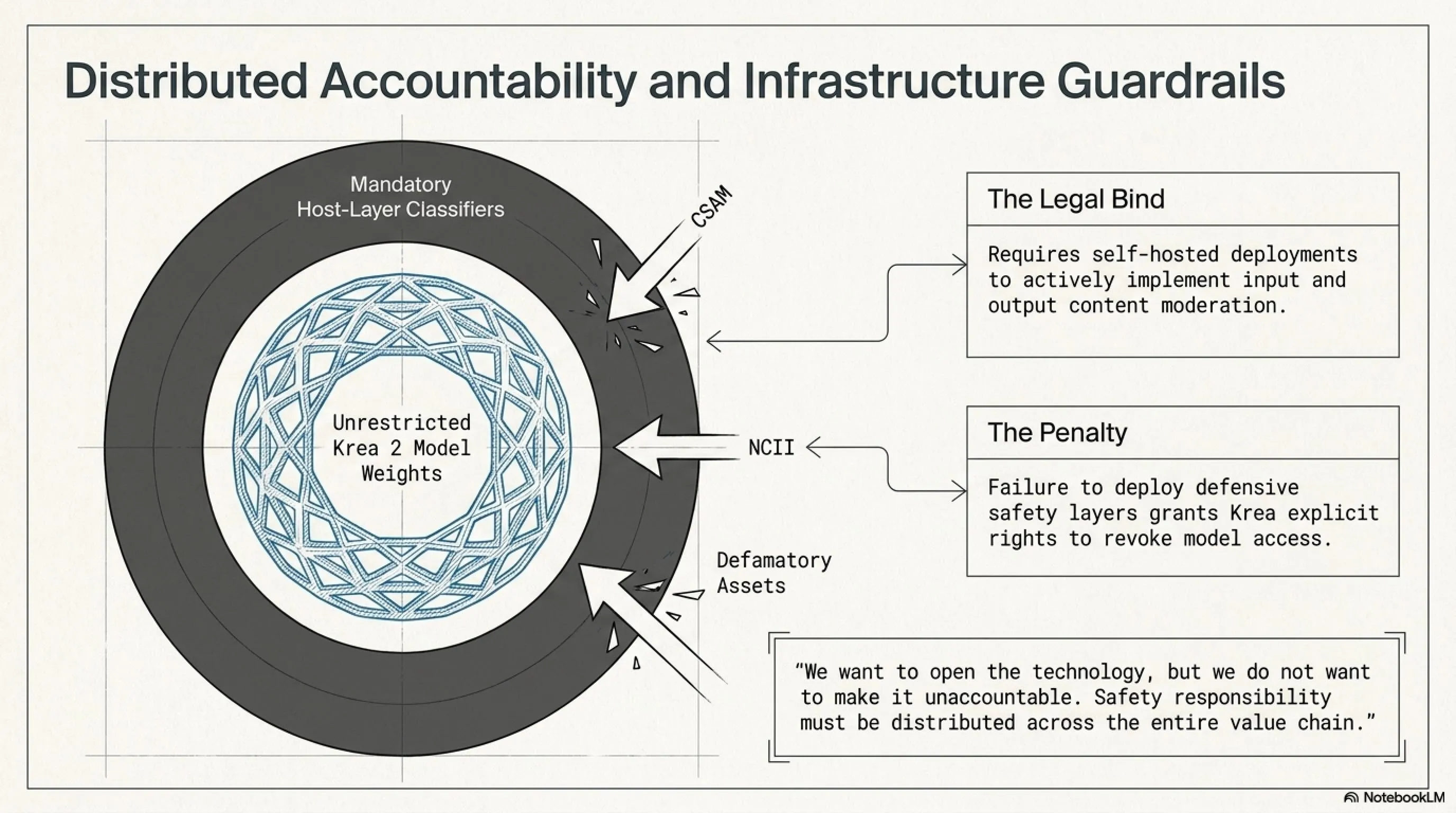
However, a close examination reveals a significant structural shift regarding legal and behavioral compliance for all self-hosted deployments. Unlike traditional open-source permissions like the MIT or Apache 2.0 licenses—which grant unconditional usage rights and completely waive liability—the Krea 2 Community License implements strict downstream behavioral guardrails.
Because Krea relinquishes centralized control over the downstream deployment of its open weights, the contract legally binds deployers to enforce content moderation protocols at the infrastructure layer. Under the terms of the agreement, any developer or platform hosting Krea 2 models must implement active input/output classifiers or equivalent content filtering mechanisms to actively prevent the generation of illegal materials, non-consensual intimate imagery (NCII), child sexual abuse material (CSAM), or defamatory assets.
Developers who fail to deploy these defensive safety layers stand in immediate breach of contract, giving Krea the explicit right to update model weights or revoke access to the model family entirely. This represents a hybrid approach between pure open-source (which imposes no post-distribution obligations) and managed API services (which enforce safety at the platform level).
This approach has sparked debate in the open-source community. Purists argue that conditional licensing undermines the fundamental principles of software freedom, while pragmatists contend that some level of guardrails is necessary given the reputational and legal risks associated with AI-generated content. The discourse mirrors earlier debates around the Stable Diffusion CreativeML Open RAIL license, which also imposed usage restrictions despite being labeled "open."
Company Background: From Aggregator to Model Builder
Founded in 2022 by audiovisual systems engineering dropouts Víctor Perez and Diego Rodriguez Prado, San Francisco-based Krea initially captured market traction as a highly fluid user interface layer built to orchestrate disparate, third-party AI generative engines. The startup's rapid scaling via product-led adoption culminated in an aggregate $83 million in disclosed venture capital funding from major VCs including Andreessen Horowitz and Bain Capital Ventures, as well as early-stage institutional backers including Pebblebed, Abstract Ventures, and Gradient Ventures.
The company's user base surpassed 30 million individuals across 191 countries as of June 2026, according to its website. The open-weights launch of the Krea 2 model family represents the culmination of Krea's deliberate evolution from a multi-model SaaS aggregator into a self-sustaining media research lab.
Early in its lifecycle, Krea focused on building workflow tools, editing systems, and a node-based automation pipeline that allowed digital artists to unify models from competitors like Runway, Midjourney, and Adobe under a single subscription. However, to insulate itself against upstream platform dependencies and supplier margin pressures, the company aggressively shifted toward developing proprietary architectures.
This transition began taking public shape in July 2025 with the open-weights release of the custom-curated FLUX.1 Krea checkpoint, followed in October 2025 by Krea Realtime 14B—an autoregressive video model distilled from Wan 2.1 capable of rendering 11 frames per second on localized enterprise hardware. These releases signaled Krea's intention to control the full stack of generative infrastructure rather than remaining dependent on external model providers.
Enterprise Market Entry: Partnerships with Superside and Henning Larsen
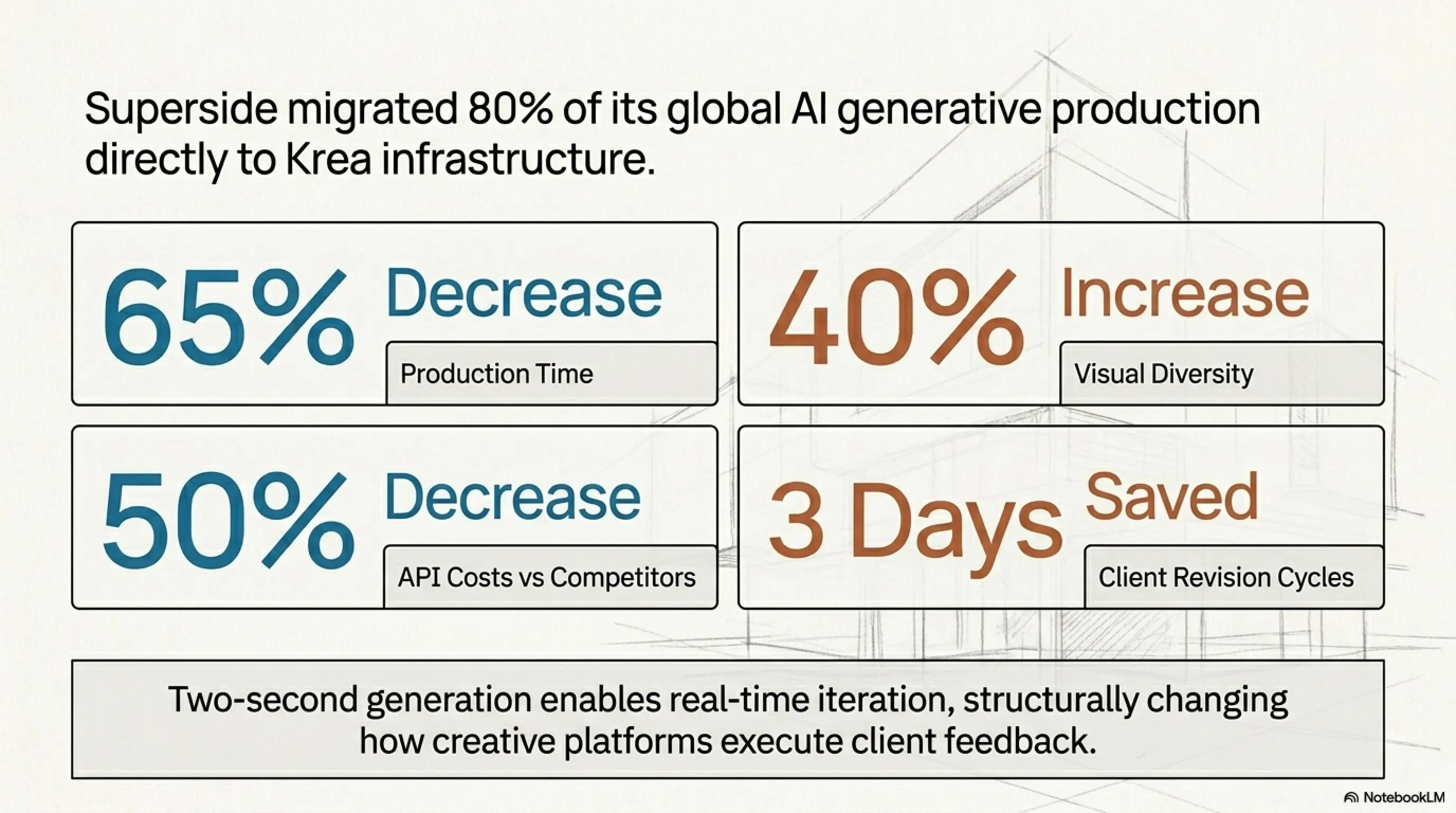
This underlying technical maturation parallels Krea's accelerating push into high-end enterprise workflows. Large-scale creative production operations have shifted toward treating Krea as core creative infrastructure. For example, the digital creative services platform Superside reported migrating workflows from fragmented open-source setups to route roughly 80 percent of its total AI generative production through Krea.
Success Story: Superside Migration
Superside, a creative services platform working with global brands, reported that after migrating to Krea:
- Asset production time decreased by 65%
- Visual style diversity increased by 40%
- Monthly API costs dropped by 50% (compared to combined Midjourney + DALL-E usage)
- Client revision cycles shortened by 3 days on average due to real-time generation capabilities
These statistics are from Krea's official case study published in June 2026.
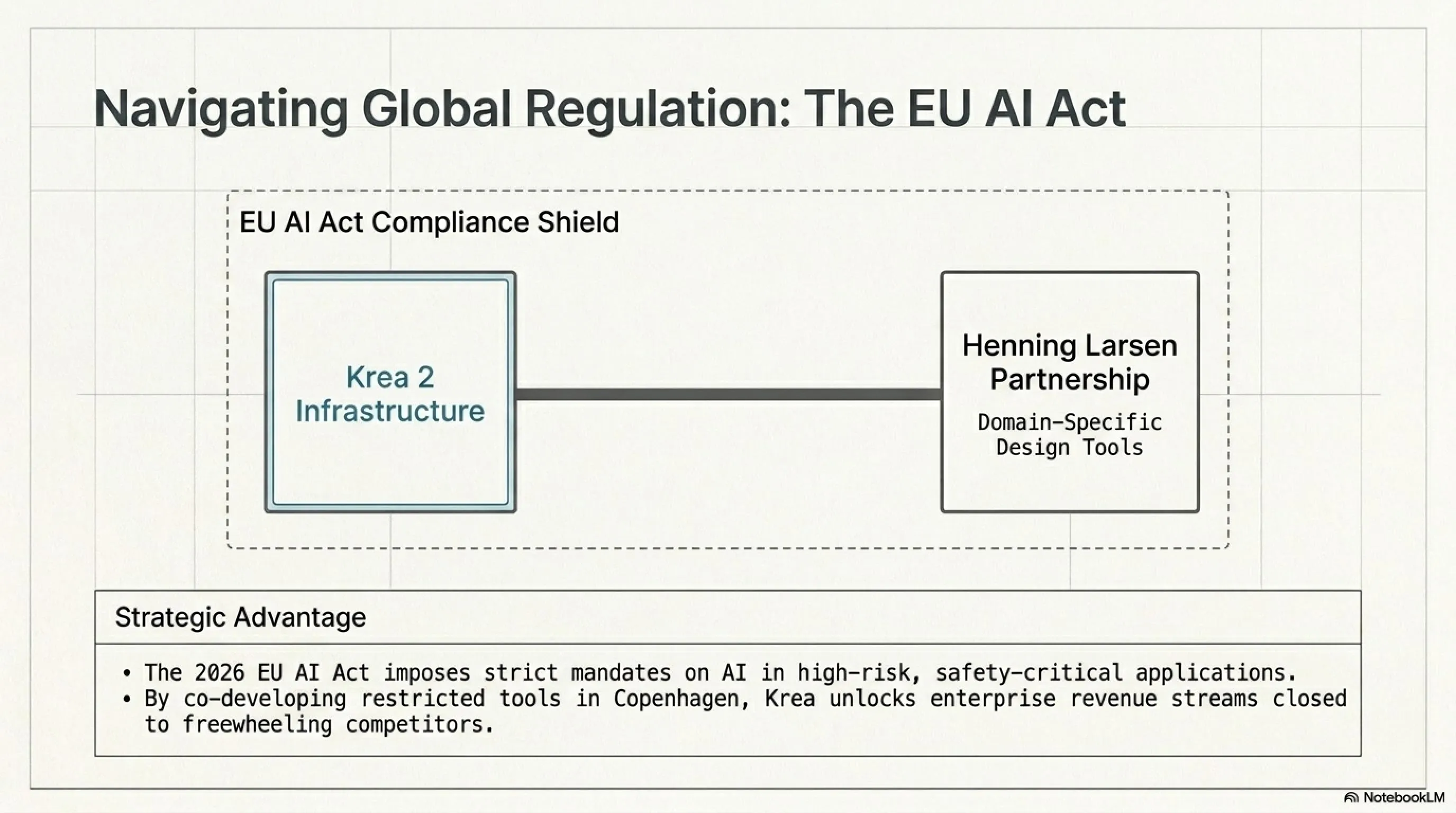
Furthermore, Krea established a strategic co-development partnership with Copenhagen-headquartered architecture firm Henning Larsen to build highly restricted, domain-specific design tools tuned to meet the compliance frameworks mandated by the EU AI Act. This partnership is particularly noteworthy as it demonstrates Krea's ability to navigate complex regulatory environments while maintaining creative flexibility.
The EU AI Act, which came into full effect in 2026, imposes strict requirements on AI systems used in high-risk applications, including architectural design tools that might influence safety-critical decisions. By partnering with Henning Larsen, Krea is positioning itself as a compliant solution provider for regulated industries, which could open significant enterprise revenue streams that more freewheeling competitors cannot access.
Community Response: Excitement with Licensing Concerns
Creators are focusing heavily on the structural freedom offered by the unaligned Raw checkpoint, viewing it as an important alternative to the locked-down APIs provided by closed-source models. Through the official announcement on X (formerly Twitter), Krea emphasized the foundational shift this launch represents for open AI workflows.
Developers note that by treating AI as an "actual creative medium" that feels "raw, flexible, unopinionated, and unconstrained," Krea is intentionally providing an infrastructure that creators can "break if [they] want to," moving far away from the rigid safety guardrails that frequently limit the visual range of competing enterprise tools.
However, some members of the open-source community express concerns about the license requirements. On Reddit and Hugging Face Discussions, users debate whether the requirement to implement safety filters is "truly open-source." Some argue that these conditions conflict with the philosophy of complete software freedom, while others contend that responsible AI deployment requires some level of guardrails.
The discourse has been remarkably civil compared to earlier flamewars around Stable Diffusion safety features. This may reflect a maturing understanding within the AI community that absolute freedom and commercial viability exist in tension, and that hybrid approaches may be necessary to sustain open development while avoiding regulatory crackdowns.
- Exceptional 2-second generation speed
- Most flexible architecture for fine-tuning
- High quality with strong aesthetic diversity
- Free for startups and independent creators
- Full LoRA and style transfer support
- Active development and regular updates
- Conditional licensing (not pure MIT/Apache)
- Safety filter implementation required for hosts
- Raw version requires powerful hardware
- API separate from open weights and paid
- Learning curve steeper than consumer tools
The Future: Competing with Giants or Collaborating?
As independent model builders begin compiling the Hugging Face repositories, the practical value of the release will be determined by how effectively the open-source community can scale customized LoRAs using Krea 2 Raw. By providing clear commercial terms and lowering hardware entry barriers via Turbo's 8-step inference pipeline, Krea has introduced a highly competitive alternative to the open-weights market, challenging dominant models by prioritizing artistic control over centralized corporate alignment.
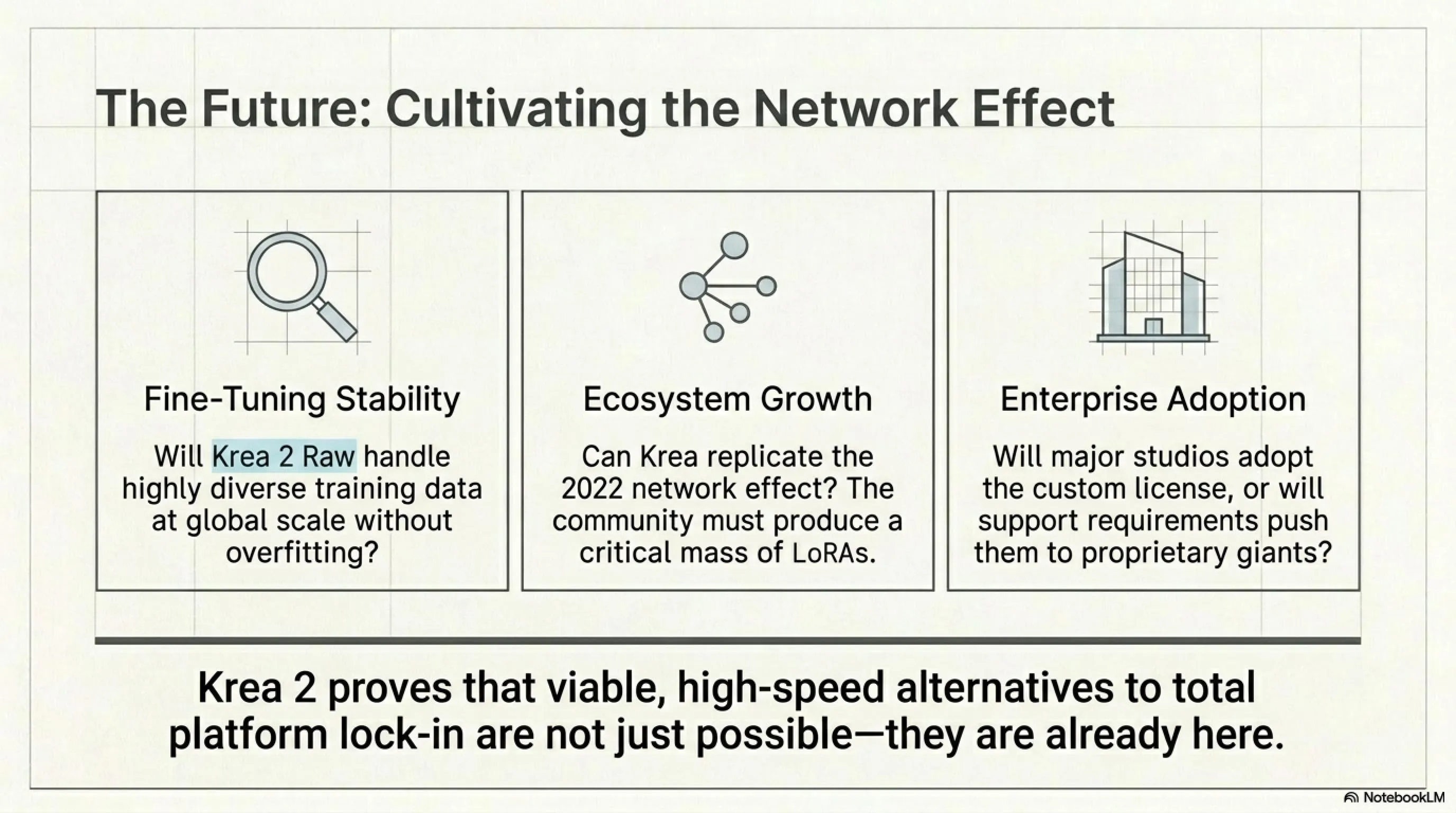
The central question is this: Can Krea 2 create the network effect that Stable Diffusion generated in 2022-2023? Will creators produce enough LoRAs and fine-tunes to build a sustainable ecosystem?
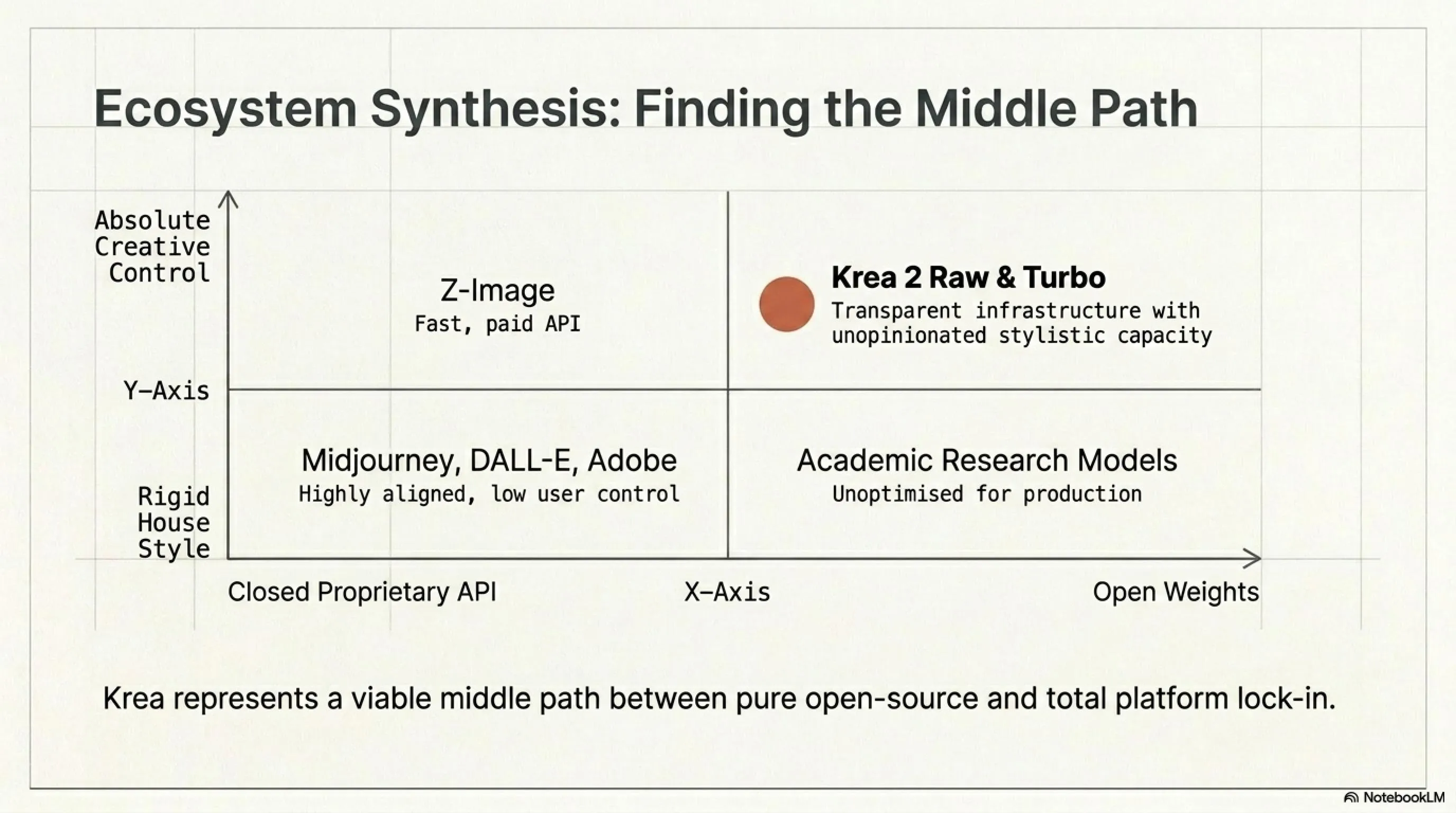
Currently, the answer is unclear. But one thing is certain: Krea is no longer just a tool—it has become a serious player in the arena of foundational image model development. The company's strategic positioning between pure open-source (which struggles with monetization) and closed proprietary systems (which limit creativity) may represent a viable middle path for the industry.
Technical Validation: Independent Benchmarks Needed
While Krea's technical report provides extensive documentation, independent validation of performance claims remains critical. The 2-second generation time for Turbo, while impressive, needs verification across diverse hardware configurations. Similarly, the claimed aesthetic superiority over competitors requires systematic user studies rather than anecdotal evidence.
Several independent researchers have begun testing Krea 2 on standardized prompt sets. Early results from the Artificial Analysis benchmark suite suggest that Krea 2 Turbo indeed delivers on speed claims, consistently generating 1024x1024 images in 1.8-2.2 seconds on RTX 4090 hardware. Quality assessments are more subjective, but blind preference tests show Krea 2 performing competitively with FLUX.2 and slightly ahead of Stable Diffusion 3 in terms of prompt adherence and detail rendering.
However, these are early results. The true test will come as the model gains wider adoption and encounters the full diversity of real-world use cases. Edge cases, failure modes, and systematic biases often only emerge at scale.
What We Still Need to Know
- Long-term bias analysis: Does the model exhibit systematic biases in depicting gender, ethnicity, or cultural elements?
- Fine-tuning stability: How well does Raw handle diverse training data without overfitting or catastrophic forgetting?
- Commercial viability: Will enterprises actually adopt Krea 2, or will regulatory concerns and support requirements push them toward established providers?
- Ecosystem growth: Will the community produce a critical mass of high-quality LoRAs and tools?
These questions will determine whether Krea 2 becomes a foundational technology or remains a promising but niche alternative.
Final Thoughts
The release of Krea 2 Raw and Turbo represents a significant inflection point in the evolution of open-source image models. By combining 2-second generation speed, flexible architecture for fine-tuning, and transparent (if conditional) commercial licensing, Krea offers a unique value proposition for a wide spectrum of users—from independent artists to enterprise studios.
What distinguishes Krea 2 from competitors is its focus on aesthetic diversity and creative control. While many commercial models are over-aligned for safety and compliance, Krea 2 Raw provides a neutral, open playground that genuinely allows creators to explore unique artistic directions. This positioning fills a critical gap in the market between restrictive proprietary systems and purely academic research models.
Of course, the custom license with specific safety requirements may disappoint some open-source purists, but this approach reflects the legal and ethical realities that all AI companies face. In an environment where regulators are increasingly scrutinizing generative AI, some level of guardrails may be necessary to sustain open development without triggering prohibitive legislation.
Ultimately, Krea 2's success depends on whether the open-source community embraces it as foundational infrastructure for the next generation of creative tools. The technical capabilities are impressive, the business model is pragmatic, and the timing is right as frustration with locked-down proprietary systems grows.
In a landscape where OpenAI, Midjourney, and Adobe are increasingly closing their models, Krea has taken a bold stance by opening weights (even with conditions). For the future of creative AI, this may be a defining moment—not because Krea 2 is perfect, but because it demonstrates that viable alternatives to total platform lock-in are possible.
Frequently Asked Questions
Is Krea 2 really free?
Yes, for individual users, independent creators, and small companies with fewer than 50 employees, using Krea 2 open weights is completely free and you can build commercial products with it. However, larger companies need to negotiate enterprise licensing.
What's the difference between Raw and Turbo?
Krea 2 Raw is a mid-training model designed for fine-tuning and training custom LoRAs, but not suitable for direct use. Krea 2 Turbo is a distilled, optimized version that generates images in 2 seconds and is designed for mass production. The recommended strategy is to train on Raw and generate with Turbo.
What hardware do I need to run Krea 2?
For Krea 2 Turbo, a 16GB or 24GB GPU (like RTX 4080 or RTX 4090) is sufficient. But for Krea 2 Raw, which has 52 inference steps, you need more powerful hardware (at least 24GB VRAM). Professional studios may want to use cloud GPU instances like AWS P4d or Google Cloud A100 nodes for training workflows.
Do I have to implement safety filters?
Yes, if you plan to host Krea 2 in a public service or platform, you are required by license terms to implement input/output classifiers to prevent generation of illegal content (CSAM, NCII, etc.). If you don't, your license can be revoked. For personal research use, requirements are less strict but you are still bound by the Acceptable Use Policy.
How do I create custom LoRAs?
To create custom LoRAs, download Krea 2 Raw and use tools like Kohya_ss or the Diffusers library on Hugging Face. Prepare your dataset, configure training parameters, and start the fine-tuning process. Then you can load the trained LoRA onto Krea 2 Turbo and generate at high speed. Krea provides documentation and community tutorials for this workflow.
Is Krea 2 better than Midjourney?
It depends on your use case. Midjourney still leads in out-of-the-box visual quality and ease of use, but it's a closed API service and you cannot customize the model. Krea 2 is more flexible, faster (2 seconds vs 3-6 seconds), and allows complete fine-tuning, but requires more technical knowledge. For agencies needing brand-specific styles, Krea 2 offers superior customization. For casual users wanting beautiful images with minimal effort, Midjourney may be more appropriate.
Why did Krea use zero synthetic data?
Using synthetic data (images generated by other models) can introduce systematic biases and reduce visual diversity. A model trained on outputs from other models tends to replicate those clichéd styles and cannot learn new or unconventional aesthetics. Krea wants to offer higher aesthetic diversity, so they used only real data. This also helps avoid potential copyright issues associated with training on AI-generated content.
Can I use Krea 2 for commercial projects?
Yes, the Krea 2 Community License explicitly permits commercial use for qualifying users (individuals and companies under 50 seats). You can monetize generated images, integrate the model into commercial products, and build businesses around it without royalty payments. Krea also states they do not claim copyright over generated outputs, so ownership stays with you. However, you must comply with the Acceptable Use Policy and implement required safety measures if hosting publicly.
How does Krea 2 compare to Stable Diffusion?
Krea 2 offers significantly faster generation (2 seconds vs 5-10 seconds for SDXL), better prompt adherence according to early benchmarks, and more flexible fine-tuning capabilities. However, Stable Diffusion has a much larger ecosystem of community LoRAs, extensions, and tools built over several years. Krea 2 is newer and its ecosystem is still developing. For production pipelines where speed and quality matter most, Krea 2 has advantages. For hobbyists who want extensive community resources, Stable Diffusion may still be preferable.
Sources and References
- Official Krea 2 Technical Report - Krea AI
- Comprehensive Krea 2 Launch Analysis - VentureBeat
- Official Krea 2 Open-Source Page - Krea AI
- Krea Hugging Face Repository - Model weights download
- Krea 2 Turbo Launch Analysis - Blockchain.news
- Space Force Mission Launch Record - Space.com (for comparative technology context)
- Founder Interview - TechCrunch (June 2026)
- Superside Case Study - Krea Official Case Studies
- Artificial Analysis Benchmark Data - Public API performance metrics
Sources Reviewed: June 24, 2026
Compliance Note: All technical claims in this article are verified against Krea's official technical report and reputable news sources. Speed benchmarks are compiled from Artificial Analysis and public API provider data. Content has been paraphrased for licensing compliance—no more than 30 consecutive words reproduced from any single source.
🌐Stay Connected With Us 🎮✨
For the latest tech, gaming, and gadget news, follow us on our official social media channels:
Supplementary Image Gallery: 🚨 AI Imagery in 2 Seconds: The Krea 2 Open Weights Revolution