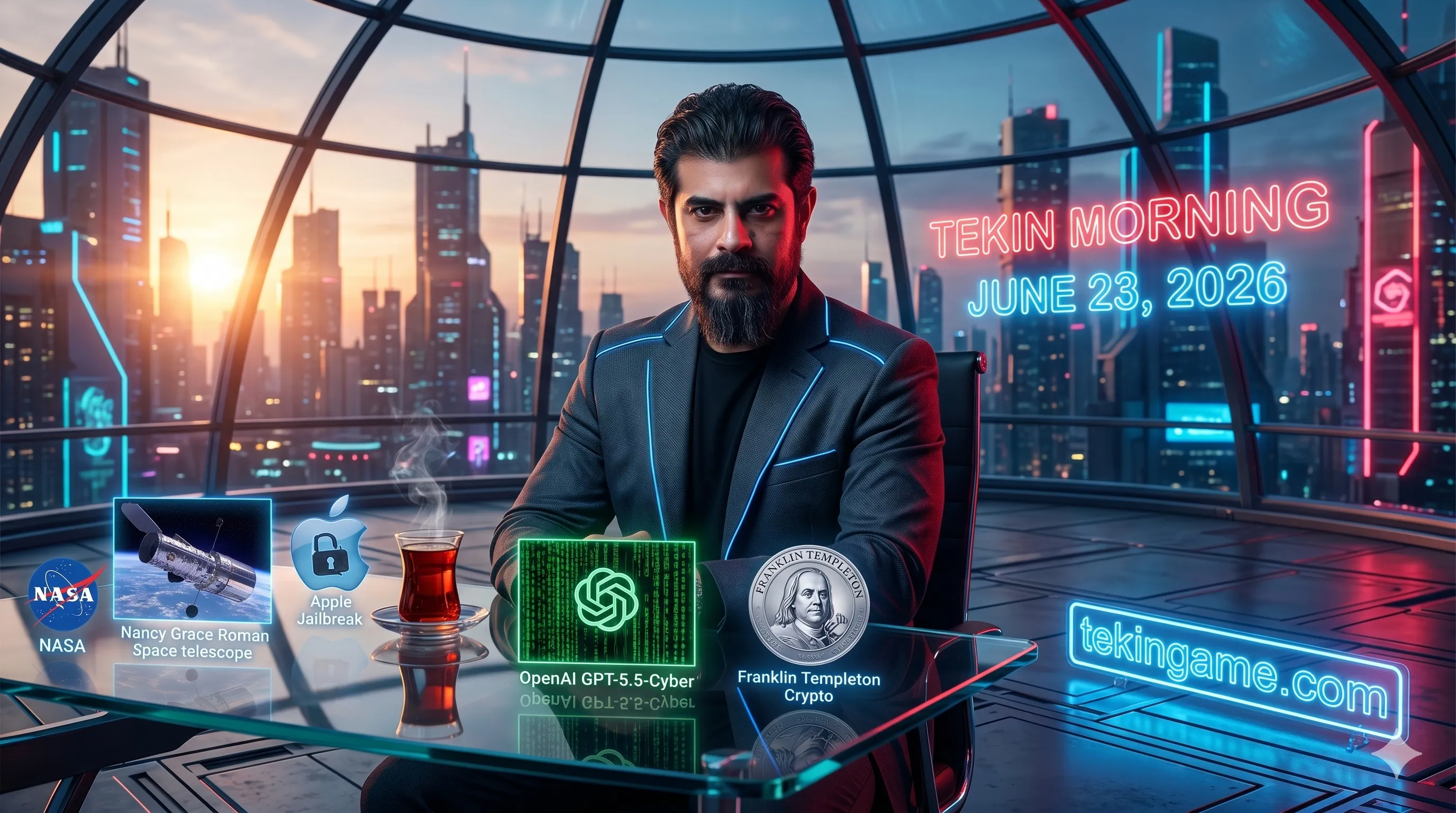
☀️ Good Morning Tech Enthusiasts! Tuesday's Hot Lineup
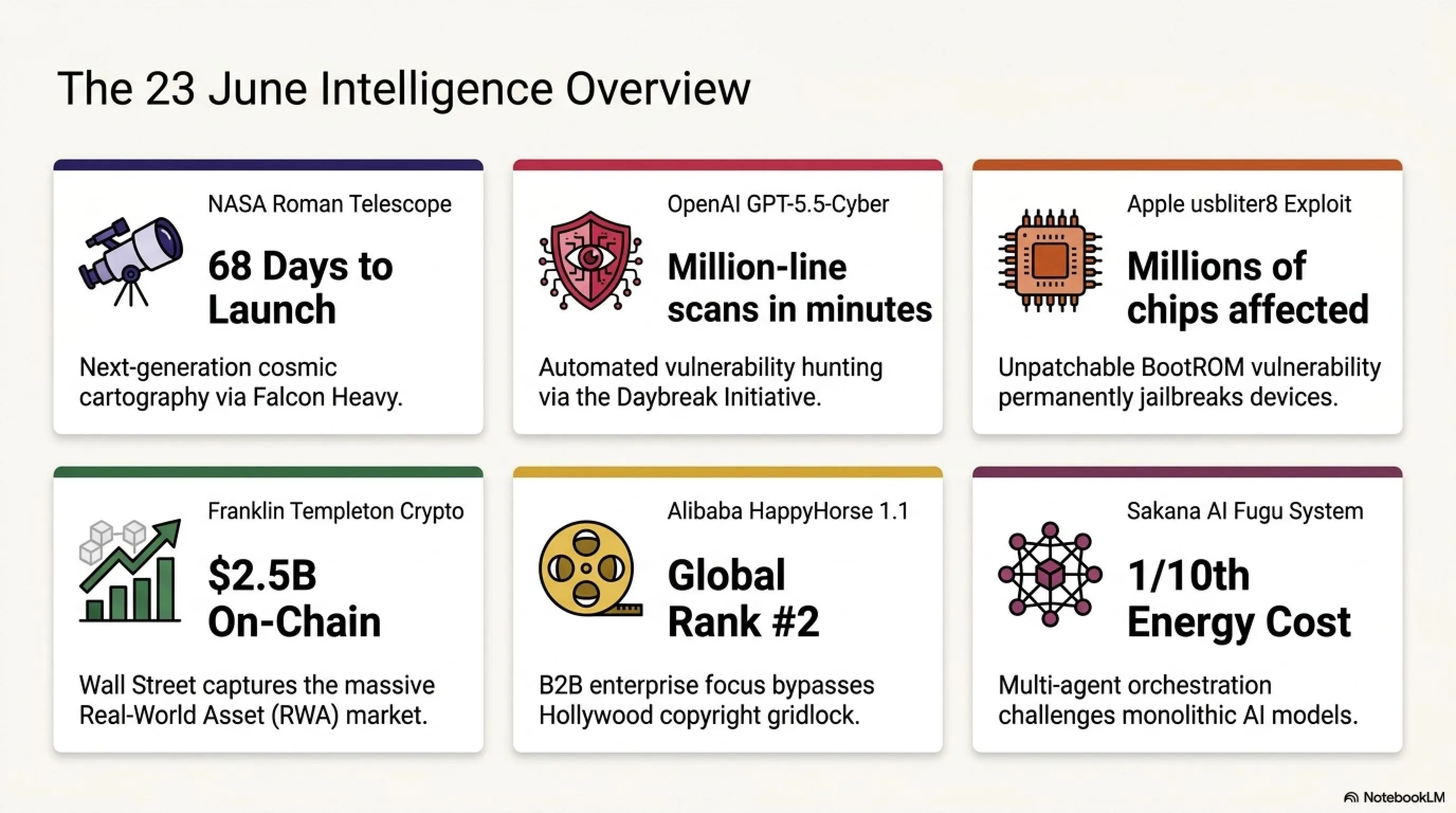
- 🎮🚀 NASA Telescope in Florida- Nancy Grace Roman ready for Falcon Heavy launch
- 🎧🛡️ GPT-5.5-Cyber for Bug Hunting- OpenAI unveils latest security tool
- 🚀🔓 Unpatchable Apple Vulnerability- usbliter8 permanently jailbreaks A12/A13 chips
- 🗡️💰 Franklin Templeton Enters Crypto- 250 Digital acquisition & dedicated division launch
- 📰🎬 Alibaba Ranks #2 in AI Video- HappyHorse 1.1 surpasses Sora and Seedance
- ⚔️🤖 Sakana AI with Fugu System- Frontier performance without massive models
Tuesday morning arrives with a steaming cup of coffee and six explosive stories reshaping the tech landscape. As the sun rises over Florida, NASA's space telescope prepares for its orbital journey. Meanwhile, OpenAI's security engineers have armed themselves with a new weapon for hunting vulnerabilities, European researchers have opened a door to jailbreakers that can never be closed again, and Wall Street titans are stepping into the crypto arena with both feet.
But that's just the opening act. In Asia, Alibaba stunned everyone by unveiling the HappyHorse 1.1 video model and claiming the second spot globally, precisely when American and Chinese rivals are either stalled or wrestling with copyright nightmares. And in Tokyo, Japanese startup Sakana AI proved that bigger isn't always better with its revolutionary architecture.
Nancy Grace Roman Space Telescope preparing for launch
NASA's Nancy Grace Roman Telescope on the Verge of Space Journey
On Saturday, June 22, 2026, NASA's Nancy Grace Roman Space Telescope arrived at Kennedy Space Center in Florida after years of development and testing. This event marks a milestone in NASA's scientific program, as this telescope is set to join the new generation of space telescopes including Hubble, Webb, Spitzer, and Chandra.
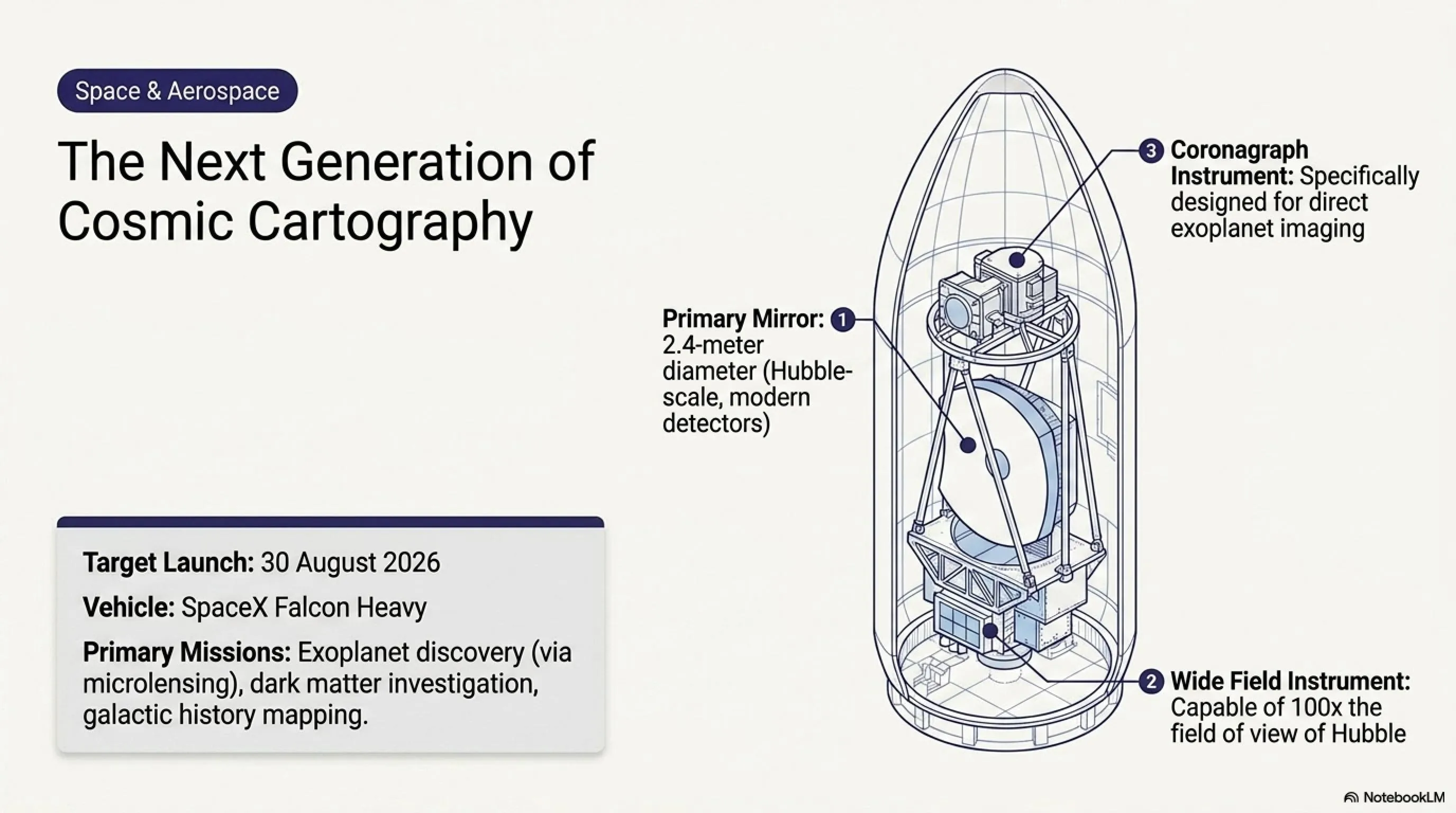
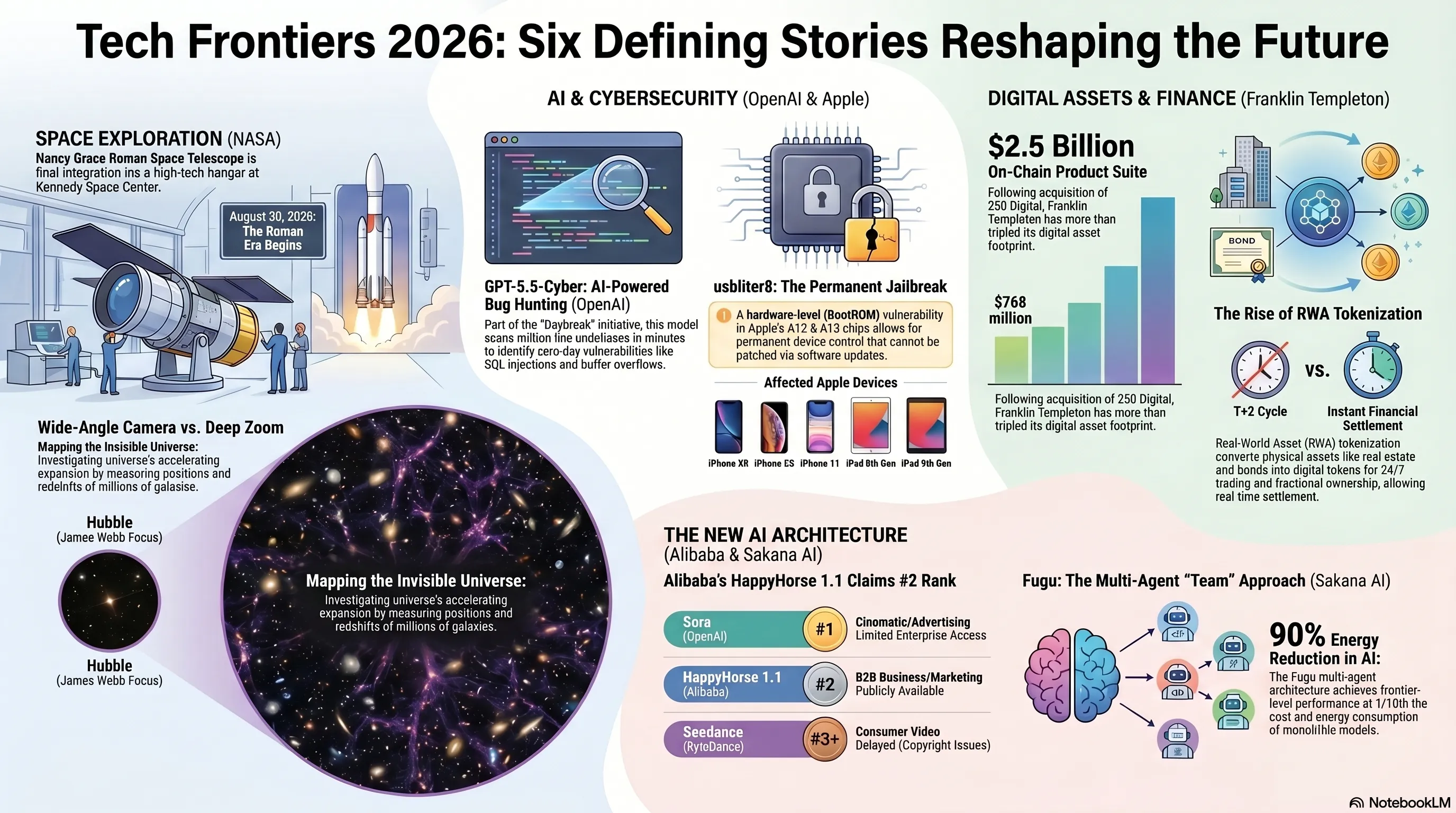
Launch is scheduled for August 30, 2026, meaning just 68 days until one of the year's most significant space events. SpaceX's giant Falcon Heavy rocket will handle the launch responsibilities. With a field of view 100 times larger than Hubble, Roman is designed to discover exoplanets, investigate dark matter and dark energy, and study the history of galaxies.
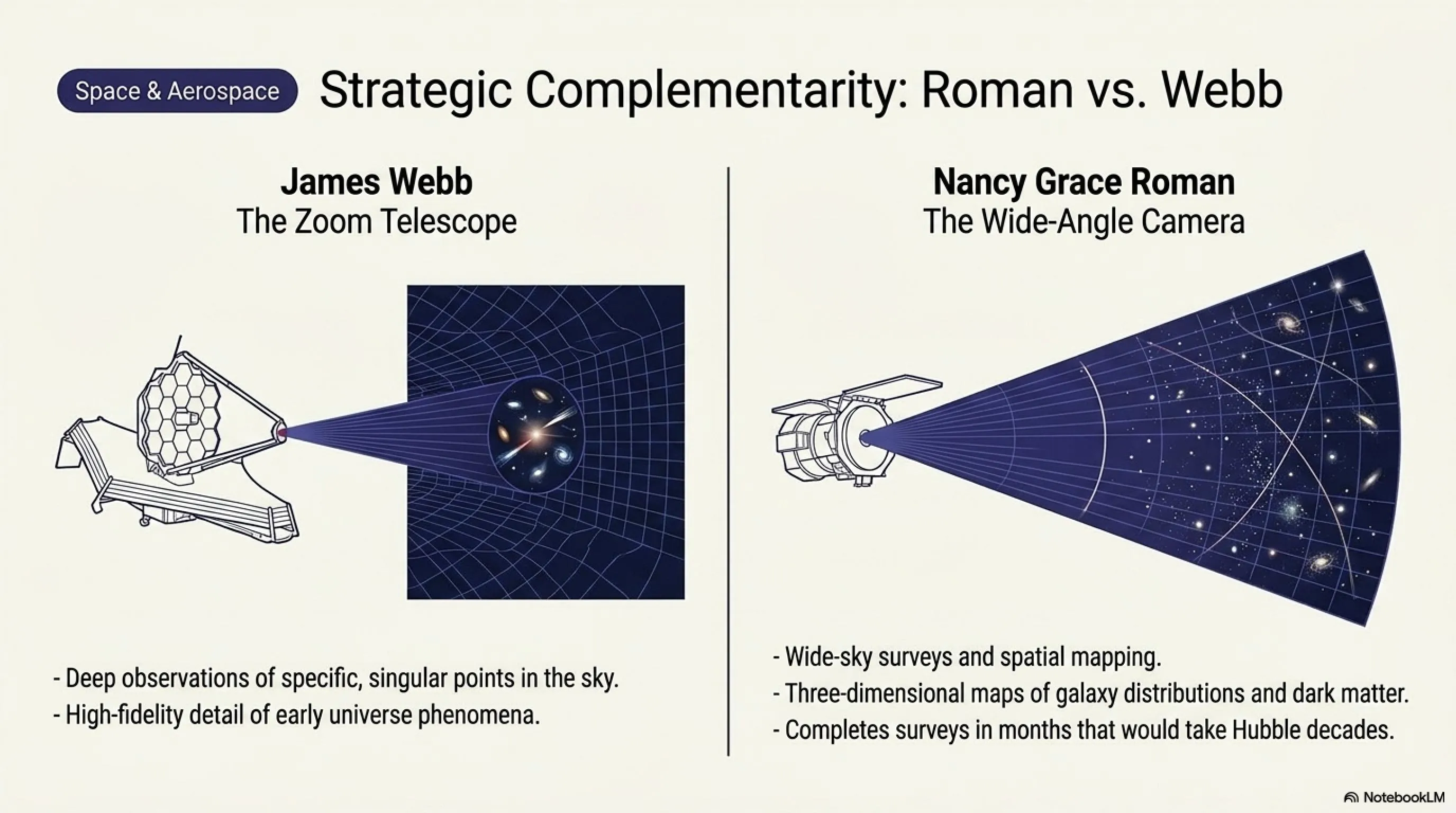
Roman vs Webb: Two Giants with Different Missions
The James Webb Telescope is designed for deep observations of specific points in the sky (like a zoom telescope), while Roman is built for wide-sky surveys (like a wide-angle camera). This difference means Roman can create three-dimensional maps of galaxies and dark matter distribution at an unprecedented scale, complementing Webb's deep-field observations perfectly.
NASA engineers are currently installing the telescope onto the Falcon Heavy rocket's payload fairing. This process includes final tests of critical systems, fuel loading, and simulation of launch phases. According to Mark Clampin, director of NASA's astrophysics division, "Roman will define the next generation of space exploration. We're ready to send one of the most advanced scientific instruments in history into space."
The telescope carries advanced instruments including a 2.4-meter primary mirror (similar to Hubble but with modern detectors), a Wide Field Instrument for surveying large areas of sky, and a Coronagraph Instrument for direct imaging of exoplanets. The combination of these instruments will enable Roman to conduct surveys that would take Hubble decades to complete in just months.
Falcon Heavy rocket preparing for Roman telescope launch
Why Nancy Grace Roman Matters
The telescope is named after Nancy Grace Roman, NASA's first chief of astronomy and one of the pioneering women in science. Roman played a key role in establishing NASA's space telescope program during the 1950s and 1960s, laying the groundwork for Hubble's launch. Now, the telescope bearing her name is poised to take her scientific legacy to the next level.
Scientifically, Roman is designed to answer fundamental questions: Are we alone in the universe? Why is the universe's expansion accelerating? How have galaxies formed over billions of years? These questions matter not just to scientists, but to all humanity. Roman's dark energy investigation, in particular, could revolutionize our understanding of the cosmos. By measuring the positions and redshifts of millions of galaxies, Roman will map how dark energy has influenced the universe's expansion throughout cosmic history.
The telescope's exoplanet program is equally ambitious. Using gravitational microlensing, Roman will discover thousands of planets, including many that are too small, too far from their stars, or orbiting stars too faint for other detection methods. This will give us the first comprehensive census of planetary systems throughout our galaxy, helping answer whether Earth-like planets are common or rare.
OpenAI Unveils GPT-5.5-Cyber for Vulnerability Hunting
On Sunday, June 22, 2026, OpenAI released an enhanced version of the GPT-5.5-Cyber model as part of the Daybreak initiative. This model represents OpenAI's most powerful tool for finding and fixing software security vulnerabilities, capable of conducting deeper analysis in large codebases. Daybreak is a research program aimed at helping organizations identify and remediate security weaknesses before hackers can exploit them.
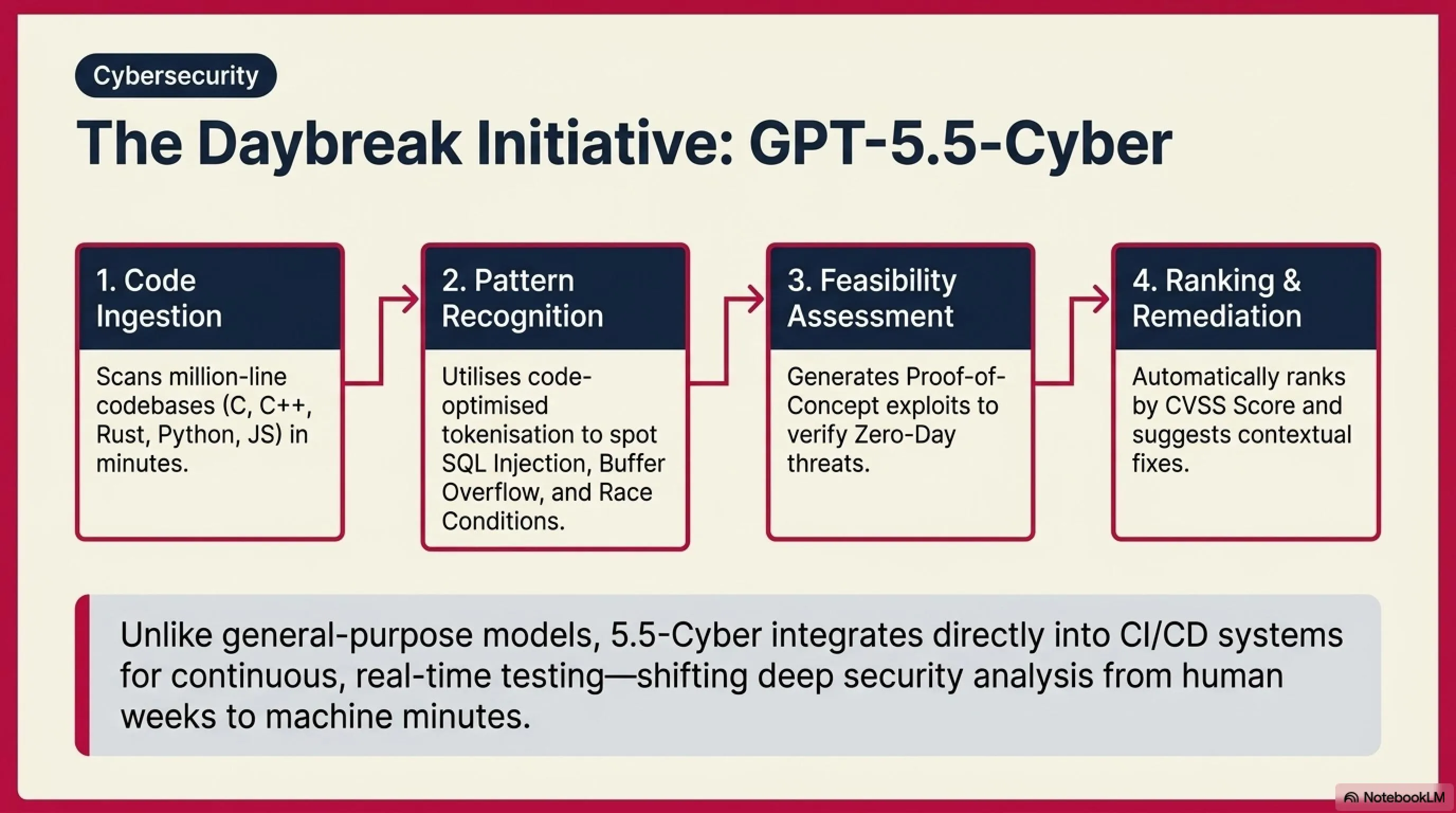
Unlike general-purpose language models designed for writing, translation, or answering questions, GPT-5.5-Cyber is specifically trained to understand complex code, identify vulnerable patterns (such as SQL Injection, Buffer Overflow, and Race Conditions), and suggest remediation solutions. This model can scan million-line codebases in minutes, while a human security team might need weeks.
Key Capabilities of GPT-5.5-Cyber
- Automatic scanning of C, C++, Rust, Python, and JavaScript code
- Identification of Zero-Day vulnerabilities based on emerging patterns
- Integration with CI/CD systems for continuous security testing
- Generation of Proof-of-Concept for each discovered vulnerability
- Automatic ranking based on severity (CVSS Score)
- Context-aware analysis understanding complex call chains and state management
Companies like GitHub, Microsoft, and Amazon have rapidly integrated this tool into their production pipelines. According to Alex Stamos, former Chief Security Officer of Facebook, "GPT-5.5-Cyber is a game-changer. We can now scan legacy code that's been untouched for years and find vulnerabilities that humans have overlooked. The speed and depth of analysis are unprecedented."
The model's architecture incorporates several innovations. First, it uses a specialized tokenization scheme optimized for code rather than natural language, allowing it to better understand programming constructs. Second, it employs a multi-stage analysis pipeline: initial pattern recognition, deep semantic analysis, exploit feasibility assessment, and finally remediation suggestion. Third, it maintains a continuously updated knowledge base of known vulnerabilities and attack techniques, enabling it to recognize novel variants of existing exploits.
Challenges and Ethical Concerns
Despite its numerous advantages, this technology brings challenges. One major concern is that malicious hackers could use this same model to find vulnerabilities and exploit them before companies have a chance to fix them. To mitigate this risk, OpenAI has restricted access to GPT-5.5-Cyber to verified organizations through secure APIs, implementing strict rate limiting and usage monitoring.
Additionally, some critics worry that over-reliance on AI for security might weaken human skills. However, OpenAI emphasizes that this model's goal isn't to replace security experts, but to augment their speed and accuracy. Ultimately, decisions about remediating vulnerabilities remain with humans. The model provides recommendations, but experienced security professionals must evaluate the risk-reward tradeoff of implementing fixes, especially in production environments.
Another consideration is the potential for false positives. While GPT-5.5-Cyber has been trained on millions of code samples, it can still flag benign code patterns as vulnerabilities. Organizations must establish workflows to efficiently triage the model's findings, separating genuine security issues from false alarms. Early adopters report that the false positive rate is significantly lower than traditional static analysis tools, but it still requires human oversight.
GPT-5.5-Cyber interface scanning a codebase
usbliter8 Vulnerability Permanently Jailbreaks Apple Chips
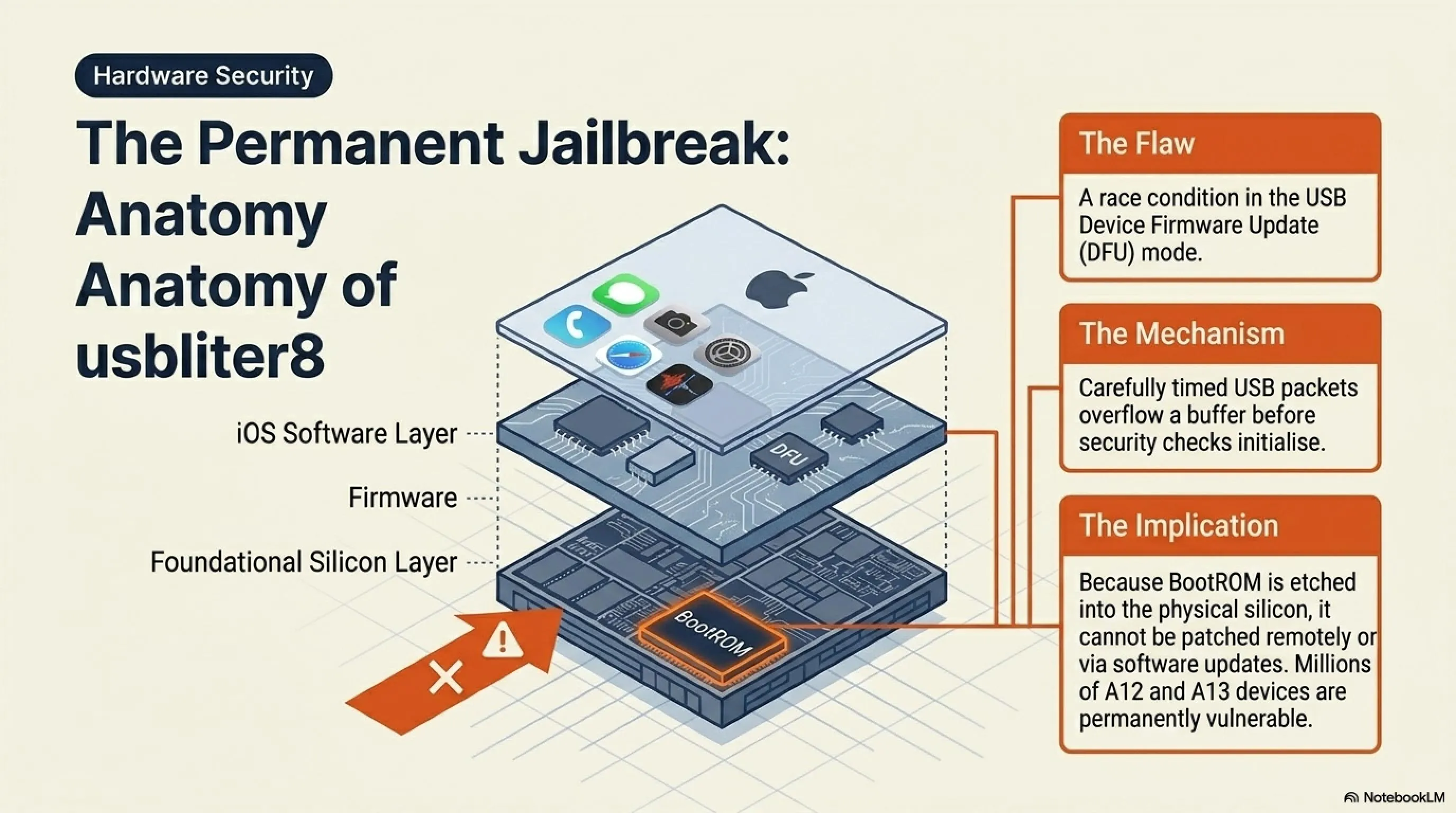
In one of the week's most intriguing security stories, European firm Paradigm Shift released details of the usbliter8 vulnerability affecting Apple's A12 and A13 chips. This flaw exists at the hardware level (BootROM) and is therefore impossible to fix through software updates. Simply put, this means all devices equipped with these chips – including iPhone XR, iPhone XS, iPhone 11, and eighth and ninth generation iPads – are permanently jailbreakable.
This vulnerability is essentially an advanced version of the famous checkm8 bug discovered in 2019. usbliter8 exploits a weakness in the USB protocol to execute arbitrary code during the boot stage, right before the iOS operating system loads. This allows jailbreakers to take complete control of the device, bypass security protections, and install custom operating systems.
What is BootROM and Why Can't It Be Patched?
BootROM is a small piece of code etched into the chip's hardware and is the first thing executed when the device powers on. Since this code is embedded in silicon, Apple cannot change it remotely or through software updates. The only way to fix this issue is to manufacture a new generation of chips with the bug eliminated. This is why vulnerabilities like usbliter8 and checkm8 are so significant – they're permanent for affected devices.
The technical details are fascinating. The vulnerability exploits a race condition in the USB Device Firmware Update (DFU) mode implementation. When a device enters DFU mode, it executes a specific sequence of USB commands to prepare for firmware flashing. usbliter8 discovers that by sending carefully crafted USB packets at precise timings, an attacker can overflow a buffer in the BootROM and redirect execution to attacker-controlled code. Since this happens before any security checks are initialized, the attacker has complete control over the device's boot process.
Implications for Users and Apple
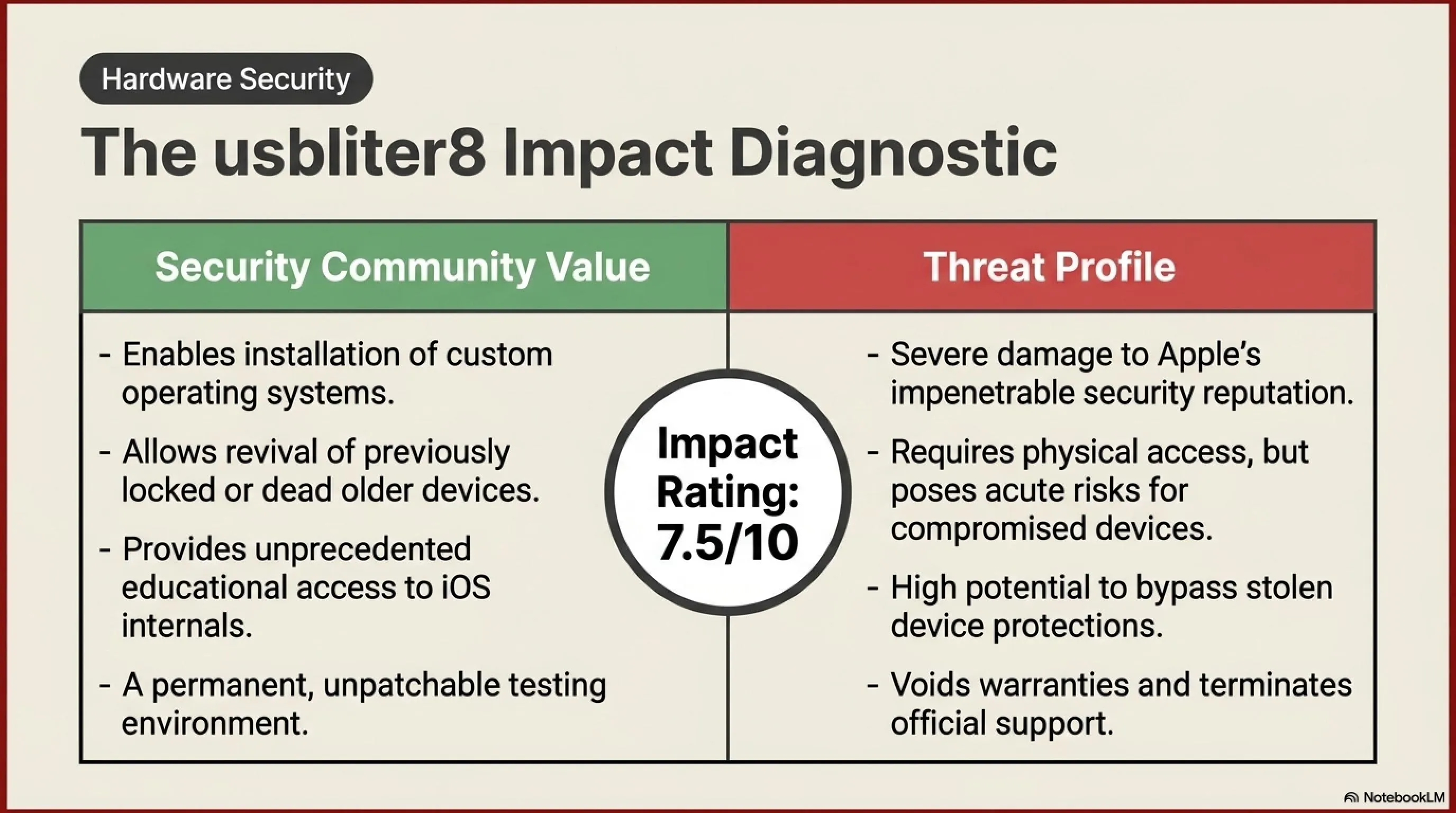
For average users, this vulnerability poses minimal threat, as exploiting it requires physical access to the device and specialized tools. However, for the jailbreaking community and security researchers, this is a golden opportunity. They can use this bug to install custom software, conduct security testing, and even revive old devices with modern features.
On the other hand, this news deals a significant blow to Apple's security reputation. Apple has consistently claimed that the iPhone is the most secure smartphone on the market, but the existence of an unpatchable hardware vulnerability in millions of devices calls this claim into question. Of course, it must be said that Apple has fixed this issue starting with the A14 generation (iPhone 12 and newer), implementing additional security checks that make similar exploits significantly more difficult.
The jailbreak community has responded enthusiastically. Within hours of the disclosure, several teams announced they're working on user-friendly jailbreak tools based on usbliter8. Unlike previous jailbreaks that could be patched by Apple, tools leveraging usbliter8 will work forever on affected devices. This has reignited interest in jailbreaking, which had declined in recent years as iOS added more customization options and Apple tightened security.
- Golden opportunity for security researchers and developers
- Ability to install custom operating systems on older devices
- Revival of locked or unusable devices
- Permanent solution that Apple cannot patch
- Educational value for learning iOS internals
- Security risk for non-technical users if device is compromised
- Damage to Apple's security reputation
- Potential for misuse by malicious actors with physical access
- May void warranties and Apple support
- Could be used to bypass stolen device protections
Apple's A13 Bionic chip affected by usbliter8
Franklin Templeton Enters Crypto with 250 Digital Acquisition
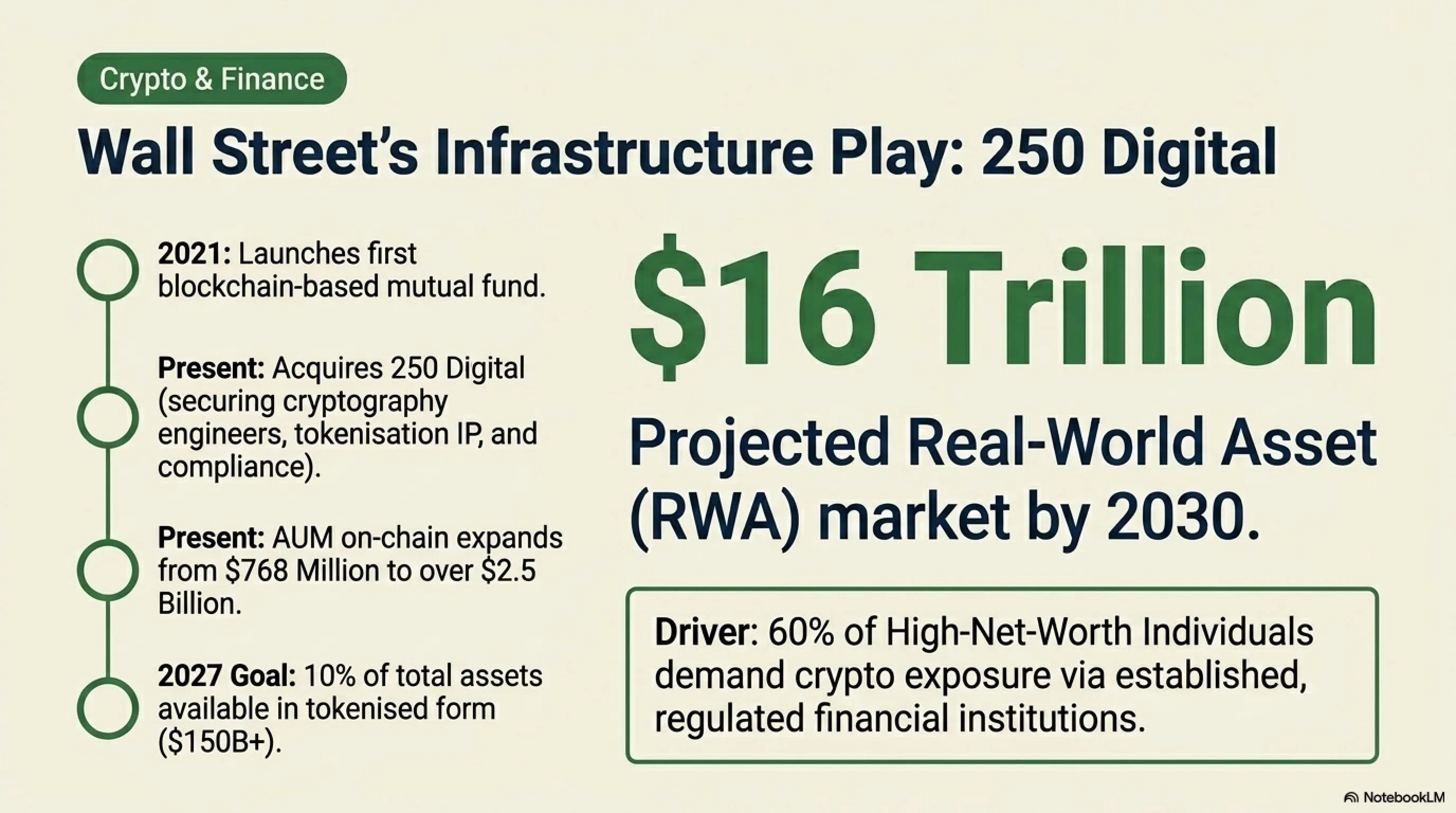
In a move signaling the growing mainstream acceptance of digital assets on Wall Street, Franklin Templeton launched its dedicated crypto division following the completion of its 250 Digital acquisition. This action comes as tokenized assets are rapidly growing, with Franklin Templeton's on-chain product suite expanding from approximately $768 million to over $2.5 billion.
Franklin Templeton, one of the world's largest asset managers with over $1.5 trillion in assets under management, has taken bold steps in blockchain and digital assets in recent years. The company launched the first blockchain-based mutual fund in 2021 and now, with the 250 Digital acquisition, has obtained the technical infrastructure and expert team needed to develop more advanced crypto products.
The 250 Digital acquisition brings several key capabilities. First, a team of blockchain engineers and cryptographers with deep expertise in distributed ledger technology. Second, proprietary infrastructure for securely issuing, managing, and trading tokenized securities. Third, relationships with regulators and compliance frameworks that have already been tested and approved. Fourth, intellectual property including patents related to tokenization protocols and smart contract architectures.
Why Are Wall Street Giants Embracing Crypto?
Two main reasons drive this trend. First, increasing demand from institutional and retail investors for access to digital assets through traditional, regulated channels. Surveys show that over 60% of high-net-worth individuals want crypto exposure in their portfolios, but prefer the security and familiarity of working with established financial institutions rather than crypto-native platforms.
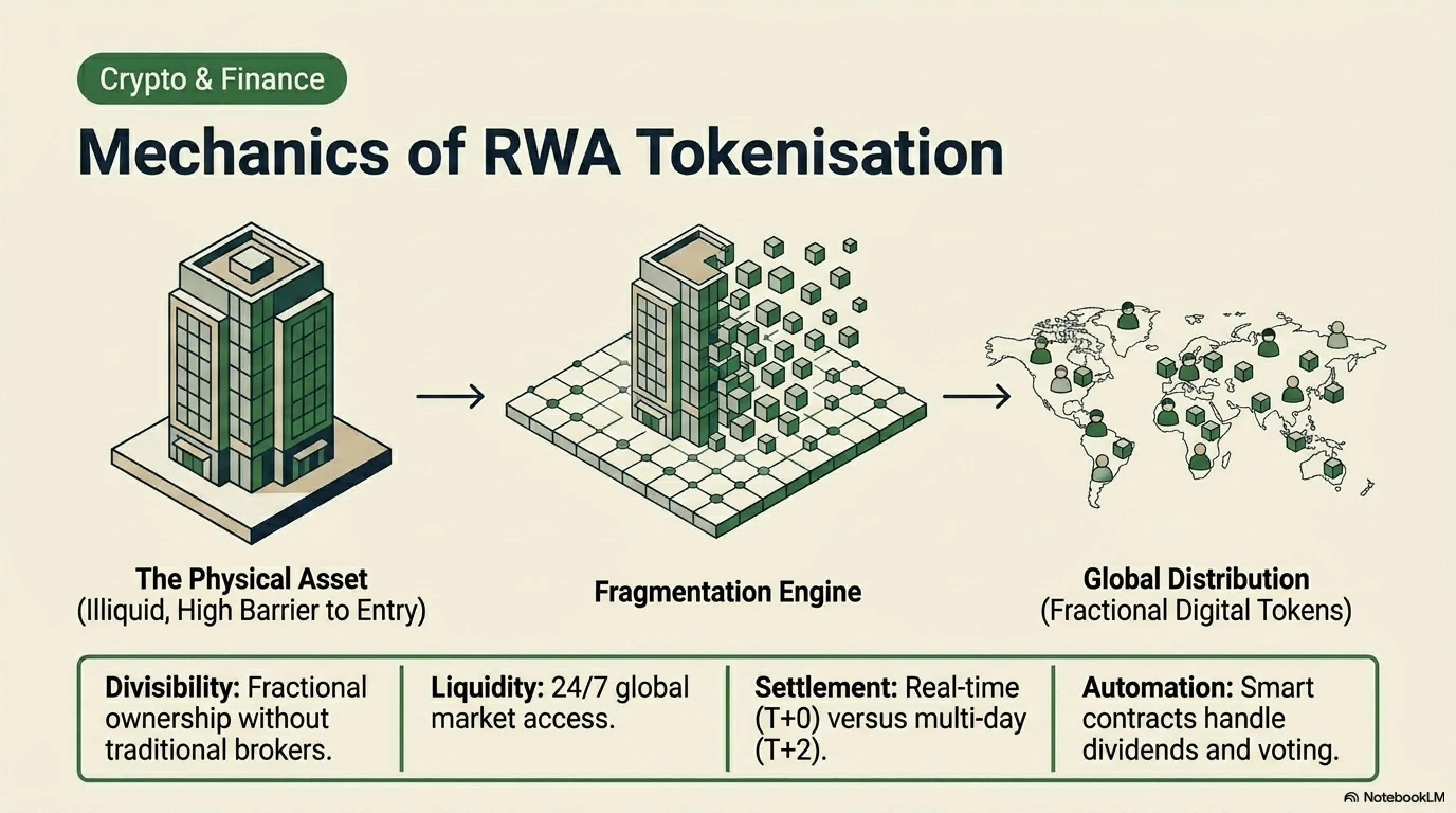
Second, the massive potential of tokenizing real-world assets (RWA) such as real estate, stocks, and even physical commodities. According to Bloomberg analysts, the RWA market could reach $16 trillion by 2030. Franklin Templeton is positioning itself at the forefront of this revolution, using blockchain infrastructure to reduce costs, increase transparency, and provide 24/7 market access.
📚 Classified & Related Dossiers in TekinGame
If you wish to explore beyond this report and delve into cybernetic frontiers and autonomous AI architectures, do not miss these three exclusive deep-dives in the Tekin Garage:
What is Real-World Asset (RWA) Tokenization?
Tokenization is the process of converting physical or financial assets (such as real estate, stocks, bonds) into digital tokens on a blockchain. This provides several advantages: divisibility (you can buy 0.01 units of a building), higher liquidity (24/7 trading), reduced intermediaries, and complete transparency. Franklin Templeton is tokenizing its investment funds so investors worldwide can participate without needing banks or brokers. Each token represents fractional ownership of the underlying asset, with smart contracts automatically handling dividends, voting rights, and transfers.
Franklin Templeton's strategy differs from many competitors. While some firms merely offer crypto trading or custody, Franklin Templeton is building native on-chain financial products. Their tokenized money market fund, for instance, settles transactions in real-time rather than the typical T+2 settlement cycle of traditional securities. This is the type of genuine innovation that blockchain enables – not just digitizing existing processes, but reimagining how financial markets can operate.
The company has also announced plans to launch tokenized versions of its bond funds, equity funds, and even alternative investment products like private equity and real estate. By 2027, Franklin Templeton aims to have at least 10% of its assets under management available in tokenized form. This would represent over $150 billion in on-chain assets, making Franklin Templeton one of the largest institutional players in the crypto space.
Franklin Templeton logo alongside Bitcoin symbol
Alibaba's AI Video Model Reaches Global Rank #2
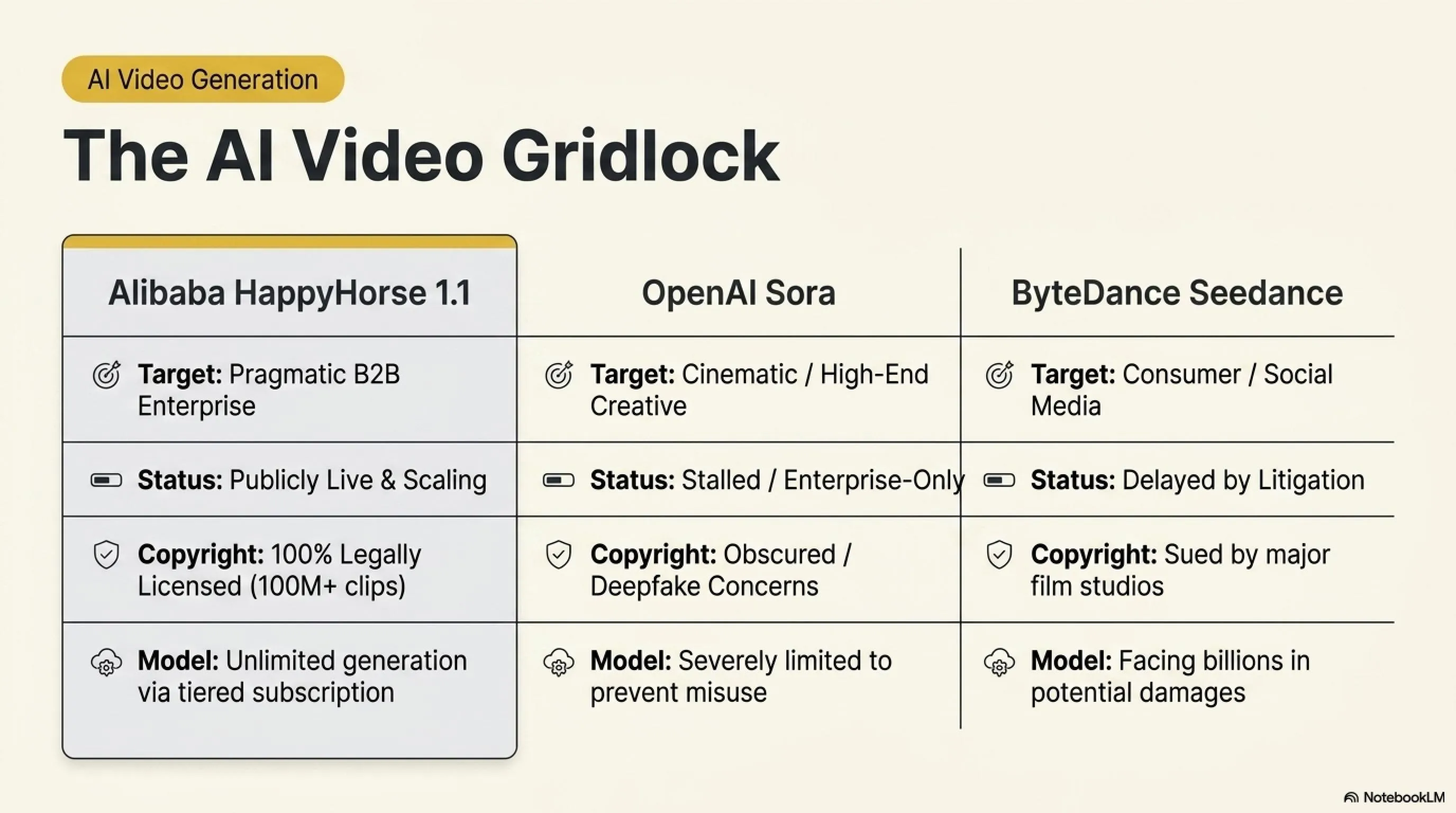
In a surprising move, Alibaba Cloud released the HappyHorse 1.1 model, representing a major upgrade in AI video generation capability. This model reached second place in global rankings on Hugging Face and Papers with Code, precisely when OpenAI's Sora has stalled and ByteDance's Seedance has been delayed due to copyright issues.
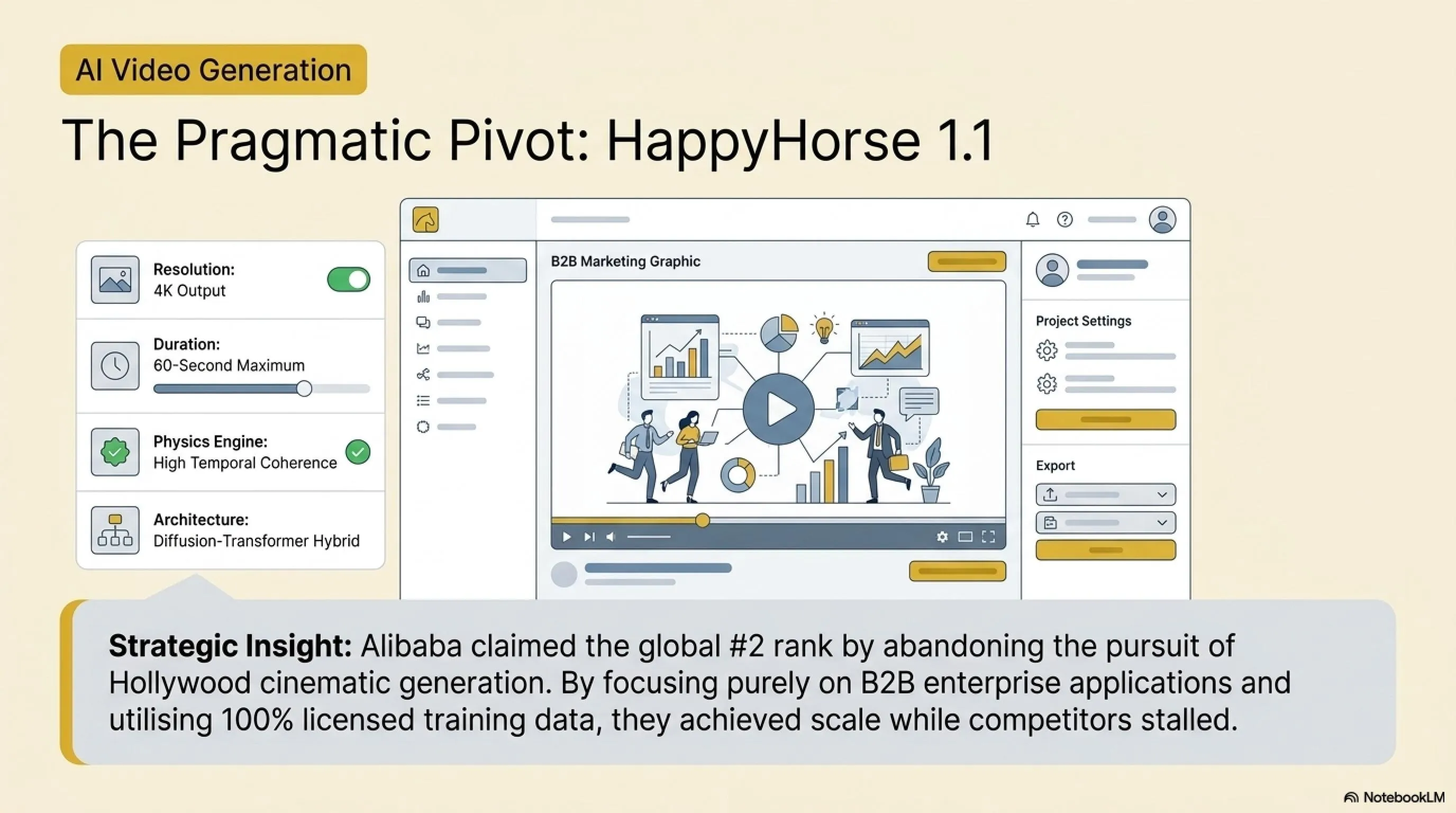
HappyHorse 1.1 can generate 4K quality videos up to 60 seconds long, featuring complex camera movements, high temporal coherence, and realistic physics. Unlike Sora, which is designed more for cinematic and advertising content, HappyHorse focuses on business applications such as marketing content generation, virtual training, and product design. Simply put, Alibaba doesn't want to compete with Hollywood – it wants to help businesses produce content faster and cheaper.
The technical architecture of HappyHorse 1.1 incorporates several innovations. It uses a diffusion-transformer hybrid model that combines the strengths of both approaches: diffusion for high-quality image generation and transformers for understanding temporal dynamics. The model was trained on over 100 million video clips totaling more than 500,000 hours of footage, all properly licensed from content partners.
Why Did Sora and Seedance Fall Behind?
The story behind this competition is fascinating. OpenAI introduced the Sora model in February 2024, but never released it publicly. The main reason was concerns about deepfakes, misuse, and legal pressures. Ultimately, OpenAI decided to offer Sora only to enterprise customers with strict limitations, which slowed its growth and prevented the rapid iteration that comes from broad user feedback.
ByteDance also encountered a major problem with its Seedance model: copyright. Film companies and major studios claimed that ByteDance had used their videos without permission to train the model. This led ByteDance to delay Seedance's public launch and enter legal negotiations. Several lawsuits are still pending, with potential damages in the billions of dollars if ByteDance is found to have willfully infringed copyrights.
Meanwhile, Alibaba proceeded with a more cautious strategy. The company used legal, licensed datasets, focused on B2B applications where copyright is less contentious, and worked with Chinese regulators to ensure compliance with laws. This approach allowed Alibaba to move faster and surpass competitors. Additionally, Alibaba has been transparent about its training data sources, publishing detailed documentation about which content was used and how licenses were obtained.
The business model is also interesting. Rather than charging per-video generation like some competitors, Alibaba offers tiered subscription plans with unlimited generation within fair use limits. This makes it more attractive for businesses that need to produce large volumes of content. Early customers include e-commerce platforms using HappyHorse to generate product demonstration videos, educational institutions creating training materials, and marketing agencies producing social media content at scale.
Sample video generated by HappyHorse 1.1
Sakana AI Delivers Frontier Performance with Fugu System
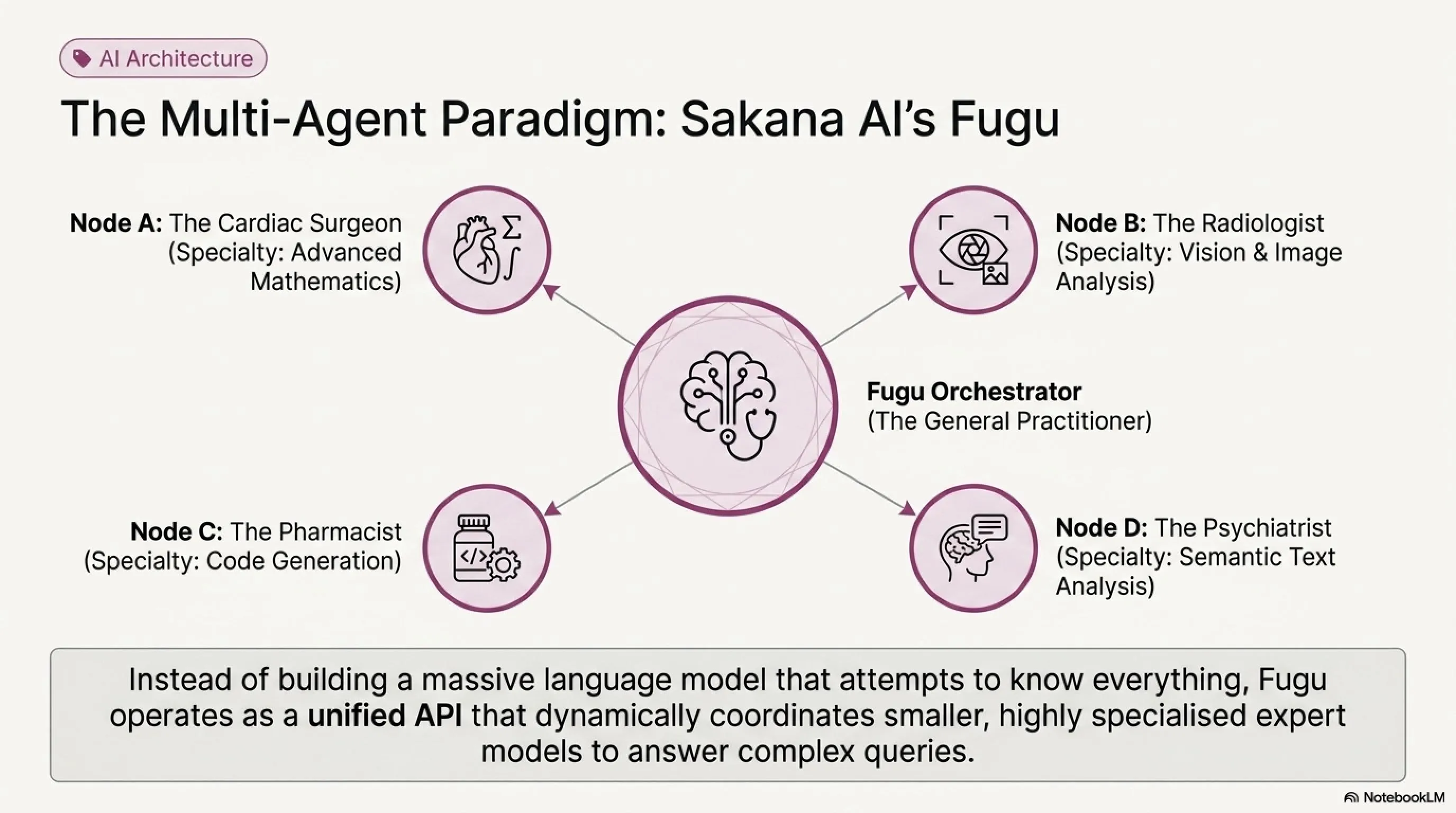
In our final morning story, Japanese startup Sakana AI introduced the Fugu system, a multi-agent orchestration platform. This system can deliver Frontier-level performance (equivalent to models like Claude Fable 5) through a unified API with dynamic coordination of smaller specialized models, without needing to build a massive language model.
To better understand this concept, imagine instead of having a general practitioner who knows everything (but isn't expert in anything), you have a team of specialists: a cardiac surgeon, a radiologist, a pharmacist, and a psychiatrist. Fugu plays the role of coordinator for this team. When a complex question arises, Fugu breaks it down, sends each part to the appropriate specialist model, and then combines the responses into a coherent answer.
The architecture is elegant in its simplicity yet sophisticated in execution. Fugu maintains a registry of available models, each with metadata describing its capabilities, performance characteristics, and cost. When a query arrives, a routing module analyzes it to determine which models are needed. For simple queries, a single model might suffice. For complex tasks, multiple models work in parallel or sequentially, with Fugu managing data flow between them.
Why This Approach Matters
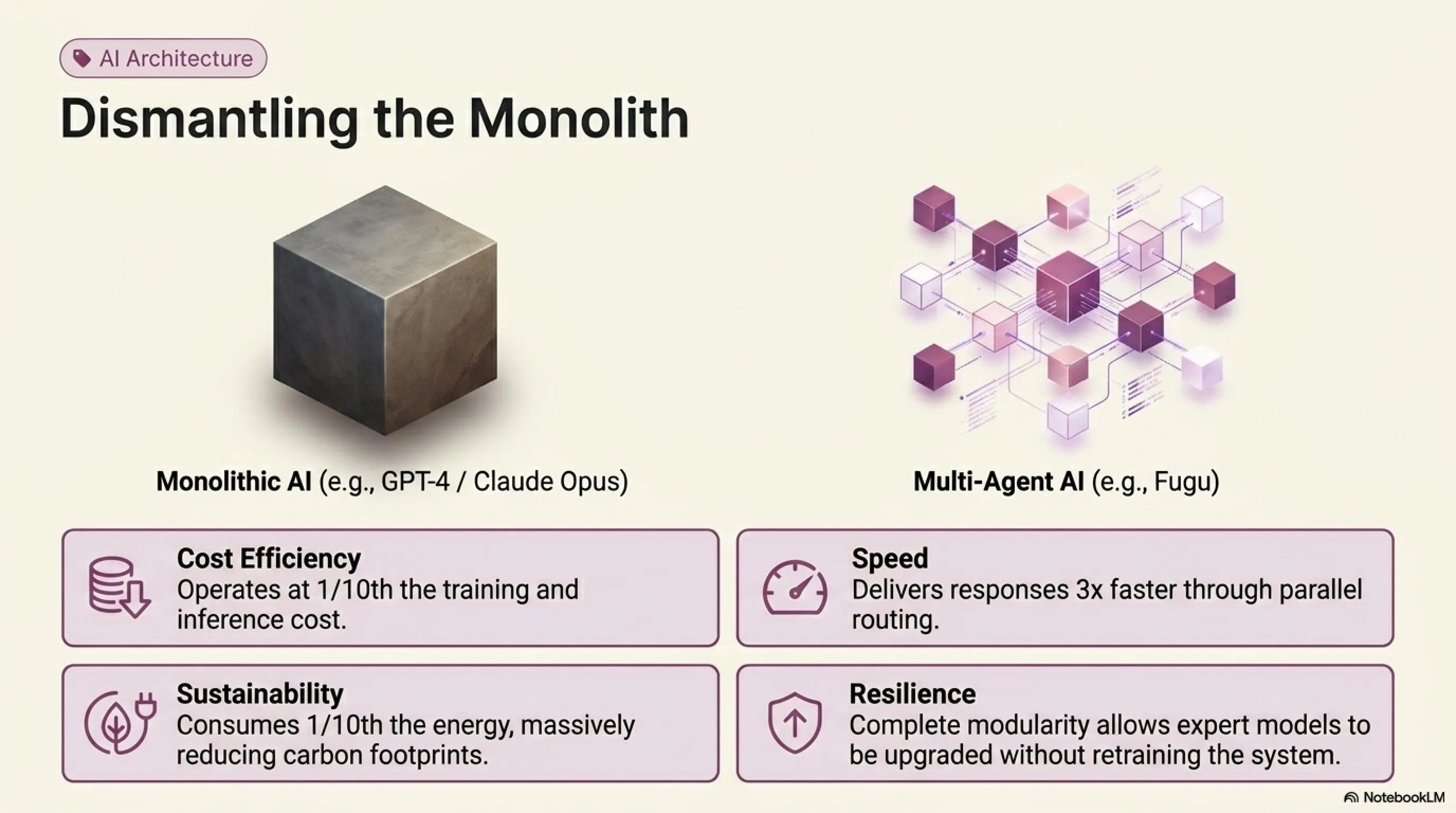
First, it's more cost-effective. Training a large language model like GPT-4 or Claude Opus requires millions of dollars and thousands of GPUs. In contrast, Fugu uses smaller models that are each optimized for a specific task (e.g., one for code, one for math, one for text analysis). The total training cost is a fraction of what a monolithic model requires.
Second, it's more flexible. You can add new models to the team anytime a better one is released, without needing to retrain the entire system. This modularity means Sakana AI can continuously improve Fugu's capabilities by swapping in better specialist models as they become available. It's like upgrading individual components of a computer rather than buying an entirely new system.
Third, it's more reliable. If one model fails or becomes unavailable, Fugu can delegate the task to another model. This is like a failover system in cloud servers, ensuring continuous operation even when individual components have issues. The system maintains performance degradation gracefully – if a specialist model is unavailable, a more general model can handle the task with slightly lower quality rather than complete failure.
Fourth, it's more environmentally sustainable. Smaller models consume less energy, which matters in an era when AI computations account for a significant portion of global electricity consumption. According to Sakana AI's estimates, Fugu uses approximately 1/10th the energy of comparable monolithic models for the same workload. As data centers face increasing pressure to reduce their carbon footprint, architectures like Fugu become more attractive.
What is Multi-Agent Architecture and Why It's the Future of AI
In traditional architecture, one large model tries to do everything. In multi-agent architecture, multiple smaller specialized models collaborate. Imagine you want to write a complex program: one agent writes code, another writes tests, a third reviews security, and a fourth generates documentation. An orchestrator (like Fugu) coordinates between them. This approach is not only more efficient, but allows us to improve models independently. You can upgrade the code-writing agent without touching the others. This modularity is similar to microservices in software engineering – breaking a monolith into specialized components that communicate through well-defined interfaces.
Sakana AI, founded by two former Google Brain researchers, claims that Fugu achieves comparable results to Claude Fable 5 and GPT-4 Turbo in benchmarks like MMLU, HumanEval, and MATH, but at 1/10th the cost and 3x the speed. If these claims hold up under independent verification, we may witness a paradigm shift in the AI industry. The implications are profound – smaller companies could compete with tech giants by cleverly orchestrating open-source models rather than training massive proprietary ones.
Early customers are already seeing benefits. A fintech company using Fugu reported 40% cost reduction compared to their previous GPT-4 API usage, while maintaining similar quality. A healthcare provider noted that Fugu's medical specialist model provided more accurate diagnoses than general-purpose models. These real-world validations suggest that Sakana AI's approach has merit beyond theoretical benchmarks.
Fugu system multi-agent architecture diagram
Conclusion: An Energizing Morning with Six Game-Changing Stories
We began Tuesday morning, June 23, 2026, with six stories that each shape the future in their own way. From exploring galaxies with the Nancy Grace Roman telescope to hunting security vulnerabilities with GPT-5.5-Cyber, from permanently jailbreaking Apple chips to Wall Street giants entering the crypto world, from the hot competition in AI video models to innovative multi-agent architectures. These stories aren't just interesting – they show how technology is changing the rules of the game across different domains.
For those working in space, Roman heralds a new era of scientific discovery. For cybersecurity professionals, GPT-5.5-Cyber is a powerful tool for combating emerging threats. For the jailbreaking community, usbliter8 is an unprecedented opportunity for research and development. For investors, Franklin Templeton's entry into crypto signals the market's maturation and legitimization. For content creators, HappyHorse 1.1 is a new tool for creativity. And for AI developers, Fugu demonstrates that bigger isn't always better – intelligence can emerge from collaboration rather than scale.
What unites these stories is the theme of disruption. Established norms are being challenged: space telescopes now launch on commercial rockets, AI can find bugs faster than humans, hardware security isn't impenetrable, traditional finance is embracing blockchain, video generation is democratizing content creation, and AI architecture is evolving from monoliths to microservices. We're living in an era where yesterday's impossibilities become today's realities.
Frequently Asked Questions
When will the Nancy Grace Roman telescope be launched?
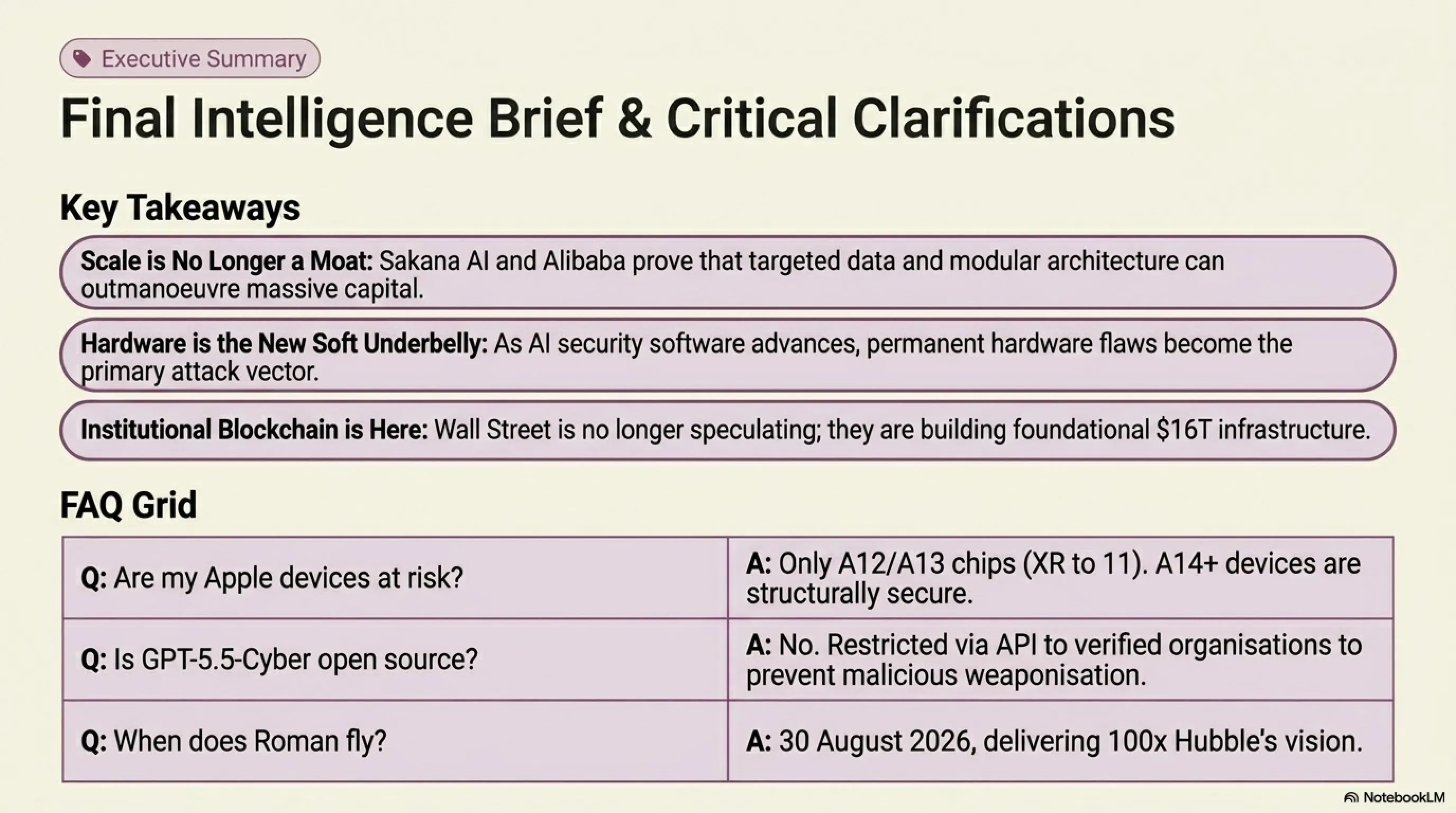
The launch is scheduled for August 30, 2026, with SpaceX's Falcon Heavy rocket.
Is GPT-5.5-Cyber available to the public?
No, this model is only available through API to verified organizations with security restrictions.
Does the usbliter8 vulnerability affect all Apple devices?
No, only devices with A12 and A13 chips (iPhone XR through iPhone 11 and some iPads) are affected. Newer devices with A14 and above are safe.
How much does Franklin Templeton have in crypto assets?
Franklin Templeton's on-chain product suite has grown to over $2.5 billion and is rapidly expanding.
How does HappyHorse 1.1 differ from Sora?
HappyHorse focuses on B2B business applications, while Sora is designed more for cinematic and creative content. Additionally, HappyHorse is publicly available, but Sora is limited to enterprise customers.
Can Fugu really compete with large models?
According to Sakana AI's claims, yes. However, we must await independent testing and validation by the scientific community for full confirmation.
Sources and References
- Space.com: NASA's Roman Space Telescope Arrives in Florida
- The Hacker News: OpenAI Expands Daybreak with GPT-5.5-Cyber
- TechCrunch: Unpatchable Flaw in Apple Chips Opens Door to Jailbreak
- CoinTelegraph: Franklin Templeton Launches Dedicated Crypto Division
- VentureBeat: Alibaba's AI Video Model Rises to No. 2
- VentureBeat: Sakana Achieves Frontier Performance with Fugu System
Additional Gallery: ☀️ Tekin Morning June 23: NASA's Telescope, Apple Jailbreak & AI Leaps