🚨 When Steam Machine Launched at $1,049
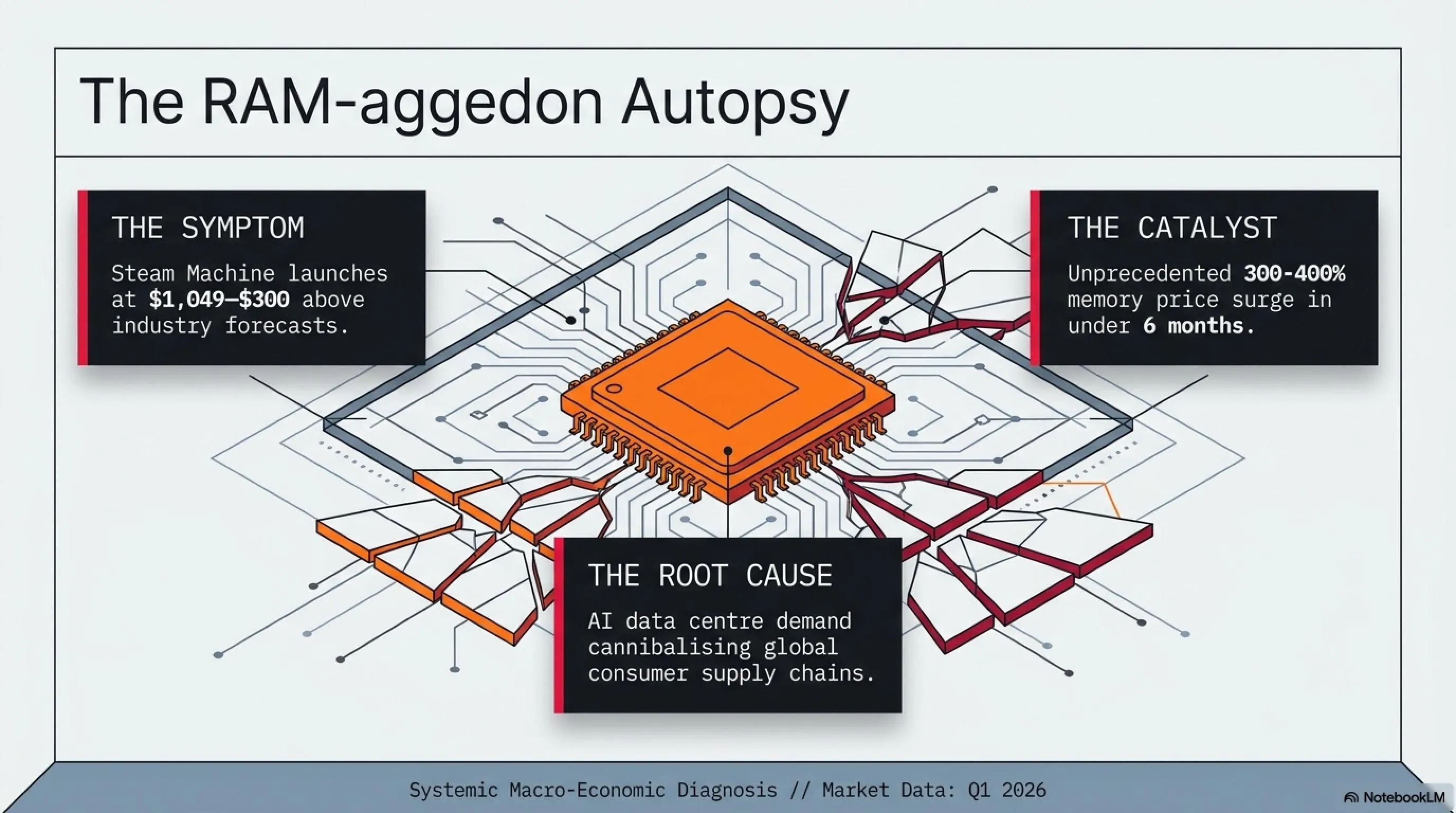
- 🎮Price: $1,049- $300 above predictions
- 🎧RAM prices tripled- In less than 6 months
- 🚀AI is to blame- HBM race destroyed consumer market
- 🗡️Three companies monopolize- Samsung, SK hynix, Micron
- 📰Crisis continues through 2027- Perhaps until 2030
When Valve Says "It's Not a Console" But Charges a Thousand Bucks
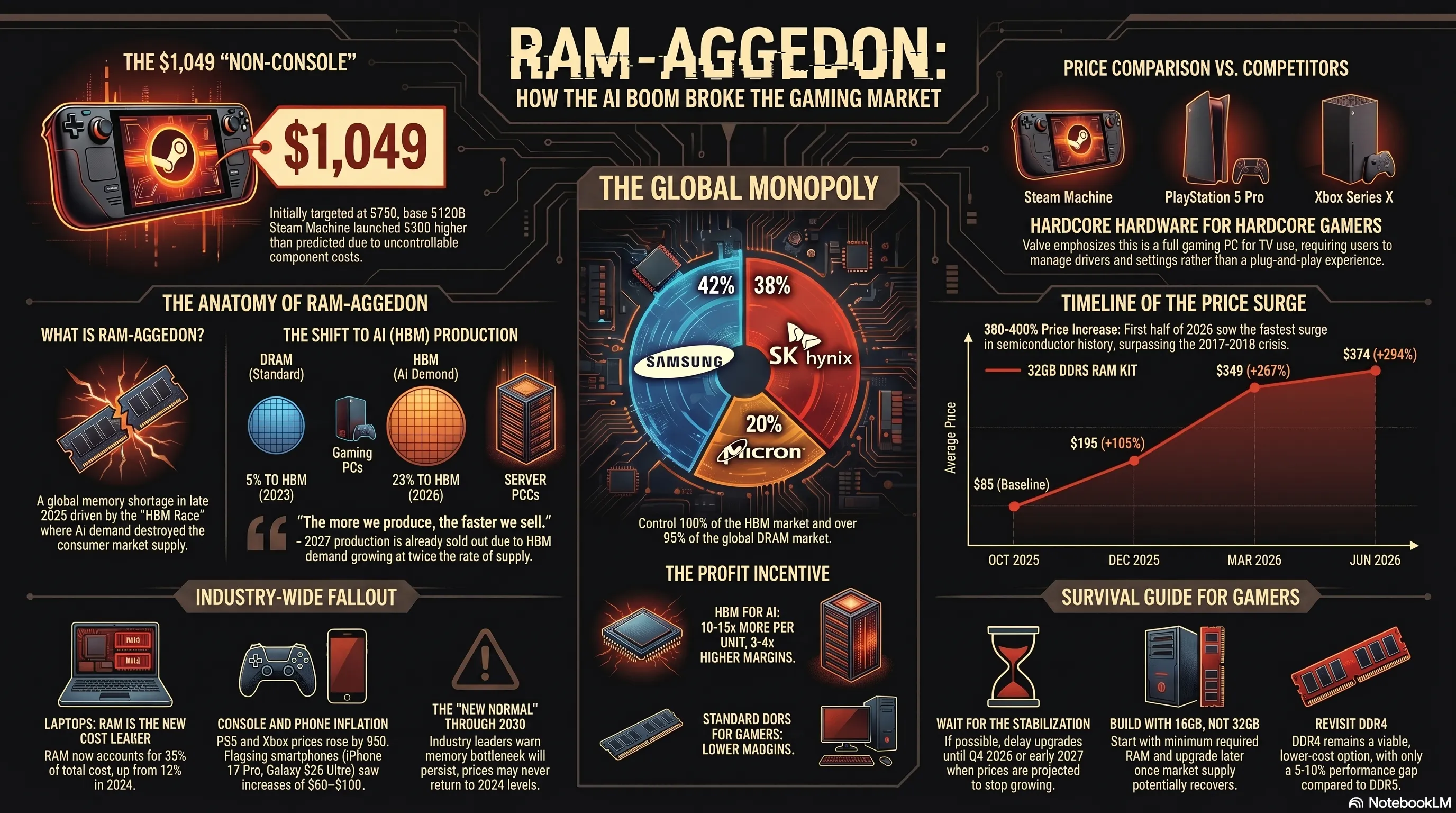
If you thought the Steam Deck was pricey, buckle up for the Steam Machine. Valve finally dropped the pricing bomb on their controversial device and shocked everyone: the base 512GB model costs $1,049, while the 2TB variant will set you back $1,428. But don't worry, Gabe Newell reassures us—it's not a console. It's a gaming PC that just happens to look and function suspiciously like one.
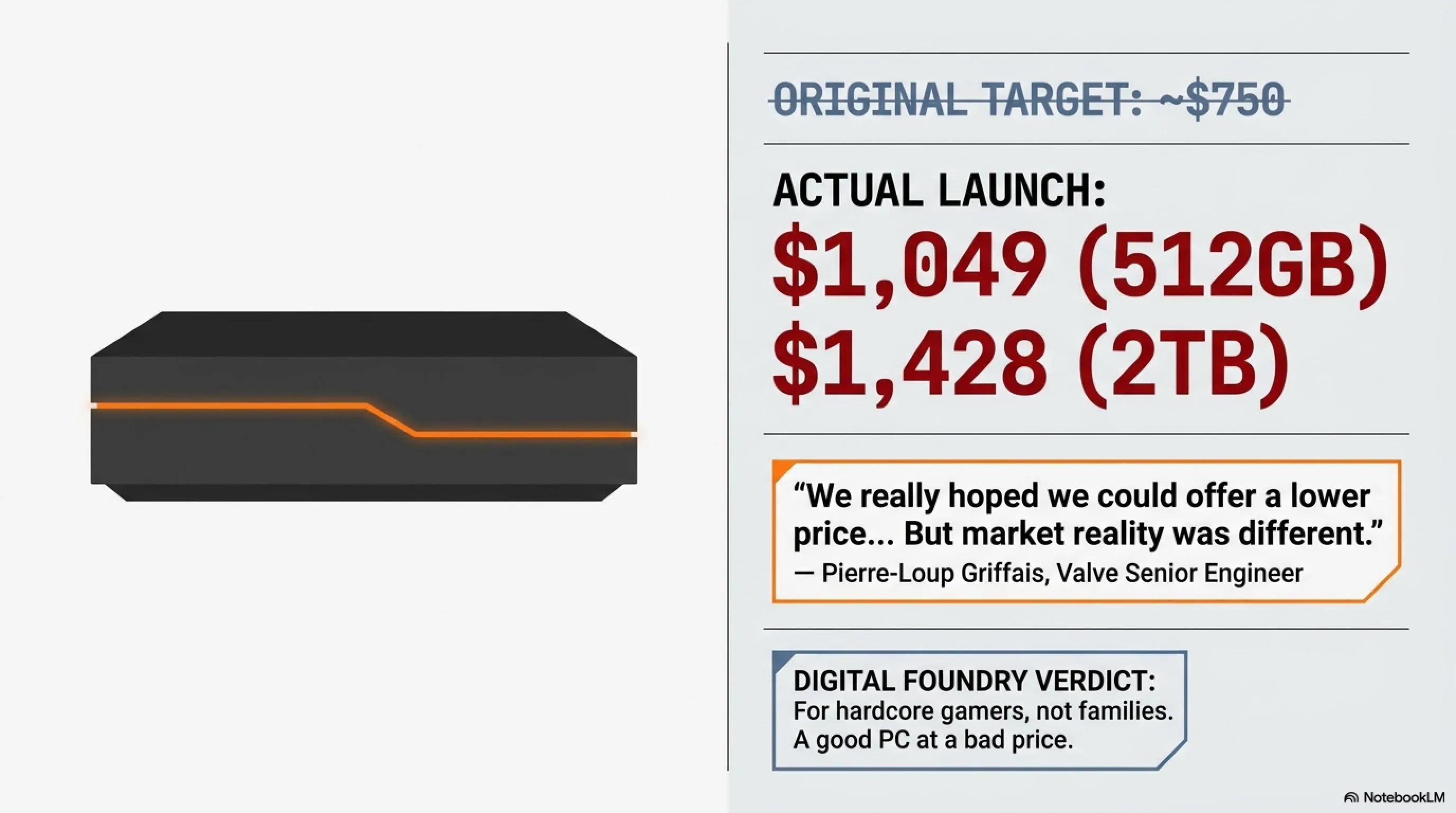
Here's where the plot thickens. According to GameSpot's extensive coverage, Valve initially aimed for a lower price point but got blindsided by the "RAM-aggedon" crisis. This supply chain catastrophe—which ravaged the memory market throughout 2025—caused RAM prices to skyrocket unexpectedly, forcing Valve to recalculate their original pricing strategy. Now the question becomes: is anyone willing to pay over a thousand dollars for something its maker insists isn't a console?
What Is RAM-aggedon?
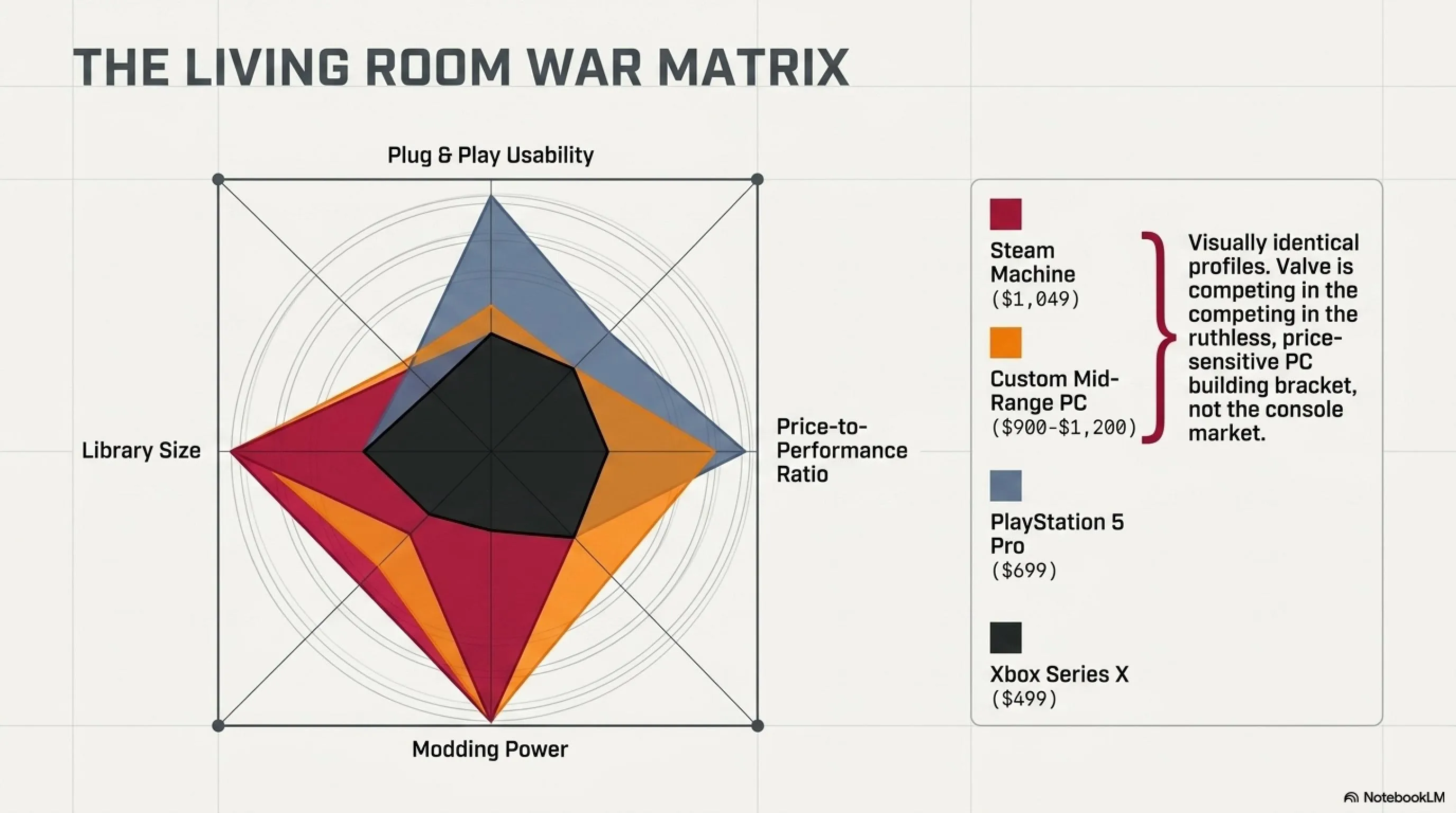
Interestingly, Valve emphasized at their press conference that Steam Machine is designed for those who want PC gaming on their TV, not for those seeking a simple, plug-and-play console experience. What does this mean? It means you'll be dealing with drivers, graphics settings, and potentially compatibility issues. Digital Foundry said in their analysis that this device is "for hardcore gamers, not families."
Price Comparison with Competitors
The Price War
$1,049
Full gaming PC
$699
9th gen console
$499
Standard console
$900-1200
Custom build
When you compare Steam Machine with competitors, a more complex picture emerges. PlayStation 5 Pro at $699 offers a simple, hassle-free console experience. Xbox Series X at $499 is a more economical option. But Steam Machine claims to offer the infinite Steam library and modding power—something no console can match.
Why RAM Became So Expensive: The Story of HBM and AI
To understand why Steam Machine became so expensive, we need to go back to late 2025—when the global memory market began its collapse.
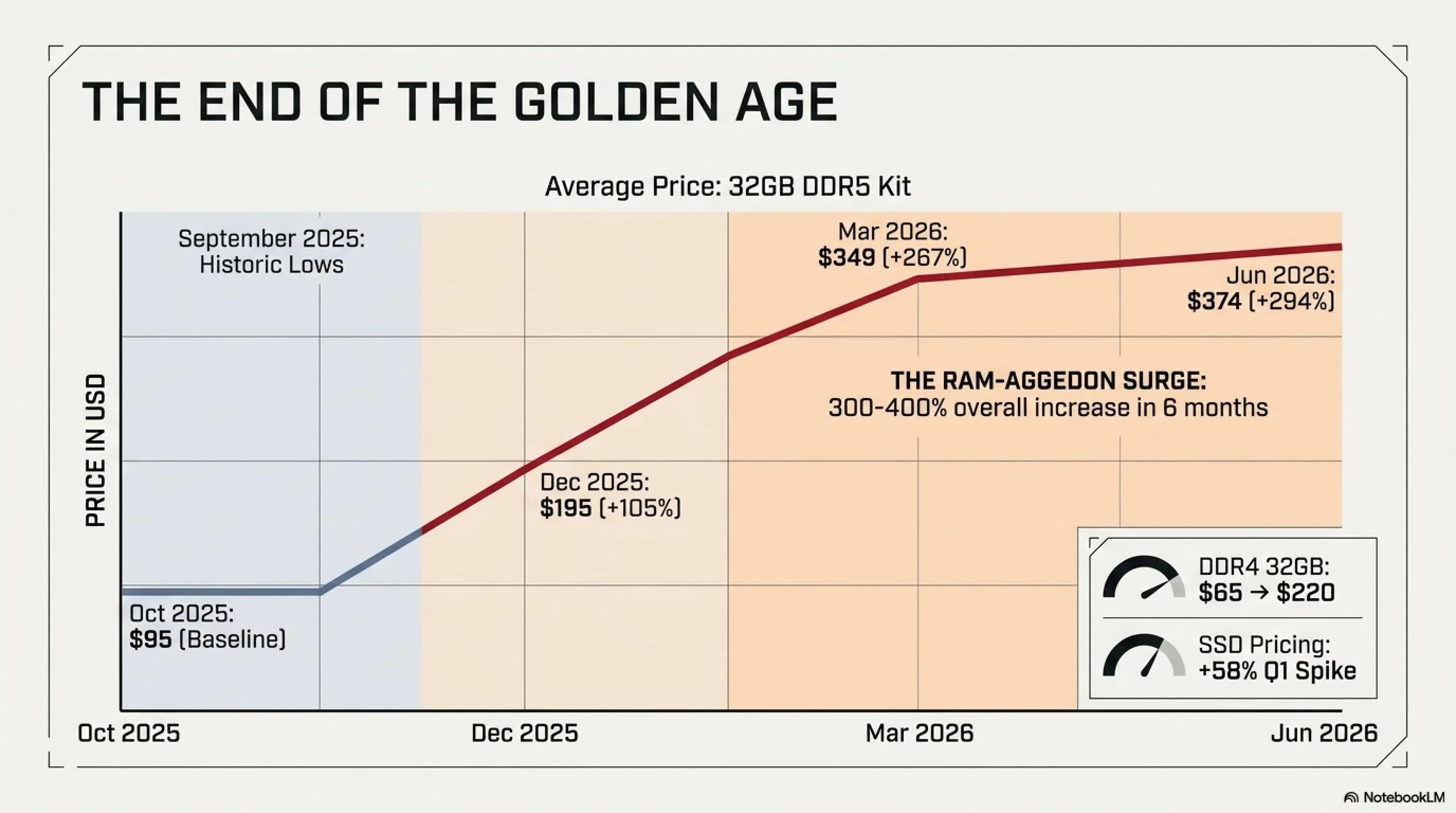
Until September 2025, DDR5 prices were at historic lows. A 32GB DDR5-6000 CL30 kit sold for around $80-100. The market was calm, supply was abundant, and gamers and PC builders were experiencing a golden age. TechSpot wrote in September 2025: "If you're planning to upgrade, now is the best time. RAM has never been this cheap."
But in October 2025, everything changed.
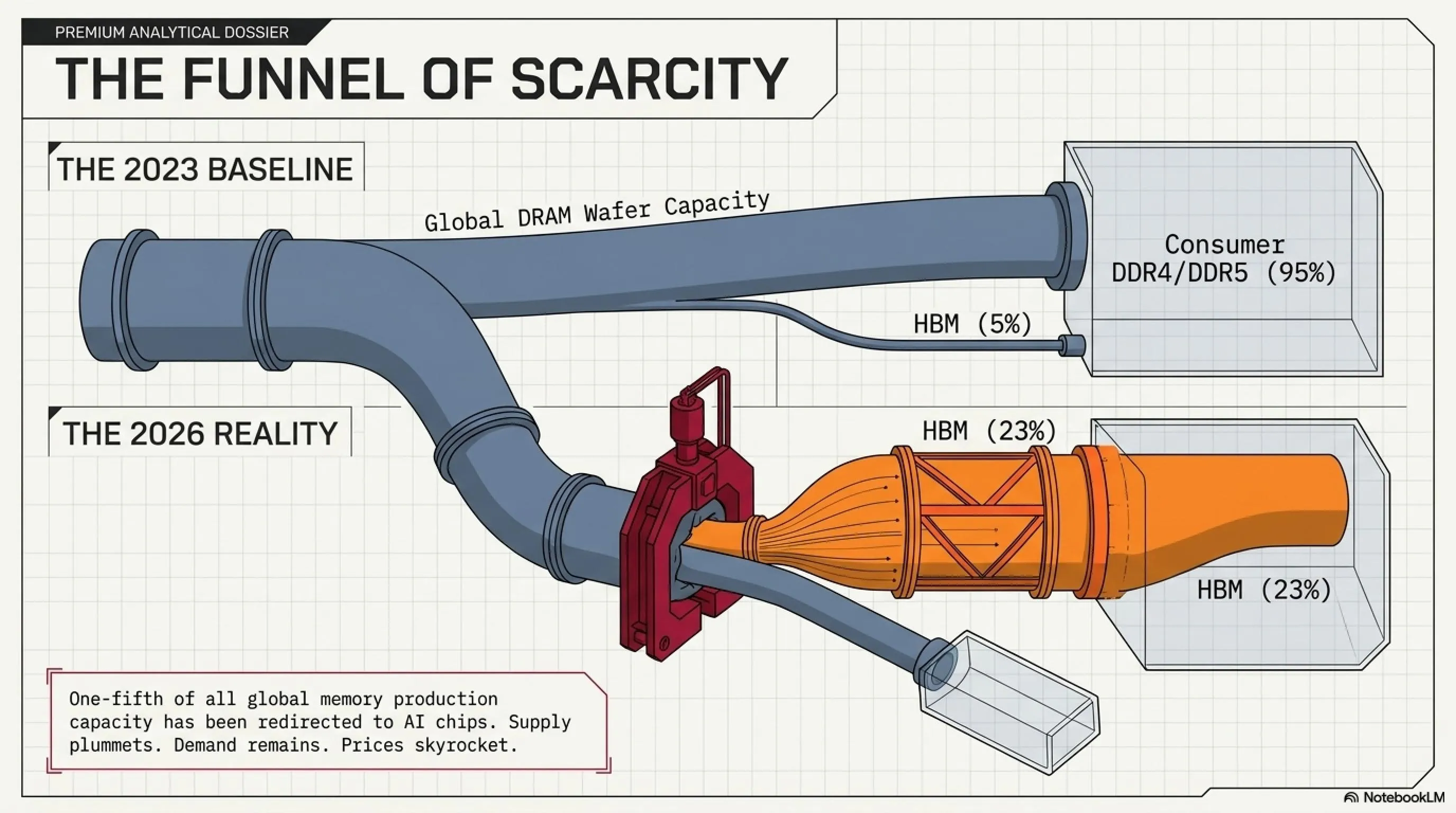
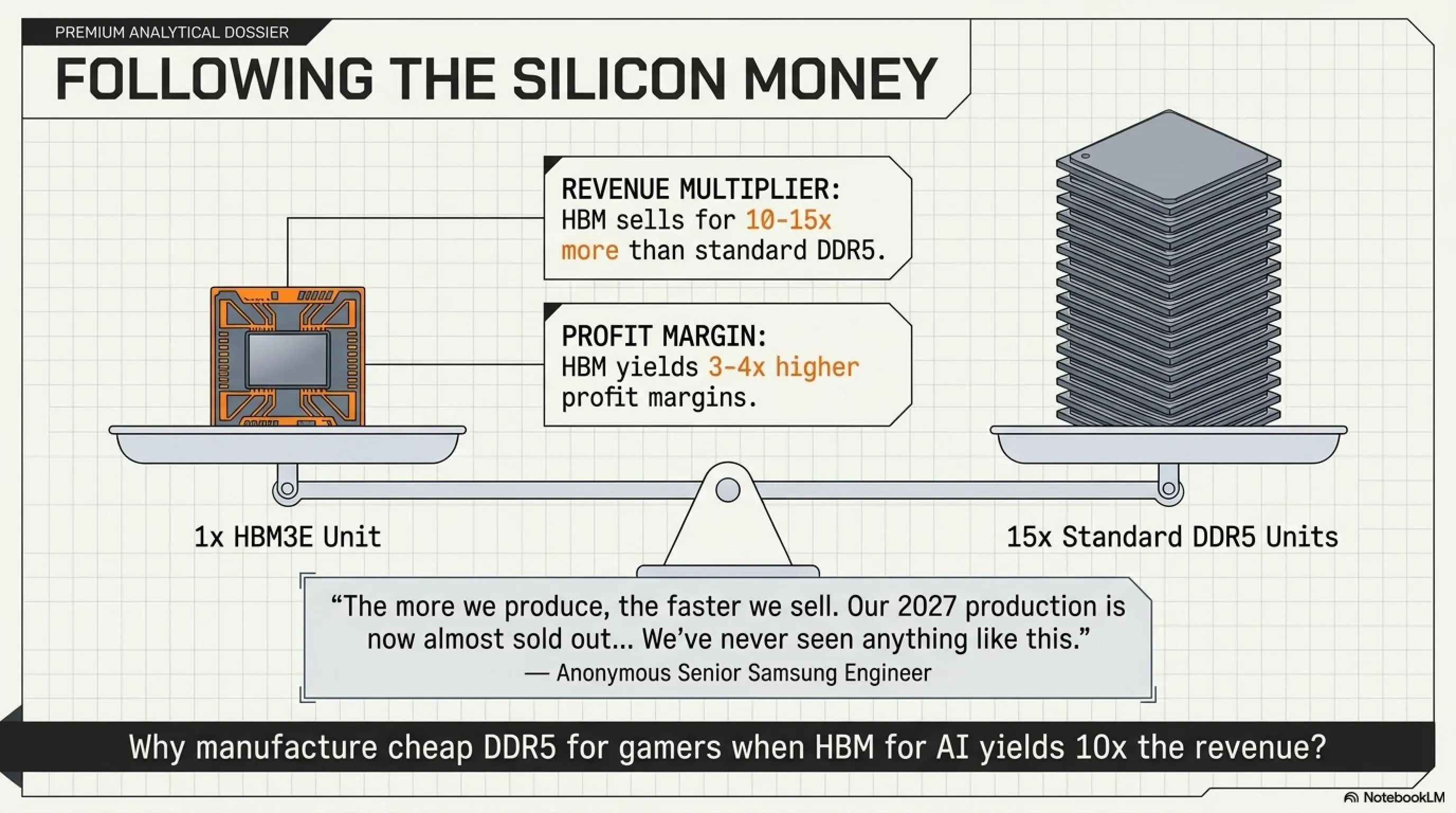
Explosive demand for HBM (High-Bandwidth Memory)—a specialized DRAM type essential for AI chips and datacenters—caused the three major memory manufacturers (Samsung, SK Hynix, Micron) to decide to shift their production capacity from consumer DRAM (DDR4/DDR5) to HBM. According to TechInsider, in 2023 only 5% of global DRAM wafer capacity went to HBM. In 2026, that figure reached 23%—meaning one-fifth of all global memory production capacity now goes to AI chips, not PCs and laptops.
The result? Severe consumer DRAM shortage. And when supply decreases but demand remains constant (or even increases), prices go into freefall—upward.
Crisis Numbers and Statistics
To understand the disaster's magnitude, let's examine the precise data. According to TrendForce data, DRAM contract prices in Q4 2025 increased approximately 90-95% quarter-over-quarter, and in Q1 2026 rose another 58-63%. Counterpoint Research reported that memory prices in the first six months of 2026 increased approximately 300-400% compared to late 2025—one of the fastest price surges in semiconductor industry history, even worse than the 2017-2018 crisis.
DDR5 32GB Price Changes Table
| Date | Average Price | % Change |
|---|---|---|
| October 2025 | $95 | Baseline (0%) |
| November 2025 | $135 | +42% |
| December 2025 | $195 | +105% |
| January 2026 | $245 | +158% |
| February 2026 | $295 | +211% |
| March 2026 | $349 | +267% |
| June 2026 | $374 | +294% |
Sources: Tom's Hardware RAM Price Tracker, Newegg, PCPartPicker
This means a memory kit that cost less than $100 six months ago is now almost 4 times more expensive. But the story doesn't end with DDR5. DDR4—which was supposed to be the affordable option—also saw price increases. DDR4 32GB that sold for $65-80 in Q4 2025 has reached $150-220 in Q2 2026.
Why? Because manufacturers are shutting down or converting DDR4 production lines to HBM/DDR5. Sourceability reported that in some cases, DDR4 now sells for more than DDR5—an odd situation unprecedented in industry history.
The crisis extended to storage too. According to TrendForce, SSD prices were expected to rise sharply in early 2026, with forecasts pointing to roughly 53-58% quarter-over-quarter increases in Q1. Tighter NAND supply, stronger server and AI demand, and supplier efforts to control output are pushing prices higher.
The Three-Company Monopoly and AI Power
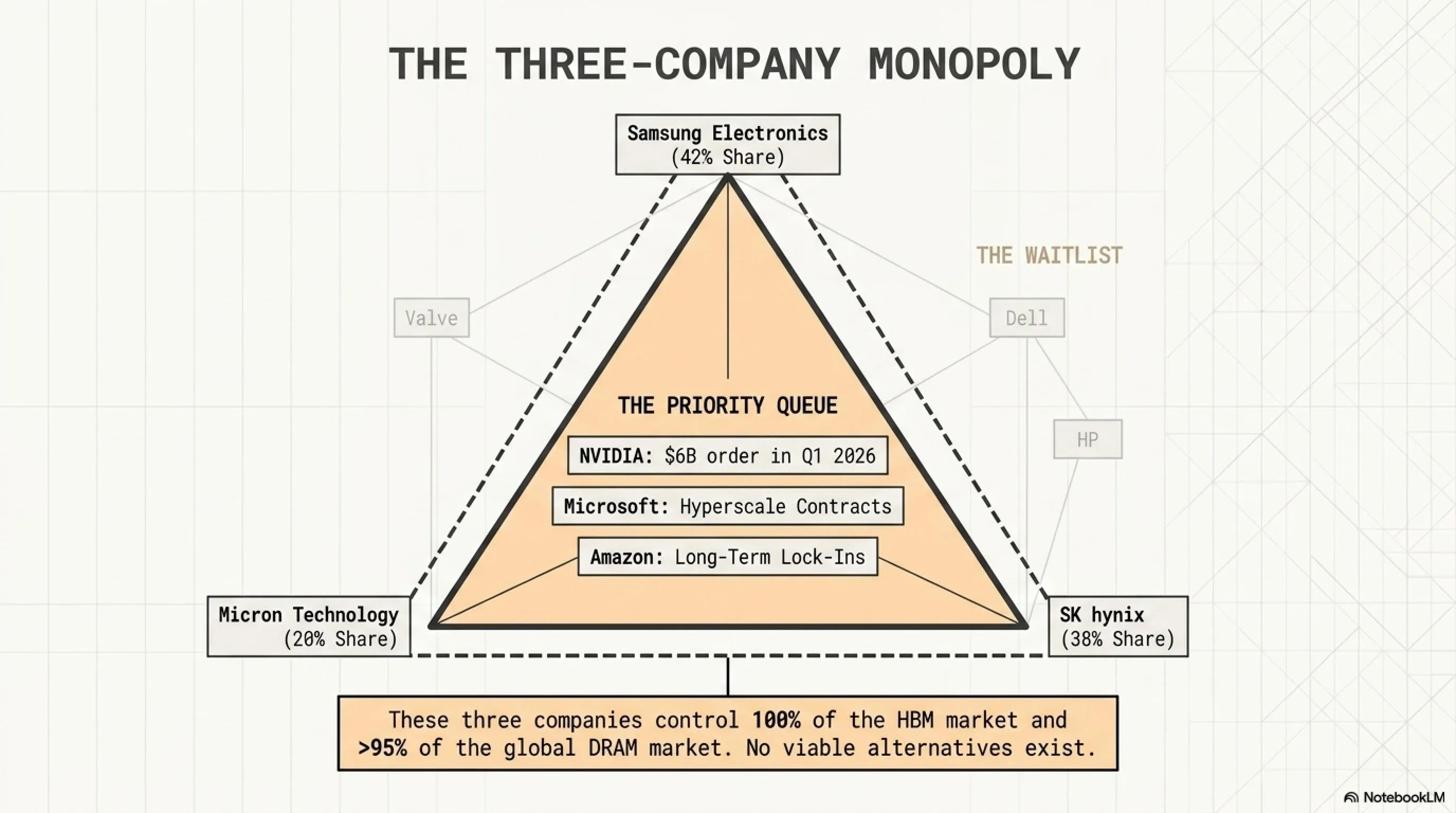
One reason for the crisis severity is that the HBM and advanced DRAM market is completely monopolized. Only three companies in the world can manufacture HBM and advanced DDR5:
- Samsung Electronics (South Korea) - Market share: ~42%
- SK hynix (South Korea) - Market share: ~38%
- Micron Technology (USA) - Market share: ~20%
These three companies control 100% of the HBM market and over 95% of the global DRAM market. No other real competitors exist. Companies like Nanya (Taiwan) and CXMT (China) only have presence in low-end DDR4 and lack capability to produce HBM or advanced DDR5.
This means when NVIDIA, Amazon, or Microsoft come to buy HBM, they have limited choices. And when these giants sign multi-billion dollar contracts, smaller manufacturers (like Valve, Dell, or HP) wait in line.
📚 Classified & Related Dossiers in TekinGame
If you wish to explore beyond this report and delve into cybernetic frontiers and autonomous AI architectures, do not miss these three exclusive deep-dives in the Tekin Garage:
DataCenter Dynamics reported that Samsung and SK hynix are increasing their HBM production by approximately 50% in 2026 compared to 2025. But even this increase isn't enough—because demand is growing at more than twice the rate. A senior Samsung engineer told SemiEngineering in an anonymous interview: "The more we produce, the faster we sell. Our 2027 production is now almost sold out. 2028 production is also being pre-ordered. We've never seen anything like this."
According to SK hynix, HBM demand in 2026 increased over 350% compared to 2025. NVIDIA alone ordered over $6 billion of HBM in Q1 2026—more than the entire HBM market in 2023.
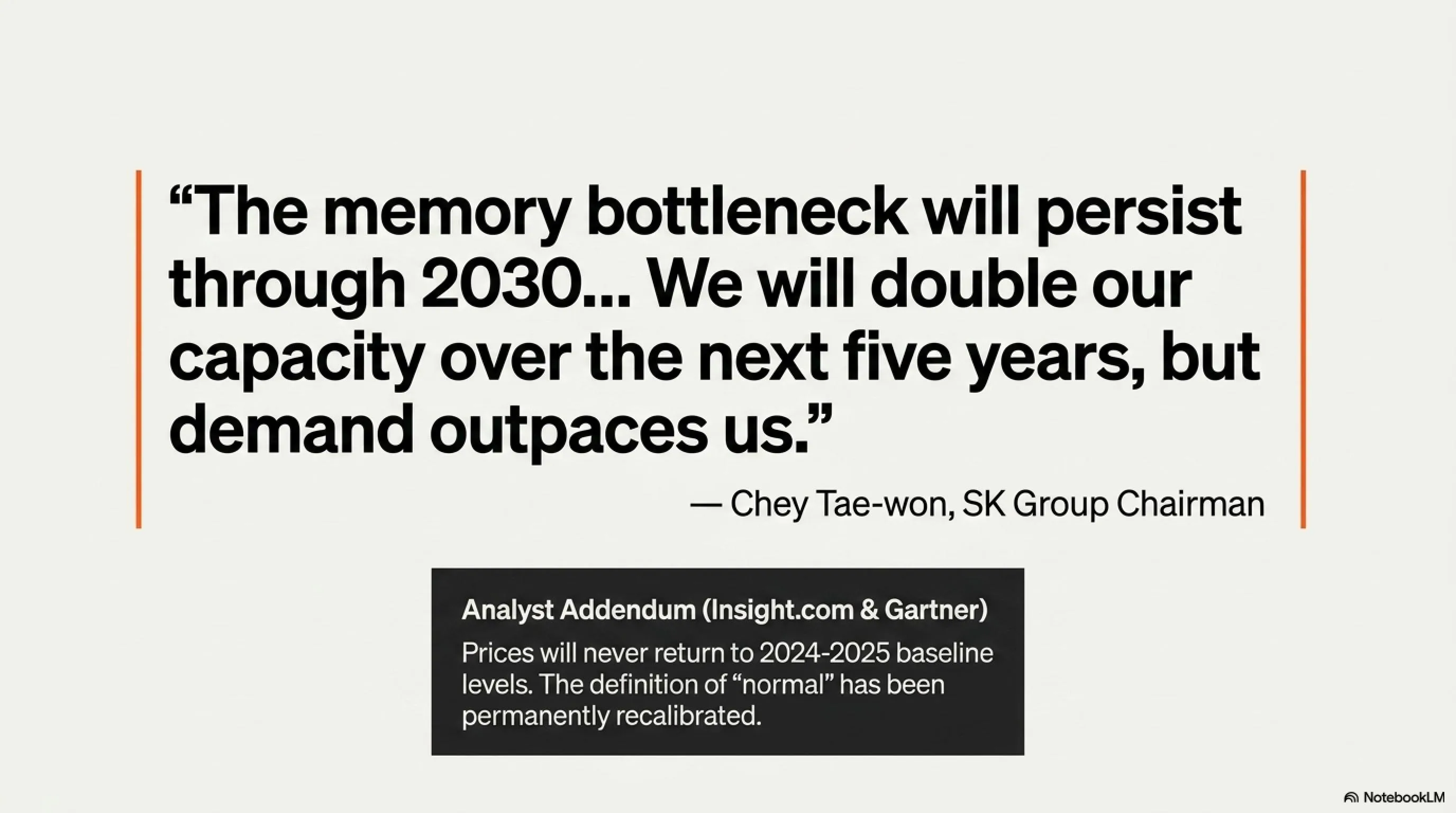
SK Group Chairman Chey Tae-won said at Computex 2026: "The memory bottleneck will persist through 2030. We will double our capacity over the next five years." This means even with massive investments, the crisis continues for at least 4 more years.
Industry Impact: From Consoles to Laptops
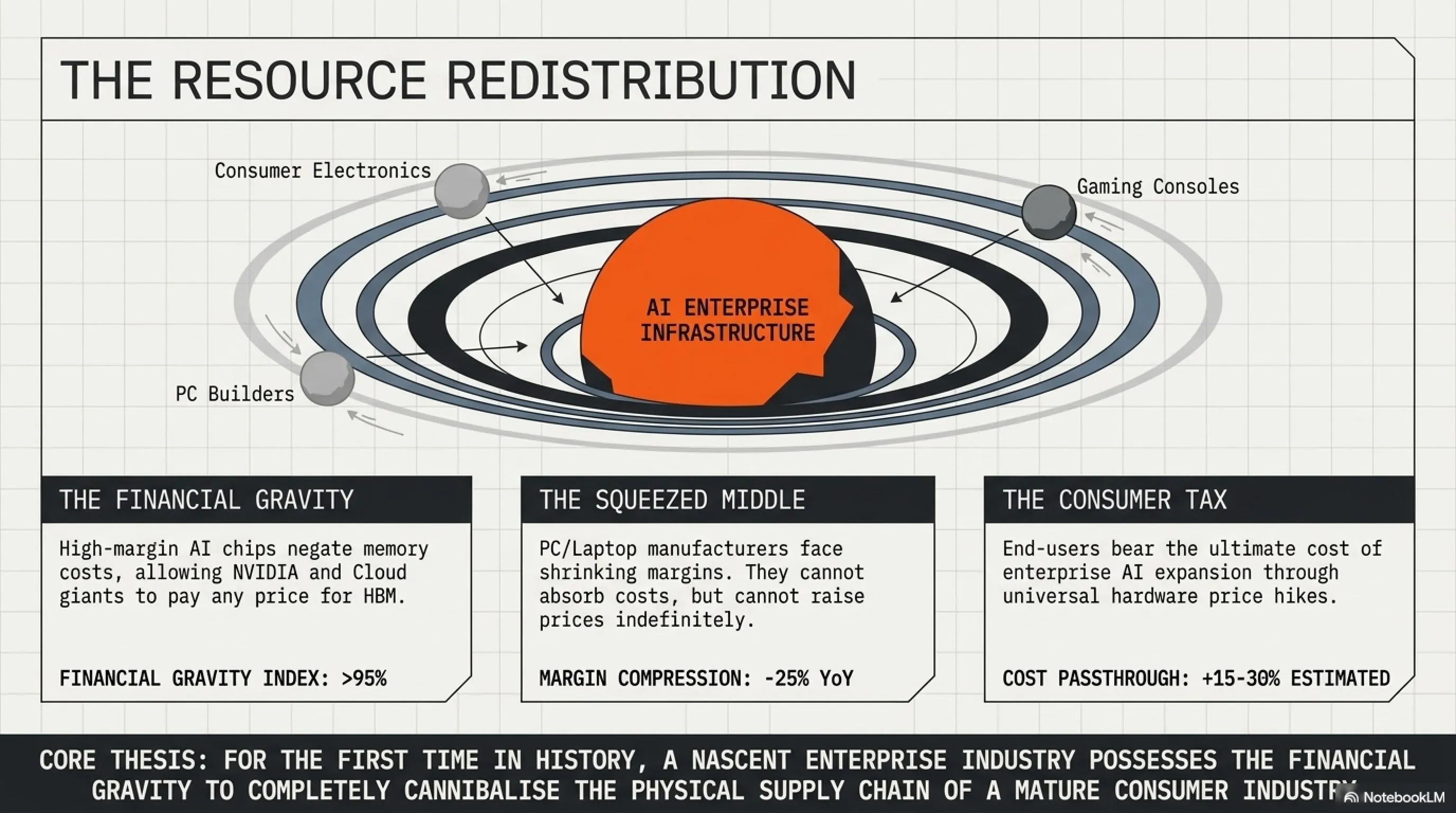
RAM-aggedon didn't just destroy Steam Machine. The entire consumer electronics industry has been affected.
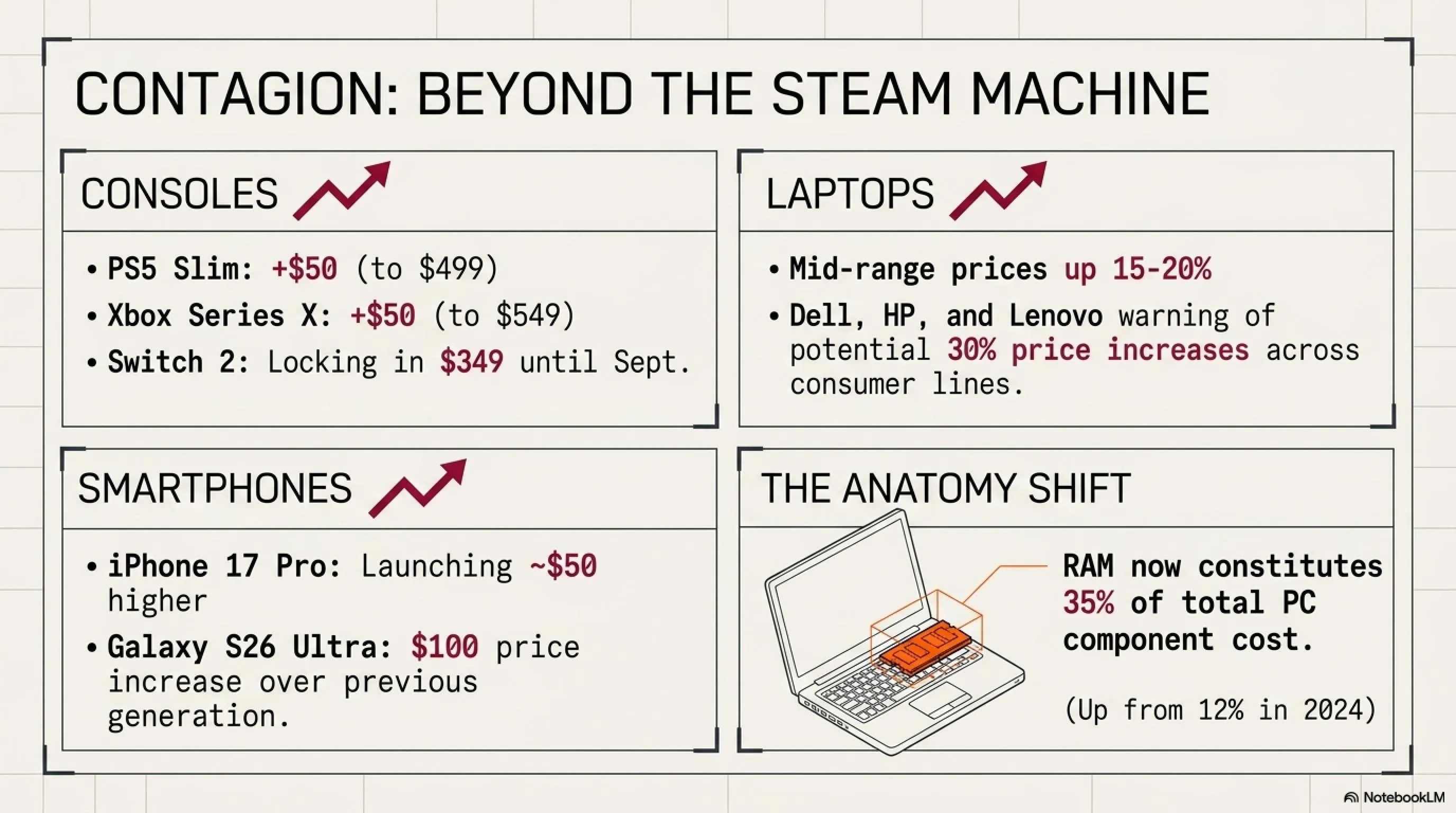
Consoles
PlayStation 5 Slim price increased from $449 to $499 in May 2026. Xbox Series X rose from $499 to $549. Nintendo Switch 2 announced $349 price (pre-order) will remain stable until September, then likely increase.
Laptops
According to Notebookcheck, mid-range laptop prices in Q1 2026 increased by approximately 15-20%. Dell, HP, Lenovo, and ASUS all warned that prices could rise by 30%.
Why? RAM now represents 35% of a laptop's component cost—compared to just 12% in 2024. A gaming laptop with 32GB DDR5 that sold for $1,200 in 2025 now costs at least $1,450.
Smartphones
Apple, Samsung, and Xiaomi all increased flagship phone prices. iPhone 17 Pro with 256GB launched approximately $50 more expensive than iPhone 16 Pro. Samsung Galaxy S26 Ultra also saw a $100 price increase.
Crisis Impact at a Glance
- Mid-range laptop prices increased 15-20%
- Consoles became $50-100 more expensive
- RAM now represents 35% of PC cost (previously 12%)
- Even smartphones became $50-100 more expensive
- Manufacturers predict prices could rise another 30%
The Verge wrote in their analysis: "The memory crisis has created a pricing crisis across the entire electronics industry. Everything with RAM—from phones to laptops, consoles to cars—has become more expensive."
When Does It End? Predictions for the Future
The million-dollar question: When will prices return to normal?
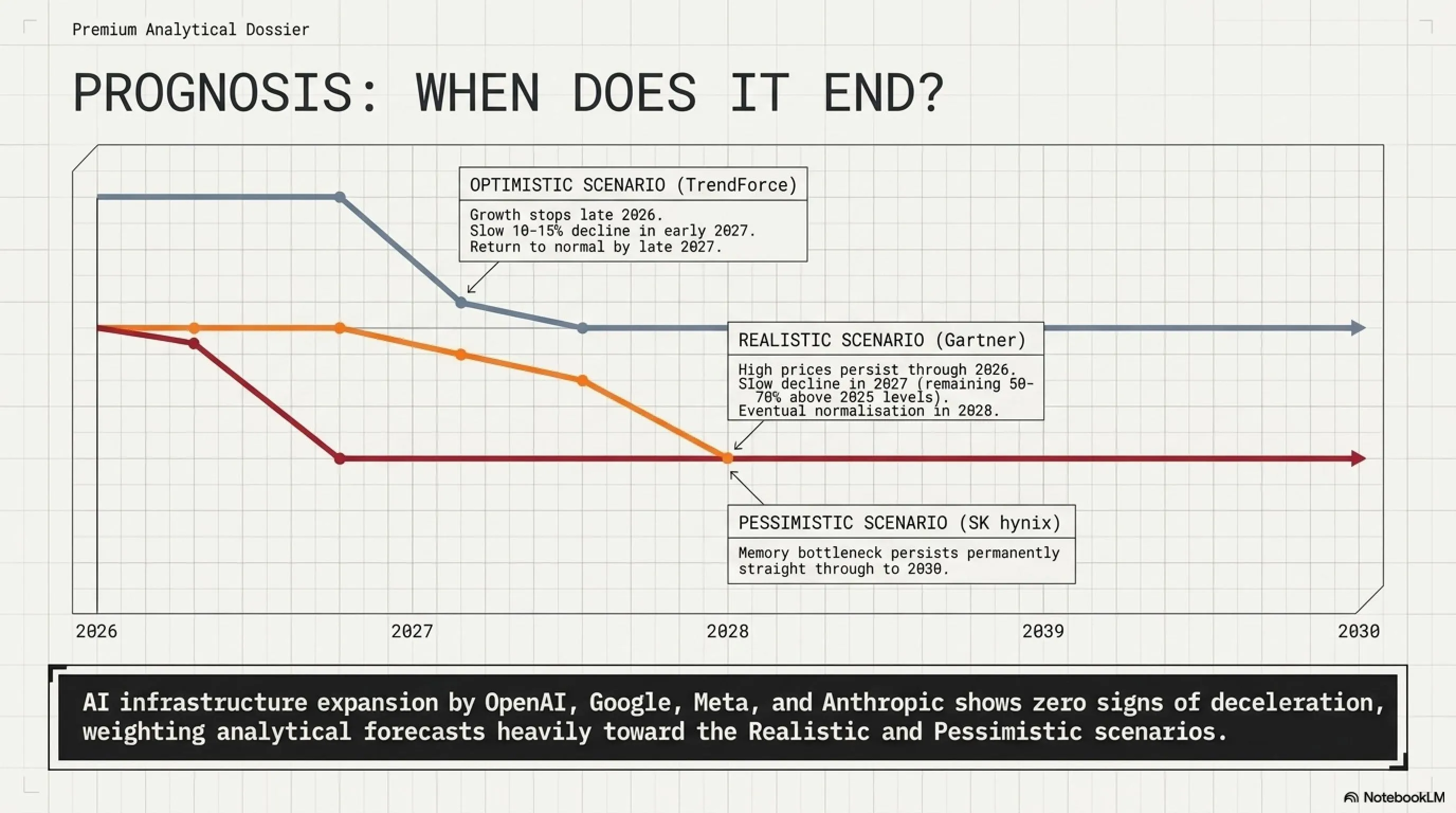
Unfortunately, the answer isn't simple. Industry analysts have varying predictions:
Future Scenarios
Optimistic Scenario (TrendForce):
Q3-Q4 2026: Price growth stops
Q1-Q2 2027: Slow decline begins (10-15%)
Late 2027: Return to near-2025 levels
Realistic Scenario (Gartner):
2026: Prices stay high
2027: Slow decline but 50-70% above 2025
2028: Return to "normal" prices
Pessimistic Scenario (SK hynix Chairman):
Memory bottleneck continues through 2030
Prices never return to 2024-2025 levels
"New normal" means RAM will always be more expensive
Reasons for delayed recovery:
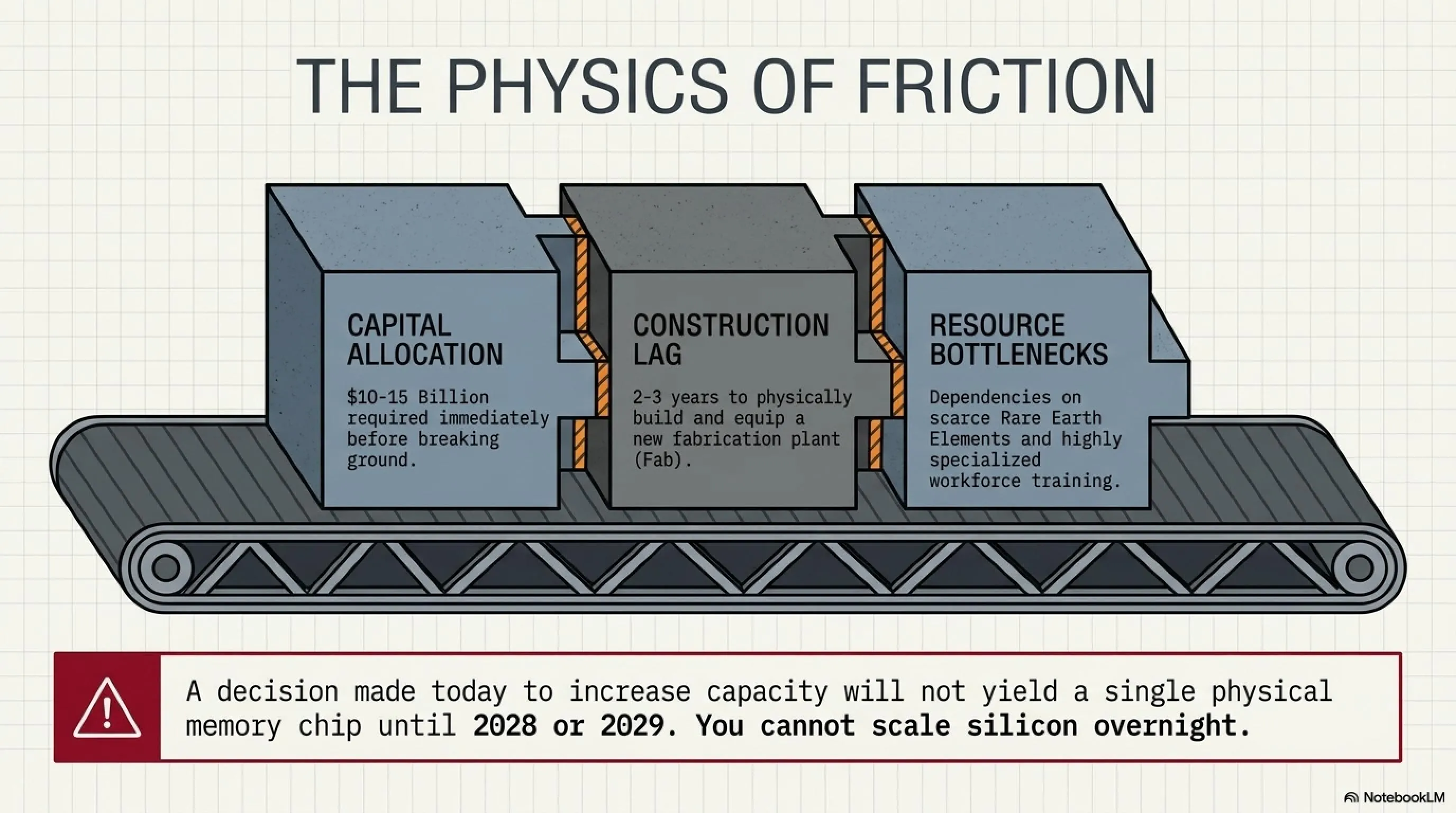
- New fab construction time: Building a new fabrication plant takes 2-3 years. Even if they decide today to build a new fab, it won't produce until 2028-2029
- AI demand still growing: OpenAI, Google, Anthropic, Meta, Microsoft, Amazon—all are expanding their datacenters. HBM demand won't decrease
- Resource constraints: Building memory chips requires specific materials (like Rare Earth Elements). These materials are also becoming scarce
- HBM profitability: Why would manufacturers return to cheap DDR5 when they can sell expensive HBM?
Insight.com wrote in their report: "Companies and consumers must prepare for a 'new normal'—where RAM never returns to 2024 prices."
Solutions for Gamers: How to Survive
If you're a gamer or PC builder wanting to survive this crisis, several solutions exist:
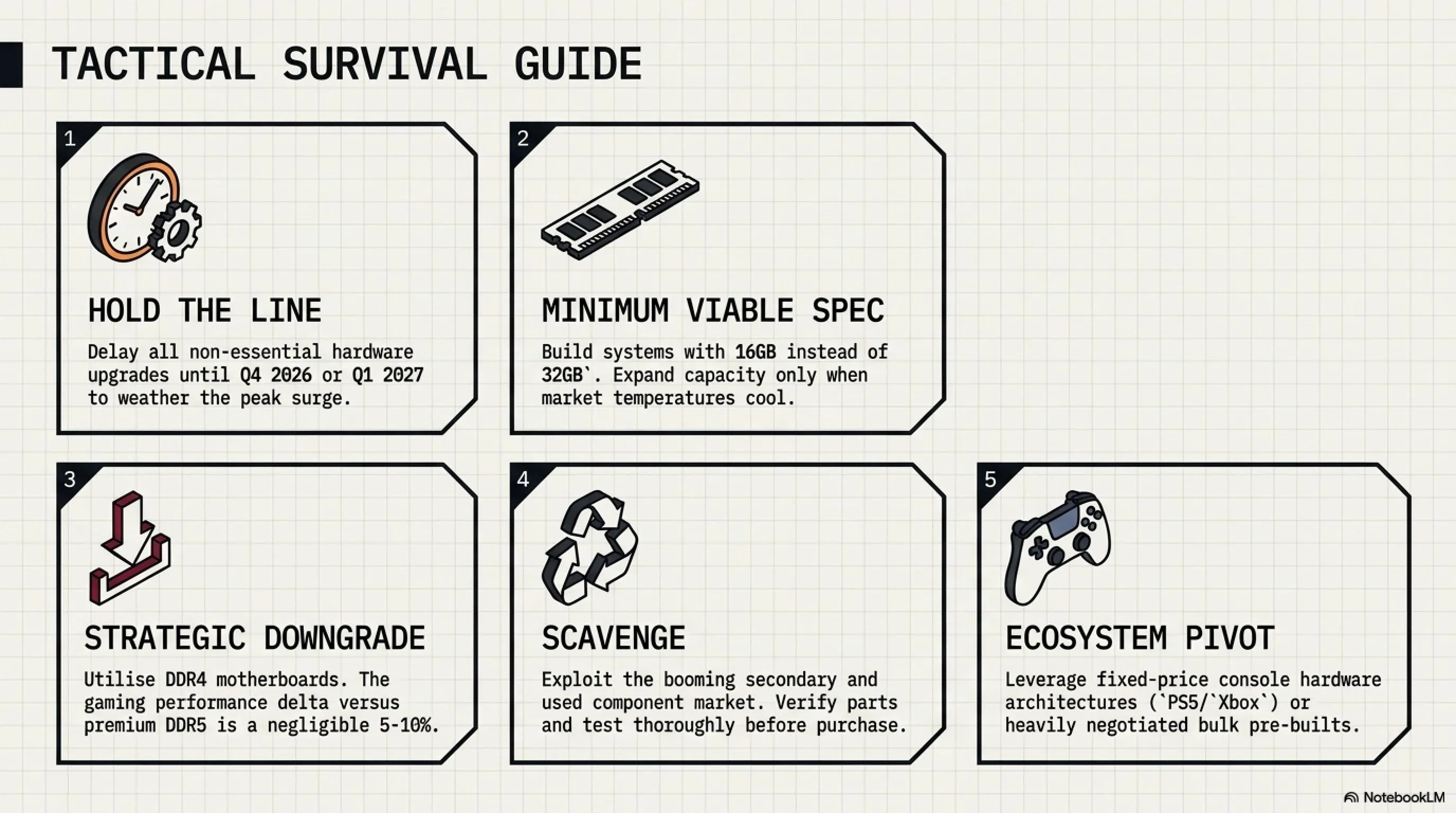
- Wait (if you can): If your current PC/laptop works, the best action is waiting until Q4 2026 or Q1 2027. Prices will likely stabilize and perhaps decline slightly
- Build with less RAM: Instead of buying 32GB, start with 16GB. Upgrade later when prices improve. Most games still work fine with 16GB
- Check the used market: Facebook Marketplace, eBay, Craigslist—many people are selling old RAM. Just watch for scams and definitely test before buying
- Consider DDR4: If your platform supports it, DDR4 is still an acceptable option. The performance gap between DDR4-3600 and DDR5-6000 in gaming isn't huge (usually 5-10%)
- Consider a console: If your budget is limited, PS5/Xbox Series X still offer the best value. Their prices increased but remain far below PC gaming
- Use pre-builts: Sometimes large companies (Dell, HP, Lenovo) have bulk contracts and can offer better prices. A pre-built PC might be cheaper than buying individual parts
Tom's Hardware recommends: "If you don't have to upgrade now, don't. Wait until the market stabilizes. If you must, build with minimum RAM and upgrade later."
Crisis Winners and Losers
This crisis has clear winners and losers:
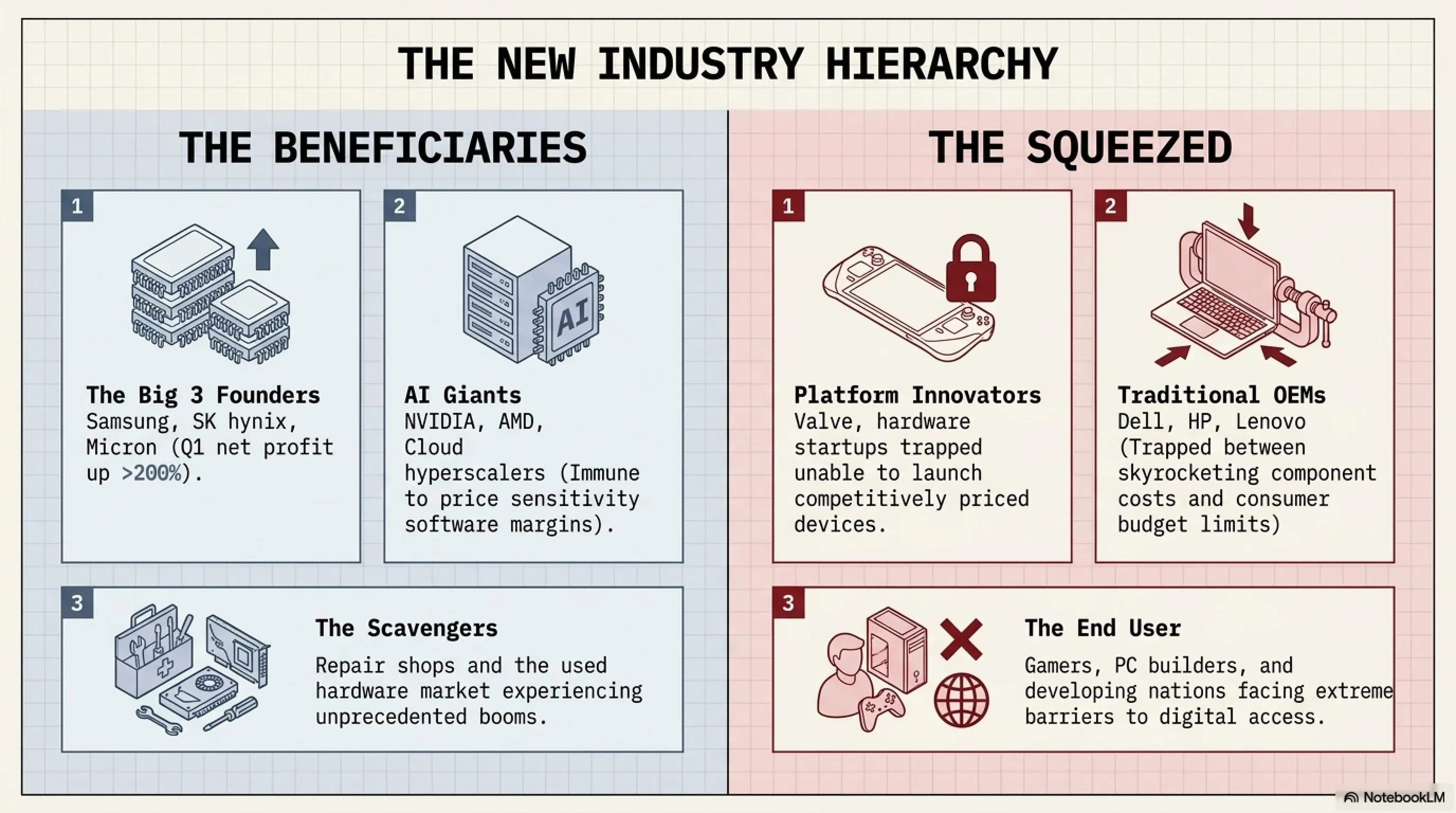
- Samsung, SK hynix, Micron: Q1 2026 net profit grew over 200% compared to Q1 2025. They now have a gold mine
- NVIDIA and AMD (AI division): They can buy HBM at any price because AI chip profit margins are so high that memory costs are negligible
- Microsoft, Amazon, Google: Cloud giants with massive datacenters. They have better prices with long-term contracts
- Repair shops and used market: Used parts sales are booming. People prefer buying old RAM over new
- Valve and Steam Machine: Their product entered the market at an uncompetitive price. Pre-order sales are below expectations
- PC/Laptop companies (Dell, HP, Lenovo): Their profit margins are squeezed. Can't raise prices too high (people won't buy) but can't sell cheap (they lose money)
- Gamers and PC Builders: Must pay more, settle for less, or return to consoles
- Hardware startups: Those with new RAM-intensive products can't launch at competitive prices
- Developing countries: High electronics prices create digital access barriers. Many can't afford new laptops or phones
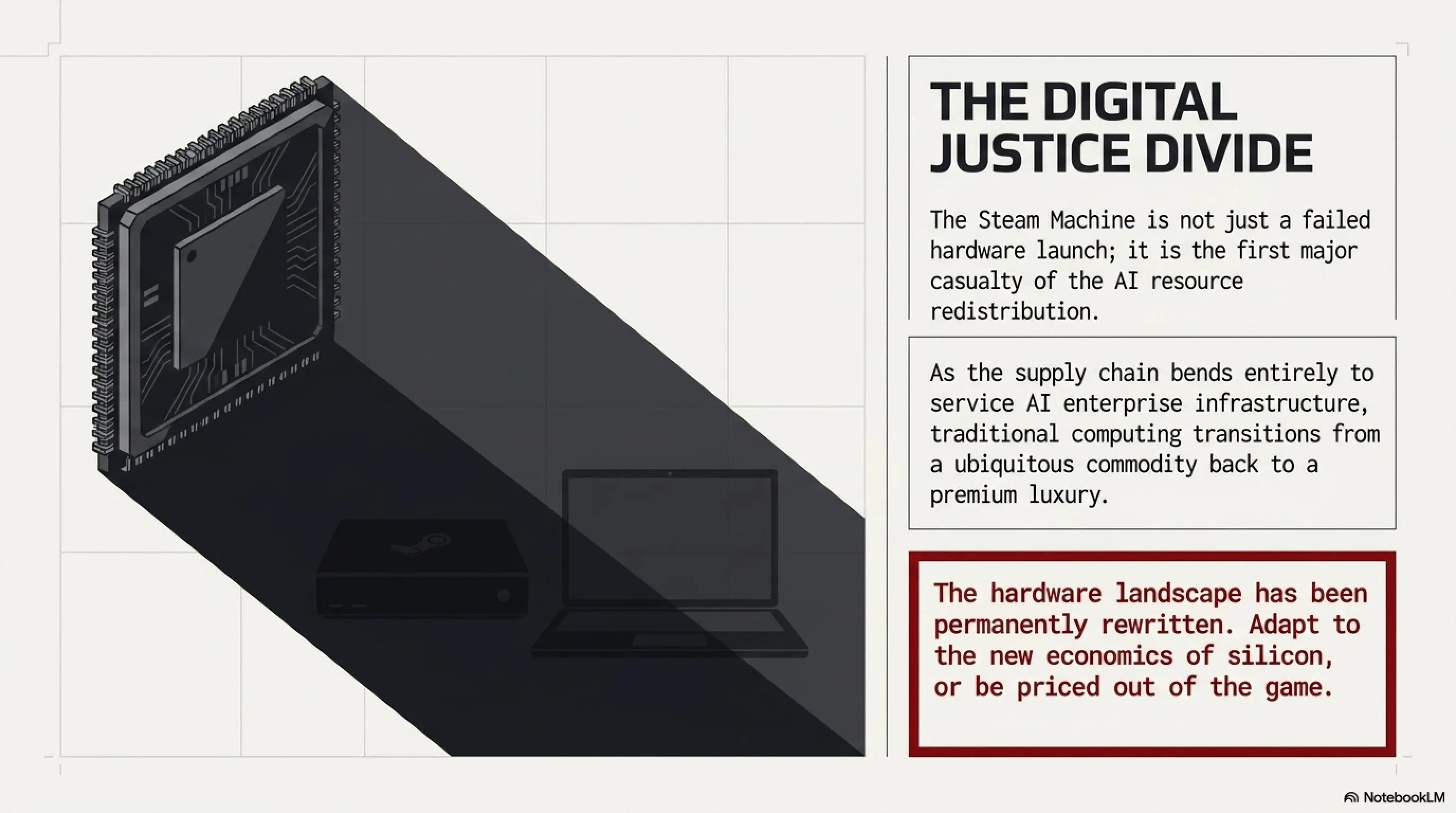
Ars Technica wrote: "RAM-aggedon is a digital justice crisis. Only the wealthy can buy new technology."
Conclusion: Lessons from RAM-aggedon
Steam Machine's $1,049 price tag isn't just a number—it's a symbol of a fundamental shift in the technology industry. For the first time in history, an emerging industry (AI) has brought a mature industry (consumer electronics) to its knees.
This crisis teaches several important lessons:
1. Monopoly Is Dangerous
When only three companies control 100% of a critical industry, any decision they make can destroy the entire ecosystem. The world needs more supply chain diversity.
2. AI Is a Market-Changing Force
Artificial intelligence is no longer just a technology trend—it's an economic force redistributing resources. Any industry competing with AI for resources must prepare for higher prices.
3. Technology Transitions Are Painful
Moving from the world of "traditional computing" to the "AI world" is a hard transition. Those caught in the middle (like Valve) pay a heavy price.
4. Consumers Are the Most Vulnerable Class
Technology giants can absorb higher costs. But the average gamer, the student who needs a laptop, or the family wanting a new phone—they're the ones who truly feel the pressure.
5. Predicting the Future Is Impossible
Valve thought in November 2025 they could sell Steam Machine for $750. Six months later, everything changed. In the world of advanced technology, unexpected events always lurk.
Steam Machine might be a failed product, but its story is a warning: We've entered a new world where artificial intelligence is the top priority, and other industries must adapt—or step aside.
The question now is: Are you ready to live in a world where RAM is always more expensive, where AI gets priority over consumers, and where a $700 console seems like a better deal than a $1,049 Steam Machine?
Welcome to the "new normal." Enjoy your stay—because you're stuck here.
Frequently Asked Questions
Is Steam Machine really worth a thousand dollars?
It depends on your needs. If you want PC gaming on TV and use Steam library, it might be worth it. But if you just want to game hassle-free, traditional consoles like PS5 Pro are better options. Digital Foundry said Steam Machine is a good PC at a bad price.
Will Steam Machine price decrease?
Unlikely—at least until 2027. Valve already has slim profit margins at current pricing. The only way prices drop is if RAM/SSD costs decrease significantly.
Why can't Valve sell at a loss like Sony/Microsoft?
Because Valve is a software/platform company, not a console manufacturer. Sony and Microsoft sell consoles at a loss because they profit from game sales and subscriptions. Valve also profits from Steam, but their strategy differs—they don't want to subsidize hardware.
Should I wait to buy RAM/PC?
Yes—if you can. Q4 2026 or Q1 2027 will likely see slightly better prices. But if you urgently need it, don't wait because things might get worse.
What's the best Steam Machine alternative?
PS5 Pro ($699) best value for console gaming, Xbox Series X ($549) cheaper option with Game Pass, self-built gaming PC ($900-1200) if you know how to build, ROG Ally X ($799) for portable gaming, or Steam Deck OLED ($549) if you want the same SteamOS in handheld form.
What is HBM and why is it so important?
HBM (High-Bandwidth Memory) is a specialized DRAM type with extremely high bandwidth—essential for AI chips like NVIDIA H100. This memory is several times faster than regular DDR5 and necessary for massive data parallel processing.
Why can't manufacturers increase production faster?
Because building a fab (chip manufacturing plant) takes 2-3 years and $10-15 billion in capital. It also requires highly specialized workforce, complex equipment, and specific raw materials. You can't double capacity overnight.
Is DDR4 still a good option?
Yes—if your platform supports it. The performance difference between DDR4-3600 and DDR5-6000 in gaming is usually 5-10%. For daily tasks, you'll notice almost no difference. DDR4 is still sufficient for most users.
How can I protect my money during this crisis?
Build with minimum RAM (16GB instead of 32GB) and upgrade later. Check the used market (but watch for scams). Follow bundle deals (sometimes motherboard+RAM together is cheaper). Use pre-built PCs if individual part prices are too high. Wait until Black Friday or Cyber Monday.
When will things get better?
Predictions: Optimistic late 2027, Realistic 2028, Pessimistic 2030 or later. SK hynix Chairman said the bottleneck continues through 2030. Gartner says prices will never return to 2024-2025 levels—we must get comfortable with the "new normal."
Sources
- GameSpot: Steam Machine pricing announcement, industry analysis
- IGN: Valve interviews, Steam Machine specifications
- The Verge: RAM-aggedon crisis coverage, AI impact analysis
- Digital Foundry: Steam Machine technical analysis
- Tom's Hardware: RAM price tracking 2026, daily lowest prices
- TrendForce: Quarterly DRAM market analysis, price forecasts
- Counterpoint Research: Memory price surge reports (90-95% increase)
- Notebookcheck: Laptop pricing analysis, RAM cost impact
- TechInsider: HBM production capacity analysis (23% of DRAM wafers)
- DataCenter Dynamics: Samsung and SK hynix production scaling
- Gamers Nexus: Interview with Valve engineers
- Ars Technica: Digital justice crisis analysis
- Wccftech: RAM shortage 2026 explained
- PCWorld: Steam Machine launch coverage
- Insight.com: 2026 RAM shortage survival guide
- Samsung Electronics, SK hynix, Micron: Q1-Q2 2026 financial reports
Additional Gallery: 🚨 When Steam Machine Launched at $1,049: The Bitter Story of RAM-aggedon