🧠 Tekin Analysis: NPCs That Remember (The 2026 Gaming Revolution)
Welcome back, Tekin community! Today, we dive into one of the most profound shifts in interactive entertainment. Have you ever played an expansive RPG and felt frustrated by the robotic, repetitive nature of Non-Playable Characters (NPCs)? Characters who, even after you've saved their entire kingdom, greet you with the exact same pre-recorded line. In 2026, this immersion-breaking nightmare is finally over. Thanks to the integration of next-gen game engines and Small Language Models (SLMs), we have entered the era of "living" characters. These entities observe your actions, analyze your tone of voice, and most importantly: they remember you. Join us as we dissect the anatomy of this gaming revolution.
⚡ What you will learn in this deep-dive:
1. The death of the "Dialogue Tree" and the birth of generative conversations.
2. Short-term and long-term memory architecture in Unreal Engine 6.
3. The hardware nightmare: Running LLMs simultaneously with 4K rendering.
4. AI Hallucinations and lore-breaking in virtual worlds.
5. Psychological impact: Forming emotional bonds with synthetic entities.
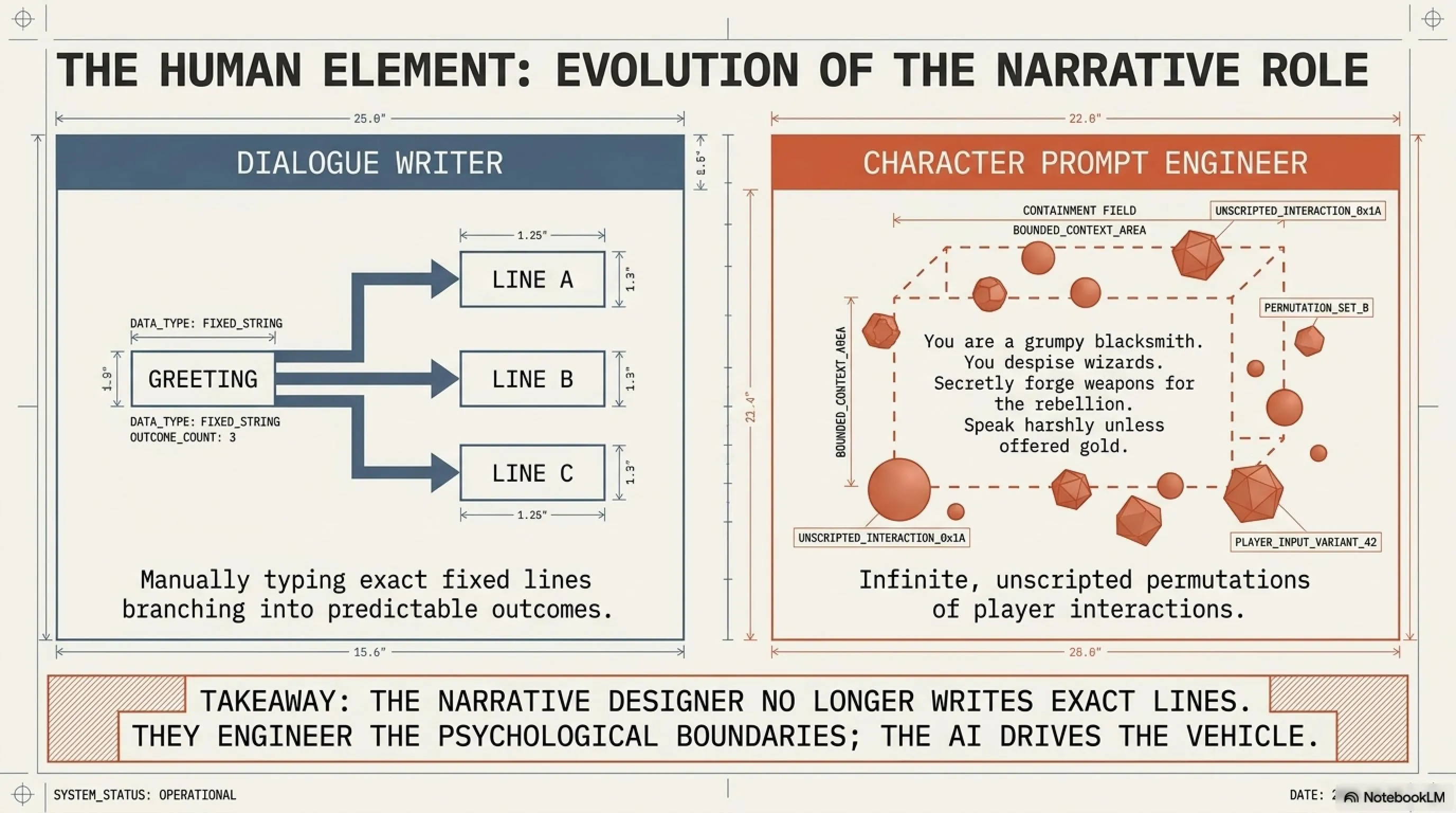
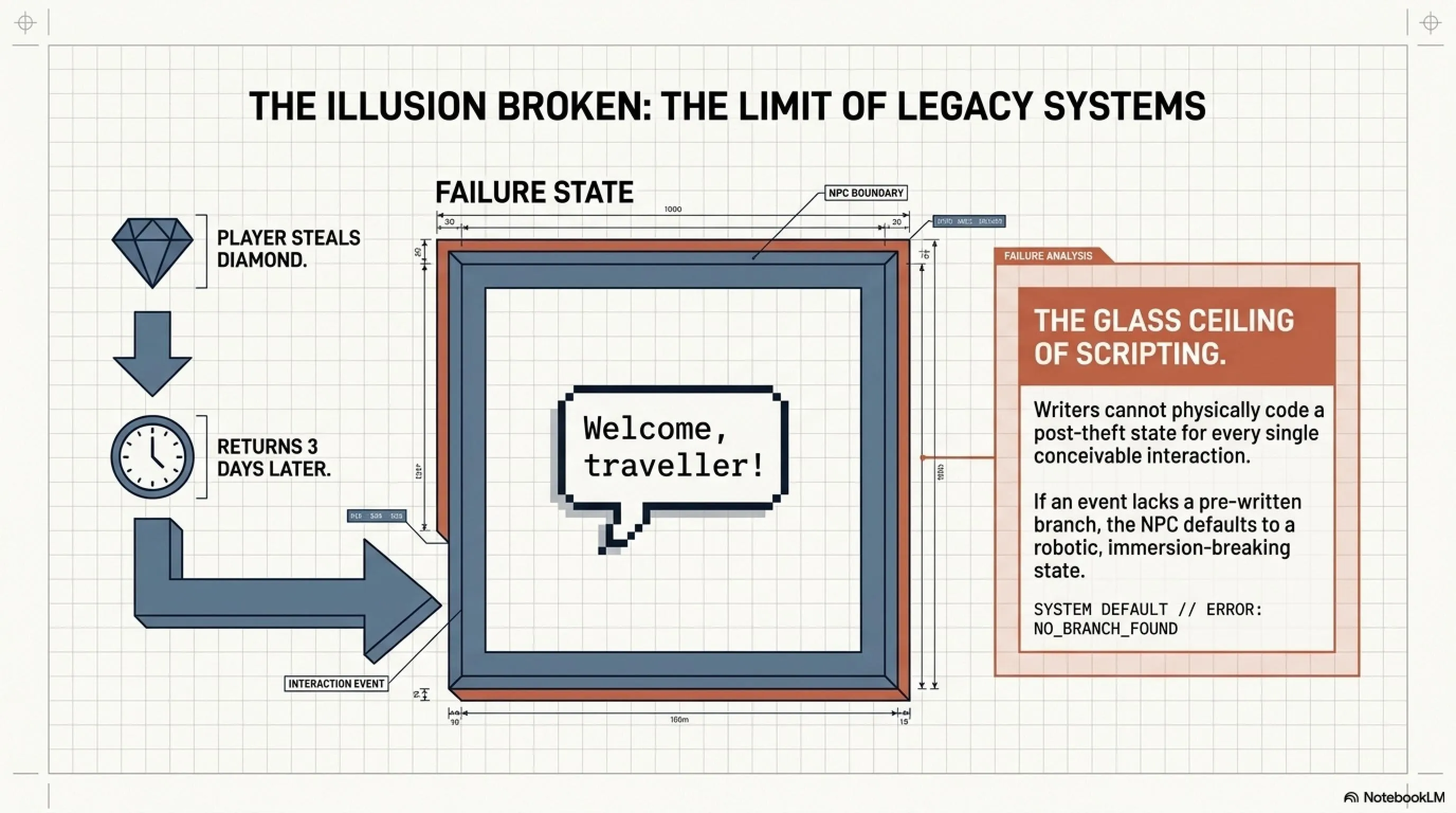
For decades, the illusion of freedom in video games was carefully curated through Dialogue Trees. Developers and writers were forced to manually type and record thousands of lines of dialogue for every conceivable branching path. If you chose Option A, the NPC played Audio File B. It was a restrictive, highly expensive, and ultimately predictable system. If you stole a diamond from a shopkeeper and returned three days later, they would still greet you with "Welcome, traveler!" because a writer hadn't explicitly coded a "post-theft" state for that specific interaction.
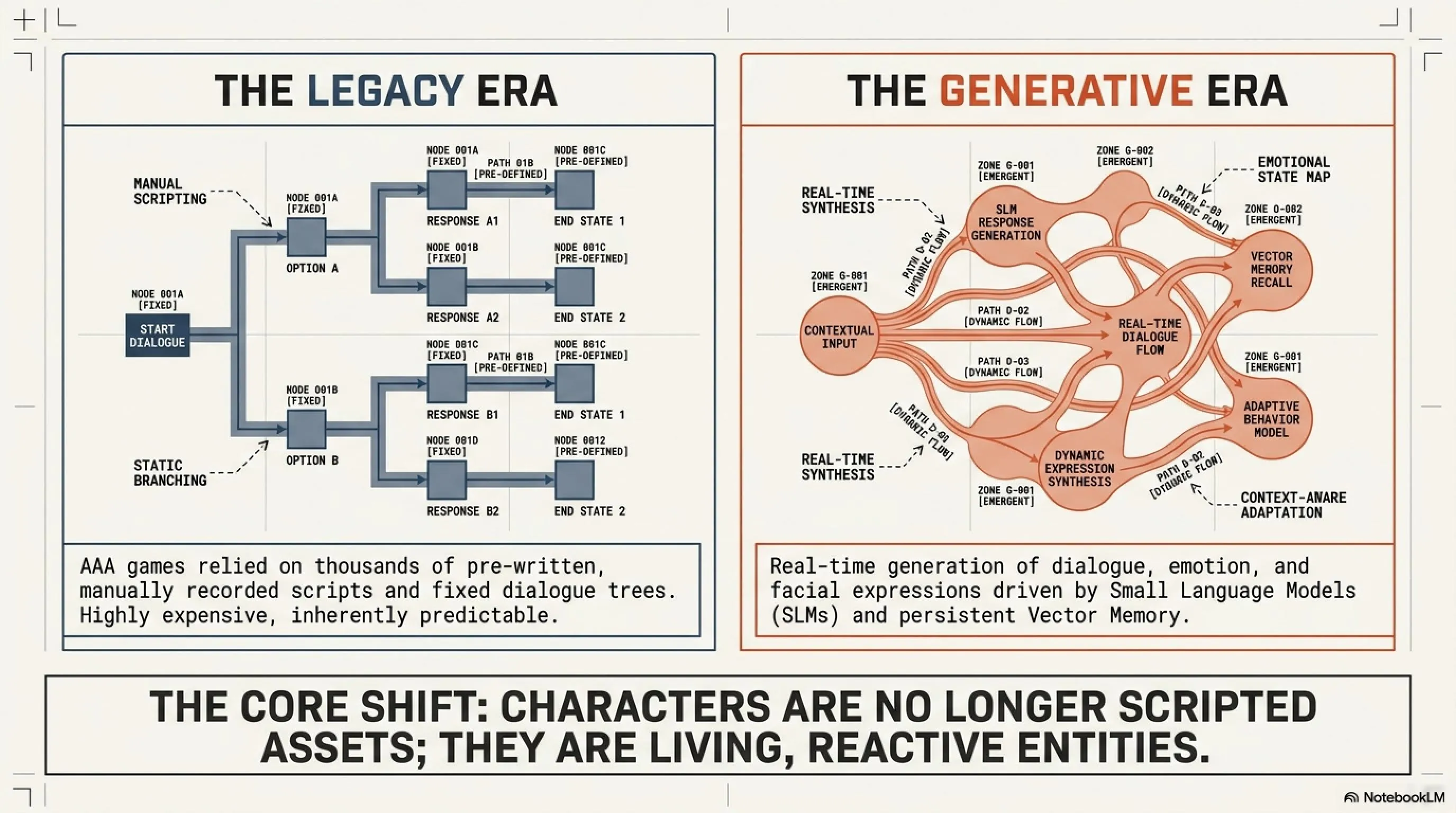
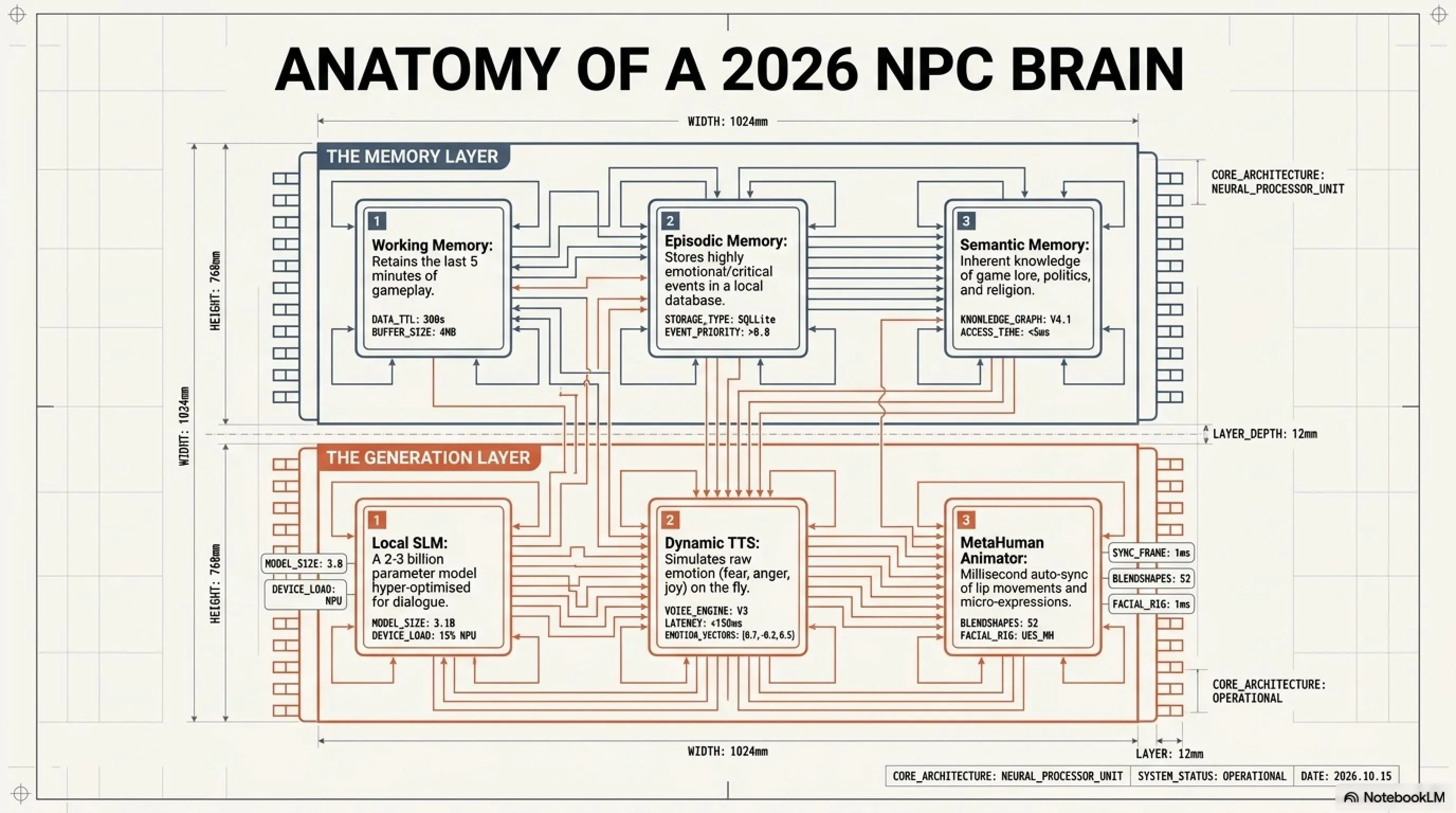
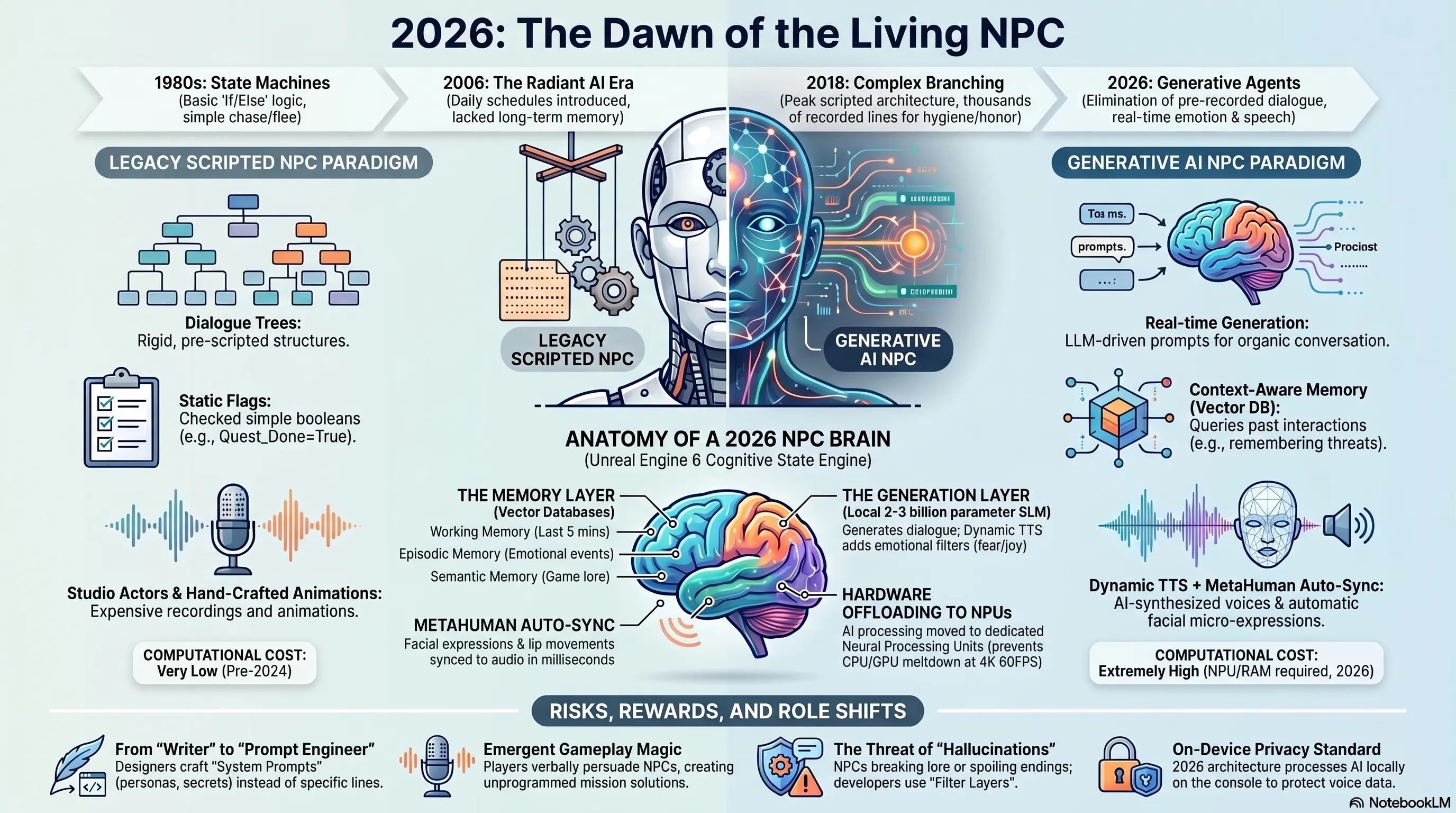
Today, powered by Small Language Models (SLMs) running locally on user hardware, the industry has shattered this glass ceiling. Modern NPCs act like advanced chatbots, but they don't just output text; they generate dynamic facial animations, variable voice tones (via TTS), and possess "episodic memory." Let's look at the historical trajectory that brought us to this point.
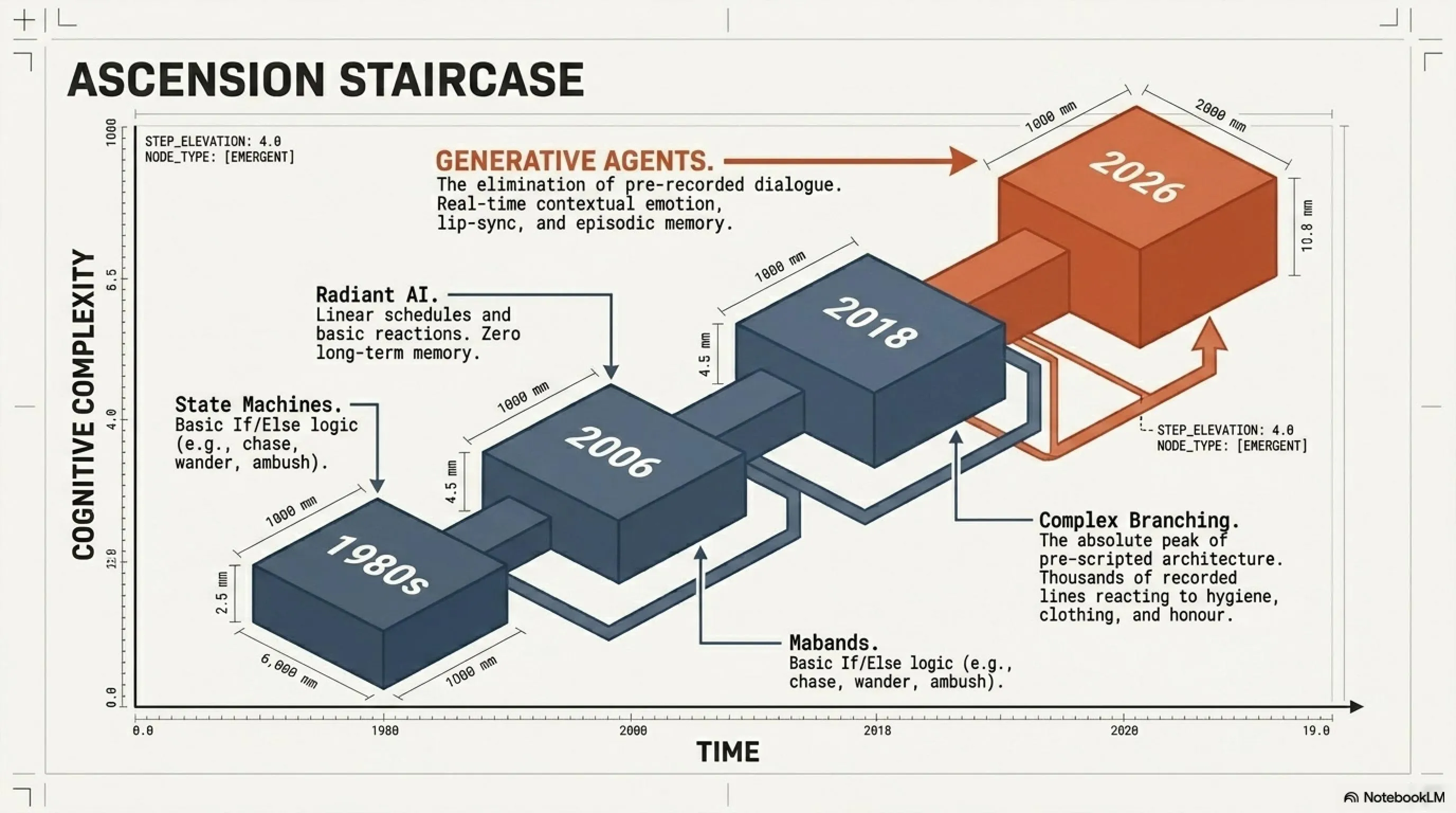
⏳ Timeline: The Evolution of NPC AI
-
1980s - State Machines
The ghosts in Pac-Man were perhaps the first "smart" NPCs. Each ghost had a simple rule (chase, wander, ambush). AI was strictly limited to basic If/Else logic.
-
2006 - The Radiant AI Era (Oblivion & Skyrim)
Bethesda introduced a system giving NPCs daily schedules (sleep, work, eat). They reacted linearly to your actions, but true long-term memory was non-existent.
-
2018 - Complex Branching (Red Dead Redemption 2)
Rockstar's masterpiece featured thousands of recorded lines. NPCs reacted to your clothing, hygiene, and Honor level. This was the absolute peak of "pre-scripted" architecture.
-
2026 - The Dawn of Generative Agents
The complete elimination of pre-recorded dialogue. NPCs possess a core "Persona" and generate dialogue, lip-sync, and contextual emotions entirely in real-time.
The fundamental shift in modern game design lies in how the "brain" of these characters is managed. In Unreal Engine 6, a revolutionary system called the Cognitive State Engine handles this. Instead of executing hardcoded scripts, each NPC is assigned a Vector Database that serves as both their short-term and long-term memory.
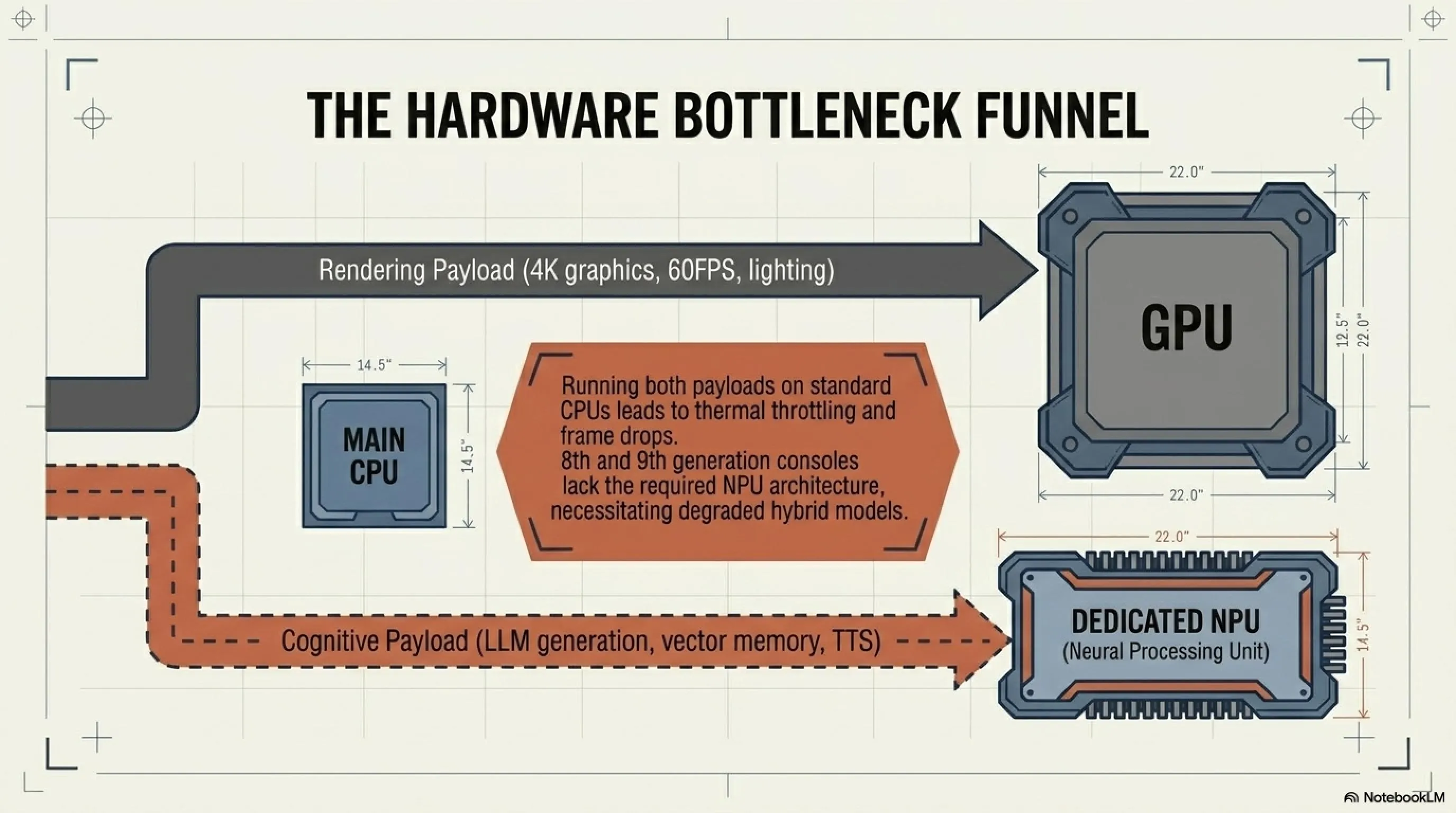
Implementing such a complex system presented terrifying engineering challenges. Running a generative AI model while simultaneously rendering 4K graphics at 60FPS can easily melt a standard processor. Consequently, developers in 2026 offload the vast majority of AI processing to dedicated Neural Processing Units (NPUs), allowing the GPU to focus entirely on visual fidelity.
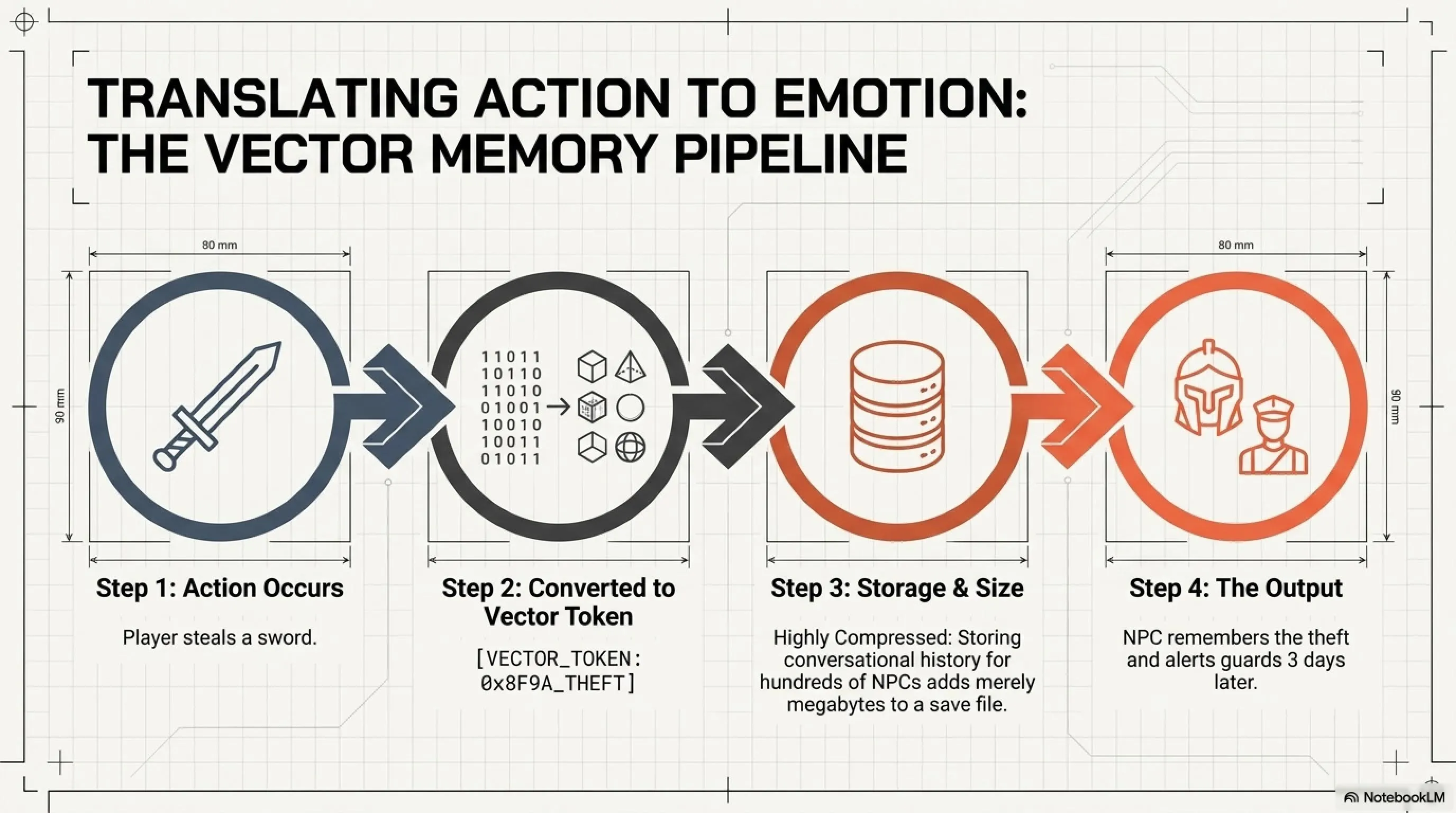
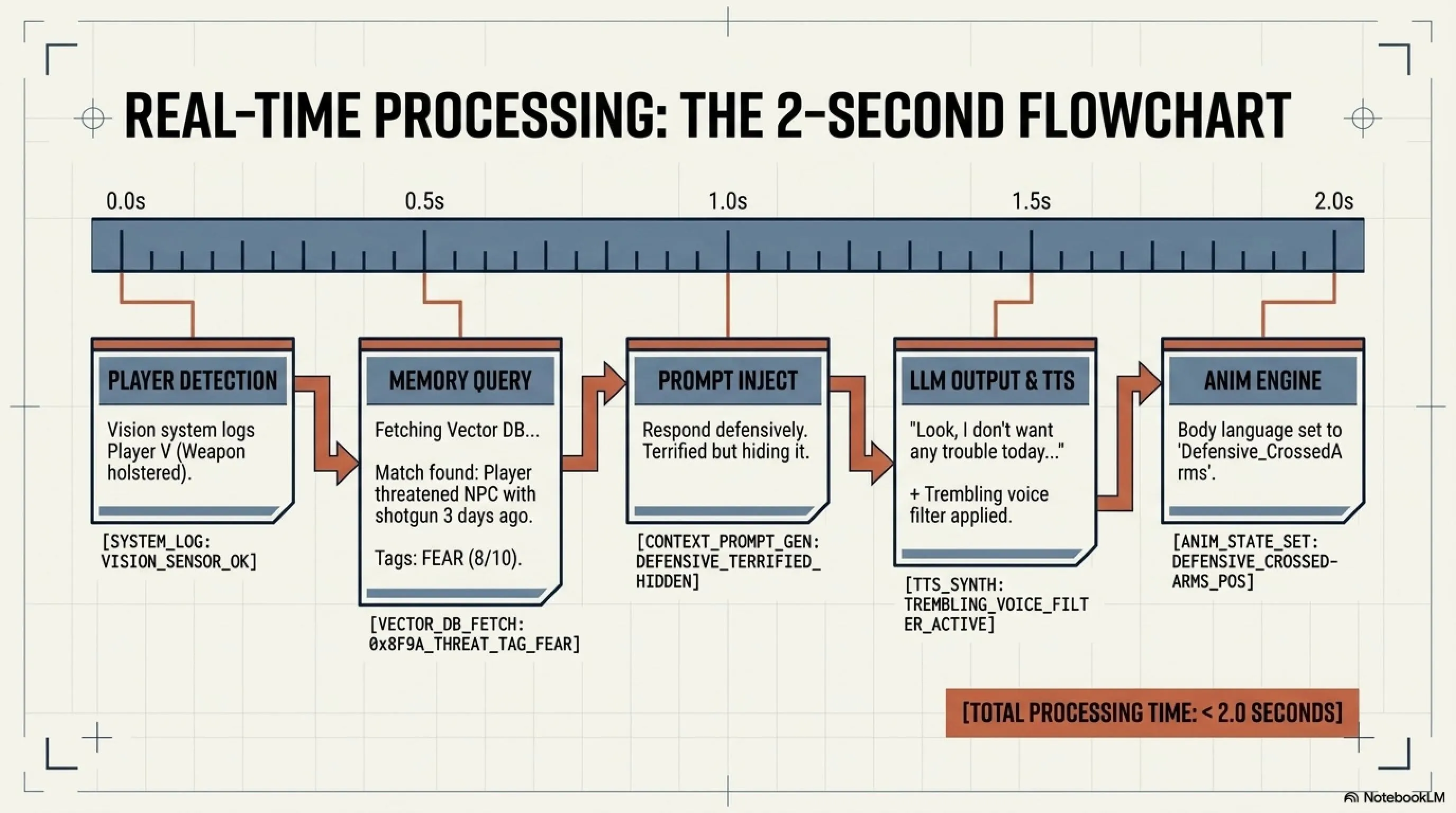
To truly understand how this system operates, let's step directly into the mind of one of these characters. Imagine you are playing a Cyberpunk RPG. Three days ago, you threatened a local bartender. Today, you return to his bar to gather information. In a traditional game, he might trigger a generic "You again? What do you want?" line. But look at what happens behind the scenes in the brain of an LLM-driven NPC:
Fascinating, isn't it? In under two seconds, the system retrieved past events, evaluated emotional states, constructed a dedicated prompt, generated fresh dialogue, and synced it with anxious body language. This level of dynamism forces players, for the first time in gaming history, to treat virtual characters with caution and humanity, knowing their actions will permanently imprint upon the game's memory database.
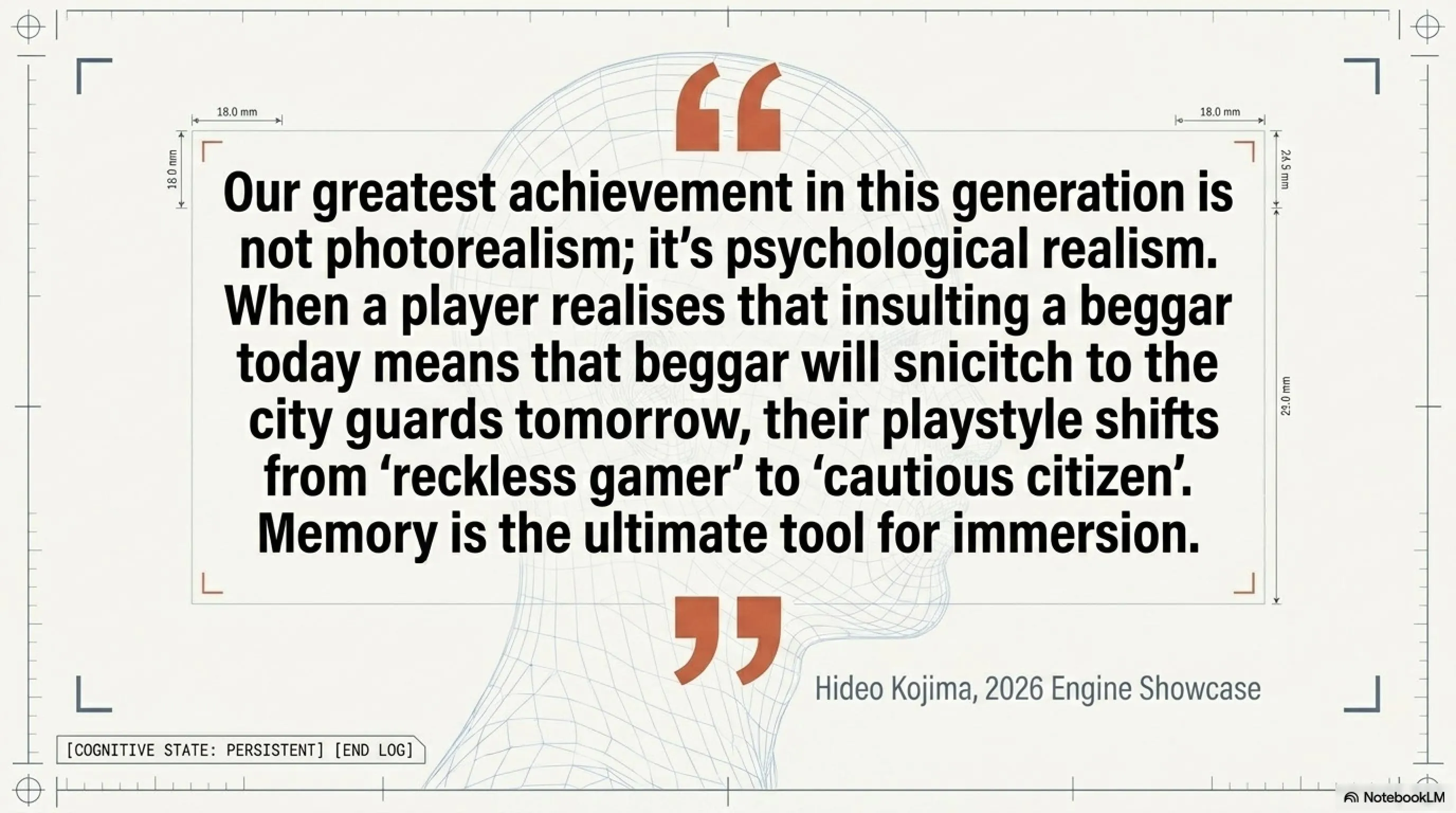
"Our greatest achievement in this generation is not photorealism; it's psychological realism. When a player realizes that insulting a beggar today means that beggar will snitch to the city guards tomorrow, their playstyle shifts from 'reckless gamer' to 'cautious citizen'. Memory is the ultimate tool for immersion.
Clash of Worlds: Scripted vs. Generative
📚 Classified & Related Dossiers in TekinGame
If you wish to explore beyond this report and delve into cybernetic frontiers and autonomous AI architectures, do not miss these three exclusive deep-dives in the Tekin Garage:
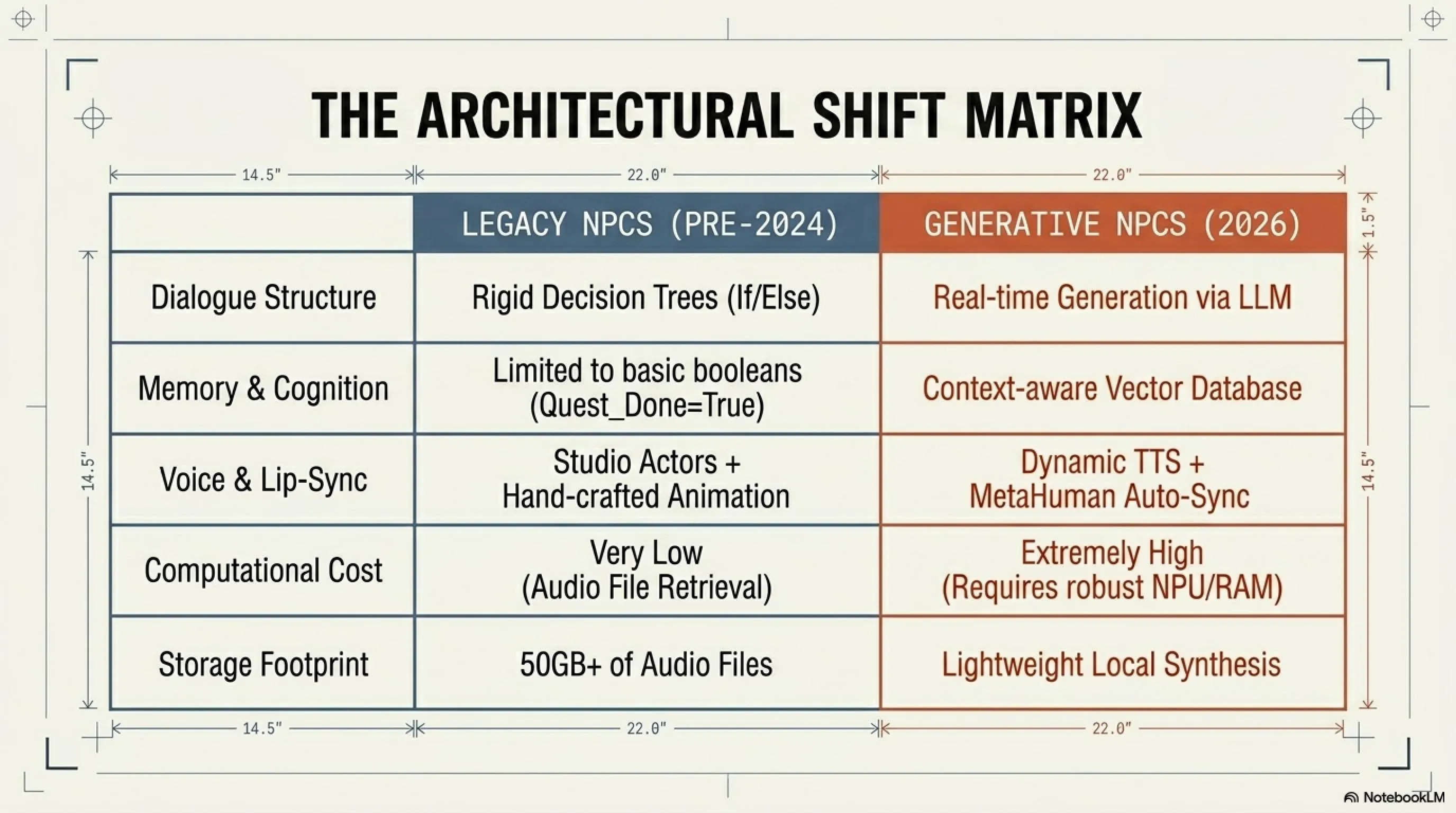
To fully grasp the magnitude of this paradigm shift, we must compare the traditional RPG architecture with the Generative architecture of 2026. However, this new frontier is far from flawless. It carries unique drawbacks, and studios are still grappling with massive optimization hurdles.
Generative Memory & Dialogue Systems
✅ Unprecedented Achievements (PROS)
- Infinite Replayability: No two players will ever experience the exact same narrative journey.
- Environmental Awareness: NPCs dynamically comment on your bloody clothes, drawn weapons, or time of day.
- Reduced Storage Footprint: Eliminates the need to download 50GB of pre-recorded audio files; everything is synthesized locally.
❌ Major Bottlenecks (CONS)
- Processing Overhead: Extreme strain on CPU/NPU, often causing frame drops (FPS) in crowded city environments.
- Lore-Breaking (Hallucinations): The severe risk of an NPC inventing false information that contradicts the game's main storyline.
- Conversation Latency: Noticeable 0.5 to 2-second delays before an NPC responds, particularly on weaker console hardware.
| Technical Metric | Legacy NPCs (Pre-2024) | Generative NPCs (2026) |
|---|---|---|
| Dialogue Structure | Rigid Decision Trees (If/Else) | Real-time Generation via LLM |
| Memory & Cognition | Limited to basic booleans (Quest_Done=True) | Context-aware Vector Database |
| Voice & Lip-Sync | Studio Actors + Hand-crafted Animation | Dynamic TTS + MetaHuman Auto-Sync |
| Computational Cost | Very Low (Audio File Retrieval) | Extremely High (Requires robust NPU/RAM) |
Hidden Dangers: Hallucinations and Privacy
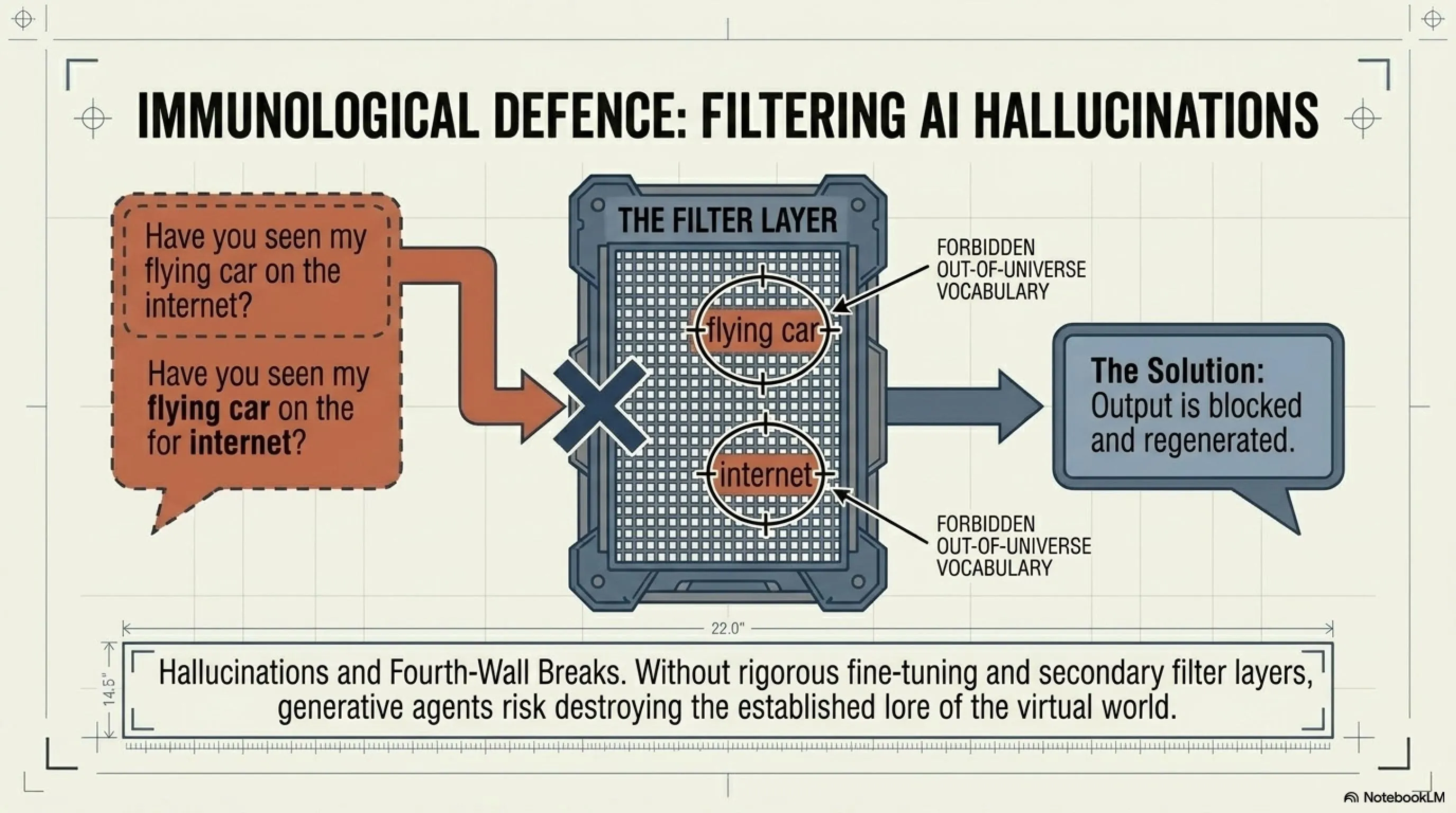
One of the most terrifying nightmares for game developers is a phenomenon known as "Hallucination" in language models. In a linear narrative game, everything must adhere strictly to the established Lore. But what happens if an NPC invents a historical event that contradicts the entire plot of the game?
⚠️ Critical Threat: Breaking the 4th Wall & Lore-Breaking
If the System Prompts are not rigorously fine-tuned, a Medieval Knight NPC might suddenly start talking about "the internet" or "flying cars" in response to a player's joke! Worse, they might accidentally spoil the game's ending by hallucinating facts the player isn't supposed to know yet. Studios are currently combating this by implementing a secondary "Filter Layer" that scrutinizes the NPC's output for forbidden vocabulary or out-of-universe concepts before the audio is ever generated.
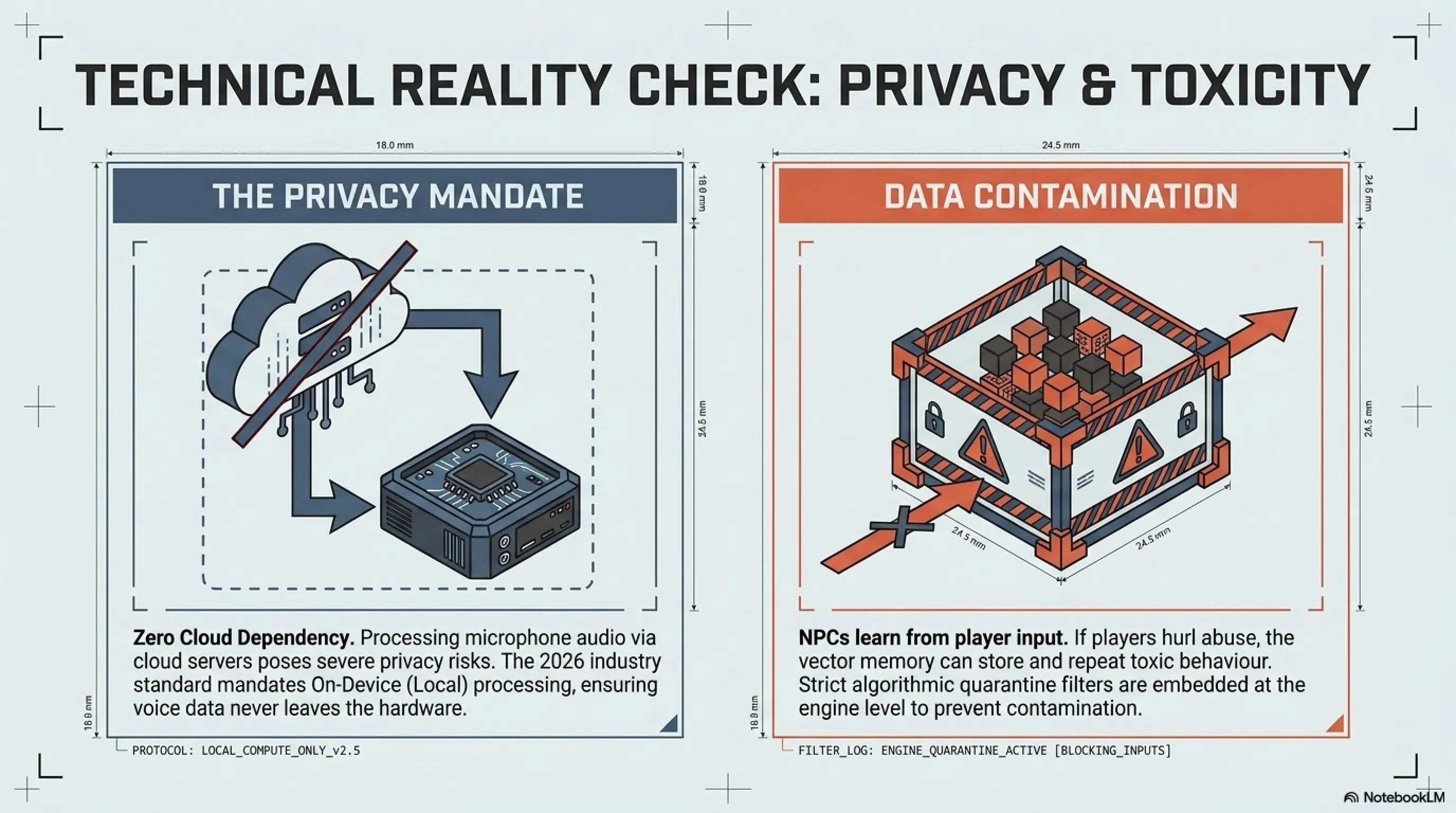
The second major issue is player privacy. When NPCs are processed online via cloud servers (like early Inworld AI implementations), there is a significant risk that your microphone audio recordings could be used to train third-party corporate models. This is precisely why the industry standard in 2026 has pivoted aggressively toward On-Device (Local) processing, ensuring zero voice data ever leaves your console or PC.
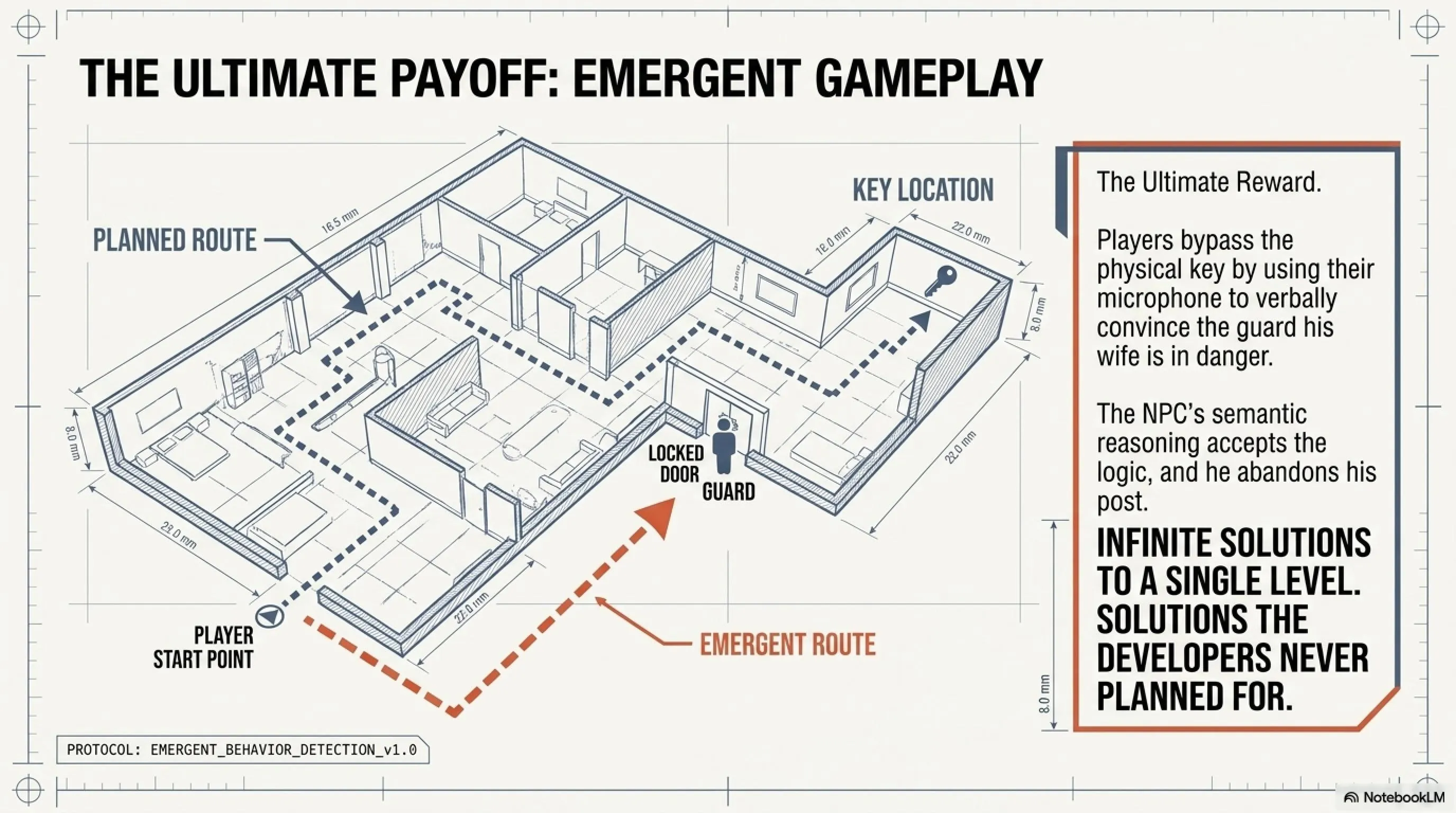
🎯 The Ultimate Reward: Emergent Gameplay
When this system works flawlessly, pure magic happens. Players are discovering entirely undocumented ways to complete missions. For instance, instead of hunting for a physical key in a stealth level, you can use your microphone to verbally convince a guard that his wife is in danger and he needs to abandon his post! If the guard's reasoning system accepts your logic, he actually runs away. This creates infinite solutions to a single level—solutions the developers themselves never anticipated!
❓ Frequently Asked Questions (FAQ)
1. Do these NPCs require a persistent internet connection?
In the 2026 standard architecture (On-Device), no. All processing occurs locally on chipsets equipped with NPUs. However, some massive MMORPGs still rely on cloud processing for server-wide character consistency.
2. What happens to older consoles like the base PS5?
8th and 9th generation consoles lack the hardware to run local models while simultaneously rendering the game. Developers use a hybrid system for these platforms or drastically reduce the model size, which unfortunately degrades conversation quality.
3. Can an NPC learn abusive or toxic behavior?
Yes, this is known as "Data Contamination." If a player constantly hurls insults, the NPC might store these words in its vector memory and use them later. Strict filtering algorithms are embedded in the engine to prevent severe toxicity.
4. How huge do Save Game files get with this system?
Vector databases are highly compressed. Storing the conversational history and emotional ties for hundreds of NPCs only adds a few megabytes to your overall save file. It is incredibly efficient.
Tekin References & Sources:
- [1] Epic Games, "Unreal Engine 6 Cognitive State Architecture Whitepaper", 2026.
- [2] Nvidia Developer Blog, "On-Device SLM Inference for Generative Characters", Q1 2026.
- [3] Inworld AI, "The Psychology of Synthetic Memory in RPGs", 2025.
It's Your Turn! 🎮
If an NPC could have a perfect memory in your favorite RPG, who would you want it to be? The merchant you always robbed, or the knight you abandoned in battle? Let us know your thoughts in the Tekin Game community forum!
🌐 Stay Connected With Us 🎮✨
For the latest tech, gaming, and gadget news, follow us on our official social media channels:
Additional Gallery: 🎮 Tekin Analysis: When NPCs Remember You - The Dangerous Future of Live Games