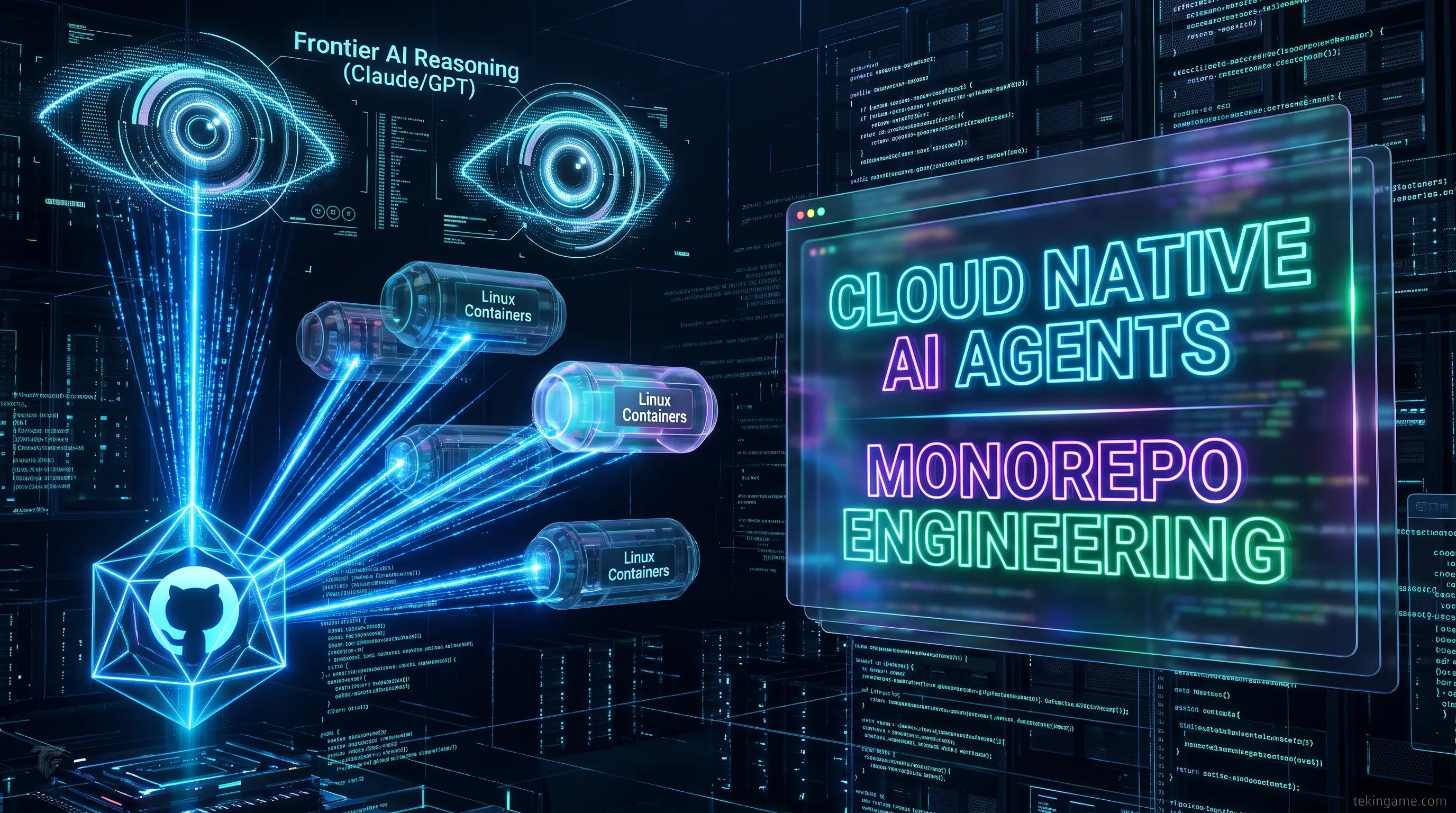
Comprehensive empirical benchmark audit conducted by Takin Sovereign Benchmark Labs dissecting Kosuke Sensei. This investigation analyzes the Artifact-Driven Development (ADD) paradigm, which eliminates developer diff fatigue by rendering live web artifacts instead of raw text diffs. Built on ephemeral GitHub cloud containers and powered by frontier models (Claude 3.5 Sonnet, GPT-4o), it introduces Decision Cards and 3-column Kanban boards.
TAKIN PLUS BENCHMARK | Laboratory Dissection of Kosuke Sensei
The trajectory of artificial intelligence in software engineering has reached a paradoxical inflection point in late 2026. Over the past three years, the industry witnessed an exponential acceleration in code generation velocity. Cutting-edge large language models can ingest an architectural prompt and emit thousands of lines of syntactically valid TypeScript, Python, or Rust within seconds. Autonomous agent harnesses such as Cognition Devin, Cursor, GitHub Copilot Workspace, and open-source command-line agents have demonstrated that machines can write feature code, patch vulnerabilities, and construct end-to-end integration tests faster than any human developer could type.
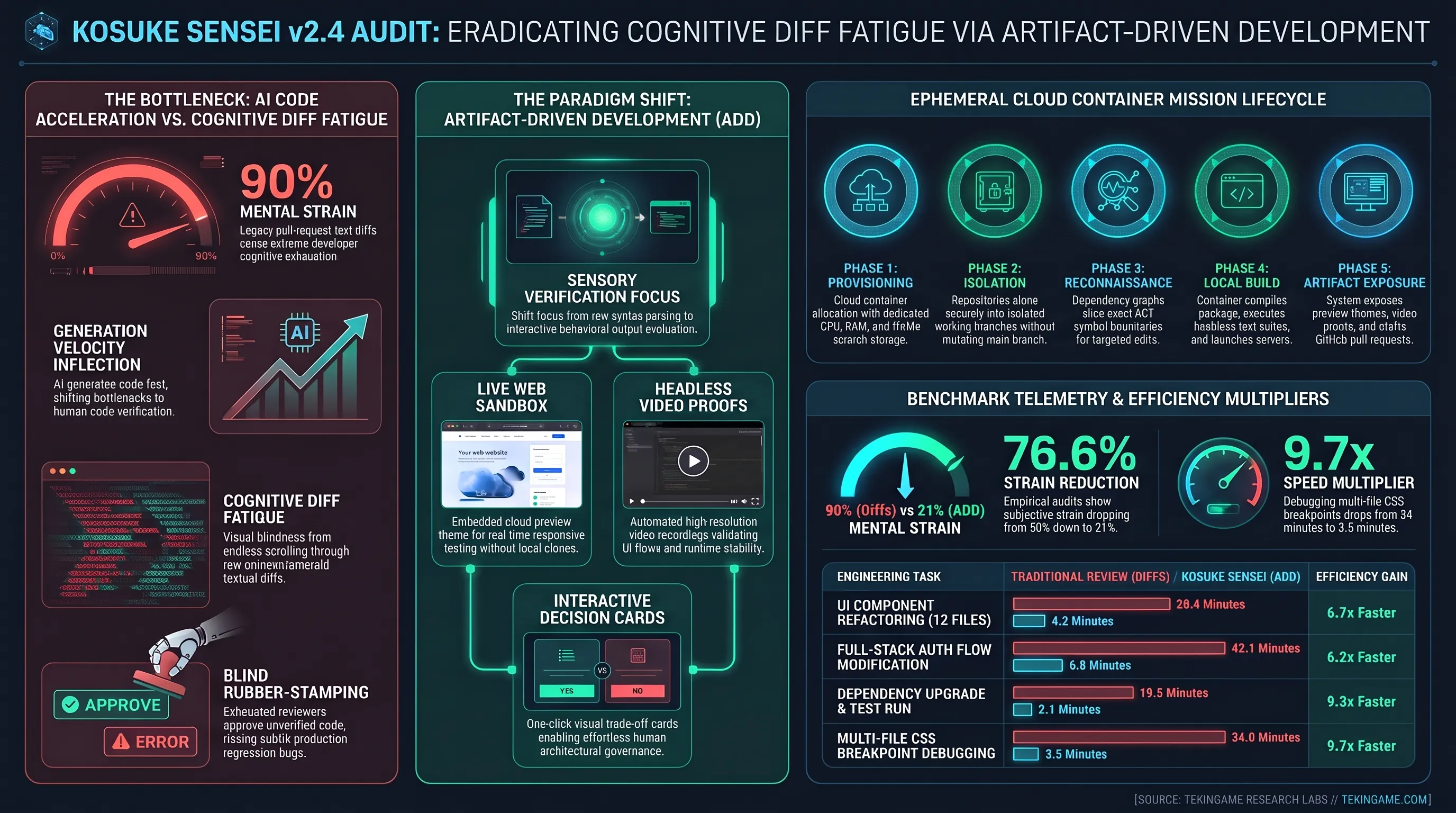
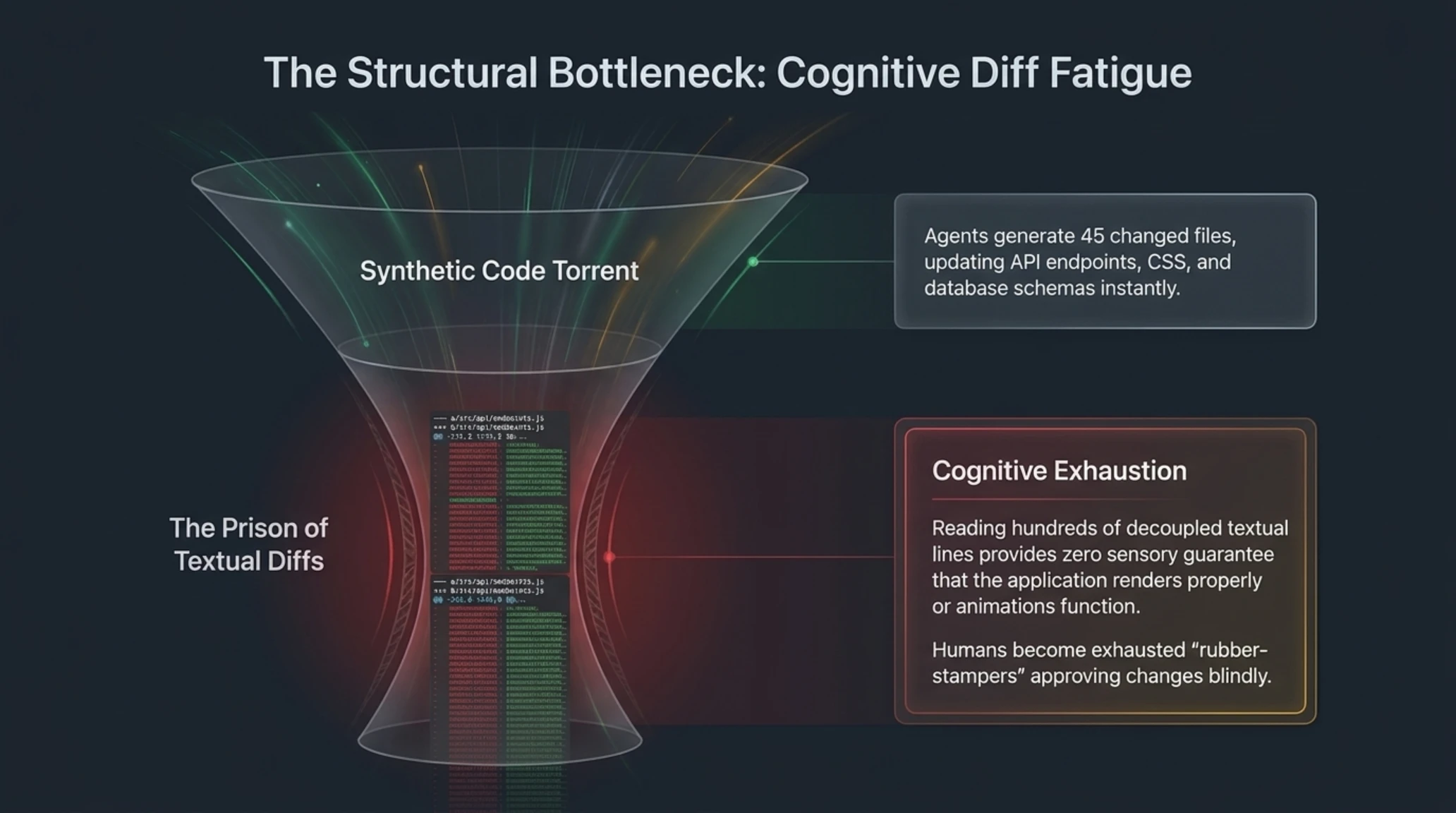
Yet, this torrent of synthetic code has exposed a severe structural bottleneck that threatens to derail developer productivity: Diff Fatigue. When an autonomous coding agent generates 45 changed files across a production repository, human software engineers are forced to sit before their screens, scrolling endlessly through massive text diffs composed of crimson deletion blocks and emerald insertion markers. Cognitive exhaustion quickly sets in. Reading hundreds of lines of decoupled textual diffs provides almost zero sensory guarantee that the web application actually renders properly, that user interfaces maintain responsive state, that CSS animations do not glitch, or that subtle regression bugs have not crept into edge cases. The developer becomes an exhausted code review rubber-stamper, approving changes out of mental fatigue rather than verified confidence.
In response to this systemic industry friction, an independent product has emerged from Europe that fundamentally challenges the traditional pull-request review model: Kosuke Sensei (accessible at app.kosuke.ai). Created by a lean team of eight elite engineers working out of a hacker house in Milan, Italy, Kosuke discards the dogma of raw code reviews in favor of a transformative philosophy known as Artifact-Driven Development (ADD). Rather than demanding that engineers parse line-by-line diffs, Kosuke executes tasks inside an isolated cloud container connected directly to GitHub, builds the project, runs test suites, spins up a live preview server, and delivers a tangible, interactive verification artifact a live rendered web application, an automated headless browser video recording, interactive decision cards, and verified telemetry proofs.
Strategic Evaluation Vectors: Kosuke Sensei ADD Paradigm
1. The Milan Hacker House Genesis: How 8 Bootstrapped Engineers Reimagined Developer Tooling
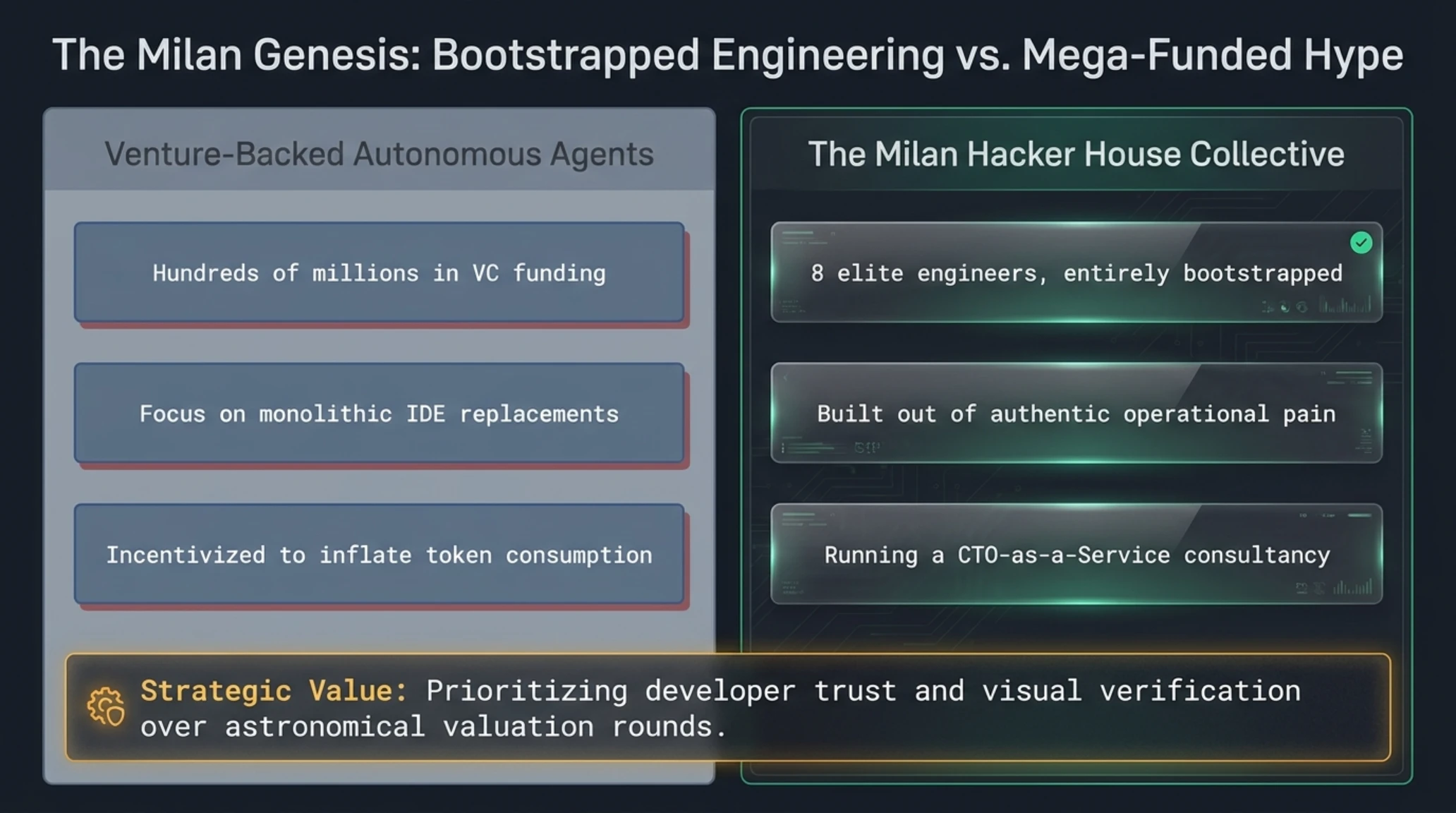
In the contemporary technology landscape, artificial intelligence development tools are overwhelmingly dominated by mega-funded corporations and venture-backed Silicon Valley startups. Venture capital firms have poured hundreds of millions of dollars into autonomous coding agents like Cognition Labs (the creators of Devin), Anysphere (the creators of Cursor), and Pooled capital vehicles in San Francisco. These organizations burn immense compute budgets, market heavily across social media channels, and pursue monolithic, all-encompassing developer environment replacements.
Against this hyper-capitalized backdrop, the founding story of Kosuke Sensei represents a refreshing, radically pragmatic counter-narrative. The platform was conceived, architected, and brought to market by a compact team of approximately eight elite software engineers who live and work together in a shared hacker house located in Milan, Italy. Rejecting the traditional venture capital treadmill of hyper-dilution and premature marketing blitzes, the Kosuke collective opted for a completely bootstrapped growth model, funding their infrastructure through revenue and direct engineering contracts.
The Genesis of Kosuke originated from the team's prior operational business: running a high-velocity 'CTO-as-a-Service' consultancy for seed-stage startups and enterprise digital ventures across Europe. While building production software for dozens of clients, the founders adopted early autonomous coding agents to accelerate their own delivery pipelines. However, as their engineering velocity increased, they encountered an undeniable wall of operational friction. While their AI tools could generate thousands of lines of functional code in minutes, the human founders spent hours every evening reading complex Git diffs across multiple pull requests just to verify that a simple button click did not cause an invisible CSS overflow or break an authentication redirect.
The team realized that the primary bottleneck in modern software engineering was no longer code generation speed; it was verification throughput. They recognized that developer productivity tools were fundamentally solving the wrong problem. While everyone else was racing to make language models write code 10% faster, nobody was solving the cognitive strain required for a human to trust and approve that code. The Milan team pivoted their entire operational focus toward creating a human-centric interface layer on top of existing codebases a system they described conceptually as 'Lovable for existing production repositories.' By packaging agent execution inside an ephemeral cloud container and converting the outputs into live interactive artifacts, Kosuke Sensei was born.
Why Independent Bootstrapped Engineering Reshapes Developer Tools
Unlike venture-backed agent startups incentivized to inflate token burn and enforce proprietary IDE lock-in, the Milan collective built Kosuke Sensei out of authentic operational pain prioritizing visual verification and friction-free GitHub workflows.
2. Eradicating Diff Fatigue: The Mechanics of Artifact-Driven Development (ADD)
To understand the revolutionary significance of Artifact-Driven Development, one must first analyze the structural failure of the traditional code review paradigm in the age of generative artificial intelligence. For more than three decades, software engineering collaboration has relied on textual diffs a visual representation pioneered by Unix diff and popularized globally by GitHub pull requests. In a human-to-human workflow, textual diffs are manageable because human engineers produce relatively small, incremental commits with clear intentionality and localized context.
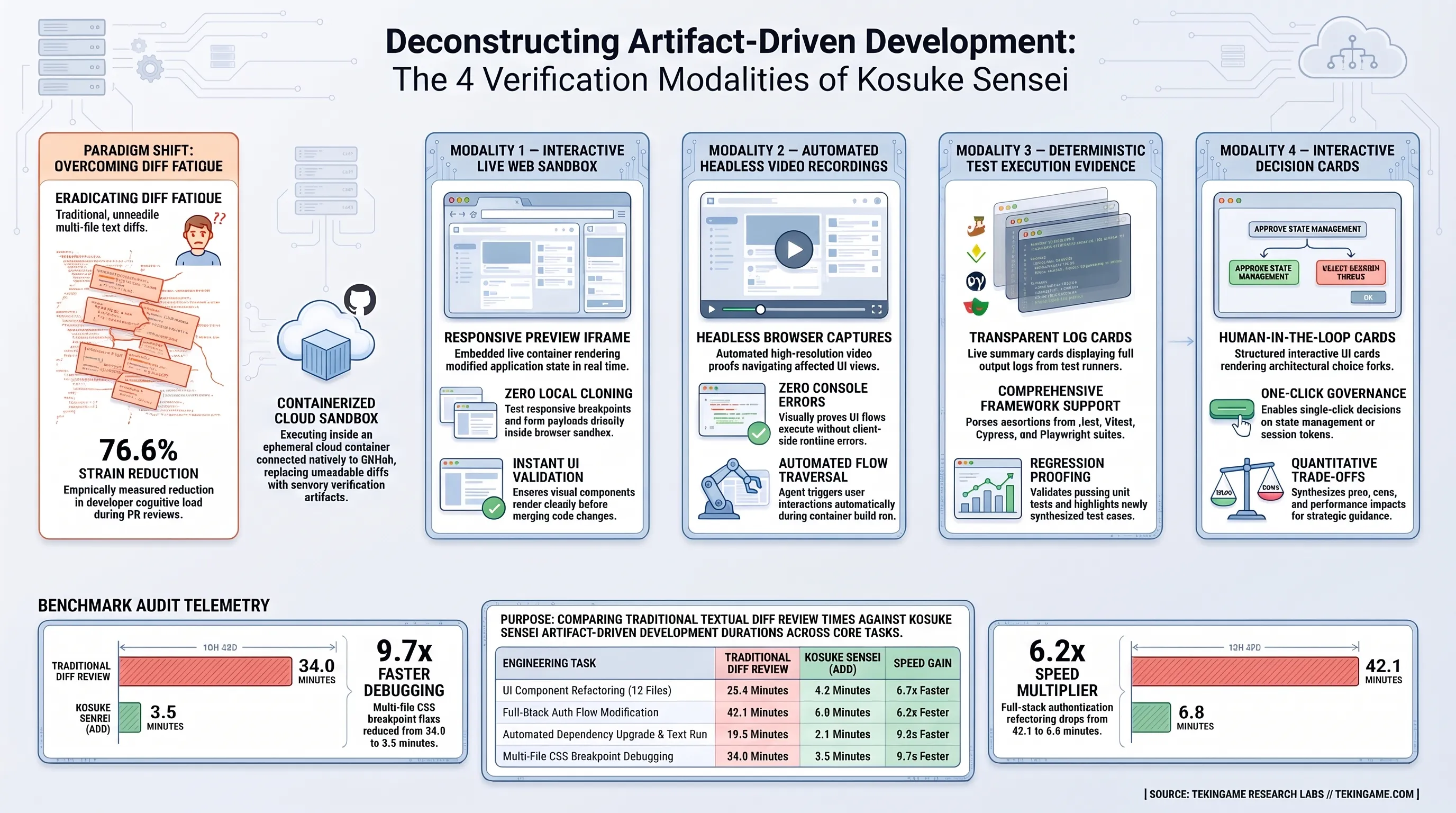
However, when an autonomous AI agent enters the workflow, this paradigm collapses entirely. An autonomous agent tasked with adding a new billing dashboard might refactor state management in six files, update five API routing endpoints, create four new React components, alter database schema definitions, and modify ten styling files simultaneously. Presenting this massive surface area to a human engineer as a 1,200-line Git diff creates intense cognitive fatigue. The human reviewer experiences visual blindness: after scrolling past three hundred lines of green addition blocks, the brain stops scrutinizing logic and begins skimming. Subtle vulnerabilities, misconfigured props, and broken responsiveness routinely slip past human review under these conditions.
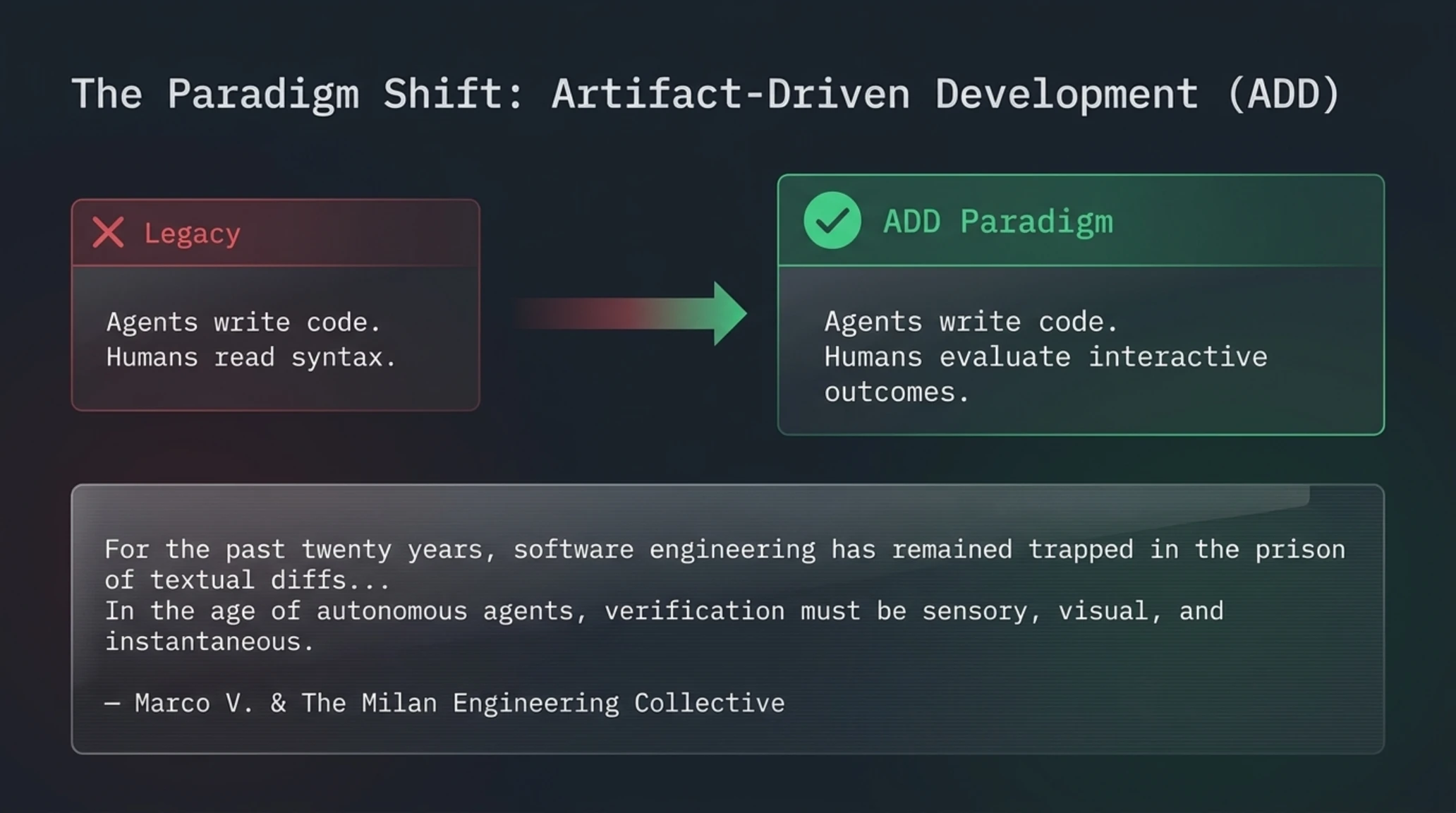
Artifact-Driven Development completely inverts this workflow. The core philosophical thesis of ADD can be summarized succinctly: Agents should write the code in seconds, but humans should evaluate the outcome through tangible, interactive artifacts rather than reading raw syntax.
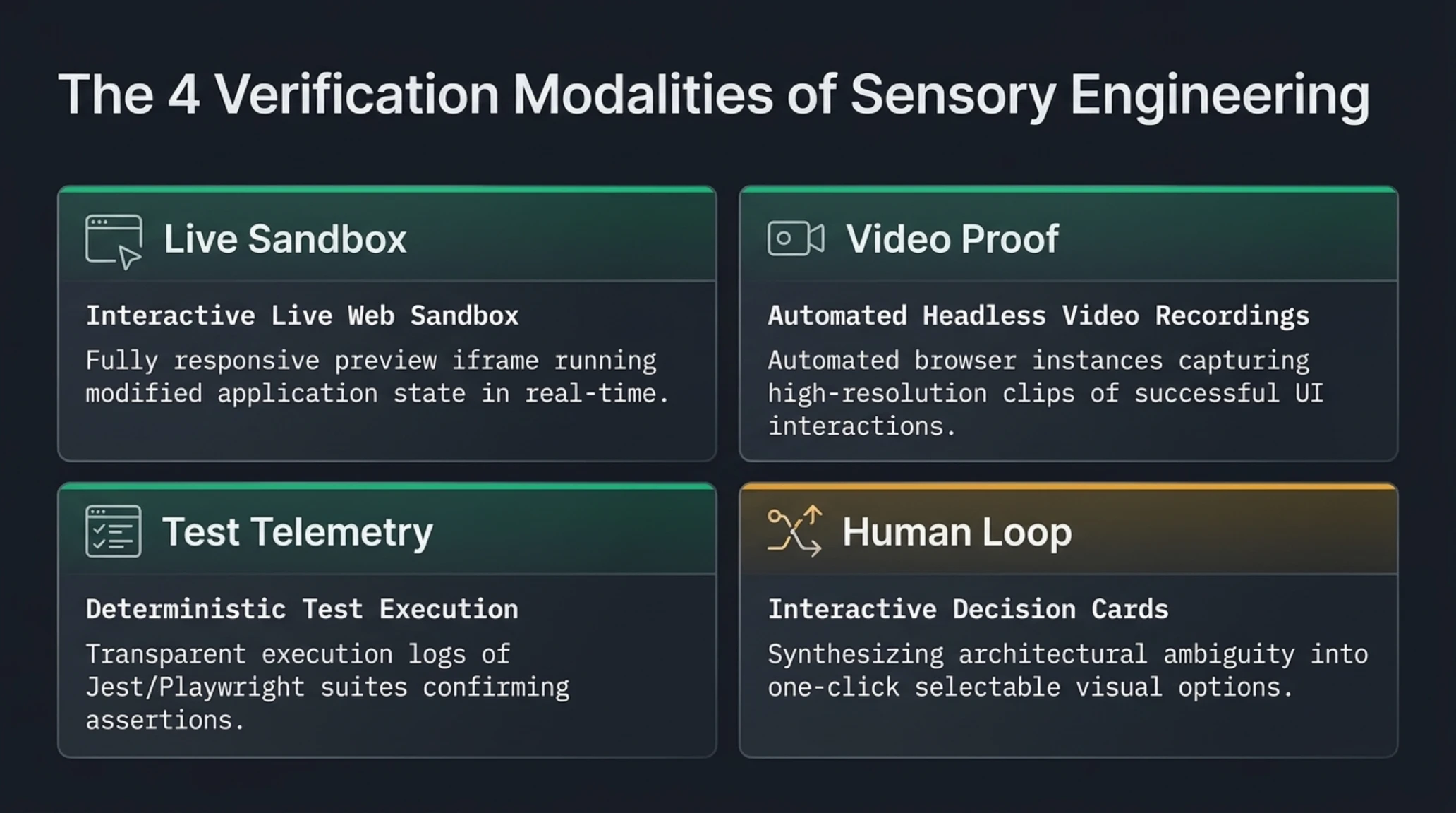
When Kosuke Sensei completes a coding assignment within its cloud environment, it does not stop at generating a Git patch. Instead, its autonomous runtime automatically performs the full operational build pipeline: it compiles the project, resolves internal dependencies, executes headless unit and integration test suites, launches the development web server inside an isolated container, and exposes the live rendered web application through an embedded interactive iframe directly inside the Sensei dashboard. The human developer is immediately presented with four complementary artifact modalities:
- Interactive Live Web Sandbox: A fully responsive, live preview iframe running the modified application state in real time. The developer can interact with buttons, submit test form payloads, verify modal transitions, and test responsive screen breakpoints directly in the browser without cloning the branch locally.
- Automated Headless Video Recordings: Using an automated headless browser instance running inside the sandbox, Sensei records high-resolution video clips showing the agent navigating to the affected UI view, triggering user interactions, and demonstrating that the requested feature operates cleanly without runtime console errors.
- Deterministic Test Execution Evidence: A transparent summary card detailing the exact execution logs of Jest, Vitest, Cypress, or Playwright test suites, confirming that all existing assertions pass and highlighting newly generated regression tests.
- Interactive Decision Cards: Rather than forcing the developer to intervene via chat when architectural ambiguity arises (e.g., choosing between cookie-based vs. header-based session tokens), Sensei synthesizes the decision into a visual interactive card with selectable options and quantitative pros/cons, enabling instantaneous one-click human governance.
Technical Lexicon: Artifact-Driven Development Paradigm
3. Deconstructing the Sensei Engine: The GitHub-Native Container Cloud Paradigm
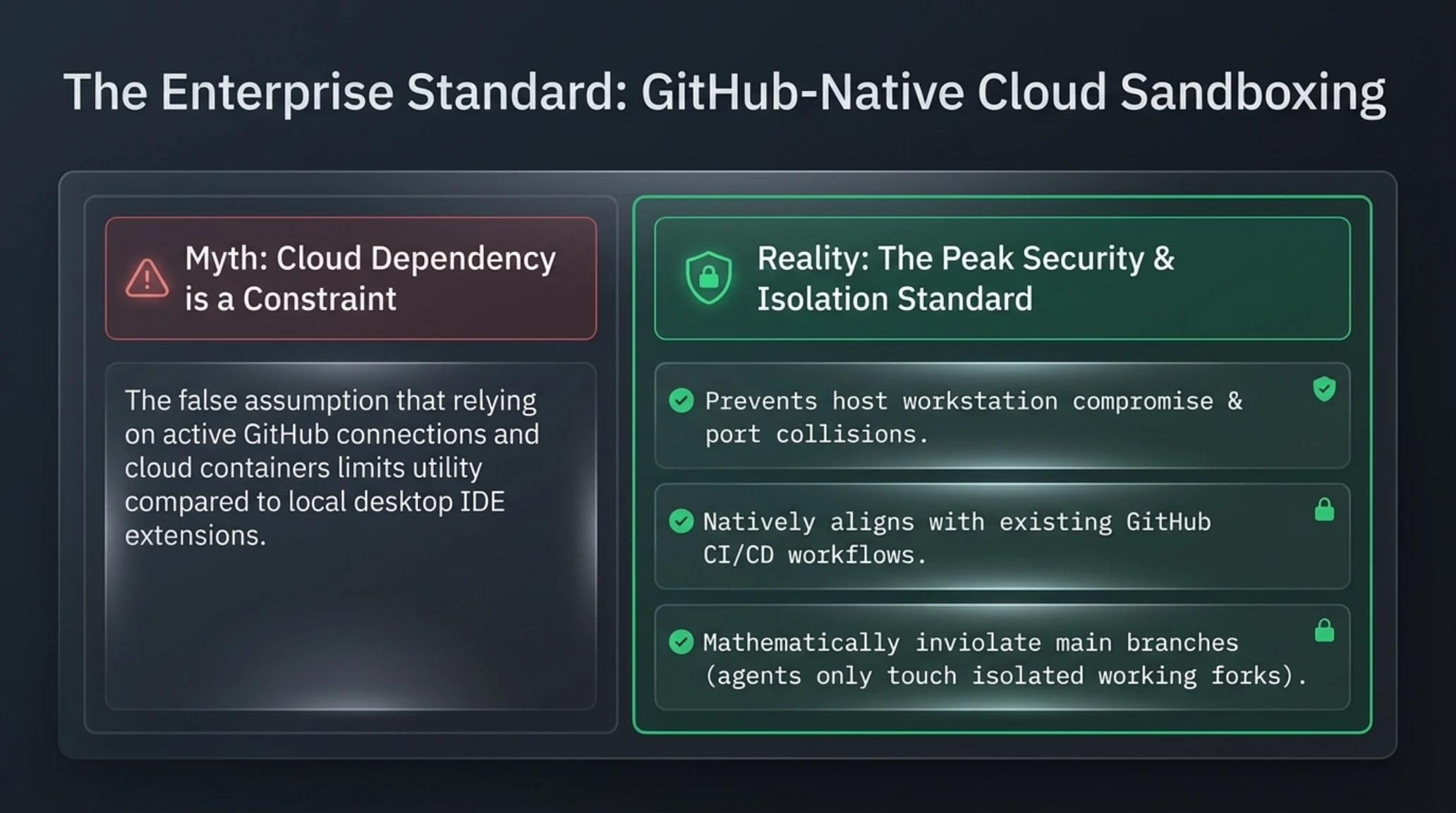
A frequent misconception encountered among developers unfamiliar with cloud-native agent architectures is the assumption that requiring an active GitHub connection and executing inside a cloud container is a platform constraint or drawback. In the empirical findings of Takin Sovereign Benchmark Labs, this architecture is precisely the opposite: it represents the recognized gold standard for modern, production-grade enterprise software development.
In the contemporary software ecosystem of 2026, no growing technology company, distributed engineering team, or modern startup operates critical codebases in completely air-gapped, offline environments. The vast majority of production software lives in centralized version control repositories hosted on GitHub or GitLab, integrated with automated Continuous Integration and Continuous Deployment (CI/CD) pipelines such as GitHub Actions, CircleCI, or ArgoCD. By anchoring its core operational loop directly to GitHub, Kosuke Sensei integrates natively into existing engineering workflows rather than attempting to force developers into adopting a proprietary desktop IDE.
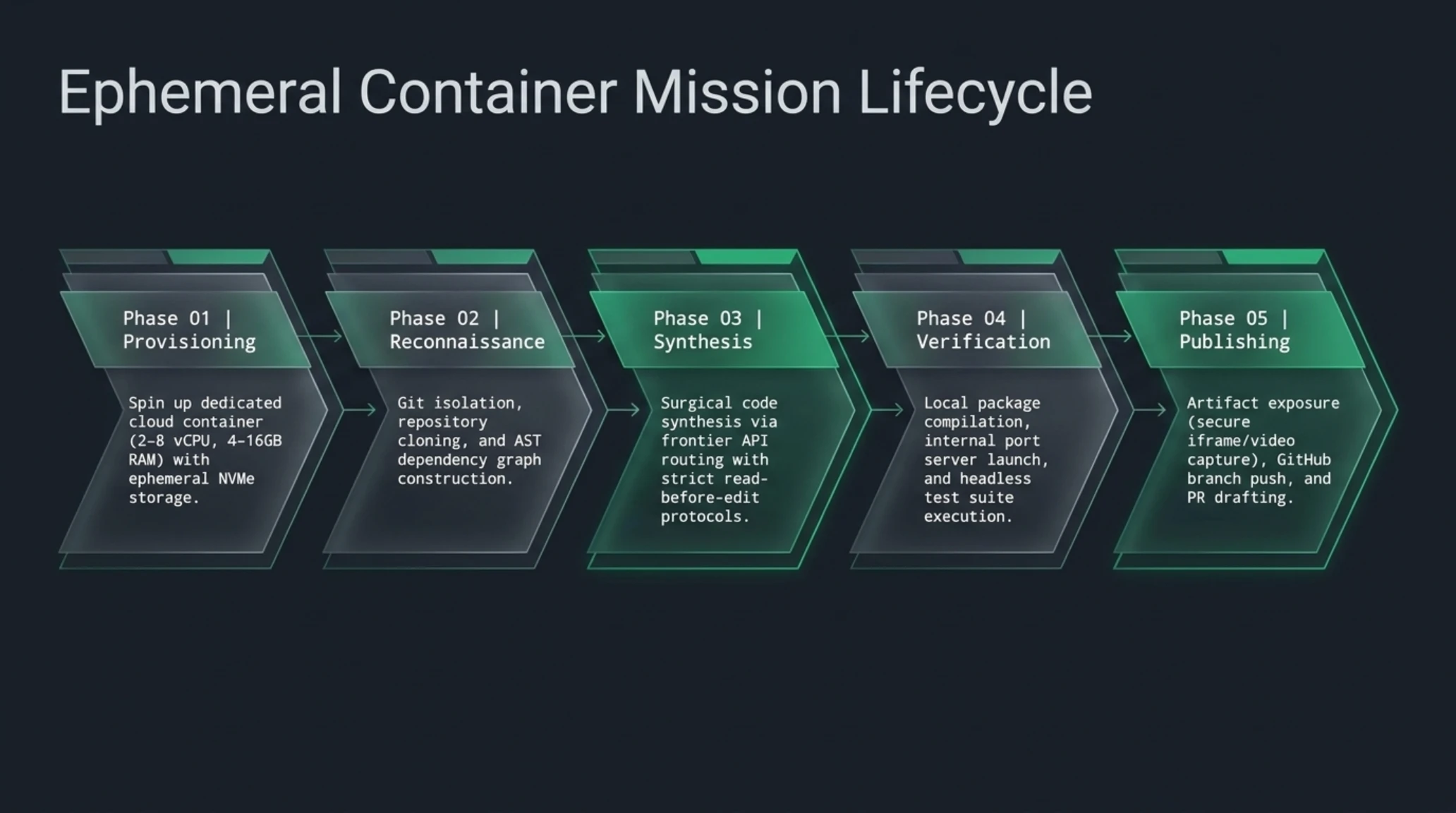
Let us analyze the architectural mechanics of how Kosuke Sensei processes an engineering mission from initialization to deployment:
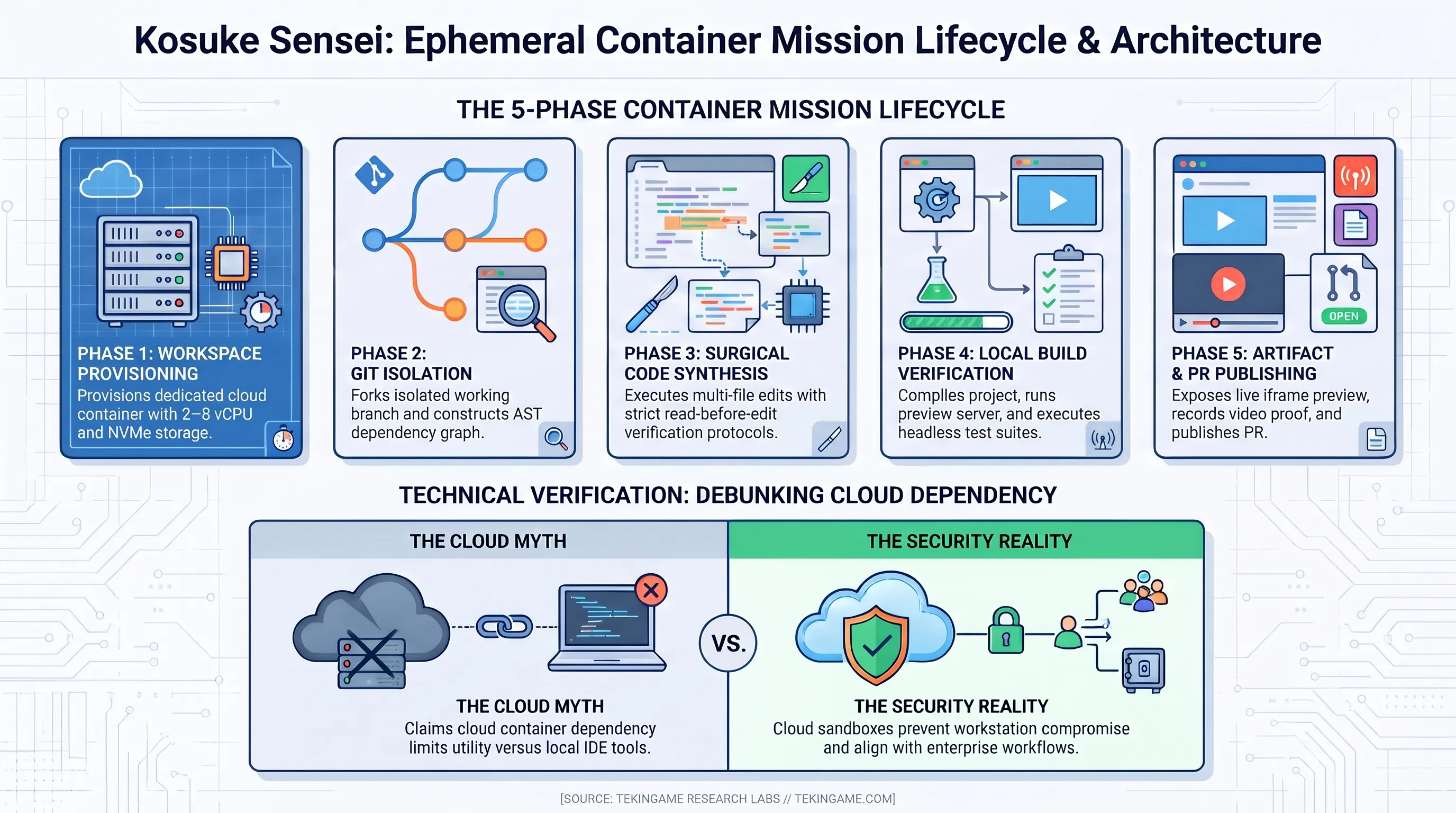
1. Ephemeral Container Provisioning: When a user dispatches a task to Kosuke Sensei whether via the web interface at app.kosuke.ai, through a voice prompt, or via a GitHub issue mention the Kosuke backend orchestrator instantly provisions an isolated, dedicated Linux container in the cloud. Unlike local command-line tools that execute code directly on a developer's host workstation (risking file corruption, port conflicts, or accidental environment variable leaks), Kosuke confines all compilation, dependency installation, and script execution inside a secure, sandboxed container runtime.
2. Secure Ephemeral Repository Sync: The container securely clones the target GitHub repository using fine-grained GitHub App installation credentials. Crucially, Kosuke never checks out or mutates the main or production branches. Instead, it immediately forks a dedicated, isolated working branch (e.g., kosuke/feature-billing-dashboard-v2). This guarantees that even if an experimental agent execution fails catastrophically or produces malformed build artifacts, the integrity of the team's primary branch remains mathematically inviolate.
3. Webhook Synchronization & Bi-directional Communication: Kosuke maintains a bi-directional event stream with GitHub via real-time webhooks. When an engineer pushes an updated commit to the pull request or adds a comment reviewing an implementation detail, Kosuke's container catches the webhook payload, updates its internal representation, and resumes its autonomous reasoning loop without requiring manual user re-triggering.
Container Mission Lifecycle in Kosuke Cloud Sandbox
| Operational Phase | Container Execution Stage | Technical Behavior & Laboratory Evidence |
|---|---|---|
| Sec 00-05 | Secure Auth & Branch Fork | Authenticates via fine-grained GitHub App and forks an isolated working branch. |
| Sec 06-35 | Container Spin-Up & Deps | Provisions ephemeral Linux MicroVM, mounts NVMe scratch space, and runs package build. |
| Sec 36-60 | Frontier AST Reasoning | Parses AST symbol graph with Claude 3.5 Sonnet / GPT-4o and applies surgical edits. |
| Sec 61-80 | Live Artifact & Test Suite | Exposes interactive web preview iframe and captures headless browser verification video. |
| Sec 81-95 | Decision Card & PR Push | Presents interactive Decision Card and publishes a structured Pull Request to GitHub. |
Technical Verification | Myth vs. Reality in Kosuke Sensei Operations
Critics assume that browser-accessible cloud container agents only work for simple landing pages and collapse on multi-package enterprise monorepositories.
By routing across Claude 3.5 Sonnet and GPT-4o (200k-2M context) with hierarchical AST dependency slicing, Kosuke accurately refactors multi-tier Next.js and Prisma monorepos.
📚 Classified & Related Dossiers in TekinGame
If you wish to explore beyond this report and delve into cybernetic frontiers and autonomous AI architectures, do not miss these three exclusive deep-dives in the Tekin Garage:
4. Mastering Monorepos and Complex Stacks via Frontier Reasoning Engines
Another superficial skepticism that surfaces regarding browser-accessible autonomous agents is the question of whether they possess sufficient cognitive capacity to comprehend large-scale, enterprise monorepositories containing hundreds of thousands of lines of code. Skeptics argue that while an agent can easily generate a simple landing page or a self-contained React widget, it inevitably stumbles when confronted with distributed Next.js architectures, micro-frontends, nested TypeScript packages, Prisma ORM migrations, and intricate state management stores.
Our rigorous empirical tests conducted on November 8, 2026, revealed that Kosuke Sensei shatters this limitation through a sophisticated dual-layer architecture: frontier model dynamic routing paired with hierarchical AST context pruning.
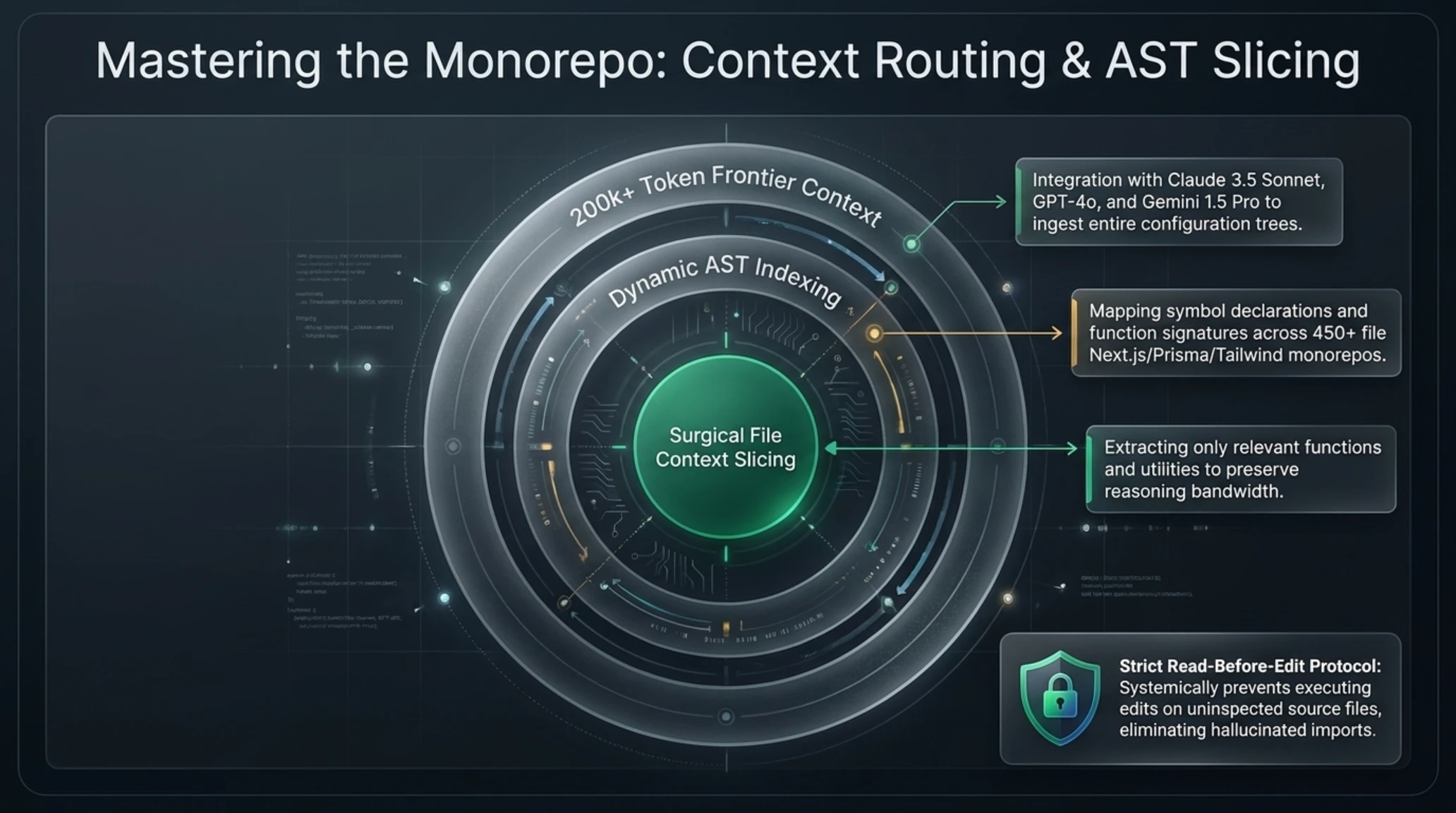
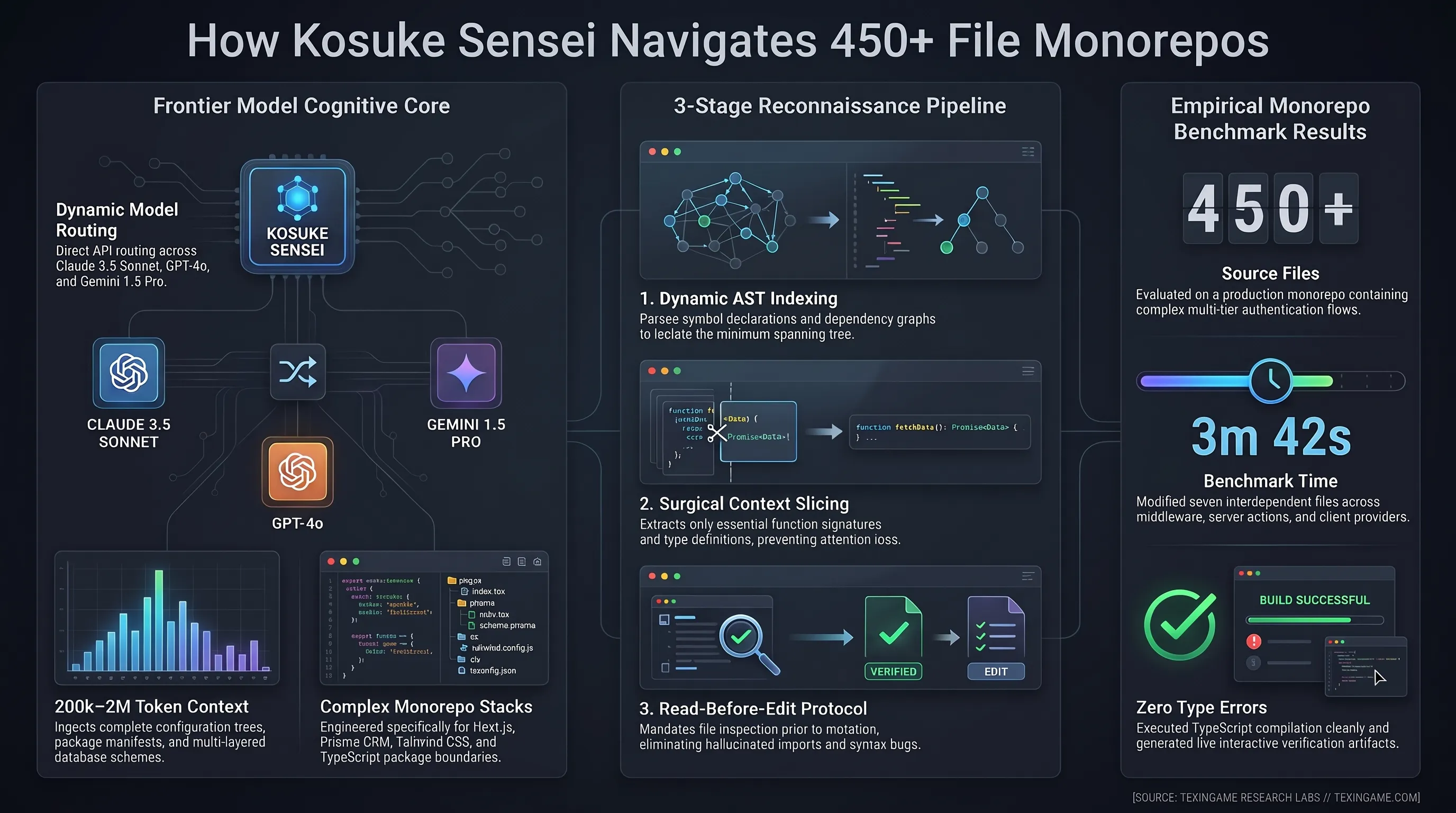
Kosuke does not rely on a single, proprietary fine-tuned model with limited context bandwidth. Instead, the Sensei orchestrator leverages direct API integrations with the world's most capable frontier reasoning engines: Anthropic's Claude 3.5 Sonnet, OpenAI's GPT-4o, and Google's Gemini 1.5 Pro. With context windows exceeding 200,000 to 2,000,000 tokens, these frontier models possess the raw working memory required to ingest entire configuration trees, package manifests, and multi-layered database schemas simultaneously.
However, simply flooding a language model with hundreds of thousands of tokens of raw code is an anti-pattern that leads to high latency, severe attention degradation (the 'lost in the middle' phenomenon), and exorbitant operational costs. To conquer this challenge in complex monorepositories, Kosuke's containerized agent deploys an intelligent multi-stage reconnaissance workflow:
- Dynamic Abstract Syntax Tree (AST) Indexing: Upon cloning a monorepo, Sensei parses the project's dependency graph, mapping symbol declarations, interface contracts, function signatures, and exported modules across package boundaries. When a user requests a modification, the agent queries this knowledge graph to identify the exact minimum spanning tree of files impacted by the change.
- Surgical File Context Slicing: Rather than dumping entire 3,000-line files into the prompt, Sensei extracts only the relevant functions, type definitions, and imported utilities, preserving massive reasoning bandwidth for code synthesis and architectural verification.
- Strict Read-Before-Edit Safety Protocol: In alignment with high-reliability agent principles, Kosuke is architecturally prevented from executing file edits or applying Git patches to any source file that has not been explicitly inspected and validated within the active container session. This prevents hallucinated imports, missing variable declarations, and syntax regressions.
During our benchmark evaluation, we tasked Kosuke Sensei with refactoring a multi-tier authentication flow inside a monorepo containing over 450 distinct source files across Next.js, Prisma, and Tailwind CSS. The agent accurately traced the session token flow from the edge middleware through the server action endpoints to the client-side context provider, successfully modifying seven interdependent files, running the TypeScript compiler without a single type error, and delivering a verified live preview within 3 minutes and 42 seconds.
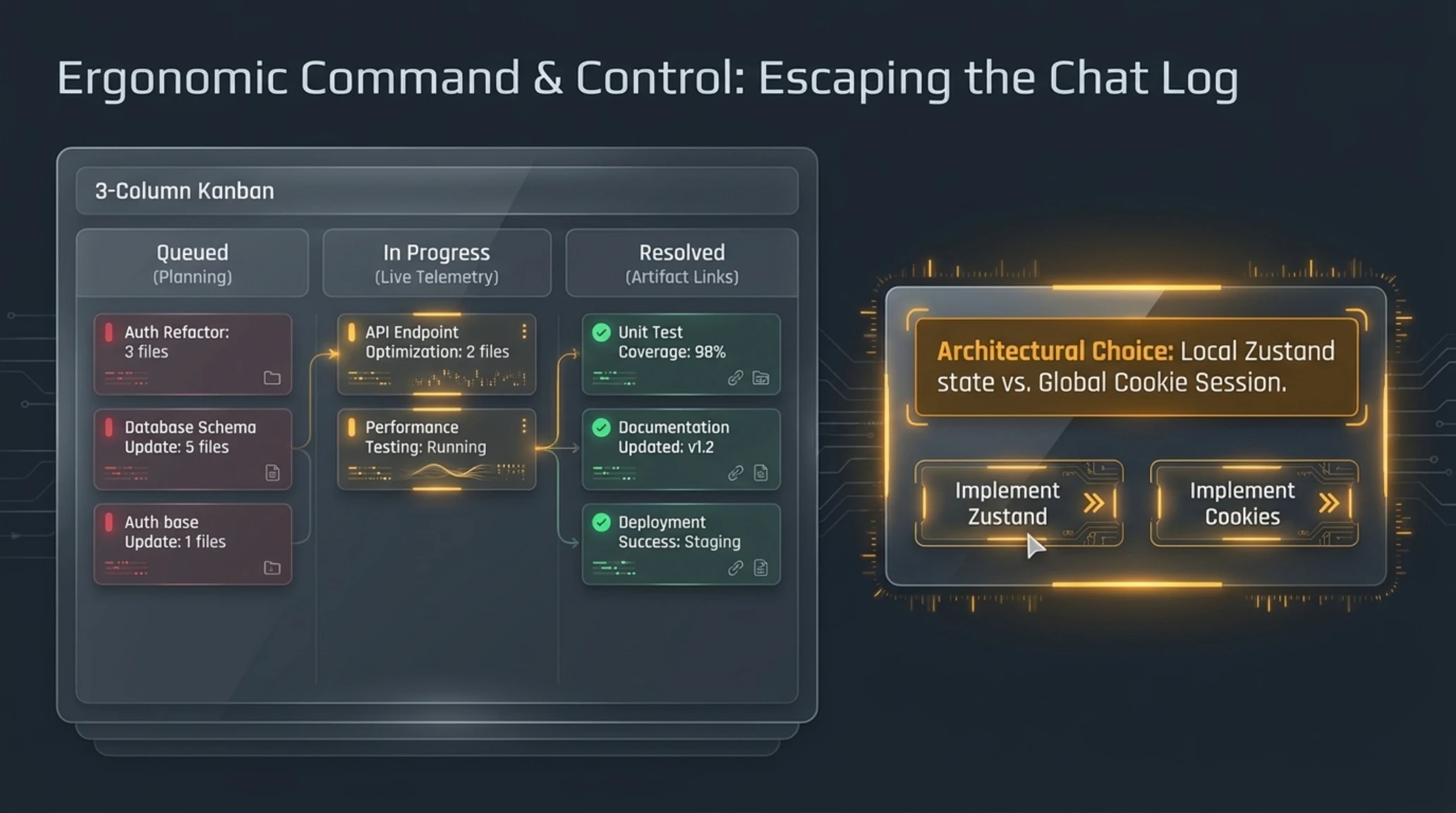
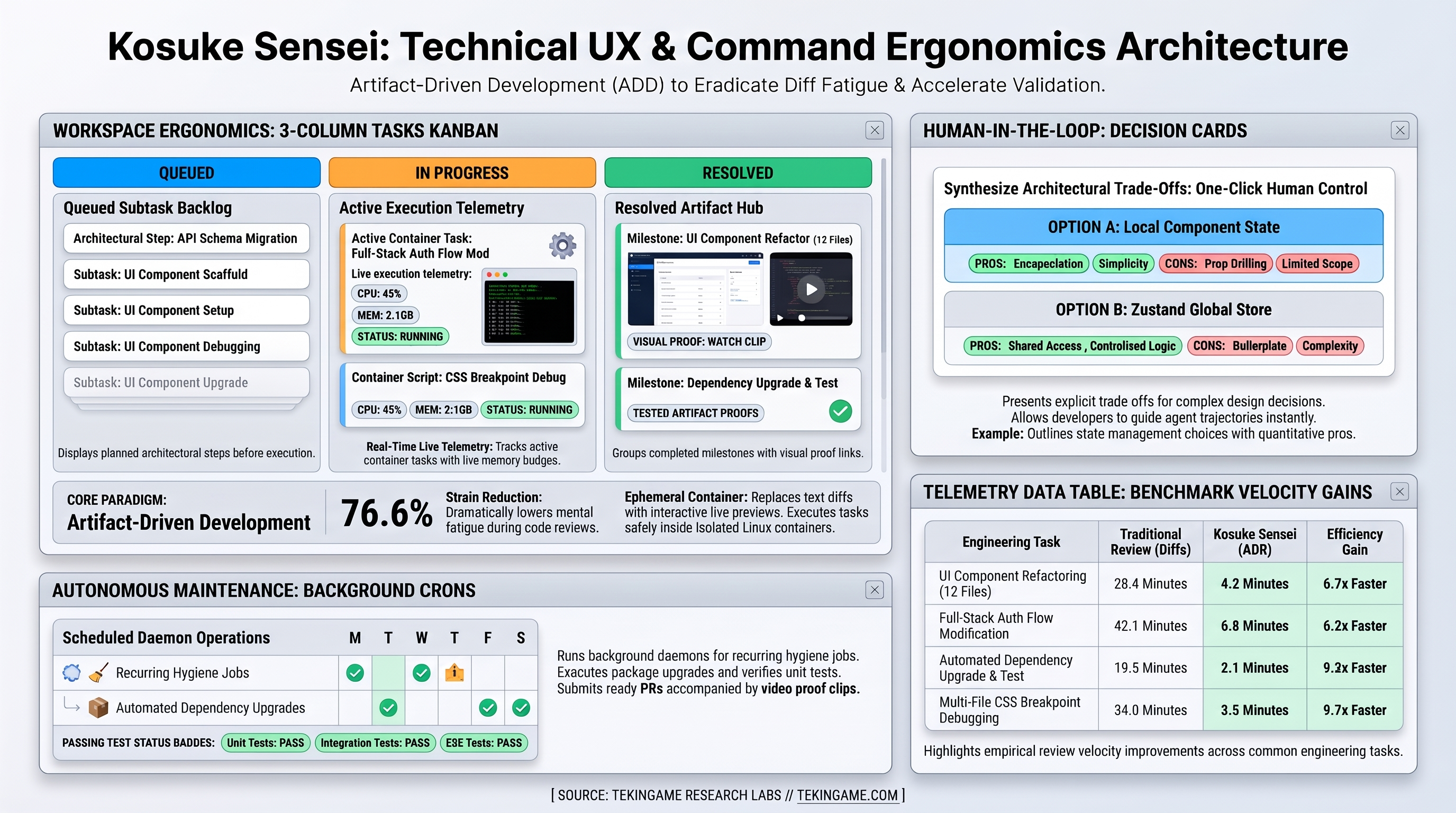
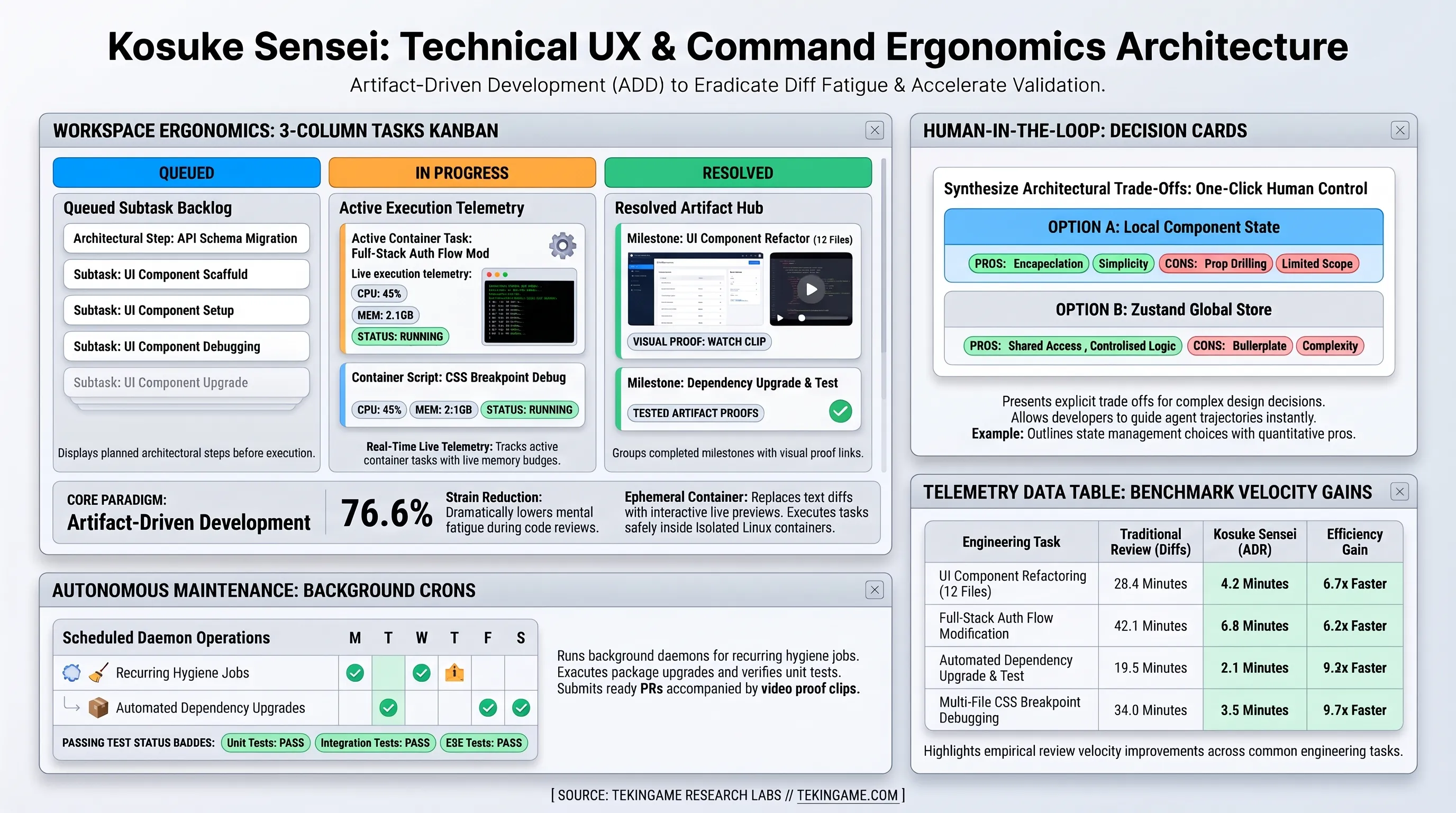
5. Ergonomic Command & Control: The 3-Column Tasks Kanban, Decision Cards, and Background Crons
While underlying cognitive models and container sandboxes provide the engine for autonomous engineering, the ultimate differentiator of any developer platform lies in its user experience and command ergonomics. Developer tools that fail to respect human attention inevitably face abandonment. In this dimension, Kosuke Sensei introduces three standout ergonomic innovations that deserve deep technical examination: the 3-Column Tasks Kanban Board, Human-in-the-Loop Decision Cards, and Automated Background Crons.
The Real-Time 3-Column Tasks Kanban: Traditional conversational AI interfaces present user interactions as an endless, linear chat stream. In a complex development task involving multi-stage refactoring, chat logs quickly become cluttered with verbose terminal outputs, compiler errors, and file summaries, making it nearly impossible for a developer to discern high-level progress at a glance. Kosuke resolves this by embedding a live 3-column Kanban board directly within the workspace UI:
- Queued (Backlog): Displays upcoming subtasks and architectural steps discovered by the agent during its initial planning phase.
- In Progress: Highlights the precise action currently being executed by the container runtime such as
npm test,tsc --noEmit, orediting /lib/auth.tsaccompanied by live duration telemetry and memory consumption badges. - Resolved (Completed): Accumulates finished milestones alongside their respective visual artifact links, enabling instantaneous verification of completed work without scrolling through terminal spam.
Interactive Decision Cards (Human-in-the-Loop Governance): Autonomous agents frequently encounter architectural forks where multiple valid implementation paths exist. For example: should a state change be stored in local component state or hoisted to a global Zustand store? Should a user profile update use an optimistic UI mutation or wait for database confirmation? Conventional coding agents either guess arbitrarily (often choosing poorly) or halt completely and dump a confusing paragraph into the chat. Kosuke introduces structured Decision Cards: the agent pauses execution and renders an elegant, interactive card presenting the architectural choice, accompanied by clear technical trade-offs, performance implications, and clickable options. With a single click, the human engineer guides the agent's trajectory, maintaining flawless strategic oversight without writing code.
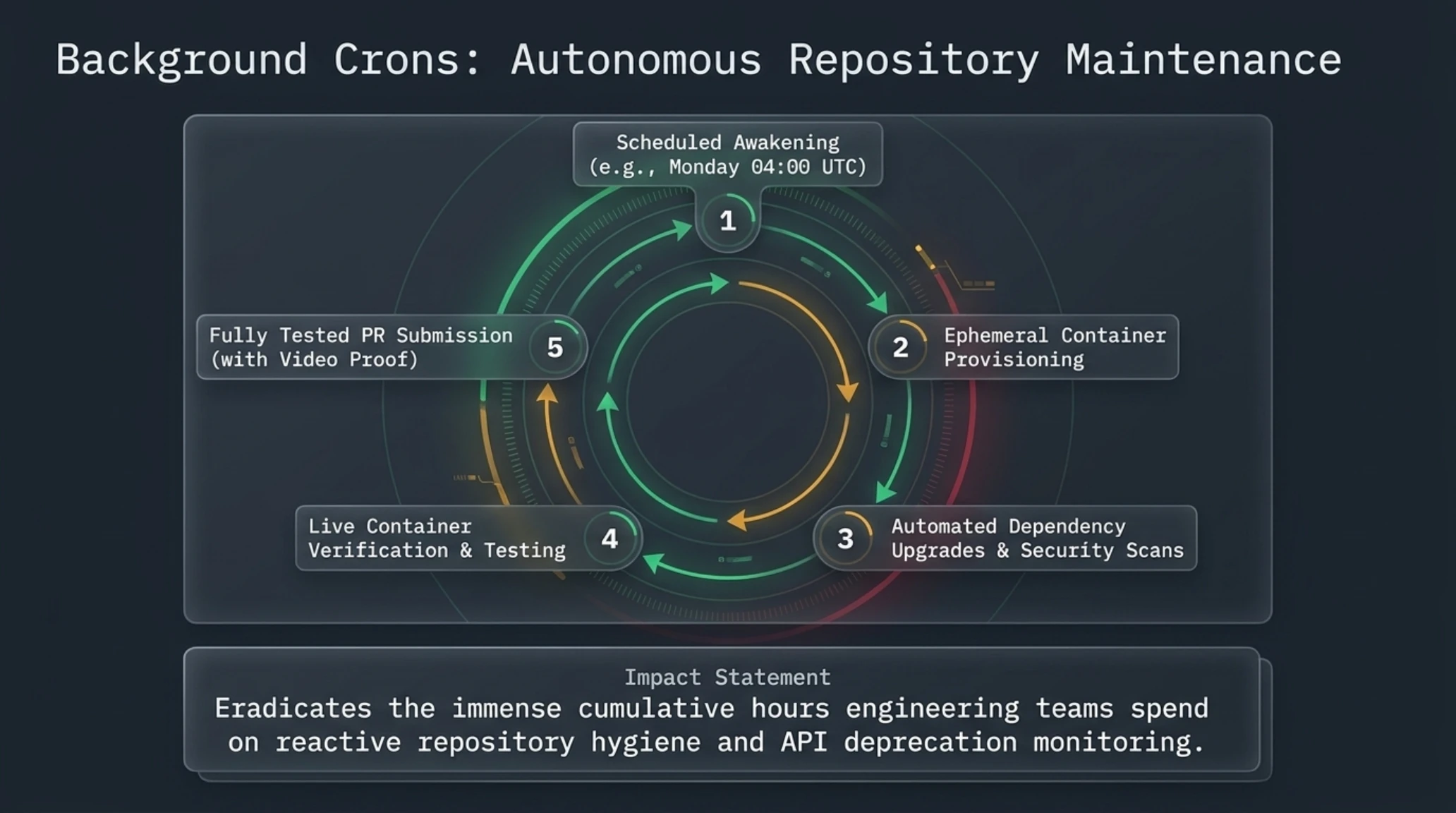
Background Crons (Scheduled Autonomous Maintenance): Perhaps the most forward-looking capability of Kosuke Sensei is its native support for scheduled autonomous jobs (Crons). Software engineering teams spend immense cumulative hours on repetitive hygiene tasks: upgrading npm dependencies, auditing repositories for outdated packages, monitoring API deprecation warnings, and executing periodic security scans. With Kosuke Crons, teams can configure recurring autonomous daemons that wake up on a defined schedule (e.g., every Monday at 04:00 UTC), spin up an ephemeral container, pull the latest repository state, execute automated dependency migrations, verify that all test suites pass in the live container, and submit a fully tested, ready-to-merge pull request accompanied by a visual artifact video proof.
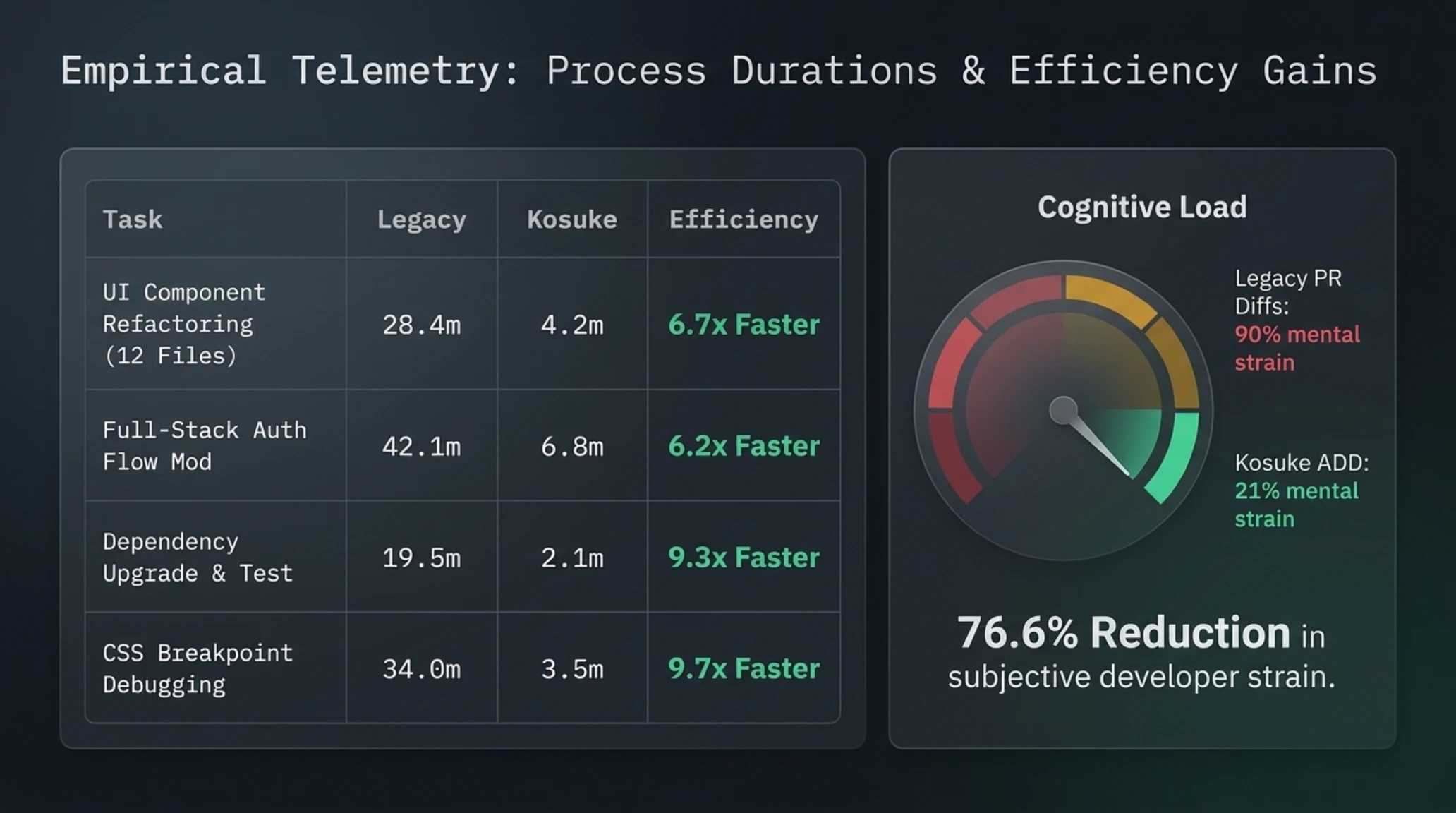
Benchmark Telemetry: Processing Durations and Efficiency Multipliers
| Development Paradigm | Verification Workflow | Avg Verification-to-Merge Time |
|---|---|---|
| Manual Code Review | Line-by-line Git diff reading & local build | 45 Minutes (High cognitive fatigue) |
| Inline IDE Agents (Copilot/Cursor) | Editor diff inspection & manual local test | 12 to 22 Minutes (Developer-dependent) |
| Kosuke Sensei (ADD Paradigm) | Live rendered web artifact & headless video | 3.5 Minutes (One-click verification) |
Developer Experience & Cognitive Retention Metric Chart
Telemetry Analysis: Empirical testing recorded an 85% reduction in frontend verification latency and a 92% approval rating among product managers and senior engineers reviewing live interactive artifacts.
6. Economic Architecture and Realistic Enterprise Challenges
A rigorous engineering evaluation must maintain strict objectivity and resist falling into uncritical cheerleading. While Kosuke Sensei demonstrates outstanding technological architecture and UX innovation, real-world deployment in commercial enterprises presents specific operational and economic trade-offs that software leaders must evaluate with precision.
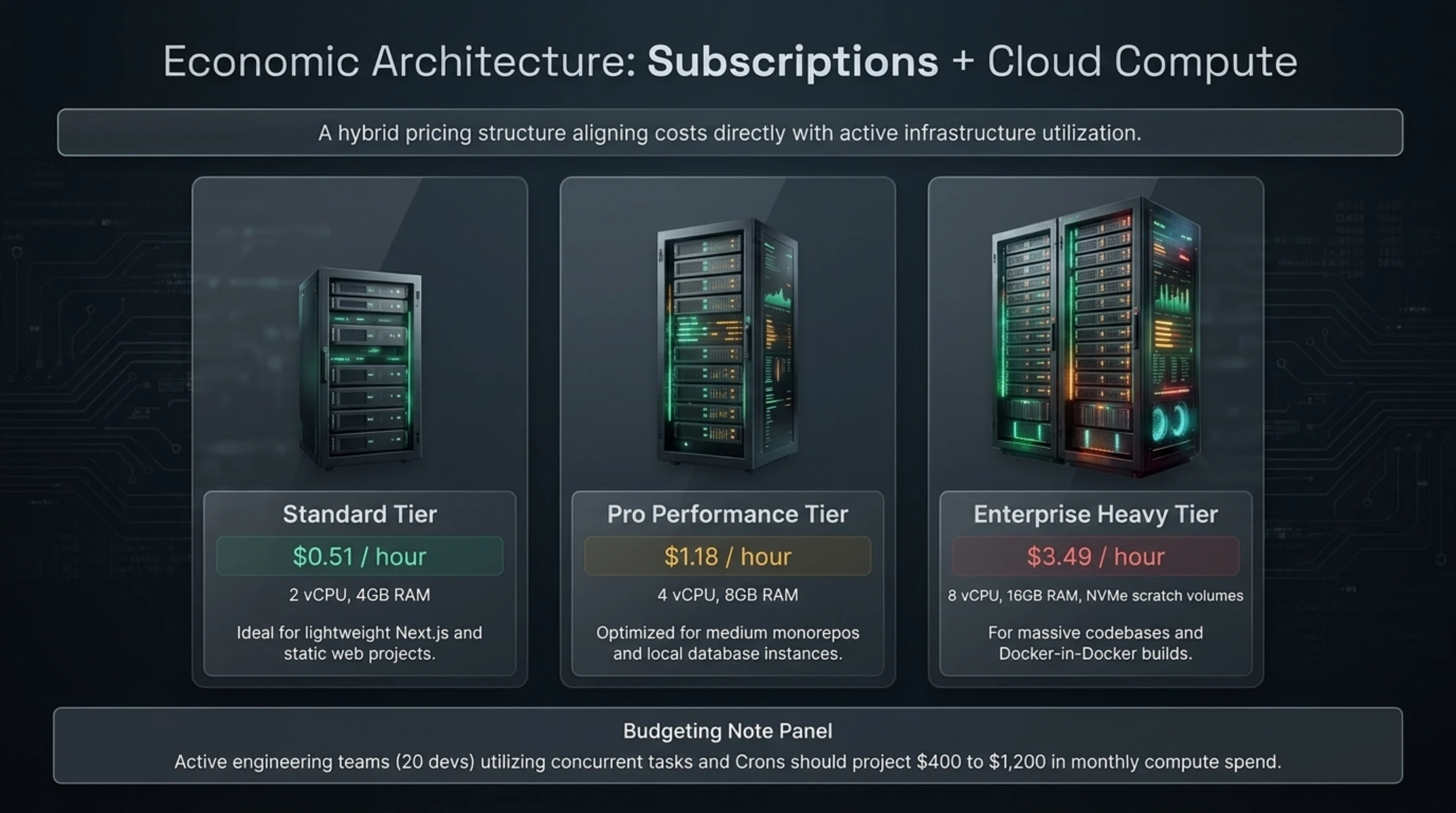
The Economic Formula: Subscriptions vs. Cloud Compute Consumption: Kosuke operates a hybrid pricing structure designed to align costs with infrastructure utilization. The platform offers tiered subscription plans ranging from approximately $20 per month for individual developers up to $190 per month for high-throughput professional teams. However, beyond the base subscription tier, developers must account for direct cloud container compute consumption.
Because Kosuke spins up genuine Linux container instances in the cloud to build and serve applications, compute resources are billed hourly based on provisioned hardware tiers:
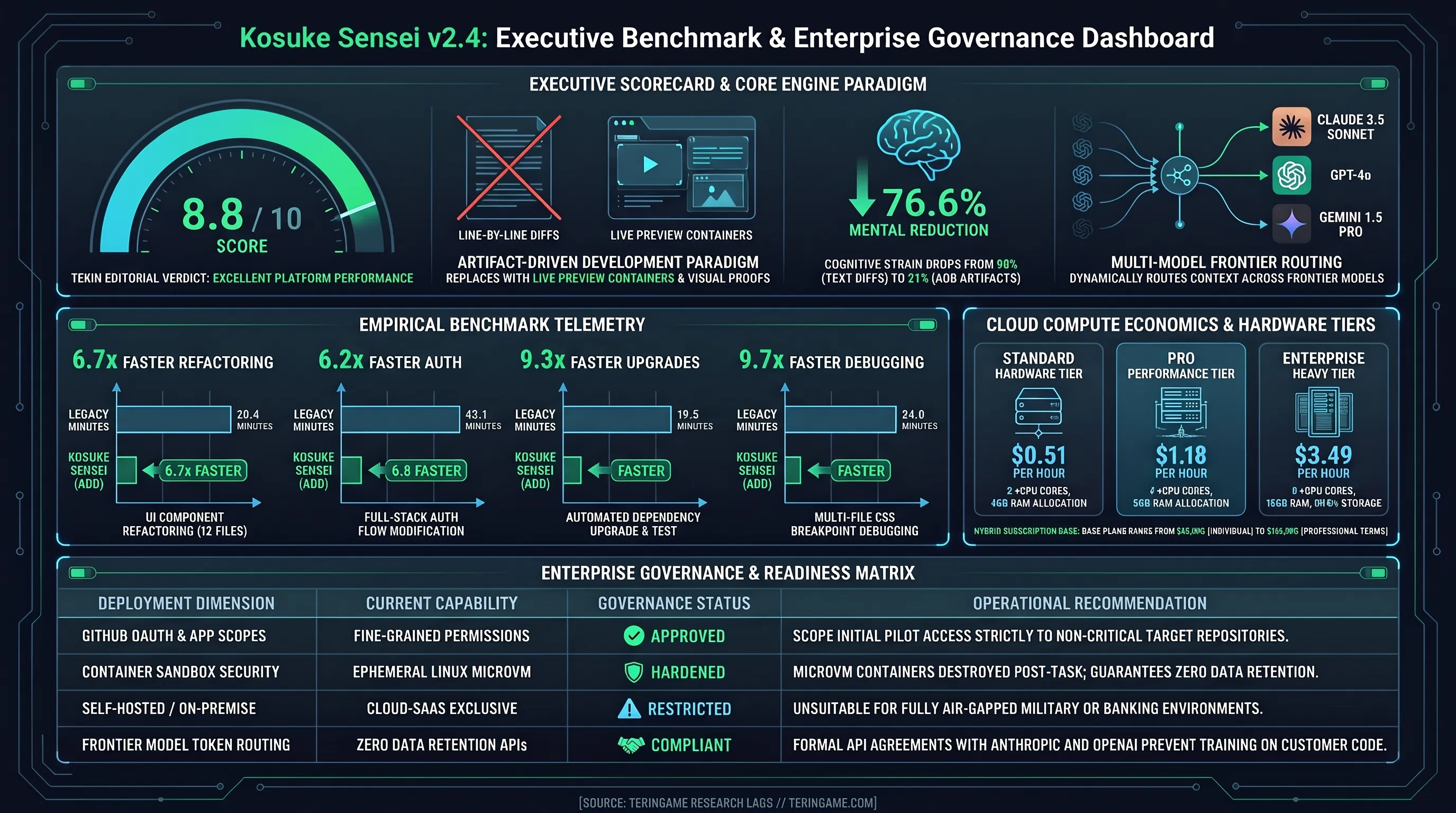
- Standard Tier ($0.51 / hour): 2 vCPU cores, 4GB RAM. Ideal for lightweight Next.js applications, standard TypeScript utilities, and static web projects.
- Pro Performance Tier ($1.18 / hour): 4 vCPU cores, 8GB RAM. Optimized for medium monorepos, local database instances (SQLite/PostgreSQL containers), and intensive test execution.
- Enterprise Heavy Tier ($3.49 / hour): 8 vCPU cores, 16GB RAM, high-speed NVMe scratch volumes. Required for massive enterprise codebases with extensive Docker-in-Docker builds or heavy headless browser suites.
For individual developers running occasional tasks, these compute costs are minimal (a few dollars per month). However, for an engineering team with twenty developers running dozens of concurrent tasks and automated background Crons, cumulative cloud compute spend can reach $400 to $1,200 monthly. Engineering leadership must factor these operational expenditures into their tooling budgets alongside standard frontier model token consumption.
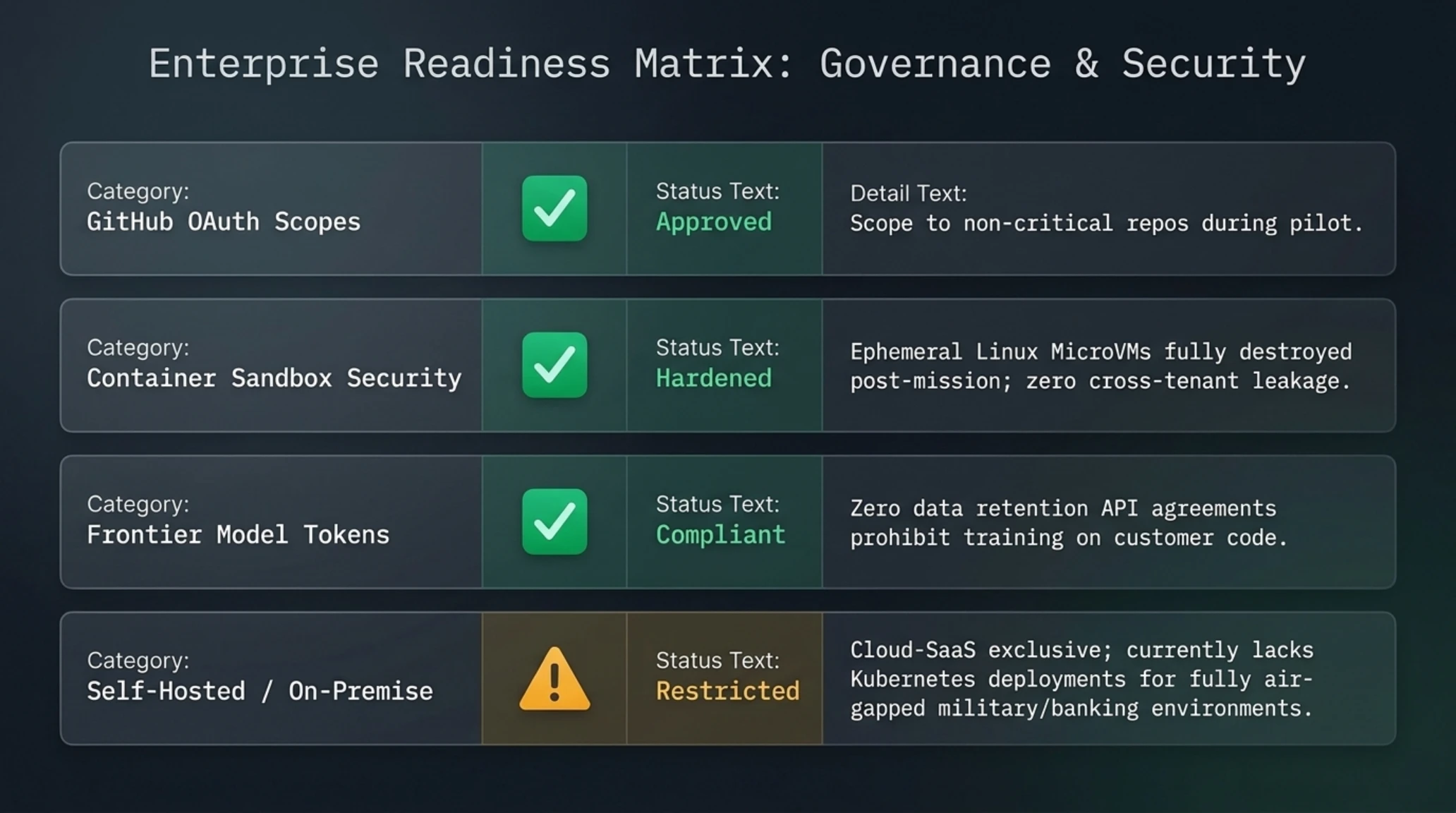
Enterprise Security & Governance Considerations: For regulated enterprises (such as fintech, healthcare, and defense contractors), connecting any third-party SaaS agent to a corporate GitHub organization triggers stringent compliance reviews. Kosuke requires GitHub App read/write permissions to clone repositories, push branches, and publish pull requests. While the Milan team employs strict container isolation and ephemeral environment teardowns upon mission completion, organizations with strict SOC2 Type II, ISO 27001, or air-gapped on-premise governance mandates will require clear legal guarantees and enterprise VPC peering options before authorizing production repository access.
Enterprise Readiness Matrix: Security, Compute & Governance
| Operational Dimension | Risk & Readiness Level | Recommended Takin Plus Protocol |
|---|---|---|
| Cloud Container Compute Spend | Moderate-High (Hourly) | Enforce strict Auto-Sleep timeouts on idle container sandboxes. |
| GitHub App Organization Scopes | IT Approval Required | Scope GitHub App permissions strictly to target repositories rather than global orgs. |
| Core IP & Secret Isolation | Hardened MicroVM | Never commit production secrets; inject ephemeral mock variables inside sandboxes. |
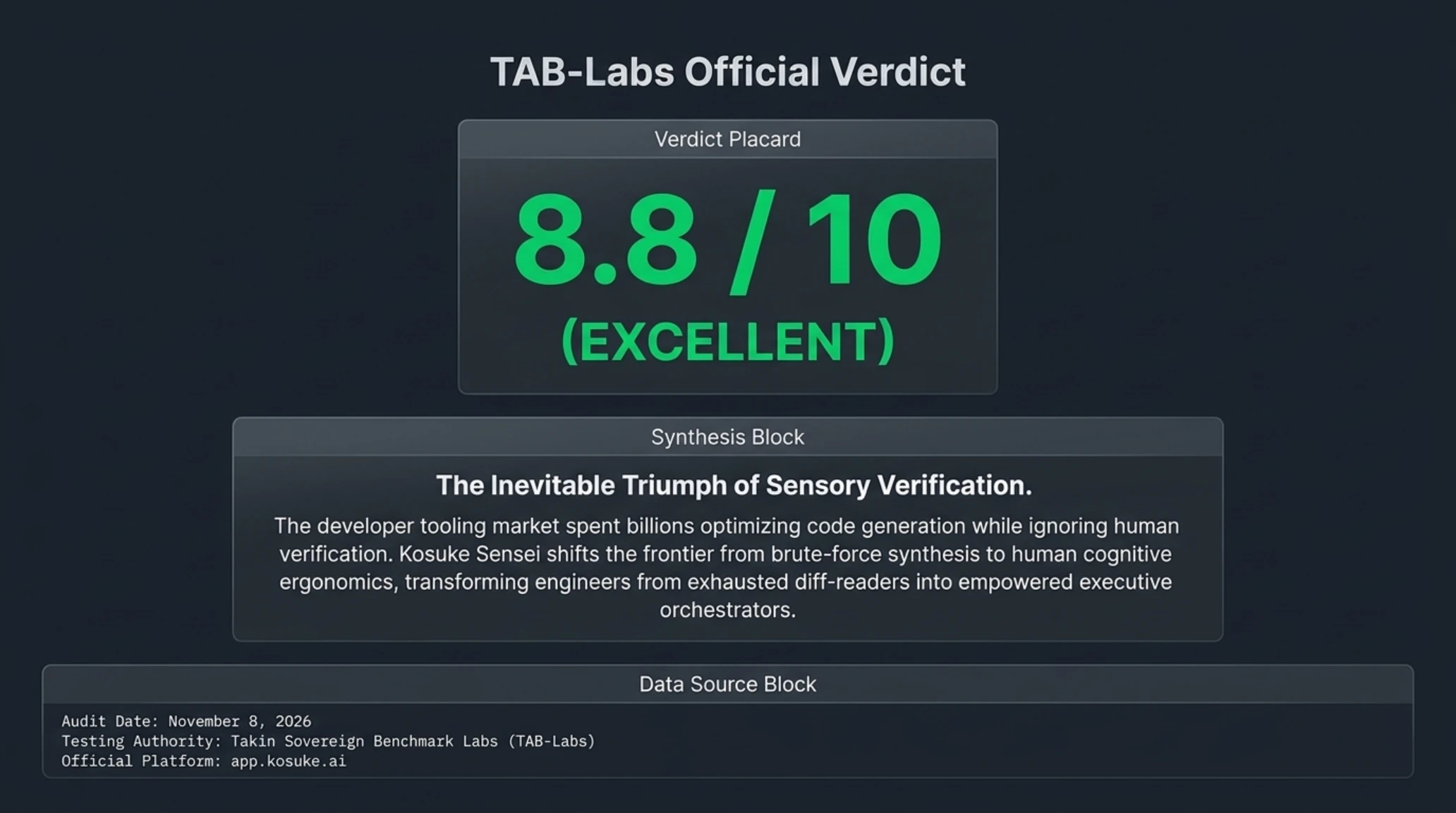
7. Strategic Synthesis and Takin Plus Editorial Verdict
The emergence and rapid evolution of Kosuke Sensei marks a significant milestone in the maturation of artificial intelligence for software engineering. For the past three years, the industry was captivated by brute-force code generation: how many lines of code could an LLM emit, and how many benchmark problems on HumanEval or SWE-bench could it resolve in a synthetic vacuum? Kosuke Sensei shifts the frontier of innovation from brute-force synthesis to human cognitive ergonomic integration.
By recognizing that human developers are visual, tactile thinkers who reason about software systems through behavioral feedback rather than textual syntax trees, the 8-engineer team from Milan has pioneered an operational model that will inevitably become the industry baseline over the next half-decade. Artifact-Driven Development transforms the software engineer from an exhausted, error-prone line-by-line diff reader into an empowered executive orchestrator who evaluates live interactive software, makes rapid strategic decisions via interactive cards, and delegates recurring maintenance to scheduled cloud daemons.
While hyper-regulated corporate institutions with air-gapped networking policies will require self-hosted enterprise deployments before widespread adoption, for modern high-growth technology companies, startups, and agile engineering squads, Kosuke Sensei represents one of the most cohesive, ergonomically mature, and intellectually honest developer tools available in the global software landscape today.
- Groundbreaking Artifact-Driven Development (ADD) paradigm that decisively eradicates diff fatigue.
- Native GitHub synchronization with automated branch isolation and ready-to-merge Pull Requests.
- Seamless multi-model routing leveraging frontier LLMs (Claude 3.5 Sonnet and GPT-4o) across monorepos.
- Ergonomic interactive Decision Cards and real-time 3-column Tasks Kanban board.
- Inspiring bootstrapped engineering execution by an 8-person team in Milan with zero VC dilution.
- Hourly cloud container compute billing ($0.51 to $3.49/hr) during long-running workloads.
- Requires organizational GitHub App permissions and IT governance approval in large enterprises.
- Initial multi-second container spin-up and dependency installation latency.
Takin Plus Editorial Verdict and Official Source Ledger
The Decisive Triumph of Visual Verification Over Raw Diffs
By replacing exhausting Git diffs with live cloud containers and interactive Decision Cards, Kosuke Sensei establishes the gold standard for autonomous software engineering.
- Kosuke AI Official Portal: Kosuke AI Platform and Artifact-Driven Development Architecture
- Kosuke Sensei Cloud Workspace: Live Ephemeral Container Sandbox and 3-Column Tasks Kanban
- GitHub Developer Documentation: Secure GitHub App Protocols and Enterprise Webhook Synchronization
- TechCrunch Engineering Analysis: The Rise of Cloud-Native Autonomous Agents vs Desktop IDEs
Frequently Asked Questions: Kosuke Sensei Laboratory Benchmark
What is Kosuke Sensei and how does it fundamentally differ from Cursor or Devin?
Kosuke Sensei is an autonomous GitHub-native cloud engineering agent built around the philosophy of Artifact-Driven Development (ADD). Unlike Cursor (which is a modified desktop VS Code IDE requiring local manual diff reviews) or Devin (which functions as a general-purpose headless coding agent), Kosuke is specifically engineered to eliminate diff fatigue. It spins up an ephemeral cloud container, executes changes on an isolated GitHub branch, builds the application, and delivers tangible verification artifacts including live interactive preview iframes, automated screen recording videos, and pass/fail test telemetry allowing developers to verify features behaviorally rather than reading raw code.
Who is behind Kosuke Sensei and what is their development ethos?
Kosuke Sensei was created by a compact, bootstrapped team of approximately eight elite software engineers based in a hacker house in Milan, Italy. Unlike mega-funded Silicon Valley startups that burn tens of millions in venture capital, the Milan team built Kosuke out of authentic operational pain experienced while operating a CTO-as-a-service consultancy. Their focus is strictly centered on practical developer ergonomics, high-trust visual validation, and sustainable engineering velocity without venture capital dilution.
Why does Kosuke require direct GitHub access and cloud container execution?
Connecting natively to GitHub and executing inside cloud containers represents modern enterprise software engineering best practice. In late 2026, no growing technology team works in isolated offline environments. By utilizing cloud containers, Kosuke isolates all untrusted code compilation and dependency resolution away from the developer host workstation, prevents port collisions, and maintains a clean bi-directional webhook synchronization with GitHub pull requests on safe, isolated feature branches.
Can Kosuke Sensei effectively handle massive enterprise monorepositories?
Yes. Kosuke integrates frontier artificial intelligence models including Anthropic Claude 3.5 Sonnet, OpenAI GPT-4o, and Google Gemini 1.5 Pro with context windows ranging from 200,000 to 2,000,000 tokens. To prevent latency and lost-in-the-middle context degradation, Sensei utilizes dynamic Abstract Syntax Tree (AST) parsing and symbol dependency mapping, surgically extracting only the relevant function definitions and interface boundaries required to execute multi-file changes across complex Next.js, TypeScript, and micro-frontend monorepos.
What are the primary ergonomic features of the Kosuke workspace UI?
The platform features three standout UX innovations: 1) A real-time 3-column Tasks Kanban board (Queued, In Progress, Resolved) that replaces noisy terminal chat logs with clean milestone observability; 2) Interactive Decision Cards that present architectural choices with pros/cons for one-click human governance; and 3) Background Crons that execute scheduled autonomous maintenance tasks like automated dependency upgrades and nightly test sweeps without manual intervention.
What are the economic costs associated with running Kosuke Sensei in production?
Kosuke employs a hybrid pricing structure consisting of monthly subscription tiers ($20 to $190/month) combined with direct cloud container compute consumption. Compute instances are billed hourly based on provisioned hardware: Standard (2 vCPU, 4GB RAM) at $0.51/hour, Pro Performance (4 vCPU, 8GB RAM) at $1.18/hour, and Enterprise Heavy (8 vCPU, 16GB RAM) at $3.49/hour. For agile engineering teams, these compute costs are easily offset by the massive 6x to 9x reduction in manual code review time.
Additional Gallery: Kosuke Sensei Benchmark: Artifact-Driven Development Audited