Unreal Engine 5 Architectural Teardown
A deep technical analysis of Unreal Engine 5's core capabilities and its profound impact on architecture, efficiency, and the development economy of ninth-generation consoles.
- 🎮Virtualized Geometry (Nanite)- Elimination of polygon budgets, enabling real-time rendering of cinematic assets without manual LOD generation.
- 🎧Dynamic Global Illumination (Lumen)- Real-time calculation of infinite bounces and reflections, completely discarding static lightmap baking.
- 🚀NVMe Hardware Synergy- Total reliance on next-gen SSD bandwidth to stream massive Nanite payloads seamlessly.
- 🗡️Mitigating CPU Bottlenecks- Shifting heavy geometric draw-call processing to the GPU, freeing critical CPU cycles.
- 📰Game Development Economics- Reduced optimization time, yet driving the need for larger budgets to produce cinema-quality assets.
- ⚔️Middle East Market Impact- Evaluating the high hardware barrier to entry for independent developers in inflation-sensitive regions.
In the video game industry, foundational game engines have perpetually acted as catalysts for hardware leaps. As we progress through the ninth console generation, Epic Games' Unreal Engine 5 (UE5) has emerged not merely as a development suite, but as a new standard in real-time rendering architecture that blurs the lines between pre-rendered cinematic CGI and interactive gameplay.
Key Editorial & Strategic Findings
- Rendering Paradigm Shift: With the introduction of Nanite, developers are no longer required to manually author varying Levels of Detail (LODs) for geometric assets.
- Fully Dynamic Lighting: Lumen allows for instantaneous environmental lighting changes, drastically slashing iteration and development time.
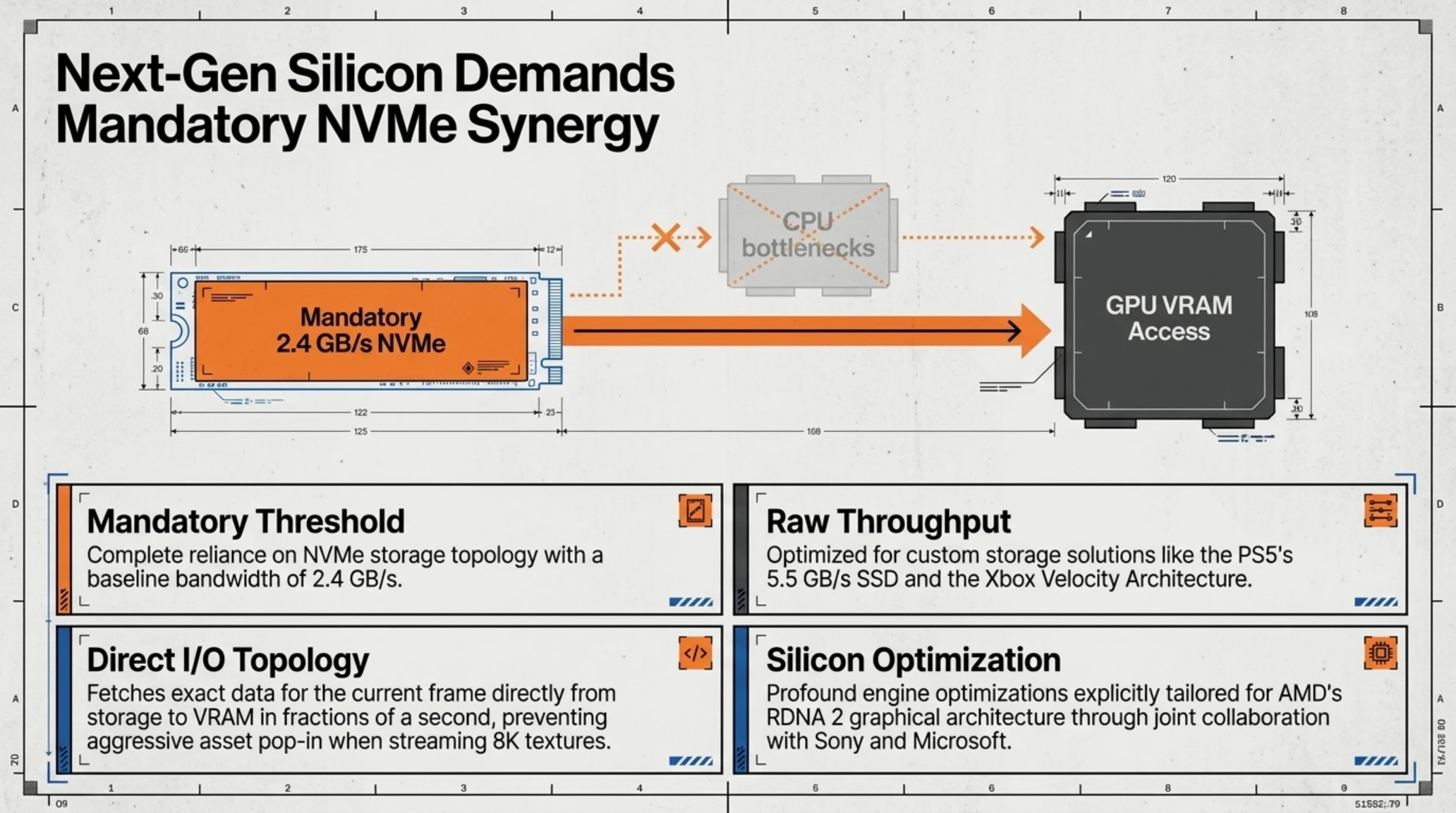
- Heavy I/O Dependency: The UE5 architecture mandates an NVMe storage topology with a baseline bandwidth of at least 2.4 GB/s to stream massive geometric payloads.
- RDNA 2 Optimization: Close collaboration between Epic Games, Sony, and Microsoft has resulted in profound engine optimizations tailored for AMD's graphical architecture.
- Budgetary Challenges: While optimization time drops, creating true cinema-quality assets demands larger art teams and expanded capital budgets.
1. Executive Briefing: The Dawn of a New Era in Real-Time Graphics
The initial unveiling of Unreal Engine 5 in 2020 sent shockwaves through the industry. The early tech demo, running natively on PlayStation 5 development hardware, showcased a level of geometric density and lighting fidelity previously confined to Hollywood render farms. With its two flagship technologies, Nanite and Lumen, UE5 has fundamentally redefined how software interacts with modern graphics processing units (GPUs).
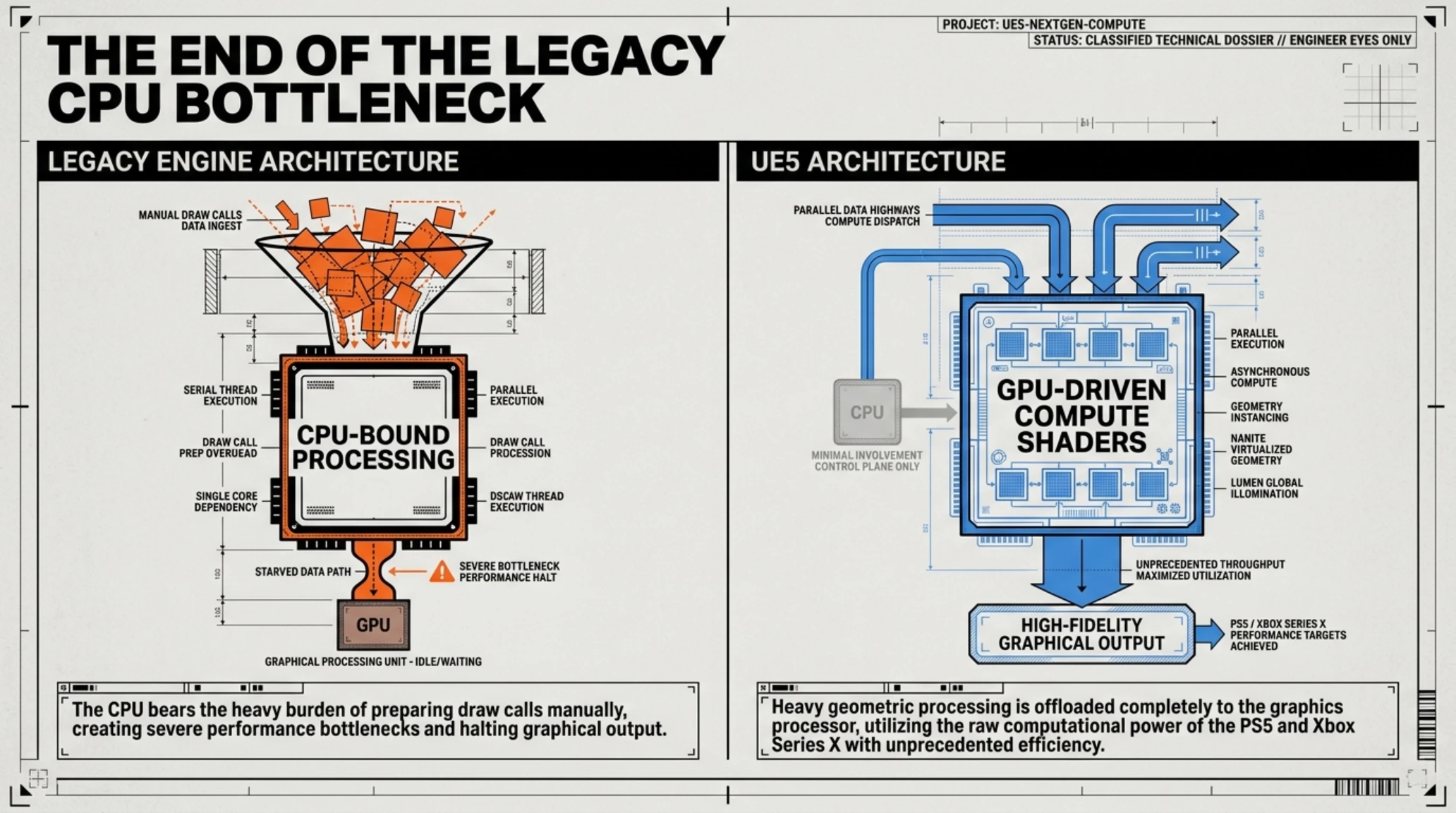
From a systems architecture perspective, UE5 represents a definitive shift away from CPU-bound processing toward GPU-driven compute shaders. In legacy engines, the central processing unit bore the heavy burden of preparing draw calls—often resulting in severe performance bottlenecks. The new architecture offloads this burden directly onto the GPU, allowing the raw computational power of the PS5 and Xbox Series X to be utilized with unprecedented efficiency.
2. Architectural Dissection: Nanite and the Virtualized Geometry Revolution
Nanite, the virtualized micropolygon geometry system, is arguably the crowning engineering achievement of UE5. In traditional rendering pipelines, developers had to manually create models at varying levels of detail (LODs) to maintain stable frame rates, swapping to lower-fidelity models as objects moved further from the camera. Nanite entirely eradicates this labor-intensive process.

Nanite's algorithms intelligently stream and render only the exact number of triangles that are perceptible to the user on a pixel-by-pixel basis. This means a developer can drop a multi-million polygon sculpture directly from ZBrush into a game environment without any manual decimation or normal-map baking. Consequently, the rendering workload scales based on output resolution rather than scene complexity, obliterating traditional polygon budgets.

The image above illustrates how Nanite clusters and streams geometric data dynamically within a highly dense environment.
Engineering Glossary & Lexicon (Jargon Buster)
- Nanite: A virtualized geometry system that permits real-time rendering of film-quality assets comprising millions of polygons without performance degradation.
- Lumen: A fully dynamic global illumination and reflection system that completely eliminates the need for static lightmap baking.
- Draw Call: A command dispatched from the CPU instructing the GPU to render a specific object; excessive draw calls bottleneck system performance.
- LOD (Level of Detail): The legacy technique of reducing a 3D model's complexity based on its distance from the player's camera.
3. Global Illumination: The Lumen Architecture and Dynamic Shading

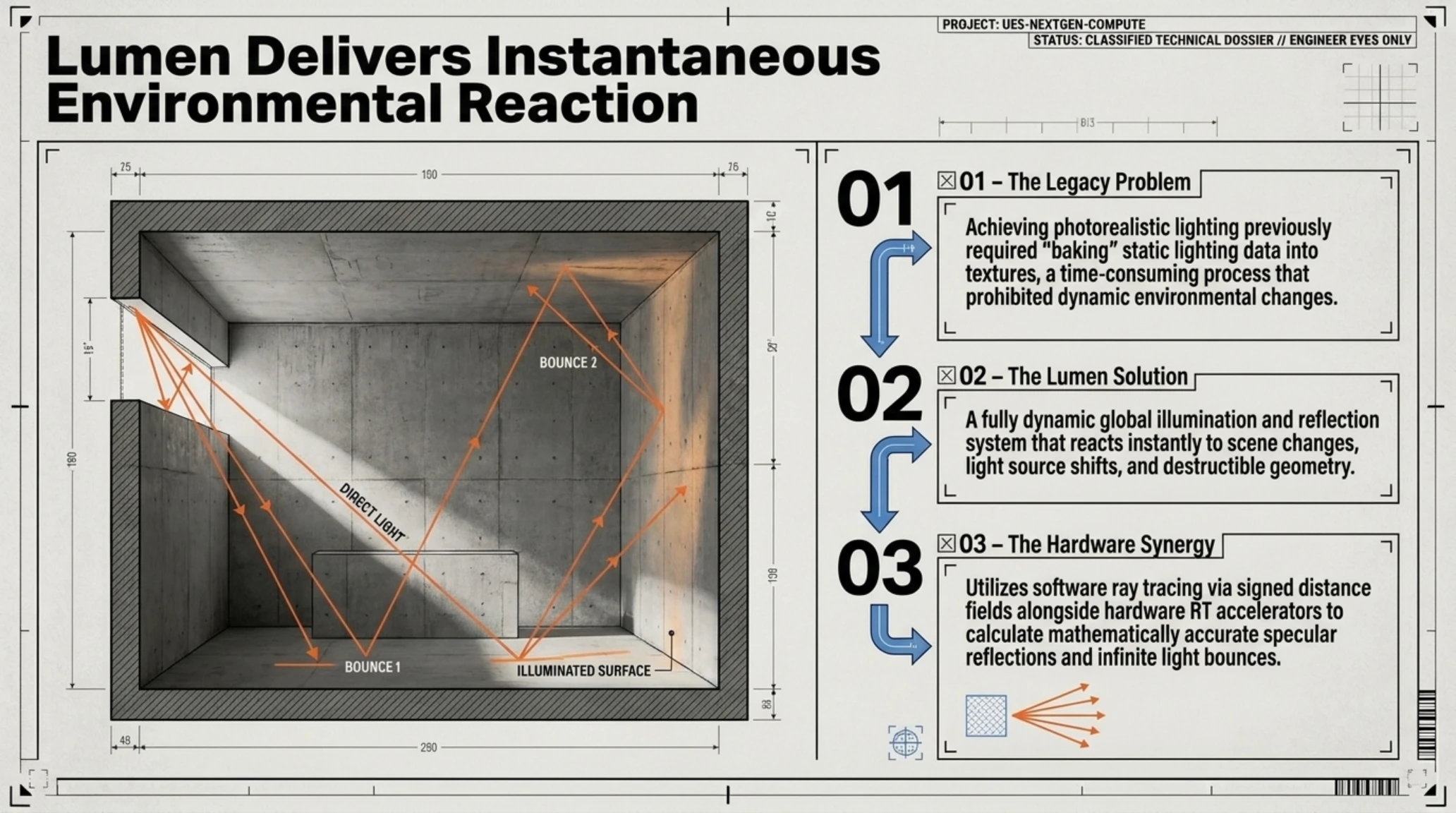
Complementing the geometric revolution of Nanite is the Lumen lighting system. Historically, achieving photorealistic lighting in games required developers to \"bake\" static lighting data directly into textures—a highly time-consuming process that prohibited dynamic environmental changes, such as moving the sun or destructible walls.
Lumen acts as a fully dynamic global illumination and real-time reflection solution that reacts instantly to scene and light source changes. Utilizing a hybrid approach of software ray tracing based on signed distance fields and hardware ray tracing where supported, Lumen calculates soft shadows and bounced light with extraordinary precision. On hardware like the PS5 and Xbox Series X, which feature dedicated RT accelerators, Lumen exploits this silicon to deliver mathematically accurate specular reflections.
4. Hardware Synergy: The Critical Role of NVMe in Console Microarchitecture

None of UE5's visual innovations would be viable without the radical storage architectures introduced in ninth-generation consoles. The Nanite technology is intrinsically dependent on continuous, high-bandwidth data streaming. The custom SSD inside the PS5 (delivering 5.5 GB/s of raw throughput) and the Xbox Velocity Architecture serve as the vital arteries feeding the Unreal Engine 5 pipeline.
If this engine were forced to execute off legacy mechanical hard disk drives (HDDs), streaming 8K textures and complex geometry would result in catastrophic bottlenecks and aggressive asset pop-in. The modern I/O topology allows the engine to fetch only the exact data needed for the current frame directly from the NVMe storage into VRAM in fractions of a second, drastically optimizing memory management at 4K resolutions.

The diagram above details the direct data transport path from NVMe storage to the GPU memory, bypassing CPU bottlenecks.

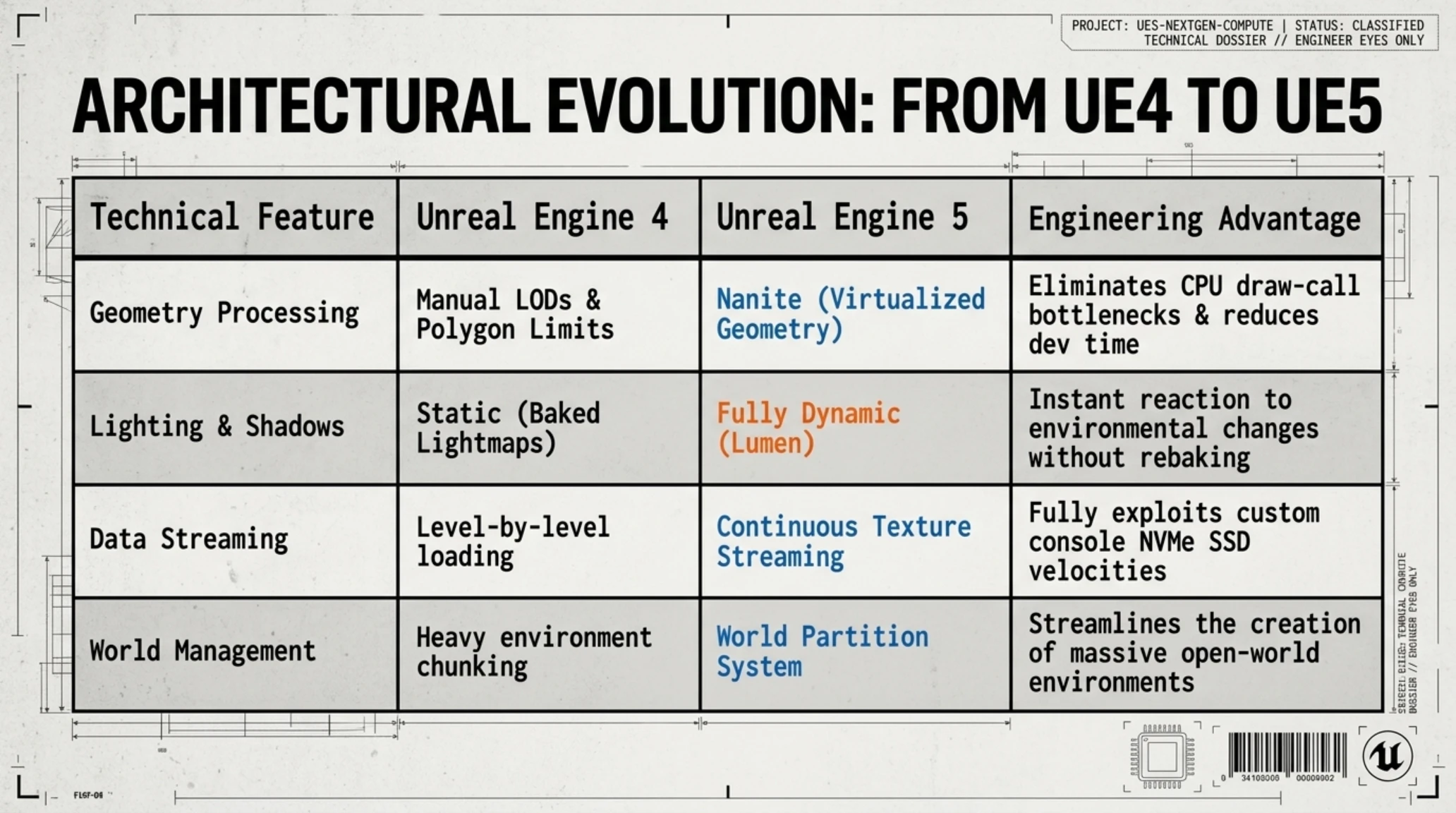
Rendering Architecture Comparison Matrix
| Technical Feature | Unreal Engine 4 | Unreal Engine 5 | Engineering Advantage |
|---|---|---|---|
| Geometry Processing | Manual LODs & Polygon Limits | Nanite (Virtualized Geometry) | Eliminates CPU draw-call bottlenecks & reduces dev time |
| Lighting & Shadows | Static (Baked Lightmaps) | Fully Dynamic (Lumen) | Instant reaction to environmental changes without rebaking |
| Data Streaming | Level-by-level loading | Continuous Texture Streaming | Fully exploits custom console NVMe SSD velocities |
| World Management | Heavy environment chunking | World Partition System | Streamlines the creation of massive open-world environments |
5. Empirical Benchmarks: Frame-Time Stability in Dense Environments
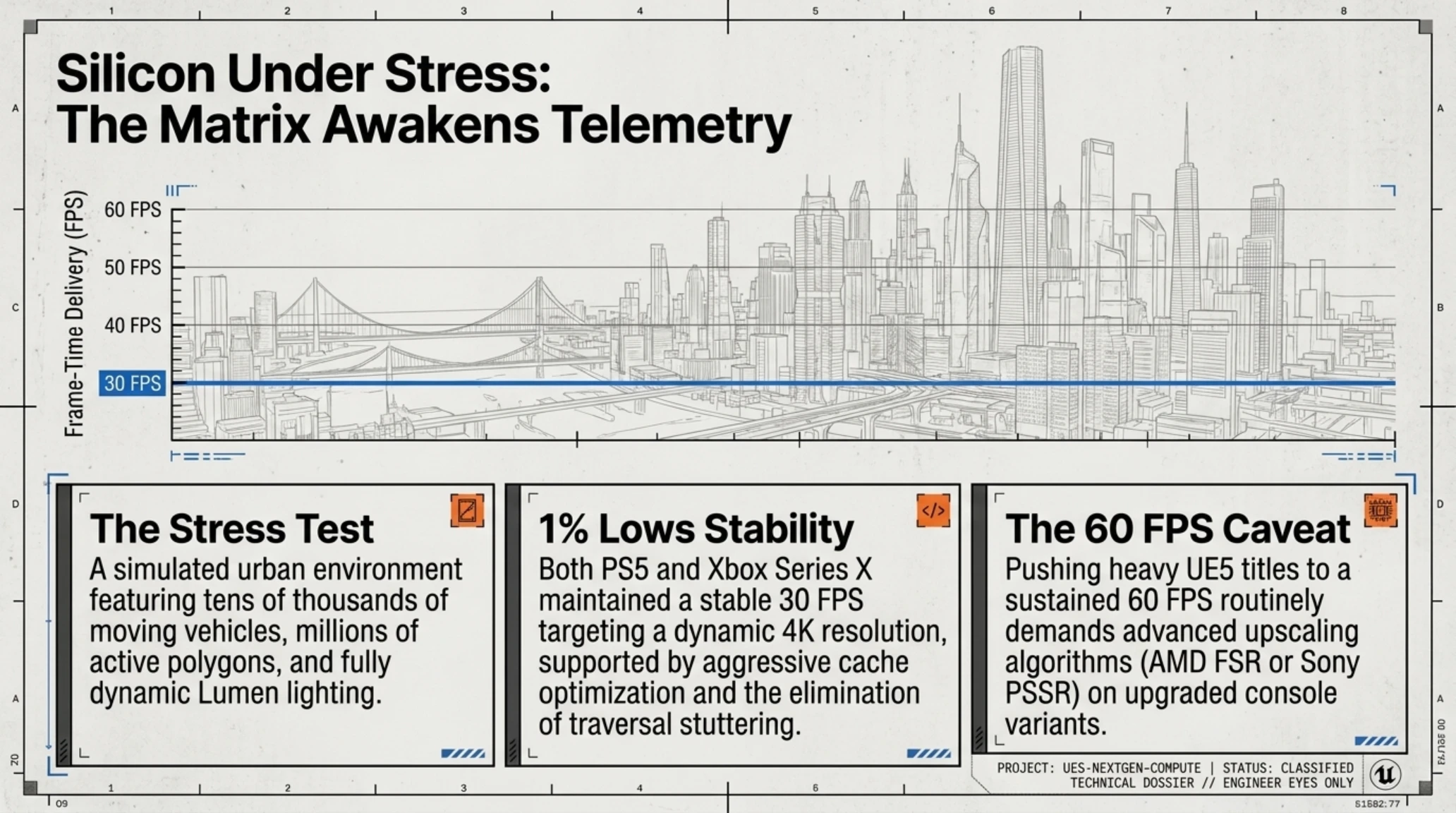
In practical empirical reviews and benchmarks conducted on \"The Matrix Awakens\" tech demo built on UE5, the behavior of the silicon under immense engine stress was clearly documented. Within a simulated urban environment featuring tens of thousands of moving vehicles, millions of active polygons, and fully dynamic lighting, both the PS5 and Xbox Series X maintained a stable 30 FPS targeting a dynamic 4K resolution.
Crucially, the telemetry of frame-time delivery showcased exceptional stability in maintaining the 1% Lows metric. Thanks to aggressive cache optimization and the elimination of traversal stuttering, the visual experience feels remarkably smoother than equivalent workloads on older engines. However, pushing heavy UE5 titles to a sustained 60 FPS routinely requires the deployment of advanced upscaling algorithms such as AMD FSR or Sony's proprietary PSSR on upgraded console variants.

The analytical video above demonstrates frame-time stability in highly congested traffic intersections with full Lumen and Nanite systems active.
6. Market Dynamics & Development Economics: Challenges in the Middle East
From an engineering economics perspective, the advent of Unreal Engine 5 is a double-edged sword for the game development industry. On one side, tools like Nanite and Lumen drastically reduce production time by eliminating tedious LOD generation and lightmap baking. On the other side, consumer expectations for cinema-grade visual fidelity force studios to hire specialized 3D artists and allocate massive budgets for high-resolution asset creation.
In the Middle East and Iranian markets, these shifts present acute challenges. Independent studios require exceptionally powerful hardware—high-end GPUs and fast NVMe SSD workstations—to compile and develop natively in UE5. Given currency volatility and inflated hardware pricing, outfitting a small development team has become an exorbitant capital expense. Nonetheless, free access to the massive Quixel Megascans library, seamlessly integrated into UE5, allows independent developers to offset some art production costs by utilizing high-quality photogrammetry assets.
📚 Classified & Related Dossiers in TekinGame
If you wish to explore beyond this report and delve into cybernetic frontiers and autonomous AI architectures, do not miss these three exclusive deep-dives in the Tekin Garage:
Market Sentiment & Developer Ecosystem Barometer (Market Sentiment)
- Industrial Adoption: Unprecedented migration of major studios (e.g., CD Projekt Red for the next Witcher) to the UE5 platform.
- Hardware Pressure: Surging demand for high-speed Gen 4 and Gen 5 SSDs among both gamers and developers.
- Indie Studio Friction: Severe budgetary pressure to upgrade development rigs in inflation-heavy markets.
- Graphical Democratization: Empowering smaller teams to create Hollywood-quality environments thanks to in-engine automation tools.
7. The Silicon Horizon: Neural Rendering and the Future of UE5
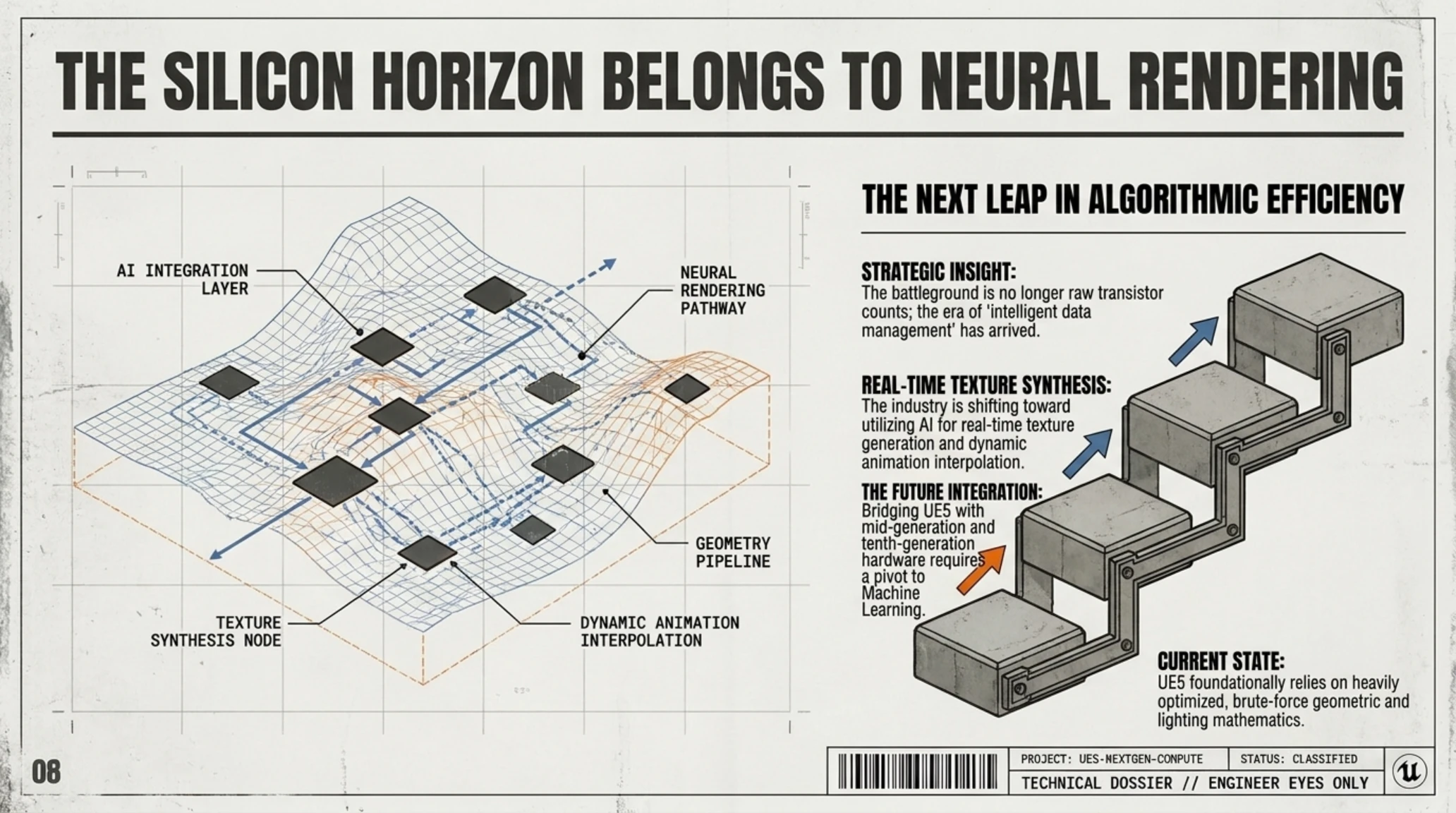
Looking toward the horizon, Unreal Engine 5 has solidified the foundation of graphics architecture for at least the next decade. However, the ultimate challenge in bridging this engine with mid-generation and tenth-generation hardware lies in deeper integration with machine learning and neural rendering. While UE5 currently relies on heavily optimized geometric and lighting mathematics, the industry's next leap will involve using AI for real-time texture synthesis and dynamic animation interpolation.
The synergy between custom console silicon and robust engines like UE5 indicates that the era of competing strictly over raw transistor counts is ending; the battleground has shifted to \"algorithmic efficiency\" and \"intelligent data management.\" TekinGame projects that titles developed natively on UE5 in the coming years will not only elevate visual fidelity but, through tools like World Partition, will offer gamers unprecedented dimensions of open-world design.
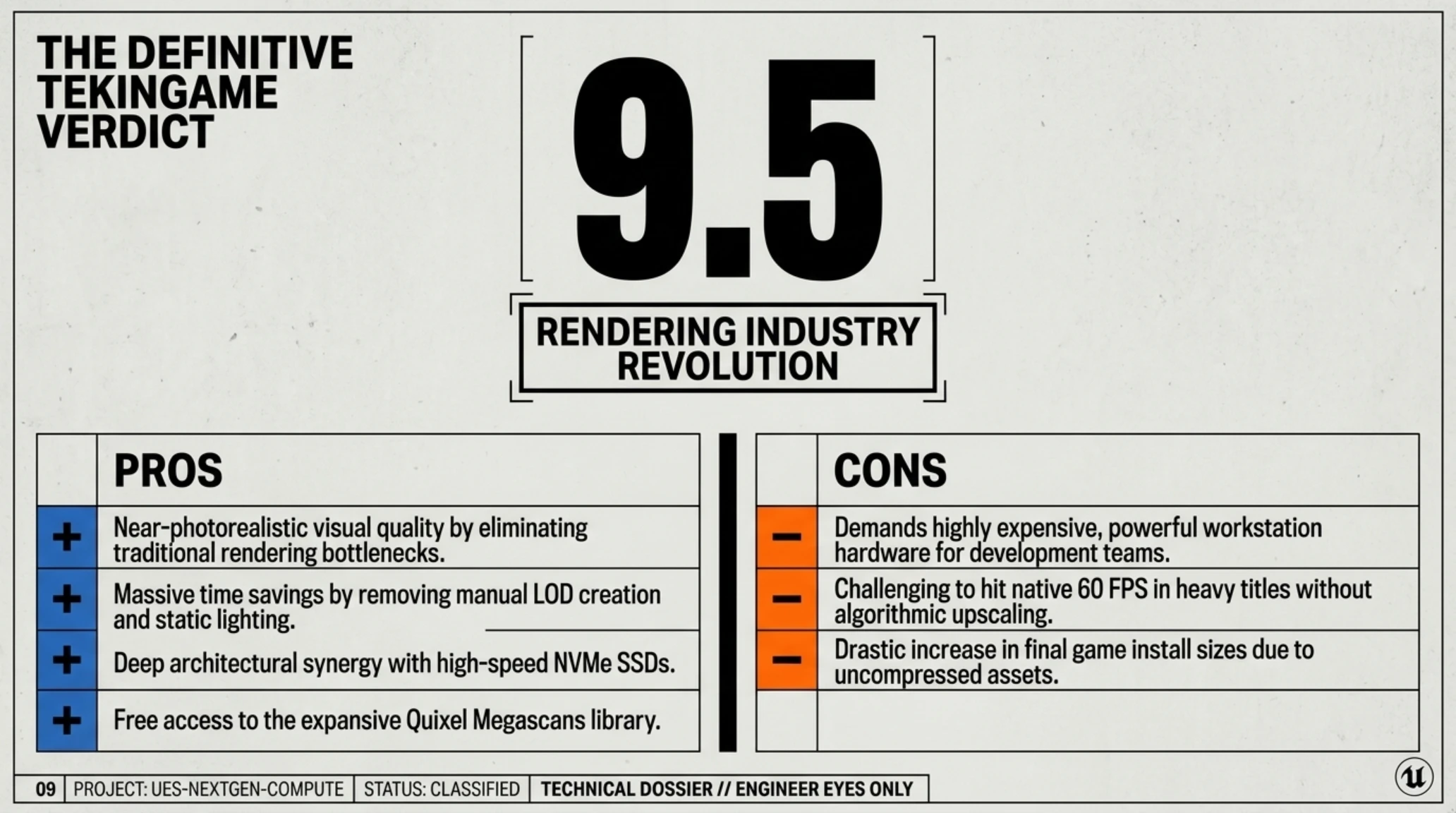
- Stunning, near-photorealistic visual quality by eliminating traditional rendering bottlenecks
- Massive time savings for developers by removing manual LOD creation and static lighting
- Deep architectural synergy with high-speed NVMe SSDs in ninth-generation consoles
- Free access to the expansive Quixel Megascans library for developers
- Demands highly expensive and powerful workstation hardware for development teams
- Challenging to hit a native 60 FPS in heavy titles without relying on algorithmic upscaling
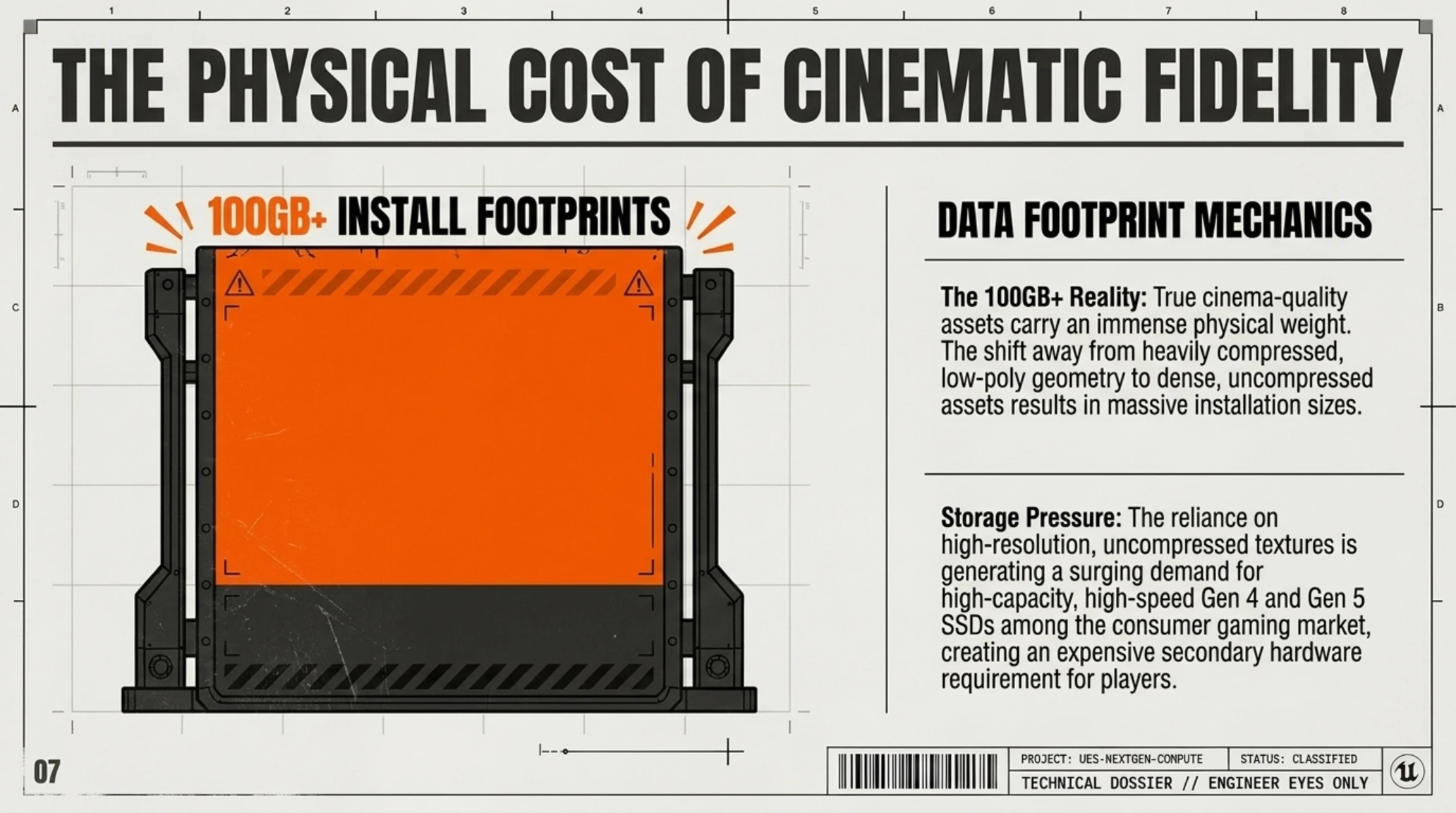
- Drastic increase in final game install sizes due to uncompressed high-resolution assets
TekinGame Strategic Conclusion (Conclusion)
Unreal Engine 5 is not merely a software update; it is a fundamental paradigm shift in how the industry approaches hardware architecture and real-time rendering. By transferring the geometric workload to the GPU and exploiting the raw velocity of next-gen SSDs, the engine empowers creators to realize visions that were previously impossible. Despite the economic hurdles for smaller teams, UE5 has firmly established itself as the gold standard for game development in the ninth generation and beyond.
Frequently Asked Technical Questions (FAQ)
What exact problem does Nanite solve in Unreal Engine 5?
Nanite eliminates the need for developers to manually create multiple lower-quality versions of a model (LODs). It allows film-quality assets with millions of polygons to be dropped directly into the game and rendered in real-time without crashing performance.
Is an SSD strictly required to play UE5 games?
Yes. Due to Nanite's continuous data streaming architecture, having a high-speed NVMe SSD is virtually mandatory to prevent severe frame drops, stuttering, and texture pop-in.
How does Lumen differ from traditional Hardware Ray Tracing?
Lumen is a dynamic global illumination system that can calculate reflections and lighting via software ray tracing (using distance fields) without needing dedicated RT hardware. However, if hardware RT accelerators are present, Lumen leverages them to increase rendering precision.
Why are game file sizes so massive for titles built on Unreal Engine 5?
The ability to utilize raw, uncompressed 3D models and 8K textures directly in the engine (thanks to Nanite) drastically inflates the size of the game's assets, directly resulting in massive final installation footprints on the storage drive.
Verified Engineering Sources & References (Sources)
Additional Gallery: Tekin Analysis: Unreal Engine 5 Architectural Deep Dive & Next-Gen Console Impact