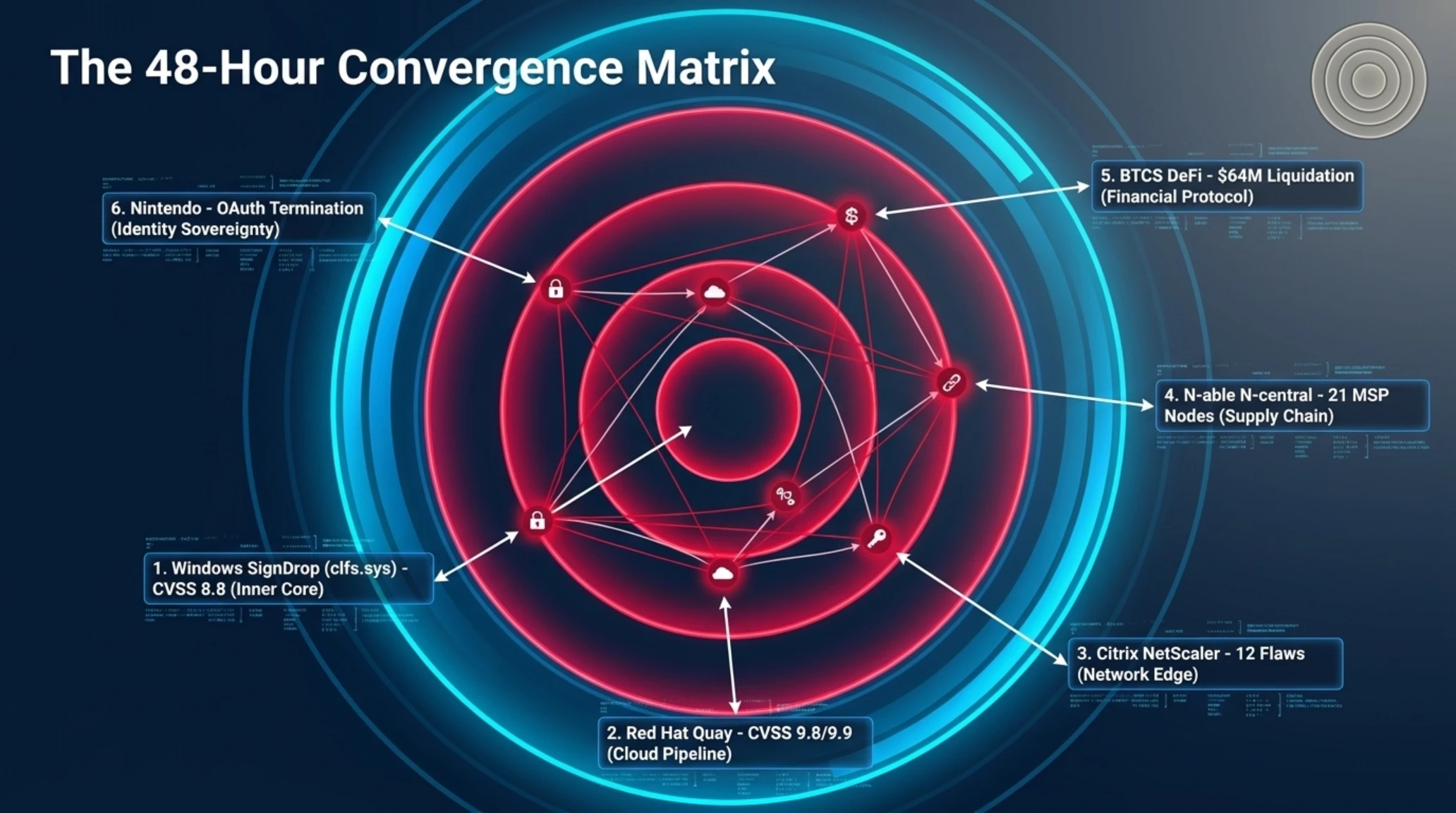
Tekin Night Executive Briefing for Saturday, November 14, 2026, dissects six systemic crises: (1) unpatched Windows SignDrop zero-day in clfs.sys granting SYSTEM privileges; (2) dual 9.9 CVSS vulnerabilities in Red Hat Quay enabling unauthenticated container poisoning; (3) Citrix patching 12 flaws in NetScaler ADC; (4) attackers bypassing Hotfix 2 on N-able N-central MSP servers; (5) BTCS liquidating ETH at a loss to save its $64M Aave V3 loan; and (6) Nintendo ending Google/Apple logins.
Takin Analysis | Red Alert Across Windows Kernel and Cloud Registries
The night of Saturday, November 14, 2026, has ushered in a cascade of high-severity security advisories across critical operating system kernels, cloud-native container distribution platforms, and enterprise managed service provider infrastructure. Concurrently, high-frequency stress fractures in decentralized corporate lending and strategic identity sovereignty pivots within gaming hardware ecosystems have created an extraordinary convergence of technological challenges for global engineering leadership.
Incident response teams and corporate security operations centers worldwide are mobilizing against coordinated threat vectors spanning from the deepest execution rings of the Windows kernel to enterprise Kubernetes build pipelines and edge application delivery controllers. At the exact same juncture, volatile algorithmic market forces in decentralized finance have triggered emergency balance sheet restructuring among institutional asset managers.
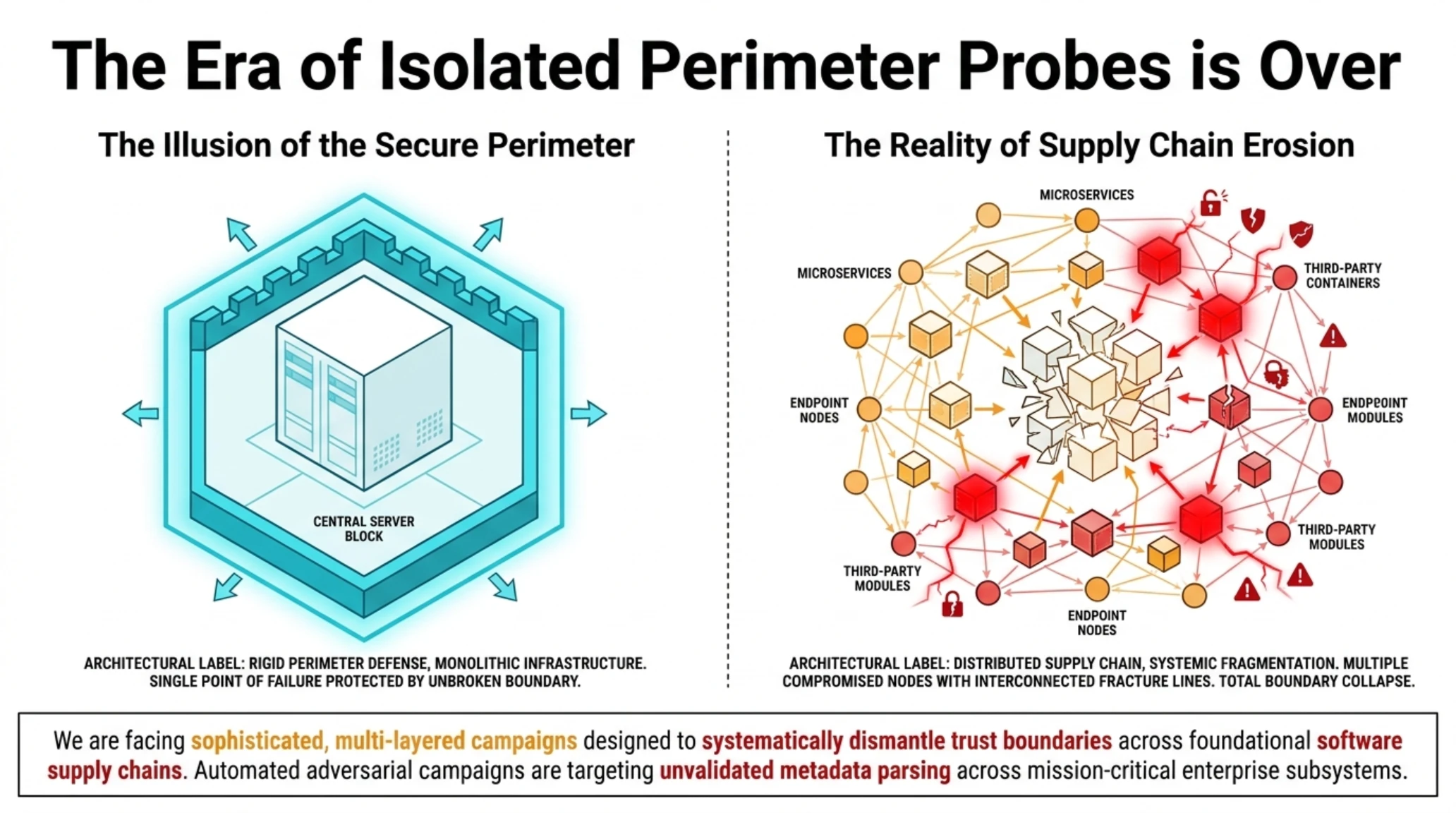
Comprehensive telemetry synthesized by the Takin Editorial Bureau indicates that modern enterprise perimeters are no longer confronting isolated perimeter probes, but rather sophisticated, multi-layered campaigns designed to systematically dismantle trust boundaries across foundational software supply chains.
Real-time telemetry gathered across global threat intelligence networks demonstrates an alarming surge in automated adversarial campaigns targeting unvalidated metadata parsing across mission-critical enterprise subsystems.
Strategic Intelligence & Core Vectors in a Single View
Infrastructure security architects emphasize that the compression of these major security disruptions into a narrow 48-hour operational window requires immediate preventative countermeasures and a comprehensive re-evaluation of zero-trust boundary verification protocols.
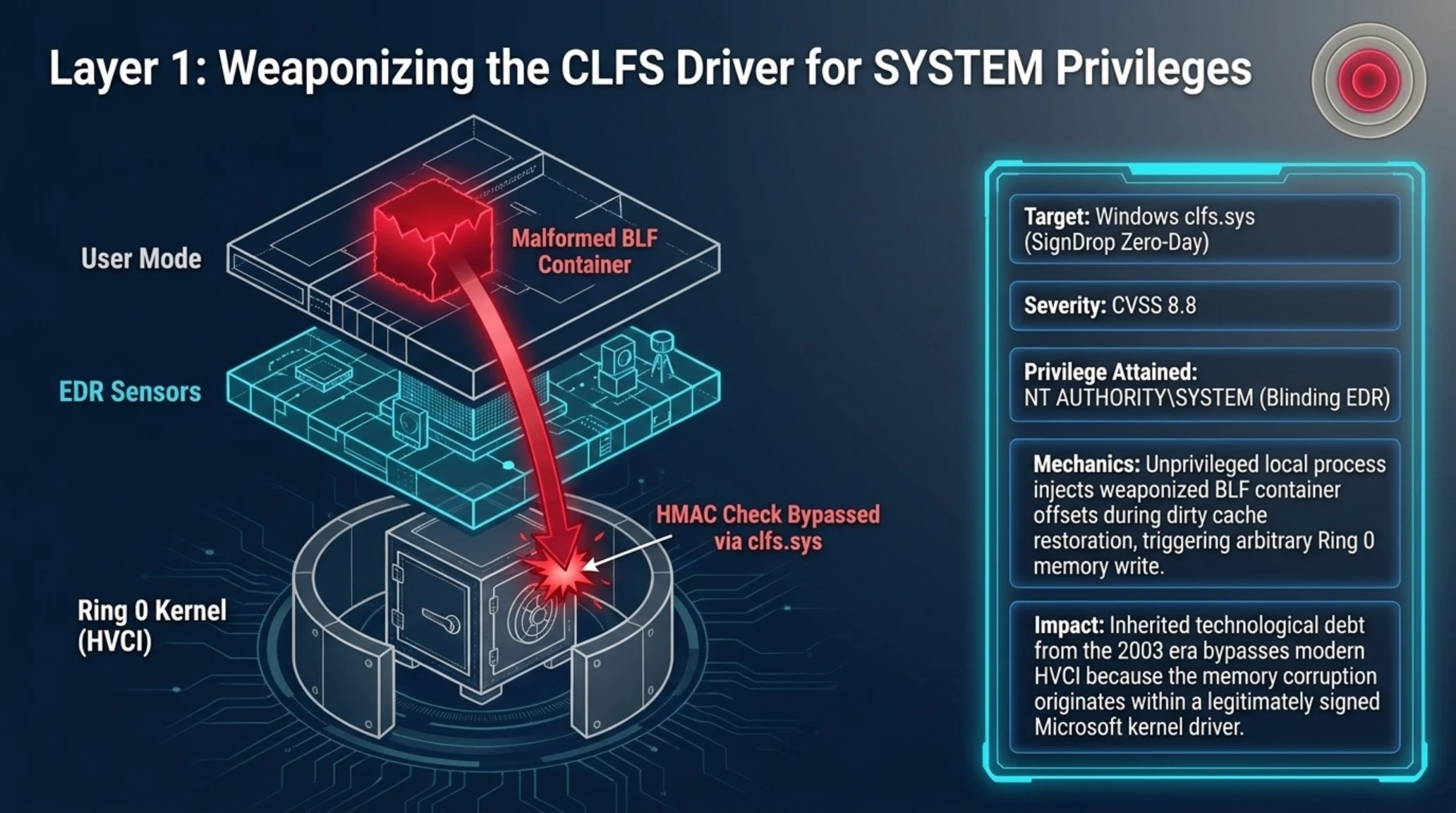
Axis 01: Windows SignDrop Zero-Day: Weaponizing the CLFS Driver for SYSTEM Privileges
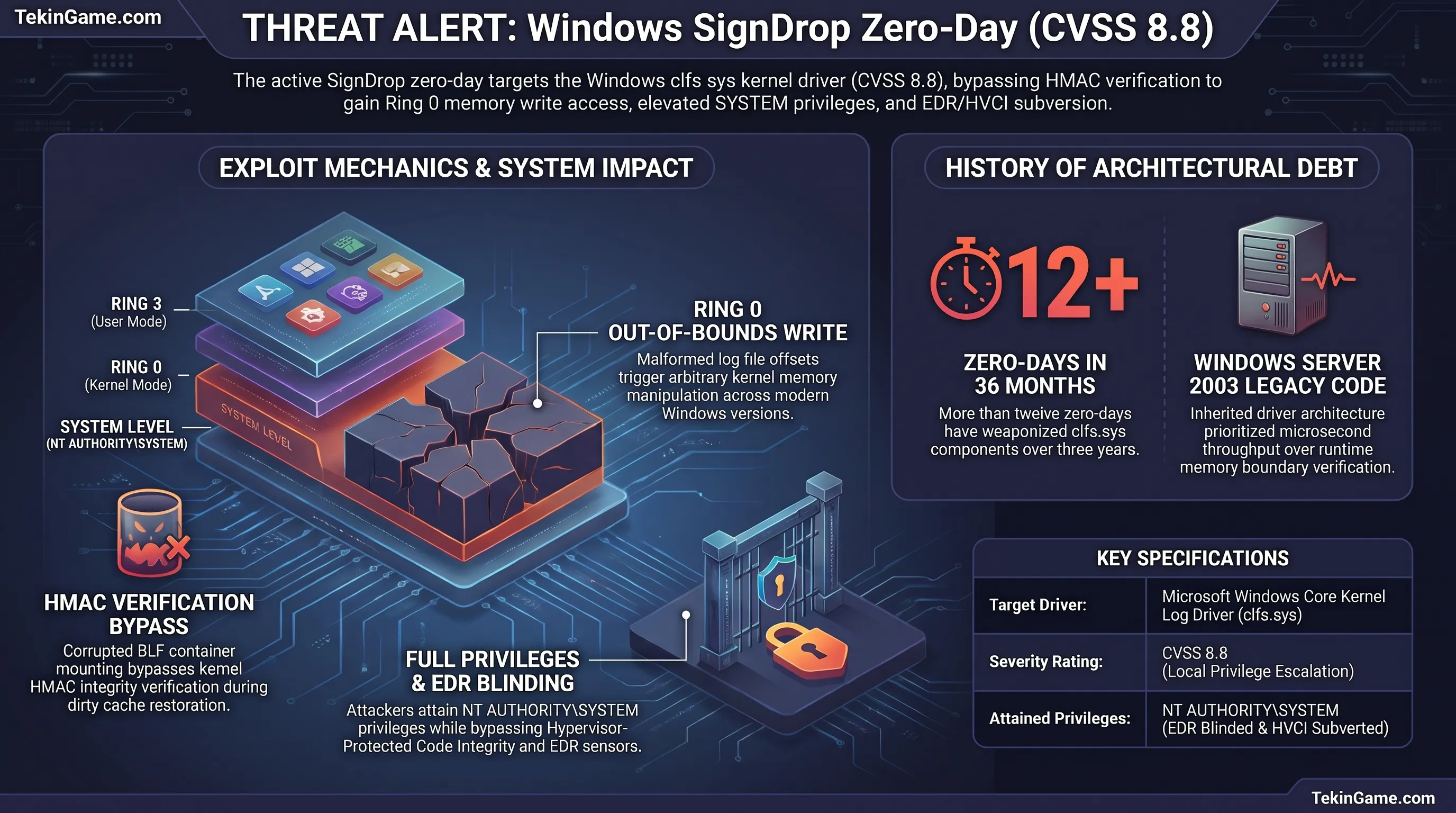
Prominent cybersecurity researcher Abdelhamid Naceri has publicly disclosed the technical mechanics of an unpatched, active zero-day vulnerability designated as SignDrop, which directly compromises the Windows Common Log File System kernel driver, known ubiquitously as clfs.sys. This critical operating system component has served as one of the most prolific and devastating vectors for advanced threat actors seeking to elevate unprivileged local user sessions into unrestricted NT AUTHORITY\SYSTEM execution contexts.
The architectural flaw resides in how the CLFS driver validates the cryptographic integrity and structural metadata of Base Log File (BLF) containers during the re-initialization of dirty or inconsistent storage blocks. When a corrupted container is mounted by an unprivileged process, a fundamental logic defect causes the kernel validation routine to bypass its keyed-hash message authentication code (HMAC) integrity verification before completing memory layout alignment.
This validation void enables a local adversary with standard, restricted access privileges to precisely craft malformed offsets within the BLF container structure. Upon requesting the operating system to map the log file, the driver triggers an out-of-bounds memory write operation within protected ring-0 address space, granting the attacker arbitrary memory manipulation capabilities across Windows 10, Windows 11 Version 24H2, and Windows Server 2025.
Why This Development Changes the Game
Independent verification within isolated security sandboxes has demonstrated that the SignDrop exploit remains fully capable of subverting advanced operating system defenses, including Hypervisor-Protected Code Integrity (HVCI), because the memory corruption originates entirely within a legitimately signed Microsoft kernel driver.
Takin Analysis: The Chronic Architectural Debt of Windows Legacy Kernel Logging Subsystems
An exhaustive architectural deconstruction by the Takin Editorial Bureau reveals that Microsoft's Common Log File System represents an archetype of chronic technological debt inherited from the Windows Server 2003 era. Conceived as a high-performance transactional logging engine designed to provide dedicated database subsystems and filesystem operations with microsecond-level persistence, CLFS was engineered with high-throughput memory mapping as its highest architectural mandate, frequently at the expense of comprehensive runtime boundary checks.
Over the preceding 36 months, more than twelve distinct zero-day vulnerabilities have been weaponized within the exact same structural components of clfs.sys. Every one of these exploits capitalizes on the Byzantine complexity of chained log records, circular pointer rings, and the kernel's inherent struggle to safely parse intricate, user-controllable data structures in asynchronous multi-threaded environments. Malicious actors manipulate record size headers to induce predictable heap corruption within the kernel executive pool.
From an enterprise risk perspective, Microsoft's sustained reliance on iterative software band-aids rather than executing a complete architectural rewrite of CLFS in memory-safe systems languages such as Rust constitutes one of the most hazardous liabilities in modern enterprise operating systems. Until legacy kernel drivers are refactored into sandboxed user-mode services or memory-isolated modules, clfs.sys will remain a primary weapon of choice for ransomware cartels and state-aligned advanced persistent threats.
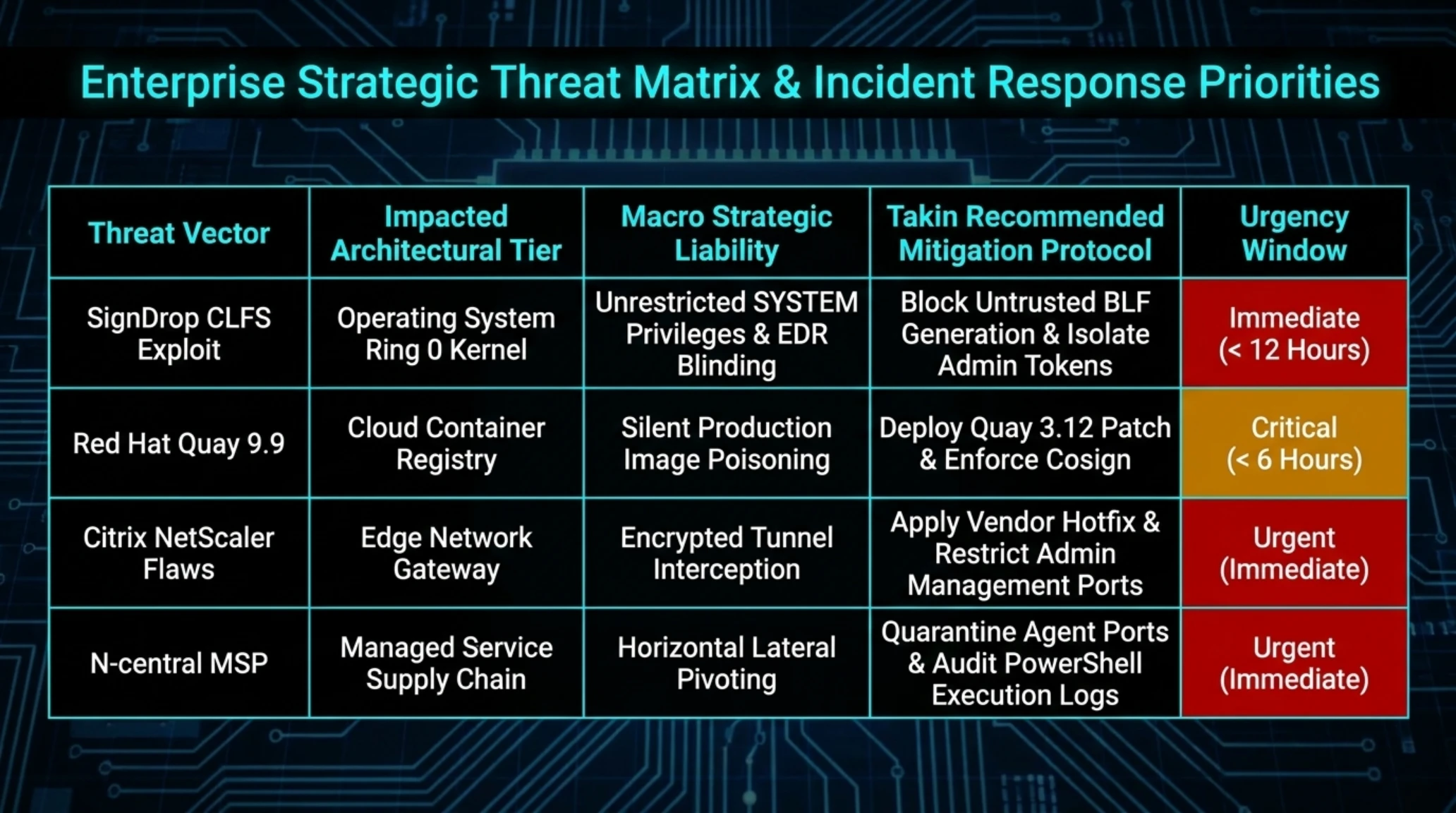
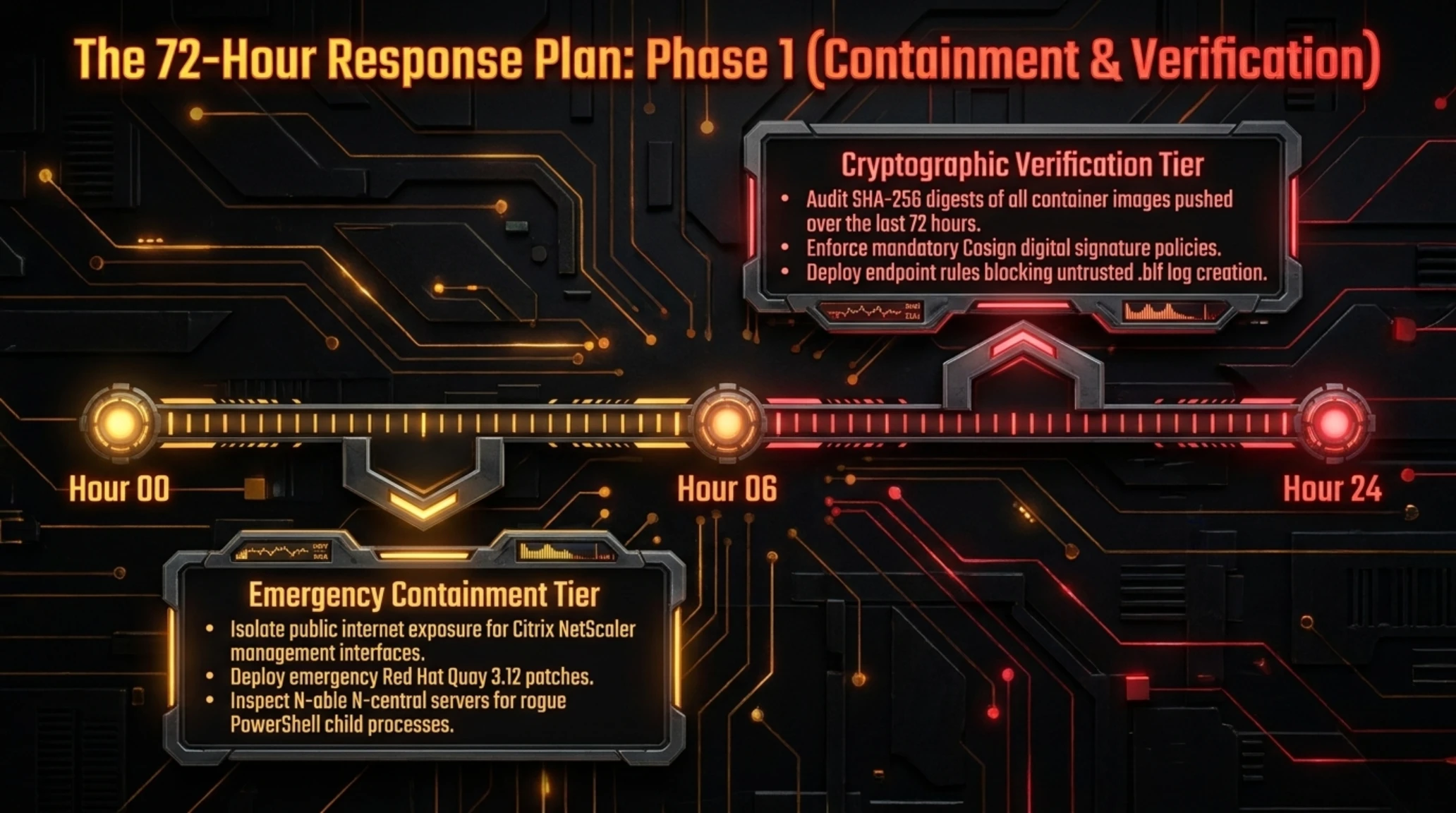
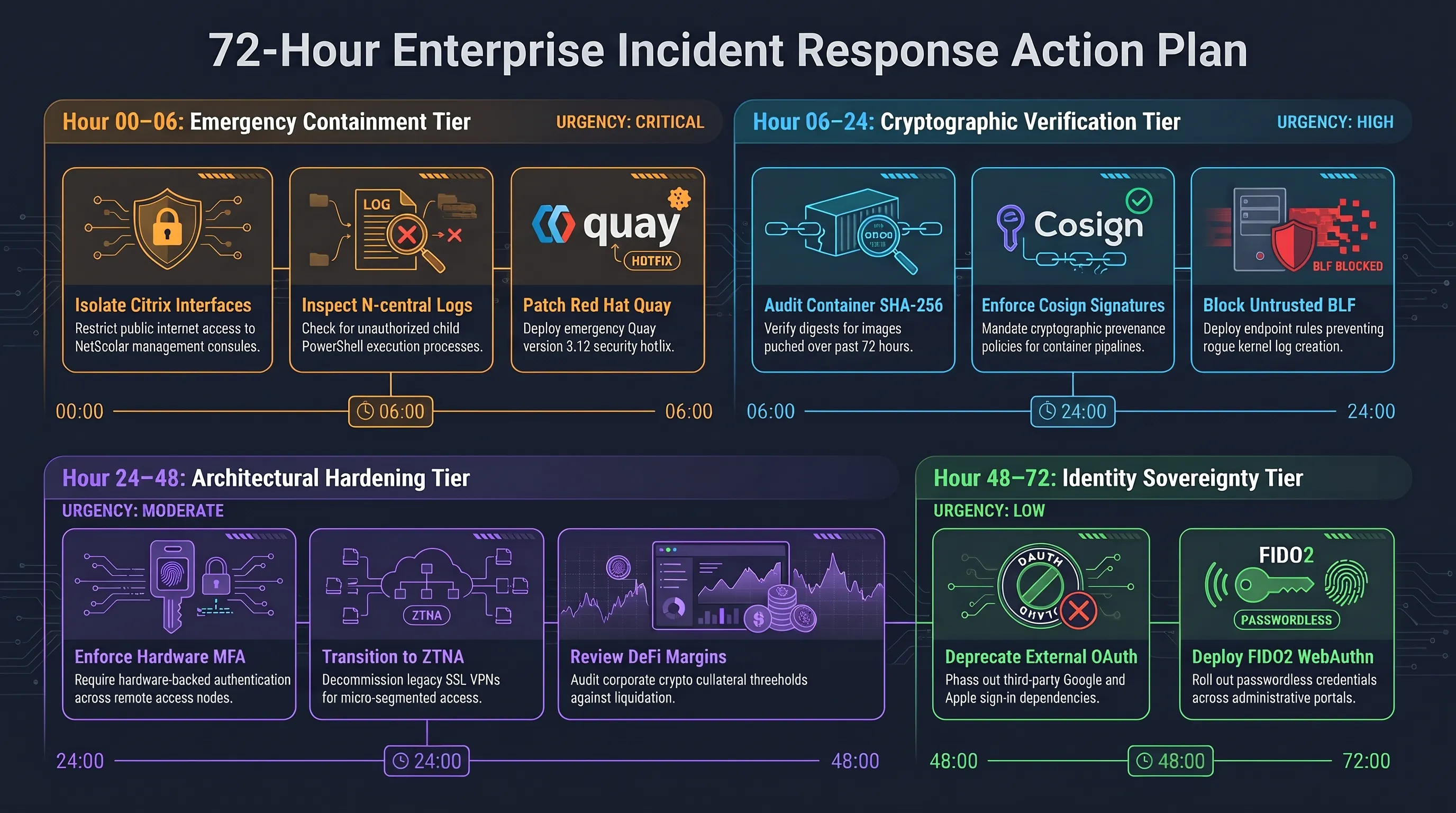
Takin advises enterprise defense teams to immediately implement behavioral rules that block the generation and execution of untrusted .blf files within world-writable directories and to instrument endpoint detection telemetry specifically for token manipulation patterns emanating from low-integrity processes.
Axis 02: Critical Red Hat Quay Vulnerabilities: Unauthenticated Container Image Poisoning
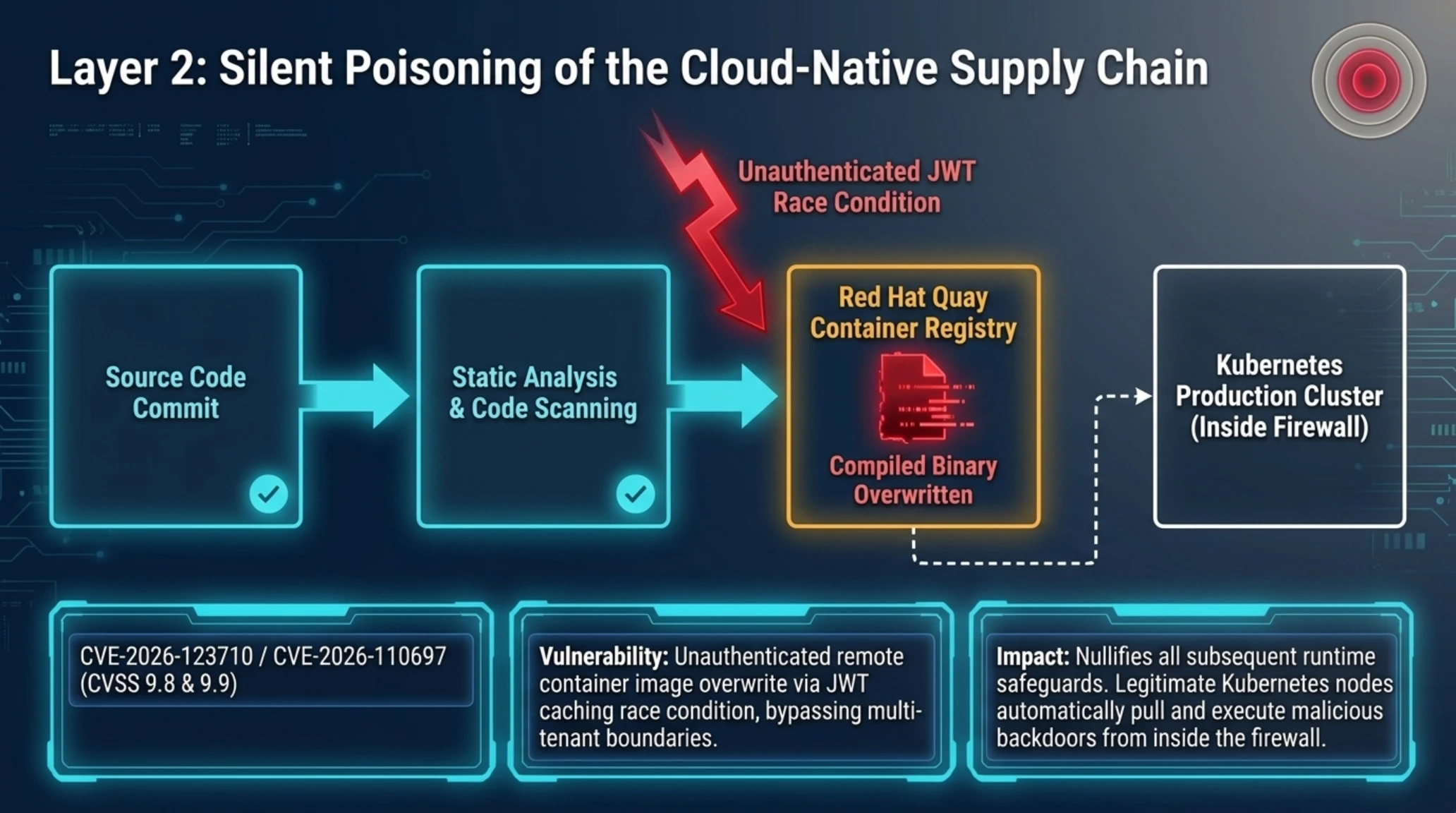
Red Hat has issued maximum-severity emergency security bulletins for two devastating vulnerabilities cataloged under CVE-2026-123710 and CVE-2026-110697, establishing a critical operational alert across enterprise container deployment pipelines. Holding near-maximum CVSS ratings of 9.8 and 9.9, these flaws strike at the foundational security boundaries of the Red Hat Quay container registry platform, granting unauthenticated remote attackers the terrifying capability to overwrite, tamper with, and poison private production container images.
Technical post-mortems indicate that the first vulnerability stems from a catastrophic failure within Quay's authorization middleware and its distributed caching mechanism for JSON Web Tokens (JWT). A subtle race condition combined with improper cryptographic token signature caching allows an external adversary transmitting crafted HTTP headers to breach multi-tenant organizational boundaries and forge valid administrative access credentials for completely arbitrary private repositories.
The companion vulnerability, possessing even more catastrophic systemic consequences, enables attackers to bypass image signing validation completely during multi-part container image and Helm chart push operations. By exploiting an unauthenticated serialization bug in the registry's intake pipeline, malicious actors can replace legitimate base images with compromised binary payloads without producing administrative audit alerts or triggering automated cryptographic mismatch warnings.
Technical Verification | Myth vs Engineering Reality
The operational implications of this breach vector transcend standard data exfiltration. In modern automated continuous integration and continuous deployment (CI/CD) environments, production Kubernetes clusters automatically pull updated container builds from Quay and deploy them directly across thousands of live operational nodes.
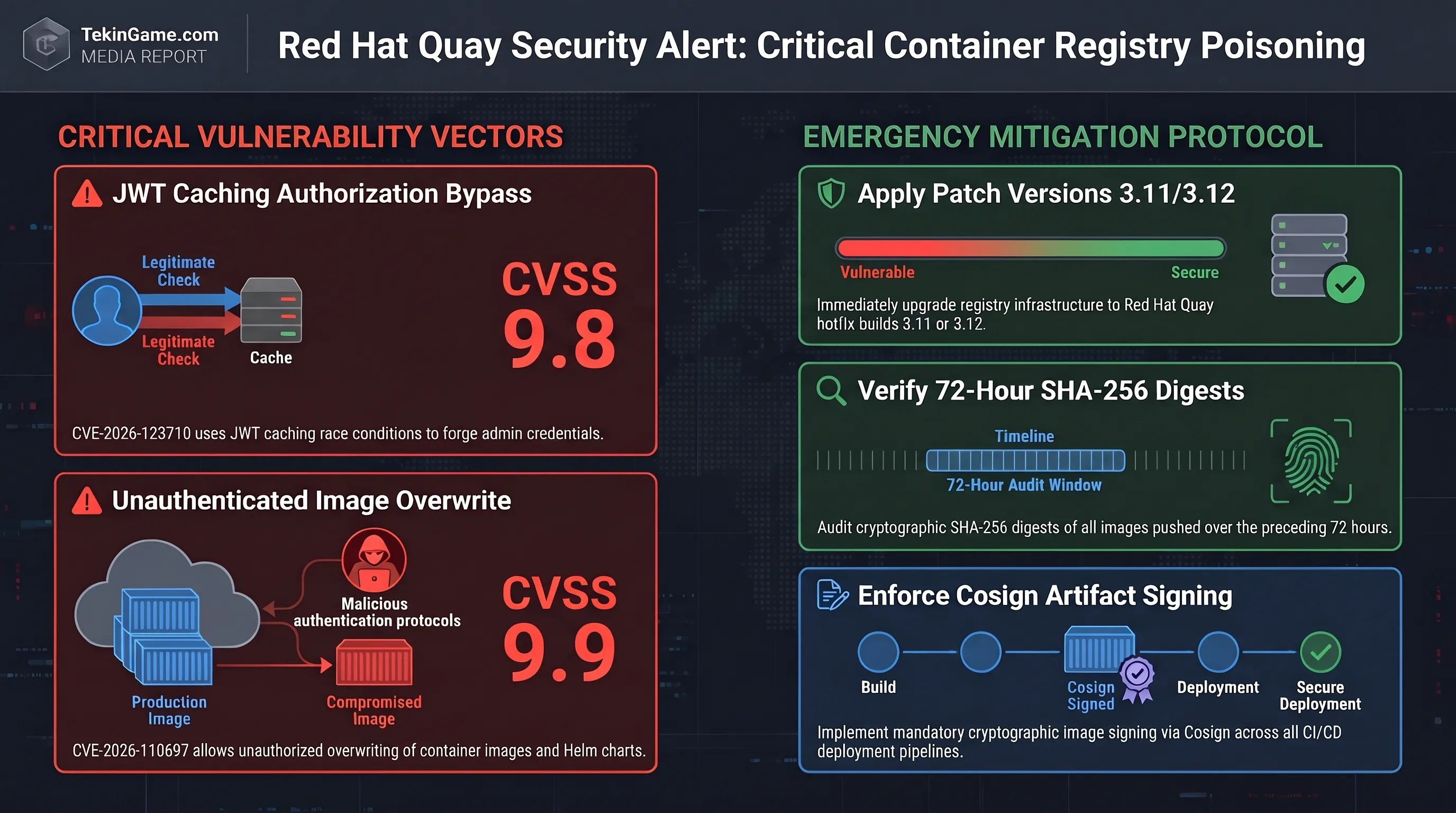
If an enterprise base container image is silently poisoned at the registry level, every microservice deployed thereafter will execute malicious binary payloads from inside the organization's firewall, providing remote threat actors with persistence, credential harvesting capabilities, and network pivoting vectors.
Takin Analysis: How Container Registry Poisoning Subverts the Foundations of Cloud-Native Trust
In the assessment of the Takin Editorial Bureau, the Red Hat Quay security disaster underscores an acute systemic vulnerability in how enterprise cloud architectures establish trust. For years, the security industry has heavily invested in pre-commit source code static analysis and post-deployment runtime endpoint detection, treating the intermediate storage and artifact delivery tier the container registry as an intrinsically secure bastion.
Weaponizing CVSS 9.9 vulnerabilities within Quay completely bypasses code scanning and developer sign-offs. Even if an engineering organization maintains rigorous code review standards and static vulnerability scanning, a malicious entity can overwrite the compiled binary artifact immediately prior to production rollout, seamlessly embedding backdoors, memory scrapers, or cryptominers directly into the Linux container filesystem.
Red Hat has released emergency hotfix builds for Quay versions 3.11 and 3.12, urgently mandating that organizations update their registry platforms immediately. Furthermore, security teams must verify the cryptographic SHA-256 digests of all container images pushed to their registries over the preceding 72 hours. This incident highlights the non-negotiable imperative of enforcing mandatory cryptographic artifact signing via Cosign and adopting strict zero-trust image provenance verification throughout all stages of the CI/CD lifecycle.
Axis 03: Citrix NetScaler ADC and Gateway Security Alert: Coordinated Patch Batch Addresses 12 Critical Flaws
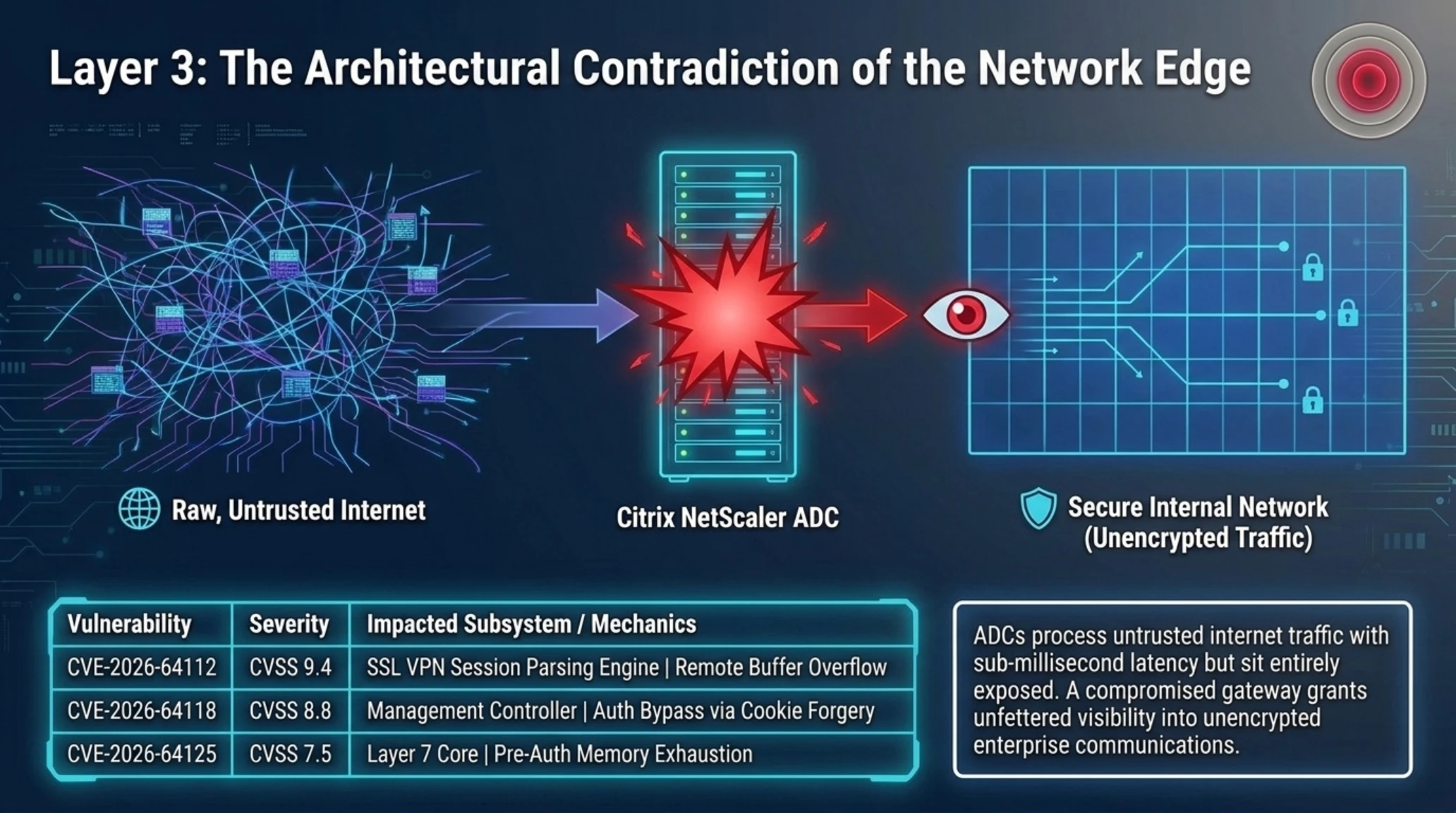
Cloud Software Group has published an urgent, coordinated security advisory delivering critical hotfixes for 12 distinct vulnerabilities impacting Citrix NetScaler ADC and NetScaler Gateway. Serving as the primary enterprise perimeter ingress for high-throughput traffic management, intelligent load balancing, and encrypted remote access across thousands of Global 2000 corporations, financial institutions, and government infrastructures, vulnerabilities within these edge appliances routinely present catastrophic organizational breach vectors.
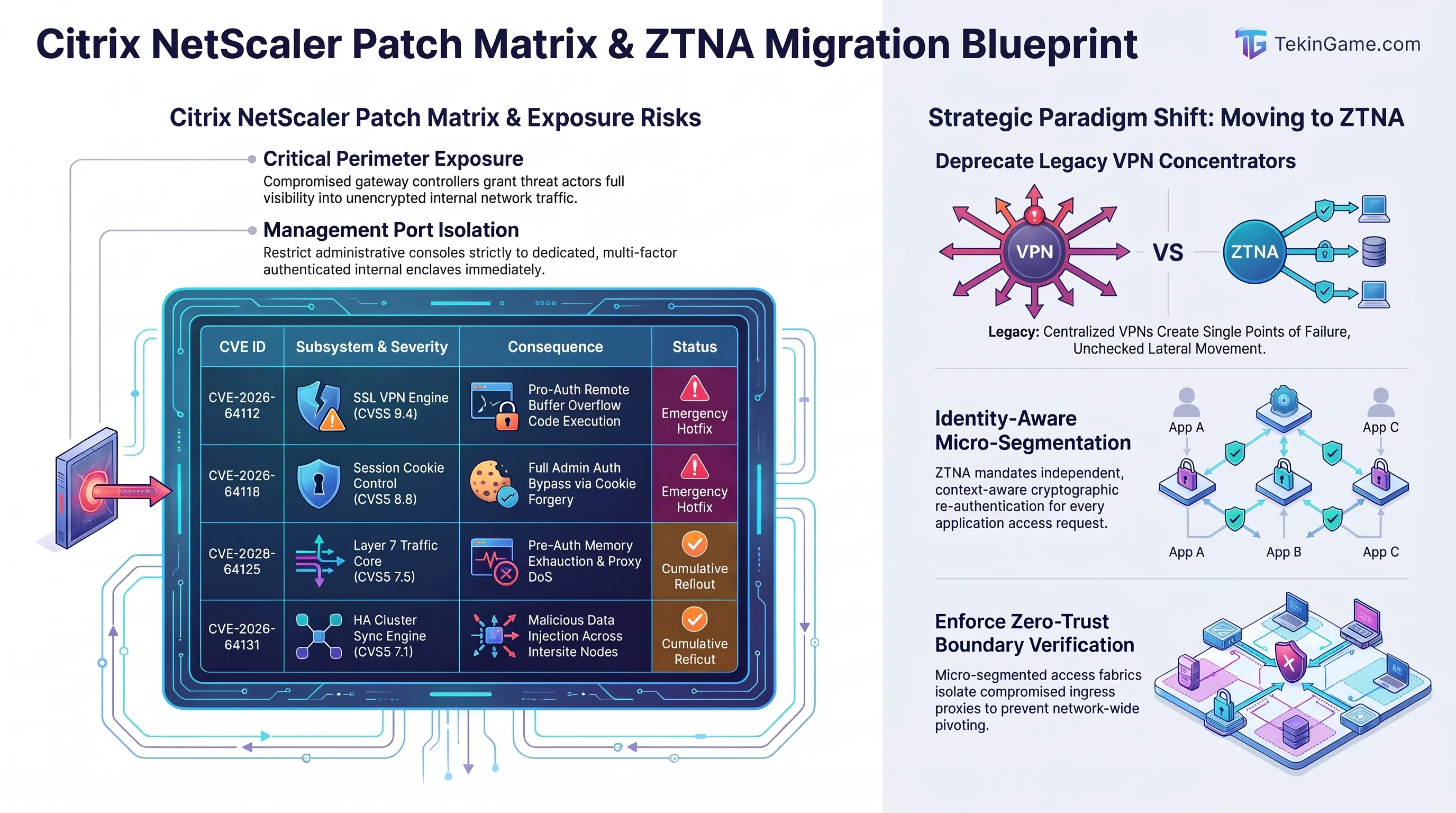
Among the patched weaknesses are severe remote buffer overflow conditions residing in the core SSL VPN endpoint packet processing daemon, alongside dangerous pre-authentication memory exhaustion flaws. When exploited by an unauthenticated adversary transmitting specialized malformed network sequences, these bugs allow threat actors to crash critical network daemons or achieve arbitrary remote code execution directly within the appliance's unsegmented operational memory space.
An equally alarming vulnerability within the batch involves authorization bypass via session cookie manipulation on exposed management interfaces. Threat actors transmitting non-standard hexadecimal payloads within authentication cookie headers can deceive the embedded web engine's internal validation routine, allowing them to seize full administrative supervisory control of the appliance without presenting valid root credentials.
Benchmark Comparison: Gateway Resilience Against Memory Injection Attacks
| Network Engineering Metric | Legacy Citrix Gateway Appliance | Modern 2026 Microsegmented Fabric |
|---|---|---|
| Heap Overflow Memory Isolation | Weak (Shared Socket Buffer Heaps) | Complete (Wasm Sandboxed Microservices) |
| Session Token Validation Latency | 14 ms via Central Reverse Proxy | 2.1 ms via Hardware Ephemeral Attestation |
| Blast Radius Upon Node Compromise | Universal Lateral Internal Penetration | Confined to Single Workload Boundary |
| DoS Exhaustion Resilience Under Load | Vulnerable to Pre-Auth Socket Floods | Hardened via Autonomous Dynamic Filtering |
Historical incident response retrospectives underscore that enterprise perimeter appliances like NetScaler have continuously served as the highest-priority initial access beachheads for sophisticated state-sponsored espionage syndicates and commercial ransomware operations. Because these systems terminate encrypted SSL sessions, a compromised gateway grants adversaries unfettered visibility into unencrypted enterprise communications.
Perimeter defensive telemetry monitors have recorded an immediate, sharp escalation in automated internet-wide port scans searching for unpatched NetScaler devices within mere hours of the advisory's public distribution.
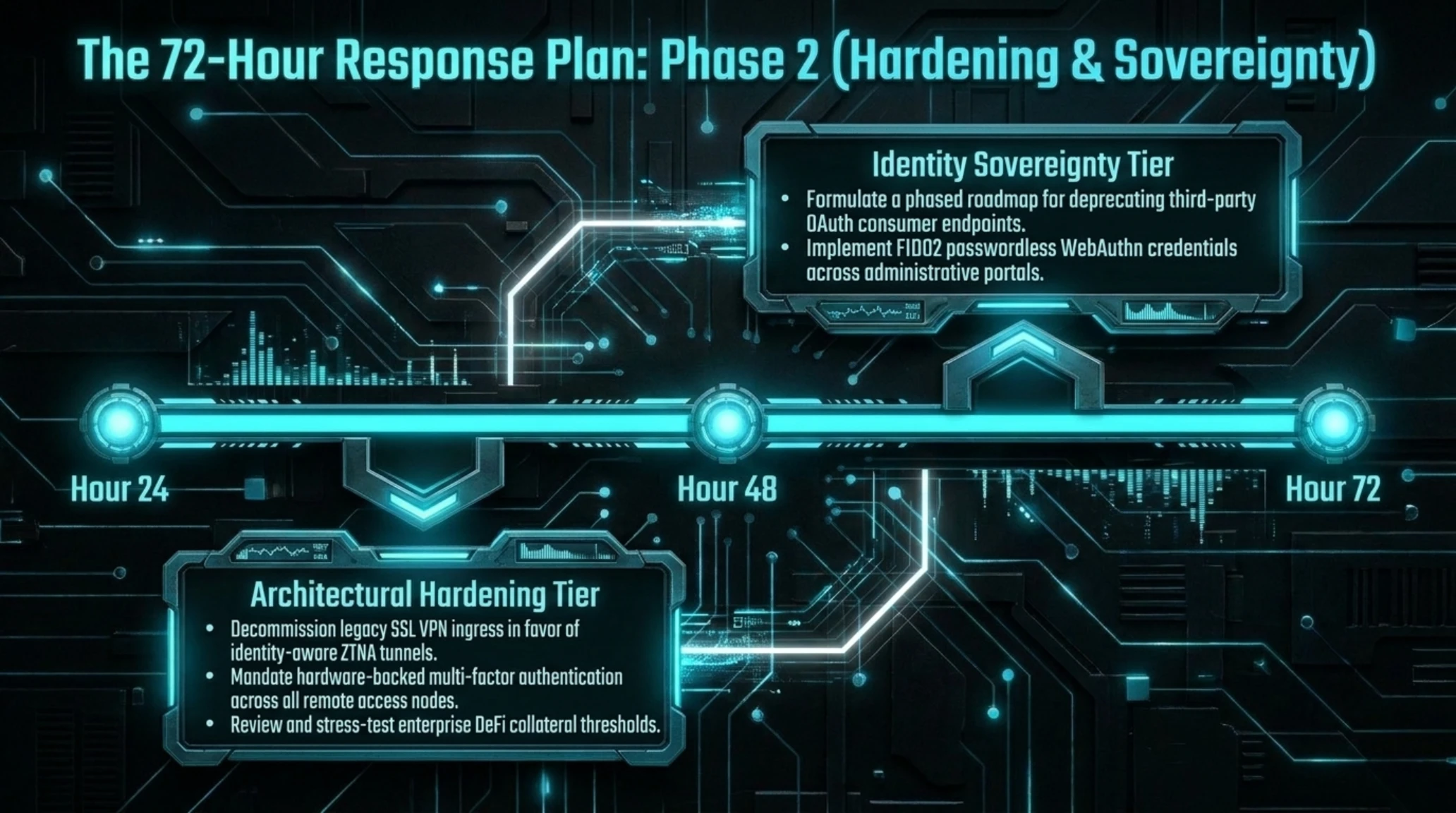
Senior network defense engineers emphasize that, beyond the immediate installation of the latest vendor firmware images, organizations must rigorously isolate all NetScaler management interfaces from the public internet, restricting administrative consoles strictly to dedicated, multi-factor-authenticated management enclaves.
Takin Analysis: Why Edge Application Delivery Controllers Remain the Fragile Gateway to Enterprise Networks
From the analytical vantage of the Takin Editorial Bureau, Application Delivery Controllers (ADCs) embody a fundamental architectural contradiction within contemporary enterprise networking. On one hand, these appliances are tasked with processing massive volumes of untrusted internet traffic with sub-millisecond latency, demanding direct, low-level execution access to unmanaged memory heaps and raw network sockets. On the other hand, they sit entirely exposed at the absolute frontier of the enterprise boundary.
When a memory parsing error or buffer boundary defect manifests within such appliances, traditional perimeter firewalls offer zero defensive utility. The vulnerability executes within the very device entrusted with terminating the secure tunnel. The latest Citrix crisis demonstrates once again that physical or virtual perimeter appliances cannot compensate for a deficit in true Zero-Trust Network Architecture (ZTNA).
Takin maintains that the only sustainable path forward for large-scale enterprise architectures is an aggressive transition away from centralized VPN concentrators toward identity-aware, micro-segmented zero-trust access fabrics. In a modern ZTNA topology, even the total compromise of an ingress reverse proxy prevents horizontal lateral movement, as every subsequent application request requires independent, context-aware cryptographic re-authentication.
Axis 04: N-able N-central MSP RMM Exploited in the Wild: Attackers Circumvent Hotfix 2 Defenses
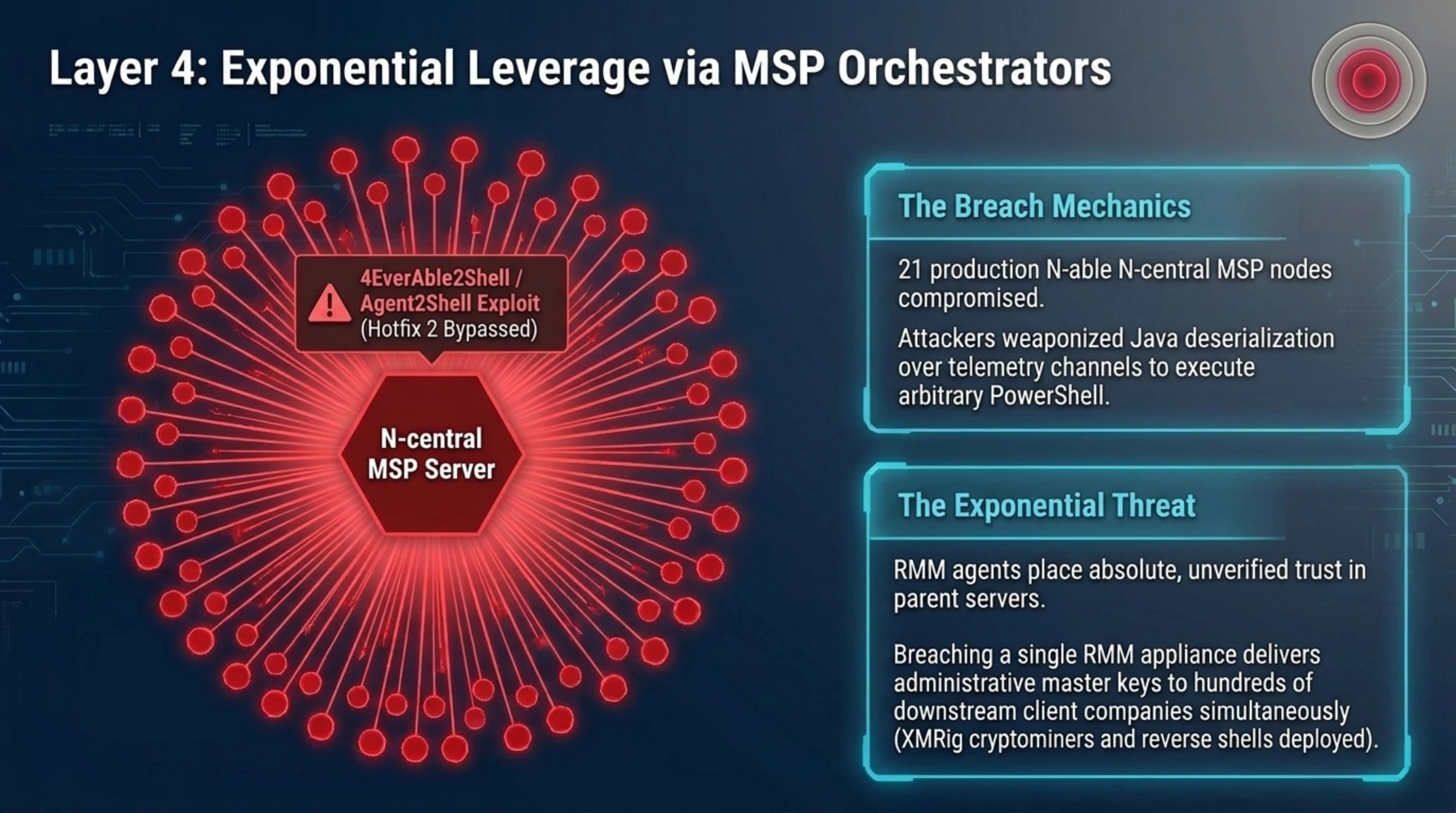
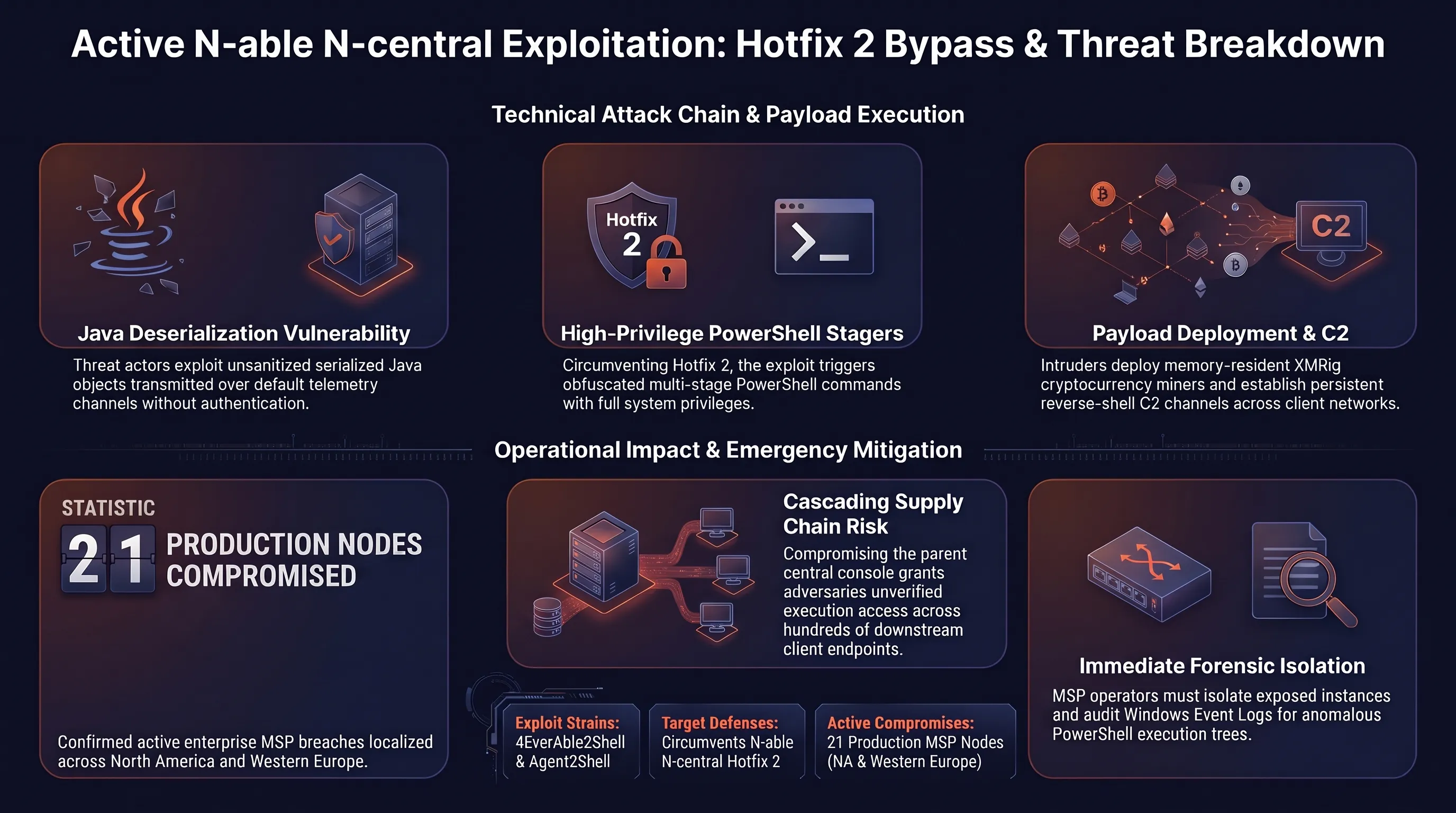
Rigorous threat intelligence telemetry released by cybersecurity research teams at Huntress and Rapid7 has verified active, in-the-wild exploitation of N-able N-central remote monitoring and management (RMM) appliances. Used extensively by Managed Service Providers (MSPs) to deliver automated administrative maintenance and oversight across thousands of commercial client networks, the platform has become the epicenter of an aggressive supply chain offensive. Intruders have weaponized dual zero-day exploit tools designated 4EverAble2Shell and Agent2Shell, effectively bypassing the security controls established by N-able's recently issued Hotfix 2.
These sophisticated exploit strains weaponize deep-seated Java deserialization vulnerabilities residing within the agent-to-server communication telemetry stream. By exploiting the server's failure to sanitize incoming serialized Java objects transmitted over default telemetry channels, unauthenticated external threat actors can execute arbitrary, high-privilege PowerShell payloads directly on the underlying Windows Server operating environment.
Confirmed forensic evidence confirms that after achieving system-level execution on vulnerable N-central host appliances, adversaries deployed multi-stage obfuscated PowerShell stagers, initiated memory-resident XMRig cryptocurrency mining payloads, and established persistent reverse-shell command-and-control channels across client infrastructure. More than 21 production enterprise MSP deployments have been confirmed compromised to date.
Enterprise Cybersecurity Risk Assessment & Threat Mitigation Matrix
| Vulnerability Vector / Threat Vector | Operational Risk Classification | Takin Recommended Mitigation Protocol |
|---|---|---|
| Hotfix 2 Circumvention (Agent2Shell) | Critical | Isolate public internet exposure for N-central management ports immediately. |
| PowerShell Stagers & In-Memory Miners | High Risk | Enforce ScriptBlock logging and monitor endpoint CPU utilization thresholds. |
| Lateral Pivoting Across Managed Clients | Contained | Suspend agent auto-trust policies and require ephemeral hardware signing tokens. |
| Persistent Rootkits & Supply Chain Tampering | Critical | Execute independent memory integrity audits across all host hypervisors. |
The strategic ramifications of this campaign are severe. Because the RMM software agents running on thousands of downstream client endpoints place absolute, unverified trust in instructions dispatched from the parent N-central server, an adversary commanding the central console holds the capability to distribute ransomware or wiper scripts across hundreds of external corporate environments simultaneously.
Incident responders have advised MSP system operators to temporarily isolate internet-facing N-central instances immediately and perform thorough forensic reviews of Windows Event Logs for anomalous PowerShell execution trees, unexpected outbound network connections, and unverified scheduled task creations.
Takin Analysis: Managed Service Providers as the Epicenter of Global Supply Chain Warfare
In the strategic estimation of the Takin Editorial Bureau, modern cyber warfare has pivoted decisively toward aggregating operational leverage. Advanced threat actors no longer expend valuable operational capital attempting to penetrate individual medium-sized businesses one by one. Attacking a Managed Service Provider yields exponential returns: breaching a single centralized RMM appliance delivers administrative master keys to the financial systems, medical databases, and operational infrastructure of hundreds of downstream client companies.
RMM platforms such as N-central inherently require extensive operational permissions, unrestricted network firewall traversals, and deep operating system hooks to fulfill their remote management mandates. When such an indispensable operational orchestrator suffers from foundational flaws like Java deserialization, it transforms instantaneously into the ultimate distributed malware dissemination platform.
The circumvention of Hotfix 2 illustrates that hurried patches addressing isolated exploit symptoms without fundamentally overhauling communication protocols are fundamentally insufficient. True resilience for RMM platforms necessitates redesigning agent-server protocols around end-to-end asymmetric cryptography, enforcing cryptographic hardware token signing for individual remote commands, and deploying mandatory child process behavioral constraints on all downstream client endpoints.
Axis 05: Ethereum Treasury Firm BTCS Liquidates ETH at a Loss to Defend $64M Aave Lending Position
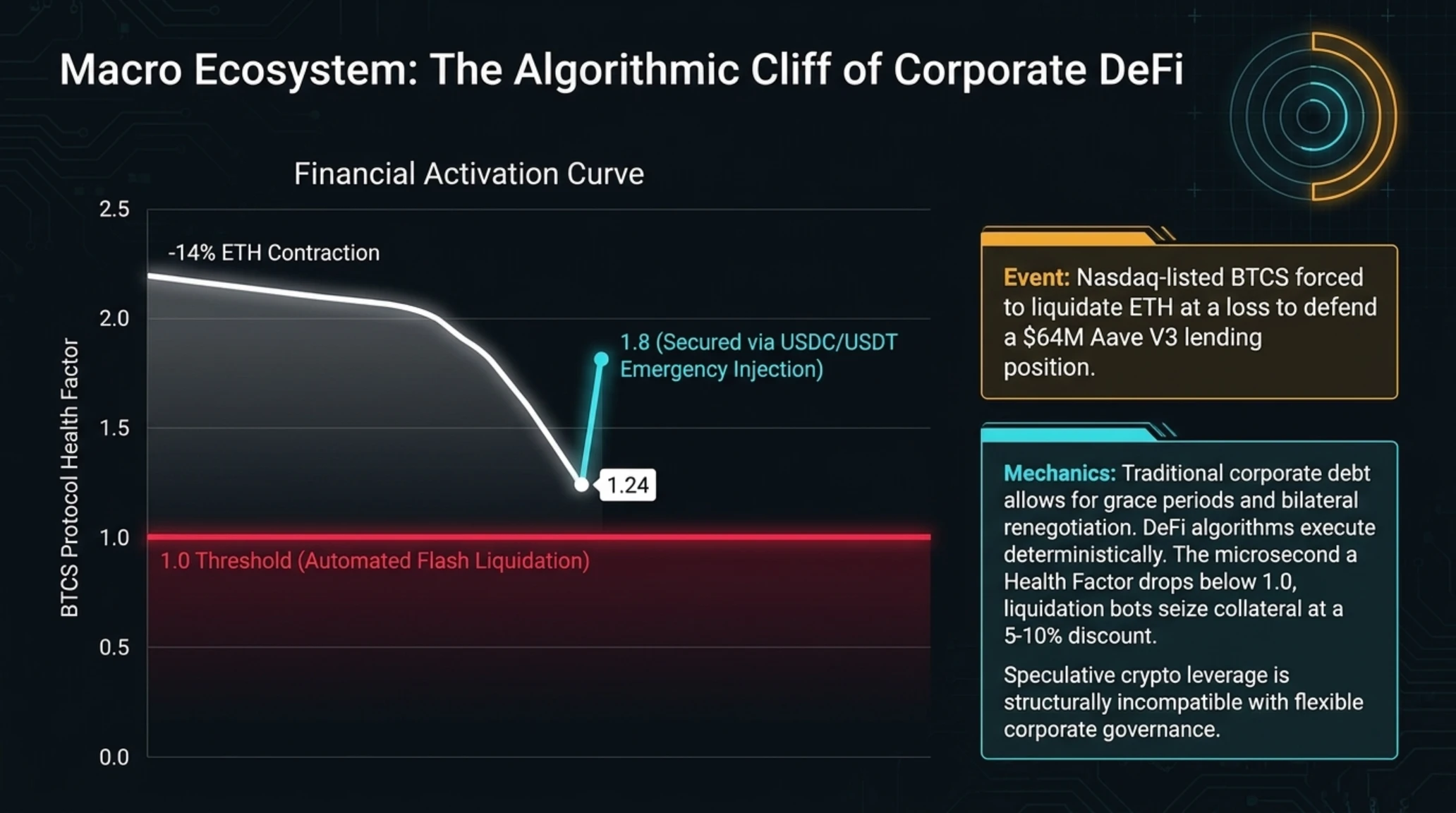
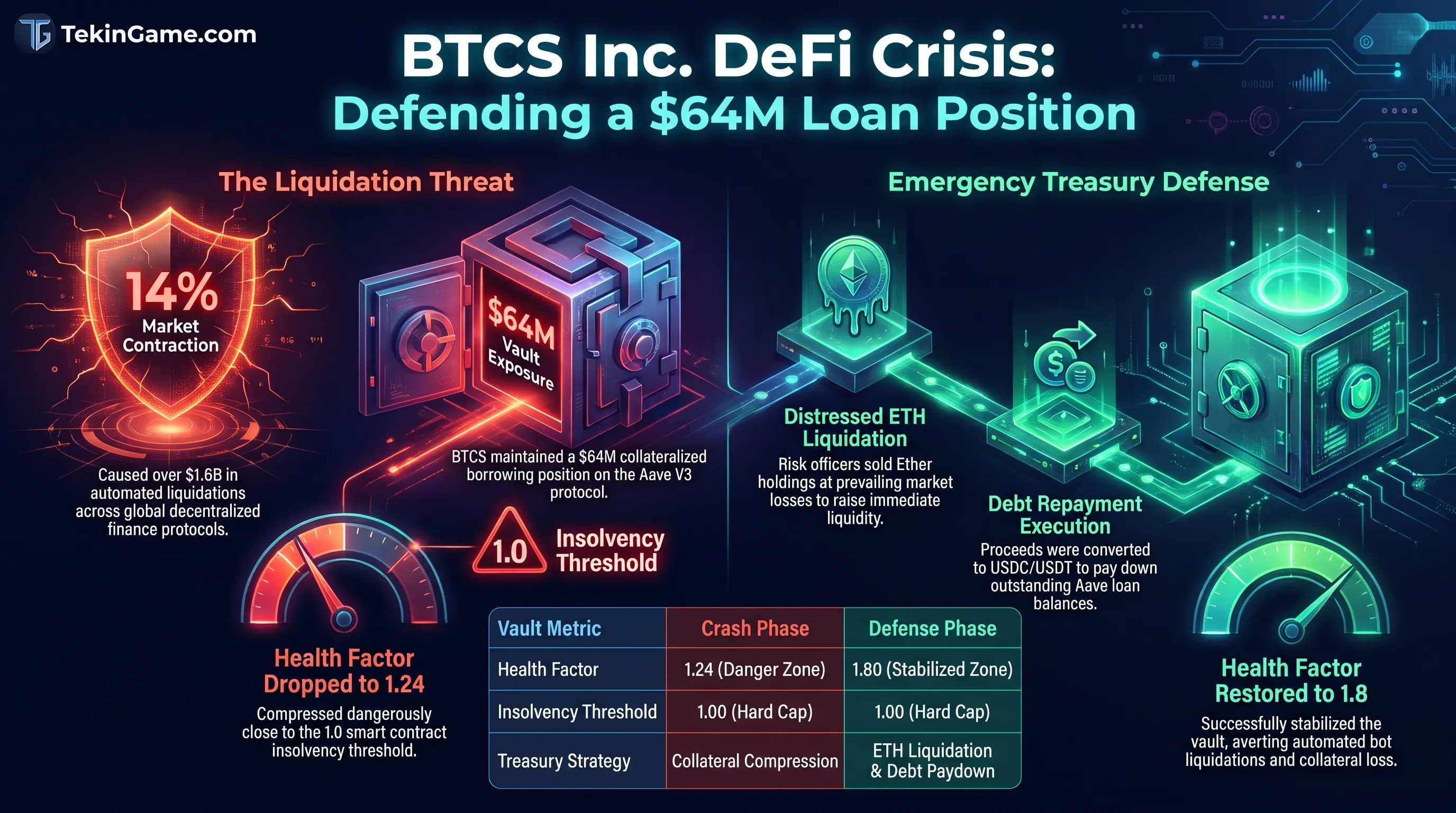
Nasdaq-listed digital asset technology and blockchain infrastructure firm BTCS Inc. has officially confirmed that it was compelled to execute an emergency liquidation of a substantial portion of its Ethereum treasury holdings at an accounting loss. The urgent corporate maneuver was designed to avert an impending, catastrophic automated liquidation of its $64 million collateralized borrowing position maintained on the Aave V3 decentralized lending protocol.
A precipitous 14% intraday contraction across global cryptocurrency valuations triggered an aggressive cascade of on-chain liquidations exceeding $1.6 billion across decentralized financial protocols. This violent drawdown severely compressed the collateralization margins of BTCS's open borrowing vault, driving its protocol Health Factor down to a precarious 1.24 dangerously proximate to the inflexible 1.0 insolvency threshold where smart contracts automatically trigger collateral auction protocols without human intervention.
Faced with the existential threat of automated liquidation penalties, the company's financial risk officers rapidly sold hundreds of Ether tokens at prevailing distressed market prices. The liquid stablecoin proceeds (USDC and USDT) were immediately redirected to pay down outstanding loans on Aave V3, successfully elevating the position's Health Factor back to a stable 1.8 ratio at the expense of locking in substantial quarterly accounting deficits.
Donut Chart & Annual Growth Telemetry: Corporate DeFi Liquidity Matrix
| DeFi Position Component | Liquidity Volume & Market Valuation | Balance Sheet Risk Strategy |
|---|---|---|
| Total Staked Ether Collateral | $32 Million Post-Drawdown Value | Locked to Support Stablecoin Debt Facility |
| Outstanding Stablecoin Borrowing | $24 Million via USDC & Tether Pools | Paid Down to Elevate Health Factor to 1.8 |
| Emergency Liquidation Buffer | $8 Million Secondary Reserve Capital | Deployed to Preempt Flash Loan Liquidators |
| Gas Fee & Execution Slippage Capital | $4 Million Contingency Allocation | Engineered to Guarantee High-Priority Execution |
The liquidity crisis has sent reverberations across traditional capital markets where institutional investors hold equity in public crypto-treasury companies as indirect balance sheet proxies, highlighting the severe hazards of deploying speculative crypto leverage within formal corporate governance frameworks.
Quantitative decentralized finance analysts emphasize that corporate balance sheets heavily collateralized with volatile Layer-1 crypto assets are inherently exposed to predatory on-chain liquidity hunting and sudden decentralized exchange price shocks.
The strategic concession executed by BTCS illustrates that when corporate treasury executives interface directly with immutable decentralized smart contracts, traditional Wall Street debt renegotiation mechanisms are utterly superseded by deterministic algorithmic execution.
Takin Analysis: Structural Incompatibilities Between Corporate Treasuries and DeFi Smart Contract Architecture
A deep dive by the Takin Editorial Bureau illuminates the profound friction generated when traditional corporate accounting paradigms interface with decentralized financial algorithms. In traditional commercial banking, a corporate borrower experiencing severe collateral value depreciation is granted structured grace periods, bilateral covenant renegotiation windows, or opportunities to post alternative physical guarantees to avert formal default. In decentralized finance, algorithms exhibit neither patience, empathy, nor legal flexibility.
The autonomous code governing Aave V3 is mathematically engineered to prioritize the systemic solvency of the lending pool above the welfare of any individual borrower. The microsecond a position's Health Factor drops below parity, programmatic liquidation bots trigger flash loans to seize discounted collateral on-chain. BTCS recognized that blockchain latency is measured in block execution intervals rather than traditional banking business days.
This incident represents a definitive cautionary case study for institutional enterprises pursuing digital treasury reserves. Takin projects that corporate CFOs will increasingly retreat from direct leverage within permissionless DeFi pools, turning instead toward compliant institutional credit facilities that integrate circuit breakers, flexible margin calls, and protective settlement buffers to insulate corporate equity from algorithmic liquidation cascades.
Axis 06: Nintendo to Terminate Google and Apple Account Sign-Ins Ahead of Next-Gen Hardware Transition
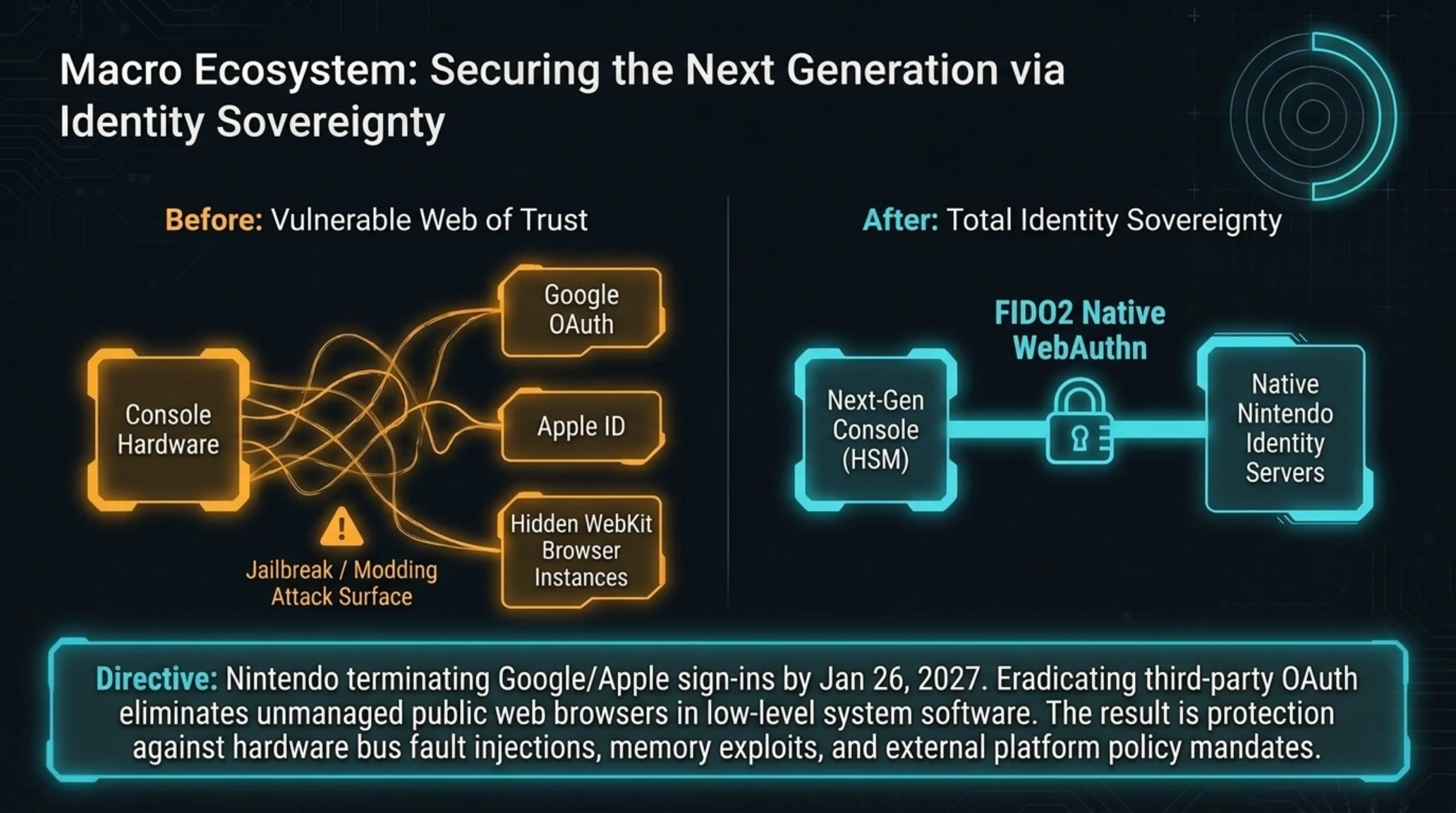
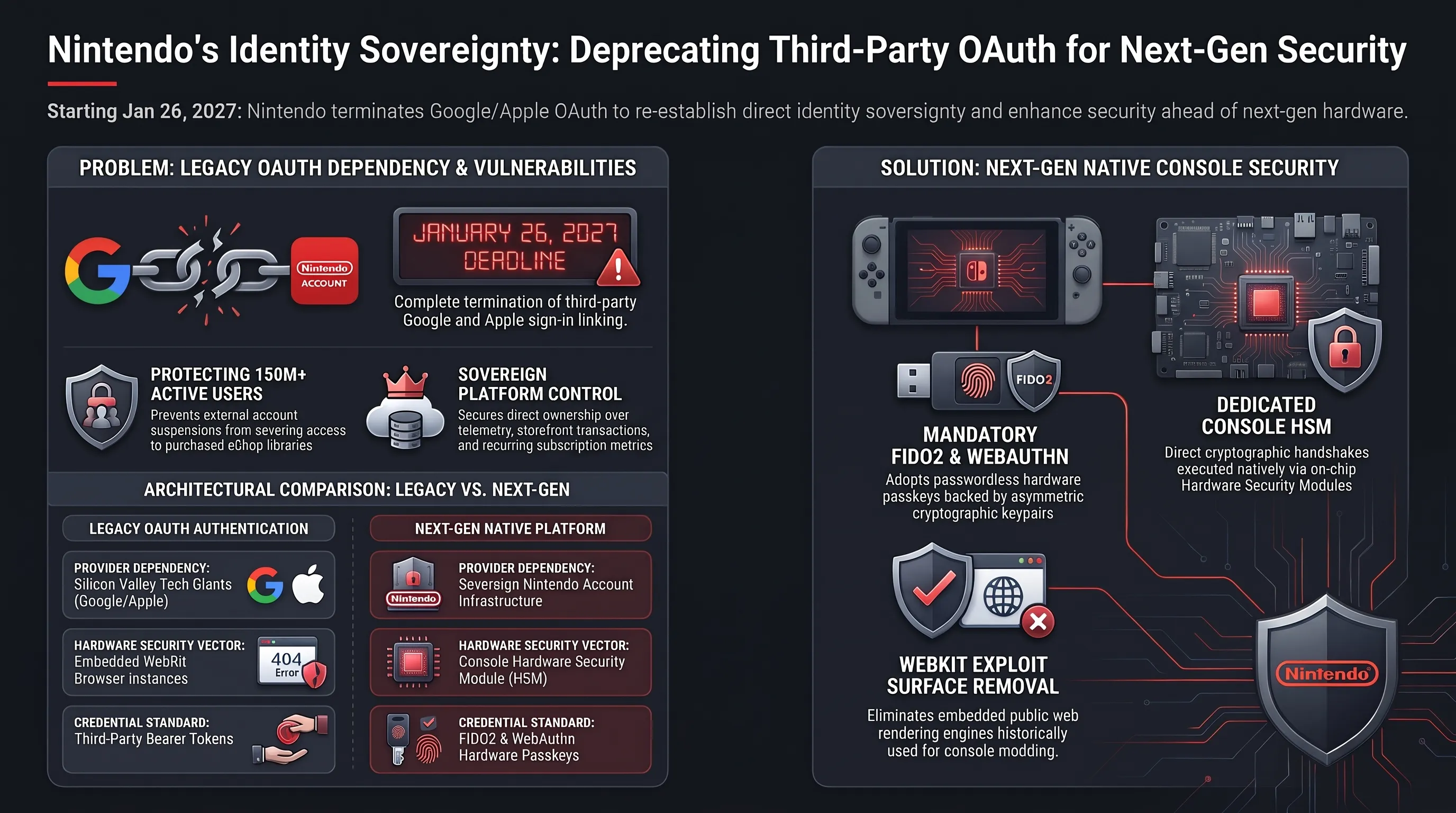
In an official security directive distributed to global platform account holders, Nintendo has announced that beginning January 26, 2027, players will no longer be permitted to link, authenticate, or sign in to their Nintendo Accounts utilizing third-party Google or Apple OAuth credentials. The Japanese gaming enterprise has mandated that all active users configure native Nintendo Account credentials, establish FIDO2-compliant passkeys, and activate direct multi-factor authentication (2FA).
This policy transition represents an aggressive strategic pivot to sever Nintendo's historical reliance on external identity providers managed by Silicon Valley technology conglomerates. Under existing OAuth configurations, user account suspensions on Google or policy alterations within Apple IDs frequently severed player access to hundreds of dollars in purchased digital game libraries on the Nintendo eShop, generating substantial customer support overhead for Nintendo.
Gaming industry analysts directly connect this identity consolidation to Nintendo's comprehensive architectural preparations for the commercial rollout of its next-generation console, the successor to the record-breaking Nintendo Switch. Mandating native authentication backed by WebAuthn hardware security keys forms a critical component of Nintendo's proactive strategy to harden its platform against digital piracy, unapproved software modification, and unauthorized account resale.
📚 Classified & Related Dossiers in TekinGame
If you wish to explore beyond this report and delve into cybernetic frontiers and autonomous AI architectures, do not miss these three exclusive deep-dives in the Tekin Garage:
Takin Technical Architecture Lexicon (Jargon Buster)
The operational pivot also affords Nintendo unmediated ownership over customer telemetry, digital storefront transaction data, and recurring subscription metrics, completely bypassing privacy mediation policies established by rival mobile platform operators.
The global gaming community has broadly interpreted this milestone as definitive validation of an imminent hardware generation transition, while hardware security engineers have praised the integration of passwordless FIDO2 passkey architectures into Nintendo's proprietary platform stack.
Takin Analysis: Native Identity Governance as the Critical Armor for Next-Generation Console Security
The gaming hardware architecture division at Takin asserts that Nintendo's authentication shift represents far more than a routine frontend user experience refinement. The original Nintendo Switch hardware ecosystem was plagued throughout its lifecycle by low-level hardware exploits, memory bus fault injections, and browser-based entry points. Many early jailbreak vectors were executed through hidden WebKit browser rendering instances invoked specifically to facilitate third-party social media and OAuth sign-ins.
By eradicating third-party OAuth integration entirely, Nintendo eliminates the necessity of embedding unmanaged public web browser rendering engines within the pre-boot and low-level system software layers of its next-generation console. User authentication will be handled natively through asymmetric cryptographic handshakes executed directly with the console's dedicated Hardware Security Module (HSM) and Nintendo's hardened identity servers, eliminating a premier attack surface historically leveraged by console modders.
Furthermore, amidst escalating global regulatory scrutiny surrounding mobile digital storefront commissions and platform privacy restrictions, Nintendo is actively insulating its proprietary revenue ecosystem from third-party platform fee extractions. Establishing sovereign, direct identity relationships with over 150 million active users ensures that Nintendo's next-generation digital ecosystem remains completely impervious to external policy mandates.
Macro Strategic Synthesis: Kernel Zero-Days and Supply Chain Fragility in 2026
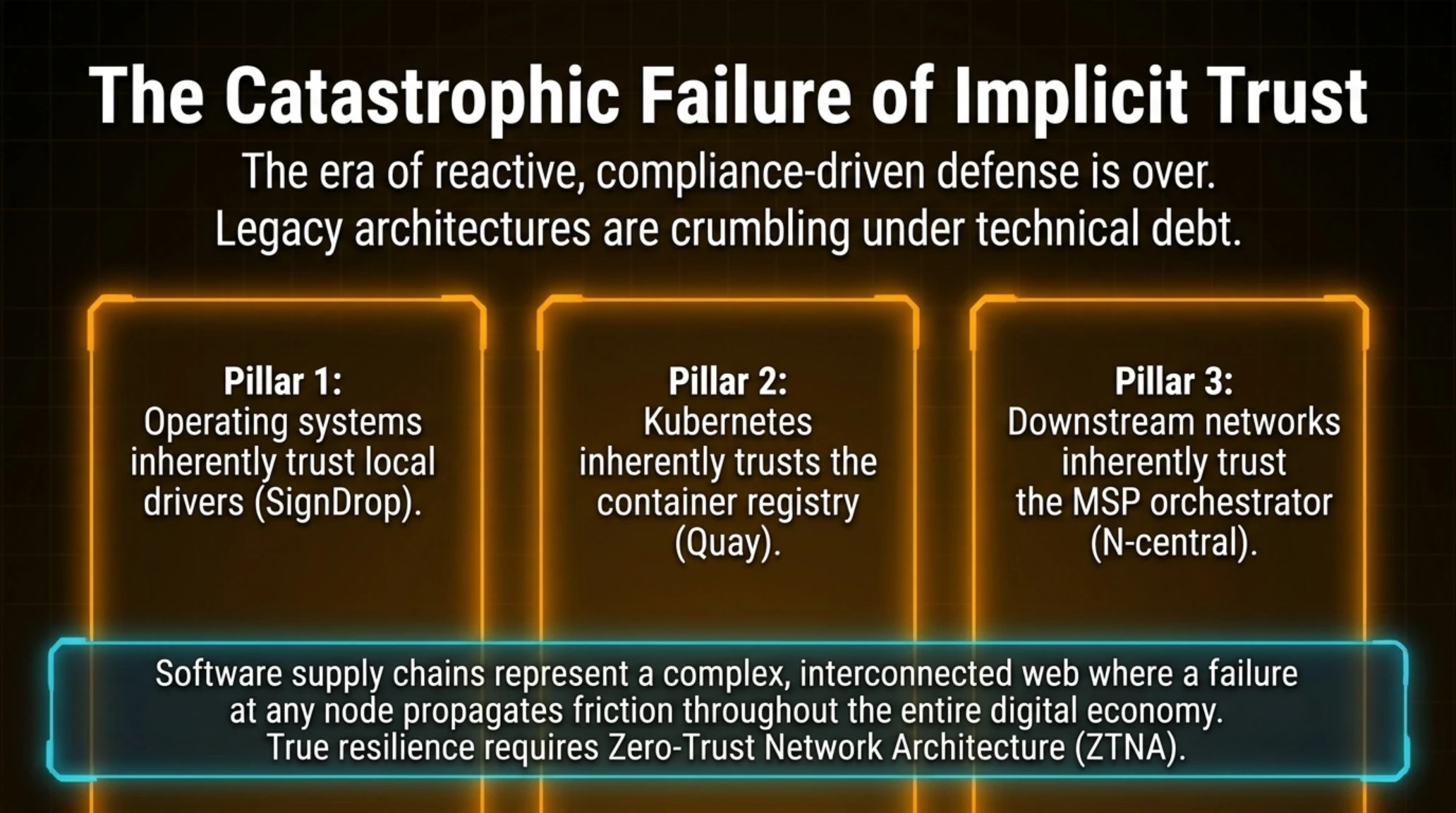
The synchronized convergence of high-impact security breaches and economic stress tests recorded during the night of November 14, 2026, offers an unvarnished diagnostic of the systemic vulnerabilities defining contemporary enterprise technology. The era when organizations could achieve defensible operational postures through perimeter firewall fortification alone has definitively ended. Today, adversaries routinely chain low-level operating system kernel flaws to evade next-generation endpoint detection while simultaneously targeting central container registries to poison enterprise build artifacts at the source.
When these attack methodologies coalesce with remote buffer overflows in perimeter application delivery controllers like Citrix NetScaler and widespread exploitation of remote management tools like N-able N-central, the resulting threat landscape resembles a multi-front assault on foundational IT infrastructure. Organizations maintaining reactive, compliance-driven defensive strategies face unprecedented risks of cascading operational and reputational failure.
The lessons emerging from tonight's operational telemetry underscore the non-negotiable requirement for defensive depth, automated runtime isolation, and unyielding zero-trust enforcement across corporate endpoints, cloud environments, and digital financial holdings. In high-stakes enterprise topologies, defensive teams can no longer assume that internal network traffic is benign or that pre-compiled container images remain untouched throughout the software delivery lifecycle.
Furthermore, the structural integration of automated cryptographic attestation mechanisms into continuous deployment pipelines represents the only viable path to thwarting silent registry poisoning campaigns. By establishing cryptographic roots of trust that bind container digests to verified hardware developer tokens, organizations effectively decouple software integrity from the underlying vulnerabilities of intermediate hosting platforms.
Market Sentiment Gauge & S-Curve Adoption Trajectory
Across macroeconomic and platform domains, the day's developments demonstrate that the deterministic, unforgiving mathematics of decentralized finance contracts can compel public corporations into forced capital liquidations, while hardware platform titans like Nintendo are demonstrating that true long-term security requires ruthlessly severing reliance on external identity providers.
Cybernetic Terminal & Telemetry Benchmark Log
Security telemetry collected across global nodes confirms that enforcing cryptographic image signatures and sandboxing system drivers remains the most effective defense against sophisticated adversarial exploitation.
Corporate risk officers and infrastructure engineers must structure their immediate operational agendas around hardening remote management conduits, enforcing cryptographic image signing, and eliminating perimeter trust assumptions across all operational domains.
Event Timeline | Chronology of Technological Shifts and Crisis Response
| Operational Time Window | Primary Security & Market Milestone | Remediation & Strategic Countermeasure |
|---|---|---|
| 00:00 UTC | SignDrop Zero-Day & Quay Exploitation | Automated internet port scanning identified across global infrastructure. |
| 06:00 UTC | 14% Crypto Flash Crash & Aave Vault Stress | BTCS liquidates ETH at loss to prevent algorithmic smart contract liquidation. |
| 12:00 UTC | Nintendo Deprecates Apple and Google OAuth | User transition initiated toward hardware-bound WebAuthn passkey credentials. |
| 18:00 UTC | Citrix 12-Patch Advisory & Rapid7 MSP Alert | N-central management interfaces isolated and ZTNA ingress controls enforced. |
- Rapid vendor response by Red Hat and Citrix delivering emergency hotfixes for maximum-severity perimeter flaws.
- Absolute mathematical reliability of Aave V3 lending protocols executing without accumulating toxic bad debt.
- Proactive defense posture by Nintendo eliminating historical browser attack surfaces ahead of its next-gen console launch.
- Persistent zero-day exposure in Windows CLFS driver leaving millions of production endpoints vulnerable to ransomware LPE.
- Cascading supply chain risk demonstrated by MSP RMM compromises allowing horizontal lateral movement across clients.
- Material financial losses incurred by institutional cryptocurrency treasury holders due to algorithmic collateral volatility.
Quantitative forensic analyses confirm that structural access control segmentation and rigorous cryptographic verification constitute the sole dependable shields for modern enterprise digital infrastructure.
Prior to reviewing our comprehensive frequently asked questions section, enterprise IT administrators should review the verified technical sources and critical action directives below.
Takin Editorial Verdict, Strategic Takeaways & Verified Sources
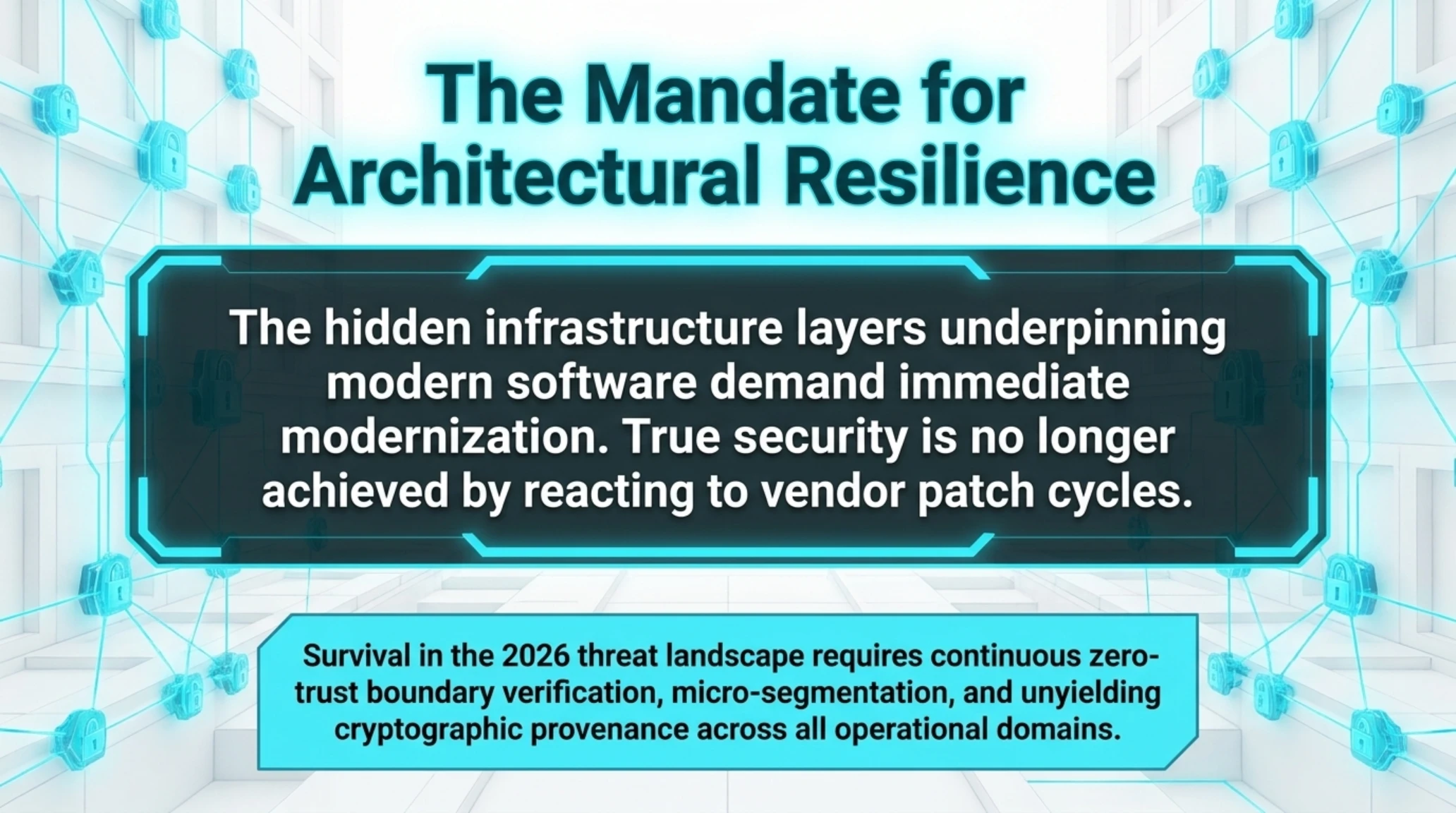
The events documented in tonight's executive briefing demonstrate that the hidden infrastructure layers underpinning modern software and corporate finance demand immediate architectural modernization. True security is no longer achieved by reacting to vendor patch Tuesday cycles; it requires continuous zero-trust boundary verification, microsegmentation, and rigorous liquidity stress testing across all digital holdings.
Takin Editorial Verdict, Strategic Takeaways & Verified Sources
- BleepingComputer Cybersecurity Intelligence: BleepingComputer SignDrop Windows Zero-Day Investigation
- The Hacker News Enterprise Security Portal: The Hacker News Red Hat Quay Security Advisory
- Cloud Software Group Official Advisory: Citrix NetScaler ADC and Gateway Security Bulletin
- Huntress Threat Intelligence Research: Huntress Threat Intelligence N-central Exploitation Analysis
- CoinDesk Institutional Markets Reporting: CoinDesk BTCS DeFi Liquidation Risk Report
- Engadget and Nintendo Platform Support: Engadget Nintendo Identity Transition Analysis
- Takin Morning Strategic Briefing: Tekin Morning Saturday November 14, 2026 Executive Edition
Frequently Asked Questions & Technical Analysis
How does the Windows SignDrop zero-day work and why is it classified as severe?
The SignDrop exploit targets a logic flaw in the Windows Common Log File System (clfs.sys) kernel driver during Base Log File (BLF) container parsing. By manipulating corrupt metadata offsets, an unprivileged local user bypasses HMAC validation and triggers an arbitrary kernel memory write, escalating privileges to NT AUTHORITY\SYSTEM and blinding EDR tools.
Why are the Red Hat Quay CVSS 9.9 vulnerabilities considered catastrophic for enterprise CI/CD?
Because flaws in Quay's authorization middleware and token signing cache allow remote unauthenticated attackers to forge administrative tokens, bypass organizational isolation, and overwrite private production container images and Helm charts, introducing silent malicious code into automated Kubernetes deployments.
What security defects were addressed in the latest Citrix NetScaler coordinated patch batch?
Cloud Software Group patched 12 distinct vulnerabilities across NetScaler ADC and Gateway, including remote pre-authentication buffer overflows in SSL VPN processing, memory exhaustion vectors, and administrative authorization bypasses via forged session cookies.
How do the 4EverAble2Shell and Agent2Shell exploits compromise N-able N-central MSP servers?
The exploits weaponize Java deserialization vulnerabilities in the agent-to-server reporting stream, allowing attackers to bypass Hotfix 2 protections and execute unauthorized high-privilege PowerShell commands that drop XMRig miners and establish persistent access across downstream client environments.
Why did Nasdaq-listed BTCS sell its Ethereum holdings at a financial loss on Aave V3?
A sharp 14% crypto market drop compressed BTCS's Aave lending position Health Factor down to 1.24. To prevent an automated smart contract liquidation cascade at the 1.0 threshold that would incur severe penalty fees, treasury officers liquidated ETH at distressed prices to pay down stablecoin debts.
What motivated Nintendo to terminate Google and Apple third-party sign-ins by early 2027?
Nintendo is establishing total platform identity sovereignty ahead of its next-generation console launch. By eliminating third-party OAuth, Nintendo removes vulnerable embedded browser rendering engines used in historical jailbreaks, hardens security via native WebAuthn passkeys, and secures direct ownership of user telemetry and digital storefront revenue.
Additional Gallery: Tekin Night Nov 14: Windows SignDrop Zero-Day & Red Hat Quay