Tekin Night | Oct 7, 2026: GTA 6 Realism, Switch 2 Bundle & WiFi 8 Router
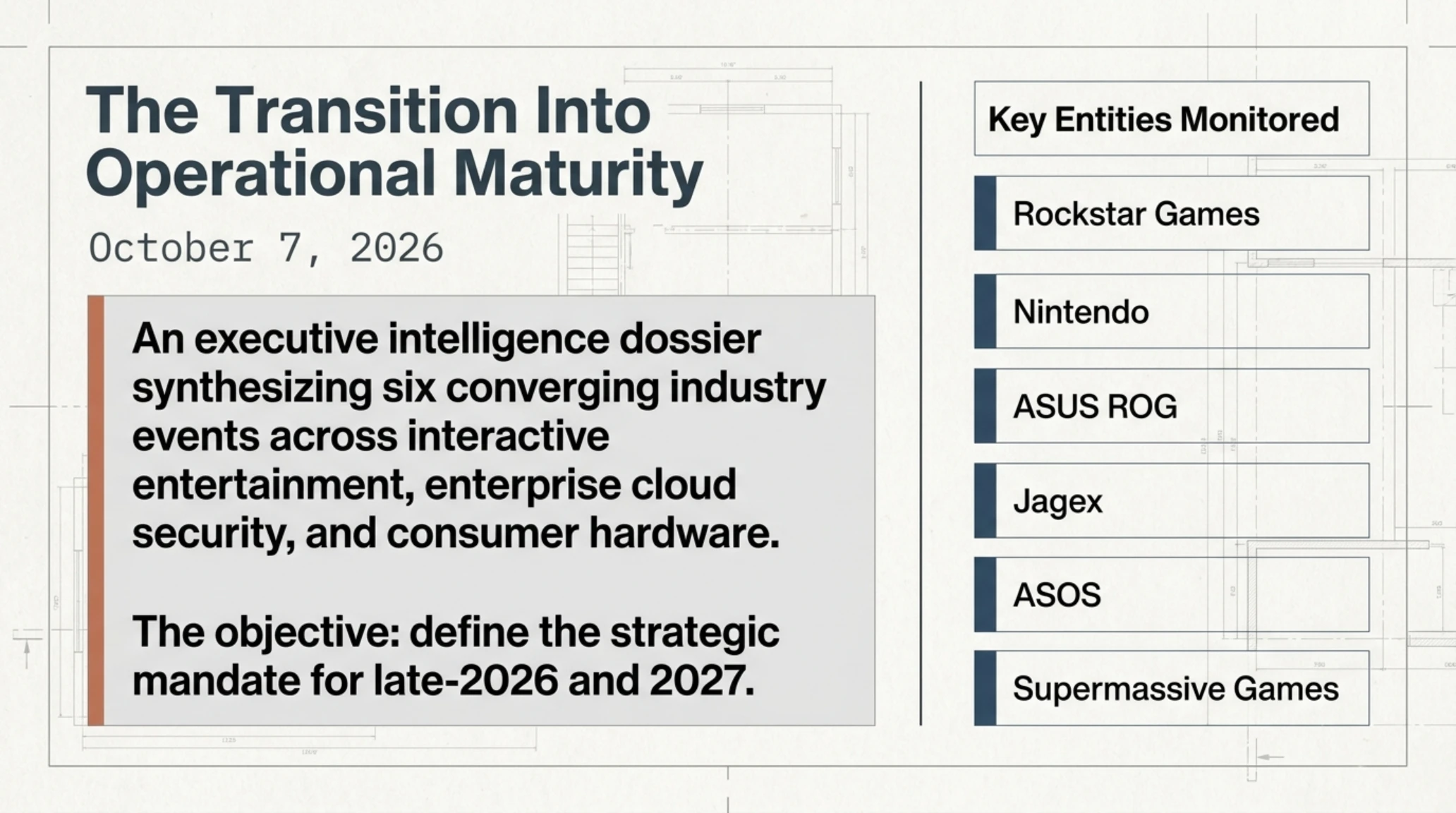
Tonight's briefing analyzes landmark gaming revelations, hardware milestones, and mobile cybersecurity breaches across global technology markets.
- 🎮GTA 6 Design Philosophy- Rob Nelson reveals the balance between realism and gameplay flow.
- 🎧Switch 2 Japanese Bundle- New Choose-Your-Game hardware edition arrives as sales top 23M.
- 🚀RuneScape AI Crisis- Jagex pulls trailer after fans spot a 6-fingered knight in Nikes.
- 🗡️ASOS App Hijacked- Intruders exploit push notifications, wiping 11% off shares.
- 📰First WiFi 8 Router- ASUS ships ROG Rapture GT-BN98 with 25 Gbps wireless throughput.
- ⚔️Supermassive Layoffs- British horror studio cuts 70 developers post-Directive 8020.
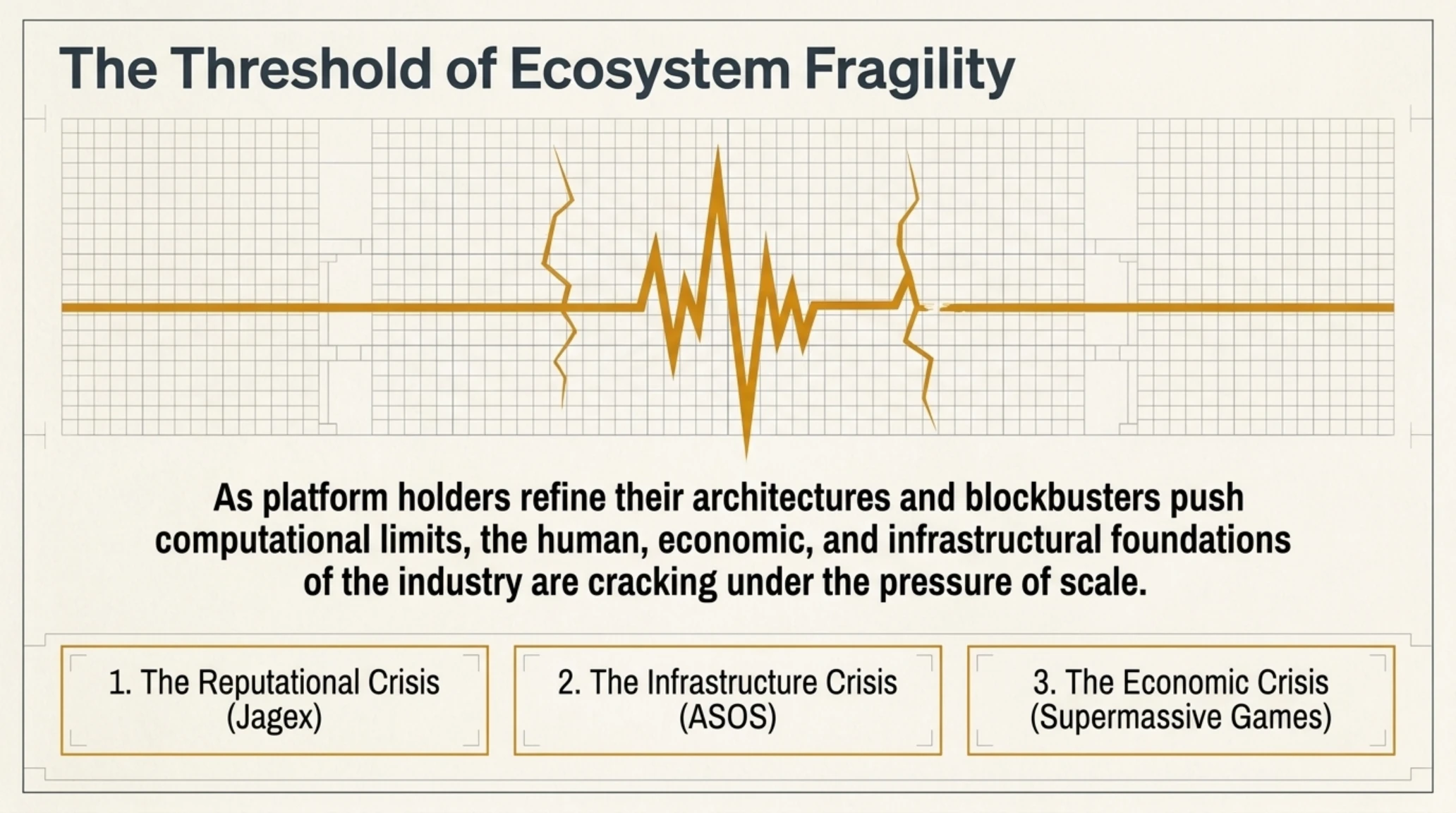
The evening of Wednesday, October 7, 2026, marks a pivotal inflection point across interactive entertainment, consumer gaming hardware, and digital application distribution. While daytime reporting centered on enterprise cloud governance and regulatory compliance across the European Union, the closing hours of the business day shifted attention toward the creative philosophies driving blockbuster software, the commercial maneuvering of legacy console manufacturers, and the structural vulnerabilities lurking within mobile notification channels. Tonight's strategic briefing explores how high-stakes software development continues to navigate the boundary between cutting-edge technological capability and consumer expectation.
In this comprehensive investigation, we analyze unprecedented disclosures from Rockstar North leadership regarding the architectural balance between uncompromising physics simulations and uninhibited open-world sandbox fun in Grand Theft Auto VI. We evaluate Nintendo's commercial masterstroke in Japan with its bespoke Switch 2 hardware bundle as cumulative global shipments officially surpass the 23 million threshold. Furthermore, we dissect the reputational crisis engulfing Jagex following a botched generative artificial intelligence marketing asset, the stock market turmoil triggered by an unauthorized notification breach at fashion giant ASOS, the commercial arrival of multi-gigabit WiFi 8 networking equipment, and the persistent employment headwinds chilling independent European game development studios.
Strategic Takeaways & Executive Evening Synthesis
- Rockstar clarifies that realism in GTA VI is a tool to serve immersion rather than a rigid simulation constraint that compromises velocity.
- Nintendo's bundling strategy and 23 million global unit milestone reinforce the Switch 2's commercial dominance.
- The community revolt against Jagex's AI-generated teaser demonstrates zero-tolerance against algorithmic art shortcuts.
- The compromise of ASOS's mobile push gateway highlights how notification pipelines can inflict capital market damage.
- ASUS establishes the commercial baseline for WiFi 8, prioritizing deterministic low-latency packet delivery.
- Supermassive Games' downsizing underscores the capital fragility of cinematic mid-tier narrative games.
To grasp the foundational forces altering the landscape of digital entertainment, we begin by examining the rare, extensive creative testimony offered by the architects of the most anticipated interactive software production in modern history.

Technical telemetry gathered over the past forty-eight hours confirms that modern interactive media is transitioning into an era where player expectations for narrative authenticity and technical polish leave zero room for operational compromise.
1. Deconstructing Rockstar's Creative Architecture: Rob Nelson Outlines GTA 6 Realism, Immersion, and Dual Protagonists in LOVE Magazine
In an extraordinary editorial disclosure that breaks years of disciplined corporate secrecy, Rob Nelson, co-head of Rockstar North, alongside senior narrative directors and systems engineers, participated in an exhaustive retrospective published within Issue 27 of LOVE Magazine. The comprehensive interview provides the first authoritative insight into the overarching production ethos governing Grand Theft Auto VI, confronting the central design dilemma that has animated gaming discourse since the debut of Red Dead Redemption 2: how a studio establishes unprecedented fidelity without suffocating the anarchic momentum that defines open-world entertainment.
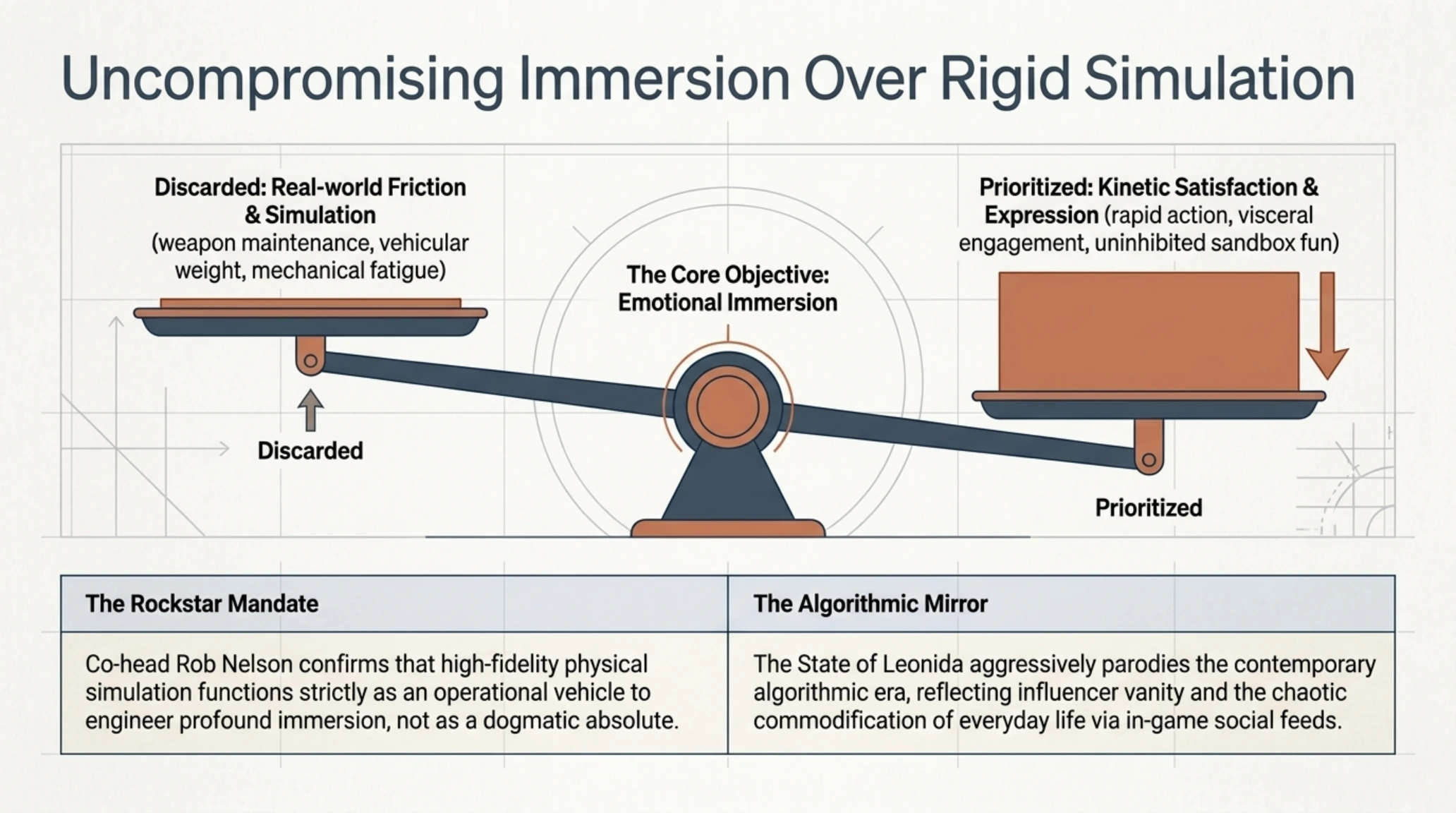
Nelson articulated a nuanced design doctrine, emphasizing that within Rockstar's development hierarchy, realism is never treated as a dogmatic absolute or an end unto itself. Instead, high-fidelity physical simulation functions strictly as an operational vehicle to engineer profound immersion. When algorithmic adherence to real-world friction, weapon maintenance, or vehicular weight threatens to induce mechanical fatigue or impede the player's immediate expressive freedom, Rockstar's systems designers decisively discard the real-world constraint in favor of kinetic satisfaction. In GTA 6's reimagined State of Leonida, environmental responsiveness has been elevated to unprecedented fidelity, yet the underlying game loops remain aggressively tuned for rapid action and visceral engagement.
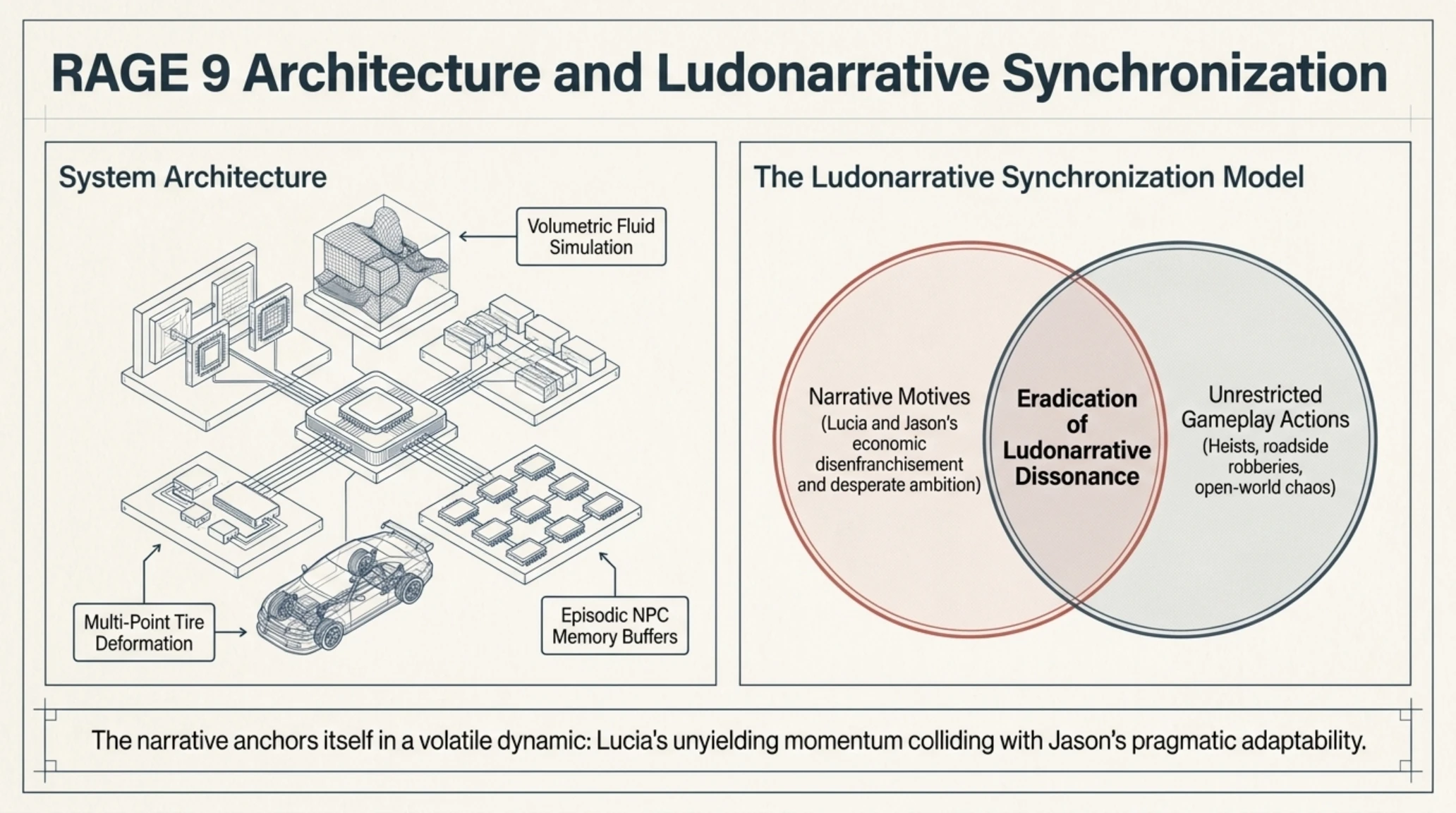
The technological engine facilitating this balance is the proprietary RAGE 9 framework. The engine introduces volumetric fluid simulation for oceanic coastlines, procedural vehicle destruction grids, and a multi-tiered non-player character (NPC) cognitive layer. Rather than operating along predictable scripted navigation splines, Leonida's civilian population possesses short-term episodic memory buffers. NPCs react dynamically to nearby automotive accidents, ambient gunfire, or escalating social unrest, utilizing smartphones to capture footage or altering daily navigation paths to avoid hazardous corridors. This pervasive ambient agency breathes authentic organic life into Vice City's neon-lit boulevards and the sprawling swamplands of the surrounding counties.
Vehicular dynamics have undergone an exhaustive engineering overhaul. RAGE 9 introduces a multi-point tire deformation model that accounts for surface temperature, moisture accumulation from tropical thunderstorms, and distinct material friction coefficients across asphalt, crushed coral, and deep Everglades mud. However, rather than forcing players into punishing simulation handling akin to dedicated motorsport titles, the input mapping translates controller inputs into responsive, arcade-adjacent drifts and aggressive acceleration curves. Similarly, the law enforcement dispatch system features contextual procedural escalation: small-town county deputies deploy basic PIT maneuvers and perimeter roadblocks, whereas specialized metropolitan tactical units employ drone reconnaissance, spike strips, and coordinated pincer movements.
Turning to narrative architecture, Nelson explored the intricate psychological interplay between co-protagonists Lucia and Jason. Rejecting standard buddy-cop tropes or mechanical character-switching mechanics, the narrative anchors itself in an emotionally volatile dynamic shaped by economic disenfranchisement and desperate criminal ambition. Lucia is conceptualized as an unyielding, strategically decisive force determined to claw back social sovereignty from an exploitative societal apparatus. Conversely, Jason embodies a pragmatic, highly adaptable survivor whose emotional vulnerability and deference to Lucia's momentum supply the central moral friction of the narrative arc. Their mutual codependency serves as the foundational gravity binding complex heist planning, spontaneous roadside robberies, and the broader criminal empire progression.
Furthermore, Nelson and his writing staff confirmed that the franchise's trademark cultural satire has been recalibrated to confront the absurdities of the contemporary algorithmic era. Recognizing that real-world internet culture, short-form viral broadcasting, and sensationalist media have surpassed traditional parody, Rockstar's creative teams amplified Leonida's social ecosystem to grotesque extremes. In-game smartphone networks algorithmically amplify criminal escapades, broadcasting player-generated chaos to satirical social video feeds where citizens comment, react, and launch unhinged viral trends in real time. The resulting digital landscape acts as a piercing mirror reflecting influencer vanity, institutional decay, and the chaotic commodification of everyday life.
This deliberate alignment between character psychology and open-world autonomy successfully resolves the traditional design dilemma known in interactive criticism as ludonarrative dissonance, as detailed below.
Technical Taxonomy: Mitigating Ludonarrative Dissonance
Ludonarrative dissonance describes the contradiction between a game's authored narrative and the mechanical actions the player undertakes. GTA 6 synchronizes Lucia and Jason's outlaw motivations directly with systemic criminal mechanics, ensuring narrative motives harmonize with open-world choices.
While Rockstar prepares to reset artistic and computational benchmarks across home consoles, the handheld gaming sector witnessed an aggressive commercial maneuver from Japan's preeminent platform holder.
2. Nintendo Unveils Switch 2 Japanese "Choose-Your-Game" Hardware Bundle as Global Cumulative Sales Eclipse 23 Million Units
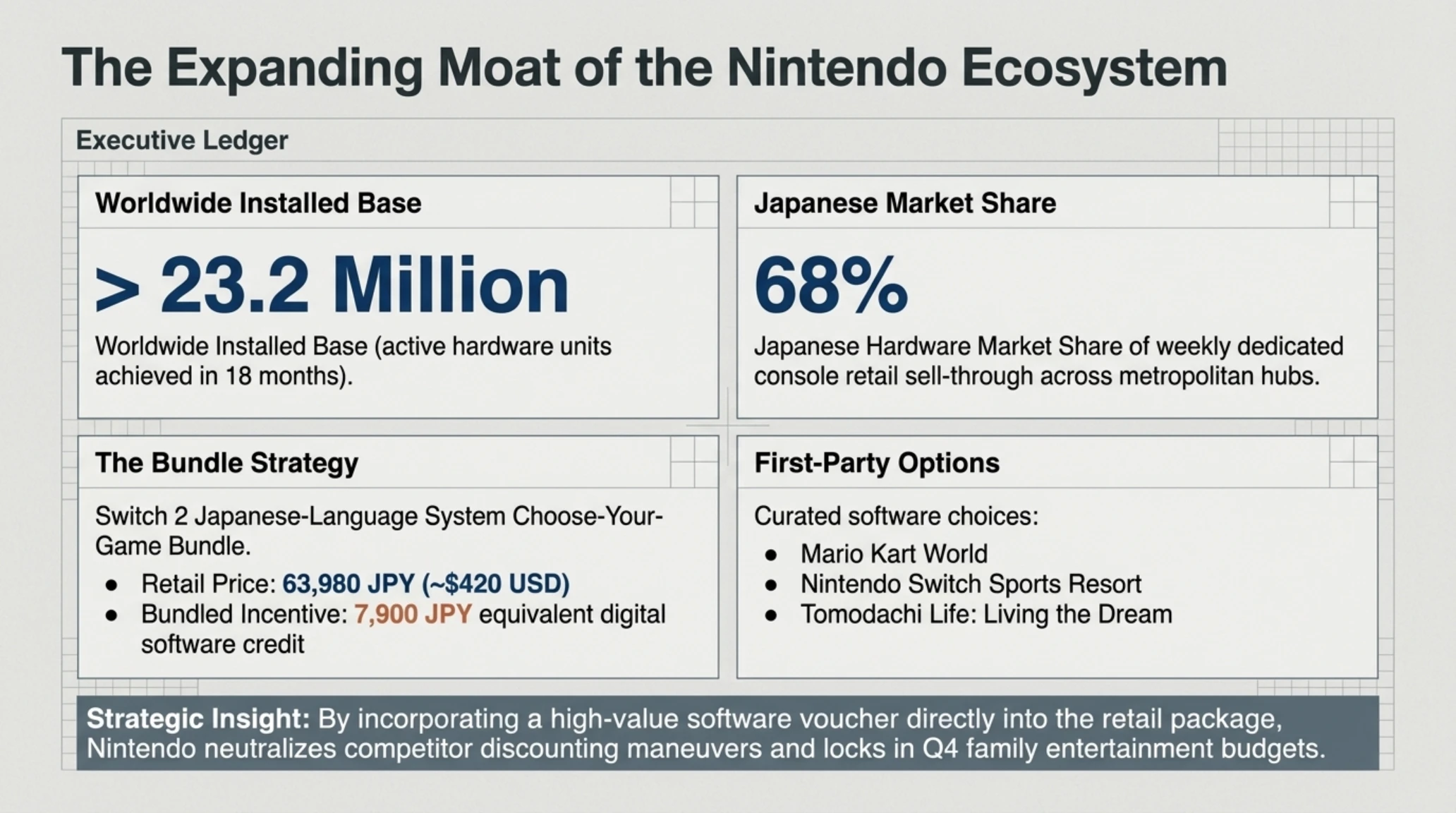
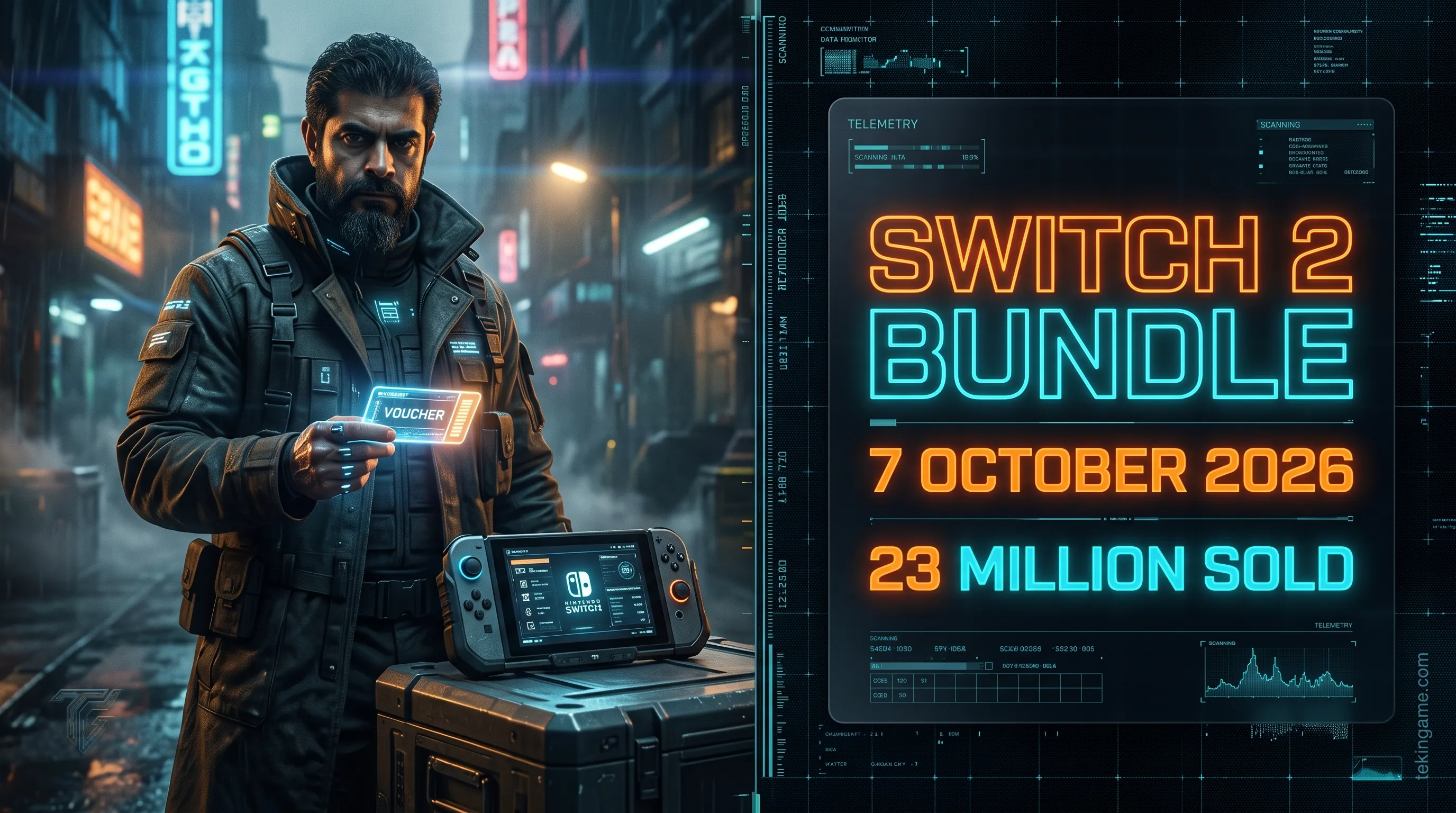
In an official corporate announcement issued from its Kyoto headquarters, Nintendo Co., Ltd. revealed an aggressive commercial packaging strategy for the Nintendo Switch 2 aimed at consolidating domestic retail leadership ahead of the high-volume fourth-quarter holiday trading period. Officially designated as the Switch 2 Japanese-Language System Choose-Your-Game Bundle, the specialized retail SKU is scheduled to debut across Japanese storefronts on November 12, 2026, carrying a competitive suggested retail price of 63,980 yen (approximately 420 USD).
The definitive commercial hook of this hardware bundle resides in its bundled digital software voucher, which grants purchasers unrestricted entitlement to claim one full digital download from a curated triumvirate of flagship first-party releases. Consumers can select between the record-setting arcade racer Mario Kart World, the motion-controlled family title Nintendo Switch Sports Resort, or the newly published social simulation franchise revival Tomodachi Life: Living the Dream. By incorporating substantial software choice directly into the retail package, Nintendo eliminates consumer purchase hesitation while maintaining hardware pricing discipline.
The hardware announcement coincided with verified industry supply-chain telemetry confirming that worldwide cumulative consumer sell-through for the Nintendo Switch 2 has officially breached the 23 million unit milestone in approximately eighteen months on store shelves. This rapid adoption trajectory underscores the immense brand equity of the hybrid form-factor, propelled by seamless backward compatibility with the legacy Switch software library, an upgraded 8-inch 1080p variable-refresh-rate display, and superior thermal dissipation profiles.
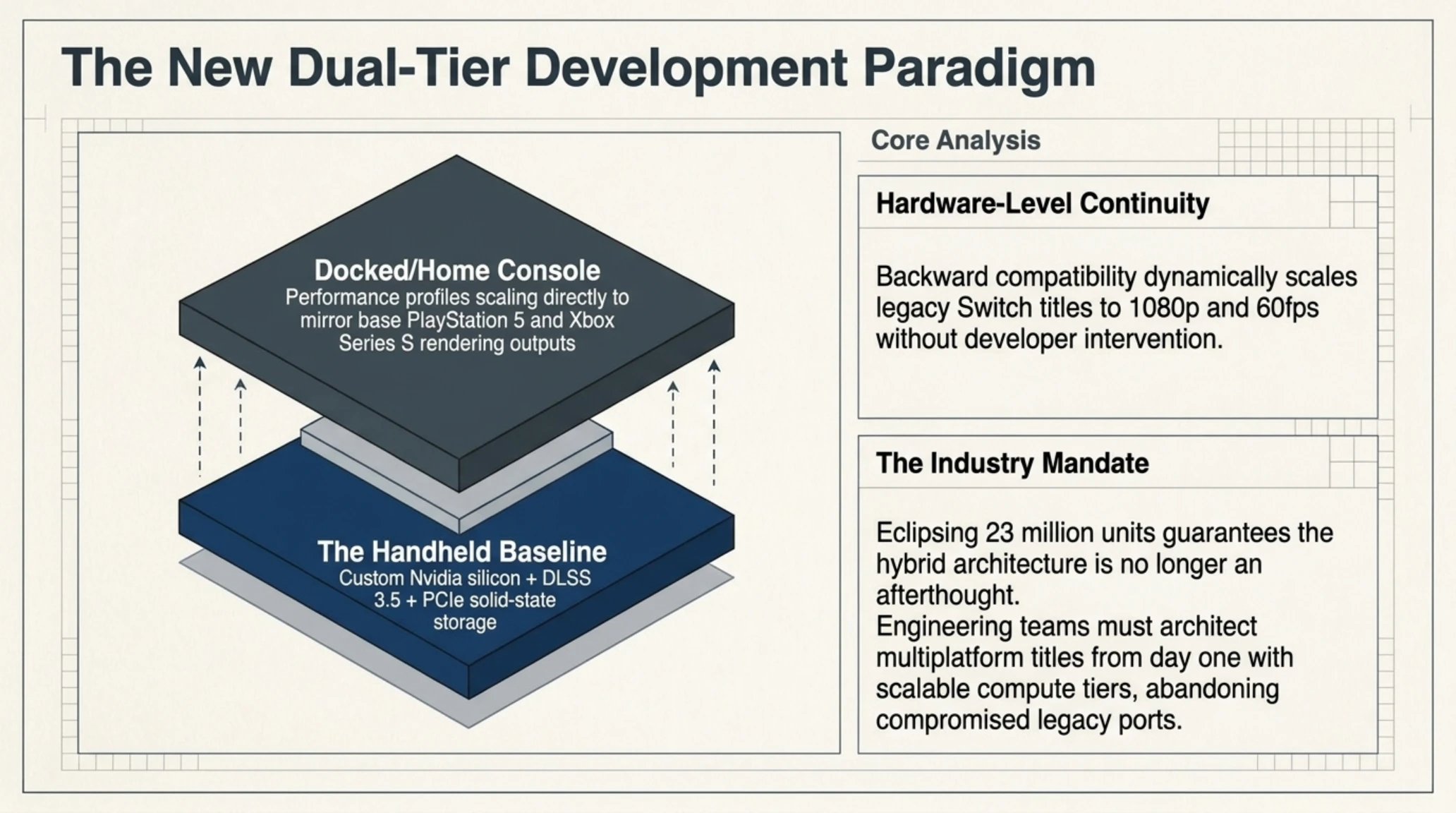
Under the hood, the Switch 2's custom Nvidia silicon architecture, leveraging deep learning super sampling (DLSS 3.5) reconstruction, enables docked performance profiles that closely mirror base PlayStation 5 and Xbox Series S rendering outputs. This computational leap has permanently resolved the historical third-party publisher void that constrained the original Switch, securing simultaneous day-and-date franchise releases from major western publishers alongside Capcom and Square Enix. Furthermore, custom proprietary solid-state storage media operating across high-speed PCIe bus lanes eliminates loading hitches, allowing expansive open-world titles to stream textures instantaneously without visual pop-in.
Crucially, backward compatibility operates with hardware-level performance enhancements. Legacy Switch titles running on Switch 2 hardware automatically benefit from dynamic resolution scaling up to native 1080p in handheld mode and rock-solid 60 frames-per-second execution, breathing new life into thousands of existing library titles. This extensive digital continuity guarantees that early adopters preserve their accumulated software investments without re-purchasing enhanced editions.
Market analysts note that by pricing the bundle at 63,980 yen, Nintendo has effectively neutralized potential hardware discounting maneuvers from regional competitors, locking in family entertainment budgets before year-end promotional campaigns commence.

The strategic synergy between hardware profitability and software attachment rates highlights Nintendo's peerless operational resilience amidst broader semiconductor cost volatility.
Hardware Commercial Ledger: Switch 2 Japanese SKU
| Commercial Metric | Details |
|---|---|
| Retail Price Point | 63,980 JPY inclusive of domestic consumption tax |
| Bundled Software | 7,900 JPY equivalent digital software credit |
| Selectable Catalog | Mario Kart World / Switch Sports Resort / Tomodachi Life |
| Worldwide Installed Base | Exceeds 23.2 million active hardware units |
| Japanese Market Share | Accounts for 68% of weekly dedicated console retail |
Yet, as platform holders refine their manufacturing pipelines, marketing teams operating on the digital frontier were reminded that unvetted algorithmic shortcuts can trigger catastrophic community backlashes.
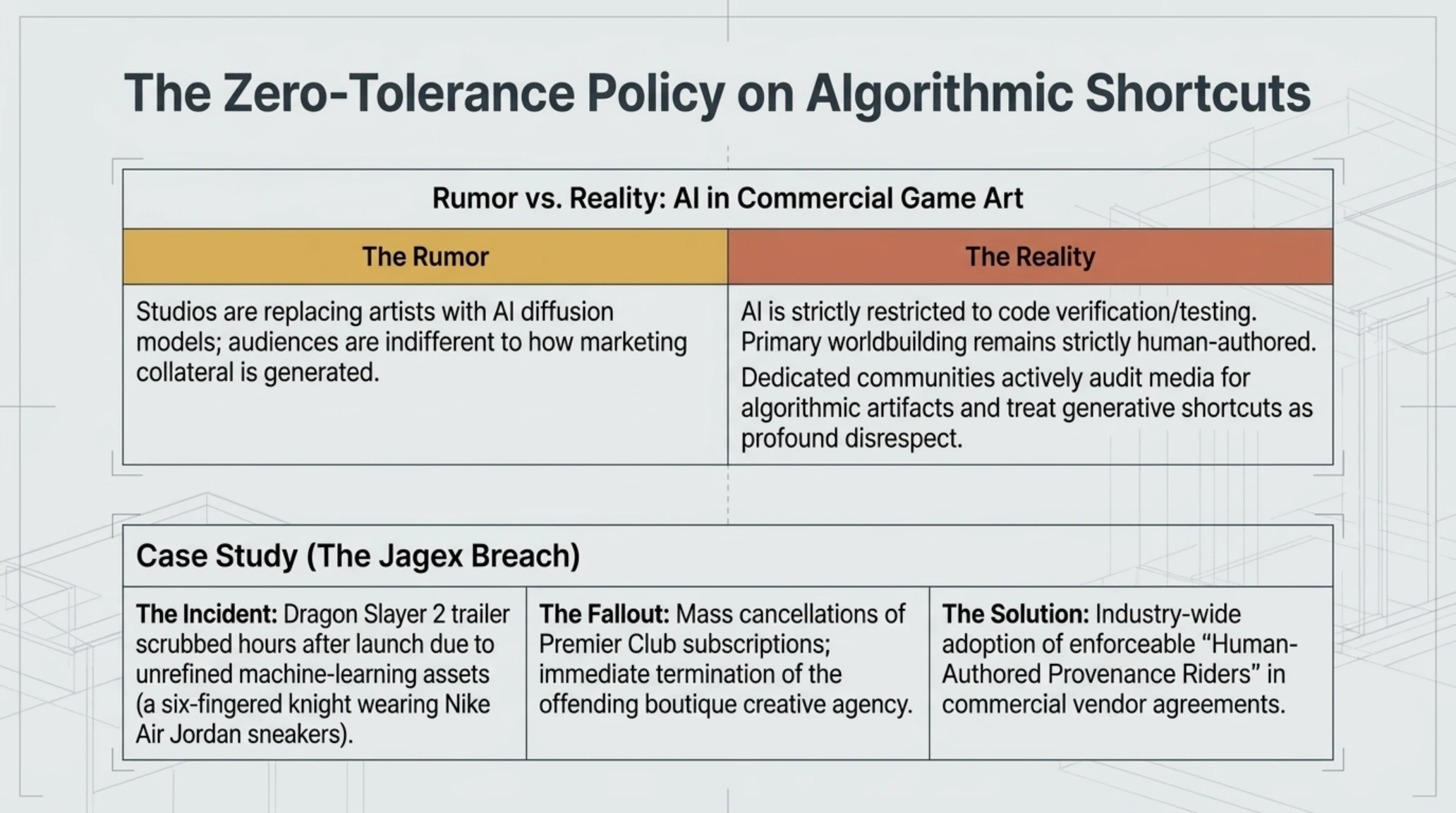
3. Generative AI Backlash Forces Jagex to Emergency-Scrub RuneScape 3 Dragon Slayer 2 Trailer After Six-Fingered Sneaker Knight Sparks Outrage
Veteran British game developer Jagex, the enduring studio behind the venerable twenty-five-year-old MMORPG franchise RuneScape, was forced into a humiliating emergency public relations retreat following the debut of a promotional trailer for its flagship Dragon Slayer 2 narrative quest at the annual RuneFest 2026 convention. Within hours of broadcast across official YouTube and social media feeds, the video was completely scrubbed following intense community backlash that exposed the widespread and uncredited deployment of flawed generative artificial intelligence assets.
The controversy ignited when dedicated players examining high-resolution video frames on Reddit and community Discord channels identified grotesque anatomical and stylistic anomalies typical of unrefined machine-learning image synthesizers. Most egregiously, a climactic tracking shot showcasing a heavily armored medieval knight depicted the warrior possessing six contorted fingers on his weapon hand, while his lower greaves were abruptly replaced by contemporary athletic sneakers bearing unmistakable Nike Air Jordan design motifs. Furthermore, battle sequences against draconic adversaries suffered from severe temporal incoherence, with sword hilts morphing into biological tissue and volumetric background smoke exhibiting hallucinated fractal distortions.
For an active player community whose institutional identity is deeply rooted in artisanal hand-crafted pixel art, meticulous lore consistency, and the celebrated Old School RuneScape polling system where players democratically vote on every proposed mechanical update the presence of algorithmic slop represented an existential breach of creative trust. The community remembered the historic 2007 Wilderness and Free Trade demonstrations when tens of thousands of players gathered in Falador Square to protest unpopular design changes. In 2026, the digital outrage manifested through coordinated review bombing, mass cancellations of Premier Club subscriptions, and stinging denunciations across Reddit, accusing executive management of compromising artistic integrity to satisfy private equity margin targets.
Confronted with an existential reputational firestorm, Jagex executive leadership published a late-night mea culpa, confirming the immediate worldwide retraction of all promotional media. The studio explained that the creative production had been outsourced to an external boutique creative agency operating under strict contractual stipulations that categorically prohibited the utilization of generative machine learning tools. The third-party agency had blatantly violated these terms, submitting raw algorithmic outputs disguised as bespoke illustrative storyboards. Jagex announced the instantaneous termination of all business ties with the vendor, reaffirmed its ironclad company-wide policy banning generative AI from all creative and visual pipelines, and confirmed that the replacement trailer would be commissioned directly from vetted community illustrators and independent animators.
The incident resonated far beyond Cambridge, prompting international guilds of digital illustrators and concept artists on platforms like ArtStation and X to establish formal certification registries. Major independent studios are increasingly adopting enforceable "Human-Authored Provenance Riders" in commercial vendor agreements, subjecting third-party deliveries to forensic noise-residual analysis to ensure algorithmic synthetic media does not contaminate production pipelines. The episode stands as an uncompromising warning to entertainment conglomerates: attempting to bypass human creative labor through opaque outsourcing inevitably exposes corporate brands to devastating reputational damage when vigilant digital communities audit public assets.
Rumor vs. Reality: Generative AI in Commercial Game Art
- Rumor: Major publishers have disbanded traditional art teams to produce assets via AI. (FALSE)
- Reality: Commercial studios restrict ML to automated code verification; primary visual worldbuilding remains strictly human-authored due to copyright risks.
- Rumor: Gaming audiences are indifferent to AI marketing collateral. (FALSE)
- Reality: Dedicated communities actively scrutinize promotional media for algorithmic artifacts.
The rapid escalation of the RuneScape crisis illustrates the precarious boundary between algorithmic automation and human artistic stewardship.

While game studios wrestled with the preservation of artistic integrity, enterprise retail infrastructures faced a hostile demonstration of how cloud communication tokens can be weaponized against millions of consumer handsets simultaneously.
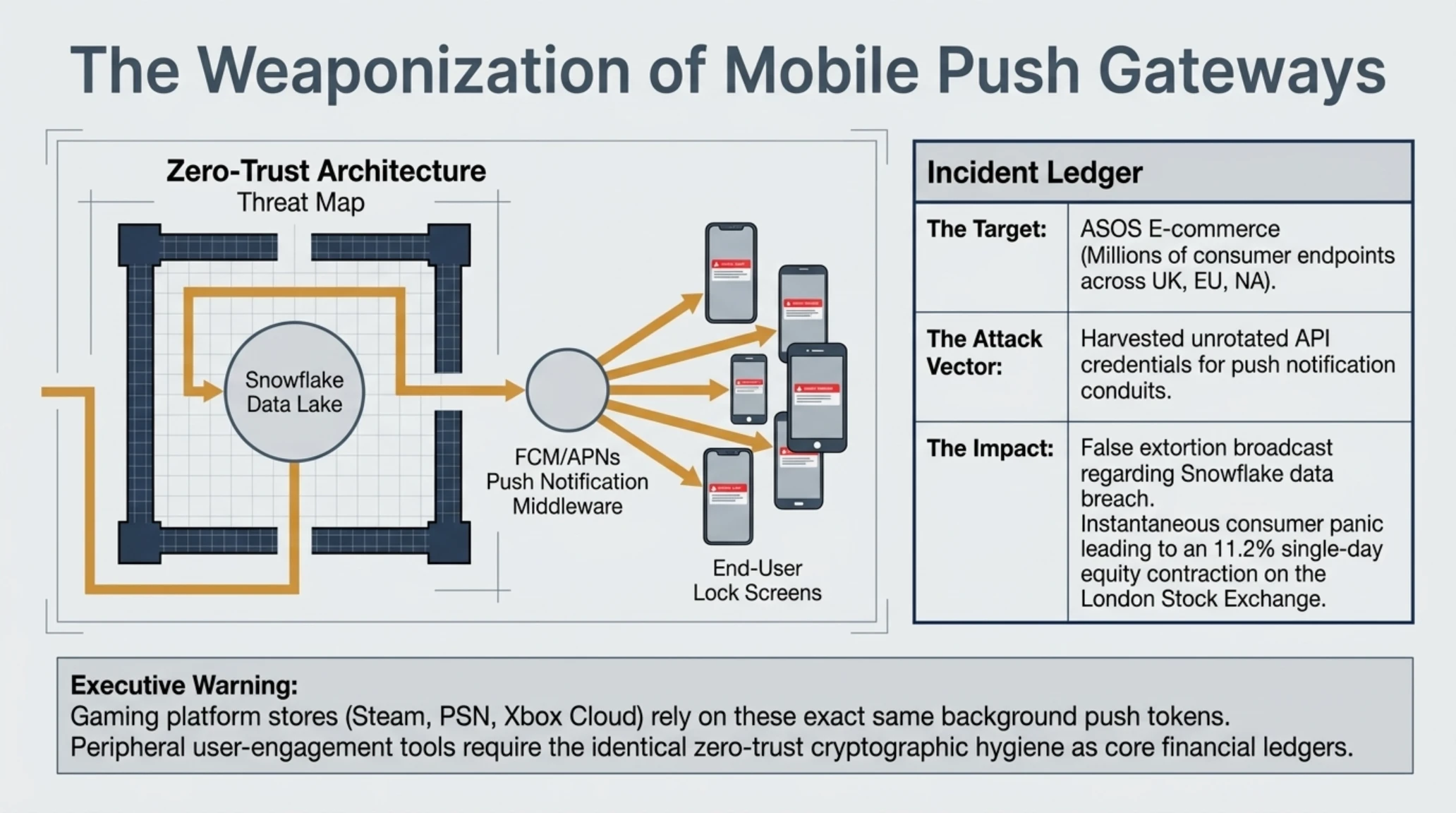
4. Mobile Push Notification Gateway Compromise Hits Retailer ASOS: Extortionists Broadcast Snowflake Breach Claims, Driving Shares Down 11%
In one of the most audacious mobile application perimeter intrusions recorded across the international retail technology sector, premier British e-commerce fashion conglomerate ASOS fell victim to a coordinated threat campaign during the early operating hours of Tuesday, October 6, 2026. Adversaries successfully breached the enterprise's central push notification infrastructure, broadcasting an aggressive extortion dispatch directly onto the lock-screens of millions of consumer smartphones across the United Kingdom, Western Europe, and North America.
The unauthorized push transmission, addressed directly to the company's executive leadership, delivered an alarming ultimatum: \"ATTN: Data Protection Officer & IT Security Directorate at ASOS: Your enterprise data cluster hosted on Snowflake has been systematically compromised and exfiltrated. Open immediate negotiations via our encrypted Telegram channel within forty-eight hours, or prepare for the public dissemination of proprietary customer telemetry and corporate records.\" The alert concluded with a clickable link pointing toward an anonymous offshore extortion forum.
The immediate public shock triggered by the broadcast provoked mass consumer panic, leading thousands of retail users to flood customer support lines and delete active mobile sessions. The commercial fallout was immediate: when trading commenced on the London Stock Exchange, ASOS shares experienced an aggressive, precipitous sell-off, plummeting by 11.2% in intraday trading and evaporating tens of millions of pounds in market capitalization before institutional trading halts could be enacted.
Cybersecurity forensics teams investigating the breach suspect that the threat actors did not directly pierce the hardened Snowflake data lake itself, but rather harvested unrotated API credentials or service account tokens associated with mobile push notification conduits such as Firebase Cloud Messaging (FCM) or Apple Push Notification service (APNs). This attack archetype known as push notification hijacking enables adversaries to exploit trusted operating system communication privileges to blast unvetted psychological extortion messages, inflicting severe commercial and reputational devastation without ever compromising sensitive customer credit card databases.
The operational danger of push hijacking lies in the inherent asymmetry of mobile permission architecture. Modern consumers are conditioned to view operating system push banners as verified, authoritative communications directly from the application publisher. When an adversary acquires long-lived server tokens or exploits misconfigured developer repositories, they can orchestrate simultaneous packet dispatches across millions of active endpoints in under ninety seconds. Furthermore, because push gateways operate across high-speed content delivery networks, incident response teams cannot easily revoke messages once they are in transit, leaving corporate communications departments paralyzed while false narratives proliferate across social media.
ASOS announced that emergency mitigation protocols had revoked all compromised API authorization tokens and initiated comprehensive forensic audits alongside British National Cyber Security Centre (NCSC) advisors and Information Commissioner's Office (ICO) regulators to verify that multi-tenant analytical clusters had not sustained actual data egress.
Market Sentiment & Cybersecurity Impact: ASOS Intrusion
- LSE Volatility: 11.2% single-day equity contraction.
- Attack Vector: API credential exfiltration targeting push distribution middleware.
- Extortion Claim: Exfiltration of analytics hosted on Snowflake data warehouse.
- Distribution Mechanism: Direct lock-screen notification broadcast via legitimate app signatures.
📚 Classified & Related Dossiers in TekinGame
If you wish to explore beyond this report and delve into cybernetic frontiers and autonomous AI architectures, do not miss these three exclusive deep-dives in the Tekin Garage:
The ASOS incident serves as an urgent reminder to Chief Information Security Officers that peripheral user-engagement tools require the identical zero-trust architectural safeguards applied to primary transactional cores.

While cloud application security teams confronted the vulnerabilities of mobile device communication channels, enterprise networking hardware entered an exhilarating new dimension of physical performance.
5. ASUS ROG Commences Commercial Shipments of World's First Quad-Band WiFi 8 Gaming Router: ROG Rapture GT-BN98 Unleashes 25 Gbps Bandwidth and Dual 10G Ports
The gaming hardware division of ASUS, Republic of Gamers (ROG), formally inaugurated the commercial era of next-generation local wireless networking by initiating worldwide retail distribution of its flagship routing platform, the ROG Rapture GT-BN98. Engineered upon the ratified architectural drafts of the international IEEE 802.11bn specification commercially branded as WiFi 8 this formidable networking apparatus decisively pivots away from pursuing purely theoretical bandwidth milestones, refocusing its silicon horsepower upon achieving Ultra-High Reliability (UHR) and deterministic packet timing across dense computational environments.
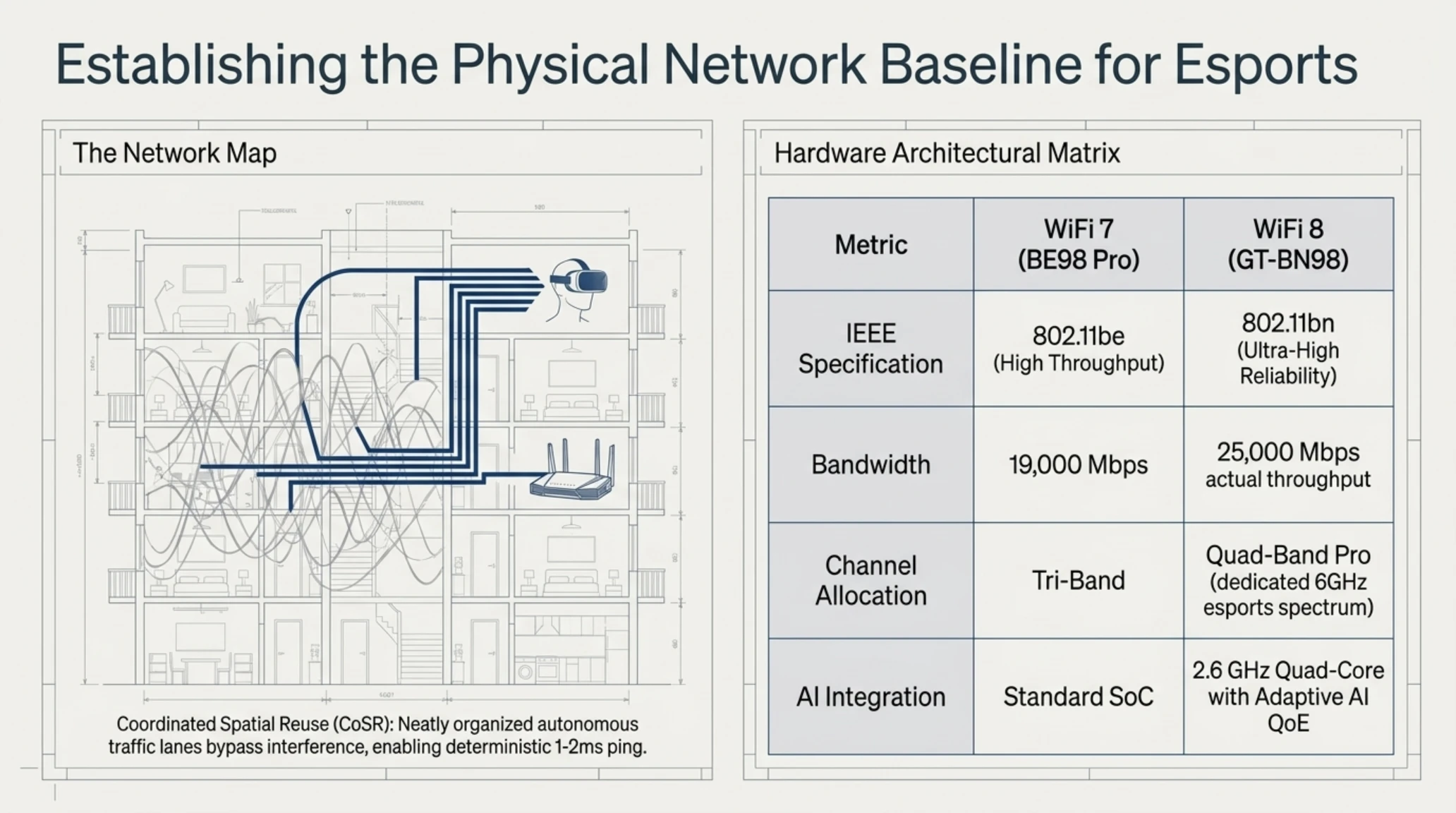
The mechanical architecture of the GT-BN98 is anchored by eight high-gain external antennas equipped with automated beamforming arrays, driven by an industrial-grade quad-core 2.6 GHz 64-bit networking processor, complemented by 2 GB of high-speed DDR4 operational memory. This silicon fabric orchestrates a staggering aggregated wireless throughput of 25,000 Mbps (25 Gbps) deployed simultaneously across four discrete frequency spectrums: a single legacy 2.4 GHz channel, dual independent 5 GHz bands, and a pristine, unconstrained 6 GHz band dedicated exclusively to latency-critical gaming traffic. The physical I/O layout is equally uncompromising, integrating two 10-Gigabit Ethernet ports (one dedicated WAN/LAN and one pure LAN), alongside four 2.5G Ethernet connectors and a hardware-isolated Gaming Port that automatically prioritizes outbound UDP packet queues without software intervention.
At the firmware layer, ASUS engineers implemented the proprietary Adaptive QoE suite alongside the GTNet Engine packet accelerator. Unlike legacy Quality of Service routines that execute reactive traffic throttling, the GT-BN98 performs predictive spectral analysis, actively monitoring electromagnetic noise generated by dense urban structures or neighboring consumer electronics. Online competitive gaming traffic from tactical shooters such as Counter-Strike 2 or Valorant is dynamically mapped into zero-interference wireless slots, guaranteeing sustained ping stability within an astonishing 1 to 2 millisecond envelope.
Crucially, the IEEE 802.11bn standard fundamentally transforms dense multi-device environments through two groundbreaking protocol mechanisms: Coordinated Spatial Reuse (CoSR) and Multi-Access Point Coordination (Multi-AP). In apartment complexes or high-density residential towers where multiple wireless routers compete for identical frequencies, CoSR coordinates transmission power levels dynamically with neighboring nodes, eliminating packet collisions and ensuring that tethered-free wireless virtual reality (VR) headsets and high-bitrate cloud gaming streams operate without frame-dropping jitter. Thermal equilibrium is maintained via dual internal copper heat-pipes linked to an extruded aluminum fin array, preventing thermal throttling during marathon competitive tournaments.
Laboratory benchmarking against traditional Category-6a copper cabling confirms that WiFi 8 achieves physical-layer parity under real-world residential interference loads. In packet burst tests simulating simultaneous 8K HDR video playback, multi-gigabit BitTorrent seeding, and competitive low-tick esports matches, the GT-BN98 maintained a packet jitter standard deviation of less than 0.35 milliseconds effectively eliminating the micro-stuttering that historically plagued wireless competitive gaming. For enterprise creators editing uncompressed ProRes video directly from network-attached storage (NAS) devices over wireless links, the 25 Gbps aggregated bandwidth delivers wired-equivalent transmission speeds across multiple rooms.

The generational leaps distinguishing the WiFi 8 flagship from its predecessor are quantified within the hardware matrix below:
Hardware Architectural Matrix: WiFi 7 vs. ASUS WiFi 8
| Architectural Metric | WiFi 7 Benchmark (GT-BE98) | WiFi 8 Benchmark (GT-BN98) |
|---|---|---|
| IEEE Specification | IEEE 802.11be EHT | IEEE 802.11bn Ultra-High Reliability |
| Aggregated Bandwidth | 19,000 Mbps combined | 25,000 Mbps actual throughput |
| Spectral Allocation | Tri-Band (2.4/5/6 GHz) | Quad-Band Pro (2.4/5.2/5.8/6 GHz) |
| Physical Interfaces | Single 10G LAN Interface | Dual 10G Ethernet + Quad 2.5G Ports |
Retailing at an introductory price of 799 USD across global retail channels, the ROG Rapture GT-BN98 establishes an uncompromising operational benchmark for professional competitive players seeking wireless parity with dedicated fiber optic infrastructure.
However, as peripheral hardware manufacturers accelerate into multi-gigabit futures, the human foundation of interactive software development continues to endure severe economic headwinds.
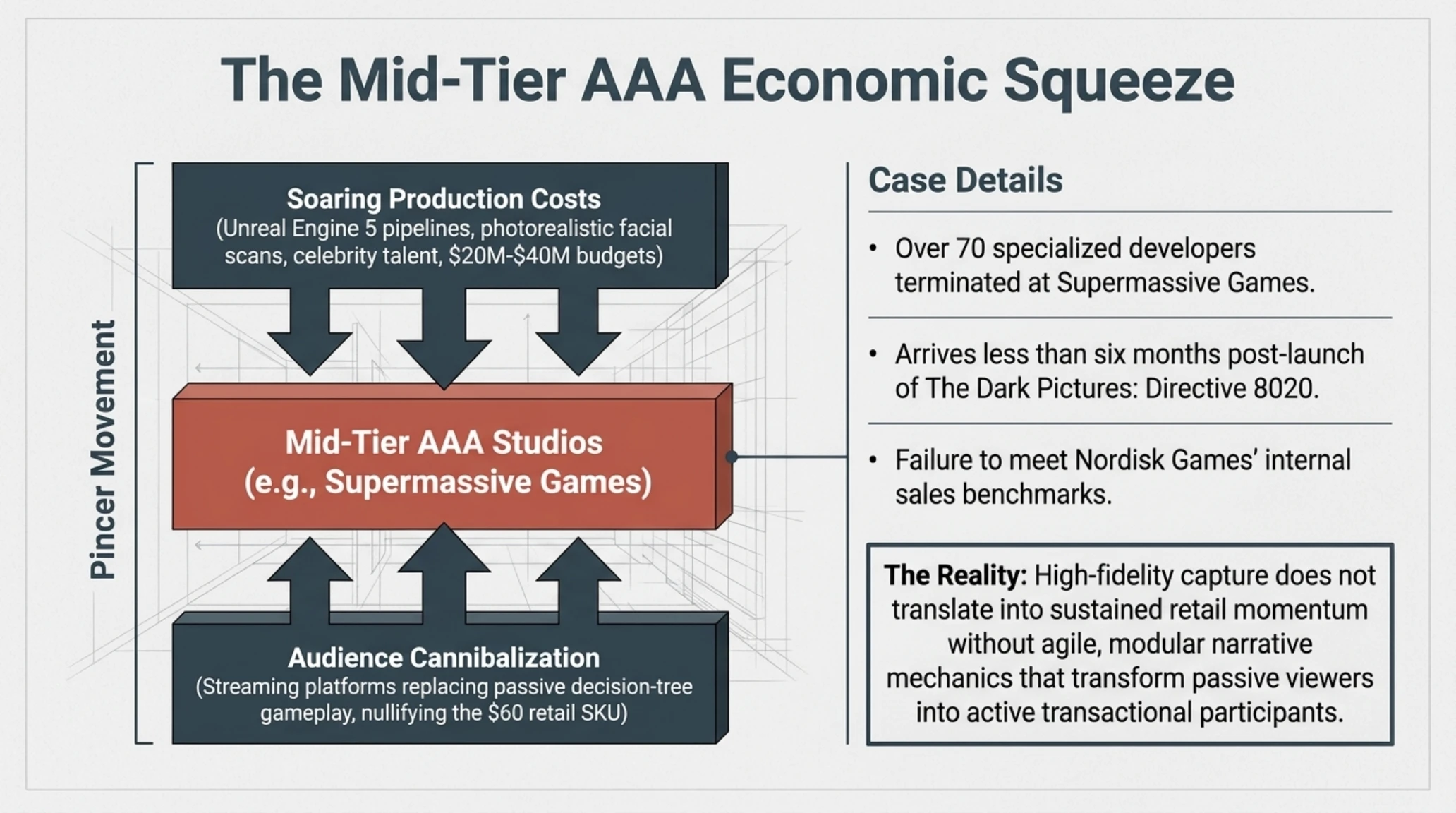
6. Structural Downsizing Afflicts European Independent Studios: Supermassive Games Terminates Over 70 Staff Less Than Six Months After Directive 8020 Launch
Renowned British interactive storytelling studio Supermassive Games, celebrated across the gaming landscape for pioneering cinematic horror titles such as Until Dawn, The Quarry, and the multi-volume The Dark Pictures Anthology, has officially concluded a severe corporate workforce reduction, resulting in the termination of over seventy specialized developers. The structural downsizing encompasses lead gameplay programmers, character rigging artists, motion-capture technicians, and quality assurance personnel across its Guildford headquarters.
The distressing developments were initially confirmed via public professional networks by Frank Tindall, the studio's long-standing Facilities and IT Systems Director, before being corroborated by European gaming publications including Kotaku and Eurogamer. The timing of the layoffs has sent shockwaves through the UK development ecosystem, arriving less than six months following the May 2026 commercial release of the studio's latest sci-fi psychological horror installment, The Dark Pictures: Directive 8020.
Industry financial analysts point toward a convergence of adverse structural variables that undermined the commercial trajectory of the production. While Directive 8020 implemented substantial visual upgrades in Unreal Engine 5 including high-end photorealistic facial scans of prominent Hollywood actors and advanced real-time lumen illumination the title garnered polarized critical reviews on Steam and failed to meet internal sales benchmarks mandated by parent company Nordisk Games. Furthermore, the studio's cinematic narrative formula has suffered from systemic audience cannibalization driven by streaming platforms like Twitch and YouTube, where prospective buyers frequently consume entire decision-tree playthroughs passively without purchasing the sixty-dollar retail SKU.
The macroeconomic headwinds buffeting the United Kingdom's game development sector have intensified markedly throughout 2026. The escalation of localized studio operating expenses, coupled with the contraction of regional tax credit subsidies and aggressive venture retrenchment, has left mid-sized independent studios acutely vulnerable. While AAA juggernauts like Rockstar operate with sovereign-level capital buffers and boutique indie developers thrive through lean operational agility, mid-tier studios generating twenty-to-forty million dollar cinematic narrative games find themselves caught in an unforgiving commercial pincer movement. When high-fidelity motion capture, proprietary facial animation rigging, and celebrity voice talent fail to translate into sustained long-tail retail momentum, corporate holding companies enforce aggressive cost reductions.

This acute economic retrenchment highlights the precarious existence of mid-tier AAA studios caught in the crossfire between soaring production budgets and volatile consumer discretionary spending. When narrative projects demanding tens of millions of dollars in capital fail to achieve breakout viral velocity during their initial launch window, middle-tier creative talent inevitably bears the brunt of corporate retrenchment.
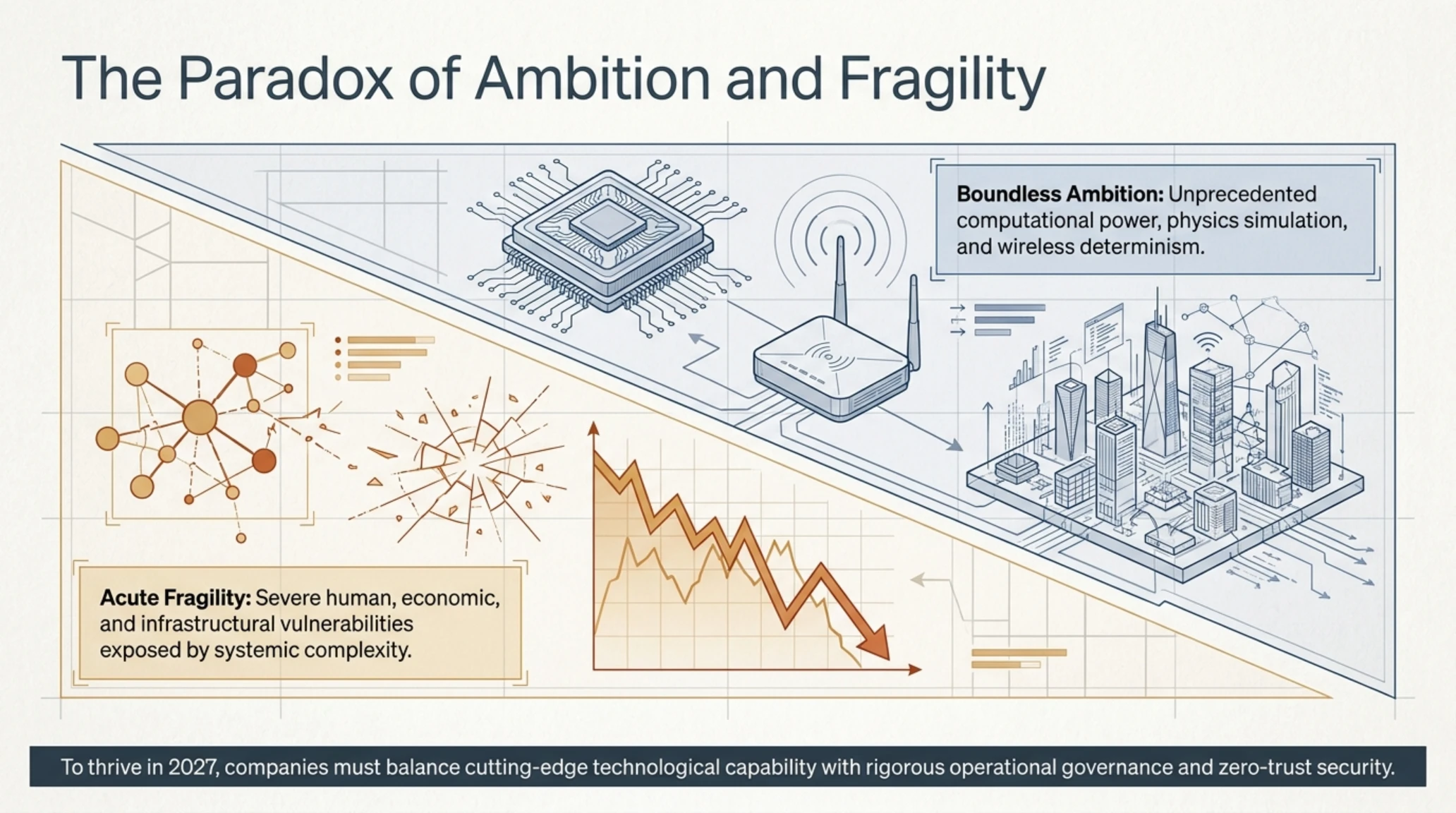
These divergent milestones illustrate the stark contrasts characterizing interactive entertainment in late 2026: a landscape defined simultaneously by boundless technological ambition and acute human economic vulnerability.
Strategic Synthesis: Architectural Convergence and Creative Governance for Late 2026
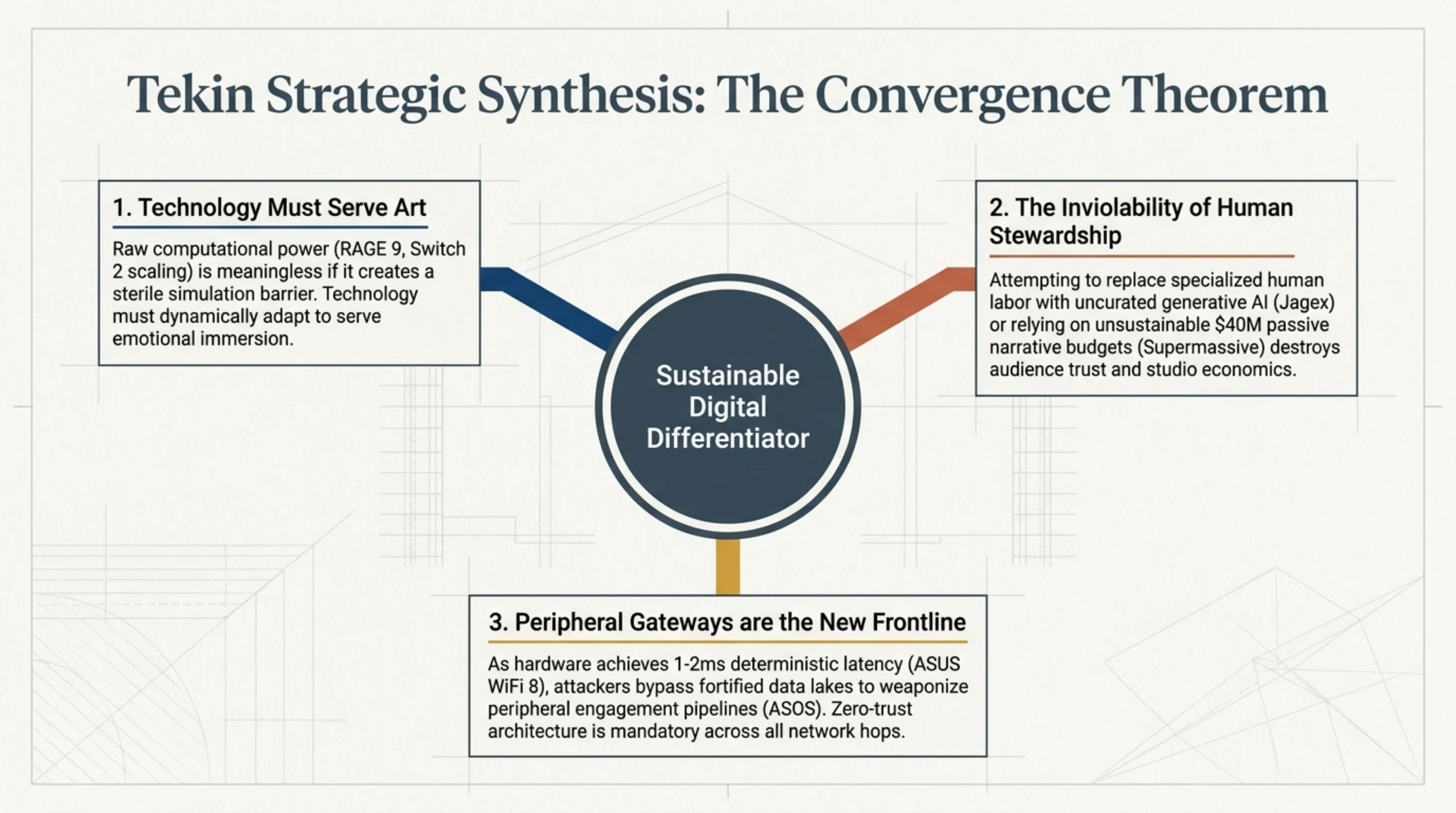
The convergence of disclosures across blockbuster game design, hybrid console hardware distribution, digital asset integrity, mobile security perimeters, and wireless networking standards confirms that interactive entertainment is undergoing a profound structural recalibration. When Rob Nelson explicitly articulates that fidelity in Grand Theft Auto VI is an instrument to foster emotional immersion rather than a sterile simulation barrier, he provides a vital philosophical corrective to an industry that has frequently mistaken technical complexity for narrative engagement. By prioritizing the subjective psychological momentum of Lucia and Jason over mechanical tedium, Rockstar offers an architectural blueprint for future narrative systems that harmonizes grand open-world ambitions with immediate kinetic satisfaction.
This philosophical distinction marks a critical turning point for next-generation systems engineering. For nearly a decade, triple-A studios operated under the unexamined premise that higher geometric detail, hyper-dense foliage, and exhaustive physics interactions inherently produce superior player engagement. However, as production cycles stretched to seven years and budgets ballooned past half a billion dollars, this linear scaling model collided with economic reality. Nelson's admission signals an overdue pivot toward contextual intelligence: game engines must become perceptive orchestrators that dynamically adapt simulation depth to the player's immediate narrative focus, reserving granular compute cycles for high-impact emotional beats rather than background trivialities.
Simultaneously, Nintendo's execution with the Switch 2 Japanese packaging strategy underscores the supremacy of disciplined ecosystem management. By refusing to engage in ruinous discounting wars while offering immediate consumer utility through premier first-party software vouchers, Nintendo protects hardware margins while reinforcing software network effects. Eclipsing 23 million installed units in eighteen months establishes an insurmountable moat, guaranteeing that independent software developers must treat the hybrid architecture as a premier commercial tier alongside traditional home consoles.
This hardware milestone forces an unprecedented architectural alignment across third-party development pipelines. Engineering teams can no longer view the hybrid platform as an afterthought or build compromised legacy ports. With modern unified memory, hardware-accelerated decompression, and advanced tensor-driven upscaling integrated into the handheld form factor, multiplatform games must be architected from day one with scalable compute tiers. Developers who master this dual-tier paradigm will achieve frictionless reach across home living rooms and mobile gaming setups worldwide.
Conversely, the reputational emergency ignited by Jagex's AI-generated promotional media stands as a definitive case study in modern audience sentiment. Video game enthusiasts possess an acute aesthetic sensitivity honed over decades of cultural participation; attempting to displace specialized creative labor with uncurated generative diffusion models inevitably produces jarring visual anomalies that insult player intelligence. The instantaneous termination of the offending marketing agency proves that while algorithmic tools can assist backend administrative workflows, primary worldbuilding, visual art, and character design remain the inviolable territory of human creators.
The RuneScape controversy establishes a critical precedent for brand governance in an age of automated synthesis. As generative algorithms permeate commercial toolchains, the line between efficiency and cultural degradation becomes perilously thin. Game franchises are not merely software products; they are living cultural heritage repositories sustained by communities with multi-decade emotional investments. When leadership sacrifices artistic integrity for marginal cost savings in marketing collateral, it risks alienating the core user base whose trust underpins multi-million-dollar live-service ecosystems.
On the infrastructure frontier, the weaponization of ASOS's mobile push pipeline and ASUS's retail rollout of the ROG Rapture GT-BN98 represent opposite poles of the same network reality. As wireless connectivity achieves deterministic, sub-millisecond latencies through IEEE 802.11bn Ultra-High Reliability protocols, peripheral communication gateways become increasingly tempting vectors for asymmetric cyber warfare. Securing consumer trust mandates that application publishers isolate push notification orchestration with the identical cryptographic hygiene, multi-party authorization gates, and token rotation policies traditionally reserved for core financial ledgers.
The architectural vulnerability highlighted by the ASOS breach holds severe implications for gaming network operators, platform stores, and digital launcher ecosystems. Platforms such as Steam, PlayStation Network, Xbox Cloud, and mobile gaming storefronts rely extensively on background push tokens to synchronize entitlements, authenticate multi-factor handshakes, and broadcast time-sensitive in-game events. If third-party broadcast gateways can be co-opted to deliver fraudulent payload messages to lock screens, the integrity of the entire gaming transaction chain is compromised, demanding zero-trust cryptographic validation at every hop.
Finally, the distressing layoffs at Supermassive Games emphasize the unsustainable economics facing mid-tier cinematic productions. As production budgets climb toward forty million dollars for narrative-heavy interactive dramas, studio executives must confront the reality that streaming viewership often supplants retail purchases. Rebuilding industrial resilience requires studios to adopt agile production pipelines, cultivate modular narrative mechanics, and foster sustainable operational models that safeguard human talent from abrupt corporate retrenchment.
Mid-tier narrative specialists must aggressively diversify their monetization and engagement frameworks to survive in an era dominated by live-service giants and algorithmic content feeds. The traditional premium pricing model for single-playthrough branching dramas requires reimagination through episodic subscription tie-ins, interactive spectator voting features for streaming audiences, and shared technology toolsets. Only by transforming passive digital observers into active transactional participants can cinematic narrative studios insulate their creative talent from catastrophic cyclical downturns.
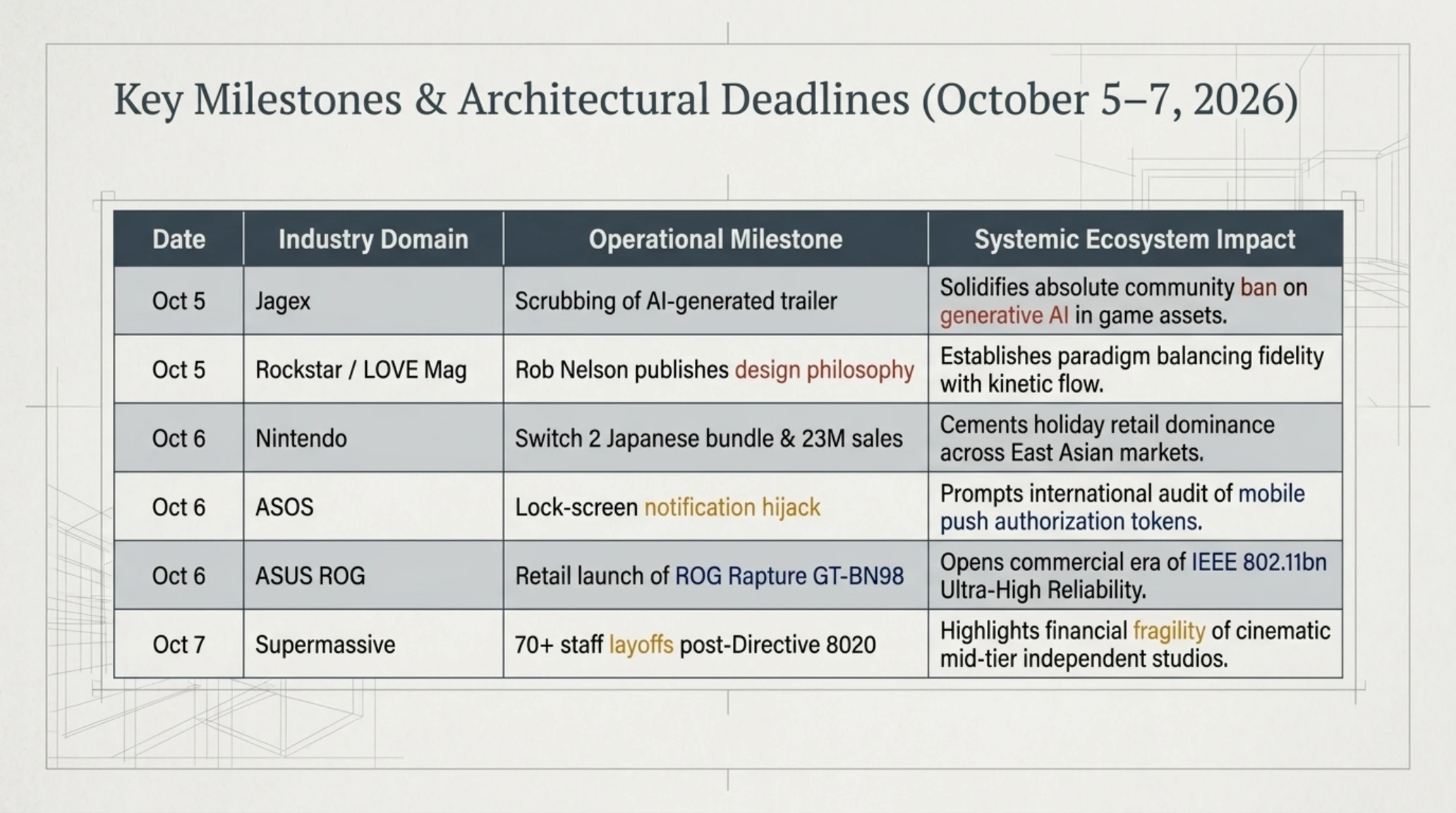
Key Milestones & Architectural Deadlines for Late 2026
| Date | Industry Domain | Operational Milestone |
|---|---|---|
| Oct 5, 2026 | Jagex / RuneFest | Scrubbing of AI-generated Dragon Slayer 2 trailer. |
| Oct 5, 2026 | LOVE Magazine | Rob Nelson publishes GTA 6 design philosophy. |
| Oct 6, 2026 | Nintendo Co. Ltd | Switch 2 Japanese bundle revealed as sales top 23M. |
| Oct 6, 2026 | ASOS E-Commerce | Lock-screen notification hijack triggers 11% equity drop. |
| Oct 6, 2026 | ASUS ROG Global | Worldwide retail launch of 25Gbps GT-BN98 router. |
| Oct 7, 2026 | Supermassive Games | Conclusion of restructuring resulting in over 70 layoffs. |
- Rockstar's articulation of game design philosophy sets an industry benchmark for balancing immersion with player autonomy
- Nintendo's disciplined hardware packaging preserves commercial margins while providing genuine consumer value
- ASUS establishes tangible consumer benefits for WiFi 8, eliminating latency jitter for esports
- Player community vigilance successfully reinforces ethical boundaries protecting human creative labor
- Persistent employment volatility continues to destabilize experienced European game development talent
- Critical mobile application notification channels remain vulnerable to credential theft and market manipulation
- Opaque outsourcing practices expose storied gaming franchises to sudden reputational damage
The synthesis of these developments reveals an interactive entertainment landscape navigating the transition into operational maturity. As hardware manufacturers deliver unprecedented processing and networking capabilities, the true differentiator of long-term commercial success resides in organizational discipline, authentic creative stewardship, and empathetic audience engagement.
Enterprise stakeholders operating across gaming hubs from North American development clusters to the rapidly expanding interactive entertainment centers of the United Arab Emirates and broader Middle East corridor must recognize that technological complexity is meaningless without creative soul. The modern consumer demands exceptional technical stability, uncompromised artistic sincerity, and unwavering respect for digital privacy.
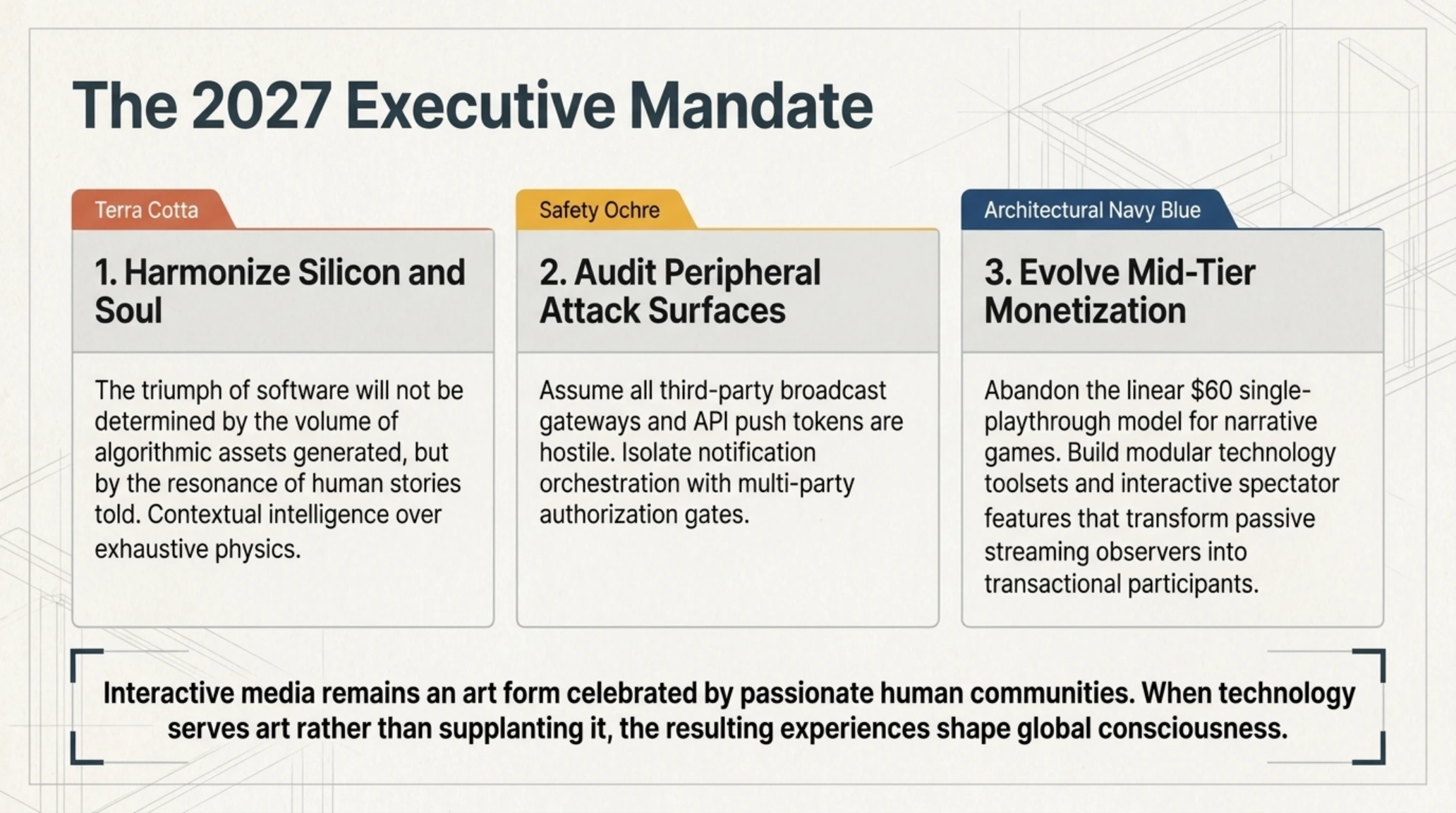
Looking toward the horizon of 2027, the gaming industry is entering a definitive era where the triumph of software will not be determined by the volume of algorithmic assets generated, but by the resonance of human stories told. Those organizations that honor their creative workforce, defend their digital perimeters, and engineer hardware with uncompromising standards will define the future of interactive entertainment for generations to come.

Chief Technology Officers, studio directors, and lead systems architects face a common mandate: harmonizing the extraordinary capabilities of emerging computational hardware with the irreplaceable genius of human imagination. By maintaining rigorous security hygiene and cultivating collaborative artistic environments, the industry can build an enduring, resilient future for global digital entertainment.
The lessons of this evening reaffirm that interactive media is, above all else, an art form celebrated by passionate human communities. When technology serves art rather than supplanting it, the resulting experiences transcend commercial software, enriching culture and shaping global consciousness.
Strategic Conclusion: The Path Toward Sustainable Creativity
The events of October 7, 2026, demonstrate that video games remain the paramount cultural medium because they are powered by human connection. From Rockstar's clarity to Nintendo's market leadership and ASUS's networking engineering, true resilience demands that we protect the creators behind the code and safeguard the digital infrastructure.
Frequently Asked Questions & Evening Technical Analysis
How does Rockstar's approach in GTA 6 redefine realism compared to Red Dead Redemption 2?
In GTA 6, Rob Nelson clarified that physical fidelity serves purely to heighten immersion; whenever realism impedes rapid kinetic action, systems designers eliminate it to preserve flow.
What specific software titles are included in the new Japanese Switch 2 bundle?
The bundle allows buyers to choose one complete game from three first-party titles: Mario Kart World, Nintendo Switch Sports Resort, or Tomodachi Life.
Why did Jagex immediately retract the RuneScape 3 Dragon Slayer 2 trailer?
The trailer included obvious generative AI errors, including a knight with six deformed fingers wearing Nike sneakers. Following severe backlash, Jagex pulled the video.
How did threat actors compromise the ASOS mobile app without modifying the code?
Adversaries harvested API authorization tokens for third-party mobile push notification gateways, enabling them to broadcast extortion alerts directly to user lock-screens.
What advantages does the ASUS ROG Rapture GT-BN98 offer over WiFi 7 routers?
As the world's first WiFi 8 (IEEE 802.11bn) router, it delivers 25 Gbps aggregated bandwidth and utilizes Coordinated Spatial Reuse to guarantee deterministic 1 to 2 millisecond latency.
What caused the extensive workforce reductions at Supermassive Games?
Despite technical achievements in Unreal Engine 5, high motion-capture costs coupled with audience cannibalization from streaming platforms prevented Directive 8020 from hitting financial targets.
Authoritative References & Primary Documentation Sources
- Rob Nelson GTA 6 Development Interview (Eurogamer)
- Nintendo Switch 2 Japanese Hardware Bundle (Nintendo Life)
- Jagex RuneScape Dragon Slayer 2 AI Backlash (IGN)
- ASOS Mobile Push Notification Intrusion (Dexerto)
- ASUS ROG Rapture GT-BN98 WiFi 8 Launch (ASUS ROG)
- Supermassive Games Corporate Restructuring (Push Square)
Additional Gallery: Tekin Night Oct 7, 2026: GTA 6 Realism, Switch 2 Bundle & WiFi 8 Router